


Slide Doc Recap Salomon’s Experience
3/24/2017 1
Table of Content
• Neuroscience:
• This is Your Brain. This is Your Brain on Ads (examples and results of neuroscience studies)
• Next Generation Marketing with Neuroscience (tips to influence the subconscious mind)
• Consumer behavior:
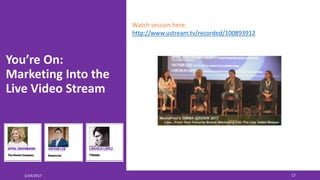
• You’re On: Marketing Into the Live Video Stream (Lincoln’s Panel session on live streaming)
• Actionable Gamification for the Win (approach to implement effective gameful design)
• Seconds Matter: Capturing Attention in Mobile Feed (explores how people are processing mobile
video)
• Facebook and Instagram: A Tale of Two Feeds (Facebook and Instagram commonalities and
differences on regards to consumer reactions)
• Workplace:
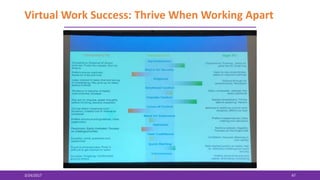
• Virtual Work Success: Thrive When Working Apart (key strategies to work and manage teams that
work remotely full, part-time or sporadic)
3/24/2017 2
…………......... 4
…………......... 10
…………......... 16
…………......... 18
…………......... 23
…………......... 31
…………......... 43
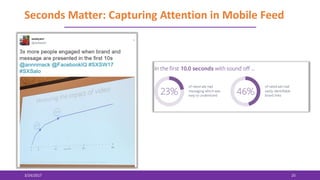
Neuroscience
3/24/2017 3
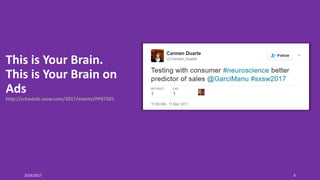
This is Your Brain.
This is Your Brain on
Ads
http://schedule.sxsw.com/2017/events/PP67301
3/24/2017 4
This is Your Brain.
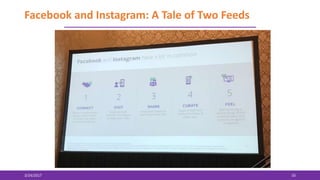
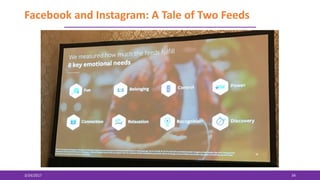
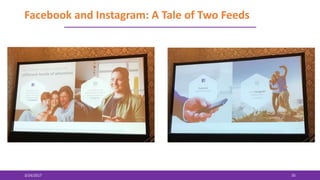
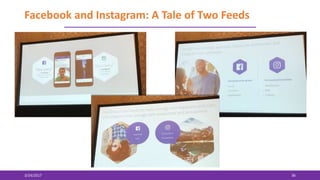
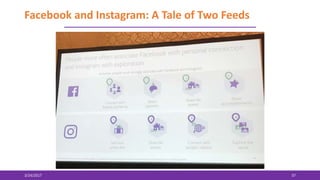
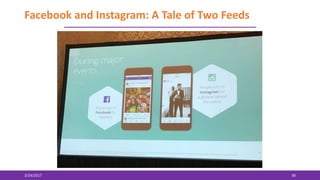
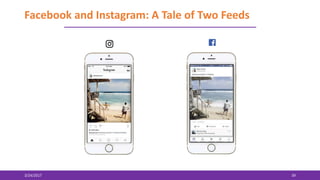
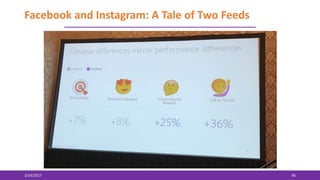
This is Your Brain on
Ads
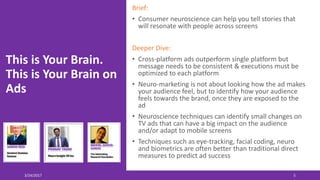
Brief:
• Consumer neuroscience can help you tell stories that
will resonate with people across screens
Deeper Dive:
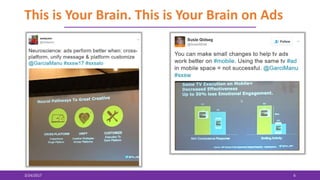
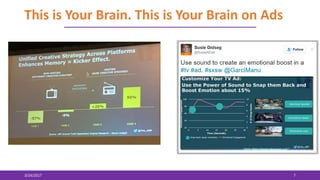
• Cross-platform ads outperform single platform but
message needs to be consistent & executions must be
optimized to each platform
• Neuro-marketing is not about looking how the ad makes
your audience feel, but to identify how your audience
feels towards the brand, once they are exposed to the
ad
• Neuroscience techniques can identify small changes on
TV ads that can have a big impact on the audience
and/or adapt to mobile screens
• Techniques such as eye-tracking, facial coding, neuro
and biometrics are often better than traditional direct
measures to predict ad success
3/24/2017 5
This is Your Brain. This is Your Brain on Ads
3/24/2017 6
This is Your Brain. This is Your Brain on Ads
3/24/2017 7
This is Your Brain. This is Your Brain on Ads
3/24/2017 8
Source: Nielsen Consumer Neuroscience
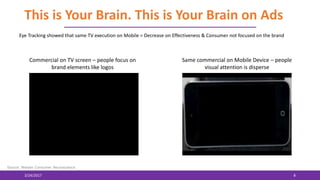
Eye Tracking showed that same TV execution on Mobile = Decrease on Effectiveness & Consumer not focused on the brand
Commercial on TV screen – people focus on
brand elements like logos
Same commercial on Mobile Device – people
visual attention is disperse
This is Your Brain. This is Your Brain on Ads
3/24/2017 9
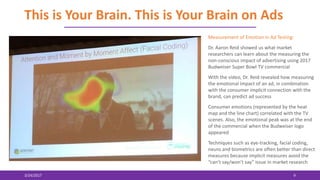
Measurement of Emotion in Ad Testing:
Dr. Aaron Reid showed us what market
researchers can learn about the measuring the
non-conscious impact of advertising using 2017
Budweiser Super Bowl TV commercial
With the video, Dr. Reid revealed how measuring
the emotional impact of an ad, in combination
with the consumer implicit connection with the
brand, can predict ad success
Consumer emotions (represented by the heat
map and the line chart) correlated with the TV
scenes. Also, the emotional peak was at the end
of the commercial when the Budweiser logo
appeared
Techniques such as eye-tracking, facial coding,
neuro and biometrics are often better than direct
measures because implicit measures avoid the
“can’t say/won’t say” issue in market research
Next Generation
Marketing with
Neuroscience
http://schedule.sxsw.com/2017/events/PP61146
3/24/2017 10
Next Generation
Marketing with
Neuroscience
Brief:
• Nancy Harhut provided 15 neuroscience marketing-proven
tips to get people to remember us, get them to do what we
want and get them to pay what we want
Deeper Dive:
• Up to 95% of decision-making takes place in the subconscious
mind
• People don't "make" decisions. Often, they just default to
reflexive actions without even thinking. That means perfectly
good ads, emails, websites, etc. can still fail. Because people
don't make logical choices
• By strategically using the 15 tips, our creatives can use
people's natural tendencies to our advantage
3/24/2017 11
Next Generation Marketing with Neuroscience
3/24/2017 12
To get people to remember us – Attention/Recall:
• Von Restorff effect: People notice and remember things that stand
out. If something is unusual, new, or there is something missing,
we pay attention.
Our audience is being bombarded with messages on a daily basis, if
we can make our message stand out, we’ll get noticed. A simple
example: some holidays stick more than others; sending
communication acknowledging an unusual holiday such as National
Peanut Butter Day will stand out and be remembered
• Psychology of Surprise: Surprise is the neuropsychological
equivalent of a pause button. It makes us stop what we're doing,
hijacks our attention, and forces us to pay attention
Interrupt a pattern or explore different/new ways to convey the
message
• Visual storytelling: provide a visual narrative (beginning and end),
bring human emotions. Utilize visual tools such as Snapchat,
Instagram stories and include videos/photos of real people and
places
Next Generation Marketing with Neuroscience
3/24/2017 13
To get people to do what we want – Action:
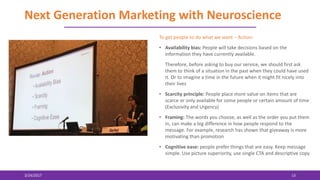
• Availability bias: People will take decisions based on the
information they have currently available.
Therefore, before asking to buy our service, we should first ask
them to think of a situation in the past when they could have used
it. Or to imagine a time in the future when it might fit nicely into
their lives
• Scarcity principle: People place more value on items that are
scarce or only available for some people or certain amount of time
(Exclusivity and Urgency)
• Framing: The words you choose, as well as the order you put them
in, can make a big difference in how people respond to the
message. For example, research has shown that giveaway is more
motivating than promotion
• Cognitive ease: people prefer things that are easy. Keep message
simple. Use picture superiority, use single CTA and descriptive copy
Next Generation Marketing with Neuroscience
3/24/2017 14
To get people to pay what we want – Price:
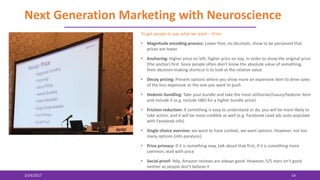
• Magnitude encoding process: Lower font, no decimals, show to be perceived that
prices are lower
• Anchoring: Higher price on left, higher price on top, in order to show the original price
(the anchor) first. Since people often don’t know the absolute value of something,
their decision-making shortcut is to look at the relative value
• Decoy pricing: Present options where you show more an expensive item to drive sales
of the less expensive or the one you want to push
• Hedonic bundling: Take your bundle and take the most utilitarian/luxury/hedonic item
and include it (e.g. include HBO for a higher bundle price)
• Friction reduction: If something is easy to understand or do, you will be more likely to
take action, and it will be more credible as well (e.g. Facebook Lead ads auto-populate
with Facebook info)
• Single choice aversion: we want to have context, we want options. However, not too
many options (info paralysis)
• Price primacy: If it is something new, talk about that first; if it is something more
common, lead with price
• Social proof: Yelp, Amazon reviews are always good. However, 5/5 stars isn't good
neither as people don't believe it
Consumer Behavior
3/24/2017 15
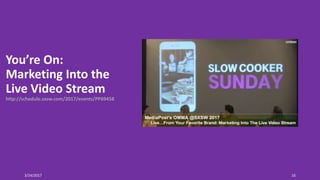
You’re On:
Marketing Into the
Live Video Stream
http://schedule.sxsw.com/2017/events/PP69458
3/24/2017 16
You’re On:
Marketing Into the
Live Video Stream
Watch session here:
http://www.ustream.tv/recorded/100893912
3/24/2017 17
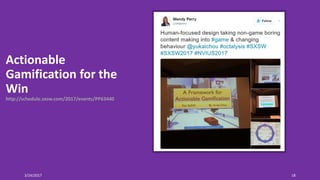
Actionable
Gamification for the
Win
http://schedule.sxsw.com/2017/events/PP63440
3/24/2017 18
Actionable
Gamification for the
Win
Brief:
• Yu-Kai Chou presented a systematic approach to
implement effective gameful design for any process
Deeper Dive:
• There are 8 Core Drives of motivation that inspire
people to engage and learn through game
techniques
• Game elements are a means to an end, not an end
in itself
• Good gamification doesn't start with game
elements but starts off with Core Drivers of human-
focused design
• Human-focused design: system that is designed to
optimize for the motivations and feelings of the
human inside (as opposed to “function-focused
design”)
3/24/2017 19
Actionable Gamification for the Win
3/24/2017 20
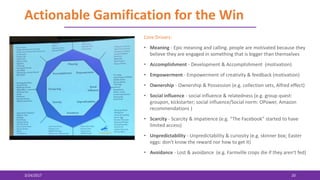
Core Drivers:
• Meaning - Epic meaning and calling. people are motivated because they
believe they are engaged in something that is bigger than themselves
• Accomplishment - Development & Accomplishment (motivation)
• Empowerment - Empowerment of creativity & feedback (motivation)
• Ownership - Ownership & Possession (e.g. collection sets, Alfred effect)
• Social influence - social influence & relatedness (e.g. group quest:
groupon, kickstarter; social influence/Social norm: OPower, Amazon
recommendations )
• Scarcity - Scarcity & impatience (e.g. “The Facebook” started to have
limited access)
• Unpredictability - Unpredictability & curiosity (e.g. skinner box; Easter
eggs: don't know the reward nor how to get it)
• Avoidance - Lost & avoidance (e.g. Farmville crops die if they aren't fed)
Actionable Gamification for the Win
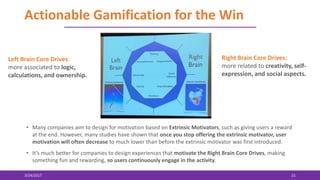
• Many companies aim to design for motivation based on Extrinsic Motivators, such as giving users a reward
at the end. However, many studies have shown that once you stop offering the extrinsic motivator, user
motivation will often decrease to much lower than before the extrinsic motivator was first introduced.
• It’s much better for companies to design experiences that motivate the Right Brain Core Drives, making
something fun and rewarding, so users continuously engage in the activity.
3/24/2017 21
Right Brain Core Drives:
more related to creativity, self-
expression, and social aspects.
Left Brain Core Drives:
more associated to logic,
calculations, and ownership.
Actionable Gamification for the Win
3/24/2017 22
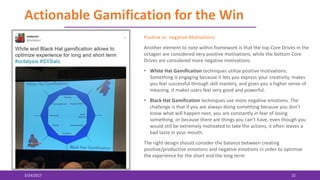
Positive vs. negative Motivations:
Another element to note within framework is that the top Core Drives in the
octagon are considered very positive motivations, while the bottom Core
Drives are considered more negative motivations.
• White Hat Gamification techniques utilize positive motivations.
Something is engaging because it lets you express your creativity, makes
you feel successful through skill mastery, and gives you a higher sense of
meaning, it makes users feel very good and powerful.
• Black Hat Gamification techniques use more negative emotions. The
challenge is that if you are always doing something because you don’t
know what will happen next, you are constantly in fear of losing
something, or because there are things you can’t have, even though you
would still be extremely motivated to take the actions, it often leaves a
bad taste in your mouth.
The right design should consider the balance between creating
positive/productive emotions and negative emotions in order to optimize
the experience for the short and the long term
Seconds Matter:
Capturing Attention
in Mobile Feed
http://schedule.sxsw.com/2017/events/PP67069
3/24/2017 23
Seconds Matter:
Capturing Attention
in Mobile Feed
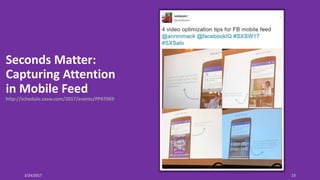
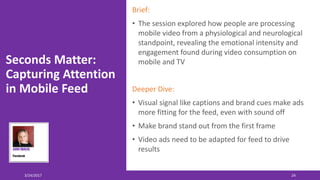
Brief:
• The session explored how people are processing
mobile video from a physiological and neurological
standpoint, revealing the emotional intensity and
engagement found during video consumption on
mobile and TV
Deeper Dive:
• Visual signal like captions and brand cues make ads
more fitting for the feed, even with sound off
• Make brand stand out from the first frame
• Video ads need to be adapted for feed to drive
results
3/24/2017 24
Seconds Matter: Capturing Attention in Mobile Feed
3/24/2017 25
Seconds Matter: Capturing Attention in Mobile Feed
3/24/2017 26
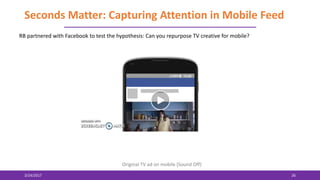
RB partnered with Facebook to test the hypothesis: Can you repurpose TV creative for mobile?
Original TV ad on mobile (Sound Off)
Seconds Matter: Capturing Attention in Mobile Feed
3/24/2017 27
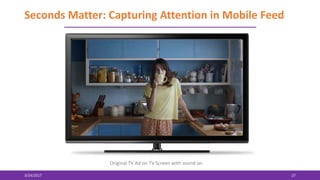
Original TV Ad on TV Screen with sound on
Seconds Matter: Capturing Attention in Mobile Feed
3/24/2017 28
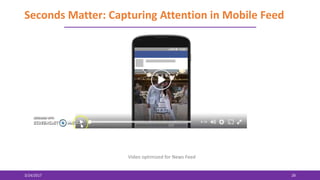
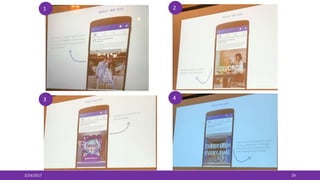
Video optimized for News Feed
3/24/2017 29
1 2
3 4
Seconds Matter: Capturing Attention in Mobile Feed
3/24/2017 30
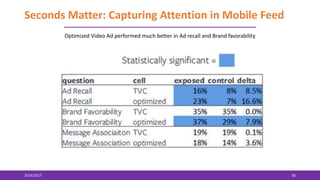
Optimized Video Ad performed much better in Ad recall and Brand favorability
Facebook and
Instagram: A Tale of
Two Feeds
http://schedule.sxsw.com/2017/events/PP67072
3/24/2017 31
Facebook and
Instagram: A Tale of
Two Feeds
3/24/2017 32
Brief:
• Facebook ran a multi-disciplinary study that found that Facebook
and Instagram feeds have a lot in common, but people have a
different mindset on each, and this affects how they react to ads
Deeper Dive:
• They found 5 similarities: Connect, Visit, Share, Curate and Feel
• The study revealed that Facebook better satisfies their need for
empowerment, recognition and connection while Instagram
more strongly fulfills their desire for fun, relaxation and discovery
• The study indicated that on Facebook discovery is more about
exposure to new ideas and ways of thinking. On Instagram on the
other hand, discovery is more about inspiration
• People most strongly associate Facebook with humor, feeling in
control and feeling appreciated. In contrast, people most strongly
associate Instagram with being adventurous, real and creative
• People more often associate Facebook with personal connection
and Instagram with exploration
• Same ad running on both feed was rated differently in
noticeability, emotional reward, informational reward and CTA
Facebook and Instagram: A Tale of Two Feeds
3/24/2017 33
Facebook and Instagram: A Tale of Two Feeds
3/24/2017 34
Facebook and Instagram: A Tale of Two Feeds
3/24/2017 35
Facebook and Instagram: A Tale of Two Feeds
3/24/2017 36
Facebook and Instagram: A Tale of Two Feeds
3/24/2017 37
Facebook and Instagram: A Tale of Two Feeds
3/24/2017 38
Facebook and Instagram: A Tale of Two Feeds
3/24/2017 39
Facebook and Instagram: A Tale of Two Feeds
3/24/2017 40
Facebook and Instagram: A Tale of Two Feeds
3/24/2017 41
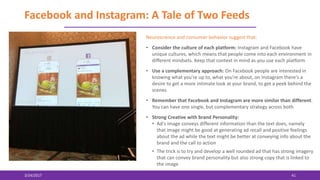
Neuroscience and consumer behavior suggest that:
• Consider the culture of each platform: Instagram and Facebook have
unique cultures, which means that people come into each environment in
different mindsets. Keep that context in mind as you use each platform
• Use a complementary approach: On Facebook people are interested in
knowing what you're up to, what you're about, on Instagram there's a
desire to get a more intimate look at your brand, to get a peek behind the
scenes
• Remember that Facebook and Instagram are more similar than different.
You can have one single, but complementary strategy across both
• Strong Creative with brand Personality:
• Ad's image conveys different information than the text does, namely
that image might be good at generating ad recall and positive feelings
about the ad while the text might be better at conveying info about the
brand and the call to action
• The trick is to try and develop a well rounded ad that has strong imagery
that can convey brand personality but also strong copy that is linked to
the image
Workplace
3/24/2017 42
Virtual Work
Success: Thrive
When Working Apart
http://schedule.sxsw.com/2017/events/PP69336
3/24/2017 43
Virtual Work
Success: Thrive
When Working Apart
3/24/2017 44
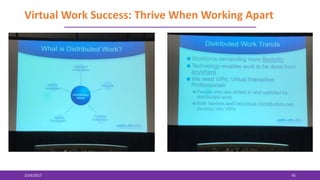
Brief:
• The workshop provided key strategies to work and manage
teams that work remotely full, part-time or sporadic
Deeper Dive:
• Only 40% of employees are receiving guidance on how to
make use of flexibility (Fortune 2015)
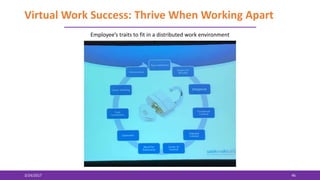
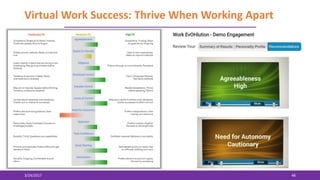
• Certain personality traits predict success for remote
workers
• Knowing these traits can help the employee to identify
habits and strategies to be successful and fulfilled in virtual
working environments
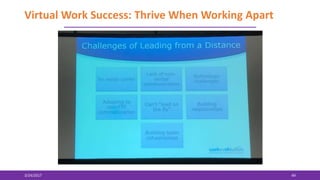
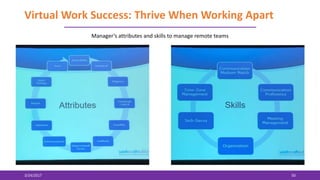
• Leaders can successfully lead remote teams by mastering
key capabilities and attributes
Virtual Work Success: Thrive When Working Apart
3/24/2017 45
Virtual Work Success: Thrive When Working Apart
3/24/2017 46
Employee’s traits to fit in a distributed work environment
Virtual Work Success: Thrive When Working Apart
3/24/2017 47
Virtual Work Success: Thrive When Working Apart
3/24/2017 48
Virtual Work Success: Thrive When Working Apart
3/24/2017 49
Virtual Work Success: Thrive When Working Apart
3/24/2017 50
Manager’s attributes and skills to manage remote teams
Virtual Work Success: Thrive When Working Apart
3/24/2017 51
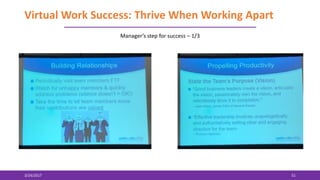
Manager’s step for success – 1/3
Virtual Work Success: Thrive When Working Apart
3/24/2017 52
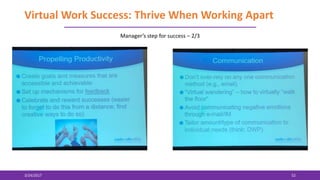
Manager’s step for success – 2/3
Virtual Work Success: Thrive When Working Apart
3/24/2017 53
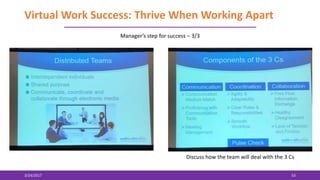
Manager’s step for success – 3/3
Discuss how the team will deal with the 3 Cs
Appendix
3/24/2017 54
Additional resources:
• Actionable Gamification for the Win:
• Gamification to improve our world: Yu-kai Chou at TEDxLausanne:
https://www.youtube.com/watch?v=v5Qjuegtiyc&sns=tw
• Author’s site: http://yukaichou.com/gamification-examples/octalysis-complete-gamification-framework/#more-2275
• Gamification Framework tool: http://yukaichou.com/octalysis-tool/
• Slideshare ebay presentation: http://www.slideshare.net/fdlink/human-focused-design-for-e-bay
• This is Your Brain. This is Your Brain on Ads
• Best Practices in the Measurement of Emotion in Ad Testing http://www.sentientdecisionscience.com/measuring-
the-subtext-in-advertising-emotion-in-ad-testing/
• http://www.sentientdecisionscience.com/measuring-emotions-attention-ads-eye-tracking-studies/
• Additional video example: https://www.youtube.com/watch?v=-hsQvC3W9F0
• Facebook/Instagram Sessions:
• http://insights.fb.com/2017/03/10/follow-facebook-iq-at-sxsw-2017/
• https://www.facebook.com/business/news/building-video-for-mobile-feed
• http://insights.fb.com/2016/04/20/capturing-attention-feed-video-creative/
• http://insights.fb.com/2016/07/11/facebook-and-instagram-a-tale-of-two-feeds/
• Tale of two feeds PowerPoint: https://tmobile.egnyte.com/dl/Uy96kYLlQM
3/24/2017 55
Additional resources:
• Next Generation Marketing with Neuroscience
• http://www.wildeagency.com/brain-science-of-pricing-strategy/
• http://www.wildeagency.com/consistency-principle-content-marketing/
• http://www.wildeagency.com/email-marketing-behavioral-science/
• http://www.wildeagency.com/behavorial-science-marketing-travel-and-hospitality/
3/24/2017 56

SXSW 2017 Sound Bites and Learnings

  • 1.
    Slide Doc RecapSalomon’s Experience 3/24/2017 1
  • 2.
    Table of Content •Neuroscience: • This is Your Brain. This is Your Brain on Ads (examples and results of neuroscience studies) • Next Generation Marketing with Neuroscience (tips to influence the subconscious mind) • Consumer behavior: • You’re On: Marketing Into the Live Video Stream (Lincoln’s Panel session on live streaming) • Actionable Gamification for the Win (approach to implement effective gameful design) • Seconds Matter: Capturing Attention in Mobile Feed (explores how people are processing mobile video) • Facebook and Instagram: A Tale of Two Feeds (Facebook and Instagram commonalities and differences on regards to consumer reactions) • Workplace: • Virtual Work Success: Thrive When Working Apart (key strategies to work and manage teams that work remotely full, part-time or sporadic) 3/24/2017 2 …………......... 4 …………......... 10 …………......... 16 …………......... 18 …………......... 23 …………......... 31 …………......... 43
  • 3.
  • 4.
    This is YourBrain. This is Your Brain on Ads http://schedule.sxsw.com/2017/events/PP67301 3/24/2017 4
  • 5.
    This is YourBrain. This is Your Brain on Ads Brief: • Consumer neuroscience can help you tell stories that will resonate with people across screens Deeper Dive: • Cross-platform ads outperform single platform but message needs to be consistent & executions must be optimized to each platform • Neuro-marketing is not about looking how the ad makes your audience feel, but to identify how your audience feels towards the brand, once they are exposed to the ad • Neuroscience techniques can identify small changes on TV ads that can have a big impact on the audience and/or adapt to mobile screens • Techniques such as eye-tracking, facial coding, neuro and biometrics are often better than traditional direct measures to predict ad success 3/24/2017 5
  • 6.
    This is YourBrain. This is Your Brain on Ads 3/24/2017 6
  • 7.
    This is YourBrain. This is Your Brain on Ads 3/24/2017 7
  • 8.
    This is YourBrain. This is Your Brain on Ads 3/24/2017 8 Source: Nielsen Consumer Neuroscience Eye Tracking showed that same TV execution on Mobile = Decrease on Effectiveness & Consumer not focused on the brand Commercial on TV screen – people focus on brand elements like logos Same commercial on Mobile Device – people visual attention is disperse
  • 9.
    This is YourBrain. This is Your Brain on Ads 3/24/2017 9 Measurement of Emotion in Ad Testing: Dr. Aaron Reid showed us what market researchers can learn about the measuring the non-conscious impact of advertising using 2017 Budweiser Super Bowl TV commercial With the video, Dr. Reid revealed how measuring the emotional impact of an ad, in combination with the consumer implicit connection with the brand, can predict ad success Consumer emotions (represented by the heat map and the line chart) correlated with the TV scenes. Also, the emotional peak was at the end of the commercial when the Budweiser logo appeared Techniques such as eye-tracking, facial coding, neuro and biometrics are often better than direct measures because implicit measures avoid the “can’t say/won’t say” issue in market research
  • 10.
  • 11.
    Next Generation Marketing with Neuroscience Brief: •Nancy Harhut provided 15 neuroscience marketing-proven tips to get people to remember us, get them to do what we want and get them to pay what we want Deeper Dive: • Up to 95% of decision-making takes place in the subconscious mind • People don't "make" decisions. Often, they just default to reflexive actions without even thinking. That means perfectly good ads, emails, websites, etc. can still fail. Because people don't make logical choices • By strategically using the 15 tips, our creatives can use people's natural tendencies to our advantage 3/24/2017 11
  • 12.
    Next Generation Marketingwith Neuroscience 3/24/2017 12 To get people to remember us – Attention/Recall: • Von Restorff effect: People notice and remember things that stand out. If something is unusual, new, or there is something missing, we pay attention. Our audience is being bombarded with messages on a daily basis, if we can make our message stand out, we’ll get noticed. A simple example: some holidays stick more than others; sending communication acknowledging an unusual holiday such as National Peanut Butter Day will stand out and be remembered • Psychology of Surprise: Surprise is the neuropsychological equivalent of a pause button. It makes us stop what we're doing, hijacks our attention, and forces us to pay attention Interrupt a pattern or explore different/new ways to convey the message • Visual storytelling: provide a visual narrative (beginning and end), bring human emotions. Utilize visual tools such as Snapchat, Instagram stories and include videos/photos of real people and places
  • 13.
    Next Generation Marketingwith Neuroscience 3/24/2017 13 To get people to do what we want – Action: • Availability bias: People will take decisions based on the information they have currently available. Therefore, before asking to buy our service, we should first ask them to think of a situation in the past when they could have used it. Or to imagine a time in the future when it might fit nicely into their lives • Scarcity principle: People place more value on items that are scarce or only available for some people or certain amount of time (Exclusivity and Urgency) • Framing: The words you choose, as well as the order you put them in, can make a big difference in how people respond to the message. For example, research has shown that giveaway is more motivating than promotion • Cognitive ease: people prefer things that are easy. Keep message simple. Use picture superiority, use single CTA and descriptive copy
  • 14.
    Next Generation Marketingwith Neuroscience 3/24/2017 14 To get people to pay what we want – Price: • Magnitude encoding process: Lower font, no decimals, show to be perceived that prices are lower • Anchoring: Higher price on left, higher price on top, in order to show the original price (the anchor) first. Since people often don’t know the absolute value of something, their decision-making shortcut is to look at the relative value • Decoy pricing: Present options where you show more an expensive item to drive sales of the less expensive or the one you want to push • Hedonic bundling: Take your bundle and take the most utilitarian/luxury/hedonic item and include it (e.g. include HBO for a higher bundle price) • Friction reduction: If something is easy to understand or do, you will be more likely to take action, and it will be more credible as well (e.g. Facebook Lead ads auto-populate with Facebook info) • Single choice aversion: we want to have context, we want options. However, not too many options (info paralysis) • Price primacy: If it is something new, talk about that first; if it is something more common, lead with price • Social proof: Yelp, Amazon reviews are always good. However, 5/5 stars isn't good neither as people don't believe it
  • 15.
  • 16.
    You’re On: Marketing Intothe Live Video Stream http://schedule.sxsw.com/2017/events/PP69458 3/24/2017 16
  • 17.
    You’re On: Marketing Intothe Live Video Stream Watch session here: http://www.ustream.tv/recorded/100893912 3/24/2017 17
  • 18.
  • 19.
    Actionable Gamification for the Win Brief: •Yu-Kai Chou presented a systematic approach to implement effective gameful design for any process Deeper Dive: • There are 8 Core Drives of motivation that inspire people to engage and learn through game techniques • Game elements are a means to an end, not an end in itself • Good gamification doesn't start with game elements but starts off with Core Drivers of human- focused design • Human-focused design: system that is designed to optimize for the motivations and feelings of the human inside (as opposed to “function-focused design”) 3/24/2017 19
  • 20.
    Actionable Gamification forthe Win 3/24/2017 20 Core Drivers: • Meaning - Epic meaning and calling. people are motivated because they believe they are engaged in something that is bigger than themselves • Accomplishment - Development & Accomplishment (motivation) • Empowerment - Empowerment of creativity & feedback (motivation) • Ownership - Ownership & Possession (e.g. collection sets, Alfred effect) • Social influence - social influence & relatedness (e.g. group quest: groupon, kickstarter; social influence/Social norm: OPower, Amazon recommendations ) • Scarcity - Scarcity & impatience (e.g. “The Facebook” started to have limited access) • Unpredictability - Unpredictability & curiosity (e.g. skinner box; Easter eggs: don't know the reward nor how to get it) • Avoidance - Lost & avoidance (e.g. Farmville crops die if they aren't fed)
  • 21.
    Actionable Gamification forthe Win • Many companies aim to design for motivation based on Extrinsic Motivators, such as giving users a reward at the end. However, many studies have shown that once you stop offering the extrinsic motivator, user motivation will often decrease to much lower than before the extrinsic motivator was first introduced. • It’s much better for companies to design experiences that motivate the Right Brain Core Drives, making something fun and rewarding, so users continuously engage in the activity. 3/24/2017 21 Right Brain Core Drives: more related to creativity, self- expression, and social aspects. Left Brain Core Drives: more associated to logic, calculations, and ownership.
  • 22.
    Actionable Gamification forthe Win 3/24/2017 22 Positive vs. negative Motivations: Another element to note within framework is that the top Core Drives in the octagon are considered very positive motivations, while the bottom Core Drives are considered more negative motivations. • White Hat Gamification techniques utilize positive motivations. Something is engaging because it lets you express your creativity, makes you feel successful through skill mastery, and gives you a higher sense of meaning, it makes users feel very good and powerful. • Black Hat Gamification techniques use more negative emotions. The challenge is that if you are always doing something because you don’t know what will happen next, you are constantly in fear of losing something, or because there are things you can’t have, even though you would still be extremely motivated to take the actions, it often leaves a bad taste in your mouth. The right design should consider the balance between creating positive/productive emotions and negative emotions in order to optimize the experience for the short and the long term
  • 23.
    Seconds Matter: Capturing Attention inMobile Feed http://schedule.sxsw.com/2017/events/PP67069 3/24/2017 23
  • 24.
    Seconds Matter: Capturing Attention inMobile Feed Brief: • The session explored how people are processing mobile video from a physiological and neurological standpoint, revealing the emotional intensity and engagement found during video consumption on mobile and TV Deeper Dive: • Visual signal like captions and brand cues make ads more fitting for the feed, even with sound off • Make brand stand out from the first frame • Video ads need to be adapted for feed to drive results 3/24/2017 24
  • 25.
    Seconds Matter: CapturingAttention in Mobile Feed 3/24/2017 25
  • 26.
    Seconds Matter: CapturingAttention in Mobile Feed 3/24/2017 26 RB partnered with Facebook to test the hypothesis: Can you repurpose TV creative for mobile? Original TV ad on mobile (Sound Off)
  • 27.
    Seconds Matter: CapturingAttention in Mobile Feed 3/24/2017 27 Original TV Ad on TV Screen with sound on
  • 28.
    Seconds Matter: CapturingAttention in Mobile Feed 3/24/2017 28 Video optimized for News Feed
  • 29.
  • 30.
    Seconds Matter: CapturingAttention in Mobile Feed 3/24/2017 30 Optimized Video Ad performed much better in Ad recall and Brand favorability
  • 31.
    Facebook and Instagram: ATale of Two Feeds http://schedule.sxsw.com/2017/events/PP67072 3/24/2017 31
  • 32.
    Facebook and Instagram: ATale of Two Feeds 3/24/2017 32 Brief: • Facebook ran a multi-disciplinary study that found that Facebook and Instagram feeds have a lot in common, but people have a different mindset on each, and this affects how they react to ads Deeper Dive: • They found 5 similarities: Connect, Visit, Share, Curate and Feel • The study revealed that Facebook better satisfies their need for empowerment, recognition and connection while Instagram more strongly fulfills their desire for fun, relaxation and discovery • The study indicated that on Facebook discovery is more about exposure to new ideas and ways of thinking. On Instagram on the other hand, discovery is more about inspiration • People most strongly associate Facebook with humor, feeling in control and feeling appreciated. In contrast, people most strongly associate Instagram with being adventurous, real and creative • People more often associate Facebook with personal connection and Instagram with exploration • Same ad running on both feed was rated differently in noticeability, emotional reward, informational reward and CTA
  • 33.
    Facebook and Instagram:A Tale of Two Feeds 3/24/2017 33
  • 34.
    Facebook and Instagram:A Tale of Two Feeds 3/24/2017 34
  • 35.
    Facebook and Instagram:A Tale of Two Feeds 3/24/2017 35
  • 36.
    Facebook and Instagram:A Tale of Two Feeds 3/24/2017 36
  • 37.
    Facebook and Instagram:A Tale of Two Feeds 3/24/2017 37
  • 38.
    Facebook and Instagram:A Tale of Two Feeds 3/24/2017 38
  • 39.
    Facebook and Instagram:A Tale of Two Feeds 3/24/2017 39
  • 40.
    Facebook and Instagram:A Tale of Two Feeds 3/24/2017 40
  • 41.
    Facebook and Instagram:A Tale of Two Feeds 3/24/2017 41 Neuroscience and consumer behavior suggest that: • Consider the culture of each platform: Instagram and Facebook have unique cultures, which means that people come into each environment in different mindsets. Keep that context in mind as you use each platform • Use a complementary approach: On Facebook people are interested in knowing what you're up to, what you're about, on Instagram there's a desire to get a more intimate look at your brand, to get a peek behind the scenes • Remember that Facebook and Instagram are more similar than different. You can have one single, but complementary strategy across both • Strong Creative with brand Personality: • Ad's image conveys different information than the text does, namely that image might be good at generating ad recall and positive feelings about the ad while the text might be better at conveying info about the brand and the call to action • The trick is to try and develop a well rounded ad that has strong imagery that can convey brand personality but also strong copy that is linked to the image
  • 42.
  • 43.
    Virtual Work Success: Thrive WhenWorking Apart http://schedule.sxsw.com/2017/events/PP69336 3/24/2017 43
  • 44.
    Virtual Work Success: Thrive WhenWorking Apart 3/24/2017 44 Brief: • The workshop provided key strategies to work and manage teams that work remotely full, part-time or sporadic Deeper Dive: • Only 40% of employees are receiving guidance on how to make use of flexibility (Fortune 2015) • Certain personality traits predict success for remote workers • Knowing these traits can help the employee to identify habits and strategies to be successful and fulfilled in virtual working environments • Leaders can successfully lead remote teams by mastering key capabilities and attributes
  • 45.
    Virtual Work Success:Thrive When Working Apart 3/24/2017 45
  • 46.
    Virtual Work Success:Thrive When Working Apart 3/24/2017 46 Employee’s traits to fit in a distributed work environment
  • 47.
    Virtual Work Success:Thrive When Working Apart 3/24/2017 47
  • 48.
    Virtual Work Success:Thrive When Working Apart 3/24/2017 48
  • 49.
    Virtual Work Success:Thrive When Working Apart 3/24/2017 49
  • 50.
    Virtual Work Success:Thrive When Working Apart 3/24/2017 50 Manager’s attributes and skills to manage remote teams
  • 51.
    Virtual Work Success:Thrive When Working Apart 3/24/2017 51 Manager’s step for success – 1/3
  • 52.
    Virtual Work Success:Thrive When Working Apart 3/24/2017 52 Manager’s step for success – 2/3
  • 53.
    Virtual Work Success:Thrive When Working Apart 3/24/2017 53 Manager’s step for success – 3/3 Discuss how the team will deal with the 3 Cs
  • 54.
  • 55.
    Additional resources: • ActionableGamification for the Win: • Gamification to improve our world: Yu-kai Chou at TEDxLausanne: https://www.youtube.com/watch?v=v5Qjuegtiyc&sns=tw • Author’s site: http://yukaichou.com/gamification-examples/octalysis-complete-gamification-framework/#more-2275 • Gamification Framework tool: http://yukaichou.com/octalysis-tool/ • Slideshare ebay presentation: http://www.slideshare.net/fdlink/human-focused-design-for-e-bay • This is Your Brain. This is Your Brain on Ads • Best Practices in the Measurement of Emotion in Ad Testing http://www.sentientdecisionscience.com/measuring- the-subtext-in-advertising-emotion-in-ad-testing/ • http://www.sentientdecisionscience.com/measuring-emotions-attention-ads-eye-tracking-studies/ • Additional video example: https://www.youtube.com/watch?v=-hsQvC3W9F0 • Facebook/Instagram Sessions: • http://insights.fb.com/2017/03/10/follow-facebook-iq-at-sxsw-2017/ • https://www.facebook.com/business/news/building-video-for-mobile-feed • http://insights.fb.com/2016/04/20/capturing-attention-feed-video-creative/ • http://insights.fb.com/2016/07/11/facebook-and-instagram-a-tale-of-two-feeds/ • Tale of two feeds PowerPoint: https://tmobile.egnyte.com/dl/Uy96kYLlQM 3/24/2017 55
  • 56.
    Additional resources: • NextGeneration Marketing with Neuroscience • http://www.wildeagency.com/brain-science-of-pricing-strategy/ • http://www.wildeagency.com/consistency-principle-content-marketing/ • http://www.wildeagency.com/email-marketing-behavioral-science/ • http://www.wildeagency.com/behavorial-science-marketing-travel-and-hospitality/ 3/24/2017 56

Editor's Notes

  • #31 The best way to ensure video creative works in the mobile-feed environment is to build with mobile in mind from the start. However, when we don’t have that opportunity to start from scratch, TV spots can be retroactively optimized for the mobile News Feed