Copyright © 2015, SiteTuners – Company Confidential - All Rights Reserved.
Copyright © 2013, SiteTuners - All Rights Reserved. @tim_ash
Lunch & Learn
Decoded & Habits Book Takeaways
Mark Hall
3/5/2015
Copyright © 2015, SiteTuners – Company Confidential - All Rights Reserved.
Summary
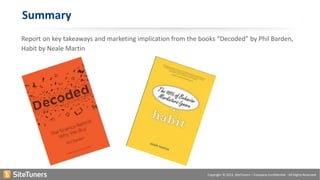
Report on key takeaways and marketing implication from the books “Decoded” by Phil Barden,
Habit by Neale Martin
Copyright © 2015, SiteTuners – Company Confidential - All Rights Reserved.
The Authors
Phil Barden
Senior roles at companies including Unilever and T-mobile
Passionate about decision science, neuromarketing
Not just academic, theoretical guy - Combines practitioner’s perspective with knowledge of
latest neuro studies
Neale Martin
Founder and SEO of Ntelec, marketing consulting firm
Developed early insights into the power of habits as counselor for drug addition programs
PhD in marketing from Georgia Tech
Copyright © 2015, SiteTuners – Company Confidential - All Rights Reserved.
Copyright © 2013, SiteTuners - All Rights Reserved. @tim_ash
First, a Brain Side Trip
Copyright © 2015, SiteTuners – Company Confidential - All Rights Reserved.
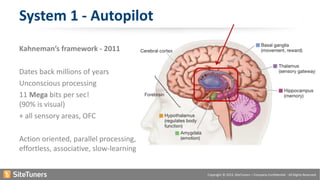
Kahneman’s framework - 2011
Dates back millions of years
Unconscious processing
11 Mega bits per sec!
(90% is visual)
+ all sensory areas, OFC
Action oriented, parallel processing,
effortless, associative, slow-learning
System 1 - Autopilot
Copyright © 2015, SiteTuners – Company Confidential - All Rights Reserved.
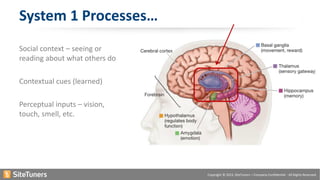
Social context – seeing or
reading about what others do
Contextual cues (learned)
Perceptual inputs – vision,
touch, smell, etc.
System 1 Processes…
Copyright © 2015, SiteTuners – Company Confidential - All Rights Reserved.
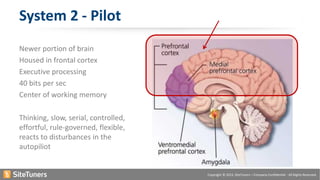
Newer portion of brain
Housed in frontal cortex
Executive processing
40 bits per sec
Center of working memory
Thinking, slow, serial, controlled,
effortful, rule-governed, flexible,
reacts to disturbances in the
autopiliot
System 2 - Pilot
Copyright © 2015, SiteTuners – Company Confidential - All Rights Reserved.
• Recent research shows the magnitude of the role of
emotion in executive-mind function and decision making
• Emotions prioritize what we remember (mainly by
intensity), and help us recall memories
• Autopilot ‘frames’ our experience; pilot focuses the picture
• Recent studies show that emotionally charged images,
words and stories are remembered better and longer
– Driver’s Ed, Texting while driving videos
Systems 1-2 Connection
“We are not thinking
individuals who feel, but
feeling individuals who think.
- Antonio Damasio
Copyright © 2015, SiteTuners – Company Confidential - All Rights Reserved.
Copyright © 2013, SiteTuners - All Rights Reserved. @tim_ash
Top Takeaways
Copyright © 2015, SiteTuners – Company Confidential - All Rights Reserved.
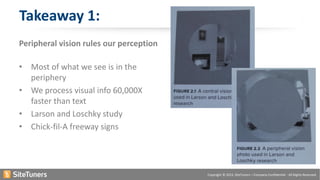
Peripheral vision rules our perception
• Most of what we see is in the
periphery
• We process visual info 60,000X
faster than text
• Larson and Loschky study
• Chick-fil-A freeway signs
Takeaway 1:
Copyright © 2015, SiteTuners – Company Confidential - All Rights Reserved.
95% of what we do is unconscious (we’re mostly on “autopilot”)
• It’s most efficient – takes least thought energy
• Driven by experience, triggered by context
– Learned: Basal ganglia (action - reward)
– Remembered: Hippocampus, Amygdala
• We assign a value to everything we perceive relative to our needs,
goals and desires
– If enough value, we focus on it
• We don’t know why we do what we do
– Our explanations of why we do something are mostly BS
Takeaway 2:
Copyright © 2015, SiteTuners – Company Confidential - All Rights Reserved.
Our interaction with products and brands are highly contextual
(‘what fires together, wires together’)
• Neurons only fire when we perceived something different
– MAYA principle (Most Advanced, Yet Acceptable) – messages that are differ moderately
from expectations are best at activating attention, recall, memory circuits
– Nielsen consultants call “delta moments”
• Brand operates in the background (unconscious) framing the perception
– Strong brands are recognizable in less than 100 millisecs!
• The brain not only answers “what is it?” but decodes what it means in this
particular context
Takeaway 3:
Copyright © 2015, SiteTuners – Company Confidential - All Rights Reserved.
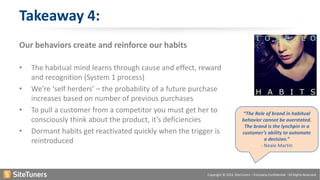
Our behaviors create and reinforce our habits
• The habitual mind learns through cause and effect, reward
and recognition (System 1 process)
• We’re ‘self herders’ – the probability of a future purchase
increases based on number of previous purchases
• To pull a customer from a competitor you must get her to
consciously think about the product, it’s deficiencies
• Dormant habits get reactivated quickly when the trigger is
reintroduced
Takeaway 4:
“The Role of brand in habitual
behavior cannot be overstated.
The brand is the lynchpin in a
customer’s ability to automate
a decision.”
- Neale Martin
Copyright © 2015, SiteTuners – Company Confidential - All Rights Reserved.
Satisfaction is not a strong predictor of future purchase
• Correlation between satisfaction and “likelihood to repurchase” is weak
– Large-scale study found that satisfaction explains only 8% of repurchase likelihood.
– Only exception: when a customer reports being delighted with product/experience.
– Little correlation between what people say they will buy and what they actually buy
• ‘Wanting’ and ‘Liking’ are regulated by different neural circuits
• Implication: Don’t give too much weight to NPS scores
– Edmunds.com surveys
Takeaway 5:
Copyright © 2015, SiteTuners – Company Confidential - All Rights Reserved.
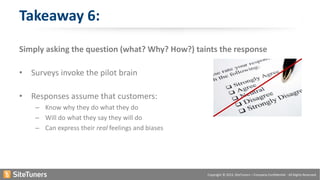
Simply asking the question (what? Why? How?) taints the response
• Surveys invoke the pilot brain
• Responses assume that customers:
– Know why they do what they do
– Will do what they say they will do
– Can express their real feelings and biases
Takeaway 6:
Copyright © 2015, SiteTuners – Company Confidential - All Rights Reserved.
In marketing, Context is King - we need to ensure our lead gen
and purchase triggers appear exactly when and where the
prospect realizes their need/goal/desire
• Behavior Experience – vs. just User Experience – approach
• Need to understand decision-making heuristics
• When streaming Netflix show on an iPad and getting
‘loading…’ delays, present an ad such as,
– “We see you stream a lot of shows and it’s a bit slow. Want to know
how to speed it up?’ [link to higher speed internet offer page]
Marketing Implications
Copyright © 2015, SiteTuners – Company Confidential - All Rights Reserved.
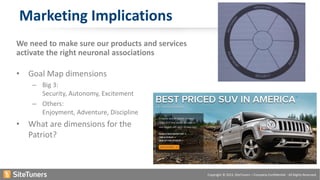
We need to make sure our products and services
activate the right neuronal associations
Marketing Implications
• Goal Map dimensions
– Big 3:
Security, Autonomy, Excitement
– Others:
Enjoyment, Adventure, Discipline
• What are dimensions for the
Patriot?
Copyright © 2015, SiteTuners – Company Confidential - All Rights Reserved.
Jeep: Example of What Not to Do
25+ questions on
this survey!
Copyright © 2015, SiteTuners – Company Confidential - All Rights Reserved.
We need to reward the micro steps along the
conversion journey
• Activate our reward center (basal ganglia)
• Besides sharing expertise, how-to’s to build
familiarity, trust, we need to
• Reward micro conversions more actively
– “Thanks for subscribing to our newsletter – you’ve been
entered into a drawing for a free Express Review!”
Marketing Implications
Copyright © 2015, SiteTuners – Company Confidential - All Rights Reserved.
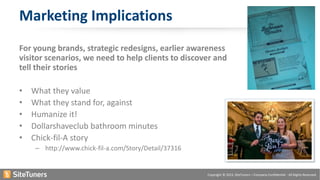
For young brands, strategic redesigns, earlier awareness
visitor scenarios, we need to help clients to discover and
tell their stories
• What they value
• What they stand for, against
• Humanize it!
• Dollarshaveclub bathroom minutes
• Chick-fil-A story
– http://www.chick-fil-a.com/Story/Detail/37316
Marketing Implications
Copyright © 2015, SiteTuners – Company Confidential - All Rights Reserved.
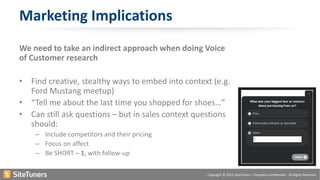
We need to take an indirect approach when doing Voice
of Customer research
• Find creative, stealthy ways to embed into context (e.g.
Ford Mustang meetup)
• “Tell me about the last time you shopped for shoes…”
• Can still ask questions – but in sales context questions
should:
– Include competitors and their pricing
– Focus on affect
– Be SHORT – 1, with follow-up
Marketing Implications
Copyright © 2015, SiteTuners – Company Confidential - All Rights Reserved.
How to create more downstream ‘brand endearment’ for your clients?
• Steps (after initial lead capture, conversion)
1. Reward their lead/conversion choice
2. Encourage a repeat choice, or at least further engagement
3. Turn multiple repeats, higher brand engagement into a (automatic) habit
Opportunity

2015_03_05_Decoded_Book_LunchandLearn

  • 1.
    Copyright © 2015,SiteTuners – Company Confidential - All Rights Reserved. Copyright © 2013, SiteTuners - All Rights Reserved. @tim_ash Lunch & Learn Decoded & Habits Book Takeaways Mark Hall 3/5/2015
  • 2.
    Copyright © 2015,SiteTuners – Company Confidential - All Rights Reserved. Summary Report on key takeaways and marketing implication from the books “Decoded” by Phil Barden, Habit by Neale Martin
  • 3.
    Copyright © 2015,SiteTuners – Company Confidential - All Rights Reserved. The Authors Phil Barden Senior roles at companies including Unilever and T-mobile Passionate about decision science, neuromarketing Not just academic, theoretical guy - Combines practitioner’s perspective with knowledge of latest neuro studies Neale Martin Founder and SEO of Ntelec, marketing consulting firm Developed early insights into the power of habits as counselor for drug addition programs PhD in marketing from Georgia Tech
  • 4.
    Copyright © 2015,SiteTuners – Company Confidential - All Rights Reserved. Copyright © 2013, SiteTuners - All Rights Reserved. @tim_ash First, a Brain Side Trip
  • 5.
    Copyright © 2015,SiteTuners – Company Confidential - All Rights Reserved. Kahneman’s framework - 2011 Dates back millions of years Unconscious processing 11 Mega bits per sec! (90% is visual) + all sensory areas, OFC Action oriented, parallel processing, effortless, associative, slow-learning System 1 - Autopilot
  • 6.
    Copyright © 2015,SiteTuners – Company Confidential - All Rights Reserved. Social context – seeing or reading about what others do Contextual cues (learned) Perceptual inputs – vision, touch, smell, etc. System 1 Processes…
  • 7.
    Copyright © 2015,SiteTuners – Company Confidential - All Rights Reserved. Newer portion of brain Housed in frontal cortex Executive processing 40 bits per sec Center of working memory Thinking, slow, serial, controlled, effortful, rule-governed, flexible, reacts to disturbances in the autopiliot System 2 - Pilot
  • 8.
    Copyright © 2015,SiteTuners – Company Confidential - All Rights Reserved. • Recent research shows the magnitude of the role of emotion in executive-mind function and decision making • Emotions prioritize what we remember (mainly by intensity), and help us recall memories • Autopilot ‘frames’ our experience; pilot focuses the picture • Recent studies show that emotionally charged images, words and stories are remembered better and longer – Driver’s Ed, Texting while driving videos Systems 1-2 Connection “We are not thinking individuals who feel, but feeling individuals who think. - Antonio Damasio
  • 9.
    Copyright © 2015,SiteTuners – Company Confidential - All Rights Reserved. Copyright © 2013, SiteTuners - All Rights Reserved. @tim_ash Top Takeaways
  • 10.
    Copyright © 2015,SiteTuners – Company Confidential - All Rights Reserved. Peripheral vision rules our perception • Most of what we see is in the periphery • We process visual info 60,000X faster than text • Larson and Loschky study • Chick-fil-A freeway signs Takeaway 1:
  • 11.
    Copyright © 2015,SiteTuners – Company Confidential - All Rights Reserved. 95% of what we do is unconscious (we’re mostly on “autopilot”) • It’s most efficient – takes least thought energy • Driven by experience, triggered by context – Learned: Basal ganglia (action - reward) – Remembered: Hippocampus, Amygdala • We assign a value to everything we perceive relative to our needs, goals and desires – If enough value, we focus on it • We don’t know why we do what we do – Our explanations of why we do something are mostly BS Takeaway 2:
  • 12.
    Copyright © 2015,SiteTuners – Company Confidential - All Rights Reserved. Our interaction with products and brands are highly contextual (‘what fires together, wires together’) • Neurons only fire when we perceived something different – MAYA principle (Most Advanced, Yet Acceptable) – messages that are differ moderately from expectations are best at activating attention, recall, memory circuits – Nielsen consultants call “delta moments” • Brand operates in the background (unconscious) framing the perception – Strong brands are recognizable in less than 100 millisecs! • The brain not only answers “what is it?” but decodes what it means in this particular context Takeaway 3:
  • 13.
    Copyright © 2015,SiteTuners – Company Confidential - All Rights Reserved. Our behaviors create and reinforce our habits • The habitual mind learns through cause and effect, reward and recognition (System 1 process) • We’re ‘self herders’ – the probability of a future purchase increases based on number of previous purchases • To pull a customer from a competitor you must get her to consciously think about the product, it’s deficiencies • Dormant habits get reactivated quickly when the trigger is reintroduced Takeaway 4: “The Role of brand in habitual behavior cannot be overstated. The brand is the lynchpin in a customer’s ability to automate a decision.” - Neale Martin
  • 14.
    Copyright © 2015,SiteTuners – Company Confidential - All Rights Reserved. Satisfaction is not a strong predictor of future purchase • Correlation between satisfaction and “likelihood to repurchase” is weak – Large-scale study found that satisfaction explains only 8% of repurchase likelihood. – Only exception: when a customer reports being delighted with product/experience. – Little correlation between what people say they will buy and what they actually buy • ‘Wanting’ and ‘Liking’ are regulated by different neural circuits • Implication: Don’t give too much weight to NPS scores – Edmunds.com surveys Takeaway 5:
  • 15.
    Copyright © 2015,SiteTuners – Company Confidential - All Rights Reserved. Simply asking the question (what? Why? How?) taints the response • Surveys invoke the pilot brain • Responses assume that customers: – Know why they do what they do – Will do what they say they will do – Can express their real feelings and biases Takeaway 6:
  • 16.
    Copyright © 2015,SiteTuners – Company Confidential - All Rights Reserved. In marketing, Context is King - we need to ensure our lead gen and purchase triggers appear exactly when and where the prospect realizes their need/goal/desire • Behavior Experience – vs. just User Experience – approach • Need to understand decision-making heuristics • When streaming Netflix show on an iPad and getting ‘loading…’ delays, present an ad such as, – “We see you stream a lot of shows and it’s a bit slow. Want to know how to speed it up?’ [link to higher speed internet offer page] Marketing Implications
  • 17.
    Copyright © 2015,SiteTuners – Company Confidential - All Rights Reserved. We need to make sure our products and services activate the right neuronal associations Marketing Implications • Goal Map dimensions – Big 3: Security, Autonomy, Excitement – Others: Enjoyment, Adventure, Discipline • What are dimensions for the Patriot?
  • 18.
    Copyright © 2015,SiteTuners – Company Confidential - All Rights Reserved. Jeep: Example of What Not to Do 25+ questions on this survey!
  • 19.
    Copyright © 2015,SiteTuners – Company Confidential - All Rights Reserved. We need to reward the micro steps along the conversion journey • Activate our reward center (basal ganglia) • Besides sharing expertise, how-to’s to build familiarity, trust, we need to • Reward micro conversions more actively – “Thanks for subscribing to our newsletter – you’ve been entered into a drawing for a free Express Review!” Marketing Implications
  • 20.
    Copyright © 2015,SiteTuners – Company Confidential - All Rights Reserved. For young brands, strategic redesigns, earlier awareness visitor scenarios, we need to help clients to discover and tell their stories • What they value • What they stand for, against • Humanize it! • Dollarshaveclub bathroom minutes • Chick-fil-A story – http://www.chick-fil-a.com/Story/Detail/37316 Marketing Implications
  • 21.
    Copyright © 2015,SiteTuners – Company Confidential - All Rights Reserved. We need to take an indirect approach when doing Voice of Customer research • Find creative, stealthy ways to embed into context (e.g. Ford Mustang meetup) • “Tell me about the last time you shopped for shoes…” • Can still ask questions – but in sales context questions should: – Include competitors and their pricing – Focus on affect – Be SHORT – 1, with follow-up Marketing Implications
  • 22.
    Copyright © 2015,SiteTuners – Company Confidential - All Rights Reserved. How to create more downstream ‘brand endearment’ for your clients? • Steps (after initial lead capture, conversion) 1. Reward their lead/conversion choice 2. Encourage a repeat choice, or at least further engagement 3. Turn multiple repeats, higher brand engagement into a (automatic) habit Opportunity