Strategic planning using the SWOT Analysis Optimise- GB A sly rabbit will have three openings to its den.  –  Chinese proverb
SWOT Analysis Optimise- GB SWOT analysis is a strategic tool  to evaluate the Strengths, Weaknesses, Opportunities, and Threats. It involves specifying the objective of the business and identifying the internal and external factors that are favourable and unfavourable to achieve that objective. The technique is credited to Albert Humphrey, who led a convention at Stanford University in the 1960s and 1970
What is the business mission statement? Who are your customers?  What is your products / Services? What is the state of your business right now in terms of sales, cost, quality, customer satisfaction, market share? Where do you want the business to be? Before we continue ask yourself the  following questions: Optimise -GB
SWOT Analysis Optimise- GB What does your company do well? What is your area of expertise? What specialist knowledge or technology do you possess? How good is your brand, marketing or sales force? What quality standards do you boast?
SWOT Analysis Optimise- GB What does your company lack?   What area of expertise do you need but do not have? Do you know what your weaknesses are? If not ask you trusted employees and customers or bench mark your competitors.
SWOT Analysis Optimise- GB Would the business processes benefit from use of technology? Are there new demographics that could be exploited? Are there any joint ventures or merger opportunities? Could resources be used in a different way to generate more revenue?
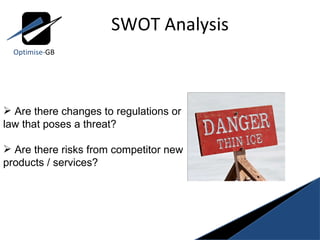
SWOT Analysis Optimise- GB Are there changes to regulations or law that poses a threat? Are there risks from competitor new products / services?
SWOT Analysis Optimise- GB Internal considerations What strengths can be exploited against the competition? How can you promote your strengths through marketing? What weaknesses can be exploited by the competition? What external resource can be used the remove weaknesses? Ensure you list opportunities to enhance capabilities?
SWOT Analysis Optimise- GB External considerations What opportunities exist in the current economical environment? What opportunities exist by exploiting competition's weaknesses? What threats are there from new and existing competition? What threats are there from political, social or economic issues?
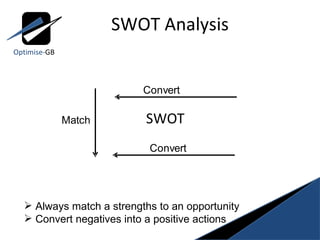
SWOT Analysis Optimise- GB Always match a strengths to an opportunity Convert negatives into a positive actions
SWOT Analysis Optimise- GB For each action / idea / solution that has been identified, ensure that you validate them against your core objectives to ensure that they are congruent.
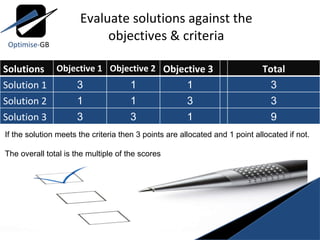
Evaluate solutions against the objectives & criteria If the solution meets the criteria then 3 points are allocated and 1 point allocated if not. The overall total is the multiple of the scores Optimise- GB Solutions Objective 1 Objective 2 Objective 3 Total Solution 1 3 1 1 3 Solution 2 1 1 3 3 Solution 3 3 3 1 9
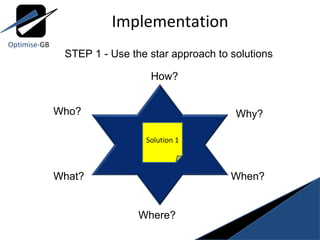
Implementation STEP 1 - Use the star approach to solutions Solution 1 Who? What? When? Where? How? Why? Optimise- GB
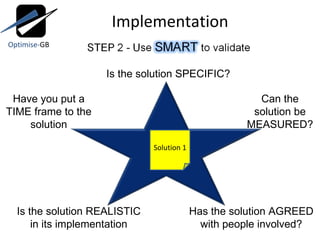
Implementation Solution 1 Have you put a TIME frame to the solution Has the solution AGREED with people involved? Is the solution REALISTIC in its implementation Is the solution SPECIFIC? Can the solution be MEASURED? Optimise- GB
For solutions Contact Simon Misiewicz through Email:  [email_address]  or Optimise- GB

SWOT analysis

  • 1.
    Strategic planning usingthe SWOT Analysis Optimise- GB A sly rabbit will have three openings to its den. – Chinese proverb
  • 2.
    SWOT Analysis Optimise-GB SWOT analysis is a strategic tool to evaluate the Strengths, Weaknesses, Opportunities, and Threats. It involves specifying the objective of the business and identifying the internal and external factors that are favourable and unfavourable to achieve that objective. The technique is credited to Albert Humphrey, who led a convention at Stanford University in the 1960s and 1970
  • 3.
    What is thebusiness mission statement? Who are your customers? What is your products / Services? What is the state of your business right now in terms of sales, cost, quality, customer satisfaction, market share? Where do you want the business to be? Before we continue ask yourself the following questions: Optimise -GB
  • 4.
    SWOT Analysis Optimise-GB What does your company do well? What is your area of expertise? What specialist knowledge or technology do you possess? How good is your brand, marketing or sales force? What quality standards do you boast?
  • 5.
    SWOT Analysis Optimise-GB What does your company lack? What area of expertise do you need but do not have? Do you know what your weaknesses are? If not ask you trusted employees and customers or bench mark your competitors.
  • 6.
    SWOT Analysis Optimise-GB Would the business processes benefit from use of technology? Are there new demographics that could be exploited? Are there any joint ventures or merger opportunities? Could resources be used in a different way to generate more revenue?
  • 7.
    SWOT Analysis Optimise-GB Are there changes to regulations or law that poses a threat? Are there risks from competitor new products / services?
  • 8.
    SWOT Analysis Optimise-GB Internal considerations What strengths can be exploited against the competition? How can you promote your strengths through marketing? What weaknesses can be exploited by the competition? What external resource can be used the remove weaknesses? Ensure you list opportunities to enhance capabilities?
  • 9.
    SWOT Analysis Optimise-GB External considerations What opportunities exist in the current economical environment? What opportunities exist by exploiting competition's weaknesses? What threats are there from new and existing competition? What threats are there from political, social or economic issues?
  • 10.
    SWOT Analysis Optimise-GB Always match a strengths to an opportunity Convert negatives into a positive actions
  • 11.
    SWOT Analysis Optimise-GB For each action / idea / solution that has been identified, ensure that you validate them against your core objectives to ensure that they are congruent.
  • 12.
    Evaluate solutions againstthe objectives & criteria If the solution meets the criteria then 3 points are allocated and 1 point allocated if not. The overall total is the multiple of the scores Optimise- GB Solutions Objective 1 Objective 2 Objective 3 Total Solution 1 3 1 1 3 Solution 2 1 1 3 3 Solution 3 3 3 1 9
  • 13.
    Implementation STEP 1- Use the star approach to solutions Solution 1 Who? What? When? Where? How? Why? Optimise- GB
  • 14.
    Implementation Solution 1Have you put a TIME frame to the solution Has the solution AGREED with people involved? Is the solution REALISTIC in its implementation Is the solution SPECIFIC? Can the solution be MEASURED? Optimise- GB
  • 15.
    For solutions ContactSimon Misiewicz through Email: [email_address] or Optimise- GB