© Linda Gorchels, BrainSnacksCafe.com
Channel
Tactics
In Memorial
This presentation represents a condensed version of
Managing Your Go-To-Market Strategy. The course,
and its predecessor versions, were offered by the
University of Wisconsin for decades. As the Center
shifted its mission to management and leadership
training, the marketing and sales courses were
discontinued. Since channel strategy is no longer
available as a public workshop, I am offering these
materials to you for your personal education.
Enjoy!
© Linda Gorchels, BrainSnacksCafe.com
Questions? Contact:
Linda M. Gorchels
Emerita Director, Executive Marketing Education
UW-Madison School of Business
Center for Professional & Executive Development
www.BrainSnacksCafe.com
New in 2017
The Product Management ShortRead Series is an evolving
collection of “bite-sized” books (of about 100 pages) on
select product management topics. Product Management
101 and Product Strategy & Roadmaps were published in
January 2017. Creatively Innovative is scheduled for
release in May.
© Linda Gorchels, BrainSnacksCafe.com
What you can expect
This channel management session
will hone your ability to:
• Assess channel fitness given
changing strategic and tactical
conditions
• Structure ideal candidate profile
templates
• Improve support programs
• Reduce channel conflict
© Linda Gorchels, BrainSnacksCafe.com
Why you should care
© Linda Gorchels, BrainSnacksCafe.com
Working with dealers
and distributors can
feel like herding cats –
unless you do it right!
What is channel management?
© Linda Gorchels, BrainSnacksCafe.com
Stewardship
Differentiation
Efficiency
What is channel management?
• Stewardship of a go-to-market strategy
that provides value to end-users…
• local selling
• financing/credit terms
• delivery/installation/customization
• service support
• In a way that establishes differentiation
• through seamless customer experience
• And increases effectiveness or efficiency
• cost containment and channel segmentation
© Linda Gorchels, BrainSnacksCafe.com
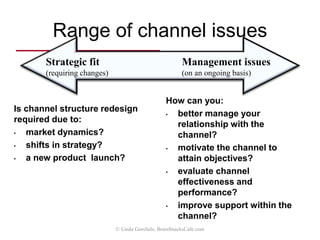
Range of channel issues
Is channel structure redesign
required due to:
• market dynamics?
• shifts in strategy?
• a new product launch?
How can you:
• better manage your
relationship with the
channel?
• motivate the channel to
attain objectives?
• evaluate channel
effectiveness and
performance?
• improve support within the
channel?
Strategic fit
(requiring changes)
Management issues
(on an ongoing basis)
© Linda Gorchels, BrainSnacksCafe.com
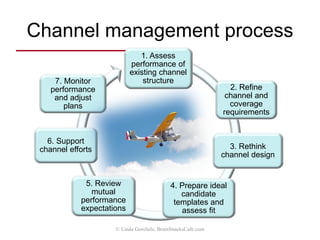
Channel management process
1. Assess
performance of
existing channel
structure
2. Refine
channel and
coverage
requirements
3. Rethink
channel design
4. Prepare ideal
candidate
templates and
assess fit
5. Review
mutual
performance
expectations
6. Support
channel efforts
7. Monitor
performance
and adjust
plans
© Linda Gorchels, BrainSnacksCafe.com
1. Assess
performance of
existing channel
structure
© Linda Gorchels, BrainSnacksCafe.com
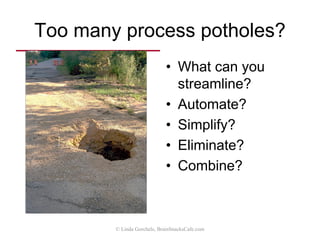
Too many process potholes?
• What can you
streamline?
• Automate?
• Simplify?
• Eliminate?
• Combine?
© Linda Gorchels, BrainSnacksCafe.com
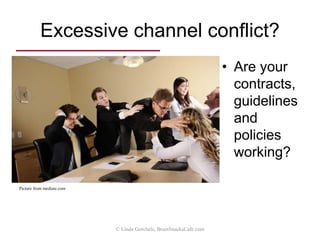
Excessive channel conflict?
• Are your
contracts,
guidelines
and
policies
working?
© Linda Gorchels, BrainSnacksCafe.com
Picture from mediate.com
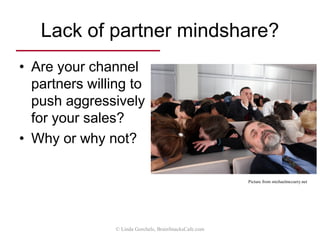
Lack of partner mindshare?
• Are your channel
partners willing to
push aggressively
for your sales?
• Why or why not?
© Linda Gorchels, BrainSnacksCafe.com
Picture from michaelmccurry.net
Lack of trust & acceptance?
• What do your
partners say
about you when
you are not in
the room?
© Linda Gorchels, BrainSnacksCafe.com
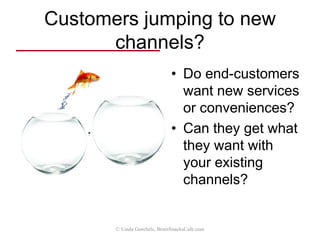
Customers jumping to new
channels?
• Do end-customers
want new services
or conveniences?
• Can they get what
they want with
your existing
channels?
© Linda Gorchels, BrainSnacksCafe.com
So …
© Linda Gorchels, BrainSnacksCafe.com
• Are you accomplishing
your objectives with
your existing channel?
• Do you need minor
tweaking?
• Or is more significant
structural change
necessary?
2. Refine channel and
coverage
requirements
© Linda Gorchels, BrainSnacksCafe.com
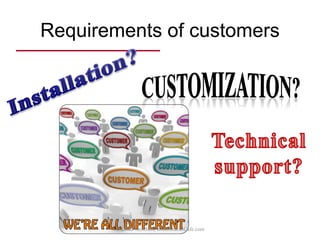
Requirements of customers
© Linda Gorchels, BrainSnacksCafe.com
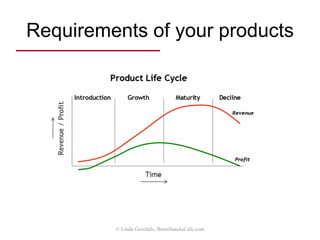
Requirements of your products
© Linda Gorchels, BrainSnacksCafe.com
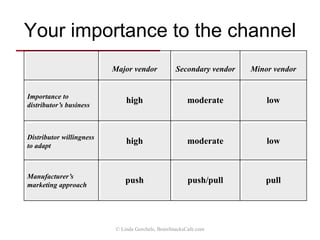
Your importance to the channel
Major vendor Secondary vendor Minor vendor
Importance to
distributor’s business
high moderate low
Distributor willingness
to adapt
high moderate low
Manufacturer’s
marketing approach
push push/pull pull
© Linda Gorchels, BrainSnacksCafe.com
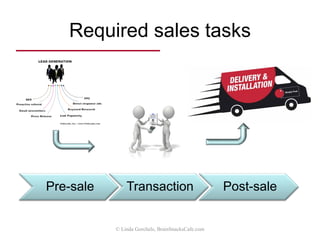
Required sales tasks
Pre-sale Transaction Post-sale
© Linda Gorchels, BrainSnacksCafe.com
3. Rethink channel
design
© Linda Gorchels, BrainSnacksCafe.com
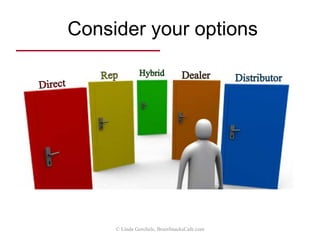
Consider your options
© Linda Gorchels, BrainSnacksCafe.com
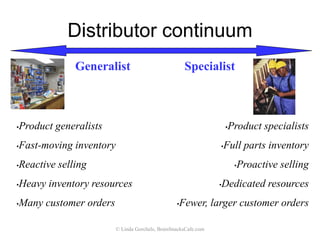
Distributor continuum
Generalist Specialist
•Product generalists
•Fast-moving inventory
•Reactive selling
•Heavy inventory resources
•Many customer orders
•Product specialists
•Full parts inventory
•Proactive selling
•Dedicated resources
•Fewer, larger customer orders
© Linda Gorchels, BrainSnacksCafe.com
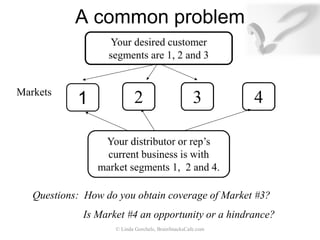
A common problem
Markets
Questions: How do you obtain coverage of Market #3?
Is Market #4 an opportunity or a hindrance?
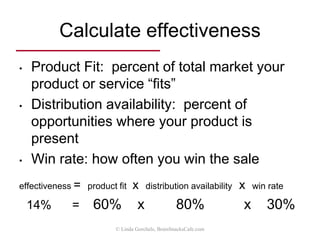
Calculate effectiveness
• Product Fit: percent of total market your
product or service “fits”
• Distribution availability: percent of
opportunities where your product is
present
• Win rate: how often you win the sale
effectiveness = product fit x distribution availability x win rate
14% = 60% x 80% x 30%
© Linda Gorchels, BrainSnacksCafe.com
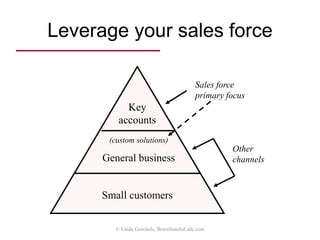
Leverage your sales force
Key
accounts
General business
Small customers
Sales force
primary focus
Other
channels
(custom solutions)
© Linda Gorchels, BrainSnacksCafe.com
4. Prepare ideal
candidate templates
and assess fit
© Linda Gorchels, BrainSnacksCafe.com
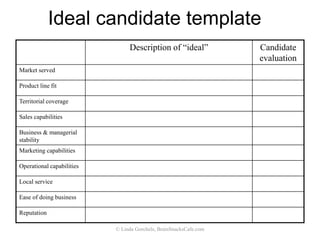
Ideal candidate template
Description of “ideal” Candidate
evaluation
Market served
Product line fit
Territorial coverage
Sales capabilities
Business & managerial
stability
Marketing capabilities
Operational capabilities
Local service
Ease of doing business
Reputation
© Linda Gorchels, BrainSnacksCafe.com
5. Review mutual
performance
expectations
© Linda Gorchels, BrainSnacksCafe.com
Manage, motivate, evaluate
• Effectiveness usually increases when
expectations are mutual
– What was written into the contract?
– What specific measures are addenda
that change annually?
–Know what to expect and what NOT to
expect from your distributors or reps.
© Linda Gorchels, BrainSnacksCafe.com
Price & performance expectations
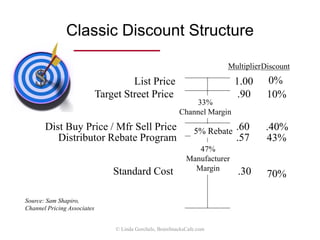
• The target street price is the price you feel
is attractive to the end user while providing
acceptable compensation to the channel.
• Compensation may include discounts from
the target price along with allowances,
rebates and other programs
© Linda Gorchels, BrainSnacksCafe.com
Classic Discount Structure
List Price
Target Street Price
Dist Buy Price / Mfr Sell Price
Distributor Rebate Program
Standard Cost
1.00
.90
.60
.57
33%
Channel Margin
5% Rebate
47%
Manufacturer
Margin
Multiplier
10%
.40%
43%
70%
Discount
0%
Source: Sam Shapiro,
Channel Pricing Associates
.30
© Linda Gorchels, BrainSnacksCafe.com
6. Support channel
efforts
© Linda Gorchels, BrainSnacksCafe.com
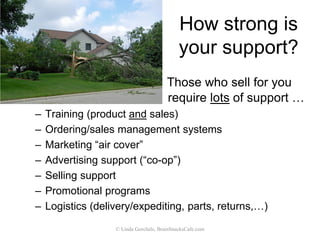
How strong is
your support?
Those who sell for you
require lots of support …
– Training (product and sales)
– Ordering/sales management systems
– Marketing “air cover”
– Advertising support (“co-op”)
– Selling support
– Promotional programs
– Logistics (delivery/expediting, parts, returns,…)
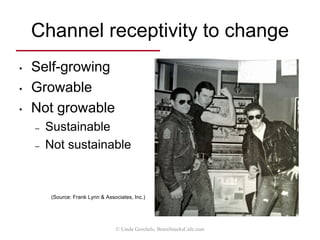
Channel receptivity to change
• Self-growing
• Growable
• Not growable
– Sustainable
– Not sustainable
(Source: Frank Lynn & Associates, Inc.)
© Linda Gorchels, BrainSnacksCafe.com
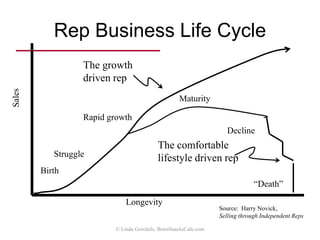
Rep Business Life Cycle
Birth
Struggle
Rapid growth
Maturity
Decline
“Death”
The comfortable
lifestyle driven rep
The growth
driven rep
Longevity
Source: Harry Novick,
Selling through Independent Reps
© Linda Gorchels, BrainSnacksCafe.com
Planning a dealer/rep meeting
• One way to learn about how your reps and
distributors evaluate you is through
advisory councils
– Survey past attendees
– Be sure senior managers attend
– Obtain feedback on company effectiveness.
– Follow up on meeting ideas
Source: Joseph Conlin, “The Art of the Dealer Meeting,” Sales & Marketing Management
© Linda Gorchels, BrainSnacksCafe.com
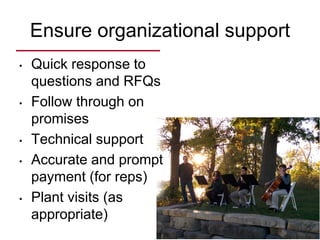
Ensure organizational support
• Quick response to
questions and RFQs
• Follow through on
promises
• Technical support
• Accurate and prompt
payment (for reps)
• Plant visits (as
appropriate)
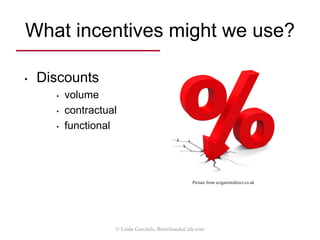
What incentives might we use?
• Discounts
• volume
• contractual
• functional
© Linda Gorchels, BrainSnacksCafe.com
Picture from ecigarettedirect.co.uk
What incentives might we use?
• Discounts
• Sales promotion
– Contests
– Spiffs
• Promotional funds
© Linda Gorchels, BrainSnacksCafe.com
Picture from thebusinessboosters.blogspot.com
What incentives might we use?
• Discounts
• Sales promotion
• Promotional funds
– MDF (market development funds)
– Coop advertising
© Linda Gorchels, BrainSnacksCafe.com
Managing promotional programs
• Provide pass-through materials
• templates, ad slicks, catalogs, videos, bulletins,
CDs, DVDs, downloads
• Design direct response campaigns
• Email newsletters, social media support
• Increase home office promotions
• website, press releases, national advertising / PR
• Support distributor promotions
• coop/MDF, yellow pages, customer seminars,
trade shows, open houses, website hosting
© Linda Gorchels, BrainSnacksCafe.com
Managing promotional programs
• Think in terms of a CAMPAIGN
rather than piecemeal efforts!
 Keep it simple.
 Coordinate with manufacturer efforts.
 Compare with competitive
programs
© Linda Gorchels, BrainSnacksCafe.com
Management
& contracts
• Distributors
– contractual agreements, mutual business
planning & support
• Reps
– commission packages & support
• Direct
– sales management (with marketing support)
© Linda Gorchels, BrainSnacksCafe.com
Build sales support
• Lead generation & qualification
• Provide sales tools
– “Elevator pitch”
– Killer demo
• Conduct joint sales calls
• Provide training
• Coach performance
• cross selling
• suggestive selling
© Linda Gorchels, BrainSnacksCafe.com
7. Monitor
performance and
adjust plans
© Linda Gorchels, BrainSnacksCafe.com
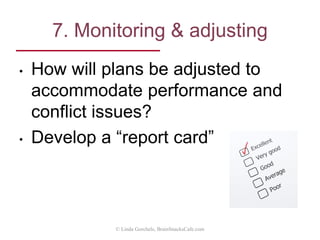
7. Monitoring & adjusting
• How will plans be adjusted to
accommodate performance and
conflict issues?
• Develop a “report card”
© Linda Gorchels, BrainSnacksCafe.com
Evaluate channel performance
• Define metrics appropriate to
your sales cycle
– Sales revenue, units
– Demos, proposals, etc. for
longer cycles
• Ability to meet plan objectives
• Functions performed
– Showroom, counter displays,
events, etc.
© Linda Gorchels, BrainSnacksCafe.com
Manage conflict between …
Manufacturer and channel
Clarify national account
strategies
Players in the same channel
Define APR and related performance measures
Different channels
“Build fences” through defined-customer
strategies, brand or product differences, etc.
© Linda Gorchels, BrainSnacksCafe.com
Key points
• Stay on top of the dynamics that may suggest a need
for channel re-evaluation, and follow the steps in
redesign:
1. Assess structure 4. Assess and/or select partners
2. Refine requirements 5. Review expectations
3. Rethink channel design 6. Support channel efforts
7. Monitor & adjust
• Manage channels on an ongoing basis
1. Maintain good two-way dialog
2. Use incentives that motivate the right behaviors
3. Measure and monitor effectiveness
4. Coordinate and improve marketing, sales and operations
support activities
5. Reduce conflict to an acceptable level
© Linda Gorchels, BrainSnacksCafe.com
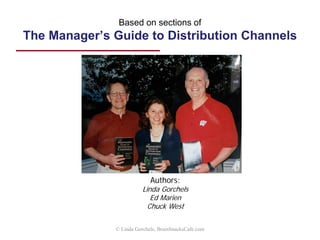
Based on sections of
The Manager’s Guide to Distribution Channels
© Linda Gorchels, BrainSnacksCafe.com
Authors:
Linda Gorchels
Ed Marien
Chuck West
© Linda Gorchels, BrainSnacksCafe.com
There are several people who taught in and/or contributed to this
course over the years. I would like to thank the main contributors as
listed below.
Jon P. Christiansen
Susan Heintz
Jack Nevin
Harry Novick
Bob Segal
Chuck West
Just as we routinely upgrade computer systems, we must upgrade our own knowledge systems.
Linda has helped over 10,000 people over a 25+ year period with these educational upgrades,
merging anecdotal client experience with researched “best practices,” and sharing the resulting
insights with managers and executives. After working in the office products, publishing and
insurance industries, she joined UW-Madison’s Center for Professional and Executive Development,
both as a corporate trainer and program director. Now, as a director emerita, she provides
workshops for select clients.
An award-winning author of The Product Manager’s Handbook, she has also written The Product
Manager’s Field Guide, The Manager’s Guide to Distribution Channels, Business Model Renewal,
and The Product Management ShortRead Series.
Linda is now a blogger, mystery author and Creativity Curator for her own company, Tomorrow’s
Mysteries, LLC.
Linda M. Gorchels
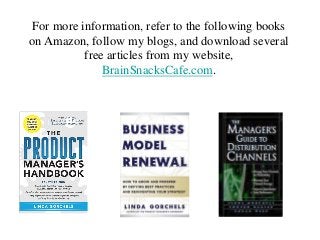
For more information, refer to the following books
on Amazon, follow my blogs, and download several
free articles from my website,
BrainSnacksCafe.com.

Aligning your channel tactics

  • 1.
    © Linda Gorchels,BrainSnacksCafe.com Channel Tactics
  • 2.
    In Memorial This presentationrepresents a condensed version of Managing Your Go-To-Market Strategy. The course, and its predecessor versions, were offered by the University of Wisconsin for decades. As the Center shifted its mission to management and leadership training, the marketing and sales courses were discontinued. Since channel strategy is no longer available as a public workshop, I am offering these materials to you for your personal education. Enjoy! © Linda Gorchels, BrainSnacksCafe.com
  • 3.
    © Linda Gorchels,BrainSnacksCafe.com Questions? Contact: Linda M. Gorchels Emerita Director, Executive Marketing Education UW-Madison School of Business Center for Professional & Executive Development www.BrainSnacksCafe.com
  • 4.
    New in 2017 TheProduct Management ShortRead Series is an evolving collection of “bite-sized” books (of about 100 pages) on select product management topics. Product Management 101 and Product Strategy & Roadmaps were published in January 2017. Creatively Innovative is scheduled for release in May. © Linda Gorchels, BrainSnacksCafe.com
  • 5.
    What you canexpect This channel management session will hone your ability to: • Assess channel fitness given changing strategic and tactical conditions • Structure ideal candidate profile templates • Improve support programs • Reduce channel conflict © Linda Gorchels, BrainSnacksCafe.com
  • 6.
    Why you shouldcare © Linda Gorchels, BrainSnacksCafe.com Working with dealers and distributors can feel like herding cats – unless you do it right!
  • 7.
    What is channelmanagement? © Linda Gorchels, BrainSnacksCafe.com Stewardship Differentiation Efficiency
  • 8.
    What is channelmanagement? • Stewardship of a go-to-market strategy that provides value to end-users… • local selling • financing/credit terms • delivery/installation/customization • service support • In a way that establishes differentiation • through seamless customer experience • And increases effectiveness or efficiency • cost containment and channel segmentation © Linda Gorchels, BrainSnacksCafe.com
  • 9.
    Range of channelissues Is channel structure redesign required due to: • market dynamics? • shifts in strategy? • a new product launch? How can you: • better manage your relationship with the channel? • motivate the channel to attain objectives? • evaluate channel effectiveness and performance? • improve support within the channel? Strategic fit (requiring changes) Management issues (on an ongoing basis) © Linda Gorchels, BrainSnacksCafe.com
  • 10.
    Channel management process 1.Assess performance of existing channel structure 2. Refine channel and coverage requirements 3. Rethink channel design 4. Prepare ideal candidate templates and assess fit 5. Review mutual performance expectations 6. Support channel efforts 7. Monitor performance and adjust plans © Linda Gorchels, BrainSnacksCafe.com
  • 11.
    1. Assess performance of existingchannel structure © Linda Gorchels, BrainSnacksCafe.com
  • 12.
    Too many processpotholes? • What can you streamline? • Automate? • Simplify? • Eliminate? • Combine? © Linda Gorchels, BrainSnacksCafe.com
  • 13.
    Excessive channel conflict? •Are your contracts, guidelines and policies working? © Linda Gorchels, BrainSnacksCafe.com Picture from mediate.com
  • 14.
    Lack of partnermindshare? • Are your channel partners willing to push aggressively for your sales? • Why or why not? © Linda Gorchels, BrainSnacksCafe.com Picture from michaelmccurry.net
  • 15.
    Lack of trust& acceptance? • What do your partners say about you when you are not in the room? © Linda Gorchels, BrainSnacksCafe.com
  • 16.
    Customers jumping tonew channels? • Do end-customers want new services or conveniences? • Can they get what they want with your existing channels? © Linda Gorchels, BrainSnacksCafe.com
  • 17.
    So … © LindaGorchels, BrainSnacksCafe.com • Are you accomplishing your objectives with your existing channel? • Do you need minor tweaking? • Or is more significant structural change necessary?
  • 18.
    2. Refine channeland coverage requirements © Linda Gorchels, BrainSnacksCafe.com
  • 19.
    Requirements of customers ©Linda Gorchels, BrainSnacksCafe.com
  • 20.
    Requirements of yourproducts © Linda Gorchels, BrainSnacksCafe.com
  • 21.
    Your importance tothe channel Major vendor Secondary vendor Minor vendor Importance to distributor’s business high moderate low Distributor willingness to adapt high moderate low Manufacturer’s marketing approach push push/pull pull © Linda Gorchels, BrainSnacksCafe.com
  • 22.
    Required sales tasks Pre-saleTransaction Post-sale © Linda Gorchels, BrainSnacksCafe.com
  • 23.
    3. Rethink channel design ©Linda Gorchels, BrainSnacksCafe.com
  • 24.
    Consider your options ©Linda Gorchels, BrainSnacksCafe.com
  • 25.
    Distributor continuum Generalist Specialist •Productgeneralists •Fast-moving inventory •Reactive selling •Heavy inventory resources •Many customer orders •Product specialists •Full parts inventory •Proactive selling •Dedicated resources •Fewer, larger customer orders © Linda Gorchels, BrainSnacksCafe.com
  • 26.
    © Linda Gorchels,BrainSnacksCafe.com A common problem Markets Questions: How do you obtain coverage of Market #3? Is Market #4 an opportunity or a hindrance?
  • 27.
    Calculate effectiveness • ProductFit: percent of total market your product or service “fits” • Distribution availability: percent of opportunities where your product is present • Win rate: how often you win the sale effectiveness = product fit x distribution availability x win rate 14% = 60% x 80% x 30% © Linda Gorchels, BrainSnacksCafe.com
  • 28.
    Leverage your salesforce Key accounts General business Small customers Sales force primary focus Other channels (custom solutions) © Linda Gorchels, BrainSnacksCafe.com
  • 29.
    4. Prepare ideal candidatetemplates and assess fit © Linda Gorchels, BrainSnacksCafe.com
  • 30.
    Ideal candidate template Descriptionof “ideal” Candidate evaluation Market served Product line fit Territorial coverage Sales capabilities Business & managerial stability Marketing capabilities Operational capabilities Local service Ease of doing business Reputation © Linda Gorchels, BrainSnacksCafe.com
  • 31.
    5. Review mutual performance expectations ©Linda Gorchels, BrainSnacksCafe.com
  • 32.
    Manage, motivate, evaluate •Effectiveness usually increases when expectations are mutual – What was written into the contract? – What specific measures are addenda that change annually? –Know what to expect and what NOT to expect from your distributors or reps. © Linda Gorchels, BrainSnacksCafe.com
  • 33.
    Price & performanceexpectations • The target street price is the price you feel is attractive to the end user while providing acceptable compensation to the channel. • Compensation may include discounts from the target price along with allowances, rebates and other programs © Linda Gorchels, BrainSnacksCafe.com
  • 34.
    Classic Discount Structure ListPrice Target Street Price Dist Buy Price / Mfr Sell Price Distributor Rebate Program Standard Cost 1.00 .90 .60 .57 33% Channel Margin 5% Rebate 47% Manufacturer Margin Multiplier 10% .40% 43% 70% Discount 0% Source: Sam Shapiro, Channel Pricing Associates .30 © Linda Gorchels, BrainSnacksCafe.com
  • 35.
    6. Support channel efforts ©Linda Gorchels, BrainSnacksCafe.com
  • 36.
    © Linda Gorchels,BrainSnacksCafe.com How strong is your support? Those who sell for you require lots of support … – Training (product and sales) – Ordering/sales management systems – Marketing “air cover” – Advertising support (“co-op”) – Selling support – Promotional programs – Logistics (delivery/expediting, parts, returns,…)
  • 37.
    Channel receptivity tochange • Self-growing • Growable • Not growable – Sustainable – Not sustainable (Source: Frank Lynn & Associates, Inc.) © Linda Gorchels, BrainSnacksCafe.com
  • 38.
    Rep Business LifeCycle Birth Struggle Rapid growth Maturity Decline “Death” The comfortable lifestyle driven rep The growth driven rep Longevity Source: Harry Novick, Selling through Independent Reps © Linda Gorchels, BrainSnacksCafe.com
  • 39.
    Planning a dealer/repmeeting • One way to learn about how your reps and distributors evaluate you is through advisory councils – Survey past attendees – Be sure senior managers attend – Obtain feedback on company effectiveness. – Follow up on meeting ideas Source: Joseph Conlin, “The Art of the Dealer Meeting,” Sales & Marketing Management © Linda Gorchels, BrainSnacksCafe.com
  • 40.
    Ensure organizational support •Quick response to questions and RFQs • Follow through on promises • Technical support • Accurate and prompt payment (for reps) • Plant visits (as appropriate)
  • 41.
    What incentives mightwe use? • Discounts • volume • contractual • functional © Linda Gorchels, BrainSnacksCafe.com Picture from ecigarettedirect.co.uk
  • 42.
    What incentives mightwe use? • Discounts • Sales promotion – Contests – Spiffs • Promotional funds © Linda Gorchels, BrainSnacksCafe.com Picture from thebusinessboosters.blogspot.com
  • 43.
    What incentives mightwe use? • Discounts • Sales promotion • Promotional funds – MDF (market development funds) – Coop advertising © Linda Gorchels, BrainSnacksCafe.com
  • 44.
    Managing promotional programs •Provide pass-through materials • templates, ad slicks, catalogs, videos, bulletins, CDs, DVDs, downloads • Design direct response campaigns • Email newsletters, social media support • Increase home office promotions • website, press releases, national advertising / PR • Support distributor promotions • coop/MDF, yellow pages, customer seminars, trade shows, open houses, website hosting © Linda Gorchels, BrainSnacksCafe.com
  • 45.
    Managing promotional programs •Think in terms of a CAMPAIGN rather than piecemeal efforts!  Keep it simple.  Coordinate with manufacturer efforts.  Compare with competitive programs © Linda Gorchels, BrainSnacksCafe.com
  • 46.
    Management & contracts • Distributors –contractual agreements, mutual business planning & support • Reps – commission packages & support • Direct – sales management (with marketing support) © Linda Gorchels, BrainSnacksCafe.com
  • 47.
    Build sales support •Lead generation & qualification • Provide sales tools – “Elevator pitch” – Killer demo • Conduct joint sales calls • Provide training • Coach performance • cross selling • suggestive selling © Linda Gorchels, BrainSnacksCafe.com
  • 48.
    7. Monitor performance and adjustplans © Linda Gorchels, BrainSnacksCafe.com
  • 49.
    7. Monitoring &adjusting • How will plans be adjusted to accommodate performance and conflict issues? • Develop a “report card” © Linda Gorchels, BrainSnacksCafe.com
  • 50.
    Evaluate channel performance •Define metrics appropriate to your sales cycle – Sales revenue, units – Demos, proposals, etc. for longer cycles • Ability to meet plan objectives • Functions performed – Showroom, counter displays, events, etc. © Linda Gorchels, BrainSnacksCafe.com
  • 51.
    Manage conflict between… Manufacturer and channel Clarify national account strategies Players in the same channel Define APR and related performance measures Different channels “Build fences” through defined-customer strategies, brand or product differences, etc. © Linda Gorchels, BrainSnacksCafe.com
  • 52.
    Key points • Stayon top of the dynamics that may suggest a need for channel re-evaluation, and follow the steps in redesign: 1. Assess structure 4. Assess and/or select partners 2. Refine requirements 5. Review expectations 3. Rethink channel design 6. Support channel efforts 7. Monitor & adjust • Manage channels on an ongoing basis 1. Maintain good two-way dialog 2. Use incentives that motivate the right behaviors 3. Measure and monitor effectiveness 4. Coordinate and improve marketing, sales and operations support activities 5. Reduce conflict to an acceptable level © Linda Gorchels, BrainSnacksCafe.com
  • 53.
    Based on sectionsof The Manager’s Guide to Distribution Channels © Linda Gorchels, BrainSnacksCafe.com Authors: Linda Gorchels Ed Marien Chuck West
  • 54.
    © Linda Gorchels,BrainSnacksCafe.com There are several people who taught in and/or contributed to this course over the years. I would like to thank the main contributors as listed below. Jon P. Christiansen Susan Heintz Jack Nevin Harry Novick Bob Segal Chuck West
  • 55.
    Just as weroutinely upgrade computer systems, we must upgrade our own knowledge systems. Linda has helped over 10,000 people over a 25+ year period with these educational upgrades, merging anecdotal client experience with researched “best practices,” and sharing the resulting insights with managers and executives. After working in the office products, publishing and insurance industries, she joined UW-Madison’s Center for Professional and Executive Development, both as a corporate trainer and program director. Now, as a director emerita, she provides workshops for select clients. An award-winning author of The Product Manager’s Handbook, she has also written The Product Manager’s Field Guide, The Manager’s Guide to Distribution Channels, Business Model Renewal, and The Product Management ShortRead Series. Linda is now a blogger, mystery author and Creativity Curator for her own company, Tomorrow’s Mysteries, LLC. Linda M. Gorchels
  • 56.
    For more information,refer to the following books on Amazon, follow my blogs, and download several free articles from my website, BrainSnacksCafe.com.