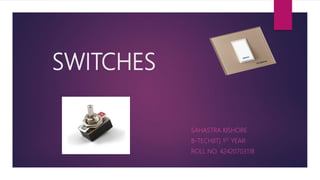
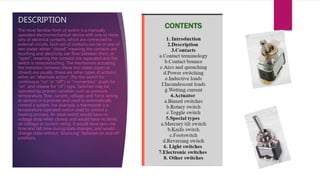
SWITCHES
SAHASTRA KISHORE
B-TECH{IT} 1ST YEAR
ROLL NO. 42420703118
INTRODUCTION
 A switch is an electrical component that can "make" or "break" an electrical circuit, interrupting the current
or diverting it from one conductor to another. The mechanism of a switch removes or restores the
conducting path in a circuit when it is operated. It may be operated manually, for example, a light switch or
a keyboard button, may be operated by a moving object such as a door, or may be operated by some
sensing element for pressure, temperature or flow. A switch will have one or more sets of contacts, which
may operate simultaneously, sequentially, or alternately. Switches in high-powered circuits must operate
rapidly to prevent destructive arcing, and may include special features to assist in rapidly interrupting a
heavy current. Multiple forms of actuators are used for operation by hand or to sense position, level,
temperature or flow. Special types are used, for example, for control of machinery, to reverse electric
motors, or to sense liquid level. Many specialized forms exist. A common use is control of lighting, where
multiple switches may be wired into one circuit to allow convenient control of light fixtures.
DESCRIPTION
The most familiar form of switch is a manually
operated electromechanical device with one or more
sets of electrical contacts, which are connected to
external circuits. Each set of contacts can be in one of
two states: either "closed" meaning the contacts are
touching and electricity can flow between them, or
"open", meaning the contacts are separated and the
switch is nonconducting. The mechanism actuating
the transition between these two states (open or
closed) are usually (there are other types of actions)
either an "alternate action" (flip the switch for
continuous "on" or "off") or "momentary" (push for
"on" and release for "of") type. Switches may be
operated by process variables such as pressure,
temperature, flow, current, voltage, and force, acting
as sensors in a process and used to automatically
control a system. For example, a thermostat is a
temperature-operated switch used to control a
heating process. An ideal switch would have no
voltage drop when closed, and would have no limits
on voltage or current rating. It would have zero rise
time and fall time during state changes, and would
change state without "bouncing" between on and off
positions.
CONTACTS
A switch has two conductive pieces, often metal, called contacts, connected to an external circuit, that touch to
complete (make) the circuit, and separate to open (break) the circuit. The contact material is chosen for its
resistance to corrosion, because most metals form insulating oxides that would prevent the switch from working.
Contact materials are also chosen on the basis of electrical conductivity, hardness (resistance to abrasive wear),
mechanical strength, low cost, low toxity.
Sometimes the contacts are plated with noble metals. They may be designed to wipe against each other to clean
off any contamination. Nonmetallic conductors, such as conductive plastic, are sometimes used. To prevent the
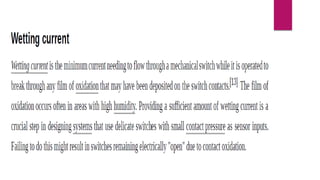
formation of insulating oxides, a minimum wetting current may be specified for a given switch design.
a. Contact Terminology
 In electronics, switches are classified according to the arrangement of their contacts. A pair of contacts is said to be
"closed" when current can flow from one to the other. When the contacts are separated by an insulating air gap,
they are said to be "open", and no current can flow between them at normal voltages. The terms "make" for
closure of contacts and "break" for opening of contacts are also widely used. The terms pole and throw are also
used to describe switch contact variations. The number of "poles" is the number of electrically separate switches
which are controlled by a single physical actuator. For example, a "2-pole" switch has two separate, parallel sets of
contacts that open and close in unison via the same mechanism. The number of "throws" is the number of separate
wiring path choices other than "open" that the switch can adopt for each pole. A single throw switch has one pair
of contacts that can either be closed or open. A double-throw switch has a contact that can be connected to either
of two other contacts, a triple-throw has a contact which can be connected to one of three other contacts, etc
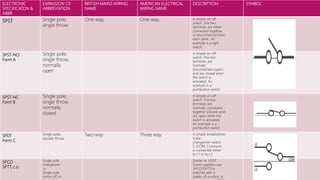
ELECTRONIC
SPECIFICATON &
ABBR.
EXPANSION OF
ABBREVIATION
BRITISH MAINS WIRING
NAME
AMERICAN ELECTRICAL
WIRING NAME
DESCRIPTION SYMBOL
SPST Single pole,
single throw
One-way One-way A simple on-off
switch: The two
terminals are either
connected together
or disconnected from
each other. An
example is a light
switch.
SPST-NO
Form A
Single pole,
single throw,
normally
open
A simple on-off
switch. The two
terminals are
normally
disconnected (open)
and are closed when
the switch is
activated. An
example is a
pushbutton switch
SPST-NC
Form B
Single pole,
single throw,
normally
closed
A simple on-off
switch. The two
terminals are
normally connected
together (closed) and
are open when the
switch is activated.
An example is a
pushbutton switch
SPDT
Form C
Single pole,
double throw
Two-way Three way A simple breakbefore-
make
changeover switch:
C (COM, Common)
is connected either
to L1 or to L2.
SPCO
SPTT, c.o.
Single pole
changeover
or
Single pole,
centre off or
Similar to SPDT.
Some suppliers use
SPCO/SPTT for
switches with a
stable off position in
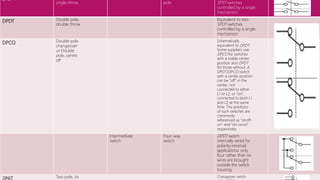
DPST
single throw pole SPST switches
controlled by a single
mechanism.
DPDT Double pole,
double throw
Equivalent to two
SPDT switches
controlled by a single
mechanism.
DPCO Double pole
changeover
or Double
pole, centre
off
Schematically
equivalent to DPDT.
Some suppliers use
DPCO for switches
with a stable center
position and DPDT
for those without. A
DPDT/DPCO switch
with a center position
can be "off" in the
center, not
connected to either
L1 or L2, or "on",
connected to both L1
and L2 at the same
time. The positions
of such switches are
commonly
referenced as "onoff-
on" and "on-onon"
respectively.
Intermediate
switch
Four-way
switch
DPDT switch
internally wired for
polarity-reversal
applications: only
four rather than six
wires are brought
outside the switch
housing.
Two pole, six Changeover switch
b. CONTACT BOUNCE
 Contact bounce (also called chatter) is a common problem with mechanical switches and relays. Switch
and relay contacts are usually made of springy metals. When the contacts strike together, their momentum
and elasticity act together to cause them to bounce apart one or more times before making steady
contact. The result is a rapidly pulsed electric current instead of a clean transition from zero to full current.
The effect is usually unimportant in power circuits, but causes problems in some analogue and logic
circuits that respond fast enough to misinterpret the on-off pulses as a data stream. The effects of contact
bounce can be eliminated by use of mercury-wetted contacts, but these are now infrequently used
because of the hazard of mercury release. Alternatively, contact circuit voltages can be low-pass filtered to
reduce or eliminate multiple pulses from appearing. In digital systems, multiple samples of the contact
state can be taken at a low rate and examined for a steady sequence, so that contacts can settle before the
contact level is considered reliable and acted upon. Bounce in SPDT switch contacts signals can be filtered
out using a SR flip-flop (latch) or Schmitt trigger. All of these methods are referred to as 'debouncing'.
c. ARCS AND QUENCHING
WHEN THE POWER BEING SWITCHED IS SUFFICIENTLY LARGE, THE ELECTRON FLOW ACROSS OPENING SWITCH CONTACTS IS
SUFFICIENT TO IONIZE THE AIR MOLECULES ACROSS THE TINY GAP BETWEEN THE CONTACTS AS THE SWITCH IS OPENED,
FORMING A GAS PLASMA, ALSO KNOWN AS AN ELECTRIC ARC. THE PLASMA IS OF LOW RESISTANCE AND IS ABLE TO
SUSTAIN POWER FLOW, EVEN WITH THE SEPARATION DISTANCE BETWEEN THE SWITCH CONTACTS STEADILY INCREASING.
THE PLASMA IS ALSO VERY HOT AND IS CAPABLE OF ERODING THE METAL SURFACES OF THE SWITCH CONTACTS. ELECTRIC
CURRENT ARCING CAUSES SIGNIFICANT DEGRADATION OF THE CONTACTS AND ALSO SIGNIFICANT ELECTROMAGNETIC
INTERFERENCE (EMI), REQUIRING THE USE OF ARC SUPPRESSION METHODS. WHERE THE VOLTAGE IS SUFFICIENTLY HIGH, AN
ARC CAN ALSO FORM AS THE SWITCH IS CLOSED AND THE CONTACTS APPROACH. IF THE VOLTAGE POTENTIAL IS SUFFICIENT
TO EXCEED THE BREAKDOWN VOLTAGE OF THE AIR SEPARATING THE CONTACTS, AN ARC FORMS WHICH IS SUSTAINED
UNTIL THE SWITCH CLOSES COMPLETELY AND THE SWITCH SURFACES MAKE CONTACT. IN EITHER CASE, THE STANDARD
METHOD FOR MINIMIZING ARC FORMATION AND PREVENTING CONTACT DAMAGE IS TO USE A FAST-MOVING SWITCH
MECHANISM, TYPICALLY USING A SPRING-OPERATED TIPPING-POINT MECHANISM TO ASSURE QUICK MOTION OF SWITCH
CONTACTS, REGARDLESS OF THE SPEED AT WHICH THE SWITCH CONTROL IS OPERATED BY THE USER. MOVEMENT OF THE
SWITCH CONTROL LEVER APPLIES TENSION TO A SPRING UNTIL A TIPPING POINT IS REACHED, AND THE CONTACTS
SUDDENLY SNAP OPEN OR CLOSED AS THE SPRING TENSION IS RELEASED.
d. POWER QUENCHING
e. INDUCTIVE LOADS
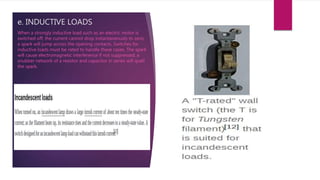
When a strongly inductive load such as an electric motor is
switched off, the current cannot drop instantaneously to zero;
a spark will jump across the opening contacts. Switches for
inductive loads must be rated to handle these cases. The spark
will cause electromagnetic interference if not suppressed; a
snubber network of a resistor and capacitor in series will quell
the spark.
ACTUATOR
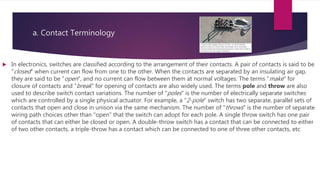
 The moving part that applies the operating force to the contacts is called the actuator, and may be a
toggle or dolly, a rocker, a push-button or any type of mechanical linkage.
a. BIASED SWITCHES
A switch normally maintains its set position once operated. A biased switch contains a mechanism that
springs it into another position when released by an operator. The momentary push-button switch is a type
of biased switch. The most common type is a "push-to-make" (or normally-open or NO) switch, which makes
contact when the button is pressed and breaks when the button is released. Each key of a computer
keyboard, for example, is a normally-open "push-to-make" switch. A "push-to-break" (or normallyclosed or
NC) switch, on the other hand, breaks contact when the button is pressed and makes contact when it is
released. An example of a push-to-break switch is a button used to release a door held closed by an
electromagnet. The interior lamp of a household refrigerator is controlled by a switch that is held open when
the door is closed.
b. ROTARY SWITCHES
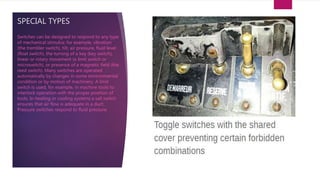
SPECIAL TYPES
Switches can be designed to respond to any type
of mechanical stimulus: for example, vibration
(the trembler switch), tilt, air pressure, fluid level
(float switch), the turning of a key (key switch),
linear or rotary movement (a limit switch or
microswitch), or presence of a magnetic field (the
reed switch). Many switches are operated
automatically by changes in some environmental
condition or by motion of machinery. A limit
switch is used, for example, in machine tools to
interlock operation with the proper position of
tools. In heating or cooling systems a sail switch
ensures that air flow is adequate in a duct.
Pressure switches respond to fluid pressure.
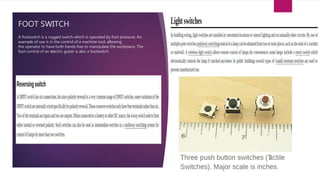
FOOT SWITCH
A footswitch is a rugged switch which is operated by foot pressure. An
example of use is in the control of a machine tool, allowing
the operator to have both hands free to manipulate the workpiece. The
foot control of an electric guitar is also a footswitch.
A relay is an electrically operated switch. Many relays use an electromagnet to operate a switching mechanism
mechanically, but other operating principles are also used. Solid-state relays control power circuits with no moving
parts, instead using a semiconductor device to perform switching—often a silicon-controlled rectifier or triac. The
analogue switch uses two MOSFET transistors in a transmission gate arrangement as a switch that works much like a
relay, with some advantages and several limitations compared to an electromechanical rela.y The power transistor(s)
in a switching voltage regulator, such as a power supply unit, are used like a switch to alternately let power flow and
block power from
flowing. Many people use metonymy to call a variety of devices "switches" that conceptually connect or disconnect
signals and
communication paths between electrical devices, analogous to the way mechanical switches connect and disconnect
paths for
electrons to flow between two conductors. Early telephone systems used an automatically operated Strowger switch to
connect
telephone callers; telephone exchanges contain one or morec rossbar switches today.
Since the advent of digital logic in the 1950s, the term switch has spread to a variety of digital active devices such as
transistors and logic gates whose function is to change their output state between two logic levels or connect different
signal lines, and even
computers, network switches, whose function is to provide connections between different ports in a computer network.
The term 'switched' is also applied to telecommunications networks, and signifies a network that is circuit switched,
providing dedicated
OTHER SWITCHES
 Centrifugal switch
 Company switch
 Dead man's switch
 Fireman's switch
 Hall-effect switch
 Inertial switch
 MEMS switch
 Optical switch
 Photonic switch
 Piezo switch
 Pull switch
 Push switch
 Sense switch
 Isolator switch
 Kill switch
 Latching switch
 Light switch
 Load control switch
 Membrane switch
 Slotted optical switch
 Stepping switch
 Thermal switch
 Time switch
 Touch switch
 Transfer switch
 Zero speed switch

Switches

  • 1.
  • 2.
    INTRODUCTION  A switchis an electrical component that can "make" or "break" an electrical circuit, interrupting the current or diverting it from one conductor to another. The mechanism of a switch removes or restores the conducting path in a circuit when it is operated. It may be operated manually, for example, a light switch or a keyboard button, may be operated by a moving object such as a door, or may be operated by some sensing element for pressure, temperature or flow. A switch will have one or more sets of contacts, which may operate simultaneously, sequentially, or alternately. Switches in high-powered circuits must operate rapidly to prevent destructive arcing, and may include special features to assist in rapidly interrupting a heavy current. Multiple forms of actuators are used for operation by hand or to sense position, level, temperature or flow. Special types are used, for example, for control of machinery, to reverse electric motors, or to sense liquid level. Many specialized forms exist. A common use is control of lighting, where multiple switches may be wired into one circuit to allow convenient control of light fixtures.
  • 3.
    DESCRIPTION The most familiarform of switch is a manually operated electromechanical device with one or more sets of electrical contacts, which are connected to external circuits. Each set of contacts can be in one of two states: either "closed" meaning the contacts are touching and electricity can flow between them, or "open", meaning the contacts are separated and the switch is nonconducting. The mechanism actuating the transition between these two states (open or closed) are usually (there are other types of actions) either an "alternate action" (flip the switch for continuous "on" or "off") or "momentary" (push for "on" and release for "of") type. Switches may be operated by process variables such as pressure, temperature, flow, current, voltage, and force, acting as sensors in a process and used to automatically control a system. For example, a thermostat is a temperature-operated switch used to control a heating process. An ideal switch would have no voltage drop when closed, and would have no limits on voltage or current rating. It would have zero rise time and fall time during state changes, and would change state without "bouncing" between on and off positions.
  • 4.
    CONTACTS A switch hastwo conductive pieces, often metal, called contacts, connected to an external circuit, that touch to complete (make) the circuit, and separate to open (break) the circuit. The contact material is chosen for its resistance to corrosion, because most metals form insulating oxides that would prevent the switch from working. Contact materials are also chosen on the basis of electrical conductivity, hardness (resistance to abrasive wear), mechanical strength, low cost, low toxity. Sometimes the contacts are plated with noble metals. They may be designed to wipe against each other to clean off any contamination. Nonmetallic conductors, such as conductive plastic, are sometimes used. To prevent the formation of insulating oxides, a minimum wetting current may be specified for a given switch design.
  • 5.
    a. Contact Terminology In electronics, switches are classified according to the arrangement of their contacts. A pair of contacts is said to be "closed" when current can flow from one to the other. When the contacts are separated by an insulating air gap, they are said to be "open", and no current can flow between them at normal voltages. The terms "make" for closure of contacts and "break" for opening of contacts are also widely used. The terms pole and throw are also used to describe switch contact variations. The number of "poles" is the number of electrically separate switches which are controlled by a single physical actuator. For example, a "2-pole" switch has two separate, parallel sets of contacts that open and close in unison via the same mechanism. The number of "throws" is the number of separate wiring path choices other than "open" that the switch can adopt for each pole. A single throw switch has one pair of contacts that can either be closed or open. A double-throw switch has a contact that can be connected to either of two other contacts, a triple-throw has a contact which can be connected to one of three other contacts, etc
  • 6.
    ELECTRONIC SPECIFICATON & ABBR. EXPANSION OF ABBREVIATION BRITISHMAINS WIRING NAME AMERICAN ELECTRICAL WIRING NAME DESCRIPTION SYMBOL SPST Single pole, single throw One-way One-way A simple on-off switch: The two terminals are either connected together or disconnected from each other. An example is a light switch. SPST-NO Form A Single pole, single throw, normally open A simple on-off switch. The two terminals are normally disconnected (open) and are closed when the switch is activated. An example is a pushbutton switch SPST-NC Form B Single pole, single throw, normally closed A simple on-off switch. The two terminals are normally connected together (closed) and are open when the switch is activated. An example is a pushbutton switch SPDT Form C Single pole, double throw Two-way Three way A simple breakbefore- make changeover switch: C (COM, Common) is connected either to L1 or to L2. SPCO SPTT, c.o. Single pole changeover or Single pole, centre off or Similar to SPDT. Some suppliers use SPCO/SPTT for switches with a stable off position in
  • 7.
    DPST single throw poleSPST switches controlled by a single mechanism. DPDT Double pole, double throw Equivalent to two SPDT switches controlled by a single mechanism. DPCO Double pole changeover or Double pole, centre off Schematically equivalent to DPDT. Some suppliers use DPCO for switches with a stable center position and DPDT for those without. A DPDT/DPCO switch with a center position can be "off" in the center, not connected to either L1 or L2, or "on", connected to both L1 and L2 at the same time. The positions of such switches are commonly referenced as "onoff- on" and "on-onon" respectively. Intermediate switch Four-way switch DPDT switch internally wired for polarity-reversal applications: only four rather than six wires are brought outside the switch housing. Two pole, six Changeover switch
  • 8.
    b. CONTACT BOUNCE Contact bounce (also called chatter) is a common problem with mechanical switches and relays. Switch and relay contacts are usually made of springy metals. When the contacts strike together, their momentum and elasticity act together to cause them to bounce apart one or more times before making steady contact. The result is a rapidly pulsed electric current instead of a clean transition from zero to full current. The effect is usually unimportant in power circuits, but causes problems in some analogue and logic circuits that respond fast enough to misinterpret the on-off pulses as a data stream. The effects of contact bounce can be eliminated by use of mercury-wetted contacts, but these are now infrequently used because of the hazard of mercury release. Alternatively, contact circuit voltages can be low-pass filtered to reduce or eliminate multiple pulses from appearing. In digital systems, multiple samples of the contact state can be taken at a low rate and examined for a steady sequence, so that contacts can settle before the contact level is considered reliable and acted upon. Bounce in SPDT switch contacts signals can be filtered out using a SR flip-flop (latch) or Schmitt trigger. All of these methods are referred to as 'debouncing'.
  • 9.
    c. ARCS ANDQUENCHING WHEN THE POWER BEING SWITCHED IS SUFFICIENTLY LARGE, THE ELECTRON FLOW ACROSS OPENING SWITCH CONTACTS IS SUFFICIENT TO IONIZE THE AIR MOLECULES ACROSS THE TINY GAP BETWEEN THE CONTACTS AS THE SWITCH IS OPENED, FORMING A GAS PLASMA, ALSO KNOWN AS AN ELECTRIC ARC. THE PLASMA IS OF LOW RESISTANCE AND IS ABLE TO SUSTAIN POWER FLOW, EVEN WITH THE SEPARATION DISTANCE BETWEEN THE SWITCH CONTACTS STEADILY INCREASING. THE PLASMA IS ALSO VERY HOT AND IS CAPABLE OF ERODING THE METAL SURFACES OF THE SWITCH CONTACTS. ELECTRIC CURRENT ARCING CAUSES SIGNIFICANT DEGRADATION OF THE CONTACTS AND ALSO SIGNIFICANT ELECTROMAGNETIC INTERFERENCE (EMI), REQUIRING THE USE OF ARC SUPPRESSION METHODS. WHERE THE VOLTAGE IS SUFFICIENTLY HIGH, AN ARC CAN ALSO FORM AS THE SWITCH IS CLOSED AND THE CONTACTS APPROACH. IF THE VOLTAGE POTENTIAL IS SUFFICIENT TO EXCEED THE BREAKDOWN VOLTAGE OF THE AIR SEPARATING THE CONTACTS, AN ARC FORMS WHICH IS SUSTAINED UNTIL THE SWITCH CLOSES COMPLETELY AND THE SWITCH SURFACES MAKE CONTACT. IN EITHER CASE, THE STANDARD METHOD FOR MINIMIZING ARC FORMATION AND PREVENTING CONTACT DAMAGE IS TO USE A FAST-MOVING SWITCH MECHANISM, TYPICALLY USING A SPRING-OPERATED TIPPING-POINT MECHANISM TO ASSURE QUICK MOTION OF SWITCH CONTACTS, REGARDLESS OF THE SPEED AT WHICH THE SWITCH CONTROL IS OPERATED BY THE USER. MOVEMENT OF THE SWITCH CONTROL LEVER APPLIES TENSION TO A SPRING UNTIL A TIPPING POINT IS REACHED, AND THE CONTACTS SUDDENLY SNAP OPEN OR CLOSED AS THE SPRING TENSION IS RELEASED.
  • 10.
  • 11.
    e. INDUCTIVE LOADS Whena strongly inductive load such as an electric motor is switched off, the current cannot drop instantaneously to zero; a spark will jump across the opening contacts. Switches for inductive loads must be rated to handle these cases. The spark will cause electromagnetic interference if not suppressed; a snubber network of a resistor and capacitor in series will quell the spark.
  • 13.
    ACTUATOR  The movingpart that applies the operating force to the contacts is called the actuator, and may be a toggle or dolly, a rocker, a push-button or any type of mechanical linkage. a. BIASED SWITCHES A switch normally maintains its set position once operated. A biased switch contains a mechanism that springs it into another position when released by an operator. The momentary push-button switch is a type of biased switch. The most common type is a "push-to-make" (or normally-open or NO) switch, which makes contact when the button is pressed and breaks when the button is released. Each key of a computer keyboard, for example, is a normally-open "push-to-make" switch. A "push-to-break" (or normallyclosed or NC) switch, on the other hand, breaks contact when the button is pressed and makes contact when it is released. An example of a push-to-break switch is a button used to release a door held closed by an electromagnet. The interior lamp of a household refrigerator is controlled by a switch that is held open when the door is closed.
  • 14.
  • 16.
    SPECIAL TYPES Switches canbe designed to respond to any type of mechanical stimulus: for example, vibration (the trembler switch), tilt, air pressure, fluid level (float switch), the turning of a key (key switch), linear or rotary movement (a limit switch or microswitch), or presence of a magnetic field (the reed switch). Many switches are operated automatically by changes in some environmental condition or by motion of machinery. A limit switch is used, for example, in machine tools to interlock operation with the proper position of tools. In heating or cooling systems a sail switch ensures that air flow is adequate in a duct. Pressure switches respond to fluid pressure.
  • 19.
    FOOT SWITCH A footswitchis a rugged switch which is operated by foot pressure. An example of use is in the control of a machine tool, allowing the operator to have both hands free to manipulate the workpiece. The foot control of an electric guitar is also a footswitch.
  • 20.
    A relay isan electrically operated switch. Many relays use an electromagnet to operate a switching mechanism mechanically, but other operating principles are also used. Solid-state relays control power circuits with no moving parts, instead using a semiconductor device to perform switching—often a silicon-controlled rectifier or triac. The analogue switch uses two MOSFET transistors in a transmission gate arrangement as a switch that works much like a relay, with some advantages and several limitations compared to an electromechanical rela.y The power transistor(s) in a switching voltage regulator, such as a power supply unit, are used like a switch to alternately let power flow and block power from flowing. Many people use metonymy to call a variety of devices "switches" that conceptually connect or disconnect signals and communication paths between electrical devices, analogous to the way mechanical switches connect and disconnect paths for electrons to flow between two conductors. Early telephone systems used an automatically operated Strowger switch to connect telephone callers; telephone exchanges contain one or morec rossbar switches today. Since the advent of digital logic in the 1950s, the term switch has spread to a variety of digital active devices such as transistors and logic gates whose function is to change their output state between two logic levels or connect different signal lines, and even computers, network switches, whose function is to provide connections between different ports in a computer network. The term 'switched' is also applied to telecommunications networks, and signifies a network that is circuit switched, providing dedicated
  • 21.
    OTHER SWITCHES  Centrifugalswitch  Company switch  Dead man's switch  Fireman's switch  Hall-effect switch  Inertial switch  MEMS switch  Optical switch  Photonic switch  Piezo switch  Pull switch  Push switch  Sense switch  Isolator switch  Kill switch  Latching switch  Light switch  Load control switch  Membrane switch  Slotted optical switch  Stepping switch  Thermal switch  Time switch  Touch switch  Transfer switch  Zero speed switch