The document outlines the fundamentals of electrical switches, explaining their types and roles in circuits. It addresses the advantages, such as increased bandwidth and reduced workload, as well as disadvantages like higher costs and security vulnerabilities. Additionally, it covers various switch types and their operational characteristics.
WHAT IS ANELECTRICAL SWITCH?
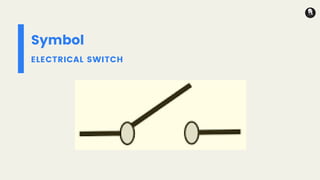
A switch in an electronic device
is used to interrupt the flow
of electricity or electric current.
Electrical switches are binary
devices, they can be either
completely off or completely
on.
Role of switchin the Circuit
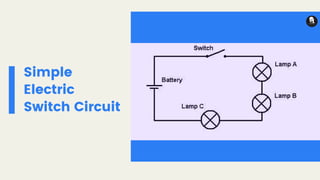
In a series circuit, devices are strung together
one after another so that whatever current flows
through one must flow through the other, each
in turn.
If the switch is open, no current will flow at all.
The switch could be placed anywhere in
the circuit and it would have the same effect.
8.
A
D
V
A
N
T
A
G
E
S
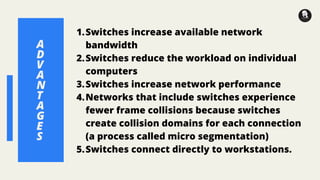
Switches increase availablenetwork
bandwidth
Switches reduce the workload on individual
computers
Switches increase network performance
Networks that include switches experience
fewer frame collisions because switches
create collision domains for each connection
(a process called micro segmentation)
Switches connect directly to workstations.
1.
2.
3.
4.
5.
9.
A
D
V
A
N
T
A
G
E
S
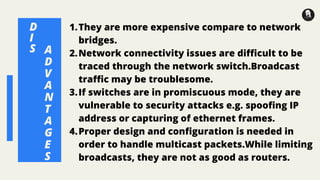
They are moreexpensive compare to network
bridges.
Network connectivity issues are difficult to be
traced through the network switch.Broadcast
traffic may be troublesome.
If switches are in promiscuous mode, they are
vulnerable to security attacks e.g. spoofing IP
address or capturing of ethernet frames.
Proper design and configuration is needed in
order to handle multicast packets.While limiting
broadcasts, they are not as good as routers.
1.
2.
3.
4.
D
I
S