








Researching
Virtual Schools

Lessons Learned Over The
     Past Five Years
Agenda
• Literature & research on virtual schooling

• Web-based design for secondary students

• Student perceptions of useful & challenging
  characteristics of virtual schooling

• What students actually do during synchronous &
  asynchronous class time
Part One


What Do We Know?


 Literature and Research on
    Virtual Schooling and
    K-12 Online Learning
Sources
• Barbour, 2007

• Rice, 2006

• Cavanaugh, 2007
Barbour, 2007 - Literature
• Benefits of virtual schooling
   – expanding educational access
   – providing high quality learning
     opportunities
   – improving student outcomes
     and skills
   – allowing for educational choice
   – administrative benefits,
     particularly administrative
     efficiency
Barbour, 2007 - Literature
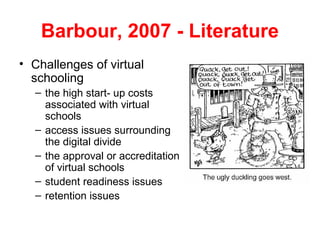
• Challenges of virtual
  schooling
  – the high start- up costs
    associated with virtual
    schools
  – access issues surrounding
    the digital divide
  – the approval or accreditation
    of virtual schools
  – student readiness issues
  – retention issues
Rice, 2006 - Research
• versus student performance
  in traditional, face-to-face
  classrooms
• studies examining the
  qualities and characteristics
  of the teaching/learning
  experience
   – learner characteristics
   – learner supports
   – affective learning domains
Cavanaugh, 2007
• rates of successful completion
  of distance education courses
  have improved over time as
  course design, instructional
  practice, support services, and
  student screening have been
  refined

• knowledge of factors that
  contribute to student success in
  virtual courses has implications
  for the types of support
  services provided to students,
  particularly counseling and
  study skill development, and for
  course design
Cavanaugh, 2007
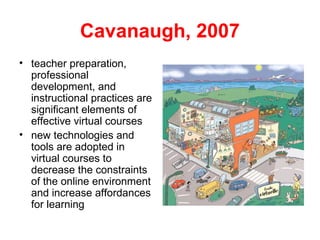
• teacher preparation,
  professional
  development, and
  instructional practices are
  significant elements of
  effective virtual courses
• new technologies and
  tools are adopted in
  virtual courses to
  decrease the constraints
  of the online environment
  and increase affordances
  for learning
Cavanaugh, 2007
• virtual school effectiveness
  is influenced by
  administrative practices
  from the school level to the
  individual student level
Bibliography
Barbour, M. K. (2007). What are they doing and how are
  they doing it? Rural student experiences in virtual
  schooling. Unpublished Dissertation, University of
  Georgia, Athens, GA.

Cavanaugh, C. (2007). Effectiveness of K-12 online
  learning. In M. G. Moore (Ed.), Handbook of Distance
  Education (2nd ed.). Mahwah, NJ: Lawrence Erlbaum
  Associates, Inc.

Rice, K. L. (2006). A comprehensive look at distance
  education in the K-12 context. Journal of Research on
  Technology in Education, 38(4), 425-448.
Questions???
Part Two


Effective web-based
design for secondary
  school students

  Experiences of Students,
    Electronic Teachers,
   and Course Developers
Why?
• there has been much research on web-based course
  design
   – Collis, 1999; Gallini & Barron, 2001-2002; Gunawardena & McIsaac,
     2004; Kanuka, 2002; McLoughlin & Oliver, 2000; Stein, 2004
• however, this research conducted in online learning has
  focused upon post-secondary institutions and corporate
  America
   – Gunawardena & McIsaac, 2004; Hill, Wiley, Nelson & Han, 2004; Kolbe
     & Bunker, 1997;
• the problem with this focus upon an adult population is
  that there is a difference between how adults learn
  compared to the way adolescents learn
   – Bright, 1989; Cavanaugh, Gillan, Kromrey, Hess & Blomeyer, 2004;
     Knowles, 1970; Moore, 1973; Vygotsky, 1962, 1978
The Studies
• Three studies
  – Teachers and developers
    in Newfoundland (Canada)
     • Jun – Aug 2004
  – Developers in Illinois
     • Nov 2004 – Feb 2005
  – Students in Newfoundland
    (Canada)
     • May – Jun 2005
The Studies
• Teachers and developers in
  Newfoundland (Canada)
   – interviews with 6 individuals
• Developers in Illinois
   – 17 completed surveys
   – interviews with 4 individuals
• Students in Newfoundland
  (Canada)
   – interviews with 2 students
   – focus group with 4 students
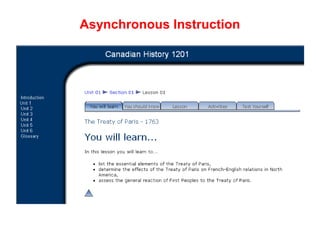
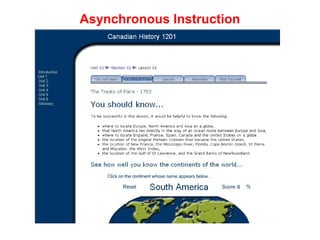
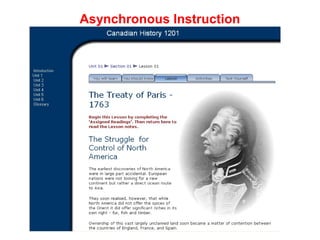
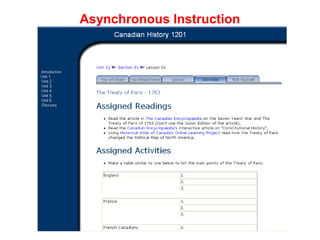
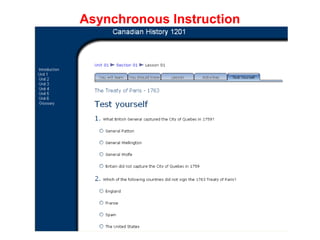
Asynchronous Instruction
Planning and preparation
Course developers
 should prior to
 beginning development
 of any of the web-
 based material, plan
 out the course with
 ideas for the individual
 lessons and specific
 items that they would
 like to include.
KISS, but not the same way all the time

Course developers
 should keep the
 navigation simple
 and to a minimum,
 but don’t present the
 material the same
 way in every lesson.
Useful and personal
Course developers
 should provide a
 summary of the
 content from the
 required readings or
 the synchronous
 lesson and include
 examples that are
 personalized to the
 students’ own context.
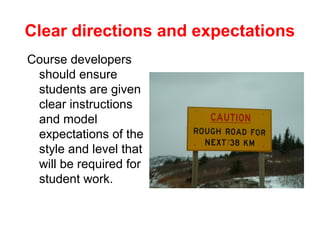
Clear directions and expectations
Course developers
 should ensure
 students are given
 clear instructions
 and model
 expectations of the
 style and level that
 will be required for
 student work.
Text, text and more text
Course developers
 should refrain from
 using too much text
 and consider the
 use of visuals to
 replace or
 supplement text
 when applicable.
Appropriate selection of tools
Course developers
 should only use
 multimedia that
 will enhances the
 content and not
 simply because it
 is available.
Who’s your audience
Course developers
 should develop
 their content for
 the average or
 below average
 student.
Do I know this
Course developers
 should provide
 opportunities for
 student to review
 what they should
 have learned.
Bibliography
Bright, B.P. (1989). Epistemological vandalism: Psychology in the study of adult
    education. In B.P. Bright (Ed.), Theory and practice in the study of adult
    education: The epistemological debate (pp. 34-64). London: Routledge.
Cavanaugh, C., Gillan, K.J., Kromrey, J., Hess, M., Blomeyer, R. (2004). The
    effectes of distance education on K-12 student outcomes: A meta-analysis.
    Naperville, IL: Learning Point Associates. Retrieved on November 24, 2004
    from http://www.ncrel.org/tech/distance/k12distance.pdf
Collins, B. (1999). Designing for differences: Cultural issues in the design of
    WWW-based course-support sites. British Journal of Educational
    Technology, 30(3), 201-215.
Gallini, J. & Barron, D. (2001-2002). Participants’ perceptions of web-infused
    environments: A survey of teaching belies, learning approaches, and
    communications. Journal of Research on Technology in Education, 34(2),
    139-156.
Gunawardena, C.N. & McIsaac, M.S. (2004) Distance education. In D.H.
    Jonassen (Ed.), Handbook of research on educational communications and
    technology (pp. 355-395). Mahwah, NJ: Lawrence Erlbaum Associates,
    Publishers.
Hill, J.R., Wiley, D., Nelson, L.M. & Han, S. (2004). Exploring research on
    Internet-based learning: From infrastructure to interactions. In D.H.
    Jonassen (Ed.), Handbook of research on educational communications and
    technology (pp. 433-460). Mahwah, NJ: Lawrence Erlbaum Associates,
    Publishers.
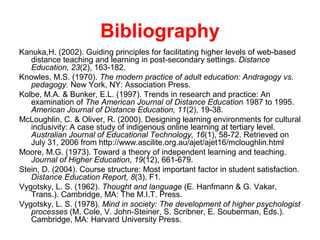
Bibliography
Kanuka,H. (2002). Guiding principles for facilitating higher levels of web-based
   distance teaching and learning in post-secondary settings. Distance
   Education, 23(2), 163-182.
Knowles, M.S. (1970). The modern practice of adult education: Andragogy vs.
   pedagogy. New York, NY: Association Press.
Kolbe, M.A. & Bunker, E.L. (1997). Trends in research and practice: An
   examination of The American Journal of Distance Education 1987 to 1995.
   American Journal of Distance Education, 11(2), 19-38.
McLoughlin, C. & Oliver, R. (2000). Designing learning environments for cultural
   inclusivity: A case study of indigenous online learning at tertiary level.
   Australian Journal of Educational Technology, 16(1), 58-72. Retrieved on
   July 31, 2006 from http://www.ascilite.org.au/ajet/ajet16/mcloughlin.html
Moore, M.G. (1973). Toward a theory of independent learning and teaching.
   Journal of Higher Education, 19(12), 661-679.
Stein, D. (2004). Course structure: Most important factor in student satisfaction.
   Distance Education Report, 8(3), F1.
Vygotsky, L. S. (1962). Thought and language (E. Hanfmann & G. Vakar,
   Trans.). Cambridge, MA: The M.I.T. Press.
Vygotsky, L. S. (1978). Mind in society: The development of higher psychologist
   processes (M. Cole, V. John-Steiner, S. Scribner, E. Souberman, Eds.).
   Cambridge, MA: Harvard University Press.
Questions???
Part Three


Student Perceptions of
   Online Learning

What do they find helpful and what
   do they find challenging?
Sample
•   eighteen schools
•   a total of 38 rural
    school students
    completed the
    survey between
    February and May
    2005
Findings
•   when asked, if they were satisfied with taking virtual
    school courses, 86.8% indicated that they were satisfied
•   when asked if they were satisfied with all of their
    experiences in their virtual school courses, only 5.3%
    selected either of the two dissatisfaction options
•   this was consistent with the low number of students
    (7.9%) who indicated that they were less satisfied with
    their virtual school courses compared to their
    classroom-based courses
•   63.2% of students indicated they were more satisfied
    with their virtual school courses
•   a little surprising, given that 50% of students stated that
    their virtual school courses were more difficult than their
    classroom-based courses
Findings
•   students reported to spending between three to
    six hours per course each week
•   only 10.5% of the students indicated that they
    could access the Internet at home, while 34.2%
    said they could accessed at a public library and
    76.3% could accessed at a friend’s home
•   81.6% stated that the reason they took the
    course through the virtual school was because it
    was the only way the course was offered, 47.4%
    wanted to try one, and 26.3% of the students
    indicated it was a required course
Findings
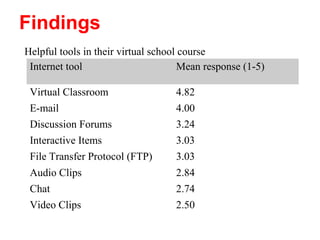
Helpful tools in their virtual school course
 Internet tool                        Mean response (1-5)

 Virtual Classroom                  4.82
 E-mail                             4.00
 Discussion Forums                  3.24
 Interactive Items                  3.03
 File Transfer Protocol (FTP)       3.03
 Audio Clips                        2.84
 Chat                               2.74
 Video Clips                        2.50
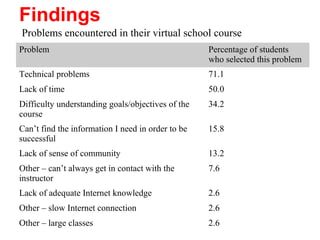
Findings
Problems encountered in their virtual school course
Problem                                            Percentage of students
                                                   who selected this problem
Technical problems                                 71.1
Lack of time                                       50.0
Difficulty understanding goals/objectives of the   34.2
course
Can’t find the information I need in order to be   15.8
successful
Lack of sense of community                         13.2
Other – can’t always get in contact with the       7.6
instructor
Lack of adequate Internet knowledge                2.6
Other – slow Internet connection                   2.6
Other – large classes                              2.6
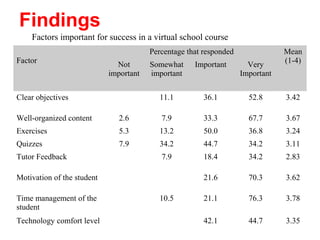
Findings
    Factors important for success in a virtual school course
                                        Percentage that responded               Mean
Factor                                                                          (1-4)
                              Not       Somewhat     Important        Very
                            important   important                   Important

Clear objectives                          11.1          36.1          52.8      3.42

Well-organized content         2.6         7.9          33.3          67.7      3.67
Exercises                      5.3        13.2          50.0          36.8      3.24
Quizzes                        7.9        34.2          44.7          34.2      3.11
Tutor Feedback                             7.9          18.4          34.2      2.83

Motivation of the student                               21.6          70.3      3.62

Time management of the                    10.5          21.1          76.3      3.78
student
Technology comfort level                                42.1          44.7      3.35
Ramifications
•   the ability of adolescents to learn in
    independent learning environments is less
    than that of adult learners because of
    differences in their development
•   the reality of the challenges being faced
    by rural schools is forcing more and more
    secondary school students into these
    independent learning environments
Ramifications
•   secondary student perceptions of the
    helpful and challenging characteristics of
    learning in this type of environment is the
    consistency between what they have
    indicated are the important factors for
    success and what the various adult
    populations have identified
Ramifications
•   there may be differences in the things that
    secondary students find useful and the
    things that they find challenging compared
    to their older counterparts
•   how to best situate them for success
    remains relatively the same: ensure that
    learners are provided with well designed
    and organized content, and provide them
    with time management and motivational
    skills to be able to work effectively in this
    independent environment
Conclusions
•   many adolescent learners probably won’t
    possess these two skills
•   more will need to be done at the secondary
    school, and even middle school level, to prepare
    students for learning in these environments
•   this is particularly true in rural jurisdictions,
    where many students do not have a choice on
    whether or not to enroll in these virtual school
    courses because this is the only means that
    they have to access, in some cases, these
    required courses
Questions???
Part Four


What are they doing and
 how are they doing it?

   Rural student experiences
      in virtual schooling
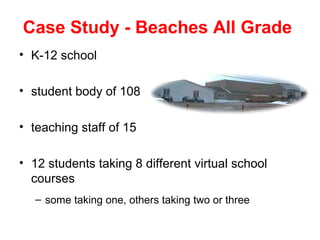
Case Study - Beaches All Grade
• K-12 school

• student body of 108

• teaching staff of 15

• 12 students taking 8 different virtual school
  courses
   – some taking one, others taking two or three
Dissertation Study
1. What are the students’ experiences
   during their synchronous time online?

2. What are the students’ experiences
   during their asynchronous time online?

3. When students require content-based
   assistance, where do they seek that
   assistance and why do they choose
   those sources?
Data Collected
• January to June 2006
• 4 monthly interviews
• 15 weeks of journal responses
• 4 different surveys
• 38 in-school classes observed
• 27 synchronous classes from 13
  different courses observed
• 13 asynchronous course
  management systems observed
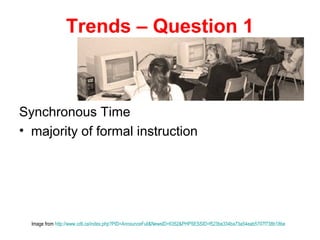
Trends – Question 1


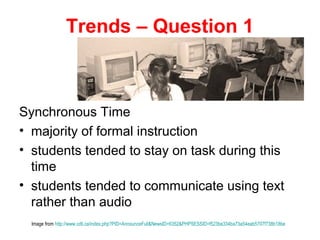
Synchronous Time
• majority of formal instruction


  Image from http://www.cdli.ca/index.php?PID=AnnounceFull&NewsID=6352&PHPSESSID=f523be334ba73a54eab5707f738b18be
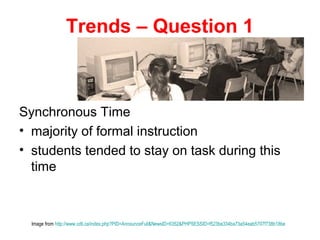
Trends – Question 1


Synchronous Time
• majority of formal instruction
• students tended to stay on task during this
  time


  Image from http://www.cdli.ca/index.php?PID=AnnounceFull&NewsID=6352&PHPSESSID=f523be334ba73a54eab5707f738b18be
Trends – Question 1


Synchronous Time
• majority of formal instruction
• students tended to stay on task during this
  time
• students tended to communicate using text
  rather than audio
  Image from http://www.cdli.ca/index.php?PID=AnnounceFull&NewsID=6352&PHPSESSID=f523be334ba73a54eab5707f738b18be
Trends – Question 2
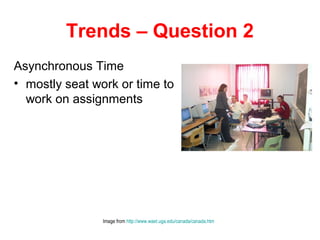
Asynchronous Time
• mostly seat work or time to
  work on assignments


                Image from http://www.waet.uga.edu/canada/canada.htm
Trends – Question 2
Asynchronous Time
• mostly seat work or time to
  work on assignments
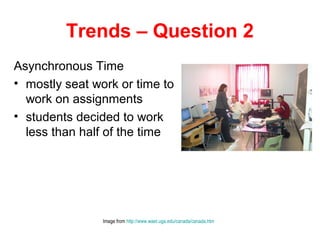
• students decided to work
  less than half of the time


                Image from http://www.waet.uga.edu/canada/canada.htm
Trends – Question 2
Asynchronous Time
• mostly seat work or time to
  work on assignments
• students decided to work
  less than half of the time
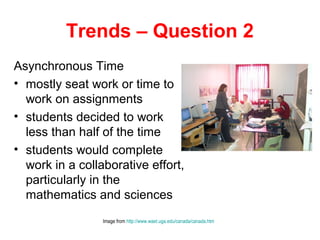
• students would complete
  work in a collaborative effort,
  particularly in the
  mathematics and sciences
                 Image from http://www.waet.uga.edu/canada/canada.htm
Trends – Question 3
Turning for Help
• students did not use sources
  of support provided
Trends – Question 3
Turning for Help
• students did not use sources
  of support provided
• students primarily relied upon
  each other for support
Trends – Question 3
Turning for Help
• students did not use sources
  of support provided
• students primarily relied upon
  each other for support
• students used their e-teacher
Trends – Question 3
Turning for Help
• students did not use sources
  of support provided
• students primarily relied upon
  each other for support
• students used their e-teacher
• students used their in-school
  teachers
Implications for Practitioners
• to provide more engaging and
  challenging asynchronous
  activities to try and encourage
  more on-task behaviors


             Image from http://www.prism-magazine.org/nov00/briefings/teacher.jpg
Implications for Practitioners
• to provide more engaging and
  challenging asynchronous
  activities to try and encourage
  more on-task behaviors
• to devise strategies that allow
  students to get to know their online
  classmates better in an attempt to
  develop a sense of community
  online


             Image from http://www.prism-magazine.org/nov00/briefings/teacher.jpg
Implications for Practitioners
• to provide more engaging and
  challenging asynchronous
  activities to try and encourage
  more on-task behaviors
• to devise strategies that allow
  students to get to know their online
  classmates better in an attempt to
  develop a sense of community
  online
• to inform students of, and when
  and how to use, all of the various
  sources of academic support that
  are made available to them

             Image from http://www.prism-magazine.org/nov00/briefings/teacher.jpg
Questions???
Contact Information
Michael K. Barbour
 Assistant Professor
 Department of Administrative and
  Organizational Studies
 Wayne State University

   mkbarbour@gmail.com
   http://www.michaelbarbour.com

IVHS Summer 2007 PD - Researching Virtual Schools

  • 1.
  • 2.
    Agenda • Literature &research on virtual schooling • Web-based design for secondary students • Student perceptions of useful & challenging characteristics of virtual schooling • What students actually do during synchronous & asynchronous class time
  • 3.
    Part One What DoWe Know? Literature and Research on Virtual Schooling and K-12 Online Learning
  • 4.
    Sources • Barbour, 2007 •Rice, 2006 • Cavanaugh, 2007
  • 5.
    Barbour, 2007 -Literature • Benefits of virtual schooling – expanding educational access – providing high quality learning opportunities – improving student outcomes and skills – allowing for educational choice – administrative benefits, particularly administrative efficiency
  • 6.
    Barbour, 2007 -Literature • Challenges of virtual schooling – the high start- up costs associated with virtual schools – access issues surrounding the digital divide – the approval or accreditation of virtual schools – student readiness issues – retention issues
  • 7.
    Rice, 2006 -Research • versus student performance in traditional, face-to-face classrooms • studies examining the qualities and characteristics of the teaching/learning experience – learner characteristics – learner supports – affective learning domains
  • 8.
    Cavanaugh, 2007 • ratesof successful completion of distance education courses have improved over time as course design, instructional practice, support services, and student screening have been refined • knowledge of factors that contribute to student success in virtual courses has implications for the types of support services provided to students, particularly counseling and study skill development, and for course design
  • 9.
    Cavanaugh, 2007 • teacherpreparation, professional development, and instructional practices are significant elements of effective virtual courses • new technologies and tools are adopted in virtual courses to decrease the constraints of the online environment and increase affordances for learning
  • 10.
    Cavanaugh, 2007 • virtualschool effectiveness is influenced by administrative practices from the school level to the individual student level
  • 11.
    Bibliography Barbour, M. K.(2007). What are they doing and how are they doing it? Rural student experiences in virtual schooling. Unpublished Dissertation, University of Georgia, Athens, GA. Cavanaugh, C. (2007). Effectiveness of K-12 online learning. In M. G. Moore (Ed.), Handbook of Distance Education (2nd ed.). Mahwah, NJ: Lawrence Erlbaum Associates, Inc. Rice, K. L. (2006). A comprehensive look at distance education in the K-12 context. Journal of Research on Technology in Education, 38(4), 425-448.
  • 12.
  • 13.
    Part Two Effective web-based designfor secondary school students Experiences of Students, Electronic Teachers, and Course Developers
  • 14.
    Why? • there hasbeen much research on web-based course design – Collis, 1999; Gallini & Barron, 2001-2002; Gunawardena & McIsaac, 2004; Kanuka, 2002; McLoughlin & Oliver, 2000; Stein, 2004 • however, this research conducted in online learning has focused upon post-secondary institutions and corporate America – Gunawardena & McIsaac, 2004; Hill, Wiley, Nelson & Han, 2004; Kolbe & Bunker, 1997; • the problem with this focus upon an adult population is that there is a difference between how adults learn compared to the way adolescents learn – Bright, 1989; Cavanaugh, Gillan, Kromrey, Hess & Blomeyer, 2004; Knowles, 1970; Moore, 1973; Vygotsky, 1962, 1978
  • 15.
    The Studies • Threestudies – Teachers and developers in Newfoundland (Canada) • Jun – Aug 2004 – Developers in Illinois • Nov 2004 – Feb 2005 – Students in Newfoundland (Canada) • May – Jun 2005
  • 16.
    The Studies • Teachersand developers in Newfoundland (Canada) – interviews with 6 individuals • Developers in Illinois – 17 completed surveys – interviews with 4 individuals • Students in Newfoundland (Canada) – interviews with 2 students – focus group with 4 students
  • 17.
  • 18.
  • 19.
  • 20.
  • 21.
  • 22.
    Planning and preparation Coursedevelopers should prior to beginning development of any of the web- based material, plan out the course with ideas for the individual lessons and specific items that they would like to include.
  • 23.
    KISS, but notthe same way all the time Course developers should keep the navigation simple and to a minimum, but don’t present the material the same way in every lesson.
  • 24.
    Useful and personal Coursedevelopers should provide a summary of the content from the required readings or the synchronous lesson and include examples that are personalized to the students’ own context.
  • 25.
    Clear directions andexpectations Course developers should ensure students are given clear instructions and model expectations of the style and level that will be required for student work.
  • 26.
    Text, text andmore text Course developers should refrain from using too much text and consider the use of visuals to replace or supplement text when applicable.
  • 27.
    Appropriate selection oftools Course developers should only use multimedia that will enhances the content and not simply because it is available.
  • 28.
    Who’s your audience Coursedevelopers should develop their content for the average or below average student.
  • 29.
    Do I knowthis Course developers should provide opportunities for student to review what they should have learned.
  • 30.
    Bibliography Bright, B.P. (1989).Epistemological vandalism: Psychology in the study of adult education. In B.P. Bright (Ed.), Theory and practice in the study of adult education: The epistemological debate (pp. 34-64). London: Routledge. Cavanaugh, C., Gillan, K.J., Kromrey, J., Hess, M., Blomeyer, R. (2004). The effectes of distance education on K-12 student outcomes: A meta-analysis. Naperville, IL: Learning Point Associates. Retrieved on November 24, 2004 from http://www.ncrel.org/tech/distance/k12distance.pdf Collins, B. (1999). Designing for differences: Cultural issues in the design of WWW-based course-support sites. British Journal of Educational Technology, 30(3), 201-215. Gallini, J. & Barron, D. (2001-2002). Participants’ perceptions of web-infused environments: A survey of teaching belies, learning approaches, and communications. Journal of Research on Technology in Education, 34(2), 139-156. Gunawardena, C.N. & McIsaac, M.S. (2004) Distance education. In D.H. Jonassen (Ed.), Handbook of research on educational communications and technology (pp. 355-395). Mahwah, NJ: Lawrence Erlbaum Associates, Publishers. Hill, J.R., Wiley, D., Nelson, L.M. & Han, S. (2004). Exploring research on Internet-based learning: From infrastructure to interactions. In D.H. Jonassen (Ed.), Handbook of research on educational communications and technology (pp. 433-460). Mahwah, NJ: Lawrence Erlbaum Associates, Publishers.
  • 31.
    Bibliography Kanuka,H. (2002). Guidingprinciples for facilitating higher levels of web-based distance teaching and learning in post-secondary settings. Distance Education, 23(2), 163-182. Knowles, M.S. (1970). The modern practice of adult education: Andragogy vs. pedagogy. New York, NY: Association Press. Kolbe, M.A. & Bunker, E.L. (1997). Trends in research and practice: An examination of The American Journal of Distance Education 1987 to 1995. American Journal of Distance Education, 11(2), 19-38. McLoughlin, C. & Oliver, R. (2000). Designing learning environments for cultural inclusivity: A case study of indigenous online learning at tertiary level. Australian Journal of Educational Technology, 16(1), 58-72. Retrieved on July 31, 2006 from http://www.ascilite.org.au/ajet/ajet16/mcloughlin.html Moore, M.G. (1973). Toward a theory of independent learning and teaching. Journal of Higher Education, 19(12), 661-679. Stein, D. (2004). Course structure: Most important factor in student satisfaction. Distance Education Report, 8(3), F1. Vygotsky, L. S. (1962). Thought and language (E. Hanfmann & G. Vakar, Trans.). Cambridge, MA: The M.I.T. Press. Vygotsky, L. S. (1978). Mind in society: The development of higher psychologist processes (M. Cole, V. John-Steiner, S. Scribner, E. Souberman, Eds.). Cambridge, MA: Harvard University Press.
  • 32.
  • 33.
    Part Three Student Perceptionsof Online Learning What do they find helpful and what do they find challenging?
  • 34.
    Sample • eighteen schools • a total of 38 rural school students completed the survey between February and May 2005
  • 35.
    Findings • when asked, if they were satisfied with taking virtual school courses, 86.8% indicated that they were satisfied • when asked if they were satisfied with all of their experiences in their virtual school courses, only 5.3% selected either of the two dissatisfaction options • this was consistent with the low number of students (7.9%) who indicated that they were less satisfied with their virtual school courses compared to their classroom-based courses • 63.2% of students indicated they were more satisfied with their virtual school courses • a little surprising, given that 50% of students stated that their virtual school courses were more difficult than their classroom-based courses
  • 36.
    Findings • students reported to spending between three to six hours per course each week • only 10.5% of the students indicated that they could access the Internet at home, while 34.2% said they could accessed at a public library and 76.3% could accessed at a friend’s home • 81.6% stated that the reason they took the course through the virtual school was because it was the only way the course was offered, 47.4% wanted to try one, and 26.3% of the students indicated it was a required course
  • 37.
    Findings Helpful tools intheir virtual school course Internet tool Mean response (1-5) Virtual Classroom 4.82 E-mail 4.00 Discussion Forums 3.24 Interactive Items 3.03 File Transfer Protocol (FTP) 3.03 Audio Clips 2.84 Chat 2.74 Video Clips 2.50
  • 38.
    Findings Problems encountered intheir virtual school course Problem Percentage of students who selected this problem Technical problems 71.1 Lack of time 50.0 Difficulty understanding goals/objectives of the 34.2 course Can’t find the information I need in order to be 15.8 successful Lack of sense of community 13.2 Other – can’t always get in contact with the 7.6 instructor Lack of adequate Internet knowledge 2.6 Other – slow Internet connection 2.6 Other – large classes 2.6
  • 39.
    Findings Factors important for success in a virtual school course Percentage that responded Mean Factor (1-4) Not Somewhat Important Very important important Important Clear objectives 11.1 36.1 52.8 3.42 Well-organized content 2.6 7.9 33.3 67.7 3.67 Exercises 5.3 13.2 50.0 36.8 3.24 Quizzes 7.9 34.2 44.7 34.2 3.11 Tutor Feedback 7.9 18.4 34.2 2.83 Motivation of the student 21.6 70.3 3.62 Time management of the 10.5 21.1 76.3 3.78 student Technology comfort level 42.1 44.7 3.35
  • 40.
    Ramifications • the ability of adolescents to learn in independent learning environments is less than that of adult learners because of differences in their development • the reality of the challenges being faced by rural schools is forcing more and more secondary school students into these independent learning environments
  • 41.
    Ramifications • secondary student perceptions of the helpful and challenging characteristics of learning in this type of environment is the consistency between what they have indicated are the important factors for success and what the various adult populations have identified
  • 42.
    Ramifications • there may be differences in the things that secondary students find useful and the things that they find challenging compared to their older counterparts • how to best situate them for success remains relatively the same: ensure that learners are provided with well designed and organized content, and provide them with time management and motivational skills to be able to work effectively in this independent environment
  • 43.
    Conclusions • many adolescent learners probably won’t possess these two skills • more will need to be done at the secondary school, and even middle school level, to prepare students for learning in these environments • this is particularly true in rural jurisdictions, where many students do not have a choice on whether or not to enroll in these virtual school courses because this is the only means that they have to access, in some cases, these required courses
  • 44.
  • 45.
    Part Four What arethey doing and how are they doing it? Rural student experiences in virtual schooling
  • 46.
    Case Study -Beaches All Grade • K-12 school • student body of 108 • teaching staff of 15 • 12 students taking 8 different virtual school courses – some taking one, others taking two or three
  • 47.
    Dissertation Study 1. Whatare the students’ experiences during their synchronous time online? 2. What are the students’ experiences during their asynchronous time online? 3. When students require content-based assistance, where do they seek that assistance and why do they choose those sources?
  • 48.
    Data Collected • Januaryto June 2006 • 4 monthly interviews • 15 weeks of journal responses • 4 different surveys • 38 in-school classes observed • 27 synchronous classes from 13 different courses observed • 13 asynchronous course management systems observed
  • 49.
    Trends – Question1 Synchronous Time • majority of formal instruction Image from http://www.cdli.ca/index.php?PID=AnnounceFull&NewsID=6352&PHPSESSID=f523be334ba73a54eab5707f738b18be
  • 50.
    Trends – Question1 Synchronous Time • majority of formal instruction • students tended to stay on task during this time Image from http://www.cdli.ca/index.php?PID=AnnounceFull&NewsID=6352&PHPSESSID=f523be334ba73a54eab5707f738b18be
  • 51.
    Trends – Question1 Synchronous Time • majority of formal instruction • students tended to stay on task during this time • students tended to communicate using text rather than audio Image from http://www.cdli.ca/index.php?PID=AnnounceFull&NewsID=6352&PHPSESSID=f523be334ba73a54eab5707f738b18be
  • 52.
    Trends – Question2 Asynchronous Time • mostly seat work or time to work on assignments Image from http://www.waet.uga.edu/canada/canada.htm
  • 53.
    Trends – Question2 Asynchronous Time • mostly seat work or time to work on assignments • students decided to work less than half of the time Image from http://www.waet.uga.edu/canada/canada.htm
  • 54.
    Trends – Question2 Asynchronous Time • mostly seat work or time to work on assignments • students decided to work less than half of the time • students would complete work in a collaborative effort, particularly in the mathematics and sciences Image from http://www.waet.uga.edu/canada/canada.htm
  • 55.
    Trends – Question3 Turning for Help • students did not use sources of support provided
  • 56.
    Trends – Question3 Turning for Help • students did not use sources of support provided • students primarily relied upon each other for support
  • 57.
    Trends – Question3 Turning for Help • students did not use sources of support provided • students primarily relied upon each other for support • students used their e-teacher
  • 58.
    Trends – Question3 Turning for Help • students did not use sources of support provided • students primarily relied upon each other for support • students used their e-teacher • students used their in-school teachers
  • 59.
    Implications for Practitioners •to provide more engaging and challenging asynchronous activities to try and encourage more on-task behaviors Image from http://www.prism-magazine.org/nov00/briefings/teacher.jpg
  • 60.
    Implications for Practitioners •to provide more engaging and challenging asynchronous activities to try and encourage more on-task behaviors • to devise strategies that allow students to get to know their online classmates better in an attempt to develop a sense of community online Image from http://www.prism-magazine.org/nov00/briefings/teacher.jpg
  • 61.
    Implications for Practitioners •to provide more engaging and challenging asynchronous activities to try and encourage more on-task behaviors • to devise strategies that allow students to get to know their online classmates better in an attempt to develop a sense of community online • to inform students of, and when and how to use, all of the various sources of academic support that are made available to them Image from http://www.prism-magazine.org/nov00/briefings/teacher.jpg
  • 62.
  • 63.
    Contact Information Michael K.Barbour Assistant Professor Department of Administrative and Organizational Studies Wayne State University mkbarbour@gmail.com http://www.michaelbarbour.com