THE STATE UNIVERSITY OF ZANZIBAR
(SUZA)
1
By Nahoda, A.M
Ethic and development
• Content
i. Definitions and concepts and theories;
ii. Civic ethic and professional ethics
iii. Responsible citizenship
Ethics
• The word Ethics originate from Greek word
“ETHOS”. The word means traditionally and
generally accepted way of behaving of doing
things.
• the systematic study of rightness and
wrongness of human conduct and character as
know by natural reason
• Is the systems of value and custom
instantiated (represented by) in the lives of
particular groups of human beings
Ethics
• Ethics is the word that refers to morals, values,
and beliefs of the individuals, family or the
society
• Ethics is the branch of philosophy concerned
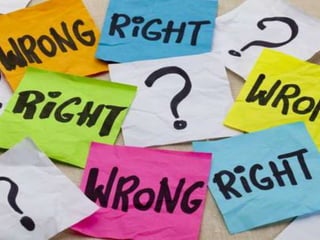
with distinguishing the right from the wrong.
• Almost all social groups, from the smallest
voluntary association to whole societies,
generate and promote ethical codes; that is,
they socialise their members into a
conception of moral and immoral action
Ethics
• Three concepts central to the subject matter
of ethics are distinguished:
1) Good (which refers to the ideal, or the thing
that is desired); (virtue)
2) Right (what is not wrong); and
3) Ought (which refers to obligation, duty, or
responsibility, both of the individual and of
the society).
Ethics
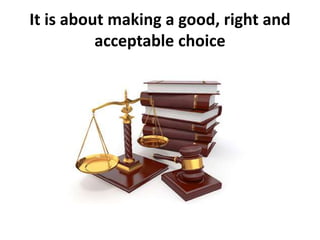
It is about making a good, right and
acceptable choice
Forms of ethics
Ethics
Morals:
• Morality is concerned with principles and
practices of morals such as:
• (a) What ought or ought not to be done in a
given situation?
• (b) What is right or wrong about the handling
of a situation? and
• (c) What is good or bad about the people,
policies, and ideals involved?
Ethics
Morals Principles
 Beneficence – Bringing about good
 Nonmaleficence – Preventing harm, to do no
harm
 Autonomy – Self-reliance, independence,
liberty rights, individual choice, freedom of
will
 Veracity – Telling the truth
 Fidelity – Being faithful
 Justice – Acting with fairness or equity
What is your conclusion?
Abort
Or
Keep the baby
WHY?
What is your conclusion?
Abort
Or
Keep the baby
WHY?
14
Ethics
core moral values
• Rushmore Kidder’s research identified 5 core
moral values
– Honesty
– Respect
– Responsibility
– Fairness
– Compassion
Ethics
• Etiquette — correct behavior and practices
according to social convention.
– Often not formally addressed.
– Often critical to your success.
– Nonconformance to standards of etiquette may cost
you a job, a sale, a deal, or a promotion.
• Etiquette determines what is polite behavior
ETHICS, MORALITY AND ETIQUETTE
• It’s hard to make a distinction between these
three terms because they are closely related.
• Morality is a differentiation of actions between
those that are right and wrong
• Etiquette is a code that governs social behaviour
within a society, class or group.
• Ethics is the philosophy of moral values.
Distinction between ethics, etiquette and morality
Difference between these three terms is that
morality defines our character, while ethics points
towards application of morality and etiquette
focuses on behaviour in a certain setting.
Ethical dilemmas
• Ethical dilemmas, also known as
a moral dilemmas, are situations in which
there is a choice to be made between two
options, neither of which resolves the
situation in an ethically acceptable fashion.
• There are three conditions that must be
present for a situation to be considered an
ethical dilemma.
Ethical dilemmas
• The first condition occurs in situations when an
individual, called the “agent,” must make a
decision about which course of action is best.
• The second condition for ethical dilemma is that
there must be different courses of action to
choose from.
• Third, in an ethical dilemma, no matter what
course of action is taken, some ethical principle is
compromised. In other words, there is no perfect
solution.
What is an Ethical Question?
● Ethical questions often involve the words “ought” or
“should,” implying a difficult decision must be made.
● There are several alternate solutions, none of that is without
some challenging or problematic aspect.
● They contain conflicting moral choices and dilemmas, and
the underlying values of the people involved may clash.
● They have no right or wrong answer which satisfies all
parties, but better or worse answers based on well-
reasoned justifications.
Ways of classifying ethical dilemmas
• Truth vs Loyalty - this is about being honest while
keeping one's promises. Truth tends to be about
accurately reporting the fact. Loyalty is about feelings
of allegiance to a friend, a group, or a set of ideas.
• Individual vs Community - this is about placing the
interests of the individual against those of the larger
community.
• Short Term vs Long Term - this is about requirements of
the present against the need for a safe and secure
future.
• Justice vs Mercy - this is about the conflict between
fairness and equal treatment on the one hand and
compassion and understanding of special
circumstances on the other.
Solving an ethical dilemma
■ Four components to solve an ethical
dilemma:
1. Identify the problem
2. Develop alternative solutions
3. Select the best solution
4. Defend your selection
Ethical theories
Ethical theories
• Ethical theories are sometimes classified into
three basic types: virtue, deontological, and
consequentialist theories
• Virtue theories take judgments about persons or
agents as the most basic;
• Duty-based or Deontological ethics
• Deontological theories take judgments about
actions;
• Consequential theories look at consequences
Ethical theories
Ethical theories
• Who is responsible? Who did it? Virtue
theories
• What was done? Deontological theories take
judgments about actions;
• What is the impact/ effect of the action/
behaviour? Consequential theories look at
consequences
Deontological Theories
Emphasize the nature of the act
Some acts are inherently good or right and
some acts are inherently wrong or bad
Deontological theories have in common the
view that we have an inherent duty to perform
right actions and avoid bad actions
Consequences
Actions based on the foreseeable outcome
of a course of decision
Ethical theories that focus primarily on
consequences in determining moral
rightness or wrongness are called:
Teleological Ethics
Utilitarianism is the most famous of these
and requires us to do what is likeliest to
have the best consequences
Virtue
Ethical theories that emphasize character,
or virtue are virtue theories
Good character traits are virtues
Bad character traits are vices
Aristotle maintained that the development
of virtuous character traits is needed to
ensure that we habitually act rightly
Vital to empower our character with the
tendency to do good
Virtue
A virtue ethicist is likely to give you this kind of
moral advice: “Act as a virtuous person would
act in your situation.”
 virtuous person is someone who has ideal
character traits. These traits derive from natural
internal tendencies, but need to be nurtured;
however, once established, they will become
stable.
Civic ethic
• Civic ethics are the moral duties and rights, as
a citizen of the village or the country or an
integral part of the society and environment.
• An individual may exhibit civic ethics by
voting, volunteering, and organizing welfare
groups and meetings
• In modern state obligation and rights of the
citizens are normally enshrined in the
constitution.
Civic ethic
• Rights enshrined in the URT constitution are:
• The Right to Equality
• The Right to Life
• Right to personal freedom
• Right to privacy and personal security
• Right to freedom of movement
• Right to freedom of religion
• Freedom to participate in public affairs
• Right to work
• Right to own property
• Right to freedom of association
Civic ethic
• The citizen also have the following duties:
• Duty to participate in work
• Duty to abide by the laws of the land
• Duty to safeguard public property
• Duty to defend the nation
Work ethics
• Work ethics is defined as a set of attitudes
concerned with the value of work, which
forms the motivational orientation.
• Work ethics are very common in the public
services, private sectors but most commonly
in the profession.
• Profession such as engineering, doctor,
lawyers, bankers and journalist need ethics
code of conducts,
Codes of ethics
• Codes refer to any of various systems or
collection of principles, rules, or regulations
that do not constitute a legal code.
• A set of rule of procedures and standard of
materials designed to secure uniformity and
protect public interest.
• The ‘codes of ethics’ exhibit, rights, duties,
and obligations of the members of a
profession and a professional society
CODE OF ETHICS AND CONDUCT FOR
THE PUBLIC SERVICE TANZANIA
In order for the Public Service to be efficient and
respected Public Servants must behave and conduct
themselves in the following manners :-
• 1. Respect all Human Rights and be courteous;
• 2. Perform diligently and in a disciplined manner;
• 3. Promote team work;
• 4. Pursue excellence in service;
CODE OF ETHICS AND CONDUCTFOR
THE PUBLIC SERVICE TANZANIA
• 4. Pursue excellence in service;
• 5. Exercise responsibility and good
stewardship;
• 6. Promote transparency and accountability;
• 7. Discharge duties with integrity, and
• 8. Maintain political neutrality.
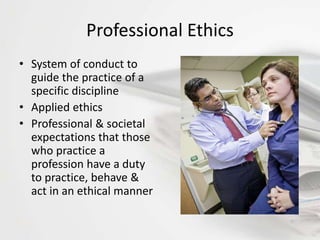
Professional Ethics
• System of conduct to
guide the practice of a
specific discipline
• Applied ethics
• Professional & societal
expectations that those
who practice a
profession have a duty
to practice, behave &
act in an ethical manner
Professional Ethics
• Professional ethics is related to the moral issues
which arise on account of specialized know how
which professionals attain, and how the use of
this knowledge should be governed when
providing a service to the public
• Professional ethics also deals with the person's
professional associations or qualifications ethics.
• Professional ethics are specific to a particular
profession such as Medical doctors, etc
significances of Professional Ethics
• As occupations become more specialized, the
ethical issues become more specialized
• Professional societies have increased efforts
to establish ethical codes to guide members
• There is regulatory oversight, public
protection against misbehaviors
• It creates group identity due to share
education, training, requirements for
admission
significances of Professional Ethics
• Special uncommon knowledge is used in the
service of others… positive social need
• Professional involves individual judgment,
(some) autonomy in decisions
• Profess adherence to certain values
• Penalties for substandard performance
Ethical person
A person is ethical:
• If he does what he ought to do.
• If he does what he should do.
• If he perform his duties
• If he has high morals and does what is right.
Responsible Citizenship
• A responsible citizen is the one who act according
to his rights and perform his duties.
• A responsible citizen is an ethical person
• Becoming and staying informed eg through
Newspapers, news, radio, education,..
• Participating in democracy eg by voting
• Abiding by Rules and Laws
• Consideration of others eg through charitable
work, donations, volunteering,…
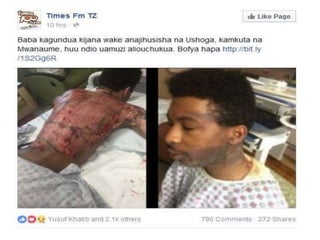
Is this an ethical person? why?
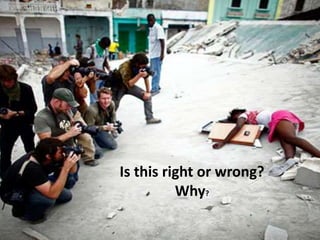
Is this right or wrong?
Why?
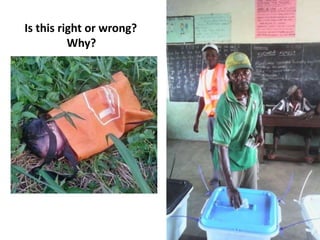
Is this right or wrong?
Why?
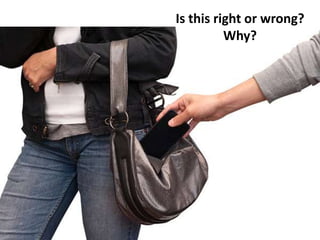
Is this right or wrong?
Why?
Is this right or wrong?
Why?
Is this right or wrong?
Why?
Seminar Questions
3. Most of the social evils such as rapping,
robbery, abortion and bribery are due to lack
of ethical principle in those who commit
these evils. Justify the statement.
4. What is the significances of having code of
ethics in the work place?
5. Discuss the differences between work ethics
and professional ethics
6. What knowledge and skills will you use in
solving ethical dilemmas?
REFERENCES
Blackburn, Simon. (2001).Ethics: A Very Short Introduction.
Oxford:Oxford University Press
Craig, Adward(ed). (2005) The shorter Routledge encyclopedia of
philosophy. London: Routledge.
Lanone,A.P (2001). Dictionary of World Philosophy. London: Routledge.
Naagarazan,R.S. (2006). A Texts Book of Professional ethics and Human
values.New Delhi: New Age International
URT. 1977 Constitution of the United Republic of Tanzania.
URT. A Code of Ethics and Conduct for the Public Service
Warburton, Nigel. (ed). (2005)Philosophy: Basic Readings .London:
Routledge.
Weston, Anthony. (2006). A practical companion to ethics. Oxford:
Oxford University Press.

Suza dds 05 ethics and development show

  • 1.
    THE STATE UNIVERSITYOF ZANZIBAR (SUZA) 1 By Nahoda, A.M
  • 2.
    Ethic and development •Content i. Definitions and concepts and theories; ii. Civic ethic and professional ethics iii. Responsible citizenship
  • 3.
    Ethics • The wordEthics originate from Greek word “ETHOS”. The word means traditionally and generally accepted way of behaving of doing things. • the systematic study of rightness and wrongness of human conduct and character as know by natural reason • Is the systems of value and custom instantiated (represented by) in the lives of particular groups of human beings
  • 4.
    Ethics • Ethics isthe word that refers to morals, values, and beliefs of the individuals, family or the society • Ethics is the branch of philosophy concerned with distinguishing the right from the wrong. • Almost all social groups, from the smallest voluntary association to whole societies, generate and promote ethical codes; that is, they socialise their members into a conception of moral and immoral action
  • 6.
    Ethics • Three conceptscentral to the subject matter of ethics are distinguished: 1) Good (which refers to the ideal, or the thing that is desired); (virtue) 2) Right (what is not wrong); and 3) Ought (which refers to obligation, duty, or responsibility, both of the individual and of the society).
  • 7.
  • 8.
    It is aboutmaking a good, right and acceptable choice
  • 9.
  • 10.
    Ethics Morals: • Morality isconcerned with principles and practices of morals such as: • (a) What ought or ought not to be done in a given situation? • (b) What is right or wrong about the handling of a situation? and • (c) What is good or bad about the people, policies, and ideals involved?
  • 11.
    Ethics Morals Principles  Beneficence– Bringing about good  Nonmaleficence – Preventing harm, to do no harm  Autonomy – Self-reliance, independence, liberty rights, individual choice, freedom of will  Veracity – Telling the truth  Fidelity – Being faithful  Justice – Acting with fairness or equity
  • 12.
    What is yourconclusion? Abort Or Keep the baby WHY?
  • 13.
    What is yourconclusion? Abort Or Keep the baby WHY?
  • 14.
    14 Ethics core moral values •Rushmore Kidder’s research identified 5 core moral values – Honesty – Respect – Responsibility – Fairness – Compassion
  • 15.
    Ethics • Etiquette —correct behavior and practices according to social convention. – Often not formally addressed. – Often critical to your success. – Nonconformance to standards of etiquette may cost you a job, a sale, a deal, or a promotion. • Etiquette determines what is polite behavior
  • 16.
    ETHICS, MORALITY ANDETIQUETTE • It’s hard to make a distinction between these three terms because they are closely related. • Morality is a differentiation of actions between those that are right and wrong • Etiquette is a code that governs social behaviour within a society, class or group. • Ethics is the philosophy of moral values. Distinction between ethics, etiquette and morality Difference between these three terms is that morality defines our character, while ethics points towards application of morality and etiquette focuses on behaviour in a certain setting.
  • 17.
    Ethical dilemmas • Ethicaldilemmas, also known as a moral dilemmas, are situations in which there is a choice to be made between two options, neither of which resolves the situation in an ethically acceptable fashion. • There are three conditions that must be present for a situation to be considered an ethical dilemma.
  • 18.
    Ethical dilemmas • Thefirst condition occurs in situations when an individual, called the “agent,” must make a decision about which course of action is best. • The second condition for ethical dilemma is that there must be different courses of action to choose from. • Third, in an ethical dilemma, no matter what course of action is taken, some ethical principle is compromised. In other words, there is no perfect solution.
  • 19.
    What is anEthical Question? ● Ethical questions often involve the words “ought” or “should,” implying a difficult decision must be made. ● There are several alternate solutions, none of that is without some challenging or problematic aspect. ● They contain conflicting moral choices and dilemmas, and the underlying values of the people involved may clash. ● They have no right or wrong answer which satisfies all parties, but better or worse answers based on well- reasoned justifications.
  • 23.
    Ways of classifyingethical dilemmas • Truth vs Loyalty - this is about being honest while keeping one's promises. Truth tends to be about accurately reporting the fact. Loyalty is about feelings of allegiance to a friend, a group, or a set of ideas. • Individual vs Community - this is about placing the interests of the individual against those of the larger community. • Short Term vs Long Term - this is about requirements of the present against the need for a safe and secure future. • Justice vs Mercy - this is about the conflict between fairness and equal treatment on the one hand and compassion and understanding of special circumstances on the other.
  • 24.
    Solving an ethicaldilemma ■ Four components to solve an ethical dilemma: 1. Identify the problem 2. Develop alternative solutions 3. Select the best solution 4. Defend your selection
  • 25.
    Ethical theories Ethical theories •Ethical theories are sometimes classified into three basic types: virtue, deontological, and consequentialist theories • Virtue theories take judgments about persons or agents as the most basic; • Duty-based or Deontological ethics • Deontological theories take judgments about actions; • Consequential theories look at consequences
  • 26.
    Ethical theories Ethical theories •Who is responsible? Who did it? Virtue theories • What was done? Deontological theories take judgments about actions; • What is the impact/ effect of the action/ behaviour? Consequential theories look at consequences
  • 27.
    Deontological Theories Emphasize thenature of the act Some acts are inherently good or right and some acts are inherently wrong or bad Deontological theories have in common the view that we have an inherent duty to perform right actions and avoid bad actions
  • 28.
    Consequences Actions based onthe foreseeable outcome of a course of decision Ethical theories that focus primarily on consequences in determining moral rightness or wrongness are called: Teleological Ethics Utilitarianism is the most famous of these and requires us to do what is likeliest to have the best consequences
  • 29.
    Virtue Ethical theories thatemphasize character, or virtue are virtue theories Good character traits are virtues Bad character traits are vices Aristotle maintained that the development of virtuous character traits is needed to ensure that we habitually act rightly Vital to empower our character with the tendency to do good
  • 30.
    Virtue A virtue ethicistis likely to give you this kind of moral advice: “Act as a virtuous person would act in your situation.”  virtuous person is someone who has ideal character traits. These traits derive from natural internal tendencies, but need to be nurtured; however, once established, they will become stable.
  • 31.
    Civic ethic • Civicethics are the moral duties and rights, as a citizen of the village or the country or an integral part of the society and environment. • An individual may exhibit civic ethics by voting, volunteering, and organizing welfare groups and meetings • In modern state obligation and rights of the citizens are normally enshrined in the constitution.
  • 32.
    Civic ethic • Rightsenshrined in the URT constitution are: • The Right to Equality • The Right to Life • Right to personal freedom • Right to privacy and personal security • Right to freedom of movement • Right to freedom of religion • Freedom to participate in public affairs • Right to work • Right to own property • Right to freedom of association
  • 33.
    Civic ethic • Thecitizen also have the following duties: • Duty to participate in work • Duty to abide by the laws of the land • Duty to safeguard public property • Duty to defend the nation
  • 34.
    Work ethics • Workethics is defined as a set of attitudes concerned with the value of work, which forms the motivational orientation. • Work ethics are very common in the public services, private sectors but most commonly in the profession. • Profession such as engineering, doctor, lawyers, bankers and journalist need ethics code of conducts,
  • 35.
    Codes of ethics •Codes refer to any of various systems or collection of principles, rules, or regulations that do not constitute a legal code. • A set of rule of procedures and standard of materials designed to secure uniformity and protect public interest. • The ‘codes of ethics’ exhibit, rights, duties, and obligations of the members of a profession and a professional society
  • 36.
    CODE OF ETHICSAND CONDUCT FOR THE PUBLIC SERVICE TANZANIA In order for the Public Service to be efficient and respected Public Servants must behave and conduct themselves in the following manners :- • 1. Respect all Human Rights and be courteous; • 2. Perform diligently and in a disciplined manner; • 3. Promote team work; • 4. Pursue excellence in service;
  • 37.
    CODE OF ETHICSAND CONDUCTFOR THE PUBLIC SERVICE TANZANIA • 4. Pursue excellence in service; • 5. Exercise responsibility and good stewardship; • 6. Promote transparency and accountability; • 7. Discharge duties with integrity, and • 8. Maintain political neutrality.
  • 39.
    Professional Ethics • Systemof conduct to guide the practice of a specific discipline • Applied ethics • Professional & societal expectations that those who practice a profession have a duty to practice, behave & act in an ethical manner
  • 40.
    Professional Ethics • Professionalethics is related to the moral issues which arise on account of specialized know how which professionals attain, and how the use of this knowledge should be governed when providing a service to the public • Professional ethics also deals with the person's professional associations or qualifications ethics. • Professional ethics are specific to a particular profession such as Medical doctors, etc
  • 41.
    significances of ProfessionalEthics • As occupations become more specialized, the ethical issues become more specialized • Professional societies have increased efforts to establish ethical codes to guide members • There is regulatory oversight, public protection against misbehaviors • It creates group identity due to share education, training, requirements for admission
  • 42.
    significances of ProfessionalEthics • Special uncommon knowledge is used in the service of others… positive social need • Professional involves individual judgment, (some) autonomy in decisions • Profess adherence to certain values • Penalties for substandard performance
  • 43.
    Ethical person A personis ethical: • If he does what he ought to do. • If he does what he should do. • If he perform his duties • If he has high morals and does what is right.
  • 44.
    Responsible Citizenship • Aresponsible citizen is the one who act according to his rights and perform his duties. • A responsible citizen is an ethical person • Becoming and staying informed eg through Newspapers, news, radio, education,.. • Participating in democracy eg by voting • Abiding by Rules and Laws • Consideration of others eg through charitable work, donations, volunteering,…
  • 46.
    Is this anethical person? why?
  • 47.
    Is this rightor wrong? Why?
  • 48.
    Is this rightor wrong? Why?
  • 49.
    Is this rightor wrong? Why?
  • 50.
    Is this rightor wrong? Why?
  • 51.
    Is this rightor wrong? Why?
  • 53.
    Seminar Questions 3. Mostof the social evils such as rapping, robbery, abortion and bribery are due to lack of ethical principle in those who commit these evils. Justify the statement. 4. What is the significances of having code of ethics in the work place? 5. Discuss the differences between work ethics and professional ethics 6. What knowledge and skills will you use in solving ethical dilemmas?
  • 54.
    REFERENCES Blackburn, Simon. (2001).Ethics:A Very Short Introduction. Oxford:Oxford University Press Craig, Adward(ed). (2005) The shorter Routledge encyclopedia of philosophy. London: Routledge. Lanone,A.P (2001). Dictionary of World Philosophy. London: Routledge. Naagarazan,R.S. (2006). A Texts Book of Professional ethics and Human values.New Delhi: New Age International URT. 1977 Constitution of the United Republic of Tanzania. URT. A Code of Ethics and Conduct for the Public Service Warburton, Nigel. (ed). (2005)Philosophy: Basic Readings .London: Routledge. Weston, Anthony. (2006). A practical companion to ethics. Oxford: Oxford University Press.