Training
Training
Manual
2Training
STERICAT PLANT
at Manesar
Company
Presentati
onTraining
Mission and Vision of STERICAT Sutures
Mission:
Leading suture Manufacturing and Marketing
company of India.
Vision:
Offering high quality surgical products, developed in
close relationship with our customers and thus close
to the market, for a reasonable price in order to help
the hospitals save money.
4 Training
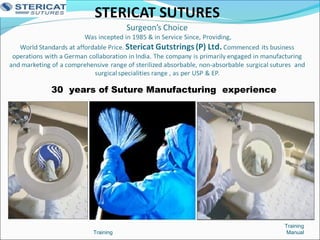
30 years of Suture Manufacturing experience
Training
ManualTraining
Stericat is governed by International Quality Management System an ISO 13485: 2003/CMD CAS,
ISO 9001: 2008, CE along with CE as per MDD 93/42/EEC as amended WHO GMP certified Company
Way to Entrance Reception
6Training
Admn. Office Changing Room
7Training
Changing Room
At our state of the art
CLASS 100,000 facility,
we operate with a quality assurance
system,
based on written procedures,
exhaustive in process controls
and a meticulous quality plan.
An ever attentive technical team
along with employee participation
monitors manufacturing of sutures
from raw material to finished
product stage ,
enabling us to guarantee product
reliability and Customer Satisfaction.
At Stericat, we have a full in house
testing facility to conduct all
Chemical, Instrumental and
Microbiological Tests.
8Training
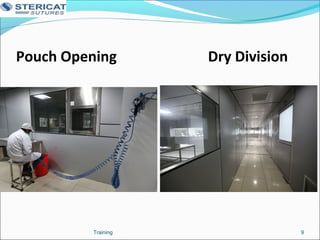
Pouch Opening Dry Division
9Training
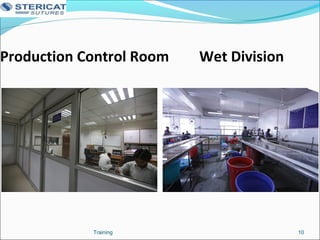
Production Control Room Wet Division
10Training
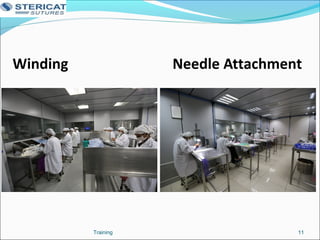
Winding Needle Attachment
11Training
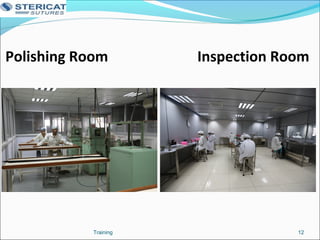
Polishing Room Inspection Room
12Training
World Class Testing Laboratory
13Training
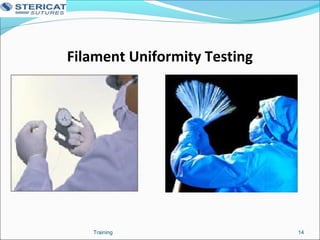
Filament Uniformity Testing
14Training
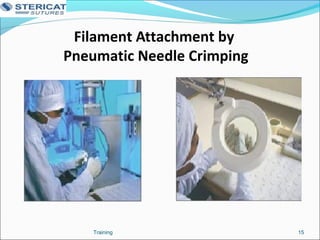
Filament Attachment by
Pneumatic Needle Crimping
15Training
Microbiology Tests & Packaging
16Training
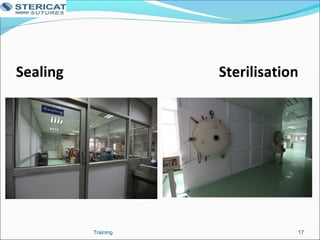
Sealing Sterilisation
17Training
STERICAT Sutures, MESH & Speciality Products
are available:
•Human use
•Veterinary use
•Third parties ( US and European Companies)
•Global Export
Product varieties like:
•Sutures
•Pro-Set (Customized Suture Sets)
•Special Suture Sets
Training
ManualTraining
STERICAT FAMILY
19Corporate PresentationTraining
Marketing Office at South Delhi
20Training
Marketing Office at South Delhi
21Training
Marketing Office at South Delhi
22Training
Marketing Office at South Delhi
23Training
Training
Training
Manual
Presence in all Reputed Hospitals
 TAMIL NADU GOVT
 ANDHRA GOVT
 DELHI GOVT
 ARMY HOSPITALS
 RAILWAY HOSPITALS
 GUJRAT GOVT
 MAHARASTHRA GOVT
 RAJASTHAN GOVT
 BIHAR GOVT.
 ORISSA GOVT
 MP GOVT
 PUNJAB GOVT
 HP GOVT
 HARYANA GOVT
 &
 ALL OTHER MAJOR HOSPITALS OF REPUTE
25 Training
Presentation Contents
HistoryHistory
Suture classification and selectionSuture classification and selection
NeedlesNeedles
Suture labelSuture label
26Training
Workshop Contents
Suture presentationSuture presentation
Basic Suture Techniques VideoBasic Suture Techniques Video
Knot tying & suture exercisesKnot tying & suture exercises
Evaluation.Evaluation.
27Training
HISTORY
The origins of surgery can be traced back many
centuries. Through the ages, practitioners have used a
wide range of materials and techniques for closing
tissue……..
1650 BC – 2000’s AD
28Training
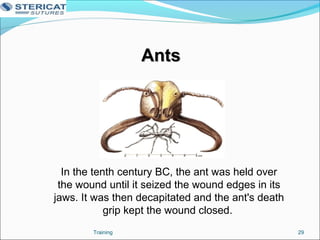
In the tenth century BC, the ant was held over
the wound until it seized the wound edges in its
jaws. It was then decapitated and the ant's death
grip kept the wound closed.
AntsAnts
29Training
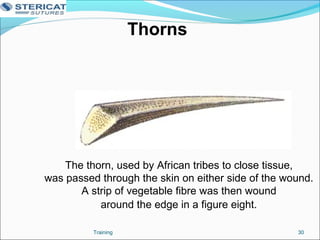
Thorns
The thorn, used by African tribes to close tissue,
was passed through the skin on either side of the wound.
A strip of vegetable fibre was then wound
around the edge in a figure eight.
30Training
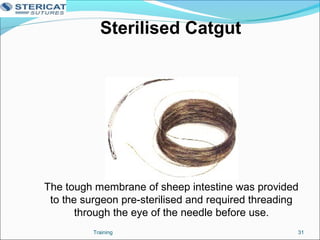
Sterilised Catgut
The tough membrane of sheep intestine was provided
to the surgeon pre-sterilised and required threading
through the eye of the needle before use.
31Training
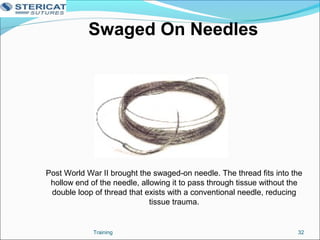
Swaged On Needles
Post World War II brought the swaged-on needle. The thread fits into the
hollow end of the needle, allowing it to pass through tissue without the
double loop of thread that exists with a conventional needle, reducing
tissue trauma.
32Training
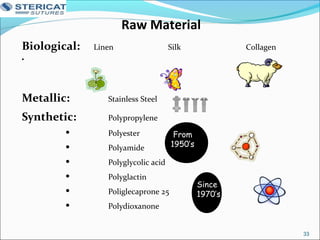
Raw Material
Biological: Linen Silk Collagen
•
Metallic: Stainless Steel
Synthetic: Polypropylene
 Polyester
 Polyamide
 Polyglycolic acid
 Polyglactin
 Poliglecaprone 25
 Polydioxanone
33
Since
1970’s
From
1950’s
Criteria of suture material choice
• Calibre
• Lineal tensile strength
• Knot tensile strength
• Knot security
• Thread surface
• Flexibility
• Elongation / Elasticity
• Capillarity
• Period of useful tensile strength
• Period of absorption
• Tissue reaction
Training34
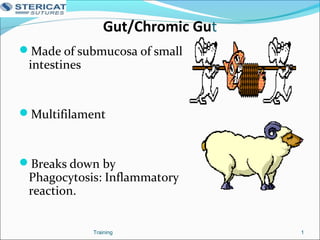
Gut/Chromic Gut
Made of submucosa of small
intestines
Multifilament
Breaks down by
Phagocytosis: Inflammatory
reaction.
1Training
Suture Classification and SelectionSuture Classification and Selection
36Training
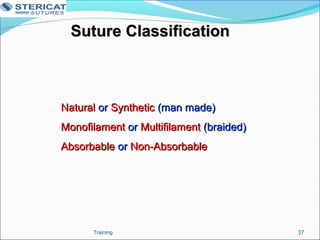
Suture ClassificationSuture Classification
NaturalNatural oror SyntheticSynthetic (man made)(man made)
MonofilamentMonofilament oror MultifilamentMultifilament (braided)(braided)
AbsorbableAbsorbable oror Non-AbsorbableNon-Absorbable
37Training
The Ideal Suture
Minimal tissue reaction
Smoothness - minimum tissue drag
Low Capillarity
Max tensile strength
Ease of handling - Minimum memory
Knot security
Consistency of performance
Predictable performance
Cost effectiveness
38Training
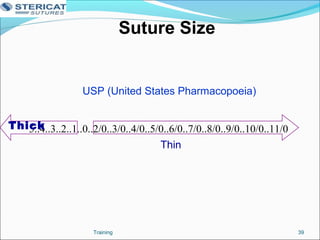
Suture Size
5..4..3..2..1..0..2/0..3/0..4/0..5/0..6/0..7/0..8/0..9/0..10/0..11/0Thick
Thin
USP (United States Pharmacopoeia)
39Training
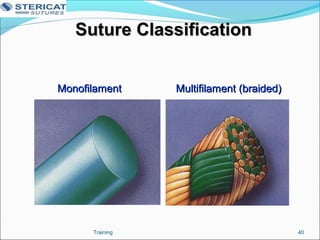
Multifilament (braided)Multifilament (braided)
Suture ClassificationSuture Classification
MonofilamentMonofilament
40Training
Training 41
Training 42
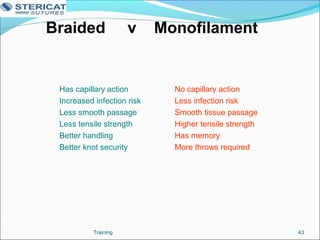
Braided v Monofilament
Has capillary action
Increased infection risk
Less smooth passage
Less tensile strength
Better handling
Better knot security
No capillary action
Less infection risk
Smooth tissue passage
Higher tensile strength
Has memory
More throws required
43Training
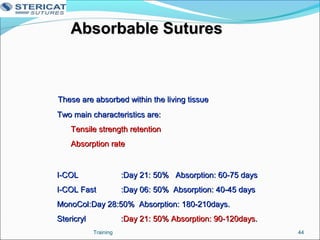
These are absorbed within the living tissueThese are absorbed within the living tissue
Two main characteristics are:Two main characteristics are:
Tensile strength retentionTensile strength retention
Absorption rateAbsorption rate
Absorbable SuturesAbsorbable Sutures
I-COLI-COL :Day 21: 50% Absorption: 60-75 days:Day 21: 50% Absorption: 60-75 days
I-COL FastI-COL Fast :Day 06: 50% Absorption: 40-45 days:Day 06: 50% Absorption: 40-45 days
MonoColMonoCol:Day 28:50% Absorption: 180-210days.:Day 28:50% Absorption: 180-210days.
StericrylStericryl ::Day 21: 50% Absorption: 90-120daysDay 21: 50% Absorption: 90-120days..
44Training
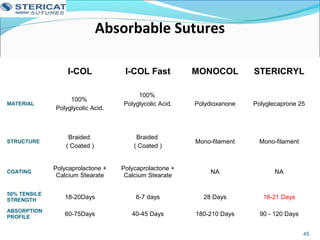
Absorbable Sutures
I-COL I-COL Fast MONOCOL STERICRYL
MATERIAL
100%
Polyglycolic Acid.
100%
Polyglycolic Acid. Polydioxanone Polyglecaprone 25
STRUCTURE
Braided
( Coated )
Braided
( Coated )
Mono-filament Mono-filament
COATING
Polycaprolactone +
Calcium Stearate
Polycaprolactone +
Calcium Stearate
NA NA
50% TENSILE
STRENGTH
18-20Days 6-7 days 28 Days 18-21 Days
ABSORPTION
PROFILE
60-75Days 40-45 Days 180-210 Days 90 - 120 Days
45
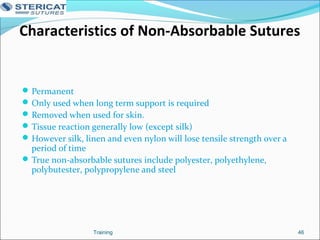
Characteristics of Non-Absorbable Sutures
Permanent
Only used when long term support is required
Removed when used for skin.
Tissue reaction generally low (except silk)
However silk, linen and even nylon will lose tensile strength over a
period of time
True non-absorbable sutures include polyester, polyethylene,
polybutester, polypropylene and steel
46Training
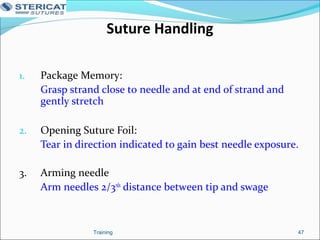
Suture Handling
1. Package Memory:
Grasp strand close to needle and at end of strand and
gently stretch
2. Opening Suture Foil:
Tear in direction indicated to gain best needle exposure.
3. Arming needle
Arm needles 2/3rds
distance between tip and swage
47Training
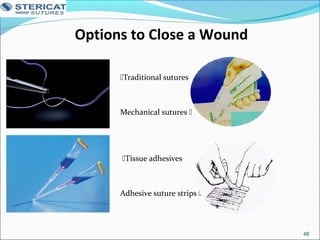
Options to Close a Wound
 Traditional sutures
 Mechanical sutures 
 Tissue adhesives
 Adhesive suture strips 
48
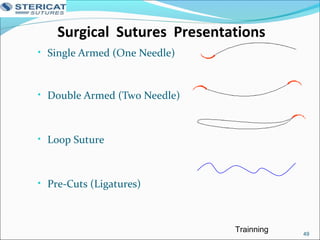
Surgical Sutures Presentations
• Single Armed (One Needle)
• Double Armed (Two Needle)
• Loop Suture
• Pre-Cuts (Ligatures)
49
Trainning
Knot Tying & SuturingKnot Tying & Suturing
50Training
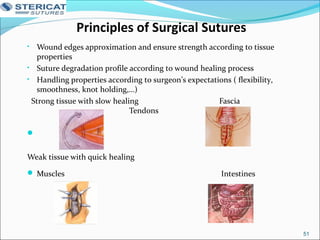
Principles of Surgical Sutures
• Wound edges approximation and ensure strength according to tissue
properties
• Suture degradation profile according to wound healing process
• Handling properties according to surgeon’s expectations ( flexibility,
smoothness, knot holding,…)
Strong tissue with slow healing Fascia
Tendons

Weak tissue with quick healing
 Muscles Intestines
51
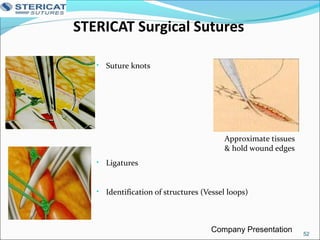
STERICAT Surgical Sutures
• Suture knots
Approximate tissues
& hold wound edges
• Ligatures
• Identification of structures (Vessel loops)
52
Company Presentation
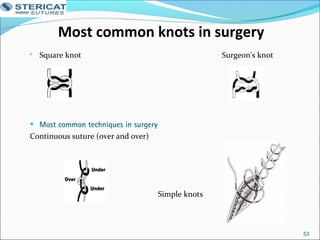
Most common knots in surgery
• Square knot Surgeon's knot
• Most common techniques in surgery
Continuous suture (over and over)
Simple knots
53
Training54
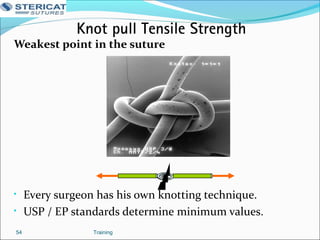
Weakest point in the suture
• Every surgeon has his own knotting technique.
• USP / EP standards determine minimum values.
Knot pull Tensile Strength
Classification of Surgical Sutures
Surgical sutures can be classified according to
• Raw Material
• Structure
• Absorption profile
Training55
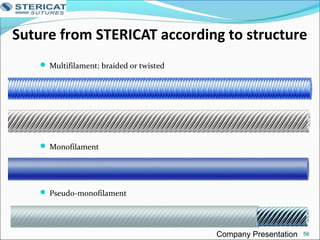
Suture from STERICAT according to structure
 Multifilament: braided or twisted
 Monofilament
 Pseudo-monofilament
56Company Presentation
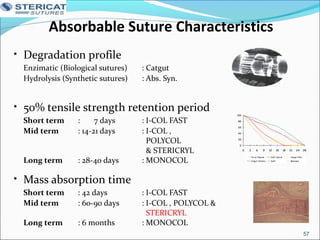
Absorbable Suture Characteristics
• Degradation profile
Enzimatic (Biological sutures) : Catgut
Hydrolysis (Synthetic sutures) : Abs. Syn.
• 50% tensile strength retention period
Short term : 7 days : I-COL FAST
Mid term : 14-21 days : I-COL ,
POLYCOL
& STERICRYL
Long term : 28-40 days : MONOCOL
• Mass absorption time
Short term : 42 days : I-COL FAST
Mid term : 60-90 days : I-COL , POLYCOL &
STERICRYL
Long term : 6 months : MONOCOL
0
20
40
60
80
100
0 3 6 9 12 15 18 21 24 28
Vicryl Rapide Safil Quick Catgut Plain
Catgut Chromic Safil Monosyn
57
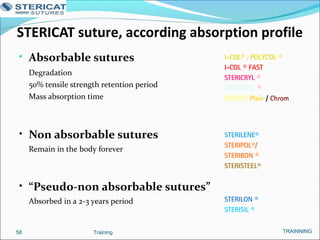
STERICAT suture, according absorption profile
• Absorbable sutures
Degradation
50% tensile strength retention period
Mass absorption time
• Non absorbable sutures
Remain in the body forever
• “Pseudo-non absorbable sutures”
Absorbed in a 2-3 years period
Training58
I-COL® , POLYCOL ®
I-COL ® FAST
STERICRYL ®
MONOCOL ®
CATGUT Plain / Chrom
STERILENE®
STERIPOL®/
STERIBON ®
STERISTEEL®
STERILON ®
STERISIL ®
TRAINNING
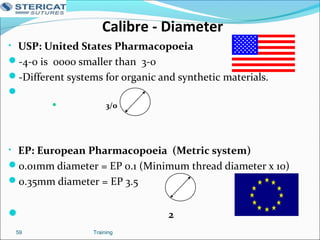
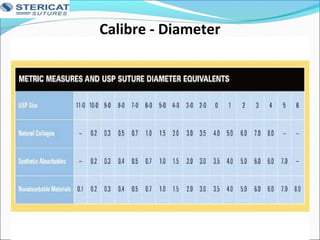
Calibre - Diameter
• USP: United States Pharmacopoeia
-4-0 is 0000 smaller than 3-0
-Different systems for organic and synthetic materials.

 3/0
• EP: European Pharmacopoeia (Metric system)
0.01mm diameter = EP 0.1 (Minimum thread diameter x 10)
0.35mm diameter = EP 3.5
 2
Training59
Calibre - Diameter
Training 60
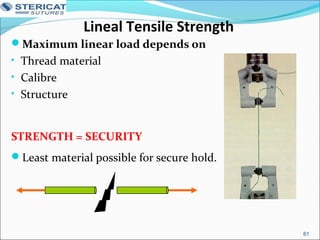
Lineal Tensile Strength
Maximum linear load depends on
• Thread material
• Calibre
• Structure
STRENGTH = SECURITY
Least material possible for secure hold.
61
Training62
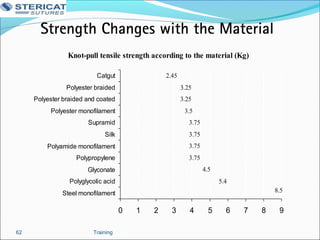
Knot-pull tensile strength according to the material (Kg)
5.4
4.5
3.75
3.75
3.75
3.75
3.5
3.25
3.25
2.45
8.5
0 1 2 3 4 5 6 7 8 9
Steel monofilament
Polyglycolic acid
Glyconate
Polypropylene
Polyamide monofilament
Silk
Supramid
Polyester monofilament
Polyester braided and coated
Polyester braided
Catgut
Strength Changes with the Material
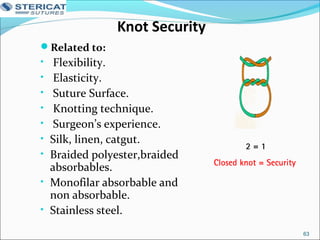
Knot Security
Related to:
• Flexibility.
• Elasticity.
• Suture Surface.
• Knotting technique.
• Surgeon’s experience.
• Silk, linen, catgut.
• Braided polyester,braided
absorbables.
• Monofilar absorbable and
non absorbable.
• Stainless steel.
63
2 = 1
Closed knot = Security
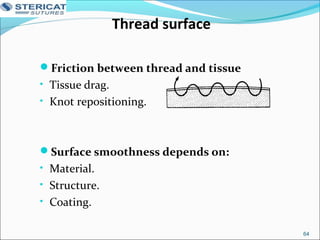
Thread surface
Friction between thread and tissue
• Tissue drag.
• Knot repositioning.
Surface smoothness depends on:
• Material.
• Structure.
• Coating.
64
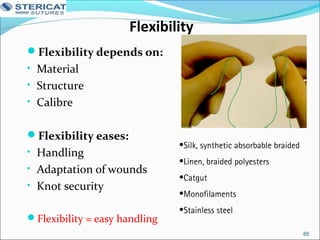
Flexibility
Flexibility depends on:
• Material
• Structure
• Calibre
Flexibility eases:
• Handling
• Adaptation of wounds
• Knot security
Flexibility = easy handling
65
•Silk, synthetic absorbable braided
•Linen, braided polyesters
•Catgut
•Monofilaments
•Stainless steel
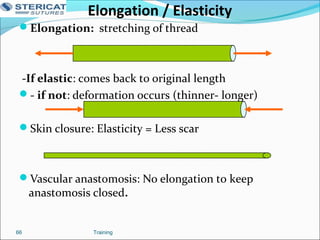
Elongation / Elasticity
Elongation: stretching of thread
-If elastic: comes back to original length
- if not: deformation occurs (thinner- longer)
Skin closure: Elasticity = Less scar
Vascular anastomosis: No elongation to keep
anastomosis closed.
Training66
Elasticity
From less to most elastic:
• Stainless steel
• Linen,Silk,Braided Synthetic absorbables,Braided polyester
• Catgut
• Absorbable monofilaments
• Polypropylene
• Polyester monofilament
• Nylon
Training67
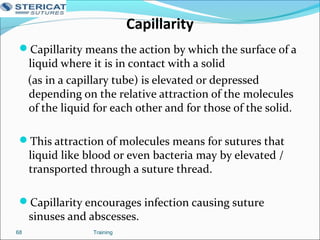
Capillarity
Capillarity means the action by which the surface of a
liquid where it is in contact with a solid
(as in a capillary tube) is elevated or depressed
depending on the relative attraction of the molecules
of the liquid for each other and for those of the solid.
This attraction of molecules means for sutures that
liquid like blood or even bacteria may by elevated /
transported through a suture thread.
Capillarity encourages infection causing suture
sinuses and abscesses.
Training68
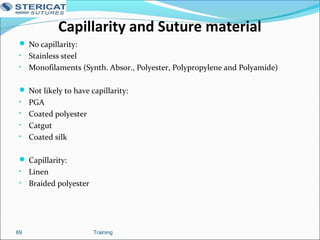
Capillarity and Suture material
 No capillarity:
• Stainless steel
• Monofilaments (Synth. Absor., Polyester, Polypropylene and Polyamide)
 Not likely to have capillarity:
• PGA
• Coated polyester
• Catgut
• Coated silk
 Capillarity:
• Linen
• Braided polyester
Training69
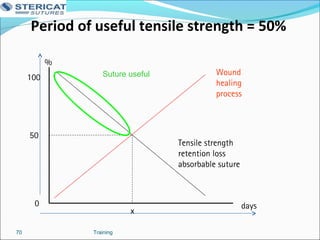
Period of useful tensile strength = 50%
Training70
days0
50
100
%
Wound
healing
process
Tensile strength
retention loss
absorbable suture
Suture useful
x
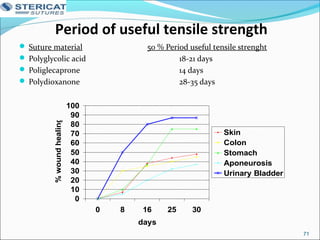
Period of useful tensile strength
 Suture material 50 % Period useful tensile strenght
 Polyglycolic acid 18-21 days
 Poliglecaprone 14 days
 Polydioxanone 28-35 days
0
10
20
30
40
50
60
70
80
90
100
0 8 16 25 30
days
%woundhealing
Skin
Colon
Stomach
Aponeurosis
Urinary Bladder
71
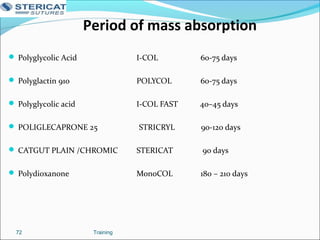
Period of mass absorption
 Polyglycolic Acid I-COL 60-75 days
 Polyglactin 910 POLYCOL 60-75 days
 Polyglycolic acid I-COL FAST 40–45 days
 POLIGLECAPRONE 25 STRICRYL 90-120 days
 CATGUT PLAIN /CHROMIC STERICAT 90 days
 Polydioxanone MonoCOL 180 – 210 days
Training72
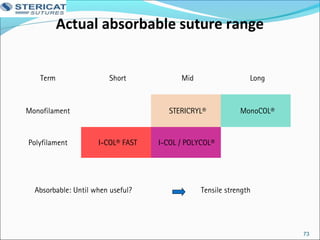
Actual absorbable suture range
Term Short Mid Long
Monofilament STERICRYL® MonoCOL®
Polyfilament I-COL® FAST I-COL / POLYCOL®
73
Absorbable: Until when useful? Tensile strength
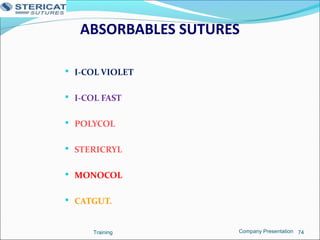
ABSORBABLES SUTURES
 I-COL VIOLET
 I-COL FAST
 POLYCOL
 STERICRYL
 MONOCOL
 CATGUT.
Training 74Company Presentation
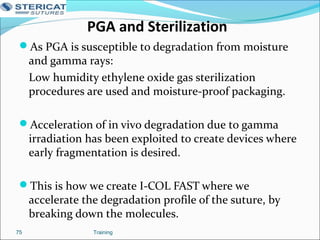
PGA and Sterilization
As PGA is susceptible to degradation from moisture
and gamma rays:
Low humidity ethylene oxide gas sterilization
procedures are used and moisture-proof packaging.
Acceleration of in vivo degradation due to gamma
irradiation has been exploited to create devices where
early fragmentation is desired.
This is how we create I-COL FAST where we
accelerate the degradation profile of the suture, by
breaking down the molecules.
Training75
Tissue Reaction
Related to:
• Material
• Amount of suture
 Calibre
 Knot type
• Structure / Capillarity
Low Tissue Reaction = Security
76
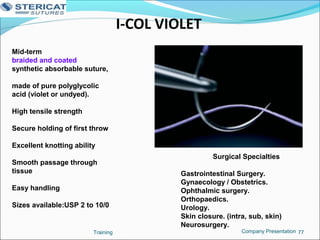
I-COL VIOLET
Training 77
Mid-term
braided and coated
synthetic absorbable suture,
made of pure polyglycolic
acid (violet or undyed).
High tensile strength
Secure holding of first throw
Excellent knotting ability
Smooth passage through
tissue
Easy handling
Sizes available:USP 2 to 10/0
Surgical Specialties
Gastrointestinal Surgery.
Gynaecology / Obstetrics.
Ophthalmic surgery.
Orthopaedics.
Urology.
Skin closure. (intra, sub, skin)
Neurosurgery.
Company Presentation
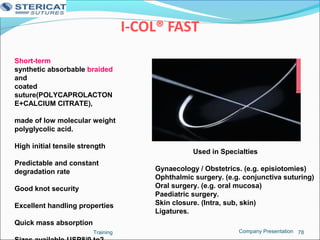
I-COL® FAST
Training 78
Short-term
synthetic absorbable braided
and
coated
suture(POLYCAPROLACTON
E+CALCIUM CITRATE),
made of low molecular weight
polyglycolic acid.
High initial tensile strength
Predictable and constant
degradation rate
Good knot security
Excellent handling properties
Quick mass absorption
Used in Specialties
Gynaecology / Obstetrics. (e.g. episiotomies)
Ophthalmic surgery. (e.g. conjunctiva suturing)
Oral surgery. (e.g. oral mucosa)
Paediatric surgery.
Skin closure. (Intra, sub, skin)
Ligatures.
Company Presentation
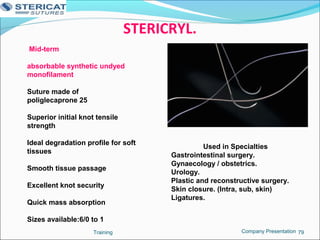
STERICRYL.
Training 79
Mid-term
absorbable synthetic undyed
monofilament
Suture made of
poliglecaprone 25
Superior initial knot tensile
strength
Ideal degradation profile for soft
tissues
Smooth tissue passage
Excellent knot security
Quick mass absorption
Sizes available:6/0 to 1
Used in Specialties
Gastrointestinal surgery.
Gynaecology / obstetrics.
Urology.
Plastic and reconstructive surgery.
Skin closure. (Intra, sub, skin)
Ligatures.
Company Presentation
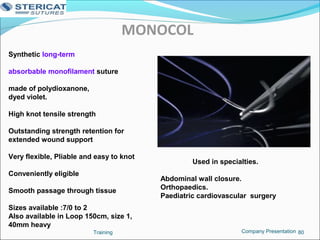
MONOCOL
Training 80
Synthetic long-term
absorbable monofilament suture
made of polydioxanone,
dyed violet.
High knot tensile strength
Outstanding strength retention for
extended wound support
Very flexible, Pliable and easy to knot
Conveniently eligible
Smooth passage through tissue
Sizes available :7/0 to 2
Also available in Loop 150cm, size 1,
40mm heavy
Used in specialties.
Abdominal wall closure.
Orthopaedics.
Paediatric cardiovascular surgery
Company Presentation
NON-ABSORBABLE SUTURES
 STERILENE
 STERIPOL
 STERILON
 STERISIL
 STERISTEEL
Training 81Company Presentation
Training 82
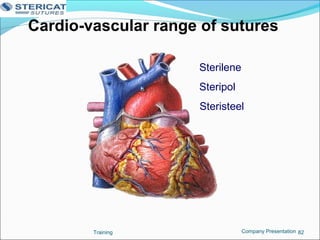
Cardio-vascular range of sutures
Sterilene
Steripol
Steristeel
Company Presentation
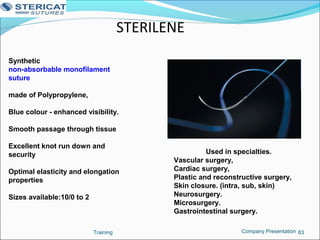
STERILENE
Training 83
Synthetic
non-absorbable monofilament
suture
made of Polypropylene,
Blue colour - enhanced visibility.
Smooth passage through tissue
Excellent knot run down and
security
Optimal elasticity and elongation
properties
Sizes available:10/0 to 2
Used in specialties.
Vascular surgery,
Cardiac surgery,
Plastic and reconstructive surgery,
Skin closure. (intra, sub, skin)
Neurosurgery.
Microsurgery.
Gastrointestinal surgery.
Company Presentation
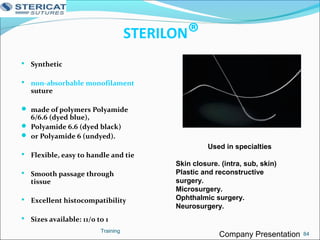
STERILON®
 Synthetic
 non-absorbable monofilament
suture
 made of polymers Polyamide
6/6.6 (dyed blue),
 Polyamide 6.6 (dyed black)
 or Polyamide 6 (undyed).
 Flexible, easy to handle and tie
 Smooth passage through
tissue
 Excellent histocompatibility
 Sizes available: 11/0 to 1
Training
Used in specialties
Skin closure. (intra, sub, skin)
Plastic and reconstructive
surgery.
Microsurgery.
Ophthalmic surgery.
Neurosurgery.
84Company Presentation
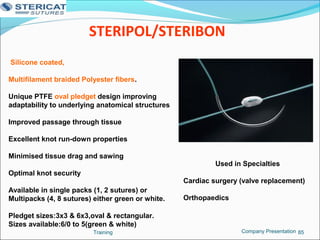
STERIPOL/STERIBON
Training 85
Silicone coated,
Multifilament braided Polyester fibers.
Unique PTFE oval pledget design improving
adaptability to underlying anatomical structures
Improved passage through tissue
Excellent knot run-down properties
Minimised tissue drag and sawing
Optimal knot security
Available in single packs (1, 2 sutures) or
Multipacks (4, 8 sutures) either green or white.
Pledget sizes:3x3 & 6x3,oval & rectangular.
Sizes available:6/0 to 5(green & white)
Used in Specialties
Cardiac surgery (valve replacement)
Orthopaedics
Company Presentation
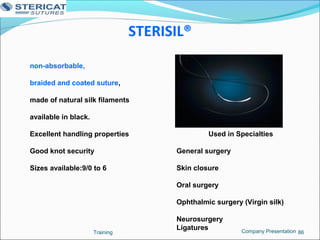
STERISIL®
Training 86
non-absorbable,
braided and coated suture,
made of natural silk filaments
available in black.
Excellent handling properties
Good knot security
Sizes available:9/0 to 6
Used in Specialties
General surgery
Skin closure
Oral surgery
Ophthalmic surgery (Virgin silk)
Neurosurgery
Ligatures Company Presentation
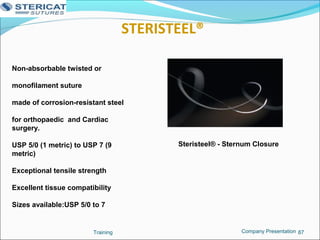
STERISTEEL®
Training 87
Non-absorbable twisted or
monofilament suture
made of corrosion-resistant steel
for orthopaedic and Cardiac
surgery.
USP 5/0 (1 metric) to USP 7 (9
metric)
Exceptional tensile strength
Excellent tissue compatibility
Sizes available:USP 5/0 to 7
Steristeel® - Sternum Closure
Company Presentation
Needles
88Training
Training
ManualTraining
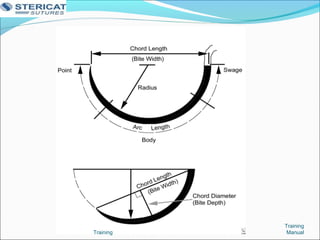
Basic components for the needle
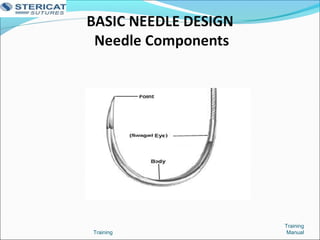
A. Points of needle:
1. Cutting points : it used to penetrate when tissue is
difficult to be penetrated as skin and tendon
2. Reverse cutting
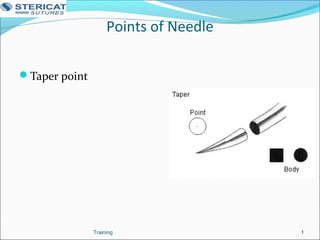
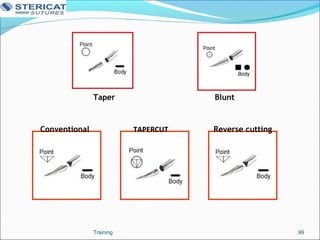
3. Taper point : these needles are used in soft tissue such as
intestine and peritoneum, the sharp point at the tip of
needle
4. Blunt point : these are using for suturing friable tissue
such as liver and kidney
1Training
Basic components for the needle
B. Body of needle :
1.Straight
2.Curved
C. Eyed of needle:
The eye is the segment of needle where the suture strand is
attached
1.Eyed needle :Like of any household sewing needle
2. French eye needle : It has a slit from the inside if the eye to
the end of the needle through which the
suture is drawn
3.Eyeless needle : The suture strand the needle are one unit
1Training
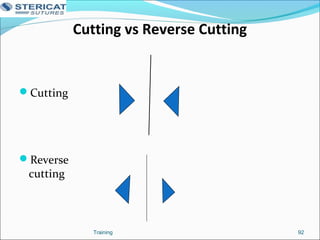
Cutting vs Reverse Cutting
Cutting
Reverse
cutting
92Training
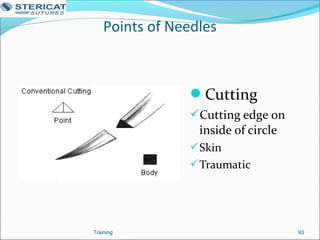
Points of Needles
Cutting
Cutting edge on
inside of circle
Skin
Traumatic
93Training
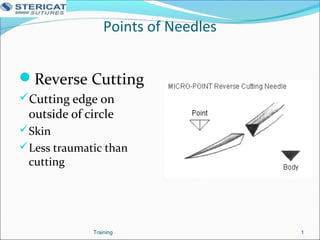
Points of Needles
Reverse Cutting
Cutting edge on
outside of circle
Skin
Less traumatic than
cutting
1Training
Points of Needle
Taper point
1Training
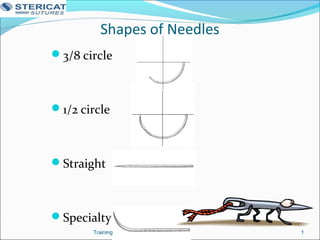
Shapes of Needles
3/8 circle
1/2 circle
Straight
Specialty
1Training
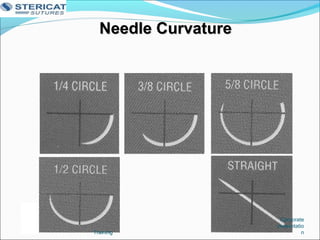
Needle CurvatureNeedle Curvature
Corporate
presentatio
nTraining
Training
ManualTraining
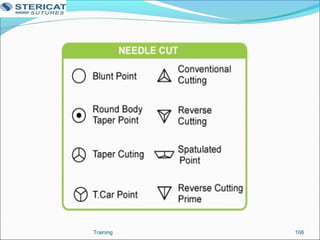
Taper Blunt
Conventional TAPERCUT Reverse cutting
99Training
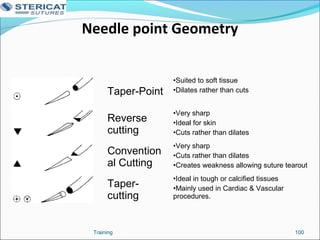
Needle point Geometry
Taper-Point
•Suited to soft tissue
•Dilates rather than cuts
Reverse
cutting
•Very sharp
•Ideal for skin
•Cuts rather than dilates
Convention
al Cutting
•Very sharp
•Cuts rather than dilates
•Creates weakness allowing suture tearout
Taper-
cutting
•Ideal in tough or calcified tissues
•Mainly used in Cardiac & Vascular
procedures.
100Training
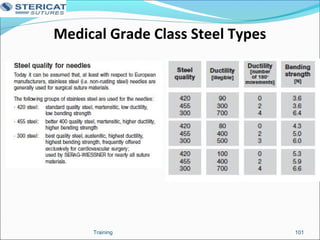
Medical Grade Class Steel Types
101Training
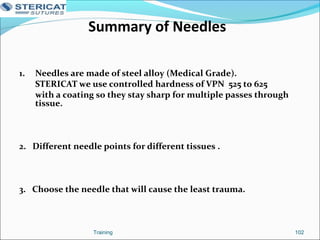
Summary of Needles
1. Needles are made of steel alloy (Medical Grade).
STERICAT we use controlled hardness of VPN 525 to 625
with a coating so they stay sharp for multiple passes through
tissue.
2. Different needle points for different tissues .
3. Choose the needle that will cause the least trauma.
102Training
Suture Label
103Training
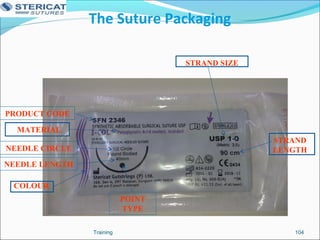
The Suture Packaging
104
STRAND SIZE
MATERIAL
STRAND
LENGTH
COLOUR
NEEDLE CIRCLE
POINT
TYPE
NEEDLE LENGTH
PRODUCT CODE
Training
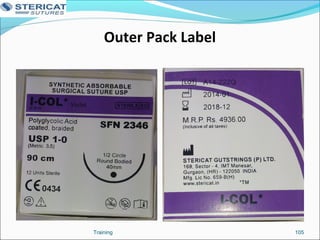
Outer Pack Label
105Training
106Training
SPECIALITY PRODUCTS
 HERNIA REPAIR –
STERILENE MESH,
STERIFLEX MESH,
STERILENE MESH KIT
 C-SECTION KIT
 STERISLING-Transobturator Sling System
107Training
SPECIALITY PRODUCTS
 HERNIA REPAIR –
STERILENE MESH,
STERIFLEX MESH,
STERILENE MESH KIT
 C-SECTION KIT
 STERISLING-Transobturator Sling System
Training 108Company Presentation
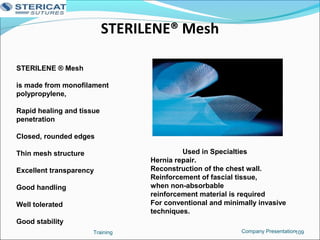
STERILENE® Mesh
Training 109
STERILENE ® Mesh
is made from monofilament
polypropylene,
Rapid healing and tissue
penetration
Closed, rounded edges
Thin mesh structure
Excellent transparency
Good handling
Well tolerated
Good stability
Used in Specialties
Hernia repair.
Reconstruction of the chest wall.
Reinforcement of fascial tissue,
when non-absorbable
reinforcement material is required
For conventional and minimally invasive
techniques.
Company Presentation
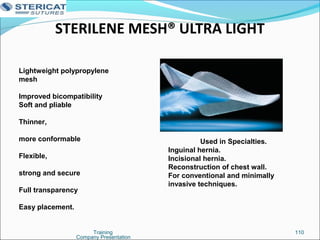
STERILENE MESH® ULTRA LIGHT
Training 110
Lightweight polypropylene
mesh
Improved bicompatibility
Soft and pliable
Thinner,
more conformable
Flexible,
strong and secure
Full transparency
Easy placement.
Used in Specialties.
Inguinal hernia.
Incisional hernia.
Reconstruction of chest wall.
For conventional and minimally
invasive techniques.
Company Presentation
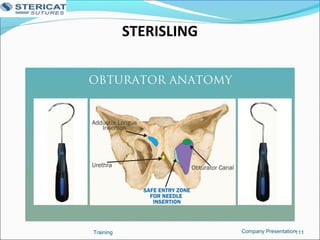
STERISLING
Training 111Company Presentation
STERISLING Trans-Obturator Needle
System
The Transobturator Needle System consists of Two Curved
Medical Grade Stainless Steel reusable passers.
They are used to place Sling for Female patients of Stress
Urinary Incontinence (SUI) with minimal blind passage.
Making it very safe, It never enters the Reptropubic space &
Abdominal wall.
Decreased risk of: Bowel, Bladder Injury & Major Bleeding.
Training Company Presentation
Training
Training
Manual
Hernia is a sac lined by peritoneum that protrudes through a defect in
the layers of the abdominal wall.
Generally, a hernia mass is composed of a peritoneal sac, into which
organs or other abdominal tissues can slip.
Most hernias occur in the abdominal cavity.
Although a hernia can develop on any part of the abdominal wall.
The areas near the natural openings in the groin areas (inguinal
hernias),
below the groin (femoral hernias),
through the naval (umbilical hernias)
through old surgical incisions (incisional hernias) are the most
common.
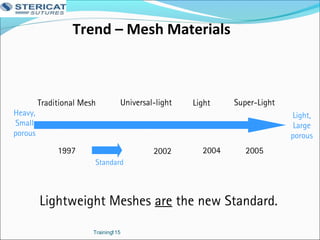
Trend – Mesh Materials
Training115
Standard
Super-LightLightUniversal-lightTraditional Mesh
1997 2002 20052004
Light,
Large
porous
Heavy,
Small
porous
Lightweight Meshes are the new Standard.
Training
Training
Manual
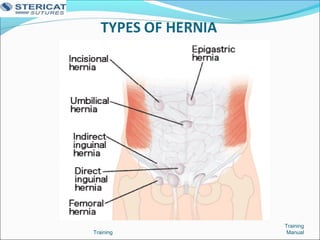
TYPES OF HERNIA
Inguinal Hernias-
Indirect Inguinal Hernias
This occurs due to a weakness in the abdominal wall present at birth.
In men, this weakness is caused by a space that is created as the testes
and spermatic cord descend by way of the inguinal canal (a / ½ inch
canal)
Direct Inguinal Hernia
They are most common in men and usually later in life, most often
after 40, Direct inguinal hernias are due to an acquired wear and tear
in the abdominal wall.
Training 117
Training 118
Training 119
Congenital Diaphragmatic Hernia is a birth defect in which abdominal organs
protrude up into the chest cavity.
Femoral Hernia is the protrusion of abdominal fat or part of the intestines
through the abdominal muscles into the upper thigh area.
Hiatal Hernia is the protrusion of a portion of the stomach through an opening
in the diaphragm called the hiatus. Hiatal hernia is also called a hiatus hernia.
Incisional Hernia is a hernia that develops through a previous surgical
incision. This can occur anywhere on the abdomen or back.
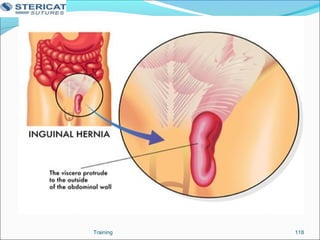
Inguinal Hernia is the protrusion of abdominal fat or part of the intestines
through the abdominal muscles into the groin area (also called the inguinal
canal). Inguinal hernia is the most common type of hernia.
Umbilical Hernia is the protrusion of part of the intestines or abdominal lining
through the abdominal wall around the belly button. It most often occurs in
infants ages six months and younger.
ENDOSCOPIC HERNIA REPAIR
(Minimally invasive surgery )
There are two forms of Endoscopic Hernia repairs:-
Trans-Abdominal Pre-Peritoneal (TAPP), this repair
involves entry into the abdominal cavity with peritoneal
incision and dissection, Hernia reduction,
Mesh placement, and Closing Peritoneum.
In Totally Extra-Peritoneal (TEP) Hernia repair the
abdominal cavity is not entered. The working space is
created by pre-peritoneal dissection.
Mesh is placed without peritoneal incision.
Training 120
Advantages of large-pore sized, lightweight, monofilament
Polypropylene Meshes :
 Improved biocompatibility
 Diminished foreign body sensation
 Less postoperative pain
 Lower rate of seroma formation
 Faster recovery
 Optimal incorporation into the surrounding tissue
 Better elasticity while maintaining the dymanics of the abdominal
wall
 Better handling characteristics
 Easy modeling to the body tissue
Training121
ENDOSCOPIC HERNIA REPAIR
(Minimally invasive surgery )
Training
Training
Manual
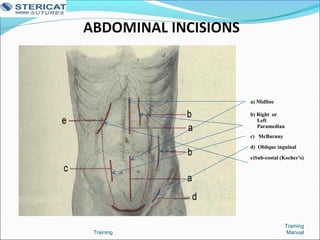
a) Midline
b) Right or
Left
Paramedian
c) McBurnny
d) Oblique inguinal
e)Sub-costal (Kocher’s)
Training
Training
Manual
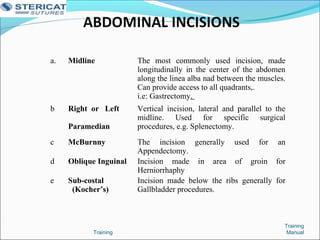
a. Midline The most commonly used incision, made
longitudinally in the center of the abdomen
along the linea alba nad between the muscles.
Can provide access to all quadrants,.
i.e: Gastrectomy.
b Right or Left
Paramedian
Vertical incision, lateral and parallel to the
midline. Used for specific surgical
procedures, e.g. Splenectomy.
c McBurnny The incision generally used for an
Appendectomy.
d Oblique Inguinal Incision made in area of groin for
Herniorrhaphy
e Sub-costal
(Kocher’s)
Incision made below the ribs generally for
Gallbladder procedures.
Training
Training
Manual
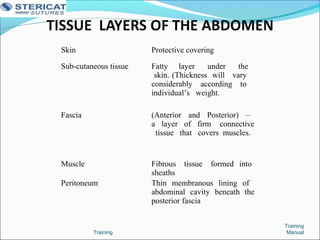
Skin Protective covering
Sub-cutaneous tissue Fatty layer under the
skin. (Thickness will vary
considerably according to
individual’s weight.
Fascia (Anterior and Posterior) –
a layer of firm connective
tissue that covers muscles.
Muscle Fibrous tissue formed into
sheaths
Peritoneum Thin membranous lining of
abdominal cavity beneath the
posterior fascia
Training 125
Training
Training
Manual
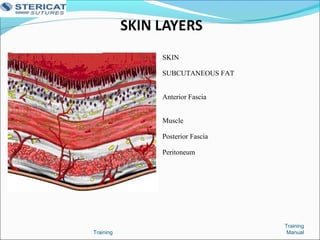
SKIN
SUBCUTANEOUS FAT
Anterior Fascia
Muscle
Posterior Fascia
Peritoneum
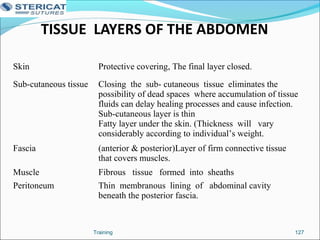
TISSUE LAYERS OF THE ABDOMEN
Skin Protective covering, The final layer closed.
Sub-cutaneous tissue Closing the sub- cutaneous tissue eliminates the
possibility of dead spaces where accumulation of tissue
fluids can delay healing processes and cause infection.
Sub-cutaneous layer is thin
Fatty layer under the skin. (Thickness will vary
considerably according to individual’s weight.
Fascia (anterior & posterior)Layer of firm connective tissue
that covers muscles.
Muscle Fibrous tissue formed into sheaths
Peritoneum Thin membranous lining of abdominal cavity
beneath the posterior fascia.
Training 127
Training
Training
Manual
Posterior
Fascia
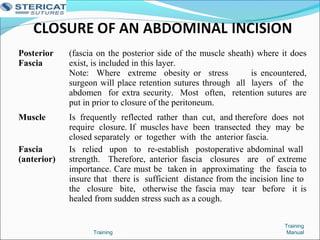
(fascia on the posterior side of the muscle sheath) where it does
exist, is included in this layer.
Note: Where extreme obesity or stress is encountered,
surgeon will place retention sutures through all layers of the
abdomen for extra security. Most often, retention sutures are
put in prior to closure of the peritoneum.
Muscle Is frequently reflected rather than cut, and therefore does not
require closure. If muscles have been transected they may be
closed separately or together with the anterior fascia.
Fascia
(anterior)
Is relied upon to re-establish postoperative abdominal wall
strength. Therefore, anterior fascia closures are of extreme
importance. Care must be taken in approximating the fascia to
insure that there is sufficient distance from the incision line to
the closure bite, otherwise the fascia may tear before it is
healed from sudden stress such as a cough.
Training
Manual
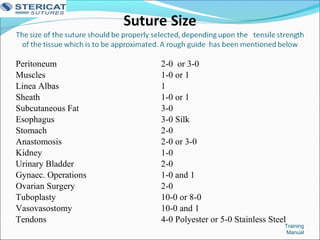
Peritoneum 2-0 or 3-0
Muscles 1-0 or 1
Linea Albas 1
Sheath 1-0 or 1
Subcutaneous Fat 3-0
Esophagus 3-0 Silk
Stomach 2-0
Anastomosis 2-0 or 3-0
Kidney 1-0
Urinary Bladder 2-0
Gynaec. Operations 1-0 and 1
Ovarian Surgery 2-0
Tuboplasty 10-0 or 8-0
Vasovasostomy 10-0 and 1
Tendons 4-0 Polyester or 5-0 Stainless Steel
Training Training
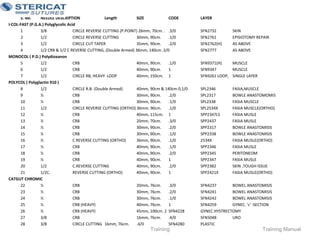
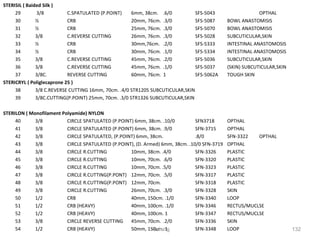
S. No. NEEDLE DESCRIPTION Length SIZE CODE LAYER
I-COL-FAST (P.G.A.) Polyglycolic Acid
1 3/8 CIRCLE REVERSE CUTTING (P.POINT) 26mm, 70cm. . .3/0 SFN2732 SKIN
2 1/2 CIRCLE REVERSE CUTTING 30mm, 90cm. .1/0 SFN2761 EPISIOTOMY REPAIR
3 1/2 CIRCLE CUT TAPER 35mm, 90cm. .2/0 SFN2762(H) AS ABOVE
4 1/2 CRB & 1/2 C REVERSE CUTTING, (Double Armed) 36mm, 140cm .2/0 SFN2777 AS ABOVE
MONOCOL ( P.D.) Polydioxanon
5 1/2 CRB 40mm, 90cm. .1/0 SFN9371(H) MUSCLE
6 1/2 CRB 40mm, 90cm. 1 SFN9347 MUSCLE
7 1/2 CIRCLE RB, HEAVY LOOP 40mm, 150cm. 1 SFN9261 LOOP, SINGLE LAYER
POLYCOL ( Polyglactin 910 )
8 1/2 CIRCLE R.B. (Double Armed) 40mm, 90cm & 140cm 0,1/0 SPL2346 FASIA,MUSCLE
9 ½ CRB 30mm, 90cm. .2/0 SPL2317 BOWLE ANASTOMOMIS
10 ½ CRB 30mm, 90cm. .1/0 SPL2338 FASIA MUSCLE
11 1/2 CIRCLE REVERSE CUTTING (ORTHO) 36mm. 90cm. .1/0 SPL2534X FASIA MUSCLE(ORTHO)
12 ½ CRB 40mm, 115cm. 1 SPP2347LS FASIA MUSLE
13 ½ CRB 20mm, 70cm. .3/0 SPP2437 FASIA MUSLE
14 ½ CRB 30mm, 90cm. .2/0 SPP2317 BOWLE ANASTOMISIS
15 ½ CRB 30mm, 90cm. .1/0 SPP2338 BOWLE ANASTOMISIS
16 ½ C REVERSE CUTTING (ORTHO) 36mm, 90cm. .1/0 2534X FASIA MUSLE(ORTHO)
17 ½ CRB 40mm, 90cm. .1/0 SPP2346 FASIA MUSLE
18 ½ CRB 40mm, 90cm. .2/0 SPP2345 PERITONEOM
19 ½ CRB 40mm, 90cm. 1 SPP2347 FASIA MUSLE
20 1/2 C.REVERSE CUTTING 40mm, 90cm. .2/0 SPP2382 SKIN ,TOUGH ISSUE
21 1/2C. REVERSE CUTTING (ORTHO) 40mm, 90cm. 1 SPP2421X FASIA MUSLE(ORTHO)
CATGUT CHROMIC
22 ½ CRB 20mm, 76cm. .3/0 SFN4237 BOWEL ANASTOMISIS
23 ½ CRB 30mm, 76cm. .2/0 SFN4241 BOWEL ANASTOMISIS
24 ½ CRB 30mm, 76cm. .1/0 SFN4242 BOWEL ANASTOMISIS
25 ½ CRB (HEAVY) 40mm, 76cm. 1 SFN4259 GYNEC. 'c' -SECTION
26 ½ CRB (HEAVY) 45mm, 100cm. 2 SFN4228 GYNEC.HYSTRECTOMY
27 3/8 CRB 16mm, 76cm. .4/0 SFN5048 URO
28 3/8 CIRCLE CUTTING 16mm, 76cm. .4/0 SFN4280 PLASTIC
Training Training Manual
STERISIL ( Baided Silk )
29 3/8 C.SPATULATED (P.POINT) 6mm, 38cm. .6/0 SFS-5043 OPTHAL
30 ½ CRB 20mm, 76cm. .3/0 SFS-5087 BOWL ANASTOMISIS
31 ½ CRB 25mm, 76cm. .3/0 SFS-5070 BOWL ANASTOMISIS
32 3/8 C.REVERSE CUTTING 26mm, 76cm. .3/0 SFS-5028 SUBCUTICULAR,SKIN
33 ½ CRB 30mm,76cm. .2/0 SFS-5333 INTESTINAL ANASTOMOSIS
34 ½ CRB 30mm, 76cm. .1/0 SFS-5334 INTESTINAL ANASTOMOSIS
35 3/8 C.REVERSE CUTTING 45mm, 76cm. .2/0 SFS-5036 SUBCUTICULAR,SKIN
36 3/8 C.REVERSE CUTTING 45mm, 76cm. .1/0 SFS-5037 (SKIN) SUBCUTICULAR,SKIN
37 3/8C. REVERSE CUTTING 60mm, 76cm. 1 SFS-5062A TOUGH SKIN
STERICRYL ( Poliglecaprone 25 )
38 3/8 C.REVERSE CUTTING 16mm, 70cm. .4/0 STR1205 SUBCUTICULAR,SKIN
39 3/8C.CUTTING(P.POINT) 25mm, 70cm. .3/0 STR1326 SUBCUTICULAR,SKIN
STERILON ( Monofilament Polyamide) NYLON
40 3/8 CIRCLE SPATULATED (P.POINT) 6mm, 38cm. .10/0 SFN3718 OPTHAL
41 3/8 CIRCLE SPATULATED (P.POINT) 6mm, 38cm. .9/0 SFN-3715 OPTHAL
42 3/8 CIRCLE SPATULATED, (P.POINT) 6mm, 38cm. .8/0 SFN-3322 OPTHAL
43 3/8 CIRCLE SPATULATED (P.POINT), (D. Armed) 6mm, 38cm. .10/0 SFN-3719 OPTHAL
44 3/8 CIRCLE R.CUTTING 10mm, 38cm. .4/0 SFN-3326 PLASTIC
45 3/8 CIRCLE R.CUTTING 10mm, 70cm. .6/0 SFN-3320 PLASTIC
46 3/8 CIRCLE R.CUTTING 10mm, 70cm. .5/0 SFN-3323 PLASTIC
47 3/8 CIRCLE R.CUTTING(P.PONT) 12mm, 70cm. .5/0 SFN-3317 PLASTIC
48 3/8 CIRCLE R.CUTTING(P.PONT) 12mm, 70cm. SFN-3318 PLASTIC
49 3/8 CIRCLE R.CUTTING 26mm, 70cm. .3/0 SFN-3328 SKIN
50 1/2 CRB 40mm, 150cm. .1/0 SFN-3340 LOOP
51 1/2 CRB (HEAVY) 40mm, 100cm. .1/0 SFN-3346 RECTUS/MUCLSE
52 1/2 CRB (HEAVY) 40mm, 100cm. 1 SFN-3347 RECTUS/MUCLSE
53 3/8 CIRCLE REVERSE CUTTING 45mm, 70cm. .2/0 SFN-3336 SKIN
54 1/2 CRB (HEAVY) 50mm, 150cm. 1 SFN-3348 LOOPTraining 132
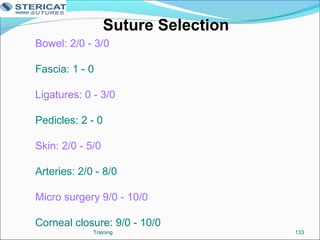
Suture Selection
Bowel: 2/0 - 3/0
Fascia: 1 - 0
Ligatures: 0 - 3/0
Pedicles: 2 - 0
Skin: 2/0 - 5/0
Arteries: 2/0 - 8/0
Micro surgery 9/0 - 10/0
Corneal closure: 9/0 - 10/0
133Training
STERICAT FAMILY
134Corporate PresentationTraining

Suture types & comparison training ppt.

  • 1.
  • 2.
  • 3.
  • 4.
    Mission and Visionof STERICAT Sutures Mission: Leading suture Manufacturing and Marketing company of India. Vision: Offering high quality surgical products, developed in close relationship with our customers and thus close to the market, for a reasonable price in order to help the hospitals save money. 4 Training
  • 5.
    30 years ofSuture Manufacturing experience Training ManualTraining
  • 6.
    Stericat is governedby International Quality Management System an ISO 13485: 2003/CMD CAS, ISO 9001: 2008, CE along with CE as per MDD 93/42/EEC as amended WHO GMP certified Company Way to Entrance Reception 6Training
  • 7.
    Admn. Office ChangingRoom 7Training
  • 8.
    Changing Room At ourstate of the art CLASS 100,000 facility, we operate with a quality assurance system, based on written procedures, exhaustive in process controls and a meticulous quality plan. An ever attentive technical team along with employee participation monitors manufacturing of sutures from raw material to finished product stage , enabling us to guarantee product reliability and Customer Satisfaction. At Stericat, we have a full in house testing facility to conduct all Chemical, Instrumental and Microbiological Tests. 8Training
  • 9.
    Pouch Opening DryDivision 9Training
  • 10.
    Production Control RoomWet Division 10Training
  • 11.
  • 12.
  • 13.
    World Class TestingLaboratory 13Training
  • 14.
  • 15.
    Filament Attachment by PneumaticNeedle Crimping 15Training
  • 16.
    Microbiology Tests &Packaging 16Training
  • 17.
  • 18.
    STERICAT Sutures, MESH& Speciality Products are available: •Human use •Veterinary use •Third parties ( US and European Companies) •Global Export Product varieties like: •Sutures •Pro-Set (Customized Suture Sets) •Special Suture Sets Training ManualTraining
  • 19.
  • 20.
    Marketing Office atSouth Delhi 20Training
  • 21.
    Marketing Office atSouth Delhi 21Training
  • 22.
    Marketing Office atSouth Delhi 22Training
  • 23.
    Marketing Office atSouth Delhi 23Training
  • 24.
  • 25.
    Presence in allReputed Hospitals  TAMIL NADU GOVT  ANDHRA GOVT  DELHI GOVT  ARMY HOSPITALS  RAILWAY HOSPITALS  GUJRAT GOVT  MAHARASTHRA GOVT  RAJASTHAN GOVT  BIHAR GOVT.  ORISSA GOVT  MP GOVT  PUNJAB GOVT  HP GOVT  HARYANA GOVT  &  ALL OTHER MAJOR HOSPITALS OF REPUTE 25 Training
  • 26.
    Presentation Contents HistoryHistory Suture classificationand selectionSuture classification and selection NeedlesNeedles Suture labelSuture label 26Training
  • 27.
    Workshop Contents Suture presentationSuturepresentation Basic Suture Techniques VideoBasic Suture Techniques Video Knot tying & suture exercisesKnot tying & suture exercises Evaluation.Evaluation. 27Training
  • 28.
    HISTORY The origins ofsurgery can be traced back many centuries. Through the ages, practitioners have used a wide range of materials and techniques for closing tissue…….. 1650 BC – 2000’s AD 28Training
  • 29.
    In the tenthcentury BC, the ant was held over the wound until it seized the wound edges in its jaws. It was then decapitated and the ant's death grip kept the wound closed. AntsAnts 29Training
  • 30.
    Thorns The thorn, usedby African tribes to close tissue, was passed through the skin on either side of the wound. A strip of vegetable fibre was then wound around the edge in a figure eight. 30Training
  • 31.
    Sterilised Catgut The toughmembrane of sheep intestine was provided to the surgeon pre-sterilised and required threading through the eye of the needle before use. 31Training
  • 32.
    Swaged On Needles PostWorld War II brought the swaged-on needle. The thread fits into the hollow end of the needle, allowing it to pass through tissue without the double loop of thread that exists with a conventional needle, reducing tissue trauma. 32Training
  • 33.
    Raw Material Biological: LinenSilk Collagen • Metallic: Stainless Steel Synthetic: Polypropylene  Polyester  Polyamide  Polyglycolic acid  Polyglactin  Poliglecaprone 25  Polydioxanone 33 Since 1970’s From 1950’s
  • 34.
    Criteria of suturematerial choice • Calibre • Lineal tensile strength • Knot tensile strength • Knot security • Thread surface • Flexibility • Elongation / Elasticity • Capillarity • Period of useful tensile strength • Period of absorption • Tissue reaction Training34
  • 35.
    Gut/Chromic Gut Made ofsubmucosa of small intestines Multifilament Breaks down by Phagocytosis: Inflammatory reaction. 1Training
  • 36.
    Suture Classification andSelectionSuture Classification and Selection 36Training
  • 37.
    Suture ClassificationSuture Classification NaturalNaturaloror SyntheticSynthetic (man made)(man made) MonofilamentMonofilament oror MultifilamentMultifilament (braided)(braided) AbsorbableAbsorbable oror Non-AbsorbableNon-Absorbable 37Training
  • 38.
    The Ideal Suture Minimaltissue reaction Smoothness - minimum tissue drag Low Capillarity Max tensile strength Ease of handling - Minimum memory Knot security Consistency of performance Predictable performance Cost effectiveness 38Training
  • 39.
  • 40.
    Multifilament (braided)Multifilament (braided) SutureClassificationSuture Classification MonofilamentMonofilament 40Training
  • 41.
  • 42.
  • 43.
    Braided v Monofilament Hascapillary action Increased infection risk Less smooth passage Less tensile strength Better handling Better knot security No capillary action Less infection risk Smooth tissue passage Higher tensile strength Has memory More throws required 43Training
  • 44.
    These are absorbedwithin the living tissueThese are absorbed within the living tissue Two main characteristics are:Two main characteristics are: Tensile strength retentionTensile strength retention Absorption rateAbsorption rate Absorbable SuturesAbsorbable Sutures I-COLI-COL :Day 21: 50% Absorption: 60-75 days:Day 21: 50% Absorption: 60-75 days I-COL FastI-COL Fast :Day 06: 50% Absorption: 40-45 days:Day 06: 50% Absorption: 40-45 days MonoColMonoCol:Day 28:50% Absorption: 180-210days.:Day 28:50% Absorption: 180-210days. StericrylStericryl ::Day 21: 50% Absorption: 90-120daysDay 21: 50% Absorption: 90-120days.. 44Training
  • 45.
    Absorbable Sutures I-COL I-COLFast MONOCOL STERICRYL MATERIAL 100% Polyglycolic Acid. 100% Polyglycolic Acid. Polydioxanone Polyglecaprone 25 STRUCTURE Braided ( Coated ) Braided ( Coated ) Mono-filament Mono-filament COATING Polycaprolactone + Calcium Stearate Polycaprolactone + Calcium Stearate NA NA 50% TENSILE STRENGTH 18-20Days 6-7 days 28 Days 18-21 Days ABSORPTION PROFILE 60-75Days 40-45 Days 180-210 Days 90 - 120 Days 45
  • 46.
    Characteristics of Non-AbsorbableSutures Permanent Only used when long term support is required Removed when used for skin. Tissue reaction generally low (except silk) However silk, linen and even nylon will lose tensile strength over a period of time True non-absorbable sutures include polyester, polyethylene, polybutester, polypropylene and steel 46Training
  • 47.
    Suture Handling 1. PackageMemory: Grasp strand close to needle and at end of strand and gently stretch 2. Opening Suture Foil: Tear in direction indicated to gain best needle exposure. 3. Arming needle Arm needles 2/3rds distance between tip and swage 47Training
  • 48.
    Options to Closea Wound  Traditional sutures  Mechanical sutures   Tissue adhesives  Adhesive suture strips  48
  • 49.
    Surgical Sutures Presentations •Single Armed (One Needle) • Double Armed (Two Needle) • Loop Suture • Pre-Cuts (Ligatures) 49 Trainning
  • 50.
    Knot Tying &SuturingKnot Tying & Suturing 50Training
  • 51.
    Principles of SurgicalSutures • Wound edges approximation and ensure strength according to tissue properties • Suture degradation profile according to wound healing process • Handling properties according to surgeon’s expectations ( flexibility, smoothness, knot holding,…) Strong tissue with slow healing Fascia Tendons  Weak tissue with quick healing  Muscles Intestines 51
  • 52.
    STERICAT Surgical Sutures •Suture knots Approximate tissues & hold wound edges • Ligatures • Identification of structures (Vessel loops) 52 Company Presentation
  • 53.
    Most common knotsin surgery • Square knot Surgeon's knot • Most common techniques in surgery Continuous suture (over and over) Simple knots 53
  • 54.
    Training54 Weakest point inthe suture • Every surgeon has his own knotting technique. • USP / EP standards determine minimum values. Knot pull Tensile Strength
  • 55.
    Classification of SurgicalSutures Surgical sutures can be classified according to • Raw Material • Structure • Absorption profile Training55
  • 56.
    Suture from STERICATaccording to structure  Multifilament: braided or twisted  Monofilament  Pseudo-monofilament 56Company Presentation
  • 57.
    Absorbable Suture Characteristics •Degradation profile Enzimatic (Biological sutures) : Catgut Hydrolysis (Synthetic sutures) : Abs. Syn. • 50% tensile strength retention period Short term : 7 days : I-COL FAST Mid term : 14-21 days : I-COL , POLYCOL & STERICRYL Long term : 28-40 days : MONOCOL • Mass absorption time Short term : 42 days : I-COL FAST Mid term : 60-90 days : I-COL , POLYCOL & STERICRYL Long term : 6 months : MONOCOL 0 20 40 60 80 100 0 3 6 9 12 15 18 21 24 28 Vicryl Rapide Safil Quick Catgut Plain Catgut Chromic Safil Monosyn 57
  • 58.
    STERICAT suture, accordingabsorption profile • Absorbable sutures Degradation 50% tensile strength retention period Mass absorption time • Non absorbable sutures Remain in the body forever • “Pseudo-non absorbable sutures” Absorbed in a 2-3 years period Training58 I-COL® , POLYCOL ® I-COL ® FAST STERICRYL ® MONOCOL ® CATGUT Plain / Chrom STERILENE® STERIPOL®/ STERIBON ® STERISTEEL® STERILON ® STERISIL ® TRAINNING
  • 59.
    Calibre - Diameter •USP: United States Pharmacopoeia -4-0 is 0000 smaller than 3-0 -Different systems for organic and synthetic materials.   3/0 • EP: European Pharmacopoeia (Metric system) 0.01mm diameter = EP 0.1 (Minimum thread diameter x 10) 0.35mm diameter = EP 3.5  2 Training59
  • 60.
  • 61.
    Lineal Tensile Strength Maximumlinear load depends on • Thread material • Calibre • Structure STRENGTH = SECURITY Least material possible for secure hold. 61
  • 62.
    Training62 Knot-pull tensile strengthaccording to the material (Kg) 5.4 4.5 3.75 3.75 3.75 3.75 3.5 3.25 3.25 2.45 8.5 0 1 2 3 4 5 6 7 8 9 Steel monofilament Polyglycolic acid Glyconate Polypropylene Polyamide monofilament Silk Supramid Polyester monofilament Polyester braided and coated Polyester braided Catgut Strength Changes with the Material
  • 63.
    Knot Security Related to: •Flexibility. • Elasticity. • Suture Surface. • Knotting technique. • Surgeon’s experience. • Silk, linen, catgut. • Braided polyester,braided absorbables. • Monofilar absorbable and non absorbable. • Stainless steel. 63 2 = 1 Closed knot = Security
  • 64.
    Thread surface Friction betweenthread and tissue • Tissue drag. • Knot repositioning. Surface smoothness depends on: • Material. • Structure. • Coating. 64
  • 65.
    Flexibility Flexibility depends on: •Material • Structure • Calibre Flexibility eases: • Handling • Adaptation of wounds • Knot security Flexibility = easy handling 65 •Silk, synthetic absorbable braided •Linen, braided polyesters •Catgut •Monofilaments •Stainless steel
  • 66.
    Elongation / Elasticity Elongation:stretching of thread -If elastic: comes back to original length - if not: deformation occurs (thinner- longer) Skin closure: Elasticity = Less scar Vascular anastomosis: No elongation to keep anastomosis closed. Training66
  • 67.
    Elasticity From less tomost elastic: • Stainless steel • Linen,Silk,Braided Synthetic absorbables,Braided polyester • Catgut • Absorbable monofilaments • Polypropylene • Polyester monofilament • Nylon Training67
  • 68.
    Capillarity Capillarity means theaction by which the surface of a liquid where it is in contact with a solid (as in a capillary tube) is elevated or depressed depending on the relative attraction of the molecules of the liquid for each other and for those of the solid. This attraction of molecules means for sutures that liquid like blood or even bacteria may by elevated / transported through a suture thread. Capillarity encourages infection causing suture sinuses and abscesses. Training68
  • 69.
    Capillarity and Suturematerial  No capillarity: • Stainless steel • Monofilaments (Synth. Absor., Polyester, Polypropylene and Polyamide)  Not likely to have capillarity: • PGA • Coated polyester • Catgut • Coated silk  Capillarity: • Linen • Braided polyester Training69
  • 70.
    Period of usefultensile strength = 50% Training70 days0 50 100 % Wound healing process Tensile strength retention loss absorbable suture Suture useful x
  • 71.
    Period of usefultensile strength  Suture material 50 % Period useful tensile strenght  Polyglycolic acid 18-21 days  Poliglecaprone 14 days  Polydioxanone 28-35 days 0 10 20 30 40 50 60 70 80 90 100 0 8 16 25 30 days %woundhealing Skin Colon Stomach Aponeurosis Urinary Bladder 71
  • 72.
    Period of massabsorption  Polyglycolic Acid I-COL 60-75 days  Polyglactin 910 POLYCOL 60-75 days  Polyglycolic acid I-COL FAST 40–45 days  POLIGLECAPRONE 25 STRICRYL 90-120 days  CATGUT PLAIN /CHROMIC STERICAT 90 days  Polydioxanone MonoCOL 180 – 210 days Training72
  • 73.
    Actual absorbable suturerange Term Short Mid Long Monofilament STERICRYL® MonoCOL® Polyfilament I-COL® FAST I-COL / POLYCOL® 73 Absorbable: Until when useful? Tensile strength
  • 74.
    ABSORBABLES SUTURES  I-COLVIOLET  I-COL FAST  POLYCOL  STERICRYL  MONOCOL  CATGUT. Training 74Company Presentation
  • 75.
    PGA and Sterilization AsPGA is susceptible to degradation from moisture and gamma rays: Low humidity ethylene oxide gas sterilization procedures are used and moisture-proof packaging. Acceleration of in vivo degradation due to gamma irradiation has been exploited to create devices where early fragmentation is desired. This is how we create I-COL FAST where we accelerate the degradation profile of the suture, by breaking down the molecules. Training75
  • 76.
    Tissue Reaction Related to: •Material • Amount of suture  Calibre  Knot type • Structure / Capillarity Low Tissue Reaction = Security 76
  • 77.
    I-COL VIOLET Training 77 Mid-term braidedand coated synthetic absorbable suture, made of pure polyglycolic acid (violet or undyed). High tensile strength Secure holding of first throw Excellent knotting ability Smooth passage through tissue Easy handling Sizes available:USP 2 to 10/0 Surgical Specialties Gastrointestinal Surgery. Gynaecology / Obstetrics. Ophthalmic surgery. Orthopaedics. Urology. Skin closure. (intra, sub, skin) Neurosurgery. Company Presentation
  • 78.
    I-COL® FAST Training 78 Short-term syntheticabsorbable braided and coated suture(POLYCAPROLACTON E+CALCIUM CITRATE), made of low molecular weight polyglycolic acid. High initial tensile strength Predictable and constant degradation rate Good knot security Excellent handling properties Quick mass absorption Used in Specialties Gynaecology / Obstetrics. (e.g. episiotomies) Ophthalmic surgery. (e.g. conjunctiva suturing) Oral surgery. (e.g. oral mucosa) Paediatric surgery. Skin closure. (Intra, sub, skin) Ligatures. Company Presentation
  • 79.
    STERICRYL. Training 79 Mid-term absorbable syntheticundyed monofilament Suture made of poliglecaprone 25 Superior initial knot tensile strength Ideal degradation profile for soft tissues Smooth tissue passage Excellent knot security Quick mass absorption Sizes available:6/0 to 1 Used in Specialties Gastrointestinal surgery. Gynaecology / obstetrics. Urology. Plastic and reconstructive surgery. Skin closure. (Intra, sub, skin) Ligatures. Company Presentation
  • 80.
    MONOCOL Training 80 Synthetic long-term absorbablemonofilament suture made of polydioxanone, dyed violet. High knot tensile strength Outstanding strength retention for extended wound support Very flexible, Pliable and easy to knot Conveniently eligible Smooth passage through tissue Sizes available :7/0 to 2 Also available in Loop 150cm, size 1, 40mm heavy Used in specialties. Abdominal wall closure. Orthopaedics. Paediatric cardiovascular surgery Company Presentation
  • 81.
    NON-ABSORBABLE SUTURES  STERILENE STERIPOL  STERILON  STERISIL  STERISTEEL Training 81Company Presentation
  • 82.
    Training 82 Cardio-vascular rangeof sutures Sterilene Steripol Steristeel Company Presentation
  • 83.
    STERILENE Training 83 Synthetic non-absorbable monofilament suture madeof Polypropylene, Blue colour - enhanced visibility. Smooth passage through tissue Excellent knot run down and security Optimal elasticity and elongation properties Sizes available:10/0 to 2 Used in specialties. Vascular surgery, Cardiac surgery, Plastic and reconstructive surgery, Skin closure. (intra, sub, skin) Neurosurgery. Microsurgery. Gastrointestinal surgery. Company Presentation
  • 84.
    STERILON®  Synthetic  non-absorbablemonofilament suture  made of polymers Polyamide 6/6.6 (dyed blue),  Polyamide 6.6 (dyed black)  or Polyamide 6 (undyed).  Flexible, easy to handle and tie  Smooth passage through tissue  Excellent histocompatibility  Sizes available: 11/0 to 1 Training Used in specialties Skin closure. (intra, sub, skin) Plastic and reconstructive surgery. Microsurgery. Ophthalmic surgery. Neurosurgery. 84Company Presentation
  • 85.
    STERIPOL/STERIBON Training 85 Silicone coated, Multifilamentbraided Polyester fibers. Unique PTFE oval pledget design improving adaptability to underlying anatomical structures Improved passage through tissue Excellent knot run-down properties Minimised tissue drag and sawing Optimal knot security Available in single packs (1, 2 sutures) or Multipacks (4, 8 sutures) either green or white. Pledget sizes:3x3 & 6x3,oval & rectangular. Sizes available:6/0 to 5(green & white) Used in Specialties Cardiac surgery (valve replacement) Orthopaedics Company Presentation
  • 86.
    STERISIL® Training 86 non-absorbable, braided andcoated suture, made of natural silk filaments available in black. Excellent handling properties Good knot security Sizes available:9/0 to 6 Used in Specialties General surgery Skin closure Oral surgery Ophthalmic surgery (Virgin silk) Neurosurgery Ligatures Company Presentation
  • 87.
    STERISTEEL® Training 87 Non-absorbable twistedor monofilament suture made of corrosion-resistant steel for orthopaedic and Cardiac surgery. USP 5/0 (1 metric) to USP 7 (9 metric) Exceptional tensile strength Excellent tissue compatibility Sizes available:USP 5/0 to 7 Steristeel® - Sternum Closure Company Presentation
  • 88.
  • 89.
  • 90.
    Basic components forthe needle A. Points of needle: 1. Cutting points : it used to penetrate when tissue is difficult to be penetrated as skin and tendon 2. Reverse cutting 3. Taper point : these needles are used in soft tissue such as intestine and peritoneum, the sharp point at the tip of needle 4. Blunt point : these are using for suturing friable tissue such as liver and kidney 1Training
  • 91.
    Basic components forthe needle B. Body of needle : 1.Straight 2.Curved C. Eyed of needle: The eye is the segment of needle where the suture strand is attached 1.Eyed needle :Like of any household sewing needle 2. French eye needle : It has a slit from the inside if the eye to the end of the needle through which the suture is drawn 3.Eyeless needle : The suture strand the needle are one unit 1Training
  • 92.
    Cutting vs ReverseCutting Cutting Reverse cutting 92Training
  • 93.
    Points of Needles Cutting Cuttingedge on inside of circle Skin Traumatic 93Training
  • 94.
    Points of Needles ReverseCutting Cutting edge on outside of circle Skin Less traumatic than cutting 1Training
  • 95.
  • 96.
    Shapes of Needles 3/8circle 1/2 circle Straight Specialty 1Training
  • 97.
  • 98.
  • 99.
    Taper Blunt Conventional TAPERCUTReverse cutting 99Training
  • 100.
    Needle point Geometry Taper-Point •Suitedto soft tissue •Dilates rather than cuts Reverse cutting •Very sharp •Ideal for skin •Cuts rather than dilates Convention al Cutting •Very sharp •Cuts rather than dilates •Creates weakness allowing suture tearout Taper- cutting •Ideal in tough or calcified tissues •Mainly used in Cardiac & Vascular procedures. 100Training
  • 101.
    Medical Grade ClassSteel Types 101Training
  • 102.
    Summary of Needles 1.Needles are made of steel alloy (Medical Grade). STERICAT we use controlled hardness of VPN 525 to 625 with a coating so they stay sharp for multiple passes through tissue. 2. Different needle points for different tissues . 3. Choose the needle that will cause the least trauma. 102Training
  • 103.
  • 104.
    The Suture Packaging 104 STRANDSIZE MATERIAL STRAND LENGTH COLOUR NEEDLE CIRCLE POINT TYPE NEEDLE LENGTH PRODUCT CODE Training
  • 105.
  • 106.
  • 107.
    SPECIALITY PRODUCTS  HERNIAREPAIR – STERILENE MESH, STERIFLEX MESH, STERILENE MESH KIT  C-SECTION KIT  STERISLING-Transobturator Sling System 107Training
  • 108.
    SPECIALITY PRODUCTS  HERNIAREPAIR – STERILENE MESH, STERIFLEX MESH, STERILENE MESH KIT  C-SECTION KIT  STERISLING-Transobturator Sling System Training 108Company Presentation
  • 109.
    STERILENE® Mesh Training 109 STERILENE® Mesh is made from monofilament polypropylene, Rapid healing and tissue penetration Closed, rounded edges Thin mesh structure Excellent transparency Good handling Well tolerated Good stability Used in Specialties Hernia repair. Reconstruction of the chest wall. Reinforcement of fascial tissue, when non-absorbable reinforcement material is required For conventional and minimally invasive techniques. Company Presentation
  • 110.
    STERILENE MESH® ULTRALIGHT Training 110 Lightweight polypropylene mesh Improved bicompatibility Soft and pliable Thinner, more conformable Flexible, strong and secure Full transparency Easy placement. Used in Specialties. Inguinal hernia. Incisional hernia. Reconstruction of chest wall. For conventional and minimally invasive techniques. Company Presentation
  • 111.
  • 112.
    STERISLING Trans-Obturator Needle System TheTransobturator Needle System consists of Two Curved Medical Grade Stainless Steel reusable passers. They are used to place Sling for Female patients of Stress Urinary Incontinence (SUI) with minimal blind passage. Making it very safe, It never enters the Reptropubic space & Abdominal wall. Decreased risk of: Bowel, Bladder Injury & Major Bleeding. Training Company Presentation
  • 113.
    Training Training Manual Hernia is asac lined by peritoneum that protrudes through a defect in the layers of the abdominal wall. Generally, a hernia mass is composed of a peritoneal sac, into which organs or other abdominal tissues can slip. Most hernias occur in the abdominal cavity. Although a hernia can develop on any part of the abdominal wall. The areas near the natural openings in the groin areas (inguinal hernias), below the groin (femoral hernias), through the naval (umbilical hernias) through old surgical incisions (incisional hernias) are the most common.
  • 114.
    Trend – MeshMaterials Training115 Standard Super-LightLightUniversal-lightTraditional Mesh 1997 2002 20052004 Light, Large porous Heavy, Small porous Lightweight Meshes are the new Standard.
  • 115.
  • 116.
    TYPES OF HERNIA InguinalHernias- Indirect Inguinal Hernias This occurs due to a weakness in the abdominal wall present at birth. In men, this weakness is caused by a space that is created as the testes and spermatic cord descend by way of the inguinal canal (a / ½ inch canal) Direct Inguinal Hernia They are most common in men and usually later in life, most often after 40, Direct inguinal hernias are due to an acquired wear and tear in the abdominal wall. Training 117
  • 117.
  • 118.
    Training 119 Congenital DiaphragmaticHernia is a birth defect in which abdominal organs protrude up into the chest cavity. Femoral Hernia is the protrusion of abdominal fat or part of the intestines through the abdominal muscles into the upper thigh area. Hiatal Hernia is the protrusion of a portion of the stomach through an opening in the diaphragm called the hiatus. Hiatal hernia is also called a hiatus hernia. Incisional Hernia is a hernia that develops through a previous surgical incision. This can occur anywhere on the abdomen or back. Inguinal Hernia is the protrusion of abdominal fat or part of the intestines through the abdominal muscles into the groin area (also called the inguinal canal). Inguinal hernia is the most common type of hernia. Umbilical Hernia is the protrusion of part of the intestines or abdominal lining through the abdominal wall around the belly button. It most often occurs in infants ages six months and younger.
  • 119.
    ENDOSCOPIC HERNIA REPAIR (Minimallyinvasive surgery ) There are two forms of Endoscopic Hernia repairs:- Trans-Abdominal Pre-Peritoneal (TAPP), this repair involves entry into the abdominal cavity with peritoneal incision and dissection, Hernia reduction, Mesh placement, and Closing Peritoneum. In Totally Extra-Peritoneal (TEP) Hernia repair the abdominal cavity is not entered. The working space is created by pre-peritoneal dissection. Mesh is placed without peritoneal incision. Training 120
  • 120.
    Advantages of large-poresized, lightweight, monofilament Polypropylene Meshes :  Improved biocompatibility  Diminished foreign body sensation  Less postoperative pain  Lower rate of seroma formation  Faster recovery  Optimal incorporation into the surrounding tissue  Better elasticity while maintaining the dymanics of the abdominal wall  Better handling characteristics  Easy modeling to the body tissue Training121 ENDOSCOPIC HERNIA REPAIR (Minimally invasive surgery )
  • 121.
    Training Training Manual a) Midline b) Rightor Left Paramedian c) McBurnny d) Oblique inguinal e)Sub-costal (Kocher’s)
  • 122.
    Training Training Manual a. Midline Themost commonly used incision, made longitudinally in the center of the abdomen along the linea alba nad between the muscles. Can provide access to all quadrants,. i.e: Gastrectomy. b Right or Left Paramedian Vertical incision, lateral and parallel to the midline. Used for specific surgical procedures, e.g. Splenectomy. c McBurnny The incision generally used for an Appendectomy. d Oblique Inguinal Incision made in area of groin for Herniorrhaphy e Sub-costal (Kocher’s) Incision made below the ribs generally for Gallbladder procedures.
  • 123.
    Training Training Manual Skin Protective covering Sub-cutaneoustissue Fatty layer under the skin. (Thickness will vary considerably according to individual’s weight. Fascia (Anterior and Posterior) – a layer of firm connective tissue that covers muscles. Muscle Fibrous tissue formed into sheaths Peritoneum Thin membranous lining of abdominal cavity beneath the posterior fascia
  • 124.
  • 125.
  • 126.
    TISSUE LAYERS OFTHE ABDOMEN Skin Protective covering, The final layer closed. Sub-cutaneous tissue Closing the sub- cutaneous tissue eliminates the possibility of dead spaces where accumulation of tissue fluids can delay healing processes and cause infection. Sub-cutaneous layer is thin Fatty layer under the skin. (Thickness will vary considerably according to individual’s weight. Fascia (anterior & posterior)Layer of firm connective tissue that covers muscles. Muscle Fibrous tissue formed into sheaths Peritoneum Thin membranous lining of abdominal cavity beneath the posterior fascia. Training 127
  • 127.
    Training Training Manual Posterior Fascia (fascia on theposterior side of the muscle sheath) where it does exist, is included in this layer. Note: Where extreme obesity or stress is encountered, surgeon will place retention sutures through all layers of the abdomen for extra security. Most often, retention sutures are put in prior to closure of the peritoneum. Muscle Is frequently reflected rather than cut, and therefore does not require closure. If muscles have been transected they may be closed separately or together with the anterior fascia. Fascia (anterior) Is relied upon to re-establish postoperative abdominal wall strength. Therefore, anterior fascia closures are of extreme importance. Care must be taken in approximating the fascia to insure that there is sufficient distance from the incision line to the closure bite, otherwise the fascia may tear before it is healed from sudden stress such as a cough.
  • 128.
    Training Manual Peritoneum 2-0 or3-0 Muscles 1-0 or 1 Linea Albas 1 Sheath 1-0 or 1 Subcutaneous Fat 3-0 Esophagus 3-0 Silk Stomach 2-0 Anastomosis 2-0 or 3-0 Kidney 1-0 Urinary Bladder 2-0 Gynaec. Operations 1-0 and 1 Ovarian Surgery 2-0 Tuboplasty 10-0 or 8-0 Vasovasostomy 10-0 and 1 Tendons 4-0 Polyester or 5-0 Stainless Steel
  • 129.
  • 130.
    S. No. NEEDLEDESCRIPTION Length SIZE CODE LAYER I-COL-FAST (P.G.A.) Polyglycolic Acid 1 3/8 CIRCLE REVERSE CUTTING (P.POINT) 26mm, 70cm. . .3/0 SFN2732 SKIN 2 1/2 CIRCLE REVERSE CUTTING 30mm, 90cm. .1/0 SFN2761 EPISIOTOMY REPAIR 3 1/2 CIRCLE CUT TAPER 35mm, 90cm. .2/0 SFN2762(H) AS ABOVE 4 1/2 CRB & 1/2 C REVERSE CUTTING, (Double Armed) 36mm, 140cm .2/0 SFN2777 AS ABOVE MONOCOL ( P.D.) Polydioxanon 5 1/2 CRB 40mm, 90cm. .1/0 SFN9371(H) MUSCLE 6 1/2 CRB 40mm, 90cm. 1 SFN9347 MUSCLE 7 1/2 CIRCLE RB, HEAVY LOOP 40mm, 150cm. 1 SFN9261 LOOP, SINGLE LAYER POLYCOL ( Polyglactin 910 ) 8 1/2 CIRCLE R.B. (Double Armed) 40mm, 90cm & 140cm 0,1/0 SPL2346 FASIA,MUSCLE 9 ½ CRB 30mm, 90cm. .2/0 SPL2317 BOWLE ANASTOMOMIS 10 ½ CRB 30mm, 90cm. .1/0 SPL2338 FASIA MUSCLE 11 1/2 CIRCLE REVERSE CUTTING (ORTHO) 36mm. 90cm. .1/0 SPL2534X FASIA MUSCLE(ORTHO) 12 ½ CRB 40mm, 115cm. 1 SPP2347LS FASIA MUSLE 13 ½ CRB 20mm, 70cm. .3/0 SPP2437 FASIA MUSLE 14 ½ CRB 30mm, 90cm. .2/0 SPP2317 BOWLE ANASTOMISIS 15 ½ CRB 30mm, 90cm. .1/0 SPP2338 BOWLE ANASTOMISIS 16 ½ C REVERSE CUTTING (ORTHO) 36mm, 90cm. .1/0 2534X FASIA MUSLE(ORTHO) 17 ½ CRB 40mm, 90cm. .1/0 SPP2346 FASIA MUSLE 18 ½ CRB 40mm, 90cm. .2/0 SPP2345 PERITONEOM 19 ½ CRB 40mm, 90cm. 1 SPP2347 FASIA MUSLE 20 1/2 C.REVERSE CUTTING 40mm, 90cm. .2/0 SPP2382 SKIN ,TOUGH ISSUE 21 1/2C. REVERSE CUTTING (ORTHO) 40mm, 90cm. 1 SPP2421X FASIA MUSLE(ORTHO) CATGUT CHROMIC 22 ½ CRB 20mm, 76cm. .3/0 SFN4237 BOWEL ANASTOMISIS 23 ½ CRB 30mm, 76cm. .2/0 SFN4241 BOWEL ANASTOMISIS 24 ½ CRB 30mm, 76cm. .1/0 SFN4242 BOWEL ANASTOMISIS 25 ½ CRB (HEAVY) 40mm, 76cm. 1 SFN4259 GYNEC. 'c' -SECTION 26 ½ CRB (HEAVY) 45mm, 100cm. 2 SFN4228 GYNEC.HYSTRECTOMY 27 3/8 CRB 16mm, 76cm. .4/0 SFN5048 URO 28 3/8 CIRCLE CUTTING 16mm, 76cm. .4/0 SFN4280 PLASTIC Training Training Manual
  • 131.
    STERISIL ( BaidedSilk ) 29 3/8 C.SPATULATED (P.POINT) 6mm, 38cm. .6/0 SFS-5043 OPTHAL 30 ½ CRB 20mm, 76cm. .3/0 SFS-5087 BOWL ANASTOMISIS 31 ½ CRB 25mm, 76cm. .3/0 SFS-5070 BOWL ANASTOMISIS 32 3/8 C.REVERSE CUTTING 26mm, 76cm. .3/0 SFS-5028 SUBCUTICULAR,SKIN 33 ½ CRB 30mm,76cm. .2/0 SFS-5333 INTESTINAL ANASTOMOSIS 34 ½ CRB 30mm, 76cm. .1/0 SFS-5334 INTESTINAL ANASTOMOSIS 35 3/8 C.REVERSE CUTTING 45mm, 76cm. .2/0 SFS-5036 SUBCUTICULAR,SKIN 36 3/8 C.REVERSE CUTTING 45mm, 76cm. .1/0 SFS-5037 (SKIN) SUBCUTICULAR,SKIN 37 3/8C. REVERSE CUTTING 60mm, 76cm. 1 SFS-5062A TOUGH SKIN STERICRYL ( Poliglecaprone 25 ) 38 3/8 C.REVERSE CUTTING 16mm, 70cm. .4/0 STR1205 SUBCUTICULAR,SKIN 39 3/8C.CUTTING(P.POINT) 25mm, 70cm. .3/0 STR1326 SUBCUTICULAR,SKIN STERILON ( Monofilament Polyamide) NYLON 40 3/8 CIRCLE SPATULATED (P.POINT) 6mm, 38cm. .10/0 SFN3718 OPTHAL 41 3/8 CIRCLE SPATULATED (P.POINT) 6mm, 38cm. .9/0 SFN-3715 OPTHAL 42 3/8 CIRCLE SPATULATED, (P.POINT) 6mm, 38cm. .8/0 SFN-3322 OPTHAL 43 3/8 CIRCLE SPATULATED (P.POINT), (D. Armed) 6mm, 38cm. .10/0 SFN-3719 OPTHAL 44 3/8 CIRCLE R.CUTTING 10mm, 38cm. .4/0 SFN-3326 PLASTIC 45 3/8 CIRCLE R.CUTTING 10mm, 70cm. .6/0 SFN-3320 PLASTIC 46 3/8 CIRCLE R.CUTTING 10mm, 70cm. .5/0 SFN-3323 PLASTIC 47 3/8 CIRCLE R.CUTTING(P.PONT) 12mm, 70cm. .5/0 SFN-3317 PLASTIC 48 3/8 CIRCLE R.CUTTING(P.PONT) 12mm, 70cm. SFN-3318 PLASTIC 49 3/8 CIRCLE R.CUTTING 26mm, 70cm. .3/0 SFN-3328 SKIN 50 1/2 CRB 40mm, 150cm. .1/0 SFN-3340 LOOP 51 1/2 CRB (HEAVY) 40mm, 100cm. .1/0 SFN-3346 RECTUS/MUCLSE 52 1/2 CRB (HEAVY) 40mm, 100cm. 1 SFN-3347 RECTUS/MUCLSE 53 3/8 CIRCLE REVERSE CUTTING 45mm, 70cm. .2/0 SFN-3336 SKIN 54 1/2 CRB (HEAVY) 50mm, 150cm. 1 SFN-3348 LOOPTraining 132
  • 132.
    Suture Selection Bowel: 2/0- 3/0 Fascia: 1 - 0 Ligatures: 0 - 3/0 Pedicles: 2 - 0 Skin: 2/0 - 5/0 Arteries: 2/0 - 8/0 Micro surgery 9/0 - 10/0 Corneal closure: 9/0 - 10/0 133Training
  • 133.

Editor's Notes

  • #27 Presentation start - confirm contents.
  • #28 Indicate approx length of time for each section. Presentation = 30 mins Knot tying practical = 20 mins Suture Vid = 40 mins Instrument tying/Suture practical = 40 mins. Evaluation forms will be issued at the end. Demonstrate delegate bag contents (highlight the knot tying manual U-L12 and sutures and wound closure U-L6). Confirm quiz sheet also included and that a certificate will be issued at end.
  • #32 Many Surgeons used Catgut previously, it was a commonly used suture. Surgeon’s liked it’s handling characteristics. it was twisted and absorbed quickly. ‘Caprosyn’ is Tyco’s synthetically developed replacement. ‘Caprosyn’ is the fastest absorbing monofilament on the market which handles like a braid.
  • #33 Sutures used in the workshop are ‘swaged’ or ‘Atraumatic’. The majority of sutures used by Surgeons are swaged. Mention ‘D-tach’ (pop-off).
  • #38 Confirm that all sutures have a ‘source’, ‘structure’ and a ‘‘fate’. It is these categories that directly affect suture selection. Every suture is either natural or synthetic. Every suture is either a monofilament or braided. Every suture is either absorbable or non-absorbable. Provide an example such as Polysorb = a synthetic, braided absorbable suture.
  • #39 Confirm that, to conclude an ideal suture material would have the following characteristics ………… ie) absorption rate of Catcut was not consistant,Silk
  • #40 Re-iterate that 5 is very thick and that 11.0 is very very fine. Indicate that brochure U-L6 (sutures and wound closure techniques) are in the delegate bag includes this scale and examples of surgery.
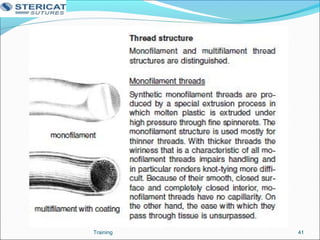
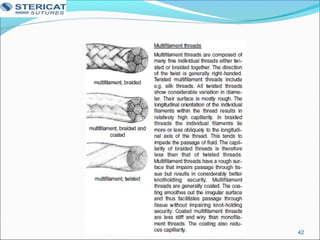
  • #41 The picture illustrates that a braided suture is made from many strands of material unlike the monofilament. As a result of these structures there are various advantages and disadvantages, these may affect suture selection.
  • #44 Ask if ‘capillary’ is understood, confirm. Discuss ‘memory’. During the practical a monofilament (Monosof) and a braided suture (Polysorb) is provided so that the handling advantages and disadvantages are experienced.
  • #45 Ask what the two main performance characteristics of an absorbable suture are, confirm. Explain that tensile strength retention is an indication of the strength of a suture, in the body over a period of time. Confirm that time required to support a wound will vary according to tissue type (eg skin, muscle = days. Tendon and fascia = months. Vascular prosthesis require long term wound support). Highlight the examples of strength and absorption rates for I-COL, MONOCOL & STERICRYL.
  • #46 HERE WE LOOK AT THE ABSORPTION RATES & ALSO THE TENSILE STRENGTHS IN-VIVO OF ALL THE ABSORBABLE SUTURES.
  • #47 THIS SHOWS SOME PROPERTIES OF NON-ABSORBABLE SUTURES
  • #51 Encourage questions. Reassure that all info included in the presentation is covered in UL-6 ‘Suture and wound closure techniques’ booklet provided in delegate bag.
  • #98 Needle curvature is selected according to site accessibility. Confirm commonly used curvatures in general surgery. Explain needle stick injury risk with use of straight needle.
  • #134 These are rough guides, it’s really the Surgeon’s preference and no a strict rules apply.