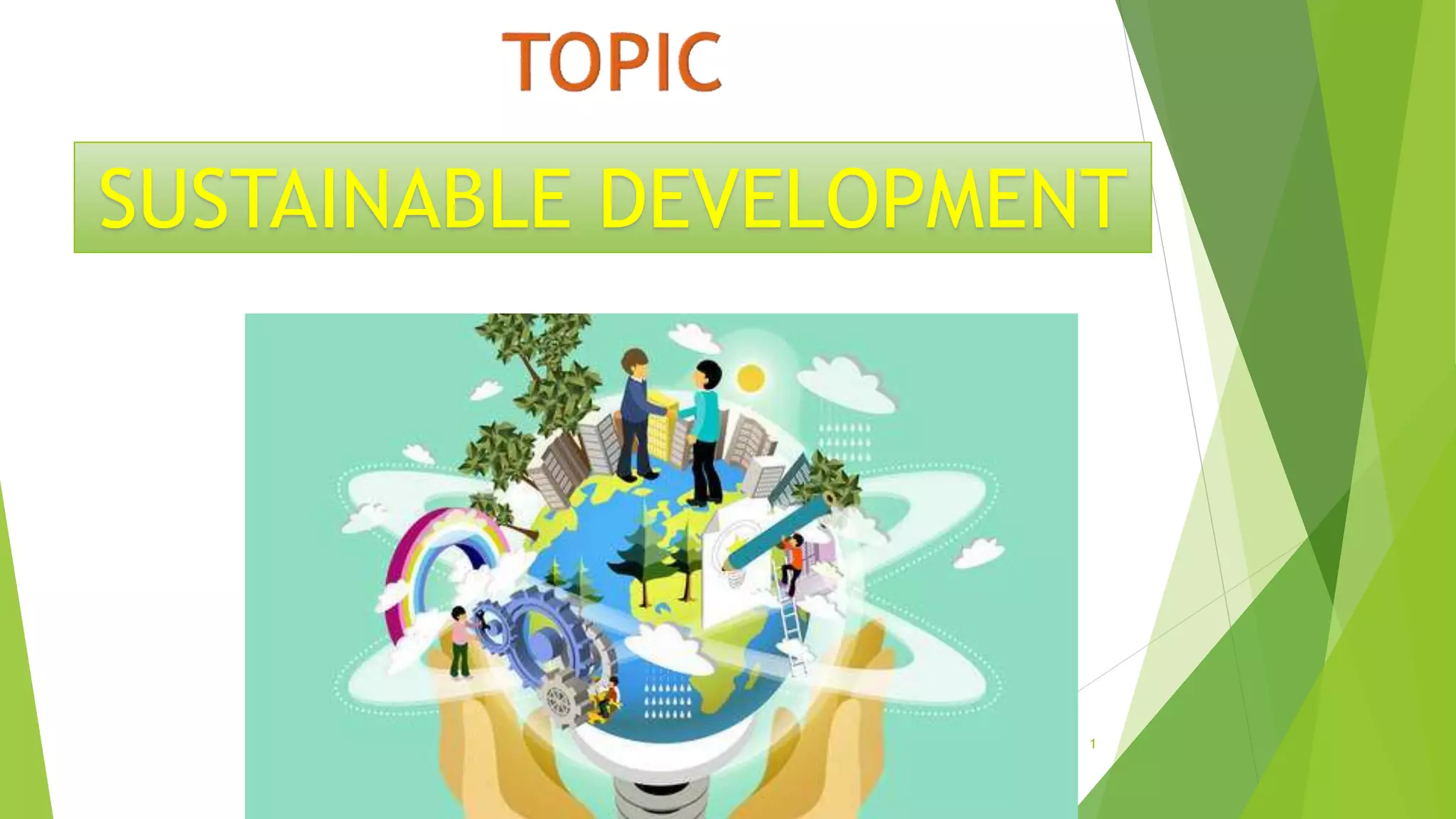
SUSTAINABLE DEVELOPMENT
1
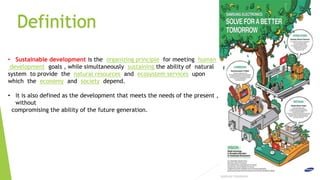
• Sustainable development is the organizing principle for meeting human
development goals , while simultaneously sustaining the ability of natural
system to provide the natural resources and ecosystem services upon
which the economy and society depend.
• it is also defined as the development that meets the needs of the present ,
without
compromising the ability of the future generation.
Definition
2
3
• Sustainablity can be defined as the practice of maintaining the process
of productivity indefinitely- natural or human made .
• it has its roots in the England during 17th & 18th centuries.
• It has started by JOHN EVELYN in England to growing awareness about
the depletion of the timber resources , then it is followed by the many
more persons.
4
• in 1980 International Union for the Conservation of Nature has
published a world conservation strategy where they first intro-
duced the term SUSTAINABLE DEVELOPMENT.
• After this many organisations like United Nations World Commission on
Environment and Development have published many reports and took
initiative for sustainable development
5
6
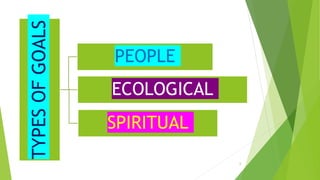
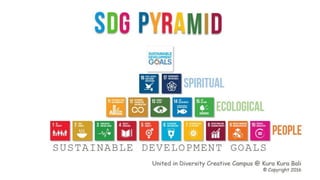
TYPESOFGOALS
PEOPLE
ECOLOGICAL
SPIRITUAL
7
8
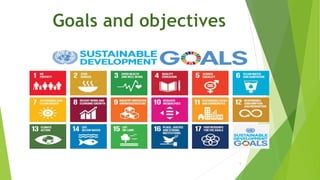
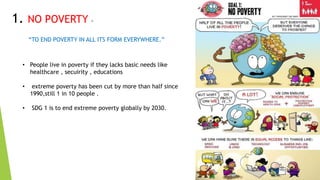
1. NO POVERTY -
“TO END POVERTY IN ALL ITS FORM EVERYWHERE.”
• People live in poverty if they lacks basic needs like
healthcare , secuirity , educations
• extreme poverty has been cut by more than half since
1990,still 1 in 10 people .
• SDG 1 is to end extreme poverty globally by 2030.
9
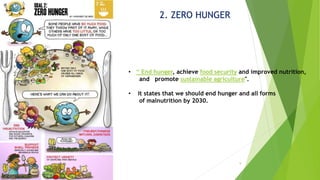
2. ZERO HUNGER
• “ End hunger, achieve food security and improved nutrition,
and promote sustainable agriculture".
• it states that we should end hunger and all forms
of malnutrition by 2030.
10
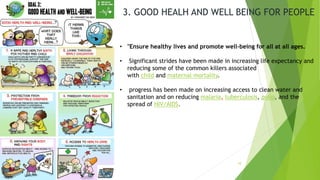
3. GOOD HEALH AND WELL BEING FOR PEOPLE
• "Ensure healthy lives and promote well-being for all at all ages.
• Significant strides have been made in increasing life expectancy and
reducing some of the common killers associated
with child and maternal mortality.
• progress has been made on increasing access to clean water and
sanitation and on reducing malaria, tuberculosis, polio, and the
spread of HIV/AIDS.
11
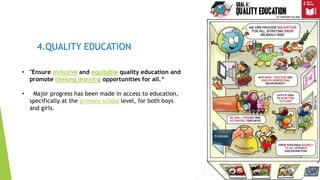
4.QUALITY EDUCATION
• "Ensure inclusive and equitable quality education and
promote lifelong learning opportunities for all.“
• Major progress has been made in access to education,
specifically at the primary school level, for both boys
and girls.
12
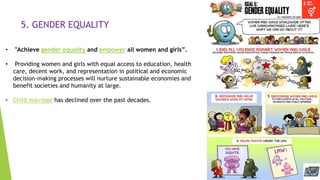
5. GENDER EQUALITY
• "Achieve gender equality and empower all women and girls”.
• Providing women and girls with equal access to education, health
care, decent work, and representation in political and economic
decision-making processes will nurture sustainable economies and
benefit societies and humanity at large.
• Child marriage has declined over the past decades.
13
6. CLEAN WATER AND SANITATION .
• "Ensure availability and sustainable management of
water and sanitation for all.“
• Worldwide, 6 out of 10 people lack safely managed
sanitation services, and 3 out of 10 lack safely managed
water services.[28] Safe drinking water and
hygienic toilets protect people from disease and enable
societies to be more productive economically.
14
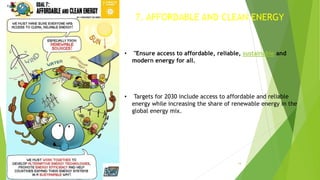
7. AFFORDABLE AND CLEAN ENERGY
• "Ensure access to affordable, reliable, sustainable and
modern energy for all.
• Targets for 2030 include access to affordable and reliable
energy while increasing the share of renewable energy in the
global energy mix.
15
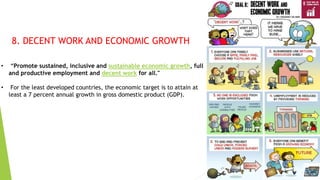
8. DECENT WORK AND ECONOMIC GROWTH
• “Promote sustained, inclusive and sustainable economic growth, full
and productive employment and decent work for all."
• For the least developed countries, the economic target is to attain at
least a 7 percent annual growth in gross domestic product (GDP).
16
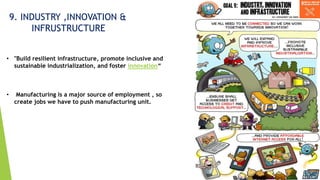
9. INDUSTRY ,INNOVATION &
INFRUSTRUCTURE
• "Build resilient infrastructure, promote inclusive and
sustainable industrialization, and foster innovation“
• Manufacturing is a major source of employment , so
create jobs we have to push manufacturing unit.
17
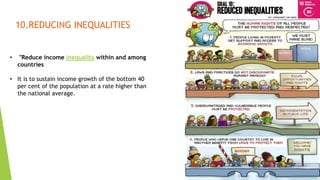
10.REDUCING INEQUALITIES
• "Reduce income inequality within and among
countries
• It is to sustain income growth of the bottom 40
per cent of the population at a rate higher than
the national average.
18
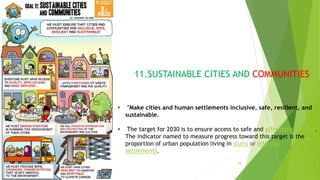
11.SUSTAINABLE CITIES AND COMMUNITIES
• "Make cities and human settlements inclusive, safe, resilient, and
sustainable.
• The target for 2030 is to ensure access to safe and affordable housing.
The indicator named to measure progress toward this target is the
proportion of urban population living in slums or informal
settlements.
19
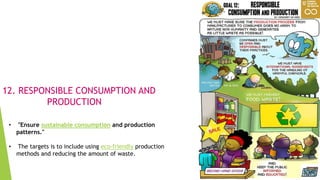
12. RESPONSIBLE CONSUMPTION AND
PRODUCTION
• "Ensure sustainable consumption and production
patterns."
• The targets is to include using eco-friendly production
methods and reducing the amount of waste.
20
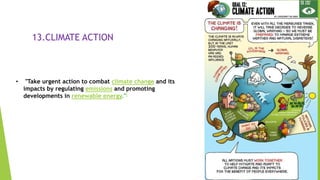
13.CLIMATE ACTION
• "Take urgent action to combat climate change and its
impacts by regulating emissions and promoting
developments in renewable energy."[
21
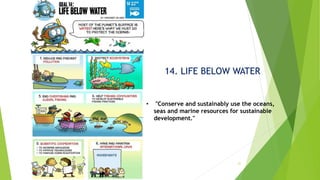
14. LIFE BELOW WATER
• "Conserve and sustainably use the oceans,
seas and marine resources for sustainable
development."
22
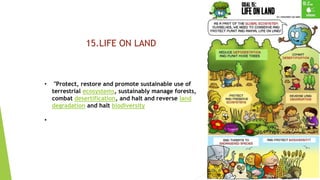
15.LIFE ON LAND
• "Protect, restore and promote sustainable use of
terrestrial ecosystems, sustainably manage forests,
combat desertification, and halt and reverse land
degradation and halt biodiversity
•
23
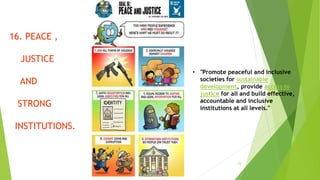
16. PEACE ,
JUSTICE
AND
STRONG
INSTITUTIONS.
• "Promote peaceful and inclusive
societies for sustainable
development, provide access to
justice for all and build effective,
accountable and inclusive
institutions at all levels."
24
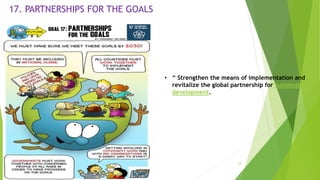
17. PARTNERSHIPS FOR THE GOALS
• “ Strengthen the means of implementation and
revitalize the global partnership for sustainable
development.
25
26
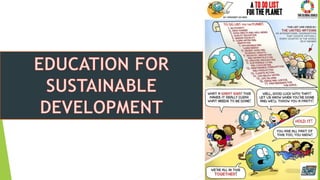
• Education for sustainable development( ESD) is defined as that encourages
changes in knowledge , skills & attitude to enable a moe sustainable and
equitable society .
• ESD aims to empower and equip current and future generations to
meet their needs using a balanced and integrated approach
to the economic, social and environmental dimensions of sustai-
nable development.
• The concept of ESD was born from the need for education to address
the growing and changing environmental challenges facing the planet.
27
• In order to do this, education must change to provide the
knowledge,skills skills, values and attitudes that
empowers learners to contribute to sustainable development.
• An empowering education is one that builds the human resources
we need to be productive, to continue to learn, to solve problems
to be creative, and to live together and with nature in peace and harmony.
28
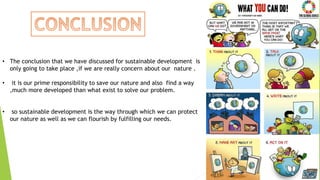
• The conclusion that we have discussed for sustainable development is
only going to take place ,if we are really concern about our nature .
• it is our prime responsibility to save our nature and also find a way
,much more developed than what exist to solve our problem.
• so sustainable development is the way through which we can protect
our nature as well as we can flourish by fulfilling our needs.
29

Sustainable development

  • 1.
  • 2.
    • Sustainable developmentis the organizing principle for meeting human development goals , while simultaneously sustaining the ability of natural system to provide the natural resources and ecosystem services upon which the economy and society depend. • it is also defined as the development that meets the needs of the present , without compromising the ability of the future generation. Definition 2
  • 3.
    3 • Sustainablity canbe defined as the practice of maintaining the process of productivity indefinitely- natural or human made . • it has its roots in the England during 17th & 18th centuries. • It has started by JOHN EVELYN in England to growing awareness about the depletion of the timber resources , then it is followed by the many more persons.
  • 4.
    4 • in 1980International Union for the Conservation of Nature has published a world conservation strategy where they first intro- duced the term SUSTAINABLE DEVELOPMENT. • After this many organisations like United Nations World Commission on Environment and Development have published many reports and took initiative for sustainable development
  • 5.
  • 6.
  • 7.
  • 8.
    8 1. NO POVERTY- “TO END POVERTY IN ALL ITS FORM EVERYWHERE.” • People live in poverty if they lacks basic needs like healthcare , secuirity , educations • extreme poverty has been cut by more than half since 1990,still 1 in 10 people . • SDG 1 is to end extreme poverty globally by 2030.
  • 9.
    9 2. ZERO HUNGER •“ End hunger, achieve food security and improved nutrition, and promote sustainable agriculture". • it states that we should end hunger and all forms of malnutrition by 2030.
  • 10.
    10 3. GOOD HEALHAND WELL BEING FOR PEOPLE • "Ensure healthy lives and promote well-being for all at all ages. • Significant strides have been made in increasing life expectancy and reducing some of the common killers associated with child and maternal mortality. • progress has been made on increasing access to clean water and sanitation and on reducing malaria, tuberculosis, polio, and the spread of HIV/AIDS.
  • 11.
    11 4.QUALITY EDUCATION • "Ensureinclusive and equitable quality education and promote lifelong learning opportunities for all.“ • Major progress has been made in access to education, specifically at the primary school level, for both boys and girls.
  • 12.
    12 5. GENDER EQUALITY •"Achieve gender equality and empower all women and girls”. • Providing women and girls with equal access to education, health care, decent work, and representation in political and economic decision-making processes will nurture sustainable economies and benefit societies and humanity at large. • Child marriage has declined over the past decades.
  • 13.
    13 6. CLEAN WATERAND SANITATION . • "Ensure availability and sustainable management of water and sanitation for all.“ • Worldwide, 6 out of 10 people lack safely managed sanitation services, and 3 out of 10 lack safely managed water services.[28] Safe drinking water and hygienic toilets protect people from disease and enable societies to be more productive economically.
  • 14.
    14 7. AFFORDABLE ANDCLEAN ENERGY • "Ensure access to affordable, reliable, sustainable and modern energy for all. • Targets for 2030 include access to affordable and reliable energy while increasing the share of renewable energy in the global energy mix.
  • 15.
    15 8. DECENT WORKAND ECONOMIC GROWTH • “Promote sustained, inclusive and sustainable economic growth, full and productive employment and decent work for all." • For the least developed countries, the economic target is to attain at least a 7 percent annual growth in gross domestic product (GDP).
  • 16.
    16 9. INDUSTRY ,INNOVATION& INFRUSTRUCTURE • "Build resilient infrastructure, promote inclusive and sustainable industrialization, and foster innovation“ • Manufacturing is a major source of employment , so create jobs we have to push manufacturing unit.
  • 17.
    17 10.REDUCING INEQUALITIES • "Reduceincome inequality within and among countries • It is to sustain income growth of the bottom 40 per cent of the population at a rate higher than the national average.
  • 18.
    18 11.SUSTAINABLE CITIES ANDCOMMUNITIES • "Make cities and human settlements inclusive, safe, resilient, and sustainable. • The target for 2030 is to ensure access to safe and affordable housing. The indicator named to measure progress toward this target is the proportion of urban population living in slums or informal settlements.
  • 19.
    19 12. RESPONSIBLE CONSUMPTIONAND PRODUCTION • "Ensure sustainable consumption and production patterns." • The targets is to include using eco-friendly production methods and reducing the amount of waste.
  • 20.
    20 13.CLIMATE ACTION • "Takeurgent action to combat climate change and its impacts by regulating emissions and promoting developments in renewable energy."[
  • 21.
    21 14. LIFE BELOWWATER • "Conserve and sustainably use the oceans, seas and marine resources for sustainable development."
  • 22.
    22 15.LIFE ON LAND •"Protect, restore and promote sustainable use of terrestrial ecosystems, sustainably manage forests, combat desertification, and halt and reverse land degradation and halt biodiversity •
  • 23.
    23 16. PEACE , JUSTICE AND STRONG INSTITUTIONS. •"Promote peaceful and inclusive societies for sustainable development, provide access to justice for all and build effective, accountable and inclusive institutions at all levels."
  • 24.
    24 17. PARTNERSHIPS FORTHE GOALS • “ Strengthen the means of implementation and revitalize the global partnership for sustainable development.
  • 25.
  • 26.
    26 • Education forsustainable development( ESD) is defined as that encourages changes in knowledge , skills & attitude to enable a moe sustainable and equitable society . • ESD aims to empower and equip current and future generations to meet their needs using a balanced and integrated approach to the economic, social and environmental dimensions of sustai- nable development. • The concept of ESD was born from the need for education to address the growing and changing environmental challenges facing the planet.
  • 27.
    27 • In orderto do this, education must change to provide the knowledge,skills skills, values and attitudes that empowers learners to contribute to sustainable development. • An empowering education is one that builds the human resources we need to be productive, to continue to learn, to solve problems to be creative, and to live together and with nature in peace and harmony.
  • 28.
    28 • The conclusionthat we have discussed for sustainable development is only going to take place ,if we are really concern about our nature . • it is our prime responsibility to save our nature and also find a way ,much more developed than what exist to solve our problem. • so sustainable development is the way through which we can protect our nature as well as we can flourish by fulfilling our needs.
  • 29.