Sustainable Water
Infrastructure
          Region 5 Report

    Navigating the Infrastructure
         Replacement Era
          February 4, 2011

           Louann Unger
         U.S. EPA Region 5
       Unger.louann@epa.gov
Setting the Stage

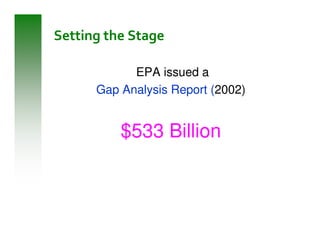
            EPA issued a
      Gap Analysis Report (2002)


          $533 Billion
Setting the Stage

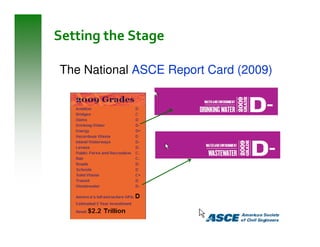
The National ASCE Report Card (2009)
Setting the Stage
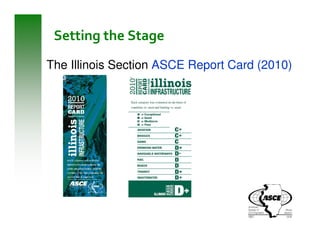
The Illinois Section ASCE Report Card (2010)
A National EPA emphasis on
“Sustainable Infrastructure” emerged

 Reduce the Funding Gap!

  Revenue and    Cost
Where is the opportunity?

 Green Infrastructure
 Asset Management
 Energy Efficiency
 Water Efficiency
 Financing Incentives (SRF)
 Full Cost Pricing
 Emergency Preparedness Planning
How do we address these practices?


  •   Provide outreach/education
  •   Understand barriers/benefits
  •   Integrate into core programs
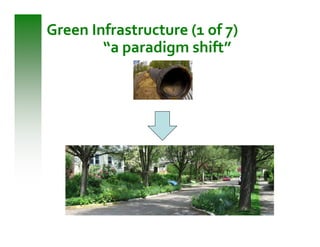
Green Infrastructure (1 of 7)
        “a paradigm shift”
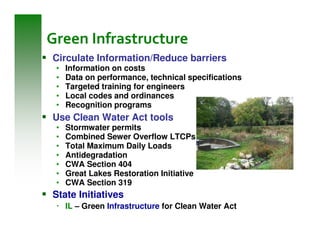
Green Infrastructure
Circulate Information/Reduce barriers
 •   Information on costs
 •   Data on performance, technical specifications
 •   Targeted training for engineers
 •   Local codes and ordinances
 •   Recognition programs
Use Clean Water Act tools
 •   Stormwater permits
 •   Combined Sewer Overflow LTCPs
 •   Total Maximum Daily Loads
 •   Antidegradation
 •   CWA Section 404
 •   Great Lakes Restoration Initiative
 •   CWA Section 319
State Initiatives
     IL – Green Infrastructure for Clean Water Act
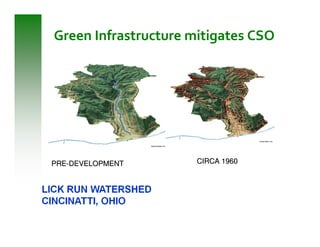
Green Infrastructure mitigates CSO


PRE-DEVELOPMENT       CIRCA 1960
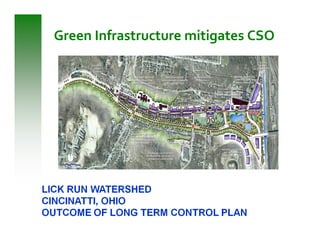
Green Infrastructure mitigates CSO
Energy Efficiency

 Importance
   Energy ~ 25% to 30% of total plant O&M cost
   $4 billion spent annually for energy, nationally
   Opportunity to reduce GHG emissions
 EPA Region 5 is
   Providing outreach on energy management
   Collaborating with Regions and HQ
   Learning from the Indiana energy management
   pilot 2009 - 2011
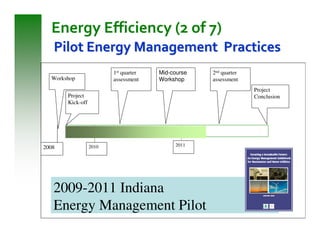
Energy Efficiency (2 of 7)
   Pilot Energy Management Practices
                         1st quarter   Mid-course   2nd quarter
  Workshop               assessment    Workshop     assessment
                                                                  Project
       Project                                                    Conclusion
       Kick-off


             *


                  2010                      2011
2008


   2009-2011 Indiana
   Energy Management Pilot
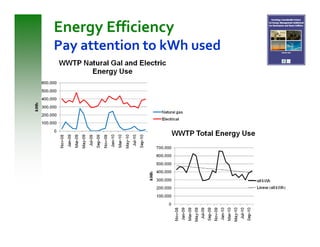
Energy Efficiency
Pay attention to kWh used
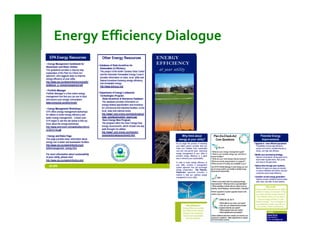
Energy Efficiency Dialogue
Energy Efficiency
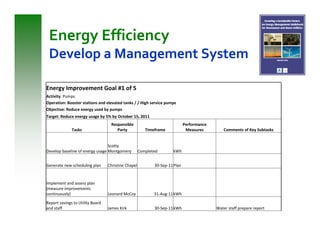
 Develop a Management System

Energy Improvement Goal #1 of 5
Activity: Pumps
Operation: Booster stations and elevated tanks / / High service pumps
Objective: Reduce energy used by pumps
Target: Reduce energy usage by 5% by October 15, 2011
                                   Responsible                               Performance
              Tasks                   Party             Timeframe             Measures         Comments of Key Subtasks


                                 Scotty
Develop baseline of energy usage Montgomery          Completed       kWh


Generate new scheduling plan      Christine Chapel          30-Sep-11 Plan


Implement and assess plan
(measure improvements
continuously)                     Leonard McCoy             31-Aug-11 kWh
Report savings to Utility Board
and staff                         James Kirk                30-Sep-11 kWh                  Water staff prepare report
Water Efficiency (3 of 7)
“Make Every Drop Count”

 EPA’s WaterSense product labeling and
  partnership program for water conservation and
  efficiency

 EPA Region 5 is working to
   Increase the number of promotional partners
   (e.g. utilities, gov’t agencies)
   Increase WaterSense brand awareness
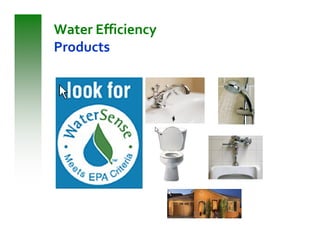
Water Efficiency
Products
Water Efficiency
Partnerships and Activities

 Over 30 new partnerships last year
 (including WI DNR)
 Kohler Company – Partner of the Year
 Partnership advocated in NE IL Regional
 Water Supply Plan
Financing Incentives (4 of 7)
State Revolving Fund (SRF)
 Green Project Reserve (GPR)
    Shift from gray infrastructure to GREEN
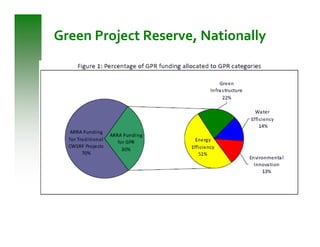
  NEW in 2009, 20% of each State’s capitalization grant for
    SRF to be used for “Green Reserve” projects: Energy
    efficiency * Water efficiency * Green Infrastructure *
    Innovative

 A Major Impact of GPR
    Awareness of Green approaches/benefits
Green Project Reserve, Nationally
Financing Incentives
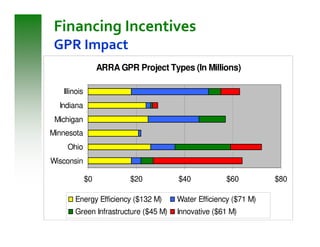
 GPR Impact
                   ARRA GPR Project Types (In Millions)

   Illinois
  Indiana
 Michigan
Minnesota
    Ohio
Wisconsin

              $0           $20         $40            $60         $80

       Energy Efficiency ($132 M)      Water Efficiency ($71 M)
       Green Infrastructure ($45 M)    Innovative ($61 M)
Financing Incentives
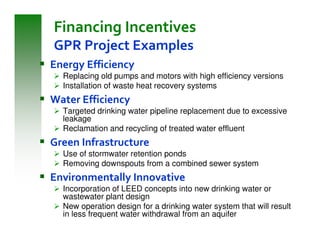
GPR Project Examples
Energy Efficiency
  Replacing old pumps and motors with high efficiency versions
  Installation of waste heat recovery systems
Water Efficiency
  Targeted drinking water pipeline replacement due to excessive
  leakage
  Reclamation and recycling of treated water effluent
Green Infrastructure
  Use of stormwater retention ponds
  Removing downspouts from a combined sewer system
Environmentally Innovative
  Incorporation of LEED concepts into new drinking water or
  wastewater plant design
  New operation design for a drinking water system that will result
  in less frequent water withdrawal from an aquifer
Community Based Emergency
Response Planning (5 of 7)
Build Community Recognition of
Interdependencies with the Water Sector

  Facilitate a water/food processing sector
  resiliency and preparedness workshop
  Distribute reports from the Evanston
  Emergency Water Roundtable
  Host Evanston Roundtable follow-up
Asset Management (6 of 7)

Training
  One-day asset management training
  Two-day asset management workshop
Software
  Check-up Program for Small Systems
  (CUPSS)


http://water.epa.gov/infrastructure/drinkingwater/pws/cupss/
Full Cost Pricing (7 of 7)
EPA Sustainability Policy


 Released in October 2010
 Approach – promote
 sustainability on three fronts
   water infrastructure,
   water sector systems, and
   the role that both of these play in the
   overall sustainability of our communities.
Region 5 Direction
Continued outreach on sustainability practices


Involvement by states and other stakeholders


Integrate with regulatory programs
NPDES permits, antidegradation, enforcement
Case Studies through community involvement
Energy pilot, Community outreach

Understand where pricing fit into programs
Incoporate Climate Ready Utilities Tools
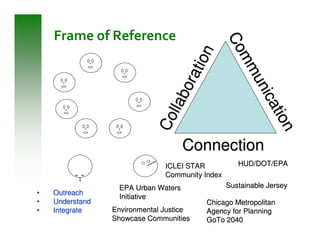
Frame of Reference


                                                 Co
                                                 Co
                                           n
                                                    mm
                                                    mm
                                       tio
                                   ora


                                                       un
                                                       un
                                                          iica
                              llab


                                                            ca
                                                              ttiio
                            Co


                                                                  onn
                                     Connection
                               ICLEI STAR           HUD/DOT/EPA
                               Community Index
                  EPA Urban Waters               Sustainable Jersey
•   Outreach
                  Initiative
•   Understand                           Chicago Metropolitan
•   Integrate    Environmental Justice   Agency for Planning
                 Showcase Communities    GoTo 2040
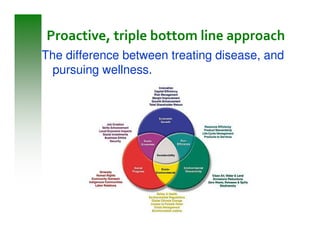
Proactive, triple bottom line approach
The difference between treating disease, and
  pursuing wellness.
Credits and Resources
•The Gap Report is at http://www.epa.gov/owm/gapreport.pdf
•ASCE IL
http://www.isasce.org/web/images/2010%20Infrastructure%20report/Clip
board01.jpg
•Energy management guidebook.
http://water.epa.gov/infrastructure/sustain/upload/2009_07_21_waterinfr
astructures_guidebook_si_energymanagement.pdf
•Clean Water SRF GPR funding status
http://www.epa.gov/owm/cwfinance/cwsrf/gpr_funding_status.pdf
•Effective Utility Management Primer.
http://water.epa.gov/scitech/wastetech/upload/tools_si_watereum_prime
rforeffectiveutilities.pdf
•Climate Ready Utilities Toolbox
http://www.epa.gov/safewater/watersecurity/climate/toolbox.html
•Triple bottom line image. http://www.gcbl.org/system/files/sustainability-
venn-sm.jpg
•Stoney, Nancy, EPA Office of Water (12/7/2010) “Sustainable Water
Infrastructure. Presented at the 2010 Urban Water Sustainability
Conference
•Sustainable Jersey www.sustainablejersey.com
•ICLEI http://www.icleiusa.org/
Bonus Slides (2)
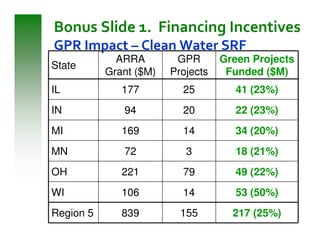
Bonus Slide 1. Financing Incentives
GPR Impact – Clean Water SRF
             ARRA        GPR       Green Projects
State
           Grant ($M)   Projects    Funded ($M)
IL            177         25          41 (23%)
IN            94          20          22 (23%)
MI            169         14          34 (20%)
MN            72           3          18 (21%)
OH            221         79          49 (22%)
WI            106         14          53 (50%)
Region 5      839         155        217 (25%)
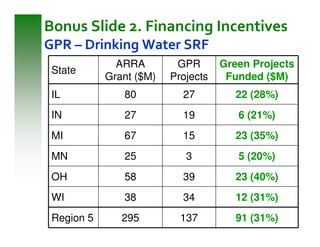
Bonus Slide 2. Financing Incentives
GPR – Drinking Water SRF
              ARRA        GPR       Green Projects
 State
            Grant ($M)   Projects    Funded ($M)
 IL            80          27          22 (28%)
 IN            27          19          6 (21%)
 MI            67          15          23 (35%)
 MN            25           3          5 (20%)
 OH            58          39          23 (40%)
 WI            38          34          12 (31%)
 Region 5      295         137         91 (31%)

Sustainable Water Infrastructure

  • 1.
    Sustainable Water Infrastructure Region 5 Report Navigating the Infrastructure Replacement Era February 4, 2011 Louann Unger U.S. EPA Region 5 Unger.louann@epa.gov
  • 2.
    Setting the Stage EPA issued a Gap Analysis Report (2002) $533 Billion
  • 3.
    Setting the Stage TheNational ASCE Report Card (2009)
  • 4.
    Setting the Stage TheIllinois Section ASCE Report Card (2010)
  • 5.
    A National EPAemphasis on “Sustainable Infrastructure” emerged Reduce the Funding Gap! Revenue and Cost
  • 6.
    Where is theopportunity? Green Infrastructure Asset Management Energy Efficiency Water Efficiency Financing Incentives (SRF) Full Cost Pricing Emergency Preparedness Planning
  • 7.
    How do weaddress these practices? • Provide outreach/education • Understand barriers/benefits • Integrate into core programs
  • 8.
    Green Infrastructure (1of 7) “a paradigm shift”
  • 9.
    Green Infrastructure Circulate Information/Reducebarriers • Information on costs • Data on performance, technical specifications • Targeted training for engineers • Local codes and ordinances • Recognition programs Use Clean Water Act tools • Stormwater permits • Combined Sewer Overflow LTCPs • Total Maximum Daily Loads • Antidegradation • CWA Section 404 • Great Lakes Restoration Initiative • CWA Section 319 State Initiatives IL – Green Infrastructure for Clean Water Act
  • 10.
    Green Infrastructure mitigatesCSO PRE-DEVELOPMENT CIRCA 1960
  • 11.
  • 12.
    Energy Efficiency Importance Energy ~ 25% to 30% of total plant O&M cost $4 billion spent annually for energy, nationally Opportunity to reduce GHG emissions EPA Region 5 is Providing outreach on energy management Collaborating with Regions and HQ Learning from the Indiana energy management pilot 2009 - 2011
  • 13.
    Energy Efficiency (2of 7) Pilot Energy Management Practices 1st quarter Mid-course 2nd quarter Workshop assessment Workshop assessment Project Project Conclusion Kick-off * 2010 2011 2008 2009-2011 Indiana Energy Management Pilot
  • 14.
  • 15.
  • 16.
    Energy Efficiency Developa Management System Energy Improvement Goal #1 of 5 Activity: Pumps Operation: Booster stations and elevated tanks / / High service pumps Objective: Reduce energy used by pumps Target: Reduce energy usage by 5% by October 15, 2011 Responsible Performance Tasks Party Timeframe Measures Comments of Key Subtasks Scotty Develop baseline of energy usage Montgomery Completed kWh Generate new scheduling plan Christine Chapel 30-Sep-11 Plan Implement and assess plan (measure improvements continuously) Leonard McCoy 31-Aug-11 kWh Report savings to Utility Board and staff James Kirk 30-Sep-11 kWh Water staff prepare report
  • 17.
    Water Efficiency (3of 7) “Make Every Drop Count” EPA’s WaterSense product labeling and partnership program for water conservation and efficiency EPA Region 5 is working to Increase the number of promotional partners (e.g. utilities, gov’t agencies) Increase WaterSense brand awareness
  • 18.
  • 19.
    Water Efficiency Partnerships andActivities Over 30 new partnerships last year (including WI DNR) Kohler Company – Partner of the Year Partnership advocated in NE IL Regional Water Supply Plan
  • 20.
    Financing Incentives (4of 7) State Revolving Fund (SRF) Green Project Reserve (GPR) Shift from gray infrastructure to GREEN NEW in 2009, 20% of each State’s capitalization grant for SRF to be used for “Green Reserve” projects: Energy efficiency * Water efficiency * Green Infrastructure * Innovative A Major Impact of GPR Awareness of Green approaches/benefits
  • 21.
  • 22.
    Financing Incentives GPRImpact ARRA GPR Project Types (In Millions) Illinois Indiana Michigan Minnesota Ohio Wisconsin $0 $20 $40 $60 $80 Energy Efficiency ($132 M) Water Efficiency ($71 M) Green Infrastructure ($45 M) Innovative ($61 M)
  • 23.
    Financing Incentives GPR ProjectExamples Energy Efficiency Replacing old pumps and motors with high efficiency versions Installation of waste heat recovery systems Water Efficiency Targeted drinking water pipeline replacement due to excessive leakage Reclamation and recycling of treated water effluent Green Infrastructure Use of stormwater retention ponds Removing downspouts from a combined sewer system Environmentally Innovative Incorporation of LEED concepts into new drinking water or wastewater plant design New operation design for a drinking water system that will result in less frequent water withdrawal from an aquifer
  • 24.
    Community Based Emergency ResponsePlanning (5 of 7) Build Community Recognition of Interdependencies with the Water Sector Facilitate a water/food processing sector resiliency and preparedness workshop Distribute reports from the Evanston Emergency Water Roundtable Host Evanston Roundtable follow-up
  • 25.
    Asset Management (6of 7) Training One-day asset management training Two-day asset management workshop Software Check-up Program for Small Systems (CUPSS) http://water.epa.gov/infrastructure/drinkingwater/pws/cupss/
  • 26.
  • 27.
    EPA Sustainability Policy Released in October 2010 Approach – promote sustainability on three fronts water infrastructure, water sector systems, and the role that both of these play in the overall sustainability of our communities.
  • 28.
    Region 5 Direction Continuedoutreach on sustainability practices Involvement by states and other stakeholders Integrate with regulatory programs NPDES permits, antidegradation, enforcement Case Studies through community involvement Energy pilot, Community outreach Understand where pricing fit into programs Incoporate Climate Ready Utilities Tools
  • 29.
    Frame of Reference Co Co n mm mm tio ora un un iica llab ca ttiio Co onn Connection ICLEI STAR HUD/DOT/EPA Community Index EPA Urban Waters Sustainable Jersey • Outreach Initiative • Understand Chicago Metropolitan • Integrate Environmental Justice Agency for Planning Showcase Communities GoTo 2040
  • 31.
    Proactive, triple bottomline approach The difference between treating disease, and pursuing wellness.
  • 32.
    Credits and Resources •TheGap Report is at http://www.epa.gov/owm/gapreport.pdf •ASCE IL http://www.isasce.org/web/images/2010%20Infrastructure%20report/Clip board01.jpg •Energy management guidebook. http://water.epa.gov/infrastructure/sustain/upload/2009_07_21_waterinfr astructures_guidebook_si_energymanagement.pdf •Clean Water SRF GPR funding status http://www.epa.gov/owm/cwfinance/cwsrf/gpr_funding_status.pdf •Effective Utility Management Primer. http://water.epa.gov/scitech/wastetech/upload/tools_si_watereum_prime rforeffectiveutilities.pdf •Climate Ready Utilities Toolbox http://www.epa.gov/safewater/watersecurity/climate/toolbox.html •Triple bottom line image. http://www.gcbl.org/system/files/sustainability- venn-sm.jpg •Stoney, Nancy, EPA Office of Water (12/7/2010) “Sustainable Water Infrastructure. Presented at the 2010 Urban Water Sustainability Conference •Sustainable Jersey www.sustainablejersey.com •ICLEI http://www.icleiusa.org/
  • 33.
  • 34.
    Bonus Slide 1.Financing Incentives GPR Impact – Clean Water SRF ARRA GPR Green Projects State Grant ($M) Projects Funded ($M) IL 177 25 41 (23%) IN 94 20 22 (23%) MI 169 14 34 (20%) MN 72 3 18 (21%) OH 221 79 49 (22%) WI 106 14 53 (50%) Region 5 839 155 217 (25%)
  • 35.
    Bonus Slide 2.Financing Incentives GPR – Drinking Water SRF ARRA GPR Green Projects State Grant ($M) Projects Funded ($M) IL 80 27 22 (28%) IN 27 19 6 (21%) MI 67 15 23 (35%) MN 25 3 5 (20%) OH 58 39 23 (40%) WI 38 34 12 (31%) Region 5 295 137 91 (31%)