Finding “Real”
Water Losses in Joliet


John H. Van Arsdel, Vice President
Overview

Water Loss Control
Water Balance Format (AWWA/IWA)
Apparent Losses
Real Losses
Leakage control
Case Study
Water Loss Control

Monitoring water resources has been conducted for
thousands of years.

Julius Frontenus was first Roman Water
Commissioner and recognized importance of
equitable water distribution (300 BC)

Concept of “water rights” and water use has been
debated for centuries

End result: majority of water use is now
metered or monitored
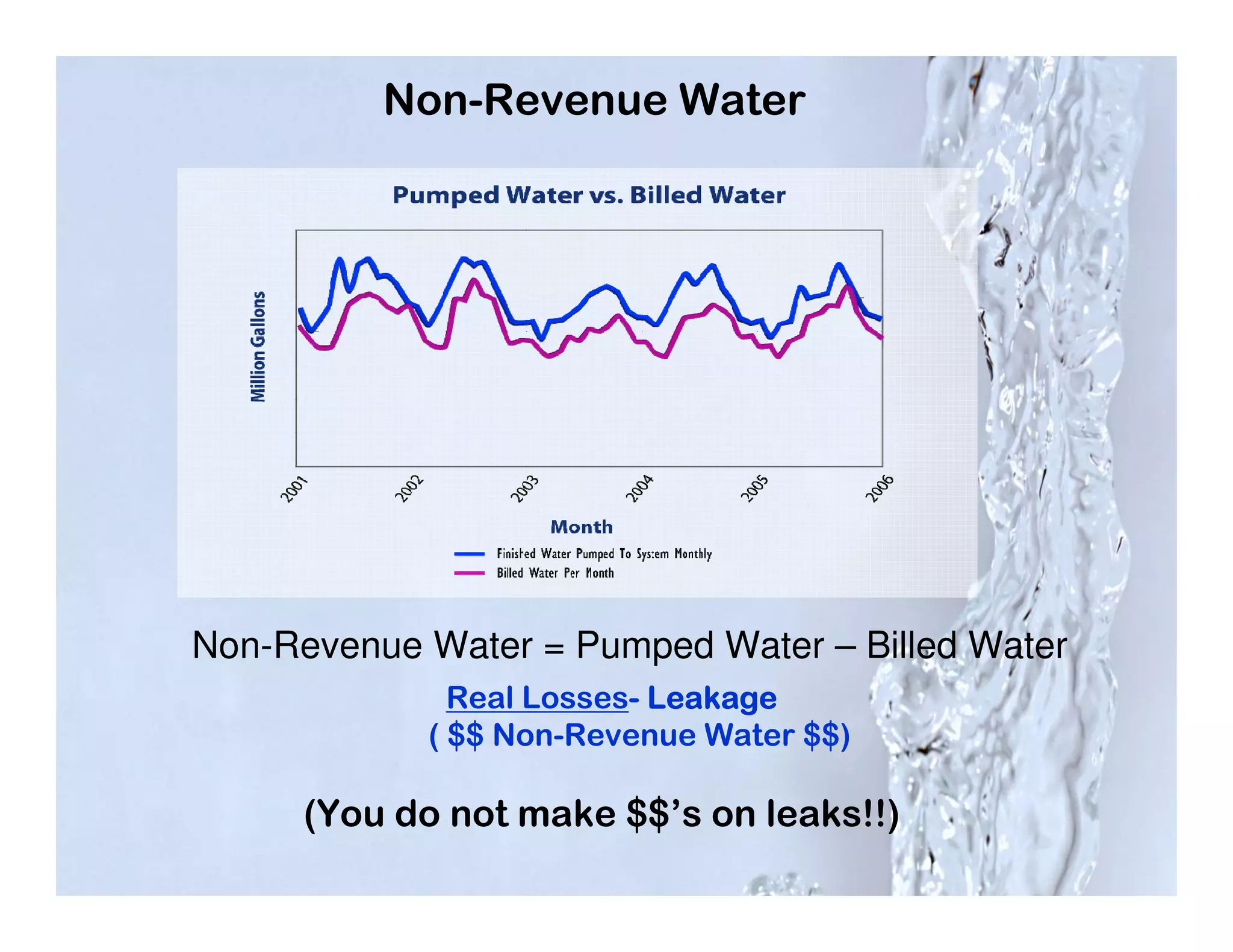
Gallons of water being pumped into the distribution system
each billing period exceeds the gallons being sold.


                                     Water Sold

       Water Pumped
Water Loss Control

The difference in the water pumped versus
water sold is basically termed “water loss”
Is it not possible to have a “perfect system”
Concept of “acceptable loss” levels
– What is “acceptable”?
– How do you control losses?
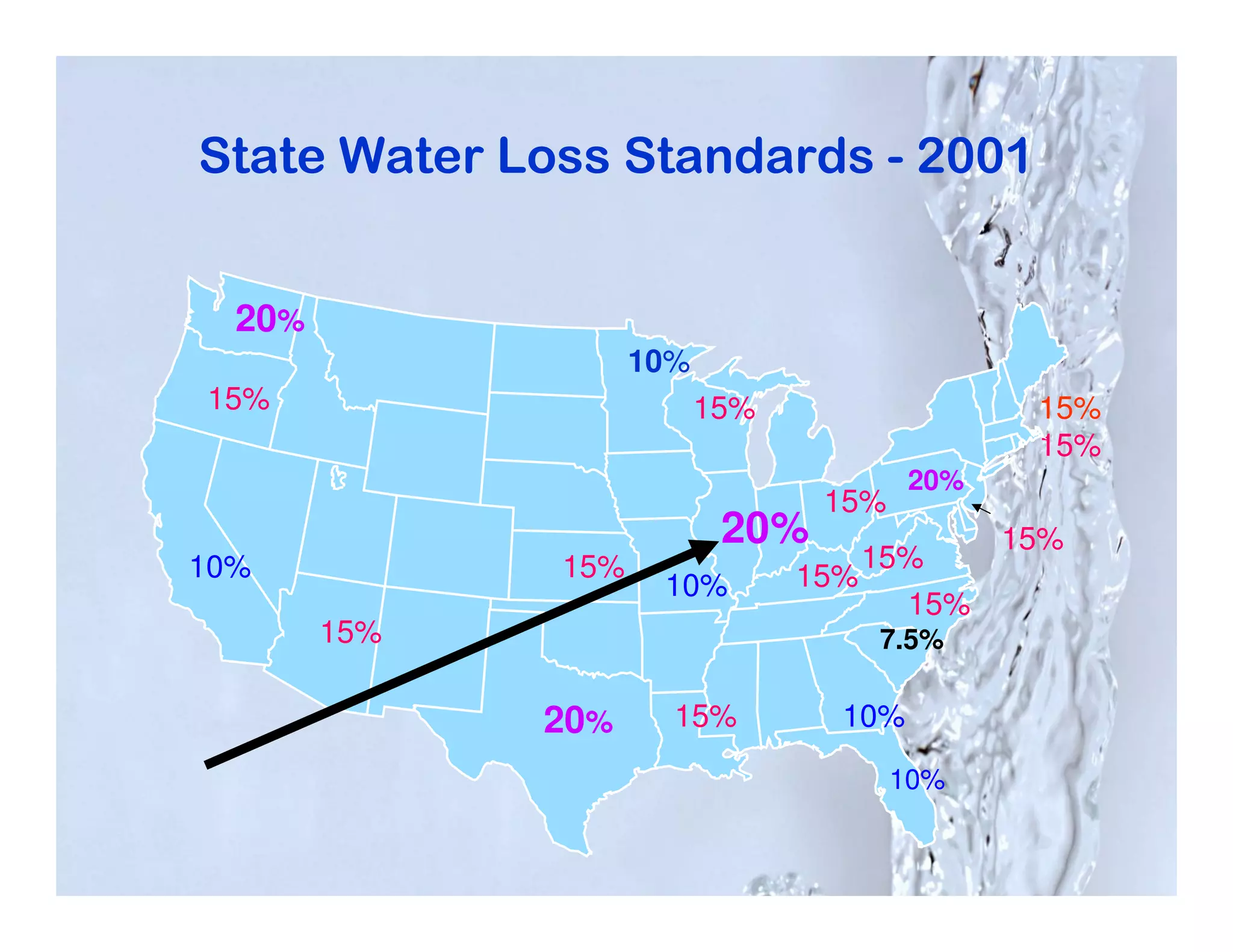
State Water Loss Standards - 2001


  20%
                    10%
15%                       15%                   15%
                                                15%
                                         20%
                                  15%
                            20%                15%
10%           15%                   15%
                     10%        15%
                                      15%
        15%                         7.5%

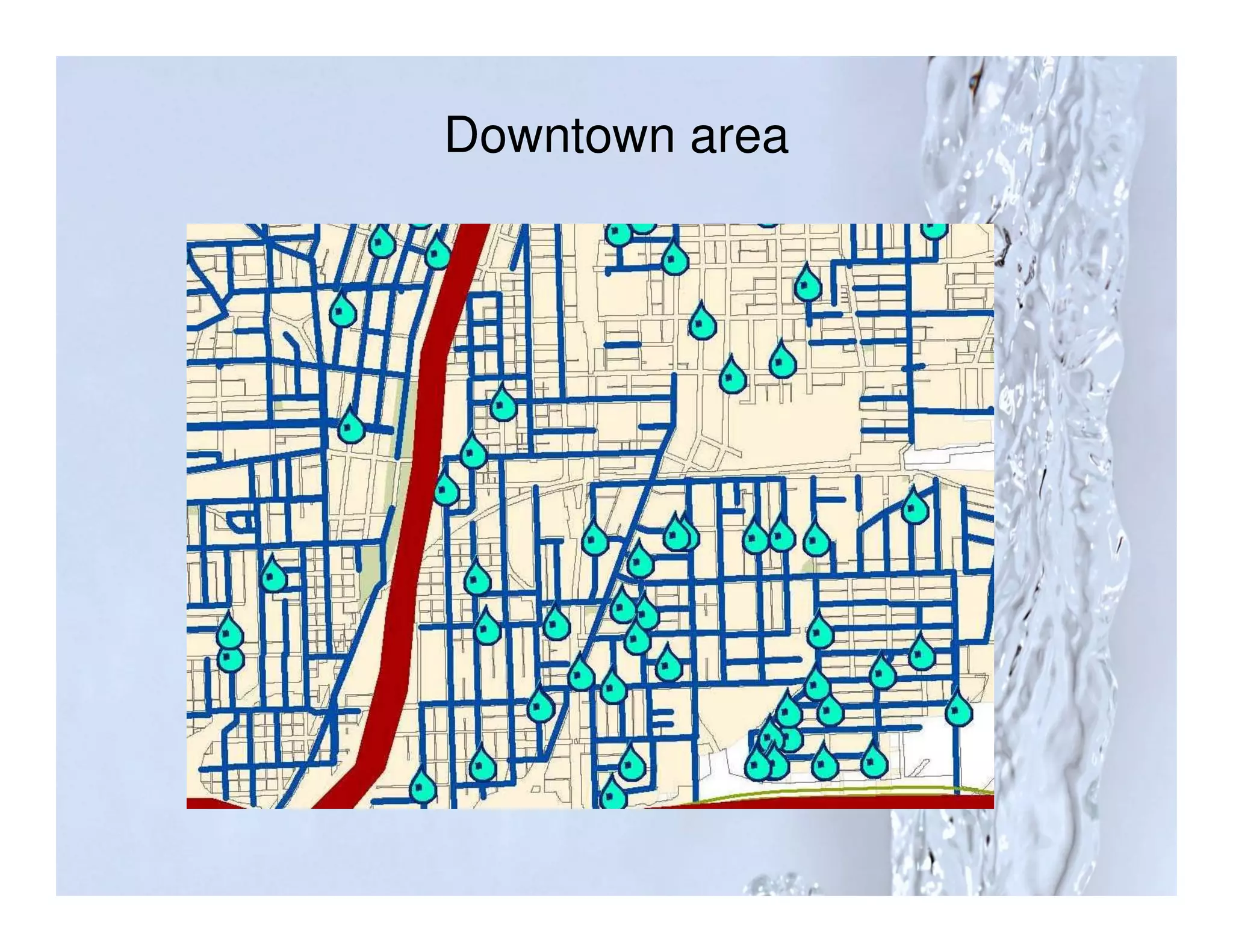
              20%     15%         10%
                                        10%
Water Systems are not designed to
              loose $$’s
• If you think it is OK to loose 10%, 15% or 20% of
  your water …

        Just hand over to me …

10%, 15%, or 20% of your paycheck each
  payday… and I will go away!!

Now that I have your attention….
Water systems are not designed to lose
               money!


 What is considered “acceptable loss”
 in a system?
     10%, 15%, ???
 Why are these losses unacceptable?
 Law of diminishing returns…
Water Loss Control
Water Loss Control is defined simply as the
 process of “Auditing” the operational
 procedures and processes of our water
 utility to determine losses and then
 provide remediation for those issues.

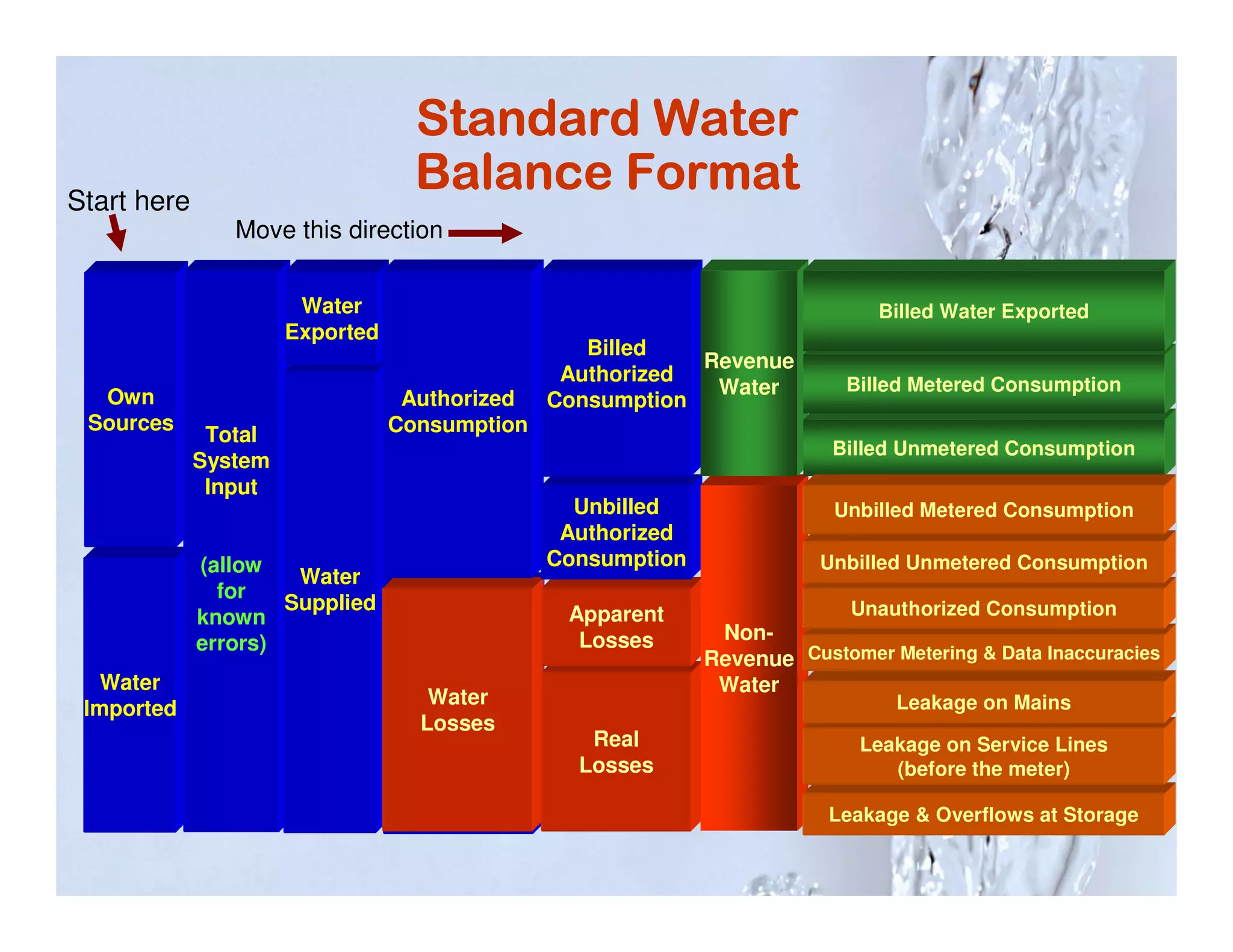
IWA/AWWA developed a “Water Balance”
  chart after much research into differences
  in concept of water losses.
Standard Water
Start here
                                   Balance Format
                Move this direction

                       Water                                                  Billed Water Exported
                      Exported
                                                  Billed
                                                           Revenue
                                                Authorized                 Billed Metered Consumption
  Own                             Authorized                Water
                                               Consumption
 Sources                         Consumption
              Total
              Total                                                      Billed Unmetered Consumption
             System
             System
              Input
              Input                              Unbilled                Unbilled Metered Consumption
                                                Authorized
              (allow                           Consumption              Unbilled Unmetered Consumption
             ( allow   Water
                for   Supplied
                for                             Apparent                   Unauthorized Consumption
             known
             known                               Losses       Non-
             errors)
             errors )                                        Revenue Customer Metering & Data Inaccuracies
   Water                                                      Water
                                    Water                                      Leakage on Mains
 Imported
                                   Losses
                                                  Real                      Leakage on Service Lines
                                                 Losses                        (before the meter)

                                                                         Leakage & Overflows at Storage
Water Audit Form


Developed by the
AWWA Water
Loss Committee


Easier than a
1040 form!
Water Loss Control

Water Loss Spreadsheet provides help
and direction for Financial, Operational,
and Water Resources Considerations
through a “scoring” mechanism (called
ILI).
Considerations are given to optimization of
the above 3 resources.
Now available free of charge at

http://www.awwa.org/waterwiser/waterloss/
Water Loss Control / Water Audit

 A Water Audit is made up of 5 major
 components
1.    Master Meter Testing
2.    Commercial/Industrial Meter Testing
3.    Residential Meter Testing
4.    Meter Reading & Billing Review
5.    Leak Detection
Water Losses

Apparent - Metering Inaccuracies
         Unauthorized Consumption

  ( $$ Non-Revenue Water    $$ )

Real Losses - Leakage
 ( $$ Non-Revenue Water $$)
Real Losses
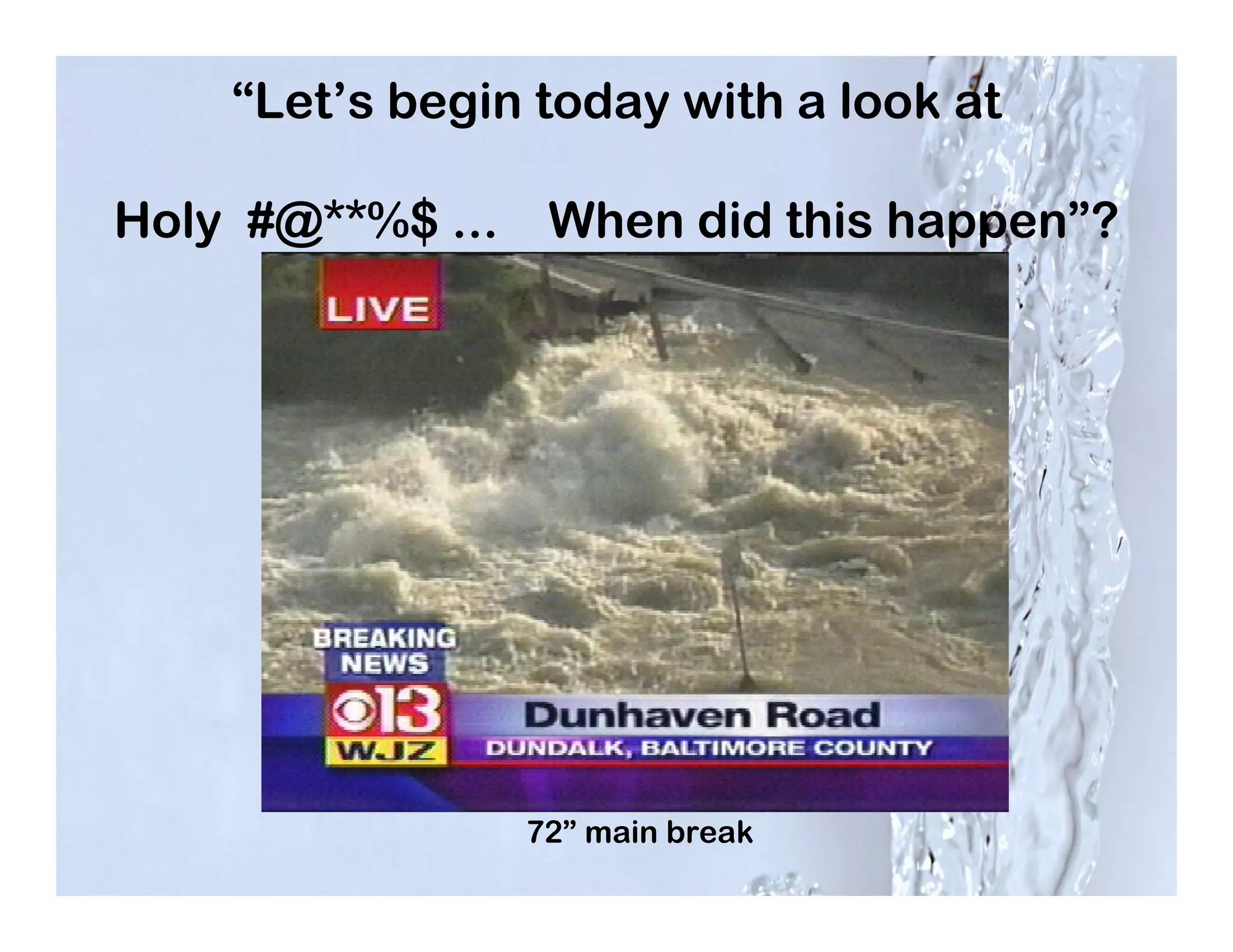
“Let’s begin today with a look at

Holy #@**%$ ...    When did this happen”?


                  72” main break
Too late…
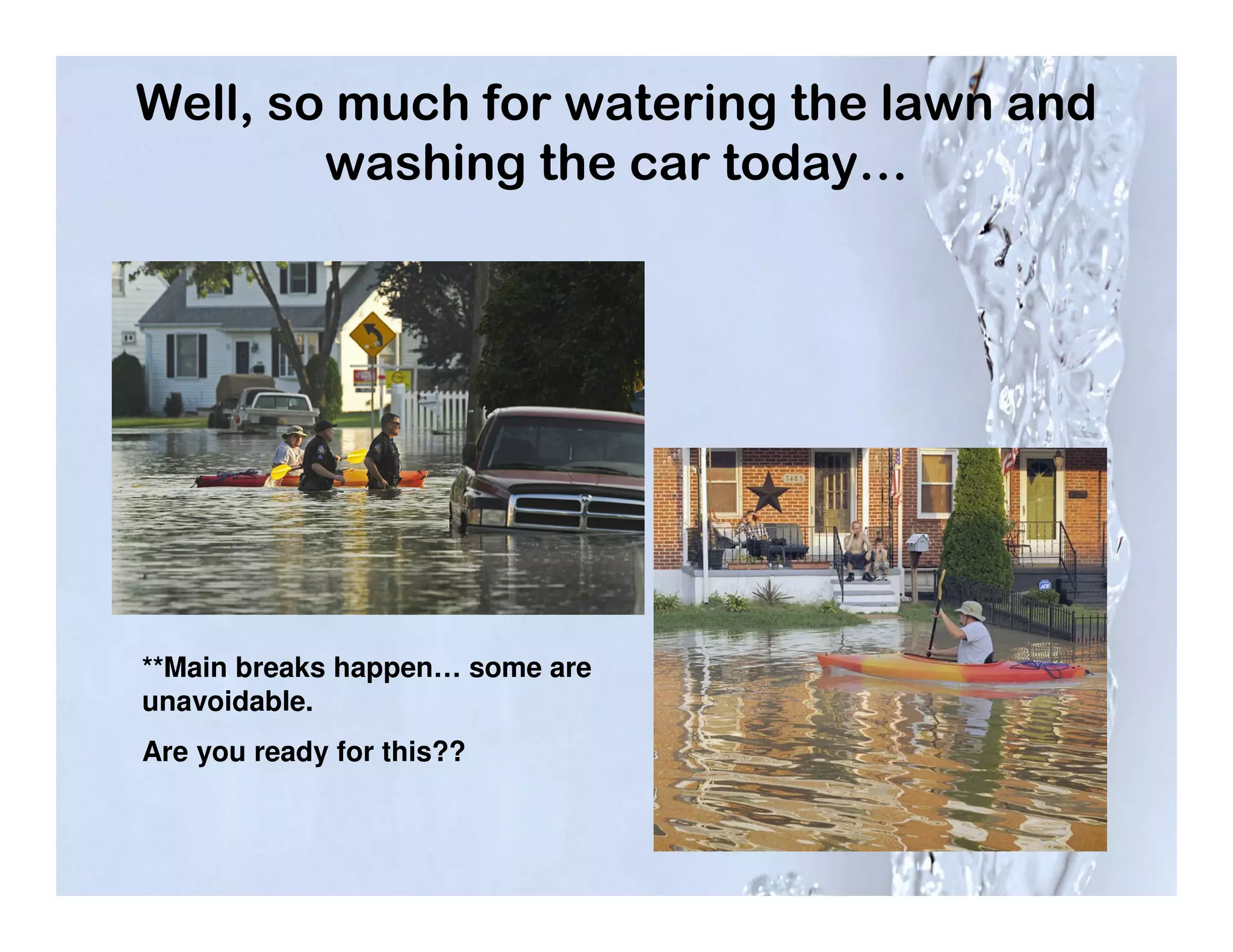
Well, so much for watering the lawn and
        washing the car today…


**Main breaks happen… some are
unavoidable.
Are you ready for this??
Four
                                  Components of
                                    Managing
                                   Real Losses
   Imp
      r ove                                                                 ce,
                                                                        enan tation
      for l respons                                                 in t
                                                                e Ma ehabili
           eak
               repa e time                                    ov
                   irs                                   Impr ent & R
                                                            cem
                                                      R epla


                                      Existing
                                       Real
                                      Losses          Pres
                         e
                    Activ ntrol                     Mana sure
                        Co                              ge m
                                                             ent
             Lea   kage

                                      Economic
  As each component receives            Level
more or less attention, the losses                 The Utility should
will increase or decrease            Unavoidable   strive to keep losses
                                     Real Losses   to a minimum
Non-Revenue Water


Non-Revenue Water = Pumped Water – Billed Water
              Real Losses- Leakage
                         -
            ( $$ Non-Revenue Water $$)

     (You do not make $$’s on leaks!!)
Think all leaks surface?


    Don’t bet on it!!
Acoustic Leak Detection 101
• Fluid escaping a pipe
  under pressure produces
  “Leak Noise”
• Leaks are detectable
  based on:
  – Size of leak
  – Pressure of pipe
  – Pipe size
  –  Pipe material
  – Length of pipe between
    listening points
  – Good physical contact with pipe
    or valve
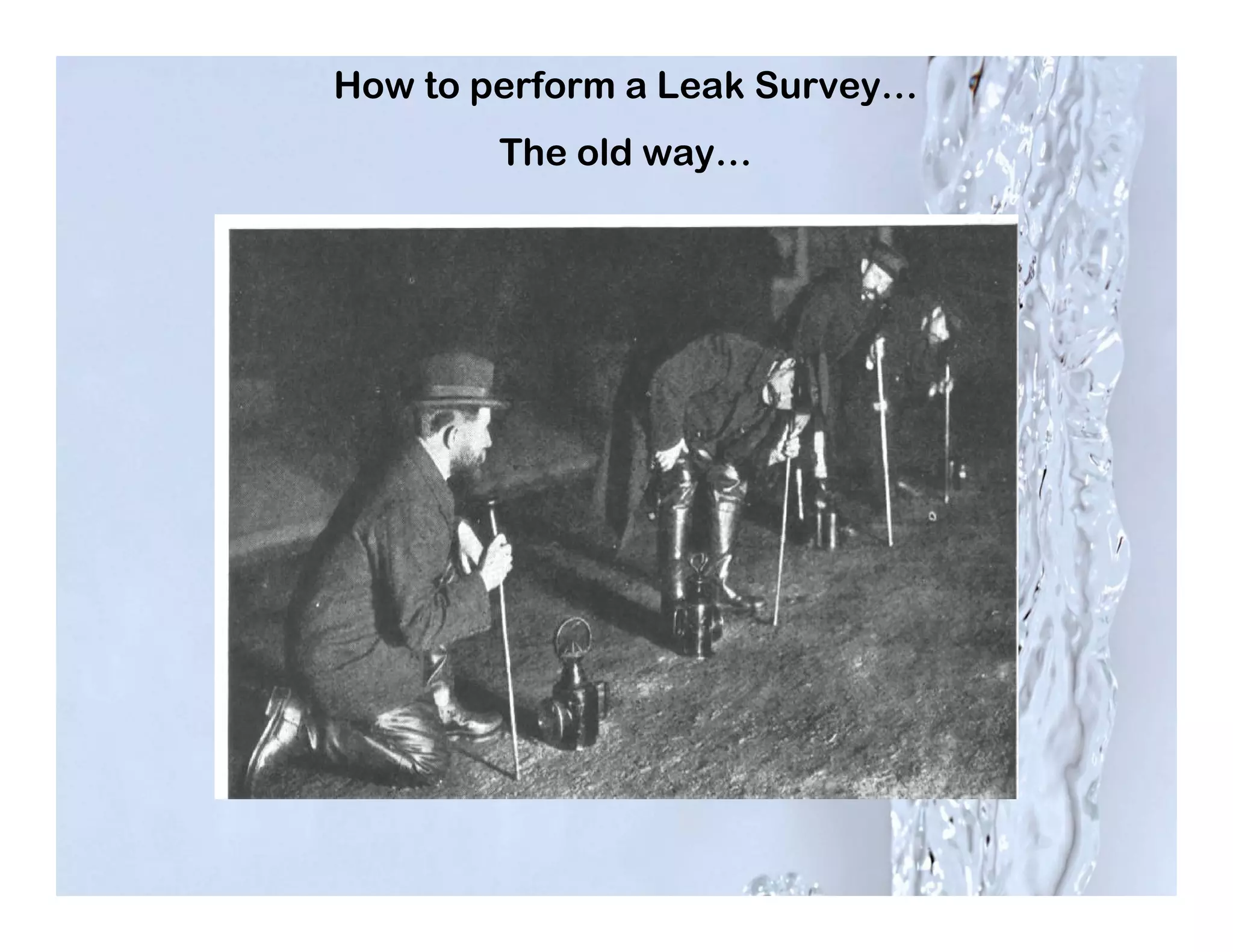
How to perform a Leak Survey…
        The old way…
Acoustic Leak Detection 101 (continued)

  • Leak noise is picked up by a set of transducers
  • Signal is amplified and transmitted to Correlator to
    pinpoint leak location.
  • Leak Correlation is based on time delay difference of
    arrival of leak sound received by each sensor.
  • Generally,
     – Smaller, high pressure leaks - mid to higher frequency
       ranges
     – Larger, low pressure leaks - low to mid range
     – PVC - lowest range
The pipe material, pipe size, and length of pipe segments
             are entered into the Correlator
 and the leak noise is analyzed and the leak pinpointed!
Operational Theory


•   L=d-vt/2
•   L is Leak Distance from “A”
•   D is distance between “A” and “B”
•   V is velocity of leak noise
•   T is time delay of noise between “A” & “B”
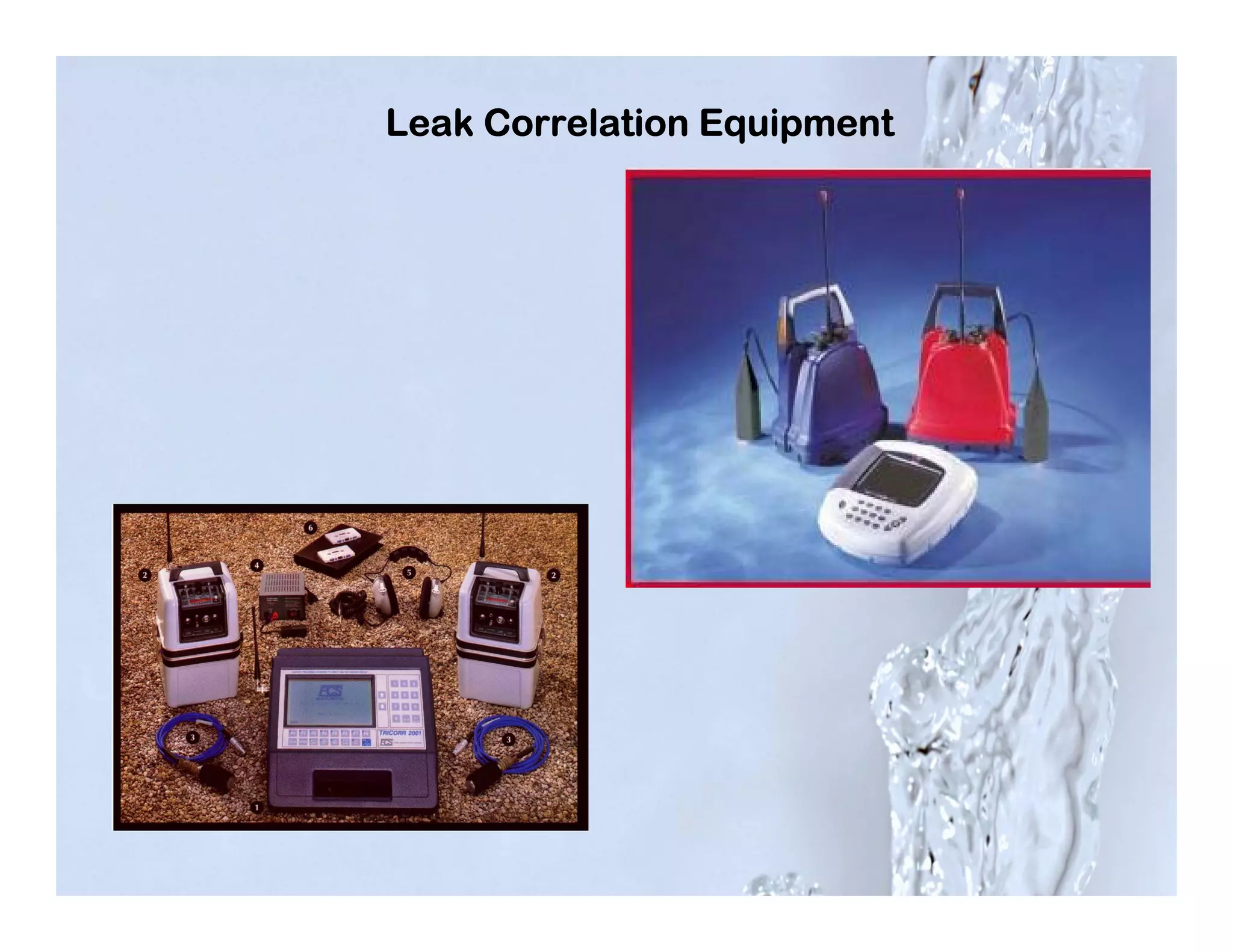
Leak Correlation Equipment
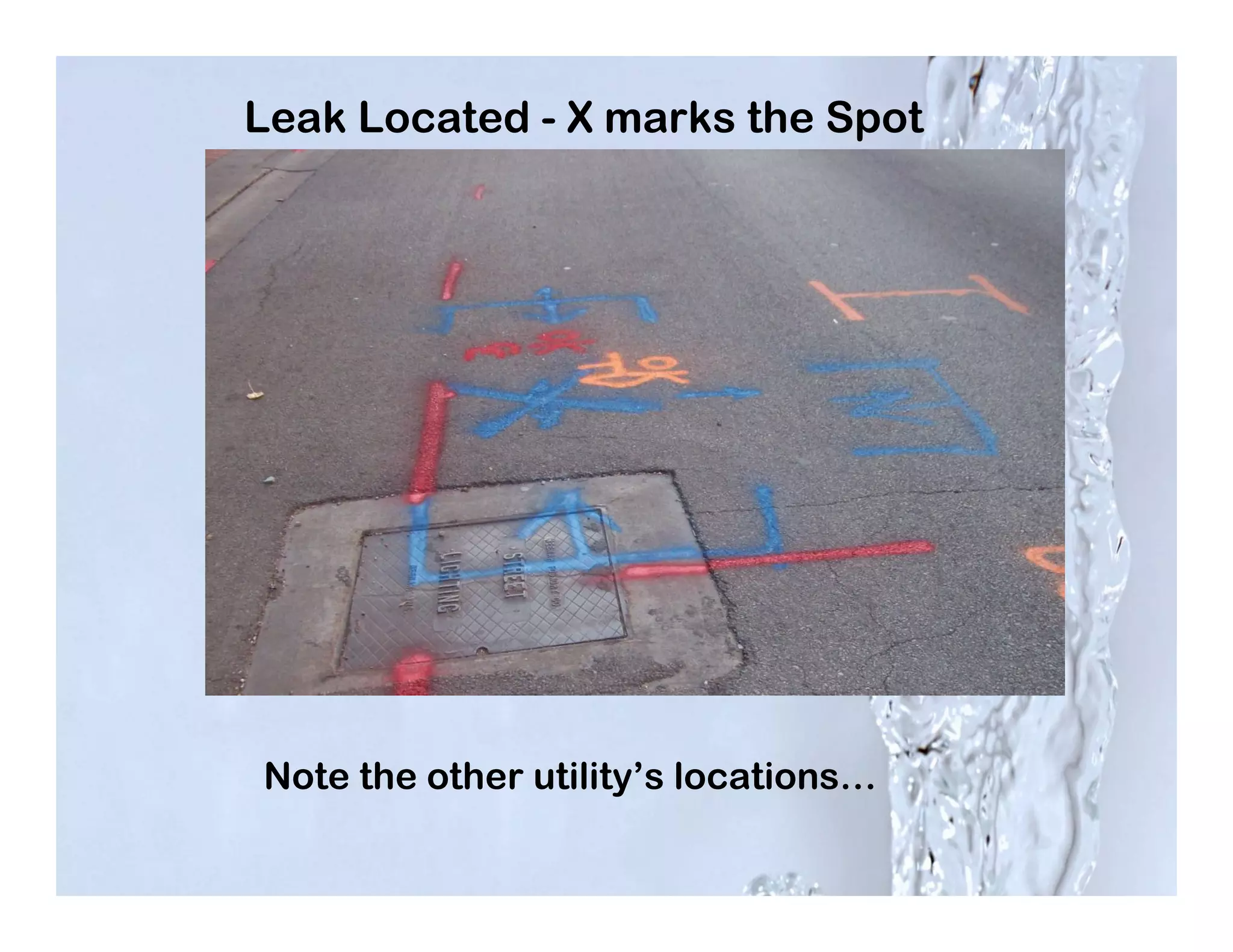
Leak Located - X marks the Spot


Note the other utility’s locations…
Hole Dug…
Leak Repaired - One Hole, One Restoration
Case study

        City of Joliet, IL (2008-2009)


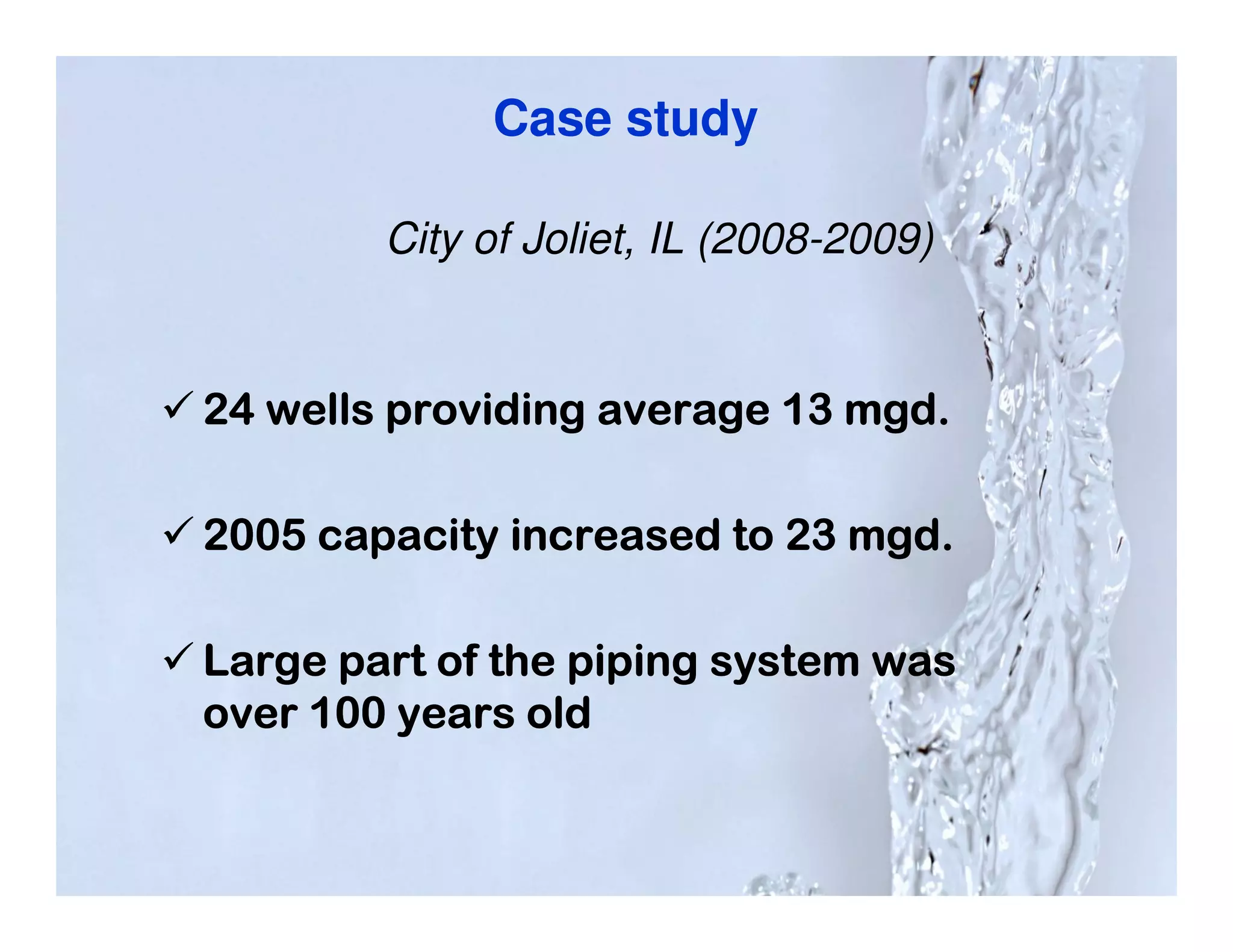
24 wells providing average 13 mgd.

2005 capacity increased to 23 mgd.

Large part of the piping system was
over 100 years old
Case study

        City of Joliet, IL (2008-2009)


375 miles of water main in the City of
Joliet’
Joliet’s distribution system.

180 miles surveyed for Phase I of the
program

Focus on older sections of pipe,
downtown areas
Reasons behind leak detection
Conserve freshwater resources by reducing the
amount of “real” water losses through leakage
Conserve energy and reducing treatment costs
by reducing pumpage because of main breaks
Help in monitoring potential distribution system
operations and maintenance problems                               Water Sold

                                                   Water Pumped
Promote proper accounting and financial
reporting (GASB 34)
Reduce the risk of water shortage and customer
hardship by finding leaks before
they become catastrophic
Ensure a sound and reliable water service and
fire protection for customers of the Utility
City of Joliet, IL
Some areas similar to other Cities and Villages…
City of Joliet, IL
Other older areas have been renewed …
Case study
          City of Joliet, IL (2008-2009)
What was found in first part of survey….

  59 leaks in first 67 miles surveyed (average of
  one leak per 1.1 miles of main)

  12 main breaks (average 1 main break per 5.6
  miles)

  17 service line leaks

  26 hydrant leaks

  4 valve leaks (packing and bonnet bolts).
Case study
          City of Joliet, IL (2008-2009)
What was found ….
  149 leaks (average of one leak per
  1.2 miles of main)

  33 main breaks (average 1 main break per 4.5
  miles)

  59 service line leaks (7 on the customer side of
  the shut off valve

  46 hydrant leaks

  11 valve leaks (packing and bonnet bolts).
Case study
        City of Joliet, IL (2008-2009)
What was found ….
 149 leaks
 (estimated total 1.73 mgd or about 1200 gpm)

 33 main breaks (average 24.5 gpm each)

 59 service line leaks (average 5 gpm each)

 46 hydrant leaks (2 gpm each)

 11 valve leaks (1 gpm each)
Case study
         City of Joliet, IL (2008-2009)

The majority of these leaks did not surface
because the local geology of Joliet is
limestone.
Annualized water losses
 $918,354.00
 (wholesale costs of $1.45/1000 gals)

Payoff for cost of survey: 15 days
Case study
          City of Joliet, IL (2008-2009)

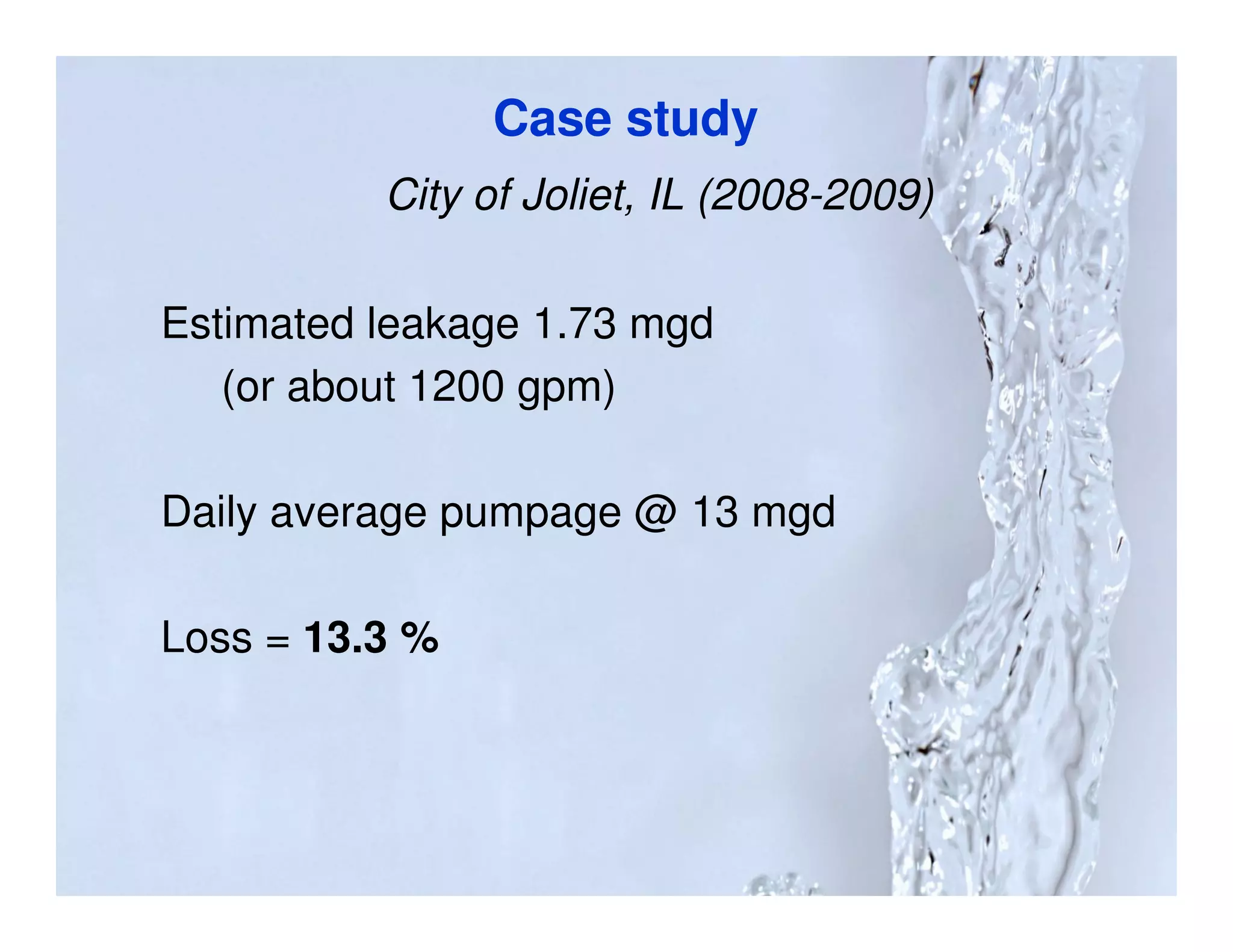
Estimated leakage 1.73 mgd
   (or about 1200 gpm)

Daily average pumpage @ 13 mgd

Loss = 13.3 %
State Water Loss Standards - 2001


  20%
                    10%
15%                       15%                  15%
                                               15%
                                        20%
                                 15%
                           20%                15%
10%           15%                   15%
                     10%        15%
                                      15%
        15%                         7.5%

              20%     15%         10%
                                       10%
Leak Locations (water drops) in 180 miles of main
Downtown area
Estimating Leak Amounts

Hole Diameter   GPM Loss        GPD Loss
    1/2"            34.9         50,256.0
    1/4"            8.85         12,744.0
    1/8"            2.25         3,240.0
    1/16"          0.5666         815.9
    1/32"          0.1333         192.0

        ** Pressure at 50 psi
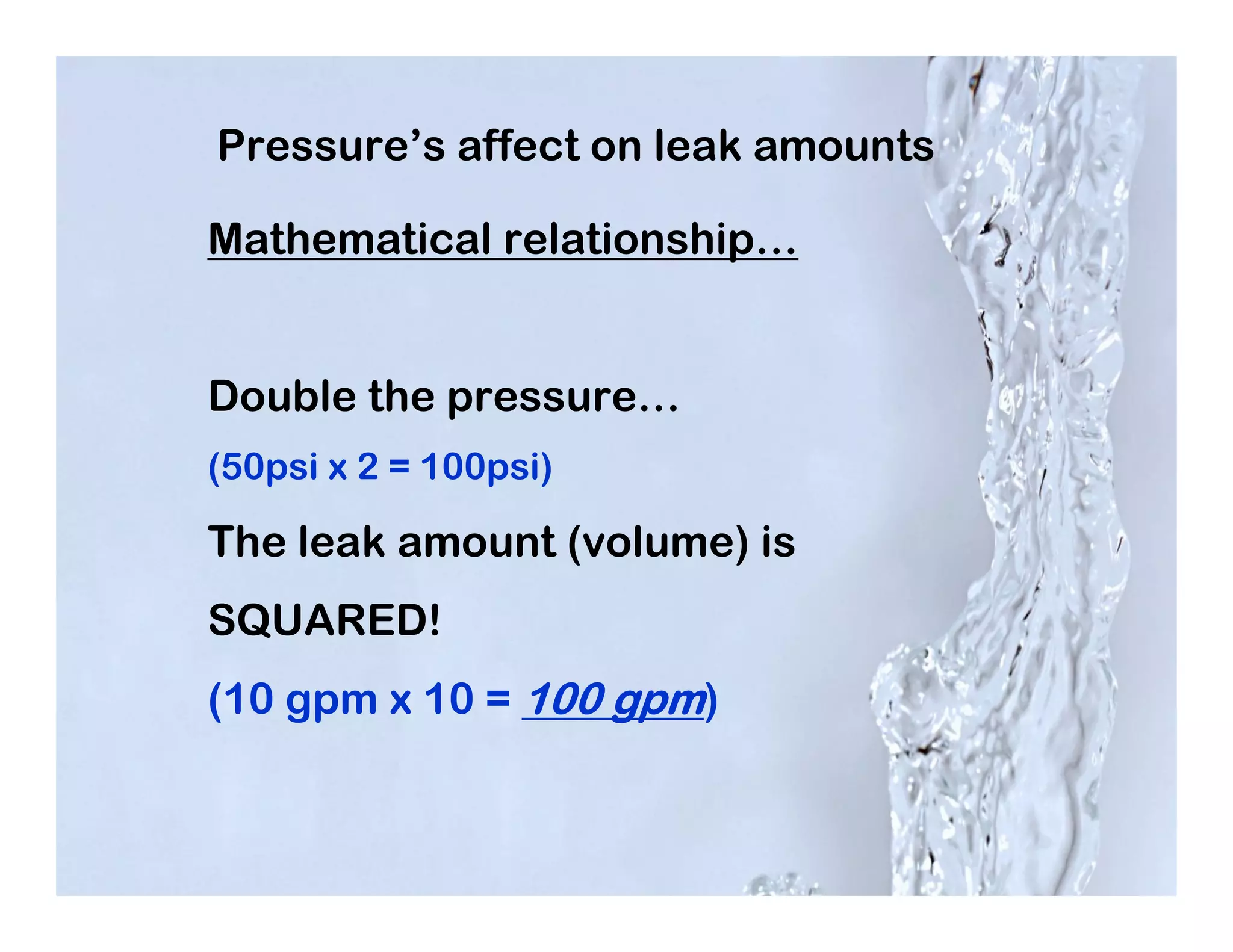
Pressure’s affect on leak amounts

Mathematical relationship…


Double the pressure…
(50psi x 2 = 100psi)

The leak amount (volume) is
SQUARED!
(10 gpm x 10 = 100 gpm)
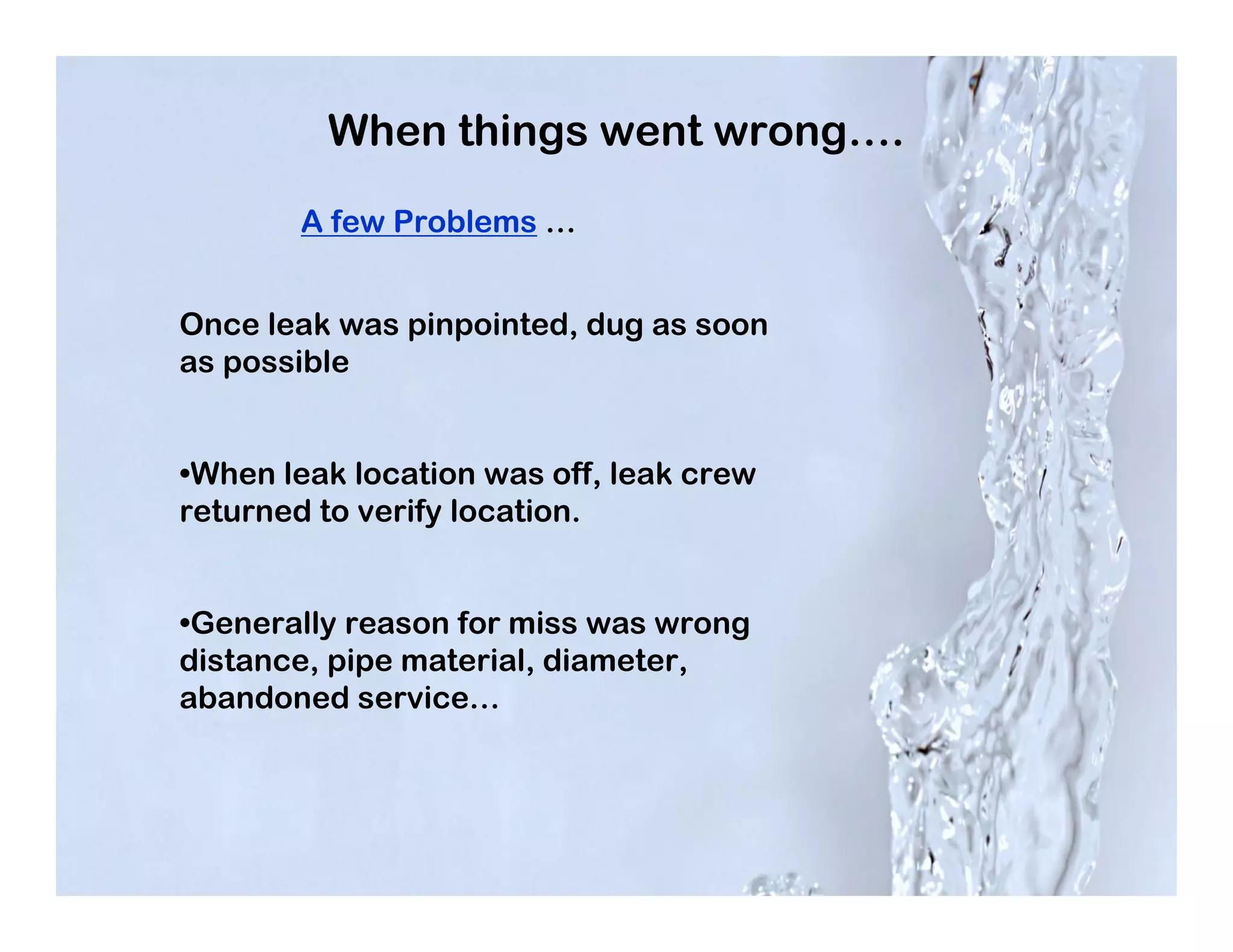
When things went wrong….
       A few Problems …


Once leak was pinpointed, dug as soon
as possible


•When leak location was off, leak crew
returned to verify location.


•Generally reason for miss was wrong
distance, pipe material, diameter,
abandoned service…
Typical Neighborhood ….
Main line break near a corp.
Some valve boxes cleaned
to gain access to the valve
for listening…
Documentation


                              GPS location of leaks for
                                  import into GIS
    Field Documentation


Diagram of Location
Leak tracking in survey area…
Phase II

What was found ….
• 69 leaks in 150 miles of pipe
  (estimated total .26352 mgd or about 183 gpm)

• 6 main breaks (average 17.5 gpm each)

• 15 service line leaks (average 2 gpm each)

• 44 hydrant leaks (1 gpm each)

• 4 valve leaks (1 gpm each)
Phase II


The majority of these leaks did not surface
because the local geology of Joliet is
limestone.
Annualized estimated water losses
 $139,468.00
 (wholesale costs of $1.45/1000 gals)

Payoff for cost of survey: 51 days
Phase I & II totals

$ 1,057,822 estimated annual
      wholesale costs (loss)


1.998 mgd loss


Average pumpage 13 mgd


15.3% estimated loss
State Water Loss Standards - 2001


  20%
                    10%
15%                       15%                  15%
                                               15%
                                        20%
                                 15%
                           20%                15%
10%           15%                   15%
                     10%        15%
                                      15%
        15%                         7.5%

              20%     15%         10%
                                       10%
Lessons Learned from the Leak program

   • Fire Hydrant issues…

   • Potential Customer Meter
     issues…

   • Customer Lateral issues

   • GIS Mapping Updates

   • Not all leaks surface!

   • Prioritize CIP programs
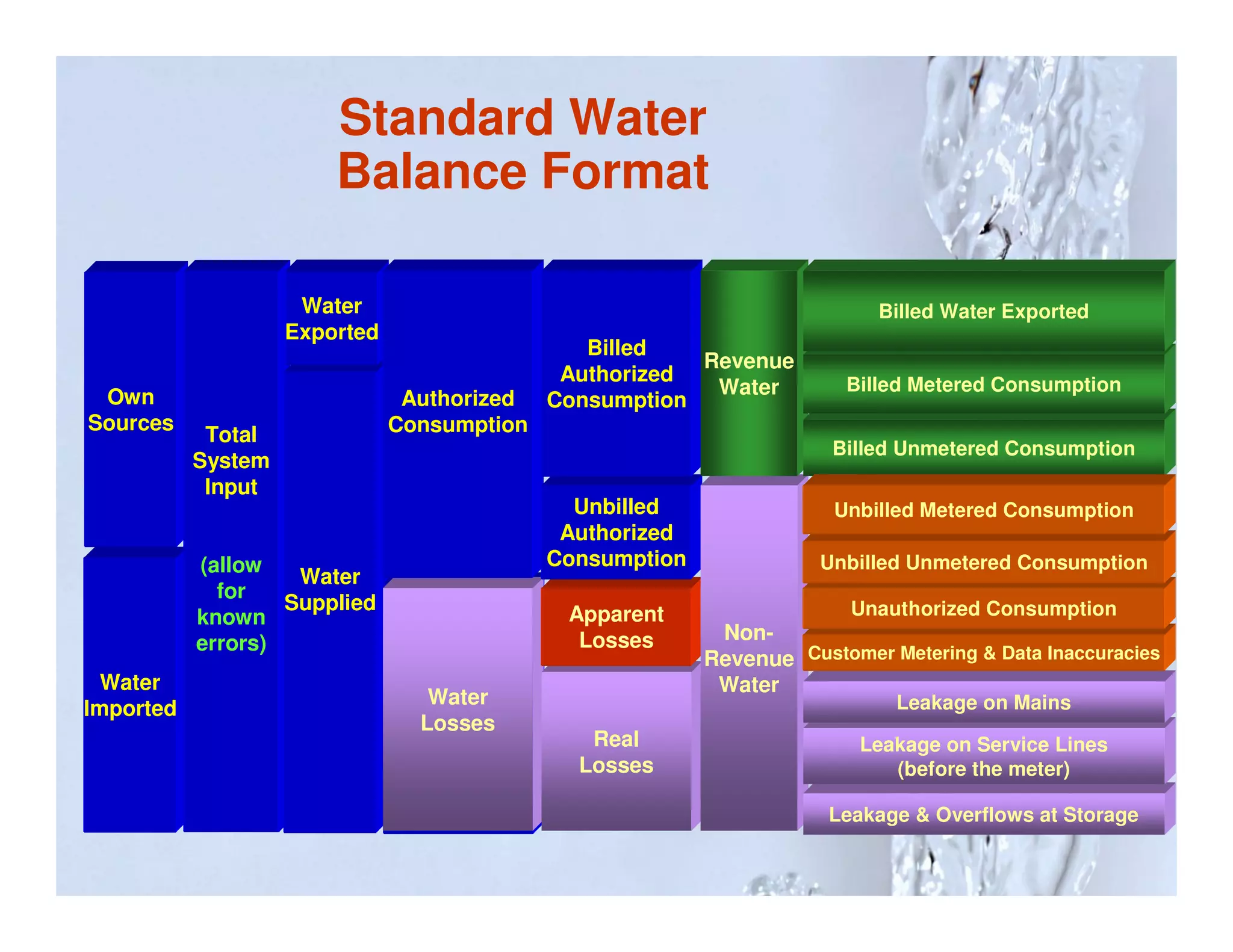
Standard Water
                        Balance Format

                     Water                                                  Billed Water Exported
                    Exported
                                                Billed
                                                         Revenue
                                              Authorized                 Billed Metered Consumption
 Own                            Authorized                Water
                                             Consumption
Sources                        Consumption
            Total
            Total                                                      Billed Unmetered Consumption
           System
           System
            Input
            Input                              Unbilled                Unbilled Metered Consumption
                                              Authorized
            (allow                           Consumption              Unbilled Unmetered Consumption
           ( allow   Water
              for   Supplied
              for                             Apparent                   Unauthorized Consumption
           known
           known                               Losses       Non-
           errors)
           errors )                                        Revenue Customer Metering & Data Inaccuracies
  Water                                                     Water
                                  Water                                      Leakage on Mains
Imported
                                 Losses
                                                Real                      Leakage on Service Lines
                                               Losses                        (before the meter)

                                                                       Leakage & Overflows at Storage
Future goals


• Increased water loss control
• Introduce the best leak detection available
• Continue process of identifying high percentage
  leak areas for system betterment
• Preparing and implementing a reporting system
  in accordance with proposed AWWA guidelines
  (per M-36)
AWWA Policy Statement (M-36)
              Conduct Audits
Evaluate overall effectiveness of:
    Metering
    Billing and accounting
    Water loss control (leaks)
** Audits provide basis of assessing what needs to
  be improved
THANK YOU!!
A special thank you to the following
  people/entities who provided information:

AWWA Water Loss Control Committee
John Van Arsdel/Dan Hood – M.E. Simpson
  Co., Inc.
Finding “Real” Water Losses in Joliet

Finding “Real” Water Losses in Joliet

  • 1.
    Finding “Real” Water Lossesin Joliet John H. Van Arsdel, Vice President
  • 2.
    Overview Water Loss Control WaterBalance Format (AWWA/IWA) Apparent Losses Real Losses Leakage control Case Study
  • 3.
    Water Loss Control Monitoringwater resources has been conducted for thousands of years. Julius Frontenus was first Roman Water Commissioner and recognized importance of equitable water distribution (300 BC) Concept of “water rights” and water use has been debated for centuries End result: majority of water use is now metered or monitored
  • 4.
    Gallons of waterbeing pumped into the distribution system each billing period exceeds the gallons being sold. Water Sold Water Pumped
  • 5.
    Water Loss Control Thedifference in the water pumped versus water sold is basically termed “water loss” Is it not possible to have a “perfect system” Concept of “acceptable loss” levels – What is “acceptable”? – How do you control losses?
  • 6.
    State Water LossStandards - 2001 20% 10% 15% 15% 15% 15% 20% 15% 20% 15% 10% 15% 15% 10% 15% 15% 15% 7.5% 20% 15% 10% 10%
  • 7.
    Water Systems arenot designed to loose $$’s • If you think it is OK to loose 10%, 15% or 20% of your water … Just hand over to me … 10%, 15%, or 20% of your paycheck each payday… and I will go away!! Now that I have your attention….
  • 8.
    Water systems arenot designed to lose money! What is considered “acceptable loss” in a system? 10%, 15%, ??? Why are these losses unacceptable? Law of diminishing returns…
  • 9.
    Water Loss Control WaterLoss Control is defined simply as the process of “Auditing” the operational procedures and processes of our water utility to determine losses and then provide remediation for those issues. IWA/AWWA developed a “Water Balance” chart after much research into differences in concept of water losses.
  • 10.
    Standard Water Start here Balance Format Move this direction Water Billed Water Exported Exported Billed Revenue Authorized Billed Metered Consumption Own Authorized Water Consumption Sources Consumption Total Total Billed Unmetered Consumption System System Input Input Unbilled Unbilled Metered Consumption Authorized (allow Consumption Unbilled Unmetered Consumption ( allow Water for Supplied for Apparent Unauthorized Consumption known known Losses Non- errors) errors ) Revenue Customer Metering & Data Inaccuracies Water Water Water Leakage on Mains Imported Losses Real Leakage on Service Lines Losses (before the meter) Leakage & Overflows at Storage
  • 11.
    Water Audit Form Developedby the AWWA Water Loss Committee Easier than a 1040 form!
  • 12.
    Water Loss Control WaterLoss Spreadsheet provides help and direction for Financial, Operational, and Water Resources Considerations through a “scoring” mechanism (called ILI). Considerations are given to optimization of the above 3 resources.
  • 13.
    Now available freeof charge at http://www.awwa.org/waterwiser/waterloss/
  • 14.
    Water Loss Control/ Water Audit A Water Audit is made up of 5 major components 1. Master Meter Testing 2. Commercial/Industrial Meter Testing 3. Residential Meter Testing 4. Meter Reading & Billing Review 5. Leak Detection
  • 15.
    Water Losses Apparent -Metering Inaccuracies Unauthorized Consumption ( $$ Non-Revenue Water $$ ) Real Losses - Leakage ( $$ Non-Revenue Water $$)
  • 16.
  • 17.
    “Let’s begin todaywith a look at Holy #@**%$ ... When did this happen”? 72” main break
  • 18.
  • 19.
    Well, so muchfor watering the lawn and washing the car today… **Main breaks happen… some are unavoidable. Are you ready for this??
  • 20.
    Four Components of Managing Real Losses Imp r ove ce, enan tation for l respons in t e Ma ehabili eak repa e time ov irs Impr ent & R cem R epla Existing Real Losses Pres e Activ ntrol Mana sure Co ge m ent Lea kage Economic As each component receives Level more or less attention, the losses The Utility should will increase or decrease Unavoidable strive to keep losses Real Losses to a minimum
  • 21.
    Non-Revenue Water Non-Revenue Water= Pumped Water – Billed Water Real Losses- Leakage - ( $$ Non-Revenue Water $$) (You do not make $$’s on leaks!!)
  • 22.
    Think all leakssurface? Don’t bet on it!!
  • 23.
    Acoustic Leak Detection101 • Fluid escaping a pipe under pressure produces “Leak Noise” • Leaks are detectable based on: – Size of leak – Pressure of pipe – Pipe size – Pipe material – Length of pipe between listening points – Good physical contact with pipe or valve
  • 24.
    How to performa Leak Survey… The old way…
  • 25.
    Acoustic Leak Detection101 (continued) • Leak noise is picked up by a set of transducers • Signal is amplified and transmitted to Correlator to pinpoint leak location. • Leak Correlation is based on time delay difference of arrival of leak sound received by each sensor. • Generally, – Smaller, high pressure leaks - mid to higher frequency ranges – Larger, low pressure leaks - low to mid range – PVC - lowest range
  • 26.
    The pipe material,pipe size, and length of pipe segments are entered into the Correlator and the leak noise is analyzed and the leak pinpointed!
  • 27.
    Operational Theory • L=d-vt/2 • L is Leak Distance from “A” • D is distance between “A” and “B” • V is velocity of leak noise • T is time delay of noise between “A” & “B”
  • 28.
  • 29.
    Leak Located -X marks the Spot Note the other utility’s locations…
  • 30.
  • 31.
    Leak Repaired -One Hole, One Restoration
  • 32.
    Case study City of Joliet, IL (2008-2009) 24 wells providing average 13 mgd. 2005 capacity increased to 23 mgd. Large part of the piping system was over 100 years old
  • 33.
    Case study City of Joliet, IL (2008-2009) 375 miles of water main in the City of Joliet’ Joliet’s distribution system. 180 miles surveyed for Phase I of the program Focus on older sections of pipe, downtown areas
  • 34.
    Reasons behind leakdetection Conserve freshwater resources by reducing the amount of “real” water losses through leakage Conserve energy and reducing treatment costs by reducing pumpage because of main breaks Help in monitoring potential distribution system operations and maintenance problems Water Sold Water Pumped Promote proper accounting and financial reporting (GASB 34) Reduce the risk of water shortage and customer hardship by finding leaks before they become catastrophic Ensure a sound and reliable water service and fire protection for customers of the Utility
  • 35.
    City of Joliet,IL Some areas similar to other Cities and Villages…
  • 36.
    City of Joliet,IL Other older areas have been renewed …
  • 37.
    Case study City of Joliet, IL (2008-2009) What was found in first part of survey…. 59 leaks in first 67 miles surveyed (average of one leak per 1.1 miles of main) 12 main breaks (average 1 main break per 5.6 miles) 17 service line leaks 26 hydrant leaks 4 valve leaks (packing and bonnet bolts).
  • 38.
    Case study City of Joliet, IL (2008-2009) What was found …. 149 leaks (average of one leak per 1.2 miles of main) 33 main breaks (average 1 main break per 4.5 miles) 59 service line leaks (7 on the customer side of the shut off valve 46 hydrant leaks 11 valve leaks (packing and bonnet bolts).
  • 39.
    Case study City of Joliet, IL (2008-2009) What was found …. 149 leaks (estimated total 1.73 mgd or about 1200 gpm) 33 main breaks (average 24.5 gpm each) 59 service line leaks (average 5 gpm each) 46 hydrant leaks (2 gpm each) 11 valve leaks (1 gpm each)
  • 40.
    Case study City of Joliet, IL (2008-2009) The majority of these leaks did not surface because the local geology of Joliet is limestone. Annualized water losses $918,354.00 (wholesale costs of $1.45/1000 gals) Payoff for cost of survey: 15 days
  • 41.
    Case study City of Joliet, IL (2008-2009) Estimated leakage 1.73 mgd (or about 1200 gpm) Daily average pumpage @ 13 mgd Loss = 13.3 %
  • 42.
    State Water LossStandards - 2001 20% 10% 15% 15% 15% 15% 20% 15% 20% 15% 10% 15% 15% 10% 15% 15% 15% 7.5% 20% 15% 10% 10%
  • 43.
    Leak Locations (waterdrops) in 180 miles of main
  • 44.
  • 45.
    Estimating Leak Amounts HoleDiameter GPM Loss GPD Loss 1/2" 34.9 50,256.0 1/4" 8.85 12,744.0 1/8" 2.25 3,240.0 1/16" 0.5666 815.9 1/32" 0.1333 192.0 ** Pressure at 50 psi
  • 46.
    Pressure’s affect onleak amounts Mathematical relationship… Double the pressure… (50psi x 2 = 100psi) The leak amount (volume) is SQUARED! (10 gpm x 10 = 100 gpm)
  • 47.
    When things wentwrong…. A few Problems … Once leak was pinpointed, dug as soon as possible •When leak location was off, leak crew returned to verify location. •Generally reason for miss was wrong distance, pipe material, diameter, abandoned service…
  • 48.
  • 49.
    Main line breaknear a corp.
  • 50.
    Some valve boxescleaned to gain access to the valve for listening…
  • 51.
    Documentation GPS location of leaks for import into GIS Field Documentation Diagram of Location
  • 52.
    Leak tracking insurvey area…
  • 53.
    Phase II What wasfound …. • 69 leaks in 150 miles of pipe (estimated total .26352 mgd or about 183 gpm) • 6 main breaks (average 17.5 gpm each) • 15 service line leaks (average 2 gpm each) • 44 hydrant leaks (1 gpm each) • 4 valve leaks (1 gpm each)
  • 54.
    Phase II The majorityof these leaks did not surface because the local geology of Joliet is limestone. Annualized estimated water losses $139,468.00 (wholesale costs of $1.45/1000 gals) Payoff for cost of survey: 51 days
  • 55.
    Phase I &II totals $ 1,057,822 estimated annual wholesale costs (loss) 1.998 mgd loss Average pumpage 13 mgd 15.3% estimated loss
  • 56.
    State Water LossStandards - 2001 20% 10% 15% 15% 15% 15% 20% 15% 20% 15% 10% 15% 15% 10% 15% 15% 15% 7.5% 20% 15% 10% 10%
  • 57.
    Lessons Learned fromthe Leak program • Fire Hydrant issues… • Potential Customer Meter issues… • Customer Lateral issues • GIS Mapping Updates • Not all leaks surface! • Prioritize CIP programs
  • 58.
    Standard Water Balance Format Water Billed Water Exported Exported Billed Revenue Authorized Billed Metered Consumption Own Authorized Water Consumption Sources Consumption Total Total Billed Unmetered Consumption System System Input Input Unbilled Unbilled Metered Consumption Authorized (allow Consumption Unbilled Unmetered Consumption ( allow Water for Supplied for Apparent Unauthorized Consumption known known Losses Non- errors) errors ) Revenue Customer Metering & Data Inaccuracies Water Water Water Leakage on Mains Imported Losses Real Leakage on Service Lines Losses (before the meter) Leakage & Overflows at Storage
  • 59.
    Future goals • Increasedwater loss control • Introduce the best leak detection available • Continue process of identifying high percentage leak areas for system betterment • Preparing and implementing a reporting system in accordance with proposed AWWA guidelines (per M-36)
  • 60.
    AWWA Policy Statement(M-36) Conduct Audits Evaluate overall effectiveness of: Metering Billing and accounting Water loss control (leaks) ** Audits provide basis of assessing what needs to be improved
  • 61.
    THANK YOU!! A specialthank you to the following people/entities who provided information: AWWA Water Loss Control Committee John Van Arsdel/Dan Hood – M.E. Simpson Co., Inc.