1 
Sustainable Water Infrastructure 
through Innovative Financing
2 
The History of Water Infrastructure 
Financing 
 In 1970’s, The U.S. Congress passed legislation making 
EPA an important fiscal partner in wastewater funding 
 In 1987, in order to better serve state and local 
communities specific water needs, the U.S. Congress 
established the Clean Water State Revolving Fund 
 During this time, EPA developed a new permit 
processes to control discharges to the nation’s 
waterways 
 Very large investments were made in the treatment of 
industrial waste and in the upgrading of the public 
wastewater systems
3 
Features of the State Revolving 
Fund (SRF) Program 
 Federally and state provided “seed money” 
 State programs are allowed great flexibility 
 State implemented and operated 
 Public participation is encouraged 
 Federal involvement is limited
4 
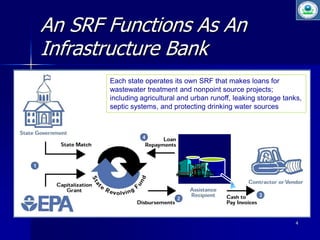
An SRF Functions As An 
Infrastructure Bank 
Each state operates its own SRF that makes loans for 
wastewater treatment and nonpoint source projects; 
including agricultural and urban runoff, leaking storage tanks, 
septic systems, and protecting drinking water sources
5 
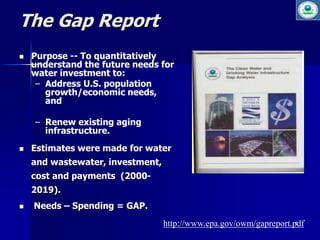
The Gap Report 
 Purpose -- To quantitatively 
understand the future needs for 
water investment to: 
– Address U.S. population 
growth/economic needs, 
and 
– Renew existing aging 
infrastructure. 
 Estimates were made for water 
and wastewater, investment, 
cost and payments (2000- 
2019). 
 Needs – Spending = GAP. 
http://www.epa.gov/owm/gapreport.pdf
Total Gap (20 Years) 
(Average in Billions of $) 
Drinking 
Water 
6 
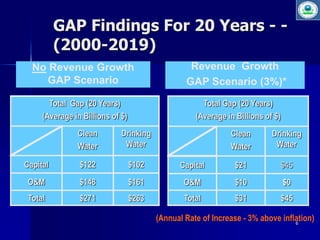
GAP Findings For 20 Years - - 
(2000-2019) 
Clean 
Water 
Capital $21 $45 
O&M $10 $0 
Total $31 $45 
No Revenue Growth 
GAP Scenario 
Revenue Growth 
GAP Scenario (3%)* 
(Annual Rate of Increase - 3% above inflation) 
Total Gap (20 Years) 
(Average in Billions of $) 
Drinking 
Water 
Clean 
Water 
Capital $122 $102 
O&M $148 $161 
Total $271 $263
7 
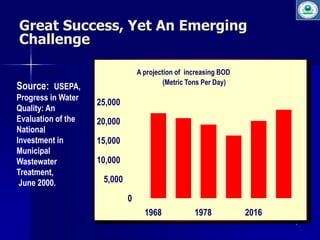
Great Success, Yet An Emerging 
Challenge 
Source: USEPA, 
Progress in Water 
Quality: An 
Evaluation of the 
National 
Investment in 
Municipal 
Wastewater 
Treatment, 
June 2000. 
A projection of increasing BOD U 
(Metric Tons Per Day) 
0 
25,000 
20,000 
15,000 
10,000 
5,000 
1968 1978 2016
8 
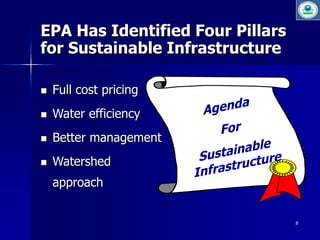
EPA Has Identified Four Pillars 
for Sustainable Infrastructure 
 Full cost pricing 
 Water efficiency 
 Better management 
 Watershed 
approach
9 
Full Cost Pricing 
 ensures that there are sufficient 
revenues in place to support the costs 
of doing business 
 can also have the added benefit of 
encouraging efficient water use
10 
Water Efficiency 
 reduces the need for costly 
infrastructure 
 options include: 
 metering, 
 water reuse, 
 water saving appliances, 
 landscaping and 
 public education
11 
Better Management 
 Asset management (Better acquisition, 
Operations and maintenance, and, Renewal 
and replacement), environmental 
management systems (EMS’s) 
 Focuses on better 
– utility performance, 
– environmental performance, and 
– customer service
12 
Watershed Approach 
 looks more broadly at water resources 
in a coordinated way 
 targets resources towards highest 
priorities 
 examples of watershed approaches 
include: 
 permitting on a watershed basis 
 water quality trading
13 
Thank you

Sustinable water Infrastructure Through Innovative Financing

  • 1.
    1 Sustainable WaterInfrastructure through Innovative Financing
  • 2.
    2 The Historyof Water Infrastructure Financing  In 1970’s, The U.S. Congress passed legislation making EPA an important fiscal partner in wastewater funding  In 1987, in order to better serve state and local communities specific water needs, the U.S. Congress established the Clean Water State Revolving Fund  During this time, EPA developed a new permit processes to control discharges to the nation’s waterways  Very large investments were made in the treatment of industrial waste and in the upgrading of the public wastewater systems
  • 3.
    3 Features ofthe State Revolving Fund (SRF) Program  Federally and state provided “seed money”  State programs are allowed great flexibility  State implemented and operated  Public participation is encouraged  Federal involvement is limited
  • 4.
    4 An SRFFunctions As An Infrastructure Bank Each state operates its own SRF that makes loans for wastewater treatment and nonpoint source projects; including agricultural and urban runoff, leaking storage tanks, septic systems, and protecting drinking water sources
  • 5.
    5 The GapReport  Purpose -- To quantitatively understand the future needs for water investment to: – Address U.S. population growth/economic needs, and – Renew existing aging infrastructure.  Estimates were made for water and wastewater, investment, cost and payments (2000- 2019).  Needs – Spending = GAP. http://www.epa.gov/owm/gapreport.pdf
  • 6.
    Total Gap (20Years) (Average in Billions of $) Drinking Water 6 GAP Findings For 20 Years - - (2000-2019) Clean Water Capital $21 $45 O&M $10 $0 Total $31 $45 No Revenue Growth GAP Scenario Revenue Growth GAP Scenario (3%)* (Annual Rate of Increase - 3% above inflation) Total Gap (20 Years) (Average in Billions of $) Drinking Water Clean Water Capital $122 $102 O&M $148 $161 Total $271 $263
  • 7.
    7 Great Success,Yet An Emerging Challenge Source: USEPA, Progress in Water Quality: An Evaluation of the National Investment in Municipal Wastewater Treatment, June 2000. A projection of increasing BOD U (Metric Tons Per Day) 0 25,000 20,000 15,000 10,000 5,000 1968 1978 2016
  • 8.
    8 EPA HasIdentified Four Pillars for Sustainable Infrastructure  Full cost pricing  Water efficiency  Better management  Watershed approach
  • 9.
    9 Full CostPricing  ensures that there are sufficient revenues in place to support the costs of doing business  can also have the added benefit of encouraging efficient water use
  • 10.
    10 Water Efficiency  reduces the need for costly infrastructure  options include:  metering,  water reuse,  water saving appliances,  landscaping and  public education
  • 11.
    11 Better Management  Asset management (Better acquisition, Operations and maintenance, and, Renewal and replacement), environmental management systems (EMS’s)  Focuses on better – utility performance, – environmental performance, and – customer service
  • 12.
    12 Watershed Approach  looks more broadly at water resources in a coordinated way  targets resources towards highest priorities  examples of watershed approaches include:  permitting on a watershed basis  water quality trading
  • 13.