REPORT OF THE COOK COUNTY
SUSTAINABILITY ADVISORY COUNCIL
Executive Summary June 5, 2013
A Sustainable Cook County
2
Cook County Board President Preckwinkle established the Cook County
Sustainability Advisory Council to help the County become
Environmentally, Socially and Economically Sustainable.
The Council recommends an overall Greenhouse Gas (GHG) Emissions Reduction
Goal of 80% by 2050, as a way to focus efforts on areas that need action
both within County government and in the Community.
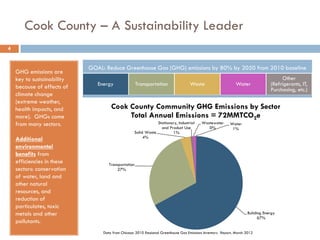
Building Energy is the largest source of GHG emissions, accounting for 67% of the emissions in the
County and so the Council began its work by focusing on the County’s building energy use. Savings
already achieved, and near-term actions recommended by the Council, can put Cook County well
ahead of schedule on meeting the goal.
As the County begins to address Transportation, Waste, Water and other sources of GHG emission,
the template of data collection, analysis and decision making used for building energy should be
applied. Cook County should roll out a series of projects to address these areas, to save money,
boost the economy, and help create healthier, more livable communities.
Cook County’s Role in Sustainability
3
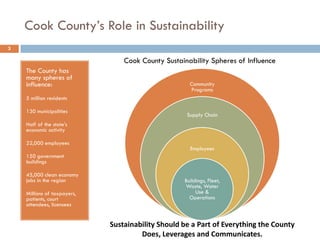
The County has
many spheres of
influence:
5 million residents
130 municipalities
Half of the state’s
economic activity
22,000 employees
150 government
buildings
45,000 clean economy
jobs in the region
Millions of taxpayers,
patients, court
attendees, licensees
Community
Programs
Supply Chain
Employees
Buildings, Fleet,
Waste, Water
Use &
Operations
Cook County Sustainability Spheres of Influence
Sustainability Should be a Part of Everything the County
Does, Leverages and Communicates.
Cook County – A Sustainability Leader
GHG emissions are
key to sustainability
because of effects of
climate change
(extreme weather,
health impacts, and
more). GHGs come
from many sectors.
Additional
environmental
benefits from
efficiencies in these
sectors: conservation
of water, land and
other natural
resources, and
reduction of
particulates, toxic
metals and other
pollutants.
GOAL: Reduce Greenhouse Gas (GHG) emissions by 80% by 2050 from 2010 baseline
Energy Transportation Waste Water
Other
(Refrigerants, IT,
Purchasing, etc.)
Building Energy
67%
Transportation
27%
Solid Waste
4%
Stationary, Industrial
and Product Use
1%
Wastewater
0%
Water
1%
Cook County Community GHG Emissions by Sector
Total Annual Emissions = 72MMTCO2e
Data from Chicago 2010 Regional Greenhouse Gas Emissions Inventory Report, March 2012
4
Cook County Sustainability Advisory Council
Recommendations
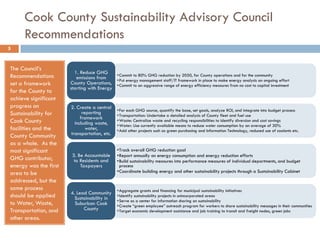
The Council’s
Recommendations
set a framework
for the County to
achieve significant
progress on
Sustainability for
Cook County
facilities and the
County Community
as a whole. As the
most significant
GHG contributor,
energy was the first
area to be
addressed, but the
same process
should be applied
to Water, Waste,
Transportation, and
other areas.
•Commit to 80% GHG reduction by 2050, for County operations and for the community
•Put energy management staff/IT framework in place to make energy analysis an ongoing effort
•Commit to an aggressive range of energy efficiency measures from no cost to capital investment
1. Reduce GHG
emissions from
County Operations,
starting with Energy
•For each GHG source, quantify the base, set goals, analyze ROI, and integrate into budget process
•Transportation: Undertake a detailed analysis of County fleet and fuel use
•Waste: Centralize waste and recycling responsibilities to identify diversion and cost savings
•Water: Use currently available means to reduce water consumption by an average of 30%
•Add other projects such as green purchasing and Information Technology, reduced use of coolants etc.
2. Create a central
reporting
framework
including waste,
water,
transportation, etc.
•Track overall GHG reduction goal
•Report annually on energy consumption and energy reduction efforts
•Build sustainability measures into performance measures of individual departments, and budget
process
•Coordinate building energy and other sustainability projects through a Sustainability Cabinet
3. Be Accountable
to Residents and
Taxpayers
•Aggregate grants and financing for municipal sustainability initiatives
•Identify sustainability projects in unincorporated areas
•Serve as a center for information sharing on sustainability
•Create “green employee” outreach program for workers to share sustainability messages in their communities
•Target economic development assistance and job training to transit and freight nodes, green jobs
4. Lead Community
Sustainability in
Suburban Cook
County
5
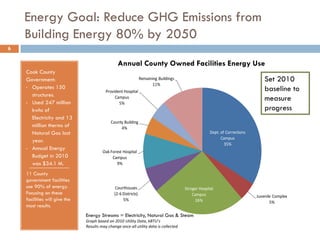
Energy Goal: Reduce GHG Emissions from
Building Energy 80% by 2050
Cook County
Government:
• Operates 150
structures.
• Used 247 million
kwhs of
Electricity and 13
million therms of
Natural Gas last
year.
• Annual Energy
Budget in 2010
was $34.1 M.
11 County
government facilities
use 90% of energy.
Focusing on these
facilities will give the
most results.
6
Dept. of Corrections
Campus
35%
Juvenile Complex
5%
Stroger Hospital
Campus
26%
Courthouses
(2-6 Districts)
5%
Oak Forest Hospital
Campus
9%
County Building
4%
Provident Hospital
Campus
5%
Remaining Buildings
11%
Annual County Owned Facilities Energy Use
Energy Streams = Electricity, Natural Gas & Steam
Graph based on 2010 Utility Data, kBTU’s
Results may change once all utility data is collected
Set 2010
baseline to
measure
progress
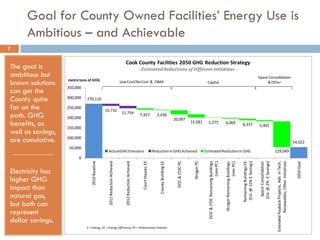
Goal for County Owned Facilities’ Energy Use is
Ambitious – and Achievable
The goal is
ambitious but
known solutions
can get the
County quite
far on the
path. GHG
benefits, as
well as savings,
are cumulative.
Electricity has
higher GHG
impact than
natural gas,
but both can
represent
dollar savings.
7
270,110
10,732
11,754 7,357 2,436
20,097
15,581 1,275 4,069 8,337 5,402
129,049
54,022
0
50,000
100,000
150,000
200,000
250,000
300,000
350,000
2010Baseline
2011ReductionAchieved
2012ReductionAchieved
CourtHousesEE
CountyBuildingEE
DOC&JTDCPC
StrogerPC
DOC&JTDCRemainingBuildings
(non-PC)
StrogerRemainingBuildings
(non-PC)
RemainingBuildingsEE
(Est.@15%ESavings)
SpaceConsolidation
(Est.@2%ESavings)
ExtendedPaybackProjects,Adv.inTech,
Renewables,OtherInitiatives
2050Goal
Cook County Facilities 2050 GHG Reduction Strategy
- Estimated Reductions of Different Initiatives -
Low Cost/NoCost & O&M Capital
Space Consolidation
&Other
metrictons of GHG
E = Energy, EE = Energy Efficiency, PC= Performance Contract
ActualGHG Emissions Reductionin GHG Achieved EstimatedReductionin GHG
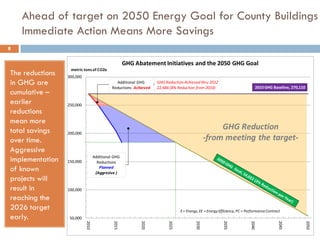
Ahead of target on 2050 Energy Goal for County Buildings
Immediate Action Means More Savings
The reductions
in GHG are
cumulative –
earlier
reductions
mean more
total savings
over time.
Aggressive
implementation
of known
projects will
result in
reaching the
2026 target
early.
8
50,000
100,000
150,000
200,000
250,000
300,000
2010
2015
2020
2025
2030
2035
2040
2045
2050
metric tons of CO2e
GHG Abatement Initiatives and the 2050 GHG Goal
2010 GHG Baseline, 270,110
E= Energy, EE = Energy Efficiency, PC = PerformanceContract
GHG Reduction
-from meeting the target-
GHG Reduction Achieved thru 2012
22,486 (8% Reduction from 2010)
Additional GHG
Reductions Achieved
Additional GHG
Reductions
Planned
(Aggresive )
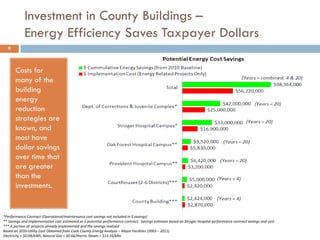
Investment in County Buildings –
Energy Efficiency Saves Taxpayer Dollars
9
Costs for
many of the
building
energy
reduction
strategies are
known, and
most have
dollar savings
over time that
are greater
than the
investments.
*Performance Contract (Operational/maintenance cost savings not included in $ savings)
** Savings and implementation cost estimated as a potential performance contract. Savings estimate based on Stroger Hospital performance contract savings and cost
*** A portion of projects already implemented and the savings realized
Based on 2010 Utility Cost Obtained from Cook County Energy Analysis – Major Facilities (2003 – 2011)
Electricity = $0.09/kWh, Natural Gas = $0.66/therm, Steam = $13.35/klbs
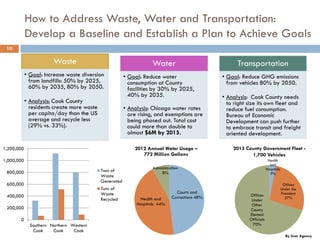
How to Address Waste, Water and Transportation:
Develop a Baseline and Establish a Plan to Achieve Goals
Waste
• Goal: Increase waste diversion
from landfills: 50% by 2025,
60% by 2035, 80% by 2050.
• Analysis: Cook County
residents create more waste
per capita/day than the US
average and recycle less
(29% vs. 33%).
Water
• Goal: Reduce water
consumption at County
facilities by 30% by 2025,
40% by 2035.
• Analysis: Chicago water rates
are rising, and exemptions are
being phased out. Total cost
could more than double to
almost $6M by 2015.
Transportation
• Goal: Reduce GHG emissions
from vehicles 80% by 2050.
• Analysis: Cook County needs
to right size its own fleet and
reduce fuel consumption.
Bureau of Economic
Development can push further
to embrace transit and freight
oriented development.
0
200,000
400,000
600,000
800,000
1,000,000
1,200,000
Southern
Cook
Northern
Cook
Western
Cook
Tons of
Waste
Generated
Tons of
Waste
Recycled
Courts and
Corrections 48%Health and
Hospitals 44%
Administration
8%
2012 Annual Water Usage –
772 Million Gallons
Health
and
Hospitals
3%
Offices
Under the
President
27%
Offices
Under
Other
County
Elected
Officials
70%
2013 County Government Fleet -
1,700 Vehicles
By User Agency
10
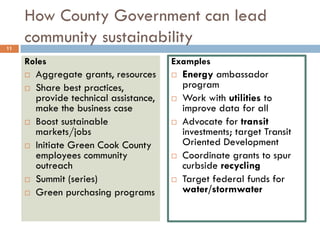
How County Government can lead
community sustainability
Roles
 Aggregate grants, resources
 Share best practices,
provide technical assistance,
make the business case
 Boost sustainable
markets/jobs
 Initiate Green Cook County
employees community
outreach
 Summit (series)
 Green purchasing programs
Examples
 Energy ambassador
program
 Work with utilities to
improve data for all
 Advocate for transit
investments; target Transit
Oriented Development
 Coordinate grants to spur
curbside recycling
 Target federal funds for
water/stormwater
11
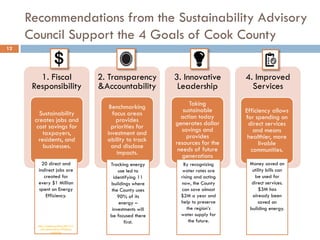
Recommendations from the Sustainability Advisory
Council Support the 4 Goals of Cook County
12
1. Fiscal
Responsibility
Sustainability
creates jobs and
cost savings for
taxpayers,
residents, and
businesses.
2. Transparency
&Accountability
Benchmarking
focus areas
provides
priorities for
investment and
ability to track
and disclose
impacts.
3. Innovative
Leadership
Taking
sustainable
action today
generates dollar
savings and
provides
resources for the
needs of future
generations
4. Improved
Services
Efficiency allows
for spending on
direct services
and means
healthier, more
livable
communities.
20 direct and
indirect jobs are
created for
every $1 Million
spent on Energy
Efficiency.
http://aceee.org/blog/2011/11
/how-does-energy-efficiency-
create-job
Money saved on
utility bills can
be used for
direct services.
$3M has
already been
saved on
building energy.
Tracking energy
use led to
identifying 11
buildings where
the County uses
90% of its
energy –
investments will
be focused there
first.
By recognizing
water rates are
rising and acting
now, the County
can save almost
$2M a year and
help to preserve
the region’s
water supply for
the future.
Cook County
Sustainability Advisory Council
Co- Chairs
Christopher G. Kennedy Anne R. Pramaggiore
Chairman, President & CEO
Joseph P. Kennedy Enterprises, Inc. ComEd
13
Gerald Bennett Jean Pogge David Anderson
Mayor Chief Executive Officer Consultant to Housing Authority of Cook County
City of Palos Hills Delta Institute
Jack Darin David Pope Alesia Hushaw
Director President Senior Financial Analyst
Sierra Club, Illinois Chapter Village of Oak Park Housing Authority of Cook County
Sandra Frum Kelly Shelton Tom McKone
President President Principal
Village of Northbrook Shelton Solutions, Inc. Civic Consulting Alliance
David Hackett Kathy Tholin Kate Tomford
Partner Chief Executive Officer Chief Sustainability Policy Advisor
Baker McKenzie Center For Neighborhood Illinois Dept. of Commerce and Economic Opportunity
Technology
Ed Miller
Program Manager, Environment Eugene Williams Karen Weigert
The Joyce Foundation Mayor Chief Sustainability Officer
Village of Lynwood City of Chicago
Ken Ortiz
Regional Manager Staffed by Cook County Sustainability Office
The Reuse People and Department of Environmental Control
Members Ex-officio Members

Executive Summary of Cook County Sustainability Advisory Report, 060513

  • 1.
    REPORT OF THECOOK COUNTY SUSTAINABILITY ADVISORY COUNCIL Executive Summary June 5, 2013
  • 2.
    A Sustainable CookCounty 2 Cook County Board President Preckwinkle established the Cook County Sustainability Advisory Council to help the County become Environmentally, Socially and Economically Sustainable. The Council recommends an overall Greenhouse Gas (GHG) Emissions Reduction Goal of 80% by 2050, as a way to focus efforts on areas that need action both within County government and in the Community. Building Energy is the largest source of GHG emissions, accounting for 67% of the emissions in the County and so the Council began its work by focusing on the County’s building energy use. Savings already achieved, and near-term actions recommended by the Council, can put Cook County well ahead of schedule on meeting the goal. As the County begins to address Transportation, Waste, Water and other sources of GHG emission, the template of data collection, analysis and decision making used for building energy should be applied. Cook County should roll out a series of projects to address these areas, to save money, boost the economy, and help create healthier, more livable communities.
  • 3.
    Cook County’s Rolein Sustainability 3 The County has many spheres of influence: 5 million residents 130 municipalities Half of the state’s economic activity 22,000 employees 150 government buildings 45,000 clean economy jobs in the region Millions of taxpayers, patients, court attendees, licensees Community Programs Supply Chain Employees Buildings, Fleet, Waste, Water Use & Operations Cook County Sustainability Spheres of Influence Sustainability Should be a Part of Everything the County Does, Leverages and Communicates.
  • 4.
    Cook County –A Sustainability Leader GHG emissions are key to sustainability because of effects of climate change (extreme weather, health impacts, and more). GHGs come from many sectors. Additional environmental benefits from efficiencies in these sectors: conservation of water, land and other natural resources, and reduction of particulates, toxic metals and other pollutants. GOAL: Reduce Greenhouse Gas (GHG) emissions by 80% by 2050 from 2010 baseline Energy Transportation Waste Water Other (Refrigerants, IT, Purchasing, etc.) Building Energy 67% Transportation 27% Solid Waste 4% Stationary, Industrial and Product Use 1% Wastewater 0% Water 1% Cook County Community GHG Emissions by Sector Total Annual Emissions = 72MMTCO2e Data from Chicago 2010 Regional Greenhouse Gas Emissions Inventory Report, March 2012 4
  • 5.
    Cook County SustainabilityAdvisory Council Recommendations The Council’s Recommendations set a framework for the County to achieve significant progress on Sustainability for Cook County facilities and the County Community as a whole. As the most significant GHG contributor, energy was the first area to be addressed, but the same process should be applied to Water, Waste, Transportation, and other areas. •Commit to 80% GHG reduction by 2050, for County operations and for the community •Put energy management staff/IT framework in place to make energy analysis an ongoing effort •Commit to an aggressive range of energy efficiency measures from no cost to capital investment 1. Reduce GHG emissions from County Operations, starting with Energy •For each GHG source, quantify the base, set goals, analyze ROI, and integrate into budget process •Transportation: Undertake a detailed analysis of County fleet and fuel use •Waste: Centralize waste and recycling responsibilities to identify diversion and cost savings •Water: Use currently available means to reduce water consumption by an average of 30% •Add other projects such as green purchasing and Information Technology, reduced use of coolants etc. 2. Create a central reporting framework including waste, water, transportation, etc. •Track overall GHG reduction goal •Report annually on energy consumption and energy reduction efforts •Build sustainability measures into performance measures of individual departments, and budget process •Coordinate building energy and other sustainability projects through a Sustainability Cabinet 3. Be Accountable to Residents and Taxpayers •Aggregate grants and financing for municipal sustainability initiatives •Identify sustainability projects in unincorporated areas •Serve as a center for information sharing on sustainability •Create “green employee” outreach program for workers to share sustainability messages in their communities •Target economic development assistance and job training to transit and freight nodes, green jobs 4. Lead Community Sustainability in Suburban Cook County 5
  • 6.
    Energy Goal: ReduceGHG Emissions from Building Energy 80% by 2050 Cook County Government: • Operates 150 structures. • Used 247 million kwhs of Electricity and 13 million therms of Natural Gas last year. • Annual Energy Budget in 2010 was $34.1 M. 11 County government facilities use 90% of energy. Focusing on these facilities will give the most results. 6 Dept. of Corrections Campus 35% Juvenile Complex 5% Stroger Hospital Campus 26% Courthouses (2-6 Districts) 5% Oak Forest Hospital Campus 9% County Building 4% Provident Hospital Campus 5% Remaining Buildings 11% Annual County Owned Facilities Energy Use Energy Streams = Electricity, Natural Gas & Steam Graph based on 2010 Utility Data, kBTU’s Results may change once all utility data is collected Set 2010 baseline to measure progress
  • 7.
    Goal for CountyOwned Facilities’ Energy Use is Ambitious – and Achievable The goal is ambitious but known solutions can get the County quite far on the path. GHG benefits, as well as savings, are cumulative. Electricity has higher GHG impact than natural gas, but both can represent dollar savings. 7 270,110 10,732 11,754 7,357 2,436 20,097 15,581 1,275 4,069 8,337 5,402 129,049 54,022 0 50,000 100,000 150,000 200,000 250,000 300,000 350,000 2010Baseline 2011ReductionAchieved 2012ReductionAchieved CourtHousesEE CountyBuildingEE DOC&JTDCPC StrogerPC DOC&JTDCRemainingBuildings (non-PC) StrogerRemainingBuildings (non-PC) RemainingBuildingsEE (Est.@15%ESavings) SpaceConsolidation (Est.@2%ESavings) ExtendedPaybackProjects,Adv.inTech, Renewables,OtherInitiatives 2050Goal Cook County Facilities 2050 GHG Reduction Strategy - Estimated Reductions of Different Initiatives - Low Cost/NoCost & O&M Capital Space Consolidation &Other metrictons of GHG E = Energy, EE = Energy Efficiency, PC= Performance Contract ActualGHG Emissions Reductionin GHG Achieved EstimatedReductionin GHG
  • 8.
    Ahead of targeton 2050 Energy Goal for County Buildings Immediate Action Means More Savings The reductions in GHG are cumulative – earlier reductions mean more total savings over time. Aggressive implementation of known projects will result in reaching the 2026 target early. 8 50,000 100,000 150,000 200,000 250,000 300,000 2010 2015 2020 2025 2030 2035 2040 2045 2050 metric tons of CO2e GHG Abatement Initiatives and the 2050 GHG Goal 2010 GHG Baseline, 270,110 E= Energy, EE = Energy Efficiency, PC = PerformanceContract GHG Reduction -from meeting the target- GHG Reduction Achieved thru 2012 22,486 (8% Reduction from 2010) Additional GHG Reductions Achieved Additional GHG Reductions Planned (Aggresive )
  • 9.
    Investment in CountyBuildings – Energy Efficiency Saves Taxpayer Dollars 9 Costs for many of the building energy reduction strategies are known, and most have dollar savings over time that are greater than the investments. *Performance Contract (Operational/maintenance cost savings not included in $ savings) ** Savings and implementation cost estimated as a potential performance contract. Savings estimate based on Stroger Hospital performance contract savings and cost *** A portion of projects already implemented and the savings realized Based on 2010 Utility Cost Obtained from Cook County Energy Analysis – Major Facilities (2003 – 2011) Electricity = $0.09/kWh, Natural Gas = $0.66/therm, Steam = $13.35/klbs
  • 10.
    How to AddressWaste, Water and Transportation: Develop a Baseline and Establish a Plan to Achieve Goals Waste • Goal: Increase waste diversion from landfills: 50% by 2025, 60% by 2035, 80% by 2050. • Analysis: Cook County residents create more waste per capita/day than the US average and recycle less (29% vs. 33%). Water • Goal: Reduce water consumption at County facilities by 30% by 2025, 40% by 2035. • Analysis: Chicago water rates are rising, and exemptions are being phased out. Total cost could more than double to almost $6M by 2015. Transportation • Goal: Reduce GHG emissions from vehicles 80% by 2050. • Analysis: Cook County needs to right size its own fleet and reduce fuel consumption. Bureau of Economic Development can push further to embrace transit and freight oriented development. 0 200,000 400,000 600,000 800,000 1,000,000 1,200,000 Southern Cook Northern Cook Western Cook Tons of Waste Generated Tons of Waste Recycled Courts and Corrections 48%Health and Hospitals 44% Administration 8% 2012 Annual Water Usage – 772 Million Gallons Health and Hospitals 3% Offices Under the President 27% Offices Under Other County Elected Officials 70% 2013 County Government Fleet - 1,700 Vehicles By User Agency 10
  • 11.
    How County Governmentcan lead community sustainability Roles  Aggregate grants, resources  Share best practices, provide technical assistance, make the business case  Boost sustainable markets/jobs  Initiate Green Cook County employees community outreach  Summit (series)  Green purchasing programs Examples  Energy ambassador program  Work with utilities to improve data for all  Advocate for transit investments; target Transit Oriented Development  Coordinate grants to spur curbside recycling  Target federal funds for water/stormwater 11
  • 12.
    Recommendations from theSustainability Advisory Council Support the 4 Goals of Cook County 12 1. Fiscal Responsibility Sustainability creates jobs and cost savings for taxpayers, residents, and businesses. 2. Transparency &Accountability Benchmarking focus areas provides priorities for investment and ability to track and disclose impacts. 3. Innovative Leadership Taking sustainable action today generates dollar savings and provides resources for the needs of future generations 4. Improved Services Efficiency allows for spending on direct services and means healthier, more livable communities. 20 direct and indirect jobs are created for every $1 Million spent on Energy Efficiency. http://aceee.org/blog/2011/11 /how-does-energy-efficiency- create-job Money saved on utility bills can be used for direct services. $3M has already been saved on building energy. Tracking energy use led to identifying 11 buildings where the County uses 90% of its energy – investments will be focused there first. By recognizing water rates are rising and acting now, the County can save almost $2M a year and help to preserve the region’s water supply for the future.
  • 13.
    Cook County Sustainability AdvisoryCouncil Co- Chairs Christopher G. Kennedy Anne R. Pramaggiore Chairman, President & CEO Joseph P. Kennedy Enterprises, Inc. ComEd 13 Gerald Bennett Jean Pogge David Anderson Mayor Chief Executive Officer Consultant to Housing Authority of Cook County City of Palos Hills Delta Institute Jack Darin David Pope Alesia Hushaw Director President Senior Financial Analyst Sierra Club, Illinois Chapter Village of Oak Park Housing Authority of Cook County Sandra Frum Kelly Shelton Tom McKone President President Principal Village of Northbrook Shelton Solutions, Inc. Civic Consulting Alliance David Hackett Kathy Tholin Kate Tomford Partner Chief Executive Officer Chief Sustainability Policy Advisor Baker McKenzie Center For Neighborhood Illinois Dept. of Commerce and Economic Opportunity Technology Ed Miller Program Manager, Environment Eugene Williams Karen Weigert The Joyce Foundation Mayor Chief Sustainability Officer Village of Lynwood City of Chicago Ken Ortiz Regional Manager Staffed by Cook County Sustainability Office The Reuse People and Department of Environmental Control Members Ex-officio Members