Invite to TWDB Webinar on
Model or Questions
• Jennifer J. Walker, P.E., D.WRE, CFM
o President, Watearth, Inc.
o jwalker@watearth.com
o 832.444.0663
o www.watearth.com
Project Team
• Texas Water Development Board
o John Sutton
• Watearth, Inc. – Prime
o Jennifer J. Walker, P.E., D.WRE, CFM
• NewGen Strategies & Solutions, LLC
(Formerly J. Stowe & Co.)
o Chris Ekrut
• RPS Espey
o Michael Pinckney, P.E.
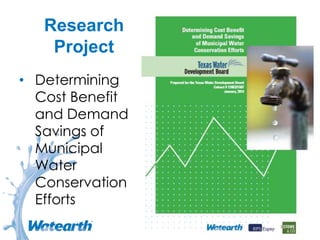
Research
Project
• Determining
Cost Benefit
and Demand
Savings of
Municipal
Water
Conservation
Efforts
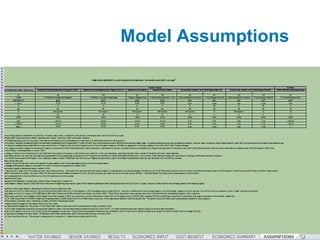
Model Assumptions
TWDB Water Conservation
BMPs Modeling Tool
• Water Conservation Benefits of
BMP Implementation by Customer
Class
• 32 BMPs in Model
• Analyze 1 or Multiple BMPs
• Cost-Benefit Analysis
• Avoided Costs for
Water/Wastewater Facilities
TWDB Water Conservation
BMPs Modeling Tool
• Indoor Fixtures – SF, MF
• Surveys – SF, MF, and ICI
• Outdoor BMPs
o Irrigation Nozzles and Controllers
o Irrigation Efficiency Evaluations
o Landscape Water Budgets
o Water Efficient Landscape Design
Economic Calculations
• Economic calculations are optional and
not essential to overall model function
• Examples presented herein are samples
based on placeholder data and are not
reflective of a particular program or
experience
• The model’s quantitative results are
useful for decision-making, but other
non-economic qualitative factors may
direct ultimate course of action
Economic Calculations
• Model produces two key metrics
o Benefit-Cost Ratio (“BCR”)
― Designed to quantify economic efficiency of
BMPs
― Assists decision makers in program
implementation to achieve the “biggest bang
for your buck”
o Lost Water and Wastewater Revenue
― Reduced water use = less revenue
Benefit-Cost Ratio (BCR)
• Compares cost of implementation with
benefits of program
BCR > 1 = Benefits outweigh cost
(Economically Viable Alternative)
BCR < 1 = Costs outweigh benefits
(Not Economically Viable)
• BCR value can assist in ranking and making
decisions based on economic efficiency
However qualitative benefits may override
quantitative results
• Calculated in Real Dollars and Present Value
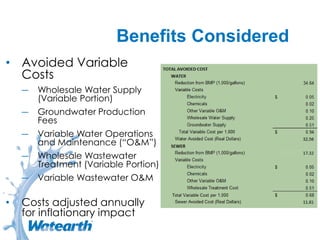
Benefits Considered
• Avoided Variable
Costs
― Wholesale Water Supply
(Variable Portion)
― Groundwater Production
Fees
― Variable Water Operations
and Maintenance (“O&M”)
― Wholesale Wastewater
Treatment (Variable Portion)
― Variable Wastewater O&M
• Costs adjusted annually
for inflationary impact
Benefits Considered
• Delayed Capital Investment and O&M
― Model allows for input of future water supply projects
including cost and capacity
― Using inputs as a baseline, model calculates annual
capital and O&M costs with and without
Conservation impact
― Calculations are then compared and variances due
to delayed investment are considered a benefit of
the program
• Model currently only considers benefits in
delayed water investment – future updates
could consider wastewater investment
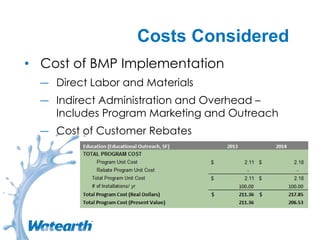
Costs Considered
• Cost of BMP Implementation
― Direct Labor and Materials
― Indirect Administration and Overhead –
Includes Program Marketing and Outreach
― Cost of Customer Rebates
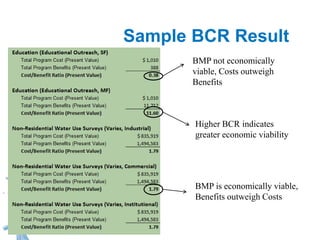
Sample BCR Result
BMP not economically
viable, Costs outweigh
Benefits
BMP is economically viable,
Benefits outweigh Costs
Higher BCR indicates
greater economic viability
Lost Revenue Calculations
• Model calculates reduction in water and
wastewater volumes
• Annual reductions are then multiplied by the
current effective rate for water and
wastewater service to determine lost revenue
o No adjustment made at this time for future rate increases
• Does not reflect fixed or variable cost
reductions at this time
o As cost reductions occur, needed revenue will decrease
o Future updates could consider revenue loss on a net basis
Sample Lost Revenue
Calculation
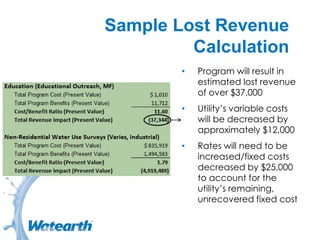
• Program will result in
estimated lost revenue
of over $37,000
• Utility’s variable costs
will be decreased by
approximately $12,000
• Rates will need to be
increased/fixed costs
decreased by $25,000
to account for the
utility’s remaining,
unrecovered fixed cost
Decision Support / Impact Planning
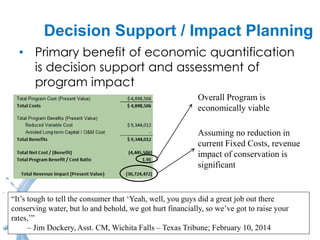
• Primary benefit of economic quantification
is decision support and assessment of
program impact
Overall Program is
economically viable
Assuming no reduction in
current Fixed Costs, revenue
impact of conservation is
significant
“It’s tough to tell the consumer that ‘Yeah, well, you guys did a great job out there
conserving water, but lo and behold, we got hurt financially, so we’ve got to raise your
rates,’”
– Jim Dockery, Asst. CM, Wichita Falls – Texas Tribune; February 10, 2014

Invite to TWDB webinar on model or questions

  • 1.
    Invite to TWDBWebinar on Model or Questions • Jennifer J. Walker, P.E., D.WRE, CFM o President, Watearth, Inc. o jwalker@watearth.com o 832.444.0663 o www.watearth.com
  • 2.
    Project Team • TexasWater Development Board o John Sutton • Watearth, Inc. – Prime o Jennifer J. Walker, P.E., D.WRE, CFM • NewGen Strategies & Solutions, LLC (Formerly J. Stowe & Co.) o Chris Ekrut • RPS Espey o Michael Pinckney, P.E.
  • 3.
    Research Project • Determining Cost Benefit andDemand Savings of Municipal Water Conservation Efforts
  • 4.
  • 5.
    TWDB Water Conservation BMPsModeling Tool • Water Conservation Benefits of BMP Implementation by Customer Class • 32 BMPs in Model • Analyze 1 or Multiple BMPs • Cost-Benefit Analysis • Avoided Costs for Water/Wastewater Facilities
  • 6.
    TWDB Water Conservation BMPsModeling Tool • Indoor Fixtures – SF, MF • Surveys – SF, MF, and ICI • Outdoor BMPs o Irrigation Nozzles and Controllers o Irrigation Efficiency Evaluations o Landscape Water Budgets o Water Efficient Landscape Design
  • 7.
    Economic Calculations • Economiccalculations are optional and not essential to overall model function • Examples presented herein are samples based on placeholder data and are not reflective of a particular program or experience • The model’s quantitative results are useful for decision-making, but other non-economic qualitative factors may direct ultimate course of action
  • 8.
    Economic Calculations • Modelproduces two key metrics o Benefit-Cost Ratio (“BCR”) ― Designed to quantify economic efficiency of BMPs ― Assists decision makers in program implementation to achieve the “biggest bang for your buck” o Lost Water and Wastewater Revenue ― Reduced water use = less revenue
  • 9.
    Benefit-Cost Ratio (BCR) •Compares cost of implementation with benefits of program BCR > 1 = Benefits outweigh cost (Economically Viable Alternative) BCR < 1 = Costs outweigh benefits (Not Economically Viable) • BCR value can assist in ranking and making decisions based on economic efficiency However qualitative benefits may override quantitative results • Calculated in Real Dollars and Present Value
  • 10.
    Benefits Considered • AvoidedVariable Costs ― Wholesale Water Supply (Variable Portion) ― Groundwater Production Fees ― Variable Water Operations and Maintenance (“O&M”) ― Wholesale Wastewater Treatment (Variable Portion) ― Variable Wastewater O&M • Costs adjusted annually for inflationary impact
  • 11.
    Benefits Considered • DelayedCapital Investment and O&M ― Model allows for input of future water supply projects including cost and capacity ― Using inputs as a baseline, model calculates annual capital and O&M costs with and without Conservation impact ― Calculations are then compared and variances due to delayed investment are considered a benefit of the program • Model currently only considers benefits in delayed water investment – future updates could consider wastewater investment
  • 12.
    Costs Considered • Costof BMP Implementation ― Direct Labor and Materials ― Indirect Administration and Overhead – Includes Program Marketing and Outreach ― Cost of Customer Rebates
  • 13.
    Sample BCR Result BMPnot economically viable, Costs outweigh Benefits BMP is economically viable, Benefits outweigh Costs Higher BCR indicates greater economic viability
  • 14.
    Lost Revenue Calculations •Model calculates reduction in water and wastewater volumes • Annual reductions are then multiplied by the current effective rate for water and wastewater service to determine lost revenue o No adjustment made at this time for future rate increases • Does not reflect fixed or variable cost reductions at this time o As cost reductions occur, needed revenue will decrease o Future updates could consider revenue loss on a net basis
  • 15.
    Sample Lost Revenue Calculation •Program will result in estimated lost revenue of over $37,000 • Utility’s variable costs will be decreased by approximately $12,000 • Rates will need to be increased/fixed costs decreased by $25,000 to account for the utility’s remaining, unrecovered fixed cost
  • 16.
    Decision Support /Impact Planning • Primary benefit of economic quantification is decision support and assessment of program impact Overall Program is economically viable Assuming no reduction in current Fixed Costs, revenue impact of conservation is significant “It’s tough to tell the consumer that ‘Yeah, well, you guys did a great job out there conserving water, but lo and behold, we got hurt financially, so we’ve got to raise your rates,’” – Jim Dockery, Asst. CM, Wichita Falls – Texas Tribune; February 10, 2014