






















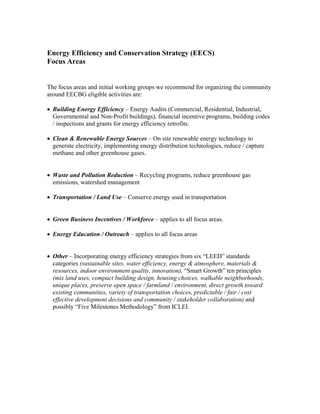









Energy Efficiency & Conservation Strategy
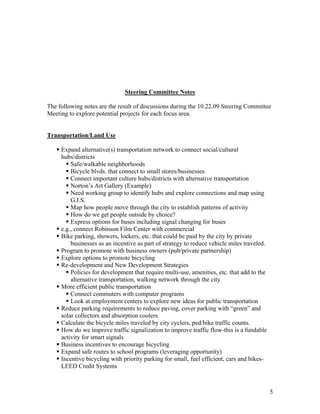
             City of Shreveport, Louisiana

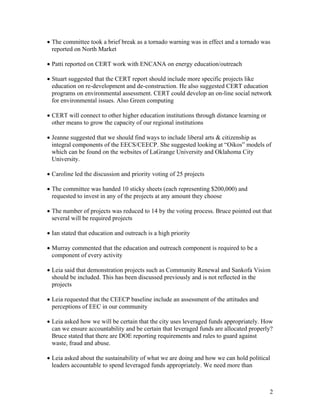
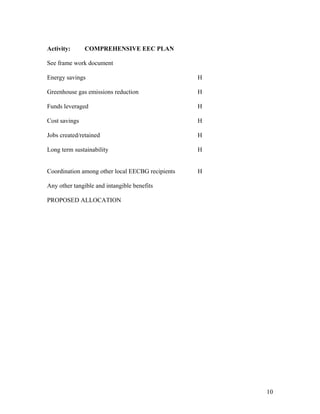
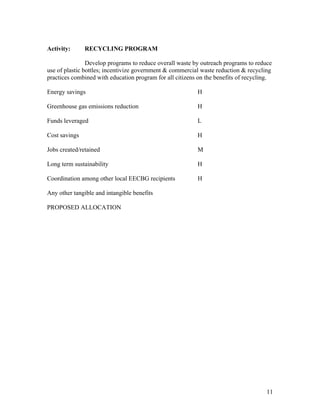
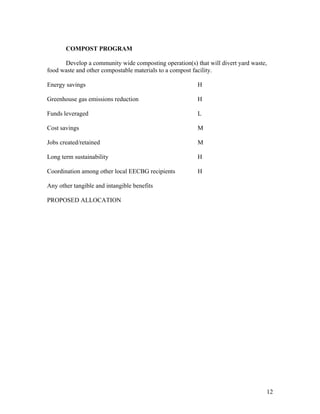
                           December 3, 2009


             Gulf Geoexchange and Consulting Services, Inc.
                             in collaboration with
                Morgan Hill Sutton & Mitchell Architects, LLC
                  Purdue Center for Regional Development
      Consortium for Education Research & Technology of North Louisiana
                       and Chronicles of Numbers, LLC
Table of Contents
Energy Efficiency & Conservation Strategy


3    Executive Summary

7    Attachment D: Energy Efficiency & Conservation Strategy

17   Appendices
     19   Appendix A – Framework Document for the Comprehensive
                       Energy Efficiency & Conservation Plan
     35   Appendix B – Aligning Higher Education to support the EECS and CEECP
     43   Appendix C – Current Energy Efficiency and Conservation Activities
                       for the Shreveport Community
     45   Appendix D – Steering Committee Members
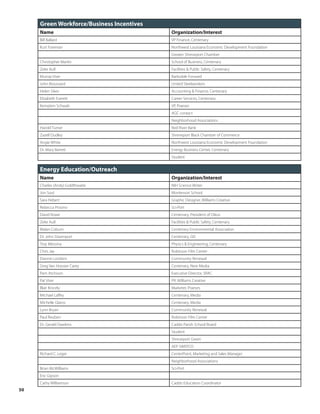
     47   Appendix E – Potential/Proposed Working Group Members
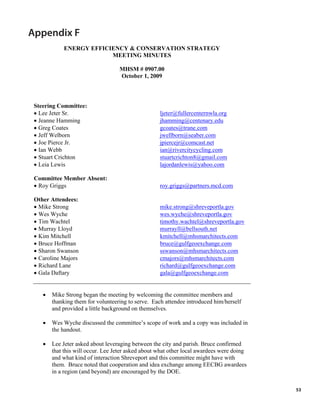
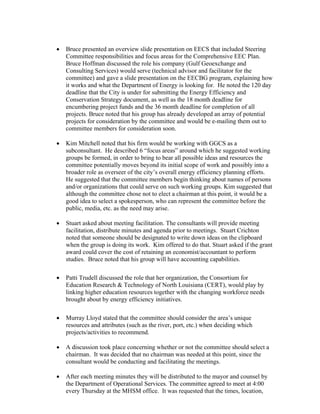
     53   Appendix F – Meeting Minutes
2
Executive Summary


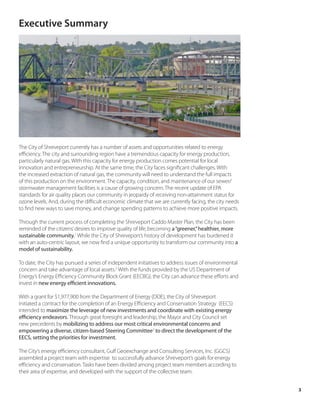
The City of Shreveport currently has a number of assets and opportunities related to energy
efficiency. The city and surrounding region have a tremendous capacity for energy production,
particularly natural gas. With this capacity for energy production comes potential for local
innovation and entrepreneurship. At the same time, the City faces significant challenges. With
the increased extraction of natural gas, the community will need to understand the full impacts
of this production on the environment. The capacity, condition, and maintenance of our sewer/
stormwater management facilities is a cause of growing concern. The recent update of EPA
standards for air quality places our community in jeopardy of receiving non-attainment status for
ozone levels. And, during the difficult economic climate that we are currently facing, the city needs
to find new ways to save money, and change spending patterns to achieve more positive impacts.

Through the current process of completing the Shreveport Caddo Master Plan, the City has been
reminded of the citizens’ desires to improve quality of life, becoming a “greener,” healthier, more
sustainable community.1 While the City of Shreveport’s history of development has burdened it
with an auto-centric layout, we now find a unique opportunity to transform our community into a
model of sustainability.

To date, the City has pursued a series of independent initiatives to address issues of environmental
concern and take advantage of local assets.2 With the funds provided by the US Department of
Energy’s Energy Efficiency Community Block Grant (EECBG), the City can advance these efforts and
invest in new energy efficient innovations.

With a grant for $1,977,900 from the Department of Energy (DOE), the City of Shreveport
initiated a contract for the completion of an Energy Efficiency and Conservation Strategy (EECS)
intended to maximize the leverage of new investments and coordinate with existing energy
efficiency endeavors. Through great foresight and leadership, the Mayor and City Council set
new precedents by mobilizing to address our most critical environmental concerns and
empowering a diverse, citizen-based Steering Committee3 to direct the development of the
EECS, setting the priorities for investment.

The City’s energy efficiency consultant, Gulf Geoexchange and Consulting Services, Inc. (GGCS)
assembled a project team with expertise to successfully advance Shreveport’s goals for energy
efficiency and conservation. Tasks have been divided among project team members according to
their area of expertise, and developed with the support of the collective team.


                                                                                                        3
4
The City charged the project team with producing:
    1) an Energy Efficiency and Conservation Strategy report
    2) a Framework Document for the future completion of a Comprehensive Energy
      Efficiency and Conservation Plan (CEECP). 4

The first task, the EECS report, involved the selection of activities to be funded by the City’s EECBG
and required the integral involvement of the steering committee. Through interviews with city
government, and the input of the EECS Steering Committee, the project team assembled a full
range of potential activities eligible for the City to consider. Then the project team prepared a
detailed report explaining and providing a cost/benefit analysis of each potential activity, so that
each could be fairly evaluated by the EECS Steering Committee. Benefits considered during this
analysis include:

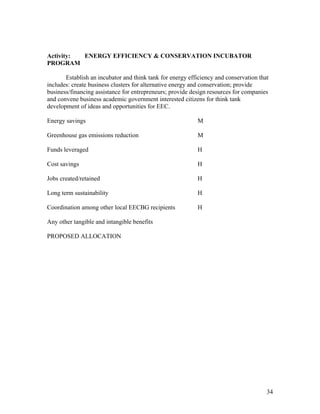
     •   energy savings
     •   greenhouse gas emissions reductions
     •   additional funding to be leveraged
     •   costs saved
     •   jobs created/retained
     •   long vs. short term impact (i.e. sustainability)
     •   coordination among other EECBG funding recipients
     •   other tangible and intangible benefits

Activities were then selected and prioritized based on this assistance, and are reported in this
document. The EECS covers all items required in Attachment D of the EECBG program, listing
activities recommended for funding, showing the dollar amounts recommended to be allocated
to each project/program, and including a description of the metrics to be used to measure the
success of the selected activities. In addition to the EECS, the project team prepared Attachment
B1 Activity Sheets, Budget Justification files, and National Environmental Policy Act (NEPA) forms for
all applicable projects/programs to be submitted to the US Department of Energy (DOE).

The second task, requested by the City of Shreveport, was to prepare a CEECP Framework
Document. This document, included in Appendix A, details the process for developing and
implementing the CEECP. The EECS Steering Committee was also called upon to advise the project
team in the preparation of this Framework Document. Committee members were introduced to
‘Strategic Doing’ and participated in a small scale version of the process proposed for the CEECP.
The committee provided feedback regarding the proposed process and identified an initial list of
stakeholders to be invited to work on the CEECP.

Ultimately, the Steering Committee recommended the CEECP as an activity to be funded through
savings leveraged by the EECS. This comprehensive plan will be vital for the ongoing success of the
City’s efforts to become energy efficient. It will allow them to build upon the initial investments made
through the EECS, continue to pursue additional activities, and provide for ongoing evaluation.


1
  See the Shreveport Caddo 2030 Vision Report: www.communicationsmgr.com/projects/1409/docs/VisionPoster-FINAL-LO.pdf
2
  See Appendix C
3
  See Appendix D
4
  See Appendix A                                                                                                        5
6
Attachment D:
Energy Efficiency & Conservation Strategy
City of Shreveport, Louisiana


        Prepared by
        Gulf Geoexchange and Consulting Services, Inc.


                                                         7
8   City of Shreveport, Louisiana◦Gulf Geoexchange and Consulting Services
Attachment D: Energy Efficiency & Conservation
Strategy for Units of Local Governments & Indian Tribes

1. Describe your government’s proposed Energy Efficiency and Conservation Strategy. Provide a concise
summary of your measureable goals and objectives, which should be aligned with the defined purposes and
eligible activities of the EECBG Program. These goals and objectives should be comprehensive and maximize
benefits community-wide. Provide a schedule or timetable for major milestones. If you government has an
existing energy, climate, or other related strategy please describe how these strategies relate to each other.

The City of Shreveport invests in long-term community transformation.
The Mayor and City Council empowered a diverse, citizen-based Steering Committee, for
development of the Energy Efficiency and Conservation Strategy (activity 1). The Committee
recommended EECBG funding priorities that increase energy efficiency, reduce energy
consumption, cross jurisdictional levels of governance, build community relations, stimulate
the economy, and maximize benefits beyond the funding period.

The City of Shreveport’s EECS (activity 1) investments will include both long-term and short-
term initiatives that will sustainably transform the environmental, economic, social and cultural
future of the Shreveport region. Technical consultants (activity 2) will be used in establishing
our baseline, facilitating a comprehensive EEC plan process, structuring projects, and in
measuring and verifying progress. The Comprehensive Energy Efficiency and Conservation
Plan (CEECP), described in Appendix A, will use a process of community engagement and
accountability, “strategic doing.” Independent audits (activity 3) of government buildings will
be used to determine the scope and benefits of building improvements. These audits will set
the examples for residential and commercial programs to demonstrate benefits and strategies.
To implement EEC improvements, financial programs (activity 4) and leveraging strategies will
be utilized. Energy efficiency retrofits (activity 5) of government buildings will leverage energy
savings from improvements to fund additional retrofits and technical consultant services. To
encourage more low and moderate income residential retrofits (activity 5), the City will provide
incentives and loan assistance. Success and progress toward our sustainable future will require
purposeful education, job training, and outreach programs (activity 6) that will inform our
region of the benefits of energy efficiency and conservation. We are aligning the resources of
higher education to support the transformation of existing inefficiencies and the emergence
of new innovations through a Consortium of 12 regional institutions (CERT). To ensure that
renovations and new construction are advancing our EEC goals, the City of Shreveport will
adopt and enforce state energy codes (activity 8) currently required for state approvals. To
grow EEC businesses, Shreveport will initiate an EEC Business Incubator Program (activity 14) in
collaboration with existing incubator programs and higher education resources.

Goals and Objectives

Goal 1: Transform the City of Shreveport’s communities around a long-term energy
efficiency and conservation plan process, using an innovative “strategic doing” method.

       Objective 1A: Prepare a Comprehensive Energy Efficiency and Conservation Plan,
       supported by technical services and guided by an invited volunteer Steering Committee.

       Objective 1B: Reduce energy consumption by 20% (229,870,208 KwH and 158,965
       metric tons GHG reduction) by 2020.

                                                                                             Energy Efficiency & Conservation Strategy   9
Objective 1C: Develop financial programs to support audits and retrofits through PACE,
                                revolving loans and other alternative financing products.

                                Objective 1D: Implement retrofits on 40 prioritized government buildings and 1000 low
                                to moderate income households to achieve energy efficiency over the next 36 months.

                                Objective 1E: Adopt state energy efficiency codes.

                                Milestones (if funds are received January 2010):
                                     • Begin planning process for the Comprehensive EEC Plan by establishing
                                        baselines, goals, and metrics; organize focus groups. (1st quarter 2010)
                                     • Perform energy audits to form a baseline for energy consumption and
                                        recommended retrofits for all government buildings. (1st quarter 2010
                                        ending mid-year 2011)
                                     • Institute audit programs for residents in conjunction with utility companies and
                                        other agencies to get buy-in throughout the community. (1st quarter 2010)
                                     • Launch PACE Bond program, revolving loan program, and alternative financing for
                                        retrofits and promote to the City’s residents and businesses. (2nd quarter 2010)
                                     • Retrofit 40 government buildings based on audit recommendations. (2nd
                                        quarter 2010 to 2nd quarter 2012)
                                     • Provide workforce training for governmental and residential retrofits and provide
                                        advanced training for city inspectors on new energy codes. (2nd quarter 2010)

                          Goal 2: Cultivate private/public partnerships that develop local and regional assets, develop
                          the workforce, and educate citizens concerning energy efficiency and conservation.

                                Objective 2A: Provide technical services to support a planned, sustainable program of
                                improvements and measures beyond the 3-year EECS proposal. The programs will
                                1.) update and complete a baseline of current EEC initiatives, city energy consumption
                                and emissions; 2.) develop plans and programs for a Bicycle/Pedestrian Master Plan,
                                Urban Agriculture, and Urban Forestry; 3.) preparation of smart growth and energy
                                efficiency regulations; and 4.) plan for contingency funding to advance other EEC
                                programs that emerge from the comprehensive EEC plan..

                                Objective 2B: Establish a diverse education and outreach program, including a web-
                                based information clearinghouse, cooperative strategies with local utilities and media,
                                and cultivate K-12, higher education and private sector partnerships.

                                Objective 2C: Establish a business incubator program.

                                Milestones (if funds are received January 2010):
                                     • Initiate “strategic doing” method to begin the proposed planning processes.
                                        (1st quarter 2010)
                                     • Develop public website for focus areas and activities. (1st quarter 2010)
                                     • Collaborate with higher education and private sector on K-12 energy
                                        education demonstration project. (1st quarter 2010)
                                     • Employ incubator director. (1st quarter 2011)
                                     • Collaborate with existing regional incubators and higher education to support
                                        start-up companies. (1st quarter 2010)


10 City of Shreveport, Louisiana◦Gulf Geoexchange and Consulting Services
The City of Shreveport is committed to energy efficiency and conservation.
To date the City and Parish (county) have pursued a series of independent initiatives, although
not part of a comprehensive strategy, to address issues of environmental and energy concerns.
The City’s proposed EECS strategy, and subsequent comprehensive energy efficiency and
conservation planning (CEECP), will build on and sustain these current efforts:

             •   Energy Efficiency upgrades to 33 City Buildings in 2004;
             •   Landfill Methane Recapture for use by a local General Motors Assembly Plant;
             •   Curbside Recycling Program;
             •   Household hazardous waste collection Program;
             •   Sewerage Sludge 100% Recycling;
             •   Recycling of Sewerage Effluent for Industrial Use ;
             •   Ozone Abatement Program;
             •   Environmental training demonstration project, recent abatement of a 144,000
                 sq. ft. high rise Brownfield site using an EPA revolving loan program;
             •   Bio-diesel Fuel Blend to reduce fossil fuel use—City, Caddo Parish and Caddo
                 Parish Schools;
             •   Hybrid Electric Vehicles – SporTran (City transit authority) is using 2 hybrid
                 electric buses in their fleet, and the city is adding 3 hybrid electric cars;
             •   Compressed Natural Gas (CNG) – SporTran is phasing in CNG for the bus
                 transit fleet, with five on order;
             •   Intelligent Transportation System – The City is installing in phases an
                 intelligent traffic signalization system; and
             •   Vehicle Pollution Control – Caddo Parish and Caddo Parish Schools.

In related action, the City and Caddo Parish jointly funded the development of a Master Plan for
2010-2030 and appointed a Community Advisory Group to oversee the plan’s development.
To date, 18 community forums, neighborhood sessions, and workshops have documented
citizens’ desire to improve quality of life and a “greener,” healthier, more sustainable community.


2. Describe your government’s proposed implementation plan for the use of EECBG Program funds to assist you
in achieving the goals and objectives outlined in the strategy described in question #1. Your description should
include a summary of the activities submitted on your activity worksheets, and how each activity supports one
or more of your strategy’s goals/objectives.

The following is a list of the City of Shreveport’s proposed activities which will implement the
City’s goals and objectives outlined in Question 1:

Activity 1. Energy Efficiency & Conservation (EEC) Strategy: Consultant prepared strategy
and Comprehensive EEC Plan guided by an invited volunteer steering committee. (Funds
already DOE approved and committed.) Allocation: $250,000

Activity 2. Technical Consulting Services: To implement the programs and action items
delineated in the EECS, the City of Shreveport proposes to continue the services of the
technical consultant. This will assist the City not only to meet our goal of a 20% reduction in
energy use, but provide a planned, sustainable program of improvements and measures to
serve us well beyond the three-year time period of the EECS. Among those areas of technical
services needs are:
            1) to update and complete a baseline of current EEC initiatives and city energy
                consumption and GHG emissions;
                                                                                             Energy Efficiency & Conservation Strategy 11
2) to prepare a Comprehensive Energy Efficiency and Conservation Plan;
                                      3) to develop a Bicycle/Pedestrian Master Plan;
                                      4) to develop Urban Agriculture/Forestry Plans and Programs; and
                                      5) to prepare smart growth and energy efficiency development regulations;
                                      6) planning contingency and funding to prepare additional planning
                                          activities required to advance other EEC programs that emerge from the
                                          comprehensive EEC Plan.

                          The process of “strategic doing” incorporated into the CEECP process will allow broader
                          community and technical participation, more efficient alignment of energy and energy-related
                          assets, faster results and greater accountability. Proposed allocation: $150,000. Additionally,
                          $1,550,000 will be allocated for technical consulting services from the funds leveraged in the
                          EECBG Energy Efficiency Retrofit Program.

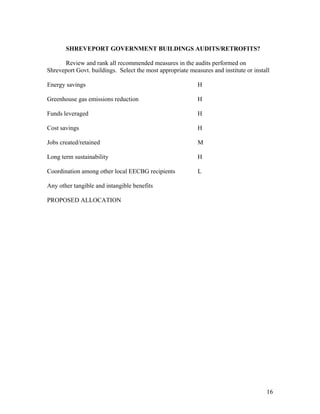
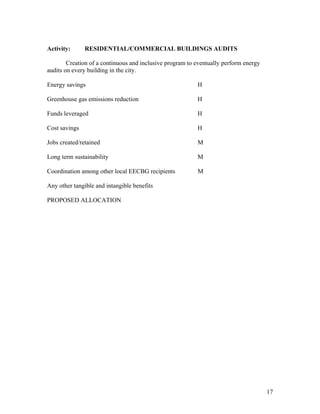
                          Activity 3. Residential and Commercial Buildings Audits: The City in 2004 audited 33 public
                          buildings and performed energy efficiency retrofits that over four years resulted in $500,000 in
                          savings, a reduction of 1000, KwH/mo., a drop in peak demand and 5t4 million fewer pounds
                          of GHG emissions. The City proposes to allocate $100,000 to re-audit its public buildings and
                          facilities with the goal of further reducing energy usage by 20%.

                          In addition to funding audits on public buildings, the City proposes to allocate $200,000 for
                          energy audits on residential housing. A portion of the $200,000 allocation will be used to
                          promote, educate and inform residents of the benefits of an audit and the energy cost savings
                          and financing available to retrofit their homes. The City will work with local utility companies
                          and/or other agencies to cover the cost of the audits, if possible. The goal is for audits to be
                          performed on approximately 8,000 residences, or 10% of Shreveport’s housing stock. Proposed
                          allocation: $300,000.

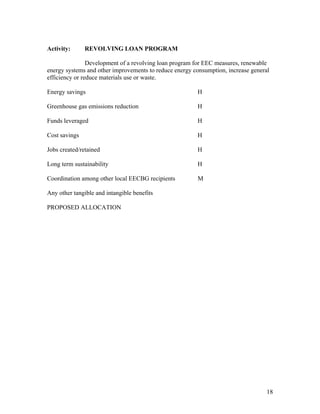
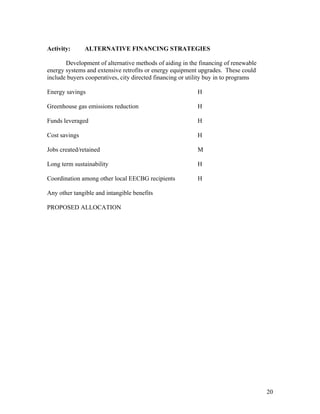
                          Activity 4. Financial Incentive Program: The City proposes to allocate $390,000 to develop
                          financial programs: 1) establish a PACE Bond Program; 2) establish a local, energy revolving
                          loan fund; 3) look for other alternative financing products to ensure access to conservation and
                          renewable energy for all of the city’s residences and businesses; coordinate also with the State
                          Energy Plan. Proposed allocation: $390,000.

                          Activity 5. Energy Efficiency Retrofits: Based on the public buildings audits, the City will
                          develop a list of proposed retrofit improvements prioritized based on energy and GHG
                          emission savings, cost, timing/phasing and ease of implementation. From this list, the City
                          proposes to use $20,000,000 of anticipated funding from the sale of Clean Renewable Energy
                          bonds and/or Qualified Energy Conservation Bonds to install energy efficiency measures on
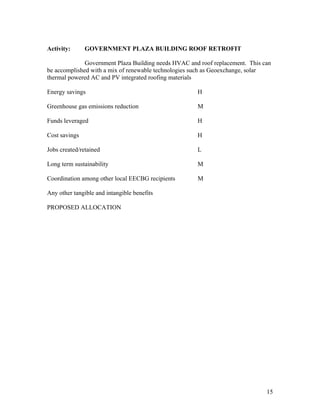
                          its public buildings, for example, the retrofit of Government Plaza. The City also proposes to
                          assist low- and moderate-income households with securing financing for energy efficiency
                          retrofits. Financing mechanisms include the PACE Bond Program and local energy revolving
                          loan program, HERO Program and the State’s Weatherization Assistance Program. Proposed
                          allocation: $510,000.

                          Activity 6. Energy Efficiency and Conservation Programs: The City proposes to develop
                          an array of education and outreach strategies to reach our diverse citizenry: 1) web-based
                          information clearing house to serve as a portal for energy efficiency and conservation
                          information and program access (the site will also serve as an access point for the “strategic
                          doing” groups and their initiatives, similar to the web2.0 site used by the EECS Steering


12 City of Shreveport, Louisiana◦Gulf Geoexchange and Consulting Services
committee); 2) employ a cooperative strategy using local utilities, media, Consortium for
Education, Research and Technology of N LA (CERT) and others to educate the public about
existing and new energy efficiency programs; and 3) collaborate with a business/education
partnership in piloting four summer energy camps, co-sponsored by energy companies, for
high school students on college campuses. Proposed allocation: $100,000.

Activity 8. Codes and Inspections: The City proposes to upgrade its current building code by
adopting the Louisiana Energy Efficiency Building Code. To implement and enforce the new
code, the City proposes the following actions: 1) provide advanced training for city inspectors
on the new Energy Efficiency Building Code and current practices in the field; 2) cover the
costs of training for city inspectors to become Home Energy Rebate Option (HERO) Energy
Raters to facilitate/expedite the HERO program; 3) upgrade code books, permitting forms,
and enforcement tools, including their public distribution; and 4) acquire energy efficiency
permitting software. Proposed allocation: $100,000.

Activity 14. Other EEC Initiatives: The City will collaborate with CERT, Southern University of
Shreveport’s Small Business Incubator, Louisiana Tech’s Small Business Incubator, and LSU-
Shreveport’s Small Business Development Center to establish an Energy Efficiency Incubator
Program. The allocation of $177,900 will provide initial funding for a program director for 3
years, to be housed at a new City energy department or as part of the CERT Sustainability
Trust. The incubator program will work with existing regional incubators and higher education
institutions in supporting start-up companies that can emerge from the audit, retrofit and
weatherization programs or other EECP initiatives. Proposed allocation: $177,900.


3. Describe how your government is taking into account the proposed implementation plans and activities for
use of funds by adjacent units of local government that are grant recipients under the Program.

The Comprehensive EEC plan process will include region support of higher education through
CERT and involvement from the City, Parish, and school systems. The City of Shreveport
and Caddo Parish are sharing in the cost of energy efficiency upgrades to the Government
Plaza building. The City’s Workforce Investment Board #71 will collaborate with the regional
10-parish (county) WIB #70 and the CERT (the higher education consortium) on expanding
training and certification for energy-related jobs.

The City of Shreveport and Technical Consultant Team will collaborate with non-profit 501(c)3
Community Renewal International in the process of planning the Center for Community
Renewal as a LEED platinum, net zero energy, and carbon neutral in downtown Shreveport’s
commercial historic district. The 270,000 square foot facility will include renovation of the
Petroleum Tower (a recently abated Brownfield site) and an adjacent new seven-story building.

The City will also collaborate also with Caddo Parish (county) on a joint application for federal
funds to retrofit the Government Plaza Building that house administrative functions for both
government bodies.


4. Describe how your government will coordinate and share information with the state in which you are located
regarding activities carried out with grant funds to maximize energy efficiency and conservation benefits.

The City will communicate with the State in the process of upgrading its current building
code by adopting the Louisiana Energy Efficiency Building Code. To implement and enforce

                                                                                            Energy Efficiency & Conservation Strategy 13
the new code, the City proposes to partner with both the State and higher education
                          institutions to provide advanced training for city inspectors on the new Energy Efficiency
                          Building Code and current practices in the field. The City envisions collaborating with business
                          and government leaders at regional and statewide workshops and conferences, sharing
                          information networks and databases, and contributing to the body of collective knowledge
                          and best practices in energy measures and savings. The City will share with the State a copy
                          of the Energy Efficiency and Conservation Strategy, once it has been approved by the U.S.
                          Department of Energy, and will also forward copies of their quarterly reports, success stories
                          and best practices gleaned from the EECS grant funds.


                          5. Describe how this plan has been designed to ensure that it sustains benefits beyond the EECBG funding period.

                          Shreveport’s joint strategies—the creation of a project team and the integral involvement
                          of the citizen-based Steering Committee in evaluating and selecting projects and programs
                          based on cost/benefit analysis—combine to ensure benefits beyond the project period. The
                          project team modeled the “strategic doing” process in crafting a Framework Document for the
                          completion of a Comprehensive Energy Efficiency and Conservation Plan.

                          These innovative City of Shreveport strategies created with EECS funds will yield benefits
                          sustainable into future generations:

                                       • The creation of a network of stakeholders to provide energy savings audits,
                                         installations, awareness, educational outreach and collaboration with public-
                                         private partnerships;
                                       • Creating media outreach and retail awareness programs to encourage
                                         energy savings;
                                       • Promoting positive media coverage of energy savings, promoting educational
                                         material for schools, businesses and government, and expanding citizen
                                         awareness of energy use and greenhouse gas emissions;
                                       • Developing of information and distribution systems to encourage energy savings;
                                       • Promoting volunteer organizations that “save energy” through efforts like
                                         community gardens, summer energy camps, recycling and biking-walking events;
                                       • Providing greater awareness at the personal, residential, commercial and
                                         industrial level of the long-term benefits of energy savings investments and
                                         opportunities for leveraging through the successes that Shreveport displays in
                                         the implementation of the EECBG program;
                                       • Educating the public about existing opportunities for leveraging, as
                                         stakeholders and private entities see; Development of a verifiable data
                                         collection system to measure energy savings in KwH and CCF by building
                                         type, energy cost savings, number of buildings, dollars spent and leveraged,
                                         building square footage, and audits performed and jobs created;
                                       • Annual reporting on progress of the City to achieve EEC goals and
                                         recommend adjustments;
                                       • Energy reductions from retrofits will be sustained by a maintenance and
                                         operating program that requires “retro-commissioning” to assure optimal
                                         equipment performance and real-time energy tracking.


                          6. The President has made it clear that every taxpayer dollar spent on our economic recovery must be subject
                          to unprecedented levels of transparency and accountability. Describe the auditing or monitoring procedures

14 City of Shreveport, Louisiana◦Gulf Geoexchange and Consulting Services
currently in place or that will be in place (by what date), to ensure funds are used for authorized purposes and
every step is taken to prevent instances of fraud, waste, error, and abuse.

Shreveport’s Administration Staff and Technical Consultant Team are experienced in regulatory
requirements for measurement and verification and will develop an implementation process
to assure transparency and accountability. Elements of that process include:

             • Written commitments by all participants of measurement and verification
               requirements, with third-party input.
             • Written contracts and memoranda of understanding with vendors, retailers and
               partnering organizations who provide resources capable of being leveraged.
             • On-site or in-home inspection of installed measures goal of 10% of EECBG
               program participants.
             • Verification of energy savings of all installed measures from quarterly reports that
               show energy savings compared to our baseline and our goals approved by the City
               Department of Operational Services or the proposed City Energy Department.
             • Energy savings tracked on a project-by-project basis and then aggregated by
               sector. Individual project results verified by inspection. Results continually
               evaluated to track performance and program implementation, and the program
               modified as necessary to meet project goals and reporting requirements. Data
               collected consist of but not limited to the energy savings in KwH, by building
               type, energy cost savings, number of buildings, dollars spent and leveraged,
               building square footage, audits performed and jobs created.
             • Designation of a single-point employee/contractor contact to handle any and
               all participant complaints, criticisms or feedback.
             • Publication of results at City’s website, and also through local media on a
               monthly, quarterly and annual basis.

City funds for the project will be managed by the City Department of Operational Services.


                                                                                              Energy Efficiency & Conservation Strategy 15
16
Appendices
Energy Efficiency & Conservation Strategy
City of Shreveport, Louisiana


Appendix A – Framework Document for the Comprehensive Energy Efficiency and
              Conservation Strategy
Appendix B – Aligning Higher Education to support the EECS and CEECP
Appendix C – Current Energy Efficiency and Conservation Activities for the
              Shreveport Community
Appendix D – Steering Committee Members
Appendix E – List of Potential/Proposed Working Group Members
Appendix F – EECS Steering Committee Meeting Minutes


                                                                              17
18
Appendix A: Framework Document for the
Comprehensive Energy Efficiency & Conservation Plan
City of Shreveport, Louisiana


          Prepared by
          Morgan Hill Sutton & Mitchell Architects, LLC
          and Purdue Center for Regional Development


                                                          19
20 City of Shreveport, Louisiana ◦ MHSM Architects ◦ Purdue Center for Regional Development
1.0         Purpose

Following the implementation of the Energy Efficiency and Conservation Strategy (EECS),
the City of Shreveport will conduct a Comprehensive Energy Efficiency and Conservation Plan
(CEECP) to guide long term decision-making and investment. To position ourselves as a front
runner in achieving the objectives outlined in the Energy Efficiency Community Block Grant
(EECBG), the City of Shreveport must go beyond minimum requirements to pursue innovation
and transformation. Reaching higher will allow the City to maximize long term benefits and
develop a competitive advantage when applying for future funding. The CEECP will build upon
the initial investments identified EECS, chart the course for future investments, and develop a
long term strategy for Shreveport to become more energy efficient.

The CEECP will implement a process that empowers citizens, enabling many people to make
meaningful contributions toward addressing complex community issues. The process used will
generate new ideas and align existing resources around innovation. The outcomes of such a
process will be new businesses, increased job opportunities, and improved quality of life.

1.1         Goals and Objectives

The CEECP will strive to provide a clear direction for achieving:

      •   job creation
      •   energy savings
      •   reduction of greenhouse gas emissions
      •   provident use of local resources
      •   renewable energy production
      •   maximized leveraging of funds

In addition to fulfilling these initial goals as outlined by the Department of Energy and the
City of Shreveport for the EECS, the CEECP will:

      • serve as a means for the City to pursue future funding from state and federal sources
      • provide a framework for regional collaboration among municipal and parish governments
      • cultivate local capacity, leadership, advocacy, and innovation

1.2         Achieving Balanced Sustainability

As our community works to improve its energy efficiency, it will be important to evaluate
our opportunities, not only from an environmental and economic point of view, but also
from a social and cultural perspective. We have the ability to make decisions that can save
money, generate income, improve environmental quality, conserve local resources, support
and enhance cultural and heritage resources, and positively impact all citizens in the greater
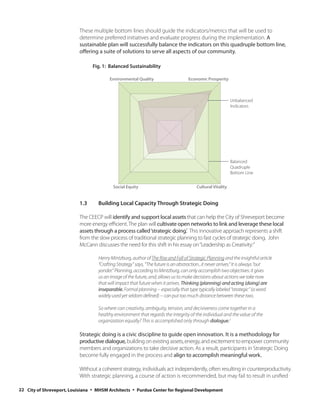
Shreveport region. Ultimately, the CEECP will aim to maximize benefits according to a
quadruple bottom line (Fig. 1):

      •   environmental quality
      •   economic prosperity
      •   social equity1
      •   cultural vitality2


                                        Framework Document for the Comprehensive Energy Efficiency & Conservation Plan 21
These multiple bottom lines should guide the indicators/metrics that will be used to
                           determine preferred initiatives and evaluate progress during the implementation. A
                           sustainable plan will successfully balance the indicators on this quadruple bottom line,
                           offering a suite of solutions to serve all aspects of our community.

                                 Fig. 1: Balanced Sustainability

                                         Environmental Quality                     Economic Prosperity


                                                                                                            Unbalanced
                                                                                                            Indicators


                                                                                                            Balanced
                                                                                                            Quadruple
                                                                                                            Bottom Line


                                           Social Equity                                Cultural Vitality


                           1.3     Building Local Capacity Through Strategic Doing

                           The CEECP will identify and support local assets that can help the City of Shreveport become
                           more energy efficient. The plan will cultivate open networks to link and leverage these local
                           assets through a process called ‘strategic doing.’ This innovative approach represents a shift
                           from the slow process of traditional strategic planning to fast cycles of strategic doing. John
                           McCann discusses the need for this shift in his essay on “Leadership as Creativity:”

                                   Henry Mintzburg, author of The Rise and Fall of Strategic Planning and the insightful article
                                   “Crafting Strategy” says, “The future is an abstraction...it never arrives.” It is always “out
                                   yonder.” Planning, according to Mintzburg, can only accomplish two objectives: it gives
                                   us an image of the future, and; allows us to make decisions about actions we take now
                                   that will impact that future when it arrives. Thinking (planning) and acting (doing) are
                                   inseparable. Formal planning -- especially that type typically labeled “strategic” (a word
                                   widely used yet seldom defined) -- can put too much distance between these two.

                                   So where can creativity, ambiguity, tension, and decisiveness come together in a
                                   healthy environment that regards the integrity of the individual and the value of the
                                   organization equally? This is accomplished only through dialogue.3

                           Strategic doing is a civic discipline to guide open innovation. It is a methodology for
                           productive dialogue, building on existing assets, energy, and excitement to empower community
                           members and organizations to take decisive action. As a result, participants in Strategic Doing
                           become fully engaged in the process and align to accomplish meaningful work.

                           Without a coherent strategy, individuals act independently, often resulting in counterproductivity.
                           With strategic planning, a course of action is recommended, but may fail to result in unified

22 City of Shreveport, Louisiana ◦ MHSM Architects ◦ Purdue Center for Regional Development
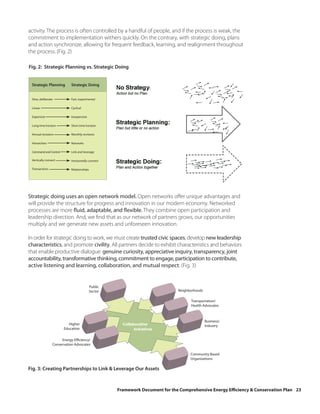
activity. The process is often controlled by a handful of people, and if the process is weak, the
commitment to implementation withers quickly. On the contrary, with strategic doing, plans
and action synchronize, allowing for frequent feedback, learning, and realignment throughout
the process. (Fig. 2)

Fig. 2: Strategic Planning vs. Strategic Doing


 Strategic Planning        Strategic Doing


 Slow, deliberate          Fast, experimental

 Linear                    Cyclical

 Expensive                 Inexpensive

 Long time horizon         Short time horizon

 Annual revisions          Monthly revisions

 Hierarchies               Networks

 Command and Control       Link and leverage

 Vertically connect        Horizontally connect

 Transactions              Relationships


Strategic doing uses an open network model. Open networks offer unique advantages and
will provide the structure for progress and innovation in our modern economy. Networked
processes are more fluid, adaptable, and flexible. They combine open participation and
leadership direction. And, we find that as our network of partners grows, our opportunities
multiply and we generate new assets and unforeseen innovation.

In order for strategic doing to work, we must create trusted civic spaces, develop new leadership
characteristics, and promote civility. All partners decide to exhibit characteristics and behaviors
that enable productive dialogue: genuine curiosity, appreciative inquiry, transparency, joint
accountability, transformative thinking, commitment to engage, participation to contribute,
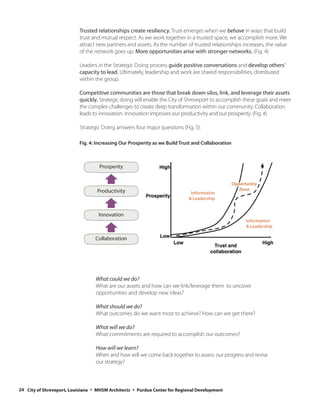
active listening and learning, collaboration, and mutual respect. (Fig. 3)


                                         Public
                                         Sector                             Neighborhoods

                                                                                  Transportation/
                                                                                  Health Advocates


                                                                                            Business/
                          Higher                    Collaborative                           Industry
                       Education                          Initiatives

                     Energy Efficiency/
                Conservation Advocates

                                                                                  Community Based
                                                                                  Organizations

Fig. 3: Creating Partnerships to Link & Leverage Our Assets


                                                  Framework Document for the Comprehensive Energy Efficiency & Conservation Plan 23
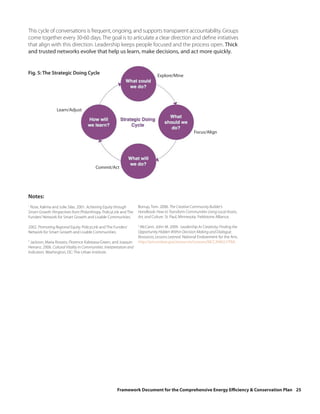
Trusted relationships create resiliency. Trust emerges when we behave in ways that build
                           trust and mutual respect. As we work together in a trusted space, we accomplish more. We
                           attract new partners and assets. As the number of trusted relationships increases, the value
                           of the network goes up. More opportunities arise with stronger networks. (Fig. 4)

                           Leaders in the Strategic Doing process guide positive conversations and develop others’
                           capacity to lead. Ultimately, leadership and work are shared responsibilities, distributed
                           within the group.

                           Competitive communities are those that break down silos, link, and leverage their assets
                           quickly. Strategic doing will enable the City of Shreveport to accomplish these goals and meet
                           the complex challenges to create deep transformation within our community. Collaboration
                           leads to innovation. Innovation improves our productivity and our prosperity. (Fig. 4)

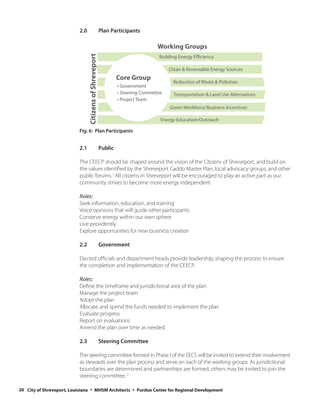
                           Strategic Doing answers four major questions (Fig. 5):

                           Fig. 4: Increasing Our Prosperity as we Build Trust and Collaboration


                                    Prosperity


                                                                                                   Opportunity
                                   Productivity                                                       Zone
                                                                             Information
                                                                            & Leadership


                                   Innovation
                                                                                                         Information
                                                                                                         & Leadership

                                  Collaboration


                                  What could we do?
                                  What are our assets and how can we link/leverage them to uncover
                                  opportunities and develop new ideas?

                                  What should we do?
                                  What outcomes do we want most to achieve? How can we get there?

                                  What will we do?
                                  What commitments are required to accomplish our outcomes?

                                  How will we learn?
                                  When and how will we come back together to assess our progress and revise
                                  our strategy?


24 City of Shreveport, Louisiana ◦ MHSM Architects ◦ Purdue Center for Regional Development
This cycle of conversations is frequent, ongoing, and supports transparent accountability. Groups
come together every 30-60 days. The goal is to articulate a clear direction and define initiatives
that align with this direction. Leadership keeps people focused and the process open. Thick
and trusted networks evolve that help us learn, make decisions, and act more quickly.


Fig. 5: The Strategic Doing Cycle                                                Explore/Mine


                  Learn/Adjust


                                                                                                       Focus/Align


                                          Commit/Act


Notes:
1
 Rose, Kalima and Julie Silas. 2001. Achieving Equity through         Borrup, Tom. 2006. The Creative Community Builder’s
Smart Growth: Perspectives from Philanthropy. PolicyLink and The      Handbook: How to Transform Communities Using Local Assets,
Funders’ Network for Smart Growth and Livable Communities.            Art, and Culture. St. Paul, Minnesota: Fieldstone Alliance.

2002. Promoting Regional Equity. PolicyLink and The Funders’          3
                                                                       McCann, John M. 2009. Leadership As Creativity: Finding the
Network for Smart Growth and Livable Communities.                     Opportunity Hidden Within Decision Making and Dialogue.
                                                                      Resources, Lessons Learned. National Endowment for the Arts.
2
  Jackson, Maria Rosario, Florence Kabwasa-Green, and Joaquin         http://arts.endow.gov/resources/Lessons/MCCANN2.HTML
Herranz. 2006. Cultural Vitality in Communities: Interpretation and
Indicators. Washington, DC: The Urban Institute.


                                                        Framework Document for the Comprehensive Energy Efficiency & Conservation Plan 25
2.0                            Plan Participants

                                                                                     Working Groups


                                 Citizens of Shreveport
                                                                                     Building Energy E ciency

                                                                                          Clean & Renewable Energy Sources
                                                                   Core Group
                                                                                           Reduction of Waste & Pollution
                                                                   • Government
                                                                   • Steering Committee     Transportation & Land Use Alternatives
                                                                   • Project Team
                                                                                          Green Workforce/Business Incentives

                                                                                      Energy Education/Outreach

                           Fig. 6: Plan Participants


                           2.1                            Public

                           The CEECP should be shaped around the vision of the Citizens of Shreveport, and build on
                           the values identified by the Shreveport Caddo Master Plan, local advocacy groups, and other
                           public forums.1 All citizens in Shreveport will be encouraged to play an active part as our
                           community strives to become more energy independent.

                           Roles:
                           Seek information, education, and training
                           Voice opinions that will guide other participants
                           Conserve energy within our own sphere
                           Live providently
                           Explore opportunities for new business creation

                           2.2                            Government

                           Elected officials and department heads provide leadership, shaping the process to ensure
                           the completion and implementation of the CEECP.

                           Roles:
                           Define the timeframe and jurisdictional area of the plan
                           Manage the project team
                           Adopt the plan
                           Allocate and spend the funds needed to implement the plan
                           Evaluate progress
                           Report on evaluations
                           Amend the plan over time as needed

                           2.3                            Steering Committee

                           The steering committee formed in Phase I of the EECS will be invited to extend their involvement
                           as stewards over the plan process and serve on each of the working groups. As jurisdictional
                           boundaries are determined and partnerships are formed, others may be invited to join the
                           steering committee. 2

26 City of Shreveport, Louisiana ◦ MHSM Architects ◦ Purdue Center for Regional Development
Roles:
Oversee the plan process
Guide and direct the project team
Provide leadership and advocacy in working groups
Recommend the plan and its initiatives to government leaders for adoption/implementation

2.4      Project Team

The project team, led by Gulf Geoexchange and Consulting Services, Inc. (GGCS), is currently
comprised of Morgan Hill Sutton & Mitchell Architects, LLC (MHSM), Consortium for Education
Research and Technology of North Louisiana (CERT), Purdue Center for Regional Development,
and Chronicles of Numbers, LLC.

Roles:
Inventory potential working group members/stakeholders
Teach ‘strategic doing’ and provide technical assistance to the working groups
Provide a web 2.0 workspace for working groups and a public interface
Provide expertise and analysis of best practices and case studies within the six focus areas
Convene and facilitate working groups every 30-60 days
Formalize the ideas generated by the working groups into a plan document
Set metrics for baseline, produce target projections and provide evaluation for initiatives
Structure GIS database and procedures for monitoring trends
Provide a format and procedures for regular evaluation and reporting

2.5      Working Groups

A series of working groups will be organized around focus areas, described in section 3.0 of this
report. Each working group will engage an open network of public and private sector stakeholders. 3

Roles:
Determine goals and principles
Set targets
Publicize and promote the plan
Generate potential initiatives
Select preferred initiatives
Develop prioritized/phased implementation strategy
Identify obstacles to implementation and describe strategies to remove obstacles
Review the plan
Advise the project team
Oversee implementation
Evaluate and report progress on initiatives


1
  Shreveport Caddo 2030 Vision Report: www.communicationsmgr.com/projects/1409/docs/VisionPoster-FINAL-LO.pdf
2
  See Appendix D
3
  See Appendix E


                                              Framework Document for the Comprehensive Energy Efficiency & Conservation Plan 27
3.0     Plan Focus Areas

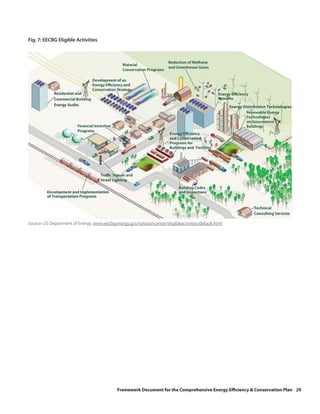
                           The CEECP will be structured around seven major focus areas that cover all of the eligible
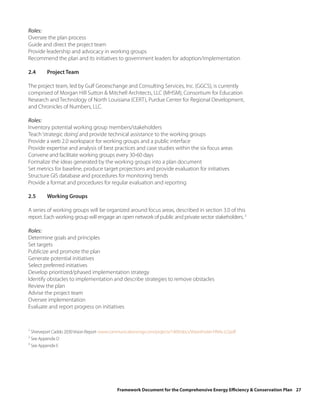
                           activities outlined for the EECBG. (Fig. 7) While each of these focus areas are strongly
                           interrelated, they also serve as major categories for our work during the planning process.
                           Working groups will be formed around each of these focus areas and, from these working
                           group discussions, specific initiatives will emerge.

                           3.1     Building Energy Efficiency

                           Eligible activities within the Building Energy Efficiency focus area include energy audits
                           for commercial, residential, industrial, governmental, and non-profit buildings, financial
                           incentive programs, revised building codes/inspections, and energy efficiency retrofits.

                           3.2     Clean and Renewable Energy Sources

                           Eligible activities within the Clean and Renewable Energy Sources focus area include on-site
                           renewable energy generation, energy distribution technology, and the reduction/capture of
                           methane and other greenhouse gases.

                           3.3     Reduction of Waste and Pollution

                           Eligible activities within the Clean and Renewable Energy Sources focus area include recycling
                           programs, activities that reduce greenhouse gas emissions, and watershed management.

                           3.4     Transportation and Land Use Alternatives

                           The Transportation and Land Use Alternatives focus area covers activities related to energy
                           conservation in transportation and patterns of land use. It will explore the application of
                           Smart Growth principles in our community and look for opportunities to expand urban
                           agriculture and urban forestry within the city.

                           3.5     Green Workforce/Business Incentives

                           The Green Workforce/Business Incentives focus area explores economic and workforce
                           development opportunities related to all other focus areas to find opportunities for the
                           “greening” of occupations, project increased demand, enhance skills, and identify new and
                           emerging occupations.

                           3.6     Energy Education/Outreach

                           The Energy Education/Outreach focus area explores methods for transforming the way
                           our community thinks about energy efficiency and conservation, sharing information and
                           promoting any of the projects above. It will emphasize the engagement of K-12 and higher
                           education in collaborative efforts around green workforce training and curricula.

                           3.7     Other

                           This focus area is for any innovations that do not fit in the other six categories. The Department
                           of Energy has included ‘other’ as an eligible activity and encourages the innovation of energy
                           efficiency and conservation strategies not included in the listed eligible activities.

28 City of Shreveport, Louisiana ◦ MHSM Architects ◦ Purdue Center for Regional Development
Fig. 7: EECBG Eligible Activities


Source: US Department of Energy, www.eecbg.energy.gov/solutioncenter/eligibleactivities/default.html


                                             Framework Document for the Comprehensive Energy Efficiency & Conservation Plan 29
4.0        Plan Process

                           The process for developing the CEECP
                                                                                                             Initiatives
                           will involve seven stages:

                           1. Plan Initiation
                           2. Baseline                                            Working Groups
                           3. Target
                           4. Opportunities/Options
                           5. Preferred Action Plan
                           6. Implementation and Evaluation                   Core Group
                           7. Plan Review and Adoption

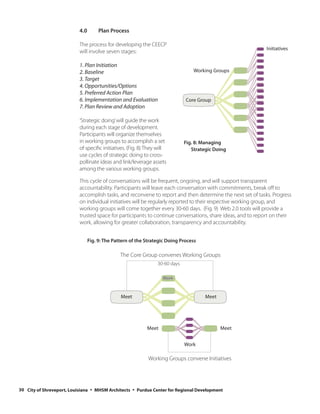
                           ‘Strategic doing’ will guide the work
                           during each stage of development.
                           Participants will organize themselves
                           in working groups to accomplish a set              Fig. 8: Managing
                           of specific initiatives. (Fig. 8) They will           Strategic Doing
                           use cycles of strategic doing to cross-
                           pollinate ideas and link/leverage assets
                           among the various working groups.

                           This cycle of conversations will be frequent, ongoing, and will support transparent
                           accountability. Participants will leave each conversation with commitments, break off to
                           accomplish tasks, and reconvene to report and then determine the next set of tasks. Progress
                           on individual initiatives will be regularly reported to their respective working group, and
                           working groups will come together every 30-60 days. (Fig. 9) Web 2.0 tools will provide a
                           trusted space for participants to continue conversations, share ideas, and to report on their
                           work, allowing for greater collaboration, transparency and accountability.


                                 Fig. 9: The Pattern of the Strategic Doing Process

                                                The Core Group convenes Working Groups
                                                                 30-60 days

                                                                    Work


                                                Meet                                   Meet


                                                            Meet                              Meet


                                                                              Work

                                                             Working Groups convene Initiatives


30 City of Shreveport, Louisiana ◦ MHSM Architects ◦ Purdue Center for Regional Development
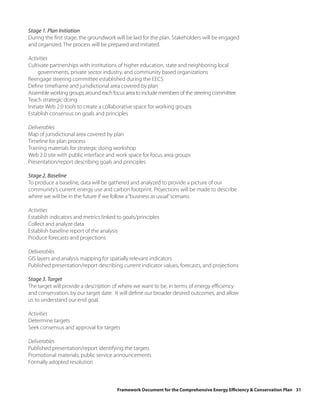
Stage 1. Plan Initiation
During the first stage, the groundwork will be laid for the plan. Stakeholders will be engaged
and organized. The process will be prepared and initiated.

Activities
Cultivate partnerships with institutions of higher education, state and neighboring local
     governments, private sector industry, and community based organizations
Reengage steering committee established during the EECS
Define timeframe and jurisdictional area covered by plan
Assemble working groups around each focus area to include members of the steering committee
Teach strategic doing
Initiate Web 2.0 tools to create a collaborative space for working groups
Establish consensus on goals and principles

Deliverables
Map of jurisdictional area covered by plan
Timeline for plan process
Training materials for strategic doing workshop
Web 2.0 site with public interface and work space for focus area groups
Presentation/report describing goals and principles

Stage 2. Baseline
To produce a baseline, data will be gathered and analyzed to provide a picture of our
community’s current energy use and carbon footprint. Projections will be made to describe
where we will be in the future if we follow a “business as usual” scenario.

Activities
Establish indicators and metrics linked to goals/principles
Collect and analyze data
Establish baseline report of the analysis
Produce forecasts and projections

Deliverables
GIS layers and analysis mapping for spatially relevant indicators
Published presentation/report describing current indicator values, forecasts, and projections

Stage 3. Target
The target will provide a description of where we want to be, in terms of energy efficiency
and conservation, by our target date. It will define our broader desired outcomes, and allow
us to understand our end goal.

Activities
Determine targets
Seek consensus and approval for targets

Deliverables
Published presentation/report identifying the targets
Promotional materials, public service announcements
Formally adopted resolution


                                        Framework Document for the Comprehensive Energy Efficiency & Conservation Plan 31
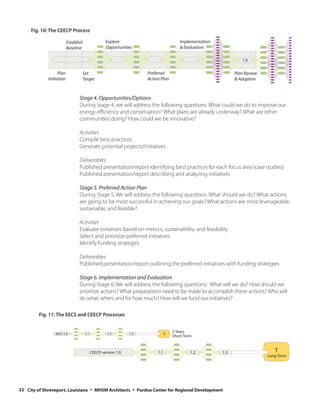
Fig. 10: The CEECP Process

                          Establish                 Explore                             Implementation
                          Baseline                  Opportunities                       & Evaluation

                                                                                                                  1.0


                   Plan           Set                                 Preferred                                Plan Review
             Initiation           Target                              Action Plan                              & Adoption


                                 Stage 4. Opportunities/Options
                                 During Stage 4, we will address the following questions: What could we do to improve our
                                 energy efficiency and conservation? What plans are already underway? What are other
                                 communities doing? How could we be innovative?

                                 Activities
                                 Compile best practices
                                 Generate potential projects/initiatives

                                 Deliverables
                                 Published presentation/report identifying best practices for each focus area (case studies)
                                 Published presentation/report describing and analyzing initiatives

                                 Stage 5. Preferred Action Plan
                                 During Stage 5, We will address the following questions: What should we do? What actions
                                 are going to be most successful in achieving our goals? What actions are most leverageable,
                                 sustainable, and feasible?

                                 Activities
                                 Evaluate initiatives based on metrics, sustainability, and feasibility
                                 Select and prioritize preferred initiatives
                                 Identify funding strategies

                                 Deliverables
                                 Published presentation/report outlining the preferred initiatives with funding strategies

                                 Stage 6. Implementation and Evaluation
                                 During Stage 6, We will address the following questions: What will we do? How should we
                                 prioritize actions? What preparations need to be made to accomplish these actions? Who will
                                 do what, when, and for how much? How will we fund our initiatives?

        Fig. 11: The EECS and CEECP Processes


                 EECS 1.0             1.1            1.2        1.3              t   3 Years
                                                                                     Short Term


                                            CEECP version 1.0              1.1                1.2        1.3                    T
                                                                                                                             Long Term


32 City of Shreveport, Louisiana ◦ MHSM Architects ◦ Purdue Center for Regional Development
1.1                                     1.2                            Target


How will we evaluate our progress? During this stage, we will create a reporting system to
evaluate and update the plan as needed. Who will gather data and prepare reports? Who will
receive those reports? How will the plan be adjusted over time to achieve results?

Activities
Develop a prioritized/phased implementation strategy for each initiative
Identify policies and/or administrative actions adopted or needed to support plan implementation
Identify obstacles to implementation and describe strategies to remove obstacles
Establish commitments for implementation
Establish mechanisms for ongoing evaluation, accountability, and adaptation (reporting system)

Deliverables
Published implementation guidebook: the guidebook will include information about the
    resources and partnerships required to achieve the plan’s goals; it will detail the prioritized
    steps to take; it will describe who will do what, when, and how much it will cost.

Stage 7. Plan Review and Adoption
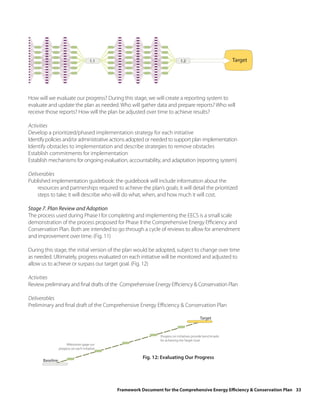
The process used during Phase I for completing and implementing the EECS is a small scale
demonstration of the process proposed for Phase II the Comprehensive Energy Efficiency and
Conservation Plan. Both are intended to go through a cycle of reviews to allow for amendment
and improvement over time. (Fig. 11)

During this stage, the initial version of the plan would be adopted, subject to change over time
as needed. Ultimately, progress evaluated on each initiative will be monitored and adjusted to
allow us to achieve or surpass our target goal. (Fig. 12)

Activities
Review preliminary and final drafts of the Comprehensive Energy Efficiency & Conservation Plan

Deliverables
Preliminary and final draft of the Comprehensive Energy Efficiency & Conservation Plan

                                                                                               Target


                                                                   Progress on Initiatives provide benchmarks
                                                                   for achieving the Target Goal
                       Milestones gage our
                  progress on each Initiative

                                                           Fig. 12: Evaluating Our Progress
       Baseline


                                                Framework Document for the Comprehensive Energy Efficiency & Conservation Plan 33
34
Appendix B: Aligning Higher Education
to support the Energy Efficiency & Conservation Strategy
and Comprehensive Energy Efficiency & Conservation Plan


        Prepared by the
        Consortium for Education, Research & Technology
        of North Louisiana


                                                           35
36 City of Shreveport, Louisiana ◦ Consortium for Education Research & Technology of North Louisiana
The Consortium for Education, Research & Technology of North Louisiana (CERT) has been
retained by Gulf Geoexchange and Consulting Services, Inc. in partnership with the City
of Shreveport and serves on the Project Team in three key roles to support the Energy
Efficiency and Conservation Strategy (EECS):

    • Identify and align the combined resources of 12 higher education member
      institutions across North Louisiana to focus on research and development, workforce
      development and K-12/community outreach;
    • Serve a “link and leverage” role to others across existing silos—education, government,
      nonprofits, businesses, funding sources and others—who can help with the process
      (e.g. baseline, reporting, GIS); and
    • Help inform the work group, creating common knowledge base (e.g., best practices,
      analyses) to explore new educational models to use in the process.

As part of the Project Team, CERT will help manage the networks, identify funding and track
initiatives.

Higher education resources. CERT Chancellors/Presidents (or their designees) for the past
year have committed to learning the Strategic Doing process and to aligning their resources on
multiple, innovative initiatives or projects. CERT has surveyed member institutions to identify
current “energy systems” research projects, grants, and members of college faculties who have
expertise and new technologies to contribute in one or more of the six EECS focus areas:

    •   Building Energy Efficiency
    •   Clean and Renewable Energy Sources
    •   Reduction of Waste and Pollution
    •   Transportation and Land Use Alternatives
    •   Green Workforce/ Business Incentives
    •   Energy Education/ Outreach

Database. CERT is constructing a database of both academic and research and
development resources of the 12 member institutions across the region. Examples include
a Louisiana Tech University research project, “Nanoparticle Incorporated Heterogeneous
Catalyst System for Biodiesel Production” and an LSU-Shreveport Institute of Human Services
& Public Policy that can assist the Project Team in designing metrics and indicators.

“Green Jobs” framework. CERT will convene a work group of higher education and k-12
educators to develop a plan framework for green jobs. CERT surveyed the U.S. Department
of Labor February 2009 report, “Greening of the World of Work: Implications for O*NET-SOC
and New and Emerging Occupations.” DOL urges moving beyond simply applying a broad
label such as “green jobs,” to identify the “greening of occupations” in three categories, and
project increased demand:
    • Green increased demand occupations—an increase in the employment demand
       for an existing occupations
    • Green enhanced skills occupations—a significant change to the work and worker
       requirements of an existing occupation; i.e., tasks, skills, knowledge and credentials
       have been altered, and
    • Green new and emerging (N&E) occupations—impact is sufficient to create the
       need for unique work and worker requirements; the new occupation could be entirely
       novel or “born” from an existing occupation.


                                                                 Aligning Higher Education to Support the EECS and CEECP 37
Through a multi-stage research and screening process that included a review of existing
                           literature, identification and compiling of job titles, review and sorting of job titles, and
                           clustering of job titles into 12 sector occupational sectors, the National Center for O*NET
                           Development identified 64 “green increased demand,” 60 “green enhanced skills,” and 91
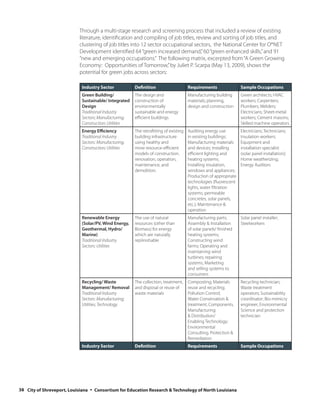
                           “new and emerging occupations.” The following matrix, excerpted from “A Green Growing
                           Economy: Opportunities of Tomorrow,” by Juliet P. Scarpa (May 13, 2009), shows the
                           potential for green jobs across sectors:

                            Industry Sector           Definition                     Requirements                Sample Occupations
                            Green Building/           The design and                 Manufacturing building      Green architects; HVAC
                            Sustainable/ Integrated   construction of                materials; planning,        workers; Carpenters;
                            Design                    environmentally                design and construction     Plumbers; Welders;
                            Traditional Industry      sustainable and energy                                     Electricians; Sheet-metal
                            Sectors; Manufacturing;   efficient buildings                                        workers; Cement masons;
                            Construction; Utilities                                                              Skilled machine operators
                            Energy Efficiency         The retrofitting of existing   Auditing energy use         Electricians; Technicians;
                            Traditional Industry      building infrastructure        in existing buildings;      Insulation workers;
                            Sectors: Manufacturing;   using healthy and              Manufacturing materials     Equipment and
                            Construction; Utilities   more resource-efficient        and devices; Installing     installation specialist
                                                      models of construction,        efficient lighting and      (solar panel installation);
                                                      renovation, operation,         heating systems;            Home weatherizing;
                                                      maintenance, and               Installing insulation,      Energy Auditors
                                                      demolition.                    windows and appliances;
                                                                                     Production of appropriate
                                                                                     technologies (fluorescent
                                                                                     lights, water filtration
                                                                                     systems, permeable
                                                                                     concretes, solar panels,
                                                                                     etc.); Maintenance &
                                                                                     operation
                            Renewable Energy          The use of natural             Manufacturing parts;        Solar panel installer;
                            (Solar/PV, Wind Energy,   resources (other than          Assembly & Installation     Steelworkers
                            Geothermal, Hydro/        Biomass) for energy            of solar panels/ finished
                            Marine)                   which are naturally            heating systems;
                            Traditional Industry      replinishable                  Constructing wind
                            Sectors: Utilities                                       farms; Operating and
                                                                                     maintaining wind
                                                                                     turbines; repairing
                                                                                     systems; Marketing
                                                                                     and selling systems to
                                                                                     consumers
                            Recycling/ Waste          The collection, treatment,     Composting; Materials       Recycling technician;
                            Management/ Removal       and disposal or reuse of       reuse and recycling;        Waste treatment
                            Traditional Industry      waste materials                Pollution Control;          operators; Sustainability
                            Sectors: Manufacturing;                                  Water Conservation &        coordinator; Bio-mimicry
                            Utilities; Technology                                    treatment; Components,      engineer; Environmental
                                                                                     Manufacturing               Science and protection
                                                                                     & Distribution/             technician
                                                                                     Enabling Technology;
                                                                                     Environmental
                                                                                     Consulting, Protection &
                                                                                     Remediation
                            Industry Sector           Definition                     Requirements                Sample Occupations


38 City of Shreveport, Louisiana ◦ Consortium for Education Research & Technology of North Louisiana
Smart Grid/ Smart Energy     Auto-balancing, self-     Manufacturing &                  Field and control
 Traditional Industry         monitoring power grid     Installation, Distributing       engineers;
 Sectors: Manufacturing;      that accepts any source   and marketing products           Communication protocol
 Utilities                    of fuel and transforms it                                  program manager;
                              into a consumer’s optimal                                  Managing consultant
                              renewable energy usage
                              with minimal human
                              intervention
 Biomass/ Biofuels/           Fuel creation from            Growing and harvesting       Process technicians in
 Biosynergy/ Ethanol/         chemical/ biological          crops for feedstock,         biodiesel or ethanol
 Fuel Cells/ Hydrogen         materials other than fossil   collecting waste oils for    companies
 Traditional Industry-        fuels                         feedstock, manufacturing
 sectors; Manufacturing;                                    parts for production
 Construction; Agriculture;                                 facilities; construction,
 transportation                                             maintenance and
                                                            operation of production
                                                            facilities
 Vehicle Electrification/     A ground vehicle              Public Transportation,       Research and
 Alternative Transportation   propelled by a motor          Bicycle repair & bike        Development jobs;
 Traditional Industry         powered by electrical         delivery services, Transit   Technology design
 Sectors: Transportation      energy from rechargeable      line construction,           jobs; Hybrid & Biodiesel
                              batteries or other source     Emissions broker,            vehicle conversion &
                              onboard the vehicle or        Engine component             repair jobs; Maintenance
                              from and external source      manufacturing                jobs; Automotive
                              in, on, or above the                                       service technicians and
                              roadway                                                    mechanics
 Sustainable Agriculture/     An integrated system          Production, Marketing,       Sustainable/ organic
 Green Space                  of plant and animal           Processing, Consumption      farming; Local Food
 Traditional Industry         production practices                                       production/ systems;
 Sectors: Agriculture         that are efficient and                                     Forestry – sustainable
                              sustainable                                                forestry worker; Urban
                                                                                         agriculture; Land use
                                                                                         planning; Sustainable
                                                                                         landscaping


Green Jobs in Energy Efficiency and Conservation Strategy (EECS) Focus Areas

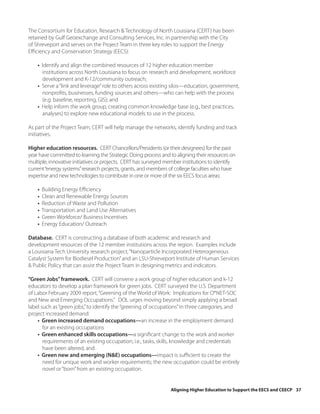
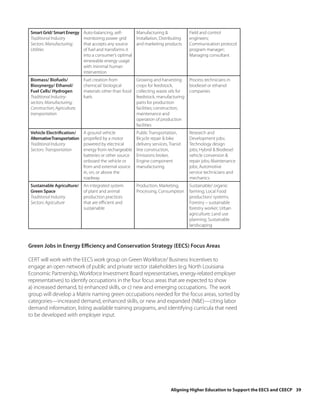
CERT will work with the EECS work group on Green Workforce/ Business Incentives to
engage an open network of public and private sector stakeholders (e.g. North Louisiana
Economic Partnership, Workforce Investment Board representatives, energy-related employer
representatives) to identify occupations in the four focus areas that are expected to show
a) increased demand, b) enhanced skills, or c) new and emerging occupations. The work
group will develop a Matrix naming green occupations needed for the focus areas, sorted by
categories—increased demand, enhanced skills, or new and expanded (N&E)—citing labor
demand information, listing available training programs, and identifying curricula that need
to be developed with employer input.


                                                                                Aligning Higher Education to Support the EECS and CEECP 39
EECS Focus Area                                              Potential “Green Jobs” Growth
                            Building Energy Efficiency                                   Green architects
                            Represents both the design and construction of               HVAC workers            Sheet-metal workers
                            environmentally sustainable and energy efficient             Carpenters              Cement masons
                            buildings as well as the retrofitting of existing building   Plumbers                Skilled machine operators
                            infrastructure                                               Welders                 Insulation workers
                                                                                         Electricians            Home weatherizing
                                                                                         Energy auditors
                            Clean & Renewable Energy Sources                             Solar panel installer
                            Onsite renewable energy generation; energy distribu-         Field and control engineers
                            tion technology; and reduction/ capture of methane           Communication protocol program manager
                            and other greenhouse gases
                            Reduction of Waste & Pollution                               Recycling technician
                            Recycling programs; reduction of greenhouse gas              Waste treatment operators
                            emissions; and watershed management                          Sustainability coordinator
                                                                                         Environmental science & protection technician
                            Transportation & Land Use Alternatives                       Research & development jobs
                            Energy conservation in transportation; sustainable           Technology design jobs
                            agriculture and green space                                  CNG and electrical conversion and repair jobs
                                                                                         Automotive technicians and mechanics
                                                                                         Organic farming
                                                                                         Local food production
                                                                                         Urban agriculture       Land use planning
                                                                                         Forestry worker         Sustainable landscaping


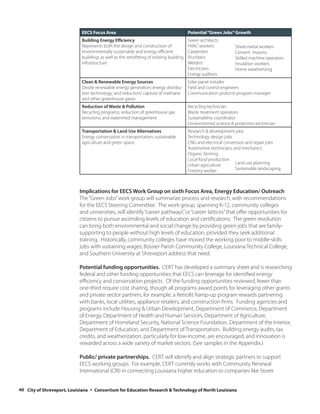
                           Implications for EECS Work Group on sixth Focus Area, Energy Education/ Outreach
                           The “Green Jobs” work group will summarize process and research, with recommendations
                           for the EECS Steering Committee. The work group, spanning K-12, community colleges
                           and universities, will identify “career pathways” or “career lattices” that offer opportunities for
                           citizens to pursue ascending levels of education and certifications. The green revolution
                           can bring both environmental and social change by providing green jobs that are family-
                           supporting to people without high levels of education, provided they seek additional
                           training. Historically, community colleges have moved the working poor to middle-skills
                           jobs with sustaining wages; Bossier Parish Community College, Louisiana Technical College,
                           and Southern University at Shreveport address that need.

                           Potential funding opportunities. CERT has developed a summary sheet and is researching
                           federal and other funding opportunities that EECS can leverage for identified energy
                           efficiency and conservation projects. Of the funding opportunities reviewed, fewer than
                           one-third require cost sharing, though all programs award points for leveraging other grants
                           and private sector partners, for example, a Retrofit Ramp-up program rewards partnering
                           with banks, local utilities, appliance retailers, and construction firms. Funding agencies and
                           programs include Housing & Urban Development, Department of Commerce, Department
                           of Energy, Department of Health and Human Services, Department of Agriculture,
                           Department of Homeland Security, National Science Foundation, Department of the Interior,
                           Department of Education, and Department of Transportation. Building energy audits, tax
                           credits, and weatherization, particularly for low-income, are encouraged, and innovation is
                           rewarded across a wide variety of market sectors. (See samples in the Appendix.)

                           Public/ private partnerships. CERT will identify and align strategic partners to support
                           EECS working groups. For example, CERT currently works with Community Renewal
                           International (CRI) in connecting Louisiana higher education to companies like Storer


40 City of Shreveport, Louisiana ◦ Consortium for Education Research & Technology of North Louisiana
Equipment, Trane, Hubbell Building Automation and CISCO to deploy new energy
conserving technologies for the design and construction of the national Center for
Community Renewal.

Energy education/ outreach. Although CERT will be convening higher education and K-12
for collaborative efforts around green workforce and curricula, the EECS Steering Committee
stipulates that every project selected and funded should incorporate strategies and funds for
marketing energy education to citizens. One member states, “Build policies that encourage
us to think of ourselves as energy producers and consumers, energy entrepreneurs.” CERT
will not only work with member institutions’ science-based programs, but also reach out
to the Liberal Arts community at the institutions as experts increasing social accountability
and promoting citizenship (e.g. Oikos Scholars Program at Oklahoma City University and
LaGrange University). Another member urged creating energy-related projects that serve
neighborhoods and diversion programs for unemployed, underemployed, prison labor
and at-risk youth. Committee members agreed on the importance of improving citizens’
knowledge of the natural environment and climate change, as well establishing a process for
informing citizens on a regular basis about environmental issues.

CERT was asked to serve as the “key hub for collaboration” around projects that educate
citizens about energy. For example, CERT is partnering with EnCana Energy, Bossier Parish
Community College and Southern University at Shreveport to conduct four, one-week
Energy Venture Camps in summer 2010 for Bossier and Caddo 14- and 15-year olds. Some
members of the EECS Steering Committee and Project Team also serve on the Shreveport/
Caddo Master Plan work groups, and will seek to build on the values identified by Shreveport
citizens. CERT will identify portions of the Master Plan that contribute to EECS initiatives to
improve Shreveport’s energy independence.


                                                               Aligning Higher Education to Support the EECS and CEECP 41
42
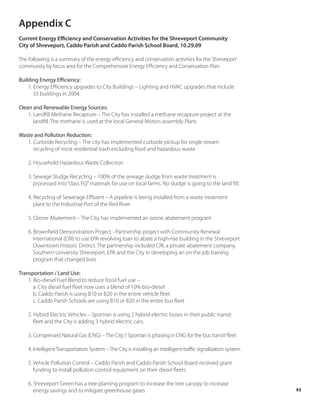
Appendix C
Current Energy Efficiency and Conservation Activities for the Shreveport Community
City of Shreveport, Caddo Parish and Caddo Parish School Board, 10.29.09

The following is a summary of the energy efficiency and conservation activities for the Shreveport
community by focus area for the Comprehensive Energy Efficiency and Conservation Plan:

Building Energy Efficiency:
    1. Energy Efficiency upgrades to City Buildings – Lighting and HVAC upgrades that include
       33 buildings in 2004.

Clean and Renewable Energy Sources:
    1. Landfill Methane Recapture – The City has installed a methane recapture project at the
       landfill. The methane is used at the local General Motors assembly Plant.

Waste and Pollution Reduction:
   1. Curbside Recycling – The city has implemented curbside pickup for single stream
      recycling of most residential trash excluding food and hazardous waste

    2. Household Hazardous Waste Collection

    3. Sewage Sludge Recycling – 100% of the sewage sludge from waste treatment is
       processed into “class EQ” materials for use on local farms. No sludge is going to the land fill.

    4. Recycling of Sewerage Effluent – A pipeline is being installed from a waste treatment
       plant to the Industrial Port of the Red River

    5. Ozone Abatement – The City has implemented an ozone abatement program

    6. Brownfield Demonstration Project - Partnership project with Community Renewal
       International (CRI) to use EPA revolving loan to abate a high-rise building in the Shreveport
       Downtown Historic District. The partnership included CRI, a private abatement company,
       Southern University Shreveport, EPA and the City in developing an on the job training
       program that changed lives

Transportation / Land Use:
    1. Bio-diesel Fuel Blend to reduce fossil fuel use –
       a. City diesel fuel fleet now uses a blend of 10% bio-diesel
       b. Caddo Parish is using B10 or B20 in the entire vehicle fleet
       c. Caddo Parish Schools are using B10 or B20 in the entire bus fleet

    2. Hybrid Electric Vehicles – Sportran is using 2 hybrid electric buses in their public transit
       fleet and the City is adding 3 hybrid electric cars.

    3. Compressed Natural Gas (CNG) – The City / Sportran is phasing in CNG for the bus transit fleet

    4. Intelligent Transportation System – The City is installing an intelligent traffic signalization system

    5. Vehicle Pollution Control – Caddo Parish and Caddo Parish School Board received grant
       funding to install pollution control equipment on their diesel fleets

    6. Shreveport Green has a tree planting program to increase the tree canopy to increase
       energy savings and to mitigate greenhouse gases                                                          43
44
Appendix D
Energy Efficiency and Conservation Strategy
                                                   UTILITIES
Steering Committee Members
                                                   Mr. Joe B. Pierce, Jr.
NEIGHBORHOODS
                                                   1040 Delaware Street
                                                   Shreveport, Louisiana 71106
Mr. Lee A. Jeter, Sr.
                                                   (318) 865-4164
Executive Director
                                                   Cell: (318) 518-5894
Fuller Center for Housing of Northwest Louisiana
                                                   jpiercejr@comcast.net
1512 Clay Street
Shreveport, Louisiana 71101
(318) 221-7474
                                                   BUSINESS/INDUSTRY
Fax: (318) 221-7437
Cell: (318) 230-5678
                                                   Mr. Roy Griggs
ljeter@fullercenternwla.org
                                                   Griggs Enterprises
                                                   330 Marshall Street
Ms. Leia Lewis
                                                   Shreveport, Louisiana 71101
Sankofa Vision, Inc.
                                                   (318) 424-9748
1651 Tulane Street
                                                   Cell: (318) 347-3306
Shreveport, Louisiana 71103
                                                   Roy.griggs@partners.mcd.com
(318) 230-2892
lajordanlewis@yahoo.com
                                                   ENVIRONMENTAL/CONSERVATION ADVOCATE
HIGHER EDUCATION
                                                   Mr. Jeff Wellborn
                                                   Seaber Corporation
Dr. Jeanne Hamming
                                                   P. O. Box 1801
Associate Professor of English
                                                   Shreveport, Louisiana 71166-1801
Centenary College of Louisiana
                                                   (318) 820-7460
2911 Centenary Blvd.
                                                   jwellborn@seaber.com
Shreveport, Louisiana 71104-3335
(318) 869-5082
Cell: (318) 426-0338
                                                   TRANSPORTATION/HEALTH & FITNESS
jhamming@centenary.edu
                                                   Mr. Ian Webb
                                                   River City Cycling & Fitness
ENERGY EFFICIENCY
                                                   3787 Youree Drive
                                                   Shreveport, Louisiana 71105
Mr. Gregory L. Coates
                                                   (318) 629-2453
Storer Equipment Company, Inc.
                                                   ian@rivercitycycling.com
504 W. 67th Street
Shreveport, Louisiana 71106
Office (318) 861-8489
                                                   STUDENT
Cell (318) 455-1999
gcoates@trane.com
                                                   Mr. Stuart Crichton
                                                   120 E. Wilkinson Street
                                                   Shreveport, Louisiana 71104
                                                   (318) 393-3637
                                                   stuartchrichton@gmail.com

                                                                                         45
46
Appendix E
Energy Efficiency and Conservation Strategy
Potential/Proposed Working Group Members

 Building Energy & Efficiency
 Name                                         Organization/Interest
 Pat Murphy                                   Facilities Manager, Biomedical Research Foundation
 Don Bloxom                                   Facilities Manager, LSUS
 Bill McConathy                               Facilities Manager, BPCC
 Gregg LeRoy                                  Optimum Energy
 David Young                                  Siemens Building Technology
 John Hubbard                                 AEP SWEPCO
 Bill Robertson                               Public Service Commission
                                              Building Office Managers Association
 Bonnie Moore                                 Director, Community Development
 Valerie Ervin                                Community Development
                                              American Society of Mechanical Engineers
                                              American Society of Heating Refrigeration and Air Condition-
                                              ing Engineers
                                              Associated General Contractors
                                              Fuller Center for Housing
 Mike McSwain                                 American Institute of Architects
 Dr. Ravish Patwardhan                        Neurosurgery, Willis-Knighton
 Kurt Foreman                                 North Louisiana Economic Partnership
 Linda Biernacki                              Fire Tech Systems
                                              Neighborhood Associations
                                              Student
 Eric Barkley                                 CenterPoint Energy
                                              Trane/Storer
                                              Home Builders Association
                                              City of Shreveport
                                              Johnson Controls, Inc.
                                              Shreveport Housing Authority
 Stanton Dossett                              Red River Properties
 Brian Bailey                                 T&L Commercial
 Ann Fumarolo                                 Sci-Port
 Dr. Gerald Dawkins                           Caddo Parish School Board
 Michael Jaeger                               Store Manager, Lowes


                                                                                                             47
Clean & Renewable Energy Sources
     Name                                                        Organization/Interest
     Bill Ballard                                                VP Finance, Centenary
     Tom Meehan                                                  SMG/Shreveport Convention Center
     Tim Wilhite                                                 Wilhite Solar Solutions
     Eric Barkley                                                CenterPoint Energy
     John Hubbard                                                AEP SWEPCO
     Bill Robertson                                              Public Service Commission
     Kevin McCotter (NGV projects, other natural gas applications) Chesapeake Energy
     John Beaird                                                 Beaird Industries
     Raymond Hill                                                Thermo-Technics
                                                                 Petrohawk
                                                                 Neighborhood Associations
     Dr. David Bieler                                            Centenary, Hydropower, Hydrothermal Energy Generator
     Dr. Juan Rodriguez                                          Centenary, Physics
     Dr. James Palmer                                            Louisiana Tech
     Bonnie Moore                                                Director, Community Development
                                                                 Bossier CNG
                                                                 Student


     Reduction of Waste & Pollution
     Name                                                        Organization/Interest
     Charles (Andy) Goldthwaite                                  NIH Science Writer
     Matthew Wallace                                             Centenary, President, Student Government
     Rebecca Prosino                                             Sci-Port
     Brian Bailey                                                T&L Commercial
     Keith McKlung                                               Caddo Parish
     Don Horton                                                  Pay Roll Co, Cleaning Co, etc.
     Skip Simonton                                               Local Food Kitchen
                                                                 Land Fill
                                                                 Neighborhood Associations
     Reggie Adams                                                Attorney
     Lynn Braggs
                                                                 Pratt Industries
                                                                 Shreveport Green
                                                                 BOMA
     Jerome Nicholas                                             Landscape Architect
     Jon Soul                                                    ABS
     Ali Mustapha                                                City of Shreveport Stormwater/Drainage
     Wes Wyche                                                   City of Shreveport


48
Transportation & Land Use Alternatives
Name                                                        Organization/Interest
Loren Demerath                                              ABetterShreveport.org
Jon Soul                                                    Montessori School
Dr. John Davenport                                          Centenary, GIS
Kevin McCotter (NGV projects, other natural gas applications) Chesapeake Energy
Grace Peterson                                              LSU Ag Center
                                                            Shreveport Bicycle Club
                                                            LOCO Mountain Bike Club
                                                            Red River Runners
                                                            Sunrise Triathlon Club
Art Walker                                                  Communicaton One
Gene Eddy                                                   SporTran
                                                            City of Shreveport (traffic engineering)
Tim Wachtel                                                 SPAR
Woody Wilson                                                Caddo Parish
Charles Kirkland                                            Director, MPC
Bonnie Moore                                                Director, Community Development
                                                            Sierra Club
Kent Rogers                                                 Director, NLCOG
Dick Bremer                                                 Chamber of Commerce
Dr. Gerald Dawkins                                          Caddo Parish School Board
Michael D. Lott                                             Re River Land Services LLC
David Nelson                                                Architect
                                                            Board of Realtors
Stanton Dossett                                             Red River Properties
Dianne Loridans                                             Community Renewal
                                                            Neighborhood Associations
                                                            Shreveport Green
                                                            Shreveport Historical Preservation
                                                            Student


                                                                                                       49
Green Workforce/Business Incentives
     Name                                  Organization/Interest
     Bill Ballard                          VP Finance, Centenary
     Kurt Foreman                          Northwest Louisiana Economic Development Foundation
                                           Greater Shreveport Chamber
     Christopher Martin                    School of Business, Centenary
     Zeke Aull                             Facilities & Public Safety, Centenary
     Murray Viser                          Barksdale Forward
     John Broussard                        United Steelworkers
     Helen Sikes                           Accounting & Finance, Centenary
     Elizabeth Everett                     Career Services, Centenary
     Kempten Schwab                        VP, Praeses
                                           AGC contact
                                           Neighborhood Associations
     Harold Turner                         Red River Bank
     Zazell Dudley                         Shreveport Black Chamber of Commerce
     Angie White                           Northwest Louisiana Economic Development Foundation
     Dr. Mary Barrett                      Energy Business Center, Centenary
                                           Student


     Energy Education/Outreach
     Name                                  Organization/Interest
     Charles (Andy) Goldthwaite            NIH Science Writer
     Jon Soul                              Montessori School
     Sara Hebert                           Graphic Designer, Williams Creative
     Rebecca Prosino                       Sci-Port
     David Rowe                            Centenary, President of Oikos
     Zeke Aull                             Facilities & Public Safety, Centenary
     Malari Coburn                         Centenary Environmental Association
     Dr. John Davenport                    Centenary, GIS
     Troy Messina                          Physics & Engineering, Centenary
     Chris Jay                             Robinson Film Center
     Dianne Loridans                       Community Renewal
     Greg Van Hoosier Carey                Centenary, New Media
     Pam Atchison                          Executive Director, SRAC
     Pat Viser                             PR, Williams Creative
     Blair Knicely                         Marketer, Praeses
     Michael Laffey                        Centenary, Media
     Michelle Glaros                       Centenary, Media
     Lynn Bryan                            Community Renewal
     Paul Reuben                           Robinson Film Center
     Dr. Gerald Dawkins                    Caddo Parish School Board
                                           Student
                                           Shreveport Green
                                           AEP SWEPCO
     Richard C. Leger                      CenterPoint, Marketing and Sales Manager
                                           Neighborhood Associations
     Brian McWilliams                      Sci-Port
     Eric Gipson
     Cathy Williamson                      Caddo Education Coordinator
50
Other
Name                      Organization/Interest
Frances Kelley
Hannah Moore
Jonathan McCartney
Michael Long
Riley Adams
Stafford Johnson
Susan Garner
Thadeus Pardue
Zach Moffett
AJ Haynes
Amanda Thoma
Caldwell Butler
John Ramsay
David Otto                Centenary College
Stephanie Lynch
Chloe Haygood
Dr. Raymond Hicks
Ora Hart
Angela Randall
Charlene Tollett
Saladin El-Amin
Jameelah El-Amin
Angelique Feaster
Julie Bass
Min. J. Kojo Livingston
Katrina Boden
Lola Kendrick
Dr. J. Orban
Yolanda Gilyard
Janice Sneed
Milton Lewis
Leroy Lewis, Jr.
Nannie J. Lewis
Katrina Henderson
Juanita Thomas
Mawiyah Bomani
Nadir Bomani
Chappelle Henderson


                                                  51
52
Appendix F
            ENERGY EFFICIENCY & CONSERVATION STRATEGY
                         MEETING MINUTES

                                   MHSM # 0907.00
                                   October 1, 2009


 Steering Committee:
 • Lee Jeter Sr.                                    ljeter@fullercenternwla.org
 • Jeanne Hamming                                   jhamming@centenary.edu
 • Greg Coates                                      gcoates@trane.com
 • Jeff Welborn                                     jwellborn@seaber.com
 • Joe Pierce Jr.                                   jpiercejr@comcast.net
 • Ian Webb                                         ian@rivercitycycling.com
 • Stuart Crichton                                  stuartcrichton8@gmail.com
 • Leia Lewis                                       lajordanlewis@yahoo.com

 Committee Member Absent:
 • Roy Griggs                                       roy.griggs@partners.mcd.com

 Other Attendees:
 • Mike Strong                                      mike.strong@shreveportla.gov
 • Wes Wyche                                        wes.wyche@shreveportla.gov
 • Tim Wachtel                                      timothy.wachtel@shreveportla.gov
 • Murray Lloyd                                     murrayll@bellsouth.net
 • Kim Mitchell                                     kmitchell@mhsmarchitects.com
 • Bruce Hoffman                                    bruce@gulfgeoexchange.com
 • Sharon Swanson                                   sswanson@mhsmarchitects.com
 • Caroline Majors                                  cmajors@mhsmarchitects.com
 • Richard Lane                                     richard@gulfgeoexchange.com
 • Gala Daftary                                     gala@gulfgeoexchange.com


    •   Mike Strong began the meeting by welcoming the committee members and
        thanking them for volunteering to serve. Each attendee introduced him/herself
        and provided a little background on themselves.

    •   Wes Wyche discussed the committee’s scope of work and a copy was included in
        the handout.

    •   Lee Jeter asked about leveraging between the city and parish. Bruce confirmed
        that this will occur. Lee Jeter asked about what other local awardees were doing
        and what kind of interaction Shreveport and this committee might have with
        them. Bruce noted that cooperation and idea exchange among EECBG awardees
        in a region (and beyond) are encouraged by the DOE.

                                                                                           53
•   Bruce presented an overview slide presentation on EECS that included Steering
    Committee responsibilities and focus areas for the Comprehensive EEC Plan.
    Bruce Hoffman discussed the role his company (Gulf Geoexchange and
    Consulting Services) would serve (technical advisor and facilitator for the
    committee) and gave a slide presentation on the EECBG program, explaining how
    it works and what the Department of Energy is looking for. He noted the 120 day
    deadline that the City is under for submitting the Energy Efficiency and
    Conservation Strategy document, as well as the 18 month deadline for
    encumbering project funds and the 36 month deadline for completion of all
    projects. Bruce noted that his group has already developed an array of potential
    projects for consideration by the committee and would be e-mailing them out to
    committee members for consideration soon.

•   Kim Mitchell noted that his firm would be working with GGCS as a
    subconsultant. He described 6 “focus areas” around which he suggested working
    groups be formed, in order to bring to bear all possible ideas and resources the
    committee potentially moves beyond its initial scope of work and possibly into a
    broader role as overseer of the city’s overall energy efficiency planning efforts.
    He suggested that the committee members begin thinking about names of persons
    and/or organizations that could serve on such working groups. Kim suggested that
    although the committee chose not to elect a chairman at this point, it would be a
    good idea to select a spokesperson, who can represent the committee before the
    public, media, etc. as the need may arise.

•   Stuart asked about meeting facilitation. The consultants will provide meeting
    facilitation, distribute minutes and agenda prior to meetings. Stuart Crichton
    noted that someone should be designated to write down ideas on the clipboard
    when the group is doing its work. Kim offered to do that. Stuart asked if the grant
    award could cover the cost of retaining an economist/accountant to perform
    studies. Bruce noted that his group will have accounting capabilities.

•   Patti Trudell discussed the role that her organization, the Consortium for
    Education Research & Technology of North Louisiana (CERT), would play by
    linking higher education resources together with the changing workforce needs
    brought about by energy efficiency initiatives.

•   Murray Lloyd stated that the committee should consider the area’s unique
    resources and attributes (such as the river, port, etc.) when deciding which
    projects/activities to recommend.

•   A discussion took place concerning whether or not the committee should select a
    chairman. It was decided that no chairman was needed at this point, since the
    consultant would be conducting and facilitating the meetings.

•   After each meeting minutes they will be distributed to the mayor and counsel by
    the Department of Operational Services. The committee agreed to meet at 4:00
    every Thursday at the MHSM office. It was requested that the times, location,
parking situation, and meeting agenda be circulated to all committee members as
far in advance as possible. A question was raised as to how the process would
work when the committee gives its report to the Mayor. Mike Strong noted that
the committee is an advisory body only and it is possible that the Mayor and city
could reject or alter some of the committee’s recommendations; however, he
noted that the fact that committee has been created in the first place indicates that
the city will seriously consider the recommendations for full implementation.

Meeting Adjourned
ENERGY EFFICIENCY & CONSERVATION STRATEGY


                                  EECS SCHEDULE


October 1- Steering Committee Meeting
             • Review the scope of work
              •   Steering Committee Roles
              •   Presentation on DOE EEC Program
              •   Overview of Comprehensive EEC and stakeholder groups

October 8- Identify stakeholders, individuals and/or organizations
             • Names & Contact information

October 15- Review draft of framework document for the Comprehensive Energy
            Efficiency & Conservation Plan
             • This framework includes planning process, resources and working
                 groups


October 22- Consider & select projects for funding from the initial $1.7 Million
             • Evaluation criteria
              •   Funding options & leveraging


October 29- Framework update and role of higher education
             • Workforce & Outreach

November 5- Steering Committee review and approval of EECS report. Send to
            Mayor


November 13- Final Plan delivered to Mayor


December 22- EECS delivered to DOE
Energy Efficiency and Conservation Strategy (EECS)
Focus Areas


The focus areas and initial working groups we recommend for organizing the community
around EECBG eligible activities are:

• Building Energy Efficiency – Energy Audits (Commercial, Residential, Industrial,
  Governmental and Non-Profit buildings), financial incentive programs, building codes
  / inspections and grants for energy efficiency retrofits.

• Clean & Renewable Energy Sources – On site renewable energy technology to
  generate electricity, implementing energy distribution technologies, reduce / capture
  methane and other greenhouse gases.


• Waste and Pollution Reduction – Recycling programs, reduce greenhouse gas
  emissions, watershed management

• Transportation / Land Use – Conserve energy used in transportation


• Green Business Incentives / Workforce – applies to all focus areas.

• Energy Education / Outreach – applies to all focus areas


• Other – Incorporating energy efficiency strategies from six “LEED” standards
  categories (sustainable sites, water efficiency, energy & atmosphere, materials &
  resources, indoor environment quality, innovation), “Smart Growth” ten principles
  (mix land uses, compact building design, housing choices, walkable neighborhoods,
  unique places, preserve open space / farmland / environment, direct growth toward
  existing communities, variety of transportation choices, predictable / fair / cost
  effective development decisions and community / stakeholder collaboration) and
  possibly “Five Milestones Methodology” from ICLEI.
EECS STEERING COMMITTEE MEETING
                           AGENDA


DATE:        Thursday, October 8, 2009

TIME:        4:00 P.M.

LOCATION: 333 Texas Street, Suite 1200
          MHSM office is located in the Regions Bank Complex
          on Texas Street. An atrium connects two office
          buildings and a parking garage (the parking garage
          is entered from the 300 block of Milam Street-mid
          block on the right.) The elevators to MHSM office
          located on the 12th floor are located behind the
          water wall in the atrium.


AGENDA ITEMS

   1. Review any corrections/additions to meeting minutes.

   2. Review potential stakeholders for the focus areas of the EEC Plan.

   3. Examples of EECS from other cities.

   4. Review of leveraging methods.

   5. Process strategy for focus area working/stakeholder groups.


This link to the Energy Efficiency Block grant FAQ page provides information that
will be useful as we shape the EECS and Comprehensive EEC Plan.
http://www.eecbg.energy.gov/about/faq.html
ENERGY EFFICIENCY & CONSERVATION STRATEGY
                        MEETING MINUTES

                                   MHSM # 0907.00
                                   October 8, 2009


Steering Committee:
• Lee Jeter Sr.                                      ljeter@fullercenternwla.org
• Jeanne Hamming                                     jhamming@centenary.edu
• Greg Coates                                        gcoates@trane.com
• Jeff Welborn                                       jwellborn@seaber.com
• Joe Pierce Jr.                                     jpiercejr@comcast.net
• Ian Webb                                           ian@rivercitycycling.com
• Stuart Crichton                                    stuartcrichton8@gmail.com
• Leia Lewis                                         lajordanlewis@yahoo.com
• Roy Griggs                                         roy.griggs@partners.mcd.com


Other Attendees:
• Wes Wyche                                          wes.wyche@shreveportla.gov
• Tim Wachtel                                        timothy.wachtel@shreveportla.gov
• Kim Mitchell                                       kmitchell@mhsmarchitects.com
• Bruce Hoffman                                      bruce@gulfgeoexchange.com
• Caroline Majors                                    cmajors@mhsmarchitects.com
• Patti Trudell                                      ptrudell@certla.org


Cc:
• Mike Strong                                        mike.strong@shreveportla.gov
• Sharon Swanson                                     sswanson@mhsmarchitects.com
• Richard Lane                                       richard@gulfgeoexchange.com
• Murray Lloyd                                       murrayll@bellsouth.net
• Gala Daftary                                       gala@gulfgeoexchange.com


  The minutes of the October 1 meeting were approved as drafted.

  Kim noted that some potential names have been received from committee members for
  the proposed work groups, and encouraged committee members to continue sending in
  names.

  Bruce Hoffman gave a slide presentation on the 14 eligible activities of the EECS. He
  noted that a goal should be to use the current $1.9 million dollar allocation to leverage
  more significant dollars and programs. He showed an example “Energy Efficiency &
  Conservation Strategy “ (EECS) document (also referred to as the EECBG program’s
“Attachment D”) submitted earlier by the City of Louisville, and stated that the EECS
to be submitted for Shreveport would need to be more detailed (patterned after a
document he showed which was prepared by the City of Chicago). He suggested that
Steering Committee members may have interest in one or more of the 14 activities and
can focus on their interests or on all of the activities.

He noted that Caroline Majors is putting together a web-based database for use by the
committee as an idea-sharing resource.

He recommended that at least some of the EECBG funds be spent to build “business
cases” for projects (rather than being spent on projects themselves), contending that
this approach will result in allowing projects to grow in scale through leveraging with
other available resources.

He noted that Caddo Parish has received a $368,000 energy allocation through the
same EECBG program (in their case, administered by the state Department of Natural
Resources rather than directly by the US Dept. of Energy). He shared the
recommendation he has presented to the Parish on how this funding should be
allocated among the various categories of eligible activities, showing how he expected
each such allocation to result in a corresponding leveraging of additional dollars
totaling $3,730,000.

Kim Mitchell then gave a presentation on the concept of “strategic doing”—in
essence, a model of working in which ideas, resources and people are linked and
leveraged and work silos are eliminated. He encouraged the committee to adopt this
approach to its work. He and Caroline Majors discussed the proposed web-based
platform for idea sharing.

Among the comments from committee members:
     - Leia Lewis asked how the idea of community gardening can be brought to scale
as city-wide “urban forestry” concept. Bruce noted that consideration of this type of
idea is a perfect example of the kinds of things this committee will be doing, and he
and Caroline noted how the web-based resource being developed would facilitate
productive discussion on this and other creative ideas.
     - Greg Coates stated that the concepts discussed were excellent but noted that
there was potential for information overload, given the short time that the committee
has to do its initial work. He requested that efforts be made to prevent the committee
from being overwhelmed as it focuses on the task at hand.
     - With regard to the proposed work groups, Joe Pierce noted that the objectives of
what those groups would be called to do should be clearly stated up front.
     - Lee Jeter asked if there were any existing energy efficiency policies in place
with the City or Parish, and was advised that there are not. He asked about the
stakeholder list and how stakeholders would be involved. Kim Mitchell explained our
goal is to identify potential people for each of the 7 focus areas identified in the
previous meeting handout.
     - Ian Webb stated it would be very helpful for committee members to receive as
much information as possible prior to committee meetings, so materials can be
reviewed in advance. Specifically, it was requested that the draft framework document
be circulated prior to the next meeting, if at all possible.
Committee members were encouraged to continue submitting names for consideration
for the work groups, and to review the various eligible activities (including the lists of
potential projects within each category) on the Department of Energy’s website in
order to get ideas for projects/programs on which the City’s $1.9 million allocation
will be spent.

Meeting Adjourned
EECS STEERING COMMITTEE MEETING
                           AGENDA


DATE:        Thursday, October 15, 2009

TIME:        4:00 – 5:30 P.M.

LOCATION: 333 Texas Street, Suite 1200
          MHSM office.


AGENDA ITEMS

   1. Mike Strong’s Comments.

   2. Review a draft of the EEC Plan Framework.

   3. Review stakeholders list for appropriate fit in one or more of the seven
      focus groups.

   4. Brainstorm steering committee ideas for the projects by focus area that
      could be considered in initial funding.
ENERGY EFFICIENCY & CONSERVATION STRATEGY
                        MEETING MINUTES

                                  MHSM # 0907.00
                                  October 15, 2009


Steering Committee:
• Greg Coates                                     gcoates@trane.com
• Jeff Welborn                                    jwellborn@seaber.com
• Lee Jeter Sr.                                   ljeter@fullercenternwla.org
• Ian Webb                                        ian@rivercitycycling.com
• Leia Lewis                                      lajordanlewis@yahoo.com


Committee Members Absent:
• Jeanne Hamming                                  jhamming@centenary.edu
• Joe Pierce Jr.                                  jpiercejr@comcast.net
• Stuart Crichton                                 stuartcrichton8@gmail.com
• Roy Griggs                                      roy.griggs@partners.mcd.com


Other Attendees:
• Wes Wyche                                       wes.wyche@shreveportla.gov
• Tim Wachtel                                     timothy.wachtel@shreveportla.gov
• Kim Mitchell                                    kmitchell@mhsmarchitects.com
• Bruce Hoffman (By Phone)                        bruce@gulfgeoexchange.com
• Patti Trudell                                   ptrudell@certla.org
• Mike Strong                                     mike.strong@shreveportla.gov


Cc:
• Caroline Majors                                 cmajors@mhsmarchitects.com
• Sharon Swanson                                  sswanson@mhsmarchitects.com
• Richard Lane                                    richard@gulfgeoexchange.com
• Murray Lloyd                                    murrayll@bellsouth.net
• Gala Daftary                                    gala@gulfgeoexchange.com


  Kim convened the meeting at 4:10 P.M. He presented the draft “framework
  document.” Bruce stated that this document will form a part of the EECS submission.
  Kim suggested that the mayor and council members also be invited to the Near-time
  website, to be able to monitor the committee’s work online and review ideas being
  discussed should they wish to do so. Mike said he endorsed this idea so the Mayor and
  Council can stay informed.


                                                                                      1
The Minutes of the October 8th meeting were approved as drafted.

Mike reported on questions from the city council at the last council meeting. He
reviewed with them the leveraging strategy to use the $1.7 million. The council
supports process. Mike requested that the committee attend the next council meeting
on Tuesday, October 27, 2009 at 3:00 P.M., or to have a spokesman for the committee
attend. Committee members unanimously agreed with the suggestion.

Lee Jeter noted that all the time and effort being put in by the committee would be for
naught if its report and recommendations were to be rejected by the City, and that
continuing to keep the mayor and council apprised of its work should help allay any
concerns that anyone might have.

Jeff encouraged the entire committee to attend.

It was noted that the deadline for submitting the EECS is December 8 and not
December 22 as was earlier indicated by the DOE.

Ian suggested that the presentation to the council illustrate how an example project
will be leveraged. He suggested that before an EECSport invitation for the Mayor and
Council goes out, it would be a good idea for the recipients to know it was coming, to
keep them from offhandedly discarding/ignoring an e-mail that might appear on its
face to be confusing or spam. Mike offered to send an advance note to the mayor and
council letting them know it was coming.

Bruce expressed his desire for the committee to develop a wish list of projects and that
the city submit a wish list to him.

Ian mentioned the need for an energy code enforcement and adoption. He also
mentioned the need to provide information to the public for how to achieve savings
from energy efficient methods or where to locate energy audits.

Sankovision is organic farming, water harvesting and is developing a learning center.
Concept plans are being developed by LA. Tech Architecture. This is a non-profit
organization. This organization is entering into a fund raising for approximately
$150,000.

Bruce mentioned that a community foods program is an opportunity for up to
$300,000. He said we need to outreach to the community to find out what is going on.
The strategy is to build coalitions.


Meeting Adjourned


                                                                                          2
Steering Committee Notes

The following notes are the result of discussions during the 10.15.09 Steering Committee
Meeting to explore potential projects for each focus area:


Reduce Waste & Pollution

       Outreach program to promote not using plastic bottles.

       Incentive programs to encourage Commercial/Government recycling

       Outreach/public education on benefits of recycling. Especially lower income
       citizens (need funding for this activity.)
                 Educating individuals about E.E.C. should address all focus areas of
                 plan.
                 The education process should move in tandem with the network building
                 process.

        Waste oil recycling program for fuel
               Reduces problems with grease contributing to sewer system overflow.
               Caddo Schools should be included

        City Composting Program
               Yard waste (green)
               Food waste (brown)
                    Get schools involved as education/entrepreneur initiative
               Connect to community garden program or urban farming program.
               Good opportunity to make a model for surrounding communities
               Leverage parish recycling program.

Clean & Renewables

        Wind, Solar, Geothermal heat pumps initiatives should be explored-possibility to
        assist projects like the Center for Community Renewal.

        Look at Government Plaza for alternative energy project connected to roof
        project. (Tax credit strategy could pay for approximately 50%) Blocker
        companies are use to place tax credits.

        Could we develop a working group to develop project strategies for using tax
        credits for smart projects related to energy efficiency and conservation.

        Natural Gas-how can we leverage this local natural resource for energy
        efficiency and conservation initiatives.

        C02 capture projects we would like to develop a list of possibilities.
                                                                                       3
Can we leverage industry investments of companies? Jeff to follow-up on
       investments private companies are making that could possibly be leveraged.


Building Energy Efficiency

       Consider (micro-enterprise) lean program related to audits and energy retrofits.

       How do we work with the weatherization program? We might incorporate
       outreach activities that get the word out.

       The city should adopt new energy codes with city possibly offering rebates for
       exceeding code. We should explain the benefits of incentives we suggest.

       Residential solar system program-tax credits pay for panels (Bruce)

       The following Audits are needed and should be separate pieces of work:
         1. Lighting
         2. HVAC
         3. Water Efficiency

       There are funds available for energy audits for low income. We need audit
       programs for other income levels. “The current state Hero” program with offset
       of initial cost by city is a possibility.

       The city program could be a public/private initiative (e.g. utilities could pay for
       outreach developed by CERT.)

Transportation/Land Use

       CNG fueling station for garbage truck fleet. Project was previously described by
       COS and a leveraging strategy is already developed.

       Replacing traffic signals with LED- +/- $300 K investment could save $25K
       per year. Ian commented that this investment does not at first glance appear to
       produce a significant R.O.I.

       Urban Forestry Program
               Need tree ordinance (current proposal tabled by council?)

       G.I.S. should be an underlying tool for tracking all initiatives-part of maximizing
       resources that enhances energy efficiency. Public access to add layers and
       produce/use G.I.S. is important for engaging our citizens and supporting their
       creativity/innovation.

       Urban Agriculture-taking urban gardening to scale
               Food supply by local


                                                                                             4
Energy/Education/Outreach

      Residential/small business energy efficiency demonstration projects.

      Small efforts add up-Educate to save $20/month/household= $20 million/year
      savings.


                                                                                   5
EECS STEERING COMMITTEE MEETING
                           AGENDA


DATE:        Thursday, October 22, 2009

TIME:        4:00 – 6:00 P.M.
             (Note: Consultants will be available to the Steering Committee
             from 3-4 P.M. to continue discussions of committee project ideas)

LOCATION: 333 Texas Street, Suite 1200
          MHSM Office.


AGENDA ITEMS

   1. Review comments on minutes.

   2. Bruce to present projects and evaluations.

   3. Committee consideration of projects, priorities and selection.

   4. Review of EECSport website and use to review project progress (e.g.,
      Forums)

   5. Next step


                                                                                 6
ENERGY EFFICIENCY & CONSERVATION STRATEGY
                        MEETING MINUTES

                                 MHSM #0907.00
                                OCTOBER 22, 2009


Steering Committee:
• Greg Coates (by phone)                                            gcoates@trane.com
• Jeff Welborn                                                  jwellborn@seaber.com
• Ian Webb                                                   ian@rivercitycycling.com
• Jeanne Hamming                                            jhamming@centenary.edu
• Joe Pierce Jr.                                                 jpiercejr@comcast.net
• Stuart Crichton                                         stuartcrichton8@gmail.com
• Roy Griggs                                            roy.griggs@partners.mcd.com


Committee Members Absent:
• Leia Lewis                                                 lajordanlewis@yahoo.com
• Lee Jeter Sr.                                            ljeter@fullercenternwla.org


Other Attendees:
• Wes Wyche                                              wes.wyche@shreveportla.gov
• Tim Wachtel                                       timothy.wachtel@shreveportla.gov
• Kim Mitchell                                         kmitchell@mhsmarchitects.com
• Bruce Hoffman                                          bruce@gulfgeoexchange.com
• Patti Trudell                                                    ptrudell@certla.org
• Murray Lloyd                                                murrayll@bellsouth.net
• Caroline Majors                                       cmajors@mhsmarchitects.com
• Lola Kendrick                                                   lolak@bellsouth.net


Cc:
• Sharon Swanson                                      sswanson@mhsmarchitects.com
• Richard Lane                                         richard@gulfgeoexchange.com
• Gala Daftary                                            gala@gulfgeoexchange.com
• Mike Strong                                           mike.strong@shreveportla.gov


• From 3 P.M. to 4 P.M. the brainstorming session from the October 22nd meeting was
  continued and the following project additions were suggested:


                                                                                      1
• The meeting convened at 4P.M. with Kim reviewing how the Steering Committee ideas
  are answering the “strategic doing” method first question, “What can we do”? The
  meeting today will begin to answer the next question “what should we do”? As we look
  at specific projects to date with preliminary budgets and potential leveraging.

• Bruce reviewed a spread sheet of budgets and leveraging.

• There were several questions about how to define jobs created. Bruce gave an example
  related to how the work required is considered jobs created. Jeff mentioned that
  Shreveport is one of the few places in the country where construction jobs are
  increasing.

• Ian said that he would like to be able to answer questions about the metrics such as
  jobs. The DOE uses a formula of $92,000 per job.

• Stuart asked about coordinating banks and lending institutions on the leveraging
  programs. Bruce reported that member of Gulf-Geo-Exchange are assembling the
  financing program options.

• Stuart asked about policies that penalize companies for not incorporating energy
  savings. Joe said there are currently policies and billing procedures that accomplish the
  incentive to save energy.

• If we want the short term savings of consumer conservation to produce long term
  benefit we need to address utility income structures.

• Combining weatherization programs with other social programs will produce positive
  benefits.

• Jeanne discussed the problems of lack of resources for people in poverty to implement
  energy savings.

• How do we create programs to supplement the weatherization programs in poverty/low
  income programs?

• There can be social benefits to low income communities beyond financial savings of
  implementing energy saving for low income families.

• Education and outreach are important aspects of energy conservation in all society
  economic level of our community. Churches can be part of delivering the message and
  education of conservation.

• Murray commented that the “weatherization program” family is an opportunity for
  entrepreneurship.
• Bruce Hoffman discussed the new grant opportunity announced earlier in the week by
  the Department of Energy, in which around $450 million would be available on a


                                                                                          2
competitive basis to communities throughout the county for energy projects/programs.
 Around $390 million of this total will available to large cities or counties who received
 direct EECBG funding (like Shreveport) for “retrofit rampup” projects—8 to 20 awards
 will be made nationwide. The remainder is dedicated to smaller government bodies.
 Deadline for submitting a non-mandatory letter of intent is November 19, and deadline
 to submit an application is December 14.

• The city could lead by promoting flex time and other energy savings work time
  strategies to reduce energy. This category on the chart would likely be a project on
  CNG fueling.

• There was general discussion on leveraging funds such as allocating $100,000 of EECS
  funds to leverage additional funds for a $400,000 project hat is ready to begin.

• Bruce reported that he has been tasked by Caddo Parish to part of the high speed rail
  program. The federal program is interested in including Shreveport. Bruce has started
  the process of connecting Shreveport to Dallas to Atlanta. The EECS should work to
  develop a master plan that includes multi-model strategies. Communities across the
  county are investing significantly in the high speed rail network.

• Wes reported that the EECS Committee is on the council agenda for Tuesday, October
  27, at 3:00 P.M. All members are encouraged to attend. Wes requested that the
  committee agree on a spokesman. Ian agreed to be the spokesperson.

• Joe suggested that we look at some other way to incentivize recycling by not charging
  citizens for recycling and raise funds thru some other means such as charging for non-
  recycled trash.

• Jeanne suggested that we do not know what Pratt Industries is actually recycling. Their
  current market includes only materials for cardboard boxes. We should look at other
  recycling businesses that use materials currently not being recycled. How do we create
  the new markets required?

• The suggested allocation for methane should go somewhere else.

• Joe suggested that we develop one project and leveraging for the city council and just
  summarize the remaining funding allocations and projected total leveraging $1,977,900
  to $24,782,000.

• Ian asked how we might work with the CAG and master plan group. Caroline a
  member of the CAG said she will be looking for how to connect or informing both
  directions.

• Ian and Jeanne asked about including something in the initial allocation for greenway
  programs as discussed it the 3-4 meetings.


                                                                                           3
• Jeanne also proposed urban forestry be placed into a more comprehensive land use that
  include xericaping and bike master plan and greenway programs.

• A carbon offset program would be a way to pay for some programs.

• How do we start a green job programs with initial funding. There is another program
  for these $.
• Jeanne asked about training/re-training professionals for green practices. These could
  be funded by Labor Dept.

• Ian suggested rolling incubators, green job training and financing into one initiative.

• The incubators could become a local think tank with support from CERT/CRI.

• Joe mentioned that utility companies do have some audit programs.

• Joe asked for a ranking of potential leveraging of projects as low, medium and high
  leveraging. He also suggested that we put all projects on the wall and vote to identify
  group priorities.

• Jeanne asked that the group also rate the quad-drupple categories of social, economic,
  cultural and environmental.

• The consultant team will refine project descriptions and put on the wall for voting at the
  next meeting.

• Kim reviewed the web site.


 Meeting Adjourned


                                                                                            4
Steering Committee Notes

The following notes are the result of discussions during the 10.22.09 Steering Committee
Meeting to explore potential projects for each focus area.


Transportation/Land Use

     Expand alternative(s) transportation network to connect social/cultural
     hubs/districts
         Safe/walkable neighborhoods
         Bicycle blvds. that connect to small stores/businesses
         Connect important culture hubs/districts with alternative transportation
         Norton’s Art Gallery (Example)
         Need working group to identify hubs and explore connections and map using
         G.I.S.
         Map how people move through the city to establish patterns of activity
         How do we get people outside by choice?
         Express options for buses including signal changing for buses
     e.g., connect Robinson Film Center with commercial
     Bike parking, showers, lockers, etc. that could be paid by the city by private
         businesses as an incentive as part of strategy to reduce vehicle miles traveled.
     Program to promote with business owners (pub/private partnership)
     Explore options to promote bicycling
     Re-development and New Development Strategies
         Policies for development that require multi-use, amenities, etc. that add to the
         alternative transportation, walking network through the city
     More efficient public transportation
         Connect commuters with computer programs
         Look at employment centers to explore new ideas for public transportation
     Reduce parking requirements to reduce paving, cover parking with “green” and
     solar collectors and absorption coolers
     Calculate the bicycle miles traveled by city cyclers, ped/bike traffic counts.
     How do we improve traffic signalization to improve traffic flow-this is a fundable
     activity for smart signals
     Business incentives to encourage bicycling
     Expand safe routes to school programs (leveraging opportunity)
     Incentive bicycling with priority parking for small, fuel efficient, cars and bikes-
     LEED Credit Systems


                                                                                            5
Bicycle Master Plan that includes biking lanes, “Complete Streets” Green Bicycle
    Zones and bicycle preference areas


Waste Reduction/Recycling Focus Area

    Shreveport has established a baseline and already has an ozone abatement plan
    Comprehensive air quality plan
    Also a water quality program
    Definition by city for infrastructure-Air, Water, Land & Energy
    Xeriscaping:
    Waste & Pollution Reduction
    Switchgrass/Wildflower
    Could be part of biofuel program to harvest switchgrass
    “Big belly trash cans” by “Tiny Seahorse”


Green Jobs/Workforce

    Diversion programs-unemployed, underemployed, prison labor and at-risk-youth
    Cyber traffic should be added to a GIS layer for citizen to describe their daily
    routes/routines


Stakeholder Additions

    Bar owner’s participation could result in programs to reduce drunk driving
    encourage alternative transportation.
    CERT is key for collaboration


Education/Outreach

    Thinking about consumers as energy producers
        Incentives for individuals to be part of a distributed energy systems
        Solar collectors on houses to feed grid as an example net metering
        Consider programs to distribute to neighbors
    “Alternative Hedonism” model
        Movement to shift definition of pleasure (Kate Soper)
        “Physically Mobile City” – “Unstructured Play” (Land Use Issue)
    Award programs for businesses for various green activities such as promoting
    bicycle use. Publicize these types of activities
    Inventory “Green” activities that city and parish are currently doing as a means of
    demonstrating we have “green capacity”


                                                                                          6
EECS STEERING COMMITTEE MEETING
                                AGENDA


DATE:               Thursday, October 29, 2009

TIME:               4:00-6:00 P.M.

LOCATION:           333 Texas Street, Suite 1200
                    MHSM Office

AGENDA ITEMS:

  1. Review minutes of October 22, 2009 meeting.

  2. Review CERT plans for higher education alignment/role in the EECP.

  3. Review project descriptions with leveraging (low, medium and high ranking) jobs
     created and energy saved.

  4. Preference voting. Project sheets will be posted on the wall and sticky dots used
     for ranking. Voting will also include committee rating of each project for
     economic, environmental, social and cultural impact.

  5. Discussion of projects.

  6. Next steps.


                                                                                         7
ENERGY EFFICIENCY & CONSERVATION STRATEGY
                         MEETING MINUTES

                                    MHSM #0907.00
                                   OCTOBER 29, 2009


Steering Committee:
• Greg Coates                                                            gcoates@trane.com
• Jeff Welborn                                                        jwellborn@seaber.com
• Ian Webb                                                         ian@rivercitycycling.com
• Jeanne Hamming                                                  jhamming@centenary.edu
• Stuart Crichton                                               stuartcrichton8@gmail.com
• Lee Jeter Sr.                                                 ljeter@fullercenternwla.org
• Leia Lewis                                                      lajordanlewis@yahoo.com

Committee Members Absent:
• Joe Pierce Jr.                                                     jpiercejr@comcast.net
• Roy Griggs                                                 roy.griggs@partners.mcd.com

Other Attendees:
• Kim Mitchell                                             kmitchell@mhsmarchitects.com
• Bruce Hoffman                                              bruce@gulfgeoexchange.com
• Patti Trudell                                                       ptrudell@certla.org
• Murray Lloyd                                                    murrayll@bellsouth.net
• Caroline Majors                                           cmajors@mhsmarchitects.com
• Lola Kendrick                                                      lolak@bellsouth.net

Cc:
• Wes Wyche                                                   wes.wyche@shreveportla.gov
• Tim Wachtel                                           timothy.wachtel@shreveportla.gov
• Sharon Swanson                                           sswanson@mhsmarchitects.com
• Richard Lane                                              richard@gulfgeoexchange.com
• Gala Daftary                                                 gala@gulfgeoexchange.com
• Mike Strong                                                mike.strong@shreveportla.gov


• The meeting convened at 4:05 P.M. The Minutes of the 10/22 meeting was accepted
  with no changes.

• Patti presented the draft of the strategy for aligning higher education to support the
  Comprehensive Energy Efficiency Plan

• Patti will upload the “ONET” report from the Labor Department concerning Green Jobs


                                                                                           1
• The committee took a brief break as a tornado warning was in effect and a tornado was
  reported on North Market

• Patti reported on CERT work with ENCANA on energy education/outreach

• Stuart suggested that the CERT report should include more specific projects like
  education on re-development and de-construction. He also suggested CERT education
  programs on environmental assessment. CERT could develop an on-line social network
  for environmental issues. Also Green computing

• CERT will connect to other higher education institutions through distance learning or
  other means to grow the capacity of our regional institutions

• Jeanne suggested that we should find ways to include liberal arts & citizenship as
  integral components of the EECS/CEECP. She suggested looking at “Oikos” models of
  which can be found on the websites of LaGrange University and Oklahoma City
  University.

• Caroline led the discussion and priority voting of 25 projects

• The committee was handed 10 sticky sheets (each representing $200,000) and
  requested to invest in any of the projects at any amount they choose

• The number of projects was reduced to 14 by the voting process. Bruce pointed out that
  several will be required projects

• Ian stated that education and outreach is a high priority

• Murray commented that the education and outreach component is required to be a
  component of every activity

• Leia said that demonstration projects such as Community Renewal and Sankofa Vision
  should be included. This has been discussed previously and is not reflected in the
  projects

• Leia requested that the CEECP baseline include an assessment of the attitudes and
  perceptions of EEC in our community

• Leia asked how we will be certain that the city uses leveraged funds appropriately. How
  can we ensure accountability and be certain that leveraged funds are allocated properly?
  Bruce stated that there are DOE reporting requirements and rules to guard against
  waste, fraud and abuse.

• Leia asked about the sustainability of what we are doing and how we can hold political
  leaders accountable to spend leveraged funds appropriately. We need more than


                                                                                          2
goodwill to be part of the strategy. The Government needs to commit to the
 Comprehensive Plan.

• Jeanne said that the outreach and education investment can lead to accountability,
  citizen involvement and community change

• Caroline described the process of voting on impact level of the quadruple bottom line
  charts for each project on the wall. The committee voted on impact levels of their
  preferred projects

• After voting the committee discussed the following:

• Further investment in the recycling program should not be part of the EECS funding.
  Although recycling is important it is not the most efficient use of these EECS funds.
  Recycling should be part of the education and outreach program work. The recycling
  program in Shreveport is very positive.

• Jeff asked about G.I.S. and stated that it should be a component of all
  projects/initiatives. Ian asked how G.I.S. saves energy. The problem is access to G.I.S.

• Murray expressed that G.I.S. is a fundamental tool for achieving success with the
  EECS. We should make certain that we have advocacy to the city to gear up to use
  G.I.S. for the comprehensive EEC plan. G.I.S. must be available to the stakeholders

• Caroline summarized and suggested that as part of the CEECP we have a strategic
  doing group around G.I.S. to address access issues

• Jeanne suggested we combine investment in urban forestry and urban agriculture. The
  committee agreed

• Ian explained the idea/concept of an EEC incubator and that several of the project ideas
  could be included: revolving doors, alternative financing and possibly some programs
  of education/outreach. (This could be part of a learning center-CERT center-concept)

• The committee agreed on all projects remaining on the wall: Comprehensive EEC Plan;
  Bike Ped. Plan; Urban Agriculture/Forestry; Outreach/Education; EEC Incubator that
  could include alternative financing /revolving loan programs; Government Buildings,
  Audit/Retrofits; Codes & Inspections, Residential/Commercial Building Audits and low
  and moderate income energy retrofits

• Bruce will prepare a recommendation on EECS funding allocation on accepted
  projects. This will be submitted to the committee for comments, revisions and
  acceptance


 Meeting Adjourned at 6:25 P.M.


                                                                                             3
Activity:      COMPREHENSIVE EEC PLAN

See frame work document

Energy savings                                    H

Greenhouse gas emissions reduction                H

Funds leveraged                                   H

Cost savings                                      H

Jobs created/retained                             H

Long term sustainability                          H


Coordination among other local EECBG recipients   H

Any other tangible and intangible benefits

PROPOSED ALLOCATION


                                                      10
Activity:      RECYCLING PROGRAM

                Develop programs to reduce overall waste by outreach programs to reduce
use of plastic bottles; incentivize government & commercial waste reduction & recycling
practices combined with education program for all citizens on the benefits of recycling.

Energy savings                                            H

Greenhouse gas emissions reduction                        H

Funds leveraged                                           L

Cost savings                                              H

Jobs created/retained                                     M

Long term sustainability                                  H

Coordination among other local EECBG recipients           H

Any other tangible and intangible benefits

PROPOSED ALLOCATION


                                                                                     11
COMPOST PROGRAM

      Develop a community wide composting operation(s) that will divert yard waste,
food waste and other compostable materials to a compost facility.

Energy savings                                          H

Greenhouse gas emissions reduction                      H

Funds leveraged                                         L

Cost savings                                            M

Jobs created/retained                                   M

Long term sustainability                                H

Coordination among other local EECBG recipients         H

Any other tangible and intangible benefits

PROPOSED ALLOCATION


                                                                                  12
BIOFUEL PRODUCTION

       Development of a program to reclaim cooking oil and grease trap waste for
conversion into some form of Biofuels. This will not only create an opportunity for a
renewable energy product but will aid the city in reducing the amount of material that is
introduced into the waste water stream

Energy savings                                              H

Greenhouse gas emissions reduction                          H

Funds leveraged                                             H

Cost savings                                                H

Jobs created/retained                                       M

Long term sustainability                                    H

Coordination among other local EECBG recipients             H

Any other tangible and intangible benefits

PROPOSED ALLOCATION


                                                                                        13
HAZARDOUS HOUSEHOLD WASTE COLLECTION

        Development of a household hazardous waste collection program that can also
accept these materials from the schools and some common items such as light bulbs and
batteries from businesses. This may be expanded to electronics collection and recycling
in conjunction with the Caddo Jail and staffed with inmates

Energy savings                                             L

Greenhouse gas emissions reduction                         M

Funds leveraged                                            M

Cost savings                                               L

Jobs created/retained                                      L

Long term sustainability                                   H

Coordination among other local EECBG recipients            H

Any other tangible and intangible benefits

PROPOSED ALLOCATION


                                                                                      14
Activity:      GOVERNMENT PLAZA BUILDING ROOF RETROFIT

              Government Plaza Building needs HVAC and roof replacement. This can
be accomplished with a mix of renewable technologies such as Geoexchange, solar
thermal powered AC and PV integrated roofing materials

Energy savings                                        H

Greenhouse gas emissions reduction                    M

Funds leveraged                                       H

Cost savings                                          H

Jobs created/retained                                 L

Long term sustainability                              M

Coordination among other local EECBG recipients       M

Any other tangible and intangible benefits

PROPOSED ALLOCATION


                                                                               15
SHREVEPORT GOVERNMENT BUILDINGS AUDITS/RETROFITS?

      Review and rank all recommended measures in the audits performed on
Shreveport Govt. buildings. Select the most appropriate measures and institute or install

Energy savings                                              H

Greenhouse gas emissions reduction                          H

Funds leveraged                                             H

Cost savings                                                H

Jobs created/retained                                       M

Long term sustainability                                    H

Coordination among other local EECBG recipients             L

Any other tangible and intangible benefits

PROPOSED ALLOCATION


                                                                                       16
Activity:      RESIDENTIAL/COMMERCIAL BUILDINGS AUDITS

        Creation of a continuous and inclusive program to eventually perform energy
audits on every building in the city.

Energy savings                                            H

Greenhouse gas emissions reduction                        H

Funds leveraged                                           H

Cost savings                                              H

Jobs created/retained                                     M

Long term sustainability                                  M

Coordination among other local EECBG recipients           M

Any other tangible and intangible benefits

PROPOSED ALLOCATION


                                                                                      17
Activity:      REVOLVING LOAN PROGRAM

                Development of a revolving loan program for EEC measures, renewable
energy systems and other improvements to reduce energy consumption, increase general
efficiency or reduce materials use or waste.

Energy savings                                          H

Greenhouse gas emissions reduction                      H

Funds leveraged                                         H

Cost savings                                            H

Jobs created/retained                                   H

Long term sustainability                                H

Coordination among other local EECBG recipients         M

Any other tangible and intangible benefits

PROPOSED ALLOCATION


                                                                                   18
Activity:      CARBON OFFSET PROGRAM

        Development of a carbon offset program to create a pool of money that can be
used to help pay for other EEC measures and programs

Energy savings                                            L

Greenhouse gas emissions reduction                        L

Funds leveraged                                           M

Cost savings                                              M

Jobs created/retained                                     L

Long term sustainability                                  M

Coordination among other local EECBG recipients           H

Any other tangible and intangible benefits

PROPOSED ALLOCATION


                                                                                       19
Activity:      ALTERNATIVE FINANCING STRATEGIES

       Development of alternative methods of aiding in the financing of renewable
energy systems and extensive retrofits or energy equipment upgrades. These could
include buyers cooperatives, city directed financing or utility buy in to programs

Energy savings                                            H

Greenhouse gas emissions reduction                        H

Funds leveraged                                           H

Cost savings                                              H

Jobs created/retained                                     M

Long term sustainability                                  H

Coordination among other local EECBG recipients           H

Any other tangible and intangible benefits

PROPOSED ALLOCATION


                                                                                     20
Activity:      NATURAL GAS-BUSES/FUELING STATION

        Study of the conversion of buses to natural gas, development of the fueling
stations and the option of providing access to the public to the fueling stations

Energy savings                                              H

Greenhouse gas emissions reduction                          H

Funds leveraged                                             H

Cost savings                                                H

Jobs created/retained                                       M

Long term sustainability                                    H

Coordination among other local EECBG recipients             H

Any other tangible and intangible benefits

PROPOSED ALLOCATION


                                                                                      21
Activities: BIKE /PEDESTRIAN MASTER PLAN

         Development of a strategy for increased walkability and better biking options,
trails, paths and increased use of for general transportation within the city. Installation of
more bike racks, development of a rent-a-bike or free bike Share program. Installation of
things such as showers, changing rooms etc to increase use of bikes for commuting.
Development of incentives to promote more biking for commuting, getting to school and
general transportation needs.

Energy savings                                                M

Greenhouse gas emissions reduction                            M

Funds leveraged                                               L

Cost savings                                                  M

Jobs created/retained                                         L

Long term sustainability                                      H

Coordination among other local EECBG recipients               H

Any other tangible and intangible benefits

PROPOSED ALLOCATION


                                                                                           22
Activity: EMPLOYEE FLEX TIME

       Development of flex time for city and other employees to reduce congestion,
encourage car pooling and other passive methods of reducing vehicle use

Energy savings                                            H

Greenhouse gas emissions reduction                        H

Funds leveraged                                           M

Cost savings                                              H

Jobs created/retained                                     L

Long term sustainability                                  H

Coordination among other local EECBG recipients           M

Any other tangible and intangible benefits

PROPOSED ALLOCATION


                                                                                     23
Activity:      CODES AND INSPECTIONS

      Adoption of latest EE codes and the tools for enforcement and incentives.
Adoption of State Energy Building Codes, training for inspectors to be certified in the
HERO program

Energy savings                                              H

Greenhouse gas emissions reduction                          H

Funds leveraged                                             M

Cost savings                                                M

Jobs created/retained                                       M

Long term sustainability                                    H

Coordination among other local EECBG recipients             H

Any other tangible and intangible benefits

PROPOSED ALLOCATION


                                                                                          24
Activity:      GIS SYSTEMS

Upgrade and completion of GIS systems for the city

Energy savings                                       M

Greenhouse gas emissions reduction                   M

Funds leveraged                                      M

Cost savings                                         M

Jobs created/retained                                M

Long term sustainability                             H

Coordination among other local EECBG recipients      H

Any other tangible and intangible benefits

PROPOSED ALLOCATION


                                                         25
Activity:      DISTRICT HEATING/COOLING

        Feasibility study for the implementation of a Combined Heat and Cooling Power
District for the Downtown area that will incorporate as much renewable energy
technology as possible to fuel things such as absorption/adsorption cooling, space
heating, chilled air reheat and process hot water

Energy savings                                           H

Greenhouse gas emissions reduction                       H

Funds leveraged                                          H

Cost savings                                             H

Jobs created/retained                                    H

Long term sustainability                                 H

Coordination among other local EECBG recipients          H

Any other tangible and intangible benefits

PROPOSED ALLOCATION


                                                                                    26
Activity:       LIGHTING RETROFITS

         Feasibility study, and implementation, of conversion of traffic lights and signals
to LED

Energy savings                                                L

Greenhouse gas emissions reduction                            M

Funds leveraged                                               L

Cost savings                                                  L

Jobs created/retained                                         L

Long term sustainability                                      H

Coordination among other local EECBG recipients               M

Any other tangible and intangible benefits

PROPOSED ALLOCATION


                                                                                          27
Activity:      OUTREACH/EDUCATION

       Develop an education outreach program that includes: weatherization programs to
educate savings goal of $20 per month per household; awards program for energy savings
and information resources available to citizens (web based, churches, CERT).

Energy savings                                           H

Greenhouse gas emissions reduction                       M

Funds leveraged                                          H

Cost savings                                             H

Jobs created/retained                                    M

Long term sustainability                                 M

Coordination among other local EECBG recipients          M

Any other tangible and intangible benefits

PROPOSED ALLOCATION


                                                                                   28
Activity:      TRANSIT EXPANSION

        Expand the ridership and improve the efficiency of public transportation through
programs such as: connect commuters with computers; explore new ideas for public
transportation at employment centers; bike racks to buses; increased frequency of bus
service; custom designed bus shelters and express lanes for buses or light changing
preference.

Energy savings                                             M

Greenhouse gas emissions reduction                         M

Funds leveraged                                            M

Cost savings                                               M

Jobs created/retained                                      L

Long term sustainability                                   H

Coordination among other local EECBG recipients            M

Any other tangible and intangible benefits

PROPOSED ALLOCATION


                                                                                       29
Activity:      PARKING POLICIES

       Develop parking policies and incentives to reduce parking requirements; cover
parking with “green and solar collectors and absorption coolers and provide priority
parking for small, fuel efficient cars and bikes.

Energy savings                                            M

Greenhouse gas emissions reduction                        M

Funds leveraged                                           L

Cost savings                                              M

Jobs created/retained                                     L

Long term sustainability                                  H

Coordination among other local EECBG recipients           M

Any other tangible and intangible benefits

PROPOSED ALLOCATION


                                                                                       30
Activity:      URBAN FORESTRY

      Establish an urban forestry program that includes: increasing tree canopy;
promoting xeriscaping; land conservation; and promoting greenways and open space.

Energy savings                                          M

Greenhouse gas emissions reduction                      M

Funds leveraged                                         L

Cost savings                                            M

Jobs created/retained                                   L

Long term sustainability                                H

Coordination among other local EECBG recipients         M

Any other tangible and intangible benefits

PROPOSED ALLOCATION


                                                                                    31
Activity:      LOW AND MODERATE INCOME ENERGY RETROFITS

       Leverage/supplement HUD weatherization programs in low and moderate income
communities. Create programs that address the lack of resources for low income home
owners to implement energy savings beyond weatherization; create Entrepreneurship
programs and policy changes including charges for waste that crates incentive to recycle
“pay to throw” program.

Energy savings                                            H

Greenhouse gas emissions reduction                        M

Funds leveraged                                           H

Cost savings                                              H

Jobs created/retained                                     M

Long term sustainability                                  H

Coordination among other local EECBG recipients           H

Any other tangible and intangible benefits

PROPOSED ALLOCATION


                                                                                     32
Activity:      URBAN ARGRICULTURE

        Develop an early agriculture program that includes taking urban gardening to
scale; local food supply by local farming; land use policies to promote urban agriculture;
inner city urban farming and urban farming education programs such as “local food/local
schools”.

Energy savings                                              M

Greenhouse gas emissions reduction                          M

Funds leveraged                                             H

Cost savings                                                H

Jobs created/retained                                       M

Long term sustainability                                    H

Coordination among other local EECBG recipients             M

Any other tangible and intangible benefits

PROPOSED ALLOCATION


                                                                                        33
Activity: ENERGY EFFICIENCY & CONSERVATION INCUBATOR
PROGRAM

       Establish an incubator and think tank for energy efficiency and conservation that
includes: create business clusters for alternative energy and conservation; provide
business/financing assistance for entrepreneurs; provide design resources for companies
and convene business academic government interested citizens for think tank
development of ideas and opportunities for EEC.

Energy savings                                             M

Greenhouse gas emissions reduction                         M

Funds leveraged                                            H

Cost savings                                               H

Jobs created/retained                                      H

Long term sustainability                                   H

Coordination among other local EECBG recipients            H

Any other tangible and intangible benefits

PROPOSED ALLOCATION


                                                                                       34
EECS STEERING COMMITTEE MEETING
                               AGENDA


DATE:               Thursday, November 5, 2009

TIME:               4:00-6:00 P.M.

LOCATION:           333 Texas Street, Suite 1200
                    MHSM Office

AGENDA ITEMS:

  1. Review minutes of October 29, 2009 meeting.

  2. Review Draft EECS Report

  3. Review & Discuss the “Potential Stakeholders” list for the
     CEECP Working Group


                                                                  4
ENERGY EFFICIENCY & CONSERVATION STRATEGY
                        MEETING MINUTES

                                 MHSM #0907.00
                                NOVEMBER 5, 2009


Steering Committee:
• Greg Coates                                                        gcoates@trane.com
• Ian Webb                                                     ian@rivercitycycling.com
• Jeanne Hamming                                              jhamming@centenary.edu
• Stuart Crichton                                           stuartcrichton8@gmail.com
• Joe Pierce Jr.                                                  jpiercejr@comcast.net
• Lee Jeter Sr.                                             ljeter@fullercenternwla.org

Committee Members Absent:
• Roy Griggs                                              roy.griggs@partners.mcd.com
• Leia Lewis                                                  lajordanlewis@yahoo.com
• Jeff Welborn                                                   jwellborn@seaber.com

Other Attendees:
• Kim Mitchell                                          kmitchell@mhsmarchitects.com
• Bruce Hoffman (by phone)                                bruce@gulfgeoexchange.com
• Patti Trudell                                                     ptrudell@certla.org
• Murray Lloyd                                                 murrayll@bellsouth.net
• Caroline Majors                                        cmajors@mhsmarchitects.com
• Lola Kendrick                                                    lolak@bellsouth.net
• Wes Wyche                                               wes.wyche@shreveportla.gov
• Tim Wachtel                                        timothy.wachtel@shreveportla.gov

Cc:
• Sharon Swanson                                       sswanson@mhsmarchitects.com
• Richard Lane                                          richard@gulfgeoexchange.com
• Gala Daftary                                             gala@gulfgeoexchange.com
• Mike Strong                                            mike.strong@shreveportla.gov


 Caroline convened the meeting at 4:10 p.m.

 The minutes of the October 29 meeting were approved, with one change made by
 Jeanne which she had posted to the website.

 Bruce reported on the trip to Washington. He and Kim met with the VanNess Feldman
 law firm and with DOE officials, including Joanna Zetterberg and Mark Johnson. He
 reported that DOE was impressed with the City’s approach to the EECBG program and
 that Shreveport was the first city to request such a meeting with the DOE. He said that
they have been given access to the website. He noted that they offered the DOE’s
“technical assistance program” to the City, which could be beneficial to the City and
which is not readily available to most communities. He will provide access to scientists
at the various DOE labs such as the National Energy Research Lab, Oak Ridge Lab.

Bruce noted that he was putting together a program to be submitted for the DOE’s
Retrofit Ramp-Up grant program. The program would be a collaboration with St.
Tammany Parish, and would include the development of the Petroleum Tower into a
“net-zero” energy project.

Rachel described the Safe Routes to School grant program offered by the DOT. She
said the grant would award up to $300,000 ($25,000 of which for infrastructure). No
match is required. Grant applications will be due March 1. Caroline noted that the
grant could be used to implement the bike master plan, which is one of the projects
recommended for EECBG funding by the committee. Rachel noted that anybody can
apply, but a government body must sponsor.

Patti noted that she and Rachel will be working on finding grant opportunities to
leverage funds for EECBG projects.

Caroline distributed the draft EECS and noted that the committee’s final report to the
City was due on Friday, Nov. 13.

Caroline asked the committee for assistance in language for the Executive Summary.
Jeanne offered some suggestions for the opening paragraph that Caroline noted.

Stuart suggested some historical context language be included in the Executive
Summary. He provided a sentence to be included in the introductory paragraph.

The Committee decided to hold a meeting next Thursday, November 12, 2009 to
review the final draft.

Stuart suggested bolding some key points in the Executive Summary.

Ian suggested some language discussing the support of the City Council and Mayor and
the new direction this program provides for the city.

Stuart suggested that some pictures should be included (e.g., azaleas from Norton,
bicycles, tree lined street, or others.)

Bruce presented his recommendations for allocating the EECBG funds

Bruce asked for additional input from the committee about the bike/ped master plan and
the urban agriculture program. What are the metrics related to energy that Bruce
should use? What are the energy impacts?
         We don’t have number of riders, and other metrics.
         Both urban agriculture and the bike master plan metrics will come from smart
         growth examples.
Caroline and Kim will help Bruce research metrics for each of these activities.
         Joe mentioned how we could increase the benefits of tree canopy by more
         underground utilities and common trenching.

Bruce reviewed the remainder of the suggested allocations. The revolving loan
program ($400,000) will likely be leveraged up to 10 times.

Caroline reviewed the updated draft of the CEECP Framework. She asked for review
and additional comments from the committee. Comments should be submitted to
Caroline by Monday, November 9, 2009.

Ian suggested that we explain how and where the 14 eligible activities fit in the 7 focus
areas.

Stuart suggested that colors should be warmer and friendlier. Jeanne suggested that
color pallet of graphics be more consistent through the document.

The language in the current document is to lofty. It needs to be friendlier and easier to
understand.

Ian suggested that the graphics and language should be more integrated. We should
also attempt to explain in simpler language.

Joe suggested that the listings should be bulleted to read more clearly.

Lee asked that the final report be posted online and be made fully accessible to the
public.

There was a suggestion that a power point and a more accessible “How to” document
should be developed.

Caroline requested that the committee carefully review the roles of participants to make
certain we are clear in expressing the roles.

Caroline also requested that the committee review the stakeholders list. We need to
categorize the list of names currently under “other.”

Ian suggested that we have more description of public involvement.

Ian suggested that the participants section be moved closer to the front between 1 and 2.

We should include more language to describe how citizens will get involved. Explain
that stakeholders list is an initial list and will be expanded as more people learn about
the process and networks are expanded.
EECS STEERING COMMITTEE MEETING
                               AGENDA


DATE:               Thursday, November 12, 2009

TIME:               4:00-6:00 P.M.

LOCATION:           333 Texas Street, Suite 1200
                    MHSM Office

AGENDA ITEMS:

  1. Review minutes of November 5, 2009 meeting.

  2. Discuss feedback received on the EECS draft.

  3. Review materials to be submitted & approve to the city on 11/13/09.

  4. Revise/finalize proposed Stakeholder List.

  5. Discuss next steps.
ENERGY EFFICIENCY & CONSERVATION STRATEGY
                         MEETING MINUTES

                                   MHSM #0907.00
                                 NOVEMBER 12, 2009


Steering Committee:
• Greg Coates                                                           gcoates@trane.com
• Jeanne Hamming                                                jhamming@centenary.edu
• Stuart Crichton                                              stuartcrichton8@gmail.com
• Leia Lewis                                                    lajordanlewis@yahoo.com
• Jeff Welborn                                                     jwellborn@seaber.com

Committee Members Absent:
• Joe Pierce Jr.                                                    jpiercejr@comcast.net
• Roy Griggs                                                roy.griggs@partners.mcd.com
• Ian Webb                                                      ian@rivercitycycling.com
• Lee Jeter Sr.                                               ljeter@fullercenternwla.org

Other Attendees:
• Kim Mitchell                                            kmitchell@mhsmarchitects.com
• Bruce Hoffman                                             bruce@gulfgeoexchange.com
• Patti Trudell                                                       ptrudell@certla.org
• Murray Lloyd                                                    murrayll@bellsouth.net
• Caroline Majors                                          cmajors@mhsmarchitects.com
• Wes Wyche                                                 wes.wyche@shreveportla.gov
• Rachel McGee-Johnson                                  chroniclesofnumbers@yahoo.com

Cc:
• Lola Kendrick                                                       lolak@bellsouth.net
• Tim Wachtel                                          timothy.wachtel@shreveportla.gov
• Sharon Swanson                                          sswanson@mhsmarchitects.com
• Richard Lane                                             richard@gulfgeoexchange.com
• Gala Daftary                                                gala@gulfgeoexchange.com
• Mike Strong                                               mike.strong@shreveportla.gov


•   The meeting convened at 4:15 p.m.
•   There were no corrections to the 11.5.09 meeting minutes.
•   Greg stated that he preferred the original graphic on the core group graphic.
•   The strategic doing comparison to strategic planning graphic is not legible.


                                                                                        1
•   Stuart suggested graphics to represent the impacts of the EECS projects. These
    graphics could represent savings, spending, employment, and dividend reinvestment.
    Greg volunteered at Bruce’s request to prepare a chart / graph.
•   Bruce reviewed each of the project activity sheets.
•   #2 Technical Consultant Services activity sheet: Stuart and Leia asked what
    obligation the City has to follow through on the recommendation to spend savings
    and on specific planning activities. Bruce explained that once the EECS is submitted
    the City is bound to use funds as submitted. If there are changes DOE must approve.
•   Stuart asked that funds be in a dedicated account for planning. Rachel suggested that
    a specific dollar amount be assigned to each of the planning projects. Leia asked that
    urban forestry and urban agriculture be listed as separate items, and as plan /
    programs. An explanation should be added to describe the funding stream for
    planning.
•   Jeff asked concerning the #8 Codes and Inspections activity sheet, if there are HERO
    inspectors in the area. Bruce indicated that there are approximately 16 in the state.
•   Wes mentioned that to be eligible for many DOE grants, including the retrofit ramp-
    up, it is mandatory to commit to energy code adoption.
•   In reviewing #3, Audits, Bruce stated that he could not verify whether local utilities
    provide free audits, or not.
•   Leia asked if new codes will require existing businesses to immediately come into
    compliance. Bruce stated that this applies to new buildings and renovations.
•   Activity sheet #5 Energy Efficiency Retrofits: Bruce described how a portion of
    leveraged energy savings funds are allocated to pay for planning activities. Bruce
    explained the HERO and PACE programs.
•   Wes expressed concern about the City committing to a bond sell. Bruce explained
    that leveraging dollars shown do not commit the City to sell bonds.
•   Rachel said the following are finance mechanisms that could be considered for
    retrofits in addition to zero interest bond programs.
     -   State Revolving loans.
     -   3rd party loans.
     -   Energy Savings Performance Contract
     -   PACE
     -   On bill repayment
•   Bruce confirmed that the leveraging is not a commitment to DOE but is the
    expectation based on DOE formula.
•   The tax credit strategies should also be included on the #5 activity sheet. Bruce will
    develop an example that will increase the leveraging for this activity.
•   The next reviewed activity is #4, Financial Incentive Program.


                                                                                             2
•   The Technical Consultant activity sheet was next in the order. This item was
    reviewed earlier in the meeting.
•   The Education and Outreach activity sheet was reviewed next. There was discussion
    on the energy camp proposal. Jeanne asked that some of the EECS funding be used
    for additional curriculum development to ensure the energy camps emphasize a
    balanced perspective on energy efficiency and alternative energy sources.. Patti
    indicated that the curriculum is already developed and will be customized by CERT.
    The CERT Committee currently includes BPCC and SUSLA and school systems
    from 7 parishes.
•   The Incubator activity sheet was discussed and Stuart commented that it would be
    desirable to have a building for the programs. The funds allocated are for a staff
    position dedicated to EEC. This person would work with other incubators and
    academic institutions. A longer term strategy for a specific facility can be developed
    by a working group focused on a business / strategic plan for the incubator.
•   Bruce commented that it is important for the city to adopt the energy codes. Not
    adopting will be a barrier. This comment should be included in the code activity
    work sheet.
•   Wes reviewed next steps:
     -   Activities sheets, with a cover sheet, will be turned into the City on Friday.
     -   All reports should be submitted to the Steering Committee, Mike, the Mayor
         and City Council ASAP for review prior to DOE submission.
     -   The City intends to submit a complete report to the DOE on December 5, 2009.
•   The meeting adjourned at 6:40 p.m.


                                                                                             3

Uic Strategy

  • 1.
    Energy Efficiency &Conservation Strategy City of Shreveport, Louisiana December 3, 2009 Gulf Geoexchange and Consulting Services, Inc. in collaboration with Morgan Hill Sutton & Mitchell Architects, LLC Purdue Center for Regional Development Consortium for Education Research & Technology of North Louisiana and Chronicles of Numbers, LLC
  • 3.
    Table of Contents EnergyEfficiency & Conservation Strategy 3 Executive Summary 7 Attachment D: Energy Efficiency & Conservation Strategy 17 Appendices 19 Appendix A – Framework Document for the Comprehensive Energy Efficiency & Conservation Plan 35 Appendix B – Aligning Higher Education to support the EECS and CEECP 43 Appendix C – Current Energy Efficiency and Conservation Activities for the Shreveport Community 45 Appendix D – Steering Committee Members 47 Appendix E – Potential/Proposed Working Group Members 53 Appendix F – Meeting Minutes
  • 4.
  • 5.
    Executive Summary The Cityof Shreveport currently has a number of assets and opportunities related to energy efficiency. The city and surrounding region have a tremendous capacity for energy production, particularly natural gas. With this capacity for energy production comes potential for local innovation and entrepreneurship. At the same time, the City faces significant challenges. With the increased extraction of natural gas, the community will need to understand the full impacts of this production on the environment. The capacity, condition, and maintenance of our sewer/ stormwater management facilities is a cause of growing concern. The recent update of EPA standards for air quality places our community in jeopardy of receiving non-attainment status for ozone levels. And, during the difficult economic climate that we are currently facing, the city needs to find new ways to save money, and change spending patterns to achieve more positive impacts. Through the current process of completing the Shreveport Caddo Master Plan, the City has been reminded of the citizens’ desires to improve quality of life, becoming a “greener,” healthier, more sustainable community.1 While the City of Shreveport’s history of development has burdened it with an auto-centric layout, we now find a unique opportunity to transform our community into a model of sustainability. To date, the City has pursued a series of independent initiatives to address issues of environmental concern and take advantage of local assets.2 With the funds provided by the US Department of Energy’s Energy Efficiency Community Block Grant (EECBG), the City can advance these efforts and invest in new energy efficient innovations. With a grant for $1,977,900 from the Department of Energy (DOE), the City of Shreveport initiated a contract for the completion of an Energy Efficiency and Conservation Strategy (EECS) intended to maximize the leverage of new investments and coordinate with existing energy efficiency endeavors. Through great foresight and leadership, the Mayor and City Council set new precedents by mobilizing to address our most critical environmental concerns and empowering a diverse, citizen-based Steering Committee3 to direct the development of the EECS, setting the priorities for investment. The City’s energy efficiency consultant, Gulf Geoexchange and Consulting Services, Inc. (GGCS) assembled a project team with expertise to successfully advance Shreveport’s goals for energy efficiency and conservation. Tasks have been divided among project team members according to their area of expertise, and developed with the support of the collective team. 3
  • 6.
  • 7.
    The City chargedthe project team with producing: 1) an Energy Efficiency and Conservation Strategy report 2) a Framework Document for the future completion of a Comprehensive Energy Efficiency and Conservation Plan (CEECP). 4 The first task, the EECS report, involved the selection of activities to be funded by the City’s EECBG and required the integral involvement of the steering committee. Through interviews with city government, and the input of the EECS Steering Committee, the project team assembled a full range of potential activities eligible for the City to consider. Then the project team prepared a detailed report explaining and providing a cost/benefit analysis of each potential activity, so that each could be fairly evaluated by the EECS Steering Committee. Benefits considered during this analysis include: • energy savings • greenhouse gas emissions reductions • additional funding to be leveraged • costs saved • jobs created/retained • long vs. short term impact (i.e. sustainability) • coordination among other EECBG funding recipients • other tangible and intangible benefits Activities were then selected and prioritized based on this assistance, and are reported in this document. The EECS covers all items required in Attachment D of the EECBG program, listing activities recommended for funding, showing the dollar amounts recommended to be allocated to each project/program, and including a description of the metrics to be used to measure the success of the selected activities. In addition to the EECS, the project team prepared Attachment B1 Activity Sheets, Budget Justification files, and National Environmental Policy Act (NEPA) forms for all applicable projects/programs to be submitted to the US Department of Energy (DOE). The second task, requested by the City of Shreveport, was to prepare a CEECP Framework Document. This document, included in Appendix A, details the process for developing and implementing the CEECP. The EECS Steering Committee was also called upon to advise the project team in the preparation of this Framework Document. Committee members were introduced to ‘Strategic Doing’ and participated in a small scale version of the process proposed for the CEECP. The committee provided feedback regarding the proposed process and identified an initial list of stakeholders to be invited to work on the CEECP. Ultimately, the Steering Committee recommended the CEECP as an activity to be funded through savings leveraged by the EECS. This comprehensive plan will be vital for the ongoing success of the City’s efforts to become energy efficient. It will allow them to build upon the initial investments made through the EECS, continue to pursue additional activities, and provide for ongoing evaluation. 1 See the Shreveport Caddo 2030 Vision Report: www.communicationsmgr.com/projects/1409/docs/VisionPoster-FINAL-LO.pdf 2 See Appendix C 3 See Appendix D 4 See Appendix A 5
  • 8.
  • 9.
    Attachment D: Energy Efficiency& Conservation Strategy City of Shreveport, Louisiana Prepared by Gulf Geoexchange and Consulting Services, Inc. 7
  • 10.
    8 City of Shreveport, Louisiana◦Gulf Geoexchange and Consulting Services
  • 11.
    Attachment D: EnergyEfficiency & Conservation Strategy for Units of Local Governments & Indian Tribes 1. Describe your government’s proposed Energy Efficiency and Conservation Strategy. Provide a concise summary of your measureable goals and objectives, which should be aligned with the defined purposes and eligible activities of the EECBG Program. These goals and objectives should be comprehensive and maximize benefits community-wide. Provide a schedule or timetable for major milestones. If you government has an existing energy, climate, or other related strategy please describe how these strategies relate to each other. The City of Shreveport invests in long-term community transformation. The Mayor and City Council empowered a diverse, citizen-based Steering Committee, for development of the Energy Efficiency and Conservation Strategy (activity 1). The Committee recommended EECBG funding priorities that increase energy efficiency, reduce energy consumption, cross jurisdictional levels of governance, build community relations, stimulate the economy, and maximize benefits beyond the funding period. The City of Shreveport’s EECS (activity 1) investments will include both long-term and short- term initiatives that will sustainably transform the environmental, economic, social and cultural future of the Shreveport region. Technical consultants (activity 2) will be used in establishing our baseline, facilitating a comprehensive EEC plan process, structuring projects, and in measuring and verifying progress. The Comprehensive Energy Efficiency and Conservation Plan (CEECP), described in Appendix A, will use a process of community engagement and accountability, “strategic doing.” Independent audits (activity 3) of government buildings will be used to determine the scope and benefits of building improvements. These audits will set the examples for residential and commercial programs to demonstrate benefits and strategies. To implement EEC improvements, financial programs (activity 4) and leveraging strategies will be utilized. Energy efficiency retrofits (activity 5) of government buildings will leverage energy savings from improvements to fund additional retrofits and technical consultant services. To encourage more low and moderate income residential retrofits (activity 5), the City will provide incentives and loan assistance. Success and progress toward our sustainable future will require purposeful education, job training, and outreach programs (activity 6) that will inform our region of the benefits of energy efficiency and conservation. We are aligning the resources of higher education to support the transformation of existing inefficiencies and the emergence of new innovations through a Consortium of 12 regional institutions (CERT). To ensure that renovations and new construction are advancing our EEC goals, the City of Shreveport will adopt and enforce state energy codes (activity 8) currently required for state approvals. To grow EEC businesses, Shreveport will initiate an EEC Business Incubator Program (activity 14) in collaboration with existing incubator programs and higher education resources. Goals and Objectives Goal 1: Transform the City of Shreveport’s communities around a long-term energy efficiency and conservation plan process, using an innovative “strategic doing” method. Objective 1A: Prepare a Comprehensive Energy Efficiency and Conservation Plan, supported by technical services and guided by an invited volunteer Steering Committee. Objective 1B: Reduce energy consumption by 20% (229,870,208 KwH and 158,965 metric tons GHG reduction) by 2020. Energy Efficiency & Conservation Strategy 9
  • 12.
    Objective 1C: Developfinancial programs to support audits and retrofits through PACE, revolving loans and other alternative financing products. Objective 1D: Implement retrofits on 40 prioritized government buildings and 1000 low to moderate income households to achieve energy efficiency over the next 36 months. Objective 1E: Adopt state energy efficiency codes. Milestones (if funds are received January 2010): • Begin planning process for the Comprehensive EEC Plan by establishing baselines, goals, and metrics; organize focus groups. (1st quarter 2010) • Perform energy audits to form a baseline for energy consumption and recommended retrofits for all government buildings. (1st quarter 2010 ending mid-year 2011) • Institute audit programs for residents in conjunction with utility companies and other agencies to get buy-in throughout the community. (1st quarter 2010) • Launch PACE Bond program, revolving loan program, and alternative financing for retrofits and promote to the City’s residents and businesses. (2nd quarter 2010) • Retrofit 40 government buildings based on audit recommendations. (2nd quarter 2010 to 2nd quarter 2012) • Provide workforce training for governmental and residential retrofits and provide advanced training for city inspectors on new energy codes. (2nd quarter 2010) Goal 2: Cultivate private/public partnerships that develop local and regional assets, develop the workforce, and educate citizens concerning energy efficiency and conservation. Objective 2A: Provide technical services to support a planned, sustainable program of improvements and measures beyond the 3-year EECS proposal. The programs will 1.) update and complete a baseline of current EEC initiatives, city energy consumption and emissions; 2.) develop plans and programs for a Bicycle/Pedestrian Master Plan, Urban Agriculture, and Urban Forestry; 3.) preparation of smart growth and energy efficiency regulations; and 4.) plan for contingency funding to advance other EEC programs that emerge from the comprehensive EEC plan.. Objective 2B: Establish a diverse education and outreach program, including a web- based information clearinghouse, cooperative strategies with local utilities and media, and cultivate K-12, higher education and private sector partnerships. Objective 2C: Establish a business incubator program. Milestones (if funds are received January 2010): • Initiate “strategic doing” method to begin the proposed planning processes. (1st quarter 2010) • Develop public website for focus areas and activities. (1st quarter 2010) • Collaborate with higher education and private sector on K-12 energy education demonstration project. (1st quarter 2010) • Employ incubator director. (1st quarter 2011) • Collaborate with existing regional incubators and higher education to support start-up companies. (1st quarter 2010) 10 City of Shreveport, Louisiana◦Gulf Geoexchange and Consulting Services
  • 13.
    The City ofShreveport is committed to energy efficiency and conservation. To date the City and Parish (county) have pursued a series of independent initiatives, although not part of a comprehensive strategy, to address issues of environmental and energy concerns. The City’s proposed EECS strategy, and subsequent comprehensive energy efficiency and conservation planning (CEECP), will build on and sustain these current efforts: • Energy Efficiency upgrades to 33 City Buildings in 2004; • Landfill Methane Recapture for use by a local General Motors Assembly Plant; • Curbside Recycling Program; • Household hazardous waste collection Program; • Sewerage Sludge 100% Recycling; • Recycling of Sewerage Effluent for Industrial Use ; • Ozone Abatement Program; • Environmental training demonstration project, recent abatement of a 144,000 sq. ft. high rise Brownfield site using an EPA revolving loan program; • Bio-diesel Fuel Blend to reduce fossil fuel use—City, Caddo Parish and Caddo Parish Schools; • Hybrid Electric Vehicles – SporTran (City transit authority) is using 2 hybrid electric buses in their fleet, and the city is adding 3 hybrid electric cars; • Compressed Natural Gas (CNG) – SporTran is phasing in CNG for the bus transit fleet, with five on order; • Intelligent Transportation System – The City is installing in phases an intelligent traffic signalization system; and • Vehicle Pollution Control – Caddo Parish and Caddo Parish Schools. In related action, the City and Caddo Parish jointly funded the development of a Master Plan for 2010-2030 and appointed a Community Advisory Group to oversee the plan’s development. To date, 18 community forums, neighborhood sessions, and workshops have documented citizens’ desire to improve quality of life and a “greener,” healthier, more sustainable community. 2. Describe your government’s proposed implementation plan for the use of EECBG Program funds to assist you in achieving the goals and objectives outlined in the strategy described in question #1. Your description should include a summary of the activities submitted on your activity worksheets, and how each activity supports one or more of your strategy’s goals/objectives. The following is a list of the City of Shreveport’s proposed activities which will implement the City’s goals and objectives outlined in Question 1: Activity 1. Energy Efficiency & Conservation (EEC) Strategy: Consultant prepared strategy and Comprehensive EEC Plan guided by an invited volunteer steering committee. (Funds already DOE approved and committed.) Allocation: $250,000 Activity 2. Technical Consulting Services: To implement the programs and action items delineated in the EECS, the City of Shreveport proposes to continue the services of the technical consultant. This will assist the City not only to meet our goal of a 20% reduction in energy use, but provide a planned, sustainable program of improvements and measures to serve us well beyond the three-year time period of the EECS. Among those areas of technical services needs are: 1) to update and complete a baseline of current EEC initiatives and city energy consumption and GHG emissions; Energy Efficiency & Conservation Strategy 11
  • 14.
    2) to preparea Comprehensive Energy Efficiency and Conservation Plan; 3) to develop a Bicycle/Pedestrian Master Plan; 4) to develop Urban Agriculture/Forestry Plans and Programs; and 5) to prepare smart growth and energy efficiency development regulations; 6) planning contingency and funding to prepare additional planning activities required to advance other EEC programs that emerge from the comprehensive EEC Plan. The process of “strategic doing” incorporated into the CEECP process will allow broader community and technical participation, more efficient alignment of energy and energy-related assets, faster results and greater accountability. Proposed allocation: $150,000. Additionally, $1,550,000 will be allocated for technical consulting services from the funds leveraged in the EECBG Energy Efficiency Retrofit Program. Activity 3. Residential and Commercial Buildings Audits: The City in 2004 audited 33 public buildings and performed energy efficiency retrofits that over four years resulted in $500,000 in savings, a reduction of 1000, KwH/mo., a drop in peak demand and 5t4 million fewer pounds of GHG emissions. The City proposes to allocate $100,000 to re-audit its public buildings and facilities with the goal of further reducing energy usage by 20%. In addition to funding audits on public buildings, the City proposes to allocate $200,000 for energy audits on residential housing. A portion of the $200,000 allocation will be used to promote, educate and inform residents of the benefits of an audit and the energy cost savings and financing available to retrofit their homes. The City will work with local utility companies and/or other agencies to cover the cost of the audits, if possible. The goal is for audits to be performed on approximately 8,000 residences, or 10% of Shreveport’s housing stock. Proposed allocation: $300,000. Activity 4. Financial Incentive Program: The City proposes to allocate $390,000 to develop financial programs: 1) establish a PACE Bond Program; 2) establish a local, energy revolving loan fund; 3) look for other alternative financing products to ensure access to conservation and renewable energy for all of the city’s residences and businesses; coordinate also with the State Energy Plan. Proposed allocation: $390,000. Activity 5. Energy Efficiency Retrofits: Based on the public buildings audits, the City will develop a list of proposed retrofit improvements prioritized based on energy and GHG emission savings, cost, timing/phasing and ease of implementation. From this list, the City proposes to use $20,000,000 of anticipated funding from the sale of Clean Renewable Energy bonds and/or Qualified Energy Conservation Bonds to install energy efficiency measures on its public buildings, for example, the retrofit of Government Plaza. The City also proposes to assist low- and moderate-income households with securing financing for energy efficiency retrofits. Financing mechanisms include the PACE Bond Program and local energy revolving loan program, HERO Program and the State’s Weatherization Assistance Program. Proposed allocation: $510,000. Activity 6. Energy Efficiency and Conservation Programs: The City proposes to develop an array of education and outreach strategies to reach our diverse citizenry: 1) web-based information clearing house to serve as a portal for energy efficiency and conservation information and program access (the site will also serve as an access point for the “strategic doing” groups and their initiatives, similar to the web2.0 site used by the EECS Steering 12 City of Shreveport, Louisiana◦Gulf Geoexchange and Consulting Services
  • 15.
    committee); 2) employa cooperative strategy using local utilities, media, Consortium for Education, Research and Technology of N LA (CERT) and others to educate the public about existing and new energy efficiency programs; and 3) collaborate with a business/education partnership in piloting four summer energy camps, co-sponsored by energy companies, for high school students on college campuses. Proposed allocation: $100,000. Activity 8. Codes and Inspections: The City proposes to upgrade its current building code by adopting the Louisiana Energy Efficiency Building Code. To implement and enforce the new code, the City proposes the following actions: 1) provide advanced training for city inspectors on the new Energy Efficiency Building Code and current practices in the field; 2) cover the costs of training for city inspectors to become Home Energy Rebate Option (HERO) Energy Raters to facilitate/expedite the HERO program; 3) upgrade code books, permitting forms, and enforcement tools, including their public distribution; and 4) acquire energy efficiency permitting software. Proposed allocation: $100,000. Activity 14. Other EEC Initiatives: The City will collaborate with CERT, Southern University of Shreveport’s Small Business Incubator, Louisiana Tech’s Small Business Incubator, and LSU- Shreveport’s Small Business Development Center to establish an Energy Efficiency Incubator Program. The allocation of $177,900 will provide initial funding for a program director for 3 years, to be housed at a new City energy department or as part of the CERT Sustainability Trust. The incubator program will work with existing regional incubators and higher education institutions in supporting start-up companies that can emerge from the audit, retrofit and weatherization programs or other EECP initiatives. Proposed allocation: $177,900. 3. Describe how your government is taking into account the proposed implementation plans and activities for use of funds by adjacent units of local government that are grant recipients under the Program. The Comprehensive EEC plan process will include region support of higher education through CERT and involvement from the City, Parish, and school systems. The City of Shreveport and Caddo Parish are sharing in the cost of energy efficiency upgrades to the Government Plaza building. The City’s Workforce Investment Board #71 will collaborate with the regional 10-parish (county) WIB #70 and the CERT (the higher education consortium) on expanding training and certification for energy-related jobs. The City of Shreveport and Technical Consultant Team will collaborate with non-profit 501(c)3 Community Renewal International in the process of planning the Center for Community Renewal as a LEED platinum, net zero energy, and carbon neutral in downtown Shreveport’s commercial historic district. The 270,000 square foot facility will include renovation of the Petroleum Tower (a recently abated Brownfield site) and an adjacent new seven-story building. The City will also collaborate also with Caddo Parish (county) on a joint application for federal funds to retrofit the Government Plaza Building that house administrative functions for both government bodies. 4. Describe how your government will coordinate and share information with the state in which you are located regarding activities carried out with grant funds to maximize energy efficiency and conservation benefits. The City will communicate with the State in the process of upgrading its current building code by adopting the Louisiana Energy Efficiency Building Code. To implement and enforce Energy Efficiency & Conservation Strategy 13
  • 16.
    the new code,the City proposes to partner with both the State and higher education institutions to provide advanced training for city inspectors on the new Energy Efficiency Building Code and current practices in the field. The City envisions collaborating with business and government leaders at regional and statewide workshops and conferences, sharing information networks and databases, and contributing to the body of collective knowledge and best practices in energy measures and savings. The City will share with the State a copy of the Energy Efficiency and Conservation Strategy, once it has been approved by the U.S. Department of Energy, and will also forward copies of their quarterly reports, success stories and best practices gleaned from the EECS grant funds. 5. Describe how this plan has been designed to ensure that it sustains benefits beyond the EECBG funding period. Shreveport’s joint strategies—the creation of a project team and the integral involvement of the citizen-based Steering Committee in evaluating and selecting projects and programs based on cost/benefit analysis—combine to ensure benefits beyond the project period. The project team modeled the “strategic doing” process in crafting a Framework Document for the completion of a Comprehensive Energy Efficiency and Conservation Plan. These innovative City of Shreveport strategies created with EECS funds will yield benefits sustainable into future generations: • The creation of a network of stakeholders to provide energy savings audits, installations, awareness, educational outreach and collaboration with public- private partnerships; • Creating media outreach and retail awareness programs to encourage energy savings; • Promoting positive media coverage of energy savings, promoting educational material for schools, businesses and government, and expanding citizen awareness of energy use and greenhouse gas emissions; • Developing of information and distribution systems to encourage energy savings; • Promoting volunteer organizations that “save energy” through efforts like community gardens, summer energy camps, recycling and biking-walking events; • Providing greater awareness at the personal, residential, commercial and industrial level of the long-term benefits of energy savings investments and opportunities for leveraging through the successes that Shreveport displays in the implementation of the EECBG program; • Educating the public about existing opportunities for leveraging, as stakeholders and private entities see; Development of a verifiable data collection system to measure energy savings in KwH and CCF by building type, energy cost savings, number of buildings, dollars spent and leveraged, building square footage, and audits performed and jobs created; • Annual reporting on progress of the City to achieve EEC goals and recommend adjustments; • Energy reductions from retrofits will be sustained by a maintenance and operating program that requires “retro-commissioning” to assure optimal equipment performance and real-time energy tracking. 6. The President has made it clear that every taxpayer dollar spent on our economic recovery must be subject to unprecedented levels of transparency and accountability. Describe the auditing or monitoring procedures 14 City of Shreveport, Louisiana◦Gulf Geoexchange and Consulting Services
  • 17.
    currently in placeor that will be in place (by what date), to ensure funds are used for authorized purposes and every step is taken to prevent instances of fraud, waste, error, and abuse. Shreveport’s Administration Staff and Technical Consultant Team are experienced in regulatory requirements for measurement and verification and will develop an implementation process to assure transparency and accountability. Elements of that process include: • Written commitments by all participants of measurement and verification requirements, with third-party input. • Written contracts and memoranda of understanding with vendors, retailers and partnering organizations who provide resources capable of being leveraged. • On-site or in-home inspection of installed measures goal of 10% of EECBG program participants. • Verification of energy savings of all installed measures from quarterly reports that show energy savings compared to our baseline and our goals approved by the City Department of Operational Services or the proposed City Energy Department. • Energy savings tracked on a project-by-project basis and then aggregated by sector. Individual project results verified by inspection. Results continually evaluated to track performance and program implementation, and the program modified as necessary to meet project goals and reporting requirements. Data collected consist of but not limited to the energy savings in KwH, by building type, energy cost savings, number of buildings, dollars spent and leveraged, building square footage, audits performed and jobs created. • Designation of a single-point employee/contractor contact to handle any and all participant complaints, criticisms or feedback. • Publication of results at City’s website, and also through local media on a monthly, quarterly and annual basis. City funds for the project will be managed by the City Department of Operational Services. Energy Efficiency & Conservation Strategy 15
  • 18.
  • 19.
    Appendices Energy Efficiency &Conservation Strategy City of Shreveport, Louisiana Appendix A – Framework Document for the Comprehensive Energy Efficiency and Conservation Strategy Appendix B – Aligning Higher Education to support the EECS and CEECP Appendix C – Current Energy Efficiency and Conservation Activities for the Shreveport Community Appendix D – Steering Committee Members Appendix E – List of Potential/Proposed Working Group Members Appendix F – EECS Steering Committee Meeting Minutes 17
  • 20.
  • 21.
    Appendix A: FrameworkDocument for the Comprehensive Energy Efficiency & Conservation Plan City of Shreveport, Louisiana Prepared by Morgan Hill Sutton & Mitchell Architects, LLC and Purdue Center for Regional Development 19
  • 22.
    20 City ofShreveport, Louisiana ◦ MHSM Architects ◦ Purdue Center for Regional Development
  • 23.
    1.0 Purpose Following the implementation of the Energy Efficiency and Conservation Strategy (EECS), the City of Shreveport will conduct a Comprehensive Energy Efficiency and Conservation Plan (CEECP) to guide long term decision-making and investment. To position ourselves as a front runner in achieving the objectives outlined in the Energy Efficiency Community Block Grant (EECBG), the City of Shreveport must go beyond minimum requirements to pursue innovation and transformation. Reaching higher will allow the City to maximize long term benefits and develop a competitive advantage when applying for future funding. The CEECP will build upon the initial investments identified EECS, chart the course for future investments, and develop a long term strategy for Shreveport to become more energy efficient. The CEECP will implement a process that empowers citizens, enabling many people to make meaningful contributions toward addressing complex community issues. The process used will generate new ideas and align existing resources around innovation. The outcomes of such a process will be new businesses, increased job opportunities, and improved quality of life. 1.1 Goals and Objectives The CEECP will strive to provide a clear direction for achieving: • job creation • energy savings • reduction of greenhouse gas emissions • provident use of local resources • renewable energy production • maximized leveraging of funds In addition to fulfilling these initial goals as outlined by the Department of Energy and the City of Shreveport for the EECS, the CEECP will: • serve as a means for the City to pursue future funding from state and federal sources • provide a framework for regional collaboration among municipal and parish governments • cultivate local capacity, leadership, advocacy, and innovation 1.2 Achieving Balanced Sustainability As our community works to improve its energy efficiency, it will be important to evaluate our opportunities, not only from an environmental and economic point of view, but also from a social and cultural perspective. We have the ability to make decisions that can save money, generate income, improve environmental quality, conserve local resources, support and enhance cultural and heritage resources, and positively impact all citizens in the greater Shreveport region. Ultimately, the CEECP will aim to maximize benefits according to a quadruple bottom line (Fig. 1): • environmental quality • economic prosperity • social equity1 • cultural vitality2 Framework Document for the Comprehensive Energy Efficiency & Conservation Plan 21
  • 24.
    These multiple bottomlines should guide the indicators/metrics that will be used to determine preferred initiatives and evaluate progress during the implementation. A sustainable plan will successfully balance the indicators on this quadruple bottom line, offering a suite of solutions to serve all aspects of our community. Fig. 1: Balanced Sustainability Environmental Quality Economic Prosperity Unbalanced Indicators Balanced Quadruple Bottom Line Social Equity Cultural Vitality 1.3 Building Local Capacity Through Strategic Doing The CEECP will identify and support local assets that can help the City of Shreveport become more energy efficient. The plan will cultivate open networks to link and leverage these local assets through a process called ‘strategic doing.’ This innovative approach represents a shift from the slow process of traditional strategic planning to fast cycles of strategic doing. John McCann discusses the need for this shift in his essay on “Leadership as Creativity:” Henry Mintzburg, author of The Rise and Fall of Strategic Planning and the insightful article “Crafting Strategy” says, “The future is an abstraction...it never arrives.” It is always “out yonder.” Planning, according to Mintzburg, can only accomplish two objectives: it gives us an image of the future, and; allows us to make decisions about actions we take now that will impact that future when it arrives. Thinking (planning) and acting (doing) are inseparable. Formal planning -- especially that type typically labeled “strategic” (a word widely used yet seldom defined) -- can put too much distance between these two. So where can creativity, ambiguity, tension, and decisiveness come together in a healthy environment that regards the integrity of the individual and the value of the organization equally? This is accomplished only through dialogue.3 Strategic doing is a civic discipline to guide open innovation. It is a methodology for productive dialogue, building on existing assets, energy, and excitement to empower community members and organizations to take decisive action. As a result, participants in Strategic Doing become fully engaged in the process and align to accomplish meaningful work. Without a coherent strategy, individuals act independently, often resulting in counterproductivity. With strategic planning, a course of action is recommended, but may fail to result in unified 22 City of Shreveport, Louisiana ◦ MHSM Architects ◦ Purdue Center for Regional Development
  • 25.
    activity. The processis often controlled by a handful of people, and if the process is weak, the commitment to implementation withers quickly. On the contrary, with strategic doing, plans and action synchronize, allowing for frequent feedback, learning, and realignment throughout the process. (Fig. 2) Fig. 2: Strategic Planning vs. Strategic Doing Strategic Planning Strategic Doing Slow, deliberate Fast, experimental Linear Cyclical Expensive Inexpensive Long time horizon Short time horizon Annual revisions Monthly revisions Hierarchies Networks Command and Control Link and leverage Vertically connect Horizontally connect Transactions Relationships Strategic doing uses an open network model. Open networks offer unique advantages and will provide the structure for progress and innovation in our modern economy. Networked processes are more fluid, adaptable, and flexible. They combine open participation and leadership direction. And, we find that as our network of partners grows, our opportunities multiply and we generate new assets and unforeseen innovation. In order for strategic doing to work, we must create trusted civic spaces, develop new leadership characteristics, and promote civility. All partners decide to exhibit characteristics and behaviors that enable productive dialogue: genuine curiosity, appreciative inquiry, transparency, joint accountability, transformative thinking, commitment to engage, participation to contribute, active listening and learning, collaboration, and mutual respect. (Fig. 3) Public Sector Neighborhoods Transportation/ Health Advocates Business/ Higher Collaborative Industry Education Initiatives Energy Efficiency/ Conservation Advocates Community Based Organizations Fig. 3: Creating Partnerships to Link & Leverage Our Assets Framework Document for the Comprehensive Energy Efficiency & Conservation Plan 23
  • 26.
    Trusted relationships createresiliency. Trust emerges when we behave in ways that build trust and mutual respect. As we work together in a trusted space, we accomplish more. We attract new partners and assets. As the number of trusted relationships increases, the value of the network goes up. More opportunities arise with stronger networks. (Fig. 4) Leaders in the Strategic Doing process guide positive conversations and develop others’ capacity to lead. Ultimately, leadership and work are shared responsibilities, distributed within the group. Competitive communities are those that break down silos, link, and leverage their assets quickly. Strategic doing will enable the City of Shreveport to accomplish these goals and meet the complex challenges to create deep transformation within our community. Collaboration leads to innovation. Innovation improves our productivity and our prosperity. (Fig. 4) Strategic Doing answers four major questions (Fig. 5): Fig. 4: Increasing Our Prosperity as we Build Trust and Collaboration Prosperity Opportunity Productivity Zone Information & Leadership Innovation Information & Leadership Collaboration What could we do? What are our assets and how can we link/leverage them to uncover opportunities and develop new ideas? What should we do? What outcomes do we want most to achieve? How can we get there? What will we do? What commitments are required to accomplish our outcomes? How will we learn? When and how will we come back together to assess our progress and revise our strategy? 24 City of Shreveport, Louisiana ◦ MHSM Architects ◦ Purdue Center for Regional Development
  • 27.
    This cycle ofconversations is frequent, ongoing, and supports transparent accountability. Groups come together every 30-60 days. The goal is to articulate a clear direction and define initiatives that align with this direction. Leadership keeps people focused and the process open. Thick and trusted networks evolve that help us learn, make decisions, and act more quickly. Fig. 5: The Strategic Doing Cycle Explore/Mine Learn/Adjust Focus/Align Commit/Act Notes: 1 Rose, Kalima and Julie Silas. 2001. Achieving Equity through Borrup, Tom. 2006. The Creative Community Builder’s Smart Growth: Perspectives from Philanthropy. PolicyLink and The Handbook: How to Transform Communities Using Local Assets, Funders’ Network for Smart Growth and Livable Communities. Art, and Culture. St. Paul, Minnesota: Fieldstone Alliance. 2002. Promoting Regional Equity. PolicyLink and The Funders’ 3 McCann, John M. 2009. Leadership As Creativity: Finding the Network for Smart Growth and Livable Communities. Opportunity Hidden Within Decision Making and Dialogue. Resources, Lessons Learned. National Endowment for the Arts. 2 Jackson, Maria Rosario, Florence Kabwasa-Green, and Joaquin http://arts.endow.gov/resources/Lessons/MCCANN2.HTML Herranz. 2006. Cultural Vitality in Communities: Interpretation and Indicators. Washington, DC: The Urban Institute. Framework Document for the Comprehensive Energy Efficiency & Conservation Plan 25
  • 28.
    2.0 Plan Participants Working Groups Citizens of Shreveport Building Energy E ciency Clean & Renewable Energy Sources Core Group Reduction of Waste & Pollution • Government • Steering Committee Transportation & Land Use Alternatives • Project Team Green Workforce/Business Incentives Energy Education/Outreach Fig. 6: Plan Participants 2.1 Public The CEECP should be shaped around the vision of the Citizens of Shreveport, and build on the values identified by the Shreveport Caddo Master Plan, local advocacy groups, and other public forums.1 All citizens in Shreveport will be encouraged to play an active part as our community strives to become more energy independent. Roles: Seek information, education, and training Voice opinions that will guide other participants Conserve energy within our own sphere Live providently Explore opportunities for new business creation 2.2 Government Elected officials and department heads provide leadership, shaping the process to ensure the completion and implementation of the CEECP. Roles: Define the timeframe and jurisdictional area of the plan Manage the project team Adopt the plan Allocate and spend the funds needed to implement the plan Evaluate progress Report on evaluations Amend the plan over time as needed 2.3 Steering Committee The steering committee formed in Phase I of the EECS will be invited to extend their involvement as stewards over the plan process and serve on each of the working groups. As jurisdictional boundaries are determined and partnerships are formed, others may be invited to join the steering committee. 2 26 City of Shreveport, Louisiana ◦ MHSM Architects ◦ Purdue Center for Regional Development
  • 29.
    Roles: Oversee the planprocess Guide and direct the project team Provide leadership and advocacy in working groups Recommend the plan and its initiatives to government leaders for adoption/implementation 2.4 Project Team The project team, led by Gulf Geoexchange and Consulting Services, Inc. (GGCS), is currently comprised of Morgan Hill Sutton & Mitchell Architects, LLC (MHSM), Consortium for Education Research and Technology of North Louisiana (CERT), Purdue Center for Regional Development, and Chronicles of Numbers, LLC. Roles: Inventory potential working group members/stakeholders Teach ‘strategic doing’ and provide technical assistance to the working groups Provide a web 2.0 workspace for working groups and a public interface Provide expertise and analysis of best practices and case studies within the six focus areas Convene and facilitate working groups every 30-60 days Formalize the ideas generated by the working groups into a plan document Set metrics for baseline, produce target projections and provide evaluation for initiatives Structure GIS database and procedures for monitoring trends Provide a format and procedures for regular evaluation and reporting 2.5 Working Groups A series of working groups will be organized around focus areas, described in section 3.0 of this report. Each working group will engage an open network of public and private sector stakeholders. 3 Roles: Determine goals and principles Set targets Publicize and promote the plan Generate potential initiatives Select preferred initiatives Develop prioritized/phased implementation strategy Identify obstacles to implementation and describe strategies to remove obstacles Review the plan Advise the project team Oversee implementation Evaluate and report progress on initiatives 1 Shreveport Caddo 2030 Vision Report: www.communicationsmgr.com/projects/1409/docs/VisionPoster-FINAL-LO.pdf 2 See Appendix D 3 See Appendix E Framework Document for the Comprehensive Energy Efficiency & Conservation Plan 27
  • 30.
    3.0 Plan Focus Areas The CEECP will be structured around seven major focus areas that cover all of the eligible activities outlined for the EECBG. (Fig. 7) While each of these focus areas are strongly interrelated, they also serve as major categories for our work during the planning process. Working groups will be formed around each of these focus areas and, from these working group discussions, specific initiatives will emerge. 3.1 Building Energy Efficiency Eligible activities within the Building Energy Efficiency focus area include energy audits for commercial, residential, industrial, governmental, and non-profit buildings, financial incentive programs, revised building codes/inspections, and energy efficiency retrofits. 3.2 Clean and Renewable Energy Sources Eligible activities within the Clean and Renewable Energy Sources focus area include on-site renewable energy generation, energy distribution technology, and the reduction/capture of methane and other greenhouse gases. 3.3 Reduction of Waste and Pollution Eligible activities within the Clean and Renewable Energy Sources focus area include recycling programs, activities that reduce greenhouse gas emissions, and watershed management. 3.4 Transportation and Land Use Alternatives The Transportation and Land Use Alternatives focus area covers activities related to energy conservation in transportation and patterns of land use. It will explore the application of Smart Growth principles in our community and look for opportunities to expand urban agriculture and urban forestry within the city. 3.5 Green Workforce/Business Incentives The Green Workforce/Business Incentives focus area explores economic and workforce development opportunities related to all other focus areas to find opportunities for the “greening” of occupations, project increased demand, enhance skills, and identify new and emerging occupations. 3.6 Energy Education/Outreach The Energy Education/Outreach focus area explores methods for transforming the way our community thinks about energy efficiency and conservation, sharing information and promoting any of the projects above. It will emphasize the engagement of K-12 and higher education in collaborative efforts around green workforce training and curricula. 3.7 Other This focus area is for any innovations that do not fit in the other six categories. The Department of Energy has included ‘other’ as an eligible activity and encourages the innovation of energy efficiency and conservation strategies not included in the listed eligible activities. 28 City of Shreveport, Louisiana ◦ MHSM Architects ◦ Purdue Center for Regional Development
  • 31.
    Fig. 7: EECBGEligible Activities Source: US Department of Energy, www.eecbg.energy.gov/solutioncenter/eligibleactivities/default.html Framework Document for the Comprehensive Energy Efficiency & Conservation Plan 29
  • 32.
    4.0 Plan Process The process for developing the CEECP Initiatives will involve seven stages: 1. Plan Initiation 2. Baseline Working Groups 3. Target 4. Opportunities/Options 5. Preferred Action Plan 6. Implementation and Evaluation Core Group 7. Plan Review and Adoption ‘Strategic doing’ will guide the work during each stage of development. Participants will organize themselves in working groups to accomplish a set Fig. 8: Managing of specific initiatives. (Fig. 8) They will Strategic Doing use cycles of strategic doing to cross- pollinate ideas and link/leverage assets among the various working groups. This cycle of conversations will be frequent, ongoing, and will support transparent accountability. Participants will leave each conversation with commitments, break off to accomplish tasks, and reconvene to report and then determine the next set of tasks. Progress on individual initiatives will be regularly reported to their respective working group, and working groups will come together every 30-60 days. (Fig. 9) Web 2.0 tools will provide a trusted space for participants to continue conversations, share ideas, and to report on their work, allowing for greater collaboration, transparency and accountability. Fig. 9: The Pattern of the Strategic Doing Process The Core Group convenes Working Groups 30-60 days Work Meet Meet Meet Meet Work Working Groups convene Initiatives 30 City of Shreveport, Louisiana ◦ MHSM Architects ◦ Purdue Center for Regional Development
  • 33.
    Stage 1. PlanInitiation During the first stage, the groundwork will be laid for the plan. Stakeholders will be engaged and organized. The process will be prepared and initiated. Activities Cultivate partnerships with institutions of higher education, state and neighboring local governments, private sector industry, and community based organizations Reengage steering committee established during the EECS Define timeframe and jurisdictional area covered by plan Assemble working groups around each focus area to include members of the steering committee Teach strategic doing Initiate Web 2.0 tools to create a collaborative space for working groups Establish consensus on goals and principles Deliverables Map of jurisdictional area covered by plan Timeline for plan process Training materials for strategic doing workshop Web 2.0 site with public interface and work space for focus area groups Presentation/report describing goals and principles Stage 2. Baseline To produce a baseline, data will be gathered and analyzed to provide a picture of our community’s current energy use and carbon footprint. Projections will be made to describe where we will be in the future if we follow a “business as usual” scenario. Activities Establish indicators and metrics linked to goals/principles Collect and analyze data Establish baseline report of the analysis Produce forecasts and projections Deliverables GIS layers and analysis mapping for spatially relevant indicators Published presentation/report describing current indicator values, forecasts, and projections Stage 3. Target The target will provide a description of where we want to be, in terms of energy efficiency and conservation, by our target date. It will define our broader desired outcomes, and allow us to understand our end goal. Activities Determine targets Seek consensus and approval for targets Deliverables Published presentation/report identifying the targets Promotional materials, public service announcements Formally adopted resolution Framework Document for the Comprehensive Energy Efficiency & Conservation Plan 31
  • 34.
    Fig. 10: TheCEECP Process Establish Explore Implementation Baseline Opportunities & Evaluation 1.0 Plan Set Preferred Plan Review Initiation Target Action Plan & Adoption Stage 4. Opportunities/Options During Stage 4, we will address the following questions: What could we do to improve our energy efficiency and conservation? What plans are already underway? What are other communities doing? How could we be innovative? Activities Compile best practices Generate potential projects/initiatives Deliverables Published presentation/report identifying best practices for each focus area (case studies) Published presentation/report describing and analyzing initiatives Stage 5. Preferred Action Plan During Stage 5, We will address the following questions: What should we do? What actions are going to be most successful in achieving our goals? What actions are most leverageable, sustainable, and feasible? Activities Evaluate initiatives based on metrics, sustainability, and feasibility Select and prioritize preferred initiatives Identify funding strategies Deliverables Published presentation/report outlining the preferred initiatives with funding strategies Stage 6. Implementation and Evaluation During Stage 6, We will address the following questions: What will we do? How should we prioritize actions? What preparations need to be made to accomplish these actions? Who will do what, when, and for how much? How will we fund our initiatives? Fig. 11: The EECS and CEECP Processes EECS 1.0 1.1 1.2 1.3 t 3 Years Short Term CEECP version 1.0 1.1 1.2 1.3 T Long Term 32 City of Shreveport, Louisiana ◦ MHSM Architects ◦ Purdue Center for Regional Development
  • 35.
    1.1 1.2 Target How will we evaluate our progress? During this stage, we will create a reporting system to evaluate and update the plan as needed. Who will gather data and prepare reports? Who will receive those reports? How will the plan be adjusted over time to achieve results? Activities Develop a prioritized/phased implementation strategy for each initiative Identify policies and/or administrative actions adopted or needed to support plan implementation Identify obstacles to implementation and describe strategies to remove obstacles Establish commitments for implementation Establish mechanisms for ongoing evaluation, accountability, and adaptation (reporting system) Deliverables Published implementation guidebook: the guidebook will include information about the resources and partnerships required to achieve the plan’s goals; it will detail the prioritized steps to take; it will describe who will do what, when, and how much it will cost. Stage 7. Plan Review and Adoption The process used during Phase I for completing and implementing the EECS is a small scale demonstration of the process proposed for Phase II the Comprehensive Energy Efficiency and Conservation Plan. Both are intended to go through a cycle of reviews to allow for amendment and improvement over time. (Fig. 11) During this stage, the initial version of the plan would be adopted, subject to change over time as needed. Ultimately, progress evaluated on each initiative will be monitored and adjusted to allow us to achieve or surpass our target goal. (Fig. 12) Activities Review preliminary and final drafts of the Comprehensive Energy Efficiency & Conservation Plan Deliverables Preliminary and final draft of the Comprehensive Energy Efficiency & Conservation Plan Target Progress on Initiatives provide benchmarks for achieving the Target Goal Milestones gage our progress on each Initiative Fig. 12: Evaluating Our Progress Baseline Framework Document for the Comprehensive Energy Efficiency & Conservation Plan 33
  • 36.
  • 37.
    Appendix B: AligningHigher Education to support the Energy Efficiency & Conservation Strategy and Comprehensive Energy Efficiency & Conservation Plan Prepared by the Consortium for Education, Research & Technology of North Louisiana 35
  • 38.
    36 City ofShreveport, Louisiana ◦ Consortium for Education Research & Technology of North Louisiana
  • 39.
    The Consortium forEducation, Research & Technology of North Louisiana (CERT) has been retained by Gulf Geoexchange and Consulting Services, Inc. in partnership with the City of Shreveport and serves on the Project Team in three key roles to support the Energy Efficiency and Conservation Strategy (EECS): • Identify and align the combined resources of 12 higher education member institutions across North Louisiana to focus on research and development, workforce development and K-12/community outreach; • Serve a “link and leverage” role to others across existing silos—education, government, nonprofits, businesses, funding sources and others—who can help with the process (e.g. baseline, reporting, GIS); and • Help inform the work group, creating common knowledge base (e.g., best practices, analyses) to explore new educational models to use in the process. As part of the Project Team, CERT will help manage the networks, identify funding and track initiatives. Higher education resources. CERT Chancellors/Presidents (or their designees) for the past year have committed to learning the Strategic Doing process and to aligning their resources on multiple, innovative initiatives or projects. CERT has surveyed member institutions to identify current “energy systems” research projects, grants, and members of college faculties who have expertise and new technologies to contribute in one or more of the six EECS focus areas: • Building Energy Efficiency • Clean and Renewable Energy Sources • Reduction of Waste and Pollution • Transportation and Land Use Alternatives • Green Workforce/ Business Incentives • Energy Education/ Outreach Database. CERT is constructing a database of both academic and research and development resources of the 12 member institutions across the region. Examples include a Louisiana Tech University research project, “Nanoparticle Incorporated Heterogeneous Catalyst System for Biodiesel Production” and an LSU-Shreveport Institute of Human Services & Public Policy that can assist the Project Team in designing metrics and indicators. “Green Jobs” framework. CERT will convene a work group of higher education and k-12 educators to develop a plan framework for green jobs. CERT surveyed the U.S. Department of Labor February 2009 report, “Greening of the World of Work: Implications for O*NET-SOC and New and Emerging Occupations.” DOL urges moving beyond simply applying a broad label such as “green jobs,” to identify the “greening of occupations” in three categories, and project increased demand: • Green increased demand occupations—an increase in the employment demand for an existing occupations • Green enhanced skills occupations—a significant change to the work and worker requirements of an existing occupation; i.e., tasks, skills, knowledge and credentials have been altered, and • Green new and emerging (N&E) occupations—impact is sufficient to create the need for unique work and worker requirements; the new occupation could be entirely novel or “born” from an existing occupation. Aligning Higher Education to Support the EECS and CEECP 37
  • 40.
    Through a multi-stageresearch and screening process that included a review of existing literature, identification and compiling of job titles, review and sorting of job titles, and clustering of job titles into 12 sector occupational sectors, the National Center for O*NET Development identified 64 “green increased demand,” 60 “green enhanced skills,” and 91 “new and emerging occupations.” The following matrix, excerpted from “A Green Growing Economy: Opportunities of Tomorrow,” by Juliet P. Scarpa (May 13, 2009), shows the potential for green jobs across sectors: Industry Sector Definition Requirements Sample Occupations Green Building/ The design and Manufacturing building Green architects; HVAC Sustainable/ Integrated construction of materials; planning, workers; Carpenters; Design environmentally design and construction Plumbers; Welders; Traditional Industry sustainable and energy Electricians; Sheet-metal Sectors; Manufacturing; efficient buildings workers; Cement masons; Construction; Utilities Skilled machine operators Energy Efficiency The retrofitting of existing Auditing energy use Electricians; Technicians; Traditional Industry building infrastructure in existing buildings; Insulation workers; Sectors: Manufacturing; using healthy and Manufacturing materials Equipment and Construction; Utilities more resource-efficient and devices; Installing installation specialist models of construction, efficient lighting and (solar panel installation); renovation, operation, heating systems; Home weatherizing; maintenance, and Installing insulation, Energy Auditors demolition. windows and appliances; Production of appropriate technologies (fluorescent lights, water filtration systems, permeable concretes, solar panels, etc.); Maintenance & operation Renewable Energy The use of natural Manufacturing parts; Solar panel installer; (Solar/PV, Wind Energy, resources (other than Assembly & Installation Steelworkers Geothermal, Hydro/ Biomass) for energy of solar panels/ finished Marine) which are naturally heating systems; Traditional Industry replinishable Constructing wind Sectors: Utilities farms; Operating and maintaining wind turbines; repairing systems; Marketing and selling systems to consumers Recycling/ Waste The collection, treatment, Composting; Materials Recycling technician; Management/ Removal and disposal or reuse of reuse and recycling; Waste treatment Traditional Industry waste materials Pollution Control; operators; Sustainability Sectors: Manufacturing; Water Conservation & coordinator; Bio-mimicry Utilities; Technology treatment; Components, engineer; Environmental Manufacturing Science and protection & Distribution/ technician Enabling Technology; Environmental Consulting, Protection & Remediation Industry Sector Definition Requirements Sample Occupations 38 City of Shreveport, Louisiana ◦ Consortium for Education Research & Technology of North Louisiana
  • 41.
    Smart Grid/ SmartEnergy Auto-balancing, self- Manufacturing & Field and control Traditional Industry monitoring power grid Installation, Distributing engineers; Sectors: Manufacturing; that accepts any source and marketing products Communication protocol Utilities of fuel and transforms it program manager; into a consumer’s optimal Managing consultant renewable energy usage with minimal human intervention Biomass/ Biofuels/ Fuel creation from Growing and harvesting Process technicians in Biosynergy/ Ethanol/ chemical/ biological crops for feedstock, biodiesel or ethanol Fuel Cells/ Hydrogen materials other than fossil collecting waste oils for companies Traditional Industry- fuels feedstock, manufacturing sectors; Manufacturing; parts for production Construction; Agriculture; facilities; construction, transportation maintenance and operation of production facilities Vehicle Electrification/ A ground vehicle Public Transportation, Research and Alternative Transportation propelled by a motor Bicycle repair & bike Development jobs; Traditional Industry powered by electrical delivery services, Transit Technology design Sectors: Transportation energy from rechargeable line construction, jobs; Hybrid & Biodiesel batteries or other source Emissions broker, vehicle conversion & onboard the vehicle or Engine component repair jobs; Maintenance from and external source manufacturing jobs; Automotive in, on, or above the service technicians and roadway mechanics Sustainable Agriculture/ An integrated system Production, Marketing, Sustainable/ organic Green Space of plant and animal Processing, Consumption farming; Local Food Traditional Industry production practices production/ systems; Sectors: Agriculture that are efficient and Forestry – sustainable sustainable forestry worker; Urban agriculture; Land use planning; Sustainable landscaping Green Jobs in Energy Efficiency and Conservation Strategy (EECS) Focus Areas CERT will work with the EECS work group on Green Workforce/ Business Incentives to engage an open network of public and private sector stakeholders (e.g. North Louisiana Economic Partnership, Workforce Investment Board representatives, energy-related employer representatives) to identify occupations in the four focus areas that are expected to show a) increased demand, b) enhanced skills, or c) new and emerging occupations. The work group will develop a Matrix naming green occupations needed for the focus areas, sorted by categories—increased demand, enhanced skills, or new and expanded (N&E)—citing labor demand information, listing available training programs, and identifying curricula that need to be developed with employer input. Aligning Higher Education to Support the EECS and CEECP 39
  • 42.
    EECS Focus Area Potential “Green Jobs” Growth Building Energy Efficiency Green architects Represents both the design and construction of HVAC workers Sheet-metal workers environmentally sustainable and energy efficient Carpenters Cement masons buildings as well as the retrofitting of existing building Plumbers Skilled machine operators infrastructure Welders Insulation workers Electricians Home weatherizing Energy auditors Clean & Renewable Energy Sources Solar panel installer Onsite renewable energy generation; energy distribu- Field and control engineers tion technology; and reduction/ capture of methane Communication protocol program manager and other greenhouse gases Reduction of Waste & Pollution Recycling technician Recycling programs; reduction of greenhouse gas Waste treatment operators emissions; and watershed management Sustainability coordinator Environmental science & protection technician Transportation & Land Use Alternatives Research & development jobs Energy conservation in transportation; sustainable Technology design jobs agriculture and green space CNG and electrical conversion and repair jobs Automotive technicians and mechanics Organic farming Local food production Urban agriculture Land use planning Forestry worker Sustainable landscaping Implications for EECS Work Group on sixth Focus Area, Energy Education/ Outreach The “Green Jobs” work group will summarize process and research, with recommendations for the EECS Steering Committee. The work group, spanning K-12, community colleges and universities, will identify “career pathways” or “career lattices” that offer opportunities for citizens to pursue ascending levels of education and certifications. The green revolution can bring both environmental and social change by providing green jobs that are family- supporting to people without high levels of education, provided they seek additional training. Historically, community colleges have moved the working poor to middle-skills jobs with sustaining wages; Bossier Parish Community College, Louisiana Technical College, and Southern University at Shreveport address that need. Potential funding opportunities. CERT has developed a summary sheet and is researching federal and other funding opportunities that EECS can leverage for identified energy efficiency and conservation projects. Of the funding opportunities reviewed, fewer than one-third require cost sharing, though all programs award points for leveraging other grants and private sector partners, for example, a Retrofit Ramp-up program rewards partnering with banks, local utilities, appliance retailers, and construction firms. Funding agencies and programs include Housing & Urban Development, Department of Commerce, Department of Energy, Department of Health and Human Services, Department of Agriculture, Department of Homeland Security, National Science Foundation, Department of the Interior, Department of Education, and Department of Transportation. Building energy audits, tax credits, and weatherization, particularly for low-income, are encouraged, and innovation is rewarded across a wide variety of market sectors. (See samples in the Appendix.) Public/ private partnerships. CERT will identify and align strategic partners to support EECS working groups. For example, CERT currently works with Community Renewal International (CRI) in connecting Louisiana higher education to companies like Storer 40 City of Shreveport, Louisiana ◦ Consortium for Education Research & Technology of North Louisiana
  • 43.
    Equipment, Trane, HubbellBuilding Automation and CISCO to deploy new energy conserving technologies for the design and construction of the national Center for Community Renewal. Energy education/ outreach. Although CERT will be convening higher education and K-12 for collaborative efforts around green workforce and curricula, the EECS Steering Committee stipulates that every project selected and funded should incorporate strategies and funds for marketing energy education to citizens. One member states, “Build policies that encourage us to think of ourselves as energy producers and consumers, energy entrepreneurs.” CERT will not only work with member institutions’ science-based programs, but also reach out to the Liberal Arts community at the institutions as experts increasing social accountability and promoting citizenship (e.g. Oikos Scholars Program at Oklahoma City University and LaGrange University). Another member urged creating energy-related projects that serve neighborhoods and diversion programs for unemployed, underemployed, prison labor and at-risk youth. Committee members agreed on the importance of improving citizens’ knowledge of the natural environment and climate change, as well establishing a process for informing citizens on a regular basis about environmental issues. CERT was asked to serve as the “key hub for collaboration” around projects that educate citizens about energy. For example, CERT is partnering with EnCana Energy, Bossier Parish Community College and Southern University at Shreveport to conduct four, one-week Energy Venture Camps in summer 2010 for Bossier and Caddo 14- and 15-year olds. Some members of the EECS Steering Committee and Project Team also serve on the Shreveport/ Caddo Master Plan work groups, and will seek to build on the values identified by Shreveport citizens. CERT will identify portions of the Master Plan that contribute to EECS initiatives to improve Shreveport’s energy independence. Aligning Higher Education to Support the EECS and CEECP 41
  • 44.
  • 45.
    Appendix C Current EnergyEfficiency and Conservation Activities for the Shreveport Community City of Shreveport, Caddo Parish and Caddo Parish School Board, 10.29.09 The following is a summary of the energy efficiency and conservation activities for the Shreveport community by focus area for the Comprehensive Energy Efficiency and Conservation Plan: Building Energy Efficiency: 1. Energy Efficiency upgrades to City Buildings – Lighting and HVAC upgrades that include 33 buildings in 2004. Clean and Renewable Energy Sources: 1. Landfill Methane Recapture – The City has installed a methane recapture project at the landfill. The methane is used at the local General Motors assembly Plant. Waste and Pollution Reduction: 1. Curbside Recycling – The city has implemented curbside pickup for single stream recycling of most residential trash excluding food and hazardous waste 2. Household Hazardous Waste Collection 3. Sewage Sludge Recycling – 100% of the sewage sludge from waste treatment is processed into “class EQ” materials for use on local farms. No sludge is going to the land fill. 4. Recycling of Sewerage Effluent – A pipeline is being installed from a waste treatment plant to the Industrial Port of the Red River 5. Ozone Abatement – The City has implemented an ozone abatement program 6. Brownfield Demonstration Project - Partnership project with Community Renewal International (CRI) to use EPA revolving loan to abate a high-rise building in the Shreveport Downtown Historic District. The partnership included CRI, a private abatement company, Southern University Shreveport, EPA and the City in developing an on the job training program that changed lives Transportation / Land Use: 1. Bio-diesel Fuel Blend to reduce fossil fuel use – a. City diesel fuel fleet now uses a blend of 10% bio-diesel b. Caddo Parish is using B10 or B20 in the entire vehicle fleet c. Caddo Parish Schools are using B10 or B20 in the entire bus fleet 2. Hybrid Electric Vehicles – Sportran is using 2 hybrid electric buses in their public transit fleet and the City is adding 3 hybrid electric cars. 3. Compressed Natural Gas (CNG) – The City / Sportran is phasing in CNG for the bus transit fleet 4. Intelligent Transportation System – The City is installing an intelligent traffic signalization system 5. Vehicle Pollution Control – Caddo Parish and Caddo Parish School Board received grant funding to install pollution control equipment on their diesel fleets 6. Shreveport Green has a tree planting program to increase the tree canopy to increase energy savings and to mitigate greenhouse gases 43
  • 46.
  • 47.
    Appendix D Energy Efficiencyand Conservation Strategy UTILITIES Steering Committee Members Mr. Joe B. Pierce, Jr. NEIGHBORHOODS 1040 Delaware Street Shreveport, Louisiana 71106 Mr. Lee A. Jeter, Sr. (318) 865-4164 Executive Director Cell: (318) 518-5894 Fuller Center for Housing of Northwest Louisiana jpiercejr@comcast.net 1512 Clay Street Shreveport, Louisiana 71101 (318) 221-7474 BUSINESS/INDUSTRY Fax: (318) 221-7437 Cell: (318) 230-5678 Mr. Roy Griggs ljeter@fullercenternwla.org Griggs Enterprises 330 Marshall Street Ms. Leia Lewis Shreveport, Louisiana 71101 Sankofa Vision, Inc. (318) 424-9748 1651 Tulane Street Cell: (318) 347-3306 Shreveport, Louisiana 71103 Roy.griggs@partners.mcd.com (318) 230-2892 lajordanlewis@yahoo.com ENVIRONMENTAL/CONSERVATION ADVOCATE HIGHER EDUCATION Mr. Jeff Wellborn Seaber Corporation Dr. Jeanne Hamming P. O. Box 1801 Associate Professor of English Shreveport, Louisiana 71166-1801 Centenary College of Louisiana (318) 820-7460 2911 Centenary Blvd. jwellborn@seaber.com Shreveport, Louisiana 71104-3335 (318) 869-5082 Cell: (318) 426-0338 TRANSPORTATION/HEALTH & FITNESS jhamming@centenary.edu Mr. Ian Webb River City Cycling & Fitness ENERGY EFFICIENCY 3787 Youree Drive Shreveport, Louisiana 71105 Mr. Gregory L. Coates (318) 629-2453 Storer Equipment Company, Inc. ian@rivercitycycling.com 504 W. 67th Street Shreveport, Louisiana 71106 Office (318) 861-8489 STUDENT Cell (318) 455-1999 gcoates@trane.com Mr. Stuart Crichton 120 E. Wilkinson Street Shreveport, Louisiana 71104 (318) 393-3637 stuartchrichton@gmail.com 45
  • 48.
  • 49.
    Appendix E Energy Efficiencyand Conservation Strategy Potential/Proposed Working Group Members Building Energy & Efficiency Name Organization/Interest Pat Murphy Facilities Manager, Biomedical Research Foundation Don Bloxom Facilities Manager, LSUS Bill McConathy Facilities Manager, BPCC Gregg LeRoy Optimum Energy David Young Siemens Building Technology John Hubbard AEP SWEPCO Bill Robertson Public Service Commission Building Office Managers Association Bonnie Moore Director, Community Development Valerie Ervin Community Development American Society of Mechanical Engineers American Society of Heating Refrigeration and Air Condition- ing Engineers Associated General Contractors Fuller Center for Housing Mike McSwain American Institute of Architects Dr. Ravish Patwardhan Neurosurgery, Willis-Knighton Kurt Foreman North Louisiana Economic Partnership Linda Biernacki Fire Tech Systems Neighborhood Associations Student Eric Barkley CenterPoint Energy Trane/Storer Home Builders Association City of Shreveport Johnson Controls, Inc. Shreveport Housing Authority Stanton Dossett Red River Properties Brian Bailey T&L Commercial Ann Fumarolo Sci-Port Dr. Gerald Dawkins Caddo Parish School Board Michael Jaeger Store Manager, Lowes 47
  • 50.
    Clean & RenewableEnergy Sources Name Organization/Interest Bill Ballard VP Finance, Centenary Tom Meehan SMG/Shreveport Convention Center Tim Wilhite Wilhite Solar Solutions Eric Barkley CenterPoint Energy John Hubbard AEP SWEPCO Bill Robertson Public Service Commission Kevin McCotter (NGV projects, other natural gas applications) Chesapeake Energy John Beaird Beaird Industries Raymond Hill Thermo-Technics Petrohawk Neighborhood Associations Dr. David Bieler Centenary, Hydropower, Hydrothermal Energy Generator Dr. Juan Rodriguez Centenary, Physics Dr. James Palmer Louisiana Tech Bonnie Moore Director, Community Development Bossier CNG Student Reduction of Waste & Pollution Name Organization/Interest Charles (Andy) Goldthwaite NIH Science Writer Matthew Wallace Centenary, President, Student Government Rebecca Prosino Sci-Port Brian Bailey T&L Commercial Keith McKlung Caddo Parish Don Horton Pay Roll Co, Cleaning Co, etc. Skip Simonton Local Food Kitchen Land Fill Neighborhood Associations Reggie Adams Attorney Lynn Braggs Pratt Industries Shreveport Green BOMA Jerome Nicholas Landscape Architect Jon Soul ABS Ali Mustapha City of Shreveport Stormwater/Drainage Wes Wyche City of Shreveport 48
  • 51.
    Transportation & LandUse Alternatives Name Organization/Interest Loren Demerath ABetterShreveport.org Jon Soul Montessori School Dr. John Davenport Centenary, GIS Kevin McCotter (NGV projects, other natural gas applications) Chesapeake Energy Grace Peterson LSU Ag Center Shreveport Bicycle Club LOCO Mountain Bike Club Red River Runners Sunrise Triathlon Club Art Walker Communicaton One Gene Eddy SporTran City of Shreveport (traffic engineering) Tim Wachtel SPAR Woody Wilson Caddo Parish Charles Kirkland Director, MPC Bonnie Moore Director, Community Development Sierra Club Kent Rogers Director, NLCOG Dick Bremer Chamber of Commerce Dr. Gerald Dawkins Caddo Parish School Board Michael D. Lott Re River Land Services LLC David Nelson Architect Board of Realtors Stanton Dossett Red River Properties Dianne Loridans Community Renewal Neighborhood Associations Shreveport Green Shreveport Historical Preservation Student 49
  • 52.
    Green Workforce/Business Incentives Name Organization/Interest Bill Ballard VP Finance, Centenary Kurt Foreman Northwest Louisiana Economic Development Foundation Greater Shreveport Chamber Christopher Martin School of Business, Centenary Zeke Aull Facilities & Public Safety, Centenary Murray Viser Barksdale Forward John Broussard United Steelworkers Helen Sikes Accounting & Finance, Centenary Elizabeth Everett Career Services, Centenary Kempten Schwab VP, Praeses AGC contact Neighborhood Associations Harold Turner Red River Bank Zazell Dudley Shreveport Black Chamber of Commerce Angie White Northwest Louisiana Economic Development Foundation Dr. Mary Barrett Energy Business Center, Centenary Student Energy Education/Outreach Name Organization/Interest Charles (Andy) Goldthwaite NIH Science Writer Jon Soul Montessori School Sara Hebert Graphic Designer, Williams Creative Rebecca Prosino Sci-Port David Rowe Centenary, President of Oikos Zeke Aull Facilities & Public Safety, Centenary Malari Coburn Centenary Environmental Association Dr. John Davenport Centenary, GIS Troy Messina Physics & Engineering, Centenary Chris Jay Robinson Film Center Dianne Loridans Community Renewal Greg Van Hoosier Carey Centenary, New Media Pam Atchison Executive Director, SRAC Pat Viser PR, Williams Creative Blair Knicely Marketer, Praeses Michael Laffey Centenary, Media Michelle Glaros Centenary, Media Lynn Bryan Community Renewal Paul Reuben Robinson Film Center Dr. Gerald Dawkins Caddo Parish School Board Student Shreveport Green AEP SWEPCO Richard C. Leger CenterPoint, Marketing and Sales Manager Neighborhood Associations Brian McWilliams Sci-Port Eric Gipson Cathy Williamson Caddo Education Coordinator 50
  • 53.
    Other Name Organization/Interest Frances Kelley Hannah Moore Jonathan McCartney Michael Long Riley Adams Stafford Johnson Susan Garner Thadeus Pardue Zach Moffett AJ Haynes Amanda Thoma Caldwell Butler John Ramsay David Otto Centenary College Stephanie Lynch Chloe Haygood Dr. Raymond Hicks Ora Hart Angela Randall Charlene Tollett Saladin El-Amin Jameelah El-Amin Angelique Feaster Julie Bass Min. J. Kojo Livingston Katrina Boden Lola Kendrick Dr. J. Orban Yolanda Gilyard Janice Sneed Milton Lewis Leroy Lewis, Jr. Nannie J. Lewis Katrina Henderson Juanita Thomas Mawiyah Bomani Nadir Bomani Chappelle Henderson 51
  • 54.
  • 55.
    Appendix F ENERGY EFFICIENCY & CONSERVATION STRATEGY MEETING MINUTES MHSM # 0907.00 October 1, 2009 Steering Committee: • Lee Jeter Sr. ljeter@fullercenternwla.org • Jeanne Hamming jhamming@centenary.edu • Greg Coates gcoates@trane.com • Jeff Welborn jwellborn@seaber.com • Joe Pierce Jr. jpiercejr@comcast.net • Ian Webb ian@rivercitycycling.com • Stuart Crichton stuartcrichton8@gmail.com • Leia Lewis lajordanlewis@yahoo.com Committee Member Absent: • Roy Griggs roy.griggs@partners.mcd.com Other Attendees: • Mike Strong mike.strong@shreveportla.gov • Wes Wyche wes.wyche@shreveportla.gov • Tim Wachtel timothy.wachtel@shreveportla.gov • Murray Lloyd murrayll@bellsouth.net • Kim Mitchell kmitchell@mhsmarchitects.com • Bruce Hoffman bruce@gulfgeoexchange.com • Sharon Swanson sswanson@mhsmarchitects.com • Caroline Majors cmajors@mhsmarchitects.com • Richard Lane richard@gulfgeoexchange.com • Gala Daftary gala@gulfgeoexchange.com • Mike Strong began the meeting by welcoming the committee members and thanking them for volunteering to serve. Each attendee introduced him/herself and provided a little background on themselves. • Wes Wyche discussed the committee’s scope of work and a copy was included in the handout. • Lee Jeter asked about leveraging between the city and parish. Bruce confirmed that this will occur. Lee Jeter asked about what other local awardees were doing and what kind of interaction Shreveport and this committee might have with them. Bruce noted that cooperation and idea exchange among EECBG awardees in a region (and beyond) are encouraged by the DOE. 53
  • 56.
    Bruce presented an overview slide presentation on EECS that included Steering Committee responsibilities and focus areas for the Comprehensive EEC Plan. Bruce Hoffman discussed the role his company (Gulf Geoexchange and Consulting Services) would serve (technical advisor and facilitator for the committee) and gave a slide presentation on the EECBG program, explaining how it works and what the Department of Energy is looking for. He noted the 120 day deadline that the City is under for submitting the Energy Efficiency and Conservation Strategy document, as well as the 18 month deadline for encumbering project funds and the 36 month deadline for completion of all projects. Bruce noted that his group has already developed an array of potential projects for consideration by the committee and would be e-mailing them out to committee members for consideration soon. • Kim Mitchell noted that his firm would be working with GGCS as a subconsultant. He described 6 “focus areas” around which he suggested working groups be formed, in order to bring to bear all possible ideas and resources the committee potentially moves beyond its initial scope of work and possibly into a broader role as overseer of the city’s overall energy efficiency planning efforts. He suggested that the committee members begin thinking about names of persons and/or organizations that could serve on such working groups. Kim suggested that although the committee chose not to elect a chairman at this point, it would be a good idea to select a spokesperson, who can represent the committee before the public, media, etc. as the need may arise. • Stuart asked about meeting facilitation. The consultants will provide meeting facilitation, distribute minutes and agenda prior to meetings. Stuart Crichton noted that someone should be designated to write down ideas on the clipboard when the group is doing its work. Kim offered to do that. Stuart asked if the grant award could cover the cost of retaining an economist/accountant to perform studies. Bruce noted that his group will have accounting capabilities. • Patti Trudell discussed the role that her organization, the Consortium for Education Research & Technology of North Louisiana (CERT), would play by linking higher education resources together with the changing workforce needs brought about by energy efficiency initiatives. • Murray Lloyd stated that the committee should consider the area’s unique resources and attributes (such as the river, port, etc.) when deciding which projects/activities to recommend. • A discussion took place concerning whether or not the committee should select a chairman. It was decided that no chairman was needed at this point, since the consultant would be conducting and facilitating the meetings. • After each meeting minutes they will be distributed to the mayor and counsel by the Department of Operational Services. The committee agreed to meet at 4:00 every Thursday at the MHSM office. It was requested that the times, location,
  • 57.
    parking situation, andmeeting agenda be circulated to all committee members as far in advance as possible. A question was raised as to how the process would work when the committee gives its report to the Mayor. Mike Strong noted that the committee is an advisory body only and it is possible that the Mayor and city could reject or alter some of the committee’s recommendations; however, he noted that the fact that committee has been created in the first place indicates that the city will seriously consider the recommendations for full implementation. Meeting Adjourned
  • 58.
    ENERGY EFFICIENCY &CONSERVATION STRATEGY EECS SCHEDULE October 1- Steering Committee Meeting • Review the scope of work • Steering Committee Roles • Presentation on DOE EEC Program • Overview of Comprehensive EEC and stakeholder groups October 8- Identify stakeholders, individuals and/or organizations • Names & Contact information October 15- Review draft of framework document for the Comprehensive Energy Efficiency & Conservation Plan • This framework includes planning process, resources and working groups October 22- Consider & select projects for funding from the initial $1.7 Million • Evaluation criteria • Funding options & leveraging October 29- Framework update and role of higher education • Workforce & Outreach November 5- Steering Committee review and approval of EECS report. Send to Mayor November 13- Final Plan delivered to Mayor December 22- EECS delivered to DOE
  • 59.
    Energy Efficiency andConservation Strategy (EECS) Focus Areas The focus areas and initial working groups we recommend for organizing the community around EECBG eligible activities are: • Building Energy Efficiency – Energy Audits (Commercial, Residential, Industrial, Governmental and Non-Profit buildings), financial incentive programs, building codes / inspections and grants for energy efficiency retrofits. • Clean & Renewable Energy Sources – On site renewable energy technology to generate electricity, implementing energy distribution technologies, reduce / capture methane and other greenhouse gases. • Waste and Pollution Reduction – Recycling programs, reduce greenhouse gas emissions, watershed management • Transportation / Land Use – Conserve energy used in transportation • Green Business Incentives / Workforce – applies to all focus areas. • Energy Education / Outreach – applies to all focus areas • Other – Incorporating energy efficiency strategies from six “LEED” standards categories (sustainable sites, water efficiency, energy & atmosphere, materials & resources, indoor environment quality, innovation), “Smart Growth” ten principles (mix land uses, compact building design, housing choices, walkable neighborhoods, unique places, preserve open space / farmland / environment, direct growth toward existing communities, variety of transportation choices, predictable / fair / cost effective development decisions and community / stakeholder collaboration) and possibly “Five Milestones Methodology” from ICLEI.
  • 60.
    EECS STEERING COMMITTEEMEETING AGENDA DATE: Thursday, October 8, 2009 TIME: 4:00 P.M. LOCATION: 333 Texas Street, Suite 1200 MHSM office is located in the Regions Bank Complex on Texas Street. An atrium connects two office buildings and a parking garage (the parking garage is entered from the 300 block of Milam Street-mid block on the right.) The elevators to MHSM office located on the 12th floor are located behind the water wall in the atrium. AGENDA ITEMS 1. Review any corrections/additions to meeting minutes. 2. Review potential stakeholders for the focus areas of the EEC Plan. 3. Examples of EECS from other cities. 4. Review of leveraging methods. 5. Process strategy for focus area working/stakeholder groups. This link to the Energy Efficiency Block grant FAQ page provides information that will be useful as we shape the EECS and Comprehensive EEC Plan. http://www.eecbg.energy.gov/about/faq.html
  • 61.
    ENERGY EFFICIENCY &CONSERVATION STRATEGY MEETING MINUTES MHSM # 0907.00 October 8, 2009 Steering Committee: • Lee Jeter Sr. ljeter@fullercenternwla.org • Jeanne Hamming jhamming@centenary.edu • Greg Coates gcoates@trane.com • Jeff Welborn jwellborn@seaber.com • Joe Pierce Jr. jpiercejr@comcast.net • Ian Webb ian@rivercitycycling.com • Stuart Crichton stuartcrichton8@gmail.com • Leia Lewis lajordanlewis@yahoo.com • Roy Griggs roy.griggs@partners.mcd.com Other Attendees: • Wes Wyche wes.wyche@shreveportla.gov • Tim Wachtel timothy.wachtel@shreveportla.gov • Kim Mitchell kmitchell@mhsmarchitects.com • Bruce Hoffman bruce@gulfgeoexchange.com • Caroline Majors cmajors@mhsmarchitects.com • Patti Trudell ptrudell@certla.org Cc: • Mike Strong mike.strong@shreveportla.gov • Sharon Swanson sswanson@mhsmarchitects.com • Richard Lane richard@gulfgeoexchange.com • Murray Lloyd murrayll@bellsouth.net • Gala Daftary gala@gulfgeoexchange.com The minutes of the October 1 meeting were approved as drafted. Kim noted that some potential names have been received from committee members for the proposed work groups, and encouraged committee members to continue sending in names. Bruce Hoffman gave a slide presentation on the 14 eligible activities of the EECS. He noted that a goal should be to use the current $1.9 million dollar allocation to leverage more significant dollars and programs. He showed an example “Energy Efficiency & Conservation Strategy “ (EECS) document (also referred to as the EECBG program’s
  • 62.
    “Attachment D”) submittedearlier by the City of Louisville, and stated that the EECS to be submitted for Shreveport would need to be more detailed (patterned after a document he showed which was prepared by the City of Chicago). He suggested that Steering Committee members may have interest in one or more of the 14 activities and can focus on their interests or on all of the activities. He noted that Caroline Majors is putting together a web-based database for use by the committee as an idea-sharing resource. He recommended that at least some of the EECBG funds be spent to build “business cases” for projects (rather than being spent on projects themselves), contending that this approach will result in allowing projects to grow in scale through leveraging with other available resources. He noted that Caddo Parish has received a $368,000 energy allocation through the same EECBG program (in their case, administered by the state Department of Natural Resources rather than directly by the US Dept. of Energy). He shared the recommendation he has presented to the Parish on how this funding should be allocated among the various categories of eligible activities, showing how he expected each such allocation to result in a corresponding leveraging of additional dollars totaling $3,730,000. Kim Mitchell then gave a presentation on the concept of “strategic doing”—in essence, a model of working in which ideas, resources and people are linked and leveraged and work silos are eliminated. He encouraged the committee to adopt this approach to its work. He and Caroline Majors discussed the proposed web-based platform for idea sharing. Among the comments from committee members: - Leia Lewis asked how the idea of community gardening can be brought to scale as city-wide “urban forestry” concept. Bruce noted that consideration of this type of idea is a perfect example of the kinds of things this committee will be doing, and he and Caroline noted how the web-based resource being developed would facilitate productive discussion on this and other creative ideas. - Greg Coates stated that the concepts discussed were excellent but noted that there was potential for information overload, given the short time that the committee has to do its initial work. He requested that efforts be made to prevent the committee from being overwhelmed as it focuses on the task at hand. - With regard to the proposed work groups, Joe Pierce noted that the objectives of what those groups would be called to do should be clearly stated up front. - Lee Jeter asked if there were any existing energy efficiency policies in place with the City or Parish, and was advised that there are not. He asked about the stakeholder list and how stakeholders would be involved. Kim Mitchell explained our goal is to identify potential people for each of the 7 focus areas identified in the previous meeting handout. - Ian Webb stated it would be very helpful for committee members to receive as much information as possible prior to committee meetings, so materials can be reviewed in advance. Specifically, it was requested that the draft framework document be circulated prior to the next meeting, if at all possible.
  • 63.
    Committee members wereencouraged to continue submitting names for consideration for the work groups, and to review the various eligible activities (including the lists of potential projects within each category) on the Department of Energy’s website in order to get ideas for projects/programs on which the City’s $1.9 million allocation will be spent. Meeting Adjourned
  • 64.
    EECS STEERING COMMITTEEMEETING AGENDA DATE: Thursday, October 15, 2009 TIME: 4:00 – 5:30 P.M. LOCATION: 333 Texas Street, Suite 1200 MHSM office. AGENDA ITEMS 1. Mike Strong’s Comments. 2. Review a draft of the EEC Plan Framework. 3. Review stakeholders list for appropriate fit in one or more of the seven focus groups. 4. Brainstorm steering committee ideas for the projects by focus area that could be considered in initial funding.
  • 65.
    ENERGY EFFICIENCY &CONSERVATION STRATEGY MEETING MINUTES MHSM # 0907.00 October 15, 2009 Steering Committee: • Greg Coates gcoates@trane.com • Jeff Welborn jwellborn@seaber.com • Lee Jeter Sr. ljeter@fullercenternwla.org • Ian Webb ian@rivercitycycling.com • Leia Lewis lajordanlewis@yahoo.com Committee Members Absent: • Jeanne Hamming jhamming@centenary.edu • Joe Pierce Jr. jpiercejr@comcast.net • Stuart Crichton stuartcrichton8@gmail.com • Roy Griggs roy.griggs@partners.mcd.com Other Attendees: • Wes Wyche wes.wyche@shreveportla.gov • Tim Wachtel timothy.wachtel@shreveportla.gov • Kim Mitchell kmitchell@mhsmarchitects.com • Bruce Hoffman (By Phone) bruce@gulfgeoexchange.com • Patti Trudell ptrudell@certla.org • Mike Strong mike.strong@shreveportla.gov Cc: • Caroline Majors cmajors@mhsmarchitects.com • Sharon Swanson sswanson@mhsmarchitects.com • Richard Lane richard@gulfgeoexchange.com • Murray Lloyd murrayll@bellsouth.net • Gala Daftary gala@gulfgeoexchange.com Kim convened the meeting at 4:10 P.M. He presented the draft “framework document.” Bruce stated that this document will form a part of the EECS submission. Kim suggested that the mayor and council members also be invited to the Near-time website, to be able to monitor the committee’s work online and review ideas being discussed should they wish to do so. Mike said he endorsed this idea so the Mayor and Council can stay informed. 1
  • 66.
    The Minutes ofthe October 8th meeting were approved as drafted. Mike reported on questions from the city council at the last council meeting. He reviewed with them the leveraging strategy to use the $1.7 million. The council supports process. Mike requested that the committee attend the next council meeting on Tuesday, October 27, 2009 at 3:00 P.M., or to have a spokesman for the committee attend. Committee members unanimously agreed with the suggestion. Lee Jeter noted that all the time and effort being put in by the committee would be for naught if its report and recommendations were to be rejected by the City, and that continuing to keep the mayor and council apprised of its work should help allay any concerns that anyone might have. Jeff encouraged the entire committee to attend. It was noted that the deadline for submitting the EECS is December 8 and not December 22 as was earlier indicated by the DOE. Ian suggested that the presentation to the council illustrate how an example project will be leveraged. He suggested that before an EECSport invitation for the Mayor and Council goes out, it would be a good idea for the recipients to know it was coming, to keep them from offhandedly discarding/ignoring an e-mail that might appear on its face to be confusing or spam. Mike offered to send an advance note to the mayor and council letting them know it was coming. Bruce expressed his desire for the committee to develop a wish list of projects and that the city submit a wish list to him. Ian mentioned the need for an energy code enforcement and adoption. He also mentioned the need to provide information to the public for how to achieve savings from energy efficient methods or where to locate energy audits. Sankovision is organic farming, water harvesting and is developing a learning center. Concept plans are being developed by LA. Tech Architecture. This is a non-profit organization. This organization is entering into a fund raising for approximately $150,000. Bruce mentioned that a community foods program is an opportunity for up to $300,000. He said we need to outreach to the community to find out what is going on. The strategy is to build coalitions. Meeting Adjourned 2
  • 67.
    Steering Committee Notes Thefollowing notes are the result of discussions during the 10.15.09 Steering Committee Meeting to explore potential projects for each focus area: Reduce Waste & Pollution Outreach program to promote not using plastic bottles. Incentive programs to encourage Commercial/Government recycling Outreach/public education on benefits of recycling. Especially lower income citizens (need funding for this activity.) Educating individuals about E.E.C. should address all focus areas of plan. The education process should move in tandem with the network building process. Waste oil recycling program for fuel Reduces problems with grease contributing to sewer system overflow. Caddo Schools should be included City Composting Program Yard waste (green) Food waste (brown) Get schools involved as education/entrepreneur initiative Connect to community garden program or urban farming program. Good opportunity to make a model for surrounding communities Leverage parish recycling program. Clean & Renewables Wind, Solar, Geothermal heat pumps initiatives should be explored-possibility to assist projects like the Center for Community Renewal. Look at Government Plaza for alternative energy project connected to roof project. (Tax credit strategy could pay for approximately 50%) Blocker companies are use to place tax credits. Could we develop a working group to develop project strategies for using tax credits for smart projects related to energy efficiency and conservation. Natural Gas-how can we leverage this local natural resource for energy efficiency and conservation initiatives. C02 capture projects we would like to develop a list of possibilities. 3
  • 68.
    Can we leverageindustry investments of companies? Jeff to follow-up on investments private companies are making that could possibly be leveraged. Building Energy Efficiency Consider (micro-enterprise) lean program related to audits and energy retrofits. How do we work with the weatherization program? We might incorporate outreach activities that get the word out. The city should adopt new energy codes with city possibly offering rebates for exceeding code. We should explain the benefits of incentives we suggest. Residential solar system program-tax credits pay for panels (Bruce) The following Audits are needed and should be separate pieces of work: 1. Lighting 2. HVAC 3. Water Efficiency There are funds available for energy audits for low income. We need audit programs for other income levels. “The current state Hero” program with offset of initial cost by city is a possibility. The city program could be a public/private initiative (e.g. utilities could pay for outreach developed by CERT.) Transportation/Land Use CNG fueling station for garbage truck fleet. Project was previously described by COS and a leveraging strategy is already developed. Replacing traffic signals with LED- +/- $300 K investment could save $25K per year. Ian commented that this investment does not at first glance appear to produce a significant R.O.I. Urban Forestry Program Need tree ordinance (current proposal tabled by council?) G.I.S. should be an underlying tool for tracking all initiatives-part of maximizing resources that enhances energy efficiency. Public access to add layers and produce/use G.I.S. is important for engaging our citizens and supporting their creativity/innovation. Urban Agriculture-taking urban gardening to scale Food supply by local 4
  • 69.
    Energy/Education/Outreach Residential/small business energy efficiency demonstration projects. Small efforts add up-Educate to save $20/month/household= $20 million/year savings. 5
  • 70.
    EECS STEERING COMMITTEEMEETING AGENDA DATE: Thursday, October 22, 2009 TIME: 4:00 – 6:00 P.M. (Note: Consultants will be available to the Steering Committee from 3-4 P.M. to continue discussions of committee project ideas) LOCATION: 333 Texas Street, Suite 1200 MHSM Office. AGENDA ITEMS 1. Review comments on minutes. 2. Bruce to present projects and evaluations. 3. Committee consideration of projects, priorities and selection. 4. Review of EECSport website and use to review project progress (e.g., Forums) 5. Next step 6
  • 71.
    ENERGY EFFICIENCY &CONSERVATION STRATEGY MEETING MINUTES MHSM #0907.00 OCTOBER 22, 2009 Steering Committee: • Greg Coates (by phone) gcoates@trane.com • Jeff Welborn jwellborn@seaber.com • Ian Webb ian@rivercitycycling.com • Jeanne Hamming jhamming@centenary.edu • Joe Pierce Jr. jpiercejr@comcast.net • Stuart Crichton stuartcrichton8@gmail.com • Roy Griggs roy.griggs@partners.mcd.com Committee Members Absent: • Leia Lewis lajordanlewis@yahoo.com • Lee Jeter Sr. ljeter@fullercenternwla.org Other Attendees: • Wes Wyche wes.wyche@shreveportla.gov • Tim Wachtel timothy.wachtel@shreveportla.gov • Kim Mitchell kmitchell@mhsmarchitects.com • Bruce Hoffman bruce@gulfgeoexchange.com • Patti Trudell ptrudell@certla.org • Murray Lloyd murrayll@bellsouth.net • Caroline Majors cmajors@mhsmarchitects.com • Lola Kendrick lolak@bellsouth.net Cc: • Sharon Swanson sswanson@mhsmarchitects.com • Richard Lane richard@gulfgeoexchange.com • Gala Daftary gala@gulfgeoexchange.com • Mike Strong mike.strong@shreveportla.gov • From 3 P.M. to 4 P.M. the brainstorming session from the October 22nd meeting was continued and the following project additions were suggested: 1
  • 72.
    • The meetingconvened at 4P.M. with Kim reviewing how the Steering Committee ideas are answering the “strategic doing” method first question, “What can we do”? The meeting today will begin to answer the next question “what should we do”? As we look at specific projects to date with preliminary budgets and potential leveraging. • Bruce reviewed a spread sheet of budgets and leveraging. • There were several questions about how to define jobs created. Bruce gave an example related to how the work required is considered jobs created. Jeff mentioned that Shreveport is one of the few places in the country where construction jobs are increasing. • Ian said that he would like to be able to answer questions about the metrics such as jobs. The DOE uses a formula of $92,000 per job. • Stuart asked about coordinating banks and lending institutions on the leveraging programs. Bruce reported that member of Gulf-Geo-Exchange are assembling the financing program options. • Stuart asked about policies that penalize companies for not incorporating energy savings. Joe said there are currently policies and billing procedures that accomplish the incentive to save energy. • If we want the short term savings of consumer conservation to produce long term benefit we need to address utility income structures. • Combining weatherization programs with other social programs will produce positive benefits. • Jeanne discussed the problems of lack of resources for people in poverty to implement energy savings. • How do we create programs to supplement the weatherization programs in poverty/low income programs? • There can be social benefits to low income communities beyond financial savings of implementing energy saving for low income families. • Education and outreach are important aspects of energy conservation in all society economic level of our community. Churches can be part of delivering the message and education of conservation. • Murray commented that the “weatherization program” family is an opportunity for entrepreneurship. • Bruce Hoffman discussed the new grant opportunity announced earlier in the week by the Department of Energy, in which around $450 million would be available on a 2
  • 73.
    competitive basis tocommunities throughout the county for energy projects/programs. Around $390 million of this total will available to large cities or counties who received direct EECBG funding (like Shreveport) for “retrofit rampup” projects—8 to 20 awards will be made nationwide. The remainder is dedicated to smaller government bodies. Deadline for submitting a non-mandatory letter of intent is November 19, and deadline to submit an application is December 14. • The city could lead by promoting flex time and other energy savings work time strategies to reduce energy. This category on the chart would likely be a project on CNG fueling. • There was general discussion on leveraging funds such as allocating $100,000 of EECS funds to leverage additional funds for a $400,000 project hat is ready to begin. • Bruce reported that he has been tasked by Caddo Parish to part of the high speed rail program. The federal program is interested in including Shreveport. Bruce has started the process of connecting Shreveport to Dallas to Atlanta. The EECS should work to develop a master plan that includes multi-model strategies. Communities across the county are investing significantly in the high speed rail network. • Wes reported that the EECS Committee is on the council agenda for Tuesday, October 27, at 3:00 P.M. All members are encouraged to attend. Wes requested that the committee agree on a spokesman. Ian agreed to be the spokesperson. • Joe suggested that we look at some other way to incentivize recycling by not charging citizens for recycling and raise funds thru some other means such as charging for non- recycled trash. • Jeanne suggested that we do not know what Pratt Industries is actually recycling. Their current market includes only materials for cardboard boxes. We should look at other recycling businesses that use materials currently not being recycled. How do we create the new markets required? • The suggested allocation for methane should go somewhere else. • Joe suggested that we develop one project and leveraging for the city council and just summarize the remaining funding allocations and projected total leveraging $1,977,900 to $24,782,000. • Ian asked how we might work with the CAG and master plan group. Caroline a member of the CAG said she will be looking for how to connect or informing both directions. • Ian and Jeanne asked about including something in the initial allocation for greenway programs as discussed it the 3-4 meetings. 3
  • 74.
    • Jeanne alsoproposed urban forestry be placed into a more comprehensive land use that include xericaping and bike master plan and greenway programs. • A carbon offset program would be a way to pay for some programs. • How do we start a green job programs with initial funding. There is another program for these $. • Jeanne asked about training/re-training professionals for green practices. These could be funded by Labor Dept. • Ian suggested rolling incubators, green job training and financing into one initiative. • The incubators could become a local think tank with support from CERT/CRI. • Joe mentioned that utility companies do have some audit programs. • Joe asked for a ranking of potential leveraging of projects as low, medium and high leveraging. He also suggested that we put all projects on the wall and vote to identify group priorities. • Jeanne asked that the group also rate the quad-drupple categories of social, economic, cultural and environmental. • The consultant team will refine project descriptions and put on the wall for voting at the next meeting. • Kim reviewed the web site. Meeting Adjourned 4
  • 75.
    Steering Committee Notes Thefollowing notes are the result of discussions during the 10.22.09 Steering Committee Meeting to explore potential projects for each focus area. Transportation/Land Use Expand alternative(s) transportation network to connect social/cultural hubs/districts Safe/walkable neighborhoods Bicycle blvds. that connect to small stores/businesses Connect important culture hubs/districts with alternative transportation Norton’s Art Gallery (Example) Need working group to identify hubs and explore connections and map using G.I.S. Map how people move through the city to establish patterns of activity How do we get people outside by choice? Express options for buses including signal changing for buses e.g., connect Robinson Film Center with commercial Bike parking, showers, lockers, etc. that could be paid by the city by private businesses as an incentive as part of strategy to reduce vehicle miles traveled. Program to promote with business owners (pub/private partnership) Explore options to promote bicycling Re-development and New Development Strategies Policies for development that require multi-use, amenities, etc. that add to the alternative transportation, walking network through the city More efficient public transportation Connect commuters with computer programs Look at employment centers to explore new ideas for public transportation Reduce parking requirements to reduce paving, cover parking with “green” and solar collectors and absorption coolers Calculate the bicycle miles traveled by city cyclers, ped/bike traffic counts. How do we improve traffic signalization to improve traffic flow-this is a fundable activity for smart signals Business incentives to encourage bicycling Expand safe routes to school programs (leveraging opportunity) Incentive bicycling with priority parking for small, fuel efficient, cars and bikes- LEED Credit Systems 5
  • 76.
    Bicycle Master Planthat includes biking lanes, “Complete Streets” Green Bicycle Zones and bicycle preference areas Waste Reduction/Recycling Focus Area Shreveport has established a baseline and already has an ozone abatement plan Comprehensive air quality plan Also a water quality program Definition by city for infrastructure-Air, Water, Land & Energy Xeriscaping: Waste & Pollution Reduction Switchgrass/Wildflower Could be part of biofuel program to harvest switchgrass “Big belly trash cans” by “Tiny Seahorse” Green Jobs/Workforce Diversion programs-unemployed, underemployed, prison labor and at-risk-youth Cyber traffic should be added to a GIS layer for citizen to describe their daily routes/routines Stakeholder Additions Bar owner’s participation could result in programs to reduce drunk driving encourage alternative transportation. CERT is key for collaboration Education/Outreach Thinking about consumers as energy producers Incentives for individuals to be part of a distributed energy systems Solar collectors on houses to feed grid as an example net metering Consider programs to distribute to neighbors “Alternative Hedonism” model Movement to shift definition of pleasure (Kate Soper) “Physically Mobile City” – “Unstructured Play” (Land Use Issue) Award programs for businesses for various green activities such as promoting bicycle use. Publicize these types of activities Inventory “Green” activities that city and parish are currently doing as a means of demonstrating we have “green capacity” 6
  • 77.
    EECS STEERING COMMITTEEMEETING AGENDA DATE: Thursday, October 29, 2009 TIME: 4:00-6:00 P.M. LOCATION: 333 Texas Street, Suite 1200 MHSM Office AGENDA ITEMS: 1. Review minutes of October 22, 2009 meeting. 2. Review CERT plans for higher education alignment/role in the EECP. 3. Review project descriptions with leveraging (low, medium and high ranking) jobs created and energy saved. 4. Preference voting. Project sheets will be posted on the wall and sticky dots used for ranking. Voting will also include committee rating of each project for economic, environmental, social and cultural impact. 5. Discussion of projects. 6. Next steps. 7
  • 78.
    ENERGY EFFICIENCY &CONSERVATION STRATEGY MEETING MINUTES MHSM #0907.00 OCTOBER 29, 2009 Steering Committee: • Greg Coates gcoates@trane.com • Jeff Welborn jwellborn@seaber.com • Ian Webb ian@rivercitycycling.com • Jeanne Hamming jhamming@centenary.edu • Stuart Crichton stuartcrichton8@gmail.com • Lee Jeter Sr. ljeter@fullercenternwla.org • Leia Lewis lajordanlewis@yahoo.com Committee Members Absent: • Joe Pierce Jr. jpiercejr@comcast.net • Roy Griggs roy.griggs@partners.mcd.com Other Attendees: • Kim Mitchell kmitchell@mhsmarchitects.com • Bruce Hoffman bruce@gulfgeoexchange.com • Patti Trudell ptrudell@certla.org • Murray Lloyd murrayll@bellsouth.net • Caroline Majors cmajors@mhsmarchitects.com • Lola Kendrick lolak@bellsouth.net Cc: • Wes Wyche wes.wyche@shreveportla.gov • Tim Wachtel timothy.wachtel@shreveportla.gov • Sharon Swanson sswanson@mhsmarchitects.com • Richard Lane richard@gulfgeoexchange.com • Gala Daftary gala@gulfgeoexchange.com • Mike Strong mike.strong@shreveportla.gov • The meeting convened at 4:05 P.M. The Minutes of the 10/22 meeting was accepted with no changes. • Patti presented the draft of the strategy for aligning higher education to support the Comprehensive Energy Efficiency Plan • Patti will upload the “ONET” report from the Labor Department concerning Green Jobs 1
  • 79.
    • The committeetook a brief break as a tornado warning was in effect and a tornado was reported on North Market • Patti reported on CERT work with ENCANA on energy education/outreach • Stuart suggested that the CERT report should include more specific projects like education on re-development and de-construction. He also suggested CERT education programs on environmental assessment. CERT could develop an on-line social network for environmental issues. Also Green computing • CERT will connect to other higher education institutions through distance learning or other means to grow the capacity of our regional institutions • Jeanne suggested that we should find ways to include liberal arts & citizenship as integral components of the EECS/CEECP. She suggested looking at “Oikos” models of which can be found on the websites of LaGrange University and Oklahoma City University. • Caroline led the discussion and priority voting of 25 projects • The committee was handed 10 sticky sheets (each representing $200,000) and requested to invest in any of the projects at any amount they choose • The number of projects was reduced to 14 by the voting process. Bruce pointed out that several will be required projects • Ian stated that education and outreach is a high priority • Murray commented that the education and outreach component is required to be a component of every activity • Leia said that demonstration projects such as Community Renewal and Sankofa Vision should be included. This has been discussed previously and is not reflected in the projects • Leia requested that the CEECP baseline include an assessment of the attitudes and perceptions of EEC in our community • Leia asked how we will be certain that the city uses leveraged funds appropriately. How can we ensure accountability and be certain that leveraged funds are allocated properly? Bruce stated that there are DOE reporting requirements and rules to guard against waste, fraud and abuse. • Leia asked about the sustainability of what we are doing and how we can hold political leaders accountable to spend leveraged funds appropriately. We need more than 2
  • 80.
    goodwill to bepart of the strategy. The Government needs to commit to the Comprehensive Plan. • Jeanne said that the outreach and education investment can lead to accountability, citizen involvement and community change • Caroline described the process of voting on impact level of the quadruple bottom line charts for each project on the wall. The committee voted on impact levels of their preferred projects • After voting the committee discussed the following: • Further investment in the recycling program should not be part of the EECS funding. Although recycling is important it is not the most efficient use of these EECS funds. Recycling should be part of the education and outreach program work. The recycling program in Shreveport is very positive. • Jeff asked about G.I.S. and stated that it should be a component of all projects/initiatives. Ian asked how G.I.S. saves energy. The problem is access to G.I.S. • Murray expressed that G.I.S. is a fundamental tool for achieving success with the EECS. We should make certain that we have advocacy to the city to gear up to use G.I.S. for the comprehensive EEC plan. G.I.S. must be available to the stakeholders • Caroline summarized and suggested that as part of the CEECP we have a strategic doing group around G.I.S. to address access issues • Jeanne suggested we combine investment in urban forestry and urban agriculture. The committee agreed • Ian explained the idea/concept of an EEC incubator and that several of the project ideas could be included: revolving doors, alternative financing and possibly some programs of education/outreach. (This could be part of a learning center-CERT center-concept) • The committee agreed on all projects remaining on the wall: Comprehensive EEC Plan; Bike Ped. Plan; Urban Agriculture/Forestry; Outreach/Education; EEC Incubator that could include alternative financing /revolving loan programs; Government Buildings, Audit/Retrofits; Codes & Inspections, Residential/Commercial Building Audits and low and moderate income energy retrofits • Bruce will prepare a recommendation on EECS funding allocation on accepted projects. This will be submitted to the committee for comments, revisions and acceptance Meeting Adjourned at 6:25 P.M. 3
  • 81.
    Activity: COMPREHENSIVE EEC PLAN See frame work document Energy savings H Greenhouse gas emissions reduction H Funds leveraged H Cost savings H Jobs created/retained H Long term sustainability H Coordination among other local EECBG recipients H Any other tangible and intangible benefits PROPOSED ALLOCATION 10
  • 82.
    Activity: RECYCLING PROGRAM Develop programs to reduce overall waste by outreach programs to reduce use of plastic bottles; incentivize government & commercial waste reduction & recycling practices combined with education program for all citizens on the benefits of recycling. Energy savings H Greenhouse gas emissions reduction H Funds leveraged L Cost savings H Jobs created/retained M Long term sustainability H Coordination among other local EECBG recipients H Any other tangible and intangible benefits PROPOSED ALLOCATION 11
  • 83.
    COMPOST PROGRAM Develop a community wide composting operation(s) that will divert yard waste, food waste and other compostable materials to a compost facility. Energy savings H Greenhouse gas emissions reduction H Funds leveraged L Cost savings M Jobs created/retained M Long term sustainability H Coordination among other local EECBG recipients H Any other tangible and intangible benefits PROPOSED ALLOCATION 12
  • 84.
    BIOFUEL PRODUCTION Development of a program to reclaim cooking oil and grease trap waste for conversion into some form of Biofuels. This will not only create an opportunity for a renewable energy product but will aid the city in reducing the amount of material that is introduced into the waste water stream Energy savings H Greenhouse gas emissions reduction H Funds leveraged H Cost savings H Jobs created/retained M Long term sustainability H Coordination among other local EECBG recipients H Any other tangible and intangible benefits PROPOSED ALLOCATION 13
  • 85.
    HAZARDOUS HOUSEHOLD WASTECOLLECTION Development of a household hazardous waste collection program that can also accept these materials from the schools and some common items such as light bulbs and batteries from businesses. This may be expanded to electronics collection and recycling in conjunction with the Caddo Jail and staffed with inmates Energy savings L Greenhouse gas emissions reduction M Funds leveraged M Cost savings L Jobs created/retained L Long term sustainability H Coordination among other local EECBG recipients H Any other tangible and intangible benefits PROPOSED ALLOCATION 14
  • 86.
    Activity: GOVERNMENT PLAZA BUILDING ROOF RETROFIT Government Plaza Building needs HVAC and roof replacement. This can be accomplished with a mix of renewable technologies such as Geoexchange, solar thermal powered AC and PV integrated roofing materials Energy savings H Greenhouse gas emissions reduction M Funds leveraged H Cost savings H Jobs created/retained L Long term sustainability M Coordination among other local EECBG recipients M Any other tangible and intangible benefits PROPOSED ALLOCATION 15
  • 87.
    SHREVEPORT GOVERNMENT BUILDINGSAUDITS/RETROFITS? Review and rank all recommended measures in the audits performed on Shreveport Govt. buildings. Select the most appropriate measures and institute or install Energy savings H Greenhouse gas emissions reduction H Funds leveraged H Cost savings H Jobs created/retained M Long term sustainability H Coordination among other local EECBG recipients L Any other tangible and intangible benefits PROPOSED ALLOCATION 16
  • 88.
    Activity: RESIDENTIAL/COMMERCIAL BUILDINGS AUDITS Creation of a continuous and inclusive program to eventually perform energy audits on every building in the city. Energy savings H Greenhouse gas emissions reduction H Funds leveraged H Cost savings H Jobs created/retained M Long term sustainability M Coordination among other local EECBG recipients M Any other tangible and intangible benefits PROPOSED ALLOCATION 17
  • 89.
    Activity: REVOLVING LOAN PROGRAM Development of a revolving loan program for EEC measures, renewable energy systems and other improvements to reduce energy consumption, increase general efficiency or reduce materials use or waste. Energy savings H Greenhouse gas emissions reduction H Funds leveraged H Cost savings H Jobs created/retained H Long term sustainability H Coordination among other local EECBG recipients M Any other tangible and intangible benefits PROPOSED ALLOCATION 18
  • 90.
    Activity: CARBON OFFSET PROGRAM Development of a carbon offset program to create a pool of money that can be used to help pay for other EEC measures and programs Energy savings L Greenhouse gas emissions reduction L Funds leveraged M Cost savings M Jobs created/retained L Long term sustainability M Coordination among other local EECBG recipients H Any other tangible and intangible benefits PROPOSED ALLOCATION 19
  • 91.
    Activity: ALTERNATIVE FINANCING STRATEGIES Development of alternative methods of aiding in the financing of renewable energy systems and extensive retrofits or energy equipment upgrades. These could include buyers cooperatives, city directed financing or utility buy in to programs Energy savings H Greenhouse gas emissions reduction H Funds leveraged H Cost savings H Jobs created/retained M Long term sustainability H Coordination among other local EECBG recipients H Any other tangible and intangible benefits PROPOSED ALLOCATION 20
  • 92.
    Activity: NATURAL GAS-BUSES/FUELING STATION Study of the conversion of buses to natural gas, development of the fueling stations and the option of providing access to the public to the fueling stations Energy savings H Greenhouse gas emissions reduction H Funds leveraged H Cost savings H Jobs created/retained M Long term sustainability H Coordination among other local EECBG recipients H Any other tangible and intangible benefits PROPOSED ALLOCATION 21
  • 93.
    Activities: BIKE /PEDESTRIANMASTER PLAN Development of a strategy for increased walkability and better biking options, trails, paths and increased use of for general transportation within the city. Installation of more bike racks, development of a rent-a-bike or free bike Share program. Installation of things such as showers, changing rooms etc to increase use of bikes for commuting. Development of incentives to promote more biking for commuting, getting to school and general transportation needs. Energy savings M Greenhouse gas emissions reduction M Funds leveraged L Cost savings M Jobs created/retained L Long term sustainability H Coordination among other local EECBG recipients H Any other tangible and intangible benefits PROPOSED ALLOCATION 22
  • 94.
    Activity: EMPLOYEE FLEXTIME Development of flex time for city and other employees to reduce congestion, encourage car pooling and other passive methods of reducing vehicle use Energy savings H Greenhouse gas emissions reduction H Funds leveraged M Cost savings H Jobs created/retained L Long term sustainability H Coordination among other local EECBG recipients M Any other tangible and intangible benefits PROPOSED ALLOCATION 23
  • 95.
    Activity: CODES AND INSPECTIONS Adoption of latest EE codes and the tools for enforcement and incentives. Adoption of State Energy Building Codes, training for inspectors to be certified in the HERO program Energy savings H Greenhouse gas emissions reduction H Funds leveraged M Cost savings M Jobs created/retained M Long term sustainability H Coordination among other local EECBG recipients H Any other tangible and intangible benefits PROPOSED ALLOCATION 24
  • 96.
    Activity: GIS SYSTEMS Upgrade and completion of GIS systems for the city Energy savings M Greenhouse gas emissions reduction M Funds leveraged M Cost savings M Jobs created/retained M Long term sustainability H Coordination among other local EECBG recipients H Any other tangible and intangible benefits PROPOSED ALLOCATION 25
  • 97.
    Activity: DISTRICT HEATING/COOLING Feasibility study for the implementation of a Combined Heat and Cooling Power District for the Downtown area that will incorporate as much renewable energy technology as possible to fuel things such as absorption/adsorption cooling, space heating, chilled air reheat and process hot water Energy savings H Greenhouse gas emissions reduction H Funds leveraged H Cost savings H Jobs created/retained H Long term sustainability H Coordination among other local EECBG recipients H Any other tangible and intangible benefits PROPOSED ALLOCATION 26
  • 98.
    Activity: LIGHTING RETROFITS Feasibility study, and implementation, of conversion of traffic lights and signals to LED Energy savings L Greenhouse gas emissions reduction M Funds leveraged L Cost savings L Jobs created/retained L Long term sustainability H Coordination among other local EECBG recipients M Any other tangible and intangible benefits PROPOSED ALLOCATION 27
  • 99.
    Activity: OUTREACH/EDUCATION Develop an education outreach program that includes: weatherization programs to educate savings goal of $20 per month per household; awards program for energy savings and information resources available to citizens (web based, churches, CERT). Energy savings H Greenhouse gas emissions reduction M Funds leveraged H Cost savings H Jobs created/retained M Long term sustainability M Coordination among other local EECBG recipients M Any other tangible and intangible benefits PROPOSED ALLOCATION 28
  • 100.
    Activity: TRANSIT EXPANSION Expand the ridership and improve the efficiency of public transportation through programs such as: connect commuters with computers; explore new ideas for public transportation at employment centers; bike racks to buses; increased frequency of bus service; custom designed bus shelters and express lanes for buses or light changing preference. Energy savings M Greenhouse gas emissions reduction M Funds leveraged M Cost savings M Jobs created/retained L Long term sustainability H Coordination among other local EECBG recipients M Any other tangible and intangible benefits PROPOSED ALLOCATION 29
  • 101.
    Activity: PARKING POLICIES Develop parking policies and incentives to reduce parking requirements; cover parking with “green and solar collectors and absorption coolers and provide priority parking for small, fuel efficient cars and bikes. Energy savings M Greenhouse gas emissions reduction M Funds leveraged L Cost savings M Jobs created/retained L Long term sustainability H Coordination among other local EECBG recipients M Any other tangible and intangible benefits PROPOSED ALLOCATION 30
  • 102.
    Activity: URBAN FORESTRY Establish an urban forestry program that includes: increasing tree canopy; promoting xeriscaping; land conservation; and promoting greenways and open space. Energy savings M Greenhouse gas emissions reduction M Funds leveraged L Cost savings M Jobs created/retained L Long term sustainability H Coordination among other local EECBG recipients M Any other tangible and intangible benefits PROPOSED ALLOCATION 31
  • 103.
    Activity: LOW AND MODERATE INCOME ENERGY RETROFITS Leverage/supplement HUD weatherization programs in low and moderate income communities. Create programs that address the lack of resources for low income home owners to implement energy savings beyond weatherization; create Entrepreneurship programs and policy changes including charges for waste that crates incentive to recycle “pay to throw” program. Energy savings H Greenhouse gas emissions reduction M Funds leveraged H Cost savings H Jobs created/retained M Long term sustainability H Coordination among other local EECBG recipients H Any other tangible and intangible benefits PROPOSED ALLOCATION 32
  • 104.
    Activity: URBAN ARGRICULTURE Develop an early agriculture program that includes taking urban gardening to scale; local food supply by local farming; land use policies to promote urban agriculture; inner city urban farming and urban farming education programs such as “local food/local schools”. Energy savings M Greenhouse gas emissions reduction M Funds leveraged H Cost savings H Jobs created/retained M Long term sustainability H Coordination among other local EECBG recipients M Any other tangible and intangible benefits PROPOSED ALLOCATION 33
  • 105.
    Activity: ENERGY EFFICIENCY& CONSERVATION INCUBATOR PROGRAM Establish an incubator and think tank for energy efficiency and conservation that includes: create business clusters for alternative energy and conservation; provide business/financing assistance for entrepreneurs; provide design resources for companies and convene business academic government interested citizens for think tank development of ideas and opportunities for EEC. Energy savings M Greenhouse gas emissions reduction M Funds leveraged H Cost savings H Jobs created/retained H Long term sustainability H Coordination among other local EECBG recipients H Any other tangible and intangible benefits PROPOSED ALLOCATION 34
  • 106.
    EECS STEERING COMMITTEEMEETING AGENDA DATE: Thursday, November 5, 2009 TIME: 4:00-6:00 P.M. LOCATION: 333 Texas Street, Suite 1200 MHSM Office AGENDA ITEMS: 1. Review minutes of October 29, 2009 meeting. 2. Review Draft EECS Report 3. Review & Discuss the “Potential Stakeholders” list for the CEECP Working Group 4
  • 107.
    ENERGY EFFICIENCY &CONSERVATION STRATEGY MEETING MINUTES MHSM #0907.00 NOVEMBER 5, 2009 Steering Committee: • Greg Coates gcoates@trane.com • Ian Webb ian@rivercitycycling.com • Jeanne Hamming jhamming@centenary.edu • Stuart Crichton stuartcrichton8@gmail.com • Joe Pierce Jr. jpiercejr@comcast.net • Lee Jeter Sr. ljeter@fullercenternwla.org Committee Members Absent: • Roy Griggs roy.griggs@partners.mcd.com • Leia Lewis lajordanlewis@yahoo.com • Jeff Welborn jwellborn@seaber.com Other Attendees: • Kim Mitchell kmitchell@mhsmarchitects.com • Bruce Hoffman (by phone) bruce@gulfgeoexchange.com • Patti Trudell ptrudell@certla.org • Murray Lloyd murrayll@bellsouth.net • Caroline Majors cmajors@mhsmarchitects.com • Lola Kendrick lolak@bellsouth.net • Wes Wyche wes.wyche@shreveportla.gov • Tim Wachtel timothy.wachtel@shreveportla.gov Cc: • Sharon Swanson sswanson@mhsmarchitects.com • Richard Lane richard@gulfgeoexchange.com • Gala Daftary gala@gulfgeoexchange.com • Mike Strong mike.strong@shreveportla.gov Caroline convened the meeting at 4:10 p.m. The minutes of the October 29 meeting were approved, with one change made by Jeanne which she had posted to the website. Bruce reported on the trip to Washington. He and Kim met with the VanNess Feldman law firm and with DOE officials, including Joanna Zetterberg and Mark Johnson. He reported that DOE was impressed with the City’s approach to the EECBG program and that Shreveport was the first city to request such a meeting with the DOE. He said that
  • 108.
    they have beengiven access to the website. He noted that they offered the DOE’s “technical assistance program” to the City, which could be beneficial to the City and which is not readily available to most communities. He will provide access to scientists at the various DOE labs such as the National Energy Research Lab, Oak Ridge Lab. Bruce noted that he was putting together a program to be submitted for the DOE’s Retrofit Ramp-Up grant program. The program would be a collaboration with St. Tammany Parish, and would include the development of the Petroleum Tower into a “net-zero” energy project. Rachel described the Safe Routes to School grant program offered by the DOT. She said the grant would award up to $300,000 ($25,000 of which for infrastructure). No match is required. Grant applications will be due March 1. Caroline noted that the grant could be used to implement the bike master plan, which is one of the projects recommended for EECBG funding by the committee. Rachel noted that anybody can apply, but a government body must sponsor. Patti noted that she and Rachel will be working on finding grant opportunities to leverage funds for EECBG projects. Caroline distributed the draft EECS and noted that the committee’s final report to the City was due on Friday, Nov. 13. Caroline asked the committee for assistance in language for the Executive Summary. Jeanne offered some suggestions for the opening paragraph that Caroline noted. Stuart suggested some historical context language be included in the Executive Summary. He provided a sentence to be included in the introductory paragraph. The Committee decided to hold a meeting next Thursday, November 12, 2009 to review the final draft. Stuart suggested bolding some key points in the Executive Summary. Ian suggested some language discussing the support of the City Council and Mayor and the new direction this program provides for the city. Stuart suggested that some pictures should be included (e.g., azaleas from Norton, bicycles, tree lined street, or others.) Bruce presented his recommendations for allocating the EECBG funds Bruce asked for additional input from the committee about the bike/ped master plan and the urban agriculture program. What are the metrics related to energy that Bruce should use? What are the energy impacts? We don’t have number of riders, and other metrics. Both urban agriculture and the bike master plan metrics will come from smart growth examples.
  • 109.
    Caroline and Kimwill help Bruce research metrics for each of these activities. Joe mentioned how we could increase the benefits of tree canopy by more underground utilities and common trenching. Bruce reviewed the remainder of the suggested allocations. The revolving loan program ($400,000) will likely be leveraged up to 10 times. Caroline reviewed the updated draft of the CEECP Framework. She asked for review and additional comments from the committee. Comments should be submitted to Caroline by Monday, November 9, 2009. Ian suggested that we explain how and where the 14 eligible activities fit in the 7 focus areas. Stuart suggested that colors should be warmer and friendlier. Jeanne suggested that color pallet of graphics be more consistent through the document. The language in the current document is to lofty. It needs to be friendlier and easier to understand. Ian suggested that the graphics and language should be more integrated. We should also attempt to explain in simpler language. Joe suggested that the listings should be bulleted to read more clearly. Lee asked that the final report be posted online and be made fully accessible to the public. There was a suggestion that a power point and a more accessible “How to” document should be developed. Caroline requested that the committee carefully review the roles of participants to make certain we are clear in expressing the roles. Caroline also requested that the committee review the stakeholders list. We need to categorize the list of names currently under “other.” Ian suggested that we have more description of public involvement. Ian suggested that the participants section be moved closer to the front between 1 and 2. We should include more language to describe how citizens will get involved. Explain that stakeholders list is an initial list and will be expanded as more people learn about the process and networks are expanded.
  • 110.
    EECS STEERING COMMITTEEMEETING AGENDA DATE: Thursday, November 12, 2009 TIME: 4:00-6:00 P.M. LOCATION: 333 Texas Street, Suite 1200 MHSM Office AGENDA ITEMS: 1. Review minutes of November 5, 2009 meeting. 2. Discuss feedback received on the EECS draft. 3. Review materials to be submitted & approve to the city on 11/13/09. 4. Revise/finalize proposed Stakeholder List. 5. Discuss next steps.
  • 111.
    ENERGY EFFICIENCY &CONSERVATION STRATEGY MEETING MINUTES MHSM #0907.00 NOVEMBER 12, 2009 Steering Committee: • Greg Coates gcoates@trane.com • Jeanne Hamming jhamming@centenary.edu • Stuart Crichton stuartcrichton8@gmail.com • Leia Lewis lajordanlewis@yahoo.com • Jeff Welborn jwellborn@seaber.com Committee Members Absent: • Joe Pierce Jr. jpiercejr@comcast.net • Roy Griggs roy.griggs@partners.mcd.com • Ian Webb ian@rivercitycycling.com • Lee Jeter Sr. ljeter@fullercenternwla.org Other Attendees: • Kim Mitchell kmitchell@mhsmarchitects.com • Bruce Hoffman bruce@gulfgeoexchange.com • Patti Trudell ptrudell@certla.org • Murray Lloyd murrayll@bellsouth.net • Caroline Majors cmajors@mhsmarchitects.com • Wes Wyche wes.wyche@shreveportla.gov • Rachel McGee-Johnson chroniclesofnumbers@yahoo.com Cc: • Lola Kendrick lolak@bellsouth.net • Tim Wachtel timothy.wachtel@shreveportla.gov • Sharon Swanson sswanson@mhsmarchitects.com • Richard Lane richard@gulfgeoexchange.com • Gala Daftary gala@gulfgeoexchange.com • Mike Strong mike.strong@shreveportla.gov • The meeting convened at 4:15 p.m. • There were no corrections to the 11.5.09 meeting minutes. • Greg stated that he preferred the original graphic on the core group graphic. • The strategic doing comparison to strategic planning graphic is not legible. 1
  • 112.
    Stuart suggested graphics to represent the impacts of the EECS projects. These graphics could represent savings, spending, employment, and dividend reinvestment. Greg volunteered at Bruce’s request to prepare a chart / graph. • Bruce reviewed each of the project activity sheets. • #2 Technical Consultant Services activity sheet: Stuart and Leia asked what obligation the City has to follow through on the recommendation to spend savings and on specific planning activities. Bruce explained that once the EECS is submitted the City is bound to use funds as submitted. If there are changes DOE must approve. • Stuart asked that funds be in a dedicated account for planning. Rachel suggested that a specific dollar amount be assigned to each of the planning projects. Leia asked that urban forestry and urban agriculture be listed as separate items, and as plan / programs. An explanation should be added to describe the funding stream for planning. • Jeff asked concerning the #8 Codes and Inspections activity sheet, if there are HERO inspectors in the area. Bruce indicated that there are approximately 16 in the state. • Wes mentioned that to be eligible for many DOE grants, including the retrofit ramp- up, it is mandatory to commit to energy code adoption. • In reviewing #3, Audits, Bruce stated that he could not verify whether local utilities provide free audits, or not. • Leia asked if new codes will require existing businesses to immediately come into compliance. Bruce stated that this applies to new buildings and renovations. • Activity sheet #5 Energy Efficiency Retrofits: Bruce described how a portion of leveraged energy savings funds are allocated to pay for planning activities. Bruce explained the HERO and PACE programs. • Wes expressed concern about the City committing to a bond sell. Bruce explained that leveraging dollars shown do not commit the City to sell bonds. • Rachel said the following are finance mechanisms that could be considered for retrofits in addition to zero interest bond programs. - State Revolving loans. - 3rd party loans. - Energy Savings Performance Contract - PACE - On bill repayment • Bruce confirmed that the leveraging is not a commitment to DOE but is the expectation based on DOE formula. • The tax credit strategies should also be included on the #5 activity sheet. Bruce will develop an example that will increase the leveraging for this activity. • The next reviewed activity is #4, Financial Incentive Program. 2
  • 113.
    The Technical Consultant activity sheet was next in the order. This item was reviewed earlier in the meeting. • The Education and Outreach activity sheet was reviewed next. There was discussion on the energy camp proposal. Jeanne asked that some of the EECS funding be used for additional curriculum development to ensure the energy camps emphasize a balanced perspective on energy efficiency and alternative energy sources.. Patti indicated that the curriculum is already developed and will be customized by CERT. The CERT Committee currently includes BPCC and SUSLA and school systems from 7 parishes. • The Incubator activity sheet was discussed and Stuart commented that it would be desirable to have a building for the programs. The funds allocated are for a staff position dedicated to EEC. This person would work with other incubators and academic institutions. A longer term strategy for a specific facility can be developed by a working group focused on a business / strategic plan for the incubator. • Bruce commented that it is important for the city to adopt the energy codes. Not adopting will be a barrier. This comment should be included in the code activity work sheet. • Wes reviewed next steps: - Activities sheets, with a cover sheet, will be turned into the City on Friday. - All reports should be submitted to the Steering Committee, Mike, the Mayor and City Council ASAP for review prior to DOE submission. - The City intends to submit a complete report to the DOE on December 5, 2009. • The meeting adjourned at 6:40 p.m. 3