S T E V E N M . B R A G G
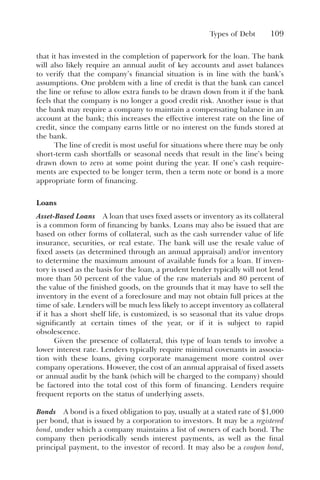
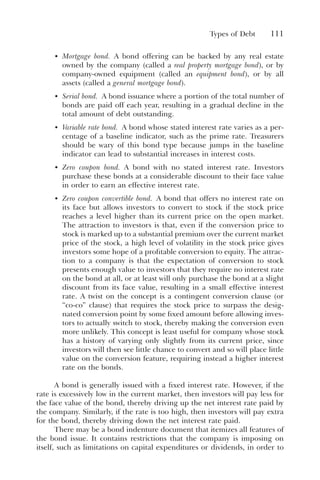
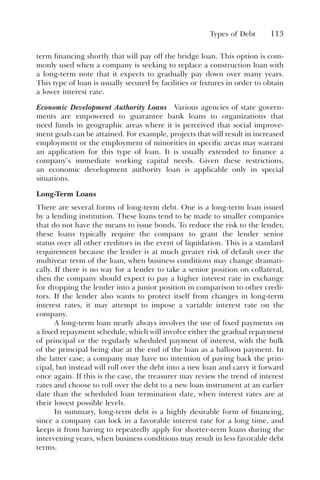
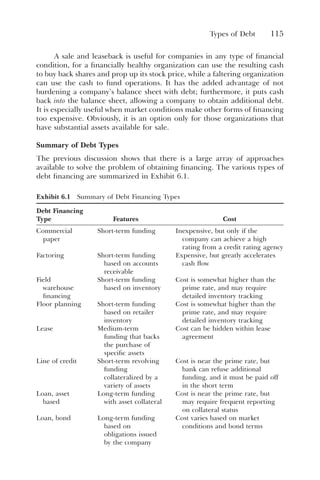
TREASURY
MANAGEMENT
The Practitioner's Guide
TREASURY MANAGEMENT
The Practitioner’s Guide
Steven M. Bragg
John Wiley & Sons, Inc.
Copyright © 2010 by John Wiley & Sons, Inc. All rights reserved.
Published by John Wiley & Sons, Inc., Hoboken, New Jersey.
Published simultaneously in Canada.
No part of this publication may be reproduced, stored in a retrieval system, or
transmitted in any form or by any means, electronic, mechanical, photocopying,
recording, scanning, or otherwise, except as permitted under Section 107 or 108 of
the 1976 United States Copyright Act, without either the prior written permission of
the Publisher, or authorization through payment of the appropriate per-copy fee to
the Copyright Clearance Center, Inc., 222 Rosewood Drive, Danvers, MA 01923,
978-750-8400, fax 978-646-8600, or on the Web at www.copyright.com. Requests to
the Publisher for permission should be addressed to the Permissions Department,
John Wiley & Sons, Inc., 111 River Street, Hoboken, NJ 07030, 201-748-6011, fax
201-748-6008, or online at http://www.wiley.com/go/permissions.
Limit of Liability/Disclaimer of Warranty: While the publisher and author have used
their best efforts in preparing this book, they make no representations or warranties
with respect to the accuracy or completeness of the contents of this book and
specifically disclaim any implied warranties of merchantability or fitness for a
particular purpose. No warranty may be created or extended by sales representatives
or written sales materials. The advice and strategies contained herein may not be
suitable for your situation. You should consult with a professional where appropriate.
Neither the publisher nor author shall be liable for any loss of profit or any other
commercial damages, including but not limited to special, incidental, consequential,
or other damages.
For general information on our other products and services, or technical support,
please contact our Customer Care Department within the United States at
800-762-2974, outside the United States at 317-572-3993 or fax 317-572-4002.
Wiley also publishes its books in a variety of electronic formats. Some content that
appears in print may not be available in electronic books.
For more information about Wiley products, visit our Web site at http://www.wiley.
com.
Library of Congress Cataloging-in-Publication Data:
Bragg, Steven M.
Treasury management : the practitioner’s guide / Steven M. Bragg.
p. cm.
Includes index.
ISBN 978-0-470-49708-1 (cloth)
1. International business enterprises–Finance–Management. 2. Banks and
banking, International–Management. I. Title.
HG4027.5.B73 2010
658.15’99–dc22
2009035912
Printed in the United States of America
10 9 8 7 6 5 4 3 2 1
Contents
Preface ix
About the Author xi
PART ONE Cash Management 1
Chapter 1 Treasury Department 3
Role of the Treasury Department 3
Treasury Controls 6
Treasurer Job Description 7
Position of Treasury within the Corporate
Structure 7
Treasury Centralization 8
Treasury Compensation 10
Bank Relations 10
Treasury Outsourcing 13
Summary 18
Chapter 2 Cash Transfer Methods 21
Check Payments 21
Wire Transfers 27
ACH Payments 28
Procurement Cards 31
Cash Payments 32
iii
iv Contents
Fees for Cash Transfers 32
Summary of Cash Transfer Methods 32
Cash Transfer Controls 34
Cash Transfer Procedures 43
Summary 48
Chapter 3 Cash Forecasting 49
Cash Forecasting Model 49
Information Sources for the Cash Forecast 53
Measuring Cash Forecast Accuracy 54
Cash Forecasting Automation 55
Bullwhip Effect 57
Business Cycle Forecasting 58
Cash Forecasting Controls 60
Cash Forecasting Policies 62
Cash Forecasting Procedure 62
Summary 62
Chapter 4 Cash Concentration 67
Benefits of Cash Concentration 67
Cash Concentration Strategies 69
Pooling Concepts 70
Physical Sweeping 70
Notional Pooling 73
Comparison of Account Sweeping and Notional
Pooling 74
Nonpooling Situations 75
Bank Overlay Structure 75
Cash Concentration Controls 76
Cash Concentration Policies 78
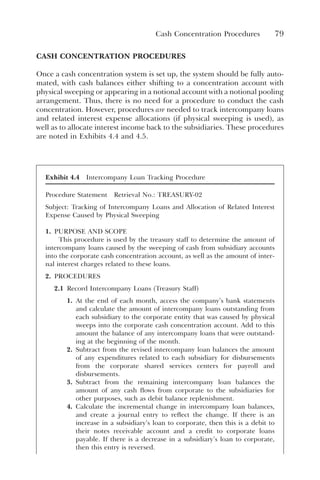
Cash Concentration Procedures 79
Summary 81
Contents v
Chapter 5 Working Capital Management 83
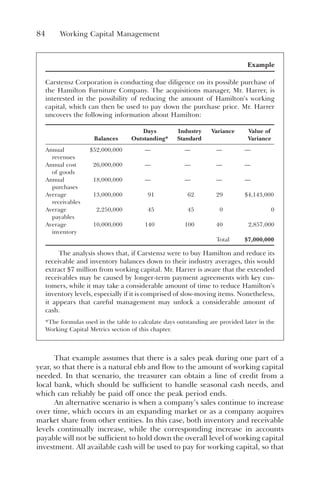
Working Capital Variability 83
Cash Management 85
Credit Management 85
Receivables Management 87
Inventory Management 88
Working Capital Metrics 95
Summary 102
PART TWO Financing 103
Chapter 6 Debt Management 105
Types of Debt 105
Credit-Rating Agencies 116
Accounting for Debt 118
Debt-Related Controls 130
Debt-Related Policies 134
Debt-Related Procedures 135
Summary 136
Chapter 7 Equity Management 141
Stock Registration 141
Exemptions from Stock Registration 147
Accounting for Stock Sales 150
Equity-Related Controls 152
Equity-Related Policies 154
Equity-Related Procedures 156
Summary 163
Chapter 8 Investment Management 165
Investment Criteria 165
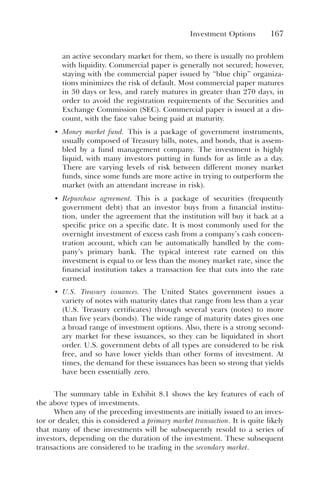
Investment Options 166
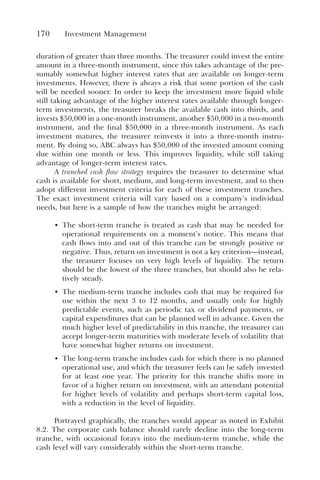
Investment Strategies 169
vi Contents
Outsourced Investment Management 172
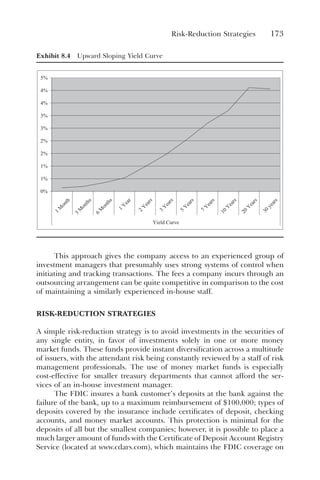
Risk-Reduction Strategies 173
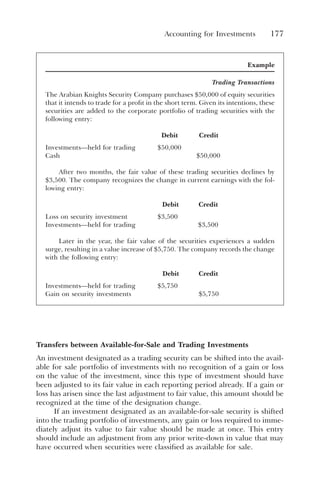
Accounting for Investments 174
Investment Journal Entries 182
Investment Reporting 188
Investment Management Controls 188
Investment Management Policies 191
Investment Management Procedures 195
Summary 199
PART THREE Risk Management 205
Chapter 9 Foreign Exchange Risk Management 207
Foreign Exchange Quote Terminology 207
The Nature of Foreign Exchange Risk 208
Data Collection for Foreign Exchange
Risk Management 209
Foreign Exchange Hedging Strategies 210
Hedge Accounting 223
Foreign Exchange Hedge Controls 232
Foreign Exchange Hedge Policies 234
Record Keeping for Foreign Exchange
Hedging Activities 235
Foreign Exchange Hedge Procedures 236
Summary 238
Chapter 10 Interest Risk Management 239
Interest Risk Management Objectives 239
Interest Risk Management Strategies 240
Accounting for Interest Risk Management
Activities 253
Interest Risk Management Policies 266
Record Keeping for Interest Rate Risk
Management 267
Contents vii
Interest Risk Management Procedures 267
Summary 267
PART FOUR Treasury Systems 271
Chapter 11 Clearing and Settlement Systems 273
Characteristics of Clearing and Settlement Systems 273
Overview of the Clearing and Settlement Process 273
Fedwire 275
Automated Clearing House (ACH) System 275
Clearing House Interbank Payments System (CHIPS) 277
Check Clearing 278
The Continuous Link Settlement (CLS) System 280
Summary 281
Chapter 12 Treasury Systems 283
Treasurer’s Technology Needs 283
Treasury Management System 285
SWIFT Connectivity 287
Summary 288
Index 289
Preface
A treasurer has a broad range of responsibilities in the modern corporation,
ranging from cash management to risk management. Further, the treasurer
is responsible for the proper movement of potentially large amounts of
funds and the construction of hedges, which call for the integration of a
comprehensive set of controls into a broad-based procedural framework.
Treasury Management: The Practitioner’s Guide shortens the treasurer’s learn-
ing curve for all aspects of the position, with chapters clustered into the
general categories of cash management, financing, risk management, and
treasury systems.
The book is divided into four sections. In Part One, we address the
various methods by which a company transfers cash, both on paper and by
electronic means, and then show how to create a cash forecast and monitor
its accuracy. We then cover several methods for aggregating cash from a
multitude of locations, so that funds can be more effectively dispositioned.
Finally, a separate chapter addresses the components of working capital and
how they may be altered, thereby impacting cash flow planning.
In Part Two, we cover what the treasurer does to raise debt and equity,
as well as how to invest funds. This includes a discussion of the various kinds
of debt and key characteristics of each one, how to deal with credit rating
agencies, and the intricacies of equity offerings. The coverage of investments
includes investment criteria, types of available investments, and investment
and risk reduction strategies.
Part Three addresses an increasingly important aspect of the trea-
surer’s responsibilities, which is risk management. This includes the objec-
tives and strategies of both interest rate and foreign exchange risk
management, as well as the available risk mitigation tools that are available
to the treasurer.
Finally, Part Four describes the technology that drives many treasury
transactions. This includes an overview of the clearing and settlement
systems used in the United States, the functions of a treasury management
ix
x Preface
system, and a discussion of how corporations can access the Society for
Worldwide Interbank Financial Telecommunication (SWIFT) network.
These chapters are liberally sprinkled with examples to clarify con-
cepts. Particular attention has also been paid to the specific accounting
requirements of key treasury transactions, as well as related controls, poli-
cies, and procedures, with the intent of providing a treasurer with a com-
plete framework for setting up and operating the treasury department.
The book answers a multitude of questions involved in running a trea-
sury department, such as:
• How do I calculate the cost-effectiveness of a lockbox?
• How do I create a cash forecast?
• How do I set up a cross-border cash pool?
• How does notional pooling work?
• What policy changes can I implement to alter the investment in
working capital?
• How can I securitize my accounts receivable?
• What types of exemptions are available from the stock registration
rules?
• How do I set up a tranched cash flow strategy?
• How do I integrate risk mitigation into my investment strategy?
• How do I use forwards, futures, swaps, and options within my
hedging strategy?
• How does the continuous link settlement system reduce settlement
risk?
• What features should I look for in a treasury management system?
In short, Treasury Management: The Practitioner’s Guide is the ideal
sourcebook for the mechanics of how to run all aspects of the modern trea-
sury department.
February 2010
Centennial, Colorado
About the Author
Steven Bragg, CPA, has been the chief financial officer or controller of four
companies, as well as a consulting manager at Ernst & Young and auditor
at Deloitte & Touche. He received a master’s degree in finance from Bentley
College, an MBA from Babson College, and a bachelor’s degree in econom-
ics from the University of Maine. He has been the two-time president of the
Colorado Mountain Club and is an avid alpine skier, mountain biker, and
certified master diver. Mr. Bragg resides in Centennial, Colorado. He has
written the following books:
Accounting and Finance for Your Small Business
Accounting Best Practices
Accounting Control Best Practices
Accounting Policies and Procedures Manual
Advanced Accounting Systems
Billing and Collections Best Practices
Business Ratios and Formulas
Controller’s Guide to Costing
Controller’s Guide to Planning and Controlling Operations
Controller’s Guide: Roles and Responsibilities for the New Controller
Controllership
Cost Accounting
Essentials of Payroll
Fast Close
xi
xii About the Author
Financial Analysis
GAAP Guide
GAAP Policies and Procedures Manual
GAAS Guide
Inventory Accounting
Inventory Best Practices
Investor Relations
Just-in-Time Accounting
Management Accounting Best Practices
Managing Explosive Corporate Growth
Mergers and Acquisitions
Outsourcing
Payroll Accounting
Payroll Best Practices
Revenue Recognition
Run the Rockies
Running a Public Company
Sales and Operations for Your Small Business
The Controller’s Function
The New CFO Financial Leadership Manual
The Ultimate Accountants’ Reference
Throughput Accounting
FREE ONLINE RESOURCES BY STEVE BRAGG
Steve issues a free accounting best practices podcast. You can sign up for it
at www.accountingtools.com, or access it through iTunes.
CASH MANAGEMENT
PART ONE
Treasury Department
1
The treasury department is responsible for a company’s liquidity. The trea-
surer must monitor current and projected cash flows and special funding
needs, and use this information to correctly invest excess funds, as well as
be prepared for additional borrowings or capital raises. The department
must also safeguard existing assets, which calls for the prudent investment
of funds, while guarding against excessive losses on interest rates and foreign
exchange positions. The treasurer needs to monitor the internal processes
and decisions that cause changes in working capital and profitability, while
also maintaining key relationships with investors and lenders. This chapter
explores these and other responsibilities of the treasury department, as well
as such key issues as treasury centralization, bank relations, outsourcing, and
performance metrics.
ROLE OF THE TREASURY DEPARTMENT
Ultimately, the treasury department ensures that a company has sufficient
cash available at all times to meet the needs of its primary business opera-
tions. However, its responsibilities range well beyond that single goal. It also
has significant responsibilities in the following areas:
• Cash forecasting. The accounting staff generally handles the receipt
and disbursement of cash, but the treasury staff needs to compile
this information from all subsidiaries into short-range and long-
range cash forecasts. These forecasts are needed for investment
purposes, so the treasury staff can plan to use investment vehicles
that are of the correct duration to match scheduled cash outflows.
The staff also uses the forecasts to determine when more cash
is needed, so that it can plan to acquire funds either through the
3
4 Treasury Department
use of debt or equity. Cash forecasting is also needed at the indi-
vidual currency level, which the treasury staff uses to plan its hedging
operations. This topic is covered in Chapter 3, Cash Forecasting.
• Working capital management. A key component of cash forecasting
and cash availability is working capital, which involves changes in
the levels of current assets and current liabilities in response to a
company’s general level of sales and various internal policies. The
treasurer should be aware of working capital levels and trends, and
advise management on the impact of proposed policy changes on
working capital levels. This topic is addressed in Chapter 5, Working
Capital Management.
• Cash management. The treasury staff uses the information it obtained
from its cash forecasting and working capital management activities
to ensure that sufficient cash is available for operational needs. The
efficiency of this area is significantly improved by the use of cash
pooling systems. This topic is addressed in Chapter 4, Cash
Concentration.
• Investment management. The treasury staff is responsible for the
proper investment of excess funds. The maximum return on
investment of these funds is rarely the primary goal. Instead, it is
much more important to not put funds at risk, and also to match
the maturity dates of investments with a company’s projected
cash needs. This topic is addressed in Chapter 8, Investment
Management.
• Treasury risk management. The interest rates that a company pays on
its debt obligations may vary directly with market rates, which
present a problem if market rates are rising. A company’s foreign
exchange positions could also be at risk if exchange rates suddenly
worsen. In both cases, the treasury staff can create risk management
strategies and implement hedging tactics to mitigate the company’s
risk. This topic is addressed in Chapter 9, Foreign Exchange Risk
Management, and in Chapter 10, Interest Risk Management.
• Management advice. The treasury staff monitors market conditions
constantly, and therefore is an excellent in-house resource for the
management team should they want to know about interest rates
that the company is likely to pay on new debt offerings, the avail-
ability of debt, and probable terms that equity investors will want in
exchange for their investment in the company.
• Credit rating agency relations. When a company issues marketable
debt, it is likely that a credit rating agency will review the company’s
financial condition and assign a credit rating to the debt. The trea-
sury staff responds to information requests from the credit agency’s
Role of the Treasury Department 5
review team and provides it with additional information over time.
This topic is addressed in Chapter 6, Debt Management.
• Bank relationships. The treasurer meets with the representatives
of any bank that the company uses to discuss the company’s financial
condition, the bank’s fee structure, any debt granted to the company
by the bank, and other services such as foreign exchange transac-
tions, hedges, wire transfers, custodial services, cash pooling, and
so forth. A long-term and open relationship can lead to some degree
of bank cooperation if a company is having financial difficulties,
and may sometimes lead to modest reductions in bank fees. This
topic is addressed further in the Bank Relations section of this
chapter.
• Fund raising. A key function is for the treasurer to maintain excel-
lent relations with the investment community for fund-raising pur-
poses. This community is composed of the sell side, which are those
brokers and investment bankers who sell the company’s debt and
equity offerings to the buy side, which are the investors, pension
funds, and other sources of cash, who buy the company’s debt and
equity. While all funds ultimately come from the buy side, the sell
side is invaluable for its contacts with the buy side, and therefore is
frequently worth the cost of its substantial fees associated with fund
raising. This topic is addressed in Chapter 6, Debt Management,
and Chapter 7, Equity Management.
• Credit granting. The granting of credit to customers can lie within
the purview of the treasury department, or may be handed off to
the accounting staff. This task is useful for the treasury staff to
manage, since it allows the treasurer some control over the amount
of working capital locked up in accounts receivable. This topic is
addressed in Chapter 5, Working Capital Management.
• Other activities. If a company engages in mergers and acquisitions
on a regular basis, then the treasury staff should have expertise in
integrating the treasury systems of acquirees into those of the
company. For larger organizations, this may require a core team of
acquisition integration experts. Another activity is the maintenance
of all types of insurance on behalf of the company. This chore may
be given to the treasury staff on the grounds that it already handles
a considerable amount of risk management through its hedging
activities, so this represents a further centralization of risk manage-
ment activities.
Clearly, the original goal of maintaining cash availability has been
expanded by the preceding points to encompass some types of asset man-
agement, risk management, working capital management, and the lead role
6 Treasury Department
in dealing with banks and credit rating agencies. Thus, the treasury depart-
ment occupies a central role in the finances of the modern corporation.
TREASURY CONTROLS
Given the large sums of cash involved in many treasury transactions, it
is important to have a broad set of controls that help to ensure that transac-
tions are appropriate. The following chapters contain sections on controls
related to those chapter topics. At a more general level, it is critical
that duties be properly segregated among the treasury staff, so that anyone
concluding a deal never controls or accounts for the resulting cash flows.
For example, trading activities should be separated from confirmation
activities, so that someone fraudulently conducting illicit trades cannot
waylay the confirmation arriving from the counterparty. In addition, a
senior-level treasury manager should approve all trades, yet another person
(possibly in the accounting department, in order to be positioned out of the
departmental chain of command) should reconcile and account for all
transactions.
It is also useful for someone outside of the trading function to regularly
compare brokerage fees or commissions to reported transactions, to see if
there are any unauthorized and unrecorded trades for which the company
is paying fees.
Treasury is also an excellent place to schedule internal audits, with the
intent of matching actual transactions against company policies and proce-
dures. Though these audits locate problems only after they have occurred,
an adverse audit report frequently leads to procedural changes that keep
similar problems from arising in the future.
In addition to segregation controls and internal auditing, the treasurer
should impose limit controls on a variety of transactions. These limits can
prohibit or severely restrict the treasury staff from investing in certain
types of financial instruments (such as some types of financial derivatives)
that present an unduly high risk of capital loss. Another limitation is on
the amount of business a company chooses to do with a specific counter-
party, which is designed to reduce company losses in the event of a coun-
terparty failure. Limitations can also apply to certain currencies if there
appears to be some risk that a country’s leaders may impose currency con-
trols in the near future. Finally, there should be monetary caps on the
transaction totals to which anyone in the treasury department can commit
the company. Even the treasurer should have such a limitation, with some
major transactions requiring the approval of the company president or
board of directors.
The controls noted here are only general concepts. For more detailed
itemizations of specific controls, please refer to the Controls sections of each
of the following chapters.
Position of Treasury within the Corporate Structure 7
TREASURER JOB DESCRIPTION
Within the organizational hierarchy, the treasurer usually reports to the
chief financial officer (CFO). The treasurer’s job description, as noted in
Exhibit 1.1, essentially establishes responsibility for the tasks noted in the
preceding sections.
POSITION OF TREASURY WITHIN THE
CORPORATE STRUCTURE
In a small company, there is no treasury department at all, nor is there a
treasurer. Instead, treasury responsibilities are handled by the accounting
Exhibit 1.1 Treasurer Job Description
Reports to: CFO
Basic function: This position is responsible for corporate liquidity, invest-
ments, and risk management related to the company’s financial activities.
Principal accountabilities:
1. Forecast cash flow positions, related borrowing needs, and available funds
for investment.
2. Ensure that sufficient funds are available to meet ongoing operational
and capital investment requirements.
3. Use hedging to mitigate financial risks related to the interest rates on the
company’s borrowings, as well as on its foreign exchange positions.
4. Maintain banking relationships.
5. Maintain credit rating agency relationships.
6. Arrange for equity and debt financing.
7. Invest funds.
8. Invest pension funds.
9. Monitor the activities of third parties handling outsourced treasury func-
tions on behalf of the company.
10. Advise management on the liquidity aspects of its short- and long-range
planning.
11. Oversee the extension of credit to customers.
12. Maintain a system of policies and procedures that impose an adequate
level of control over treasury activities.
8 Treasury Department
department and are under the supervision of the controller. This is an
adequate situation if there are just a few bank accounts, foreign exchange
exposures are minor, and there is not an excessive need for investment or
borrowing expertise. However, as a company grows, the need for a special-
ized treasury staff increases. This typically begins with a treasurer, who
personally handles all of the responsibilities of the department, and gradu-
ally includes specialized staff to handle more complex transactions, such as
cash pooling and hedging. Personnel are added either as transaction volume
increases or when management decides to centralize more activities under
the treasurer, as described in the next section.
Once the treasurer position is created, the treasurer usually reports
directly to the CFO, and may also be asked to deliver occasional reports to
the board of directors or its various committees.
TREASURY CENTRALIZATION
The treasury department deals with a number of highly regimented pro-
cesses, which are noted in the Procedures sections of each of the following
chapters. Given the very large amounts of funds that the treasury incorpo-
rates into its transactions, it is critical that all procedures be performed
precisely as planned and incorporating all controls. Procedural oversight is
much easier when the treasury function is highly centralized and progres-
sively more difficult when it is distributed over a large number of locations.
Centralization is easier, because transactions are handled in higher volumes
by a smaller number of highly skilled staff. There is generally better man-
agement oversight, and the internal audit staff can review operations in a
single location more easily than in a distributed environment. Further,
treasury activities frequently involve complicated terminology that is incom-
prehensible to nontreasury specialists, so it makes sense to centralize opera-
tions into a small, well-trained group.
Another reason for using treasury centralization is the presence of
an enterprise resources planning (ERP) system that has been implemented
throughout a company. An ERP system processes all of the transactions
used to run all key operations of a company, so all of the information needed
to derive cash forecasts and foreign exchange positions can be derived from
a single system. If this system is available, then a centralized treasury
group will find that all of the in-house information it requires is available
through the nearest computer terminal. Conversely, if a company has many
subsidiaries, each of which uses its own ERP or accounting system, then it
becomes increasingly difficult for a centralized treasury staff to access infor-
mation. Instead, it may make more sense to assign a small treasury staff
to each subsidiary that is an expert in using the local system to extract
information.
Treasury Centralization 9
If a company operates in just one or a small number of countries, then
banking relationships are relatively few, and can be handled by a centralized
staff. However, if it operates in a multitude of countries, especially in devel-
oping countries where there may be currency controls, then there is a
greater need for local treasury staff that can maintain local banking relation-
ships and monitor local regulations that may impact treasury operations.
The preceding discussion certainly favors a centralized treasury func-
tion. However, in a company’s early years, it is common to pass through a
series of phases, where centralization gradually occurs over time. Exhibit
1.2 shows some typical stages in the gradual transition from dispersed to
centralized treasury functions.
The transition from Stage 1 to Stage 2 may be triggered by a large loss
on a foreign exchange position that could have been prevented by a proper
hedge transaction, while the additional transition to Stage 3 usually arises
when it becomes apparent that the increased scale of company operations
has resulted in so many bank accounts that cash is not being effectively
pooled and invested. In Stage 3, it is common to first create local cash pools
by country, then to progress to an international cash pool in order to further
aggregate cash for investment purposes. Stage 4 involves the complete inte-
gration of the accounts receivable and payable portions of working capital
into the treasury department. In many companies, there is considerable
resistance to Stage 4, on the grounds that working capital should remain
under the control of local managers, and that centralization calls for the
Exhibit 1.2 Stages in Treasury Centralization
Stage 1: Complete decentralization Individual locations manage their own
bank accounts, foreign exchange
transactions, customer credit, payables,
borrowings, and investments.
Stage 2: Centralized netting and
hedging
A central staff nets payments between
subsidiaries and hedges major foreign
exchange and interest rate risks. Local
locations still manage their own bank
accounts, customer credit, payables,
borrowings, and investments.
Stage 3: Centralized investments In addition to prior centralization, a
central treasury staff consolidates and
manages all bank accounts, including
pooling of funds and investment of
those funds. Local locations still manage
customer credit and payables.
Stage 4: Centralized working capital
management
In addition to prior centralization, the
central treasury staff centralizes credit
granting and uses a payment factory for
centralized payables management.
10 Treasury Department
prior installation of an enterprise resources planning system. Thus, many
companies stop at Stage 3 and do not fully centralize their treasury
activities.
Even a fully centralized treasury department may find that it needs to
maintain a regional treasury center in the major time zones in which it
operates, so that some treasury personnel are always available during the
business hours of subsidiaries located in their regions. This typically means
that a company operates a regional treasury center in one of the major
money center cities of the European time zones, such as Amsterdam,
Brussels, London, or Zurich. Similarly, a treasury center in Chicago or New
York can cover the American time zones, while an office in Singapore or
Tokyo can address the needs of the Asian time zones.
Consequently, treasury centralization is usually a gradual process that
progresses through several decision points as a company increases the geo-
graphic scope and scale of its operations.
TREASURY COMPENSATION
The treasury staff should not operate under a bonus plan that issues com-
pensation based on unusually high rates of return on investment, nor for
gains from active speculation in other currencies. A company’s board of
directors should be much more interested in conserving a company’s excess
cash than in putting it at risk in exchange for the possibility of improving
returns by a few percentage points. Thus, it makes considerably more sense
to create a compensation plan that rewards the treasury staff for its exact
adherence to a detailed set of investment guidelines.
If anything, risky investment activities should result in the opposite of
a bonus—censure and possibly termination—even if the activities resulted
in outsized earnings for the company.
BANK RELATIONS
A key part of the treasury’s responsibilities includes the management of a
company’s banking relationships. A large company may deal with dozens of
banks, so it makes sense for the treasurer to gradually reduce the total
number of banks with which the treasury department transacts business. By
doing so, the relationship task can be refined down to only a core group of
key banks. The following subsections note key aspects of bank relations.
Relationship Bank Relations
The treasurer is responsible for maintaining relations with a company’s
banks. There may be a number of banks to deal with, but the most critical
Bank Relations 11
one is a company’s relationship bank. This is a company’s designated long-
term partner, with whom the company does the bulk of its business. The
bank maintains its checking and zero-balance accounts there, and may have
negotiated overdraft privileges, cash pooling, and a line of credit and pos-
sibly long-term debt. A company may rely heavily on a high-quality relation-
ship bank, so the treasurer should maintain frequent and open discussions
with his counterpart at this bank.
The treasurer should be thoroughly familiar with the monthly account
analysis statement that is provided by the company’s bank, since it itemizes
the company’s transactions with the bank and the cost of the bank’s process-
ing of those transactions and other services.
Bank Account Analysis
The treasurer should receive an account analysis statement from each of the
company’s banks shortly after the end of each month. The statement con-
tains a summarization of the bank’s fees for services rendered and the
company’s usage volume for each of those fees. Fee structure will vary by
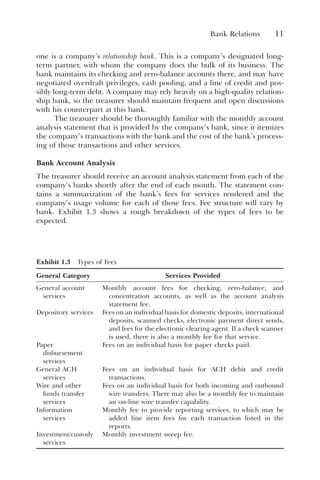
bank. Exhibit 1.3 shows a rough breakdown of the types of fees to be
expected.
Exhibit 1.3 Types of Fees
General Category Services Provided
General account
services
Monthly account fees for checking, zero-balance, and
concentration accounts, as well as the account analysis
statement fee.
Depository services Fees on an individual basis for domestic deposits, international
deposits, scanned checks, electronic payment direct sends,
and fees for the electronic clearing agent. If a check scanner
is used, there is also a monthly fee for that service.
Paper
disbursement
services
Fees on an individual basis for paper checks paid.
General ACH
services
Fees on an individual basis for ACH debit and credit
transactions.
Wire and other
funds transfer
services
Fees on an individual basis for both incoming and outbound
wire transfers. There may also be a monthly fee to maintain
an on-line wire transfer capability.
Information
services
Monthly fee to provide reporting services, to which may be
added line item fees for each transaction listed in the
reports.
Investment/custody
services
Monthly investment sweep fee.
12 Treasury Department
In addition, the account analysis statement contains an analysis of
an earnings credit allowance, which is used to offset service charges. It is
calculated using a monthly earnings credit rate, multiplied by the average
collected balance in the account for the month. Because the earnings
credit rate is low, the amount of credit earned to offset service charges will
be minimal, unless the treasurer chooses to retain large cash balances in
the account. Also, the earnings credit allowance can be used only to offset
service charges incurred in the reporting period. If the earnings credit is
higher than the service charges, then the company loses any unused earn-
ings credit. Since any other type of investment carries a higher interest
rate than the earnings credit allowance, it is generally better to shift funds
to an investment account elsewhere and simply pay the bank its service
charges.
The treasurer should compile the per-unit and per-month charges
listed in the account analysis statement, and use this information to periodi-
cally conduct a comparison to the fees charged by other competing banks.
While it is quite time-consuming to switch a company’s account-level banking
business to a new bank, the analysis can be useful for negotiating down those
existing fees having the largest impact on the company’s total service
charges.
Bank Account Management
One of the most inefficient activities in bank relations is maintaining up-
to-date lists of bank account signatories—that is, authorized check signers.
The typical bank requires not only a signature card containing the signa-
tures of all signatories, but also a board resolution approving the check
signers. Further, each bank wants the same information, but in a different
format, so there is no way to standardize the reporting required by each
bank. This can be a real problem when a company has hundreds of bank
accounts that are spread among multiple banks, since ongoing personnel
turnover is bound to result in a continuing authorization updating process.
There are more efficient methods being discussed for electronic bank
account management (eBAM), but these discussions have only just begun to
translate into commercial products. In the meantime, the treasury staff
should have a quarterly procedure to review and update authorized
signatories.
In addition to signatory management, the treasury staff must integrate
information from bank accounts into its treasury management system, so
that it has immediate access to bank transactional information. This integra-
tion process can take months to set up communication channels, exchange
encryption and signing keys, configure formats, and test the interface. Given
the large number of bank accounts used by larger companies, and ongoing
account turnover, a treasury staff is constantly monitoring the progress of
these integration efforts by its information technology staff.
Treasury Outsourcing 13
Loan Covenants
The treasurer should have an excellent knowledge of the loan covenants
imposed on the company by its banks, and be in frequent communication
with them regarding any approaching covenant violations. A treasurer who
spends considerable time with his banking counterparts is much more likely
to be granted a waiver of a covenant violation than one who suddenly springs
a violation on bankers whom he barely knows. However, a prolonged viola-
tion is likely to yield additional covenants, higher fees, or an interest rate
increase. Also, if a loan was originally priced below the market rate, a lender
will more likely impose fees in response to a covenant breach, simply to
improve its rate of return on the loan.
Another factor related to covenant violations is the length of a com-
pany’s relationship with a lender. If the treasurer dropped the offer of a
relationship bank in favor of lower-priced offer from a new lender, he may
find later that the new lender set tight covenants in hope of a violation, so
that it could ratchet up its fees.
Collateral
When dealing with lenders, the treasurer should use great caution in allow-
ing company assets to be used as collateral on various loans. A lender will
always attempt to maximize its access to company assets through broad-
based collateral provisions, but this leaves little room for the use of those
assets for additional loans at some point in the future. If a treasurer allows
this situation to occur, then the result is a senior lender who has a collateral
position in virtually all company assets, and any number of junior lenders
whose collateral positions fall behind the senior lender’s and who accord-
ingly charge much higher rates of interest to offset their increased risk. A
better scenario is to fight off demands for broad-based collateral agree-
ments, instead of apportioning out specific assets, so that the corporate asset
base can be stretched as far as possible among multiple loans. This approach
requires considerable negotiation skill with bankers and is more achievable
if a company is reporting excellent financial results.
TREASURY OUTSOURCING
There are several levels of outsourcing that can be applied to the treasury
department, ranging from relatively minimal technology outsourcing to
a broad transfer of the bulk of the department’s activities to a third
party.
It is possible to shift a company’s treasury management system (TMS)
to a third party under an application service provider (ASP) arrangement.
Not only does this allow a company to eliminate the capital cost of acquiring
the software and hardware needed for a TMS, but it also eliminates the need
14 Treasury Department
for in-house maintenance staff to operate the system. Further, the ASP
should have a considerable array of controls installed around its system to
limit access, provide disaster recovery services, and so on. Many companies
consider these added controls to be of considerable value, especially those
public companies whose managers must personally certify their systems of
internal control. Under this outsourcing scenario, the in-house treasury staff
is retained, but the computer systems it uses are now accessed through the
Internet, rather than through a local server.
A more expansive form of outsourcing is to retain a treasurer on the
corporate staff, while shifting most other treasury functions to a third party.
This means that functions such as cash flow management, foreign exchange
deal execution and confirmation, cash pool management, netting, and
reporting are provided by the third party. The treasurer reviews the perfor-
mance of the third party against the benchmarks itemized in a service-level
agreement, and sets up policies, conducts bank relations, acquires new
funding, and develops the strategic direction of the department. The
problem is that nearly all expertise has now left the company, which can be
a problem if the company chooses to end the outsourcing arrangement and
reconstitute the department in-house.
Outsourcing cannot always be proven to provide significant cost savings
since the third party must also build an adequate profit into its service fee.
Thus, a key reason for shifting to outsourcing may simply be that a company
has experienced problems in the past with controls, transactional errors, or
fraud, and so prefers to shift the function to a group of outside professionals
who are presumably more competent.
Outsourcing is an especially viable option for smaller companies
having smaller cash balances, banking relationships, and foreign exchange
transactions. For these companies, it can be expensive to maintain a group
of specialists to engage in and monitor a relatively low volume of transac-
tions. However, as a company and its financing activities grow, it may
become more cost-effective to transition the treasury function back
in-house.
Treasury Metrics
Many treasury departments find that their performance falls outside of a
company’s normal set of performance metrics. The standard of performance
is earnings before interest, taxes, depreciation and amortization (EBITDA),
which essentially focuses on operational results. However, since the treasury
department’s primary impact is on interest expense, foreign exchange expo-
sure, and liquidity, it does not fall within the EBITDA metric. Thus, even a
stellar treasury performance may go unnoticed! The treasury department
needs to look outside of EBITDA for performance measures that reveal its
true effectiveness. The following subsections describe possible metrics for
the treasury function.
Treasury Outsourcing 15
Earnings Rate on Invested Funds
A company’s investments can include interest income or an increase in the
market value of securities held. The earnings rate on invested funds is a good
measurement for tracking investment performance. To calculate it, sum-
marize the interest earned on investments, as well as the change in market
value of securities held, and divide by the total amount of funds invested.
Since the amount of funds invested may fluctuate substantially over the
measurement period, this can be an average value. The amount of interest
earned should not be based on the actual interest paid to the company, but
rather on the accrued amount (since the date of actual payment may fall
outside of the measurement period). The formula is as follows:
Interest Earned Increase in Market Value of Securities
Tota
+
l
l Funds Invested
Example
The Rake and Mow Garden Centers corporate parent is earning a consider-
able return from its chain of small-town garden centers. Its treasurer wants to
know its earnings rate on invested funds during the past year. It had $5,500,000
of invested funds at the beginning of the year and $6,200,000 at the end of
the year. It earned $75,000 in interest income, and had a net gain of $132,000
on its short-term equity investments. Its total earnings rate on invested funds
was as follows:
=
+
Interest Earned Increase in Market Value of Securities
Tota
al Funds Invested
Interest Earned Increase
$ , $ ,
75 000 132 000
+ i
in Market Value of Securities
$ , , $ , ,
.
5 500 000 6 200 000 2
3 5
+
( )
= %
% Earnings Rate on Invested Funds
A company can place too great a degree of reliance on this measurement,
resorting to increasingly risky investments in order to achieve a higher earn-
ings rate. The board of directors must realize that a reasonable, but not
spectacular, amount of return is perfectly acceptable, because a company
should also focus its investment strategy on other goals, such as liquidity
and minimal loss of principal, which tend to result in lower rates of return.
Thus, the rate of return metric must be evaluated alongside a summary of
the types of investments that the treasury staff engaged in to achieve the
calculated results.
16 Treasury Department
Borrowing Base Usage Percentage
The borrowing base usage percentage is an excellent measure for keeping track of
the amount of debt that a company can potentially borrow, based on that
portion of its accounts receivable, inventory, and fixed assets that are not cur-
rently being used as collateral for an existing loan. A treasurer should have
this information available on all standard internal accounting reports, so that
the company’s available debt capacity is easily available. It is particularly
useful when employed within a cash budget, so that one can see at a glance not
only the amount of any potential cash shortfalls, but also the ability of the
company to cover those shortfalls with collateralized debt from existing assets.
To calculate the borrowing base usage percentage, multiply the current
amount of accounts receivable, less those invoices that are more than 90
days old, by the allowable borrowing base percentage (as per the loan docu-
ment). Then multiply the current amount of inventory, less the obsolescence
reserve, by the allowable borrowing base percentage (as per the loan docu-
ment). Add the results of these two calculations together and divide the sum
into the amount of debt outstanding. It is also possible to include in the
denominator the amount of fixed assets (net of a borrowing base percent-
age), but many lenders do not allow a company to use fixed assets as part
of its collateral, on the grounds that fixed assets are too difficult to liquidate.
The formula is as follows:
Amount of Debt Outstanding
Accounts Receivable Allowable Pe
× r
rcentage
Inventory Allowable Percentage
( )
+ ×
( )
Example
The Spinning Wheel Company, maker of heirloom-quality spinning wheels,
has been in a breakeven cash flow situation for a number of years. The market
for its products is gradually declining, and the president is searching for
alternative products that will shift the company into a more profitable situa-
tion. In the meantime, she needs to know the proportion of debt available
under the company’s borrowing arrangement, in order to see how much
funding is available to start new lines of business. Under the terms of the loan,
the borrowing base percentage for accounts receivable is 70 percent, 50
percent for inventory, and 20 percent for fixed assets. According to the com-
pany’s balance sheet, it has the following assets and liabilities:
Account Amount
Accounts receivable $350,000
Inventory $425,000
Fixed assets $205,000
Accumulated depreciation −$65,000
Loans $250,000
Treasury Outsourcing 17
The borrowing base calculation for the denominator of the ratio is as
follows:
$350,000 Accounts receivable × 70%
borrowing base
$245,000
$425,000 Inventory × 50% borrowing base 212,500
$140,000 Net fixed assets × 20% borrowing
base
28,000
Total borrowing base $ ,
485 500
(Note that the fixed assets borrowing base calculation was net of the accu-
mulated depreciation figure; otherwise, the borrowing base would not prop-
erly reflect the reduced resale value of older fixed assets.)
Using the preceding borrowing base calculation, the president of Spinning
Wheel can complete the borrowing base usage percentage as follows:
$ ,
$ ,
.
250 000
485 500
51 5
Loans Outstanding
Total Borrowing Base
= %
% Borrowing Base Usage
The president notices that about one-half of the total borrowing base has
been used to collateralize existing debt levels. Also, by subtracting the numera-
tor from the denominator, she sees that the company can borrow another
$235,500 before the borrowing base is maximized.
Other Metrics
If a company is operating in a negative or neutral cash flow situation and
has minimal available sources of excess cash, then the accuracy of its cash
forecast might be a useful metric. The treasury staff needs to predict cash
balances as close to actual results as possible, so that the company does not
find itself running out of cash. However, it is a difficult metric to hold the
treasurer responsible, because the sources of information that comprise the
forecast come from all over the company, and the treasurer is not respon-
sible for those cash flows. Thus, even if the cash forecast is inaccurate, the
cause may not lie within the control of the treasury department.
Another possible metric is bad debts as a percentage of sales. This metric
is relevant only if the treasury department is responsible for the granting of
customer credit. However, if the accounting department is responsible for
collections, then this percentage is really the joint responsibility of the trea-
surer and the controller.
A more viable metric is a transaction error rate, which can be subdivided
by each type of transaction in which the treasury staff engages. This can be
18 Treasury Department
a valuable tool for upgrading controls, procedures, and training, to mitigate
the risk of such errors occurring again. This metric is not easily translated
into a simplified presentation report that compares error totals by period
because some errors may have much worse repercussions than others, and
this is not readily apparent in a simplified report.
It is also possible to track the cost of outside services. The most obvious
one, and most easily derived, is the cost of banking services, which can
be tracked on a trend line. This information can also be compared to
benchmark information, or used to compare the fees of different provider
banks; the comparison provides a tool for negotiating reduced service
charges.
A final metric to consider is unhedged gains and losses. These gains and
losses can be quite large, and would initially appear to be a good way to
judge the hedging activity of the treasury staff. However, the amount of
hedging risk that a company chooses to expose itself to is set by the board
of directors (admittedly with the advice of the treasurer), and the treasury
staff is supposed to follow the board’s guidelines. If the board elects not to
hedge, then there will be gains and losses, but they will not be the respon-
sibility of the treasurer.
Metrics Summary
The treasury department is not easily measured, and in fact is particularly
resistant to metrics. A well-run treasury department will produce unspec-
tacular gains on its investments, and will manage to avoid outsized gains or
losses on its currency positions, while ensuring that corporate cash needs
are met in a steady and reliable manner. In short, the treasury department
provides functions that appear to be largely invisible unless something goes
wrong—and it is difficult to build metrics around such a situation.
Of the two metrics fully explored here, the earnings rate on invested
funds should be used with considerable caution, while the borrowing base
usage percentage can provide useful information, but only in regard to what
may be a limited amount of available borrowing capacity.
SUMMARY
A well-run treasury department is critical for the proper management of a
company’s liquidity. It is staffed by specialists in money and risk manage-
ment, who are responsible for aggregating cash flow information from
around the company, integrating it with current market data, and managing
the ebb and flow of cash in a conservative and responsible manner that does
not put the company’s capital at risk.
The following chapters delve into considerably more detail regarding
the mechanics of cash forecasting and cash concentration, the management
Summary 19
of working capital, debt, equity, and investments, and how to use hedging
to mitigate various financing risks. Where needed, the chapters include
considerable detail regarding the policies, procedures, controls, and account-
ing required to ensure that treasury activities are properly enacted and
accounted for.
Cash Transfer Methods
2
The treasurer should understand the implications of different methods of
transferring cash to or from a company, since there are significant differ-
ences in the costs and cash flow speed of each one. Further, the level of
manual processing and related controls is significantly different for each
kind of transfer, which has a major impact on the long-term efficiency of
the finance and accounting functions. This chapter intends to give the trea-
surer a thorough understanding of each form of cash transfer; when it
should be used; what it will cost; and any required policies, procedures, and
controls.
CHECK PAYMENTS
A check payment is made on a paper document, which has traditionally been
physically routed from the payer to the payee, to the payee’s bank, and then
back to the payer’s bank. The number of routings and the need for physical
handling of the check results in significant delays in the transfer of cash
between the principal parties.
The vast majority of checks are issued directly by companies. However,
they may also be issued directly by a bank, which is called a bank check
or bank draft. The bank check is a payment on behalf of the payer, which
is guaranteed by the bank (and therefore of value to the payee). The bank
can safely issue this guarantee because it immediately debits the payer’s
account for the amount of the check, and therefore has no risk. Not only is
this a safe transaction for the bank, it is also beneficial to the bank, since
the bank has ownership of the funds from the time when it debits the payer’s
account to when the money is eventually paid to the payee (which could
be several weeks, depending on when the payer elects to send the check to
the payee).
21
22 Cash Transfer Methods
Mechanics of a Check Payment
Portland Cement Company creates a check to pay for a supplier invoice.
It immediately adjusts its own records to reflect the reduction in available
cash. However, its bank balance remains unchanged for several days because
several additional events must occur. First, there is a delay while the payment
is delivered through the postal service, which is the mail float. Second,
the supplier must deposit the check at its bank; the time from when
the supplier receives the check and deposits it is the processing float.
The duration of the processing float is driven by the recipient’s internal
processes, staff training, and the existence of any work backlog. Third, the
time between when the check is deposited and when it is available to
the recipient is availability float. Availability float is generally no longer than
two days. The time between when the check is deposited and when it is
charged to the payer’s account is the presentation float. Thus, while the check
is clearing, Portland Cement retains ownership of the payment amount at
its bank.
The same process works in reverse when a company receives a payment
from a customer. In this instance, the company receives a payment and
records the receipt in its own records, but must wait multiple days before
the cash is credited to its bank account. This availability float works against
the company, because it does not immediately have use of the funds noted
on the check.
The combination of the floats associated with these inbound and out-
bound check payments is the net float. The net float should be relatively
neutral, but a company can influence it with more aggressive working capital
management to accelerate inbound payments and delay outbound payments
(as described in Chapter 5).
The check process flow, with float periods included, is shown in Exhibit
2.1.
Investing Float-Related Funds
When a company has written a large volume of checks that have not yet
cleared, the available cash balance shown by the company’s bank will be
larger than the company’s ledger balance. If the treasurer can reliably
predict how long it will take for the checks to clear, it is then possible to
invest some of the cash that is available due to uncleared checks.
If a company has significant cash holdings, then it may be worthwhile
to spend time investing in float-related funds. However, maintaining an
abnormally small cash balance requires active float monitoring on a daily
basis. If there is a gap of even a single day in float monitoring, then the
company will very likely not have sufficient funds for all presented checks,
and will incur expensive account overage fees.
Check Payments 23
Exhibit 2.1 Check Process Flow
Payer issues
check
Payee receives
check
Payee’s bank sets
value date for
entry in payee’s
bank balance
Check is
transmitted to
payer bank
through settlement
system
Payer’s bank
debits payer’s
account
Payer’s bank
transfers cash to
payee’s bank
through settlement
system
Payee’s bank
credits payee’s
account on value
date
Mail float
Payee records
check and
deposits at bank
Processing float
Presentation float
Availability float
24 Cash Transfer Methods
Value Dating
When a bank receives a deposit of checks from a payee, it will credit the
payee’s account with the funds represented by the checks. However, the
bank has not really received the cash yet, since it must still collect the funds
from the bank of the paying party. Until the bank collects the funds, it is at
risk of having a negative cash flow situation if the payee uses the cash it has
just received.
To avoid this risk, the bank posts the amount of the deposit with a
value date that is one or more days later than the book date. This value date
is the presumed date of receipt of the cash by the bank. Once the value date
is reached, the payee has use of the funds. The value date may also be cat-
egorized by a bank as 1-day float, 2+-day float, or some similar term.
Value dating is not noticed by many treasurers, since it may not
be mentioned at all in a monthly bank statement, and can be evaluated
only through a close examination of online records. Because of this obscu-
rity, some banks take advantage of their customers and extend the
value dating out beyond the point when they have actually received the cash.
This gives a bank use of the funds for an additional period of time, at the
expense of its customers. If an enterprising treasurer spots this problem, it
is possible to negotiate with the bank to implement shorter-duration value
dating.
Check Payments through a Lockbox
A company can have its bank receive and process checks on its behalf, which
is termed a lockbox service. The bank assigns a mailbox address to the
company, which forwards this information to its customers. The customers
mail their checks to the lockbox, where the bank opens the envelopes, scans
all checks and accompanying documents, deposits the checks, and makes
the scans available to the company through a web site. By using a lockbox,
a company can eliminate some of the float involved in check processing and
eliminate some check processing labor. This means that checks are no
longer processed through the company’s location, which greatly reduces the
amount of cash controls that it needs.
How many lockboxes are needed? It depends on where customers are
and the speed of the mail service from those locations. If customers are
evenly distributed throughout the country and it is economically feasible to
install multiple lockboxes, then the bank that will provide the lockbox can
likely conduct an analysis of possible locations, based on sales by zip code.
However, when conducting this analysis, it is useful to examine the larger-
value checks mailed in by customers to see if the checks are being mailed
from more distant locations, under a remote disbursement scheme (see the
following section). If such disbursements are being made, then the lockbox
analysis should use the remote disbursement bank locations, rather than the
locations of the customers who are using such services.
Check Payments 25
Alternatively, if it appears that only a single lockbox is needed, then
it is generally best to set up the lockbox in a large city that is roughly cen-
trally located. For example, Chicago is an excellent location for checks being
received within the United States.
Also, it is entirely possible that the company’s current mail-to location
yields acceptable results already. To see if this is the case, the following
example shows the model results for the proposed lockboxes versus the
current situation.
Example
The treasurer of Portland Cement wants to know if it would be cost-effective
to open a lockbox for the collection of receivables from customers. He gathers
the following information for the group of states where customers would be
asked to send their payments to a lockbox:
Average number of daily payments to lockbox 165
Average size of payment $1,450
Rate of interest per day 0.02%
Mail time savings 1.0 days
Processing time savings 0.8 days
Based on this information, the treasurer calculates the collected balance
at the lockbox as follows:
165 1 450 1 0 0 8 430 650
items per day each days saved
× × +
( ) =
$ , . . $ ,
When invested at 0.02 per day, the $430,650 increase in the collected
balance yields interest income of:
0 0002 430 650 86
. $ , $
× = daily interest income
The bank’s lockbox fee is $0.25 per check processed, for which the daily
cost calculation is:
165 0 25 41
checks fee per check daily lockbox fee
× =
$ . $
The treasurer finds that Portland will have a net daily gain of $45, or
$11,700 over the standard number of 260 business days per year, and decides
to implement the lockbox solution.
Additional factors in this calculation are the initial cost of contacting
customers to have them route their payments to the new lockbox address, and
the reduced cost of directly handling the checks that are now routed through
the lockbox.
26 Cash Transfer Methods
Remote Deposit Capture
Remote deposit capture allows a company to avoid the physical movement
of received checks to its bank. Instead, one can use a special scanner and
scanning software to create an electronic image of each check, which it then
transmits to the bank. The bank accepts the online image, posts it to the
company’s account, and assigns funds availability based on a predetermined
schedule.
The key benefit of remote deposit capture is the complete elimination
of the transportation float that arises when shifting checks from the company
to the bank—which can be a considerable delay. If the delivery person misses
the bank’s cutoff time, then an entire extra day is added to this float.
However, since remote deposit capture typically has extended processing
hours, there is far less risk of incurring this extra delay.
Another benefit is that a company no longer needs a bank that is physi-
cally located near the company location. Instead, it can consolidate its
banking relationships and use just a single provider, who may be located
anywhere in the country.
The system does not allow for the capture of non-U.S.-dollar checks,
so they must still be deposited at a local banking institution. However, for
most companies, the volume of these checks is so low that they can be mailed
to a bank with minimal additional contribution to float.
Finally, the company using this system should be aware that it is finan-
cially liable for the accuracy of the information they enter into the system.
This is a factor only when the system cannot correctly scan the dollar amount
and the operator must manually enter the information instead. If the opera-
tor enters an incorrect check total, then the company will be liable for the
variance.
Remote Disbursement
The float concept can also be applied to a company’s payments. The key
area that can be lengthened is the presentation float. A check written on a
New York or Chicago bank will likely have a minimal lapse of a day or so
before it is presented for payment. However, if a check is written on a bank
in a remote location, such as Montana or Idaho, presentation may require
several additional days, all of which allow a company to continue using its
cash during that time. This delay is difficult for a check recipient to spot,
since the check itself arrives on time, thereby triggering no late payment
warnings from the accounting system.
At a more sophisticated level, a company can set up controlled dis-
bursement accounts in different parts of the country, and then write checks
on whichever banks are most distant from its check recipients.
The usefulness of remote disbursing has declined over time, as central
banks have gradually driven down clearing times, with a particular emphasis
on eliminating those regions where clearing intervals were unusually long.
Wire Transfers 27
WIRE TRANSFERS
A wire transfer sends funds to the recipient’s bank account more rapidly
than any other form of payment, and is the standard form of international
payment. To initiate a wire, the treasury staff must send the following infor-
mation to its bank:
• Sending company’s name, address, and account number
• Recipient’s name and account number
• Recipient bank’s name and bank identification number
• Amount of the payment
To send a wire transfer, a company can access a bank’s web site to enter
the wiring instructions, fax the information to the bank, or call in the infor-
mation. No matter what method is used, the wiring information must be
received by the bank prior to its cutoff time. Any wiring instructions received
after this time will be delayed until the beginning of the next business day.
A wire transfer between countries may not be credited to the account
of the recipient for several days. Part of the problem is a bank-imposed delay
in the value date. In addition, if the initiating bank does not have a direct
correspondent relationship with the receiving bank, then it must route the
payment through a third bank that does have a correspondent relationship
with the receiving bank, which takes time. Also, some banks still manually
review incoming wires and apply them to beneficiary accounts, which takes
more time. Finally, the time of day when a wire is initiated can be a factor;
if it begins near the close of business, then an extra day may be added to
the transaction.
There are several ways to improve the situation. One is to use the same
bank at both ends of a transaction. This makes the transfer a simple book
transfer, which passes immediate value dating to the recipient. The receiving
bank may be making its profits on delayed value dating; if so, specify a dif-
ferent receiving bank.
When a company sends funds internationally via a wire transfer, the
recipient will likely be charged a stiff foreign exchange conversion fee by
the receiving bank. The receiving bank can get away with a high fee (some-
times as much as 10 percent for smaller funds transfers), because it is the
designated recipient, and so has a monopoly on the conversion of the funds
into the local currency; the recipient cannot shop for a better exchange rate
with other banks. To avoid these fees, the paying company can offer the
recipient to pay in the recipient’s currency in exchange for a lower price.
The payer can then shop among several foreign exchange providers for the
best exchange rate. At a minimum, a company should have its international
customers quote in both the company’s home currency and the supplier’s
local currency, so that the company can see if it can achieve a better
exchange rate through its foreign currency provider.
28 Cash Transfer Methods
Both the issuing and receiving banks in a wire transfer transaction
charge high transaction fees. In particular, the payment recipient is charged
a lifting fee, which its bank imposes for handling the transaction. This fee is
deducted from the amount of the funds being transferred, which means that
the amount ultimately received is always somewhat less than the amount
expected, which interferes with account reconciliation.
If a company engages in a large number of wire transfer transactions,
these fees can add up to a significant expense. To avoid it, some countries
have created local electronic payment facilities, such as the automated clear-
ing house (ACH) system used in the United States and Canada, which allows
for low-cost electronic funds transfers. The ACH system is described in the
following section.
ACH PAYMENTS
The ACH is an electronic network for the processing of both credit and
debit transactions within the United States and Canada. ACH payments
include direct deposit payroll, Social Security payments, tax refunds, and
the direct payment of business-to-business and consumer bills. Within the
ACH system, the originator is the entity that originates transactions, and the
receiver is the entity that has authorized an originator to initiate a debit or
credit entry to a transaction account. These transactions pass through
sending and receiving banks that are authorized to use the ACH system.
The transaction costs associated with ACH payments are low, typically
about 10 percent of the fees charged for wire transfers. In addition, it is easy
to set up recurring payments through the ACH system, and settlements are
fast. Consequently, the ACH system is the electronic payment method of
choice within the geographic region where it can be used.
ACH Debits
An ACH debit allows a payee to initiate a debit of the payer’s bank account,
with the funds shifting into the payee’s bank account. This is normally done
with the written approval of the payer. The ACH debit is typically imple-
mented between companies that plan to do business with each other for a
long period of time, and who wish to avoid the expense of preparing a large
amount of checks during that time. For example, ACH debits are common
for lease and loan payments, as well as overnight delivery charges. The ACH
debit is much less common for more complex transactions, where the payer
wants to retain some control over denying payment in the event of delivery
or service problems.
The ACH debit can be fraudulent, so many companies install ACH debit
blocks on their accounts, preventing such debits except for those that are spe-
cifically authorized in advance, or debits that are less than a maximum cap.
The ACH debit is a boon for the initiating company, since it can
predict the exact amount and timing of the incoming cash transfer. However,
ACH Payments 29
the transfer will not take place if there are not sufficient funds in the payer’s
account.
Global ACH Payments
There is no comprehensive equivalent of the ACH system that is available
worldwide. Instead, similar electronic payment systems have been created
in a number of countries, which are intended for payment transactions
within those countries. A few large international banks have created links
between these systems, which simulate a global ACH system. Under their
systems, a company enters payment information, which the banks then
reformat into the standard format of the country where the payment will be
made. As such integrated systems become more common, there will likely
be a decline in wire transfers in favor of global ACH payments. Such pay-
ments will be especially popular among recipients, who are not charged the
lifting fees that are common for wire transfers.
The existing global ACH payment system is not perfect. Here are two
limitations that are of particular concern:
• Limited coverage. Global ACH systems are by no means truly global.
National ACH systems have been built in parts of Europe, North
America, India, Singapore, Hong Kong, New Zealand, and Australia,
and these systems can be linked into the ACH systems of other
countries. However, outside of these regions, wire transfers remain
the most reliable method of funds transfer.
• Limited remittance information. Some national ACH systems do not
allow for the inclusion of remittance information with a payment,
so the payer needs to send this information by some alternative
method, or make the information available on a web site.
Letters of Credit
When dealing with counterparties in other countries, it is difficult to evaluate
their financial condition, and the legal systems in their countries make it
more difficult to collect overdue receivables. For these reasons, exporters
are more concerned with using cash transfer methods that have a high prob-
ability of payment.
A well-established method for doing so is the letter of credit. This is an
arrangement where the importer’s bank (the issuing bank) formally autho-
rizes an obligation to pay the exporter’s bank during a specific period of
time, assuming that several documented conditions have been met. The
documents that must be presented to the issuing bank include an invoice
and proof of delivery. In addition, a certificate of insurance may be required,
as well as a quality certificate. The issuing bank creates the letter of credit,
and therefore has control over its terms.
When all terms of the letter of credit have been completed, the exporter
presents all required documents to its bank, which pays the exporter the
30 Cash Transfer Methods
amount noted in the letter of credit. If the exporter’s bank is unwilling to
make this payment, then it is called the advising bank, and merely passes
along the documentation to the issuing bank, which is now designated as
the nominated bank, and makes the payment. If the exporter is uncertain of
the reliability of the nominated bank, it may ask its own bank to confirm
the letter of credit. If the bank agrees, then it is designated as the confirming
bank, and enters into an agreement to pay the exporter immediately follow-
ing receipt of the required documents. Upon completion of this step, the
letter of credit is said to be a confirmed letter of credit. A bank will charge a
fee in exchange for being the confirming bank. This fee can be quite high
if a banker feels that there is a significant risk of the issuing bank’s failing
to pay, and a banker may refuse confirmation entirely if the risk is perceived
to be excessively high.
The key party in making a letter of credit work is the issuing bank,
which is guaranteeing the credit. In order to do so, this bank may block out
Example
Portland Cement, based in Portland, Maine, is contemplating a sale of its
masonry cement to Amsterdam Architectural Consultants (AAC), a firm located
in the Netherlands. The contract has a total value of $500,000. Delivery will
be at Amsterdam, with an expected shipment date of June 15. Payment under
a letter of credit is to be through the nominated bank, which is ABN AMRO.
Portland’s bank, which is the advising bank, is Citibank. The steps in the letter
of credit payment process are as follows:
1. AAC asks ABN AMRO to issue a letter of credit to be confirmed by
Citibank.
2. ABN AMRO reviews AAC’s application and issues the letter of credit. It
also requests that Citibank confirm the letter of credit.
3. Citibank confirms the letter of credit and sends the letter of credit, along
with a confirmation advice, to Portland.
4. Portland ships the cement to AAC.
5. Portland presents all required letter of credit documentation to Citibank,
which reviews and approves them, and pays Portland $500,000, less trans-
action costs.
6. Citibank sends the documents to ABN AMRO, which reviews and approves
them. ABN AMRO sends $500,000 to Citibank.
7. ABN AMRO sends the letter of credit documents to AAC, while also charg-
ing its account for the euro equivalent of $500,000, plus transaction costs.
8. AAC takes delivery of the masonry cement at Amsterdam on June 15.
Procurement Cards 31
a portion of its line of credit to the importer, which it will not release until
the letter of credit transaction has been completed and the bank has been
paid by the importer.
The letter of credit is useful for the importer, who receives proof of
title to the goods, as well as evidence that the goods have been shipped.
However, the real benefit goes to the exporter, who obtains a guarantee of
payment from a bank, which is a distinct improvement over a guarantee of
payment from the importer.
The letter of credit requires significant administrative time and manual
effort by the importer, exporter, and their banks. There is also a significant
risk that a bank will refuse to pay under the terms of a letter of credit if
there are any discrepancies in the submitted documents (a number of con-
trols are provided later in the Controls section). For these reasons, there
has been ongoing pressure for a number of years to use other, more stream-
lined ways to transfer cash.
PROCUREMENT CARDS
A company can make smaller-scale payments with a procurement card
program. This can involve the use of debit cards, which deduct cash directly
from a company’s bank account, but more commonly employ credit cards.
Under this system, the bank managing the procurement card program will
bill the payer on a monthly basis for all charges made during the month,
while remitting funds to the payee within a few days of each charge. If the
payer pays the monthly bill late, then the bank charges interest on the open
balance. A procurement card program is an excellent tool for any company
making payments to its suppliers, since it circumvents the lengthy and
expensive process of issuing purchase orders, matching receiving docu-
ments to supplier invoices, and making check payments.
If a company accepts payments via credit cards, then it must sign a
credit card agreement with a credit card processor, under which it agrees
to be charged a processing fee in exchange for being in the program. The
fee charged varies considerably by type of credit card, as well as by the
amount of card volume that a company transacts. Typically, the company
pays 2 to 3 percent of charged amounts to the processor as a fee. This fee
is significantly lower for debit card transactions.
Because of the fee charged to the recipient of funds under a credit
card program, the payee is not usually willing to accept large payments—it
would seriously impact profits. Instead, procurement cards are normally
used for smaller, high-volume transactions, especially in a retail
environment.
Procurement cards are less commonly used for international pay-
ments, because the payer is also charged a fee for any conversions of foreign
currencies back into the credit card processor’s home currency.
32 Cash Transfer Methods
CASH PAYMENTS
Inbound cash payments tend to be for very small transactions, though pos-
sibly in very high volume, especially in retail situations. However, business-
to-business cash payments are not common.
If a company receives large volumes of cash, it is usually more secure
to hire a professional money transporter to move the cash to the bank on
behalf of the company. To do so, the company locks the cash into a cash
box, which the transporter takes to the bank. The receiving bank also has
a key for the cash box; the bank staff opens the cash box and then counts
and deposits the cash for the company.
Cash is bulky, requires significant controls to maintain on-site, and
does not earn interest income until deposited. Given the extra cost of count-
ing it at the bank, it is also expensive to deposit. Consequently, companies
have a strong incentive to avoid both paying with or accepting cash.
FEES FOR CASH TRANSFERS
The fees charged by banks vary considerably for different types of cash
transfers. Exhibit 2.2 outlines the fee arrangements for the most common
types of cash transfers.
Of these types of cash transfer, the value dating delay is usually the
shortest for wire transfers, though this can be delayed in some countries
where wire transfer processing is still accomplished manually. The value
dating delay is normally the longest for company checks, though this can
vary depending on the source of checks, as well as the negotiated value
dating terms between the payee company and its bank.
The key point regarding the fees associated with cash transfers is that
banks now charge their clients for both the initiation and receipt of any type
of cash—the only difference is the amount charged. For example, the wire
transfer fee can easily be 50 times more expensive than an ACH payment.
A cash transfer that crosses an international border is usually processed
through a correspondent bank, which introduces both additional fees and
delays into the transfer process. For these reasons, multinational companies
may set up in-country bank accounts, through which these transfers are
routed. By doing so, transfers can take advantage of the more automated
and lower-cost settlement systems of local institutions.
SUMMARY OF CASH TRANSFER METHODS
The table in Exhibit 2.3 shows the advantages and disadvantages of each of
the cash transfer methods described earlier in this chapter, along with the
best use of each one.
Summary of Cash Transfer Methods 33
Exhibit 2.2 Comparison of Bank Fees for Cash Transfer Methods
Initiator
Charged
Recipient
Charged
Fee
Size
ACH √ √ Low
Bank check √ √ Medium
Company check √ √ Low
Letter of credit √ Medium
Procurement card √ Medium
Wire transfer √ √ Large
Exhibit 2.3 Summary of Cash Transfer Methods
Advantages Disadvantages Primary Use
ACH debit - Assured
delivery on
scheduled
date
- Risk of fraud - Recurring
payments
ACH
payment
- Low cost
- Efficient
processing
- Requires setup, so
not as efficient for
one-time pays
- Corporate
payables
Bank check - Payment
requires time
to clear
- Less efficient
process
- Corporate
payables
Book
transfer
- Low cost
- Fast cash
transfer
- None - Payments
between accounts
at the same bank
Cash - None - Requires strong
controls
- Expensive to
handle
- Retail sales
Company
check
- Timing is
under the
control of the
payer
- Payer takes
advantage of
float
- Payment may not
clear
- Less efficient
process
- Corporate
payables
Letter of
credit
- Secure for the
seller
- Administratively
tedious
- International
payments
Procurement
card
- Consolidate
small billings
- Significant fee for
cash recipient
- Retail and small
sales
Wire
transfer
- Relatively fast
- Assured
delivery
- Can experience
delays in some
countries
- Requires some
manual processing
- Large one-time
payments that
are required on
short notice
34 Cash Transfer Methods
In general, the ACH payment is the best alternative—it is inexpensive
and can transfer cash quickly. However, it requires some initial setup time
for a new payee. At the other extreme is check payments—the payee must
wait a number of days before the cash arrives in its bank account, and it also
involves extensive manual processing by the payer. The only viable reason
for continuing to use checks is that the payer can take advantage of a favor-
able float. All of the other types of cash transfer lie somewhere between the
extremes of these two forms of cash transfer.
CASH TRANSFER CONTROLS
Cash transfers can subject a company to a considerable risk of loss, and so
require a broad array of controls, which vary considerably by transfer
method. This section describes both basic and enhanced controls for mul-
tiple types of cash transfer. Flowcharts are included for the more compre-
hensive systems of control.
Controls for Check Payments
The control system for check payments assumes that a fully documented
packet of payables information has already been created, which contains
receiving, purchase order, and supplier invoice information. With this infor-
mation in hand, the following controls should be used to create and monitor
check payments:
• Remove check stock from locked storage. Unused check stock should
always be kept in a locked storage cabinet. In addition, the range
of check numbers used should be stored in a separate location and
cross-checked against the check numbers on the stored checks to
verify that no checks have been removed from the locked location.
• Restrict access to check-signing equipment. If a company uses any form
of computerized check-printing equipment, it may be necessary to
lock down all access to it. This can include any printers in which
check stock is maintained, signature plates, and signature stamps.
• Require a manual signature on checks exceeding a predetermined
amount. This control is useful when signature plates are used for
smaller check amounts. When signature plates are used, there is no
longer a final review of payments before they are mailed. Therefore,
requiring a “real” signature for large checks adds a final review point
to the payment process.
• Check signer compares voucher package to check. The check signer must
compare the backup information attached to each check to the
check itself, verifying the payee name, amount to be paid, and the
Cash Transfer Controls 35
due date. This review is intended to spot unauthorized purchases,
payments to the wrong parties, or payments being made either too
early or too late. This is a major control point for companies not
using purchase orders, since the check signer represents the only
supervisory-level review of purchases.
• Implement positive pay. A strong control that virtually eliminates the
risk of an unauthorized check’s being cashed is “positive pay.”
Under this approach, a company sends a list of all checks issued to
its bank, which clears only checks on this list, rejecting all others.
However, this approach also calls for consistent use of the positive
pay concept, since any manual checks issued that are not included
on the daily payments list to the bank will be rejected by the bank.
• Use electronic payments. There are several types of fraud that employ-
ees can use when a company pays with checks, while outside parties
can also modify issued checks or attempt to duplicate them. This
problem disappears when electronic payments are made instead. In
addition, the accounts payable staff no longer has to follow up with
suppliers on uncashed checks, or be concerned about remitting pay-
ments to state governments under local escheat laws, since there are
no checks.
• Reconcile the checking account every day. An excellent detective control,
this approach ensures that any fraudulently modified checks or
checks not processed through the standard accounting system will
be spotted as soon as they clear the bank and are posted on the
bank’s web site.
Controls for Remote Deposit Capture
Remote deposit capture eliminates the need to physically transfer check
payments to the local bank for deposit. However, the replacement process
of converting the checks to an electronic format still requires some controls.
They are:
• Verify receipt by the bank. When processing checks through a remote
deposit capture system, always print out a verification statement that
the image was successfully sent to and received by the bank, and
attach this verification to copies of the checks for storage. This
ensures that the deposit has taken place.
• Train for handling of foreign checks. Remote deposit capture works
only for checks originating in the United States. However, if
the person operating the scanning equipment were to mistakenly
scan a foreign check, the system may indicate initial acceptance
of the payment and then reject it a few days later. To avoid this
36 Cash Transfer Methods
delay in check presentation, train the staff regarding the treatment
of foreign checks, and use periodic audits of scanned checks to see
if any such checks were erroneously entered in the system.
Controls for Electronic Payments
Electronic payments can involve large amounts of money, and so require a
stringent set of controls to mitigate the risk of loss. A baseline set of controls
over the standard electronic payment process is noted in Exhibit 2.4.
The controls shown in the flowchart are described in the following
bullet points, in sequence from the top of the flowchart to the bottom:
• Restrict access to master vendor file. For those electronic payments
being made automatically by the accounting software, it is important
to keep tight control over changes to the vendor master file, since
someone could access the file and alter the bank account informa-
tion to which payments are being sent.
• Require signed approval document for manually initiated electronic pay-
ments. In a high-volume payment environment, nearly all electronic
payments are routed through the accounting software, which handles
the payments automatically. However, since a manually initiated
payment falls outside the controls already imposed on the regular
accounts payable process, the addition of an approval document is
mandatory, preferably requiring multiple approval signatures.
• Verify ACH debit filter with bank. If the business arrangement with a
supplier is for the supplier to initiate an ACH debit from the com-
pany’s account, rather than the company’s initiating the transfer to
the supplier, then the company should verify that it has authorized
the bank to allow a specific supplier to debit an account.
• Require password access to payment software. It is necessary not only to
enforce tightly limited access to the software used to initiate elec-
tronic payments, but also to ensure that passwords are replaced on
a frequent basis. This is a critical control and should be rigorously
enforced.
• Require additional approvals. Additional approvals are useful for
larger payments. Another approval should be required whenever a
new supplier is set up for electronic payment, since this is an excel-
lent spot to detect the initiation of payments to a shell company.
The additional approval could be linked to the generation of a
credit report on the supplier, to verify its existence as a valid busi-
ness entity. The highest level of control over electronic payments
would be to require dual approvals for all such payments, though
this may prove too onerous for ongoing business operations.
Cash Transfer Controls 37
File
Initiate manual
electronic
payment
Initiate electronic
payments
New
supplier?
Large
payment
?
Yes
Yes
No
No
Auto-pay through
accounting
software
Restrict access to
vendor master file
Suppliers initiate
debit to company
bank account
Verify ACH debit
filter with bank
Require password access
to payment software
End-of-day
payments review
Require additional
approval
Verify supplier
existence
Require signed approval
document
Signed approval
document
Exhibit 2.4 Electronic Payment Controls
38 Cash Transfer Methods
• Require an end-of-day payments review. A standard detection control
should be to have a third party who is unrelated to the electronic
payments process review all payments made at the end of each day.
This review should encompass a comparison of authorizing docu-
ments to the actual amounts paid, as well as verification that pay-
ments are made to the correct supplier accounts.
The preceding set of controls relate only to the process of either
issuing an electronic payment to a supplier or of allowing a supplier to debit
the company’s bank account, and do not address problems such as unau-
thorized account debits and the sheer size of potentially incorrect or fraudu-
lent payments. The following controls address these additional issues:
• Impose an outright debit block on all company accounts. If the company
does not wish to incur any risk of having a third party initiate a debit
transaction against one of its bank accounts, it can impose a blanket
debit block on those accounts, thereby preventing debit transactions
from posting to a company account. A result of this control is that
all electronic payments be initiated solely by the company, not by
its trading partners.
• Request a daily cumulative limit for authorized trading partner debits. Even
if a company has installed ACH debit filters that authorize only
certain suppliers to initiate an ACH debit, there is still a risk that
the employees of an authorized supplier could fraudulently initiate
a very large ACH debit. To mitigate this risk, see if the company’s
bank can impose a daily cumulative limit on those suppliers who are
allowed to initiate account debits.
• Request notification of duplicate debits. If a supplier initiates a debit
transaction that is identical to one posted in the past day or two,
there is an increased risk that this could be a duplicate charge. To
reduce the risk of this problem going undetected, have the bank
notify the company whenever a duplicate debit is posted, or (even
better) prior to posting.
• Use a separate bank account as the source of electronic payments. Because
there is a risk of making extremely large fraudulent electronic pay-
ments, a useful control is to use a separate bank account as the
source of electronic payments, with cash levels kept only high
enough to fund those electronic payments made during the normal
course of business, based on historical patterns. If an extremely
large electronic payment is due to be made, this should initiate
additional perusal of the transaction before additional cash is shifted
to the account from which the payment will be made. To achieve a
greater level of control, the person responsible for shifting funds
Cash Transfer Controls 39
into the electronic payments account should not be the same person
who initiates or approves electronic payments.
Controls for Letters of Credit
The greatest risk with a letter of credit is not being paid. The documents
that a payee must present in order to be paid are usually prepared and
controlled by other parties, and the terms of those documents may be very
strictly defined, thereby delaying payment. All controls related to letters of
credit are designed to improve the odds of being paid. The following con-
trols should be implemented prior to finalizing a letter of credit:
• Avoid approval by the buyer. There should not be any documentation
requirement under the letter of credit where the document must be
signed by someone who is under the control of the buyer, since the
buyer can use this requirement to effectively block payment.
• Avoid tight dating. The letter of credit contains dates by which goods
must be shipped and documents presented. The seller should add a
large margin of error to these dates to ensure that they can be met. If
they cannot be met, then the seller should avoid shipping anything
until the dates have been revised and agreed to in writing by all parties.
In addition, the expiry date of the letter of credit should be sufficiently
far off to allow for several rounds of document resubmissions.
• Minimize presentment documents. If there are fewer documentation
requirements under the letter of credit, then it will be easier for the
payee to obtain payment. This must be negotiated with the buyer
prior to issuance of the letter of credit.
• Require a financially strong issuing bank. The issuing bank assumes the
risk of the buyer’s insolvency, so the payee should insist that a bank
with a strong credit rating be the issuing bank.
• Require confirmation by a U.S. bank. If the issuing bank is in suspect
financial condition, or if the political stability of the issuing bank’s
country is questionable, then have a U.S. bank confirm the payment
obligation. This confirmation makes the U.S. bank liable for the
payment. If the confirmation cost is too high or cannot be obtained
at all, then try to have the letter of credit issued outside of the politi-
cal area that is causing the problem.
• Require payment prior to buyer possession. The letter of credit should
require that the seller is paid before the buyer takes possession of
the goods. Otherwise, if there are discrepancies in the presented
documents, a buyer that is already in possession of the goods will
be less likely to waive the discrepancies, thereby delaying payment
to the seller.
40 Cash Transfer Methods
The following control involves the timing of shipments under a letter
of credit to ensure that the buyer will pay in the event of an amendment to
the letter of credit:
Complete amendments prior to shipment. If there are issues with the letter
of credit that require amendment by the buyer and seller (and agreement
by the issuing and confirming banks), then verify that these changes have
been completed and approved in writing prior to shipping the goods to the
buyer. Otherwise, it is possible that the bank will not allow the amendments
and refuse to pay, even though the goods have shipped.
The following control involves the creation of the seller’s invoice to
the buyer, to ensure that it will be acceptable to the bank:
• Match the description of goods on the invoice to the letter of credit. A bank
will not pay under the terms of a letter of credit unless the descrip-
tion of goods on the invoice exactly match those on the letter of
credit. The invoice preparer should be well trained on this issue,
and it may also be useful to have a second person verify the invoice
information.
Controls for Procurement Cards
The key procurement card controls are enumerated in Exhibit 2.5, where
controls are summarized next to the small black diamonds. The first control
calls for card users to itemize each of their purchases in a separate log, which
they then reconcile against the monthly card statement, noting missing
receipts and rejected line items as part of the reconciliation. They then
assemble this information into a packet of receipts and forms, and have a
supervisor review it for inappropriate or split purchases, who then forwards
the packet to the accounts payable department for payment.
The controls noted in the flowchart are described in the following
bullet points, in sequence from the top of the flowchart to the bottom:
• Enter receipt in procurement card transaction log. When employees use
procurement cards, there is a danger that they will purchase a mul-
titude of items and not remember all of them when it comes time
to approve the monthly purchases statement. By maintaining a log
of purchases, the card user can tell which statement line items
should be rejected.
• Reconcile transaction log with monthly card statement. Each cardholder
must review his or her monthly purchases, as itemized by the card
issuer on the monthly card statement.
• Fill out missing receipt form. Each card user should attach original
receipts to the statement of account, in order to verify that they have
made every purchase noted on the statement. If they do not have a
receipt, they should fill out a missing receipt form, which itemizes
Cash Transfer Controls 41
Exhibit 2.5 Procurement Card Controls
Receipts
Transaction log
Missing rcpt form
File
Make purchase
with procurement
card and obtain
receipt
Purchasing Card
Statement of
Account
Assemble
monthly receipts
package and
create a copy
Enter receipt in Purchasing
Card Transaction Log
Reconcile Transaction Log
with monthly card statement
Missing
receipts?
Fill out Missing
Receipt form
Reject
items?
Fill out Line Item
Rejection form
Complete reconciliation
checklist on the Purchasing
Card Statement of Account
Supervisory review for
inappropriate or split purchases
Item rejection form
Statement of
Account
Copy of monthly
receipts package
To Accounts Payable
Yes
Yes
No
No
42 Cash Transfer Methods
each line item on the statement of account for which there is no
receipt. The department manager must review and approve this
document, thereby ensuring that all purchases made are
appropriate.
• Fill out line item rejection form. There must be an organized mecha-
nism for cardholders to reject line items on the statement of account.
A good approach is to use a procurement card line item rejection
form, which users can send directly to the card issuer.
• Complete reconciliation checklist. The statement of account reconcilia-
tion process requires multiple steps, some of which cardholders are
likely to inadvertently skip from time to time. Accordingly, a stan-
dard reconciliation checklist that they must sign is a useful way to
ensure that the procedure is followed.
• Supervisory review for inappropriate or split purchases. There must be
a third-party review of all purchases made with procurement
cards. An effective control is to hand this task to the person having
budgetary responsibility for the department in which the cardholder
works. By doing so, the reviewer is more likely to conduct a
detailed review of purchases that will be charged against his or her
budget.
The preceding set of controls relate only to the process of tracking
receipts and reconciling them against the monthly card statement. There
are several additional controls that can be used to keep excessive or inap-
propriate purchases from being made; they are as follows:
• Restrict purchasing levels. A major control over the use of procure-
ment cards is the restriction of amounts that can be purchased. This
may be a maximum amount of daily purchases, a limitation on the
total purchased over a month, or restriction to purchases only from
suppliers having certain Standard Industry Classification (SIC)
codes. This approach is extremely useful for ensuring that cardhold-
ers do not run amok with their card purchases, while ensuring that
losses are restricted if cards are stolen and used by a third party to
make purchases.
• Require supervisory approval of changes in spending limits. The initial
spending limitation on a procurement card is intended to meet the
purchasing needs of the user. Consequently, any request for an
increase in the spending limit may mean that the user fraudulently
intends to purchase beyond the budgeted spending level. To ensure
that spending limits do not result in a significant level of overspend-
ing, all spending limit changes should be closely monitored and
approved by a supervisor.
Cash Transfer Procedures 43
• Verify that purchases are made through an approved supplier. The pur-
chasing staff may have negotiated special volume pricing deals with
selected suppliers, so it may be necessary to review statements of
account to ensure that card users are making purchases from those
suppliers. This control can be made more robust by issuing an
approved supplier “Yellow Pages” to all cardholders, so they know
where they are supposed to make purchases.
Cash Transfer Policies
The policies in this section are used to designate a preferred form of funds
transfer, and to define the authorizations for various transfers. They are as
follows:
• The preferred method of payment is by ACH transaction. A company
incurs the lowest transaction costs by using ACH transactions, and
allows for precise cash planning, which makes ACH a good default
form of cash transfer.
• The preferred method of payment for amounts less than $___ is by procure-
ment card. For small-dollar payments, a single monthly payment
through a procurement card program is more efficient than a large
number of ACH payments.
• The employees authorized to sign checks and approve electronic payments
shall be reviewed at least annually. This policy calls for a periodic
review to see if the most appropriate people are involved in the
check-signing and wire transfer approval processes.
• All wire transfers greater than $___ must be approved by an authorized
employee. Many banks allow one person to set up a wire transfer, and
then require a second person to log in separately and approve the
transaction before it will be completed. This is an excellent method
for maintaining oversight over wire transfers.
CASH TRANSFER PROCEDURES
The procedure shown in Exhibit 2.6 shows the basic steps required to issue
a payment by check.
The procedure shown in Exhibit 2.7 shows the basic steps required to
issue an electronic payment.
The procedure shown in Exhibit 2.8 shows the basic steps required to
issue a letter of credit.
The procedure shown in Exhibit 2.9 shows the basic steps required to
pay using a company procurement card.
44 Cash Transfer Methods
Exhibit 2.6 Check Payment Procedure
Procedure Statement Retrieval No.: TREASURY-08
Subject: Steps required to create, sign, and issue check payments.
1. PURPOSE AND SCOPE
This procedure is used by the accounting staff to issue payments by check,
and includes key control points in the process.
2. PROCEDURES
2.1 Print Checks (Payables Clerk)
1. Print the scheduled check payment report. Have the controller
review and approve the report.
2. If any items on the report are not scheduled for payment, designate
them as such in the payables database.
3. Unlock the cabinet containing check stock and remove a sufficient
number of checks for the check run, and load the check stock into
the printer.
4. Unlock the safe containing the signature plate and load it into the
printer.
5. Access the accounting software, call up the check printing module,
and print checks.
6. Print the check register and compare it to the original scheduled
payment report. Note any discrepancies.
7. Return remaining unused check stock to the storage cabinet, and
log in the range of check numbers used.
8. Return the signature plate to the safe.
2.2 Sign Checks (Payables Clerk)
1. Schedule a check signing session with the controller.
2. Attach backup documentation to each of the checks to be signed.
3. Sit with the controller during the check signing session in order to
answer questions.
4. If the controller is not available, then use the backup check signer,
and notify the controller that the backup person was used, and for
which checks.
5. If a check amount is large enough to require a second signature,
then have an additional authorized person sign the check.
2.3 Distribute Checks
1. Detach backup documentation from each check, burst one copy of
the remittance advice from each check, and staple the remittance
advice to the backup documentation. File the documentation by
supplier name.
2. Stuff checks into envelopes and send to the mail room for mailing.
3. Compile all check numbers and amounts into an electronic file and
forward to the positive pay program of the company’s bank.
Cash Transfer Procedures 45
Exhibit 2.7 Electronic Payment Procedure
Procedure Statement Retrieval No.: TREASURY-09
Subject: Steps required to issue electronic payments.
1. PURPOSE AND SCOPE
This procedure is used by the accounting staff to issue electronic pay-
ments, and includes key control points in the process.
2. PROCEDURES
2.1 Authorize Payment (Payables Clerk)
1. Print the scheduled electronic payment report. Have the controller
review and approve the report.
2. If any items on the report are not scheduled for payment, designate
them as such in the payables database.
3. Access the password-protected electronic payment module in the
accounting software.
4. Set up preliminary payment authorizations for all approved items
on the scheduled electronic payment report.
5. Print the preliminary electronic payment register and match it
against the approved list. Adjust payments to match the approved
list.
6. Authorize the electronic payments.
7. Print the final electronic payment register, staple it to the approved
scheduled electronic payment report, and file the packet by date.
2.2 Authorize Large Payments (Controller)
1. Access the password-protected electronic payment module in the
accounting software, using a supervisory password.
2. Review and approve all electronic payments above the approval
threshold that are scheduled for payment.
2.3 Final review (Assistant Controller)
1. At the end of each business day, match the amount of electronic
payments as reported by the bank to the approved scheduled elec-
tronic payment report. Report any discrepancies to the controller.
46 Cash Transfer Methods
Exhibit 2.8 Letter of Credit Procedure
Procedure Statement Retrieval No.: TREASURY-10
Subject: Steps required for processing a letter of credit.
1. PURPOSE AND SCOPE
This procedure is used by the treasury staff to process a letter of credit
originated by a customer.
2. PROCEDURES
2.1 Review Initial Letter of Credit Document (Treasury Clerk)
1. Review the proposed letter of credit forwarded by the customer’s
bank. Review items include due dates for goods shipment and docu-
ment presentation, the complexity of documents to be presented,
and the credit rating of the issuing bank.
2. Request that the company’s bank confirm the letter of credit. If the
confirmation fee exceeds $___, forward the confirmation proposal
to the treasurer for approval.
3. If the company’s bank refuses to confirm the letter of credit, then
meet with the assistant treasurer to discuss alternative financing
arrangements.
4. If amendments are required, then verify that all parties have agreed
to the amendments in writing. Then issue authorization to the ship-
ping department to ship the goods, and send the shipping manager
a copy of the letter of credit.
2.2 Submit Documentation (Treasury Clerk)
1. Copy the exact text of the delivered goods in the letter of credit
into an invoice, and print the invoice on the letterhead of the
company noted in the letter of credit.
2. Add the bill of lading for the shipment to the invoice, and forward
this information to the confirming bank by overnight delivery
service, along with a request for payment under the terms of the
letter of credit.
3. Contact the bank daily to determine the progress of its review of
the letter of credit payment request. The review should take no
longer than three days. If the letter of credit expiry date is within
___ days, then notify the treasurer.
4. Upon receipt of funds, debit cash and credit accounts receivable for
the full amount of the original invoice, and then debit the banking
fees expense and credit cash for the transaction fees the bank
deducted from the payment.
Exhibit 2.9 Procurement Card Payment Procedure
Procedure Statement Retrieval No.: TREASURY-11
Subject: Steps required to pay with a procurement card.
1. PURPOSE AND SCOPE
This procedure is used by designated staff to make purchases with a
procurement card, as well as to reconcile their purchases with the month-
end purchasing report and to note variances.
2. PROCEDURES
2.1 Initial Payment (Authorized Procurement Card Users)
1. When first making a purchase with a procurement card, inquire if
the supplier accepts credit card payments. If so, pay with the card
if the purchase is less than the per-transaction purchasing maximum
for the card. When making the transaction, give the supplier the
address listed on the purchasing card billing statement.
2. If a purchase is declined by the supplier, refer the matter to the
procurement card manager. This may call for an increase in the
authorized spend limit on the card.
3. Obtain an itemized receipt for all purchases made with the procure-
ment card. Receipts will be used at month-end to verify purchases
listed on the procurement card statement.
4. Log all receipts into a procurement card transaction log.
5. Verify that items ordered are actually received. Note all items not
received.
2.2 Reconcile Purchases to Statement (Authorized Procurement Card
Users)
1. Upon receipt of the monthly procurement card statement, match
all items on the statement to the procurement card transaction log.
2. If any receipts are missing, contact the supplier and attempt to
obtain a replacement receipt.
3. If any receipts are still missing, list them on a procurement card
missing receipt form, and send it to the department manager for
approval.
4. If any items on the card statement are to be disputed, circle them
on the statement and note “In Dispute” next to them.
5. Sign and date the billing statement, attach the missing receipt form
and all receipts to it, and forward it to the procurement card
manager for approval.
2.3 Review Forwarded Expense Packets (Procurement Card Manager)
1. Upon receipt of each employee’s expense packet, scan the list of
purchased items to determine if any inappropriate purchases were
made, or if there is any evidence of split purchases being made. If
so, discuss the issue with the employee’s manager to see if further
action should be taken.
2. Forward the expense packet to the accounts payable department for
payment.
48 Cash Transfer Methods
SUMMARY
A company that wants to create an efficient cash transfer system should stay
away from cash, checks, and even letters of credit—they simply involve too
many controls, process steps, and administrative hassles. The better forms
of cash transfer are ACH payments, wire transfers, and procurement cards,
because they involve fewer of the problems just noted. Of this latter group,
ACH payments and procurement cards involve the least manual interven-
tion, and so are the preferred forms of cash transfer. While a company
normally deals with all of the forms of transfer noted in this chapter, the
treasurer should push for a larger proportion of ACH and procurement
card payments wherever possible.
Cash Forecasting
3
Cash forecasting is absolutely crucial to the operation of every organization.
If there is ever a cash shortfall, payroll cannot be met, suppliers are not
paid, scheduled loan payments will not be made, and investors will not
receive dividend checks. Any one of these factors can either bring down a
business or ensure a change in its management in short order.
Conversely, if a company is burdened by too much cash, it may be
losing the opportunity to invest it in higher-yielding, longer-term invest-
ments unless it knows its projected cash balances. A quality cash forecast
ideally allows the treasurer to determine how much cash is available for
short-, medium-, and long-term investments, each having progressively
higher returns. Since longer-term investments may have less liquidity, it is
imperative that the treasurer be able to invest the correct amounts with
confidence.
In order to avoid these problems, this chapter covers how to construct
a cash forecast and automate the creation of some of the information con-
tained within it, and how to create a feedback loop for gradually increasing
the accuracy of the forecast. We also describe several related topics, includ-
ing the bullwhip effect and the integration of business cycle forecasting into
the cash forecast.
CASH FORECASTING MODEL
The core of any cash management system is the cash forecast. It is impera-
tive for the management team to be fully appraised of any cash problems
with as much lead time as possible. The sample model shown in Exhibit 3.1
is a good way to provide this information. The model is based on the receipts
and disbursements method, which is primarily based on a combination of actual
and estimated receivables and payables.
49
Exhibit 3.1 Sample Cash Forecast
52 Cash Forecasting
The cash forecast in the exhibit lists all cash activity on a weekly basis
for the next nine weeks, which is approximately two months. These are fol-
lowed by a partial month, which is needed in case the month that falls after
the first nine weeks is also contained within the nine weeks. In the exhibit,
the first week of March is listed, so the remaining three weeks of that month
are described within a partial month column. There are also two more full
months listed in the last two columns. By using this columnar format, the
reader can see the expected cash flows for the next one-third of a year. The
final two months listed in the forecast will tend to be much less accurate
than the first two, but are still useful for making estimates about likely cash
positions. This format can easily be extended to cover any number of addi-
tional months.
The top row of the report lists the date when the cash report was last
updated. This is crucial information, for some companies will update this
report every day, and the management team does not want to confuse itself
with information on old reports. The next row contains the beginning cash
balance. The leftmost cell in the row is encircled by heavy lines, indicating
that the person responsible for the report should update this cell with the
actual cash balance as of the first day of the report. The remaining cells in
the row are updated from the ending cash balance for each period that is
listed at the bottom of the preceding column. The next block of rows con-
tains the expected receipt dates for sales that have not yet occurred. It is
useful to break these down by specific customer and type of sale, rather than
summarizing it into a single row, so that it can more easily be reviewed. The
sales staff should review this information regularly to see if the timing and
amount of each expected cash receipt is correct.
The next block of rows in the exhibit show the specific weeks within
which accounts receivable are expected to be collected. This section can
become quite large and difficult to maintain if there are many accounts
receivable, so it is better to list only the largest items by customer, and then
lump all others into a minor invoices row, as is the case in the exhibit. The
input of the collections staff should be sought when updating these rows,
since they will have the best insights into collection problems. The sum of
all the rows thus far described is then listed in the “Total Cash In” row.
The next block of rows in the exhibit shows the various uses for cash.
A service company is being used in this forecast, so the largest single use of
cash is payroll, rather than the cost of goods sold, as would be the case in
a manufacturing company. Other key cash outflows, such as monthly insur-
ance, commission and rental payments, and capital purchases, are shown in
the following rows. Being a service business, there are few other expenses,
so they are lumped together in an “Other Expenses” row. In this case, cash
payments have a slight tendency to be toward the beginning of the month,
so the cash flows are adjusted accordingly. If the cost of goods sold had been
a major component of the forecast, then it would have been listed either in
aggregate and based on a percentage of total sales, or else split into a dif-
Information Sources for the Cash Forecast 53
ferent cash outflow for each product line. The latter case is more useful
when the gross margin is significantly different for each product line and
when the sales by product line vary considerably over time.
The bottom of the exhibit summarizes the end-of-period cash position,
which rolls forward into the beginning cash balance for the next reporting
period.
There are a few other rows that could be added to the model, depend-
ing on the type of payments that a company makes. For example, there
could be an annual dividend payment, quarterly income tax payment, or
monthly principal and interest payments to lenders. These and other items
can be added to enhance the basic model, if needed. However, the model
requires considerable effort to update, so carefully consider the extra work
load needed before adding more information requirements to it.
The cash forecast shown in Exhibit 3.1 relies on anticipated cash
receipts and disbursements for the first month, but then gradually transi-
tions into a greater reliance on sales forecasts and expense trend lines. To
extend the forecast even further into the future, the treasurer must rely to
a greater extent on the annual budget, as modified for the company’s actual
experience subsequent to finalization of the budget. Thus, a long-duration
cash forecast draws on input from three sources—receipts and disburse-
ments, then short-term projections, and then the budget. Since each of these
sources of information is progressively less accurate, the forecasted results
will be correspondingly less reliable. The impact of different sources of
information on the reliability of the cash forecast is shown in Exhibit 3.2.
INFORMATION SOURCES FOR THE CASH FORECAST
The cash forecast shown in the preceding exhibit primarily includes sched-
uled items, which are specific cash inflows and outflows that can be predicted
with a reasonable degree of accuracy. Examples of scheduled items are
specific accounts receivable and scheduled payroll payments. If the treasurer
wants an accurate cash forecast, then as much of it as possible should be
comprised of scheduled items.
It is not always possible to include all of the scheduled items in the cash
forecast; a company of reasonable size may have several thousand scheduled
items to include in the forecast. In such cases, it is necessary to summarize
many of the smaller items using the distribution method. Under this method,
the treasurer examines historical cash flows to create an estimate of the
timing and amounts of future cash flows. In the cash flow exhibit, the “Cash,
Minor Invoices” and “Other Expenses” line items were generated using the
distribution method. There are too many smaller incoming invoice payments
to list individually, so instead we estimate the approximate arrival dates and
amounts based on their occurrence in the past, possibly using the company’s
historical days sales outstanding. Small expenses are also quite predictable.
54 Cash Forecasting
Exhibit 3.2 Progressive Decline in Cash Forecast Accuracy
Month 2 Month 8
Month 6
Month 4
Forecast Duration
Forecast
Variance
+
-
Based on receipts and
disbursements
Based on short-term
projections
Based on modified
budget
Potential positive variance from projection
Potential negative variance from projection
Cash forecast projection
An experienced compiler of cash forecasts will consider a number of
variables when constructing a forecast. For example, employee expense
reports tend to arrive at the end of the month, and so will be paid during
the first week of the following month. Also, the accounts payable depart-
ments of many companies operate with reduced staffing near major holi-
days, and are less likely to issue payments on their usual schedules; this is
a particular problem during the Christmas holidays. Similarly, payroll pay-
ments will be shifted forward in time if a company holiday is scheduled for
what would otherwise have been a payroll day. For these reasons, cash fore-
casting requires a considerable amount of experience.
MEASURING CASH FORECAST ACCURACY
A cash forecast is useless unless it can be relied upon to yield accurate cash
flow information for some distance into the future. There are a number of
ways to improve the forecast, all involving the continuing comparison of
past forecasts to actual results and correcting the system to ensure that better
information is provided for future forecasts.
Cash Forecasting Automation 55
A key area in which the cash forecast can be wildly incorrect is in
receipts from sales forecasts. A detailed review of this area will reveal that
some salespersons do not want to forecast any sales because then they will
be held accountable for their predictions. This problem requires constant
feedback with the sales staff to correct, and may require reinforcement by
including the sales forecasting function in the annual review and compensa-
tion plan for them.
Another problem is in the accounts payable area, where actual cash
outflows will typically exceed forecast cash outflows. This imbalance is caused
by a faulty accounts payable data entry process, where invoices are initially
mailed by suppliers to people outside of the accounts payable department,
or because invoices are sent out for approval before they are logged
into the accounting system, thereby resulting in their late appearance in
the forecast, usually just before they need to be paid. These problems
can be solved by asking suppliers to send invoices straight to the accounting
department, and by entering all invoices into the accounting system
before sending them out for approval. It is also possible to review open
purchase orders to see if there are any missing invoices that are supposed
to be currently payable, thereby proactively starting a search for the
missing invoices.
A major cash flow variance will arise if a fixed asset is suddenly pur-
chased that was not included in the cash forecast. This problem is best
resolved by giving the treasury staff complete access to the capital budgeting
process, so that it can tell what capital requests are in queue for approval,
and when they are likely to require cash payments.
In short, the accuracy of the cash forecast requires great attention to
processes that provide its source data. The treasury staff should regularly
compare forecasted to actual results, and work its way back through the
underlying systems to determine what issues caused the error—and then
correct them.
CASH FORECASTING AUTOMATION
The steps just noted to create a cash forecast can be quite cumbersome,
especially if there are multiple departments or subsidiaries spread out across
many locations. When the cash forecast is generated on a regular basis, the
required workload can be extraordinarily high. Automation can be used to
avoid some of the most time-consuming steps.
Many off-the-shelf accounting software packages contain standard
reports that itemize the daily or weekly time buckets in which payments are
scheduled to be made, based on each supplier invoice date and the number
of days before they are due for payment, including any requirements for
early payment in order to take advantage of early payment discounts. The
56 Cash Forecasting
cash flow information provided by this report is quite reliable, but tends to
be less accurate for the time period several weeks into the future, because
of delays in the entry of supplier invoice information into the accounting
system. This delay is usually caused by the divergence of incoming invoices
to managers for approval. By first entering the invoice information and then
sending the invoices out for approval, this time delay can be avoided,
thereby improving the accuracy of the automated accounts payable payment
timing report.
If there is a well-managed purchase order system in place that is
stored in a purchasing database, then the accounts payable report format
can be stretched further into the future with some accuracy. Since purchase
orders may be issued for some months into the future, and involve specific
delivery dates, this information can be compiled into a report that reveals
when the payments to suppliers based on these purchase orders will be sent
out. It is also useful for the purchase of fixed assets, since these orders
are so large that suppliers will not normally process an order in the absence
of a signed purchase order. However, a large asset purchase may require
an up-front payment that will not become apparent until the purchase
order is entered into the accounting system, which will result in the
sudden appearance of a large cash requirement on the report in the near
future.
There are some instances where invoice payments can be predicted
well into the future, even in the absence of a purchase order. These are
typically recurring payments in a constant amount, such as facility lease
payments or maintenance payments that are prespecified under a long-term
contract. If these payments are listed in the accounts payable system as
recurring invoices, then it is a simple matter to extract them for use in the
cash forecast.
The same report is available in many accounting software packages for
accounts receivable, itemizing the day or week buckets in which invoice
payments are scheduled to be received, based on their original issuance
dates and the number of days before customers are required to pay for
them. However, this report tends to be much less accurate, for any overdue
invoice payments are scheduled for immediate payment in the current
period, when in fact there may be collection problems that will delay receipt
for quite some time. Also, the report does not account for the average
delay in payments that varies by each customer, in accordance with each
one’s timeliness in making payments. Consequently, this report should be
manually modified, especially for the largest outstanding invoices, to
reflect the collection staff ’s best estimates of when payments will actually be
received.
In a few cases, software packages will also extend current payroll pay-
ments into the future, by assuming that the existing salaries for current
employees will continue at the same rates, and that hourly employees will
be paid for a regular workweek for all future reporting periods. This is not
Bullwhip Effect 57
a viable option for those companies that outsource their payroll, since the
in-house software will not have any way to predict cash flows if it does not
contain any information about payroll.
The preceding discussion shows that there are numerous ways in which
elements of the cash forecast can be automated. However, there are so many
variables, such as uncertain receipt dates for accounts receivable, changes
in payroll levels, and the sudden purchase of fixed assets, that any automati-
cally generated reports should be adjusted by the accounting staff ’s knowl-
edge of special situations that will throw off the results of the reports. Also,
the basis for automated reports is primarily very short-term accounts receiv-
able and payable information that will rapidly become inaccurate for periods
much greater than a month, so manual adjustments to the cash forecast that
are derived from short-term forecasts or the budget will become increasingly
necessary for later time periods.
BULLWHIP EFFECT
It is usually possible to create reasonably accurate estimates of the amounts
and timing of incoming payments from customers and outgoing ones to
suppliers. However, the inventory component of the forecast can be down-
right befuddling. Inventory levels may rise or fall so sporadically that it
appears impossible to forecast accurate payables.
One element of inventory forecasting that causes so much heartburn
is the bullwhip effect. This is when a company runs into a materials or capacity
shortage and informs its customers that they are being put on an allocation
basis. The customers immediately ramp up their order quantities so they
can lock in a greater proportion of the company’s output over a longer time
horizon, which forces the company to increase its capacity to meet the unex-
pected demand; once the company starts meeting the larger orders and
eliminates its shipment allocations, customers promptly shrink their plan-
ning horizons, find that they now have plenty of inventory for their immedi-
ate needs, and rescind most outstanding orders. The company has just been
the victim of the bullwhip effect. The cash forecast has also been bull-
whipped, as the payables line item alternatively skyrockets and dives. How
can one avoid this problem?
The treasurer should monitor the issuance of any order allocation
notices to customers and see if there is a sudden order increase that occurs
subsequent to the notice. If so, the treasurer should work with the materials
manager to estimate “real” order volumes based on the historical order
volumes of each customer, adjusted for any seasonal effects. Inventory plan-
ning should incorporate these historical values, rather than the incremental
jump in orders, until such time as the allocation notice is rescinded and
order volumes return to their normal levels. This kind of proactive planning
will result in a much more accurate cash forecast, and will also keep a
58 Cash Forecasting
company from suffering through the inventory and production gyrations of
the bullwhip effect.
BUSINESS CYCLE FORECASTING
The cash forecasting period is generally quite short—anywhere from one to
six months. The level of accuracy of this forecast declines markedly if it
projects multiple months into the future. However, it is possible to incorpo-
rate longer-range business cycle forecasting into the cash forecast in order
to introduce a higher degree of accuracy into the more distant parts of the
cash forecast. Here are some possible actions to take to obtain, analyze, and
report on business cycle forecasts. They are listed in ascending order of
difficulty:
• Report on published forecasts. There are forecasts published by nearly
every major business magazine for the economy at large. Several key
advantages are that the information is fairly accurate for the entire
economy, it is prepared by professional forecasters, and it is essen-
tially free. The problem is that each company operates in a smaller
industry within the national economy, and as such is subject to
“mini” business cycles that may not move in lockstep with that of
the national economy. For this reason, the reported information
may be only generally relevant to a company’s specific situation.
• Subscribe to a forecasting service. A company can pay a significant fee,
probably in the five- to six-figure range, to a forecasting service for
more specific reports that relate to the industry in which it operates.
This is a good approach for those organizations that do not have
the resources to gather, summarize, and interpret economic data by
themselves. However, some industries are too small to be serviced
by a specialized forecasting service, or the fee charged is too high
in comparison to the value of the information received.
• Develop an in-house forecasting model. In cases where either a company
wants to run its own forecasting model or there are no forecasting
services available that can provide the information, it is time to try
some in-house forecasting. This effort can range from a minimalist
approach to a comprehensive one, with each level of effort yielding
better results. The first step is to find the right kinds of data to
accumulate, followed by implementing a data-gathering method
that yields reliable data in a timely manner. Then arrive at a meth-
odology for translating the underlying data into a forecast. This
forecast should include the underlying assumptions and data used
to arrive at the forecast, so that any changes in the assumptions are
Business Cycle Forecasting 59
clearly laid out. Finally, there should be a methodology for compar-
ing the results against actual data and adjusting the forecasting
methodology based on that information. Though this approach is a
time-consuming one, it can yield the best results if a carefully devel-
oped forecasting system is used.
Example
The treasurer of a sport rack company has elected to use the last of the pre-
ceding options for creating forecasting information. Sport racks is a very small
niche market that creates and sells racks for skis, snowboards, bicycles, and
kayaks that can be attached to the tops of most kinds of automobiles. The
treasurer wants to derive a forecasting system that will give management an
estimate of the amount by which projected sales can be expected to vary. She
decides to subdivide the market into four categories, one each for skis, snow-
boards, bicycles, and kayaks. Based on a historical analysis, she finds that 25
percent of ski purchasers, 35 percent of snowboard purchasers, 75 percent of
bicycle purchasers, and 30 percent of kayak purchasers will purchase a car-top
rack system to hold their new equipment. The typical delay in these purchases
from the time when they bought their sports equipment to the time they
bought sport racks was six months. The treasurer finds that she can obtain
new sports equipment sales data from industry trade groups every three
months. Given the lag time before users purchase car-top racks, this means
that she can accumulate the underlying data that predict sport rack sales and
disseminate it to management with three months to go before the resulting
sport rack sales will occur. Thus, she concludes that these are usable data.
The next task is to determine the company’s share of the sport rack
market, which is readily obtainable from the industry trade group for sport
racks, though this information is at least one year old. Given the stability of
sales within the industry, she feels that this information is still accurate.
She then prepares the report shown in the following table. It shows total sports
equipment sales for the last quarter, uses historical percentages to arrive
at the amount of resulting sport rack sales, and then factors in the company’s
market share percentage to determine the forecasted sales of each type
of sport rack. By comparing this information to the previously forecasted
sales information, the report reveals that the company should significantly
ramp up its production of snowboard sport racks as soon as possible.
Description
Sports
Equipment
Unit Sales
% Buying
Sport
Racks
Company
Market
Share
Forecasted
Company
Unit Sales
Original
Company
Forecast Variance
Ski 3,200,000 25 40% 320,000 300,000 +20,000
Snowboard 2,700,000 35 40% 378,000 300,000 +78,000
Bicycle 2,500,000 75 30% 562,500 550,000 +16,500
Kayak 450,000 30 30% 40,500 45,000 −4,500
60 Cash Forecasting
The example used was for an extremely limited niche market, but it
does point out that a modest amount of forecasting work can yield excellent
results that are much more company specific than would be the case if a
company relied solely on the forecasts of experts who were concerned only
with general national trends. For most companies, there will be a number
of additional underlying indicators that should be factored into the forecast-
ing model; however, the work associated with tracking these added data
must be compared to the benefit of more accurate results, so that a manager
arrives at a reasonable cost-benefit compromise.
Business cycle forecasting is useful for a cash flow forecast only if
the forecast extends a considerable distance into the future. Such informa-
tion will have a minimal impact on a cash forecast having a duration of
three months or less, but can be quite useful for more extended periods.
CASH FORECASTING CONTROLS
The daily cash forecast usually is assembled quickly, using the preceding
day’s forecast as a template, and with only minor updates. A less frequent
forecast may be assembled “from scratch,” without attempting to roll forward
the old forecast; this increases the risk of errors. Also, the person who pre-
pares a cash forecast on an infrequent basis is less familiar with the process,
and so is more likely to make a mistake. These characteristics allow the
treasurer to mandate a reduced set of controls for a daily cash forecast and
a more comprehensive one for less frequent forecasts.
If a forecast is issued on a daily basis, then the treasurer should focus
controls on the incremental daily changes in the forecast. This can be
achieved with the following two controls:
1. Investigate significant variances from the preceding day’s forecast. This is a
side-by-side comparison of the current day’s forecast and the imme-
diately preceding day’s forecast. If there are significant changes, the
preparer should verify that the changes are reasonable.
2. Obtain the approval of a knowledgeable person. Another person should
briefly review the forecast, initial it, and retain a copy. The reviewer
may not necessarily be the preparer’s supervisor; it may make more
sense to have someone else with significant and recent cash forecast-
ing expertise review it. Alternatively, the reviewer could be someone
with considerable knowledge of the information feeding into the
forecast, such as the person responsible for collections, payables,
payroll, or capital expenditures.
If a forecast is generated less frequently, the controls should include
the preceding two controls (with some modifications), as well as additional
controls. They are:
Cash Forecasting Controls 61
• Match latest forecast against preceding forecasts. It is useful to compare
the new forecast against several preceding forecasts. In particular,
compare the predicted ending cash balance for each time period
to the same time period in the earlier forecasts. If there are
significant differences in the ending balance for a specific time
period as it moves closer to the present, it is likely that the fore-
cast model needs to be changed for the periods farther in the
future.
• Match forecast against standard forecast checklist. When a forecast is
being prepared on an infrequent basis, there is an increased risk
that some line items in the forecast will be inadvertently left out. It
is extremely difficult to spot a missing item, so a reviewer should
match the forecast against a standard checklist of forecast contents.
This control is more useful when reviewing a forecast prepared by
an inexperienced person who is not familiar with the company’s
business processes.
• Obtain approvals. The less frequently a forecast is prepared, the
more approvals it needs, since the company is going to rely on it
for a longer period of time. This may call for reviews by all of the
people having provided input into the forecast, such as the manag-
ers of collections, payables, payroll, and capital expenditures. At a
minimum, at least one person with extensive knowledge of the com-
pany’s cash flows should review and initial the forecast, and retain
a copy.
• Retain a copy. The best way to investigate the accuracy of a cash
forecast is to compare it to the forecasts from prior periods, so retain
a copy of every forecast. If the forecast is compiled on a spreadsheet,
then save each forecast on a separate tab of the spreadsheet, and
label each tab with the date of the forecast. It may also be useful to
lock the spreadsheet, so that earlier versions are not inadvertently
altered.
Finally, if the forecast is created using an electronic spreadsheet, then
the departmental year-end procedure book should include a requirement
to verify every formula in the most recent cash forecast. Any tinkering with
the forecast model during the year could have caused a calculation error
that no longer properly rolls up the cash forecast. This formula review
should not be conducted by the person who prepares the cash forecast;
instead, use someone who does not use the spreadsheet. This third party
will be more likely to painstakingly work through all of the formulas and
how they work, whereas someone who is excessively familiar with the spread-
sheet is more likely to assume that it works correctly.
62 Cash Forecasting
CASH FORECASTING POLICIES
The treasurer should implement policies that will assist in the management
of two aspects of cash forecasting, which are the issuance frequency
and review frequency of the forecasts. Sample policies include the
following:
• Cash forecasts shall be issued on a [daily/weekly/monthly] basis. This policy
ensures that cash forecasts are issued with sufficient frequency to
match the periodic updating of a company’s debt and investments.
A larger company with significant transaction volume may need
daily cash forecasts, while a smaller one may only require a monthly
issuance.
• Cash forecasts shall be structurally updated at least once a [month/quarter/
year]. A cash forecast may gradually become less accurate over time,
due to changes in the business that are not reflected in the cash
forecast model. This policy requires the treasurer to engage in a
periodic updating that “fine-tunes” the forecast to make it more
accurately reflect actual cash flows.
These policies should be integrated into the treasury’s policies and
procedures manual, and can also be integrated into the job descriptions of
those responsible for the cash forecast.
CASH FORECASTING PROCEDURE
A formal cash forecasting procedure is least likely to be used if an experi-
enced person prepares a forecast every day, but can be quite useful for more
infrequent forecasting intervals or for training purposes, where there is less
certainty about the various components of the forecast. The cash forecasting
procedure is shown in Exhibit 3.3, and assumes the use of an electronic
spreadsheet for preparation of the forecast.
The key steps in the procedure are noted in the flowchart in Exhibit
3.4. In addition, the small black diamonds on the flowchart indicate the
location of key control points in the process, with descriptions next to the
diamonds.
SUMMARY
Cash forecasting is an important task that deserves the utmost attention
from the treasurer, since a cash shortfall can bring a company’s operations
to an abrupt halt in short order, or at least require the use of expensive
short-term debt. The cash forecasting process is based on multiple sources
Summary 63
of information that can yield quite inaccurate results just a few months in
the future. To improve forecasting accuracy, the treasury staff should
regularly compare the forecast to actual results in order to locate and
root out problems. A number of controls and a rigidly followed forecast-
ing procedure can also help improve forecasting accuracy. Only by improv-
ing forecast accuracy can a company take proper steps to mitigate its
borrowing needs, as well as place excess funds in the proper types of
investments.
Exhibit 3.3 Cash Forecasting Procedure
Procedure Statement Retrieval No.: TREASURY-01
Subject: Cash Forecast
1. PURPOSE AND SCOPE
This procedure is used by the treasury staff to create a periodic cash
forecast.
2. PROCEDURES
2.1 Create Cash Forecast (Treasury Staff)
1. Create a new worksheet within the forecast spreadsheet.
2. Copy the forecast model forward from the most recent worksheet
into the new worksheet.
3. Label the tab of the new version with the issuance date of the cash
forecast.
4. Lock the most recent completed worksheet.
5. In the new worksheet, clear all numbers from the forecast model.
6. Enter the beginning cash balance from the daily bank
reconciliation.
7. Obtain from the collections manager the best estimate of receipt
dates for receivables exceeding $_____. For smaller receivables,
estimate the distribution of receipts based on the historical days
sales outstanding metric. Enter this information in the forecast.
8. Obtain from the payroll manager the estimated timing and
amounts of scheduled wage and commission payments. Enter this
information in the forecast.
9. Obtain from the payables system the timing and amounts of sched-
uled payables. Enter this information in the forecast.
10. Obtain from the financial analyst the timing and amounts of sched-
uled capital expenditures. Enter this information in the forecast.
11. Obtain from the sales manager the short-term sales forecast, and
estimate cash receipts from these sales based on the historical days
sales outstanding.
64 Cash Forecasting
12. Incorporate expenses into the short-term sales forecast period,
based on recurring expenses and historical percentages of the cost
of goods sold and administrative expenses.
13. Obtain from the financial analyst the receipts and expenditures
based on the modified budget for the period beyond the short-
term sales forecast. Enter this information in the forecast.
14. Review the preliminary cash forecast for reasonableness.
15. Forward the forecast to the assistant treasurer for review.
2.2 Review Cash Forecast (Assistant Treasurer)
1. Review and approve the cash forecast. This may include matching
the timing and amounts of the projected collection, payables, and
capital expenditures listed in the forecast to other reports, or asking
for additional reviews by the managers of those functions.
2. Print two copies of the cash forecast.
3. Initial both copies to indicate approval, return one to the forecast
preparer, and retain the other copy in a binder, stored by date.
2.3 Issue Cash Forecast (Treasury Staff)
1. Upon receipt of the approved forecast, issue the forecast to the
treasurer, assistant treasurer, controller, and chief financial officer.
Summary 65
Exhibit 3.4 Procedural and Control Steps for the Cash Forecast
Create new
forecast
spreadsheet
Lock old forecast copy
Enter new
balances
Receivables
Payables
Payroll
Capital Expenditures
Sales forecast
Modified budget
Match balances against
preceding forecast
Match forecast against
standard forecast checklist
Review for
reasonableness
Review and approve
the forecast
Retain a copy of the
approved forecast
Issue the cash
forecast
Cash Concentration
4
Larger companies with many subsidiaries, especially those with operations
in multiple countries, maintain a significant number of bank accounts. This
is an inefficient arrangement from the perspective of cash management,
since the treasury staff must track all of the individual account balances.
With such highly fragmented cash balances, it is extremely difficult to repur-
pose the funds for either centralized payments, debt paydown, or invest-
ments. An excellent solution is cash concentration, where the cash in multiple
accounts is pooled. Pooling can be achieved either through physical sweeping
(where cash is actually moved into a concentration account or master account)
or notional pooling (where funds are not actually transferred, but balance
information is reported as though physical sweeping had occurred). This
chapter describes the various cash concentration strategies, the mechanics
of pooling, and supporting policies, procedures, and controls.
BENEFITS OF CASH CONCENTRATION
The typical company has a number of bank accounts, each containing either
a credit balance or a debit balance that is being covered by a bank overdraft.
At a small-company level, and in the absence of a formal treasurer position,
these balances are probably monitored by an assistant controller, with occa-
sional cash transfers to cover debit balances. Interest income is probably
minimal.
As the company becomes larger and the number of its bank accounts
expands, the total volume of idle cash balances becomes too great to ignore.
At this stage, the company hires a treasurer to manage the cash. The trea-
surer will likely advance the following list of benefits related to aggregating
the cash in all of those bank accounts:
67
68 Cash Concentration
• Elimination of idle cash. The treasurer’s best argument will be that
cash idling in a multitude of accounts can be aggregated into inter-
est-earning investments.
• Improved investment returns. If the company’s cash can be aggregated,
then it is easier to allocate the cash into short-term, low-yield invest-
ments and higher-yield, longer-term investments. The overall results
should be an improved return on investment.
• More cost-effective oversight of accounts. When an automated sweeping
arrangement is used to concentrate cash, there is no need to manu-
ally review subsidiary account balances. This can yield a significant
reduction in labor costs.
• Internal funding of debit balances. Where a company is grappling with
ongoing debit balance problems in multiple accounts, the avoidance
of high-cost bank overdraft charges alone may be a sufficient incen-
tive to use cash concentration. An example of the change in costs is
shown in Exhibit 4.1. In the first part of the exhibit, ABC Company
has bank accounts at four of its subsidiaries. Each of the accounts
earns the same 3 percent interest rate on credit balances, while the
banks all charge the same 8 percent rate on debit balances (over-
drafts). In the second part of the exhibit, ABC shifts all of its funds
into a cash concentration account, thereby avoiding the 8 percent
overdraft charge, and realizing a significant improvement in its
interest income.
Exhibit 4.1 Change in Interest Income from Cash Concentration Banking
Scenario without Cash Concentration
Overdraft
Interest Rate
Credit Balance
Interest Rate
Cash Balance
in Account
Annual
Interest
Subsidiary 1 8% 3% $100,000 $3,000
Subsidiary 2 8% 3% (50,000) (4,000)
Subsidiary 3 8% 3% (35,000) (2,800)
Subsidiary 4 8% 3% 75,000 2,250
Totals $90,000 $(1,550)
Scenario with Cash Concentration
Overdraft
Interest Rate
Credit Balance
Interest Rate
Cash Balance
in Account
Annual
Interest
Subsidiary 1 8% 3% — —
Subsidiary 2 8% 3% — —
Subsidiary 3 8% 3% — —
Subsidiary 4 8% 3% — —
Total $90,000 $2,700
Cash Concentration Strategies 69
In the exhibit, interest income improves by $4,250, which makes cash
concentration cost-effective as long as the sweeping fee charged by the bank
is less than that amount.
CASH CONCENTRATION STRATEGIES
A company having multiple locations can pursue a variety of cash concentra-
tion strategies, which tend to bring larger benefits with greater centraliza-
tion. The strategies are:
• Complete decentralization. Every subsidiary or branch office with its
own bank account manages its own cash position. This is fine if bal-
ances are small, so that there is little synergy to be gained by con-
centrating cash in a single account. However, if large cash balances
are languishing in some accounts, or other accounts are incurring
overdraft charges, then a more centralized approach is called for.
A more advanced version of this strategy is to centralize accounts in
the country of currency (e.g., dollars are kept in the United States,
and yen are kept in Japan). This alternative is transactionally effi-
cient, but does not sufficiently centralize cash for investment
purposes.
• Centralized payments, decentralized liquidity management. A company
can implement a centralized payment factory that handles all pay-
ables for all company subsidiaries but issues payments from local
accounts. This improves the overall planning for cash outflows but
does not improve the management of excess cash balances, for
which local managers are still responsible. Also, if investments are
managed at the local level, there is a greater risk that the corporate
investment policy will not be followed.
• Centralized liquidity management, decentralized payments. The treasury
staff centralizes cash into a concentration account (either through
sweeps or notional pooling) and has responsibility for investments.
However, local managers are still responsible for disbursements.
• All functions centralized. The treasury staff pools all cash into a con-
centration account, invests it, and manages disbursements. This is
an excellent structure for optimizing investment income and gives
the treasurer considerable control over the accounts payable portion
of the company’s working capital. Larger companies usually follow
this strategy, but may not carry it through to cross-border centraliza-
tion. Instead, they may centrally manage key currencies, such as
euros and dollars, while allowing regional control over other
currencies.
70 Cash Concentration
In cases where cash is invested from a central location and multiple
currencies are involved, it may be necessary for the treasury staff to invest
funds locally (i.e., in the home country of the currency), because of legal or
foreign exchange restrictions.
The final (and most centralized) of these strategies is the most efficient
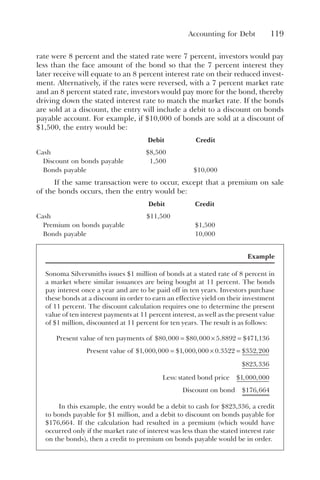
approach for cash concentration, but it may not be the most cost-effective.
If a company has relatively few subsidiaries with low account balances,
then creating a central treasury staff to manage the cash may add more
overhead than will be offset by increased interest income or reduced interest
expense.
POOLING CONCEPTS
Cash concentration requires that a company create a cash pool. This com-
prises a cluster of subsidiary bank accounts and a concentration account.
Funds physically flow from the subsidiary accounts into the concentration
account under a physical sweeping method. Alternatively, cash balances in the
subsidiary accounts can be concentrated in the master account only within
the bank’s records, with the cash remaining in the subsidiary accounts. This
later method is called notional pooling.
If a pooling arrangement includes accounts located in more than one
country, this is known as a cross-border cash pool. A company may elect to pool
cash within the home country of each currency (e.g., U.S. dollars are pooled
in the United States), which is known as the single-currency-center model. If
a company pools all of its foreign currency accounts in a single location, this
is a multicurrency-center arrangement. Multicurrency centers are generally
easier to manage, but transactions are more expensive than under the sin-
gle-currency-center model.
PHYSICAL SWEEPING
When a company sets up a zero-balance account, its bank automatically moves
cash from that account into a concentration account, usually within the same
bank. The cash balance in the zero-balance account (as the name implies)
is reduced to zero whenever a sweep occurs. If the account has a debit
balance at the time of the sweep, then money is shifted from the concentra-
tion account back into the account having the debit balance. An example is
shown in Exhibit 4.2.
In the example, two of three subsidiary accounts initially contain credit
(positive) balances, and Account C contains a debit (negative) balance. In
the first stage of the sweep transaction, the cash in the two accounts having
credit balances are swept into the concentration account. In the next stage
of the sweep, sufficient funds are transferred from the concentration account
Physical Sweeping 71
Exhibit 4.2 Zero-Balance Sweep Transaction
Concentration
Account
$0 Initial Balance
Local Bank
Account B
$25,000 Balance
Local Bank
Account A
$10,000 Balance
Local Bank
Account C
–$5,000 Balance
1. Balances before sweep
Concentration
Account
$35,000 Balance
Local Bank
Account B
$0 Balance
Local Bank
Account A
$0 Balance
Local Bank
Account C
–$5,000 Balance
2. Move credit balances to
concentration account
Concentration
Account
$30,000 Balance
Local Bank
Account B
$0 Balance
Local Bank
Account A
$0 Balance
Local Bank
Account C
$0 Balance
3. Move funds to local account
to clear debit balance
to offset the debit balance in Account C. At the end of the sweep, then, there
are no credit or debit balances in the zero-balance accounts.
It is also possible to use constant balancing to maintain a predetermined
minimum balance in a subsidiary account, which involves sweeping only
those cash levels above the minimum balance, and reverse sweeping cash
into the subsidiary account if the balance drops below the minimum balance.
72 Cash Concentration
Daily sweeping may not be necessary outside of a company’s desig-
nated core currencies. This is especially likely when noncore currency
account balances are relatively low. If so, it may be more cost-effective to
sweep them less frequently, or to implement trigger balances. A trigger
balance is an account balance level above which excess funds are swept out
of the account.
Some concentration banks can also monitor a company’s account bal-
ances at third-party banks using SWIFT (Society for Worldwide Interbank
Financial Telecommunication) messages, and create transfer requests to
move excess cash to the concentration bank. The key point with account
sweeping is to fully automate it—the effort involved in manually tracking
account balances and shifting funds on a daily basis is not only expensive,
but also likely to cause errors.
In most sweeping transactions, the sweeps occur on an intraday basis,
which means that balances are transferred to the concentration account
before the end of the day. Consequently, some cash may be left behind in
subsidiary accounts, rather than being centralized. This occurs when cash
arrives in an account after execution of the daily sweep. The cash will remain
in the subsidiary account overnight and be included in the following day’s
sweep. If a bank can accomplish true end-of-day sweeps, then no cash will be
left behind in local accounts. If a company is not dealing with such a bank,
then a proactive approach to depositing checks before cutoff times is the
best way to avoid unused cash.
There may be a need to track the amounts of cash swept from each
zero-balance account into the concentration account; if so, the company
records an intercompany loan from the subsidiary to the corporate parent
in the amount of the cash transferred through the cash concentration
process. There are several reasons for doing so:
• Subsidiary-level financial reporting requirements. A subsidiary may have
an outstanding loan, for which a bank requires the periodic produc-
tion of a balance sheet. Since account sweeping shifts cash away from
a subsidiary’s balance sheet, detailed sweep tracking is needed to
put the cash back on the subsidiary’s balance sheet for reporting
purposes. This can be done by recording an intercompany loan
from the subsidiary to the corporate parent in exchange for any
swept cash, which can then be reversed to place the cash back on
the subsidiary’s balance sheet.
• Interest income allocation. A company may elect to allocate the interest
earned at the concentration account level back to the subsidiaries
whose accounts contributed cash to the concentration account. Some
countries require that this interest allocation be done to keep a
company from locating the concentration account in a low-tax juris-
diction, where the tax on interest income is minimized. Thus, the
Notional Pooling 73
amounts of cash swept into and out of a subsidiary account must be
tracked in order to properly allocate the correct proportion of inter-
est income to that account.
• Interest expense allocation. Some tax jurisdictions may require the
parent company to record interest expense on intercompany loans
associated with the transfer of cash in a physical sweeping arrange-
ment. If so, the company must track the intercompany loan balances
outstanding per day, which is then used as the principal for the
calculation of interest expense. The interest rate used for these
calculations should be the market rate; any other rate can be con-
strued by local tax authorities to be transfer pricing designed to shift
income into low-tax regions.
• Central bank reporting. Some central banks require that they be sent
reports on transfers between resident and nonresident accounts.
This may be handled by the company’s bank but can still increase
the administrative burden associated with the sweep.
Some banks have the capability to track the amount of balance sweeps
from each subsidiary account on an ongoing basis, which a company can
use as its record of intercompany loans.
NOTIONAL POOLING
Notional pooling is a mechanism for calculating interest on the combined
credit and debit balances of accounts that a corporate parent chooses to
cluster together without actually transferring any funds. This approach
allows each subsidiary company to take advantage of a single, centralized
liquidity position, while still retaining daily cash management privileges.
Also, since it avoids the use of cash transfers to a central pooling account,
there is no need to create or monitor intercompany loans, nor are there any
bank fees related to cash transfers (since there are no transfers). In addition,
it largely eliminates the need to arrange overdraft lines with local banks.
Further, interest earnings tend to be higher than if investments were made
separately for the smaller individual accounts. Also, it offers a solution for
partially owned subsidiaries whose other owners may balk at the prospect
of physically transferring funds to an account controlled by another entity.
And finally, the use of notional pooling is not a long-term commitment; on
the contrary, it is relatively easy to back out of the arrangement.
Where global notional pooling is offered (usually where all participat-
ing accounts are held within a single bank), the pool offsets credit and debit
balances on a multicurrency basis without the need to engage in any foreign
exchange transactions. An additional benefit of global notional pooling lies
in the area of intercompany cash flows; for example, if there are charges
74 Cash Concentration
for administrative services, the transaction can be accomplished with no net
movement of cash.
Once a company earns interest on the funds in a notional account,
interest income is usually allocated back to each of the accounts making
up the pool. For tax management reasons, it may be useful for the cor-
porate parent to charge the subsidiaries participating in the pool for
some cash concentration administration expenses related to management
of the pool. This scenario works best if the corporate subsidiaries are
located in high-tax regions, where reduced reportable income will result
in reduced taxes.
The main downside of notional pooling is that it is not allowed in some
countries, especially in portions of Africa, Asia, and Latin America (though
it is very common in Europe). In these excluded areas, physical cash sweep-
ing is the most common alternative. Also, the precise form of the notional
pooling arrangement will vary according to local laws, so that some countries
allow cross-border pooling, while others do not.
In addition to the prohibition against notional pooling in some coun-
tries, it is difficult to find anything but a large multinational bank that offers
cross-currency notional pooling. Instead, it is most common to have a sepa-
rate notional cash pool for each currency area.
COMPARISON OF ACCOUNT SWEEPING AND
NOTIONAL POOLING
Where there is a choice between account sweeping and notional pooling,
notional pooling is usually the better alternative. Under notional pooling,
cash does not physically leave the bank accounts of each subsidiary, which
greatly reduces the amount of intercompany loans that would otherwise
have to be recorded. This eliminates the treasury overhead cost that would
otherwise be associated with tracking and recording the intercompany loans.
Similarly, if the parent company allocates interest earned to its various
subsidiaries based on their cash balances, this requires significant accounting
resources to calculate the interest income allocation based on intercompany
loans and deposits. In multicurrency situations, this also involves revaluing
the interest income into different currencies. However, in a notional pooling
environment, the bank may be able to automate the calculation of interest,
with a physical transfer of funds at month-end to pay out the interest income
to each subsidiary.
Also, if the intent is to pool funds denominated in multiple currencies,
account sweeps require the use of foreign exchange transactions and pos-
sibly hedging. Notional pooling eliminates these activities, since funds are
not shifted from one currency to another.
When account sweeping moves cash from one entity to another, this
can have adverse tax consequences in some countries. Conversely, because
Bank Overlay Structure 75
notional pooling requires no physical transfer of funds between legal enti-
ties, no tax problems are triggered.
Notional pooling is more likely to be supported by the managers of
local subsidiaries, since it means that they retain control over their cash
balances. Indeed, they may not even realize that a notional pooling arrange-
ment has been created!
However, a major disadvantage of notional pooling is that it is
illegal in some countries. Thus, notional pooling should be taken advan-
tage of where it is offered. When not available, physical sweeping is a
very acceptable alternative to conducting no cash concentration activities
at all.
NONPOOLING SITUATIONS
A company may need to use a local bank that cannot be linked into its cor-
porate account sweeping or notional pooling structures. If so, the company’s
account balances within that bank must be managed manually. A key focus
of this activity is to prevent overdrafts, since their cost usually greatly exceeds
the interest income to be earned on the same account; thus, it is cost-
effective to maintain excess balances in such accounts, rather than incurring
overdraft fees.
If there are to be cash transfers out of such accounts, they tend to be
infrequent, since the parent company will prefer to maintain excess cash
balances in order to avoid overdrafts, and so will only siphon off cash when
there is a clear excess balance. Also, because account management is manual,
it is more cost-effective from a labor perspective to limit the number of
transfers into or out of these accounts.
BANK OVERLAY STRUCTURE
Companies operating on an international scale frequently have trouble
reconciling the need for efficient cash concentration operations with the use
of local banking partners with whom they may have long-standing relation-
ships and valuable business contacts. The solution is the bank overlay
structure.
A bank overlay structure consists of two layers. The lower layer is com-
prised of all in-country banks that are used for local cash transaction require-
ments. The higher layer is a group of networked regional banks, or even a
single global bank, that maintains a separate bank account for each country
or legal entity of the corporate structure. Cash balances in the lower layer
of banks are zero-balanced into the corresponding accounts in the higher
layer of banks on a daily basis (where possible, subject to cash flow restric-
tions). These sweeps are accomplished either with manual transfers, SWIFT
76 Cash Concentration
messages from the networked banks to the local banks, or with standing
authorizations to the local banks. The concept is shown in Exhibit 4.3. This
approach allows funds to be consolidated on either a regional or global basis
for centralized cash management.
CASH CONCENTRATION CONTROLS
There is a strong argument that having a physical sweep cash concentration
system in place is a control, since it pushes all cash balances into a single
location for easier monitoring. Otherwise, the treasury staff would be faced
with a large jumble of accounts, over which it might exercise little control.
Exhibit 4.3 Multicountry Physical Sweeping with Bank Overlay Structure
Local Bank
Account,
Country A
Local Bank
Account,
Country B
Local Bank
Account,
Country C
Network Bank,
Country A
Overlay Account
Network Bank,
Country B
Overlay Account
Network Bank,
Country C
Overlay Account
Corporate HQ
Home Country
Consolidation
Account
Within Country A Within Country B Within Country C
SWIFT Messages Manual Transfers Standing Authorizations
Automated Sweeps
Cash Concentration Controls 77
Nonetheless, the following controls can improve on the inherent control of
a physical sweep system:
• Review target balances. If a subsidiary account is allowed a target cash
balance, then periodically review account usage to see if the target
balance is appropriate.
• Review excluded accounts. Some subsidiary accounts may have been
excluded from the sweep on the grounds that there are local cur-
rency restrictions, or that minimal transaction activity does not
justify a periodic sweep. These factors may change over time, so
schedule an annual analysis of excluded accounts.
• Compare intercompany loan rates to market rates. If the company uses
nonmarket interest rates when calculating intercompany charges, it
may run afoul of transfer pricing rules in some tax jurisdictions.
Thus, create a tracking procedure to periodically compare market
rates to the intercompany loan rates.
• Verify the allocation of interest income to subsidiaries. Depending on the
circumstances, it may be necessary to allocate interest earned back
to the subsidiaries. If so, verify that the calculation is consistently
applied across all subsidiaries.
• Verify the calculation of intercompany loan balances. A company using
physical sweeping may need to record intercompany loan balances
to reflect the shifts in cash to the corporate consolidation account.
If so, have the internal audit staff periodically verify the calculation
of these balances. This review can impact the amount of interest
expense or income allocated to subsidiaries.
A notional pooling system does not create an inherent control over
physical cash balances, as was the case with a physical sweep, since cash is
still sitting in what may be a large number of accounts in multiple locations.
Thus, all controls normally exercised over a bank account would be in effect
in this situation. The primary change with notional pooling is the presence
of interest income distributions back to the originating bank accounts. This
calls for a repetition of a preceding control, which is:
• Verify the allocation of interest income to subsidiaries. Depending on the
circumstances, it may be necessary to allocate interest earned back
to the subsidiaries. If so, verify that the calculation is consistently
applied across all subsidiaries.
The receipt and disbursement of cash involve intricate controls, which
are beyond the scope of this book. For detailed cash controls, refer to the
author’s Accounting Control Best Practices, 2nd edition (Wiley, 2009). The
controls noted here were specific just to the cash concentration function.
78 Cash Concentration
CASH CONCENTRATION POLICIES
There is one key policy required for cash concentration, which is one that
places responsibility for cash concentration on a specific group within the
company. Otherwise, it can be extremely difficult to exert central control
over far-flung accounts that are normally under the control of the managers
of local subsidiaries. The policy follows:
• All cash concentration activities shall be managed by the corporate treasury
department. This can be a surprisingly important policy in a larger
firm where divisional managers may attempt to retain control over
their bank accounts. The policy clearly places responsibility for cash
concentration in the hands of the corporate treasury department.
Of course, a deliberate decentralization policy could revise the preced-
ing policy to state that cash concentration activities are limited to a lower
level within the company, such as at the division level.
It is also possible, though not necessary, to state the company’s cash
concentration strategy with a policy statement. Doing so certainly clarifies
the company’s direction in this area, but also requires a subsequent policy
change if the treasurer wants to turn in a different direction. Strategies for
both small and large companies are noted in the following two policies:
1. Small-company policy. The company shall engage in cash concentra-
tion with a “physical sweeping” strategy. All subsidiary accounts
shall be designated as zero-balance, and shall sweep into a concen-
tration account, which in turn shall also be used as a central dis-
bursement account. The treasurer may exclude accounts from this
strategy if sweeping is not cost-effective. This policy works well for
smaller entities using a single currency, in locations where notional
pooling is not available.
2. Large-company policy. The company shall engage in cash concentra-
tion with a “cross-currency notional pooling” strategy. All subsidiar-
ies are restricted to accounts with a bank designated by the treasurer.
In areas where notional pooling is not available, the treasurer may
opt for physical sweeping, or no sweeping if it is not cost-effective.
This policy assumes that notional pooling will be organized under
a single global bank, and provides for the inevitable exceptions that
will arise in some jurisdictions.
It is not necessary at the policy level to define any greater level of detail
regarding cash concentration, such as the allowable methods of cash transfer
for physical sweeping—these are tactical issues over which the treasury staff
should have discretion.
Cash Concentration Procedures 79
CASH CONCENTRATION PROCEDURES
Once a cash concentration system is set up, the system should be fully auto-
mated, with cash balances either shifting to a concentration account with
physical sweeping or appearing in a notional account with a notional pooling
arrangement. Thus, there is no need for a procedure to conduct the cash
concentration. However, procedures are needed to track intercompany loans
and related interest expense allocations (if physical sweeping is used), as
well as to allocate interest income back to the subsidiaries. These procedures
are noted in Exhibits 4.4 and 4.5.
Exhibit 4.4 Intercompany Loan Tracking Procedure
Procedure Statement Retrieval No.: TREASURY-02
Subject: Tracking of Intercompany Loans and Allocation of Related Interest
Expense Caused by Physical Sweeping
1. PURPOSE AND SCOPE
This procedure is used by the treasury staff to determine the amount of
intercompany loans caused by the sweeping of cash from subsidiary accounts
into the corporate cash concentration account, as well as the amount of inter-
nal interest charges related to these loans.
2. PROCEDURES
2.1 Record Intercompany Loans (Treasury Staff)
1. At the end of each month, access the company’s bank statements
and calculate the amount of intercompany loans outstanding from
each subsidiary to the corporate entity that was caused by physical
sweeps into the corporate cash concentration account. Add to this
amount the balance of any intercompany loans that were outstand-
ing at the beginning of the month.
2. Subtract from the revised intercompany loan balances the amount
of any expenditures related to each subsidiary for disbursements
from the corporate shared services centers for payroll and
disbursements.
3. Subtract from the remaining intercompany loan balances the
amount of any cash flows from corporate to the subsidiaries for
other purposes, such as debit balance replenishment.
4. Calculate the incremental change in intercompany loan balances,
and create a journal entry to reflect the change. If there is an
increase in a subsidiary’s loan to corporate, then this is a debit to
their notes receivable account and a credit to corporate loans
payable. If there is a decrease in a subsidiary’s loan to corporate,
then this entry is reversed.
80 Cash Concentration
5. Also calculate the average loan balance outstanding during the
month, which is calculated [on a daily basis / by adding the beginning
and ending balances and dividing by two], which shall be used for sub-
sequent allocations of interest income or expense.
6. Retain a copy of the calculations for use during the next month’s
calculations.
7. Forward the intercompany loan calculations to the treasurer for
approval.
8. Forward the approved calculations and journal entry to the general
ledger accountant for entry into the accounting system.
2.2 Allocate Interest Expense (Treasury Staff)
1. Determine the market interest rate on debt, which is the monthly
interest rate charged to the company on its primary line of credit.
2. Calculate the intercompany interest expense to be charged to cor-
porate for use of the subsidiary’s funds, and credited to the subsid-
iaries, based on the market interest rate multiplied by their average
intercompany loans outstanding during the month.
3. Create a journal entry to reflect the interest expense, which is a
debit to the corporate interest expense account, and a credit to the
subsidiary’s interest income accounts. If there is a net flow of cash
to a subsidiary, then this entry is reversed.
4. Retain a copy of the calculations.
5. Forward the interest expense calculations and journal entry to the
treasurer for approval.
6. Forward the approved calculation and journal entry to the general
ledger accountant for entry into the accounting system.
Exhibit 4.5 Interest Income Allocation from Cash Concentration Account
Procedure Statement Retrieval No.: TREASURY-03
Subject:CalculationandRecordingofInterestIncomefromCashConcentration
Account
1. PURPOSE AND SCOPE
This procedure is used by the treasury staff to calculate the interest
income earned from the investment of cash concentration activities, less
administrative charges.
2. PROCEDURES
2.1 Calculate Allocable Interest Income (Treasury Staff)
1. Summarize interest income earned for the month, as reported on
investment statements.
Summary 81
2. Record the interest income as corporate income, with a debit to cash
and credit to the interest income account. Have the entry approved
by the treasurer, and forward to the general ledger accountant for
entry into the accounting system.
3. Calculate the amount of administrative expense that is associated
with the administration of cash concentration and subsequent
investment activities. This should include bank pooling fees and
loaded labor expenses. Compare this expense to the amount for
previous months to establish the reasonableness of the amount.
4. Subtract the administrative expense from the total interest earned.
5. Allocate the remaining interest earned to the subsidiaries, based on
the proportional average amount of intercompany loans they had
outstanding to the parent company during the month. This is a
debit to the corporate interest income account, and a credit to the
interest income accounts of the subsidiaries.
6. Combine the interest allocation, administrative fee calculation, and
copies of investment statements into a package, and retain a copy
for backup purposes.
7. Forward the originals of the package to the treasurer for approval.
8. Forward the approved package to the general ledger accountant for
entry into the accounting system.
SUMMARY
A company must determine if it makes sense to engage in cash concentration
activities. For it to be cost-effective, the company should have large, ongoing
balances in multiple accounts that are not being efficiently invested. Further,
the incremental reduction in overdraft fees and increase in interest income
should outweigh the incremental increase in pooling fees and administrative
costs. There is also the intangible factor of whether the managers of local
subsidiaries will accept corporate-level interference in their bank accounts.
If this analysis is favorable, then a company should engage in cash concen-
tration activities. While notional pooling is theoretically to be preferred over
physical sweeping, either method is significantly better than having no
pooling at all. Also, manual sweeping is not recommended; it involves a
large volume of manually initiated transactions to transfer funds between
accounts.The level of automation associated with these services mandates
the use of a large bank with a broad range of automated services; a small
local bank simply cannot assist a multilocation company with a cash concen-
tration strategy.
Working Capital Management
5
When a company requires additional funding, the treasurer usually turns to
either debt or an equity issuance. However, if the cost of these traditional
funding sources is too high, the treasurer should take a hard look at unlock-
ing cash that is trapped in working capital. While working capital manage-
ment calls for a considerable amount of tactical work on an ongoing basis,
it can be a rewarding exercise if the result is a significant source of cash.
The following example shows how much cash can potentially be extracted
from a company’s working capital.
The following sections note how working capital tends to vary with
changes in corporate sales volume, and then describe the key management
aspects of each component of working capital that can impact the level of
funds invested in working capital.
WORKING CAPITAL VARIABILITY
Working capital is defined as a company’s current assets minus its current
liabilities. While there are a number of minor asset and liability categories
that can be included in this definition, the primary components of working
capital are cash, accounts receivable, inventory, and accounts payable. All
of these components tend to vary in proportion to the level of sales, but not
at the same time. For example, if a company experiences high seasonal sales
in its fourth quarter, then inventories and accounts payable will likely rise
in advance of the prime selling season, while accounts receivable will increase
during the fourth quarter and remain high through the early part of the
first quarter of the following year. Cash will decline before the key sales
season in order to pay for inventories, and will increase as receivables are
collected, so that cash levels are maximized after the prime selling season
is over. If a company is not profitable, the cash levels will not recover at the
end of the prime selling season, but will instead remain low.
83
84 Working Capital Management
That example assumes that there is a sales peak during one part of a
year, so that there is a natural ebb and flow to the amount of working capital
needed. In that scenario, the treasurer can obtain a line of credit from a
local bank, which should be sufficient to handle seasonal cash needs, and
which can reliably be paid off once the peak period ends.
An alternative scenario is when a company’s sales continue to increase
over time, which occurs in an expanding market or as a company acquires
market share from other entities. In this case, both inventory and receivable
levels continually increase, while the corresponding increase in accounts
payable will not be sufficient to hold down the overall level of working capital
investment. All available cash will be used to pay for working capital, so that
Example
Carstensz Corporation is conducting due diligence on its possible purchase of
the Hamilton Furniture Company. The acquisitions manager, Mr. Harrer, is
interested in the possibility of reducing the amount of Hamilton’s working
capital, which can then be used to pay down the purchase price. Mr. Harrer
uncovers the following information about Hamilton:
Balances
Days
Outstanding*
Industry
Standard
Variance Value of
Variance
Annual
revenues
$52,000,000 — — — —
Annual cost
of goods
26,000,000 — — — —
Annual
purchases
18,000,000 — — — —
Average
receivables
13,000,000 91 62 29 $4,143,000
Average
payables
2,250,000 45 45 0 0
Average
inventory
10,000,000 140 100 40 2,857,000
Total $7,000,000
The analysis shows that, if Carstensz were to buy Hamilton and reduce its
receivable and inventory balances down to their industry averages, this would
extract $7 million from working capital. Mr. Harrer is aware that the extended
receivables may be caused by longer-term payment agreements with key cus-
tomers, while it may take a considerable amount of time to reduce Hamilton’s
inventory levels, especially if it is comprised of slow-moving items. Nonetheless,
it appears that careful management may unlock a considerable amount of
cash.
*The formulas used in the table to calculate days outstanding are provided later in the
Working Capital Metrics section of this chapter.
Credit Management 85
the cash balance is essentially zero, and new funds are continually needed
as sales continue to increase. This is a demanding environment for the
treasurer, who must look for long-term loans or equity infusions to help pay
for the additional working capital.
A final scenario is when a company’s sales are declining. As inventories
are sold off and receivables are collected, cash may increase substantially,
since there is less ongoing working capital to fund. This is the easiest sce-
nario for the treasurer to deal with, since it is the only case where working
capital becomes a net source of cash, which can then be applied to other
company requirements.
The treasurer should also be aware of unusually high proportions of
any one component of working capital, since this may be caused by improper
management practices. For example, if the investment in inventory is usually
high, this may correspond to an ongoing practice of purchasing in bulk in
order to save per-unit costs. Similarly, a very high receivables balance may
be caused by the use of special deals to boost sales over the short term or
because revenues are being accrued but have not yet been billed. In such
cases, the expanded working capital level is not related to sales, but rather
to company policy. If funding sources are in short supply, the treasurer may
be able to lobby for a policy change that eliminates the need for more cash.
The following five sections describe the various management practices
that cause changes in working capital, and note actions the treasurer may
take to control or at least monitor them.
CASH MANAGEMENT
Cash is a key component of working capital, and is thoroughly covered in
Chapter 4. That chapter reveals how to concentrate cash through various
pooling methods, so that the balances scattered in a multitude of bank
accounts can be centrally marshaled for use by the treasurer.
CREDIT MANAGEMENT
There are no receivables unless a company elects to extend credit to its
customers through a credit policy. Thus, proper credit management is key
to the amount of funds that a company must invest in its accounts
receivable.
A loose credit policy is common in companies having a certain mix of
characteristics. For example, they may have high product margins, such as
in the software industry, and so have little to lose if a customer defaults on
payment. Also, they may be intent on gaining market share, and so will
“buy” sales with a loose credit policy, which essentially means they give
liberal credit to everyone. Another variation is that a company may be
86 Working Capital Management
eliminating a product line or exiting an industry, and so is willing to take
some losses on credit defaults in exchange for selling off its inventory as
expeditiously as possible. In all of these cases, a company has a specific
reason for extending an inordinate amount of credit, even though it knows
there will be above-average credit defaults.
A tight credit policy is common in the reverse circumstances; product
margins are small, or the industry is an old one with little room to gain
market share. Also, a recessionary environment may require a firm to restrict
its credit policy, on the assumption that customers will have less money
available to make timely payments.
Any change in a company’s credit policy can have a profound effect
on the funding requirements that a treasurer must deal with. For example,
if a $48 million (revenues) company has receivables with an average age of
30 days, and its wants to enact a looser credit policy that will increase the
average receivable days to 45 days, then the company’s investment in receiv-
ables is going to increase by 50 percent, from $4 million to $6 million.
Consequently, the treasurer must be prepared to find $2 million to fund
this increase in working capital.
In many companies, the treasurer has direct control over the credit
policy and, indeed, over the entire credit granting function. This is a wise
placement of responsibility, since the treasurer can now see both sides of
the credit policy—both the resulting change in sales and the offsetting
change in required working capital funds.
The treasurer can set up a considerable number of credit controls
to reduce the probability of default by customers. Here are some
possibilities:
• Issue credit based on credit scoring. There are several credit-monitoring
services, such as Experian and Dun & Bradstreet, which provide
online credit scores on most larger businesses. The treasury staff can
create a credit-granting model that is based on a mix of the credit
scores of these services, the company’s history with each customer,
and the amount of credit requested.
• Alter payment terms. If a customer requests an inordinate amount of
credit, it may be possible to alter the payment terms to accommo-
date the customer while still reducing the level of credit risk. For
example, one-half of a sale can be made with 15-day payment terms,
with the remainder of the order to be shipped upon receipt of
payment for the first half of the order. This results in payment of
the total order in 30 days, but with half the risk.
• Offer financing by a third party. If the treasury department is unwilling
to extend credit, then perhaps a third party is willing to do so. This
can be a leasing company or perhaps even a distributor with a loose
credit policy.
Receivables Management 87
• Require guarantees. There is a variety of possible payment guarantees
that can be extracted from a customer, such as a personal guarantee
by an owner, a guarantee by a corporate parent, or a letter of credit
from a bank.
• Perfect a security interest in goods sold. It may be possible to create a
security agreement with a customer in which the goods being sold
are listed, which the company then files in the jurisdiction where
the goods reside. This gives the company a senior position ahead
of general creditors in the event of default by the customer.
• Obtain credit insurance. Credit insurance is a guarantee by a third
party against nonpayment by a customer. It can be used for both
domestic and international receivables. The cost of credit insurance
can exceed one-half percent of the invoiced amount, with higher
costs for riskier customers and substantially lower rates for custom-
ers who are considered to be in excellent financial condition.
• Require a credit reexamination upon an initiating event. The treasury
staff should review customer credit at regular intervals to see if
they still deserve existing credit limits. These reviews can be trig-
gered when the current credit limit is exceeded, if a customer places
an order after a long interval of inactivity, if there is an unjustified
late payment, or if a customer stops taking early payment
discounts.
An active treasury staff that manages the credit function can use the
preceding list of credit practices to retain the appropriate level of control
over accounts receivable and the corresponding amount of working capital
funding.
RECEIVABLES MANAGEMENT
Once credit has been granted to a customer, responsibility for billing and
collecting from the customer usually passes to the accounting department.
The ability of the accounting staff to reliably invoice and collect in a timely
manner has a major impact on the amount of working capital invested in
accounts receivable. The treasurer does not have direct control over these
functions but should be aware of the following factors, which can seriously
extend customer payment intervals unless carefully managed:
• Invoicing delay. Invoices should be issued immediately after the
related goods or services have been provided. If the accounting staff
is billing only at stated intervals, then receivables are being extended
just because of an internal accounting work policy.
88 Working Capital Management
• Invoicing errors. If invoices are being continually reissued due to
errors, then additional controls are needed to increase the accuracy
of initial invoices. This can be a serious issue, since invoicing errors
are usually found by the customer, which may be several weeks after
they were originally issued.
• Invoice transmission. There is a multiday mailing delay when invoices
are delivered through the postal service. Instead, the accounting
system should be configured to issue invoices by email or electronic
data interchange, or the accounting staff should manually email
invoices.
• Lockbox receipt. If checks are received at the company location and
then sent to the bank, this creates a delay of potentially several days
before the checks are processed internally, deposited, and then clear
the bank. Instead, customers should send all checks to a lockbox, so
that checks are deposited in the minimum amount of time, thereby
increasing the availability of funds.
• Collection management. There should be a well-trained collection staff
that assigns responsibility for specific accounts, focuses on the largest
overdue account balances first, begins talking to customers imme-
diately after payment due dates are reached, and is supported by
collection software systems. The group should use a broad array of
collection techniques, including dunning letters, on-site visits, attor-
ney letters, payment commitment letters, credit holds, and collec-
tion agencies.
• Internal error follow-up. If payments are being delayed due to service
problems by the company or product flaws, the collection staff
should have a tracking system in place that stores the details of these
problems, and the accounting manager should follow up with man-
agers elsewhere in the company to have them resolved.
The treasurer can periodically inquire of the controller if these collec-
tion issues are being managed properly. Another approach is to obtain an
accounts receivable aging report and determine the reasons why overdue
receivables have not yet been paid. At a minimum, the treasurer should track
the days receivables outstanding on a timeline, and follow up with the con-
troller or chief financial officer if the metric increases over time.
INVENTORY MANAGEMENT
Of all the components of working capital, inventory management is the most
critical because it is the least liquid and therefore tends to be a cash trap.
Once funds have been spent on inventory, the time period required to
Inventory Management 89
convert it back into cash can be quite long, so it is extremely important to
invest in the smallest possible amount of inventory.
Responsibility for inventory resides with the materials management
department, which controls purchasing, manufacturing planning, and ware-
housing. None of these areas are ones over which the treasurer traditionally
exercises control. Nonetheless, the treasurer should be aware of activities
related to inventory management, because they can have a profound impact
on the level of funding needed for working capital. The following topics
address a number of areas in which inventory decisions impact funding.
Inventory Purchasing
When the purchasing department orders inventory from suppliers, it asks
them for the lead time they need to deliver orders and then creates a safety
stock level to at least match the lead time. For example, if a supplier says
that it needs two weeks to deliver goods, and the company uses $100,000
of its inventory per week, then the purchasing department creates a safety
stock level of at least $200,000 to keep the company running while it waits
for the next delivery. This lead time therefore requires $200,000 of funding.
The treasurer should be aware that extremely distant foreign sourcing, such
as to Asia, will drastically lengthen lead times and therefore the amount of
safety stock. Conversely, if a company can source its inventory needs from
suppliers located very close to the company and work with them to reduce
their lead times and increase the frequency of their deliveries, this results
in lowered safety stock and therefore a reduced need for funding.
Another contributor to long lead times is the manual processing of
purchase orders to suppliers. If inventory needs are calculated by hand, then
transferred to a purchase order, manually approved, and delivered by mail,
then a company must retain more safety stock to cover for this additional
delay. Conversely, if a company can install a material requirements planning
system that automatically calculates inventory needs, creates purchase orders,
and transmits them to suppliers electronically, then the ordering cycle is
significantly reduced and corresponding lead times can be shortened.
The purchasing department orders inventory based on its estimates of
what customers are going to buy. No matter how sophisticated, these esti-
mates are bound to be incorrect to some extent, resulting in the purchase
of excess inventory. To reduce this forecasting error, a company should
attempt to gain direct access to the inventory planning systems of key customers.
This gives the purchasing staff perfect information about what it, in turn,
needs to order from its suppliers, and thereby reduces excess inventory
levels.
It may also be possible to shift raw material ownership to suppliers so that
they own the inventory located on the company’s premises. Suppliers may
agree to this scenario if the company sole-sources purchases from them.
Under this arrangement, the company pays suppliers when it removes
90 Working Capital Management
inventory from its warehouse, to either sell it or incorporate it into the
manufacture of other goods. The resulting payment delay reduces the need
for funding.
All of the preceding changes in purchasing practices can reduce a
company’s investment in inventory. Conversely, a purchasing practice that
contributes to startling increases in funding requirements is the bulk purchase
of inventory. If the purchasing staff is offered quantity discounts in exchange
for large orders, they will be tempted to proclaim large per-unit cost reduc-
tions, not realizing that this calls for much more up-front cash and a con-
siderable storage cost and risk of obsolescence.
Inventory Receiving
The receiving staff ’s procedures can have an impact on inventory-related
funding. For example, a supplier may ship goods without an authorizing
purchase order from the company. If the receiving staff accepts the delivery,
then the company is obligated to pay for it. A better practice is to reject all
inbound deliveries that do not have a purchase order authorization.
Another procedural issue is to require the immediate entry of all receiving
information into the company’s warehouse management system. If this is not
done, the risk increases that the receipt will never be recorded due to lost
or misplaced paperwork. The purchasing staff will see that the inventory
never arrived and may order additional goods to compensate—which
requires more funding. Similarly, a procedure should call for the immediate
put-away of inventory items following their receipt, on the grounds that they
can become lost in the staging area.
Inventory Storage
In a traditional system, inventory arrives from suppliers, is stored in the
company warehouse, and is shipped when ordered by customers. The
company is funding the inventory for as long as it sits in the warehouse
waiting for a customer order. A better method is to avoid the warehouse
entirely by using drop shipping. Under this system, a company receives an
order from a customer and contacts its supplier with the shipping informa-
tion, who in turn ships the product directly to the customer. This is a some-
what cumbersome process and may result in longer delivery times, but it
completely eliminates the company’s investment in inventory and therefore
all associated funding needs. This option is available only to inventory
resellers.
Another option that severely reduces the amount of inventory reten-
tion time is cross-docking. Under cross-docking, when an item arrives at the
receiving dock, it is immediately moved to a shipping dock for delivery to
the customer in a different truck. There is no put-away or picking transac-
tion, and no long-term storage, which also reduces the risk of damage to
the inventory. Cross-docking only works when there is excellent control over
Inventory Management 91
the timing of in-bound deliveries, so the warehouse management system
knows when items will arrive. It also requires multiple extra loading docks,
since trailers may have to be kept on-site longer than normal while loads
are accumulated from several inbound deliveries.
Production Issues Impacting Inventory
The production process is driven by several procedural, policy, and setup
issues that strongly impact the amount of inventory and therefore the level
of funding.
The traditional manufacturing system is geared toward very long pro-
duction runs, on the justification that this results in the spreading of fixed
costs over a large number of units, which yields the lowest possible cost per
unit. The logic is flawed, because such large production runs also yield too
much inventory, which then sits in stock and runs the significant risk of
obsolescence. To reduce the funding requirement of this excess inventory,
a company should produce to demand, which is exemplified by the just-in-
time (JIT) manufacturing system. A JIT system triggers an authorization to
produce only if an order is received from a customer, so there is never any
excess inventory on hand. Though a JIT system initially appears to generate
higher per-unit costs, the eliminated carrying cost of inventory makes it
considerably less expensive. And, from the treasurer’s perspective, a JIT
system can release a great deal of cash from inventory.
Another production issue is to avoid volume-based incentive pay systems.
Some companies pay their employees more if they produce more. Not only
does this result in extremely high levels of inventory, but these pay systems
tend to yield lower-quality goods, since employees favor higher volume over
higher quality. A reasonable alternative is an incentive to exactly meet the
production plan. If the plan is derived from a JIT system, then employees
are producing only to match existing customer orders, which keep funding
requirements low.
A related issue is the use of complex, high-capacity machinery.
Industrial engineers enjoy these machines because they feature impressively
high throughput rates. However, they also require immense production
volumes in order to justify their initial and ongoing maintenance costs,
which once again results in the accumulation of too much inventory. Instead,
the treasurer should favor the acquisition of smaller, simpler machines having
lower maintenance costs. Such machines can be operated profitably with very
small production runs, thereby making it easier to drive down inventory
levels.
A simple method for reducing work-in-process inventory is to use
smaller container sizes. Typically, an employee at a workstation fills a container
and then moves it to the next downstream workstation. If the container is
a large one, and if there are many workstations using the same size con-
tainer, then a great deal of work-in-process inventory is being unnecessarily
92 Working Capital Management
accumulated. By shifting to a smaller container size, the inventory invest-
ment is reduced, as is the amount of scrap—because the downstream work-
station operator is more likely to spot faults originating in an upstream
location more quickly if containers are delivered more frequently.
When a machine requires a substantial amount of time to be switched
over to a new configuration for the production of a different part, there is
a natural tendency to have very long production runs of the same part in
order to spread the cost of the changeover across as many parts as possible.
This practice results in too much inventory, so the solution is to reduce
machine setup times to such an extent that it becomes practicable to have
production runs of as little as one unit. Setup reduction can be accomplished
by using changeover consultants, process videotaping, quick-release fasten-
ers, color-coded parts, standardized tools, and so forth.
A common arrangement of machines on the shop floor is by functional
group, where machines of one type are clustered in one place. By doing so,
jobs requiring a specific type of processing can all be routed to the same
cluster of machines and loaded into whichever one becomes available for
processing next. However, by doing so, there tend to be large batches of
work-in-process inventory piling up behind each machine because this
approach calls for the completion of a job at one workstation before the
entire job is moved to the next workstation. A better layout is provided by
cellular manufacturing, where a small cluster of machines are set up in close
proximity to one another, each one performing a sequential task in complet-
ing a specific type or common set of products. Usually, only a few employees
work in each cell and walk a single part all the way through the cell before
moving on to the next part. By doing so, there is obviously only the most
minimal work-in-process inventory in the cell.
The Bill of Materials
A bill of materials is the record of the materials used to construct a product.
It is exceedingly worthwhile to examine the bills of material with the objec-
tive of reducing inventory. For example, a bill may contain an excess quan-
tity of a part. If so, and the underlying purchase order system automatically
places orders for parts, the bill will be used to order too many parts, thereby
increasing inventory levels. A periodic audit of all bills, where the reviewer
compares each bill to a disassembled product, will reveal such errors. For
the same reason, the estimated scrap listed in all bills of material should be
compared to actual scrap levels; if the estimated scrap level is too high, then
the bill will call for too much inventory to be ordered for the next produc-
tion run.
A significant bill of materials issue from the perspective of inventory
reduction is the substitution of parts. This may occur when the engineering
staff issues an engineering change order, specifying a reconfiguration of the
parts that form a product. Ideally, the materials management staff should
Inventory Management 93
draw down all remaining inventory stocks under the old bill of materials
before implementing the new change order. If this is not done, then the
company will have a remainder stock of raw materials inventory for which
there are no disposition plans.
Product Design
There are a number of design decisions that have a considerable impact on
the size of a company’s investment in inventory. A key factor is the number
of product options offered. If there are a multitude of options, then a company
may find it necessary to stock every variation on the product, which calls for
a substantial inventory investment. If, however, it is possible to limit the
number of options, then inventory volumes can be substantially reduced. A
similar issue is the number of products offered. If there is an enormous range
of product offerings, it is quite likely that only a small proportion of the
total generate a profit; the remainder requires large inventory holdings in
return for minimal sales volume.
Customer Service
A company may feel that its primary method of competition is to provide
excellent customer service, which requires it to never have a stockout condi-
tion for any inventory item. This may require an inordinate amount of
finished goods inventory. This policy should be reviewed regularly, with an
analysis of the inventory cost required to maintain such a high level of order
fulfillment.
Inventory Disposition
Even if a company has built up a large proportion of obsolete inventory,
continuing attention to an inventory disposition program can result in the
recovery of a substantial amount of cash. The first step in this program
is to create a materials review board, which is comprised of members of
the materials management, engineering, and accounting departments. This
group is responsible for determining which inventory items can be used
in-house and the most cost-effective type of disposition for those items
that cannot be used. This may involve sending inventory back to suppliers
for a restocking charge, sales to salvage contractors, sales as repair parts
through the service department, or even donating them to a nonprofit in
exchange for a tax credit. Throwing out inventory is frequently better than
keeping it, since retention requires the ongoing use of valuable warehouse
space.
Payables Management
The processing and payment policies of the accounts payable function can
have a resounding impact on the amount of funds invested in working
94 Working Capital Management
capital. Payables processing is managed by the accounting department, and
payment terms by the purchasing department. The treasurer does not have
control over either function but should be aware of the following issues that
can impact funding requirements.
Payment Terms
As part of its negotiations with suppliers, the purchasing staff may try to
extend payment terms. This is certainly an advantage for the treasurer, since
extended terms equate to free funding by suppliers. However, extended
terms may be at the cost of higher per-unit prices, which the controller may
not favor at all.
The reverse situation also arises, where suppliers negotiate for more
rapid payment terms. This is particularly common for large and powerful
suppliers that have near-monopoly control over their industries. It is also
common when a company’s financial condition is poor enough that suppli-
ers insist on short payment terms or even cash in advance. While the trea-
surer may not be able to mitigate such onerous terms, he or she should
certainly be made aware of them, so that the resulting decline in cash flows
from working capital can be properly planned for.
Payment Processing
The accounting department may pay suppliers only at stated intervals, such
as once a week. If so, an internal policy likely governs whether payments
that are not quite due will be covered in the current payment period or the
next one. This is of some importance, since paying anything prior to its due
date will shrink the funding normally made available through accounts
payable.
The accounting staff may also have a policy of taking all early payment
discounts. Such discounts normally equate to a significant rate of interest,
and so are highly favorable to the company and should be taken. Nonetheless,
paying a very large supplier invoice early in order to take advantage of a
discount may significantly impact the borrowing activities of the treasurer.
Consequently, there should be a system in place to notify the treasury staff
in advance of the amount and timing of unusually large discounts.
Intercompany Netting
If a company has multiple subsidiaries, it is possible that they do a significant
amount of business with each other. If so, there could be a substantial
volume of billings between them. The best way to deal with these intercom-
pany payments is to net them out through the accounting system so that
actual cash transfers are minimized. If each subsidiary uses a separate
accounting system, then intercompany netting can be quite a chore. However,
if they all operate under a single accounting system, then the software can
automatically handle this task.
Working Capital Metrics 95
Supply Chain Financing
Under supply chain financing, a company sends its approved payables list to
its bank, specifying the dates on which invoice payments are to be made. The
bank makes these payments on behalf of the company. However, in addition
to this basic payables function, the bank contacts the company’s suppliers
with an offer of early payment, in exchange for a financing charge for the
period until maturity. If a supplier agrees with this arrangement and signs a
receivables sale contract, then the bank delivers payment from its own funds
to the supplier, less its fee. Once the company’s payment dates are reached,
the bank removes the funds from the company’s account, transferring some
of the cash to those customers electing to be paid on the prearrangement
settlement date and transferring the remaining funds to its own account to
pay for those invoices that it paid early to suppliers at a discount.
This arrangement works very well for suppliers, since they may be in
need of early settlement. In addition, they receive a much higher percentage
of invoice face value than would be the case if they opted for a factoring
arrangement with a third party, where 80 percent of the invoice is typically
the maximum amount that will be advanced. The amount of the discount
offered by the bank may be quite small if the company is a large and well-
funded entity having excellent credit. Finally, the arrangement is usually
nonrecourse for the supplier, since the arrangement with the bank is struc-
tured as a receivables assignment.
The arrangement also works well for the bank, which has excellent
visibility into the company’s bank balances and cash flow history, and so
knows when it can offer such financing. Also, it obtains fees from the
company in exchange for disbursing funds on behalf of the company.
This is also a good deal for the company, whose suppliers now have
ready access to funds. Further, since the bank is contacting suppliers with
payment dates, they will no longer make inquiries of the company regarding
when they will be paid.
Supply chain financing is less useful when payment terms are relatively
short, since there is not much benefit for suppliers in being paid just a few
days early. However, it is an excellent tool when standard payment terms
are quite long.
Since supply chain financing is arranged with the company’s primary
bank, and the treasurer is in charge of banking relations, this is one payables
area in which the treasurer can provide a considerable amount of value to
the company and its suppliers.
WORKING CAPITAL METRICS
This section contains four metrics for working capital, which the treasurer
can use to form an opinion regarding the amount of receivables, inventory,
and payables that a company is maintaining. There is no right or wrong
96 Working Capital Management
result of these metrics, since they are tied to a company’s policies for grant-
ing credit, order fulfillment, and so on. Nonetheless, the treasurer should
track these metrics on a trend line to see if working capital levels are chang-
ing. The same trend line will reveal the results of the working capital
improvement tactics noted earlier in this chapter.
Average Receivable Collection Period
This measurement expresses the average number of days that accounts
receivable are outstanding. This format is particularly useful when it is com-
pared to the standard number of days of credit granted to customers. For
example, if the average collection period is 60 days and the standard days
of credit is 30, then customers are taking much too long to pay their
invoices. A sign of good performance is when the average receivable collec-
tion period is only a few days longer than the standard days of credit.
To calculate the average receivable collection period, divide annual
credit sales by 365 days, and divide the result into average accounts receiv-
able. The formula is as follows:
Average Accounts Receivable
Annual Sales 365
Example
The new controller of the Flexo Paneling Company, makers of modularized
office equipment, wants to determine the company’s accounts receivable col-
lection period. In the June accounting period, the beginning accounts receiv-
able balance was $318,000, and the ending balance was $383,000. Sales for
May and June totaled $625,000. Based on this information, the controller
calculates the average receivable collection period as follows:
Average Accounts Receivable
Annual Sales
Beginni
365
318 000
=
$ , n
ng Receivables Ending Receivables
+
( )
×
( )
$ ,
$ ,
383 000 2
625 000 6 36
65
350 500
10 273
=
$ ,
$ ,
Average Accounts Receivable
Sales per Day
y
Days
= 34 1
.
Note that the controller derived the annual sales figure used in the
denominator by multiplying the two-month sales period in May and June by
six. Since the company has a stated due date of 30 days after the billing date,
the 34.1 day collection period appears reasonable.
Working Capital Metrics 97
The main issue with this calculation is what figure to use for annual sales.
If the total sales for the year are used, this may result in a skewed measure-
ment, since the sales associated with the current outstanding accounts receiv-
able may be significantly higher or lower than the average level of sales
represented by the annual sales figure. This problem is especially common
when sales are highly seasonal. A better approach is to annualize the sales
figure for the period covered by the bulk of the existing accounts
receivable.
Inventory Turnover
Inventory is frequently the largest component of a company’s working
capital; in such situations, if inventory is not being used up by operations
at a reasonable pace, then a company has invested a large part of its cash
in an asset that may be difficult to liquidate in short order. Accordingly,
keeping close track of the rate of inventory turnover is a significant function
of management. There are several variations on the inventory turnover
measurement, which may be combined to yield the most complete turnover
reporting for management to peruse. In all cases, these measurements
should be tracked on a trend line in order to see if there are gradual reduc-
tions in the rate of turnover, which can indicate to management that cor-
rective action is required in order to eliminate excess inventory stocks.
The simplest turnover calculation is to divide the period-end inventory
into the annualized cost of sales. One can also use an average inventory figure
in the denominator, which avoids sudden changes in the inventory level
that are likely to occur on any specific period-end date. The formula is
as follows:
Cost of Goods Sold
Inventory
A variation on the preceding formula is to divide it into 365 days,
which yields the number of days of inventory on hand. This may be more
understandable to the layman; for example, 43 days of inventory is more
clear than 8.5 inventory turns, even though they represent the same situa-
tion. The formula is as follows:
365 ÷
Cost of Goods Sold
Inventory
The preceding two formulas use the entire cost of goods sold in the
numerator, which includes direct labor, direct materials, and overhead.
However, only direct materials costs directly relate to the level of raw materi-
als inventory. Consequently, a cleaner relationship is to compare the value
of direct materials expense to raw materials inventory, yielding a raw materi-
als turnover figure. This measurement can also be divided into 365 days in
98 Working Capital Management
order to yield the number of days of raw materials on hand. The formula
is as follows:
Direct Materials Expense
Raw Materials Inventory
The preceding formula does not yield as clean a relationship between
direct materials expense and work-in-process or finished goods, since these
two categories of inventory also include cost allocations for direct labor and
overhead. However, if these added costs can be stripped out of the work-in-
process and finished goods valuations, then there are reasonable grounds
for comparing them to the direct materials expense as a valid ratio.
Example
The Rotary Mower Company, maker of the only lawnmower driven by a
Wankel rotary engine, is going through its annual management review of
inventory. Its treasurer has the following information:
Balance Sheet Line Item Amount
Cost of goods sold $4,075,000
Direct materials expense 1,550,000
Raw materials inventory 388,000
Total inventory 815,000
To calculate total inventory turnover, the treasurer creates the following
calculation:
Cost of Goods Sold
Inventory
Cost of Goods Sold
=
$ , ,
$
4 075 000
81
15 000
5
, Inventory
Turns per Year
=
To determine the number of days of inventory on hand, the treasurer
divides the number of turns per year into 365 days, as follows:
365
365
4 075 000
÷
= ÷
Cost of Goods Sold
Inventory
Cost of Goo
$ , , d
ds
Inventory
Days of Inventory
$ ,
815 000
73
=
The treasurer is also interested in the turnover level of raw materials when
compared to just direct materials expenses. He determines this amount with
the following calculation:
Working Capital Metrics 99
Direct Materials Expense
Raw Materials Inventory
=
$ , ,
1 550 000 D
Direct Materials Expense
Raw Materials Inventory
Turn
$388
4
= s
s Per Year
The next logical step for the treasurer is to compare these results to those
for previous years, as well as to the results achieved by other companies in the
industry. One result that is probably not good in any industry is the compari-
son of direct materials to raw materials inventory, which yielded only four
turns per year. This means that the average component sits in the warehouse
for 90 days prior to being used, which is far too long if any reliable materials
planning system is used.
The turnover ratio can be skewed by changes in the underlying costing
methods used to allocate direct labor, and especially overhead cost pools,
to the inventory. For example, if additional categories of costs are added to
the overhead cost pool, then the allocation to inventory will increase, which
will reduce the reported level of inventory turnover—even though the turn-
over level under the original calculation method has not changed at all. The
problem can also arise if the method of allocating costs is changed; for
example, it may be shifted from an allocation based on labor hours worked
to one based on machine hours worked, which can alter the total amount
of overhead costs assigned to inventory. The problem can also arise if the
inventory valuation is based on standard costs and the underlying standards
are altered. In all three cases, the amount of inventory on hand has not
changed, but the costing systems used have altered the reported level of
inventory costs, which impacts the reported level of turnover.
A separate issue is that the basic inventory turnover figure may not be
sufficient evidence of exactly where an inventory overage problem may
lie. Accordingly, one can subdivide the measurement so that there are
separate calculations for raw materials, work-in-process, and finished
goods (and perhaps be subdivided further by location). This approach
allows for more precise management of inventory-related problems.
Accounts Payable Days
A calculation of the days of accounts payable gives a fair indication of a
company’s ability to pay its bills on time. If the accounts payable days are
inordinately long, this is probably a sign that the company does not have
sufficient cash flow to pay its bills. Alternatively, a small amount of accounts
payable days indicates that a company is either taking advantage of early
payment discounts or is simply paying its bills earlier than it has to.
100 Working Capital Management
The calculation is to divide total annualized purchases by 360 days,
and then divide the result into the ending accounts payable balance. An
alternative approach is to use the average accounts payable for the reporting
period, since the ending figure may be disproportionately high or low. The
amount of purchases should be derived from all nonpayroll expenses
incurred during the year; payroll is not included because it is not a part of
the accounts payable listed in the numerator. Depreciation and amortization
should be excluded from the purchases figure, since they do not involve
cash payments. The formula follows:
Accounts Payable
Purchases 360
Example
The Drain-Away Toilet Company has beginning accounts payable of $145,000
and ending accounts payable of $157,000. On an annualized basis, its total
expenses are $2,400,000, of which $600,000 is payroll and $50,000 is depre-
ciation. To determine its accounts payable days, we plug this information into
the following formula:
Beginning Accounts Payable Ending Accounts Payable
Total
+
( ) 2
Expenses Payroll Depreciation
Beginning Pay
− −
( )
=
360
145 000
$ , a
ables Ending Payables
Total Expenses
+
( )
−
$ ,
$ , ,
157 000 2
2 400 000 $
$ ,
$ ,
$ ,
600 000
50 000 360
151 000
Payroll
Depreciation
Average
(
− )
=
Accounts Payable
Purchases
Days
$ , ,
1 750 000 360
31
=
The most difficult part of this formulation is determining the amount
of annualized purchases. If a company has an irregular flow of business over
the course of a year, then estimating the amount of purchases can be quite
difficult. In such cases, annualizing the amount of purchases for just the past
month or two will yield the most accurate comparison to the current level
of accounts payable, since these purchases are directly reflected within the
accounts payable in the numerator.
Days of Working Capital
A company can use a very large amount of working capital to generate a
small volume of sales, which represents a poor use of assets. The inefficient
Working Capital Metrics 101
asset use can lie in any part of working capital—excessive quantities of
accounts receivable or inventory in relation to sales, or very small amounts
of accounts payable. The days of working capital measure, when tracked on
a trend line, is a good indicator of changes in the efficient use of working
capital. A low number of days of working capital indicates a highly efficient
use of working capital.
To calculate days of working capital, add together the current balance
of accounts receivable and inventory, and subtract accounts payable. Then
divide the result by sales per day (annual sales divided by 365). The formula
follows:
Accounts Receivable Inventory Accounts Payable
Net Sales
+ −
( )
36
65
Example
The Electro-Therm Company, maker of electronic thermometers, has altered
its customer service policy to guarantee a 99 percent fulfillment rate within
one day of a customer’s order. To do that, it has increased inventory levels
for many stock-keeping units. Electro-Therm’s treasurer is concerned about
the company’s use of capital to sustain this new policy; she has collected the
information in the following table to prove her point to the company
president:
Time
Period
Accounts
Receivable Inventory
Accounts
Payable
Working
Capital
Net
Sales
Sales
per
Day
Days of
Working
Capital
Year before
policy
change
602,000 1,825,000 493,000 2,920,000 5,475,000 15,000 195
Year after
policy
change
723,000 2,760,000 591,000 4,074,000 6,570,000 18,000 226
The table reveals that Electro-Therm’s management has acquired
an additional $1,095,000 of revenue (assuming that incremental sales are
solely driven by the customer service policy change) at the cost of a nearly
equivalent amount of investment in inventory. Depending on the firm’s cost
of capital, inventory obsolescence rate, and changes in customer retention
rates, the new customer service policy may or may not be considered a reason-
able decision.
102 Working Capital Management
SUMMARY
One of the largest uses of cash within a company is its working capital.
Though the treasurer does not have direct control over many aspects of
working capital, he should be aware of the multitude of internal policies,
controls, and systems that, in large part, are responsible for changes in the
size of working capital, and which he may be able to influence. Of particular
importance is a company’s credit policy; a suddenly loosened credit policy
can spark a rapid increase in the amount of working capital. Conversely, if
a company is in need of cash in the short term, a well-managed tightening
of the credit policy can provide the needed funds. Inventory is the most
dangerous component of working capital because it can build rapidly unless
properly controlled and can be quite difficult to convert back into cash.
The treasurer should monitor all components of working capital on a
trend line, in comparison to revenue levels, and against industry bench-
marks. If a company’s investment in working capital appears to be dispro-
portionately high, the treasurer should bring this to the attention of senior
management and recommend ways to reduce the investment.
FINANCING
PART TWO
Debt Management
6
The treasurer is usually called upon to either manage a company’s existing
debt or procure new debt. In either case, this calls for a knowledge of the
broad variety of debt instruments available, as well as dealing with credit
rating agencies. It may also be necessary to have a working knowledge of
the accounting, controls, policies, and procedures used to manage debt.
This chapter gives a thorough grounding in both key areas.
TYPES OF DEBT
The typical form of corporate debt is either a secured or unsecured loan,
and many treasurers do not explore further than these two basic formats.
However, there are quite a few alternative forms of debt that bear consid-
eration, based on the duration of a company’s cash needs, its financial
condition, and the presence of various types of collateral. This section con-
tains descriptions of more than a dozen forms of financing. In addition,
please refer to Chapter 5 for a discussion of how to reduce working capital,
thereby offsetting the need for debt.
Commercial Paper
Commercial paper is unsecured debt that is issued by a company and has a
fixed maturity ranging from 1 to 270 days. A company uses commercial
paper to meet its short-term working capital obligations. It is commonly
sold at a discount from face value, with the discount (and therefore the
interest rate) being higher if the term is longer. A company can sell its com-
mercial paper directly to investors, such as money market funds, or through
a dealer in exchange for a small commission.
105
106 Debt Management
Because there is no collateral on the debt, commercial paper is an
option only for large companies having high-level credit ratings from a
recognized credit rating agency (see the Credit-Rating Agencies section of
this chapter). For those companies capable of issuing it, the interest rate on
commercial paper is extremely low.
Factoring
Under a factoring arrangement, a finance company agrees to take over a
company’s accounts receivable collections and keep the money from those
collections in exchange for an immediate cash payment to the company.
This process typically involves having customers mail their payments to a
lockbox that appears to be operated by the company but is actually con-
trolled by the finance company. Under a true factoring arrangement, the
finance company takes over the risk of loss on any bad debts, though it will
have the right to pick which types of receivables it will accept in order to
reduce its risk of loss. A finance company is more interested in this type of
deal when the size of each receivable is fairly large, since this reduces its
per-transaction cost of collection. If each receivable is quite small, the
finance company may still be interested in a factoring arrangement, but it
will charge the company extra for its increased processing work. The lender
will charge an interest rate (at least 2 percent higher than the prime rate),
as well as a transaction fee for processing each invoice as it is received. There
may also be a minimum total fee charged, in order to cover the origination
fee for the factoring arrangement in the event that few receivables are actu-
ally handed to the lender. A company working under this arrangement can
be paid by the factor at once or can wait until the invoice due date before
payment is sent. The latter arrangement reduces the interest expense that
a company would have to pay the factor, but tends to go against the reason
why the factoring arrangement was established, which is to get money back
to the company as rapidly as possible. An added advantage is that no col-
lections staff is required, since the lender handles this chore.
A similar arrangement is accounts receivable financing, under which
a lender uses the accounts receivable as collateral for a loan and takes direct
receipt of payments from customers, rather than waiting for periodic loan
payments from the company. A lender will typically loan a maximum of only
80 percent of the accounts receivable balance to a company, and only against
those accounts that are less than 90 days old. Also, if an invoice against
which a loan has been made is not paid within the required 90-day time
period, then the lender will require the company to pay back the loan asso-
ciated with that invoice.
Though both variations on the factoring concept will accelerate a
company’s cash flow dramatically, it is an expensive financing option, and
so is not considered a viable long-term approach to funding a company’s
operations. It is better for short-term growth situations where money is in
Types of Debt 107
short supply to fund a sudden need for working capital. A company’s busi-
ness partners may look askance at such an arrangement, since it is an
approach associated with organizations that have severe cash flow
problems.
Field Warehouse Financing
Under a field warehousing arrangement, a finance company (usually one
that specializes in this type of arrangement) will segregate a portion of a
company’s warehouse area with a fence. All inventory within it is collateral
for a loan from the finance company to the company. The finance company
will pay for more raw materials as they are needed, and is paid back directly
from accounts receivable as soon as customer payments are received. If a
strict inventory control system is in place, the finance company will employ
someone who will record all additions to and withdrawals from the secured
warehouse. If not, then the company will be required to frequently count all
items within the secure area and report this information back to the finance
company. If the level of inventory drops below the amount of the loan, then
the company must pay back the finance company the difference between
the outstanding loan amount and the total inventory valuation. The company
is also required under state lien laws to post signs around the secured area,
stating that a lien is in place on its contents.
Field warehousing is highly transaction intensive, especially when the
finance company employs an on-site warehouse clerk, and therefore is a very
expensive way to obtain funds. This approach is recommended only for
those companies that have exhausted all other less expensive forms of
financing. However, lenders typically do not require any covenants in asso-
ciation with these loans, giving corporate management more control over
company operations.
Floor Planning
Some lenders will directly pay for large assets that are being procured by a
distributor or retailer (such as kitchen appliances or automobiles) and be
paid back when the assets are sold to a consumer. In order to protect itself,
the lender may require that the price of all assets sold be no lower than the
price the lender originally paid for it on behalf of the distributor or retailer.
Since the lender’s basis for lending is strictly on the underlying collateral
(as opposed to its faith in a business plan or general corporate cash flows),
it will undertake frequent recounts of the assets, and compare them to its
list of assets originally purchased for the distributor or retailer. If there is a
shortfall in the expected number of assets, the lender will require payment
for the missing items. The lender may also require liquidation of the loan
after a specific time period, especially if the underlying assets run the risk
of becoming outdated in the near term.
108 Debt Management
This financing option is a good one for smaller or underfunded dis-
tributors or retailers, since the interest rate is not excessive (due to the
presence of collateral).
Lease
A lease covers the purchase of a specific asset, which is paid for by the lease
provider on the company’s behalf. In exchange, the company pays a fixed
rate, which includes interest and principal, to the leasing company. It may
also be charged for personal property taxes on the asset purchased. The
lease may be defined as an operating lease, under the terms of which the
lessor carries the asset on its books and records a depreciation expense,
while the lessee records the lease payments as an expense on its books. This
type of lease typically does not cover the full life of the asset, nor does the
buyer have a small-dollar buyout option at the end of the lease. The reverse
situation arises for a capital lease, where the lessee records it as an asset and
is entitled to record all related depreciation as an expense. In the latter case,
the lease payments are split into their interest and principal portions and
recorded on the lessee’s books as such.
The cost of a lease can be reduced by clumping together the purchases
of multiple items under one lease, which greatly reduces the paperwork cost
of the lender. If there are multiple leases currently in existence, they can
be paid off and re-leased through a larger single lease, thereby obtaining a
slightly lower financing cost.
The leasing option is most useful for those companies that want to
establish collateral agreements only for specific assets, thereby leaving their
remaining assets available as a borrowing base for other loans. Leases can
be arranged for all but the most financially shaky companies, since lenders
can always use the underlying assets as collateral and rarely impose any
other financing restrictions. Furthermore, future operating lease payments
are not listed on the balance sheet as a liability; instead, future lease obliga-
tions are listed in a footnote.
However, unscrupulous lenders can hide or obscure the interest rate
charged on leases, so that less financially knowledgeable companies will
pay exorbitant rates. A company is obligated to make all payments through
the end of a lease term, even if it no longer needs the equipment being
leased.
Line of Credit
A line of credit is a commitment from a lender to pay a company whenever
it needs cash, up to a preset maximum level. It is generally secured by
company assets, and for that reason bears an interest rate not far above the
prime rate. The bank will typically charge an annual maintenance fee, irre-
spective of the amount of funds drawn down on the loan, on the grounds
Types of Debt 109
that it has invested in the completion of paperwork for the loan. The bank
will also likely require an annual audit of key accounts and asset balances
to verify that the company’s financial situation is in line with the bank’s
assumptions. One problem with a line of credit is that the bank can cancel
the line or refuse to allow extra funds to be drawn down from it if the bank
feels that the company is no longer a good credit risk. Another issue is that
the bank may require a company to maintain a compensating balance in an
account at the bank; this increases the effective interest rate on the line of
credit, since the company earns little or no interest on the funds stored at
the bank.
The line of credit is most useful for situations where there may be only
short-term cash shortfalls or seasonal needs that result in the line’s being
drawn down to zero at some point during the year. If one’s cash require-
ments are expected to be longer term, then a term note or bond is a more
appropriate form of financing.
Loans
Asset-Based Loans A loan that uses fixed assets or inventory as its collateral
is a common form of financing by banks. Loans may also be issued that are
based on other forms of collateral, such as the cash surrender value of life
insurance, securities, or real estate. The bank will use the resale value of
fixed assets (as determined through an annual appraisal) and/or inventory
to determine the maximum amount of available funds for a loan. If inven-
tory is used as the basis for the loan, a prudent lender typically will not lend
more than 50 percent of the value of the raw materials and 80 percent of
the value of the finished goods, on the grounds that it may have to sell the
inventory in the event of a foreclosure and may not obtain full prices at the
time of sale. Lenders will be much less likely to accept inventory as collateral
if it has a short shelf life, is customized, is so seasonal that its value drops
significantly at certain times of the year, or if it is subject to rapid
obsolescence.
Given the presence of collateral, this type of loan tends to involve a
lower interest rate. Lenders typically require minimal covenants in associa-
tion with these loans, giving corporate management more control over
company operations. However, the cost of an annual appraisal of fixed assets
or annual audit by the bank (which will be charged to the company) should
be factored into the total cost of this form of financing. Lenders require
frequent reports on the status of underlying assets.
Bonds A bond is a fixed obligation to pay, usually at a stated rate of $1,000
per bond, that is issued by a corporation to investors. It may be a registered
bond, under which a company maintains a list of owners of each bond. The
company then periodically sends interest payments, as well as the final
principal payment, to the investor of record. It may also be a coupon bond,
110 Debt Management
for which the company does not maintain a standard list of bondholders.
Instead, each bond contains interest coupons that the bondholders send to
the company on the dates when interest payments are due. The coupon
bond is more easily transferable between investors, but the ease of transfer-
ability makes them more susceptible to loss.
Bonds come in many flavors. Following is a list and short description
of the most common ones:
• Collateral trust bond. A bond that uses as collateral a company’s secu-
rity investments.
• Convertible bond. A bond that can be converted to stock using a pre-
determined conversion ratio. The presence of conversion rights
typically reduces the interest cost of these bonds, since investors
assign some value to the conversion privilege. See the “zero coupon
convertible bond” for a variation on this approach.
• Debenture. A bond issued with no collateral. A subordinated deben-
ture is one that specifies debt that is senior to it.
• Deferred interest bond. A bond that provides for either reduced or no
interest in the beginning years of the bond term, and compensates
for it with increased interest later in the bond term. Since this type
of bond is associated with firms having short-term cash flow prob-
lems, the full-term interest rate can be high.
• Floorless bond. A bond whose terms allow purchasers to convert them
to common stock, as well as any accrued interest. The reason for its
“death spiral” nickname is that bondholders can convert some
shares and sell them on the open market, thereby supposedly driving
down the price and allowing them to buy more shares, and so on.
If a major bondholder were to convert all holdings to common stock,
the result could be a major stock price decline, possibly resulting in
a change of control to the former bondholder. However, this conver-
sion problem can be controlled to some extent by including conver-
sion terms that allow bondholders to convert only at certain times
or with the permission of company management.
• Guaranteed bond. A bond whose payments are guaranteed by another
party. Corporate parents will sometimes issue this guarantee for
bonds issued by subsidiaries in order to obtain a lower effective
interest rate.
• Income bond. A bond that pays interest only if income has been
earned. The income can be tied to total corporate earnings or
to specific projects. If the bond terms indicate that interest is cumu-
lative, then interest will accumulate during nonpayment periods and
be paid at a later date when income is available for doing so.
Types of Debt 111
• Mortgage bond. A bond offering can be backed by any real estate
owned by the company (called a real property mortgage bond), or by
company-owned equipment (called an equipment bond), or by all
assets (called a general mortgage bond).
• Serial bond. A bond issuance where a portion of the total number of
bonds are paid off each year, resulting in a gradual decline in the
total amount of debt outstanding.
• Variable rate bond. A bond whose stated interest rate varies as a per-
centage of a baseline indicator, such as the prime rate. Treasurers
should be wary of this bond type because jumps in the baseline
indicator can lead to substantial increases in interest costs.
• Zero coupon bond. A bond with no stated interest rate. Investors
purchase these bonds at a considerable discount to their face value
in order to earn an effective interest rate.
• Zero coupon convertible bond. A bond that offers no interest rate on
its face but allows investors to convert to stock if the stock price
reaches a level higher than its current price on the open market.
The attraction to investors is that, even if the conversion price to
stock is marked up to a substantial premium over the current market
price of the stock, a high level of volatility in the stock price gives
investors some hope of a profitable conversion to equity. The attrac-
tion to a company is that the expectation of conversion to stock
presents enough value to investors that they require no interest rate
on the bond at all, or at least will only purchase the bond at a slight
discount from its face value, resulting in a small effective interest
rate. A twist on the concept is a contingent conversion clause (or
“co-co” clause) that requires the stock price to surpass the desig-
nated conversion point by some fixed amount before allowing inves-
tors to actually switch to stock, thereby making the conversion even
more unlikely. This concept is least useful for company whose stock
has a history of varying only slightly from its current price, since
investors will then see little chance to convert and so will place little
value on the conversion feature, requiring instead a higher interest
rate on the bonds.
A bond is generally issued with a fixed interest rate. However, if the
rate is excessively low in the current market, then investors will pay less for
the face value of the bond, thereby driving up the net interest rate paid by
the company. Similarly, if the rate is too high, then investors will pay extra
for the bond, thereby driving down the net interest rate paid.
There may be a bond indenture document that itemizes all features of
the bond issue. It contains restrictions that the company is imposing on
itself, such as limitations on capital expenditures or dividends, in order to
112 Debt Management
make the bond issuance as palatable as possible to investors. If the company
does not follow these restrictions, the bonds will be in default.
A number of features may be added to a bond in order to make it
more attractive for investors. For example, its terms may include a require-
ment by the company to set up a sinking fund into which it contributes funds
periodically, thereby ensuring that there will be enough cash on hand at the
termination date of the bond to pay off all bondholders. There may also be
a conversion feature that allows a bondholder to turn in his or her bonds
in exchange for stock; this feature usually sets the conversion ratio of bonds
to stock at a level that will keep an investor from making the conversion
until the stock price has changed from its level at the time of bond issuance,
in order to avoid watering down the ownership percentages of existing
shareholders. In rare instances, bonds may be backed by personal guaran-
tees or by a corporate parent.
There are also features that bondholders may be less pleased about.
For example, it may contain a call feature that allows the company to buy
back bonds at a set price within certain future time frames. This feature may
limit the amount of money that a bondholder would otherwise be able to
earn by holding the bond. The company may impose a staggered buyback
feature, under which it can buy back some fixed proportion of all bonds at
regular intervals. When this feature is activated, investors will be paid back
much sooner than the stated payback date listed on the bond, thereby
requiring them to find a new home for their cash, possibly at a time when
interest rates are much lower than what they would otherwise have earned
by retaining the bond. The bondholder may also be positioned last among
all creditors for repayment in the event of a liquidation (called a subordinated
debenture), which allows the company to use its assets as collateral for other
forms of debt; however, it may have to pay a higher interest rate to investors
in order to offset their perceived higher degree of risk. The typical bond
offering will contain a mix of these features that impact investors from both
a positive and a negative perspective, depending on its perceived level of
difficulty in attracting investors, its expected future cash flows, and its need
to reserve assets as collateral for other types of debt.
Bonds are highly recommended for those organizations large enough
to attract a group of investors willing to purchase them, since the bonds
can be structured to precisely fit a company’s financing needs. Bonds are
also issued directly to investors, so there are no financial intermediaries to
whom transactional fees must be paid. A company can issue long-maturity
bonds at times of low interest rates, thereby locking in modest financing
costs for a longer period than would normally be possible with other forms
of financing. Consequently, bonds can be one of the lowest-cost forms of
financing.
Bridge Loans A bridge loan is a form of short-term loan that is granted by
a lending institution on the condition that the company will obtain longer-
Types of Debt 113
term financing shortly that will pay off the bridge loan. This option is com-
monly used when a company is seeking to replace a construction loan with
a long-term note that it expects to gradually pay down over many years.
This type of loan is usually secured by facilities or fixtures in order to obtain
a lower interest rate.
Economic Development Authority Loans Various agencies of state govern-
ments are empowered to guarantee bank loans to organizations that
need funds in geographic areas where it is perceived that social improve-
ment goals can be attained. For example, projects that will result in increased
employment or the employment of minorities in specific areas may warrant
an application for this type of loan. It is usually extended to finance a
company’s immediate working capital needs. Given these restrictions,
an economic development authority loan is applicable only in special
situations.
Long-Term Loans
There are several forms of long-term debt. One is a long-term loan issued
by a lending institution. These loans tend to be made to smaller companies
that do not have the means to issue bonds. To reduce the risk to the lender,
these loans typically require the company to grant the lender senior
status over all other creditors in the event of liquidation. This is a standard
requirement because the lender is at much greater risk of default over the
multiyear term of the loan, when business conditions may change dramati-
cally. If there is no way for a lender to take a senior position on collateral,
then the company should expect to pay a higher interest rate in exchange
for dropping the lender into a junior position in comparison to other credi-
tors. If the lender also wants to protect itself from changes in long-term
interest rates, it may attempt to impose a variable interest rate on the
company.
A long-term loan nearly always involves the use of fixed payments on
a fixed repayment schedule, which will involve either the gradual repayment
of principal or the regularly scheduled payment of interest, with the bulk
of the principal being due at the end of the loan as a balloon payment. In
the latter case, a company may have no intention of paying back the prin-
cipal, but instead will roll over the debt into a new loan and carry it forward
once again. If this is the case, the treasurer may review the trend of interest
rates and choose to roll over the debt to a new loan instrument at an earlier
date than the scheduled loan termination date, when interest rates are at
their lowest possible levels.
In summary, long-term debt is a highly desirable form of financing,
since a company can lock in a favorable interest rate for a long time, and
keeps it from having to repeatedly apply for shorter-term loans during the
intervening years, when business conditions may result in less favorable debt
terms.
114 Debt Management
Receivables Securitization
A large company can consider securitizing its accounts receivable, thereby
achieving one of the lowest interest rates available for debt. To do so, it
creates a special purpose entity (SPE) and transfers a selection of its receiv-
ables into the SPE. The SPE then sells the receivables to a bank conduit,
which in turn pools the receivables that it has bought from multiple com-
panies, and uses the cash flows from the receivables to back the issuance of
commercial paper to investors, who in turn are repaid with the cash flows
from the receivables.
Receivables securitization is clearly a complex process to initially
create; the primary benefit of doing so is that a company’s receivables are
isolated from its other risks, so that the SPE has a higher credit rating than
the company, with an attendant decline in borrowing costs. To achieve the
AAA credit rating typically needed for receivables securitization, a credit-
rating agency will review the performance record of receivables previously
included in the pool, debtor concentrations in the pool, and the company’s
credit and collection policies.
A lesser reason for using receivables securitization is that a company
is not required to record it as debt on its balance sheet. However, this some-
times leads to an outcry from the investing community that a company is
hiding liabilities, so companies sometimes voluntarily record the transaction
as debt on their balance sheets.
A key factor in preserving the stellar credit rating of the SPE is to
maintain an adequate degree of separation between the company and the
SPE. To do so, the transfer of receivables is supposed to be a nonrecourse
sale, so that the company’s creditors cannot claim the assets of the SPE if the
company goes bankrupt. This means that there should be no mechanism by
which the company can regain control of any receivables shifted to the SPE.
Receivables securitization is available only to large companies having
a broad customer base whose receivables experience minimal defaults.
Further, there must be adequate tracking systems in place to monitor the
creditworthiness of those debtors whose receivables are included in the SPE,
delinquency statistics, and customer concentrations, as well as frequent
reporting on receivable collections.
Sale and Leaseback
Under this arrangement, a company sells one of its assets to a lender and
then immediately leases it back for a guaranteed minimum time period. By
doing so, the company obtains cash from the sale of the asset that it may
be able to use more profitably elsewhere, while the leasing company han-
dling the deal obtains a guaranteed lessee for a time period that will allow
it to turn a profit on the financing arrangement. A sale and leaseback is
most commonly used for the sale of a corporate building, but can also be
arranged for other large assets, such as production machinery.
Types of Debt 115
A sale and leaseback is useful for companies in any type of financial
condition, for a financially healthy organization can use the resulting cash
to buy back shares and prop up its stock price, while a faltering organization
can use the cash to fund operations. It has the added advantage of not
burdening a company’s balance sheet with debt; furthermore, it puts cash
back into the balance sheet, allowing a company to obtain additional debt.
It is especially useful when market conditions make other forms of financing
too expensive. Obviously, it is an option only for those organizations that
have substantial assets available for sale.
Summary of Debt Types
The previous discussion shows that there is a large array of approaches
available to solve the problem of obtaining financing. The various types of
debt financing are summarized in Exhibit 6.1.
Exhibit 6.1 Summary of Debt Financing Types
Debt Financing
Type Features Cost
Commercial
paper
Short-term funding Inexpensive, but only if the
company can achieve a high
rating from a credit rating agency
Factoring Short-term funding
based on accounts
receivable
Expensive, but greatly accelerates
cash flow
Field
warehouse
financing
Short-term funding
based on inventory
Cost is somewhat higher than the
prime rate, and may require
detailed inventory tracking
Floor planning Short-term funding
based on retailer
inventory
Cost is somewhat higher than the
prime rate, and may require
detailed inventory tracking
Lease Medium-term
funding that backs
the purchase of
specific assets
Cost can be hidden within lease
agreement
Line of credit Short-term revolving
funding
collateralized by a
variety of assets
Cost is near the prime rate, but
bank can refuse additional
funding, and it must be paid off
in the short term
Loan, asset
based
Long-term funding
with asset collateral
Cost is near the prime rate, but
may require frequent reporting
on collateral status
Loan, bond Long-term funding
based on
obligations issued
by the company
Cost varies based on market
conditions and bond terms
116 Debt Management
Debt Financing
Type Features Cost
Loan, bridge Short-term funding
used to carry a
debt position until
longer-term
financing is found
Cost is near the prime rate, but
secured by facilities
Loan, economic
development
authority
Short-term funding
backed by a
government in
special social
improvement
situations
Cost is near the prime rate
Loan,
long-term
Long-term funding
issued by a lender
Cost is near the prime rate, but
requires senior debt status, and
can involve balloon payments
Loan,
short-term
Short-term funding
based on seasonal
cash flow needs
Cost is near the prime rate, but can
require collateral
Receivables
securitization
Move receivables into
a special-purpose
entity, from which
the related cash
flows support
commercial paper
Complex setup and subsequent
accounting, offset by lower
borrowing costs
Sale and lease
back
Long-term funding
from selling a
building or major
asset and leasing it
back for a long
period
Low cost, but requires a long-term
lease commitment
CREDIT-RATING AGENCIES
If a publicly held company issues debt, it can elect to have that debt rated
by either Moody’s, Standard & Poor’s, or Fitch. These are the three top-tier
credit-rating agencies that the Securities and Exchange Commission SEC
allows to issue debt ratings. A debt rating results in a credit score that indi-
cates the perceived risk of default on the underlying debt, which in turn
impacts the price of the debt on the open market. Having a credit score is
essentially mandatory, since most funds are prohibited by their internal
investment rules from buying debt that does not have a specific level of
credit rating assigned to it. The rating scores used by the three credit-rating
agencies are noted in Exhibit 6.2, and are in declining order of credit
quality.
Exhibit 6.1 (Continued)
Credit-Rating Agencies 117
Exhibit 6.2 Credit Score Comparison
Definition Fitch Rating Moody’s Rating S&P Rating
Prime AAA Aaa AAA
High grade AA+
AA
AA−
Aa1
Aa2
Aa3
AA+
AA
AA−
Upper medium grade A+
A
A−
A1
A2
A3
A+
A
A−
Lower medium grade BBB+
BBB
BBB−
Baa1
Baa2
Baa3
BBB+
BBB
BBB−
Non–investment grade BB+ Ba1 BB+
Speculative BB
BB−
Ba2
Ba3
BB
BB−
Highly speculative B+ B1
B2
B3
B+
B
B−
Substantial risk CCC Caa1 CCC+
A company should expect to deal with a credit-rating agency through
a primary analyst who has considerable credit-rating experience, and is
usually ranked at the director level. The primary analyst is supported by a
senior analyst having direct experience in the company’s industry. The
primary analyst is responsible for formulating a rating and for the ongoing
monitoring of that rating.
The treasurer represents the company to the credit-rating agency. If
there is a chief risk officer or similar position, then this person will also have
discussions with the analyst team. It is also entirely likely that the managers
of the company’s operating divisions will be asked to participate in some
meetings with the analyst team or to assist them with tours of key company
facilities.
In order to develop a credit rating, the analyst team uses the financial
statements that a company has previously filed with the SEC, but also needs
detailed information about its budgets, internal operating reports, risk man-
agement strategies, and financial and operating policies. To this end, it will
ask the management team to complete an initial questionnaire that usually
requires five years of historical financial data, five years of forecasted finan-
cial results, a summary of the business and its objectives, a comparison of
its market share and growth prospects to those of its peer companies, and
the biographies of the senior management team. The focus of this analysis
is forward-looking, since the analyst team is most concerned with the com-
pany’s future performance. Consequently, short- and medium-range projec-
tions of a company’s financial viability are considered more important than
its historical performance.
118 Debt Management
A key part of the analysis will be a question-and-answer session with
the management team. The treasurer will be expected to make a presenta-
tion about the company, after which the analysts will ask about any areas of
weakness that could impact the nature of their eventual credit rating. The
general thrust of their questioning is to compare the company’s current
financial situation to its strategic intentions, to see if its financial structure
can support where management wants to take the company.
The analysts will use their agency’s standardized rating methodology
to assign a credit rating to the specific company debt for which they are
being hired. It is difficult to estimate in advance what the rating may be,
since the relative weighting of factors in the methodology will vary based on
individual circumstances. Generally speaking, the analysts will ascribe about
50 percent of the rating to the company’s business profile and future pros-
pects, and 50 percent to its current financial profile.
If an agency issues a low credit rating or downgrades an existing rating,
the best reaction by the company is to not publicly challenge it. There is no
upside to a company’s complaining bitterly about the perceived injustice of
a low rating, since it is very unlikely that the issuing agency will change its
rating. The only result of such action is that the company has drawn atten-
tion to a negative opinion issued by a qualified third party, which may very
well reduce investor confidence in the debt price. However, a company may
certainly appeal the rating, usually by presenting new information to the
agency. Appeals are very rare, comprising only about one-half percent of
all ratings changes.
If a company wants to improve its credit rating, then it must take
specific steps to make its financial structure more conservative, such as by
issuing more stock and using the proceeds to pay down debt. This requires
the development of a plan to achieve the higher credit rating and commu-
nication of this information to the credit rating agency.
ACCOUNTING FOR DEBT
The key accounting issues related to debt are the treatment of discounts and
premiums, debt issuance costs, debt extinguishment, conversion features,
and attached warrants. This section addresses how to properly account for
each of these items.
Bonds Sold at a Discount or Premium to Their Face Value
When bonds are initially sold, the entry is a debit to cash and a credit to
bonds payable. However, this occurs only when the price paid by investors
exactly matches the face amount of the bond. A more common occurrence
is when the market interest rate varies somewhat from the stated interest
rate on the bond, so investors pay a different price in order to achieve an
effective interest rate matching the market rate. For example, if the market
Accounting for Debt 119
rate were 8 percent and the stated rate were 7 percent, investors would pay
less than the face amount of the bond so that the 7 percent interest they
later receive will equate to an 8 percent interest rate on their reduced invest-
ment. Alternatively, if the rates were reversed, with a 7 percent market rate
and an 8 percent stated rate, investors would pay more for the bond, thereby
driving down the stated interest rate to match the market rate. If the bonds
are sold at a discount, the entry will include a debit to a discount on bonds
payable account. For example, if $10,000 of bonds are sold at a discount of
$1,500, the entry would be:
Debit Credit
Cash $8,500
Discount on bonds payable 1,500
Bonds payable $10,000
If the same transaction were to occur, except that a premium on sale
of the bonds occurs, then the entry would be:
Debit Credit
Cash $11,500
Premium on bonds payable $1,500
Bonds payable 10,000
Example
Sonoma Silversmiths issues $1 million of bonds at a stated rate of 8 percent in
a market where similar issuances are being bought at 11 percent. The bonds
pay interest once a year and are to be paid off in ten years. Investors purchase
these bonds at a discount in order to earn an effective yield on their investment
of 11 percent. The discount calculation requires one to determine the present
value of ten interest payments at 11 percent interest, as well as the present value
of $1 million, discounted at 11 percent for ten years. The result is as follows:
Present value of ten payments of $ , $ , . $
80 000 80 000 5 8892 47
= × = 1
1 136
,
Present value of $ , , $ , , . $ ,
1 000 000 1 000 000 0 3522 352 200
= × =
$ ,
823 336
Less stated bond price
: $ , ,
1 000 000
Discount on bond $ ,
176 664
In this example, the entry would be a debit to cash for $823,336, a credit
to bonds payable for $1 million, and a debit to discount on bonds payable for
$176,664. If the calculation had resulted in a premium (which would have
occurred only if the market rate of interest was less than the stated interest rate
on the bonds), then a credit to premium on bonds payable would be in order.
120 Debt Management
Effective Interest Method
The amount of a discount or premium should be gradually written off to
the interest expense account over the life of the bond. The only acceptable
method for writing off these amounts is through the effective interest method,
which allows one to charge off the difference between the market and stated
rate of interest to the existing discount or premium account, gradually
reducing the balance in the discount or premium account over the life of
the bond. If interest payment dates do not coincide with the end of financial
reporting periods, a journal entry must be made to show the amount of
interest expense and related discount or premium amortization that would
have occurred during the days following the last interest payment date and
the end of the reporting period.
Example
To continue with our example, the interest method holds that, in the first year
of interest payments, Sonoma Silversmiths’ accountant would determine that
the market interest expense for the first year would be $90,567 (bond stated
price of $1 million minus discount of $176,664, multiplied by the market
interest rate of 11 percent). The resulting journal entry would be:
Debit Credit
Interest expense $90,567
Discount on bonds payable $10,567
Cash $80,000
The reason why only $80,000 is listed as a reduction in cash is that the
company only has an obligation to pay an 8 percent interest rate on the $1
million face value of the bonds, which is $80,000. The difference is netted
against the existing discount on bonds payable account. The following table
shows the calculation of the discount to be charged to expense each year for
the full ten-year period of the bond, where the annual amortization of the
discount is added back to the bond present value, eventually resulting in a
bond present value of $1 million by the time principal payment is due, while
the discount has dropped to zero.
Beginning Interest Cash Credit to
Year
Bond Present
Value (4)
Unamortized
Discount
Expense
(1)
Payment
(2)
Discount
(3)
1 $823,336 $176,664 $90,567 $80,000 $10,567
2 $833,903 $166,097 $91,729 $80,000 $11,729
Accounting for Debt 121
Beginning Interest Cash Credit to
Year
Bond Present
Value (4)
Unamortized
Discount
Expense
(1)
Payment
(2)
Discount
(3)
3 $845,632 $154,368 $93,020 $80,000 $13,020
4 $858,652 $141,348 $94,452 $80,000 $14,452
5 $873,104 $126,896 $96,041 $80,000 $16,041
6 $889,145 $110,855 $97,806 $80,000 $17,806
7 $906,951 $93,049 $99,765 $80,000 $19,765
8 $926,716 $73,284 $101,939 $80,000 $21,939
9 $948,655 $51,346 $104,352 $80,000 $24,352
10 $973,007 $26,994 $107,031 $80,000 $26,994
$1,000,000 $0
(1) = Bond present value multiplied by the market rate of 11 percent.
(2) = Required cash payment of 8% stated rate multiplied by face value of $1 million.
(3) = Interest expense reduced by cash payment.
(4) = Beginning present value of the bond plus annual reduction in the discount.
Debt Issued with No Stated Interest Rate
If a company issues debt that has no stated rate of interest, then the accoun-
tant must create an interest rate for it that approximates the rate that the
company would likely obtain, given its credit rating, on the open market on
the date when the debt was issued. The accountant then uses this rate to
discount the face amount of the debt down to its present value, and then
records the difference between this present value and the loan’s face value
as the loan balance. For example, if a company issued debt with a face
amount of $1 million, payable in five years and at no stated interest rate,
and the market rate for interest at the time of issuance was 9 percent, then
the discount factor to be applied to the debt would be 0.6499. This would
give the debt a present value of $649,900. The difference between the face
amount of $1 million and the present value of $649,900 should be recorded
as a discount on the note, as shown in the following entry:
Debit Credit
Cash $649,900
Discount on note payable 350,100
Notes payable $1,000,000
Debt Issuance Costs The costs associated with issuing bonds can be sub-
stantial. These include the legal costs of creating the bond documents,
122 Debt Management
printing the bond certificates, and (especially) the underwriting costs of the
investment banker. Since these costs are directly associated with the procure-
ment of funds that the company can be expected to use for a number of
years (until the bonds are paid off), the related bond issuance costs should
be recorded as an asset and then written off on a straight-line basis over the
period during which the bonds are expected to be used by the company.
This entry is a debit to a bond issuance asset account and a credit to cash.
However, if the bonds associated with these costs are subsequently paid off
earlier than anticipated, one can reasonably argue that the associated
remaining bond issuance costs should be charged to expense at the same
time.
Notes Issued with Attached Rights An issuing company can grant additional
benefits to the other party, such as exclusive distribution rights on its
products, discounts on product sales, and so on—the range of possibilities
is endless. In these cases, consider the difference between the present value
and face value of the debt to be the value of the additional consideration.
When this occurs, the difference is debited to the discount on note payable
account and is amortized using the effective interest method that was described
earlier. The offsetting credit can be to a variety of accounts, depending
on the nature of the transaction. The credited account is typically written
off either ratably (if the attached benefit is equally spread over many account-
ing periods) or in conjunction with specific events (such as the shipment
of discounted products to the holder of the debt). Though less common, it
is also possible to issue debt at an above-market rate in order to obtain
additional benefits from the debt holder. In this case, the entry is reversed,
with a credit to the premium on note payable account and the offsetting
debit to a number of possible accounts related to the specific consideration
given.
Example
Sonoma Silversmiths has issued a new note for $2,500,000 at 4 percent interest
to a customer, the Alaskan Pipeline Company. Under the terms of the five-year
note, Alaskan obtains a 20 percent discount on all silver beading it purchases
from Sonoma during the term of the note. The market rate for similar debt
was 9 percent on the date the loan documents were signed.
The present value of the note at the 9 percent market rate of interest over
a five-year term is $1,624,750, while the present value of the note at its stated
rate of 4 percent is $2,054,750. The difference between the two present-value
figures is $430,000, which is the value of the attached right to discounted silver
beading granted to Alaskan. Sonoma should make the following entry to
record the loan:
Accounting for Debt 123
Debit Credit
Cash $2,500,000
Discount on note payable 430,000
Note payable $2,500,000
Unearned revenue 430,000
The unearned revenue of $430,000 can either be recognized incrementally
as part of each invoice billed to Alaskan, or it can be recognized ratably over the
term of the debt. Since Sonoma does not know the exact amount of the security
services that will be contracted for by Alaskan during the term of the five-year
note, the better approach is to recognize the unearned revenue ratably over the
note term. The first month’s entry would be as follows, where the amount rec-
ognized is one-sixtieth of the beginning balance of unearned revenue:
Debit Credit
Unearned revenue $7,166.67
Services revenue $7,166.67
Extinguishment of Debt
A company may find it advisable to repurchase its bonds prior to their matu-
rity date, perhaps because market interest rates have dropped so far below the
stated rate on the bonds that the company can profitably refinance at a lower
interest rate. Whatever the reason may be, the resulting transaction should
recognize any gain or loss on the transaction, as well as recognize the transac-
tional cost of the retirement, and any proportion of the outstanding discount,
premium, or bond issuance costs relating to the original bond issuance.
Example
To return to our earlier example, if Sonoma Silversmiths were to buy back
$200,000 of its $1 million bond issuance at a premium of 5 percent, and does
so with $125,000 of the original bond discount still on its books, it would
record a loss of $10,000 on the bond retirement ($200,000 × 5%), while also
recognizing one-fifth of the remaining discount, which is $25,000
($125,000 × 1
/5). The entry follows:
Debit Credit
Bonds payable $200,000
Loss on bond retirement 10,000
Discount on bonds payable $25,000
Cash 185,000
124 Debt Management
If the issuing company finds itself in the position of being unable to
pay either interest or principle to its bondholders, there are two directions
the accountant can take in reflecting the problem in the accounting records.
In the first case, the company may only temporarily be in default and is
attempting to work out a payment solution with the bondholders. Under
this scenario, the amortization of discounts or premiums, as well as of bond
issuance costs and interest expense, should continue as they have in the past.
However, if there is no chance of payment, then the amortization of dis-
counts or premiums, as well as of bond issuance costs, should be accelerated,
being recognized in full in the current period. This action is taken on the
grounds that the underlying accounting transaction that specified the period
over which the amortizations occurred has now disappeared, requiring the
accountant to recognize all remaining expenses.
If the issuing company has not defaulted on a debt, but rather has
restructured its terms, then the accountant must determine the present
value of the new stream of cash flows and compare it to the original carrying
value of the debt arrangement. In the likely event that the new present value
of the debt is less than the original present value, the difference should be
recognized in the current period as a gain.
Alternatively, if the present value of the restructured debt agreement is
more than the carrying value of the original agreement, then a loss is not rec-
ognized on the difference—instead, the effective interest rate on the new
stream of debt payments is reduced to the point where the resulting present
value of the restructured debt matches the carrying value of the original
agreement. This will result in a reduced amount of interest expense being
accrued for all future periods during which the debt is outstanding.
In some cases where the issuing company is unable to pay bondhold-
ers, it gives them other company assets in exchange for the interest or
principal payments owed to them. When this occurs, the issuing company
first records a gain or loss on the initial revaluation of the asset being trans-
ferred to its fair market value. Next, it records a gain or loss on the transac-
tion if there is a difference between the carrying value of the debt being
paid off and the fair market value of the asset being transferred to the
bondholder.
Example
Sonoma Silversmiths is unable to pay off its loan from a local lender. The
lender agrees to cancel the debt, with a remaining face value of $35,000, in
exchange for a company truck having a book value of $26,000 and a fair
market value of $29,000. There is also $2,500 of accrued but unpaid interest
expense associated with the debt. Sonoma’s controller first revalues the truck
to its fair market value and then records a gain on the debt settlement transac-
tion. The entries are as follows:
Accounting for Debt 125
Debit Credit
Vehicles $3,000
Gain on asset transfer $3,000
Note payable $35,000
Interest payable 2,500
Vehicles $29,000
Gain on debt settlement 8,500
If convertible debt is issued with a conversion feature that is already
in the money, then the intrinsic value of that equity component should have
been recorded as a credit to the additional paid-in capital account. If so,
the intrinsic value must be remeasured as of the debt retirement date and
then removed from the additional paid-in capital account. This may result
in the recognition of a gain or loss, depending on the difference between
the original and final intrinsic value calculations.
Scheduled Bond Retirement
A bond agreement may contain specific requirements to either create a
sinking fund that is used at the maturity date to buy back all bonds, or else
to gradually buy back bonds on a regular schedule, usually through a trustee.
In either case, the intention is to ensure that the company is not suddenly
faced with a large repayment requirement at the maturity date. In this situ-
ation, the company usually forwards funds to a trustee at regular intervals,
who in turn uses it to buy back bonds. The resulting accounting is identical
to that just noted under Extinguishment of Debt. In addition, if the company
forwards interest payments to the trustee for bonds that the trustee now has
in its possession, these payments are used to purchase additional bonds
(since there is no one to whom the interest can be paid). In this case, the
journal entry that would normally record this transaction as interest expense
is converted into an entry that reduces the principal balance of the bonds
outstanding.
Convertible Debt
The convertible bond contains a feature allowing the holder to turn in the
bond in exchange for stock when a preset strike price for the stock is
reached, sometimes after a specific date. This involves a specific conversion
price per share, which is typically set at a point that makes the transaction
uneconomical unless the share price rises at some point in the future.
To account for this transaction under the popular book value method,
the principal amount of the bond is moved to an equity account, with a
126 Debt Management
portion being allocated to the capital account at par value and the remain-
der going to the additional paid-in capital account. A portion of the discount
or premium associated with the bond issuance is also retired, based on the
proportion of bonds converted to equity. If the market value method is used
instead, the conversion price is based on the number of shares issued to
former bondholders, multiplied by the market price of the shares on the
conversion date. This will likely create a gain or loss as compared to the
book value of the converted bonds.
Examples
BOOK VALUE METHOD
A bondholder owns $50,000 of bonds and wishes to convert them to 1,000
shares of company stock that has a par value of $5. The total amount of the
premium associated with the original bond issuance was $42,000, and the
amount of bonds to be converted to stock represents 18 percent of the total
amount of bonds outstanding. In this case, the amount of premium to be
recognized will be $7,560 ($42,000 × 18 percent), while the amount of funds
shifted to the capital stock at par value account will be $5,000 (1,000
shares × $5). The entry is as follows:
Debit Credit
Bonds payable $50,000
Premium on bonds payable 7,560
Capital stock at par value $5,000
Additional paid-in capital 52,560
MARKET VALUE METHOD
Use the same assumptions as the last example, except that the fair market
value of the shares acquired by the former bondholder is $5.50 each. This
creates a loss on the bond conversion of $5,000, which is added to the addi-
tional paid-in capital account. The entry is as follows:
Debit Credit
Bonds payable $50,000
Loss on bond conversion 5,000
Premium on bonds payable 7,560
Capital stock at par value $5,000
Additional paid-in capital 57,560
Accounting for Debt 127
Convertible Debt Issued in the Money
The situation becomes more complicated if convertible bonds are issued
with a stock conversion strike price that is already lower than the market
price of the stock. In this case, the related journal entry must assign a value
to the shares that is based on the potential number of convertible shares,
multiplied by the difference between the strike price and the market value
of the stock. If there is a series of strike prices for different future dates in
the bond agreement, then the lowest strike price should be used to deter-
mine the intrinsic value of the deal. If bonds are issued with a strike price
that is in the money, but contingent on a future event, then any recognition
of the intrinsic value of the equity element is delayed until the contingent
event has occurred.
Examples
BOND ISSUANCE, STRIKE PRICE IS IN THE MONEY
An investor purchases $50,000 of bonds that are convertible into 10,000 shares
of common stock at a conversion price of $5. At the time of issuance, the stock
had a fair market value of $6.50. The intrinsic value of the conversion feature
at the time of issuance is $15,000, based on the difference between the fair
market value of $6.50 and the conversion price of $5, multiplied by the 10,000
shares that would be issued if a full conversion were to take place. The entry
would be as follows:
Debit Credit
Cash $50,000
Bonds payable $35,000
Additional paid-in capital 15,000
BOND ISSUANCE, A SEQUENCE OF STRIKE PRICES
ARE IN THE MONEY
Use the same information as the last example, except that the bond agreement
contains a lower strike price of $4.50 after three years have passed. Since this
later strike price results in a greater intrinsic value being assigned to equity
than the initial strike price, the later price is used for the valuation calculation.
The calculation is 11,111 shares ($50,000 divided by a strike price of $4.50),
multiplied by the $2 difference between the strike price and the fair market
value, resulting in a debit to cash of $50,000, a credit to bonds payable of
$27,778, and a credit to additional paid-in capital of $22,222.
128 Debt Management
Convertible Debt—Accrued but Unpaid Interest on Converted Debt
If a convertible debt agreement’s terms state that a bondholder shall forfeit
any accrued interest at the time the bondholder converts to equity, the
company must recognize the accrued interest expense anyway, net of income
taxes. The offset to the expense is a credit to the capital account.
BOND ISSUANCE, STRIKE PRICE IS IN THE MONEY BUT
DEPENDENT ON A CONTINGENT EVENT
Use the same information as was used for the first example, except that con-
version cannot take place until the stock of all Series A preferred shareholders
has been bought back by the company. The initial journal entry is a simple
debit to cash of $50,000 and a credit to bonds payable of $50,000, since there
is no intrinsic value to the equity component at this time. Once the Series A
shareholders are bought out, the intrinsic value of the equity is recognized by
debiting the discount on bonds payable account and crediting the additional
paid-in capital accounts for $15,000.
Example
Mr. Abraham Smith owns $25,000 of the North Dakota Railroad’s convertible
debt. He elects to convert it to the railroad’s common stock, and forfeits the
accrued $520 of interest expense that was not yet paid as of the conversion
date. The railroad debits the interest expense account and credits the capital
account for $520.
Convertible Debt—Subsequent Change in Offering to
Induce Conversion
If a company induces its bondholders to convert their holdings to equity by
subsequently improving the conversion feature of the bond agreement, it
must record an expense for the difference between the consideration given to
induce the conversion and the consideration originally noted in the bond
agreement.
Example
Mr. Abraham Smith owns $25,000 of the North Dakota Railroad’s convertible
debt. The bonds were originally issued with a conversion price of $50 per
share, which the railroad has subsequently lowered to $40 to induce conver-
sion. The shares have a market value of $38 and a par value of $1. Mr. Smith
elects to convert to stock, resulting in the following calculation:
Accounting for Debt 129
Debt Issued with Stock Warrants
A company may attach warrants to its bonds in order to sell the bonds to
investors more easily. A warrant gives an investor the right to buy a specific
number of shares of company stock at a set price for a given time
interval.
To account for the presence of a warrant, the accountant must deter-
mine its value if it were sold separately from the bond, determine the pro-
portion of the total bond price to allocate to it, and then credit this
proportional amount into the additional paid-in capital account.
Example
A bond/warrant combination is purchased by an investor for $1,100. The
investment banker handling the transaction estimates that the value of the
warrant is $150, while the bond (with a face value of $1,000) begins trading
at $975. Accordingly, the value the accountant assigns to the warrant is
$146.67, which is calculated as follows:
Warrant Value
Bond Value Warrant Value
Purchase Price Price
+
× = Assigned to Warrant
Before Change in Terms After Change in Terms
Face amount of
bonds
$25,000 $25,000
Conversion price 50 40
Total shares
converted
500 625
Fair value per
share
38 38
Value of
converted stock
$19,000 $23,750
The difference between the total values of converted stock before and
after the change in terms is $4,750, resulting in the following entry to record
the entire conversion transaction:
Debit Credit
Bonds payable $25,000
Debt conversion expense 4,750
Capital account, par
value
$625
Additional paid-in
capital
29,125
130 Debt Management
The decision tree shown in Exhibit 6.3 shows the general set of deci-
sions to be made during the life of a bond, beginning with the treatment of
discounts or premiums on the initial sale price and proceeding through the
presence of attached warrants and early debt extinguishment. The decisions
in the top third of the tree impact nearly all bonds, since it is unusual not
to have a discount or premium. The middle third impacts only attached
warrants, with most of the action items involving in-the-money warrants.
DEBT-RELATED CONTROLS
The recordation of debt-related transactions is somewhat technical, and
therefore subject to some degree of calculation error. Several of the follow-
ing controls are designed to verify that the correct interest rates and calcula-
tion dates are used. In addition, there is some possibility that the deliberate
timing of gain and loss recognition related to debt transactions can be used
to manipulate reported earnings. Several of the following controls are used
to detect such issues. Finally, controls over the approval of debt terms, bor-
rowings, and repayments are also described.
General Debt Transaction Controls
• Require approval of the terms of all new borrowing agreements. A senior
corporate manager should be assigned the task of reviewing all
prospective debt instruments to verify that their interest rate, col-
lateral, and other requirements are not excessively onerous or con-
flict with the terms of existing debt agreements. It may also be useful
from time to time to see if a lending institution has inappropriate
$
$ $
$ , $ .
150
975 150
1100 146 67
+
× =
The accountant then credits the $146.67 assigned to the warrant value to
the additional paid-in capital account, since this is a form of equity funding,
rather than debt funding, for which the investor has paid. The discount on
bonds payable represents the difference between the $1,000 face value of the
bond and its assigned value of $953.33. The journal entry is as follows:
Debit Credit
Cash $1,100.00
Discount on bonds payable 46.67
Bonds payable $1,000.00
Additional paid-in capital 146.67
Debt-Related Controls 131
Exhibit 6.3 Decision Points during the Lifetime of a Bond
Issue bonds
At discount?
At premium?
Ratably charge
discount to interest
expense
Ratably credit
premium to
interest expense
Attached
warrants?
In the money?
Change in
conversion
offer?
Early debt
extinguish-
ment?
Record intrinsic
value
Record debt
conversion
expense
Record gain/loss
on extinguishment
No
Yes
Yes
No
Yes
No
Yes
Yes
Hold until
scheduled
payment date
No
Yes
No
No
132 Debt Management
ties to the company, such as partial or full ownership in its stock by
the person responsible for obtaining debt agreements.
• Require supervisory approval of all borrowings and repayments. As was
the case with the preceding control point, high-level supervisory
approval is required for all debt instruments—except this time it is
for final approval of each debt commitment. If the debt to be
acquired is extremely large, it may be useful to have a policy requir-
ing approval by the board of directors, just to be sure that there is
full agreement at all levels of the organization regarding the nature
of the debt commitment. To be a more useful control, this signing
requirement should be communicated to the lender, so that it does
not inadvertently accept a debt agreement that has not been signed
by the proper person.
• Investigate the reasoning for revenue recognition related to attached rights
that is not recognized ratably. When a value is assigned to an attached
right, the debit is to a discount account that will be ratably recog-
nized as interest expense over the term of the debt; however, the
credit will be to an unearned revenue account for which the poten-
tial exists to recognize revenue much sooner, thereby creating a split
in the timing of revenue and expense recognition. Whenever revenue
recognition related to this credit is not calculated on a ratable basis
(which would create an approximate match between revenue and
expense recognition), the calculation should first be approved by a
manager.
Interest Rate Calculations
• Require written and approved justification for the interest rate used to value
debt. When the stated interest rate on debt varies significantly from
the market rate of interest, generally accepted accounting principles
(GAAP) requires that the debt be valued using the market rate.
However, the exact amount of this market rate is subject to inter-
pretation, which has an impact on the amount of interest expense
recognized. Requiring justification for and approval of the rate used
introduces some rigor to the process.
• Include in the month-end closing procedure a task to record interest expense
on any bonds for which interest payments do not correspond to the closing
date. The payment of interest to bondholders is a natural trigger for
the recording of interest expense, but there is no such trigger when
there is no payment. To enforce the proper recording not only of
unpaid interest expense but also of any amortization on related
bond discounts or premiums, a specific task should be included in
the closing procedure, as well as a required signoff on the task.
Debt-Related Controls 133
Extinguishment of Debt
• Include in the debt procedure a line item to charge unamortized discounts
or premiums to expense proportionate to the amount of any extinguished
debt. The general ledger accountant may not remember to write off
any unamortized discount or premium when debt is extinguished,
so the debt extinguishment procedure should include a line item
requiring that this task be addressed. Otherwise, expense recogni-
tion could potentially be delayed until the original payment date of
the debt, which may be many years in the future.
• Report to the board of directors the repayment status of all debt. GAAP
requires that all unamortized discounts and premiums be recognized
in the current period if there is no reasonable chance that the debt will
be repaid. Since this acceleration has a significant impact on reported
earnings in the current period, there may be some unwillingness to
classify debt as unable to be paid. By requiring a standard report to
the board of directors regarding the status of debt repayments at each
of its meetings, the board can decide on its own when amortization
must be accelerated, and can force management to do so.
Convertible Debt
• Verify the market value of equity on conversion dates when the market value
method is used. If a company uses the market value method to record
the conversion of debt to equity, it is possible to influence the gain
or loss recorded, depending on fluctuations in the stock price from
day to day. Accordingly, the market price of the stock should be
independently matched to the date on which the conversion took
place. Also, it is possible to include in the conversion procedure a
fill-in blank where the stock price can be noted, dated, and initialed.
This approach makes it much easier to trace transactions, and also
holds accountants responsible for their entries.
• Verify the market value of equity on debt retirement dates when offsetting
equity entries are being reversed. When a convertible bond is issued with
its equity conversion feature already in the money, the intrinsic value
of the equity portion of the bond must be credited to the additional
paid-in capital account. If the bond is later retired, the equity portion
of the bond must then be removed from the additional paid-in
capital account. Any difference between the original and final intrin-
sic values is charged to either a gain or loss on the extinguishment of
debt. The presence of a potential gain or loss on extinguishment
makes it more likely for manipulation to occur in both the timing and
calculation of the extinguishment transaction. One can match the
date of the debt retirement to the equity valuation on that date to
134 Debt Management
ensure that the proper equity value is used. Also, the correct retire-
ment calculation can be included in the corporate accounting proce-
dures manual to ensure that it is handled properly.
• Include a review of accrued interest expense on all recently converted
debt. If the terms of a company’s bond agreements state that bond-
holders must forfeit accrued interest on converted debt, then there
will be a temptation to also avoid recording this accrual on the books
as an expense, as is required by GAAP. Consequently, the formal
procedure used to convert debt to equity should include a line item
for the general ledger accountant to record this accrued interest
expense, and also require a signature on the procedure to ensure
its completion.
• Verify expense calculations associated with any sweetened conversion
offers. GAAP requires the recognition of a debt conversion expense
associated with any completed conversion from bonds to equity, in
the incremental amount of the net increase in fair value of stock
obtained through a sweetened conversion offer. Since this results in
an added expense, there will be a tendency to simply process the
total conversion and not recognize the incremental expense, which
could be substantial. Accordingly, a copy of the relevant portions of
the original bond agreement should be attached to any journal entry
that records a conversion to equity, which provides documentation
of the initial conversion price. When the calculation is verified by
an internal auditor or senior accounting person, this provides docu-
mentation of the initial baseline conversion price.
DEBT-RELATED POLICIES
The policies set forth in this section define the issuance and buyback of debt,
control the timing of expense recognition, the setting of interest rates used
for expense calculations, and similar issues. The intent of the bulk of these
policies is to issue and buy back debt only when it is in the best business
interest of the company to do so, as well as to ensure that debt-related
transactions are recorded fairly.
General Debt Transaction Policies
• All notes and bonds shall only be issued subsequent to approval by the board
of directors. This policy gives the board control over any new debt
liabilities. In reality, anyone lending money to the company will
require a board motion, so this policy is likely to be imposed by the
lender even if it does not exist internally.
• Debt sinking funds shall be fully funded on scheduled dates. This policy
is designed to force the treasury staff to plan for the timely accumu-
Debt-Related Procedures 135
lation of funds needed to pay off scheduled principal payments on
debt, thereby avoiding any last-minute funding crises.
• Recognition of unearned revenue for attached rights shall match offsetting
discount amortization as closely as possible. This policy is designed to
avoid the manipulation of revenue recognition for attached rights.
For example, if a value is assigned to an attached right, the debit
will be to a discount account that will be ratably recognized as inter-
est expense over the term of the debt; however, the credit will be to
an unearned revenue account for which the potential exists to rec-
ognize revenue much sooner, thereby creating a split in the timing
of revenue and expense recognition. Though this split may be valid
in some cases, an effort should be made to avoid any significant
disparities, thereby avoiding any surges in profits.
Extinguishment of Debt
• Debt shall not be extinguished early if the primary aim is to report a gain
or loss on the extinguishment. If a company buys back its bonds when
the stated interest rate on the debt is lower than the current market
interest rate, it will recognize a gain on the transaction, but must
refinance the purchase with more expensive debt at current market
rates. Thus, this policy is designed to keep company management
from creating transactions that appear to increase profits when the
underlying results worsen the company’s financial situation.
• When interest rates allow, the company shall repurchase its debt with less
expensive debt. Though it sounds obvious, this policy is designed to
force management to make the correct decision to always use less
expensive debt, even though this will result in the recognition of a
loss when the older, more expensive debt is eliminated from
company records.
Convertible Debt
• Debt conversions to equity shall always be recorded using the book value
method. This policy keeps the accounting staff from switching
between the book value and market value methods, whereby they
could use the market value method to recognize gains and the book
value method to avoid losses.
DEBT-RELATED PROCEDURES
The detailed procedures used for borrowing from a line of credit, calculat-
ing the effective interest rate, extinguishing debt, converting debt to stock,
136 Debt Management
and dealing with debt that has attached warrants are shown in this section.
The line of credit procedure is shown in Exhibit 6.4.
The procedure used to calculate the discount or premium to be amor-
tized under a debt issuance is shown in Exhibit 6.5.
The procedure used to calculate debt extinguishment is shown in
Exhibit 6.6.
The procedure used to convert debt to equity is shown in Exhibit 6.7.
The procedure used to issue debt with attached stock warrants is shown
in Exhibit 6.8.
SUMMARY
The treasurer is regularly called upon to obtain debt financing for a company.
On a simplified level, this may involve obtaining a line of credit from the
Exhibit 6.4 Borrow From a Line of Credit
Procedure Statement Retrieval No.: TREASURY-12
Subject: Steps required to borrow from the corporate line of credit
1. PURPOSE AND SCOPE
This procedure is used by the treasury staff to borrow funds from a
line of credit.
2. PROCEDURES
2.1 Determine Amount to Borrow (Assistant Treasurer)
1. Review the short-term cash forecast with the financial analyst and
determine the immediate cash need from that report.
2. Alter the expected cash need based on any unusual cash flows not
noted on the cash forecast.
2.2 Borrow Funds (Assistant Treasurer)
1. Verify that there is a sufficient amount left on the line of credit to
borrow. If not, contact the treasurer at once.
2. Enter in the Loan Borrowing form the amount determined in the
preceding step.
3. Have an authorized approver sign the form.
4. Fax the completed form to the bank and confirm receipt.
5. Send a copy of the completed form to the general ledger accountant
for proper recording in the general ledger.
6. Follow up with the bank if it does not send a transaction confirma-
tion within a reasonable period of time.
7. Staple the Loan Borrowing form to the bank’s confirmation, and
file by date.
Summary 137
Exhibit 6.5 Calculation of a Discount or Premium
Procedure Statement Retrieval No.: TREASURY-13
Subject: Steps required to calculate the discount or premium associated with
a bond issuance
1. PURPOSE AND SCOPE
This procedure is used by the accounting staff to determine the amount
of discount or premium to amortize in a given accounting period.
2. PROCEDURES
2.1 Calculate Discount or Premium (Financial Analyst)
1. Determine the present value of the outstanding bond at the begin-
ning of the calculation period. To do this, determine the present
value of all interest payments for the bond instrument, as well as
the present value of the principal payment at the end of the bor-
rowing period, using the market rate of interest as the basis for the
discount factor.
2. Calculate the interest expense in the reporting period by multiply-
ing the market interest rate by the bond’s present value for the
number of days in the accounting period.
3. Subtract from the calculated interest expense the actual cash
payment made for interest expense to the bond holders, which is
based on the stated interest rate rather than the market interest
rate. Using the difference between the two numbers, create a journal
entry offsetting the outstanding discount or premium.
4. Add this interest rate difference to the outstanding present value of
the bond if there is a discount, or subtract it from the bond if there
is an outstanding premium.
5. Store the new balance of the bond present value, as well as the newly
reduced discount or premium, which will be used as the basis for
the effective interest calculation in the next reporting period.
company’s bank, or a factoring or leasing arrangement. However, larger
companies with excellent credit ratings have a number of additional tools
available, such as bonds, commercial paper, and receivables securitization.
Of these types of debt, bond offerings in particular present a number
of challenges from the perspective of accounting and control systems because
there are ways to manipulate expense recognition in a company’s favor.
However, for the majority of companies that are restricted to basic lines of
credit and loans, the accounting and control systems are relatively straight-
forward, primarily involving the approval of new debt and the proper rec-
ognition of interest expense in the correct reporting periods.
Exhibit 6.6 Account for Debt Extinguishment
Procedure Statement Retrieval No.: TREASURY-14
Subject: Steps required to determine the cost of a debt extinguishment, com-
plete the extinguishment, and account for it
1. PURPOSE AND SCOPE
This procedure is used by the accounting staff to summarize and
account for the costs of a debt extinguishment, and is used by the treasury
staff to physically withdraw the debt.
2. PROCEDURES
2.1 Calculate the Cost of a Proposed Debt Extinguishment (Financial
Analyst)
1. Examine the bond documentation to determine the amount of any
extra fees required to extinguish debt early, such as termination fees
or premium payments. Calculate the full extinguishment cost
including these factors, and compare it to the cost of replacement
financing to see if the proposed extinguishment will result in
increased cash flow for the company.
2.2 Approve and Process the Debt Extinguishment (Treasury Staff)
1. Obtain written approval from the Board of Directors to retire the
debt, and include this document in the corporate minute book.
2. If there is a trustee managing bondholder transactions, notify the
trustee of the proposed extinguishment.
3. Contact bond holders to notify them of the date on which conversion
shall occur, and the price they will receive for each bond held. If
required by the bond document, this information may require publica-
tion to the general public well in advance of the extinguishment date.
2.3 Account for the Transaction (Accounting Staff)
1. If the original record of the bond issuance included a recognition of
the intrinsic value of its equity portion, this recognition must be
reversed. To do so, determine the number of shares that could have
been converted on the retirement date. Then calculate the difference
between the strike price and the fair market value of the stock on that
date, and multiply it by the number of shares that could have been
converted. Debit the result to the Additional Paid-In Capital account.
2. If bond issuance costs were incurred and capitalized, then any
remaining unamortized amounts left in the asset account as of the
date of the debt extinguishment must be recognized as expense.
3. If there is any unamortized discount or premium related to the
original bond issuance, recognize that portion of the remaining
amount that equates to the proportion of debt being retired.
4. If any premium is being paid to retire the debt, charge this premium
to expense at the time of the retirement.
5. Summarize the transaction and send this information to the general
ledger accountant for entry in the general ledger.
2.4 Retire the Debt (Treasury Staff)
1. On the retirement date, issue settlement funding to the bondholder
trustee to retire the bonds.
Summary 139
Exhibit 6.7 Convert Debt to Equity
Procedure Statement Retrieval No.: TREASURY-15
Subject: Steps required to process a request by a bond holder to convert that
entity’s bond holdings to company stock.
1. PURPOSE AND SCOPE
This procedure is used by the accounting staff to account for the con-
version of debt to equity, as well as by the treasury staff to retire bonds and
issue stock.
2. PROCEDURES
2.1 Retire Debt and Issue Stock (Treasury Staff)
1. Verify that a sufficient number of shares are authorized and avail-
able to fulfill the request by the bond holder.
2. Update the bond ledger by recording the retirement of the bond
serial number.
3. Create a stock certificate for the bond holder and obtain valid sig-
natures authorizing the certificate. Issue the certificate to the former
bond holder by registered mail.
4. Update the stock ledger by recording the stock certificate number
and the number of shares issued.
2.2 Account for the Conversion (Accounting Staff)
1. Send documentation of the transaction to the general ledger accoun-
tant, who records any accrued but unpaid interest expense on the
bond, debiting it to expense and crediting the capital account (if
the bond holder forfeits the interest). The general ledger accoun-
tant should initial the step to signify its completion.
2. If the market value method is used to record the conversion transac-
tion, the general ledger accountant should also note in the proce-
dure the date of the conversion, the market price of the stock on
that date, and initial next to this information.
140 Debt Management
Exhibit 6.8 Issue Debt with Stock Warrants
Procedure Statement Retrieval No.: TREASURY-16
Subject: Steps required to determine the proper valuation of each component
of a debt offering that has attached warrants
1. PURPOSE AND SCOPE
This procedure is used primarily by the accounting staff to determine
the value of the bond and stock warrants components of a debt offering,
and to account for this information.
2. PROCEDURES
2.1 Obtain Approval for and Conduct Bond Offering (Treasury Staff)
1. Obtain written approval from the Board of Directors to issue debt
with attached stock warrants, and include this document in the
corporate minute book.
2. Conduct the bond offering.
2.2 Account for the Debt Warrant Components of the Offering (Accounting
Staff)
1. Determine the value of the bond and stock warrant components of
the offering. This can be obtained from the investment banker
handling the transaction, who can estimated it based on the value
of similar offerings for other clients. Another alternative is to wait
until the bonds and warrants are publicly traded and assign values
based on their initial trading prices.
2. To assign a price to the warrants, divide the warrant value by the
total of both the bond value and the warrant value, and multiply
the result by the total purchase price.
3. Have an independent party, such as the internal audit staff, review
the calculations splitting the value of the offering between bonds
and stock warrants.
4. Credit the resulting warrant value to the additional paid-in capital
account and credit the full face value of the bond to the bonds
payable account. Debit the total cash received from the transaction
to the cash account, and enter any remaining difference to either
the Discount on Bonds Payable (if a debit) or to the Premium on
Bonds Payable (if a credit).
5. If bond issuance costs were incurred, capitalize them and establish
an amortization schedule.
Equity Management
7
A key goal of the treasurer of a public company is to have its securities
registered, so that it can more easily sell the securities, and so that its
investors can freely trade them. The registration process is very time con-
suming and expensive, so companies attempt to circumvent it through a
variety of exemptions. Regulation A provides a reduced filing requirement
for small-dollar issuances, while Regulation D allows for the complete
absence of registration for security sales to accredited investors, though
those investors cannot resell their securities without taking additional steps.
If none of these simpler methods are available, then a company must use
either the Form S-1 or S-3. Form S-3 is an abbreviated registration that is
available only to seasoned public companies, while Form S-1 is the “full”
version that the remaining public companies must use. This chapter describes
the applicability of the various forms of registration and the exemptions
from registration, as well as the accounting and systems related to equity
transactions.
STOCK REGISTRATION
If a treasurer wants to sell stock to investors that in turn can be immediately
traded by the investors, then it is necessary to file a registration statement
with the Securities and Exchange Commission (SEC). Compiling a registra-
tion statement and walking it through the SEC review process is one of the
most expensive and time-consuming tasks that a treasurer can engage in. It
should be avoided if one of the exemptions described in the following
section is available. If not, then a Form S-1 or S-3 must be filed. The two
forms are described through the remainder of this section, along with the
concept of a shelf registration and the process of declaring a registration
statement effective.
141
142 Equity Management
Form S-1
This form is the default registration form to be used if no other registration
forms or exemptions from registration (such as would be applicable under
Regulations A or D) are applicable.
A key factor in the preparation of a Form S-1 is whether the company
can incorporate a number of required items by referencing them in the
form, which can save a great deal of work. Incorporation by reference is
available only if the company has not been for the past three years a blank
check company, a shell company, or a registrant for an offering of penny
stock. The company must also be current with its various filings of financial
information. These requirements are a particular burden for any private
company that has gone public by acquiring a shell company, since it cannot
incorporate its other SEC filings by reference until three years have passed
from the date of acquisition.
The main informational contents of the Form S-1 are as follows:
1. Forepart of the registration statement. Include the company name, the
title and amount of securities to be registered, and their offering
price. Also describe the market for the securities, and a cross-
reference to the risk factors section. Include a legend stating that
the SEC has not approved or disapproved of the securities, and
then identify the underwriters and state the nature of the under-
writing arrangement.
2. Summary information. Provide a summary of the prospectus con-
tents that contains a brief overview of the key aspects of the offer-
ing, as well as contact information for the company’s principal
executive offices.
3. Risk factors. Discuss the most significant factors that make the
offering speculative or risky, and explain how the risk affects the
company or the securities being offered.
4. Ratio of earnings to fixed charges. If the registration is for debt securi-
ties, then show a ratio of earnings to fixed charges. If the registra-
tion is for preferred equity securities, then show the ratio of
combined fixed charges and preference dividends to earnings.
These ratios must be shown for the past five years and the latest
interim period.
5. Use of proceeds. State the principal purpose for which proceeds
from the offering are intended.
6. Determination of offering price. Describe the factors considered in
determining the offering price, both for common equity and for
warrants, rights, and convertible securities.
Stock Registration 143
7. Dilution. Disclose the net tangible book value per share before and
after the distribution, the amount of the change in net tangible
book value per share attributable to the cash payments made by
purchasers of the shares being offered, and the amount of the
immediate dilution from the public offering price, which will be
absorbed by these purchasers.
8. Selling security holders. For those securities being sold for the
account of another security holder, name each security holder, as
well as each person’s relationship with the company within the past
three years, and the before-and-after ownership percentages of
each security holder.
9. Plan of distribution. For securities offered through an underwriter,
name all underwriters involved and their relationship with
the offering. Also outline the plan of distribution for any securities
to be registered that are offered otherwise than through under-
writers. If the securities are to be offered on an exchange, then
name the exchange. Also reveal the compensation paid to the
underwriters, dealers, and finders. Further, describe any stabiliza-
tion transactions that the underwriter intends to conduct during
the offering period, and how these transactions will affect the
security’s price.
10. Description of securities to be registered. For equity securities, state the
title of the security and related rights, such as voting rights, liqui-
dation rights, dividend rights, and terms of conversion. For debt
securities, state their title, the principal amount being offered and
terms, such as maturity, interest, conversion, amortization, and so
on; the description should also address liens, rights subordination,
operational and financing restrictions, default events, warrants,
and so forth.
11. Interests of named experts and counsel. Identify any experts and
counsel that are certifying or preparing the registration document,
or providing a supporting valuation, and the nature of their com-
pensation relating to the registration. This can be excluded if their
compensation does not exceed $50,000.
12. Information with respect to the registrant. This section comprises the
bulk of the document, and includes a description of the business
and its property, any legal proceedings, the market price of the
company’s stock, financial statements, selected financial data, and
management’s discussion and analysis of the company’s financial
condition and its results of operations. It also requires disclosure
of any disagreements with the company’s auditors, market risk
analysis, and several ownership and governance issues.
144 Equity Management
13. Material changes. Describe material changes that have occurred
since the company’s last-filed annual or quarterly report.
14. Other expenses of issuance and distribution. Itemize the expenses
incurred in connection with the issuance and distribution of the
securities to be registered, other than underwriting discounts and
commissions.
15. Indemnification of directors and officers. Note the effect of any arrange-
ments under which the company’s directors and officers are
insured or indemnified against liability.
16. Recent sales of unregistered securities. Identify all unregistered securi-
ties sold by the company within the past three years, including the
names of the principal underwriters, consideration received, and
the type of exemption from registration claimed. Also state the use
of proceeds from registered securities until all proceeds have been
applied, or the offering is terminated.
17. Exhibits and financial statement schedules. Provide exhibits, with
a related index, for such items as the underwriting agreement,
consents, and powers of attorney. A table showing the com-
plete list of possible exhibits is noted in Item 601 of Regulation
S-K.
The preceding summary addresses the essential disclosure require-
ments for a Form S-1, but not all; the detail for these reporting requirements
is located in Regulation S-K. Clearly, the Form S-1 is a serious undertaking
that will likely result in a document having the size of a small book. It
requires massive internal effort, as well as substantial input by and review
of the company’s auditors and counsel. The result is a major expense and
a diversion of management time away from operational matters. Thus, there
is an excellent reason why companies use every other means at their disposal
to avoid raising funds through a Form S-1. One reduced type of informa-
tional reporting is available through Form S-3.
Form S-3
Form S-3 allows a company to incorporate a large amount of information
into the form by reference, which is generally not allowed in a Form S-1.
Specifically, the company can incorporate the information already filed in
its latest Form 10-K, subsequent quarterly 10-Q reports, and 8-K reports,
thereby essentially eliminating the “information with respect to the registra-
tion” that was described in the immediately preceding section for the Form
S-1. This represents a considerable time savings, so companies file a Form
S-3 whenever possible. However, the Form S-3 is restricted to those compa-
nies that meet the following eligibility requirements:
Stock Registration 145
1. It is organized within and has principal business operations within
the United States; and
2. It already has a class of registered securities, or has been meeting
its periodic reporting requirements to the SEC for at least the past
12 months; and
3. It cannot have failed to pay dividends, sinking fund installments,
or defaulted on scheduled debt or lease payments since the end of
the last fiscal year; and
4. The aggregate market value of the common equity held by nonaf-
filiates of the company is at least $75 million.
If a company has an aggregate market value of common equity held by
nonaffiliates of less than $75 million, it can still use Form S-3, provided that:
1. The aggregate market value of securities sold by the company
during the 12 months prior to the Form S-3 filing is no more than
one-third of the aggregate market value of the voting and nonvot-
ing common equity held by its nonaffiliated investors; and
2. It is not a shell company, and has not been one for the past 12
months; and
3. It has at least one class of common equity securities listed on a
national securities exchange.
Clearly, the eligibility requirements of the Form S-3 restrict its use to
larger public companies. Smaller “nano-cap” firms must search for a
registration exemption, such as is provided by Regulations A and D.
Shelf Registration
Shelf registration is the registration of a new issue of securities that can be
filed with the SEC up to three years in advance of the actual distribution of
such securities. This allows a company to obtain funds quickly when needed,
rather than compiling a registration document and then waiting for the SEC
to declare the registration effective. It is especially useful for debt offerings,
since a public company can wait for interest rates to decline before issuing
any securities.
A shelf registration is governed by the SEC’s Rule 415. It can be accom-
plished through a Form S-3 filing, which in turn is restricted to certain
companies that meet the SEC’s eligibility rules (see the preceding Form S-3
section for details). It is also possible to use a Form S-1 to initiate a shelf
registration, but only if the intent is to sell the securities “on an immediate,
continuous, or delayed basis,” with all sales being completed within the next
two years.
146 Equity Management
A shelf registration must be declared effective by the SEC before any
securities sales related to it can be initiated. However, the SEC’s Rule 462(e)
allows for some registration statements to be declared effective immediately
upon their dates of filing. This automatic shelf registration is available only
to well-known seasoned issuers (WKSIs). A WKSI is a company whose common
stock belonging to nonaffiliates has a market value of at least $700 million,
or which has issued at least $1 billion of nonconvertible securities within the
past three years and will register only nonconvertible securities other than
common equity. In addition, such filings have reduced information filing
requirements.
Declaring a Registration Statement Effective
A registration statement is reviewed by the SEC staff, and if they find that
it conforms to SEC regulations and clearly states key information about the
company, then they declare it effective. Once declared effective, either the
company or those investors on whose behalf it is registering the securities
can initiate selling activities.
The problem is obtaining that “effective” status. The SEC’s examiners
delve into registration statements with great vigor, and it is a rare document
indeed that is immediately granted “effective” status. Instead, the usual situ-
ation is for the SEC to spend one month reviewing the registration docu-
ment and then sending back a comment letter. The letter begins with the
following boilerplate comments:
We have reviewed your filing and have the following comments. Where indi-
cated, we think you should revise your document in response to these
comments. If you disagree, we will consider your explanation as to why our
comment is inapplicable or a revision is unnecessary. Please be as detailed as
necessary in your explanation. In some of our comments, we may ask you to
provide us with supplemental information so we may better understand your
disclosure. After reviewing this information, we may or may not raise addi-
tional questions.
Please understand that the purpose of our review process is to assist you in
your compliance with the applicable disclosure requirements, and to enhance
the overall disclosure of your filing.
The letter then continues with potentially dozens of questions about
various items of information contained within the filing. The company then
sends back a response, after which the SEC spends about one month review-
ing the information again, and then responds with either another (hopefully
reduced) list of questions or declares the document to be effective. A new
public company can reasonably expect anywhere from two to four iterations
of this process, with each iteration taking an additional month. A more
Exemptions from Stock Registration 147
experienced public company whose filings have been reviewed by the SEC
in the recent past will occasionally not be reviewed at all, or will only be
subjected to one or two rounds of questions.
The key issues involving the effectiveness declaration are the time and
expense involved. The company’s attorneys and auditors are deeply involved
in every question and answer iteration with the SEC, so the cost of their
services builds over time. Further, being declared effective in anything
under two months is an excellent achievement, with previously unreviewed
companies sometimes being subjected to a half-year of effort.
EXEMPTIONS FROM STOCK REGISTRATION
Given the exceptional delay just described in having a registration statement
declared effective, any treasurer will always search for a registration exemp-
tion. The most common two exemptions are Regulation A, which applies
to smaller issuances, and Regulation D, which applies to accredited
investors.
Regulation A Exemption
Regulation A is described in the SEC’s Rules 251 through 263, and provides
an exemption from the securities registration requirements of the Securities
Act of 1933, on the grounds that a smaller securities issuance does not
warrant registration. Regulation A allows exemption from registration if the
offering is no larger than $5 million in aggregate per year. Of this amount,
no more than $1.5 million can be attributed to the secondary offering of
securities currently held by existing shareholders; the secondary offering
cannot include resales by company affiliates if the company has not gener-
ated net income from continuing operations in at least one of the past two
fiscal years. The exemption is restricted to American and Canadian compa-
nies, and it is not available to investment and development-stage (such as
“blank check” companies) companies. Anyone using this exemption must
also create an offering circular, similar to the one that would be required
for a registered offering.
There are a number of critical advantages to the exemption provided
under Regulation A. First, there is no limit on the number of investors, nor
must they pass any kind of qualification test (as would be the case under
Regulation D, as described below). Further, there are no restrictions on the
resale of any securities sold under the Regulation. Finally, the key difference
between a Regulation A offering and a registered offering is the absence of
any periodic reporting requirements. This is a major reduction in costs to
the company, and is the most attractive aspect of the exemption.
In addition, and unlike a registered offering, the regulation allows a
company to “test the waters” with investors in advance of the offering, in
148 Equity Management
order to determine the level of investor interest. To take advantage of this
feature, the company must submit the materials used for this initial testing
of the waters to the SEC on or before their first date of use. The materials
must state that no money is being solicited or will be accepted, that no sales
will be made until the company issues an offering circular, that any indica-
tion of interest by an investor does not constitute a purchase commitment,
and also identify the company’s chief executive officer (CEO), as well as
briefly describe the business. The company can only “test the waters” until
it has filed an offering circular with the SEC, and can only commence securi-
ties sales once at least 20 days have passed since the last document delivery
or broadcast.
When a company is ready to notify the SEC of securities sales under
this regulation, it does so using Form 1-A. Once the Form is filed, the
company can conduct a general solicitation, which can include advertising
the offering, as long as the solicitation states that sales cannot be completed
until the SEC qualifies the company’s preliminary offering circular. This
preliminary document does not have to include the final security price,
though it should contain an estimate of the range of the maximum offering
price and the maximum number of shares or debt securities to be offered.
Advertising can only state where the offering circular can be obtained, the
name of the company, the price and type of security being offered, and the
company’s general type of business.
While a company is permitted to advertise its offering as soon as the
Form 1-A is filed, it must follow a specific procedure to conduct actual secu-
rity sales. Once the Form 1-A has been qualified by the SEC, the company
must furnish an offering circular to each prospective purchaser at least 48
hours prior to mailing a confirmation of sale. If a broker-dealer is involved
with the sale, this entity must provide a copy of the offering circular either
with or prior to the confirmation of sale.
If the information in an offering circular becomes false or misleading
due to changed circumstances or there have been material developments
during the course of an offering, the company must revise the offering
circular.
Once securities sales are under way, the company must file Form 2-A
with the SEC every six months following the qualification of the offering
statement, describing ongoing sales from the offering and use of proceeds.
In addition, it must file a final Form 2-A within 30 calendar days following
the later of the termination of the offering or the application of proceeds
from the offering.
The regulation has provisions that can disqualify a company from
using it. It is not available if a company has had a variety of disclosure
problems with the SEC in the past five years, or if the company currently
has a registration statement being reviewed by the SEC, or if any affiliates
or the company’s underwriter have been convicted within the past ten years
of a crime related to a security transaction.
Exemptions from Stock Registration 149
Regulation D Exemption
Securities can only be sold under Regulation D to an accredited investor. An
accredited investor is one whom the issuing company reasonably believes
falls within any of these categories at the time of the securities sale:
1. A bank, broker-dealer, insurance company, investment company,
or employee benefit plan;
2. A director, executive officer, or general partner of the issuing
company;
3. A person whose individual net worth (or joint net worth with a
spouse) exceeds $1 million;
4. A person having individual income exceeding $200,000 or joint
income with a spouse exceeding $300,000 in each of the last two
years, with a reasonable expectation for reaching the same income
level in the current year; and
5. Any trust with total assets exceeding $5 million.
There are several additional types of accredited investors, and some
restrictions on the accredited investor types just noted; please review Rule
501 of Regulation D for more details. Nonetheless, the preceding definitions
describe the primary types of accredited investors.
The information that must be sent to accredited investors as part of
the financing is minimized if the issuing company is already meeting its
financial reporting requirements under the Exchange Act. Additional
reporting requirements are applicable if this is not the case. Please consult
Rule 502 of the Regulation for further details.
The issuing company is not allowed any form of general solicitation
for the sale of securities under the Regulation. This prohibits the use of
advertisements and articles via any medium of publication. It also prohibits
the sale of securities through seminars to which attendees were invited
through any form of general solicitation. In order to avoid having a general
solicitation, a company must prescreen any investor to whom an inquiry is
sent, usually by using an underwriter or promoter who already has a list of
qualified potential investors.
A Regulation D offering may span a number of months; if so, there
may be some question about which securities sales fall within its boundaries.
The consideration of a sale transaction as being integrated into a specific
Regulation D offering is a judgmental one. The following factors would lead
to the presumption of integration: whether the sale is part of a single financ-
ing plan; involves the issuance of the same class of securities; is being made
at approximately the same time; involves the same type of consideration;
and the sale is made for the same general purpose.
150 Equity Management
Securities sold under a Regulation D offering cannot be resold without
registration. For this reason, the issuing company is required under Rule
502 of the Regulation to “exercise reasonable care to assure that the pur-
chasers of the securities are not underwriters. …” To do so, the company
must take the following three steps: (1) inquire of purchasers if they are
acquiring the securities for themselves or for other parties; (2) disclose to
each purchaser that the securities have not been registered and therefore
cannot be resold until they are registered; and (3) add a legend to each
securities certificate, stating that the securities have not been registered, and
stating the restrictions on their sale or transfer.
Summary of Registration Options
The preceding discussion should make it clear that a vast amount of paper-
work is involved in any stock registration, even including the Regulation A
exemption. Only the Regulation D exemption involves a relatively minor
amount of SEC notification. Given the minimal resources available to a
smaller public company, this tends to shift companies in the direction of
registration exemptions. The reverse situation is true for large and well-
funded public companies, whose large accounting and treasury staffs rou-
tinely file S-3 registration documents.
ACCOUNTING FOR STOCK SALES
Most types of stock contain a par value, which is a minimum price below
which the stock cannot be sold. The original intent for using par value was
to ensure that a residual amount of funding was contributed to the company,
and which could not be removed from it until dissolution of the corporate
entity. In reality, most common stock now has a par value that is so low
(typically anywhere from a penny to a dollar) that its original intent no
longer works. Thus, though the accountant still tracks par value separately
in the accounting records, it has little meaning.
If an investor purchases a share of stock at a price greater than its par
value, the difference is credited to an additional paid-in capital account. For
example, if an investor buys one share of common stock at a price of $82,
and the stock’s par value is $1, then the entry would be:
Debit Credit
Cash $82
Common stock—par value $1
Common stock—additional paid-in capital 81
When a company initially issues stock, there will be a number of costs
associated with it, such as the printing of stock certificates, legal fees, invest-
Accounting for Stock Sales 151
ment banker fees, and security registration fees. These costs can be charged
against the proceeds of the stock sale, rather than be recognized as expenses
within the current period.
If the warrant attached to a debt instrument cannot be detached and
sold separately from the debt, then it should not be separately accounted
for. However, if it can be sold separately by the debt holder, then the fair
market value of each item (the warrant and the debt instrument) should be
determined, and then the accountant should apportion the price at which
the combined items were sold amongst the two, based on their fair market
values.
Example
If the fair market value of a warrant is $63.50 and the fair market value of a
bond to which it was attached is $950, and the price at which the two items
were sold was $1,005, then an entry should be made to an additional paid-in
capital account for $62.97 to account for the warrants, while the remaining
$942.03 is accounted for as debt. The apportionment of the actual sale price
of $1,005 to warrants is calculated as follows:
Fair Market Value of Warrant
F
+ a
air Market Value of Bond
Price of Combined Instruments
×
or,
$ .
$ . $
$ , $ .
63 50
63 50 950
1 005 62 97
+
( )
× =
If a warrant expires, then the funds are shifted from the outstanding war-
rants account to an additional paid-in capital account. To continue with the
last example, this would require the following entry:
Debit Credit
Additional Paid-In Capital—Warrants $62.97
Additional Paid-in Capital—Expired Warrants $62.97
If a warrant is subsequently used to purchase a share of stock, then the
value allocated to the warrant in the accounting records should be shifted to
the common stock accounts. To use the preceding example, if the warrant
valued at $62.97 is used to purchase a share of common stock at a price of
$10, and the common stock has a par value of $25, then the par value account
152 Equity Management
EQUITY-RELATED CONTROLS
There are a number of controls that should be used during the process of
selling equity to the investment community. The following controls are listed
in sequential order, from the start of an equity offering. Those applying
primarily to a specific registration document or exemption are so noted.
General Stock Sale Controls
1. Verify available authorized shares. There must be a sufficient number
of authorized and unused shares available for distribution, which
can be determined by comparing the authorized number of shares
listed in the articles of incorporation to the share total reported by
the company’s stock transfer agent.
2. Verify board authorization. The board minutes should reflect the
approval of a stock offering that includes the minimum and
maximum allowed amounts of funding, and the approximate terms
of the offering.
3. Have due diligence officer review all SEC filings. The SEC can and will
reject any registration documents if information is not presented
exactly in accordance with its instructions. To avoid the delay of an
SEC rejection, have a due diligence officer who specializes in SEC
procedures review the filings prior to submission.
4. Verify contents of security authorization letter. The next step in the
process is to authorize the issuance of shares to the new investors.
The treasurer authorizes the issuance of shares to new investors by
completing a form letter to the company’s stock transfer agent,
itemizing the number of shares to be issued to each investor, and
noting addresses and tax identification numbers. Corporate counsel
should match all information on the authorization letter to the sup-
porting documentation prior to approving the letter.
is credited with $25 (since it is mandatory that the par value be recorded), and
the remainder of the funds are recorded in the additional paid-in capital
account. The entry is as follows:
Debit Credit
Cash $10.00
Additional paid-in capital—warrants 62.97
Common stock—par value $25.00
Common stock—additional paid-in capital 47.97
Equity-Related Controls 153
Controls Specific to Regulation A Stock Sales
1. Review disqualification provisions. The SEC can use several rules to
disqualify a company’s Regulation A offering. Corporate counsel
should review these rules in advance to determine if the regulation
can be used, and advise the CEO if the offering can proceed.
2. Submit “test the waters” documents to counsel. The company can issue
“test the waters” documents to prospective investors, but only ones
that follow specific SEC guidelines, and which have been submitted
to the SEC in advance. To ensure that such documents meet SEC
requirements, have corporate counsel not only review them, but
formally approve them and retain a copy of the approved version.
3. Verify termination of “test the waters” documents. A formal offering
cannot begin until at least 20 days after “test the waters” materials
have been distributed, so ensure that distribution is terminated as
of a specific date.
4. Control release of offering circular. The preliminary offering circular
cannot be released until the SEC qualifies it. Corporate counsel
should have control over the release, so that no premature distribu-
tion occurs.
5. Submit advertising to counsel. The company can advertise the offer-
ing, but only include specific terminology in the advertisements. To
ensure that the advertising meets SEC requirements, have corpo-
rate counsel not only review it, but formally approve it and retain
a copy of the approved version.
6. Specify an escrow cap. Regulation A does not allow for the issuance
of more than $5 million in aggregate per year, of which no more
than $1.5 million can be a secondary offering. To ensure that these
limitations are not exceeded, impose a cap on the amount of funds
to be accepted by the escrow, beyond which funds will be returned
to investors.
7. Update offering circular. The offering circular must be re-issued if
material events occur during the offering period that would make
information in the circular false or misleading. A disclosure com-
mittee, composed of at least the controller and corporate counsel,
should meet regularly during the offering period to determine if
such changes should be made.
8. Ensure that Form 2-A is filed. At least one Form 2-A must be filed
within six months of the SEC’s qualification of the offering state-
ment. Responsibility for the filing lies with corporate counsel, who
should note the due date on a checklist of activities associated with
the funding
154 Equity Management
Controls Specific to Regulation D Stock Sales
1. Review outgoing subscription agreement. There is a possibility that
variations on the subscription agreement will be sent to different
prospective investors. To avoid this, create a master term sheet and
have the CEO initial it. All subscription agreements must be com-
pared to this master term sheet prior to being issued. Better yet,
have corporate counsel initial every subscription agreement before
it is issued, and retain a copy as proof of the issued terms.
2. Review received subscription agreement. It is possible that an investor
might fraudulently modify the terms of the subscription agreement.
To guard against this, compare the retained copy of the issued
subscription agreement to the one returned by each investor.
3. Review investor qualification certificate. The company must be able to
prove that it has received sufficient assurances from its investors
that they are accredited investors. Accordingly, corporate counsel
should verify that a signed investor qualification certificate has been
received from each investor, and that it has been properly
completed.
4. Verify cash receipt. An investor may submit signed documents indi-
cating that he is investing, but not transfer funds to the escrow
agent. To detect this, request verification of cash receipt from the
escrow agent, and match the amounts received to the amounts
indicated on the signed subscription agreements.
5. Ensure that Form D is filed. The Form D must be filed within 15 days
of the receipt of funds from the escrow account. Responsibility for
the filing lies with the corporate counsel, who should note the due
date on a checklist of activities associated with the funding. Counsel
must also obtain the signature of the chief executive officer on the
Form D, and retain a copy of the completed form in storage. A
subsequent audit can also verify that these tasks have been com-
pleted in a timely manner.
EQUITY-RELATED POLICIES
The policies described in this section apply to a company’s use of the
Regulation A or D exemptions, and so are only needed if the treasurer
expects to issue stock under either exemption.
Policies Specific to Regulation A Stock Sales
A company will find itself at significant risk of having a Regulation A offer-
ing not qualified by the SEC if it either employs or is owned by an individual
Equity-Related Policies 155
with an objectionable background. Accordingly, all directors, officers, share-
holders owning at least 10 percent of any class of company securities, and
underwriter officers should be required to complete a violations question-
naire similar to the one shown later in the Procedures section, and subject
the questionnaire to a review and approval process. A sample policy follows:
Policy: The Company shall require all directors, officers, and shareholders
owning at least 10 percent of any class of company securities to complete and
sign a violations questionnaire that fully describes any convictions, court
orders, and organizational suspensions to which they are subjected.
A sample violations questionnaire is shown in Exhibit 7.2. Once an
individual submits this questionnaire, there should be an obligation to notify
the company of any changes in the status of any responses to it. A sample
policy follows:
Policy: If there is a material change to the information initially submitted on
the violations questionnaire, then the submitting party shall promptly notify
corporate counsel of the change.
Regulation A allows for the use of “test the waters” documents, as well
as advertising. Given that the Regulation restricts the content of these issu-
ances, the company should channel them all past corporate counsel, who is
required to review and approve them prior to issuance. A sample policy
follows:
Policy: All securities solicitations must be approved in advance and in writing
by corporate counsel. This approval shall include a description of the solicita-
tion and sample marketing materials.
Thus, the strong need for compliance with Regulation A at multiple
points during an offering requires corporate counsel to be featured repeat-
edly in all of the preceding policies.
Policies Specific to Regulation D Stock Sales
A key part of Regulation D is that the sale of unregistered securities can
only be to accredited investors. The company must take reasonable steps to
be assured that a prospective investor is indeed an accredited investor. This
process begins with the following policy:
Policy: The Company shall not issue unregistered securities without first
obtaining a signed statement from each prospective investor, clearing stating
that individual or entity’s status as an accredited investor.
A procedure in the next section follows up on this policy, detailing the
use of an investor qualification certificate.
156 Equity Management
All unregistered securities issued by the company must carry a restric-
tive legend, specifying that they cannot be traded. The following policy
enumerates the precise restrictive language:
Policy: All unregistered securities issued by the Company shall contain the
following restrictive legend: “These securities have not been registered under
the Securities Act of 1933, as amended. They may not be sold, offered for sale,
pledged or hypothecated in the absence of a registration statement in effect
with respect to the securities under such Act or an exemption from such reg-
istration requirements.” This legend may only be modified following the
recommendation of corporate counsel.
General solicitation of investors is not allowed under Regulation D, so
a policy should note that prohibition. An example follows:
Policy: The Company shall not use any form of general solicitation to poten-
tial investors for the sale of unregistered securities.
Better yet, require the advance approval of corporate counsel for all
contemplated securities solicitations. Given the presumed expertise of
counsel, it is most unlikely that a general solicitation would be approved.
An example follows:
Policy: All securities solicitations must be approved in advance and in writing
by corporate counsel. This approval shall include a description of the solicita-
tion and sample marketing materials.
EQUITY-RELATED PROCEDURES
There are two procedures in this section, one describing the process flow
for a stock sale under the Regulation A exemption, and the other describing
a sale under the Regulation D exemption.
The procedure used to sell stock under the Regulation A exemption
is shown in Exhibit 7.1. It assumes that a company uses the “test the waters”
option and also elects to use subsequent marketing events.
The core of the procedure surrounding stock sales under the Regulation
D exemption is the issuance of a package of information to each prospective
investor, and verification that it has been completed prior to accepting funds
from and issuing any security certificates to the investor. The procedure
shown in Exhibit 7.3 itemizes the process flow.
Please note that the investor qualification certificate shown in Exhibit
7.4 is only a portion of a full certificate, since it does not make reference to
several additional types of accredited investors that are not commonly found.
Rule 501 of Regulation D itemizes the full range of accredited investors.
Equity-Related Procedures 157
Exhibit 7.1 Stock Sale Procedure Under the Regulation A Exemption
Procedure Statement Retrieval No.: TREASURY-13
Subject: Steps required to sell stock under the filing exemption of SEC
Regulation A.
1. PURPOSE AND SCOPE
This procedure is used primarily by corporate counsel to verify that
the company will not be disqualified under the provisions of the exemption,
as well as to file notices with the SEC, collect funds through an escrow
account, and authorize the issuance of shares to investors.
2. PROCEDURES
2.1 Disqualification Investigation (Corporate Counsel)
1. Corporate counsel reviews the disqualification provisions of
Regulation A to ascertain if there are any Regulation compliance
issues that may prevent the company from using a Regulation A
offering.
2. If there are no obvious disqualifying issues at the company level,
corporate counsel distributes a questionnaire such as the sample
shown in Exhibit 7.2 to the board of directors, officers, shareholders
owning at least 10 percent of any class of company securities, and
underwriter officers. Counsel subsequently reviews the completed
questionnaires to ascertain if the activities of these individuals would
disqualify the company.
2.2 Legal Requirements Review (Corporate Counsel)
1. Counsel verifies that there are a sufficient number of authorized
shares available to at least match the maximum number of shares
to be issued under the offering.
2. Counsel verifies that the board of directors has authorized the
issuance of securities under Regulation A.
2.3 SEC Review (SEC and Corporate Counsel)
1. Submit “test the waters” documents, as well as scripts for broadcast
releases, to counsel for prior approval. Counsel approves and retains
copies of all such documents.
2. Counsel submits the “test the waters” documents to the SEC, and
then authorizes their release to the investment community.
3. Counsel determines the final date upon which “test the waters”
documents are issued to the investment community, and then
authorizes the termination of such distributions.
4. Counsel reviews and approves the preliminary offering circular and
submits it to the SEC for qualification, using Form 1-A.
5. Counsel responds to all SEC comment letters relating to the pre-
liminary offering circular.
158 Equity Management
6. Upon qualification by the SEC, counsel determines the number of
days that have passed since the last “test the waters” document
delivery or broadcast. Once 20 days have passed, counsel authorizes
commencement of a general solicitation.
7. Counsel preapproves and retains a copy of all advertising used as
part of the general solicitation.
2.4 Collect Funds (Corporate Counsel and Treasurer)
1. Counsel specifies an escrow cap, so that the Regulation A maximum
funding amount is not exceeded.
2. Once all funding is received, the escrow agent wires all funds to the
designated corporate account. The treasurer tallies the received
funds and sends a summary document to the general ledger
accountant for entry in the accounting system.
2. Once funding is completed, counsel creates a security authorization
letter for the stock transfer agent, specifying the number of shares
to be issued.
2.5 Subsequent SEC Filings (Corporate Counsel)
1. Counsel files Form 2-A every six months following qualification, as
well as a final Form 2-A within 30 calendar days following offering
termination or the final application of offering proceeds.
Exhibit 7.2 Violations Questionnaire
1. Have you been convicted within ten years prior to the filing of the offering
circular of any felony or misdemeanor in connection with the purchase or
sale of any security, involving the making of a false filing with the SEC, or
arising out of the conduct of the business of an underwriter, broker, dealer,
municipal securities dealer, or investment advisor?
2. Are you subject to any order, judgment, or decree of any court, temporarily
or permanently restraining you from engaging in any conduct or practice
in connection with the purchase or sale of any security involving the making
of a false filing with the SEC, or arising out of the conduct of the business
of an underwriter, broker, dealer, municipal securities dealer, or invest-
ment advisor?
3. Have you been suspended or expelled from membership in, or barred from
association with a member of, a national securities exchange for any act or
omission to act constituting conduct inconsistent with just and equitable
principles of trade?
4. Are you subject to a United States Postal Service false representation order
within five years prior to the filing of the offering circular?
Exhibit 7.3 Stock Sale Procedure Under the Regulation D Exemption
Procedure Statement Retrieval No.: TREASURY-14
Subject: Steps required to sell stock under the filing exemption of SEC
Regulation D.
1. PURPOSE AND SCOPE
This procedure is used primarily by corporate counsel to file notices
with the SEC, prepare subscription agreements and investor qualification
certificates, collect funds through an escrow account, and authorize the
issuance of shares to investors
2. PROCEDURES
2.1 Legal Requirements Review (Corporate Counsel)
1. Verify that there are a sufficient number of authorized shares avail-
able to at least match the maximum number of shares to be issued
under the offering.
2. Verify that the board of directors has authorized the issuance of
Regulation D securities.
2.2 Document Preparation (Corporate Counsel)
1. Update the subscription agreement with the minimum and
maximum amount of funds to be collected, specific terms of the
agreement, and wiring instructions for the escrow account.
2. Update the Investor Qualification Certificate (see Exhibit 7.4) with
the dates of the last two calendar years, in the block asking whether
an individual investor has earned income of at least $200,000 in
each of the last two specified years.
3. Issue the documents to each prospective investor.
2.3 Collect Funds (Corporate Counsel and Treasurer)
1. Upon receipt of the documents, verify with the escrow agent that
all funds have been received.
2. Once the minimum amount of funding has been received in the
escrow account, authorize the transfer of funds from the escrow
agent to the corporate bank account.
3. Once all funding is received, the escrow agent wires all funds to the
designated corporate account. The treasurer tallies the received
funds and sends a summary document to the general ledger accoun-
tant for entry in the accounting system.
4. Create a security authorization letter for the stock transfer agent,
specifying the number of shares to be issued, and the restrictive
legend to be placed on the back of each certificate.
2.4 Subsequent SEC Filings (Corporate Counsel)
1. Within 15 days of the initial receipt of funds, file a Form D with the
SEC. The chief executive officer must manually sign this form prior
to filing. Retain the original copy in storage.
160 Equity Management
Exhibit 7.4 Investor Qualification Certificate
Name of Investor:_____________________
This information is being furnished to ______, Inc., to determine whether
securities may be issued to the undersigned pursuant to Regulation D of the
Securities and Exchange Commission.
The undersigned acknowledges that the Company’s evaluation of the
information contained herein may preclude the Company’s issuance of securi-
ties to the undersigned.
The undersigned furnishes to the Company the following representations
and information:
1. Please initial in the space provided:
The undersigned has such knowledge and experience in
financial and business matters as to be capable of
evaluating the merits and risks of the securities. The
undersigned has not relied on the advice of any
representative or other persons in evaluating the merits
and risks of the undersigned’s acquisition of the securities. RNC
The undersigned understands that the securities cannot
be transferred or sold unless they are registered under
the Securities Act. The undersigned is able to bear
the economic risk of the undersigned’s prospective
investment. In making this statement, consideration has
been given to whether the undersigned could afford to
hold the securities for an indefinite period and whether,
at this time, the undersigned could afford a complete loss
of such securities. RNC
The undersigned’s overall commitment to investments
which are not readily marketable is not disproportionate
to the undersigned’s net worth, and the undersigned’s
prospective investment will not cause such overall
commitment to become excessive. RNC
The undersigned has adequate means of providing
for the undersigned’s current needs and, if applicable,
possible personal contingencies. The undersigned has no
need for liquidity of the prospective investment, and has
no reason to anticipate any change in the undersigned’s
circumstances, financial or otherwise, which may cause or
require any sale or distribution of the securities. RNC
Equity-Related Procedures 161
The undersigned will hold the securities for the
undersigned’s own account for investment, and will not
hold the securities for the interest of any other person
and/or with a view to or for sale in connection with any
distribution thereof. RNC
The undersigned acknowledges that the undersigned has
the right to ask questions of and receive answers from the
company and to obtain such information concerning
the terms and conditions of the securities or about the
company as the company possesses or can acquire
without unreasonable effort or expense. The undersigned
acknowledges that prior to any purchase by the
undersigned of any securities, the undersigned will have
asked such questions, received such answers and obtained
such information as the undersigned deems necessary to
evaluate the merits and risks of the securities. RNC
The undersigned represents to the company that: 1) the
information contained in this questionnaire is complete
and accurate; 2) the undersigned will notify the com-
pany immediately of any material change in any of
such information occurring prior to purchase by the
undersigned of any securities; and 3) if the undersigned
is a corporation, partnership, trust or other entity, the
person signing this Certificate on behalf of such entity
has been authorized by such entity to do so. RNC
2. Please check all appropriate spaces:
Yes No
The undersigned is an individual whose net worth,
or joint net worth with spouse, is in excess of
$1,000,000. √
The undersigned is an individual whose income is
each of 2008 and 2009 was in excess of $200,000,
and the undersigned reasonably anticipates
reaching $200,000 in income in 2010. √
The undersigned is an individual whose joint income
with spouse was in excess of $300,000 in each of
2008 and 2009, and the undersigned reasonably
anticipates reaching $300,000 in joint income with
spouse in 2010. √
162 Equity Management
Yes No
The undersigned is a director or executive director
of the Company or is a person who performs a
policy-making function for the Company, or who is
in charge of a principal business unit, division, or
function of the Company. √
The undersigned is a trust, with total assets in excess
of $5,000,000, not formed for the specific purpose
of acquiring the securities, the purchase of which is
directed by a person having such knowledge of
financial matters that he is capable of evaluating the
merits and risks of the investment. √
The undersigned is an employee benefit plan, and
the investment plan is made by a plan fiduciary, or
the plan has total assets in excess of $5,000,000, or
it is a self-directed plan whose investment decisions
are made by accredited investors. √
The undersigned is a bank, savings and loan
association, broker-dealer, insurance company, or
investment company. √
3. Please complete the following:
If the undersigned is a partnership, a corporation or other entity, the under-
signed is organized on [date] under the laws of the State of __________,
and its principal place of business is located in the State of _______________.
If the undersigned is an individual, the undersigned’s residence is located
in the State of ____________.
In witness whereof, the undersigned has caused this Investor Qualification
Certificate to be executed on _____________ [date].
By: Richard N. Cladwell
Name: Richard N. Cladwell
Summary 163
SUMMARY
The ability to issue high-quality registration documents to the SEC is the
mark of a well-run company. It requires excellent knowledge of SEC regula-
tions, as well as the support and direction of experienced company counsel.
However, even those companies with such expertise prefer to escalate their
filings from a Form S-1 to a Form S-3, simply to avoid the drudgery of
preparing and defending the S-1. A filing under Regulation A involves less
paperwork, but the amount of funds raised under it is quite limited, and
there are a number of compliance issues to monitor. Where possible, the
simplest alternative of all is a Regulation D offering, in which securities are
only offered to accredited investors. The treasurer is heavily involved in
stock sales, and so should be familiar with all forms of registration and
related exemptions, as well as the controls and procedures needed to com-
plete stock sales under each one.
Investment Management
8
Surplus funds not needed for either operating purposes or compensating
bank balances are available for investment. Prudent use of these funds can
add to income, though the treasurer must consider a range of investment
criteria, types of investments, and investment strategies before selecting the
appropriate investment vehicle. This chapter describes these issues, as well
as the accounting, controls, policies, and procedures required for an ongoing
investment program.
INVESTMENT CRITERIA
When considering various forms of cash investment, the treasurer should
first consider the safety of the principal being invested. It would not do to
invest company funds in a risky investment in order to earn extraordinarily
high returns if there is a chance that any portion of the principal will be
lost. Accordingly, a company policy should limit investments to a specific
set of low-risk investment types. Also, some consideration should be given
to the maturity and marketability of an investment. For example, if an invest-
ment in a block of apartment houses appears to generate a reasonably risk-
free return and a good rate of return, it is still a poor investment from a
cash management perspective, because the investment probably cannot be
converted to cash on short notice. Accordingly, it is best to only make invest-
ments where there is a robust market available for their immediate resale.
The final consideration when making an investment is its yield—and this is
truly the last consideration after the previous items have already been
reviewed. Within the boundaries of appropriate levels of risk, maturity, and
marketability, the treasurer can then pick the investment with the highest
yield. Since these criteria tend to limit one to very low-risk investments, the
yield will also likely be quite low.
165
166 Investment Management
The investment criteria for a company that finds itself in a rapid
growth situation are more circumscribed. It typically burns through its cash
reserves quite rapidly, so the liquidity of its investments must be extremely
high in order to allow rapid access to it. Unfortunately, high liquidity is
commonly associated with low investment returns, so the treasurer is forced
to invest in low-yield investments. In addition, the company cannot run the
risk of loss on its investments, because it is critically important to keep cash
available to feed the company’s growth engine. Since risk is also associated
with return, the treasurer must, once again, favor low-yield investments for
minimal risk.
INVESTMENT OPTIONS
Within the investment boundaries just noted, there are a number of invest-
ment options available. Here are the most common ones that have low risk
levels, short maturity dates, and high levels of marketability:
• Bankers’ acceptances. Banks sometimes guarantee (or accept) corpo-
rate debt, usually when they issue a loan to a corporate customer,
and then sell the debt to investors. Because of the bank guarantee,
they are viewed as obligations of the bank.
• Bonds near maturity dates. A corporate bond may not mature for
many years, but one can always purchase a bond that is close to its
maturity date. There tends to be a minimal risk of loss (or gain) on
the principal amount of this investment, since there is a low risk that
interest rates will change so much in the short time period left
before the maturity date of the bond that it will impact its value. A
variation on this type of investment is the municipal bond, for which
there is no tax on the interest income; however, in consideration of
this reduced liability, its yield also tends to be somewhat lower than
on other types of bonds.
• Certificate of deposit (CD). These certificates are essentially term bank
deposits, typically having durations of up to two years. They usually
pay a fixed interest rate upon maturity, though some variable-rate
CDs are available. There is a perception that they are more secure
than commercial paper, since CDs are issued by banks, which are
more closely regulated than companies. There is up to $100,000 of
Federal Deposit Insurance Corporation (FDIC) insurance coverage
of this investment. The secondary market for CDs can vary and calls
for some review prior to making an investment. A more restrictive
CD may require an early-withdrawal penalty.
• Commercial paper. Larger corporations issue short-term notes that
carry higher yields than on government debt issuances. There is also
Investment Options 167
an active secondary market for them, so there is usually no problem
with liquidity. Commercial paper is generally not secured; however,
staying with the commercial paper issued by “blue chip” organiza-
tions minimizes the risk of default. Most commercial paper matures
in 30 days or less, and rarely matures in greater than 270 days, in
order to avoid the registration requirements of the Securities and
Exchange Commission (SEC). Commercial paper is issued at a dis-
count, with the face value being paid at maturity.
• Money market fund. This is a package of government instruments,
usually composed of Treasury bills, notes, and bonds, that is assem-
bled by a fund management company. The investment is highly
liquid, with many investors putting in funds for as little as a day.
There are varying levels of risk between different money market
funds, since some funds are more active in trying to outperform the
market (with an attendant increase in risk).
• Repurchase agreement. This is a package of securities (frequently
government debt) that an investor buys from a financial institu-
tion, under the agreement that the institution will buy it back at a
specific price on a specific date. It is most commonly used for the
overnight investment of excess cash from a company’s cash concen-
tration account, which can be automatically handled by the com-
pany’s primary bank. The typical interest rate earned on this
investment is equal to or less than the money market rate, since the
financial institution takes a transaction fee that cuts into the rate
earned.
• U.S. Treasury issuances. The United States government issues a
variety of notes with maturity dates that range from less than a year
(U.S. Treasury certificates) through several years (notes) to more
than five years (bonds). The wide range of maturity dates gives one
a broad range of investment options. Also, there is a strong second-
ary market for these issuances, so they can be liquidated in short
order. U.S. government debts of all types are considered to be risk
free, and so have lower yields than other forms of investment. At
times, the demand for these issuances has been so strong that yields
have been essentially zero.
The summary table in Exhibit 8.1 shows the key features of each of
the above types of investments.
When any of the preceding investments are initially issued to an inves-
tor or dealer, this is considered a primary market transaction. It is quite likely
that many of these investments will be subsequently resold to a series of
investors, depending on the duration of the investment. These subsequent
transactions are considered to be trading in the secondary market.
Exhibit
8.1
Investment
Comparison
Investment
Type
Maturity
Issued
By
Interest
Rate
Interest
Paid
Secured
Capital
Access
Prior
to
Maturity
Bankers
’
acceptances
Less
than
1
year
Banks
Fixed
Discount
to
face
value
Yes
Secondary
market
available
Bonds
near
maturity
date
Multiyear
Corporations
and
governments
Fixed
Coupon
No
Secondary
market
available
Certifi
cates
of
deposit
1
day
to
2
years
Banks
Mostly
fi
xed,
variable
available
On
maturity
FDIC
only
Secondary
market
available
Commercial
paper
Overnight
to
270
days
Corporations
Fixed
Discount
to
face
value
No
Secondary
market
available
Money
market
fund
Weighted
average
of
90
days
or
less
Assemblage
of
federal
government
issuances
Variable
Periodic
No
Secondary
market
available
Repurchase
agreement
Negotiable
Corporations
and
banks
Negotiable
On
maturity
Yes
Negotiable
U.S.
Treasury
issuances
Varies
Federal
government
Fixed
On
maturity
No
Secondary
market
available
Investment Strategies 169
Many of the secondary market transactions pass through the hands of
dealers, who add a small markup to the price of each investment that they
then sell to an investor. However, it is possible to deal directly with the
United States Treasury to buy government debt. The government has set
up the www.publicdebt.treas.gov web site. A company can use the site to
create a TreasuryDirect account for making electronic purchases of debt.
Though the intent of the site is to sell debt that is held to maturity, one can
request a debt sale through the Federal Reserve Bank of Chicago via the
Treasury’s Sell Direct system; the government will then sell one’s debt
investments on the open market in exchange for a small fee per security
sold. The usual investment will be in Treasury bills, since they have the
shortest term to maturity and can therefore liquidate prior to any need for
a commissionable sale to a broker or reseller. More information about this
service is available by downloading the Treasury Direct Investor Kit from
the aforementioned web site.
INVESTMENT STRATEGIES
The treasurer should develop a standard methodology for investing funds.
This goes beyond the selection of a type of investment, and enters the ream
of strategies that can range from being passive (and requiring no attention)
to those that are quite active and call for continuing decision making. This
section describes a range of possible investment strategies.
At the most minimal level of investment strategy, the treasurer can do
nothing and leave idle balances in the corporate bank accounts. This is
essentially an earnings credit strategy, since the bank uses the earnings from
these idle balances to offset its service fees. If a company has minimal cash
balances, then this is not an entirely bad strategy—the earnings credit can
be the equivalent of a modest rate of return, and if there is not enough cash
to plan for more substantive investments, leaving the cash alone is a reason-
able alternative.
A matching strategy simply matches the maturity date of an investment
to the cash flow availability dates listed on the cash forecast. For example,
ABC Company’s cash forecast indicates that $80,000 will be available for
investment immediately, but must be used in two months for a capital
project. The treasurer can invest the funds in a two-month instrument, such
that its maturity date is just prior to when the funds will be needed. This is
a very simple investment strategy that is more concerned with short-term
liquidity than return on investment, and is most commonly used by firms
having minimal excess cash.
A laddering strategy involves creating a set of investments that have a
series of consecutive maturity dates. For example, ABC Company’s cash
forecast indicates that $150,000 of excess cash will be available for the fore-
seeable future, and its investment policy forbids any investments having a
170 Investment Management
duration of greater than three months. The treasurer could invest the entire
amount in a three-month instrument, since this takes advantage of the pre-
sumably somewhat higher interest rates that are available on longer-term
investments. However, there is always a risk that some portion of the cash
will be needed sooner. In order to keep the investment more liquid while
still taking advantage of the higher interest rates available through longer-
term investments, the treasurer breaks the available cash into thirds, and
invests $50,000 in a one-month instrument, another $50,000 in a two-month
instrument, and the final $50,000 in a three-month instrument. As each
investment matures, the treasurer reinvests it into a three-month instru-
ment. By doing so, ABC always has $50,000 of the invested amount coming
due within one month or less. This improves liquidity, while still taking
advantage of longer-term interest rates.
A tranched cash flow strategy requires the treasurer to determine what
cash is available for short, medium, and long-term investment, and to then
adopt different investment criteria for each of these investment tranches.
The exact investment criteria will vary based on a company’s individual
needs, but here is a sample of how the tranches might be arranged:
• The short-term tranche is treated as cash that may be needed for
operational requirements on a moment’s notice. This means that
cash flows into and out of this tranche can be strongly positive or
negative. Thus, return on investment is not a key criterion—instead,
the treasurer focuses on very high levels of liquidity. The return
should be the lowest of the three tranches, but should also be rela-
tively steady.
• The medium-term tranche includes cash that may be required for
use within the next 3 to 12 months, and usually only for highly
predictable events, such as periodic tax or dividend payments, or
capital expenditures that can be planned well in advance. Given the
much higher level of predictability in this tranche, the treasurer can
accept longer-term maturities with moderate levels of volatility that
have somewhat higher returns on investment.
• The long-term tranche includes cash for which there is no planned
operational use, and which the treasurer feels can be safely invested
for at least one year. The priority for this tranche shifts more in
favor of a higher return on investment, with an attendant potential
for higher levels of volatility and perhaps short-term capital loss,
with a reduction in the level of liquidity.
Portrayed graphically, the tranches would appear as noted in Exhibit
8.2. The corporate cash balance should rarely decline into the long-term
tranche, with occasional forays into the medium-term tranche, while the
cash level will vary considerably within the short-term tranche.
Investment Strategies 171
Exhibit 8.2 Investments by Cash Flow Tranches
Time
Cash
Balance
Long-Term Cash Tranche
Medium-Term Cash Tranche
Short-Term Cash Tranche
Tax Payment
Asset Sale
Dividend Payment
Dividend Payment
An example of the numerical result of a tranched cashflow strategy is
shown in Exhibit 8.3, which assumes a baseline return to be the return on
one-month Treasuries, with a target of increased basis points (BPs) above
that standard for the medium-term and long-term tranches.
To engage in the tranched cash flow strategy, the treasurer should
regularly review the cash forecast, and adjust the amounts of cash needed
in each of the three tranches. Inattention to these adjustments could result
in an unanticipated cash requirement when the cash in the company’s long-
term tranche is tied up in excessively long-term, illiquid investments.
The preceding strategies were mechanical; the treasurer analyzes cash
flows and engages in investments based on cash availability. The next two
strategies are more speculative, since the treasurer is guessing at the possible
direction of future yields.
Riding the yield curve is a strategy of buying longer-term securities and
selling them prior to their maturity dates. This strategy works when interest
rates on short-term securities are lower than the rates on longer-term securi-
ties, which is normally the case. An example of an upward-sloping yield
curve is shown in Exhibit 8.4, which is based on the Constant Maturity
Treasury rates in May 2009. In such an environment, the longer-term securi-
ties with their higher interest rates that are held by the company will increase
in value over time. For example, ABC Company has $75,000 of cash avail-
able for investment for a three-month period of time. The treasurer invests
in a six-month security and sells it after three months, achieving a higher-
than-usual rate of return. However, if the yield curve had changed during
the interim, so that short-term rates were higher than long-term rates, then
172 Investment Management
Exhibit 8.3 Returns from Tranched Cash Flow Strategy
Baseline
Return +
Additional
Basis Points
Percent of
Portfolio
Return
Enhancement
Short-term
tranche
1-month
Treasuries
+ 0 50% 0BPs
Medium-
term
tranche
1-month
Treasuries
+ 15 40% +6BPs
Long-term
tranche
1-month
Treasuries
+ 60 10% +6BPs
Total Incremental Return +12BPs
the treasurer would have sold the security and earned a below-market return
on the investment.
Under a credit-rating strategy, the treasurer buys the debt of a company
that may be on the verge of having its credit rating upgraded. By doing so,
the investment ends up earning a higher interest rate than would other
investments with a comparable credit rating. This strategy works best when
the treasurer is very familiar with the debt issuer and has some confidence
in his credit assessment. However, the company’s stated investment policy
may prevent the treasurer from buying debt below a fairly high credit rating,
which eliminates this strategy from consideration. Also, it is difficult to time
a possible credit-rating upgrade to be within the term of an investment. And
finally, delving into lower-grade debt increases the risk of an outright default
on payments by the debtor.
For all of the investment strategies noted here, the treasurer must
closely monitor the credit rating of the debt issuer. A credit downgrade can
result in a substantially lower return to the company if the treasurer needs
to sell the debt prior to its maturity date.
The strategies outlined here involve a broad range of ongoing invest-
ment activities; the more active ones call for additional staffing that a trea-
sury department may not have available. If so, outsourcing investment
management, as noted in the next section, may be a viable alternative.
OUTSOURCED INVESTMENT MANAGEMENT
A treasurer may conclude that investment management is not a core com-
petency, or have little funding for a professional in-house investment staff.
If so, it is possible to shift cash into a separate account that is managed by
outside investment advisors. Under this arrangement, the outside firm
invests the cash under the terms of a customized investment agreement with
the company. The company can choose from a variety of possible investment
strategies, as well as restrict investments to certain classes of assets.
Risk-Reduction Strategies 173
Exhibit 8.4 Upward Sloping Yield Curve
0%
1%
1%
2%
2%
3%
3%
4%
4%
5%
1
M
o
n
t
h
3
M
o
n
t
h
s
6
M
o
n
t
h
s
1
Y
e
a
r
2
Y
e
a
r
s
3
Y
e
a
r
s
5
Y
e
a
r
s
7
Y
e
a
r
s
1
0
Y
e
a
r
s
2
0
Y
e
a
r
s
3
0
y
e
a
r
s
Yield Curve
This approach gives the company access to an experienced group of
investment managers that presumably uses strong systems of control when
initiating and tracking transactions. The fees a company incurs through an
outsourcing arrangement can be quite competitive in comparison to the cost
of maintaining a similarly experienced in-house staff.
RISK-REDUCTION STRATEGIES
A simple risk-reduction strategy is to avoid investments in the securities of
any single entity, in favor of investments solely in one or more money
market funds. These funds provide instant diversification across a multitude
of issuers, with the attendant risk being constantly reviewed by a staff of risk
management professionals. The use of money market funds is especially
cost-effective for smaller treasury departments that cannot afford the ser-
vices of an in-house investment manager.
The FDIC insures a bank customer’s deposits at the bank against the
failure of the bank, up to a maximum reimbursement of $100,000; types of
deposits covered by the insurance include certificates of deposit, checking
accounts, and money market accounts. This protection is minimal for the
deposits of all but the smallest companies; however, it is possible to place a
much larger amount of funds with the Certificate of Deposit Account Registry
Service (located at www.cdars.com), which maintains the FDIC coverage on
174 Investment Management
up to $50 million of deposits. It achieves this coverage by splitting larger
deposits into amounts of just under $100,000, and spreading the deposits
over a network of more than 2,000 banks. Under this system, customers
select a single bank in the network as their primary bank, which in turn
issues them a statement listing each holding. There is no depositor fee for
this service, though the network banks pay CDARS to be listed in the
network. A possible risk with CDARS is that, if the primary bank were to
fail, a depositor’s funds could be tied up by the FDIC during its recovery
period. Of course, a treasurer could simply shop for a large number of CDs
with different banks, and manually track the investments, but the CDARS
system is simpler to administer.
In order to invest funds, cash must be physically shifted out of a com-
pany’s cash concentration account (see Chapter 4) and into the investment.
This physical shift is required by the Federal Reserve’s Regulation Q, which
prohibits banks from paying interest on demand deposits. A common
method to circumvent this restriction is to create a sweep account, where funds
are automatically swept out of the concentration account at the end of each
business day and moved into an interest-earning account. The interest
earned is less than what may be available from other investments, since the
bank charges a sweeping fee. However, a sweep is still a good option for
smaller amounts of cash that would not otherwise be actively managed.
The overnight sweep can be set up as a one-to-one sweep, where the
company’s funds are used to buy a specific asset. An alternative is for the
bank to pool funds from multiple customers and buy an asset in the bank’s
name, which it liquidates in the morning and apportions back to its custom-
ers. This is called a one-to-many sweep. The one-to-one sweep is safer for the
company if its bank enters bankruptcy, since the asset was purchased in the
company’s name, and the company therefore has title to the asset. The one-
to-many sweep is more risky in the event of a bankruptcy, since the asset
was purchased in the name of the bank, which leaves the company having
a claim to the asset, along with all other creditors.
This section noted three risk-reduction strategies. Using the inherent
diversification of money market funds is the simplest means for reducing
risk. Setting up a CDARS account can greatly improve the amount of FDIC
insurance coverage of a company’s investments, while the use of one-to-one
sweeps provides extra protection in the event of a bank’s bankruptcy.
ACCOUNTING FOR INVESTMENTS
A company will normally invest in marketable securities, so that it can more
easily liquidate its investments. Marketable securities are investments that
can be easily liquidated through an organized exchange, such as the New
York Stock Exchange. For accounting purposes, marketable securities must
be grouped into one of the following three categories at the time of purchase
Accounting for Investments 175
and reevaluated periodically to see if they still belong in the designated
categories:
1. Available for sale. This category includes both debt and equity securi-
ties. It contains those securities that do not readily fall into either
of the following two categories. These securities are reported on the
balance sheet at their fair value, while unrealized gains and losses
are charged to an equity account and reported in other compre-
hensive income in the current period. The balance in the equity
account is only eliminated upon sale of the underlying securities. If
a permanent reduction in the value of an individual security occurs,
the unrealized loss is charged against earnings, resulting in a new
and lower cost basis in the remaining investment. Any subsequent
increase in the value of such an investment above the new cost basis
cannot be formally recognized in earnings until the related security
is sold, and so the interim gains will be temporarily “parked” in the
unrealized gains account in the equity section of the balance sheet.
All interest, realized gains or losses, and debt amortization are
recognized within the continuing operations section of the income
statement. The listing of these securities on the balance sheet under
either current or long-term assets is dependent upon their ability
to be liquidated in the short term and to be available for disposition
within that time frame, unencumbered by any obligations.
2. Held to maturity. This category includes only debt securities for
which the company has both the intent and ability to hold them
until their time of maturity. Their amortized cost is recorded on
the balance sheet. These securities are likely to be listed on the
balance sheet as long-term assets.
If marketable securities are shifted into the held-to-maturity
category from debt securities in the available-for-sale category, their
unrealized holding gain or loss should continue to be stored in the
equity section, while being gradually amortized down to zero over
the remaining life of each security.
3. Trading securities. This category includes both debt and equity secu-
rities that the company intends to sell in the short term for a profit.
They are recorded on the balance sheet at their fair value. This type
of marketable security is always positioned in the balance sheet as
a current asset.
No matter how an investment is categorized, a material decline in its
fair value subsequent to the balance sheet date but prior to the release of
the financial statements should be disclosed. Further, clear evidence of
permanent impairment in the value of available-for-sale securities prior to
the release date of the financial statements is grounds for restatement to
recognize permanent impairment of the investment.
176 Investment Management
Example
Available-for-Sale Transactions
The Arabian Knights Security Company has purchased $100,000 of equity
securities, which it does not intend to sell in the short term for profit, and
therefore designates as available for sale. Its initial entry to record the transac-
tion is as follows:
Debit Credit
Investments—available for sale $100,000
Cash $100,000
After a month, the fair market value of the securities drops by $15,000,
but management considers the loss to be a temporary decline, and so does
not record a loss in current earnings. However, it must still alter the value of
the investment on the balance sheet to show its fair value, and report the loss
in Other Comprehensive Income, which requires the following entry:
Debit Credit
Unrealized loss on security investment
(reported in Other Comprehensive Income)
$15,000
Investments—available for sale $15,000
Management then obtains additional information indicating that the loss
is likely to be a permanent one, so it then recognizes the loss with the follow-
ing entry:
Debit Credit
Loss on equity securities $15,000
Unrealized loss on security investment
(reported in Other Comprehensive
Income)
$15,000
Another month passes by and the fair value of the investment rises by
$3,500. Since this gain exceeds the value of the newly written-down invest-
ment, management cannot recognize it, even though the new value of the
investment would still be less than its original amount. Instead, the following
entry is used to adjust the investment value on the balance sheet:
Debit Credit
Investments—available for sale $3,500
Unrealized gain on security investment
(recorded in Other Comprehensive
Income)
$3,500
Accounting for Investments 177
Example
Trading Transactions
The Arabian Knights Security Company purchases $50,000 of equity securities
that it intends to trade for a profit in the short term. Given its intentions, these
securities are added to the corporate portfolio of trading securities with the
following entry:
Debit Credit
Investments—held for trading $50,000
Cash $50,000
After two months, the fair value of these trading securities declines by
$3,500. The company recognizes the change in current earnings with the fol-
lowing entry:
Debit Credit
Loss on security investment $3,500
Investments—held for trading $3,500
Later in the year, the fair value of the securities experiences a sudden
surge, resulting in a value increase of $5,750. The company records the change
with the following entry:
Debit Credit
Investments—held for trading $5,750
Gain on security investments $5,750
Transfers between Available-for-Sale and Trading Investments
An investment designated as a trading security can be shifted into the avail-
able for sale portfolio of investments with no recognition of a gain or loss
on the value of the investment, since this type of investment should have
been adjusted to its fair value in each reporting period already. If a gain or
loss has arisen since the last adjustment to fair value, this amount should be
recognized at the time of the designation change.
If an investment designated as an available-for-sale security is shifted
into the trading portfolio of investments, any gain or loss required to imme-
diately adjust its value to fair value should be made at once. This entry
should include an adjustment from any prior write-down in value that may
have occurred when securities were classified as available for sale.
178 Investment Management
Accounting for Investments in Debt Securities
A debt security can be classified as either held for trading or available for
sale (as previously defined for equity securities), or as held to maturity. The
held-to-maturity portfolio is intended for any debt securities for which a
company has the intent and ability to retain the security for its full term
until maturity is reached. An investment held in the held-to-maturity port-
folio is recorded at its historical cost, which is not changed at any time
during the holding period, unless it is shifted into a different investment
Example
Transfer from the Trading Portfolio to the Available-for-Sale Portfolio
The Arabian Knights Security Company owns $17,500 of equity securities that
it had originally intended to sell for a profit in the short term, and so had
classified the investment in its trading portfolio. Its intent has now changed,
and it wishes to hold the securities for a considerably longer period, so it must
shift the securities into the available-for-sale account. It had marked the securi-
ties to market one month previously, but now the securities have lost $350 of
value. The company records the following entry to reclassify the security and
recognize the additional loss:
Debit Credit
Investments—available for sale $17,150
Loss on equity securities 350
Investments—held for trading $17,500
Example
Transfer from the Available-for-Sale Portfolio to the Trading Portfolio
The Arabian Knights Security Company finds that it must liquidate $250,000
of its available-for-sale portfolio in the short term. This investment had previ-
ously been marked down to $250,000 from an initial investment value of
$275,000, and its value has since risen by $12,000. The incremental gain must
now be recognized in current income. The entry is as follows:
Debit Credit
Investments—held for trading $262,000
Investments—available for sale $250,000
Gain on security investments 12,000
Accounting for Investments 179
portfolio. The only exceptions to this rule are (1) the periodic amortization
of any discount or premium from the face value of a debt instrument,
depending on the initial purchase price; and (2) clear evidence of a perma-
nent reduction in the value of the investment.
Example
Held-to-maturity transactions
The Arabian Knights Security Company purchases $82,000 of debt securities
at face value. The company has both the intent and ability to hold the securi-
ties to maturity. Given its intentions, these securities are added to the corpo-
rate portfolio of held-to-maturity securities with the following entry:
Debit Credit
Investment in debt
securities—held to maturity
$82,000
Cash $82,000
The fair value of the investment subsequently declines by $11,000. There
is no entry to be made, since the investment is recorded at its historical cost.
However, the company receives additional information that the debt issuer
has filed for bankruptcy and intends to repay debtholders at 50 cents on the
dollar. Since management considers this to be a permanent reduction, a
charge of $41,000 is recorded in current income with the following entry:
Debit Credit
Loss on debt investment $41,000
Investment in debt
securities—held to maturity
$41,000
The company subsequently learns that the debt issuer is instead able to
pay 75 cents on the dollar. This increase in value of $20,500 is not recorded
in a journal entry, since it is a recovery of value, but is instead recorded in a
footnote accompanying the financial statements.
Transfers of Debt Securities among Portfolios
The accounting for transfers between debt securities portfolios varies based
on the portfolio from which the accounts are being shifted, with the basic
principle being that transfers are recorded at the fair market value of the
security on the date of the transfer. The treatment of gains or losses on all
possible transfers is noted in Exhibit 8.5.
180 Investment Management
The offsetting entry for any gain or loss reported in the Other
Comprehensive Income section of the income statement goes to a contra
account, which is used to offset the investment account on the balance sheet,
thereby revealing the extent of changes in the trading securities from their
purchased cost.
The flowchart shown in Exhibit 8.6 shows the decision tree for how
gains and losses are handled for different types of securities portfolios. The
decision flow begins in the upper left corner. For example, if a security is
designated as available-for-sale and there is a change in its fair value, then
the decision tree moves to the right, asking if there is a permanent value
impairment. If so, the proper treatment matches that of a loss for a held-
for-trading security; if not, the proper treatment is listed as being reported
in the Other Comprehensive Income section of the income statement.
Recognition of Deferred Tax Effects on Changes in
Investment Valuations
A deferred tax benefit or tax liability should be recognized alongside the
recognition of any change in the fair value of an investment listed in either
a trading or available-for-sale portfolio or of a permanent decline in the
value of a debt security being held to maturity. The tax impact varies by
investment type, and is noted as follows:
Exhibit 8.5 Accounting Treatment of Debt Transfers between Portfolios
“From”
Portfolio “To” Portfolio Accounting Treatment
Trading Available for sale No entry (assumes gains and losses have
already been recorded)
Trading Held to maturity No entry (assumes gains and losses have
already been recorded)
Available for
sale
Trading Shift any previously recorded gain or
loss shown in Other Comprehensive
Income to operating income.
Available for
sale
Held to maturity Amortize to income over the remaining
period to debt maturity any previously
recorded gain or loss shown in Other
Comprehensive Income, using the
effective interest method.
Held to
maturity
Trading Record the unrealized gain or loss in
operating income.
Held to
maturity
Available for sale Record the unrealized gain or loss in
the Other Comprehensive Income
section of the income statement.
Accounting for Investments 181
Exhibit 8.6 Accounting for Gains or Losses on Securities
Held for
trading?
Available
for sale?
Change in
fair value?
Change in
fair value?
Change in
fair value?
Recognize net of
taxes in current
earnings
Permanent
value
impairment?
Report net of taxes
in Other
Comprehensive
Income
Do not recognize
change in value
No
No
Held to
maturity?
No
No
No
No
No
Yes
Yes
Yes
Yes
Yes
s
e
Y
s
e
Y
• Gains or losses on the trading portfolio. The deferred tax effect is rec-
ognized in the income statement. If there is a loss in value, then
debit the deferred tax benefit account and credit the provision for
income taxes account. If there is a gain in value, then debit the
provision for income taxes account and credit the deferred tax liabil-
ity account.
• Gains or losses on the available-for-sale portfolio. The same treatment as
noted for gains or losses on the trading portfolio, except that taxes
are noted in the Other Comprehensive Income section of the income
statement.
182 Investment Management
• Gains or losses on the held-to-maturity portfolio. There is no tax recogni-
tion if changes in value are considered to be temporary in nature.
If there is a permanent reduction in value, the treatment is identical
to the treatment of losses in the trading portfolio, as just noted.
INVESTMENT JOURNAL ENTRIES
This section contains all of the journal entries that should be needed to
account for investments, including the acquisition of an investment, recogni-
tion of any gains or losses, and transfers of the investments among various
investment categories.
Accounting for Marketable Equity Securities
Initial investment designated as held for trading: To record an investment that
management intends to trade for a profit in the short term.
Debit Credit
Investment in equity
securities—held for trading
••
Cash ••
Initial investment designated as available for sale: To record an investment
that management intends to hold as a long-term investment.
Debit Credit
Investment in equity
securities—available for sale
••
Cash ••
Gain or loss on investment designated as held for trading: The first entry
shows the immediate recognition in the current period of a loss due to a
drop in the value of an investment designated as a trading security, as well
as the related tax effect. The second entry shows the immediate recognition
in the current period of a gain due to an increase in the value of an invest-
ment designated as a trading security, as well as the related tax effect.
Debit Credit
Loss on equity security
investment
••
Deferred tax benefit ••
Investment in equity
securities—held for trading
••
Provision for income taxes ••
Investment Journal Entries 183
Debit Credit
Investment in equity
securities—held for trading
••
Provision for income taxes ••
Gain on equity security
investments
••
Deferred tax liability ••
Gain or loss on investment designated as available-for-sale: The first entry
shows an unrealized loss in the other comprehensive income account on an
investment designated as available for sale, as well as the related tax effect.
The second entry shows an unrealized gain in the other comprehensive
income account on an investment designated as available for sale, as well as
the related tax effect. In both cases, the tax effect is netted against the
investment account, rather than a provision for income taxes account).
Debit Credit
Unrealized loss on equity
security investment
••
Deferred tax benefit ••
Investments in equity
securities—available for sale
••
Investment in equity
securities—available for sale
••
Unrealized gain on equity
security investment
••
Deferred tax liability ••
Impairment in value of equity investments classified as available-for-sale: When
a drop in the value of an available-for-sale investment is judged to be other
than temporary, the first journal entry should be used to recognize the drop
in value. The entry includes the initial recognition of a related income tax
benefit on the transaction. If one had previously recognized an income tax
benefit associated with the loss but prior to its classification as a permanent
decline in value, the offset to the deferred tax benefit would have been the
investment account itself. If so, shift the offset from the investment account to
an income tax liability account, as shown in the second journal entry.
Debit Credit
Loss on equity securities ••
Deferred tax benefit ••
Unrealized loss on available-for-
sale securities
••
Provision for income taxes ••
Loss on equity securities ••
Unrealized loss on available-for-
sale securities
••
Provision for income taxes ••
184 Investment Management
Transfers of Equity Securities between Available-for-Sale and
Trading Portfolios
Shift investment designation from a trading security to an available-for-sale security:
To shift the designation of a security currently recorded as a trading security
to that of an available-for-sale security. The journal entry includes provisions
for the recognition of any gains or losses on the fair value of the securities
transferred since they were last marked to market.
Debit Credit
Investments—available for sale ••
Loss on equity securities ••
Investments—held for trading ••
Gain on equity securities ••
Shift investment designation from an available-for-sale security to a trading
security: To shift the designation of a security currently recorded as an
available-for-sale security to that of a trading security, which requires the
recognition of all unrealized gains or losses. The first entry assumes the
recognition of unrealized losses on securities, while the second entry assumes
the recognition of unrealized gains.
Debit Credit
Investments—held for trading ••
Loss on equity securities ••
Investments—available for sale ••
Unrealized loss on available for sale securities ••
Investments—held for trading ••
Unrealized gain on available-for-sale securities ••
Investments—available-for-sale ••
Gain on equity securities ••
Accounting for Investments in Debt Securities
Initial investment designated as held for trading: To record an investment in
debt securities that management intends to trade for a profit in the short
term.
Debit Credit
Investment in debt securities—held for
trading
••
Cash ••
Initial investment designated as available-for-sale: To record an invest-
ment in debt securities that management intends to hold as a long-term
investment.
Investment Journal Entries 185
Debit Credit
Investment in debt securities—
available for sale
••
Cash ••
Initial investment designated as held-to-maturity: To record an investment
in debt securities that management has the intent and ability to hold to the
debt maturity date.
Debit Credit
Investment in debt securities—
held to maturity
••
Cash ••
Gain or loss on debt investment designated as held for trading: The first
journal entry records the immediate recognition in the current period of a
loss due to a drop in the value of a debt investment designated as a trading
security. The second journal entry records the immediate recognition of a
gain due to an increase in the value of a debt investment designated as a
trading security.
Debit Credit
Loss on debt security
investment
••
Investment in debt securities—
held for trading
••
Investment in debt securities—
held for trading
••
Gain on debt securities—held
for trading
••
Gain or loss on debt investment designated as available for sale: The first
journal entry records the immediate recognition in the current period of a
loss due to a drop in the value of a debt investment designated as an
available-for-sale security, which is reported in the Other Comprehensive
Income section of the income statement. The second journal entry records
the immediate recognition of a gain due to an increase in the value of a
debt investment designated as an available-for-sale security.
Debit Credit
Unrealized loss on debt security
investment
••
Deferred tax benefit ••
Investments in debt securities—
available for sale
••
Investment in debt securities—
available for sale
••
186 Investment Management
Debit Credit
Unrealized gain on debt
security investment
••
Deferred tax liability ••
Impairment in value of debt investments classified as held to maturity: To
record a loss on a held to maturity debt investment, which only occurs when
management considers a drop in value to be permanent in nature.
Debit Credit
Loss on debt investment ••
Investment in debt securities—
held to maturity
••
Transfers of Debt Securities among Portfolios
Shift investment designation from the available-for-sale debt security portfolio to
the trading debt security portfolio: Any debt security shifted from the available-
for-sale portfolio to the trading portfolio must be recorded at its fair
market value on the date of the transfer. The first journal entry records the
recognition of a loss on the transfer date, while the second entry records a
gain.
Debit Credit
Investment in debt securities—
held for trading
••
Loss on debt securities ••
Investment in debt securities—
available for sale
••
Unrealized loss on debt
securities—available for sale
••
Investment in debt securities—
held for trading
••
Unrealized gain on debt
securities—available for sale
••
Investment in debt securities—
available for sale
••
Gain on holding debt securities ••
Shift investment designation from the available-for-sale debt security
portfolio to the held-to-maturity debt security portfolio: Any debt security
shifted from the available-for-sale portfolio to the held-to-maturity portfolio
must be recorded at its fair market value on the date of the transfer. The
first journal entry records the recognition of a loss on the transfer date,
while the second entry records a gain.
Investment Journal Entries 187
Debit Credit
Investment in debt securities—
held to maturity
••
Loss on debt securities ••
Investment in debt securities—
available for sale
••
Unrealized loss on debt
securities—available for sale
••
Investment in debt securities—
held to maturity
••
Unrealized gain on debt
securities—available for sale
••
Investment in debt securities—
available for sale
••
Gain on holding debt securities ••
Shift investment designation from the held-to-maturity debt security
portfolio to the available-for-sale debt security portfolio: To record any
accumulated gain or loss on a held-to-maturity debt security being trans-
ferred into the available-for-sale portfolio, which is recorded in other com-
prehensive income. The first entry records a loss on the transaction, while
the second entry records a gain.
Debit Credit
Investment in debt securities—
available for sale
••
Unrealized loss on holding
debt securities
••
Investment in debt securities—
held to maturity
••
Investment in debt securities—
—available for sale
••
Investment in debt securities—
held to maturity
••
Unrealized gain on holding
debt securities
••
Shift investment designation from the held-to-maturity debt security portfolio to
the held-for-trading debt security portfolio: To record any accumulated gain or
loss on a held-to-maturity debt security being transferred into the held-for-
trading portfolio, which is recorded in earnings. The first entry records a
loss on the transaction, while the second entry records a gain. There are no
unrealized gains or losses to recognize, since no gains or losses are recog-
nized for held-to-maturity debt investments.
188 Investment Management
Debit Credit
Investment in debt securities—
held for trading
••
Loss on holding debt securities ••
Investment in debt securities—
held to maturity
••
Investment in debt securities—
held for trading
••
Investment in debt securities—
held to maturity
••
Gain on holding debt
securities
••
INVESTMENT REPORTING
It is useful to have a summary-level report itemizing the investment, current
market value and return on investment for each investment made. An
example is shown in Exhibit 8.7, where all investments are in equity. This
approach yields a quick view of a company’s overall level of investment and
the results thereof.
If the investment portfolio includes debt, then the report could be
expanded to include either individual or average maturity dates.
INVESTMENT MANAGEMENT CONTROLS
The process of issuing funds for an investment is unique in that every step
in the process is a control point. Without regard to controls, the only step
required to make an investment is for an authorized person to create and
sign an investment authorization form (itself a control point) and deliver it
to the bank, which invests the company’s funds in the designated invest-
ment. However, as shown in the flowchart in Exhibit 8.8, there are a number
of additional steps, all designed to ensure that there is an appropriate level
of control over the size and duration of the investment, and that the earn-
ings from the investment vehicle are maximized.
The controls noted in the flowchart are described at greater length as
follows, in sequence from the top of the flowchart to the bottom:
• Create and approve a cash forecast. There must be some basis for both
the size and duration of an investment. Otherwise, a mismatch can
develop between the need for cash and its availability, resulting in
liquidity problems or an excessive amount of underutilized cash. By
requiring that a cash forecast be completed and approved by an
authorized person, there is less risk of these problems occurring.
Investment Management Controls 189
• Record proposed investment and duration on the cash forecast. Though
the cash forecast alone should be a sufficient control over the deter-
mination of the correct size and duration of an investment, it helps
to also formally write this information directly on the cash forecast,
so there is no question about the details of the proposed
investment.
• Obtain approval of investment recommendation. A manager should sign
off on the proposed investment. By placing the approval signature
line directly on the cash forecast, the approver can review the accu-
racy of the forecast as well as the resulting investment recommenda-
tion, giving sufficient information for the approver to determine if
the recommendation is correct.
• Obtain and document ___ quotes for each investment. An investment
officer may have a favorite bank and will continue to invest with
it, even if its rates are not competitive. It is also common for
the investment staff to not want to go to the effort of obtaining
multiple quotes on a regular basis. By requiring them to complete
a quotation sheet, this control ensures that the best investment rate
is obtained.
• Issue a signed investment authorization form to the issuer. Banks will not
invest funds without a signed investment authorization form from
the company. From the company’s perspective, a signed authoriza-
tion also ensures that the appropriate level of management has
approved the investment.
• Match authorization form to transaction report. The bank may uninten-
tionally invest funds incorrectly or neglect to invest at all. By match-
ing the signed authorization form to any investment transaction
report issued by the bank, the company can verify what action the
bank took as a result of the authorization.
Exhibit 8.7 Report on Investment Position
Security
Number of
Shares
Market
Value
Purchase
Price
Rate of
Return
Total
Dividends
Y-T-D
1. ABC Corporation 500 $37,000 $31,000 5.2% $ 800
2. Atlas Construction 100 2,400 2,400 6.3 75
3. National Co. 1,000 30,000 31,000 6.5 1,000
4. USA Corporation 1,000 65,500 64,000 7.8 2,000
5. JPC Corporation 100 1,900 1,875 7.5 70
6. Security Co. 500 42,000 38,000 5.3 1,000
Total or average $178,800 $168,275 6.5% $4,945
190 Investment Management
Exhibit 8.8 The System of Controls for Investments
Cash forecast
File
Create a cash forecast
Record proposed
investment and duration
on cash forecast
Obtain approval of
investment
recommendation
Obtain investment quotes
Issue investment
authorization form
Forward records to
Accounting
Cash forecast
Request for quotes
Investment authorization
Investment transaction report
Request for
interest rate
quotations
Investment
authorization form
Investment
transaction report
To bank
From bank
Match authorization form
to transaction report
Investment Management Policies 191
• Forward records to accounting for storage. There is some risk that a
person in the investment department will alter investment authori-
zation documents after the fact to hide evidence of inappropriate
investments. To reduce this risk, require them to immediately
forward a set of supporting documents to the accounting depart-
ment for storage in a locked location. The accounting staff should
stamp the receipt date on each set of documents received, which the
internal auditors can use to determine if any documents were inap-
propriately delayed.
In addition to the basic process flow just noted, the following controls
are also useful for ensuring that the documented investments were actually
obtained and stored:
• Periodically match the approved cash forecast, quote sheets, and investment
authorization to actual investments completed. Though all the support-
ing paperwork may be in order, it is still possible for an investment
officer to shift funds to some other, unauthorized form of invest-
ment. To detect such transactions, the internal audit department
should periodically match all supporting documents to the actual
investments made, as reported by the issuing entities.
• Assign securities custody to independent party. It is not common for a
company to physically control securities; instead, they are more
commonly stored by a third-party custodian, which represents a
higher level of control. If some securities must be stored on-site,
then ensure that the person responsible for their physical security
is not also responsible for recording the securities in the accounting
records.
The controls noted here assume that a company is investing in simpler
investments, such as CDs, that are handled through a bank. It will be neces-
sary to expand these controls for more complex investments that are not
routed through banks.
INVESTMENT MANAGEMENT POLICIES
An investment policy is used to define the level of risk that a company is
willing to tolerate and defines the exact types of investment vehicles to be
used (or not used). Such a policy should cover the level of allowable liquid-
ity. For example, the policy may state that all investments must be capable
of total liquidation upon notification or that some proportion of investments
must be in this class of liquidity. Thus, the policy could state that 75 percent
of all investments must be capable of immediate liquidation (which rules out
192 Investment Management
real estate holdings!), or that any investments over a base level of $50 million
can be invested in less liquid instruments. Generally speaking, the policy
should severely restrict the use of any investments that cannot be liquidated
within a short period of time, since this gives a company maximum use of
the money in case of special opportunities (such as an acquisition) or emer-
gencies (such as a natural disaster destroying a facility). Such careful delinea-
tion of investment liquidity will leave a small number of investments that a
treasurer can safely use.
The second policy criterion is risk. Many companies have decided that
they are not in the business of making investments, and so they avoid all
risk, even though they may be losing a significant amount of investment
income by putting all excess cash in U.S. government securities. Other
companies take the opposite tack and attempt to derive a significant propor-
tion of their profits from investment income. No matter which direction a
company takes, it is necessary to delineate which kinds of investments are
to be used, thereby keeping the treasurer focused on a specific set of invest-
ment options.
The final policy criterion is return on investment. For the purposes of
a company’s short-term investments, this should be the least of the three
investment criteria; it is much more important for a company to achieve
high levels of liquidity and risk minimization than it is to achieve a high
rate of return. If a company is willing to rebalance the three criteria in favor
of a greater return, then it should at least consider making return on invest-
ment a lesser factor for its short-term investments, since they have less time
to recover from the vagaries of the financial market.
The investment policy should be closely aligned with the investment
strategy. For example, if the treasurer elects to divide available cash into
short-term, medium-term, and long-term tranches, then the policy should
allow for long-term investments that approximate the amounts and durations
to be used in the long-term tranche. Similarly, if the treasurer plans to aggres-
sively anticipate interest rates, then the policy should allow for some degree of
speculation. Conversely, if the board of directors specifically does not allow
certain activities, then this limits the treasurer’s available strategies.
There are a multitude of possible investment policies that a treasury
can adopt; some are designed to restrict its choices of possible investments,
while others are needed to account for investments. The following policy
possibilities are sorted into the categories for funds investment, designations
of types of investments, transfers of investments among different portfolio
designations, and investment accounting. A more comprehensive sample
investment policy is shown at the end of this section.
Funds Investment
• At least $___ shall be invested in overnight investments and in negotiable
marketable obligations of major U.S. issuers. This policy forces the trea-
Investment Management Policies 193
sury staff to attain a minimum level of liquidity. The fixed dollar
amount used in the policy should be regularly reviewed to match
upcoming budgeted working capital requirements.
• No more than ___ percent of the total portfolio shall be invested in time
deposits or other investments with a lack of liquidity. This policy is similar
to the preceding one, except that it ignores a fixed liquidity require-
ment, focusing instead on a maximum proportion of the total port-
folio that must be retained for short-term requirements. This policy
tends to require less periodic updating.
• The average maturity of the investment portfolio shall be limited to ___
years. This policy is designed to keep a company from investing in
excessively long maturities. The policy can be broken down into
more specific maturity limitations for different types of investments,
such as 5 years for any U.S. government obligations, 1 year for bank
CDs, and 270 days for commercial paper.
• Investments in foreign commercial paper shall be limited to those uncondi-
tionally guaranteed by a prime U.S. issuer and fully hedged. This policy
is designed to lower the risk of default on investments in securities
issued by foreign entities.
• Investments in commercial paper shall be limited to those of companies
having long-term senior debt ratings of A or better. This policy is designed
to limit the risk of default on commercial paper investments by
focusing investments on only the highest-grade commercial paper.
The policy can be expanded to require the sale of any commercial
paper when the debt rating is adjusted downward below the minimum
rating level.
• Investments in bank certificates of deposit shall be limited to those banks with
capital accounts exceeding $1 billion. This policy is designed to limit
the risk of default on certificates of deposit, on the assumption that
large capital accounts equate to minimal risk of bank failure.
• Investments shall only be made in investments backed by U.S. government
debt obligations. This policy can be used in place of the preceding
ones that specify allowable investments in nongovernment invest-
ments. This policy tends to be used by highly risk-averse companies
who place less emphasis on the return generated from their
investments.
• Securities physically held by the company shall be stored with an accredited
third party. This policy improves the physical control over
securities.
• If an employee is responsible for the physical security of securities held by
the company, then this person cannot also be responsible for recording the
194 Investment Management
securities in the accounting records. This policy prevents an employee
from removing securities and then eliminating evidence of the secu-
rities from the accounting records.
Investment in Debt Securities Accounting
• The unrecognized amount of gains or losses on held-to-maturity securities
shall be regularly reported to the board of directors. Management
may designate poor-performing debt securities as held-to-maturity,
in which case any changes in their fair value will not be recognized.
This policy is designed to reveal any gains or losses that would
be recognized if these securities were to have any other portfolio
designation, so the Board is aware of any “hanging” gains or
losses.
• Debt securities shall not be classified as held to maturity unless sufficient
investments are already on hand to cover all budgeted short-term cash
requirements. Generally accepted accounting principles (GAAP)
already requires that debt securities not be classified as held to
maturity if a company does not have the ability to hold the securities
for the required time period—this policy is more specific in stating
that all anticipated cash flows be fully covered by other investments
before any debt securities receive the held-to-maturity classification.
The policy makes it more likely that a company will not be forced
to prematurely liquidate its held-to-maturity debt portfolio.
Investment Portfolios, Transfer Between
• The board of directors shall be notified of the reasons for any significant shift
in the designation of securities among the held-to-maturity, available-
for-sale, and trading portfolios, and the approximate impact on different
categories of income. This policy is designed to require management
to justify its actions in shifting securities between portfolios, which
is likely to reduce the amount of shifting, while also keeping the
board informed of any likely movements of gains or losses between
the Operating Income and Other Comprehensive Income parts of
the income statement.
Investment Portfolios, Transfer of Debt Securities Among
• The board of directors must authorize all shifts in investment designation
out of the held-to-maturity portfolio. There are specific accounting
instances where the transfer of securities out of the held-to-maturity
portfolio will preclude a company’s subsequent use of the held-to-
maturity portfolio. Accordingly, the board of directors should be
Investment Management Procedures 195
notified of the reasons for such a designation and give its formal
approval before the designation change can be made.
Marketable Equity Securities Accounting
• All securities purchases shall be designated as trading securities at the time
of purchase. This policy is intended to avoid the designation of an
investment as “available for sale,” which would allow management
to avoid recording short-term changes in the fair value of the invest-
ment in reported earnings. The policy removes the ability of man-
agement to alter financial results by shifting the designation of an
investment.
• All losses on securities designated as available for sale shall be considered
permanent. Accounting rules allow one to avoid recognizing losses
on available-for-sale securities by assuming that the losses are tem-
porary. By using this policy to require an immediate write-down on
all losses, management no longer has the ability to manipulate earn-
ings by making assumptions that losses are temporary in nature.
• Available-for-sale securities shall not be sold solely to recognize related gains
in their fair market value. Accounting rules do not allow ongoing
recognition of gains in the value of available-for-sale securities in
earnings until they have been sold, so there is a natural temptation
to manage earnings by timing their sale. This policy is designed to
set an ethical standard for management to prevent such actions from
taking place. In reality, this is a difficult policy to enforce, since
management can find reasonable excuses for selling securities when
their unrecognized gains are needed for bookkeeping purposes.
A sample investment policy that selectively incorporates some of the
preceding policies is shown in Exhibit 8.9.
A company may find that its investment policy, while appearing to be
reasonable on paper, does not match the realities of the marketplace, result-
ing in a suboptimal investment portfolio. To bring the investment policy
into better alignment with the market, use backtesting with the company’s
historical investment records to see what various changes to the policy would
have done to the company’s investment profile. This can yield suggestions
for fine-tuning the investment policy, especially if performed at regular
intervals to account for ongoing changes in the marketplace.
INVESTMENT MANAGEMENT PROCEDURES
The detailed procedures used for initiating an investment, as well as for
transferring investments between portfolios, are shown in this section. The
investment procedure is noted in Exhibit 8.10.
196 Investment Management
Exhibit 8.9 Sample Investment Policy
Objective: To invest excess cash in only top-quality short-term invest-
ments, for optimum total return, commensurate with corporate
liquidity requirements.
Liquidity: Liquidity shall be provided by minimum and maximum
limits as follows:
1. At least $80 million shall be invested in the overnight investments and
in negotiable marketable obligations of major U.S. issuers.
2. No more than 50% of the total portfolio shall be invested in time
deposits or other investments with a lack of liquidity such as commer-
cial paper for which only the dealer and issuer make a market.
Diversification: Diversification shall be provided through a limit on
each non-government issuer (as listed next). These are general
limits, and in each case quality review may result in elimination of
a lower limit for the issuer. Overnight or repurchase investments
must meet quality criteria but are not subject to limits on the
amount invested.
1. U.S. Government and agencies—no limit.
2. Domestic bank certificates of deposit, time deposits and banker’s
acceptances—$30 million limit for banks with capital accounts in
excess of $800 million (top 10 banks); $20 million for banks with
capital accounts of $350 to $800 million (second 11 banks); $5 million
for all other banks with capital accounts in excess of $250 million (11
banks).
3. U.S. dollar (or fully hedged foreign currency) obligations of foreign
banks, each with capital accounts exceeding $500 million—limited to
$15 million each for Canadian banks and $10 million each for other
foreign banks, subject to an aggregate limit of $75 million for non-
Canadian foreign banks.
4. Domestic commercial paper with P-1/A-1 rating only—$20 million
limit for issuers with long-term senior debt rating of Aa or better; $10
million for issuers with a debt rating of A; and $10 million for com-
mercial bank holding companies with capital amounts in excess of
$500 million, within the overall limit of the flagship bank described in
item 2 above.
5. Foreign commercial paper unconditionally guaranteed by a prime U.S.
issuer and fully hedged, subject to the guarantor’s issuer limit described
in item 4 above.
Operating procedure: Payments shall be made only against delivery of
a security to a custodian bank. Securities shall be delivered from
Investment Management Procedures 197
custody only against payment. Due bills by a bank will be accepted
for delivery only under exceptional conditions. No due bills issued
by a dealer will be accepted.
Maturity limits: The average maturity of the entire fund shall be
limited to an average of two years. The maximum maturity for
each category is as follows:
U.S. Government 5 years
Municipal obligations 2 years
Bank certificates of deposit 1 year
Banker’s acceptances 1 year
Bank time deposits 90 days
Commercial paper 270 days
External investment management. On an annual basis, the treasurer
shall examine the cost-effectiveness and risk management benefits
associated with outsourcing the company’s investment manage-
ment function, and report on the results of this analysis to the
board of directors.
Reporting: The investment portfolio shall be marked to market at the
end of each calendar quarter. The resulting changes in valuation,
including a clear statement of gains and losses, shall be reported
to the CEO, CFO, and treasurer.
Exhibit 8.10 Investment Procedure
Procedure Statement Retrieval No.: TREASURY-04
Subject: Determination of investment amount and type, and investment
execution
1. PURPOSE AND SCOPE
This procedure is used by the treasury staff to invest funds in accor-
dance with the corporate investment policy.
2. PROCEDURES
2.1 Create a Cash Forecast (Treasury Staff)
1. Create a cash forecast covering the next __ weeks, including stan-
dard cash inflows and outflows, and also incorporating expected
capital expenditures and special adjustments.
2. Compare the new forecast to the forecast developed for the preced-
ing week to see if there are any large variances in the weekly cash
results; investigate and adjust as necessary.
198 Investment Management
2.2 Record Proposed Investment on Cash Forecast (Treasury Staff)
1. Based on the amount of excess funds projected to be available, note
below each week on the forecast the proposed amount of funds to
invest, the type of investment, and the duration of each proposed
investment. The type of investment should be based on the approved
corporate investment policy.
2. Create a copy of the forecast and file it.
3. Send the original cash forecast to the Treasurer.
2.3 Approve Investment Recommendation (Treasurer)
1. Upon receipt of the cash forecast, review it in general for errors and
omissions. Have the financial analyst revise the forecast as necessary.
2. Compare the proposed types of investments to the approved cor-
porate investment policy to ensure that they are acceptable.
3. Verify that the proposed investment duration does not exceed the
approved corporate investment duration policy.
4. Sign and date the forecast in the approval block.
5. Forward the cash forecast to the treasury staff.
2.4 Obtain Investment Quotes (Treasury Staff)
1. Upon receipt of the latest approved cash forecast, print the latest
Request for Interest Rate Quotations form (see Exhibit 8.11).
2. Verify that the banks listed on the form are approved for invest-
ments by the company.
3. Contact the banks for rate quotes on the investment type, duration,
and amount noted on the cash forecast, and enter the quotes on the
form.
4. Sign in the “Quotes compiled by” field in the “Approvals” block of
the form.
5. Review the quotes with the treasurer and enter the actual investment
to be made in the “Final Investment” block of the form.
6. The treasurer signs in the “Approved by” field in the “Approvals”
block of the form.
7. Forward the form to the Investment Manager for investment
placement.
8. File the cash forecast.
2.5 Issue Investment Authorization Form (Investment Manager)
1. Extract a copy of the investment form from the forms cabinet and
fill it out, entering the investment type, amount, and duration noted
in the “Final Investment” block of the Request for Interest Rate
Quotations form.
2. Sign the investment form.
3. Fax the form to the bank quoting the highest rate on the Interest
Rate Quotations form.
4. Call the firm to verify receipt of the fax.
5. Sign in the “Investment placed by” field in the “Approvals” block
of the Request for Interest Rate Quotations form.
Summary 199
6. Create two copies of the Request for Interest Rate Quotations form
and investment form, and file both copies.
7. Forward the original versions of both the Request for Interest Rate
Quotations form and investment form to the Treasury Clerk.
2.6 Match Authorization to Transaction Report (Treasury Staff)
Upon receipt of an investment transaction report from the bank, match
its terms to those listed on the investment form and Request for
Interest Rate Quotations form. If there are discrepancies, contact the
bank to determine why, and forward this information to the Treasurer.
2.7 Forward Records to Accounting (Treasury Staff)
1. Assemble the cash forecast, Request for Interest Rate Quotations,
investment form, and investment transaction report into a single
packet.
2. Create a copy of the packet and file it by date.
3. Forward the original version of the packet to the general ledger
accountant, to be recorded in the accounting system.
2.8 Record Investment Transaction (Accounting Staff)
1. Upon receipt of the approved investment packet, record a credit to
the cash account and a debit to the investments account.
2. If the investment is into bonds, update the Bond Ledger Report
(see Exhibit 8.12).
3. If the investment is into stocks, update the Stock Ledger Report
(see Exhibit 8.13).
4. Stamp the investment packet as having been entered, and file the
packet.
The procedure used to shift investments between investment portfolios
is shown in Exhibit 8.14.
SUMMARY
Investing cash is a key role of the treasurer, and this chapter provided a
great deal of guidance for doing so. In sorting through the large number
of strategies, controls, policies, and accounting issues related to investment,
the treasurer should particularly keep in mind the following three items:
1. Investment policy is critical. If there is a large quantity of cash to be
invested, then there is a correspondingly large risk of losing
it through inappropriate investments. To mitigate this risk,
absolutely have a detailed investment policy that is regularly
updated to match the changing needs of the company and the
investment environment.
Exhibit 8.11 Request for Interest Rate Quotations
Exhibit
8.12
Bond
Ledger
Report
Bond
Name:
________ABC
Coal
Mining
Co.__________
Purchased
Nominal
Rate
___7%___
Through
____ABC
Bond
Sales
_______
Actual
Rate
____6.3%___
Description:
Numbers:
______B1676,
B1677________
_
Dated:
__________1/1/2010__________
Denomination:
__$5,000_______________
When
Due:
______12/31/2027________
Where
Payable:
__
Third
Trust,
Chicago__
Interest
Payable:
_6/30,
12/31_____
___
Trustee:
________Third
Trust,
Chicago__
Redeemable:
___
__Yes_____________
__
Date
Pieces
Memo
Price
Debit
Credit
Balance
Profi
t
or
Loss
Due
Date
Interest
Amount
Paid
Date
4/1/2010
2
ABC
Bond
$107.5
$10,750
$10,750
6/30/2010
$500
6/30/2010
6/30/2010
Premium
$50
$10,700
12/31/2010
$500
12/31/2010
12/31/2010
Premium
$100
$10,600
6/30/2011
$500
6/30/2011
6/30/2011
Premium
$100
$10,500
$100
7/1/2011
1
Denver
National
$107.0
$5,200
$5,250
Exhibit
8.13
Stock
Ledger
Report
Stock
Ledger
Report
Issued
by:
___ABC
Coal
Mining
Co.__________
Class:
____Common_____
Par
Value:
_____$1.00___________
Bought
Sold
Profi
t
or
Loss
Balance
Date
No.
of
Shares
Price
Cost
*
Date
No.
of
Shares
Price
Total
Received
*
No.
of
Shares
Average
Price
Cost
1/30/2010
100
$30
$3,020
100
$30.20
$3,020
9/30/2010
25
$36
$890
$135
75
$30.20
$2,265
10/3/2010
50
$35
$1,770
125
$32.28
$4,035
11/15/2010
25
$38
$940
$133
100
$32.28
$3,228
*
Includes
commission
Summary 203
Exhibit 8.14 Investment Transfer Procedure
Procedure Statement Retrieval No.: TREASURY-05
Subject: Steps required to transfer investments between investment
portfolios
1. PURPOSE AND SCOPE
This procedure is used by the accounting staff to not only specify the correct
accounting transactions for a shift between the available-for-sale and trading
portfolios, but also to ensure that justification for the change has been
documented and approved.
2. PROCEDURES
2.1 Document Reason for Transfer (Assistant Controller)
1. Document the reason for the shift between portfolios, and summa-
rize the total impact of gains or losses to be recognized in current
income as a result of the change, including the tax impact.
2. If the impact on current earnings is significant, notify the board of
directors of the prospective change, if required by company policy.
2.2 Record Change in Portfolios (General Ledger Accountant)
1. Create a journal entry to shift funds between the available-for-sale
and trading portfolios, including the recognition of any gains or
losses required to bring the recorded value of the securities to their
fair market value as of the transaction date. Log the entry into the
accounting system.
2. Store all documentation of the shift in portfolios, including docu-
mentation of board notification and the related journal entry, in the
journal entry binder.
2. Return is least important. Do not let return on investment become the
key criterion for an investment strategy, or else the attendant
increase in risk could result in a significant loss of principal.
3. Use all controls. Because of the large volumes of cash involved, there
is a risk of investment fraud, as well as of inadvertently making
incorrect investments. Strong controls mitigate this risk.
In short, the treasurer’s primary goal in investment management is to
guard the principal; a respectable return is nice, but not as critical as ensur-
ing that no cash is lost. The investment strategy should be built around this
key underlying goal.
RISK MANAGEMENT
PART THREE
Foreign Exchange
Risk Management
9
When a company accepts foreign currency in payment for its goods or ser-
vices, it accepts some level of foreign exchange risk, since the value of that
currency in comparison to the company’s home currency may fluctuate
enough between the beginning of the contract and receipt of funds to seri-
ously erode the underlying profit on the sale. This is becoming more of an
issue over time because global competition is making it more likely that a
company must accept payment in a foreign currency.
When dealing in foreign currencies, a company must determine its
level of exposure, create a plan for how to mitigate that risk, engage in daily
activities to implement the plan, and properly account for each transaction.
Each of these steps is covered in the following sections.
FOREIGN EXCHANGE QUOTE TERMINOLOGY
Before delving into foreign exchange risk, it is useful to understand the
terminology used in the foreign exchange quotation process. When compar-
ing the price of one currency to another, the base currency is the unit of
currency that does not fluctuate in amount, while the quoted currency or price
currency does fluctuate. The U.S. dollar is most commonly used as the base
currency. For example, if the dollar is the base currency and $1 is worth
0.7194 euros, then this quote is called the indirect quote of presenting a quote
for euros. However, if the euro is used as the base currency, the same quote
becomes $1.39 per euro (and is calculated as 1 / 0.7194), and is referred to
as a direct quote. The direct quote is the inverse of the indirect quote. If
neither the base currency nor the quoted currency is the U.S. dollar, then
the exchange rate between the two currencies is called a cross rate.
As an example of an indirect quote, the U.S. dollar is listed first, and
the currency it is being paired with is listed second. Thus, a USD/EUR quote
(dollars/euros) means that $1 equals 0.7194 euros. Conversely, a EUR/USD
(euros/dollars) quote is a direct quote, and means that one euro equals
207
208 Foreign Exchange Risk Management
$1.3900. The key factor to remember with any quote pairing is that the first
currency referenced always has a unit value of one.
Most exchange rates are quoted to four decimals, since the sums
involved in currency transactions are so large that the extra few decimals
can have a meaningful impact on payments. A point is a change of one digit
at the fourth decimal place of a quote.
A foreign exchange dealer will quote both bid and offer foreign exchange
prices. The bid price is the price at which the dealer will purchase a currency,
while the ask price is the price at which the dealer will sell a currency.
The current exchange rate between any two currencies is known as the
spot rate. When two parties to a foreign exchange transaction exchange
funds, this is on the delivery date or value date. When a company requires
foreign exchange immediately, it engages in a spot settlement, though there
is actually a one-to-two day delay in final settlement of the transaction.
Example
Toledo Toolmakers learns from its bank on June 1 that it has just received
50,000 euros. Toledo’s treasurer wants to convert these funds into dollars, and
so calls its bank and requests the U.S. dollar exchange rate in euros. The bank
quotes him an exchange rate of $1.3900 per euro. The treasurer immediately
sells the euros at the rate of $1.3900. Settlement is completed two working
days later, on the delivery date of June 3, when Toledo will receive $35,971.
THE NATURE OF FOREIGN EXCHANGE RISK
We will assume that a company’s home currency is the U.S. dollar. If, during
the interval when a customer is obligated to pay the company, the dollar
appreciates against the customer’s currency, then the customer is paying
with a reduced-value currency, which causes the company to record a foreign
exchange loss once it is paid.
Example
Toledo Toolmakers sells goods to an Italian company for 100,000 euros. At
the time of sale, one euro is worth $1.39079 at the spot rate, which is a total
sale price of $139,079. The customer is not obligated to pay until 90 days have
passed; upon receipt of the euro payment in 90 days, the value in dollars will
be based on the spot rate at the time of receipt. On the day when payment is
received, the spot rate has dropped to $1.3630, which reduces the value of the
payment to $136,300, resulting in a decline of $2,779 or 2 percent. Toledo
must record this reduction as a loss.
Data Collection for Foreign Exchange Risk Management 209
There is also a possibility that exchange rates will move in the opposite
direction, which creates a gain for the selling company. Smaller firms that
do not engage in much foreign currency trade are more likely to accept the
gains and losses from changes in the spot rate. However, this can cause wild
swings in the profitability of larger firms with substantial multicountry
trading activity. These firms are more likely to seek a solution that reduces
their earnings volatility. Hedging is the solution, and a broad array of pos-
sible solutions will be covered later in this chapter.
Before considering hedging solutions, a treasurer needs to know if
there is any currency risk that requires such a solution—and that is not
always a simple matter to determine. The next section discusses this problem.
DATA COLLECTION FOR FOREIGN EXCHANGE
RISK MANAGEMENT
Determining the extent of a company’s currency risk can be a frustrating
exercise for the foreign exchange specialist, who is often at the receiving
end of a flood of disorganized information arriving from the accounting,
budgeting, tax, and treasury departments. The specialist must somehow
aggregate this information, not only into a current statement of currency
positions, but also into a reliable forecast of where currency positions are
expected to be in the near to medium term. This information is then used
as the foundation for a hedging strategy.
A large firm with an enterprise resources planning (ERP) system can
automatically accumulate its existing net currency exposures from the ERP
system, but such is not the case for a company with more distributed account-
ing systems; its staff will likely accumulate the information manually from
each subsidiary and load it into an electronic spreadsheet in order to net
out the positions of each subsidiary and determine the level of currency
exposure. Obviously, those with an ERP system have a significant advantage
in determining the amount of this booked exposure.
The currency forecast can be unusually difficult to formulate, because
a company may have many subsidiaries, each of which has some level of
exposure in multiple currencies that varies continually. Ideally, there should
be a forecast for each currency, which can result in a multitude of forecasts.
To manage the forecasting workload, the foreign exchange specialist usually
only constructs forecasts for those currencies in which the company is most
heavily committed, and ignores currencies where the company generally has
minimal currency positions. The resulting forecasted exposure estimates the
most likely size of currency transactions that will occur in the near term and
medium term, so that hedging plans can be made to mitigate these
exposures.
Booked exposure, especially when derived from ERP information,
should be quite accurate. However, forecasted exposure is only moderately
210 Foreign Exchange Risk Management
accurate in the near term, and its accuracy declines rapidly within a year.
This reduced accuracy strongly impacts the amount of hedging that a
company may be willing to engage in, as discussed in the next section.
FOREIGN EXCHANGE HEDGING STRATEGIES
There are a variety of foreign exchange hedging strategies noted in this
section. The main strategy groupings are:
• To not hedge the exposure
• To hedge the exposure through business practices
• To hedge the exposure with a derivative
Also, within the third category, a treasurer must decide on what level
of exposure to hedge. One possible strategy could be to hedge 100 percent
of booked exposures, 50 percent of forecasted exposures over the next
rolling 12-month period, and 25 percent of forecasted exposures over the
following 12-month period. This gradually declining benchmark hedge ratio
for longer forecast periods is justifiable on the assumption that the level of
forecast accuracy declines over time, so that one should hedge against the
minimum amount of exposure that will almost certainly occur.
Example
The treasurer of Toledo Toolmakers compares her trailing 6-month stream
of euro-denominated cash flows (in thousands) to the original forecast, which
appears in Exhibit 9.A.
The forecasted cash flow is consistently higher than the actual cash flow
by 5 percent to 10 percent, which is a very high level of forecasting accuracy
and is indicative of mature and stable cash flows. In this case, the treasurer
can safely adopt a 90 percent benchmark hedge ratio, which should hedge
nearly all of the forecasted exposure. However, what if a company has more
difficulty in predicting its cash flows? Exhibit 9.B reveals a considerably more
variable cash flow situation.
In this more difficult forecasting environment, the average variance
of actual cash flows from the forecast is 21 percent, but also lower than the
forecast by 41 percent in half of the reporting periods. In this case, the trea-
surer may well feel justified in adopting a benchmark hedge ratio of only 60
percent, in order to hedge only that portion of cash flows that is most likely
to occur.
Foreign Exchange Hedging Strategies 211
Exhibit 9.A Sample Forecasted and Actual Cash Flow Stream (Stable)
Jan Feb Mar Apr May Jun
Forecast ö3,051 ö3,293 ö4,011 ö3,982 ö3,854 ö3,702
Actual 2,715 3,015 3,742 3,800 3,750 3,509
ö Variance −336 −278 −269 −182 −104 −193
% Variance −11% −8% −7% −5% −3% −5%
Exhibit 9.B Sample Forecasted and Actual Cash Flow Stream (Unstable)
Jan Feb Mar Apr May Jun
Forecast ö3,051 ö3,293 ö4,011 ö3,982 ö3,854 ö3,702
Actual 2,142 3,409 4,000 1,862 3,915 2,274
ö Variance −909 116 −11 −2,120 61 −1,428
% Variance −30% 4% 0% −53% 2% −39%
The benchmark hedge ratio does not need to be consistent across the
entire currency portfolio. There may be significant differences in the level
of forecasting accuracy by currency, so a high-confidence currency forecast
with little expected volatility can be matched with a higher benchmark
hedge ratio, while a questionable forecast may justify a much lower ratio.
Introducing this higher degree of granularity into the hedging strategy
allows for better matching of hedging activity to foreign exchange risk.
The benchmark hedge ratio is also important from the perspective of
the availability of hedge accounting. If the benchmark hedge ratio can be
proven to cause a “high probability” of hedging effectiveness, then hedge
accounting (which can delay the recognition of hedging gains and losses)
can be used. Consequently, an ongoing analysis of the most appropriate
benchmark hedge ratio would leave open the option of using hedge
accounting.
Accept the Risk
Not hedging the exposure is the simplest strategy of all. A company can
accept the foreign exchange risk, and record any gains or losses on changes
in the spot rate as they occur. The size of a company’s currency exposure
may dictate whether to hedge. For a smaller currency position, the expense
associated with setting up and monitoring a hedge may be greater than any
likely loss from a decline in the spot rate. Conversely, as a company’s cur-
rency positions increase in size, the risk also increases, and makes this
strategy less palatable.
212 Foreign Exchange Risk Management
The next seven strategies are all internal business practices that reduce
currency exposure.
Insist on Home Currency Payment
It is possible to insist on being paid in the company’s home currency, so
that the foreign exchange risk shifts entirely to the customer. This is a likely
strategy for a company that is dominant in its industry and can therefore
impose terms on its customers. However, smaller firms will find that they
have a modest competitive advantage if they allow customers to pay in their
own currencies.
The worst option is to offer a customer a choice of currencies in which
to make a payment, since it will invariably use the one having the more
favorable exchange rate; the company essentially bears the downside risk in
this scenario, with no upside potential.
Currency Surcharges
If a customer will not pay in a company’s home currency, then a related
option is to bill the customer a currency surcharge if the company incurs a
foreign exchange loss between the time of billing and payment. The sur-
charge may not be billed for minor changes in the exchange rate (to avoid
paperwork), but is triggered by a significant decline in the exchange rate.
Customers are rarely happy about this, since they are taking on the foreign
exchange risk, and they cannot budget for the amount of the surcharge. It
is also hardly a competitive advantage for a company to impose this practice
on its customers.
Get Paid on Time
When a company deals with a counterparty in another country, the payment
terms may be quite long, due to longer delivery schedules, border-crossing
delays, or simply because of longer customary payment intervals in the other
country. If a payment period is unusually prolonged, then the company is
exposed to changes in the spot rate to a much greater extent than would
be the case if the payment interval were compressed. Consequently, it
behooves a company’s sales staff to constantly strive toward sales agreements
with shorter payment terms, while the collections staff should be unusually
aggressive in collecting from foreign customers.
Foreign Currency Loans
It is possible to offset a foreign currency risk exposure by creating a counter
liability, such as a loan. To do so, a company can borrow an amount of money
in the foreign currency that matches the amount of the receivable. When the
customer pays off the receivable, the company uses the proceeds to pay off
the loan—all in the same currency. This is an especially attractive option if
Foreign Exchange Hedging Strategies 213
foreign interest rates on debt are low, or if there are tax advantages peculiar
to the foreign tax location, of which the company can take advantage.
Sourcing Changes
If there is a large amount of foreign currency cash flows coming from a
specific country, then one way to hedge this risk is to start using suppliers
located in the same country. By doing so, the company can find a ready use
for the incoming currency, by turning it around and sending it right back
to the same country. A more permanent possibility is to either buy or build
a facility in that country, which will require currency not only for the initial
capital investment, but also to fund continuing operations. This is a particu-
larly favorable option if there are local government subsidies that give the
company additional cost savings. However, local sourcing is not a good
option if it will interrupt a smoothly operating supply chain.
Foreign Currency Accounts
If a company regularly receives and pays out funds in a particular foreign
currency, it may make sense to open a foreign exchange account, in which
it maintains a sufficient currency balance to meet its operational needs. This
approach can be cost-effective, because the company would otherwise have
to buy the foreign currency in order to pay those suppliers requiring payment
in that currency, and then separately sell the same currency upon receipt
of customer payments. While the company is still accepting the risk of loss
on fluctuations in the exchange rate, it is eliminating the cost of continually
buying and selling the currency.
Such a bank account does not necessarily have to be held in the country
where the currency originates. It is also possible, and likely more efficient,
to maintain a variety of currency accounts in a single major currency center,
such as New York, London, or Amsterdam.
Unilateral, Bilateral, and Multilateral Netting Arrangements
A company that regularly conducts business in multiple countries must spend
a considerable amount of time settling foreign exchange transactions. It may
buy and sell the same currencies many times over as it processes individual
payables and receivables. There are three ways to reduce the volume of these
transactions, depending on the number of parties involved. They are:
1. Unilateral netting. A company can aggregate the cash flows among
its various subsidiaries, to determine if any foreign exchange pay-
ments between the subsidiaries can be netted, with only the (pre-
sumably) smaller residual balances being physically shifted. This
reduces the volume of foreign exchange cash flows, and therefore
the associated foreign exchange risk.
214 Foreign Exchange Risk Management
2. Bilateral spreadsheet netting. If two companies located in different
countries transact a great deal of business with each other, then they
can track the payables owed to each other and net out the balances
at the end of each month, and one party pays the other the net
remaining balance.
3. Multilateral centralized netting. When there are multiple parties
wishing to net transactions, it becomes much too complex to manage
with a spreadsheet. Instead, the common approach is to net transac-
tions through a centralized exchange, such as Arizona-based
EuroNetting (www.euronetting.com). Under a centralized netting
system, each participant enters its payables into a centralized data-
base through an Internet browser or some other file upload system,
after which the netting service converts each participant’s net cash
flows to an equivalent amount in each participant’s base currency,
and then uses actual traded exchange rates to determine the final
net position of each participant. The exchange operator then pays
or receives each participant’s net position, and uses the proceeds
to offset the required foreign exchange trades.
Each type of netting arrangement can involve a broad array of payment
types, covering such areas as products, services, royalties, dividends, interest,
loans, and hedging contracts.
When bilateral or multilateral netting is used, the parties usually sign a
master agreement that itemizes the types of netting to be performed, as well
as which contracts or purchase orders are to be included in the arrangement.
Though netting can be a highly effective way to reduce foreign
exchange transaction costs, some governments do not recognize the enforce-
ability of netting arrangements, because they can undermine the payment
rights of third-party creditors. Consequently, consult a qualified attorney
prior to entering into a netting arrangement.
The remaining strategies in this section involve the use of derivatives
to hedge foreign exchange risk.
Forward Exchange Contracts
Under a forward exchange contract, which is the most commonly used
foreign exchange hedge, a company agrees to purchase a fixed amount of
a foreign currency on a specific date, and at a predetermined rate. This
allows it to lock in the rate of exchange up front for settlement at a specified
date in the future. The counterparty is typically a bank, which requires a
deposit to secure the contract, with a final payment due in time to be cleared
by the settlement date. If the company has a credit facility with the bank
acting as its counterparty, then the bank can allocate a portion of that line
to any outstanding forward exchange contracts and release the allocation
once the contracts have been settled. The forward exchange contract is
Foreign Exchange Hedging Strategies 215
Example
Toledo Toolmakers has a 100,000 euro receivable at a spot rate of 1.39079.
Toledo can enter into a forward foreign exchange (FX) contract with a bank
for 100,000 euros at a forward rate of 1.3900, so that Toledo receives a fixed
amount of $139,000 on the maturity date of the receivable. When Toledo
receives the 100,000-euro payment, it transfers the funds to the bank acting
as counterparty on the forward FX contract and receives $139,000 from the
bank. Thus, Toledo has achieved its original receivable amount of $139,000,
even if the spot rate has declined during the interval.
considered to be an over-the-counter transaction, because there is no cen-
tralized trading location, and customized transactions are created directly
between parties.
The price of a currency on the maturity date (its forward price) is
composed of the spot price, plus a transaction fee, plus or minus points that
represent the interest rate differential between the two currencies. The
combination of the spot rate and the forward points is known as the all-in
forward rate. The interest rate differential is calculated in accordance with
these two rules:
1. The currency of the country having a higher interest rate trades at
a discount.
2. The currency of the country having a lower interest rate trades at
a premium.
For example, if the domestic interest rate is higher than that of the
foreign currency, then forward points are deducted from the spot rate,
which makes the foreign currency less expensive in the forward market. The
result of this pricing is that the forward price should make the buyer indif-
ferent to taking delivery immediately or at some future date. Thus, if the
spot price of euros per dollar were 0.7194 and there was a discount of 40
points for forwards having a one-year maturity, then the all-in forward rate
would be 0.7154.
The calculation of the discount or premium points follows this formula:
Premium Discount Exchange Rate Interest Rate Differential
= ×
×
D
Days of Contract Duration
360
216 Foreign Exchange Risk Management
Example
The six-month U.S. dollar money market rate is 2.50 percent and the six-
month euro money market rate is 3.75 percent. The USD/EUR exchange rate
is 0.7194. The number of days in the forward exchange contract is 181.
Because the euro interest rate exceeds the dollar interest rate, the dollar is at
a premium to the euro. Thus, the USD/EUR forward exchange rate exceeds
the spot rate. The premium is calculated as:
0 7194 0125 181 365
0
. .
.
Spot Rate Interest Differential Days
× × ( )
= 0
045 Premium
The premium is therefore 45 points, which results in a USD/EUR forward
exchange rate of 0.7194 + 0.0045, or 0.7239.
There are a few problems with forward exchange contracts to be aware
of. First, because they are special transactions between two parties, it can be
difficult to sell them to a third party. Also, the transaction premium offered
may not be competitive.
Another problem is that the arrangement relies on the customer’s
paying the company on or before the date when the forward FX contract
matures. To continue using Toledo Toolmakers in an example, its terms to
a European Union customer may require payment in 60 days, so it enters
into a forward contract to expire in 63 days, which factors in an allowance
of 3 extra days for the customer to pay. If the customer does not pay within
63 days, then Toledo still has to deliver euros on that date to fulfill its side
of the forward contract.
It is possible to mitigate this problem with the variability of customer
payments by entering into a forward window contract. This contract has a
range of settlement dates during which the company can settle the outstand-
ing contract at the currency rate noted in the contract. This contract is
slightly more expensive than a standard forward exchange contract but
makes it much easier to match incoming customer payments to the terms
of the contract.
A related problem is when a company enters into a forward exchange
contract to hedge an anticipated cash flow but the cash never happens
at all, perhaps because a sale was canceled. In this case, the treasurer can
enter into an offsetting forward exchange contract to negate the initial
contract.
Foreign Exchange Hedging Strategies 217
Example
Toledo Toolmakers learns on July 15 that a Belgian customer has financial
difficulties and has defaulted on a payment of 250,000 euros that Toledo
expected to receive on October 15. Unfortunately, Toledo already sold this
amount through a forward exchange contract having a EUR/USD exchange
rate of 1.3900, with a settlement date of October 15. Since it now has an obli-
gation to deliver currency that will not be available on October 15, it needs to
enter into an offsetting agreement to buy 250,000 euros on the same date.
Since the date of the original contract, the exchange rate has worsened,
so that Toledo now enters into a three-month forward exchange contract
having a EUR/USD rate of 1.3850. On the settlement date, Toledo buys
250,000 euros for $346,250 (250,000 × $1.3850) and sells them for $347,500
(250,000 × $1.3900), thereby incurring a loss of $1,250.
A variation on the forward contract is the nondeliverable forward. Under
this arrangement, the only payment made between the parties is the differ-
ence between the spot rate and the forward rate. This net-cash solution can
greatly reduce the total gross amount of funds being transferred.
Currency Futures
A currency future is the same as a forward exchange contract, except that
it trades on an exchange. Each contract has a standardized size, expiry date,
and settlement rules. The primary currency futures center with substantial
volume is the Chicago Mercantile Exchange (CME). The CME offers futures
trading between the major currencies, as well as some of the emerging
market currencies; however, the volume of contracts in the emerging market
currencies is quite low.
These contracts are normally handled through a broker, who charges
a commission. There is also a margin requirement, so that the buyer may
be called on to submit additional funds over time, if the underlying futures
contract declines in value. Part of this margin is an initial deposit whose size
is based on the contract size and the type of position being acquired. All
futures contracts are marked to market daily, with the underlying margin
accounts being credited or debited with the day’s gains or losses. If the
balance of the margin account drops too far, then the contract buyer must
contribute more funds to the margin account. If the buyer does not update
his margin account as required, then it is possible that the position will be
closed out.
Since currency futures have standard sizes and expiry dates, it is quite
likely that a futures hedging strategy will not exactly match the underlying
currency activity. For example, if a company needs to hedge a projected
218 Foreign Exchange Risk Management
receipt of 375,000 euros, and the related futures contract trades only in
units of 100,000 euros, then the company has the choice of selling either
three or four contracts, totaling 300,000 and 400,000 euros, respectively.
Further, if the projected currency receipt date varies from the standard
futures contract expiry date, then the company will be subject to some
foreign exchange risk for a few days. Thus, the standardized nature of cur-
rency futures contracts result in an imperfect hedge for users.
Currency Options
A foreign currency option requires the payment of a premium in exchange
for a right to use one currency to buy another currency at a specified price
on or before a specified date. A call option permits the buyer to buy the
underlying currency at the strike price, while a put option allows the buyer
to sell the underlying currency at the strike price.
An option is easier to manage than a forward exchange contract
because a company can choose not to exercise its option to sell currency if
a customer does not pay it. Not exercising an option is also useful when it
becomes apparent that a company can realize a gain on changes in the
exchange rate, which would not have been the case if it were tied into a
forward exchange contract.
Options are especially useful for those companies interested in bidding
on contracts that will be paid in a foreign currency. If they do not win the
bid, they can simply let the option expire, without any obligation to pur-
chase currency. If they win the bid, then they have the option of taking
advantage of the exchange rate that they locked in at the time they formu-
lated the bid. Thus, options allow a company to realize the original margin
Example
Toledo Toolmakers ships product to a German customer in February and
expects to receive a payment of 425,000 euros on June 12. Toledo’s treasurer
elects to hedge the transaction by selling a futures contract on the CME. The
standard contract size for the EUR/USD pairing is 100,000 euros, so Toledo
sells four contracts to hedge its expected receipt of 425,000 euros. This con-
tract always expires on Fridays; the nearest Friday following the expected
receipt date of the euros is on June 15, so Toledo enters into contracts having
that expiry date. Because the standardized futures contracts do not exactly fit
Toledo’s transaction, Toledo is electing not to hedge 25,000 euros of the
expected receipt, and it will also retain the risk of exchange rate fluctuations
between its currency receipt date of June 12 and its currency sale date of June
15.
Foreign Exchange Hedging Strategies 219
that they quoted to a customer, rather than potentially having the margin
erode due to exchange risk.
In an option agreement, the cost to the buyer is fixed up front, while
the cost to the seller is potentially unlimited—which tends to increase the
cost of the option to the point where the seller is willing to take on the risk
associated with the contract. From the seller’s perspective, the amount of
an option premium is based on the strike price, time to expiration, and the
volatility of the underlying currency. If the currency is highly volatile, then
it is more likely that the buyer will exercise the option, which increases the
risk for the seller. Thus, an option for a nonvolatile currency is less expen-
sive, since it is unlikely to be exercised.
Currency options are both available over the counter and are traded
on exchanges. Those traded on exchanges are known as listed options. The
contract value, term, and strike price of a listed option is standardized,
whereas these terms are customized for an over-the-counter option.
Within an option agreement, the strike price states the exchange rate
at which the underlying currency can be bought or sold, the notional contract
amount is the amount of currency that can be bought or sold at the option
of the buyer, and the expiry date is the date when the contract will expire, if
not previously exercised. If the option is in the money, then the buyer can
exercise it at a better price than the current exchange rate. If the option is
at the money, then the buyer can exercise it at the current market price, while
it is considered to be out of the money if the buyer can exercise it only at an
exchange rate that is worse than the market rate. A European-style option is
only exercisable on the expiry date, while an American-style option can be
exercised at any time prior to and including the expiry date.
The problem with an option is that it requires the payment of an up-
front premium to purchase the option, so not exercising the option means
that the fee is lost. This may be fine if a gain from currency appreciation
offsets the fee, but is an outright loss if the nonexercise was caused by the
customer’s not paying on time.
Example
Toledo Toolmakers buys a 90-day option to buy 100,000 euros at $1.3900 for
a fee of $4,000, which it plans to use as a hedge against a 100,000-euro
payment from a customer that is due in 90 days. At the end of the option
contract, the spot rate is $1.4350. Toledo elects to not exercise the option,
thereby receiving 100,000 euros from its customer that can be exchanged at
the spot price of $1.4350 for a total of $143,500. Thus, Toledo has gained
$4,500 on the differential in the spot price, less $4,000 for the cost of the
option, for a net profit of $500.
220 Foreign Exchange Risk Management
A more complicated version of the option is the foreign exchange collar.
Under this strategy, a company buys one option and sells another at the
same time, using the same expiry date and the same currencies. Doing so
establishes an exchange rate range for a company. The upper limit of the
exchange rate is established by the option the company buys, while the lower
limit is established by the option that the company sells. If the exchange
rate remains within the upper and lower price points of the collar, then
neither option is exercised. By accepting a moderate range of acceptable
prices, a company can offset the cost of the premium paid for the purchased
option with the premium from the option that is sold. The options are
usually European-style, so they are only exercised on the expiry date.
Example
Toledo Toolmakers is contractually obligated to pay a French supplier 500,000
euros in three months. The current EUR/USD exchange rate is 1.3900.
Toledo’s treasurer does not want to pay an option premium. The three-month
EUR/USD forward exchange rate is 1.3950, and the treasurer is willing to
accept a variation of 0.02 both above and below this rate, which means that
the acceptable currency range is from 1.3750 to 1.4150. The option premium
for selling euros at 1.4150 is 0.10, while Toledo can also earn the same
premium for buying euros at 1.3750. Thus, the cost of one option is exactly
offset by the earnings from the other option, resulting in a net option cost of
zero.
The actual exchange rate on the settlement date is 1.4300, so the treasurer
exercises the option to sell 500,000 euros at 1.4150, thereby avoiding an
incremental loss of $7,500, which Toledo would otherwise have incurred if it
had been forced to sell euros at 1.4300.
Another issue with options is that they must be marked to market at
the end of every reporting period, with the gain or loss recorded in the
company’s financial statements. This is addressed more fully in the Hedge
Accounting section.
Currency Swaps
A currency swap is a spot transaction on the over-the-counter market that
is executed at the same time as a forward transaction, with currencies being
exchanged at both the spot date and the forward date. One currency is
bought at the spot rate and date, while the transaction is reversed at the
forward date and rate. Thus, once the swap expires, both parties return to
their original positions. The currency swap acts as an investment in one
currency and a loan in another. The amount of a foreign exchange swap
usually begins at $5 million, so this is not an option for smaller foreign
exchange cash positions.
Foreign Exchange Hedging Strategies 221
The exchange rates of both transactions are set at the time of the initial
transaction, so the difference between the two rates is caused by the interest
differential between the two currencies over the duration of the swap.
Example
Toledo Toolmakers has excess euros that it will need in nine months to pay
for a capital project in Europe. In the interim, its treasurer wants to invest the
euros in a short-term instrument, while also obtaining use of the funds in U.S.
dollars to cover its operating cash flow needs. To do so, Toledo engages in a
foreign exchange swap with its bank, under which it buys $10 million at a
0.7194 USD/EUR exchange rate, and sells 7,194,000 euros. Simultaneously,
Toledo agrees to sell back $10 million of U.S. dollars in nine months at a rate
of 0.7163 and buy back 7,163,000 euros. The difference between the spot rate
and forward rate of 0.0031 represents the interest rate differential between
euros and U.S. dollars over the nine months spanned by the swap agreement,
or $31,000. Toledo earns the extra interest, because it has chosen to invest in
the currency having the higher interest rate.
The currency swap is useful when a company forecasts a short-term
liquidity shortfall in a specific currency, and has sufficient funds in a differ-
ent currency to effect a swap into the currency where funds are needed. In
addition, the company offsets what is likely to be a high interest rate on the
short-term debt with the lower interest rate that it was earning on funds in
a different currency.
Example
Toledo Toolmakers has a short-term negative euro account balance of 500,000
euros, which it expects will continue for the next six months. During that time,
Toledo must pay its bank the London Interbank Offered Rate (LIBOR) plus
2 percent for the current account deficit. At the current LIBOR rate of 3.5%
and EUR/USD spot rate of 1.3900, this represents an interest expense of
$19,113, which is calculated as follows:
$ , , .
. %
19 113 500 000 1 3900
5 5 18
= ×
× ×
C Exchange Rate
Interest Rate 0
0 360 Days
( )
Toledo has several million U.S. dollars available, so it engages in a six-
month swap of dollars for euros, thereby eliminating the negative account
balance. The interest rates in Europe and the United States are identical, so
there is no premium or discount between the currencies. Toledo was earning
the LIBOR rate on its short-term investments. The interest income that it gave
up by engaging in the swap was $12,163, which is calculated as follows:
222 Foreign Exchange Risk Management
The currency swap is also useful when a foreign currency cash flow is
delayed, and a company would normally be obligated to sell the currency
on the expected receipt date, as per the terms of a forward exchange con-
tract. To meet this contractually obligated payment, a company can swap its
other currency reserves into the currency that must be sold, and reverse the
transaction later, when the expected cash flow eventually arrives.
Proxy Hedging
If a company elects to receive a currency that is not actively traded, then it
may have a difficult time locating a hedge in the same currency. However,
changes in the value of the currencies of a large economic area, such as
Southeast Asia, tend to be closely correlated with each other. If the treasurer
feels that this correlation will continue, then it may make sense to instead
hedge through a highly correlated currency. However, just because the
respective values of a currency pair were highly correlated in the past does
not mean that they will continue to be in the future, since a multitude of
political and economic issues can break the correlation.
Summary of Strategies
Forward exchange contracts are the most heavily used form of hedging, for
two reasons. First, they are very inexpensive, having a modest transactional
cost. Second, they are an over-the-counter product, and so can be precisely
tailored to a company’s individual needs. However, they firmly lock a
company into the current spot rate, giving them no opportunity to partici-
pate in any future favorable price movements. While a company could use
partial hedging to give itself some upside potential, this is also a two-way
street, with increased risk of loss if exchange rates move in the wrong
direction.
Currency futures are more easily entered into and sold off, since they
are standardized products that trade through a formal exchange system.
However, these conveniences present a problem, since a company’s hedging
requirements cannot precisely fit the amount or timing of available futures
contracts. Futures also suffer from the same problem as forward exchange
contracts—they leave no room to participate in any future favorable price
movements.
Currency options have a clear advantage over the preceding two strate-
gies in that they allow a buyer to exercise an option or let it lapse, thereby
$ , , .
. %
12 163 500 000 1 3900
3 5 18
= ×
× ×
C Exchange Rate
Interest Rate 0
0 360 Days
( )
Thus, by using a swap to use low-interest investments to offset higher-cost
debt, Toledo saves $6,950.
Hedge Accounting 223
allowing a treasurer to take advantage of favorable price movements. Against
this major benefit is ranged the biggest problem with options—the premium
imposed by the option seller. In practice, treasurers tend to buy options that
are relatively far out of the money, since these options are less expensive,
but doing so means that they must retain some foreign exchange risk.
Because of the premium, options appear to be the most expensive alterna-
tive; however, one must also factor in the opportunity cost of using forward
exchange contracts or currency futures where one cannot take advantage of
favorable price swings. When netted against the option premium, the cost
of options does not appear to be so prohibitive. Options also require closer
monitoring than other strategies, since one must judge exactly when to
exercise them.
In summary, forward exchange contracts and currency futures are
easier and less expensive to engage in than options, and so are favored by
organizations with simpler treasury operations and conservative risk pro-
files. Options are more expensive in the short-term and require closer
monitoring, but can be financially rewarding to more aggressive treasury
departments.
HEDGE ACCOUNTING1
There are complex hedging rules that permit a company to elect to obtain
special accounting treatment relative to foreign currency risks. These rules
include the establishment, at inception, of criteria for measuring hedge
effectiveness and ineffectiveness. Periodically, each hedge must be evaluated
for effectiveness, using the preestablished criteria, and the gains or losses
associated with hedge ineffectiveness must be reported currently in earn-
ings, and not deferred to future periods.
In the instance of foreign currency hedges, companies must exclude
from their assessments of hedge effectiveness the portions of the fair value
of forward contracts attributable to spot-forward differences (i.e., differences
between the spot exchange rate and the forward exchange rate).
In practice, this means that companies must estimate the cash flows
on forecasted transactions based on the current spot exchange rate, appro-
priately discounted for time value. Effectiveness is then assessed by compar-
ing the changes in fair values of the forward contracts attributable to changes
in the dollar spot price of the pertinent foreign currency to the changes in
the present values of the forecasted cash flows based on the current spot
exchange rate(s).
1
Adapted with permission from the 2009 Wiley GAAP Guide, John Wiley & Sons,
Chapter 23.
Example
On October 1, 2009, Toledo Toolmakers orders from its European supplier,
Gemutlichkeit GmbH, a machine that is to be delivered and paid for on March
31, 2010. The price is 4 million euros. Although Toledo will not make the
payment until the planned delivery date, it has immediately entered into a
firm commitment to make this purchase and to pay 4 million euros upon
delivery. This creates a euro liability exposure to foreign exchange risk; thus,
if the euro appreciates over the intervening six months, the dollar cost of the
equipment will increase.
To reduce or eliminate this uncertainty, Toledo desires to lock in the
purchase cost in euros by entering into a six-month forward contract to pur-
chase euros on the date when the purchase order is issued to and accepted by
Gemutlichkeit. The spot rate on October 1, 2009, is $1.40 per euro and the
forward rate for March 31, 2010 settlement is $1.44 per euro. Toledo enters
into a forward contract on October 1, 2009, with the First Intergalactic Bank
to pay US$5,760,000 in exchange for the receipt of 4 million euros on March
31, 2010, which can then be used to pay Gemutlichkeit. No premium is
received or paid at the inception of this forward contract.
Assume the relevant time value of money is measured at 0.5 percent per
month (a nominal 6 percent annual rate). The spot rate for euros at December
31, 2009, is $1.45, and at March 31, 2010, it is $1.48. The forward rate as of
December 31 for March 31 settlement is $1.46.
Entries to reflect the foregoing scenario are as follows:
10/1/09 No entries, since neither the forward contract nor the firm commitment
have value on this date
12/31/09 Forward currency contract 78,818
Gain on forward contract 78,818
To record present value (at 0.5 percent monthly rate) of change in value
of forward contract [= change in forward rate (1.46 − 1.44)
× à4,000,000 = $80,000 to be received in three months, discounted
at 6 percent per annum]
Loss on firm purchase
commitment
197,044
Firm commitment obligation 197,044
To record present value (at 0.5 percent monthly rate) of change in
amount of firm commitment [= change in spot rate (1.45 − 1.40) ×
à4,000,000 = $200,000 to be paid in three months, discounted at
6% per annum]
Gain on forward contract 78,818
Loss on firm purchase
commitment
197,044
P&L summary (then to retained
earnings)
118,226
To close the gain and loss accounts to net income and thus to retained
earnings
Hedge Accounting 225
3/31/10 Forward currency contract 81,182
Gain on forward contract 81,182
To record change in value of forward contract {[= (1.48 − 1.44)
× à4,000,000 = $160,000] − gain previously recognized ($78,818)}
Loss on firm commitment 122,956
Firm commitment obligation 122,956
To record change in amount of firm commitment {[= (1.48 − 1.40)
× à4,000,000] less loss previously recognized ($197,044)}
Firm commitment obligation 320,000
Machinery and equipment 5,600,000
Cash 5,920,000
To record purchase of machinery based on spot exchange rate as of date
of contractual commitment (1.40) and close out the firm commitment
obligation (representing effect of change in spot rate during commitment
period)
Cash 160,000
Forward contract 160,000
To record collection of cash on net settlement of forward contract
[= (1.48 − 1.44) × à4,000,000]
Gain on forward contract 81,182
P&L summary (then to retained
earnings)
41,774
Loss on firm purchase
commitment
122,956
To close the gain and loss accounts to net income and thus to retained
earnings
With respect to fair value hedges of firm purchase commitments
denominated in a foreign currency, the change in value of the contract
related to the changes in the differences between the spot price and the
forward or futures price would be excluded from the assessment of hedge
effectiveness. As applied to the foregoing example, therefore, the net credit
to income in 2009 ($118,226) can be further analyzed into two constituent
elements: the amount arising from the change in the difference between the
spot price and the forward price, and the amount resulting from hedge
ineffectiveness.
The former item, not attributed to ineffectiveness, arose because the
spread between spot and forward price at hedge inception, (1.44 − 1.40) = .04,
fell to (1.46 − 1.45) = .01 by December 31, for an impact amounting to
(.04 − .01) = .03 × 4,000,000 = $120,000, which, reduced to present value
226 Foreign Exchange Risk Management
terms, equaled $118,227. The net credit to earnings in December 2009,
($78,818 + 118,226) = $197,044, relates to the spread between the spot
and forward rates on December 31 and is identifiable with hedge
ineffectiveness.
Forward Exchange Contract Accounting
Foreign currency transaction gains and losses on assets and liabilities that
are denominated in a currency other than the home currency can be hedged
if a U.S. company enters into a forward exchange contract. The following
example shows how a forward exchange contract can be used as a hedge,
first against a firm commitment and then, following delivery date, as a hedge
against a recognized liability.
A general rule for estimating the fair value of forward exchange rates
is to use the changes in the forward exchange rates, and discount those
estimated future cash flows to a present-value basis. An entity will need to
consider the time value of money if significant in the circumstances for these
contracts. The following example does not apply discounting of the future
cash flows from the forward contracts, in order to focus on the relationships
between the forward contract and the foreign currency denominated payable.
Example
Toledo Toolmakers enters into a firm commitment with Dempsey Inc., Inc.
of Germany, on October 1, 2009, to purchase a computerized robotic system
for 6 million euros. The system will be delivered on March 1, 2010, with
payment due 60 days after delivery (April 30, 2010). Toledo decides to hedge
this foreign currency firm commitment and enters into a forward exchange
contract on the firm commitment date to receive 6 million euros on the
payment date. The applicable exchange rates are shown in the table below.
Date Spot Rates Forward Rates for April 30, 2009
October 1, 2009 P1 = $1.55 P1 = $1.570
December 31, 2009 P1 = $1.58 P1 = $1.589
March 1, 2010 P1 = $1.58 P1 = $1.585
April 30, 2010 P1 = $1.60
The example continues on the following pages, and separately pres-
ents both the forward contract receivable and the dollars payable liability in
Hedge Accounting 227
order to show all aspects of the forward contract. For financial reporting
purposes, most companies present just the net fair value of the forward
contract that would be the difference between the current value of the
forward contract receivable and the dollars payable liability. Note that the
foreign currency hedges in the illustration are not perfectly effective.
However, for this example, the degree of ineffectiveness is not deemed to
be sufficient to trigger income statement recognition.
The transactions that reflect the forward exchange contract, the firm
commitment, and the acquisition of the asset and retirement of the related
liability appear below. The net fair value of the forward contract is shown
below each set of entries for the forward exchange contract.
Unnumbered Exhibit 9A Net Fair Value
Forward contract entries Hedge against firm commitment
entries
(1) 10/1/08 (forward
rate for 4/30/09
©1 = $1.57)
Forward contract
receivable
9,420,000
Dollars payable 9,420,000
This entry recognizes the existence of the
forward exchange contract using the gross
method. Under the net method, this entry
would not appear at all, since the fair value
of the forward contract is zero when the
contract is initiated. The amount is
calculated using the 10/1/08 forward rate
for 4/30/09 (©6,000,000 × $1.57 =
$9,420,000).
Net fair value of the forward contract = $0
Note that the net fair value of the forward
exchange contact on 10/1/08 is zero
because there is an exact amount offset
of the forward contract receivable of
$9,420,000 with the dollars payable liability
of $9,420,000. Many companies present
only the net fair value of the forward
contract on their balance sheets, and
therefore, they would have no net amount
reported for the forward contract at its
inception.
228 Foreign Exchange Risk Management
Forward contract entries Hedge against firm commitment
entries
(2) 12/31/08
(forward rate
for 4/30/09
Á1 = $1.589)
(3) 12/31/08
Forward contract
receivable
114,000 Loss on hedge
activity
114,000
Gain on hedge
activity
114,000 Firm
commitment
114,000
The dollar values for this entry reflect, among
other things, the change in the forward rate
from 10/1/08 to 12/31/08. However, the
actual amount recorded as gain or loss
(gain in this case) is determined by all
market factors.
Net increase in fair value of the forward
contract = (1.589 − 1.57 = .019 × Q6,000,000
= $114,000).
The increase in the net fair value of the
forward exchange contract on 12/31/08 is
$114,000 for the difference between the
$7,134,000 ($7,020,000 plus $114,000) in
the forward contract receivable and the
$7,020,000 for the dollars payable liability.
Many companies present only the net fair
value on their balance sheet, in this case as
an asset. And, this $114,000 is the amount
that would be discounted to present value,
if interest is significant, to recognize the
time value of the future cash flow from the
forward contract.
The dollar values for this entry are
identical to those in entry (2),
reflecting the fact that the
hedge is highly effective (100%)
and also the fact that the market
recognizes the same factors in
this transaction as for entry (2).
This entry reflects the first
use of the firm commitment
account, a temporary liability
account pending the receipt of
the asset against which the firm
commitment has been hedged.
(4) 3/1/09 (forward
rate for 4/30/09
Q1 = $1.585)
(5) 3/1/09
Loss on hedge
activity
24,000 Firm
commitment
24,000
Forward contract
receivable
24,000 Gain on hedge
activity
24,000
These entries again will be driven by market factors, and they are calculated the
same way as entries (2) and (3) above. Note that the decline in the forward rate
from 12/31/08 to 3/1/09 resulted in a loss against the forward contract receivable
and a gain against the firm commitment [1.585 − 1.589 = (.004) ×
Q6,000,000 = ($24,000)].
Hedge Accounting 229
Forward contract entries Hedge against a recognized liability entries
(6) 3/1/09 (spot rate
Q1 = $1.58)
Equipment 9,390,000
Firm commitment 90,000
Accounts payable (Q) 9,480,000
Net fair value of the forward contract =
$90,000
The net fair value of the forward
exchange contract on 3/1/09 is $90,000
for the difference between the
$9,510,000 ($9,420,000 plus 114,000
minus $24,000) in the forward contract
receivable and the $9,420,000 for the
dollars payable liability. Another way
of computing the net fair value is to
determine the change in the forward
contract rate from the initial date of
the contract, 10/1/08, which is $1.585
− $1.57 = $.015 × Q6,000,000 =
$90,000. Also note that the amount in
the firm commitment temporary
liability account is equal to the net fair
value of the forward contract on the
date the equipment is received.
This entry records the receipt of the
equipment, the elimination of the
temporary liability account (firm
commitment), and the recognition of
the payable, calculated using the spot
rate on the date of receipt (Q6,000,000
× $1.58 = $9,480,000).
(7) 4/30/09
(spot rate
Q1 = $1.60)
(8) 4/30/09
Forward
contract
receivable
90,000 Transaction loss 120,000
Gain on
forward
contract
90,000 Accounts payable (Q) 120,000
The gain or loss (gain in this case) on
the forward contract is calculated
using the change in the forward to
the spot rate from 3/1/09 to 4/30/09
[Q6,000,000 × ($1.60 − $1.585) =
$90,000]
Net fair value of the forward contract =
$180,000
The transaction loss related to the accounts
payable reflects only the change in the
spot rates and ignores the accrual of
interest. [Q6,000,000 × ($1.60 − $1.58)
= $120,000]
230 Foreign Exchange Risk Management
The net fair value of the forward
exchange contract on 4/30/09 is
$180,000 for the difference between
the $9,600,000 ($9,510,000 plus
$90,000) in the forward contract
receivable and the $9,420,000 for the
dollars payable liability. The net fair
value of the forward contract at its
terminal date of 4/30/09 is based on
the difference between the contract
forward rate of Q1 = $1.57 and the
spot rate on 4/30/09 of Q1 = $1.60.
The forward contract receivable has
reached its maturity and the contract
is completed on this date at the
forward rate of Q1 = $1.57 as
contracted on 10/1/08. If the entity
recognizes an interest factor in the
forward contract over the life of the
contract, then interest is recognized at
this time on the forward contract, but
no separate accrual of interest is
required for the accounts payable in
euros.
(9) 4/30/09 (10) 4/30/09
Dollars payable 9,420,000 Accounts payable (Q) 9,600,000
Cash 9,420,000 Foreign currency
units (Q)
9,600,000
Foreign
currency units
(Q)
9,600,000
Forward
contract
receivable
9,600,000
This entry reflects the settlement of
the forward contract at the 10/1/08
contracted forward rate (Q6,000,000 ×
$1.17 = $7,020,000) and the receipt
of foreign currency units valued at the
spot rate (Q6,000,000 × $1.20 =
$7,200,000).
This entry reflects the use of the foreign
currency units to retire the account
payable.
Hedge Accounting 231
Foreign Currency Investment Hedge Accounting
A company can invest in a subsidiary located in another country, and issue
a loan to act as a hedge against the investment in the subsidiary. This loan
can be designated as a hedge. The gain or loss from the designated hedge
to the extent that it is effective is reported as a translation adjustment.
Example
Toledo Toolmakers has invested $15 million in a subsidiary in Germany, and
for which the euro is the functional currency. The initial exchange rate is
Q1.2:$1, so the initial investment is worth 18 million euros. Toledo issues a
debt instrument for 12 million euros and designates it as a hedge of the
German investment. Toledo’s strategy is that any change in the fair value of
the loan attributable to foreign exchange risk should offset any translation
gain or loss on two-thirds of Toledo’s German investment.
At the end of the year, the exchange rate changes to Q0.8:$1. Toledo uses
the following calculation to determine the translation gain on its net
investment:
C C
18 000 000 0 8 22 500 000 18 000 000 1 2
15 000 000 7
, , $ . $ , , , , $ .
$ , , $
= −
= = ,
, ,
500 000
Toledo uses the following calculation to determine the translation loss on
its euro-denominated debt:
C C
12 000 000 0 8 15 000 000 12 000 000 1 2
10 000 000 5
, , $ . $ , , , , $ .
$ , , $
= −
= = ,
, ,
000 000
Toledo creates the following entries to record changes in the value of the
translation gain on its investment and translation loss in its debt,
respectively:
Investment in subsidiary 7,500,000
Cumulative translation adjustment (equity) 7,500,000
Cumulative translation adjustment (equity) 5,000,000
Euro-denominated debt 5,000,000
The net effect of these translation adjustments is a net increase in Toledo’s
investment of $2.5 million. In the following year, the exchange rates do not
change, and Toledo sells its subsidiary for $17.5 million. Toledo’s tax rate is
30 percent. Its reported annual gains and losses follow:
232 Foreign Exchange Risk Management
FOREIGN EXCHANGE HEDGE CONTROLS
There are a variety of controls that the treasury department can implement
in order to reduce the risk profile of its hedging activities. These controls
are divided into ones related to hedging authorizations, contracts, hedge
accounting, and risk assessment.
Authorization Controls
• Define dealing responsibilities. Management should define the autho-
rizations and responsibilities of all treasury staff engaged in foreign
exchange transactions, including the position titles authorized to
deal, the instruments they are allowed to deal in, and limits on open
positions.
• Issue an updated signatory list to counterparties at least once a year.
Schedule a periodic distribution of the company’s authorized deriva-
tive contract signers to all counterparties, to keep unauthorized
transactions from taking place, as well as whenever someone is
dropped from the list. This should be a written notification, followed
by a call to verify receipt.
• Centralize foreign exchange trading operations. Centralization makes it
easier to maintain control over a company’s trading activities.
Year 1 Year 2
Net income:
Gain on sale of investment in ABC
Company
$2,500,000
Income tax expense (750,000)
Net gain realized in net income 1,750,000
Other comprehensive income:
Foreign currency translation
adjustment, net of tax
$1,750,000
Reclassification adjustment, net of tax (1,750,000)
Other comprehensive income net gain/
(loss)
$1,750,000 $(1,750,000)
If a company is hedging only its booked exposure, it may make sense
from a paperwork perspective to not attempt to use hedge accounting, since
its positions are necessarily short, and will not benefit from any recognition
deferral. However, if a company chooses to hedge its forecasted position,
which may cover a considerably longer time period, then its primary challenge
is to prove that the hedge can be matched to a pool of exposures having the
same time horizon as the hedge. A simple way to do this is to hedge only a
portion of the total exposure, so that the full amount of the hedge can always
be matched against some portion of the exposure.
Foreign Exchange Hedge Controls 233
Contractual Controls
• Verify contract terms and signatory. It is possible that a company may
have difficulty forcing a counterparty to pay for its obligations under
an over-the-counter contract if the counterparty did not correctly
fill out the contract or if the signatory to the agreement was not
authorized to do so. The company’s legal department can follow up
on these issues whenever a new contract is signed.
• Confirm all hedging transactions. As soon as a hedging deal is con-
cluded, a different person than the transaction originator should
confirm the details of the deal. This should be a matching of the
company’s transaction details to those of the counterparty or
exchange, which may involve a written or electronic message (such
as an email or SWIFT MT300).
• Use standardized master agreements. By using the master agreements
provided by such organizations as the International Swaps and
Derivatives Association, a company can avoid entering into contracts
having inadequate coverage that may leave it at risk.
Hedge Accounting Controls
• Include in the hedging procedure a requirement for full documentation of
each hedge. Hedging transactions are allowed under generally
accepted accounting principles (GAAP) only if they are fully docu-
mented at the inception of the hedge. One can ensure compliance
by including the documentation requirement in an accounting pro-
cedure for creating hedges.
General Risk Assessment Controls
• Determine counterparty creditworthiness. In cases where a company
expects to deal directly with a counterparty through an over-the-
counter hedging transaction (as opposed to dealing with an
exchange), the treasurer should determine the creditworthiness of
the counterparty prior to entering into the contract. Otherwise, the
company could be taking on a significant risk that the counterparty
cannot meet its obligations under the contract. This control can be
expanded to include specific procedures to follow in the event of a
counterparty credit downgrade.
• Full-risk modeling. The treasury staff should periodically conduct
full-risk modeling of its foreign exchange positions to determine the
potential risk inherent in its unhedged portfolio, and to determine
what the company’s gain or loss would have been on a rolling his-
torical basis if it had not engaged in hedging transactions.
• Audit spreadsheet calculations and contents. If a company is compiling
its currency cash flows in spreadsheets, then there is a significant
234 Foreign Exchange Risk Management
risk of spreadsheet error. A qualified auditor should review the
spreadsheets at least annually, with a particular examination of
formula ranges and totals. It is also possible that entire cash accounts
or entities may not be included in the spreadsheets, so the auditor
should be cognizant of missing information.
FOREIGN EXCHANGE HEDGE POLICIES
The following policies are divided into ones that introduce consistency
into the accounting for hedges, create boundaries around the amounts and
durations of hedging activities, and authorize the treasurer to engage in
hedging.
Accounting Consistency Policies
• The determination of hedge effectiveness shall always use the same method
for similar types of hedges. GAAP allows one to use different assess-
ment techniques in determining whether a hedge is highly effective.
However, changing methods, even when justified, allows the acco-
unting staff room to alter effectiveness designations, which can
yield variations in the level of reported earnings. Consequently,
creating and consistently using a standard assessment method
for each type of hedge eliminates the risk of assessment
manipulation.
• A hedge shall be considered highly effective if the fair values of the
hedging instrument and hedged item are at least ___ percent
offset. GAAP does not quantitatively specify what constitutes a
highly effective hedge, so a company should create a policy defining
the number. A different hedging range can be used for different
types of hedges.
Deal Boundaries
• The benchmark hedge ratio shall be ___ percent for booked exposures, ___
percent for forecasted exposures over the next 12-month period, and ___
percent of forecasted exposures for the following ___-month period. This
staggered benchmark hedging policy gives the treasury staff firm
guidance regarding the amount of hedging activity to engage in.
The benchmark hedge ratio should decline over the three periods
noted in the policy, to reflect the increased uncertainty of cash flows
further in the future.
• Review benchmark hedge ratio. The treasury staff should periodically
compare forecasted foreign currency cash flows to actual results, by
Record Keeping for Foreign Exchange Hedging Activities 235
currency, and determine if the benchmark hedge ratio is appropri-
ate, based on the company’s forecasting ability.
• All derivative transactions shall be limited to a time horizon of ___
months, and involve no more than $___ in aggregate and $___
individually. This policy is designed to put general boundaries
around the use of derivatives, and can be expanded to include the
authorized types of derivatives, and who can bind the company in
derivatives transactions. It can even include the compensation for
foreign exchange trader performance, since an excessive bonus plan
can lead to risky trading behavior. If implemented, this policy must
be updated regularly, since ongoing changes in a company’s busi-
ness may mandate different types of transactions or volumes.
Authorization Policies
• The treasurer is authorized to discontinue hedging transactions with
those counterparties with whom the company has experienced
ongoing or significant operational problems. This policy is deliber-
ately vague, giving the treasurer authority to stop doing business
with a counterparty for any number of reasons, such as improper
contract completion, incorrect contract signatories, or difficulty in
settling accounts.
• Authorization to deal in foreign exchange hedging transactions shall be issued
solely by the board of directors. Not only does this policy tend to reduce
the number of people authorized to deal in hedging transactions, but
it is also a requirement of many banks that deal in such transactions.
• All sales contracts not denominated in U.S. dollars must be approved in
advance by the treasury department. This policy not only gives the trea-
sury staff advance notice of a forthcoming sale for which a hedge may
be required, but may also give them some leverage to force a contract
change, so that it is denominated in the company’s home currency.
RECORD KEEPING FOR FOREIGN EXCHANGE
HEDGING ACTIVITIES
At the inception of a fair value hedge, GAAP requires documentation of the
relationship between the hedging instrument and the hedged item, the risk
management objectives of the hedging transaction, how the hedge is to be
undertaken, the method to be used for gain or loss recognition, identifica-
tion of the instrument used for the hedge, and how the effectiveness calcula-
tion is measured. Since hedge accounting cannot be used unless this
documentation exists, it is important to store a complete set of documenta-
tion for each hedge for the duration not only of the hedge, but also through
the audit following the hedge termination. It can then be included in the
236 Foreign Exchange Risk Management
archives with accounting documentation for the year in which the transac-
tion terminated.
FOREIGN EXCHANGE HEDGE PROCEDURES
The procedure shown in Exhibit 9.1 is a generic one designed to handle
the basic steps in a foreign exchange hedging transaction.
Exhibit 9.1 Foreign Exchange Hedging Procedure
Procedure Statement Retrieval No.: TREASURY-07
Subject: Steps required to create, monitor, and account for a foreign exchange
hedging transaction.
1. PURPOSE AND SCOPE
This procedure is used by the treasury, legal, and accounting staffs to
set up, monitor, and account for a foreign exchange hedging transaction,
incorporating key control points.
2. PROCEDURES
2.1 Set Up Hedging Transaction (Assistant Treasurer)
1. Ensure that the counterparty’s credit rating equals or exceeds the
company’s minimum credit rating policy standard. Notify the trea-
surer if the counterparty exhibits a declining credit rating over the
past two years.
2. Calculate the level of hedging effectiveness of the proposed transac-
tion, and document the calculation.
3. Have the treasurer review and approve the transaction.
4. Enter into the hedging transaction.
5. Document the hedge, as required under hedge accounting stan-
dards. This includes documenting the relationship between the
hedging instrument and liability, as well as the hedging strategy,
risk management objectives, and how the effectiveness of the trans-
action shall be measured.
6. Have the treasurer review and approve the hedge documentation.
2.2 Confirm the Hedge (Treasury Clerk)
1. Immediately upon notification of the deal, confirm it with the coun-
terparty, either by email, orally, or by written notification. The
confirmation should include all key terms of the deal, including
the date of the transaction, the name and location of the counter-
party, the rate, amount, currency, type and side of the deal, all
relevant action dates, and the standard terms convention being
used. Note: For transactions with short settlement periods, do not
wait for the counterparty’s confirmation—send out your own con-
firmation instead.
2. If the confirmation sent by the counterparty contains incorrect
information, then immediately call them back with correction infor-
mation, and request a new version of the confirmation.
3. If the confirmation review process reveals an error that results in an
open risk for either party, immediately close out the position.
4. Assemble the hedge contract, documentation, and confirmation into
a package, and create a copy for distribution to the legal depart-
ment. Retain the original documents.
2.3 Review the Contract Legality (Legal Staff)
1. Review the contract for completeness, and verify that the counter-
party’s signatory is authorized to approve such contracts.
2. Approve the contract if acceptable, and forward to the assistant
controller. If not, return it to the treasurer with attached notes
regarding problem areas. If there are problems, then retain a copy
of the package, and follow up with the treasurer periodically regard-
ing resolution of the indicated issues.
2.4 Account for the Hedge (Assistant Controller)
1. Determine the extent of hedge effectiveness, based on the ranges
set forth in the corporate hedge effectiveness policy.
2. On an ongoing basis, charge to comprehensive income that portion
of the hedge that is considered effective, for any gains or losses
resulting from marking to market. At the same time, charge to earn-
ings that portion of the hedge that is considered ineffective as a
result of marking to market.
3. On a monthly basis, evaluate the nonrecoverability of hedge losses,
and shift these losses from other comprehensive income to earnings.
4. On a monthly basis, evaluate if it has become probable that any fore-
casted cash flow transactions will not take place, and shift the associ-
ated gains or losses from other comprehensive income to earnings.
2.5 Reconcile the Hedge (Assistant Controller)
1. Match the internal account balances for the hedge to the statement
received from the exchange or the over-the-counter counterparty.
Report the reason for any significant differences to the treasurer
and controller.
2. If the hedge is completed and settlement has occurred, reconcile
the payment received or issued to internal records, and adjust for
any differences.
3. If the reason for a reconciliation problem is not clear, or if the cause
results in a variance of at least $_____, notify the treasurer and
controller immediately.
2.6 Report on the Results of the Hedge (Assistant Controller)
1. Calculate the percentage of hedging achieved by the transaction and
report this amount to the treasurer and controller.
2. Calculate the speed of confirmation matching, and the types of prob-
lems found during the reconciliation process, and report these metrics
as key performance indicators to the treasurer and controller.
238 Foreign Exchange Risk Management
SUMMARY
Foreign exchange risk management can be used to reduce the volatility of
a company’s cash flows and earnings. If currency options are used aggres-
sively by a well-trained and experienced treasury team, it can even generate
additional profits. A treasurer should at least maximize the use of all internal
hedging strategies, such as internal netting, sourcing changes, and prompt
payment, which are all zero-cost alternatives. The next step up is to use a
selection of forward exchange contracts, currency futures, or currency
options to hedge any remaining foreign exchange risk.
This may seem to require a considerable amount of monitoring by the
treasury staff. However, most multinational companies are not so far-flung
that they need to track more than a dozen currencies. For such organiza-
tions, it is quite practical to aggregate currency positions across a relatively
small number of subsidiaries, and then engage in one forward trade per
month for each currency. Only companies trading in dozens of currencies
need a more comprehensive and automated system to aggregate and fore-
cast information, as well as a larger treasury team to measure risk and
conduct trading activities.
The accounting for hedging is complex, requiring considerable docu-
mentation and a large volume of entries to record each transaction. Given
the short-term nature of many currency hedging transactions, it may make
more sense to ignore hedge accounting entirely and simply record hedging
gains and losses as they occur. For longer-term hedges, a treasurer is more
likely to opt for hedge accounting.
Interest Risk Management
10
Interest rate risk is the possibility of a change in interest rates that has a
negative impact on a company’s profits. A company incurs interest rate risk
whenever it borrows or extends credit. This is a serious issue for companies
with large amounts of outstanding debt, since a small hike in their interest
expense could not only have a large negative impact on their profits, but
possibly also violate several loan covenants, such as the interest coverage
ratio. A less critical issue is when a company forecasts a certain amount of
available cash in the coming year that will be available for investment pur-
poses, but cannot reliably forecast the return on investment beyond the first
few months of the year. In this situation, the company is forced to budget
for some amount of interest income, but it has no way of knowing if the
forecasted interest rate will be available throughout the year. In the first
case, interest rate volatility can cause serious cash flow problems, and in the
second case it can cause a company to miss its budgeted interest income.
Thus, it is important for a treasurer to define interest risk management
objectives and implement strategies to mitigate the risk. This chapter
addresses the management of interest risk, as well as associated accounting,
controls, policies, and procedures.
INTEREST RISK MANAGEMENT OBJECTIVES
Does a treasurer care if interest rates change over time? After all, if a
company acquires debt at a certain interest rate that subsequently varies,
then rates over the long term should vary both above and below the bench-
mark of the initial rate. Thus, over the long term, interest rate fluctuations
should cancel each other out. Right?
Not really. A company will attempt to borrow at the lowest possible
interest rates, and may time its borrowing activities to take advantage of
239
240 Interest Risk Management
unusually low rates. This means that the initial benchmark is so low that
subsequent interest rates are more likely to vary above this point than below
it. Thus, one objective is to lock in exceptionally favorable interest rates.
This is an especially important objective when a company is experiencing
weak cash flows, and will violate interest coverage covenants if the floating
interest rate rises too much beyond its current level. In such a case, locking
in a favorable interest rate is an objective that could prevent the demise of
a company.
It is only possible to lock in a low borrowing rate if the treasurer is
allowed a considerable degree of flexibility regarding the amount of interest
rate exposure that he is allowed to leave unhedged. The trouble is that,
while waiting for the market to cycle down to a sufficiently low interest rate
that can then be locked in with a hedge, there may be extended periods
when a company is borrowing at much higher short-term interest rates; and
given the higher rates, the treasurer may not elect to hedge them at all, on
the grounds that they are unlikely to go much higher.
Another issue is that treasurers do not deal with multiyear timelines
over which they can calmly accept large interest rate variations. Instead, they
want to meet budgeted interest rates, either for borrowing or investments,
and interest rates most certainly can vary during these shorter reporting
intervals. Thus, another objective is to reduce or eliminate the volatility of
interest rates, so that short-term budgeted financing targets can be met.
This is a relatively easy hedge to create and maintain, since it requires no
market timing, nor any ongoing monitoring of market conditions.
Thus, the objectives of interest risk management are to safeguard
company profits, and to reduce the volatility of interest rates. We now move
to the discussion of a variety of interest risk management strategies that can
be used to accomplish these objectives.
INTEREST RISK MANAGEMENT STRATEGIES
There are a variety of strategies for managing interest risk. Before address-
ing methods that require interaction with outside parties, a treasurer should
first explore a variety of available internal techniques. One possibility is cash
netting across the company in order to avoid excess investments in one part
of the company while a different subsidiary must borrow. Chapter 4 dis-
cussed the various methods for combining cash flows from different parts
of a company. Another alternative is an intercompany netting center that
reduces the number of payment transactions between related companies.
This was discussed in Chapter 9, “Foreign Exchange Risk Management.”
After the treasurer implements internal risk management strategies,
the next alternative is to create hedges with external entities. However,
before delving into specific techniques, a treasurer must determine the
overall level of risk that the company is willing to accept. At the most con-
Interest Risk Management Strategies 241
servative level of full-cover hedging, a company enters into hedging positions
that completely eliminate all exposure. Selective hedging leaves room for
some hedging activity, usually by the predetermined setting of minimum
and maximum risk levels. The minimum amount of risk management is
none at all, known as a naked position. A naked position may be intentional,
based on management’s assessment that hedging is not necessary, or through
simple ignorance of how hedging can be used. Conversely, a company can
engage in speculative positions, where it essentially reverses the underlying
exposure. A speculative position is not recommended, since a company can
place itself at considerable risk by doing so; also, this strategy establishes
the presumption that the company is earning profits from its financing
activities, rather than from its operations. Normally, financial activities are
considered to be in support of operations, and therefore should never place
those operations at risk.
The primary strategies for interest risk management are the use of for-
wards, futures, and options, and are described in the following subsections.
Forwards
A forward rate agreement (FRA) is an agreement between two parties to lock
in an interest rate for a predetermined period of time. Under the FRA
agreement, a borrower wants to guard against the cost of rising interest
rates, while the counterparty wishes to protect against declining interest
rates. The counterparty is usually a bank.
When a buyer engages in an FRA, and if interest rates rise, then it will
be paid by the counterparty for the amount by which actual interest rates
exceed the reference rate (typically based on an interbank rate such as the
London Interbank Offered Rate [LIBOR] or Euribor) specified in the FRA.
Assuming that the buyer was using the FRA to hedge the interest rate on
its borrowings, it then pays its lender the increased interest rate, and offsets
this added cost with the payment from the counterparty. Conversely, if
interest rates decline, then the buyer pays the counterparty the difference
between the reduced interest rate and the reference rate specified in the
FRA, and adds this cost to the reduced interest rate that it pays its lender.
Thus, the FRA buyer has locked in a fixed interest rate, irrespective of the
direction in which actual interest rates subsequently move.
A number of date conventions are used in an FRA. The contract date is
the start date of the agreement. The next sequential date in the agreement
is the expiry date, which is when the difference between the market rate and
the reference rate is determined. The settlement date is when the interest
differential is paid; this is also the first day of the underlying period. Finally,
the maturity date is the last day of the underlying FRA period. These dates
are shown in the timeline example in Exhibit 10.1. In the exhibit, the FRA
contract term is three months, running from January 1 to April 1. The
underlying period is three months, from April 3 to July 3.
242 Interest Risk Management
Exhibit 10.1 FRA Timeline
January 1
(contract date)
April 1
(expiry date)
April 3
(settlement date)
July 3
(maturity date)
FRA contract term FRA underlying period
On the settlement date, one party pays the other, using a three-step
process. First, they compare the contract interest rate on the contract date
to the reference rate on the expiry date of the FRA. Second, they determine
the difference between the two interest rates for the underlying period,
multiplied by the notional amount of the contract. Thus, the parties only
take a notional position, which means that one party only pays the other for
the incremental change in interest rates. The formula under which incremen-
tal interest payments are made under an FRA is shown in Exhibit 10.2.
Finally, the paying party discounts the amount of the payment against the
reference rate, and pays this amount to the other party. The formula for
discounting the payment to its net discounted present value is shown in
Exhibit 10.3.
There are a broad range of time periods over which an FRA can be
used. It is possible to enter into an FRA (for example) that begins in 9
months and expires in 12 months, or that begins in one year and expires
in two years. Standard descriptive notation for the terms of a variety of pos-
sible FRAs is shown in Exhibit 10.4. In essence, the notation sets the effective
(beginning) and termination dates of the FRA, with each date being the
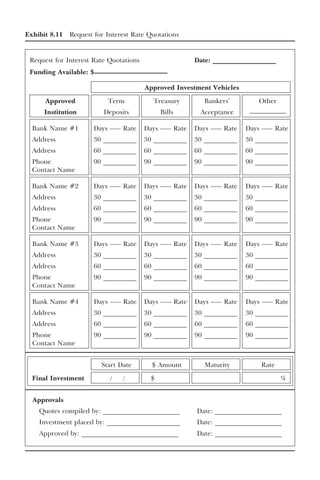
number of months from the present month.
A treasurer can also combine a sequential group of FRAs into an FRA
strip, which provides a hedge for a longer interval.
Exhibit 10.2 FRA Interest Payment Formula
Payment Notional amount Day count fraction
Reference rat
= × ( )
× e
e FRA rate
−
( )
Note: The day count fraction is the portion of a year over which rates are
calculated, which is 360 days in Europe and the United States, though 365
days may be used elsewhere.
Interest Risk Management Strategies 243
Exhibit 10.3 Payment Discounting Formula
Payment
Settlement Amount
Days in FRA Underlying Period
=
+
1 360
0 Days
( )
Exhibit 10.4 Term Notation for a Forward Rate Agreement
FRA Term Expanded Text of FRA Term Effective Term
1 × 3 Effective 1 month from now,
terminates 3 months from now
2 months
1 × 7 Effective 1 month from now,
terminates 7 months from now
6 months
3 × 6 Effective 3 months from now,
terminates 6 months from now
3 months
3 × 9 Effective 3 months from now,
terminates 9 months from now
6 months
6 × 12 Effective 6 months from now,
terminates 12 months from now
6 months
12 × 18 Effective 12 months from now,
terminates 18 months from now
6 months
Example
Gulf Coast Petrochemical expects to borrow $25 million in one year’s time to
finance a new offshore drilling platform, and will need the funds for a period
of one year. The current market interest rate is 5.00 percent, and Gulf Coast’s
treasurer anticipates that the rate will rise to 6.00 percent by the time the
company needs the money. To lock in the 5.00 percent rate, he enters into a
12 × 24 FRA at 5.00 percent, where the reference rate is the LIBOR rate. The
settlement amount of the FRA will depend on the 12-month LIBOR in 12
months. At that time, the reference rate has risen to 5.80 percent. Accordingly,
the bank that was the counterparty to the FRA determines that (prior to dis-
counting) it must pay $200,000 to Gulf Coast, which it calculates as:
$200,000 = × ( )
×
$ , ,
25 000 000 360 360
Days in Contract Days in Year
.
. .
058 050
Reference Rate Contract Rate
−
( )
The final step in the process is for the bank to calculate its discounted
payment to Gulf Coast. The discounted payment is $189,035.92, which is
calculated as $200,000 / (1 + (360/360 × 5.80%)), in accordance with the
formula in Exhibit 10.3, and using the 5.80 percent reference rate.
244 Interest Risk Management
Example
The treasurer of Abbott Software wants to buy an FRA to hedge the risk of an
interest rate increase in $30 million of debt that he plans to borrow in one
month, extending for nine months. He plans to use a strip of consecutive
three-month FRAs to construct this longer-term hedge. The FRA terms and
rates are as follows:
FRA Term FRA Rate
1 × 4 months 4.00%
5 × 7 months 4.20%
8 × 10 months 4.40%
The FRA rate gradually increases over time, since it is based on the yield
curve (see Chapter 8), which is usually upward sloping. The treasurer buys the
FRAs; the resulting reference (actual) rates are shown in the following table,
along with the variance between the FRA and reference rates for each of the
three FRAs.
FRA Term Contract Rate Reference Rate Variance
1 × 4 months 4.00% 3.90% −0.10%
5 × 7 months 4.20% 4.25% 0.05%
8 × 10 months 4.40% 4.50% 0.10%
For the 1 × 4 FRA, ABC pays the other party $7,500, which is calculated as:
-$7,500 = × ( ) × −
( )
$ , , . .
30 000 000 90 360 0390 0400
Abbott’s discounted payment to the other party is $7,427.58, which is
calculated as $7,500 / (1 + (90/360 × 3.90%)), in accordance with the formula
in Exhibit 10.3, and using the 3.90 percent reference rate for the 1 × 4 FRA.
For the 5 × 7 FRA, the other party pays Abbott $3,750, which is calculated
as:
$3,750 = × ( ) × −
( )
$ , , . .
30 000 000 90 360 0425 0420
Its discounted payment is $3,710.58, which is calculated as $3,750 / (1 +
(90/360 × 4.25%)), in accordance with the formula in Exhibit 10.3, and using
the 4.25% reference rate for the 5 × 7 FRA.
For the 8 × 10 FRA, the other party pays ABC $7,500, which is calculated
as:
$7,500 = × ( ) × −
( )
$ , , . .
30 000 000 90 360 0450 0440
Its discounted payment is $7,416.56, which is calculated as $7,500 / (1 +
(90/360 × 4.50%)), in accordance with the formula in Exhibit 10.3, and using
the 4.40 percent reference rate for the 8 × 10 FRA.
Thus, over the nine-month period, Abbott is paid a net total of $3,699.56
from its hedging activity, which it then uses to offset its increased borrowing
cost.
Interest Risk Management Strategies 245
Futures
An interest rate future is an exchange-traded forward contract that allows a
company to lock in an interest rate for a future time period. Interest rate
futures trade on the Chicago Mercantile Exchange (CME; www.cmegroup.
com). The standard futures contract is in eurodollars, which are bank depos-
its comprised of U.S. dollars, and held outside the United States. However,
the CME also offers futures contracts in a variety of other interest rate
products, including 30-day federal funds, one-month LIBOR, and even
Euroyen TIBOR (Tokyo Interbank Offered Rate). Most trading volume is
in eurodollar contracts. Eurodollar contracts are available for as much as
ten years into the future, though trading volumes drop off substantially after
the first three years.
A eurodollar futures contract allows the buyer to lock in the interest
rate on $1 million; if the buyer wishes to lock in the interest rate on a larger
amount, then he must purchase additional contracts in $1 million incre-
ments. The quoted prices are derived from a baseline index of 100, and
decline in amount for periods further in the future. The difference between
the baseline index and the quoted price is the interest rate on the contract.
For example, recent eurodollar rates traded on the CME were:
March 99.050 September 97.255
June 97.500 December 96.990
A company can buy a futures contract through a broker. The broker
will charge a fee on the transaction, and also imposes margin requirements
on the company that are used to ensure that the buyer or seller fulfills the
futures contract’s obligations. The initial margin requirement is calculated
on the basis of the maximum likely volatility for one day. The initial margin
varies from a low of one-sixteenth of a percent of the contract amount for
three-month contracts, to 2 percent for ten-year Treasury bonds.
The futures position represented by a contract is marked to market
(valued at market rates) every day; if the most recent valuation results in an
incremental loss, then the margin account is reduced, and a margin call
requires the contract holder to add more funds to the margin account to
bring it up to the maintenance level. If the contract holder does not respond
to the margin call, the broker can close out the futures position by offsetting
the contract (at the contract holder’s cost). Thus, the margin account keeps
unrealized losses from accumulating, which might otherwise result in a
contract default.
On the final day of the contract, the exchange prices the contract and
makes a final cash settlement of the profit or loss due to or from the
company.
An interest rate future is a standard contract, with a standard value,
term, and underlying instrument; thus, its terms may vary somewhat from
the amount of a company’s borrowings. This means that there is likely to
246 Interest Risk Management
be an imperfect hedge, which means that the company utilizing a futures
contract must still carry some amount of risk.
Interest Rate Swaps
The interest rate swap is an agreement between two parties (where one party
is almost always a bank) to exchange interest payments in the same currency
over a defined time period, which normally ranges from one to ten years.
One of the parties is paying a fixed rate of interest, while the other is paying
a variable rate. The variable interest rate is paid whenever a new coupon is
set, which is typically once a quarter. Fixed interest is usually paid at the
end of each year.
By engaging in a swap, a company can shift from fixed to variable
payments, or vice versa. Thus, if a company uses a swap to shift from vari-
able to fixed interest payments, it can better forecast its financing costs and
avoid increased payments but loses the chance of reduced interest payments
if rates were to decline. If it takes the opposite position and swaps fixed
rates for variable rates, then it is essentially betting that it will benefit from
a future decline in interest rates. An interest rate swap is especially useful
for a company with a weak credit rating, since such entities must pay a
premium to obtain fixed-rate debt. They may find it less expensive to obtain
variable-rate debt, and then engage in an interest rate swap to secure what
is essentially a fixed-rate payment schedule.
The parties to an interest rate swap deal directly with each other,
rather than using a standard product that is traded over an exchange. They
customarily use the standard master agreement that is maintained by the
International Swaps and Derivatives Association (ISDA; www.isda.org). The
ISDA represents participants in the privately negotiated derivatives indus-
Example
The treasurer of Gulf Coast Petroleum decides to sell a three-month future
with a contract term of six months. The current three-month LIBOR is 4.50
percent, and the 6 × 9 forward rate is 4.85 percent. Since the treasurer wishes
to hedge a principal amount of $25 million, he sells 25 contracts of $1 million
each. The future is now listed as 95.15, which is calculated as 100 minus the
4.85 percent forward rate. The future expires after six months; at that time,
the forward rate has declined to 4.35 percent, which means that the future is
now listed as 95.65 (derived from 100 minus the 4.35 percent forward rate).
This means that Gulf Coast has earned a profit of $31,250, which is derived
as follows:
$31,250 = × ( )
× −
$ , ,
. .
25 000 000 90 360
9565 9515
ending price beginnin
ng price
( )
Interest Risk Management Strategies 247
try, and maintains standard contracts for derivatives transactions. The
parties commonly modify a variety of features within the agreement to suit
their needs.
Example
ABC Company borrows $10 million. Under the terms of the agreement, ABC
must make quarterly interest payments for the next three years that are based
on LIBOR, which is reset once a quarter under the terms of the borrowing
agreement. Since the interest payments are variable, the company will experi-
ence reduced interest payments if LIBOR declines, but will pay more if LIBOR
increases. ABC’s management is more concerned about the risk of LIBOR
increasing, so it eliminates this risk by entering into an interest rate swap in
which it agrees to pay interest for three years on $10 million at a fixed rate,
while its counterparty agrees to make floating interest rate payments for three
years on $10 million to ABC. The first-year payment stream for the transaction
is shown in the following table, where the counterparty makes quarterly pay-
ments to ABC, which vary based on changes in LIBOR. ABC makes a single
fixed interest rate payment to the counterparty at the end of year one. The
result of these transactions is that ABC experiences a net reduction in its inter-
est expense of $20,000 in the first year of the swap agreement.
Payment
Date
Loan
Fixed
Rate
Applicable
LIBOR Quarterly
Rate
Payments from the
Counterparty to
ABC Company
Payments from
ABC Company to
the Counterparty
March 31 — 4.20% $105,000
June 30 — 4.35% 108,750
September 30 — 4.60% 115,000
December 31 4.25% 4.65% 116,250 $425,000
Totals $445,000 $425,000
The treasurer should arrange for payments under an interest swap
agreement to be as closely aligned as possible with the payment terms of
the underlying debt agreement. Thus, it is not useful if a counterparty’s
payment to the company is scheduled to arrive several weeks after the
company is scheduled to pay its bank under a loan agreement. Instead, the
counterparty’s payment should be scheduled to arrive just prior to the due
date specified in the loan agreement, thereby better aligning the company’s
cash flows.
Another strategy is to use an interest rate cap option. The cap option
allows a company to limit the extent of interest rate increases, while still
retaining some of the benefit if interest rates subsequently decline. However,
the cost of the rate cap will incrementally increase a company’s borrowing
248 Interest Risk Management
cost. The cost of a rate cap option can be reduced by acquiring a more
tailored solution called a knockout cap. Such a cap limits a company’s debt
service cost only so long as the baseline interest rate measurement does not
exceed a certain interest rate. If the actual rate exceeds the upper boundary
of the cap, then the company receives no protection at all.
Interest rate swaps work only if there are counterparties available who
are willing to take on the company’s perceived risk. However, when there
is a general consensus that interest rates will increase, a greater volume of
market participants will want to lock in their low borrowing rates with fixed
interest rates, which tends to force the cost of a swap higher. The reverse
situation arises when there is a general consensus that rates will decline;
more companies shift into variable-rate debt in expectation of benefiting
from lower rates, which makes it less expensive to create a swap for a fixed
rate.
Example
To use the same example, ABC Company buys a 6.00 percent interest rate
cap, which keeps ABC’s potential interest rate liability from exceeding 6.00
percent. Thus, if the interest rate were to actually reach 6.50 percent, the cap
seller would pay ABC 0.50 percent, while ABC would pay its bank 6.50 percent
interest on the loan, yielding a net interest rate of 6.00 percent.
Now, let’s alter the example to assume that ABC’s treasurer considers it
likely that interest rates will only rise slightly. He wants to save on the cost of
the interest rate cap, so he purchases a knockout cap that only provides pro-
tection up to 6.50 percent. The actual LIBOR rate jumps to 6.60 percent,
thereby triggering the knockout. ABC must now pay the entire 6.60 percent
interest on the loan, while the cap seller has no obligation to pay ABC.
Example
ABC Company wants to exchange its variable rate payments for fixed rate
payments for a period of three years. The benchmark government fixed rate
yield for that time period is 5.50 percent, and a spread of .30 percent is added
to the benchmark, which incorporates the supply and demand for a fixed rate
swap. Thus, ABC must pay a fixed rate of 5.80 percent if it chooses to engage
in an interest rate swap transaction.
Interest Risk Management Strategies 249
If the parties to a swap agreement choose to terminate it prior to the
contractual termination date, they determine the net present value of future
payment obligations by each party. They then net the payments together to
determine the net incremental payment to be made, which goes to which-
ever party is disadvantaged by terminating the swap. A variation on this
approach is the blend and extend, where the closeout cost of the original swap
agreement is incorporated into a new swap agreement.
It is also possible to assign the swap agreement to a third party, which
is then obligated to make and receive payments until the contract maturity
date. As part of the contract assignment, whichever party is assigning the
swap will either pay to the new counterparty or receive from it a payment
reflecting the net present value of cash flows remaining under the swap
agreement.
One more alternative is to acquire a new swap agreement that offsets
the payment streams of the original swap agreement.
There are several risks to be aware of when entering into swap agree-
ments. They are:
• Basis risk. This is caused by the mismatch between the cash flows
involved in a swap. For example, the reference rate may be tied to
LIBOR, while the interest rate on a company’s borrowing may be
tied to some other index, such as an index of money market funds.
Thus, if LIBOR increased by .5 percent and the basis for a com-
pany’s debt increased by .6 percent, then the payments it receives
through a swap arrangement would still leave the company with an
unhedged. 1 percent interest rate increase.
• Counterparty risk. One of the parties to a swap agreement may not
meet its financial obligations. Accordingly, it is important for the
counterparty to have excellent credit quality. If a bank or broker is
acting as the intermediary between two parties, then it may assume
the counterparty risk by charging a fee to both parties to the swap.
• Legal risk. One of the parties to an over-the-counter transaction may
have incorrectly or incompletely filled out a contract, or the signer
of it may not have been authorized to do so.
Debt Call Provisions
If a company is issuing its own debt, it can include a call provision in the debt
instrument that allows the company to retire the debt at a predetermined
price. A treasurer would take advantage of this provision if market rates
were to decline subsequent to issuance of the debt, and could then refinance
at a lower interest rate. The call provision typically incorporates higher
prices for earlier calls, which gradually decline closer to par pricing further
into the future. This higher initial price point compensates investors for the
250 Interest Risk Management
interest income they would otherwise have earned if the company had not
called the debt. Also, a call provision limits a bond’s potential price appre-
ciation to the amount of its call price, since the issuer will then call the bond.
Consequently, the call provision is useful to a company by allowing it to buy
back expensive debt and reissue at lower rates, but only if the savings from
doing so exceed the amount of the call price.
For example, ABC Company could issue bonds with a call provision
that allows it to buy back the bonds at 105 percent of par value after two
years, then again at 103 percent of par value after six years, and then at
their par value after eight years.
Options
An options contract is a trade that gives the buyer the right to buy or sell
an amount of futures contracts at some date in the future. The cost of this
right is the options premium, and is paid to the counterparty at the beginning
of the contract. This cost will vary based on such factors as the remaining
term of an option, the strike price, and the volatility of the reference interest
rate. If the option is entered into through an exchange, the exchange will
ask for a deposit, which is refundable when the deal is completed.
In the options market, the party buying an option wants to reduce its
risk, while the party selling an option is willing to be paid to accept the risk.
Thus, the cost of an option is based on the comparative level of perceived
risk. The options premium increases the borrowing cost of the party wishing
to reduce its interest rate risk, so if the option is priced too high, a prospec-
tive hedger may elect to retain the risk.
A call option on interest rates protects the option buyer from rising
interest rates, while a put option protects the option buyer from declining
rates. Both types of options are benchmarked against a reference rate that
is set forth in the option contract. Thus, if the reference rate is 5.00 percent,
subsequent changes in the interest rate are measured in terms of their varia-
tion from 5.00 percent in determining potential benefits to option buyers.
An interest rate option contract includes the following key components:
• A benchmark reference rate, as just described
• A strike price, which is the interest rate at which the option buyer
can borrow or lend funds
• The amount of funds that can be borrowed or loaned
• How the contract may be settled, such as by cash payment or by
delivery of the underlying asset
• The contract expiry date
It is possible to modify the above features to meet a company’s specific
needs by dealing in the over-the-counter market.
Interest Risk Management Strategies 251
An interest rate option can be modified to include a cap; the buyer
pays a premium in order to be protected from higher interest rates above
the cap strike rate. At the expiry date of the option, the seller reimburses
the buyer if the reference rate is above the cap strike rate and pays nothing
if the reference rate is below the strike rate.
Example
ABC Company has $5 million of variable rate debt that resets every three
months. ABC’s treasurer buys a 3 × 6 interest rate cap with a strike price of
6.00 percent to cover its debt. The reference rate is the Euribor rate on the
reset date. Subsequently, the reference rate increases to 6.30 percent. The
seller must reimburse ABC for the difference between the cap strike price and
the reference rate. The calculation of the payment is:
$3,750 =
× −
( ) ×
$ , , . .
5 000 000 0 0630 0 0600 90
360
days
days
In order to determine ABC Company’s true savings, the cost of the option
must be offset against the $3,750 payment from the option seller, so the net
amount of the hedge does not entirely cover ABC’s increased interest rate
payment.
A company can engage in a longer-term cap by purchasing a strip of
options with consecutive expiry dates and the same strike price for all
options. The following table shows an option strip covering an 18-month
period, where the principal was $1 million. The first few months are not
included in the table, since the option for that period would expire at the
beginning of the period, yielding a zero payout.
Option Term
Strike
Price
3-Month
LIBOR
Rate
(A) Payout
Rate
(B)
Principal
A × B × (90/360)
Payment
Calculation
1 3 × 6 4.50% 4.35% 0.00% $1,000,000 —
2 6 × 9 4.50% 4.45% 0.00% 1,000,000 —
3 9 × 12 4.50% 4.55% 0.05% 1,000,000 $125
4 12 × 15 4.50% 4.60% 0.10% 1,000,000 250
5 15 × 18 4.50% 4.70% 0.20% 1,000,000 500
Total $875
252 Interest Risk Management
In the example, the strike price at the expiry date of the first two
options is higher than the reference rate, so the company does not trigger
the option; this is not a concern to the treasurer, since the underlying debt
payments that he is most concerned about have not increased, either.
However, the reference rate is higher for the remaining three option periods,
which triggers three payments to the company totaling $875. The treasurer
then uses the payments from these options to offset the increased cost of
his debt during the same time periods.
If a treasurer considers the cost of a cap to be too expensive, an alter-
native is to purchase a collar from a bank. This is composed of a purchased
cap and a sold floor. The option that the treasurer sells (the floor) is used
to take any profits from favorable interest rates and use them to pay for the
cap. For this cost-offset method to work, the treasurer must align the time
periods, reference rates, and exercise details of the cap and floor. If an
option expires with the reference rate between the cap and floor rates, then
neither side of the collar is exercised.
Example
The treasurer of the Alaskan Barrel Company anticipates that interest rates
will fluctuate between 4.5 percent and 6.5 percent over the next two years,
and is comfortable incurring interest expenses anywhere within that range. To
avoid paying interest greater than 6.5 percent, he purchases a 6.5 percent cap
and sells a 4.5 percent floor. If the interest rate stays between 4.5 percent and
6.5 percent, then neither the cap nor the floor is triggered. However, if inter-
est rates rise to 7.0 percent, then the cap will pay for the 0.5 percent excess
over the 6.5 percent cap. Also, if the interest rate falls below 4.5 percent,
Alaskan must pay the difference between the reference rate and the floor of
4.5 percent, thereby effectively limiting its lowest possible interest rate to 4.5
percent.
Swaptions
A swaption is an option on an interest rate swap. The buyer of a swaption
has the right, but not an obligation, to enter into an interest rate swap with
predefined terms at the expiration of the option. In exchange for a premium
payment, the buyer of a swaption can lock in either a fixed or variable inter-
est rate. Thus, if a treasurer believes that interest rates will rise, he can enter
into a swaption agreement, which he can later convert into an interest rate
swap if interest rates do indeed go up.
Accounting for Interest Risk Management Activities 253
Example
The Shapiro Pool Company needs to finance its construction of the pool
complex for the Summer Olympic Games. It expects to do so at the floating
LIBOR rate plus 1.5 percent in six months, with a duration of three years. To
protect itself from rates increasing above 7.0 percent, Shapiro buys a swaption.
The swaption agreement gives Shapiro the right, but not the obligation, to
enter into an interest rate swap where it pays a fixed rate of 7.0 percent and
receives LIBOR plus 1.5 percent. If the reference rate in nine months is above
7.0 percent, then Shapiro should exercise the option to enter into the swap.
A swaption can be a risky endeavor for a swaption seller, since the seller
is taking on potentially substantial risk in exchange for a premium. Thus, the
swaption buyer should carefully examine the credit risk of the swaption
seller, both at the initiation of the transaction and throughout its term.
Counterparty Limits
There is a limit to the amount of the risk management strategies outlined
here that a company can employ. The counterparty to FRAs, swaps, and
collars are usually banks, and they will reduce their risk by setting up coun-
terparty limits for each company doing business with them. Every time a
company enters into one of these agreements with a bank, the bank reduces
the available amount of the limit assigned to that company. Thus, it is pos-
sible that some of the risk strategies outlined here will not be available
beyond a certain level of activity.
Summary of Interest Risk Management Strategies
Of the strategies presented here, forwards and futures are the most inflex-
ible, because they do no more than lock a company into a set rate, and
present an opportunity loss if rates turn in the opposite direction from the
constructed hedge. Options are more flexible, since they can be tailored to
provide payoffs that closely match a company’s exposure, while also yielding
benefits from a favorable market move.
A comparison of the various interest rate risk management strategies
is shown in Exhibit 10.5.
ACCOUNTING FOR INTEREST RISK MANAGEMENT ACTIVITIES
The following discussion of accounting is targeted at derivative financial
instruments, of which the two main forms of derivatives are option contracts
and forward contracts. Within these main categories are interest rate caps
254 Interest Risk Management
Exhibit 10.5 Interest Risk Management Strategy Comparison
Forward Rate
Agreements Futures
Interest
Rate Swaps Options
Notional
payments
Yes Yes Not
necessarily
Yes
Agreement
type
Customized Standard Customized Standard or
customized
Collateral
requirement
None Initial margin
and margin
calls
None Initial margin and
margin calls if
originated on
an exchange
Counterparty A bank An exchange A bank A bank or an
exchange
Counterparty
limits
imposed
Yes No Yes Yes
Method of
exchange
Over the
counter
Exchange
traded
Over the
counter
Exchange traded
or over the
counter
Settlement
frequency
At expiry
date
Daily On coupon
dates
Either daily or at
expiry date
and floors, forward interest rate agreements, interest rate collars, futures,
swaps, and swaptions.
Derivatives represent rights and obligations, and must be reported as
assets and liabilities at their fair value. A gain or loss on a derivative that is
not designated as a hedge must be recognized in earnings. If a derivative is
designated as a hedge, then the accounting for it varies, depending on
whether it is an effective hedge or an ineffective hedge.
A fair value hedge primarily relates to the hedging of fixed-interest
balance sheet items, while cash flow hedges mean hedges against the risk
associated with future interest payments from a variable-interest balance
sheet transaction. Since this chapter is about the mitigation of risk associated
with variable interest payments, the appropriate type of accounting is the
cash flow hedge. Thus, the remainder of this section discusses the account-
ing for only a cash flow hedge.
To establish a valid cash flow hedge, one must document the relation-
ship between the hedging instrument and an asset, liability, or forecasted
transaction (including expected date of occurrence and amount). The docu-
mentation must also describe the hedging strategy, risk management objec-
tives, and how the effectiveness of the transaction shall be measured. The
method for effectiveness assessment must be defined at the time of hedge
designation, and must be consistently maintained throughout the hedge
period. Further, similar types of hedges should be documented and treated
in the same manner, unless a different method can be reasonably justified.
Accounting for Interest Risk Management Activities 255
In addition, the hedging relationship must be expected to be highly
effective in producing offsetting cash flows, and evaluated at least quarterly
to ensure that this is the case.
One must discontinue a cash flow hedge when the hedge criteria are
no longer met, the hedging designation is canceled, or the derivative instru-
ments used in the hedge are terminated. If any of these circumstances arise,
a new hedging relationship can be documented with a different derivative
instrument.
When reporting derivative gains and losses for a cash flow hedge, the
effective portion of the gain or loss is reported in other comprehensive
income, while any gains or losses attributable to the ineffective portion of
the hedge are reported in earnings. For example, any differences in the key
terms between a hedged item and the hedging instrument, such as notional
amounts, maturities, quantities, or delivery dates would cause some amount
of ineffectiveness, and the amount of that ineffective portion of the hedge
would be included in earnings.
Whenever one expects a net loss from the hedging transaction, the
amount not expected to be recovered must be shifted in the current period
from other comprehensive income to earnings. Also, if a hedging relation-
ship is established for a forecasted cash flow transaction and the transaction
is deemed unlikely to occur, any gain or loss thus far recorded in other
comprehensive income must be shifted to earnings in the current period.
Example
Accounting for an Interest Rate Swap1
On July 1, 2009, Abbott Corporation borrows $5 million with a fixed maturity
(no prepayment option) of June 30, 2013, carrying interest at prime + 0.5
percent. Interest only is due semiannually. At the same date, it enters into a
“plain vanilla”–type swap arrangement, calling for fixed payments at 8 percent
and receipt of prime + 0.5 percent, on a notional amount of $5 million. At
that date, prime is 7.5 percent, and there is no premium due on the swap
arrangement.
This swap qualifies as a cash flow hedge, and it is appropriate to assume
no ineffectiveness, since it fulfills all GAAP criteria.
NOTE: These criteria are that: the notional amount of the swap and the
principal amount of the debt are equal; the fair value of the swap at inception
is zero; the formula for computing net settlements under the swap is constant
during its term; the debt may not be prepaid; all interest payments on the
debt are designated as being hedged, and no payments beyond the term of
the swap are so designated; there is no floor or cap on the variable rate of the
1
The following two examples are taken with permission from the 2009 Wiley GAAP
Guide (Epstein, et. al.), Chapter 8.
256 Interest Risk Management
debt that is not likewise designated for the swap; the repricing dates of the
swap match those of the variable rate debt; and the same index is designated
for the hedging instrument and the underlying obligation.
Accordingly, as rates change over the term of the debt and of the swap
arrangement, changes in the value of the swap are reflected in other compre-
hensive income, and the swap will appear on the balance sheet as an asset or
liability at fair value. As the maturity of the debt approaches, the value of the
swap will converge on zero. Periodic interest expense in the income statement
will be at the effective rate of 8 percent.
Assume that the prime rate over the four-year term of the loan, as of each
interest payment date, is as follows, along with the fair value of the remaining
term of the interest rate swap at those dates:
Date Prime Rate (%) Fair Value of Swap*
December 31, 2009 6.5 $−150,051
June 30, 2010 6.0 −196,580
December 31, 2010 6.5 −111,296
June 30, 2011 7.0 −45,374
December 31, 2011 7.5 0
June 30, 2012 8.0 23,576
December 31, 2012 8.5 24,038
June 30, 2013 8.0 0
*Fair values are determined as the present values of future cash flows resulting from
expected interest rate differentials, based on the current prime rate, discounted at 8%.
Regarding the fair values presented in the foregoing table, it should be
assumed that the fair values are precisely equal to the present value, at each
valuation date (assumed to be the interest payment dates), of the differential
future cash flows resulting from utilization of the swap. Future variable interest
rates (prime + 0.5 percent) are assumed to be the same as the existing rates
at each valuation date (i.e., there is no basis for any expectation of rate
changes, and therefore the best estimate is that the current rate will persist
over time). The discount rate, 8 percent, is assumed to be constant over time.
Thus, for example, the fair value of the swap at December 31, 2009, would
be the present value of an annuity of seven payments (the number of remaining
semiannual interest payments due) of $25,000 each (pay 8 percent, receive 7
percent, based on then-existing prime rate of 6.5 percent) to be made to the
swap counterparty, discounted at an annual rate of 8 percent (using 4 percent
for the semiannual discounting, which is a slight simplification). This computa-
tion yields a present value of a stream of seven $25,000 payments to the swap
counterparty amounting to $150,051 at December 31, 2009, which is a liability
to be reported by the entity at that date. The offset is a debit to other compre-
hensive income, since the hedge is (presumably) judged to be 100 percent
effective in this case. Semiannual accounting entries will be as follows:
December 31, 2009
Interest expense 175,000
Accrued interest (or cash) 175,000
Accounting for Interest Risk Management Activities 257
To accrue or pay semiannual interest on the debt at the variable rate of prime
+ 0.5% (7.0%)
Interest expense 25,000
Accrued interest (or cash) 25,000
To record net settlement on swap arrangement [8.0–7.0%]
Other comprehensive income 150,051
Swap contract 150,051
To record the fair value of the swap contract as of this date (a net liability because fixed
rate payable to counterparty of 8% exceeds floating rate receivable from counterparty
of 7%)
June 30, 2010
Interest expense 162,500
Accrued interest (or cash) 162,500
To accrue or pay semiannual interest on the debt at the variable rate of prime + 0.5%
(6.5%)
Interest expense 37,500
Accrued interest (or cash) 37,500
To record net settlement on swap arrangement [8.0–6.5%]
Other comprehensive income 46,529
Swap contract 46,529
To record the fair value of the swap contract as of this date (increase in obligation
because of further decline in prime rate)
December 31, 2010
Interest expense 175,000
Accrued interest (or cash) 175,000
To accrue or pay semiannual interest on the debt at the variable rate of prime + 0.5%
(7.0%)
Interest expense 25,000
Accrued interest (or cash) 25,000
To record net settlement on swap arrangement [8.0–7.0%]
Other comprehensive income 150,051
Swap contract 150,051
To record the fair value of the swap contract as of this date (decrease in obligation due
to increase in prime rate
June 30, 2011
Interest expense 187,500
Accrued interest (or cash) 187,500
258 Interest Risk Management
To accrue or pay semiannual interest on the debt at the variable rate of prime + 0.5%
(7.5%)
Interest expense 12,500
Accrued interest (or cash) 12,500
To record net settlement on swap arrangement [8.0–7.5%]
Swap contract 65,922
Other comprehensive income 65,922
To record the fair value of the swap contract as of this date (decrease in obligation
due to further increase in prime rate)
December 31, 2011
Interest expense 200,000
Accrued interest (or cash) 200,000
To accrue or pay semiannual interest on the debt at the variable rate of prime + 0.5%
(8.0%)
Interest expense 0
Accrued interest (or cash) 0
To record net settlement on swap arrangement [8.0–8.0%]
Swap contract 45,374
Other comprehensive income 45,374
To record the fair value of the swap contract as of this date (further increase in prime
rate to the original rate of inception of the hedge eliminates fair value of the
derivative)
June 30, 2012
Interest expense 212,500
Accrued interest (or cash) 212,500
To accrue or pay semiannual interest on the debt at the variable rate of prime + 0.5%
(8.5%)
Receivable from counterparty (or cash) 12,500
Interest expense 12,500
To record net settlement on swap arrangement [8.0–8.5%], counterparty remits
settlement
Swap contract 23,576
Other comprehensive income 23,576
To record the fair value of the swap contract as of this date (increase in prime rate
creates net asset position for derivative)
December 31, 2012
Interest expense 225,000
Accrued interest (or cash) 225,000
Accounting for Interest Risk Management Activities 259
To accrue or pay semiannual interest on the debt at the variable rate of prime + 0.5%
(9.0%)
Receivable from counterparty (or cash) 25,000
Interest expense 25,000
To record net settlement on swap arrangement [8.0–9.0%], counterparty remits
settlement
Swap contract 462
Other comprehensive income 462
To record the fair value of the swap contract as of this date (increase in asset value due
to further rise in prime rate)
June 30, 2013 (Maturity)
Interest expense 212,500
Accrued interest (or cash) 212,500
To accrue or pay semiannual interest on the debt at the variable rate of prime + 0.5%
(8.5%)
Receivable from counterparty (or cash) 12,500
Interest expense 12,500
Other comprehensive income 24,038
Swap contract 24,038
To record the fair value of the swap contract as of this date (value declines to zero as
expiration date approaches)
Example
Accounting for a Swaption
The facts of this example are a variation on the previous example. Abbott
Corporation anticipates as of June 30, 2009, that as of June 30, 2011, it will
become a borrower of $5 million with a fixed maturity four years hence (June
30, 2015). Based on its current credit rating, it expects to be able to borrow
at prime + 0.5%. As of June 30, 2009, it is able to purchase, for a single
payment of $25,000, a “swaption” (an option on an interest rate swap), calling
for fixed pay at 8 percent and variable receipt at prime + 0.5%, on a notional
amount of $5 million, for a term of four years. The option will expire in two
years. At June 30, 2009, prime is 7.5 percent.
NOTE: The interest rate behavior in this example differs somewhat from
the prior example, to better illustrate the “one-sidedness” of options, versus
the obligation under a swap arrangement or other futures and forwards.
It will be assumed that the time value of the swaption expires ratably over
the two years.
260 Interest Risk Management
This swaption qualifies as a cash flow hedge. However, while the change
in fair value of the contract is an effective hedge of the cash flow variability of
the prospective debt issuance, the premium paid is a reflection of the time
value of money and is thus to be expensed ratably over the period that the
swaption is outstanding.
The table below gives the prime rate at semiannual intervals including
the two-year period prior to the debt issuance, plus the four years during which
the forecasted debt (and the swap, if the option is exercised) will be outstand-
ing, as well as the fair value of the swaption (and later the swap itself) at these
points in time.
Date Prime Rate (%) Fair Value of Swaption/Swap*
December 31, 2009 7.5 $0
June 30, 2010 8.0 77,925
December 31, 2010 6.5 0
June 30, 2011 7.0 –84,159
December 31, 2011 7.5 0
June 30, 2012 8.0 65,527
December 31, 2012 8.5 111,296
June 30, 2013 8.0 45,374
December 31, 2013 8.0 34,689
June 30, 2014 7.5 0
December 31, 2014 7.5 0
June 30, 2015 7.0 0
*Fair value is determined as the present value of future expected interest rate differen-
tials, based on the current prime rate, discounted at 8%. An “out-of-the-money” swap-
tion is valued at zero, since the option does not have to be exercised. Since the option
is exercised on June 30, 2011, the value at that date is recorded, although negative.
The value of the swaption contract is recorded (unless and until exercised,
of course, at which point it becomes a contractually binding swap) only if it is
positive, since if “out of the money” the holder would forgo exercise in most
instances, and thus there is no liability by the holder to be reported. (This
example is an illustration of the opposite, however, as despite having a nega-
tive value the option holder determines that exercise is advisable.) At June 30,
2010, for example, the swaption is an asset, since the reference variable rate
(prime + 0.5 percent or 8.5 percent) is greater than the fixed swap rate of
8 percent, and thus the expectation is that the option will be exercised at
expiration. This would, if present rates hold steady—which is the naïve
assumption—result in a series of eight semiannual payments from the swap
counterparty in the amount of $12,500. Discounting this at a nominal 8
percent, the present value as of the debt origination date (to be June 30, 2011)
would be $84,159, which, when further discounted to June 30, 2010, yields a
fair value of $77,925.
Note that the following period (December 31, 2010) prime drops to such
an extent that the value of the swaption evaporates entirely (actually goes
negative, which will not be reported since the holder is under no obligation
to exercise it), and the carrying value is therefore eliminated. At expiration,
the holder does (for this example) exercise, notwithstanding a negative fair
Accounting for Interest Risk Management Activities 261
value, and from that point forward the fair value of the swap will be reported,
whether positive (an asset) or negative (a liability).
As previously noted, assume that, at the option expiration date, despite
the fact that prime + 0.5 percent is below the fixed pay rate on the swap, the
management of Abbott Corporation is convinced that rates will climb over the
four-year term of the loan, and thus exercises the swaption at that date.
Accounting journal entries over the six years are as follows:
June 30, 2009
Swaption contract 25,000
Cash 25,000
To record purchase premium on swaption contract
December 31, 2009
Loss on hedging transaction 6,250
Swaption contract 6,250
To record change in time value of swaption contract—charge premium to income since
this represents payment for time value of money, which expires ratably over two-year
term
June 30, 2010
Swaption contract 77,925
Other comprehensive income 77,925
To record the fair value of the swaption contract as of this date
Loss on hedging transaction 6,250
Swaption contract 6,250
To record change in time value of swaption contract—charge premium to income since
this represents payment for time value of money, which expires ratably over two-year
term
December 31, 2010
Other comprehensive
income
77,925
Swaption contract 77,925
To record the change in fair value of the swaption contract as of this date; since contract
is “out of the money,” it is not written down below zero (i.e., a net liability is not
reported)
Loss on hedging
transaction
6,250
Swaption contract 6,250
To record change in time value of swaption contract—charge premium to income since
this represents payment for time value of money, which expires ratably over two-year
term
262 Interest Risk Management
June 30, 2011
Other comprehensive income 84,159
Swap contract 84,159
To record the fair value of the swap contract as of this date—a net liability is reported
since swap option was exercised
Loss on hedging transaction 6,250
Swaption contract 6,250
To record change in time value of swaption contract—charge premium to income since
this represents payment for time value of money, which expires ratably over two-year
term
December 31, 2011
Interest expense 200,000
Accrued interest (or cash) 200,000
To accrue or pay interest on the debt at the variable rate of prime + 0.5% (8.0%)
Interest expense 0
Accrued interest (or cash) 0
To record net settlement on swap arrangement [8.0–8.0%]
Swap contract 84,159
Other comprehensive income 84,159
To record the change in the fair value of the swap contract as of this date
June 30, 2012
Interest expense 212,500
Accrued interest (or cash) 212,500
To accrue or pay interest on the debt at the variable rate of prime + 0.5% (8.5%)
Receivable from counterparty (or cash) 12,500
Interest expense 12,500
To record net settlement on swap arrangement [8.0–8.5%]
Swap contract 65,527
Other comprehensive income 65,527
To record the fair value of the swap contract as of this date
December 31, 2012
Interest expense 225,000
Accrued interest (or cash) 225,000
To accrue or pay interest on the debt at the variable rate of prime + 0.5% (9.0%)
Receivable from counterparty (or cash) 25,000
Interest expense 25,000
Accounting for Interest Risk Management Activities 263
To record net settlement on swap arrangement [8.0–9.0%]
Swap contract 45,769
Other comprehensive income 45,769
To record the fair value of the swap contract as of this date
June 30, 2013
Interest expense 212,500
Accrued interest (or cash) 212,500
To accrue or pay interest on the debt at the variable rate of prime + 0.5% (8.5%)
Receivable from counterparty (or cash) 12,500
Interest expense 12,500
To record net settlement on swap arrangement [8.0–8.5%]
Other comprehensive income 65,922
Swap contract 65,922
To record the change in fair value of the swap contract as of this date (declining prime
rate causes swap to lose value)
December 31, 2013
Interest expense 212,500
Accrued interest (or cash) 212,500
To accrue or pay interest on the debt at the variable rate of prime + 0.5% (8.5%)
Receivable from counterparty (or cash) 12,500
Interest expense 12,500
To record net settlement on swap arrangement [8.0–8.5%]
Other comprehensive income 10,685
Swap contract 10,685
To record the fair value of the swap contract as of this date (decline is due to passage
of time, as the prime rate expectations have not changed from the earlier period)
June 30, 2014
Interest expense 200,000
Accrued interest (or cash) 200,000
To accrue or pay interest on the debt at the variable rate of prime + 0.5% (8.0%)
Receivable from counterparty (or cash) 0
Interest expense 0
To record net settlement on swap arrangement [8.0–8.0%]
Other comprehensive income 34,689
Swap contract 34,689
To record the decline in the fair value of the swap contract to zero as of this date
264 Interest Risk Management
December 31, 2014
Interest expense 200,000
Accrued interest (or cash) 200,000
To accrue or pay interest on the debt at the variable rate of prime + 0.5% (8.0%)
Receivable from counterparty (or
cash)
0
Interest expense 0
To record net settlement on swap arrangement [8.0–8.0%]
Swap contract 0
Other comprehensive income 0
No change to the zero fair value of the swap contract as of this date
June 30, 2015 (Maturity)
Interest expense 187,500
Accrued interest (or cash) 187,500
To accrue or pay interest on the debt at the variable rate of prime + 0.5% (7.5%)
Interest expense 12,500
Accrued interest (or cash) 12,500
To record net settlement on swap arrangement [8.0–7.5%]
Other comprehensive income 0
Swap contract 0
No change to the zero fair value of the swap contract, which expires as of this date
Interest Risk Management Controls
There are a variety of controls that the treasury department can implement
in order to reduce the risk profile of its hedging activities. These controls
are divided into ones that can be used for all types of hedges, and those
that apply specifically to cash flow hedges.
Hedges—General
• Determine counterparty creditworthiness. In cases where a company
expects to deal directly with a counterparty through an over-the-
counter hedging transaction (as opposed to dealing with an
exchange), the treasurer should determine the creditworthiness of
the counterparty prior to entering into the contract. Otherwise, the
company could be taking on a significant risk that the counterparty
cannot meet its obligations under the contract.
Accounting for Interest Risk Management Activities 265
• Verify contract terms and signatory. It is possible that a company may
have difficulty forcing a counterparty to pay for its obligations under
an over-the-counter contract if the counterparty did not correctly
fill out the contract or if the signatory to the agreement was not
authorized to do so. The company’s legal department can follow up
on these issues whenever a new contract is signed.
• Include in the hedging procedure a requirement for full documentation of
each hedge. Hedging transactions are only allowed under generally
accepted accounting principles (GAAP) if they are fully documented
at the inception of the hedge. One can ensure compliance by includ-
ing the documentation requirement in an accounting procedure for
creating hedges.
• Confirm all hedging transactions. As soon as a hedging deal is con-
cluded, a different person than the transaction originator should
confirm the details of the deal. This should be a matching of the
company’s transaction details to those of the counterparty or
exchange, which may involve a written or electronic message (such
as an email or SWIFT MT300).
• Reconcile accounts. The treasury staff should regularly reconcile all
debt and investment accounts to counterparty account balances on
a monthly basis. If there is a serious problem, then the control
should provide for an immediate escalation of the issue to a higher
level of management. This review can be supplemented by periodic
unscheduled reconciliations by the internal audit staff.
• Full-risk modeling. The treasury staff should conduct full-risk model-
ing of its investments and debt on at least a quarterly basis, to
determine the potential risk inherent in its unhedged portfolio, and
also to determine what the company’s gain or loss would have been
on a rolling historical basis if it had not engaged in hedging
transactions.
Cash Flow Hedges
• Include in the monthly financial statement procedure a review of the recover-
ability of cash flow hedge losses. GAAP requires that a nonrecoverable
cash flow hedge loss be shifted in the current period from other
comprehensive income to earnings. Since this can only result in a
reduced level of earnings, accounting personnel tend not to conduct
the review. Including the step in the monthly procedure is a good
way to ensure prompt loss recognition.
• Include in the monthly financial statement procedure a review of the likely
occurrence of forecasted cash flow transactions. GAAP requires that any
266 Interest Risk Management
accumulated gain or loss recorded in other comprehensive income
be shifted into earnings as soon as it becomes probable that the
forecasted cash flow transaction will not take place. Including a
standard periodic review of forecasted transactions in the monthly
procedure is a good way to ensure prompt inclusion of accumulated
gains or losses in earnings.
• Compare hedging effectiveness assessments to the corporate policy setting
forth effectiveness ranges. GAAP does not specify the exact amount by
which hedging instruments and hedged items must offset each other
in order to be deemed highly effective, so a corporate policy should
be established (see the Policies section) to create such a standard.
This control is intended to ensure that the policy is followed when
making effectiveness assessments. Comparison to the corporate
policy should be included in the assessment procedure.
INTEREST RISK MANAGEMENT POLICIES
The first two policies noted below are designed to introduce consistency into
the accounting for hedges, so that the accounting department will be unable
to take liberties with profit recognition. The final policy provides for a hard
credit-rating floor, below which a company is not allowed to deal with a
counterparty whose financial position may be weak. The final policy is a
catchall authorization to avoid counterparties that are too hard to deal with.
The policies are:
• The determination of hedge effectiveness shall always use the same method
for similar types of hedges. GAAP allows one to use different assess-
ment techniques in determining whether a hedge is highly effective.
However, changing methods, even when justified, allows the account-
ing staff room to alter effectiveness designations, which can yield
variations in the level of reported earnings. Consequently, creating
and consistently using a standard assessment method for each type
of hedge eliminates the risk of assessment manipulation.
• A hedge shall be considered highly effective if the fair values of the hedging
instrument and hedged item are at least ___ percent offset. GAAP does
not quantitatively specify what constitutes a highly effective hedge,
so a company should create a policy defining the number. A differ-
ent hedging range can be used for different types of hedges.
• The company shall not deal with a counterparty having a credit rating of
less than ___. This policy is designed to mitigate the risk of a coun-
terparty’s failing to pay its obligations to the company under a
hedging agreement. The underlying procedure can direct the atten-
Summary 267
tion of the treasury staff to changes in counterparty credit ratings
from previous periods, so that those with declining ratings are
watched more carefully.
• The treasurer is authorized to discontinue hedging transactions with
those counterparties with whom the company has experienced
ongoing or significant operational problems. This policy is deliber-
ately vague, giving the treasurer authority to stop doing business
with a counterparty for any number of reasons, such as improper
contract completion, incorrect contract signatories, or difficulty in
settling accounts.
RECORD KEEPING FOR INTEREST RATE RISK MANAGEMENT
At the inception of a hedge, GAAP requires documentation of the relation-
ship between the hedging instrument and the hedged item, the risk man-
agement objectives of the hedging transaction, how the hedge is to be
undertaken, the method to be used for gain or loss recognition, identifica-
tion of the instrument used for the hedge, and how the effectiveness calcula-
tion is measured. Since hedge accounting cannot be used unless this
documentation exists, it is important to store a complete set of documenta-
tion for each hedge for the duration not only of the hedge, but also through
the audit following the hedge termination. It can then be included in the
archives with accounting documentation for the year in which the transac-
tion terminated.
INTEREST RISK MANAGEMENT PROCEDURES
The procedure shown in Exhibit 10.6 is a generic one designed to handle
the basic steps in an interest hedging transaction.
SUMMARY
Interest risk management is useful for reducing the volatility of a company’s
cash flows and earnings, as well as for avoiding significant increases in inter-
est costs that can seriously impact the financial well-being of a heavily lever-
aged company. There are a number of alternatives available to hedge
against these risks, which a treasurer can take advantage of either at a
minimal level, with selective hedging, or completely, with full-cover hedging.
The extent to which hedging is used varies widely by company, and depends
on the level of conservatism that each one practices in managing its funds.
The accounting for hedging is complex, requiring considerable documenta-
tion and a large volume of entries to record each transaction.
268 Interest Risk Management
Exhibit 10.6 Interest Hedging Procedure
Procedure Statement Retrieval No.: TREASURY-06
Subject: Steps required to create, monitor, and account for an interest hedging
transaction.
1. PURPOSE AND SCOPE
This procedure is used by the treasury, legal, and accounting staffs to
set up, monitor, and account for an interest hedging transaction, incorpo-
rating key control points.
2. PROCEDURES
2.1 Set up Hedging Transaction (Assistant Treasurer)
1. Ensure that the counterparty’s credit rating equals or exceeds the
company’s minimum credit rating policy standard. Notify the trea-
surer if the counterparty exhibits a declining credit rating over the
past two years.
2. Calculate the level of hedging effectiveness of the proposed transac-
tion, and document the calculation.
3. Have the treasurer review and approve the transaction.
4. Enter into the hedging transaction.
5. Document the hedge, as required under hedge accounting stan-
dards. This includes documenting the relationship between the
hedging instrument and liability, as well as the hedging strategy,
risk management objectives, and how the effectiveness of the trans-
action shall be measured.
6. Have the treasurer review and approve the hedge documentation.
2.2 Confirm the Hedge (Treasury Clerk)
1. Immediately upon notification of the deal, confirm it with the coun-
terparty, either by email, orally, or by written notification.
Confirmation should include all key terms of the deal.
2. Assemble the hedge contract, documentation, and confirmation into
a package, and create a copy for distribution to the legal depart-
ment. Retain the original documents.
2.3 Review the Contract Legality (Legal Staff)
1. Review the contract for completeness, and verify that the counter-
party’s signatory is authorized to approve such contracts.
2. Approve the contract if acceptable, and forward to the assistant
controller. If not, return it to the treasurer with attached notes
regarding problem areas. If there are problems, then retain a copy
of the package, and follow up with the treasurer periodically regard-
ing resolution of the indicated issues.
2.4 Account for the Hedge (Assistant Controller)
1. Determine the extent of hedge effectiveness, based on the ranges
set forth in the corporate hedge effectiveness policy.
Summary 269
2. On an ongoing basis, charge to comprehensive income that portion
of the hedge that is considered effective, for any gains or losses
resulting from marking to market. At the same time, charge to earn-
ings that portion of the hedge that is considered ineffective as a
result of marking to market.
3. On a monthly basis, evaluate the nonrecoverability of hedge losses,
and shift these losses from other comprehensive income to
earnings.
4. On a monthly basis, evaluate if it has become probable that any
forecasted cash flow transactions will not take place, and shift the
associated gains or losses from other comprehensive income to
earnings.
2.5 Reconcile the Hedge (Assistant Controller)
1. Match the internal account balances for the hedge to the statement
received from the exchange or the over-the-counter counterparty.
Report the reason for any significant differences to the treasurer
and controller.
2. If the hedge is completed and settlement has occurred, reconcile
the payment received or issued to internal records, and adjust for
any differences.
3. If the reason for a reconciliation problem is not clear, or if the cause
results in a variance of at least $_____, notify the treasurer and
controller immediately.
2.6 Report on the Results of the Hedge (Assistant Controller)
1. Calculate the percentage of hedging achieved by the transaction and
report this amount to the treasurer and controller.
2. Calculate the speed of confirmation matching, and the types of
problems found during the reconciliation process, and report these
metrics as key performance indicators to the treasurer and
controller.
TREASURY SYSTEMS
PART FOUR
Clearing and
Settlement Systems
11
This chapter contains descriptions of a number of clearing and settlement
systems that are used for both electronic and check payments within the
United States, as well as a multicurrency clearing system. Clearing is all of
the steps involved in transferring funds ownership from one party to another
except for the final step, which is settlement. Settlement involves the finaliza-
tion of a payment, so that a new party takes possession of transferred funds.
The treasurer should be aware of these processes in order to understand
the timing of payment transfers.
CHARACTERISTICS OF CLEARING AND SETTLEMENT SYSTEMS
In clearing and settlement systems, the banks of the payer and beneficiary
exchange information regarding monetary transfers; the result of this
exchange is payments between the banks.
OVERVIEW OF THE CLEARING AND SETTLEMENT PROCESS
The general concept of clearing and settlement is for the banks of the paying
party (the payer) and the receiving party (the beneficiary) to exchange
information regarding monetary transfers, resulting in the transfer of funds
between the two banks. The banks, in turn, debit the account of the payer
and credit the account of the beneficiary. Given the massive volume of such
transactions, formal clearing and settlement systems have been installed to
streamline the process.
Clearing and settlement systems are generally organized around indi-
vidual countries or economic regions. Banks located within these areas can
have an account with the local clearing and settlement institution; settlement
273
274 Clearing and Settlement Systems
takes place between the accounts of the banks held at the clearing institution.
Banks located outside of these areas do not have such an account, and so
must use a local bank as a correspondent bank that handles payment instruc-
tions on their behalf.
Settlement Types
Payments can be on a gross basis, where each bank pays the total amount
owed. Payments handled through a gross settlement system are more likely
to have a requirement for immediate execution, where payment instructions
are processed separately for each individual transaction. The cost of gross
settlement transactions is high, so individual transactions running through
these systems tend to involve larger amounts of funds or be very time
sensitive.
Payments can also be on a net basis, where a large number of transac-
tions are accumulated and offset against each other, with only the net dif-
ferential being transferred between banks. Payments handled through a net
settlement system usually wait until the end of the day, when all transactions
between the banks are summarized and offset against each other by a clear-
ing institution; the clearing institution then sends the net transfer informa-
tion to the settlement institution, which executes the transfer of funds
between banks. The clearing institution normally completes its daily sum-
marization process and transmits net transfer information to the settlement
institution after the cutoff time of the settlement institution. This means that
the transfer of funds to the account of the beneficiary bank will be delayed
by one business day. A few clearing institutions compile net transfer infor-
mation to settlement institutions not only before their cutoff times, but
several times per day, which allows for settlement speeds similar to those of
gross settlement systems. The cost of net settlement transactions is low, so
lower-value transactions are usually settled through these systems.
Banks prefer to use net settlement systems because payments pro-
cessed through them require greatly reduced funds transfers (and therefore
considerably less liquidity) than gross settlement systems.
Transaction Types
Each clearing and settlement system is primarily designed to handle a
certain type of transaction. One such type is the high-value payment, which
must be executed immediately. Because of the time constraint, high-value
payments cannot wait for end-of-day netting, and so are settled on a gross
basis, with an immediate cash transfer between banks. Another payment
type is the low-value payment, which does not require immediate execution
and tends to be for smaller amounts. Because of the reduced need for
immediate execution, these payments are handled through a net settlement
system.
Automated Clearing House (ACH) System 275
FEDWIRE
The Fedwire system is a gross settlement system that is operated by the U.S.
Federal Reserve and processes large-value items with same-day, real-time
settlement. Nearly all U.S. banks and the agencies of foreign banks partici-
pate in the Fedwire system. If a bank is sending funds through the Fedwire
system on behalf of a client company, then the deadline for initiating such
transfers is 6 P.M. eastern time. The fee for a Fedwire payment is relatively
inexpensive.
The process flow for a Fedwire payment is for a paying company to
transmit payment instructions to its bank, which debits the paying compa-
ny’s account and forwards the payment instructions on to the Federal
Reserve (Fed). The Fed then debits the paying bank’s account at the Fed
and credits the account of the beneficiary bank at the Fed. Finally, the ben-
eficiary’s bank credits the account of the beneficiary. The process flow for a
Fedwire payment is shown in Exhibit 11.1.
AUTOMATED CLEARING HOUSE (ACH) SYSTEM
The ACH system is the net settlement system used for electronic payments
in the United States, and is used by most banks in the country. The ACH
system is used for large-volume, low-value payments, such as payroll direct
deposits, business-to-business payments, dividends, tax payments, and Social
Security payments. The transfer of funds from the payer to the beneficiary
can take several days, depending on the payer’s payment instructions. This
system is significantly more complex than the Fedwire system, since it com-
prises a network of bank associations and privately owned processing enti-
ties. The cost of an ACH payment is quite low, usually just a few cents per
transaction.
The ACH process flow is for a company to submit an electronic file to
its bank (also known as the originating depository financial institution), contain-
ing payment information; the bank lets these submissions accumulate until
the end of the day. At that time, it directly pays any of the authorized items
with a book transfer if the recipient has an account with the bank. If not,
the bank batches and forwards the remaining payment authorizations to its
designated ACH operator (usually a regional branch of the Federal Reserve,
or the Electronic Payments Network). The ACH operator collects the ACH
submissions from all of the banks in its region and calculates the net settle-
ment amounts that they must pay to each other. The ACH operator then
aggregates the remaining transactions involving banks outside of its region,
subdivides them by ACH region, and transmits them to the ACH operators
responsible for conducting similar processing for their regions. Payments
are made to the beneficiary’s banks (also known as receiving depository finan-
cial institutions), which in turn pay the beneficiaries. Payments between banks
276 Clearing and Settlement Systems
Exhibit 11.1 Fedwire Process Flow
Payer Company
Payer’s Bank
Federal Reserve
System
Beneficiary’s Bank
Beneficiary
Company
The payer company instructs its
bank to send funds to the beneficiary
company
The payer’s bank debits the payer
company’s account and sends funds
to the beneficiary’s bank through the
Federal Reserve System
The Federal Reserve debits the
account of the payer’s bank and
credits the account of the
beneficiary’s bank
The beneficiary’s bank credits the
account of the beneficiary company
The beneficiary’s bank notifies the
beneficiary company of the transfer
associated with different ACH operators are settled on a gross basis. The
process flow for an ACH payment is shown in Exhibit 11.2.
Settlement timing is based on the payment date specified by the payer
in the ACH file submitted to its bank. A company can deliver ACH debit
instructions that are no earlier than one banking day prior to the settlement
Clearing House Interbank Payments System (CHIPS) 277
Exhibit 11.2 ACH Process Flow
Originator (Paying
Company)
Originating
Depository
Financial
Institution
Receiving
Depository
Financial
Institution
Receiver
(Beneficiary)
The paying company initiates entries
into the ACH network
The financial institution aggregates ACH
instructions and forwards them to the
ACH operator
The financial institution receives ACH
transactions on behalf of the paying
company
The beneficiary receives payment
ACH Operator
The ACH operator calculates net
settlement claims between the originating
and receiving financial institutions in its
area
Pay in-house accounts
by book transfer
Send transactions outside region
to pertinent ACH operator
date, while ACH credits can be delivered no earlier than two banking days
prior to the settlement date. If the ACH file is delivered too late to settle
on the specified date, then the ACH operator will use the next business day
as the settlement date.
CLEARING HOUSE INTERBANK PAYMENTS SYSTEM (CHIPS)
CHIPS is a net settlement system that is operated by the Clearing House in
New York, which in turn is owned by a group of banks. It settles primarily
278 Clearing and Settlement Systems
foreign exchange and eurodollar trades, with total daily volume exceeding
$1 trillion. CHIPS accumulates payment instructions throughout the day,
and then calculates the net payment to be paid by each bank in the system.
The net payment is then made through the Fedwire system. The CHIPS
system is designed for high-value payments, and can also transmit remit-
tance information along with payment instructions.
The CHIPS process flow is for a payer’s bank to send payment instruc-
tions to CHIPS, which calculates net positions at the end of the day
and sends this information to the Fed. The Fed then debits the paying
bank’s account at the Fed, and credits the account of the beneficiary’s bank
at the Fed. A separate instruction from CHIPS to the beneficiary’s
bank results in the beneficiary’s bank crediting the account of the
beneficiary.
There is some risk for a bank using CHIPS because it is not being paid
until the end of the day but could make funds available to its customers prior
to the end of the day; if a bank owing it money were to fail, the bank would
then have no means of recovering the funds already paid to its customers.
Banks control this risk by imposing intraday credit limits on their transac-
tions with each other.
CHECK CLEARING
A check issued from a payer to a beneficiary can be cleared and settled
through one of several routings. They are:
• Same bank settlement. The bank on which a check is drawn may be
the same bank used by the beneficiary. If so, the bank simply makes
a book entry to shift the in-house funds from the account of the
payer to the account of the beneficiary.
• Correspondent bank settlement. A company may receive a check from
an entity located outside of its country. If so, the company’s bank
sends the check to a correspondent bank in the originating country;
clearing and settlement occurs in that country, and then the cor-
respondent bank uses an electronic transfer to shift the funds back
to the beneficiary’s bank.
• Check-clearing institution. Checks are physically processed through
the Federal Reserve System. The process flow is for the beneficiary
(check recipient) to send the check to its bank, which in turn
sends the check to the check-clearing institution (CCI), which is
frequently the Fed. The CCI aggregates the information on all
checks received and sends a payment instruction to the Fed. The
Fed then debits the account of the payer’s bank at the Fed and
credits the account of the beneficiary’s bank at the Fed. Meanwhile,
Check Clearing 279
the CCI has notified the banks of both the payer and beneficiary,
who debit the payer’s bank account and credit the beneficiary’s
account, respectively.
• Electronic check presentment. Either the recipient of a check or its bank
can scan a check to create an electronic image, and then send the
image to the CCI. Since no transport of actual checks occurs, the
clearing process can be several days quicker than traditional paper
check clearing. The process flow for an electronic check present-
ment is shown in Exhibit 11.3.
Exhibit 11.3 Electronic Check Presentment Process Flow
Beneficiary
Company
Beneficiary’s Bank
Federal Reserve
Bank
Payer’s Bank
Payer Company
The beneficiary company receives a
check from the payer company, and
sends the check to its bank
The beneficiary’s bank creates an
electronic image of the check and
sends the image to an electronic
clearing house
The electronic clearing house
calculates the net position of all
checks received, and sends net
settlement information to the Federal
Reserve Bank
The Fed debits the account of the
payer’s bank and credits the account
of the beneficiary’s bank at the Fed
Electronic Clearing
House (ECH)
Beneficiary’s Bank
Beneficiary
Company
Upon advice of the ECH, the payer’s
bank debits the account of the payer
company
Upon advice of the ECH, the
beneficiary’s bank credits the account
of the beneficiary company
280 Clearing and Settlement Systems
THE CONTINUOUS LINK SETTLEMENT (CLS) SYSTEM
Foreign exchange settlement presents a risk of one party’s defaulting before
a transaction has been completed because settlement takes place through
accounts in the correspondent banks in the countries where the relevant
currencies are issued. Because the various national payment systems are
located in different time zones around the world, one side of a foreign
exchange transaction will likely be settled before the other side of the trans-
action. For example, dollar payments are settled later than euro payments,
which in turn are settled later than yen payments. Thus, someone buying
in dollars and paying in euros will have settled the euro side of the payment
before receiving any dollars. If the counterparty were to fail in the midst of
this transaction, the transaction initiator would have paid dollars but lost
the offsetting euros. This risk is called settlement risk.
To avoid this settlement risk while also speeding up the settlement
process, a number of major banks banded together to create the CLS system.
The system is operated by CLS Bank International, of which the founding
banks are shareholders. Other banks can submit their foreign exchange
transactions through these member banks. The following currencies can be
settled in the CLS system:
Australian dollar Israeli shekel Singapore dollar
British pound Japanese yen South African rand
Canadian dollar Korean won Swedish krona
Danish krone Mexican peso Swiss franc
Euro New Zealand dollar U.S. dollar
Hong Kong dollar Norwegian krone
The CLS system has proven to be a popular one, with system settle-
ments averaging more than $2 trillion per day.
CLS maintains an account with the central bank controlling each of
the above currencies. Also, each member bank of CLS has its own account
with CLS, which is subdivided into a sub-account for each currency. The
member banks submit their foreign exchange transactions to CLS, which
uses a gross settlement system to debit the account of a participant in one
currency, while at the same time crediting its account in a different currency.
If a member bank has a net debit position in a particular currency, CLS
requires that it have sufficient balances in its other subaccounts (less a small
margin to account for possible fluctuations in exchange rates during the
day) to act as collateral for the debit position. If a member bank’s debit
position exceeds a preset limit, then that bank has to replenish its subac-
count in the currency having the debit position.
The CLS settlement process flow is for member banks to send their
foreign exchange transaction information to CLS during the day, after
which CLS creates a schedule of net payments that the member banks must
Summary 281
pay to CLS. CLS then processes both sides of each individual foreign
exchange transaction, so that the account of one member bank is debited,
while the account of another member bank is credited. CLS processes these
transactions on a first-in, first-out basis. If, during the processing sequence,
a member bank’s cash position with CLS becomes too low, CLS will shunt
aside and postpone its remaining transactions until additional funds are
provided by the member bank.
After CLS has completed this process, it transfers the updated balances
of the settlements back to the accounts that the member banks hold at the
central banks in their home countries. Since these payments are the result
of the aggregation of a multitude of smaller transactions, they are on a net
basis. This processing period must be completed during a five-hour period
that covers the overlapping business hours of the participating national
settlement systems.
How does CLS impact the corporation? It gives the treasurer exact
information about when settlements will occur in various currencies, which
previously had been difficult to predict with precision. With better foreign
exchange settlement information, the treasury staff can now optimize its
short-term investment strategy.
SUMMARY
With the exception of the CLS system, this chapter has described only the
clearing and settlement systems operating within the United States. Similar
systems operate in other countries and economic regions, and also fall into
the general categories of high-value, gross settlement systems or low-value,
net settlement systems. Examples of such systems are TARGET2, Euro1,
and STEP2 in Europe, BACS and CHAPS in the United Kingdom, and
BOJ-NET and FXYCS in Japan. If a treasurer’s company transacts signifi-
cant business in regions outside of the United States, it may be worthwhile
to research the process flows of the clearing and settlement systems used in
those regions.
Treasury Systems
12
The treasurer requires information that is not normally available through a
company’s standard accounting systems, or even from its enterprise resources
planning (ERP) systems. Even though an ERP system is designed to aggre-
gate all of the information used in a modern corporation, the treasurer also
requires information from a variety of external sources regarding invest-
ments, foreign exchange positions, interest rates, and so forth. Consequently,
treasury systems are needed that integrate information from a variety of
sources, yielding real-time information that the treasury staff can use to
efficiently perform their tasks. This chapter describes the treasurer’s tech-
nology needs, and whether to install a treasury management system.
TREASURER’S TECHNOLOGY NEEDS
The treasurer is in the difficult position of requiring information from many
sources, most of which are not required by any other company manager.
Since treasury is a relatively small department that may not command the
resources of larger departments, it can be difficult to collect all of the
required information. Consequently, the treasurer must frequently priori-
tize information needs. While priorities may vary by company, the following
list establishes a reasonable set of priorities, in declining order:
1. Cash position. The treasurer’s overriding obligation is to ensure that the
company has adequate cash to fund its operations. Thus, the following
technology needs are critical:
• Cash book balance tracking
• Multibank reporting of balance information
• Cash pooling management
283
284 Treasury Systems
• Cash forecasting and reconciliation of actual to projected cash flows
• Funds transfer capability
• Investment management, including money market dealing
• Interest income calculation
• Debt management
• Interest expense calculation
• Payment processing
• Intercompany transaction settlement with notional accounts
2. Foreign exchange transactions. Some companies have so little foreign busi-
ness that foreign exchange transactions are negligible, but larger firms
with established treasury operations will likely need the ongoing pur-
chase and sale of multiple currencies. Thus, the following technology
needs arise:
• Rate feeds from Bloomberg or Reuters
• Intercompany netting capability
• Foreign exchange forecasting and position analysis
• Foreign exchange bid summarization
• Foreign exchange deal-making capability
• Foreign exchange confirmation processing
3. Hedging. For those companies that elect to hedge their interest rates or
foreign exchange positions, consider the following technology
requirements:
• Rate feeds from Bloomberg or Reuters
• Exposure modeling capability
• Hedge deal–making capability
• Hedge confirmation processing
• Hedge documentation capability for Statement of Financial Accounting
Standards (SFAS) 133 requirements
In all cases, transactions generated by the treasury system should auto-
matically create accounting entries that are interfaced directly into the
corporate general ledger.
In addition to these three core areas, the treasurer also needs a report-
ing system that reveals the global cash position, investment portfolio, debt
portfolio, cash forecast, and foreign exchange transactions. The system
Treasury Management System 285
should also provide mark-to-market valuations, scenario analysis, and coun-
terparty risk summaries. This information can be presented through a
customized online dashboard that is updated in real time.
The treasurer’s technology needs also extend to the efficiency of and
control over treasury activities. Thus, the following requirements should be
considered:
Efficiency Issues
• Minimize data entry. The system should never require the manual
entry of a transaction into the system more than once, and prefer-
ably should involve automated data collection and posting, so that
no manual entry is required at all.
• Work flow processing. If supervisory approval is required, the system
should electronically route the pertinent transaction to the correct
supervisor for approval.
Control Issues
• Audit trail. All treasury transactions should result in a clearly defined
audit trail that identifies who made a transaction and the date,
amount, and accounts impacted by the transaction.
• Segregation of duties. The system should limit access to certain
modules and require approval of key transactions.
• Warning indicators. The system should automatically notify users if
transaction confirmations have not been received, if hedging poli-
cies are being violated, if there are negative cash balances, and so
on.
These treasury technology issues are applied in the next section, where
we address the treasury management system.
TREASURY MANAGEMENT SYSTEM
All of the technology requirements noted in the last section are available in
treasury management systems today. However, these systems are quite
expensive, beginning in the six-figure range and comfortably exceeding $1
million for fully integrated systems. The difference in those systems located
between the low and high ends of this price range is the amount of func-
tionality and bank interfaces added to the treasury system—if a buyer wants
every possible feature and must share data with a large number of financial
suppliers, then the cost will be much closer to the top of the range. Thus,
more banking relationships and users equate to a high price.
286 Treasury Systems
Given these costs, a treasury management system is generally not cost-
effective for companies with sales volumes under $250 million, and many
companies do not find them to be cost-effective unless their sales are sub-
stantially higher. Also, because of the large number of interfaces needed to
connect the system to the data feeds of other entities, the installation time
can exceed one year.
Why spend so much money and installation time on a treasury man-
agement system? Because it automates so many of the rote treasury tasks.
For example, if an employee buys an investment and runs the transaction
through this system, it will create a transaction for the settlement, one for
the maturity, and another for the interest. It will then alter the cash forecast
with this information, and create a wire transfer to send the money to the
financial intermediary that is handling the purchase.
A treasury management system will be less expensive and easier to
install if the treasurer reduces the number of outside banking relations that
the company has, so that there are fewer customized interfaces to construct.
Since it can take multiple months to unwind a banking relationship, this
issue should be dealt with well before the system’s scheduled installation
date.
A key issue with a treasury management system is its complexity, which
can be substantial. There is a significant risk that the system will not be fully
utilized, since employees will gain expertise only in those specific functions
that they were performing prior to the system installation. To avoid this
issue, schedule thorough training for all affected personnel in all functions
of the system, and also schedule an audit of system usage several months
after installation, to determine which features are not being used. The likely
result of this review will be targeted training for underutilized
functionality.
What if a company cannot find a cost-beneficial way to acquire a trea-
sury management system? One solution is to examine the cost of a failed
manual system, such as a spreadsheet error. If such an error is discovered,
its cost may be justification for acquiring a system. Another option is to enlist
the internal auditors, who can argue that the risk of a transactional error
may result in a Sarbanes-Oxley control breach that would have to be revealed
in the company’s public filings. A third alternative is to explore a third-party
hosting solution, which substitutes the large up-front capital cost of a trea-
sury management system for an ongoing monthly fee.
If none of these alternatives work, the treasurer should at least attempt
to install those portions of a treasury management system that reduce the
amount of data entry and repetitive work by the treasury staff, thereby giving
them more time to work on such value-added activities as risk management,
fund raising, and hedge analysis. As the size of the company gradually
increases, it may then be possible to add to the functionality of the existing
system.
SWIFT Connectivity 287
SWIFT CONNECTIVITY
The Society for Worldwide Interbank Financial Telecommunication (SWIFT)
operates a worldwide network that banks use to exchange standardized
electronic messages that are known as SWIFT MT codes. The SWIFT
network is highly secure and is designed strictly to transport messages
between participants—it does not provide a clearing or settlement service.
Companies are now able to access the SWIFT network by any one of
four methods, which are as follows:
• Standardized corporate environment (SCORE). Under this approach, a
company can communicate with all member banks in a closed user
group. Companies allowed to use this method must be listed on
selected stock exchanges in specific countries, which include most
of western Europe, North America, and some countries in eastern
Europe, Latin America, and Asia. SWIFT invoices companies directly
for their message traffic. This is the most efficient method, because
users have direct access to nearly all banks.
• Member-administered closed user group (MA-CUG). A company can join
a separate MA-CUG for each bank with which it wishes to commu-
nicate. Each MA-CUG is administered by a bank, rather than SWIFT.
The bank running each CUG will invoice member companies for
their message traffic. This approach may call for membership in
multiple MA-CUGs, which is less convenient than the SCORE
method. However, it is available to all types and sizes of
companies.
• Alliance lite. SWIFT has made this method available to smaller com-
panies having low transaction volumes. It allows them to use either
a manual browser-based payment entry system or to integrate
directly into their treasury management systems.
• SWIFT bureaus. Third-party providers have set up their own access
to the SWIFT network and allow companies access through their
systems for a per-transaction fee. This approach avoids the need for
any in-house systems maintenance, but connectivity to any in-house
treasury management systems is likely to be limited.
In none of the preceding access methodologies is a company allowed
to deal directly with another corporation; it can only send messages through
bank intermediaries.
Access to the SWIFT network is important for larger companies,
because they can link their treasury management systems directly into the
SWIFT network. By doing so, they avoid having to establish individual
interfaces with the reporting systems of all the banks with which they do
288 Treasury Systems
business, and instead can rely on a single standard messaging format to
initiate transactions with and acquire information from bank accounts all
over the world.
Each SWIFT MT code used to send messages within the SWIFT network
contains a standard set of information fields. Thus, a different SWIFT MT
code is used for each type of transaction. For example, a company can issue
an MT 101 to move funds, an MT 104 to debit a debtor’s account, an MT
300 for a foreign exchange confirmation, an MT 320 for a loan confirma-
tion, and an MT 940 to request bank account information. Given the high
degree of standardization, these messages can be automatically generated
by a company’s treasury management system and transmitted through
SWIFT, while all incoming messages can also be dealt with by the treasury
management system in a highly automated manner.
In summary, there are multiple ways available for a company to gain
access to the SWIFT system, which it can then integrate into its treasury
management system. Doing so streamlines a number of treasury transac-
tions, which makes the entire system more cost-effective to operate.
SUMMARY
A company can subsist on spreadsheet-based systems if it engages in a tri-
fling number of treasury transactions. However, it will soon find with
increased volume that the amount of rote data entry labor and outright
errors associated with such systems will eventually call for the implementa-
tion of formal treasury systems. These systems operate best if the treasurer
insists on a high level of staff training, as well as some reduction in the
number of external banking relationships. Also, the increased availability of
the SWIFT network to corporations makes it possible to engage in a high
degree of transactional automation, thereby giving the treasury staff more
time for tasks that better utilize their skills.
Index
289
Accredited investor, 149
Automated Clearing House
Controls, 36–39
Payments, 28–29
System, 275–277
All-in forward rate, 215
American-style option, 219
Availability float, 22
Available for sale
Accounting, 176–178
Securities, 175
Bad debt percentage, 17
Bank account
Analysis, 11–12
Management, 12
Bank draft, 21
Bank overlay structure, 75–76
Bank relations, 5, 10–11
Bankers’ acceptance, 166
Base currency, 207
Basis risk, 249
Bilateral netting, 214
Bill of materials, 92–93
Bonds, 109–110, 118–119, 125, 201
Book transfer, 27
Book value method, 125–126
Booked exposure, 209
Borrowing base usage percentage,
16–17
Bridge loan, 112–113
Bullwhip effect, 57–58
Business cycle forecasting, 58–60
Call option, 218, 250
Cash concentration
Controls, 76–77
Description, 67–70
Policies, 78
Procedures, 79–81
Cash flow hedge, 254–255, 265–266
Cash forecasting
Accuracy measurement, 17, 55–56
Automation, 56–57
Bullwhip effect, 57–58
Controls, 60–62
Model, 49–53
Policies, 62–63
Procedure, 63–64
Role, 3
Cash transfer
Controls, 34–43
Description, 32
Fees, 32, 33
Methods, 33
Policies, 43
Procedures, 43–47
Certificate of deposit, 166
Certificate of Deposit Account Registry
Service, 173–174
Check
Clearing, 278–279
Controls, 34–35
Payment, 21, 22
Procedure, 44–45
Process flow, 23
Chicago Mercantile Exchange, 217,
245
Clearing and settlement systems,
273–281
Clearing House Interbank Payments
System, 277–278
Collateral, 13
Commercial paper, 105–106, 166–167
Confirming bank, 30
Container sizes, 91–92
290 Index
Continuous Link Settlement System,
280–281
Controls
Cash concentration, 76–77
Cash forecasting, 60–62
Cash transfer, 34–43
Debt, 130–134
Foreign exchange, 232–234
Interest risk, 264–266
Investment, 188–191
Overview, 6
Stock, 152–154
Counterparty
Creditworthiness, 264
Limits, 253
Risk, 249
Covenants, loan, 13
Credit card, see Procurement card
Credit
Insurance, 87
Policy, 85–86
Scoring, 86–
Credit rating agency
Description, 116–118
Relations, 4–5
Credit-rating strategy, 172
Cross docking, 90–91
Cross rate, 207
Currency
Futures, 217–218
Investment hedge, 231–232
Options, 218–220
Surcharge, 212
Swaps, 220–222
Cutoff time, 27
Debenture, 110
Debt
Accounting for, 118–130
Call provision, 249–250
Controls, 130–134
Convertible, 125–129, 139
Extinguishment, 123–125, 138
Issuance costs, 121–122
Policies, 134–135
Procedures, 135–140
Types of, 105–116
Direct quote, 207
Distribution method, 53–55
Drop shipping, 90
Earnings credit
Allowance, 12
Strategy, 169
Earnings rate on invested funds, 15
Economic development authority bond,
113
Effective interest method, 120–121, 122
Electronic check presentment, 279
Equity, see Stock
European-style option, 219
Factoring, 106–107
Fair value hedge, 254
Fedwire, 275
Field warehouse financing, 107
Float, 22
Floor planning, 107–108
Floorless bond, 110
Forecasted exposure, 209–210
Forecasting, see Cash Forecasting
Foreign exchange
Collar, 220
Controls, 232–234
Data collection, 209–210
Hedge accounting, 223–232
Hedge procedures, 236–237
Hedge strategies, 210–223
Risk, 208–209
Policies, 234–235
Record keeping, 235–236
Terminology, 207–208
Forward exchange contracts, 214–217,
226–230
Forward rate agreement, 241–244
Forward window contract, 216
Full-cover hedging, 241
Futures, interest rate, 245–246
Gross basis settlement, 274
Guaranteed bond, 110
Hedge
Accounting, 253–264
Controls, 264–266
Procedure, 268–269
Strategies, 240–241
Held to maturity, 175
Home currency, 212
Income bond, 110
Indirect quote, 207
Index 291
Intercompany netting center, 240
Interest
Calculation controls, 132
Rate
Cap option, 247–248
Controls, 264–266
Futures, 245–246
Hedge accounting, 253–264
Options, 250–252
Policies, 266–267
Procedure, 268–269
Quotation form, 200
Record keeping, 267
Swaps, 246–249, 255–259
Risk management, 239–253
International Swaps and Derivatives
Association, 246
Inventory
Disposition program, 93
Management, 88–95
Turnover, 97–99
Investment
Accounting, 176–188
Controls, 188–191
Criteria, 165–166
Journal entries, 182–188
Options, 166–169
Outsourcing, 172–173
Policies, 191–195
Procedures, 195–199
Reporting, 188
Role, 4
Strategies, 169–172
Investor qualification certificate,
160–162
Job description, treasurer, 7
Journal entries, investment, 182–188
Just-in-time manufacturing, 91
Knockout cap, 248
Laddering strategy, 169–170
Lease financing, 108
Letter of credit
Controls, 39–40
Description, 29–31
Procedure, 46
Lifting fee, 28
Limit controls, 6
Line of credit, 108–109, 136
Loan
Collateral, 13
Covenants, 13
Foreign currency, 212–213
Types, 109–116
Lockbox service, 24–25
Mail float, 22
Market value method, 126
Marketable securities, 174–175
Matching strategy, 169
Material requirements planning, 89
Metrics, 14–18, 95–101
Money market fund, 167
Mortgage bond, 111
Multilateral netting, 214
Naked position, 241
Net basis settlement, 274
Net float, 22
Netting
Arrangements, 213–214
Centralization of, 9
Intercompany, 94
Nominated bank, 30
Notional pooling, 73–74
Notional position, 242
Outsourcing
Of investment functions, 172–173
Of treasury functions, 13–14
Overlay structure, 75–76
Payables
Management, 93–94
Metrics, 99–100
Physical sweeping, 70–73
Policies
Cash concentration, 78
Cash forecasting, 62–63
Cash transfer, 43
Credit, 85–86
Debt, 134–135
Equity, 154–156
Foreign exchange, 234–235
Interest risk management, 266–267
Investment, 191–195
Pooling
Concepts, 70
Notional, 73–74
292 Index
Presentation float, 22
Processing float, 22
Procurement card
Controls, 40–43
Description, 31
Procedure, 47
Procedures
Cash concentration, 79–81
Cash forecasting, 63–64
Cash transfer, 43–47
Debt, 135–140
Equity, 156–162
Foreign exchange hedging, 236–237
Interest hedge, 268–269
Investment, 195–199
Product design, 93
Proxy hedging, 222
Put option, 218, 250
Questionnaire, violations, 158
Receipts and disbursements method, 49
Receivable
Collection period, 96–97
Management, 87–88
Securitization, 114
Reference rate, 241
Registration
Exemptions, 147–150
Statement, 141–147
Regulation A exemption, 147–148, 153,
154–155, 157–158
Regulation D exemption, 149–150,
154, 155–156, 159
Remote deposit capture
Controls, 35–36
Process, 26
Remote disbursement, 26
Repurchase agreement, 167
Riding the yield curve, 171–172
Risk management
Role, 4
Strategies, 173–174
Sale and leaseback, 114–115
SEC forms, 142–145
Security interest, 87
Selective hedging, 241
Serial bond, 111
Shelf registration, 145–146
Speculative position, 241
Spot rate, 208
Stock
Controls, 152–154
Ledger report, 202
Policies, 154–156
Procedures, 156–162
Registration, see Registration
Sales, accounting for, 150–152
Warrants, see Warrants
Supply chain financing, 95
Swap, interest rate, 246–249
Swaption, 252–253, 259–264
Sweeping, 70–73
SWIFT, 72, 287–288
Tranched cash flow strategy, 170–171
Transaction error rate, 17–18
Treasurer job description, 7
Treasury department
Centralization, 810
Compensation, 10
Metrics, 14–18
Outsourcing, 13–14
Role of, 3–6
Treasury management system, 13–14,
283–286
Trigger balances, 72
Unilateral netting, 213
United States treasury issuances, 167
Value dating, 24
Variable rate bond, 111
Violations questionnaire, 158
Warrants, 129–130, 140
Wire transfers
Controls, 36–39
Description, 27–28
Working capital
Days of, 100–101
Management, 4, 9
Metrics, 95–101
Variability, 83–85
Zero-balance account, 70
Zero coupon bond, 111
Praise for
TREASURY MANAGEMENT
The Practitioner’s Guide
“Steven Bragg has written a broad-based look at the treasurer’s
function that is as timely as it is complete. This book is an excellent
choice for experienced treasury personnel, those new to the area, or the
small business CFO needing to develop additional expertise.”
—Matthew Boutte, Asset/Liability Manager, AVP, Sterling Bank
“Cash is king! Steven Bragg’s Treasury Management: The Practitioner’s Guide
peels back the onion on the most pressing topics facing today’s treasurer
—cash management, financing, risk management, and treasury systems.”
—Geoffrey Garland, Controller, Staco Systems
“This book gives an insight into the various intricacies, augmented with
examples and flowcharts, involved in a treasury role. It gives a practical
and detailed approach to cash management. A must-read for account-
ing heads of small businesses who have the additional responsibility of
being a treasurer.”
—Priya K Srinivasan, Owner, Priya K Srinivasan CPA
Treasury Management: The Practitioner’s Guide describes all aspects
of the treasury function. This comprehensive book includes
chapters covering the treasury department, cash transfer methods,
cash forecasting, cash concentration, working capital management,
debt management, equity management, investment management,
foreign exchange risk management, interest risk management,
clearing and settlement systems, and treasury systems.
If you are a treasurer, CFO, cash manager, or controller, Treasury
Management: The Practitioner’s Guide allows you to quickly
grasp the real world of treasury management and the many
practical and strategic issues faced by treasurers and financial
professionals today.

Treasury-Management-1.pdf

  • 1.
    S T EV E N M . B R A G G TREASURY MANAGEMENT The Practitioner's Guide
  • 3.
    TREASURY MANAGEMENT The Practitioner’sGuide Steven M. Bragg John Wiley & Sons, Inc.
  • 4.
    Copyright © 2010by John Wiley & Sons, Inc. All rights reserved. Published by John Wiley & Sons, Inc., Hoboken, New Jersey. Published simultaneously in Canada. No part of this publication may be reproduced, stored in a retrieval system, or transmitted in any form or by any means, electronic, mechanical, photocopying, recording, scanning, or otherwise, except as permitted under Section 107 or 108 of the 1976 United States Copyright Act, without either the prior written permission of the Publisher, or authorization through payment of the appropriate per-copy fee to the Copyright Clearance Center, Inc., 222 Rosewood Drive, Danvers, MA 01923, 978-750-8400, fax 978-646-8600, or on the Web at www.copyright.com. Requests to the Publisher for permission should be addressed to the Permissions Department, John Wiley & Sons, Inc., 111 River Street, Hoboken, NJ 07030, 201-748-6011, fax 201-748-6008, or online at http://www.wiley.com/go/permissions. Limit of Liability/Disclaimer of Warranty: While the publisher and author have used their best efforts in preparing this book, they make no representations or warranties with respect to the accuracy or completeness of the contents of this book and specifically disclaim any implied warranties of merchantability or fitness for a particular purpose. No warranty may be created or extended by sales representatives or written sales materials. The advice and strategies contained herein may not be suitable for your situation. You should consult with a professional where appropriate. Neither the publisher nor author shall be liable for any loss of profit or any other commercial damages, including but not limited to special, incidental, consequential, or other damages. For general information on our other products and services, or technical support, please contact our Customer Care Department within the United States at 800-762-2974, outside the United States at 317-572-3993 or fax 317-572-4002. Wiley also publishes its books in a variety of electronic formats. Some content that appears in print may not be available in electronic books. For more information about Wiley products, visit our Web site at http://www.wiley. com. Library of Congress Cataloging-in-Publication Data: Bragg, Steven M. Treasury management : the practitioner’s guide / Steven M. Bragg. p. cm. Includes index. ISBN 978-0-470-49708-1 (cloth) 1. International business enterprises–Finance–Management. 2. Banks and banking, International–Management. I. Title. HG4027.5.B73 2010 658.15’99–dc22 2009035912 Printed in the United States of America 10 9 8 7 6 5 4 3 2 1
  • 5.
    Contents Preface ix About theAuthor xi PART ONE Cash Management 1 Chapter 1 Treasury Department 3 Role of the Treasury Department 3 Treasury Controls 6 Treasurer Job Description 7 Position of Treasury within the Corporate Structure 7 Treasury Centralization 8 Treasury Compensation 10 Bank Relations 10 Treasury Outsourcing 13 Summary 18 Chapter 2 Cash Transfer Methods 21 Check Payments 21 Wire Transfers 27 ACH Payments 28 Procurement Cards 31 Cash Payments 32 iii
  • 6.
    iv Contents Fees forCash Transfers 32 Summary of Cash Transfer Methods 32 Cash Transfer Controls 34 Cash Transfer Procedures 43 Summary 48 Chapter 3 Cash Forecasting 49 Cash Forecasting Model 49 Information Sources for the Cash Forecast 53 Measuring Cash Forecast Accuracy 54 Cash Forecasting Automation 55 Bullwhip Effect 57 Business Cycle Forecasting 58 Cash Forecasting Controls 60 Cash Forecasting Policies 62 Cash Forecasting Procedure 62 Summary 62 Chapter 4 Cash Concentration 67 Benefits of Cash Concentration 67 Cash Concentration Strategies 69 Pooling Concepts 70 Physical Sweeping 70 Notional Pooling 73 Comparison of Account Sweeping and Notional Pooling 74 Nonpooling Situations 75 Bank Overlay Structure 75 Cash Concentration Controls 76 Cash Concentration Policies 78 Cash Concentration Procedures 79 Summary 81
  • 7.
    Contents v Chapter 5Working Capital Management 83 Working Capital Variability 83 Cash Management 85 Credit Management 85 Receivables Management 87 Inventory Management 88 Working Capital Metrics 95 Summary 102 PART TWO Financing 103 Chapter 6 Debt Management 105 Types of Debt 105 Credit-Rating Agencies 116 Accounting for Debt 118 Debt-Related Controls 130 Debt-Related Policies 134 Debt-Related Procedures 135 Summary 136 Chapter 7 Equity Management 141 Stock Registration 141 Exemptions from Stock Registration 147 Accounting for Stock Sales 150 Equity-Related Controls 152 Equity-Related Policies 154 Equity-Related Procedures 156 Summary 163 Chapter 8 Investment Management 165 Investment Criteria 165 Investment Options 166 Investment Strategies 169
  • 8.
    vi Contents Outsourced InvestmentManagement 172 Risk-Reduction Strategies 173 Accounting for Investments 174 Investment Journal Entries 182 Investment Reporting 188 Investment Management Controls 188 Investment Management Policies 191 Investment Management Procedures 195 Summary 199 PART THREE Risk Management 205 Chapter 9 Foreign Exchange Risk Management 207 Foreign Exchange Quote Terminology 207 The Nature of Foreign Exchange Risk 208 Data Collection for Foreign Exchange Risk Management 209 Foreign Exchange Hedging Strategies 210 Hedge Accounting 223 Foreign Exchange Hedge Controls 232 Foreign Exchange Hedge Policies 234 Record Keeping for Foreign Exchange Hedging Activities 235 Foreign Exchange Hedge Procedures 236 Summary 238 Chapter 10 Interest Risk Management 239 Interest Risk Management Objectives 239 Interest Risk Management Strategies 240 Accounting for Interest Risk Management Activities 253 Interest Risk Management Policies 266 Record Keeping for Interest Rate Risk Management 267
  • 9.
    Contents vii Interest RiskManagement Procedures 267 Summary 267 PART FOUR Treasury Systems 271 Chapter 11 Clearing and Settlement Systems 273 Characteristics of Clearing and Settlement Systems 273 Overview of the Clearing and Settlement Process 273 Fedwire 275 Automated Clearing House (ACH) System 275 Clearing House Interbank Payments System (CHIPS) 277 Check Clearing 278 The Continuous Link Settlement (CLS) System 280 Summary 281 Chapter 12 Treasury Systems 283 Treasurer’s Technology Needs 283 Treasury Management System 285 SWIFT Connectivity 287 Summary 288 Index 289
  • 11.
    Preface A treasurer hasa broad range of responsibilities in the modern corporation, ranging from cash management to risk management. Further, the treasurer is responsible for the proper movement of potentially large amounts of funds and the construction of hedges, which call for the integration of a comprehensive set of controls into a broad-based procedural framework. Treasury Management: The Practitioner’s Guide shortens the treasurer’s learn- ing curve for all aspects of the position, with chapters clustered into the general categories of cash management, financing, risk management, and treasury systems. The book is divided into four sections. In Part One, we address the various methods by which a company transfers cash, both on paper and by electronic means, and then show how to create a cash forecast and monitor its accuracy. We then cover several methods for aggregating cash from a multitude of locations, so that funds can be more effectively dispositioned. Finally, a separate chapter addresses the components of working capital and how they may be altered, thereby impacting cash flow planning. In Part Two, we cover what the treasurer does to raise debt and equity, as well as how to invest funds. This includes a discussion of the various kinds of debt and key characteristics of each one, how to deal with credit rating agencies, and the intricacies of equity offerings. The coverage of investments includes investment criteria, types of available investments, and investment and risk reduction strategies. Part Three addresses an increasingly important aspect of the trea- surer’s responsibilities, which is risk management. This includes the objec- tives and strategies of both interest rate and foreign exchange risk management, as well as the available risk mitigation tools that are available to the treasurer. Finally, Part Four describes the technology that drives many treasury transactions. This includes an overview of the clearing and settlement systems used in the United States, the functions of a treasury management ix
  • 12.
    x Preface system, anda discussion of how corporations can access the Society for Worldwide Interbank Financial Telecommunication (SWIFT) network. These chapters are liberally sprinkled with examples to clarify con- cepts. Particular attention has also been paid to the specific accounting requirements of key treasury transactions, as well as related controls, poli- cies, and procedures, with the intent of providing a treasurer with a com- plete framework for setting up and operating the treasury department. The book answers a multitude of questions involved in running a trea- sury department, such as: • How do I calculate the cost-effectiveness of a lockbox? • How do I create a cash forecast? • How do I set up a cross-border cash pool? • How does notional pooling work? • What policy changes can I implement to alter the investment in working capital? • How can I securitize my accounts receivable? • What types of exemptions are available from the stock registration rules? • How do I set up a tranched cash flow strategy? • How do I integrate risk mitigation into my investment strategy? • How do I use forwards, futures, swaps, and options within my hedging strategy? • How does the continuous link settlement system reduce settlement risk? • What features should I look for in a treasury management system? In short, Treasury Management: The Practitioner’s Guide is the ideal sourcebook for the mechanics of how to run all aspects of the modern trea- sury department. February 2010 Centennial, Colorado
  • 13.
    About the Author StevenBragg, CPA, has been the chief financial officer or controller of four companies, as well as a consulting manager at Ernst & Young and auditor at Deloitte & Touche. He received a master’s degree in finance from Bentley College, an MBA from Babson College, and a bachelor’s degree in econom- ics from the University of Maine. He has been the two-time president of the Colorado Mountain Club and is an avid alpine skier, mountain biker, and certified master diver. Mr. Bragg resides in Centennial, Colorado. He has written the following books: Accounting and Finance for Your Small Business Accounting Best Practices Accounting Control Best Practices Accounting Policies and Procedures Manual Advanced Accounting Systems Billing and Collections Best Practices Business Ratios and Formulas Controller’s Guide to Costing Controller’s Guide to Planning and Controlling Operations Controller’s Guide: Roles and Responsibilities for the New Controller Controllership Cost Accounting Essentials of Payroll Fast Close xi
  • 14.
    xii About theAuthor Financial Analysis GAAP Guide GAAP Policies and Procedures Manual GAAS Guide Inventory Accounting Inventory Best Practices Investor Relations Just-in-Time Accounting Management Accounting Best Practices Managing Explosive Corporate Growth Mergers and Acquisitions Outsourcing Payroll Accounting Payroll Best Practices Revenue Recognition Run the Rockies Running a Public Company Sales and Operations for Your Small Business The Controller’s Function The New CFO Financial Leadership Manual The Ultimate Accountants’ Reference Throughput Accounting FREE ONLINE RESOURCES BY STEVE BRAGG Steve issues a free accounting best practices podcast. You can sign up for it at www.accountingtools.com, or access it through iTunes.
  • 15.
  • 17.
    Treasury Department 1 The treasurydepartment is responsible for a company’s liquidity. The trea- surer must monitor current and projected cash flows and special funding needs, and use this information to correctly invest excess funds, as well as be prepared for additional borrowings or capital raises. The department must also safeguard existing assets, which calls for the prudent investment of funds, while guarding against excessive losses on interest rates and foreign exchange positions. The treasurer needs to monitor the internal processes and decisions that cause changes in working capital and profitability, while also maintaining key relationships with investors and lenders. This chapter explores these and other responsibilities of the treasury department, as well as such key issues as treasury centralization, bank relations, outsourcing, and performance metrics. ROLE OF THE TREASURY DEPARTMENT Ultimately, the treasury department ensures that a company has sufficient cash available at all times to meet the needs of its primary business opera- tions. However, its responsibilities range well beyond that single goal. It also has significant responsibilities in the following areas: • Cash forecasting. The accounting staff generally handles the receipt and disbursement of cash, but the treasury staff needs to compile this information from all subsidiaries into short-range and long- range cash forecasts. These forecasts are needed for investment purposes, so the treasury staff can plan to use investment vehicles that are of the correct duration to match scheduled cash outflows. The staff also uses the forecasts to determine when more cash is needed, so that it can plan to acquire funds either through the 3
  • 18.
    4 Treasury Department useof debt or equity. Cash forecasting is also needed at the indi- vidual currency level, which the treasury staff uses to plan its hedging operations. This topic is covered in Chapter 3, Cash Forecasting. • Working capital management. A key component of cash forecasting and cash availability is working capital, which involves changes in the levels of current assets and current liabilities in response to a company’s general level of sales and various internal policies. The treasurer should be aware of working capital levels and trends, and advise management on the impact of proposed policy changes on working capital levels. This topic is addressed in Chapter 5, Working Capital Management. • Cash management. The treasury staff uses the information it obtained from its cash forecasting and working capital management activities to ensure that sufficient cash is available for operational needs. The efficiency of this area is significantly improved by the use of cash pooling systems. This topic is addressed in Chapter 4, Cash Concentration. • Investment management. The treasury staff is responsible for the proper investment of excess funds. The maximum return on investment of these funds is rarely the primary goal. Instead, it is much more important to not put funds at risk, and also to match the maturity dates of investments with a company’s projected cash needs. This topic is addressed in Chapter 8, Investment Management. • Treasury risk management. The interest rates that a company pays on its debt obligations may vary directly with market rates, which present a problem if market rates are rising. A company’s foreign exchange positions could also be at risk if exchange rates suddenly worsen. In both cases, the treasury staff can create risk management strategies and implement hedging tactics to mitigate the company’s risk. This topic is addressed in Chapter 9, Foreign Exchange Risk Management, and in Chapter 10, Interest Risk Management. • Management advice. The treasury staff monitors market conditions constantly, and therefore is an excellent in-house resource for the management team should they want to know about interest rates that the company is likely to pay on new debt offerings, the avail- ability of debt, and probable terms that equity investors will want in exchange for their investment in the company. • Credit rating agency relations. When a company issues marketable debt, it is likely that a credit rating agency will review the company’s financial condition and assign a credit rating to the debt. The trea- sury staff responds to information requests from the credit agency’s
  • 19.
    Role of theTreasury Department 5 review team and provides it with additional information over time. This topic is addressed in Chapter 6, Debt Management. • Bank relationships. The treasurer meets with the representatives of any bank that the company uses to discuss the company’s financial condition, the bank’s fee structure, any debt granted to the company by the bank, and other services such as foreign exchange transac- tions, hedges, wire transfers, custodial services, cash pooling, and so forth. A long-term and open relationship can lead to some degree of bank cooperation if a company is having financial difficulties, and may sometimes lead to modest reductions in bank fees. This topic is addressed further in the Bank Relations section of this chapter. • Fund raising. A key function is for the treasurer to maintain excel- lent relations with the investment community for fund-raising pur- poses. This community is composed of the sell side, which are those brokers and investment bankers who sell the company’s debt and equity offerings to the buy side, which are the investors, pension funds, and other sources of cash, who buy the company’s debt and equity. While all funds ultimately come from the buy side, the sell side is invaluable for its contacts with the buy side, and therefore is frequently worth the cost of its substantial fees associated with fund raising. This topic is addressed in Chapter 6, Debt Management, and Chapter 7, Equity Management. • Credit granting. The granting of credit to customers can lie within the purview of the treasury department, or may be handed off to the accounting staff. This task is useful for the treasury staff to manage, since it allows the treasurer some control over the amount of working capital locked up in accounts receivable. This topic is addressed in Chapter 5, Working Capital Management. • Other activities. If a company engages in mergers and acquisitions on a regular basis, then the treasury staff should have expertise in integrating the treasury systems of acquirees into those of the company. For larger organizations, this may require a core team of acquisition integration experts. Another activity is the maintenance of all types of insurance on behalf of the company. This chore may be given to the treasury staff on the grounds that it already handles a considerable amount of risk management through its hedging activities, so this represents a further centralization of risk manage- ment activities. Clearly, the original goal of maintaining cash availability has been expanded by the preceding points to encompass some types of asset man- agement, risk management, working capital management, and the lead role
  • 20.
    6 Treasury Department indealing with banks and credit rating agencies. Thus, the treasury depart- ment occupies a central role in the finances of the modern corporation. TREASURY CONTROLS Given the large sums of cash involved in many treasury transactions, it is important to have a broad set of controls that help to ensure that transac- tions are appropriate. The following chapters contain sections on controls related to those chapter topics. At a more general level, it is critical that duties be properly segregated among the treasury staff, so that anyone concluding a deal never controls or accounts for the resulting cash flows. For example, trading activities should be separated from confirmation activities, so that someone fraudulently conducting illicit trades cannot waylay the confirmation arriving from the counterparty. In addition, a senior-level treasury manager should approve all trades, yet another person (possibly in the accounting department, in order to be positioned out of the departmental chain of command) should reconcile and account for all transactions. It is also useful for someone outside of the trading function to regularly compare brokerage fees or commissions to reported transactions, to see if there are any unauthorized and unrecorded trades for which the company is paying fees. Treasury is also an excellent place to schedule internal audits, with the intent of matching actual transactions against company policies and proce- dures. Though these audits locate problems only after they have occurred, an adverse audit report frequently leads to procedural changes that keep similar problems from arising in the future. In addition to segregation controls and internal auditing, the treasurer should impose limit controls on a variety of transactions. These limits can prohibit or severely restrict the treasury staff from investing in certain types of financial instruments (such as some types of financial derivatives) that present an unduly high risk of capital loss. Another limitation is on the amount of business a company chooses to do with a specific counter- party, which is designed to reduce company losses in the event of a coun- terparty failure. Limitations can also apply to certain currencies if there appears to be some risk that a country’s leaders may impose currency con- trols in the near future. Finally, there should be monetary caps on the transaction totals to which anyone in the treasury department can commit the company. Even the treasurer should have such a limitation, with some major transactions requiring the approval of the company president or board of directors. The controls noted here are only general concepts. For more detailed itemizations of specific controls, please refer to the Controls sections of each of the following chapters.
  • 21.
    Position of Treasurywithin the Corporate Structure 7 TREASURER JOB DESCRIPTION Within the organizational hierarchy, the treasurer usually reports to the chief financial officer (CFO). The treasurer’s job description, as noted in Exhibit 1.1, essentially establishes responsibility for the tasks noted in the preceding sections. POSITION OF TREASURY WITHIN THE CORPORATE STRUCTURE In a small company, there is no treasury department at all, nor is there a treasurer. Instead, treasury responsibilities are handled by the accounting Exhibit 1.1 Treasurer Job Description Reports to: CFO Basic function: This position is responsible for corporate liquidity, invest- ments, and risk management related to the company’s financial activities. Principal accountabilities: 1. Forecast cash flow positions, related borrowing needs, and available funds for investment. 2. Ensure that sufficient funds are available to meet ongoing operational and capital investment requirements. 3. Use hedging to mitigate financial risks related to the interest rates on the company’s borrowings, as well as on its foreign exchange positions. 4. Maintain banking relationships. 5. Maintain credit rating agency relationships. 6. Arrange for equity and debt financing. 7. Invest funds. 8. Invest pension funds. 9. Monitor the activities of third parties handling outsourced treasury func- tions on behalf of the company. 10. Advise management on the liquidity aspects of its short- and long-range planning. 11. Oversee the extension of credit to customers. 12. Maintain a system of policies and procedures that impose an adequate level of control over treasury activities.
  • 22.
    8 Treasury Department departmentand are under the supervision of the controller. This is an adequate situation if there are just a few bank accounts, foreign exchange exposures are minor, and there is not an excessive need for investment or borrowing expertise. However, as a company grows, the need for a special- ized treasury staff increases. This typically begins with a treasurer, who personally handles all of the responsibilities of the department, and gradu- ally includes specialized staff to handle more complex transactions, such as cash pooling and hedging. Personnel are added either as transaction volume increases or when management decides to centralize more activities under the treasurer, as described in the next section. Once the treasurer position is created, the treasurer usually reports directly to the CFO, and may also be asked to deliver occasional reports to the board of directors or its various committees. TREASURY CENTRALIZATION The treasury department deals with a number of highly regimented pro- cesses, which are noted in the Procedures sections of each of the following chapters. Given the very large amounts of funds that the treasury incorpo- rates into its transactions, it is critical that all procedures be performed precisely as planned and incorporating all controls. Procedural oversight is much easier when the treasury function is highly centralized and progres- sively more difficult when it is distributed over a large number of locations. Centralization is easier, because transactions are handled in higher volumes by a smaller number of highly skilled staff. There is generally better man- agement oversight, and the internal audit staff can review operations in a single location more easily than in a distributed environment. Further, treasury activities frequently involve complicated terminology that is incom- prehensible to nontreasury specialists, so it makes sense to centralize opera- tions into a small, well-trained group. Another reason for using treasury centralization is the presence of an enterprise resources planning (ERP) system that has been implemented throughout a company. An ERP system processes all of the transactions used to run all key operations of a company, so all of the information needed to derive cash forecasts and foreign exchange positions can be derived from a single system. If this system is available, then a centralized treasury group will find that all of the in-house information it requires is available through the nearest computer terminal. Conversely, if a company has many subsidiaries, each of which uses its own ERP or accounting system, then it becomes increasingly difficult for a centralized treasury staff to access infor- mation. Instead, it may make more sense to assign a small treasury staff to each subsidiary that is an expert in using the local system to extract information.
  • 23.
    Treasury Centralization 9 Ifa company operates in just one or a small number of countries, then banking relationships are relatively few, and can be handled by a centralized staff. However, if it operates in a multitude of countries, especially in devel- oping countries where there may be currency controls, then there is a greater need for local treasury staff that can maintain local banking relation- ships and monitor local regulations that may impact treasury operations. The preceding discussion certainly favors a centralized treasury func- tion. However, in a company’s early years, it is common to pass through a series of phases, where centralization gradually occurs over time. Exhibit 1.2 shows some typical stages in the gradual transition from dispersed to centralized treasury functions. The transition from Stage 1 to Stage 2 may be triggered by a large loss on a foreign exchange position that could have been prevented by a proper hedge transaction, while the additional transition to Stage 3 usually arises when it becomes apparent that the increased scale of company operations has resulted in so many bank accounts that cash is not being effectively pooled and invested. In Stage 3, it is common to first create local cash pools by country, then to progress to an international cash pool in order to further aggregate cash for investment purposes. Stage 4 involves the complete inte- gration of the accounts receivable and payable portions of working capital into the treasury department. In many companies, there is considerable resistance to Stage 4, on the grounds that working capital should remain under the control of local managers, and that centralization calls for the Exhibit 1.2 Stages in Treasury Centralization Stage 1: Complete decentralization Individual locations manage their own bank accounts, foreign exchange transactions, customer credit, payables, borrowings, and investments. Stage 2: Centralized netting and hedging A central staff nets payments between subsidiaries and hedges major foreign exchange and interest rate risks. Local locations still manage their own bank accounts, customer credit, payables, borrowings, and investments. Stage 3: Centralized investments In addition to prior centralization, a central treasury staff consolidates and manages all bank accounts, including pooling of funds and investment of those funds. Local locations still manage customer credit and payables. Stage 4: Centralized working capital management In addition to prior centralization, the central treasury staff centralizes credit granting and uses a payment factory for centralized payables management.
  • 24.
    10 Treasury Department priorinstallation of an enterprise resources planning system. Thus, many companies stop at Stage 3 and do not fully centralize their treasury activities. Even a fully centralized treasury department may find that it needs to maintain a regional treasury center in the major time zones in which it operates, so that some treasury personnel are always available during the business hours of subsidiaries located in their regions. This typically means that a company operates a regional treasury center in one of the major money center cities of the European time zones, such as Amsterdam, Brussels, London, or Zurich. Similarly, a treasury center in Chicago or New York can cover the American time zones, while an office in Singapore or Tokyo can address the needs of the Asian time zones. Consequently, treasury centralization is usually a gradual process that progresses through several decision points as a company increases the geo- graphic scope and scale of its operations. TREASURY COMPENSATION The treasury staff should not operate under a bonus plan that issues com- pensation based on unusually high rates of return on investment, nor for gains from active speculation in other currencies. A company’s board of directors should be much more interested in conserving a company’s excess cash than in putting it at risk in exchange for the possibility of improving returns by a few percentage points. Thus, it makes considerably more sense to create a compensation plan that rewards the treasury staff for its exact adherence to a detailed set of investment guidelines. If anything, risky investment activities should result in the opposite of a bonus—censure and possibly termination—even if the activities resulted in outsized earnings for the company. BANK RELATIONS A key part of the treasury’s responsibilities includes the management of a company’s banking relationships. A large company may deal with dozens of banks, so it makes sense for the treasurer to gradually reduce the total number of banks with which the treasury department transacts business. By doing so, the relationship task can be refined down to only a core group of key banks. The following subsections note key aspects of bank relations. Relationship Bank Relations The treasurer is responsible for maintaining relations with a company’s banks. There may be a number of banks to deal with, but the most critical
  • 25.
    Bank Relations 11 oneis a company’s relationship bank. This is a company’s designated long- term partner, with whom the company does the bulk of its business. The bank maintains its checking and zero-balance accounts there, and may have negotiated overdraft privileges, cash pooling, and a line of credit and pos- sibly long-term debt. A company may rely heavily on a high-quality relation- ship bank, so the treasurer should maintain frequent and open discussions with his counterpart at this bank. The treasurer should be thoroughly familiar with the monthly account analysis statement that is provided by the company’s bank, since it itemizes the company’s transactions with the bank and the cost of the bank’s process- ing of those transactions and other services. Bank Account Analysis The treasurer should receive an account analysis statement from each of the company’s banks shortly after the end of each month. The statement con- tains a summarization of the bank’s fees for services rendered and the company’s usage volume for each of those fees. Fee structure will vary by bank. Exhibit 1.3 shows a rough breakdown of the types of fees to be expected. Exhibit 1.3 Types of Fees General Category Services Provided General account services Monthly account fees for checking, zero-balance, and concentration accounts, as well as the account analysis statement fee. Depository services Fees on an individual basis for domestic deposits, international deposits, scanned checks, electronic payment direct sends, and fees for the electronic clearing agent. If a check scanner is used, there is also a monthly fee for that service. Paper disbursement services Fees on an individual basis for paper checks paid. General ACH services Fees on an individual basis for ACH debit and credit transactions. Wire and other funds transfer services Fees on an individual basis for both incoming and outbound wire transfers. There may also be a monthly fee to maintain an on-line wire transfer capability. Information services Monthly fee to provide reporting services, to which may be added line item fees for each transaction listed in the reports. Investment/custody services Monthly investment sweep fee.
  • 26.
    12 Treasury Department Inaddition, the account analysis statement contains an analysis of an earnings credit allowance, which is used to offset service charges. It is calculated using a monthly earnings credit rate, multiplied by the average collected balance in the account for the month. Because the earnings credit rate is low, the amount of credit earned to offset service charges will be minimal, unless the treasurer chooses to retain large cash balances in the account. Also, the earnings credit allowance can be used only to offset service charges incurred in the reporting period. If the earnings credit is higher than the service charges, then the company loses any unused earn- ings credit. Since any other type of investment carries a higher interest rate than the earnings credit allowance, it is generally better to shift funds to an investment account elsewhere and simply pay the bank its service charges. The treasurer should compile the per-unit and per-month charges listed in the account analysis statement, and use this information to periodi- cally conduct a comparison to the fees charged by other competing banks. While it is quite time-consuming to switch a company’s account-level banking business to a new bank, the analysis can be useful for negotiating down those existing fees having the largest impact on the company’s total service charges. Bank Account Management One of the most inefficient activities in bank relations is maintaining up- to-date lists of bank account signatories—that is, authorized check signers. The typical bank requires not only a signature card containing the signa- tures of all signatories, but also a board resolution approving the check signers. Further, each bank wants the same information, but in a different format, so there is no way to standardize the reporting required by each bank. This can be a real problem when a company has hundreds of bank accounts that are spread among multiple banks, since ongoing personnel turnover is bound to result in a continuing authorization updating process. There are more efficient methods being discussed for electronic bank account management (eBAM), but these discussions have only just begun to translate into commercial products. In the meantime, the treasury staff should have a quarterly procedure to review and update authorized signatories. In addition to signatory management, the treasury staff must integrate information from bank accounts into its treasury management system, so that it has immediate access to bank transactional information. This integra- tion process can take months to set up communication channels, exchange encryption and signing keys, configure formats, and test the interface. Given the large number of bank accounts used by larger companies, and ongoing account turnover, a treasury staff is constantly monitoring the progress of these integration efforts by its information technology staff.
  • 27.
    Treasury Outsourcing 13 LoanCovenants The treasurer should have an excellent knowledge of the loan covenants imposed on the company by its banks, and be in frequent communication with them regarding any approaching covenant violations. A treasurer who spends considerable time with his banking counterparts is much more likely to be granted a waiver of a covenant violation than one who suddenly springs a violation on bankers whom he barely knows. However, a prolonged viola- tion is likely to yield additional covenants, higher fees, or an interest rate increase. Also, if a loan was originally priced below the market rate, a lender will more likely impose fees in response to a covenant breach, simply to improve its rate of return on the loan. Another factor related to covenant violations is the length of a com- pany’s relationship with a lender. If the treasurer dropped the offer of a relationship bank in favor of lower-priced offer from a new lender, he may find later that the new lender set tight covenants in hope of a violation, so that it could ratchet up its fees. Collateral When dealing with lenders, the treasurer should use great caution in allow- ing company assets to be used as collateral on various loans. A lender will always attempt to maximize its access to company assets through broad- based collateral provisions, but this leaves little room for the use of those assets for additional loans at some point in the future. If a treasurer allows this situation to occur, then the result is a senior lender who has a collateral position in virtually all company assets, and any number of junior lenders whose collateral positions fall behind the senior lender’s and who accord- ingly charge much higher rates of interest to offset their increased risk. A better scenario is to fight off demands for broad-based collateral agree- ments, instead of apportioning out specific assets, so that the corporate asset base can be stretched as far as possible among multiple loans. This approach requires considerable negotiation skill with bankers and is more achievable if a company is reporting excellent financial results. TREASURY OUTSOURCING There are several levels of outsourcing that can be applied to the treasury department, ranging from relatively minimal technology outsourcing to a broad transfer of the bulk of the department’s activities to a third party. It is possible to shift a company’s treasury management system (TMS) to a third party under an application service provider (ASP) arrangement. Not only does this allow a company to eliminate the capital cost of acquiring the software and hardware needed for a TMS, but it also eliminates the need
  • 28.
    14 Treasury Department forin-house maintenance staff to operate the system. Further, the ASP should have a considerable array of controls installed around its system to limit access, provide disaster recovery services, and so on. Many companies consider these added controls to be of considerable value, especially those public companies whose managers must personally certify their systems of internal control. Under this outsourcing scenario, the in-house treasury staff is retained, but the computer systems it uses are now accessed through the Internet, rather than through a local server. A more expansive form of outsourcing is to retain a treasurer on the corporate staff, while shifting most other treasury functions to a third party. This means that functions such as cash flow management, foreign exchange deal execution and confirmation, cash pool management, netting, and reporting are provided by the third party. The treasurer reviews the perfor- mance of the third party against the benchmarks itemized in a service-level agreement, and sets up policies, conducts bank relations, acquires new funding, and develops the strategic direction of the department. The problem is that nearly all expertise has now left the company, which can be a problem if the company chooses to end the outsourcing arrangement and reconstitute the department in-house. Outsourcing cannot always be proven to provide significant cost savings since the third party must also build an adequate profit into its service fee. Thus, a key reason for shifting to outsourcing may simply be that a company has experienced problems in the past with controls, transactional errors, or fraud, and so prefers to shift the function to a group of outside professionals who are presumably more competent. Outsourcing is an especially viable option for smaller companies having smaller cash balances, banking relationships, and foreign exchange transactions. For these companies, it can be expensive to maintain a group of specialists to engage in and monitor a relatively low volume of transac- tions. However, as a company and its financing activities grow, it may become more cost-effective to transition the treasury function back in-house. Treasury Metrics Many treasury departments find that their performance falls outside of a company’s normal set of performance metrics. The standard of performance is earnings before interest, taxes, depreciation and amortization (EBITDA), which essentially focuses on operational results. However, since the treasury department’s primary impact is on interest expense, foreign exchange expo- sure, and liquidity, it does not fall within the EBITDA metric. Thus, even a stellar treasury performance may go unnoticed! The treasury department needs to look outside of EBITDA for performance measures that reveal its true effectiveness. The following subsections describe possible metrics for the treasury function.
  • 29.
    Treasury Outsourcing 15 EarningsRate on Invested Funds A company’s investments can include interest income or an increase in the market value of securities held. The earnings rate on invested funds is a good measurement for tracking investment performance. To calculate it, sum- marize the interest earned on investments, as well as the change in market value of securities held, and divide by the total amount of funds invested. Since the amount of funds invested may fluctuate substantially over the measurement period, this can be an average value. The amount of interest earned should not be based on the actual interest paid to the company, but rather on the accrued amount (since the date of actual payment may fall outside of the measurement period). The formula is as follows: Interest Earned Increase in Market Value of Securities Tota + l l Funds Invested Example The Rake and Mow Garden Centers corporate parent is earning a consider- able return from its chain of small-town garden centers. Its treasurer wants to know its earnings rate on invested funds during the past year. It had $5,500,000 of invested funds at the beginning of the year and $6,200,000 at the end of the year. It earned $75,000 in interest income, and had a net gain of $132,000 on its short-term equity investments. Its total earnings rate on invested funds was as follows: = + Interest Earned Increase in Market Value of Securities Tota al Funds Invested Interest Earned Increase $ , $ , 75 000 132 000 + i in Market Value of Securities $ , , $ , , . 5 500 000 6 200 000 2 3 5 + ( ) = % % Earnings Rate on Invested Funds A company can place too great a degree of reliance on this measurement, resorting to increasingly risky investments in order to achieve a higher earn- ings rate. The board of directors must realize that a reasonable, but not spectacular, amount of return is perfectly acceptable, because a company should also focus its investment strategy on other goals, such as liquidity and minimal loss of principal, which tend to result in lower rates of return. Thus, the rate of return metric must be evaluated alongside a summary of the types of investments that the treasury staff engaged in to achieve the calculated results.
  • 30.
    16 Treasury Department BorrowingBase Usage Percentage The borrowing base usage percentage is an excellent measure for keeping track of the amount of debt that a company can potentially borrow, based on that portion of its accounts receivable, inventory, and fixed assets that are not cur- rently being used as collateral for an existing loan. A treasurer should have this information available on all standard internal accounting reports, so that the company’s available debt capacity is easily available. It is particularly useful when employed within a cash budget, so that one can see at a glance not only the amount of any potential cash shortfalls, but also the ability of the company to cover those shortfalls with collateralized debt from existing assets. To calculate the borrowing base usage percentage, multiply the current amount of accounts receivable, less those invoices that are more than 90 days old, by the allowable borrowing base percentage (as per the loan docu- ment). Then multiply the current amount of inventory, less the obsolescence reserve, by the allowable borrowing base percentage (as per the loan docu- ment). Add the results of these two calculations together and divide the sum into the amount of debt outstanding. It is also possible to include in the denominator the amount of fixed assets (net of a borrowing base percent- age), but many lenders do not allow a company to use fixed assets as part of its collateral, on the grounds that fixed assets are too difficult to liquidate. The formula is as follows: Amount of Debt Outstanding Accounts Receivable Allowable Pe × r rcentage Inventory Allowable Percentage ( ) + × ( ) Example The Spinning Wheel Company, maker of heirloom-quality spinning wheels, has been in a breakeven cash flow situation for a number of years. The market for its products is gradually declining, and the president is searching for alternative products that will shift the company into a more profitable situa- tion. In the meantime, she needs to know the proportion of debt available under the company’s borrowing arrangement, in order to see how much funding is available to start new lines of business. Under the terms of the loan, the borrowing base percentage for accounts receivable is 70 percent, 50 percent for inventory, and 20 percent for fixed assets. According to the com- pany’s balance sheet, it has the following assets and liabilities: Account Amount Accounts receivable $350,000 Inventory $425,000 Fixed assets $205,000 Accumulated depreciation −$65,000 Loans $250,000
  • 31.
    Treasury Outsourcing 17 Theborrowing base calculation for the denominator of the ratio is as follows: $350,000 Accounts receivable × 70% borrowing base $245,000 $425,000 Inventory × 50% borrowing base 212,500 $140,000 Net fixed assets × 20% borrowing base 28,000 Total borrowing base $ , 485 500 (Note that the fixed assets borrowing base calculation was net of the accu- mulated depreciation figure; otherwise, the borrowing base would not prop- erly reflect the reduced resale value of older fixed assets.) Using the preceding borrowing base calculation, the president of Spinning Wheel can complete the borrowing base usage percentage as follows: $ , $ , . 250 000 485 500 51 5 Loans Outstanding Total Borrowing Base = % % Borrowing Base Usage The president notices that about one-half of the total borrowing base has been used to collateralize existing debt levels. Also, by subtracting the numera- tor from the denominator, she sees that the company can borrow another $235,500 before the borrowing base is maximized. Other Metrics If a company is operating in a negative or neutral cash flow situation and has minimal available sources of excess cash, then the accuracy of its cash forecast might be a useful metric. The treasury staff needs to predict cash balances as close to actual results as possible, so that the company does not find itself running out of cash. However, it is a difficult metric to hold the treasurer responsible, because the sources of information that comprise the forecast come from all over the company, and the treasurer is not respon- sible for those cash flows. Thus, even if the cash forecast is inaccurate, the cause may not lie within the control of the treasury department. Another possible metric is bad debts as a percentage of sales. This metric is relevant only if the treasury department is responsible for the granting of customer credit. However, if the accounting department is responsible for collections, then this percentage is really the joint responsibility of the trea- surer and the controller. A more viable metric is a transaction error rate, which can be subdivided by each type of transaction in which the treasury staff engages. This can be
  • 32.
    18 Treasury Department avaluable tool for upgrading controls, procedures, and training, to mitigate the risk of such errors occurring again. This metric is not easily translated into a simplified presentation report that compares error totals by period because some errors may have much worse repercussions than others, and this is not readily apparent in a simplified report. It is also possible to track the cost of outside services. The most obvious one, and most easily derived, is the cost of banking services, which can be tracked on a trend line. This information can also be compared to benchmark information, or used to compare the fees of different provider banks; the comparison provides a tool for negotiating reduced service charges. A final metric to consider is unhedged gains and losses. These gains and losses can be quite large, and would initially appear to be a good way to judge the hedging activity of the treasury staff. However, the amount of hedging risk that a company chooses to expose itself to is set by the board of directors (admittedly with the advice of the treasurer), and the treasury staff is supposed to follow the board’s guidelines. If the board elects not to hedge, then there will be gains and losses, but they will not be the respon- sibility of the treasurer. Metrics Summary The treasury department is not easily measured, and in fact is particularly resistant to metrics. A well-run treasury department will produce unspec- tacular gains on its investments, and will manage to avoid outsized gains or losses on its currency positions, while ensuring that corporate cash needs are met in a steady and reliable manner. In short, the treasury department provides functions that appear to be largely invisible unless something goes wrong—and it is difficult to build metrics around such a situation. Of the two metrics fully explored here, the earnings rate on invested funds should be used with considerable caution, while the borrowing base usage percentage can provide useful information, but only in regard to what may be a limited amount of available borrowing capacity. SUMMARY A well-run treasury department is critical for the proper management of a company’s liquidity. It is staffed by specialists in money and risk manage- ment, who are responsible for aggregating cash flow information from around the company, integrating it with current market data, and managing the ebb and flow of cash in a conservative and responsible manner that does not put the company’s capital at risk. The following chapters delve into considerably more detail regarding the mechanics of cash forecasting and cash concentration, the management
  • 33.
    Summary 19 of workingcapital, debt, equity, and investments, and how to use hedging to mitigate various financing risks. Where needed, the chapters include considerable detail regarding the policies, procedures, controls, and account- ing required to ensure that treasury activities are properly enacted and accounted for.
  • 35.
    Cash Transfer Methods 2 Thetreasurer should understand the implications of different methods of transferring cash to or from a company, since there are significant differ- ences in the costs and cash flow speed of each one. Further, the level of manual processing and related controls is significantly different for each kind of transfer, which has a major impact on the long-term efficiency of the finance and accounting functions. This chapter intends to give the trea- surer a thorough understanding of each form of cash transfer; when it should be used; what it will cost; and any required policies, procedures, and controls. CHECK PAYMENTS A check payment is made on a paper document, which has traditionally been physically routed from the payer to the payee, to the payee’s bank, and then back to the payer’s bank. The number of routings and the need for physical handling of the check results in significant delays in the transfer of cash between the principal parties. The vast majority of checks are issued directly by companies. However, they may also be issued directly by a bank, which is called a bank check or bank draft. The bank check is a payment on behalf of the payer, which is guaranteed by the bank (and therefore of value to the payee). The bank can safely issue this guarantee because it immediately debits the payer’s account for the amount of the check, and therefore has no risk. Not only is this a safe transaction for the bank, it is also beneficial to the bank, since the bank has ownership of the funds from the time when it debits the payer’s account to when the money is eventually paid to the payee (which could be several weeks, depending on when the payer elects to send the check to the payee). 21
  • 36.
    22 Cash TransferMethods Mechanics of a Check Payment Portland Cement Company creates a check to pay for a supplier invoice. It immediately adjusts its own records to reflect the reduction in available cash. However, its bank balance remains unchanged for several days because several additional events must occur. First, there is a delay while the payment is delivered through the postal service, which is the mail float. Second, the supplier must deposit the check at its bank; the time from when the supplier receives the check and deposits it is the processing float. The duration of the processing float is driven by the recipient’s internal processes, staff training, and the existence of any work backlog. Third, the time between when the check is deposited and when it is available to the recipient is availability float. Availability float is generally no longer than two days. The time between when the check is deposited and when it is charged to the payer’s account is the presentation float. Thus, while the check is clearing, Portland Cement retains ownership of the payment amount at its bank. The same process works in reverse when a company receives a payment from a customer. In this instance, the company receives a payment and records the receipt in its own records, but must wait multiple days before the cash is credited to its bank account. This availability float works against the company, because it does not immediately have use of the funds noted on the check. The combination of the floats associated with these inbound and out- bound check payments is the net float. The net float should be relatively neutral, but a company can influence it with more aggressive working capital management to accelerate inbound payments and delay outbound payments (as described in Chapter 5). The check process flow, with float periods included, is shown in Exhibit 2.1. Investing Float-Related Funds When a company has written a large volume of checks that have not yet cleared, the available cash balance shown by the company’s bank will be larger than the company’s ledger balance. If the treasurer can reliably predict how long it will take for the checks to clear, it is then possible to invest some of the cash that is available due to uncleared checks. If a company has significant cash holdings, then it may be worthwhile to spend time investing in float-related funds. However, maintaining an abnormally small cash balance requires active float monitoring on a daily basis. If there is a gap of even a single day in float monitoring, then the company will very likely not have sufficient funds for all presented checks, and will incur expensive account overage fees.
  • 37.
    Check Payments 23 Exhibit2.1 Check Process Flow Payer issues check Payee receives check Payee’s bank sets value date for entry in payee’s bank balance Check is transmitted to payer bank through settlement system Payer’s bank debits payer’s account Payer’s bank transfers cash to payee’s bank through settlement system Payee’s bank credits payee’s account on value date Mail float Payee records check and deposits at bank Processing float Presentation float Availability float
  • 38.
    24 Cash TransferMethods Value Dating When a bank receives a deposit of checks from a payee, it will credit the payee’s account with the funds represented by the checks. However, the bank has not really received the cash yet, since it must still collect the funds from the bank of the paying party. Until the bank collects the funds, it is at risk of having a negative cash flow situation if the payee uses the cash it has just received. To avoid this risk, the bank posts the amount of the deposit with a value date that is one or more days later than the book date. This value date is the presumed date of receipt of the cash by the bank. Once the value date is reached, the payee has use of the funds. The value date may also be cat- egorized by a bank as 1-day float, 2+-day float, or some similar term. Value dating is not noticed by many treasurers, since it may not be mentioned at all in a monthly bank statement, and can be evaluated only through a close examination of online records. Because of this obscu- rity, some banks take advantage of their customers and extend the value dating out beyond the point when they have actually received the cash. This gives a bank use of the funds for an additional period of time, at the expense of its customers. If an enterprising treasurer spots this problem, it is possible to negotiate with the bank to implement shorter-duration value dating. Check Payments through a Lockbox A company can have its bank receive and process checks on its behalf, which is termed a lockbox service. The bank assigns a mailbox address to the company, which forwards this information to its customers. The customers mail their checks to the lockbox, where the bank opens the envelopes, scans all checks and accompanying documents, deposits the checks, and makes the scans available to the company through a web site. By using a lockbox, a company can eliminate some of the float involved in check processing and eliminate some check processing labor. This means that checks are no longer processed through the company’s location, which greatly reduces the amount of cash controls that it needs. How many lockboxes are needed? It depends on where customers are and the speed of the mail service from those locations. If customers are evenly distributed throughout the country and it is economically feasible to install multiple lockboxes, then the bank that will provide the lockbox can likely conduct an analysis of possible locations, based on sales by zip code. However, when conducting this analysis, it is useful to examine the larger- value checks mailed in by customers to see if the checks are being mailed from more distant locations, under a remote disbursement scheme (see the following section). If such disbursements are being made, then the lockbox analysis should use the remote disbursement bank locations, rather than the locations of the customers who are using such services.
  • 39.
    Check Payments 25 Alternatively,if it appears that only a single lockbox is needed, then it is generally best to set up the lockbox in a large city that is roughly cen- trally located. For example, Chicago is an excellent location for checks being received within the United States. Also, it is entirely possible that the company’s current mail-to location yields acceptable results already. To see if this is the case, the following example shows the model results for the proposed lockboxes versus the current situation. Example The treasurer of Portland Cement wants to know if it would be cost-effective to open a lockbox for the collection of receivables from customers. He gathers the following information for the group of states where customers would be asked to send their payments to a lockbox: Average number of daily payments to lockbox 165 Average size of payment $1,450 Rate of interest per day 0.02% Mail time savings 1.0 days Processing time savings 0.8 days Based on this information, the treasurer calculates the collected balance at the lockbox as follows: 165 1 450 1 0 0 8 430 650 items per day each days saved × × + ( ) = $ , . . $ , When invested at 0.02 per day, the $430,650 increase in the collected balance yields interest income of: 0 0002 430 650 86 . $ , $ × = daily interest income The bank’s lockbox fee is $0.25 per check processed, for which the daily cost calculation is: 165 0 25 41 checks fee per check daily lockbox fee × = $ . $ The treasurer finds that Portland will have a net daily gain of $45, or $11,700 over the standard number of 260 business days per year, and decides to implement the lockbox solution. Additional factors in this calculation are the initial cost of contacting customers to have them route their payments to the new lockbox address, and the reduced cost of directly handling the checks that are now routed through the lockbox.
  • 40.
    26 Cash TransferMethods Remote Deposit Capture Remote deposit capture allows a company to avoid the physical movement of received checks to its bank. Instead, one can use a special scanner and scanning software to create an electronic image of each check, which it then transmits to the bank. The bank accepts the online image, posts it to the company’s account, and assigns funds availability based on a predetermined schedule. The key benefit of remote deposit capture is the complete elimination of the transportation float that arises when shifting checks from the company to the bank—which can be a considerable delay. If the delivery person misses the bank’s cutoff time, then an entire extra day is added to this float. However, since remote deposit capture typically has extended processing hours, there is far less risk of incurring this extra delay. Another benefit is that a company no longer needs a bank that is physi- cally located near the company location. Instead, it can consolidate its banking relationships and use just a single provider, who may be located anywhere in the country. The system does not allow for the capture of non-U.S.-dollar checks, so they must still be deposited at a local banking institution. However, for most companies, the volume of these checks is so low that they can be mailed to a bank with minimal additional contribution to float. Finally, the company using this system should be aware that it is finan- cially liable for the accuracy of the information they enter into the system. This is a factor only when the system cannot correctly scan the dollar amount and the operator must manually enter the information instead. If the opera- tor enters an incorrect check total, then the company will be liable for the variance. Remote Disbursement The float concept can also be applied to a company’s payments. The key area that can be lengthened is the presentation float. A check written on a New York or Chicago bank will likely have a minimal lapse of a day or so before it is presented for payment. However, if a check is written on a bank in a remote location, such as Montana or Idaho, presentation may require several additional days, all of which allow a company to continue using its cash during that time. This delay is difficult for a check recipient to spot, since the check itself arrives on time, thereby triggering no late payment warnings from the accounting system. At a more sophisticated level, a company can set up controlled dis- bursement accounts in different parts of the country, and then write checks on whichever banks are most distant from its check recipients. The usefulness of remote disbursing has declined over time, as central banks have gradually driven down clearing times, with a particular emphasis on eliminating those regions where clearing intervals were unusually long.
  • 41.
    Wire Transfers 27 WIRETRANSFERS A wire transfer sends funds to the recipient’s bank account more rapidly than any other form of payment, and is the standard form of international payment. To initiate a wire, the treasury staff must send the following infor- mation to its bank: • Sending company’s name, address, and account number • Recipient’s name and account number • Recipient bank’s name and bank identification number • Amount of the payment To send a wire transfer, a company can access a bank’s web site to enter the wiring instructions, fax the information to the bank, or call in the infor- mation. No matter what method is used, the wiring information must be received by the bank prior to its cutoff time. Any wiring instructions received after this time will be delayed until the beginning of the next business day. A wire transfer between countries may not be credited to the account of the recipient for several days. Part of the problem is a bank-imposed delay in the value date. In addition, if the initiating bank does not have a direct correspondent relationship with the receiving bank, then it must route the payment through a third bank that does have a correspondent relationship with the receiving bank, which takes time. Also, some banks still manually review incoming wires and apply them to beneficiary accounts, which takes more time. Finally, the time of day when a wire is initiated can be a factor; if it begins near the close of business, then an extra day may be added to the transaction. There are several ways to improve the situation. One is to use the same bank at both ends of a transaction. This makes the transfer a simple book transfer, which passes immediate value dating to the recipient. The receiving bank may be making its profits on delayed value dating; if so, specify a dif- ferent receiving bank. When a company sends funds internationally via a wire transfer, the recipient will likely be charged a stiff foreign exchange conversion fee by the receiving bank. The receiving bank can get away with a high fee (some- times as much as 10 percent for smaller funds transfers), because it is the designated recipient, and so has a monopoly on the conversion of the funds into the local currency; the recipient cannot shop for a better exchange rate with other banks. To avoid these fees, the paying company can offer the recipient to pay in the recipient’s currency in exchange for a lower price. The payer can then shop among several foreign exchange providers for the best exchange rate. At a minimum, a company should have its international customers quote in both the company’s home currency and the supplier’s local currency, so that the company can see if it can achieve a better exchange rate through its foreign currency provider.
  • 42.
    28 Cash TransferMethods Both the issuing and receiving banks in a wire transfer transaction charge high transaction fees. In particular, the payment recipient is charged a lifting fee, which its bank imposes for handling the transaction. This fee is deducted from the amount of the funds being transferred, which means that the amount ultimately received is always somewhat less than the amount expected, which interferes with account reconciliation. If a company engages in a large number of wire transfer transactions, these fees can add up to a significant expense. To avoid it, some countries have created local electronic payment facilities, such as the automated clear- ing house (ACH) system used in the United States and Canada, which allows for low-cost electronic funds transfers. The ACH system is described in the following section. ACH PAYMENTS The ACH is an electronic network for the processing of both credit and debit transactions within the United States and Canada. ACH payments include direct deposit payroll, Social Security payments, tax refunds, and the direct payment of business-to-business and consumer bills. Within the ACH system, the originator is the entity that originates transactions, and the receiver is the entity that has authorized an originator to initiate a debit or credit entry to a transaction account. These transactions pass through sending and receiving banks that are authorized to use the ACH system. The transaction costs associated with ACH payments are low, typically about 10 percent of the fees charged for wire transfers. In addition, it is easy to set up recurring payments through the ACH system, and settlements are fast. Consequently, the ACH system is the electronic payment method of choice within the geographic region where it can be used. ACH Debits An ACH debit allows a payee to initiate a debit of the payer’s bank account, with the funds shifting into the payee’s bank account. This is normally done with the written approval of the payer. The ACH debit is typically imple- mented between companies that plan to do business with each other for a long period of time, and who wish to avoid the expense of preparing a large amount of checks during that time. For example, ACH debits are common for lease and loan payments, as well as overnight delivery charges. The ACH debit is much less common for more complex transactions, where the payer wants to retain some control over denying payment in the event of delivery or service problems. The ACH debit can be fraudulent, so many companies install ACH debit blocks on their accounts, preventing such debits except for those that are spe- cifically authorized in advance, or debits that are less than a maximum cap. The ACH debit is a boon for the initiating company, since it can predict the exact amount and timing of the incoming cash transfer. However,
  • 43.
    ACH Payments 29 thetransfer will not take place if there are not sufficient funds in the payer’s account. Global ACH Payments There is no comprehensive equivalent of the ACH system that is available worldwide. Instead, similar electronic payment systems have been created in a number of countries, which are intended for payment transactions within those countries. A few large international banks have created links between these systems, which simulate a global ACH system. Under their systems, a company enters payment information, which the banks then reformat into the standard format of the country where the payment will be made. As such integrated systems become more common, there will likely be a decline in wire transfers in favor of global ACH payments. Such pay- ments will be especially popular among recipients, who are not charged the lifting fees that are common for wire transfers. The existing global ACH payment system is not perfect. Here are two limitations that are of particular concern: • Limited coverage. Global ACH systems are by no means truly global. National ACH systems have been built in parts of Europe, North America, India, Singapore, Hong Kong, New Zealand, and Australia, and these systems can be linked into the ACH systems of other countries. However, outside of these regions, wire transfers remain the most reliable method of funds transfer. • Limited remittance information. Some national ACH systems do not allow for the inclusion of remittance information with a payment, so the payer needs to send this information by some alternative method, or make the information available on a web site. Letters of Credit When dealing with counterparties in other countries, it is difficult to evaluate their financial condition, and the legal systems in their countries make it more difficult to collect overdue receivables. For these reasons, exporters are more concerned with using cash transfer methods that have a high prob- ability of payment. A well-established method for doing so is the letter of credit. This is an arrangement where the importer’s bank (the issuing bank) formally autho- rizes an obligation to pay the exporter’s bank during a specific period of time, assuming that several documented conditions have been met. The documents that must be presented to the issuing bank include an invoice and proof of delivery. In addition, a certificate of insurance may be required, as well as a quality certificate. The issuing bank creates the letter of credit, and therefore has control over its terms. When all terms of the letter of credit have been completed, the exporter presents all required documents to its bank, which pays the exporter the
  • 44.
    30 Cash TransferMethods amount noted in the letter of credit. If the exporter’s bank is unwilling to make this payment, then it is called the advising bank, and merely passes along the documentation to the issuing bank, which is now designated as the nominated bank, and makes the payment. If the exporter is uncertain of the reliability of the nominated bank, it may ask its own bank to confirm the letter of credit. If the bank agrees, then it is designated as the confirming bank, and enters into an agreement to pay the exporter immediately follow- ing receipt of the required documents. Upon completion of this step, the letter of credit is said to be a confirmed letter of credit. A bank will charge a fee in exchange for being the confirming bank. This fee can be quite high if a banker feels that there is a significant risk of the issuing bank’s failing to pay, and a banker may refuse confirmation entirely if the risk is perceived to be excessively high. The key party in making a letter of credit work is the issuing bank, which is guaranteeing the credit. In order to do so, this bank may block out Example Portland Cement, based in Portland, Maine, is contemplating a sale of its masonry cement to Amsterdam Architectural Consultants (AAC), a firm located in the Netherlands. The contract has a total value of $500,000. Delivery will be at Amsterdam, with an expected shipment date of June 15. Payment under a letter of credit is to be through the nominated bank, which is ABN AMRO. Portland’s bank, which is the advising bank, is Citibank. The steps in the letter of credit payment process are as follows: 1. AAC asks ABN AMRO to issue a letter of credit to be confirmed by Citibank. 2. ABN AMRO reviews AAC’s application and issues the letter of credit. It also requests that Citibank confirm the letter of credit. 3. Citibank confirms the letter of credit and sends the letter of credit, along with a confirmation advice, to Portland. 4. Portland ships the cement to AAC. 5. Portland presents all required letter of credit documentation to Citibank, which reviews and approves them, and pays Portland $500,000, less trans- action costs. 6. Citibank sends the documents to ABN AMRO, which reviews and approves them. ABN AMRO sends $500,000 to Citibank. 7. ABN AMRO sends the letter of credit documents to AAC, while also charg- ing its account for the euro equivalent of $500,000, plus transaction costs. 8. AAC takes delivery of the masonry cement at Amsterdam on June 15.
  • 45.
    Procurement Cards 31 aportion of its line of credit to the importer, which it will not release until the letter of credit transaction has been completed and the bank has been paid by the importer. The letter of credit is useful for the importer, who receives proof of title to the goods, as well as evidence that the goods have been shipped. However, the real benefit goes to the exporter, who obtains a guarantee of payment from a bank, which is a distinct improvement over a guarantee of payment from the importer. The letter of credit requires significant administrative time and manual effort by the importer, exporter, and their banks. There is also a significant risk that a bank will refuse to pay under the terms of a letter of credit if there are any discrepancies in the submitted documents (a number of con- trols are provided later in the Controls section). For these reasons, there has been ongoing pressure for a number of years to use other, more stream- lined ways to transfer cash. PROCUREMENT CARDS A company can make smaller-scale payments with a procurement card program. This can involve the use of debit cards, which deduct cash directly from a company’s bank account, but more commonly employ credit cards. Under this system, the bank managing the procurement card program will bill the payer on a monthly basis for all charges made during the month, while remitting funds to the payee within a few days of each charge. If the payer pays the monthly bill late, then the bank charges interest on the open balance. A procurement card program is an excellent tool for any company making payments to its suppliers, since it circumvents the lengthy and expensive process of issuing purchase orders, matching receiving docu- ments to supplier invoices, and making check payments. If a company accepts payments via credit cards, then it must sign a credit card agreement with a credit card processor, under which it agrees to be charged a processing fee in exchange for being in the program. The fee charged varies considerably by type of credit card, as well as by the amount of card volume that a company transacts. Typically, the company pays 2 to 3 percent of charged amounts to the processor as a fee. This fee is significantly lower for debit card transactions. Because of the fee charged to the recipient of funds under a credit card program, the payee is not usually willing to accept large payments—it would seriously impact profits. Instead, procurement cards are normally used for smaller, high-volume transactions, especially in a retail environment. Procurement cards are less commonly used for international pay- ments, because the payer is also charged a fee for any conversions of foreign currencies back into the credit card processor’s home currency.
  • 46.
    32 Cash TransferMethods CASH PAYMENTS Inbound cash payments tend to be for very small transactions, though pos- sibly in very high volume, especially in retail situations. However, business- to-business cash payments are not common. If a company receives large volumes of cash, it is usually more secure to hire a professional money transporter to move the cash to the bank on behalf of the company. To do so, the company locks the cash into a cash box, which the transporter takes to the bank. The receiving bank also has a key for the cash box; the bank staff opens the cash box and then counts and deposits the cash for the company. Cash is bulky, requires significant controls to maintain on-site, and does not earn interest income until deposited. Given the extra cost of count- ing it at the bank, it is also expensive to deposit. Consequently, companies have a strong incentive to avoid both paying with or accepting cash. FEES FOR CASH TRANSFERS The fees charged by banks vary considerably for different types of cash transfers. Exhibit 2.2 outlines the fee arrangements for the most common types of cash transfers. Of these types of cash transfer, the value dating delay is usually the shortest for wire transfers, though this can be delayed in some countries where wire transfer processing is still accomplished manually. The value dating delay is normally the longest for company checks, though this can vary depending on the source of checks, as well as the negotiated value dating terms between the payee company and its bank. The key point regarding the fees associated with cash transfers is that banks now charge their clients for both the initiation and receipt of any type of cash—the only difference is the amount charged. For example, the wire transfer fee can easily be 50 times more expensive than an ACH payment. A cash transfer that crosses an international border is usually processed through a correspondent bank, which introduces both additional fees and delays into the transfer process. For these reasons, multinational companies may set up in-country bank accounts, through which these transfers are routed. By doing so, transfers can take advantage of the more automated and lower-cost settlement systems of local institutions. SUMMARY OF CASH TRANSFER METHODS The table in Exhibit 2.3 shows the advantages and disadvantages of each of the cash transfer methods described earlier in this chapter, along with the best use of each one.
  • 47.
    Summary of CashTransfer Methods 33 Exhibit 2.2 Comparison of Bank Fees for Cash Transfer Methods Initiator Charged Recipient Charged Fee Size ACH √ √ Low Bank check √ √ Medium Company check √ √ Low Letter of credit √ Medium Procurement card √ Medium Wire transfer √ √ Large Exhibit 2.3 Summary of Cash Transfer Methods Advantages Disadvantages Primary Use ACH debit - Assured delivery on scheduled date - Risk of fraud - Recurring payments ACH payment - Low cost - Efficient processing - Requires setup, so not as efficient for one-time pays - Corporate payables Bank check - Payment requires time to clear - Less efficient process - Corporate payables Book transfer - Low cost - Fast cash transfer - None - Payments between accounts at the same bank Cash - None - Requires strong controls - Expensive to handle - Retail sales Company check - Timing is under the control of the payer - Payer takes advantage of float - Payment may not clear - Less efficient process - Corporate payables Letter of credit - Secure for the seller - Administratively tedious - International payments Procurement card - Consolidate small billings - Significant fee for cash recipient - Retail and small sales Wire transfer - Relatively fast - Assured delivery - Can experience delays in some countries - Requires some manual processing - Large one-time payments that are required on short notice
  • 48.
    34 Cash TransferMethods In general, the ACH payment is the best alternative—it is inexpensive and can transfer cash quickly. However, it requires some initial setup time for a new payee. At the other extreme is check payments—the payee must wait a number of days before the cash arrives in its bank account, and it also involves extensive manual processing by the payer. The only viable reason for continuing to use checks is that the payer can take advantage of a favor- able float. All of the other types of cash transfer lie somewhere between the extremes of these two forms of cash transfer. CASH TRANSFER CONTROLS Cash transfers can subject a company to a considerable risk of loss, and so require a broad array of controls, which vary considerably by transfer method. This section describes both basic and enhanced controls for mul- tiple types of cash transfer. Flowcharts are included for the more compre- hensive systems of control. Controls for Check Payments The control system for check payments assumes that a fully documented packet of payables information has already been created, which contains receiving, purchase order, and supplier invoice information. With this infor- mation in hand, the following controls should be used to create and monitor check payments: • Remove check stock from locked storage. Unused check stock should always be kept in a locked storage cabinet. In addition, the range of check numbers used should be stored in a separate location and cross-checked against the check numbers on the stored checks to verify that no checks have been removed from the locked location. • Restrict access to check-signing equipment. If a company uses any form of computerized check-printing equipment, it may be necessary to lock down all access to it. This can include any printers in which check stock is maintained, signature plates, and signature stamps. • Require a manual signature on checks exceeding a predetermined amount. This control is useful when signature plates are used for smaller check amounts. When signature plates are used, there is no longer a final review of payments before they are mailed. Therefore, requiring a “real” signature for large checks adds a final review point to the payment process. • Check signer compares voucher package to check. The check signer must compare the backup information attached to each check to the check itself, verifying the payee name, amount to be paid, and the
  • 49.
    Cash Transfer Controls35 due date. This review is intended to spot unauthorized purchases, payments to the wrong parties, or payments being made either too early or too late. This is a major control point for companies not using purchase orders, since the check signer represents the only supervisory-level review of purchases. • Implement positive pay. A strong control that virtually eliminates the risk of an unauthorized check’s being cashed is “positive pay.” Under this approach, a company sends a list of all checks issued to its bank, which clears only checks on this list, rejecting all others. However, this approach also calls for consistent use of the positive pay concept, since any manual checks issued that are not included on the daily payments list to the bank will be rejected by the bank. • Use electronic payments. There are several types of fraud that employ- ees can use when a company pays with checks, while outside parties can also modify issued checks or attempt to duplicate them. This problem disappears when electronic payments are made instead. In addition, the accounts payable staff no longer has to follow up with suppliers on uncashed checks, or be concerned about remitting pay- ments to state governments under local escheat laws, since there are no checks. • Reconcile the checking account every day. An excellent detective control, this approach ensures that any fraudulently modified checks or checks not processed through the standard accounting system will be spotted as soon as they clear the bank and are posted on the bank’s web site. Controls for Remote Deposit Capture Remote deposit capture eliminates the need to physically transfer check payments to the local bank for deposit. However, the replacement process of converting the checks to an electronic format still requires some controls. They are: • Verify receipt by the bank. When processing checks through a remote deposit capture system, always print out a verification statement that the image was successfully sent to and received by the bank, and attach this verification to copies of the checks for storage. This ensures that the deposit has taken place. • Train for handling of foreign checks. Remote deposit capture works only for checks originating in the United States. However, if the person operating the scanning equipment were to mistakenly scan a foreign check, the system may indicate initial acceptance of the payment and then reject it a few days later. To avoid this
  • 50.
    36 Cash TransferMethods delay in check presentation, train the staff regarding the treatment of foreign checks, and use periodic audits of scanned checks to see if any such checks were erroneously entered in the system. Controls for Electronic Payments Electronic payments can involve large amounts of money, and so require a stringent set of controls to mitigate the risk of loss. A baseline set of controls over the standard electronic payment process is noted in Exhibit 2.4. The controls shown in the flowchart are described in the following bullet points, in sequence from the top of the flowchart to the bottom: • Restrict access to master vendor file. For those electronic payments being made automatically by the accounting software, it is important to keep tight control over changes to the vendor master file, since someone could access the file and alter the bank account informa- tion to which payments are being sent. • Require signed approval document for manually initiated electronic pay- ments. In a high-volume payment environment, nearly all electronic payments are routed through the accounting software, which handles the payments automatically. However, since a manually initiated payment falls outside the controls already imposed on the regular accounts payable process, the addition of an approval document is mandatory, preferably requiring multiple approval signatures. • Verify ACH debit filter with bank. If the business arrangement with a supplier is for the supplier to initiate an ACH debit from the com- pany’s account, rather than the company’s initiating the transfer to the supplier, then the company should verify that it has authorized the bank to allow a specific supplier to debit an account. • Require password access to payment software. It is necessary not only to enforce tightly limited access to the software used to initiate elec- tronic payments, but also to ensure that passwords are replaced on a frequent basis. This is a critical control and should be rigorously enforced. • Require additional approvals. Additional approvals are useful for larger payments. Another approval should be required whenever a new supplier is set up for electronic payment, since this is an excel- lent spot to detect the initiation of payments to a shell company. The additional approval could be linked to the generation of a credit report on the supplier, to verify its existence as a valid busi- ness entity. The highest level of control over electronic payments would be to require dual approvals for all such payments, though this may prove too onerous for ongoing business operations.
  • 51.
    Cash Transfer Controls37 File Initiate manual electronic payment Initiate electronic payments New supplier? Large payment ? Yes Yes No No Auto-pay through accounting software Restrict access to vendor master file Suppliers initiate debit to company bank account Verify ACH debit filter with bank Require password access to payment software End-of-day payments review Require additional approval Verify supplier existence Require signed approval document Signed approval document Exhibit 2.4 Electronic Payment Controls
  • 52.
    38 Cash TransferMethods • Require an end-of-day payments review. A standard detection control should be to have a third party who is unrelated to the electronic payments process review all payments made at the end of each day. This review should encompass a comparison of authorizing docu- ments to the actual amounts paid, as well as verification that pay- ments are made to the correct supplier accounts. The preceding set of controls relate only to the process of either issuing an electronic payment to a supplier or of allowing a supplier to debit the company’s bank account, and do not address problems such as unau- thorized account debits and the sheer size of potentially incorrect or fraudu- lent payments. The following controls address these additional issues: • Impose an outright debit block on all company accounts. If the company does not wish to incur any risk of having a third party initiate a debit transaction against one of its bank accounts, it can impose a blanket debit block on those accounts, thereby preventing debit transactions from posting to a company account. A result of this control is that all electronic payments be initiated solely by the company, not by its trading partners. • Request a daily cumulative limit for authorized trading partner debits. Even if a company has installed ACH debit filters that authorize only certain suppliers to initiate an ACH debit, there is still a risk that the employees of an authorized supplier could fraudulently initiate a very large ACH debit. To mitigate this risk, see if the company’s bank can impose a daily cumulative limit on those suppliers who are allowed to initiate account debits. • Request notification of duplicate debits. If a supplier initiates a debit transaction that is identical to one posted in the past day or two, there is an increased risk that this could be a duplicate charge. To reduce the risk of this problem going undetected, have the bank notify the company whenever a duplicate debit is posted, or (even better) prior to posting. • Use a separate bank account as the source of electronic payments. Because there is a risk of making extremely large fraudulent electronic pay- ments, a useful control is to use a separate bank account as the source of electronic payments, with cash levels kept only high enough to fund those electronic payments made during the normal course of business, based on historical patterns. If an extremely large electronic payment is due to be made, this should initiate additional perusal of the transaction before additional cash is shifted to the account from which the payment will be made. To achieve a greater level of control, the person responsible for shifting funds
  • 53.
    Cash Transfer Controls39 into the electronic payments account should not be the same person who initiates or approves electronic payments. Controls for Letters of Credit The greatest risk with a letter of credit is not being paid. The documents that a payee must present in order to be paid are usually prepared and controlled by other parties, and the terms of those documents may be very strictly defined, thereby delaying payment. All controls related to letters of credit are designed to improve the odds of being paid. The following con- trols should be implemented prior to finalizing a letter of credit: • Avoid approval by the buyer. There should not be any documentation requirement under the letter of credit where the document must be signed by someone who is under the control of the buyer, since the buyer can use this requirement to effectively block payment. • Avoid tight dating. The letter of credit contains dates by which goods must be shipped and documents presented. The seller should add a large margin of error to these dates to ensure that they can be met. If they cannot be met, then the seller should avoid shipping anything until the dates have been revised and agreed to in writing by all parties. In addition, the expiry date of the letter of credit should be sufficiently far off to allow for several rounds of document resubmissions. • Minimize presentment documents. If there are fewer documentation requirements under the letter of credit, then it will be easier for the payee to obtain payment. This must be negotiated with the buyer prior to issuance of the letter of credit. • Require a financially strong issuing bank. The issuing bank assumes the risk of the buyer’s insolvency, so the payee should insist that a bank with a strong credit rating be the issuing bank. • Require confirmation by a U.S. bank. If the issuing bank is in suspect financial condition, or if the political stability of the issuing bank’s country is questionable, then have a U.S. bank confirm the payment obligation. This confirmation makes the U.S. bank liable for the payment. If the confirmation cost is too high or cannot be obtained at all, then try to have the letter of credit issued outside of the politi- cal area that is causing the problem. • Require payment prior to buyer possession. The letter of credit should require that the seller is paid before the buyer takes possession of the goods. Otherwise, if there are discrepancies in the presented documents, a buyer that is already in possession of the goods will be less likely to waive the discrepancies, thereby delaying payment to the seller.
  • 54.
    40 Cash TransferMethods The following control involves the timing of shipments under a letter of credit to ensure that the buyer will pay in the event of an amendment to the letter of credit: Complete amendments prior to shipment. If there are issues with the letter of credit that require amendment by the buyer and seller (and agreement by the issuing and confirming banks), then verify that these changes have been completed and approved in writing prior to shipping the goods to the buyer. Otherwise, it is possible that the bank will not allow the amendments and refuse to pay, even though the goods have shipped. The following control involves the creation of the seller’s invoice to the buyer, to ensure that it will be acceptable to the bank: • Match the description of goods on the invoice to the letter of credit. A bank will not pay under the terms of a letter of credit unless the descrip- tion of goods on the invoice exactly match those on the letter of credit. The invoice preparer should be well trained on this issue, and it may also be useful to have a second person verify the invoice information. Controls for Procurement Cards The key procurement card controls are enumerated in Exhibit 2.5, where controls are summarized next to the small black diamonds. The first control calls for card users to itemize each of their purchases in a separate log, which they then reconcile against the monthly card statement, noting missing receipts and rejected line items as part of the reconciliation. They then assemble this information into a packet of receipts and forms, and have a supervisor review it for inappropriate or split purchases, who then forwards the packet to the accounts payable department for payment. The controls noted in the flowchart are described in the following bullet points, in sequence from the top of the flowchart to the bottom: • Enter receipt in procurement card transaction log. When employees use procurement cards, there is a danger that they will purchase a mul- titude of items and not remember all of them when it comes time to approve the monthly purchases statement. By maintaining a log of purchases, the card user can tell which statement line items should be rejected. • Reconcile transaction log with monthly card statement. Each cardholder must review his or her monthly purchases, as itemized by the card issuer on the monthly card statement. • Fill out missing receipt form. Each card user should attach original receipts to the statement of account, in order to verify that they have made every purchase noted on the statement. If they do not have a receipt, they should fill out a missing receipt form, which itemizes
  • 55.
    Cash Transfer Controls41 Exhibit 2.5 Procurement Card Controls Receipts Transaction log Missing rcpt form File Make purchase with procurement card and obtain receipt Purchasing Card Statement of Account Assemble monthly receipts package and create a copy Enter receipt in Purchasing Card Transaction Log Reconcile Transaction Log with monthly card statement Missing receipts? Fill out Missing Receipt form Reject items? Fill out Line Item Rejection form Complete reconciliation checklist on the Purchasing Card Statement of Account Supervisory review for inappropriate or split purchases Item rejection form Statement of Account Copy of monthly receipts package To Accounts Payable Yes Yes No No
  • 56.
    42 Cash TransferMethods each line item on the statement of account for which there is no receipt. The department manager must review and approve this document, thereby ensuring that all purchases made are appropriate. • Fill out line item rejection form. There must be an organized mecha- nism for cardholders to reject line items on the statement of account. A good approach is to use a procurement card line item rejection form, which users can send directly to the card issuer. • Complete reconciliation checklist. The statement of account reconcilia- tion process requires multiple steps, some of which cardholders are likely to inadvertently skip from time to time. Accordingly, a stan- dard reconciliation checklist that they must sign is a useful way to ensure that the procedure is followed. • Supervisory review for inappropriate or split purchases. There must be a third-party review of all purchases made with procurement cards. An effective control is to hand this task to the person having budgetary responsibility for the department in which the cardholder works. By doing so, the reviewer is more likely to conduct a detailed review of purchases that will be charged against his or her budget. The preceding set of controls relate only to the process of tracking receipts and reconciling them against the monthly card statement. There are several additional controls that can be used to keep excessive or inap- propriate purchases from being made; they are as follows: • Restrict purchasing levels. A major control over the use of procure- ment cards is the restriction of amounts that can be purchased. This may be a maximum amount of daily purchases, a limitation on the total purchased over a month, or restriction to purchases only from suppliers having certain Standard Industry Classification (SIC) codes. This approach is extremely useful for ensuring that cardhold- ers do not run amok with their card purchases, while ensuring that losses are restricted if cards are stolen and used by a third party to make purchases. • Require supervisory approval of changes in spending limits. The initial spending limitation on a procurement card is intended to meet the purchasing needs of the user. Consequently, any request for an increase in the spending limit may mean that the user fraudulently intends to purchase beyond the budgeted spending level. To ensure that spending limits do not result in a significant level of overspend- ing, all spending limit changes should be closely monitored and approved by a supervisor.
  • 57.
    Cash Transfer Procedures43 • Verify that purchases are made through an approved supplier. The pur- chasing staff may have negotiated special volume pricing deals with selected suppliers, so it may be necessary to review statements of account to ensure that card users are making purchases from those suppliers. This control can be made more robust by issuing an approved supplier “Yellow Pages” to all cardholders, so they know where they are supposed to make purchases. Cash Transfer Policies The policies in this section are used to designate a preferred form of funds transfer, and to define the authorizations for various transfers. They are as follows: • The preferred method of payment is by ACH transaction. A company incurs the lowest transaction costs by using ACH transactions, and allows for precise cash planning, which makes ACH a good default form of cash transfer. • The preferred method of payment for amounts less than $___ is by procure- ment card. For small-dollar payments, a single monthly payment through a procurement card program is more efficient than a large number of ACH payments. • The employees authorized to sign checks and approve electronic payments shall be reviewed at least annually. This policy calls for a periodic review to see if the most appropriate people are involved in the check-signing and wire transfer approval processes. • All wire transfers greater than $___ must be approved by an authorized employee. Many banks allow one person to set up a wire transfer, and then require a second person to log in separately and approve the transaction before it will be completed. This is an excellent method for maintaining oversight over wire transfers. CASH TRANSFER PROCEDURES The procedure shown in Exhibit 2.6 shows the basic steps required to issue a payment by check. The procedure shown in Exhibit 2.7 shows the basic steps required to issue an electronic payment. The procedure shown in Exhibit 2.8 shows the basic steps required to issue a letter of credit. The procedure shown in Exhibit 2.9 shows the basic steps required to pay using a company procurement card.
  • 58.
    44 Cash TransferMethods Exhibit 2.6 Check Payment Procedure Procedure Statement Retrieval No.: TREASURY-08 Subject: Steps required to create, sign, and issue check payments. 1. PURPOSE AND SCOPE This procedure is used by the accounting staff to issue payments by check, and includes key control points in the process. 2. PROCEDURES 2.1 Print Checks (Payables Clerk) 1. Print the scheduled check payment report. Have the controller review and approve the report. 2. If any items on the report are not scheduled for payment, designate them as such in the payables database. 3. Unlock the cabinet containing check stock and remove a sufficient number of checks for the check run, and load the check stock into the printer. 4. Unlock the safe containing the signature plate and load it into the printer. 5. Access the accounting software, call up the check printing module, and print checks. 6. Print the check register and compare it to the original scheduled payment report. Note any discrepancies. 7. Return remaining unused check stock to the storage cabinet, and log in the range of check numbers used. 8. Return the signature plate to the safe. 2.2 Sign Checks (Payables Clerk) 1. Schedule a check signing session with the controller. 2. Attach backup documentation to each of the checks to be signed. 3. Sit with the controller during the check signing session in order to answer questions. 4. If the controller is not available, then use the backup check signer, and notify the controller that the backup person was used, and for which checks. 5. If a check amount is large enough to require a second signature, then have an additional authorized person sign the check. 2.3 Distribute Checks 1. Detach backup documentation from each check, burst one copy of the remittance advice from each check, and staple the remittance advice to the backup documentation. File the documentation by supplier name. 2. Stuff checks into envelopes and send to the mail room for mailing. 3. Compile all check numbers and amounts into an electronic file and forward to the positive pay program of the company’s bank.
  • 59.
    Cash Transfer Procedures45 Exhibit 2.7 Electronic Payment Procedure Procedure Statement Retrieval No.: TREASURY-09 Subject: Steps required to issue electronic payments. 1. PURPOSE AND SCOPE This procedure is used by the accounting staff to issue electronic pay- ments, and includes key control points in the process. 2. PROCEDURES 2.1 Authorize Payment (Payables Clerk) 1. Print the scheduled electronic payment report. Have the controller review and approve the report. 2. If any items on the report are not scheduled for payment, designate them as such in the payables database. 3. Access the password-protected electronic payment module in the accounting software. 4. Set up preliminary payment authorizations for all approved items on the scheduled electronic payment report. 5. Print the preliminary electronic payment register and match it against the approved list. Adjust payments to match the approved list. 6. Authorize the electronic payments. 7. Print the final electronic payment register, staple it to the approved scheduled electronic payment report, and file the packet by date. 2.2 Authorize Large Payments (Controller) 1. Access the password-protected electronic payment module in the accounting software, using a supervisory password. 2. Review and approve all electronic payments above the approval threshold that are scheduled for payment. 2.3 Final review (Assistant Controller) 1. At the end of each business day, match the amount of electronic payments as reported by the bank to the approved scheduled elec- tronic payment report. Report any discrepancies to the controller.
  • 60.
    46 Cash TransferMethods Exhibit 2.8 Letter of Credit Procedure Procedure Statement Retrieval No.: TREASURY-10 Subject: Steps required for processing a letter of credit. 1. PURPOSE AND SCOPE This procedure is used by the treasury staff to process a letter of credit originated by a customer. 2. PROCEDURES 2.1 Review Initial Letter of Credit Document (Treasury Clerk) 1. Review the proposed letter of credit forwarded by the customer’s bank. Review items include due dates for goods shipment and docu- ment presentation, the complexity of documents to be presented, and the credit rating of the issuing bank. 2. Request that the company’s bank confirm the letter of credit. If the confirmation fee exceeds $___, forward the confirmation proposal to the treasurer for approval. 3. If the company’s bank refuses to confirm the letter of credit, then meet with the assistant treasurer to discuss alternative financing arrangements. 4. If amendments are required, then verify that all parties have agreed to the amendments in writing. Then issue authorization to the ship- ping department to ship the goods, and send the shipping manager a copy of the letter of credit. 2.2 Submit Documentation (Treasury Clerk) 1. Copy the exact text of the delivered goods in the letter of credit into an invoice, and print the invoice on the letterhead of the company noted in the letter of credit. 2. Add the bill of lading for the shipment to the invoice, and forward this information to the confirming bank by overnight delivery service, along with a request for payment under the terms of the letter of credit. 3. Contact the bank daily to determine the progress of its review of the letter of credit payment request. The review should take no longer than three days. If the letter of credit expiry date is within ___ days, then notify the treasurer. 4. Upon receipt of funds, debit cash and credit accounts receivable for the full amount of the original invoice, and then debit the banking fees expense and credit cash for the transaction fees the bank deducted from the payment.
  • 61.
    Exhibit 2.9 ProcurementCard Payment Procedure Procedure Statement Retrieval No.: TREASURY-11 Subject: Steps required to pay with a procurement card. 1. PURPOSE AND SCOPE This procedure is used by designated staff to make purchases with a procurement card, as well as to reconcile their purchases with the month- end purchasing report and to note variances. 2. PROCEDURES 2.1 Initial Payment (Authorized Procurement Card Users) 1. When first making a purchase with a procurement card, inquire if the supplier accepts credit card payments. If so, pay with the card if the purchase is less than the per-transaction purchasing maximum for the card. When making the transaction, give the supplier the address listed on the purchasing card billing statement. 2. If a purchase is declined by the supplier, refer the matter to the procurement card manager. This may call for an increase in the authorized spend limit on the card. 3. Obtain an itemized receipt for all purchases made with the procure- ment card. Receipts will be used at month-end to verify purchases listed on the procurement card statement. 4. Log all receipts into a procurement card transaction log. 5. Verify that items ordered are actually received. Note all items not received. 2.2 Reconcile Purchases to Statement (Authorized Procurement Card Users) 1. Upon receipt of the monthly procurement card statement, match all items on the statement to the procurement card transaction log. 2. If any receipts are missing, contact the supplier and attempt to obtain a replacement receipt. 3. If any receipts are still missing, list them on a procurement card missing receipt form, and send it to the department manager for approval. 4. If any items on the card statement are to be disputed, circle them on the statement and note “In Dispute” next to them. 5. Sign and date the billing statement, attach the missing receipt form and all receipts to it, and forward it to the procurement card manager for approval. 2.3 Review Forwarded Expense Packets (Procurement Card Manager) 1. Upon receipt of each employee’s expense packet, scan the list of purchased items to determine if any inappropriate purchases were made, or if there is any evidence of split purchases being made. If so, discuss the issue with the employee’s manager to see if further action should be taken. 2. Forward the expense packet to the accounts payable department for payment.
  • 62.
    48 Cash TransferMethods SUMMARY A company that wants to create an efficient cash transfer system should stay away from cash, checks, and even letters of credit—they simply involve too many controls, process steps, and administrative hassles. The better forms of cash transfer are ACH payments, wire transfers, and procurement cards, because they involve fewer of the problems just noted. Of this latter group, ACH payments and procurement cards involve the least manual interven- tion, and so are the preferred forms of cash transfer. While a company normally deals with all of the forms of transfer noted in this chapter, the treasurer should push for a larger proportion of ACH and procurement card payments wherever possible.
  • 63.
    Cash Forecasting 3 Cash forecastingis absolutely crucial to the operation of every organization. If there is ever a cash shortfall, payroll cannot be met, suppliers are not paid, scheduled loan payments will not be made, and investors will not receive dividend checks. Any one of these factors can either bring down a business or ensure a change in its management in short order. Conversely, if a company is burdened by too much cash, it may be losing the opportunity to invest it in higher-yielding, longer-term invest- ments unless it knows its projected cash balances. A quality cash forecast ideally allows the treasurer to determine how much cash is available for short-, medium-, and long-term investments, each having progressively higher returns. Since longer-term investments may have less liquidity, it is imperative that the treasurer be able to invest the correct amounts with confidence. In order to avoid these problems, this chapter covers how to construct a cash forecast and automate the creation of some of the information con- tained within it, and how to create a feedback loop for gradually increasing the accuracy of the forecast. We also describe several related topics, includ- ing the bullwhip effect and the integration of business cycle forecasting into the cash forecast. CASH FORECASTING MODEL The core of any cash management system is the cash forecast. It is impera- tive for the management team to be fully appraised of any cash problems with as much lead time as possible. The sample model shown in Exhibit 3.1 is a good way to provide this information. The model is based on the receipts and disbursements method, which is primarily based on a combination of actual and estimated receivables and payables. 49
  • 64.
    Exhibit 3.1 SampleCash Forecast
  • 66.
    52 Cash Forecasting Thecash forecast in the exhibit lists all cash activity on a weekly basis for the next nine weeks, which is approximately two months. These are fol- lowed by a partial month, which is needed in case the month that falls after the first nine weeks is also contained within the nine weeks. In the exhibit, the first week of March is listed, so the remaining three weeks of that month are described within a partial month column. There are also two more full months listed in the last two columns. By using this columnar format, the reader can see the expected cash flows for the next one-third of a year. The final two months listed in the forecast will tend to be much less accurate than the first two, but are still useful for making estimates about likely cash positions. This format can easily be extended to cover any number of addi- tional months. The top row of the report lists the date when the cash report was last updated. This is crucial information, for some companies will update this report every day, and the management team does not want to confuse itself with information on old reports. The next row contains the beginning cash balance. The leftmost cell in the row is encircled by heavy lines, indicating that the person responsible for the report should update this cell with the actual cash balance as of the first day of the report. The remaining cells in the row are updated from the ending cash balance for each period that is listed at the bottom of the preceding column. The next block of rows con- tains the expected receipt dates for sales that have not yet occurred. It is useful to break these down by specific customer and type of sale, rather than summarizing it into a single row, so that it can more easily be reviewed. The sales staff should review this information regularly to see if the timing and amount of each expected cash receipt is correct. The next block of rows in the exhibit show the specific weeks within which accounts receivable are expected to be collected. This section can become quite large and difficult to maintain if there are many accounts receivable, so it is better to list only the largest items by customer, and then lump all others into a minor invoices row, as is the case in the exhibit. The input of the collections staff should be sought when updating these rows, since they will have the best insights into collection problems. The sum of all the rows thus far described is then listed in the “Total Cash In” row. The next block of rows in the exhibit shows the various uses for cash. A service company is being used in this forecast, so the largest single use of cash is payroll, rather than the cost of goods sold, as would be the case in a manufacturing company. Other key cash outflows, such as monthly insur- ance, commission and rental payments, and capital purchases, are shown in the following rows. Being a service business, there are few other expenses, so they are lumped together in an “Other Expenses” row. In this case, cash payments have a slight tendency to be toward the beginning of the month, so the cash flows are adjusted accordingly. If the cost of goods sold had been a major component of the forecast, then it would have been listed either in aggregate and based on a percentage of total sales, or else split into a dif-
  • 67.
    Information Sources forthe Cash Forecast 53 ferent cash outflow for each product line. The latter case is more useful when the gross margin is significantly different for each product line and when the sales by product line vary considerably over time. The bottom of the exhibit summarizes the end-of-period cash position, which rolls forward into the beginning cash balance for the next reporting period. There are a few other rows that could be added to the model, depend- ing on the type of payments that a company makes. For example, there could be an annual dividend payment, quarterly income tax payment, or monthly principal and interest payments to lenders. These and other items can be added to enhance the basic model, if needed. However, the model requires considerable effort to update, so carefully consider the extra work load needed before adding more information requirements to it. The cash forecast shown in Exhibit 3.1 relies on anticipated cash receipts and disbursements for the first month, but then gradually transi- tions into a greater reliance on sales forecasts and expense trend lines. To extend the forecast even further into the future, the treasurer must rely to a greater extent on the annual budget, as modified for the company’s actual experience subsequent to finalization of the budget. Thus, a long-duration cash forecast draws on input from three sources—receipts and disburse- ments, then short-term projections, and then the budget. Since each of these sources of information is progressively less accurate, the forecasted results will be correspondingly less reliable. The impact of different sources of information on the reliability of the cash forecast is shown in Exhibit 3.2. INFORMATION SOURCES FOR THE CASH FORECAST The cash forecast shown in the preceding exhibit primarily includes sched- uled items, which are specific cash inflows and outflows that can be predicted with a reasonable degree of accuracy. Examples of scheduled items are specific accounts receivable and scheduled payroll payments. If the treasurer wants an accurate cash forecast, then as much of it as possible should be comprised of scheduled items. It is not always possible to include all of the scheduled items in the cash forecast; a company of reasonable size may have several thousand scheduled items to include in the forecast. In such cases, it is necessary to summarize many of the smaller items using the distribution method. Under this method, the treasurer examines historical cash flows to create an estimate of the timing and amounts of future cash flows. In the cash flow exhibit, the “Cash, Minor Invoices” and “Other Expenses” line items were generated using the distribution method. There are too many smaller incoming invoice payments to list individually, so instead we estimate the approximate arrival dates and amounts based on their occurrence in the past, possibly using the company’s historical days sales outstanding. Small expenses are also quite predictable.
  • 68.
    54 Cash Forecasting Exhibit3.2 Progressive Decline in Cash Forecast Accuracy Month 2 Month 8 Month 6 Month 4 Forecast Duration Forecast Variance + - Based on receipts and disbursements Based on short-term projections Based on modified budget Potential positive variance from projection Potential negative variance from projection Cash forecast projection An experienced compiler of cash forecasts will consider a number of variables when constructing a forecast. For example, employee expense reports tend to arrive at the end of the month, and so will be paid during the first week of the following month. Also, the accounts payable depart- ments of many companies operate with reduced staffing near major holi- days, and are less likely to issue payments on their usual schedules; this is a particular problem during the Christmas holidays. Similarly, payroll pay- ments will be shifted forward in time if a company holiday is scheduled for what would otherwise have been a payroll day. For these reasons, cash fore- casting requires a considerable amount of experience. MEASURING CASH FORECAST ACCURACY A cash forecast is useless unless it can be relied upon to yield accurate cash flow information for some distance into the future. There are a number of ways to improve the forecast, all involving the continuing comparison of past forecasts to actual results and correcting the system to ensure that better information is provided for future forecasts.
  • 69.
    Cash Forecasting Automation55 A key area in which the cash forecast can be wildly incorrect is in receipts from sales forecasts. A detailed review of this area will reveal that some salespersons do not want to forecast any sales because then they will be held accountable for their predictions. This problem requires constant feedback with the sales staff to correct, and may require reinforcement by including the sales forecasting function in the annual review and compensa- tion plan for them. Another problem is in the accounts payable area, where actual cash outflows will typically exceed forecast cash outflows. This imbalance is caused by a faulty accounts payable data entry process, where invoices are initially mailed by suppliers to people outside of the accounts payable department, or because invoices are sent out for approval before they are logged into the accounting system, thereby resulting in their late appearance in the forecast, usually just before they need to be paid. These problems can be solved by asking suppliers to send invoices straight to the accounting department, and by entering all invoices into the accounting system before sending them out for approval. It is also possible to review open purchase orders to see if there are any missing invoices that are supposed to be currently payable, thereby proactively starting a search for the missing invoices. A major cash flow variance will arise if a fixed asset is suddenly pur- chased that was not included in the cash forecast. This problem is best resolved by giving the treasury staff complete access to the capital budgeting process, so that it can tell what capital requests are in queue for approval, and when they are likely to require cash payments. In short, the accuracy of the cash forecast requires great attention to processes that provide its source data. The treasury staff should regularly compare forecasted to actual results, and work its way back through the underlying systems to determine what issues caused the error—and then correct them. CASH FORECASTING AUTOMATION The steps just noted to create a cash forecast can be quite cumbersome, especially if there are multiple departments or subsidiaries spread out across many locations. When the cash forecast is generated on a regular basis, the required workload can be extraordinarily high. Automation can be used to avoid some of the most time-consuming steps. Many off-the-shelf accounting software packages contain standard reports that itemize the daily or weekly time buckets in which payments are scheduled to be made, based on each supplier invoice date and the number of days before they are due for payment, including any requirements for early payment in order to take advantage of early payment discounts. The
  • 70.
    56 Cash Forecasting cashflow information provided by this report is quite reliable, but tends to be less accurate for the time period several weeks into the future, because of delays in the entry of supplier invoice information into the accounting system. This delay is usually caused by the divergence of incoming invoices to managers for approval. By first entering the invoice information and then sending the invoices out for approval, this time delay can be avoided, thereby improving the accuracy of the automated accounts payable payment timing report. If there is a well-managed purchase order system in place that is stored in a purchasing database, then the accounts payable report format can be stretched further into the future with some accuracy. Since purchase orders may be issued for some months into the future, and involve specific delivery dates, this information can be compiled into a report that reveals when the payments to suppliers based on these purchase orders will be sent out. It is also useful for the purchase of fixed assets, since these orders are so large that suppliers will not normally process an order in the absence of a signed purchase order. However, a large asset purchase may require an up-front payment that will not become apparent until the purchase order is entered into the accounting system, which will result in the sudden appearance of a large cash requirement on the report in the near future. There are some instances where invoice payments can be predicted well into the future, even in the absence of a purchase order. These are typically recurring payments in a constant amount, such as facility lease payments or maintenance payments that are prespecified under a long-term contract. If these payments are listed in the accounts payable system as recurring invoices, then it is a simple matter to extract them for use in the cash forecast. The same report is available in many accounting software packages for accounts receivable, itemizing the day or week buckets in which invoice payments are scheduled to be received, based on their original issuance dates and the number of days before customers are required to pay for them. However, this report tends to be much less accurate, for any overdue invoice payments are scheduled for immediate payment in the current period, when in fact there may be collection problems that will delay receipt for quite some time. Also, the report does not account for the average delay in payments that varies by each customer, in accordance with each one’s timeliness in making payments. Consequently, this report should be manually modified, especially for the largest outstanding invoices, to reflect the collection staff ’s best estimates of when payments will actually be received. In a few cases, software packages will also extend current payroll pay- ments into the future, by assuming that the existing salaries for current employees will continue at the same rates, and that hourly employees will be paid for a regular workweek for all future reporting periods. This is not
  • 71.
    Bullwhip Effect 57 aviable option for those companies that outsource their payroll, since the in-house software will not have any way to predict cash flows if it does not contain any information about payroll. The preceding discussion shows that there are numerous ways in which elements of the cash forecast can be automated. However, there are so many variables, such as uncertain receipt dates for accounts receivable, changes in payroll levels, and the sudden purchase of fixed assets, that any automati- cally generated reports should be adjusted by the accounting staff ’s knowl- edge of special situations that will throw off the results of the reports. Also, the basis for automated reports is primarily very short-term accounts receiv- able and payable information that will rapidly become inaccurate for periods much greater than a month, so manual adjustments to the cash forecast that are derived from short-term forecasts or the budget will become increasingly necessary for later time periods. BULLWHIP EFFECT It is usually possible to create reasonably accurate estimates of the amounts and timing of incoming payments from customers and outgoing ones to suppliers. However, the inventory component of the forecast can be down- right befuddling. Inventory levels may rise or fall so sporadically that it appears impossible to forecast accurate payables. One element of inventory forecasting that causes so much heartburn is the bullwhip effect. This is when a company runs into a materials or capacity shortage and informs its customers that they are being put on an allocation basis. The customers immediately ramp up their order quantities so they can lock in a greater proportion of the company’s output over a longer time horizon, which forces the company to increase its capacity to meet the unex- pected demand; once the company starts meeting the larger orders and eliminates its shipment allocations, customers promptly shrink their plan- ning horizons, find that they now have plenty of inventory for their immedi- ate needs, and rescind most outstanding orders. The company has just been the victim of the bullwhip effect. The cash forecast has also been bull- whipped, as the payables line item alternatively skyrockets and dives. How can one avoid this problem? The treasurer should monitor the issuance of any order allocation notices to customers and see if there is a sudden order increase that occurs subsequent to the notice. If so, the treasurer should work with the materials manager to estimate “real” order volumes based on the historical order volumes of each customer, adjusted for any seasonal effects. Inventory plan- ning should incorporate these historical values, rather than the incremental jump in orders, until such time as the allocation notice is rescinded and order volumes return to their normal levels. This kind of proactive planning will result in a much more accurate cash forecast, and will also keep a
  • 72.
    58 Cash Forecasting companyfrom suffering through the inventory and production gyrations of the bullwhip effect. BUSINESS CYCLE FORECASTING The cash forecasting period is generally quite short—anywhere from one to six months. The level of accuracy of this forecast declines markedly if it projects multiple months into the future. However, it is possible to incorpo- rate longer-range business cycle forecasting into the cash forecast in order to introduce a higher degree of accuracy into the more distant parts of the cash forecast. Here are some possible actions to take to obtain, analyze, and report on business cycle forecasts. They are listed in ascending order of difficulty: • Report on published forecasts. There are forecasts published by nearly every major business magazine for the economy at large. Several key advantages are that the information is fairly accurate for the entire economy, it is prepared by professional forecasters, and it is essen- tially free. The problem is that each company operates in a smaller industry within the national economy, and as such is subject to “mini” business cycles that may not move in lockstep with that of the national economy. For this reason, the reported information may be only generally relevant to a company’s specific situation. • Subscribe to a forecasting service. A company can pay a significant fee, probably in the five- to six-figure range, to a forecasting service for more specific reports that relate to the industry in which it operates. This is a good approach for those organizations that do not have the resources to gather, summarize, and interpret economic data by themselves. However, some industries are too small to be serviced by a specialized forecasting service, or the fee charged is too high in comparison to the value of the information received. • Develop an in-house forecasting model. In cases where either a company wants to run its own forecasting model or there are no forecasting services available that can provide the information, it is time to try some in-house forecasting. This effort can range from a minimalist approach to a comprehensive one, with each level of effort yielding better results. The first step is to find the right kinds of data to accumulate, followed by implementing a data-gathering method that yields reliable data in a timely manner. Then arrive at a meth- odology for translating the underlying data into a forecast. This forecast should include the underlying assumptions and data used to arrive at the forecast, so that any changes in the assumptions are
  • 73.
    Business Cycle Forecasting59 clearly laid out. Finally, there should be a methodology for compar- ing the results against actual data and adjusting the forecasting methodology based on that information. Though this approach is a time-consuming one, it can yield the best results if a carefully devel- oped forecasting system is used. Example The treasurer of a sport rack company has elected to use the last of the pre- ceding options for creating forecasting information. Sport racks is a very small niche market that creates and sells racks for skis, snowboards, bicycles, and kayaks that can be attached to the tops of most kinds of automobiles. The treasurer wants to derive a forecasting system that will give management an estimate of the amount by which projected sales can be expected to vary. She decides to subdivide the market into four categories, one each for skis, snow- boards, bicycles, and kayaks. Based on a historical analysis, she finds that 25 percent of ski purchasers, 35 percent of snowboard purchasers, 75 percent of bicycle purchasers, and 30 percent of kayak purchasers will purchase a car-top rack system to hold their new equipment. The typical delay in these purchases from the time when they bought their sports equipment to the time they bought sport racks was six months. The treasurer finds that she can obtain new sports equipment sales data from industry trade groups every three months. Given the lag time before users purchase car-top racks, this means that she can accumulate the underlying data that predict sport rack sales and disseminate it to management with three months to go before the resulting sport rack sales will occur. Thus, she concludes that these are usable data. The next task is to determine the company’s share of the sport rack market, which is readily obtainable from the industry trade group for sport racks, though this information is at least one year old. Given the stability of sales within the industry, she feels that this information is still accurate. She then prepares the report shown in the following table. It shows total sports equipment sales for the last quarter, uses historical percentages to arrive at the amount of resulting sport rack sales, and then factors in the company’s market share percentage to determine the forecasted sales of each type of sport rack. By comparing this information to the previously forecasted sales information, the report reveals that the company should significantly ramp up its production of snowboard sport racks as soon as possible. Description Sports Equipment Unit Sales % Buying Sport Racks Company Market Share Forecasted Company Unit Sales Original Company Forecast Variance Ski 3,200,000 25 40% 320,000 300,000 +20,000 Snowboard 2,700,000 35 40% 378,000 300,000 +78,000 Bicycle 2,500,000 75 30% 562,500 550,000 +16,500 Kayak 450,000 30 30% 40,500 45,000 −4,500
  • 74.
    60 Cash Forecasting Theexample used was for an extremely limited niche market, but it does point out that a modest amount of forecasting work can yield excellent results that are much more company specific than would be the case if a company relied solely on the forecasts of experts who were concerned only with general national trends. For most companies, there will be a number of additional underlying indicators that should be factored into the forecast- ing model; however, the work associated with tracking these added data must be compared to the benefit of more accurate results, so that a manager arrives at a reasonable cost-benefit compromise. Business cycle forecasting is useful for a cash flow forecast only if the forecast extends a considerable distance into the future. Such informa- tion will have a minimal impact on a cash forecast having a duration of three months or less, but can be quite useful for more extended periods. CASH FORECASTING CONTROLS The daily cash forecast usually is assembled quickly, using the preceding day’s forecast as a template, and with only minor updates. A less frequent forecast may be assembled “from scratch,” without attempting to roll forward the old forecast; this increases the risk of errors. Also, the person who pre- pares a cash forecast on an infrequent basis is less familiar with the process, and so is more likely to make a mistake. These characteristics allow the treasurer to mandate a reduced set of controls for a daily cash forecast and a more comprehensive one for less frequent forecasts. If a forecast is issued on a daily basis, then the treasurer should focus controls on the incremental daily changes in the forecast. This can be achieved with the following two controls: 1. Investigate significant variances from the preceding day’s forecast. This is a side-by-side comparison of the current day’s forecast and the imme- diately preceding day’s forecast. If there are significant changes, the preparer should verify that the changes are reasonable. 2. Obtain the approval of a knowledgeable person. Another person should briefly review the forecast, initial it, and retain a copy. The reviewer may not necessarily be the preparer’s supervisor; it may make more sense to have someone else with significant and recent cash forecast- ing expertise review it. Alternatively, the reviewer could be someone with considerable knowledge of the information feeding into the forecast, such as the person responsible for collections, payables, payroll, or capital expenditures. If a forecast is generated less frequently, the controls should include the preceding two controls (with some modifications), as well as additional controls. They are:
  • 75.
    Cash Forecasting Controls61 • Match latest forecast against preceding forecasts. It is useful to compare the new forecast against several preceding forecasts. In particular, compare the predicted ending cash balance for each time period to the same time period in the earlier forecasts. If there are significant differences in the ending balance for a specific time period as it moves closer to the present, it is likely that the fore- cast model needs to be changed for the periods farther in the future. • Match forecast against standard forecast checklist. When a forecast is being prepared on an infrequent basis, there is an increased risk that some line items in the forecast will be inadvertently left out. It is extremely difficult to spot a missing item, so a reviewer should match the forecast against a standard checklist of forecast contents. This control is more useful when reviewing a forecast prepared by an inexperienced person who is not familiar with the company’s business processes. • Obtain approvals. The less frequently a forecast is prepared, the more approvals it needs, since the company is going to rely on it for a longer period of time. This may call for reviews by all of the people having provided input into the forecast, such as the manag- ers of collections, payables, payroll, and capital expenditures. At a minimum, at least one person with extensive knowledge of the com- pany’s cash flows should review and initial the forecast, and retain a copy. • Retain a copy. The best way to investigate the accuracy of a cash forecast is to compare it to the forecasts from prior periods, so retain a copy of every forecast. If the forecast is compiled on a spreadsheet, then save each forecast on a separate tab of the spreadsheet, and label each tab with the date of the forecast. It may also be useful to lock the spreadsheet, so that earlier versions are not inadvertently altered. Finally, if the forecast is created using an electronic spreadsheet, then the departmental year-end procedure book should include a requirement to verify every formula in the most recent cash forecast. Any tinkering with the forecast model during the year could have caused a calculation error that no longer properly rolls up the cash forecast. This formula review should not be conducted by the person who prepares the cash forecast; instead, use someone who does not use the spreadsheet. This third party will be more likely to painstakingly work through all of the formulas and how they work, whereas someone who is excessively familiar with the spread- sheet is more likely to assume that it works correctly.
  • 76.
    62 Cash Forecasting CASHFORECASTING POLICIES The treasurer should implement policies that will assist in the management of two aspects of cash forecasting, which are the issuance frequency and review frequency of the forecasts. Sample policies include the following: • Cash forecasts shall be issued on a [daily/weekly/monthly] basis. This policy ensures that cash forecasts are issued with sufficient frequency to match the periodic updating of a company’s debt and investments. A larger company with significant transaction volume may need daily cash forecasts, while a smaller one may only require a monthly issuance. • Cash forecasts shall be structurally updated at least once a [month/quarter/ year]. A cash forecast may gradually become less accurate over time, due to changes in the business that are not reflected in the cash forecast model. This policy requires the treasurer to engage in a periodic updating that “fine-tunes” the forecast to make it more accurately reflect actual cash flows. These policies should be integrated into the treasury’s policies and procedures manual, and can also be integrated into the job descriptions of those responsible for the cash forecast. CASH FORECASTING PROCEDURE A formal cash forecasting procedure is least likely to be used if an experi- enced person prepares a forecast every day, but can be quite useful for more infrequent forecasting intervals or for training purposes, where there is less certainty about the various components of the forecast. The cash forecasting procedure is shown in Exhibit 3.3, and assumes the use of an electronic spreadsheet for preparation of the forecast. The key steps in the procedure are noted in the flowchart in Exhibit 3.4. In addition, the small black diamonds on the flowchart indicate the location of key control points in the process, with descriptions next to the diamonds. SUMMARY Cash forecasting is an important task that deserves the utmost attention from the treasurer, since a cash shortfall can bring a company’s operations to an abrupt halt in short order, or at least require the use of expensive short-term debt. The cash forecasting process is based on multiple sources
  • 77.
    Summary 63 of informationthat can yield quite inaccurate results just a few months in the future. To improve forecasting accuracy, the treasury staff should regularly compare the forecast to actual results in order to locate and root out problems. A number of controls and a rigidly followed forecast- ing procedure can also help improve forecasting accuracy. Only by improv- ing forecast accuracy can a company take proper steps to mitigate its borrowing needs, as well as place excess funds in the proper types of investments. Exhibit 3.3 Cash Forecasting Procedure Procedure Statement Retrieval No.: TREASURY-01 Subject: Cash Forecast 1. PURPOSE AND SCOPE This procedure is used by the treasury staff to create a periodic cash forecast. 2. PROCEDURES 2.1 Create Cash Forecast (Treasury Staff) 1. Create a new worksheet within the forecast spreadsheet. 2. Copy the forecast model forward from the most recent worksheet into the new worksheet. 3. Label the tab of the new version with the issuance date of the cash forecast. 4. Lock the most recent completed worksheet. 5. In the new worksheet, clear all numbers from the forecast model. 6. Enter the beginning cash balance from the daily bank reconciliation. 7. Obtain from the collections manager the best estimate of receipt dates for receivables exceeding $_____. For smaller receivables, estimate the distribution of receipts based on the historical days sales outstanding metric. Enter this information in the forecast. 8. Obtain from the payroll manager the estimated timing and amounts of scheduled wage and commission payments. Enter this information in the forecast. 9. Obtain from the payables system the timing and amounts of sched- uled payables. Enter this information in the forecast. 10. Obtain from the financial analyst the timing and amounts of sched- uled capital expenditures. Enter this information in the forecast. 11. Obtain from the sales manager the short-term sales forecast, and estimate cash receipts from these sales based on the historical days sales outstanding.
  • 78.
    64 Cash Forecasting 12.Incorporate expenses into the short-term sales forecast period, based on recurring expenses and historical percentages of the cost of goods sold and administrative expenses. 13. Obtain from the financial analyst the receipts and expenditures based on the modified budget for the period beyond the short- term sales forecast. Enter this information in the forecast. 14. Review the preliminary cash forecast for reasonableness. 15. Forward the forecast to the assistant treasurer for review. 2.2 Review Cash Forecast (Assistant Treasurer) 1. Review and approve the cash forecast. This may include matching the timing and amounts of the projected collection, payables, and capital expenditures listed in the forecast to other reports, or asking for additional reviews by the managers of those functions. 2. Print two copies of the cash forecast. 3. Initial both copies to indicate approval, return one to the forecast preparer, and retain the other copy in a binder, stored by date. 2.3 Issue Cash Forecast (Treasury Staff) 1. Upon receipt of the approved forecast, issue the forecast to the treasurer, assistant treasurer, controller, and chief financial officer.
  • 79.
    Summary 65 Exhibit 3.4Procedural and Control Steps for the Cash Forecast Create new forecast spreadsheet Lock old forecast copy Enter new balances Receivables Payables Payroll Capital Expenditures Sales forecast Modified budget Match balances against preceding forecast Match forecast against standard forecast checklist Review for reasonableness Review and approve the forecast Retain a copy of the approved forecast Issue the cash forecast
  • 81.
    Cash Concentration 4 Larger companieswith many subsidiaries, especially those with operations in multiple countries, maintain a significant number of bank accounts. This is an inefficient arrangement from the perspective of cash management, since the treasury staff must track all of the individual account balances. With such highly fragmented cash balances, it is extremely difficult to repur- pose the funds for either centralized payments, debt paydown, or invest- ments. An excellent solution is cash concentration, where the cash in multiple accounts is pooled. Pooling can be achieved either through physical sweeping (where cash is actually moved into a concentration account or master account) or notional pooling (where funds are not actually transferred, but balance information is reported as though physical sweeping had occurred). This chapter describes the various cash concentration strategies, the mechanics of pooling, and supporting policies, procedures, and controls. BENEFITS OF CASH CONCENTRATION The typical company has a number of bank accounts, each containing either a credit balance or a debit balance that is being covered by a bank overdraft. At a small-company level, and in the absence of a formal treasurer position, these balances are probably monitored by an assistant controller, with occa- sional cash transfers to cover debit balances. Interest income is probably minimal. As the company becomes larger and the number of its bank accounts expands, the total volume of idle cash balances becomes too great to ignore. At this stage, the company hires a treasurer to manage the cash. The trea- surer will likely advance the following list of benefits related to aggregating the cash in all of those bank accounts: 67
  • 82.
    68 Cash Concentration •Elimination of idle cash. The treasurer’s best argument will be that cash idling in a multitude of accounts can be aggregated into inter- est-earning investments. • Improved investment returns. If the company’s cash can be aggregated, then it is easier to allocate the cash into short-term, low-yield invest- ments and higher-yield, longer-term investments. The overall results should be an improved return on investment. • More cost-effective oversight of accounts. When an automated sweeping arrangement is used to concentrate cash, there is no need to manu- ally review subsidiary account balances. This can yield a significant reduction in labor costs. • Internal funding of debit balances. Where a company is grappling with ongoing debit balance problems in multiple accounts, the avoidance of high-cost bank overdraft charges alone may be a sufficient incen- tive to use cash concentration. An example of the change in costs is shown in Exhibit 4.1. In the first part of the exhibit, ABC Company has bank accounts at four of its subsidiaries. Each of the accounts earns the same 3 percent interest rate on credit balances, while the banks all charge the same 8 percent rate on debit balances (over- drafts). In the second part of the exhibit, ABC shifts all of its funds into a cash concentration account, thereby avoiding the 8 percent overdraft charge, and realizing a significant improvement in its interest income. Exhibit 4.1 Change in Interest Income from Cash Concentration Banking Scenario without Cash Concentration Overdraft Interest Rate Credit Balance Interest Rate Cash Balance in Account Annual Interest Subsidiary 1 8% 3% $100,000 $3,000 Subsidiary 2 8% 3% (50,000) (4,000) Subsidiary 3 8% 3% (35,000) (2,800) Subsidiary 4 8% 3% 75,000 2,250 Totals $90,000 $(1,550) Scenario with Cash Concentration Overdraft Interest Rate Credit Balance Interest Rate Cash Balance in Account Annual Interest Subsidiary 1 8% 3% — — Subsidiary 2 8% 3% — — Subsidiary 3 8% 3% — — Subsidiary 4 8% 3% — — Total $90,000 $2,700
  • 83.
    Cash Concentration Strategies69 In the exhibit, interest income improves by $4,250, which makes cash concentration cost-effective as long as the sweeping fee charged by the bank is less than that amount. CASH CONCENTRATION STRATEGIES A company having multiple locations can pursue a variety of cash concentra- tion strategies, which tend to bring larger benefits with greater centraliza- tion. The strategies are: • Complete decentralization. Every subsidiary or branch office with its own bank account manages its own cash position. This is fine if bal- ances are small, so that there is little synergy to be gained by con- centrating cash in a single account. However, if large cash balances are languishing in some accounts, or other accounts are incurring overdraft charges, then a more centralized approach is called for. A more advanced version of this strategy is to centralize accounts in the country of currency (e.g., dollars are kept in the United States, and yen are kept in Japan). This alternative is transactionally effi- cient, but does not sufficiently centralize cash for investment purposes. • Centralized payments, decentralized liquidity management. A company can implement a centralized payment factory that handles all pay- ables for all company subsidiaries but issues payments from local accounts. This improves the overall planning for cash outflows but does not improve the management of excess cash balances, for which local managers are still responsible. Also, if investments are managed at the local level, there is a greater risk that the corporate investment policy will not be followed. • Centralized liquidity management, decentralized payments. The treasury staff centralizes cash into a concentration account (either through sweeps or notional pooling) and has responsibility for investments. However, local managers are still responsible for disbursements. • All functions centralized. The treasury staff pools all cash into a con- centration account, invests it, and manages disbursements. This is an excellent structure for optimizing investment income and gives the treasurer considerable control over the accounts payable portion of the company’s working capital. Larger companies usually follow this strategy, but may not carry it through to cross-border centraliza- tion. Instead, they may centrally manage key currencies, such as euros and dollars, while allowing regional control over other currencies.
  • 84.
    70 Cash Concentration Incases where cash is invested from a central location and multiple currencies are involved, it may be necessary for the treasury staff to invest funds locally (i.e., in the home country of the currency), because of legal or foreign exchange restrictions. The final (and most centralized) of these strategies is the most efficient approach for cash concentration, but it may not be the most cost-effective. If a company has relatively few subsidiaries with low account balances, then creating a central treasury staff to manage the cash may add more overhead than will be offset by increased interest income or reduced interest expense. POOLING CONCEPTS Cash concentration requires that a company create a cash pool. This com- prises a cluster of subsidiary bank accounts and a concentration account. Funds physically flow from the subsidiary accounts into the concentration account under a physical sweeping method. Alternatively, cash balances in the subsidiary accounts can be concentrated in the master account only within the bank’s records, with the cash remaining in the subsidiary accounts. This later method is called notional pooling. If a pooling arrangement includes accounts located in more than one country, this is known as a cross-border cash pool. A company may elect to pool cash within the home country of each currency (e.g., U.S. dollars are pooled in the United States), which is known as the single-currency-center model. If a company pools all of its foreign currency accounts in a single location, this is a multicurrency-center arrangement. Multicurrency centers are generally easier to manage, but transactions are more expensive than under the sin- gle-currency-center model. PHYSICAL SWEEPING When a company sets up a zero-balance account, its bank automatically moves cash from that account into a concentration account, usually within the same bank. The cash balance in the zero-balance account (as the name implies) is reduced to zero whenever a sweep occurs. If the account has a debit balance at the time of the sweep, then money is shifted from the concentra- tion account back into the account having the debit balance. An example is shown in Exhibit 4.2. In the example, two of three subsidiary accounts initially contain credit (positive) balances, and Account C contains a debit (negative) balance. In the first stage of the sweep transaction, the cash in the two accounts having credit balances are swept into the concentration account. In the next stage of the sweep, sufficient funds are transferred from the concentration account
  • 85.
    Physical Sweeping 71 Exhibit4.2 Zero-Balance Sweep Transaction Concentration Account $0 Initial Balance Local Bank Account B $25,000 Balance Local Bank Account A $10,000 Balance Local Bank Account C –$5,000 Balance 1. Balances before sweep Concentration Account $35,000 Balance Local Bank Account B $0 Balance Local Bank Account A $0 Balance Local Bank Account C –$5,000 Balance 2. Move credit balances to concentration account Concentration Account $30,000 Balance Local Bank Account B $0 Balance Local Bank Account A $0 Balance Local Bank Account C $0 Balance 3. Move funds to local account to clear debit balance to offset the debit balance in Account C. At the end of the sweep, then, there are no credit or debit balances in the zero-balance accounts. It is also possible to use constant balancing to maintain a predetermined minimum balance in a subsidiary account, which involves sweeping only those cash levels above the minimum balance, and reverse sweeping cash into the subsidiary account if the balance drops below the minimum balance.
  • 86.
    72 Cash Concentration Dailysweeping may not be necessary outside of a company’s desig- nated core currencies. This is especially likely when noncore currency account balances are relatively low. If so, it may be more cost-effective to sweep them less frequently, or to implement trigger balances. A trigger balance is an account balance level above which excess funds are swept out of the account. Some concentration banks can also monitor a company’s account bal- ances at third-party banks using SWIFT (Society for Worldwide Interbank Financial Telecommunication) messages, and create transfer requests to move excess cash to the concentration bank. The key point with account sweeping is to fully automate it—the effort involved in manually tracking account balances and shifting funds on a daily basis is not only expensive, but also likely to cause errors. In most sweeping transactions, the sweeps occur on an intraday basis, which means that balances are transferred to the concentration account before the end of the day. Consequently, some cash may be left behind in subsidiary accounts, rather than being centralized. This occurs when cash arrives in an account after execution of the daily sweep. The cash will remain in the subsidiary account overnight and be included in the following day’s sweep. If a bank can accomplish true end-of-day sweeps, then no cash will be left behind in local accounts. If a company is not dealing with such a bank, then a proactive approach to depositing checks before cutoff times is the best way to avoid unused cash. There may be a need to track the amounts of cash swept from each zero-balance account into the concentration account; if so, the company records an intercompany loan from the subsidiary to the corporate parent in the amount of the cash transferred through the cash concentration process. There are several reasons for doing so: • Subsidiary-level financial reporting requirements. A subsidiary may have an outstanding loan, for which a bank requires the periodic produc- tion of a balance sheet. Since account sweeping shifts cash away from a subsidiary’s balance sheet, detailed sweep tracking is needed to put the cash back on the subsidiary’s balance sheet for reporting purposes. This can be done by recording an intercompany loan from the subsidiary to the corporate parent in exchange for any swept cash, which can then be reversed to place the cash back on the subsidiary’s balance sheet. • Interest income allocation. A company may elect to allocate the interest earned at the concentration account level back to the subsidiaries whose accounts contributed cash to the concentration account. Some countries require that this interest allocation be done to keep a company from locating the concentration account in a low-tax juris- diction, where the tax on interest income is minimized. Thus, the
  • 87.
    Notional Pooling 73 amountsof cash swept into and out of a subsidiary account must be tracked in order to properly allocate the correct proportion of inter- est income to that account. • Interest expense allocation. Some tax jurisdictions may require the parent company to record interest expense on intercompany loans associated with the transfer of cash in a physical sweeping arrange- ment. If so, the company must track the intercompany loan balances outstanding per day, which is then used as the principal for the calculation of interest expense. The interest rate used for these calculations should be the market rate; any other rate can be con- strued by local tax authorities to be transfer pricing designed to shift income into low-tax regions. • Central bank reporting. Some central banks require that they be sent reports on transfers between resident and nonresident accounts. This may be handled by the company’s bank but can still increase the administrative burden associated with the sweep. Some banks have the capability to track the amount of balance sweeps from each subsidiary account on an ongoing basis, which a company can use as its record of intercompany loans. NOTIONAL POOLING Notional pooling is a mechanism for calculating interest on the combined credit and debit balances of accounts that a corporate parent chooses to cluster together without actually transferring any funds. This approach allows each subsidiary company to take advantage of a single, centralized liquidity position, while still retaining daily cash management privileges. Also, since it avoids the use of cash transfers to a central pooling account, there is no need to create or monitor intercompany loans, nor are there any bank fees related to cash transfers (since there are no transfers). In addition, it largely eliminates the need to arrange overdraft lines with local banks. Further, interest earnings tend to be higher than if investments were made separately for the smaller individual accounts. Also, it offers a solution for partially owned subsidiaries whose other owners may balk at the prospect of physically transferring funds to an account controlled by another entity. And finally, the use of notional pooling is not a long-term commitment; on the contrary, it is relatively easy to back out of the arrangement. Where global notional pooling is offered (usually where all participat- ing accounts are held within a single bank), the pool offsets credit and debit balances on a multicurrency basis without the need to engage in any foreign exchange transactions. An additional benefit of global notional pooling lies in the area of intercompany cash flows; for example, if there are charges
  • 88.
    74 Cash Concentration foradministrative services, the transaction can be accomplished with no net movement of cash. Once a company earns interest on the funds in a notional account, interest income is usually allocated back to each of the accounts making up the pool. For tax management reasons, it may be useful for the cor- porate parent to charge the subsidiaries participating in the pool for some cash concentration administration expenses related to management of the pool. This scenario works best if the corporate subsidiaries are located in high-tax regions, where reduced reportable income will result in reduced taxes. The main downside of notional pooling is that it is not allowed in some countries, especially in portions of Africa, Asia, and Latin America (though it is very common in Europe). In these excluded areas, physical cash sweep- ing is the most common alternative. Also, the precise form of the notional pooling arrangement will vary according to local laws, so that some countries allow cross-border pooling, while others do not. In addition to the prohibition against notional pooling in some coun- tries, it is difficult to find anything but a large multinational bank that offers cross-currency notional pooling. Instead, it is most common to have a sepa- rate notional cash pool for each currency area. COMPARISON OF ACCOUNT SWEEPING AND NOTIONAL POOLING Where there is a choice between account sweeping and notional pooling, notional pooling is usually the better alternative. Under notional pooling, cash does not physically leave the bank accounts of each subsidiary, which greatly reduces the amount of intercompany loans that would otherwise have to be recorded. This eliminates the treasury overhead cost that would otherwise be associated with tracking and recording the intercompany loans. Similarly, if the parent company allocates interest earned to its various subsidiaries based on their cash balances, this requires significant accounting resources to calculate the interest income allocation based on intercompany loans and deposits. In multicurrency situations, this also involves revaluing the interest income into different currencies. However, in a notional pooling environment, the bank may be able to automate the calculation of interest, with a physical transfer of funds at month-end to pay out the interest income to each subsidiary. Also, if the intent is to pool funds denominated in multiple currencies, account sweeps require the use of foreign exchange transactions and pos- sibly hedging. Notional pooling eliminates these activities, since funds are not shifted from one currency to another. When account sweeping moves cash from one entity to another, this can have adverse tax consequences in some countries. Conversely, because
  • 89.
    Bank Overlay Structure75 notional pooling requires no physical transfer of funds between legal enti- ties, no tax problems are triggered. Notional pooling is more likely to be supported by the managers of local subsidiaries, since it means that they retain control over their cash balances. Indeed, they may not even realize that a notional pooling arrange- ment has been created! However, a major disadvantage of notional pooling is that it is illegal in some countries. Thus, notional pooling should be taken advan- tage of where it is offered. When not available, physical sweeping is a very acceptable alternative to conducting no cash concentration activities at all. NONPOOLING SITUATIONS A company may need to use a local bank that cannot be linked into its cor- porate account sweeping or notional pooling structures. If so, the company’s account balances within that bank must be managed manually. A key focus of this activity is to prevent overdrafts, since their cost usually greatly exceeds the interest income to be earned on the same account; thus, it is cost- effective to maintain excess balances in such accounts, rather than incurring overdraft fees. If there are to be cash transfers out of such accounts, they tend to be infrequent, since the parent company will prefer to maintain excess cash balances in order to avoid overdrafts, and so will only siphon off cash when there is a clear excess balance. Also, because account management is manual, it is more cost-effective from a labor perspective to limit the number of transfers into or out of these accounts. BANK OVERLAY STRUCTURE Companies operating on an international scale frequently have trouble reconciling the need for efficient cash concentration operations with the use of local banking partners with whom they may have long-standing relation- ships and valuable business contacts. The solution is the bank overlay structure. A bank overlay structure consists of two layers. The lower layer is com- prised of all in-country banks that are used for local cash transaction require- ments. The higher layer is a group of networked regional banks, or even a single global bank, that maintains a separate bank account for each country or legal entity of the corporate structure. Cash balances in the lower layer of banks are zero-balanced into the corresponding accounts in the higher layer of banks on a daily basis (where possible, subject to cash flow restric- tions). These sweeps are accomplished either with manual transfers, SWIFT
  • 90.
    76 Cash Concentration messagesfrom the networked banks to the local banks, or with standing authorizations to the local banks. The concept is shown in Exhibit 4.3. This approach allows funds to be consolidated on either a regional or global basis for centralized cash management. CASH CONCENTRATION CONTROLS There is a strong argument that having a physical sweep cash concentration system in place is a control, since it pushes all cash balances into a single location for easier monitoring. Otherwise, the treasury staff would be faced with a large jumble of accounts, over which it might exercise little control. Exhibit 4.3 Multicountry Physical Sweeping with Bank Overlay Structure Local Bank Account, Country A Local Bank Account, Country B Local Bank Account, Country C Network Bank, Country A Overlay Account Network Bank, Country B Overlay Account Network Bank, Country C Overlay Account Corporate HQ Home Country Consolidation Account Within Country A Within Country B Within Country C SWIFT Messages Manual Transfers Standing Authorizations Automated Sweeps
  • 91.
    Cash Concentration Controls77 Nonetheless, the following controls can improve on the inherent control of a physical sweep system: • Review target balances. If a subsidiary account is allowed a target cash balance, then periodically review account usage to see if the target balance is appropriate. • Review excluded accounts. Some subsidiary accounts may have been excluded from the sweep on the grounds that there are local cur- rency restrictions, or that minimal transaction activity does not justify a periodic sweep. These factors may change over time, so schedule an annual analysis of excluded accounts. • Compare intercompany loan rates to market rates. If the company uses nonmarket interest rates when calculating intercompany charges, it may run afoul of transfer pricing rules in some tax jurisdictions. Thus, create a tracking procedure to periodically compare market rates to the intercompany loan rates. • Verify the allocation of interest income to subsidiaries. Depending on the circumstances, it may be necessary to allocate interest earned back to the subsidiaries. If so, verify that the calculation is consistently applied across all subsidiaries. • Verify the calculation of intercompany loan balances. A company using physical sweeping may need to record intercompany loan balances to reflect the shifts in cash to the corporate consolidation account. If so, have the internal audit staff periodically verify the calculation of these balances. This review can impact the amount of interest expense or income allocated to subsidiaries. A notional pooling system does not create an inherent control over physical cash balances, as was the case with a physical sweep, since cash is still sitting in what may be a large number of accounts in multiple locations. Thus, all controls normally exercised over a bank account would be in effect in this situation. The primary change with notional pooling is the presence of interest income distributions back to the originating bank accounts. This calls for a repetition of a preceding control, which is: • Verify the allocation of interest income to subsidiaries. Depending on the circumstances, it may be necessary to allocate interest earned back to the subsidiaries. If so, verify that the calculation is consistently applied across all subsidiaries. The receipt and disbursement of cash involve intricate controls, which are beyond the scope of this book. For detailed cash controls, refer to the author’s Accounting Control Best Practices, 2nd edition (Wiley, 2009). The controls noted here were specific just to the cash concentration function.
  • 92.
    78 Cash Concentration CASHCONCENTRATION POLICIES There is one key policy required for cash concentration, which is one that places responsibility for cash concentration on a specific group within the company. Otherwise, it can be extremely difficult to exert central control over far-flung accounts that are normally under the control of the managers of local subsidiaries. The policy follows: • All cash concentration activities shall be managed by the corporate treasury department. This can be a surprisingly important policy in a larger firm where divisional managers may attempt to retain control over their bank accounts. The policy clearly places responsibility for cash concentration in the hands of the corporate treasury department. Of course, a deliberate decentralization policy could revise the preced- ing policy to state that cash concentration activities are limited to a lower level within the company, such as at the division level. It is also possible, though not necessary, to state the company’s cash concentration strategy with a policy statement. Doing so certainly clarifies the company’s direction in this area, but also requires a subsequent policy change if the treasurer wants to turn in a different direction. Strategies for both small and large companies are noted in the following two policies: 1. Small-company policy. The company shall engage in cash concentra- tion with a “physical sweeping” strategy. All subsidiary accounts shall be designated as zero-balance, and shall sweep into a concen- tration account, which in turn shall also be used as a central dis- bursement account. The treasurer may exclude accounts from this strategy if sweeping is not cost-effective. This policy works well for smaller entities using a single currency, in locations where notional pooling is not available. 2. Large-company policy. The company shall engage in cash concentra- tion with a “cross-currency notional pooling” strategy. All subsidiar- ies are restricted to accounts with a bank designated by the treasurer. In areas where notional pooling is not available, the treasurer may opt for physical sweeping, or no sweeping if it is not cost-effective. This policy assumes that notional pooling will be organized under a single global bank, and provides for the inevitable exceptions that will arise in some jurisdictions. It is not necessary at the policy level to define any greater level of detail regarding cash concentration, such as the allowable methods of cash transfer for physical sweeping—these are tactical issues over which the treasury staff should have discretion.
  • 93.
    Cash Concentration Procedures79 CASH CONCENTRATION PROCEDURES Once a cash concentration system is set up, the system should be fully auto- mated, with cash balances either shifting to a concentration account with physical sweeping or appearing in a notional account with a notional pooling arrangement. Thus, there is no need for a procedure to conduct the cash concentration. However, procedures are needed to track intercompany loans and related interest expense allocations (if physical sweeping is used), as well as to allocate interest income back to the subsidiaries. These procedures are noted in Exhibits 4.4 and 4.5. Exhibit 4.4 Intercompany Loan Tracking Procedure Procedure Statement Retrieval No.: TREASURY-02 Subject: Tracking of Intercompany Loans and Allocation of Related Interest Expense Caused by Physical Sweeping 1. PURPOSE AND SCOPE This procedure is used by the treasury staff to determine the amount of intercompany loans caused by the sweeping of cash from subsidiary accounts into the corporate cash concentration account, as well as the amount of inter- nal interest charges related to these loans. 2. PROCEDURES 2.1 Record Intercompany Loans (Treasury Staff) 1. At the end of each month, access the company’s bank statements and calculate the amount of intercompany loans outstanding from each subsidiary to the corporate entity that was caused by physical sweeps into the corporate cash concentration account. Add to this amount the balance of any intercompany loans that were outstand- ing at the beginning of the month. 2. Subtract from the revised intercompany loan balances the amount of any expenditures related to each subsidiary for disbursements from the corporate shared services centers for payroll and disbursements. 3. Subtract from the remaining intercompany loan balances the amount of any cash flows from corporate to the subsidiaries for other purposes, such as debit balance replenishment. 4. Calculate the incremental change in intercompany loan balances, and create a journal entry to reflect the change. If there is an increase in a subsidiary’s loan to corporate, then this is a debit to their notes receivable account and a credit to corporate loans payable. If there is a decrease in a subsidiary’s loan to corporate, then this entry is reversed.
  • 94.
    80 Cash Concentration 5.Also calculate the average loan balance outstanding during the month, which is calculated [on a daily basis / by adding the beginning and ending balances and dividing by two], which shall be used for sub- sequent allocations of interest income or expense. 6. Retain a copy of the calculations for use during the next month’s calculations. 7. Forward the intercompany loan calculations to the treasurer for approval. 8. Forward the approved calculations and journal entry to the general ledger accountant for entry into the accounting system. 2.2 Allocate Interest Expense (Treasury Staff) 1. Determine the market interest rate on debt, which is the monthly interest rate charged to the company on its primary line of credit. 2. Calculate the intercompany interest expense to be charged to cor- porate for use of the subsidiary’s funds, and credited to the subsid- iaries, based on the market interest rate multiplied by their average intercompany loans outstanding during the month. 3. Create a journal entry to reflect the interest expense, which is a debit to the corporate interest expense account, and a credit to the subsidiary’s interest income accounts. If there is a net flow of cash to a subsidiary, then this entry is reversed. 4. Retain a copy of the calculations. 5. Forward the interest expense calculations and journal entry to the treasurer for approval. 6. Forward the approved calculation and journal entry to the general ledger accountant for entry into the accounting system. Exhibit 4.5 Interest Income Allocation from Cash Concentration Account Procedure Statement Retrieval No.: TREASURY-03 Subject:CalculationandRecordingofInterestIncomefromCashConcentration Account 1. PURPOSE AND SCOPE This procedure is used by the treasury staff to calculate the interest income earned from the investment of cash concentration activities, less administrative charges. 2. PROCEDURES 2.1 Calculate Allocable Interest Income (Treasury Staff) 1. Summarize interest income earned for the month, as reported on investment statements.
  • 95.
    Summary 81 2. Recordthe interest income as corporate income, with a debit to cash and credit to the interest income account. Have the entry approved by the treasurer, and forward to the general ledger accountant for entry into the accounting system. 3. Calculate the amount of administrative expense that is associated with the administration of cash concentration and subsequent investment activities. This should include bank pooling fees and loaded labor expenses. Compare this expense to the amount for previous months to establish the reasonableness of the amount. 4. Subtract the administrative expense from the total interest earned. 5. Allocate the remaining interest earned to the subsidiaries, based on the proportional average amount of intercompany loans they had outstanding to the parent company during the month. This is a debit to the corporate interest income account, and a credit to the interest income accounts of the subsidiaries. 6. Combine the interest allocation, administrative fee calculation, and copies of investment statements into a package, and retain a copy for backup purposes. 7. Forward the originals of the package to the treasurer for approval. 8. Forward the approved package to the general ledger accountant for entry into the accounting system. SUMMARY A company must determine if it makes sense to engage in cash concentration activities. For it to be cost-effective, the company should have large, ongoing balances in multiple accounts that are not being efficiently invested. Further, the incremental reduction in overdraft fees and increase in interest income should outweigh the incremental increase in pooling fees and administrative costs. There is also the intangible factor of whether the managers of local subsidiaries will accept corporate-level interference in their bank accounts. If this analysis is favorable, then a company should engage in cash concen- tration activities. While notional pooling is theoretically to be preferred over physical sweeping, either method is significantly better than having no pooling at all. Also, manual sweeping is not recommended; it involves a large volume of manually initiated transactions to transfer funds between accounts.The level of automation associated with these services mandates the use of a large bank with a broad range of automated services; a small local bank simply cannot assist a multilocation company with a cash concen- tration strategy.
  • 97.
    Working Capital Management 5 Whena company requires additional funding, the treasurer usually turns to either debt or an equity issuance. However, if the cost of these traditional funding sources is too high, the treasurer should take a hard look at unlock- ing cash that is trapped in working capital. While working capital manage- ment calls for a considerable amount of tactical work on an ongoing basis, it can be a rewarding exercise if the result is a significant source of cash. The following example shows how much cash can potentially be extracted from a company’s working capital. The following sections note how working capital tends to vary with changes in corporate sales volume, and then describe the key management aspects of each component of working capital that can impact the level of funds invested in working capital. WORKING CAPITAL VARIABILITY Working capital is defined as a company’s current assets minus its current liabilities. While there are a number of minor asset and liability categories that can be included in this definition, the primary components of working capital are cash, accounts receivable, inventory, and accounts payable. All of these components tend to vary in proportion to the level of sales, but not at the same time. For example, if a company experiences high seasonal sales in its fourth quarter, then inventories and accounts payable will likely rise in advance of the prime selling season, while accounts receivable will increase during the fourth quarter and remain high through the early part of the first quarter of the following year. Cash will decline before the key sales season in order to pay for inventories, and will increase as receivables are collected, so that cash levels are maximized after the prime selling season is over. If a company is not profitable, the cash levels will not recover at the end of the prime selling season, but will instead remain low. 83
  • 98.
    84 Working CapitalManagement That example assumes that there is a sales peak during one part of a year, so that there is a natural ebb and flow to the amount of working capital needed. In that scenario, the treasurer can obtain a line of credit from a local bank, which should be sufficient to handle seasonal cash needs, and which can reliably be paid off once the peak period ends. An alternative scenario is when a company’s sales continue to increase over time, which occurs in an expanding market or as a company acquires market share from other entities. In this case, both inventory and receivable levels continually increase, while the corresponding increase in accounts payable will not be sufficient to hold down the overall level of working capital investment. All available cash will be used to pay for working capital, so that Example Carstensz Corporation is conducting due diligence on its possible purchase of the Hamilton Furniture Company. The acquisitions manager, Mr. Harrer, is interested in the possibility of reducing the amount of Hamilton’s working capital, which can then be used to pay down the purchase price. Mr. Harrer uncovers the following information about Hamilton: Balances Days Outstanding* Industry Standard Variance Value of Variance Annual revenues $52,000,000 — — — — Annual cost of goods 26,000,000 — — — — Annual purchases 18,000,000 — — — — Average receivables 13,000,000 91 62 29 $4,143,000 Average payables 2,250,000 45 45 0 0 Average inventory 10,000,000 140 100 40 2,857,000 Total $7,000,000 The analysis shows that, if Carstensz were to buy Hamilton and reduce its receivable and inventory balances down to their industry averages, this would extract $7 million from working capital. Mr. Harrer is aware that the extended receivables may be caused by longer-term payment agreements with key cus- tomers, while it may take a considerable amount of time to reduce Hamilton’s inventory levels, especially if it is comprised of slow-moving items. Nonetheless, it appears that careful management may unlock a considerable amount of cash. *The formulas used in the table to calculate days outstanding are provided later in the Working Capital Metrics section of this chapter.
  • 99.
    Credit Management 85 thecash balance is essentially zero, and new funds are continually needed as sales continue to increase. This is a demanding environment for the treasurer, who must look for long-term loans or equity infusions to help pay for the additional working capital. A final scenario is when a company’s sales are declining. As inventories are sold off and receivables are collected, cash may increase substantially, since there is less ongoing working capital to fund. This is the easiest sce- nario for the treasurer to deal with, since it is the only case where working capital becomes a net source of cash, which can then be applied to other company requirements. The treasurer should also be aware of unusually high proportions of any one component of working capital, since this may be caused by improper management practices. For example, if the investment in inventory is usually high, this may correspond to an ongoing practice of purchasing in bulk in order to save per-unit costs. Similarly, a very high receivables balance may be caused by the use of special deals to boost sales over the short term or because revenues are being accrued but have not yet been billed. In such cases, the expanded working capital level is not related to sales, but rather to company policy. If funding sources are in short supply, the treasurer may be able to lobby for a policy change that eliminates the need for more cash. The following five sections describe the various management practices that cause changes in working capital, and note actions the treasurer may take to control or at least monitor them. CASH MANAGEMENT Cash is a key component of working capital, and is thoroughly covered in Chapter 4. That chapter reveals how to concentrate cash through various pooling methods, so that the balances scattered in a multitude of bank accounts can be centrally marshaled for use by the treasurer. CREDIT MANAGEMENT There are no receivables unless a company elects to extend credit to its customers through a credit policy. Thus, proper credit management is key to the amount of funds that a company must invest in its accounts receivable. A loose credit policy is common in companies having a certain mix of characteristics. For example, they may have high product margins, such as in the software industry, and so have little to lose if a customer defaults on payment. Also, they may be intent on gaining market share, and so will “buy” sales with a loose credit policy, which essentially means they give liberal credit to everyone. Another variation is that a company may be
  • 100.
    86 Working CapitalManagement eliminating a product line or exiting an industry, and so is willing to take some losses on credit defaults in exchange for selling off its inventory as expeditiously as possible. In all of these cases, a company has a specific reason for extending an inordinate amount of credit, even though it knows there will be above-average credit defaults. A tight credit policy is common in the reverse circumstances; product margins are small, or the industry is an old one with little room to gain market share. Also, a recessionary environment may require a firm to restrict its credit policy, on the assumption that customers will have less money available to make timely payments. Any change in a company’s credit policy can have a profound effect on the funding requirements that a treasurer must deal with. For example, if a $48 million (revenues) company has receivables with an average age of 30 days, and its wants to enact a looser credit policy that will increase the average receivable days to 45 days, then the company’s investment in receiv- ables is going to increase by 50 percent, from $4 million to $6 million. Consequently, the treasurer must be prepared to find $2 million to fund this increase in working capital. In many companies, the treasurer has direct control over the credit policy and, indeed, over the entire credit granting function. This is a wise placement of responsibility, since the treasurer can now see both sides of the credit policy—both the resulting change in sales and the offsetting change in required working capital funds. The treasurer can set up a considerable number of credit controls to reduce the probability of default by customers. Here are some possibilities: • Issue credit based on credit scoring. There are several credit-monitoring services, such as Experian and Dun & Bradstreet, which provide online credit scores on most larger businesses. The treasury staff can create a credit-granting model that is based on a mix of the credit scores of these services, the company’s history with each customer, and the amount of credit requested. • Alter payment terms. If a customer requests an inordinate amount of credit, it may be possible to alter the payment terms to accommo- date the customer while still reducing the level of credit risk. For example, one-half of a sale can be made with 15-day payment terms, with the remainder of the order to be shipped upon receipt of payment for the first half of the order. This results in payment of the total order in 30 days, but with half the risk. • Offer financing by a third party. If the treasury department is unwilling to extend credit, then perhaps a third party is willing to do so. This can be a leasing company or perhaps even a distributor with a loose credit policy.
  • 101.
    Receivables Management 87 •Require guarantees. There is a variety of possible payment guarantees that can be extracted from a customer, such as a personal guarantee by an owner, a guarantee by a corporate parent, or a letter of credit from a bank. • Perfect a security interest in goods sold. It may be possible to create a security agreement with a customer in which the goods being sold are listed, which the company then files in the jurisdiction where the goods reside. This gives the company a senior position ahead of general creditors in the event of default by the customer. • Obtain credit insurance. Credit insurance is a guarantee by a third party against nonpayment by a customer. It can be used for both domestic and international receivables. The cost of credit insurance can exceed one-half percent of the invoiced amount, with higher costs for riskier customers and substantially lower rates for custom- ers who are considered to be in excellent financial condition. • Require a credit reexamination upon an initiating event. The treasury staff should review customer credit at regular intervals to see if they still deserve existing credit limits. These reviews can be trig- gered when the current credit limit is exceeded, if a customer places an order after a long interval of inactivity, if there is an unjustified late payment, or if a customer stops taking early payment discounts. An active treasury staff that manages the credit function can use the preceding list of credit practices to retain the appropriate level of control over accounts receivable and the corresponding amount of working capital funding. RECEIVABLES MANAGEMENT Once credit has been granted to a customer, responsibility for billing and collecting from the customer usually passes to the accounting department. The ability of the accounting staff to reliably invoice and collect in a timely manner has a major impact on the amount of working capital invested in accounts receivable. The treasurer does not have direct control over these functions but should be aware of the following factors, which can seriously extend customer payment intervals unless carefully managed: • Invoicing delay. Invoices should be issued immediately after the related goods or services have been provided. If the accounting staff is billing only at stated intervals, then receivables are being extended just because of an internal accounting work policy.
  • 102.
    88 Working CapitalManagement • Invoicing errors. If invoices are being continually reissued due to errors, then additional controls are needed to increase the accuracy of initial invoices. This can be a serious issue, since invoicing errors are usually found by the customer, which may be several weeks after they were originally issued. • Invoice transmission. There is a multiday mailing delay when invoices are delivered through the postal service. Instead, the accounting system should be configured to issue invoices by email or electronic data interchange, or the accounting staff should manually email invoices. • Lockbox receipt. If checks are received at the company location and then sent to the bank, this creates a delay of potentially several days before the checks are processed internally, deposited, and then clear the bank. Instead, customers should send all checks to a lockbox, so that checks are deposited in the minimum amount of time, thereby increasing the availability of funds. • Collection management. There should be a well-trained collection staff that assigns responsibility for specific accounts, focuses on the largest overdue account balances first, begins talking to customers imme- diately after payment due dates are reached, and is supported by collection software systems. The group should use a broad array of collection techniques, including dunning letters, on-site visits, attor- ney letters, payment commitment letters, credit holds, and collec- tion agencies. • Internal error follow-up. If payments are being delayed due to service problems by the company or product flaws, the collection staff should have a tracking system in place that stores the details of these problems, and the accounting manager should follow up with man- agers elsewhere in the company to have them resolved. The treasurer can periodically inquire of the controller if these collec- tion issues are being managed properly. Another approach is to obtain an accounts receivable aging report and determine the reasons why overdue receivables have not yet been paid. At a minimum, the treasurer should track the days receivables outstanding on a timeline, and follow up with the con- troller or chief financial officer if the metric increases over time. INVENTORY MANAGEMENT Of all the components of working capital, inventory management is the most critical because it is the least liquid and therefore tends to be a cash trap. Once funds have been spent on inventory, the time period required to
  • 103.
    Inventory Management 89 convertit back into cash can be quite long, so it is extremely important to invest in the smallest possible amount of inventory. Responsibility for inventory resides with the materials management department, which controls purchasing, manufacturing planning, and ware- housing. None of these areas are ones over which the treasurer traditionally exercises control. Nonetheless, the treasurer should be aware of activities related to inventory management, because they can have a profound impact on the level of funding needed for working capital. The following topics address a number of areas in which inventory decisions impact funding. Inventory Purchasing When the purchasing department orders inventory from suppliers, it asks them for the lead time they need to deliver orders and then creates a safety stock level to at least match the lead time. For example, if a supplier says that it needs two weeks to deliver goods, and the company uses $100,000 of its inventory per week, then the purchasing department creates a safety stock level of at least $200,000 to keep the company running while it waits for the next delivery. This lead time therefore requires $200,000 of funding. The treasurer should be aware that extremely distant foreign sourcing, such as to Asia, will drastically lengthen lead times and therefore the amount of safety stock. Conversely, if a company can source its inventory needs from suppliers located very close to the company and work with them to reduce their lead times and increase the frequency of their deliveries, this results in lowered safety stock and therefore a reduced need for funding. Another contributor to long lead times is the manual processing of purchase orders to suppliers. If inventory needs are calculated by hand, then transferred to a purchase order, manually approved, and delivered by mail, then a company must retain more safety stock to cover for this additional delay. Conversely, if a company can install a material requirements planning system that automatically calculates inventory needs, creates purchase orders, and transmits them to suppliers electronically, then the ordering cycle is significantly reduced and corresponding lead times can be shortened. The purchasing department orders inventory based on its estimates of what customers are going to buy. No matter how sophisticated, these esti- mates are bound to be incorrect to some extent, resulting in the purchase of excess inventory. To reduce this forecasting error, a company should attempt to gain direct access to the inventory planning systems of key customers. This gives the purchasing staff perfect information about what it, in turn, needs to order from its suppliers, and thereby reduces excess inventory levels. It may also be possible to shift raw material ownership to suppliers so that they own the inventory located on the company’s premises. Suppliers may agree to this scenario if the company sole-sources purchases from them. Under this arrangement, the company pays suppliers when it removes
  • 104.
    90 Working CapitalManagement inventory from its warehouse, to either sell it or incorporate it into the manufacture of other goods. The resulting payment delay reduces the need for funding. All of the preceding changes in purchasing practices can reduce a company’s investment in inventory. Conversely, a purchasing practice that contributes to startling increases in funding requirements is the bulk purchase of inventory. If the purchasing staff is offered quantity discounts in exchange for large orders, they will be tempted to proclaim large per-unit cost reduc- tions, not realizing that this calls for much more up-front cash and a con- siderable storage cost and risk of obsolescence. Inventory Receiving The receiving staff ’s procedures can have an impact on inventory-related funding. For example, a supplier may ship goods without an authorizing purchase order from the company. If the receiving staff accepts the delivery, then the company is obligated to pay for it. A better practice is to reject all inbound deliveries that do not have a purchase order authorization. Another procedural issue is to require the immediate entry of all receiving information into the company’s warehouse management system. If this is not done, the risk increases that the receipt will never be recorded due to lost or misplaced paperwork. The purchasing staff will see that the inventory never arrived and may order additional goods to compensate—which requires more funding. Similarly, a procedure should call for the immediate put-away of inventory items following their receipt, on the grounds that they can become lost in the staging area. Inventory Storage In a traditional system, inventory arrives from suppliers, is stored in the company warehouse, and is shipped when ordered by customers. The company is funding the inventory for as long as it sits in the warehouse waiting for a customer order. A better method is to avoid the warehouse entirely by using drop shipping. Under this system, a company receives an order from a customer and contacts its supplier with the shipping informa- tion, who in turn ships the product directly to the customer. This is a some- what cumbersome process and may result in longer delivery times, but it completely eliminates the company’s investment in inventory and therefore all associated funding needs. This option is available only to inventory resellers. Another option that severely reduces the amount of inventory reten- tion time is cross-docking. Under cross-docking, when an item arrives at the receiving dock, it is immediately moved to a shipping dock for delivery to the customer in a different truck. There is no put-away or picking transac- tion, and no long-term storage, which also reduces the risk of damage to the inventory. Cross-docking only works when there is excellent control over
  • 105.
    Inventory Management 91 thetiming of in-bound deliveries, so the warehouse management system knows when items will arrive. It also requires multiple extra loading docks, since trailers may have to be kept on-site longer than normal while loads are accumulated from several inbound deliveries. Production Issues Impacting Inventory The production process is driven by several procedural, policy, and setup issues that strongly impact the amount of inventory and therefore the level of funding. The traditional manufacturing system is geared toward very long pro- duction runs, on the justification that this results in the spreading of fixed costs over a large number of units, which yields the lowest possible cost per unit. The logic is flawed, because such large production runs also yield too much inventory, which then sits in stock and runs the significant risk of obsolescence. To reduce the funding requirement of this excess inventory, a company should produce to demand, which is exemplified by the just-in- time (JIT) manufacturing system. A JIT system triggers an authorization to produce only if an order is received from a customer, so there is never any excess inventory on hand. Though a JIT system initially appears to generate higher per-unit costs, the eliminated carrying cost of inventory makes it considerably less expensive. And, from the treasurer’s perspective, a JIT system can release a great deal of cash from inventory. Another production issue is to avoid volume-based incentive pay systems. Some companies pay their employees more if they produce more. Not only does this result in extremely high levels of inventory, but these pay systems tend to yield lower-quality goods, since employees favor higher volume over higher quality. A reasonable alternative is an incentive to exactly meet the production plan. If the plan is derived from a JIT system, then employees are producing only to match existing customer orders, which keep funding requirements low. A related issue is the use of complex, high-capacity machinery. Industrial engineers enjoy these machines because they feature impressively high throughput rates. However, they also require immense production volumes in order to justify their initial and ongoing maintenance costs, which once again results in the accumulation of too much inventory. Instead, the treasurer should favor the acquisition of smaller, simpler machines having lower maintenance costs. Such machines can be operated profitably with very small production runs, thereby making it easier to drive down inventory levels. A simple method for reducing work-in-process inventory is to use smaller container sizes. Typically, an employee at a workstation fills a container and then moves it to the next downstream workstation. If the container is a large one, and if there are many workstations using the same size con- tainer, then a great deal of work-in-process inventory is being unnecessarily
  • 106.
    92 Working CapitalManagement accumulated. By shifting to a smaller container size, the inventory invest- ment is reduced, as is the amount of scrap—because the downstream work- station operator is more likely to spot faults originating in an upstream location more quickly if containers are delivered more frequently. When a machine requires a substantial amount of time to be switched over to a new configuration for the production of a different part, there is a natural tendency to have very long production runs of the same part in order to spread the cost of the changeover across as many parts as possible. This practice results in too much inventory, so the solution is to reduce machine setup times to such an extent that it becomes practicable to have production runs of as little as one unit. Setup reduction can be accomplished by using changeover consultants, process videotaping, quick-release fasten- ers, color-coded parts, standardized tools, and so forth. A common arrangement of machines on the shop floor is by functional group, where machines of one type are clustered in one place. By doing so, jobs requiring a specific type of processing can all be routed to the same cluster of machines and loaded into whichever one becomes available for processing next. However, by doing so, there tend to be large batches of work-in-process inventory piling up behind each machine because this approach calls for the completion of a job at one workstation before the entire job is moved to the next workstation. A better layout is provided by cellular manufacturing, where a small cluster of machines are set up in close proximity to one another, each one performing a sequential task in complet- ing a specific type or common set of products. Usually, only a few employees work in each cell and walk a single part all the way through the cell before moving on to the next part. By doing so, there is obviously only the most minimal work-in-process inventory in the cell. The Bill of Materials A bill of materials is the record of the materials used to construct a product. It is exceedingly worthwhile to examine the bills of material with the objec- tive of reducing inventory. For example, a bill may contain an excess quan- tity of a part. If so, and the underlying purchase order system automatically places orders for parts, the bill will be used to order too many parts, thereby increasing inventory levels. A periodic audit of all bills, where the reviewer compares each bill to a disassembled product, will reveal such errors. For the same reason, the estimated scrap listed in all bills of material should be compared to actual scrap levels; if the estimated scrap level is too high, then the bill will call for too much inventory to be ordered for the next produc- tion run. A significant bill of materials issue from the perspective of inventory reduction is the substitution of parts. This may occur when the engineering staff issues an engineering change order, specifying a reconfiguration of the parts that form a product. Ideally, the materials management staff should
  • 107.
    Inventory Management 93 drawdown all remaining inventory stocks under the old bill of materials before implementing the new change order. If this is not done, then the company will have a remainder stock of raw materials inventory for which there are no disposition plans. Product Design There are a number of design decisions that have a considerable impact on the size of a company’s investment in inventory. A key factor is the number of product options offered. If there are a multitude of options, then a company may find it necessary to stock every variation on the product, which calls for a substantial inventory investment. If, however, it is possible to limit the number of options, then inventory volumes can be substantially reduced. A similar issue is the number of products offered. If there is an enormous range of product offerings, it is quite likely that only a small proportion of the total generate a profit; the remainder requires large inventory holdings in return for minimal sales volume. Customer Service A company may feel that its primary method of competition is to provide excellent customer service, which requires it to never have a stockout condi- tion for any inventory item. This may require an inordinate amount of finished goods inventory. This policy should be reviewed regularly, with an analysis of the inventory cost required to maintain such a high level of order fulfillment. Inventory Disposition Even if a company has built up a large proportion of obsolete inventory, continuing attention to an inventory disposition program can result in the recovery of a substantial amount of cash. The first step in this program is to create a materials review board, which is comprised of members of the materials management, engineering, and accounting departments. This group is responsible for determining which inventory items can be used in-house and the most cost-effective type of disposition for those items that cannot be used. This may involve sending inventory back to suppliers for a restocking charge, sales to salvage contractors, sales as repair parts through the service department, or even donating them to a nonprofit in exchange for a tax credit. Throwing out inventory is frequently better than keeping it, since retention requires the ongoing use of valuable warehouse space. Payables Management The processing and payment policies of the accounts payable function can have a resounding impact on the amount of funds invested in working
  • 108.
    94 Working CapitalManagement capital. Payables processing is managed by the accounting department, and payment terms by the purchasing department. The treasurer does not have control over either function but should be aware of the following issues that can impact funding requirements. Payment Terms As part of its negotiations with suppliers, the purchasing staff may try to extend payment terms. This is certainly an advantage for the treasurer, since extended terms equate to free funding by suppliers. However, extended terms may be at the cost of higher per-unit prices, which the controller may not favor at all. The reverse situation also arises, where suppliers negotiate for more rapid payment terms. This is particularly common for large and powerful suppliers that have near-monopoly control over their industries. It is also common when a company’s financial condition is poor enough that suppli- ers insist on short payment terms or even cash in advance. While the trea- surer may not be able to mitigate such onerous terms, he or she should certainly be made aware of them, so that the resulting decline in cash flows from working capital can be properly planned for. Payment Processing The accounting department may pay suppliers only at stated intervals, such as once a week. If so, an internal policy likely governs whether payments that are not quite due will be covered in the current payment period or the next one. This is of some importance, since paying anything prior to its due date will shrink the funding normally made available through accounts payable. The accounting staff may also have a policy of taking all early payment discounts. Such discounts normally equate to a significant rate of interest, and so are highly favorable to the company and should be taken. Nonetheless, paying a very large supplier invoice early in order to take advantage of a discount may significantly impact the borrowing activities of the treasurer. Consequently, there should be a system in place to notify the treasury staff in advance of the amount and timing of unusually large discounts. Intercompany Netting If a company has multiple subsidiaries, it is possible that they do a significant amount of business with each other. If so, there could be a substantial volume of billings between them. The best way to deal with these intercom- pany payments is to net them out through the accounting system so that actual cash transfers are minimized. If each subsidiary uses a separate accounting system, then intercompany netting can be quite a chore. However, if they all operate under a single accounting system, then the software can automatically handle this task.
  • 109.
    Working Capital Metrics95 Supply Chain Financing Under supply chain financing, a company sends its approved payables list to its bank, specifying the dates on which invoice payments are to be made. The bank makes these payments on behalf of the company. However, in addition to this basic payables function, the bank contacts the company’s suppliers with an offer of early payment, in exchange for a financing charge for the period until maturity. If a supplier agrees with this arrangement and signs a receivables sale contract, then the bank delivers payment from its own funds to the supplier, less its fee. Once the company’s payment dates are reached, the bank removes the funds from the company’s account, transferring some of the cash to those customers electing to be paid on the prearrangement settlement date and transferring the remaining funds to its own account to pay for those invoices that it paid early to suppliers at a discount. This arrangement works very well for suppliers, since they may be in need of early settlement. In addition, they receive a much higher percentage of invoice face value than would be the case if they opted for a factoring arrangement with a third party, where 80 percent of the invoice is typically the maximum amount that will be advanced. The amount of the discount offered by the bank may be quite small if the company is a large and well- funded entity having excellent credit. Finally, the arrangement is usually nonrecourse for the supplier, since the arrangement with the bank is struc- tured as a receivables assignment. The arrangement also works well for the bank, which has excellent visibility into the company’s bank balances and cash flow history, and so knows when it can offer such financing. Also, it obtains fees from the company in exchange for disbursing funds on behalf of the company. This is also a good deal for the company, whose suppliers now have ready access to funds. Further, since the bank is contacting suppliers with payment dates, they will no longer make inquiries of the company regarding when they will be paid. Supply chain financing is less useful when payment terms are relatively short, since there is not much benefit for suppliers in being paid just a few days early. However, it is an excellent tool when standard payment terms are quite long. Since supply chain financing is arranged with the company’s primary bank, and the treasurer is in charge of banking relations, this is one payables area in which the treasurer can provide a considerable amount of value to the company and its suppliers. WORKING CAPITAL METRICS This section contains four metrics for working capital, which the treasurer can use to form an opinion regarding the amount of receivables, inventory, and payables that a company is maintaining. There is no right or wrong
  • 110.
    96 Working CapitalManagement result of these metrics, since they are tied to a company’s policies for grant- ing credit, order fulfillment, and so on. Nonetheless, the treasurer should track these metrics on a trend line to see if working capital levels are chang- ing. The same trend line will reveal the results of the working capital improvement tactics noted earlier in this chapter. Average Receivable Collection Period This measurement expresses the average number of days that accounts receivable are outstanding. This format is particularly useful when it is com- pared to the standard number of days of credit granted to customers. For example, if the average collection period is 60 days and the standard days of credit is 30, then customers are taking much too long to pay their invoices. A sign of good performance is when the average receivable collec- tion period is only a few days longer than the standard days of credit. To calculate the average receivable collection period, divide annual credit sales by 365 days, and divide the result into average accounts receiv- able. The formula is as follows: Average Accounts Receivable Annual Sales 365 Example The new controller of the Flexo Paneling Company, makers of modularized office equipment, wants to determine the company’s accounts receivable col- lection period. In the June accounting period, the beginning accounts receiv- able balance was $318,000, and the ending balance was $383,000. Sales for May and June totaled $625,000. Based on this information, the controller calculates the average receivable collection period as follows: Average Accounts Receivable Annual Sales Beginni 365 318 000 = $ , n ng Receivables Ending Receivables + ( ) × ( ) $ , $ , 383 000 2 625 000 6 36 65 350 500 10 273 = $ , $ , Average Accounts Receivable Sales per Day y Days = 34 1 . Note that the controller derived the annual sales figure used in the denominator by multiplying the two-month sales period in May and June by six. Since the company has a stated due date of 30 days after the billing date, the 34.1 day collection period appears reasonable.
  • 111.
    Working Capital Metrics97 The main issue with this calculation is what figure to use for annual sales. If the total sales for the year are used, this may result in a skewed measure- ment, since the sales associated with the current outstanding accounts receiv- able may be significantly higher or lower than the average level of sales represented by the annual sales figure. This problem is especially common when sales are highly seasonal. A better approach is to annualize the sales figure for the period covered by the bulk of the existing accounts receivable. Inventory Turnover Inventory is frequently the largest component of a company’s working capital; in such situations, if inventory is not being used up by operations at a reasonable pace, then a company has invested a large part of its cash in an asset that may be difficult to liquidate in short order. Accordingly, keeping close track of the rate of inventory turnover is a significant function of management. There are several variations on the inventory turnover measurement, which may be combined to yield the most complete turnover reporting for management to peruse. In all cases, these measurements should be tracked on a trend line in order to see if there are gradual reduc- tions in the rate of turnover, which can indicate to management that cor- rective action is required in order to eliminate excess inventory stocks. The simplest turnover calculation is to divide the period-end inventory into the annualized cost of sales. One can also use an average inventory figure in the denominator, which avoids sudden changes in the inventory level that are likely to occur on any specific period-end date. The formula is as follows: Cost of Goods Sold Inventory A variation on the preceding formula is to divide it into 365 days, which yields the number of days of inventory on hand. This may be more understandable to the layman; for example, 43 days of inventory is more clear than 8.5 inventory turns, even though they represent the same situa- tion. The formula is as follows: 365 ÷ Cost of Goods Sold Inventory The preceding two formulas use the entire cost of goods sold in the numerator, which includes direct labor, direct materials, and overhead. However, only direct materials costs directly relate to the level of raw materi- als inventory. Consequently, a cleaner relationship is to compare the value of direct materials expense to raw materials inventory, yielding a raw materi- als turnover figure. This measurement can also be divided into 365 days in
  • 112.
    98 Working CapitalManagement order to yield the number of days of raw materials on hand. The formula is as follows: Direct Materials Expense Raw Materials Inventory The preceding formula does not yield as clean a relationship between direct materials expense and work-in-process or finished goods, since these two categories of inventory also include cost allocations for direct labor and overhead. However, if these added costs can be stripped out of the work-in- process and finished goods valuations, then there are reasonable grounds for comparing them to the direct materials expense as a valid ratio. Example The Rotary Mower Company, maker of the only lawnmower driven by a Wankel rotary engine, is going through its annual management review of inventory. Its treasurer has the following information: Balance Sheet Line Item Amount Cost of goods sold $4,075,000 Direct materials expense 1,550,000 Raw materials inventory 388,000 Total inventory 815,000 To calculate total inventory turnover, the treasurer creates the following calculation: Cost of Goods Sold Inventory Cost of Goods Sold = $ , , $ 4 075 000 81 15 000 5 , Inventory Turns per Year = To determine the number of days of inventory on hand, the treasurer divides the number of turns per year into 365 days, as follows: 365 365 4 075 000 ÷ = ÷ Cost of Goods Sold Inventory Cost of Goo $ , , d ds Inventory Days of Inventory $ , 815 000 73 = The treasurer is also interested in the turnover level of raw materials when compared to just direct materials expenses. He determines this amount with the following calculation:
  • 113.
    Working Capital Metrics99 Direct Materials Expense Raw Materials Inventory = $ , , 1 550 000 D Direct Materials Expense Raw Materials Inventory Turn $388 4 = s s Per Year The next logical step for the treasurer is to compare these results to those for previous years, as well as to the results achieved by other companies in the industry. One result that is probably not good in any industry is the compari- son of direct materials to raw materials inventory, which yielded only four turns per year. This means that the average component sits in the warehouse for 90 days prior to being used, which is far too long if any reliable materials planning system is used. The turnover ratio can be skewed by changes in the underlying costing methods used to allocate direct labor, and especially overhead cost pools, to the inventory. For example, if additional categories of costs are added to the overhead cost pool, then the allocation to inventory will increase, which will reduce the reported level of inventory turnover—even though the turn- over level under the original calculation method has not changed at all. The problem can also arise if the method of allocating costs is changed; for example, it may be shifted from an allocation based on labor hours worked to one based on machine hours worked, which can alter the total amount of overhead costs assigned to inventory. The problem can also arise if the inventory valuation is based on standard costs and the underlying standards are altered. In all three cases, the amount of inventory on hand has not changed, but the costing systems used have altered the reported level of inventory costs, which impacts the reported level of turnover. A separate issue is that the basic inventory turnover figure may not be sufficient evidence of exactly where an inventory overage problem may lie. Accordingly, one can subdivide the measurement so that there are separate calculations for raw materials, work-in-process, and finished goods (and perhaps be subdivided further by location). This approach allows for more precise management of inventory-related problems. Accounts Payable Days A calculation of the days of accounts payable gives a fair indication of a company’s ability to pay its bills on time. If the accounts payable days are inordinately long, this is probably a sign that the company does not have sufficient cash flow to pay its bills. Alternatively, a small amount of accounts payable days indicates that a company is either taking advantage of early payment discounts or is simply paying its bills earlier than it has to.
  • 114.
    100 Working CapitalManagement The calculation is to divide total annualized purchases by 360 days, and then divide the result into the ending accounts payable balance. An alternative approach is to use the average accounts payable for the reporting period, since the ending figure may be disproportionately high or low. The amount of purchases should be derived from all nonpayroll expenses incurred during the year; payroll is not included because it is not a part of the accounts payable listed in the numerator. Depreciation and amortization should be excluded from the purchases figure, since they do not involve cash payments. The formula follows: Accounts Payable Purchases 360 Example The Drain-Away Toilet Company has beginning accounts payable of $145,000 and ending accounts payable of $157,000. On an annualized basis, its total expenses are $2,400,000, of which $600,000 is payroll and $50,000 is depre- ciation. To determine its accounts payable days, we plug this information into the following formula: Beginning Accounts Payable Ending Accounts Payable Total + ( ) 2 Expenses Payroll Depreciation Beginning Pay − − ( ) = 360 145 000 $ , a ables Ending Payables Total Expenses + ( ) − $ , $ , , 157 000 2 2 400 000 $ $ , $ , $ , 600 000 50 000 360 151 000 Payroll Depreciation Average ( − ) = Accounts Payable Purchases Days $ , , 1 750 000 360 31 = The most difficult part of this formulation is determining the amount of annualized purchases. If a company has an irregular flow of business over the course of a year, then estimating the amount of purchases can be quite difficult. In such cases, annualizing the amount of purchases for just the past month or two will yield the most accurate comparison to the current level of accounts payable, since these purchases are directly reflected within the accounts payable in the numerator. Days of Working Capital A company can use a very large amount of working capital to generate a small volume of sales, which represents a poor use of assets. The inefficient
  • 115.
    Working Capital Metrics101 asset use can lie in any part of working capital—excessive quantities of accounts receivable or inventory in relation to sales, or very small amounts of accounts payable. The days of working capital measure, when tracked on a trend line, is a good indicator of changes in the efficient use of working capital. A low number of days of working capital indicates a highly efficient use of working capital. To calculate days of working capital, add together the current balance of accounts receivable and inventory, and subtract accounts payable. Then divide the result by sales per day (annual sales divided by 365). The formula follows: Accounts Receivable Inventory Accounts Payable Net Sales + − ( ) 36 65 Example The Electro-Therm Company, maker of electronic thermometers, has altered its customer service policy to guarantee a 99 percent fulfillment rate within one day of a customer’s order. To do that, it has increased inventory levels for many stock-keeping units. Electro-Therm’s treasurer is concerned about the company’s use of capital to sustain this new policy; she has collected the information in the following table to prove her point to the company president: Time Period Accounts Receivable Inventory Accounts Payable Working Capital Net Sales Sales per Day Days of Working Capital Year before policy change 602,000 1,825,000 493,000 2,920,000 5,475,000 15,000 195 Year after policy change 723,000 2,760,000 591,000 4,074,000 6,570,000 18,000 226 The table reveals that Electro-Therm’s management has acquired an additional $1,095,000 of revenue (assuming that incremental sales are solely driven by the customer service policy change) at the cost of a nearly equivalent amount of investment in inventory. Depending on the firm’s cost of capital, inventory obsolescence rate, and changes in customer retention rates, the new customer service policy may or may not be considered a reason- able decision.
  • 116.
    102 Working CapitalManagement SUMMARY One of the largest uses of cash within a company is its working capital. Though the treasurer does not have direct control over many aspects of working capital, he should be aware of the multitude of internal policies, controls, and systems that, in large part, are responsible for changes in the size of working capital, and which he may be able to influence. Of particular importance is a company’s credit policy; a suddenly loosened credit policy can spark a rapid increase in the amount of working capital. Conversely, if a company is in need of cash in the short term, a well-managed tightening of the credit policy can provide the needed funds. Inventory is the most dangerous component of working capital because it can build rapidly unless properly controlled and can be quite difficult to convert back into cash. The treasurer should monitor all components of working capital on a trend line, in comparison to revenue levels, and against industry bench- marks. If a company’s investment in working capital appears to be dispro- portionately high, the treasurer should bring this to the attention of senior management and recommend ways to reduce the investment.
  • 117.
  • 119.
    Debt Management 6 The treasureris usually called upon to either manage a company’s existing debt or procure new debt. In either case, this calls for a knowledge of the broad variety of debt instruments available, as well as dealing with credit rating agencies. It may also be necessary to have a working knowledge of the accounting, controls, policies, and procedures used to manage debt. This chapter gives a thorough grounding in both key areas. TYPES OF DEBT The typical form of corporate debt is either a secured or unsecured loan, and many treasurers do not explore further than these two basic formats. However, there are quite a few alternative forms of debt that bear consid- eration, based on the duration of a company’s cash needs, its financial condition, and the presence of various types of collateral. This section con- tains descriptions of more than a dozen forms of financing. In addition, please refer to Chapter 5 for a discussion of how to reduce working capital, thereby offsetting the need for debt. Commercial Paper Commercial paper is unsecured debt that is issued by a company and has a fixed maturity ranging from 1 to 270 days. A company uses commercial paper to meet its short-term working capital obligations. It is commonly sold at a discount from face value, with the discount (and therefore the interest rate) being higher if the term is longer. A company can sell its com- mercial paper directly to investors, such as money market funds, or through a dealer in exchange for a small commission. 105
  • 120.
    106 Debt Management Becausethere is no collateral on the debt, commercial paper is an option only for large companies having high-level credit ratings from a recognized credit rating agency (see the Credit-Rating Agencies section of this chapter). For those companies capable of issuing it, the interest rate on commercial paper is extremely low. Factoring Under a factoring arrangement, a finance company agrees to take over a company’s accounts receivable collections and keep the money from those collections in exchange for an immediate cash payment to the company. This process typically involves having customers mail their payments to a lockbox that appears to be operated by the company but is actually con- trolled by the finance company. Under a true factoring arrangement, the finance company takes over the risk of loss on any bad debts, though it will have the right to pick which types of receivables it will accept in order to reduce its risk of loss. A finance company is more interested in this type of deal when the size of each receivable is fairly large, since this reduces its per-transaction cost of collection. If each receivable is quite small, the finance company may still be interested in a factoring arrangement, but it will charge the company extra for its increased processing work. The lender will charge an interest rate (at least 2 percent higher than the prime rate), as well as a transaction fee for processing each invoice as it is received. There may also be a minimum total fee charged, in order to cover the origination fee for the factoring arrangement in the event that few receivables are actu- ally handed to the lender. A company working under this arrangement can be paid by the factor at once or can wait until the invoice due date before payment is sent. The latter arrangement reduces the interest expense that a company would have to pay the factor, but tends to go against the reason why the factoring arrangement was established, which is to get money back to the company as rapidly as possible. An added advantage is that no col- lections staff is required, since the lender handles this chore. A similar arrangement is accounts receivable financing, under which a lender uses the accounts receivable as collateral for a loan and takes direct receipt of payments from customers, rather than waiting for periodic loan payments from the company. A lender will typically loan a maximum of only 80 percent of the accounts receivable balance to a company, and only against those accounts that are less than 90 days old. Also, if an invoice against which a loan has been made is not paid within the required 90-day time period, then the lender will require the company to pay back the loan asso- ciated with that invoice. Though both variations on the factoring concept will accelerate a company’s cash flow dramatically, it is an expensive financing option, and so is not considered a viable long-term approach to funding a company’s operations. It is better for short-term growth situations where money is in
  • 121.
    Types of Debt107 short supply to fund a sudden need for working capital. A company’s busi- ness partners may look askance at such an arrangement, since it is an approach associated with organizations that have severe cash flow problems. Field Warehouse Financing Under a field warehousing arrangement, a finance company (usually one that specializes in this type of arrangement) will segregate a portion of a company’s warehouse area with a fence. All inventory within it is collateral for a loan from the finance company to the company. The finance company will pay for more raw materials as they are needed, and is paid back directly from accounts receivable as soon as customer payments are received. If a strict inventory control system is in place, the finance company will employ someone who will record all additions to and withdrawals from the secured warehouse. If not, then the company will be required to frequently count all items within the secure area and report this information back to the finance company. If the level of inventory drops below the amount of the loan, then the company must pay back the finance company the difference between the outstanding loan amount and the total inventory valuation. The company is also required under state lien laws to post signs around the secured area, stating that a lien is in place on its contents. Field warehousing is highly transaction intensive, especially when the finance company employs an on-site warehouse clerk, and therefore is a very expensive way to obtain funds. This approach is recommended only for those companies that have exhausted all other less expensive forms of financing. However, lenders typically do not require any covenants in asso- ciation with these loans, giving corporate management more control over company operations. Floor Planning Some lenders will directly pay for large assets that are being procured by a distributor or retailer (such as kitchen appliances or automobiles) and be paid back when the assets are sold to a consumer. In order to protect itself, the lender may require that the price of all assets sold be no lower than the price the lender originally paid for it on behalf of the distributor or retailer. Since the lender’s basis for lending is strictly on the underlying collateral (as opposed to its faith in a business plan or general corporate cash flows), it will undertake frequent recounts of the assets, and compare them to its list of assets originally purchased for the distributor or retailer. If there is a shortfall in the expected number of assets, the lender will require payment for the missing items. The lender may also require liquidation of the loan after a specific time period, especially if the underlying assets run the risk of becoming outdated in the near term.
  • 122.
    108 Debt Management Thisfinancing option is a good one for smaller or underfunded dis- tributors or retailers, since the interest rate is not excessive (due to the presence of collateral). Lease A lease covers the purchase of a specific asset, which is paid for by the lease provider on the company’s behalf. In exchange, the company pays a fixed rate, which includes interest and principal, to the leasing company. It may also be charged for personal property taxes on the asset purchased. The lease may be defined as an operating lease, under the terms of which the lessor carries the asset on its books and records a depreciation expense, while the lessee records the lease payments as an expense on its books. This type of lease typically does not cover the full life of the asset, nor does the buyer have a small-dollar buyout option at the end of the lease. The reverse situation arises for a capital lease, where the lessee records it as an asset and is entitled to record all related depreciation as an expense. In the latter case, the lease payments are split into their interest and principal portions and recorded on the lessee’s books as such. The cost of a lease can be reduced by clumping together the purchases of multiple items under one lease, which greatly reduces the paperwork cost of the lender. If there are multiple leases currently in existence, they can be paid off and re-leased through a larger single lease, thereby obtaining a slightly lower financing cost. The leasing option is most useful for those companies that want to establish collateral agreements only for specific assets, thereby leaving their remaining assets available as a borrowing base for other loans. Leases can be arranged for all but the most financially shaky companies, since lenders can always use the underlying assets as collateral and rarely impose any other financing restrictions. Furthermore, future operating lease payments are not listed on the balance sheet as a liability; instead, future lease obliga- tions are listed in a footnote. However, unscrupulous lenders can hide or obscure the interest rate charged on leases, so that less financially knowledgeable companies will pay exorbitant rates. A company is obligated to make all payments through the end of a lease term, even if it no longer needs the equipment being leased. Line of Credit A line of credit is a commitment from a lender to pay a company whenever it needs cash, up to a preset maximum level. It is generally secured by company assets, and for that reason bears an interest rate not far above the prime rate. The bank will typically charge an annual maintenance fee, irre- spective of the amount of funds drawn down on the loan, on the grounds
  • 123.
    Types of Debt109 that it has invested in the completion of paperwork for the loan. The bank will also likely require an annual audit of key accounts and asset balances to verify that the company’s financial situation is in line with the bank’s assumptions. One problem with a line of credit is that the bank can cancel the line or refuse to allow extra funds to be drawn down from it if the bank feels that the company is no longer a good credit risk. Another issue is that the bank may require a company to maintain a compensating balance in an account at the bank; this increases the effective interest rate on the line of credit, since the company earns little or no interest on the funds stored at the bank. The line of credit is most useful for situations where there may be only short-term cash shortfalls or seasonal needs that result in the line’s being drawn down to zero at some point during the year. If one’s cash require- ments are expected to be longer term, then a term note or bond is a more appropriate form of financing. Loans Asset-Based Loans A loan that uses fixed assets or inventory as its collateral is a common form of financing by banks. Loans may also be issued that are based on other forms of collateral, such as the cash surrender value of life insurance, securities, or real estate. The bank will use the resale value of fixed assets (as determined through an annual appraisal) and/or inventory to determine the maximum amount of available funds for a loan. If inven- tory is used as the basis for the loan, a prudent lender typically will not lend more than 50 percent of the value of the raw materials and 80 percent of the value of the finished goods, on the grounds that it may have to sell the inventory in the event of a foreclosure and may not obtain full prices at the time of sale. Lenders will be much less likely to accept inventory as collateral if it has a short shelf life, is customized, is so seasonal that its value drops significantly at certain times of the year, or if it is subject to rapid obsolescence. Given the presence of collateral, this type of loan tends to involve a lower interest rate. Lenders typically require minimal covenants in associa- tion with these loans, giving corporate management more control over company operations. However, the cost of an annual appraisal of fixed assets or annual audit by the bank (which will be charged to the company) should be factored into the total cost of this form of financing. Lenders require frequent reports on the status of underlying assets. Bonds A bond is a fixed obligation to pay, usually at a stated rate of $1,000 per bond, that is issued by a corporation to investors. It may be a registered bond, under which a company maintains a list of owners of each bond. The company then periodically sends interest payments, as well as the final principal payment, to the investor of record. It may also be a coupon bond,
  • 124.
    110 Debt Management forwhich the company does not maintain a standard list of bondholders. Instead, each bond contains interest coupons that the bondholders send to the company on the dates when interest payments are due. The coupon bond is more easily transferable between investors, but the ease of transfer- ability makes them more susceptible to loss. Bonds come in many flavors. Following is a list and short description of the most common ones: • Collateral trust bond. A bond that uses as collateral a company’s secu- rity investments. • Convertible bond. A bond that can be converted to stock using a pre- determined conversion ratio. The presence of conversion rights typically reduces the interest cost of these bonds, since investors assign some value to the conversion privilege. See the “zero coupon convertible bond” for a variation on this approach. • Debenture. A bond issued with no collateral. A subordinated deben- ture is one that specifies debt that is senior to it. • Deferred interest bond. A bond that provides for either reduced or no interest in the beginning years of the bond term, and compensates for it with increased interest later in the bond term. Since this type of bond is associated with firms having short-term cash flow prob- lems, the full-term interest rate can be high. • Floorless bond. A bond whose terms allow purchasers to convert them to common stock, as well as any accrued interest. The reason for its “death spiral” nickname is that bondholders can convert some shares and sell them on the open market, thereby supposedly driving down the price and allowing them to buy more shares, and so on. If a major bondholder were to convert all holdings to common stock, the result could be a major stock price decline, possibly resulting in a change of control to the former bondholder. However, this conver- sion problem can be controlled to some extent by including conver- sion terms that allow bondholders to convert only at certain times or with the permission of company management. • Guaranteed bond. A bond whose payments are guaranteed by another party. Corporate parents will sometimes issue this guarantee for bonds issued by subsidiaries in order to obtain a lower effective interest rate. • Income bond. A bond that pays interest only if income has been earned. The income can be tied to total corporate earnings or to specific projects. If the bond terms indicate that interest is cumu- lative, then interest will accumulate during nonpayment periods and be paid at a later date when income is available for doing so.
  • 125.
    Types of Debt111 • Mortgage bond. A bond offering can be backed by any real estate owned by the company (called a real property mortgage bond), or by company-owned equipment (called an equipment bond), or by all assets (called a general mortgage bond). • Serial bond. A bond issuance where a portion of the total number of bonds are paid off each year, resulting in a gradual decline in the total amount of debt outstanding. • Variable rate bond. A bond whose stated interest rate varies as a per- centage of a baseline indicator, such as the prime rate. Treasurers should be wary of this bond type because jumps in the baseline indicator can lead to substantial increases in interest costs. • Zero coupon bond. A bond with no stated interest rate. Investors purchase these bonds at a considerable discount to their face value in order to earn an effective interest rate. • Zero coupon convertible bond. A bond that offers no interest rate on its face but allows investors to convert to stock if the stock price reaches a level higher than its current price on the open market. The attraction to investors is that, even if the conversion price to stock is marked up to a substantial premium over the current market price of the stock, a high level of volatility in the stock price gives investors some hope of a profitable conversion to equity. The attrac- tion to a company is that the expectation of conversion to stock presents enough value to investors that they require no interest rate on the bond at all, or at least will only purchase the bond at a slight discount from its face value, resulting in a small effective interest rate. A twist on the concept is a contingent conversion clause (or “co-co” clause) that requires the stock price to surpass the desig- nated conversion point by some fixed amount before allowing inves- tors to actually switch to stock, thereby making the conversion even more unlikely. This concept is least useful for company whose stock has a history of varying only slightly from its current price, since investors will then see little chance to convert and so will place little value on the conversion feature, requiring instead a higher interest rate on the bonds. A bond is generally issued with a fixed interest rate. However, if the rate is excessively low in the current market, then investors will pay less for the face value of the bond, thereby driving up the net interest rate paid by the company. Similarly, if the rate is too high, then investors will pay extra for the bond, thereby driving down the net interest rate paid. There may be a bond indenture document that itemizes all features of the bond issue. It contains restrictions that the company is imposing on itself, such as limitations on capital expenditures or dividends, in order to
  • 126.
    112 Debt Management makethe bond issuance as palatable as possible to investors. If the company does not follow these restrictions, the bonds will be in default. A number of features may be added to a bond in order to make it more attractive for investors. For example, its terms may include a require- ment by the company to set up a sinking fund into which it contributes funds periodically, thereby ensuring that there will be enough cash on hand at the termination date of the bond to pay off all bondholders. There may also be a conversion feature that allows a bondholder to turn in his or her bonds in exchange for stock; this feature usually sets the conversion ratio of bonds to stock at a level that will keep an investor from making the conversion until the stock price has changed from its level at the time of bond issuance, in order to avoid watering down the ownership percentages of existing shareholders. In rare instances, bonds may be backed by personal guaran- tees or by a corporate parent. There are also features that bondholders may be less pleased about. For example, it may contain a call feature that allows the company to buy back bonds at a set price within certain future time frames. This feature may limit the amount of money that a bondholder would otherwise be able to earn by holding the bond. The company may impose a staggered buyback feature, under which it can buy back some fixed proportion of all bonds at regular intervals. When this feature is activated, investors will be paid back much sooner than the stated payback date listed on the bond, thereby requiring them to find a new home for their cash, possibly at a time when interest rates are much lower than what they would otherwise have earned by retaining the bond. The bondholder may also be positioned last among all creditors for repayment in the event of a liquidation (called a subordinated debenture), which allows the company to use its assets as collateral for other forms of debt; however, it may have to pay a higher interest rate to investors in order to offset their perceived higher degree of risk. The typical bond offering will contain a mix of these features that impact investors from both a positive and a negative perspective, depending on its perceived level of difficulty in attracting investors, its expected future cash flows, and its need to reserve assets as collateral for other types of debt. Bonds are highly recommended for those organizations large enough to attract a group of investors willing to purchase them, since the bonds can be structured to precisely fit a company’s financing needs. Bonds are also issued directly to investors, so there are no financial intermediaries to whom transactional fees must be paid. A company can issue long-maturity bonds at times of low interest rates, thereby locking in modest financing costs for a longer period than would normally be possible with other forms of financing. Consequently, bonds can be one of the lowest-cost forms of financing. Bridge Loans A bridge loan is a form of short-term loan that is granted by a lending institution on the condition that the company will obtain longer-
  • 127.
    Types of Debt113 term financing shortly that will pay off the bridge loan. This option is com- monly used when a company is seeking to replace a construction loan with a long-term note that it expects to gradually pay down over many years. This type of loan is usually secured by facilities or fixtures in order to obtain a lower interest rate. Economic Development Authority Loans Various agencies of state govern- ments are empowered to guarantee bank loans to organizations that need funds in geographic areas where it is perceived that social improve- ment goals can be attained. For example, projects that will result in increased employment or the employment of minorities in specific areas may warrant an application for this type of loan. It is usually extended to finance a company’s immediate working capital needs. Given these restrictions, an economic development authority loan is applicable only in special situations. Long-Term Loans There are several forms of long-term debt. One is a long-term loan issued by a lending institution. These loans tend to be made to smaller companies that do not have the means to issue bonds. To reduce the risk to the lender, these loans typically require the company to grant the lender senior status over all other creditors in the event of liquidation. This is a standard requirement because the lender is at much greater risk of default over the multiyear term of the loan, when business conditions may change dramati- cally. If there is no way for a lender to take a senior position on collateral, then the company should expect to pay a higher interest rate in exchange for dropping the lender into a junior position in comparison to other credi- tors. If the lender also wants to protect itself from changes in long-term interest rates, it may attempt to impose a variable interest rate on the company. A long-term loan nearly always involves the use of fixed payments on a fixed repayment schedule, which will involve either the gradual repayment of principal or the regularly scheduled payment of interest, with the bulk of the principal being due at the end of the loan as a balloon payment. In the latter case, a company may have no intention of paying back the prin- cipal, but instead will roll over the debt into a new loan and carry it forward once again. If this is the case, the treasurer may review the trend of interest rates and choose to roll over the debt to a new loan instrument at an earlier date than the scheduled loan termination date, when interest rates are at their lowest possible levels. In summary, long-term debt is a highly desirable form of financing, since a company can lock in a favorable interest rate for a long time, and keeps it from having to repeatedly apply for shorter-term loans during the intervening years, when business conditions may result in less favorable debt terms.
  • 128.
    114 Debt Management ReceivablesSecuritization A large company can consider securitizing its accounts receivable, thereby achieving one of the lowest interest rates available for debt. To do so, it creates a special purpose entity (SPE) and transfers a selection of its receiv- ables into the SPE. The SPE then sells the receivables to a bank conduit, which in turn pools the receivables that it has bought from multiple com- panies, and uses the cash flows from the receivables to back the issuance of commercial paper to investors, who in turn are repaid with the cash flows from the receivables. Receivables securitization is clearly a complex process to initially create; the primary benefit of doing so is that a company’s receivables are isolated from its other risks, so that the SPE has a higher credit rating than the company, with an attendant decline in borrowing costs. To achieve the AAA credit rating typically needed for receivables securitization, a credit- rating agency will review the performance record of receivables previously included in the pool, debtor concentrations in the pool, and the company’s credit and collection policies. A lesser reason for using receivables securitization is that a company is not required to record it as debt on its balance sheet. However, this some- times leads to an outcry from the investing community that a company is hiding liabilities, so companies sometimes voluntarily record the transaction as debt on their balance sheets. A key factor in preserving the stellar credit rating of the SPE is to maintain an adequate degree of separation between the company and the SPE. To do so, the transfer of receivables is supposed to be a nonrecourse sale, so that the company’s creditors cannot claim the assets of the SPE if the company goes bankrupt. This means that there should be no mechanism by which the company can regain control of any receivables shifted to the SPE. Receivables securitization is available only to large companies having a broad customer base whose receivables experience minimal defaults. Further, there must be adequate tracking systems in place to monitor the creditworthiness of those debtors whose receivables are included in the SPE, delinquency statistics, and customer concentrations, as well as frequent reporting on receivable collections. Sale and Leaseback Under this arrangement, a company sells one of its assets to a lender and then immediately leases it back for a guaranteed minimum time period. By doing so, the company obtains cash from the sale of the asset that it may be able to use more profitably elsewhere, while the leasing company han- dling the deal obtains a guaranteed lessee for a time period that will allow it to turn a profit on the financing arrangement. A sale and leaseback is most commonly used for the sale of a corporate building, but can also be arranged for other large assets, such as production machinery.
  • 129.
    Types of Debt115 A sale and leaseback is useful for companies in any type of financial condition, for a financially healthy organization can use the resulting cash to buy back shares and prop up its stock price, while a faltering organization can use the cash to fund operations. It has the added advantage of not burdening a company’s balance sheet with debt; furthermore, it puts cash back into the balance sheet, allowing a company to obtain additional debt. It is especially useful when market conditions make other forms of financing too expensive. Obviously, it is an option only for those organizations that have substantial assets available for sale. Summary of Debt Types The previous discussion shows that there is a large array of approaches available to solve the problem of obtaining financing. The various types of debt financing are summarized in Exhibit 6.1. Exhibit 6.1 Summary of Debt Financing Types Debt Financing Type Features Cost Commercial paper Short-term funding Inexpensive, but only if the company can achieve a high rating from a credit rating agency Factoring Short-term funding based on accounts receivable Expensive, but greatly accelerates cash flow Field warehouse financing Short-term funding based on inventory Cost is somewhat higher than the prime rate, and may require detailed inventory tracking Floor planning Short-term funding based on retailer inventory Cost is somewhat higher than the prime rate, and may require detailed inventory tracking Lease Medium-term funding that backs the purchase of specific assets Cost can be hidden within lease agreement Line of credit Short-term revolving funding collateralized by a variety of assets Cost is near the prime rate, but bank can refuse additional funding, and it must be paid off in the short term Loan, asset based Long-term funding with asset collateral Cost is near the prime rate, but may require frequent reporting on collateral status Loan, bond Long-term funding based on obligations issued by the company Cost varies based on market conditions and bond terms
  • 130.
    116 Debt Management DebtFinancing Type Features Cost Loan, bridge Short-term funding used to carry a debt position until longer-term financing is found Cost is near the prime rate, but secured by facilities Loan, economic development authority Short-term funding backed by a government in special social improvement situations Cost is near the prime rate Loan, long-term Long-term funding issued by a lender Cost is near the prime rate, but requires senior debt status, and can involve balloon payments Loan, short-term Short-term funding based on seasonal cash flow needs Cost is near the prime rate, but can require collateral Receivables securitization Move receivables into a special-purpose entity, from which the related cash flows support commercial paper Complex setup and subsequent accounting, offset by lower borrowing costs Sale and lease back Long-term funding from selling a building or major asset and leasing it back for a long period Low cost, but requires a long-term lease commitment CREDIT-RATING AGENCIES If a publicly held company issues debt, it can elect to have that debt rated by either Moody’s, Standard & Poor’s, or Fitch. These are the three top-tier credit-rating agencies that the Securities and Exchange Commission SEC allows to issue debt ratings. A debt rating results in a credit score that indi- cates the perceived risk of default on the underlying debt, which in turn impacts the price of the debt on the open market. Having a credit score is essentially mandatory, since most funds are prohibited by their internal investment rules from buying debt that does not have a specific level of credit rating assigned to it. The rating scores used by the three credit-rating agencies are noted in Exhibit 6.2, and are in declining order of credit quality. Exhibit 6.1 (Continued)
  • 131.
    Credit-Rating Agencies 117 Exhibit6.2 Credit Score Comparison Definition Fitch Rating Moody’s Rating S&P Rating Prime AAA Aaa AAA High grade AA+ AA AA− Aa1 Aa2 Aa3 AA+ AA AA− Upper medium grade A+ A A− A1 A2 A3 A+ A A− Lower medium grade BBB+ BBB BBB− Baa1 Baa2 Baa3 BBB+ BBB BBB− Non–investment grade BB+ Ba1 BB+ Speculative BB BB− Ba2 Ba3 BB BB− Highly speculative B+ B1 B2 B3 B+ B B− Substantial risk CCC Caa1 CCC+ A company should expect to deal with a credit-rating agency through a primary analyst who has considerable credit-rating experience, and is usually ranked at the director level. The primary analyst is supported by a senior analyst having direct experience in the company’s industry. The primary analyst is responsible for formulating a rating and for the ongoing monitoring of that rating. The treasurer represents the company to the credit-rating agency. If there is a chief risk officer or similar position, then this person will also have discussions with the analyst team. It is also entirely likely that the managers of the company’s operating divisions will be asked to participate in some meetings with the analyst team or to assist them with tours of key company facilities. In order to develop a credit rating, the analyst team uses the financial statements that a company has previously filed with the SEC, but also needs detailed information about its budgets, internal operating reports, risk man- agement strategies, and financial and operating policies. To this end, it will ask the management team to complete an initial questionnaire that usually requires five years of historical financial data, five years of forecasted finan- cial results, a summary of the business and its objectives, a comparison of its market share and growth prospects to those of its peer companies, and the biographies of the senior management team. The focus of this analysis is forward-looking, since the analyst team is most concerned with the com- pany’s future performance. Consequently, short- and medium-range projec- tions of a company’s financial viability are considered more important than its historical performance.
  • 132.
    118 Debt Management Akey part of the analysis will be a question-and-answer session with the management team. The treasurer will be expected to make a presenta- tion about the company, after which the analysts will ask about any areas of weakness that could impact the nature of their eventual credit rating. The general thrust of their questioning is to compare the company’s current financial situation to its strategic intentions, to see if its financial structure can support where management wants to take the company. The analysts will use their agency’s standardized rating methodology to assign a credit rating to the specific company debt for which they are being hired. It is difficult to estimate in advance what the rating may be, since the relative weighting of factors in the methodology will vary based on individual circumstances. Generally speaking, the analysts will ascribe about 50 percent of the rating to the company’s business profile and future pros- pects, and 50 percent to its current financial profile. If an agency issues a low credit rating or downgrades an existing rating, the best reaction by the company is to not publicly challenge it. There is no upside to a company’s complaining bitterly about the perceived injustice of a low rating, since it is very unlikely that the issuing agency will change its rating. The only result of such action is that the company has drawn atten- tion to a negative opinion issued by a qualified third party, which may very well reduce investor confidence in the debt price. However, a company may certainly appeal the rating, usually by presenting new information to the agency. Appeals are very rare, comprising only about one-half percent of all ratings changes. If a company wants to improve its credit rating, then it must take specific steps to make its financial structure more conservative, such as by issuing more stock and using the proceeds to pay down debt. This requires the development of a plan to achieve the higher credit rating and commu- nication of this information to the credit rating agency. ACCOUNTING FOR DEBT The key accounting issues related to debt are the treatment of discounts and premiums, debt issuance costs, debt extinguishment, conversion features, and attached warrants. This section addresses how to properly account for each of these items. Bonds Sold at a Discount or Premium to Their Face Value When bonds are initially sold, the entry is a debit to cash and a credit to bonds payable. However, this occurs only when the price paid by investors exactly matches the face amount of the bond. A more common occurrence is when the market interest rate varies somewhat from the stated interest rate on the bond, so investors pay a different price in order to achieve an effective interest rate matching the market rate. For example, if the market
  • 133.
    Accounting for Debt119 rate were 8 percent and the stated rate were 7 percent, investors would pay less than the face amount of the bond so that the 7 percent interest they later receive will equate to an 8 percent interest rate on their reduced invest- ment. Alternatively, if the rates were reversed, with a 7 percent market rate and an 8 percent stated rate, investors would pay more for the bond, thereby driving down the stated interest rate to match the market rate. If the bonds are sold at a discount, the entry will include a debit to a discount on bonds payable account. For example, if $10,000 of bonds are sold at a discount of $1,500, the entry would be: Debit Credit Cash $8,500 Discount on bonds payable 1,500 Bonds payable $10,000 If the same transaction were to occur, except that a premium on sale of the bonds occurs, then the entry would be: Debit Credit Cash $11,500 Premium on bonds payable $1,500 Bonds payable 10,000 Example Sonoma Silversmiths issues $1 million of bonds at a stated rate of 8 percent in a market where similar issuances are being bought at 11 percent. The bonds pay interest once a year and are to be paid off in ten years. Investors purchase these bonds at a discount in order to earn an effective yield on their investment of 11 percent. The discount calculation requires one to determine the present value of ten interest payments at 11 percent interest, as well as the present value of $1 million, discounted at 11 percent for ten years. The result is as follows: Present value of ten payments of $ , $ , . $ 80 000 80 000 5 8892 47 = × = 1 1 136 , Present value of $ , , $ , , . $ , 1 000 000 1 000 000 0 3522 352 200 = × = $ , 823 336 Less stated bond price : $ , , 1 000 000 Discount on bond $ , 176 664 In this example, the entry would be a debit to cash for $823,336, a credit to bonds payable for $1 million, and a debit to discount on bonds payable for $176,664. If the calculation had resulted in a premium (which would have occurred only if the market rate of interest was less than the stated interest rate on the bonds), then a credit to premium on bonds payable would be in order.
  • 134.
    120 Debt Management EffectiveInterest Method The amount of a discount or premium should be gradually written off to the interest expense account over the life of the bond. The only acceptable method for writing off these amounts is through the effective interest method, which allows one to charge off the difference between the market and stated rate of interest to the existing discount or premium account, gradually reducing the balance in the discount or premium account over the life of the bond. If interest payment dates do not coincide with the end of financial reporting periods, a journal entry must be made to show the amount of interest expense and related discount or premium amortization that would have occurred during the days following the last interest payment date and the end of the reporting period. Example To continue with our example, the interest method holds that, in the first year of interest payments, Sonoma Silversmiths’ accountant would determine that the market interest expense for the first year would be $90,567 (bond stated price of $1 million minus discount of $176,664, multiplied by the market interest rate of 11 percent). The resulting journal entry would be: Debit Credit Interest expense $90,567 Discount on bonds payable $10,567 Cash $80,000 The reason why only $80,000 is listed as a reduction in cash is that the company only has an obligation to pay an 8 percent interest rate on the $1 million face value of the bonds, which is $80,000. The difference is netted against the existing discount on bonds payable account. The following table shows the calculation of the discount to be charged to expense each year for the full ten-year period of the bond, where the annual amortization of the discount is added back to the bond present value, eventually resulting in a bond present value of $1 million by the time principal payment is due, while the discount has dropped to zero. Beginning Interest Cash Credit to Year Bond Present Value (4) Unamortized Discount Expense (1) Payment (2) Discount (3) 1 $823,336 $176,664 $90,567 $80,000 $10,567 2 $833,903 $166,097 $91,729 $80,000 $11,729
  • 135.
    Accounting for Debt121 Beginning Interest Cash Credit to Year Bond Present Value (4) Unamortized Discount Expense (1) Payment (2) Discount (3) 3 $845,632 $154,368 $93,020 $80,000 $13,020 4 $858,652 $141,348 $94,452 $80,000 $14,452 5 $873,104 $126,896 $96,041 $80,000 $16,041 6 $889,145 $110,855 $97,806 $80,000 $17,806 7 $906,951 $93,049 $99,765 $80,000 $19,765 8 $926,716 $73,284 $101,939 $80,000 $21,939 9 $948,655 $51,346 $104,352 $80,000 $24,352 10 $973,007 $26,994 $107,031 $80,000 $26,994 $1,000,000 $0 (1) = Bond present value multiplied by the market rate of 11 percent. (2) = Required cash payment of 8% stated rate multiplied by face value of $1 million. (3) = Interest expense reduced by cash payment. (4) = Beginning present value of the bond plus annual reduction in the discount. Debt Issued with No Stated Interest Rate If a company issues debt that has no stated rate of interest, then the accoun- tant must create an interest rate for it that approximates the rate that the company would likely obtain, given its credit rating, on the open market on the date when the debt was issued. The accountant then uses this rate to discount the face amount of the debt down to its present value, and then records the difference between this present value and the loan’s face value as the loan balance. For example, if a company issued debt with a face amount of $1 million, payable in five years and at no stated interest rate, and the market rate for interest at the time of issuance was 9 percent, then the discount factor to be applied to the debt would be 0.6499. This would give the debt a present value of $649,900. The difference between the face amount of $1 million and the present value of $649,900 should be recorded as a discount on the note, as shown in the following entry: Debit Credit Cash $649,900 Discount on note payable 350,100 Notes payable $1,000,000 Debt Issuance Costs The costs associated with issuing bonds can be sub- stantial. These include the legal costs of creating the bond documents,
  • 136.
    122 Debt Management printingthe bond certificates, and (especially) the underwriting costs of the investment banker. Since these costs are directly associated with the procure- ment of funds that the company can be expected to use for a number of years (until the bonds are paid off), the related bond issuance costs should be recorded as an asset and then written off on a straight-line basis over the period during which the bonds are expected to be used by the company. This entry is a debit to a bond issuance asset account and a credit to cash. However, if the bonds associated with these costs are subsequently paid off earlier than anticipated, one can reasonably argue that the associated remaining bond issuance costs should be charged to expense at the same time. Notes Issued with Attached Rights An issuing company can grant additional benefits to the other party, such as exclusive distribution rights on its products, discounts on product sales, and so on—the range of possibilities is endless. In these cases, consider the difference between the present value and face value of the debt to be the value of the additional consideration. When this occurs, the difference is debited to the discount on note payable account and is amortized using the effective interest method that was described earlier. The offsetting credit can be to a variety of accounts, depending on the nature of the transaction. The credited account is typically written off either ratably (if the attached benefit is equally spread over many account- ing periods) or in conjunction with specific events (such as the shipment of discounted products to the holder of the debt). Though less common, it is also possible to issue debt at an above-market rate in order to obtain additional benefits from the debt holder. In this case, the entry is reversed, with a credit to the premium on note payable account and the offsetting debit to a number of possible accounts related to the specific consideration given. Example Sonoma Silversmiths has issued a new note for $2,500,000 at 4 percent interest to a customer, the Alaskan Pipeline Company. Under the terms of the five-year note, Alaskan obtains a 20 percent discount on all silver beading it purchases from Sonoma during the term of the note. The market rate for similar debt was 9 percent on the date the loan documents were signed. The present value of the note at the 9 percent market rate of interest over a five-year term is $1,624,750, while the present value of the note at its stated rate of 4 percent is $2,054,750. The difference between the two present-value figures is $430,000, which is the value of the attached right to discounted silver beading granted to Alaskan. Sonoma should make the following entry to record the loan:
  • 137.
    Accounting for Debt123 Debit Credit Cash $2,500,000 Discount on note payable 430,000 Note payable $2,500,000 Unearned revenue 430,000 The unearned revenue of $430,000 can either be recognized incrementally as part of each invoice billed to Alaskan, or it can be recognized ratably over the term of the debt. Since Sonoma does not know the exact amount of the security services that will be contracted for by Alaskan during the term of the five-year note, the better approach is to recognize the unearned revenue ratably over the note term. The first month’s entry would be as follows, where the amount rec- ognized is one-sixtieth of the beginning balance of unearned revenue: Debit Credit Unearned revenue $7,166.67 Services revenue $7,166.67 Extinguishment of Debt A company may find it advisable to repurchase its bonds prior to their matu- rity date, perhaps because market interest rates have dropped so far below the stated rate on the bonds that the company can profitably refinance at a lower interest rate. Whatever the reason may be, the resulting transaction should recognize any gain or loss on the transaction, as well as recognize the transac- tional cost of the retirement, and any proportion of the outstanding discount, premium, or bond issuance costs relating to the original bond issuance. Example To return to our earlier example, if Sonoma Silversmiths were to buy back $200,000 of its $1 million bond issuance at a premium of 5 percent, and does so with $125,000 of the original bond discount still on its books, it would record a loss of $10,000 on the bond retirement ($200,000 × 5%), while also recognizing one-fifth of the remaining discount, which is $25,000 ($125,000 × 1 /5). The entry follows: Debit Credit Bonds payable $200,000 Loss on bond retirement 10,000 Discount on bonds payable $25,000 Cash 185,000
  • 138.
    124 Debt Management Ifthe issuing company finds itself in the position of being unable to pay either interest or principle to its bondholders, there are two directions the accountant can take in reflecting the problem in the accounting records. In the first case, the company may only temporarily be in default and is attempting to work out a payment solution with the bondholders. Under this scenario, the amortization of discounts or premiums, as well as of bond issuance costs and interest expense, should continue as they have in the past. However, if there is no chance of payment, then the amortization of dis- counts or premiums, as well as of bond issuance costs, should be accelerated, being recognized in full in the current period. This action is taken on the grounds that the underlying accounting transaction that specified the period over which the amortizations occurred has now disappeared, requiring the accountant to recognize all remaining expenses. If the issuing company has not defaulted on a debt, but rather has restructured its terms, then the accountant must determine the present value of the new stream of cash flows and compare it to the original carrying value of the debt arrangement. In the likely event that the new present value of the debt is less than the original present value, the difference should be recognized in the current period as a gain. Alternatively, if the present value of the restructured debt agreement is more than the carrying value of the original agreement, then a loss is not rec- ognized on the difference—instead, the effective interest rate on the new stream of debt payments is reduced to the point where the resulting present value of the restructured debt matches the carrying value of the original agreement. This will result in a reduced amount of interest expense being accrued for all future periods during which the debt is outstanding. In some cases where the issuing company is unable to pay bondhold- ers, it gives them other company assets in exchange for the interest or principal payments owed to them. When this occurs, the issuing company first records a gain or loss on the initial revaluation of the asset being trans- ferred to its fair market value. Next, it records a gain or loss on the transac- tion if there is a difference between the carrying value of the debt being paid off and the fair market value of the asset being transferred to the bondholder. Example Sonoma Silversmiths is unable to pay off its loan from a local lender. The lender agrees to cancel the debt, with a remaining face value of $35,000, in exchange for a company truck having a book value of $26,000 and a fair market value of $29,000. There is also $2,500 of accrued but unpaid interest expense associated with the debt. Sonoma’s controller first revalues the truck to its fair market value and then records a gain on the debt settlement transac- tion. The entries are as follows:
  • 139.
    Accounting for Debt125 Debit Credit Vehicles $3,000 Gain on asset transfer $3,000 Note payable $35,000 Interest payable 2,500 Vehicles $29,000 Gain on debt settlement 8,500 If convertible debt is issued with a conversion feature that is already in the money, then the intrinsic value of that equity component should have been recorded as a credit to the additional paid-in capital account. If so, the intrinsic value must be remeasured as of the debt retirement date and then removed from the additional paid-in capital account. This may result in the recognition of a gain or loss, depending on the difference between the original and final intrinsic value calculations. Scheduled Bond Retirement A bond agreement may contain specific requirements to either create a sinking fund that is used at the maturity date to buy back all bonds, or else to gradually buy back bonds on a regular schedule, usually through a trustee. In either case, the intention is to ensure that the company is not suddenly faced with a large repayment requirement at the maturity date. In this situ- ation, the company usually forwards funds to a trustee at regular intervals, who in turn uses it to buy back bonds. The resulting accounting is identical to that just noted under Extinguishment of Debt. In addition, if the company forwards interest payments to the trustee for bonds that the trustee now has in its possession, these payments are used to purchase additional bonds (since there is no one to whom the interest can be paid). In this case, the journal entry that would normally record this transaction as interest expense is converted into an entry that reduces the principal balance of the bonds outstanding. Convertible Debt The convertible bond contains a feature allowing the holder to turn in the bond in exchange for stock when a preset strike price for the stock is reached, sometimes after a specific date. This involves a specific conversion price per share, which is typically set at a point that makes the transaction uneconomical unless the share price rises at some point in the future. To account for this transaction under the popular book value method, the principal amount of the bond is moved to an equity account, with a
  • 140.
    126 Debt Management portionbeing allocated to the capital account at par value and the remain- der going to the additional paid-in capital account. A portion of the discount or premium associated with the bond issuance is also retired, based on the proportion of bonds converted to equity. If the market value method is used instead, the conversion price is based on the number of shares issued to former bondholders, multiplied by the market price of the shares on the conversion date. This will likely create a gain or loss as compared to the book value of the converted bonds. Examples BOOK VALUE METHOD A bondholder owns $50,000 of bonds and wishes to convert them to 1,000 shares of company stock that has a par value of $5. The total amount of the premium associated with the original bond issuance was $42,000, and the amount of bonds to be converted to stock represents 18 percent of the total amount of bonds outstanding. In this case, the amount of premium to be recognized will be $7,560 ($42,000 × 18 percent), while the amount of funds shifted to the capital stock at par value account will be $5,000 (1,000 shares × $5). The entry is as follows: Debit Credit Bonds payable $50,000 Premium on bonds payable 7,560 Capital stock at par value $5,000 Additional paid-in capital 52,560 MARKET VALUE METHOD Use the same assumptions as the last example, except that the fair market value of the shares acquired by the former bondholder is $5.50 each. This creates a loss on the bond conversion of $5,000, which is added to the addi- tional paid-in capital account. The entry is as follows: Debit Credit Bonds payable $50,000 Loss on bond conversion 5,000 Premium on bonds payable 7,560 Capital stock at par value $5,000 Additional paid-in capital 57,560
  • 141.
    Accounting for Debt127 Convertible Debt Issued in the Money The situation becomes more complicated if convertible bonds are issued with a stock conversion strike price that is already lower than the market price of the stock. In this case, the related journal entry must assign a value to the shares that is based on the potential number of convertible shares, multiplied by the difference between the strike price and the market value of the stock. If there is a series of strike prices for different future dates in the bond agreement, then the lowest strike price should be used to deter- mine the intrinsic value of the deal. If bonds are issued with a strike price that is in the money, but contingent on a future event, then any recognition of the intrinsic value of the equity element is delayed until the contingent event has occurred. Examples BOND ISSUANCE, STRIKE PRICE IS IN THE MONEY An investor purchases $50,000 of bonds that are convertible into 10,000 shares of common stock at a conversion price of $5. At the time of issuance, the stock had a fair market value of $6.50. The intrinsic value of the conversion feature at the time of issuance is $15,000, based on the difference between the fair market value of $6.50 and the conversion price of $5, multiplied by the 10,000 shares that would be issued if a full conversion were to take place. The entry would be as follows: Debit Credit Cash $50,000 Bonds payable $35,000 Additional paid-in capital 15,000 BOND ISSUANCE, A SEQUENCE OF STRIKE PRICES ARE IN THE MONEY Use the same information as the last example, except that the bond agreement contains a lower strike price of $4.50 after three years have passed. Since this later strike price results in a greater intrinsic value being assigned to equity than the initial strike price, the later price is used for the valuation calculation. The calculation is 11,111 shares ($50,000 divided by a strike price of $4.50), multiplied by the $2 difference between the strike price and the fair market value, resulting in a debit to cash of $50,000, a credit to bonds payable of $27,778, and a credit to additional paid-in capital of $22,222.
  • 142.
    128 Debt Management ConvertibleDebt—Accrued but Unpaid Interest on Converted Debt If a convertible debt agreement’s terms state that a bondholder shall forfeit any accrued interest at the time the bondholder converts to equity, the company must recognize the accrued interest expense anyway, net of income taxes. The offset to the expense is a credit to the capital account. BOND ISSUANCE, STRIKE PRICE IS IN THE MONEY BUT DEPENDENT ON A CONTINGENT EVENT Use the same information as was used for the first example, except that con- version cannot take place until the stock of all Series A preferred shareholders has been bought back by the company. The initial journal entry is a simple debit to cash of $50,000 and a credit to bonds payable of $50,000, since there is no intrinsic value to the equity component at this time. Once the Series A shareholders are bought out, the intrinsic value of the equity is recognized by debiting the discount on bonds payable account and crediting the additional paid-in capital accounts for $15,000. Example Mr. Abraham Smith owns $25,000 of the North Dakota Railroad’s convertible debt. He elects to convert it to the railroad’s common stock, and forfeits the accrued $520 of interest expense that was not yet paid as of the conversion date. The railroad debits the interest expense account and credits the capital account for $520. Convertible Debt—Subsequent Change in Offering to Induce Conversion If a company induces its bondholders to convert their holdings to equity by subsequently improving the conversion feature of the bond agreement, it must record an expense for the difference between the consideration given to induce the conversion and the consideration originally noted in the bond agreement. Example Mr. Abraham Smith owns $25,000 of the North Dakota Railroad’s convertible debt. The bonds were originally issued with a conversion price of $50 per share, which the railroad has subsequently lowered to $40 to induce conver- sion. The shares have a market value of $38 and a par value of $1. Mr. Smith elects to convert to stock, resulting in the following calculation:
  • 143.
    Accounting for Debt129 Debt Issued with Stock Warrants A company may attach warrants to its bonds in order to sell the bonds to investors more easily. A warrant gives an investor the right to buy a specific number of shares of company stock at a set price for a given time interval. To account for the presence of a warrant, the accountant must deter- mine its value if it were sold separately from the bond, determine the pro- portion of the total bond price to allocate to it, and then credit this proportional amount into the additional paid-in capital account. Example A bond/warrant combination is purchased by an investor for $1,100. The investment banker handling the transaction estimates that the value of the warrant is $150, while the bond (with a face value of $1,000) begins trading at $975. Accordingly, the value the accountant assigns to the warrant is $146.67, which is calculated as follows: Warrant Value Bond Value Warrant Value Purchase Price Price + × = Assigned to Warrant Before Change in Terms After Change in Terms Face amount of bonds $25,000 $25,000 Conversion price 50 40 Total shares converted 500 625 Fair value per share 38 38 Value of converted stock $19,000 $23,750 The difference between the total values of converted stock before and after the change in terms is $4,750, resulting in the following entry to record the entire conversion transaction: Debit Credit Bonds payable $25,000 Debt conversion expense 4,750 Capital account, par value $625 Additional paid-in capital 29,125
  • 144.
    130 Debt Management Thedecision tree shown in Exhibit 6.3 shows the general set of deci- sions to be made during the life of a bond, beginning with the treatment of discounts or premiums on the initial sale price and proceeding through the presence of attached warrants and early debt extinguishment. The decisions in the top third of the tree impact nearly all bonds, since it is unusual not to have a discount or premium. The middle third impacts only attached warrants, with most of the action items involving in-the-money warrants. DEBT-RELATED CONTROLS The recordation of debt-related transactions is somewhat technical, and therefore subject to some degree of calculation error. Several of the follow- ing controls are designed to verify that the correct interest rates and calcula- tion dates are used. In addition, there is some possibility that the deliberate timing of gain and loss recognition related to debt transactions can be used to manipulate reported earnings. Several of the following controls are used to detect such issues. Finally, controls over the approval of debt terms, bor- rowings, and repayments are also described. General Debt Transaction Controls • Require approval of the terms of all new borrowing agreements. A senior corporate manager should be assigned the task of reviewing all prospective debt instruments to verify that their interest rate, col- lateral, and other requirements are not excessively onerous or con- flict with the terms of existing debt agreements. It may also be useful from time to time to see if a lending institution has inappropriate $ $ $ $ , $ . 150 975 150 1100 146 67 + × = The accountant then credits the $146.67 assigned to the warrant value to the additional paid-in capital account, since this is a form of equity funding, rather than debt funding, for which the investor has paid. The discount on bonds payable represents the difference between the $1,000 face value of the bond and its assigned value of $953.33. The journal entry is as follows: Debit Credit Cash $1,100.00 Discount on bonds payable 46.67 Bonds payable $1,000.00 Additional paid-in capital 146.67
  • 145.
    Debt-Related Controls 131 Exhibit6.3 Decision Points during the Lifetime of a Bond Issue bonds At discount? At premium? Ratably charge discount to interest expense Ratably credit premium to interest expense Attached warrants? In the money? Change in conversion offer? Early debt extinguish- ment? Record intrinsic value Record debt conversion expense Record gain/loss on extinguishment No Yes Yes No Yes No Yes Yes Hold until scheduled payment date No Yes No No
  • 146.
    132 Debt Management tiesto the company, such as partial or full ownership in its stock by the person responsible for obtaining debt agreements. • Require supervisory approval of all borrowings and repayments. As was the case with the preceding control point, high-level supervisory approval is required for all debt instruments—except this time it is for final approval of each debt commitment. If the debt to be acquired is extremely large, it may be useful to have a policy requir- ing approval by the board of directors, just to be sure that there is full agreement at all levels of the organization regarding the nature of the debt commitment. To be a more useful control, this signing requirement should be communicated to the lender, so that it does not inadvertently accept a debt agreement that has not been signed by the proper person. • Investigate the reasoning for revenue recognition related to attached rights that is not recognized ratably. When a value is assigned to an attached right, the debit is to a discount account that will be ratably recog- nized as interest expense over the term of the debt; however, the credit will be to an unearned revenue account for which the poten- tial exists to recognize revenue much sooner, thereby creating a split in the timing of revenue and expense recognition. Whenever revenue recognition related to this credit is not calculated on a ratable basis (which would create an approximate match between revenue and expense recognition), the calculation should first be approved by a manager. Interest Rate Calculations • Require written and approved justification for the interest rate used to value debt. When the stated interest rate on debt varies significantly from the market rate of interest, generally accepted accounting principles (GAAP) requires that the debt be valued using the market rate. However, the exact amount of this market rate is subject to inter- pretation, which has an impact on the amount of interest expense recognized. Requiring justification for and approval of the rate used introduces some rigor to the process. • Include in the month-end closing procedure a task to record interest expense on any bonds for which interest payments do not correspond to the closing date. The payment of interest to bondholders is a natural trigger for the recording of interest expense, but there is no such trigger when there is no payment. To enforce the proper recording not only of unpaid interest expense but also of any amortization on related bond discounts or premiums, a specific task should be included in the closing procedure, as well as a required signoff on the task.
  • 147.
    Debt-Related Controls 133 Extinguishmentof Debt • Include in the debt procedure a line item to charge unamortized discounts or premiums to expense proportionate to the amount of any extinguished debt. The general ledger accountant may not remember to write off any unamortized discount or premium when debt is extinguished, so the debt extinguishment procedure should include a line item requiring that this task be addressed. Otherwise, expense recogni- tion could potentially be delayed until the original payment date of the debt, which may be many years in the future. • Report to the board of directors the repayment status of all debt. GAAP requires that all unamortized discounts and premiums be recognized in the current period if there is no reasonable chance that the debt will be repaid. Since this acceleration has a significant impact on reported earnings in the current period, there may be some unwillingness to classify debt as unable to be paid. By requiring a standard report to the board of directors regarding the status of debt repayments at each of its meetings, the board can decide on its own when amortization must be accelerated, and can force management to do so. Convertible Debt • Verify the market value of equity on conversion dates when the market value method is used. If a company uses the market value method to record the conversion of debt to equity, it is possible to influence the gain or loss recorded, depending on fluctuations in the stock price from day to day. Accordingly, the market price of the stock should be independently matched to the date on which the conversion took place. Also, it is possible to include in the conversion procedure a fill-in blank where the stock price can be noted, dated, and initialed. This approach makes it much easier to trace transactions, and also holds accountants responsible for their entries. • Verify the market value of equity on debt retirement dates when offsetting equity entries are being reversed. When a convertible bond is issued with its equity conversion feature already in the money, the intrinsic value of the equity portion of the bond must be credited to the additional paid-in capital account. If the bond is later retired, the equity portion of the bond must then be removed from the additional paid-in capital account. Any difference between the original and final intrin- sic values is charged to either a gain or loss on the extinguishment of debt. The presence of a potential gain or loss on extinguishment makes it more likely for manipulation to occur in both the timing and calculation of the extinguishment transaction. One can match the date of the debt retirement to the equity valuation on that date to
  • 148.
    134 Debt Management ensurethat the proper equity value is used. Also, the correct retire- ment calculation can be included in the corporate accounting proce- dures manual to ensure that it is handled properly. • Include a review of accrued interest expense on all recently converted debt. If the terms of a company’s bond agreements state that bond- holders must forfeit accrued interest on converted debt, then there will be a temptation to also avoid recording this accrual on the books as an expense, as is required by GAAP. Consequently, the formal procedure used to convert debt to equity should include a line item for the general ledger accountant to record this accrued interest expense, and also require a signature on the procedure to ensure its completion. • Verify expense calculations associated with any sweetened conversion offers. GAAP requires the recognition of a debt conversion expense associated with any completed conversion from bonds to equity, in the incremental amount of the net increase in fair value of stock obtained through a sweetened conversion offer. Since this results in an added expense, there will be a tendency to simply process the total conversion and not recognize the incremental expense, which could be substantial. Accordingly, a copy of the relevant portions of the original bond agreement should be attached to any journal entry that records a conversion to equity, which provides documentation of the initial conversion price. When the calculation is verified by an internal auditor or senior accounting person, this provides docu- mentation of the initial baseline conversion price. DEBT-RELATED POLICIES The policies set forth in this section define the issuance and buyback of debt, control the timing of expense recognition, the setting of interest rates used for expense calculations, and similar issues. The intent of the bulk of these policies is to issue and buy back debt only when it is in the best business interest of the company to do so, as well as to ensure that debt-related transactions are recorded fairly. General Debt Transaction Policies • All notes and bonds shall only be issued subsequent to approval by the board of directors. This policy gives the board control over any new debt liabilities. In reality, anyone lending money to the company will require a board motion, so this policy is likely to be imposed by the lender even if it does not exist internally. • Debt sinking funds shall be fully funded on scheduled dates. This policy is designed to force the treasury staff to plan for the timely accumu-
  • 149.
    Debt-Related Procedures 135 lationof funds needed to pay off scheduled principal payments on debt, thereby avoiding any last-minute funding crises. • Recognition of unearned revenue for attached rights shall match offsetting discount amortization as closely as possible. This policy is designed to avoid the manipulation of revenue recognition for attached rights. For example, if a value is assigned to an attached right, the debit will be to a discount account that will be ratably recognized as inter- est expense over the term of the debt; however, the credit will be to an unearned revenue account for which the potential exists to rec- ognize revenue much sooner, thereby creating a split in the timing of revenue and expense recognition. Though this split may be valid in some cases, an effort should be made to avoid any significant disparities, thereby avoiding any surges in profits. Extinguishment of Debt • Debt shall not be extinguished early if the primary aim is to report a gain or loss on the extinguishment. If a company buys back its bonds when the stated interest rate on the debt is lower than the current market interest rate, it will recognize a gain on the transaction, but must refinance the purchase with more expensive debt at current market rates. Thus, this policy is designed to keep company management from creating transactions that appear to increase profits when the underlying results worsen the company’s financial situation. • When interest rates allow, the company shall repurchase its debt with less expensive debt. Though it sounds obvious, this policy is designed to force management to make the correct decision to always use less expensive debt, even though this will result in the recognition of a loss when the older, more expensive debt is eliminated from company records. Convertible Debt • Debt conversions to equity shall always be recorded using the book value method. This policy keeps the accounting staff from switching between the book value and market value methods, whereby they could use the market value method to recognize gains and the book value method to avoid losses. DEBT-RELATED PROCEDURES The detailed procedures used for borrowing from a line of credit, calculat- ing the effective interest rate, extinguishing debt, converting debt to stock,
  • 150.
    136 Debt Management anddealing with debt that has attached warrants are shown in this section. The line of credit procedure is shown in Exhibit 6.4. The procedure used to calculate the discount or premium to be amor- tized under a debt issuance is shown in Exhibit 6.5. The procedure used to calculate debt extinguishment is shown in Exhibit 6.6. The procedure used to convert debt to equity is shown in Exhibit 6.7. The procedure used to issue debt with attached stock warrants is shown in Exhibit 6.8. SUMMARY The treasurer is regularly called upon to obtain debt financing for a company. On a simplified level, this may involve obtaining a line of credit from the Exhibit 6.4 Borrow From a Line of Credit Procedure Statement Retrieval No.: TREASURY-12 Subject: Steps required to borrow from the corporate line of credit 1. PURPOSE AND SCOPE This procedure is used by the treasury staff to borrow funds from a line of credit. 2. PROCEDURES 2.1 Determine Amount to Borrow (Assistant Treasurer) 1. Review the short-term cash forecast with the financial analyst and determine the immediate cash need from that report. 2. Alter the expected cash need based on any unusual cash flows not noted on the cash forecast. 2.2 Borrow Funds (Assistant Treasurer) 1. Verify that there is a sufficient amount left on the line of credit to borrow. If not, contact the treasurer at once. 2. Enter in the Loan Borrowing form the amount determined in the preceding step. 3. Have an authorized approver sign the form. 4. Fax the completed form to the bank and confirm receipt. 5. Send a copy of the completed form to the general ledger accountant for proper recording in the general ledger. 6. Follow up with the bank if it does not send a transaction confirma- tion within a reasonable period of time. 7. Staple the Loan Borrowing form to the bank’s confirmation, and file by date.
  • 151.
    Summary 137 Exhibit 6.5Calculation of a Discount or Premium Procedure Statement Retrieval No.: TREASURY-13 Subject: Steps required to calculate the discount or premium associated with a bond issuance 1. PURPOSE AND SCOPE This procedure is used by the accounting staff to determine the amount of discount or premium to amortize in a given accounting period. 2. PROCEDURES 2.1 Calculate Discount or Premium (Financial Analyst) 1. Determine the present value of the outstanding bond at the begin- ning of the calculation period. To do this, determine the present value of all interest payments for the bond instrument, as well as the present value of the principal payment at the end of the bor- rowing period, using the market rate of interest as the basis for the discount factor. 2. Calculate the interest expense in the reporting period by multiply- ing the market interest rate by the bond’s present value for the number of days in the accounting period. 3. Subtract from the calculated interest expense the actual cash payment made for interest expense to the bond holders, which is based on the stated interest rate rather than the market interest rate. Using the difference between the two numbers, create a journal entry offsetting the outstanding discount or premium. 4. Add this interest rate difference to the outstanding present value of the bond if there is a discount, or subtract it from the bond if there is an outstanding premium. 5. Store the new balance of the bond present value, as well as the newly reduced discount or premium, which will be used as the basis for the effective interest calculation in the next reporting period. company’s bank, or a factoring or leasing arrangement. However, larger companies with excellent credit ratings have a number of additional tools available, such as bonds, commercial paper, and receivables securitization. Of these types of debt, bond offerings in particular present a number of challenges from the perspective of accounting and control systems because there are ways to manipulate expense recognition in a company’s favor. However, for the majority of companies that are restricted to basic lines of credit and loans, the accounting and control systems are relatively straight- forward, primarily involving the approval of new debt and the proper rec- ognition of interest expense in the correct reporting periods.
  • 152.
    Exhibit 6.6 Accountfor Debt Extinguishment Procedure Statement Retrieval No.: TREASURY-14 Subject: Steps required to determine the cost of a debt extinguishment, com- plete the extinguishment, and account for it 1. PURPOSE AND SCOPE This procedure is used by the accounting staff to summarize and account for the costs of a debt extinguishment, and is used by the treasury staff to physically withdraw the debt. 2. PROCEDURES 2.1 Calculate the Cost of a Proposed Debt Extinguishment (Financial Analyst) 1. Examine the bond documentation to determine the amount of any extra fees required to extinguish debt early, such as termination fees or premium payments. Calculate the full extinguishment cost including these factors, and compare it to the cost of replacement financing to see if the proposed extinguishment will result in increased cash flow for the company. 2.2 Approve and Process the Debt Extinguishment (Treasury Staff) 1. Obtain written approval from the Board of Directors to retire the debt, and include this document in the corporate minute book. 2. If there is a trustee managing bondholder transactions, notify the trustee of the proposed extinguishment. 3. Contact bond holders to notify them of the date on which conversion shall occur, and the price they will receive for each bond held. If required by the bond document, this information may require publica- tion to the general public well in advance of the extinguishment date. 2.3 Account for the Transaction (Accounting Staff) 1. If the original record of the bond issuance included a recognition of the intrinsic value of its equity portion, this recognition must be reversed. To do so, determine the number of shares that could have been converted on the retirement date. Then calculate the difference between the strike price and the fair market value of the stock on that date, and multiply it by the number of shares that could have been converted. Debit the result to the Additional Paid-In Capital account. 2. If bond issuance costs were incurred and capitalized, then any remaining unamortized amounts left in the asset account as of the date of the debt extinguishment must be recognized as expense. 3. If there is any unamortized discount or premium related to the original bond issuance, recognize that portion of the remaining amount that equates to the proportion of debt being retired. 4. If any premium is being paid to retire the debt, charge this premium to expense at the time of the retirement. 5. Summarize the transaction and send this information to the general ledger accountant for entry in the general ledger. 2.4 Retire the Debt (Treasury Staff) 1. On the retirement date, issue settlement funding to the bondholder trustee to retire the bonds.
  • 153.
    Summary 139 Exhibit 6.7Convert Debt to Equity Procedure Statement Retrieval No.: TREASURY-15 Subject: Steps required to process a request by a bond holder to convert that entity’s bond holdings to company stock. 1. PURPOSE AND SCOPE This procedure is used by the accounting staff to account for the con- version of debt to equity, as well as by the treasury staff to retire bonds and issue stock. 2. PROCEDURES 2.1 Retire Debt and Issue Stock (Treasury Staff) 1. Verify that a sufficient number of shares are authorized and avail- able to fulfill the request by the bond holder. 2. Update the bond ledger by recording the retirement of the bond serial number. 3. Create a stock certificate for the bond holder and obtain valid sig- natures authorizing the certificate. Issue the certificate to the former bond holder by registered mail. 4. Update the stock ledger by recording the stock certificate number and the number of shares issued. 2.2 Account for the Conversion (Accounting Staff) 1. Send documentation of the transaction to the general ledger accoun- tant, who records any accrued but unpaid interest expense on the bond, debiting it to expense and crediting the capital account (if the bond holder forfeits the interest). The general ledger accoun- tant should initial the step to signify its completion. 2. If the market value method is used to record the conversion transac- tion, the general ledger accountant should also note in the proce- dure the date of the conversion, the market price of the stock on that date, and initial next to this information.
  • 154.
    140 Debt Management Exhibit6.8 Issue Debt with Stock Warrants Procedure Statement Retrieval No.: TREASURY-16 Subject: Steps required to determine the proper valuation of each component of a debt offering that has attached warrants 1. PURPOSE AND SCOPE This procedure is used primarily by the accounting staff to determine the value of the bond and stock warrants components of a debt offering, and to account for this information. 2. PROCEDURES 2.1 Obtain Approval for and Conduct Bond Offering (Treasury Staff) 1. Obtain written approval from the Board of Directors to issue debt with attached stock warrants, and include this document in the corporate minute book. 2. Conduct the bond offering. 2.2 Account for the Debt Warrant Components of the Offering (Accounting Staff) 1. Determine the value of the bond and stock warrant components of the offering. This can be obtained from the investment banker handling the transaction, who can estimated it based on the value of similar offerings for other clients. Another alternative is to wait until the bonds and warrants are publicly traded and assign values based on their initial trading prices. 2. To assign a price to the warrants, divide the warrant value by the total of both the bond value and the warrant value, and multiply the result by the total purchase price. 3. Have an independent party, such as the internal audit staff, review the calculations splitting the value of the offering between bonds and stock warrants. 4. Credit the resulting warrant value to the additional paid-in capital account and credit the full face value of the bond to the bonds payable account. Debit the total cash received from the transaction to the cash account, and enter any remaining difference to either the Discount on Bonds Payable (if a debit) or to the Premium on Bonds Payable (if a credit). 5. If bond issuance costs were incurred, capitalize them and establish an amortization schedule.
  • 155.
    Equity Management 7 A keygoal of the treasurer of a public company is to have its securities registered, so that it can more easily sell the securities, and so that its investors can freely trade them. The registration process is very time con- suming and expensive, so companies attempt to circumvent it through a variety of exemptions. Regulation A provides a reduced filing requirement for small-dollar issuances, while Regulation D allows for the complete absence of registration for security sales to accredited investors, though those investors cannot resell their securities without taking additional steps. If none of these simpler methods are available, then a company must use either the Form S-1 or S-3. Form S-3 is an abbreviated registration that is available only to seasoned public companies, while Form S-1 is the “full” version that the remaining public companies must use. This chapter describes the applicability of the various forms of registration and the exemptions from registration, as well as the accounting and systems related to equity transactions. STOCK REGISTRATION If a treasurer wants to sell stock to investors that in turn can be immediately traded by the investors, then it is necessary to file a registration statement with the Securities and Exchange Commission (SEC). Compiling a registra- tion statement and walking it through the SEC review process is one of the most expensive and time-consuming tasks that a treasurer can engage in. It should be avoided if one of the exemptions described in the following section is available. If not, then a Form S-1 or S-3 must be filed. The two forms are described through the remainder of this section, along with the concept of a shelf registration and the process of declaring a registration statement effective. 141
  • 156.
    142 Equity Management FormS-1 This form is the default registration form to be used if no other registration forms or exemptions from registration (such as would be applicable under Regulations A or D) are applicable. A key factor in the preparation of a Form S-1 is whether the company can incorporate a number of required items by referencing them in the form, which can save a great deal of work. Incorporation by reference is available only if the company has not been for the past three years a blank check company, a shell company, or a registrant for an offering of penny stock. The company must also be current with its various filings of financial information. These requirements are a particular burden for any private company that has gone public by acquiring a shell company, since it cannot incorporate its other SEC filings by reference until three years have passed from the date of acquisition. The main informational contents of the Form S-1 are as follows: 1. Forepart of the registration statement. Include the company name, the title and amount of securities to be registered, and their offering price. Also describe the market for the securities, and a cross- reference to the risk factors section. Include a legend stating that the SEC has not approved or disapproved of the securities, and then identify the underwriters and state the nature of the under- writing arrangement. 2. Summary information. Provide a summary of the prospectus con- tents that contains a brief overview of the key aspects of the offer- ing, as well as contact information for the company’s principal executive offices. 3. Risk factors. Discuss the most significant factors that make the offering speculative or risky, and explain how the risk affects the company or the securities being offered. 4. Ratio of earnings to fixed charges. If the registration is for debt securi- ties, then show a ratio of earnings to fixed charges. If the registra- tion is for preferred equity securities, then show the ratio of combined fixed charges and preference dividends to earnings. These ratios must be shown for the past five years and the latest interim period. 5. Use of proceeds. State the principal purpose for which proceeds from the offering are intended. 6. Determination of offering price. Describe the factors considered in determining the offering price, both for common equity and for warrants, rights, and convertible securities.
  • 157.
    Stock Registration 143 7.Dilution. Disclose the net tangible book value per share before and after the distribution, the amount of the change in net tangible book value per share attributable to the cash payments made by purchasers of the shares being offered, and the amount of the immediate dilution from the public offering price, which will be absorbed by these purchasers. 8. Selling security holders. For those securities being sold for the account of another security holder, name each security holder, as well as each person’s relationship with the company within the past three years, and the before-and-after ownership percentages of each security holder. 9. Plan of distribution. For securities offered through an underwriter, name all underwriters involved and their relationship with the offering. Also outline the plan of distribution for any securities to be registered that are offered otherwise than through under- writers. If the securities are to be offered on an exchange, then name the exchange. Also reveal the compensation paid to the underwriters, dealers, and finders. Further, describe any stabiliza- tion transactions that the underwriter intends to conduct during the offering period, and how these transactions will affect the security’s price. 10. Description of securities to be registered. For equity securities, state the title of the security and related rights, such as voting rights, liqui- dation rights, dividend rights, and terms of conversion. For debt securities, state their title, the principal amount being offered and terms, such as maturity, interest, conversion, amortization, and so on; the description should also address liens, rights subordination, operational and financing restrictions, default events, warrants, and so forth. 11. Interests of named experts and counsel. Identify any experts and counsel that are certifying or preparing the registration document, or providing a supporting valuation, and the nature of their com- pensation relating to the registration. This can be excluded if their compensation does not exceed $50,000. 12. Information with respect to the registrant. This section comprises the bulk of the document, and includes a description of the business and its property, any legal proceedings, the market price of the company’s stock, financial statements, selected financial data, and management’s discussion and analysis of the company’s financial condition and its results of operations. It also requires disclosure of any disagreements with the company’s auditors, market risk analysis, and several ownership and governance issues.
  • 158.
    144 Equity Management 13.Material changes. Describe material changes that have occurred since the company’s last-filed annual or quarterly report. 14. Other expenses of issuance and distribution. Itemize the expenses incurred in connection with the issuance and distribution of the securities to be registered, other than underwriting discounts and commissions. 15. Indemnification of directors and officers. Note the effect of any arrange- ments under which the company’s directors and officers are insured or indemnified against liability. 16. Recent sales of unregistered securities. Identify all unregistered securi- ties sold by the company within the past three years, including the names of the principal underwriters, consideration received, and the type of exemption from registration claimed. Also state the use of proceeds from registered securities until all proceeds have been applied, or the offering is terminated. 17. Exhibits and financial statement schedules. Provide exhibits, with a related index, for such items as the underwriting agreement, consents, and powers of attorney. A table showing the com- plete list of possible exhibits is noted in Item 601 of Regulation S-K. The preceding summary addresses the essential disclosure require- ments for a Form S-1, but not all; the detail for these reporting requirements is located in Regulation S-K. Clearly, the Form S-1 is a serious undertaking that will likely result in a document having the size of a small book. It requires massive internal effort, as well as substantial input by and review of the company’s auditors and counsel. The result is a major expense and a diversion of management time away from operational matters. Thus, there is an excellent reason why companies use every other means at their disposal to avoid raising funds through a Form S-1. One reduced type of informa- tional reporting is available through Form S-3. Form S-3 Form S-3 allows a company to incorporate a large amount of information into the form by reference, which is generally not allowed in a Form S-1. Specifically, the company can incorporate the information already filed in its latest Form 10-K, subsequent quarterly 10-Q reports, and 8-K reports, thereby essentially eliminating the “information with respect to the registra- tion” that was described in the immediately preceding section for the Form S-1. This represents a considerable time savings, so companies file a Form S-3 whenever possible. However, the Form S-3 is restricted to those compa- nies that meet the following eligibility requirements:
  • 159.
    Stock Registration 145 1.It is organized within and has principal business operations within the United States; and 2. It already has a class of registered securities, or has been meeting its periodic reporting requirements to the SEC for at least the past 12 months; and 3. It cannot have failed to pay dividends, sinking fund installments, or defaulted on scheduled debt or lease payments since the end of the last fiscal year; and 4. The aggregate market value of the common equity held by nonaf- filiates of the company is at least $75 million. If a company has an aggregate market value of common equity held by nonaffiliates of less than $75 million, it can still use Form S-3, provided that: 1. The aggregate market value of securities sold by the company during the 12 months prior to the Form S-3 filing is no more than one-third of the aggregate market value of the voting and nonvot- ing common equity held by its nonaffiliated investors; and 2. It is not a shell company, and has not been one for the past 12 months; and 3. It has at least one class of common equity securities listed on a national securities exchange. Clearly, the eligibility requirements of the Form S-3 restrict its use to larger public companies. Smaller “nano-cap” firms must search for a registration exemption, such as is provided by Regulations A and D. Shelf Registration Shelf registration is the registration of a new issue of securities that can be filed with the SEC up to three years in advance of the actual distribution of such securities. This allows a company to obtain funds quickly when needed, rather than compiling a registration document and then waiting for the SEC to declare the registration effective. It is especially useful for debt offerings, since a public company can wait for interest rates to decline before issuing any securities. A shelf registration is governed by the SEC’s Rule 415. It can be accom- plished through a Form S-3 filing, which in turn is restricted to certain companies that meet the SEC’s eligibility rules (see the preceding Form S-3 section for details). It is also possible to use a Form S-1 to initiate a shelf registration, but only if the intent is to sell the securities “on an immediate, continuous, or delayed basis,” with all sales being completed within the next two years.
  • 160.
    146 Equity Management Ashelf registration must be declared effective by the SEC before any securities sales related to it can be initiated. However, the SEC’s Rule 462(e) allows for some registration statements to be declared effective immediately upon their dates of filing. This automatic shelf registration is available only to well-known seasoned issuers (WKSIs). A WKSI is a company whose common stock belonging to nonaffiliates has a market value of at least $700 million, or which has issued at least $1 billion of nonconvertible securities within the past three years and will register only nonconvertible securities other than common equity. In addition, such filings have reduced information filing requirements. Declaring a Registration Statement Effective A registration statement is reviewed by the SEC staff, and if they find that it conforms to SEC regulations and clearly states key information about the company, then they declare it effective. Once declared effective, either the company or those investors on whose behalf it is registering the securities can initiate selling activities. The problem is obtaining that “effective” status. The SEC’s examiners delve into registration statements with great vigor, and it is a rare document indeed that is immediately granted “effective” status. Instead, the usual situ- ation is for the SEC to spend one month reviewing the registration docu- ment and then sending back a comment letter. The letter begins with the following boilerplate comments: We have reviewed your filing and have the following comments. Where indi- cated, we think you should revise your document in response to these comments. If you disagree, we will consider your explanation as to why our comment is inapplicable or a revision is unnecessary. Please be as detailed as necessary in your explanation. In some of our comments, we may ask you to provide us with supplemental information so we may better understand your disclosure. After reviewing this information, we may or may not raise addi- tional questions. Please understand that the purpose of our review process is to assist you in your compliance with the applicable disclosure requirements, and to enhance the overall disclosure of your filing. The letter then continues with potentially dozens of questions about various items of information contained within the filing. The company then sends back a response, after which the SEC spends about one month review- ing the information again, and then responds with either another (hopefully reduced) list of questions or declares the document to be effective. A new public company can reasonably expect anywhere from two to four iterations of this process, with each iteration taking an additional month. A more
  • 161.
    Exemptions from StockRegistration 147 experienced public company whose filings have been reviewed by the SEC in the recent past will occasionally not be reviewed at all, or will only be subjected to one or two rounds of questions. The key issues involving the effectiveness declaration are the time and expense involved. The company’s attorneys and auditors are deeply involved in every question and answer iteration with the SEC, so the cost of their services builds over time. Further, being declared effective in anything under two months is an excellent achievement, with previously unreviewed companies sometimes being subjected to a half-year of effort. EXEMPTIONS FROM STOCK REGISTRATION Given the exceptional delay just described in having a registration statement declared effective, any treasurer will always search for a registration exemp- tion. The most common two exemptions are Regulation A, which applies to smaller issuances, and Regulation D, which applies to accredited investors. Regulation A Exemption Regulation A is described in the SEC’s Rules 251 through 263, and provides an exemption from the securities registration requirements of the Securities Act of 1933, on the grounds that a smaller securities issuance does not warrant registration. Regulation A allows exemption from registration if the offering is no larger than $5 million in aggregate per year. Of this amount, no more than $1.5 million can be attributed to the secondary offering of securities currently held by existing shareholders; the secondary offering cannot include resales by company affiliates if the company has not gener- ated net income from continuing operations in at least one of the past two fiscal years. The exemption is restricted to American and Canadian compa- nies, and it is not available to investment and development-stage (such as “blank check” companies) companies. Anyone using this exemption must also create an offering circular, similar to the one that would be required for a registered offering. There are a number of critical advantages to the exemption provided under Regulation A. First, there is no limit on the number of investors, nor must they pass any kind of qualification test (as would be the case under Regulation D, as described below). Further, there are no restrictions on the resale of any securities sold under the Regulation. Finally, the key difference between a Regulation A offering and a registered offering is the absence of any periodic reporting requirements. This is a major reduction in costs to the company, and is the most attractive aspect of the exemption. In addition, and unlike a registered offering, the regulation allows a company to “test the waters” with investors in advance of the offering, in
  • 162.
    148 Equity Management orderto determine the level of investor interest. To take advantage of this feature, the company must submit the materials used for this initial testing of the waters to the SEC on or before their first date of use. The materials must state that no money is being solicited or will be accepted, that no sales will be made until the company issues an offering circular, that any indica- tion of interest by an investor does not constitute a purchase commitment, and also identify the company’s chief executive officer (CEO), as well as briefly describe the business. The company can only “test the waters” until it has filed an offering circular with the SEC, and can only commence securi- ties sales once at least 20 days have passed since the last document delivery or broadcast. When a company is ready to notify the SEC of securities sales under this regulation, it does so using Form 1-A. Once the Form is filed, the company can conduct a general solicitation, which can include advertising the offering, as long as the solicitation states that sales cannot be completed until the SEC qualifies the company’s preliminary offering circular. This preliminary document does not have to include the final security price, though it should contain an estimate of the range of the maximum offering price and the maximum number of shares or debt securities to be offered. Advertising can only state where the offering circular can be obtained, the name of the company, the price and type of security being offered, and the company’s general type of business. While a company is permitted to advertise its offering as soon as the Form 1-A is filed, it must follow a specific procedure to conduct actual secu- rity sales. Once the Form 1-A has been qualified by the SEC, the company must furnish an offering circular to each prospective purchaser at least 48 hours prior to mailing a confirmation of sale. If a broker-dealer is involved with the sale, this entity must provide a copy of the offering circular either with or prior to the confirmation of sale. If the information in an offering circular becomes false or misleading due to changed circumstances or there have been material developments during the course of an offering, the company must revise the offering circular. Once securities sales are under way, the company must file Form 2-A with the SEC every six months following the qualification of the offering statement, describing ongoing sales from the offering and use of proceeds. In addition, it must file a final Form 2-A within 30 calendar days following the later of the termination of the offering or the application of proceeds from the offering. The regulation has provisions that can disqualify a company from using it. It is not available if a company has had a variety of disclosure problems with the SEC in the past five years, or if the company currently has a registration statement being reviewed by the SEC, or if any affiliates or the company’s underwriter have been convicted within the past ten years of a crime related to a security transaction.
  • 163.
    Exemptions from StockRegistration 149 Regulation D Exemption Securities can only be sold under Regulation D to an accredited investor. An accredited investor is one whom the issuing company reasonably believes falls within any of these categories at the time of the securities sale: 1. A bank, broker-dealer, insurance company, investment company, or employee benefit plan; 2. A director, executive officer, or general partner of the issuing company; 3. A person whose individual net worth (or joint net worth with a spouse) exceeds $1 million; 4. A person having individual income exceeding $200,000 or joint income with a spouse exceeding $300,000 in each of the last two years, with a reasonable expectation for reaching the same income level in the current year; and 5. Any trust with total assets exceeding $5 million. There are several additional types of accredited investors, and some restrictions on the accredited investor types just noted; please review Rule 501 of Regulation D for more details. Nonetheless, the preceding definitions describe the primary types of accredited investors. The information that must be sent to accredited investors as part of the financing is minimized if the issuing company is already meeting its financial reporting requirements under the Exchange Act. Additional reporting requirements are applicable if this is not the case. Please consult Rule 502 of the Regulation for further details. The issuing company is not allowed any form of general solicitation for the sale of securities under the Regulation. This prohibits the use of advertisements and articles via any medium of publication. It also prohibits the sale of securities through seminars to which attendees were invited through any form of general solicitation. In order to avoid having a general solicitation, a company must prescreen any investor to whom an inquiry is sent, usually by using an underwriter or promoter who already has a list of qualified potential investors. A Regulation D offering may span a number of months; if so, there may be some question about which securities sales fall within its boundaries. The consideration of a sale transaction as being integrated into a specific Regulation D offering is a judgmental one. The following factors would lead to the presumption of integration: whether the sale is part of a single financ- ing plan; involves the issuance of the same class of securities; is being made at approximately the same time; involves the same type of consideration; and the sale is made for the same general purpose.
  • 164.
    150 Equity Management Securitiessold under a Regulation D offering cannot be resold without registration. For this reason, the issuing company is required under Rule 502 of the Regulation to “exercise reasonable care to assure that the pur- chasers of the securities are not underwriters. …” To do so, the company must take the following three steps: (1) inquire of purchasers if they are acquiring the securities for themselves or for other parties; (2) disclose to each purchaser that the securities have not been registered and therefore cannot be resold until they are registered; and (3) add a legend to each securities certificate, stating that the securities have not been registered, and stating the restrictions on their sale or transfer. Summary of Registration Options The preceding discussion should make it clear that a vast amount of paper- work is involved in any stock registration, even including the Regulation A exemption. Only the Regulation D exemption involves a relatively minor amount of SEC notification. Given the minimal resources available to a smaller public company, this tends to shift companies in the direction of registration exemptions. The reverse situation is true for large and well- funded public companies, whose large accounting and treasury staffs rou- tinely file S-3 registration documents. ACCOUNTING FOR STOCK SALES Most types of stock contain a par value, which is a minimum price below which the stock cannot be sold. The original intent for using par value was to ensure that a residual amount of funding was contributed to the company, and which could not be removed from it until dissolution of the corporate entity. In reality, most common stock now has a par value that is so low (typically anywhere from a penny to a dollar) that its original intent no longer works. Thus, though the accountant still tracks par value separately in the accounting records, it has little meaning. If an investor purchases a share of stock at a price greater than its par value, the difference is credited to an additional paid-in capital account. For example, if an investor buys one share of common stock at a price of $82, and the stock’s par value is $1, then the entry would be: Debit Credit Cash $82 Common stock—par value $1 Common stock—additional paid-in capital 81 When a company initially issues stock, there will be a number of costs associated with it, such as the printing of stock certificates, legal fees, invest-
  • 165.
    Accounting for StockSales 151 ment banker fees, and security registration fees. These costs can be charged against the proceeds of the stock sale, rather than be recognized as expenses within the current period. If the warrant attached to a debt instrument cannot be detached and sold separately from the debt, then it should not be separately accounted for. However, if it can be sold separately by the debt holder, then the fair market value of each item (the warrant and the debt instrument) should be determined, and then the accountant should apportion the price at which the combined items were sold amongst the two, based on their fair market values. Example If the fair market value of a warrant is $63.50 and the fair market value of a bond to which it was attached is $950, and the price at which the two items were sold was $1,005, then an entry should be made to an additional paid-in capital account for $62.97 to account for the warrants, while the remaining $942.03 is accounted for as debt. The apportionment of the actual sale price of $1,005 to warrants is calculated as follows: Fair Market Value of Warrant Fair Market Value of Warrant F + a air Market Value of Bond Price of Combined Instruments × or, $ . $ . $ $ , $ . 63 50 63 50 950 1 005 62 97 + ( ) × = If a warrant expires, then the funds are shifted from the outstanding war- rants account to an additional paid-in capital account. To continue with the last example, this would require the following entry: Debit Credit Additional Paid-In Capital—Warrants $62.97 Additional Paid-in Capital—Expired Warrants $62.97 If a warrant is subsequently used to purchase a share of stock, then the value allocated to the warrant in the accounting records should be shifted to the common stock accounts. To use the preceding example, if the warrant valued at $62.97 is used to purchase a share of common stock at a price of $10, and the common stock has a par value of $25, then the par value account
  • 166.
    152 Equity Management EQUITY-RELATEDCONTROLS There are a number of controls that should be used during the process of selling equity to the investment community. The following controls are listed in sequential order, from the start of an equity offering. Those applying primarily to a specific registration document or exemption are so noted. General Stock Sale Controls 1. Verify available authorized shares. There must be a sufficient number of authorized and unused shares available for distribution, which can be determined by comparing the authorized number of shares listed in the articles of incorporation to the share total reported by the company’s stock transfer agent. 2. Verify board authorization. The board minutes should reflect the approval of a stock offering that includes the minimum and maximum allowed amounts of funding, and the approximate terms of the offering. 3. Have due diligence officer review all SEC filings. The SEC can and will reject any registration documents if information is not presented exactly in accordance with its instructions. To avoid the delay of an SEC rejection, have a due diligence officer who specializes in SEC procedures review the filings prior to submission. 4. Verify contents of security authorization letter. The next step in the process is to authorize the issuance of shares to the new investors. The treasurer authorizes the issuance of shares to new investors by completing a form letter to the company’s stock transfer agent, itemizing the number of shares to be issued to each investor, and noting addresses and tax identification numbers. Corporate counsel should match all information on the authorization letter to the sup- porting documentation prior to approving the letter. is credited with $25 (since it is mandatory that the par value be recorded), and the remainder of the funds are recorded in the additional paid-in capital account. The entry is as follows: Debit Credit Cash $10.00 Additional paid-in capital—warrants 62.97 Common stock—par value $25.00 Common stock—additional paid-in capital 47.97
  • 167.
    Equity-Related Controls 153 ControlsSpecific to Regulation A Stock Sales 1. Review disqualification provisions. The SEC can use several rules to disqualify a company’s Regulation A offering. Corporate counsel should review these rules in advance to determine if the regulation can be used, and advise the CEO if the offering can proceed. 2. Submit “test the waters” documents to counsel. The company can issue “test the waters” documents to prospective investors, but only ones that follow specific SEC guidelines, and which have been submitted to the SEC in advance. To ensure that such documents meet SEC requirements, have corporate counsel not only review them, but formally approve them and retain a copy of the approved version. 3. Verify termination of “test the waters” documents. A formal offering cannot begin until at least 20 days after “test the waters” materials have been distributed, so ensure that distribution is terminated as of a specific date. 4. Control release of offering circular. The preliminary offering circular cannot be released until the SEC qualifies it. Corporate counsel should have control over the release, so that no premature distribu- tion occurs. 5. Submit advertising to counsel. The company can advertise the offer- ing, but only include specific terminology in the advertisements. To ensure that the advertising meets SEC requirements, have corpo- rate counsel not only review it, but formally approve it and retain a copy of the approved version. 6. Specify an escrow cap. Regulation A does not allow for the issuance of more than $5 million in aggregate per year, of which no more than $1.5 million can be a secondary offering. To ensure that these limitations are not exceeded, impose a cap on the amount of funds to be accepted by the escrow, beyond which funds will be returned to investors. 7. Update offering circular. The offering circular must be re-issued if material events occur during the offering period that would make information in the circular false or misleading. A disclosure com- mittee, composed of at least the controller and corporate counsel, should meet regularly during the offering period to determine if such changes should be made. 8. Ensure that Form 2-A is filed. At least one Form 2-A must be filed within six months of the SEC’s qualification of the offering state- ment. Responsibility for the filing lies with corporate counsel, who should note the due date on a checklist of activities associated with the funding
  • 168.
    154 Equity Management ControlsSpecific to Regulation D Stock Sales 1. Review outgoing subscription agreement. There is a possibility that variations on the subscription agreement will be sent to different prospective investors. To avoid this, create a master term sheet and have the CEO initial it. All subscription agreements must be com- pared to this master term sheet prior to being issued. Better yet, have corporate counsel initial every subscription agreement before it is issued, and retain a copy as proof of the issued terms. 2. Review received subscription agreement. It is possible that an investor might fraudulently modify the terms of the subscription agreement. To guard against this, compare the retained copy of the issued subscription agreement to the one returned by each investor. 3. Review investor qualification certificate. The company must be able to prove that it has received sufficient assurances from its investors that they are accredited investors. Accordingly, corporate counsel should verify that a signed investor qualification certificate has been received from each investor, and that it has been properly completed. 4. Verify cash receipt. An investor may submit signed documents indi- cating that he is investing, but not transfer funds to the escrow agent. To detect this, request verification of cash receipt from the escrow agent, and match the amounts received to the amounts indicated on the signed subscription agreements. 5. Ensure that Form D is filed. The Form D must be filed within 15 days of the receipt of funds from the escrow account. Responsibility for the filing lies with the corporate counsel, who should note the due date on a checklist of activities associated with the funding. Counsel must also obtain the signature of the chief executive officer on the Form D, and retain a copy of the completed form in storage. A subsequent audit can also verify that these tasks have been com- pleted in a timely manner. EQUITY-RELATED POLICIES The policies described in this section apply to a company’s use of the Regulation A or D exemptions, and so are only needed if the treasurer expects to issue stock under either exemption. Policies Specific to Regulation A Stock Sales A company will find itself at significant risk of having a Regulation A offer- ing not qualified by the SEC if it either employs or is owned by an individual
  • 169.
    Equity-Related Policies 155 withan objectionable background. Accordingly, all directors, officers, share- holders owning at least 10 percent of any class of company securities, and underwriter officers should be required to complete a violations question- naire similar to the one shown later in the Procedures section, and subject the questionnaire to a review and approval process. A sample policy follows: Policy: The Company shall require all directors, officers, and shareholders owning at least 10 percent of any class of company securities to complete and sign a violations questionnaire that fully describes any convictions, court orders, and organizational suspensions to which they are subjected. A sample violations questionnaire is shown in Exhibit 7.2. Once an individual submits this questionnaire, there should be an obligation to notify the company of any changes in the status of any responses to it. A sample policy follows: Policy: If there is a material change to the information initially submitted on the violations questionnaire, then the submitting party shall promptly notify corporate counsel of the change. Regulation A allows for the use of “test the waters” documents, as well as advertising. Given that the Regulation restricts the content of these issu- ances, the company should channel them all past corporate counsel, who is required to review and approve them prior to issuance. A sample policy follows: Policy: All securities solicitations must be approved in advance and in writing by corporate counsel. This approval shall include a description of the solicita- tion and sample marketing materials. Thus, the strong need for compliance with Regulation A at multiple points during an offering requires corporate counsel to be featured repeat- edly in all of the preceding policies. Policies Specific to Regulation D Stock Sales A key part of Regulation D is that the sale of unregistered securities can only be to accredited investors. The company must take reasonable steps to be assured that a prospective investor is indeed an accredited investor. This process begins with the following policy: Policy: The Company shall not issue unregistered securities without first obtaining a signed statement from each prospective investor, clearing stating that individual or entity’s status as an accredited investor. A procedure in the next section follows up on this policy, detailing the use of an investor qualification certificate.
  • 170.
    156 Equity Management Allunregistered securities issued by the company must carry a restric- tive legend, specifying that they cannot be traded. The following policy enumerates the precise restrictive language: Policy: All unregistered securities issued by the Company shall contain the following restrictive legend: “These securities have not been registered under the Securities Act of 1933, as amended. They may not be sold, offered for sale, pledged or hypothecated in the absence of a registration statement in effect with respect to the securities under such Act or an exemption from such reg- istration requirements.” This legend may only be modified following the recommendation of corporate counsel. General solicitation of investors is not allowed under Regulation D, so a policy should note that prohibition. An example follows: Policy: The Company shall not use any form of general solicitation to poten- tial investors for the sale of unregistered securities. Better yet, require the advance approval of corporate counsel for all contemplated securities solicitations. Given the presumed expertise of counsel, it is most unlikely that a general solicitation would be approved. An example follows: Policy: All securities solicitations must be approved in advance and in writing by corporate counsel. This approval shall include a description of the solicita- tion and sample marketing materials. EQUITY-RELATED PROCEDURES There are two procedures in this section, one describing the process flow for a stock sale under the Regulation A exemption, and the other describing a sale under the Regulation D exemption. The procedure used to sell stock under the Regulation A exemption is shown in Exhibit 7.1. It assumes that a company uses the “test the waters” option and also elects to use subsequent marketing events. The core of the procedure surrounding stock sales under the Regulation D exemption is the issuance of a package of information to each prospective investor, and verification that it has been completed prior to accepting funds from and issuing any security certificates to the investor. The procedure shown in Exhibit 7.3 itemizes the process flow. Please note that the investor qualification certificate shown in Exhibit 7.4 is only a portion of a full certificate, since it does not make reference to several additional types of accredited investors that are not commonly found. Rule 501 of Regulation D itemizes the full range of accredited investors.
  • 171.
    Equity-Related Procedures 157 Exhibit7.1 Stock Sale Procedure Under the Regulation A Exemption Procedure Statement Retrieval No.: TREASURY-13 Subject: Steps required to sell stock under the filing exemption of SEC Regulation A. 1. PURPOSE AND SCOPE This procedure is used primarily by corporate counsel to verify that the company will not be disqualified under the provisions of the exemption, as well as to file notices with the SEC, collect funds through an escrow account, and authorize the issuance of shares to investors. 2. PROCEDURES 2.1 Disqualification Investigation (Corporate Counsel) 1. Corporate counsel reviews the disqualification provisions of Regulation A to ascertain if there are any Regulation compliance issues that may prevent the company from using a Regulation A offering. 2. If there are no obvious disqualifying issues at the company level, corporate counsel distributes a questionnaire such as the sample shown in Exhibit 7.2 to the board of directors, officers, shareholders owning at least 10 percent of any class of company securities, and underwriter officers. Counsel subsequently reviews the completed questionnaires to ascertain if the activities of these individuals would disqualify the company. 2.2 Legal Requirements Review (Corporate Counsel) 1. Counsel verifies that there are a sufficient number of authorized shares available to at least match the maximum number of shares to be issued under the offering. 2. Counsel verifies that the board of directors has authorized the issuance of securities under Regulation A. 2.3 SEC Review (SEC and Corporate Counsel) 1. Submit “test the waters” documents, as well as scripts for broadcast releases, to counsel for prior approval. Counsel approves and retains copies of all such documents. 2. Counsel submits the “test the waters” documents to the SEC, and then authorizes their release to the investment community. 3. Counsel determines the final date upon which “test the waters” documents are issued to the investment community, and then authorizes the termination of such distributions. 4. Counsel reviews and approves the preliminary offering circular and submits it to the SEC for qualification, using Form 1-A. 5. Counsel responds to all SEC comment letters relating to the pre- liminary offering circular.
  • 172.
    158 Equity Management 6.Upon qualification by the SEC, counsel determines the number of days that have passed since the last “test the waters” document delivery or broadcast. Once 20 days have passed, counsel authorizes commencement of a general solicitation. 7. Counsel preapproves and retains a copy of all advertising used as part of the general solicitation. 2.4 Collect Funds (Corporate Counsel and Treasurer) 1. Counsel specifies an escrow cap, so that the Regulation A maximum funding amount is not exceeded. 2. Once all funding is received, the escrow agent wires all funds to the designated corporate account. The treasurer tallies the received funds and sends a summary document to the general ledger accountant for entry in the accounting system. 2. Once funding is completed, counsel creates a security authorization letter for the stock transfer agent, specifying the number of shares to be issued. 2.5 Subsequent SEC Filings (Corporate Counsel) 1. Counsel files Form 2-A every six months following qualification, as well as a final Form 2-A within 30 calendar days following offering termination or the final application of offering proceeds. Exhibit 7.2 Violations Questionnaire 1. Have you been convicted within ten years prior to the filing of the offering circular of any felony or misdemeanor in connection with the purchase or sale of any security, involving the making of a false filing with the SEC, or arising out of the conduct of the business of an underwriter, broker, dealer, municipal securities dealer, or investment advisor? 2. Are you subject to any order, judgment, or decree of any court, temporarily or permanently restraining you from engaging in any conduct or practice in connection with the purchase or sale of any security involving the making of a false filing with the SEC, or arising out of the conduct of the business of an underwriter, broker, dealer, municipal securities dealer, or invest- ment advisor? 3. Have you been suspended or expelled from membership in, or barred from association with a member of, a national securities exchange for any act or omission to act constituting conduct inconsistent with just and equitable principles of trade? 4. Are you subject to a United States Postal Service false representation order within five years prior to the filing of the offering circular?
  • 173.
    Exhibit 7.3 StockSale Procedure Under the Regulation D Exemption Procedure Statement Retrieval No.: TREASURY-14 Subject: Steps required to sell stock under the filing exemption of SEC Regulation D. 1. PURPOSE AND SCOPE This procedure is used primarily by corporate counsel to file notices with the SEC, prepare subscription agreements and investor qualification certificates, collect funds through an escrow account, and authorize the issuance of shares to investors 2. PROCEDURES 2.1 Legal Requirements Review (Corporate Counsel) 1. Verify that there are a sufficient number of authorized shares avail- able to at least match the maximum number of shares to be issued under the offering. 2. Verify that the board of directors has authorized the issuance of Regulation D securities. 2.2 Document Preparation (Corporate Counsel) 1. Update the subscription agreement with the minimum and maximum amount of funds to be collected, specific terms of the agreement, and wiring instructions for the escrow account. 2. Update the Investor Qualification Certificate (see Exhibit 7.4) with the dates of the last two calendar years, in the block asking whether an individual investor has earned income of at least $200,000 in each of the last two specified years. 3. Issue the documents to each prospective investor. 2.3 Collect Funds (Corporate Counsel and Treasurer) 1. Upon receipt of the documents, verify with the escrow agent that all funds have been received. 2. Once the minimum amount of funding has been received in the escrow account, authorize the transfer of funds from the escrow agent to the corporate bank account. 3. Once all funding is received, the escrow agent wires all funds to the designated corporate account. The treasurer tallies the received funds and sends a summary document to the general ledger accoun- tant for entry in the accounting system. 4. Create a security authorization letter for the stock transfer agent, specifying the number of shares to be issued, and the restrictive legend to be placed on the back of each certificate. 2.4 Subsequent SEC Filings (Corporate Counsel) 1. Within 15 days of the initial receipt of funds, file a Form D with the SEC. The chief executive officer must manually sign this form prior to filing. Retain the original copy in storage.
  • 174.
    160 Equity Management Exhibit7.4 Investor Qualification Certificate Name of Investor:_____________________ This information is being furnished to ______, Inc., to determine whether securities may be issued to the undersigned pursuant to Regulation D of the Securities and Exchange Commission. The undersigned acknowledges that the Company’s evaluation of the information contained herein may preclude the Company’s issuance of securi- ties to the undersigned. The undersigned furnishes to the Company the following representations and information: 1. Please initial in the space provided: The undersigned has such knowledge and experience in financial and business matters as to be capable of evaluating the merits and risks of the securities. The undersigned has not relied on the advice of any representative or other persons in evaluating the merits and risks of the undersigned’s acquisition of the securities. RNC The undersigned understands that the securities cannot be transferred or sold unless they are registered under the Securities Act. The undersigned is able to bear the economic risk of the undersigned’s prospective investment. In making this statement, consideration has been given to whether the undersigned could afford to hold the securities for an indefinite period and whether, at this time, the undersigned could afford a complete loss of such securities. RNC The undersigned’s overall commitment to investments which are not readily marketable is not disproportionate to the undersigned’s net worth, and the undersigned’s prospective investment will not cause such overall commitment to become excessive. RNC The undersigned has adequate means of providing for the undersigned’s current needs and, if applicable, possible personal contingencies. The undersigned has no need for liquidity of the prospective investment, and has no reason to anticipate any change in the undersigned’s circumstances, financial or otherwise, which may cause or require any sale or distribution of the securities. RNC
  • 175.
    Equity-Related Procedures 161 Theundersigned will hold the securities for the undersigned’s own account for investment, and will not hold the securities for the interest of any other person and/or with a view to or for sale in connection with any distribution thereof. RNC The undersigned acknowledges that the undersigned has the right to ask questions of and receive answers from the company and to obtain such information concerning the terms and conditions of the securities or about the company as the company possesses or can acquire without unreasonable effort or expense. The undersigned acknowledges that prior to any purchase by the undersigned of any securities, the undersigned will have asked such questions, received such answers and obtained such information as the undersigned deems necessary to evaluate the merits and risks of the securities. RNC The undersigned represents to the company that: 1) the information contained in this questionnaire is complete and accurate; 2) the undersigned will notify the com- pany immediately of any material change in any of such information occurring prior to purchase by the undersigned of any securities; and 3) if the undersigned is a corporation, partnership, trust or other entity, the person signing this Certificate on behalf of such entity has been authorized by such entity to do so. RNC 2. Please check all appropriate spaces: Yes No The undersigned is an individual whose net worth, or joint net worth with spouse, is in excess of $1,000,000. √ The undersigned is an individual whose income is each of 2008 and 2009 was in excess of $200,000, and the undersigned reasonably anticipates reaching $200,000 in income in 2010. √ The undersigned is an individual whose joint income with spouse was in excess of $300,000 in each of 2008 and 2009, and the undersigned reasonably anticipates reaching $300,000 in joint income with spouse in 2010. √
  • 176.
    162 Equity Management YesNo The undersigned is a director or executive director of the Company or is a person who performs a policy-making function for the Company, or who is in charge of a principal business unit, division, or function of the Company. √ The undersigned is a trust, with total assets in excess of $5,000,000, not formed for the specific purpose of acquiring the securities, the purchase of which is directed by a person having such knowledge of financial matters that he is capable of evaluating the merits and risks of the investment. √ The undersigned is an employee benefit plan, and the investment plan is made by a plan fiduciary, or the plan has total assets in excess of $5,000,000, or it is a self-directed plan whose investment decisions are made by accredited investors. √ The undersigned is a bank, savings and loan association, broker-dealer, insurance company, or investment company. √ 3. Please complete the following: If the undersigned is a partnership, a corporation or other entity, the under- signed is organized on [date] under the laws of the State of __________, and its principal place of business is located in the State of _______________. If the undersigned is an individual, the undersigned’s residence is located in the State of ____________. In witness whereof, the undersigned has caused this Investor Qualification Certificate to be executed on _____________ [date]. By: Richard N. Cladwell Name: Richard N. Cladwell
  • 177.
    Summary 163 SUMMARY The abilityto issue high-quality registration documents to the SEC is the mark of a well-run company. It requires excellent knowledge of SEC regula- tions, as well as the support and direction of experienced company counsel. However, even those companies with such expertise prefer to escalate their filings from a Form S-1 to a Form S-3, simply to avoid the drudgery of preparing and defending the S-1. A filing under Regulation A involves less paperwork, but the amount of funds raised under it is quite limited, and there are a number of compliance issues to monitor. Where possible, the simplest alternative of all is a Regulation D offering, in which securities are only offered to accredited investors. The treasurer is heavily involved in stock sales, and so should be familiar with all forms of registration and related exemptions, as well as the controls and procedures needed to com- plete stock sales under each one.
  • 179.
    Investment Management 8 Surplus fundsnot needed for either operating purposes or compensating bank balances are available for investment. Prudent use of these funds can add to income, though the treasurer must consider a range of investment criteria, types of investments, and investment strategies before selecting the appropriate investment vehicle. This chapter describes these issues, as well as the accounting, controls, policies, and procedures required for an ongoing investment program. INVESTMENT CRITERIA When considering various forms of cash investment, the treasurer should first consider the safety of the principal being invested. It would not do to invest company funds in a risky investment in order to earn extraordinarily high returns if there is a chance that any portion of the principal will be lost. Accordingly, a company policy should limit investments to a specific set of low-risk investment types. Also, some consideration should be given to the maturity and marketability of an investment. For example, if an invest- ment in a block of apartment houses appears to generate a reasonably risk- free return and a good rate of return, it is still a poor investment from a cash management perspective, because the investment probably cannot be converted to cash on short notice. Accordingly, it is best to only make invest- ments where there is a robust market available for their immediate resale. The final consideration when making an investment is its yield—and this is truly the last consideration after the previous items have already been reviewed. Within the boundaries of appropriate levels of risk, maturity, and marketability, the treasurer can then pick the investment with the highest yield. Since these criteria tend to limit one to very low-risk investments, the yield will also likely be quite low. 165
  • 180.
    166 Investment Management Theinvestment criteria for a company that finds itself in a rapid growth situation are more circumscribed. It typically burns through its cash reserves quite rapidly, so the liquidity of its investments must be extremely high in order to allow rapid access to it. Unfortunately, high liquidity is commonly associated with low investment returns, so the treasurer is forced to invest in low-yield investments. In addition, the company cannot run the risk of loss on its investments, because it is critically important to keep cash available to feed the company’s growth engine. Since risk is also associated with return, the treasurer must, once again, favor low-yield investments for minimal risk. INVESTMENT OPTIONS Within the investment boundaries just noted, there are a number of invest- ment options available. Here are the most common ones that have low risk levels, short maturity dates, and high levels of marketability: • Bankers’ acceptances. Banks sometimes guarantee (or accept) corpo- rate debt, usually when they issue a loan to a corporate customer, and then sell the debt to investors. Because of the bank guarantee, they are viewed as obligations of the bank. • Bonds near maturity dates. A corporate bond may not mature for many years, but one can always purchase a bond that is close to its maturity date. There tends to be a minimal risk of loss (or gain) on the principal amount of this investment, since there is a low risk that interest rates will change so much in the short time period left before the maturity date of the bond that it will impact its value. A variation on this type of investment is the municipal bond, for which there is no tax on the interest income; however, in consideration of this reduced liability, its yield also tends to be somewhat lower than on other types of bonds. • Certificate of deposit (CD). These certificates are essentially term bank deposits, typically having durations of up to two years. They usually pay a fixed interest rate upon maturity, though some variable-rate CDs are available. There is a perception that they are more secure than commercial paper, since CDs are issued by banks, which are more closely regulated than companies. There is up to $100,000 of Federal Deposit Insurance Corporation (FDIC) insurance coverage of this investment. The secondary market for CDs can vary and calls for some review prior to making an investment. A more restrictive CD may require an early-withdrawal penalty. • Commercial paper. Larger corporations issue short-term notes that carry higher yields than on government debt issuances. There is also
  • 181.
    Investment Options 167 anactive secondary market for them, so there is usually no problem with liquidity. Commercial paper is generally not secured; however, staying with the commercial paper issued by “blue chip” organiza- tions minimizes the risk of default. Most commercial paper matures in 30 days or less, and rarely matures in greater than 270 days, in order to avoid the registration requirements of the Securities and Exchange Commission (SEC). Commercial paper is issued at a dis- count, with the face value being paid at maturity. • Money market fund. This is a package of government instruments, usually composed of Treasury bills, notes, and bonds, that is assem- bled by a fund management company. The investment is highly liquid, with many investors putting in funds for as little as a day. There are varying levels of risk between different money market funds, since some funds are more active in trying to outperform the market (with an attendant increase in risk). • Repurchase agreement. This is a package of securities (frequently government debt) that an investor buys from a financial institu- tion, under the agreement that the institution will buy it back at a specific price on a specific date. It is most commonly used for the overnight investment of excess cash from a company’s cash concen- tration account, which can be automatically handled by the com- pany’s primary bank. The typical interest rate earned on this investment is equal to or less than the money market rate, since the financial institution takes a transaction fee that cuts into the rate earned. • U.S. Treasury issuances. The United States government issues a variety of notes with maturity dates that range from less than a year (U.S. Treasury certificates) through several years (notes) to more than five years (bonds). The wide range of maturity dates gives one a broad range of investment options. Also, there is a strong second- ary market for these issuances, so they can be liquidated in short order. U.S. government debts of all types are considered to be risk free, and so have lower yields than other forms of investment. At times, the demand for these issuances has been so strong that yields have been essentially zero. The summary table in Exhibit 8.1 shows the key features of each of the above types of investments. When any of the preceding investments are initially issued to an inves- tor or dealer, this is considered a primary market transaction. It is quite likely that many of these investments will be subsequently resold to a series of investors, depending on the duration of the investment. These subsequent transactions are considered to be trading in the secondary market.
  • 182.
    Exhibit 8.1 Investment Comparison Investment Type Maturity Issued By Interest Rate Interest Paid Secured Capital Access Prior to Maturity Bankers ’ acceptances Less than 1 year Banks Fixed Discount to face value Yes Secondary market available Bonds near maturity date Multiyear Corporations and governments Fixed Coupon No Secondary market available Certifi cates of deposit 1 day to 2 years Banks Mostly fi xed, variable available On maturity FDIC only Secondary market available Commercial paper Overnight to 270 days Corporations Fixed Discount to face value No Secondary market available Money market fund Weighted average of 90 days or less Assemblage of federal government issuances Variable Periodic No Secondary market available Repurchase agreement Negotiable Corporations and banks Negotiable On maturity Yes Negotiable U.S. Treasury issuances Varies Federal government Fixed On maturity No Secondary market available
  • 183.
    Investment Strategies 169 Manyof the secondary market transactions pass through the hands of dealers, who add a small markup to the price of each investment that they then sell to an investor. However, it is possible to deal directly with the United States Treasury to buy government debt. The government has set up the www.publicdebt.treas.gov web site. A company can use the site to create a TreasuryDirect account for making electronic purchases of debt. Though the intent of the site is to sell debt that is held to maturity, one can request a debt sale through the Federal Reserve Bank of Chicago via the Treasury’s Sell Direct system; the government will then sell one’s debt investments on the open market in exchange for a small fee per security sold. The usual investment will be in Treasury bills, since they have the shortest term to maturity and can therefore liquidate prior to any need for a commissionable sale to a broker or reseller. More information about this service is available by downloading the Treasury Direct Investor Kit from the aforementioned web site. INVESTMENT STRATEGIES The treasurer should develop a standard methodology for investing funds. This goes beyond the selection of a type of investment, and enters the ream of strategies that can range from being passive (and requiring no attention) to those that are quite active and call for continuing decision making. This section describes a range of possible investment strategies. At the most minimal level of investment strategy, the treasurer can do nothing and leave idle balances in the corporate bank accounts. This is essentially an earnings credit strategy, since the bank uses the earnings from these idle balances to offset its service fees. If a company has minimal cash balances, then this is not an entirely bad strategy—the earnings credit can be the equivalent of a modest rate of return, and if there is not enough cash to plan for more substantive investments, leaving the cash alone is a reason- able alternative. A matching strategy simply matches the maturity date of an investment to the cash flow availability dates listed on the cash forecast. For example, ABC Company’s cash forecast indicates that $80,000 will be available for investment immediately, but must be used in two months for a capital project. The treasurer can invest the funds in a two-month instrument, such that its maturity date is just prior to when the funds will be needed. This is a very simple investment strategy that is more concerned with short-term liquidity than return on investment, and is most commonly used by firms having minimal excess cash. A laddering strategy involves creating a set of investments that have a series of consecutive maturity dates. For example, ABC Company’s cash forecast indicates that $150,000 of excess cash will be available for the fore- seeable future, and its investment policy forbids any investments having a
  • 184.
    170 Investment Management durationof greater than three months. The treasurer could invest the entire amount in a three-month instrument, since this takes advantage of the pre- sumably somewhat higher interest rates that are available on longer-term investments. However, there is always a risk that some portion of the cash will be needed sooner. In order to keep the investment more liquid while still taking advantage of the higher interest rates available through longer- term investments, the treasurer breaks the available cash into thirds, and invests $50,000 in a one-month instrument, another $50,000 in a two-month instrument, and the final $50,000 in a three-month instrument. As each investment matures, the treasurer reinvests it into a three-month instru- ment. By doing so, ABC always has $50,000 of the invested amount coming due within one month or less. This improves liquidity, while still taking advantage of longer-term interest rates. A tranched cash flow strategy requires the treasurer to determine what cash is available for short, medium, and long-term investment, and to then adopt different investment criteria for each of these investment tranches. The exact investment criteria will vary based on a company’s individual needs, but here is a sample of how the tranches might be arranged: • The short-term tranche is treated as cash that may be needed for operational requirements on a moment’s notice. This means that cash flows into and out of this tranche can be strongly positive or negative. Thus, return on investment is not a key criterion—instead, the treasurer focuses on very high levels of liquidity. The return should be the lowest of the three tranches, but should also be rela- tively steady. • The medium-term tranche includes cash that may be required for use within the next 3 to 12 months, and usually only for highly predictable events, such as periodic tax or dividend payments, or capital expenditures that can be planned well in advance. Given the much higher level of predictability in this tranche, the treasurer can accept longer-term maturities with moderate levels of volatility that have somewhat higher returns on investment. • The long-term tranche includes cash for which there is no planned operational use, and which the treasurer feels can be safely invested for at least one year. The priority for this tranche shifts more in favor of a higher return on investment, with an attendant potential for higher levels of volatility and perhaps short-term capital loss, with a reduction in the level of liquidity. Portrayed graphically, the tranches would appear as noted in Exhibit 8.2. The corporate cash balance should rarely decline into the long-term tranche, with occasional forays into the medium-term tranche, while the cash level will vary considerably within the short-term tranche.
  • 185.
    Investment Strategies 171 Exhibit8.2 Investments by Cash Flow Tranches Time Cash Balance Long-Term Cash Tranche Medium-Term Cash Tranche Short-Term Cash Tranche Tax Payment Asset Sale Dividend Payment Dividend Payment An example of the numerical result of a tranched cashflow strategy is shown in Exhibit 8.3, which assumes a baseline return to be the return on one-month Treasuries, with a target of increased basis points (BPs) above that standard for the medium-term and long-term tranches. To engage in the tranched cash flow strategy, the treasurer should regularly review the cash forecast, and adjust the amounts of cash needed in each of the three tranches. Inattention to these adjustments could result in an unanticipated cash requirement when the cash in the company’s long- term tranche is tied up in excessively long-term, illiquid investments. The preceding strategies were mechanical; the treasurer analyzes cash flows and engages in investments based on cash availability. The next two strategies are more speculative, since the treasurer is guessing at the possible direction of future yields. Riding the yield curve is a strategy of buying longer-term securities and selling them prior to their maturity dates. This strategy works when interest rates on short-term securities are lower than the rates on longer-term securi- ties, which is normally the case. An example of an upward-sloping yield curve is shown in Exhibit 8.4, which is based on the Constant Maturity Treasury rates in May 2009. In such an environment, the longer-term securi- ties with their higher interest rates that are held by the company will increase in value over time. For example, ABC Company has $75,000 of cash avail- able for investment for a three-month period of time. The treasurer invests in a six-month security and sells it after three months, achieving a higher- than-usual rate of return. However, if the yield curve had changed during the interim, so that short-term rates were higher than long-term rates, then
  • 186.
    172 Investment Management Exhibit8.3 Returns from Tranched Cash Flow Strategy Baseline Return + Additional Basis Points Percent of Portfolio Return Enhancement Short-term tranche 1-month Treasuries + 0 50% 0BPs Medium- term tranche 1-month Treasuries + 15 40% +6BPs Long-term tranche 1-month Treasuries + 60 10% +6BPs Total Incremental Return +12BPs the treasurer would have sold the security and earned a below-market return on the investment. Under a credit-rating strategy, the treasurer buys the debt of a company that may be on the verge of having its credit rating upgraded. By doing so, the investment ends up earning a higher interest rate than would other investments with a comparable credit rating. This strategy works best when the treasurer is very familiar with the debt issuer and has some confidence in his credit assessment. However, the company’s stated investment policy may prevent the treasurer from buying debt below a fairly high credit rating, which eliminates this strategy from consideration. Also, it is difficult to time a possible credit-rating upgrade to be within the term of an investment. And finally, delving into lower-grade debt increases the risk of an outright default on payments by the debtor. For all of the investment strategies noted here, the treasurer must closely monitor the credit rating of the debt issuer. A credit downgrade can result in a substantially lower return to the company if the treasurer needs to sell the debt prior to its maturity date. The strategies outlined here involve a broad range of ongoing invest- ment activities; the more active ones call for additional staffing that a trea- sury department may not have available. If so, outsourcing investment management, as noted in the next section, may be a viable alternative. OUTSOURCED INVESTMENT MANAGEMENT A treasurer may conclude that investment management is not a core com- petency, or have little funding for a professional in-house investment staff. If so, it is possible to shift cash into a separate account that is managed by outside investment advisors. Under this arrangement, the outside firm invests the cash under the terms of a customized investment agreement with the company. The company can choose from a variety of possible investment strategies, as well as restrict investments to certain classes of assets.
  • 187.
    Risk-Reduction Strategies 173 Exhibit8.4 Upward Sloping Yield Curve 0% 1% 1% 2% 2% 3% 3% 4% 4% 5% 1 M o n t h 3 M o n t h s 6 M o n t h s 1 Y e a r 2 Y e a r s 3 Y e a r s 5 Y e a r s 7 Y e a r s 1 0 Y e a r s 2 0 Y e a r s 3 0 y e a r s Yield Curve This approach gives the company access to an experienced group of investment managers that presumably uses strong systems of control when initiating and tracking transactions. The fees a company incurs through an outsourcing arrangement can be quite competitive in comparison to the cost of maintaining a similarly experienced in-house staff. RISK-REDUCTION STRATEGIES A simple risk-reduction strategy is to avoid investments in the securities of any single entity, in favor of investments solely in one or more money market funds. These funds provide instant diversification across a multitude of issuers, with the attendant risk being constantly reviewed by a staff of risk management professionals. The use of money market funds is especially cost-effective for smaller treasury departments that cannot afford the ser- vices of an in-house investment manager. The FDIC insures a bank customer’s deposits at the bank against the failure of the bank, up to a maximum reimbursement of $100,000; types of deposits covered by the insurance include certificates of deposit, checking accounts, and money market accounts. This protection is minimal for the deposits of all but the smallest companies; however, it is possible to place a much larger amount of funds with the Certificate of Deposit Account Registry Service (located at www.cdars.com), which maintains the FDIC coverage on
  • 188.
    174 Investment Management upto $50 million of deposits. It achieves this coverage by splitting larger deposits into amounts of just under $100,000, and spreading the deposits over a network of more than 2,000 banks. Under this system, customers select a single bank in the network as their primary bank, which in turn issues them a statement listing each holding. There is no depositor fee for this service, though the network banks pay CDARS to be listed in the network. A possible risk with CDARS is that, if the primary bank were to fail, a depositor’s funds could be tied up by the FDIC during its recovery period. Of course, a treasurer could simply shop for a large number of CDs with different banks, and manually track the investments, but the CDARS system is simpler to administer. In order to invest funds, cash must be physically shifted out of a com- pany’s cash concentration account (see Chapter 4) and into the investment. This physical shift is required by the Federal Reserve’s Regulation Q, which prohibits banks from paying interest on demand deposits. A common method to circumvent this restriction is to create a sweep account, where funds are automatically swept out of the concentration account at the end of each business day and moved into an interest-earning account. The interest earned is less than what may be available from other investments, since the bank charges a sweeping fee. However, a sweep is still a good option for smaller amounts of cash that would not otherwise be actively managed. The overnight sweep can be set up as a one-to-one sweep, where the company’s funds are used to buy a specific asset. An alternative is for the bank to pool funds from multiple customers and buy an asset in the bank’s name, which it liquidates in the morning and apportions back to its custom- ers. This is called a one-to-many sweep. The one-to-one sweep is safer for the company if its bank enters bankruptcy, since the asset was purchased in the company’s name, and the company therefore has title to the asset. The one- to-many sweep is more risky in the event of a bankruptcy, since the asset was purchased in the name of the bank, which leaves the company having a claim to the asset, along with all other creditors. This section noted three risk-reduction strategies. Using the inherent diversification of money market funds is the simplest means for reducing risk. Setting up a CDARS account can greatly improve the amount of FDIC insurance coverage of a company’s investments, while the use of one-to-one sweeps provides extra protection in the event of a bank’s bankruptcy. ACCOUNTING FOR INVESTMENTS A company will normally invest in marketable securities, so that it can more easily liquidate its investments. Marketable securities are investments that can be easily liquidated through an organized exchange, such as the New York Stock Exchange. For accounting purposes, marketable securities must be grouped into one of the following three categories at the time of purchase
  • 189.
    Accounting for Investments175 and reevaluated periodically to see if they still belong in the designated categories: 1. Available for sale. This category includes both debt and equity securi- ties. It contains those securities that do not readily fall into either of the following two categories. These securities are reported on the balance sheet at their fair value, while unrealized gains and losses are charged to an equity account and reported in other compre- hensive income in the current period. The balance in the equity account is only eliminated upon sale of the underlying securities. If a permanent reduction in the value of an individual security occurs, the unrealized loss is charged against earnings, resulting in a new and lower cost basis in the remaining investment. Any subsequent increase in the value of such an investment above the new cost basis cannot be formally recognized in earnings until the related security is sold, and so the interim gains will be temporarily “parked” in the unrealized gains account in the equity section of the balance sheet. All interest, realized gains or losses, and debt amortization are recognized within the continuing operations section of the income statement. The listing of these securities on the balance sheet under either current or long-term assets is dependent upon their ability to be liquidated in the short term and to be available for disposition within that time frame, unencumbered by any obligations. 2. Held to maturity. This category includes only debt securities for which the company has both the intent and ability to hold them until their time of maturity. Their amortized cost is recorded on the balance sheet. These securities are likely to be listed on the balance sheet as long-term assets. If marketable securities are shifted into the held-to-maturity category from debt securities in the available-for-sale category, their unrealized holding gain or loss should continue to be stored in the equity section, while being gradually amortized down to zero over the remaining life of each security. 3. Trading securities. This category includes both debt and equity secu- rities that the company intends to sell in the short term for a profit. They are recorded on the balance sheet at their fair value. This type of marketable security is always positioned in the balance sheet as a current asset. No matter how an investment is categorized, a material decline in its fair value subsequent to the balance sheet date but prior to the release of the financial statements should be disclosed. Further, clear evidence of permanent impairment in the value of available-for-sale securities prior to the release date of the financial statements is grounds for restatement to recognize permanent impairment of the investment.
  • 190.
    176 Investment Management Example Available-for-SaleTransactions The Arabian Knights Security Company has purchased $100,000 of equity securities, which it does not intend to sell in the short term for profit, and therefore designates as available for sale. Its initial entry to record the transac- tion is as follows: Debit Credit Investments—available for sale $100,000 Cash $100,000 After a month, the fair market value of the securities drops by $15,000, but management considers the loss to be a temporary decline, and so does not record a loss in current earnings. However, it must still alter the value of the investment on the balance sheet to show its fair value, and report the loss in Other Comprehensive Income, which requires the following entry: Debit Credit Unrealized loss on security investment (reported in Other Comprehensive Income) $15,000 Investments—available for sale $15,000 Management then obtains additional information indicating that the loss is likely to be a permanent one, so it then recognizes the loss with the follow- ing entry: Debit Credit Loss on equity securities $15,000 Unrealized loss on security investment (reported in Other Comprehensive Income) $15,000 Another month passes by and the fair value of the investment rises by $3,500. Since this gain exceeds the value of the newly written-down invest- ment, management cannot recognize it, even though the new value of the investment would still be less than its original amount. Instead, the following entry is used to adjust the investment value on the balance sheet: Debit Credit Investments—available for sale $3,500 Unrealized gain on security investment (recorded in Other Comprehensive Income) $3,500
  • 191.
    Accounting for Investments177 Example Trading Transactions The Arabian Knights Security Company purchases $50,000 of equity securities that it intends to trade for a profit in the short term. Given its intentions, these securities are added to the corporate portfolio of trading securities with the following entry: Debit Credit Investments—held for trading $50,000 Cash $50,000 After two months, the fair value of these trading securities declines by $3,500. The company recognizes the change in current earnings with the fol- lowing entry: Debit Credit Loss on security investment $3,500 Investments—held for trading $3,500 Later in the year, the fair value of the securities experiences a sudden surge, resulting in a value increase of $5,750. The company records the change with the following entry: Debit Credit Investments—held for trading $5,750 Gain on security investments $5,750 Transfers between Available-for-Sale and Trading Investments An investment designated as a trading security can be shifted into the avail- able for sale portfolio of investments with no recognition of a gain or loss on the value of the investment, since this type of investment should have been adjusted to its fair value in each reporting period already. If a gain or loss has arisen since the last adjustment to fair value, this amount should be recognized at the time of the designation change. If an investment designated as an available-for-sale security is shifted into the trading portfolio of investments, any gain or loss required to imme- diately adjust its value to fair value should be made at once. This entry should include an adjustment from any prior write-down in value that may have occurred when securities were classified as available for sale.
  • 192.
    178 Investment Management Accountingfor Investments in Debt Securities A debt security can be classified as either held for trading or available for sale (as previously defined for equity securities), or as held to maturity. The held-to-maturity portfolio is intended for any debt securities for which a company has the intent and ability to retain the security for its full term until maturity is reached. An investment held in the held-to-maturity port- folio is recorded at its historical cost, which is not changed at any time during the holding period, unless it is shifted into a different investment Example Transfer from the Trading Portfolio to the Available-for-Sale Portfolio The Arabian Knights Security Company owns $17,500 of equity securities that it had originally intended to sell for a profit in the short term, and so had classified the investment in its trading portfolio. Its intent has now changed, and it wishes to hold the securities for a considerably longer period, so it must shift the securities into the available-for-sale account. It had marked the securi- ties to market one month previously, but now the securities have lost $350 of value. The company records the following entry to reclassify the security and recognize the additional loss: Debit Credit Investments—available for sale $17,150 Loss on equity securities 350 Investments—held for trading $17,500 Example Transfer from the Available-for-Sale Portfolio to the Trading Portfolio The Arabian Knights Security Company finds that it must liquidate $250,000 of its available-for-sale portfolio in the short term. This investment had previ- ously been marked down to $250,000 from an initial investment value of $275,000, and its value has since risen by $12,000. The incremental gain must now be recognized in current income. The entry is as follows: Debit Credit Investments—held for trading $262,000 Investments—available for sale $250,000 Gain on security investments 12,000
  • 193.
    Accounting for Investments179 portfolio. The only exceptions to this rule are (1) the periodic amortization of any discount or premium from the face value of a debt instrument, depending on the initial purchase price; and (2) clear evidence of a perma- nent reduction in the value of the investment. Example Held-to-maturity transactions The Arabian Knights Security Company purchases $82,000 of debt securities at face value. The company has both the intent and ability to hold the securi- ties to maturity. Given its intentions, these securities are added to the corpo- rate portfolio of held-to-maturity securities with the following entry: Debit Credit Investment in debt securities—held to maturity $82,000 Cash $82,000 The fair value of the investment subsequently declines by $11,000. There is no entry to be made, since the investment is recorded at its historical cost. However, the company receives additional information that the debt issuer has filed for bankruptcy and intends to repay debtholders at 50 cents on the dollar. Since management considers this to be a permanent reduction, a charge of $41,000 is recorded in current income with the following entry: Debit Credit Loss on debt investment $41,000 Investment in debt securities—held to maturity $41,000 The company subsequently learns that the debt issuer is instead able to pay 75 cents on the dollar. This increase in value of $20,500 is not recorded in a journal entry, since it is a recovery of value, but is instead recorded in a footnote accompanying the financial statements. Transfers of Debt Securities among Portfolios The accounting for transfers between debt securities portfolios varies based on the portfolio from which the accounts are being shifted, with the basic principle being that transfers are recorded at the fair market value of the security on the date of the transfer. The treatment of gains or losses on all possible transfers is noted in Exhibit 8.5.
  • 194.
    180 Investment Management Theoffsetting entry for any gain or loss reported in the Other Comprehensive Income section of the income statement goes to a contra account, which is used to offset the investment account on the balance sheet, thereby revealing the extent of changes in the trading securities from their purchased cost. The flowchart shown in Exhibit 8.6 shows the decision tree for how gains and losses are handled for different types of securities portfolios. The decision flow begins in the upper left corner. For example, if a security is designated as available-for-sale and there is a change in its fair value, then the decision tree moves to the right, asking if there is a permanent value impairment. If so, the proper treatment matches that of a loss for a held- for-trading security; if not, the proper treatment is listed as being reported in the Other Comprehensive Income section of the income statement. Recognition of Deferred Tax Effects on Changes in Investment Valuations A deferred tax benefit or tax liability should be recognized alongside the recognition of any change in the fair value of an investment listed in either a trading or available-for-sale portfolio or of a permanent decline in the value of a debt security being held to maturity. The tax impact varies by investment type, and is noted as follows: Exhibit 8.5 Accounting Treatment of Debt Transfers between Portfolios “From” Portfolio “To” Portfolio Accounting Treatment Trading Available for sale No entry (assumes gains and losses have already been recorded) Trading Held to maturity No entry (assumes gains and losses have already been recorded) Available for sale Trading Shift any previously recorded gain or loss shown in Other Comprehensive Income to operating income. Available for sale Held to maturity Amortize to income over the remaining period to debt maturity any previously recorded gain or loss shown in Other Comprehensive Income, using the effective interest method. Held to maturity Trading Record the unrealized gain or loss in operating income. Held to maturity Available for sale Record the unrealized gain or loss in the Other Comprehensive Income section of the income statement.
  • 195.
    Accounting for Investments181 Exhibit 8.6 Accounting for Gains or Losses on Securities Held for trading? Available for sale? Change in fair value? Change in fair value? Change in fair value? Recognize net of taxes in current earnings Permanent value impairment? Report net of taxes in Other Comprehensive Income Do not recognize change in value No No Held to maturity? No No No No No Yes Yes Yes Yes Yes s e Y s e Y • Gains or losses on the trading portfolio. The deferred tax effect is rec- ognized in the income statement. If there is a loss in value, then debit the deferred tax benefit account and credit the provision for income taxes account. If there is a gain in value, then debit the provision for income taxes account and credit the deferred tax liabil- ity account. • Gains or losses on the available-for-sale portfolio. The same treatment as noted for gains or losses on the trading portfolio, except that taxes are noted in the Other Comprehensive Income section of the income statement.
  • 196.
    182 Investment Management •Gains or losses on the held-to-maturity portfolio. There is no tax recogni- tion if changes in value are considered to be temporary in nature. If there is a permanent reduction in value, the treatment is identical to the treatment of losses in the trading portfolio, as just noted. INVESTMENT JOURNAL ENTRIES This section contains all of the journal entries that should be needed to account for investments, including the acquisition of an investment, recogni- tion of any gains or losses, and transfers of the investments among various investment categories. Accounting for Marketable Equity Securities Initial investment designated as held for trading: To record an investment that management intends to trade for a profit in the short term. Debit Credit Investment in equity securities—held for trading •• Cash •• Initial investment designated as available for sale: To record an investment that management intends to hold as a long-term investment. Debit Credit Investment in equity securities—available for sale •• Cash •• Gain or loss on investment designated as held for trading: The first entry shows the immediate recognition in the current period of a loss due to a drop in the value of an investment designated as a trading security, as well as the related tax effect. The second entry shows the immediate recognition in the current period of a gain due to an increase in the value of an invest- ment designated as a trading security, as well as the related tax effect. Debit Credit Loss on equity security investment •• Deferred tax benefit •• Investment in equity securities—held for trading •• Provision for income taxes ••
  • 197.
    Investment Journal Entries183 Debit Credit Investment in equity securities—held for trading •• Provision for income taxes •• Gain on equity security investments •• Deferred tax liability •• Gain or loss on investment designated as available-for-sale: The first entry shows an unrealized loss in the other comprehensive income account on an investment designated as available for sale, as well as the related tax effect. The second entry shows an unrealized gain in the other comprehensive income account on an investment designated as available for sale, as well as the related tax effect. In both cases, the tax effect is netted against the investment account, rather than a provision for income taxes account). Debit Credit Unrealized loss on equity security investment •• Deferred tax benefit •• Investments in equity securities—available for sale •• Investment in equity securities—available for sale •• Unrealized gain on equity security investment •• Deferred tax liability •• Impairment in value of equity investments classified as available-for-sale: When a drop in the value of an available-for-sale investment is judged to be other than temporary, the first journal entry should be used to recognize the drop in value. The entry includes the initial recognition of a related income tax benefit on the transaction. If one had previously recognized an income tax benefit associated with the loss but prior to its classification as a permanent decline in value, the offset to the deferred tax benefit would have been the investment account itself. If so, shift the offset from the investment account to an income tax liability account, as shown in the second journal entry. Debit Credit Loss on equity securities •• Deferred tax benefit •• Unrealized loss on available-for- sale securities •• Provision for income taxes •• Loss on equity securities •• Unrealized loss on available-for- sale securities •• Provision for income taxes ••
  • 198.
    184 Investment Management Transfersof Equity Securities between Available-for-Sale and Trading Portfolios Shift investment designation from a trading security to an available-for-sale security: To shift the designation of a security currently recorded as a trading security to that of an available-for-sale security. The journal entry includes provisions for the recognition of any gains or losses on the fair value of the securities transferred since they were last marked to market. Debit Credit Investments—available for sale •• Loss on equity securities •• Investments—held for trading •• Gain on equity securities •• Shift investment designation from an available-for-sale security to a trading security: To shift the designation of a security currently recorded as an available-for-sale security to that of a trading security, which requires the recognition of all unrealized gains or losses. The first entry assumes the recognition of unrealized losses on securities, while the second entry assumes the recognition of unrealized gains. Debit Credit Investments—held for trading •• Loss on equity securities •• Investments—available for sale •• Unrealized loss on available for sale securities •• Investments—held for trading •• Unrealized gain on available-for-sale securities •• Investments—available-for-sale •• Gain on equity securities •• Accounting for Investments in Debt Securities Initial investment designated as held for trading: To record an investment in debt securities that management intends to trade for a profit in the short term. Debit Credit Investment in debt securities—held for trading •• Cash •• Initial investment designated as available-for-sale: To record an invest- ment in debt securities that management intends to hold as a long-term investment.
  • 199.
    Investment Journal Entries185 Debit Credit Investment in debt securities— available for sale •• Cash •• Initial investment designated as held-to-maturity: To record an investment in debt securities that management has the intent and ability to hold to the debt maturity date. Debit Credit Investment in debt securities— held to maturity •• Cash •• Gain or loss on debt investment designated as held for trading: The first journal entry records the immediate recognition in the current period of a loss due to a drop in the value of a debt investment designated as a trading security. The second journal entry records the immediate recognition of a gain due to an increase in the value of a debt investment designated as a trading security. Debit Credit Loss on debt security investment •• Investment in debt securities— held for trading •• Investment in debt securities— held for trading •• Gain on debt securities—held for trading •• Gain or loss on debt investment designated as available for sale: The first journal entry records the immediate recognition in the current period of a loss due to a drop in the value of a debt investment designated as an available-for-sale security, which is reported in the Other Comprehensive Income section of the income statement. The second journal entry records the immediate recognition of a gain due to an increase in the value of a debt investment designated as an available-for-sale security. Debit Credit Unrealized loss on debt security investment •• Deferred tax benefit •• Investments in debt securities— available for sale •• Investment in debt securities— available for sale ••
  • 200.
    186 Investment Management DebitCredit Unrealized gain on debt security investment •• Deferred tax liability •• Impairment in value of debt investments classified as held to maturity: To record a loss on a held to maturity debt investment, which only occurs when management considers a drop in value to be permanent in nature. Debit Credit Loss on debt investment •• Investment in debt securities— held to maturity •• Transfers of Debt Securities among Portfolios Shift investment designation from the available-for-sale debt security portfolio to the trading debt security portfolio: Any debt security shifted from the available- for-sale portfolio to the trading portfolio must be recorded at its fair market value on the date of the transfer. The first journal entry records the recognition of a loss on the transfer date, while the second entry records a gain. Debit Credit Investment in debt securities— held for trading •• Loss on debt securities •• Investment in debt securities— available for sale •• Unrealized loss on debt securities—available for sale •• Investment in debt securities— held for trading •• Unrealized gain on debt securities—available for sale •• Investment in debt securities— available for sale •• Gain on holding debt securities •• Shift investment designation from the available-for-sale debt security portfolio to the held-to-maturity debt security portfolio: Any debt security shifted from the available-for-sale portfolio to the held-to-maturity portfolio must be recorded at its fair market value on the date of the transfer. The first journal entry records the recognition of a loss on the transfer date, while the second entry records a gain.
  • 201.
    Investment Journal Entries187 Debit Credit Investment in debt securities— held to maturity •• Loss on debt securities •• Investment in debt securities— available for sale •• Unrealized loss on debt securities—available for sale •• Investment in debt securities— held to maturity •• Unrealized gain on debt securities—available for sale •• Investment in debt securities— available for sale •• Gain on holding debt securities •• Shift investment designation from the held-to-maturity debt security portfolio to the available-for-sale debt security portfolio: To record any accumulated gain or loss on a held-to-maturity debt security being trans- ferred into the available-for-sale portfolio, which is recorded in other com- prehensive income. The first entry records a loss on the transaction, while the second entry records a gain. Debit Credit Investment in debt securities— available for sale •• Unrealized loss on holding debt securities •• Investment in debt securities— held to maturity •• Investment in debt securities— —available for sale •• Investment in debt securities— held to maturity •• Unrealized gain on holding debt securities •• Shift investment designation from the held-to-maturity debt security portfolio to the held-for-trading debt security portfolio: To record any accumulated gain or loss on a held-to-maturity debt security being transferred into the held-for- trading portfolio, which is recorded in earnings. The first entry records a loss on the transaction, while the second entry records a gain. There are no unrealized gains or losses to recognize, since no gains or losses are recog- nized for held-to-maturity debt investments.
  • 202.
    188 Investment Management DebitCredit Investment in debt securities— held for trading •• Loss on holding debt securities •• Investment in debt securities— held to maturity •• Investment in debt securities— held for trading •• Investment in debt securities— held to maturity •• Gain on holding debt securities •• INVESTMENT REPORTING It is useful to have a summary-level report itemizing the investment, current market value and return on investment for each investment made. An example is shown in Exhibit 8.7, where all investments are in equity. This approach yields a quick view of a company’s overall level of investment and the results thereof. If the investment portfolio includes debt, then the report could be expanded to include either individual or average maturity dates. INVESTMENT MANAGEMENT CONTROLS The process of issuing funds for an investment is unique in that every step in the process is a control point. Without regard to controls, the only step required to make an investment is for an authorized person to create and sign an investment authorization form (itself a control point) and deliver it to the bank, which invests the company’s funds in the designated invest- ment. However, as shown in the flowchart in Exhibit 8.8, there are a number of additional steps, all designed to ensure that there is an appropriate level of control over the size and duration of the investment, and that the earn- ings from the investment vehicle are maximized. The controls noted in the flowchart are described at greater length as follows, in sequence from the top of the flowchart to the bottom: • Create and approve a cash forecast. There must be some basis for both the size and duration of an investment. Otherwise, a mismatch can develop between the need for cash and its availability, resulting in liquidity problems or an excessive amount of underutilized cash. By requiring that a cash forecast be completed and approved by an authorized person, there is less risk of these problems occurring.
  • 203.
    Investment Management Controls189 • Record proposed investment and duration on the cash forecast. Though the cash forecast alone should be a sufficient control over the deter- mination of the correct size and duration of an investment, it helps to also formally write this information directly on the cash forecast, so there is no question about the details of the proposed investment. • Obtain approval of investment recommendation. A manager should sign off on the proposed investment. By placing the approval signature line directly on the cash forecast, the approver can review the accu- racy of the forecast as well as the resulting investment recommenda- tion, giving sufficient information for the approver to determine if the recommendation is correct. • Obtain and document ___ quotes for each investment. An investment officer may have a favorite bank and will continue to invest with it, even if its rates are not competitive. It is also common for the investment staff to not want to go to the effort of obtaining multiple quotes on a regular basis. By requiring them to complete a quotation sheet, this control ensures that the best investment rate is obtained. • Issue a signed investment authorization form to the issuer. Banks will not invest funds without a signed investment authorization form from the company. From the company’s perspective, a signed authoriza- tion also ensures that the appropriate level of management has approved the investment. • Match authorization form to transaction report. The bank may uninten- tionally invest funds incorrectly or neglect to invest at all. By match- ing the signed authorization form to any investment transaction report issued by the bank, the company can verify what action the bank took as a result of the authorization. Exhibit 8.7 Report on Investment Position Security Number of Shares Market Value Purchase Price Rate of Return Total Dividends Y-T-D 1. ABC Corporation 500 $37,000 $31,000 5.2% $ 800 2. Atlas Construction 100 2,400 2,400 6.3 75 3. National Co. 1,000 30,000 31,000 6.5 1,000 4. USA Corporation 1,000 65,500 64,000 7.8 2,000 5. JPC Corporation 100 1,900 1,875 7.5 70 6. Security Co. 500 42,000 38,000 5.3 1,000 Total or average $178,800 $168,275 6.5% $4,945
  • 204.
    190 Investment Management Exhibit8.8 The System of Controls for Investments Cash forecast File Create a cash forecast Record proposed investment and duration on cash forecast Obtain approval of investment recommendation Obtain investment quotes Issue investment authorization form Forward records to Accounting Cash forecast Request for quotes Investment authorization Investment transaction report Request for interest rate quotations Investment authorization form Investment transaction report To bank From bank Match authorization form to transaction report
  • 205.
    Investment Management Policies191 • Forward records to accounting for storage. There is some risk that a person in the investment department will alter investment authori- zation documents after the fact to hide evidence of inappropriate investments. To reduce this risk, require them to immediately forward a set of supporting documents to the accounting depart- ment for storage in a locked location. The accounting staff should stamp the receipt date on each set of documents received, which the internal auditors can use to determine if any documents were inap- propriately delayed. In addition to the basic process flow just noted, the following controls are also useful for ensuring that the documented investments were actually obtained and stored: • Periodically match the approved cash forecast, quote sheets, and investment authorization to actual investments completed. Though all the support- ing paperwork may be in order, it is still possible for an investment officer to shift funds to some other, unauthorized form of invest- ment. To detect such transactions, the internal audit department should periodically match all supporting documents to the actual investments made, as reported by the issuing entities. • Assign securities custody to independent party. It is not common for a company to physically control securities; instead, they are more commonly stored by a third-party custodian, which represents a higher level of control. If some securities must be stored on-site, then ensure that the person responsible for their physical security is not also responsible for recording the securities in the accounting records. The controls noted here assume that a company is investing in simpler investments, such as CDs, that are handled through a bank. It will be neces- sary to expand these controls for more complex investments that are not routed through banks. INVESTMENT MANAGEMENT POLICIES An investment policy is used to define the level of risk that a company is willing to tolerate and defines the exact types of investment vehicles to be used (or not used). Such a policy should cover the level of allowable liquid- ity. For example, the policy may state that all investments must be capable of total liquidation upon notification or that some proportion of investments must be in this class of liquidity. Thus, the policy could state that 75 percent of all investments must be capable of immediate liquidation (which rules out
  • 206.
    192 Investment Management realestate holdings!), or that any investments over a base level of $50 million can be invested in less liquid instruments. Generally speaking, the policy should severely restrict the use of any investments that cannot be liquidated within a short period of time, since this gives a company maximum use of the money in case of special opportunities (such as an acquisition) or emer- gencies (such as a natural disaster destroying a facility). Such careful delinea- tion of investment liquidity will leave a small number of investments that a treasurer can safely use. The second policy criterion is risk. Many companies have decided that they are not in the business of making investments, and so they avoid all risk, even though they may be losing a significant amount of investment income by putting all excess cash in U.S. government securities. Other companies take the opposite tack and attempt to derive a significant propor- tion of their profits from investment income. No matter which direction a company takes, it is necessary to delineate which kinds of investments are to be used, thereby keeping the treasurer focused on a specific set of invest- ment options. The final policy criterion is return on investment. For the purposes of a company’s short-term investments, this should be the least of the three investment criteria; it is much more important for a company to achieve high levels of liquidity and risk minimization than it is to achieve a high rate of return. If a company is willing to rebalance the three criteria in favor of a greater return, then it should at least consider making return on invest- ment a lesser factor for its short-term investments, since they have less time to recover from the vagaries of the financial market. The investment policy should be closely aligned with the investment strategy. For example, if the treasurer elects to divide available cash into short-term, medium-term, and long-term tranches, then the policy should allow for long-term investments that approximate the amounts and durations to be used in the long-term tranche. Similarly, if the treasurer plans to aggres- sively anticipate interest rates, then the policy should allow for some degree of speculation. Conversely, if the board of directors specifically does not allow certain activities, then this limits the treasurer’s available strategies. There are a multitude of possible investment policies that a treasury can adopt; some are designed to restrict its choices of possible investments, while others are needed to account for investments. The following policy possibilities are sorted into the categories for funds investment, designations of types of investments, transfers of investments among different portfolio designations, and investment accounting. A more comprehensive sample investment policy is shown at the end of this section. Funds Investment • At least $___ shall be invested in overnight investments and in negotiable marketable obligations of major U.S. issuers. This policy forces the trea-
  • 207.
    Investment Management Policies193 sury staff to attain a minimum level of liquidity. The fixed dollar amount used in the policy should be regularly reviewed to match upcoming budgeted working capital requirements. • No more than ___ percent of the total portfolio shall be invested in time deposits or other investments with a lack of liquidity. This policy is similar to the preceding one, except that it ignores a fixed liquidity require- ment, focusing instead on a maximum proportion of the total port- folio that must be retained for short-term requirements. This policy tends to require less periodic updating. • The average maturity of the investment portfolio shall be limited to ___ years. This policy is designed to keep a company from investing in excessively long maturities. The policy can be broken down into more specific maturity limitations for different types of investments, such as 5 years for any U.S. government obligations, 1 year for bank CDs, and 270 days for commercial paper. • Investments in foreign commercial paper shall be limited to those uncondi- tionally guaranteed by a prime U.S. issuer and fully hedged. This policy is designed to lower the risk of default on investments in securities issued by foreign entities. • Investments in commercial paper shall be limited to those of companies having long-term senior debt ratings of A or better. This policy is designed to limit the risk of default on commercial paper investments by focusing investments on only the highest-grade commercial paper. The policy can be expanded to require the sale of any commercial paper when the debt rating is adjusted downward below the minimum rating level. • Investments in bank certificates of deposit shall be limited to those banks with capital accounts exceeding $1 billion. This policy is designed to limit the risk of default on certificates of deposit, on the assumption that large capital accounts equate to minimal risk of bank failure. • Investments shall only be made in investments backed by U.S. government debt obligations. This policy can be used in place of the preceding ones that specify allowable investments in nongovernment invest- ments. This policy tends to be used by highly risk-averse companies who place less emphasis on the return generated from their investments. • Securities physically held by the company shall be stored with an accredited third party. This policy improves the physical control over securities. • If an employee is responsible for the physical security of securities held by the company, then this person cannot also be responsible for recording the
  • 208.
    194 Investment Management securitiesin the accounting records. This policy prevents an employee from removing securities and then eliminating evidence of the secu- rities from the accounting records. Investment in Debt Securities Accounting • The unrecognized amount of gains or losses on held-to-maturity securities shall be regularly reported to the board of directors. Management may designate poor-performing debt securities as held-to-maturity, in which case any changes in their fair value will not be recognized. This policy is designed to reveal any gains or losses that would be recognized if these securities were to have any other portfolio designation, so the Board is aware of any “hanging” gains or losses. • Debt securities shall not be classified as held to maturity unless sufficient investments are already on hand to cover all budgeted short-term cash requirements. Generally accepted accounting principles (GAAP) already requires that debt securities not be classified as held to maturity if a company does not have the ability to hold the securities for the required time period—this policy is more specific in stating that all anticipated cash flows be fully covered by other investments before any debt securities receive the held-to-maturity classification. The policy makes it more likely that a company will not be forced to prematurely liquidate its held-to-maturity debt portfolio. Investment Portfolios, Transfer Between • The board of directors shall be notified of the reasons for any significant shift in the designation of securities among the held-to-maturity, available- for-sale, and trading portfolios, and the approximate impact on different categories of income. This policy is designed to require management to justify its actions in shifting securities between portfolios, which is likely to reduce the amount of shifting, while also keeping the board informed of any likely movements of gains or losses between the Operating Income and Other Comprehensive Income parts of the income statement. Investment Portfolios, Transfer of Debt Securities Among • The board of directors must authorize all shifts in investment designation out of the held-to-maturity portfolio. There are specific accounting instances where the transfer of securities out of the held-to-maturity portfolio will preclude a company’s subsequent use of the held-to- maturity portfolio. Accordingly, the board of directors should be
  • 209.
    Investment Management Procedures195 notified of the reasons for such a designation and give its formal approval before the designation change can be made. Marketable Equity Securities Accounting • All securities purchases shall be designated as trading securities at the time of purchase. This policy is intended to avoid the designation of an investment as “available for sale,” which would allow management to avoid recording short-term changes in the fair value of the invest- ment in reported earnings. The policy removes the ability of man- agement to alter financial results by shifting the designation of an investment. • All losses on securities designated as available for sale shall be considered permanent. Accounting rules allow one to avoid recognizing losses on available-for-sale securities by assuming that the losses are tem- porary. By using this policy to require an immediate write-down on all losses, management no longer has the ability to manipulate earn- ings by making assumptions that losses are temporary in nature. • Available-for-sale securities shall not be sold solely to recognize related gains in their fair market value. Accounting rules do not allow ongoing recognition of gains in the value of available-for-sale securities in earnings until they have been sold, so there is a natural temptation to manage earnings by timing their sale. This policy is designed to set an ethical standard for management to prevent such actions from taking place. In reality, this is a difficult policy to enforce, since management can find reasonable excuses for selling securities when their unrecognized gains are needed for bookkeeping purposes. A sample investment policy that selectively incorporates some of the preceding policies is shown in Exhibit 8.9. A company may find that its investment policy, while appearing to be reasonable on paper, does not match the realities of the marketplace, result- ing in a suboptimal investment portfolio. To bring the investment policy into better alignment with the market, use backtesting with the company’s historical investment records to see what various changes to the policy would have done to the company’s investment profile. This can yield suggestions for fine-tuning the investment policy, especially if performed at regular intervals to account for ongoing changes in the marketplace. INVESTMENT MANAGEMENT PROCEDURES The detailed procedures used for initiating an investment, as well as for transferring investments between portfolios, are shown in this section. The investment procedure is noted in Exhibit 8.10.
  • 210.
    196 Investment Management Exhibit8.9 Sample Investment Policy Objective: To invest excess cash in only top-quality short-term invest- ments, for optimum total return, commensurate with corporate liquidity requirements. Liquidity: Liquidity shall be provided by minimum and maximum limits as follows: 1. At least $80 million shall be invested in the overnight investments and in negotiable marketable obligations of major U.S. issuers. 2. No more than 50% of the total portfolio shall be invested in time deposits or other investments with a lack of liquidity such as commer- cial paper for which only the dealer and issuer make a market. Diversification: Diversification shall be provided through a limit on each non-government issuer (as listed next). These are general limits, and in each case quality review may result in elimination of a lower limit for the issuer. Overnight or repurchase investments must meet quality criteria but are not subject to limits on the amount invested. 1. U.S. Government and agencies—no limit. 2. Domestic bank certificates of deposit, time deposits and banker’s acceptances—$30 million limit for banks with capital accounts in excess of $800 million (top 10 banks); $20 million for banks with capital accounts of $350 to $800 million (second 11 banks); $5 million for all other banks with capital accounts in excess of $250 million (11 banks). 3. U.S. dollar (or fully hedged foreign currency) obligations of foreign banks, each with capital accounts exceeding $500 million—limited to $15 million each for Canadian banks and $10 million each for other foreign banks, subject to an aggregate limit of $75 million for non- Canadian foreign banks. 4. Domestic commercial paper with P-1/A-1 rating only—$20 million limit for issuers with long-term senior debt rating of Aa or better; $10 million for issuers with a debt rating of A; and $10 million for com- mercial bank holding companies with capital amounts in excess of $500 million, within the overall limit of the flagship bank described in item 2 above. 5. Foreign commercial paper unconditionally guaranteed by a prime U.S. issuer and fully hedged, subject to the guarantor’s issuer limit described in item 4 above. Operating procedure: Payments shall be made only against delivery of a security to a custodian bank. Securities shall be delivered from
  • 211.
    Investment Management Procedures197 custody only against payment. Due bills by a bank will be accepted for delivery only under exceptional conditions. No due bills issued by a dealer will be accepted. Maturity limits: The average maturity of the entire fund shall be limited to an average of two years. The maximum maturity for each category is as follows: U.S. Government 5 years Municipal obligations 2 years Bank certificates of deposit 1 year Banker’s acceptances 1 year Bank time deposits 90 days Commercial paper 270 days External investment management. On an annual basis, the treasurer shall examine the cost-effectiveness and risk management benefits associated with outsourcing the company’s investment manage- ment function, and report on the results of this analysis to the board of directors. Reporting: The investment portfolio shall be marked to market at the end of each calendar quarter. The resulting changes in valuation, including a clear statement of gains and losses, shall be reported to the CEO, CFO, and treasurer. Exhibit 8.10 Investment Procedure Procedure Statement Retrieval No.: TREASURY-04 Subject: Determination of investment amount and type, and investment execution 1. PURPOSE AND SCOPE This procedure is used by the treasury staff to invest funds in accor- dance with the corporate investment policy. 2. PROCEDURES 2.1 Create a Cash Forecast (Treasury Staff) 1. Create a cash forecast covering the next __ weeks, including stan- dard cash inflows and outflows, and also incorporating expected capital expenditures and special adjustments. 2. Compare the new forecast to the forecast developed for the preced- ing week to see if there are any large variances in the weekly cash results; investigate and adjust as necessary.
  • 212.
    198 Investment Management 2.2Record Proposed Investment on Cash Forecast (Treasury Staff) 1. Based on the amount of excess funds projected to be available, note below each week on the forecast the proposed amount of funds to invest, the type of investment, and the duration of each proposed investment. The type of investment should be based on the approved corporate investment policy. 2. Create a copy of the forecast and file it. 3. Send the original cash forecast to the Treasurer. 2.3 Approve Investment Recommendation (Treasurer) 1. Upon receipt of the cash forecast, review it in general for errors and omissions. Have the financial analyst revise the forecast as necessary. 2. Compare the proposed types of investments to the approved cor- porate investment policy to ensure that they are acceptable. 3. Verify that the proposed investment duration does not exceed the approved corporate investment duration policy. 4. Sign and date the forecast in the approval block. 5. Forward the cash forecast to the treasury staff. 2.4 Obtain Investment Quotes (Treasury Staff) 1. Upon receipt of the latest approved cash forecast, print the latest Request for Interest Rate Quotations form (see Exhibit 8.11). 2. Verify that the banks listed on the form are approved for invest- ments by the company. 3. Contact the banks for rate quotes on the investment type, duration, and amount noted on the cash forecast, and enter the quotes on the form. 4. Sign in the “Quotes compiled by” field in the “Approvals” block of the form. 5. Review the quotes with the treasurer and enter the actual investment to be made in the “Final Investment” block of the form. 6. The treasurer signs in the “Approved by” field in the “Approvals” block of the form. 7. Forward the form to the Investment Manager for investment placement. 8. File the cash forecast. 2.5 Issue Investment Authorization Form (Investment Manager) 1. Extract a copy of the investment form from the forms cabinet and fill it out, entering the investment type, amount, and duration noted in the “Final Investment” block of the Request for Interest Rate Quotations form. 2. Sign the investment form. 3. Fax the form to the bank quoting the highest rate on the Interest Rate Quotations form. 4. Call the firm to verify receipt of the fax. 5. Sign in the “Investment placed by” field in the “Approvals” block of the Request for Interest Rate Quotations form.
  • 213.
    Summary 199 6. Createtwo copies of the Request for Interest Rate Quotations form and investment form, and file both copies. 7. Forward the original versions of both the Request for Interest Rate Quotations form and investment form to the Treasury Clerk. 2.6 Match Authorization to Transaction Report (Treasury Staff) Upon receipt of an investment transaction report from the bank, match its terms to those listed on the investment form and Request for Interest Rate Quotations form. If there are discrepancies, contact the bank to determine why, and forward this information to the Treasurer. 2.7 Forward Records to Accounting (Treasury Staff) 1. Assemble the cash forecast, Request for Interest Rate Quotations, investment form, and investment transaction report into a single packet. 2. Create a copy of the packet and file it by date. 3. Forward the original version of the packet to the general ledger accountant, to be recorded in the accounting system. 2.8 Record Investment Transaction (Accounting Staff) 1. Upon receipt of the approved investment packet, record a credit to the cash account and a debit to the investments account. 2. If the investment is into bonds, update the Bond Ledger Report (see Exhibit 8.12). 3. If the investment is into stocks, update the Stock Ledger Report (see Exhibit 8.13). 4. Stamp the investment packet as having been entered, and file the packet. The procedure used to shift investments between investment portfolios is shown in Exhibit 8.14. SUMMARY Investing cash is a key role of the treasurer, and this chapter provided a great deal of guidance for doing so. In sorting through the large number of strategies, controls, policies, and accounting issues related to investment, the treasurer should particularly keep in mind the following three items: 1. Investment policy is critical. If there is a large quantity of cash to be invested, then there is a correspondingly large risk of losing it through inappropriate investments. To mitigate this risk, absolutely have a detailed investment policy that is regularly updated to match the changing needs of the company and the investment environment.
  • 214.
    Exhibit 8.11 Requestfor Interest Rate Quotations
  • 215.
    Exhibit 8.12 Bond Ledger Report Bond Name: ________ABC Coal Mining Co.__________ Purchased Nominal Rate ___7%___ Through ____ABC Bond Sales _______ Actual Rate ____6.3%___ Description: Numbers: ______B1676, B1677________ _ Dated: __________1/1/2010__________ Denomination: __$5,000_______________ When Due: ______12/31/2027________ Where Payable: __ Third Trust, Chicago__ Interest Payable: _6/30, 12/31_____ ___ Trustee: ________Third Trust, Chicago__ Redeemable: ___ __Yes_____________ __ Date Pieces Memo Price Debit Credit Balance Profi t or Loss Due Date Interest Amount Paid Date 4/1/2010 2 ABC Bond $107.5 $10,750 $10,750 6/30/2010 $500 6/30/2010 6/30/2010 Premium $50 $10,700 12/31/2010 $500 12/31/2010 12/31/2010 Premium $100 $10,600 6/30/2011 $500 6/30/2011 6/30/2011 Premium $100 $10,500 $100 7/1/2011 1 Denver National $107.0 $5,200 $5,250
  • 216.
  • 217.
    Summary 203 Exhibit 8.14Investment Transfer Procedure Procedure Statement Retrieval No.: TREASURY-05 Subject: Steps required to transfer investments between investment portfolios 1. PURPOSE AND SCOPE This procedure is used by the accounting staff to not only specify the correct accounting transactions for a shift between the available-for-sale and trading portfolios, but also to ensure that justification for the change has been documented and approved. 2. PROCEDURES 2.1 Document Reason for Transfer (Assistant Controller) 1. Document the reason for the shift between portfolios, and summa- rize the total impact of gains or losses to be recognized in current income as a result of the change, including the tax impact. 2. If the impact on current earnings is significant, notify the board of directors of the prospective change, if required by company policy. 2.2 Record Change in Portfolios (General Ledger Accountant) 1. Create a journal entry to shift funds between the available-for-sale and trading portfolios, including the recognition of any gains or losses required to bring the recorded value of the securities to their fair market value as of the transaction date. Log the entry into the accounting system. 2. Store all documentation of the shift in portfolios, including docu- mentation of board notification and the related journal entry, in the journal entry binder. 2. Return is least important. Do not let return on investment become the key criterion for an investment strategy, or else the attendant increase in risk could result in a significant loss of principal. 3. Use all controls. Because of the large volumes of cash involved, there is a risk of investment fraud, as well as of inadvertently making incorrect investments. Strong controls mitigate this risk. In short, the treasurer’s primary goal in investment management is to guard the principal; a respectable return is nice, but not as critical as ensur- ing that no cash is lost. The investment strategy should be built around this key underlying goal.
  • 219.
  • 221.
    Foreign Exchange Risk Management 9 Whena company accepts foreign currency in payment for its goods or ser- vices, it accepts some level of foreign exchange risk, since the value of that currency in comparison to the company’s home currency may fluctuate enough between the beginning of the contract and receipt of funds to seri- ously erode the underlying profit on the sale. This is becoming more of an issue over time because global competition is making it more likely that a company must accept payment in a foreign currency. When dealing in foreign currencies, a company must determine its level of exposure, create a plan for how to mitigate that risk, engage in daily activities to implement the plan, and properly account for each transaction. Each of these steps is covered in the following sections. FOREIGN EXCHANGE QUOTE TERMINOLOGY Before delving into foreign exchange risk, it is useful to understand the terminology used in the foreign exchange quotation process. When compar- ing the price of one currency to another, the base currency is the unit of currency that does not fluctuate in amount, while the quoted currency or price currency does fluctuate. The U.S. dollar is most commonly used as the base currency. For example, if the dollar is the base currency and $1 is worth 0.7194 euros, then this quote is called the indirect quote of presenting a quote for euros. However, if the euro is used as the base currency, the same quote becomes $1.39 per euro (and is calculated as 1 / 0.7194), and is referred to as a direct quote. The direct quote is the inverse of the indirect quote. If neither the base currency nor the quoted currency is the U.S. dollar, then the exchange rate between the two currencies is called a cross rate. As an example of an indirect quote, the U.S. dollar is listed first, and the currency it is being paired with is listed second. Thus, a USD/EUR quote (dollars/euros) means that $1 equals 0.7194 euros. Conversely, a EUR/USD (euros/dollars) quote is a direct quote, and means that one euro equals 207
  • 222.
    208 Foreign ExchangeRisk Management $1.3900. The key factor to remember with any quote pairing is that the first currency referenced always has a unit value of one. Most exchange rates are quoted to four decimals, since the sums involved in currency transactions are so large that the extra few decimals can have a meaningful impact on payments. A point is a change of one digit at the fourth decimal place of a quote. A foreign exchange dealer will quote both bid and offer foreign exchange prices. The bid price is the price at which the dealer will purchase a currency, while the ask price is the price at which the dealer will sell a currency. The current exchange rate between any two currencies is known as the spot rate. When two parties to a foreign exchange transaction exchange funds, this is on the delivery date or value date. When a company requires foreign exchange immediately, it engages in a spot settlement, though there is actually a one-to-two day delay in final settlement of the transaction. Example Toledo Toolmakers learns from its bank on June 1 that it has just received 50,000 euros. Toledo’s treasurer wants to convert these funds into dollars, and so calls its bank and requests the U.S. dollar exchange rate in euros. The bank quotes him an exchange rate of $1.3900 per euro. The treasurer immediately sells the euros at the rate of $1.3900. Settlement is completed two working days later, on the delivery date of June 3, when Toledo will receive $35,971. THE NATURE OF FOREIGN EXCHANGE RISK We will assume that a company’s home currency is the U.S. dollar. If, during the interval when a customer is obligated to pay the company, the dollar appreciates against the customer’s currency, then the customer is paying with a reduced-value currency, which causes the company to record a foreign exchange loss once it is paid. Example Toledo Toolmakers sells goods to an Italian company for 100,000 euros. At the time of sale, one euro is worth $1.39079 at the spot rate, which is a total sale price of $139,079. The customer is not obligated to pay until 90 days have passed; upon receipt of the euro payment in 90 days, the value in dollars will be based on the spot rate at the time of receipt. On the day when payment is received, the spot rate has dropped to $1.3630, which reduces the value of the payment to $136,300, resulting in a decline of $2,779 or 2 percent. Toledo must record this reduction as a loss.
  • 223.
    Data Collection forForeign Exchange Risk Management 209 There is also a possibility that exchange rates will move in the opposite direction, which creates a gain for the selling company. Smaller firms that do not engage in much foreign currency trade are more likely to accept the gains and losses from changes in the spot rate. However, this can cause wild swings in the profitability of larger firms with substantial multicountry trading activity. These firms are more likely to seek a solution that reduces their earnings volatility. Hedging is the solution, and a broad array of pos- sible solutions will be covered later in this chapter. Before considering hedging solutions, a treasurer needs to know if there is any currency risk that requires such a solution—and that is not always a simple matter to determine. The next section discusses this problem. DATA COLLECTION FOR FOREIGN EXCHANGE RISK MANAGEMENT Determining the extent of a company’s currency risk can be a frustrating exercise for the foreign exchange specialist, who is often at the receiving end of a flood of disorganized information arriving from the accounting, budgeting, tax, and treasury departments. The specialist must somehow aggregate this information, not only into a current statement of currency positions, but also into a reliable forecast of where currency positions are expected to be in the near to medium term. This information is then used as the foundation for a hedging strategy. A large firm with an enterprise resources planning (ERP) system can automatically accumulate its existing net currency exposures from the ERP system, but such is not the case for a company with more distributed account- ing systems; its staff will likely accumulate the information manually from each subsidiary and load it into an electronic spreadsheet in order to net out the positions of each subsidiary and determine the level of currency exposure. Obviously, those with an ERP system have a significant advantage in determining the amount of this booked exposure. The currency forecast can be unusually difficult to formulate, because a company may have many subsidiaries, each of which has some level of exposure in multiple currencies that varies continually. Ideally, there should be a forecast for each currency, which can result in a multitude of forecasts. To manage the forecasting workload, the foreign exchange specialist usually only constructs forecasts for those currencies in which the company is most heavily committed, and ignores currencies where the company generally has minimal currency positions. The resulting forecasted exposure estimates the most likely size of currency transactions that will occur in the near term and medium term, so that hedging plans can be made to mitigate these exposures. Booked exposure, especially when derived from ERP information, should be quite accurate. However, forecasted exposure is only moderately
  • 224.
    210 Foreign ExchangeRisk Management accurate in the near term, and its accuracy declines rapidly within a year. This reduced accuracy strongly impacts the amount of hedging that a company may be willing to engage in, as discussed in the next section. FOREIGN EXCHANGE HEDGING STRATEGIES There are a variety of foreign exchange hedging strategies noted in this section. The main strategy groupings are: • To not hedge the exposure • To hedge the exposure through business practices • To hedge the exposure with a derivative Also, within the third category, a treasurer must decide on what level of exposure to hedge. One possible strategy could be to hedge 100 percent of booked exposures, 50 percent of forecasted exposures over the next rolling 12-month period, and 25 percent of forecasted exposures over the following 12-month period. This gradually declining benchmark hedge ratio for longer forecast periods is justifiable on the assumption that the level of forecast accuracy declines over time, so that one should hedge against the minimum amount of exposure that will almost certainly occur. Example The treasurer of Toledo Toolmakers compares her trailing 6-month stream of euro-denominated cash flows (in thousands) to the original forecast, which appears in Exhibit 9.A. The forecasted cash flow is consistently higher than the actual cash flow by 5 percent to 10 percent, which is a very high level of forecasting accuracy and is indicative of mature and stable cash flows. In this case, the treasurer can safely adopt a 90 percent benchmark hedge ratio, which should hedge nearly all of the forecasted exposure. However, what if a company has more difficulty in predicting its cash flows? Exhibit 9.B reveals a considerably more variable cash flow situation. In this more difficult forecasting environment, the average variance of actual cash flows from the forecast is 21 percent, but also lower than the forecast by 41 percent in half of the reporting periods. In this case, the trea- surer may well feel justified in adopting a benchmark hedge ratio of only 60 percent, in order to hedge only that portion of cash flows that is most likely to occur.
  • 225.
    Foreign Exchange HedgingStrategies 211 Exhibit 9.A Sample Forecasted and Actual Cash Flow Stream (Stable) Jan Feb Mar Apr May Jun Forecast ö3,051 ö3,293 ö4,011 ö3,982 ö3,854 ö3,702 Actual 2,715 3,015 3,742 3,800 3,750 3,509 ö Variance −336 −278 −269 −182 −104 −193 % Variance −11% −8% −7% −5% −3% −5% Exhibit 9.B Sample Forecasted and Actual Cash Flow Stream (Unstable) Jan Feb Mar Apr May Jun Forecast ö3,051 ö3,293 ö4,011 ö3,982 ö3,854 ö3,702 Actual 2,142 3,409 4,000 1,862 3,915 2,274 ö Variance −909 116 −11 −2,120 61 −1,428 % Variance −30% 4% 0% −53% 2% −39% The benchmark hedge ratio does not need to be consistent across the entire currency portfolio. There may be significant differences in the level of forecasting accuracy by currency, so a high-confidence currency forecast with little expected volatility can be matched with a higher benchmark hedge ratio, while a questionable forecast may justify a much lower ratio. Introducing this higher degree of granularity into the hedging strategy allows for better matching of hedging activity to foreign exchange risk. The benchmark hedge ratio is also important from the perspective of the availability of hedge accounting. If the benchmark hedge ratio can be proven to cause a “high probability” of hedging effectiveness, then hedge accounting (which can delay the recognition of hedging gains and losses) can be used. Consequently, an ongoing analysis of the most appropriate benchmark hedge ratio would leave open the option of using hedge accounting. Accept the Risk Not hedging the exposure is the simplest strategy of all. A company can accept the foreign exchange risk, and record any gains or losses on changes in the spot rate as they occur. The size of a company’s currency exposure may dictate whether to hedge. For a smaller currency position, the expense associated with setting up and monitoring a hedge may be greater than any likely loss from a decline in the spot rate. Conversely, as a company’s cur- rency positions increase in size, the risk also increases, and makes this strategy less palatable.
  • 226.
    212 Foreign ExchangeRisk Management The next seven strategies are all internal business practices that reduce currency exposure. Insist on Home Currency Payment It is possible to insist on being paid in the company’s home currency, so that the foreign exchange risk shifts entirely to the customer. This is a likely strategy for a company that is dominant in its industry and can therefore impose terms on its customers. However, smaller firms will find that they have a modest competitive advantage if they allow customers to pay in their own currencies. The worst option is to offer a customer a choice of currencies in which to make a payment, since it will invariably use the one having the more favorable exchange rate; the company essentially bears the downside risk in this scenario, with no upside potential. Currency Surcharges If a customer will not pay in a company’s home currency, then a related option is to bill the customer a currency surcharge if the company incurs a foreign exchange loss between the time of billing and payment. The sur- charge may not be billed for minor changes in the exchange rate (to avoid paperwork), but is triggered by a significant decline in the exchange rate. Customers are rarely happy about this, since they are taking on the foreign exchange risk, and they cannot budget for the amount of the surcharge. It is also hardly a competitive advantage for a company to impose this practice on its customers. Get Paid on Time When a company deals with a counterparty in another country, the payment terms may be quite long, due to longer delivery schedules, border-crossing delays, or simply because of longer customary payment intervals in the other country. If a payment period is unusually prolonged, then the company is exposed to changes in the spot rate to a much greater extent than would be the case if the payment interval were compressed. Consequently, it behooves a company’s sales staff to constantly strive toward sales agreements with shorter payment terms, while the collections staff should be unusually aggressive in collecting from foreign customers. Foreign Currency Loans It is possible to offset a foreign currency risk exposure by creating a counter liability, such as a loan. To do so, a company can borrow an amount of money in the foreign currency that matches the amount of the receivable. When the customer pays off the receivable, the company uses the proceeds to pay off the loan—all in the same currency. This is an especially attractive option if
  • 227.
    Foreign Exchange HedgingStrategies 213 foreign interest rates on debt are low, or if there are tax advantages peculiar to the foreign tax location, of which the company can take advantage. Sourcing Changes If there is a large amount of foreign currency cash flows coming from a specific country, then one way to hedge this risk is to start using suppliers located in the same country. By doing so, the company can find a ready use for the incoming currency, by turning it around and sending it right back to the same country. A more permanent possibility is to either buy or build a facility in that country, which will require currency not only for the initial capital investment, but also to fund continuing operations. This is a particu- larly favorable option if there are local government subsidies that give the company additional cost savings. However, local sourcing is not a good option if it will interrupt a smoothly operating supply chain. Foreign Currency Accounts If a company regularly receives and pays out funds in a particular foreign currency, it may make sense to open a foreign exchange account, in which it maintains a sufficient currency balance to meet its operational needs. This approach can be cost-effective, because the company would otherwise have to buy the foreign currency in order to pay those suppliers requiring payment in that currency, and then separately sell the same currency upon receipt of customer payments. While the company is still accepting the risk of loss on fluctuations in the exchange rate, it is eliminating the cost of continually buying and selling the currency. Such a bank account does not necessarily have to be held in the country where the currency originates. It is also possible, and likely more efficient, to maintain a variety of currency accounts in a single major currency center, such as New York, London, or Amsterdam. Unilateral, Bilateral, and Multilateral Netting Arrangements A company that regularly conducts business in multiple countries must spend a considerable amount of time settling foreign exchange transactions. It may buy and sell the same currencies many times over as it processes individual payables and receivables. There are three ways to reduce the volume of these transactions, depending on the number of parties involved. They are: 1. Unilateral netting. A company can aggregate the cash flows among its various subsidiaries, to determine if any foreign exchange pay- ments between the subsidiaries can be netted, with only the (pre- sumably) smaller residual balances being physically shifted. This reduces the volume of foreign exchange cash flows, and therefore the associated foreign exchange risk.
  • 228.
    214 Foreign ExchangeRisk Management 2. Bilateral spreadsheet netting. If two companies located in different countries transact a great deal of business with each other, then they can track the payables owed to each other and net out the balances at the end of each month, and one party pays the other the net remaining balance. 3. Multilateral centralized netting. When there are multiple parties wishing to net transactions, it becomes much too complex to manage with a spreadsheet. Instead, the common approach is to net transac- tions through a centralized exchange, such as Arizona-based EuroNetting (www.euronetting.com). Under a centralized netting system, each participant enters its payables into a centralized data- base through an Internet browser or some other file upload system, after which the netting service converts each participant’s net cash flows to an equivalent amount in each participant’s base currency, and then uses actual traded exchange rates to determine the final net position of each participant. The exchange operator then pays or receives each participant’s net position, and uses the proceeds to offset the required foreign exchange trades. Each type of netting arrangement can involve a broad array of payment types, covering such areas as products, services, royalties, dividends, interest, loans, and hedging contracts. When bilateral or multilateral netting is used, the parties usually sign a master agreement that itemizes the types of netting to be performed, as well as which contracts or purchase orders are to be included in the arrangement. Though netting can be a highly effective way to reduce foreign exchange transaction costs, some governments do not recognize the enforce- ability of netting arrangements, because they can undermine the payment rights of third-party creditors. Consequently, consult a qualified attorney prior to entering into a netting arrangement. The remaining strategies in this section involve the use of derivatives to hedge foreign exchange risk. Forward Exchange Contracts Under a forward exchange contract, which is the most commonly used foreign exchange hedge, a company agrees to purchase a fixed amount of a foreign currency on a specific date, and at a predetermined rate. This allows it to lock in the rate of exchange up front for settlement at a specified date in the future. The counterparty is typically a bank, which requires a deposit to secure the contract, with a final payment due in time to be cleared by the settlement date. If the company has a credit facility with the bank acting as its counterparty, then the bank can allocate a portion of that line to any outstanding forward exchange contracts and release the allocation once the contracts have been settled. The forward exchange contract is
  • 229.
    Foreign Exchange HedgingStrategies 215 Example Toledo Toolmakers has a 100,000 euro receivable at a spot rate of 1.39079. Toledo can enter into a forward foreign exchange (FX) contract with a bank for 100,000 euros at a forward rate of 1.3900, so that Toledo receives a fixed amount of $139,000 on the maturity date of the receivable. When Toledo receives the 100,000-euro payment, it transfers the funds to the bank acting as counterparty on the forward FX contract and receives $139,000 from the bank. Thus, Toledo has achieved its original receivable amount of $139,000, even if the spot rate has declined during the interval. considered to be an over-the-counter transaction, because there is no cen- tralized trading location, and customized transactions are created directly between parties. The price of a currency on the maturity date (its forward price) is composed of the spot price, plus a transaction fee, plus or minus points that represent the interest rate differential between the two currencies. The combination of the spot rate and the forward points is known as the all-in forward rate. The interest rate differential is calculated in accordance with these two rules: 1. The currency of the country having a higher interest rate trades at a discount. 2. The currency of the country having a lower interest rate trades at a premium. For example, if the domestic interest rate is higher than that of the foreign currency, then forward points are deducted from the spot rate, which makes the foreign currency less expensive in the forward market. The result of this pricing is that the forward price should make the buyer indif- ferent to taking delivery immediately or at some future date. Thus, if the spot price of euros per dollar were 0.7194 and there was a discount of 40 points for forwards having a one-year maturity, then the all-in forward rate would be 0.7154. The calculation of the discount or premium points follows this formula: Premium Discount Exchange Rate Interest Rate Differential = × × D Days of Contract Duration 360
  • 230.
    216 Foreign ExchangeRisk Management Example The six-month U.S. dollar money market rate is 2.50 percent and the six- month euro money market rate is 3.75 percent. The USD/EUR exchange rate is 0.7194. The number of days in the forward exchange contract is 181. Because the euro interest rate exceeds the dollar interest rate, the dollar is at a premium to the euro. Thus, the USD/EUR forward exchange rate exceeds the spot rate. The premium is calculated as: 0 7194 0125 181 365 0 . . . Spot Rate Interest Differential Days × × ( ) = 0 045 Premium The premium is therefore 45 points, which results in a USD/EUR forward exchange rate of 0.7194 + 0.0045, or 0.7239. There are a few problems with forward exchange contracts to be aware of. First, because they are special transactions between two parties, it can be difficult to sell them to a third party. Also, the transaction premium offered may not be competitive. Another problem is that the arrangement relies on the customer’s paying the company on or before the date when the forward FX contract matures. To continue using Toledo Toolmakers in an example, its terms to a European Union customer may require payment in 60 days, so it enters into a forward contract to expire in 63 days, which factors in an allowance of 3 extra days for the customer to pay. If the customer does not pay within 63 days, then Toledo still has to deliver euros on that date to fulfill its side of the forward contract. It is possible to mitigate this problem with the variability of customer payments by entering into a forward window contract. This contract has a range of settlement dates during which the company can settle the outstand- ing contract at the currency rate noted in the contract. This contract is slightly more expensive than a standard forward exchange contract but makes it much easier to match incoming customer payments to the terms of the contract. A related problem is when a company enters into a forward exchange contract to hedge an anticipated cash flow but the cash never happens at all, perhaps because a sale was canceled. In this case, the treasurer can enter into an offsetting forward exchange contract to negate the initial contract.
  • 231.
    Foreign Exchange HedgingStrategies 217 Example Toledo Toolmakers learns on July 15 that a Belgian customer has financial difficulties and has defaulted on a payment of 250,000 euros that Toledo expected to receive on October 15. Unfortunately, Toledo already sold this amount through a forward exchange contract having a EUR/USD exchange rate of 1.3900, with a settlement date of October 15. Since it now has an obli- gation to deliver currency that will not be available on October 15, it needs to enter into an offsetting agreement to buy 250,000 euros on the same date. Since the date of the original contract, the exchange rate has worsened, so that Toledo now enters into a three-month forward exchange contract having a EUR/USD rate of 1.3850. On the settlement date, Toledo buys 250,000 euros for $346,250 (250,000 × $1.3850) and sells them for $347,500 (250,000 × $1.3900), thereby incurring a loss of $1,250. A variation on the forward contract is the nondeliverable forward. Under this arrangement, the only payment made between the parties is the differ- ence between the spot rate and the forward rate. This net-cash solution can greatly reduce the total gross amount of funds being transferred. Currency Futures A currency future is the same as a forward exchange contract, except that it trades on an exchange. Each contract has a standardized size, expiry date, and settlement rules. The primary currency futures center with substantial volume is the Chicago Mercantile Exchange (CME). The CME offers futures trading between the major currencies, as well as some of the emerging market currencies; however, the volume of contracts in the emerging market currencies is quite low. These contracts are normally handled through a broker, who charges a commission. There is also a margin requirement, so that the buyer may be called on to submit additional funds over time, if the underlying futures contract declines in value. Part of this margin is an initial deposit whose size is based on the contract size and the type of position being acquired. All futures contracts are marked to market daily, with the underlying margin accounts being credited or debited with the day’s gains or losses. If the balance of the margin account drops too far, then the contract buyer must contribute more funds to the margin account. If the buyer does not update his margin account as required, then it is possible that the position will be closed out. Since currency futures have standard sizes and expiry dates, it is quite likely that a futures hedging strategy will not exactly match the underlying currency activity. For example, if a company needs to hedge a projected
  • 232.
    218 Foreign ExchangeRisk Management receipt of 375,000 euros, and the related futures contract trades only in units of 100,000 euros, then the company has the choice of selling either three or four contracts, totaling 300,000 and 400,000 euros, respectively. Further, if the projected currency receipt date varies from the standard futures contract expiry date, then the company will be subject to some foreign exchange risk for a few days. Thus, the standardized nature of cur- rency futures contracts result in an imperfect hedge for users. Currency Options A foreign currency option requires the payment of a premium in exchange for a right to use one currency to buy another currency at a specified price on or before a specified date. A call option permits the buyer to buy the underlying currency at the strike price, while a put option allows the buyer to sell the underlying currency at the strike price. An option is easier to manage than a forward exchange contract because a company can choose not to exercise its option to sell currency if a customer does not pay it. Not exercising an option is also useful when it becomes apparent that a company can realize a gain on changes in the exchange rate, which would not have been the case if it were tied into a forward exchange contract. Options are especially useful for those companies interested in bidding on contracts that will be paid in a foreign currency. If they do not win the bid, they can simply let the option expire, without any obligation to pur- chase currency. If they win the bid, then they have the option of taking advantage of the exchange rate that they locked in at the time they formu- lated the bid. Thus, options allow a company to realize the original margin Example Toledo Toolmakers ships product to a German customer in February and expects to receive a payment of 425,000 euros on June 12. Toledo’s treasurer elects to hedge the transaction by selling a futures contract on the CME. The standard contract size for the EUR/USD pairing is 100,000 euros, so Toledo sells four contracts to hedge its expected receipt of 425,000 euros. This con- tract always expires on Fridays; the nearest Friday following the expected receipt date of the euros is on June 15, so Toledo enters into contracts having that expiry date. Because the standardized futures contracts do not exactly fit Toledo’s transaction, Toledo is electing not to hedge 25,000 euros of the expected receipt, and it will also retain the risk of exchange rate fluctuations between its currency receipt date of June 12 and its currency sale date of June 15.
  • 233.
    Foreign Exchange HedgingStrategies 219 that they quoted to a customer, rather than potentially having the margin erode due to exchange risk. In an option agreement, the cost to the buyer is fixed up front, while the cost to the seller is potentially unlimited—which tends to increase the cost of the option to the point where the seller is willing to take on the risk associated with the contract. From the seller’s perspective, the amount of an option premium is based on the strike price, time to expiration, and the volatility of the underlying currency. If the currency is highly volatile, then it is more likely that the buyer will exercise the option, which increases the risk for the seller. Thus, an option for a nonvolatile currency is less expen- sive, since it is unlikely to be exercised. Currency options are both available over the counter and are traded on exchanges. Those traded on exchanges are known as listed options. The contract value, term, and strike price of a listed option is standardized, whereas these terms are customized for an over-the-counter option. Within an option agreement, the strike price states the exchange rate at which the underlying currency can be bought or sold, the notional contract amount is the amount of currency that can be bought or sold at the option of the buyer, and the expiry date is the date when the contract will expire, if not previously exercised. If the option is in the money, then the buyer can exercise it at a better price than the current exchange rate. If the option is at the money, then the buyer can exercise it at the current market price, while it is considered to be out of the money if the buyer can exercise it only at an exchange rate that is worse than the market rate. A European-style option is only exercisable on the expiry date, while an American-style option can be exercised at any time prior to and including the expiry date. The problem with an option is that it requires the payment of an up- front premium to purchase the option, so not exercising the option means that the fee is lost. This may be fine if a gain from currency appreciation offsets the fee, but is an outright loss if the nonexercise was caused by the customer’s not paying on time. Example Toledo Toolmakers buys a 90-day option to buy 100,000 euros at $1.3900 for a fee of $4,000, which it plans to use as a hedge against a 100,000-euro payment from a customer that is due in 90 days. At the end of the option contract, the spot rate is $1.4350. Toledo elects to not exercise the option, thereby receiving 100,000 euros from its customer that can be exchanged at the spot price of $1.4350 for a total of $143,500. Thus, Toledo has gained $4,500 on the differential in the spot price, less $4,000 for the cost of the option, for a net profit of $500.
  • 234.
    220 Foreign ExchangeRisk Management A more complicated version of the option is the foreign exchange collar. Under this strategy, a company buys one option and sells another at the same time, using the same expiry date and the same currencies. Doing so establishes an exchange rate range for a company. The upper limit of the exchange rate is established by the option the company buys, while the lower limit is established by the option that the company sells. If the exchange rate remains within the upper and lower price points of the collar, then neither option is exercised. By accepting a moderate range of acceptable prices, a company can offset the cost of the premium paid for the purchased option with the premium from the option that is sold. The options are usually European-style, so they are only exercised on the expiry date. Example Toledo Toolmakers is contractually obligated to pay a French supplier 500,000 euros in three months. The current EUR/USD exchange rate is 1.3900. Toledo’s treasurer does not want to pay an option premium. The three-month EUR/USD forward exchange rate is 1.3950, and the treasurer is willing to accept a variation of 0.02 both above and below this rate, which means that the acceptable currency range is from 1.3750 to 1.4150. The option premium for selling euros at 1.4150 is 0.10, while Toledo can also earn the same premium for buying euros at 1.3750. Thus, the cost of one option is exactly offset by the earnings from the other option, resulting in a net option cost of zero. The actual exchange rate on the settlement date is 1.4300, so the treasurer exercises the option to sell 500,000 euros at 1.4150, thereby avoiding an incremental loss of $7,500, which Toledo would otherwise have incurred if it had been forced to sell euros at 1.4300. Another issue with options is that they must be marked to market at the end of every reporting period, with the gain or loss recorded in the company’s financial statements. This is addressed more fully in the Hedge Accounting section. Currency Swaps A currency swap is a spot transaction on the over-the-counter market that is executed at the same time as a forward transaction, with currencies being exchanged at both the spot date and the forward date. One currency is bought at the spot rate and date, while the transaction is reversed at the forward date and rate. Thus, once the swap expires, both parties return to their original positions. The currency swap acts as an investment in one currency and a loan in another. The amount of a foreign exchange swap usually begins at $5 million, so this is not an option for smaller foreign exchange cash positions.
  • 235.
    Foreign Exchange HedgingStrategies 221 The exchange rates of both transactions are set at the time of the initial transaction, so the difference between the two rates is caused by the interest differential between the two currencies over the duration of the swap. Example Toledo Toolmakers has excess euros that it will need in nine months to pay for a capital project in Europe. In the interim, its treasurer wants to invest the euros in a short-term instrument, while also obtaining use of the funds in U.S. dollars to cover its operating cash flow needs. To do so, Toledo engages in a foreign exchange swap with its bank, under which it buys $10 million at a 0.7194 USD/EUR exchange rate, and sells 7,194,000 euros. Simultaneously, Toledo agrees to sell back $10 million of U.S. dollars in nine months at a rate of 0.7163 and buy back 7,163,000 euros. The difference between the spot rate and forward rate of 0.0031 represents the interest rate differential between euros and U.S. dollars over the nine months spanned by the swap agreement, or $31,000. Toledo earns the extra interest, because it has chosen to invest in the currency having the higher interest rate. The currency swap is useful when a company forecasts a short-term liquidity shortfall in a specific currency, and has sufficient funds in a differ- ent currency to effect a swap into the currency where funds are needed. In addition, the company offsets what is likely to be a high interest rate on the short-term debt with the lower interest rate that it was earning on funds in a different currency. Example Toledo Toolmakers has a short-term negative euro account balance of 500,000 euros, which it expects will continue for the next six months. During that time, Toledo must pay its bank the London Interbank Offered Rate (LIBOR) plus 2 percent for the current account deficit. At the current LIBOR rate of 3.5% and EUR/USD spot rate of 1.3900, this represents an interest expense of $19,113, which is calculated as follows: $ , , . . % 19 113 500 000 1 3900 5 5 18 = × × × C Exchange Rate Interest Rate 0 0 360 Days ( ) Toledo has several million U.S. dollars available, so it engages in a six- month swap of dollars for euros, thereby eliminating the negative account balance. The interest rates in Europe and the United States are identical, so there is no premium or discount between the currencies. Toledo was earning the LIBOR rate on its short-term investments. The interest income that it gave up by engaging in the swap was $12,163, which is calculated as follows:
  • 236.
    222 Foreign ExchangeRisk Management The currency swap is also useful when a foreign currency cash flow is delayed, and a company would normally be obligated to sell the currency on the expected receipt date, as per the terms of a forward exchange con- tract. To meet this contractually obligated payment, a company can swap its other currency reserves into the currency that must be sold, and reverse the transaction later, when the expected cash flow eventually arrives. Proxy Hedging If a company elects to receive a currency that is not actively traded, then it may have a difficult time locating a hedge in the same currency. However, changes in the value of the currencies of a large economic area, such as Southeast Asia, tend to be closely correlated with each other. If the treasurer feels that this correlation will continue, then it may make sense to instead hedge through a highly correlated currency. However, just because the respective values of a currency pair were highly correlated in the past does not mean that they will continue to be in the future, since a multitude of political and economic issues can break the correlation. Summary of Strategies Forward exchange contracts are the most heavily used form of hedging, for two reasons. First, they are very inexpensive, having a modest transactional cost. Second, they are an over-the-counter product, and so can be precisely tailored to a company’s individual needs. However, they firmly lock a company into the current spot rate, giving them no opportunity to partici- pate in any future favorable price movements. While a company could use partial hedging to give itself some upside potential, this is also a two-way street, with increased risk of loss if exchange rates move in the wrong direction. Currency futures are more easily entered into and sold off, since they are standardized products that trade through a formal exchange system. However, these conveniences present a problem, since a company’s hedging requirements cannot precisely fit the amount or timing of available futures contracts. Futures also suffer from the same problem as forward exchange contracts—they leave no room to participate in any future favorable price movements. Currency options have a clear advantage over the preceding two strate- gies in that they allow a buyer to exercise an option or let it lapse, thereby $ , , . . % 12 163 500 000 1 3900 3 5 18 = × × × C Exchange Rate Interest Rate 0 0 360 Days ( ) Thus, by using a swap to use low-interest investments to offset higher-cost debt, Toledo saves $6,950.
  • 237.
    Hedge Accounting 223 allowinga treasurer to take advantage of favorable price movements. Against this major benefit is ranged the biggest problem with options—the premium imposed by the option seller. In practice, treasurers tend to buy options that are relatively far out of the money, since these options are less expensive, but doing so means that they must retain some foreign exchange risk. Because of the premium, options appear to be the most expensive alterna- tive; however, one must also factor in the opportunity cost of using forward exchange contracts or currency futures where one cannot take advantage of favorable price swings. When netted against the option premium, the cost of options does not appear to be so prohibitive. Options also require closer monitoring than other strategies, since one must judge exactly when to exercise them. In summary, forward exchange contracts and currency futures are easier and less expensive to engage in than options, and so are favored by organizations with simpler treasury operations and conservative risk pro- files. Options are more expensive in the short-term and require closer monitoring, but can be financially rewarding to more aggressive treasury departments. HEDGE ACCOUNTING1 There are complex hedging rules that permit a company to elect to obtain special accounting treatment relative to foreign currency risks. These rules include the establishment, at inception, of criteria for measuring hedge effectiveness and ineffectiveness. Periodically, each hedge must be evaluated for effectiveness, using the preestablished criteria, and the gains or losses associated with hedge ineffectiveness must be reported currently in earn- ings, and not deferred to future periods. In the instance of foreign currency hedges, companies must exclude from their assessments of hedge effectiveness the portions of the fair value of forward contracts attributable to spot-forward differences (i.e., differences between the spot exchange rate and the forward exchange rate). In practice, this means that companies must estimate the cash flows on forecasted transactions based on the current spot exchange rate, appro- priately discounted for time value. Effectiveness is then assessed by compar- ing the changes in fair values of the forward contracts attributable to changes in the dollar spot price of the pertinent foreign currency to the changes in the present values of the forecasted cash flows based on the current spot exchange rate(s). 1 Adapted with permission from the 2009 Wiley GAAP Guide, John Wiley & Sons, Chapter 23.
  • 238.
    Example On October 1,2009, Toledo Toolmakers orders from its European supplier, Gemutlichkeit GmbH, a machine that is to be delivered and paid for on March 31, 2010. The price is 4 million euros. Although Toledo will not make the payment until the planned delivery date, it has immediately entered into a firm commitment to make this purchase and to pay 4 million euros upon delivery. This creates a euro liability exposure to foreign exchange risk; thus, if the euro appreciates over the intervening six months, the dollar cost of the equipment will increase. To reduce or eliminate this uncertainty, Toledo desires to lock in the purchase cost in euros by entering into a six-month forward contract to pur- chase euros on the date when the purchase order is issued to and accepted by Gemutlichkeit. The spot rate on October 1, 2009, is $1.40 per euro and the forward rate for March 31, 2010 settlement is $1.44 per euro. Toledo enters into a forward contract on October 1, 2009, with the First Intergalactic Bank to pay US$5,760,000 in exchange for the receipt of 4 million euros on March 31, 2010, which can then be used to pay Gemutlichkeit. No premium is received or paid at the inception of this forward contract. Assume the relevant time value of money is measured at 0.5 percent per month (a nominal 6 percent annual rate). The spot rate for euros at December 31, 2009, is $1.45, and at March 31, 2010, it is $1.48. The forward rate as of December 31 for March 31 settlement is $1.46. Entries to reflect the foregoing scenario are as follows: 10/1/09 No entries, since neither the forward contract nor the firm commitment have value on this date 12/31/09 Forward currency contract 78,818 Gain on forward contract 78,818 To record present value (at 0.5 percent monthly rate) of change in value of forward contract [= change in forward rate (1.46 − 1.44) × à4,000,000 = $80,000 to be received in three months, discounted at 6 percent per annum] Loss on firm purchase commitment 197,044 Firm commitment obligation 197,044 To record present value (at 0.5 percent monthly rate) of change in amount of firm commitment [= change in spot rate (1.45 − 1.40) × à4,000,000 = $200,000 to be paid in three months, discounted at 6% per annum] Gain on forward contract 78,818 Loss on firm purchase commitment 197,044 P&L summary (then to retained earnings) 118,226 To close the gain and loss accounts to net income and thus to retained earnings
  • 239.
    Hedge Accounting 225 3/31/10Forward currency contract 81,182 Gain on forward contract 81,182 To record change in value of forward contract {[= (1.48 − 1.44) × à4,000,000 = $160,000] − gain previously recognized ($78,818)} Loss on firm commitment 122,956 Firm commitment obligation 122,956 To record change in amount of firm commitment {[= (1.48 − 1.40) × à4,000,000] less loss previously recognized ($197,044)} Firm commitment obligation 320,000 Machinery and equipment 5,600,000 Cash 5,920,000 To record purchase of machinery based on spot exchange rate as of date of contractual commitment (1.40) and close out the firm commitment obligation (representing effect of change in spot rate during commitment period) Cash 160,000 Forward contract 160,000 To record collection of cash on net settlement of forward contract [= (1.48 − 1.44) × à4,000,000] Gain on forward contract 81,182 P&L summary (then to retained earnings) 41,774 Loss on firm purchase commitment 122,956 To close the gain and loss accounts to net income and thus to retained earnings With respect to fair value hedges of firm purchase commitments denominated in a foreign currency, the change in value of the contract related to the changes in the differences between the spot price and the forward or futures price would be excluded from the assessment of hedge effectiveness. As applied to the foregoing example, therefore, the net credit to income in 2009 ($118,226) can be further analyzed into two constituent elements: the amount arising from the change in the difference between the spot price and the forward price, and the amount resulting from hedge ineffectiveness. The former item, not attributed to ineffectiveness, arose because the spread between spot and forward price at hedge inception, (1.44 − 1.40) = .04, fell to (1.46 − 1.45) = .01 by December 31, for an impact amounting to (.04 − .01) = .03 × 4,000,000 = $120,000, which, reduced to present value
  • 240.
    226 Foreign ExchangeRisk Management terms, equaled $118,227. The net credit to earnings in December 2009, ($78,818 + 118,226) = $197,044, relates to the spread between the spot and forward rates on December 31 and is identifiable with hedge ineffectiveness. Forward Exchange Contract Accounting Foreign currency transaction gains and losses on assets and liabilities that are denominated in a currency other than the home currency can be hedged if a U.S. company enters into a forward exchange contract. The following example shows how a forward exchange contract can be used as a hedge, first against a firm commitment and then, following delivery date, as a hedge against a recognized liability. A general rule for estimating the fair value of forward exchange rates is to use the changes in the forward exchange rates, and discount those estimated future cash flows to a present-value basis. An entity will need to consider the time value of money if significant in the circumstances for these contracts. The following example does not apply discounting of the future cash flows from the forward contracts, in order to focus on the relationships between the forward contract and the foreign currency denominated payable. Example Toledo Toolmakers enters into a firm commitment with Dempsey Inc., Inc. of Germany, on October 1, 2009, to purchase a computerized robotic system for 6 million euros. The system will be delivered on March 1, 2010, with payment due 60 days after delivery (April 30, 2010). Toledo decides to hedge this foreign currency firm commitment and enters into a forward exchange contract on the firm commitment date to receive 6 million euros on the payment date. The applicable exchange rates are shown in the table below. Date Spot Rates Forward Rates for April 30, 2009 October 1, 2009 P1 = $1.55 P1 = $1.570 December 31, 2009 P1 = $1.58 P1 = $1.589 March 1, 2010 P1 = $1.58 P1 = $1.585 April 30, 2010 P1 = $1.60 The example continues on the following pages, and separately pres- ents both the forward contract receivable and the dollars payable liability in
  • 241.
    Hedge Accounting 227 orderto show all aspects of the forward contract. For financial reporting purposes, most companies present just the net fair value of the forward contract that would be the difference between the current value of the forward contract receivable and the dollars payable liability. Note that the foreign currency hedges in the illustration are not perfectly effective. However, for this example, the degree of ineffectiveness is not deemed to be sufficient to trigger income statement recognition. The transactions that reflect the forward exchange contract, the firm commitment, and the acquisition of the asset and retirement of the related liability appear below. The net fair value of the forward contract is shown below each set of entries for the forward exchange contract. Unnumbered Exhibit 9A Net Fair Value Forward contract entries Hedge against firm commitment entries (1) 10/1/08 (forward rate for 4/30/09 ©1 = $1.57) Forward contract receivable 9,420,000 Dollars payable 9,420,000 This entry recognizes the existence of the forward exchange contract using the gross method. Under the net method, this entry would not appear at all, since the fair value of the forward contract is zero when the contract is initiated. The amount is calculated using the 10/1/08 forward rate for 4/30/09 (©6,000,000 × $1.57 = $9,420,000). Net fair value of the forward contract = $0 Note that the net fair value of the forward exchange contact on 10/1/08 is zero because there is an exact amount offset of the forward contract receivable of $9,420,000 with the dollars payable liability of $9,420,000. Many companies present only the net fair value of the forward contract on their balance sheets, and therefore, they would have no net amount reported for the forward contract at its inception.
  • 242.
    228 Foreign ExchangeRisk Management Forward contract entries Hedge against firm commitment entries (2) 12/31/08 (forward rate for 4/30/09 Á1 = $1.589) (3) 12/31/08 Forward contract receivable 114,000 Loss on hedge activity 114,000 Gain on hedge activity 114,000 Firm commitment 114,000 The dollar values for this entry reflect, among other things, the change in the forward rate from 10/1/08 to 12/31/08. However, the actual amount recorded as gain or loss (gain in this case) is determined by all market factors. Net increase in fair value of the forward contract = (1.589 − 1.57 = .019 × Q6,000,000 = $114,000). The increase in the net fair value of the forward exchange contract on 12/31/08 is $114,000 for the difference between the $7,134,000 ($7,020,000 plus $114,000) in the forward contract receivable and the $7,020,000 for the dollars payable liability. Many companies present only the net fair value on their balance sheet, in this case as an asset. And, this $114,000 is the amount that would be discounted to present value, if interest is significant, to recognize the time value of the future cash flow from the forward contract. The dollar values for this entry are identical to those in entry (2), reflecting the fact that the hedge is highly effective (100%) and also the fact that the market recognizes the same factors in this transaction as for entry (2). This entry reflects the first use of the firm commitment account, a temporary liability account pending the receipt of the asset against which the firm commitment has been hedged. (4) 3/1/09 (forward rate for 4/30/09 Q1 = $1.585) (5) 3/1/09 Loss on hedge activity 24,000 Firm commitment 24,000 Forward contract receivable 24,000 Gain on hedge activity 24,000 These entries again will be driven by market factors, and they are calculated the same way as entries (2) and (3) above. Note that the decline in the forward rate from 12/31/08 to 3/1/09 resulted in a loss against the forward contract receivable and a gain against the firm commitment [1.585 − 1.589 = (.004) × Q6,000,000 = ($24,000)].
  • 243.
    Hedge Accounting 229 Forwardcontract entries Hedge against a recognized liability entries (6) 3/1/09 (spot rate Q1 = $1.58) Equipment 9,390,000 Firm commitment 90,000 Accounts payable (Q) 9,480,000 Net fair value of the forward contract = $90,000 The net fair value of the forward exchange contract on 3/1/09 is $90,000 for the difference between the $9,510,000 ($9,420,000 plus 114,000 minus $24,000) in the forward contract receivable and the $9,420,000 for the dollars payable liability. Another way of computing the net fair value is to determine the change in the forward contract rate from the initial date of the contract, 10/1/08, which is $1.585 − $1.57 = $.015 × Q6,000,000 = $90,000. Also note that the amount in the firm commitment temporary liability account is equal to the net fair value of the forward contract on the date the equipment is received. This entry records the receipt of the equipment, the elimination of the temporary liability account (firm commitment), and the recognition of the payable, calculated using the spot rate on the date of receipt (Q6,000,000 × $1.58 = $9,480,000). (7) 4/30/09 (spot rate Q1 = $1.60) (8) 4/30/09 Forward contract receivable 90,000 Transaction loss 120,000 Gain on forward contract 90,000 Accounts payable (Q) 120,000 The gain or loss (gain in this case) on the forward contract is calculated using the change in the forward to the spot rate from 3/1/09 to 4/30/09 [Q6,000,000 × ($1.60 − $1.585) = $90,000] Net fair value of the forward contract = $180,000 The transaction loss related to the accounts payable reflects only the change in the spot rates and ignores the accrual of interest. [Q6,000,000 × ($1.60 − $1.58) = $120,000]
  • 244.
    230 Foreign ExchangeRisk Management The net fair value of the forward exchange contract on 4/30/09 is $180,000 for the difference between the $9,600,000 ($9,510,000 plus $90,000) in the forward contract receivable and the $9,420,000 for the dollars payable liability. The net fair value of the forward contract at its terminal date of 4/30/09 is based on the difference between the contract forward rate of Q1 = $1.57 and the spot rate on 4/30/09 of Q1 = $1.60. The forward contract receivable has reached its maturity and the contract is completed on this date at the forward rate of Q1 = $1.57 as contracted on 10/1/08. If the entity recognizes an interest factor in the forward contract over the life of the contract, then interest is recognized at this time on the forward contract, but no separate accrual of interest is required for the accounts payable in euros. (9) 4/30/09 (10) 4/30/09 Dollars payable 9,420,000 Accounts payable (Q) 9,600,000 Cash 9,420,000 Foreign currency units (Q) 9,600,000 Foreign currency units (Q) 9,600,000 Forward contract receivable 9,600,000 This entry reflects the settlement of the forward contract at the 10/1/08 contracted forward rate (Q6,000,000 × $1.17 = $7,020,000) and the receipt of foreign currency units valued at the spot rate (Q6,000,000 × $1.20 = $7,200,000). This entry reflects the use of the foreign currency units to retire the account payable.
  • 245.
    Hedge Accounting 231 ForeignCurrency Investment Hedge Accounting A company can invest in a subsidiary located in another country, and issue a loan to act as a hedge against the investment in the subsidiary. This loan can be designated as a hedge. The gain or loss from the designated hedge to the extent that it is effective is reported as a translation adjustment. Example Toledo Toolmakers has invested $15 million in a subsidiary in Germany, and for which the euro is the functional currency. The initial exchange rate is Q1.2:$1, so the initial investment is worth 18 million euros. Toledo issues a debt instrument for 12 million euros and designates it as a hedge of the German investment. Toledo’s strategy is that any change in the fair value of the loan attributable to foreign exchange risk should offset any translation gain or loss on two-thirds of Toledo’s German investment. At the end of the year, the exchange rate changes to Q0.8:$1. Toledo uses the following calculation to determine the translation gain on its net investment: C C 18 000 000 0 8 22 500 000 18 000 000 1 2 15 000 000 7 , , $ . $ , , , , $ . $ , , $ = − = = , , , 500 000 Toledo uses the following calculation to determine the translation loss on its euro-denominated debt: C C 12 000 000 0 8 15 000 000 12 000 000 1 2 10 000 000 5 , , $ . $ , , , , $ . $ , , $ = − = = , , , 000 000 Toledo creates the following entries to record changes in the value of the translation gain on its investment and translation loss in its debt, respectively: Investment in subsidiary 7,500,000 Cumulative translation adjustment (equity) 7,500,000 Cumulative translation adjustment (equity) 5,000,000 Euro-denominated debt 5,000,000 The net effect of these translation adjustments is a net increase in Toledo’s investment of $2.5 million. In the following year, the exchange rates do not change, and Toledo sells its subsidiary for $17.5 million. Toledo’s tax rate is 30 percent. Its reported annual gains and losses follow:
  • 246.
    232 Foreign ExchangeRisk Management FOREIGN EXCHANGE HEDGE CONTROLS There are a variety of controls that the treasury department can implement in order to reduce the risk profile of its hedging activities. These controls are divided into ones related to hedging authorizations, contracts, hedge accounting, and risk assessment. Authorization Controls • Define dealing responsibilities. Management should define the autho- rizations and responsibilities of all treasury staff engaged in foreign exchange transactions, including the position titles authorized to deal, the instruments they are allowed to deal in, and limits on open positions. • Issue an updated signatory list to counterparties at least once a year. Schedule a periodic distribution of the company’s authorized deriva- tive contract signers to all counterparties, to keep unauthorized transactions from taking place, as well as whenever someone is dropped from the list. This should be a written notification, followed by a call to verify receipt. • Centralize foreign exchange trading operations. Centralization makes it easier to maintain control over a company’s trading activities. Year 1 Year 2 Net income: Gain on sale of investment in ABC Company $2,500,000 Income tax expense (750,000) Net gain realized in net income 1,750,000 Other comprehensive income: Foreign currency translation adjustment, net of tax $1,750,000 Reclassification adjustment, net of tax (1,750,000) Other comprehensive income net gain/ (loss) $1,750,000 $(1,750,000) If a company is hedging only its booked exposure, it may make sense from a paperwork perspective to not attempt to use hedge accounting, since its positions are necessarily short, and will not benefit from any recognition deferral. However, if a company chooses to hedge its forecasted position, which may cover a considerably longer time period, then its primary challenge is to prove that the hedge can be matched to a pool of exposures having the same time horizon as the hedge. A simple way to do this is to hedge only a portion of the total exposure, so that the full amount of the hedge can always be matched against some portion of the exposure.
  • 247.
    Foreign Exchange HedgeControls 233 Contractual Controls • Verify contract terms and signatory. It is possible that a company may have difficulty forcing a counterparty to pay for its obligations under an over-the-counter contract if the counterparty did not correctly fill out the contract or if the signatory to the agreement was not authorized to do so. The company’s legal department can follow up on these issues whenever a new contract is signed. • Confirm all hedging transactions. As soon as a hedging deal is con- cluded, a different person than the transaction originator should confirm the details of the deal. This should be a matching of the company’s transaction details to those of the counterparty or exchange, which may involve a written or electronic message (such as an email or SWIFT MT300). • Use standardized master agreements. By using the master agreements provided by such organizations as the International Swaps and Derivatives Association, a company can avoid entering into contracts having inadequate coverage that may leave it at risk. Hedge Accounting Controls • Include in the hedging procedure a requirement for full documentation of each hedge. Hedging transactions are allowed under generally accepted accounting principles (GAAP) only if they are fully docu- mented at the inception of the hedge. One can ensure compliance by including the documentation requirement in an accounting pro- cedure for creating hedges. General Risk Assessment Controls • Determine counterparty creditworthiness. In cases where a company expects to deal directly with a counterparty through an over-the- counter hedging transaction (as opposed to dealing with an exchange), the treasurer should determine the creditworthiness of the counterparty prior to entering into the contract. Otherwise, the company could be taking on a significant risk that the counterparty cannot meet its obligations under the contract. This control can be expanded to include specific procedures to follow in the event of a counterparty credit downgrade. • Full-risk modeling. The treasury staff should periodically conduct full-risk modeling of its foreign exchange positions to determine the potential risk inherent in its unhedged portfolio, and to determine what the company’s gain or loss would have been on a rolling his- torical basis if it had not engaged in hedging transactions. • Audit spreadsheet calculations and contents. If a company is compiling its currency cash flows in spreadsheets, then there is a significant
  • 248.
    234 Foreign ExchangeRisk Management risk of spreadsheet error. A qualified auditor should review the spreadsheets at least annually, with a particular examination of formula ranges and totals. It is also possible that entire cash accounts or entities may not be included in the spreadsheets, so the auditor should be cognizant of missing information. FOREIGN EXCHANGE HEDGE POLICIES The following policies are divided into ones that introduce consistency into the accounting for hedges, create boundaries around the amounts and durations of hedging activities, and authorize the treasurer to engage in hedging. Accounting Consistency Policies • The determination of hedge effectiveness shall always use the same method for similar types of hedges. GAAP allows one to use different assess- ment techniques in determining whether a hedge is highly effective. However, changing methods, even when justified, allows the acco- unting staff room to alter effectiveness designations, which can yield variations in the level of reported earnings. Consequently, creating and consistently using a standard assessment method for each type of hedge eliminates the risk of assessment manipulation. • A hedge shall be considered highly effective if the fair values of the hedging instrument and hedged item are at least ___ percent offset. GAAP does not quantitatively specify what constitutes a highly effective hedge, so a company should create a policy defining the number. A different hedging range can be used for different types of hedges. Deal Boundaries • The benchmark hedge ratio shall be ___ percent for booked exposures, ___ percent for forecasted exposures over the next 12-month period, and ___ percent of forecasted exposures for the following ___-month period. This staggered benchmark hedging policy gives the treasury staff firm guidance regarding the amount of hedging activity to engage in. The benchmark hedge ratio should decline over the three periods noted in the policy, to reflect the increased uncertainty of cash flows further in the future. • Review benchmark hedge ratio. The treasury staff should periodically compare forecasted foreign currency cash flows to actual results, by
  • 249.
    Record Keeping forForeign Exchange Hedging Activities 235 currency, and determine if the benchmark hedge ratio is appropri- ate, based on the company’s forecasting ability. • All derivative transactions shall be limited to a time horizon of ___ months, and involve no more than $___ in aggregate and $___ individually. This policy is designed to put general boundaries around the use of derivatives, and can be expanded to include the authorized types of derivatives, and who can bind the company in derivatives transactions. It can even include the compensation for foreign exchange trader performance, since an excessive bonus plan can lead to risky trading behavior. If implemented, this policy must be updated regularly, since ongoing changes in a company’s busi- ness may mandate different types of transactions or volumes. Authorization Policies • The treasurer is authorized to discontinue hedging transactions with those counterparties with whom the company has experienced ongoing or significant operational problems. This policy is deliber- ately vague, giving the treasurer authority to stop doing business with a counterparty for any number of reasons, such as improper contract completion, incorrect contract signatories, or difficulty in settling accounts. • Authorization to deal in foreign exchange hedging transactions shall be issued solely by the board of directors. Not only does this policy tend to reduce the number of people authorized to deal in hedging transactions, but it is also a requirement of many banks that deal in such transactions. • All sales contracts not denominated in U.S. dollars must be approved in advance by the treasury department. This policy not only gives the trea- sury staff advance notice of a forthcoming sale for which a hedge may be required, but may also give them some leverage to force a contract change, so that it is denominated in the company’s home currency. RECORD KEEPING FOR FOREIGN EXCHANGE HEDGING ACTIVITIES At the inception of a fair value hedge, GAAP requires documentation of the relationship between the hedging instrument and the hedged item, the risk management objectives of the hedging transaction, how the hedge is to be undertaken, the method to be used for gain or loss recognition, identifica- tion of the instrument used for the hedge, and how the effectiveness calcula- tion is measured. Since hedge accounting cannot be used unless this documentation exists, it is important to store a complete set of documenta- tion for each hedge for the duration not only of the hedge, but also through the audit following the hedge termination. It can then be included in the
  • 250.
    236 Foreign ExchangeRisk Management archives with accounting documentation for the year in which the transac- tion terminated. FOREIGN EXCHANGE HEDGE PROCEDURES The procedure shown in Exhibit 9.1 is a generic one designed to handle the basic steps in a foreign exchange hedging transaction. Exhibit 9.1 Foreign Exchange Hedging Procedure Procedure Statement Retrieval No.: TREASURY-07 Subject: Steps required to create, monitor, and account for a foreign exchange hedging transaction. 1. PURPOSE AND SCOPE This procedure is used by the treasury, legal, and accounting staffs to set up, monitor, and account for a foreign exchange hedging transaction, incorporating key control points. 2. PROCEDURES 2.1 Set Up Hedging Transaction (Assistant Treasurer) 1. Ensure that the counterparty’s credit rating equals or exceeds the company’s minimum credit rating policy standard. Notify the trea- surer if the counterparty exhibits a declining credit rating over the past two years. 2. Calculate the level of hedging effectiveness of the proposed transac- tion, and document the calculation. 3. Have the treasurer review and approve the transaction. 4. Enter into the hedging transaction. 5. Document the hedge, as required under hedge accounting stan- dards. This includes documenting the relationship between the hedging instrument and liability, as well as the hedging strategy, risk management objectives, and how the effectiveness of the trans- action shall be measured. 6. Have the treasurer review and approve the hedge documentation. 2.2 Confirm the Hedge (Treasury Clerk) 1. Immediately upon notification of the deal, confirm it with the coun- terparty, either by email, orally, or by written notification. The confirmation should include all key terms of the deal, including the date of the transaction, the name and location of the counter- party, the rate, amount, currency, type and side of the deal, all relevant action dates, and the standard terms convention being used. Note: For transactions with short settlement periods, do not
  • 251.
    wait for thecounterparty’s confirmation—send out your own con- firmation instead. 2. If the confirmation sent by the counterparty contains incorrect information, then immediately call them back with correction infor- mation, and request a new version of the confirmation. 3. If the confirmation review process reveals an error that results in an open risk for either party, immediately close out the position. 4. Assemble the hedge contract, documentation, and confirmation into a package, and create a copy for distribution to the legal depart- ment. Retain the original documents. 2.3 Review the Contract Legality (Legal Staff) 1. Review the contract for completeness, and verify that the counter- party’s signatory is authorized to approve such contracts. 2. Approve the contract if acceptable, and forward to the assistant controller. If not, return it to the treasurer with attached notes regarding problem areas. If there are problems, then retain a copy of the package, and follow up with the treasurer periodically regard- ing resolution of the indicated issues. 2.4 Account for the Hedge (Assistant Controller) 1. Determine the extent of hedge effectiveness, based on the ranges set forth in the corporate hedge effectiveness policy. 2. On an ongoing basis, charge to comprehensive income that portion of the hedge that is considered effective, for any gains or losses resulting from marking to market. At the same time, charge to earn- ings that portion of the hedge that is considered ineffective as a result of marking to market. 3. On a monthly basis, evaluate the nonrecoverability of hedge losses, and shift these losses from other comprehensive income to earnings. 4. On a monthly basis, evaluate if it has become probable that any fore- casted cash flow transactions will not take place, and shift the associ- ated gains or losses from other comprehensive income to earnings. 2.5 Reconcile the Hedge (Assistant Controller) 1. Match the internal account balances for the hedge to the statement received from the exchange or the over-the-counter counterparty. Report the reason for any significant differences to the treasurer and controller. 2. If the hedge is completed and settlement has occurred, reconcile the payment received or issued to internal records, and adjust for any differences. 3. If the reason for a reconciliation problem is not clear, or if the cause results in a variance of at least $_____, notify the treasurer and controller immediately. 2.6 Report on the Results of the Hedge (Assistant Controller) 1. Calculate the percentage of hedging achieved by the transaction and report this amount to the treasurer and controller. 2. Calculate the speed of confirmation matching, and the types of prob- lems found during the reconciliation process, and report these metrics as key performance indicators to the treasurer and controller.
  • 252.
    238 Foreign ExchangeRisk Management SUMMARY Foreign exchange risk management can be used to reduce the volatility of a company’s cash flows and earnings. If currency options are used aggres- sively by a well-trained and experienced treasury team, it can even generate additional profits. A treasurer should at least maximize the use of all internal hedging strategies, such as internal netting, sourcing changes, and prompt payment, which are all zero-cost alternatives. The next step up is to use a selection of forward exchange contracts, currency futures, or currency options to hedge any remaining foreign exchange risk. This may seem to require a considerable amount of monitoring by the treasury staff. However, most multinational companies are not so far-flung that they need to track more than a dozen currencies. For such organiza- tions, it is quite practical to aggregate currency positions across a relatively small number of subsidiaries, and then engage in one forward trade per month for each currency. Only companies trading in dozens of currencies need a more comprehensive and automated system to aggregate and fore- cast information, as well as a larger treasury team to measure risk and conduct trading activities. The accounting for hedging is complex, requiring considerable docu- mentation and a large volume of entries to record each transaction. Given the short-term nature of many currency hedging transactions, it may make more sense to ignore hedge accounting entirely and simply record hedging gains and losses as they occur. For longer-term hedges, a treasurer is more likely to opt for hedge accounting.
  • 253.
    Interest Risk Management 10 Interestrate risk is the possibility of a change in interest rates that has a negative impact on a company’s profits. A company incurs interest rate risk whenever it borrows or extends credit. This is a serious issue for companies with large amounts of outstanding debt, since a small hike in their interest expense could not only have a large negative impact on their profits, but possibly also violate several loan covenants, such as the interest coverage ratio. A less critical issue is when a company forecasts a certain amount of available cash in the coming year that will be available for investment pur- poses, but cannot reliably forecast the return on investment beyond the first few months of the year. In this situation, the company is forced to budget for some amount of interest income, but it has no way of knowing if the forecasted interest rate will be available throughout the year. In the first case, interest rate volatility can cause serious cash flow problems, and in the second case it can cause a company to miss its budgeted interest income. Thus, it is important for a treasurer to define interest risk management objectives and implement strategies to mitigate the risk. This chapter addresses the management of interest risk, as well as associated accounting, controls, policies, and procedures. INTEREST RISK MANAGEMENT OBJECTIVES Does a treasurer care if interest rates change over time? After all, if a company acquires debt at a certain interest rate that subsequently varies, then rates over the long term should vary both above and below the bench- mark of the initial rate. Thus, over the long term, interest rate fluctuations should cancel each other out. Right? Not really. A company will attempt to borrow at the lowest possible interest rates, and may time its borrowing activities to take advantage of 239
  • 254.
    240 Interest RiskManagement unusually low rates. This means that the initial benchmark is so low that subsequent interest rates are more likely to vary above this point than below it. Thus, one objective is to lock in exceptionally favorable interest rates. This is an especially important objective when a company is experiencing weak cash flows, and will violate interest coverage covenants if the floating interest rate rises too much beyond its current level. In such a case, locking in a favorable interest rate is an objective that could prevent the demise of a company. It is only possible to lock in a low borrowing rate if the treasurer is allowed a considerable degree of flexibility regarding the amount of interest rate exposure that he is allowed to leave unhedged. The trouble is that, while waiting for the market to cycle down to a sufficiently low interest rate that can then be locked in with a hedge, there may be extended periods when a company is borrowing at much higher short-term interest rates; and given the higher rates, the treasurer may not elect to hedge them at all, on the grounds that they are unlikely to go much higher. Another issue is that treasurers do not deal with multiyear timelines over which they can calmly accept large interest rate variations. Instead, they want to meet budgeted interest rates, either for borrowing or investments, and interest rates most certainly can vary during these shorter reporting intervals. Thus, another objective is to reduce or eliminate the volatility of interest rates, so that short-term budgeted financing targets can be met. This is a relatively easy hedge to create and maintain, since it requires no market timing, nor any ongoing monitoring of market conditions. Thus, the objectives of interest risk management are to safeguard company profits, and to reduce the volatility of interest rates. We now move to the discussion of a variety of interest risk management strategies that can be used to accomplish these objectives. INTEREST RISK MANAGEMENT STRATEGIES There are a variety of strategies for managing interest risk. Before address- ing methods that require interaction with outside parties, a treasurer should first explore a variety of available internal techniques. One possibility is cash netting across the company in order to avoid excess investments in one part of the company while a different subsidiary must borrow. Chapter 4 dis- cussed the various methods for combining cash flows from different parts of a company. Another alternative is an intercompany netting center that reduces the number of payment transactions between related companies. This was discussed in Chapter 9, “Foreign Exchange Risk Management.” After the treasurer implements internal risk management strategies, the next alternative is to create hedges with external entities. However, before delving into specific techniques, a treasurer must determine the overall level of risk that the company is willing to accept. At the most con-
  • 255.
    Interest Risk ManagementStrategies 241 servative level of full-cover hedging, a company enters into hedging positions that completely eliminate all exposure. Selective hedging leaves room for some hedging activity, usually by the predetermined setting of minimum and maximum risk levels. The minimum amount of risk management is none at all, known as a naked position. A naked position may be intentional, based on management’s assessment that hedging is not necessary, or through simple ignorance of how hedging can be used. Conversely, a company can engage in speculative positions, where it essentially reverses the underlying exposure. A speculative position is not recommended, since a company can place itself at considerable risk by doing so; also, this strategy establishes the presumption that the company is earning profits from its financing activities, rather than from its operations. Normally, financial activities are considered to be in support of operations, and therefore should never place those operations at risk. The primary strategies for interest risk management are the use of for- wards, futures, and options, and are described in the following subsections. Forwards A forward rate agreement (FRA) is an agreement between two parties to lock in an interest rate for a predetermined period of time. Under the FRA agreement, a borrower wants to guard against the cost of rising interest rates, while the counterparty wishes to protect against declining interest rates. The counterparty is usually a bank. When a buyer engages in an FRA, and if interest rates rise, then it will be paid by the counterparty for the amount by which actual interest rates exceed the reference rate (typically based on an interbank rate such as the London Interbank Offered Rate [LIBOR] or Euribor) specified in the FRA. Assuming that the buyer was using the FRA to hedge the interest rate on its borrowings, it then pays its lender the increased interest rate, and offsets this added cost with the payment from the counterparty. Conversely, if interest rates decline, then the buyer pays the counterparty the difference between the reduced interest rate and the reference rate specified in the FRA, and adds this cost to the reduced interest rate that it pays its lender. Thus, the FRA buyer has locked in a fixed interest rate, irrespective of the direction in which actual interest rates subsequently move. A number of date conventions are used in an FRA. The contract date is the start date of the agreement. The next sequential date in the agreement is the expiry date, which is when the difference between the market rate and the reference rate is determined. The settlement date is when the interest differential is paid; this is also the first day of the underlying period. Finally, the maturity date is the last day of the underlying FRA period. These dates are shown in the timeline example in Exhibit 10.1. In the exhibit, the FRA contract term is three months, running from January 1 to April 1. The underlying period is three months, from April 3 to July 3.
  • 256.
    242 Interest RiskManagement Exhibit 10.1 FRA Timeline January 1 (contract date) April 1 (expiry date) April 3 (settlement date) July 3 (maturity date) FRA contract term FRA underlying period On the settlement date, one party pays the other, using a three-step process. First, they compare the contract interest rate on the contract date to the reference rate on the expiry date of the FRA. Second, they determine the difference between the two interest rates for the underlying period, multiplied by the notional amount of the contract. Thus, the parties only take a notional position, which means that one party only pays the other for the incremental change in interest rates. The formula under which incremen- tal interest payments are made under an FRA is shown in Exhibit 10.2. Finally, the paying party discounts the amount of the payment against the reference rate, and pays this amount to the other party. The formula for discounting the payment to its net discounted present value is shown in Exhibit 10.3. There are a broad range of time periods over which an FRA can be used. It is possible to enter into an FRA (for example) that begins in 9 months and expires in 12 months, or that begins in one year and expires in two years. Standard descriptive notation for the terms of a variety of pos- sible FRAs is shown in Exhibit 10.4. In essence, the notation sets the effective (beginning) and termination dates of the FRA, with each date being the number of months from the present month. A treasurer can also combine a sequential group of FRAs into an FRA strip, which provides a hedge for a longer interval. Exhibit 10.2 FRA Interest Payment Formula Payment Notional amount Day count fraction Reference rat = × ( ) × e e FRA rate − ( ) Note: The day count fraction is the portion of a year over which rates are calculated, which is 360 days in Europe and the United States, though 365 days may be used elsewhere.
  • 257.
    Interest Risk ManagementStrategies 243 Exhibit 10.3 Payment Discounting Formula Payment Settlement Amount Days in FRA Underlying Period = + 1 360 0 Days ( ) Exhibit 10.4 Term Notation for a Forward Rate Agreement FRA Term Expanded Text of FRA Term Effective Term 1 × 3 Effective 1 month from now, terminates 3 months from now 2 months 1 × 7 Effective 1 month from now, terminates 7 months from now 6 months 3 × 6 Effective 3 months from now, terminates 6 months from now 3 months 3 × 9 Effective 3 months from now, terminates 9 months from now 6 months 6 × 12 Effective 6 months from now, terminates 12 months from now 6 months 12 × 18 Effective 12 months from now, terminates 18 months from now 6 months Example Gulf Coast Petrochemical expects to borrow $25 million in one year’s time to finance a new offshore drilling platform, and will need the funds for a period of one year. The current market interest rate is 5.00 percent, and Gulf Coast’s treasurer anticipates that the rate will rise to 6.00 percent by the time the company needs the money. To lock in the 5.00 percent rate, he enters into a 12 × 24 FRA at 5.00 percent, where the reference rate is the LIBOR rate. The settlement amount of the FRA will depend on the 12-month LIBOR in 12 months. At that time, the reference rate has risen to 5.80 percent. Accordingly, the bank that was the counterparty to the FRA determines that (prior to dis- counting) it must pay $200,000 to Gulf Coast, which it calculates as: $200,000 = × ( ) × $ , , 25 000 000 360 360 Days in Contract Days in Year . . . 058 050 Reference Rate Contract Rate − ( ) The final step in the process is for the bank to calculate its discounted payment to Gulf Coast. The discounted payment is $189,035.92, which is calculated as $200,000 / (1 + (360/360 × 5.80%)), in accordance with the formula in Exhibit 10.3, and using the 5.80 percent reference rate.
  • 258.
    244 Interest RiskManagement Example The treasurer of Abbott Software wants to buy an FRA to hedge the risk of an interest rate increase in $30 million of debt that he plans to borrow in one month, extending for nine months. He plans to use a strip of consecutive three-month FRAs to construct this longer-term hedge. The FRA terms and rates are as follows: FRA Term FRA Rate 1 × 4 months 4.00% 5 × 7 months 4.20% 8 × 10 months 4.40% The FRA rate gradually increases over time, since it is based on the yield curve (see Chapter 8), which is usually upward sloping. The treasurer buys the FRAs; the resulting reference (actual) rates are shown in the following table, along with the variance between the FRA and reference rates for each of the three FRAs. FRA Term Contract Rate Reference Rate Variance 1 × 4 months 4.00% 3.90% −0.10% 5 × 7 months 4.20% 4.25% 0.05% 8 × 10 months 4.40% 4.50% 0.10% For the 1 × 4 FRA, ABC pays the other party $7,500, which is calculated as: -$7,500 = × ( ) × − ( ) $ , , . . 30 000 000 90 360 0390 0400 Abbott’s discounted payment to the other party is $7,427.58, which is calculated as $7,500 / (1 + (90/360 × 3.90%)), in accordance with the formula in Exhibit 10.3, and using the 3.90 percent reference rate for the 1 × 4 FRA. For the 5 × 7 FRA, the other party pays Abbott $3,750, which is calculated as: $3,750 = × ( ) × − ( ) $ , , . . 30 000 000 90 360 0425 0420 Its discounted payment is $3,710.58, which is calculated as $3,750 / (1 + (90/360 × 4.25%)), in accordance with the formula in Exhibit 10.3, and using the 4.25% reference rate for the 5 × 7 FRA. For the 8 × 10 FRA, the other party pays ABC $7,500, which is calculated as: $7,500 = × ( ) × − ( ) $ , , . . 30 000 000 90 360 0450 0440 Its discounted payment is $7,416.56, which is calculated as $7,500 / (1 + (90/360 × 4.50%)), in accordance with the formula in Exhibit 10.3, and using the 4.40 percent reference rate for the 8 × 10 FRA. Thus, over the nine-month period, Abbott is paid a net total of $3,699.56 from its hedging activity, which it then uses to offset its increased borrowing cost.
  • 259.
    Interest Risk ManagementStrategies 245 Futures An interest rate future is an exchange-traded forward contract that allows a company to lock in an interest rate for a future time period. Interest rate futures trade on the Chicago Mercantile Exchange (CME; www.cmegroup. com). The standard futures contract is in eurodollars, which are bank depos- its comprised of U.S. dollars, and held outside the United States. However, the CME also offers futures contracts in a variety of other interest rate products, including 30-day federal funds, one-month LIBOR, and even Euroyen TIBOR (Tokyo Interbank Offered Rate). Most trading volume is in eurodollar contracts. Eurodollar contracts are available for as much as ten years into the future, though trading volumes drop off substantially after the first three years. A eurodollar futures contract allows the buyer to lock in the interest rate on $1 million; if the buyer wishes to lock in the interest rate on a larger amount, then he must purchase additional contracts in $1 million incre- ments. The quoted prices are derived from a baseline index of 100, and decline in amount for periods further in the future. The difference between the baseline index and the quoted price is the interest rate on the contract. For example, recent eurodollar rates traded on the CME were: March 99.050 September 97.255 June 97.500 December 96.990 A company can buy a futures contract through a broker. The broker will charge a fee on the transaction, and also imposes margin requirements on the company that are used to ensure that the buyer or seller fulfills the futures contract’s obligations. The initial margin requirement is calculated on the basis of the maximum likely volatility for one day. The initial margin varies from a low of one-sixteenth of a percent of the contract amount for three-month contracts, to 2 percent for ten-year Treasury bonds. The futures position represented by a contract is marked to market (valued at market rates) every day; if the most recent valuation results in an incremental loss, then the margin account is reduced, and a margin call requires the contract holder to add more funds to the margin account to bring it up to the maintenance level. If the contract holder does not respond to the margin call, the broker can close out the futures position by offsetting the contract (at the contract holder’s cost). Thus, the margin account keeps unrealized losses from accumulating, which might otherwise result in a contract default. On the final day of the contract, the exchange prices the contract and makes a final cash settlement of the profit or loss due to or from the company. An interest rate future is a standard contract, with a standard value, term, and underlying instrument; thus, its terms may vary somewhat from the amount of a company’s borrowings. This means that there is likely to
  • 260.
    246 Interest RiskManagement be an imperfect hedge, which means that the company utilizing a futures contract must still carry some amount of risk. Interest Rate Swaps The interest rate swap is an agreement between two parties (where one party is almost always a bank) to exchange interest payments in the same currency over a defined time period, which normally ranges from one to ten years. One of the parties is paying a fixed rate of interest, while the other is paying a variable rate. The variable interest rate is paid whenever a new coupon is set, which is typically once a quarter. Fixed interest is usually paid at the end of each year. By engaging in a swap, a company can shift from fixed to variable payments, or vice versa. Thus, if a company uses a swap to shift from vari- able to fixed interest payments, it can better forecast its financing costs and avoid increased payments but loses the chance of reduced interest payments if rates were to decline. If it takes the opposite position and swaps fixed rates for variable rates, then it is essentially betting that it will benefit from a future decline in interest rates. An interest rate swap is especially useful for a company with a weak credit rating, since such entities must pay a premium to obtain fixed-rate debt. They may find it less expensive to obtain variable-rate debt, and then engage in an interest rate swap to secure what is essentially a fixed-rate payment schedule. The parties to an interest rate swap deal directly with each other, rather than using a standard product that is traded over an exchange. They customarily use the standard master agreement that is maintained by the International Swaps and Derivatives Association (ISDA; www.isda.org). The ISDA represents participants in the privately negotiated derivatives indus- Example The treasurer of Gulf Coast Petroleum decides to sell a three-month future with a contract term of six months. The current three-month LIBOR is 4.50 percent, and the 6 × 9 forward rate is 4.85 percent. Since the treasurer wishes to hedge a principal amount of $25 million, he sells 25 contracts of $1 million each. The future is now listed as 95.15, which is calculated as 100 minus the 4.85 percent forward rate. The future expires after six months; at that time, the forward rate has declined to 4.35 percent, which means that the future is now listed as 95.65 (derived from 100 minus the 4.35 percent forward rate). This means that Gulf Coast has earned a profit of $31,250, which is derived as follows: $31,250 = × ( ) × − $ , , . . 25 000 000 90 360 9565 9515 ending price beginnin ng price ( )
  • 261.
    Interest Risk ManagementStrategies 247 try, and maintains standard contracts for derivatives transactions. The parties commonly modify a variety of features within the agreement to suit their needs. Example ABC Company borrows $10 million. Under the terms of the agreement, ABC must make quarterly interest payments for the next three years that are based on LIBOR, which is reset once a quarter under the terms of the borrowing agreement. Since the interest payments are variable, the company will experi- ence reduced interest payments if LIBOR declines, but will pay more if LIBOR increases. ABC’s management is more concerned about the risk of LIBOR increasing, so it eliminates this risk by entering into an interest rate swap in which it agrees to pay interest for three years on $10 million at a fixed rate, while its counterparty agrees to make floating interest rate payments for three years on $10 million to ABC. The first-year payment stream for the transaction is shown in the following table, where the counterparty makes quarterly pay- ments to ABC, which vary based on changes in LIBOR. ABC makes a single fixed interest rate payment to the counterparty at the end of year one. The result of these transactions is that ABC experiences a net reduction in its inter- est expense of $20,000 in the first year of the swap agreement. Payment Date Loan Fixed Rate Applicable LIBOR Quarterly Rate Payments from the Counterparty to ABC Company Payments from ABC Company to the Counterparty March 31 — 4.20% $105,000 June 30 — 4.35% 108,750 September 30 — 4.60% 115,000 December 31 4.25% 4.65% 116,250 $425,000 Totals $445,000 $425,000 The treasurer should arrange for payments under an interest swap agreement to be as closely aligned as possible with the payment terms of the underlying debt agreement. Thus, it is not useful if a counterparty’s payment to the company is scheduled to arrive several weeks after the company is scheduled to pay its bank under a loan agreement. Instead, the counterparty’s payment should be scheduled to arrive just prior to the due date specified in the loan agreement, thereby better aligning the company’s cash flows. Another strategy is to use an interest rate cap option. The cap option allows a company to limit the extent of interest rate increases, while still retaining some of the benefit if interest rates subsequently decline. However, the cost of the rate cap will incrementally increase a company’s borrowing
  • 262.
    248 Interest RiskManagement cost. The cost of a rate cap option can be reduced by acquiring a more tailored solution called a knockout cap. Such a cap limits a company’s debt service cost only so long as the baseline interest rate measurement does not exceed a certain interest rate. If the actual rate exceeds the upper boundary of the cap, then the company receives no protection at all. Interest rate swaps work only if there are counterparties available who are willing to take on the company’s perceived risk. However, when there is a general consensus that interest rates will increase, a greater volume of market participants will want to lock in their low borrowing rates with fixed interest rates, which tends to force the cost of a swap higher. The reverse situation arises when there is a general consensus that rates will decline; more companies shift into variable-rate debt in expectation of benefiting from lower rates, which makes it less expensive to create a swap for a fixed rate. Example To use the same example, ABC Company buys a 6.00 percent interest rate cap, which keeps ABC’s potential interest rate liability from exceeding 6.00 percent. Thus, if the interest rate were to actually reach 6.50 percent, the cap seller would pay ABC 0.50 percent, while ABC would pay its bank 6.50 percent interest on the loan, yielding a net interest rate of 6.00 percent. Now, let’s alter the example to assume that ABC’s treasurer considers it likely that interest rates will only rise slightly. He wants to save on the cost of the interest rate cap, so he purchases a knockout cap that only provides pro- tection up to 6.50 percent. The actual LIBOR rate jumps to 6.60 percent, thereby triggering the knockout. ABC must now pay the entire 6.60 percent interest on the loan, while the cap seller has no obligation to pay ABC. Example ABC Company wants to exchange its variable rate payments for fixed rate payments for a period of three years. The benchmark government fixed rate yield for that time period is 5.50 percent, and a spread of .30 percent is added to the benchmark, which incorporates the supply and demand for a fixed rate swap. Thus, ABC must pay a fixed rate of 5.80 percent if it chooses to engage in an interest rate swap transaction.
  • 263.
    Interest Risk ManagementStrategies 249 If the parties to a swap agreement choose to terminate it prior to the contractual termination date, they determine the net present value of future payment obligations by each party. They then net the payments together to determine the net incremental payment to be made, which goes to which- ever party is disadvantaged by terminating the swap. A variation on this approach is the blend and extend, where the closeout cost of the original swap agreement is incorporated into a new swap agreement. It is also possible to assign the swap agreement to a third party, which is then obligated to make and receive payments until the contract maturity date. As part of the contract assignment, whichever party is assigning the swap will either pay to the new counterparty or receive from it a payment reflecting the net present value of cash flows remaining under the swap agreement. One more alternative is to acquire a new swap agreement that offsets the payment streams of the original swap agreement. There are several risks to be aware of when entering into swap agree- ments. They are: • Basis risk. This is caused by the mismatch between the cash flows involved in a swap. For example, the reference rate may be tied to LIBOR, while the interest rate on a company’s borrowing may be tied to some other index, such as an index of money market funds. Thus, if LIBOR increased by .5 percent and the basis for a com- pany’s debt increased by .6 percent, then the payments it receives through a swap arrangement would still leave the company with an unhedged. 1 percent interest rate increase. • Counterparty risk. One of the parties to a swap agreement may not meet its financial obligations. Accordingly, it is important for the counterparty to have excellent credit quality. If a bank or broker is acting as the intermediary between two parties, then it may assume the counterparty risk by charging a fee to both parties to the swap. • Legal risk. One of the parties to an over-the-counter transaction may have incorrectly or incompletely filled out a contract, or the signer of it may not have been authorized to do so. Debt Call Provisions If a company is issuing its own debt, it can include a call provision in the debt instrument that allows the company to retire the debt at a predetermined price. A treasurer would take advantage of this provision if market rates were to decline subsequent to issuance of the debt, and could then refinance at a lower interest rate. The call provision typically incorporates higher prices for earlier calls, which gradually decline closer to par pricing further into the future. This higher initial price point compensates investors for the
  • 264.
    250 Interest RiskManagement interest income they would otherwise have earned if the company had not called the debt. Also, a call provision limits a bond’s potential price appre- ciation to the amount of its call price, since the issuer will then call the bond. Consequently, the call provision is useful to a company by allowing it to buy back expensive debt and reissue at lower rates, but only if the savings from doing so exceed the amount of the call price. For example, ABC Company could issue bonds with a call provision that allows it to buy back the bonds at 105 percent of par value after two years, then again at 103 percent of par value after six years, and then at their par value after eight years. Options An options contract is a trade that gives the buyer the right to buy or sell an amount of futures contracts at some date in the future. The cost of this right is the options premium, and is paid to the counterparty at the beginning of the contract. This cost will vary based on such factors as the remaining term of an option, the strike price, and the volatility of the reference interest rate. If the option is entered into through an exchange, the exchange will ask for a deposit, which is refundable when the deal is completed. In the options market, the party buying an option wants to reduce its risk, while the party selling an option is willing to be paid to accept the risk. Thus, the cost of an option is based on the comparative level of perceived risk. The options premium increases the borrowing cost of the party wishing to reduce its interest rate risk, so if the option is priced too high, a prospec- tive hedger may elect to retain the risk. A call option on interest rates protects the option buyer from rising interest rates, while a put option protects the option buyer from declining rates. Both types of options are benchmarked against a reference rate that is set forth in the option contract. Thus, if the reference rate is 5.00 percent, subsequent changes in the interest rate are measured in terms of their varia- tion from 5.00 percent in determining potential benefits to option buyers. An interest rate option contract includes the following key components: • A benchmark reference rate, as just described • A strike price, which is the interest rate at which the option buyer can borrow or lend funds • The amount of funds that can be borrowed or loaned • How the contract may be settled, such as by cash payment or by delivery of the underlying asset • The contract expiry date It is possible to modify the above features to meet a company’s specific needs by dealing in the over-the-counter market.
  • 265.
    Interest Risk ManagementStrategies 251 An interest rate option can be modified to include a cap; the buyer pays a premium in order to be protected from higher interest rates above the cap strike rate. At the expiry date of the option, the seller reimburses the buyer if the reference rate is above the cap strike rate and pays nothing if the reference rate is below the strike rate. Example ABC Company has $5 million of variable rate debt that resets every three months. ABC’s treasurer buys a 3 × 6 interest rate cap with a strike price of 6.00 percent to cover its debt. The reference rate is the Euribor rate on the reset date. Subsequently, the reference rate increases to 6.30 percent. The seller must reimburse ABC for the difference between the cap strike price and the reference rate. The calculation of the payment is: $3,750 = × − ( ) × $ , , . . 5 000 000 0 0630 0 0600 90 360 days days In order to determine ABC Company’s true savings, the cost of the option must be offset against the $3,750 payment from the option seller, so the net amount of the hedge does not entirely cover ABC’s increased interest rate payment. A company can engage in a longer-term cap by purchasing a strip of options with consecutive expiry dates and the same strike price for all options. The following table shows an option strip covering an 18-month period, where the principal was $1 million. The first few months are not included in the table, since the option for that period would expire at the beginning of the period, yielding a zero payout. Option Term Strike Price 3-Month LIBOR Rate (A) Payout Rate (B) Principal A × B × (90/360) Payment Calculation 1 3 × 6 4.50% 4.35% 0.00% $1,000,000 — 2 6 × 9 4.50% 4.45% 0.00% 1,000,000 — 3 9 × 12 4.50% 4.55% 0.05% 1,000,000 $125 4 12 × 15 4.50% 4.60% 0.10% 1,000,000 250 5 15 × 18 4.50% 4.70% 0.20% 1,000,000 500 Total $875
  • 266.
    252 Interest RiskManagement In the example, the strike price at the expiry date of the first two options is higher than the reference rate, so the company does not trigger the option; this is not a concern to the treasurer, since the underlying debt payments that he is most concerned about have not increased, either. However, the reference rate is higher for the remaining three option periods, which triggers three payments to the company totaling $875. The treasurer then uses the payments from these options to offset the increased cost of his debt during the same time periods. If a treasurer considers the cost of a cap to be too expensive, an alter- native is to purchase a collar from a bank. This is composed of a purchased cap and a sold floor. The option that the treasurer sells (the floor) is used to take any profits from favorable interest rates and use them to pay for the cap. For this cost-offset method to work, the treasurer must align the time periods, reference rates, and exercise details of the cap and floor. If an option expires with the reference rate between the cap and floor rates, then neither side of the collar is exercised. Example The treasurer of the Alaskan Barrel Company anticipates that interest rates will fluctuate between 4.5 percent and 6.5 percent over the next two years, and is comfortable incurring interest expenses anywhere within that range. To avoid paying interest greater than 6.5 percent, he purchases a 6.5 percent cap and sells a 4.5 percent floor. If the interest rate stays between 4.5 percent and 6.5 percent, then neither the cap nor the floor is triggered. However, if inter- est rates rise to 7.0 percent, then the cap will pay for the 0.5 percent excess over the 6.5 percent cap. Also, if the interest rate falls below 4.5 percent, Alaskan must pay the difference between the reference rate and the floor of 4.5 percent, thereby effectively limiting its lowest possible interest rate to 4.5 percent. Swaptions A swaption is an option on an interest rate swap. The buyer of a swaption has the right, but not an obligation, to enter into an interest rate swap with predefined terms at the expiration of the option. In exchange for a premium payment, the buyer of a swaption can lock in either a fixed or variable inter- est rate. Thus, if a treasurer believes that interest rates will rise, he can enter into a swaption agreement, which he can later convert into an interest rate swap if interest rates do indeed go up.
  • 267.
    Accounting for InterestRisk Management Activities 253 Example The Shapiro Pool Company needs to finance its construction of the pool complex for the Summer Olympic Games. It expects to do so at the floating LIBOR rate plus 1.5 percent in six months, with a duration of three years. To protect itself from rates increasing above 7.0 percent, Shapiro buys a swaption. The swaption agreement gives Shapiro the right, but not the obligation, to enter into an interest rate swap where it pays a fixed rate of 7.0 percent and receives LIBOR plus 1.5 percent. If the reference rate in nine months is above 7.0 percent, then Shapiro should exercise the option to enter into the swap. A swaption can be a risky endeavor for a swaption seller, since the seller is taking on potentially substantial risk in exchange for a premium. Thus, the swaption buyer should carefully examine the credit risk of the swaption seller, both at the initiation of the transaction and throughout its term. Counterparty Limits There is a limit to the amount of the risk management strategies outlined here that a company can employ. The counterparty to FRAs, swaps, and collars are usually banks, and they will reduce their risk by setting up coun- terparty limits for each company doing business with them. Every time a company enters into one of these agreements with a bank, the bank reduces the available amount of the limit assigned to that company. Thus, it is pos- sible that some of the risk strategies outlined here will not be available beyond a certain level of activity. Summary of Interest Risk Management Strategies Of the strategies presented here, forwards and futures are the most inflex- ible, because they do no more than lock a company into a set rate, and present an opportunity loss if rates turn in the opposite direction from the constructed hedge. Options are more flexible, since they can be tailored to provide payoffs that closely match a company’s exposure, while also yielding benefits from a favorable market move. A comparison of the various interest rate risk management strategies is shown in Exhibit 10.5. ACCOUNTING FOR INTEREST RISK MANAGEMENT ACTIVITIES The following discussion of accounting is targeted at derivative financial instruments, of which the two main forms of derivatives are option contracts and forward contracts. Within these main categories are interest rate caps
  • 268.
    254 Interest RiskManagement Exhibit 10.5 Interest Risk Management Strategy Comparison Forward Rate Agreements Futures Interest Rate Swaps Options Notional payments Yes Yes Not necessarily Yes Agreement type Customized Standard Customized Standard or customized Collateral requirement None Initial margin and margin calls None Initial margin and margin calls if originated on an exchange Counterparty A bank An exchange A bank A bank or an exchange Counterparty limits imposed Yes No Yes Yes Method of exchange Over the counter Exchange traded Over the counter Exchange traded or over the counter Settlement frequency At expiry date Daily On coupon dates Either daily or at expiry date and floors, forward interest rate agreements, interest rate collars, futures, swaps, and swaptions. Derivatives represent rights and obligations, and must be reported as assets and liabilities at their fair value. A gain or loss on a derivative that is not designated as a hedge must be recognized in earnings. If a derivative is designated as a hedge, then the accounting for it varies, depending on whether it is an effective hedge or an ineffective hedge. A fair value hedge primarily relates to the hedging of fixed-interest balance sheet items, while cash flow hedges mean hedges against the risk associated with future interest payments from a variable-interest balance sheet transaction. Since this chapter is about the mitigation of risk associated with variable interest payments, the appropriate type of accounting is the cash flow hedge. Thus, the remainder of this section discusses the account- ing for only a cash flow hedge. To establish a valid cash flow hedge, one must document the relation- ship between the hedging instrument and an asset, liability, or forecasted transaction (including expected date of occurrence and amount). The docu- mentation must also describe the hedging strategy, risk management objec- tives, and how the effectiveness of the transaction shall be measured. The method for effectiveness assessment must be defined at the time of hedge designation, and must be consistently maintained throughout the hedge period. Further, similar types of hedges should be documented and treated in the same manner, unless a different method can be reasonably justified.
  • 269.
    Accounting for InterestRisk Management Activities 255 In addition, the hedging relationship must be expected to be highly effective in producing offsetting cash flows, and evaluated at least quarterly to ensure that this is the case. One must discontinue a cash flow hedge when the hedge criteria are no longer met, the hedging designation is canceled, or the derivative instru- ments used in the hedge are terminated. If any of these circumstances arise, a new hedging relationship can be documented with a different derivative instrument. When reporting derivative gains and losses for a cash flow hedge, the effective portion of the gain or loss is reported in other comprehensive income, while any gains or losses attributable to the ineffective portion of the hedge are reported in earnings. For example, any differences in the key terms between a hedged item and the hedging instrument, such as notional amounts, maturities, quantities, or delivery dates would cause some amount of ineffectiveness, and the amount of that ineffective portion of the hedge would be included in earnings. Whenever one expects a net loss from the hedging transaction, the amount not expected to be recovered must be shifted in the current period from other comprehensive income to earnings. Also, if a hedging relation- ship is established for a forecasted cash flow transaction and the transaction is deemed unlikely to occur, any gain or loss thus far recorded in other comprehensive income must be shifted to earnings in the current period. Example Accounting for an Interest Rate Swap1 On July 1, 2009, Abbott Corporation borrows $5 million with a fixed maturity (no prepayment option) of June 30, 2013, carrying interest at prime + 0.5 percent. Interest only is due semiannually. At the same date, it enters into a “plain vanilla”–type swap arrangement, calling for fixed payments at 8 percent and receipt of prime + 0.5 percent, on a notional amount of $5 million. At that date, prime is 7.5 percent, and there is no premium due on the swap arrangement. This swap qualifies as a cash flow hedge, and it is appropriate to assume no ineffectiveness, since it fulfills all GAAP criteria. NOTE: These criteria are that: the notional amount of the swap and the principal amount of the debt are equal; the fair value of the swap at inception is zero; the formula for computing net settlements under the swap is constant during its term; the debt may not be prepaid; all interest payments on the debt are designated as being hedged, and no payments beyond the term of the swap are so designated; there is no floor or cap on the variable rate of the 1 The following two examples are taken with permission from the 2009 Wiley GAAP Guide (Epstein, et. al.), Chapter 8.
  • 270.
    256 Interest RiskManagement debt that is not likewise designated for the swap; the repricing dates of the swap match those of the variable rate debt; and the same index is designated for the hedging instrument and the underlying obligation. Accordingly, as rates change over the term of the debt and of the swap arrangement, changes in the value of the swap are reflected in other compre- hensive income, and the swap will appear on the balance sheet as an asset or liability at fair value. As the maturity of the debt approaches, the value of the swap will converge on zero. Periodic interest expense in the income statement will be at the effective rate of 8 percent. Assume that the prime rate over the four-year term of the loan, as of each interest payment date, is as follows, along with the fair value of the remaining term of the interest rate swap at those dates: Date Prime Rate (%) Fair Value of Swap* December 31, 2009 6.5 $−150,051 June 30, 2010 6.0 −196,580 December 31, 2010 6.5 −111,296 June 30, 2011 7.0 −45,374 December 31, 2011 7.5 0 June 30, 2012 8.0 23,576 December 31, 2012 8.5 24,038 June 30, 2013 8.0 0 *Fair values are determined as the present values of future cash flows resulting from expected interest rate differentials, based on the current prime rate, discounted at 8%. Regarding the fair values presented in the foregoing table, it should be assumed that the fair values are precisely equal to the present value, at each valuation date (assumed to be the interest payment dates), of the differential future cash flows resulting from utilization of the swap. Future variable interest rates (prime + 0.5 percent) are assumed to be the same as the existing rates at each valuation date (i.e., there is no basis for any expectation of rate changes, and therefore the best estimate is that the current rate will persist over time). The discount rate, 8 percent, is assumed to be constant over time. Thus, for example, the fair value of the swap at December 31, 2009, would be the present value of an annuity of seven payments (the number of remaining semiannual interest payments due) of $25,000 each (pay 8 percent, receive 7 percent, based on then-existing prime rate of 6.5 percent) to be made to the swap counterparty, discounted at an annual rate of 8 percent (using 4 percent for the semiannual discounting, which is a slight simplification). This computa- tion yields a present value of a stream of seven $25,000 payments to the swap counterparty amounting to $150,051 at December 31, 2009, which is a liability to be reported by the entity at that date. The offset is a debit to other compre- hensive income, since the hedge is (presumably) judged to be 100 percent effective in this case. Semiannual accounting entries will be as follows: December 31, 2009 Interest expense 175,000 Accrued interest (or cash) 175,000
  • 271.
    Accounting for InterestRisk Management Activities 257 To accrue or pay semiannual interest on the debt at the variable rate of prime + 0.5% (7.0%) Interest expense 25,000 Accrued interest (or cash) 25,000 To record net settlement on swap arrangement [8.0–7.0%] Other comprehensive income 150,051 Swap contract 150,051 To record the fair value of the swap contract as of this date (a net liability because fixed rate payable to counterparty of 8% exceeds floating rate receivable from counterparty of 7%) June 30, 2010 Interest expense 162,500 Accrued interest (or cash) 162,500 To accrue or pay semiannual interest on the debt at the variable rate of prime + 0.5% (6.5%) Interest expense 37,500 Accrued interest (or cash) 37,500 To record net settlement on swap arrangement [8.0–6.5%] Other comprehensive income 46,529 Swap contract 46,529 To record the fair value of the swap contract as of this date (increase in obligation because of further decline in prime rate) December 31, 2010 Interest expense 175,000 Accrued interest (or cash) 175,000 To accrue or pay semiannual interest on the debt at the variable rate of prime + 0.5% (7.0%) Interest expense 25,000 Accrued interest (or cash) 25,000 To record net settlement on swap arrangement [8.0–7.0%] Other comprehensive income 150,051 Swap contract 150,051 To record the fair value of the swap contract as of this date (decrease in obligation due to increase in prime rate June 30, 2011 Interest expense 187,500 Accrued interest (or cash) 187,500
  • 272.
    258 Interest RiskManagement To accrue or pay semiannual interest on the debt at the variable rate of prime + 0.5% (7.5%) Interest expense 12,500 Accrued interest (or cash) 12,500 To record net settlement on swap arrangement [8.0–7.5%] Swap contract 65,922 Other comprehensive income 65,922 To record the fair value of the swap contract as of this date (decrease in obligation due to further increase in prime rate) December 31, 2011 Interest expense 200,000 Accrued interest (or cash) 200,000 To accrue or pay semiannual interest on the debt at the variable rate of prime + 0.5% (8.0%) Interest expense 0 Accrued interest (or cash) 0 To record net settlement on swap arrangement [8.0–8.0%] Swap contract 45,374 Other comprehensive income 45,374 To record the fair value of the swap contract as of this date (further increase in prime rate to the original rate of inception of the hedge eliminates fair value of the derivative) June 30, 2012 Interest expense 212,500 Accrued interest (or cash) 212,500 To accrue or pay semiannual interest on the debt at the variable rate of prime + 0.5% (8.5%) Receivable from counterparty (or cash) 12,500 Interest expense 12,500 To record net settlement on swap arrangement [8.0–8.5%], counterparty remits settlement Swap contract 23,576 Other comprehensive income 23,576 To record the fair value of the swap contract as of this date (increase in prime rate creates net asset position for derivative) December 31, 2012 Interest expense 225,000 Accrued interest (or cash) 225,000
  • 273.
    Accounting for InterestRisk Management Activities 259 To accrue or pay semiannual interest on the debt at the variable rate of prime + 0.5% (9.0%) Receivable from counterparty (or cash) 25,000 Interest expense 25,000 To record net settlement on swap arrangement [8.0–9.0%], counterparty remits settlement Swap contract 462 Other comprehensive income 462 To record the fair value of the swap contract as of this date (increase in asset value due to further rise in prime rate) June 30, 2013 (Maturity) Interest expense 212,500 Accrued interest (or cash) 212,500 To accrue or pay semiannual interest on the debt at the variable rate of prime + 0.5% (8.5%) Receivable from counterparty (or cash) 12,500 Interest expense 12,500 Other comprehensive income 24,038 Swap contract 24,038 To record the fair value of the swap contract as of this date (value declines to zero as expiration date approaches) Example Accounting for a Swaption The facts of this example are a variation on the previous example. Abbott Corporation anticipates as of June 30, 2009, that as of June 30, 2011, it will become a borrower of $5 million with a fixed maturity four years hence (June 30, 2015). Based on its current credit rating, it expects to be able to borrow at prime + 0.5%. As of June 30, 2009, it is able to purchase, for a single payment of $25,000, a “swaption” (an option on an interest rate swap), calling for fixed pay at 8 percent and variable receipt at prime + 0.5%, on a notional amount of $5 million, for a term of four years. The option will expire in two years. At June 30, 2009, prime is 7.5 percent. NOTE: The interest rate behavior in this example differs somewhat from the prior example, to better illustrate the “one-sidedness” of options, versus the obligation under a swap arrangement or other futures and forwards. It will be assumed that the time value of the swaption expires ratably over the two years.
  • 274.
    260 Interest RiskManagement This swaption qualifies as a cash flow hedge. However, while the change in fair value of the contract is an effective hedge of the cash flow variability of the prospective debt issuance, the premium paid is a reflection of the time value of money and is thus to be expensed ratably over the period that the swaption is outstanding. The table below gives the prime rate at semiannual intervals including the two-year period prior to the debt issuance, plus the four years during which the forecasted debt (and the swap, if the option is exercised) will be outstand- ing, as well as the fair value of the swaption (and later the swap itself) at these points in time. Date Prime Rate (%) Fair Value of Swaption/Swap* December 31, 2009 7.5 $0 June 30, 2010 8.0 77,925 December 31, 2010 6.5 0 June 30, 2011 7.0 –84,159 December 31, 2011 7.5 0 June 30, 2012 8.0 65,527 December 31, 2012 8.5 111,296 June 30, 2013 8.0 45,374 December 31, 2013 8.0 34,689 June 30, 2014 7.5 0 December 31, 2014 7.5 0 June 30, 2015 7.0 0 *Fair value is determined as the present value of future expected interest rate differen- tials, based on the current prime rate, discounted at 8%. An “out-of-the-money” swap- tion is valued at zero, since the option does not have to be exercised. Since the option is exercised on June 30, 2011, the value at that date is recorded, although negative. The value of the swaption contract is recorded (unless and until exercised, of course, at which point it becomes a contractually binding swap) only if it is positive, since if “out of the money” the holder would forgo exercise in most instances, and thus there is no liability by the holder to be reported. (This example is an illustration of the opposite, however, as despite having a nega- tive value the option holder determines that exercise is advisable.) At June 30, 2010, for example, the swaption is an asset, since the reference variable rate (prime + 0.5 percent or 8.5 percent) is greater than the fixed swap rate of 8 percent, and thus the expectation is that the option will be exercised at expiration. This would, if present rates hold steady—which is the naïve assumption—result in a series of eight semiannual payments from the swap counterparty in the amount of $12,500. Discounting this at a nominal 8 percent, the present value as of the debt origination date (to be June 30, 2011) would be $84,159, which, when further discounted to June 30, 2010, yields a fair value of $77,925. Note that the following period (December 31, 2010) prime drops to such an extent that the value of the swaption evaporates entirely (actually goes negative, which will not be reported since the holder is under no obligation to exercise it), and the carrying value is therefore eliminated. At expiration, the holder does (for this example) exercise, notwithstanding a negative fair
  • 275.
    Accounting for InterestRisk Management Activities 261 value, and from that point forward the fair value of the swap will be reported, whether positive (an asset) or negative (a liability). As previously noted, assume that, at the option expiration date, despite the fact that prime + 0.5 percent is below the fixed pay rate on the swap, the management of Abbott Corporation is convinced that rates will climb over the four-year term of the loan, and thus exercises the swaption at that date. Accounting journal entries over the six years are as follows: June 30, 2009 Swaption contract 25,000 Cash 25,000 To record purchase premium on swaption contract December 31, 2009 Loss on hedging transaction 6,250 Swaption contract 6,250 To record change in time value of swaption contract—charge premium to income since this represents payment for time value of money, which expires ratably over two-year term June 30, 2010 Swaption contract 77,925 Other comprehensive income 77,925 To record the fair value of the swaption contract as of this date Loss on hedging transaction 6,250 Swaption contract 6,250 To record change in time value of swaption contract—charge premium to income since this represents payment for time value of money, which expires ratably over two-year term December 31, 2010 Other comprehensive income 77,925 Swaption contract 77,925 To record the change in fair value of the swaption contract as of this date; since contract is “out of the money,” it is not written down below zero (i.e., a net liability is not reported) Loss on hedging transaction 6,250 Swaption contract 6,250 To record change in time value of swaption contract—charge premium to income since this represents payment for time value of money, which expires ratably over two-year term
  • 276.
    262 Interest RiskManagement June 30, 2011 Other comprehensive income 84,159 Swap contract 84,159 To record the fair value of the swap contract as of this date—a net liability is reported since swap option was exercised Loss on hedging transaction 6,250 Swaption contract 6,250 To record change in time value of swaption contract—charge premium to income since this represents payment for time value of money, which expires ratably over two-year term December 31, 2011 Interest expense 200,000 Accrued interest (or cash) 200,000 To accrue or pay interest on the debt at the variable rate of prime + 0.5% (8.0%) Interest expense 0 Accrued interest (or cash) 0 To record net settlement on swap arrangement [8.0–8.0%] Swap contract 84,159 Other comprehensive income 84,159 To record the change in the fair value of the swap contract as of this date June 30, 2012 Interest expense 212,500 Accrued interest (or cash) 212,500 To accrue or pay interest on the debt at the variable rate of prime + 0.5% (8.5%) Receivable from counterparty (or cash) 12,500 Interest expense 12,500 To record net settlement on swap arrangement [8.0–8.5%] Swap contract 65,527 Other comprehensive income 65,527 To record the fair value of the swap contract as of this date December 31, 2012 Interest expense 225,000 Accrued interest (or cash) 225,000 To accrue or pay interest on the debt at the variable rate of prime + 0.5% (9.0%) Receivable from counterparty (or cash) 25,000 Interest expense 25,000
  • 277.
    Accounting for InterestRisk Management Activities 263 To record net settlement on swap arrangement [8.0–9.0%] Swap contract 45,769 Other comprehensive income 45,769 To record the fair value of the swap contract as of this date June 30, 2013 Interest expense 212,500 Accrued interest (or cash) 212,500 To accrue or pay interest on the debt at the variable rate of prime + 0.5% (8.5%) Receivable from counterparty (or cash) 12,500 Interest expense 12,500 To record net settlement on swap arrangement [8.0–8.5%] Other comprehensive income 65,922 Swap contract 65,922 To record the change in fair value of the swap contract as of this date (declining prime rate causes swap to lose value) December 31, 2013 Interest expense 212,500 Accrued interest (or cash) 212,500 To accrue or pay interest on the debt at the variable rate of prime + 0.5% (8.5%) Receivable from counterparty (or cash) 12,500 Interest expense 12,500 To record net settlement on swap arrangement [8.0–8.5%] Other comprehensive income 10,685 Swap contract 10,685 To record the fair value of the swap contract as of this date (decline is due to passage of time, as the prime rate expectations have not changed from the earlier period) June 30, 2014 Interest expense 200,000 Accrued interest (or cash) 200,000 To accrue or pay interest on the debt at the variable rate of prime + 0.5% (8.0%) Receivable from counterparty (or cash) 0 Interest expense 0 To record net settlement on swap arrangement [8.0–8.0%] Other comprehensive income 34,689 Swap contract 34,689 To record the decline in the fair value of the swap contract to zero as of this date
  • 278.
    264 Interest RiskManagement December 31, 2014 Interest expense 200,000 Accrued interest (or cash) 200,000 To accrue or pay interest on the debt at the variable rate of prime + 0.5% (8.0%) Receivable from counterparty (or cash) 0 Interest expense 0 To record net settlement on swap arrangement [8.0–8.0%] Swap contract 0 Other comprehensive income 0 No change to the zero fair value of the swap contract as of this date June 30, 2015 (Maturity) Interest expense 187,500 Accrued interest (or cash) 187,500 To accrue or pay interest on the debt at the variable rate of prime + 0.5% (7.5%) Interest expense 12,500 Accrued interest (or cash) 12,500 To record net settlement on swap arrangement [8.0–7.5%] Other comprehensive income 0 Swap contract 0 No change to the zero fair value of the swap contract, which expires as of this date Interest Risk Management Controls There are a variety of controls that the treasury department can implement in order to reduce the risk profile of its hedging activities. These controls are divided into ones that can be used for all types of hedges, and those that apply specifically to cash flow hedges. Hedges—General • Determine counterparty creditworthiness. In cases where a company expects to deal directly with a counterparty through an over-the- counter hedging transaction (as opposed to dealing with an exchange), the treasurer should determine the creditworthiness of the counterparty prior to entering into the contract. Otherwise, the company could be taking on a significant risk that the counterparty cannot meet its obligations under the contract.
  • 279.
    Accounting for InterestRisk Management Activities 265 • Verify contract terms and signatory. It is possible that a company may have difficulty forcing a counterparty to pay for its obligations under an over-the-counter contract if the counterparty did not correctly fill out the contract or if the signatory to the agreement was not authorized to do so. The company’s legal department can follow up on these issues whenever a new contract is signed. • Include in the hedging procedure a requirement for full documentation of each hedge. Hedging transactions are only allowed under generally accepted accounting principles (GAAP) if they are fully documented at the inception of the hedge. One can ensure compliance by includ- ing the documentation requirement in an accounting procedure for creating hedges. • Confirm all hedging transactions. As soon as a hedging deal is con- cluded, a different person than the transaction originator should confirm the details of the deal. This should be a matching of the company’s transaction details to those of the counterparty or exchange, which may involve a written or electronic message (such as an email or SWIFT MT300). • Reconcile accounts. The treasury staff should regularly reconcile all debt and investment accounts to counterparty account balances on a monthly basis. If there is a serious problem, then the control should provide for an immediate escalation of the issue to a higher level of management. This review can be supplemented by periodic unscheduled reconciliations by the internal audit staff. • Full-risk modeling. The treasury staff should conduct full-risk model- ing of its investments and debt on at least a quarterly basis, to determine the potential risk inherent in its unhedged portfolio, and also to determine what the company’s gain or loss would have been on a rolling historical basis if it had not engaged in hedging transactions. Cash Flow Hedges • Include in the monthly financial statement procedure a review of the recover- ability of cash flow hedge losses. GAAP requires that a nonrecoverable cash flow hedge loss be shifted in the current period from other comprehensive income to earnings. Since this can only result in a reduced level of earnings, accounting personnel tend not to conduct the review. Including the step in the monthly procedure is a good way to ensure prompt loss recognition. • Include in the monthly financial statement procedure a review of the likely occurrence of forecasted cash flow transactions. GAAP requires that any
  • 280.
    266 Interest RiskManagement accumulated gain or loss recorded in other comprehensive income be shifted into earnings as soon as it becomes probable that the forecasted cash flow transaction will not take place. Including a standard periodic review of forecasted transactions in the monthly procedure is a good way to ensure prompt inclusion of accumulated gains or losses in earnings. • Compare hedging effectiveness assessments to the corporate policy setting forth effectiveness ranges. GAAP does not specify the exact amount by which hedging instruments and hedged items must offset each other in order to be deemed highly effective, so a corporate policy should be established (see the Policies section) to create such a standard. This control is intended to ensure that the policy is followed when making effectiveness assessments. Comparison to the corporate policy should be included in the assessment procedure. INTEREST RISK MANAGEMENT POLICIES The first two policies noted below are designed to introduce consistency into the accounting for hedges, so that the accounting department will be unable to take liberties with profit recognition. The final policy provides for a hard credit-rating floor, below which a company is not allowed to deal with a counterparty whose financial position may be weak. The final policy is a catchall authorization to avoid counterparties that are too hard to deal with. The policies are: • The determination of hedge effectiveness shall always use the same method for similar types of hedges. GAAP allows one to use different assess- ment techniques in determining whether a hedge is highly effective. However, changing methods, even when justified, allows the account- ing staff room to alter effectiveness designations, which can yield variations in the level of reported earnings. Consequently, creating and consistently using a standard assessment method for each type of hedge eliminates the risk of assessment manipulation. • A hedge shall be considered highly effective if the fair values of the hedging instrument and hedged item are at least ___ percent offset. GAAP does not quantitatively specify what constitutes a highly effective hedge, so a company should create a policy defining the number. A differ- ent hedging range can be used for different types of hedges. • The company shall not deal with a counterparty having a credit rating of less than ___. This policy is designed to mitigate the risk of a coun- terparty’s failing to pay its obligations to the company under a hedging agreement. The underlying procedure can direct the atten-
  • 281.
    Summary 267 tion ofthe treasury staff to changes in counterparty credit ratings from previous periods, so that those with declining ratings are watched more carefully. • The treasurer is authorized to discontinue hedging transactions with those counterparties with whom the company has experienced ongoing or significant operational problems. This policy is deliber- ately vague, giving the treasurer authority to stop doing business with a counterparty for any number of reasons, such as improper contract completion, incorrect contract signatories, or difficulty in settling accounts. RECORD KEEPING FOR INTEREST RATE RISK MANAGEMENT At the inception of a hedge, GAAP requires documentation of the relation- ship between the hedging instrument and the hedged item, the risk man- agement objectives of the hedging transaction, how the hedge is to be undertaken, the method to be used for gain or loss recognition, identifica- tion of the instrument used for the hedge, and how the effectiveness calcula- tion is measured. Since hedge accounting cannot be used unless this documentation exists, it is important to store a complete set of documenta- tion for each hedge for the duration not only of the hedge, but also through the audit following the hedge termination. It can then be included in the archives with accounting documentation for the year in which the transac- tion terminated. INTEREST RISK MANAGEMENT PROCEDURES The procedure shown in Exhibit 10.6 is a generic one designed to handle the basic steps in an interest hedging transaction. SUMMARY Interest risk management is useful for reducing the volatility of a company’s cash flows and earnings, as well as for avoiding significant increases in inter- est costs that can seriously impact the financial well-being of a heavily lever- aged company. There are a number of alternatives available to hedge against these risks, which a treasurer can take advantage of either at a minimal level, with selective hedging, or completely, with full-cover hedging. The extent to which hedging is used varies widely by company, and depends on the level of conservatism that each one practices in managing its funds. The accounting for hedging is complex, requiring considerable documenta- tion and a large volume of entries to record each transaction.
  • 282.
    268 Interest RiskManagement Exhibit 10.6 Interest Hedging Procedure Procedure Statement Retrieval No.: TREASURY-06 Subject: Steps required to create, monitor, and account for an interest hedging transaction. 1. PURPOSE AND SCOPE This procedure is used by the treasury, legal, and accounting staffs to set up, monitor, and account for an interest hedging transaction, incorpo- rating key control points. 2. PROCEDURES 2.1 Set up Hedging Transaction (Assistant Treasurer) 1. Ensure that the counterparty’s credit rating equals or exceeds the company’s minimum credit rating policy standard. Notify the trea- surer if the counterparty exhibits a declining credit rating over the past two years. 2. Calculate the level of hedging effectiveness of the proposed transac- tion, and document the calculation. 3. Have the treasurer review and approve the transaction. 4. Enter into the hedging transaction. 5. Document the hedge, as required under hedge accounting stan- dards. This includes documenting the relationship between the hedging instrument and liability, as well as the hedging strategy, risk management objectives, and how the effectiveness of the trans- action shall be measured. 6. Have the treasurer review and approve the hedge documentation. 2.2 Confirm the Hedge (Treasury Clerk) 1. Immediately upon notification of the deal, confirm it with the coun- terparty, either by email, orally, or by written notification. Confirmation should include all key terms of the deal. 2. Assemble the hedge contract, documentation, and confirmation into a package, and create a copy for distribution to the legal depart- ment. Retain the original documents. 2.3 Review the Contract Legality (Legal Staff) 1. Review the contract for completeness, and verify that the counter- party’s signatory is authorized to approve such contracts. 2. Approve the contract if acceptable, and forward to the assistant controller. If not, return it to the treasurer with attached notes regarding problem areas. If there are problems, then retain a copy of the package, and follow up with the treasurer periodically regard- ing resolution of the indicated issues. 2.4 Account for the Hedge (Assistant Controller) 1. Determine the extent of hedge effectiveness, based on the ranges set forth in the corporate hedge effectiveness policy.
  • 283.
    Summary 269 2. Onan ongoing basis, charge to comprehensive income that portion of the hedge that is considered effective, for any gains or losses resulting from marking to market. At the same time, charge to earn- ings that portion of the hedge that is considered ineffective as a result of marking to market. 3. On a monthly basis, evaluate the nonrecoverability of hedge losses, and shift these losses from other comprehensive income to earnings. 4. On a monthly basis, evaluate if it has become probable that any forecasted cash flow transactions will not take place, and shift the associated gains or losses from other comprehensive income to earnings. 2.5 Reconcile the Hedge (Assistant Controller) 1. Match the internal account balances for the hedge to the statement received from the exchange or the over-the-counter counterparty. Report the reason for any significant differences to the treasurer and controller. 2. If the hedge is completed and settlement has occurred, reconcile the payment received or issued to internal records, and adjust for any differences. 3. If the reason for a reconciliation problem is not clear, or if the cause results in a variance of at least $_____, notify the treasurer and controller immediately. 2.6 Report on the Results of the Hedge (Assistant Controller) 1. Calculate the percentage of hedging achieved by the transaction and report this amount to the treasurer and controller. 2. Calculate the speed of confirmation matching, and the types of problems found during the reconciliation process, and report these metrics as key performance indicators to the treasurer and controller.
  • 285.
  • 287.
    Clearing and Settlement Systems 11 Thischapter contains descriptions of a number of clearing and settlement systems that are used for both electronic and check payments within the United States, as well as a multicurrency clearing system. Clearing is all of the steps involved in transferring funds ownership from one party to another except for the final step, which is settlement. Settlement involves the finaliza- tion of a payment, so that a new party takes possession of transferred funds. The treasurer should be aware of these processes in order to understand the timing of payment transfers. CHARACTERISTICS OF CLEARING AND SETTLEMENT SYSTEMS In clearing and settlement systems, the banks of the payer and beneficiary exchange information regarding monetary transfers; the result of this exchange is payments between the banks. OVERVIEW OF THE CLEARING AND SETTLEMENT PROCESS The general concept of clearing and settlement is for the banks of the paying party (the payer) and the receiving party (the beneficiary) to exchange information regarding monetary transfers, resulting in the transfer of funds between the two banks. The banks, in turn, debit the account of the payer and credit the account of the beneficiary. Given the massive volume of such transactions, formal clearing and settlement systems have been installed to streamline the process. Clearing and settlement systems are generally organized around indi- vidual countries or economic regions. Banks located within these areas can have an account with the local clearing and settlement institution; settlement 273
  • 288.
    274 Clearing andSettlement Systems takes place between the accounts of the banks held at the clearing institution. Banks located outside of these areas do not have such an account, and so must use a local bank as a correspondent bank that handles payment instruc- tions on their behalf. Settlement Types Payments can be on a gross basis, where each bank pays the total amount owed. Payments handled through a gross settlement system are more likely to have a requirement for immediate execution, where payment instructions are processed separately for each individual transaction. The cost of gross settlement transactions is high, so individual transactions running through these systems tend to involve larger amounts of funds or be very time sensitive. Payments can also be on a net basis, where a large number of transac- tions are accumulated and offset against each other, with only the net dif- ferential being transferred between banks. Payments handled through a net settlement system usually wait until the end of the day, when all transactions between the banks are summarized and offset against each other by a clear- ing institution; the clearing institution then sends the net transfer informa- tion to the settlement institution, which executes the transfer of funds between banks. The clearing institution normally completes its daily sum- marization process and transmits net transfer information to the settlement institution after the cutoff time of the settlement institution. This means that the transfer of funds to the account of the beneficiary bank will be delayed by one business day. A few clearing institutions compile net transfer infor- mation to settlement institutions not only before their cutoff times, but several times per day, which allows for settlement speeds similar to those of gross settlement systems. The cost of net settlement transactions is low, so lower-value transactions are usually settled through these systems. Banks prefer to use net settlement systems because payments pro- cessed through them require greatly reduced funds transfers (and therefore considerably less liquidity) than gross settlement systems. Transaction Types Each clearing and settlement system is primarily designed to handle a certain type of transaction. One such type is the high-value payment, which must be executed immediately. Because of the time constraint, high-value payments cannot wait for end-of-day netting, and so are settled on a gross basis, with an immediate cash transfer between banks. Another payment type is the low-value payment, which does not require immediate execution and tends to be for smaller amounts. Because of the reduced need for immediate execution, these payments are handled through a net settlement system.
  • 289.
    Automated Clearing House(ACH) System 275 FEDWIRE The Fedwire system is a gross settlement system that is operated by the U.S. Federal Reserve and processes large-value items with same-day, real-time settlement. Nearly all U.S. banks and the agencies of foreign banks partici- pate in the Fedwire system. If a bank is sending funds through the Fedwire system on behalf of a client company, then the deadline for initiating such transfers is 6 P.M. eastern time. The fee for a Fedwire payment is relatively inexpensive. The process flow for a Fedwire payment is for a paying company to transmit payment instructions to its bank, which debits the paying compa- ny’s account and forwards the payment instructions on to the Federal Reserve (Fed). The Fed then debits the paying bank’s account at the Fed and credits the account of the beneficiary bank at the Fed. Finally, the ben- eficiary’s bank credits the account of the beneficiary. The process flow for a Fedwire payment is shown in Exhibit 11.1. AUTOMATED CLEARING HOUSE (ACH) SYSTEM The ACH system is the net settlement system used for electronic payments in the United States, and is used by most banks in the country. The ACH system is used for large-volume, low-value payments, such as payroll direct deposits, business-to-business payments, dividends, tax payments, and Social Security payments. The transfer of funds from the payer to the beneficiary can take several days, depending on the payer’s payment instructions. This system is significantly more complex than the Fedwire system, since it com- prises a network of bank associations and privately owned processing enti- ties. The cost of an ACH payment is quite low, usually just a few cents per transaction. The ACH process flow is for a company to submit an electronic file to its bank (also known as the originating depository financial institution), contain- ing payment information; the bank lets these submissions accumulate until the end of the day. At that time, it directly pays any of the authorized items with a book transfer if the recipient has an account with the bank. If not, the bank batches and forwards the remaining payment authorizations to its designated ACH operator (usually a regional branch of the Federal Reserve, or the Electronic Payments Network). The ACH operator collects the ACH submissions from all of the banks in its region and calculates the net settle- ment amounts that they must pay to each other. The ACH operator then aggregates the remaining transactions involving banks outside of its region, subdivides them by ACH region, and transmits them to the ACH operators responsible for conducting similar processing for their regions. Payments are made to the beneficiary’s banks (also known as receiving depository finan- cial institutions), which in turn pay the beneficiaries. Payments between banks
  • 290.
    276 Clearing andSettlement Systems Exhibit 11.1 Fedwire Process Flow Payer Company Payer’s Bank Federal Reserve System Beneficiary’s Bank Beneficiary Company The payer company instructs its bank to send funds to the beneficiary company The payer’s bank debits the payer company’s account and sends funds to the beneficiary’s bank through the Federal Reserve System The Federal Reserve debits the account of the payer’s bank and credits the account of the beneficiary’s bank The beneficiary’s bank credits the account of the beneficiary company The beneficiary’s bank notifies the beneficiary company of the transfer associated with different ACH operators are settled on a gross basis. The process flow for an ACH payment is shown in Exhibit 11.2. Settlement timing is based on the payment date specified by the payer in the ACH file submitted to its bank. A company can deliver ACH debit instructions that are no earlier than one banking day prior to the settlement
  • 291.
    Clearing House InterbankPayments System (CHIPS) 277 Exhibit 11.2 ACH Process Flow Originator (Paying Company) Originating Depository Financial Institution Receiving Depository Financial Institution Receiver (Beneficiary) The paying company initiates entries into the ACH network The financial institution aggregates ACH instructions and forwards them to the ACH operator The financial institution receives ACH transactions on behalf of the paying company The beneficiary receives payment ACH Operator The ACH operator calculates net settlement claims between the originating and receiving financial institutions in its area Pay in-house accounts by book transfer Send transactions outside region to pertinent ACH operator date, while ACH credits can be delivered no earlier than two banking days prior to the settlement date. If the ACH file is delivered too late to settle on the specified date, then the ACH operator will use the next business day as the settlement date. CLEARING HOUSE INTERBANK PAYMENTS SYSTEM (CHIPS) CHIPS is a net settlement system that is operated by the Clearing House in New York, which in turn is owned by a group of banks. It settles primarily
  • 292.
    278 Clearing andSettlement Systems foreign exchange and eurodollar trades, with total daily volume exceeding $1 trillion. CHIPS accumulates payment instructions throughout the day, and then calculates the net payment to be paid by each bank in the system. The net payment is then made through the Fedwire system. The CHIPS system is designed for high-value payments, and can also transmit remit- tance information along with payment instructions. The CHIPS process flow is for a payer’s bank to send payment instruc- tions to CHIPS, which calculates net positions at the end of the day and sends this information to the Fed. The Fed then debits the paying bank’s account at the Fed, and credits the account of the beneficiary’s bank at the Fed. A separate instruction from CHIPS to the beneficiary’s bank results in the beneficiary’s bank crediting the account of the beneficiary. There is some risk for a bank using CHIPS because it is not being paid until the end of the day but could make funds available to its customers prior to the end of the day; if a bank owing it money were to fail, the bank would then have no means of recovering the funds already paid to its customers. Banks control this risk by imposing intraday credit limits on their transac- tions with each other. CHECK CLEARING A check issued from a payer to a beneficiary can be cleared and settled through one of several routings. They are: • Same bank settlement. The bank on which a check is drawn may be the same bank used by the beneficiary. If so, the bank simply makes a book entry to shift the in-house funds from the account of the payer to the account of the beneficiary. • Correspondent bank settlement. A company may receive a check from an entity located outside of its country. If so, the company’s bank sends the check to a correspondent bank in the originating country; clearing and settlement occurs in that country, and then the cor- respondent bank uses an electronic transfer to shift the funds back to the beneficiary’s bank. • Check-clearing institution. Checks are physically processed through the Federal Reserve System. The process flow is for the beneficiary (check recipient) to send the check to its bank, which in turn sends the check to the check-clearing institution (CCI), which is frequently the Fed. The CCI aggregates the information on all checks received and sends a payment instruction to the Fed. The Fed then debits the account of the payer’s bank at the Fed and credits the account of the beneficiary’s bank at the Fed. Meanwhile,
  • 293.
    Check Clearing 279 theCCI has notified the banks of both the payer and beneficiary, who debit the payer’s bank account and credit the beneficiary’s account, respectively. • Electronic check presentment. Either the recipient of a check or its bank can scan a check to create an electronic image, and then send the image to the CCI. Since no transport of actual checks occurs, the clearing process can be several days quicker than traditional paper check clearing. The process flow for an electronic check present- ment is shown in Exhibit 11.3. Exhibit 11.3 Electronic Check Presentment Process Flow Beneficiary Company Beneficiary’s Bank Federal Reserve Bank Payer’s Bank Payer Company The beneficiary company receives a check from the payer company, and sends the check to its bank The beneficiary’s bank creates an electronic image of the check and sends the image to an electronic clearing house The electronic clearing house calculates the net position of all checks received, and sends net settlement information to the Federal Reserve Bank The Fed debits the account of the payer’s bank and credits the account of the beneficiary’s bank at the Fed Electronic Clearing House (ECH) Beneficiary’s Bank Beneficiary Company Upon advice of the ECH, the payer’s bank debits the account of the payer company Upon advice of the ECH, the beneficiary’s bank credits the account of the beneficiary company
  • 294.
    280 Clearing andSettlement Systems THE CONTINUOUS LINK SETTLEMENT (CLS) SYSTEM Foreign exchange settlement presents a risk of one party’s defaulting before a transaction has been completed because settlement takes place through accounts in the correspondent banks in the countries where the relevant currencies are issued. Because the various national payment systems are located in different time zones around the world, one side of a foreign exchange transaction will likely be settled before the other side of the trans- action. For example, dollar payments are settled later than euro payments, which in turn are settled later than yen payments. Thus, someone buying in dollars and paying in euros will have settled the euro side of the payment before receiving any dollars. If the counterparty were to fail in the midst of this transaction, the transaction initiator would have paid dollars but lost the offsetting euros. This risk is called settlement risk. To avoid this settlement risk while also speeding up the settlement process, a number of major banks banded together to create the CLS system. The system is operated by CLS Bank International, of which the founding banks are shareholders. Other banks can submit their foreign exchange transactions through these member banks. The following currencies can be settled in the CLS system: Australian dollar Israeli shekel Singapore dollar British pound Japanese yen South African rand Canadian dollar Korean won Swedish krona Danish krone Mexican peso Swiss franc Euro New Zealand dollar U.S. dollar Hong Kong dollar Norwegian krone The CLS system has proven to be a popular one, with system settle- ments averaging more than $2 trillion per day. CLS maintains an account with the central bank controlling each of the above currencies. Also, each member bank of CLS has its own account with CLS, which is subdivided into a sub-account for each currency. The member banks submit their foreign exchange transactions to CLS, which uses a gross settlement system to debit the account of a participant in one currency, while at the same time crediting its account in a different currency. If a member bank has a net debit position in a particular currency, CLS requires that it have sufficient balances in its other subaccounts (less a small margin to account for possible fluctuations in exchange rates during the day) to act as collateral for the debit position. If a member bank’s debit position exceeds a preset limit, then that bank has to replenish its subac- count in the currency having the debit position. The CLS settlement process flow is for member banks to send their foreign exchange transaction information to CLS during the day, after which CLS creates a schedule of net payments that the member banks must
  • 295.
    Summary 281 pay toCLS. CLS then processes both sides of each individual foreign exchange transaction, so that the account of one member bank is debited, while the account of another member bank is credited. CLS processes these transactions on a first-in, first-out basis. If, during the processing sequence, a member bank’s cash position with CLS becomes too low, CLS will shunt aside and postpone its remaining transactions until additional funds are provided by the member bank. After CLS has completed this process, it transfers the updated balances of the settlements back to the accounts that the member banks hold at the central banks in their home countries. Since these payments are the result of the aggregation of a multitude of smaller transactions, they are on a net basis. This processing period must be completed during a five-hour period that covers the overlapping business hours of the participating national settlement systems. How does CLS impact the corporation? It gives the treasurer exact information about when settlements will occur in various currencies, which previously had been difficult to predict with precision. With better foreign exchange settlement information, the treasury staff can now optimize its short-term investment strategy. SUMMARY With the exception of the CLS system, this chapter has described only the clearing and settlement systems operating within the United States. Similar systems operate in other countries and economic regions, and also fall into the general categories of high-value, gross settlement systems or low-value, net settlement systems. Examples of such systems are TARGET2, Euro1, and STEP2 in Europe, BACS and CHAPS in the United Kingdom, and BOJ-NET and FXYCS in Japan. If a treasurer’s company transacts signifi- cant business in regions outside of the United States, it may be worthwhile to research the process flows of the clearing and settlement systems used in those regions.
  • 297.
    Treasury Systems 12 The treasurerrequires information that is not normally available through a company’s standard accounting systems, or even from its enterprise resources planning (ERP) systems. Even though an ERP system is designed to aggre- gate all of the information used in a modern corporation, the treasurer also requires information from a variety of external sources regarding invest- ments, foreign exchange positions, interest rates, and so forth. Consequently, treasury systems are needed that integrate information from a variety of sources, yielding real-time information that the treasury staff can use to efficiently perform their tasks. This chapter describes the treasurer’s tech- nology needs, and whether to install a treasury management system. TREASURER’S TECHNOLOGY NEEDS The treasurer is in the difficult position of requiring information from many sources, most of which are not required by any other company manager. Since treasury is a relatively small department that may not command the resources of larger departments, it can be difficult to collect all of the required information. Consequently, the treasurer must frequently priori- tize information needs. While priorities may vary by company, the following list establishes a reasonable set of priorities, in declining order: 1. Cash position. The treasurer’s overriding obligation is to ensure that the company has adequate cash to fund its operations. Thus, the following technology needs are critical: • Cash book balance tracking • Multibank reporting of balance information • Cash pooling management 283
  • 298.
    284 Treasury Systems •Cash forecasting and reconciliation of actual to projected cash flows • Funds transfer capability • Investment management, including money market dealing • Interest income calculation • Debt management • Interest expense calculation • Payment processing • Intercompany transaction settlement with notional accounts 2. Foreign exchange transactions. Some companies have so little foreign busi- ness that foreign exchange transactions are negligible, but larger firms with established treasury operations will likely need the ongoing pur- chase and sale of multiple currencies. Thus, the following technology needs arise: • Rate feeds from Bloomberg or Reuters • Intercompany netting capability • Foreign exchange forecasting and position analysis • Foreign exchange bid summarization • Foreign exchange deal-making capability • Foreign exchange confirmation processing 3. Hedging. For those companies that elect to hedge their interest rates or foreign exchange positions, consider the following technology requirements: • Rate feeds from Bloomberg or Reuters • Exposure modeling capability • Hedge deal–making capability • Hedge confirmation processing • Hedge documentation capability for Statement of Financial Accounting Standards (SFAS) 133 requirements In all cases, transactions generated by the treasury system should auto- matically create accounting entries that are interfaced directly into the corporate general ledger. In addition to these three core areas, the treasurer also needs a report- ing system that reveals the global cash position, investment portfolio, debt portfolio, cash forecast, and foreign exchange transactions. The system
  • 299.
    Treasury Management System285 should also provide mark-to-market valuations, scenario analysis, and coun- terparty risk summaries. This information can be presented through a customized online dashboard that is updated in real time. The treasurer’s technology needs also extend to the efficiency of and control over treasury activities. Thus, the following requirements should be considered: Efficiency Issues • Minimize data entry. The system should never require the manual entry of a transaction into the system more than once, and prefer- ably should involve automated data collection and posting, so that no manual entry is required at all. • Work flow processing. If supervisory approval is required, the system should electronically route the pertinent transaction to the correct supervisor for approval. Control Issues • Audit trail. All treasury transactions should result in a clearly defined audit trail that identifies who made a transaction and the date, amount, and accounts impacted by the transaction. • Segregation of duties. The system should limit access to certain modules and require approval of key transactions. • Warning indicators. The system should automatically notify users if transaction confirmations have not been received, if hedging poli- cies are being violated, if there are negative cash balances, and so on. These treasury technology issues are applied in the next section, where we address the treasury management system. TREASURY MANAGEMENT SYSTEM All of the technology requirements noted in the last section are available in treasury management systems today. However, these systems are quite expensive, beginning in the six-figure range and comfortably exceeding $1 million for fully integrated systems. The difference in those systems located between the low and high ends of this price range is the amount of func- tionality and bank interfaces added to the treasury system—if a buyer wants every possible feature and must share data with a large number of financial suppliers, then the cost will be much closer to the top of the range. Thus, more banking relationships and users equate to a high price.
  • 300.
    286 Treasury Systems Giventhese costs, a treasury management system is generally not cost- effective for companies with sales volumes under $250 million, and many companies do not find them to be cost-effective unless their sales are sub- stantially higher. Also, because of the large number of interfaces needed to connect the system to the data feeds of other entities, the installation time can exceed one year. Why spend so much money and installation time on a treasury man- agement system? Because it automates so many of the rote treasury tasks. For example, if an employee buys an investment and runs the transaction through this system, it will create a transaction for the settlement, one for the maturity, and another for the interest. It will then alter the cash forecast with this information, and create a wire transfer to send the money to the financial intermediary that is handling the purchase. A treasury management system will be less expensive and easier to install if the treasurer reduces the number of outside banking relations that the company has, so that there are fewer customized interfaces to construct. Since it can take multiple months to unwind a banking relationship, this issue should be dealt with well before the system’s scheduled installation date. A key issue with a treasury management system is its complexity, which can be substantial. There is a significant risk that the system will not be fully utilized, since employees will gain expertise only in those specific functions that they were performing prior to the system installation. To avoid this issue, schedule thorough training for all affected personnel in all functions of the system, and also schedule an audit of system usage several months after installation, to determine which features are not being used. The likely result of this review will be targeted training for underutilized functionality. What if a company cannot find a cost-beneficial way to acquire a trea- sury management system? One solution is to examine the cost of a failed manual system, such as a spreadsheet error. If such an error is discovered, its cost may be justification for acquiring a system. Another option is to enlist the internal auditors, who can argue that the risk of a transactional error may result in a Sarbanes-Oxley control breach that would have to be revealed in the company’s public filings. A third alternative is to explore a third-party hosting solution, which substitutes the large up-front capital cost of a trea- sury management system for an ongoing monthly fee. If none of these alternatives work, the treasurer should at least attempt to install those portions of a treasury management system that reduce the amount of data entry and repetitive work by the treasury staff, thereby giving them more time to work on such value-added activities as risk management, fund raising, and hedge analysis. As the size of the company gradually increases, it may then be possible to add to the functionality of the existing system.
  • 301.
    SWIFT Connectivity 287 SWIFTCONNECTIVITY The Society for Worldwide Interbank Financial Telecommunication (SWIFT) operates a worldwide network that banks use to exchange standardized electronic messages that are known as SWIFT MT codes. The SWIFT network is highly secure and is designed strictly to transport messages between participants—it does not provide a clearing or settlement service. Companies are now able to access the SWIFT network by any one of four methods, which are as follows: • Standardized corporate environment (SCORE). Under this approach, a company can communicate with all member banks in a closed user group. Companies allowed to use this method must be listed on selected stock exchanges in specific countries, which include most of western Europe, North America, and some countries in eastern Europe, Latin America, and Asia. SWIFT invoices companies directly for their message traffic. This is the most efficient method, because users have direct access to nearly all banks. • Member-administered closed user group (MA-CUG). A company can join a separate MA-CUG for each bank with which it wishes to commu- nicate. Each MA-CUG is administered by a bank, rather than SWIFT. The bank running each CUG will invoice member companies for their message traffic. This approach may call for membership in multiple MA-CUGs, which is less convenient than the SCORE method. However, it is available to all types and sizes of companies. • Alliance lite. SWIFT has made this method available to smaller com- panies having low transaction volumes. It allows them to use either a manual browser-based payment entry system or to integrate directly into their treasury management systems. • SWIFT bureaus. Third-party providers have set up their own access to the SWIFT network and allow companies access through their systems for a per-transaction fee. This approach avoids the need for any in-house systems maintenance, but connectivity to any in-house treasury management systems is likely to be limited. In none of the preceding access methodologies is a company allowed to deal directly with another corporation; it can only send messages through bank intermediaries. Access to the SWIFT network is important for larger companies, because they can link their treasury management systems directly into the SWIFT network. By doing so, they avoid having to establish individual interfaces with the reporting systems of all the banks with which they do
  • 302.
    288 Treasury Systems business,and instead can rely on a single standard messaging format to initiate transactions with and acquire information from bank accounts all over the world. Each SWIFT MT code used to send messages within the SWIFT network contains a standard set of information fields. Thus, a different SWIFT MT code is used for each type of transaction. For example, a company can issue an MT 101 to move funds, an MT 104 to debit a debtor’s account, an MT 300 for a foreign exchange confirmation, an MT 320 for a loan confirma- tion, and an MT 940 to request bank account information. Given the high degree of standardization, these messages can be automatically generated by a company’s treasury management system and transmitted through SWIFT, while all incoming messages can also be dealt with by the treasury management system in a highly automated manner. In summary, there are multiple ways available for a company to gain access to the SWIFT system, which it can then integrate into its treasury management system. Doing so streamlines a number of treasury transac- tions, which makes the entire system more cost-effective to operate. SUMMARY A company can subsist on spreadsheet-based systems if it engages in a tri- fling number of treasury transactions. However, it will soon find with increased volume that the amount of rote data entry labor and outright errors associated with such systems will eventually call for the implementa- tion of formal treasury systems. These systems operate best if the treasurer insists on a high level of staff training, as well as some reduction in the number of external banking relationships. Also, the increased availability of the SWIFT network to corporations makes it possible to engage in a high degree of transactional automation, thereby giving the treasury staff more time for tasks that better utilize their skills.
  • 303.
    Index 289 Accredited investor, 149 AutomatedClearing House Controls, 36–39 Payments, 28–29 System, 275–277 All-in forward rate, 215 American-style option, 219 Availability float, 22 Available for sale Accounting, 176–178 Securities, 175 Bad debt percentage, 17 Bank account Analysis, 11–12 Management, 12 Bank draft, 21 Bank overlay structure, 75–76 Bank relations, 5, 10–11 Bankers’ acceptance, 166 Base currency, 207 Basis risk, 249 Bilateral netting, 214 Bill of materials, 92–93 Bonds, 109–110, 118–119, 125, 201 Book transfer, 27 Book value method, 125–126 Booked exposure, 209 Borrowing base usage percentage, 16–17 Bridge loan, 112–113 Bullwhip effect, 57–58 Business cycle forecasting, 58–60 Call option, 218, 250 Cash concentration Controls, 76–77 Description, 67–70 Policies, 78 Procedures, 79–81 Cash flow hedge, 254–255, 265–266 Cash forecasting Accuracy measurement, 17, 55–56 Automation, 56–57 Bullwhip effect, 57–58 Controls, 60–62 Model, 49–53 Policies, 62–63 Procedure, 63–64 Role, 3 Cash transfer Controls, 34–43 Description, 32 Fees, 32, 33 Methods, 33 Policies, 43 Procedures, 43–47 Certificate of deposit, 166 Certificate of Deposit Account Registry Service, 173–174 Check Clearing, 278–279 Controls, 34–35 Payment, 21, 22 Procedure, 44–45 Process flow, 23 Chicago Mercantile Exchange, 217, 245 Clearing and settlement systems, 273–281 Clearing House Interbank Payments System, 277–278 Collateral, 13 Commercial paper, 105–106, 166–167 Confirming bank, 30 Container sizes, 91–92
  • 304.
    290 Index Continuous LinkSettlement System, 280–281 Controls Cash concentration, 76–77 Cash forecasting, 60–62 Cash transfer, 34–43 Debt, 130–134 Foreign exchange, 232–234 Interest risk, 264–266 Investment, 188–191 Overview, 6 Stock, 152–154 Counterparty Creditworthiness, 264 Limits, 253 Risk, 249 Covenants, loan, 13 Credit card, see Procurement card Credit Insurance, 87 Policy, 85–86 Scoring, 86– Credit rating agency Description, 116–118 Relations, 4–5 Credit-rating strategy, 172 Cross docking, 90–91 Cross rate, 207 Currency Futures, 217–218 Investment hedge, 231–232 Options, 218–220 Surcharge, 212 Swaps, 220–222 Cutoff time, 27 Debenture, 110 Debt Accounting for, 118–130 Call provision, 249–250 Controls, 130–134 Convertible, 125–129, 139 Extinguishment, 123–125, 138 Issuance costs, 121–122 Policies, 134–135 Procedures, 135–140 Types of, 105–116 Direct quote, 207 Distribution method, 53–55 Drop shipping, 90 Earnings credit Allowance, 12 Strategy, 169 Earnings rate on invested funds, 15 Economic development authority bond, 113 Effective interest method, 120–121, 122 Electronic check presentment, 279 Equity, see Stock European-style option, 219 Factoring, 106–107 Fair value hedge, 254 Fedwire, 275 Field warehouse financing, 107 Float, 22 Floor planning, 107–108 Floorless bond, 110 Forecasted exposure, 209–210 Forecasting, see Cash Forecasting Foreign exchange Collar, 220 Controls, 232–234 Data collection, 209–210 Hedge accounting, 223–232 Hedge procedures, 236–237 Hedge strategies, 210–223 Risk, 208–209 Policies, 234–235 Record keeping, 235–236 Terminology, 207–208 Forward exchange contracts, 214–217, 226–230 Forward rate agreement, 241–244 Forward window contract, 216 Full-cover hedging, 241 Futures, interest rate, 245–246 Gross basis settlement, 274 Guaranteed bond, 110 Hedge Accounting, 253–264 Controls, 264–266 Procedure, 268–269 Strategies, 240–241 Held to maturity, 175 Home currency, 212 Income bond, 110 Indirect quote, 207
  • 305.
    Index 291 Intercompany nettingcenter, 240 Interest Calculation controls, 132 Rate Cap option, 247–248 Controls, 264–266 Futures, 245–246 Hedge accounting, 253–264 Options, 250–252 Policies, 266–267 Procedure, 268–269 Quotation form, 200 Record keeping, 267 Swaps, 246–249, 255–259 Risk management, 239–253 International Swaps and Derivatives Association, 246 Inventory Disposition program, 93 Management, 88–95 Turnover, 97–99 Investment Accounting, 176–188 Controls, 188–191 Criteria, 165–166 Journal entries, 182–188 Options, 166–169 Outsourcing, 172–173 Policies, 191–195 Procedures, 195–199 Reporting, 188 Role, 4 Strategies, 169–172 Investor qualification certificate, 160–162 Job description, treasurer, 7 Journal entries, investment, 182–188 Just-in-time manufacturing, 91 Knockout cap, 248 Laddering strategy, 169–170 Lease financing, 108 Letter of credit Controls, 39–40 Description, 29–31 Procedure, 46 Lifting fee, 28 Limit controls, 6 Line of credit, 108–109, 136 Loan Collateral, 13 Covenants, 13 Foreign currency, 212–213 Types, 109–116 Lockbox service, 24–25 Mail float, 22 Market value method, 126 Marketable securities, 174–175 Matching strategy, 169 Material requirements planning, 89 Metrics, 14–18, 95–101 Money market fund, 167 Mortgage bond, 111 Multilateral netting, 214 Naked position, 241 Net basis settlement, 274 Net float, 22 Netting Arrangements, 213–214 Centralization of, 9 Intercompany, 94 Nominated bank, 30 Notional pooling, 73–74 Notional position, 242 Outsourcing Of investment functions, 172–173 Of treasury functions, 13–14 Overlay structure, 75–76 Payables Management, 93–94 Metrics, 99–100 Physical sweeping, 70–73 Policies Cash concentration, 78 Cash forecasting, 62–63 Cash transfer, 43 Credit, 85–86 Debt, 134–135 Equity, 154–156 Foreign exchange, 234–235 Interest risk management, 266–267 Investment, 191–195 Pooling Concepts, 70 Notional, 73–74
  • 306.
    292 Index Presentation float,22 Processing float, 22 Procurement card Controls, 40–43 Description, 31 Procedure, 47 Procedures Cash concentration, 79–81 Cash forecasting, 63–64 Cash transfer, 43–47 Debt, 135–140 Equity, 156–162 Foreign exchange hedging, 236–237 Interest hedge, 268–269 Investment, 195–199 Product design, 93 Proxy hedging, 222 Put option, 218, 250 Questionnaire, violations, 158 Receipts and disbursements method, 49 Receivable Collection period, 96–97 Management, 87–88 Securitization, 114 Reference rate, 241 Registration Exemptions, 147–150 Statement, 141–147 Regulation A exemption, 147–148, 153, 154–155, 157–158 Regulation D exemption, 149–150, 154, 155–156, 159 Remote deposit capture Controls, 35–36 Process, 26 Remote disbursement, 26 Repurchase agreement, 167 Riding the yield curve, 171–172 Risk management Role, 4 Strategies, 173–174 Sale and leaseback, 114–115 SEC forms, 142–145 Security interest, 87 Selective hedging, 241 Serial bond, 111 Shelf registration, 145–146 Speculative position, 241 Spot rate, 208 Stock Controls, 152–154 Ledger report, 202 Policies, 154–156 Procedures, 156–162 Registration, see Registration Sales, accounting for, 150–152 Warrants, see Warrants Supply chain financing, 95 Swap, interest rate, 246–249 Swaption, 252–253, 259–264 Sweeping, 70–73 SWIFT, 72, 287–288 Tranched cash flow strategy, 170–171 Transaction error rate, 17–18 Treasurer job description, 7 Treasury department Centralization, 810 Compensation, 10 Metrics, 14–18 Outsourcing, 13–14 Role of, 3–6 Treasury management system, 13–14, 283–286 Trigger balances, 72 Unilateral netting, 213 United States treasury issuances, 167 Value dating, 24 Variable rate bond, 111 Violations questionnaire, 158 Warrants, 129–130, 140 Wire transfers Controls, 36–39 Description, 27–28 Working capital Days of, 100–101 Management, 4, 9 Metrics, 95–101 Variability, 83–85 Zero-balance account, 70 Zero coupon bond, 111
  • 307.
    Praise for TREASURY MANAGEMENT ThePractitioner’s Guide “Steven Bragg has written a broad-based look at the treasurer’s function that is as timely as it is complete. This book is an excellent choice for experienced treasury personnel, those new to the area, or the small business CFO needing to develop additional expertise.” —Matthew Boutte, Asset/Liability Manager, AVP, Sterling Bank “Cash is king! Steven Bragg’s Treasury Management: The Practitioner’s Guide peels back the onion on the most pressing topics facing today’s treasurer —cash management, financing, risk management, and treasury systems.” —Geoffrey Garland, Controller, Staco Systems “This book gives an insight into the various intricacies, augmented with examples and flowcharts, involved in a treasury role. It gives a practical and detailed approach to cash management. A must-read for account- ing heads of small businesses who have the additional responsibility of being a treasurer.” —Priya K Srinivasan, Owner, Priya K Srinivasan CPA Treasury Management: The Practitioner’s Guide describes all aspects of the treasury function. This comprehensive book includes chapters covering the treasury department, cash transfer methods, cash forecasting, cash concentration, working capital management, debt management, equity management, investment management, foreign exchange risk management, interest risk management, clearing and settlement systems, and treasury systems. If you are a treasurer, CFO, cash manager, or controller, Treasury Management: The Practitioner’s Guide allows you to quickly grasp the real world of treasury management and the many practical and strategic issues faced by treasurers and financial professionals today.