Financial Statements Analysis

         Lecture 7

 Limitations of ratio analysis
              &
Problems with benchmarking
Lecture Objectives
By the end of this lecture you should be able to:
I.Explain    the level of analysis
II.Explain
         the reasons for using ratios instead of
absolute numbers for analysis
III.Discussthe various limitations of ratio analysis
and its association with accounting quality
IV.Discussproblems with benchmarking for
cross-sectional and time series analysis
I. Level of analysis
a) Industry analysis

 Analysis of the business environment
 – degree of competition
 – price competition
 – high or low barriers to entry
 – the relation of the input and output market of a
   firm
I. Level of analysis
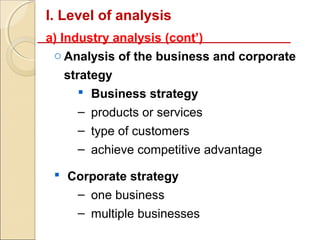
a) Industry analysis (cont’)
 o Analysis of the business and corporate
  strategy
      Business strategy
     – products or services
     – type of customers
     – achieve competitive advantage

  Corporate strategy
    – one business
    – multiple businesses
I. Level of analysis
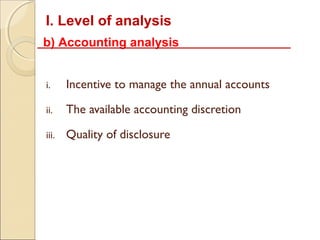
b) Accounting analysis


i.     Incentive to manage the annual accounts

ii.    The available accounting discretion

iii.   Quality of disclosure
I. Level of analysis
b) Accounting analysis
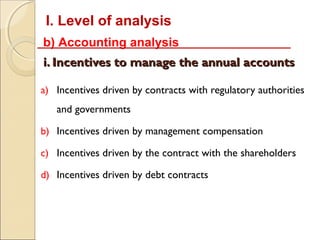
i. Incentives to manage the annual accounts

a) Incentives driven by contracts with regulatory authorities
   and governments

b) Incentives driven by management compensation

c) Incentives driven by the contract with the shareholders

d) Incentives driven by debt contracts
I. Level of analysis
 b) Accounting analysis
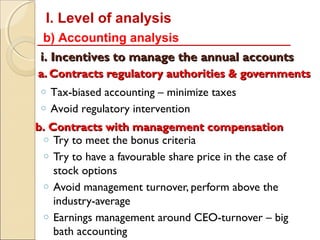
 i. Incentives to manage the annual accounts
a. Contracts regulatory authorities & governments
 o Tax-biased accounting – minimize taxes
 o Avoid regulatory intervention

b. Contracts with management compensation
 o Try to meet the bonus criteria
 o Try to have a favourable share price in the case of
    stock options
 o Avoid management turnover, perform above the
    industry-average
 o Earnings management around CEO-turnover – big
    bath accounting
I. Level of analysis
 b) Accounting analysis
i. Incentives to manage the annual accounts (cont.)
c. Incentives driven by the contract with the
   shareholders
 o   Low earnings volatility – income smoothing
 o   Recurrent and increasing stream of earnings
 o   Meeting earnings targets and industry benchmarks

d. Incentives driven by debt contracts
oTry to avoid violation of debt covenants
oTry to get favourable credit ratings
I. Level of analysis
b) Accounting analysis

ii. The available accounting discretion
Impact  of the quality of accounting
  standards used
  ◦ High quality versus low quality accounting standards,
    low quality standards allow more flexibility
Institutional     characteristics
  ◦ Risk of litigation, degree of enforcement
Company        characteristics
  ◦ Ownership structure (dispersed vs concentrated;
    listed vs nonlisted)
Level of analysis
 b) Accounting analysis
ii.The available accounting discretion (cont.)
 Board characteristics
  ◦ Percentage of independent directors
  ◦ Presence of audit committee
  ◦ CEO duality
 Audit quality

iii. Quality of disclosure
• Description of accounting methods and accounting
  estimates
• Explanation of significant changes in accounting
  methods and accounting estimates
• Level of information disclosure
iii. Quality of disclosure (cont’)
Accounting method choice & estimates
Choice   of depreciation method
Choice of inventory valuation
Choice whether or not to capitalize certain
 expenditures
Choice with regard to the valuation base
 (historical cost versus fair value)
..Bad debt allowances
Provisions
Write-down on inventory
Impairment of assets
Useful life or economic life of a fixed asset
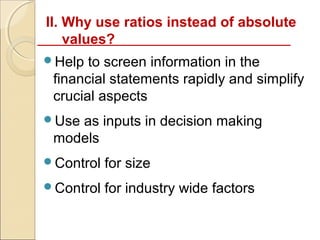
II. Why use ratios instead of absolute
    values?
Help  to screen information in the
 financial statements rapidly and simplify
 crucial aspects
Useas inputs in decision making
 models
Control   for size
Control   for industry wide factors
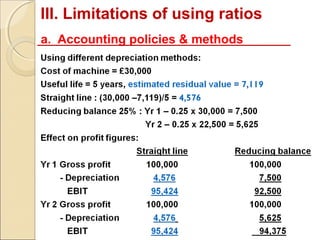
III. Limitations of using ratios
a. Accounting policies & methods
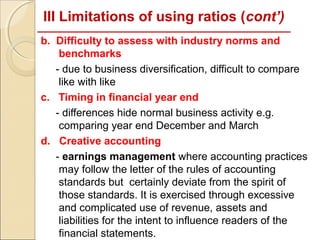
III Limitations of using ratios (cont’)
b. Difficulty to assess with industry norms and
    benchmarks
   - due to business diversification, difficult to compare
    like with like
c. Timing in financial year end
   - differences hide normal business activity e.g.
    comparing year end December and March
d. Creative accounting
   - earnings management where accounting practices
    may follow the letter of the rules of accounting
    standards but certainly deviate from the spirit of
    those standards. It is exercised through excessive
    and complicated use of revenue, assets and
    liabilities for the intent to influence readers of the
    financial statements.
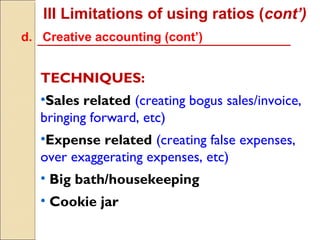
III Limitations of using ratios (cont’)
d. Creative accounting (cont’)


   TECHNIQUES:
   •Sales related (creating bogus sales/invoice,
   bringing forward, etc)
   •Expense related (creating false expenses,
   over exaggerating expenses, etc)
   • Big bath/housekeeping
   • Cookie jar
III Limitations of using ratios (cont’)
d. Creative accounting (cont’)

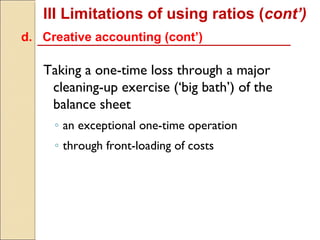
   Taking a one-time loss through a major
    cleaning-up exercise (‘big bath’) of the
    balance sheet
     ◦ an exceptional one-time operation
     ◦ through front-loading of costs
d. Creative accounting (cont’)

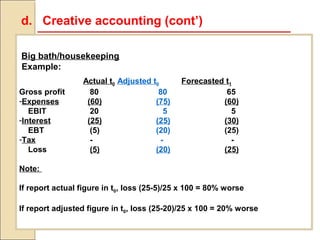
Big bath/housekeeping
Example:
                 Actual t0 Adjusted t0       Forecasted t1
Gross profit       80                 80                65
-Expenses         (60)               (75)              (60)
   EBIT            20                   5                 5
-Interest         (25)               (25)              (30)
   EBT             (5)               (20)              (25)
-Tax               -                   -                  -
   Loss            (5)               (20)              (25)

Note:

If report actual figure in t0, loss (25-5)/25 x 100 = 80% worse

If report adjusted figure in t0, loss (25-20)/25 x 100 = 20% worse
d. Creative accounting (cont’)

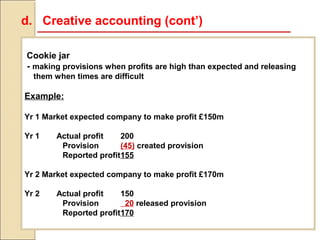
Cookie jar
- making provisions when profits are high than expected and releasing
  them when times are difficult

Example:

Yr 1 Market expected company to make profit £150m

Yr 1    Actual profit   200
         Provision      (45) created provision
         Reported profit155

Yr 2 Market expected company to make profit £170m

Yr 2    Actual profit   150
         Provision       20 released provision
         Reported profit170
d. Creative accounting (cont’)
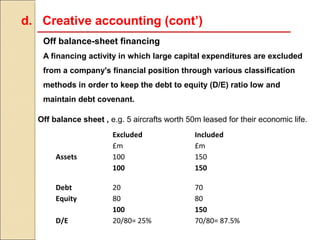
   Off balance-sheet financing
   A financing activity in which large capital expenditures are excluded
   from a company's financial position through various classification
   methods in order to keep the debt to equity (D/E) ratio low and
   maintain debt covenant.

  Off balance sheet , e.g. 5 aircrafts worth 50m leased for their economic life.
                       Excluded                Included
                       £m                      £m
       Assets          100                     150
                       100                     150

       Debt            20                      70
       Equity          80                      80
                       100                     150
       D/E             20/80= 25%              70/80= 87.5%
IV. Ratio Analysis Benchmarking

 Evaluating
           ratios requires comparison against
  some benchmark.
 Such   benchmarks include:
   ◦ Ratios of other firms in the industry
     (cross-sectional)
   ◦ Ratios over time from prior periods
     (time series)

 Effectiveratio analysis must attempt to relate
  underlying business factors to the financial
  numbers
However, benchmarking has its problems…….
IV. Ratio Analysis Benchmarking
Problems in Cross-sectional Analysis
1. Data availability
a) non-availability
    - due to ltd. disclosure, foreign language or
  private co.?
b) non-synchronous reporting periods
    - due to difference in yr-end e.g. US in Dec;
  Japan in March; Australia in June. Hence, need to
  adjust the reporting period
c) non-uniformity in accounting methods
   - restrict sample to those using similar methods;
  adjust reported numbers or use approximation
  method
Problems in Cross-sectional Analysis (cont’)

2. International comparisons
a) accounting principles
   - US doesn’t use IFRS
b) taxation rules
    - in UK, different rules for tax and reporting while in
  France, Germany, same rules for tax and reporting
c) Financing & operational arrangements
   - debt is more popular form in Germany, Japan,
  Korea but equity in the UK, US
d) cultural, economic, political environment
   - law: common vs. codified law; type of ownership;
  govt.-buss. relations
Problems in Cross-sectional Analysis (cont’)
3. Activity of firms- look at segmental report
a) acquisitions/diversification
   - new product line; geographic; create synergy
b) divestitures/sell off
    - combine remaining divisions; discontinued; re-
  align continuing activities
c) organisational changes
   - structural changes in divisions affect
  performance
d) internal reporting system
   - how accounts are kept and reported e.g.
  allocation methods, transfer pricing
Problems in Cross-sectional Analysis (cont’)

4. Industry comparison
a) classification of industry
  - selecting comparables (see next slide)
b) sources of info on industry
   - UK: SEIC (FTSE classification); US: SIC;
  analyst or own
c) industry differences
   - ratios affected by type of industry e.g. gearing
  high for airline but low for life insurance
Selecting Comparables in Cross-sectional Analysis

    similarity   on supply side (industry level)
     - use same raw materials, production process,
     distribution networks
    similarity on demand side (product level)
     - similar end-product (substitute); similar brands &
     range of products
    similarity in capital market attributes

      - for investment purposes: e.g. similar risk factor,
     listed in same market
    similarity in legal ownership

       - public listed companies, private companies
Problems in Time Series Analysis

 1. Structural Issues

 2. Accounting method changes &
  classification
Problems in time series – Structural issue

Within company
1. Financing structure – e.g. change in composition of
  debt to equity
2. Product mix – e.g. diversification; new product range
3. Mergers – e.g. change in structure and business

Outside company
1. Competition – e.g. contraction in mkt. share due to
  entrance of big player
2. Technology - advancement in R & D/major discovery
3. Economy - inflation & interest rate, economic cycle, etc
4. Regulation - e.g. environmental Act
Problems in time series – Change in
accounting methods & classification

 a) Mandatory vs. Voluntary
 - change in regulation or company’s policy
   affects disclosure

 b) Accounting policy choice
 - principles-based vs rule-based

 c) Timing of event
 - change in year-end or recognition of events
Problems in time series – Change in
accounting methods & classification
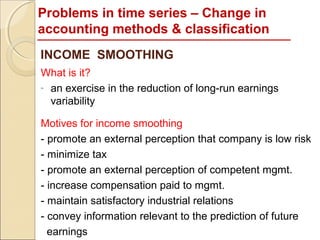
INCOME SMOOTHING
What is it?
- an exercise in the reduction of long-run earnings
  variability

Motives for income smoothing
- promote an external perception that company is low risk
- minimize tax
- promote an external perception of competent mgmt.
- increase compensation paid to mgmt.
- maintain satisfactory industrial relations
- convey information relevant to the prediction of future
  earnings

7 limitations of ratio analysis

  • 1.
    Financial Statements Analysis Lecture 7 Limitations of ratio analysis & Problems with benchmarking
  • 2.
    Lecture Objectives By theend of this lecture you should be able to: I.Explain the level of analysis II.Explain the reasons for using ratios instead of absolute numbers for analysis III.Discussthe various limitations of ratio analysis and its association with accounting quality IV.Discussproblems with benchmarking for cross-sectional and time series analysis
  • 3.
    I. Level ofanalysis a) Industry analysis Analysis of the business environment – degree of competition – price competition – high or low barriers to entry – the relation of the input and output market of a firm
  • 4.
    I. Level ofanalysis a) Industry analysis (cont’) o Analysis of the business and corporate strategy  Business strategy – products or services – type of customers – achieve competitive advantage  Corporate strategy – one business – multiple businesses
  • 5.
    I. Level ofanalysis b) Accounting analysis i. Incentive to manage the annual accounts ii. The available accounting discretion iii. Quality of disclosure
  • 6.
    I. Level ofanalysis b) Accounting analysis i. Incentives to manage the annual accounts a) Incentives driven by contracts with regulatory authorities and governments b) Incentives driven by management compensation c) Incentives driven by the contract with the shareholders d) Incentives driven by debt contracts
  • 7.
    I. Level ofanalysis b) Accounting analysis i. Incentives to manage the annual accounts a. Contracts regulatory authorities & governments o Tax-biased accounting – minimize taxes o Avoid regulatory intervention b. Contracts with management compensation o Try to meet the bonus criteria o Try to have a favourable share price in the case of stock options o Avoid management turnover, perform above the industry-average o Earnings management around CEO-turnover – big bath accounting
  • 8.
    I. Level ofanalysis b) Accounting analysis i. Incentives to manage the annual accounts (cont.) c. Incentives driven by the contract with the shareholders o Low earnings volatility – income smoothing o Recurrent and increasing stream of earnings o Meeting earnings targets and industry benchmarks d. Incentives driven by debt contracts oTry to avoid violation of debt covenants oTry to get favourable credit ratings
  • 9.
    I. Level ofanalysis b) Accounting analysis ii. The available accounting discretion Impact of the quality of accounting standards used ◦ High quality versus low quality accounting standards, low quality standards allow more flexibility Institutional characteristics ◦ Risk of litigation, degree of enforcement Company characteristics ◦ Ownership structure (dispersed vs concentrated; listed vs nonlisted)
  • 10.
    Level of analysis b) Accounting analysis ii.The available accounting discretion (cont.)  Board characteristics ◦ Percentage of independent directors ◦ Presence of audit committee ◦ CEO duality  Audit quality iii. Quality of disclosure • Description of accounting methods and accounting estimates • Explanation of significant changes in accounting methods and accounting estimates • Level of information disclosure
  • 11.
    iii. Quality ofdisclosure (cont’) Accounting method choice & estimates Choice of depreciation method Choice of inventory valuation Choice whether or not to capitalize certain expenditures Choice with regard to the valuation base (historical cost versus fair value) ..Bad debt allowances Provisions Write-down on inventory Impairment of assets Useful life or economic life of a fixed asset
  • 12.
    II. Why useratios instead of absolute values? Help to screen information in the financial statements rapidly and simplify crucial aspects Useas inputs in decision making models Control for size Control for industry wide factors
  • 13.
    III. Limitations ofusing ratios a. Accounting policies & methods
  • 14.
    III Limitations ofusing ratios (cont’) b. Difficulty to assess with industry norms and benchmarks - due to business diversification, difficult to compare like with like c. Timing in financial year end - differences hide normal business activity e.g. comparing year end December and March d. Creative accounting - earnings management where accounting practices may follow the letter of the rules of accounting standards but certainly deviate from the spirit of those standards. It is exercised through excessive and complicated use of revenue, assets and liabilities for the intent to influence readers of the financial statements.
  • 15.
    III Limitations ofusing ratios (cont’) d. Creative accounting (cont’) TECHNIQUES: •Sales related (creating bogus sales/invoice, bringing forward, etc) •Expense related (creating false expenses, over exaggerating expenses, etc) • Big bath/housekeeping • Cookie jar
  • 16.
    III Limitations ofusing ratios (cont’) d. Creative accounting (cont’) Taking a one-time loss through a major cleaning-up exercise (‘big bath’) of the balance sheet ◦ an exceptional one-time operation ◦ through front-loading of costs
  • 17.
    d. Creative accounting(cont’) Big bath/housekeeping Example: Actual t0 Adjusted t0 Forecasted t1 Gross profit 80 80 65 -Expenses (60) (75) (60) EBIT 20 5 5 -Interest (25) (25) (30) EBT (5) (20) (25) -Tax - - - Loss (5) (20) (25) Note: If report actual figure in t0, loss (25-5)/25 x 100 = 80% worse If report adjusted figure in t0, loss (25-20)/25 x 100 = 20% worse
  • 18.
    d. Creative accounting(cont’) Cookie jar - making provisions when profits are high than expected and releasing them when times are difficult Example: Yr 1 Market expected company to make profit £150m Yr 1 Actual profit 200 Provision (45) created provision Reported profit155 Yr 2 Market expected company to make profit £170m Yr 2 Actual profit 150 Provision 20 released provision Reported profit170
  • 19.
    d. Creative accounting(cont’) Off balance-sheet financing A financing activity in which large capital expenditures are excluded from a company's financial position through various classification methods in order to keep the debt to equity (D/E) ratio low and maintain debt covenant. Off balance sheet , e.g. 5 aircrafts worth 50m leased for their economic life. Excluded Included £m £m Assets 100 150 100 150 Debt 20 70 Equity 80 80 100 150 D/E 20/80= 25% 70/80= 87.5%
  • 20.
    IV. Ratio AnalysisBenchmarking  Evaluating ratios requires comparison against some benchmark.  Such benchmarks include: ◦ Ratios of other firms in the industry (cross-sectional) ◦ Ratios over time from prior periods (time series)  Effectiveratio analysis must attempt to relate underlying business factors to the financial numbers However, benchmarking has its problems…….
  • 21.
    IV. Ratio AnalysisBenchmarking Problems in Cross-sectional Analysis 1. Data availability a) non-availability - due to ltd. disclosure, foreign language or private co.? b) non-synchronous reporting periods - due to difference in yr-end e.g. US in Dec; Japan in March; Australia in June. Hence, need to adjust the reporting period c) non-uniformity in accounting methods - restrict sample to those using similar methods; adjust reported numbers or use approximation method
  • 22.
    Problems in Cross-sectionalAnalysis (cont’) 2. International comparisons a) accounting principles - US doesn’t use IFRS b) taxation rules - in UK, different rules for tax and reporting while in France, Germany, same rules for tax and reporting c) Financing & operational arrangements - debt is more popular form in Germany, Japan, Korea but equity in the UK, US d) cultural, economic, political environment - law: common vs. codified law; type of ownership; govt.-buss. relations
  • 23.
    Problems in Cross-sectionalAnalysis (cont’) 3. Activity of firms- look at segmental report a) acquisitions/diversification - new product line; geographic; create synergy b) divestitures/sell off - combine remaining divisions; discontinued; re- align continuing activities c) organisational changes - structural changes in divisions affect performance d) internal reporting system - how accounts are kept and reported e.g. allocation methods, transfer pricing
  • 24.
    Problems in Cross-sectionalAnalysis (cont’) 4. Industry comparison a) classification of industry - selecting comparables (see next slide) b) sources of info on industry - UK: SEIC (FTSE classification); US: SIC; analyst or own c) industry differences - ratios affected by type of industry e.g. gearing high for airline but low for life insurance
  • 25.
    Selecting Comparables inCross-sectional Analysis similarity on supply side (industry level) - use same raw materials, production process, distribution networks similarity on demand side (product level) - similar end-product (substitute); similar brands & range of products similarity in capital market attributes - for investment purposes: e.g. similar risk factor, listed in same market similarity in legal ownership - public listed companies, private companies
  • 26.
    Problems in TimeSeries Analysis 1. Structural Issues 2. Accounting method changes & classification
  • 27.
    Problems in timeseries – Structural issue Within company 1. Financing structure – e.g. change in composition of debt to equity 2. Product mix – e.g. diversification; new product range 3. Mergers – e.g. change in structure and business Outside company 1. Competition – e.g. contraction in mkt. share due to entrance of big player 2. Technology - advancement in R & D/major discovery 3. Economy - inflation & interest rate, economic cycle, etc 4. Regulation - e.g. environmental Act
  • 28.
    Problems in timeseries – Change in accounting methods & classification a) Mandatory vs. Voluntary - change in regulation or company’s policy affects disclosure b) Accounting policy choice - principles-based vs rule-based c) Timing of event - change in year-end or recognition of events
  • 29.
    Problems in timeseries – Change in accounting methods & classification INCOME SMOOTHING What is it? - an exercise in the reduction of long-run earnings variability Motives for income smoothing - promote an external perception that company is low risk - minimize tax - promote an external perception of competent mgmt. - increase compensation paid to mgmt. - maintain satisfactory industrial relations - convey information relevant to the prediction of future earnings