Academic Journal
Article Writing Course
Sioux McKenna
s.mckenna@ru.ac.za
CHERTL
Academic Writing: The thesis statement
Sioux McKenna
s.mckenna@ru.ac.za
CHERTL
This session…
• The difference between a thesis and a journal
article
• Developing the central argument: writing the
thesis statement
• Mind-mapping the article, identifying the key
terms
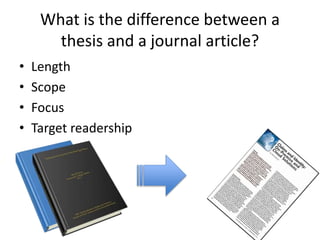
What is the difference between a
thesis and a journal article?
• Length
• Scope
• Focus
• Target readership
What is it that you want your reader to
understand and agree with after reading your
convincing article substantiated with credible
evidence?
One clear and clean argument
Using argument in your thesis
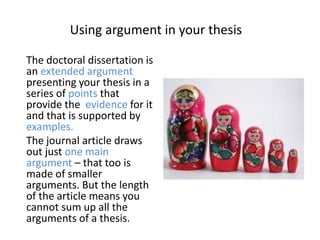
The doctoral dissertation is
an extended argument
presenting your thesis in a
series of points that
provide the evidence for it
and that is supported by
examples.
The journal article draws
out just one main
argument – that too is
made of smaller
arguments. But the length
of the article means you
cannot sum up all the
arguments of a thesis.
Can you write your journal article
argument on a matchbox?
Some (unfortunate) ‘truths’ about publishing out of the
thesis
• It can take some time to find small arguments
within the big thesis argument
• One paper = one small, well-crafted argument
• You can’t actually cut and paste from your
thesis – it is not the way to craft an argument
• Thesis writing and article writing can be quite
different – adjusting needs to be done
consciously
Thanks to Sherran Clarence
So, where to start with your paper?
• You need ONE argument you can make
– Can be ‘empirical’ (Lea & Street, ‘Student writing in higher
education: An academic literacies approach’)
– Can be a critical literature review (Robotham & Julian,
‘Stress and the higher education student: a critical review
of the literature’)
– Can be a reflective, analytical piece (Grant, ‘The Mourning
After’)
– Can be focused on methodology and methods (Ortlipp,
‘Keeping and using reflective journals in the qualitative
research process’)
Thanks to Sherran Clarence
Shut up and scribble 
• Spend about 5 minutes now thinking about the one
good idea you are turning into a paper.
• What kind of paper will it be? Ask yourself: what is
the significance of this argument? For whom would it
be significant? (So what? + possible audience)
• Share with a partner for 5 minutes, and make a note
of any useful feedback.
Thanks to Sherran Clarence
Being authoritative
• Work out who you can be in your writing (‘the
researcher’, ‘I’, ‘we’ or ‘anonymous’)
• Be conscious of the CLAIMS you are making/developing
Evidence for your claims can come from
• – The work of others
• – Your own data
Data and argument
• Novice researchers often describe the data
• INSTEAD, they need to use it as evidence to support
claims
• What does the data say?
• How can it help you to make a claim?
• What claim can be made with the evidence that comes
from the data?
• How does this contribute to the overall argument?
Demonstrate mastery of the
territory
• A field or territory is always occupied by a number of
academic communities who are seeking to advance
knowledge
• These communities are held together by common
interests and beliefs, and by progress in knowledge
production
• Look at who is citing whom. Academic communities often
have ‘Chiefs and Followers’ (Becher and Trowler 2001). They can
change their minds over time – dates are crucial! Older Chiefs
are often replaced by new Chiefs as knowledge is advanced in a
particular field.
• How does your work ‘fit’ into this field?
• NB: You will only find out by reading widely and by being
part of the academic community!
• Use your reading journal to make connections over and
between communities and to track changes in position
and thinking
Defending your approach
• Is there another way to understand/approach the
problem/question you have identified?
• What are the objections to that understanding/approach?
• If an alternative exists, acknowledge, consider and, if
appropriate, demolish (with a strong argument, not weak
language)!
• Do not mock the alternative or dismiss it – show
awareness and critical engagement with it in relation to
your own work and positioning
• Make sure you read carefully, deeply and critically …
map out the territory and position your work
Substantiating your claim
• Examine your claims for weaknesses and either
SUBSTANTIATE them more/differently or LIMIT
your claim
• Provide more evidence
• Develop the argument using evidence differently
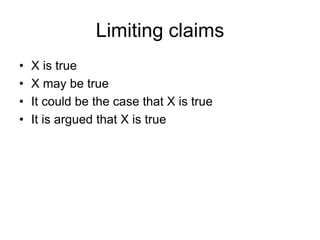
Limiting claims
• X is true
• X may be true
• It could be the case that X is true
• It is argued that X is true
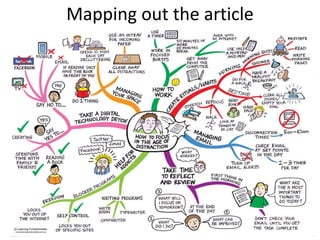
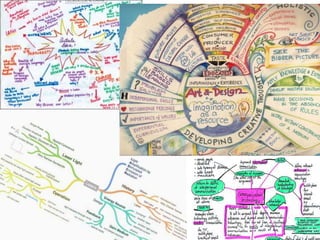
Mapping out the article
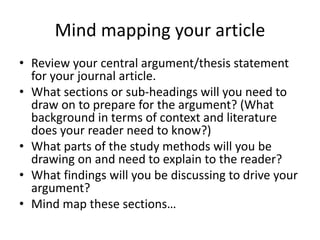
Mind mapping your article
• Review your central argument/thesis statement
for your journal article.
• What sections or sub-headings will you need to
draw on to prepare for the argument? (What
background in terms of context and literature
does your reader need to know?)
• What parts of the study methods will you be
drawing on and need to explain to the reader?
• What findings will you be discussing to drive your
argument?
• Mind map these sections…
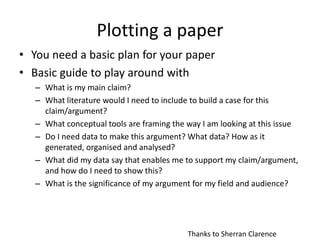
Plotting a paper
• You need a basic plan for your paper
• Basic guide to play around with
– What is my main claim?
– What literature would I need to include to build a case for this
claim/argument?
– What conceptual tools are framing the way I am looking at this issue
– Do I need data to make this argument? What data? How as it
generated, organised and analysed?
– What did my data say that enables me to support my claim/argument,
and how do I need to show this?
– What is the significance of my argument for my field and audience?
Thanks to Sherran Clarence
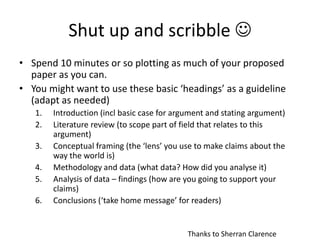
Shut up and scribble 
• Spend 10 minutes or so plotting as much of your proposed
paper as you can.
• You might want to use these basic ‘headings’ as a guideline
(adapt as needed)
1. Introduction (incl basic case for argument and stating argument)
2. Literature review (to scope part of field that relates to this
argument)
3. Conceptual framing (the ‘lens’ you use to make claims about the
way the world is)
4. Methodology and data (what data? How did you analyse it)
5. Analysis of data – findings (how are you going to support your
claims)
6. Conclusions (‘take home message’ for readers)
Thanks to Sherran Clarence
• On paper
• Then as poster
Key terms / Core concepts
• What are the key terms or ideas in the journal
article?
• Do they need discussion or can we assume
shared understanding?

Writing for publication 2017 argument and mindmapping the article

  • 1.
    Academic Journal Article WritingCourse Sioux McKenna s.mckenna@ru.ac.za CHERTL
  • 2.
    Academic Writing: Thethesis statement Sioux McKenna s.mckenna@ru.ac.za CHERTL
  • 3.
    This session… • Thedifference between a thesis and a journal article • Developing the central argument: writing the thesis statement • Mind-mapping the article, identifying the key terms
  • 4.
    What is thedifference between a thesis and a journal article? • Length • Scope • Focus • Target readership
  • 5.
    What is itthat you want your reader to understand and agree with after reading your convincing article substantiated with credible evidence? One clear and clean argument
  • 6.
    Using argument inyour thesis The doctoral dissertation is an extended argument presenting your thesis in a series of points that provide the evidence for it and that is supported by examples. The journal article draws out just one main argument – that too is made of smaller arguments. But the length of the article means you cannot sum up all the arguments of a thesis.
  • 8.
    Can you writeyour journal article argument on a matchbox?
  • 9.
    Some (unfortunate) ‘truths’about publishing out of the thesis • It can take some time to find small arguments within the big thesis argument • One paper = one small, well-crafted argument • You can’t actually cut and paste from your thesis – it is not the way to craft an argument • Thesis writing and article writing can be quite different – adjusting needs to be done consciously Thanks to Sherran Clarence
  • 10.
    So, where tostart with your paper? • You need ONE argument you can make – Can be ‘empirical’ (Lea & Street, ‘Student writing in higher education: An academic literacies approach’) – Can be a critical literature review (Robotham & Julian, ‘Stress and the higher education student: a critical review of the literature’) – Can be a reflective, analytical piece (Grant, ‘The Mourning After’) – Can be focused on methodology and methods (Ortlipp, ‘Keeping and using reflective journals in the qualitative research process’) Thanks to Sherran Clarence
  • 11.
    Shut up andscribble  • Spend about 5 minutes now thinking about the one good idea you are turning into a paper. • What kind of paper will it be? Ask yourself: what is the significance of this argument? For whom would it be significant? (So what? + possible audience) • Share with a partner for 5 minutes, and make a note of any useful feedback. Thanks to Sherran Clarence
  • 12.
    Being authoritative • Workout who you can be in your writing (‘the researcher’, ‘I’, ‘we’ or ‘anonymous’) • Be conscious of the CLAIMS you are making/developing Evidence for your claims can come from • – The work of others • – Your own data
  • 13.
    Data and argument •Novice researchers often describe the data • INSTEAD, they need to use it as evidence to support claims • What does the data say? • How can it help you to make a claim? • What claim can be made with the evidence that comes from the data? • How does this contribute to the overall argument?
  • 14.
    Demonstrate mastery ofthe territory • A field or territory is always occupied by a number of academic communities who are seeking to advance knowledge • These communities are held together by common interests and beliefs, and by progress in knowledge production • Look at who is citing whom. Academic communities often have ‘Chiefs and Followers’ (Becher and Trowler 2001). They can change their minds over time – dates are crucial! Older Chiefs are often replaced by new Chiefs as knowledge is advanced in a particular field. • How does your work ‘fit’ into this field? • NB: You will only find out by reading widely and by being part of the academic community! • Use your reading journal to make connections over and between communities and to track changes in position and thinking
  • 15.
    Defending your approach •Is there another way to understand/approach the problem/question you have identified? • What are the objections to that understanding/approach? • If an alternative exists, acknowledge, consider and, if appropriate, demolish (with a strong argument, not weak language)! • Do not mock the alternative or dismiss it – show awareness and critical engagement with it in relation to your own work and positioning • Make sure you read carefully, deeply and critically … map out the territory and position your work
  • 16.
    Substantiating your claim •Examine your claims for weaknesses and either SUBSTANTIATE them more/differently or LIMIT your claim • Provide more evidence • Develop the argument using evidence differently
  • 17.
    Limiting claims • Xis true • X may be true • It could be the case that X is true • It is argued that X is true
  • 18.
  • 19.
    Mind mapping yourarticle • Review your central argument/thesis statement for your journal article. • What sections or sub-headings will you need to draw on to prepare for the argument? (What background in terms of context and literature does your reader need to know?) • What parts of the study methods will you be drawing on and need to explain to the reader? • What findings will you be discussing to drive your argument? • Mind map these sections…
  • 20.
    Plotting a paper •You need a basic plan for your paper • Basic guide to play around with – What is my main claim? – What literature would I need to include to build a case for this claim/argument? – What conceptual tools are framing the way I am looking at this issue – Do I need data to make this argument? What data? How as it generated, organised and analysed? – What did my data say that enables me to support my claim/argument, and how do I need to show this? – What is the significance of my argument for my field and audience? Thanks to Sherran Clarence
  • 21.
    Shut up andscribble  • Spend 10 minutes or so plotting as much of your proposed paper as you can. • You might want to use these basic ‘headings’ as a guideline (adapt as needed) 1. Introduction (incl basic case for argument and stating argument) 2. Literature review (to scope part of field that relates to this argument) 3. Conceptual framing (the ‘lens’ you use to make claims about the way the world is) 4. Methodology and data (what data? How did you analyse it) 5. Analysis of data – findings (how are you going to support your claims) 6. Conclusions (‘take home message’ for readers) Thanks to Sherran Clarence
  • 23.
    • On paper •Then as poster
  • 24.
    Key terms /Core concepts • What are the key terms or ideas in the journal article? • Do they need discussion or can we assume shared understanding?