Los Barrios' fauna and flora


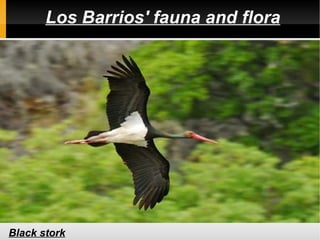
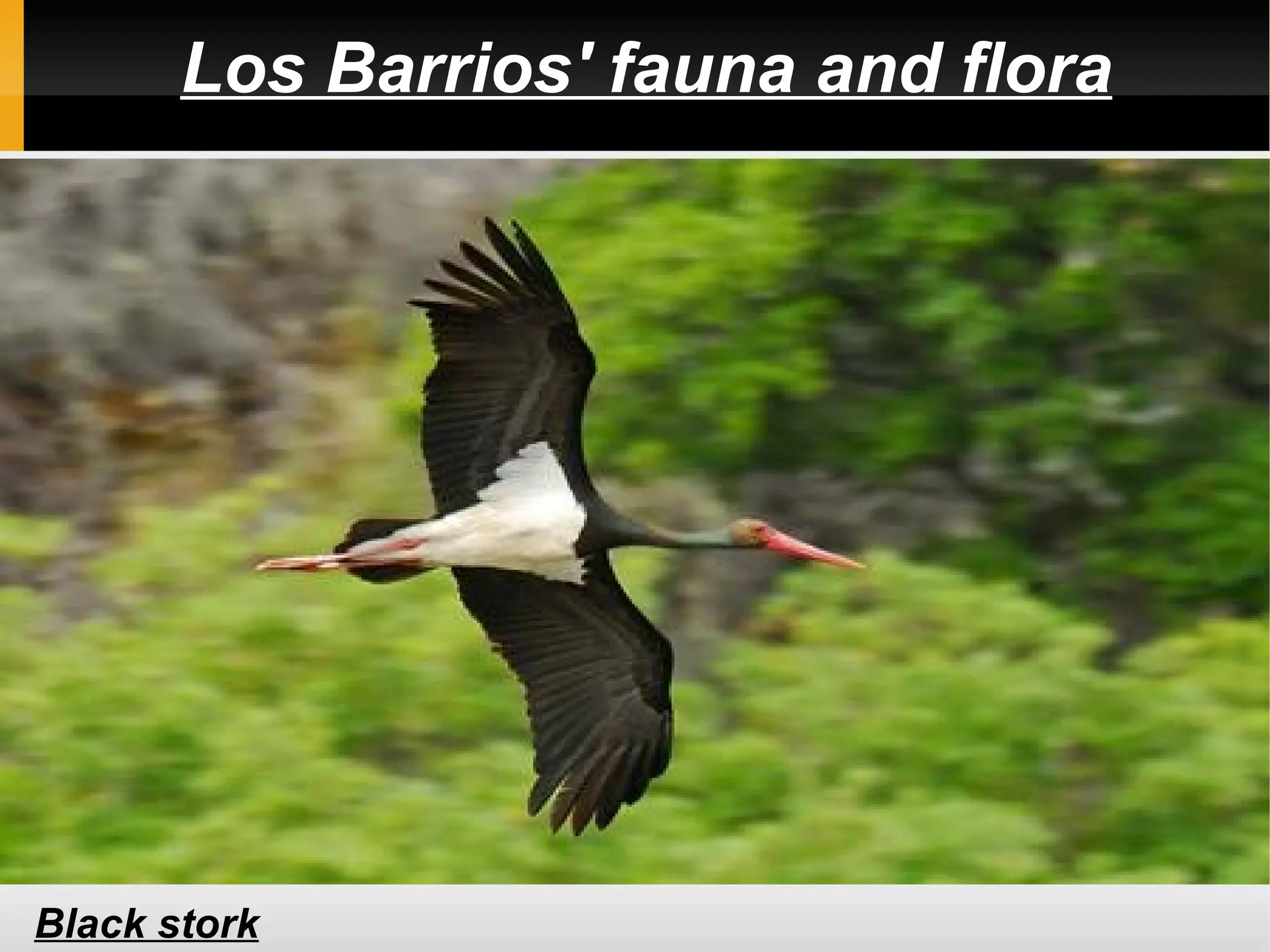
Black stork
Los Barrios' fauna and flora

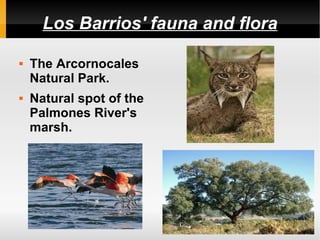
   The Arcornocales
    Natural Park.
   Natural spot of the
    Palmones River's
    marsh.
The Arcornocales Natural Park

It was declared Natural Park by the Parlament of
Andalusia in 1989. It takes up a big strip between the
coastal zone of Tarfa to the interior mountain range. It has
in total an area of about 167.767 ha. It's one of the biggest
Natural Park in Spain. Given the geographic position of
Los Alcornocales, the dominant climate in the zone is,
logically, Mediterranean.
Fauna of the Alcornocales

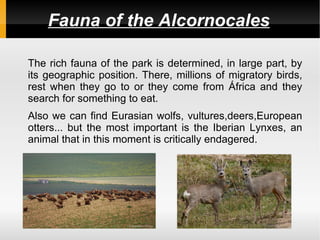
The rich fauna of the park is determined, in large part, by
its geographic position. There, millions of migratory birds,
rest when they go to or they come from África and they
search for something to eat.
Also we can find Eurasian wolfs, vultures,deers,European
otters... but the most important is the Iberian Lynxes, an
animal that in this moment is critically endagered.
Iberian Lynxes and Eurasian Wolfs

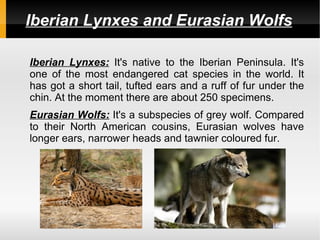
Iberian Lynxes: It's native to the Iberian Peninsula. It's
one of the most endangered cat species in the world. It
has got a short tail, tufted ears and a ruff of fur under the
chin. At the moment there are about 250 specimens.
Eurasian Wolfs: It's a subspecies of grey wolf. Compared
to their North American cousins, Eurasian wolves have
longer ears, narrower heads and tawnier coloured fur.
Flora of the Arcornocales
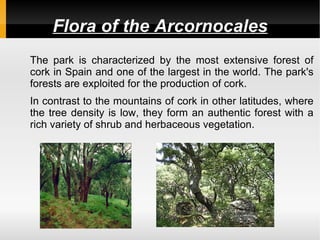
The park is characterized by the most extensive forest of
cork in Spain and one of the largest in the world. The park's
forests are exploited for the production of cork.
In contrast to the mountains of cork in other latitudes, where
the tree density is low, they form an authentic forest with a
rich variety of shrub and herbaceous vegetation.
Cork Oak

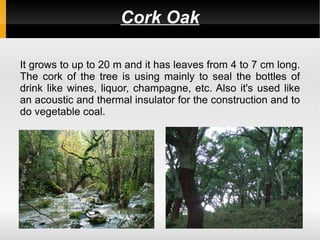
It grows to up to 20 m and it has leaves from 4 to 7 cm long.
The cork of the tree is using mainly to seal the bottles of
drink like wines, liquor, champagne, etc. Also it's used like
an acoustic and thermal insulator for the construction and to
do vegetable coal.
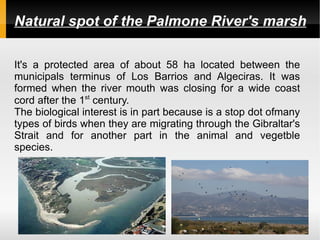
Natural spot of the Palmone River's marsh

It's a protected area of about 58 ha located between the
municipals terminus of Los Barrios and Algeciras. It was
formed when the river mouth was closing for a wide coast
cord after the 1st century.
The biological interest is in part because is a stop dot ofmany
types of birds when they are migrating through the Gibraltar's
Strait and for another part in the animal and vegetble
species.
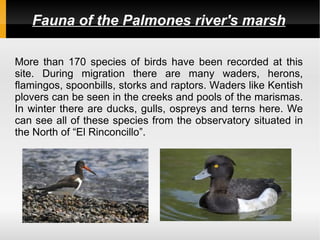
Fauna of the Palmones river's marsh

More than 170 species of birds have been recorded at this
site. During migration there are many waders, herons,
flamingos, spoonbills, storks and raptors. Waders like Kentish
plovers can be seen in the creeks and pools of the marismas.
In winter there are ducks, gulls, ospreys and terns here. We
can see all of these species from the observatory situated in
the North of “El Rinconcillo”.
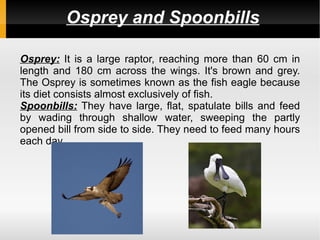
Osprey and Spoonbills

Osprey: It is a large raptor, reaching more than 60 cm in
length and 180 cm across the wings. It's brown and grey.
The Osprey is sometimes known as the fish eagle because
its diet consists almost exclusively of fish.
Spoonbills: They have large, flat, spatulate bills and feed
by wading through shallow water, sweeping the partly
opened bill from side to side. They need to feed many hours
each day.
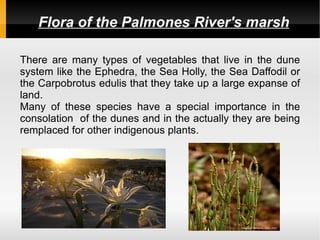
Flora of the Palmones River's marsh

There are many types of vegetables that live in the dune
system like the Ephedra, the Sea Holly, the Sea Daffodil or
the Carpobrotus edulis that they take up a large expanse of
land.
Many of these species have a special importance in the
consolation of the dunes and in the actually they are being
remplaced for other indigenous plants.
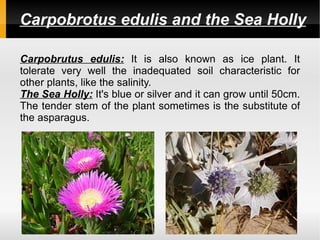
Carpobrotus edulis and the Sea Holly

Carpobrutus edulis: It is also known as ice plant. It
tolerate very well the inadequated soil characteristic for
other plants, like the salinity.
The Sea Holly: It's blue or silver and it can grow until 50cm.
The tender stem of the plant sometimes is the substitute of
the asparagus.
Thank you

Juan García Ruiz

Alvaro Sánchez Gutiérrez

Juan Ernesto del Río Martín

Pablo Venegas Álvarez

Victor Daniel Gil Becerra

Adrián Farrell Rovira

Grupo 5

  • 1.
    Los Barrios' faunaand flora Black stork
  • 2.
    Los Barrios' faunaand flora  The Arcornocales Natural Park.  Natural spot of the Palmones River's marsh.
  • 3.
    The Arcornocales NaturalPark It was declared Natural Park by the Parlament of Andalusia in 1989. It takes up a big strip between the coastal zone of Tarfa to the interior mountain range. It has in total an area of about 167.767 ha. It's one of the biggest Natural Park in Spain. Given the geographic position of Los Alcornocales, the dominant climate in the zone is, logically, Mediterranean.
  • 4.
    Fauna of theAlcornocales The rich fauna of the park is determined, in large part, by its geographic position. There, millions of migratory birds, rest when they go to or they come from África and they search for something to eat. Also we can find Eurasian wolfs, vultures,deers,European otters... but the most important is the Iberian Lynxes, an animal that in this moment is critically endagered.
  • 5.
    Iberian Lynxes andEurasian Wolfs Iberian Lynxes: It's native to the Iberian Peninsula. It's one of the most endangered cat species in the world. It has got a short tail, tufted ears and a ruff of fur under the chin. At the moment there are about 250 specimens. Eurasian Wolfs: It's a subspecies of grey wolf. Compared to their North American cousins, Eurasian wolves have longer ears, narrower heads and tawnier coloured fur.
  • 6.
    Flora of theArcornocales The park is characterized by the most extensive forest of cork in Spain and one of the largest in the world. The park's forests are exploited for the production of cork. In contrast to the mountains of cork in other latitudes, where the tree density is low, they form an authentic forest with a rich variety of shrub and herbaceous vegetation.
  • 7.
    Cork Oak It growsto up to 20 m and it has leaves from 4 to 7 cm long. The cork of the tree is using mainly to seal the bottles of drink like wines, liquor, champagne, etc. Also it's used like an acoustic and thermal insulator for the construction and to do vegetable coal.
  • 8.
    Natural spot ofthe Palmone River's marsh It's a protected area of about 58 ha located between the municipals terminus of Los Barrios and Algeciras. It was formed when the river mouth was closing for a wide coast cord after the 1st century. The biological interest is in part because is a stop dot ofmany types of birds when they are migrating through the Gibraltar's Strait and for another part in the animal and vegetble species.
  • 9.
    Fauna of thePalmones river's marsh More than 170 species of birds have been recorded at this site. During migration there are many waders, herons, flamingos, spoonbills, storks and raptors. Waders like Kentish plovers can be seen in the creeks and pools of the marismas. In winter there are ducks, gulls, ospreys and terns here. We can see all of these species from the observatory situated in the North of “El Rinconcillo”.
  • 10.
    Osprey and Spoonbills Osprey:It is a large raptor, reaching more than 60 cm in length and 180 cm across the wings. It's brown and grey. The Osprey is sometimes known as the fish eagle because its diet consists almost exclusively of fish. Spoonbills: They have large, flat, spatulate bills and feed by wading through shallow water, sweeping the partly opened bill from side to side. They need to feed many hours each day.
  • 11.
    Flora of thePalmones River's marsh There are many types of vegetables that live in the dune system like the Ephedra, the Sea Holly, the Sea Daffodil or the Carpobrotus edulis that they take up a large expanse of land. Many of these species have a special importance in the consolation of the dunes and in the actually they are being remplaced for other indigenous plants.
  • 12.
    Carpobrotus edulis andthe Sea Holly Carpobrutus edulis: It is also known as ice plant. It tolerate very well the inadequated soil characteristic for other plants, like the salinity. The Sea Holly: It's blue or silver and it can grow until 50cm. The tender stem of the plant sometimes is the substitute of the asparagus.
  • 13.
    Thank you Juan GarcíaRuiz Alvaro Sánchez Gutiérrez Juan Ernesto del Río Martín Pablo Venegas Álvarez Victor Daniel Gil Becerra Adrián Farrell Rovira