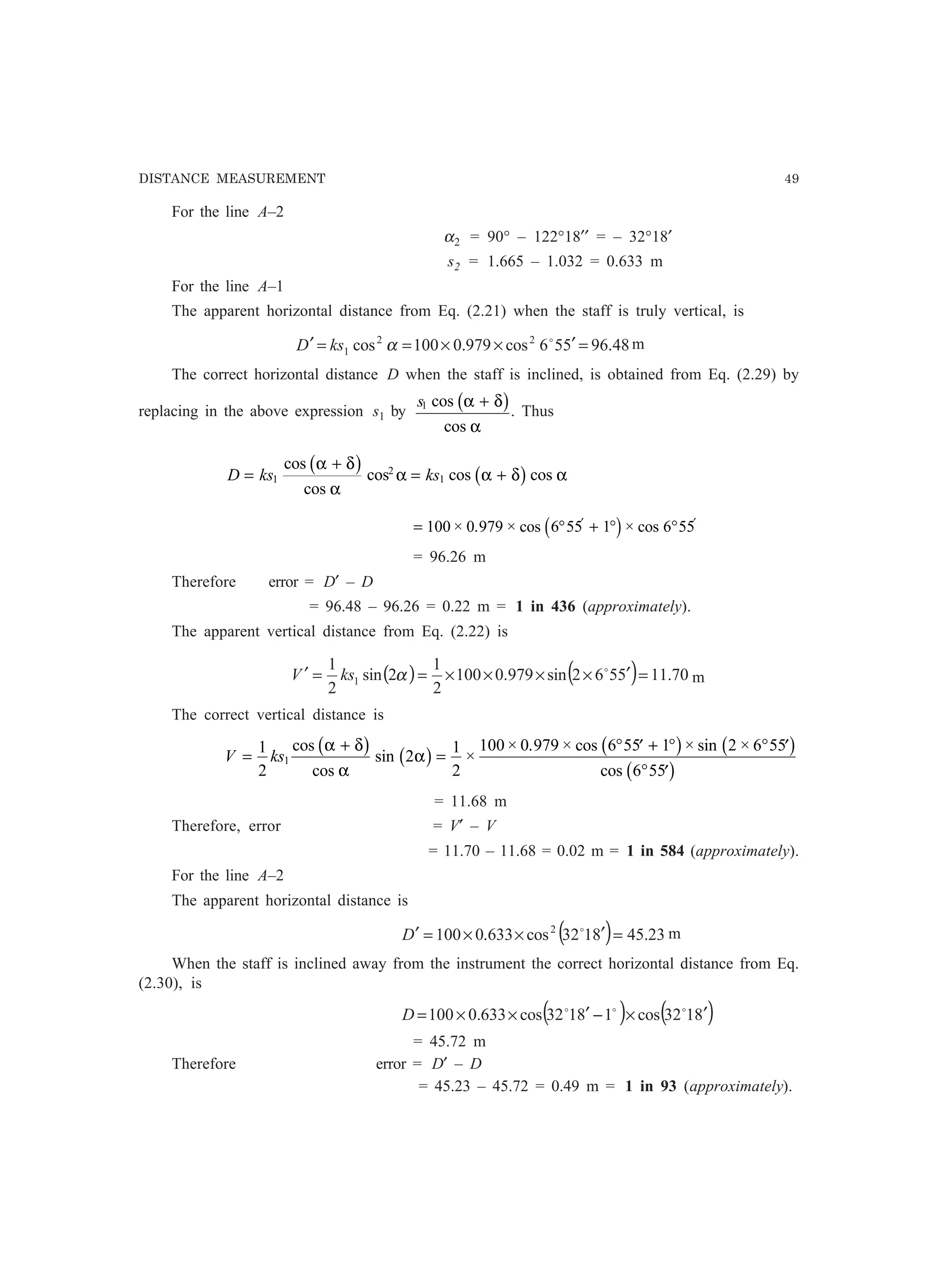
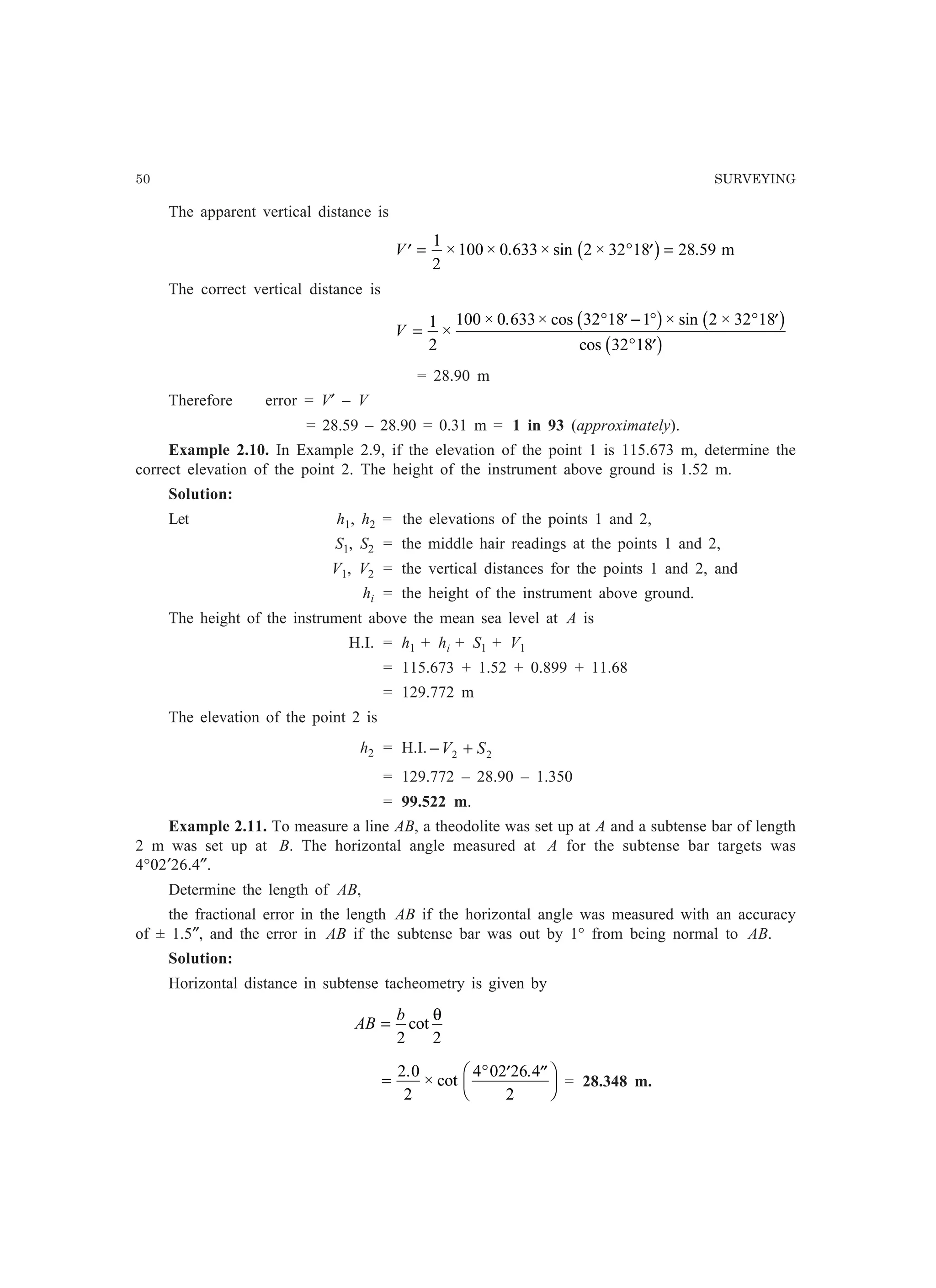
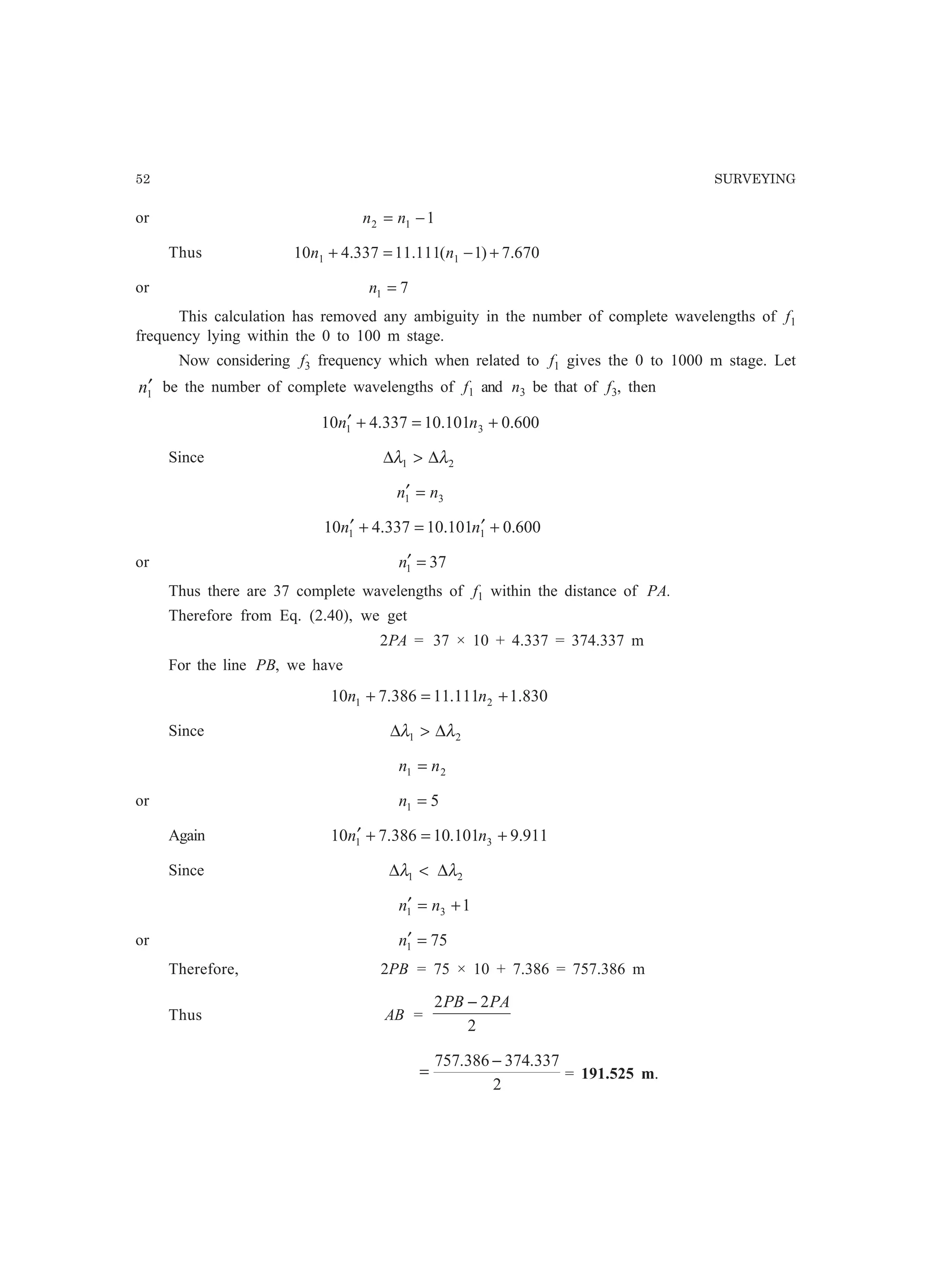
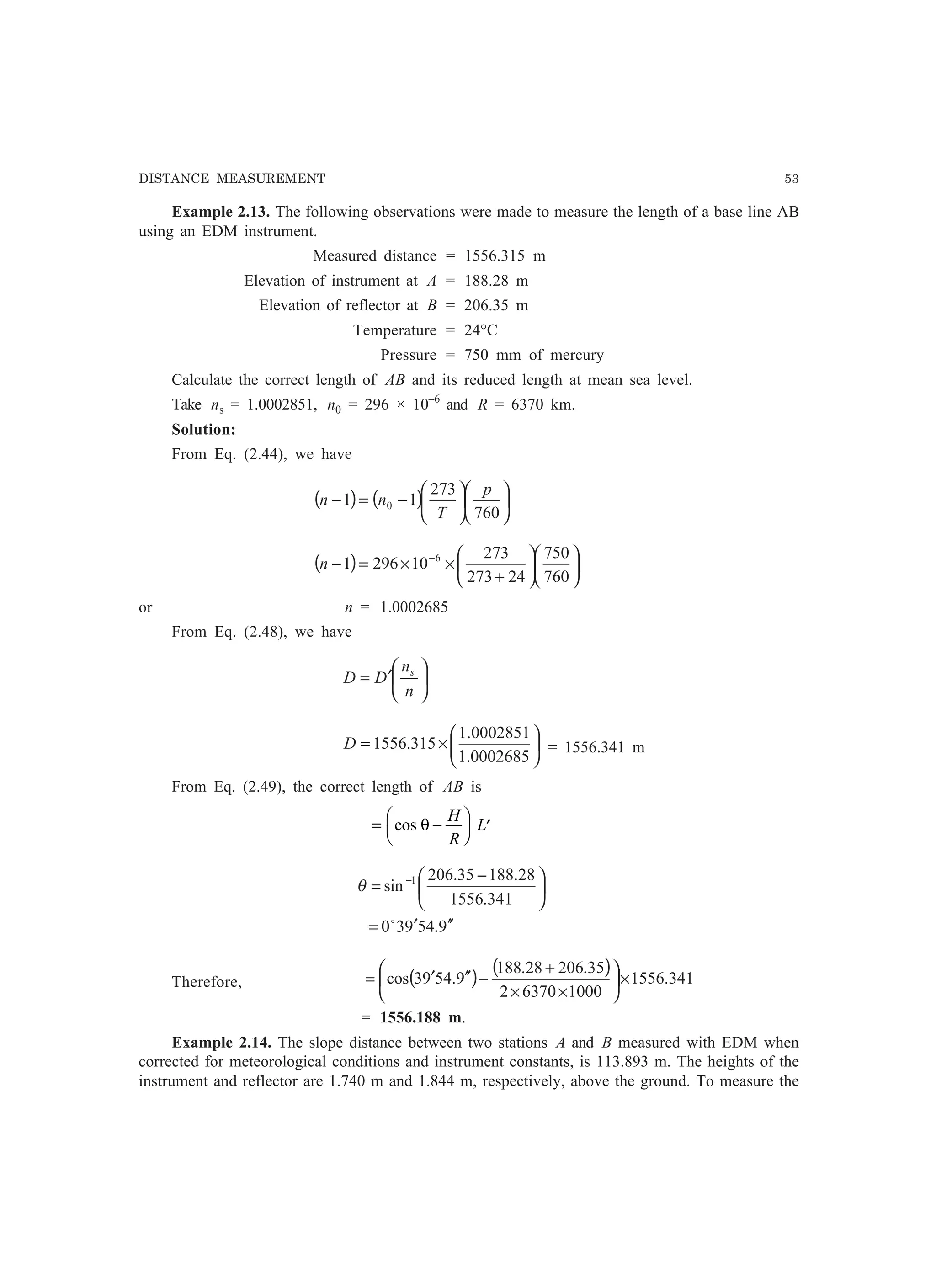
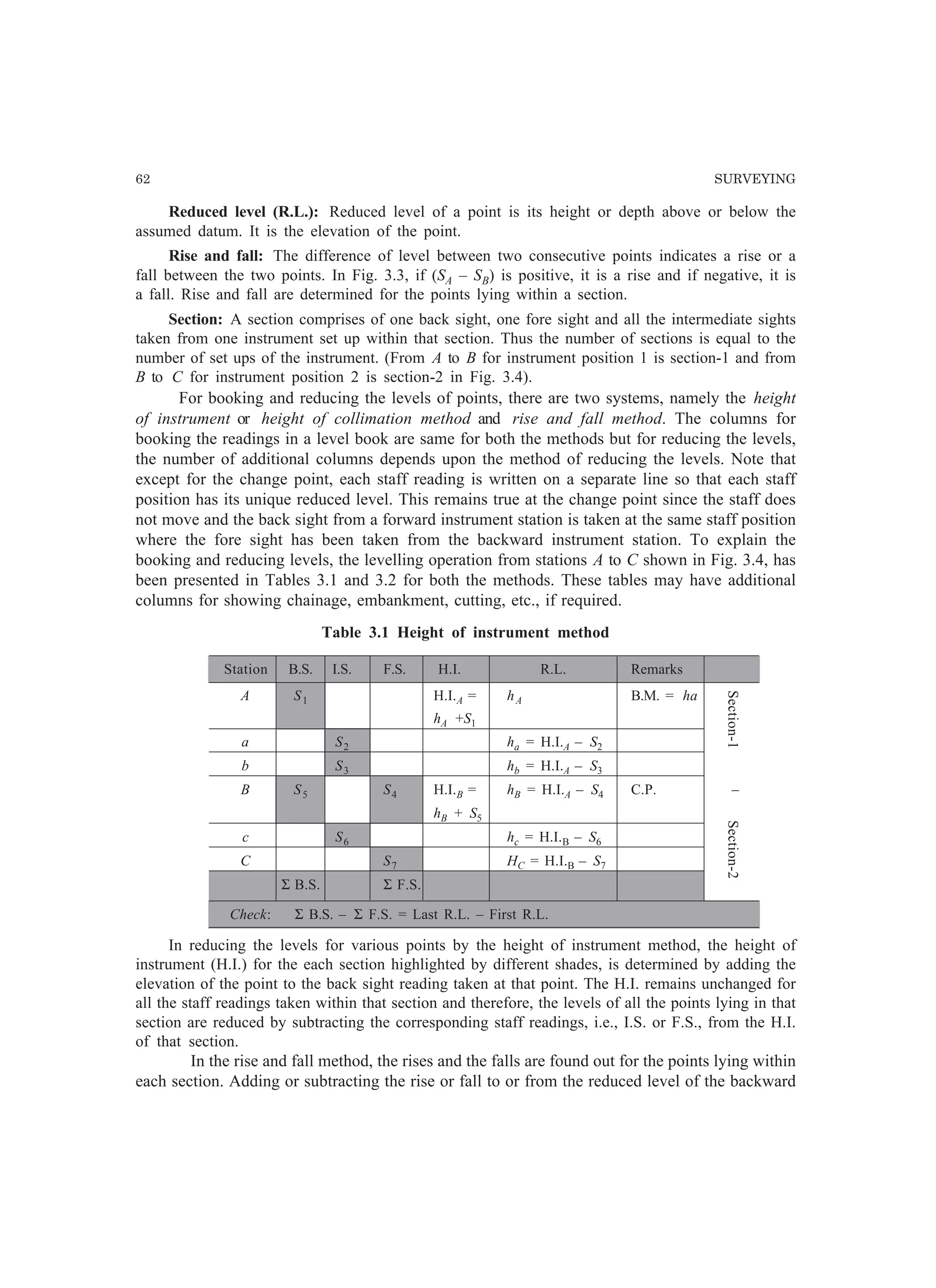
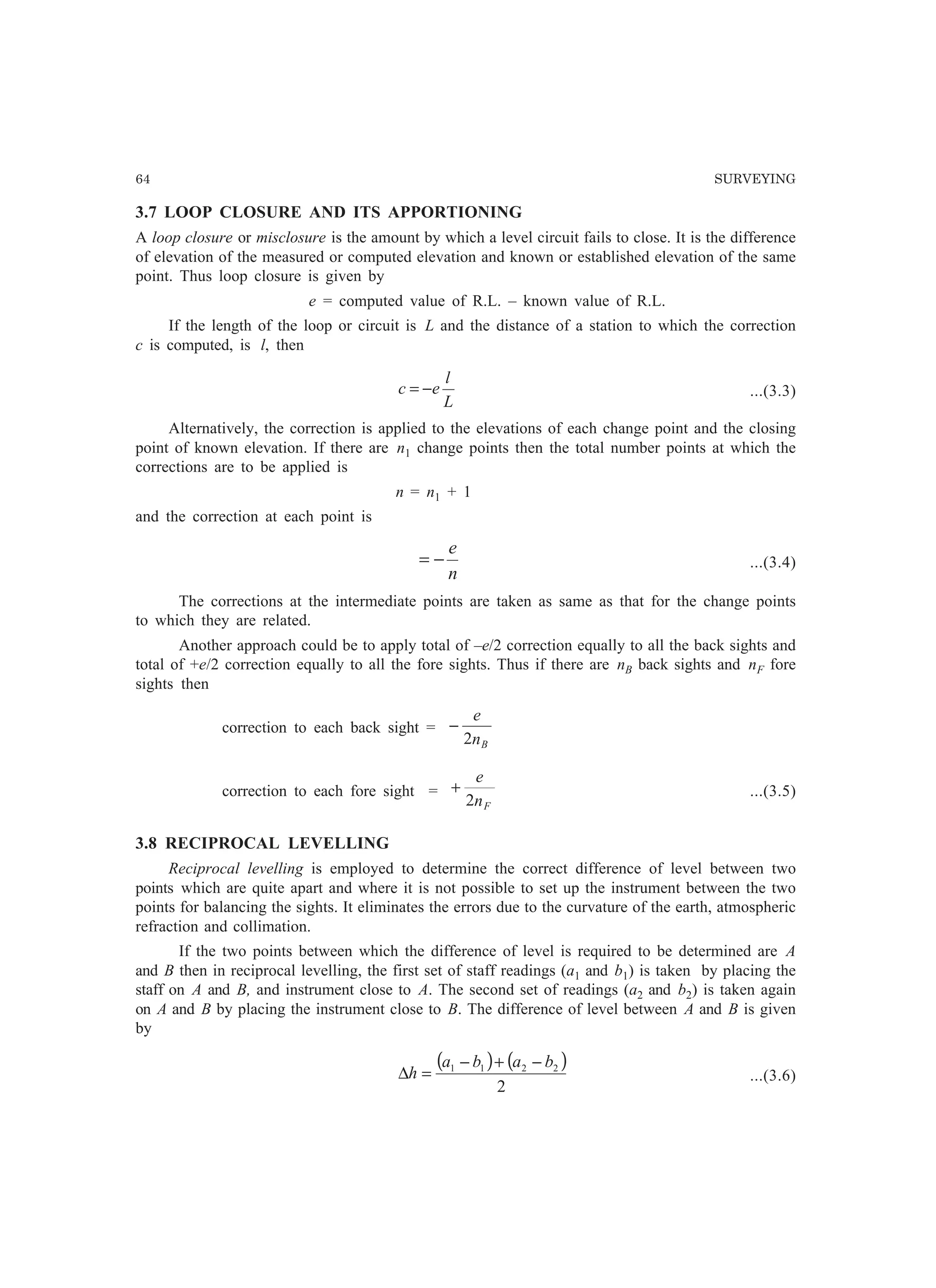
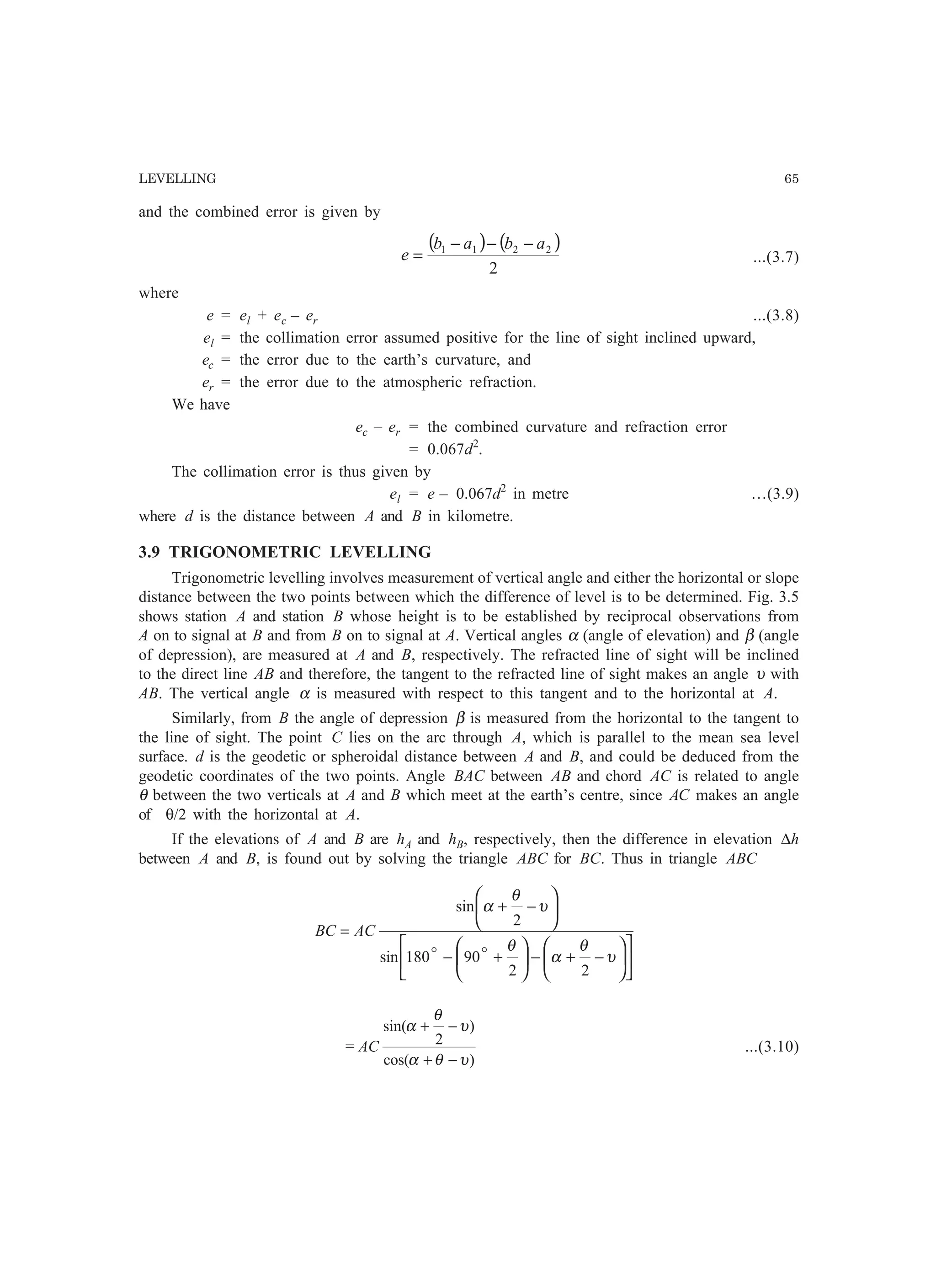
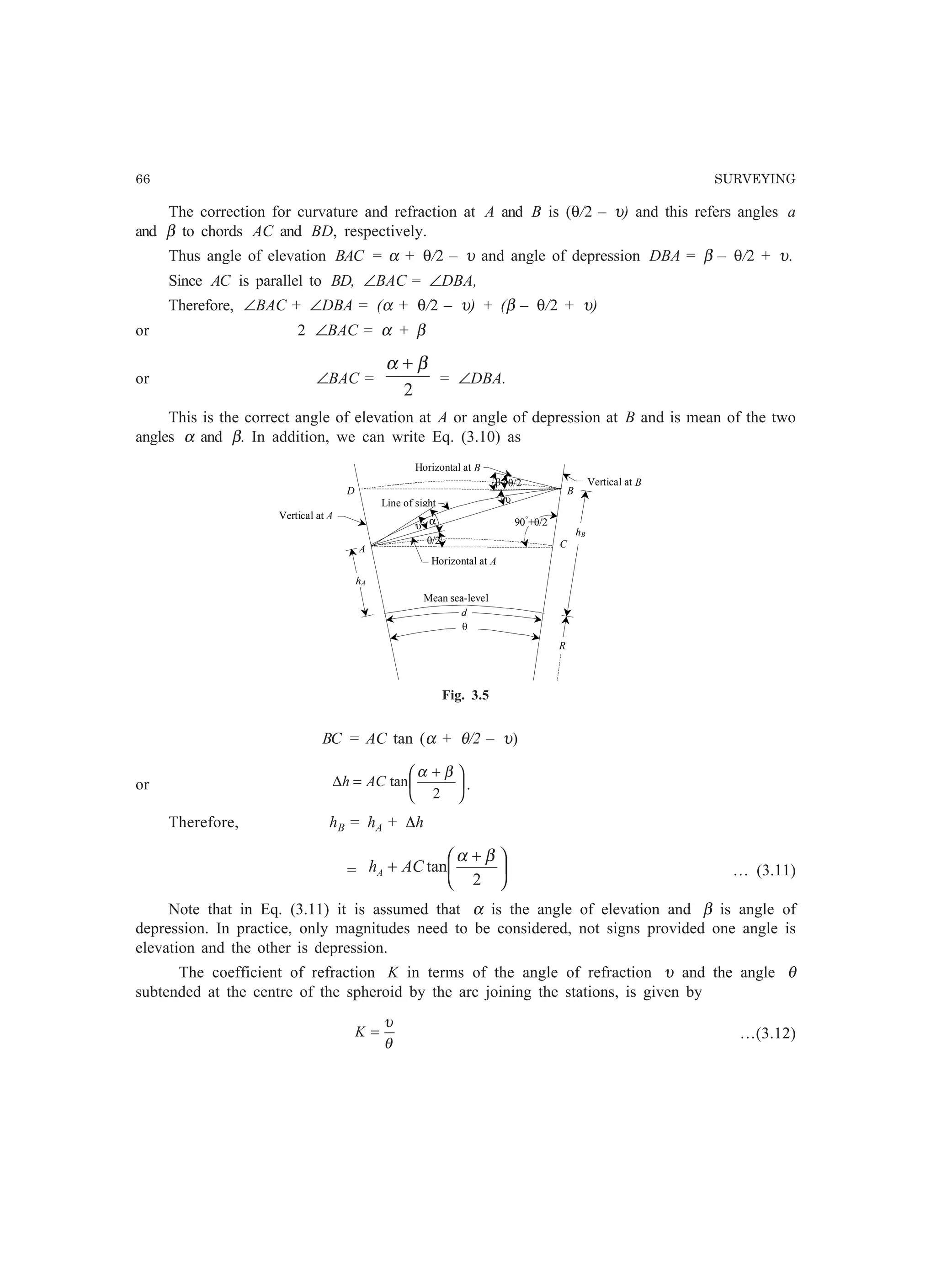
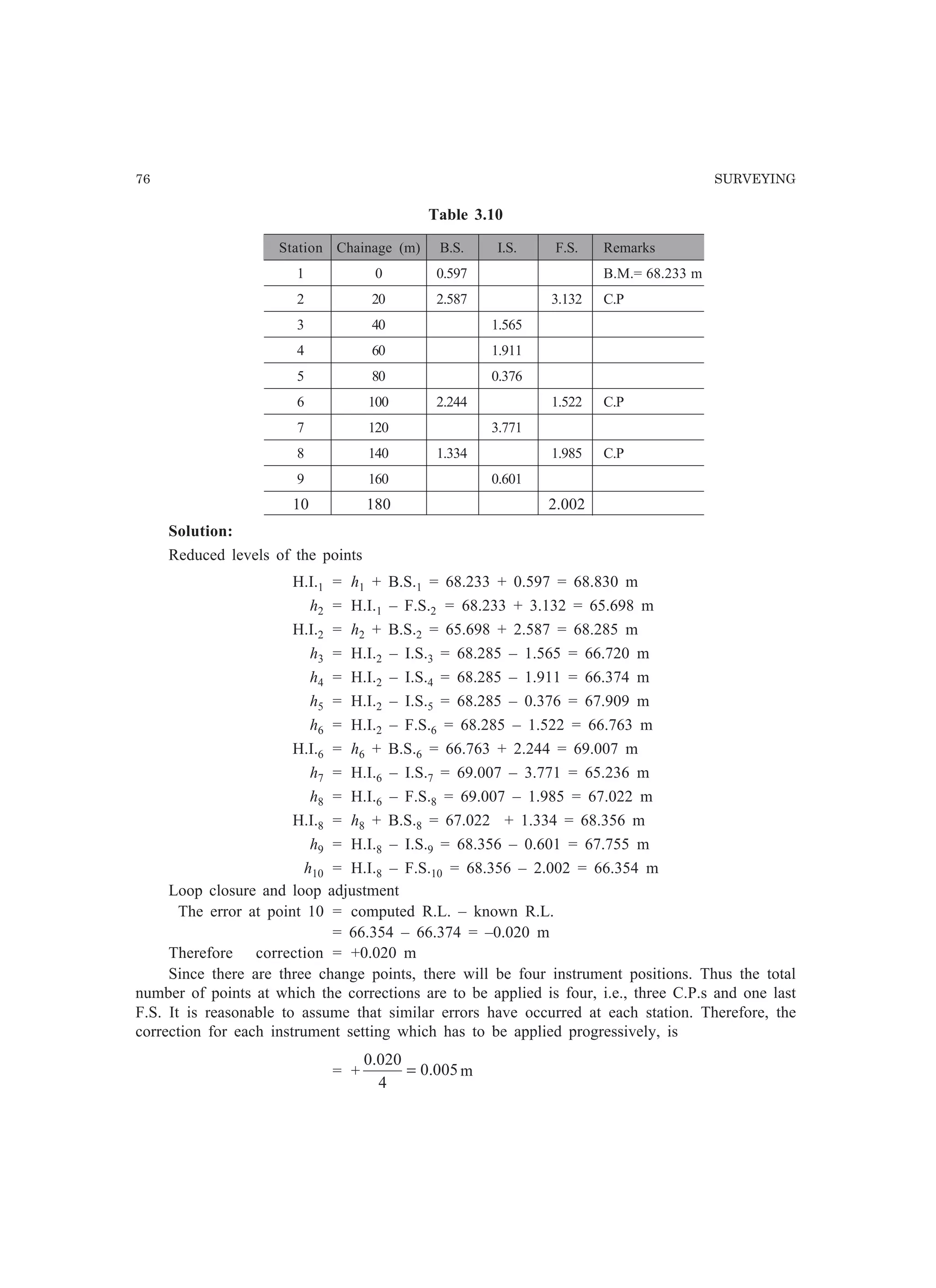
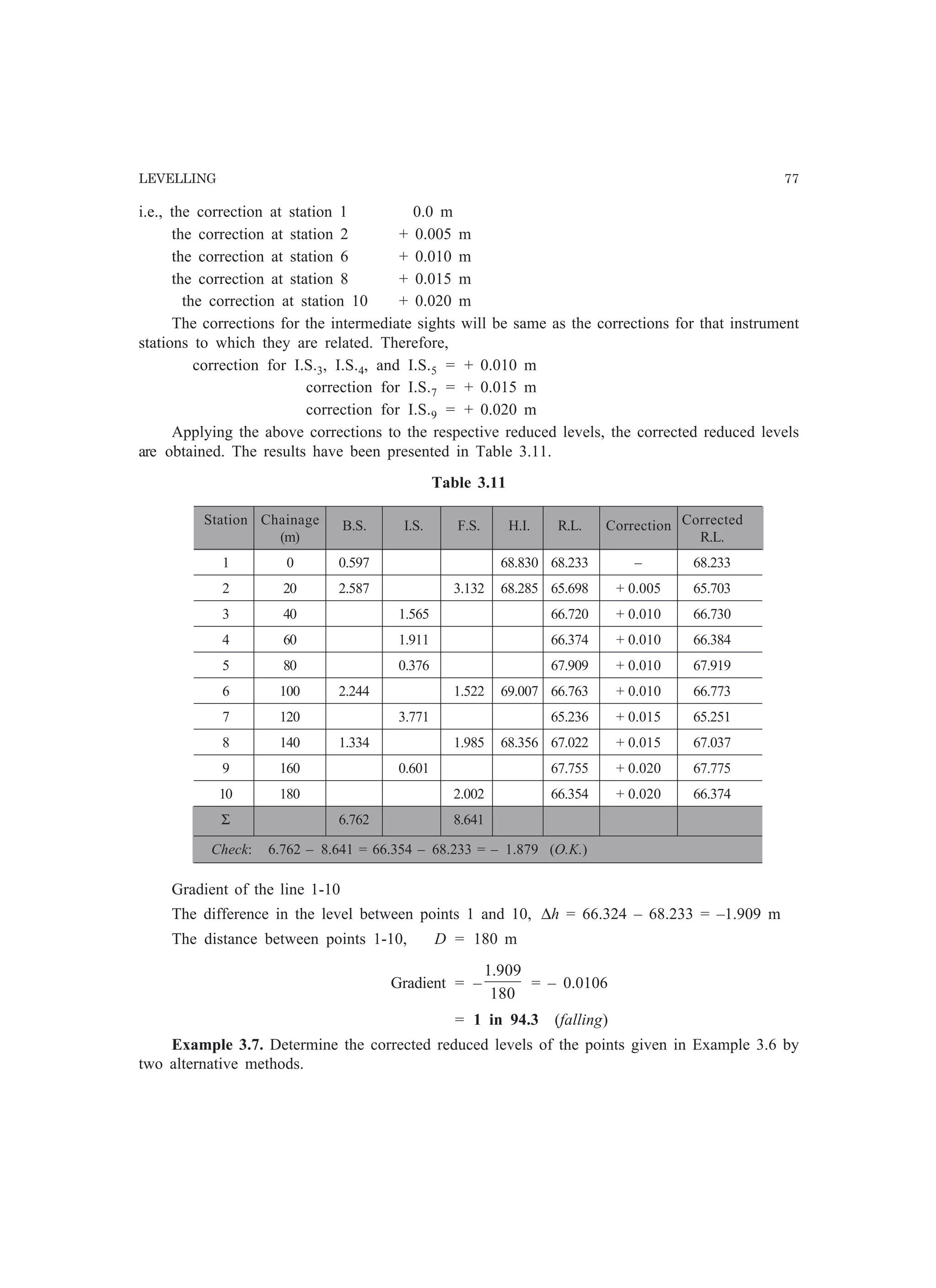
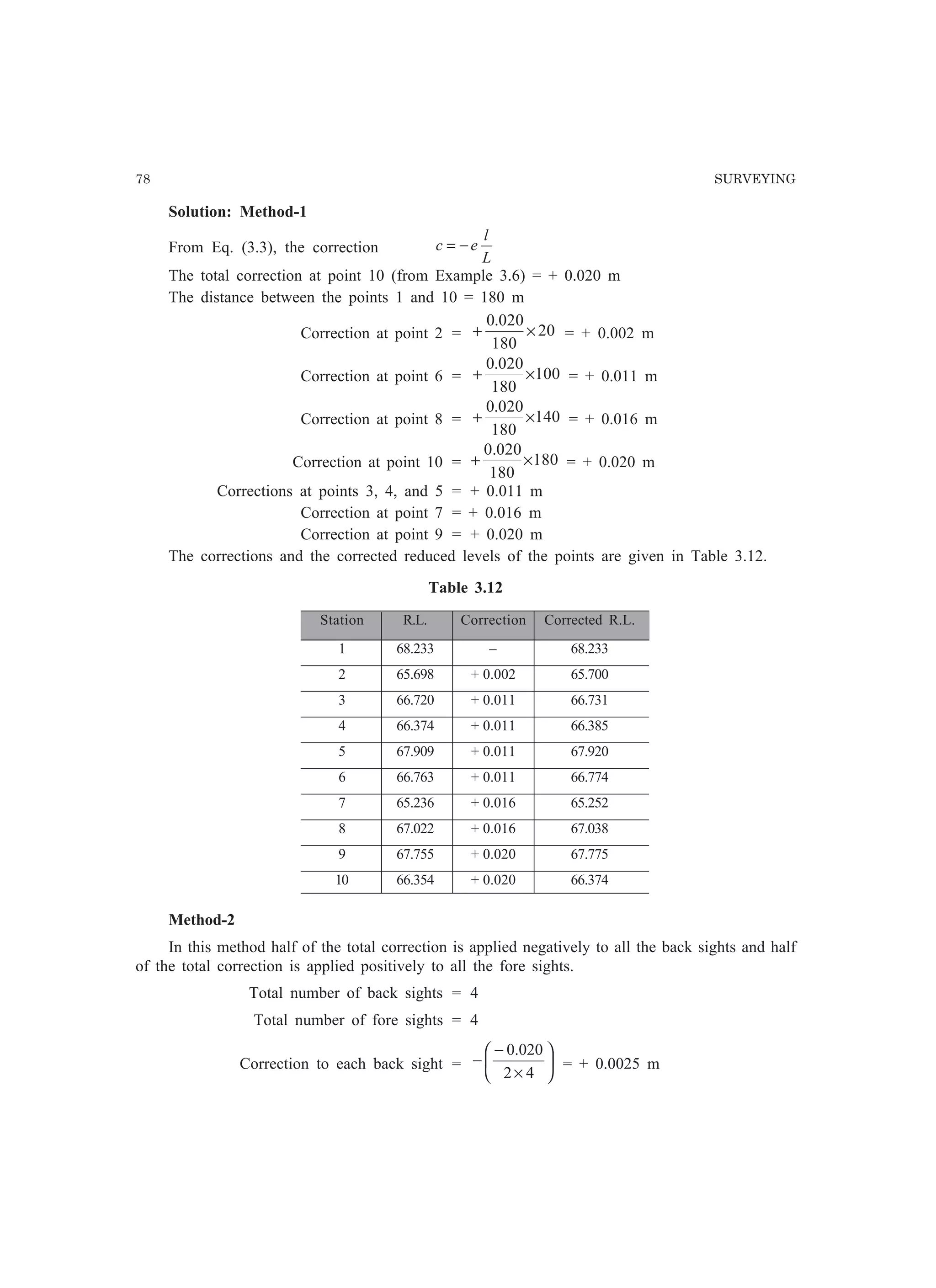
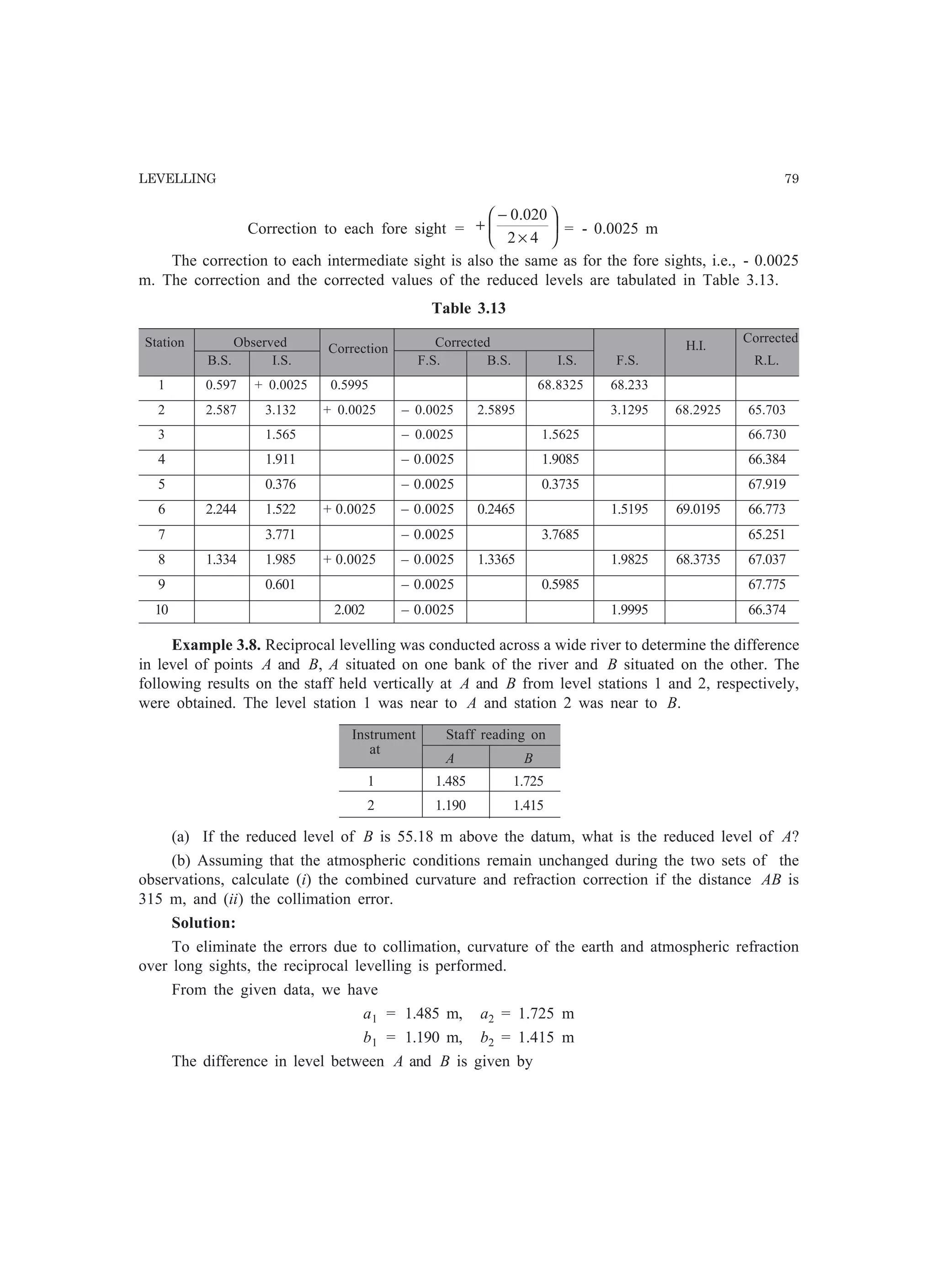
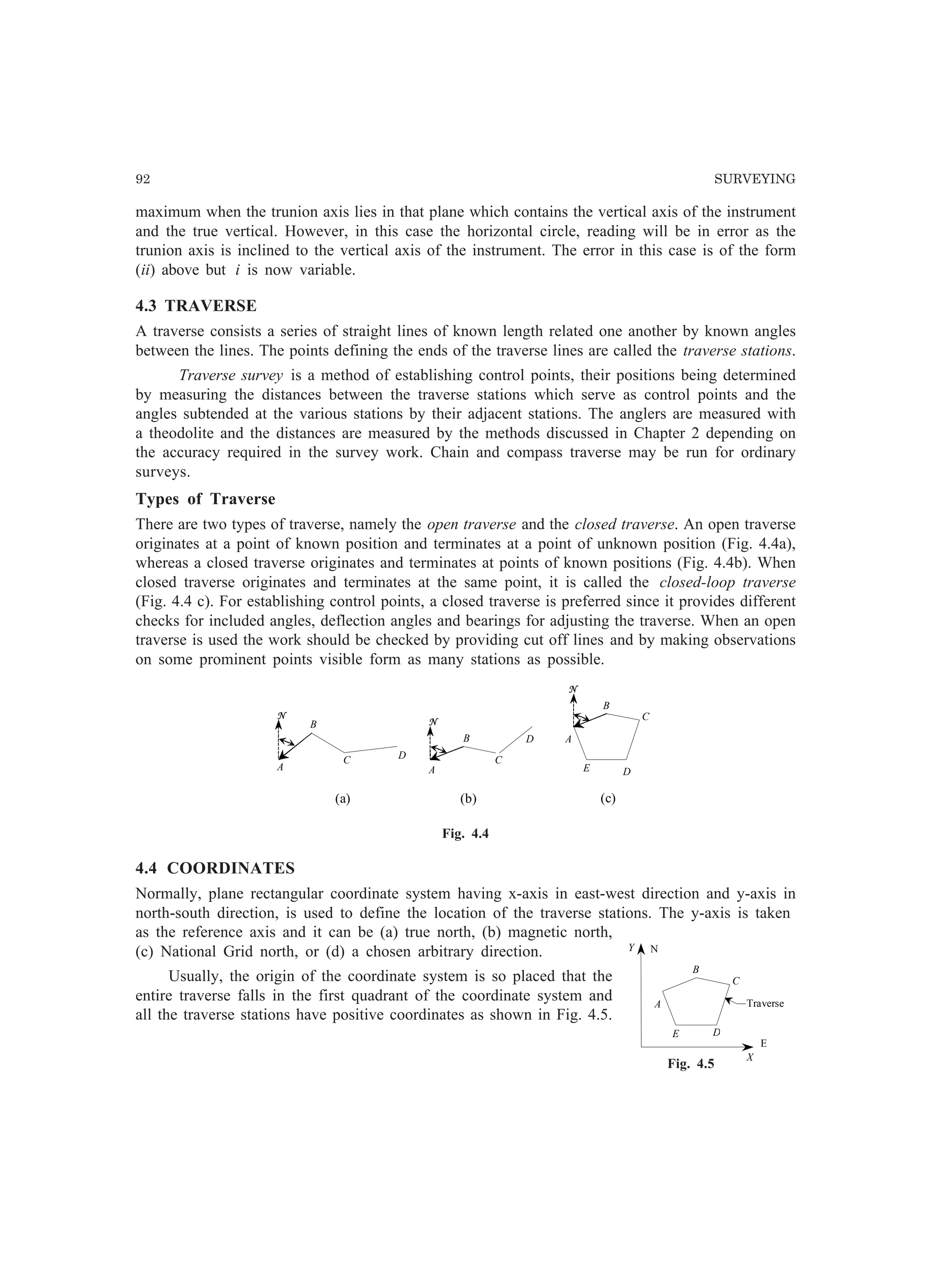
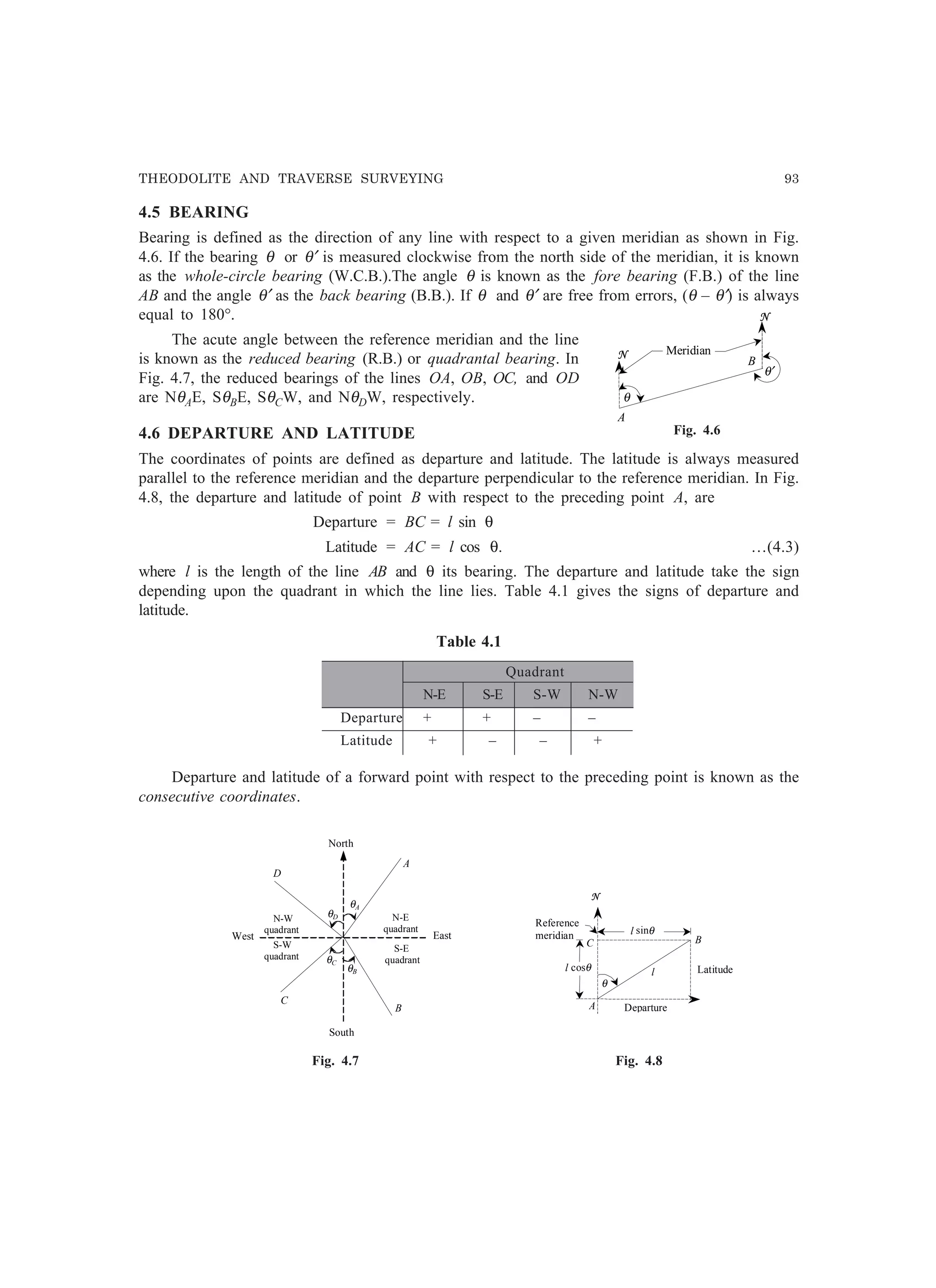
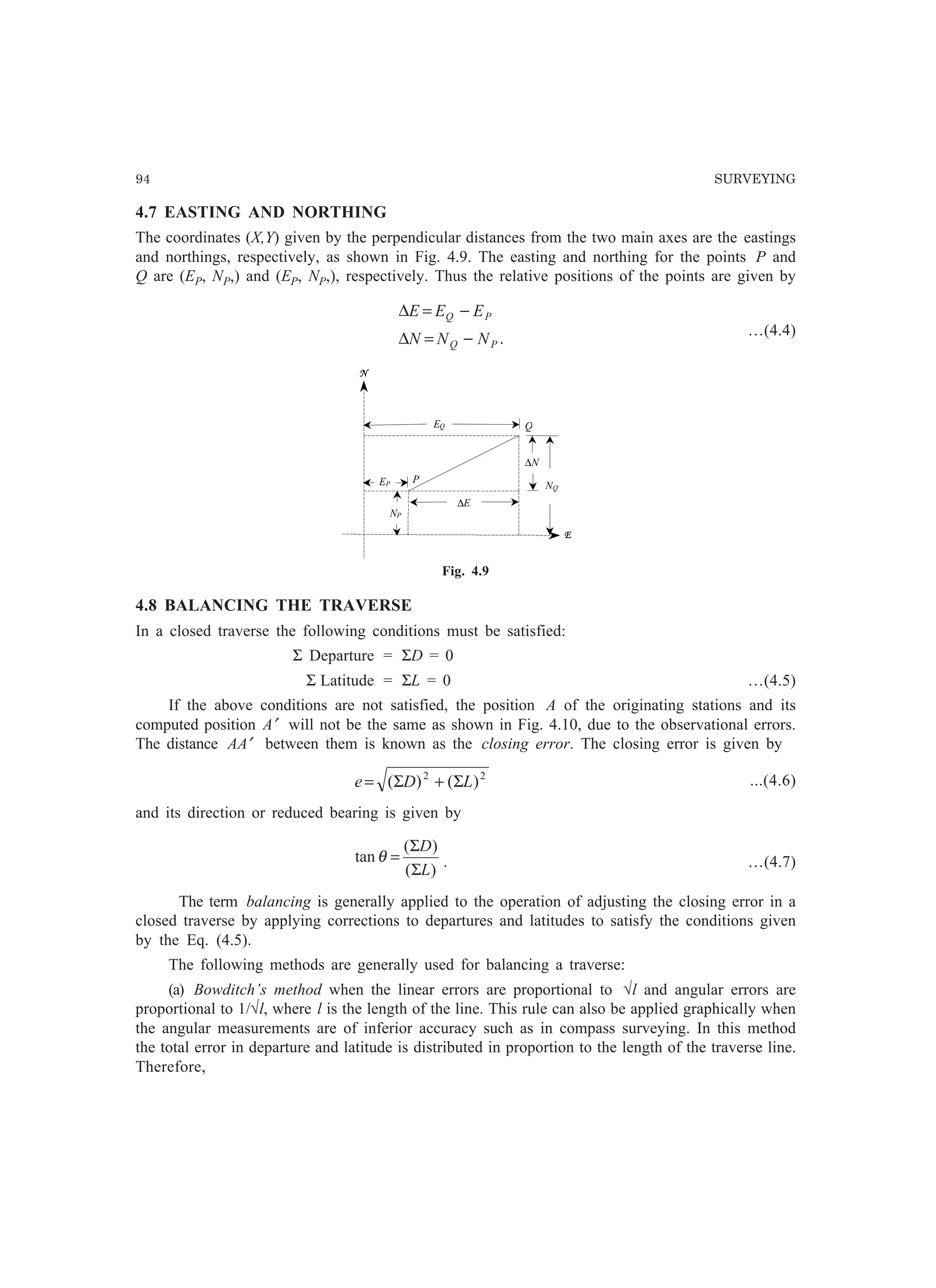
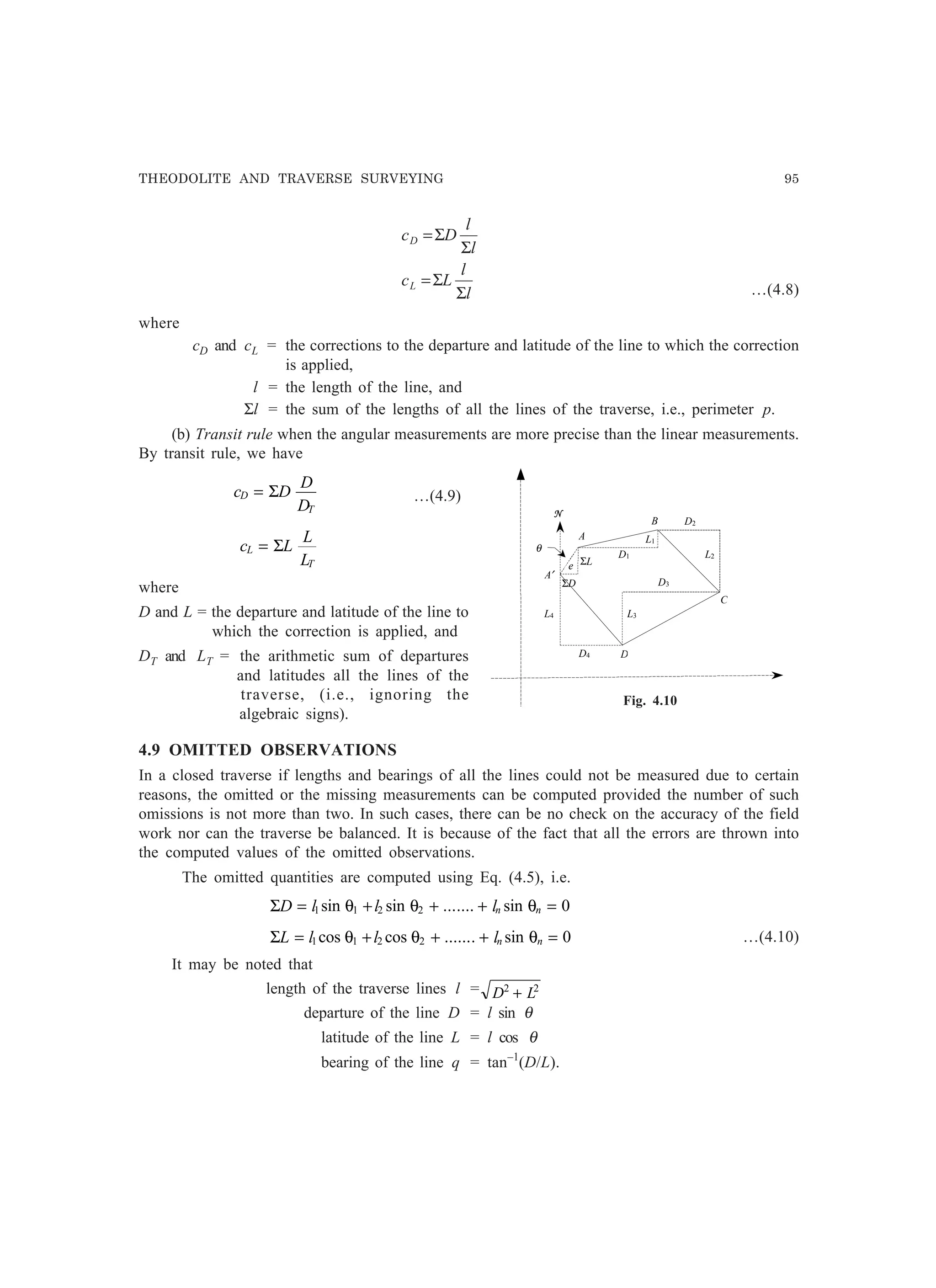
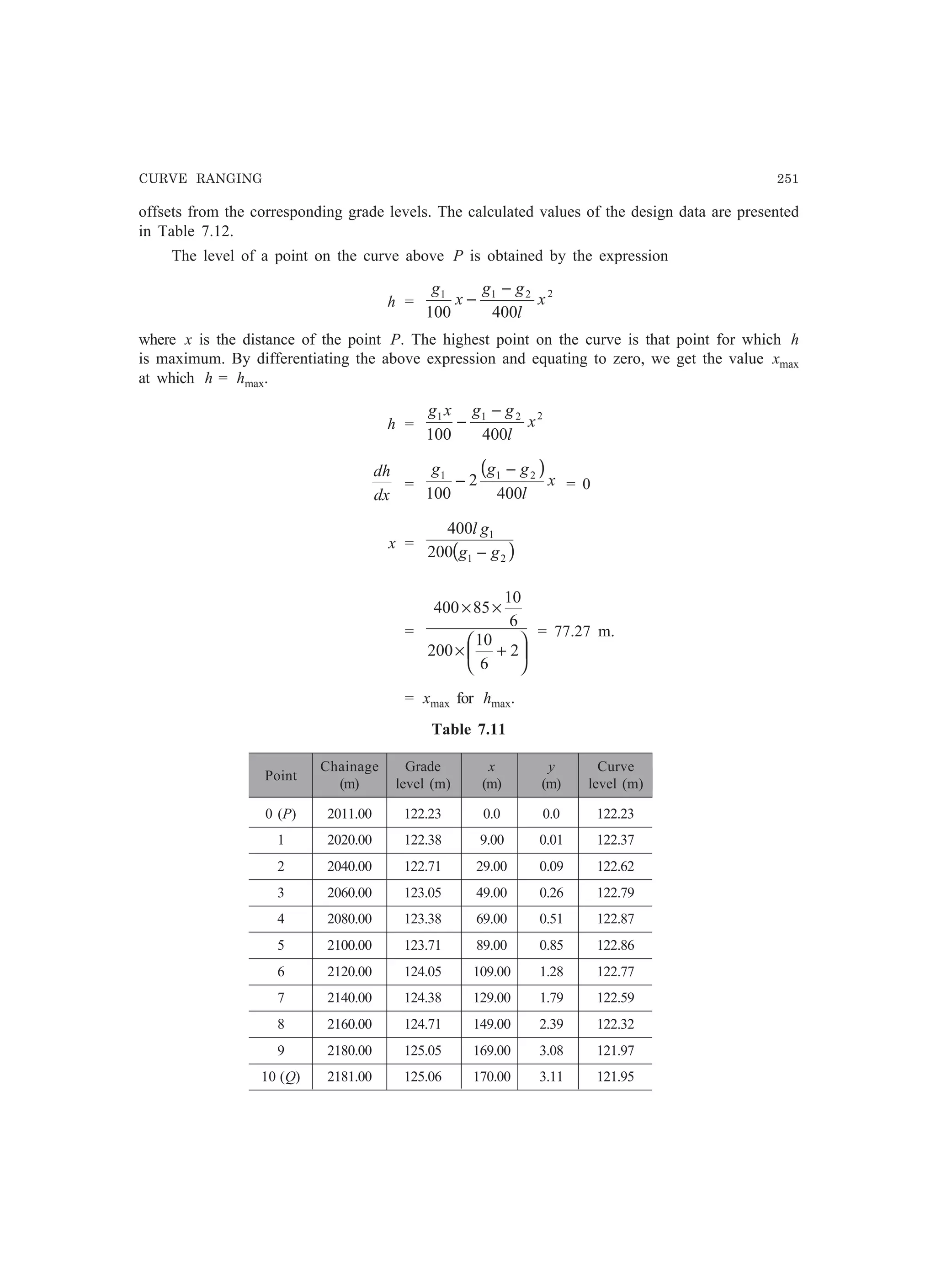
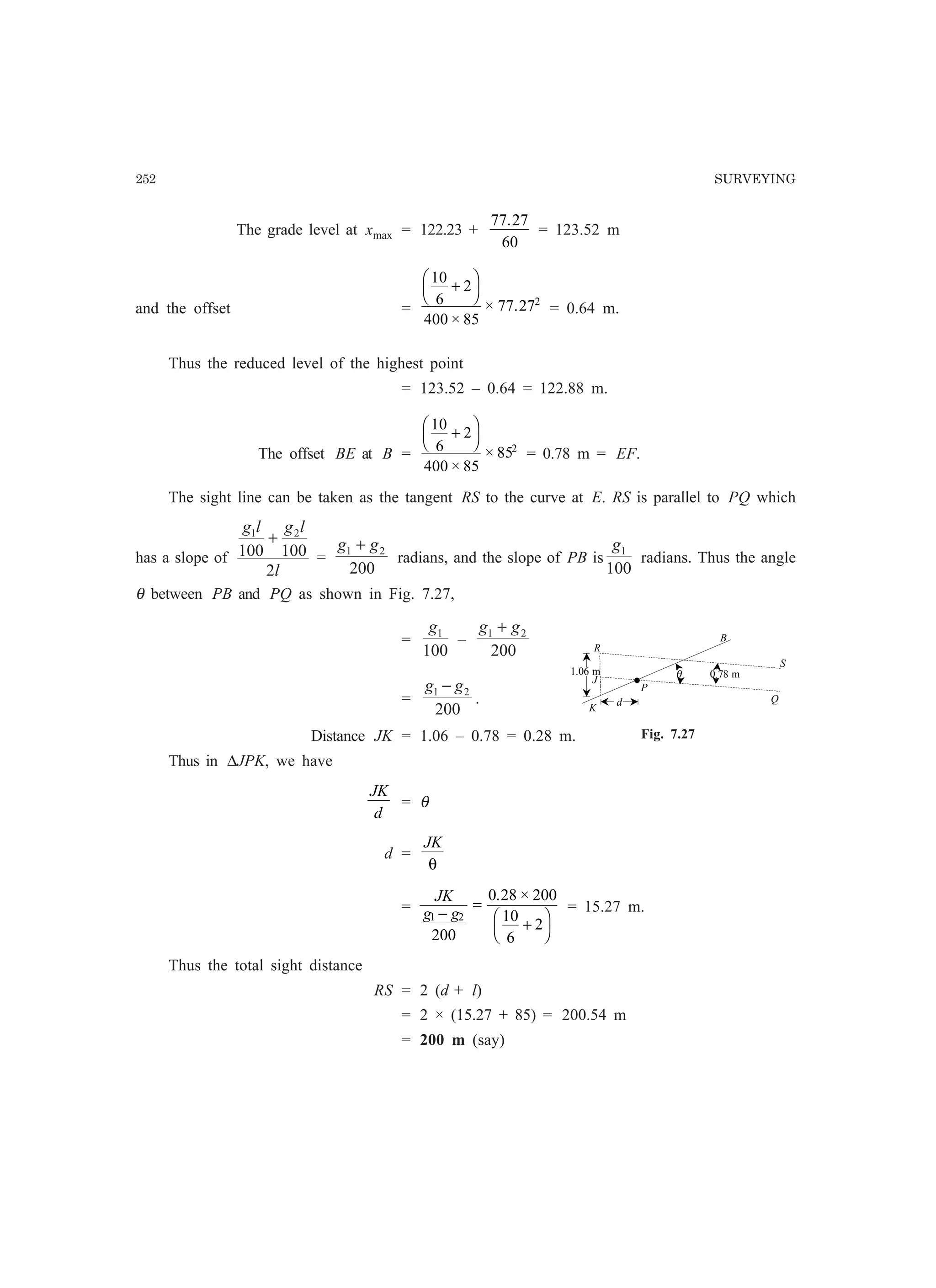
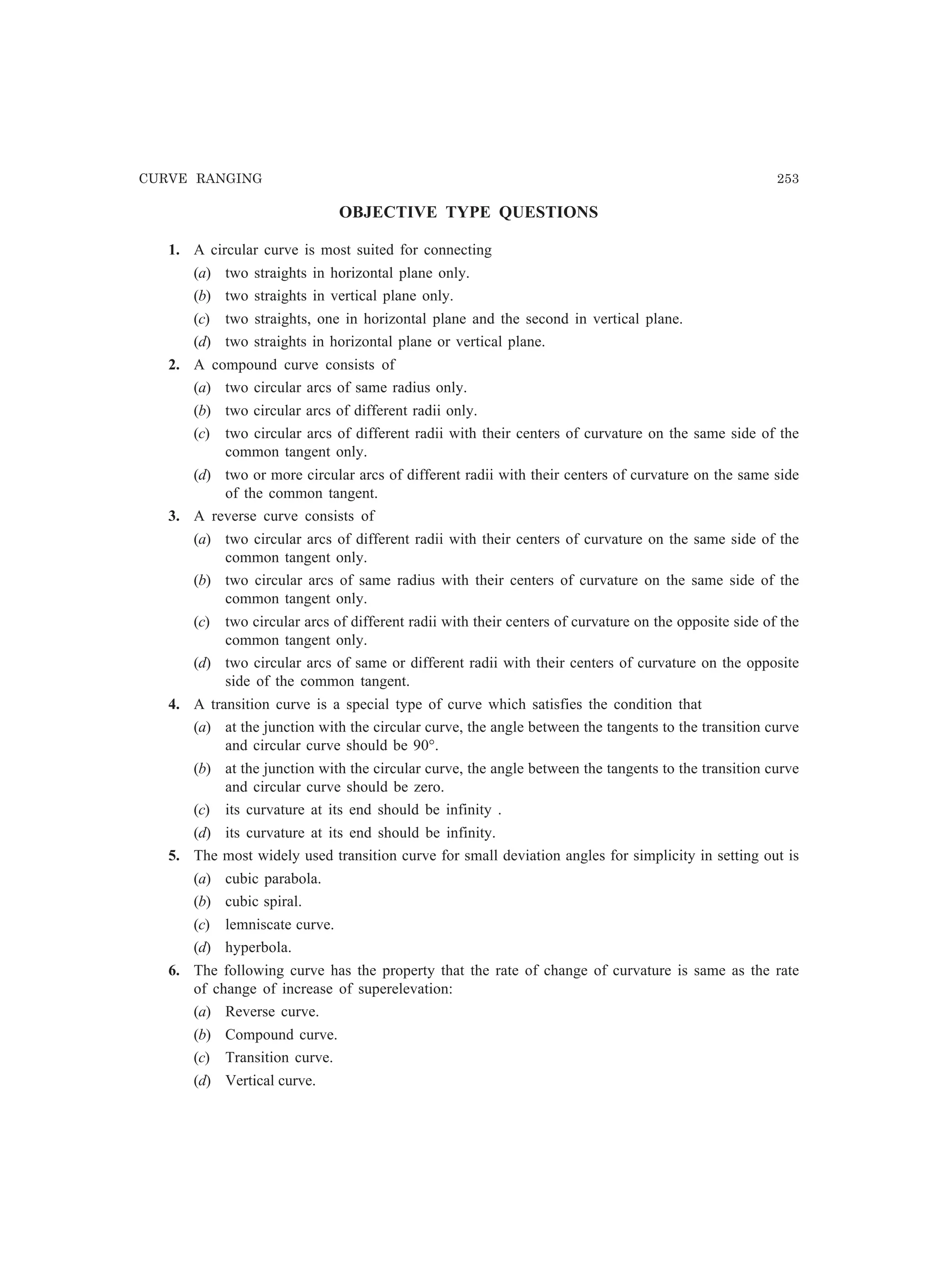
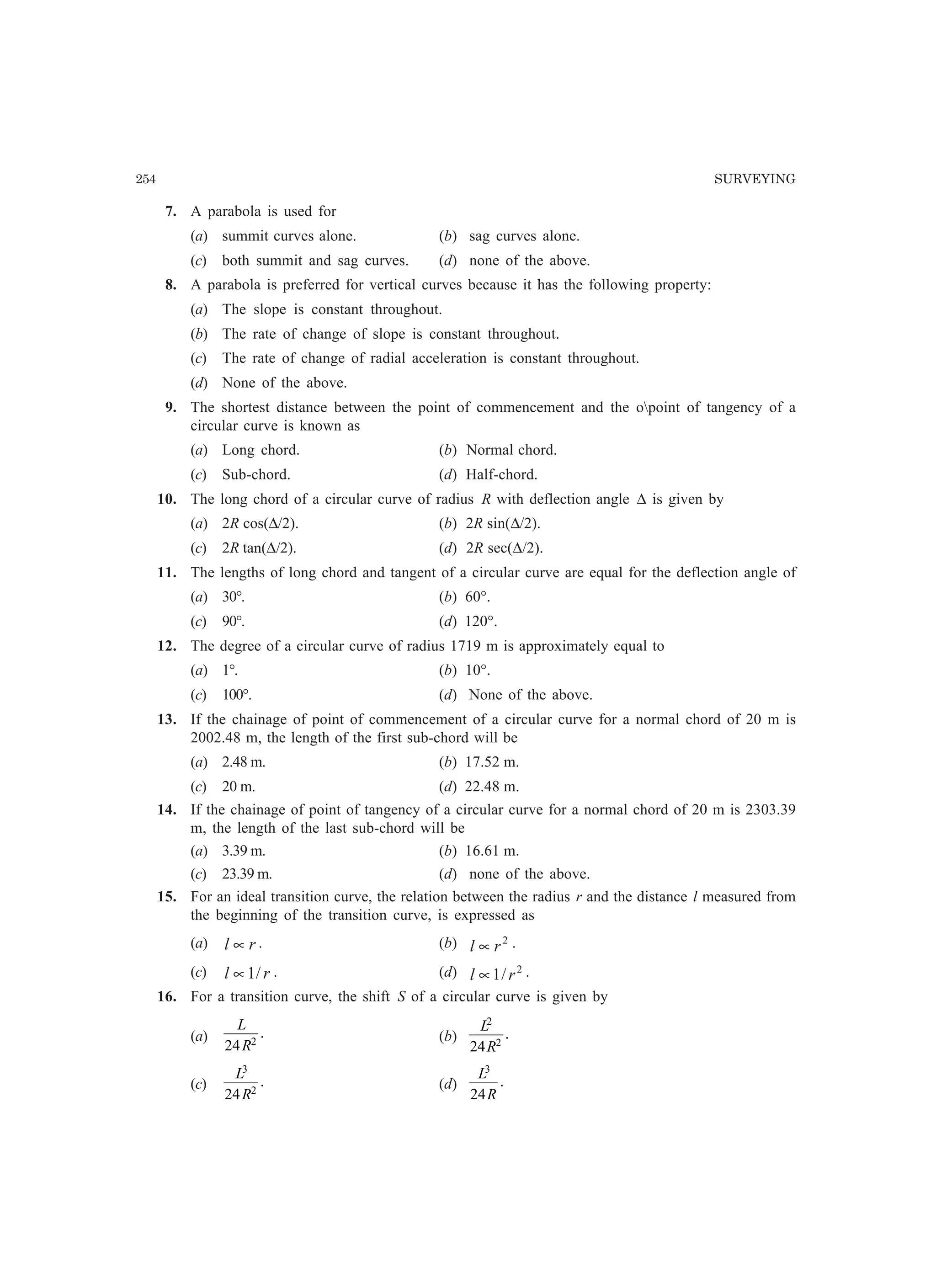
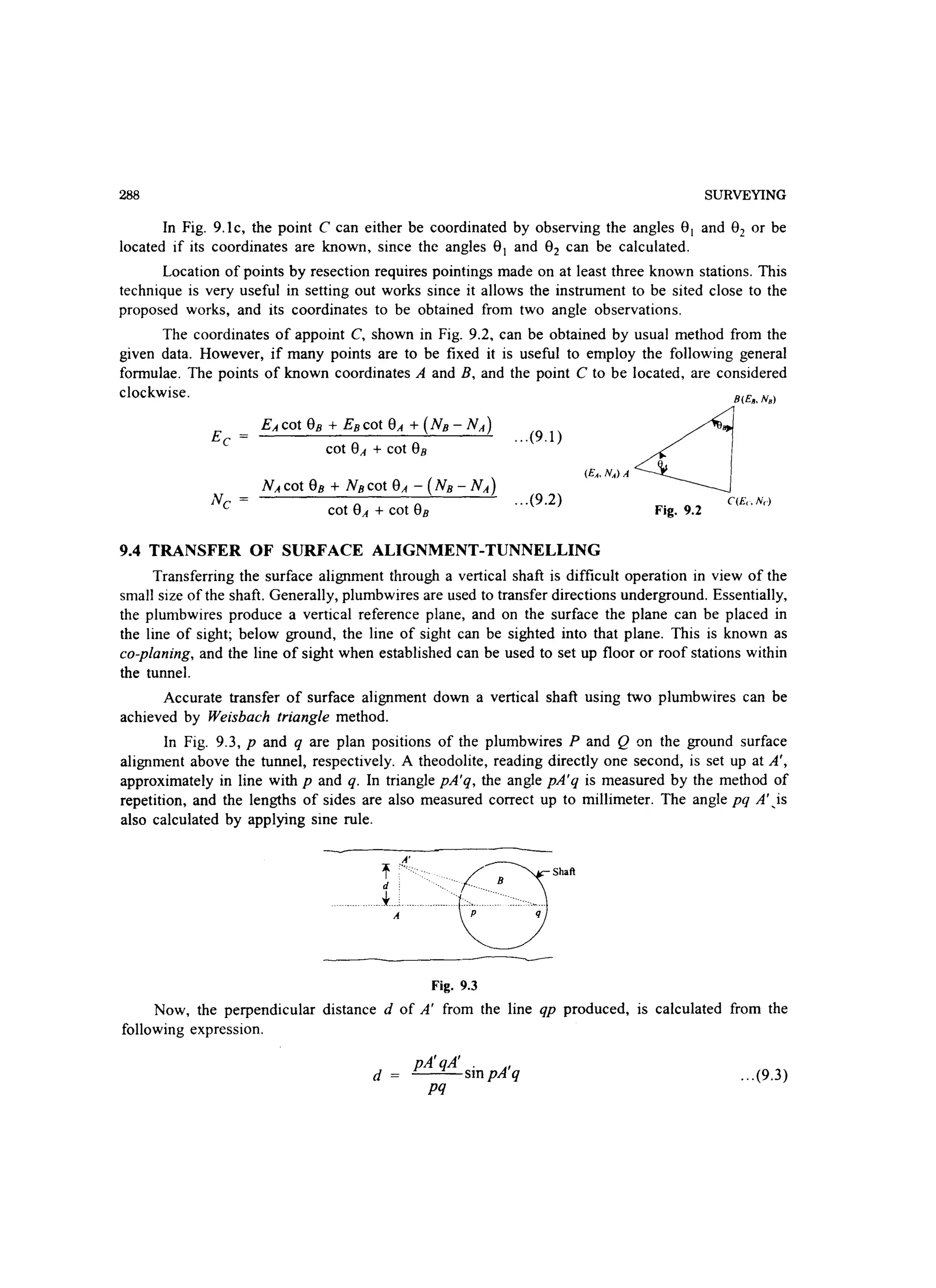
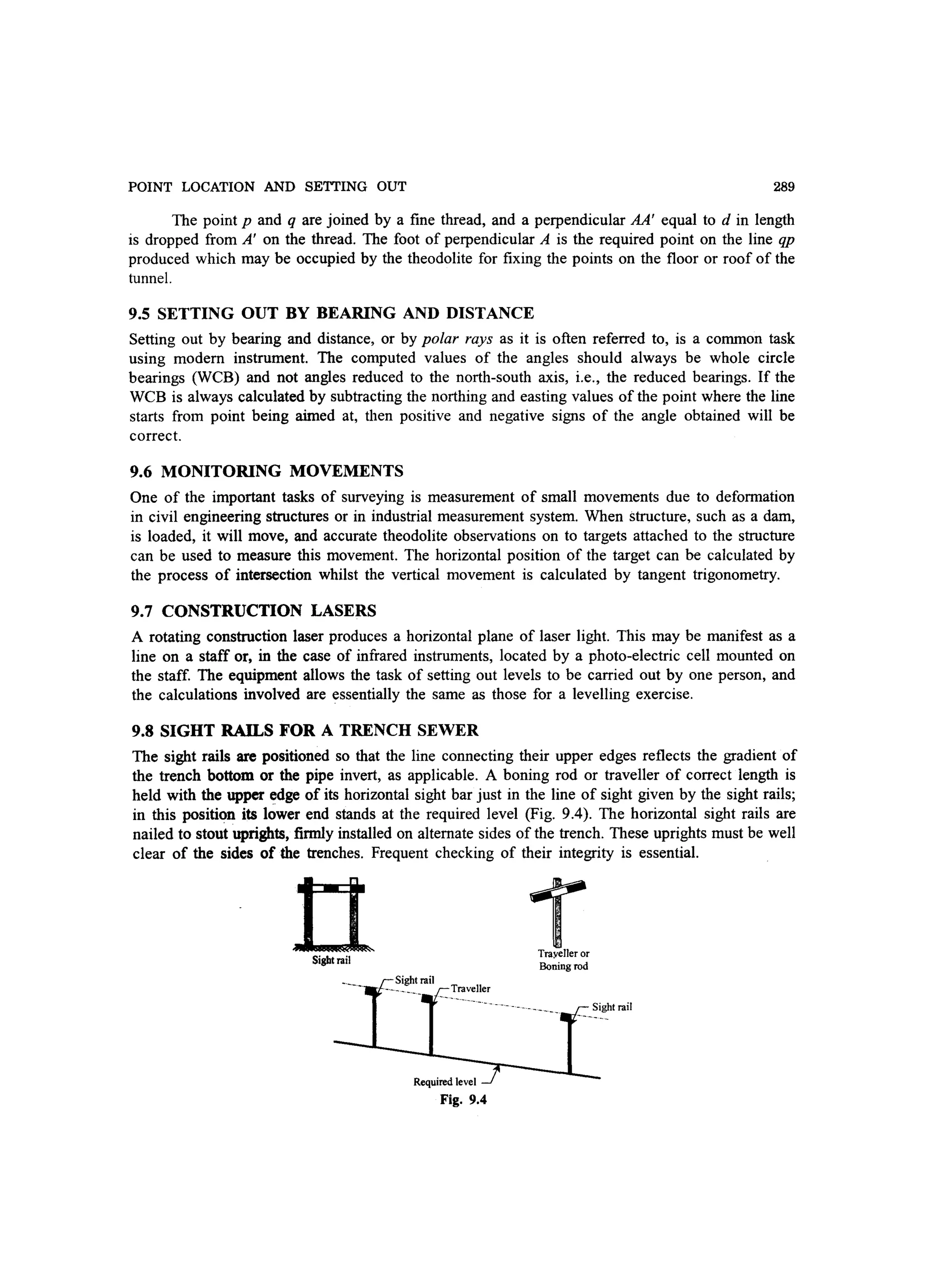
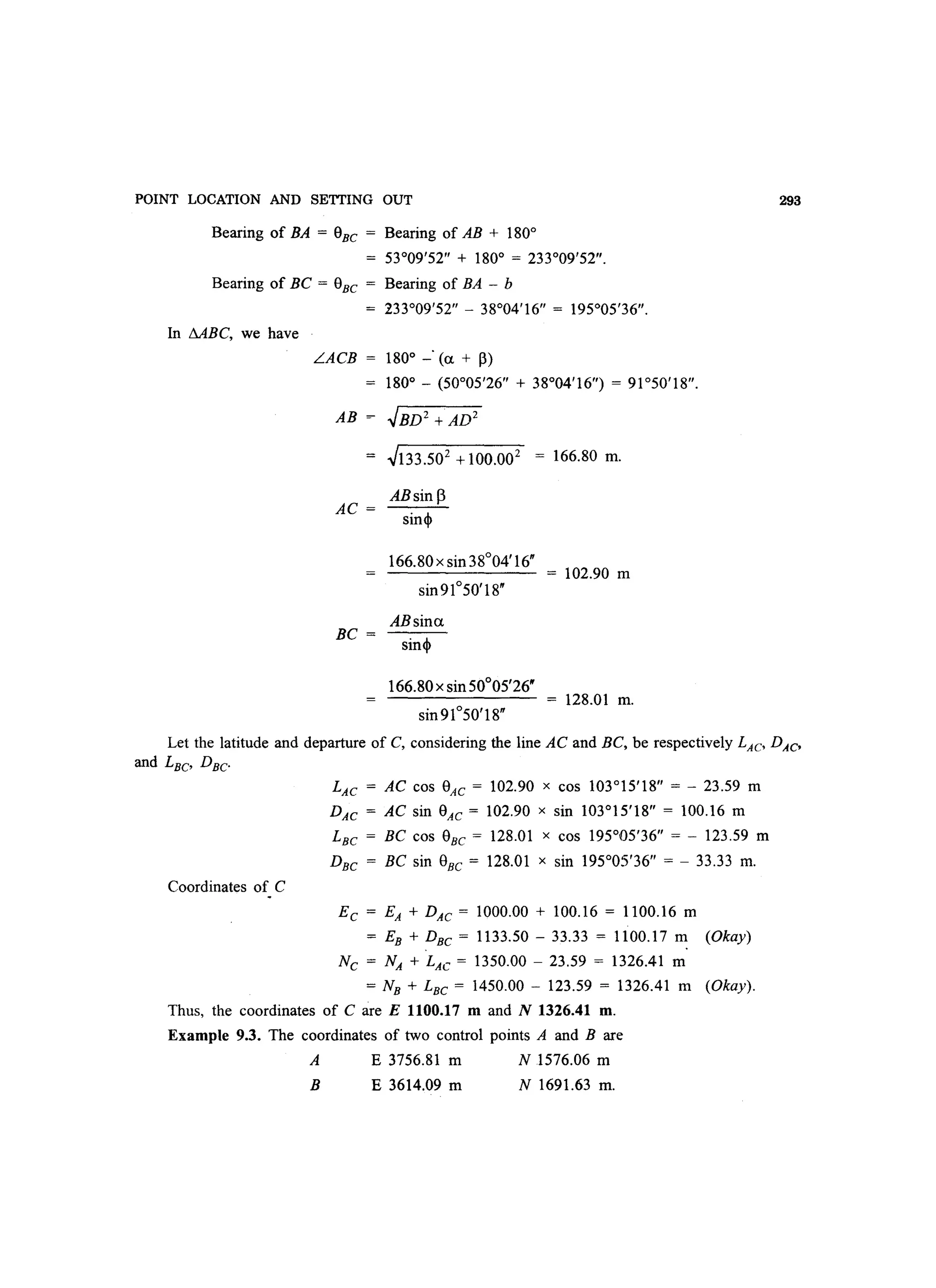
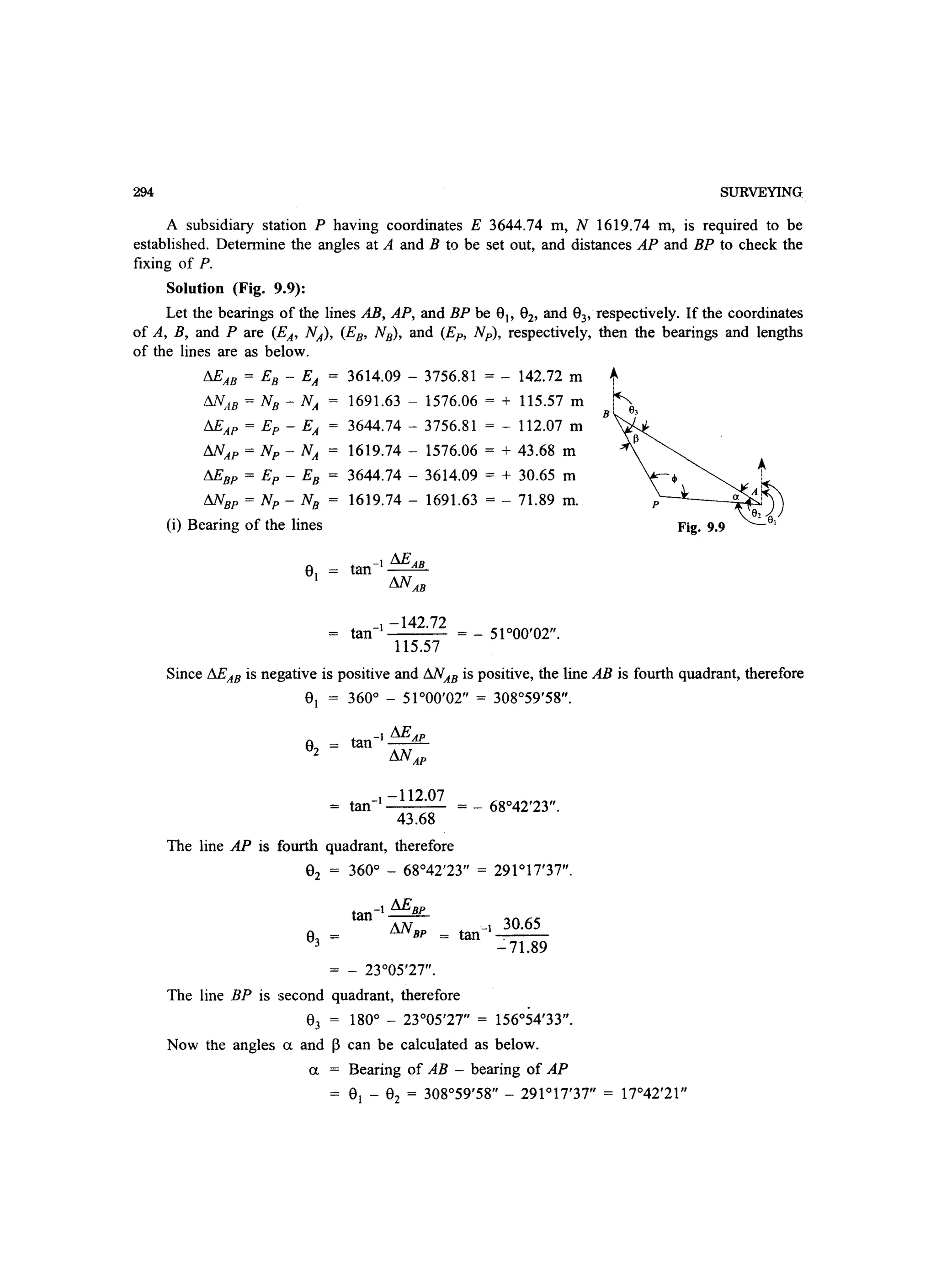
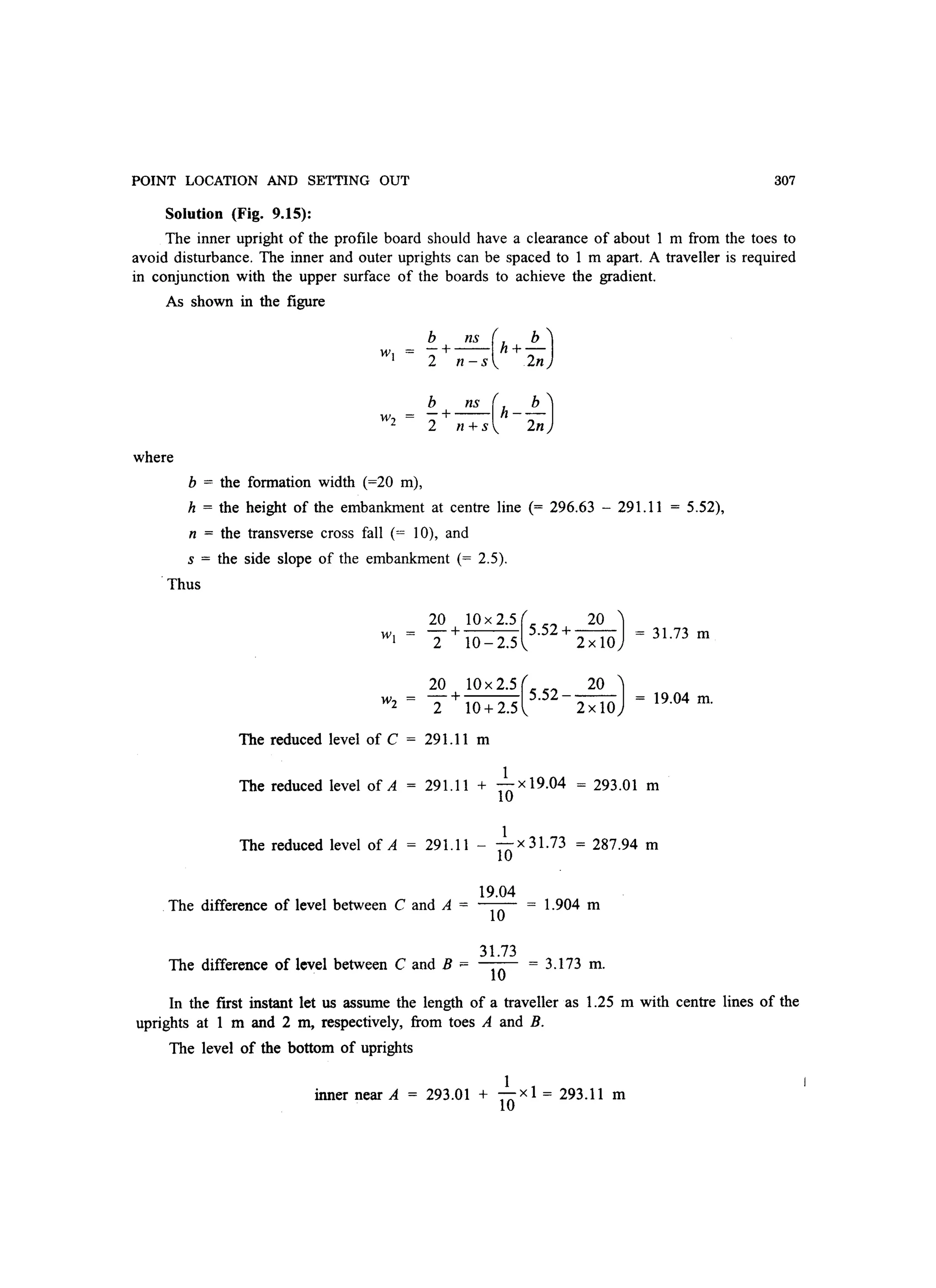
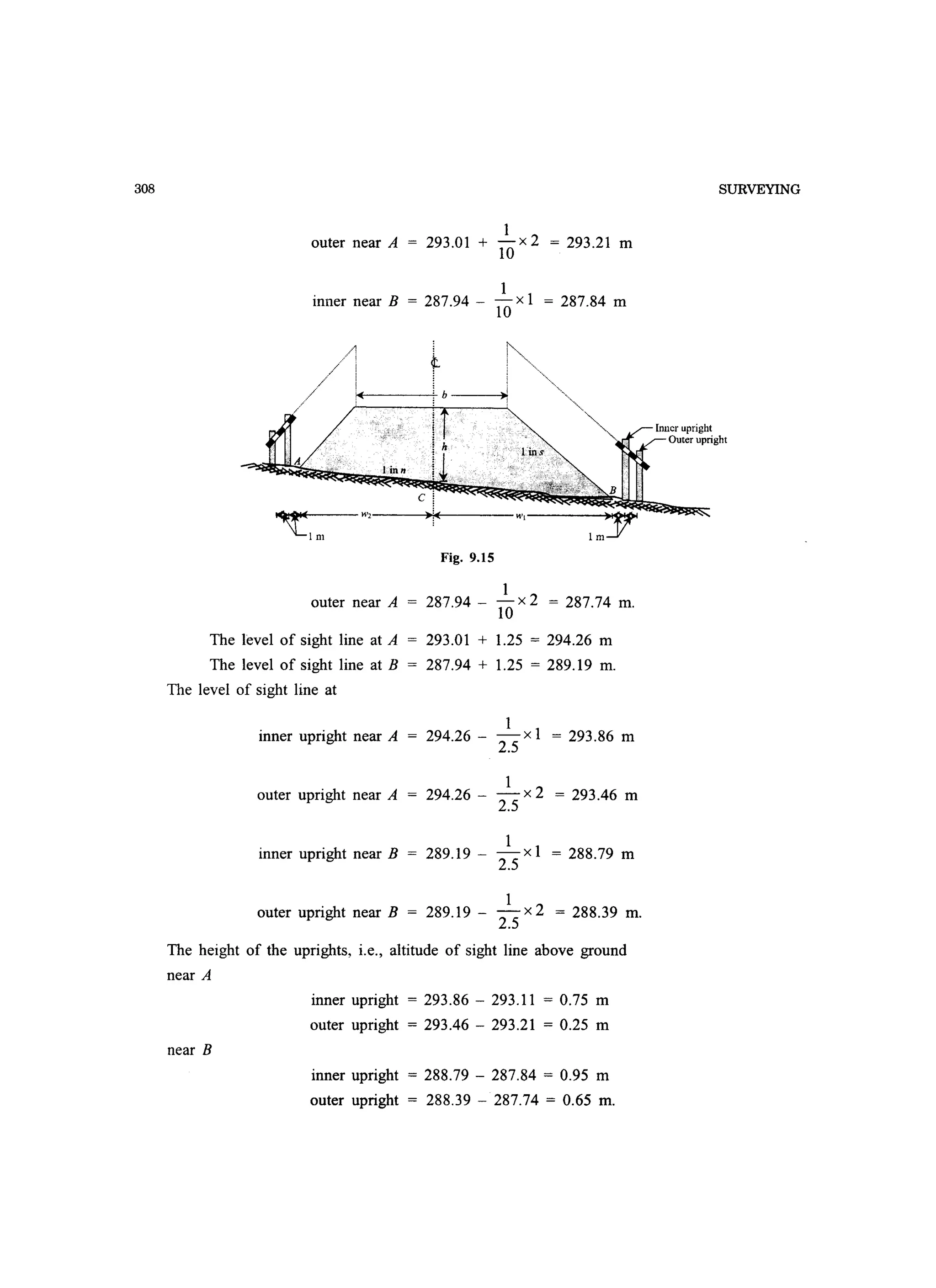
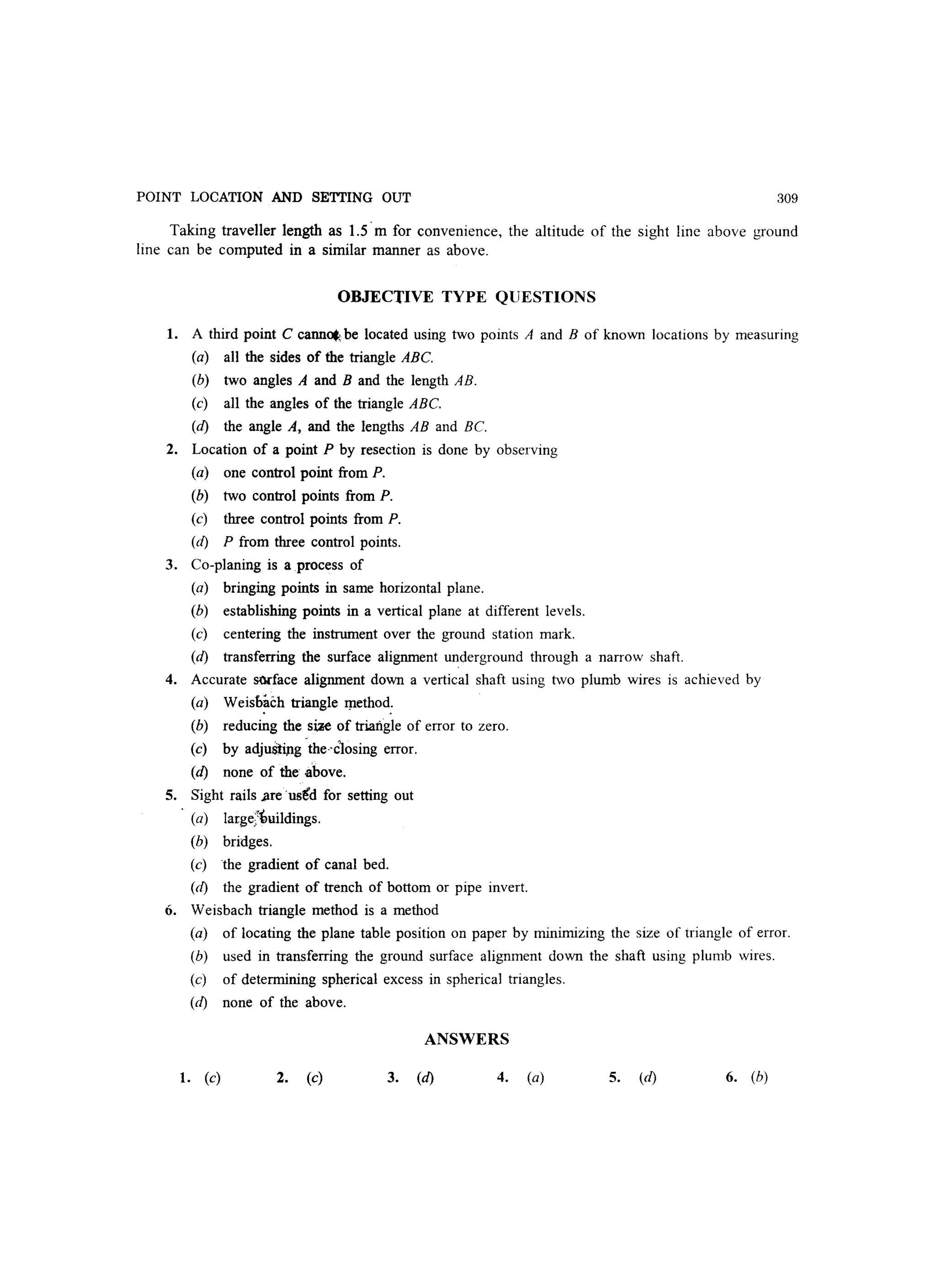
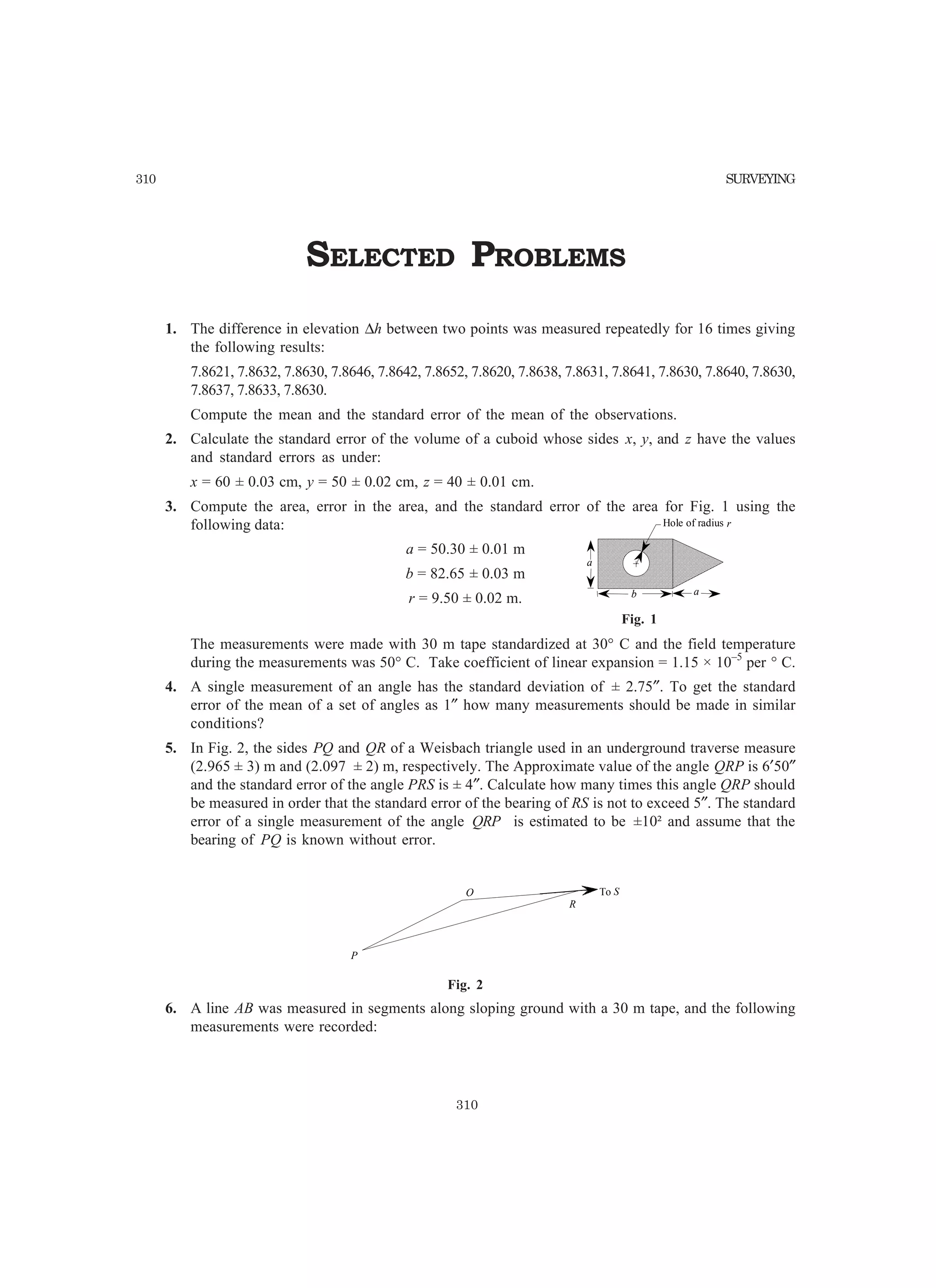
Dr AM Chandra
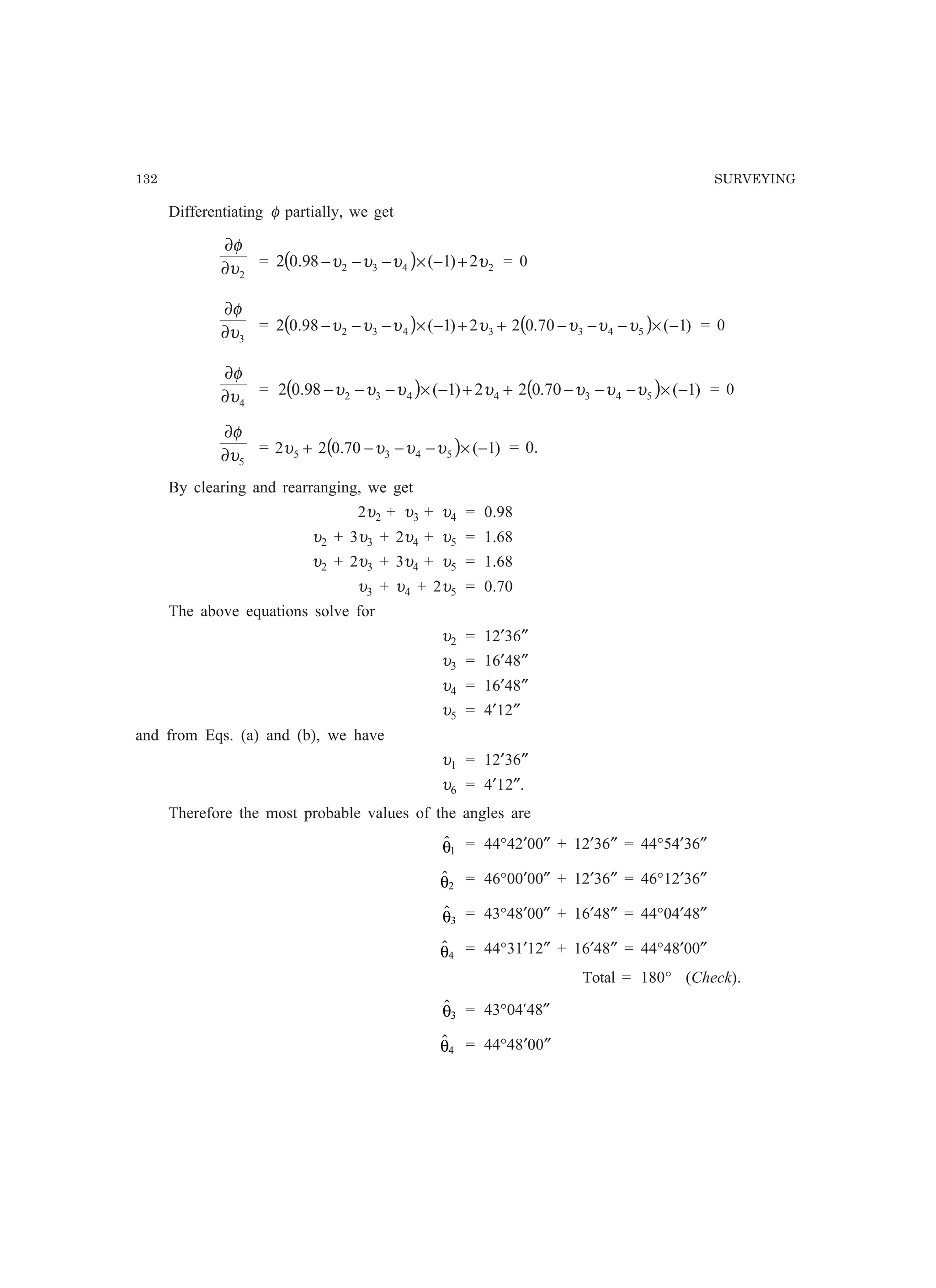
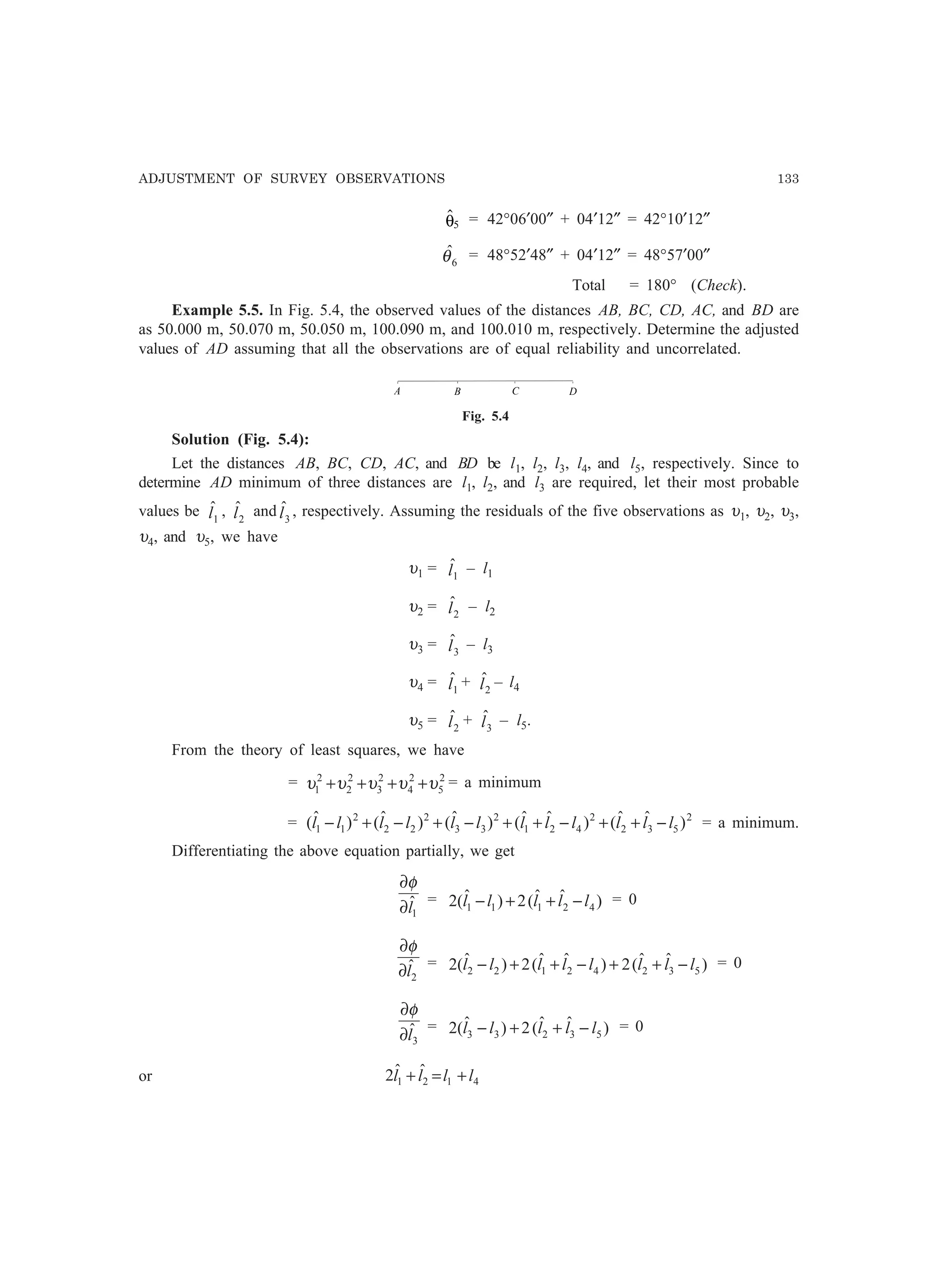
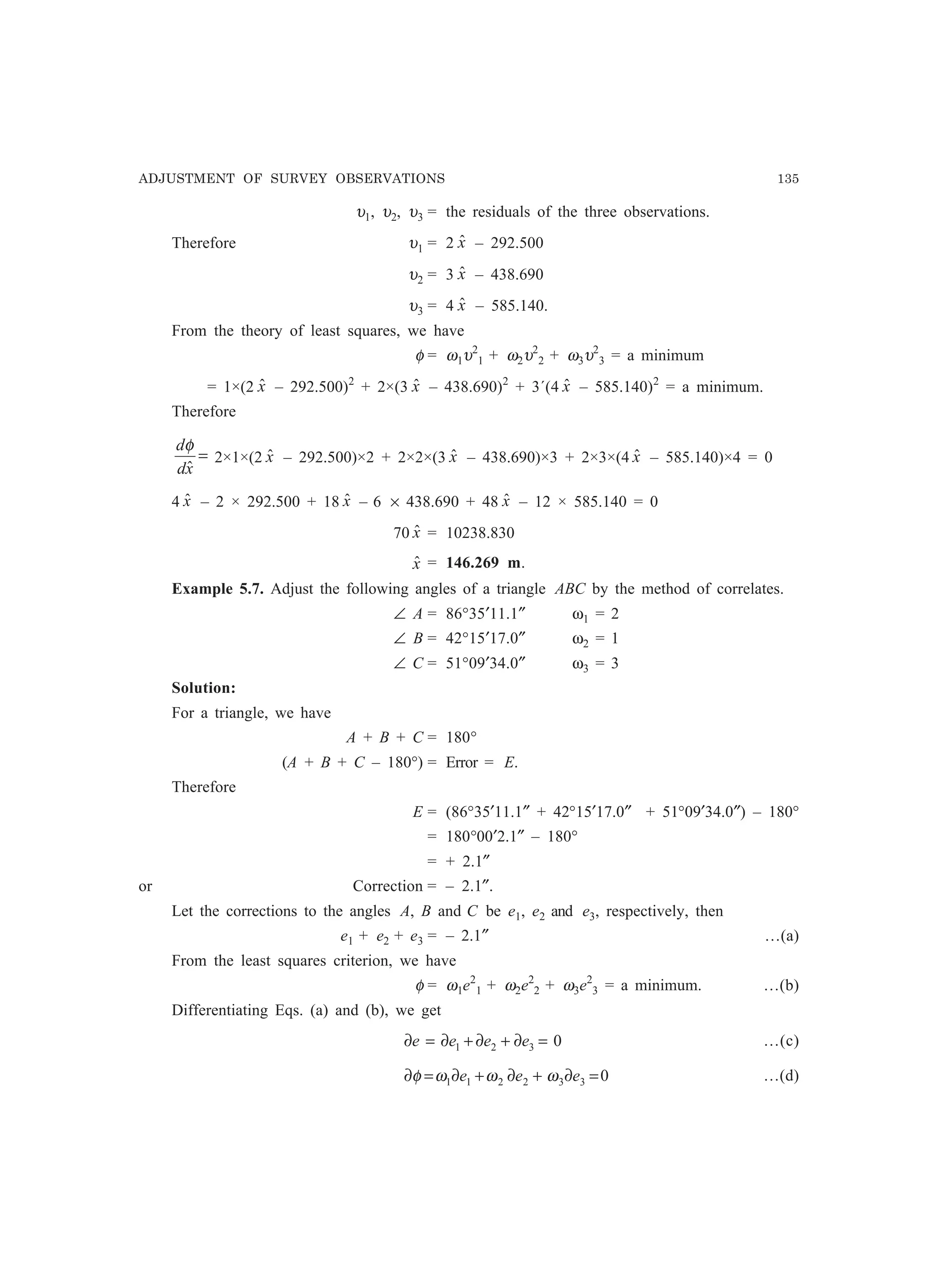
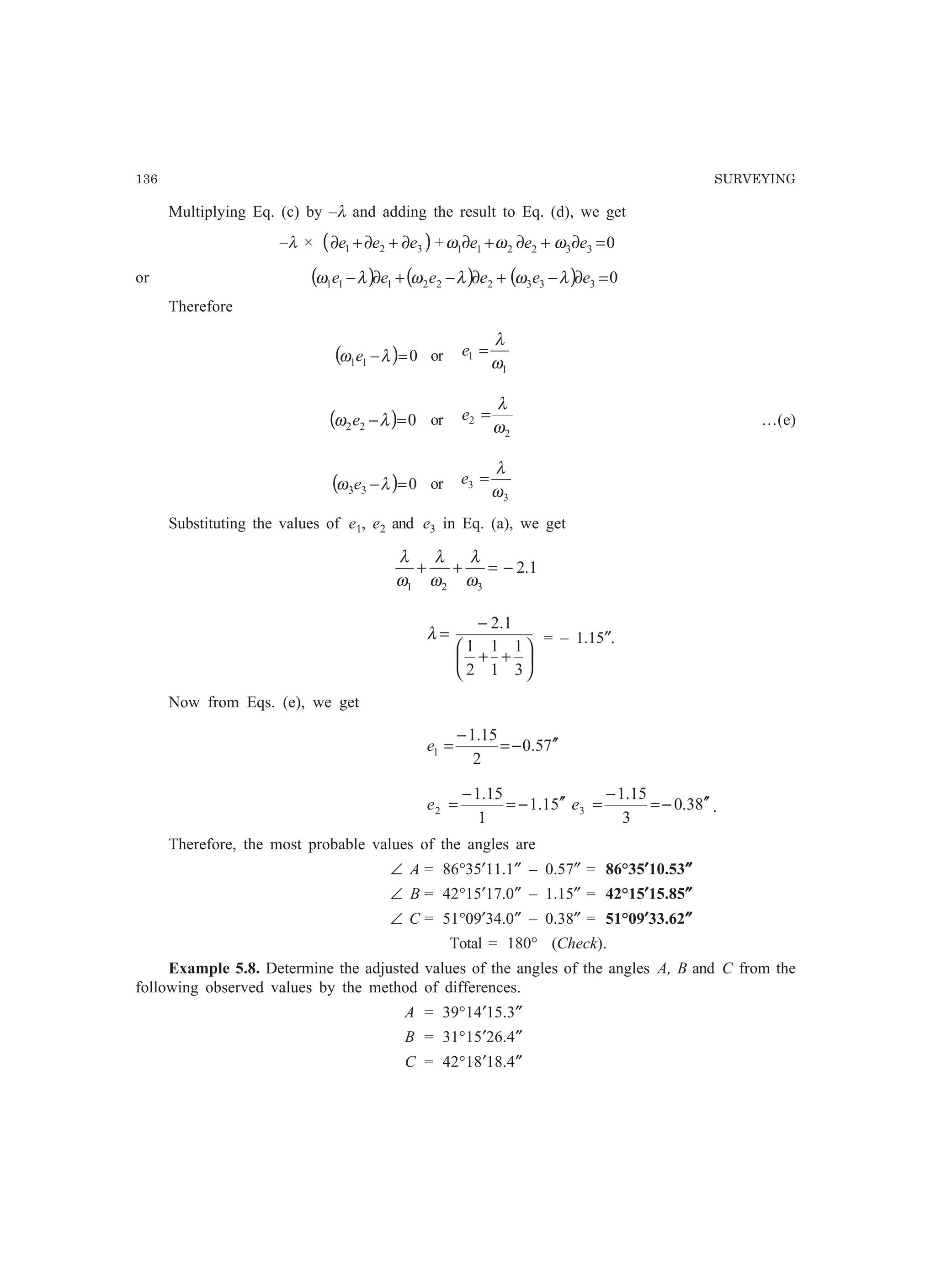
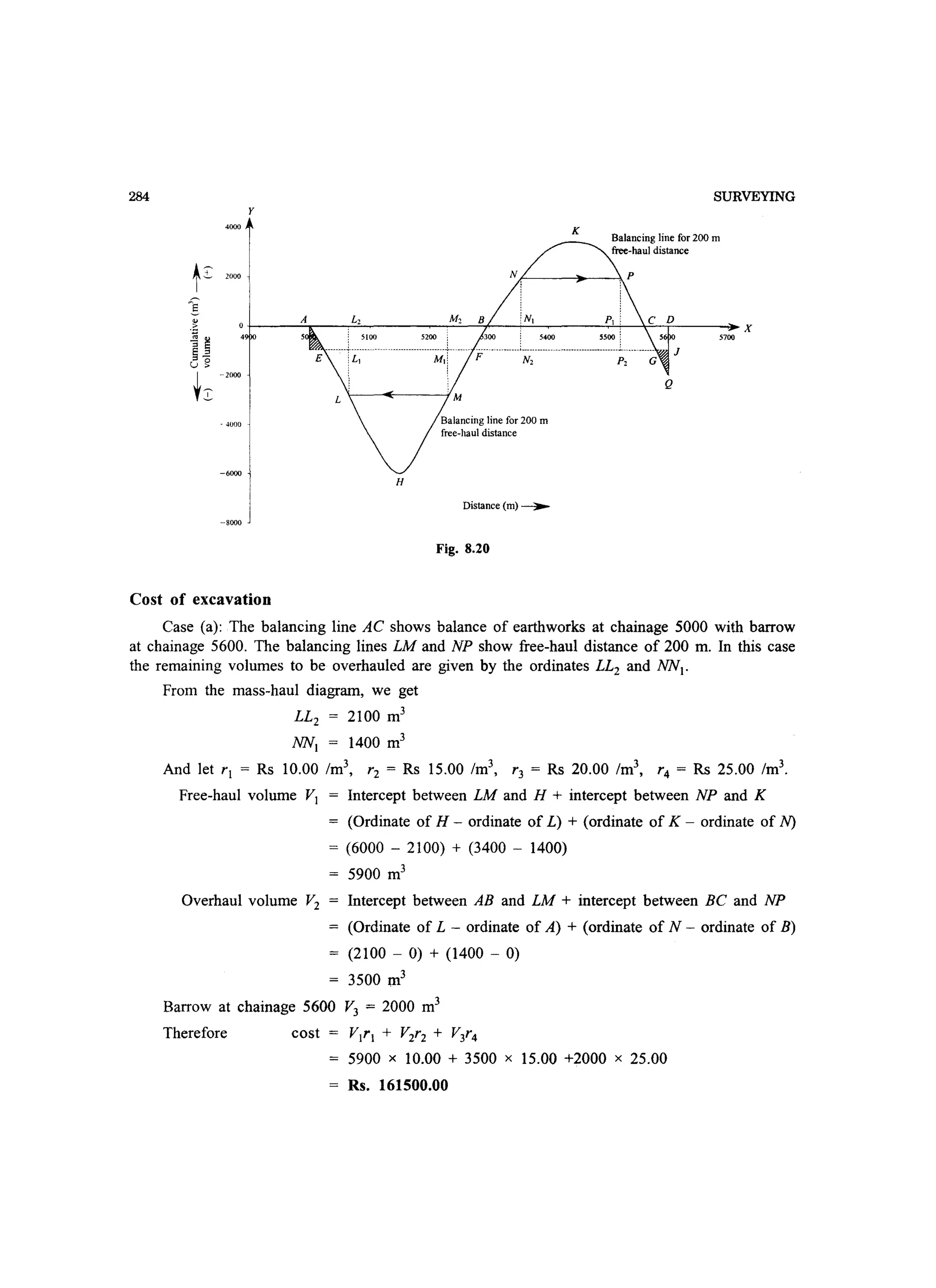
2000
2000
Distance (m) ..
Surveying
This page
intentionally left
blank
Surveying
Dr AM Chandra
Prof. of Civil Engineering
Indian Institute ofiedmology
Roorkee
NEW AGE
NEW AGE INTERNATIONAL(P) LIMITED, PUBLISHERS
New Delhi' Bangalore ' Chennai ' Cochin' Guwahati ' Hyderabad
Jalandhar· Kolkala· Lucknow· Mumbai' Ranchi
Visit us at www.newagepublishers.com
Copyright © 2005, NewAge International (P) Ltd., Publishers
Published by NewAge International (P) Ltd., Publishers
All rights reserved.
No part of this ebook may be reproduced in any form, by photostat, microfilm,
xerography, or any other means, or incorporated into any information retrieval
system, electronic or mechanical, without the written permission of the publisher.
All inquiries should be emailed to rights@newagepublishers.com
PUBLISHING FOR ONE WORLD
NEWAGE INTERNATIONAL(P) LIMITED, PUBLISHERS
4835/24,Ansari Road, Daryaganj, New Delhi - 110002
Visitusatwww.newagepublishers.com
ISBN (13) : 978-81-224-2532-1
Dedicated
to
My Parents
L
This page
intentionally left
blank
24-.)+-
The book adopts a classical pedagogical approach by providing a vivid insight into
the theory of surveying and its application through solving typical problems in the field
of surveying. It aims at helping the students understand surveying more comprehensively
through solving field related problems. Each chapter of the book commences with a
summary of basic theory and a range of worked out examples making it very useful for
all undergraduate and postgraduate courses in surveying. Alternative solutions to the
problems wherever possible, have also been included for stimulating the budding minds.
A number of objective type questions which are now a days commonly used in many
competitive examinations, have been included on each topic to help the readers to get
better score in such examinations. At the end, a number of selected unsolved problems
have also been included to attain confidence on the subject by solving them. The book
is also intended to help students preparing for AMIE, IS, and Diploma examinations.
The practicing engineers and surveyors will also find the book very useful in their
career while preparing designs and layouts of various application-oriented projects.
Constructive suggestions towards the improvement of the book in the next edition
are fervently solicited.
The author expresses his gratitude to the Arba Minch University, Ethiopia, for
providing him a conducive environment during his stay there from Sept. 2002 to June
2004, which made it possible for writing this book.
The author also wishes to express his thanks to all his colleagues in India and
abroad who helped him directly or indirectly, in writing this book.
Roorkee —Dr A M Chandra
LEE
This page
intentionally left
blank
CONTENTS
2=CAI
2HAB=?A (LEE)
1. ERRORS IN MEASUREMENTS AND THEIR PROPAGATION 1
1.1 Error Types 1
1.2 Probability Distribution 1
1.3 Most Probable Value 1
1.4 Standard Deviation 2
1.5 Variance 2
1.6 Standard Error of Mean 2
1.7 Most Probable Error 3
1.8 Confidence Limits 3
1.9 Weight 3
1.10 Precision and Accuracy 4
1.11 Propagation of Error 4
1.12 Normal Distribution 5
2. DISTANCE MEASUREMENT 20
2.1. Direct Method Using a Tape 20
2.2. Error in Pull Correction due to Error in Pull 23
2.3. Error in Sag Correction due to Error in Pull 23
2.4. Elongation of a Steel Tape when Used for Measurements
in a Vertical Shaft 24
2.5. Tacheometric or Optical Method 26
2.6. Subtense Tacheometry 27
2.7. Effect of Staff Vertically 27
2.8. Effect of Error in Measurement of Horizontal Angle
in Subtense Tacheometry 29
2.9. Electromagnetic Distance Measurement (EDM) 30
2.10. Accuracy in Vertical Angle Measurements 36
3. LEVELLING 59
3.1. Levelling 59
3.2. Level Surface 59
EN
3.3. Datum 59
3.4. Level Line 59
3.5. Direct Differential or Spirit Levelling 60
3.6. Comparison of Methods and their Uses 63
3.7. Loop Closure and its Apportioning 64
3.8. Reciprocal Levelling 64
3.9. Trigonometric Levelling 65
3.10. Sensitivity of a Level Tube 67
3.11. Two-Peg Test 67
3.12. Eye and Object Correction 68
4. THEODOLITE AND TRAVERSE SURVEYING 89
4.1. The Theodolite 89
4.2 Errors due to Maladjustments of the Theodolite 90
4.3 Traverse 92
4.4 Coordinates 92
4.5 Bearing 93
4.6 Departure and Latitude 93
4.7 Easting and Northing 94
4.8 Balancing the Traverse 94
4.9 Omitted Observations 95
4.10 Centring Error of Theodolite 96
4.11 Compatibility of Linear and Angular Measurements 97
5. ADJUSTMENT OF SURVEY OBSERVATIONS 122
5.1. Adjustment of Observations 122
5.2. Method of Last Squares 122
5.3. Observation Equations and Condition Equations 122
5.4. Normal Equation 123
5.5. Least Squares Method of Correlates 124
5.6. Method of Differences 124
5.7. Method of Variation of Coordinates 124
5.8. General Method of Adjusting a Polygon with a Central Station 125
6. TRIANGULATION AND TRILATERATION 166
6.1. Triangulation Surveys 166
6.2. Strength of Figure 166
6.3. Distance of Visible Horizon 167
N
6.4. Phase of a Signal 167
6.5. Satellite Station, Reduction to Centre, and Eccentricity of Signal 168
6.6. Location of Points by Intersection and Resection 170
6.7. Reduction of Slope Distance 173
6.8. Spherical Triangle 176
6.9. Effect of Earth’s Curvature 177
6.10. Convergence 178
7. CURVE RANGING 202
7.1. Curves 202
7.2. Circular Curves 202
7.3. Compound Curves 204
7.4. Reverse Curves 205
7.5. Transition Curves 207
7.6. Vertical Curves 208
8. AREAS AND VOLUMES 256
8.1. Areas and Volumes 256
8.2. Areas 256
8.3. Volumes 258
8.4. Heights of Points from a Digital Terrai Model 261
8.5. Mass-Haul Diagram 262
9. POINT LOCATION AND SETTING OUT 287
9.1. Setting Out 287
9.2. Point Location 287
9.3. Intersection and Resection 287
9.4. Transfer of Surface Alignment-Tunnelling 288
9.5. Setting out by Bearing and Distance 289
9.6. Monitoring Movements 289
9.7. Construction Lasers 289
9.8. Sight Rails for a Trench Sewer 289
9.9. Embankment Profile Boards 290
Selected Problems 310
Index 323
NE
This page
intentionally left
blank
ERRORS IN MEASUREMENTS
AND THEIR PROPAGATION
1.1 ERROR TYPES
Gross errors are, in fact, not errors at all, but results of mistakes that are due to the carelessness
of the observer. The gross errors must be detected and eliminated from the survey measurements
before such measurements can be used. Systematic errors follow some pattern and can be expressed
by functional relationships based on some deterministic system. Like the gross errors, the systematic
errors must also be removed from the measurements by applying necessary corrections. After all
mistakes and systematic errors have been detected and removed from the measurements, there will
still remain some errors in the measurements, called the random errors or accidental errors. The
random errors are treated using probability models. Theory of errors deals only with such type of
observational errors.
1.2 PROBABILITY DISTRIBUTION
If a large number of masurements have been taken, the frequency distribution could be considered
to be the probability distribution. The statistical analysis of survey observations has indicated that
the survey measurements follow normal distribution or Gaussian distribution, being expressed by
the equation,
dxedy
x 22
1 2/)(
2
1 σµ
πσ
−−
= ...(1.1)
where dy is the probability that the value will lie between the limits of x1 and (x1+dx), µ is the true
mean of the population, and σ is the standard deviation.
1.3 MOST PROBABLE VALUE
Different conditions under which the measurements are made, cause variations in measurments and,
therefore, no measured quantity is completely detrminable. A fixed value of a quantity may be
concieved as its true value. The difference between the measured quantity and its true value τ is
known as error ε, i.e.,
τε −= x ...(1.2)
Since the true value of a measured quantity cannot be determined, the exact value of ε can
never be found out. However, if a best estimate xˆ which is known as the most probable value of
τ, can be determined, xˆ can be used as a reference to express the variations in x. If we define
υ as residual then
1
2 SURVEYING
xx −= ˆυ ...(1.3)
The residuals express the variations or deviations in the measurements.
1.4 STANDARD DEVIATION
Standard deviation also called the root-mean square (R.M.S.) error, is a measure of spread of a
distribution and for the population, assuming the observations are of equal reliability it is expressed
as





 −Σ
±=
n
x
n
2
)(µ
σ ...(1.4)
However, µ cannot be determined from a sample of observations. Instead, the arithmetic mean
x is accepted as the most probable value and the population standard deviation is estimated as
σn
x x
n
− = ±
−
−
L
NM O
QP1
2
1
Σ (  )
( )
...(1.5)
or 





−
Σ
±=
)1(
2
n
υ
...(1.6)
The standard deviation given by the above expression is also called the standard error. Henceforth
in this book the symbol σ will mean 1−nσ .
1.5 VARIANCE
Variance of a quantity is expressed as
1
2
−
Σ
=
n
V
υ
...(1.7)
or 2
1−= nσ
or
2
σ= ...(1.8)
and is also used as a measure of dispersion or spread of a distribution.
1.6 STANDARD ERROR OF MEAN
The standard error of mean σm is given by






−
Σ
±=
)1(
2
nn
m
υ
σ ...(1.9)
or =
n
σ
± ...(1.10)
ERRORS IN MEASUREMENTS AND THEIR PROPAGATION 3
and hence the precision of the mean is enhanced with respect to that of a single observation. There
aren deviations (or residuals) from the mean of the sample and their sum will be zero. Thus, knowing
(n – 1) deviations the surveyor could deduce the remaining deviation and it may be said that there are
(n – 1) degrees of freedom. This number is used when estimating the population standard deviation.
1.7 MOST PROBABLE ERROR
The most probable error is defined as the error for which there are equal chances of the true error
being less and greater than probable error. In other words, the probability of the true error being
less than the probable error is 50% and the probability of the true error being greater than the
probable error is also 50%. The most probable error is given by






−
Σ
±=
)1(
6745.0
2
n
e
υ
...(1.11)
σ6745.0±= ...(1.12)
1.8 CONFIDENCE LIMITS
After establishing the sample mean as estimate of the true value of the quantity, the range of values
within which the true value should lie for a given probability is required. This range is called the
confidence interval, its bounds called the confidence limits. Confidence limits can be established for
that stated probability from the standard deviation for a set of observations. Statistical tables are
available for this purpose. A figure of 95% frequently chosen implies that nineteen times out of
twenty the true value will lie within the computed limits. The presence of a very large error in a
set of normally distributed errors, suggests an occurance to the contrary and such an observation
can be rejected if the residual error is larger than three times the standard deviation.
1.9 WEIGHT
This quantity ω is known as weight of the measurement indicates the reliability of a quantity. It
is inversely proportional to the variance ( 2
σ ) of the observation, and can be expressed as
ω
σ
=
k
2
where k is a constant of proportionality. If the weights and the standard errors for observations
x1, x2, ,….., etc., are respectively 1ω , 2ω ,….., etc., and 1σ , 2σ ,….., etc., and uσ is the
standard error for the observation having unit weight then we have
22
22
2
11 ...... uσσωσω === . ...(1.13)
Hence
,2
1
2
1
σ
σ
ω u
= ,2
2
2
2
σ
σ
ω u
= etc.,
4 SURVEYING
and ,2
1
2
2
2
1
σ
σ
ω
ω
= etc. ...(1.14)
The weights are applied to the individual measurements of unequal reliability to reduce them
to one standard. The most probable value is then the weighted mean xm of the measurements. Thus
( )
ω
ω
Σ
Σ
=
x
xmˆ , ...(1.15)
and standard error of the wieghted mean
σ
ω
ω
x
m
m
x x
n
= ±
−
−
L
N
MM
O
Q
PP
Σ
Σ
(  )
( )
2
1
m r ...(1.16)
The standard deviation of an observation of unit weight is given by
σ
ω
u
mx x
n
= ±
−
−
L
N
MM
O
Q
PP
Σ (  )
( )
2
1
m r ...(1.17)
and the standard deviation of an observation of weight nω is given by
σ
ω
ω
w
m
n
x x
n
= ±
−
−
L
N
MM
O
Q
PP
Σ (  )
( )
2
1
m r ...(1.18)
1.10 PRECISION AND ACCURACY
Precision is the degree of closeness or conformity of repeated measurements of the same quantity
to each other whereas the accuracy is the degree of conformity of a measurement to its true value.
1.11 PROPAGATION OF ERROR
The calculation of quantities such as areas, volumes, difference in height, horizontal distance, etc.,
using the measured quantities distances and angles, is done through mathematical relationships
between the computed quantities and the measured quantities. Since the measured quantities have
errors, it is inevitable that the quantities computed from them will not have errors. Evaluation of
the errors in the computed quantities as the function of errors in the measurements, is called error
propagation.
Let y = f(x1, x2,......., xn) then the error in y is
dy
f
x
dx
f
x
dx
f
x
dx
n
n= + + +
∂
∂
∂
∂
∂
∂1
1
2
2 ....... ...(1.19)
and the standard deviation of y is
22
2
2
1
2
........21 





∂
∂
++





∂
∂
+





∂
∂
= nx
n
xxy
x
f
x
f
x
f
σσσσ ...(1.20)
ERRORS IN MEASUREMENTS AND THEIR PROPAGATION 5
where ,, 21 dxdx ....., etc., are the errors in x1, x2,....., etc., and ,, 21 xx σσ ....., etc., are their
standard deviations. In a similar way if
nxxxy +++= .......21
then
2222
........21 nxxxy σσσσ +++= , since
1x
f
∂
∂
, etc. = 1. ...(1.21)
And if
y = 1kx in which k is free of error
σ σy xk= 1
since
1x
f
∂
∂
= k.
In the above relationships it is assumed that x1, x2,......., xn are independent implying that the
probability of any single observation having a certain value does not depend on the values of other
observations.
1.12 NORMAL DISTRIBUTION
The expression for the normal distribution is
dy e dxx
= − −1
2
1
2 22
σ π
µ σ( ) /
. ...(1.23)
Taking
σ
µ x
u
−
= , the expression becomes
dy e duu
= −1
2
2 2
π
/
. ...(1.24)
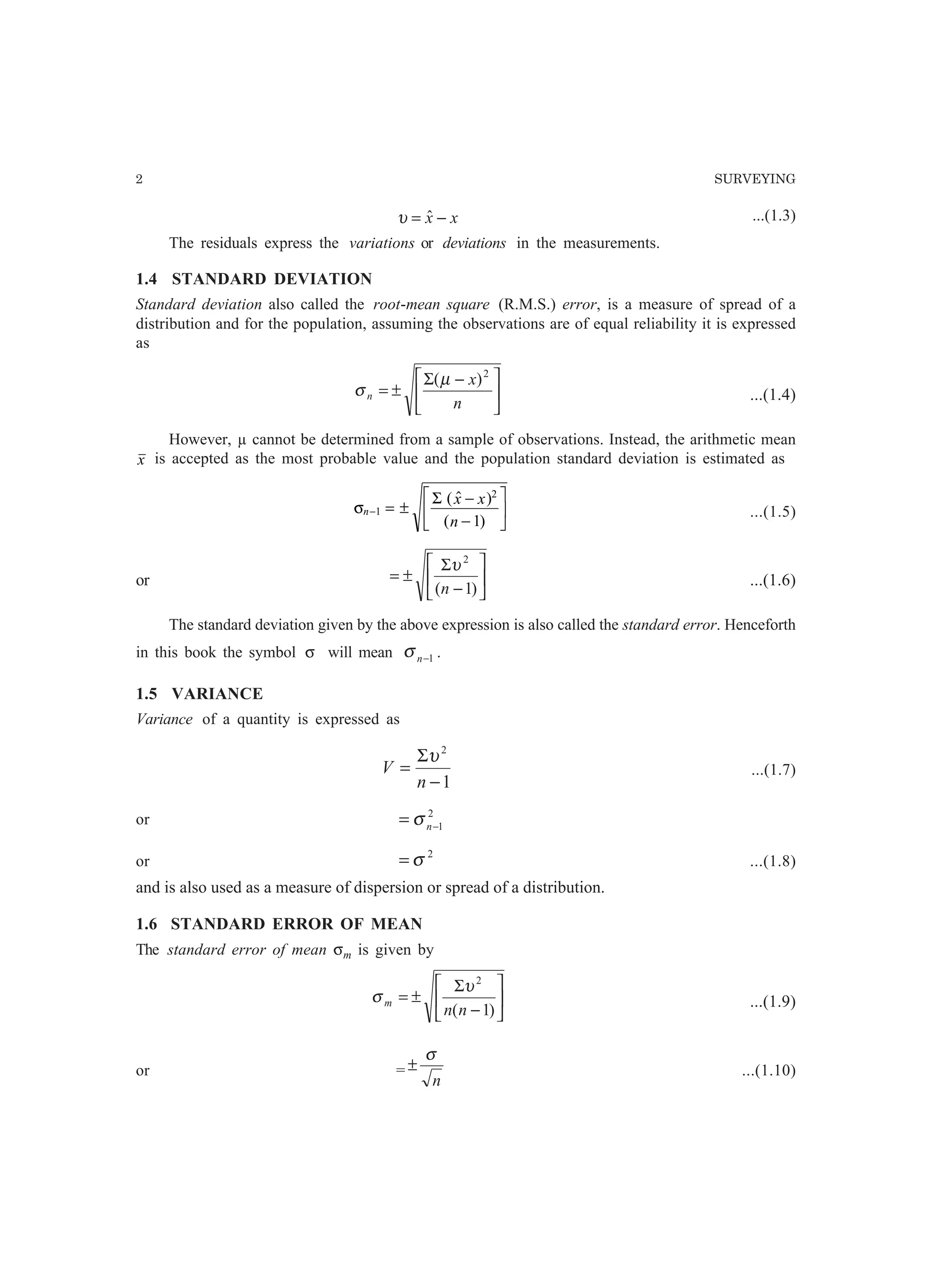
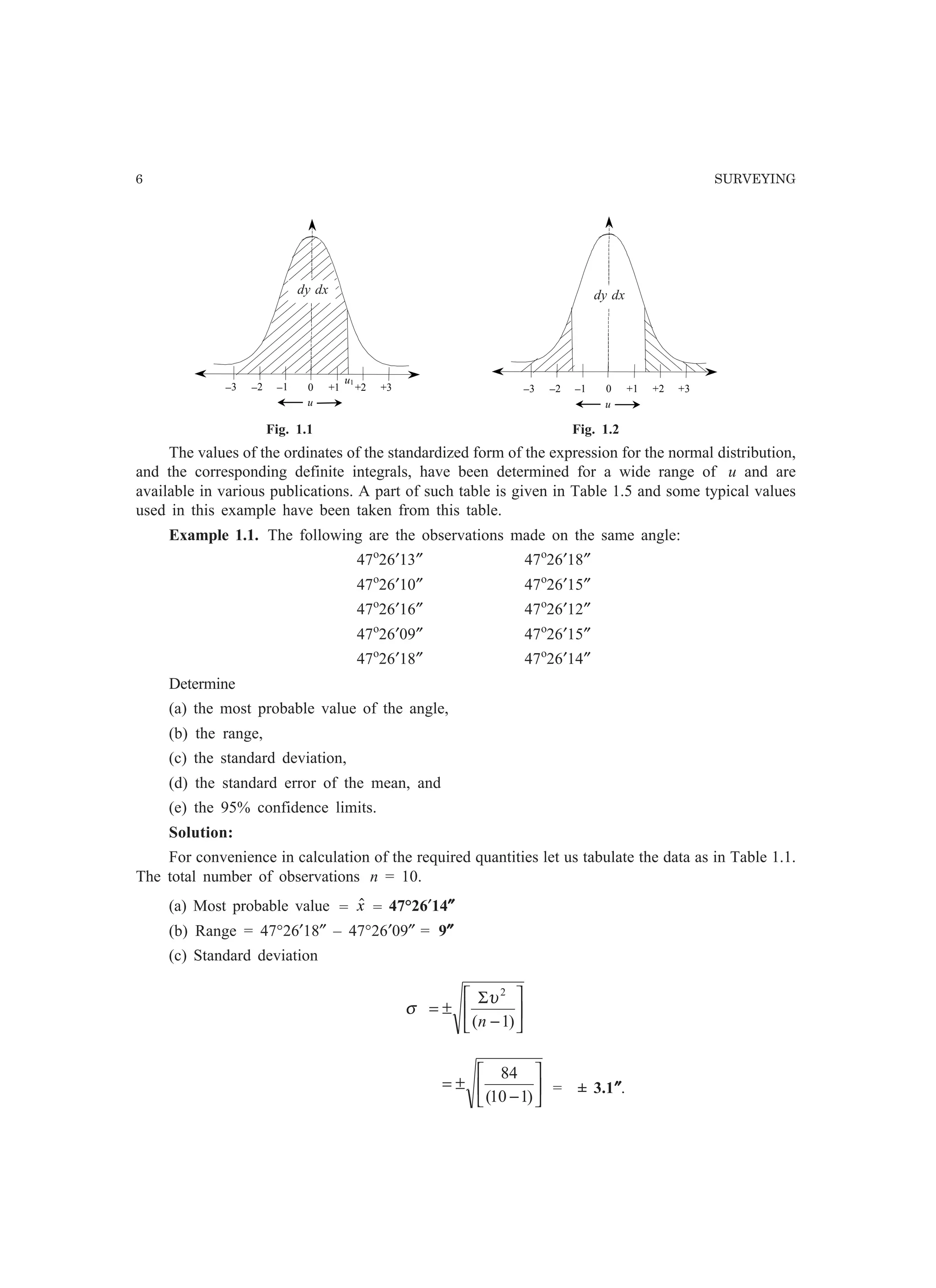
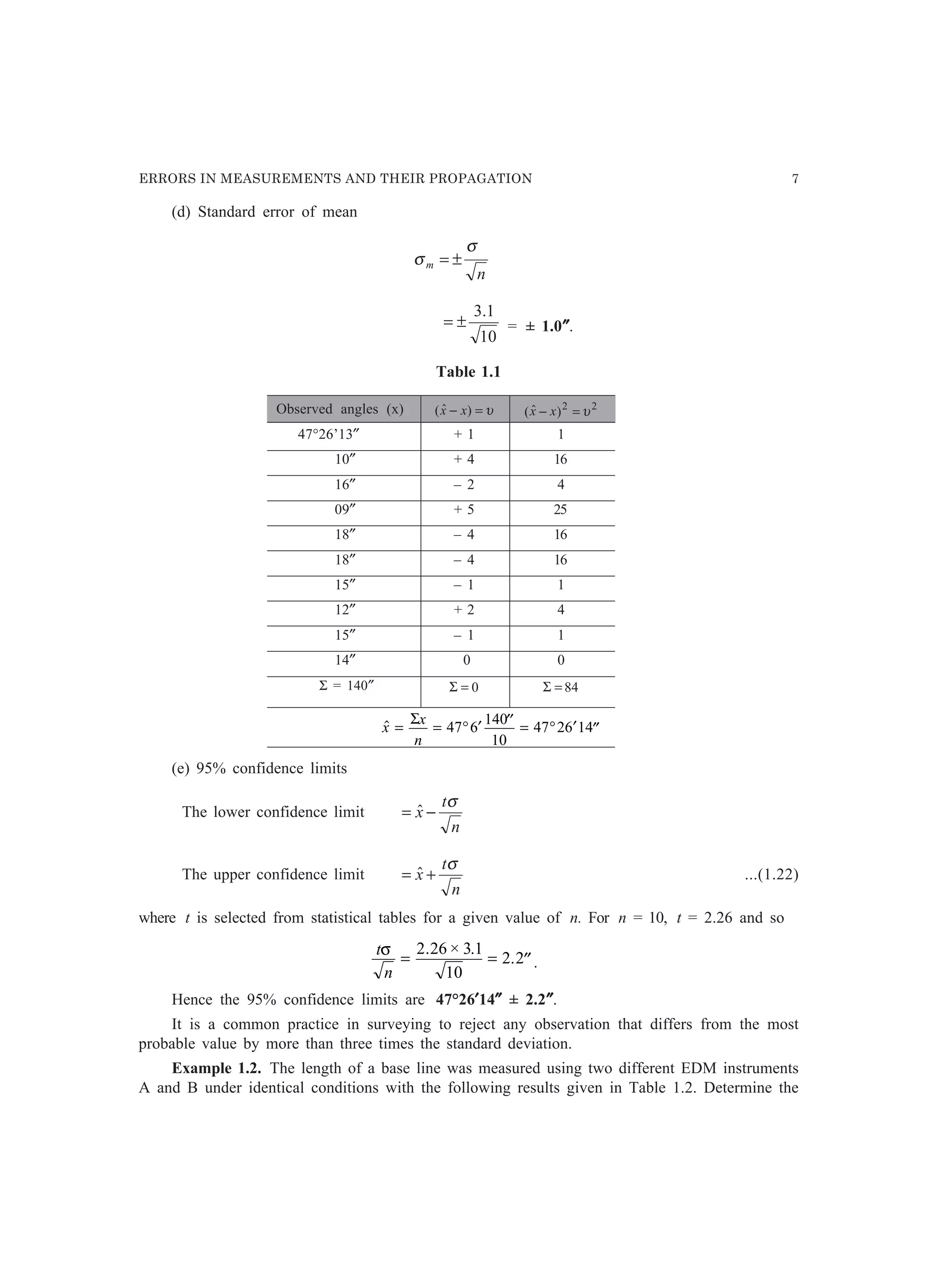
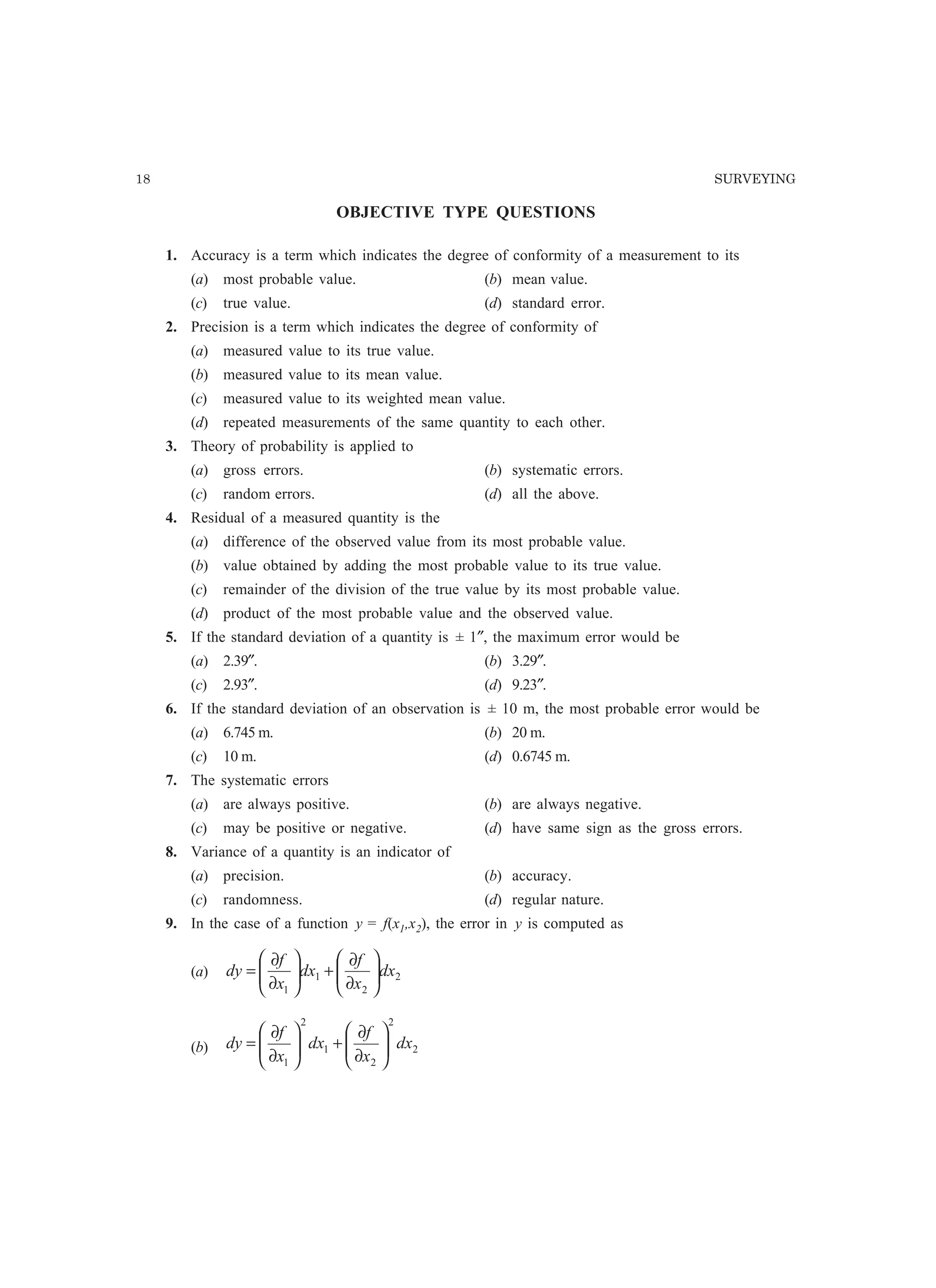
Eq. (1.24) is the standardized form of the above expression, and Fig. 1.1 illustrates the
relationship between dy/du and u is illustrated in Fig. 1.1.
The curve is symmetrical and its total area is 1, the two parts about u = 0 having areas of
0.5. The shaded area has the value
1
2
21
2
π
e duu
u
−
−∞
+
z /
and it gives the probability of u being lying between – ∞ and + u1. The unshaded area gives the
probability that u will be larger than + u1. Since the curve is symmetrical, the probability that u takes
up a value outside the range + u1 to – u1 is given by the two areas indicated in Fig. 1.2.
6 SURVEYING
0−1−2−3 +1 +2 +3
u
u1
dxdy
0−1−2−3 +1 +2 +3
u
dxdy
Fig. 1.1 Fig. 1.2
The values of the ordinates of the standardized form of the expression for the normal distribution,
and the corresponding definite integrals, have been determined for a wide range of u and are
available in various publications. A part of such table is given in Table 1.5 and some typical values
used in this example have been taken from this table.
Example 1.1. The following are the observations made on the same angle:
47o
26′13″ 47o
26′18″
47o
26′10″ 47o
26′15″
47o
26′16″ 47o
26′12″
47o
26′09″ 47o
26′15″
47o
26′18″ 47o
26′14″
Determine
(a) the most probable value of the angle,
(b) the range,
(c) the standard deviation,
(d) the standard error of the mean, and
(e) the 95% confidence limits.
Solution:
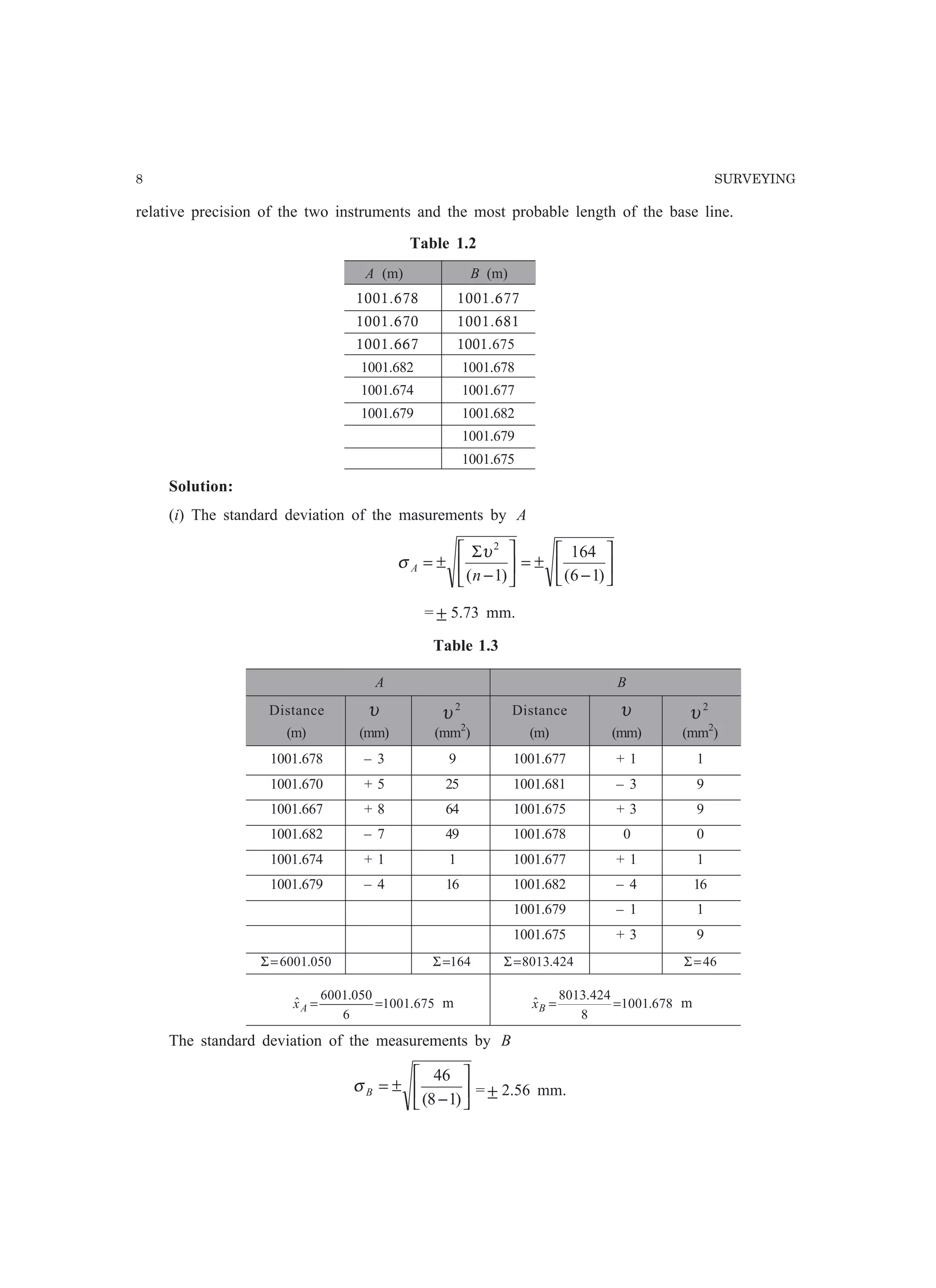
For convenience in calculation of the required quantities let us tabulate the data as in Table 1.1.
The total number of observations n = 10.
(a) Most probable value = x = 47°26′14″″″″″
(b) Range = 47°26′18″ – 47°26′09″ = 9″″″″″
(c) Standard deviation






−
Σ
±=
)1(
2
n
υ
σ






−
±=
)110(
84
= ± 3.1″″″″″.
dy dx dy dx
ERRORS IN MEASUREMENTS AND THEIR PROPAGATION 7
(d) Standard error of mean
n
m
σ
σ ±=
10
1.3
±= = ± 1.0″″″″″.
Table 1.1
Observed angles (x) υ=− )ˆ( xx 22
)ˆ( υ=− xx
47°26’13″ + 1 1
10″ + 4 16
16″ – 2 4
09″ + 5 25
18″ – 4 16
18″ – 4 16
15″ – 1 1
12″ + 2 4
15″ – 1 1
14″ 0 0
Σ = 140″ 0=Σ 84=Σ
x
x
n
= = ° ′ ′′ = ° ′ ′′
Σ
47 6
140
10
47 26 14
(e) 95% confidence limits
The lower confidence limit
n
t
x
σ
−= ˆ
The upper confidence limit
n
t
x
σ
+= ˆ ...(1.22)
where t is selected from statistical tables for a given value of n. For n = 10, t = 2.26 and so
t
n
σ
= = ′′
2 26 3 1
10
2 2
. × .
. .
Hence the 95% confidence limits are 47°26′′′′′14″″″″″ ± 2.2″″″″″.
It is a common practice in surveying to reject any observation that differs from the most
probable value by more than three times the standard deviation.
Example 1.2. The length of a base line was measured using two different EDM instruments
A and B under identical conditions with the following results given in Table 1.2. Determine the
8 SURVEYING
relative precision of the two instruments and the most probable length of the base line.
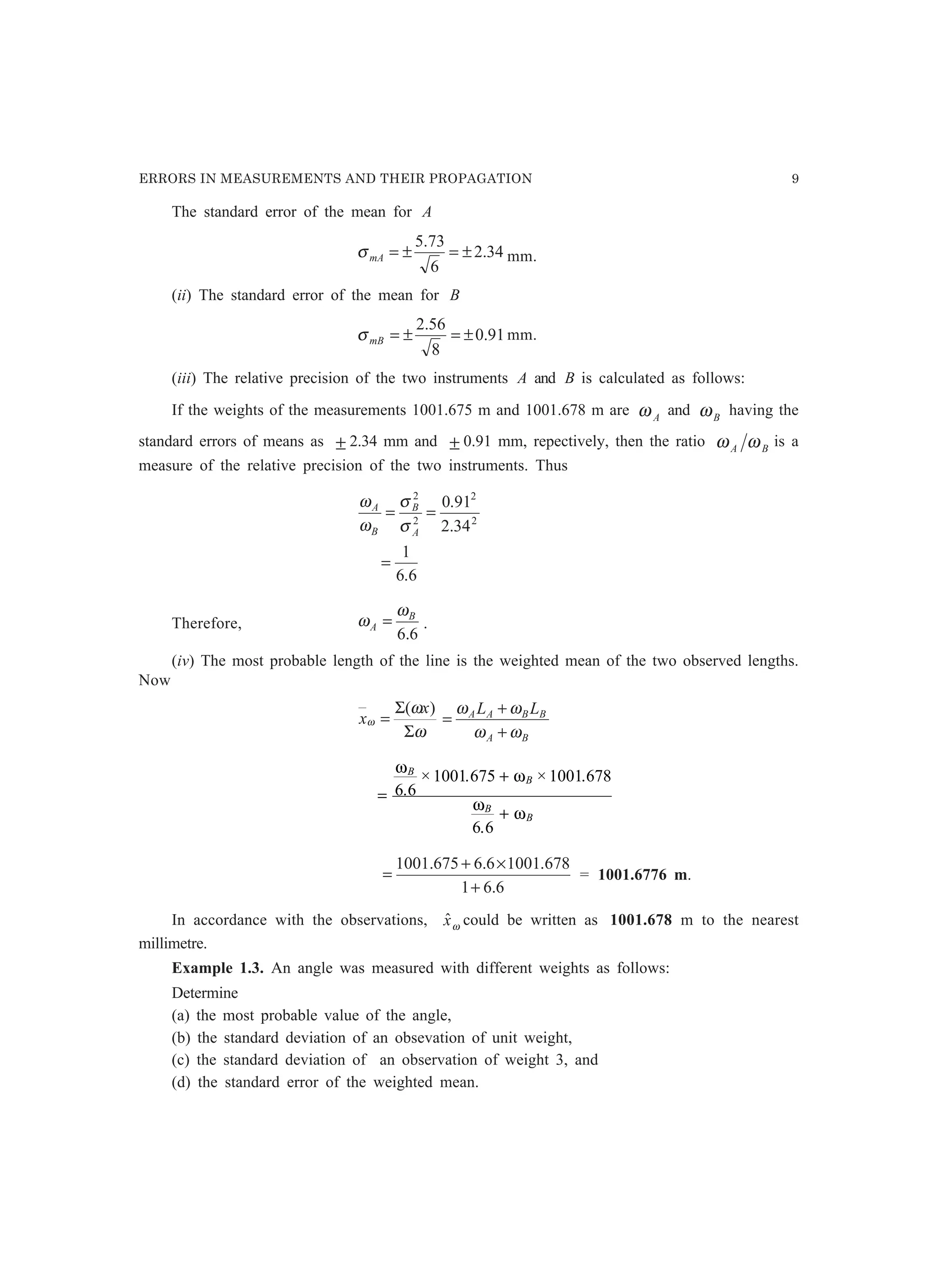
Table 1.2
A (m) B (m)
1001.678 1001.677
1001.670 1001.681
1001.667 1001.675
1001.682 1001.678
1001.674 1001.677
1001.679 1001.682
1001.679
1001.675
Solution:
(i) The standard deviation of the masurements by A






−
±=





−
Σ
±=
)16(
164
)1(
2
n
A
υ
σ
= ± 5.73 mm.
Table 1.3
A B
Distance υ 2
υ Distance υ 2
υ
(m) (mm) (mm2
) (m) (mm) (mm2
)
1001.678 – 3 9 1001.677 + 1 1
1001.670 + 5 25 1001.681 – 3 9
1001.667 + 8 64 1001.675 + 3 9
1001.682 – 7 49 1001.678 0 0
1001.674 + 1 1 1001.677 + 1 1
1001.679 – 4 16 1001.682 – 4 16
1001.679 – 1 1
1001.675 + 3 9
050.6001=Σ 164=Σ 424.8013=Σ 46=Σ
675.1001
6
050.6001
ˆ ==Ax m 678.1001
8
424.8013
ˆ ==Bx m
The standard deviation of the measurements by B






−
±=
)18(
46
Bσ = ± 2.56 mm.
ERRORS IN MEASUREMENTS AND THEIR PROPAGATION 9
The standard error of the mean for A
34.2
6
73.5
±=±=mAσ mm.
(ii) The standard error of the mean for B
91.0
8
56.2
±=±=mBσ mm.
(iii) The relative precision of the two instruments A and B is calculated as follows:
If the weights of the measurements 1001.675 m and 1001.678 m are Aω and Bω having the
standard errors of means as ± 2.34 mm and ± 0.91 mm, repectively, then the ratio BA ωω is a
measure of the relative precision of the two instruments. Thus
6.6
1
34.2
91.0
2
2
2
2
=
==
A
B
B
A
σ
σ
ω
ω
Therefore,
6.6
B
A
ω
ω = .
(iv) The most probable length of the line is the weighted mean of the two observed lengths.
Now
ω
ω
ω
Σ
Σ
=
)( x
x
BA
BBAA LL
ωω
ωω
+
+
=
=
+
+
ω
ω
ω
ω
B
B
B
B
6 6
1001 675 1001 678
6 6
.
× . × .
.
6.61
678.10016.6675.1001
+
×+
= = 1001.6776 m.
In accordance with the observations, ωxˆ could be written as 1001.678 m to the nearest
millimetre.
Example 1.3. An angle was measured with different weights as follows:
Determine
(a) the most probable value of the angle,
(b) the standard deviation of an obsevation of unit weight,
(c) the standard deviation of an observation of weight 3, and
(d) the standard error of the weighted mean.
10 SURVEYING
Angle Weight
(ω )
86°47′25″ 1
86°47′28″ 3
86°47′22″ 1
86°47′26″ 2
86°47′23″ 4
86°47′30″ 1
86°47′28″ 3
86°47′26″ 3
Solution: Tabulating the data and the weighted results working from a datum of 86°47′, we
get the values as given in Table 1.4.
(a) The most probable value of the angle is the weighted mean
=ωx Datum +
( )
ω
ω
Σ
Σ x
= ° ′ + = ° ′ ′′86 47
467
18
86 47 25 9.
(b) Standard deviation of an observation of unit weight
( )






−
Σ
±=
)1(
2
n
u
ωυ
σ
( )18
93
−
±= ±= 3.64″″″″″.
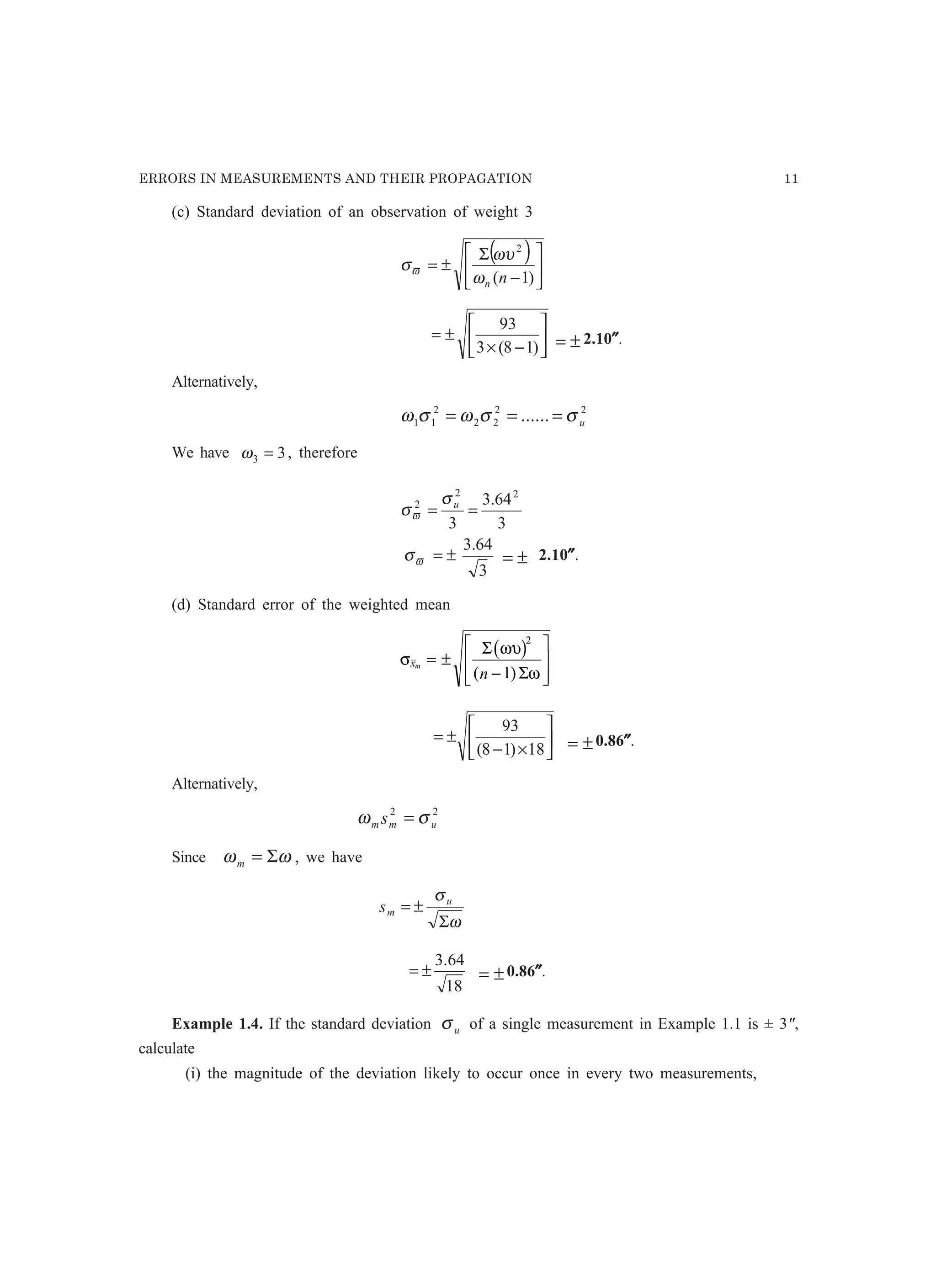
Table 1.4
Observed
x ω ω x υ 2
ωυ
angle
86°47′25″ 25 1 25 + 1 1
86°47′28″ 28 3 84 – 2 12
86°47′22″ 22 1 22 + 4 16
86°47′26″ 26 2 52 0 0
86°47′23″ 23 4 92 + 3 36
86°47′30″ 30 1 30 – 4 16
86°47′28″ 28 3 84 – 2 12
86°47′26″ 26 3 78 0 0
208=Σ 18=Σ 467=Σ 93=Σ
26
8
208
ˆ ==x
ERRORS IN MEASUREMENTS AND THEIR PROPAGATION 11
(c) Standard deviation of an observation of weight 3
( )






−
Σ
±=
)1(
2
nnω
ωυ
σϖ






−×
±=
)18(3
93
±= 2.10″″″″″.
Alternatively,
22
22
2
11 ...... uσσωσω ===
We have 33 =ω , therefore
3
64.3
3
64.3
3
22
2
±=
==
ϖ
ϖ
σ
σ
σ u
(d) Standard error of the weighted mean
σ
ωυ
ω
xm
n
= ±
−
L
N
MM
O
Q
PP
Σ
Σ
b g2
1( )






×−
±=
18)18(
93
±= 0.86″″″″″.
Alternatively,
22
umm s σω =
Since ωω Σ=m , we have
ω
σ
Σ
±= u
ms
18
64.3
±= ±= 0.86″″″″″.
Example 1.4. If the standard deviation uσ of a single measurement in Example 1.1 is ± 3,
calculate
(i) the magnitude of the deviation likely to occur once in every two measurements,
±= 2.10″″″″″.
12 SURVEYING
(ii) the probability that a single measurement may deviate from the true value by ± 6, and
(iii) the probability that the mean of nine measurments may deviate from the true value by
± 1.5.
Solution:
If a deviation is to occur once in every two measurements a probability of 50% is implied.
Thus in Fig. 1.2 the two shaded parts have areas of 0.25 each and the total shaded area is 0.5.
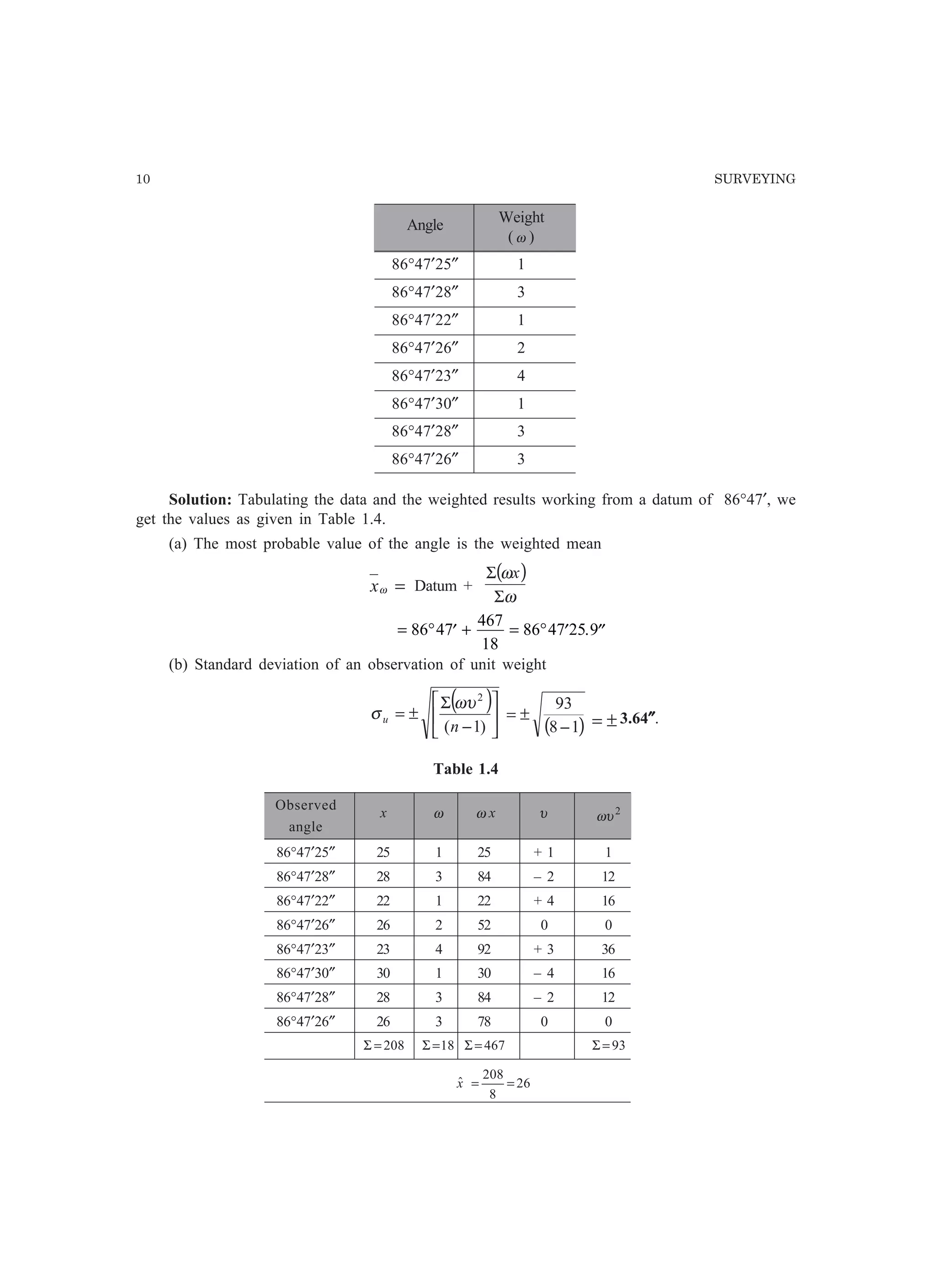
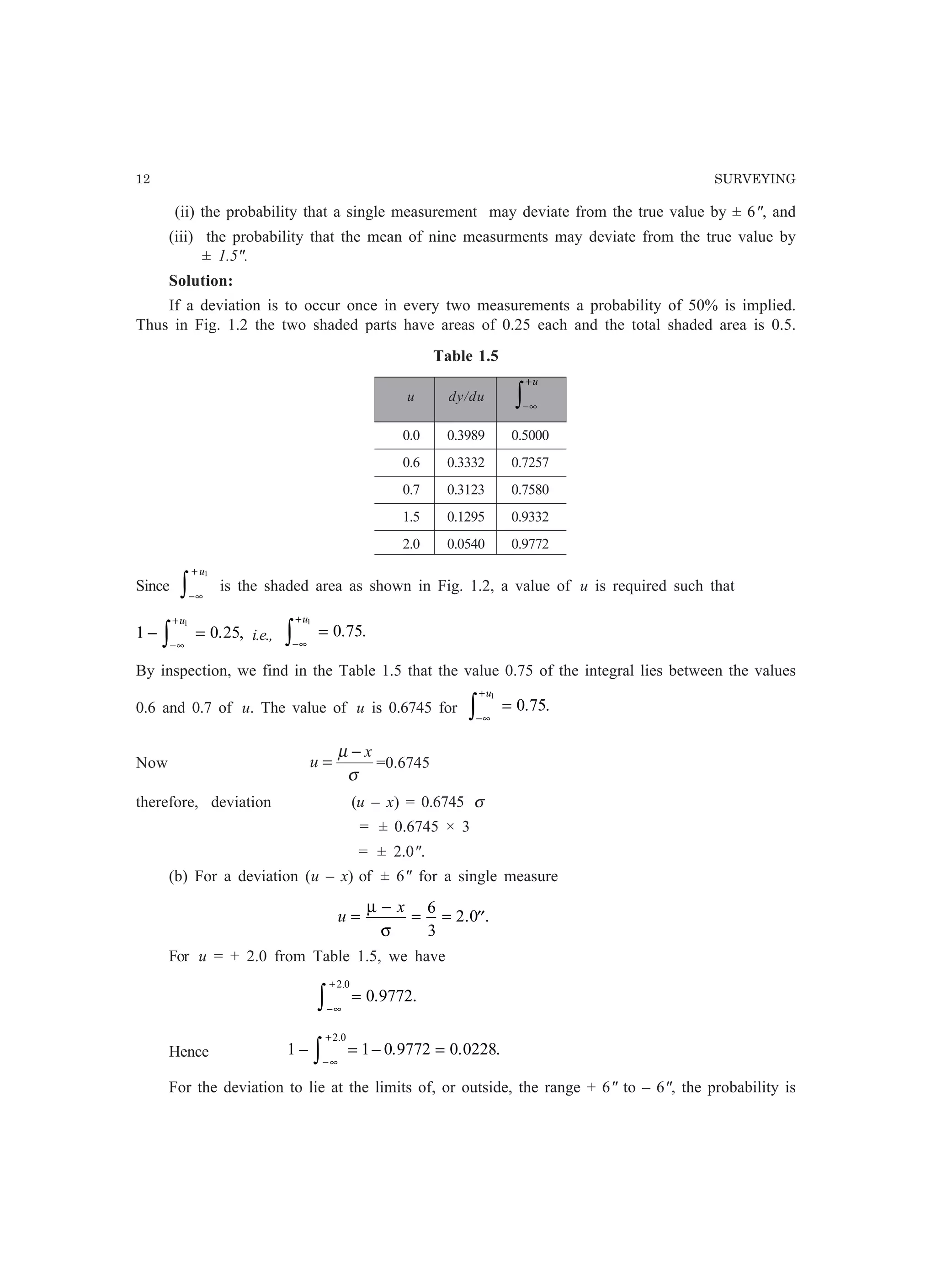
Table 1.5
u dy/du
−∞
+
z u
0.0 0.3989 0.5000
0.6 0.3332 0.7257
0.7 0.3123 0.7580
1.5 0.1295 0.9332
2.0 0.0540 0.9772
Since
−∞
+
z u1
is the shaded area as shown in Fig. 1.2, a value of u is required such that
1 0 25
1
− =
−∞
+
z . ,
u
i.e., =
−∞
+
z 0 75
1
. .
u
By inspection, we find in the Table 1.5 that the value 0.75 of the integral lies between the values
0.6 and 0.7 of u. The value of u is 0.6745 for =
−∞
+
z 0 75
1
. .
u
Now
σ
µ x
u
−
= =0.6745
therefore, deviation (u – x) = 0.6745 σ
= ± 0.6745 × 3
= ± 2.0.
(b) For a deviation (u – x) of ± 6 for a single measure
u
x
=
−
= = ′′
µ
σ
6
3
2 0. .
For u = + 2.0 from Table 1.5, we have
=
−∞
+
z 0 9772
2 0
. .
.
Hence 1 1 0 9772 0 0228
2 0
− = − =
−∞
+
z . . .
.
For the deviation to lie at the limits of, or outside, the range + 6 to – 6, the probability is
ERRORS IN MEASUREMENTS AND THEIR PROPAGATION 13
= 2 × 0.0228
= 0.0456, or 4.6%.
(c) The standard deviation of the mean of nine observations
9
0.3
==
n
m
σ
σ = ± 1.0.
For a deviation of ±1.5
u
x
m
=
−
= ′′µ
σ
15
1 0.
= 1.5.
For u = + 1.5 from the Table 1.5, we get
1 1 0 9332 0 0668
15
− = − =
−∞
+
z .
. . .
Therefore the probability of assuming a deviation of ± 1.5
= 2 × 0.0668
= 0.1336, or 13.4%.
Example 1.5. The coordinates with standard deviations of two stations A and B were determined
as given below. Calculate the length and standard deviation of AB.
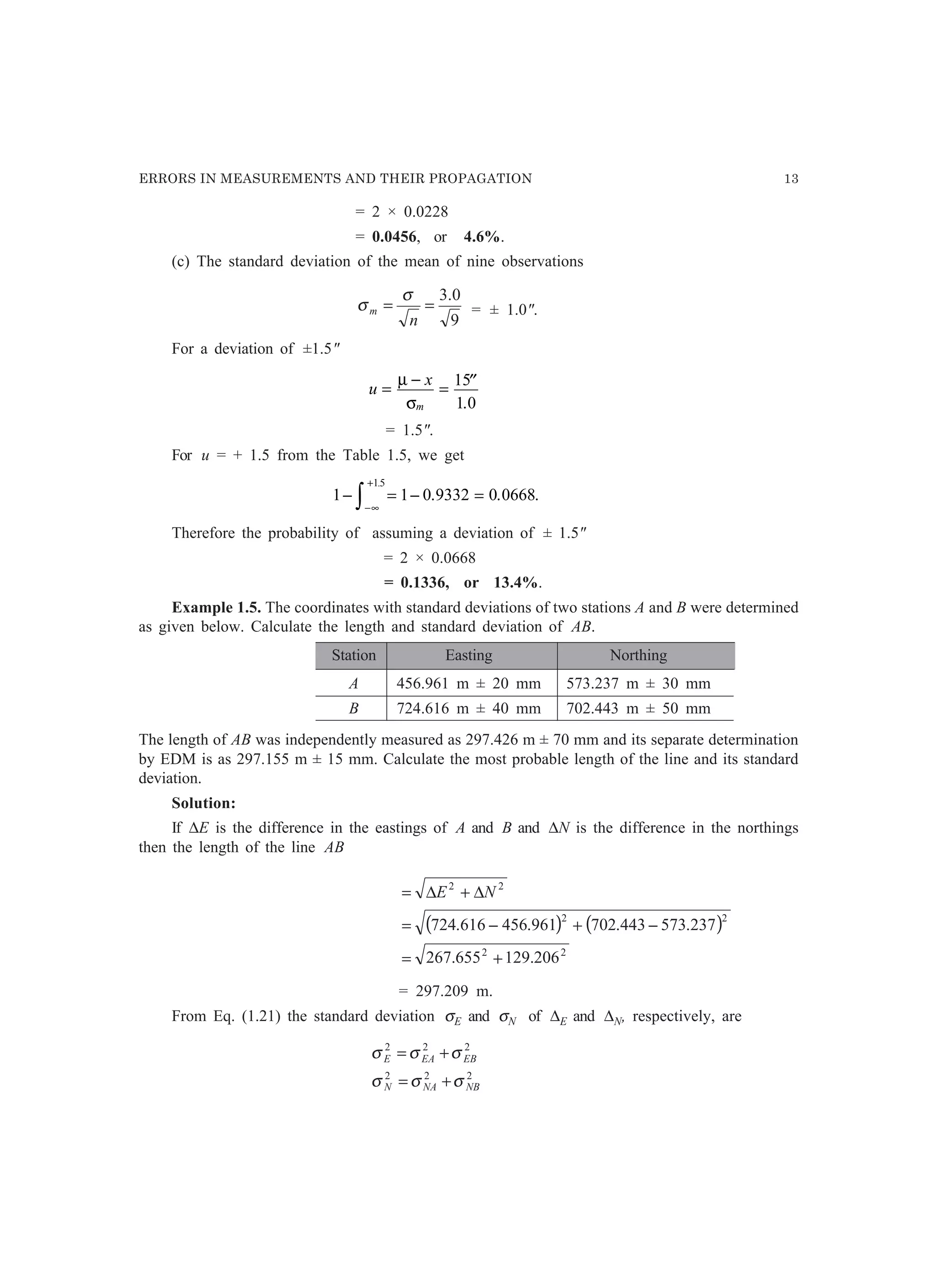
Station Easting Northing
A 456.961 m ± 20 mm 573.237 m ± 30 mm
B 724.616 m ± 40 mm 702.443 m ± 50 mm
The length of AB was independently measured as 297.426 m ± 70 mm and its separate determination
by EDM is as 297.155 m ± 15 mm. Calculate the most probable length of the line and its standard
deviation.
Solution:
If ∆E is the difference in the eastings of A and B and ∆N is the difference in the northings
then the length of the line AB
( ) ( )
22
22
22
206.129655.267
237.573443.702961.456616.724
+=
−+−=
∆+∆= NE
= 297.209 m.
From Eq. (1.21) the standard deviation σE and σN of ∆E and ∆N, respectively, are
222
222
NBNAN
EBEAE
σσσ
σσσ
+=
+=
14 SURVEYING
20±=EAσ mm; 40±=EBσ mm; 30±=NAσ mm; 50±=NBσ mm.
Therefore,
222
4020 +=Eσ , or 7.44±=Eσ mm
222
5030 +=Nσ , or 3.58±=Nσ mm
Now from Eq. (1.20), the standard deviation of the computed length AB
σ
∂
∂
σ
∂
∂
σAB E N
L
E
L
L
2
2 2
=
F
HG
I
KJ +
F
HG
I
KJ∆ ∆b g b g …(a)
where 22
NEL ∆+∆= ...(b)
Now by differentiating Eq. (b), we get
∂
∂
L
E
E E N
∆
∆ ∆ ∆
a f b g= +
−1
2
2 2 2 1 2
× ×
/
=
+
= = =
∆
∆ ∆
∆E
E N
E
L2 2
267 655
297 209
0 901
.
.
.
Similarly,
( )
435.0
209.297
206.129
==
∆
=
∆∂
∂
L
N
E
L
Hence from Eq. (a), we get
( ) ( )222
3.58435.07.44901.0 ×+×=ABσ = 2265.206
or ABσ = ± 47.6 mm.
Now we have three values of the length AB and their standard deviations as given in Table 1.6.
Table 1.6
Length (l) by σ ω = 1/σ2
(m) (mm)
Tape 297.426 ± 70 1/4900
EDM 297.155 ± 15 1/225
Calculation 297.209 ± 47.6 1/2266
Since the weight of a measured quantity is inversely proportional to its variance, we can
calculate the weights of the lengths obtained by different methods, and these have been given in
Table 1.6.
ERRORS IN MEASUREMENTS AND THEIR PROPAGATION 15
The most probable length of AB is the weighted mean of the three values of AB.
Thus
2266
1
225
1
4900
1
209.297
2266
1
155.297
225
1
426.297
4900
1
++
×+×+×
=L
= 297.171 m.
The weight of L is
2266
1
225
1
4900
1
++=Σω = 0.00509
Since ω 2
/1 σ=
ω
σ
L
L
=
1
2
σ
ω
L
L
= =
1 1
0 00509.
= ± 14.0 mm.
The standard deviation of the length 297.171 m is ± 14.0 mm.
Example 1.6. A base line AB was measured accurately using a subtense bar 1 m long. From
a point C near the centre of the base, the lengths AC and CB were measured as 9.375 m and
9.493 m, respectively. If the standard error in the angular mesurement was ± 1″, determine the error
in the length of the line.
Solution:
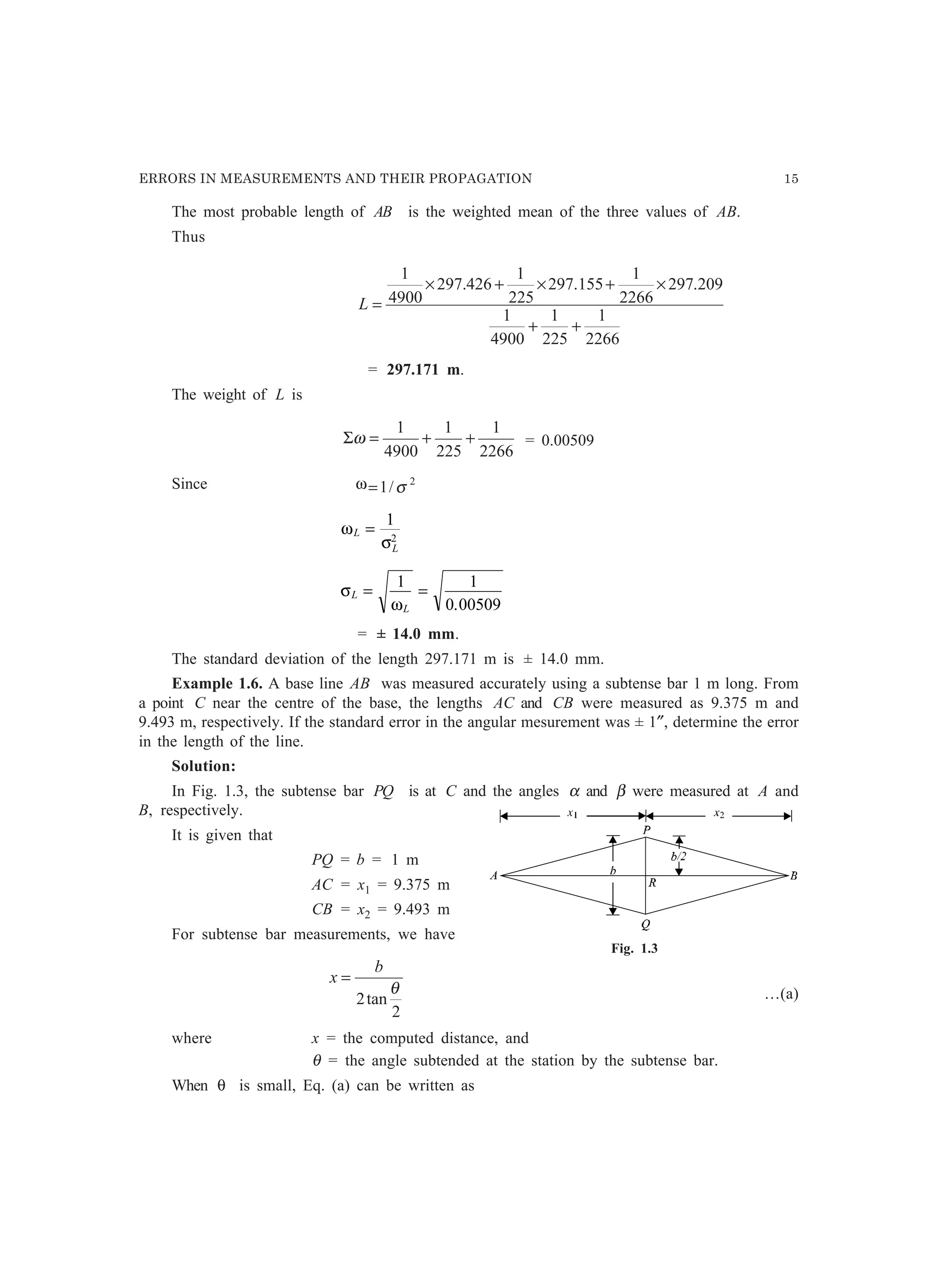
In Fig. 1.3, the subtense bar PQ is at C and the angles α and β were measured at A and
B, respectively.
It is given that
PQ = b = 1 m
AC = x1 = 9.375 m
CB = x2 = 9.493 m
For subtense bar measurements, we have
2
tan2
θ
b
x =
…(a)
where x = the computed distance, and
θ = the angle subtended at the station by the subtense bar.
When θ is small, Eq. (a) can be written as
Fig. 1.3
16 SURVEYING
,
θ
b
x = or
x
b
=θ
Therefore 2
θ
θdb
dx −= 2






−=
x
b
db θ
)(
2
radiansind
b
dx
θ
θ
−=
Writing ,,,, ασσσσ CBACAB and βσ as the respective standard errors, we have
000426.0
206265
1
1
375.9 22
1
±=×=−= ασσ
b
x
AC m
000437.0
206265
1
1
493.9 22
2
±=×=−= βσσ
b
x
CB m
222
CBACAB σσσ +=
22
000437.0000426.0 +±=ABσ
= ± 0.61 mm.
The ratio of the standard error to the measured length (AB = 9.375 + 9.493 = 18.868 m) is
given as
=
868.18
00061.0
= 1 in 30931
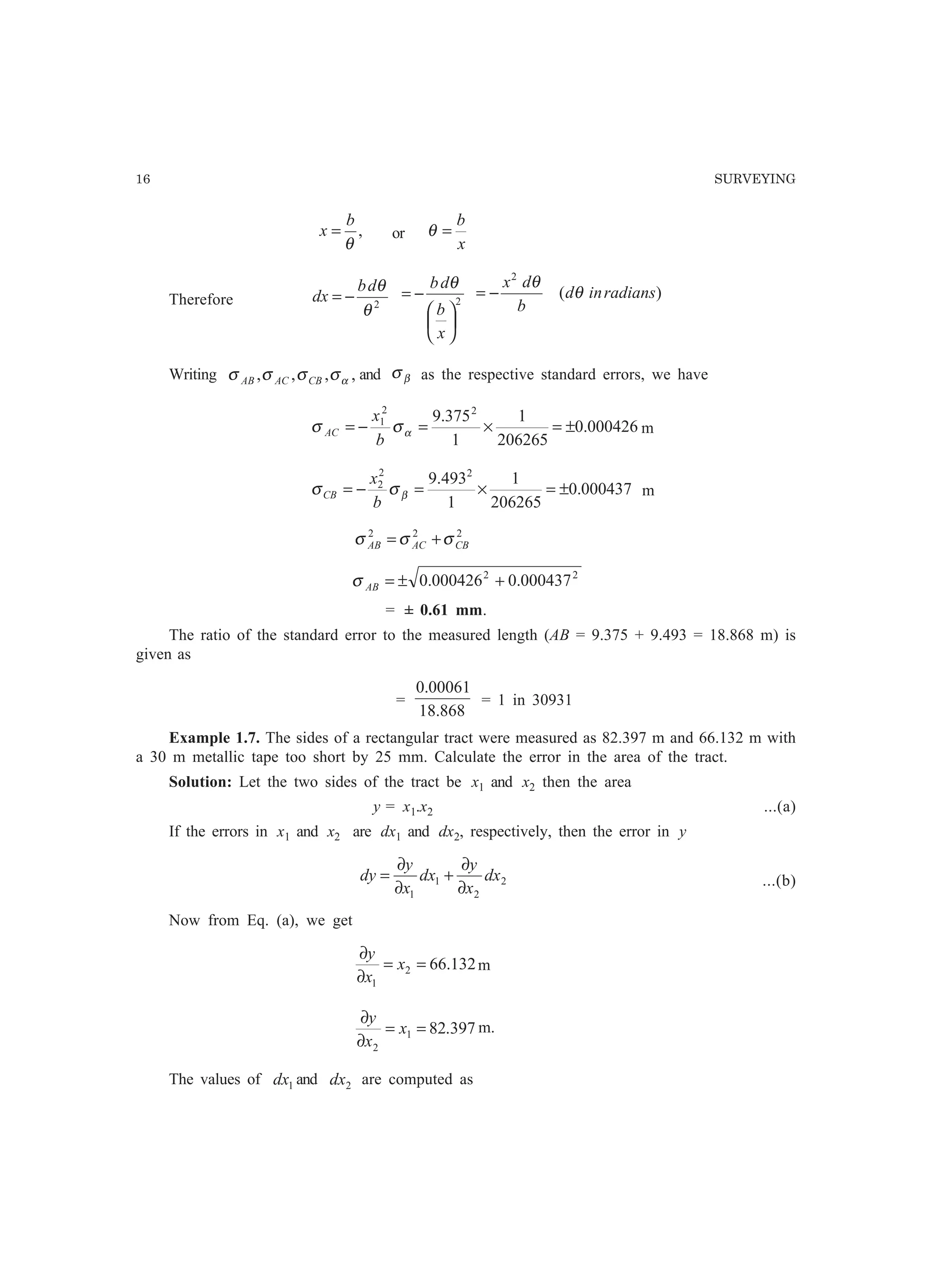
Example 1.7. The sides of a rectangular tract were measured as 82.397 m and 66.132 m with
a 30 m metallic tape too short by 25 mm. Calculate the error in the area of the tract.
Solution: Let the two sides of the tract be x1 and x2 then the area
y = x1.x2 ...(a)
If the errors in x1 and x2 are dx1 and dx2, respectively, then the error in y
2
2
1
1
dx
x
y
dx
x
y
dy
∂
∂
+
∂
∂
= ...(b)
Now from Eq. (a), we get
132.662
1
==
∂
∂
x
x
y
m
397.821
2
==
∂
∂
x
x
y
m.
The values of 1dx and 2dx are computed as
ERRORS IN MEASUREMENTS AND THEIR PROPAGATION 17
069.0397.82
30
025.0
1 =×=dx m
055.0132.66
30
025.0
2 =×=dx m.
Therefore from Eq. (b), we get
055.0397.82069.0132.66 ×+×=dy = 9.095 m2
.
The percentage of error
100
132.66397.82
095.9
×
×
= = 0.17 %.
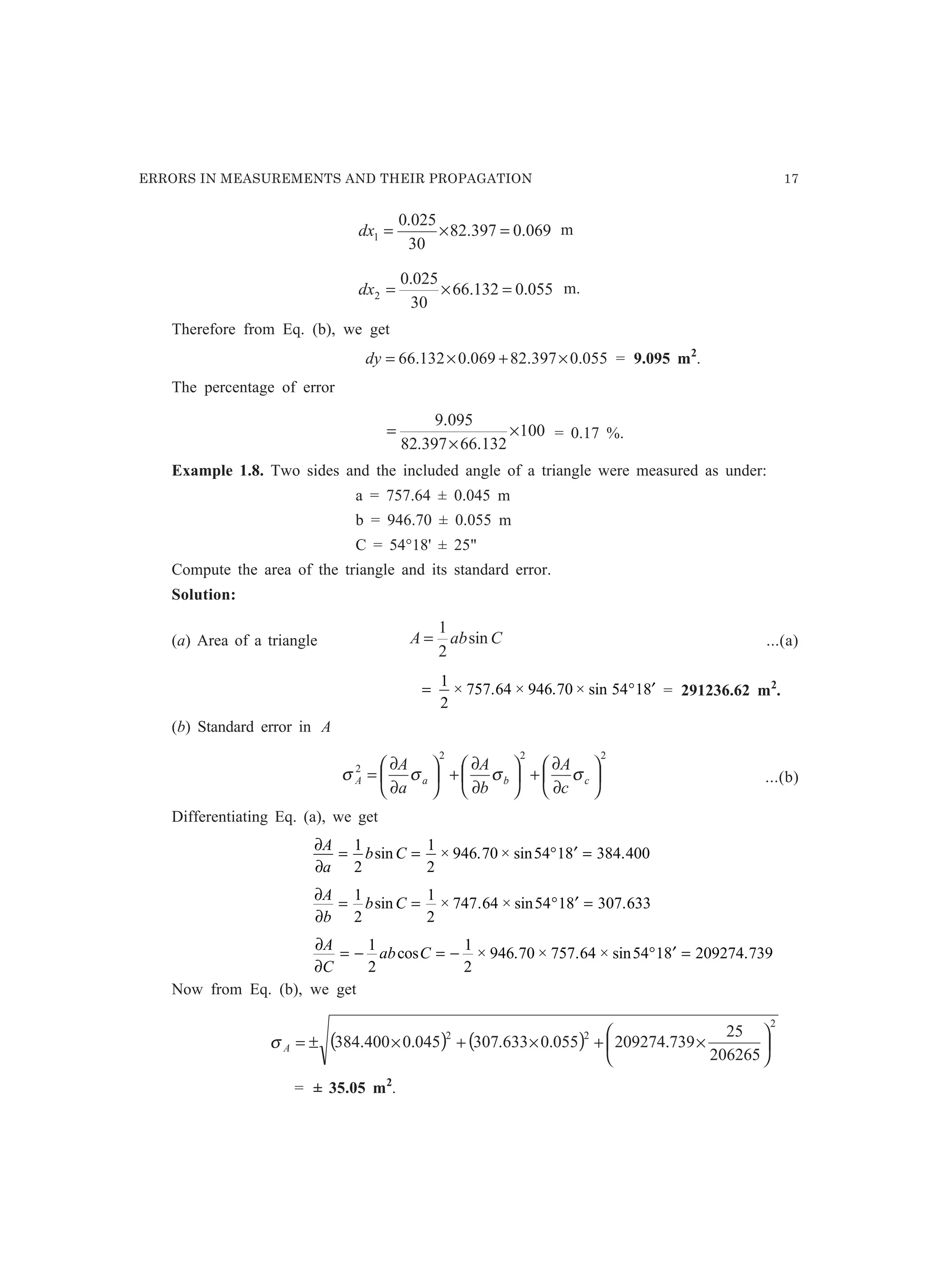
Example 1.8. Two sides and the included angle of a triangle were measured as under:
a = 757.64 ± 0.045 m
b = 946.70 ± 0.055 m
C = 54°18' ± 25
Compute the area of the triangle and its standard error.
Solution:
(a) Area of a triangle CabA sin
2
1
= ...(a)
= ° ′
1
2
757 64 946 70 54 18× . × . × sin = 291236.62 m2
.
(b) Standard error in A
222
2






∂
∂
+





∂
∂
+





∂
∂
= cbaA
c
A
b
A
a
A
σσσσ ...(b)
Differentiating Eq. (a), we get
∂
∂
A
a
b C= = ° ′ =
1
2
1
2
946 70 54 18 384 400sin × . × sin .
∂
∂
A
b
b C= = ° ′ =
1
2
1
2
747 64 54 18 307 633sin × . × sin .
∂
∂
A
C
ab C= − = − ° ′ =
1
2
1
2
946 70 757 64 54 18 209274 739cos × . × . × sin .
Now from Eq. (b), we get
( ) ( )
2
22
206265
25
739.209274055.0633.307045.0400.384 





×+×+×±=Aσ
= ± 35.05 m2
.
18 SURVEYING
OBJECTIVE TYPE QUESTIONS
1. Accuracy is a term which indicates the degree of conformity of a measurement to its
(a) most probable value. (b) mean value.
(c) true value. (d) standard error.
2. Precision is a term which indicates the degree of conformity of
(a) measured value to its true value.
(b) measured value to its mean value.
(c) measured value to its weighted mean value.
(d) repeated measurements of the same quantity to each other.
3. Theory of probability is applied to
(a) gross errors. (b) systematic errors.
(c) random errors. (d) all the above.
4. Residual of a measured quantity is the
(a) difference of the observed value from its most probable value.
(b) value obtained by adding the most probable value to its true value.
(c) remainder of the division of the true value by its most probable value.
(d) product of the most probable value and the observed value.
5. If the standard deviation of a quantity is ± 1″, the maximum error would be
(a) 2.39″. (b) 3.29″.
(c) 2.93″. (d) 9.23″.
6. If the standard deviation of an observation is ± 10 m, the most probable error would be
(a) 6.745 m. (b) 20 m.
(c) 10 m. (d) 0.6745 m.
7. The systematic errors
(a) are always positive. (b) are always negative.
(c) may be positive or negative. (d) have same sign as the gross errors.
8. Variance of a quantity is an indicator of
(a) precision. (b) accuracy.
(c) randomness. (d) regular nature.
9. In the case of a function y = f(x1,x2), the error in y is computed as
(a) 2
2
1
1
dx
x
f
dx
x
f
dy 





∂
∂
+





∂
∂
=
(b) 2
2
2
1
2
1
dx
x
f
dx
x
f
dy 





∂
∂
+





∂
∂
=
ERRORS IN MEASUREMENTS AND THEIR PROPAGATION 19
(c) ( ) ( )2
2
2
2
1
1
dx
x
f
dx
x
f
dy 





∂
∂
+





∂
∂
=
(d)
2
2
2
2
1
1






∂
∂
+





∂
∂
= dx
x
f
dx
x
f
dy
10. The adjusted value of an observed quantity may contain
(a) small gross errors. (b) small systematic errors.
(c) small random errors. (d) all the above.
11. One of the characteristics of random errors is that
(a) small errors occur as frequently as the large errors.
(b) plus errors occur more frequently than the negative errors.
(c) small errors occur more frequently than the large errors.
(d) large errors may occur more frequently.
12. If the standard error of each tape length used to measure a length is ± 0.01 m. the standard error
in 4 tape lengths will be
(a) 0.01 m. (b) 0.02 m.
(c) 0.04 m. (d) 0.16 m.
ANSWERS
1. (c) 2. (d) 3. (c) 4. (a) 5. (b) 6. (a)
7. (c) 8. (a) 9. (a) 10. (c) 11. (c) 12. (b).
20 SURVEYING
DISTANCE MEASUREMENT
Three methods of distance measurement are briefly discussed in this chapter. They are
Direct method using a tape or wire
Tacheometric method or optical method
EDM (Electromagnetic Distance Measuring equipment) method.
2.1 DIRECT METHOD USING A TAPE
In this method, steel tapes or wires are used to measure distance very accurately. Nowadays, EDM
is being used exclusively for accurate measurements but the steel tape still is of value for measuring
limited lengths for setting out purposes.
Tape measurements require certain corrections to be applied to the measured distance depending
upon the conditions under which the measurements have been made. These corrections are discussed
below.
Correction for Absolute Length
Due to manufacturing defects the absolute length of the tape may be different from its designated
or nominal length. Also with use the tape may stretch causing change in the length and it is
imperative that the tape is regularly checked under standard conditions to determine its absolute
length. The correction for absolute length or standardization is given by
L
l
c
ac = ...(2.1)
where
c = the correction per tape length,
l = the designated or nominal length of the tape, and
L= the measured length of the line.
If the absolute length is more than the nominal length the sign of the correction is positive and vice
versa.
Correction for Temperature
If the tape is used at a field temperature different from the standardization temperature then the
temperature correction to the measured length is
( )Ltmttc 0−=α ...(2.2)
20
DISTANCE MEASUREMENT 21
End support
Intermediate support
Catenary
Sag
Chord Length
where
α = the coefficient of thermal expansion of the tape material,
tm = the mean field temperature, and
t0 = the standardization temperature.
The sign of the correction takes the sign of ( )0ttm − .
Correction for Pull or Tension
If the pull applied to the tape in the field is different from the standardization pull, the pull correction
is to be applied to the measured length. This correction is
( )
L
AE
PP
pc 0−
= ...(2.3)
where
P = the pull applied during the measurement,
0P = the standardization pull,
A = the area of cross-section of the tape, and
E = the Young’s modulus for the tape material.
The sign of the correction is same as that of ( )0PP − .
Correction for Sag
For very accurate measurements the tape can be allowed to hang in catenary between two supports
(Fig. 2.1a). In the case of long tape, intermediate supports as shown in Fig. 2.1b, can be used to
reduce the magnitude of correction.
(a) (b)
Fig. 2.1
The tape hanging between two supports, free of ground, sags under its own weight, with
maximum dip occurring at the middle of the tape. This necessitates a correction for sag if the tape
has been standardized on the flat, to reduce the curved length to the chord length. The correction
for the sag is
c
W
P
Lg =
F
HG I
KJ1
24
2
...(2.4)
where
W = the weight of the tape per span length.
Sag
22 SURVEYING
The sign of this correction is always negative.
If both the ends of the tape are not at the same level, a further correction due to slope is
required. It is given by
′ =c cg g cos α ...(2.5)
where
α = the angle of slope between the end supports.
Correction for Slope
If the length L is measured on the slope as shown in Fig.
2.2, it must be reduced to its horizontal equivalent
L cos θ. The required slope correction is
c Ls = −1 cos θb g (exact) ...(2.6)
L
h
2
2
= (approximate) …(2.7)
where
θ = the angle of the slope, and
h = the difference in elevation of the ends of the tape.
The sign of this correction is always negative.
Correction for Alignment
If the intermediate points are not in correct alignment with ends
of the line, a correction for alignment given below, is applied to
the measured length (Fig. 2.3).
L
d
cm
2
2
= (approximate) …(2.8)
where
d = the distance by which the other end of the tape is out of alignment.
The correction for alignment is always negative.
Reduction to Mean Sea Level (M.S.L.)
In the case of long lines in triangulation surveys the relationship between
the length AB measured on the ground and the equivalent length A′B′
at mean sea level has to be considered (Fig. 2.4). Determination of the
equivalent mean sea level length of the measured length is known as
reduction to mean sea level.
The reduced length at mean sea level is given by
L
R
R H
L′
=
+( )
…(2.9)
L cosθ
hL
θ
Fig. 2.2
dL
A B
Fig. 2.3
A
R
L
L′
M.S.L.
A′
Fig. 2.4
DISTANCE MEASUREMENT 23
where
R = the mean earth’s radius (6372 km), and
H = the average elevation of the line.
When H is considered small compared to R, the correction to L is given as
c
HL
R
approximatemsl = ( ) …(2.10)
The sign of the correction is always negative.
The various tape corrections discussed above, are summarized in Table 2.1.
2.2 ERROR IN PULL CORRECTION DUE TO ERROR IN PULL
If the nominal applied pull is in error the required correction for pull will be in error. Let the error
in the nominal applied pull P be ± Pδ then the
actual pull correction =
( )
L
AE
PPP 0−± δ
…(2.11)
and nominal pull correction =
( )
L
AE
PP 0−
…(2.12)
Therefore error = actual pull correction – nominal pull correction
=
( )
L
AE
PPP 0−± δ
–
( )
L
AE
PP 0−
= ± P
AE
L
δ …(2.13)
From Eq. (2.12), we have
0
correctionpullnominal
PPAE
L
−
=
Therefore from Eq. (2.13), we get
Error in pull correction = P
PP
δ
0
correctionpullnominal
−
± …(2.14)
From Eq. (2.14), we find that an increase in pull increases the pull correction.
2.3 ERROR IN SAG CORRECTION DUE TO ERROR IN PULL
If the applied pull is in error the computed sag correction will be in error. Let the error in pull be
± δP then
the actual sag correction L
PP
W
2
24
1






±
−=
δ
24 SURVEYING
22
1
24
1
−






±





−=
P
P
L
P
W δ
and nominal sag correction L
P
W
2
24
1








−=
Therefore error








−





±







−=
−
11
24
1
22
P
P
L
P
W δ














−=
P
P
L
P
W δ
2
24
1
2
m neglecting the terms of higher power.
= m nominal sag correction 





P
Pδ2
...(2.15)
Eq. (2.15) shows that an increase in pull correction reduces the sag correction.
2.4 ELONGATION OF A STEEL TAPE WHEN USED FOR MEASUREMENTS IN A
VERTICAL SHAFT
Elongation in a steel tape takes place when transferring the level in a tunnel through a vertical shaft.
This is required to establish a temporary bench mark so that the construction can be carried
Table 2.1
Correction Sign Formula
Absolute length (ca) ± L
l
c
Temperature (ct) ± ( )Ltmt 0−α
Pull (cp) ±
( )
L
AE
PP 0−
Sag (cg) – L
P
W
2
24
1






Slope (cs) – ( )Lθcos1− (exact)
Alignment (cm) –
L
h
2
2
(approximate)
Mean sea level (cmsl
) −
L
d
2
2
(approximate)
R
HL
(approximate)
DISTANCE MEASUREMENT 25
out to correct level as well as to correct line. Levels are carried down from a known datum, may
be at the side of the excavated shaft at top, using a very long tape hanging vertically and free of
restrictions to carry out operation in a single stage. In the case when a very long tape is not
available, the operation is carried out by marking the separate tape lengths in descending order.
The elongation in the length of the tape AC hanging vertically from a fixed point A due to
its own weight as shown in Fig. 2.5, can be determined as below.
Let s = the elongation of the tape,
g = the acceleration due to gravity,
x = the length of the suspended tape used
for the measurement,
(l – x) = the additional length of the tape not required
in the measurements,
A = the area of cross-section of the tape,
E = the modulus of elasticity of the tape material,
m = the mass of the tape per unit length,
M = the attached mass,
l = the total length of the tape, and
P0 = the standard pull.
The tension sustained by the vertical tape due to self-loading is maximum at A. The tension
varies with y considered from free-end of the tape, i.e., it is maximum when y is maximum and,
therefore, the elongations induced in the small element of length dy, are greater in magnitude in the
upper regions of the tape than in the lower regions.
Considering an element dy at y,
loading on the element dy = mgy
and extension over the length dy
AE
dy
mgy=
Therefore, extension over length AB, Ex ( )∫ −
=
l
xl AE
dy
mgy
( )
constant
2
2
+





=
−
l
xl
y
AE
mg
We have Ex = 0 when y = 0, therefore the constant = 0. Thus
( )[ ]22
2
xll
AE
mg
Ex −−= 




 −
=
2
2 xl
AE
mgx
…(2.16)
To ensure verticality of the tape and to minimize the oscillation, a mass M may be attached
to the lower end A. It will have a uniform effect over the tape in the elongation of the tape.
x
l
dy
y
(l−x)
A
B
Support
Fixed end of tape
Measured length
Free end of tape
C
Fig. 2.5
26 SURVEYING
Additional extension due to mass M over length x
AE
x
Mg=
If the standard pull is P0 , it should be allowed in the same way as the standard pull in the
pull correction.
Therefore elongation over length x becomes
AE
xP
AE
Mgxxl
AE
mgx
Ex
0
2
2
−+




 −
=
( ) 





−+−=
g
P
Mxl
m
AE
gx 0
2
2 …(2.17)
2.5 TACHEOMETRIC OR OPTICAL METHOD
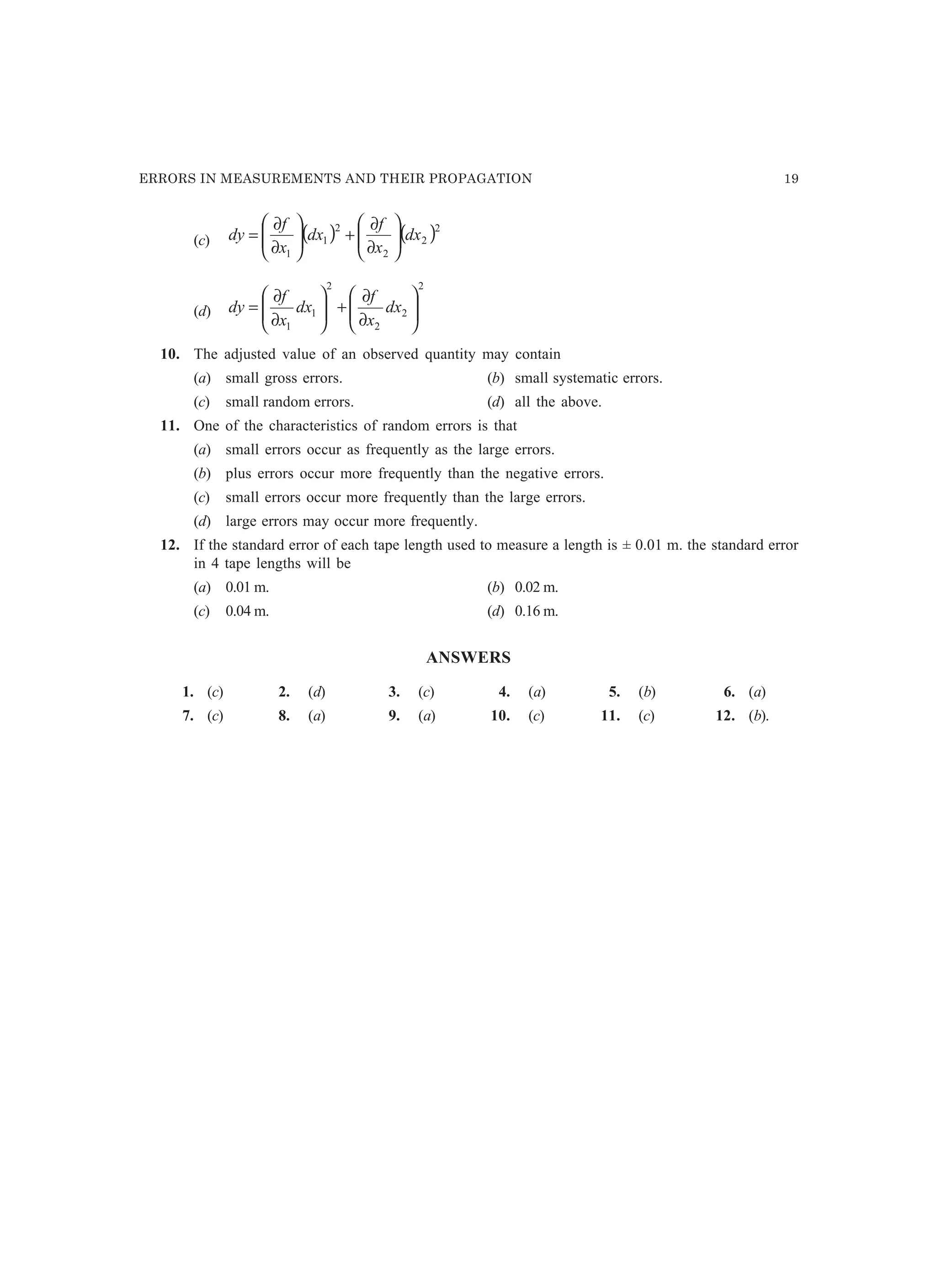
In stadia tacheometry the line of sight of the tacheometer may be kept horizontal or inclined
depending upon the field conditions. In the case of horizontal line of sight (Fig. 2.6), the horizontal
distance between the instrument at A and the staff at B is
D = ks + c ...(2.18)
where
k and c = the multiplying and additive constants of the tacheometer, and
s = the staff intercept,
= ST – SB , where ST and SB are the top hair and bottom hair readings, respectively.
Generally, the value of k and c are kept equal to 100 and 0 (zero), respectively, for making
the computations simpler. Thus
D = 100 s ...(2.19)
Datum
D
s
hi
hA hB
SM
A B
Levelling staff
Horizontal line of sight
Tacheometer
Fig. 2.6
The elevations of the points, in this case, are obtained by determining the height of instrument
and taking the middle hair reading. Let
hi = the height of the instrument axis above the ground at A,
hA, hB = the elevations of A and B, and
DISTANCE MEASUREMENT 27
SM = the middle hair reading
then the height of instrument is
H.I. = hA + hi
and hB = H.I. – SM
= hA + hi – SM ...(2.20)
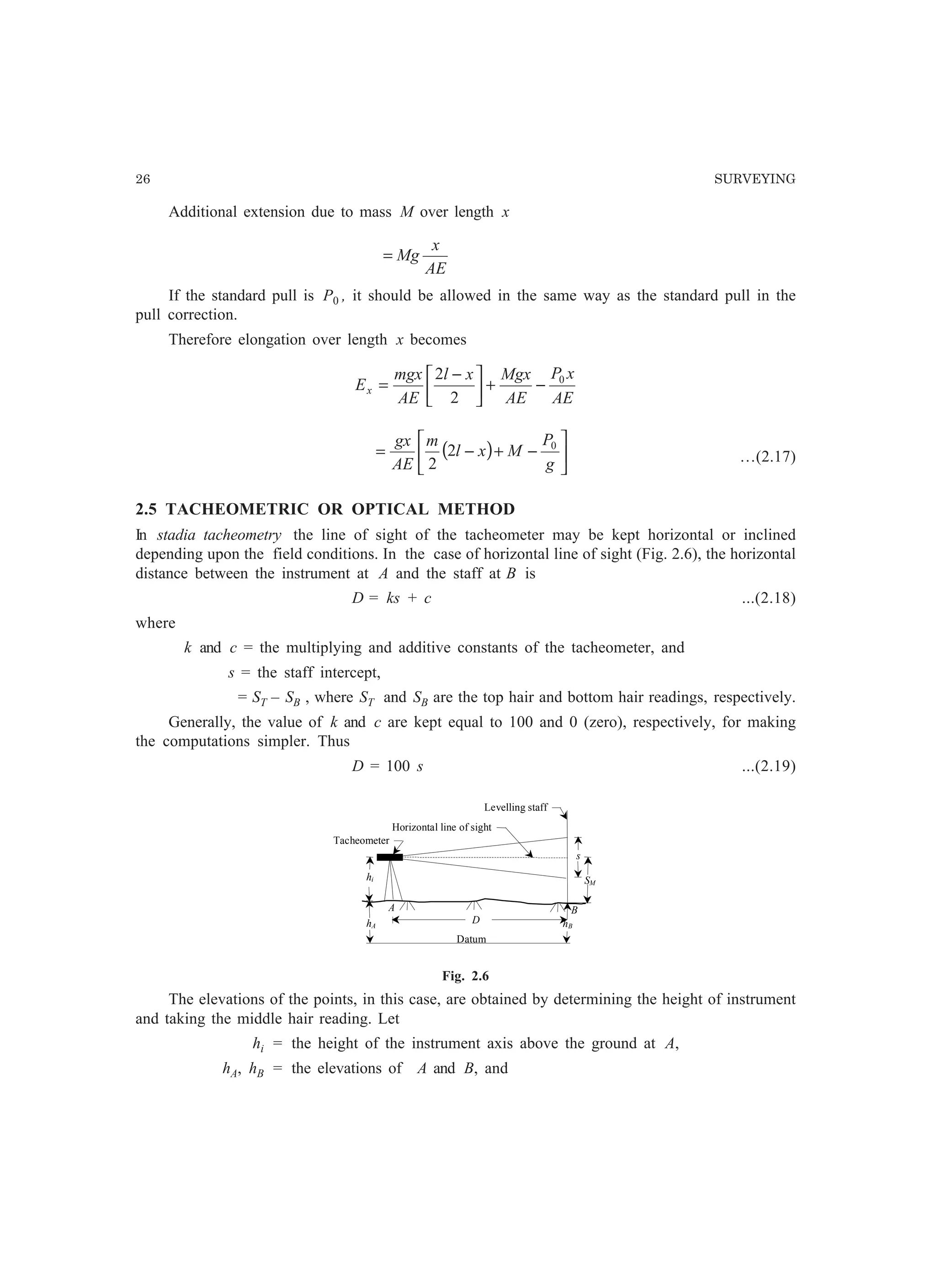
In the case of inclined line of sight as shown in
Fig. 2.7, the vertical angle α is measured, and the horizontal
and vertical distances, D and V, respectively, are determined
from the following expressions.
α2
cosksD = ...(2.21)
α2sin
2
1
ksV = ...(2.22)
The elevation of B is computed as below.
hB = hA + hi + V – SM ...(2.23)
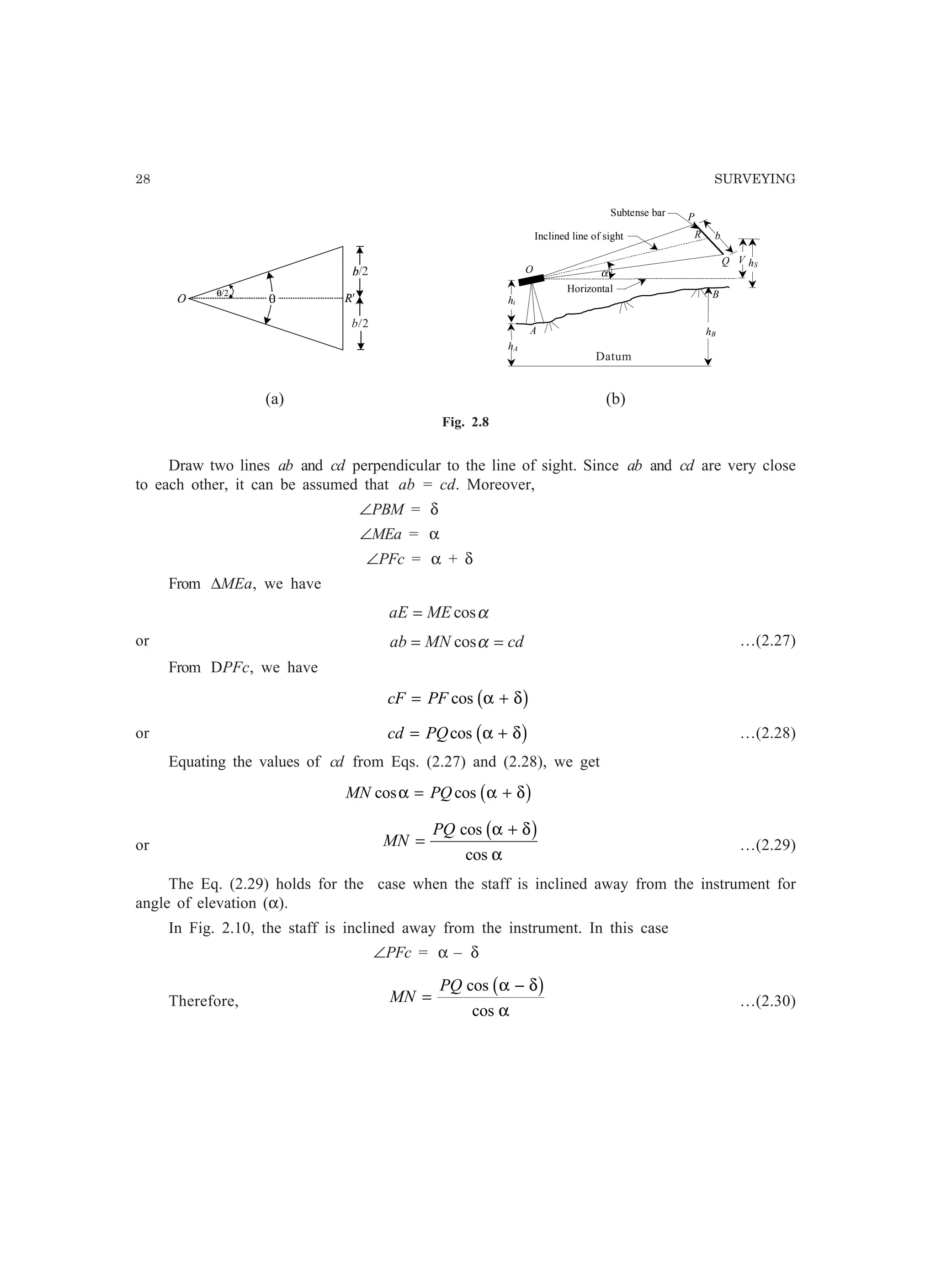
2.6 SUBTENSE TACHEOMETRY
In subtense tacheometry the distance is determined by measuring the horizontal angle subtended by
the subtense bar targets (Fig. 2.8a) and for heighting, a vertical angle is also measured
(Fig. 2.8b).
Let b = the length of the subtense bar PQ,
θ = the horizontal angle subtended by the subtense bar targets P and Q at the
station A, and
α = the vertical angle of R at O
then
2
tan2
θ
b
D = ≈
θ
b
(when θ is small) …(2.24)
αtanDV = …(2.25)
and siAB hVhhh −++= …(2.26)
where hs = the height of the subtense bar above the ground.
When a vertical bar with two targets is used vertical angles are required to be measured and
the method is termed as tangential system.
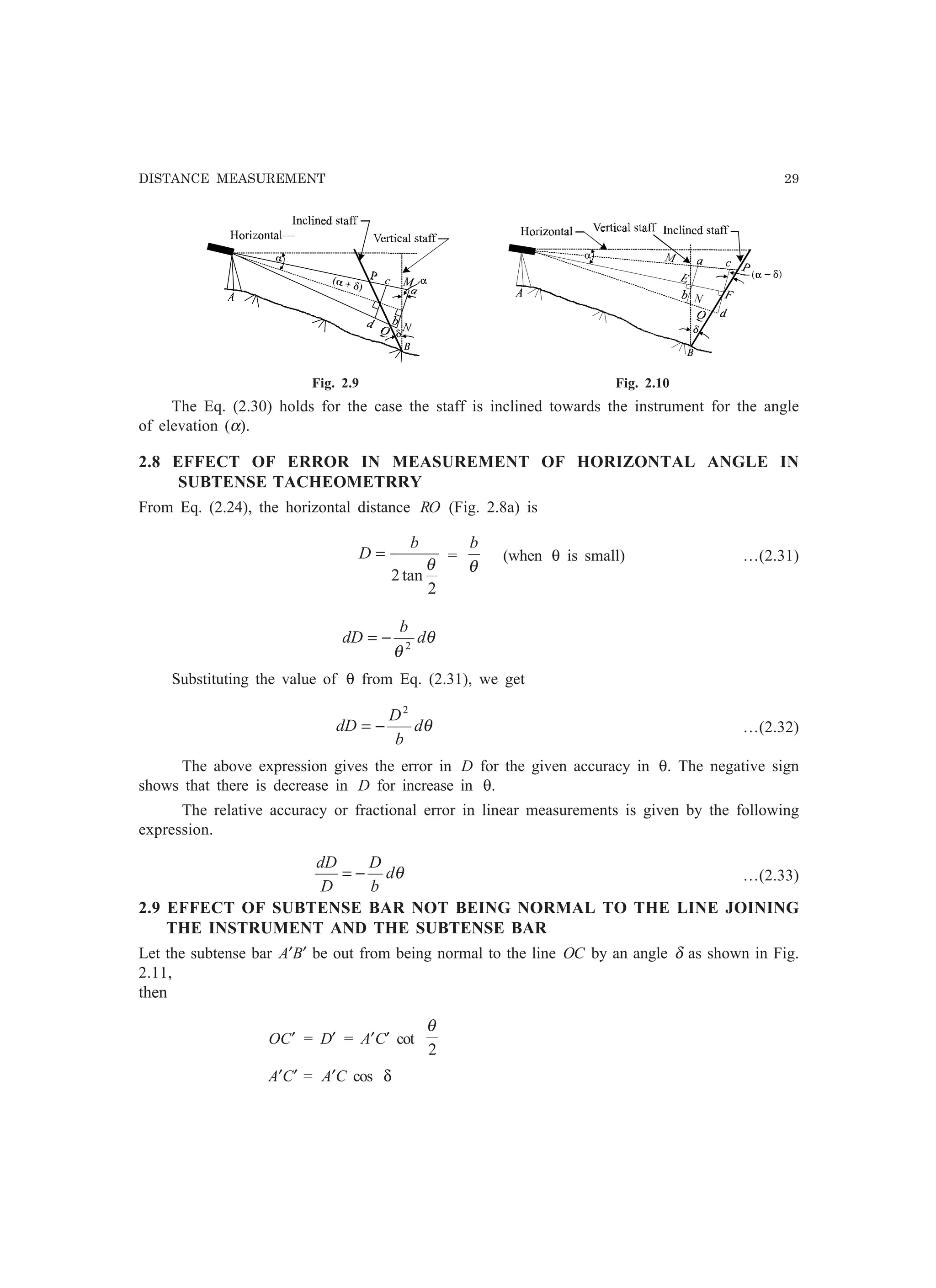
2.7 EFFECT OF STAFF VERTICALITY
In Fig. 2.9, the staff is inclined through angle δ towards the instrument. The staff intercept for the
inclined staff would be PQ rather than the desired value MN for the vertical staff.
Datum
s
hi
hA
hB
V
A
BHorizontal
Inclined line of sight
SMα
Fig. 2.7
28 SURVEYING
Datum
hi
hA
hB
V
A
B
Horizontal
Inclined line of sight
hS
α
b
P
Q
R
O
Subtense bar
(a) (b)
Fig. 2.8
Draw two lines ab and cd perpendicular to the line of sight. Since ab and cd are very close
to each other, it can be assumed that ab = cd. Moreover,
∠PBM = δ
∠MEa = α
∠PFc = α + δ
From ∆MEa, we have
αcosMEaE =
or cdMNab == αcos …(2.27)
From DPFc, we have
cF PF= +cos α δb g
or cd PQ= +cos α δb g …(2.28)
Equating the values of cd from Eqs. (2.27) and (2.28), we get
MN PQcos cosα α δ= +b g
or MN
PQ
=
+cos
cos
α δ
α
b g …(2.29)
The Eq. (2.29) holds for the case when the staff is inclined away from the instrument for
angle of elevation (α).
In Fig. 2.10, the staff is inclined away from the instrument. In this case
∠PFc = α – δ
Therefore, MN
PQ
=
−cos
cos
α δ
α
b g …(2.30)
Datum
b/2
DISTANCE MEASUREMENT 29
Fig. 2.9 Fig. 2.10
The Eq. (2.30) holds for the case the staff is inclined towards the instrument for the angle
of elevation (α).
2.8 EFFECT OF ERROR IN MEASUREMENT OF HORIZONTAL ANGLE IN
SUBTENSE TACHEOMETRRY
From Eq. (2.24), the horizontal distance RO (Fig. 2.8a) is
2
tan2
θ
b
D = =
θ
b
(when θ is small) …(2.31)
θ
θ
d
b
dD 2
−=
Substituting the value of θ from Eq. (2.31), we get
θd
b
D
dD
2
−= …(2.32)
The above expression gives the error in D for the given accuracy in θ. The negative sign
shows that there is decrease in D for increase in θ.
The relative accuracy or fractional error in linear measurements is given by the following
expression.
θd
b
D
D
dD
−= …(2.33)
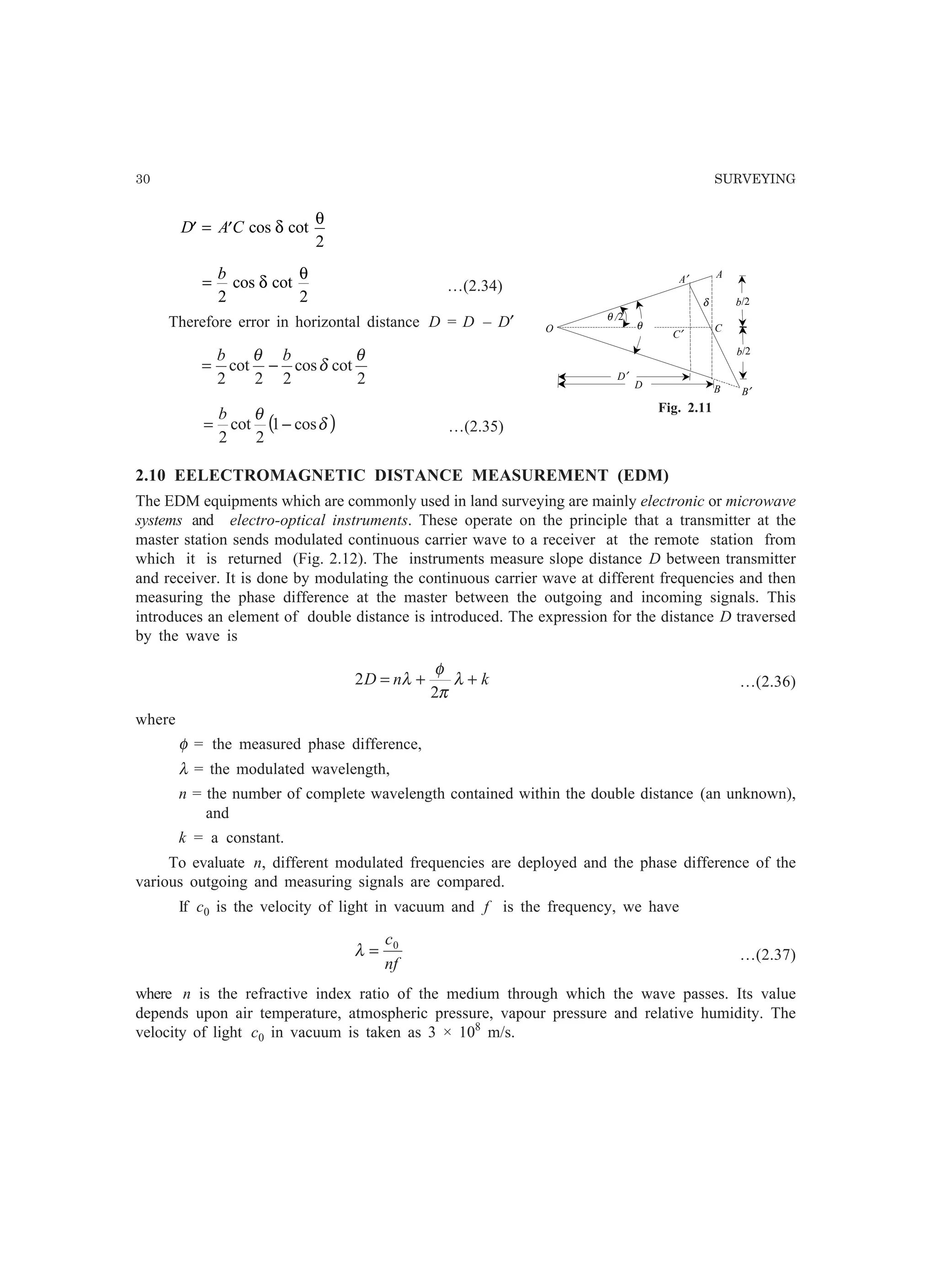
2.9 EFFECT OF SUBTENSE BAR NOT BEING NORMAL TO THE LINE JOINING
THE INSTRUMENT AND THE SUBTENSE BAR
Let the subtense bar A′B′ be out from being normal to the line OC by an angle δ as shown in Fig.
2.11,
then
OC′ = D′ = A′C′ cot
2
θ
A′C′ = A′C cos δ
30 SURVEYING
′ = ′D A C cos cotδ
θ
2
=
b
2 2
cos cotδ
θ
…(2.34)
Therefore error in horizontal distance D = D – D′
2
cotcos
22
cot
2
θ
δ
θ bb
−=
( )δ
θ
cos1
2
cot
2
−=
b
…(2.35)
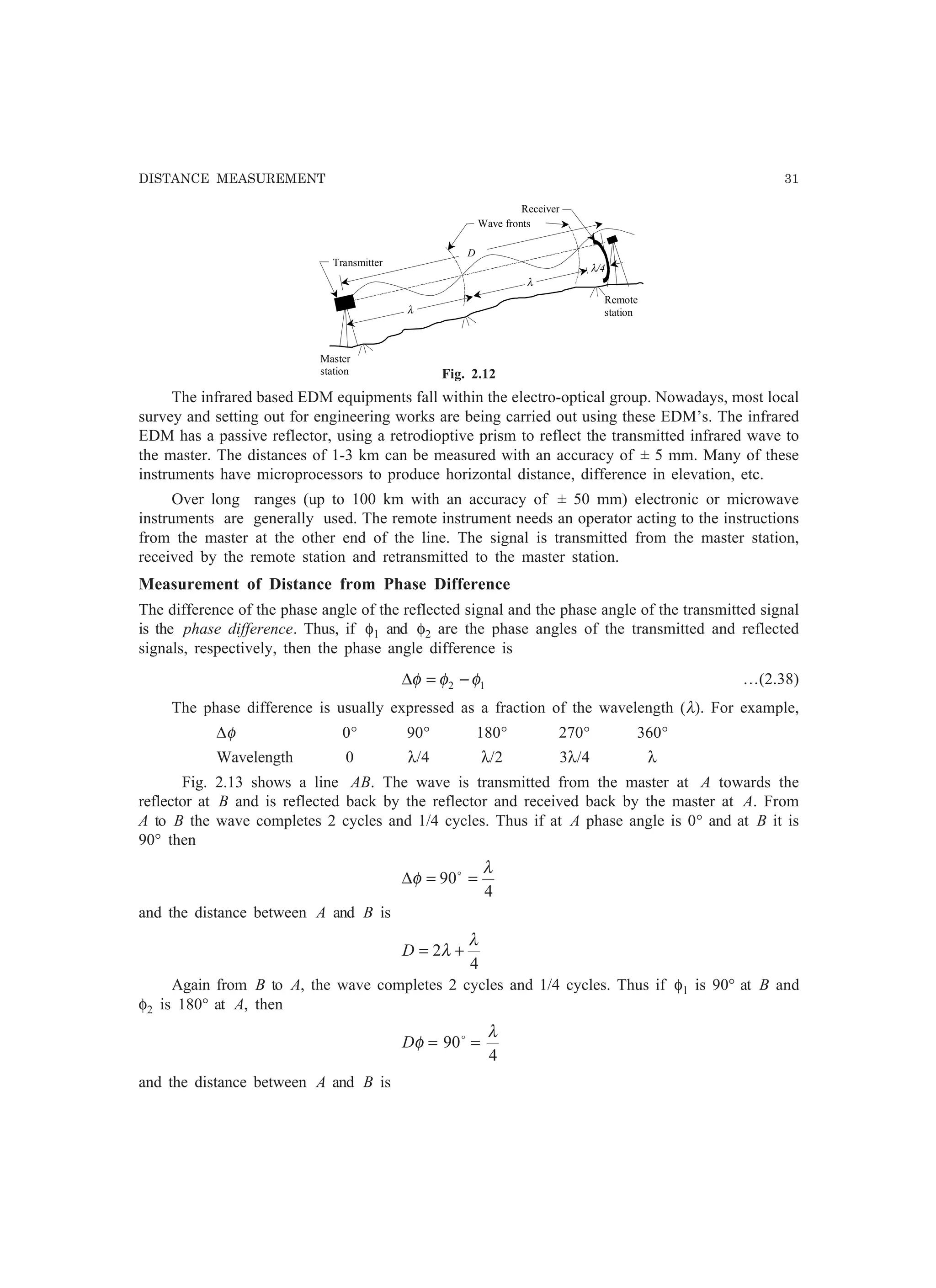
2.10 EELECTROMAGNETIC DISTANCE MEASUREMENT (EDM)
The EDM equipments which are commonly used in land surveying are mainly electronic or microwave
systems and electro-optical instruments. These operate on the principle that a transmitter at the
master station sends modulated continuous carrier wave to a receiver at the remote station from
which it is returned (Fig. 2.12). The instruments measure slope distance D between transmitter
and receiver. It is done by modulating the continuous carrier wave at different frequencies and then
measuring the phase difference at the master between the outgoing and incoming signals. This
introduces an element of double distance is introduced. The expression for the distance D traversed
by the wave is
knD ++= λ
π
φ
λ
2
2 …(2.36)
where
φ = the measured phase difference,
λ = the modulated wavelength,
n = the number of complete wavelength contained within the double distance (an unknown),
and
k = a constant.
To evaluate n, different modulated frequencies are deployed and the phase difference of the
various outgoing and measuring signals are compared.
If c0 is the velocity of light in vacuum and f is the frequency, we have
nf
c0
=λ …(2.37)
where n is the refractive index ratio of the medium through which the wave passes. Its value
depends upon air temperature, atmospheric pressure, vapour pressure and relative humidity. The
velocity of light c0 in vacuum is taken as 3 × 10⁸
m/s.
Fig. 2.11
θ /2
θ
A′
B′
O
b/2
b/2
A
B
C
C′
D
D′
δ
DISTANCE MEASUREMENT 31
Fig. 2.12
The infrared based EDM equipments fall within the electro-optical group. Nowadays, most local
survey and setting out for engineering works are being carried out using these EDM’s. The infrared
EDM has a passive reflector, using a retrodioptive prism to reflect the transmitted infrared wave to
the master. The distances of 1-3 km can be measured with an accuracy of ± 5 mm. Many of these
instruments have microprocessors to produce horizontal distance, difference in elevation, etc.
Over long ranges (up to 100 km with an accuracy of ± 50 mm) electronic or microwave
instruments are generally used. The remote instrument needs an operator acting to the instructions
from the master at the other end of the line. The signal is transmitted from the master station,
received by the remote station and retransmitted to the master station.
Measurement of Distance from Phase Difference
The difference of the phase angle of the reflected signal and the phase angle of the transmitted signal
is the phase difference. Thus, if φ1 and φ2 are the phase angles of the transmitted and reflected
signals, respectively, then the phase angle difference is
12 φφφ −=∆ …(2.38)
The phase difference is usually expressed as a fraction of the wavelength (λ). For example,
∆φ 0° 90° 180° 270° 360°
Wavelength 0 λ/4 λ/2 3λ/4 λ
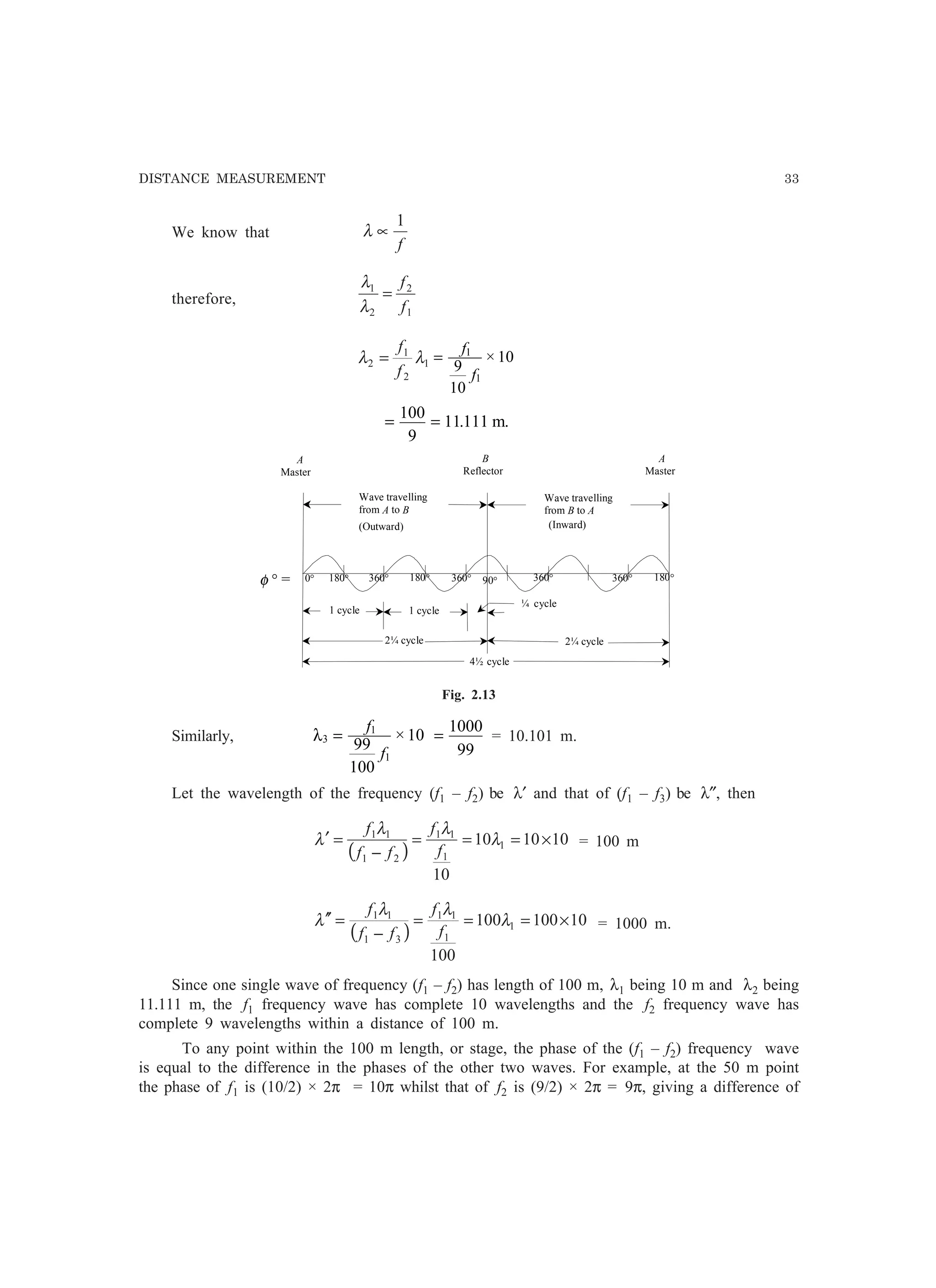
Fig. 2.13 shows a line AB. The wave is transmitted from the master at A towards the
reflector at B and is reflected back by the reflector and received back by the master at A. From
A to B the wave completes 2 cycles and 1/4 cycles. Thus if at A phase angle is 0° and at B it is
90° then
4
90
λ
φ ==∆ o
and the distance between A and B is
4
2
λ
λ +=D
Again from B to A, the wave completes 2 cycles and 1/4 cycles. Thus if φ1 is 90° at B and
φ2 is 180° at A, then
4
90
λ
φ == o
D
and the distance between A and B is
Transmitter
Wave fronts
λ/4
D
λ
λ
Master
station
Remote
station
Receiver
32 SURVEYING
4
2
λ
λ +=D
The phase difference between the wave at A when transmitted and when received back is
180°, i.e., λ/2 and the number of complete cycles is 4. Thus






+=
+=
2
4
2
1
2
42
λ
λ
λ
λ
D
D
…(2.39)
The above expression in a general form can be written as
( )λλ ∆+= nD
2
1
where
n = the number of complete cycles of the wave in traveling from A to B and back from B
to A, and
∆l = the fraction of wavelength traveled by the wave from A to B and back from B to A.
The value of ∆λ depends upon the phase difference of the wave transmitted and that received
back at the master. It is measured as phase angle (φ) at A by an electrical phase detector built in
the master unit at A. Obviously,
λ
φ
λ 




 ∆
=∆ o
360
where
∆φ = the phase difference
= 12 φφ −
In Eq. (3.39), n is an unknown and thus the value of D cannot be determined. In EDM
instruments the frequency can be increased in multiples of 10 and the phase difference for each
frequency is determined separately. The distance is calculated by evaluating the values of n solving
the following simultaneous equations for each frequency.
( )111
2
1
λλ ∆+= nD …(2.40)
( )222
2
1
λλ ∆+= nD …(2.41)
( )333
2
1
λλ ∆+= nD …(2.42)
For more accurate results, three or more frequencies are used and the resulting equations are
solved.
Let us take an example to explain the determination of n1, n2, n3, etc. To measure a distance
three frequencies f1, f2, and f3 were used in the instrument and phase differences ∆λ1, ∆λ2, and
∆λ3 were measured. The f2 frequency is 1
10
9
f and the f3 frequency is 1
100
99
f . The wavelength
of f1 is 10 m.
DISTANCE MEASUREMENT 33
We know that
f
1
∝λ
therefore,
1
2
2
1
f
f
=
λ
λ
1
2
1
2 λλ
f
f
= =
f
f
1
1
9
10
10×
= =
100
9
11111. m.
2¼ cycle
1 cycle
¼ cycle
1 cycle
180°0° 180°φ ° = 360° 360°90°360° 180°360°
Wave travelling
from A to B
A
Master
Wave travelling
from B to A
A
Master
B
Reflector
(Outward) (Inward)
4½ cycle
2¼ cycle
Fig. 2.13
Similarly, λ3
1
1
99
100
10=
f
f
× =
1000
99
= 10.101 m.
Let the wavelength of the frequency (f1 – f2) be λ′ and that of (f1 – f3) be λ″, then
( )
101010
10
1
1
11
21
11
×===
−
=′ λ
λλ
λ
f
f
ff
f
= 100 m
( )
10100100
100
1
1
11
31
11
×===
−
=′′ λ
λλ
λ
f
f
ff
f
= 1000 m.
Since one single wave of frequency (f1 – f2) has length of 100 m, λ1 being 10 m and λ2 being
11.111 m, the f1 frequency wave has complete 10 wavelengths and the f2 frequency wave has
complete 9 wavelengths within a distance of 100 m.
To any point within the 100 m length, or stage, the phase of the (f1 – f2) frequency wave
is equal to the difference in the phases of the other two waves. For example, at the 50 m point
the phase of f1 is (10/2) × 2π = 10π whilst that of f2 is (9/2) × 2π = 9π, giving a difference of
34 SURVEYING
10π – 9π = π, which is the phase of the (f1 – f2) frequency. This relationship allows distance to
be measured within 100 m. This statement applies as well when we consider a distance of
1000 m. Within distance of 500 m, the f1 wave has phase of (100/2) × 2π = 100π, the f3 wave
has (99/2) × 2π = 99π, and the (f1 – f3) wave has phase of 100π – 99π = π. If in a similar manner
further frequencies are applied, the measurement can be extended to a distance of 10,000 m, etc.,
without any ambiguity.
The term fine frequency can be assigned to f1 which appear in all the frequency difference
values, i.e. (f1 – f2) whilst the other frequencies needed to make up the stages, or measurements
of distance 100 m, 1000 m, etc., are termed as coarse frequencies. The f1 phase difference
measured at the master station covers the length for 0 m to 10 m. The electronics involved in
modern EDM instruments automatically takes care of the whole procedure.
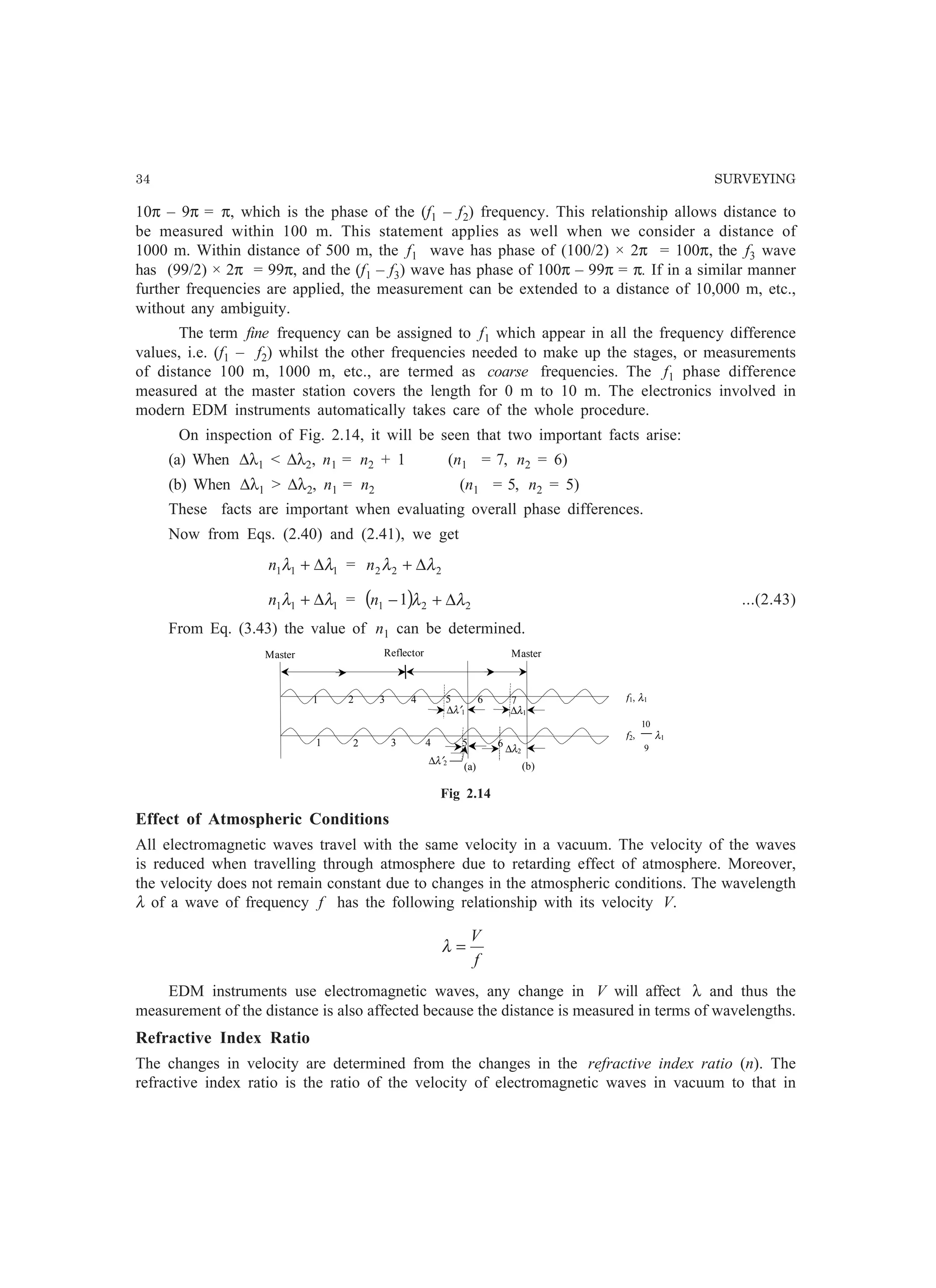
On inspection of Fig. 2.14, it will be seen that two important facts arise:
(a) When ∆λ1  ∆λ2, n1 = n2 + 1 (n1 = 7, n2 = 6)
(b) When ∆λ1  ∆λ2, n1 = n2 (n1 = 5, n2 = 5)
These facts are important when evaluating overall phase differences.
Now from Eqs. (2.40) and (2.41), we get
111 λλ ∆+n = 222 λλ ∆+n
111 λλ ∆+n = ( ) 221 1 λλ ∆+−n ...(2.43)
From Eq. (3.43) the value of n1 can be determined.
Fig 2.14
Effect of Atmospheric Conditions
All electromagnetic waves travel with the same velocity in a vacuum. The velocity of the waves
is reduced when travelling through atmosphere due to retarding effect of atmosphere. Moreover,
the velocity does not remain constant due to changes in the atmospheric conditions. The wavelength
λ of a wave of frequency f has the following relationship with its velocity V.
f
V
=λ
EDM instruments use electromagnetic waves, any change in V will affect λ and thus the
measurement of the distance is also affected because the distance is measured in terms of wavelengths.
Refractive Index Ratio
The changes in velocity are determined from the changes in the refractive index ratio (n). The
refractive index ratio is the ratio of the velocity of electromagnetic waves in vacuum to that in
1 2 3 4 5 6
1 2 3 4 5 6 7
∆λ′2
∆λ2
∆λ1∆λ′1
Master MasterReflector
f1, λ1
f2,
9
10
λ1
(a) (b)
DISTANCE MEASUREMENT 35
atmosphere. Thus
V
c
n 0
=
or
n
c
V 0
=
The value of n is equal to or greater than unity. The value depends upon air temperature,
atmospheric pressure and the vapour pressure.
For the instruments using carrier waves of wavelength in or near visible range of electromagnetic
spectrum, the value of n is given by
( ) ( ) 











−=−
760
273
11 0
p
T
nn …(2.44)












=
760
273
0
p
T
NN …(2.45)
where
p = the atmospheric pressure in millimetre of mercury,
T = the absolute temperature in degrees Kelvin (T = 273° + t°C),
n0 = the refractive index ratio of air at 0°C and 760 mm of mercury,
N = (n – 1) and,
N0 = (n0 – 1).
The value of n0 is given by
( ) 6
420 10
068.08864.4
604.2871 −
×





+





+=−
λλ
n …(2.46)
where λ is the wavelength of the carrier wave in µm.
The instruments that use microwaves, the value of n for them is obtained from
( ) ( ) e
TT
ep
T
n 





++−=×−
5748
1
26.8649.103
101 6
…(2.47)
where e is the water vapour pressure in millimetre of mercury.
Determination of Correct Distance
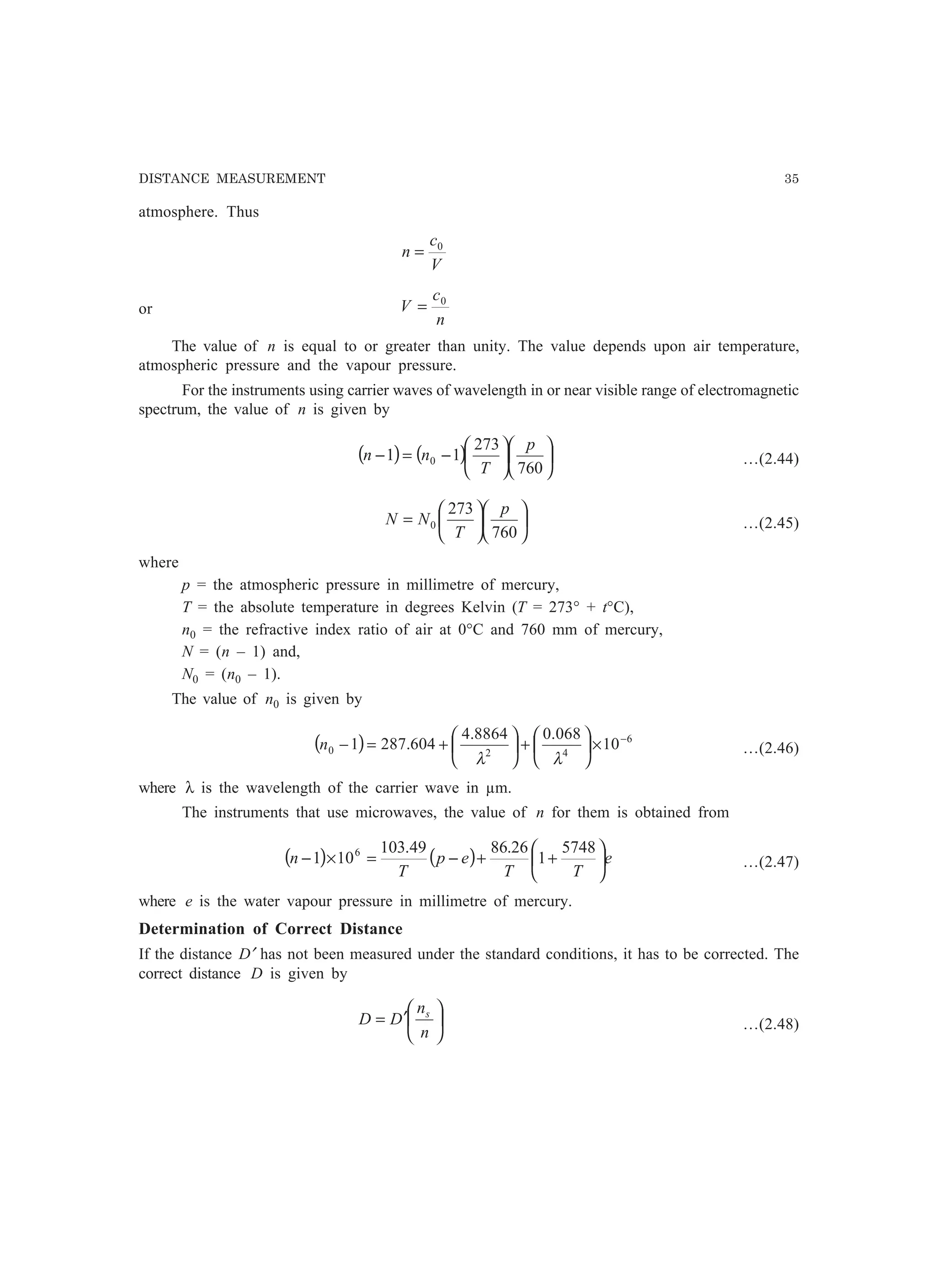
If the distance D′ has not been measured under the standard conditions, it has to be corrected. The
correct distance D is given by






′=
n
n
DD s
…(2.48)
36 SURVEYING
where
ns = the standardizing refractive index,
n = the refractive index at the time of measurement.
The values of ns and n are obtained from Eq. (2.44) taking the appropriate values of p, T, n0,
and e.
Slope and Height Corrections
The measured lengths using EDM instruments are generally slope lengths. The following corrections
are applied to get their horizontal equivalent and then the equivalent mean sea level length.
The correction for slope is given by Eqs. (2.6) and (2.7) and that for the mean sea level by
Eq. (2.10). The sign of both the corrections is negative. Thus if the measured length is L′, the
correct length is
L L c c
L L
HL
R
g msl= ′ + +
= ′ − − ′ − ′1 cos θb g
L
R
H
′





−= θcos …(2.49)
where
θ = the slope angle of the line,
H = the average elevation of the line, and
R = the mean radius of the earth (≈ 6370 km).
2.11 ACCURACY IN VERTICAL ANGLE MEASUREMENTS
The accuracy, with which a vertical angle must be measured in order to reduce a slope distance
to the corresponding horizontal distance, can be determined. Accuracy in distances can be expressed
as absolute or relative. If a distance of 10,000 m is measured with an accuracy of 1 m then the
absolute accuracy with which the distance has been measured is 1 m. For this case, the relative
accuracy is 1 m/10,000 m or 1/10,000 or 1:10,000. The relative accuracy is preferred as it does
not involve the length of lines.
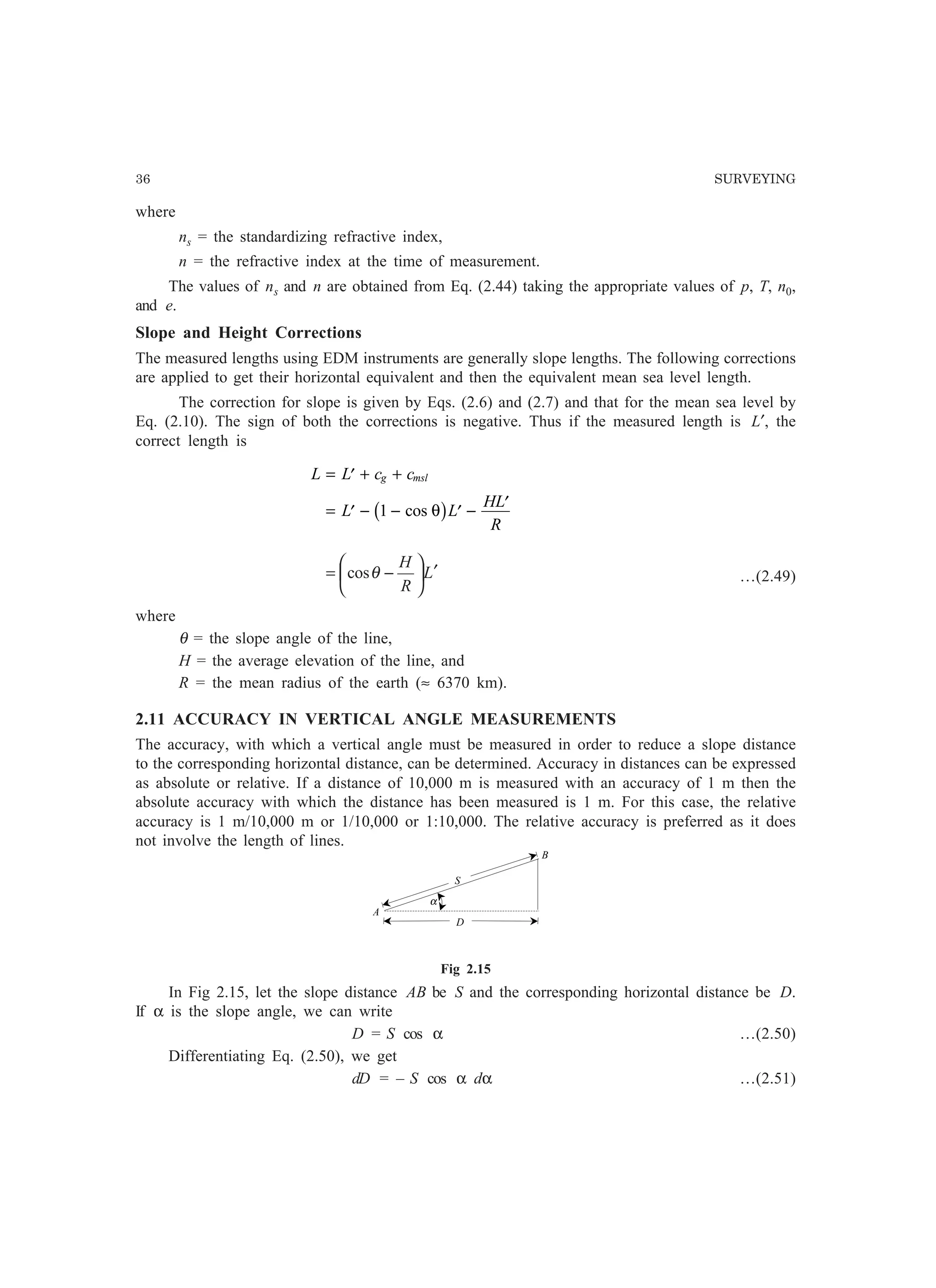
Fig 2.15
In Fig 2.15, let the slope distance AB be S and the corresponding horizontal distance be D.
If α is the slope angle, we can write
D = S cos α …(2.50)
Differentiating Eq. (2.50), we get
dD = – S cos α dα …(2.51)
α
A
D
S
B
DISTANCE MEASUREMENT 37
Dividing Eq. (2.51) by Eq. (2.50) and disregarding the negative sign, the relative accuracy is
given as
D
dD
=
α
αα
cos
sin
S
dS
= αα dtan …(2.52)
where dα is a the desired accuracy in measurement of the slope angle α for an accuracy of
D
dD
in
linear measurements.
Example 2.1. A line AB between the stations A and B was measured as 348.28 using a 20
m tape, too short by 0.05 m. Determine
the correct length of AB,
the reduced horizontal length of AB if AB lay on a slope of 1 in 25, and
the reading required to produce a horizontal distance of 22.86 m between two pegs, one being
0.56 m above the other.
Solution:
(a) Since the tape is too short by 0.05 m, actual length of AB will be less than the measured
length. The correction required to the measured length is
L
l
c
ca =
It is given that
c = 0.05 m
l = 20 m
L = 348.28 m
28.348
20
05.0
×=ac = 0.87 m
The correct length of the line
= 348.28 – 0.87 = 347.41 m
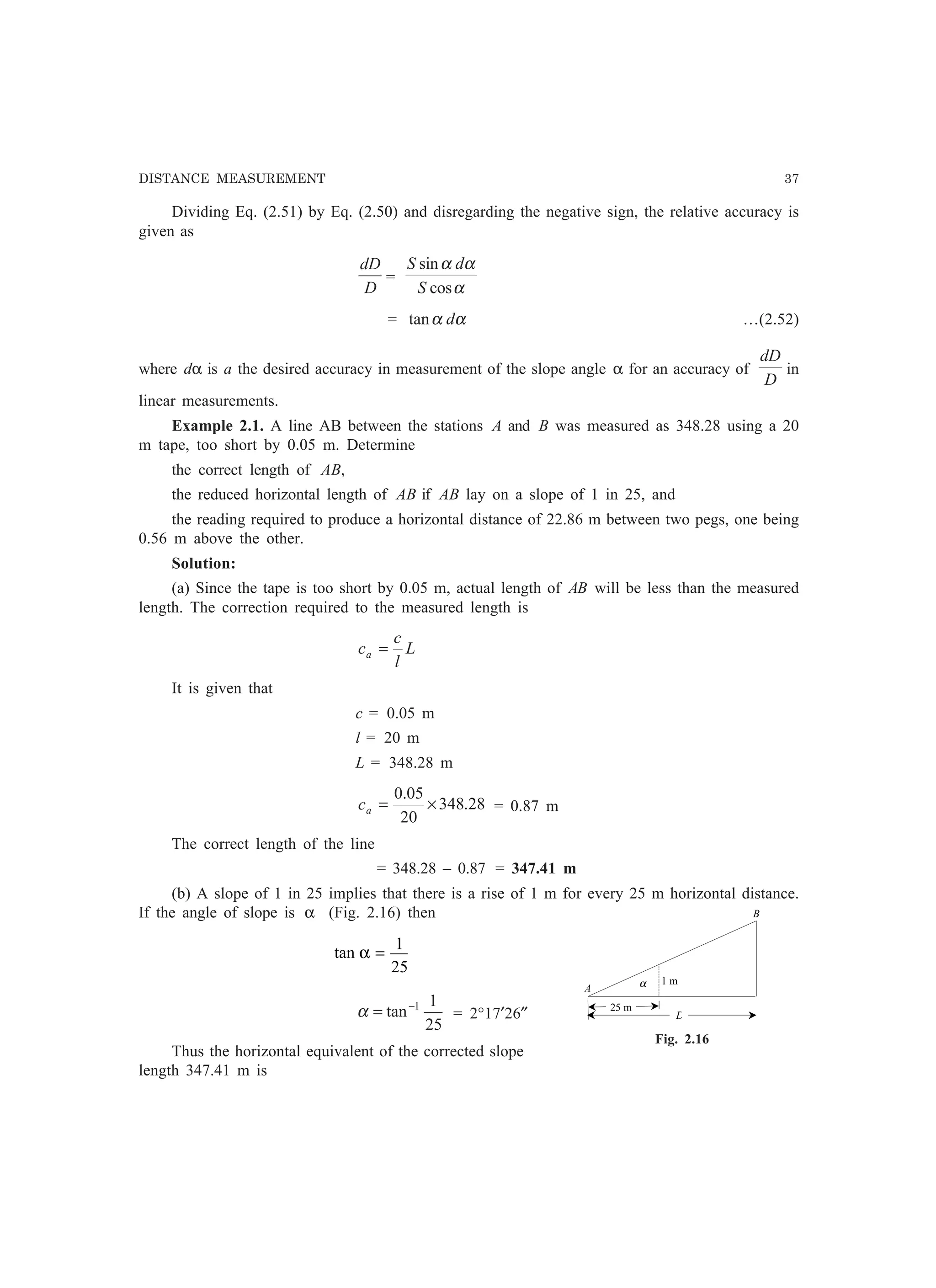
(b) A slope of 1 in 25 implies that there is a rise of 1 m for every 25 m horizontal distance.
If the angle of slope is α (Fig. 2.16) then
tan α =
1
25
25
1
tan 1−
=α = 2°17′26″
Thus the horizontal equivalent of the corrected slope
length 347.41 m is
D
25 m
1 mαA
B
Fig. 2.16
38 SURVEYING
D AB=
= ° ′ ′′
cos
. × cos ( )
α
347 41 2 17 26 = 347.13 m.
Alternatively, for small angles,
25
1
=α radians = 13712 ′′′o , which gives the same value of
D as above.
From Fig. 2.17, we have
22
22
56.086.22 +=
+= CBACAB
= 22.87 m
Therefore the reading required
= 22.87 + 87.22
0.20
05.0
× = 22.93 m
Example 2.2. A tape of standard length 20 m at 85°F was used to measure a base line. The
measured distance was 882.50 m. The following being the slopes for the various segments of the
line:
Segment length (m) Slope
100 2°20′
150 4°12′
50 1°06′
200 7°48′
300 3°00′
82.5 5°10′
Calculate the true length of the line if the mean temperature during measurement was 63°F and
the coefficient of thermal expansion of the tape material is 6.5 × 10⁻⁶
per °F.
Solution:
Correction for temperature
( )Lttc mt 0−=α
( ) 50.8828563105.6 6
×−××= −
= – 0.126 m
Correction for slope
( )[ ]Lcs αcos1−Σ=
( ) ( ) ( )
( ) ( ) ( ) 5.82015cos1300003cos1200847cos1
50601cos1150214cos1100022cos1
×′−+×′−+×′−
+×′−+×′−+×′−=
ooo
ooo
= –3.092 m
0.56 mA
B
C22.86 m
Fig. 2.17
DISTANCE MEASUREMENT 39
Total correction = st cc + = –0.126 + (– 3.092) = – 3.218 m
Correct length = 882.50 – 3.218 = 879.282 m
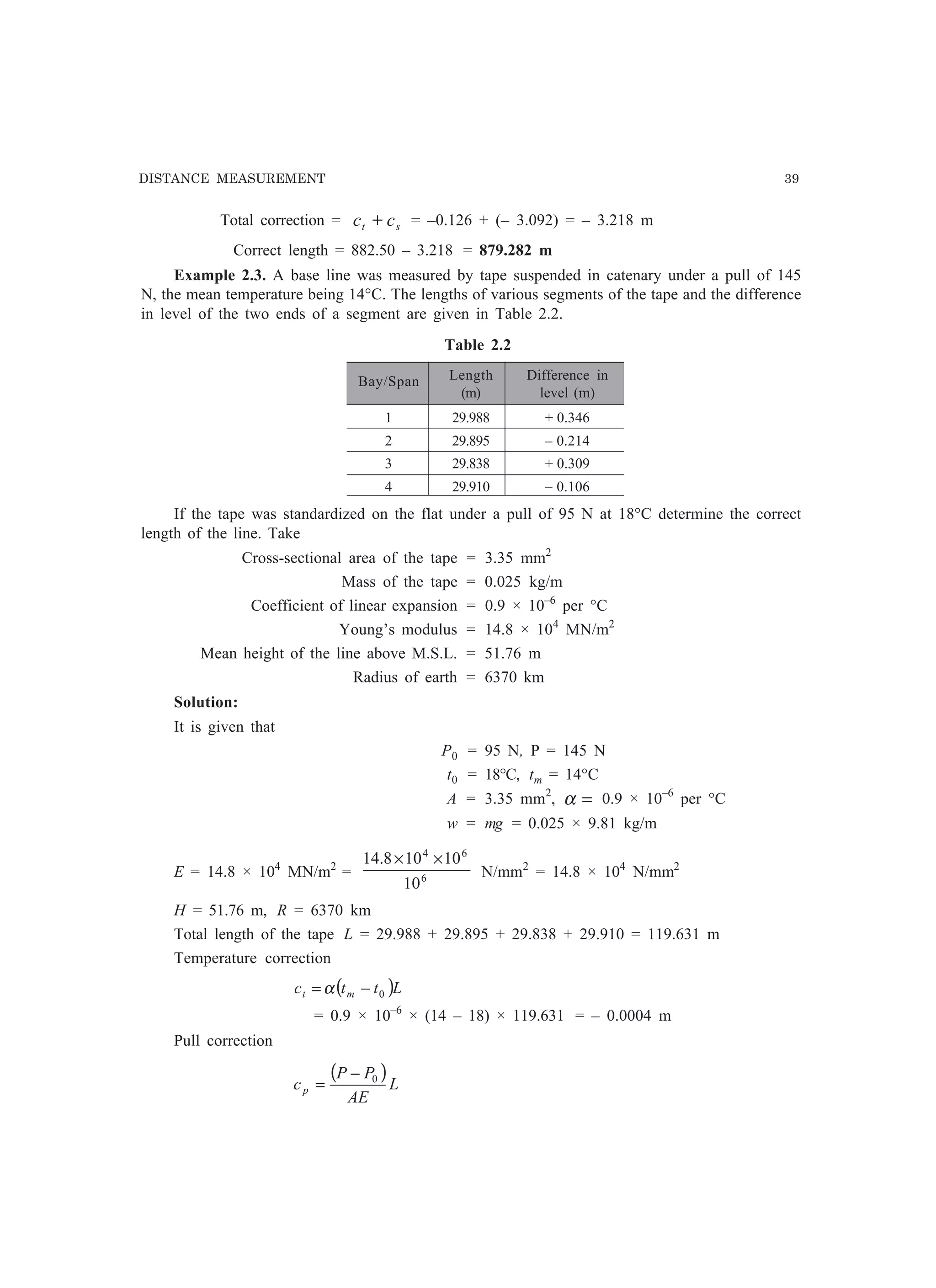
Example 2.3. A base line was measured by tape suspended in catenary under a pull of 145
N, the mean temperature being 14°C. The lengths of various segments of the tape and the difference
in level of the two ends of a segment are given in Table 2.2.
Table 2.2
Bay/Span Length Difference in
(m) level (m)
1 29.988 + 0.346
2 29.895 – 0.214
3 29.838 + 0.309
4 29.910 – 0.106
If the tape was standardized on the flat under a pull of 95 N at 18°C determine the correct
length of the line. Take
Cross-sectional area of the tape = 3.35 mm2
Mass of the tape = 0.025 kg/m
Coefficient of linear expansion = 0.9 × 10⁻⁶
per °C
Young’s modulus = 14.8 × 10⁴
MN/m2
Mean height of the line above M.S.L. = 51.76 m
Radius of earth = 6370 km
Solution:
It is given that
P0 = 95 N, P = 145 N
t0 = 18°C, tm = 14°C
A = 3.35 mm2
, =α 0.9 × 10⁻⁶
per °C
w = mg = 0.025 × 9.81 kg/m
E = 14.8 × 10⁴
MN/m2
= 6
64
10
10108.14 ××
N/mm2
= 14.8 × 10⁴
N/mm2
H = 51.76 m, R = 6370 km
Total length of the tape L = 29.988 + 29.895 + 29.838 + 29.910 = 119.631 m
Temperature correction
( )Lttc mt 0−= α
= 0.9 × 10–6
× (14 – 18) × 119.631 = – 0.0004 m
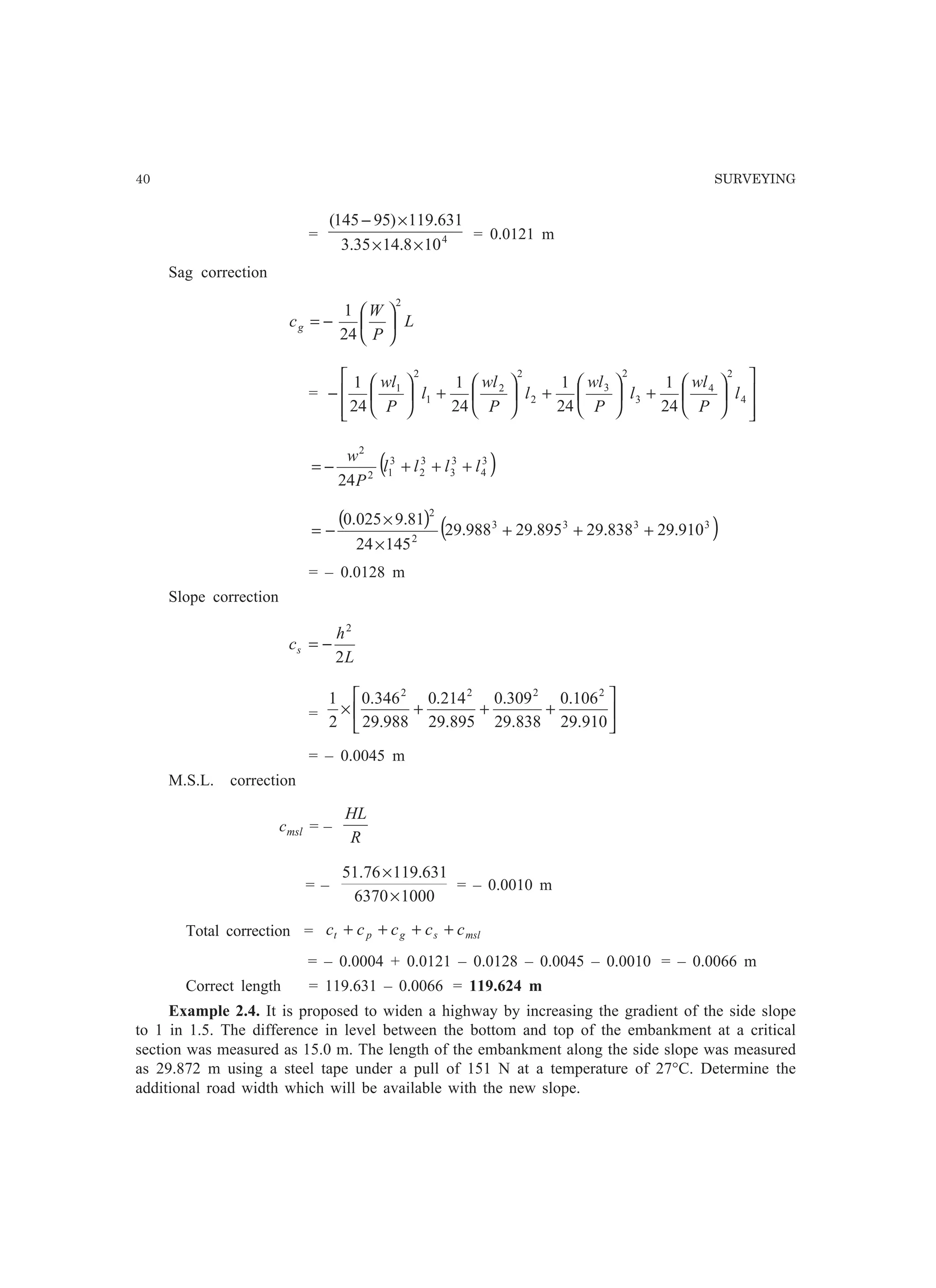
Pull correction
( )L
AE
PP
cp
0−
=
40 SURVEYING
= 4
108.1435.3
631.119)95145(
××
×−
= 0.0121 m
Sag correction
L
P
W
cg
2
24
1






−=
=














+





+





+





− 4
2
4
3
2
3
2
2
2
1
2
1
24
1
24
1
24
1
24
1
l
P
wl
l
P
wl
l
P
wl
l
P
wl
( )3
4
3
3
3
2
3
12
2
24
llll
P
w
+++−=
( ) ( )3333
2
2
910.29838.29895.29988.29
14524
81.9025.0
+++
×
×
−=
= – 0.0128 m
Slope correction
L
h
cs
2
2
−=
= 





+++×
910.29
106.0
838.29
309.0
895.29
214.0
988.29
346.0
2
1 2222
= – 0.0045 m
M.S.L. correction
cmsl = –
R
HL
= –
10006370
631.11976.51
×
×
= – 0.0010 m
Total correction = mslsgpt ccccc ++++
= – 0.0004 + 0.0121 – 0.0128 – 0.0045 – 0.0010 = – 0.0066 m
Correct length = 119.631 – 0.0066 = 119.624 m
Example 2.4. It is proposed to widen a highway by increasing the gradient of the side slope
to 1 in 1.5. The difference in level between the bottom and top of the embankment at a critical
section was measured as 15.0 m. The length of the embankment along the side slope was measured
as 29.872 m using a steel tape under a pull of 151 N at a temperature of 27°C. Determine the
additional road width which will be available with the new slope.
DISTANCE MEASUREMENT 41
The tape was standardized on the flat at 18°C under a pull of 47 N. The cross-sectional area
of the tape is 6.5 mm2
, E = 20.8 × 10⁴
MN/m2
and α = 1.1 × 10⁻⁵
per °C.
Solution:
Temperature correction
( )Lttc mt 0−=α
= 1.1 × 10–5
× (27 – 18) × 29.872 = 0.0030 m
Pull correction
( )L
AE
PP
cp
0−
=
=
6
6
4
10
10
108.205.6
872.29)47151(
×××
×−
= 0.0023 m
Total correction to the measured slope length L = 0.0030 + 0.0023 = 0.0053 m
Correct slope length L′ = 29.872 + 0.0053 = 29.877 m.
To determine the equivalent horizontal distance x (Fig. 2.18), the approximate formula
L
h
2
2
given by Eq. (2.7), should not be used. This will induce a very significant error on the steep slopes
for small values of h. Instead directly the Pythagoras’s theorem should be used.
2222
15877.29 −=−′= hLx
= 25.839 m
The existing slope
= =
F
H
I
K
15
29 877
1
29 877
15
. .
2
1
= or 1 in 2 (i.e., n = 2)
Now the additional road width d is obtained as below.
839.255.115
1
5.1
15
−×=
=
+
d
xd
= 3.34 m
Example 2.5. A tape of 30 m length suspended in catenary measured the length of a base line.
After applying all corrections the deduced length of the base line was 1462.36 m. Later on it was
found that the actual pull applied was 155 N and not the 165 N as recorded in the field book.
Correct the deduced length for the incorrect pull.
d
h = 15 m
L′
B
x
1 in 1.5
1 in n
Proposed slope
Existing slope
Fig. 2.18
42 SURVEYING
The tape was standardized on the flat under a pull of 85 N having a mass of 0.024 kg/m
and cross-sectional area of 4.12 mm2
. The Young’s modulus of the tape material is 152000
MN/ m2
and the acceleration due to gravity is 9.806 m/s2
.
Solution:
It is given that
P0 = 85 N, P = 165 N, Pδ = 155 – 165 = – 10 N
E = 6
6
10
10152000×
N/mm2
= 152000 N/mm2
W = 0.024 × 9.806 × 30 = 7.060 kg per 30 m
A = 4.12 mm2
g = 9.806 m/s2
Nominal pull correction =
( )
L
AE
PP 0−
( )
15200012.4
3085165
×
×−
= = 0.0038 m per 30 m
Nominal sag correction L
P
W
2
24
1






−=
30
165
060.7
24
1
2
×





×−=
= –0.0023 m per 30 m
From Eq. (2.14), we have
Error in pull correction = P
PP
δ
0
correctionpullnominal
−
10
85165
0038.0
×
−
=
= 0.0005 m per 30 m
Since the sign of the correction is same as that of Pδ , the correction will be
= –0.0005 m per 30 m
30
36.1462
0005.0 ×−= for the whole length
= –0.0244 m
DISTANCE MEASUREMENT 43
From Eq. (2.15), we have
Error in sag correction = nominal sag correction × 





P
Pδ2
Since the sign of this correction is opposite of the sign of δP, the correction of pull error in
sag
( )
165
102
0023.0
×
×−+= per 30 m
30
36.1462
165
102
0023.0 ×
×
×−= for the whole length
= –0.0136 m
Thus the total sag correction was too small by 0.0136 m. The length of the line has, therefore,
been overestimated because the pull correction (too large) would have been added to the measured
length, since (P  P0), whilst the sag correction (too small ) would have been subtracted.
Therefore, overestimation = 0.0244 + 0.0136
= 0.0380 m
The correct length of the line
= 1462.36 – 0.0380 = 1462.322 m
Example 2.6. The depth of a mine shaft was measured as 834.66 m using a 1000 m steel tape
having a cross-section of 10 mm2
and a mass of 0.08 kg/m. Calculate the correct depth of the mine
shaft if the tape was standardized at a tension of 182 N. The Young’s modulus of elasticity of the
tape material is 21 × 104
N/mm2
and g = 9.806 m/s2
.
Solution:
The elongation in the tape hanging vertically is given by Eq. (2.17), is
Ex ( ) 





−+−=
g
P
Mxl
m
AE
gx 0
2
2
It is given that
P0 = 182 N, l = 1000 m, x = 834.66 m
g = 9.806 m/s2
, E = 21 × 104 N/mm2
A = 10 mm2
, m = 0.08 kg/m, M = 0
Ex
( ) 





−+−×
××
×
=
806.9
182
066.83410002
2
08.0
102110
66.834806.9
4
= 0.109 m
Therefore the correct depth of the shaft
= 834.66 + 0.109
= 834.77 m.
44 SURVEYING
Example 2.7. To determine the distance between two points A and B, a tacheometer was set
up at P and the following observations were recorded.
(a) Staff at A
Staff readings = 2.225, 2.605, 2.985
Vertical angle = + 7°54′
(b) Staff at B
Staff readings = 1.640, 1.920, 2.200
Vertical angle = – 1°46′
(c) Horizontal angle APB = + 68°32′30″
Elevation of A = 315.600 m
k = 100 m
c = 0.00 m
Determine the distance AB and the elevation of B.
Solution:
The horizontal distance is given by D = ks cos2
α
If the horizontal distances PA and PB are DA and DB, respectively, then
( ) ( ) 564.74457cos225.2985.2100 2
=′×−×= o
AD m
( ) ( ) 947.55641cos640.1200.2100 2
=′×−×= o
BD m
Now in ∆ APB if ∠ APB is θ and the distance AB is D then
D D D D DA B A B
2 2 2
2 2
2
74 564 55 947 2 74 564 55 947 68 32 30
5637 686
= + −
= + − ° ′ ′′
=
cos
. . × . × . × cos
.
θ
b g
or D = 75.085 m
(ii) The vertical distance V is given by
α2sin
2
1
ksV =
If the vertical distances for the points A and B are VA and VB, respectively, then
( ) 347.104572sin760.0100
2
1
=′××××= o
AV m
( ) 726.16412sin560.0100
2
1
=′××××= o
BV m
The elevation of the line of sight for A is
H.I. = Elevation of A + middle hair reading at A – VA
= 315.600 + 2.605 – 10.347
= 307.858 m.
DISTANCE MEASUREMENT 45
The elevation of B is
hB = H.I. – VB – middle hair reading at B
= 307.858 – 1.726 – 1.920
= 304.212 m.
Example 2.8. The following tacheometric observations were made on two points P and Q
from station A.
Table 2.3
Staff at Vertical angle Staff reading
Upper Middle Lower
P – 5°12′ 1.388 0.978 0.610
Q + 27°35′ 1.604 1.286 0.997
The height of the tacheometer at A above the ground was 1.55 m. Determine the elevations
of P and Q if the elevation of A is 75.500 m. The stadia constant k and c are respectively 100 and
0.00 m. Assuming that the standard error in stadia reading is ± 1.6 mm and of vertical angle ± 1.5′,
also calculate the standard errors of the horizontal distances and height differences.
Solution:
Since the vertical angles are given, the line of sights are inclined for both the points. From Eqs.
(2.21) and (2.22), we have
α2
cosksH = …(a)
α2sin
2
1
ksV = …(b)
The given data are
( ) 215,m778.0610.0388.1 11
′==−= o
αs
( ) 5327,m607.0997.0604.1 22
′==−= o
αs
Therefore the distances
( ) 161.77215cos778.0100 2
=′××= o
APH m
( ) 022.72152sin778.0100
2
1
=′××××= o
APV m
( ) 686.475327cos607.0100 2
=′××= o
AQH m
( ) 912.2453272sin607.0100
2
1
=′××××= o
AQV m
The height of the instrument
H.I. = Elevation of A + instrument height
= 75.500 + 1.55 = 77.050 m
46 SURVEYING
Elevation of P
hP = H.I. – VAP – middle hair reading at P
= 77.050 – 7.022 – 0.978
= 69.050 m
Elevation Q
HQ = H.I. + VAQ – middle hair reading at Q
= 77.050 + 24.912 – 1.286
= 100.676 m.
To find the standard errors of horizontal and vertical distances, the expressions (a) and (b) are
differentiated with respect to staff intercept (s) and vertical angle (α), as the distances are influenced
by these two quantities. It is assumed that the multiplying constant k is unchanged.
α2
cosk
s
H
=
∂
∂
ααα
α
2sinsincos2 ksks
H
−=−=
∂
∂
α2sin
2
1
k
s
V
=
∂
∂
…(c)
∂
∂α
α α
V
ks ks= =
1
2
2 2 2(cos ) × cos …(d)
Thus the standard error in horizontal distance
22
2






∂
∂
+





∂
∂
= ασ
α
σσ
H
s
H
sH …(e)
and the standard error in vertical distance
22
2






∂
∂
+





∂
∂
= ασ
α
σσ
V
s
V
sV …(f)
where σs and σα are the standard errors of stadia reading and vertical angle, respectively.
In obtaining the staff intercept s at a station, two readings are involved and the standard error
in one stadia reading is ± 1.6 mm, thus the standard error σs of s is calculated as
σ σ σs s s
2 2 2 2 2
1 2
1 6 1 6 5 12= + = + =. . . mm2
The standard error σ1 of vertical angle measurement at a station is ± 1.5′, therefore
( ) ( )24
2
22
103633.4
18060
5.1
5.1 −
×=





×==
π
σα
DISTANCE MEASUREMENT 47
Now from Fig. 2.19, the difference in elevation between two points, say, A and P, is
MiAP SVhhh −−+=
or iMPA hSVhhh −+==− …(g)
where
SM = the middle hair reading, and
hi = the height of the instrument above the
ground.
Assuming hi as constant, the value of h will be
affected due to errors in V and SM. Thus the standard
error of h is given by
22
2






∂
∂
+





∂
∂
= MS
M
Vh
S
h
V
h
σσσ …(h)
From Eq. (g), we get
1=
∂
∂
V
h
and 1=
∂
∂
MS
h
From Eq. (f), we get
2
2
2
2
2
ασ
α
σσ 





∂
∂
+





∂
∂
=
V
s
V
sV
Substituting the value of
s
V
∂
∂
and
α∂
∂V
from Eq. (c) and (d), we get
( ) 222
2
2
2cos2sin
2
1
ασασασ ksk sV +





=
56.26.1 22
==MSσ mm2
Thus ( ) 2222
2
2
2cos2sin
2
1
MSsh ksk σσασασ α ++





=
and from Eq. (e), we have
( ) ( ) 222222
2sincos ασασασ ksk sH +=
Between A and P
( ) ( )( ) ( )
2
42222
103633.42152sin1000778.010012.5215cos100 −
××′××××+×′×= oo
Hσ
= 50399.9 mm2
Fig. 2.19
hA
A
P
SM
Datum
hi
hB
V
A
48 SURVEYING
σH = ± 224.5 mm = ± 0.22
σh
2
2
21
2
100 2 5 12 5 12 100 0 778 1000 2 5 12= °
F
HG I
KJ + + °′ ′
× × sin × × . . × × cos ×c h c he j
× . × .4 3633 10 2 564 2−
+c h
= 1534.5 mm2
σh = ± 39.2 mm = ± 0.039 mm
Between A and Q
( ) ( )( ) ( )
2
42222
103633.453272sin1000607.010012.55327cos100 −
××′××××+×′×= oo
Hσ
= 32071.2 mm2
σH = ± 179.1 mm = ± 0.18 m
σh
2
2
21
2
100 2 27 35 5 12 100 0 607 1000 2 27 35= ° ′
F
HG I
KJ + + ° ′× ×sin × × . . × × cos ×b g b gc h
× . × .4 3633 10 2 564 2−
+c h j
= 8855.3 mm2
σh = ± 94.1 mm = ± 0.09 m.
Example 2.9. The following tacheometric observations were made from station A to stations
1 and 2.
Table 2.4
Instrument
Staff at
Zenith Staff reading
at station angle Upper Middle Lower
A
1 96° 55′ 1.388 0.899 0.409
2 122°18′ 1.665 1.350 1.032
Calculate the errors in horizontal and vertical distances if the staff was inclined by 1° to the
vertical in the following cases:
(a) Staff inclined towards the instrument for the line A–1.
(b) Staff inclined away from the instrument for the line A–2.
The height of the instrument above ground was 1.52 m. Take stadia constants as 100 and 0.0 m.
Solution:
Let us first calculate the vertical angles from the zenith angles and the staff intercepts.
For the line A–1
α1 = 90° – 96°55′ = – 6°55′
s1 = 1.388 – 0.409 = 0.979 m
DISTANCE MEASUREMENT 49
For the line A–2
α2 = 90° – 122°18′′ = – 32°18′
s2 = 1.665 – 1.032 = 0.633 m
For the line A–1
The apparent horizontal distance from Eq. (2.21) when the staff is truly vertical, is
48.96556cos979.0100cos 22
1 =′××==′ o
αksD m
The correct horizontal distance D when the staff is inclined, is obtained from Eq. (2.29) by
replacing in the above expression s1 by
s1 cos
cos
α δ
α
+b g. Thus
D ks ks=
+
= +1
2
1
cos
cos
cos cos cos
α δ
α
α α δ α
b g b g
= ° + ° °′ ′
100 0 979 6 55 1 6 55× . × cos × cosc h
= 96.26 m
Therefore error = D′ – D
= 96.48 – 96.26 = 0.22 m = 1 in 436 (approximately).
The apparent vertical distance from Eq. (2.22) is
( ) ( ) 70.115562sin979.0100
2
1
2sin
2
1
1 =′××××==′ o
αksV m
The correct vertical distance is
V ks=
+
=
° ′ + ° ° ′
° ′
1
2
2
1
2
100 0 979 6 55 1 2 6 55
6 55
1
cos
cos
sin ×
× . × cos × sin ×
cos
α δ
α
α
b g b g b g b g
b g
= 11.68 m
Therefore, error = V′ – V
= 11.70 – 11.68 = 0.02 m = 1 in 584 (approximately).
For the line A–2
The apparent horizontal distance is
( ) 23.458132cos633.0100 2
=′××=′ o
D m
When the staff is inclined away from the instrument the correct horizontal distance from Eq.
(2.30), is
( ) ( )8132cos18132cos633.0100 ′×−′××= ooo
D
= 45.72 m
Therefore error = D′ – D
= 45.23 – 45.72 = 0.49 m = 1 in 93 (approximately).
50 SURVEYING
The apparent vertical distance is
′ = ° ′ =V
1
2
100 0 633 2 32 18 28 59× × . × sin × .b g m
The correct vertical distance is
V =
° ′ − ° ° ′
° ′
1
2
100 0 633 32 18 1 2 32 18
32 18
×
× . × cos × sin ×
cos
b g b g
b g
= 28.90 m
Therefore error = V′ – V
= 28.59 – 28.90 = 0.31 m = 1 in 93 (approximately).
Example 2.10. In Example 2.9, if the elevation of the point 1 is 115.673 m, determine the
correct elevation of the point 2. The height of the instrument above ground is 1.52 m.
Solution:
Let h1, h2 = the elevations of the points 1 and 2,
S1, S2 = the middle hair readings at the points 1 and 2,
V1, V2 = the vertical distances for the points 1 and 2, and
hi = the height of the instrument above ground.
The height of the instrument above the mean sea level at A is
H.I. = h1 + hi + S1 + V1
= 115.673 + 1.52 + 0.899 + 11.68
= 129.772 m
The elevation of the point 2 is
h2 = H.I. 22 SV +−
= 129.772 – 28.90 – 1.350
= 99.522 m.
Example 2.11. To measure a line AB, a theodolite was set up at A and a subtense bar of length
2 m was set up at B. The horizontal angle measured at A for the subtense bar targets was
4°02′26.4″.
Determine the length of AB,
the fractional error in the length AB if the horizontal angle was measured with an accuracy
of ± 1.5″, and the error in AB if the subtense bar was out by 1° from being normal to AB.
Solution:
Horizontal distance in subtense tacheometry is given by
AB
b
=
2 2
cot
θ
=
° ′ ′′F
H
I
K
2 0
2
4 02 26 4
2
.
× cot
.
= 28.348 m.
DISTANCE MEASUREMENT 51
The error in distance AB is
206265
5.1
2
348.28 2
2
′′
×−=
−= θd
b
D
dD
= 0.003 m (neglecting the sign).
The fractional error is
= =
dD
D dD
D
1
= 1 in 9449
The error in horizontal distance due to the bar not being normal to AB, is given by
∆D
b
= −
=
° ′ ′′F
HG I
KJ − °
2 2
1
2
2
4 02 26 4
2
1 1
cot ( cos )
× cot
.
× ( cos )
θ
δ
= 0.004 m.
Example 2.12. A line AB was measured using EDM. The instrument was set up at P in line with
AB on the side of A remote from B. The wavelength of frequency 1 (f1) is 10 m exactly. Frequency
2 (f2) is (9/10) f1 and that of frequency 3 (f3) is (99/100) f1. Calculate the accurate length of AB that
is known to be less than 200 m, from the phase difference readings given in Table 2.5.
Table 2.5
Line
Phase difference (m)
f1 f2 f3
PA 4.337 7.670 0.600
PB 7.386 1.830 9.911
Solution:
In Sec. 2.11.1, we have found out that
λ2 = 11.111 m
λ3 = 10.101 m
From Eq. (2.43) for the line PA, we have
222111 λλλλ ∆+=∆+ nn
670.7111.11337.410 21 +=+ nn
Since 21 λλ ∆∆
121 += nn
52 SURVEYING
or 112 −= nn
Thus 670.7)1(111.11337.410 11 +−=+ nn
or 71 =n
This calculation has removed any ambiguity in the number of complete wavelengths of f1
frequency lying within the 0 to 100 m stage.
Now considering f3 frequency which when related to f1 gives the 0 to 1000 m stage. Let
1n′ be the number of complete wavelengths of f1 and n3 be that of f3, then
600.0101.10337.410 31 +=+′ nn
Since 21 λλ ∆∆
31 nn =′
600.0101.10337.410 11 +′=+′ nn
or 371 =′n
Thus there are 37 complete wavelengths of f1 within the distance of PA.
Therefore from Eq. (2.40), we get
2PA = 37 × 10 + 4.337 = 374.337 m
For the line PB, we have
830.1111.11386.710 21 +=+ nn
Since 21 λλ ∆∆
21 nn =
or 51 =n
Again 911.9101.10386.710 31 +=+′ nn
Since 21 λλ ∆∆
131 +=′ nn
or 751 =′n
Therefore, 2PB = 75 × 10 + 7.386 = 757.386 m
Thus AB =
2
22 PAPB −
2
337.374386.757 −
= = 191.525 m.
DISTANCE MEASUREMENT 53
Example 2.13. The following observations were made to measure the length of a base line AB
using an EDM instrument.
Measured distance = 1556.315 m
Elevation of instrument at A = 188.28 m
Elevation of reflector at B = 206.35 m
Temperature = 24°C
Pressure = 750 mm of mercury
Calculate the correct length of AB and its reduced length at mean sea level.
Take ns = 1.0002851, n0 = 296 × 10–6
and R = 6370 km.
Solution:
From Eq. (2.44), we have
( ) ( ) 











−=−
760
273
11 0
p
T
nn
( ) 











+
××=− −
760
750
24273
273
102961 6
n
or n = 1.0002685
From Eq. (2.48), we have






′=
n
n
DD s






×=
0002685.1
0002851.1
315.1556D = 1556.341 m
From Eq. (2.49), the correct length of AB is
= −
F
H
I
K ′cos θ
H
R
L
9.54930
341.1556
28.18835.206
sin 1
′′′=





 −
= −
o
θ
Therefore, ( ) ( ) 341.1556
100063702
35.20628.188
9.5493cos ×





××
+
−′′′=
= 1556.188 m.
Example 2.14. The slope distance between two stations A and B measured with EDM when
corrected for meteorological conditions and instrument constants, is 113.893 m. The heights of the
instrument and reflector are 1.740 m and 1.844 m, respectively, above the ground. To measure the
54 SURVEYING
vertical angle a theodolite was set up at A, 1.660 m above the ground and a target at B having height
above the ground as 1.634 m. The measured angle above the horizontal was + 4°23′18″. Determine
(a) The horizontal length of the line AB.
(b) To what precision the slope angle be measured
(c) if the relative precision of the reduced horizontal distance is to be 1/100000.
(d) if the reduced horizontal distance is to have a standard error of ± 1.8 mm.
Solution:
If the heights of the instrument and the target are not same, a correction known as eye and
object correction is required to be determined to get the correct vertical angle. In Fig. 2.20a, the
observed vertical angle is α. If the correct vertical angle α′ and the correction to α is β then
βαα +=′
While measuring the distance as shown Fig. 2.20b, the height of the EDM and the reflector
should also be same and the inclination of the line of sight due to height difference between the
EDM and the reflector, a correction of β is to be applied to the slope angle θ, to make the line of
sight inclined at α + β to the horizontal.
Fig. 2.20
From Fig. 2.19a, we have
893.113
026.0
893.113
634.1660.1
=
−
=β radians
= 1.47520626
893.113
026.0
′′=′′×
From Fig. 2.19b, we have
893.113
104.0
893.113
740.1844.1
=
−
=γ radians
4.083520626
893.113
104.0
′′′=′′×=
(a) (b)
Line
DISTANCE MEASUREMENT 55
The correct slope angle
θ = α + β + γ
= 4°23′18″ + 47.1″ + 3′08.4″
5.13724 ′′′= o
Therefore the horizontal distance
L L= ′
= ° ′ ′′
cos
. × cos .
θ
113 893 4 27 13 5
= 113.549 m.
We have L L= ′ cos θ
dL L d= − ′ sin θ θ …(a)
The negative sign in the above expression shows decrease in L with increase in dθ. Thus the
relative accuracy
dL
L
L
L
d= ′
′
sin
cos
.
θ
θ
θ
= tanθ .dθ
It is given that
100000
1
=
L
dL
,
therefore,
θd×′′′= 5.13724tan
100000
1 o
or dθ = 0.000128 radians
= 0.000128 × 206265″
= 26″
It is given that
dL = ± 1.5 mm,
therefore, from Eq. (a), we get
θd×′′′×= 5.13724sin893.1130015.0 o
dθ = 0 .000169 radians
= 0.000169 × 206265″
= ± 35″″″″″.
56 SURVEYING
OBJECTIVE TYPE QUESTIONS
1. A metallic tape is
(a) a tape made of any metal.
(b) another name of a steel tape.
(c) another name of an invar tape.
(d) is a tape of water proof fabric into which metal wires are woven.
2. Spring balance in linear measurements is used
(a) to know the weight of the tape
(b) to apply the desired pull.
(c) to know the standard pull at the time of measurement.
(d) none of the above.
3. Ranging in distance mesurements is
(a) another name of taping.
(b) a process of establishing intermediate points on a line.
(c) putting the ranging rod on the hill top for reciprocal ranging.
(d) a process of determining the intersectoion of two straight lines.
4. Reciprocal ranging is employed when
(a) the two ends of a line are not intervisible.
(b) one end of a line is inaccessible.
(c) both the ends are inaccessible.
(d) the ends of the line are not visible even from intermediate points.
5. The following expression gives the relative accuracy in linear measurements when the slope angle
is α.
(a)
dD
D
d= tan . .2α α (b)
dD
D
d= tan . .2
α α
(c)
dD
D
d= 2 tan . .α α (d)
dD
D
d= tan . .α α
6. If the slope angle 64°08′07″ is measured to an accuracy of 10″ the expected relative accuracy in
the linear measurements is
(a) 1/10. (b) 1/100.
(c) 1/1000. (d) 1/10000.
7. The temperature correction and pull correction
(a) may have same sign. (b) always have same sign.
(c) always have opposite signs. (d) always have positive sign.
8. The sag corrections on hills
(a) is positive. (b) is negative.
(c) may be either positive or negative. (d) is zero
DISTANCE MEASUREMENT 57
9. The correction for reduced length on the mean sea level is proportional to
(a) H. (b) H2
.
(c) 1/H. (d) 1/2H.
where H is the mean elevetion of the line.
10. If the difference in the levels of the two ends of a 50 m long line is 1 m and its ends are out
of alignment by 5 m then the corrections for slope (cs) and alignment (cm) are related to each
other as
(a) cs = 4cm. (b) cs = 0.4cm.
(c) cs = 0.04cm. (d) cs = 0.004cm.
11. Stadia is a form of tacheometric mesurements that relies on
(a) fixed intercept. (b) fixed angle intercept
(c) varying angle intercept (d) none of the above.
12. The tacheometric method of surveying is generally preferred for
(a) providing primary control. (b) large scale survey.
(c) fixing points with highest precision. (d) difficult terrain.
13. If two points A and B 125 m apart, have difference in elevation of 0.5 m, the slope correction to
the measured length is
(a) + 0.001 m. (b) 0.001 m.
(c) + 0.0125 m. (d) 0.001 m.
14. The branch of surveying in which an optical instrument is used too determine both horizontal
and vertical positions, is known as
(a) Tachemetry. (b) Tachometry.
(c) Tacheometry. (d) Telemetry.
15. If the vertical angle from one station to another 100 m apart, is 60°, the staff intercept for a
tacheometer with k = 100 and c = 0, would be
(a) 1. (b) 4.
(c) 5. (d) 0.1.
16. Electronic distance measurement instruments use
(a) X-rays. (b) Sound waves.
(c) Light waves. (d) Magnetic flux.
17. Modern EDM instruments work on the principle of measuring
(a) the reflected energy generated by electromagnetic waves.
(b) total time taken by electromagnetic wave in travelling the distance.
(c) the change in frequency of the electromagnetic waves.
(d) the phase difference between the transmitted and the reflected electromagnetic waves.
18. The range of infrared EDM instrument is generally limited to measuring the distances
(a) 2 to 3 km. (b) 20 to 30 km.
(c) 200 to 300 km. (d) more than 300 km.
58 SURVEYING
19. Electromagnetic waves are unaffected by
(a) air temperature.
(b) atmospheric pressure.
(c) vapour pressure.
(d) wind speed.
ANSWERS
1. (d) 2. (b) 3. (b) 4. (a) 5. (d) 6. (d)
7. (a) 8. (b) 9. (a) 10. (c) 11. (b) 12. (d)
13. (b) 14. (c) 15. (b) 16. (c) 17. (d) 18. (a)
19. (d).
LEVELLING
3.1 LEVELLING
Levelling is an operation in surveying performed to determine the difference in levels of two points.
By this operation the height of a point from a datum, known as elevation, is determined.
3.2 LEVEL SURFACE
A level surface is the equipotential surface of the earth’s gravity field. It is a curved surface and
every element of which is normal to the plumb line.
3.3 DATUM
A datum is a reference surface of constant potential, called as a level surface of the earth’s gravity
field, for measuring the elevations of the points. One of such surfaces is the mean sea level surface
and is considered as a standard datum. Also an arbitrary surface may be adopted as a datum.
3.4 LEVEL LINE
A line lying in a level surface is a level line. It is thus a curved line.
Line of sight
Horizontal line
Staff held vertical
Mean sea-level
Fig. 3.1
A level in proper adjustment, and correctly set up, produces a horizontal line of sight which
is at right angles to the direction of gravity and tangential to the level line at the instrument height.
It follows a constant height above mean sea level and hence is a curved line, as shown in Fig. 3.1.
Over short distances, such as those met in civil engineering works, the two lines can be taken
to coincide. Over long distances a correction is required to reduce the staff readings given by the
horizontal line of sight to the level line equivalent. Refraction of the line of sight is also to be taken
into account. The corrections for the curvature of the level line Cc and refraction Cr are shown in
59
!
60 SURVEYING
Fig. 3.2. The combined correction is given by
C
d
R
cr = −
3
7
2
...(3.1)
where
Ccr = the correction for the curvature and refraction,
d = the distance of the staff from the point of tangency, and
R = the mean earth’s radius.
For the value of R = 6370 km and d in kilometre, the value of Ccr in metre is given as
2
067.0 dCcr −= ...(3.2)
Fig. 3.2
3.5 DIRECT DIFFERENTIAL OR SPIRIT LEVELLING
Differential levelling or spirit levelling is the most accurate simple direct method of determining the
difference of level between two points using an instrument known as level with a levelling staff.
A level establishes a horizontal line of sight and the difference in the level of the line of sight and
the point over which the levelling staff is held, is measured through the levelling staff.
Fig. 3.3 shows the principle of determining the difference in level ∆h between two points A
and B, and thus the elevation of one of them can be determined if the elevation of the other one
is known. SA and SB are the staff readings at A and B, respectively, and hA and hB are their
respective elevations.
Fig. 3.3
Level line
Line of sight
H orizontal line
M ean sea-level
C r
C c
C cr
LEVELLING 61
From the figure, we find that
(i) if SB  SA, the point B is higher than point A.
(ii) if SB  SA, the point B is lower than point A.
(iii) to determine the difference of level, the elevation of ground point at which the level is
set up, is not required.
Booking and Reducing the Levels
Before discussing the booking and methods of reducing levels, the following terms associated with
differential levelling must be understood.
Station: A station is the point where the levelling staff is held. (Points A, a, b, B, c, and C
in Fig. 3.4).
Height of instrument (H.I.) or height of collimation: For any set up of the level, the
elevation of the line of sight is the height of instrument. (H.I. = hA + SA in Fig. 3.3).
Back sight (B.S.): It is the first reading taken on the staff after setting up the level usually
to determine the height of instrument. It is usually made to some form of a bench mark (B.M.) or
to the points whose elevations have already been determined. When the instrument position has to
be changed, the first sight taken in the next section is also a back sight. (Staff readings S1 and S5
in Fig. 3.4).
Section-1 Section-2
B.M.
C.P.
1
2
A
B
C
a
b
B.S.
F.S. F.S.
c
B.S.
I.S..
I.S.S1
S2
S3
S4
S5
S6
S7
B.M.
Staff position/Station
Instrument position
I.S
Fig. 3.4
Fore sight (F.S.): It is the last reading from an instrument position on to a staff held at a point.
It is thus the last reading taken within a section of levels before shifting the instrument to the next
section, and also the last reading taken over the whole series of levels. (Staff readings S4 and S7
in Fig. 3.4).
Change point (C.P.) or turning point: A change point or turning point is the point where
both the fore sight and back sight are made on a staff held at that point. A change point is required
before moving the level from one section to another section. By taking the fore sight the elevation
of the change point is determined and by taking the back sight the height of instrument is determined.
The change points relate the various sections by making fore sight and back sight at the same point.
(Point B in Fig. 3.4).
Intermediate sight (I.S.): The term ‘intermediate sight’ covers all sightings and consequent
staff readings made between back sight and fore sight within each section. Thus, intermediate sight
station is neither the change point nor the last point. (Points a, b, and c in Fig. 3.4).
Balancing of sights: When the distances of the stations where back sight and fore sight are
taken from the instrument station, are kept approximately equal, it is known as balancing of sights.
Balancing of sights minimizes the effect of instrumental and other errors.
62 SURVEYING
Section-1Section-2
Reduced level (R.L.): Reduced level of a point is its height or depth above or below the
assumed datum. It is the elevation of the point.
Rise and fall: The difference of level between two consecutive points indicates a rise or a
fall between the two points. In Fig. 3.3, if (SA – SB) is positive, it is a rise and if negative, it is
a fall. Rise and fall are determined for the points lying within a section.
Section: A section comprises of one back sight, one fore sight and all the intermediate sights
taken from one instrument set up within that section. Thus the number of sections is equal to the
number of set ups of the instrument. (From A to B for instrument position 1 is section-1 and from
B to C for instrument position 2 is section-2 in Fig. 3.4).
For booking and reducing the levels of points, there are two systems, namely the height
of instrument or height of collimation method and rise and fall method. The columns for
booking the readings in a level book are same for both the methods but for reducing the levels,
the number of additional columns depends upon the method of reducing the levels. Note that
except for the change point, each staff reading is written on a separate line so that each staff
position has its unique reduced level. This remains true at the change point since the staff does
not move and the back sight from a forward instrument station is taken at the same staff position
where the fore sight has been taken from the backward instrument station. To explain the
booking and reducing levels, the levelling operation from stations A to C shown in Fig. 3.4, has
been presented in Tables 3.1 and 3.2 for both the methods. These tables may have additional
columns for showing chainage, embankment, cutting, etc., if required.
Table 3.1 Height of instrument method
Station B.S. I.S. F.S. H.I. R.L. Remarks
A S1 H.I.A = hA B.M. = ha
hA +S1
a S2 ha = H.I.A – S2
b S3 hb = H.I.A – S3
B S5 S4 H.I.B = hB = H.I.A – S4 C.P. –
hB + S5
c S6 hc = H.I.B – S6
C S7 HC = H.I.B – S7
Σ B.S. Σ F.S.
Check: Σ B.S. – Σ F.S. = Last R.L. – First R.L.
In reducing the levels for various points by the height of instrument method, the height of
instrument (H.I.) for the each section highlighted by different shades, is determined by adding the
elevation of the point to the back sight reading taken at that point. The H.I. remains unchanged for
all the staff readings taken within that section and therefore, the levels of all the points lying in that
section are reduced by subtracting the corresponding staff readings, i.e., I.S. or F.S., from the H.I.
of that section.
In the rise and fall method, the rises and the falls are found out for the points lying within
each section. Adding or subtracting the rise or fall to or from the reduced level of the backward
LEVELLING 63
Section-1Section-2
station obtains the level for a forward station. In Table 3.2, r and f indicate the rise and the fall,
respectively, assumed between the consecutive points.
Table 3.2 Rise and fall method
Station B.S. I.S. F.S. Rise Fall R.L. Remarks
A S1 hA B.M. = ha
a S2 r1 = ha = hA + r1
S1 – S2
b S3 f1 = S2 – S3 hb = ha – f1
B S5 S4 f2 = S3 – S4 hB = hb – f2 C.P.
c S6 f3 = S5 – S6 hc = hB – f3
C S7 r2 = HC = hc + r2
S6 – S7
Σ B.S. Σ F.S. Σ Rise Σ Fall
Check: Σ B.S. − Σ F.S. = Σ Rise − Σ Fall = Last R.L. − First R.L.
The arithmetic involved in reduction of the levels is used as check on the computations. The
following rules are used in the two methods of reduction of levels.
(a) For the height of instrument method
(i) Σ B.S. – Σ F.S. = Last R.L. – First R.L.
(ii) Σ [H.I. × (No. of I.S.’s + 1)] – Σ I.S. – Σ F.S. = Σ R.L. – First R.L.
(b) For the rise and fall method
Σ B.S. – Σ F.S. = Σ Rise – Σ Fall = Last R.L. – First R.L.
3.6 COMPARISON OF METHODS AND THEIR USES
Less arithmetic is involved in the reduction of levels with the height of instrument method than with
the rise and fall method, in particular when large numbers of intermediate sights is involved.
Moreover, the rise and fall method gives an arithmetic check on all the levels reduced, i.e., including
the points where the intermediate sights have been taken, whereas in the height of instrument
method, the check is on the levels reduced at the change points only. In the height of instrument
method the check on all the sights is available only using the second formula that is not as simple
as the first one.
The height of instrument method involves less computation in reducing the levels when there
are large numbers of intermediate sights and thus it is faster than the rise and fall method. The rise
and fall method, therefore, should be employed only when a very few or no intermediate sights are
taken in the whole levelling operation. In such case, frequent change of instrument position requires
determination of the height of instrument for the each setting of the instrument and, therefore,
computations involved in the height of instrument method may be more or less equal to that required
in the rise and fall method. On the other hand, it has a disadvantage of not having check on the
intermediate sights, if any, unless the second check is applied.
64 SURVEYING
3.7 LOOP CLOSURE AND ITS APPORTIONING
A loop closure or misclosure is the amount by which a level circuit fails to close. It is the difference
of elevation of the measured or computed elevation and known or established elevation of the same
point. Thus loop closure is given by
e = computed value of R.L. – known value of R.L.
If the length of the loop or circuit is L and the distance of a station to which the correction
c is computed, is l, then
L
l
ec −= ...(3.3)
Alternatively, the correction is applied to the elevations of each change point and the closing
point of known elevation. If there are n1 change points then the total number points at which the
corrections are to be applied is
n = n1 + 1
and the correction at each point is
n
e
−= ...(3.4)
The corrections at the intermediate points are taken as same as that for the change points
to which they are related.
Another approach could be to apply total of –e/2 correction equally to all the back sights and
total of +e/2 correction equally to all the fore sights. Thus if there are nB back sights and nF fore
sights then
correction to each back sight =
Bn
e
2
−
correction to each fore sight =
Fn
e
2
+ ...(3.5)
3.8 RECIPROCAL LEVELLING
Reciprocal levelling is employed to determine the correct difference of level between two
points which are quite apart and where it is not possible to set up the instrument between the two
points for balancing the sights. It eliminates the errors due to the curvature of the earth, atmospheric
refraction and collimation.
If the two points between which the difference of level is required to be determined are A
and B then in reciprocal levelling, the first set of staff readings (a1 and b1) is taken by placing the
staff on A and B, and instrument close to A. The second set of readings (a2 and b2) is taken again
on A and B by placing the instrument close to B. The difference of level between A and B is given
by
( ) ( )
2
2211 baba
h
−+−
=∆ ...(3.6)
LEVELLING 65
and the combined error is given by
( ) ( )
2
2211 abab
e
−−−
= ...(3.7)
where
e = el + ec – er ...(3.8)
el = the collimation error assumed positive for the line of sight inclined upward,
ec = the error due to the earth’s curvature, and
er = the error due to the atmospheric refraction.
We have
ec – er = the combined curvature and refraction error
= 0.067d2
.
The collimation error is thus given by
el = e – 0.067d2
in metre …(3.9)
where d is the distance between A and B in kilometre.
3.9 TRIGONOMETRIC LEVELLING
Trigonometric levelling involves measurement of vertical angle and either the horizontal or slope
distance between the two points between which the difference of level is to be determined. Fig. 3.5
shows station A and station B whose height is to be established by reciprocal observations from
A on to signal at B and from B on to signal at A. Vertical angles α (angle of elevation) and β (angle
of depression), are measured at A and B, respectively. The refracted line of sight will be inclined
to the direct line AB and therefore, the tangent to the refracted line of sight makes an angle υ with
AB. The vertical angle α is measured with respect to this tangent and to the horizontal at A.
Similarly, from B the angle of depression β is measured from the horizontal to the tangent to
the line of sight. The point C lies on the arc through A, which is parallel to the mean sea level
surface. d is the geodetic or spheroidal distance between A and B, and could be deduced from the
geodetic coordinates of the two points. Angle BAC between AB and chord AC is related to angle
θ between the two verticals at A and B which meet at the earth’s centre, since AC makes an angle
of θ/2 with the horizontal at A.
If the elevations of A and B are hA and hB, respectively, then the difference in elevation ∆h
between A and B, is found out by solving the triangle ABC for BC. Thus in triangle ABC
























−+−+−
−+
=
υ
θ
α
θ
υ
θ
α
22
90180sin
2
sin
oo
ACBC
=
)cos(
)
2
sin(
υθα
υ
θ
α
−+
−+
AC ...(3.10)
66 SURVEYING
The correction for curvature and refraction at A and B is (θ/2 – υ) and this refers angles a
and β to chords AC and BD, respectively.
Thus angle of elevation BAC = α + θ/2 – υ and angle of depression DBA = β – θ/2 + υ.
Since AC is parallel to BD, ∠BAC = ∠DBA,
Therefore, ∠BAC + ∠DBA = (α + θ/2 – υ) + (β – θ/2 + υ)
or 2 ∠BAC = α + β
or ∠BAC =
2
βα +
= ∠DBA.
This is the correct angle of elevation at A or angle of depression at B and is mean of the two
angles α and β. In addition, we can write Eq. (3.10) as
è
αυ
υ
â è/2
D B
A Cè/2
Mean sea-level
R
hA
hB
Vertical at A
Vertical at B
Horizontal at A
Horizontal at B
Line of sight
d
90°
+è/2
Fig. 3.5
BC = AC tan (α + θ/2 – υ)
or 




 +
=∆
2
tan
βα
ACh .
Therefore, hB = hA + Dh
= 




 +
+
2
tan
βα
AChA … (3.11)
Note that in Eq. (3.11) it is assumed that α is the angle of elevation and β is angle of
depression. In practice, only magnitudes need to be considered, not signs provided one angle is
elevation and the other is depression.
The coefficient of refraction K in terms of the angle of refraction υ and the angle θ
subtended at the centre of the spheroid by the arc joining the stations, is given by
θ
υ
=K …(3.12)
LEVELLING 67
3.10 SENSITIVITY OF A LEVEL TUBE
The sensitivity of a level tube is expressed in terms of angle in seconds subtended at the centre
by the arc of one division length of the level tube. The radius of curvature of the inner surface of
the upper portion of the level tube is also a measure of the sensitivity. The sensitivity of a level tube
depends upon radius of curvature of the inner surface of the level tube and its diameter. It also
depends upon the length of the vapour bubble, viscosity and surface tension of the liquid and
smoothness of the inner surface of the tube.
If α′ is the sensitivity of the level tube it is given by
1sin ′′
=′
nD
s
α seconds …(3.13)
where
s = the change in the staff reading for movement of the
bubble by n divisions (Fig.3.6), and
D = the distance of the staff from the instrument.
The radius of curvature of the level tube is expressed as
s
nlD
R = …(3.14)
where l is the length of one division of the level tube.
3.11 TWO-PEG TEST
Two-peg test is conducted for checking the adjustment of a level. Fig. 3.7 shows the method of
conducting the test. Two rigid points A and B are marked on the ground with two pegs and the
instrument is set up exactly between them at point C. Readings are taken on the staff held at A and
B, and the difference between them gives the correct difference in level of the pegs. The equality
in length of back sight and fore sight ensures that any instrumental error, e, is equal on both sights
and is cancelled out in the difference of the two readings. The instrument is then moved to D so
that it is outside the line AB and it is near to one of the pegs. Readings are again taken on the staff
held at A and B. The difference in the second set of the staff readings is equal to the difference
in level of the points A and B, and it will be equal to that determined with the first set of readings
if the instrument is in adjustment. If the two values of the difference in level differ from each other,
the instrument is out of adjustment.
A BC
e e
A B D
e′
d d
Fig. 3.7
The adjustment of the instrument can also be tested by determining the difference in level
of the points A and B by placing the instrument at C and D as shown in Fig. 3.8.
s
D
nl
R
Fig. 3.6
68 SURVEYING
A B DA BC
d d d d
θ θ
Fig. 3.8
3.12 EYE AND OBJECT CORRECTION
The heights of the instrument and signal at which the observation is made, are generally not same
and thus the observed angle of elevation θ′ as shown in Fig. 3.9, does not refer to the ground levels
at A and B. This difference in height causes the observed vertical angle θ′ to be larger than that
θ which would have been observed directly from those points. A correction (ε) termed as eye and
object correction, is applied to the observed vertical angle to reduce it to the required value.
The value of the eye and object correction is given by
d
hh is −
=ε radians …(3.15)
d
hh is −
= 206265 seconds …(3.16)
Example 3.1. The following readings were taken with a level and 4 m staff. Draw up a level
book page and reduce the levels by the height of instrument method.
0.578 B.M.(= 58.250 m), 0.933, 1.768, 2.450, (2.005 and 0.567) C.P., 1.888, 1.181, (3.679
and 0.612) C.P., 0.705, 1.810.
Solution:
The first reading being on a B.M., is a back sight. As the fifth station is a change point, 2.005
is fore sight reading and 0.567 is back sight reading. All the readings between the first and fifth
readings are intermediate sight-readings. Similarly, the eighth station being a change point, 3.679 is
fore sight reading, 0.612 is back sight reading, and 1.888, 1.181 are intermediate sight readings. The
last reading 1.810 is fore sight and 0.705 is intermediate sight-readings. All the readings have been
entered in their respective columns in the following table and the levels have been reduced by height
of instrument method. In the following computations, the values of B.S., I.S., H.I., etc., for a
particular station have been indicated by its number or name.
Section-1:
H.I.1 = h1 + B.S.1 = 58.250 + 0.578 = 58.828 m
h2 = H.I.1 – I.S.2 = 58.828 – 0.933 = 57.895 m
h3 = H.I.1 – I.S.3 = 58.828 – 1.768 = 57.060 m
h4 = H.I.1 – I.S.4 = 58.828 – 2.450 = 56.378 m
h5 = H.I.1 – F.S.5 = 58.828 – 2.005 = 56.823 m
hs
A
B
hi
B′
B′′
hi
d
ε
θ θ′
Fig. 3.8
LEVELLING 69
Section-2:
H.I.5 = h5 + B.S.5 = 56.823 + 0.567 = 57.390 m
h6 = H.I.2 – I.S.6 = 57.390 – 1.888 = 55.502 m
h7 = H.I.2 – I.S.7 = 57.390 – 1.181 = 56.209 m
h8 = H.I.2 – F.S.8 = 57.390 – 3.679 = 53.711 m
Section-3:
H.I.8 = h8 + B.S.8 = 53.711 + 0.612 = 54.323 m
h9 = H.I.8 – I.S.9 = 54.323 – 0.705 = 53.618 m
h10 = H.I.8 – F.S.10 = 54.323 – 1.810 = 52.513 m
Additional check for H.I. method: Σ [H.I. × (No. of I.S.s + 1)] – Σ I.S. – Σ F.S. = Σ R.L.
– First R.L.
[58.828 × 4 + 57.390 ´ 3 + 54.323 × 2] – 8.925 – 7.494 = 557.959 – 58.250 = 499.709 (O.K.)
Table 3.3
Station B.S. I.S. F.S. H.I. R.L. Remarks
1 0.578 58.828 58.250 B.M.=58.250 m
2 0.933 57.895
3 1.768 57.060
4 2.450 56.378
5 0.567 2.005 57.390 56.823 C.P.
6 1.888 55.502
7 1.181 56.209
8 0.612 3.679 54.323 53.711 C.P.
9 0.705 53.618
10 1.810 52.513
Σ 1.757 8.925 7.494 557.956
Check: 1.757 – 7.494 = 52.513 – 58.250 = – 5.737 (O.K.)
Example 3.2. Reduce the levels of the stations from the readings given in the Example 3.1 by
the rise and fall method.
Solution:
Booking of the readings for reducing the levels by rise and fall method is same as explained
in Example 3.1. The computations of the reduced levels by rise and fall method is given below and
the results are tabulated in the table. In the following computations, the values of B.S., I.S., Rise
(r), Fall (f ), etc., for a particular station have been indicated by its number or name.
(i) Calculation of rise and fall
Section-1: f2 = B.S.1 – I.S.2 = 0.578 – 0.933 = 0.355
f3 = I.S.2 – I.S.3 = 0.933 – 1.768 = 0.835
f4 = I.S.3 – I.S.4 = 1.768 – 2.450 = 0.682
r5 = I.S.4 – F.S.5 = 2.450 – 2.005 = 0.445
70 SURVEYING
Section-2: f6 = B.S.5 – I.S.6 = 0.567 – 1.888 = 1.321
f7 = I.S.6 – I.S.7 = 1.888 – 1.181 = 0.707
f8 = I.S.7 – F.S.8 = 1.181 –- 3.679 = 2.498
Section-3: f9 = B.S.8 – I.S.9 = 0.612 – 0.705 = 0.093
f10 = I.S.9 – F.S.10 = 0.705 – 1.810 = 1.105
(ii) Calculation of reduced levels
h2 = h1 – f2 = 58.250 – 0.355 = 57.895 m
h3 = h2 – f3 = 57.895 – 0.835 = 57.060 m
h4 = h3 – f4 = 57.060 – 0.682 = 56.378 m
h5 = h4 + r5 = 56.378 + 0.445 = 56.823 m
h6 = h5 – f6 = 56.823 – 1.321 = 55.502 m
h7 = h6 + r7 = 55.502 + 0.707 = 56.209 m
h8 = h7 – f8 = 56.209 – 2.498 = 53.711 m
h9 = h8 – f9 = 53.711 – 0.093 = 53.618 m
h10 = h9 – f10 = 53.618 – 1.105 = 52.513 m
Table 3.4
Station B.S. I.S. F.S. Rise Fall R.L. Remarks
1 0.578 58.250 B.M.=58.250 m
2 0.933 0.355 57.895
3 1.768 0.835 57.060
4 2.450 0.682 56.378
5 0.567 2.005 0.445 56.823 C.P.
6 1.888 1.321 55.502
7 1.181 0.707 56.209
8 0.612 3.679 2.498 53.711 C.P.
9 0.705 0.093 53.618
10 1.810 1.105 52.513
Σ 1.757 7.494 1.152 6.889
Check: 1.757 – 7.494 = 1.152 – 6.889 = 52.513 – 58.250 = – 5.737 (O.K.)
Example 3.3. The following consecutive readings were taken with a level on continuously
sloping ground at a common interval of 20 m. The last station has an elevation of 155.272 m. Rule
out a page of level book and enter the readings. Calculate
(i) the reduced levels of the points by rise and fall method, and
LEVELLING 71
(ii) the gradient of the line joining the first and last points.
0.420, 1.115, 2.265, 2.900, 3.615, 0.535, 1.470, 2.815, 3.505, 4.445, 0.605, 1.925, 2.885.
Solution:
Since the readings have been taken along a line on a continuously sloping ground, any sudden
large change in the reading such as in the sixth reading compared to the fifth reading and in the
eleventh reading compared to the tenth reading, indicates the change in the instrument position.
Therefore, the sixth and eleventh readings are the back sights and fifth and tenth readings are the
fore sights. The first and the last readings are the back sight and fore sight, respectively, and all
remaining readings are intermediate sights.
The last point being of known elevation, the computation of the levels is to be done from
last point to the first point. The falls are added to and the rises are subtracted from the known
elevations. The computation of levels is explained below and the results have been presented in the
following table.
(i) Calculation of rise and fall
Section-1: f2 = B.S.1 – I.S.2 = 0.420 – 1.115= 0.695
f3 = I.S.2 – I.S.3 = 1.115 – 2.265= 1.150
f4 = I.S.3 – I.S.4 = 2.265 – 2.900= 0.635
f5 = I.S.4 – F.S.5 = 2.900 – 3.615= 0.715
Section-2: f6 = B.S.5 – I.S.6 = 0.535 – 1.470 = 0.935
f7 = I.S.6 – I.S.7 = 1.470 – 2.815 = 1.345
f8 = I.S.7 – I.S.8 = 2.815 – 3.505 = 0.690
f9 = I.S.8 – F.S.9 = 3.505 – 4.445 = 0.940
Section-3: f10 = B.S.9 – I.S.10 = 0.605 – 1.925 = 1.320
f11 = I.S.10 – F.S.11 = 1.925 – 2.885 = 0.960
(ii) Calculation of reduced levels
h10 = h11 + f11 = 155.272 + 0.960 = 156.232 m
h9 = h10 + f10 = 156.232 + 1.320 = 157.552 m
h8 = h9 + f9 = 157.552 + 0.940 = 158.492 m
h7 = h8 + f8 = 158.492 + 0.690 = 159.182 m
h6 = h7 + f7 = 159.182 + 1.345 = 160.527 m
h5 = h6 + f6 = 160.527 + 0.935 = 161.462 m
h4 = h5 + f5 = 161.462 + 0.715 = 162.177 m
h3 = h4 + f4 = 162.177 + 0.635 = 162.812 m
h2 = h3 + f3 = 162.812 + 1.150 = 163.962 m
h1 = h2 + f2 = 163.962 + 0.695 = 164.657 m
72 SURVEYING
Table 3.5
Station Chainage
B.S. I.S. F.S. Rise Fall R.L. Remarks
(m)
1 0 0.420 164.657
2 20 1.115 0.695 163.962
3 40 2.265 1.150 162.812
4 60 2.900 0.635 162.177
5 80 0.535 3.615 0.715 161.462 C.P.
6 100 1.470 0.935 160.527
7 120 2.815 1.345 159.182
8 140 3.505 0.690 158.492
9 160 0.605 4.445 0.940 157.552 C.P.
10 180 1.925 1.320 156.232
11 200 2.885 0.960 155.272 Elevation
= 155.272 m
Σ 1.560 10.945 0.000 9.385
Check: 1.560 – 10.945 = 0.000 – 9.385 = 155.272 – 164.657 = – 9.385 (O.K.)
(iii) Calculation of gradient
The gradient of the line 1-11 is
=
11-1pointsbetweendistance
11-1pointsbetweenlevelofdifference
=
155 272 164 657
200
. .−
=
200
9.385−
= 1 in 21.3 (falling)
Example 3.4. A page of level book is reproduced below in which some readings marked as
(×), are missing. Complete the page with all arithmetic checks.
Solution:
The computations of the missing values are explained below.
B.S.4 – I.S.5 = f5, B.S.4 = f5 + I.S.5 = – 0.010 + 2.440 = 2.430
B.S.9 – F.S.10 = f10, B.S.9 = f10 + F.S.10 = – 0.805 + 1.525 = 0.720
B.S.1 + B.S.2 + B.S.4 + B.S.6 + B.S.7 + B.S.9 = ΣB.S.
3.150 + 1.770 + 2.430 + B.S.6 + 1.185 + 0.720 = 12.055
B.S.6 = 12.055 – 9.255 = 2.800
LEVELLING 73
Table 3.6
Station B.S. I.S. F.S. Rise Fall R.L. Remarks
1 3.150 ×
2 1.770 × 0.700 × C.P.
3 2.200 × ×
4 × 1.850 × × C.P.
5 2.440 0.010 ×
6 × × 1.100 × C.P.
7 1.185 2.010 × 222.200 C.P.
8 –2.735 × × Staff held
inverted
9 × 1.685 4.420 × C.P.
10 1.525 0.805 ×
Σ 12.055 × × ×
B.S.1 – F.S.2 = f2, F.S.2 = B.S.1 – f2 = 3.150 – (–0.700) = 3.850
I.S.5 – F.S.6 = r6, F.S.6 = I.S.5 – r6 = 2.440 – 1.100 = 1.340
B.S.2 – I.S.3 = 1.770 – 2.200 = – 0.430 = 0.430 (fall) = f3
I.S.3 – F.S.4 = 2.200 – 1.850 = 0.350 = r4
B.S.6 – F.S.7 = 2.800 – 2.010 = 0.790 = r7
B.S.7 – I.S.8 = 1.185 – (– 2.735) = 3.920 = r8
For the computation of reduced levels the given reduced level of point 7 is to be used. For
the points 1 to 6, the computations are done from points 6 to 1, upwards in the table and for points
8 to 10, downwards in the table.
h6 = h7 – r7 = 222.200 – 0.790 = 221.410 m
h5 = h6 – r6 = 221.410 – 1.100 = 220.310 m
h4 = h5 + f5 = 220.310 + 0.010 = 220.320 m
h3 = h4 – r4 = 220.320 – 0.350 = 219.970 m
h2 = h3 + f3 = 219.970 + 0.430 = 220.400 m
h1 = h2 + f2 = 220.400 + 0.700 = 221.100 m
h8 = h7 + r8 = 222.200 + 3.920 = 226.120 m
h9 = h8 – f9 = 226.120 – 4.420 = 221.700 m
h10 = h9 – f10 = 221.700 – 0.805 = 220.895 m
The computed missing values and the arithmetic check are given Table 3.7.
74 SURVEYING
Table 3.7.
Station B.S. I.S. F.S. Rise Fall R.L. Remarks
1 3.150 221.100
2 1.770 3.850 0.700 220.400 C.P.
3 2.200 0.430 219.970
4 2.430 1.850 0.350 220.320 C.P.
5 2.440 0.010 220.310
6 2.800 1.340 1.100 221.410 C.P.
7 1.185 2.010 0.790 222.200 C.P.
8 -2.735 3.920 226.120 Staff held
inverted
9 0.720 1.685 4.420 221.700 C.P.
10 1.525 0.805 220.895
Σ 12.055 12.266 6.610 6.365
Check: 12.055 – 12.266 = 6.610 – 6.365 = 220.895 – 221.100 = – 0.205 (O.K.)
Example 3.5. Given the following data in Table 3.8, determine the R.L.s of the points 1 to
6. If an uniform upward gradient of 1 in 20 starts at point 1, having elevation of 150 m, calculate
the height of embankment and depth of cutting at all the points from 1 to 6.
Table 3.8
Station Chainage (m) B.S. I.S. F.S. Remarks
B.M. – 10.11 153.46 m
1 0 3.25
2 100 1.10
3 200 6.89 0.35
4 300 3.14
5 400 11.87 3.65
6 500 5.98
Solution:
Reduced levels of the points by height of instrument method
H.I.B.M. = R.L.B.M. + B.S.B.M. = 153.46 + 10.11 = 163.57 m
h1 = H.I.B.M. – I.S.1 = 163.57 – 3.25 = 160.32 m
h2 = H.I.B.M. – I.S.2 = 163.57 – 1.10 = 162.47 m
h3 = H.I.B.M. – F.S.3 = 163.57 – 0.35 = 163.22 m
H.I.3 = h3 + B.S.3 = 163.22 + 6.89 = 170.11 m
LEVELLING 75
h4 = H.I.3 – I.S.4 = 170.11 – 3.14 = 166.97 m
h5 = H.I.3 – F.S.5 = 170.11 – 3.65 = 166.46 m
H.I.5 = h5 + B.S.5 = 166.46 + 11.87 = 178.33 m
h6 = H.I.5 – F.S.6 = 178.33 – 5.98 = 172.35 m
Levels of the points from gradient
Since the gradient is 1 in 20, for every 100 m the rise is 5 m.
Level of point 1, h′1 = 150 m (given)
Level of point 2, h′2 = 150 + 5 = 155 m
Level of point 3, h′3 = 155 + 5 = 160 m
Level of point 4, h′4 = 160 + 5 = 165 m
Level of point 5, h′5 = 165 + 5 = 170 m
Level of point 6, h′6 = 170 + 5 = 175 m
Height of embankment and depth of cutting
At point 1 h1 – h′1 = 160.32 – 150.00 = + 10.32 m (embankment)
At point 2 h2 – h′2 = 162.47 – 155.00 = + 7.47 m (embankment)
At point 3 h3 – h′3 = 163.22 – 160.00 = + 3.22 m (embankment)
At point 4 h4 – h′4 = 166.97 – 165.00 = + 1.97 m (embankment)
At point 5 h5 – h′5 = 166.46 – 170.00 = – 3.54 m (cutting)
At point 6 h6 – h′6 = 172.35 – 175.00 = – 2.65 m (cutting)
The computed values of the height of embankment and depth of cutting are tabulated below.
Table 3.9
Station Chainage B.S. I.S. F.S. H.I. R.L.
Gradient Embankment/cutting
(m) level Height (m) Depth (m)
B.M. – 10.11 163.57 153.46 –
1 0 3.25 160.32 150 10.32
2 100 1.10 162.47 155 7.47
3 200 6.89 0.35 170.11 163.22 160 3.22
4 300 3.14 166.97 165 1.97
5 400 11.87 3.65 178.33 166.46 170 3.54
6 500 5.98 172.35 175 2.65
Example 3.6. The readings given in Table 3.10, were recorded in a levelling operation from
points 1 to 10. Reduce the levels by the height of instrument method and apply appropriate checks.
The point 10 is a bench mark having elevation of 66.374 m. Determine the loop closure and adjust
the calculated values of the levels by applying necessary corrections. Also determine the mean
gradient between the points 1 to 10.
76 SURVEYING
Table 3.10
Station Chainage (m) B.S. I.S. F.S. Remarks
1 0 0.597 B.M.= 68.233 m
2 20 2.587 3.132 C.P
3 40 1.565
4 60 1.911
5 80 0.376
6 100 2.244 1.522 C.P
7 120 3.771
8 140 1.334 1.985 C.P
9 160 0.601
10 180 2.002
Solution:
Reduced levels of the points
H.I.1 = h1 + B.S.1 = 68.233 + 0.597 = 68.830 m
h2 = H.I.1 – F.S.2 = 68.233 + 3.132 = 65.698 m
H.I.2 = h2 + B.S.2 = 65.698 + 2.587 = 68.285 m
h3 = H.I.2 – I.S.3 = 68.285 – 1.565 = 66.720 m
h4 = H.I.2 – I.S.4 = 68.285 – 1.911 = 66.374 m
h5 = H.I.2 – I.S.5 = 68.285 – 0.376 = 67.909 m
h6 = H.I.2 – F.S.6 = 68.285 – 1.522 = 66.763 m
H.I.6 = h6 + B.S.6 = 66.763 + 2.244 = 69.007 m
h7 = H.I.6 – I.S.7 = 69.007 – 3.771 = 65.236 m
h8 = H.I.6 – F.S.8 = 69.007 – 1.985 = 67.022 m
H.I.8 = h8 + B.S.8 = 67.022 + 1.334 = 68.356 m
h9 = H.I.8 – I.S.9 = 68.356 – 0.601 = 67.755 m
h10 = H.I.8 – F.S.10 = 68.356 – 2.002 = 66.354 m
Loop closure and loop adjustment
The error at point 10 = computed R.L. – known R.L.
= 66.354 – 66.374 = –0.020 m
Therefore correction = +0.020 m
Since there are three change points, there will be four instrument positions. Thus the total
number of points at which the corrections are to be applied is four, i.e., three C.P.s and one last
F.S. It is reasonable to assume that similar errors have occurred at each station. Therefore, the
correction for each instrument setting which has to be applied progressively, is
= + 005.0
4
0.020
= m
LEVELLING 77
i.e., the correction at station 1 0.0 m
the correction at station 2 + 0.005 m
the correction at station 6 + 0.010 m
the correction at station 8 + 0.015 m
the correction at station 10 + 0.020 m
The corrections for the intermediate sights will be same as the corrections for that instrument
stations to which they are related. Therefore,
correction for I.S.3, I.S.4, and I.S.5 = + 0.010 m
correction for I.S.7 = + 0.015 m
correction for I.S.9 = + 0.020 m
Applying the above corrections to the respective reduced levels, the corrected reduced levels
are obtained. The results have been presented in Table 3.11.
Table 3.11
Station Chainage B.S. I.S. F.S. H.I. R.L. Correction Corrected
(m) R.L.
1 0 0.597 68.830 68.233 – 68.233
2 20 2.587 3.132 68.285 65.698 + 0.005 65.703
3 40 1.565 66.720 + 0.010 66.730
4 60 1.911 66.374 + 0.010 66.384
5 80 0.376 67.909 + 0.010 67.919
6 100 2.244 1.522 69.007 66.763 + 0.010 66.773
7 120 3.771 65.236 + 0.015 65.251
8 140 1.334 1.985 68.356 67.022 + 0.015 67.037
9 160 0.601 67.755 + 0.020 67.775
10 180 2.002 66.354 + 0.020 66.374
Σ 6.762 8.641
Check: 6.762 – 8.641 = 66.354 – 68.233 = – 1.879 (O.K.)
Gradient of the line 1-10
The difference in the level between points 1 and 10, ∆h = 66.324 – 68.233 = –1.909 m
The distance between points 1-10, D = 180 m
Gradient = –
180
909.1
= – 0.0106
= 1 in 94.3 (falling)
Example 3.7. Determine the corrected reduced levels of the points given in Example 3.6 by
two alternative methods.
78 SURVEYING
Solution: Method-1
From Eq. (3.3), the correction
L
l
ec −=
The total correction at point 10 (from Example 3.6) = + 0.020 m
The distance between the points 1 and 10 = 180 m
Correction at point 2 = 20
180
020.0
×+ = + 0.002 m
Correction at point 6 = 100
180
020.0
×+ = + 0.011 m
Correction at point 8 = 140
180
020.0
×+ = + 0.016 m
Correction at point 10 = 180
180
020.0
×+ = + 0.020 m
Corrections at points 3, 4, and 5 = + 0.011 m
Correction at point 7 = + 0.016 m
Correction at point 9 = + 0.020 m
The corrections and the corrected reduced levels of the points are given in Table 3.12.
Table 3.12
Station R.L. Correction Corrected R.L.
1 68.233 – 68.233
2 65.698 + 0.002 65.700
3 66.720 + 0.011 66.731
4 66.374 + 0.011 66.385
5 67.909 + 0.011 67.920
6 66.763 + 0.011 66.774
7 65.236 + 0.016 65.252
8 67.022 + 0.016 67.038
9 67.755 + 0.020 67.775
10 66.354 + 0.020 66.374
Method-2
In this method half of the total correction is applied negatively to all the back sights and half
of the total correction is applied positively to all the fore sights.
Total number of back sights = 4
Total number of fore sights = 4
Correction to each back sight = 





×
−
−
42
020.0
= + 0.0025 m
LEVELLING 79
Correction to each fore sight = 





×
−
+
42
020.0
= - 0.0025 m
The correction to each intermediate sight is also the same as for the fore sights, i.e., - 0.0025
m. The correction and the corrected values of the reduced levels are tabulated in Table 3.13.
Table 3.13
Station Observed Correction Corrected H.I.
Corrected
B.S. I.S. F.S. B.S. I.S. F.S. R.L.
1 0.597 + 0.0025 0.5995 68.8325 68.233
2 2.587 3.132 + 0.0025 – 0.0025 2.5895 3.1295 68.2925 65.703
3 1.565 – 0.0025 1.5625 66.730
4 1.911 – 0.0025 1.9085 66.384
5 0.376 – 0.0025 0.3735 67.919
6 2.244 1.522 + 0.0025 – 0.0025 0.2465 1.5195 69.0195 66.773
7 3.771 – 0.0025 3.7685 65.251
8 1.334 1.985 + 0.0025 – 0.0025 1.3365 1.9825 68.3735 67.037
9 0.601 – 0.0025 0.5985 67.775
10 2.002 – 0.0025 1.9995 66.374
Example 3.8. Reciprocal levelling was conducted across a wide river to determine the difference
in level of points A and B, A situated on one bank of the river and B situated on the other. The
following results on the staff held vertically at A and B from level stations 1 and 2, respectively,
were obtained. The level station 1 was near to A and station 2 was near to B.
Instrument Staff reading on
at
A B
1 1.485 1.725
2 1.190 1.415
(a) If the reduced level of B is 55.18 m above the datum, what is the reduced level of A?
(b) Assuming that the atmospheric conditions remain unchanged during the two sets of the
observations, calculate (i) the combined curvature and refraction correction if the distance AB is
315 m, and (ii) the collimation error.
Solution:
To eliminate the errors due to collimation, curvature of the earth and atmospheric refraction
over long sights, the reciprocal levelling is performed.
From the given data, we have
a1 = 1.485 m, a2 = 1.725 m
b1 = 1.190 m, b2 = 1.415 m
The difference in level between A and B is given by
80 SURVEYING
( ) ( )
2
2211 baba
h
−+−
=∆
2
)415.1725.1()190.1485.1( −+−
= = 0.303 m
R.L. of B = R.L. of A + ∆h
R.L. of A = R.L. of B – ∆h
= 55.18 – 0.303 = 54.88 m.
The total error e = el + ec – er
where
( ) ( )
2
2211 abab
e
−−−
=
2
)725.1415.1()485.1190.1( −−−
= = 0.008 m
and ec – er = 0.067 d2
= 0.067 × 0.3152
= 0.007 m.
Therefore collimation error el = e – (ec – er)
= 0.008 – 0.007 = 0.001 m.
Example 3.9. To determine difference in level between two stations A and B, reciprocal
vertical angles have been observed as + 6°32′58.3″ from A to B and – 6°33′36.7″ from B to A,
the horizontal distance AB being 1411.402 m.
Compute
(i) the corrected vertical angle,
(ii) the coefficient of refraction,
(iii) the correction for the earth’s curvature and atmospheric refraction, and
(iv) the elevation of B if the elevation of A is 116.73 m.
Take the mean radius of the earth equal to 6383.393 km.
Solution: (Fig. 3.10)
In Fig. 3.10, from ∆ AEO, we have
Chord AC = 2 (R + hA) sin
2
θ
But for all practical purposes we can take
Chord AC = arc AC =
R
hR
d A )( +
Unless hA is appreciable, chord AC = d since hA becomes negligible compared to R.
From Fig. 3.10, we get
R
d
R
AC
AO
AE
2
2chord
2
sin ==
θ
1000393.63832
402.1411
××
=
A
E
θ⁄2
d
C
θ
O
R+hA
Fig. 3.10
LEVELLING 81
8.22
2
′′=
θ
The observed angle of elevation α = 6°32′58.3″
and the observed angle of depression β = 6°33′36.7″
(i) Correct vertical angle =
2
βα +
=
2
7.363363.58236 ′′′+′′′ oo
= 6°33′17.5″
We know that
α + θ/2 – υ =
2
βα +
υ = α + θ/2 –
2
βα +
= 6°32′58.3″ + 22.8″ – 6°33′17.5″
= 3.6″″″″″.
(ii) Coefficient of refraction K =
υ
θ
=
8.222
6.3
×
= 0.079.
Combined correction for curvature and refraction
C
d
R
cr = −
3
7
2
= −
3
7
1 411402 1000
6383 393
2
×
. ×
.
= – 0.134 m.
(iii) The difference of level in A and B is given by
∆h AC=
+F
H
I
Ktan
α β
2
= 




 +
2
tan
βα
d
= 1411.402 × tan 6°33′17.5″ = 162.178 m
Elevation of B hB = hA + ∆h
= 116.73 + 162.178 = 278.91 m.
82 SURVEYING
Example 3.10. The following observations were made to determine the sensitivity of two
bubble tubes. Determine which bubble tube is more sensitive.The distance of the staff from the
instrument was 80 m and the length of one division of both the bubble tubes is 2 mm.
Bubble tube
Bubble reading Staff
L.H.S. R.H.S. reading
A (i) 13 5 1.618
(ii) 18 12 1.767
B (i) 15 3 1.635
(ii) 6 14 1.788
Solution:
Bubble tube A
The distance of the bubble from the centre of its run
(i) n1 =
2
1
× (13 – 5) = 4 divisions
(ii) n2 =
2
1
× (12 – 8) = 2 divisions
The total number of divisions n through which bubble has moved = n1 + n2 = 6
The staff intercept s = 1.767 – 1.618 = 0.149 m
The sensitivity of the bubble tube
Aα′ =
nD
s
×206265 seconds
=
806
149.0
206265
×
× seconds = 1′4″
Bubble tube B
The distance of the bubble from the centre of its run
(i) n1 =
2
1
× (15 – 3) = 6 divisions
(ii) n2 =
2
1
× (14 – 6) = 4 divisions
The total number of divisions n through which bubble has moved = n1 + n2 = 10
The staff intercept s = 1.788 – 1.635 = 0.153 m
The sensitivity of the bubble tube
Bα′ =
8010
153.0
206265
×
× seconds = 40″
Since Aα ′  Bα′ , the bubble A is more sensitive than B.
LEVELLING 83
Example 3.11. If sensitivity of a bubble tube is 30″ per 2 mm division what would be the error
in staff reading on a vertically held staff at a distance of 200 m when the bubble is out of centre
by 2.5 divisions?
Solution:
The sensitivity of a bubble tube is given by
nD
s
206265=′α seconds
where s can be taken as the error in staff reading for the error in the bubble tube.
Therefore s =
206265
α′nD
=
206265
302005.2 ××
= 0.073 m.
Example 3.12. Four stations C, A, B, and D were set out in a straight line such that CA =
AB = BD = 30 m. A level was set up at C and readings of 2.135 and 1.823 were observed on
vertically held staff at A and B, respectively, when bubble was at the centre of its run. The level
was then set up at D and readings of 2.026 and 1.768 were again observed at A and B, respectively.
Determine the collimation error of the level and correct difference in level of A and B.
Solution: (Fig. 3.8)
Apparent difference in level of A and B when instrument at C
∆h1 = 2.135 – 1.823 = 0.312 m
Apparent difference in level of A and B when instrument at D
∆h2 = 2.026 – 1.768 = 0.258 m
Since the two differences in level do not agree, the line of collimation is inclined to the
horizontal and not parallel to the axis of the bubble tube. Let the inclination of the line of collimation
with the horizontal be θ, directed upwards. The distance d between consecutive stations is 30 m.
If the errors in the staff readings at A and B for the instrument position at C are eA1 and eB1 and
that for the instrument position D are eA2 and eB2, respectively, then
eA1 = dθ
eB1 = 2 dθ
eA2 = 2 dθ
eB2 = dθ
The correct staff readings for the instrument position at C are (2.135 – dθ) and
(1.823 – 2 dθ) and that for the instrument position at D are (2.026 – 2 dθ) and (1.768 – dθ)
Substituting d = 30 m, the correct difference in level are
∆h1 = (2.135 – 30θ) – (1.823 – 60θ) = 0.312 + 30θ
∆h2 = (2.026 – 60θ) – (1.768 – 30θ) = 0.258 – 30θ
Since both ∆h1and ∆h2 are the correct differences in level, they must be equal.
Therefore ∆h1 = ∆h2
84 SURVEYING
0.312 + 30θ = 0.258 – 30θ
θ = – 0.0009 radians
= – 0.0009 × 206265 seconds
= – 3′5.64″
The negative sign shows the line of collimation is inclined downwards rather upwards as
assumed.
The correct difference of level between A and B
∆h = 0.312 + 30 × (– 0.0009)
= 0.285 m.
The correct difference in level can also be obtained from Eq. (3.6) by reciprocal levelling
( ) ( )
2
2211 baba
h
−+−
=∆
= half the sum of apparent difference in level
=
2
258.0312.0 +
= 0.285 m.
Example 3.13. Fig. 3.11 shows a rectangle ABCD,
in which A, B, and C are the stations where staff readings
were obtained with a level set up at E and D. The observed
readings are given in Table 3.14.
Table 3.14
Level at
Staff reading at
A B C
E 1.856 0.809 –
D 2.428 1.369 1.667
If A is a bench mark having elevation of 150 m, calculate the correct elevations of B and C.
Solution: Since ∠DAB = 90°
EB = √ (152
+ 202
) = 25 m
DB = √ (482
+ 202
) = 52 m
Assuming the line of sight is inclined upwards by angle θ,
the correct staff reading on A when level at E = 1.856 – 15θ
the correct staff reading on B when level at E = 0.809 – 25θ
the correct staff reading on A when level at D = 2.428 – 48θ
the correct staff reading on B when level at D = 1.369 – 52θ
A
B C
D
E
48 m
20 m
15 m 33 m
Fig. 3.11
LEVELLING 85
The correct differences in level of A and B from the two instrument positions must be equal.
Therefore
(1.856 – 15θ) – (0.809 – 25θ) = (2.428 – 48θ) – (1.369 – 52θ)
=
6
012.0
= 0.002 radians
The correct level difference of A and B = (1.856 – 15θ) – (0.809 – 25θ)
= 1.047 + 10θ
= 1.047 + 10 × 0.002 = 1.067 m
Reduced level of B = 150 + 1.067
= 151.067 m.
The correct staff reading at C = 1.667 – 20θ
The correct level difference of A and C = (2.428 – 48θ) – (1.667 – 20θ)
= 0.761 – 28 × 0.002 = 0.705 m
Reduced level of C = 150 + 0.705 = 150.705 m.
Example 3.14. To determine the difference in level between two stations A and B, 4996.8 m
apart, the reciprocal trigonometric levelling was performed and the readings in Table 3.15,were
obtained. Assuming the mean earth’s radius as 6366.20 km and the coefficient of refraction as
0.071 for both sets of observations, compute the observed value of the vertical angle of A from
B and the difference in level between A and B.
Table 3.15
Instrument Height of Target Height of Mean vertical
at Instrument (m) at Target (m) angle
A 1.6 B 5.5 + 1°15′32″
B 1.5 A 2.5 –
Solution (Fig. 3.9):
Height of instrument at A, hi = 1.6 m
Height of target at B, hS = 5.5 m
Correction for eye and object to the angle α′ observed from A to B
Aε = 206265.
d
hh iS −
seconds
= 206265
8.4996
6.15.5
×
−
seconds
= 2′41″
Similarly, the correction for eye and object to the angle β′ observed from B to A
Bε = 206265
8.4996
5.15.2
×
−
seconds = 41.3″
86 SURVEYING
Length of arc at mean sea level subtending an angle of 1″ at the centre of earth
= 1000
206265
1
×
′′×R
= 1000
206265
12.6366
×
′′×
= 30.86 m
Therefore angle θ subtended at the centre of earth by AB
=
86.30
8.4996
θ = 2¢41.9″
Refraction υ = Kθ
= 0.071 × 2′41.9″ = 11.5″
Therefore correction for curvature and refraction
q/2 – υ = 5.11
2
5.412
′′−
′′′
= 1′9.5″
Corrected angle of elevation for eye and object
α = α′ – εA
= 1°15′32″ – 2′41″ = 1°12′51″
Corrected angle of elevation for curvature and refraction
α + θ/2 – υ = 1°12¢51″ + 1¢9.5″
= 1°14¢0.5″
If b is the angle of depression at B corrected for eye and object then
α + θ/2 – υ = β – (θ/2 – υ)
or β = 1°14¢0.5″ + 1¢9.5″ = 1°15′10″
If the observed angle of depression is β′ then
β¢ = β′ – εB
or β¢ = β + εB
= 1°15′10″ + 41.3″ = 1°15¢51.3″″″″″
Now the difference in level
∆h AC=
′ + ′F
HG I
KJtan
α β
2
=
° ′ ′′ + ° ′ ′′F
H
I
K4996 8
1 12 51 1 15 51 3
2
. × tan
.
= 108.1 m
LEVELLING 87
OBJECTIVE TYPE QUESTIONS
1. A datum surface in levelling is a
(a) horizontal surface.
(b) vertical surface.
(c) level surface.
(d) non of the above.
2. Reduced level of a point is its height or depth above or below
(a) the ground surface.
(b) the assumed datum.
(c) assumed horizontal surface.
(d) the line of collimation.
3. The correction for the atmospheric refraction is equal to
(a) + 1/7 of the correction for curvature of the earth.
(b) 1/7 of the correction for curvature of the earth.
(c) + 6/7 of the correction for curvature of the earth.
(d) 6/7 of the correction for curvature of the earth.
4. If the back sight reading at point A is greater than the fore sight reading at point B then
(a) A is higher than B.
(b) B is higher than A.
(c) height of the instrument is required to know which point is higher.
(d) instrument position is required to know which point is higher.
5. Change points in levelling are
(a) the instrument stations that are changed from one position to another.
(b) the staff stations that are changed from point to point to obtain the reduced levels of the
points.
(c) the staff stations of known elevations.
(d) the staff stations where back sight and fore sight readings are taken.
6. Balancing of sights mean
(a) making fore sight reading equal to back sight reading.
(b) making the line of collimation horizontal.
(c) making the distance of fore sight station equal to that of the back sight station from the
instrument station.
(d) taking fore sight and back sight readings at the same station.
7. The height of instrument method of reducing levels is preferred when
(a) there are large numbers of intermediate sights.
(b) there are no intermediate sights.
(c) there are large numbers of fore sights.
(d) there are no fore sights.
88 SURVEYING
8. Sensitivity of a bubble tube depends on
(a) the radius of curvature.
(b) the length of the vapour bubble.
(c) the smoothness of the inner surface of the buble tube.
(d) all the above.
9. Reciprocal levelling is employed to determine the accurate difference in level of two points which
(a) are quite apart and where it is not possible to set up the instrument midway between the
points.
(b) are quite close and where it is not possible to set up the instrument midway between
the points.
(c) have very large difference in level and two instrument settings are required to determine the
difference in level.
(d) are at almost same elevation.
10. When a level is in adjustment, the line of sight of the instrument is
(a) perpendicular to the vertical axis of the instrument and parallel to the bubble tube axis.
(b) perpendicular to the vertical axis of the instrument and bubble level axis.
(c) perpendicular to the bubble tube axis and parallel to the vertical axis.
(d) none of the above.
11. A Dumpy level is preferred to determine the elevations of points
(a) lying on hills.
(b) lying on a line.
(c) lying in moderately flat terrain.
(d) on a contour gradient.
ANSWERS
1. (c) 2. (b) 3. (a) 4. (b) 5. (d) 6. (c)
7. (a) 8. (d) 9. (a) 10. (a) 11. (c)
89
Vertical axis
Trunion axis
Vertical circle
(face left)
Horizontal circle
Line of collimation
Plumb bob
Axis of plate level
Axis of telescope
4.1 THE THEODOLITE
A theodolite is a versatile instrument basically designed to measure horizontal and vertical angles.
It is also used to give horizontal and vertical distances using stadia hairs. Magnetic bearing of lines
can be measured by attaching a trough compass to the theodolite. It is used for horizontal and
vertical alignments and for many other purposes.
A theodolite has three important lines or axes, namely the horizontal axis or trunion axis, the
vertical axis, and the line of collimation or the line of sight. It has one horizontal circle perpendicular
to the vertical axis of the instrument for measuring horizontal angles and one vertical circle
perpendicular to the trunion axis for measuring vertical angles. For leveling the instrument there is
one plate level having its axis perpendicular to the vertical axis. The instrument also has one
telescope level having its axis parallel to the line of sight for measuring vertical angles.
The three axes of a perfectly constructed and adjusted theodolite have certain geometrical
requirements of relationship between them as shown in Fig. 4.1. The line of collimation has to be
perpendicular to the trunion axis and their point of intersection has to lie on the vertical axis. The
intersection of the horizontal axis, the vertical axis and the line of collimation, is known as the
instrumental centre. The line of sight coinciding with the line of sight describes a vertical plane
when the telescope is rotated about the trunion axis. The vertical axis defined by plumb bob or
optical plummet, has to be centered as accurately as possible over the station at which angles are
going to be measured.
Fig. 4.1
THEODOLITE AND
TRAVERSE SURVEYING
90 SURVEYING
4.2 ERRORS DUE TO MALADJUSTMENTS OF THE THEODOLITE
Errors in horizontal circle and vertical circle readings arise due to certain maladjustments of the
theodolite.
Error in the Horizontal Circle Reading
Error in the horizontal circle readings are due to the following maladjustments of the instrument:
(i) The line of collimation not perpendicular to the trunion axis by a small amount c.
(ii) The trunion axis not perpendicular to the vertical axis by a small amount i.
The Line of Collimation Not Perpendicular to the Trunion Axis by a Small Amount c
Let us consider a sphere the centre O of which is the instrumental centre of the theodolite as
shown in Fig. 4.2. The line of sight of the theodolite is out of adjustment from the line perpendicular
to the trunion axis by a small angle c. When the theodolite is rotated about the trunion axis for the
pointing on P the line of sight sweeps along circle Z1PT1. The reading on the horizontal circle,
however, as if P were in vertical circle ZS1 (to which Z1PT1 is parallel) whereas it is actually in
vertical circle ZP1. Consequently, the error in the horizontal circle reading is S1P1 for this sighting,
and is positive on a clockwise reading circle.
Z′1
Z1
S
c
P
h
O
S1 T1 P1
T2
S2
Path of line
of sight
(face right)
Path of line
of sight
(face left)
Z
Trunion axis
Z
c
Line of
sight
Vertical
circle
PS
c
90°
90°−h
Fig 4.2
Let SP be at right angles to ZS1 in the spherical triangle ZSP and the altitude of P be
h (= PP1). Then
ZP
S
SP
Z
sin
sin
sin
sin
=
or
ZP
SSP
Z
sin
sinsin
sin = .
For small angle, we can write the error in horizontal circle reading
Z
c
h
c
h
=
°
° −
=
sin
sin ( ) cos
90
90
= .sec hc (4.1)
THEODOLITE AND TRAVERSE SURVEYING 91
The Trunion Axis not Perpendicular to the Vertical Axis by a Small Amount i
In Fig. 4.3, it has been assumed that the left-hand support of the trunion axis is higher than
the right-hand support and, consequently, the line of sight sweeps along circle Z2PS3, making angle
i with the vertical circle ZS3. P appears to be on that circle but is in fact on vertical circle ZP2,
and therefore, the error in the horizontal circle reading is S3P2 and it is negative.
Considering the right-angled spherical triangle PP2S3 in which ∠P2 = 90°, from Napier’s rule
we have
232 tan.tansin PPiSP = .
For small angles we can write the error in horizontal circle reading
232 tan PPiSP = = i tan h …(4.2)
where PP2 = PP1 = h.
In the case of depression angles the errors in horizontal circle reading due to collimation error
c are the same since path Z1PT1 is parallel to ZS1 throughout (Fig. 4.2). However, for the error
in trunion axis, path Z2PS3 in Fig. 4.3, is inclined to ZS3, the two paths effectively crossing at S3
when moving from elevation to depression. Thus there is a change in the direction of error for
depression angles.
Z′2Z2
P
h
O
S4 P2
S3
Z
Trunion axis
Line of
sight
Vertical
circle
i
i
Path of line
of sight
(face right)
Path of line
of sight
(face left)
P
P2
S3
90°
i
Fig. 4.3
For face right observations the path of the lines of sight change from Z1 to Z1′ in Fig. 4.2,
thus giving an error of P1S2 in the horizontal circle reading. This is of similar magnitude but of
opposite sign to S1P1. Similarly, in Fig. 4.3, Z2 moves to Z2′ and S3 to S4, giving error S4P2 which
is of same magnitude but of opposite sign to error P2S3.
It may be noted that in each case taking means of face left and face right observations cancels
out the errors, and the means will be the true values of the horizontal circle readings.
Errors in Vertical Circle Reading
Errors in circle readings due to the line of collimation not being perpendicular to the trunion axis
and the trunion axis not being perpendicular to the vertical axis may be taken as negligible. When
the vertical axis is not truly vertical the angle i by which the trunion axis is not perpendicular to
the vertical axis, varies with the pointing direction of the telescope of the instrument. Its value is
92 SURVEYING
N
A
B
C
DE
E
X
Y
Traverse
Fig. 4.5
maximum when the trunion axis lies in that plane which contains the vertical axis of the instrument
and the true vertical. However, in this case the horizontal circle, reading will be in error as the
trunion axis is inclined to the vertical axis of the instrument. The error in this case is of the form
(ii) above but i is now variable.
4.3 TRAVERSE
A traverse consists a series of straight lines of known length related one another by known angles
between the lines. The points defining the ends of the traverse lines are called the traverse stations.
Traverse survey is a method of establishing control points, their positions being determined
by measuring the distances between the traverse stations which serve as control points and the
angles subtended at the various stations by their adjacent stations. The anglers are measured with
a theodolite and the distances are measured by the methods discussed in Chapter 2 depending on
the accuracy required in the survey work. Chain and compass traverse may be run for ordinary
surveys.
Types of Traverse
There are two types of traverse, namely the open traverse and the closed traverse. An open traverse
originates at a point of known position and terminates at a point of unknown position (Fig. 4.4a),
whereas a closed traverse originates and terminates at points of known positions (Fig. 4.4b). When
closed traverse originates and terminates at the same point, it is called the closed-loop traverse
(Fig. 4.4 c). For establishing control points, a closed traverse is preferred since it provides different
checks for included angles, deflection angles and bearings for adjusting the traverse. When an open
traverse is used the work should be checked by providing cut off lines and by making observations
on some prominent points visible form as many stations as possible.
N
N
N
A
A
B
B
B
A
C
CC D
D
DE
(a) (b) (c)
Fig. 4.4
4.4 COORDINATES
Normally, plane rectangular coordinate system having x-axis in east-west direction and y-axis in
north-south direction, is used to define the location of the traverse stations. The y-axis is taken
as the reference axis and it can be (a) true north, (b) magnetic north,
(c) National Grid north, or (d) a chosen arbitrary direction.
Usually, the origin of the coordinate system is so placed that the
entire traverse falls in the first quadrant of the coordinate system and
all the traverse stations have positive coordinates as shown in Fig. 4.5.
THEODOLITE AND TRAVERSE SURVEYING 93
4.5 BEARING
Bearing is defined as the direction of any line with respect to a given meridian as shown in Fig.
4.6. If the bearing θ or θ′ is measured clockwise from the north side of the meridian, it is known
as the whole-circle bearing (W.C.B.).The angle θ is known as the fore bearing (F.B.) of the line
AB and the angle θ′ as the back bearing (B.B.). If θ and θ′ are free from errors, (θ – θ′) is always
equal to 180°.
The acute angle between the reference meridian and the line
is known as the reduced bearing (R.B.) or quadrantal bearing. In
Fig. 4.7, the reduced bearings of the lines OA, OB, OC, and OD
are NθAE, SθBE, SθCW, and NθDW, respectively.
4.6 DEPARTURE AND LATITUDE
The coordinates of points are defined as departure and latitude. The latitude is always measured
parallel to the reference meridian and the departure perpendicular to the reference meridian. In Fig.
4.8, the departure and latitude of point B with respect to the preceding point A, are
Departure = BC = l sin θ
Latitude = AC = l cos θ. …(4.3)
where l is the length of the line AB and θ its bearing. The departure and latitude take the sign
depending upon the quadrant in which the line lies. Table 4.1 gives the signs of departure and
latitude.
Table 4.1
Quadrant
N-E S-E S-W N-W
Departure + + – –
Latitude + – – +
Departure and latitude of a forward point with respect to the preceding point is known as the
consecutive coordinates.
N-E
quadrant
S-E
quadrant
S-W
quadrant
N-W
quadrant
A
B
C
D
East
South
North
West
θA
θB
θD
θC
A
B
θ
l
N
Reference
meridian
Departure
Latitudel cosθ
l sinθ
C
Fig. 4.7 Fig. 4.8
N
A
B
N
θ′
θ
Meridian
Fig. 4.6
94 SURVEYING
4.7 EASTING AND NORTHING
The coordinates (X,Y) given by the perpendicular distances from the two main axes are the eastings
and northings, respectively, as shown in Fig. 4.9. The easting and northing for the points P and
Q are (EP, NP,) and (EP, NP,), respectively. Thus the relative positions of the points are given by
.PQ
PQ
NNN
EEE
−=∆
−=∆
…(4.4)
P
Q
∆N
E
N
EQ
EP
NP
∆E
NQ
Fig. 4.9
4.8 BALANCING THE TRAVERSE
In a closed traverse the following conditions must be satisfied:
Σ Departure = ΣD = 0
Σ Latitude = ΣL = 0 …(4.5)
If the above conditions are not satisfied, the position A of the originating stations and its
computed position A′ will not be the same as shown in Fig. 4.10, due to the observational errors.
The distance AA′ between them is known as the closing error. The closing error is given by
22
)()( LDe Σ+Σ= ...(4.6)
and its direction or reduced bearing is given by
)(
)(
tan
L
D
Σ
Σ
=θ . …(4.7)
The term balancing is generally applied to the operation of adjusting the closing error in a
closed traverse by applying corrections to departures and latitudes to satisfy the conditions given
by the Eq. (4.5).
The following methods are generally used for balancing a traverse:
(a) Bowditch’s method when the linear errors are proportional to √l and angular errors are
proportional to 1/√l, where l is the length of the line. This rule can also be applied graphically when
the angular measurements are of inferior accuracy such as in compass surveying. In this method
the total error in departure and latitude is distributed in proportion to the length of the traverse line.
Therefore,
THEODOLITE AND TRAVERSE SURVEYING 95
l
l
Lc
l
l
Dc
L
D
Σ
Σ=
Σ
Σ=
…(4.8)
where
cD and cL = the corrections to the departure and latitude of the line to which the correction
is applied,
l = the length of the line, and
Σl = the sum of the lengths of all the lines of the traverse, i.e., perimeter p.
(b) Transit rule when the angular measurements are more precise than the linear measurements.
By transit rule, we have
c D
D
D
D
T
= Σ …(4.9)
c L
L
L
L
T
= Σ
where
D and L = the departure and latitude of the line to
which the correction is applied, and
DT and LT = the arithmetic sum of departures
and latitudes all the lines of the
traverse, (i.e., ignoring the
algebraic signs).
4.9 OMITTED OBSERVATIONS
In a closed traverse if lengths and bearings of all the lines could not be measured due to certain
reasons, the omitted or the missing measurements can be computed provided the number of such
omissions is not more than two. In such cases, there can be no check on the accuracy of the field
work nor can the traverse be balanced. It is because of the fact that all the errors are thrown into
the computed values of the omitted observations.
The omitted quantities are computed using Eq. (4.5), i.e.
ΣD l l ln n= + + + =1 1 2 2 0sin sin ....... sinθ θ θ
ΣL l l ln n= + + + =1 1 2 2 0cos cos ....... sinθ θ θ …(4.10)
It may be noted that
length of the traverse lines l = D L2 2
+
departure of the line D = l sin θ
latitude of the line L = l cos θ
bearing of the line q = tan–1
(D/L).
D2
D1
D3
D4
L4 L3
L1
L2
B
A
ΣD
ΣLe
θ
N
A′
D
C
Fig. 4.10
96 SURVEYING
4.10 CENTERING ERROR OF THEODOLITE
If the theodolite is not correctly centered over the ground station mark at which the horizontal
angles are to be measured, its vertical angle will not pass through the station mark and the measured
horizontal angle will be in error.
In Fig. 4.11, let the true centering position of the theodolite be S. When the theodolite is not
correctly centered over station S the vertical axis of the theodolite may lie any where within a circle
of radius x from S, x being the centering error. However, there are two points S1 and S2 on the
perimeter of the circle at which the true horizontal angle PSQ will be subtended. S1 and S2 lie on
the circumference of the circle passing through P, S and Q. Accordingly ∠PS1Q = ∠PSQ =
∠PS2Q, because all the three angles stand on chord PQ.
To determine the maximum angular error
due to a centering error, let us assume that the
theodolite is centered at S′ which is x distance
away from the correct position S.
Correct horizontal angle ∠PSQ = γ = θ + φ
Measured horizontal angle ∠PS′Q = γ′
= α + θ + φ + β
Therefore the error in measurement E = γ′ – γ
= α + β
From ∆SS′P, we have
sin sinα θ
SS S P′
=
′
…(4.11)
From ∆SS′Q, we have
QSSS ′
=
′
φβ sinsin
. …(4.12)
Taking S′P = y and S′Q = z, for small angles Eqs. (4.11) and (4.12) become
y
x θ
α
sin
=
z
x φ
β
sin
= .
Therfore E = 





+
zy
x
φθ sinsin
= 





+
′′ zy
x φθ sinsin
1sin
seconds …(4.13)
S1
S
P Q
α
S2
S′
x
y z
β
γ
θ φ
γ ′
Fig. 4.11
THEODOLITE AND TRAVERSE SURVEYING 97
where
1sin ′′
x
= 206265.
The maximum absolute error E occurs when
(a) sin θ and cos φ are maximum, i.e., θ = φ = 90°.
(b) y and z are minimum.
For the given values if γ, y and z, the maximum angular error can be determined as under.
For a given value of γ,
θ = γ – φ
E =
( )






+
−
′′ zy
x φφγ sinsin
1sin
…(4.14)
= 





+
−
′′ zy
x φγφφγ sincossincossin
1sin






+
−−
′′
=
zy
x
d
dE φγφφγ
φ
coscoscossinsin
1sin
= 0
yz
γφφγφ coscossinsincos +
=
( )γφγ costansin += zy
γ
γ
φ
sin
cos
tan
z
zy −
= . …(4.15)
For the given values of γ, y and z, the maximum value of α can be determined from Eq. (4.15)
which on substitution in Eq. (4.14) will give the maximum absolute error EMax.
4.11 COMPATIBILITY OF LINEAR AND ANGULAR MEASUREMENTS
The precision achieved in a measurement depends upon the
instruments used and the methods employed. Therefore, the
instruments and methods to be employed for a particular survey
should be so chosen that the precision in linear and angular
measurements are consistent with each other. This can be achieved
by making the error in angular measurement equal to the error in
the linear measurement.
Fig. 4.12
In Fig. 4.12, a point R is located with reference to the traverse line PQ by making angular
measurement θ and linear measurement l. But due to the errors δθ in the angular measurement R
is located at R′ and due to error δl in the linear measurement the location of R′ is further displaced
to R from R′.
R′′
R′
R
δ l
δθ
θ
l
P Q
98 SURVEYING
The displacement due to the angular error
RR′ = l tan δθ.
The displacement due to the linear error
R′R′′ = δl .
For consistency in linear and angular errors
RR′ = R′R′′
or l tan δθ = δl
tan δθ =
l
lδ
.
For small values of δθ, tan δθ = δθ, thus
δθ =
l
lδ
. ...(4.16)
Example 4.1. The fore bearings and back bearings of the lines of a closed traverse ABCDA
were recorded as below:
Line Fore bearing Back bearing
AB 77°30′ 259°10′
BC 110°30′ 289°30′
CD 228°00′ 48°00′
DA 309°50′ 129°10′
Determine which of the stations are affected by local attraction and compute the values of the
corrected bearings.
Solution (Fig. 4.13):
Method-I
In this method the errors in the bearings of the lines are determined and the bearings are
corrected for the respective errors.
By observing the values of the fore bearings and
back bearing of the lines, it is found that the fore bearing
and back bearing of the line CD differ exactly by 180°,
i.e., 228° – 48° = 180°. Therefore both the stations C and
D must be free from local attraction. Since for other lines
the difference is not 180°, the stations A and B are affected
by local attraction.
Since station D is free from local attraction, the fore
bearing of DA must be correct.
Calculation of corrected bearings
Correct fore bearing of DA = 309°50′ (given)
Correct back bearing of DA = 180° + 309°50′ = 129°50′
A
N
D
C
B
N
N
N
Free from
local
attraction
Free from
local
attraction
Fig. 4.13
THEODOLITE AND TRAVERSE SURVEYING 99
Observed back bearing of DA = 129°10′
Error at A = 129°10′ – 129°50′ = – 40′
Correction at A = + 40′
Observed fore bearing of AB = 77°30′
Correct fore bearing of AB = 77°30′ + 40′ = 78°10′
Correct back bearing of AB = 180° + 78°10′ = 258°10′
Observed back bearing of AB = 259°10′
Error at B = 259°10′ – 258°10′ = 1°
Correction at B = – 1°
Observed fore bearing of BC = 110°30′
Correct fore bearing of BC = 110°30′ – 1° = 109°30′
Correct back bearing of BC = 180° + 109°30′ = 289°30′. (Check)
Since the computed back bearing of BC is equal to its observed back bearing, the last
computation provides a check over the entire computation.
Method-II
Since all the bearings observed at a station are equally affected, the difference of bearings of
two lines originating from that station will be the correct included or interior angle between the lines
at that station. In this method, from the observed bearings included angles are computed and
starting from a correct bearing, all other bearings are computed using the included angles.
In Method-I we have found that the stations C and D are free from local attraction and
therefore, the bearings observed at these stations are the correct bearings.
Calculation of included angles
Included angle A = back bearing of DA – fore bearing of AB
= 129°10′ – 77°30′ = 51°40′.
Included angle B = back bearing of AB – fore bearing of BC
= 259°10′ – 110°30′ = 148°40′.
Included angle C = back bearing of BC – fore bearing of CD
= 289°30′ – 228°00′ = 61°30′.
Included angle D = back bearing of CD – fore bearing of DA
= (48°00′ – 309°50′) + 360° = 98°10′.
Σ Included angles = 51°40′ + 148°40′ + 61°30′ + 98°10′ = 360°
Theoretical sum = (2n – 4). 90° = (2 × 4 – 4) × 90° = 360°. (Check)
Since the sum of the included angles is equal to their theoretical sum, all the angles are assumed
to be free from errors.
Calculation of corrected bearings
Correct back bearing of DA = 180° + 309°50′ – 360° = 129°50′
Correct fore bearing of AB = 129°50′ – ∠A = 129°50′ – 51°40′ = 78°10′
100 SURVEYING
Correct back bearing of AB = 180° + 78°10′ = 258°10′
Correct fore bearing of BC = 258°10′ – ∠B = 258°10′ – 148°40′ = 109°30′
Correct back bearing of BC = 180° + 109°30′ = 289°30′. (Check)
The corrected bearings of the lines are tabulated in Table 4.2.
Table 4.2
Line
Corrected
Fore bearing Back bearing
AB 78°10′ 258°10′
BC 109°30′ 289°30′
CD 228°00′ 48°00′
DA 309°50′ 129°50′
Example 4.2. The angles at the stations of a closed traverse ABCDEFA were observed as
given below:
Traverse station Included angle
A 120°35′00′′
B 89°23′40′′
C 131°01′00′′
D 128°02′20′′
E 94°54′40′′
F 155°59′20′′
Adjust the angular error in the observations, if any, and calculate the bearings of the traverse
lines in the following systems if whole circle bearing of the line AB is 42°:
(a) Whole circle bearing in sexagesimal system.
(b) Quadrantal bearing in sexagesimal system.
(c) Corresponding values in centesimal system for (a).
Solution:
Adjustment of angular error
The sum of the internal angles of a polygon having n sides is (2n - 4). 90°, therefore for six
sides polygon
Σ Internal angles = (2 × 6 – 4) × 90° = 720°
Σ Observed internal angles = 719°56′00′′
Total error = 719°56′00′′ – 720° = – 4′
Total correction = 4′ or 240′′.
Since the error is of some magnitude, it implies that the work is of relatively low order;
therefore, the correction may be applied equally to each angle assuming that the conditions were
constant at the time of observation and the angles were measured with the same precision.
THEODOLITE AND TRAVERSE SURVEYING 101
Hence the correction to each angle =
6
024 ′
= 40″.
The corrected included angles are given in the following table:
Traverse station Included angle Correction Adjusted value
A 120°35′00″ + 40″ 120°35′40″
B 89°23′40″ + 40″ 89°24′20″
C 131°01′00″ + 40″ 131°01′40″
D 128°02′20″ + 40″ 128°03′00″
E 94°54′40″ + 40″ 94°55′20″
F 155°59′20″ + 40″ 156°00′00″
Σ 719°56′00″ + 240″ 720°00′00″
(a) Calculation of W.C.B.
W.C.B. of AB = 42° (given)
W.C.B. of BA = 180° + 42° = 222°00′00″
W.C.B. of BC = W.C.B. of BA – ∠B
= 222°00′00″ – 89°24′20″ = 132°35′40″
W.C.B. of CB = 180° + 132°35′40″ = 312°35′40″
W.C.B. of CD = W.C.B. of CB – ∠C
= 312°25′40″ – 131°01’40'’ = 181°34′00″
W.C.B. of DC = 180° + 181°34′00″ = 361°34′00″ – 360° = 1°34′00″
W.C.B. of DE = W.C.B. of DC – ∠D
= 361°34′00″ – 128°03′00″ = 233°31′00″
W.C.B. of ED = 180° + 233°31′00″ = 413°31′00″ – 360° = 53°31′00″
W.C.B. of EF = W.C.B. of ED – ∠E
= 413°31′00″ – 94°55′20″ = 318°35′40″
W.C.B. of FE = 180° + 318°35′40″ = 498°35′40″ – 360° = 138°35′40″
W.C.B. of FA = W.C.B. of FE – ∠F
= 498°35′40″ – 156°00′00″ = 342°35′40″
W.C.B. of AF = 180° + 342°35′40″ = 522°35′40″ – 360° = 162°35′40″
W.C.B. of AB = W.C.B. of AF – ∠A
= 162°35′40″ – 120°35′40″ = 42°00′00″. (Check)
(b) Computation of Quadrantal bearings (R.B.)
W.C.B. of AB = 42°
AB being N-E quadrant, R.B. = N42°E
W.C.B. of BC = 132°35′40″
BC being S-E quadrant, R.B. = S (180° – 132°35′40″) E = S47°24′20″E
W.C.B. of CD = 181°34′00″
102 SURVEYING
CD being S-W quadrant, R.B. = S(181°34′00″ – 180°)W = S1°34′00″W
W.C.B. of DE = 233°31′00″
DE being S-W quadrant, R.B. = S(233°31′00″ – 180°)W = S53°31′00″W
W.C.B. of EF = 318°35’40″
EF being N-W quadrant, R.B. = N(360° – 318°35’40″)W = N41°24′20″W
W.C.B. of FA = 342°35′40″
FA being N-W quadrant, R.B. = N(360° – 342°35′40″)W = N17°24′20″W.
W.C.B. in centesimal system
In the centesimal system a circle is divided equally in 400 gon, as against 360° in the sexagesimal
system as shown in Fig. 4.14.
Thus 1 degree =
100
90
gon=
10
9
1 minute =
10
60
gon
×
=
9
1
54
1 second =
1
60
gon
×
=
54
1
3240
Hence for the line BC its bearing 132°35′40″ in centesimal system is
132° = 132 ×
9
10
= 146.6667 gon
35′ = 35 ×
54
1
= 0.6481 gon
40² = 40 ×
3240
1
= 0.0123 gon
Total = 147.327 gon
Making similar calculations other bearings can be converted into centesimal system. All the
results are given in Table 4.3.
Table 4.3
Bearing
Line Sexagesimal system Centesimal
system
W.C.B. R.B. W.C.B.
AB 42°00′00″ N42°00′00″E 46.6667 gon
BC 132°35′40″ S47°24′20″E 147.3271 gon
CD 181°34′00″ S1°34′00″W 201.7407 gon
DE 233°31′00″ S53°31′00″W 259.4630 gon
EF 318°35′40″ S41°24′20″W 353.9938 gon
FA 342°35′40″ N17°24′20″W 380.6605 gon
360°
90°
180°
270° 100 gon
200 gon
300 gon
400 gon
Sexagesimal system Centesimal system
Fig. 4.14
THEODOLITE AND TRAVERSE SURVEYING 103
Example 4.3. A closed-loop traverse ABCDA was run around an area and the following
observations were made:
Station Length Included
W.C.B.
at to (m) angle
A
187.4 86°30′02″ 140°11′40″
B
B
382.7 80°59′34″
C
C
106.1 91°31′29″
D
D
364.8 100°59′15″
A
Adjust the angular error, if any, and calculate the coordinates of other stations if the coordinates
of the station A are E1000 m and N1000 m.
Solution:
For systematic computations, the observations are recorded in a tabular form suggested by
Gale. The Gale’s traverse table is given in Table 4.4 and all results of various computations have
been entered in the appropriate columns of the table.
Adjustment of angular error
Σ Included angles = 86°30′02″ + 80°59′34″ + 91°31′29″ + 100°59′15″ = 360°00′2040″
Theoretical sum of the included angles = (2n – 4). 90° = (2 × 4 – 4) × 90° = 360°
Total error = 360°00′2040″ – 360° = + 20″
Total correction = – 20″.
Assuming the conditions of observation at different stations constant, the total correction can
be distributed equally to each angle.
Thus the correction to individual angle =
4
20
= – 5″.
Therefore the corrected included angles are
∠A = 86°30′02″ – 5″ = 86°29′57″
∠B = 80°59′34″ – 5″ = 80°59′29″
∠C = 91°31′29″ – 5″ = 91°31′24″
∠D = 100°59′15″ – 5″ = 100°59′10″
Total = 360°00′00'’. (Check)
104 SURVEYING
Table 4.4 Gale’s traverse table
Station
Length Included Correction Corrected W.C.B.
Consecutive Independent
(m) angle angle
coordinates
at t o Departure Latitude Easting Northing
(E) (N)
A 187.4 86°30′02″ –5″ 86°29′57″ 140°11′40″ 120.0 –144.0 1000 1000
B
B 382.7 80°59′34″ –5″ 80°59′29″ 41°11′09″ 252.0 288.0 1120.0 856.0
C
C 106.1 91°31′29″ –5″ 91°31′24″ 312°42′33″ – 78.0 72.0 1370.0 1144.0
D
D 364.8 100°59′15″ –5″ 100°59′10″ 233°41′43″ – 294.0 – 216.0 1294.0 1216.0
A
Σ 360°00′20″ –20″ 360°00′00″ 0.0 0.0
Computation of W.C.B.
W.C.B. of AB = 140°11′40″ (given)
W.C.B. of BA = 180° + 140°11′40″ = 320°11′40″
W.C.B. of BC = W.C.B. of BA + ∠B
= 320°11′40″ + 80°59′29″ – 360° = 41°11′09″
W.C.B. of BA = 180° + 40°11′09″ = 221°11′09″
W.C.B. of CD = W.C.B. of CB + ∠C
= 221°11′09″ + 91°31′24″ = 312°42′33″
W.C.B. of DC = 180° + 312°42′33″ – 360° = 132°42′33″
W.C.B. of DA = W.C.B. of DC + ∠D
= 132°42′33″ + 100°59′10″ = 233°41′43″
W.C.B. of AD = 180° + 233°41′43″ – 360° = 53°41′43″
W.C.B. of AB = W.C.B. of AD + ∠A
= 53°41′43″ + 86°29′57″ = 140°11′40″. (Check)
Computation of consecutive coordinates
Departure of a line D = l sin θ
Latitude of a line L = l cos θ.
Line AB
DAB = 187.4 × sin 140°11′40″ = + 120.0 m
LAB = 187.4 × cos 140°11′40″ = – 144.0 m.
Line BC
DBC = 382.7 × sin 41°11′09″ = +252.0 m
LBC = 382.7 × cos 41°11′09″ = − 288.0 m.
THEODOLITE AND TRAVERSE SURVEYING 105
Line CD
DCD = 106.1 × sin 312°42′33″ = – 78.0 m
LCD = 106.1 × cos 312°42′33″ = + 72.0 m.
Line DA
DDA = 364.8 × sin 233°41′43″ = –294.0 m
LDA = 364.8 × cos 233°41′43″ = –216.0 m.
∑D = 120.0 + 252.0 – 78.0 – 294.0 = 0.0 (Check)
∑L = – 144.0 + 288.0 + 72.0 – 216.0 = 0.0 (Check)
Computation of independent coordinates (Easting and Northing)
Coordinates of A
EA = 1000.0 m (given)
NA = 1000.0 m (given)
Coordinates of B
EB = EA + DAB = 1000.0 + 120.0 = 1120.0 m
NB = NA + LAB = 1000.0 – 144.0 = 856.0 m.
Coordinates of C
EC = EB + DBC = 1120.0 + 252.0 = 1370.0 m
NC = NB + LBC = 856.0 + 288.0 = 1144.0 m
Coordinates of D
ED = EC + DCD = 1370.0 – 78.0 = 1294.0 m
ND = NC + LCD = 1144.0 + 72.0 = 1216.0 m
Coordinates of A
EA = ED + DDA = 1294.0 – 294.0 = 1000.0 m (Check)
NA = NA + LDA = 1216.0 – 216.0 = 1000.0 m. (Check)
Example 4.4. The data given in Table 4.5, were obtained for an anti-clockwise closed-loop
traverse. The coordinates of the station A are E1500 m and N1500 m. Determine the correct
coordinates of all the traverse stations after adjusting the traverse by
(i) Bowditch’s method
(ii) Transit rule.
Table 4.5
Internal angles Length (m) Bearing
∠A = 130°18′45″ AB = 17.098 AF = 136°25′12″
∠B = 110°18′23″ BC = 102.925
∠C = 99°32′35″ CD = 92.782
∠D = 116°18′02″ DE = 33.866
∠E = 119°46′07″ EF = 63.719
∠F = 143°46′20″ FA = 79.097
106 SURVEYING
Solution (Fig. 4.15):
(i) Adjusting the traverse by Bowditch’s method
Adjustment of angular errors
∑ Internal angles = 720°00′12″
Expected ∑ Internal angles = (2n – 4). 90° = (2 × 6 – 4) × 90° = 720°
Total error = + 12″
Total correction = – 12″.
Thus, assuming that all the angles have been measured
with same precision, the correction to the individual angles
=
6
12
− = – 2″.
The corrected internal angles are given in Table 4.5.
Computation of bearings
Since the traverse is an anti-clockwise traverse, the measured bearing of the line AF is the
back bearing (B.B.) of FA. The computation of bearings of other lines can be done in anti-clockwise
direction by using the B.B. of AF or in clockwise direction using the fore bearing (F.B.) of FA,
and the adjusted internal angles. Here the first approach has been used.
F.B.FA = B.B.AF = 136°25′12″ (given)
F.B.AB = B.B.AF + ∠A
= 136°25′12″ + 130°18′43″ = 266°43′55″
B.B.AB = 180° + 266°43′55″ = 86°43′55″
F.B.BC = B.B.AB + ∠B
= 86°43′55″ + 110°18′21″ = 197°02′16″
B.B.BC = 180° + 197°02′16² = 17°02′16″
F.B.CD = B.B.BC + ∠C
= 17°02′16″ + 99°32′33″ = 116°34′49″
B.B.CD = 180° + 116°34′49″ = 296°34′49″
F.B.DE = B.B.CD + ∠D
= 296°34′49″ + 116°18′00″ = 52°52′49″
B.B.DE = 180° + 52°52′49″ = 232°52′49″
F.B.EF = B.B.DE + ∠E
= 232°52′49″ + 119°46′05″ = 352°38′54″
B.B.EF = 180° + 352°38′54″ = 172°38′54″
F.B.FA = B.B.EF + ∠F
= 172°38′54″ + 143°46′18″ = 316°25′12″
B.B.FA = 180° + 316°25′12″ = 136°25′12″. (Check)
A
B
C
D
E
F
N
Fig. 4.15
THEODOLITE AND TRAVERSE SURVEYING 107
Computation of consecutive coordinates
Line AB
DAB = lAB sin θAB = 17.098 × sin 266°43′55″ = – 17.070 m
LAB = lAB cos θAB = 17.098 × cos 266°43′55″ = – 0.975 m.
Line BC
DBC = lBC sin θBC = 102.925 × sin 197°02′16″ = – 30.157 m
LBC = lBC cos θBC = 102.925 × cos 197°02′16″ = – 98.408 m.
Line CD
DCD = lCD sin θCD = 92.782 × sin 116°34′49″ = + 82.976 m
LCD = lCD cos θCD = 92.782 × cos 116°34′49″ = – 41.515 m.
Line DE
DDE = lDE sin θDE = 33.866 × sin 52°52′49″ = + 27.004 m
LDE = lDE cos θDE = 33.866 × cos 52°52′49″ = + 20.438 m.
Line EF
DEF = lEF sin θEF = 63.719 × sin 352°38′54″ = – 8.153 m
LEF = lEF cos θEF = 63.719 × cos 352°38′54″ = + 63.195 m.
Line FA
DFA = lFA sin θFA = 79.097 × sin 316°25′12″ = – 54.527 m
LFA = lFA cos θFA = 79.097 × cos 316°25′12″ = + 57.299 m.
Algebraic sum of departures = total error in departure = ΣD = + 0.073 m
Algebraic sum of latitudes = total error in latitude = ΣL = + 0.034 m
Arithmetic sum of departures DT = 219.887 m
Arithmetic sum of latitudes LT = 281.830 m
Balancing the traverse
(i) By Bowditch’s method
Correction to (departure/latitude) of a line
= – Algebraic sum of (departure/latitude)
traversetheofperimeter
linethatoflength
Dc = −Σ
Σ
D
l
l
Lc = −Σ
Σ
L
l
l
ABDc , =
487.389
098.17
073.0 ×− = – 0.003 m
108 SURVEYING
BCDc , =
487.389
925.102
073.0 ×− = – 0.019 m
CDDc , =
487.389
782.92
073.0 ×− = – 0.017 m
DEDc , =
487.389
866.33
073.0 ×− = – 0.006 m
EFDc , =
487.389
719.63
073.0 ×− = – 0.013 m
FADc , =
487.389
097.79
073.0 ×− = – 0.015 m
Total = – 0.073 m (Check)
ABLc , =
487.389
098.17
034.0 ×− = – 0.001 m
BCLc , =
487.389
925.102
034.0 ×− = – 0.009 m
CDLc , =
487.389
782.92
034.0 ×− = – 0.008 m
DELc , =
487.389
866.33
034.0 ×− = – 0.003 m
EFLc , =
487.389
719.63
034.0 ×− = – 0.006 m
FALc , =
487.389
097.79
034.0 ×− = – 0.007 m
Total = – 0.034 m (Check)
Corrected consecutive coordinates
D′AB = – 17.070 – 0.003 = – 17.073 m, L′AB = – 0.975 – 0.001 = – 0.976 m
D′BC = – 30.157 – 0.019 = – 30.176 m, L′BC = – 98.408 – 0.009 = – 98.417 m
D′CD = + 82.976 – 0.017 = + 82.959 m, L′CD = – 41.515 – 0.008 = – 41.523 m
D′DE = + 27.004 – 0.006 = + 26.998 m, L′DE = + 20.438 – 0.003 = + 20.435 m
D′EF = – 8.153 – 0.013 = – 8.166 m, L′EF = + 63.195 – 0.006 = + 63.189 m
THEODOLITE AND TRAVERSE SURVEYING 109
D′FA = – 54.527 – 0.015 = – 54.542 m, L′FA = + 57.299 – 0.007 = + 57.292 m
ΣD′ = 0.000 m (Check) ΣL′ = 0.000 m (Check)
Independent coordinates
EA = 1500 m (given), NA = 1500 m (given)
EB = EA + D′AB = 1500 – 17.073 = 1482.927 m
NB = NA + L′AB = 1500 – 0.976 = 1499.024 m
EC = EB + D′BC = 1482.927 – 30.176 = 1452.751 m
NC = NB + L′BC = 1499.024 – 98.417 = 1400.607 m
ED = EC + D′CD = 1452.751 + 82.959 = 1535.710 m
ND = NC + L′CD = 1400.607 – 41.523 = 1379.519 m
EE = ED + D′DE = 1535.710 + 26.998 = 1562.708 m
ND = ND + L′DE = 1359.084 + 20.435 = 1379.519 m
EF = EE + D′EF = 1562.708 – 8.166 = 1554.542 m
NF = NF + L′EF = 1379.519 + 63.189 = 1442.708 m
EA = EF + D′FA = 1554.542 – 54.542 = 1500 m (Check)
NA = NF + L′FA = 1442.708 + 57.292 = 1500m. (Check)
The results of all the computations are given in Table 4.6.
(ii) By Transit rule
Correction to (departure/latitude) of a line
= – Algebraic sum of departure/latitude)
/latitude)(departureofsumarithmetic
linethatof/latitude)(departure
Dc =
TD
D
DΣ−
Lc =
TL
L
LΣ−
Table 4.6
Station
Length Internal Correction Corrected Bearing
Consecutive
(m) angle Int. angle
coordinates
Departure Latitude
A 17.098 130°18′45″ – 2″ 130°18′43″ 266°43′55″ – 17.070 – 0.975
B 102.925 110°18′23″ – 2″ 110°18′21″ 197°02′16″ – 30.157 – 98.408
C 92.782 99°32′35″ – 2″ 99°32′33″ 116°34′49″ + 82.976 – 41.515
D 33.866 116°18′02″ – 2″ 116°18′00″ 52°52′49″ + 27.004 + 20.438
E 63.719 119°46′07″ – 2″ 119°46′05″ 352°38′54″ – 8.153 + 63.195
F 79.097 143°46′20″ – 2″ 143°46′18″ 316°25′12″ – 54.527 + 57.299
∑ 389.487 720°00′12″ – 12″ 720°00′00″ + 0.073 – 0.034
110 SURVEYING
Table 4.6 (continued)
Correction by Corrected consecutive Independent
Bowditch’s method coordinates coordinates
Departure Latitude Departure Latitude Easting (m) Northing (m)
– 0.003 – 0.001 – 17.073 – 0.976 1500 1500
– 0.019 – 0.009 – 30.176 – 98.417 1482.927 1499.024
– 0.017 – 0.008 + 82.959 – 41.523 1452.751 1400.607
– 0.006 – 0.003 + 26.998 + 20.435 1535.710 1359.084
– 0.013 – 0.006 – 8.166 + 63.189 1562.708 1379.519
– 0.015 – 0.007 – 54.542 + 57.292 1554.542 1442.708
– 0.073 – 0.034 0.000 0.000
ABDc , =
219.887
070.17
073.0 ×− = – 0.006 m
BCDc , =
219.887
157.30
073.0 ×− = – 0.010 m
CDDc , =
219.887
976.82
073.0 ×− = – 0.027 m
DEDc , =
219.887
004.27
073.0 ×− = – 0.009 m
EFDc , =
219.887
153.8
073.0 ×− = – 0.003 m
FADc , =
219.887
527.54
073.0 ×− = – 0.018 m
Total = – 0.073 m (Check)
ABLc , =
281.830
957.0
034.0 ×− = – 0.000 m
BCLc , =
281.830
408.98
034.0 ×− = – 0.012 m
CDLc , =
281.830
515.41
034.0 ×− = – 0.005 m
DELc , =
281.830
438.20
034.0 ×− = – 0.002 m
EFLc , =
281.830
195.63
034.0 ×− = – 0.008 m
THEODOLITE AND TRAVERSE SURVEYING 111
FALc , =
281.830
299.57
034.0 ×− = – 0.007 m
Total = – 0.034 m (Check)
Corrected consecutive coordinates
D′AB = – 17.070 – 0.006 = – 17.076 m, L′AB = – 0.975 – 0.000 = – 0.975 m
D′BC = – 30.157 – 0.010 = – 30.167 m, L′BC = – 98.408 – 0.012 = – 98.420 m
D′CD = + 82.976 – 0.027 = + 82.949 m, L′CD = – 41.515 – 0.005 = – 41.520 m
D′DE = + 27.004 – 0.009 = + 26.995 m, L′DE = + 20.438 – 0.002 = + 20.436 m
D′EF = – 8.153 – 0.003 = – 8.156 m, L′EF = + 63.195 – 0.008 = + 63.187 m
D′FA = – 54.527 – 0.018 = – 54.545 m, L′FA = + 57.299 – 0.007 = + 57.292 m
ΣD′ = 0.000 m (Check) ΣL′ = 0.000 m (Check)
Independent coordinates
EA = 1500 m (given), NA = 1500 m (given)
EB = EA + D′AB = 1500 – 17.076 = 1482.924 m
NB = NA + L′AB = 1500 – 0.975 = 1499.025 m
EC = EB + D′BC = 1482.924 – 30.167 = 1452.757 m
NC = NB + L′BC = 1499.025 – 98.420 = 1400.605 m
ED = EC + D′CD = 1452.757 + 82.949 = 1535.706 m
ND = NC + L′CD = 1400.605 – 41.520 = 1359.085 m
EE = ED + D′DE = 1535.706 + 26.995 = 1562.701 m
ND = ND + L′DE = 1359.085 + 20.436 = 1379.521 m
EF = EE + D′EF = 1562.701 – 8.156 = 1554.545 m
NF = NF + L′EF = 1379.521 + 63.187 = 1442.708 m
EA = EF + D′FA = 1554.545 – 54.545 = 1500 m (Check)
NA = NF + L′FA = 1442.708 + 57.292 = 1500 m. (Check)
The results of all the computations for Transit rule are given in Table 4.7.
Table 4.7
Correction by Corrected consecutive Independent
Transit rule coordinated coordinates
Departure Latitude Departure Latitude Easting Northing
(m) (m)
– 0.006 – 0.000 – 17.076 – 0.975 1500 1500
– 0.010 – 0.012 – 30.167 – 98.420 1482.924 1499.025
– 0.027 – 0.005 + 82.949 – 41.520 1452.757 1400.605
– 0.009 – 0.002 + 26.995 + 20.436 1535.706 1359.085
– 0.003 – 0.008 – 8.156 + 63.187 1562.701 1379.521
– 0.018 – 0.007 – 54.545 + 57.292 1554.545 1442.708
– 0.073 – 0.034 0.000 0.000
112 SURVEYING
Example 4.5. The following data were collected while running a closed traverse ABCDA.
Calculate the missing data.
Line Length (m) Bearing
AB 330 181°25′
BC ? 89°50′
CD 411 355°00′
DA 827 ?
Solution (Fig. 4.16):
Let the length of BC be l and the bearing of DA be θ then the consecutive coordinates of
the lines are
DAB = lAB sin θAB = 330 × sin 181°25′ = – 8.159 m
LAB = lAB cos θAB = 330 × cos 181°25′ = – 329.899 m
DBC = lBC sin θBC = l × sin 89°50′
LBC = lBC cos θBC = l × cos 89°50′
DCD = lCD sin θCD = 411 × sin 355°00′ = – 35.821 m
LCD = lCD cos θCD = 411 × cos 355°00′ = + 409.436 m
DDA = lDA sin θDA = 827 × sin θ
LDA = lDA cos θDA = 827 × cos θ
N
A
D
B
C
Fig. 4.16
In the closed traverse ABCDA
ΣD = 0.0
ΣL = 0.0
– 8.159 + l × sin 89°50 – 35.821 = 827 × sin θ
– 329.899 + l × cos (89°50′) + 409.436 = 827 × cos θ
827 × sin θ = − 43.980 + 0.999 l …(a)
827 × cos θ = + 79.537 + 0.003 l …(b)
D
N
THEODOLITE AND TRAVERSE SURVEYING 113
N
A
D
B
C
A′ α
β
γ
Taking 0.003 l = 0 in Eq. (a), we get
cos θ =
827
537.79
θ = 84°29′.
Substituting the value of θ in Eq. (a), we get
l =
999.0
9284sin872980.43 ′×+ o
= 867.15 m.
Now substituting the value of l = 867.15 m in Eq. (b), we get the value of θ in the second
iteration as
cos θ =
827
15.867003.0537.79 ×+
= 84°18′
and the value of l as
l =
999.0
8184sin827980.43 ′×+ o
= 867.78 m.
Taking the value of θ and l for the third iteration, we get
cos θ =
827
78.867003.0537.79 ×+
θ = 84°18¢.
Since the value of θ has not changed, the value of l will be same as in the second iteration,
and therefore, the length of BC = 867.78 m and the bearing of DA = 84°18′′′′′.
Alternative solution Fig. (4.17):
In this method, the two sides BC and DA with omitted
measurements, are made adjacent lines by drawing parallel
lines. In this way the lines DA and DA′ are the adjacent
lines in the traverse ADA′BA. To achieve this, draw DA′
from D parallel to and equal to BC and BA′ from B parallel
to and equal to CD.
Fig. 4.17
Considering the length and bearing of the line AA′ in the closed traverse ABA′A as l and θ,
respectively, we get
114 SURVEYING
DAB + DBA′ + DA′A = 0
LAB + LBA′ + LA′A = 0
DA′A = l sin θ = – 330 × sin 181°25′ – 411 × sin 355° = + 43.980
LA′A = l cos θ = – 33 × cos 181°25′ – 411 × cos 355° = – 79.537
tan θ =
537.79
980.43
cos
sin
=
θ
θ
l
l
θ = 28°56′26″
(in S-E quadrant, since departure is positive and latitude is negative)
or W.C.B. of AA′ = 180° – 28°56′26″ = 151°03′34″
and AA′ = l = 2222
537.79980.43 +=+ ′′ AAAA LD = 90.887 m.
In ∆AA′D, we have
γαβ sinsinsin
ADAAAD
=
′
=
γ = bearing of A′A – bearing of A′D
= bearing of A′A – bearing of BC
= 51°03′34″ – 89°50′
= 61°13′34″.
sin α =
AD
AA γsin′
=
827
433161sin887.90 ′′′× o
= 0.09633
α = 5°31′40″.
In ∆AA′D, we have
β = 180° – (α + γ)
= 180° – (5°31′40″ + 61°13′34″)
= 113°14′46″.
γ
β
sin
sinAD
DA =′
or
433161sin
6441113sin827
′′′
′′′×
=
o
o
BC
= 866.90 m.
THEODOLITE AND TRAVERSE SURVEYING 115
Bearing of DA = bearing of DA′ – α
= (180° + 89°50′) – 5°31′40″
= 264°18′′′′′20″″″″″.
Example 4.6. P, Q, R, and S are four stations whose coordinates are as below:
Station
Easting Northing
(m) (m)
P 1000.00 1000.00
Q 1180.94 1075.18
R 1021.98 1215.62
S 939.70 1102.36
Another station X is to be fixed at the intersection of the lines PR and QS. What are the
coordinates of X ?
Solution Fig. (4.18):
PQ = 2222
)00.100094.1180()00.100018.1075( −+−=+ PBQB = 195.937 m
QR = 2222
)98.102194.1180()18.107562.1215( −+−=+CRQC = 212.112 m
PR = 2222
)00.100098.1021()00.100062.1215( −+−=+ DRPD = 216.737 m
SQ = 2222
)70.93994.1180()18.107536.1102( −+−=+ EQSE = 242.766 m
SP = 2222
)70.93900.1000()00.100036.1102( −+−=+ APSA = 118.801 m
From ∆PRQ, we have
cos α =
PQPR
RQPQPR
.2
222
−+
=
937.195373.2162
112.212937.195373.216 222
××
−+
α = 61°37′00″.
From ∆SPQ, we have
cos β =
PQSQ
SPPQSQ
.2
222
−+
=
937.195766.2422
801.118937.195766.242 222
××
−+
= 28°59′28″.
116 SURVEYING
A
D
B
C
α
β
γ
θ
S
P
Q
R
E
F
X
Fig. 4.18
From ∆PQB, we have
tan ω =
PB
QB
=
)00.1000940.1180(
)00.1000180.1075(
−
−
ω = 22°23′46″.
From ∆PQX, we have
= 180° – (α + β) = 180° – (61°37′00″ + 28°59′28″)
= 89°23′32″.
From sin law in ∆PQX, we get
γβ sinsin
PQPX
=
γ
β
sin
sin.PQ
PX =
=
195 937 28 59 28
89 23 32
. × sin ( )
sin ( )
° ′ ′′
° ′ ′′
= 94.971 m.
Let bearing of PX be θ then
θ = 90° – (α + ω)
θ = 90° – (61°37′00″ + 22°23′46″) = 5°59′14″.
Departure of PX = PX sin θ = 94.971 × sin (5°59′14″) = + 9.91 m
Latitude of PX = PX cos θ = 94.971 × cos (5°59′14″) = 94.45 m
THEODOLITE AND TRAVERSE SURVEYING 117
Coordinates of X
Easting of X = easting of P + departure of PX = 1000.00 + 9.91 = 1009.91 m
Northing of X = northing of P + latitude of PX = 1000.00 + 94.45 = 1094.45 m
Therefore the coordinates of X are E1009.91 m and N1094.45 m.
Alternative solution-I (Fig. 4.19):
Let the coordinates of X be (X, Y) and
XD = m, DQ = n
XB = x, BR = y
From ∆s RBX, and RAP, we have
PA
RA
x
y
=
or
98.21
62.215
00.100098.1021
00.100062.1215
98.1021
62.1215
=
−
−
=
−
−
X
Y
Y = + 9.810 X – 8809.827. …(a)
From ∆s XDQ, and QSC, we have
CQ
SC
n
m
=
or
24.241
18.27
70.93994.1180
18.107536.1102
94.1180
18.1075
=
−
−
=
−
−
X
Y
Y
= – 0.113 X + 1208.234. …(b)
Equating Eqs. (a) and (b), we get
9.810 X – 8809.827 = – 0.113 X + 1208.234
90.923 X = 10018.061
X = 1009.58 m.
Substituting the value of X in (a), we get
Y = 9.810 × 1009.58 – 8809.827
= 1094.15 m
Thus the coordinates of X are E 1009.58 m, N 1094.15 m.
Alternative solution-II (Fig. 4.19):
Since PR and QS are two straight lines, their intersection can be determined if their equations
are known.
Equation of a straight line is
y = ax + b.
Equation of the line PR
y1 = a1x1 + b1
A
B
C
S
P
Q
R
X
n
m
y
x
D
Fig. 4.19
118 SURVEYING
a1 =
98.21
62.215
=
PA
RA
= 9.801
At the point P, x1 = 1000.00 and y1 = 1000.00
therefore, 1000.0 = 9.801 × 1000.00 + b1
b1 = – 8801
Similarly, equation of the line SQ
y2 = a2x2 + b2
a2 =
24.241
18.27−
=
CQ
SC
= – 0.113
At the point S, x2 = 939.70 and y2 = 1102.36
therefore, 1102.36 = – 0.113 × 939.70 + b2
b2 = 1208.55.
Thus the equations of the lines PR and SQ are
y1 = 9.801 x1 – 8801
y2 = – 0.113 x2 + 1208.55.
At the intersection X of the two lines y1 = y2 = y and x1 = x2 = x, we have
9.801 X – 8801 = – 0.113 X + 1208.55
X = 1009.64 m
Y = 9.801 × 1009.64 – 8801 = 1094.48 m.
Thus the coordinates of X are E 1009.64 m, N 1094.48 m.
Example 4.7. A theodolite was set up at station PO and horizontal and vertical angles were
observed as given in the following table:
Station Face
Horizontal Vertical
circle reading circle reading
P L 26°36′22″ – 40°17′18″
Q L 113°25′50″ + 26°14′32″
Calculate the true value of angle POQ when the line of collimation is inclined to the trunion
axis by (90° – c) and the trunion axis is not perpendicular to the vertical axis by (90° – i) where
c = 22″ and i = 16″ down at right.
Solution (Figs. 4.2 and 4.3):
The error ec in horizontal circle reading for face left for the line of collimation to the trunion
axis, is given by
hczec sec==
For the sighting OP
ecOP = + 22″ sec 40°17′18″ = + 28.9″
THEODOLITE AND TRAVERSE SURVEYING 119
Correction = – 28.9″
and for the sighting OQ
ecOQ = + 22″ sec 26°14′32″ = + 24.5″
Correction = – 24.5″
It may be noted that the error in the horizontal circle readings remains same for the angles of
elevation and depression. It changes sign only when the face is changed.
The error in the horizontal circle reading for the trunion axis not perpendicular to the vertical
axis, is given by
hiei tan=
and for the sighting OP
eiOP = + 16″ tan 40°17′18″ = + 13.6″ (for depression angle)
Correction = – 13.6″.
For the sighting OQ
eiOQ = – 16″ tan 26°14′32″ = – 7.9″ (for elevation angle)
Correction = + 7.9″.
It may be noted that for this error in horizontal circle readings the signs are different for the
angles of depression and elevation.
Total correction for the sighting OP = – 28.9″ – 13.6″ = – 42.5″
Total correction for the sighting OQ = – 24.5″ + 7.9″ = – 16.6″
Therefore,
the correct horizontal circle reading for OP = 26°36′22″ – 42.5″
= 26°35′39.5″
the correct horizontal circle reading for OQ = 113°25′50″ – 16.6″
= 113°25′33.4″
Therefore
the correct horizontal angle POQ = 113°25′3.4″ – 26°35′39.5″
= 86°49′53.9″.
OBJECTIVE TYPE QUESTIONS
1. A theodolite can measure
(a) difference in level.
(b) bearing of a line.
(c) zenith angle.
(d) all the above.
120 SURVEYING
2. The error in the horizontal circle readings, is due to
(a) the late axis bubble not being parallel to the line of collimation.
(b) the line of sight not being parallel to the telescope axis.
(c) the line of collimation not being perpendicular to the trunion axis.
(d) none of the above.
3. The error in the horizontal circle readings due the line of collimation not being perpendicular to
the trunion axis is eliminated by
(a) taking readings on the different parts of the horizontal circle.
(b) taking readings on both the faces.
(c) removing the parallax.
(d) transiting the telescope.
4. Quadrantal bearing is always measured from
(a) the north end of the magnetic meridian only.
(b) the south end of the magnetic meridian only.
(c) the north end or the south end of the magnetic meridian.
(d) either the north end or the south end of the magnetic meridian as the case may be.
5. If the departure and latitude of a line are + 78.0 m and – 135.1 m, respectively, the whole circle
bearing of the line is
(a) 150°.
(b) 30°.
(c) 60°.
(d) 120°.
6. If the departure and latitude of a line are + 78.0 m and – 135.1 m, respectively, the length of the
line is
(a) 213.1 m.
(b) 57.1 m.
(c) 156.0 m.
(d) non of the above.
7. Transit rule of balancing a traverse is applied when
(a) the linear and angular measurements are of same precision.
(b) the linear measurements are more precise than the angular measurements.
(c) the angular measurements are more precise than the linear measurements.
(d) the linear measurements are proportional to l and the angular measurements are proportional
to (1/l) where l is the length of the line.
8. The error due to the non-verticality of the vertical axis of a theodolite
(a) is eliminated in the method of repetition only.
(b) is eliminated in the method of reiteration only.
(c) is eliminated in the method of repetition as well as in reiteration.
(d) cannot be eliminated by any method.
THEODOLITE AND TRAVERSE SURVEYING 121
9. Random method of running a line between two points A and B is employed when
(a) A and B are not intervisible even from an intermediate point.
(b) A and B are only intervisible from an intermediate point.
(c) the difference of level between the points is large.
(d) it is not a method at all for running a line.
10. The error in the horizontal circle reading of 41°59′13.96″ and vertical circle reading of + 36°52′11.63″
for any pointing due to the trunion axis not being perpendicular to the vertical axis by
(90° – i) where i is 20″, is
(a) + 15″.
(b) + 18″.
(c) – 15″.
(d) – 18″.
ANSWERS
1. (d) 2. (c) 3. (b) 4. (d) 5. (a) 6. (c)
7. (c) 8. (d) 9. (a) 10. (a)
122 SURVEYING
ADJUSTMENT OF
SURVEY OBSERVATIONS
5.1 ADJUSTMENT OF OBSERVATIONS
While making a measurement, certain amount of error is bound to creep into the measurements and
hence, no observation is free from error. Gross errors are checked by designing the field procedures
of observations. Systematic errors are expressed by functional relationships and therefore, they can
be completely eliminated from the observations. The remaining error in the observations is the
accidental or random error. The random errors use probability model and can only be minimized
or adjusted, and the adjusted value of a quantity is known as the most probable value of the
measured quantity. It is the most probable value of a measured quantity which is used for computing
other quantities related to it by mathematical relationships.
5.2 METHOD OF LEAST SQUARES
It is a general practice in surveying to always have redundant observations as they help in detection
of mistakes or blunders. Redundant observations require a method which can yield a unique solution
of the model for which the observations have been made. The least squares method provides a
general and systematic procedure which yields a unique solution in all situations.
Assuming that all the observations are uncorrelated then the least squares method of adjustment
is based upon the following criterion:
“The sum of the weighted squares of the residuals must be a minimum”.
If υ1, υ2, υ3, etc., are the residuals and ω1, ω2, ω3, etc., are the weights then
φ = ω1υ1
2
+ ω2υ2
2
+ ω3υ3
2
+……+ ωnυn
2
= a minimum …(5.1)
= Σω νi i
i
n
=
∑ =
1
a minimum.
The above condition which the residuals have to satisfy is in addition to the conditions which
the adjusted values have to satisfy for a given model.
5.3 OBSERVATION EQUATIONS AND CONDITION EQUATIONS
The relation between the observed quantities is known as observation equation. For example, if α
and β are the angles observed at a station then α + β = d is the observation equation.
A condition equation expresses the relation existing between several dependent quantities. For
example, the three angles α, β and γ of a plane triangle are related to each other through the
condition equation α + β + γ = 180°.
122
#
ADJUSTMENT OF SURVEY OBSERVATIONS 123
5.4 NORMAL EQUATION
Normal equations are the equations which are formed from the observation equations using the
criterion of least squares. The solution of normal equations yields the most probable values or the
adjusted values of the unknowns in the equations.
A normal equation of an unknown is formed by multiplying each observation equation by the
coefficient of that unknown in the observation equation and the weight of the equation, and by
adding the equations thus formed. The number of normal equations is same as the number of
unknowns.
For example, let there be three unknowns x, y, and z having n observation equations as
below:
01111 =−++ dzcybxa
02222 =−++ dzcybxa
. . . . .
. . . . .
. . . . .
0=−++ nnnn dzcybxa
The normal equations of x, y, and z are respectively
( ) ( ) ( ) ( ) 02
=Σ−Σ+Σ+Σ adzacyabxa
( ) ( ) ( ) ( ) 02
=Σ−Σ+Σ+Σ bdzbcybxab
( ) ( ) ( ) ( ) 02
=Σ−Σ+Σ+Σ cdzcybcxac
In matrix form, the above equations are written as
0
2
2
2
=
Σ
Σ
Σ
−
ΣΣΣ
ΣΣΣ
ΣΣΣ
cd
bd
ad
z
y
x
cbcac
bcbab
acaba
…(5.2)
or CX = D …(5.3)
where
C = the coefficient matrix of normal equations
X = the column vector of unknowns, and
D = the column vector of constants.
The normal equations given by Eq. (5.2), have the following characteristics:
(i) The number of normal equations is equal to the number of unknowns.
(ii) The matrix coefficients of the unknowns is a symmetric matrix, i.e., the elements of ith
row are the same as the elements of ith
column.
124 SURVEYING
5.5 LEAST SQUARES METHOD OF CORRELATES
Correlates are the unknown multipliers used to determine the most probable values of unknown
parameters which are the errors (or the corrections) considered directly. The number of correlates
is equal to the number of condition equations, excluding the one imposed by the least squares
principle. The method of determining the most probable values has been explained in Example 5.6.
5.6 METHOD OF DIFFERENCES
If the normal equations involve large numbers, the solution of simultaneous equations becomes very
laborious. The method of differences simplifies the computations. In this method, the observation
equations are written in terms of the quantity whose most probable values is to be determined by
least squares method. The solution of Example 5.8 is based on this method.
5.7 METHOD OF VARIATION OF COORDINATES
In the method of variation of coordinates, provisional coordinates are allocated to points requiring
adjustment. The amount of displacement for the adjustment is determined by the method of least
squares.
In Fig 5.1, there are two points A and B having coordinates (xA, yA) and (xB, yB), respectively,
from where the observations were made on the point C, whose coordinates are to be determined.
Let the provisional coordinates assigned to C be (xC′, yC′ ) and
the bearing of AC = θAC
the bearing of BC = θBC
the length of AC = lAC
the length of BC = lBC
the angle ACB = α
The length of AC is given by
222
)()(
ACACAC
yyxxl −′+−′=
By differentiating the above equation, we get
[ ]AACAACACCAC
AC
AC
dyyydxxx
c
dyyydxxx
l
dl )()()()(
1
−′−−′−−′+−′= …(5.4)
where dlAC is the displacement in lAC due to small displacements dxC, dxA, dyC, and dyA in C and
A, respectively.
The bearing of AC is given by
AC
AC
AC
yy
xx
−′
−′
=θtan …(5.5)
The change dθAC in the bearing due to the displacements dxC, dxA, dyC, and dyA, is
[ ]AACAACACCAC
AC
AC
dyxxdxyy
c
dyxxdxyy
l
d )()()()(
1
2
−′+−′−−′−−′=θ ...(5.6)
α
lAC
θ1
A
N
B
N
C
lBC
θ2
Fig. 5.1
ADJUSTMENT OF SURVEY OBSERVATIONS 125
Similar expressions can be obtained for BC and then the change in the angle ACB can be
related to dθAC and dθBC. Using the method of least squares, the displacements dx and dy in the
points can be determined. Residuals υ can be derived in the form
υ = O – C – dγ
where
O = the observed value of quantity, i.e., length, bearing, or angle,
C = the calculated value of that quantity from the coordinates, and
dγ = the change in that quantity due the displacements of the respective points.
The best value of the quantity will be C + dγ.
5.8 GENERAL METHOD OF ADJUSTING A POLYGON WITH A CENTRAL
STATION (By The Author)
Let a polygon with a central station O has n sides and the observed angles be θ1, θ2, …., θ3n as
shown in Fig. 5.2. The total number of angles observed in this polygon will be 3n with n angles
around the central station.
The computations are done step-wise as explained below.
Step-1: Determine the total corrections for (i) each triangle, (ii) the central station and (iii)
the side conditions
(i) C1 = 180° – (θ1 + θ2 + θ2n+1)
C2 = 180° – (θ3 + θ4 + θ2n+2)
C3 = 180° – (θ5 + θ6 + θ2n+3)
. . .
. . .
Cn = 180° – (θ2n–1 + θ2n + θ3n)
(ii) Cn+1 = 360° – (θ2n+1 + θ2n+2 +…..+ θ3n)
(iii) Cn+2 = – [log sin(odd angles) – log sin(even angles)] × 106
for angles (θ1, θ2…θ2n).
Calculate log sin of the angles using pocket calculator and ignore the negative sign of the
values.
Step-2: Framing the normal equations of the correlates
There will be (n + 2) correlates and the normal equations for the correlates will be written in
matrix form. The size of the coefficient matrix will be (n + 2) × (n + 2). The column vectors of
correlates and constants will have (n + 2) elements.
Let f1, f2, f3, etc., = the differences for 1″ of log sin of the angles × 106
F12 = f1 – f2
F34 = f3 – f4
F56 = f5 – f6
. .
. .
θ1
θ2
θ3
θ4
θ5 θ6
θ2n-1
θ2n
θ3n
θ2n+1
θ2n+2
θ2n+3
Fig. 5.2
126 SURVEYING
F(2n–1)2n = f2n–1 – f2n
F2
= f1
2
+ f2
2
+……..+ f2n
2
The coefficient matrix of normal equations is formed as below.
(i) Write the diagonal elements from (1,1) to (n + 2, n + 2) as 3, 3, 3,…..,3, n, and F2
.
The (n + 2, n + 2)th
element is F2
and (n + 1, n + 1)th element is n.
(ii) Write F12, F34, F56,….., F(2n–1)2n, and 0 in the (n + 2)th column from 1st row to (n + 1)th
row and in the (n + 2)th
row from 1st column to (n + 1)th
column. It may be noted that
the values of the (n + 2, n + 1)th
element and (n + 1, n + 2)th
element are zero.
1 2 3 4 n+2
31
2
3
4
n+2
n+1
n+1
3
3
3
3
n
F2
F12
0
0
F12 F34
F34
F56
F56 F78
F78
F(2n-1) 2n
F(2n-1) 2n
.
.
.
. . .
.
.
. .
(iii) Write 1 as the value of the remaining elements of the (n+1)th column and the (n+1)th row,
and zero for all the remaining elements of the matrix.
1 2 3 4 n+2
31
2
3
4
n+2
n+1
n+1
3
3
3
3
n
F2
F12
0
0
F12 F34
F34
F56
F56 F78
F78
F(2n-1) 2n
F(2n-1) 2n
1
1
1
1
1
1111 1
0
0
0 0
0
0 0 0
0 0
0
0
0
0
0
0 0 0 0
0
.
.
.
. . .
. .
.
.
..
. .
. .
. .
1 2 3 4 . . . n+1 n+2
1 3
2 3
3 3
4 3
.
.
. 3
n+1 n
n+2 F2
ADJUSTMENT OF SURVEY OBSERVATIONS 127
(iv) Write the elements of column vectors of the unknown correlates and the constants as
shown below and this is the final form of the matrix of the normal equations.
1 2 3 4 n+2
31
2
3
4
n+2
n+1
n+1
3
3
3
3
n
F2
F12
0
0
F12 F34
F34
F56
F56 F78
F78
F(2n-1) 2n
F(2n-1) 2n
1
1
1
1
1
1111 1
0
0
0 0
0
0 0 0
0 0
0
0
0
0
0
0 0 0 0
0
.
.
.
. . .
. .
.
.
..
. .
. .
. .
λ1
λ2
λ3
λ4
λn
λn+1
λn+2
C1
C2
C3
C4
.
. .
.
− = 0
Cn+1
Cn+2
Cn
Now the normal equations can be solved directly using the matrix for the values of the
correlates. For small values of n, the equations can be written as under and can be solved for λ1,
λ2, λ3, etc.
03 121211 =−++ ++ CF nn λλλ
03 223412 =−++ ++ CF nn λλλ
03 325613 =−++ ++ CF nn λλλ
03 22)12(1 =−++ +−+ nnnnnn CF λλλ
0.... 1121 =−++++ ++ nnn Cnλλλλ
0.... 22
2
2)12(234112 =−++++ ++− nnnnn CFFFF λλλλ
Step-3: Calculate the values of the corrections e1, e2, e3,… e3n to the angles using the following
expressions which can be framed up to the desired numbers by noticing their pattern and similarity
in Type-1 and Type-2 equations.
Type-1 Type-2
e1 = λ1 + f1λn+2 e2n+1 = λ1 + λn+1
e2 = λ1 – f2λn+2 e2n+2 = λ2 + λn+1
e2n+3 = λ3 + λn+1
e3 = λ2 + f3λn+2 . .
e4 = λ2 – f4λn+2 . .
e3n–2 = λn–2 + λn+1
e5 = λ3 + f5λn+2 e3n–1 = λn–1 + λn+1
e6 = λ3 – f6λn+2 e3n = λn + λn+1
. .
. .
128 SURVEYING
e2n–3 = λn–1 + f2n–3λn+2
e2n–2 = λn–1 – f2n–2λn+2
e2n–1 = λn + f2n–1λn+2
e2n = λn – f2nλn+2
Step-4: The most probable values of the angles are
θ1 + e1
θ2 + e2
θ3 + e3
. .
. .
θ3n–1 + e3n–1
θ3n + e3n
Example 5.15 has been solved by this method to help the students understand the method more
clearly.
Example 5.1. A distance is measured six times with following results:
74.31 m, 74.28 m, 74.32 m, 74.33 m, 74.30 m, 74.31 m.
Determine the most probable value of the distance by least square method.
Solution:
Let the most probable value of the distance be lˆ . If the six observed values of the distance
are l1, l2, l3, l4, l5, and l6 and the respective residuals are υ1, υ2, υ3, υ4, υ5, and υ6 then
υ1 = lˆ– l1; υ2 = lˆ– l2; υ3 = lˆ – l3
υ4 = lˆ– l4; υ5 = lˆ– l5; υ6 = lˆ – l6.
From the least squares principle, we have
φ = 2
6
2
5
2
4
2
3
2
2
2
1 υυυυυυ +++++ = a minimum
= 2
6
2
5
2
4
2
3
2
2
2
1 )ˆ()ˆ()ˆ()ˆ()ˆ()ˆ( llllllllllll −+−+−+−+−+− = a minimum.
For φ to be a minimum
ld
d
ˆ
φ
= )ˆ(2)ˆ(2)ˆ(2)ˆ(2)ˆ(2)ˆ(2 654321 llllllllllll −+−+−+−+−+− = 0
lˆ6 = 654321 llllll +++++
lˆ =
6
654321 llllll +++++
ADJUSTMENT OF SURVEY OBSERVATIONS 129
=
6
31.7430.7433.7432.7428.7431.74 +++++
= 74.31 m.
Example 5.2. An angle was measured six times by different observers and the following values
were obtained:
42°25′10″ (2), 42°25′08″ (1), 42°25′09″ (3), 42°25′07″ (2), 42°25′11″ (3), 42°25′09″ (2).
The values given in the parentheses are the weights of the observations. Determine the most
probable value of the angle using least squares.
Solution:
Let the observations be α1, α2, α3, α4, α5, and α6 and their respective weights are ω1, ω2,
ω3, ω4, ω5, and ω6. If the most probable value of the angle is αˆ and the respective residuals are
υ1, υ2, υ3, υ4, υ5, and υ6 then
υ1 = αˆ – α1; υ2 = αˆ – α2; υ3 = αˆ – α3
υ4 = αˆ – α4; υ5 = αˆ – α5; υ6 = αˆ – α6.
From the least squares principle, we get
φ = 2
66
2
55
2
44
2
33
2
22
2
11 υωυωυωυωυωυω +++++ = a minimum
= 2
6
2
5
2
4
2
3
2
2
2
1 )ˆ()ˆ()ˆ()ˆ()ˆ()ˆ( αααααααααααα −+−+−+−+−+−
= a minimum.
For φ to be a minimum
α
φ
ˆd
d
= 





−+−+
−+−+−+−
)ˆ(2)ˆ(2
)ˆ(2)ˆ(2)ˆ(2)ˆ(2
6655
44332211
ααωααω
ααωααωααωααω
= 0
αˆ = ( )654321
665544332211
ωωωωωω
αωαωαωαωαωαω
+++++
+++++
= 42°25′ + ( )232312
92113729381012
+++++
′′×+′′×+′′×+′′×+′′×+′′×
= 42°25′′′′′9.2″″″″″.
Example 5.3. Three angles of a plane triangle were measured and the following values were
obtained:
θ1 = 52°33′; θ2 = 64°45′; θ3 = 62°39′.
Determine the least squares estimates of the angles.
Solution:
Let the most probable values of the angle =  ,  , θ θ θ1 2 3
the respective residuals = υ1, υ2, υ3.
130 SURVEYING
We can write now that
θ1
= θ1 + υ1
θ2
= θ2 + υ2
θ3
= θ3+ υ3.
In a plane triangle, we have
  θ θ θ1 2 3+ + = 180°
or (θ1 + υ1) + (θ2 + υ2) + (θ3+ υ3) = 180°
υ1 + υ2 + υ3 = 180° – (θ1 + θ2 + θ3)
= 180° – (52°33′ + 64°45′ + 62°39′)
= 180° – 179°57′ = + 3′
or υ3 = 3′ – (υ1 + υ2).
From the least squares principle, we have
= 2
3
2
2
2
1 υυυ ++ = a minimum
= 2
21
2
2
2
1 )3( υυυυ −−′++ = a minimum.
Therefore,
1υ
φ
∂
∂
= )3(22 211 υυυ −−′− = 0
2υ
φ
∂
∂
= )3(22 212 υυυ −−′− = 0
or 212 υυ + = 3′
21 2υυ + = 3′.
The above equations are the normal equations for υ1 and υ2. The solution of these equations
yields
υ1 = 1¢
υ2 = 1¢
υ3 = 3¢ – 1¢ – 1¢ = 1¢.
Thus the most probable values of the angles are
θ1 = 52°33¢ + 1¢ = 52°34¢
θ2 = 64°45¢ +1¢ = 64°46¢
θ3 = 62°39¢ + 1¢ = 62°40¢
Total = 180° (Check).
ADJUSTMENT OF SURVEY OBSERVATIONS 131
Example 5.4. The angles for the figure of a triangulation scheme shown in Fig. 5.3 were
measured as under.
θ1 = 44°42′00″; θ3 = 43°48′00″; θ5 = 42°06′00″
θ2 = 46°00′00″; θ4 = 44°31′12″; θ6 = 48°52′48″
B
θ2
θ1
C
A
θ3 θ4
θ5
θ6
D
Fig. 5.3
Solution (Fig. 5.3):
For the most probable values of the angles from ∆′s ABC and BCD, we get
   θ θ θ θ1 2 3 4+ + + = 180°
   θ θ θ θ3 4 5 6+ + + = 180°.
Therefore for the respective residuals υ1, υ2, υ3. etc., we have
υ1 + υ2 + υ3 + υ4 = 180° – (θ1 + θ2 + θ3 + θ4)
= 180° – 179°01′12²
= 58′48²
= 0.98°
υ3 + υ4 + υ5 + υ6 = 180° – (θ3 + θ4 + θ5 + θ6)
= 180° – 179°18′00²
= 42′00²
= 0.70°.
The above two condition equations can be used to have four independent unknowns. Thus
υ1 = 0.98° – (υ2 + υ3 + υ4) …(a)
υ6 = 0.70° – (υ3 + υ4 + υ5). …(b)
From the least squares theory, we have
φ = 2
6
2
5
2
4
2
3
2
2
2
1 υυυυυυ +++++ = a minimum …(c)
Now using Eqs. (a) and (b), Eq. (c) becomes
φ = 0 98 0 702 3 3 4
2
2
2
3
2
4
2
5
2
3 4 5
2
. .− − − − + + + + + − − −υ υ υ υ υ υ υ υ υ υ υ C  C
= a minimum.
132 SURVEYING
Differentiating φ partially, we get
2υ
φ
∂
∂
= ( ) 2432 2)1(80.92 υυυυ +−×−−− = 0
3υ
φ
∂
∂
= ( ) ( ) )1(70.022)1(80.92 5433432 −×−−−++−×−−− υυυυυυυ = 0
4υ
φ
∂
∂
= ( ) ( ) )1(70.022)1(80.92 5434432 −×−−−++−×−−− υυυυυυυ = 0
5υ
φ
∂
∂
= ( ) )1(70.022 5435 −×−−−+ υυυυ = 0.
By clearing and rearranging, we get
2υ2 + υ3 + υ4 = 0.98
υ2 + 3υ3 + 2υ4 + υ5 = 1.68
υ2 + 2υ3 + 3υ4 + υ5 = 1.68
υ3 + υ4 + 2υ5 = 0.70
The above equations solve for
υ2 = 12′36″
υ3 = 16′48″
υ4 = 16′48″
υ5 = 4′12″
and from Eqs. (a) and (b), we have
υ1 = 12′36″
υ6 = 4′12″.
Therefore the most probable values of the angles are
θ1
= 44°42′00″ + 12′36″ = 44°54′36″
θ2
= 46°00′00″ + 12′36″ = 46°12′36″
θ3
= 43°48′00″ + 16′48″ = 44°04′48″
θ4
= 44°31′12″ + 16′48″ = 44°48′00″
Total = 180° (Check).
θ3 = 43°04¢48″
θ4 = 44°48′00″
ADJUSTMENT OF SURVEY OBSERVATIONS 133
θ5 = 42°06′00″ + 04′12″ = 42°10′12″
6
ˆθ = 48°52′48″ + 04′12″ = 48°57′00″
Total = 180° (Check).
Example 5.5. In Fig. 5.4, the observed values of the distances AB, BC, CD, AC, and BD are
as 50.000 m, 50.070 m, 50.050 m, 100.090 m, and 100.010 m, respectively. Determine the adjusted
values of AD assuming that all the observations are of equal reliability and uncorrelated.
B CA D
Fig. 5.4
Solution (Fig. 5.4):
Let the distances AB, BC, CD, AC, and BD be l1, l2, l3, l4, and l5, respectively. Since to
determine AD minimum of three distances are l1, l2, and l3 are required, let their most probable
values be 1
ˆl , 2
ˆl and 3
ˆl , respectively. Assuming the residuals of the five observations as υ1, υ2, υ3,
υ4, and υ5, we have
υ1 = 1
ˆl – l1
υ2 = 2
ˆl – l2
υ3 = 3
ˆl – l3
υ4 = 1
ˆl + 2
ˆl – l4
υ5 = 2
ˆl + 3
ˆl – l5.
From the theory of least squares, we have
= 2
5
2
4
2
3
2
2
2
1 υυυυυ ++++ = a minimum
= 2
532
2
421
2
33
2
22
2
11 )ˆˆ()ˆˆ()ˆ()ˆ()ˆ( llllllllllll −++−++−+−+− = a minimum.
Differentiating the above equation partially, we get
1
ˆl∂
∂φ
= )ˆˆ(2)ˆ(2 42111 lllll −++− = 0
2
ˆl∂
∂φ
= )ˆˆ(2)ˆˆ(2)ˆ(2 53242122 llllllll −++−++− = 0
3
ˆl∂
∂φ
= )ˆˆ(2)ˆ(2 53233 lllll −++− = 0
or 4121
ˆˆ2 llll +=+
134 SURVEYING
542321
ˆˆ3ˆ llllll ++=++
5332
ˆˆ2 llll +=+
or 21
ˆˆ2 ll + = 50.000 + 100.090 = 150.090 …(a)
321
ˆˆ3ˆ lll ++ = 50.070 + 100.090 + 10.010 = 250.170 …(b)
32
ˆˆ2 ll + = 50.050 + 100.010 = 150.060 …(c)
From Eq. (c), we get 3
ˆl =
2
ˆ060.150 2l−
…(d)
From Eq. (a), we get 2
ˆl = 1
ˆ2090.150 l− …(e)
Now substituting the values of 2
ˆl and 3
ˆl in Eq. (b), we get
170.250)]ˆ2090.150(060.150[
2
1
)ˆ2090.150(3ˆ
111 =−−×+−×+ lll
4 1
ˆl = 200.085
1
ˆl = 50.022 m
From Eq. (e), we get 2
ˆl = 150.090 – 2 × 50.022
= 50.046 m
From Eq. (d), we get 3
ˆl =
2
046.5060150.0 −
= 50.007 m
Thus the adjusted distance AD = 50.022 + 50.046 + 50.007
= 150.075 m.
Example 5.6. Find the least square estimate of the quantity x from the following data:
x (m) Weight
2x = 292.500 ω1 = 1
3x = 438.690 ω2 = 2
4x = 585.140 ω3 = 3
Solution:
Let xˆ = the least square estimate of x and
ADJUSTMENT OF SURVEY OBSERVATIONS 135
υ1, υ2, υ3 = the residuals of the three observations.
Therefore υ1 = 2 xˆ – 292.500
υ2 = 3 xˆ – 438.690
υ3 = 4 xˆ – 585.140.
From the theory of least squares, we have
φ = ω1υ2
1 + ω2υ2
2 + ω3υ2
3 = a minimum
= 1×(2 xˆ – 292.500)2
+ 2×(3 xˆ – 438.690)2
+ 3´(4 xˆ – 585.140)2
= a minimum.
Therefore
=
xd
d
ˆ
φ
2×1×(2 xˆ – 292.500)×2 + 2×2×(3 xˆ – 438.690)×3 + 2×3×(4 xˆ – 585.140)×4 = 0
4 xˆ – 2 × 292.500 + 18 xˆ – 6 × 438.690 + 48 xˆ – 12 × 585.140 = 0
70 xˆ = 10238.830
xˆ = 146.269 m.
Example 5.7. Adjust the following angles of a triangle ABC by the method of correlates.
∠ A = 86°35′11.1″ ω1 = 2
∠ B = 42°15′17.0″ ω2 = 1
∠ C = 51°09′34.0″ ω3 = 3
Solution:
For a triangle, we have
A + B + C = 180°
(A + B + C – 180°) = Error = E.
Therefore
E = (86°35′11.1″ + 42°15′17.0″ + 51°09′34.0″) – 180°
= 180°00′2.1″ – 180°
= + 2.1″
or Correction = – 2.1″.
Let the corrections to the angles A, B and C be e1, e2 and e3, respectively, then
e1 + e2 + e3 = – 2.1″ …(a)
From the least squares criterion, we have
φ = ω1e2
1 + ω2e2
2 + ω3e2
3 = a minimum. …(b)
Differentiating Eqs. (a) and (b), we get
0321 =∂+∂+∂=∂ eeee …(c)
0332211 =∂+∂+∂=∂ eee ωωωφ …(d)
136 SURVEYING
Multiplying Eq. (c) by –λ and adding the result to Eq. (d), we get
–λ × ( )321 eee ∂+∂+∂ + 0332211 =∂+∂+∂ eee ωωω
or ( ) ( ) ( ) 0333222111 =∂−+∂−+∂− eeeeee λωλωλω
Therefore
( ) 011 =−λω e or
1
1
ω
λ
=e
( ) 022 =−λω e or
2
2
ω
λ
=e …(e)
( ) 033 =−λω e or
3
3
ω
λ
=e
Substituting the values of e1, e2 and e3 in Eq. (a), we get
1.2
321
−=++
ω
λ
ω
λ
ω
λ






++
−
=
3
1
1
1
2
1
1.2
λ = – 1.15″.
Now from Eqs. (e), we get
75.0
2
15.1
1
′′−=
−
=e
51.1
1
15.1
2
′′−=
−
=e 83.0
3
15.1
3
′′−=
−
=e .
Therefore, the most probable values of the angles are
∠ A = 86°35′11.1″ – 0.57″ = 86°35′′′′′10.53″″″″″
∠ B = 42°15′17.0″ – 1.15″ = 42°15′′′′′15.85″″″″″
∠ C = 51°09′34.0″ – 0.38″ = 51°09′′′′′33.62″″″″″
Total = 180° (Check).
Example 5.8. Determine the adjusted values of the angles of the angles A, B and C from the
following observed values by the method of differences.
A = 39°14′15.3″
B = 31°15′26.4″
C = 42°18′18.4″
ADJUSTMENT OF SURVEY OBSERVATIONS 137
A + B = 70°29′45.2″
B + C = 73°33′48.3″
Solution:
If k1, k2 and k3 are the corrections to the angles A, B and C, respectively, then
A = 39°14′15.3″ + k1
B = 31°15′26.4″ + k2
C = 42°18′18.4″ + k3 …(a)
A + B = (39°14′15.3″ + 31°15′26.4″) + k1 + k2
= 70°29′41.7″ + k1 + k2
B + C = (31°15′26.4″ + 42°18′18.4″) + k2 + k3
= 73°33′44.8″ + k2 + k3
Equating Eq. (a) to the respective observed values, i.e.,
39°14′15.3″ + k1 = 39°14′15.3″
31°15′26.4″ + k2 = 31°15′26.4″
42°18′18.4″ + k3 = 42°18′18.4″ …(b)
70°29′41.7″ + k1 + k2 = 70°29′45.2″
73°33′44.8″ + k2 + k3 = 73°33′48.3″
Eq. (b) reduce to
k1 = 0
k2 = 0
k3 = 0 …(b)
k1 + k2 = 3.5
k2 + k3 = 3.5
Forming the normal equations for k1, k2 and k3, we get
2k1 + k2 = 3.5
k1 + 3k2 + k3 = 7.0
k2 + 2k3 = 3.5
The solution of the above normal equations gives
k1 = 0.88″
k2 = 1.75″
k3 = 0.88″.
Therefore, the most probable values or the adjusted values of the angles are
A = 39°14′15.3″ + 0.88″ = 39°14′′′′′16.18″″″″″
B = 31°15′26.4″ + 1.75″ = 31°15′′′′′28.15″″″″″
C = 42°18′18.4″ + 0.88″ = 42°18′′′′′19.28″″″″″.
138 SURVEYING
Example 5.9. The observed differences in level for the points in a level net shown in Fig. 5.5
are given below:
From To Level
(Lower point) (Higher point) difference (m)
Q P h1 = 6.226
S Q h2 = 5.133
S P h3 = 11.368
Q R h4 = 23.521
S R h5 = 28.639
P R h6 = 17.275
Determine the most probable values of the elevations of Q, R and S if the observations are
uncorrelated and of equal reliability.
Solution (Fig. 5.5):
Let 1
ˆh , 2
ˆh ,…, 6
ˆh = the most probable values of the differences in level, and
υ1, υ2, …, υ6 = the respective residuals.
Designating the elevation of the point by its own name, we can write
Q – P + 1
ˆh = Q – 150.020 + h1 + υ1 = 0
S – Q + 2
ˆh = S – Q + h2 + υ2 = 0
S – P + 3
ˆh = S – 150.020 + h3 + υ3 = 0 …(a)
Q – R + 4
ˆh = Q – R + h4 + υ4 = 0
S – R + 5
ˆh = S – R + h5 + υ5 = 0
P – R + 6
ˆh = 150.020 – R + h6 + υ6 = 0
Substituting the values of h1, h2, h3, etc., in Eq. (a), we get
υ1 = 143.794 – Q
υ2 = Q – S – 5.133
υ3 = 138.652 – S …(b)
υ4 = R – Q – 23.521
υ5 = R – S + 28.639
υ6 = R – 167.295
Applying the least squares criterion, we get
φ = 2
6
2
5
2
4
2
3
2
2
2
1 υυυυυυ +++++ = a minimum …(c)
P
Q
R
S
h1
h2
h3
h4
h5
h6
(B.M. = 150.020 m)
Fig. 5.5
ADJUSTMENT OF SURVEY OBSERVATIONS 139
= (143.794 – Q)2
+ (Q – S – 5.133)2
+ (138.652 – S)2
+ (R – Q – 23.521)2
+ (R – S + 28.639)2
+ (R – 167.295)2
= a minimum.
To minimize φ
Q∂
∂φ
= – 2(143.794 – Q) + 2(Q – S – 5.133) – 2(R – Q – 23.521) = 0
R∂
∂φ
= 2(R – Q – 23.521) + 2(R – S + 28.639) + 2(R – 167.295) = 0
S∂
∂φ
= – 2(Q – S – 5.133) – 2(138.652 – S) – 2(R – S + 28.639) = 0
By clearing and collecting terms, we get
3Q – R – S = 125.406
– Q + 3R – S = 219.455 …(d)
– Q – R + 3S = 104.880
The solution of the above equations yields
Q = 143.786 m
R = 167.298 m
S = 138.654 m.
Alternative solution:
The normal equations given by Eqs. (d) can directly be formed as given in Sec. 5.4. Let us
write the coefficients of the unknowns Q, R and S and the constants of Eqs. (b) in the tabular form
as given in below:
Coefficients Constant
Q R S
– 1 0 0 143.794
+ 1 0 – 1 – 5.133
0 0 – 1 138.652
– 1 + 1 0 – 23.521
0 + 1 – 1 – 28.639
0 + 1 0 – 167.295
To obtain the normal equation for Q
The coefficients of Q appear in first, second and fourth lines. Multiply the first line by (–1),
the second line by (+ 1) and the fourth line by (– 1), and add them. The result is
140 SURVEYING
[(– 1) × (– 1)Q + (– 1) × (0)R + (– 1) × (0)S + (– 1) × 143.794] + [(+ 1) × (+ 1)Q
+ (+ 1) × (0)R + (+ 1) × (–1)S + (+ 1) × (– 5.133)] + [(– 1) × (– 1)Q + (– 1) × (+ 1)
R + (– 1) × (0)S + (– 1) × (– 23.521)] = 0
or 3Q – R – S = 125.406 …(e)
To obtain the normal equation for R
The coefficients of R appear in fourth, fifth and sixth lines. Multiply the fourth line by (+ 1),
the fifth line by (+ 1) and the sixth line by (+ 1), and add them. The result is
[(+ 1) × (– 1)Q + (+ 1) × (+ 1)R + (+ 1) × (0)S + (+ 1) × (–23.521)] + [(+ 1) × (0)Q
+ (+ 1) × (+ 1)R + (+ 1) × (–1)S + (+ 1) × (– 28.639)] + [(+ 1) × (0)Q + (+ 1) × (+ 1)
R + (+ 1) × (0)S + (+ 1) × (– 167.295)] = 0
or – Q +3R – S = 219.455 …(f)
To obtain the normal equation for S
The coefficients of S appear in second, third and fifth lines. Multiply the second line by (– 1),
the third line by (– 1) and the fifth line by (– 1), and add them. The result is
[(– 1) × (+ 1)Q + (– 1) × (0)R + (– 1) × (– 1)S + (– 1) × (– 5.133)] + [(– 1) × (0)Q
+ (– 1) × (0)R + (– 1) × (–1)S + (– 1) × 138.652] + [(– 1) × (0)Q + (– 1) × (+ 1)
R + (– 1) × (– 1)S + (– 1) × (– 28.639)] = 0
or – Q – R + 3S = 104.880. …(g)
Comparing the Eqs. (e), (f) and (g) with Eqs. (d), we find that they are same. It will be realized
that we have automatically carried out the partial differentiation of φ demanded by the principle of
least squares.
Example 5.10. Determine the least square estimates of the levels of B, C, and D from the
following data for the level net shown in Fig. 5.6. The level difference for the line A to B is the
mean of the two runs, all other lines being observed once only.
Line
Length Level difference (m)
(km) Rise (+) Fall (–)
A to B 22 42.919 –
B to C 12 – 12.196
B to D 25 – 20.544
C to D 22 – 8.236
D to A 32 – 22.557
Solution (Fig. 5.6):
Assuming the distance being equal for the back sights and fore sights, the accidental errors may
be taken as proportional to (number of instrument stations ) and hence proportional to
(length of line ). Accordingly, the weights of the observations can be taken as inversely proportional
to the square of the errors and, therefore, can be taken as the reciprocal of the length of the line, i.e.,
ADJUSTMENT OF SURVEY OBSERVATIONS 141
∝ 2
1
e
∝
( )2
1
l
∝
l
1
From Fig. 5.6, we find that there are three closed circuits of level runs, namely ABCDA,
ABDA, and BCDB. Only two out of three are needed to determine the most probable values of
differences in level. In choosing the two out of three, the compatibility of the level nets must be
ensured through the directions of levelling. The level nets shown in Fig. 5.7a are compatible but
the level nets shown in Fig. 5.7b are not compatible as to maintain conformity along BD in the two
nets ABDA and BCDB, the second net has to be considered as BDCB. In doing so the falls from
B to C and C to D are to be taken as rises from C to B and D to C, respectively. Therefore, the
level nets in Fig. 5.7 a will be used to avoid any confusion.
In each of the closed circuit the following condition must be satisfied:
Σ Rise = Σ Fall.
Let the corrections to be applied to the differences in level be e1, e2, e3, e4, and e5.
In circuit ABCDA
Error = + 42.919 – 12.196 – 8.236 – 22.557 = – 0.070 m
Correction = + 0.070 m.
B
A
C
D
+ 42.919
− 12.196
− 8.236
− 22.557
B
A
D
+ 42.919
− 22.557
− 20.544
(a)
Fig. 5.7
In circuit ABDA
Error = + 42.919 – 20.544 – 22.557
= – 0.182 m
Correction = + 0.182 m.
B
A
C
D
+ 42.919
− 12.196
− 8.236
− 22.557
− 20.544
Fig. 5.6
142 SURVEYING
B
C
D
− 12.196
− 8.236
B
A
D
+ 42.919
− 20.544
− 20.544
− 22.557
(b)
Fig. 5.7
Thus we have the following condition equations.
e1 + e2 + e3 + e4 = 0.070 …(a)
e1 + e4 + e5 = 0.182.
From the least squares principle, we have
φ = ω1e2
1 + ω2e2
2 + ω3e2
3 + ω4e2
4 + w5e2
5 = a minimum …(b)
Differentiating partially Eqs. (a) and (b), we get
04321 =∂+∂+∂+∂ eeee …(c)
0541 =∂+∂+∂ eee …(d)
05544332211 =∂+∂+∂+∂+∂ eeeee ωωωωω ...(e)
Multiplying Eq. (c) by –λ1, Eq. (d) by –λ2, and adding the results to Eq. (e), we get
–λ1( 4321 eeee ∂+∂+∂+∂ ) – λ2( 541 eee ∂+∂+∂ ) + 05544332211 =∂+∂+∂+∂+∂ eeeee ωωωωω
or
0)()(
)()()(
525542144
3133212212111
=∂−+∂−−+
∂−+∂−+∂−−
eeee
eeeeee
λωλλω
λωλωλλω
Since 1e∂ , 2e∂ , etc., are independent quantities, we have
0)( 2111 =−− λλω e or
1
21
1
ω
λλ +
=e
0)( 122 =− λω e or
2
1
2
ω
λ
=e
0)( 133 =−λω e or
3
1
3
ω
λ
=e
0)( 2144 =−− λλω e or
4
21
4
ω
λλ +
=e
ADJUSTMENT OF SURVEY OBSERVATIONS 143
0)( 255 =−λω e or
5
2
5
ω
λ
=e
Now taking weights inversely proportional to the length of run, we have
ω2 =
12
1
, ω3 =
25
1
, ω4 =
22
1
, ω5 =
32
1
.
Two runs were made on the line AB and the mean value of level difference is given. We know
that
n
m
σ
σ =
and 22
ωσσω =mm
therefore, ω
σ
ωσ
ω n
m
m == 2
2
. …(f)
Eq. (f) relates the weight of the mean of n observations to that of the single observation.
Hence, for the observation made for the line AB, which is mean of two observations
n = 2
ω =
20
11
=
l
11
1
22
2
1 ==== ωωω nm .
Therefore
e1 1 211= +( ),λ λ e2 112= λ , e3 122= λ , e4 1 232= +( ),λ λ e5 225= λ .
Substituting the values of e1, e2, e3, e4, and e5 in Eq. (a), we get
77λ1 + 43λ2 = 0.070
43λ1 + 68λ2 = 0.182
λ1 = – 0.0009
λ2 = + 0.0032.
Therefore
)00032.00009.0(111 +−×=e = + 0.025 m
)0009.0(122 −×=e = – 0.012 m
)0009.0(223 −×=e = – 0.020 m
)0032.00009.0(324 +−×=e = + 0.074 m
0032.0255 ×=e = + 0.080 m.
144 SURVEYING
Therefore the most probable values of the level differences are
A to B = 42.919 + 0.025 = + 42.944 m
B to C = – 12.196 – 0.012 = – 12.208 m
B to D = – 20.544 + 0.080 = – 20.464 m
C to D = – 8.236 – 0.020 = – 8.256 m
D to A = – 22.557 + 0.074 = – 22.483 m.
If the level nets shown in Fig. 5.7b are considered, the falls from B to C and from C to D
in the net BCDA are to be taken as rises from C to B and from D to C, respectively.
Error in ABDA = + 42.919 – 20.544 – 22.557 = – 0.182 m
Error in BCDB = + 12.196 – 20.544 + 8.236 = – 0.112 m
Therefore,
e1 + e5 + e4 = – (– 0.179) = 0.182 m
e2 + e5 + e3 = – (– 0.112) = 0.110 m.
Following the steps as given above for Fig. 5.7a, the values of the corrections would be
e1 = + 0.025 m
e2 = + 0.012 m
e3 = + 0.020 m
e4 = + 0.074 m
e5 = + 0.080 m
and the most probable values would be
A to B = 42.919 + 0.025 = + 42.309 m
C to B = + 12.196 + 0.012 = + 12.025 m
B to D = – 20.544 + 0.080 = – 20.157 m
D to C = + 8.236 + 0.020 = + 8.132 m
D to A = – 22.557 + 0.074 = – 22.152 m.
Now taking rises from C to B and from D to C as falls from B to C and from C to D,
respectively, we get the same values of the most probable values of the level differences as obtained
considering the nets shown in Fig. 5.7a, i.e.,
A to B = + 42.309 m B to C = – 12.025 m
B to D = – 20.157 m C to D = – 8.132 m
D to A = – 22.152 m.
Example 5.11. The mean observed values of a spherical triangle ABC are as follows:
α = 55°18′24.45² ω1 = 1
β = 62°23′34.24² ω2 = 2
γ = 62°18′10.34² ω3 = 3
The length of the side BC was also measured as 59035.6 m. If the mean earth’s radius is 6370
km, determine the most probable values of the spherical angles.
ADJUSTMENT OF SURVEY OBSERVATIONS 145
Solution (Fig. 5.8):
In a Spherical triangle ABC, we have
A + B + C – 180° = Spherical excess = ε.
Thus for the given angles
ε = α + β + γ – 180°
= 55°18′24.45″ + 62°23′34.24″ + 62°18′10.34″ – 180°
= 180°00′9.03″ – 180°
= 9.03″.
The spherical excess is given by
ε =
1sin2
0
′′R
A
seconds
where
α
γβ
sin
sinsin
2
1 2
0 aA = ,
R = the mean radius of earth, and
a = the measured length of BC.
In determination of A0, spherical excess being a small quantity, taking the observed angles
directly would not cause appreciable error in ε. Therefore,
A0
21
2
59035 6
62 23 34 24 62 18 10 34
55 18 24 45
=
° ′ ′′ ° ′ ′′
° ′ ′′
× .
sin( . ) sin( . )
sin( . )
= 1665.5940 sq km
and ε = 206265
6370
5940.1665
2
× = 8.47″.
Theoretical sum of the angles = 180° + ε = 180° + 8.47″ = 180°00′8.47″
Thus the total error in the angles= 180°00′9.03″ – 180°00′8.47″
= 0.56″
Correction = – 0.56″.
If the corrections to the angles α, β, and γ are e1, e2, and e3, respectively, then
e1 + e2 + e3 = – 0.56″ …(a)
From theory of least squares, we have
φ = ω1e2
1 + ω2e2
2 + ω3e2
3 = a minimum. …(b)
Differentiating Eqs. (a) and (b), we get
0321 =∂+∂+∂ eee …(c)
0332211 =∂+∂+∂ eee ωωω …(d)
A
B
C
α
a
bc
β
γ
Fig. 5.8
146 SURVEYING
Multiplying Eq (c) by –λ and adding the result to Eq. (d), we get
0)()()( 333222111 =∂−+∂−+∂− eeeeee λωλωλω
or 0)( 11 =−λω e or
1
1
ω
λ
=e λ=
0)( 22 =−λω e or
2
2
ω
λ
=e
2
λ
=
0)( 33 =−λω e or
3
3
ω
λ
=e
3
λ
=
Now substituting the values of e1, e2, and e3 in Eq. (a), we get
65.0
32
′′−=++
λλ
λ
11
56.06×
−=λ
λ = – 0.305″.
Thus e1 = – 0.305″
e2 = – 0.153″
e3 = – 0.102″.
Therefore, the most probable values of the spherical angles are
α = 55°18′24.45″ – 0.305″ = 55°18′′′′′24.14″″″″″
β = 62°23′34.24″ – 0.153″ = 62°23′′′′′34.09″″″″″
γ = 62°18′10.34″ – 0.102″ = 62°18′′′′′10.24″″″″″
Total = 80°00′08.47″ (Check).
Alternative solution:
The corrections to the individual angles can be taken as inversely proportion to their weights,
i.e.,
3
1
:
2
1
:
1
1
:: 321 =eee
Therefore 12
2
1
ee =
13
3
1
ee = .
ADJUSTMENT OF SURVEY OBSERVATIONS 147
Substituting the values of e2, and e3 in Eq. (a), we get
11
56.06
1
×
−=e
e1 = – 0.305″
and e2 = – 0.153″
e3 = – 0.102″.
These corrections are the same as obtained from the least squares principle and, therefore, the
most probable values by applying these corrections will be the same as obtained above.
Example 5.12. A braced quadrilateral ABCD as shown in Fig. 5.8, was set out to determine
the distance between A and B. The mean observed angles are given below:
θ1 = 43°48′22″; θ5 = 49°20′43″;
θ2 = 38°36′57″; θ6 = 33°04′56″;
θ3 = 33°52′55″; θ7 = 50°10′43″;
θ4 = 63°41′24″; θ8 = 47°23′28″;
Adjust the quadrilateral by
(a) Approximate method
(b) Rigorous method.
Solution (Fig. 5.8):
A braced quadrilateral has the following four
conditions to be satisfied:
(i) θ1 + θ2 + θ3 + θ4 + θ5 + θ6 + θ7 + θ8 = 360°
or Σθ = 360°
(ii) θ1 + θ2 = θ5 + θ6
(iii) θ3 + θ4 = θ7 + θ8
(iv) log sin θ1 + log sin θ3 + log sin θ5 + log sin θ7
= log sin θ2 + log sin θ4 + log sin θ6 + log sin θ8
or Σ log sin (odd angle) = Σ log sin (even angle).
(a) Approximate method
Satisfying the condition (i)
Σθ = 359°59′28″
Total error = 359°59′28″ – 360° = – 32″
Correction C1 = + 32″.
If the corrections to the angles be e1, e2, e3, etc., then
e1 + e2 + e3 + e4 + e5 + e6 + e7 + e8 = + 32″
Distributing the total correction to each angle equally, we get
B
θ2
C
A
θ3
θ4
θ5
θ6
D
θ1 θ7θ8
Fig. 5.8
148 SURVEYING
e1 = e2 = e3 = e4 = e5 = e6 = e7 = e8 =
8
32
+ = 4″
Therefore the corrected angles are
θ1 = 43°48′22″ + 4″ = 43°48′26″
θ2 = 38°36′57″ + 4″ = 38°37′01″
θ3 = 33°52′55″ + 4″ = 33°52′59″
θ4 = 63°41′24″ + 4″ = 63°41′28″
θ5 = 49°20′43″ + 4″ = 49°20′47″
θ6 = 33°04′56″ + 4″ = 33°05′00″
θ7 = 50°10′43″ + 4″ = 50°10′47″
θ8 = 47°23′28″ + 4″ = 47°23′32″
Total = 360°00′00″ (Check).
Satisfying the condition (ii)
θ1 + θ2 = θ5 + θ6
θ1 + θ2 = 43°48′26″ + 38°37′01″ = 82°25′27″
θ5 + θ6 = 49°20′47″ + 33°05′00″ = 82°25′47″
Difference = 20″
Correction to each angle =
4
20
= 5″
The signs of the corrections C2 to angles θ1, θ2, θ5, and θ6 are determined as below.
Since the sum of θ1 and θ2 is less than the sum of θ5 and θ6, the correction to each θ1 and
θ2+, is + 5″ and the correction to each θ5 and θ6+, is – 5″.
Therefore the corrected angles are
θ1 = 43°48′26″ + 5″ = 43°48′31″
θ2 = 38°37′01″ + 5″ = 38°37′06″
θ5 = 49°20′47″ – 5″ = 49°20′42″
θ6 = 33°05′00″ – 5″ = 33°04′55″
θ1 + θ2 = 82°25′37″ = θ5 + θ6 (Check).
Satisfying the condition (iii)
θ3 + θ4 = θ7 + θ8
θ3 + θ4 = 33°52′59″ + 63°41′28″ = 97°34′27″
θ7 + θ8 = 50°10′47″ + 47°23′32″= 97°34′19″
Difference = 8″
Correction to each angle =
4
8
= 2″
ADJUSTMENT OF SURVEY OBSERVATIONS 149
The signs of the corrections C3 to angles θ3, θ4, θ7, and θ8 are determined as below:
Since the sum of θ3 and θ4 is more than the sum of θ7 and θ8, the correction to each θ3 and
θ4, is – 2″ and the correction to each θ7 and θ8, is +2″.
Therefore the corrected angles are
θ3 = 33°52′59″ – 2″ = 33°52′57″
θ4 = 63°41′28″ – 2″ = 63°41′26″
θ7 = 50°10′47″ + 2″ = 50°10′49″
θ8 = 47°23′32″ + 2″ = 47°23′34″
θ3 + θ4 = 97°34′23″ = θ7 + θ8 (Check).
Satisfying the condition (iv)
The following computations involve the values of (log sin) of the angles which were determined
using a log table before the inception of digital calculators. As the students now, will be using the
calculators, the method of determining the values of (log sin θ) and other quantities using a
calculator has been used here.
The corrections to the individual angles for satisfying the condition (iv), is given as
cn = 2
f
fn
∑
δ
seconds …(a)
where
fn = the difference 1″ for log sinθn multiplied by 106
, i.e.,
[log sin(θn + 1″) – log sin θn] × 106
,
d = [Σ log sin(odd angle) – Σ log sin(even angle)]
× 106
ignoring the signs of Σ log sin(odd angle)
and Σ log sin (even angle), and
Σf 2
= the sum of squares of f1, f2, f3, etc., i.e.,
22
3
2
2
2
1 ....... nffff ++++ .
The sign of the corrections Cn is decided as below.
If Σ log sin(odd angle)  Σ log sin(even angle), the corrections for odd angles will be positive
and for the even angles negative and vice-versa.
Calculating the values of log sin(odd angle)’s, ignoring the signs
log sin θ1 = log sin (43°48′31″) = 0.1597360, f1 = 22
log sin θ3 = log sin (33°52′57″) = 0.2537617, f3 = 31
log sin θ5 = log sin (49°20′42″) = 0.1199607, f5 = 18
log sin θ7 = log sin (50°10′49″) = 0.1146031, f7 = 18
Σ log sin(odd angle) = 0.6480615
150 SURVEYING
Calculating the values of log sin(even angle)’s, ignoring the signs
log sin θ2 = log sin (38°37′06″) = 0.2047252, f2 = 26
log sin θ4 = log sin (63°41′26″) = 0.0474917, f4 = 10
log sin θ6 = log sin (33°04′55″) = 0.2629363, f6 = 32
log sin θ8 = log sin (47°23′34″) = 0.1331152, f8 = 19
Σ log sin (even angle) = 0.6482684
Therefore, δ = [Σ log sin (odd angle) – Σ log sin (even angle)] × 106
= (0.6480615 – 0.6482684) × 106
= 2069 (ignoring the sign)
and Σf 2
= 222
+ 262
+ 312
+ 102
+ 182
+ 322
+ 182
+ 192
= 4254.
Since Σ log sin (odd angle)  Σ log sin (even angle) the corrections c1, c3, c5, and c7 will be
negative, and c2, c4, c6, and c8 will be positive.
Thus c1 = 22 ×
4254
2069
= – 10.7″; c5 = 18 ×
4254
2069
= – 8.8″
c2 = 26 ×
4254
2069
= + 12.6″; c6 = 32 ×
4254
2069
= + 15.6″
c3 = 31 ×
4254
2069
= – 15.1″; c7 = 18 ×
4254
2069
= – 8.8″
c4 = 10 ×
4254
2069
= + 4.9″; c8 = 19 ×
4254
2069
= + 9.2″.
Therefore the adjusted values of the angles are
θ1 = 43°48′31″ – 10.7″= 43°48′′′′′20.3″″″″″
θ2 = 38°37′06″ + 12.6″ = 38°37′′′′′18.4″″″″″
θ3 = 33°52′57″ – 15.1″= 33°52′′′′′41.9″″″″″
θ4 = 63°41′26″ + 4.9″ = 63°41′′′′′30.9″″″″″
θ5 = 49°20′42″ – 8.8″ = 49°20′′′′′33.2″″″″″
θ6 = 33°04′55″ + 15.6″ = 33°05′′′′′10.6″″″″″
θ7 = 50°10′49″ – 8.8″ = 50°10′′′′′40.2″″″″″
θ8 = 47°23′34″ + 9.2″ = 47°23′′′′′43.2″″″″″
Total = 359°59′58.7″ (Check).
Since there is still an error of 1.3″, if need be one more iteration of all the steps can be done
to get better most probable values of the angles. Alternatively, since the method is approximate, one
can add
8
3.1 ′′
= 0.163″ to each angle and take the resulting values as the most probable values.
ADJUSTMENT OF SURVEY OBSERVATIONS 151
Thus, θ1 = 43°48′20.3″ + 0.163″ = 43°48′20.463″
θ2 = 38°37′18.6″ + 0.163″ = 38°37′18.763″
θ3 = 33°52′41.9″ + 0.163″ = 33°52′42.063″
θ4 = 63°41′30.9″ + 0.163″ = 63°41′31.063″
θ5 = 49°20′33.2″ + 0.163″ = 49°20′33.363″
θ6 = 33°05′10.6″ + 0.163″ = 33°05′10.763″
θ7 = 50°10′40.2″ + 0.163″ = 50°10′40.363″
θ8 = 47°23′43.2″ + 0.163″ = 47°23′43.363″
Total = 360°00′00.204″ (Check).
For systematic computations, the computations may be done in tabular form as given in
Table 5.1.
(b) Rigorous method
Let the corrections to the angles be e1, e2,......, e8 then from the conditions to be satisfied, we
get
e1 + e2 + e3 + e4 + e5 + e6 + e7 + e8 = + 32″ …(a)
e1 + e2 – e5 – e6 = 82°25′27″ – 82°25′47″ = + 20″ …(b)
e3 + e4 – e7 – e8 = 97°34′27″ – 97°34′19″ = – 8″ …(c)
f1e1 – f2e2 + f3e3 – f4e4 + f5e5 – f6e6 + f7e7 – f8e8 = –δ = –2069 …(d)
where δ = [Σ log sin (odd angle) – Σ log sin (even angle)] × 106
.
Another condition to be satisfied from least squares theory is
φ = 2
8
2
7
2
6
2
5
2
4
2
3
2
2
2
1 eeeeeeee +++++++ = a minimum. …(e)
Differentiating the Eq. (a) to (e), we get
87654321 eeeeeeee ∂+∂+∂+∂+∂+∂+∂+∂ = 0 …(f)
6521 eeee ∂−∂−∂+∂ = 0 …(g)
8743 eeee ∂−∂−∂+∂ = 0 …(h)
8877665544332211 efefefefefefefef ∂−∂+∂−∂+∂−∂+∂−∂ = 0 ...(i)
8877665544332211 eeeeeeeeeeeeeeee ∂+∂+∂+∂+∂+∂+∂+∂ = 0 …(j)
Multiplying Eqs. (f), (g), (h) and (i) by –λ1, –λ2, –λ3, and –λ4, respectively, and adding to
Eq. (j), and equating the coefficients of 321 ,, eee ∂∂∂ , etc., in the resulting equation, to zero, we
get
(e1 – λ1 – λ2 – f1λ4) = 0 or e1 = λ1 + λ2 + f1λ4
(e2 – λ1 – λ2 + f2λ4) = 0 or e2 = λ1 + λ2 – f2λ4
(e3 – λ1 – λ3 – f3λ4) = 0 or e3 = λ1 + λ3 + f3λ4
(e4 – λ1 – λ3 + f4λ4) = 0 or e4 = λ1 + λ3 – f4λ4
152SURVEYING
Table 5.1
Angle C1
Corrtd. C2,3
Corrtd. Log sin Log sin f f 2
C4
Corrtd.
angle angle (odd) (even) angle
θ1 = 43°48′22″ +4″ 43°48′26″ +5″ 43°48′26″ 0.1597360 22 484 – 10.7″ 43°48′20.3″
θ2 = 38°36′57″ +4″ 38°37′01″ +5″ 38°37′01″ 0.2047252 26 676 + 12.6″ 38°37′18.6″
θ3 = 33°52′55″ +4″ 33°52′59″ –2″ 33°52′59″ 0.2537617 31 961 – 15.1″ 33°52′41.9″
θ4 = 63°41′24″ +4″ 63°41′28″ –2″ 63°41′28″ 0.0474917 10 100 + 4.9″ 63°41′30.9″
θ5 = 49°20′43″ +4″ 49°20′47″ –5″ 49°20′47″ 0.1199607 18 324 – 8.8″ 49°20′33.2″
θ6 = 33°04′56″ +4″ 33°05′00″ –5″ 33°05′00″ 0.2629363 32 1024 + 15.6″ 33°05′10.6″
θ7 = 50°10′43″ +4″ 50°10′47″ +2″ 50°10′47″ 0.1146031 18 324 – 8.8″ 50°10′40.2″
θ8 = 47°23′28″ +4″ 47°23′32″ +2″ 47°23′32″ 0.1331152 19 361 + 9.2″ 47°23′43.2″
Σ = 359°59′28″ +32″ 360°00′00″ 360°00′00″ 0.6480615 0.6482684 4254 359°59′58.9″
ADJUSTMENT OF SURVEY OBSERVATIONS 153
(e5 – λ1 + λ2 – f5λ4) = 0 or e5 = λ1 – λ2 + f5λ4
(e6 – λ1 + λ2 + f6λ4) = 0 or e6 = λ1 – λ2 – f6λ4
(e7 – λ1 + λ3 – f7λ4) = 0 or e7 = λ1 – λ3 + f7λ4
(e8 – l1 + λ3 + f8λ4) = 0 or e8 = λ1 – λ3 – f8λ4.
Substituting the values of the corrections e1, e2,......, e8 in Eq. (a) to (e), we get
8λ1 + Fλ4 = 32″
4λ2 + (F12 – F56)λ4 = 20²
4λ3 + (F34 – F78)λ4 = – 8″
(F12 + F34 + F56 + F78)λ1 + (F12 – F56)λ2 + (F34 – F78)λ3 + F2
λ4 = – 2069
where F = Σ fodd – Σfeven = (22 + 31 + 18 + 18) – (26 + 10 + 32 + 19) = 2
F12 = f1 – f2 = 22 – 26 = – 4
F34 = f3 – f4 = 31 – 10 = 21
F56 = f5 – f6 = 18 – 32 = – 14
F78 = f7 – f8 = 18 – 19 = – 1
F2
= 4254.
Therefore
8λ1 + 2λ4 = 32″
4λ2 + 10λ4 = 20″
4λ3 + 22λ4 = – 8″ …(k)
2λ1 + 10λ2 + 22λ3 + 4254λ4 = – 2069
or λ1 =
1
8
32 24 4( )− λ
λ2 =
1
4
20 10 4( )− λ
λ3 =
1
4
8 22 4( ).− − λ .
Substituting the values of λ1, λ2 and λ3 in Eq. (k), we get
λ4 = – 0.507
and then λ1 = + 4.127
λ2 = + 6.268
λ3 = + 0.789.
Thus,
e1 = + 4.127 + 6.268 – 22 × (– 0.507) = – 0.759″
e2 = + 4.127 + 6.268 + 26 × (− 0.507) = + 23.577″
e3 = + 4.127 + 0.789 − 31 × (− 0.507) = − 10.801″
154 SURVEYING
e4 = + 4.127 + 0.789 + 10 × (− 0.507) = + 9.986″
e5 = + 4.127 − 6.268 − 18 × (− 0.507) = − 11.267″
e6 = + 4.127 − 6.268 + 32 × (− 0.507) = + 14.083″
e7 = + 4.127 − 0.789 − 18 × (− 0.507) = − 5.788″
e8 = + 4.127 − 0.789 + 19 × (− 0.507) = + 12.971″
Total = 32.002″ ≈ 32″ (Check).
In view of the Eqs. (a) to (d), the following checks may be applied on the calculated values
of the corrections:
e1 + e2 + e3 + e4 + e5 + e6 + e7 + e8 = + 32.002″ ≈ + 32″
e1 + e2 − e5 − e6 = + 20.002″ ≈ + 20″
e3 + e4 − e7 − e8 = − 7.998″ ≈ − 8″
f1e1 − f2e2 + f3e3 − f4e4 + f5e5 − f6e6 + f7e7 − f8e8 = −δ = −2068.486 ≈ −2069
Applying the corrections to the observed values, the adjusted values of the angles are
θ1 = 43°48′22″ − 0.759″ = 43°°°°°48′′′′′21.241″″″″″
θ2 = 38°36′57″ + 23.577″ = 38°°°°°37′′′′′20.577″″″″″
θ3 = 33°52′55″ − 10.801″ = 33°°°°°52′′′′′44.199″″″″″
θ4 = 63°41′24″ + 9.986″ = 63°°°°°41′′′′′33.986″″″″″
θ5 = 49°20′43″ − 11.267″ = 49°°°°°20′′′′′31.733″″″″″
θ6 = 33°04′56″ + 14.083″ = 33°°°°°05′′′′′10.083″″″″″
θ7 = 50°10′43″ − 5.788″ = 50°°°°°10′′′′′37.212″″″″″
θ8 = 47°23′28″ + 12.971″ = 47°°°°°23′′′′′40.971″″″″″
Total = 360°00′00.002″ (Check).
Example 5.13. Fig. 5.9 shows a quadrilateral ABCD with a central station O. The angles
measured are as below:
θ1 = 29°17′00″; θ2 = 28°42′00″
θ3 = 62°59′49″; θ4 = 56°28′01″
θ5 = 29°32′06″; θ6 = 32°03′54″
θ7 = 59°56′06″; θ8 = 61°00′54″
θ9 = 122°00′55″; θ10 = 60°32′05″
θ11 = 118°23′50″; θ12 = 59°03′10″
Determine the most probable values of the angles assuming
that the angles are of same reliability and have been adjusted for
station adjustment and spherical excess.
Solution (Fig. 5.9):
There are four triangles in which the following conditions are to be satisfied:
θ1 + θ2 + θ9 = 180°
θ3 + θ4 + θ10 = 180°
θ5 + θ6 + θ11 = 180°
θ7 + θ8 + θ12 = 180°
At station O, the condition to be satisfied is
B
θ2
C
A
θ3
θ4
θ5
θ6
D
θ1
θ7θ8
O
θ9
θ10
θ11
θ12
Fig. 5.9
ADJUSTMENT OF SURVEY OBSERVATIONS 155
θ9 + θ10 + θ11 + θ12 = 360°
and the side condition to be satisfied is
∑ log sin (odd angle) = ∑ log sin (even angle)
or log sin θ1 + log sin θ3 + log sin θ5 + log sin θ7
= log sin θ2 + log sin θ4 + log sin θ6 + log sin θ8.
For the various notations used here and in other problems, Example 5.12 may be referred.
29°17′00″ + 28°42′00″ + 122°00′55″ – 180° = E1 = – 5″
e1 + e2 + e9 = C1 = + 5″
62°59′49″ + 56°28′01″ + 60°32′05″ – 180° = E2 = – 5″
e3 + e4 + e10 = C2 = + 5″
29°32′06″ + 32°03′54″ + 118°23′50″ – 180° = E3 = – 10″
e5 + e6 + e11 = C3 = + 10″
59°56′06″ + 61°00′54″ + 59°03′10″ – 180° = E4 = + 10″
e7 + e8 + e12 = C4 = – 10″
122°00′55″ + 60°32′05″ + 118°23′50″ + 59°03′10″ – 360° = E5 = 0″
e9 + e10 + e11 + e12 = C5 = 0″
Calculating the values of log sin (odd angle)’s, ignoring the signs
log sin θ1 = log sin (29°17′00″) = 0.3105768, f1 = 38
log sin θ3 = log sin (62°59′49″) = 0.0501309, f3 = 11
log sin θ5 = log sin (29°32′06″) = 0.3071926, f5 = 37
log sin θ7 = log sin (59°56′06″) = 0.0627542, f7 = 12
Σ log sin (odd angle) = 0.7306545
Calculating the values of log sin(even angle)’s, ignoring the signs
log sin θ2 = log sin (28°42′00″) = 0.3185566, f2 = 38
log sin θ4 = log sin (56°28′01″) = 0.0790594, f4 = 14
log sin θ6 = log sin (32°03′54″) = 0.2750028, f6 = 34
log sin θ8 = log sin (61°00′54″) = 0.0581177, f8 = 12
Σ log sin (even angle) = 0.7307365
Therefore δ = [Σ log sin (odd angle) – Σ log sin (even angle)] × 106
= (0.7306545 – 0.7307365) × 106
= E6
= – 820
or f1e1 – f2e2 + f3e3 – f4e4 + f5e5 – f6e6 + f7e7 – f8e8 = C6 = + 820.
Since there are six condition equations, there will be six correlates and the equations to
determine them using the theory of least squares, will be
156 SURVEYING
3λ1 + λ5 + F12λ6 = 5
3λ2 + λ5 + F34λ6 = 5
3λ3 + λ5 + F56λ6 = 10
3λ4 + λ5 + F78λ6 = – 10 …(a)
λ1 + λ2 + λ3 + λ4 + 4λ5 = 0
F12λ1 + F34λ2 + F56λ3 + F78λ4 + F2
λ6 = 820
From the values of f1, f2, f3, etc., we have
F12 = 0, F34 = – 3, F56 = 3, F78 = 0, F2
= 6018.
Substituting the above values in Eqs. (a) and solving them, we get
λ1 = + 2.083, λ4 = – 2.917
λ2 = + 2.219, λ5 = – 1.250
λ3 = + 3.614, λ6 = + 0.136.
Now the corrections to the angles are
e1 = λ1 + f1λ6 = 2.083 + 38 × 0.136 = + 7.251″
e2 = λ1 – f2λ6 = 2.083 – 38 × 0.136 = – 3.085″
e3 = λ2 + f3λ6 = 2.219 + 11 × 0.136 = + 3.715″
e4 = λ2 – f4λ6 = 2.219 – 14 × 0.136 = + 0.315″
e5 = λ3 + f5λ6 = 3.614 + 37 × 0.136 = + 8.646″
e6 = λ3 – f6λ6 = 3.614 – 34 × 0.136 = – 1.010″
e7 = λ4 + f7λ6 = – 2.917 + 12 × 0.136 = – 1.285″
e8 = λ4 – f8λ6 = – 2.917 – 12 × 0.136 = – 4.549″
Total = 9.998″ ≈ 10″
Check:
Total correction = (2n – 4) 90° – (θ1 + θ2 + θ3 + θ4 + θ5 + θ6 +θ7 +θ8)
= 360° – 359°59′50″
= 10″ (Okay).
e9 = λ1 + λ5 = 2.083 – 1.250 = 0.833″
e10 = λ2 + λ5 = 2.219 – 1.250 = 0.969″
e11 = λ3 + λ5 = 3.614 – 1.250 = 2.364″
e12 = λ4 + λ5 = 2.917 – 1.250 = – 4.167″
Total = – 0.001″ ≈ 0
Check:
Total correction = 360° – (θ9 + θ10 + θ11 + θ12)
= 360° – 360°
= 0 (Okay).
Applying the above corrections to the observed angles, we get the most probable values as
under:
ADJUSTMENT OF SURVEY OBSERVATIONS 157
θ1 + e1 = 29°17′00″ + 7.251″ = 29°17′′′′′07.25″″″″″
θ2 + e2 = 28°42′00″ – 3.085″ = 28°41′′′′′56.92″″″″″
θ9 + e9 = 122°00′55″ + 0.833″ = 122°01′′′′′55.83″″″″″
Total = 180°00′00″ (Check).
θ3 + e3 = 62°59′49″ + 3.715″ = 62°59′′′′′52.71″″″″″
θ4 + e4 = 56°28′01″ + 0.315″ = 56°28′′′′′01.31″″″″″
θ10 + e10 = 60°32′05″ + 0.969″ = 60°32′′′′′05.97″″″″″
Total = 180°00′00″ (Check).
θ5 + e5 = 29°32′06″ + 8.646″ = 29°32′′′′′14.65″″″″″
θ6 + e6 = 32°03′54″ – 1.010″ = 32°03′′′′′52.99″″″″″
θ11 + e11 = 118°23′50″ + 2.364″ =118°23′′′′′52.36″″″″″
Total = 180°00′00″ (Check).
θ7 + e7 = 59°56′06″ – 1.285″ = 59°56′′′′′04.72″″″″″
θ8 + e8 = 61°00′54″ – 4.549″ = 61°00′′′′′49.45″″″″″
θ12 + e12 = 59°03′10″ – 4.167″ = 59°03′′′′′05.83″″″″″
Total = 180°00′00″ (Check).
Example 5.14. For two stations A ( E 4006.99 m, N 11064.76 m) and B ( E 7582.46 m, N
8483.29 m), the following observations were made on station C.
Line Length (m) Bearing Angle
AC 4663.08 ± 0.05 76°06′29″ ± 4.0″ ACB = 61°41′57″ ± 5.6″
BC 3821.21 ± 0.05 14°24′27″ ± 4.0″
If the provisional coordinates of C have been taken as E 8533.38 m, N 12184.52 m, determine
the coordinates of C by the method of variation of coordinates.
Solution (Fig. 5.1):
(i) Calculation of (O – C) values
For θAC
xC – xA = 8533.38 – 4006.99 = 4526.39 m
yC – yA = 12184.52 – 11064.76 = 1119.76 m
tan
.
.
θ AC =
4526 39
1119 76
= 4.0422858
Computed value of θAC = 76°06′17.5″ = C
Observed value of θAC = 76°06′29″ = O
(O – C) = 76°06′29″ – 76°06′17.5″ = + 11.5″
=
206265
5.11
+ = + 5.57535210 × 10⁻⁵
radians.
158 SURVEYING
For θBC
xC – xB = 8533.38 – 7582.46 = 950.92 m
yC – yB = 12184.52 – 8483.29 = 3701.23 m
23.3701
92.950
tan =BCθ = 0.2569200
Computed value of θBC = 14°24′31.7″ = C
Observed value of θBC = 14°24′27″ = O
(O – C) = 14°24′27″ – 14°24′31.7″ = – 4.7″
=
206265
7.4
− = – 2.27862216 × 10⁻⁵
radians.
For lAC
lAC = [( ) ( ) ]x x y yC A C A− − −2 2
= [( . . )]4526 39 1119 762 2
−
Computed value of lAC = 4662.84 m = C
Observed value of lAC = 4663.08 m = O
(O – C) = 4663.08 – 4662.84 = + 0.24 m.
For lBC
lBC = [( ) ( ) ]x x y yC B C B− − −2 2
= [( . . )]950 92 3701 232 2
−
Computed value of lBC = 3821.43 m = C
Observed value of lBC = 3821.21 m = O
(O – C) = 3821.21 – 3821.43 = – 0.22 m.
For angle ACB
∠ACB = Back bearing of AC – back bearing of BC
= (180° + 76°06′17.5″) – (180° + 14°24′31.7″)
Computed value of ∠ACB = 61°41′45.8″ = C
Observed value of ∠ACB = 61°41′57″ = O
(O – C) = 61°41′57″ – 61°41′45.8″ = + 11.2″.
=
206265
2.11
+ = + 5.42990813 × 10⁻⁵
radians.
(ii) Calculation of residuals υ
Since A and B are fixed points
dxA = dxB = dyA = dyB = 0.
ADJUSTMENT OF SURVEY OBSERVATIONS 159
Therefore, from Eq. (5.4), we have
dl
l
x x dx y y dyAC
AC
C A c c A c= − + −
1
( ) ( )
dl dx dyAC c c= +
1
4662 84
4526 39 1119 76
.
× . . C
= 0 70736718 10 2 40145491 101 1
. × . ×− −
+dx dyc c.
dl dx dyBC c c= +
1
3821 43
950 92 3701 23
.
× ( . . )
= 2 48838785 10 9 68545806 101 1
. × . × .− −
+dx dyc c .
From Eq. (5.6), we have
d ACθ =
1
2
l AC
y y dx x x dyc A c c A c( ) ( )− − −
=
1
4662 84
1119 76 4526 392
.
× ( . . )dx dyc c−
= 5 15019796 10 2 08185723 105 4
. × . × .− −
−dx dyc c
d BCθ =
1
3821 43
3701 23 950 922
.
× ( . . )dx dyc c−
= 2 53451144 10 6 51166672 104 5
. × . × .− −
−dx dyc c
dα = dθAC – dθBC
= −− −
( . × . × )5 15019796 10 2 53451144 105 4
dxc
− −− −
( . × . × )2 08185723 10 6 51166672 104 5
dyc
= − −− −
2 01949164 10 1 43069056 104 4
. × . × .dx dyc c .
Now the residuals can be computed as below:
υθAC = (O – C) – dθAC
= + − +− − −
5 57535210 10 5 15019796 10 2 08185723 105 5 4
. × . × . ×dx dyc c
υ1 = d1 + a1X + b1Y
υθBC = υ2 = (O – C) – BC
dθ
= − − +− − −
2 27862216 10 2 53451144 10 6 51166672 105 4 5
. × . × . ×dx dyc c
υ2 = d2 + a2X + b2Y
υlAC = υ3 = (O – C) – dlAC
= + − −− −
0 24 9 70736718 10 2 4014591 101 1
. . × . ×dx dyc c
160 SURVEYING
υ3 = d3 + a3X + b3Y
υlAC = υ4 = (O – C) – dlBC
= − − −− −
0 22 2 48838785 10 9 68545806 101 1
. . × . ×dx dyc c
υ4 = d4 + a4X + b4Y
υα = υ5 = (O – C) – αd
= + + +− − −
5 42990813 10 2 01949164 10 1 43069056 105 4 4
. × . × . ×dx dyc c
υ5 = d5 + a5X + b5Y
where in the above equations
X = dxc,
Y = dyc,
a, b = the coefficients of terms, and
d = the constant term.
Since the standard errors of the observations are given, the weights of the observations can
be computed taking 2
1
σ
ω ∝ .
For lengths ωl =
1
0 052
.
or ωl = 200
For bearings ωθ =
1
4 206265 2
( / )
or ωθ = 51566 25.
For angle ωα =
1
5 6 206265 2
( . / )
or ωα = 36833 04. .
From the least squares principle, we have
φ = ( ) ( ) ( ) ( ) ( )ω υ ω υ ω υ ω υ ω υθ θ α1
2
2
2
3
2
4
2
5
2
+ + + + =l l a minimum
= ωθ (d1 + a1X + b1Y)2
+ ωθ (d2 + a2X + b2Y)2
+ ωl (d3 + a3X + b3Y)2
+ ωl (d4 + a4X + b4Y)2
+ ωα (d5 + a5X + b5Y)2
= a minimum.
Differentiating the above equation, we get
X∂
∂φ
= 2ωθ (d1 + a1X + b1Y)a1 + 2ωθ (d2 + a2X + b2Y) a2
+ 2ωl (d3 + a3X + b3Y) a3 + 2ωl (d4 + a4X + b4Y) a4
+ 2ωα (d5 + a5X + b5Y) a5 = 0
ADJUSTMENT OF SURVEY OBSERVATIONS 161
Y∂
∂φ
= 2ωθ (d1 + a1X + b1Y)b1 + 2ωθ (d2 + a2X + b2Y)b2 + 2ωl
(d3 + a3X + b3Y)b3 + 2ωl (d4 + a4X + b4Y)b4 + 2ωα
(d5 + a5X + b5Y)b5 = 0
By rearranging the terms, we get
[ωθ(a2
1 + a2
2) + ωl(a2
3 + a2
4) + ωαa2
5]X + [ωθ(b1a1 + b2a2) + ωl(b3a3 + b4a4) + ωαb5a5]Y
= – [ωθ(d1a1 + d2a2) + ωl(d3a3 + d4a4) + ωαd5a5]
[ωθ(b1a1 + b2a2) + ωl(b3a3 + b4a4) + ωab5a5]X + [ωθ(b2
1 + b2
2) + ωl(b2
3 + b2
4) + ωαb2
5]Y
= – [ωθ(d1b1 + d2b2) + ωl(d3b3 + d4b4) + ωαd5b5].
The above two equations are the normal equations in X (i.e., dxC) and Y (i.e., dyc). Now
Substituting the values of a, b, d, ωθ, ωl; and ωα, we get
634.895456 dxc + 156.454114 dyc – 48.6944390 = 0
156.454114 dxc + 552.592599 dyc + 99.6361111 = 0
The above equations solve for
dxc = + 1.30213821 × 10–1
= + 0.13 m
dyc = – 2.17173736 × 10–1
= – 0.22 m.
Hence the most probable values of the coordinates of C are
Easting of C = E 8533.38 + 0.13 = E 8533.51 m
Northing of C = N 12184.52 – 0.22 = N 12184.30 m.
Example 5.15. A quadrilateral ABCD with a central station O is a part of a triangulation survey.
The following angles were measured, all have equal weight.
θ1 = 57°55′08″; θ2 = 38°37′27″
θ3 = 62°36′16″; θ4 = 34°15′39″
θ5 = 36°50′25″; θ6 = 51°54′24″
θ7 = 27°57′23″; θ8 = 49°52′50″
θ9 = 83°27′17″; θ10 = 83°08′06″
θ11 = 91°15′09″; θ12 = 102°09′32″.
Adjust the quadrilateral by the method of least squares.
Solution (Fig. 5.9):
This example has been solved by the general method of adjusting a polygon with a central
station discussed in Sec. 5.8.
For the given polygon
n = 4
(n + 2) = 6.
Therefore, the matrix of coefficients of normal equations will be a 6 × 6 matrix.
Step-1: Total corrections
162 SURVEYING
(i) C1 = 180° – (θ1 + θ2 + θ9) = + 8″
C2 = 180° – (θ3 + θ4 + θ10) = – 1″
C3 = 180° – (θ5 + θ6 + θ11) = + 2″
C4 = 180° – (θ7 + θ8 + θ12) = +15″
(ii) C5 = 360° – (θ9 + θ10 + θ11 + θ12) = – 4″
(iii) C6 = – [log sin(odd angles) – log sin(even angles)] × 106
(for angles (θ1, θ2…θ2n).
= – [(0.071964298 + 0.051659872 + 0.222148263
+ 0.329012985) – (0.20466985 + 0.24952153 + 0.104021508
+ 0.116507341)] × 106
= – 651.9″.
Step-2: Normal equations
f1 = 13, f2 = 26, f3 = 11, f4 = 31, f5 = 28, f6 = 17, f7 = 40, f8 = 18
F12 = 13 – 26 = –13, F34 = 11 – 31 = – 20
F56 = 28 – 17 = 11, F78 = 40 – 18 = 22
F2
= 4924.
Coefficient matrix of normal equations
1 2 3 4
31
2
3
4
3
3
3
0
1
0
0
0 0
0
0 0 0
0 0
0
0
5 6
−13
−20
11
22
1
1
4
1
0 4924−13 −20 11 22
5
6
1 1 1 1
Matrix of normal equations
1 2 3 4
31
2
3
4
3
3
3
0
1
0
0
0 0
0
0 0 0
0 0
0
0
5 6
−13
−20
11
22
1
1
4
1
0 4924−13 −20 11 22
5
6
1 1 1 1
λ1
λ2
λ3
λ4
8
−1
2
+15
− = 0
λ5
λ6
−4
−651.9
Normal equations
3λ1 + λ5 – 13λ6 – 8 = 0
3λ2 + λ5 – 20λ6 + 1 = 0
ADJUSTMENT OF SURVEY OBSERVATIONS 163
3λ3 + λ5 + 11λ6 – 2 = 0
3λ4 + λ5 + 22λ6 – 15 = 0
λ1 + λ2 + λ3 + λ4 + 4λ5 + 4 = 0
– 13λ1 – 20λ2 + 11λ3 + 22λ4 + 4924λ6 + 651.9 = 0
The above equations solve for
λ1 = + 3.456, λ4 = + 7.703
λ2 = + 0.073, λ5 = – 4.500
λ3 = + 2.768, λ6 = – 0.164.
Now the corrections to the angles are
e1 = λ1 + f1λ6 = 3.456 + 13 × ( – 0.164) = + 1.324″
e2 = λ1 – f2λ6 = 3.456 – 26 × ( – 0.164) = + 7.720″
e3 = λ2 + f3λ6 = 0.073 + 11 × ( – 0.164) = – 1.731″
e4 = λ2 – f4λ6 = 0.073 – 31 × ( – 0.164) = + 5.157″
e5 = λ3 + f5λ6 = 2.768 + 28 × ( – 0.164) = - 1.824″
e6 = λ3 – f6λ6 = 2.768 – 17 × ( – 0.164) = + 5.556″
e7 = λ4 + f7λ6 = 7.703 + 40 × ( – 0.164) = + 1.143″
e8 = λ4 – f8λ6 = 7.703 – 18 × ( – 0.164) = + 10.655″
e9 = λ1 + λ5 = 3.456 – 4.500 = – 1.044″
e10 = λ2 + λ5 = 0.073 – 4.500 = – 4.427″
e11 = λ3 + λ5 = 2.768 – 4.500 = – 1.732″
e12 = λ4 + λ5 = 7.703 – 4.500 = + 3.203″.
Checks:
C1 = e1 + e2 + e9 = + 8″
C2 = e3 + e4 + e10 = – 1″
C3 = e5 + e6 + e11 = + 2″
C4 = e7 + e8 + e12 = +15″
C5 = e9 + e10 + e11 + e12 = – 4″
Applying the above corrections to the observed angles, we get the most probable values as
under:
θ1 + e1 = 57°55′08″ + 1.324″ = 57°55′′′′′09.3″″″″″
θ2 + e2 = 38°37′27″ + 7.720″ = 38°37′′′′′34.7″″″″″
θ9 + e9 = 83°27′17″ – 1.044″ = 83°27′′′′′16.0″″″″″
Total = 180°00′00″ (Check).
θ3 + e3 = 62°36′16″ – 1.731″ = 62°36′′′′′14.0″″″″″
θ4 + e4 = 34°15′39″ + 5.157″ = 34°15′′′′′44.0″″″″″
164 SURVEYING
θ10 + e10 = 83°08′06″ – 4.427″ = 83°08′′′′′02.0″″″″″
Total = 180°00′00″ (Check).
θ5 + e5 = 36°50′25″ – 1.824″ = 36°50′′′′′23.0″″″″″
θ6 + e6 = 51°54′24″ + 5.556″ = 51°54′′′′′30.0″″″″″
θ11 + e11 = 91°15′09″ – 1.732″ = 91°15′′′′′07.0″″″″″
Total = 180°00′00″ (Check).
θ7 + e7 = 27°57′23″ + 1.143″ = 27°57′′′′′24.0″″″″″
θ8 + e8 = 49°52′50″ + 10.655″ = 49°53′′′′′01.0″″″″″
θ12 + e12 = 102°09′32″ + 3.203″ = 102°09′′′′′35.0″″″″″
Total = 180°00′00″ (Check).
OBJECTIVE TYPE QUESTIONS
1. Theory of errors is applied to minimize
(a) the gross errors.
(b) the systematic errors.
(c) the random errors.
(d) all the above.
2. Most probable value of a quantity is equal to
(a) observed value + correction.
(b) the observed value – correction.
(c) the true value + correction.
(d) the true value – correction.
3. The method of least squares of determining the most probable value of a quantity is based upon
the criterion that
(a) Σ Correction2
= a minimum.
(b) Σ Error2
= a minimum.
(c) Σ (Weight × correction)2
= a minimum.
(d) Σ Residual2
= a minimum.
4. If the observations of a quantity contains systematic and random errors, the most probable value
of the quantity is obtained by
(a) removing the systematic and random errors from the observations.
(b) removing the systematic errors and minimizing the residuals from the observations.
(c) removing the random errors and minimizing the systematic errors from the observations.
(d) minimizing the systematic and random errors from the observations.
5. The most probable value of a quantity is the quantity which is nearest to
(a) the true value of the quantity.
(b) the true value of the quantity ± standard deviation.
(c) the true value of the quantity ± probable error.
(d) the observed value of the quantity ± weight of the observation.
ADJUSTMENT OF SURVEY OBSERVATIONS 165
6. The theory of least squares is used in
(a) the method of differences.
(b) in the normal equation method.
(c) the method of correlates.
(d) all the above.
7. In a braced quadrilateral the number of conditions required to be satisfied for adjustment
excluding the condition imposed by least squares theory, is
(a) 2.
(b) 3.
(c) 4.
(d) 5.
8. The spherical excess for a triangle of area 200 sq km is approximately
(a) 0.5″.
(b) 1.0″.
(c) 1.5″.
(d) 2.0″.
9. Correlate is the unknown multiplier used to determine the most probable values by multiplying
it with
(a) normal equation.
(b) observation equation.
(c) condition equation.
(d) condition imposed by the least squares theory .
10. Station adjustment of observation means
(a) making sum of the angles observed around a station equal to 360°.
(b) checking the permanent adjustment of the instrument at every station.
(c) adjusting the instrument so that it is exactly over the station.
(d) shifting the station location to make it intervisible from other stations.
ANSWERS
1. (c) 2. (a) 3. (d) 4. (b) 5. (a) 6. (d)
7. (c) 8. (b) 9. (c) 10. (a)
166 SURVEYING
166
TRIANGULATION
AND TRILATERATION$
6.1 TRIANGULATION SURVEYS
Triangulation is one of the methods of fixing accurate controls. It is based on the trigonometric
proposition that if one side and two angles of a triangle are known, the remaining sides can be
computed. A triangulation system consists of a series of joined or overlapping triangles in which
an occasional side called as base line, is measured and remaining sides are calculated from the
angles measured at the vertices of the triangles, vertices being the control points are called as
triangulation stations.
Triangulation surveys are carried out
1. to establish accurate control for plane and geodetic surveys covering large areas,
2. to establish accurate control for photogrammetric surveys for large areas,
3. to assist in the determination of the size and shape of the earth,
4. to determine accurate locations for setting out of civil engineering works such as piers and
abutments of long span bridges, fixing centre line, terminal points and shafts for long
tunnels, measurement of the deformation of dams, etc.
When all the sides of a triangulation system are measured it is known as the trilateration system.
However, the angular measurements define the shape of the triangulation system better than wholly
linear measurements and so it is preferred that a number of angles are included in trilateration system.
A combined triangulation and trilateration system in which all the angles and all the sides are
measured, represents the strongest network for creating horizontal control.
6.2 STRENGTH OF FIGURE
The strength of figure is a factor considered in establishing a triangulation system to maintain the
computations within a desired degree of precision. It plays an important role in deciding the layout
of a triangulation system.The expression given by the U.S. Coast and Geodetic Survey for evaluation
of strength of figure is
RdL 22
3
4
= …(6.1)
where L2
= the square of the probable error that would occur in the sixth place of
the logarithm of any side,
d = the probable error of an observed direction in seconds of arc,
R = a term which represents the shape of a figure
TRIANGULATION AND TRILATERATION 167
=
D C
D
A A B B
−
+ +∑ δ δ δ δ2 2
d i …(6.2)
D = the number of directions observed excluding the known side of the figure,
CBA δδδ ,, = the difference in the sixth place of logarithm of the sine of the distance
angles A, B, C, etc., respectively,
C = ( ) ( )321 +−++′−′ SnSn …(6.3)
n′ = the total number of sides including the known side of the figure,
n = the total number of sides observed in both directions including the
known side,
S′ = the number of stations occupied, and
S = the total number of stations.
6.3 DISTANCE OF VISIBLE HORIZON
If there is no obstruction due to intervening ground between two stations A and B, the distance
D of visible horizon as shown in Fig. 6.1 from a station A of known elevation h above mean sea
level, is calculated from the following expression:
( )m
R
D
h 21
2
2
−= …(6.4)
where h = the elevation of the station above mean sea level,
D = the distance of visible horizon,
R = the mean earth’s radius (−~6373 km), and
m = the mean coefficient of refraction (taken as 0.07 for sights over land, 0.08
for sights over sea).
A
B
B′
D
T
h
A′
Fig. 6.1
For the sights over land
h D= 0 6735 2
. metres …(6.5)
where D is in kilometers.
The expression given by Eqs. (6.4) or (6.5), is used to determine the intervisibility between
two triangulation stations.
6.4 PHASE OF A SIGNAL
When cylindrical opaque signals are used they require a correction in the observed horizontal angles
168 SURVEYING
due to an error known as the phase. When sunlight falls on a cylindrical opaque signal it is partly
illuminated, and the remaining part being in shadow as shown in Fig. 6.2 becomes invisible to the
observer. While making the observations the observations may be made on the bright portion (Fig.
6.2a) or the bright line (Fig. 6.2b). Since the observations are not being made on the centre of the
signal, an error due to incorrect bisection is introduced in the measured horizontal angles at O.
Observations Made on Bright Portion (Fig. 6.2a)
When the observations are made on the two extremities A and B of the bright portion AB then the
phase correction β is given by the following expression:
β θ=
206265
22
D
r cos ( / ) seconds …(6.6)
where θ = the angle between the sun and the line OP,
D = the distance OP, and
r = the radius of the cylindrical signal.
Observations Made on Bright Line (Fig. 6.2b)
In the case of the observations made on the bright line at C, the phase correction is computed from
the following expression:
β θ=
20625
2
D
r cos ( / ) seconds …(6.7)
While applying the correction, the directions of the phase correction and the observed stations
with respect to the line OP must be noted carefully.
Fig. 6.2
6.5 SATELLITE STATION, REDUCTION TO CENTRE, AND ECCENTRICITY OF
SIGNAL
In triangulation surveys there can be two types of problems as under:
(a) It is not possible to set up the instrument over the triangulation station.
(b) The target or signal is out of centre.
TRIANGULATION AND TRILATERATION 169
The first type of problem arises when chimneys, church spires, flag poles, towers, light
houses, etc., are selected as triangulation stations because of their good visibility and forming well-
conditioned triangles. Such stations can be sighted from other stations but it is not possible to
occupy them directly below such excellent stations for making observations on other stations. The
problem is solved as shown in Fig. 6.3, by taking another station S in the vicinity of the main
triangulation station C from where the other stations A and B are visible. Such stations are called
the satellite stations, and determining the unobserved angle ACB from the observations made is
known as the reduction to centre.
In the second type of problem, signals are blown out of position.
Since the signal S is out of centre as shown in Fig. 6.3, i.e., not over the
true position of the station, the observations made from other stations A
and B will be in error, but the angle φ observed at C will be correct.
Therefore the observed angles at A and B are to be corrected. Such type
of problem is known as the eccentricity of signal.
The problems reduction to centre and eccentricity of signal are solved by determining the
corrections α and β. It may be noted that if the instrument is not centered over the true position
of the station it will also introduce error in the angles measured at that station but it cannot be
corrected since the observer has unknowingly made the centering error and therefore, the displacement
of the instrument from the correct position of the station is not known.
The observations made on the station C from the stations A and B, are θA, θB, respectively.
At the satellite station S the measured angles are θ and γ.If the line AS is moved to AC by an angle
α, and the line BS is moved to BC by an angle β, the satellite station S moves to the main station
C by amount d, and the angle θ becomes φ by getting corrections α and β. The values of the
corrections α and β are given by
α θ γ= +206265
d
b
sin ( ) seconds …(6.8)
γβ sin206265
a
d
= seconds …(6.9)
From ∆’s AOS and BOC, we have
BOCAOS ∠=∠
βφαθ +=+
βαθφ −+= …(6.10)
Eq. (6.10) gives the value of φ when the satellite station S is in S1 position shown in Fig. 6.4a.
In general, depending upon the field conditions the following four cases may occur as shown in
Fig. 6.4.
Case-1: S1 position of the satellite station (Fig. 6.4a)
φ θ α β= + −
Case-2: S2 position of the satellite station (Fig. 6.4b)
φ θ α β= − + …(6.11)
θA θB
α β
θ γ
φ
A B
C
a
S
b
d
O
Fig. 6.3
170 SURVEYING
A B
C S2
S3
S4
S1
θA θB
α β
θ
γ
φ
a
b
d
A B
C S2
θA θB
α β
θ
γ
φ
A B
C
a
S3b
d
θA θB
α β
θ
γ
φ
A B
C
a
S4
b
d
(a) (b)
(c) (d)
Fig. 6.4
Case-3: S3 position of the satellite station (Fig. 6.4c)
βαθφ −−= …(6.12)
Case-4: S4 position of the satellite station (Fig. 6.4d)
φ θ α β= + + . …(6.13)
6.6 LOCATION OF POINTS BY INTERSECTION AND RESECTION
The points located by observing directions from the points of known locations, are known as the
intersected points (Fig. 6.5a). When a point is established by taking observations from the point to
the points of known locations, such points are known as the resected points (Fig. 6.5b). Generally
the intersected points are located for subsequent use at the time of plane tabling to determine the
plane-table station by solving three-point problem. Therefore, their locations are such that they are
visible from most of the places in the survey area. The resected points are the additional stations
which are established when the main triangulation stations have been completed and it is found
necessary to locate some additional stations for subsequent use as instrument stations as in topographic
surveys. This problem also arises in hydrographic surveys where it is required to locate on plan the
position of observer in boat.
In Fig. 6.6a, let A, B, and C be the main triangulation stations whose locations are known.
P is the point whose location is to be determined.
α
β
θ φ
A
B
C
P
x
zy
α
β
θ φ
A
B
C
P
x
zy
γ γ
(a) (b)
Resected pointIntersected point
Fig. 6.5
TRIANGULATION AND TRILATERATION 171
Since the coordinates of A, B, and C are known, the lengths a, b, and the angle β are known.
The angle α and γ are observed at A and C.
Let θ=∠APB
φ=∠BPC
xAP =
yBP =
zCP =
From ∆’s ABP and BCP, we get
θα sinsin
ay
=
and
φγ sinsin
by
=
or
φ
γ
θ
α
sin
sin
sin
sin
bay == . …(6.14)
Also for the quadrilateral ABCP, we have
α β γ φ θ+ + + + = °360 . …(6.15)
There are two unknowns θ and φ in two equations (6.14) and (6.15). The solution of these
equations gives the values of θ and φ, and then the values of x, y, and z can be calculated by sine
law. Knowing the distances x, y, and z, the point P can be plotted by intersection.
If the coordinates of P, A and B are (XP, YP), (XA, YA), and (XB, YB), the reduced bearings
θ1 and θ2 of AP and BP are respectively given by
tan θ1 =
−
−
X X
Y Y
P A
P A
…(6.16)
tan θ2 =
−
−
X X
Y Y
P B
P B
. …(6.17)
Since θ1 and θ2 are now known, by solving the simultaneous equations (6.16) and (6.17) the
coordinates XP are YP are determined, and the point P is located. The check on the computations
is provided by computing the distance CP.
In the case of resected points shown in Fig. 6.6b, the angles α and γ are unknowns, and
the angles θ and φ are measured by occupying the station P. The Eqs. (6.14) and (6.15) solve
for α and γ, and then x, y, and z are computed by sine law. The point P can be located now by
intersection. Since in this case the angles α and γ are not measured, the solution of Eqs. (6.14) and
(6.15) is obtained as explained below.
172 SURVEYING
From Eq. (6.15), we get
)(360 φθβγα ++−=+ o
or )(
2
1
180)(
2
1
φθβγα ++−=+ o
…(6.18)
From Eq. (6.14), we have
θ
φ
α
γ
sin
sin
sin
sin
b
a
= .
Let
sin
sin
tan .
γ
α
λ=
Therefore
a
b
sin
sin
tan .
φ
θ
λ= …(6.19)
We can also write
1tan1
sin
sin
+=+ λ
α
γ
λ
α
γ
tan1
sin
sin
1 −=−
or
o
45tantan
sin
sinsin
+=
+
λ
α
γα
and
o
45tantan1
sin
sinsin
λ
α
γα
−=
−
or o
o
45tantan
45tantan1
sinsin
sinsin
+
−
=
+
−
λ
λ
γα
γα
2
1
2
1
2
2
1
2
1
2
1
45
cos ( )sin ( )
sin ( )cos ( ) tan ( )
α γ α γ
α γ α γ λ
+ −
+ −
=
°+
cot tan cot ( )
α γ α γ
λ
+F
H
I
K
−F
H
I
K = ° +
2 2
45
tan cot ( ) tan .
α γ
λ
α γ+F
H
I
K = ° +
+F
H
I
K2
45
2
…(6.20)
TRIANGULATION AND TRILATERATION 173
Substituting the values of
α γ+F
H
I
K2
from Eq. (6.18) and the value of λ from Eq. (6.19) in
Eq. (6.20), we get the value of
α γ−F
H
I
K2
. Now the values of α and γ can be obtained from the
values of
α γ+F
H
I
K2
and
α γ−F
H
I
K2
.
Obviously, α =
α γ+F
H
I
K2
+
α γ−F
H
I
K2
γ =
α γ+F
H
I
K2
–
α γ−F
H
I
K2
.
Now the lengths x, y, and z are obtained by applying sine law in the triangles APB and BPC.
The length y of the common side BP gives a check on the computations. The azimuths of the three
sides AP, BP, and CP are computed, and the coordinates of P are determined from the azimuths
and lengths of the lines.
The following points should be noted:
(a) Due regard must be given to the algebraic sign of tan
α γ+F
H
I
K2
and cot (45° + λ) to get
the correct sign of
α γ−F
H
I
K2
.
(b) If
α γ+F
H
I
K2
is equal to 90°, the point P lies on the circle passing through A, B, and C, and
the problem is indeterminate.
(c) Mathematical checks do not provide any check on the field work.
(d) The angles θ and φ measured in the field can be checked by measuring the exterior angle
at P. The sum of all the angles should be 360°.
(e) A fourth control station may be sighted to check the accuracy of a three-point resection.
The two independent solutions should give the same position of the point P. It checks both
the field work and computation.
(f) The least squares method can be used to adjust the overdetermined resection, and for the
determination of the most probable values.
6.7 REDUCTION OF SLOPE DISTANCES
In trilateration system, the lengths of the sides of the figures are obtained by measuring the slope
distances between the stations using EDM equipment, and reducing them to equivalent mean sea
level distances. There are the two following methods of reducing the slope distances:
1. Reduction by vertical angles
2. Reduction by station elevations.
174 SURVEYING
υ
α
O
E
A
è/2
Mean sea level
R
hA
90°
+è/2
M
V
N
B
L
F
S
è/2
β
90°
−α
υ
B’
è
Fig. 6.6
Reduction by Vertical Angles
Fig. 6.6 shows two stations A and B established by trilateration. α is the angle of elevation at A,
and β is the angle of depression at B. The angle υ is the refraction angle assumed to be the same
at both stations. For simplicity in computations it is further assumed that the height of instrument
above the ground and the height of the signal above the ground at both stations are same. Thus
the axis-signal correction is zero.
The angle subtended at the centre of the earth O, between the vertical lines through A and B,
is θ. The angle OVB is (90° – θ) as the angle VBO in triangle VBO, is 90°. The distance L between
A and B, is measured along the refracted line (curved) from A to B by the EDM. The distance L
within the range of the instrument can be taken as the straight-line slope distance AB. The difference
between the two distances in 100 km is less than 20 cm.
In ∆VAB,
∠VAB + ∠ABV + ∠BVA = 180°
( ) ( ) ( )90 90 180° − + + + + ° − = °α υ β υ θ
2υ = α + θ – β
( )βθαυ −+=
2
1
…(6.21)
In ∆BAB′,
∠BAB′ = α – υ + θ/2 …(6.22)
Substituting the value of υ from Eq. (6.21) in Eq. (6.22), we get
∠ BAB′ = ( )
22
1 θ
βθαα −−+−
( )βα +=
2
1
…(6.23)
Taking ∠AB′B approximately equal to 90° in the triangle
ABB′, the distance AB′ is very nearly given by
AB′ −~ AB cos BAB′ …(6.24)
With approximate value of AB′, the value of θ can be
computed with sufficient accuracy from the following
relationship.
In ∆AOE,
R
BA
OE
AE
22
sin
′
==
θ
…(6.25)
taking OE = R which the radius of earth for the latitude of the
area in the direction of the line.
TRIANGULATION AND TRILATERATION 175
In ∆ABB′,
∠ABB′ = 180° – (∠BAB′ + ∠AB′B)
= 180° –
2
1
(α + β) − ° +
F
H
I
K90
2
θ
= 90
1
2
° − + +( )α β θ
The triangle ABB′ can now be solved by the sine law to give a more exact value of AB′.
Thus
AB AB
AB ABB
′ = ′
° +
F
H
I
K
sin
sin 90
2
θ …(6.26)
The points M and N are the sea level positions of the stations A and B, respectively. The chord
length MN which is less than the chord length AB′, is given by
R
h
BABAMN A
′−′=
= ′ −
F
H
I
KAB
h
R
A
1 …(6.27)
where hA is the elevation of the station A.
The sea level distance S which is greater than the chord length MN, is given by
2
3
24R
MN
MNS += …(6.28)
or MNSl −=δ
2
3
24R
MN
= …(6.29)
The difference δl is added to the chord distance MN to obtain the sea level distance S of the
line. The value of δl is about 250 cm in a distance of 100 km, and decreases to 1 ppm of the
measured length at about 30 km. Thus, for distances less than 30 km, the chord-to-arc distance
correction is negligible.
Reduction by Station Elevation
If the difference in elevation ∆h of the two stations A and B as shown in Fig. 6.7 is known, the
measured slope distance L between the stations can be reduced to its equivalent sea level distance
without making any further observations. Assuming the distance AB as the straight-line distance,
the difference between the slope distance and the horizontal distance AC can be written as
176 SURVEYING
O
E
A
è/2
R
hA
M
N
B
L
S
è/2
B’
D
C
∆h
è
Fig. 6.7
AB
h
ACABCD
2
2
∆
=−= ,
since the slope of the line AB is small.
From ∆CBB′, we have
2
sin
θ
hCB ∆=′ .
The value of θ/2 is determined from Eq. (6.25) by calculating the approximate value of AB′
as below.
AB −~ AB
h
AB
−
∆ 2
2
…(6.30)
We have AB AD B D′ = − ′
= − ′ +AD B C CD( )
= − +
F
HG I
KJAB h
h
AB
∆
∆
sin
θ
2 2
2
…(6.31)
Now the value of S is determined from Eq. (6.28) by substituting the value of MN from
Eq. (6.27).
6.8 SPHERICAL TRIANGLE
The theodolite measures horizontal angles in the horizontal plane, but when the area becomes large,
such as in the case of primary triangulation, the curvature of the earthmeans that such planes in
large triangles called as spherical triangles or geodetic triangles are not parallel at the apices as
shown in Fig. 6.8. Accordingly, the three angles of a large triangle do not total 180°, as in the case
of plane triangles, but to 180° + ε, where ε is known as spherical excess. The spherical excess
TRIANGULATION AND TRILATERATION 177
depends upon the area of the triangle, and it is given by
1sin2
0
′′
=
R
A
ε seconds …(6.32)
where 0A = the area of the triangle in sq km, and
R = the mean radius of the earth in km (−~ 6373 km).
The triangular error is given by
ε = Σ Observed angles – (180° + ε)
= A + B + C – (180° – ε) …(6.33)
6.9 EFFECT OF EARTH’S CURVATURE
Due to the curvature of the earth causes the azimuth or bearing of a straight line to constantly
changes resulting into the bearing of X from Y being not equal to the bearing of Y from X ± 180°.
As shown in Fig. 6.9, let XY be the line in question, and φ1 and φ2 be the latitudes of its two ends
X and Y, respectively. N and S are the terrestrial north and south poles, and the meridians of X and
Y are SXN and SYN, respectively. At the equator these meridians are parallel, but this changes with
progress towards the poles. Let the angles between the meridians at the poles be θ, which is equal
to the difference in longitude of X and Y. The bearings of XY at X and Y are α and α + δα,
respectively. Here δα indicates the convergence of the meridians, i.e., the angle between the
meridians at X and Y.
We have
XN = 90° – φ1
YN = 90° – φ2
2
cot
2
cos
2
cos
2
tan
θ
yx
yx
YX
+
−
=
+
2
180
tan




 −−+ δααα o
=
cos
cos
cot
90 90
2
90 90
2
2
2 1
2 1
° − − ° −
° − + ° −
φ φ
φ φ
θ
b g b g
b g b g
tan
cos
sin
cot90
2
2
2
2
1 2
1 2
°−
F
H
I
K =
−
+
δα
φ φ
φ φ
θ
tan
sin
cos
tan
δα
φ φ
φ φ
θ
2
2
2
2
1 2
1 2
=
+
−
A
B
C
Fig. 6.8
90°−φ1
90°−φ2
Equator
α
θ
φ1
S
N
Y
X
y x
φ2
α+δα
Fig. 6.9
178 SURVEYING
For survey purposes, taking (φ1 – φ2) and θ small, we have
δα θ
φ φ
θ φ
=
−
=
sin
sin
1 2
2
where φ is the mean latitude of X and Y.
Within the limits of calculations it is quite adequate to assume that the meridians at X and
Y are parallel when the two points are relatively close together (say  40 km apart). With this
assumption a rectangular grid can be established as in Fig. 6.10, in which the lines are spaced apart
at mid-latitude distances. Thus λ represents the length of 1″ of latitude, and µ represents the length
of 1″ of longitude at the mean latitude φ of X and Y in each case. l is the length of XY which
is actually part of a great circle, and α
δα
+
F
H
I
K2
is the average bearing of XY.
Thus
λδφ α
δα
= +
F
H
I
Kl cos
2
…(6.34)
µδφ α
δα
= +
F
H
I
Kl sin
2
…(6.35)
and δα δθ φ= sin …(6.36)
If X and Y are widely separated, the triangle XNY is solved
for angle X and Y using standard expressions for tan
X Y+
2
and tan .
X Y−
2
6.10 CONVERGENCE
The Grid North has its direction of the central meridian but elsewhere a meridian does not align with
Grid North. Thus, in general, the grid bearing of a line will not equal the true bearing of that line
if measured at a station by an astronomical method or by gyro-theodolite. To convert the former
to the latter a convergence factor has to be applied.
Example 6.1. In a triangulation survey, four triangulation stations A, B, C, and D were tied
using a braced quadrilateral ABCD shown in Fig. 6.12. The length of the diagonal AC was measured
and found to be 1116.40 m long. The measured angles are as below:
α = 44°40′59″ γ = 63°19′28″
β = 67°43′55″ δ = 29°38′50″.
Calculate the length of BD.
α
X µδ
α+δα
λδ
Y
l
α+δα/2
Fig. 6.10
TRIANGULATION AND TRILATERATION 179
Solution (Fig. 6.11):
In ∆ABD, we have
∠BAD = θ = 180° – (α + γ)
= 180° – (44°40′59″ + 63°19′28″)
= 71°59′33″.
In ∆BCD, we have
∠BCD = φ = 180° – (β + δ)
= 180° – (67°43′55″ + 29°38′50″)
= 82°37′15″.
By sine rule in ∆ABD, we have
AB BD
sin sinγ θ
=
AB BD=
sin
sin
γ
θ
…(a)
By sine rule in ∆BCD, we have
BC BD
sin sinδ φ
=
BC BD=
sin
sin
δ
φ
…(b)
By cosine rule in ∆ABC, we have
AC AB BC AB BC ABC2 2 2
2= + − cos …(c)
Substituting the values of AB and BC from (a) and (b), respectively, in (c), we get
ABCBDBDBDBDAC cos
sin
sin
sin
sin
2
sin
sin
sin
sin
2
2
2
2
2
22
φ
δ
θ
γ
φ
δ
θ
γ
++=








++= ABCBD cos
sin
sin
sin
sin
2
sin
sin
sin
sin
2
2
2
2
2
φ
δ
θ
γ
φ
δ
θ
γ
( ) 











′′′+′′′
′′′
′′′
×
′′′
′′′
+
′′′
′′′
+
′′′
′′′
=
553467950444cos
517382sin
058329sin
339571sin
829163sin
2
517382sin
058329sin
339571sin
829163sin
40.1116
2
2
2
2
22
oo
o
o
o
o
o
o
o
o
BD
489025.12
×= BD
α
δ
θ
φ
A
B
C
y
β
D
Fig. 6.11
180 SURVEYING
489025.1
40.1116 2
=BD = 914.89 m.
Example 6.2. Compute the value of R for the desired maximum probable error of 1 in 25000
if the probable error of direction measurement is 1.20″.
Solution:
L being the probable error that would occur in the sixth place of logarithm of any side, we
have
log . × .1
1
25000
17 37 10 6
±
F
H
I
K = −
The sixth place in log of 





±
25000
1
1 = 17.
Thus L = 17.
It is given that
d = 1.20″.
From Eq. (6.1), we have RdL 22
3
4
= .
Therefore
2
4
3






=
d
L
R
2
20.1
17
4
3






= = 151.
Example 6.3. Compute the value of
D
CD −
for the triangulation figures shown in Fig. 6.13.
The broken lines indicate that the observation has been taken in only one direction.
Fig. 6.12
Solution (Fig. 6.12):
Figure (a) n = 6
n′ = 6
S = 4
S ′ = 4
D = 2(n – 1) = ( )162 −× = 10
TRIANGULATION AND TRILATERATION 181
C = ( ) ( )321 +−++′−′ SnSn
( ) ( )3426146 +×−++−=
= 3 + 1 = 4.
Therefore
D C
D
−
=
−
=
10 4
10
0 6.
Figure (b) n = 8
n′ = 8
S = 5
S ′ = 5
D = 2(n – 1)
= ( )182 −× = 14
C = ( ) ( )321 +−++′−′ SnSn
( ) ( )3528158 +×−++−=
= 4 + 1 = 5.
Therefore
D C
D
−
=
−
=
14 5
14
0 64.
Figure (c)
n = 20
n′ = 18
S = 10
S′ = 10
D = 2(n – 1) – 2
= ( )1202 −× – 2 = 36
C = ( ) ( )321 +−++′−′ SnSn
( ) ( )31022011018 +×−++−=
= 9 + 3 = 12.
Therefore
D C
D
−
=
−36 12
36
= 0.67.
Example 6.4. Compute the strength of figure ABCD (Fig. 6.13) for all the routes by which
the length CD can be determined from the known side AB assuming that all the stations have been
occupied, and find the strongest route.
182 SURVEYING
Solution (Fig. 6:13):
There are four routes by which the length of CD can be computed. These are
Route-1: ∆ABD and ∆BDC having common side BD
Route-2: ∆ABD and ∆ADC having common side AD
Route-3: ∆ABC and ∆ADC having common side AC
Route-4: ∆ABC and ∆BCD having common side BC.
The relative strength of figures can be computed quantitatively
in terms of the factor R given by Eq. (6.2). By means of computed
values of R alternative routes of computations can be compared, and
hence, the best or strongest route can be selected. As strength of a figure is approximately equal
to the strength of the strongest chain, the lowest value of R is a measure of the strongest route.
For a braced quadrilateral, the value of
D
CD −
has been calculated in Example 6.3, and
therefore
D
CD −
= 0.60.
For each route the value of ( )22
BBAA δδδδ ++∑ is calculated as below.
Let ∆ = ( )22
BBAA δδδδ ++∑ .
Route-1:
In ∆ABD, the distance angles for the sides AB and BD are 28° and
(54° + 46° = 100°), respectively.
28δ = sixth place of decimal of log sin log sin .28 1 28 3 96° + ′′ − ° =b g b g
100δ = sixth place of decimal of log sin log sin .100 1 100 0 37° + ′′ − ° = −b g b g
2
10010028
2
28 δδδδ ++ = ( ) 22
37.037.096.396.3 +−×+ = 14.34 −~ 14.
In ∆BDC the distance angles for the sides BD and CD are (70° + 42° = 112°) and 40°,
respectively.
112δ = Sixth place of decimal of log sin log sin .112 1 112 0 85° + ′′ − ° = −b g b g
40δ = Sixth place of decimal of log sin log sin .40 1 40 2 51° + ′′ − ° = −b g b g
2
4040112
2
112 δδδδ ++ = ( ) 22
51.251.285.085.0 +×−+ = 5.
Therefore ∆1 = 14 + 5 = 19.
In the similar manner ∆2, ∆3, and ∆4 for the remaining routes are calculated.
A
B
C
54°
D
52°
42°
46°
70°
28°
28°
40°
Fig. 6.13
TRIANGULATION AND TRILATERATION 183
Route-2:
In ∆ABD the distance angles for the sides AB and AD are 28° and 52°, respectively.
28δ = 3.96
52δ = 1.65
In ∆ADC the distance angles for the sides AD and CD are 70°and 54°, respectively.
70δ = 0.77
54δ = 1.53
∆2 = 29.
Route-3:
In ∆ABC the distance angles for the sides AB and AC are 42° and (52° + 40° = 92°),
respectively.
42δ = 2.34
92δ = – 0.07
In ∆ADC the distance angles for the sides AC and CD are (28° + 28° = 56°) and 54°,
respectively.
56δ = 1.42
54δ = 1.53
∆3 = 12.
Route-4:
In ∆ABC the distance angles for the sides AB and BC are 42° and 46°, respectively.
42δ = 2.34
46δ = 2.03
In ∆BCD the distance angles for the sides BC and CD are 28° and 40°, respectively.
28δ = 3.96
40δ = 2.51
∆4 = 46.
Thus R1 = 0.6 × ∆1 = 0.6 × 19 = 11
R2 = 0.6 × ∆2 = 0.6 × 29 = 17
R3 = 0.6 × ∆3 = 0.6 × 12 = 7
R4 = 0.6 × ∆4 = 0.6 × 46 = 28.
The route-3 has the minimum value of R = 7, therefore the strongest route.
184 SURVEYING
Example 6.5. In a triangulation survey, the altitudes of two stations A and B, 110 km apart,
are respectively 440 m and 725 m. The elevation of a peak P situated at 65 km from A has an
elevation of 410 m. Ascertain if A and B are intervisible, and if necessary, find by how much B
should be raised so that the line of sight nowhere be less than 3 m above the surface of ground.
Take earth’s mean radius as 6400 km and the mean coefficient of refraction as 0.07.
Solution (Fig.6:15):
The distance of visible horizon given by Eq. (6.4), is
( )m
R
D
h 21
2
2
−=
D
Rh
m
2 2
1 2
=
−( )
D
h
=
−
2 6400
1 2 0 07 1000
×
( × . ) ×
h85794.3= kilometre
= =3 85794 440 80 92. . km.
Therefore PT D A P0 0 0= −
= 80.92 – 65 = 15.92 km.
P P
PT
0 1
0
2
3 85794
=
F
HG I
KJ.
=
F
HG I
KJ =
15 92
3 85794
17 03
2
.
.
. m.
TB A B A T0 0 0 0= −
= 110 – 80.92 = 29.08 km.
B B
TB
0 1
0
2
3 85794
=
F
HG I
KJ.
=
F
HG I
KJ =
29 08
3 85794
56 82
2
.
.
. m.
BB B B B B1 0 0 1= −
= 725 – 56.82 = 668.18 m.
A
B
B0
P
P
T
B2
B1
P1
P2
440 m
410 + 3 m
65 km D 110 km
725 m
A0
Fig. 6.15
TRIANGULATION AND TRILATERATION 185
From similar ∆’s AP2P1 and ABB1, we get
00
1
00
12
BA
BB
PA
PP
=
00
100
12
BA
BBPA
PP =
110
18.66865×
= = 394.83 m.
Therefore 011202 PPPPPP −=
= 394.83 + 17.03 = 411.86 m.
Since the line of sight has to be 3 m above the ground surface at P, the elevation of P may
be taken as 410 + 3 = 413 m, or PP0 = 413 m. The line of sight fails to clear P by PP2 = 413
– 411.86 = 1.14 m. Thus the amount of raising required at B is BB2.
From similar ∆’s APP2 and AB2B, we get
00
2
00
2
PA
PP
BA
BB
=
00
200
2
PA
PPBA
BB =
65
14.1110×
= = 1.93 m −~ 2 m.
Example 6.6. Solve the Example 6.5 by Capt. McCaw’s method.
Solution (Fig.6:16):
A
A0
B
B0
P
P0
h 725 m
440 m
413 m
S + x
S − x
2S
Fig. 6.16
It is given that
2S = 110 km
S = 55
2
110
= km
186 SURVEYING
and S + x = 65 km
x = 65 – S
= 65 – 55 = 10 km.
From Capt. McCaw’s formula, we have
( ) ( ) ( ) ( )
R
m
xS
s
x
hhhhh ABAB
2
21
eccos
2
1
2
1 222 −
−−−++= ξ
= + + − − −
−1
2
725 440
1
2
725 440
10
55
55 10 1
1 2 0 07
2 6400
10002 2
× × × × ×
( × . )
×
×b g b g c h
= 582.5 + 25.909 – 196.523
= 411.89 m.
Here h is same as P2P0 obtained in Example 6.5. The line of sight fails to clear the line of sight
by 413 – 411.89 = 1.11 m. The amount of raising BB2 required at B is calculated now in a similar
manner as in Example 6.5. Thus
65
11.1110×
= = 1.88 m ≈ 2 m.
Example 6.7: Two triangulation stations A and B, B being on the right of A, have cylindrical
signals of diameter 4 m and 3 m, respectively. The observations were made on A on the bright
portion and on B on the bright line, and the measured angle AOB at a station O was 44°15′32″.The
distances OA and OB were measured as 4015 m and 5635 m, respectively. The angle which the
sun makes with the lines joining the station O with A and B was 42°. Calculate the correct angle
AOB.
Solution (Fig.6:17):
Given that
D1 = 4015 m; D2 = 5635 m
r1 = 2 m; r2 = 1.5 m
θ1 = θ2 = 42° m
φ′ = 44°15′32″.
If the phase corrections for the signals A and B are
β1 and β2, respectively, the correct angle AOB
φ = φ′ – β1 + β2
The observation for A was made on the bright portion, therefore the phase correction
β1 =
206265
2
1
1
2r
D
cos
θ
seconds
=
°206265 2
4015
42
2
2×
cos
= 89.55″.
Fig. 6.17
Sun
O
5635 m
β1
β2
A
5015m
φ
φ′
θ
TRIANGULATION AND TRILATERATION 187
The observation for B was made on the bright line, therefore, the phase correction
β2 =
206265
2
2
2
r
D
cos
θ
seconds
=
206265 1 5
5635
42
2
× .
cos
°
= 51.26″.
Thus the correct angle AOB
= 44°15′32″ – 89.55″ + 51.26″
= 44°14′53.71″.
Example 6.8. The directions observed from a satellite station S, 70 m from a triangulation
station C, to the triangulation station A, B, and C are 0°00′00″, 71°32′54″ and 301°16′15″,
respectively. The lengths of AB, and AC are 16.5 km and 25.0 km, respectively. Deduce the angle
ACB.
Solution (Fig.6.18):
Given that θ = 71°32′54″
ξ = 301°16′15″
a = AC = 16.5 km
b = BC = 25.0 km
d = SC = 70 m
γ = 360° – 301°16′15″ = 58°43′45″.
From Eq. (6.11), we have
βαθφ +−=
From Eq. (6.9), we have
γα sin206265
a
d
= seconds
543458sin
10005.16
70
206265 ′′′
×
×= o
= 747.94″ = 12′27.94″.
From Eq. (6.8), we have
( )γθβ += sin206265
b
d
seconds
)543458652371sin(
10000.25
70
206265 ′′′+′′′
×
×= oo
β seconds
= 440.62″ = 7′20.62″.
B
A
C
S
α
β
φ γ
θ
ξ
Fig. 6.18
188 SURVEYING
Thus 26.20749.2721652371 ′′′+′′′−′′′= o
φ
= 71°27′′′′′48.68″″″″″.
Example 6.9. S is a satellite station to a triangulation station A at a distance of 12 m from A.
From S the following bearings were observed:
A = 0°00′00″
B = 143°36′20″
C = 238°24′48″
D = 307°18′54″
The lengths of lines AB, AC, and AD were measured and found to be 3190.32 m, 4085.15,
and 3108.60 m, respectively. Determine the directions of B, C, and D from A.
Solution (Fig.6.19):
If α1, α2, and α3 are the corrections to the observed directions, the required directions from
the stations A will be (θ1 + α1) for B, (θ2 + α2) for C, and (θ3 + α3) for D. Since the distances
SB, SC, and SD are quite large compared to the distance SA, the distances AB, AC, and AD,
respectively can be taken equal to them. The corrections can be computed from the following
relationship that is same as Eq. (6.9), i.e.,
α θ= 206265
d
a
sin seconds
4085.15 m
A
C
S
B
D
3108.60 m
3190.32 m
α3
α2
θ3
θ2
θ1
α1
12 m
Fig. 6.19
Thus α1 206265
12
3190 32
143 36 20= ° ′ ′′×
.
sin
= 460.34″ = 7′40.34″
α2 206265
12
4085 15
238 24 48= ° ′ ′′×
.
sin
= – 516.13″ = – 8′36.13″
α3 206265
12
3108 60
307 18 54= ° ′ ′′×
.
sin
= – 633.24″ = –10′33.24″.
TRIANGULATION AND TRILATERATION 189
Therefore, the directions from A to
B = 143°36′20″ + 7′40.34″ = 143°44′′′′′00.34″″″″″
C = 238°24′48″ – 8′36.13″ = 238°16′′′′′11.87″″″″″
D = 307°18′54″ – 10′33.24″ = 307°08′′′′′20.76″″″″″.
Example 6.10. In a triangulation survey, the station C could not be occupied in a triangle ABC,
and a satellite station S was established north of C. The angles as given in Table 6.1 were measured
at S using a theodolite.
Table 6.1
Pointing on Horizontal circle reading
A 14°43′27″
B 74°30′35″
C 227°18′12″
Approximate lengths of AC and BC were found by estimation as 17495 m and 13672 m,
respectively, and the angle ACB was deduced to be 59°44′53″. Calculate the distance of S from C.
Solution (Fig.6.20):
∠ASB = Angle to B – angle to A
= 74°30′35″ – 14°43′27″ = 59°47′08″
∠BSC = Angle to C – angle to B
= 227°18′12″ – 74°30′35″ = 152°47′37″
∠ASC = 360° – (∠ASB + ∠BSC)
= 360° – (59°47′08″ + 152°47′37″) = 147°25′15″.
By sine rule in ∆’s ASC and BCS, we get
αsinsin
d
ASC
AC
= or sin
sin
α =
d ASC
AC
and
βsinsin
d
BSC
BC
= or sin
sin
.β =
d BSC
BC
For small angles, we can take
206265
1sinsin
α
αα
′′
=′′′′=
206265
1sinsin
β
ββ
′′
=′′′′= .
Therefore d
d
348.6
17495
5152147sin206265
=
′′′××
=′′
o
α
Fig. 6.20
13672 m
A
α
C
S
B
β
17495 m
θ
φ
d
190 SURVEYING
′′ =
° ′ ′′ =β
206265 152 47 37
13672
6 898
× × sin
. .
d
d
The angle φ is given by Eq. (6.12)
βαφ −−∠= ASB
= 59°47′08″ – (6.348 + 6.898) d
= 59°47′08″ – 13.246 d.
But the value of φ is given as 59°44′53″. Therefore
59°44′53″ = 59°47′08″ – 13.246d
d =
624.13
354459807459
′′
′′′−′′′ oo
=
( )3600246.13
7480556.597855556.59 −
= 10.192 m.
Example 6.11. Determine the coordinates of a point R from the following data:
Coordinates of P = E1200 m, N1200 m
Coordinates of Q = E400 m, N1000 m
Bearing of PR = 62°13′40″
Bearing of QR = 38°46′25″.
Solution (Fig. 6.21):
Let the coordinates of R be (X, Y), and the bearings of PR and QR be α and β, respectively.
α = 38°46′25″, β = 62°13′40″
αtan =
1200
1200
−
−
Y
X
βtan =
1000
400
−
−
Y
X
or αα tan1200tan −Y = 1200−X
αβ tan1000tan −Y = 400−X …(a)
or X = 1200tan1200tan +− ααY = 400tan1000tan +− ββY
Y =
βα
βα
tantan
800tan1000tan1200
−
−−
. …(b)
Substituting the values of α and β in (b), we get
Y = 1583.54 m
R (X, Y)
N
62°13′40″ 38°46′25″
Q (400, 1000) P (1200, 1200)
N
Fig. 6.21
TRIANGULATION AND TRILATERATION 191
and from (a), we get
X = 1508.08 m.
Example 6.12. In a triangulation survey it was required to establish a point P by taking
observations from three triangulation stations A, B, and C. The observations made are as under:
∠PAB = 65°27′48″
∠PBA = 72°45′12″
∠PBC = 67°33′24″
∠PCB = 78°14′55″
AB = 2600 m
BC = 2288 m.
Determine three distances AP, BP, and CP to fix P.
Solution (Fig. 6.6a):
In the quadrilateral ABCP, we have
PCBPBCPBAPAB ∠+∠+∠+∠++ φθ = 360°
or θ = 360° – (65°27′48″ + 72°45′12″ + 67°33′24″ + 78°14′55″) – φ
= 75°58′41″ – φ
= ε – φ …(a)
where ε is = 75°58′41″.
From Eq. (6.14), we have
φsin =
BC PCB
AB PAB
sin sin
sin
θ
=
2288 78 14 55
2600 65 27 48
× sin
× sin
sin
° ′ ′′
° ′ ′′
θ
= 0.94708 sin θ. …(b)
Substituting the value of θ from (a) in (b), we get
sin φ = 0 94708. sin ( )ε φ−
= 0 94708. (sin cos cos sin )ε φ ε φ−
1 = 0 94708. (sin cot cos )ε φ ε−
φcot = cot
. sin
ε
ε
+
1
0 94708
Substituting the value of ε, we get
cot φ = 1.33804
φ = 36°46′23″.
192 SURVEYING
Therefore θ = 75°58′41″ – 36°46′23″
= 39°12′18″.
From ∆APB, we get
PBA
AP
sin
=
θsin
AB
=
PBA
BP
sin
AP =
812139sin
215472sin2600
′′′
′′′×
o
o
= 3928.35 m
BP =
812139sin
847265sin2600
′′′
′′′×
o
o
= 3741.85 m.
From ∆BPC, we get
PBC
CP
sin
=
φsin
BC
=
PCB
BP
sin
CP =
326436sin
423367sin2288
′′′
′′′×
o
o
= 3532.47 m
BP =
812139sin
554178sin2288
′′′
′′′×
o
o
= 3741.85 m.
The two values of BP being same, give a check on the computations.
Example 6.13. To establish a point P, three triangulation stations A, B, and C were observed
from P with the following results:
∠APB = 39°12′18″
∠BPC = 36°46′23″
∠ABC = 140°18′36″
AB = 2600 m
BC = 2288 m.
Compute the lengths of the lines PA, PB, and PC to establish P by the method of resection.
Solution (Fig. 6.6b):
It is given that
θ = 39°12′18″
β = 140°18′36″
φ = 36°46′23″
a = 2600 m
b = 2288 m.
TRIANGULATION AND TRILATERATION 193
In the quadrilateral ABCP, we have
α + β + γ + φθ + = 360°
α + γ = 360° – ( )β θ φ+ +
= 360° – (140°18′36″ + 39°12′18″ + 36°46′23″)
= 143°42′43″
1
2
α γ+b g = 71°51′21.5″. …(a)
From Eq. (6.14), we get
α
γ
sin
sin
=
θ
φ
sin
sin
b
a
…(b)
∆tan =
α
γ
sin
sin
…(c)
Adding unity to both sides, we have
α
γ
sin
sin
+ 1 = ∆tan + 1
α
γα
sin
sinsin +
=
o45tantan +∆ …(d)
Subtracting both sides of (c) from unity, we get
α
γ
sin
sin
1− = ∆− tan1
α
γα
sin
sinsin −
= ∆− tan45tan1 o
…(e)
Dividing (e) by (d), we have
sin sin
sin sin
α γ
α γ
−
+
=
1 45
45
− °
+ °
tan tan
tan tan
∆
∆
( ) ( )
( ) ( )γαγα
γαγα
−+
−+
2
1
cos
2
1
sin2
2
1
sin
2
1
cos2
=




 ∆+o45tan
1
( ) ( )γαγα −+
2
1
tan
2
1
cot = 



 ∆+o45cot
194 SURVEYING
( )γα −
2
1
tan = ( )γα +



 ∆+
2
1
tan45cot o
…(f)
From (b) and (c), we get
∆tan =
812139sin2288
326436sin2600
′′′×
′′′×
o
o
= 1.076228
∆ = 47°06′09.54″.
Substituting the value of ∆ and ½(α + β) from (a) in (f), we get
tan
1
2
α γ−b g = 5.211571tan45.9604745cot ′′′



 ′′′+ ooo
= – 0.112037
( )γα −
2
1
= – 6°23′33.33″.
Thus ( )γα +
2
1
+ ( )γα −
2
1
= α = 71°51′21.5″ – 6°23′33.33″
= 65°27′48.17″
and ( )γα +
2
1
– ( )γα −
2
1
= γ = 71°51′21.5″ + 6°23′33.33″
= 78°14′54.83″.
In ∆ABP, we have
∠ABP + α + θ = 180°
∠ABP = 180° – (α + θ)
= 180° – (65°27′48.17″ + 39°12′18″)
= 75°19′53.83″.
In ∆CBP, we have
∠CBP + γ + φ = 180°
∠CBP = 180° – (γ + φ)
= 180° – (78°14′54.83″ +36°46′23″)
= 64°58′42.17″.
Check: ∠ABC = ∠ABP + ∠CBP = 75°19′53.83″ + 64°58′42.17″
= 140°18′36″ (Okay).
Now from ∆’s ABP and CBP, we have
ABP
x
sin
=
θsin
a
=
αsin
y
TRIANGULATION AND TRILATERATION 195
x =
θsin
sin ABPa
=
812139sin
38.539175sin2600
′′′
′′′×
o
o
= 3979.23 m.
y =
θ
α
sin
sina
=
812139sin
71.487265sin2600
′′′
′′′×
o
o
= 3741.85 m.
γsin
y
=
φsin
b
=
CBP
z
sin
y =
φ
γ
sin
sinb
=
326436sin
38.544178sin2288
′′′
′′′×
o
o
= 3741.85 m.
z =
φsin
sin CBPb
=
326436sin
71.428564sin2288
′′′
′′′×
o
o
= 3463.26 m.
Example 6.14. To determine the sea- level distance between two stations A and B, A being
lower than B, the measured slope distance between A and B, and corrected for meteorological
conditions, is 32015.65 m. The measured vertical angles at A and B are + 3°40′15″ and –3°51′32″,
respectively. The elevation of point A is 410.22 m. Determine the sea level distance between the
points. Take mean earth’s radius as 6370 m.
Solution (Fig. 6.7):
From Eq. (6.23), we get
∠ ′BAB = ( )βα +
2
1
= 



 ′′′+′′′× 2315351413
2
1 oo
= 3°45′53.5″.
196 SURVEYING
From Eqs. (6.24) and (6.25), we get
R
BABAB
2
'cos
22
sin ≈≈
θθ
radians
=
32015 65 30 45 53 5
2 6370 10
2062653
. × cos .
× ×
×
° ′ ′′ seconds
= 517.23″ = 8′37.23″.
and ∠AB′B =
2
90
θ
+o
= 90 + 8′37.23″ = 90°08′37.23″
∠ABB′ = ( )
22
1
90
θ
βα −+−o
= 32.3785.5354390 ′′′−′′′− oo
= 86°05′29.27″.
From Eq. (6.26), we have
AB′ =




 +
′
290sin
sin
θo
BABAB
=
32.378090sin
72.295086sin65.32015
′′′
′′′×
o
o
= 31941.286 m.
From Eq. (6.27), we have
MN = 





−′
R
h
BA A
1
= 





×
−×
10006370
22.410
1286.31941
= 31939.229 m.
From Eq. (6.29), the sea level distance
S = 2
3
24R
MN
MN +
= 62
3
10637024
229.31939
229.31939
××
+
= 31939.262 m.
TRIANGULATION AND TRILATERATION 197
Example 6.15. Solve the Example 6.14 when the elevations of stations A and B are respectively
1799.19 m and 4782.74 m, and the vertical angles not observed.
Solution (Fig. 6.8):
The difference in elevations
∆h = 4782.74 – 1799.19
= 2983.55 m.
From Eq. (6.30), we have
BA ′ ≈
AB
h
AB
2
2
∆
+−
=
65.320152
55.2983
65.32015
2
×
− = 31876.631 m.
From Eq. (6.26), we have
R
BA
22
′
≈
θ
radians
=
100063702
206265631.31876
××
×
radians
= 516.096″ = 8′36.09″
From Eq. (6.31), the more accurate value of AB′
= 






 ∆
+∆−
AB
h
hAB
22
sin
2
θ
= 







×
+′′′×−
65.320152
55.2983
90.368sin55.298365.32015
2
= 31869.166 m.
From Eq. (6.27), we have
MN = AB
h
R
A
′ −
F
H
I
K1
= 





×
−× 3
106370
19.1799
1166.31869
= 31854.239 m.
From Eq. (6.29), the sea level distance
S = 2
3
24R
MN
MN +
198 SURVEYING
= 62
3
10637024
239.31854
239.31854
××
+
= 31854.272 m.
Example 6.16. In a geodetic survey, the mean angles of a triangle ABC having equal weights,
are as below:
∠A = 62°24′18.4″
∠B = 64°56′09.9″
∠C = 52°39′34.4″.
Side AB has length of 34606.394 m. Estimate the corrected values of the three angles. Take
the radius of the earth to be 6383.393 km.
Solution (Fig. 6.9):
In order to estimate the spherical excess using Eq. (6.32), it is necessary to estimate the area
of the triangle ABC. For this purpose it is sufficiently accurate to assume the triangle to be as a
plane triangle. Thus the sum of the three angles should be equal to 180°. To satisfy this condition
the value (ΣObserved angles – 180°)/3 must be deducted from each angle.
3
1
(ΣObserved angles − 180°)
=
3
1
× (62°24′18.4″ + 64°56′09.9″ + 52°39′34.4″ – 180°)
= 0.9″.
Thus the plane triangles are
A = 62°24′18.4″ – 0.9″ = 62°24′17.5″
B = 64°56′09.9″ – 0.9″ = 64°56′09.0″
C = 52°39′34.4″ – 0.9″ = 52°39′33.5″
Sum = 180°00′00″.
By sine rule in ∆ABC, we get
A
BC
C
AB
sinsin
=
C
AAB
BC
sin
sin
=
=
5.339352sin
5.174262sin394.34606
′′′
′′′×
o
o
= 38576.121 m.
TRIANGULATION AND TRILATERATION 199
Area of the ∆ABC
A0 = BBCAB sin
2
1
= 906564sin121.38576394.34606
2
1
′′′××× o
= 604.64 km2
.
From Eq. (6.32), we have
ε =
1sin2
0
′′R
A
= 206265
393.6383
64.604
2
× = 3.06″.
Thus the theoretical sum of the spherical angles
= 180° + ε
= 180° + 3.06″
= 180°00′3.06″.
The sum of the observed angles
= 180° + 3 × 0.9″
= 180°00′02.7″.
Therefore, the triangular error
= 180°00′02.7″ – 180°00′3.06″ = – 0.36″.
Since the angles were measured with equal reliability, the correction to each angle will be
+ 0.36″/3 = + 0.12″.
Therefore the corrected angles are
A = 62°24′18.4″ + 0.12″ = 62°24′18.52″
B = 64°56′09.9″ + 0.12″ = 64°56′10.02″
C = 52°39′34.4″ + 0.12″ = 52°39′34.52″
Sum = 180°00′00″.
OBJECTIVE TYPE QUESTIONS
1. Control for survey can be provided by
(a) Triangulation.
(b) Trilateration.
(c) Traversing.
(d) All of the above.
200 SURVEYING
2. The distance of visible horizon for a point having an elevation of 637.5 m is
(a) 6.735 km.
(b) 67.35 km.
(c) 10 km.
(d) 100 km.
3. A strongest route in a triangulation net has
(a) minimum value of R.
(b) maximum value of R.
(c) minimum value of R.
(d) maximum value of R.
where R
D C
D
A A B B=
−
+ +Σ δ δ δ δ2 2
e j
4. In a braced quadrilateral, the position of unknown corner points can be determined by
(a) a single route only.
(b) two alternative routes only.
(c) three alternative routes only.
(d) four alternative routes only.
5. Phase correction is required when the observations are made on
(a) Pole signals.
(b) Cylindrical signals.
(c) Pole and brush signals.
(d) Beacons.
6. The errors in horizontal angle measurements due to eccentricity of signal, is eliminated completely by
(a) the method of repetition.
(b) the method of reiteration.
(c) both the above method.
(d) none of the above.
7. The problem of reduction to center is solved by
(a) taking a long base line.
(b) removing the error due to phase.
(c) taking a satellite station.
(d) taking well-conditioned triangles.
8. A satellite station is a station
(a) close to the main triangulation station that cannot be occupied for making observations.
(b) also known as an intersected point.
(c) also known as a resected point.
(d) which falls on the circumference of the circle passing through three main triangulation
stations.
TRIANGULATION AND TRILATERATION 201
9. The horizontal refraction is minimum between
(a) 6 AM to 9 AM.
(b) 10 AM to 2 PM.
(c) 8 AM to 12 Noon.
(d) 2 PM to 4 PM.
10. The vertical refraction is minimum between
(a) 6 AM to 9 AM.
(b) 10 AM to 2 PM.
(c) 8 AM to 12 Noon.
(d) 2 PM to 4 PM.
11. A grazing line of sight is that line which
(a) joins two stations which are not intervisible.
(b) is at least 3 m above the intervening ground between two stations.
(c) touches the intervening ground between two stations.
(d) joins the signals at two stations kept on towers.
12. Sum of the three angles of spherical triangle
(a) is always less than 180°.
(b) is always more than 180°.
(c) is less or more than 180° depending the location of the triangle on spheroid.
(d) is equal to 180°.
ANSWERS
1. (d) 2. (d) 3. (a) 4. (d) 5. (b) 6. (d)
7. (c) 8. (a) 9. (a) 10. (b) 11. (c) 12. (b)
202 SURVEYING
CURVE RANGING
202
%%
7.1 CURVES
In highways, railways, or canals the curve are provided for smooth or gradual change in direction
due the nature of terrain, cultural features, or other unavoidable reasons. In highway practice, it is
recommended to provide curves deliberately on straight route to break the monotony in driving on
long straight route to avoid accidents.
The horizontal curve may be a simple circular curve or a compound curve. For a smooth
transition between straight and a curve, a transition or easement curve is provided. The vertical
curves are used to provide a smooth change in direction taking place in the vertical plane due to
change of grade.
7.2 CIRCULAR CURVES
A simple circular curve shown in Fig. 7.1, consists of simple arc of a circle of radius R connecting
two straights AI and IB at tangent points T1 called the point of commencement (P.C.) and T2 called
the point of tangency (P.T.), intersecting at I, called the point of intersection (P.I.), having a deflection
angle ∆ or angle of intersection φ. The distance E of the midpoint of the curve from I is called the
external distance. The arc length from T1 to T2 is the length of curve, and the chord T1T2 is called
the long chord. The distance M between the midpoints of the curve and the long chord, is called the
mid-ordinate. The distance T1I which is equal to the distance IT2, is called the tangent length. The
tangent AI is called the back tangent and the tangent IB is the forward tangent.
C
I
P
O
R R
D
T1 T2
A B
P″
P′
P1
x
E
M
y
b
a
L
∆
φ
δ
δ
2
∆
2
∆
2δ
Fig. 7.1
CURVE RANGING 203
Formula to calculate the various elements of a circular curve for use in design and setting
out, are as under.
Tangent length (T) =
2
tan
∆
R ...(7.1)
Length of curve (l) =
180
∆Rπ
…(7.2)
Long chord (L) =
2
sin2
∆
R ...(7.3)
External distance (E) = 





−
∆
1
2
secR ...(7.4)
Mid-ordinate (M) = 




 ∆
−
2
cos1R ...(7.5)
Chainage of T1 = Chainage of P.I. – T ...(7.6)
Chainage of T2 = Chainage of T1 + l. ...(7.7)
Setting out of Circular Curve
There are various methods for setting out circular curves. Some of them are:
Perpendicular Offsets from Tangent (Fig. 7.1)
y = ( )22
xRR −− (exact) ...(7.8)
=
R
x
2
2
(approximate) ...(7.9)
where x = the measured distance from T1 along the tangent.
Radial Offsets (Fig. 7.1)
r = ( ) 222
RxR −+ (exact) ...(7.10)
=
R
x
2
2
(approximate) ...(7.11)
where x = the measured distance from T1 along the tangent.
Offsets from Long Chord (Fig. 7.1)
b = ( ) 







−−−
2
222
4
L
RaR ...(7.12)
where a = the measured distance from D along the long chord.
204 SURVEYING
Offsets from Chords Produced (Fig. 7.2)
Offset from tangent
a1a =
R
aT
2
2
1
...(7.13)
Offset from chords produced
b1b =
( )
R
abaTab
2
1 +
...(7.14)
Rankin’s Method or Deflection Angle Method
Tangential angle nδ =
R
cn
9.1718 minutes ...(7.15)
Deflection angles n∆ = nn δ+∆ −1 ...(7.16)
7.3 COMPOUND CURVES
A compound curve (Fig. 7.3) has two or more circular curves contained between the two main
straights or tangents. The individual curves meet tangentially at their junction point. Smooth driving
characteristics require that the larger radius be more than 1 times larger than the smaller radius.
The elements of a compound curve shown in Fig. 7.3 are as below:
Tangent lengths
ts =
2
tan S
SR
∆
...(7.17)
tL =
2
tan L
LR
∆
...(7.18)
Ts = ( ) S
L
LS ttt +
∆
∆
+
sin
sin
...(7.19)
TL = ( ) L
S
LS ttt +
∆
∆
+
sin
sin
...(7.20)
where ∆ = ∆S + ∆L.
Lengths of curves
ls =
180
SSR ∆π
...(7.21)
lL =
180
LLR ∆π
...(7.22)
l = lS + lL ...(7.23)
O
R
T1
δ1=∆1 a
ba1
b1
c1
c2∆2
δ2
2δ1
2δ2
Fig. 7.2
CURVE RANGING 205
= ( )LLSS RR ∆+∆
180
π
...(7.24)
(iii) Chainages
Chainage of T1 = Chainage of P.I. – TS ...(7.25)
Chainage of T3 = Chainage of T1 + lS ...(7.26)
Chainage of T2 = Chainage of T3 + lL ...(7.28)
7.4 REVERSE CURVES
A reverse curve is one in which two circular curves of same or different radii have their centre
of curvature on the opposite sides of the common tangent (Fig. 7.4).Two straights to which a
reverse curve connects may be parallel or non-parallel.
We have the following cases:
Case-1: Non-parallel straights when R1 = R2 = R, and ∆2  ∆1 (∆ = ∆2 – ∆1) given ∆1, ∆2,
d, and chainage of I
RS
TS
T1
OS
OL
RL
T3
T2
lS
lL
I1
I
I2
TL
tS
tL
∆=∆S+∆L
∆L
∆S
Fig.7.3
R =
2
tan
2
tan 21 ∆
+
∆
d
...(7.29)
where d = the length of the common tangent.
Chainage of T1 = Chainage of P.I. – 





∆
∆
+
∆
sin
sin
2
tan 2
dR ..(7.30)
Chainage of T3 = Chainage of T1 +
180
1∆Rπ
...(7.31)
206 SURVEYING
Chainage of T2 = Chainage of T3 +
180
2∆Rπ
...(7.32)
R1
T1
∆
O1
O2
R2
T3
T2
I1
I2
T1
T2
I
I1
I2
δ1
δ2
∆1
∆2
Fig. 7.4
Case-2: Non-parallel straights when R1 = R2 = R, given δ1, δ2, and L
R =
L
sin cos sinδ θ δ1 22+ +
...(7.33)
where θ = sin
cos cos− +F
HG I
KJ1 1 2
2
δ δ
∆1 = δ1 + (90° – θ)
∆2 = δ2 + (90° – θ).
Case-3: Non-parallel straights when R1 = R2, given δ1, δ2, L and R1 (or R2)
R2 =





 −
+
−
2
sin4sin2
sin2
212
12
11
2
δδ
δ
δ
RL
LRL
...(7.35)
Case-4: Parallel straights when ∆1 = ∆2, given R1, R2,
and ∆1 (=∆2) (Fig. 7.5)
D = 2
2
1 2
2 1
R R+b gsin
∆
...(7.36)
L = ( )[ ]212 RRD + ...(7.37)
H = R R1 2 1+b gsin ∆ ...(7.38)
R1
T1
O1
O2
R2
T3
T2
H
∆1
∆2
D
Fig. 7.5
CURVE RANGING 207
7.5 TRANSITION CURVES
Transition curves permit gradual change of direction from straight to curve and vice-versa, and at
the same time gradual introduction of cant or superelevation (raising of the outer edge over the
inner). Transition curve is also required to be introduces between two circular curves of different
radii. The radius of transition curve at its junction with the straight is infinity, i.e., that of the
straight, and at the junction with the circular curve that of the circular curve (Fig. 7.6).
A clothoid is a curve whose radius decreases linearly from infinity to zero. It fulfills the
condition of an ideal transition curve, i.e.,
rl = constant = RL = K ...(7.39)
For a transition curve, we have
Deflection angle of curve = φ1 =
R
L
2
radians ...(7.40)
Deflection angle of a specific chord =
RL
l
π
2
1800
minutes ...(7.41)
δn =
R
L
π
1800
minutes ...(7.42)
=
3
1φ
radians (when φ1 is small) ...(7.43)
I
l
T1
Radius = ∞
Radius = r
Radius =R
1T′
S/2 θ
δ
Circular
curve
δn
φ1
x
S
φ1
y
L/2
L
Transition
curve
Straight
Fig. 7.6
Offsets from tangent
y ≈ l, x =
RL
l
6
3
(Cubic spiral) ...(7.44)
208 SURVEYING
=
RL
y
6
3
(Cubic parabola) ...(7.45)
Shift of circular curve S =
R
L
24
2
...(7.46)
Tangent length IT1 = ( )
22
tan
L
SR ++
θ
...(7.47)
Rate of Change of Radial Acceleration
The centrifugal force P acting on a vehicle moving at a velocity of V on a curve shown in Fig.
7.7, having weight W is given by
P =
gR
WV 2
...(7.48)
The ratio
W
P
=
gR
V 2
is known as the centrifugal ratio. By lifting the outer edge of the road
or rail, the resultant can be made to act perpendicular to the running surface. In practice to avoid
large superelevations, for the amount by which the outer edge is raised, an allowance (fB) for
friction is made. In the case of transition curve, radial acceleration given by expression
R
V 2
, changes
as the vehicle moves along the curve due to change in radius. For a constant velocity v the rate
of change of radial acceleration (assumed uniform) is
α =
vL
Rv
/
/2
=
RL
v3
...(7.49)
where v is in m/s.
7.6 VERTICAL CURVES
Vertical curves are introduced at the intersection of two gradients either as summit curves
(Fig. 7.8a), or sag curves (Fig. 7.8b).
The requirement of a vertical curve is that it should provide a constant rate of change of grade,
and a parabola fulfills this requirement. As shown in Fig. 7.9, for flat gradients it is normal to
assume the length of curve (2L) equal to the length along the tangents the length of the long chord
AB its horizontal projection.
Reaction = (P sin α + W cos α)
α
(P cos α − W sin α)
fB
W
Resultant
P = WV2
/gR
Fig. 7.7
CURVE RANGING 209
(+)
(−)
(+)
(+)
(−)
(−)
(a)
(+)
(−) (+)
(+)
(−)(−)
(b)
Fig. 7.8
Tangent correction h = kN 2
...(7.50)
where
k =
n
ee
4
21 −
...(7.51)
N = the number of chords counted from A (total length l = 2n),
n = the number of chords of length l on each side of apex of the curve, and
e1, e2 = the rise and fall per chord length of l corresponding to +g1 and –g2, respectively.
Chainage of A = Chainage of apex C – nl
Chainage of B = Chainage of apex C + nl
Elevation of A = Elevation of apex C m ne1 (take – ive when e1 + ive and vice-versa)
Elevation of B = Elevation of apex C ± ne2 (take + ive when e2 –ive and vice-versa)
Elevation of tangent at any point (n′) = Elevation of A + n′e1
Elevation of corresponding point on curve
= Elevation of tangent + tangent correction (algebraically)
For the positive value of K, the tangent correction is negative, and vice-versa.
nth
chord gradient = e1 – (2n – 1) k ...(7.52)
Elevation of nth
point on curve = Elevation of (n – 1)th
point + nth
chord gradient
+g1%
−g2%
A
g
100
P
C
B
(g1 − g2)/100 radians
h
L L
Fig. 7.9
210 SURVEYING
Example 7.1. The chainage of the intersection point of two straights is 1060 m, and the angle
of intersection is 120°. If radius of a circular curve to be set out is 570 m, and peg interval is 30
m, determine the tangent length, the length of the curve, the chainage at the beginning and end of
the curve, the length of the long chord, the lengths of the sub-chords, and the total number of
chords.
Solution (Fig. 7.10):
I
T1
T2
A
B
.P(24+00)
(24+10.91 m)
(44+00)
(43+00)
(26+00)
.
.(25+00) 30 m
2
1
20
19
.
.
7.81 m = cl
(44+7.81 m)
L
∆
T
10.01 m
19.09 m = cf
φ
Fig. 7.10
Deflection angle ∆ = 180° – φ
= 180° – 120° = 60°
2
∆
= 30°
(i) Tangent length T =
2
tan
∆
R
= 570 × tan 30° = 329.09 m
(ii) Length of curve l =
180
∆Rπ
=
180
60570××π
= 596.90 m
(iii) Chainage of P.I. = 1060 m
= (35 × 30 + 10) m
= 35 Full chain + 10 m
= 35 + 10
CURVE RANGING 211
T = 329.09 m = 10 + 29.09
l = 596.90 m = 19 + 26.90
Chainage of T1 = Chainage of P.I. – T
= (35 + 10) – (10 + 29.09)
= 24 +10.91
Chainage of T2 = Chainage of T1 + l
= (24 + 10.91) + (19 + 26.90) = 44 + 7.81
Long chord L =
2
sin2
∆
R
= 2 × 570 × sin 30° = 570 m.
(iv) On the straight AI, the chainage of T1 is (24 + 10.91). Therefore a point P having chainage
(24 + 00) will be 10.91 m before T1 on AI. Since the peg interval is 30 m, the length of the normal
chord is 30 m. The first point 1 on the curve will be at a distance of 30 m from P having chainage
(25 + 00) and 30 – 10.91 = 19.09 m from T1. Thus the length of the first sub-chord
= 19.09 m.
Similarly, the chainage of T2 being (44 + 7.81) a point Q on the curve having chainage of
(44 + 00) will be at a distance of 7.81 m from T2. Thus the length of the last sub-chord
= 7.81 m.
To calculate the length of the sub-chords directly, the following procedure may be adopted.
If chainage of T1 is (F1 + m1) and the length of the normal chord C is m then
the length of the first sub-chord cf = m – m1
= 30 – 10.91 = 19.09 m.
If the chainage of T2 is (F2 + m2)
the chainage of the last sub-chord cl = m2 = 7.81 m.
(v) The total number of chords N = n + 2
where n = Chainage of the last peg – chainage of the first peg
= (44 + 00) – (25 + 00) = 19
Thus N = 19 + 2 = 21.
Example 7.2. Two straight roads meet at an angle of 130°. Calculate the necessary data for
setting out a circular curve of 15 chains radius between the roads by the perpendicular offsets
method. The length of one chain is 20 m.
Making the use of the following data, determine the coordinates of P.C., P.T., and apex of
the curve.
(a) Coordinates of a control point X = E 1200 m, N 1500 m
(b) Distance of X from P.I. = 100 m
(c) Bearing of line joining IX = 320°
(d) Angle between IX and back tangent = 90°.
212 SURVEYING
Solution (Fig. 7.11):
C
I
P
O
R
R
D
x
y
T1
T2
A
B
P′
Q
(P.C.)
(P.T.)
(P.I.)
C′
(E 1200 m, N 1500)
100 m
320° ∆
x′
φ
N
X•
2
∆
2
∆
Fig. 7.11
The given data are
R = 15 chains = 15 × 20 = 300 m
∆ = 180° – 130° = 50°
2
∆
= 25°
(a) The value of x′ to fix the apex C of the curve, is determined from ∆OQC
xC = QC =
2
sin
∆
R
= 300 × sin 25°
= 126.79 m.
The maximum value of x being 126.79 m, the offsets are to be calculated for
x = 20, 40, 60, 80, 100, 120, and 126.79 m.
The perpendicular offsets are calculated from
y = ( )22
xRR −−
Thus y20 = 300 – ( )22
20300 − = 0.67 m
y40 = 300 – ( )22
40300 − = 2.68 m
y60 = 300 – ( )22
60300 − = 6.06 m
CURVE RANGING 213
y80 = 300 – ( )22
80300 − = 10.86 m
y100 = 300 – ( )22
100300 − = 17.16 m
y120 = 300 – ( )22
120300 − = 25.05 m
y126.79 = 300 – ( )22
79.126300 − = 28.11 m
(b) Tangent length T = T1C = R tan
2
∆
= 300 × tan 25° = 139.892 m
External distance E = IC = R sec
∆
2
1−
F
H
I
K
= 300 × (sec 25° – 1) = 31.013 m
Bearing of IT1 = Bearing IX – ∠XIT1
= 320° – 90° = 230°
Bearing of IC = Bearing of IT1 –
2
φ
= 230° –
2
130o
= 165°
Bearing of XI = (180° + 320°) – 360° = 140°
Bearing of IT2 = Bearing of IT1 – φ
= 230° – 130° = 100°
Coordinates of I
Departure of XI = DXI = 100 × sin 140° = + 64.279 m
Latitude of XI = LXI = 100 × cos 140° = – 76.604 m
Easting of I = EI = Easting of X + DXI = 1200 + 64.279
= E 1264.279 m ≈ E 1264.28 m
Northing of I = NI = Northing of X + LXI = 1500 – 76.604
= N 1423.396 m ≈ N 1423.40 m
Coordinates of T1
Departure of IT1 = DIT1 = 139.892 × sin 230° = – 107.163 m
Latitude of IT1 = LIT1 = 139.892 × cos 230° = – 89.921 m
Easting of T1 = ET1 = Easting of I + DIT1 = 1264.279 – 107.163
= E 1157.116 m ≈ E 1157.12 m
214 SURVEYING
Northing of T1 = NT1 = Northing of I + LIT1 = 1423.396 – 89.921
= N 1333.475 m ≈ N 1333.48 m
Coordinates of C
Departure of IC = DIC = 31.013 × sin 165° = + 8.027 m
Latitude of IC = LIC = 31.013 × cos 165° = – 29.956 m
Easting of C = EC = Easting of I + DIC = 1264.279 + 8.027
= E 1272.306 m ≈ E 1272.31 m
Northing of C = NC = Northing of I + LIC = 1423.396 – 29.956
= N 1393.440 m ≈ N 1393.44 m
Coordinates of T2
Departure of IT2 = DIT2 = 139.892 × sin 100° = + 137.767 m
Latitude of IT2 = L IT2 = 139.892 × cos 100° = – 24.292 m
Easting of T2 = ET2 = Easting of I + DIT2 = 1264.279 + 137.767
= E 1402.046 m ≈ E 1402.05 m
Northing of T2 = NT2 = Northing of I + LIT2 = 1423.396 – 24.292
= N 1399.104 m ≈ N 1399.10 m
Checks: Long chord T1T2 = 2R sin
2
∆
= 2 × 300 × sin 25° = 253.57 m
= ( ) ( )2
12
2
12 TTTT NNEE −+−
= ( ) ( )22
475.1333104.1399116.1157046.1402 −+−
= 22
629.65930.244 + = 253.57 m
Mid-ordinate EC = R 1
2
−
F
H
I
Kcos
∆
= 300 × (1 – cos 25°) = 28.11 m
Easting of E = EE = ET1 +
2
1
(ET2 – ET1)
= 1157.116 +
2
1
× 244.930 = 1279.581 m
Northing of N = NE = NT1 +
2
1
(NT2 – NT1)
= 1333.475 +
2
1
× 65.629 = 1366.290 m
CURVE RANGING 215
EC = ( ) ( )22
CECE NNEE −+−
= ( . . ) ( . . )1279 581 1272 36 1366 290 1393 442 2
− + −
= ( )22
151.27275.7 −+
= 28.11 m. (Okay)
Example 7.3. A circular curve of 250 m radius is to be set out between two straights having
deflection angle of 45°20′ right, and chainage of the point of intersection as 112 + 10. Calculate
the necessary data for setting out the curve by the method of offsets from the chords produced
taking the length of one chain as 20 m.
Solution (Fig. 7.2):
∆ = 45°20′ = 45.333°
2
∆
= 22°40′
Tangent length T =
2
tan
∆
R
= 250 × tan 22°40′ = 104.41 m
Length of curve l =
180
∆Rπ
=
180
333.45250××π
= 197.80 m
Chainage of T1 = Chainage of P.I. – T
= (112 + 10) – 104.41
= (112 × 20 + 10) – 104.41
= 2145.59 m = 107 + 5.59
Chainage of T2 = Chainage of T1 + l
= 2145.59 + 197.80
= 2343.39 m = 117 + 3.39.
Length of first sub-chord cf = (107 + 20) – (107 + 5.59) = 14.41 m
Length of last sub-chord cl = (117 + 3.39) – (117 + 0) = 3.39 m
Number of normal chords N = 117 – 108 = 9
Total number of chords n = 9 +2 = 11.
Offsets from chords produced
O1 =
R
cf
2
2
=
2502
41.14 2
×
= 0.42 m
216 SURVEYING
O2 =
( )
R
CcC f
2
+
=
( )
2502
2041.1420
×
+×
= 1.38 m
O3 to O10 =
R
C2
=
250
202
= 1.60 m
O11 =
( )
R
Ccc ll
2
+
=
( )
2502
2039.339.3
×
+×
= 0.16 m.
The chainages of the points on the curve, chord length, and offsets are given in Table 7.1.
Table 7.1
Point Chainage
Chord length Offset
Remarks
(m) (m)
0 107+5.59 14.41 – T1 (P.C.)
1 108+00 20 0.42
2 109+00 20 1.38
3 110+00 20 1.60
4 111+00 20 1.60
5 112+00 20 1.60
6 113+00 20 1.60
7 114+00 20 1.60
8 115+00 20 1.60
9 116+00 20 1.60
10 117+00 20 1.60
11 117+3.39 3.39 0.16 T2 (P.T.)
Example 7.4. A circular curve of radius of 17.5 chains deflecting right through 32°40′, is to
be set out between two straights having chainage of the point of intersection as (51 + 9.35).
Calculate the necessary data to set out the curve by the method of deflection angles. Also calculate
the necessary data indicating the use of the control points shown in Fig. 7.12. The length of one
chain is 20 m. Present the values of the deflection angles to be set out using a theodolite of least
count (a) 20″, and (b) 1″ in tabular form.
CURVE RANGING 217
I
P
(E 1062.11,
N 1062.63)
X
α
T1
T2
∆4
Y
Z
(E 1161.26,
N 1025.74)
(E 941.57,
N 1041.44)
N
.78°36′30″
(E 1058.55,
N 1045.04)
β
R = 17.5 chains
∆ = 32°40′
φ
Fig. 7.12
Solution (Fig. 7.12):
R = 17.5 × 20 = 350 m
∆ = 32°40′ = 32.667°
2
∆
= 16°20′
Tangent length T =
2
tan
∆
R
= 350 × tan 16°20′ = 102.57 m
Length of curve l =
180
∆Rπ
=
180
667.32250××π
= 199.55 m
Chainage of T1 = Chainage of P.I. – T
= (51 + 9.35) – 102.57
= (51 × 20 + 9.35) – 102.57
= 926.78 m = 46 + 6.78
Chainage of T2 = Chainage of T1 + l
= 926.78 + 199.55 = 1126.33 m
= 56 + 6.33.
Length of first sub-chord cf = (46 + 20) – (46 + 6.78) = 13.22 m
Length of last sub-chord cl = (56 + 6.33) – (56 + 0) = 6.33 m
Number of normal chords N = 56 – 47 = 9
Total number of chords n = 9 + 2 = 11.
218 SURVEYING
Coordinates of T1 and T2
Bearing of IT1 = α = 180° + bearing of T1I
= 180° + 78°36′30″
= 258°36′30″
Bearing of IT2 = β = Bearing of IT1 – φ
= Bearing of IT1 – (180° – ∆)
= 258°36′30″ – (180° – 32°40′)
= 111°16′30″
Coordinates of T1
Easting of T1 = ET1 = Easting of I + T sin α
= 1058.55 + 102.57 × sin 258°36′30″
= E 958.00 m
Northing of T1 = NT1 = Northing of I + T cos α
= 1045.04 + 102.57 × cos 258°36′30″
= N 1024.78 m
Coordinates of T2
Easting of T2 = ET2 = Easting of I + T sin β
= 1058.55 + 102.57 × sin 111°16′30″
= E 1154.13 m
Northing of T2 = NT2 = Northing of I + T cos β
= 1045.04 + 102.57 × cos 111°16′30″
= N 1007.812 m.
Tangential angles
δ =
R
c
9.1718 minutes
1δ =
350
22.13
9.1718 = 64.925′
2δ to 10δ =
350
20
9.1718 = 98.223′
11δ =
350
33.6
9.1718 = 31.088′
Deflection angles
∆1 = δ1 = 64.925′ =1°04′55″
∆2 = ∆1 + δ2 = 64.925′ + 98.223′ = 163.148′ = 2°43′09″
CURVE RANGING 219
∆3 = ∆2 + δ3 = 163.148′ + 98.223′ = 261.371′ = 4°21′22″
∆4 = ∆3 + δ4 = 261.371′ + 98.223′ = 359.594′ = 5°59′36″
∆5 = ∆4 + δ5 = 359.594′ + 98.223′ = 457.817′ = 7°37′39″
∆6 = ∆5 + δ6 = 457.817′ + 98.223′ = 556.040′ = 9°16′02″
∆7 = ∆6 + δ7 = 556.040′ + 98.223′ = 654.263′ = 10°54′16″
∆8 = ∆7 + δ8 = 654.263′ + 98.223′ = 752.486′ = 12°32′29″
∆9 = ∆8 + δ9 = 752.486′ + 98.223′ = 850.709′ = 14°10′43″
∆10 = ∆9 + δ10 = 850.709′ + 98.223′ = 948.932′ = 15°48′56″
∆11 = ∆10 + δ11 = 948.932′ + 31.088′ = 980.020′ = 16°20′00″
Check: ∆11 =
2
∆
= 16°20′ (Okay)
The deflection angles for theodolites having least counts of 20″ and 1″, respectively, are given
in Table 7.2.
Table 7.2
Point Chainage
Chord Tangential Deflection Angle set Angle set
length angle (′) angle (′) on 20″ on 1″
(m) theodolite theodolite
0 (T1) 46+6.78 – 0.0 0.0 0.0 0.0
1 47+00 13.22 64.925 64.925 1°05′00″ 1°04′55″
2 48+00 20 98.233 163.148 1°43′00″ 1°43′09″
3 49+00 20 98.233 261.371 4°21′20″ 4°21′22″
4 50+00 20 98.233 359.594 5°59′40″ 5°59′36″
5 51+00 20 98.233 457.817 7°37′40″ 7°37′49″
6 52+00 20 98.233 556.040 9°16′00″ 9°16′02″
7 53+00 20 98.233 654.263 10°54′20″ 10°54′16″
8 54+00 20 98.233 752.486 12°32′20″ 12°32′29″
9 55+00 20 98.233 850.709 14°10′40″ 14°10′43″
10 56+00 20 98.233 948.932 15°49′00″ 15°48′56″
11(T2) 56+6.33 6.33 31.088 980.0230 16°20′00″ 16°20′00″
Use of Control Points
To make the use of control points to set out the curve, the points on the curve can be located by
setting up the theodolite at any control point, and setting of bearing of a particular point on the
theodolite, and measuring the length of the point from the control point. From the figure we find
that to set out the complete curve, use of control point Y would be most appropriate.
Let us take a point P having chainage 50 + 00 = 50 × 20 + 00 = 1000.00 m, and calculate
the necessary data to locate it from Y.
220 SURVEYING
Bearing of T1P = Bearing of T1I + ∠IT1P
= Bearing of T1I + ∆4
= 78°36′30″ + 5°59′36″ = 84°36′06″
Length T1P = 2R sin ∆4
= 2 × 350 × sin 5°59′36″ = 73.09 m
Departure of T1P = DT1P = 73.09 × sin 84°36′06″ = 72.77 m
Latitude of T1P = LT1P = 73.09 × cos 84°36′06″ = 6.88 m
Easting of P = EP = ET1 + DT1P
= 958.00 + 72.77 = 1030.77 m
Northing of P = NP = NT1 + LT1P
= 1024.78 + 6.88 = 1031.66 m
Length YP = ( ) ( )E E N NP Y E Y− + −2
= ( . . ) ( . . )1030 77 1062 11 1031 66 1062 632 2
− + −
= ( . ) ( . )− + −31 34 30 972 2
= 44.06 m
Bearing of YP = 





−
−−
97.30
34.31
tan 1
= 45°30′25″
WCB of YP = 180° + 45°30′25″ = 225°20′25″
Bearing of YZ = 





−
−−
YZ
YZ
NN
EE1
tan
= 





−
−−
63.106274.1025
11.106226.1161
tan 1
= 





−
−
89.36
15.99
tan 1
= 69°35′30″
WCB of YZ = 90° + 69°35′30″ = 110°24′30″
∠PYZ = WCB of YP – WCB of YZ
= 225°20′25″ – 110°24′30″ = 114°55′55″.
The surveyor can sight Z, and P can be located by setting off an angle 114°55′55″ on the
horizontal circle of the theodolite, and measuring distance YP equal to 44.06 m. For other points
similar calculations can be done to locate them from Y.
CURVE RANGING 221
I
P
T1 T2
A
B C
D
•
∆
•
•
• •
Fig. 7.13
Example 7.5. Points A, B, C, and D lie on two straights as shown in Fig. 7.13, having
coordinates given in Table 7.3. The chainage of A is 1216.165 m. Calculate necessary data to set
out a circular curve of radius 220 m from a point P (E 1114.626 m, N 710.012 m) at through
chainage interval of 20 m.
Table 7.3
Point
Easting Northing
(m) (m)
A 935.922 657.993
B 1051.505 767.007
C 1212.840 778.996
D 1331.112 712.870
Solution (Fig. 7.13):
Coordinates of I
Let the coordinates of I be EI and NI. The equation of a straight line is
Y = mx + c
At the intersection I, we have
m1E1 + c1 = m2E1 + c2
E1 =
−
−
c c
m m
2 1
1 2
But m1 =
−
−
N N
E E
B A
B A
=
−
−
767 007 657 993
1051 505 935 922
. .
. .
= =
109 014
115 583
0 9432
.
.
.
m2 =
−
−
N N
E E
D C
D C
=
−
−
712 870 778 996
1331112 1212 840
. .
. .
=
−
= −
66 126
118 272
0 5591
.
.
.
At Point A 657.993 = 0.9432 × 935.922 +C1
C1 = – 224.769
222 SURVEYING
At Point D 712.870 = – 0.5591 × 1331.112 + C2
C2 = 1457.095
Thus the coordinates of I are
EI =
5591.09432.0
769.224095.1457
+
+
= 1119.526 m
NI = 0.9432 × 1119.526 – 224.769
= 831.168 m
The deflection angle ∆ = tan–1
(m1) – tan–1
(m2)
= tan–1
(0.9432) – tan–1
(– 0.5591)
= 43°19′33″ – (– 29°12′34″)
= 72°32′07″
2
∆
= 36°16′03.5″.
Tangent length (T) =
2
tan
∆
R
= 220 × tan 36°16′03.5″ = 161.415 m
Length of curve (l) =
180
∆Rπ
=
° ′ ′′ =
π × ×
.
200 72 32 07
180
278 515 m.
Length IA = E E N NA I A I− + −b g b g2 2
= 935 922 1119 526 657 993 831 168
2 2
. . . .− + −b g b g
= − + −183 604 173 175
2 2
. .b g b g
= 44.06 m.
Thus chainage of I = Chainage of A + IA
= 1216.165 + 252.389 = 1468.554 m
Thus chainage of T1 = Chainage of I + T
= 1468.554 – 161.415
= 1307.139 m = 65 + 7.139.
CURVE RANGING 223
Thus chainage of T2 = Chainage of T2 + l
= 1307.139 + 278.515
= 1585.654 m = 79 + 5.654.
Bearing of AI θ = tan− −
−
F
HG I
KJ1 E E
N N
I A
I A
= tan
.
.
.− F
HG I
KJ = ° ′ ′′1 183 604
173 175
46 40 28
Length of AT1 = AI – T
= 252.389 – 161.415 = 90.974 m.
Easting of T1 = ET1 = Easting of A + AT1 sin θ
= 935.922 + 90.974 × sin 46°40′28″
= 1002.103 m.
Northing of T1 = NT1 = Northing of A + AT1 cos θ
= 657.993 + 90.974 × cos 46°40′28″
= 720.414 m.
Let the centre of the curve be O.
Bearing of T1O = α = Bearing of T1I + 90°
= Bearing of AI + 90°
= 46°40′28″ + 90° = 136°40′28″.
Coordinates of O
Easting of O = EO = ET1 + R sin α
= 1002.103 + 220 × sin 136°40′28″
= 1153.054 m.
Northing of O = NO = NT1 + R cos α
= 720.414 + 220 × cos 136°40′28″
= 560.371 m.
Bearing of OT1 = Bearing of T1O + 180°
= 136°40′28″ + 180°
= 316°40′28″.
Length of first sub-chord cf = (65 + 20) – (65 + 7.139)
= 12.861 m.
Length of last sub-chord cl = (79 + 5.654) − (79 + 0)
= 5.654 m.
Total number of chords n = (79 − 66) + 2
= 13 + 2 = 15.
224 SURVEYING
Point 1 on the curve
Angle subtended at O by the first sub-chord for point 1
=
R
cf
radians
=
12 861
220
180.
×
π
degree = 3 20 58° ′ ′′
Bearing of O1 = Bearing of OT1 + 3°20′58″
= 316°40′28″ + 3°20′58″
= 320°01′26″.
Easting of point 1 = E1 = EO + R sin 320°01′26″
= 1153.054 + 220 × sin 320°01′26″
= 1011.711 m.
Northing of point 1 = N1 = NO + R cos 320°01′26″
= 560.371 + 220 × cos 320°01′26″
= 728.960 m.
Length P1 = E E N NP P1
2
1
2
− + −b g b g
= 1011 711 1114 626 728 960 710 012
2 2
. . . .− + −b g b g
= − +102 915 18 948
2 2
. .b g
= 104.64 m.
Bearing of P1 = 




−
175.173
604.183
tan 1
= – 79°34′05″.
The line being in fourth quadrant, the bearing will be 360° – 79°34′05″ = 280°25′55″.
Point 2 on the curve
Chord length = cf + C = 12.861 + 20 = 32.861 m.
Angle subtended at O =
π
180
220
861.32
× degrees
= 8°33′29″.
Bearing of O2 = 316°40′28″ + 8°33′29″
= 325°13′57″.
Easting of point 2 = E2 = EO + R sin 325°13′57″
= 1153.054 + 220 × sin 325°13′57″
= 1027.600 m.
CURVE RANGING 225
Northing of point 2 = N2 = NO + R cos 320°01′26″
= 560.371 + 220 × cos 320°01′26″
= 728.960 m.
Length P2 = E E N NP P2
2
2
2
− + −b g b g
= 1027 600 1114 626 741 095 710 012
2 2
. . . .− + −b g b g
= − + =87 026 31 083 92 41
2 2
. . .b g m.
Bearing of P2 = 




 −−
083.31
026.87
tan 1
= – 70°20′41″ = 289°39′19″.
Point 3 on the curve
Chord length = cf + C + C = 12.861 + 20 + 20 = 52.861 m.
Angle subtended at O =
π
180
220
861.52
× degrees
= 13°46′01″.
Bearing of O3 = 316°40′28″ + 13°46′01″
= 330°26′29″.
Easting of point 3 = E3 = EO + R sin 330°26′29″
= 1153.054 + 220 × sin 330°26′29″
= 1044.525 m.
Northing of point 2 = N3 = NO + R cos 330°26′29″
= 560.371 + 220 × cos 330°26′29″
= 751.738 m.
Length P3 = E E N NP P3
2
3
2
− + −b g b g
= 1044 525 1114 626 7851 738 710 012
2 2
. . . .− + −b g b g
= − + =70 101 41 726 81 579
2 2
. . .b g m.
Bearing of P3 = tan
.
.
− −F
HG I
KJ1 70 101
41 726
= – 59°14′16″ = 300°45′44″.
In similar manner as above, the necessary data for the remaining points have been calculated,
and are presented in Table 7.3.
226SURVEYING
Table 7.3
Point Chainage
Chord Coordinates Bearing of Distance of Bearing of Angle
length Pp Pp Op subtended
(m) E (m) N (m) (p=1, 2, 3,..) (p=1, 2, 3,..) (p=1, 2, 3,..) by T1p
(p=1, 2, 3...)
0–T1 65+7.139 – 1002.103 720.414 275°16′54″ 113.003 316°40′28″ –
1 66+00 12.861 1011.711 728.960 280°25′55″ 106.640 320°01′26″ 3°20′58″
2 67+00 32.861 1027.600 741.095 289°39′19″ 92.410 325°13′57″ 8°33′29″
3 68+00 52.861 1044.525 751.738 300°45′44″ 81.579 330°26′29″ 13°46′01″
4 69+00 72.861 1062.346 760.801 314°10′16″ 72.888 335°39′00″ 18°58′32″
5 70+00 92.861 1080.916 768.208 329°55′06″ 67.254 340°51′31″ 24°11′03″
6 71+00 112.861 1100.083 773.899 347°10′33″ 65.521 346°04′03″ 29°23′35″
7 72+00 132.861 1119.686 777.826 4°16′02″ 68.003 351°16′34″ 34°36′06″
8 73+00 152.861 1139.565 779.957 19°37′26″ 74.258 356°29′05″ 39°48′37″
9 74+00 172.861 1159.556 780.275 32°35′49″ 83.400 1°41′47″ 45°01′09″
10 75+00 192.861 1179.493 778.777 43°19′45″ 94.532 6°54′08″ 50°13′40″
11 76+00 212.861 1199.212 775.474 52°15′54″ 106.958 12°06′40″ 55°26′12″
12 77+00 232.861 1218.549 770.396 59°50′29″ 120.192 17°09′11″ 60°38′43″
13 78+00 252.861 1237.345 763.583 66°25′02″ 133.902 22°31′42″ 65°51′14″
14 79+00 272.861 1255.446 755.091 72°14′57″ 147.859 27°44′14″ 71°03′46″
15–T2 79+5.654 278.515 1260.416 752.396 73°47′23″ 151.826 29°12′35″ 72°32′07″
= ∆ (Okay)
CURVE RANGING 227
As a check, the bearing of T1 and T2, and their distances from P have also been calculated,
and presented in the above Table.
A further check on the computations can be applied by calculating the coordinates of T2
directly as below.
∠IT1T2 =
2
∆
= 36°16′03.5″
Bearing of T1T2 = θ′ = Bearing of AI +
2
∆
= 46°40′28″ + 36°16′03.5″ = 82°56′31.5″.
Length of T1T2 = 2R sin
2
∆
= 2 × 220 × sin 36°16′03.5″ = 260.285 m.
Thus ET2 = ET1 + T1T2 sin θ′
= 1002.103 + 260.285 sin 82°56′31.5″
= 1260.416 (Okay)
NT2 = NT1 + T1T2 cos θ′
= 720.414 + 260.285 cos 82°56′31.5″
= 752.396 (Okay).
Example 7.6. Two straights AP and QC meet at an inaccessible point I. A circular curve of
500 m radius is to be set out joining the two straights. The following data were collected:
∠APQ = 157°22′, ∠CQP = 164°38′, PQ = 200 m.
Calculate the necessary data for setting out the curve by the method of offsets from long
chord. The chain to be used is of 30 m length, and the chainage of P is (57 + 17.30) chains.
Solution (Fig. 7.14):
In the figure
α = 157°22′
β = 164°38′
θ1 = 180° – α = 22°38′
θ2 = 180° − β = 15°22′
φ = 180° − (θ1 + θ2)
= 180° − (22°38′ + 15°22′) = 142°00′
∆ = 180° − φ
= 180° − 142°00′ = 38°00′
2
∆
= 19°00′.
From sine rule in ∆PIQ, we have
2sinθ
PI
=
φsin
PQ
228 SURVEYING
PI =
PQsin
sin
θ
φ
2
=
200 15 22
142
86 085
× sin
sin
.
° ′
°
= m.
Tangent length T = R tan
∆
2
= o19tan500×
= 172.164 m.
Length of curve l =
πR∆
180
=
π × ×
.
500 38
180
331 613= m.
Chainage of T1 = Chainage of P + PI – T
= 57 × 30 + 17.30 + 86.085 – 172.164
= 1641.221 m
= (54 + 21.22) chains.
Chainage of T2 = Chainage of T1 + l
= 1641.221 + 331.613
= 1972.834 m
= (65 + 22.83) chains.
Long chord =
2
sin2
∆
R
= o19sin5002 ×× = 325.57 m.
Mid-ordinate = R 1
2
−
F
HG I
KJcos
∆
= 500 1 19 27 24× cos .− ° =b g m.
Locate E at
1
2
1
2
1
2
325 571 2T T L= = × . = 162.79 m, and C at 27.24 m on the perpendicular to
T1T2 at E. To locate other points, the distances to be measured along T1T2 from E on either sides
of E are
x = 0, 30, 60, 90, 120, 150, 162.785 m.
C
I
O
R
E
T1 T2
A
P
Q
•
θ1
θ2
φ
∆
L
x
y
α β200 m
Fig. 7.14
CURVE RANGING 229
The ordinates are given by
y = R x R
L2 2 2
2
4
− − −
F
HG I
KJc h
= ( ) 759.472500 22
−− x
The calculated values of y are given in Table 7.5.
Table 7.5
Distance x (m) 0 30 60 90 120 150 162.79
Offset y (m) 27.24 26.34 23.63 19.07 12.63 4.21 0.00
Check:
y at x = 0.00 m is equal to M = 27.24 m
y at x = 162.79 m is equal to = 0.00 m.
Example 7.7. Two straights AB and BC are to be connected by a right-hand circular curve.
The bearings of AB and BC are 70° and 140°, respectively. The curve is to pass through a point
P at a distance of 120 m from B, and the angle ABP is 40°. Determine
(i) Radius of the curve,
(ii) Chainage of the tangent points,
(iii) Total deflection angles for the first two pegs.
Take the peg interval and the length of a normal chord as 30 m. The chainage of the P.I. is
3000 m.
Solution (Fig. 7.15):
From the given data, we have
Bearing of AB = 70°
Bearing of BC = 140°
∠ABP = α = 40°
BP = 120 m.
Thus the deflection angle ∆ = 140° – 70° = 70°
2
∆
= 35°.
If ∠POT1 = θ , the following expression can be derived for θ.
θ = cos
cos
cos
−
+
F
H
I
K −1 2
2
∆
∆
α
α
230 SURVEYING
= cos
cos
cos
− ° + °
°
− °1 35 40
35
40
b g
= 31°34′52.46″.
The radius of the curve passing through P which is at a distance of x from B along the tangent
BT1, is given by
R =
x tan
cos
α
θ1−
=
BPcos
sin
cos
cos
α
α
α
θ1−
=
BP sin
cos
α
θ1−
=
64.524331cos1
40sin120
′′′−
×
o
o
= 520.82 m.
Tangent length T = R tan
∆
2
= o35tan82.520 × = 364.68 m.
Length of curve l =
180
∆Rπ
=
180
7082.520 ××π
= 636.30 m.
Chainage of T1 = Chainage of B – T
= 3000 – 364.68
= 2635.32 m = (87 + 25.32) chains.
Chainage of T2 = Chainage of T1 + l
= 2635.32 + 636.30
= 3271.62 m = (109 + 1.62) chains.
Length of first sub-chord cf = (87 + 30) – (87 + 25.32)
= 4.68 m.
Length of last sub-chord cl = (109 + 1.62) – (109 + 0)
= 1.62 m.
C
B
O
R
120 m
T1 T2
A
α
P
.
Q
∆
θ
2
∆
x
Fig. 7.15
CURVE RANGING 231
Tangential angle =
1718 9. c
R
minutes
For the first peg δ1 =
1718 9 4 68
520 82
. × .
.
= 0°15′27″
For the second peg δ1 =
1718 9 30
520 82
. ×
.
= 1°39′01″
Total deflection angles
For the first peg ∆1 = 0°15′′′′′27″″″″″
For the second peg ∆2 = 0°15′27″ + 1°39′01″ = 1°54′′′′′28″″″″″.
Example 7.8. Two straights AB and BC intersect at chainage 1530.685 m, the total deflection
angle being 33°08′. It is proposed to insert a circular curve of 1000 m radius and the transition
curves for a rate of change of radial acceleration of 0.3 m/s3
, and a velocity of 108 km/h. Determine
setting out data using theodolite and tape for the transition curve at 20 m intervals and the circular
curve at 50 m intervals.
Solution (Fig. 7.16):
Given that
Rate of change of radial acceleration α = 0.3 m/s3
Velocity V = 110 km/h, or v =
108 1000
60 60
×
×
= 30.000 m/s
Deflection angle ∆ = 33°08′, or
∆
2
= 16°34′
Radius of circular curve = 1000 m
Chainage of I = 1530.685 m
Peg interval for the transition curve = 20 m
Peg interval for the circular curve = 50 m.
α =
v
LR
3
L =
v
R
3 3
30 000
0 3 1000α
=
.
. ×
= 90.000 m.
Shift S =
L
R
2 2
24
90 000
24 1000
=
.
×
= 0.338 m.
I
Transition
curve
S
R
xT1 T2
16
A B
∆S
5
22
0
Circular curve
• •
••y
L/2
∆
Fig. 7.16
232 SURVEYING
Tangent length IT1 = (R + S) tan
∆
2 2
+
L
= (1000 + 0.338) × tan 16°34′ +
2
000.90
= 342.580 m.
∆S =
R
L
2
=
10002
000.90
×
radians
=
π
180
10002
000.90
×
×
degrees = 2°34′42″.
Angle subtended by the circular curve at its centre
θ = ∆ – 2∆S
= 32°24′ – 2 × 2°43′28″ = 27°58′36″.
Length of circular curve l =
πRA
180
=
π × ×1000 27 58 36
180
° ′ ′′
= 488.285 m.
Chainage of T1 = Chainage of I – IT1
= 1530.685 – 342.580 = 1188.105 m
= (59 + 8.105) chains for peg interval 20 m.
Chainage of A = Chainage of T1 + L
= 1188.105 + 90.000 = 1278.105 m
= (25 + 28.105) chains for peg interval 50 m.
Chainage of B = Chainage of A + l
= 1278.105 + 488.285
= 1766.390 m
= (35 + 16.390) chains for peg interval 50 m.
= (88 + 6.390) chains for peg interval 20 m.
Chainage of T2 = Chainage of B + L
= 1766.390 + 90.000 = 1856.390 m
= (92 + 16.390) chains for peg interval 20 m.
CURVE RANGING 233
Length of first sub-chord for the transition curve
fc′ = (59 + 20) – (59 + 8.105) = 11.895 m.
Length of first sub-chord for the circular curve
fc = (25 + 50) – (25 + 28.105) = 21.895 m.
Length of last sub-chord for the circular curve
cl = (35 + 16.390) – (35 + 0) = 16.390 m.
Deflection angle for the transition curve
δ =
1800 2
l
RLπ
minutes
=
1800
1000 90 000
2
π × × .
l minutes
= 0.006366 l2
minutes.
For different values of l, the deflection angles are given in Table 7.5.
Deflection angle for the circular curve
δ = 1718 9.
c
R
minutes
=
1718 9
1000
.
c minutes
= 1.7189 c minutes
Table 7.5
Point
Chainage Chord length l Deflection angle
(m) (m) (m) (δ)
0 (T1) 1188.105 0.0 0.0 0.0
1 1200.000 11.895 11.895 0°00′54″
2 1220.000 20 31.895 0°06′29″
3 1240.000 20 51.895 0°17′09″
4 1260.000 20 71.895 0°32′54″
5 (A) 1278.105 18.105 90.000 0°51′34″
The values of the tangential angles and total deflection angles to be set out at A are given in
Table 7.6.
234 SURVEYING
Table 7.6
Point
Chainage Chord Tangential Deflection
(m) length (m) angle (δ) angle (∆)
5 (A) 1278.105 0.0 0.0 0.0
6 1300.000 21.895 0°37′38.1″ 0°37′38″
7 1350.000 50 1°25′56.7″ 2°03′35″
8 1400.000 50 1°25′56.7″ 3°29′32″
9 1450.000 50 1°25′56.7″ 4°55′28″
10 1500.000 50 1°25′56.7″ 6°21′25″
11 1550.000 50 1°25′56.7″ 7°47′22″
12 1600.000 50 1°25′56.7″ 9°13′18″
13 1650.000 50 1°25′56.7″ 10°39′15″
14 1700.000 50 1°25′56.7″ 12°05′12″
15 1750.766 50 1°25′56.7″ 13°31′08″
16 (B) 1766.390 16.390 0°28′10.4″ 13°59′19″
The second transition curve is set out from tangent point T2 by measuring distances in the
direction from B to T2, and deflection angles for the corresponding points from T2 measured in
counterclockwise from T2I.
Length of first sub-chord for the transition curve measured from B
fc′′ = (88 + 20) – (88 + 6.390) = 13.610 m.
Length of last sub-chord
lc′′ = (92 + 16.390) – (92 + 0) = 16.390 m.
Table 7.7
Point
Chainage Chord l Deflection
(m) length (m) (m) angle (δ)
16 (B) 1766.390 13.610 90.000 0°51′34″
(from Table 7.5)
17 1780.000 20.000 76.390 0°37′09″
18 1800.000 20.000 56.390 0°20′15″
19 1820.000 20.000 36.390 0°08′26″
20 1840.000 16.390 16.390 0°01′43″
21 (T2) 1856.390 0.0 0.0 0.0
CURVE RANGING 235
Number of normal chords of 20 m = 92 – 89 = 3
Deflection angles
For point 17, the chord length from T2 = 95.097 – 2.234 = 92.863 m
δ17 = 0.006025 × 92.8632
= 51¢57″.
For point 18, the chord length from T2 = 92.863 – 20 = 72.863 m
δ18 = 0.006025 × 72.8632
= 31¢59″.
For other points δ can be computed in the similar manner. The data are tabulated inTable-7.7.
Example 7.9. For Example 7.8, determine the offsets required to set out the first transition
curve.
Solution (Fig. 7.16):
In the previous example, the length of the transition curve has been determined as
L = 90.000 m
The offsets from the straight T1I for cubic spiral
x =
RL
l
6
3
=
000.9010006
3
××
l
=
540000
3
l
Chord length for setting out a transition curve is taken as 1/2 or 1/3 of the corresponding chord
length taken for a circular curve which is R/20.Therefore, for the circular curve chord length
= 1000/20 = 50 m, and for the transition curve 50/2 or 50/3 ≈ 20 m. Thus the given chord lengths
in the problem, are justified. The offsets calculated using the above formula, are given in Table 7.8.
Table 7.8
Point
Chainage Chord l x
(m) length (m) (m) (m)
0 (T1) 1188.105 0.0 0.0 0.0
1 1200.000 11.895 11.895 0.003
2 1220.000 20 31.895 0.060
3 1240.000 20 51.895 0.259
4 1260.000 20 71.895 0.688
5 (T2) 1278.105 18.105 90.000 1.350
Example 7.11. It is proposed to connect two straights, their point of intersection being
inaccessible, by a curve wholly transitional. The points A and B lie on the first straight, and C and
D lie on the second straight. These points were connected by running a traverse BPQC between
B and C. The data given in Table 7.9 were obtained.
236 SURVEYING
Table 7.9
Line Length (m) Bearing
AB 0.0 3°05′10″
BP 51.50 19°16′50″
PQ 70.86 29°02′10″
QC 66.25 53°25′30″
CD 0.0 66°45′10″
Determine the locations of the tangent points for the design of the rate of change of radial
acceleration as 1/3 m/s3
, and the design velocity as 52 km/h.
Solution (Fig. 7.17, 7.19 and 7.20):
I
T1 T2
Proposed
Transition curveA B
P Q
C
D
• •
•
••
•
•
•
Fig. 7.17
Latitudes and departures of the lines
Latitude L = l cos θ
Departure D = l sin θ
LBP = 51.50 × cos 19°16′50″ = 48.61 m
DBP = 51.50 × sin 19°16′50″ = 17.00 m
LPQ = 70.86 × cos 29°02′10″ = 61.95 m
DPQ = 70.86 × sin 29°02′10″ = 34.39 m
LQC = 66.25 × cos 53°25′30″ = 39.48 m
DQC = 66.25 × sin 53°25′30″ = 53.20 m
ΣL = 150.04 m
ΣD = 104.59 m.
Length BC = 150 04 104 592 2
. .+ = 182.90 m
Bearing of BC θ = tan
.
.
− F
HG I
KJ1 150 04
104 59
= 55°07′13″.
In Fig. 7.18, we have
∆ = ∠I′IC = Bearing of CD – bearing of AB
= Bearing of IC – bearing of BI
= 66°45′10″ – 3°05′10″
= 63°40′00″.
I
N
B
A D
I′
C
3°05′10″
55°07′13″
52°02′03″
65°40′00″
∆ = 63°40′00″
Fig. 7.18
CURVE RANGING 237
In ∆BIC, we have
∠BIC = 180° – ∠I ′IC
= 180° – 63°40′00″ = 116°20′00″
∠IBC = Bearing of BC – Bearing of BI
= 55°07′13″ – 3°05′10″ = 52°02′03″
∠BCI = 180° – (∠BIC + ∠IBC)
= 180° – (116°20′00″ + 52°02′03″) = 11°37′57″.
By sine rule, we get
IB
BCIsin
=
BC
BIC
IC
IBCsin sin
=
IB =
BC BCI
BIC
sin
sin
=
182 90 11 37 57
116 20 00
. × sin
sin
° ′ ′′
° ′ ′′
= 41.15 m
IC =
BC IBC
BIC
sin
sin
=
0002116sin
302052sin90.182
′′′
′′′×
o
o
= 160.89 m.
In ∆BI′C, we have
BI′ = BC IBCcos
= 182.90 × cos 52°02′03″ = 112.52 m
CI′ = BC IBCsin
= 182.90 × sin 52°02′03″ = 144.19 m.
The transitional curve is to be wholly transitional and, therefore, there will be two transition
curves meeting at common point T as shown in Fig. 7.19, having the common tangent EF at T.
The tangent ET to the first transition curve at T makes angle φ1 with that tangent T1I or the tangent
TF to the second transition curve makes angle φ1 with the tangent IT2.
φ1 =
2
∆
=
2
000463 ′′′o
= 31°50′00″ = 0.5555965 radians.
I
T1
φ1
K
T2
E Fφ2
dl
T
•
• •
yT xT
∆ = 65°40′00″
l
dy
dx
Fig. 7.19
238 SURVEYING
The angle φ1 being of large magnitude, the first order equations used between φ1 and
2
∆
in this
case, will not be valid.
Taking dx = dl sin φ
dy = dl cos φ
we have dx = φ
φ φ
− +
F
HG I
KJ = − +
F
HG I
KJ
3 5 2 6
3
10
5
3 5 2 48 3840! !
dl
l
k
l
k
l
k
dl
dy = 1
2 6
1
8 384
2 4 4
2
8
4
− +
F
HG I
KJ = − +
F
HG I
KJφ φ
! !
.dl
l
k
l
k
dl
By integrating the above equations, we get
x =
l
k
l
k
l
k
3 7
3
11
5
6 336 42240
− +
y = l
l
k
l
k
− +
5
2
9
4
40 3456
In the above equations, the constant of integration are zero since at l = 0, φ = 0. If L is the
length of each transition curve with the minimum radius R at the junction point T, then
φ1 = 0.5555965 =
R
L
2
L = 1.111193 R.
Also α =
ν3
LR
1
3
=
52 1000 3600
3
× /b g
LR
LR = k =
F
HG I
KJ52
1000
3600
3
3
× × = 9041.15.
(1.1460996 R) R = 9041.15
R2 =
904115
1 111193
.
.
R =
9041 15
1 111193
.
.
= 90.20 m
and L = 10023 m.
CURVE RANGING 239
Thus, when l = L at T, the values of x and y are
xT =
100 23
6 9041 15
100 23
336 9041 15
3 7
3
.
× .
.
× .
− = 18.15 m
yT = 100 23
100 23
40 9041 15
5
2
.
.
× .
− = 97.14 m.
Now
Tangent length T1I = T2I = yT + xT tan φ1
= 97.14 + 18.15 × tan 31°50′00″ = 108.41 m.
To locate T1 from BI, and T2 from C, we require
BT1 = IT1 – IB
= 108.41 – 41.15 = 67.26 m
CT2 = IT2 – IC
= 108.41 – 160.89 = – 52.48 m.
The negative sign of CT2 shows that T2 is between I and C.
Example 7.11. Two straights having a total deflection angle of 65°45′ are connected with a
circular curve of radius 1550 m. It is required to introduce a curve of length 120 m at the beginning
and end of the circular curve without altering the total length of the route. The transition curve to
be inserted is a cubic spiral, and the chainage of the point of intersection is 5302.10 m. Calculate
(i) the distance between the new and the previous tangent points,
(ii) the setting out data for transition curve taking peg intervals 20 m, and
(iii) the data for locating the midpoint of the new circular curve from the point of intersection.
Solution (Fig. 7.20 and 7.22):
I (5302.10 m)
T1
R′ = 1550 m
T2
T′2
New tangent
point
Existing circular
curve
Existing
tangent point
∆ = 65°45′
•
• •
•T′1
Fig. 7.20
R′ = 1550 m
∆ = 65°45′ = 65.75°
2
∆
= 32°52′30″
240 SURVEYING
Existing circular curve
Curve length l =
πR′ ∆
180
=
π × × .1550 65 75
180
= 1778.71 m.
Tangent length (IT1) T = R′ tan
∆
2
= 1550 × tan 32°52′30″ = 1001.78 m.
Transition curves
φ1 =
L
R2
radians
where L is the length of the transition curve, and R is the radius of the new circular curve.
I
Transition curve
S
R
T1 T2
C
Old circular
curve
R
T″2T″1
T′1
T′2
C′
I′
Midpoint of new
circular curve
57°07′30″
•
••
•
∆ = 65°45′
φ1
65°45′ φ2
Fig. 7.21
Total length of the curve
T1' T2' = 2L +
π
φ
R
R
∆
180
2 1−
L
NM O
QPb g
= 2L +
π × .65 75
180
−
F
HG I
KJL
R
R
= 2L + 1 1475540. −
F
HG I
KJL
R
R
Shift of circular curve S =
L
R
2
24
CURVE RANGING 241
The new tangent length
1TI ′ =
2
L
+ ( )
2
tan
∆
+ SR
=
L
R
L
R2 24
32 52 30
2
+ +
F
HG I
KJ ° ′ ′′tan
T1' T1 = 1TI ′ – T = 1TI ′ – 1001.78
Since the total length of the route must remain unchanged, the total curve length
T1' T2' = Length of the existing circular curve + 2 T1' T1'
or 2L + 1 1475540. −
F
HG I
KJL
R
R = 1778.71 + 2 T1' T1'
= 1778.71+2
L
R
L
R2 24
32 52 30
2
+ +
F
HG I
KJ ° ′ ′′
L
NM O
QPtan – 2 × 1001.78
By clearing and rearranging the terms, and substituting the value of L = 120 m, we get
R2
– 1549.98 R + 5346.32 = 0
Solving the above equation, we get
R = 1546.52 m.
Thus S =
L
R
2 2
24
120
24 1546 52
=
× .
= 0.39 m
and 1TI ′ = ( ) 032532tan39.052.1546
2
120
′′′++ o
= 1059.78 m.
(a) Therefore the distance between the new tangent point 1T′ and the previous tangent point T1
T1' T1 = 1TI ′ – IT1
= 1059.78 – 1001.78 = 58.00 m.
(b) Setting out transition curve T1' T1
Chainage of 1T′ = Chainage of I – IT1
′
= 5302.10 – 1059.78 = 42425.32 m
= 212 + 2.32 for 20 m chain.
242 SURVEYING
The deflection angle for chord length l
δ =
1800 2
l
RLπ
minutes
=
1800
1546 52 120
2
π × . ×
l minutes
= 0.0030873 l2
minutes.
The length of the first sub-chord
cf = (212 +20) – (212 + 2.32) = 17.68 m
δ17.68 = 0.0030873 × 17.682
minutes
= 00′58″
δ37.68 = 0.0030873 × 37.682 minutes
= 4′23″.
Other values of δ are given in Table 7.10.
Table 7.10
Point
Chainage Chord Deflection
(m) lenght (m) angle (δ)
0 ( 1T ′ ) 4242.32 0.0 0.0
1 4260.00 17.68 0′58″
2 4280.00 37.68 4′23″
3 4300.00 57.68 10′16″
4 4320.00 77.68 18′38″
5 4340.00 97.68 29′27″
6 4360.00 117.68 42′45″
7 ( 1T ′′ ) 4362.32 120.00 44′27″
(c) IO =
OT R S1
2 2
cos cos
∆ ∆
=
+
=
2
5465
cos
39.052.1546
′
+
o
= 1841.87 m
IC′ = IO – OC′
= 1841.87 – (1546.52 + 0.39) = 294.96 m
IC = IC′ + C′ C
= 294.96 + 0.39 = 295.35 m
∠II′O = 65°45′ + 57°07′30″ = 122°52′′′′′30″″″″″
CURVE RANGING 243
Now C can be located by setting out an angle of 122°52′30″ from IT1′ produced, and
measuring a distance of 295.35 m from I.
Example 7.12. Two parallel railway tracks, centre lines being 60 m apart, are to be connected
by a reverse curve, each section having the same radius. If the maximum distance between the tangent
points is 220 m calculate the maximum allowable radius of the reverse curve that can be used.
Solution (Fig. 7.22):
We have
T1P = PT3 = T3Q = QT2 = R tan
2
∆
T1T3 = T3T2 = sin
∆
2
1
2
2
2
= +AT ATe j
= +200 602 2
c h
= 228.035 m …(a)
PQ = (PT3 + T3Q) = 2PT3 = 2R tan
sin
∆
∆2
60
=
or 2 2
2
R
sin
sin
∆
∆ =
60
2
2 2
sin cos
∆ ∆
2
2
Rsin
∆
=
30
2
sin
∆
From (a), we have 228.035 =
30
2
sin
∆
sin
∆
2
=
30
228 035.
Substituting the value of
2
sin
∆
in (a) we get
2
30
228 035
R ×
.
= 228.035
R =
228 035
60
2
.
= 866.7 m.
Fig. 7.22
R
T1
O
T3
T2Q
P
Common
tangent
A
60 m
220 m
∆/2
∆/2
∆
244 SURVEYING
R1
T1
O1
T3
T2Q
P
R2
∆2/2
∆1/2
O2
∆1
∆2
∆1
D
H
∆2
Fig. 7.23
Example 7.13. The first branch of a reverse curve has a radius of 200 m. If the distance
between the tangent points is 110 m, what is the radius of the second branch so that the curve
can connect two parallel straights, 18 m apart ? Also calculate the length of the two branches of
the curve.
Solution (Fig. 7.23):
We have
R1 = 200 m
D = 18 m
L = 110 m.
From Eq. (7.37), we have
L = 2 1 2D R R+b g
R2 =
L
D
R
2
1
2
−
=
100
2 18
200 136 11
2
×
.− = m.
From Eq. (7.36), we have
D = 2
2
1 2
2 1
R R+b gsin
∆
∆1 = 2
2
1
1 2
sin−
+
L
N
MM
O
Q
PP
D
R Rb g
= 2
18
2 200 136 11
1
× sin
× .
−
+
L
N
MM
O
Q
PPb g
= 18°50′10″ = 18.836° = ∆2
The lengths of the first and second branches of the curve
l1 =
πR1 1
180
∆
=
π × × .200 18 836
180
= 65.75 m
l1 =
π × . × .136 11 18 836
180
= 44.75 m.
Example 7.14. It is proposed to introduce a reverse curve between two straights AB and CD
intersecting at a point I with ∠CBI = 30° and ∠BCI = 120°. The reverse curve consists of two
circular arcs AX and XD, X lying on the common tangent BC. If BC = 791.71, the radius
CURVE RANGING 245
RAX
O1
O2
D
C
BA
I
X
RAD
°
Fig. 7.24
60°
30°
120°
15°
30°
∆
RAX = 750 m, and chainage of B is 1250 m, calculate
(i) the radius RXD,
(ii) the lengths of the reverse curve, and
(iii) The chainage of D.
Solution (Fig. 7.24):
From the given data, we have
∆1 = 30°,
∆1
2
= 15°
∆2 = 180° – 120° = 60°,
∆2
2
= 30°
RAX = 750 m
BC = 791.71 m
Chainage of B = 1250 m.
(a) Tangent lengths
BX = RAX tan
∆1
2
XC = RXD tan
∆2
2
BC = BX + XD
BC = RAX tan
∆1
2
+ RXD tan
∆2
2
RXD =
BC RAX− tan
tan
∆
∆
1
2
2
2
=
791 71 750 15
30
. × tan
tan
− °
°
= 1023.21 m.
(b) Length of the reverse curve l
lAX =
180
1∆AXRπ
lXD =
180
2∆XDRπ
l = lAX + lXD
30°
246 SURVEYING
=
π
180
1 2R RAX XD∆ ∆+b g
=
π
180
750 30 1023 21 60× ( × . × )+ = 1464.20 m.
(c) Chainage of D
AB = BX = RAX tan
2
1∆
= 750 × tan 15° = 200.96 m
Chainage of D = Chainage of B – AB + l
= 1250 – 200.96 + 146.20 = 2513.24 m.
Example 7.15. Two straights AB and BC falling to the right at gradients 10% and 5%,
respectively, are to be connected by a parabolic curve 200 m long. Design the vertical curve for
chainage and reduce level of B as 2527.00 m and 56.46 m, respectively. Take peg interval as
20 m.
Also calculate the sight distance for a car having headlights 0.60 m above the road level, and
the headlight beams inclined upwards at an angle of 1.2°.
Solution (Fig. 7.25):
The total number of stations at 20 m interval
= 2n =
L
20
200
20
= = 10 m
or n =
10
2
= 5.
g1 = − 10%
A
D
B
g2 = − 5%
A0
C0 C
Ey
x
l
Fig. 7.25
Fall per chord length
e1 =
g1
100
20
10
100
20 2× ×=
−
= − m
e2 =
g2
100
20
5
100
20 1× ×=
−
= − m.
CURVE RANGING 247
Elevation of the beginning of the curve at A0
= Elevation of B – ne1
= 56.46 – 5 × (– 2) = 66.46 m.
Elevation of the end of the curve at C0
= Elevation of B + ne2
= 56.46 – 5 × (–1) = 51.46 m.
Tangent correction with respect to the first tangent
h = kN2
where k =
n
ee
4
21 −
=
54
)1(2
×
−−−
= – 0.05
Reduced levels (R.L.) of the points on the curve
= Tangential elevation – tangent correction
= H – h
where H is the tangential elevation of a point.
R.L. on the n' th
point on the curve = R.L. of A0 + n′ e1 – kn′ 2
R.L. of point 1 (A0) = 66.46 + 1 × (–2) – (– 0.05) × 12
= 64.51 m
R.L. of point 2 = 6.46 + 2 × (– 2) – (– 0.05) × 22
= 62.66 m
R.L. of point 3 = 6.46 + 3 × (– 2) – (– 0.05) × 32
= 60.91 m
R.L. of point 4 = 66.46 + 4 × (– 2) – (– 0.05) × 42
= 59.26 m
R.L. of point 5 = 66.46 + 5 × (– 2) – (– 0.05) × 52
= 57.71 m
R.L. of point 6 = 66.46 + 6 × (– 2) – (– 0.05) × 62
= 56.26 m
R.L. of point 7 = 66.46 + 7 × (– 2) – (– 0.05) × 72
= 54.91 m
R.L. of point 8 = 66.46 + 8 × (– 2) – (– 0.05) × 82
= 53.66 m
R.L. of point 9 = 66.46 + 9 × (– 2) – (– 0.05) × 92
= 52.51 m
R.L. of point 10 (C0) = 66.46 + 10 × (– 2) – (– 0.05) × 102
= 51.46 m (Okay).
Chainage of the intersection point B = 2527.00 m
Chainage of A0 = Chainage of B – 20n
= 2527.00 – 20 × 5 = 2427.00 m.
Chainage of C0 = Chainage of B + 20n
= 2527.00 + 20 × 5 = 2627.00 m.
The chainage of the points and the reduced levels of the corresponding points on the curve
are tabulated in Table 7.11.
248 SURVEYING
Table 7.11
Point
Chainage R.L. of
Remarks(m) points on curve
(m)
0 2427.00 66.46 A0 (P.C.)
1 2447.00 64.51
2 2467.00 62.66
3 2487.00 60.91
4 2507.00 59.26
5 2527.00 57.71 Apex
6 2547.00 56.26
7 2567.00 54.91
8 2587.00 53.66
9 2607.00 52.51
10 2627.00 51.46 C0 (P.T.)
With the car at tangent point A0, the headlight beams will strike the curved road surface at
a point where the offset y from the tangent at A0 is (0.60 + x tan 1.2°), x being the distance from
A0. The offset y at a distance x from A0 is given by
y =
221
400
x
l
gg −
where l is half of the total length of the curve = 200/2 = 100 m. Thus
y =
2
100400
12
x
×
+−
=
40000
2
x
ignoring the sign
or 0.60 + x tan 1.2° =
40000
2
x
x2
– 837.88x – 24000 = 0
Sight distance x =
+ + +837 88 937 88 4 1 2400
2 1
2
. . × ×
×
= 865.61 m.
Example 7.16. Two straights AB having gradient rising to the right at 1 in 60 and BC having
gradient falling to the right at 1 in 50, are to be connected at a summit by a parabolic curve. The
point A, reduced level 121.45 m, lies on AB at chainage 1964.00 m, and C, reduced level 120.05
m, lies on BC at chainage 2276.00 m. The vertical curve must pass through a point M, reduced
level 122.88 at chainage 2088.00 m.
Design the curve, and determine the sight distance between two points 1.06 m above road
level.
CURVE RANGING 249
Solution (Fig. 7.26):
Given that
g1 = +
60
100
=
6
10
%
g2 = +
50
100
=
5
10
= 2%.
+ g1 %
A
x
P
B
− g2 %
d
C
E
F
M
Q
R
S
•
•
•
•
••
1.06 m
1.05 m
l l
S
Sight distance
y
Fig. 7.26
Let the horizontal distance AB = x1.
Level of B = Level of A +
60
1x
= 121.45 +
x1
60
= Level of C +
− −2276 1964
50
1x
= 120.05 +
312
50
1− x
Therefore
121.45 +
x1
60
= 120.05 +
312
50
1− x
x1 =
50 60
110
120 05
312
50
121 45 132 00
×
. . .+ −
F
HG I
KJ − m.
Chainage of B = Chainage of A + x1
= 1964.00 + 132.00 = 2096.00 m.
Distance of M from B = x′ = Chainage of B – chainage of M
= 2096.00 – 2088.00 = 8.00 m.
Distance of M from A = Chainage of M – chainage of A
= 2088 – 1964.00 = 124.00 m .
Grade level at the chainage of M = 121.45 +
124 00
60
.
= 123.52 m.
250 SURVEYING
Curve level at M = 122.88 m
Offset at M = 123.52 – 122.88 = 0.64 m.
If the tangent length of the curve is l then the offset at M
=
g g
l
l x1 2 2
400
−
− ′b g
or 0.64 =
g g
l
l1 2 2
400
8
−
−b g
=
10
6
2
400
8
2
+
−
l
lb g
l2
– 85.818182 l + 64 = 0
l = 85.066 m.
The value of l can be taken as 85 m for the design purposes. Therefore
chainage of P = 2096.00 – 85 = 2011.00 m
chainage of Q = 2011.00 + 2 × 85 = 2181.00 m .
Taking peg interval as 20 m, the values of x and chainage of the points are
x = 0.0 m chainage of 0 (P) = 2011.00 m
= 9.0 m 1 = 2020.00 m
= 29.0 m 2 = 2040.00 m
= 49.0 m 3 = 2060.00 m
= 69.0 m 4 = 2080.00 m
= 89.0 m 5 = 2100.00 m
= 109.0 m 6 = 2120.00 m
= 129.0 m 7 = 2140.00 m
= 149.0 m 8 = 2160.00 m
= 169.0 m 9 = 2180.00 m
= 170.0 m 10 = 2181.00 m
Grade levels
Distance between A and P = 2011.00 – 1964.00 = 47.00 m
Grade level at P =
47
60
121 45+ . = 122.23 m.
The grade levels of other points can be obtained from 122.23 +
60
x
, and the offsets y from
221
400
x
l
gg −
by substituting the values of x. The curve levels can be calculated by subtracting the
CURVE RANGING 251
offsets from the corresponding grade levels. The calculated values of the design data are presented
in Table 7.12.
The level of a point on the curve above P is obtained by the expression
h =
2211
400100
x
l
gg
x
g −
−
where x is the distance of the point P. The highest point on the curve is that point for which h
is maximum. By differentiating the above expression and equating to zero, we get the value xmax
at which h = hmax.
h =
2211
400100
x
l
ggxg −
−
dx
dh
=
( )
x
l
ggg
400
2
100
211 −
− = 0
x =
( )21
1
200
400
gg
gl
−
=






+×
××
2
6
10
200
6
10
85400
= 77.27 m.
= xmax for hmax.
Table 7.11
Point
Chainage Grade x y Curve
(m) level (m) (m) (m) level (m)
0 (P) 2011.00 122.23 0.0 0.0 122.23
1 2020.00 122.38 9.00 0.01 122.37
2 2040.00 122.71 29.00 0.09 122.62
3 2060.00 123.05 49.00 0.26 122.79
4 2080.00 123.38 69.00 0.51 122.87
5 2100.00 123.71 89.00 0.85 122.86
6 2120.00 124.05 109.00 1.28 122.77
7 2140.00 124.38 129.00 1.79 122.59
8 2160.00 124.71 149.00 2.39 122.32
9 2180.00 125.05 169.00 3.08 121.97
10 (Q) 2181.00 125.06 170.00 3.11 121.95
252 SURVEYING
The grade level at xmax = 122.23 +
77 27
60
.
= 123.52 m
and the offset =
10
6
2
400 85
77 272
+
F
H
I
K
×
× . = 0.64 m.
Thus the reduced level of the highest point
= 123.52 – 0.64 = 122.88 m.
The offset BE at B =
10
6
2
400 85
852
+
F
H
I
K
×
× = 0.78 m = EF.
The sight line can be taken as the tangent RS to the curve at E. RS is parallel to PQ which
has a slope of
l
lglg
2
100100
21
+
=
200
21 gg +
radians, and the slope of PB is
100
1g
radians. Thus the angle
θ between PB and PQ as shown in Fig. 7.27,
=
100
1g
–
200
21 gg +
=
200
21 gg −
.
Distance JK = 1.06 – 0.78 = 0.28 m.
Thus in ∆JPK, we have
JK
d
= θ
d =
JK
θ
=
JK
g g1 2
200
0 28 200
10
6
2
−
=
+
F
H
I
K
. ×
= 15.27 m.
Thus the total sight distance
RS = 2 (d + l)
= 2 × (15.27 + 85) = 200.54 m
= 200 m (say)
P
B
K
J
Q
R
S
• θ1.06 m 0.78 m
d
Fig. 7.27
CURVE RANGING 253
OBJECTIVE TYPE QUESTIONS
1. A circular curve is most suited for connecting
(a) two straights in horizontal plane only.
(b) two straights in vertical plane only.
(c) two straights, one in horizontal plane and the second in vertical plane.
(d) two straights in horizontal plane or vertical plane.
2. A compound curve consists of
(a) two circular arcs of same radius only.
(b) two circular arcs of different radii only.
(c) two circular arcs of different radii with their centers of curvature on the same side of the
common tangent only.
(d) two or more circular arcs of different radii with their centers of curvature on the same side
of the common tangent.
3. A reverse curve consists of
(a) two circular arcs of different radii with their centers of curvature on the same side of the
common tangent only.
(b) two circular arcs of same radius with their centers of curvature on the same side of the
common tangent only.
(c) two circular arcs of different radii with their centers of curvature on the opposite side of the
common tangent only.
(d) two circular arcs of same or different radii with their centers of curvature on the opposite
side of the common tangent.
4. A transition curve is a special type of curve which satisfies the condition that
(a) at the junction with the circular curve, the angle between the tangents to the transition curve
and circular curve should be 90°.
(b) at the junction with the circular curve, the angle between the tangents to the transition curve
and circular curve should be zero.
(c) its curvature at its end should be infinity .
(d) its curvature at its end should be infinity.
5. The most widely used transition curve for small deviation angles for simplicity in setting out is
(a) cubic parabola.
(b) cubic spiral.
(c) lemniscate curve.
(d) hyperbola.
6. The following curve has the property that the rate of change of curvature is same as the rate
of change of increase of superelevation:
(a) Reverse curve.
(b) Compound curve.
(c) Transition curve.
(d) Vertical curve.
254 SURVEYING
7. A parabola is used for
(a) summit curves alone. (b) sag curves alone.
(c) both summit and sag curves. (d) none of the above.
8. A parabola is preferred for vertical curves because it has the following property:
(a) The slope is constant throughout.
(b) The rate of change of slope is constant throughout.
(c) The rate of change of radial acceleration is constant throughout.
(d) None of the above.
9. The shortest distance between the point of commencement and the opoint of tangency of a
circular curve is known as
(a) Long chord. (b) Normal chord.
(c) Sub-chord. (d) Half-chord.
10. The long chord of a circular curve of radius R with deflection angle ∆ is given by
(a) 2R cos(∆/2). (b) 2R sin(∆/2).
(c) 2R tan(∆/2). (d) 2R sec(∆/2).
11. The lengths of long chord and tangent of a circular curve are equal for the deflection angle of
(a) 30°. (b) 60°.
(c) 90°. (d) 120°.
12. The degree of a circular curve of radius 1719 m is approximately equal to
(a) 1°. (b) 10°.
(c) 100°. (d) None of the above.
13. If the chainage of point of commencement of a circular curve for a normal chord of 20 m is
2002.48 m, the length of the first sub-chord will be
(a) 2.48 m. (b) 17.52 m.
(c) 20 m. (d) 22.48 m.
14. If the chainage of point of tangency of a circular curve for a normal chord of 20 m is 2303.39
m, the length of the last sub-chord will be
(a) 3.39 m. (b) 16.61 m.
(c) 23.39 m. (d) none of the above.
15. For an ideal transition curve, the relation between the radius r and the distance l measured from
the beginning of the transition curve, is expressed as
(a) rl ∝ . (b) 2
rl ∝ .
(c) rl /1∝ . (d) 2
/1 rl ∝ .
16. For a transition curve, the shift S of a circular curve is given by
(a)
L
R24 2
. (b)
L
R
2
2
24
.
(c)
L
R
3
2
24
. (d)
L
R
3
24
.
CURVE RANGING 255
17. For a transition curve, the polar deflection angle αs and the spiral angle ∆s are related to each
other by the expression
(a) αS = ∆S/2. (b) αS = ∆S /3.
(c) αS = ∆S/4. (d) αS = ∆2
S/3.
18. To avoid inconvenience to passengers on highways, the recommended value of the centrifugal
ratio is
(a) 1. (b) 1/2.
(c) 1/4. (d) 1/8.
19. The following value of the change in radial acceleration passes unnoticed by the passengers:
(a) 0.003 m/s2
/sec. (b) 0.03 m/s2
/sec.
(c) 0.3 m/s2
/sec. (d) 3.0 m/s2
/sec.
20. The curve preferred for vertical curves is a
(a) circular arc. (b) spiral.
(c) parabola. (d) hyperbola.
21. If an upgrade of 2% is followed by a downgrade of 2%, and the rate of change of grade is 0.4%
per 100 m, the length of the vertical curve will be
(a) 200 m. (b) 400 m.
(c) 600 m. (d) 1000 m.
22. For a vertical curve if x is the distance from the point of tangency, the tangent correction is given
by
(a) Cx. (b) Cx2
.
(c) Cx3
. (d) Cx4
.
ANSWERS
1. (a) 2. (d) 3. (d) 4. (b) 5. (a) 6. (c)
7. (c) 8. (b) 9. (a) 10. (b) 11. (d) 12. (a)
13. (b) 14. (a) 15. (c) 16. (d) 17. (b) 18. (c)
19. (c) 20. (c) 21. (d) 22. (b)
8 AREAs AND VOLUMES
8.1 AREAS AND VOLUMES
In civil engineering works such as designing of long bridges, dams, reservoirs, etc., the area of
catchments of rivers is required. The areas of fields are also required for planning and management
of projects. The area is required for the title documents of land.
In many civil engineering projects, earthwork involves excavation and removal and dumping
of earth, therefore it is required to make good estimates of volumes of earthwork. Volume
computations are also needed to determine the capacity of bins, tanks, and reservoirs, and to check
the stockpiles of coal, gravel, and other material.
Computing areas and volumes is an important part of the office work involved in surveying.
8.2 AREAS
The method of computation of area depends upon the shape of the boundary of the tract and
accuracy required. The area of the tract of the land is computed from its plan which may be
enclosed by straight, irregular or combination of straight and irregular boundaries. When the boundaries
are straight the area is determined by subdividing the plan into simple geometrical figures such as
triangles, rectangles, trapezoids, etc. For irregular boundaries, they are replaced by short straight
boundaries, and the area is computed using approximate methods or Planimeter when the boundaries
are very irregular. Standard expressions as given belC!w are available for the areas of straight figures.
Area of triangle =.lab sin C
2
in which C is the included angle between the sides a and b.
Ar f
. a+b
hea 0 trapezmm =--
. 2
in which a and b are the parallel sides separated by perpendicular distance h.
Various methods of determining area are discussed below.
Area Enclosed by Regular Straight Boundaries
If the coordinates of the points A, B, C, etc., for a closed traverse of n sides shown in Fig.
8.1, are known, the area enclosed by the traverse can be calculated from the following expression.
.. .(8.1)
256
AREAS AND VOLUMES 257
... (8.2)
The area can also be computed by arranging the coordinates in the determinant form given
below.
xt
x xx3••••••••••x)xt
y(/ y:i/ Y3    y~'/ Yt
The products of the coordinates along full lines is taken positive and along dashed lines
negative.
Thus the area
.(8.3)
Area Enclosed by Irregular Boundaries
Two fundamental rules exist for the determination of areas of irregular figures as shown in
Fig 8.2. These rules are (i) Trapezoidal rule and (ii) Simpson's rule.
y
E(x~.ys)
Fig. 8.1
Trapezoidal Rule
I
I
I
I
C (Xl. y,)
I »
Fig. 8.2
In trapezoidal rule, the area is divided into a number of trapezoids, boundaries being assumed
to be straight between pairs of offsets. The area of each trapezoid is determined and added together
to derive the whole area. If there are n offsets at equal interval of d then the total area is
(
Ot +On )
A =d 2 + 02 + 0 3 + ......... + 0n-t ...(8.4)
While using the trapezoidal rule, the end ordinates must be considered even they happen to be zero.
Simpson's Rule
In Simpson's rule it is assumed that the irregular boundary is made up of parabolic arcs. The
areas of the successive pairs of intercepts are added together to get the total area.
258 SURVEYING
Since pairs of intercepts are taken, it will be evident that the number of intercepts n is even.
If n is odd then the first or last intercept is treated as a trapezoid.
Planimeter
An integrating device, the planimeter, is used for the direct measurement of area of all shapes,
regular or irregular, with a high degree of accuracy.
The area of plan is calculated from the following formula when using Amsler polar planimeter.
...(8.6)
where M the multiplying constant of the instrument. Its value is marked on the tracing
arm of the instrument,
RF and RJ = the final and initial readings,
N = the number of complete revolutions of the dial taken positive when the zer::i
mark passes the index mark in a clockwise direction an4 'negative when i,1
counterclockwise direction, and
C the constant of the instrument marked on the instrument arm just above the
scale divisions. Its value is taken as zero when the needle point is kept outside
the area. For the needle point inside, -the value of MC is equal to the area of
zero circle.
8.3 VOLUMES
Earthwork operations involve the determination of volumes of material that is to be excavated or
embankeq in engineering project to bring the ground surface to a predetermined grade. Volumes can
be determined via cross-sections, spot levels or contours. It is convenient to determine the volume
from 'standard-type' cross-sections shown in Fig. 8.3, provided that the original ground surface
is reasonably uniform in respect of the cross-fall, or gradient transverse'to the longitudinal centre
line. The areas of various standard-type of cross-sections have been discussed in various examples.
Having computed the cross-sections at given intervals of chainage along the centre line by
standard expressions for various cross-sections, or by planimeter, etc., volumes of cut in the case
of excavation or volumes of fill in the case of embankment, can be determined using end-area rule
or prismoidal rule which are analogous to the trapezoidal rule and Simpson's rule, respectively.
If the cross-sections are considered to be apart by distance d then by end-areas rule and
prismoidal rule the volume is given by the following formulae:
End-areas rule
...(8.7)
Prismoidal rule
AREAS AND VOLUMES 259
The prismoidal rule assumes that the earth forms a prismoid between two cross-sections 2d
apart, and for this to apply the linear dimensions of the mid-section between them should be the
mean of the corresponding dimensions at the outer sections. The prismoidal formula gives very
nearly correct volume of earthwork even for irregular end sections and sides that are warped
surfaces.
The prismoidal formula though being more accurate than end-areas rule, in practice the end-
areas rule is more frequently adopted because of the ease of its application. End-areas rule gives
the computed volumes generally too great which is in favour of contractor.
Since the end-areas rule gives volume larger than the prismoidal rule, accurate volume by the
former can be obtained by applying a correction known as prismoidal correction given below.
Cpc = Volume by end-areas rule - volume by prismoidal rule
... (8.9)
where Am = the area of the middle section.
If hi and h2 are the depths or heights at the midpoints of the sections Al and A2, respectively,
hi + h2
hm for the middle section is = 2
rOriginal ground level
_JL ___ t _____________ _
J in s
Formation level
(a) Level section
1 inn~.___,
1 ins
(c) Three-level section
.......
_____________~ Ori~inal ground level
-----------------. J.ill n
I in s
Formation level
(b) Two-level section
.....
......··1·······
,.-..,
.............
.......
I ins
(d) Part cut-part fill
I ins
(e) M~lti-Ievel section
Fig. 8.3
260
where
For a two-level section, we have
n = the cross-fall (1 in n) of the original ground,
s = the side slope (1 in s), and
b = the width of formation.
SURVEYING
Substituting the values of AI' A2, and in Eq. (8.9), the prismoidal correction for a two-level
section is
=ds ( n2 J(h _h )2
6
2 2 1 2
n -s
...(8.10)
In a similar manner, the prismoidal corrections can be obtained for other types of sections.
The end-areas rule for calculating the volume is based on parallel end-areas, i.e., the two cross-
sections are normal to the centre line of the route. When the centre line is curved, the cross-sections
are set out in radial direction and, therefore they are not parallel to one another. Hence the volume
computed by end-areas rule will have discrepancies and need correction for curvature.
According to Pappus's theorem, the volume swept by an area revolving about an axis is given
by the product of the area and the length of travel of centroid of the area, provided that the area
is in the plane of the axis and to one side thereof.
If an area A is revolved along a circular path of radius R through a distance L, the volume
of the solid generated is
V=AL(R±e)
R
...(8.11)
where e is the distance of the centroid of the cross-sections from the centre line AB as shown in
Fig. 8.4, and it is called as eccentricity of cross-sections. The eccentricity e is taken negative when
it is inside the centre 0 and the centre line AB, and positive when outside.
Volume by Spot Levels
If the spot levels have been observed at the corners of squares or rectangles forming grid, the
volume is calculated by determining the volume of individual vertical prisms of square or rectangular
base A and depth h, and adding them together. The following expression gives the total volume.
AREAS AND VOLUMES
v
where
A(Ihl +2Ih2 +3I h3 +4IhJ
4
261
... (S.12)
A the area of the square or rectangle,
I hI = the sum of the vertical depths common to one
pnsm,
Centroid lin~~'entrc line
~:~~~--~:{-:~: -: ..~
' . ' , ~
I h2 = the sum of the vertical depths common to two
pnsm,
I h3 = the sum of the vertical depths common to three
prism, and
I h4 = the sum of the vertical depths common to four
pnsm.
~~~'
'o
Fig. 8.4
Volume from Contours
Contours are used in a manner similar to cross-sections and the distance between the cross-
sections is taken equal to the contour interval. The area enclosed by a contour is determined using
a planimeter. This method of determining volume is approximate since the contour interval is
generally not sufficiently small to fully depict the irregularities of the ground.
8.4 HEIGHTS OF POINTS FROM A DIGITAL TERRAIN MODEL
A digital terrain model (DTM) also is a digital representation of terrain surface by densely distributed
points of known (X, Y, Z) coordinates. It is also known as digital elevation model (DEM) when
the Z coordinate represent only elevation of the points. Data for a DTM may be gathered by land
survey, photogrammetry or from an existing map, of these the photogrammetric methods are most
widely used. By photogrammetric method the DTM is produced in a photogrammetric plotter by
supplementing it with special processing components which make model digitization possible. The
stored digital data in the form of (X, Y, Z) coordinates of characteristic points in a computer, allow
the interpolation of Z coordinates of other points of given coordinates (X, 1').
When the characteristic points are located in the form of square, rectangular or triangular grid
layouts, linear interpolation is used to determine the Z coordinates of other points. Fig. S.Sa shows
the spot levels ZA' ZB' Ze, and ZD at the nodes A, B, C, and D, respectively, of the square of side
L.
Interpolating linearly between A and B, in Fig. 8.Sb,
X
Za = ZA + (ZH -ZA)-
L
_ (L-x)Z X
z- A+- B
L L
Similarly, interpolating between C and D, in Fig. 8.Sc,
262 SURVEYING
Zb = (L - x) Zc +~ZD
L L
Now interpolating between a and b, in Fig. 8.5d, we get the Z coordinate of P.
f
~
tL
tL
Z - (L-x)Z 1::.ZP - ,,+ b
L L
_(L-y)[(L-X)Z Xz] y[(L-X)Z Xz]- A+- B +- c+- D
L L L L L L
= ~2 [(L -x)(L - y)ZA + x(L - y)ZB + y(L -x)Zc + XyZD]
C b D
c~.~.~.~.·· d
;~
A a B
[]J [}]
P
: z. : z i
Z, iZ. Zc iZ
' . z.cE]A~x~ BC~x~ D b
~L~ ~L~ ~L~
(b) (c) (d)
i ~--~--~--~x
O~L~L~~L~
(b) (c) (d)
(a)
(a)
Fig. 8.S
..(8.13)
8.5 MASS-HAUL DIAGRAM
A mass-haul diagram or curve is drawn subsequent to the calculation of earthwork volumes, its
ordinates showing cumulative volumes at specific points along the centre line. Volumes of cut and
fill are treated as positive and negative, respectively. Compensation can be made as necessary, for
shrinkage or bulking of the excavated material when placed finally in an embankment.
Fig. 8.6 shows a typical mass-haul diagram in which the following characteristics of a mass-
haul diagram may be noted:
(a) A to G and S to M indicate decreasing aggregate volume which imply the formation of
embankment.
(b) Rising curve from R to B indicates a cut.
(c) R having a minimum ordinate is a point which occurs in the curve at the end of an
embankment.
(d) S having the maximum ordinate is a point which indicates the end of a cut.
AREAS AND VOLUMES 263
R
-8000 Distance (m) --..
Fig. 8.6
In a mass-haul diagram for any horizontal line, e.g., GH, the ordinates at G and H will be equal,
and therefore, over the length GH, the volume of cut and fill are equal, i.e., they are balanced out.
When the curve lies between the trace line ABC, earth is moved to left, B-R-A, and, similarly, when
the curve lies above, earth is moved to right, i.e., B-S-C. The length of the balancing line indicates
the maximum distance that the earth will be transported within the particular loop of the diagram
formed by the line. Though the base line ABC gives continuous balancing lines AB and BC, but for
ensuring the most economical solution, the balancing lines should be taken at appropriate place
without caring for continuity.
Haul: It is defined as the total volume of excavation multiplied by average haul distance. It
is the area between the curve and balancing line, i.e., area GRH is the haul in length GH
Free-haul: It is the distance up to which the hauling is done by the contractor free of charge.
For this distance the cost of transportation of the excavated material is included in the excavation
cost.
Overhaul: It is the excavated material from a cutting moved to a greater distance than the
free-haul, the extra distance is overhaul.
Example 8.1. The length of a line originally 100 mm long on a map plotted to a scale of
111000, was found to be 96 mm due to shrinkage of the map. The map prepared using a tape of
length 20 m was later found to be actually 20.03 m. If a certain area on the map, measured using
a planimeter, is 282 mm2
, determine the correct area on the ground.
Solution:
Due to shrinkage in the map, the scale of the map will change from 111000 to liS where
S = 1000 x 100.
96
20.03
Further, since the 20 m tape was actually 20.03 m, a correction factor c of 20 has to be
applied to all th.e linear measurements.
264
The correct area on the ground due to change in scale
A' = Measured area x (new scalei
= Measured area x S-
Now the corrected area due to incorrect length of the tape
A =A'e2
= 282 x ( 1000 x 1~~Jx ( 2~.~3Jmm2
SURVEYING
= 282 x (1000x 100)2 x (20.03)2 x _1_ m2 = 307 m 2•
96 20 10002
Example 8.2. The coordinates of traverse stations of a closed traverse ABCDE are given in
Table 8.1.
Table 8.1
A 0 0
B + 170 + 320
C +470
D + 340 - 110
E - 40 - 220
Calculate the area enclosed by the traverse.
Solution (Fig. 8.7):
Writing the coordinates in determinant form, we get
A
o
B
+170
C D
+470 +340
E
-40
A
o
xxxxx0 +320 +90 -1l0 -220 0
B
Y
.+
c
E
Fill. 117
AREAS AND VOLUMES
Thus the area
A = ~ x [0 x 320 - 0 x 170 + 170 x 90 - 320 x 470 + 470 x (-110) - 90 x 340
2
+ 340 x (- 220)- (-llO)x (- 40)+ (- 40 +} x 0 - (- 220)x 0]
= ~ x (- 296600) = - 148300 m2
2
= 148300 m2
(neglecting the sign) = 14.83 hectares.
265
It may be noted that the computed area has negative sign since the traverse has been considered
clockwise.
Example 8.3. A tract of land has three straight boundaries AB, BC, and CD. The fourth
boundary DA is irregular. The measured lengths are as under:
AB = 135 m, BC = 191 m, CD = 126 m, BD = 255 m.
The offsets measured outside the boundary DA to the irregular boundary at a regular interval
of 30 m from D, are as below:
0.0 30 60 90 120 150 180
0.0 3.7 4.9 4.2 2.8 3.6 0.0
Determine the area of the tract.
Solution (Fig. 8.8):
Let us first calculate the areas of triangles ABD and BCD.
The area of a triangle is given by
A = ~S(S-a)(S-b)(S-c)
S =a+b+c
in which a, b, !lnd c are the lengths of the sides, and 2
For MBD
S = 135 + 255 + 180 = 285 m
2
AI = ~285 x {285 -135}x {285 - 255}x {285 -180}... .
= 11604.42 m2
•
For MCD
S= 191+126+255 =286m
2
A2 =~286 x {286 -191}x {286 -126}x {286 - 255}
= 11608.76 m2
.
B 191 m
Fig. 8.8
266 SURVEYING
Now to calculate the area of the irregular figure, use of trapezoidal rule or Simpson's rule can
be made. The Simpson's rule require even number of increments, whereas the trapezoidal rule can
be used for odd as well as even number of increments. In the present case since the number of
increments is even, the area can be determined with either trapezoidal rule or Simpson's rule.
Area by trapezoidal rule
(
01 +07 )
A =d 2 +02 +03 +04 +05 +06
In this case 0 1 and 0 7 are the end offsets, and therefore 0 1 = 07 = 0 m.
Thus A3.=30X(0~0 +3.6+2.8+4.2+4.9+3.7)
= 30 x 19.2 = 576.00 m2
.
Hence the total area of the tract
= Al + A2 + A3
= 11604.42 + 11608.76 + 576.00
= 23789.18 m2
= 2.4 hectares.
Example 8.4. The area of an irregular boundary was measured using a planimeter. The initial
and final readings were 9.036 and 1.645, respectively. The zero mark on the dial passed the index
mark twice. The tracing point was moved in clockwise direction and needlepoint was outside the
plan. Calculate the area of the plan if the multiplying constant of the planimeter is 100 cm2
.
Solution:
A = M (RF - RJ ± ION + C)
Since the needlepoint was kept outside the plan, C = 0, and the tracing point was moved in
clockwise direction, N = +2. Thus
A=100x(1.645-9.036+10x2) = 1260.9 m2
•
Example 8.5. An area defined by the lines of a traverse ABCDEA is to be partitioned by a line
XY, X being on AB, and Y on CD, having bearing 196°58'. The area of XCDYX has to be
30100 m2
. The coordinates of the traverse stations are given in Table 8.2.
Solution (Fig. 8.9):
Table 8.2
Easting (E) 610 1010 760 580 460
Northing (N) 760 760 260 380 510
Let X be at a distance of x from B on AB, and Y be at a distance of y from C on CD. Since
A and B have equal northings, i.e., N 760, the coordinates of X can be written as
Easting of X = Easting of B - x
= (1010 - x) = y (say)
AREAS AND VOLUMES
and
A
E
Northing of X = Northing of A or B
= 760 = 'A. (say).
X
~_X~B
A
(E61O, N760) (E 100, N 760)
(b)
Fig. 8.9
From Fig. 8.9b, we find that
We have
Therefore
My Y Mly
--=-=--
M CD MI
!1E = 760 - 580 = 180 m
MI = 380 - 260 = 120 m
CD = ~(M2+Ml2)
~(18Q2 +12Q2) = 216.33 m.
M 180
!1Ey = CDY = 216.33 Y = 0.832 Y
MI 120
Mly = CDY = 216.33Y = 0.555 Y
Easting of Y = Easting of C - My
= 760 - O.~32 Y = a (say)
Northing of Y = Northing of C + Mly
= 260 - 0.555 Y = P (say).
267
Now the bearing of XY being 196°58', the bearing of YX will be 196°58' - 180° = 16°58'.
Thus
Ex-Ey y-a
tanI6°58' = =--
Nx-Ny 'A.-P
0.30509
y -a
),,-p
268
y -u = 0.30509 (A - P)
1010 - x - 760 + 0.832 y = 0.30509 x (760 - 260 - 0.555 y)
x = 97.455 + 1.001 y.
Therefore Easing of X = 1010 - (97.455 + 1.001 y)
= 912.545 - 1.001 y = x' (say)
Northing of X = 760 m.
Now writing the coordinates of X, B, C, Y, and X in determinant form
X B c y x
x' 1010 760 a x'
XXXX760 760 260 760
The area of the traverse XBCYX is
SURVEYING
1
A = -x[x'x760-760x1010+1010x260-760x760+760x P-260xu
2
+ux760-pxx']
=.!.x [(760 - P)x' + 760p + 50fu -1082600]
2
1
= - x [(760 - 260 - 0.555y) x (912.545 - 1.001y) + 760 x (260 + 0.555y)
2
+ 500 x (760 - 0.832y)-1082600]
= .!.X[0.556y2 -1001.312y-48727.5]
2
Since the traverse XBCYX has been considered in clockwise direction, the sign of the computed
area will be negative. Therefore
.!.X [0.556y 2 -1001.312y - 48727.5] =- 30100
2
0.556y2 -1001.312y - 48727.5 = - 60200
0.556y2 -1001.312y + 11472.5 = 0
AREAS AND VOLUMES
and
The solution of the above equation gives
y = 23.06 m
x = 97.455 + 1.001 x 23.06 = 120.54 m.
Thus the coordinates of X and Yare
Ex = 912.545 - 1.001 x 23.06
E 889.46 m :::; E 889 m
Nx = N 760 m
Ey = 760 - 0.832 x 23.06
E 740.81 m :::; E 741 m
Ny = 260 + 0.555 x 23.06
= N 272.80 m :::; N 273 m.
269
Example 8.6. Calculate the area of cross-section that has breadth of formation as 10m, center
height as 3.2 m and side slopes as 1 vertical to 2 horizontal.
Solution (Fig. 8.10):
A cross-section having no cross-fall, i.e., the ground transverse to the center line of the road
is level, is called as a level- section. The area of a level-section is given by
where
A = h (b + sh)
h = the depth at the center line in case of cutting, and the height in case of embankment,
b = the formation width, and
1 in s = the side slope.
The widths w are given by
It is given that
w
b
-+sh
2
b 10 m
h 3.2 m
s 2.
(a) Cutting
Fig. 8.10
(b) Embankment
270 SURVEYING
Hence the area
A = 3.2 x (10 + 2 x 3.2) = 52.48 m2
.
Example 8.7. Compute the area of cross-section if the formation width is 12 m, side slopes
are I to I, average height along the center line is 5 m, and the transverse slope of the ground is
10 to 1.
Solution (Fig. 8.11):
A cross-section that has a cross-fall is known as two-level section. For such sections the area
is given by
where
_n_(!.+Sh), a,1'1d
n+s 2
1 in n = the cross·-fall of the ground.
(a) Cutting (b) Embankment
Fig. 8.11
From the given data, we have
b 12 m
h 5m
s = 1
n = 10.
To calculate the area, let us first calculate wI and w2'
wI = ~X(~+lX5)= 12.22 m
10-1 2
10 (12 )w2 10+1 x 2+ 1x5 = 10.00 m.
Therefore A -.x -+lx5 (12.22+10.00)-- = 157.00 m2
.1 [(12) 122]
2xl 2 2
AREAS AND VOLUMES
Example 8.8. The following data pertains to a cross-section:
Formation width 18 m
Depth of cut at the midpoint of formation
Transverse slope on the right side of midpoint
Transverse slope on the left side of midpoint
Side slope
Compute the area of the cross-section.
Solution (Fig. 8.12):
3m
10 to 1
7 to 1
2.5 to 1.
271
In this problem the original ground surface has three different levels at A, B, and C, and such
sections are known as three-level section. The area of a three level-section is given by the following
expression.
A -(w +w h+---1  b) b2
2 1 2 2s 4s
where n1 (b )- - -+sh ,
n1 -s 2
- - -+sh .n2 (b )n2 +s 2
It is given that b 18 m Fig. 8.12
h 3 m
s = 2.5
Now ~x(.!!+2x3)= 18.75 m
10-2 2
w2 = ~X(.!!+2x3)= 11.67 m.
7+2 2
Therefore
1 ( 18) 18
2
A = - x (18.75 + 11.67) x 3 + - - ---
2 2x2 4x2
= 73.58 m2
.
Example 8.9. Calculate the area of a cut section shown in Fig. 8.13.
Solution (Fig. 8.12):
Since the point B at which the level is changing from 1 in 18 to 1 in 10 is not on the center
line, there is no staildard expression for such a three-level section. Let us derive the expression for
determination of the area.
272
b
GE = bl = -+FE
2
FD
b
b2 = 2-FE
-_n_I_(b
l
+sh)
nl -s
SURVEYING
A~WI ~ W2~
------------------------__________ i B
I in 18 --.;rj--(j?f--- I in 10
I in 3 !~ i1.0 :--------- C
Fi :G , , : . ' D
t+::.8m~~m~
~~.:... i:pb2~
t
Fig. 8.13
The area of the cross-section ABCDGA is given by
A = Area of MBJ - area of I1GFJ + area of MCH - area of I1EDH
Now
From the figure, we have
Therefore
1 1 1 1
-W)BJ --GE EJ +-'W2BH --EDEH
2 2 2 2
1
-(W)BJ - bt EJ +'W2BH - hz EH)
2
btBJ = BE + EJ = BE + -
btEJ =-
s
s
hzBH = BE + EH = BE + -
s
EH = hz
s
s = 3, nl = 18, n2 = 10
h 1.0 m = BE, b = 16 m.
18
18-2 x(9.0+3xl.O)= 13.5 m
10 )
10+2 x(7.0+3xl.O = 8.33 m
AREAS AND VOLUMES
9.0
BJ = l.0 + 2= 5.5 m.
9.0
EJ = 2= 4.5
7.0
BH = l.0 + 2= 4.5
7.0
EH = 2= 3.5 m.
Therefore the area of cross-section
A
1
- x (13.5 x 5.5 - 9.0 x 4.5 + 8.33 x 4.5 - 7.0 x 3.5)
2
23.37 m2
.
273
Example 8.10. The width of a certain road at formation level is 9.50 m with side slopes
in 1 for cut and 1 in 2 for filling. The original ground has a cross-fall of 1 in 5. If the depth of
excavation at the center line of the section is 0.4 m, calculate the areas of the cross-section in cut
and fill.
Solution (Fig. 8.14):
The transverse slope of the ground as shown in Fig. 6.13, may intersect the formation level
such that one portion of the section is in cutting and the other in filling. In such cases the section
is partly in cpt and partly in fill, and they are known as side hill two-level section.
Since the side slopes in fill and cut are different, the areas of fill and cut will different as below.
1 (%-nhY
t.
1+--111 .,0(
,
Area of fill
2 n-s
Fill
Area of cut =
1 (%+nhJ /
2 n-r Fig. 8.14
The side widths can be calculated from the following expressions.
_n (~+rh)n-r 2
_n (~-Sh).
n-s 2
274 SURVEYING
In Fig. 8.13, the center of the fonnation is lying in cut. If the center of the cross-section lies
in the fill, in the expressions the + h is replaced by - h and vice-versa to get the areas, i.e.,
Area of fill
Area of cut
2 n-r
The given data are b 9.5 ro
h 0.4 ro
s 2
r =
n = 5.
Since the center of fonnation is lying in cut, we have
Area of cut
1 (9~5 +5X0.4r
-x~----,:,--
2 5-1
= 5.70 m2
Area of fill =
1 (9~5 -5X0.4r
-x~----':'--
2 5-2
Example 8.11. A new road is to be constructed with formation width of 20 ro, side slopes
of 1 vertical to 2.5 horizontal. The heights of fill at the center line of three successive cross-
sections, 50 ro apart, are 3.3 ro, 4.1 ro, and 4.9 ro, respectively. The existing ground has a cross-
fall of 1 in 10. Calculate the volume of the fill. .
Solution (Fig. 8.11b):
It is the case of two- level section for which the area is given by
where _n(~+Sh),
n-s 2
W2
_n(~+Sh).
n+s 2
AREAS AND VOLUMES
The volume of fill is'given by the end-areas rule, i.e.,
V = d(Al ~ A3 + A2 )
and by prismoidal rule
where AI' A2, and A3 are the areas of the three cross-sections.
The following are given
b = 20 m
s = 2.5
n = 10
d = 50 m
hI' h2' h3 = 3.3 m, 4.1 m, 4.9 m.
For section-l
_1_0_x (_20 + 2.5 x 3.3J= 2427 m
10- 2.5 2 .
_1_0_ x (_20 + 2.5 x 3.3J = 14.60 m
10+2.5 2
1 x [(20 + 2.5 x 3.3J x (24.27 + 14.60)- 20
2
]
2x 2.5 2 2
101.88 m2
.
For section-2
10 x(20 +2.5X4.1J = 26.93 m
10-2.5 2
_1_0_X(_20 +2.5X4.1J = 16.20 m
10+ 2.5 2
1 x[(20 + 2.5 X4.1J x (26.93 +16.20)- 20
2
]
2x 2.5 2 2
134.68 m2
.
For section-3
_1_0_x (_20 + 2.5 x 4.9J = 29.59 m
10- 2.5 2
275
276
Therefore
by end-areas rule
and by prismoidal rule
SURVEYING
Wz _1_0_X(_20 +2.5 X4.9)= 17.80 m
10+ 2.5 2
1 x [(20 + 2.5 x 4.9) x (29.59 + 17.80)- 20
2
]
2x 2.5 2 2
170.89 mZ
•
v = 50 x C°1.88; 170.89 + 134.68)
13553.3 ~ 13553 m3
.
v = 50 x (101.88 + 170.89 + 4 x 134.68)
3
13524.8 ~ 13525 m3
.
Since the end-areas rule gives the higher value of volume than the prismoidal rule, the volume
by the former can be corrected by applying prismoidal correction given by the following formula
for a two-level section.
Cpc
50 (102
J- x 2.5 x 2 2 = 22.22
6 10 - 2.5
Now 22.22x(3.3-4.1Y= 14.22 m3
Total correction
Cpc = Cpcl + Cpcz = 2 x 14.22 = 28.44 m3
.
Thus the corrected end-areas volume
= 13553 - 28.44 = 13524.56 ~ 13525 m3
.
Example 8.12. Fig. 8.15 shows the distribution of 12 spot heights with a regular 20 m spacing
covering a rectangular area which is to be graded to form a horizontal plane having an elevation
of 10.00 m. Calculate the volume of the earth.
Solution (Fig. 8.15):
Since the finished horizontal surface has the elevation of 10.00 m, the heights of the comers
above the finished surface will be (h - 10.00) where h is the spot heights of the points.
AREAS AND VOLUMES
Now
[.h! 17.18 + 17.76 + 18.38 + 17.76 = 71.08 m
[.h2 17.52 + 18.00 + 18.29 + 18.24 + 17.63 + 17.32 = 107.00 m
[.h3
0
[.h4 17.69 + 18.11 = 35.80 m
A = 20 x 20 = 400 m2
.
The volume is given by
v = A(i./4 + 2i.~ + 3[.ft., + 4[.14)
4
i27]76
~28.00_
20
fI 27.69
20
127]18 27.32
277
~9 2~38
I
I
I
I
i
28
1
11 2sh
,
I
27.63 27176
400 x (17.08 + 2 x 107.00 + 3 x 0 + 4 x 35.80)
4
1+--20 )I( 20~~20~
Fig. 8.15
37428.00 m3
.
Example 8.13. The area having spot heights given in Example 8.12 to be graded to form a
horizontal plane at a level where cut and fill are balanced. Assuming no bulking or shrinking of the
excavated earth and neglecting any effects of side slopes, determine the design level.
Solution (Fig. 8.15):
Let the design level be h. Thus
[.h! (27.18 - h) + (27.76 - h) + (28.38 - h) + (27.76 - h) = 111.08 - 4h
[.h2 (27.52 - h) + (28.00 - h) + (28.29 - h) + (28.24 - h) + (27.63 - h) + (27.32 - h)
167.00 - 6h
[.h3 0
[.h4 (27.69 - h) + (28.11 - h) = 55.80 - 2h.
Since the cut and fill are balanced, there will be no residual volume of excavated earth,
therefore
v = 4~0 x[(111.08-4h)+2(167.00-6h)+3xO+4(55.80-2h)]
o 668.28 - 24h
668.28
h =
24
= 27.85 m.
Example 8.14. The stations P and Q were established on the top of a spoil heap as shown
in Fig. 8.16. Seven points were established at the base of the heap and one at the top on the line
PQ. The observations given in Table 8.3 were recorded using a total station instrument from the.
stations P and Q keeping the heights of instrument and prism equal at both the stations.
278
zero
F
A 230°15'24 50.23
B 281 °26' 18 41.69
c 37.28
D 46.17
E 48.33
F
G
H 20.13
B
E
Fig. 8.16
Table-8.3
- 5.65
- 5.34
- 5.13
- 5.44
- 5.76
+0.25
C Reference
...-y' zero
D
42.89
58.96
45.41
34.35
28.72
SURVEYING
- 5.37
- 5.48
- 5.67
- 5.71
+ 0.53
Determine the volume of heap above a horizontal plane 6.0 m below the station P.
Solution (Fig. 8.17):
For such problems, the volume is calculated from a ground surface model consisting of a
network of triangles. Further, it may be noted that if the point H does not lie on the ridge joining
the stations P and Q, the top of the ridge would be truncated.
As shown in Fig. 8.17, the volume bounded between the ground surface and the horizontal
surface is the sum of the volumes of the triangular prisms with base in horizontal plane and having
heights· .:quai to m2an of the thn:c heights of the comers. For example, the volume of the prism
hI Tit, + h,
------- x area of triangle 1'-2'-3'
3
h x area of triangle 1'-2'-3'
AREAS AND VOLUMES 279
where
In the present case, since the lengths of two sides of a triangle and the included angle are
known, the area of the triangle can be computed from the following formula for a plane triangle.
A = .!..absinC.
2
Let us calculate the volume under the triangle PAB.
LAPB = Direction to B from P - direction to A from P
= 281°26'18 - 230°15'24 = 51°10'54
PA = LI = 50.23 m
I
4
PB = L2 = 41.69 m 1L----..Jr--t--74'
Height of P = hi = 6.00 m
Height of A
Height of B
h2 = 6.00 - 5.65 = 0.35 m
h3 = 6.00 - 5.34 = 0.65 m
Horizontal surtace
Mean height h
Volume
1
3 x (6 + 0.35 + 0.65) = 2.33 m
2.33 x.!.. x 50.23 x 41.69 x sin51°10'54
2
Table 8.4
Fig. 8.17
PAB 51°10'54 50.23 41.69 6.00 0.35 0.65 2.33 1900.79
PBC 41°21'14 41.69 37.28 6.00 0.65 0.87 2.51 128X.T~
PCD 61°54'24 37.28 6.00 0.87 2.48 1882.85
PHA
-----
QAH 6.25 4.10 2246.81
QHE 0.24 4.07 2839.64
0.05 2.00 2609.27
1.93 148~.77
2.03 l364.77
Total = 21643.93
~ 21644
280 SURVEYING
The horizontal plane is 6 m below P, or (6 + 0.25) = 6.25 m below H, or (6.25 - 0.53) =
5.72 m below Q. Therefore, to calculate the heights of the comers of the triangles, observed from
P, the height 6.00 m of P, and observed from Q, the height 5.72 m of Q, above the horizontal plane
have to be considered.
Table 8.4 gives the necessary data to calculate the volume of triangular prisms.
Example 8.15. Fig. 8.18 shows the spot heights at the nodes of the squares of 20 m side in
certain area. With origin at 0, three points P, Q, and R were located having coordinates as
(23.0 m, 44.0 m), (86.0 m, 48.0 m), and (65.0 m, 2.0 m), respectively. It is proposed to raise the
area PQR to a level of 50.00 m above datum. Determine the volume of earthwork required to fill
the area.
i'-'i.~ .'- H'-:' ~ -
46~5 _ _A6j-__A7.5 _ 4lLl __48.7_~_Q'
I ;-pr~~~:----------------------r}:
46,5 4710_' '4.7.7 _48.4_ 49.0 -I ._
, ~, /
! 'I ' ' /
411--- 41..4___ .48.Q -4,~6.-__ 4~
i i   , R!
47[4____ 47..9 __ 48.5- 48:'r~~~'I{49l3-
o
Fig. 8.18
Solution (Fig. 8.18):
46.8 47_5
Fig. 8.19
To determine the heights of the points P, Q, and R above datum, let us define the squares as
shown in Fig. 8.19.
For the point P
L
x
L-x
y
L - Y
20
23.0 - 20 = 3.0 m
20 - 3.0 = 17.0 m
44.0 - 40 = 4.0 m
20 - 4.0 = 16.0 m
ZA 47.0 m, ZB = 47.7 m, Zc = 46.8 m, ZD = 47.5 m.
Zp
1
-x [17.0 xI6.0x47.0 +3.0xI6.0x47.7 +4.0xI7.0x46.8
202
+3.0 x 4.0x 47.5]
47.1 m.
AREAS AND VOLUMES
For th~ point Q
For the point R
The area of !:lPQR
x = 86.0 - 80 = 6.0 m
L - x = 20 - 6.0 = 14.0 m
y = 48.0 - 40 = 8.0 m
L - y = 20 - 8.0 = 12.0 m
ZA = 49.0 m, ZB = 49.3 m, Zc = 48.7 m, ZD = 48.9 m.
281
1
ZQ = -2 X [14.0 x 12.0 x 49.0 + 6.0 x 12.0 x 49.3 + 8.0 x 14.0 x 48.7
20
-+ 6.0 x 8.0 x 48.9]
= 49.0 m.
x = 65.0 - 60 = 5.0 m
L - x = 20 - 5.0 = 15.0 m
y = 2.0 - 0 = 2.0 m
L - y = 20 - 2.0 = 18.0 m
ZA = 48.9 m, ZB = 49.3 m, Zc = 48.6 m, ZD = 49.0 m.
1
ZR = -2 x [15.0 x 18.0 x 48.9 + 5.0 x 18.0 x 49.3 + 2.0 x 15.0 x 48.6
20
+ 5.0 x 2.0 x 49.0]
= 49.0 m.
PQ = ~(23.0-86.0)2 +(44.0-48.0)2 = 63.13 m
QR = ~(86.0-65.0)2+(48.0-2.0)2 = 50.57 m
RP = ~(65.0-23.of +(2.0-44.0)2 = 59.40 m
S = l.(PQ+QR+RP)
2
.!.x(63.13+50.57+59.40) = 86.55 m.
2
Area A = ~[S(S - PQ){S - QR)(S - RP)]
~86.55 x {86.55 - 63.13}x {86.55 - 50.57}x {86.55 - 59.40}
1407.2 m2
.
282
Depth of fills at P, Q, and R
Therefore volume of fill
hp 50.0 - 47.1 = 2.9 m
hQ 50.0 - 49.0 = 1.0 m
hR 50.0 - 49.0 = 1.0 m.
(h; + hQ + hR )
A---=---
3
1407.2 x (2.9 + 1.0 + 1.0) = 2298.4 ~ 2298 m3.
3
SURVEYING
Example 8.16. Along a proposed road, the volumes of earthwork between successive cross-
sections 50 m apart are given in Table 8.5. Plot a mass-haul diagram for chainage 5000 to 5600,
assuming that the earthworks were balanced at chainage 5000. The positive volumes denote cut and
the negative volumes denote fill. Draw the balancing lines for the following cases:
(a) Balance of earthworks at chainage 5000 and barrow at chainage 5600.
(b) Equal barrow at chainages 5000 and 5600.
Determine the costs of earthworks in the above two cases using the rates as under.
(i) Excavate, cart, and fill within a free-haul distance of 200 m Rs. 10.00 1m3
(ii) Excavate, cart, and fill for overhaul
(iii) Barrow and fill at chainage 5000
(iv) Barrow and fill at chainage 5600
Table 8.5
5000
5050 - 2100
5100 - 2400
5150 - 1500
5200 + 1800
5250 +2200
5300 +2100
5350 + 1700
5400
5450 + 300
5500 - 600
5550 - 2300
5600 - 2500
Rs. 15.00 1m3
Rs. 20.00 1m3
Rs. 25.00 1m3
.
AREAS AND VOLUMES 2sa
Solution (Fig. 8.20):
Taking cut as positive and fill as negative the cumulative volumes are determined at each
chainage with zero volume at chainage 5000 since at this chainage the earthworks were balanced,
and the same have been tabulated in Table 8.6. Plot the mass-haul diagram Fig. 8.19, tlking the
chainage on x-axis and the cumulative volumes on y-axis.
Case (a): Since the earthworks have been balanced at the chainage 5000. there is no furplus
or barrow at this chainage, therefore the balancing must commence from A which is the origin of
the mass-haul diagram. This balancing line will intersect the mass-haul diagram at Band Cleaving
a barrow of 2000 m3
at chainage 5600.
Case (b): For equal barrow at chainages 5000 and 5600, the balancing line must bisect the
ordinate at chainage 5600, i.e., the balancing line EJ must pass through J such that DJ = JQ
DQI2 =- 2000/2 = - 1000 m3
or 1000 m3
barrow at chainages 5000 and 5600.
Table 8.6
5000 0
5050 - 2100 - 2100
5100 . 24()0 .- 4500
5150 - 1500 - 6000
5200 + 1800 -4200
5250 + 2200 - 2000
5300 + 2100 + 100
5350 + 1700 + 1800
5400 + 1300 + 3100
5450 + 300 + 3400
5500 - 600 +2800
5550 - 2300 + 500
5600 - 2500 - 2000
The free-haul distance is the distance up to which. carting of the excavated material is done
without any extra payment to the contractor, the cost of transportation being included in excavation
cost. Beyond the free-haul distance if the excavation is to cart it is overhaul and a different unit
rate 55 is applied. To show free-haul distance of 200 m, draw the balancing lines LM and NP 200
In long The volumes of excavation involved are given by the intercepts from LM to H, and NP
to K Since the balancing line indicates that cut halances fill over the length of the balancing line
the earth will be cart a maximum distance of 200 m from M to L, and N to P, respectively.
284
4000
t£ 2000
1
.:::
1 ~
§o.:!
u ~
t:!:
-2000
- -l-OOO
-6000
-8000
SURVEYING
y
K
N.f---~--
r-___=r__~L~2~------__~~~--~__----~~~~~----~~X
5100 5200
·························.,.········f-::.··················..............•.•............•........'-......••....'v,,,j
---~---f. M
H
Balancing line for 200 m
free-haul distance
Distance (m) ~
Fig. 8.20
Q
5700
Cost of excavation
Case (a): The balancing line AC shows balance of earthworks at chainage 5000 with barrow
at chainage 5600. The balancing lines LM and NP show free-haul distance of 200 m. In this case
the remaining volumes to be overhauled are given by the ordinates LL2 and NNI •
From the mass-haul diagram, we get
LLz = 2100 m3
NNI = 1400 m3
And let rl = Rs 10.00 1m3
, rz = Rs 15.00 1m3
, r3 = Rs 20.00 1m3
, r4 = Rs 25.00 1m3
.
Free-haul volume VI
Overhaul volume Vz
Intercept between LM and H + intercept between NP and K
(Ordinate of H - ordinate of L) + (ordinate of K - ordinate of N)
= (6000 - 2100) + (3400 - 1400)
5900 m3
Intercept between AB and LM + intercept between BC and NP
(Ordinate of L - ordinate of A) + (ordinate of N - ordinate of B)
(2100 - 0) + (1400 - 0)
3500 m3
Barrow at chainage 5600 V3 = 2000 m3
Therefore cost Vlrl + V2rz + V3r4
5900 x 10.00 + 3500 x 15.00 +2000 x 25.00
Rs. 161500.00
AREAS AND VOLUMES 285
Case (b): The balancing line EJ shows equal barrow at chainages 5000 and 5600. The
balancing lines LM and NP show free-haul distance of 200 m. In this case the remaining volumes
to be overhauled are given by the ordinates LL) and NN2.
From the mass-haul diagram, we get
Free-haul volume V)
NN) + N)N2 = 1400 + lOOO = 2400 m3
LL2 - L)L2 = 2100 - lOOO = 1100 m3
Same as in the case (a)
5900 m3
Overhaul volume V2 Intercept between LM and EF + intercept between FG and NP
= LL) + NN2 = 1100 + 2400 = 3500 m3
Barrow at chainage 5000 V3 = 1000 m3
Barrow at chainage 5600 V4 = 1000 m3
Therefore cost VIr) + V2r2 + V3r3 + V4r4
5900 x 10.00 + 3500 x 15.00 + lOOO x 20.00 + lOOO x 25.00
Rs. 156500.00.
OBJECTIVE TYPE QUESTIONS
1. If area calculated by end - areas rule and prismoidal rule are Ae and Ap. respectively, then
(Ae - Ap)
(a) is always positive.
(b) is always negative.
(c) may be positive or negative.
(d) is equal to zero.
2. Prismoidal correction is required to correct the volume calculated
(a) using contours.
(b) using spot heights.
(c) for a curved section.
(d) by end-areas rule.
3. Curvature correction to the computed volume is applied when
(a) the formation levels at the cross-sections are at different levels.
(b) the successive cross-sections are not parallel to each other.
(c) the distance between the successive cross-sections is quite large.
(d) none of the above.
286 SURVEYING
4. Free-haul distance is
(a) the length of a balancing line.
(b) the distance between two balancing lines.
(c) the distance between two successive points where the mass-haul diagram intersects the line
of zero ordinate.
(d) the distance up to which carting of excavated material is done without extra payment.
S. A mass-haul diagram indicates cutting if the curve
(a) rises.
(b) falls.
(c) becomes horizontal.
(d) none of the above.
6. A mass-haul diagram indicates fill if the curve
(a) rises.
(b) falls.
(c) becomes horizontal.
(d) none of the above.
7. Maximum ordinate on a mass-haul diagram occurs
(a) at the end of a cut.
(b) at the end of an embankment.
(c) where cut and fill are balanced.
(d) none of the above.
8. A minimum ordinate on a mass-haul diagram occurs
(a) at the end of a cut.
(b) at the end of an embankment.
(c) where cut and fill are balanced.
(d) none of the above.
ANSWERS
1. (a)
7. (a)
2. (d)
8. (b)
3. (b) 4. (d) S. (a) 6. (b)
9
9.1 SETTING OUT
POINT LoCATION AND
SETTING OUT
Setting out is a procedure adopted to correctly position a specific design feature such as a building,
a road, a bridge, a dam, etc., on the ground at the construction site. It requires location of the
control fixed during the original survey. These may be subsidiary stations which are located by the
method of intersection or resection (see Sec. 6.6) from controls already fixed. Setting out is thus
the ,reverse process of detail surveying in that the control stations are used to fix the points on the
gr6~d in their correct relative positions.
9.2 POINT LOCATION
If two control points A and B are known, a third point C as shown in Fig. 9.1, can be located in
a number of ways.
B'lc B /c B~~···.---,c
j D ~
(a) A (b) A (c) A
B~c B~c
A A
(d) (e)
Fig. 9.1
(a) Set out distanees AC and Be.
(b) Set out distance AD and then perpendicular distance DC.
(c) Set off angles 91 and 92,
(d) Set off aagle 9 and distance Ae.
(e) Sef;:.l.IIiaIete iDd distance BC.
9.3 INTERSECTION AND RESECTION
Subsidiary statiaaa clOle to the work site can be fixed using intersection or resection. The method
of locating poiats by intersection and resection is discussed in Sec. 6.6.
287
288 SURVEYING
In Fig. 9.1 c, the point C can either be coordinated by observing the angles 8, and 82 or be
located if its coordinates are known, since the angles 8, and 82 can be calculated.
Location of points by resection requires pointings made on at least three known stations. This
technique is very useful in setting out works since it allows the instrument to be sited close to the
proposed works, and its coordinates to be obtained from two angle observations.
The coordinates of appoint C, shown in Fig. 9.2, can be obtained by usual method from the
given data. However, if many points are to be fixed it is useful to employ the following general
formulae. The points of known coordinates A and E, and the point C to be located, are considered
clockwise.
EAcot 8B + EBcot 8A + (NB - NA)
cot 8A + cot 8B
cot 8A + cot 8B
...(9.1)
...(9.2)
9.4 TRANSFER OF SURFACE ALIGNMENT-TUNNELLING
Fig. 9.2
C(EN,.)
Transferring the surface alignment through a vertical shaft is difficult operation in view of the
small size of the shaft. Generally, plumbwires are used to transfer directions underground. Essentially,
the plumbwires produce a vertical reference plane, and on the surface the plane can be placed in
the line of sight; below ground, the line of sight can be sighted into that plane. This is known as
co-planing, and the line of sight when established can be used to set up floor or roof stations within
the tunnel.
Accurate transfer of surface alignment down a vertical shaft using two plumbwires can be
achieved by Weisbach triangle method.
In Fig. 9.3, p and q are plan positions of the plumbwires P and Q on the ground surface
alignment above the tunnel, respectively. A theodolite, reading directly one second, is set up at A',
approximately in line with p and q. In triangle pA'q, the angle pA'q is measured by the method of
repetition, and the lengths of sides are also measured correct up to millimeter. The angle pq A')s
also calculated by applying sine rule.
-----------------------
Fig. 9.3
Now, the perpendicular distance d of A' from the line qp produced, is calculated from the
following expression.
d
A' A'
P q sinpA'q ...(9.3)
pq
POINT LOCATION AND SETTING OUT 289
The point p and q are joined by a fine thread, and a perpendicular AA' equal to d in length
is dropped from A' on the thread. The foot of perpendicular A is the required point on the line qp
produced which may be occupied by the theodolite for fixing the points on the floor or roof of the
tunnel.
9.5 SETTING OUT BY BEARING AND DISTANCE
Setting out by bearing and distance, or by polar rays as it is often referred to, is a common task
using modem instrument. The computed values of the angles should always be whole circle
bearings (WCB) and not angles reduced to the north-south axis, i.e., the reduced bearings. If the
WCB is always calculated by subtracting the northing and easting values of the point where the line
starts from point being aimed at, then positive and negative signs of the angle obtained will be
correct.
9.6 MONITORING MOVEMENTS
One of the important tasks of surveying is measurement of small movements due to deformation
in civil engineering structures or in industrial measurement system. When structure, such as a dam,
is loaded, it will move, and accurate theodolite observations on to targets attached to the structure
can be used to measure this movement. The horizontal position of the target can be calculated by
the process of intersection whilst the vertical movement is calculated by tangent trigonometry.
9.7 CONSTRUCTION LASERS
A rotating construction laser produces a horizontal plane of laser light. This may be manifest as a
line on a staff or, in the case of infrared instruments, located by a photo-electric cell mounted on
the staff. The equipment allows the task of setting out levels to be carried out by one person, and
the calculations involved are essentially the same as those for a levelling exercise.
9.8 SIGHT RAILS FOR A TRENCH SEWER
The sight rails are positioned so that the line connecting their upper edges reflects the gradient of
the trench bottom or the pipe invert, as applicable. A boning rod or traveller of correct length is
held with the upper edge of its horizontal sight bar just in the line of sight given by the sight rails;
in this position its lower end stands at the required level (Fig. 9.4). The horizontal sight rails are
nailed to stout uprights, firmly installed on alternate sides of the trench. These uprights must be well
clear of the sides of the trenches. Frequent checking of their integrity is essential.
nSight rail
Required level
Fig. 9.4
-rTrayelleror
Boning rod
Sight rail
290 SURVEYING
9.9 EMBANKMENT PROFILE BOARDS
The profile boards are nailed to two uprights which are firmly driven into the ground near the toes
of the embankment (Fig. 9.5). The inner uprights must have clearances from the toes of the order
of 1.0 m to prevent disturbance. The inner and outer uprights can be spaced up to 1.0 m apart,
since the sloping boards reflecting the side gradients, need to be of reasonable length for sighting
purposes. A traveller is used in conjunction with the upper surface of the boards to achieve the
gradients.
Embankment
rl1 in s Profile board
Outer upright
Fig.9.S
Example 9.1. The four comers A, B, C, and D of a rectangular building having the coordinates
given in Table 9.1, are to be set out from control station P by a total station instrument. Calculate
the WCB and distance to establish each comer of the building.
Table 9.1
A 117.984 92.849
B 82.629 128.204
c 33.132 78.707
D 68.487 43.352
The coordinates of Pare E 110.383 m, N 81.334 m.
Solution (Fig. 9.6):
For comer A
WCB of PA = epA
tan = tan ---_1[117.984 -110.383] -I[ 7.601 ]
92.849-81.334 11.515
POINT LOCATION AND SETTING OUT
For comer B
weB of PB = aPB
PA = ~(EA -Ep)2 +(NA-Np)2
.J7.6012
+11.5152
13.797 m.
_1[82.629 -110.383]tan
128.204 - 81.334
_1[-27.754]= tan
46.870
= 30°37'55 (from a calculator)
291
Fig. 9.6
The whole circle bearings are never negative. The computed value using a calculator is from
trigonometric functions relative to north-south axis with positive and negative signs depending upon
the quadrant containing the angle. The tangent value of an angle is positive or negative as shown
in Fig. 9.7.
In this case northing of B is greater than that of P so B must lie in the fourth quadrant.
Therefore
apB
PB
For comer C
WeB of PC =
360° - 30°37'55 = 329°22'05
~(-27.754)2 +46.8702
a - t -l[ Ee - Ep ]PC - an
Ne-Np
tan-l[ 33.132 -110.383]
78.707 - 81.334
tan-1[-77.251 ]
-2.627
= 54.471
c········
West I
88°03'08 (from a calculator)
c•••
m.
IV
- Departure
+ Latitude
tan = - value
III
-Departure
- Latitude
tan = + value
North
........
~
South
Fig. 9.7
+ Departure
+ Latitude
tan = + value
II
+ Departure
- Latitude
tan = - value
East
......
Since both easting and northing of C are less that those of P as indicated by the negative signs
in numerator and denominator of the calculation of tan-I, the point C must be in the third quadrant
to get the positive value of the tangent of WeB. Therefore
292
For corner D
apc = 180° + 88°03'08 = 268°03'08
PC = ~(-77.251Y +(- 2.627Y = 77.296 m.
WCB of PD = apD
_1[68.487 -110.383]tan
43.352 - 81.334
SURVEYING
_1[-41.896]
= tan = 47°48'19 (from a calculator)
-37.982
The point D is also in the third quadrant due to the same reasons as for C above. Therefore
aPD = 180° + 47°48'19 = 227°48'192
PD = ~(-41.896)2 +(-37.982Y = 56.55 m.
Example 9.2. From two triangulation stations A and B the clockwise horizontal angles to a
station C were measured as LBAC = 50°05'262
and LABC = 321°55'442
• Determine the coordinates
of C given those of A and Bare
A E 1000.00 m N 1350.00 m
B E 1133.50 m N 1450.00 m.
Solution (Fig. 9.8):
a 50°05'26
P 360° - 321°55'442
= 38°04'16.
If the coordinates of A, B, and Care (EA' NA), (EB' NB), and (Eo Nd, respectively, then
BD = EB - EA 1133.50 - 1000.00 = 133.50 m
AD = NB - NA
Therefore bearing of AB
1450.00 - 1350.00 = 100.00 m.
a tan-I BD.
AD
_1133.50
tan = 53°09'52.
100.0
Bearing of AC = aAC = Bearing of AB + a
53°09'52 + 50°05'26
D:----
0..._.
A
--c
Fig. 9.8
POINT LOCATION AND SETTING OUT
Bearing of BA = eBC = Bearing of AB + 180°
= 53°09'52 + 180° = 233°09'52.
Bearing of BC = eBC = Bearing of BA - b
In MBC, we have
233°09'52 - 38°04'16 = 195°05'36.
L.ACB = 180° _. (a + ~)
180° - (50°05'26 + 38°04'16) = 91°50'18.
AB ~ .JBD2 +AD2
.J133.S02
+100.002
= 166.80 m.
ABsin 13
AC =
sin
BC =
166.80 x sin 38°04'16
ABsina
sin
166.80x sinSOoOS'26w
sin91°S0'18
= 102.90 m
= 128.01 m.
293
Let the latitude and departure of C, considering the line AC and BC, be respectively LAC DAc
and LBC DBC·
Coordinates of C
LAC = AC cos 8AC = 102.90 x cos 103°15'18 = - 23.59 m
DAC = AC sin e AC = 102.90 x sin 103°15'18 = 100.16 m
LBC = BC cos eBC = 128.01 x cos 195°05'36 = - 123.59 m
DBC = BC sin eBC = 128.01 x sin 195°05'36 = - 33.33 m.
EC = EA + DAC = 1000.00 + 100.16 = 1100.16 m
= EB + DBC = 1133.50 - 33.33 = 1100.17 m (Okay)
Nc = NA + LAC = 1350.00 - 23.59 = 1326.41 m
= NB + LBC = 1450.00 - 123.59 = 1326.41 m (Okay).
Thus, the coordinates of Care E 1100.17 m and N 1326.41 m.
Example 9.3. The coordinates of two control points A and B are
A E 3756.81 m N 1576.06 m
B E 3614.09 m N 1691.63 m.
294 SURVEYING:
A subsidiary station P having coordinates E 3644.74 m, N 1619.74 m, is required to be
established. Determine the angles at A and B to be set out, and distances AP and BP to check the
fixing of P.
Solution (Fig. 9.9):
Let the bearings of the lines AB, AP, and BP be 8), 82, and 83, respectively. If the coordinates
of A, B, and Pare (EA' NA), (EB' NB), and (Ep, N p), respectively, then the bearings and lengths
of the lines are as below.
MAB = EB - EA
MAB = NB - NA
3614.09 - 3756.81 = - 142.72 m
1691.63 - 1576.06 = + 115.57 m
MAP = Ep - EA 3644.74 - 3756.81 = - 112.07 m
MAP = Np - NA 1619.74 - 1576.06 = + 43.68 m
M BP = Ep - EB 3644.74 - 3614.09 = + 30.65 m
M BP = Np - NB 1619.74 - 1691.63 = - 71.89 m.
B
(i) Bearing of the lines Fig. 9.9
tan-I -142.72 = _ 51000'02.
115.57
Since MAB is negative is positive and MAB is positive, the line AB is fourth quadrant, therefore
8) 360° - 51 °00'02 = 308°59'58.
t
-I !lEAP
an - -
tlNAP
tan-I-112.07 = _ 68042'23.
43.68
The line AP is fourth quadrant, therefore
02 = 360° - 68°42'23 = 291°17'37.
tan-t !lEBP
tlNBP
= - 23°05'27.
_I 30.65
tan -:',--
-71.89
The line BP is second quadrant, therefore
83 = 180° - 23°05'27 = 156°54'33.
Now the angles a and p can be calculated as below.
a Bearing of AB -, bearing of AP
= 8) - 82 = 308°59'58 - 291°17'37 = 17°42'21
POINT LOCATION AND SETTING OUT 295
P = Bearing of BP - back bearing of AB
= 8, - 82 = 156°54'33 - (180° + 308°59'582
- 360°) = 27°54'352•
To check the computations
I = (360° - back bearing of BP) + back bearing of AP
= [360° - (180° - 156°54'332
)] + (180° + 291°17'372
) = 134°23'042
Now, in !:!.APB we should have
a + P+ I
17°42'21 + 27°54'35 + f34°23'04 180° (Okay).
Lengths of the lines
Thus
~(-112.07r + 43.68 2
= 120.28 m.
~30.652 +(-71.89)2 = 78.15 m.
LBAP = 17°42'21
LABP = 27°54'35
AP = 120.28 m
BP = 78.15 m.
Example 9.4. To monitor the movement of dam, the observations were made on a target C
attached to the wall of the dam from two fixed concrete pillars A and B, situated to the north-west
of the dam. The coordinates and elevations of the pillar tops on which a theodolite can be mounted
for making observations, are:
A E 1322.281 m, N 961.713 m, 241.831 m
B E 1473.712 m N 1063.522 m, 242.262 m
The observations given in Table-9.2, were made with a theodolite having the height of collimation
486 m above the pillar top. If the height of C is given by the mean observations from A and B,
determine its movement after the reservoir is filled.
Solution (Fig. 9.10):
The given data are
Table 9.2
B Horizontal LABC 48°31' 18 48°31 '05
Vertical angle LC +4°54'42 +4°54'38
EA. NA = E 1322.281 m, N 961.713 m
EB, NB = E 1473.712 m, N 1063.522'm
296
hA = 241.831 m
hB = 242.262 m
hi = 486 mm
eA LBAC
eB LABC
ex Vertical angle to C at A
13 = Vertical angle to C at B.
Fig. 9.10
Bearing 4 of AB = tan-1[EB - EA ]
NB -NA
The line AB is in first quadrant, therefore
_1[1473.712 -1322.281J
tan
1063.522 - 961.713
tan-1[151.431J = 56005'11.6.
101.809
4 56°05'11.6.
AB ~(EB -EJ2 +(NB -NJ2
SURVEYING
= ~151.4312 +101.8092 = 182.473 m.
POINT LOCATION AND SETTING OUT
(i) Before filling the reservoir
Bearing of AC = 0AC = Bearing of AB + OA
= 56°05'11.6 + 55°11 '23 = 111°16'34.6.
Bearing of BC = 0BC = Bearing of BA - 0B
= (180° + 56°05'11.62
) - 48°31'18
= 187°33'53.6.
In MBC, we have
'Y = 180° - (OA + 0B)
ACo =
ACo =
180° - (55°11'23 + 48°31'18) = 76°17'19.
ABsin8B
Stn'Y
182.473 x sin 48°31'18 =140.720 m
sin76° 17' 19
AB sin 8 A
sin 'Y
182.473 x sin55° 11' 23 =154.214 m.
sin76° 17'19
Latitude and departure of C from A
Therefore
LAC = ACo cosOAc = 140.720 x cos 111°16'34.6 = - 51.062 m
DAC=ACo sinOAC = 140.720 x sin 111°16'34.6 = + 131.129 m.
EC = EA + DAC
= 1322.281 + 131.129 = E 1453.410 m
Nc = NA + LAC
961.713 - 51.062 = N 910.651 m.
Latitude and departure of C from B
Therefore
Thus
LBc = BCo cosOBC = 154.214 x cos 187°33'53.6 = - 152.872 m
DBC = BCo sinOBc = 154.214 x sin 187°33'53.6 = - 20.302 m.
EC = EB + DBC
= 1473~712 - 20.302 = E 1453.410 m
Nc = NB + LBC
1063.522 - 152.872 = N 910.650 m.
mean Ec = 1453.4100 m
mean Nc = 910.6505 m.
297
298
Height of point C
Height of instrument at A = hA + hi
H.I. = 241.831 + 0.486 = 242.317 m
Height of C above height of instrument
V = ACo tan ex
= 140.720 x tan 5°33'12 = 13.682 m.
Elevation of C = H.I. + V
242.317 + 13.682 = 255.999 m.
Height of instrument at B = hE + hi
H.I. = 242.262 + 0.486 = 242.748 m
Height of C above height of instrument
V = BCo tan ~
= 154.214 x tan 4°54'42 = 13.252 m.
Elevation of C = H.I. + V
Mean elevation of C =
(ii) After filling the reservoir
242.748 + 13.252 = 256.000 m.
255.999 + 256.000
2
= 255.9995 m
Bearing of AC = 8AC = 56°05'11.6 + 55°11'12 = 111°16'23.6.
SURVEYING
Bearing of BC = 8BC = (180° + 56°05'11.6) - 48°31'052
= 187°34'06.6.
In MBC, we have
ACo =
BCo =
182.473 x sin 48°31'05
sin 76°17'43
182.473 x sin 55°11' 12
sin 76°17'43
= 140.708 m
154.204 m.
Latitude and departure of C from A
Therefore
LAC = ACo cos 8AC = 140.708 x cos 111°16'23.6 = - 51.051 m
DAC = ACo sin 8AC = 140.708 x sin 111°16'23.6 = + 131.120 m.
Ec = EA + DAC
= 1322.281 + 131.120 = E 1453.401 m
NC = NA + LAC
= 961.713 - 51.051 = N 910.662 m.
POINT LOCATION AND SETTING OUT
Latitude and departure of C from B
Therefore
Thus
LBe = BCo cos eBe = 154.204 x cos 187°34'06.6 = - 152.861 m
DBe = BCo sin eBe = 154.204 x sin 187°34'063.6 ='- 20.3lO m.
Ee = EB + DBe
= 1473.712 - 20.310 = E 1453.402 m
Ne = NB + LBe
1063.522 152.861 = N 9lO.661 m.
mean Ee = 1453.4015 m
mean Nc = 910.6615 m.
Height of point C
Elevation of C = H.1. at A + ACo tan p
242.317 + 140.708 x tan 5°33'06 = 255.994 m.
Elevation of C = H.1. at B + BCo tan P
242.748 + 154.204 x tan 4°54'38 = 255.997 m.
255.994 + 255.997
Mean elevation of C =
2
= 255.9955 m.
Movement of dam 0E = 1453.4100 - 1453.4015
= + 0.0085 m = 8.5 mm west
299
ON = 910.6505 - 9lO.6615 = - 0.011 m = 11.0 mm north.
The horizontal movement
~8.52 +11.02 = 13.9 mm north-west
::::: 14 mm north-west.
Example 9.S. From two stations A and B a third station C, not intervisible from A and B, is
to be fixed by making linear measurements along and perpendicular to the line AB. The coordinates
of the main stations are:
A
B
C
E 908.50 m,
E 942.00 m,
E 933.50 m,
Determine the required data to fix C.
Solution (Fig. 9.11):
N 1158.50 m
N 1298.50 m
N 1224.50 m
Let the coordinates of the points A, B, and C be (EA' NA), (EB' NB), and (Eo Nc), respectively.
Also let
LBAC = ~A
LABC = ~B
AB = L
300
AD = x
DB = y = (L - x)
CD = d
From Eqs. (9.1) and (9.2), we have
cot SA +cot SB
cot SA +cot SB
x
But cot 8A
d
cot 8B
Y
d
A
(EA, NA )
,~i9.11
Substituting the values of cot 8A and cot 8B in (a) and (b), we~~
'.
x YEe-+Ec-
d d
(Ee -EB)X+(Ec -EA)Y = (NB -NA)d
and (Nc -NB)X+(Nc -NA)y = -(EB -EA)d
Let EB - EA = EBA
NB - NA = NBA
Ec - EA = ECA
Nc - NA = NCA
Ee - EB = ECB
Nc - NB = NCB
Thus ECB x + ECA (L - x) = NBA d
NCB X + NCA (L - x) = - EBA d
(ECB - ECA) x - NBA d = - ECA L
(NCB - NCA) x + EBA d = - NCA L
SURVEYING
...(a)
...(b)
... (c)
...(d)
In (c) and (d), there are two unknowns x and d, and solution of these two equations will give
their values.
EBA 942.00 - 908.50 = 33.50 m
NBA 1298.50 - 1158.50 = 140.00 m
POINT LOCATION ANJ. -8J1mNG OUT
ECA ' = 933.50 - 908.50 = 25.00 m
NCA = 1224.50 - 1158.50 = 66.00 m
-ECB = 933.50 - 942.00 = - 8.50 m
NCB = 1224.50 - 1298.50 = - 74.00 m
L ~33.502 +140.002
143.95 m.
Thus (C) and (d) are
(- 8.50 - 25.00) x ...·.14().00 d = - 25.00 x 143.95
(- 74.00 - 66.00) x + 33.50 d = - 66.00 x 143.95
- 33.50 x -: 140:00 d = - 3598.75
• ' . J ~ c.,
- 140.00 x + 33.50 d = - 9500.70
185551.55
d = 20722.25 = 8.95 m
x = 70.02 m.
Alternative solution
Therefore
-I 33.50
B an' f AB tan = 13°27'25.3e ng 0 = 140.00
Bearing of AC = tan-I 25.00 = 20°44'45.9
66.00
SA = 20°44'45.9 - 13°27'25.3 = 7°17'20.6
AC = ~25.002 +66.002
= 70.58 m.
AD = 70.58 x cos 7°17'20.6 = 70.01 m
CD = 70.58 x sin 7°17'20.6 = 8.95 m.
301
Example 9.6. During the installation of plumbwires in a shaft, two surface stations A and B
were observed from a surface station P near to a line XY. The observations are given in Table-9.4.
If PB = 79.056 m, PX = 8.575 m, and XY = 6.146 m, determine the bearing of XP given that X
was the nearer of the wires to P.
Table 9.4
Plumb wire Y 0°00'00
Plumb wire X 0°02'40
A (E 1550.00 m, N 1600.00 m) 85°45'44
B 1500.00 m, N 1450.00 m) 265°43'58
302
Solution (Fig. 9.12):
From the given data, we get
AB = ~(EA -EB)2 +(NA-NBY
~(1550-1500Y+(1600 -1450Y
= ~502 +1502 = 158.114 m.
-I[50 ]Bearing of AB = e = tan - = 18°26'05 8AB 150 .
LAPB = Pointing to B - pointing to A
= 265°43'58 - 85°45'44 = 179°58'14.
Since P is very close to the line AB, it may be assumed that
PA + PB = AB
SURVEYING
Thus PA = AB - PB = 158.114 - 79.056 = 79.058 m.
y
~P_ _--:::::?- A
B
Fig. 9.12
Now in MPB, we have
Similarly
Therefore
sin PAB
PB
sin PAB
78.855
sin PAB sin APB
=
PA AB
sin PBA sin 179°58'14
=
79.259 158.114
sin 179°58'14 = sin (180° - 1'46) = sin 1'46 = sin 106
= 106 x sin 1 (angle being small)
sin PAB = PAB x sin 1
sin PBA = PBA x sin 1
LPAB =
LPBA =
79.056x10⁶
158.114
79.058xl06
158.114
= 52.999
= 53.001
Bearing BP = Bearing AB - LPBA
= 18°26'05.8 - 53.001 = 18°25'12.8.
POINT LOCATION AND SETTING OUT
Now
In MPY, we have
Therefore
LXPY = Pointing on X - pointing on Y
2°02'40 - 0°00'00
= 2'40 = 160.
sin XYP = XYP x sin 1
sin XPY = XPY x sin 1
XYP XPY
PX XP
PXXPY 8.575 x 160
XYP =
XP
6.146 seconds = 3'43.2.
LPXY = 180° - (3'43.2 + 2'40) = 179°53'36.8
LBPX = 360° - (pointing on B - pointing on X)
= 360° - 265°43'58 + 0°02'40 = 94°18'42
Bearing of PB = Bearing of BP + 180°
18°25'12.8 + 180° = 198°25'12.8
Bearing of PX = Bearing of PB + LBPX
198°25'12.8 + 94°18'42 = 292°43'54.8
Bearing of XP = Bearing of PX + 180°
292°43'54.8 + 180° = 112°43'54.8
Bearing of XY = Bearing of XP + LPxy
112°43'54.8 + 179°53'36.8
292°37'31.6 = 292°37'32.
303
Example 9.7. For setting out a rectangular platfonn ABCD, a rotating construction laser was
used. It gave a reading of 0.878 m on a temporary B.M., having a level 45.110 m. The platfonn has
a cross fall of 1 in 1000 longitudinally and 1 in 250 transversely. If the platfonn is 8 m longitudinally,
i.e., along AD or BD, and 40 m transversely, i.e., along AB or DC, detennine the offsets from the
laser beam to the comers of the platfonn. The lowest comer A has a level 45.30 m.
Solution (Fig. 9.13):
A construction laser produces a horizontal plane of laser light. In this case the horizontal plane
produced by the laser beam has a level
= 45.110 + 0.878 = 45.988 m.
The levels of all the comers should be found out and difference from the level of the horizontal
plane produced would be the reading for the particular comer.
Level of A 45.30m
Level of B
I
45.30 + - x 40 = 45.460 m
250
I
Level of C = 45.460 + - - x 8 = 45.468 m
1000
I
Level of D 45.468 - 250 x 40 = 45.308 m
'304
Check:
Offsets
t
~ D
Fig. 9.13
Level of A
1
45.468 - 1000 x 8 = 45.300 m (Okay).
to corner A 45.988 - 45.300 = 0.688 m
to corner B 45.988 - 45.460 = 0.528 m
to corner C = 45.988 - 45.468 = 0.520 m
to corner D = 45.988 - 45.308 = 0.680 m.
SURVEYING
Example 9.8. To lay a sewer is to be laid between two points A and B, 120 m apart, the
data of profile levelling are given in Table 9.4. The invert level at A is to be 112.250 m, and the
gradient of AB is to be 1 in 130, B being at lower level than A.
Table-9.4
1 0.744 117.064 B.M. = 116.320 m
2 3.036 0 A
3 2.808 30
4 2.671 60
5 3.026 90
6 3.131 120 B
7 0.744 B.M.
POINT LOCATION AND SETTING OUT 305
At the setting-out stage, the level was set up close to its previous position, and a back sight of 0.698
was recorded on the staff held at the B.M. Determine
(a) the length of the traveler,
(b) the height of rails above ground level at A and B, and
(c) the staff reading required for fixing of sight rails at A and B.
Solution (Fig. 9.14):
Let us first reduce the existing ground levels from the given levelling record.
Table 9.5
Now the invert levels for the intermediate points and point B are as below:
at 0 m (A) = 112.250 m
1
30 m = 112.250 - 130 x 30 112.019 m
1
60 m = 112250 - -x60 111.788 m
. 130
I
90 m = 112250 - - x 90 111.558 m
. 130
I
120 m (B) = 112.250 - 130 x 120 = 111.327 m.
The level differences at the intermediate points have been given in Table-9.6.
Table 9.6
B 120 113.933 111.327 2.606
306
Sight
rail
Sight
rail
p
Invert
level
Ground
profile
Invert
level
Traveller
Q
Sight
rail
Invert 112.250 111.327
level _.__._............._.__. _.____._____.__._...._...............____.__......__....
Ground 114.028 114.256 114.393 114.038 113.933
level
o 30 60 90 120
Distance ....
Fig. 9.14
SURVEYING
Seeing the level difference between the ground level and invert level, a traveller or boning rod
of 3 m length should be sufficient. Further, the line of sight given by the sight rails should have
gradient of 1 in 130, and it must have clearance of 1 m above ground and also one of the sight
rails should be about 1 m or so above the ground for convenient sighting.
Hence the levels of the top sight rails
at A 112.250 + 3 = 115.250 m
at B = 111.327 + 3 = 114.327 m.
The height of the top of sight rails above ground
at A 115.250 - 114.028 = 1.222 m (Okay)
at B = 114.327 - 113.933 = 0.394 m.
To achieve the levels of top of the sight rails at A and B as 115.250 m and 114.327 m,
respectively, the staff readings required are calculated below.
Level of the B.M. 116.320 m
B.S. reading on B.M.
Height of instrument
Staff reading at A
Staff reading at B
0.698 m
116.320 + 0.698 = 117.018 m
117.018 - 115.250 = 1.768 m
117.018 - 114.327 = 2.691 m.
To fix the sight rails, the staff is moved up and down the uprights to give readings of 1.768
m and 2.691 m, respectively, at A and B, marks are made thereon corresponding to the base of
the staff. The sight rail is then nailed in position and checked. Alternatively, the tops of the uprights
could be leveled, and measurements made down the uprights to locate the finished levels of 115.250
m and 114.327 m.
Example 9.9. An embankment is to be constructed on ground having a transverse cross fall
of 1 in 10. At a cross-section the formation level is 296.63 m, ground level at the centre line being
291. 11 m. Side slope of 1 in 2.5 have been specified together with a formation width of 20 m.
Determine the necessary data to establish the profile boards to control the construction.
POINT LOCATION AND SETTING OUT 307
Solution (Fig. 9.15):
The inner upright of the profile board should have a clearance of about 1 m from the toes to
avoid disturbance. The inner and outer uprights can be spaced to 1 m apart. A traveller is required
in conjunction with the upper surface of the boards to achieve the gradient.
As shown in the figure
b ns ( b)-+-- h+-
2 n -s 2n
W2
where
b = the formation width (=20 m),
h = the height of the embankment at centre line (= 296.63 - 291.11 = 5.52),
n = the transverse cross fall (= 10), and
s = the side slope of the embankment (= 2.5).
'Thus
20 + 10X2.5(S.52+~) = 3l.73 m
2 10 - 2.S 2 x 10
W2 =
20 + 10 x 2.S (S.52 _~)
2 10 + 2.S 2 x 10
19.04 m.
The reduced level of C = 291.11 m
1
The reduced level of A = 29l.l1 + 10 x 19.04 = 293.01 m
The reduced level of A
1
29l.l1 - 10x 31.73 = 287.94 m
The difference of level between C and A =
The difference of level between C and B ~
19.04
10
31.73
10
l.904 m
=3.173m.
In the first instant let us assume the length of a traveller as 1.25 m with centre lines of the
uprights at 1 m and 2 m, respectively, from toes A and B.
The level of the bottom of uprights
1
inner near A = 293.01 + 10 xl = 293.11 m
308
outer near A
1
293.01 + -x 2 = 293.21 m
10
1
inner near B = 287.94 - 10xl = 287.84 m
~ ~
 ; '~
///' ! f i . ,
/../:~(----7:. b --~J,'/ ,.........
linn
ci B
1ICi~tt+(-l-n-1- - W2------O.~:((-----WI----lm-ly
Fig. 9.15
outer near A
1
287.94 - 1Ox2 = 287.74 m.
The level of sight line at A
The level of sight line at B
The level of sight hne at
293.01 + 1.25 = 294.26 m
287.94 + 1.25 = 289.19 m.
inner upright near A
1
294.26 - 2.5 xl = 293.86 m
outer upright near A
1
294.26 - 2.5 x 2 = 293.46 m
inner upright near B
1
289.19 - 2.5 xl = 288.79 m
1
outer upright near B = 289.19 - 2.5 x 2 = 288.39 m.
The height of the uprights, i.e., altitude of sight line above ground
near A
near B
inner upright = 293.86 - 293.11 = 0.75 m
outer upright = 293.46 - 293.21 = 0.25 m
inner upright = 288.79 - 287.84 = 0.95 m
outer upright = 288.39 - 287.74 = 0.65 m.
SURVEYING
Imler upright
Outer uprighl
POINT LOCATION AND SETTING OUT 309
Taking traveller length as 1.5' m for convenience, the altitude of the sight line above ground
line can be computed in a similar manner as above.
OBJECTIVE TYPE QUESTIONS
1. A third point C cann~~ be located using two points A and B of known locations by measuring
(a) all the sides of the triangle ABe.
(b) two angles A and B and the length AB.
(c) all the angles of the triangle ABe.
(d) the angle A, and the lengths AB and Be.
2. Location of a point P by resection is done by observing
(a) one control point from P.
(b) two control points from P.
(c) three control points from P.
(d) P from three control points.
3. Co-planing is a process of
(a) bringing points in same horizontal plane.
(b) establishing points in a vertical plane at different levels.
(c) centering the instrument over the ground station mark.
(d) transferring the surface alignment underground through a narrow shaft.
4. Accurate sm-face alignment down a vertical shaft using two plumb wires is achieved by
(a) Weisb~ch triangle qlethod:
(b) reducing the s~ of triangle of error to zero.
(c) by adjuStip.g 'theclosing error.
(d) none of the above.
5. Sight rails ..are 'usid for setting out
(a) large;'imildings.
(b) bridges.
(c) the gradient of canal bed.
(d) the gradient of trench of bottom or pipe invert.
6. Weisbach triangle method is a method
(a) of locating the plane table position on paper by minimizing the size of triangle of error.
(b) used in transferring the ground surface alignment down the shaft using plumb wires.
(c) of determining spherical excess in spherical triangles.
(d) none of the above.
ANSWERS
1. (c) 2. (c) 3. (d) 4. (a) 5. Cd) 6. (b)
310 SURVEYING
SELECTED PROBLEMS
1. The difference in elevation ∆h between two points was measured repeatedly for 16 times giving
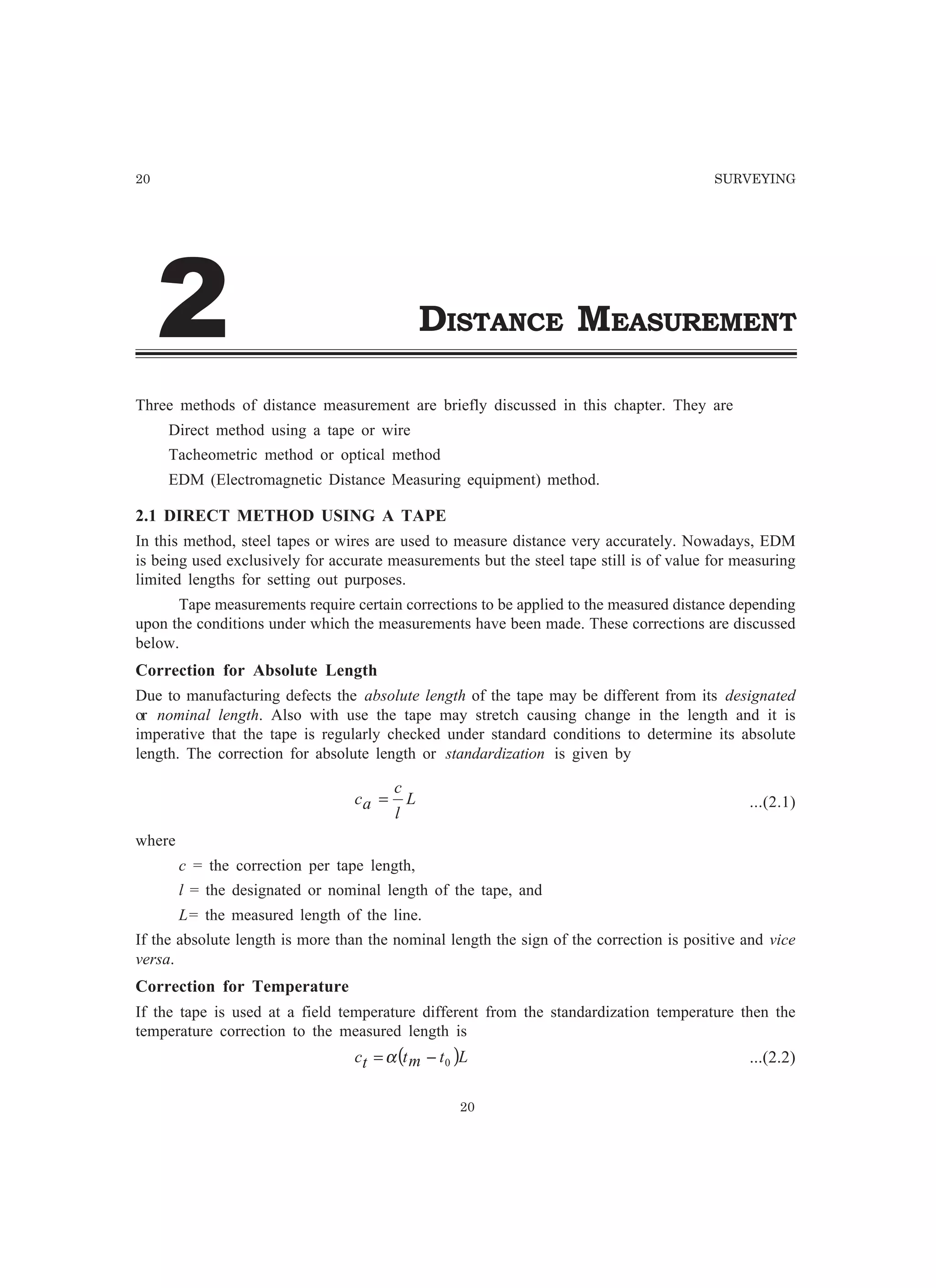
the following results:
7.8621, 7.8632, 7.8630, 7.8646, 7.8642, 7.8652, 7.8620, 7.8638, 7.8631, 7.8641, 7.8630, 7.8640, 7.8630,
7.8637, 7.8633, 7.8630.
Compute the mean and the standard error of the mean of the observations.
2. Calculate the standard error of the volume of a cuboid whose sides x, y, and z have the values
and standard errors as under:
x = 60 ± 0.03 cm, y = 50 ± 0.02 cm, z = 40 ± 0.01 cm.
3. Compute the area, error in the area, and the standard error of the area for Fig. 1 using the
following data:
a = 50.30 ± 0.01 m
b = 82.65 ± 0.03 m
r = 9.50 ± 0.02 m.
The measurements were made with 30 m tape standardized at 30° C and the field temperature
during the measurements was 50° C. Take coefficient of linear expansion = 1.15 × 10⁻⁵
per ° C.
4. A single measurement of an angle has the standard deviation of ± 2.75″. To get the standard
error of the mean of a set of angles as 1″ how many measurements should be made in similar
conditions?
5. In Fig. 2, the sides PQ and QR of a Weisbach triangle used in an underground traverse measure
(2.965 ± 3) m and (2.097 ± 2) m, respectively. The Approximate value of the angle QRP is 6′50″
and the standard error of the angle PRS is ± 4″. Calculate how many times this angle QRP should
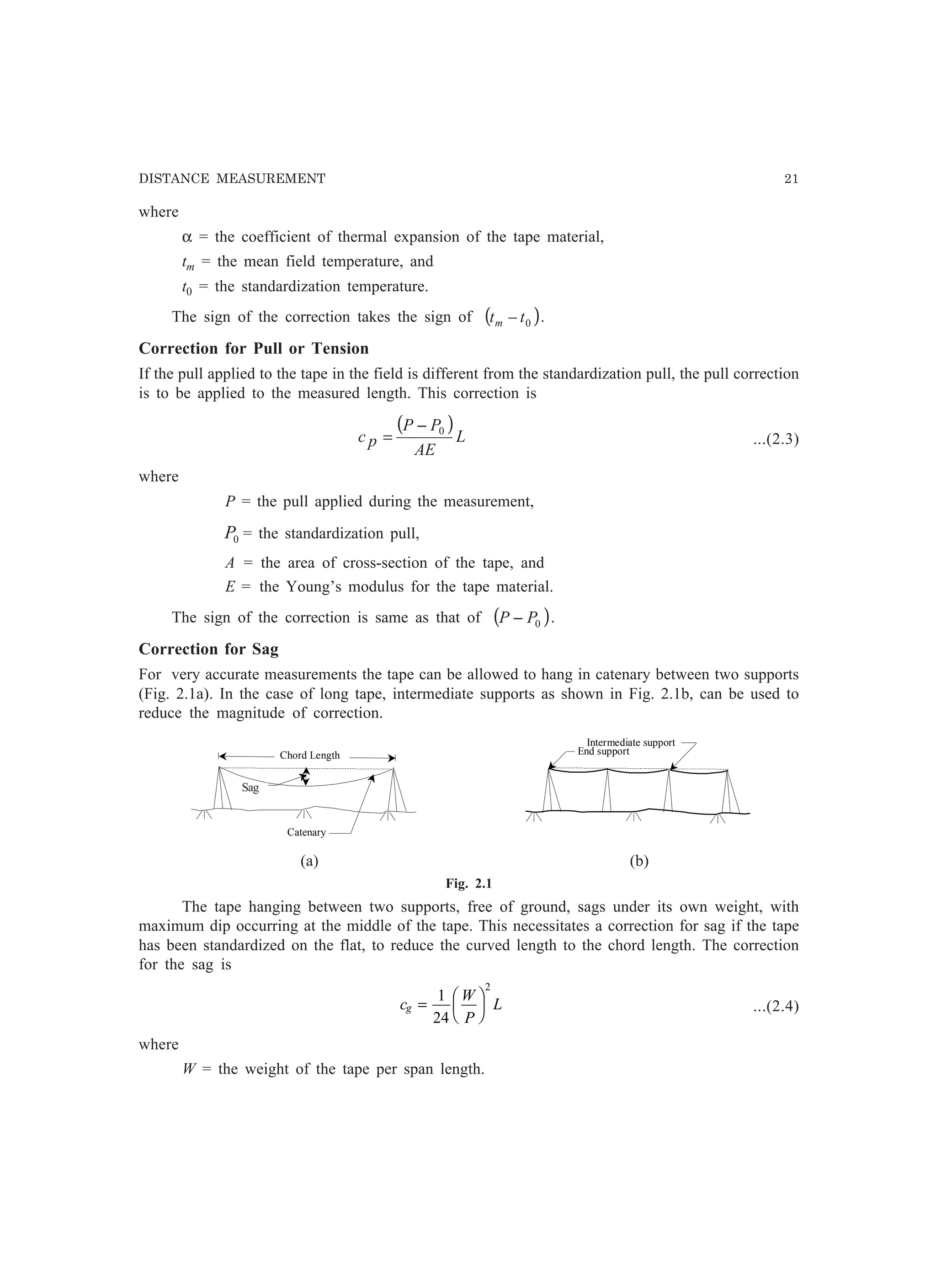
be measured in order that the standard error of the bearing of RS is not to exceed 5″. The standard
error of a single measurement of the angle QRP is estimated to be ±10² and assume that the
bearing of PQ is known without error.
R
P
Q To S
Fig. 2
6. A line AB was measured in segments along sloping ground with a 30 m tape, and the following
measurements were recorded:
Fig. 1
Hole of radius r
a
b a
310
SELECTED PROBLEMS 311
Slope Difference in
distance (m) elevation (m)
30.00 1.58
30.00 0.95
18.92 0.90
11.46 0.56
30.00 3.01
8.23 0.69
What is horizontal length of the line AB ?
7. A line was measured by a 30 m tape in five bays, and the following results were obtained:
Bay Span length Rise/fall between
(m) the ends of span (m)
1 29.60 0.0
2 29.80 – 0.21
3 29.40 0.0
4 29.60 + 0.31
5 26.00 – 0.04
The field temperature and pull as measured were 10° C and 175 N.
The tape was standardized on the flat under a pull of 125 N at temperature 20° C. If the top of
the first peg is at 250.00 m from the mean sea level, calculate the correct length of the line reduced
to mean sea level. Take mean radius of the earth as 6372 km.
Tape details:
Tape density ρ = 77 kg/m3
Cross-sectional area A = 6 mm2
Coefficient of linear expansion α = 0.000011/°C
Modulus of elasticity of tape material E = 207 kN/mm2
8. The length of a steel tape found to be exactly 30 m at a temperature of 30° C under pull of 5
kg when lying on the flat platform. The tape is stretched over two supports between which the
measured distance is 300.000 m. There are two additional supports in between equally spaced.
All the supports are at same level; the tape is allowed to sag freely between the supports.
Determine the actual horizontal distance between the outer supports, and its equivalent reduced
mean sea level distance if the mean temperature during the measurements was 37° C and the pull
applied was 9kg. The average elevation of the terrain is 1500 m. Take tape details as below:
Weight = 1.50 kg
Area of cross-section = 6.5 mm2
Coefficient of linear expansion = 1.2 × 10⁻⁵
/°C
Modulus of elasticity of tape material E = 2.1 × 10⁶
kg/cm2
Mean earth, radius = 6372 km.
312 SURVEYING
9. A 30 m tape weighing 0.900 kg has a cross-sectional area 0.0485 cm2
. The tape measures
30.000 m when supported throughout under a tension of 5 kg. The modulus of elasticity is
2.1 × 10⁶
kg/cm2
. What tension is required to make the tape measure 30 m when supported only
at the two ends ?
10. The length of an embankment was measured along its surface as 25.214 m using a steel tape under
a pull of 25 N at a temperature of 10° C. If the top and bottom of the embankment are at levels
of 75.220 m and 60.004 m, respectively, and the tape was standardized on the flat at 20° C under
a pull of 49 N, what is the embankment gradient ?
Tape details
Cross-sectional area = 6 mm2
Coefficient of linear expansion = 0.000011/°C
Modulus of elasticity of tape material = 207000 MN/mm2
.
11. A steel tape of nominal length 200 m with a plumb bob of mass 16 kg attached to it was used
to measure a length down a shaft as 160.852 m. The mean temperature during the measurement
was 4° C. If the tape was standardized to be 200.0014m under a tension of 115 N at 20° C
temperature, determine the correct measured length.
The following data may be used:
Mass of tape = 0.07 kg/m
Cross-sectional area of tape = 10 mm2
Coefficient of linear expansion α = 11 × 10–6
/°C
Modulus of elasticity = 2 × 10⁵
N/mm2
Acceleration due to gravity = 9.807 m/s2
.
12. A distance is measured along a slope with an EDM which when corrected for meteorological
conditions and instrument constants, is 714.652 m. The EDM is 1.750 m above the ground, and
the reflector is located 1.922 m above ground. A theodolite is used to measure a vertical angle
of + 4°25′15″ to a target placed 1.646 m above ground. Determine the horizontal length of the
line.
13. With a theodolite set 1.58 m above station A, a sight is taken on a staff held at station B. The
staff intercept 1.420 m with middle cross hair reading 3.54 m, and vertical angle – 5°13′. With the
instrument set 1.55 m above station B, a sight is taken on the staff held at station A. The staff
intercept is 1.430 m with middle cross hair reading as 2.35 m, and the vertical angle + 6°00′. The
instrument is internal focussing with constants k = 101 and c = 0. What is the average length
of AB and the average difference in elevation between the two points ?
14. A tacheometer was set up at station A with trunion axis 1.18 m above ground, and due to some
obstruction in line of sight only reading of upper stadia wire could be recorded as 2.022 with
vertical angle as + 3°05′, on the staff held vertically at station B. The line joining A and B has
a gradient of 1 in 20. If the tacheometric constants are as k = 100 and c = 0, calculate the other
staff readings and the horizontal distance AB.
15. To determine the gradient of a line AB, the following data were collected from a station T with
staff held vertical using a tacheometer having the constants as k = 100 and c = 0 m.
SELECTED PROBLEMS 313
Tacheometer Staff at Bearing Vertical Staff readings
at observed at T angle (m)
A 120°15′ + 7°35′ 1.410, 1.965, 2.520
B 206°15′ + 4°10′ 1.655, 2.475, 3.295
Determine the gradient of the line AB.
16. A base line AB was measured in two parts AC and CB of lengths 1540 m and a9a9 m, respectively,
with a steel tape, which was exactly 30 m at 20° C at pull of 10 kg. The applied pull during the
measurements for both parts was 25 kg, whereas the respective temperatures were 40° C and 45°
C. The ground slope for AC and CB were + 2°40′ and + 3°10′, respectively, and the deflection
angle for CB was 11° R. Determine the correct length of the base line. The cross-section of the
tape is 0.025 cm2
, the coefficient of linear expansion is 2.511 × 10⁻⁶
/°C, and the modulus of
elasticity is 2.1´105
kg/cm2
.
17. The following observations were made using a tacheometer (k = 100 and c = 0 m). A point P
is on the line AB and between the stations A and B, and another point Q is such that the angle
ABQ is 120°.
Tacheometer at Staff at Vertical angle Staff readings (m)
P (hI = 1.45 m) A (hA = 256.305 m) – 7°15′ 2.225, 2.605, 2.985
B – 3°30′ 1.640, 1.920, 2.200
Q (hI = 1.51 m) B + 9°34′ 0.360, 0.900, 1.440
hI = Height of instrument above ground
hA = Elevation of A above m.s.l.
Determine
(i) the distance AQ,
(ii) the elevation of Band Q, and
(iii) the gradient of line AQ.
18. A back sight of 3.0545 m is taken on a point 50 m from the level. A for sight 2.1604 m is taken
on a point 200 m from the level. Compute the correct difference in level between the two points,
taking into effect of
(i) curvature, and
(ii) curvature and refraction.
19. Sighting across a lake 40 km wide through a pair of binoculars, what is the height of a shortest
tree on the opposite shore whose tip the observer can see if the eyes are 1.70 m above the
shoreline on which he stands ?
20. The line of sight rises at the rate of 0.143 m in 100 m when the level bubble is centered. A back
sight of 1.713 m is taken on a point P at a distance of 25 m from the level, and a fore sight of
1.267 m is taken from a point Q at a distance of 60 m from the level. If the elevation of P is 111.000
m, what is the elevation of Q ?
21. A line of levels is run from B.M.-1 (elevation = 100.00 m) to B.M.-2 (elevation = 104.00 m). The
field observations were recorded as given below:
T
314 SURVEYING
Station B.S. I.S. F.S. Remarks
1 4.95 B.M.-1
2 2.65
3 5.60 3.45
4 – 3.90 – 2.60
5 2.50
6 1.50 B.M.-2
Reduce the levels of points 2, 3, 4, and 5. Determine the total error of closure, and adjust the
values.
22. The following figures were extracted from a level filed book; some of the entries eligible because
of exposure to rain. Insert the missing figures, and check your results.
Station B.S. I.S. F.S. H.I. R.L. Remarks
1 ? 279.08 277.65 B.M.-1
2 2.01 ?
3 ? 278.07
4 3.37 0.40 278.68
5 2.98 ?
6 1.41 280.64
7 ? 281.37 B.M.-2
23. A staff is held at a distance of 200 m from a level, and a reading of 2.587 m is obtained. Calculate
the correct reading for curvature and refraction.
24. The following results were obtained in reciprocal leveling across a river for staff held vertically
at stations at X and Y from level stations A and B on each bank of a river, respectively.
Staff reading at X from A = 1.753 m
Staff reading at Y from A = 2.550 m
Staff reading at X from B = 2.080 m
Staff reading at Y from B = 2.895 m
Calculate the elevation of Y if the elevation of X is 101.30 m above mean sea level.
25. In order to check the adjustment of a tilting level, the following procedure was followed. Pegs
A, B, C, and D were set out on a straight line such that AB = BC = CD = 30 m. The level was
set up at B, and readings were taken to a staff at A then at C. The level was then moved to D,
and readings were again taken to a staff held first at A and then at C. The readings are given
below:
Instrument Staff reading (m)
position A C
B 1.926 1.462
D 2.445 1.945
Determine whether or not the instrument is in adjustment and if not, explain how the instrument
can be corrected.
SELECTED PROBLEMS 315
26. A tilting level is set up with the eyepiece vertically over a peg A. The height of the center of the
eyepiece above A was measured to be 1.516 m. The reading on a vertically held staff at a peg B,
was found to be 0.0696 m. The positions of the level and staff were interchanged, and the measured
height of the center of the eyepiece above B was 1.466 m, and the staff reading at A was 2.162 m.
Determine the difference in level between A and B. Also ascertain from the readings the adjustment
of line of collimation, and calculate the correct reading on the staff at A.
27. During levelling it was found that the bubble was displaced by two divisions off the centre when
the length of the sight was 100 m. If the angular value of one division of the bubble tube is 20²,
find the consequent error in the staff reading. What is the radius of the bubble tube if one
graduation is 2 mm long?
28. Levelling was done to determine the levels of two pegs A and B, and to determine the soffit level
of an over bridge. Using the values of staff readings given the following table, and given that
the first back sight is taken on a bench mark at a temple (R.L. = 75.630 m), and the final fore sight
is on a bench mark at P.W.D. guest house (R.L. = 75.320 m) determine the closing error.
Could a lorry 5.5 m high pass under the bridge?
Staff reading Remarks
(m)
1.275 B.S. on B.M. at temple (R.L. = 75.630 m)
2.812 F.S. on C.P.1
0.655 B.S. on C.P.1
– 3.958 Inverted staff to soffit of bridge
1.515 Ground level beneath center of bridge
1.138 F.S. on C.P.2
2.954 B.S. on C.P.2
2.706 Peg A
2.172 Peg B
1.240 F.S. on B.M. at P.W.D. (R.L. = 75.320 m)
29. To check the rail levels of an existing railway, seven points were marked on the rails at regular
intervals of 20 m, and the following levels were taken:
Point B.S. I.S. F.S. Remarks
2.80 B.M. A = 38.40 m
1 0.94
2 0.76
3 0.57
4 1.17 0.37
5 0.96
6 0.75
7 0.54
Reduce the levels of the points by rise and fall method, and carry out appropriate checks. If the
levels of the points 1 and 7 were correct, calculate the amount by which the rails are required
to be lifted at the intermediate points to give a uniform gradient throughout.
316 SURVEYING
30. To determine the collimation adjustment of a level, readings were taken on two bench marks X
and Y 53.8 m apart having elevations of 187.89 m and 186.42 m, respectively, the readings being
0.429 and 1.884, respectively. The distance of the level at P from Y was 33.8 m. What is the
collimation error per 100 m ? If further reading of 2.331 is taken from P on a point Z 71.6 m from
P, what is the elevation of Z ?
31. To determine the reduced level of a point B, the vertical angle to B was measured as + 1°48′15″
from a point A having reduced level of 185.40 m. The vertical angle from B to A was also measured
as – 1°48′02″. The signal heights and instrument heights at A and B were 3.10 mand 4.50 m, and
1.35 m and 1.36 m, respectively. The geodetic distance AB is 5800 m. If the mean radius of the
earth is 6370 km determine (a) the reduced level of B and (b) the refraction correction.
32. The following observations were obtained for a closed-link traverse ABCDE.
Station Clockwise Length
angle (m)
A 260°31′18″ –
B 123°50′42″ 129.352
C 233°00′06″ 81.700
D 158°22¢48″ 101.112
E 283°00′18″ 94.273
The observations were made keeping the bearings of lines XA and EY, and the coordinates of
A and E, fixed as below:
W.C.B. of XA = 123°16′06″
W.C.B. of EY = 282°03′00″
Coordinates of A = E 782.820 m N 460.901 m
Coordinates of E = E 740.270 m N 84.679 m
Obtain the adjusted values of the coordinates of stations B, C, and D by Bowditch’s method.
33. Determine the coordinates of the intersection of the line joining the traverse stations A and B
with the line joining the stations C and D if the coordinates of the traverse stations are as below.
Station Easting Nothing
(m) (m)
A 4020.94 5915.06
B 4104.93 6452.93
C 3615.12 5714.61
D 4166.20′ 6154.22
34. A theodolite traverse was run between two points A and B with the following observations:
Line Bearing Length (m)
A-1 86°37′ 128.88
1-2 165°18′ 208.56
2-3 223°15′ 96.54
3-B 159°53′ 145.05
Calculate the bearing and distance of point B from point A.
SELECTED PROBLEMS 317
35. Calculate the lengths of the lines BC and CD from the following observations made for a closed
traverse ABCDE.
Line Length (m) Bearing ∆E (m) ∆N (m)
AB 104.85 14°31′ + 26.29 + 101.50
BC – 319°42′ – –
CD – 347°15′ – –
DE 91.44 5°16′ + 8.39 + 91.04
EA 596.80 168°12′ + 122.05 – 584.21
36. The following table giving lengths and bearings of a closed-loop traverse contains an error in
transcription of one of the values of length. Determine the error.
Line AB BC CD DE EA
Length (m) 210.67 433.67 126.00 294.33 223.00
Bearing 20°31′30″ 357°16′00″ 120°04′00″ 188°28′30″ 213°31′00″
37. A traverse was run between two points P and Q having the coordinates as E1268.49 m, N1836.88
m, and E1375.64 m, N1947.05 m, respectively. The field observations yielded the following values
of eastings and northings of the traverse lines.
Line Length (m)
∆E (m) ∆N (m)
+ – + –
AB 104.65 26.44 – 101.26 –
BC 208.96 136.41 – 158.29 –
CD 212.45 203.88 – – 59.74
DE 215.98 – 146.62 – 158.59
EA 131.18 – 112.04 68.23 –
Calculate the adjusted coordinates of A, B, C, and D using Bowditch’s method.
38. The two legs AB and BC of a traverse and the angle ABC as measured are 35.50 m, 26.26 m, and
135°, respectively. Calculate the resulting maximum error in the measurement of the angle due to
the centering error of ± 2 mm.
39. In a certain theodolite it was found that the left-hand end of the trunion axis is higher than the
right-hand end making it to incline by 30″ to the horizontal. Determine the correct horizontal angle
between the targets A and B at the theodolite station from the following observations.
Pointings Horizontal circle Vertical circle
reading (face right) reading
A 246°18′53″ + 63°22′00″
B 338°41′28″ + 12°16′20″
40. The bearing and length of a traverse line are 38°45′20″ and 169.08 m, respectively. If the standard
deviations of the two observations are ±20″ and ±50 mm, respectively, calculate the standard
deviations of the coordinate differences of the line.
41. In some levelling operation, rise (+) and fall (–) between the points with their weights given in
parentheses, are shown in Fig. 3.
318 SURVEYING
θ1
θ2
θ3
θ4
θ5
θ6
A
B
C
D
Fig. 3
Given that the reduced level of P as 134.31 m above datum, determine the levels of Q, R, and
S.
42. In a triangulation network shown in Fig. 4, the measured angles are as follows:
θ1 = 67°43′04″, θ4 = 29°38′52″
θ2 = 45°24′10″, θ5 = 63°19′35″
θ3 = 37°14′12″, θ6 = 49°47′08″
Adjust the angles to the nearest seconds assuming that θ1 and θ6 are of twice the weight of
the other four.
43. Three stations A, B, and C have the coordinates E 2000.00 m, N 2000.00 m, E 1000.00 m, N 267.95
m, and E 0.00 m, N 2000.00 m, respectively. The following readings have been recorded by a
theodolite set up at a station P very near to the centre of the circle circumscribing stations A,
B, and C :
Pointings on A B C
Horizontal circle 00°00′00″ 119°59′51.0″ 240°00′23.5″
reading
Determine the coordinates of P.
44. By application of the principle of least squares Determine the most probable values of x and y
from the following observations using the least squares method. Assume that the observations
are of equal weights.
2x + y = + 1.0
x + 2y = – 1.0
x + y = + 0.1
x – y = + 2.2
2x = + 1.9.
45. In a braced quadrilateral shown in Fig. 5, the angles were observed as plane angles with no
spherical excess:
θ1 = 40°08′17.9″, θ2 = 44°49′14.7″
θ3 = 53°11′23.7″, θ4 = 41°51′09.9″
Fig. 4
SELECTED PROBLEMS 319
θ5 = 61°29′34.3″, θ6 = 23°27′51.2″
θ7 = 23°06′37.3″, θ8 = 71°55′49.0″
Fig. 5
Determine the most probable values of the angles by rigorous method.
46. Directions ware observed from a satellite station S, 200 m from a station C, with the following
results:
∠A = 00°00′00″
ÐB = 62°15′24″
∠C = 280°20′12″.
The approximate lengths of AC and BC are 25.2 km and 35.5 km, respectively. Calculate the ∠ACB.
47. The altitudes of the proposed triangulation stations A and B, 130 km apart are respectively
220 m and 1160 m. The altitudes of two peaks C and D on the profile between A and B, are
respectively 308 m and 632 m, the distances AC and AD being 50 km and 90 km. Determine
whether A and B are intervisible, and if necessary, find the minimum height of scaffolding at B,
assuming A as the ground station.
48. Calculate the data for setting out the kerb line shown in Fig. 6 if R = 12 m and ∆ = 90°. Calculate
the offsets at 2 m interval.
Fig. 6
49. Derive data needed to set out a circular curve of radius 600 m by theodolite and tape (deflection
angle method) to connect two straights having a deflection angle 18°24′, the chainage of the
intersection point being 2140.00 m. The least count of the is 20″.
50. A circular curve of radius 300 m is to be set out using two control stations A and B, their
coordinates being E 2134.091 m, N 1769.173 m and E 2725.172 m, N 1696.142 m, respectively. The
chginage of the first tangent point having coordinates E 2014.257 m, N 1542.168 m is 1109.27 m.
If the coordinates of the point of intersection are E 2115.372 m and N 1593.188 m, calculate the
bearing and distance from A required to set out a point X on the curve at chainage 1180 m.
51. Two straights AB and CD having bearings as 30° and 45°, respectively, are to be connected CD
by a continuous reverse curve consisting of two circular curves of equal radius and four
transition curves. The straight BC, 800 m long, having bearing of 90°, is to be the common tangent
to the two inner transition curves. What is the radius of the circular curves if the maximum speed
is to be restricted to 80 km/h and a rate of change of radial acceleration is 0.3 m/s3
? Give (a)
the offset, and (b) the deflection angle with respect to BC to locate the intersection of the third
transition curve with its circular curve.
θ1 θ2
θ3
θ4
θ5
θ6
θ7
θ8
320 SURVEYING
52. It is required to connect two straights having a total deflection angle of 18°36′ right by a circular
curve of 450 m radius and two cubic spiral transition curves at the ends. The design velocity
is 70 km/h, and the rate of change of radial acceleration along the transition curve is not to exceed
0.3 m/s3
. Chainage of the point of intersection is 2524.20 m. Determine (a) length of the transition
curve, (b) shift of the circular curve, (c) deflection angles for the transition curve to locate the
points at 10 m interval, and (d) deflection angles for the circular curve at 20 m intervals.
53. If the sight distance equals half the total length of the curve, g1 = +4% and g2 = –4%, and the
observer’s eye level h = 1.08 m, calculate the length of the vertical curve.
54. A gradient of +2% is to be joined to a gradient –4/3% by a vertical curve with a sight distance
of 200 m at 1.05 m above ground level. Determine the chainage and level of the two tangent points
for the highest point on the curve at chainage 2532.00 m and level 100.23 m.
55. In a modification, a straight sloping at –1 in 150 is to be changed to a gradient of +1 in 100, the
intervening curve being 400 m in length. Assuming the curve to start at a point A on the negative
gradient, calculate the reduced levels of pegs at 50 intervals which you set out in order to
construct the curve, assuming the reduced level of A to be 100 m.
56. Determine the area in hectares enclosed by a closed traverse ABCDE from the following data.
Station Easting Nothing
(m) (m)
A 181.23 184.35
B 272.97 70.05
C 374.16 133.15
D 349.78 166.37
E 288.21 270.00
57. Using the data given below to determine the volume of earth involved a length of the cutting
to be made in ground:
Transverse slope = 1 in 5
Formation width = 8.00 m
Side slopes = 1 in 2
Depths at the centre lines of three sections, 20 m apart = 2.50, 3.10, 4.30 m.
Get the results considering
(a) The whole cutting as one prismoid.
(b) End-areas formula with prismoidal correction.
58. A 10 m wide road is to be constructed between two point A and B, 20 m apart, the transverse
slope of the original ground being 1 in 5. The cross-sections at A and B are partly in cut with
0.40 m cut depth at the centre line and partly in fill with 0.26 m fill at the centre line. The respective
side slopes of cut and fill are 1 vertical in 2 horizontal, and the centre line of the road AB is a
curved line of radius 160 m in plan. Determine the net volume of earthworks between the two
sections.
59. A dam is to be constructed across a valley to form a reservoir, and the areas in the following
table enclosed by contour loops were obtained from a plan of the area involved.
(a) If the 660 m level represents the level floor of the reservoir, use the prismoidal formula to
calculate the volume of water impounded when the water level reaches 700 m.
SELECTED PROBLEMS 321
(b) Determine the level of water at which one-third of the total capacity is stored in the reservoir.
(c) On checking the calculations it was found that the original plan from which the areas of
contour loops had been measured had shrunk evenly by approximately 1.2 % of linear
measurement. What is the corrected volume of water?
Contour (m) 660 665 670 675 680 685 690 695 670
Area 5200 9400 16300 22400 40700 61500 112200 198100 272400
60. A point X having the cordinates as E1075.25 m, N 2000.25 m, is to be set out using two control
points P (E 1050.25 m, N 2050.25 m) and Q (E 1036.97 m, N 1947.71 m) by two linear mesurements
alone. Calculate the necessary data to fix X.
61. A length of sewer PRQ is to be constructed in which the bearings of RP and RQ are 205°02′ and
22°30′, respectively. The coordinates of the manhole at R are E 134.17 m, N 455.74 m. A station
A on the nearby traverse line AB has coordinates E 67.12 m, N 307.12 m, the bearing of AB being
20°55′. Considering a point M on AB such that MR is at right angles to AB, derive the data to
set out the two lengths of sewer.
62. The coordinates of three stations A, B, and C are respectively E 11264.69 m, N 21422.30 m, E
12142.38 m, N 21714.98 m, and E 12907.49 m, N 21538.66 m. Two unknown points P and Q lie to
the southerly side of AC with Q on the easterly side of point P. The angles measured are ∠APB
= 38°15′47″, ∠BPC = 30°38′41″, ∠CPQ = 33°52′06″, and ∠CQP = 106°22′20″. Calculate the length
and bearing of the line PQ.
63. During a shaft plumbing exercis, two surface reference stations A (E 1000.00 m, N 1000.00 m) and
B (E 1300.00 m, N 1500.00 m) were observed with a theodolite placed at a surface station X near
to the line AB. The observations were also made on two plumb wires P and Q, the distances XA,
XP, and PQ being 269.120 m, 8.374 m, and 5.945 m, respectively, when P is nearer to X than Q.
The measured horizontal angles at X from a reference mark M are as ∠MXA = 273°42′24″,
∠MXB = 93°42¢08″, ∠MXP = 98°00′50″, and ∠MXQ = 98°00′40″. Calculate the bearing of PQ.
ANSWERS TO SELECTED PROBLEMS
1. 17.8635 m, ± 2.128 × 10⁻⁴
m. 2. ± 82 cm3
. 3. 5138.82 m2
, 2.43 m2
, ± 2.34 m2
4. 8. 5. 6. 6. 128.34 m.
7. 144.38 m. 8. 299.92 m. 9. 16.95 kg.
10. 1 in 1.32. 11. 160.835 m. 12. 712.512 m.
13. 142.54 m, 14.58m. 14. 1.122, 1.072, 94.73 m. 15. 1/60.33.
16. 3420.65 m. 17. 204.43 m, 263.092 m, 244.783 m, 1 in 18.
18. (i) 0.8969 m, (ii) 0.8966 m. 19. 14.62 m. 20. 111.496 m.
21. R.L.’s: 102.30 m, 101.50 m, 109.70 m, 103.30 m, Closing error: + 0.30 m, Adjusted values:
102.30 m, 101.40 m, 109.50 m, 103.10 m.
22. B.S.: 1.43 m, I.S.: 1.01 m, F.S.: 0.68 m, H.I.: 282.05 m, R.L.’s: 277.07 m, 279.07 m.
23. 2.584 m. 24. 100.49 m. 25. Line of collimation up by + 2′4″.
26. 0.758 m, 2.224 m. 27. 19 mm, 20.627 m.
28. 73.858 m, 74.392 m, 4 mm, No, Clearance under bridge: 5.473 m.
29. 0.02, 0.03, 0.03, 0.02, 0.01. 30. 27.9 mm, 185.984 m. 31. (a) 367.21 m, (b) 13.4″.
32. E 730.630 m and N 342.553 m, E 774.351 m and N 273.541 m, E 738.688 m and N 178.933 m.
33. E 4042.93 m and N 6055.88 m. 34. 157°35′, 433.41 m. 35. 143.73 m, 289.15 m.
36. BC = 343.67 m. 37. Coordinates of C: E 1634.67 m, N 2037.13 m.
38. 25.3″. 39. 92°23′28″. 40. σ∆E = ±34 mm, σ∆N = ±40 mm.
41. Q 138.64 m, R 141.78 m, S 144.34 m.
42. 45°23′59″, 29°38′51″, 67°42′59″, 37°14′11″, 63°19′45″, 49°47′13″.
43. E 999.92 m, N 1422.57 m. 44. x = + 1.02, y = – 1.05.
45. θ1 = 48°08′15.23″, θ8 = 71°55′52.62″. 46. 62°00′31″.
47. 5.50 m. 48. At x = 2 m, y = 3.34 m.
49. At chainage 2100.00 m, 02°44′00″. 50. 194°47′01″, 209.791 m.
51. 758.5 m, 0.51 m, 00°36′20″.
52. (a) 54.44 m, (b) 0.27 m, (c) At chainage 2450.00 m, 00°16′40″, (d) At chainage 2560.00 m, 05°14′20″.
53. 216 m. 54. 2443.20 m, 2591.20 m, 99.34 m, 99.83 m.
55. 99.719, 99.541, 99.469, 99.500, 99.635, 99.875, 100.219, 100.667.
56. 1.944 hectares. 57. (a) 2283.3 m3
, (b) 2331.9 m3
.
58. 2.23 m3
(cut). 59. (a) 29.693 × 10⁶ m3
, (b) 669.8 m, (c) 30.406 × 10⁶
m3
.
60. AS = 55.90 m, BS = 65.01 m.
61. AR = 163.04 m, AM = 162.76 m, PM = 9.59 m, ∠MRP = 85°53′, ∠MRQ = 91°35′.
62. 1013.27 m, 68°10′10″. 63. 35°16′00″.
Index
A
Accuracy, 3
Adjustment of survey observation, 122
condition equation, 122
correlates, 124
general method for polygons, 125
method of differences, 124
method of least squares, 122
method of variation of coordinates, 124
normal equations, 123
observation equation, 122
Areas, 256
C
Confidence interval, 3
Confidence limit, 3
Correlates, 124
Correction
absolute length, 20
alignment, 22
eye and object correction, 68
phase, 167
prismoidal, 259
pull,21
sag, 21
sea level, 22
slope, 22
slope and height, 36
temperature, 20
Curves, 202
circular, 202
323
D
compound, 204
reverse, 205
setting out, 203
transition, 207
vertical, 208
Datum, 59
Departure, 93
Digital terrain model (DTM), 261
Digital elevation mod~l (DEM), 261
E
Eccentricity of signal, 168
Electromagnetic distance measurement
(EDM),30
effect of atmospheric conditions 34,
refractive index ratio, 34
slope and height correction, 36
Elongation of steel tape, 24
Error
G
due to maladjustment of theodolite, 90
most probable, 3
propagation, 3
pull, 23
root mean square, 2
standard, 2
types of, 1
Geodetic triangle, 176
324
L
Latitude, 93
Levelling, 59
back sight, 61
balancing of sights, 61
booking and reducing the levels, 61
change point, 61
datum, 59
differential, 60
eye and object correction, 68
fore sight, 61
height of instrument method, 61
intermediate sight, 61
level line, 59
level surface, 59
loop closure, 64
reciprocal, 64
reduced level, 62
rise and fall method, 62
section, 62
sensitivity of level tube, 67
trigonometric, 65
two peg test, 67
Level surface, 59
M
Mass-haul diagram, 262
free-haul, 263
haul, 263
overhaul, 263
Most probable error, 3
Most probable value, 1
N
Normal distribution, 5
Normal equations, 123
o
Omitted observations, 95
Optical method, 26
p
Phase difference, 31
Planimeter, 258
Precision, 3
Probability distribution, 1
Profile board, 290
Propagation of error, 3
R
SURVEYING
Reduction to mean sea level, 22
Reciprocal levelling, 64
Reduced level, 62
Reduction to centre, 168
Root mean square error, 2
S
Satellite station, 168
Sensitivity of level tube, 67
Setting out, 287
Sight rails, 289
Simpson's rule, 257
Spherical triangle, 176
errors due to mahtdjustment of, 90
Stadia tacheometry, 26
Standard error, 2
Standard deviation, 2
Subtense tacheometry, 27
T
Tacheometric method, 26
stadia, 26
sutense, 27
Tape correction, 21
INDEX
absolute length, 20
alignment, 22
pull,21
sag, 21
sea level, 22
slope, 22
temperature, 20
Theodolite, 89
horizontal circle, 89
line of collimation, 89
line of sight, 89
plate level, 89
telescope level, 89
vertical circle, 89
Trapezoidal rule, 257
Traversing, 92
balancing, 94
Bowditch's method, 94
closed, 92
closed-loop, 92
consecutive coordinates, 93
departure and latitude, 93
omitted observations, 95
open, 92
transit rule, 95
types of traverse, 92
Triangulation, 166
convergence of meridians, 178
Earth's curvature, 177
eccentricity of signal, 168
geodetic triangle, 176
intersected point, 170
phase correction, 167
reduction of slope distance, 173
reduction to centre, 168
resected point, 170
satellite station, 168
spherical triangle, 176
strength of figure, 166
Trigonometric levelling, 65
Trilateration, 166
Two peg test, 67
v
Variance, 2
Volumes, 258
end-areas rule, 258
free-haul, 263
haul,263
mass-haul diagram, 262
overhaul, 263
prismoidal rule, 258
prismoidal correction, 259
W
Weight, 3
Weisbach triangle 288
325

Surveying problem solving

  • 1.
  • 2.
  • 3.
  • 4.
    Surveying Dr AM Chandra Prof.of Civil Engineering Indian Institute ofiedmology Roorkee NEW AGE NEW AGE INTERNATIONAL(P) LIMITED, PUBLISHERS New Delhi' Bangalore ' Chennai ' Cochin' Guwahati ' Hyderabad Jalandhar· Kolkala· Lucknow· Mumbai' Ranchi Visit us at www.newagepublishers.com
  • 5.
    Copyright © 2005,NewAge International (P) Ltd., Publishers Published by NewAge International (P) Ltd., Publishers All rights reserved. No part of this ebook may be reproduced in any form, by photostat, microfilm, xerography, or any other means, or incorporated into any information retrieval system, electronic or mechanical, without the written permission of the publisher. All inquiries should be emailed to rights@newagepublishers.com PUBLISHING FOR ONE WORLD NEWAGE INTERNATIONAL(P) LIMITED, PUBLISHERS 4835/24,Ansari Road, Daryaganj, New Delhi - 110002 Visitusatwww.newagepublishers.com ISBN (13) : 978-81-224-2532-1
  • 6.
  • 7.
  • 8.
    24-.)+- The book adoptsa classical pedagogical approach by providing a vivid insight into the theory of surveying and its application through solving typical problems in the field of surveying. It aims at helping the students understand surveying more comprehensively through solving field related problems. Each chapter of the book commences with a summary of basic theory and a range of worked out examples making it very useful for all undergraduate and postgraduate courses in surveying. Alternative solutions to the problems wherever possible, have also been included for stimulating the budding minds. A number of objective type questions which are now a days commonly used in many competitive examinations, have been included on each topic to help the readers to get better score in such examinations. At the end, a number of selected unsolved problems have also been included to attain confidence on the subject by solving them. The book is also intended to help students preparing for AMIE, IS, and Diploma examinations. The practicing engineers and surveyors will also find the book very useful in their career while preparing designs and layouts of various application-oriented projects. Constructive suggestions towards the improvement of the book in the next edition are fervently solicited. The author expresses his gratitude to the Arba Minch University, Ethiopia, for providing him a conducive environment during his stay there from Sept. 2002 to June 2004, which made it possible for writing this book. The author also wishes to express his thanks to all his colleagues in India and abroad who helped him directly or indirectly, in writing this book. Roorkee —Dr A M Chandra LEE
  • 9.
  • 10.
    CONTENTS 2=CAI 2HAB=?A (LEE) 1. ERRORSIN MEASUREMENTS AND THEIR PROPAGATION 1 1.1 Error Types 1 1.2 Probability Distribution 1 1.3 Most Probable Value 1 1.4 Standard Deviation 2 1.5 Variance 2 1.6 Standard Error of Mean 2 1.7 Most Probable Error 3 1.8 Confidence Limits 3 1.9 Weight 3 1.10 Precision and Accuracy 4 1.11 Propagation of Error 4 1.12 Normal Distribution 5 2. DISTANCE MEASUREMENT 20 2.1. Direct Method Using a Tape 20 2.2. Error in Pull Correction due to Error in Pull 23 2.3. Error in Sag Correction due to Error in Pull 23 2.4. Elongation of a Steel Tape when Used for Measurements in a Vertical Shaft 24 2.5. Tacheometric or Optical Method 26 2.6. Subtense Tacheometry 27 2.7. Effect of Staff Vertically 27 2.8. Effect of Error in Measurement of Horizontal Angle in Subtense Tacheometry 29 2.9. Electromagnetic Distance Measurement (EDM) 30 2.10. Accuracy in Vertical Angle Measurements 36 3. LEVELLING 59 3.1. Levelling 59 3.2. Level Surface 59 EN
  • 11.
    3.3. Datum 59 3.4.Level Line 59 3.5. Direct Differential or Spirit Levelling 60 3.6. Comparison of Methods and their Uses 63 3.7. Loop Closure and its Apportioning 64 3.8. Reciprocal Levelling 64 3.9. Trigonometric Levelling 65 3.10. Sensitivity of a Level Tube 67 3.11. Two-Peg Test 67 3.12. Eye and Object Correction 68 4. THEODOLITE AND TRAVERSE SURVEYING 89 4.1. The Theodolite 89 4.2 Errors due to Maladjustments of the Theodolite 90 4.3 Traverse 92 4.4 Coordinates 92 4.5 Bearing 93 4.6 Departure and Latitude 93 4.7 Easting and Northing 94 4.8 Balancing the Traverse 94 4.9 Omitted Observations 95 4.10 Centring Error of Theodolite 96 4.11 Compatibility of Linear and Angular Measurements 97 5. ADJUSTMENT OF SURVEY OBSERVATIONS 122 5.1. Adjustment of Observations 122 5.2. Method of Last Squares 122 5.3. Observation Equations and Condition Equations 122 5.4. Normal Equation 123 5.5. Least Squares Method of Correlates 124 5.6. Method of Differences 124 5.7. Method of Variation of Coordinates 124 5.8. General Method of Adjusting a Polygon with a Central Station 125 6. TRIANGULATION AND TRILATERATION 166 6.1. Triangulation Surveys 166 6.2. Strength of Figure 166 6.3. Distance of Visible Horizon 167 N
  • 12.
    6.4. Phase ofa Signal 167 6.5. Satellite Station, Reduction to Centre, and Eccentricity of Signal 168 6.6. Location of Points by Intersection and Resection 170 6.7. Reduction of Slope Distance 173 6.8. Spherical Triangle 176 6.9. Effect of Earth’s Curvature 177 6.10. Convergence 178 7. CURVE RANGING 202 7.1. Curves 202 7.2. Circular Curves 202 7.3. Compound Curves 204 7.4. Reverse Curves 205 7.5. Transition Curves 207 7.6. Vertical Curves 208 8. AREAS AND VOLUMES 256 8.1. Areas and Volumes 256 8.2. Areas 256 8.3. Volumes 258 8.4. Heights of Points from a Digital Terrai Model 261 8.5. Mass-Haul Diagram 262 9. POINT LOCATION AND SETTING OUT 287 9.1. Setting Out 287 9.2. Point Location 287 9.3. Intersection and Resection 287 9.4. Transfer of Surface Alignment-Tunnelling 288 9.5. Setting out by Bearing and Distance 289 9.6. Monitoring Movements 289 9.7. Construction Lasers 289 9.8. Sight Rails for a Trench Sewer 289 9.9. Embankment Profile Boards 290 Selected Problems 310 Index 323 NE
  • 13.
  • 14.
    ERRORS IN MEASUREMENTS ANDTHEIR PROPAGATION 1.1 ERROR TYPES Gross errors are, in fact, not errors at all, but results of mistakes that are due to the carelessness of the observer. The gross errors must be detected and eliminated from the survey measurements before such measurements can be used. Systematic errors follow some pattern and can be expressed by functional relationships based on some deterministic system. Like the gross errors, the systematic errors must also be removed from the measurements by applying necessary corrections. After all mistakes and systematic errors have been detected and removed from the measurements, there will still remain some errors in the measurements, called the random errors or accidental errors. The random errors are treated using probability models. Theory of errors deals only with such type of observational errors. 1.2 PROBABILITY DISTRIBUTION If a large number of masurements have been taken, the frequency distribution could be considered to be the probability distribution. The statistical analysis of survey observations has indicated that the survey measurements follow normal distribution or Gaussian distribution, being expressed by the equation, dxedy x 22 1 2/)( 2 1 σµ πσ −− = ...(1.1) where dy is the probability that the value will lie between the limits of x1 and (x1+dx), µ is the true mean of the population, and σ is the standard deviation. 1.3 MOST PROBABLE VALUE Different conditions under which the measurements are made, cause variations in measurments and, therefore, no measured quantity is completely detrminable. A fixed value of a quantity may be concieved as its true value. The difference between the measured quantity and its true value τ is known as error ε, i.e., τε −= x ...(1.2) Since the true value of a measured quantity cannot be determined, the exact value of ε can never be found out. However, if a best estimate xˆ which is known as the most probable value of τ, can be determined, xˆ can be used as a reference to express the variations in x. If we define υ as residual then 1
  • 15.
    2 SURVEYING xx −=ˆυ ...(1.3) The residuals express the variations or deviations in the measurements. 1.4 STANDARD DEVIATION Standard deviation also called the root-mean square (R.M.S.) error, is a measure of spread of a distribution and for the population, assuming the observations are of equal reliability it is expressed as       −Σ ±= n x n 2 )(µ σ ...(1.4) However, µ cannot be determined from a sample of observations. Instead, the arithmetic mean x is accepted as the most probable value and the population standard deviation is estimated as σn x x n − = ± − − L NM O QP1 2 1 Σ ( ) ( ) ...(1.5) or       − Σ ±= )1( 2 n υ ...(1.6) The standard deviation given by the above expression is also called the standard error. Henceforth in this book the symbol σ will mean 1−nσ . 1.5 VARIANCE Variance of a quantity is expressed as 1 2 − Σ = n V υ ...(1.7) or 2 1−= nσ or 2 σ= ...(1.8) and is also used as a measure of dispersion or spread of a distribution. 1.6 STANDARD ERROR OF MEAN The standard error of mean σm is given by       − Σ ±= )1( 2 nn m υ σ ...(1.9) or = n σ ± ...(1.10)
  • 16.
    ERRORS IN MEASUREMENTSAND THEIR PROPAGATION 3 and hence the precision of the mean is enhanced with respect to that of a single observation. There aren deviations (or residuals) from the mean of the sample and their sum will be zero. Thus, knowing (n – 1) deviations the surveyor could deduce the remaining deviation and it may be said that there are (n – 1) degrees of freedom. This number is used when estimating the population standard deviation. 1.7 MOST PROBABLE ERROR The most probable error is defined as the error for which there are equal chances of the true error being less and greater than probable error. In other words, the probability of the true error being less than the probable error is 50% and the probability of the true error being greater than the probable error is also 50%. The most probable error is given by       − Σ ±= )1( 6745.0 2 n e υ ...(1.11) σ6745.0±= ...(1.12) 1.8 CONFIDENCE LIMITS After establishing the sample mean as estimate of the true value of the quantity, the range of values within which the true value should lie for a given probability is required. This range is called the confidence interval, its bounds called the confidence limits. Confidence limits can be established for that stated probability from the standard deviation for a set of observations. Statistical tables are available for this purpose. A figure of 95% frequently chosen implies that nineteen times out of twenty the true value will lie within the computed limits. The presence of a very large error in a set of normally distributed errors, suggests an occurance to the contrary and such an observation can be rejected if the residual error is larger than three times the standard deviation. 1.9 WEIGHT This quantity ω is known as weight of the measurement indicates the reliability of a quantity. It is inversely proportional to the variance ( 2 σ ) of the observation, and can be expressed as ω σ = k 2 where k is a constant of proportionality. If the weights and the standard errors for observations x1, x2, ,….., etc., are respectively 1ω , 2ω ,….., etc., and 1σ , 2σ ,….., etc., and uσ is the standard error for the observation having unit weight then we have 22 22 2 11 ...... uσσωσω === . ...(1.13) Hence ,2 1 2 1 σ σ ω u = ,2 2 2 2 σ σ ω u = etc.,
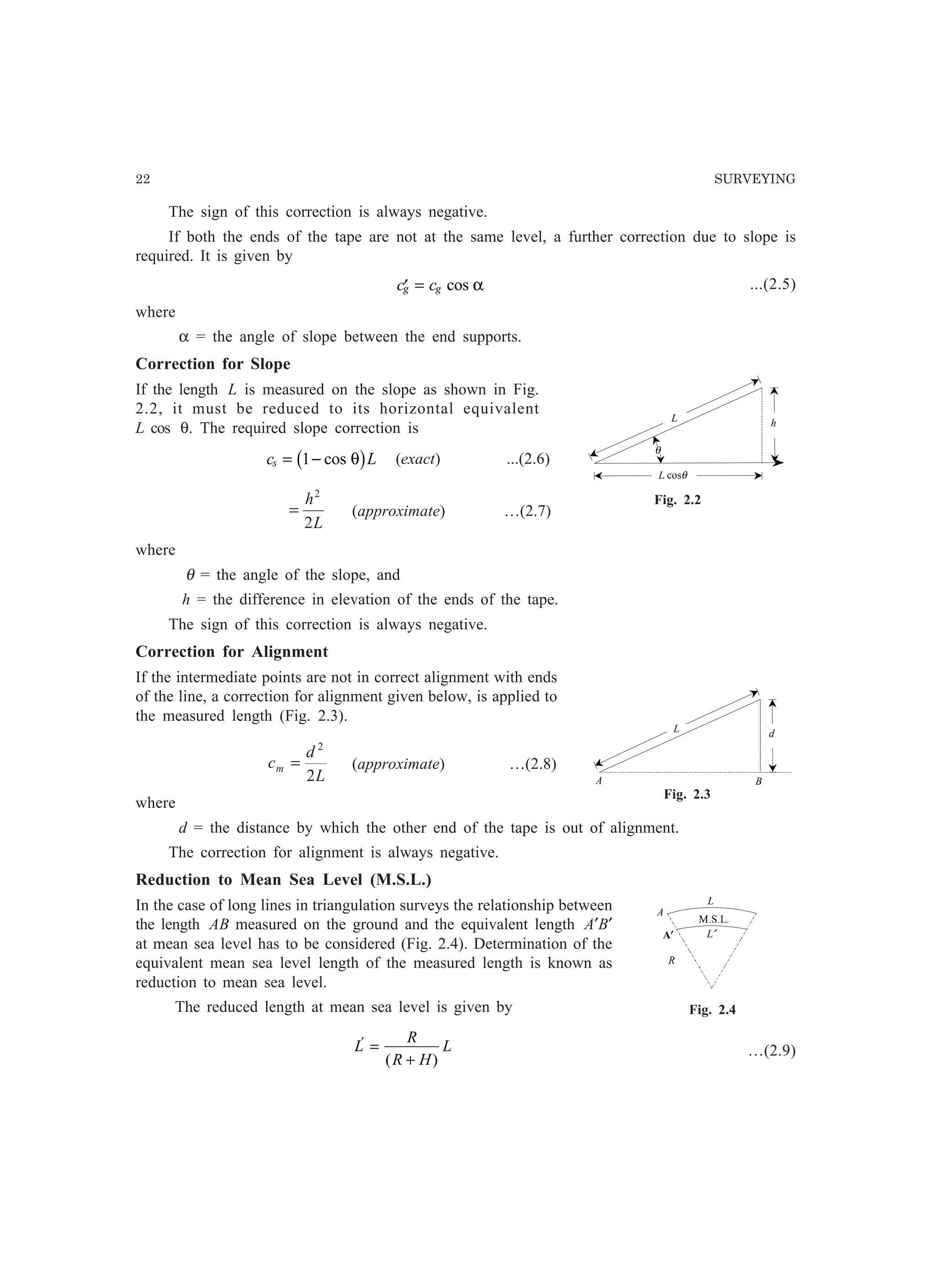
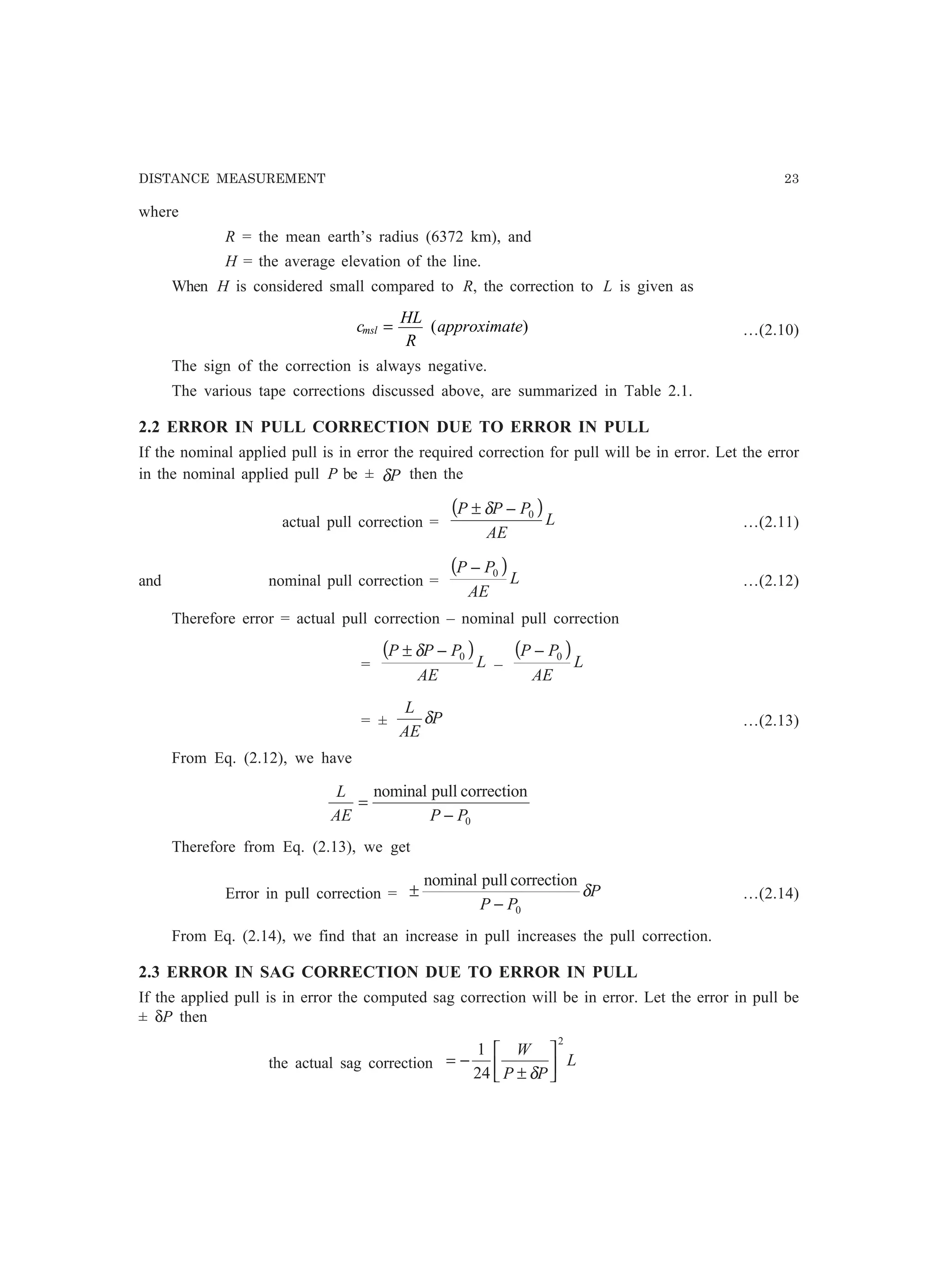
  • 17.
    4 SURVEYING and ,2 1 2 2 2 1 σ σ ω ω =etc. ...(1.14) The weights are applied to the individual measurements of unequal reliability to reduce them to one standard. The most probable value is then the weighted mean xm of the measurements. Thus ( ) ω ω Σ Σ = x xmˆ , ...(1.15) and standard error of the wieghted mean σ ω ω x m m x x n = ± − − L N MM O Q PP Σ Σ ( ) ( ) 2 1 m r ...(1.16) The standard deviation of an observation of unit weight is given by σ ω u mx x n = ± − − L N MM O Q PP Σ ( ) ( ) 2 1 m r ...(1.17) and the standard deviation of an observation of weight nω is given by σ ω ω w m n x x n = ± − − L N MM O Q PP Σ ( ) ( ) 2 1 m r ...(1.18) 1.10 PRECISION AND ACCURACY Precision is the degree of closeness or conformity of repeated measurements of the same quantity to each other whereas the accuracy is the degree of conformity of a measurement to its true value. 1.11 PROPAGATION OF ERROR The calculation of quantities such as areas, volumes, difference in height, horizontal distance, etc., using the measured quantities distances and angles, is done through mathematical relationships between the computed quantities and the measured quantities. Since the measured quantities have errors, it is inevitable that the quantities computed from them will not have errors. Evaluation of the errors in the computed quantities as the function of errors in the measurements, is called error propagation. Let y = f(x1, x2,......., xn) then the error in y is dy f x dx f x dx f x dx n n= + + + ∂ ∂ ∂ ∂ ∂ ∂1 1 2 2 ....... ...(1.19) and the standard deviation of y is 22 2 2 1 2 ........21       ∂ ∂ ++      ∂ ∂ +      ∂ ∂ = nx n xxy x f x f x f σσσσ ...(1.20)
  • 18.
    ERRORS IN MEASUREMENTSAND THEIR PROPAGATION 5 where ,, 21 dxdx ....., etc., are the errors in x1, x2,....., etc., and ,, 21 xx σσ ....., etc., are their standard deviations. In a similar way if nxxxy +++= .......21 then 2222 ........21 nxxxy σσσσ +++= , since 1x f ∂ ∂ , etc. = 1. ...(1.21) And if y = 1kx in which k is free of error σ σy xk= 1 since 1x f ∂ ∂ = k. In the above relationships it is assumed that x1, x2,......., xn are independent implying that the probability of any single observation having a certain value does not depend on the values of other observations. 1.12 NORMAL DISTRIBUTION The expression for the normal distribution is dy e dxx = − −1 2 1 2 22 σ π µ σ( ) / . ...(1.23) Taking σ µ x u − = , the expression becomes dy e duu = −1 2 2 2 π / . ...(1.24) Eq. (1.24) is the standardized form of the above expression, and Fig. 1.1 illustrates the relationship between dy/du and u is illustrated in Fig. 1.1. The curve is symmetrical and its total area is 1, the two parts about u = 0 having areas of 0.5. The shaded area has the value 1 2 21 2 π e duu u − −∞ + z / and it gives the probability of u being lying between – ∞ and + u1. The unshaded area gives the probability that u will be larger than + u1. Since the curve is symmetrical, the probability that u takes up a value outside the range + u1 to – u1 is given by the two areas indicated in Fig. 1.2.
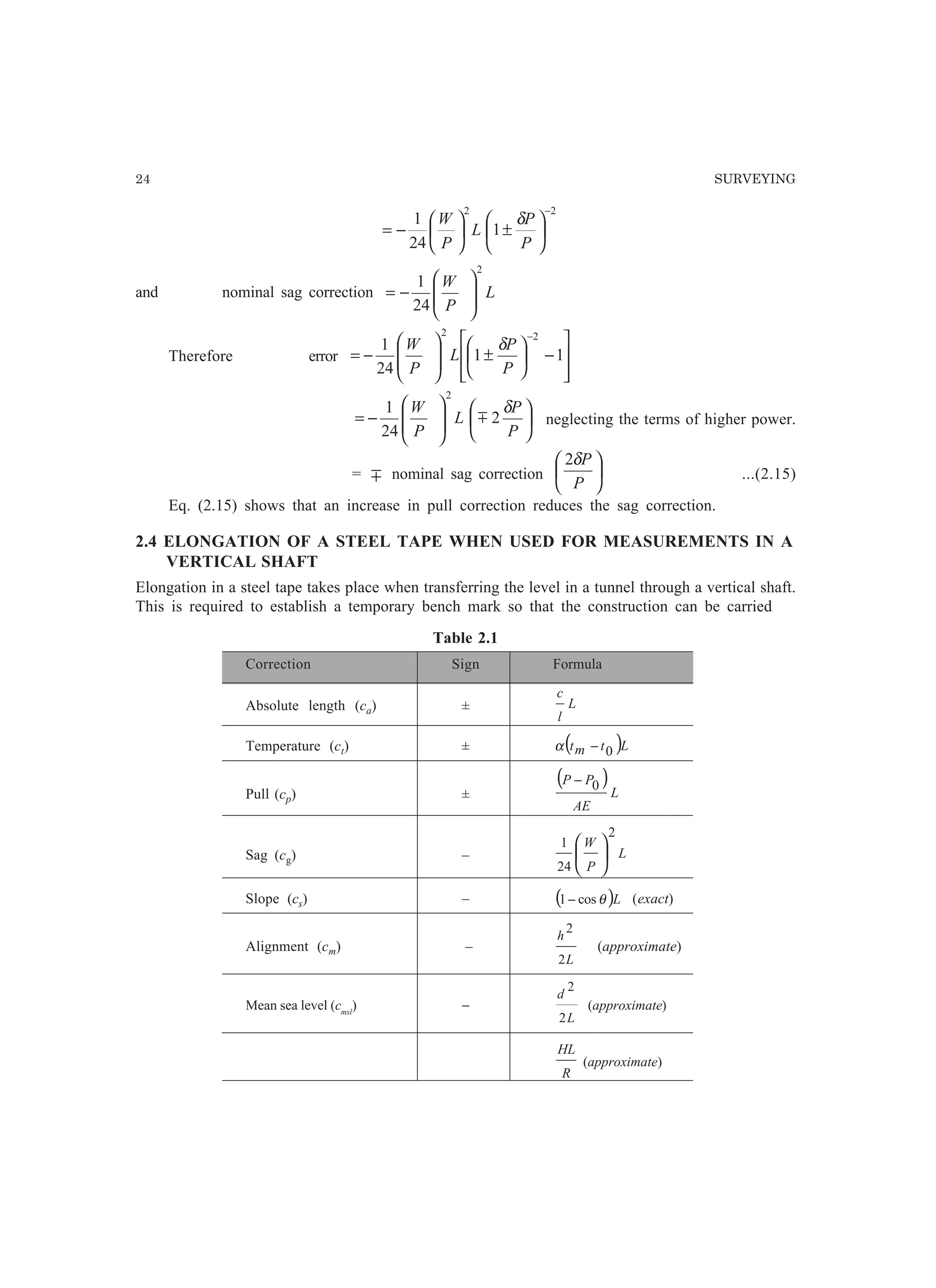
  • 19.
    6 SURVEYING 0−1−2−3 +1+2 +3 u u1 dxdy 0−1−2−3 +1 +2 +3 u dxdy Fig. 1.1 Fig. 1.2 The values of the ordinates of the standardized form of the expression for the normal distribution, and the corresponding definite integrals, have been determined for a wide range of u and are available in various publications. A part of such table is given in Table 1.5 and some typical values used in this example have been taken from this table. Example 1.1. The following are the observations made on the same angle: 47o 26′13″ 47o 26′18″ 47o 26′10″ 47o 26′15″ 47o 26′16″ 47o 26′12″ 47o 26′09″ 47o 26′15″ 47o 26′18″ 47o 26′14″ Determine (a) the most probable value of the angle, (b) the range, (c) the standard deviation, (d) the standard error of the mean, and (e) the 95% confidence limits. Solution: For convenience in calculation of the required quantities let us tabulate the data as in Table 1.1. The total number of observations n = 10. (a) Most probable value = x = 47°26′14″″″″″ (b) Range = 47°26′18″ – 47°26′09″ = 9″″″″″ (c) Standard deviation       − Σ ±= )1( 2 n υ σ       − ±= )110( 84 = ± 3.1″″″″″. dy dx dy dx
  • 20.
    ERRORS IN MEASUREMENTSAND THEIR PROPAGATION 7 (d) Standard error of mean n m σ σ ±= 10 1.3 ±= = ± 1.0″″″″″. Table 1.1 Observed angles (x) υ=− )ˆ( xx 22 )ˆ( υ=− xx 47°26’13″ + 1 1 10″ + 4 16 16″ – 2 4 09″ + 5 25 18″ – 4 16 18″ – 4 16 15″ – 1 1 12″ + 2 4 15″ – 1 1 14″ 0 0 Σ = 140″ 0=Σ 84=Σ x x n = = ° ′ ′′ = ° ′ ′′ Σ 47 6 140 10 47 26 14 (e) 95% confidence limits The lower confidence limit n t x σ −= ˆ The upper confidence limit n t x σ += ˆ ...(1.22) where t is selected from statistical tables for a given value of n. For n = 10, t = 2.26 and so t n σ = = ′′ 2 26 3 1 10 2 2 . × . . . Hence the 95% confidence limits are 47°26′′′′′14″″″″″ ± 2.2″″″″″. It is a common practice in surveying to reject any observation that differs from the most probable value by more than three times the standard deviation. Example 1.2. The length of a base line was measured using two different EDM instruments A and B under identical conditions with the following results given in Table 1.2. Determine the
  • 21.
    8 SURVEYING relative precisionof the two instruments and the most probable length of the base line. Table 1.2 A (m) B (m) 1001.678 1001.677 1001.670 1001.681 1001.667 1001.675 1001.682 1001.678 1001.674 1001.677 1001.679 1001.682 1001.679 1001.675 Solution: (i) The standard deviation of the masurements by A       − ±=      − Σ ±= )16( 164 )1( 2 n A υ σ = ± 5.73 mm. Table 1.3 A B Distance υ 2 υ Distance υ 2 υ (m) (mm) (mm2 ) (m) (mm) (mm2 ) 1001.678 – 3 9 1001.677 + 1 1 1001.670 + 5 25 1001.681 – 3 9 1001.667 + 8 64 1001.675 + 3 9 1001.682 – 7 49 1001.678 0 0 1001.674 + 1 1 1001.677 + 1 1 1001.679 – 4 16 1001.682 – 4 16 1001.679 – 1 1 1001.675 + 3 9 050.6001=Σ 164=Σ 424.8013=Σ 46=Σ 675.1001 6 050.6001 ˆ ==Ax m 678.1001 8 424.8013 ˆ ==Bx m The standard deviation of the measurements by B       − ±= )18( 46 Bσ = ± 2.56 mm.
  • 22.
    ERRORS IN MEASUREMENTSAND THEIR PROPAGATION 9 The standard error of the mean for A 34.2 6 73.5 ±=±=mAσ mm. (ii) The standard error of the mean for B 91.0 8 56.2 ±=±=mBσ mm. (iii) The relative precision of the two instruments A and B is calculated as follows: If the weights of the measurements 1001.675 m and 1001.678 m are Aω and Bω having the standard errors of means as ± 2.34 mm and ± 0.91 mm, repectively, then the ratio BA ωω is a measure of the relative precision of the two instruments. Thus 6.6 1 34.2 91.0 2 2 2 2 = == A B B A σ σ ω ω Therefore, 6.6 B A ω ω = . (iv) The most probable length of the line is the weighted mean of the two observed lengths. Now ω ω ω Σ Σ = )( x x BA BBAA LL ωω ωω + + = = + + ω ω ω ω B B B B 6 6 1001 675 1001 678 6 6 . × . × . . 6.61 678.10016.6675.1001 + ×+ = = 1001.6776 m. In accordance with the observations, ωxˆ could be written as 1001.678 m to the nearest millimetre. Example 1.3. An angle was measured with different weights as follows: Determine (a) the most probable value of the angle, (b) the standard deviation of an obsevation of unit weight, (c) the standard deviation of an observation of weight 3, and (d) the standard error of the weighted mean.
  • 23.
    10 SURVEYING Angle Weight (ω) 86°47′25″ 1 86°47′28″ 3 86°47′22″ 1 86°47′26″ 2 86°47′23″ 4 86°47′30″ 1 86°47′28″ 3 86°47′26″ 3 Solution: Tabulating the data and the weighted results working from a datum of 86°47′, we get the values as given in Table 1.4. (a) The most probable value of the angle is the weighted mean =ωx Datum + ( ) ω ω Σ Σ x = ° ′ + = ° ′ ′′86 47 467 18 86 47 25 9. (b) Standard deviation of an observation of unit weight ( )       − Σ ±= )1( 2 n u ωυ σ ( )18 93 − ±= ±= 3.64″″″″″. Table 1.4 Observed x ω ω x υ 2 ωυ angle 86°47′25″ 25 1 25 + 1 1 86°47′28″ 28 3 84 – 2 12 86°47′22″ 22 1 22 + 4 16 86°47′26″ 26 2 52 0 0 86°47′23″ 23 4 92 + 3 36 86°47′30″ 30 1 30 – 4 16 86°47′28″ 28 3 84 – 2 12 86°47′26″ 26 3 78 0 0 208=Σ 18=Σ 467=Σ 93=Σ 26 8 208 ˆ ==x
  • 24.
    ERRORS IN MEASUREMENTSAND THEIR PROPAGATION 11 (c) Standard deviation of an observation of weight 3 ( )       − Σ ±= )1( 2 nnω ωυ σϖ       −× ±= )18(3 93 ±= 2.10″″″″″. Alternatively, 22 22 2 11 ...... uσσωσω === We have 33 =ω , therefore 3 64.3 3 64.3 3 22 2 ±= == ϖ ϖ σ σ σ u (d) Standard error of the weighted mean σ ωυ ω xm n = ± − L N MM O Q PP Σ Σ b g2 1( )       ×− ±= 18)18( 93 ±= 0.86″″″″″. Alternatively, 22 umm s σω = Since ωω Σ=m , we have ω σ Σ ±= u ms 18 64.3 ±= ±= 0.86″″″″″. Example 1.4. If the standard deviation uσ of a single measurement in Example 1.1 is ± 3, calculate (i) the magnitude of the deviation likely to occur once in every two measurements, ±= 2.10″″″″″.
  • 25.
    12 SURVEYING (ii) theprobability that a single measurement may deviate from the true value by ± 6, and (iii) the probability that the mean of nine measurments may deviate from the true value by ± 1.5. Solution: If a deviation is to occur once in every two measurements a probability of 50% is implied. Thus in Fig. 1.2 the two shaded parts have areas of 0.25 each and the total shaded area is 0.5. Table 1.5 u dy/du −∞ + z u 0.0 0.3989 0.5000 0.6 0.3332 0.7257 0.7 0.3123 0.7580 1.5 0.1295 0.9332 2.0 0.0540 0.9772 Since −∞ + z u1 is the shaded area as shown in Fig. 1.2, a value of u is required such that 1 0 25 1 − = −∞ + z . , u i.e., = −∞ + z 0 75 1 . . u By inspection, we find in the Table 1.5 that the value 0.75 of the integral lies between the values 0.6 and 0.7 of u. The value of u is 0.6745 for = −∞ + z 0 75 1 . . u Now σ µ x u − = =0.6745 therefore, deviation (u – x) = 0.6745 σ = ± 0.6745 × 3 = ± 2.0. (b) For a deviation (u – x) of ± 6 for a single measure u x = − = = ′′ µ σ 6 3 2 0. . For u = + 2.0 from Table 1.5, we have = −∞ + z 0 9772 2 0 . . . Hence 1 1 0 9772 0 0228 2 0 − = − = −∞ + z . . . . For the deviation to lie at the limits of, or outside, the range + 6 to – 6, the probability is
  • 26.
    ERRORS IN MEASUREMENTSAND THEIR PROPAGATION 13 = 2 × 0.0228 = 0.0456, or 4.6%. (c) The standard deviation of the mean of nine observations 9 0.3 == n m σ σ = ± 1.0. For a deviation of ±1.5 u x m = − = ′′µ σ 15 1 0. = 1.5. For u = + 1.5 from the Table 1.5, we get 1 1 0 9332 0 0668 15 − = − = −∞ + z . . . . Therefore the probability of assuming a deviation of ± 1.5 = 2 × 0.0668 = 0.1336, or 13.4%. Example 1.5. The coordinates with standard deviations of two stations A and B were determined as given below. Calculate the length and standard deviation of AB. Station Easting Northing A 456.961 m ± 20 mm 573.237 m ± 30 mm B 724.616 m ± 40 mm 702.443 m ± 50 mm The length of AB was independently measured as 297.426 m ± 70 mm and its separate determination by EDM is as 297.155 m ± 15 mm. Calculate the most probable length of the line and its standard deviation. Solution: If ∆E is the difference in the eastings of A and B and ∆N is the difference in the northings then the length of the line AB ( ) ( ) 22 22 22 206.129655.267 237.573443.702961.456616.724 += −+−= ∆+∆= NE = 297.209 m. From Eq. (1.21) the standard deviation σE and σN of ∆E and ∆N, respectively, are 222 222 NBNAN EBEAE σσσ σσσ += +=
  • 27.
    14 SURVEYING 20±=EAσ mm;40±=EBσ mm; 30±=NAσ mm; 50±=NBσ mm. Therefore, 222 4020 +=Eσ , or 7.44±=Eσ mm 222 5030 +=Nσ , or 3.58±=Nσ mm Now from Eq. (1.20), the standard deviation of the computed length AB σ ∂ ∂ σ ∂ ∂ σAB E N L E L L 2 2 2 = F HG I KJ + F HG I KJ∆ ∆b g b g …(a) where 22 NEL ∆+∆= ...(b) Now by differentiating Eq. (b), we get ∂ ∂ L E E E N ∆ ∆ ∆ ∆ a f b g= + −1 2 2 2 2 1 2 × × / = + = = = ∆ ∆ ∆ ∆E E N E L2 2 267 655 297 209 0 901 . . . Similarly, ( ) 435.0 209.297 206.129 == ∆ = ∆∂ ∂ L N E L Hence from Eq. (a), we get ( ) ( )222 3.58435.07.44901.0 ×+×=ABσ = 2265.206 or ABσ = ± 47.6 mm. Now we have three values of the length AB and their standard deviations as given in Table 1.6. Table 1.6 Length (l) by σ ω = 1/σ2 (m) (mm) Tape 297.426 ± 70 1/4900 EDM 297.155 ± 15 1/225 Calculation 297.209 ± 47.6 1/2266 Since the weight of a measured quantity is inversely proportional to its variance, we can calculate the weights of the lengths obtained by different methods, and these have been given in Table 1.6.
  • 28.
    ERRORS IN MEASUREMENTSAND THEIR PROPAGATION 15 The most probable length of AB is the weighted mean of the three values of AB. Thus 2266 1 225 1 4900 1 209.297 2266 1 155.297 225 1 426.297 4900 1 ++ ×+×+× =L = 297.171 m. The weight of L is 2266 1 225 1 4900 1 ++=Σω = 0.00509 Since ω 2 /1 σ= ω σ L L = 1 2 σ ω L L = = 1 1 0 00509. = ± 14.0 mm. The standard deviation of the length 297.171 m is ± 14.0 mm. Example 1.6. A base line AB was measured accurately using a subtense bar 1 m long. From a point C near the centre of the base, the lengths AC and CB were measured as 9.375 m and 9.493 m, respectively. If the standard error in the angular mesurement was ± 1″, determine the error in the length of the line. Solution: In Fig. 1.3, the subtense bar PQ is at C and the angles α and β were measured at A and B, respectively. It is given that PQ = b = 1 m AC = x1 = 9.375 m CB = x2 = 9.493 m For subtense bar measurements, we have 2 tan2 θ b x = …(a) where x = the computed distance, and θ = the angle subtended at the station by the subtense bar. When θ is small, Eq. (a) can be written as Fig. 1.3
  • 29.
    16 SURVEYING , θ b x =or x b =θ Therefore 2 θ θdb dx −= 2       −= x b db θ )( 2 radiansind b dx θ θ −= Writing ,,,, ασσσσ CBACAB and βσ as the respective standard errors, we have 000426.0 206265 1 1 375.9 22 1 ±=×=−= ασσ b x AC m 000437.0 206265 1 1 493.9 22 2 ±=×=−= βσσ b x CB m 222 CBACAB σσσ += 22 000437.0000426.0 +±=ABσ = ± 0.61 mm. The ratio of the standard error to the measured length (AB = 9.375 + 9.493 = 18.868 m) is given as = 868.18 00061.0 = 1 in 30931 Example 1.7. The sides of a rectangular tract were measured as 82.397 m and 66.132 m with a 30 m metallic tape too short by 25 mm. Calculate the error in the area of the tract. Solution: Let the two sides of the tract be x1 and x2 then the area y = x1.x2 ...(a) If the errors in x1 and x2 are dx1 and dx2, respectively, then the error in y 2 2 1 1 dx x y dx x y dy ∂ ∂ + ∂ ∂ = ...(b) Now from Eq. (a), we get 132.662 1 == ∂ ∂ x x y m 397.821 2 == ∂ ∂ x x y m. The values of 1dx and 2dx are computed as
  • 30.
    ERRORS IN MEASUREMENTSAND THEIR PROPAGATION 17 069.0397.82 30 025.0 1 =×=dx m 055.0132.66 30 025.0 2 =×=dx m. Therefore from Eq. (b), we get 055.0397.82069.0132.66 ×+×=dy = 9.095 m2 . The percentage of error 100 132.66397.82 095.9 × × = = 0.17 %. Example 1.8. Two sides and the included angle of a triangle were measured as under: a = 757.64 ± 0.045 m b = 946.70 ± 0.055 m C = 54°18' ± 25 Compute the area of the triangle and its standard error. Solution: (a) Area of a triangle CabA sin 2 1 = ...(a) = ° ′ 1 2 757 64 946 70 54 18× . × . × sin = 291236.62 m2 . (b) Standard error in A 222 2       ∂ ∂ +      ∂ ∂ +      ∂ ∂ = cbaA c A b A a A σσσσ ...(b) Differentiating Eq. (a), we get ∂ ∂ A a b C= = ° ′ = 1 2 1 2 946 70 54 18 384 400sin × . × sin . ∂ ∂ A b b C= = ° ′ = 1 2 1 2 747 64 54 18 307 633sin × . × sin . ∂ ∂ A C ab C= − = − ° ′ = 1 2 1 2 946 70 757 64 54 18 209274 739cos × . × . × sin . Now from Eq. (b), we get ( ) ( ) 2 22 206265 25 739.209274055.0633.307045.0400.384       ×+×+×±=Aσ = ± 35.05 m2 .
  • 31.
    18 SURVEYING OBJECTIVE TYPEQUESTIONS 1. Accuracy is a term which indicates the degree of conformity of a measurement to its (a) most probable value. (b) mean value. (c) true value. (d) standard error. 2. Precision is a term which indicates the degree of conformity of (a) measured value to its true value. (b) measured value to its mean value. (c) measured value to its weighted mean value. (d) repeated measurements of the same quantity to each other. 3. Theory of probability is applied to (a) gross errors. (b) systematic errors. (c) random errors. (d) all the above. 4. Residual of a measured quantity is the (a) difference of the observed value from its most probable value. (b) value obtained by adding the most probable value to its true value. (c) remainder of the division of the true value by its most probable value. (d) product of the most probable value and the observed value. 5. If the standard deviation of a quantity is ± 1″, the maximum error would be (a) 2.39″. (b) 3.29″. (c) 2.93″. (d) 9.23″. 6. If the standard deviation of an observation is ± 10 m, the most probable error would be (a) 6.745 m. (b) 20 m. (c) 10 m. (d) 0.6745 m. 7. The systematic errors (a) are always positive. (b) are always negative. (c) may be positive or negative. (d) have same sign as the gross errors. 8. Variance of a quantity is an indicator of (a) precision. (b) accuracy. (c) randomness. (d) regular nature. 9. In the case of a function y = f(x1,x2), the error in y is computed as (a) 2 2 1 1 dx x f dx x f dy       ∂ ∂ +      ∂ ∂ = (b) 2 2 2 1 2 1 dx x f dx x f dy       ∂ ∂ +      ∂ ∂ =
  • 32.
    ERRORS IN MEASUREMENTSAND THEIR PROPAGATION 19 (c) ( ) ( )2 2 2 2 1 1 dx x f dx x f dy       ∂ ∂ +      ∂ ∂ = (d) 2 2 2 2 1 1       ∂ ∂ +      ∂ ∂ = dx x f dx x f dy 10. The adjusted value of an observed quantity may contain (a) small gross errors. (b) small systematic errors. (c) small random errors. (d) all the above. 11. One of the characteristics of random errors is that (a) small errors occur as frequently as the large errors. (b) plus errors occur more frequently than the negative errors. (c) small errors occur more frequently than the large errors. (d) large errors may occur more frequently. 12. If the standard error of each tape length used to measure a length is ± 0.01 m. the standard error in 4 tape lengths will be (a) 0.01 m. (b) 0.02 m. (c) 0.04 m. (d) 0.16 m. ANSWERS 1. (c) 2. (d) 3. (c) 4. (a) 5. (b) 6. (a) 7. (c) 8. (a) 9. (a) 10. (c) 11. (c) 12. (b).
  • 33.
    20 SURVEYING DISTANCE MEASUREMENT Threemethods of distance measurement are briefly discussed in this chapter. They are Direct method using a tape or wire Tacheometric method or optical method EDM (Electromagnetic Distance Measuring equipment) method. 2.1 DIRECT METHOD USING A TAPE In this method, steel tapes or wires are used to measure distance very accurately. Nowadays, EDM is being used exclusively for accurate measurements but the steel tape still is of value for measuring limited lengths for setting out purposes. Tape measurements require certain corrections to be applied to the measured distance depending upon the conditions under which the measurements have been made. These corrections are discussed below. Correction for Absolute Length Due to manufacturing defects the absolute length of the tape may be different from its designated or nominal length. Also with use the tape may stretch causing change in the length and it is imperative that the tape is regularly checked under standard conditions to determine its absolute length. The correction for absolute length or standardization is given by L l c ac = ...(2.1) where c = the correction per tape length, l = the designated or nominal length of the tape, and L= the measured length of the line. If the absolute length is more than the nominal length the sign of the correction is positive and vice versa. Correction for Temperature If the tape is used at a field temperature different from the standardization temperature then the temperature correction to the measured length is ( )Ltmttc 0−=α ...(2.2) 20
  • 34.
    DISTANCE MEASUREMENT 21 Endsupport Intermediate support Catenary Sag Chord Length where α = the coefficient of thermal expansion of the tape material, tm = the mean field temperature, and t0 = the standardization temperature. The sign of the correction takes the sign of ( )0ttm − . Correction for Pull or Tension If the pull applied to the tape in the field is different from the standardization pull, the pull correction is to be applied to the measured length. This correction is ( ) L AE PP pc 0− = ...(2.3) where P = the pull applied during the measurement, 0P = the standardization pull, A = the area of cross-section of the tape, and E = the Young’s modulus for the tape material. The sign of the correction is same as that of ( )0PP − . Correction for Sag For very accurate measurements the tape can be allowed to hang in catenary between two supports (Fig. 2.1a). In the case of long tape, intermediate supports as shown in Fig. 2.1b, can be used to reduce the magnitude of correction. (a) (b) Fig. 2.1 The tape hanging between two supports, free of ground, sags under its own weight, with maximum dip occurring at the middle of the tape. This necessitates a correction for sag if the tape has been standardized on the flat, to reduce the curved length to the chord length. The correction for the sag is c W P Lg = F HG I KJ1 24 2 ...(2.4) where W = the weight of the tape per span length. Sag
  • 35.
    22 SURVEYING The signof this correction is always negative. If both the ends of the tape are not at the same level, a further correction due to slope is required. It is given by ′ =c cg g cos α ...(2.5) where α = the angle of slope between the end supports. Correction for Slope If the length L is measured on the slope as shown in Fig. 2.2, it must be reduced to its horizontal equivalent L cos θ. The required slope correction is c Ls = −1 cos θb g (exact) ...(2.6) L h 2 2 = (approximate) …(2.7) where θ = the angle of the slope, and h = the difference in elevation of the ends of the tape. The sign of this correction is always negative. Correction for Alignment If the intermediate points are not in correct alignment with ends of the line, a correction for alignment given below, is applied to the measured length (Fig. 2.3). L d cm 2 2 = (approximate) …(2.8) where d = the distance by which the other end of the tape is out of alignment. The correction for alignment is always negative. Reduction to Mean Sea Level (M.S.L.) In the case of long lines in triangulation surveys the relationship between the length AB measured on the ground and the equivalent length A′B′ at mean sea level has to be considered (Fig. 2.4). Determination of the equivalent mean sea level length of the measured length is known as reduction to mean sea level. The reduced length at mean sea level is given by L R R H L′ = +( ) …(2.9) L cosθ hL θ Fig. 2.2 dL A B Fig. 2.3 A R L L′ M.S.L. A′ Fig. 2.4
  • 36.
    DISTANCE MEASUREMENT 23 where R= the mean earth’s radius (6372 km), and H = the average elevation of the line. When H is considered small compared to R, the correction to L is given as c HL R approximatemsl = ( ) …(2.10) The sign of the correction is always negative. The various tape corrections discussed above, are summarized in Table 2.1. 2.2 ERROR IN PULL CORRECTION DUE TO ERROR IN PULL If the nominal applied pull is in error the required correction for pull will be in error. Let the error in the nominal applied pull P be ± Pδ then the actual pull correction = ( ) L AE PPP 0−± δ …(2.11) and nominal pull correction = ( ) L AE PP 0− …(2.12) Therefore error = actual pull correction – nominal pull correction = ( ) L AE PPP 0−± δ – ( ) L AE PP 0− = ± P AE L δ …(2.13) From Eq. (2.12), we have 0 correctionpullnominal PPAE L − = Therefore from Eq. (2.13), we get Error in pull correction = P PP δ 0 correctionpullnominal − ± …(2.14) From Eq. (2.14), we find that an increase in pull increases the pull correction. 2.3 ERROR IN SAG CORRECTION DUE TO ERROR IN PULL If the applied pull is in error the computed sag correction will be in error. Let the error in pull be ± δP then the actual sag correction L PP W 2 24 1       ± −= δ
  • 37.
    24 SURVEYING 22 1 24 1 −       ±      −= P P L P W δ andnominal sag correction L P W 2 24 1         −= Therefore error         −      ±        −= − 11 24 1 22 P P L P W δ               −= P P L P W δ 2 24 1 2 m neglecting the terms of higher power. = m nominal sag correction       P Pδ2 ...(2.15) Eq. (2.15) shows that an increase in pull correction reduces the sag correction. 2.4 ELONGATION OF A STEEL TAPE WHEN USED FOR MEASUREMENTS IN A VERTICAL SHAFT Elongation in a steel tape takes place when transferring the level in a tunnel through a vertical shaft. This is required to establish a temporary bench mark so that the construction can be carried Table 2.1 Correction Sign Formula Absolute length (ca) ± L l c Temperature (ct) ± ( )Ltmt 0−α Pull (cp) ± ( ) L AE PP 0− Sag (cg) – L P W 2 24 1       Slope (cs) – ( )Lθcos1− (exact) Alignment (cm) – L h 2 2 (approximate) Mean sea level (cmsl ) − L d 2 2 (approximate) R HL (approximate)
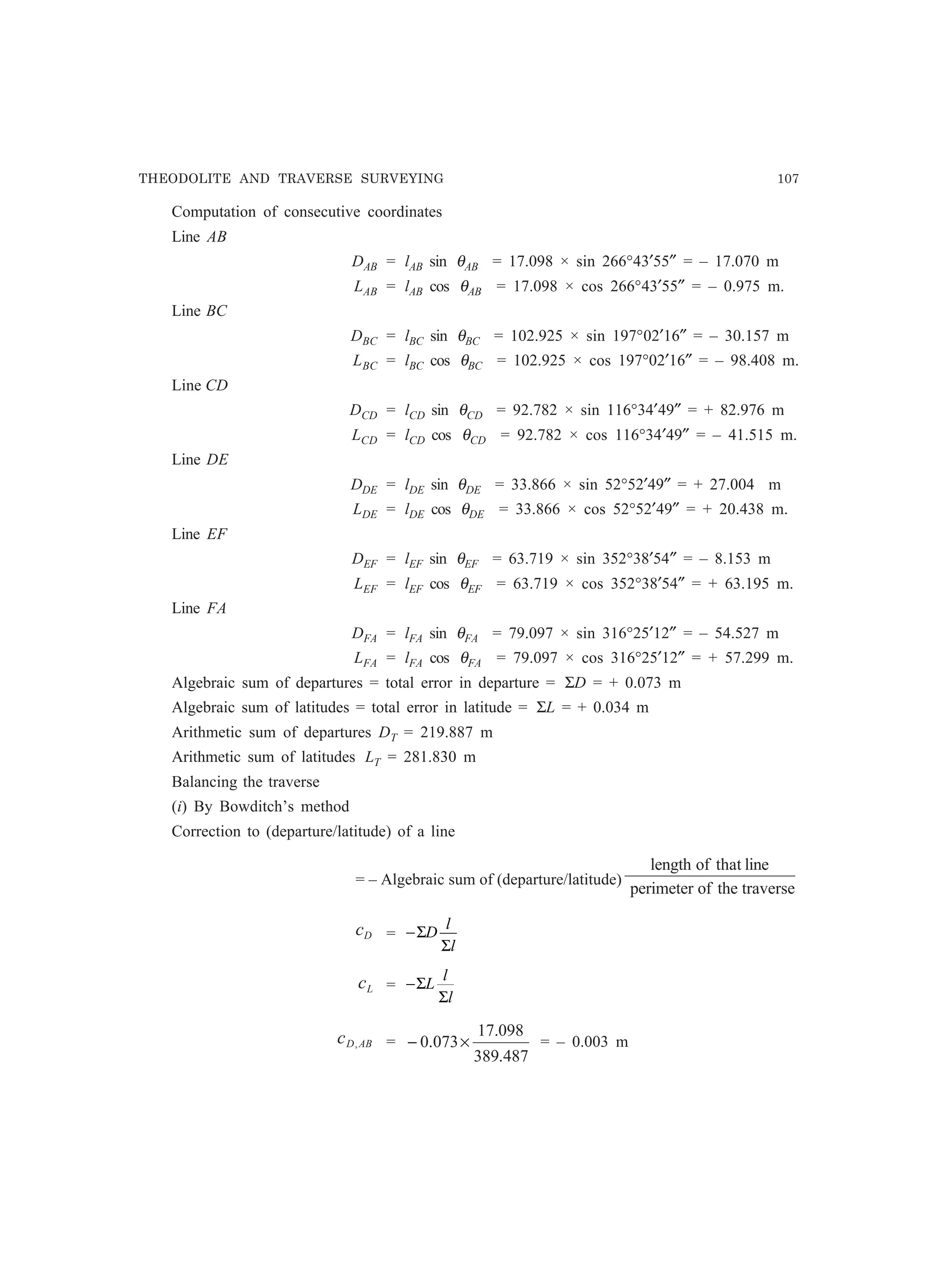
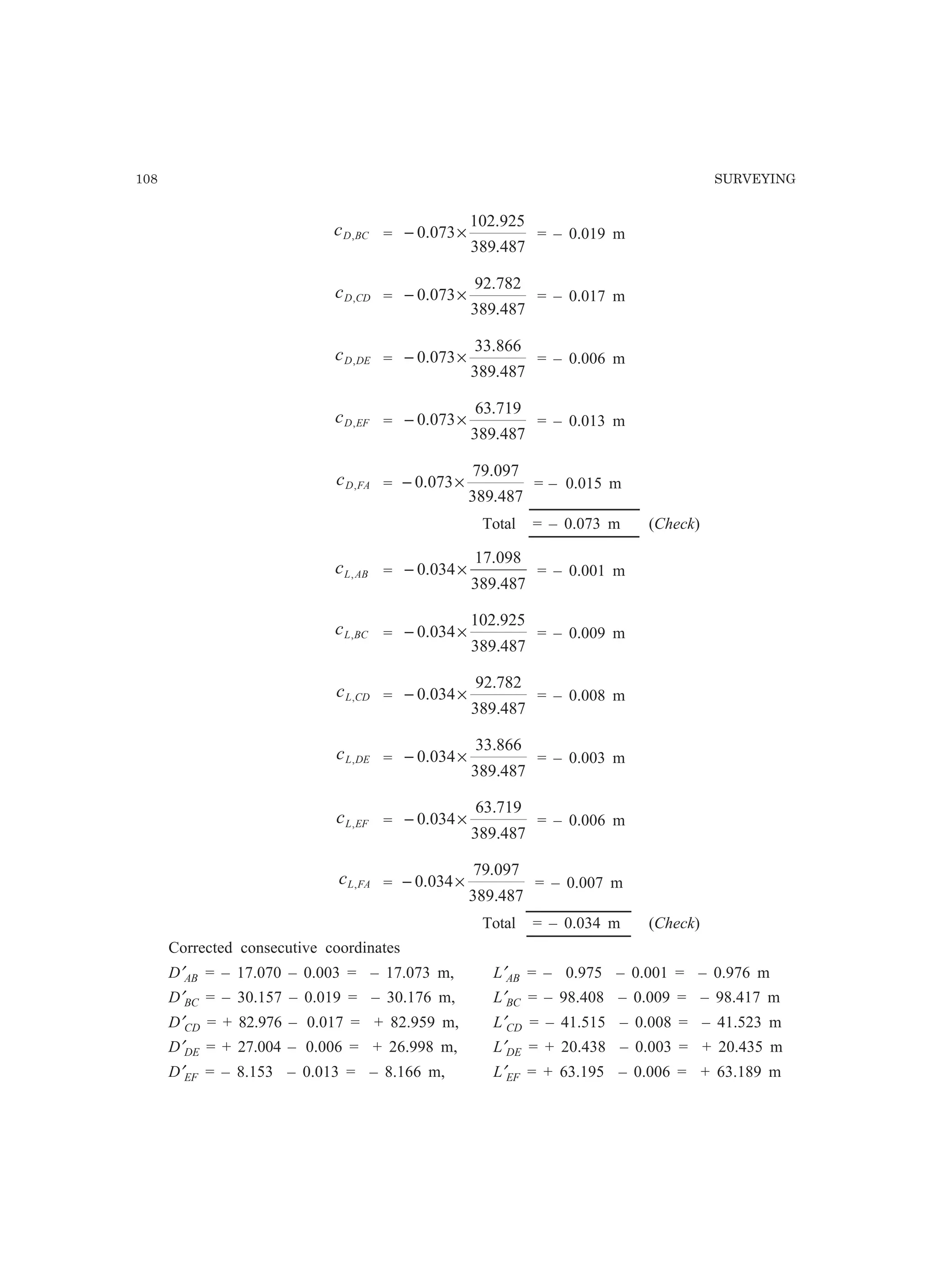
  • 38.
    DISTANCE MEASUREMENT 25 outto correct level as well as to correct line. Levels are carried down from a known datum, may be at the side of the excavated shaft at top, using a very long tape hanging vertically and free of restrictions to carry out operation in a single stage. In the case when a very long tape is not available, the operation is carried out by marking the separate tape lengths in descending order. The elongation in the length of the tape AC hanging vertically from a fixed point A due to its own weight as shown in Fig. 2.5, can be determined as below. Let s = the elongation of the tape, g = the acceleration due to gravity, x = the length of the suspended tape used for the measurement, (l – x) = the additional length of the tape not required in the measurements, A = the area of cross-section of the tape, E = the modulus of elasticity of the tape material, m = the mass of the tape per unit length, M = the attached mass, l = the total length of the tape, and P0 = the standard pull. The tension sustained by the vertical tape due to self-loading is maximum at A. The tension varies with y considered from free-end of the tape, i.e., it is maximum when y is maximum and, therefore, the elongations induced in the small element of length dy, are greater in magnitude in the upper regions of the tape than in the lower regions. Considering an element dy at y, loading on the element dy = mgy and extension over the length dy AE dy mgy= Therefore, extension over length AB, Ex ( )∫ − = l xl AE dy mgy ( ) constant 2 2 +      = − l xl y AE mg We have Ex = 0 when y = 0, therefore the constant = 0. Thus ( )[ ]22 2 xll AE mg Ex −−=       − = 2 2 xl AE mgx …(2.16) To ensure verticality of the tape and to minimize the oscillation, a mass M may be attached to the lower end A. It will have a uniform effect over the tape in the elongation of the tape. x l dy y (l−x) A B Support Fixed end of tape Measured length Free end of tape C Fig. 2.5
  • 39.
    26 SURVEYING Additional extensiondue to mass M over length x AE x Mg= If the standard pull is P0 , it should be allowed in the same way as the standard pull in the pull correction. Therefore elongation over length x becomes AE xP AE Mgxxl AE mgx Ex 0 2 2 −+      − = ( )       −+−= g P Mxl m AE gx 0 2 2 …(2.17) 2.5 TACHEOMETRIC OR OPTICAL METHOD In stadia tacheometry the line of sight of the tacheometer may be kept horizontal or inclined depending upon the field conditions. In the case of horizontal line of sight (Fig. 2.6), the horizontal distance between the instrument at A and the staff at B is D = ks + c ...(2.18) where k and c = the multiplying and additive constants of the tacheometer, and s = the staff intercept, = ST – SB , where ST and SB are the top hair and bottom hair readings, respectively. Generally, the value of k and c are kept equal to 100 and 0 (zero), respectively, for making the computations simpler. Thus D = 100 s ...(2.19) Datum D s hi hA hB SM A B Levelling staff Horizontal line of sight Tacheometer Fig. 2.6 The elevations of the points, in this case, are obtained by determining the height of instrument and taking the middle hair reading. Let hi = the height of the instrument axis above the ground at A, hA, hB = the elevations of A and B, and
  • 40.
    DISTANCE MEASUREMENT 27 SM= the middle hair reading then the height of instrument is H.I. = hA + hi and hB = H.I. – SM = hA + hi – SM ...(2.20) In the case of inclined line of sight as shown in Fig. 2.7, the vertical angle α is measured, and the horizontal and vertical distances, D and V, respectively, are determined from the following expressions. α2 cosksD = ...(2.21) α2sin 2 1 ksV = ...(2.22) The elevation of B is computed as below. hB = hA + hi + V – SM ...(2.23) 2.6 SUBTENSE TACHEOMETRY In subtense tacheometry the distance is determined by measuring the horizontal angle subtended by the subtense bar targets (Fig. 2.8a) and for heighting, a vertical angle is also measured (Fig. 2.8b). Let b = the length of the subtense bar PQ, θ = the horizontal angle subtended by the subtense bar targets P and Q at the station A, and α = the vertical angle of R at O then 2 tan2 θ b D = ≈ θ b (when θ is small) …(2.24) αtanDV = …(2.25) and siAB hVhhh −++= …(2.26) where hs = the height of the subtense bar above the ground. When a vertical bar with two targets is used vertical angles are required to be measured and the method is termed as tangential system. 2.7 EFFECT OF STAFF VERTICALITY In Fig. 2.9, the staff is inclined through angle δ towards the instrument. The staff intercept for the inclined staff would be PQ rather than the desired value MN for the vertical staff. Datum s hi hA hB V A BHorizontal Inclined line of sight SMα Fig. 2.7
  • 41.
    28 SURVEYING Datum hi hA hB V A B Horizontal Inclined lineof sight hS α b P Q R O Subtense bar (a) (b) Fig. 2.8 Draw two lines ab and cd perpendicular to the line of sight. Since ab and cd are very close to each other, it can be assumed that ab = cd. Moreover, ∠PBM = δ ∠MEa = α ∠PFc = α + δ From ∆MEa, we have αcosMEaE = or cdMNab == αcos …(2.27) From DPFc, we have cF PF= +cos α δb g or cd PQ= +cos α δb g …(2.28) Equating the values of cd from Eqs. (2.27) and (2.28), we get MN PQcos cosα α δ= +b g or MN PQ = +cos cos α δ α b g …(2.29) The Eq. (2.29) holds for the case when the staff is inclined away from the instrument for angle of elevation (α). In Fig. 2.10, the staff is inclined away from the instrument. In this case ∠PFc = α – δ Therefore, MN PQ = −cos cos α δ α b g …(2.30) Datum b/2
  • 42.
    DISTANCE MEASUREMENT 29 Fig.2.9 Fig. 2.10 The Eq. (2.30) holds for the case the staff is inclined towards the instrument for the angle of elevation (α). 2.8 EFFECT OF ERROR IN MEASUREMENT OF HORIZONTAL ANGLE IN SUBTENSE TACHEOMETRRY From Eq. (2.24), the horizontal distance RO (Fig. 2.8a) is 2 tan2 θ b D = = θ b (when θ is small) …(2.31) θ θ d b dD 2 −= Substituting the value of θ from Eq. (2.31), we get θd b D dD 2 −= …(2.32) The above expression gives the error in D for the given accuracy in θ. The negative sign shows that there is decrease in D for increase in θ. The relative accuracy or fractional error in linear measurements is given by the following expression. θd b D D dD −= …(2.33) 2.9 EFFECT OF SUBTENSE BAR NOT BEING NORMAL TO THE LINE JOINING THE INSTRUMENT AND THE SUBTENSE BAR Let the subtense bar A′B′ be out from being normal to the line OC by an angle δ as shown in Fig. 2.11, then OC′ = D′ = A′C′ cot 2 θ A′C′ = A′C cos δ
  • 43.
    30 SURVEYING ′ =′D A C cos cotδ θ 2 = b 2 2 cos cotδ θ …(2.34) Therefore error in horizontal distance D = D – D′ 2 cotcos 22 cot 2 θ δ θ bb −= ( )δ θ cos1 2 cot 2 −= b …(2.35) 2.10 EELECTROMAGNETIC DISTANCE MEASUREMENT (EDM) The EDM equipments which are commonly used in land surveying are mainly electronic or microwave systems and electro-optical instruments. These operate on the principle that a transmitter at the master station sends modulated continuous carrier wave to a receiver at the remote station from which it is returned (Fig. 2.12). The instruments measure slope distance D between transmitter and receiver. It is done by modulating the continuous carrier wave at different frequencies and then measuring the phase difference at the master between the outgoing and incoming signals. This introduces an element of double distance is introduced. The expression for the distance D traversed by the wave is knD ++= λ π φ λ 2 2 …(2.36) where φ = the measured phase difference, λ = the modulated wavelength, n = the number of complete wavelength contained within the double distance (an unknown), and k = a constant. To evaluate n, different modulated frequencies are deployed and the phase difference of the various outgoing and measuring signals are compared. If c0 is the velocity of light in vacuum and f is the frequency, we have nf c0 =λ …(2.37) where n is the refractive index ratio of the medium through which the wave passes. Its value depends upon air temperature, atmospheric pressure, vapour pressure and relative humidity. The velocity of light c0 in vacuum is taken as 3 × 10⁸ m/s. Fig. 2.11 θ /2 θ A′ B′ O b/2 b/2 A B C C′ D D′ δ
  • 44.
    DISTANCE MEASUREMENT 31 Fig.2.12 The infrared based EDM equipments fall within the electro-optical group. Nowadays, most local survey and setting out for engineering works are being carried out using these EDM’s. The infrared EDM has a passive reflector, using a retrodioptive prism to reflect the transmitted infrared wave to the master. The distances of 1-3 km can be measured with an accuracy of ± 5 mm. Many of these instruments have microprocessors to produce horizontal distance, difference in elevation, etc. Over long ranges (up to 100 km with an accuracy of ± 50 mm) electronic or microwave instruments are generally used. The remote instrument needs an operator acting to the instructions from the master at the other end of the line. The signal is transmitted from the master station, received by the remote station and retransmitted to the master station. Measurement of Distance from Phase Difference The difference of the phase angle of the reflected signal and the phase angle of the transmitted signal is the phase difference. Thus, if φ1 and φ2 are the phase angles of the transmitted and reflected signals, respectively, then the phase angle difference is 12 φφφ −=∆ …(2.38) The phase difference is usually expressed as a fraction of the wavelength (λ). For example, ∆φ 0° 90° 180° 270° 360° Wavelength 0 λ/4 λ/2 3λ/4 λ Fig. 2.13 shows a line AB. The wave is transmitted from the master at A towards the reflector at B and is reflected back by the reflector and received back by the master at A. From A to B the wave completes 2 cycles and 1/4 cycles. Thus if at A phase angle is 0° and at B it is 90° then 4 90 λ φ ==∆ o and the distance between A and B is 4 2 λ λ +=D Again from B to A, the wave completes 2 cycles and 1/4 cycles. Thus if φ1 is 90° at B and φ2 is 180° at A, then 4 90 λ φ == o D and the distance between A and B is Transmitter Wave fronts λ/4 D λ λ Master station Remote station Receiver
  • 45.
    32 SURVEYING 4 2 λ λ +=D Thephase difference between the wave at A when transmitted and when received back is 180°, i.e., λ/2 and the number of complete cycles is 4. Thus       += += 2 4 2 1 2 42 λ λ λ λ D D …(2.39) The above expression in a general form can be written as ( )λλ ∆+= nD 2 1 where n = the number of complete cycles of the wave in traveling from A to B and back from B to A, and ∆l = the fraction of wavelength traveled by the wave from A to B and back from B to A. The value of ∆λ depends upon the phase difference of the wave transmitted and that received back at the master. It is measured as phase angle (φ) at A by an electrical phase detector built in the master unit at A. Obviously, λ φ λ       ∆ =∆ o 360 where ∆φ = the phase difference = 12 φφ − In Eq. (3.39), n is an unknown and thus the value of D cannot be determined. In EDM instruments the frequency can be increased in multiples of 10 and the phase difference for each frequency is determined separately. The distance is calculated by evaluating the values of n solving the following simultaneous equations for each frequency. ( )111 2 1 λλ ∆+= nD …(2.40) ( )222 2 1 λλ ∆+= nD …(2.41) ( )333 2 1 λλ ∆+= nD …(2.42) For more accurate results, three or more frequencies are used and the resulting equations are solved. Let us take an example to explain the determination of n1, n2, n3, etc. To measure a distance three frequencies f1, f2, and f3 were used in the instrument and phase differences ∆λ1, ∆λ2, and ∆λ3 were measured. The f2 frequency is 1 10 9 f and the f3 frequency is 1 100 99 f . The wavelength of f1 is 10 m.
  • 46.
    DISTANCE MEASUREMENT 33 Weknow that f 1 ∝λ therefore, 1 2 2 1 f f = λ λ 1 2 1 2 λλ f f = = f f 1 1 9 10 10× = = 100 9 11111. m. 2¼ cycle 1 cycle ¼ cycle 1 cycle 180°0° 180°φ ° = 360° 360°90°360° 180°360° Wave travelling from A to B A Master Wave travelling from B to A A Master B Reflector (Outward) (Inward) 4½ cycle 2¼ cycle Fig. 2.13 Similarly, λ3 1 1 99 100 10= f f × = 1000 99 = 10.101 m. Let the wavelength of the frequency (f1 – f2) be λ′ and that of (f1 – f3) be λ″, then ( ) 101010 10 1 1 11 21 11 ×=== − =′ λ λλ λ f f ff f = 100 m ( ) 10100100 100 1 1 11 31 11 ×=== − =′′ λ λλ λ f f ff f = 1000 m. Since one single wave of frequency (f1 – f2) has length of 100 m, λ1 being 10 m and λ2 being 11.111 m, the f1 frequency wave has complete 10 wavelengths and the f2 frequency wave has complete 9 wavelengths within a distance of 100 m. To any point within the 100 m length, or stage, the phase of the (f1 – f2) frequency wave is equal to the difference in the phases of the other two waves. For example, at the 50 m point the phase of f1 is (10/2) × 2π = 10π whilst that of f2 is (9/2) × 2π = 9π, giving a difference of
  • 47.
    34 SURVEYING 10π –9π = π, which is the phase of the (f1 – f2) frequency. This relationship allows distance to be measured within 100 m. This statement applies as well when we consider a distance of 1000 m. Within distance of 500 m, the f1 wave has phase of (100/2) × 2π = 100π, the f3 wave has (99/2) × 2π = 99π, and the (f1 – f3) wave has phase of 100π – 99π = π. If in a similar manner further frequencies are applied, the measurement can be extended to a distance of 10,000 m, etc., without any ambiguity. The term fine frequency can be assigned to f1 which appear in all the frequency difference values, i.e. (f1 – f2) whilst the other frequencies needed to make up the stages, or measurements of distance 100 m, 1000 m, etc., are termed as coarse frequencies. The f1 phase difference measured at the master station covers the length for 0 m to 10 m. The electronics involved in modern EDM instruments automatically takes care of the whole procedure. On inspection of Fig. 2.14, it will be seen that two important facts arise: (a) When ∆λ1 ∆λ2, n1 = n2 + 1 (n1 = 7, n2 = 6) (b) When ∆λ1 ∆λ2, n1 = n2 (n1 = 5, n2 = 5) These facts are important when evaluating overall phase differences. Now from Eqs. (2.40) and (2.41), we get 111 λλ ∆+n = 222 λλ ∆+n 111 λλ ∆+n = ( ) 221 1 λλ ∆+−n ...(2.43) From Eq. (3.43) the value of n1 can be determined. Fig 2.14 Effect of Atmospheric Conditions All electromagnetic waves travel with the same velocity in a vacuum. The velocity of the waves is reduced when travelling through atmosphere due to retarding effect of atmosphere. Moreover, the velocity does not remain constant due to changes in the atmospheric conditions. The wavelength λ of a wave of frequency f has the following relationship with its velocity V. f V =λ EDM instruments use electromagnetic waves, any change in V will affect λ and thus the measurement of the distance is also affected because the distance is measured in terms of wavelengths. Refractive Index Ratio The changes in velocity are determined from the changes in the refractive index ratio (n). The refractive index ratio is the ratio of the velocity of electromagnetic waves in vacuum to that in 1 2 3 4 5 6 1 2 3 4 5 6 7 ∆λ′2 ∆λ2 ∆λ1∆λ′1 Master MasterReflector f1, λ1 f2, 9 10 λ1 (a) (b)
  • 48.
    DISTANCE MEASUREMENT 35 atmosphere.Thus V c n 0 = or n c V 0 = The value of n is equal to or greater than unity. The value depends upon air temperature, atmospheric pressure and the vapour pressure. For the instruments using carrier waves of wavelength in or near visible range of electromagnetic spectrum, the value of n is given by ( ) ( )             −=− 760 273 11 0 p T nn …(2.44)             = 760 273 0 p T NN …(2.45) where p = the atmospheric pressure in millimetre of mercury, T = the absolute temperature in degrees Kelvin (T = 273° + t°C), n0 = the refractive index ratio of air at 0°C and 760 mm of mercury, N = (n – 1) and, N0 = (n0 – 1). The value of n0 is given by ( ) 6 420 10 068.08864.4 604.2871 − ×      +      +=− λλ n …(2.46) where λ is the wavelength of the carrier wave in µm. The instruments that use microwaves, the value of n for them is obtained from ( ) ( ) e TT ep T n       ++−=×− 5748 1 26.8649.103 101 6 …(2.47) where e is the water vapour pressure in millimetre of mercury. Determination of Correct Distance If the distance D′ has not been measured under the standard conditions, it has to be corrected. The correct distance D is given by       ′= n n DD s …(2.48)
  • 49.
    36 SURVEYING where ns =the standardizing refractive index, n = the refractive index at the time of measurement. The values of ns and n are obtained from Eq. (2.44) taking the appropriate values of p, T, n0, and e. Slope and Height Corrections The measured lengths using EDM instruments are generally slope lengths. The following corrections are applied to get their horizontal equivalent and then the equivalent mean sea level length. The correction for slope is given by Eqs. (2.6) and (2.7) and that for the mean sea level by Eq. (2.10). The sign of both the corrections is negative. Thus if the measured length is L′, the correct length is L L c c L L HL R g msl= ′ + + = ′ − − ′ − ′1 cos θb g L R H ′      −= θcos …(2.49) where θ = the slope angle of the line, H = the average elevation of the line, and R = the mean radius of the earth (≈ 6370 km). 2.11 ACCURACY IN VERTICAL ANGLE MEASUREMENTS The accuracy, with which a vertical angle must be measured in order to reduce a slope distance to the corresponding horizontal distance, can be determined. Accuracy in distances can be expressed as absolute or relative. If a distance of 10,000 m is measured with an accuracy of 1 m then the absolute accuracy with which the distance has been measured is 1 m. For this case, the relative accuracy is 1 m/10,000 m or 1/10,000 or 1:10,000. The relative accuracy is preferred as it does not involve the length of lines. Fig 2.15 In Fig 2.15, let the slope distance AB be S and the corresponding horizontal distance be D. If α is the slope angle, we can write D = S cos α …(2.50) Differentiating Eq. (2.50), we get dD = – S cos α dα …(2.51) α A D S B
  • 50.
    DISTANCE MEASUREMENT 37 DividingEq. (2.51) by Eq. (2.50) and disregarding the negative sign, the relative accuracy is given as D dD = α αα cos sin S dS = αα dtan …(2.52) where dα is a the desired accuracy in measurement of the slope angle α for an accuracy of D dD in linear measurements. Example 2.1. A line AB between the stations A and B was measured as 348.28 using a 20 m tape, too short by 0.05 m. Determine the correct length of AB, the reduced horizontal length of AB if AB lay on a slope of 1 in 25, and the reading required to produce a horizontal distance of 22.86 m between two pegs, one being 0.56 m above the other. Solution: (a) Since the tape is too short by 0.05 m, actual length of AB will be less than the measured length. The correction required to the measured length is L l c ca = It is given that c = 0.05 m l = 20 m L = 348.28 m 28.348 20 05.0 ×=ac = 0.87 m The correct length of the line = 348.28 – 0.87 = 347.41 m (b) A slope of 1 in 25 implies that there is a rise of 1 m for every 25 m horizontal distance. If the angle of slope is α (Fig. 2.16) then tan α = 1 25 25 1 tan 1− =α = 2°17′26″ Thus the horizontal equivalent of the corrected slope length 347.41 m is D 25 m 1 mαA B Fig. 2.16
  • 51.
    38 SURVEYING D AB= =° ′ ′′ cos . × cos ( ) α 347 41 2 17 26 = 347.13 m. Alternatively, for small angles, 25 1 =α radians = 13712 ′′′o , which gives the same value of D as above. From Fig. 2.17, we have 22 22 56.086.22 += += CBACAB = 22.87 m Therefore the reading required = 22.87 + 87.22 0.20 05.0 × = 22.93 m Example 2.2. A tape of standard length 20 m at 85°F was used to measure a base line. The measured distance was 882.50 m. The following being the slopes for the various segments of the line: Segment length (m) Slope 100 2°20′ 150 4°12′ 50 1°06′ 200 7°48′ 300 3°00′ 82.5 5°10′ Calculate the true length of the line if the mean temperature during measurement was 63°F and the coefficient of thermal expansion of the tape material is 6.5 × 10⁻⁶ per °F. Solution: Correction for temperature ( )Lttc mt 0−=α ( ) 50.8828563105.6 6 ×−××= − = – 0.126 m Correction for slope ( )[ ]Lcs αcos1−Σ= ( ) ( ) ( ) ( ) ( ) ( ) 5.82015cos1300003cos1200847cos1 50601cos1150214cos1100022cos1 ×′−+×′−+×′− +×′−+×′−+×′−= ooo ooo = –3.092 m 0.56 mA B C22.86 m Fig. 2.17
  • 52.
    DISTANCE MEASUREMENT 39 Totalcorrection = st cc + = –0.126 + (– 3.092) = – 3.218 m Correct length = 882.50 – 3.218 = 879.282 m Example 2.3. A base line was measured by tape suspended in catenary under a pull of 145 N, the mean temperature being 14°C. The lengths of various segments of the tape and the difference in level of the two ends of a segment are given in Table 2.2. Table 2.2 Bay/Span Length Difference in (m) level (m) 1 29.988 + 0.346 2 29.895 – 0.214 3 29.838 + 0.309 4 29.910 – 0.106 If the tape was standardized on the flat under a pull of 95 N at 18°C determine the correct length of the line. Take Cross-sectional area of the tape = 3.35 mm2 Mass of the tape = 0.025 kg/m Coefficient of linear expansion = 0.9 × 10⁻⁶ per °C Young’s modulus = 14.8 × 10⁴ MN/m2 Mean height of the line above M.S.L. = 51.76 m Radius of earth = 6370 km Solution: It is given that P0 = 95 N, P = 145 N t0 = 18°C, tm = 14°C A = 3.35 mm2 , =α 0.9 × 10⁻⁶ per °C w = mg = 0.025 × 9.81 kg/m E = 14.8 × 10⁴ MN/m2 = 6 64 10 10108.14 ×× N/mm2 = 14.8 × 10⁴ N/mm2 H = 51.76 m, R = 6370 km Total length of the tape L = 29.988 + 29.895 + 29.838 + 29.910 = 119.631 m Temperature correction ( )Lttc mt 0−= α = 0.9 × 10–6 × (14 – 18) × 119.631 = – 0.0004 m Pull correction ( )L AE PP cp 0− =
  • 53.
    40 SURVEYING = 4 108.1435.3 631.119)95145( ×× ×− =0.0121 m Sag correction L P W cg 2 24 1       −= =               +      +      +      − 4 2 4 3 2 3 2 2 2 1 2 1 24 1 24 1 24 1 24 1 l P wl l P wl l P wl l P wl ( )3 4 3 3 3 2 3 12 2 24 llll P w +++−= ( ) ( )3333 2 2 910.29838.29895.29988.29 14524 81.9025.0 +++ × × −= = – 0.0128 m Slope correction L h cs 2 2 −= =       +++× 910.29 106.0 838.29 309.0 895.29 214.0 988.29 346.0 2 1 2222 = – 0.0045 m M.S.L. correction cmsl = – R HL = – 10006370 631.11976.51 × × = – 0.0010 m Total correction = mslsgpt ccccc ++++ = – 0.0004 + 0.0121 – 0.0128 – 0.0045 – 0.0010 = – 0.0066 m Correct length = 119.631 – 0.0066 = 119.624 m Example 2.4. It is proposed to widen a highway by increasing the gradient of the side slope to 1 in 1.5. The difference in level between the bottom and top of the embankment at a critical section was measured as 15.0 m. The length of the embankment along the side slope was measured as 29.872 m using a steel tape under a pull of 151 N at a temperature of 27°C. Determine the additional road width which will be available with the new slope.
  • 54.
    DISTANCE MEASUREMENT 41 Thetape was standardized on the flat at 18°C under a pull of 47 N. The cross-sectional area of the tape is 6.5 mm2 , E = 20.8 × 10⁴ MN/m2 and α = 1.1 × 10⁻⁵ per °C. Solution: Temperature correction ( )Lttc mt 0−=α = 1.1 × 10–5 × (27 – 18) × 29.872 = 0.0030 m Pull correction ( )L AE PP cp 0− = = 6 6 4 10 10 108.205.6 872.29)47151( ××× ×− = 0.0023 m Total correction to the measured slope length L = 0.0030 + 0.0023 = 0.0053 m Correct slope length L′ = 29.872 + 0.0053 = 29.877 m. To determine the equivalent horizontal distance x (Fig. 2.18), the approximate formula L h 2 2 given by Eq. (2.7), should not be used. This will induce a very significant error on the steep slopes for small values of h. Instead directly the Pythagoras’s theorem should be used. 2222 15877.29 −=−′= hLx = 25.839 m The existing slope = = F H I K 15 29 877 1 29 877 15 . . 2 1 = or 1 in 2 (i.e., n = 2) Now the additional road width d is obtained as below. 839.255.115 1 5.1 15 −×= = + d xd = 3.34 m Example 2.5. A tape of 30 m length suspended in catenary measured the length of a base line. After applying all corrections the deduced length of the base line was 1462.36 m. Later on it was found that the actual pull applied was 155 N and not the 165 N as recorded in the field book. Correct the deduced length for the incorrect pull. d h = 15 m L′ B x 1 in 1.5 1 in n Proposed slope Existing slope Fig. 2.18
  • 55.
    42 SURVEYING The tapewas standardized on the flat under a pull of 85 N having a mass of 0.024 kg/m and cross-sectional area of 4.12 mm2 . The Young’s modulus of the tape material is 152000 MN/ m2 and the acceleration due to gravity is 9.806 m/s2 . Solution: It is given that P0 = 85 N, P = 165 N, Pδ = 155 – 165 = – 10 N E = 6 6 10 10152000× N/mm2 = 152000 N/mm2 W = 0.024 × 9.806 × 30 = 7.060 kg per 30 m A = 4.12 mm2 g = 9.806 m/s2 Nominal pull correction = ( ) L AE PP 0− ( ) 15200012.4 3085165 × ×− = = 0.0038 m per 30 m Nominal sag correction L P W 2 24 1       −= 30 165 060.7 24 1 2 ×      ×−= = –0.0023 m per 30 m From Eq. (2.14), we have Error in pull correction = P PP δ 0 correctionpullnominal − 10 85165 0038.0 × − = = 0.0005 m per 30 m Since the sign of the correction is same as that of Pδ , the correction will be = –0.0005 m per 30 m 30 36.1462 0005.0 ×−= for the whole length = –0.0244 m
  • 56.
    DISTANCE MEASUREMENT 43 FromEq. (2.15), we have Error in sag correction = nominal sag correction ×       P Pδ2 Since the sign of this correction is opposite of the sign of δP, the correction of pull error in sag ( ) 165 102 0023.0 × ×−+= per 30 m 30 36.1462 165 102 0023.0 × × ×−= for the whole length = –0.0136 m Thus the total sag correction was too small by 0.0136 m. The length of the line has, therefore, been overestimated because the pull correction (too large) would have been added to the measured length, since (P P0), whilst the sag correction (too small ) would have been subtracted. Therefore, overestimation = 0.0244 + 0.0136 = 0.0380 m The correct length of the line = 1462.36 – 0.0380 = 1462.322 m Example 2.6. The depth of a mine shaft was measured as 834.66 m using a 1000 m steel tape having a cross-section of 10 mm2 and a mass of 0.08 kg/m. Calculate the correct depth of the mine shaft if the tape was standardized at a tension of 182 N. The Young’s modulus of elasticity of the tape material is 21 × 104 N/mm2 and g = 9.806 m/s2 . Solution: The elongation in the tape hanging vertically is given by Eq. (2.17), is Ex ( )       −+−= g P Mxl m AE gx 0 2 2 It is given that P0 = 182 N, l = 1000 m, x = 834.66 m g = 9.806 m/s2 , E = 21 × 104 N/mm2 A = 10 mm2 , m = 0.08 kg/m, M = 0 Ex ( )       −+−× ×× × = 806.9 182 066.83410002 2 08.0 102110 66.834806.9 4 = 0.109 m Therefore the correct depth of the shaft = 834.66 + 0.109 = 834.77 m.
  • 57.
    44 SURVEYING Example 2.7.To determine the distance between two points A and B, a tacheometer was set up at P and the following observations were recorded. (a) Staff at A Staff readings = 2.225, 2.605, 2.985 Vertical angle = + 7°54′ (b) Staff at B Staff readings = 1.640, 1.920, 2.200 Vertical angle = – 1°46′ (c) Horizontal angle APB = + 68°32′30″ Elevation of A = 315.600 m k = 100 m c = 0.00 m Determine the distance AB and the elevation of B. Solution: The horizontal distance is given by D = ks cos2 α If the horizontal distances PA and PB are DA and DB, respectively, then ( ) ( ) 564.74457cos225.2985.2100 2 =′×−×= o AD m ( ) ( ) 947.55641cos640.1200.2100 2 =′×−×= o BD m Now in ∆ APB if ∠ APB is θ and the distance AB is D then D D D D DA B A B 2 2 2 2 2 2 74 564 55 947 2 74 564 55 947 68 32 30 5637 686 = + − = + − ° ′ ′′ = cos . . × . × . × cos . θ b g or D = 75.085 m (ii) The vertical distance V is given by α2sin 2 1 ksV = If the vertical distances for the points A and B are VA and VB, respectively, then ( ) 347.104572sin760.0100 2 1 =′××××= o AV m ( ) 726.16412sin560.0100 2 1 =′××××= o BV m The elevation of the line of sight for A is H.I. = Elevation of A + middle hair reading at A – VA = 315.600 + 2.605 – 10.347 = 307.858 m.
  • 58.
    DISTANCE MEASUREMENT 45 Theelevation of B is hB = H.I. – VB – middle hair reading at B = 307.858 – 1.726 – 1.920 = 304.212 m. Example 2.8. The following tacheometric observations were made on two points P and Q from station A. Table 2.3 Staff at Vertical angle Staff reading Upper Middle Lower P – 5°12′ 1.388 0.978 0.610 Q + 27°35′ 1.604 1.286 0.997 The height of the tacheometer at A above the ground was 1.55 m. Determine the elevations of P and Q if the elevation of A is 75.500 m. The stadia constant k and c are respectively 100 and 0.00 m. Assuming that the standard error in stadia reading is ± 1.6 mm and of vertical angle ± 1.5′, also calculate the standard errors of the horizontal distances and height differences. Solution: Since the vertical angles are given, the line of sights are inclined for both the points. From Eqs. (2.21) and (2.22), we have α2 cosksH = …(a) α2sin 2 1 ksV = …(b) The given data are ( ) 215,m778.0610.0388.1 11 ′==−= o αs ( ) 5327,m607.0997.0604.1 22 ′==−= o αs Therefore the distances ( ) 161.77215cos778.0100 2 =′××= o APH m ( ) 022.72152sin778.0100 2 1 =′××××= o APV m ( ) 686.475327cos607.0100 2 =′××= o AQH m ( ) 912.2453272sin607.0100 2 1 =′××××= o AQV m The height of the instrument H.I. = Elevation of A + instrument height = 75.500 + 1.55 = 77.050 m
  • 59.
    46 SURVEYING Elevation ofP hP = H.I. – VAP – middle hair reading at P = 77.050 – 7.022 – 0.978 = 69.050 m Elevation Q HQ = H.I. + VAQ – middle hair reading at Q = 77.050 + 24.912 – 1.286 = 100.676 m. To find the standard errors of horizontal and vertical distances, the expressions (a) and (b) are differentiated with respect to staff intercept (s) and vertical angle (α), as the distances are influenced by these two quantities. It is assumed that the multiplying constant k is unchanged. α2 cosk s H = ∂ ∂ ααα α 2sinsincos2 ksks H −=−= ∂ ∂ α2sin 2 1 k s V = ∂ ∂ …(c) ∂ ∂α α α V ks ks= = 1 2 2 2 2(cos ) × cos …(d) Thus the standard error in horizontal distance 22 2       ∂ ∂ +      ∂ ∂ = ασ α σσ H s H sH …(e) and the standard error in vertical distance 22 2       ∂ ∂ +      ∂ ∂ = ασ α σσ V s V sV …(f) where σs and σα are the standard errors of stadia reading and vertical angle, respectively. In obtaining the staff intercept s at a station, two readings are involved and the standard error in one stadia reading is ± 1.6 mm, thus the standard error σs of s is calculated as σ σ σs s s 2 2 2 2 2 1 2 1 6 1 6 5 12= + = + =. . . mm2 The standard error σ1 of vertical angle measurement at a station is ± 1.5′, therefore ( ) ( )24 2 22 103633.4 18060 5.1 5.1 − ×=      ×== π σα
  • 60.
    DISTANCE MEASUREMENT 47 Nowfrom Fig. 2.19, the difference in elevation between two points, say, A and P, is MiAP SVhhh −−+= or iMPA hSVhhh −+==− …(g) where SM = the middle hair reading, and hi = the height of the instrument above the ground. Assuming hi as constant, the value of h will be affected due to errors in V and SM. Thus the standard error of h is given by 22 2       ∂ ∂ +      ∂ ∂ = MS M Vh S h V h σσσ …(h) From Eq. (g), we get 1= ∂ ∂ V h and 1= ∂ ∂ MS h From Eq. (f), we get 2 2 2 2 2 ασ α σσ       ∂ ∂ +      ∂ ∂ = V s V sV Substituting the value of s V ∂ ∂ and α∂ ∂V from Eq. (c) and (d), we get ( ) 222 2 2 2cos2sin 2 1 ασασασ ksk sV +      = 56.26.1 22 ==MSσ mm2 Thus ( ) 2222 2 2 2cos2sin 2 1 MSsh ksk σσασασ α ++      = and from Eq. (e), we have ( ) ( ) 222222 2sincos ασασασ ksk sH += Between A and P ( ) ( )( ) ( ) 2 42222 103633.42152sin1000778.010012.5215cos100 − ××′××××+×′×= oo Hσ = 50399.9 mm2 Fig. 2.19 hA A P SM Datum hi hB V A
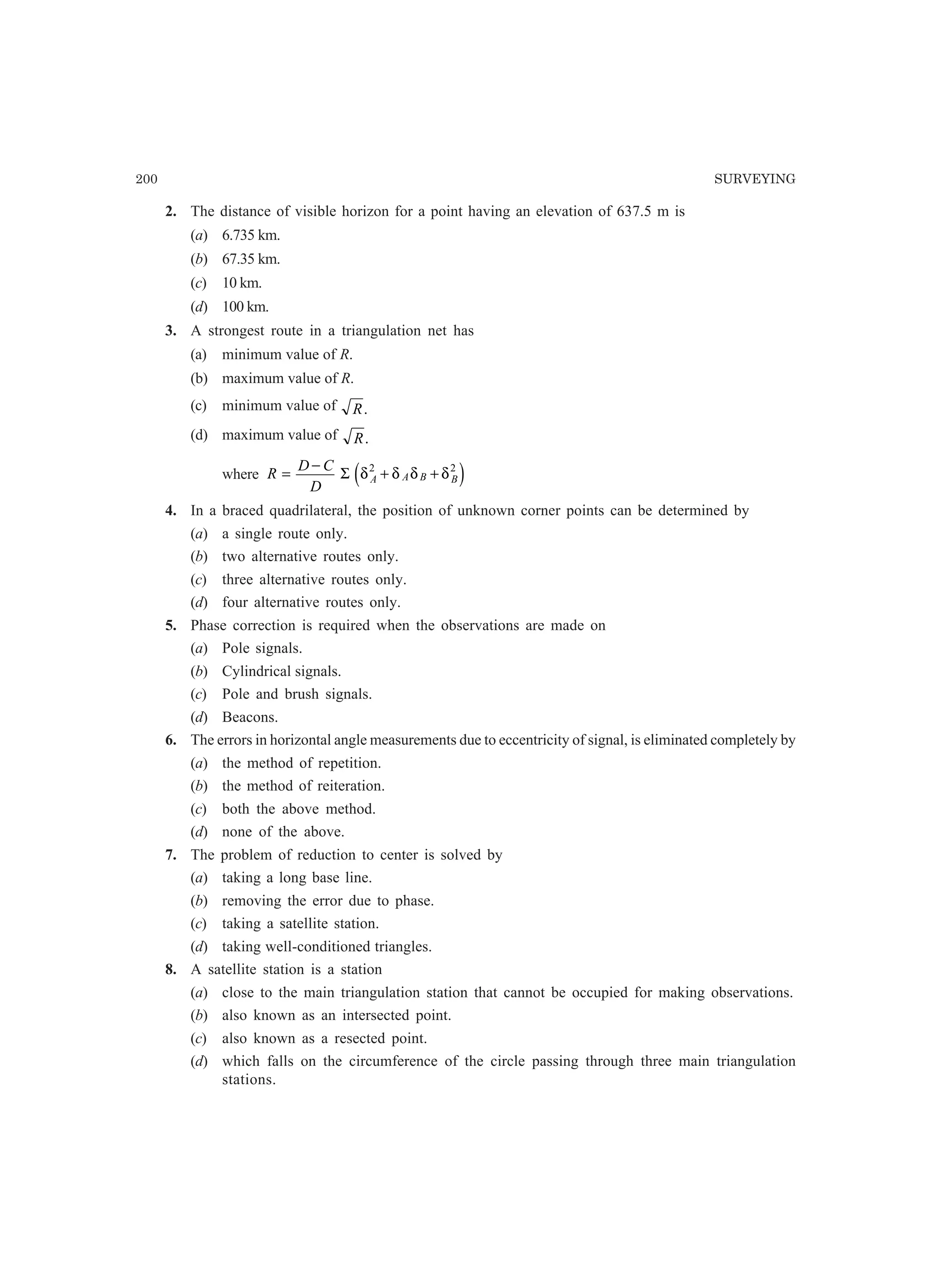
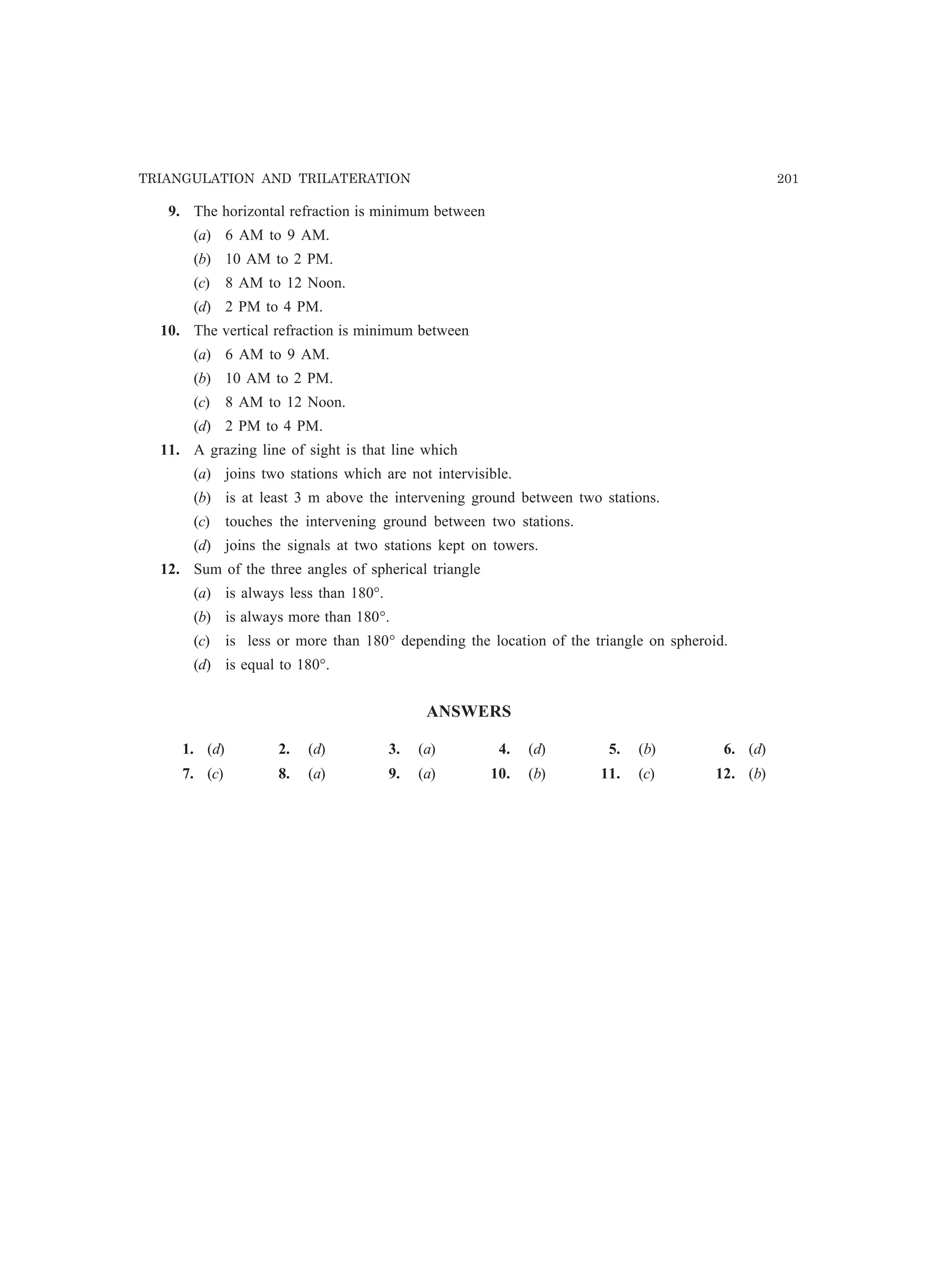
  • 61.
    48 SURVEYING σH =± 224.5 mm = ± 0.22 σh 2 2 21 2 100 2 5 12 5 12 100 0 778 1000 2 5 12= ° F HG I KJ + + °′ ′ × × sin × × . . × × cos ×c h c he j × . × .4 3633 10 2 564 2− +c h = 1534.5 mm2 σh = ± 39.2 mm = ± 0.039 mm Between A and Q ( ) ( )( ) ( ) 2 42222 103633.453272sin1000607.010012.55327cos100 − ××′××××+×′×= oo Hσ = 32071.2 mm2 σH = ± 179.1 mm = ± 0.18 m σh 2 2 21 2 100 2 27 35 5 12 100 0 607 1000 2 27 35= ° ′ F HG I KJ + + ° ′× ×sin × × . . × × cos ×b g b gc h × . × .4 3633 10 2 564 2− +c h j = 8855.3 mm2 σh = ± 94.1 mm = ± 0.09 m. Example 2.9. The following tacheometric observations were made from station A to stations 1 and 2. Table 2.4 Instrument Staff at Zenith Staff reading at station angle Upper Middle Lower A 1 96° 55′ 1.388 0.899 0.409 2 122°18′ 1.665 1.350 1.032 Calculate the errors in horizontal and vertical distances if the staff was inclined by 1° to the vertical in the following cases: (a) Staff inclined towards the instrument for the line A–1. (b) Staff inclined away from the instrument for the line A–2. The height of the instrument above ground was 1.52 m. Take stadia constants as 100 and 0.0 m. Solution: Let us first calculate the vertical angles from the zenith angles and the staff intercepts. For the line A–1 α1 = 90° – 96°55′ = – 6°55′ s1 = 1.388 – 0.409 = 0.979 m
  • 62.
    DISTANCE MEASUREMENT 49 Forthe line A–2 α2 = 90° – 122°18′′ = – 32°18′ s2 = 1.665 – 1.032 = 0.633 m For the line A–1 The apparent horizontal distance from Eq. (2.21) when the staff is truly vertical, is 48.96556cos979.0100cos 22 1 =′××==′ o αksD m The correct horizontal distance D when the staff is inclined, is obtained from Eq. (2.29) by replacing in the above expression s1 by s1 cos cos α δ α +b g. Thus D ks ks= + = +1 2 1 cos cos cos cos cos α δ α α α δ α b g b g = ° + ° °′ ′ 100 0 979 6 55 1 6 55× . × cos × cosc h = 96.26 m Therefore error = D′ – D = 96.48 – 96.26 = 0.22 m = 1 in 436 (approximately). The apparent vertical distance from Eq. (2.22) is ( ) ( ) 70.115562sin979.0100 2 1 2sin 2 1 1 =′××××==′ o αksV m The correct vertical distance is V ks= + = ° ′ + ° ° ′ ° ′ 1 2 2 1 2 100 0 979 6 55 1 2 6 55 6 55 1 cos cos sin × × . × cos × sin × cos α δ α α b g b g b g b g b g = 11.68 m Therefore, error = V′ – V = 11.70 – 11.68 = 0.02 m = 1 in 584 (approximately). For the line A–2 The apparent horizontal distance is ( ) 23.458132cos633.0100 2 =′××=′ o D m When the staff is inclined away from the instrument the correct horizontal distance from Eq. (2.30), is ( ) ( )8132cos18132cos633.0100 ′×−′××= ooo D = 45.72 m Therefore error = D′ – D = 45.23 – 45.72 = 0.49 m = 1 in 93 (approximately).
  • 63.
    50 SURVEYING The apparentvertical distance is ′ = ° ′ =V 1 2 100 0 633 2 32 18 28 59× × . × sin × .b g m The correct vertical distance is V = ° ′ − ° ° ′ ° ′ 1 2 100 0 633 32 18 1 2 32 18 32 18 × × . × cos × sin × cos b g b g b g = 28.90 m Therefore error = V′ – V = 28.59 – 28.90 = 0.31 m = 1 in 93 (approximately). Example 2.10. In Example 2.9, if the elevation of the point 1 is 115.673 m, determine the correct elevation of the point 2. The height of the instrument above ground is 1.52 m. Solution: Let h1, h2 = the elevations of the points 1 and 2, S1, S2 = the middle hair readings at the points 1 and 2, V1, V2 = the vertical distances for the points 1 and 2, and hi = the height of the instrument above ground. The height of the instrument above the mean sea level at A is H.I. = h1 + hi + S1 + V1 = 115.673 + 1.52 + 0.899 + 11.68 = 129.772 m The elevation of the point 2 is h2 = H.I. 22 SV +− = 129.772 – 28.90 – 1.350 = 99.522 m. Example 2.11. To measure a line AB, a theodolite was set up at A and a subtense bar of length 2 m was set up at B. The horizontal angle measured at A for the subtense bar targets was 4°02′26.4″. Determine the length of AB, the fractional error in the length AB if the horizontal angle was measured with an accuracy of ± 1.5″, and the error in AB if the subtense bar was out by 1° from being normal to AB. Solution: Horizontal distance in subtense tacheometry is given by AB b = 2 2 cot θ = ° ′ ′′F H I K 2 0 2 4 02 26 4 2 . × cot . = 28.348 m.
  • 64.
    DISTANCE MEASUREMENT 51 Theerror in distance AB is 206265 5.1 2 348.28 2 2 ′′ ×−= −= θd b D dD = 0.003 m (neglecting the sign). The fractional error is = = dD D dD D 1 = 1 in 9449 The error in horizontal distance due to the bar not being normal to AB, is given by ∆D b = − = ° ′ ′′F HG I KJ − ° 2 2 1 2 2 4 02 26 4 2 1 1 cot ( cos ) × cot . × ( cos ) θ δ = 0.004 m. Example 2.12. A line AB was measured using EDM. The instrument was set up at P in line with AB on the side of A remote from B. The wavelength of frequency 1 (f1) is 10 m exactly. Frequency 2 (f2) is (9/10) f1 and that of frequency 3 (f3) is (99/100) f1. Calculate the accurate length of AB that is known to be less than 200 m, from the phase difference readings given in Table 2.5. Table 2.5 Line Phase difference (m) f1 f2 f3 PA 4.337 7.670 0.600 PB 7.386 1.830 9.911 Solution: In Sec. 2.11.1, we have found out that λ2 = 11.111 m λ3 = 10.101 m From Eq. (2.43) for the line PA, we have 222111 λλλλ ∆+=∆+ nn 670.7111.11337.410 21 +=+ nn Since 21 λλ ∆∆ 121 += nn
  • 65.
    52 SURVEYING or 112−= nn Thus 670.7)1(111.11337.410 11 +−=+ nn or 71 =n This calculation has removed any ambiguity in the number of complete wavelengths of f1 frequency lying within the 0 to 100 m stage. Now considering f3 frequency which when related to f1 gives the 0 to 1000 m stage. Let 1n′ be the number of complete wavelengths of f1 and n3 be that of f3, then 600.0101.10337.410 31 +=+′ nn Since 21 λλ ∆∆ 31 nn =′ 600.0101.10337.410 11 +′=+′ nn or 371 =′n Thus there are 37 complete wavelengths of f1 within the distance of PA. Therefore from Eq. (2.40), we get 2PA = 37 × 10 + 4.337 = 374.337 m For the line PB, we have 830.1111.11386.710 21 +=+ nn Since 21 λλ ∆∆ 21 nn = or 51 =n Again 911.9101.10386.710 31 +=+′ nn Since 21 λλ ∆∆ 131 +=′ nn or 751 =′n Therefore, 2PB = 75 × 10 + 7.386 = 757.386 m Thus AB = 2 22 PAPB − 2 337.374386.757 − = = 191.525 m.
  • 66.
    DISTANCE MEASUREMENT 53 Example2.13. The following observations were made to measure the length of a base line AB using an EDM instrument. Measured distance = 1556.315 m Elevation of instrument at A = 188.28 m Elevation of reflector at B = 206.35 m Temperature = 24°C Pressure = 750 mm of mercury Calculate the correct length of AB and its reduced length at mean sea level. Take ns = 1.0002851, n0 = 296 × 10–6 and R = 6370 km. Solution: From Eq. (2.44), we have ( ) ( )             −=− 760 273 11 0 p T nn ( )             + ××=− − 760 750 24273 273 102961 6 n or n = 1.0002685 From Eq. (2.48), we have       ′= n n DD s       ×= 0002685.1 0002851.1 315.1556D = 1556.341 m From Eq. (2.49), the correct length of AB is = − F H I K ′cos θ H R L 9.54930 341.1556 28.18835.206 sin 1 ′′′=       − = − o θ Therefore, ( ) ( ) 341.1556 100063702 35.20628.188 9.5493cos ×      ×× + −′′′= = 1556.188 m. Example 2.14. The slope distance between two stations A and B measured with EDM when corrected for meteorological conditions and instrument constants, is 113.893 m. The heights of the instrument and reflector are 1.740 m and 1.844 m, respectively, above the ground. To measure the
  • 67.
    54 SURVEYING vertical anglea theodolite was set up at A, 1.660 m above the ground and a target at B having height above the ground as 1.634 m. The measured angle above the horizontal was + 4°23′18″. Determine (a) The horizontal length of the line AB. (b) To what precision the slope angle be measured (c) if the relative precision of the reduced horizontal distance is to be 1/100000. (d) if the reduced horizontal distance is to have a standard error of ± 1.8 mm. Solution: If the heights of the instrument and the target are not same, a correction known as eye and object correction is required to be determined to get the correct vertical angle. In Fig. 2.20a, the observed vertical angle is α. If the correct vertical angle α′ and the correction to α is β then βαα +=′ While measuring the distance as shown Fig. 2.20b, the height of the EDM and the reflector should also be same and the inclination of the line of sight due to height difference between the EDM and the reflector, a correction of β is to be applied to the slope angle θ, to make the line of sight inclined at α + β to the horizontal. Fig. 2.20 From Fig. 2.19a, we have 893.113 026.0 893.113 634.1660.1 = − =β radians = 1.47520626 893.113 026.0 ′′=′′× From Fig. 2.19b, we have 893.113 104.0 893.113 740.1844.1 = − =γ radians 4.083520626 893.113 104.0 ′′′=′′×= (a) (b) Line
  • 68.
    DISTANCE MEASUREMENT 55 Thecorrect slope angle θ = α + β + γ = 4°23′18″ + 47.1″ + 3′08.4″ 5.13724 ′′′= o Therefore the horizontal distance L L= ′ = ° ′ ′′ cos . × cos . θ 113 893 4 27 13 5 = 113.549 m. We have L L= ′ cos θ dL L d= − ′ sin θ θ …(a) The negative sign in the above expression shows decrease in L with increase in dθ. Thus the relative accuracy dL L L L d= ′ ′ sin cos . θ θ θ = tanθ .dθ It is given that 100000 1 = L dL , therefore, θd×′′′= 5.13724tan 100000 1 o or dθ = 0.000128 radians = 0.000128 × 206265″ = 26″ It is given that dL = ± 1.5 mm, therefore, from Eq. (a), we get θd×′′′×= 5.13724sin893.1130015.0 o dθ = 0 .000169 radians = 0.000169 × 206265″ = ± 35″″″″″.
  • 69.
    56 SURVEYING OBJECTIVE TYPEQUESTIONS 1. A metallic tape is (a) a tape made of any metal. (b) another name of a steel tape. (c) another name of an invar tape. (d) is a tape of water proof fabric into which metal wires are woven. 2. Spring balance in linear measurements is used (a) to know the weight of the tape (b) to apply the desired pull. (c) to know the standard pull at the time of measurement. (d) none of the above. 3. Ranging in distance mesurements is (a) another name of taping. (b) a process of establishing intermediate points on a line. (c) putting the ranging rod on the hill top for reciprocal ranging. (d) a process of determining the intersectoion of two straight lines. 4. Reciprocal ranging is employed when (a) the two ends of a line are not intervisible. (b) one end of a line is inaccessible. (c) both the ends are inaccessible. (d) the ends of the line are not visible even from intermediate points. 5. The following expression gives the relative accuracy in linear measurements when the slope angle is α. (a) dD D d= tan . .2α α (b) dD D d= tan . .2 α α (c) dD D d= 2 tan . .α α (d) dD D d= tan . .α α 6. If the slope angle 64°08′07″ is measured to an accuracy of 10″ the expected relative accuracy in the linear measurements is (a) 1/10. (b) 1/100. (c) 1/1000. (d) 1/10000. 7. The temperature correction and pull correction (a) may have same sign. (b) always have same sign. (c) always have opposite signs. (d) always have positive sign. 8. The sag corrections on hills (a) is positive. (b) is negative. (c) may be either positive or negative. (d) is zero
  • 70.
    DISTANCE MEASUREMENT 57 9.The correction for reduced length on the mean sea level is proportional to (a) H. (b) H2 . (c) 1/H. (d) 1/2H. where H is the mean elevetion of the line. 10. If the difference in the levels of the two ends of a 50 m long line is 1 m and its ends are out of alignment by 5 m then the corrections for slope (cs) and alignment (cm) are related to each other as (a) cs = 4cm. (b) cs = 0.4cm. (c) cs = 0.04cm. (d) cs = 0.004cm. 11. Stadia is a form of tacheometric mesurements that relies on (a) fixed intercept. (b) fixed angle intercept (c) varying angle intercept (d) none of the above. 12. The tacheometric method of surveying is generally preferred for (a) providing primary control. (b) large scale survey. (c) fixing points with highest precision. (d) difficult terrain. 13. If two points A and B 125 m apart, have difference in elevation of 0.5 m, the slope correction to the measured length is (a) + 0.001 m. (b) 0.001 m. (c) + 0.0125 m. (d) 0.001 m. 14. The branch of surveying in which an optical instrument is used too determine both horizontal and vertical positions, is known as (a) Tachemetry. (b) Tachometry. (c) Tacheometry. (d) Telemetry. 15. If the vertical angle from one station to another 100 m apart, is 60°, the staff intercept for a tacheometer with k = 100 and c = 0, would be (a) 1. (b) 4. (c) 5. (d) 0.1. 16. Electronic distance measurement instruments use (a) X-rays. (b) Sound waves. (c) Light waves. (d) Magnetic flux. 17. Modern EDM instruments work on the principle of measuring (a) the reflected energy generated by electromagnetic waves. (b) total time taken by electromagnetic wave in travelling the distance. (c) the change in frequency of the electromagnetic waves. (d) the phase difference between the transmitted and the reflected electromagnetic waves. 18. The range of infrared EDM instrument is generally limited to measuring the distances (a) 2 to 3 km. (b) 20 to 30 km. (c) 200 to 300 km. (d) more than 300 km.
  • 71.
    58 SURVEYING 19. Electromagneticwaves are unaffected by (a) air temperature. (b) atmospheric pressure. (c) vapour pressure. (d) wind speed. ANSWERS 1. (d) 2. (b) 3. (b) 4. (a) 5. (d) 6. (d) 7. (a) 8. (b) 9. (a) 10. (c) 11. (b) 12. (d) 13. (b) 14. (c) 15. (b) 16. (c) 17. (d) 18. (a) 19. (d).
  • 72.
    LEVELLING 3.1 LEVELLING Levelling isan operation in surveying performed to determine the difference in levels of two points. By this operation the height of a point from a datum, known as elevation, is determined. 3.2 LEVEL SURFACE A level surface is the equipotential surface of the earth’s gravity field. It is a curved surface and every element of which is normal to the plumb line. 3.3 DATUM A datum is a reference surface of constant potential, called as a level surface of the earth’s gravity field, for measuring the elevations of the points. One of such surfaces is the mean sea level surface and is considered as a standard datum. Also an arbitrary surface may be adopted as a datum. 3.4 LEVEL LINE A line lying in a level surface is a level line. It is thus a curved line. Line of sight Horizontal line Staff held vertical Mean sea-level Fig. 3.1 A level in proper adjustment, and correctly set up, produces a horizontal line of sight which is at right angles to the direction of gravity and tangential to the level line at the instrument height. It follows a constant height above mean sea level and hence is a curved line, as shown in Fig. 3.1. Over short distances, such as those met in civil engineering works, the two lines can be taken to coincide. Over long distances a correction is required to reduce the staff readings given by the horizontal line of sight to the level line equivalent. Refraction of the line of sight is also to be taken into account. The corrections for the curvature of the level line Cc and refraction Cr are shown in 59 !
  • 73.
    60 SURVEYING Fig. 3.2.The combined correction is given by C d R cr = − 3 7 2 ...(3.1) where Ccr = the correction for the curvature and refraction, d = the distance of the staff from the point of tangency, and R = the mean earth’s radius. For the value of R = 6370 km and d in kilometre, the value of Ccr in metre is given as 2 067.0 dCcr −= ...(3.2) Fig. 3.2 3.5 DIRECT DIFFERENTIAL OR SPIRIT LEVELLING Differential levelling or spirit levelling is the most accurate simple direct method of determining the difference of level between two points using an instrument known as level with a levelling staff. A level establishes a horizontal line of sight and the difference in the level of the line of sight and the point over which the levelling staff is held, is measured through the levelling staff. Fig. 3.3 shows the principle of determining the difference in level ∆h between two points A and B, and thus the elevation of one of them can be determined if the elevation of the other one is known. SA and SB are the staff readings at A and B, respectively, and hA and hB are their respective elevations. Fig. 3.3 Level line Line of sight H orizontal line M ean sea-level C r C c C cr
  • 74.
    LEVELLING 61 From thefigure, we find that (i) if SB SA, the point B is higher than point A. (ii) if SB SA, the point B is lower than point A. (iii) to determine the difference of level, the elevation of ground point at which the level is set up, is not required. Booking and Reducing the Levels Before discussing the booking and methods of reducing levels, the following terms associated with differential levelling must be understood. Station: A station is the point where the levelling staff is held. (Points A, a, b, B, c, and C in Fig. 3.4). Height of instrument (H.I.) or height of collimation: For any set up of the level, the elevation of the line of sight is the height of instrument. (H.I. = hA + SA in Fig. 3.3). Back sight (B.S.): It is the first reading taken on the staff after setting up the level usually to determine the height of instrument. It is usually made to some form of a bench mark (B.M.) or to the points whose elevations have already been determined. When the instrument position has to be changed, the first sight taken in the next section is also a back sight. (Staff readings S1 and S5 in Fig. 3.4). Section-1 Section-2 B.M. C.P. 1 2 A B C a b B.S. F.S. F.S. c B.S. I.S.. I.S.S1 S2 S3 S4 S5 S6 S7 B.M. Staff position/Station Instrument position I.S Fig. 3.4 Fore sight (F.S.): It is the last reading from an instrument position on to a staff held at a point. It is thus the last reading taken within a section of levels before shifting the instrument to the next section, and also the last reading taken over the whole series of levels. (Staff readings S4 and S7 in Fig. 3.4). Change point (C.P.) or turning point: A change point or turning point is the point where both the fore sight and back sight are made on a staff held at that point. A change point is required before moving the level from one section to another section. By taking the fore sight the elevation of the change point is determined and by taking the back sight the height of instrument is determined. The change points relate the various sections by making fore sight and back sight at the same point. (Point B in Fig. 3.4). Intermediate sight (I.S.): The term ‘intermediate sight’ covers all sightings and consequent staff readings made between back sight and fore sight within each section. Thus, intermediate sight station is neither the change point nor the last point. (Points a, b, and c in Fig. 3.4). Balancing of sights: When the distances of the stations where back sight and fore sight are taken from the instrument station, are kept approximately equal, it is known as balancing of sights. Balancing of sights minimizes the effect of instrumental and other errors.
  • 75.
    62 SURVEYING Section-1Section-2 Reduced level(R.L.): Reduced level of a point is its height or depth above or below the assumed datum. It is the elevation of the point. Rise and fall: The difference of level between two consecutive points indicates a rise or a fall between the two points. In Fig. 3.3, if (SA – SB) is positive, it is a rise and if negative, it is a fall. Rise and fall are determined for the points lying within a section. Section: A section comprises of one back sight, one fore sight and all the intermediate sights taken from one instrument set up within that section. Thus the number of sections is equal to the number of set ups of the instrument. (From A to B for instrument position 1 is section-1 and from B to C for instrument position 2 is section-2 in Fig. 3.4). For booking and reducing the levels of points, there are two systems, namely the height of instrument or height of collimation method and rise and fall method. The columns for booking the readings in a level book are same for both the methods but for reducing the levels, the number of additional columns depends upon the method of reducing the levels. Note that except for the change point, each staff reading is written on a separate line so that each staff position has its unique reduced level. This remains true at the change point since the staff does not move and the back sight from a forward instrument station is taken at the same staff position where the fore sight has been taken from the backward instrument station. To explain the booking and reducing levels, the levelling operation from stations A to C shown in Fig. 3.4, has been presented in Tables 3.1 and 3.2 for both the methods. These tables may have additional columns for showing chainage, embankment, cutting, etc., if required. Table 3.1 Height of instrument method Station B.S. I.S. F.S. H.I. R.L. Remarks A S1 H.I.A = hA B.M. = ha hA +S1 a S2 ha = H.I.A – S2 b S3 hb = H.I.A – S3 B S5 S4 H.I.B = hB = H.I.A – S4 C.P. – hB + S5 c S6 hc = H.I.B – S6 C S7 HC = H.I.B – S7 Σ B.S. Σ F.S. Check: Σ B.S. – Σ F.S. = Last R.L. – First R.L. In reducing the levels for various points by the height of instrument method, the height of instrument (H.I.) for the each section highlighted by different shades, is determined by adding the elevation of the point to the back sight reading taken at that point. The H.I. remains unchanged for all the staff readings taken within that section and therefore, the levels of all the points lying in that section are reduced by subtracting the corresponding staff readings, i.e., I.S. or F.S., from the H.I. of that section. In the rise and fall method, the rises and the falls are found out for the points lying within each section. Adding or subtracting the rise or fall to or from the reduced level of the backward
  • 76.
    LEVELLING 63 Section-1Section-2 station obtainsthe level for a forward station. In Table 3.2, r and f indicate the rise and the fall, respectively, assumed between the consecutive points. Table 3.2 Rise and fall method Station B.S. I.S. F.S. Rise Fall R.L. Remarks A S1 hA B.M. = ha a S2 r1 = ha = hA + r1 S1 – S2 b S3 f1 = S2 – S3 hb = ha – f1 B S5 S4 f2 = S3 – S4 hB = hb – f2 C.P. c S6 f3 = S5 – S6 hc = hB – f3 C S7 r2 = HC = hc + r2 S6 – S7 Σ B.S. Σ F.S. Σ Rise Σ Fall Check: Σ B.S. − Σ F.S. = Σ Rise − Σ Fall = Last R.L. − First R.L. The arithmetic involved in reduction of the levels is used as check on the computations. The following rules are used in the two methods of reduction of levels. (a) For the height of instrument method (i) Σ B.S. – Σ F.S. = Last R.L. – First R.L. (ii) Σ [H.I. × (No. of I.S.’s + 1)] – Σ I.S. – Σ F.S. = Σ R.L. – First R.L. (b) For the rise and fall method Σ B.S. – Σ F.S. = Σ Rise – Σ Fall = Last R.L. – First R.L. 3.6 COMPARISON OF METHODS AND THEIR USES Less arithmetic is involved in the reduction of levels with the height of instrument method than with the rise and fall method, in particular when large numbers of intermediate sights is involved. Moreover, the rise and fall method gives an arithmetic check on all the levels reduced, i.e., including the points where the intermediate sights have been taken, whereas in the height of instrument method, the check is on the levels reduced at the change points only. In the height of instrument method the check on all the sights is available only using the second formula that is not as simple as the first one. The height of instrument method involves less computation in reducing the levels when there are large numbers of intermediate sights and thus it is faster than the rise and fall method. The rise and fall method, therefore, should be employed only when a very few or no intermediate sights are taken in the whole levelling operation. In such case, frequent change of instrument position requires determination of the height of instrument for the each setting of the instrument and, therefore, computations involved in the height of instrument method may be more or less equal to that required in the rise and fall method. On the other hand, it has a disadvantage of not having check on the intermediate sights, if any, unless the second check is applied.
  • 77.
    64 SURVEYING 3.7 LOOPCLOSURE AND ITS APPORTIONING A loop closure or misclosure is the amount by which a level circuit fails to close. It is the difference of elevation of the measured or computed elevation and known or established elevation of the same point. Thus loop closure is given by e = computed value of R.L. – known value of R.L. If the length of the loop or circuit is L and the distance of a station to which the correction c is computed, is l, then L l ec −= ...(3.3) Alternatively, the correction is applied to the elevations of each change point and the closing point of known elevation. If there are n1 change points then the total number points at which the corrections are to be applied is n = n1 + 1 and the correction at each point is n e −= ...(3.4) The corrections at the intermediate points are taken as same as that for the change points to which they are related. Another approach could be to apply total of –e/2 correction equally to all the back sights and total of +e/2 correction equally to all the fore sights. Thus if there are nB back sights and nF fore sights then correction to each back sight = Bn e 2 − correction to each fore sight = Fn e 2 + ...(3.5) 3.8 RECIPROCAL LEVELLING Reciprocal levelling is employed to determine the correct difference of level between two points which are quite apart and where it is not possible to set up the instrument between the two points for balancing the sights. It eliminates the errors due to the curvature of the earth, atmospheric refraction and collimation. If the two points between which the difference of level is required to be determined are A and B then in reciprocal levelling, the first set of staff readings (a1 and b1) is taken by placing the staff on A and B, and instrument close to A. The second set of readings (a2 and b2) is taken again on A and B by placing the instrument close to B. The difference of level between A and B is given by ( ) ( ) 2 2211 baba h −+− =∆ ...(3.6)
  • 78.
    LEVELLING 65 and thecombined error is given by ( ) ( ) 2 2211 abab e −−− = ...(3.7) where e = el + ec – er ...(3.8) el = the collimation error assumed positive for the line of sight inclined upward, ec = the error due to the earth’s curvature, and er = the error due to the atmospheric refraction. We have ec – er = the combined curvature and refraction error = 0.067d2 . The collimation error is thus given by el = e – 0.067d2 in metre …(3.9) where d is the distance between A and B in kilometre. 3.9 TRIGONOMETRIC LEVELLING Trigonometric levelling involves measurement of vertical angle and either the horizontal or slope distance between the two points between which the difference of level is to be determined. Fig. 3.5 shows station A and station B whose height is to be established by reciprocal observations from A on to signal at B and from B on to signal at A. Vertical angles α (angle of elevation) and β (angle of depression), are measured at A and B, respectively. The refracted line of sight will be inclined to the direct line AB and therefore, the tangent to the refracted line of sight makes an angle υ with AB. The vertical angle α is measured with respect to this tangent and to the horizontal at A. Similarly, from B the angle of depression β is measured from the horizontal to the tangent to the line of sight. The point C lies on the arc through A, which is parallel to the mean sea level surface. d is the geodetic or spheroidal distance between A and B, and could be deduced from the geodetic coordinates of the two points. Angle BAC between AB and chord AC is related to angle θ between the two verticals at A and B which meet at the earth’s centre, since AC makes an angle of θ/2 with the horizontal at A. If the elevations of A and B are hA and hB, respectively, then the difference in elevation ∆h between A and B, is found out by solving the triangle ABC for BC. Thus in triangle ABC                         −+−+− −+ = υ θ α θ υ θ α 22 90180sin 2 sin oo ACBC = )cos( ) 2 sin( υθα υ θ α −+ −+ AC ...(3.10)
  • 79.
    66 SURVEYING The correctionfor curvature and refraction at A and B is (θ/2 – υ) and this refers angles a and β to chords AC and BD, respectively. Thus angle of elevation BAC = α + θ/2 – υ and angle of depression DBA = β – θ/2 + υ. Since AC is parallel to BD, ∠BAC = ∠DBA, Therefore, ∠BAC + ∠DBA = (α + θ/2 – υ) + (β – θ/2 + υ) or 2 ∠BAC = α + β or ∠BAC = 2 βα + = ∠DBA. This is the correct angle of elevation at A or angle of depression at B and is mean of the two angles α and β. In addition, we can write Eq. (3.10) as è αυ υ â è/2 D B A Cè/2 Mean sea-level R hA hB Vertical at A Vertical at B Horizontal at A Horizontal at B Line of sight d 90° +è/2 Fig. 3.5 BC = AC tan (α + θ/2 – υ) or       + =∆ 2 tan βα ACh . Therefore, hB = hA + Dh =       + + 2 tan βα AChA … (3.11) Note that in Eq. (3.11) it is assumed that α is the angle of elevation and β is angle of depression. In practice, only magnitudes need to be considered, not signs provided one angle is elevation and the other is depression. The coefficient of refraction K in terms of the angle of refraction υ and the angle θ subtended at the centre of the spheroid by the arc joining the stations, is given by θ υ =K …(3.12)
  • 80.
    LEVELLING 67 3.10 SENSITIVITYOF A LEVEL TUBE The sensitivity of a level tube is expressed in terms of angle in seconds subtended at the centre by the arc of one division length of the level tube. The radius of curvature of the inner surface of the upper portion of the level tube is also a measure of the sensitivity. The sensitivity of a level tube depends upon radius of curvature of the inner surface of the level tube and its diameter. It also depends upon the length of the vapour bubble, viscosity and surface tension of the liquid and smoothness of the inner surface of the tube. If α′ is the sensitivity of the level tube it is given by 1sin ′′ =′ nD s α seconds …(3.13) where s = the change in the staff reading for movement of the bubble by n divisions (Fig.3.6), and D = the distance of the staff from the instrument. The radius of curvature of the level tube is expressed as s nlD R = …(3.14) where l is the length of one division of the level tube. 3.11 TWO-PEG TEST Two-peg test is conducted for checking the adjustment of a level. Fig. 3.7 shows the method of conducting the test. Two rigid points A and B are marked on the ground with two pegs and the instrument is set up exactly between them at point C. Readings are taken on the staff held at A and B, and the difference between them gives the correct difference in level of the pegs. The equality in length of back sight and fore sight ensures that any instrumental error, e, is equal on both sights and is cancelled out in the difference of the two readings. The instrument is then moved to D so that it is outside the line AB and it is near to one of the pegs. Readings are again taken on the staff held at A and B. The difference in the second set of the staff readings is equal to the difference in level of the points A and B, and it will be equal to that determined with the first set of readings if the instrument is in adjustment. If the two values of the difference in level differ from each other, the instrument is out of adjustment. A BC e e A B D e′ d d Fig. 3.7 The adjustment of the instrument can also be tested by determining the difference in level of the points A and B by placing the instrument at C and D as shown in Fig. 3.8. s D nl R Fig. 3.6
  • 81.
    68 SURVEYING A BDA BC d d d d θ θ Fig. 3.8 3.12 EYE AND OBJECT CORRECTION The heights of the instrument and signal at which the observation is made, are generally not same and thus the observed angle of elevation θ′ as shown in Fig. 3.9, does not refer to the ground levels at A and B. This difference in height causes the observed vertical angle θ′ to be larger than that θ which would have been observed directly from those points. A correction (ε) termed as eye and object correction, is applied to the observed vertical angle to reduce it to the required value. The value of the eye and object correction is given by d hh is − =ε radians …(3.15) d hh is − = 206265 seconds …(3.16) Example 3.1. The following readings were taken with a level and 4 m staff. Draw up a level book page and reduce the levels by the height of instrument method. 0.578 B.M.(= 58.250 m), 0.933, 1.768, 2.450, (2.005 and 0.567) C.P., 1.888, 1.181, (3.679 and 0.612) C.P., 0.705, 1.810. Solution: The first reading being on a B.M., is a back sight. As the fifth station is a change point, 2.005 is fore sight reading and 0.567 is back sight reading. All the readings between the first and fifth readings are intermediate sight-readings. Similarly, the eighth station being a change point, 3.679 is fore sight reading, 0.612 is back sight reading, and 1.888, 1.181 are intermediate sight readings. The last reading 1.810 is fore sight and 0.705 is intermediate sight-readings. All the readings have been entered in their respective columns in the following table and the levels have been reduced by height of instrument method. In the following computations, the values of B.S., I.S., H.I., etc., for a particular station have been indicated by its number or name. Section-1: H.I.1 = h1 + B.S.1 = 58.250 + 0.578 = 58.828 m h2 = H.I.1 – I.S.2 = 58.828 – 0.933 = 57.895 m h3 = H.I.1 – I.S.3 = 58.828 – 1.768 = 57.060 m h4 = H.I.1 – I.S.4 = 58.828 – 2.450 = 56.378 m h5 = H.I.1 – F.S.5 = 58.828 – 2.005 = 56.823 m hs A B hi B′ B′′ hi d ε θ θ′ Fig. 3.8
  • 82.
    LEVELLING 69 Section-2: H.I.5 =h5 + B.S.5 = 56.823 + 0.567 = 57.390 m h6 = H.I.2 – I.S.6 = 57.390 – 1.888 = 55.502 m h7 = H.I.2 – I.S.7 = 57.390 – 1.181 = 56.209 m h8 = H.I.2 – F.S.8 = 57.390 – 3.679 = 53.711 m Section-3: H.I.8 = h8 + B.S.8 = 53.711 + 0.612 = 54.323 m h9 = H.I.8 – I.S.9 = 54.323 – 0.705 = 53.618 m h10 = H.I.8 – F.S.10 = 54.323 – 1.810 = 52.513 m Additional check for H.I. method: Σ [H.I. × (No. of I.S.s + 1)] – Σ I.S. – Σ F.S. = Σ R.L. – First R.L. [58.828 × 4 + 57.390 ´ 3 + 54.323 × 2] – 8.925 – 7.494 = 557.959 – 58.250 = 499.709 (O.K.) Table 3.3 Station B.S. I.S. F.S. H.I. R.L. Remarks 1 0.578 58.828 58.250 B.M.=58.250 m 2 0.933 57.895 3 1.768 57.060 4 2.450 56.378 5 0.567 2.005 57.390 56.823 C.P. 6 1.888 55.502 7 1.181 56.209 8 0.612 3.679 54.323 53.711 C.P. 9 0.705 53.618 10 1.810 52.513 Σ 1.757 8.925 7.494 557.956 Check: 1.757 – 7.494 = 52.513 – 58.250 = – 5.737 (O.K.) Example 3.2. Reduce the levels of the stations from the readings given in the Example 3.1 by the rise and fall method. Solution: Booking of the readings for reducing the levels by rise and fall method is same as explained in Example 3.1. The computations of the reduced levels by rise and fall method is given below and the results are tabulated in the table. In the following computations, the values of B.S., I.S., Rise (r), Fall (f ), etc., for a particular station have been indicated by its number or name. (i) Calculation of rise and fall Section-1: f2 = B.S.1 – I.S.2 = 0.578 – 0.933 = 0.355 f3 = I.S.2 – I.S.3 = 0.933 – 1.768 = 0.835 f4 = I.S.3 – I.S.4 = 1.768 – 2.450 = 0.682 r5 = I.S.4 – F.S.5 = 2.450 – 2.005 = 0.445
  • 83.
    70 SURVEYING Section-2: f6= B.S.5 – I.S.6 = 0.567 – 1.888 = 1.321 f7 = I.S.6 – I.S.7 = 1.888 – 1.181 = 0.707 f8 = I.S.7 – F.S.8 = 1.181 –- 3.679 = 2.498 Section-3: f9 = B.S.8 – I.S.9 = 0.612 – 0.705 = 0.093 f10 = I.S.9 – F.S.10 = 0.705 – 1.810 = 1.105 (ii) Calculation of reduced levels h2 = h1 – f2 = 58.250 – 0.355 = 57.895 m h3 = h2 – f3 = 57.895 – 0.835 = 57.060 m h4 = h3 – f4 = 57.060 – 0.682 = 56.378 m h5 = h4 + r5 = 56.378 + 0.445 = 56.823 m h6 = h5 – f6 = 56.823 – 1.321 = 55.502 m h7 = h6 + r7 = 55.502 + 0.707 = 56.209 m h8 = h7 – f8 = 56.209 – 2.498 = 53.711 m h9 = h8 – f9 = 53.711 – 0.093 = 53.618 m h10 = h9 – f10 = 53.618 – 1.105 = 52.513 m Table 3.4 Station B.S. I.S. F.S. Rise Fall R.L. Remarks 1 0.578 58.250 B.M.=58.250 m 2 0.933 0.355 57.895 3 1.768 0.835 57.060 4 2.450 0.682 56.378 5 0.567 2.005 0.445 56.823 C.P. 6 1.888 1.321 55.502 7 1.181 0.707 56.209 8 0.612 3.679 2.498 53.711 C.P. 9 0.705 0.093 53.618 10 1.810 1.105 52.513 Σ 1.757 7.494 1.152 6.889 Check: 1.757 – 7.494 = 1.152 – 6.889 = 52.513 – 58.250 = – 5.737 (O.K.) Example 3.3. The following consecutive readings were taken with a level on continuously sloping ground at a common interval of 20 m. The last station has an elevation of 155.272 m. Rule out a page of level book and enter the readings. Calculate (i) the reduced levels of the points by rise and fall method, and
  • 84.
    LEVELLING 71 (ii) thegradient of the line joining the first and last points. 0.420, 1.115, 2.265, 2.900, 3.615, 0.535, 1.470, 2.815, 3.505, 4.445, 0.605, 1.925, 2.885. Solution: Since the readings have been taken along a line on a continuously sloping ground, any sudden large change in the reading such as in the sixth reading compared to the fifth reading and in the eleventh reading compared to the tenth reading, indicates the change in the instrument position. Therefore, the sixth and eleventh readings are the back sights and fifth and tenth readings are the fore sights. The first and the last readings are the back sight and fore sight, respectively, and all remaining readings are intermediate sights. The last point being of known elevation, the computation of the levels is to be done from last point to the first point. The falls are added to and the rises are subtracted from the known elevations. The computation of levels is explained below and the results have been presented in the following table. (i) Calculation of rise and fall Section-1: f2 = B.S.1 – I.S.2 = 0.420 – 1.115= 0.695 f3 = I.S.2 – I.S.3 = 1.115 – 2.265= 1.150 f4 = I.S.3 – I.S.4 = 2.265 – 2.900= 0.635 f5 = I.S.4 – F.S.5 = 2.900 – 3.615= 0.715 Section-2: f6 = B.S.5 – I.S.6 = 0.535 – 1.470 = 0.935 f7 = I.S.6 – I.S.7 = 1.470 – 2.815 = 1.345 f8 = I.S.7 – I.S.8 = 2.815 – 3.505 = 0.690 f9 = I.S.8 – F.S.9 = 3.505 – 4.445 = 0.940 Section-3: f10 = B.S.9 – I.S.10 = 0.605 – 1.925 = 1.320 f11 = I.S.10 – F.S.11 = 1.925 – 2.885 = 0.960 (ii) Calculation of reduced levels h10 = h11 + f11 = 155.272 + 0.960 = 156.232 m h9 = h10 + f10 = 156.232 + 1.320 = 157.552 m h8 = h9 + f9 = 157.552 + 0.940 = 158.492 m h7 = h8 + f8 = 158.492 + 0.690 = 159.182 m h6 = h7 + f7 = 159.182 + 1.345 = 160.527 m h5 = h6 + f6 = 160.527 + 0.935 = 161.462 m h4 = h5 + f5 = 161.462 + 0.715 = 162.177 m h3 = h4 + f4 = 162.177 + 0.635 = 162.812 m h2 = h3 + f3 = 162.812 + 1.150 = 163.962 m h1 = h2 + f2 = 163.962 + 0.695 = 164.657 m
  • 85.
    72 SURVEYING Table 3.5 StationChainage B.S. I.S. F.S. Rise Fall R.L. Remarks (m) 1 0 0.420 164.657 2 20 1.115 0.695 163.962 3 40 2.265 1.150 162.812 4 60 2.900 0.635 162.177 5 80 0.535 3.615 0.715 161.462 C.P. 6 100 1.470 0.935 160.527 7 120 2.815 1.345 159.182 8 140 3.505 0.690 158.492 9 160 0.605 4.445 0.940 157.552 C.P. 10 180 1.925 1.320 156.232 11 200 2.885 0.960 155.272 Elevation = 155.272 m Σ 1.560 10.945 0.000 9.385 Check: 1.560 – 10.945 = 0.000 – 9.385 = 155.272 – 164.657 = – 9.385 (O.K.) (iii) Calculation of gradient The gradient of the line 1-11 is = 11-1pointsbetweendistance 11-1pointsbetweenlevelofdifference = 155 272 164 657 200 . .− = 200 9.385− = 1 in 21.3 (falling) Example 3.4. A page of level book is reproduced below in which some readings marked as (×), are missing. Complete the page with all arithmetic checks. Solution: The computations of the missing values are explained below. B.S.4 – I.S.5 = f5, B.S.4 = f5 + I.S.5 = – 0.010 + 2.440 = 2.430 B.S.9 – F.S.10 = f10, B.S.9 = f10 + F.S.10 = – 0.805 + 1.525 = 0.720 B.S.1 + B.S.2 + B.S.4 + B.S.6 + B.S.7 + B.S.9 = ΣB.S. 3.150 + 1.770 + 2.430 + B.S.6 + 1.185 + 0.720 = 12.055 B.S.6 = 12.055 – 9.255 = 2.800
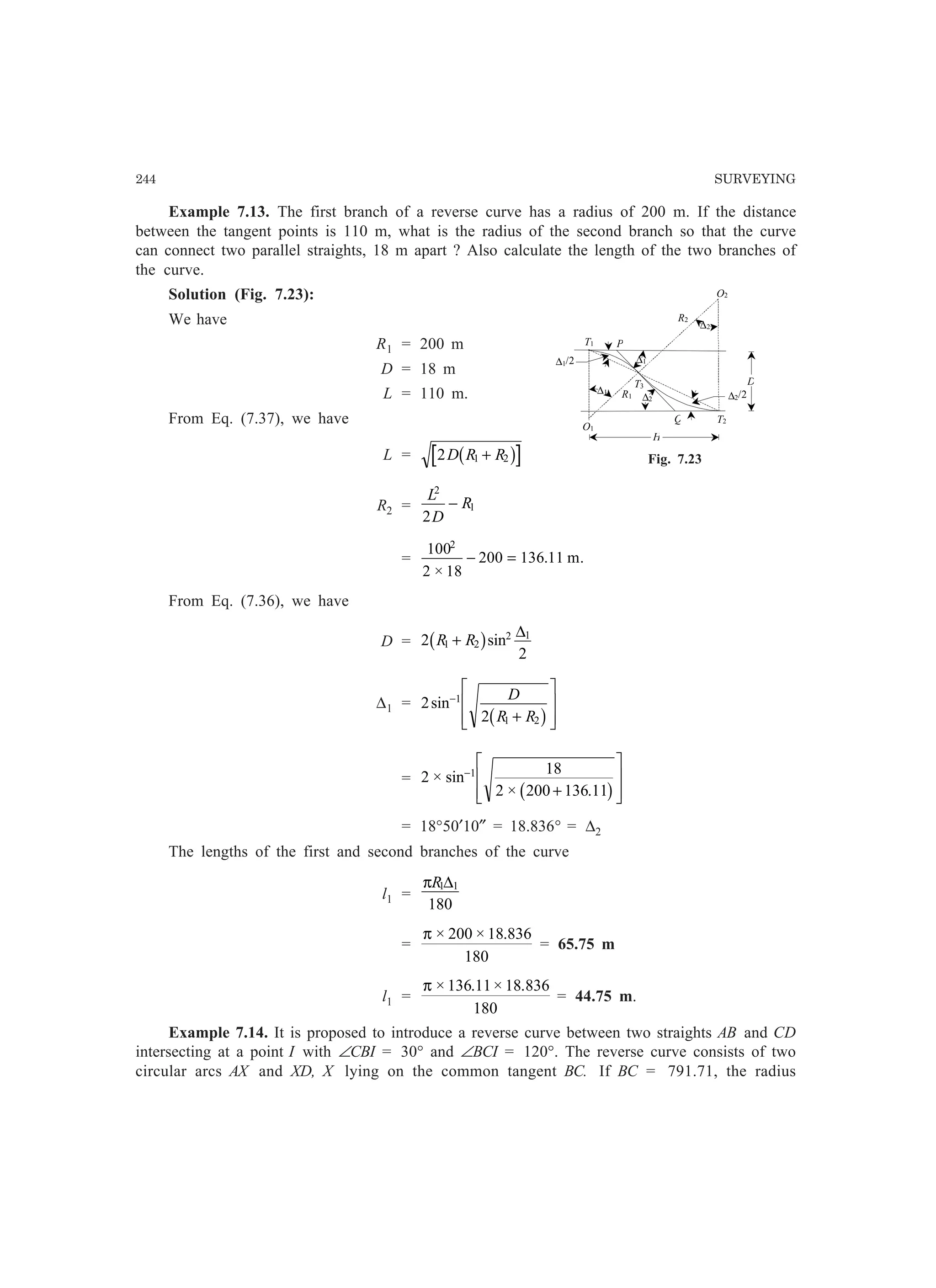
  • 86.
    LEVELLING 73 Table 3.6 StationB.S. I.S. F.S. Rise Fall R.L. Remarks 1 3.150 × 2 1.770 × 0.700 × C.P. 3 2.200 × × 4 × 1.850 × × C.P. 5 2.440 0.010 × 6 × × 1.100 × C.P. 7 1.185 2.010 × 222.200 C.P. 8 –2.735 × × Staff held inverted 9 × 1.685 4.420 × C.P. 10 1.525 0.805 × Σ 12.055 × × × B.S.1 – F.S.2 = f2, F.S.2 = B.S.1 – f2 = 3.150 – (–0.700) = 3.850 I.S.5 – F.S.6 = r6, F.S.6 = I.S.5 – r6 = 2.440 – 1.100 = 1.340 B.S.2 – I.S.3 = 1.770 – 2.200 = – 0.430 = 0.430 (fall) = f3 I.S.3 – F.S.4 = 2.200 – 1.850 = 0.350 = r4 B.S.6 – F.S.7 = 2.800 – 2.010 = 0.790 = r7 B.S.7 – I.S.8 = 1.185 – (– 2.735) = 3.920 = r8 For the computation of reduced levels the given reduced level of point 7 is to be used. For the points 1 to 6, the computations are done from points 6 to 1, upwards in the table and for points 8 to 10, downwards in the table. h6 = h7 – r7 = 222.200 – 0.790 = 221.410 m h5 = h6 – r6 = 221.410 – 1.100 = 220.310 m h4 = h5 + f5 = 220.310 + 0.010 = 220.320 m h3 = h4 – r4 = 220.320 – 0.350 = 219.970 m h2 = h3 + f3 = 219.970 + 0.430 = 220.400 m h1 = h2 + f2 = 220.400 + 0.700 = 221.100 m h8 = h7 + r8 = 222.200 + 3.920 = 226.120 m h9 = h8 – f9 = 226.120 – 4.420 = 221.700 m h10 = h9 – f10 = 221.700 – 0.805 = 220.895 m The computed missing values and the arithmetic check are given Table 3.7.
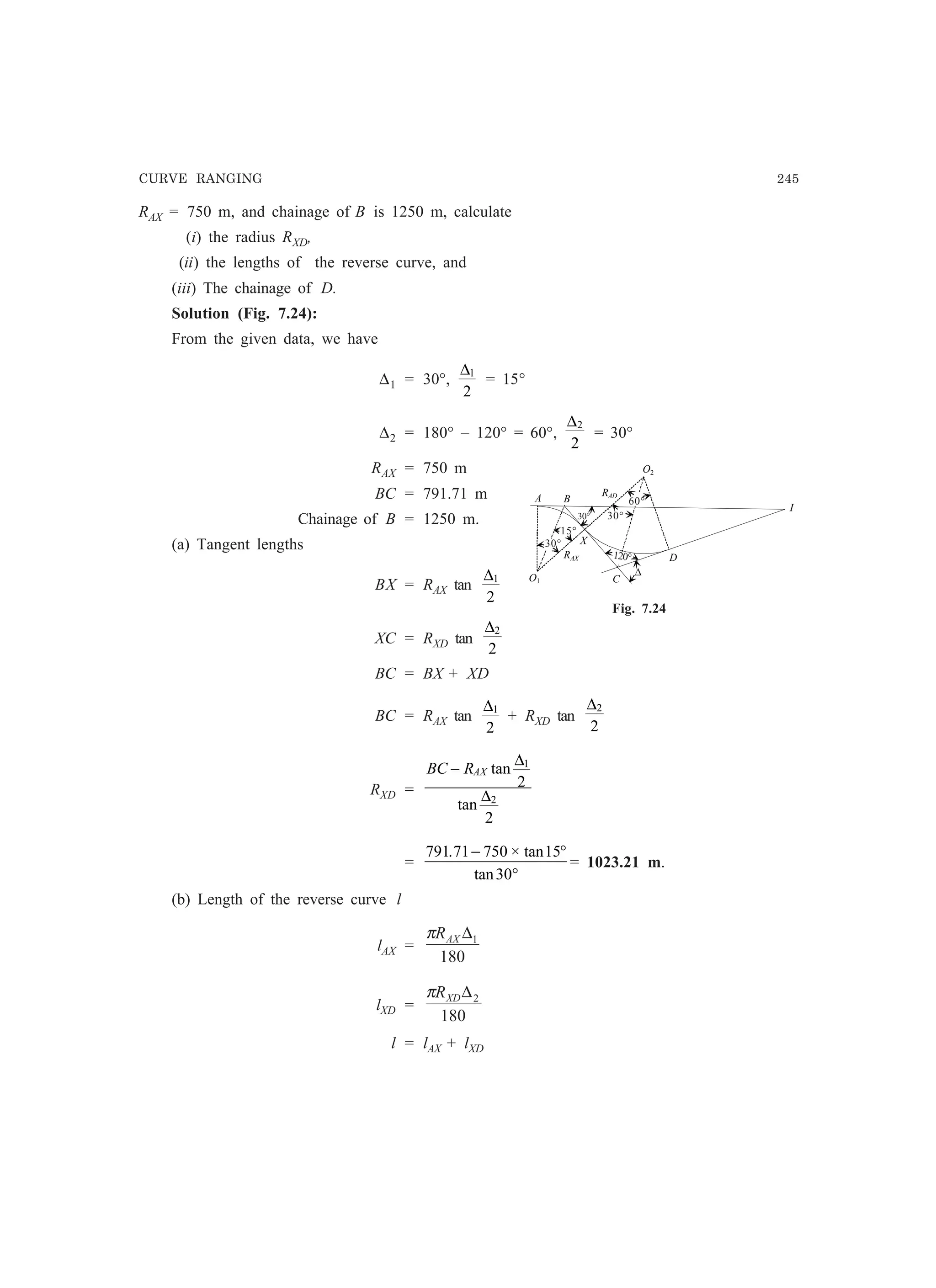
  • 87.
    74 SURVEYING Table 3.7. StationB.S. I.S. F.S. Rise Fall R.L. Remarks 1 3.150 221.100 2 1.770 3.850 0.700 220.400 C.P. 3 2.200 0.430 219.970 4 2.430 1.850 0.350 220.320 C.P. 5 2.440 0.010 220.310 6 2.800 1.340 1.100 221.410 C.P. 7 1.185 2.010 0.790 222.200 C.P. 8 -2.735 3.920 226.120 Staff held inverted 9 0.720 1.685 4.420 221.700 C.P. 10 1.525 0.805 220.895 Σ 12.055 12.266 6.610 6.365 Check: 12.055 – 12.266 = 6.610 – 6.365 = 220.895 – 221.100 = – 0.205 (O.K.) Example 3.5. Given the following data in Table 3.8, determine the R.L.s of the points 1 to 6. If an uniform upward gradient of 1 in 20 starts at point 1, having elevation of 150 m, calculate the height of embankment and depth of cutting at all the points from 1 to 6. Table 3.8 Station Chainage (m) B.S. I.S. F.S. Remarks B.M. – 10.11 153.46 m 1 0 3.25 2 100 1.10 3 200 6.89 0.35 4 300 3.14 5 400 11.87 3.65 6 500 5.98 Solution: Reduced levels of the points by height of instrument method H.I.B.M. = R.L.B.M. + B.S.B.M. = 153.46 + 10.11 = 163.57 m h1 = H.I.B.M. – I.S.1 = 163.57 – 3.25 = 160.32 m h2 = H.I.B.M. – I.S.2 = 163.57 – 1.10 = 162.47 m h3 = H.I.B.M. – F.S.3 = 163.57 – 0.35 = 163.22 m H.I.3 = h3 + B.S.3 = 163.22 + 6.89 = 170.11 m
  • 88.
    LEVELLING 75 h4 =H.I.3 – I.S.4 = 170.11 – 3.14 = 166.97 m h5 = H.I.3 – F.S.5 = 170.11 – 3.65 = 166.46 m H.I.5 = h5 + B.S.5 = 166.46 + 11.87 = 178.33 m h6 = H.I.5 – F.S.6 = 178.33 – 5.98 = 172.35 m Levels of the points from gradient Since the gradient is 1 in 20, for every 100 m the rise is 5 m. Level of point 1, h′1 = 150 m (given) Level of point 2, h′2 = 150 + 5 = 155 m Level of point 3, h′3 = 155 + 5 = 160 m Level of point 4, h′4 = 160 + 5 = 165 m Level of point 5, h′5 = 165 + 5 = 170 m Level of point 6, h′6 = 170 + 5 = 175 m Height of embankment and depth of cutting At point 1 h1 – h′1 = 160.32 – 150.00 = + 10.32 m (embankment) At point 2 h2 – h′2 = 162.47 – 155.00 = + 7.47 m (embankment) At point 3 h3 – h′3 = 163.22 – 160.00 = + 3.22 m (embankment) At point 4 h4 – h′4 = 166.97 – 165.00 = + 1.97 m (embankment) At point 5 h5 – h′5 = 166.46 – 170.00 = – 3.54 m (cutting) At point 6 h6 – h′6 = 172.35 – 175.00 = – 2.65 m (cutting) The computed values of the height of embankment and depth of cutting are tabulated below. Table 3.9 Station Chainage B.S. I.S. F.S. H.I. R.L. Gradient Embankment/cutting (m) level Height (m) Depth (m) B.M. – 10.11 163.57 153.46 – 1 0 3.25 160.32 150 10.32 2 100 1.10 162.47 155 7.47 3 200 6.89 0.35 170.11 163.22 160 3.22 4 300 3.14 166.97 165 1.97 5 400 11.87 3.65 178.33 166.46 170 3.54 6 500 5.98 172.35 175 2.65 Example 3.6. The readings given in Table 3.10, were recorded in a levelling operation from points 1 to 10. Reduce the levels by the height of instrument method and apply appropriate checks. The point 10 is a bench mark having elevation of 66.374 m. Determine the loop closure and adjust the calculated values of the levels by applying necessary corrections. Also determine the mean gradient between the points 1 to 10.
  • 89.
    76 SURVEYING Table 3.10 StationChainage (m) B.S. I.S. F.S. Remarks 1 0 0.597 B.M.= 68.233 m 2 20 2.587 3.132 C.P 3 40 1.565 4 60 1.911 5 80 0.376 6 100 2.244 1.522 C.P 7 120 3.771 8 140 1.334 1.985 C.P 9 160 0.601 10 180 2.002 Solution: Reduced levels of the points H.I.1 = h1 + B.S.1 = 68.233 + 0.597 = 68.830 m h2 = H.I.1 – F.S.2 = 68.233 + 3.132 = 65.698 m H.I.2 = h2 + B.S.2 = 65.698 + 2.587 = 68.285 m h3 = H.I.2 – I.S.3 = 68.285 – 1.565 = 66.720 m h4 = H.I.2 – I.S.4 = 68.285 – 1.911 = 66.374 m h5 = H.I.2 – I.S.5 = 68.285 – 0.376 = 67.909 m h6 = H.I.2 – F.S.6 = 68.285 – 1.522 = 66.763 m H.I.6 = h6 + B.S.6 = 66.763 + 2.244 = 69.007 m h7 = H.I.6 – I.S.7 = 69.007 – 3.771 = 65.236 m h8 = H.I.6 – F.S.8 = 69.007 – 1.985 = 67.022 m H.I.8 = h8 + B.S.8 = 67.022 + 1.334 = 68.356 m h9 = H.I.8 – I.S.9 = 68.356 – 0.601 = 67.755 m h10 = H.I.8 – F.S.10 = 68.356 – 2.002 = 66.354 m Loop closure and loop adjustment The error at point 10 = computed R.L. – known R.L. = 66.354 – 66.374 = –0.020 m Therefore correction = +0.020 m Since there are three change points, there will be four instrument positions. Thus the total number of points at which the corrections are to be applied is four, i.e., three C.P.s and one last F.S. It is reasonable to assume that similar errors have occurred at each station. Therefore, the correction for each instrument setting which has to be applied progressively, is = + 005.0 4 0.020 = m
  • 90.
    LEVELLING 77 i.e., thecorrection at station 1 0.0 m the correction at station 2 + 0.005 m the correction at station 6 + 0.010 m the correction at station 8 + 0.015 m the correction at station 10 + 0.020 m The corrections for the intermediate sights will be same as the corrections for that instrument stations to which they are related. Therefore, correction for I.S.3, I.S.4, and I.S.5 = + 0.010 m correction for I.S.7 = + 0.015 m correction for I.S.9 = + 0.020 m Applying the above corrections to the respective reduced levels, the corrected reduced levels are obtained. The results have been presented in Table 3.11. Table 3.11 Station Chainage B.S. I.S. F.S. H.I. R.L. Correction Corrected (m) R.L. 1 0 0.597 68.830 68.233 – 68.233 2 20 2.587 3.132 68.285 65.698 + 0.005 65.703 3 40 1.565 66.720 + 0.010 66.730 4 60 1.911 66.374 + 0.010 66.384 5 80 0.376 67.909 + 0.010 67.919 6 100 2.244 1.522 69.007 66.763 + 0.010 66.773 7 120 3.771 65.236 + 0.015 65.251 8 140 1.334 1.985 68.356 67.022 + 0.015 67.037 9 160 0.601 67.755 + 0.020 67.775 10 180 2.002 66.354 + 0.020 66.374 Σ 6.762 8.641 Check: 6.762 – 8.641 = 66.354 – 68.233 = – 1.879 (O.K.) Gradient of the line 1-10 The difference in the level between points 1 and 10, ∆h = 66.324 – 68.233 = –1.909 m The distance between points 1-10, D = 180 m Gradient = – 180 909.1 = – 0.0106 = 1 in 94.3 (falling) Example 3.7. Determine the corrected reduced levels of the points given in Example 3.6 by two alternative methods.
  • 91.
    78 SURVEYING Solution: Method-1 FromEq. (3.3), the correction L l ec −= The total correction at point 10 (from Example 3.6) = + 0.020 m The distance between the points 1 and 10 = 180 m Correction at point 2 = 20 180 020.0 ×+ = + 0.002 m Correction at point 6 = 100 180 020.0 ×+ = + 0.011 m Correction at point 8 = 140 180 020.0 ×+ = + 0.016 m Correction at point 10 = 180 180 020.0 ×+ = + 0.020 m Corrections at points 3, 4, and 5 = + 0.011 m Correction at point 7 = + 0.016 m Correction at point 9 = + 0.020 m The corrections and the corrected reduced levels of the points are given in Table 3.12. Table 3.12 Station R.L. Correction Corrected R.L. 1 68.233 – 68.233 2 65.698 + 0.002 65.700 3 66.720 + 0.011 66.731 4 66.374 + 0.011 66.385 5 67.909 + 0.011 67.920 6 66.763 + 0.011 66.774 7 65.236 + 0.016 65.252 8 67.022 + 0.016 67.038 9 67.755 + 0.020 67.775 10 66.354 + 0.020 66.374 Method-2 In this method half of the total correction is applied negatively to all the back sights and half of the total correction is applied positively to all the fore sights. Total number of back sights = 4 Total number of fore sights = 4 Correction to each back sight =       × − − 42 020.0 = + 0.0025 m
  • 92.
    LEVELLING 79 Correction toeach fore sight =       × − + 42 020.0 = - 0.0025 m The correction to each intermediate sight is also the same as for the fore sights, i.e., - 0.0025 m. The correction and the corrected values of the reduced levels are tabulated in Table 3.13. Table 3.13 Station Observed Correction Corrected H.I. Corrected B.S. I.S. F.S. B.S. I.S. F.S. R.L. 1 0.597 + 0.0025 0.5995 68.8325 68.233 2 2.587 3.132 + 0.0025 – 0.0025 2.5895 3.1295 68.2925 65.703 3 1.565 – 0.0025 1.5625 66.730 4 1.911 – 0.0025 1.9085 66.384 5 0.376 – 0.0025 0.3735 67.919 6 2.244 1.522 + 0.0025 – 0.0025 0.2465 1.5195 69.0195 66.773 7 3.771 – 0.0025 3.7685 65.251 8 1.334 1.985 + 0.0025 – 0.0025 1.3365 1.9825 68.3735 67.037 9 0.601 – 0.0025 0.5985 67.775 10 2.002 – 0.0025 1.9995 66.374 Example 3.8. Reciprocal levelling was conducted across a wide river to determine the difference in level of points A and B, A situated on one bank of the river and B situated on the other. The following results on the staff held vertically at A and B from level stations 1 and 2, respectively, were obtained. The level station 1 was near to A and station 2 was near to B. Instrument Staff reading on at A B 1 1.485 1.725 2 1.190 1.415 (a) If the reduced level of B is 55.18 m above the datum, what is the reduced level of A? (b) Assuming that the atmospheric conditions remain unchanged during the two sets of the observations, calculate (i) the combined curvature and refraction correction if the distance AB is 315 m, and (ii) the collimation error. Solution: To eliminate the errors due to collimation, curvature of the earth and atmospheric refraction over long sights, the reciprocal levelling is performed. From the given data, we have a1 = 1.485 m, a2 = 1.725 m b1 = 1.190 m, b2 = 1.415 m The difference in level between A and B is given by
  • 93.
    80 SURVEYING ( )( ) 2 2211 baba h −+− =∆ 2 )415.1725.1()190.1485.1( −+− = = 0.303 m R.L. of B = R.L. of A + ∆h R.L. of A = R.L. of B – ∆h = 55.18 – 0.303 = 54.88 m. The total error e = el + ec – er where ( ) ( ) 2 2211 abab e −−− = 2 )725.1415.1()485.1190.1( −−− = = 0.008 m and ec – er = 0.067 d2 = 0.067 × 0.3152 = 0.007 m. Therefore collimation error el = e – (ec – er) = 0.008 – 0.007 = 0.001 m. Example 3.9. To determine difference in level between two stations A and B, reciprocal vertical angles have been observed as + 6°32′58.3″ from A to B and – 6°33′36.7″ from B to A, the horizontal distance AB being 1411.402 m. Compute (i) the corrected vertical angle, (ii) the coefficient of refraction, (iii) the correction for the earth’s curvature and atmospheric refraction, and (iv) the elevation of B if the elevation of A is 116.73 m. Take the mean radius of the earth equal to 6383.393 km. Solution: (Fig. 3.10) In Fig. 3.10, from ∆ AEO, we have Chord AC = 2 (R + hA) sin 2 θ But for all practical purposes we can take Chord AC = arc AC = R hR d A )( + Unless hA is appreciable, chord AC = d since hA becomes negligible compared to R. From Fig. 3.10, we get R d R AC AO AE 2 2chord 2 sin == θ 1000393.63832 402.1411 ×× = A E θ⁄2 d C θ O R+hA Fig. 3.10
  • 94.
    LEVELLING 81 8.22 2 ′′= θ The observedangle of elevation α = 6°32′58.3″ and the observed angle of depression β = 6°33′36.7″ (i) Correct vertical angle = 2 βα + = 2 7.363363.58236 ′′′+′′′ oo = 6°33′17.5″ We know that α + θ/2 – υ = 2 βα + υ = α + θ/2 – 2 βα + = 6°32′58.3″ + 22.8″ – 6°33′17.5″ = 3.6″″″″″. (ii) Coefficient of refraction K = υ θ = 8.222 6.3 × = 0.079. Combined correction for curvature and refraction C d R cr = − 3 7 2 = − 3 7 1 411402 1000 6383 393 2 × . × . = – 0.134 m. (iii) The difference of level in A and B is given by ∆h AC= +F H I Ktan α β 2 =       + 2 tan βα d = 1411.402 × tan 6°33′17.5″ = 162.178 m Elevation of B hB = hA + ∆h = 116.73 + 162.178 = 278.91 m.
  • 95.
    82 SURVEYING Example 3.10.The following observations were made to determine the sensitivity of two bubble tubes. Determine which bubble tube is more sensitive.The distance of the staff from the instrument was 80 m and the length of one division of both the bubble tubes is 2 mm. Bubble tube Bubble reading Staff L.H.S. R.H.S. reading A (i) 13 5 1.618 (ii) 18 12 1.767 B (i) 15 3 1.635 (ii) 6 14 1.788 Solution: Bubble tube A The distance of the bubble from the centre of its run (i) n1 = 2 1 × (13 – 5) = 4 divisions (ii) n2 = 2 1 × (12 – 8) = 2 divisions The total number of divisions n through which bubble has moved = n1 + n2 = 6 The staff intercept s = 1.767 – 1.618 = 0.149 m The sensitivity of the bubble tube Aα′ = nD s ×206265 seconds = 806 149.0 206265 × × seconds = 1′4″ Bubble tube B The distance of the bubble from the centre of its run (i) n1 = 2 1 × (15 – 3) = 6 divisions (ii) n2 = 2 1 × (14 – 6) = 4 divisions The total number of divisions n through which bubble has moved = n1 + n2 = 10 The staff intercept s = 1.788 – 1.635 = 0.153 m The sensitivity of the bubble tube Bα′ = 8010 153.0 206265 × × seconds = 40″ Since Aα ′ Bα′ , the bubble A is more sensitive than B.
  • 96.
    LEVELLING 83 Example 3.11.If sensitivity of a bubble tube is 30″ per 2 mm division what would be the error in staff reading on a vertically held staff at a distance of 200 m when the bubble is out of centre by 2.5 divisions? Solution: The sensitivity of a bubble tube is given by nD s 206265=′α seconds where s can be taken as the error in staff reading for the error in the bubble tube. Therefore s = 206265 α′nD = 206265 302005.2 ×× = 0.073 m. Example 3.12. Four stations C, A, B, and D were set out in a straight line such that CA = AB = BD = 30 m. A level was set up at C and readings of 2.135 and 1.823 were observed on vertically held staff at A and B, respectively, when bubble was at the centre of its run. The level was then set up at D and readings of 2.026 and 1.768 were again observed at A and B, respectively. Determine the collimation error of the level and correct difference in level of A and B. Solution: (Fig. 3.8) Apparent difference in level of A and B when instrument at C ∆h1 = 2.135 – 1.823 = 0.312 m Apparent difference in level of A and B when instrument at D ∆h2 = 2.026 – 1.768 = 0.258 m Since the two differences in level do not agree, the line of collimation is inclined to the horizontal and not parallel to the axis of the bubble tube. Let the inclination of the line of collimation with the horizontal be θ, directed upwards. The distance d between consecutive stations is 30 m. If the errors in the staff readings at A and B for the instrument position at C are eA1 and eB1 and that for the instrument position D are eA2 and eB2, respectively, then eA1 = dθ eB1 = 2 dθ eA2 = 2 dθ eB2 = dθ The correct staff readings for the instrument position at C are (2.135 – dθ) and (1.823 – 2 dθ) and that for the instrument position at D are (2.026 – 2 dθ) and (1.768 – dθ) Substituting d = 30 m, the correct difference in level are ∆h1 = (2.135 – 30θ) – (1.823 – 60θ) = 0.312 + 30θ ∆h2 = (2.026 – 60θ) – (1.768 – 30θ) = 0.258 – 30θ Since both ∆h1and ∆h2 are the correct differences in level, they must be equal. Therefore ∆h1 = ∆h2
  • 97.
    84 SURVEYING 0.312 +30θ = 0.258 – 30θ θ = – 0.0009 radians = – 0.0009 × 206265 seconds = – 3′5.64″ The negative sign shows the line of collimation is inclined downwards rather upwards as assumed. The correct difference of level between A and B ∆h = 0.312 + 30 × (– 0.0009) = 0.285 m. The correct difference in level can also be obtained from Eq. (3.6) by reciprocal levelling ( ) ( ) 2 2211 baba h −+− =∆ = half the sum of apparent difference in level = 2 258.0312.0 + = 0.285 m. Example 3.13. Fig. 3.11 shows a rectangle ABCD, in which A, B, and C are the stations where staff readings were obtained with a level set up at E and D. The observed readings are given in Table 3.14. Table 3.14 Level at Staff reading at A B C E 1.856 0.809 – D 2.428 1.369 1.667 If A is a bench mark having elevation of 150 m, calculate the correct elevations of B and C. Solution: Since ∠DAB = 90° EB = √ (152 + 202 ) = 25 m DB = √ (482 + 202 ) = 52 m Assuming the line of sight is inclined upwards by angle θ, the correct staff reading on A when level at E = 1.856 – 15θ the correct staff reading on B when level at E = 0.809 – 25θ the correct staff reading on A when level at D = 2.428 – 48θ the correct staff reading on B when level at D = 1.369 – 52θ A B C D E 48 m 20 m 15 m 33 m Fig. 3.11
  • 98.
    LEVELLING 85 The correctdifferences in level of A and B from the two instrument positions must be equal. Therefore (1.856 – 15θ) – (0.809 – 25θ) = (2.428 – 48θ) – (1.369 – 52θ) = 6 012.0 = 0.002 radians The correct level difference of A and B = (1.856 – 15θ) – (0.809 – 25θ) = 1.047 + 10θ = 1.047 + 10 × 0.002 = 1.067 m Reduced level of B = 150 + 1.067 = 151.067 m. The correct staff reading at C = 1.667 – 20θ The correct level difference of A and C = (2.428 – 48θ) – (1.667 – 20θ) = 0.761 – 28 × 0.002 = 0.705 m Reduced level of C = 150 + 0.705 = 150.705 m. Example 3.14. To determine the difference in level between two stations A and B, 4996.8 m apart, the reciprocal trigonometric levelling was performed and the readings in Table 3.15,were obtained. Assuming the mean earth’s radius as 6366.20 km and the coefficient of refraction as 0.071 for both sets of observations, compute the observed value of the vertical angle of A from B and the difference in level between A and B. Table 3.15 Instrument Height of Target Height of Mean vertical at Instrument (m) at Target (m) angle A 1.6 B 5.5 + 1°15′32″ B 1.5 A 2.5 – Solution (Fig. 3.9): Height of instrument at A, hi = 1.6 m Height of target at B, hS = 5.5 m Correction for eye and object to the angle α′ observed from A to B Aε = 206265. d hh iS − seconds = 206265 8.4996 6.15.5 × − seconds = 2′41″ Similarly, the correction for eye and object to the angle β′ observed from B to A Bε = 206265 8.4996 5.15.2 × − seconds = 41.3″
  • 99.
    86 SURVEYING Length ofarc at mean sea level subtending an angle of 1″ at the centre of earth = 1000 206265 1 × ′′×R = 1000 206265 12.6366 × ′′× = 30.86 m Therefore angle θ subtended at the centre of earth by AB = 86.30 8.4996 θ = 2¢41.9″ Refraction υ = Kθ = 0.071 × 2′41.9″ = 11.5″ Therefore correction for curvature and refraction q/2 – υ = 5.11 2 5.412 ′′− ′′′ = 1′9.5″ Corrected angle of elevation for eye and object α = α′ – εA = 1°15′32″ – 2′41″ = 1°12′51″ Corrected angle of elevation for curvature and refraction α + θ/2 – υ = 1°12¢51″ + 1¢9.5″ = 1°14¢0.5″ If b is the angle of depression at B corrected for eye and object then α + θ/2 – υ = β – (θ/2 – υ) or β = 1°14¢0.5″ + 1¢9.5″ = 1°15′10″ If the observed angle of depression is β′ then β¢ = β′ – εB or β¢ = β + εB = 1°15′10″ + 41.3″ = 1°15¢51.3″″″″″ Now the difference in level ∆h AC= ′ + ′F HG I KJtan α β 2 = ° ′ ′′ + ° ′ ′′F H I K4996 8 1 12 51 1 15 51 3 2 . × tan . = 108.1 m
  • 100.
    LEVELLING 87 OBJECTIVE TYPEQUESTIONS 1. A datum surface in levelling is a (a) horizontal surface. (b) vertical surface. (c) level surface. (d) non of the above. 2. Reduced level of a point is its height or depth above or below (a) the ground surface. (b) the assumed datum. (c) assumed horizontal surface. (d) the line of collimation. 3. The correction for the atmospheric refraction is equal to (a) + 1/7 of the correction for curvature of the earth. (b) 1/7 of the correction for curvature of the earth. (c) + 6/7 of the correction for curvature of the earth. (d) 6/7 of the correction for curvature of the earth. 4. If the back sight reading at point A is greater than the fore sight reading at point B then (a) A is higher than B. (b) B is higher than A. (c) height of the instrument is required to know which point is higher. (d) instrument position is required to know which point is higher. 5. Change points in levelling are (a) the instrument stations that are changed from one position to another. (b) the staff stations that are changed from point to point to obtain the reduced levels of the points. (c) the staff stations of known elevations. (d) the staff stations where back sight and fore sight readings are taken. 6. Balancing of sights mean (a) making fore sight reading equal to back sight reading. (b) making the line of collimation horizontal. (c) making the distance of fore sight station equal to that of the back sight station from the instrument station. (d) taking fore sight and back sight readings at the same station. 7. The height of instrument method of reducing levels is preferred when (a) there are large numbers of intermediate sights. (b) there are no intermediate sights. (c) there are large numbers of fore sights. (d) there are no fore sights.
  • 101.
    88 SURVEYING 8. Sensitivityof a bubble tube depends on (a) the radius of curvature. (b) the length of the vapour bubble. (c) the smoothness of the inner surface of the buble tube. (d) all the above. 9. Reciprocal levelling is employed to determine the accurate difference in level of two points which (a) are quite apart and where it is not possible to set up the instrument midway between the points. (b) are quite close and where it is not possible to set up the instrument midway between the points. (c) have very large difference in level and two instrument settings are required to determine the difference in level. (d) are at almost same elevation. 10. When a level is in adjustment, the line of sight of the instrument is (a) perpendicular to the vertical axis of the instrument and parallel to the bubble tube axis. (b) perpendicular to the vertical axis of the instrument and bubble level axis. (c) perpendicular to the bubble tube axis and parallel to the vertical axis. (d) none of the above. 11. A Dumpy level is preferred to determine the elevations of points (a) lying on hills. (b) lying on a line. (c) lying in moderately flat terrain. (d) on a contour gradient. ANSWERS 1. (c) 2. (b) 3. (a) 4. (b) 5. (d) 6. (c) 7. (a) 8. (d) 9. (a) 10. (a) 11. (c)
  • 102.
    89 Vertical axis Trunion axis Verticalcircle (face left) Horizontal circle Line of collimation Plumb bob Axis of plate level Axis of telescope 4.1 THE THEODOLITE A theodolite is a versatile instrument basically designed to measure horizontal and vertical angles. It is also used to give horizontal and vertical distances using stadia hairs. Magnetic bearing of lines can be measured by attaching a trough compass to the theodolite. It is used for horizontal and vertical alignments and for many other purposes. A theodolite has three important lines or axes, namely the horizontal axis or trunion axis, the vertical axis, and the line of collimation or the line of sight. It has one horizontal circle perpendicular to the vertical axis of the instrument for measuring horizontal angles and one vertical circle perpendicular to the trunion axis for measuring vertical angles. For leveling the instrument there is one plate level having its axis perpendicular to the vertical axis. The instrument also has one telescope level having its axis parallel to the line of sight for measuring vertical angles. The three axes of a perfectly constructed and adjusted theodolite have certain geometrical requirements of relationship between them as shown in Fig. 4.1. The line of collimation has to be perpendicular to the trunion axis and their point of intersection has to lie on the vertical axis. The intersection of the horizontal axis, the vertical axis and the line of collimation, is known as the instrumental centre. The line of sight coinciding with the line of sight describes a vertical plane when the telescope is rotated about the trunion axis. The vertical axis defined by plumb bob or optical plummet, has to be centered as accurately as possible over the station at which angles are going to be measured. Fig. 4.1 THEODOLITE AND TRAVERSE SURVEYING
  • 103.
    90 SURVEYING 4.2 ERRORSDUE TO MALADJUSTMENTS OF THE THEODOLITE Errors in horizontal circle and vertical circle readings arise due to certain maladjustments of the theodolite. Error in the Horizontal Circle Reading Error in the horizontal circle readings are due to the following maladjustments of the instrument: (i) The line of collimation not perpendicular to the trunion axis by a small amount c. (ii) The trunion axis not perpendicular to the vertical axis by a small amount i. The Line of Collimation Not Perpendicular to the Trunion Axis by a Small Amount c Let us consider a sphere the centre O of which is the instrumental centre of the theodolite as shown in Fig. 4.2. The line of sight of the theodolite is out of adjustment from the line perpendicular to the trunion axis by a small angle c. When the theodolite is rotated about the trunion axis for the pointing on P the line of sight sweeps along circle Z1PT1. The reading on the horizontal circle, however, as if P were in vertical circle ZS1 (to which Z1PT1 is parallel) whereas it is actually in vertical circle ZP1. Consequently, the error in the horizontal circle reading is S1P1 for this sighting, and is positive on a clockwise reading circle. Z′1 Z1 S c P h O S1 T1 P1 T2 S2 Path of line of sight (face right) Path of line of sight (face left) Z Trunion axis Z c Line of sight Vertical circle PS c 90° 90°−h Fig 4.2 Let SP be at right angles to ZS1 in the spherical triangle ZSP and the altitude of P be h (= PP1). Then ZP S SP Z sin sin sin sin = or ZP SSP Z sin sinsin sin = . For small angle, we can write the error in horizontal circle reading Z c h c h = ° ° − = sin sin ( ) cos 90 90 = .sec hc (4.1)
  • 104.
    THEODOLITE AND TRAVERSESURVEYING 91 The Trunion Axis not Perpendicular to the Vertical Axis by a Small Amount i In Fig. 4.3, it has been assumed that the left-hand support of the trunion axis is higher than the right-hand support and, consequently, the line of sight sweeps along circle Z2PS3, making angle i with the vertical circle ZS3. P appears to be on that circle but is in fact on vertical circle ZP2, and therefore, the error in the horizontal circle reading is S3P2 and it is negative. Considering the right-angled spherical triangle PP2S3 in which ∠P2 = 90°, from Napier’s rule we have 232 tan.tansin PPiSP = . For small angles we can write the error in horizontal circle reading 232 tan PPiSP = = i tan h …(4.2) where PP2 = PP1 = h. In the case of depression angles the errors in horizontal circle reading due to collimation error c are the same since path Z1PT1 is parallel to ZS1 throughout (Fig. 4.2). However, for the error in trunion axis, path Z2PS3 in Fig. 4.3, is inclined to ZS3, the two paths effectively crossing at S3 when moving from elevation to depression. Thus there is a change in the direction of error for depression angles. Z′2Z2 P h O S4 P2 S3 Z Trunion axis Line of sight Vertical circle i i Path of line of sight (face right) Path of line of sight (face left) P P2 S3 90° i Fig. 4.3 For face right observations the path of the lines of sight change from Z1 to Z1′ in Fig. 4.2, thus giving an error of P1S2 in the horizontal circle reading. This is of similar magnitude but of opposite sign to S1P1. Similarly, in Fig. 4.3, Z2 moves to Z2′ and S3 to S4, giving error S4P2 which is of same magnitude but of opposite sign to error P2S3. It may be noted that in each case taking means of face left and face right observations cancels out the errors, and the means will be the true values of the horizontal circle readings. Errors in Vertical Circle Reading Errors in circle readings due to the line of collimation not being perpendicular to the trunion axis and the trunion axis not being perpendicular to the vertical axis may be taken as negligible. When the vertical axis is not truly vertical the angle i by which the trunion axis is not perpendicular to the vertical axis, varies with the pointing direction of the telescope of the instrument. Its value is
  • 105.
    92 SURVEYING N A B C DE E X Y Traverse Fig. 4.5 maximumwhen the trunion axis lies in that plane which contains the vertical axis of the instrument and the true vertical. However, in this case the horizontal circle, reading will be in error as the trunion axis is inclined to the vertical axis of the instrument. The error in this case is of the form (ii) above but i is now variable. 4.3 TRAVERSE A traverse consists a series of straight lines of known length related one another by known angles between the lines. The points defining the ends of the traverse lines are called the traverse stations. Traverse survey is a method of establishing control points, their positions being determined by measuring the distances between the traverse stations which serve as control points and the angles subtended at the various stations by their adjacent stations. The anglers are measured with a theodolite and the distances are measured by the methods discussed in Chapter 2 depending on the accuracy required in the survey work. Chain and compass traverse may be run for ordinary surveys. Types of Traverse There are two types of traverse, namely the open traverse and the closed traverse. An open traverse originates at a point of known position and terminates at a point of unknown position (Fig. 4.4a), whereas a closed traverse originates and terminates at points of known positions (Fig. 4.4b). When closed traverse originates and terminates at the same point, it is called the closed-loop traverse (Fig. 4.4 c). For establishing control points, a closed traverse is preferred since it provides different checks for included angles, deflection angles and bearings for adjusting the traverse. When an open traverse is used the work should be checked by providing cut off lines and by making observations on some prominent points visible form as many stations as possible. N N N A A B B B A C CC D D DE (a) (b) (c) Fig. 4.4 4.4 COORDINATES Normally, plane rectangular coordinate system having x-axis in east-west direction and y-axis in north-south direction, is used to define the location of the traverse stations. The y-axis is taken as the reference axis and it can be (a) true north, (b) magnetic north, (c) National Grid north, or (d) a chosen arbitrary direction. Usually, the origin of the coordinate system is so placed that the entire traverse falls in the first quadrant of the coordinate system and all the traverse stations have positive coordinates as shown in Fig. 4.5.
  • 106.
    THEODOLITE AND TRAVERSESURVEYING 93 4.5 BEARING Bearing is defined as the direction of any line with respect to a given meridian as shown in Fig. 4.6. If the bearing θ or θ′ is measured clockwise from the north side of the meridian, it is known as the whole-circle bearing (W.C.B.).The angle θ is known as the fore bearing (F.B.) of the line AB and the angle θ′ as the back bearing (B.B.). If θ and θ′ are free from errors, (θ – θ′) is always equal to 180°. The acute angle between the reference meridian and the line is known as the reduced bearing (R.B.) or quadrantal bearing. In Fig. 4.7, the reduced bearings of the lines OA, OB, OC, and OD are NθAE, SθBE, SθCW, and NθDW, respectively. 4.6 DEPARTURE AND LATITUDE The coordinates of points are defined as departure and latitude. The latitude is always measured parallel to the reference meridian and the departure perpendicular to the reference meridian. In Fig. 4.8, the departure and latitude of point B with respect to the preceding point A, are Departure = BC = l sin θ Latitude = AC = l cos θ. …(4.3) where l is the length of the line AB and θ its bearing. The departure and latitude take the sign depending upon the quadrant in which the line lies. Table 4.1 gives the signs of departure and latitude. Table 4.1 Quadrant N-E S-E S-W N-W Departure + + – – Latitude + – – + Departure and latitude of a forward point with respect to the preceding point is known as the consecutive coordinates. N-E quadrant S-E quadrant S-W quadrant N-W quadrant A B C D East South North West θA θB θD θC A B θ l N Reference meridian Departure Latitudel cosθ l sinθ C Fig. 4.7 Fig. 4.8 N A B N θ′ θ Meridian Fig. 4.6
  • 107.
    94 SURVEYING 4.7 EASTINGAND NORTHING The coordinates (X,Y) given by the perpendicular distances from the two main axes are the eastings and northings, respectively, as shown in Fig. 4.9. The easting and northing for the points P and Q are (EP, NP,) and (EP, NP,), respectively. Thus the relative positions of the points are given by .PQ PQ NNN EEE −=∆ −=∆ …(4.4) P Q ∆N E N EQ EP NP ∆E NQ Fig. 4.9 4.8 BALANCING THE TRAVERSE In a closed traverse the following conditions must be satisfied: Σ Departure = ΣD = 0 Σ Latitude = ΣL = 0 …(4.5) If the above conditions are not satisfied, the position A of the originating stations and its computed position A′ will not be the same as shown in Fig. 4.10, due to the observational errors. The distance AA′ between them is known as the closing error. The closing error is given by 22 )()( LDe Σ+Σ= ...(4.6) and its direction or reduced bearing is given by )( )( tan L D Σ Σ =θ . …(4.7) The term balancing is generally applied to the operation of adjusting the closing error in a closed traverse by applying corrections to departures and latitudes to satisfy the conditions given by the Eq. (4.5). The following methods are generally used for balancing a traverse: (a) Bowditch’s method when the linear errors are proportional to √l and angular errors are proportional to 1/√l, where l is the length of the line. This rule can also be applied graphically when the angular measurements are of inferior accuracy such as in compass surveying. In this method the total error in departure and latitude is distributed in proportion to the length of the traverse line. Therefore,
  • 108.
    THEODOLITE AND TRAVERSESURVEYING 95 l l Lc l l Dc L D Σ Σ= Σ Σ= …(4.8) where cD and cL = the corrections to the departure and latitude of the line to which the correction is applied, l = the length of the line, and Σl = the sum of the lengths of all the lines of the traverse, i.e., perimeter p. (b) Transit rule when the angular measurements are more precise than the linear measurements. By transit rule, we have c D D D D T = Σ …(4.9) c L L L L T = Σ where D and L = the departure and latitude of the line to which the correction is applied, and DT and LT = the arithmetic sum of departures and latitudes all the lines of the traverse, (i.e., ignoring the algebraic signs). 4.9 OMITTED OBSERVATIONS In a closed traverse if lengths and bearings of all the lines could not be measured due to certain reasons, the omitted or the missing measurements can be computed provided the number of such omissions is not more than two. In such cases, there can be no check on the accuracy of the field work nor can the traverse be balanced. It is because of the fact that all the errors are thrown into the computed values of the omitted observations. The omitted quantities are computed using Eq. (4.5), i.e. ΣD l l ln n= + + + =1 1 2 2 0sin sin ....... sinθ θ θ ΣL l l ln n= + + + =1 1 2 2 0cos cos ....... sinθ θ θ …(4.10) It may be noted that length of the traverse lines l = D L2 2 + departure of the line D = l sin θ latitude of the line L = l cos θ bearing of the line q = tan–1 (D/L). D2 D1 D3 D4 L4 L3 L1 L2 B A ΣD ΣLe θ N A′ D C Fig. 4.10
  • 109.
    96 SURVEYING 4.10 CENTERINGERROR OF THEODOLITE If the theodolite is not correctly centered over the ground station mark at which the horizontal angles are to be measured, its vertical angle will not pass through the station mark and the measured horizontal angle will be in error. In Fig. 4.11, let the true centering position of the theodolite be S. When the theodolite is not correctly centered over station S the vertical axis of the theodolite may lie any where within a circle of radius x from S, x being the centering error. However, there are two points S1 and S2 on the perimeter of the circle at which the true horizontal angle PSQ will be subtended. S1 and S2 lie on the circumference of the circle passing through P, S and Q. Accordingly ∠PS1Q = ∠PSQ = ∠PS2Q, because all the three angles stand on chord PQ. To determine the maximum angular error due to a centering error, let us assume that the theodolite is centered at S′ which is x distance away from the correct position S. Correct horizontal angle ∠PSQ = γ = θ + φ Measured horizontal angle ∠PS′Q = γ′ = α + θ + φ + β Therefore the error in measurement E = γ′ – γ = α + β From ∆SS′P, we have sin sinα θ SS S P′ = ′ …(4.11) From ∆SS′Q, we have QSSS ′ = ′ φβ sinsin . …(4.12) Taking S′P = y and S′Q = z, for small angles Eqs. (4.11) and (4.12) become y x θ α sin = z x φ β sin = . Therfore E =       + zy x φθ sinsin =       + ′′ zy x φθ sinsin 1sin seconds …(4.13) S1 S P Q α S2 S′ x y z β γ θ φ γ ′ Fig. 4.11
  • 110.
    THEODOLITE AND TRAVERSESURVEYING 97 where 1sin ′′ x = 206265. The maximum absolute error E occurs when (a) sin θ and cos φ are maximum, i.e., θ = φ = 90°. (b) y and z are minimum. For the given values if γ, y and z, the maximum angular error can be determined as under. For a given value of γ, θ = γ – φ E = ( )       + − ′′ zy x φφγ sinsin 1sin …(4.14) =       + − ′′ zy x φγφφγ sincossincossin 1sin       + −− ′′ = zy x d dE φγφφγ φ coscoscossinsin 1sin = 0 yz γφφγφ coscossinsincos + = ( )γφγ costansin += zy γ γ φ sin cos tan z zy − = . …(4.15) For the given values of γ, y and z, the maximum value of α can be determined from Eq. (4.15) which on substitution in Eq. (4.14) will give the maximum absolute error EMax. 4.11 COMPATIBILITY OF LINEAR AND ANGULAR MEASUREMENTS The precision achieved in a measurement depends upon the instruments used and the methods employed. Therefore, the instruments and methods to be employed for a particular survey should be so chosen that the precision in linear and angular measurements are consistent with each other. This can be achieved by making the error in angular measurement equal to the error in the linear measurement. Fig. 4.12 In Fig. 4.12, a point R is located with reference to the traverse line PQ by making angular measurement θ and linear measurement l. But due to the errors δθ in the angular measurement R is located at R′ and due to error δl in the linear measurement the location of R′ is further displaced to R from R′. R′′ R′ R δ l δθ θ l P Q
  • 111.
    98 SURVEYING The displacementdue to the angular error RR′ = l tan δθ. The displacement due to the linear error R′R′′ = δl . For consistency in linear and angular errors RR′ = R′R′′ or l tan δθ = δl tan δθ = l lδ . For small values of δθ, tan δθ = δθ, thus δθ = l lδ . ...(4.16) Example 4.1. The fore bearings and back bearings of the lines of a closed traverse ABCDA were recorded as below: Line Fore bearing Back bearing AB 77°30′ 259°10′ BC 110°30′ 289°30′ CD 228°00′ 48°00′ DA 309°50′ 129°10′ Determine which of the stations are affected by local attraction and compute the values of the corrected bearings. Solution (Fig. 4.13): Method-I In this method the errors in the bearings of the lines are determined and the bearings are corrected for the respective errors. By observing the values of the fore bearings and back bearing of the lines, it is found that the fore bearing and back bearing of the line CD differ exactly by 180°, i.e., 228° – 48° = 180°. Therefore both the stations C and D must be free from local attraction. Since for other lines the difference is not 180°, the stations A and B are affected by local attraction. Since station D is free from local attraction, the fore bearing of DA must be correct. Calculation of corrected bearings Correct fore bearing of DA = 309°50′ (given) Correct back bearing of DA = 180° + 309°50′ = 129°50′ A N D C B N N N Free from local attraction Free from local attraction Fig. 4.13
  • 112.
    THEODOLITE AND TRAVERSESURVEYING 99 Observed back bearing of DA = 129°10′ Error at A = 129°10′ – 129°50′ = – 40′ Correction at A = + 40′ Observed fore bearing of AB = 77°30′ Correct fore bearing of AB = 77°30′ + 40′ = 78°10′ Correct back bearing of AB = 180° + 78°10′ = 258°10′ Observed back bearing of AB = 259°10′ Error at B = 259°10′ – 258°10′ = 1° Correction at B = – 1° Observed fore bearing of BC = 110°30′ Correct fore bearing of BC = 110°30′ – 1° = 109°30′ Correct back bearing of BC = 180° + 109°30′ = 289°30′. (Check) Since the computed back bearing of BC is equal to its observed back bearing, the last computation provides a check over the entire computation. Method-II Since all the bearings observed at a station are equally affected, the difference of bearings of two lines originating from that station will be the correct included or interior angle between the lines at that station. In this method, from the observed bearings included angles are computed and starting from a correct bearing, all other bearings are computed using the included angles. In Method-I we have found that the stations C and D are free from local attraction and therefore, the bearings observed at these stations are the correct bearings. Calculation of included angles Included angle A = back bearing of DA – fore bearing of AB = 129°10′ – 77°30′ = 51°40′. Included angle B = back bearing of AB – fore bearing of BC = 259°10′ – 110°30′ = 148°40′. Included angle C = back bearing of BC – fore bearing of CD = 289°30′ – 228°00′ = 61°30′. Included angle D = back bearing of CD – fore bearing of DA = (48°00′ – 309°50′) + 360° = 98°10′. Σ Included angles = 51°40′ + 148°40′ + 61°30′ + 98°10′ = 360° Theoretical sum = (2n – 4). 90° = (2 × 4 – 4) × 90° = 360°. (Check) Since the sum of the included angles is equal to their theoretical sum, all the angles are assumed to be free from errors. Calculation of corrected bearings Correct back bearing of DA = 180° + 309°50′ – 360° = 129°50′ Correct fore bearing of AB = 129°50′ – ∠A = 129°50′ – 51°40′ = 78°10′
  • 113.
    100 SURVEYING Correct backbearing of AB = 180° + 78°10′ = 258°10′ Correct fore bearing of BC = 258°10′ – ∠B = 258°10′ – 148°40′ = 109°30′ Correct back bearing of BC = 180° + 109°30′ = 289°30′. (Check) The corrected bearings of the lines are tabulated in Table 4.2. Table 4.2 Line Corrected Fore bearing Back bearing AB 78°10′ 258°10′ BC 109°30′ 289°30′ CD 228°00′ 48°00′ DA 309°50′ 129°50′ Example 4.2. The angles at the stations of a closed traverse ABCDEFA were observed as given below: Traverse station Included angle A 120°35′00′′ B 89°23′40′′ C 131°01′00′′ D 128°02′20′′ E 94°54′40′′ F 155°59′20′′ Adjust the angular error in the observations, if any, and calculate the bearings of the traverse lines in the following systems if whole circle bearing of the line AB is 42°: (a) Whole circle bearing in sexagesimal system. (b) Quadrantal bearing in sexagesimal system. (c) Corresponding values in centesimal system for (a). Solution: Adjustment of angular error The sum of the internal angles of a polygon having n sides is (2n - 4). 90°, therefore for six sides polygon Σ Internal angles = (2 × 6 – 4) × 90° = 720° Σ Observed internal angles = 719°56′00′′ Total error = 719°56′00′′ – 720° = – 4′ Total correction = 4′ or 240′′. Since the error is of some magnitude, it implies that the work is of relatively low order; therefore, the correction may be applied equally to each angle assuming that the conditions were constant at the time of observation and the angles were measured with the same precision.
  • 114.
    THEODOLITE AND TRAVERSESURVEYING 101 Hence the correction to each angle = 6 024 ′ = 40″. The corrected included angles are given in the following table: Traverse station Included angle Correction Adjusted value A 120°35′00″ + 40″ 120°35′40″ B 89°23′40″ + 40″ 89°24′20″ C 131°01′00″ + 40″ 131°01′40″ D 128°02′20″ + 40″ 128°03′00″ E 94°54′40″ + 40″ 94°55′20″ F 155°59′20″ + 40″ 156°00′00″ Σ 719°56′00″ + 240″ 720°00′00″ (a) Calculation of W.C.B. W.C.B. of AB = 42° (given) W.C.B. of BA = 180° + 42° = 222°00′00″ W.C.B. of BC = W.C.B. of BA – ∠B = 222°00′00″ – 89°24′20″ = 132°35′40″ W.C.B. of CB = 180° + 132°35′40″ = 312°35′40″ W.C.B. of CD = W.C.B. of CB – ∠C = 312°25′40″ – 131°01’40'’ = 181°34′00″ W.C.B. of DC = 180° + 181°34′00″ = 361°34′00″ – 360° = 1°34′00″ W.C.B. of DE = W.C.B. of DC – ∠D = 361°34′00″ – 128°03′00″ = 233°31′00″ W.C.B. of ED = 180° + 233°31′00″ = 413°31′00″ – 360° = 53°31′00″ W.C.B. of EF = W.C.B. of ED – ∠E = 413°31′00″ – 94°55′20″ = 318°35′40″ W.C.B. of FE = 180° + 318°35′40″ = 498°35′40″ – 360° = 138°35′40″ W.C.B. of FA = W.C.B. of FE – ∠F = 498°35′40″ – 156°00′00″ = 342°35′40″ W.C.B. of AF = 180° + 342°35′40″ = 522°35′40″ – 360° = 162°35′40″ W.C.B. of AB = W.C.B. of AF – ∠A = 162°35′40″ – 120°35′40″ = 42°00′00″. (Check) (b) Computation of Quadrantal bearings (R.B.) W.C.B. of AB = 42° AB being N-E quadrant, R.B. = N42°E W.C.B. of BC = 132°35′40″ BC being S-E quadrant, R.B. = S (180° – 132°35′40″) E = S47°24′20″E W.C.B. of CD = 181°34′00″
  • 115.
    102 SURVEYING CD beingS-W quadrant, R.B. = S(181°34′00″ – 180°)W = S1°34′00″W W.C.B. of DE = 233°31′00″ DE being S-W quadrant, R.B. = S(233°31′00″ – 180°)W = S53°31′00″W W.C.B. of EF = 318°35’40″ EF being N-W quadrant, R.B. = N(360° – 318°35’40″)W = N41°24′20″W W.C.B. of FA = 342°35′40″ FA being N-W quadrant, R.B. = N(360° – 342°35′40″)W = N17°24′20″W. W.C.B. in centesimal system In the centesimal system a circle is divided equally in 400 gon, as against 360° in the sexagesimal system as shown in Fig. 4.14. Thus 1 degree = 100 90 gon= 10 9 1 minute = 10 60 gon × = 9 1 54 1 second = 1 60 gon × = 54 1 3240 Hence for the line BC its bearing 132°35′40″ in centesimal system is 132° = 132 × 9 10 = 146.6667 gon 35′ = 35 × 54 1 = 0.6481 gon 40² = 40 × 3240 1 = 0.0123 gon Total = 147.327 gon Making similar calculations other bearings can be converted into centesimal system. All the results are given in Table 4.3. Table 4.3 Bearing Line Sexagesimal system Centesimal system W.C.B. R.B. W.C.B. AB 42°00′00″ N42°00′00″E 46.6667 gon BC 132°35′40″ S47°24′20″E 147.3271 gon CD 181°34′00″ S1°34′00″W 201.7407 gon DE 233°31′00″ S53°31′00″W 259.4630 gon EF 318°35′40″ S41°24′20″W 353.9938 gon FA 342°35′40″ N17°24′20″W 380.6605 gon 360° 90° 180° 270° 100 gon 200 gon 300 gon 400 gon Sexagesimal system Centesimal system Fig. 4.14
  • 116.
    THEODOLITE AND TRAVERSESURVEYING 103 Example 4.3. A closed-loop traverse ABCDA was run around an area and the following observations were made: Station Length Included W.C.B. at to (m) angle A 187.4 86°30′02″ 140°11′40″ B B 382.7 80°59′34″ C C 106.1 91°31′29″ D D 364.8 100°59′15″ A Adjust the angular error, if any, and calculate the coordinates of other stations if the coordinates of the station A are E1000 m and N1000 m. Solution: For systematic computations, the observations are recorded in a tabular form suggested by Gale. The Gale’s traverse table is given in Table 4.4 and all results of various computations have been entered in the appropriate columns of the table. Adjustment of angular error Σ Included angles = 86°30′02″ + 80°59′34″ + 91°31′29″ + 100°59′15″ = 360°00′2040″ Theoretical sum of the included angles = (2n – 4). 90° = (2 × 4 – 4) × 90° = 360° Total error = 360°00′2040″ – 360° = + 20″ Total correction = – 20″. Assuming the conditions of observation at different stations constant, the total correction can be distributed equally to each angle. Thus the correction to individual angle = 4 20 = – 5″. Therefore the corrected included angles are ∠A = 86°30′02″ – 5″ = 86°29′57″ ∠B = 80°59′34″ – 5″ = 80°59′29″ ∠C = 91°31′29″ – 5″ = 91°31′24″ ∠D = 100°59′15″ – 5″ = 100°59′10″ Total = 360°00′00'’. (Check)
  • 117.
    104 SURVEYING Table 4.4Gale’s traverse table Station Length Included Correction Corrected W.C.B. Consecutive Independent (m) angle angle coordinates at t o Departure Latitude Easting Northing (E) (N) A 187.4 86°30′02″ –5″ 86°29′57″ 140°11′40″ 120.0 –144.0 1000 1000 B B 382.7 80°59′34″ –5″ 80°59′29″ 41°11′09″ 252.0 288.0 1120.0 856.0 C C 106.1 91°31′29″ –5″ 91°31′24″ 312°42′33″ – 78.0 72.0 1370.0 1144.0 D D 364.8 100°59′15″ –5″ 100°59′10″ 233°41′43″ – 294.0 – 216.0 1294.0 1216.0 A Σ 360°00′20″ –20″ 360°00′00″ 0.0 0.0 Computation of W.C.B. W.C.B. of AB = 140°11′40″ (given) W.C.B. of BA = 180° + 140°11′40″ = 320°11′40″ W.C.B. of BC = W.C.B. of BA + ∠B = 320°11′40″ + 80°59′29″ – 360° = 41°11′09″ W.C.B. of BA = 180° + 40°11′09″ = 221°11′09″ W.C.B. of CD = W.C.B. of CB + ∠C = 221°11′09″ + 91°31′24″ = 312°42′33″ W.C.B. of DC = 180° + 312°42′33″ – 360° = 132°42′33″ W.C.B. of DA = W.C.B. of DC + ∠D = 132°42′33″ + 100°59′10″ = 233°41′43″ W.C.B. of AD = 180° + 233°41′43″ – 360° = 53°41′43″ W.C.B. of AB = W.C.B. of AD + ∠A = 53°41′43″ + 86°29′57″ = 140°11′40″. (Check) Computation of consecutive coordinates Departure of a line D = l sin θ Latitude of a line L = l cos θ. Line AB DAB = 187.4 × sin 140°11′40″ = + 120.0 m LAB = 187.4 × cos 140°11′40″ = – 144.0 m. Line BC DBC = 382.7 × sin 41°11′09″ = +252.0 m LBC = 382.7 × cos 41°11′09″ = − 288.0 m.
  • 118.
    THEODOLITE AND TRAVERSESURVEYING 105 Line CD DCD = 106.1 × sin 312°42′33″ = – 78.0 m LCD = 106.1 × cos 312°42′33″ = + 72.0 m. Line DA DDA = 364.8 × sin 233°41′43″ = –294.0 m LDA = 364.8 × cos 233°41′43″ = –216.0 m. ∑D = 120.0 + 252.0 – 78.0 – 294.0 = 0.0 (Check) ∑L = – 144.0 + 288.0 + 72.0 – 216.0 = 0.0 (Check) Computation of independent coordinates (Easting and Northing) Coordinates of A EA = 1000.0 m (given) NA = 1000.0 m (given) Coordinates of B EB = EA + DAB = 1000.0 + 120.0 = 1120.0 m NB = NA + LAB = 1000.0 – 144.0 = 856.0 m. Coordinates of C EC = EB + DBC = 1120.0 + 252.0 = 1370.0 m NC = NB + LBC = 856.0 + 288.0 = 1144.0 m Coordinates of D ED = EC + DCD = 1370.0 – 78.0 = 1294.0 m ND = NC + LCD = 1144.0 + 72.0 = 1216.0 m Coordinates of A EA = ED + DDA = 1294.0 – 294.0 = 1000.0 m (Check) NA = NA + LDA = 1216.0 – 216.0 = 1000.0 m. (Check) Example 4.4. The data given in Table 4.5, were obtained for an anti-clockwise closed-loop traverse. The coordinates of the station A are E1500 m and N1500 m. Determine the correct coordinates of all the traverse stations after adjusting the traverse by (i) Bowditch’s method (ii) Transit rule. Table 4.5 Internal angles Length (m) Bearing ∠A = 130°18′45″ AB = 17.098 AF = 136°25′12″ ∠B = 110°18′23″ BC = 102.925 ∠C = 99°32′35″ CD = 92.782 ∠D = 116°18′02″ DE = 33.866 ∠E = 119°46′07″ EF = 63.719 ∠F = 143°46′20″ FA = 79.097
  • 119.
    106 SURVEYING Solution (Fig.4.15): (i) Adjusting the traverse by Bowditch’s method Adjustment of angular errors ∑ Internal angles = 720°00′12″ Expected ∑ Internal angles = (2n – 4). 90° = (2 × 6 – 4) × 90° = 720° Total error = + 12″ Total correction = – 12″. Thus, assuming that all the angles have been measured with same precision, the correction to the individual angles = 6 12 − = – 2″. The corrected internal angles are given in Table 4.5. Computation of bearings Since the traverse is an anti-clockwise traverse, the measured bearing of the line AF is the back bearing (B.B.) of FA. The computation of bearings of other lines can be done in anti-clockwise direction by using the B.B. of AF or in clockwise direction using the fore bearing (F.B.) of FA, and the adjusted internal angles. Here the first approach has been used. F.B.FA = B.B.AF = 136°25′12″ (given) F.B.AB = B.B.AF + ∠A = 136°25′12″ + 130°18′43″ = 266°43′55″ B.B.AB = 180° + 266°43′55″ = 86°43′55″ F.B.BC = B.B.AB + ∠B = 86°43′55″ + 110°18′21″ = 197°02′16″ B.B.BC = 180° + 197°02′16² = 17°02′16″ F.B.CD = B.B.BC + ∠C = 17°02′16″ + 99°32′33″ = 116°34′49″ B.B.CD = 180° + 116°34′49″ = 296°34′49″ F.B.DE = B.B.CD + ∠D = 296°34′49″ + 116°18′00″ = 52°52′49″ B.B.DE = 180° + 52°52′49″ = 232°52′49″ F.B.EF = B.B.DE + ∠E = 232°52′49″ + 119°46′05″ = 352°38′54″ B.B.EF = 180° + 352°38′54″ = 172°38′54″ F.B.FA = B.B.EF + ∠F = 172°38′54″ + 143°46′18″ = 316°25′12″ B.B.FA = 180° + 316°25′12″ = 136°25′12″. (Check) A B C D E F N Fig. 4.15
  • 120.
    THEODOLITE AND TRAVERSESURVEYING 107 Computation of consecutive coordinates Line AB DAB = lAB sin θAB = 17.098 × sin 266°43′55″ = – 17.070 m LAB = lAB cos θAB = 17.098 × cos 266°43′55″ = – 0.975 m. Line BC DBC = lBC sin θBC = 102.925 × sin 197°02′16″ = – 30.157 m LBC = lBC cos θBC = 102.925 × cos 197°02′16″ = – 98.408 m. Line CD DCD = lCD sin θCD = 92.782 × sin 116°34′49″ = + 82.976 m LCD = lCD cos θCD = 92.782 × cos 116°34′49″ = – 41.515 m. Line DE DDE = lDE sin θDE = 33.866 × sin 52°52′49″ = + 27.004 m LDE = lDE cos θDE = 33.866 × cos 52°52′49″ = + 20.438 m. Line EF DEF = lEF sin θEF = 63.719 × sin 352°38′54″ = – 8.153 m LEF = lEF cos θEF = 63.719 × cos 352°38′54″ = + 63.195 m. Line FA DFA = lFA sin θFA = 79.097 × sin 316°25′12″ = – 54.527 m LFA = lFA cos θFA = 79.097 × cos 316°25′12″ = + 57.299 m. Algebraic sum of departures = total error in departure = ΣD = + 0.073 m Algebraic sum of latitudes = total error in latitude = ΣL = + 0.034 m Arithmetic sum of departures DT = 219.887 m Arithmetic sum of latitudes LT = 281.830 m Balancing the traverse (i) By Bowditch’s method Correction to (departure/latitude) of a line = – Algebraic sum of (departure/latitude) traversetheofperimeter linethatoflength Dc = −Σ Σ D l l Lc = −Σ Σ L l l ABDc , = 487.389 098.17 073.0 ×− = – 0.003 m
  • 121.
    108 SURVEYING BCDc ,= 487.389 925.102 073.0 ×− = – 0.019 m CDDc , = 487.389 782.92 073.0 ×− = – 0.017 m DEDc , = 487.389 866.33 073.0 ×− = – 0.006 m EFDc , = 487.389 719.63 073.0 ×− = – 0.013 m FADc , = 487.389 097.79 073.0 ×− = – 0.015 m Total = – 0.073 m (Check) ABLc , = 487.389 098.17 034.0 ×− = – 0.001 m BCLc , = 487.389 925.102 034.0 ×− = – 0.009 m CDLc , = 487.389 782.92 034.0 ×− = – 0.008 m DELc , = 487.389 866.33 034.0 ×− = – 0.003 m EFLc , = 487.389 719.63 034.0 ×− = – 0.006 m FALc , = 487.389 097.79 034.0 ×− = – 0.007 m Total = – 0.034 m (Check) Corrected consecutive coordinates D′AB = – 17.070 – 0.003 = – 17.073 m, L′AB = – 0.975 – 0.001 = – 0.976 m D′BC = – 30.157 – 0.019 = – 30.176 m, L′BC = – 98.408 – 0.009 = – 98.417 m D′CD = + 82.976 – 0.017 = + 82.959 m, L′CD = – 41.515 – 0.008 = – 41.523 m D′DE = + 27.004 – 0.006 = + 26.998 m, L′DE = + 20.438 – 0.003 = + 20.435 m D′EF = – 8.153 – 0.013 = – 8.166 m, L′EF = + 63.195 – 0.006 = + 63.189 m
  • 122.
    THEODOLITE AND TRAVERSESURVEYING 109 D′FA = – 54.527 – 0.015 = – 54.542 m, L′FA = + 57.299 – 0.007 = + 57.292 m ΣD′ = 0.000 m (Check) ΣL′ = 0.000 m (Check) Independent coordinates EA = 1500 m (given), NA = 1500 m (given) EB = EA + D′AB = 1500 – 17.073 = 1482.927 m NB = NA + L′AB = 1500 – 0.976 = 1499.024 m EC = EB + D′BC = 1482.927 – 30.176 = 1452.751 m NC = NB + L′BC = 1499.024 – 98.417 = 1400.607 m ED = EC + D′CD = 1452.751 + 82.959 = 1535.710 m ND = NC + L′CD = 1400.607 – 41.523 = 1379.519 m EE = ED + D′DE = 1535.710 + 26.998 = 1562.708 m ND = ND + L′DE = 1359.084 + 20.435 = 1379.519 m EF = EE + D′EF = 1562.708 – 8.166 = 1554.542 m NF = NF + L′EF = 1379.519 + 63.189 = 1442.708 m EA = EF + D′FA = 1554.542 – 54.542 = 1500 m (Check) NA = NF + L′FA = 1442.708 + 57.292 = 1500m. (Check) The results of all the computations are given in Table 4.6. (ii) By Transit rule Correction to (departure/latitude) of a line = – Algebraic sum of departure/latitude) /latitude)(departureofsumarithmetic linethatof/latitude)(departure Dc = TD D DΣ− Lc = TL L LΣ− Table 4.6 Station Length Internal Correction Corrected Bearing Consecutive (m) angle Int. angle coordinates Departure Latitude A 17.098 130°18′45″ – 2″ 130°18′43″ 266°43′55″ – 17.070 – 0.975 B 102.925 110°18′23″ – 2″ 110°18′21″ 197°02′16″ – 30.157 – 98.408 C 92.782 99°32′35″ – 2″ 99°32′33″ 116°34′49″ + 82.976 – 41.515 D 33.866 116°18′02″ – 2″ 116°18′00″ 52°52′49″ + 27.004 + 20.438 E 63.719 119°46′07″ – 2″ 119°46′05″ 352°38′54″ – 8.153 + 63.195 F 79.097 143°46′20″ – 2″ 143°46′18″ 316°25′12″ – 54.527 + 57.299 ∑ 389.487 720°00′12″ – 12″ 720°00′00″ + 0.073 – 0.034
  • 123.
    110 SURVEYING Table 4.6(continued) Correction by Corrected consecutive Independent Bowditch’s method coordinates coordinates Departure Latitude Departure Latitude Easting (m) Northing (m) – 0.003 – 0.001 – 17.073 – 0.976 1500 1500 – 0.019 – 0.009 – 30.176 – 98.417 1482.927 1499.024 – 0.017 – 0.008 + 82.959 – 41.523 1452.751 1400.607 – 0.006 – 0.003 + 26.998 + 20.435 1535.710 1359.084 – 0.013 – 0.006 – 8.166 + 63.189 1562.708 1379.519 – 0.015 – 0.007 – 54.542 + 57.292 1554.542 1442.708 – 0.073 – 0.034 0.000 0.000 ABDc , = 219.887 070.17 073.0 ×− = – 0.006 m BCDc , = 219.887 157.30 073.0 ×− = – 0.010 m CDDc , = 219.887 976.82 073.0 ×− = – 0.027 m DEDc , = 219.887 004.27 073.0 ×− = – 0.009 m EFDc , = 219.887 153.8 073.0 ×− = – 0.003 m FADc , = 219.887 527.54 073.0 ×− = – 0.018 m Total = – 0.073 m (Check) ABLc , = 281.830 957.0 034.0 ×− = – 0.000 m BCLc , = 281.830 408.98 034.0 ×− = – 0.012 m CDLc , = 281.830 515.41 034.0 ×− = – 0.005 m DELc , = 281.830 438.20 034.0 ×− = – 0.002 m EFLc , = 281.830 195.63 034.0 ×− = – 0.008 m
  • 124.
    THEODOLITE AND TRAVERSESURVEYING 111 FALc , = 281.830 299.57 034.0 ×− = – 0.007 m Total = – 0.034 m (Check) Corrected consecutive coordinates D′AB = – 17.070 – 0.006 = – 17.076 m, L′AB = – 0.975 – 0.000 = – 0.975 m D′BC = – 30.157 – 0.010 = – 30.167 m, L′BC = – 98.408 – 0.012 = – 98.420 m D′CD = + 82.976 – 0.027 = + 82.949 m, L′CD = – 41.515 – 0.005 = – 41.520 m D′DE = + 27.004 – 0.009 = + 26.995 m, L′DE = + 20.438 – 0.002 = + 20.436 m D′EF = – 8.153 – 0.003 = – 8.156 m, L′EF = + 63.195 – 0.008 = + 63.187 m D′FA = – 54.527 – 0.018 = – 54.545 m, L′FA = + 57.299 – 0.007 = + 57.292 m ΣD′ = 0.000 m (Check) ΣL′ = 0.000 m (Check) Independent coordinates EA = 1500 m (given), NA = 1500 m (given) EB = EA + D′AB = 1500 – 17.076 = 1482.924 m NB = NA + L′AB = 1500 – 0.975 = 1499.025 m EC = EB + D′BC = 1482.924 – 30.167 = 1452.757 m NC = NB + L′BC = 1499.025 – 98.420 = 1400.605 m ED = EC + D′CD = 1452.757 + 82.949 = 1535.706 m ND = NC + L′CD = 1400.605 – 41.520 = 1359.085 m EE = ED + D′DE = 1535.706 + 26.995 = 1562.701 m ND = ND + L′DE = 1359.085 + 20.436 = 1379.521 m EF = EE + D′EF = 1562.701 – 8.156 = 1554.545 m NF = NF + L′EF = 1379.521 + 63.187 = 1442.708 m EA = EF + D′FA = 1554.545 – 54.545 = 1500 m (Check) NA = NF + L′FA = 1442.708 + 57.292 = 1500 m. (Check) The results of all the computations for Transit rule are given in Table 4.7. Table 4.7 Correction by Corrected consecutive Independent Transit rule coordinated coordinates Departure Latitude Departure Latitude Easting Northing (m) (m) – 0.006 – 0.000 – 17.076 – 0.975 1500 1500 – 0.010 – 0.012 – 30.167 – 98.420 1482.924 1499.025 – 0.027 – 0.005 + 82.949 – 41.520 1452.757 1400.605 – 0.009 – 0.002 + 26.995 + 20.436 1535.706 1359.085 – 0.003 – 0.008 – 8.156 + 63.187 1562.701 1379.521 – 0.018 – 0.007 – 54.545 + 57.292 1554.545 1442.708 – 0.073 – 0.034 0.000 0.000
  • 125.
    112 SURVEYING Example 4.5.The following data were collected while running a closed traverse ABCDA. Calculate the missing data. Line Length (m) Bearing AB 330 181°25′ BC ? 89°50′ CD 411 355°00′ DA 827 ? Solution (Fig. 4.16): Let the length of BC be l and the bearing of DA be θ then the consecutive coordinates of the lines are DAB = lAB sin θAB = 330 × sin 181°25′ = – 8.159 m LAB = lAB cos θAB = 330 × cos 181°25′ = – 329.899 m DBC = lBC sin θBC = l × sin 89°50′ LBC = lBC cos θBC = l × cos 89°50′ DCD = lCD sin θCD = 411 × sin 355°00′ = – 35.821 m LCD = lCD cos θCD = 411 × cos 355°00′ = + 409.436 m DDA = lDA sin θDA = 827 × sin θ LDA = lDA cos θDA = 827 × cos θ N A D B C Fig. 4.16 In the closed traverse ABCDA ΣD = 0.0 ΣL = 0.0 – 8.159 + l × sin 89°50 – 35.821 = 827 × sin θ – 329.899 + l × cos (89°50′) + 409.436 = 827 × cos θ 827 × sin θ = − 43.980 + 0.999 l …(a) 827 × cos θ = + 79.537 + 0.003 l …(b) D N
  • 126.
    THEODOLITE AND TRAVERSESURVEYING 113 N A D B C A′ α β γ Taking 0.003 l = 0 in Eq. (a), we get cos θ = 827 537.79 θ = 84°29′. Substituting the value of θ in Eq. (a), we get l = 999.0 9284sin872980.43 ′×+ o = 867.15 m. Now substituting the value of l = 867.15 m in Eq. (b), we get the value of θ in the second iteration as cos θ = 827 15.867003.0537.79 ×+ = 84°18′ and the value of l as l = 999.0 8184sin827980.43 ′×+ o = 867.78 m. Taking the value of θ and l for the third iteration, we get cos θ = 827 78.867003.0537.79 ×+ θ = 84°18¢. Since the value of θ has not changed, the value of l will be same as in the second iteration, and therefore, the length of BC = 867.78 m and the bearing of DA = 84°18′′′′′. Alternative solution Fig. (4.17): In this method, the two sides BC and DA with omitted measurements, are made adjacent lines by drawing parallel lines. In this way the lines DA and DA′ are the adjacent lines in the traverse ADA′BA. To achieve this, draw DA′ from D parallel to and equal to BC and BA′ from B parallel to and equal to CD. Fig. 4.17 Considering the length and bearing of the line AA′ in the closed traverse ABA′A as l and θ, respectively, we get
  • 127.
    114 SURVEYING DAB +DBA′ + DA′A = 0 LAB + LBA′ + LA′A = 0 DA′A = l sin θ = – 330 × sin 181°25′ – 411 × sin 355° = + 43.980 LA′A = l cos θ = – 33 × cos 181°25′ – 411 × cos 355° = – 79.537 tan θ = 537.79 980.43 cos sin = θ θ l l θ = 28°56′26″ (in S-E quadrant, since departure is positive and latitude is negative) or W.C.B. of AA′ = 180° – 28°56′26″ = 151°03′34″ and AA′ = l = 2222 537.79980.43 +=+ ′′ AAAA LD = 90.887 m. In ∆AA′D, we have γαβ sinsinsin ADAAAD = ′ = γ = bearing of A′A – bearing of A′D = bearing of A′A – bearing of BC = 51°03′34″ – 89°50′ = 61°13′34″. sin α = AD AA γsin′ = 827 433161sin887.90 ′′′× o = 0.09633 α = 5°31′40″. In ∆AA′D, we have β = 180° – (α + γ) = 180° – (5°31′40″ + 61°13′34″) = 113°14′46″. γ β sin sinAD DA =′ or 433161sin 6441113sin827 ′′′ ′′′× = o o BC = 866.90 m.
  • 128.
    THEODOLITE AND TRAVERSESURVEYING 115 Bearing of DA = bearing of DA′ – α = (180° + 89°50′) – 5°31′40″ = 264°18′′′′′20″″″″″. Example 4.6. P, Q, R, and S are four stations whose coordinates are as below: Station Easting Northing (m) (m) P 1000.00 1000.00 Q 1180.94 1075.18 R 1021.98 1215.62 S 939.70 1102.36 Another station X is to be fixed at the intersection of the lines PR and QS. What are the coordinates of X ? Solution Fig. (4.18): PQ = 2222 )00.100094.1180()00.100018.1075( −+−=+ PBQB = 195.937 m QR = 2222 )98.102194.1180()18.107562.1215( −+−=+CRQC = 212.112 m PR = 2222 )00.100098.1021()00.100062.1215( −+−=+ DRPD = 216.737 m SQ = 2222 )70.93994.1180()18.107536.1102( −+−=+ EQSE = 242.766 m SP = 2222 )70.93900.1000()00.100036.1102( −+−=+ APSA = 118.801 m From ∆PRQ, we have cos α = PQPR RQPQPR .2 222 −+ = 937.195373.2162 112.212937.195373.216 222 ×× −+ α = 61°37′00″. From ∆SPQ, we have cos β = PQSQ SPPQSQ .2 222 −+ = 937.195766.2422 801.118937.195766.242 222 ×× −+ = 28°59′28″.
  • 129.
    116 SURVEYING A D B C α β γ θ S P Q R E F X Fig. 4.18 From∆PQB, we have tan ω = PB QB = )00.1000940.1180( )00.1000180.1075( − − ω = 22°23′46″. From ∆PQX, we have = 180° – (α + β) = 180° – (61°37′00″ + 28°59′28″) = 89°23′32″. From sin law in ∆PQX, we get γβ sinsin PQPX = γ β sin sin.PQ PX = = 195 937 28 59 28 89 23 32 . × sin ( ) sin ( ) ° ′ ′′ ° ′ ′′ = 94.971 m. Let bearing of PX be θ then θ = 90° – (α + ω) θ = 90° – (61°37′00″ + 22°23′46″) = 5°59′14″. Departure of PX = PX sin θ = 94.971 × sin (5°59′14″) = + 9.91 m Latitude of PX = PX cos θ = 94.971 × cos (5°59′14″) = 94.45 m
  • 130.
    THEODOLITE AND TRAVERSESURVEYING 117 Coordinates of X Easting of X = easting of P + departure of PX = 1000.00 + 9.91 = 1009.91 m Northing of X = northing of P + latitude of PX = 1000.00 + 94.45 = 1094.45 m Therefore the coordinates of X are E1009.91 m and N1094.45 m. Alternative solution-I (Fig. 4.19): Let the coordinates of X be (X, Y) and XD = m, DQ = n XB = x, BR = y From ∆s RBX, and RAP, we have PA RA x y = or 98.21 62.215 00.100098.1021 00.100062.1215 98.1021 62.1215 = − − = − − X Y Y = + 9.810 X – 8809.827. …(a) From ∆s XDQ, and QSC, we have CQ SC n m = or 24.241 18.27 70.93994.1180 18.107536.1102 94.1180 18.1075 = − − = − − X Y Y = – 0.113 X + 1208.234. …(b) Equating Eqs. (a) and (b), we get 9.810 X – 8809.827 = – 0.113 X + 1208.234 90.923 X = 10018.061 X = 1009.58 m. Substituting the value of X in (a), we get Y = 9.810 × 1009.58 – 8809.827 = 1094.15 m Thus the coordinates of X are E 1009.58 m, N 1094.15 m. Alternative solution-II (Fig. 4.19): Since PR and QS are two straight lines, their intersection can be determined if their equations are known. Equation of a straight line is y = ax + b. Equation of the line PR y1 = a1x1 + b1 A B C S P Q R X n m y x D Fig. 4.19
  • 131.
    118 SURVEYING a1 = 98.21 62.215 = PA RA =9.801 At the point P, x1 = 1000.00 and y1 = 1000.00 therefore, 1000.0 = 9.801 × 1000.00 + b1 b1 = – 8801 Similarly, equation of the line SQ y2 = a2x2 + b2 a2 = 24.241 18.27− = CQ SC = – 0.113 At the point S, x2 = 939.70 and y2 = 1102.36 therefore, 1102.36 = – 0.113 × 939.70 + b2 b2 = 1208.55. Thus the equations of the lines PR and SQ are y1 = 9.801 x1 – 8801 y2 = – 0.113 x2 + 1208.55. At the intersection X of the two lines y1 = y2 = y and x1 = x2 = x, we have 9.801 X – 8801 = – 0.113 X + 1208.55 X = 1009.64 m Y = 9.801 × 1009.64 – 8801 = 1094.48 m. Thus the coordinates of X are E 1009.64 m, N 1094.48 m. Example 4.7. A theodolite was set up at station PO and horizontal and vertical angles were observed as given in the following table: Station Face Horizontal Vertical circle reading circle reading P L 26°36′22″ – 40°17′18″ Q L 113°25′50″ + 26°14′32″ Calculate the true value of angle POQ when the line of collimation is inclined to the trunion axis by (90° – c) and the trunion axis is not perpendicular to the vertical axis by (90° – i) where c = 22″ and i = 16″ down at right. Solution (Figs. 4.2 and 4.3): The error ec in horizontal circle reading for face left for the line of collimation to the trunion axis, is given by hczec sec== For the sighting OP ecOP = + 22″ sec 40°17′18″ = + 28.9″
  • 132.
    THEODOLITE AND TRAVERSESURVEYING 119 Correction = – 28.9″ and for the sighting OQ ecOQ = + 22″ sec 26°14′32″ = + 24.5″ Correction = – 24.5″ It may be noted that the error in the horizontal circle readings remains same for the angles of elevation and depression. It changes sign only when the face is changed. The error in the horizontal circle reading for the trunion axis not perpendicular to the vertical axis, is given by hiei tan= and for the sighting OP eiOP = + 16″ tan 40°17′18″ = + 13.6″ (for depression angle) Correction = – 13.6″. For the sighting OQ eiOQ = – 16″ tan 26°14′32″ = – 7.9″ (for elevation angle) Correction = + 7.9″. It may be noted that for this error in horizontal circle readings the signs are different for the angles of depression and elevation. Total correction for the sighting OP = – 28.9″ – 13.6″ = – 42.5″ Total correction for the sighting OQ = – 24.5″ + 7.9″ = – 16.6″ Therefore, the correct horizontal circle reading for OP = 26°36′22″ – 42.5″ = 26°35′39.5″ the correct horizontal circle reading for OQ = 113°25′50″ – 16.6″ = 113°25′33.4″ Therefore the correct horizontal angle POQ = 113°25′3.4″ – 26°35′39.5″ = 86°49′53.9″. OBJECTIVE TYPE QUESTIONS 1. A theodolite can measure (a) difference in level. (b) bearing of a line. (c) zenith angle. (d) all the above.
  • 133.
    120 SURVEYING 2. Theerror in the horizontal circle readings, is due to (a) the late axis bubble not being parallel to the line of collimation. (b) the line of sight not being parallel to the telescope axis. (c) the line of collimation not being perpendicular to the trunion axis. (d) none of the above. 3. The error in the horizontal circle readings due the line of collimation not being perpendicular to the trunion axis is eliminated by (a) taking readings on the different parts of the horizontal circle. (b) taking readings on both the faces. (c) removing the parallax. (d) transiting the telescope. 4. Quadrantal bearing is always measured from (a) the north end of the magnetic meridian only. (b) the south end of the magnetic meridian only. (c) the north end or the south end of the magnetic meridian. (d) either the north end or the south end of the magnetic meridian as the case may be. 5. If the departure and latitude of a line are + 78.0 m and – 135.1 m, respectively, the whole circle bearing of the line is (a) 150°. (b) 30°. (c) 60°. (d) 120°. 6. If the departure and latitude of a line are + 78.0 m and – 135.1 m, respectively, the length of the line is (a) 213.1 m. (b) 57.1 m. (c) 156.0 m. (d) non of the above. 7. Transit rule of balancing a traverse is applied when (a) the linear and angular measurements are of same precision. (b) the linear measurements are more precise than the angular measurements. (c) the angular measurements are more precise than the linear measurements. (d) the linear measurements are proportional to l and the angular measurements are proportional to (1/l) where l is the length of the line. 8. The error due to the non-verticality of the vertical axis of a theodolite (a) is eliminated in the method of repetition only. (b) is eliminated in the method of reiteration only. (c) is eliminated in the method of repetition as well as in reiteration. (d) cannot be eliminated by any method.
  • 134.
    THEODOLITE AND TRAVERSESURVEYING 121 9. Random method of running a line between two points A and B is employed when (a) A and B are not intervisible even from an intermediate point. (b) A and B are only intervisible from an intermediate point. (c) the difference of level between the points is large. (d) it is not a method at all for running a line. 10. The error in the horizontal circle reading of 41°59′13.96″ and vertical circle reading of + 36°52′11.63″ for any pointing due to the trunion axis not being perpendicular to the vertical axis by (90° – i) where i is 20″, is (a) + 15″. (b) + 18″. (c) – 15″. (d) – 18″. ANSWERS 1. (d) 2. (c) 3. (b) 4. (d) 5. (a) 6. (c) 7. (c) 8. (d) 9. (a) 10. (a)
  • 135.
    122 SURVEYING ADJUSTMENT OF SURVEYOBSERVATIONS 5.1 ADJUSTMENT OF OBSERVATIONS While making a measurement, certain amount of error is bound to creep into the measurements and hence, no observation is free from error. Gross errors are checked by designing the field procedures of observations. Systematic errors are expressed by functional relationships and therefore, they can be completely eliminated from the observations. The remaining error in the observations is the accidental or random error. The random errors use probability model and can only be minimized or adjusted, and the adjusted value of a quantity is known as the most probable value of the measured quantity. It is the most probable value of a measured quantity which is used for computing other quantities related to it by mathematical relationships. 5.2 METHOD OF LEAST SQUARES It is a general practice in surveying to always have redundant observations as they help in detection of mistakes or blunders. Redundant observations require a method which can yield a unique solution of the model for which the observations have been made. The least squares method provides a general and systematic procedure which yields a unique solution in all situations. Assuming that all the observations are uncorrelated then the least squares method of adjustment is based upon the following criterion: “The sum of the weighted squares of the residuals must be a minimum”. If υ1, υ2, υ3, etc., are the residuals and ω1, ω2, ω3, etc., are the weights then φ = ω1υ1 2 + ω2υ2 2 + ω3υ3 2 +……+ ωnυn 2 = a minimum …(5.1) = Σω νi i i n = ∑ = 1 a minimum. The above condition which the residuals have to satisfy is in addition to the conditions which the adjusted values have to satisfy for a given model. 5.3 OBSERVATION EQUATIONS AND CONDITION EQUATIONS The relation between the observed quantities is known as observation equation. For example, if α and β are the angles observed at a station then α + β = d is the observation equation. A condition equation expresses the relation existing between several dependent quantities. For example, the three angles α, β and γ of a plane triangle are related to each other through the condition equation α + β + γ = 180°. 122 #
  • 136.
    ADJUSTMENT OF SURVEYOBSERVATIONS 123 5.4 NORMAL EQUATION Normal equations are the equations which are formed from the observation equations using the criterion of least squares. The solution of normal equations yields the most probable values or the adjusted values of the unknowns in the equations. A normal equation of an unknown is formed by multiplying each observation equation by the coefficient of that unknown in the observation equation and the weight of the equation, and by adding the equations thus formed. The number of normal equations is same as the number of unknowns. For example, let there be three unknowns x, y, and z having n observation equations as below: 01111 =−++ dzcybxa 02222 =−++ dzcybxa . . . . . . . . . . . . . . . 0=−++ nnnn dzcybxa The normal equations of x, y, and z are respectively ( ) ( ) ( ) ( ) 02 =Σ−Σ+Σ+Σ adzacyabxa ( ) ( ) ( ) ( ) 02 =Σ−Σ+Σ+Σ bdzbcybxab ( ) ( ) ( ) ( ) 02 =Σ−Σ+Σ+Σ cdzcybcxac In matrix form, the above equations are written as 0 2 2 2 = Σ Σ Σ − ΣΣΣ ΣΣΣ ΣΣΣ cd bd ad z y x cbcac bcbab acaba …(5.2) or CX = D …(5.3) where C = the coefficient matrix of normal equations X = the column vector of unknowns, and D = the column vector of constants. The normal equations given by Eq. (5.2), have the following characteristics: (i) The number of normal equations is equal to the number of unknowns. (ii) The matrix coefficients of the unknowns is a symmetric matrix, i.e., the elements of ith row are the same as the elements of ith column.
  • 137.
    124 SURVEYING 5.5 LEASTSQUARES METHOD OF CORRELATES Correlates are the unknown multipliers used to determine the most probable values of unknown parameters which are the errors (or the corrections) considered directly. The number of correlates is equal to the number of condition equations, excluding the one imposed by the least squares principle. The method of determining the most probable values has been explained in Example 5.6. 5.6 METHOD OF DIFFERENCES If the normal equations involve large numbers, the solution of simultaneous equations becomes very laborious. The method of differences simplifies the computations. In this method, the observation equations are written in terms of the quantity whose most probable values is to be determined by least squares method. The solution of Example 5.8 is based on this method. 5.7 METHOD OF VARIATION OF COORDINATES In the method of variation of coordinates, provisional coordinates are allocated to points requiring adjustment. The amount of displacement for the adjustment is determined by the method of least squares. In Fig 5.1, there are two points A and B having coordinates (xA, yA) and (xB, yB), respectively, from where the observations were made on the point C, whose coordinates are to be determined. Let the provisional coordinates assigned to C be (xC′, yC′ ) and the bearing of AC = θAC the bearing of BC = θBC the length of AC = lAC the length of BC = lBC the angle ACB = α The length of AC is given by 222 )()( ACACAC yyxxl −′+−′= By differentiating the above equation, we get [ ]AACAACACCAC AC AC dyyydxxx c dyyydxxx l dl )()()()( 1 −′−−′−−′+−′= …(5.4) where dlAC is the displacement in lAC due to small displacements dxC, dxA, dyC, and dyA in C and A, respectively. The bearing of AC is given by AC AC AC yy xx −′ −′ =θtan …(5.5) The change dθAC in the bearing due to the displacements dxC, dxA, dyC, and dyA, is [ ]AACAACACCAC AC AC dyxxdxyy c dyxxdxyy l d )()()()( 1 2 −′+−′−−′−−′=θ ...(5.6) α lAC θ1 A N B N C lBC θ2 Fig. 5.1
  • 138.
    ADJUSTMENT OF SURVEYOBSERVATIONS 125 Similar expressions can be obtained for BC and then the change in the angle ACB can be related to dθAC and dθBC. Using the method of least squares, the displacements dx and dy in the points can be determined. Residuals υ can be derived in the form υ = O – C – dγ where O = the observed value of quantity, i.e., length, bearing, or angle, C = the calculated value of that quantity from the coordinates, and dγ = the change in that quantity due the displacements of the respective points. The best value of the quantity will be C + dγ. 5.8 GENERAL METHOD OF ADJUSTING A POLYGON WITH A CENTRAL STATION (By The Author) Let a polygon with a central station O has n sides and the observed angles be θ1, θ2, …., θ3n as shown in Fig. 5.2. The total number of angles observed in this polygon will be 3n with n angles around the central station. The computations are done step-wise as explained below. Step-1: Determine the total corrections for (i) each triangle, (ii) the central station and (iii) the side conditions (i) C1 = 180° – (θ1 + θ2 + θ2n+1) C2 = 180° – (θ3 + θ4 + θ2n+2) C3 = 180° – (θ5 + θ6 + θ2n+3) . . . . . . Cn = 180° – (θ2n–1 + θ2n + θ3n) (ii) Cn+1 = 360° – (θ2n+1 + θ2n+2 +…..+ θ3n) (iii) Cn+2 = – [log sin(odd angles) – log sin(even angles)] × 106 for angles (θ1, θ2…θ2n). Calculate log sin of the angles using pocket calculator and ignore the negative sign of the values. Step-2: Framing the normal equations of the correlates There will be (n + 2) correlates and the normal equations for the correlates will be written in matrix form. The size of the coefficient matrix will be (n + 2) × (n + 2). The column vectors of correlates and constants will have (n + 2) elements. Let f1, f2, f3, etc., = the differences for 1″ of log sin of the angles × 106 F12 = f1 – f2 F34 = f3 – f4 F56 = f5 – f6 . . . . θ1 θ2 θ3 θ4 θ5 θ6 θ2n-1 θ2n θ3n θ2n+1 θ2n+2 θ2n+3 Fig. 5.2
  • 139.
    126 SURVEYING F(2n–1)2n =f2n–1 – f2n F2 = f1 2 + f2 2 +……..+ f2n 2 The coefficient matrix of normal equations is formed as below. (i) Write the diagonal elements from (1,1) to (n + 2, n + 2) as 3, 3, 3,…..,3, n, and F2 . The (n + 2, n + 2)th element is F2 and (n + 1, n + 1)th element is n. (ii) Write F12, F34, F56,….., F(2n–1)2n, and 0 in the (n + 2)th column from 1st row to (n + 1)th row and in the (n + 2)th row from 1st column to (n + 1)th column. It may be noted that the values of the (n + 2, n + 1)th element and (n + 1, n + 2)th element are zero. 1 2 3 4 n+2 31 2 3 4 n+2 n+1 n+1 3 3 3 3 n F2 F12 0 0 F12 F34 F34 F56 F56 F78 F78 F(2n-1) 2n F(2n-1) 2n . . . . . . . . . . (iii) Write 1 as the value of the remaining elements of the (n+1)th column and the (n+1)th row, and zero for all the remaining elements of the matrix. 1 2 3 4 n+2 31 2 3 4 n+2 n+1 n+1 3 3 3 3 n F2 F12 0 0 F12 F34 F34 F56 F56 F78 F78 F(2n-1) 2n F(2n-1) 2n 1 1 1 1 1 1111 1 0 0 0 0 0 0 0 0 0 0 0 0 0 0 0 0 0 0 0 0 . . . . . . . . . . .. . . . . . . 1 2 3 4 . . . n+1 n+2 1 3 2 3 3 3 4 3 . . . 3 n+1 n n+2 F2
  • 140.
    ADJUSTMENT OF SURVEYOBSERVATIONS 127 (iv) Write the elements of column vectors of the unknown correlates and the constants as shown below and this is the final form of the matrix of the normal equations. 1 2 3 4 n+2 31 2 3 4 n+2 n+1 n+1 3 3 3 3 n F2 F12 0 0 F12 F34 F34 F56 F56 F78 F78 F(2n-1) 2n F(2n-1) 2n 1 1 1 1 1 1111 1 0 0 0 0 0 0 0 0 0 0 0 0 0 0 0 0 0 0 0 0 . . . . . . . . . . .. . . . . . . λ1 λ2 λ3 λ4 λn λn+1 λn+2 C1 C2 C3 C4 . . . . − = 0 Cn+1 Cn+2 Cn Now the normal equations can be solved directly using the matrix for the values of the correlates. For small values of n, the equations can be written as under and can be solved for λ1, λ2, λ3, etc. 03 121211 =−++ ++ CF nn λλλ 03 223412 =−++ ++ CF nn λλλ 03 325613 =−++ ++ CF nn λλλ 03 22)12(1 =−++ +−+ nnnnnn CF λλλ 0.... 1121 =−++++ ++ nnn Cnλλλλ 0.... 22 2 2)12(234112 =−++++ ++− nnnnn CFFFF λλλλ Step-3: Calculate the values of the corrections e1, e2, e3,… e3n to the angles using the following expressions which can be framed up to the desired numbers by noticing their pattern and similarity in Type-1 and Type-2 equations. Type-1 Type-2 e1 = λ1 + f1λn+2 e2n+1 = λ1 + λn+1 e2 = λ1 – f2λn+2 e2n+2 = λ2 + λn+1 e2n+3 = λ3 + λn+1 e3 = λ2 + f3λn+2 . . e4 = λ2 – f4λn+2 . . e3n–2 = λn–2 + λn+1 e5 = λ3 + f5λn+2 e3n–1 = λn–1 + λn+1 e6 = λ3 – f6λn+2 e3n = λn + λn+1 . . . .
  • 141.
    128 SURVEYING e2n–3 =λn–1 + f2n–3λn+2 e2n–2 = λn–1 – f2n–2λn+2 e2n–1 = λn + f2n–1λn+2 e2n = λn – f2nλn+2 Step-4: The most probable values of the angles are θ1 + e1 θ2 + e2 θ3 + e3 . . . . θ3n–1 + e3n–1 θ3n + e3n Example 5.15 has been solved by this method to help the students understand the method more clearly. Example 5.1. A distance is measured six times with following results: 74.31 m, 74.28 m, 74.32 m, 74.33 m, 74.30 m, 74.31 m. Determine the most probable value of the distance by least square method. Solution: Let the most probable value of the distance be lˆ . If the six observed values of the distance are l1, l2, l3, l4, l5, and l6 and the respective residuals are υ1, υ2, υ3, υ4, υ5, and υ6 then υ1 = lˆ– l1; υ2 = lˆ– l2; υ3 = lˆ – l3 υ4 = lˆ– l4; υ5 = lˆ– l5; υ6 = lˆ – l6. From the least squares principle, we have φ = 2 6 2 5 2 4 2 3 2 2 2 1 υυυυυυ +++++ = a minimum = 2 6 2 5 2 4 2 3 2 2 2 1 )ˆ()ˆ()ˆ()ˆ()ˆ()ˆ( llllllllllll −+−+−+−+−+− = a minimum. For φ to be a minimum ld d ˆ φ = )ˆ(2)ˆ(2)ˆ(2)ˆ(2)ˆ(2)ˆ(2 654321 llllllllllll −+−+−+−+−+− = 0 lˆ6 = 654321 llllll +++++ lˆ = 6 654321 llllll +++++
  • 142.
    ADJUSTMENT OF SURVEYOBSERVATIONS 129 = 6 31.7430.7433.7432.7428.7431.74 +++++ = 74.31 m. Example 5.2. An angle was measured six times by different observers and the following values were obtained: 42°25′10″ (2), 42°25′08″ (1), 42°25′09″ (3), 42°25′07″ (2), 42°25′11″ (3), 42°25′09″ (2). The values given in the parentheses are the weights of the observations. Determine the most probable value of the angle using least squares. Solution: Let the observations be α1, α2, α3, α4, α5, and α6 and their respective weights are ω1, ω2, ω3, ω4, ω5, and ω6. If the most probable value of the angle is αˆ and the respective residuals are υ1, υ2, υ3, υ4, υ5, and υ6 then υ1 = αˆ – α1; υ2 = αˆ – α2; υ3 = αˆ – α3 υ4 = αˆ – α4; υ5 = αˆ – α5; υ6 = αˆ – α6. From the least squares principle, we get φ = 2 66 2 55 2 44 2 33 2 22 2 11 υωυωυωυωυωυω +++++ = a minimum = 2 6 2 5 2 4 2 3 2 2 2 1 )ˆ()ˆ()ˆ()ˆ()ˆ()ˆ( αααααααααααα −+−+−+−+−+− = a minimum. For φ to be a minimum α φ ˆd d =       −+−+ −+−+−+− )ˆ(2)ˆ(2 )ˆ(2)ˆ(2)ˆ(2)ˆ(2 6655 44332211 ααωααω ααωααωααωααω = 0 αˆ = ( )654321 665544332211 ωωωωωω αωαωαωαωαωαω +++++ +++++ = 42°25′ + ( )232312 92113729381012 +++++ ′′×+′′×+′′×+′′×+′′×+′′× = 42°25′′′′′9.2″″″″″. Example 5.3. Three angles of a plane triangle were measured and the following values were obtained: θ1 = 52°33′; θ2 = 64°45′; θ3 = 62°39′. Determine the least squares estimates of the angles. Solution: Let the most probable values of the angle = , , θ θ θ1 2 3 the respective residuals = υ1, υ2, υ3.
  • 143.
    130 SURVEYING We canwrite now that θ1 = θ1 + υ1 θ2 = θ2 + υ2 θ3 = θ3+ υ3. In a plane triangle, we have θ θ θ1 2 3+ + = 180° or (θ1 + υ1) + (θ2 + υ2) + (θ3+ υ3) = 180° υ1 + υ2 + υ3 = 180° – (θ1 + θ2 + θ3) = 180° – (52°33′ + 64°45′ + 62°39′) = 180° – 179°57′ = + 3′ or υ3 = 3′ – (υ1 + υ2). From the least squares principle, we have = 2 3 2 2 2 1 υυυ ++ = a minimum = 2 21 2 2 2 1 )3( υυυυ −−′++ = a minimum. Therefore, 1υ φ ∂ ∂ = )3(22 211 υυυ −−′− = 0 2υ φ ∂ ∂ = )3(22 212 υυυ −−′− = 0 or 212 υυ + = 3′ 21 2υυ + = 3′. The above equations are the normal equations for υ1 and υ2. The solution of these equations yields υ1 = 1¢ υ2 = 1¢ υ3 = 3¢ – 1¢ – 1¢ = 1¢. Thus the most probable values of the angles are θ1 = 52°33¢ + 1¢ = 52°34¢ θ2 = 64°45¢ +1¢ = 64°46¢ θ3 = 62°39¢ + 1¢ = 62°40¢ Total = 180° (Check).
  • 144.
    ADJUSTMENT OF SURVEYOBSERVATIONS 131 Example 5.4. The angles for the figure of a triangulation scheme shown in Fig. 5.3 were measured as under. θ1 = 44°42′00″; θ3 = 43°48′00″; θ5 = 42°06′00″ θ2 = 46°00′00″; θ4 = 44°31′12″; θ6 = 48°52′48″ B θ2 θ1 C A θ3 θ4 θ5 θ6 D Fig. 5.3 Solution (Fig. 5.3): For the most probable values of the angles from ∆′s ABC and BCD, we get θ θ θ θ1 2 3 4+ + + = 180° θ θ θ θ3 4 5 6+ + + = 180°. Therefore for the respective residuals υ1, υ2, υ3. etc., we have υ1 + υ2 + υ3 + υ4 = 180° – (θ1 + θ2 + θ3 + θ4) = 180° – 179°01′12² = 58′48² = 0.98° υ3 + υ4 + υ5 + υ6 = 180° – (θ3 + θ4 + θ5 + θ6) = 180° – 179°18′00² = 42′00² = 0.70°. The above two condition equations can be used to have four independent unknowns. Thus υ1 = 0.98° – (υ2 + υ3 + υ4) …(a) υ6 = 0.70° – (υ3 + υ4 + υ5). …(b) From the least squares theory, we have φ = 2 6 2 5 2 4 2 3 2 2 2 1 υυυυυυ +++++ = a minimum …(c) Now using Eqs. (a) and (b), Eq. (c) becomes φ = 0 98 0 702 3 3 4 2 2 2 3 2 4 2 5 2 3 4 5 2 . .− − − − + + + + + − − −υ υ υ υ υ υ υ υ υ υ υ C C = a minimum.
  • 145.
    132 SURVEYING Differentiating φpartially, we get 2υ φ ∂ ∂ = ( ) 2432 2)1(80.92 υυυυ +−×−−− = 0 3υ φ ∂ ∂ = ( ) ( ) )1(70.022)1(80.92 5433432 −×−−−++−×−−− υυυυυυυ = 0 4υ φ ∂ ∂ = ( ) ( ) )1(70.022)1(80.92 5434432 −×−−−++−×−−− υυυυυυυ = 0 5υ φ ∂ ∂ = ( ) )1(70.022 5435 −×−−−+ υυυυ = 0. By clearing and rearranging, we get 2υ2 + υ3 + υ4 = 0.98 υ2 + 3υ3 + 2υ4 + υ5 = 1.68 υ2 + 2υ3 + 3υ4 + υ5 = 1.68 υ3 + υ4 + 2υ5 = 0.70 The above equations solve for υ2 = 12′36″ υ3 = 16′48″ υ4 = 16′48″ υ5 = 4′12″ and from Eqs. (a) and (b), we have υ1 = 12′36″ υ6 = 4′12″. Therefore the most probable values of the angles are θ1 = 44°42′00″ + 12′36″ = 44°54′36″ θ2 = 46°00′00″ + 12′36″ = 46°12′36″ θ3 = 43°48′00″ + 16′48″ = 44°04′48″ θ4 = 44°31′12″ + 16′48″ = 44°48′00″ Total = 180° (Check). θ3 = 43°04¢48″ θ4 = 44°48′00″
  • 146.
    ADJUSTMENT OF SURVEYOBSERVATIONS 133 θ5 = 42°06′00″ + 04′12″ = 42°10′12″ 6 ˆθ = 48°52′48″ + 04′12″ = 48°57′00″ Total = 180° (Check). Example 5.5. In Fig. 5.4, the observed values of the distances AB, BC, CD, AC, and BD are as 50.000 m, 50.070 m, 50.050 m, 100.090 m, and 100.010 m, respectively. Determine the adjusted values of AD assuming that all the observations are of equal reliability and uncorrelated. B CA D Fig. 5.4 Solution (Fig. 5.4): Let the distances AB, BC, CD, AC, and BD be l1, l2, l3, l4, and l5, respectively. Since to determine AD minimum of three distances are l1, l2, and l3 are required, let their most probable values be 1 ˆl , 2 ˆl and 3 ˆl , respectively. Assuming the residuals of the five observations as υ1, υ2, υ3, υ4, and υ5, we have υ1 = 1 ˆl – l1 υ2 = 2 ˆl – l2 υ3 = 3 ˆl – l3 υ4 = 1 ˆl + 2 ˆl – l4 υ5 = 2 ˆl + 3 ˆl – l5. From the theory of least squares, we have = 2 5 2 4 2 3 2 2 2 1 υυυυυ ++++ = a minimum = 2 532 2 421 2 33 2 22 2 11 )ˆˆ()ˆˆ()ˆ()ˆ()ˆ( llllllllllll −++−++−+−+− = a minimum. Differentiating the above equation partially, we get 1 ˆl∂ ∂φ = )ˆˆ(2)ˆ(2 42111 lllll −++− = 0 2 ˆl∂ ∂φ = )ˆˆ(2)ˆˆ(2)ˆ(2 53242122 llllllll −++−++− = 0 3 ˆl∂ ∂φ = )ˆˆ(2)ˆ(2 53233 lllll −++− = 0 or 4121 ˆˆ2 llll +=+
  • 147.
    134 SURVEYING 542321 ˆˆ3ˆ llllll++=++ 5332 ˆˆ2 llll +=+ or 21 ˆˆ2 ll + = 50.000 + 100.090 = 150.090 …(a) 321 ˆˆ3ˆ lll ++ = 50.070 + 100.090 + 10.010 = 250.170 …(b) 32 ˆˆ2 ll + = 50.050 + 100.010 = 150.060 …(c) From Eq. (c), we get 3 ˆl = 2 ˆ060.150 2l− …(d) From Eq. (a), we get 2 ˆl = 1 ˆ2090.150 l− …(e) Now substituting the values of 2 ˆl and 3 ˆl in Eq. (b), we get 170.250)]ˆ2090.150(060.150[ 2 1 )ˆ2090.150(3ˆ 111 =−−×+−×+ lll 4 1 ˆl = 200.085 1 ˆl = 50.022 m From Eq. (e), we get 2 ˆl = 150.090 – 2 × 50.022 = 50.046 m From Eq. (d), we get 3 ˆl = 2 046.5060150.0 − = 50.007 m Thus the adjusted distance AD = 50.022 + 50.046 + 50.007 = 150.075 m. Example 5.6. Find the least square estimate of the quantity x from the following data: x (m) Weight 2x = 292.500 ω1 = 1 3x = 438.690 ω2 = 2 4x = 585.140 ω3 = 3 Solution: Let xˆ = the least square estimate of x and
  • 148.
    ADJUSTMENT OF SURVEYOBSERVATIONS 135 υ1, υ2, υ3 = the residuals of the three observations. Therefore υ1 = 2 xˆ – 292.500 υ2 = 3 xˆ – 438.690 υ3 = 4 xˆ – 585.140. From the theory of least squares, we have φ = ω1υ2 1 + ω2υ2 2 + ω3υ2 3 = a minimum = 1×(2 xˆ – 292.500)2 + 2×(3 xˆ – 438.690)2 + 3´(4 xˆ – 585.140)2 = a minimum. Therefore = xd d ˆ φ 2×1×(2 xˆ – 292.500)×2 + 2×2×(3 xˆ – 438.690)×3 + 2×3×(4 xˆ – 585.140)×4 = 0 4 xˆ – 2 × 292.500 + 18 xˆ – 6 × 438.690 + 48 xˆ – 12 × 585.140 = 0 70 xˆ = 10238.830 xˆ = 146.269 m. Example 5.7. Adjust the following angles of a triangle ABC by the method of correlates. ∠ A = 86°35′11.1″ ω1 = 2 ∠ B = 42°15′17.0″ ω2 = 1 ∠ C = 51°09′34.0″ ω3 = 3 Solution: For a triangle, we have A + B + C = 180° (A + B + C – 180°) = Error = E. Therefore E = (86°35′11.1″ + 42°15′17.0″ + 51°09′34.0″) – 180° = 180°00′2.1″ – 180° = + 2.1″ or Correction = – 2.1″. Let the corrections to the angles A, B and C be e1, e2 and e3, respectively, then e1 + e2 + e3 = – 2.1″ …(a) From the least squares criterion, we have φ = ω1e2 1 + ω2e2 2 + ω3e2 3 = a minimum. …(b) Differentiating Eqs. (a) and (b), we get 0321 =∂+∂+∂=∂ eeee …(c) 0332211 =∂+∂+∂=∂ eee ωωωφ …(d)
  • 149.
    136 SURVEYING Multiplying Eq.(c) by –λ and adding the result to Eq. (d), we get –λ × ( )321 eee ∂+∂+∂ + 0332211 =∂+∂+∂ eee ωωω or ( ) ( ) ( ) 0333222111 =∂−+∂−+∂− eeeeee λωλωλω Therefore ( ) 011 =−λω e or 1 1 ω λ =e ( ) 022 =−λω e or 2 2 ω λ =e …(e) ( ) 033 =−λω e or 3 3 ω λ =e Substituting the values of e1, e2 and e3 in Eq. (a), we get 1.2 321 −=++ ω λ ω λ ω λ       ++ − = 3 1 1 1 2 1 1.2 λ = – 1.15″. Now from Eqs. (e), we get 75.0 2 15.1 1 ′′−= − =e 51.1 1 15.1 2 ′′−= − =e 83.0 3 15.1 3 ′′−= − =e . Therefore, the most probable values of the angles are ∠ A = 86°35′11.1″ – 0.57″ = 86°35′′′′′10.53″″″″″ ∠ B = 42°15′17.0″ – 1.15″ = 42°15′′′′′15.85″″″″″ ∠ C = 51°09′34.0″ – 0.38″ = 51°09′′′′′33.62″″″″″ Total = 180° (Check). Example 5.8. Determine the adjusted values of the angles of the angles A, B and C from the following observed values by the method of differences. A = 39°14′15.3″ B = 31°15′26.4″ C = 42°18′18.4″
  • 150.
    ADJUSTMENT OF SURVEYOBSERVATIONS 137 A + B = 70°29′45.2″ B + C = 73°33′48.3″ Solution: If k1, k2 and k3 are the corrections to the angles A, B and C, respectively, then A = 39°14′15.3″ + k1 B = 31°15′26.4″ + k2 C = 42°18′18.4″ + k3 …(a) A + B = (39°14′15.3″ + 31°15′26.4″) + k1 + k2 = 70°29′41.7″ + k1 + k2 B + C = (31°15′26.4″ + 42°18′18.4″) + k2 + k3 = 73°33′44.8″ + k2 + k3 Equating Eq. (a) to the respective observed values, i.e., 39°14′15.3″ + k1 = 39°14′15.3″ 31°15′26.4″ + k2 = 31°15′26.4″ 42°18′18.4″ + k3 = 42°18′18.4″ …(b) 70°29′41.7″ + k1 + k2 = 70°29′45.2″ 73°33′44.8″ + k2 + k3 = 73°33′48.3″ Eq. (b) reduce to k1 = 0 k2 = 0 k3 = 0 …(b) k1 + k2 = 3.5 k2 + k3 = 3.5 Forming the normal equations for k1, k2 and k3, we get 2k1 + k2 = 3.5 k1 + 3k2 + k3 = 7.0 k2 + 2k3 = 3.5 The solution of the above normal equations gives k1 = 0.88″ k2 = 1.75″ k3 = 0.88″. Therefore, the most probable values or the adjusted values of the angles are A = 39°14′15.3″ + 0.88″ = 39°14′′′′′16.18″″″″″ B = 31°15′26.4″ + 1.75″ = 31°15′′′′′28.15″″″″″ C = 42°18′18.4″ + 0.88″ = 42°18′′′′′19.28″″″″″.
  • 151.
    138 SURVEYING Example 5.9.The observed differences in level for the points in a level net shown in Fig. 5.5 are given below: From To Level (Lower point) (Higher point) difference (m) Q P h1 = 6.226 S Q h2 = 5.133 S P h3 = 11.368 Q R h4 = 23.521 S R h5 = 28.639 P R h6 = 17.275 Determine the most probable values of the elevations of Q, R and S if the observations are uncorrelated and of equal reliability. Solution (Fig. 5.5): Let 1 ˆh , 2 ˆh ,…, 6 ˆh = the most probable values of the differences in level, and υ1, υ2, …, υ6 = the respective residuals. Designating the elevation of the point by its own name, we can write Q – P + 1 ˆh = Q – 150.020 + h1 + υ1 = 0 S – Q + 2 ˆh = S – Q + h2 + υ2 = 0 S – P + 3 ˆh = S – 150.020 + h3 + υ3 = 0 …(a) Q – R + 4 ˆh = Q – R + h4 + υ4 = 0 S – R + 5 ˆh = S – R + h5 + υ5 = 0 P – R + 6 ˆh = 150.020 – R + h6 + υ6 = 0 Substituting the values of h1, h2, h3, etc., in Eq. (a), we get υ1 = 143.794 – Q υ2 = Q – S – 5.133 υ3 = 138.652 – S …(b) υ4 = R – Q – 23.521 υ5 = R – S + 28.639 υ6 = R – 167.295 Applying the least squares criterion, we get φ = 2 6 2 5 2 4 2 3 2 2 2 1 υυυυυυ +++++ = a minimum …(c) P Q R S h1 h2 h3 h4 h5 h6 (B.M. = 150.020 m) Fig. 5.5
  • 152.
    ADJUSTMENT OF SURVEYOBSERVATIONS 139 = (143.794 – Q)2 + (Q – S – 5.133)2 + (138.652 – S)2 + (R – Q – 23.521)2 + (R – S + 28.639)2 + (R – 167.295)2 = a minimum. To minimize φ Q∂ ∂φ = – 2(143.794 – Q) + 2(Q – S – 5.133) – 2(R – Q – 23.521) = 0 R∂ ∂φ = 2(R – Q – 23.521) + 2(R – S + 28.639) + 2(R – 167.295) = 0 S∂ ∂φ = – 2(Q – S – 5.133) – 2(138.652 – S) – 2(R – S + 28.639) = 0 By clearing and collecting terms, we get 3Q – R – S = 125.406 – Q + 3R – S = 219.455 …(d) – Q – R + 3S = 104.880 The solution of the above equations yields Q = 143.786 m R = 167.298 m S = 138.654 m. Alternative solution: The normal equations given by Eqs. (d) can directly be formed as given in Sec. 5.4. Let us write the coefficients of the unknowns Q, R and S and the constants of Eqs. (b) in the tabular form as given in below: Coefficients Constant Q R S – 1 0 0 143.794 + 1 0 – 1 – 5.133 0 0 – 1 138.652 – 1 + 1 0 – 23.521 0 + 1 – 1 – 28.639 0 + 1 0 – 167.295 To obtain the normal equation for Q The coefficients of Q appear in first, second and fourth lines. Multiply the first line by (–1), the second line by (+ 1) and the fourth line by (– 1), and add them. The result is
  • 153.
    140 SURVEYING [(– 1)× (– 1)Q + (– 1) × (0)R + (– 1) × (0)S + (– 1) × 143.794] + [(+ 1) × (+ 1)Q + (+ 1) × (0)R + (+ 1) × (–1)S + (+ 1) × (– 5.133)] + [(– 1) × (– 1)Q + (– 1) × (+ 1) R + (– 1) × (0)S + (– 1) × (– 23.521)] = 0 or 3Q – R – S = 125.406 …(e) To obtain the normal equation for R The coefficients of R appear in fourth, fifth and sixth lines. Multiply the fourth line by (+ 1), the fifth line by (+ 1) and the sixth line by (+ 1), and add them. The result is [(+ 1) × (– 1)Q + (+ 1) × (+ 1)R + (+ 1) × (0)S + (+ 1) × (–23.521)] + [(+ 1) × (0)Q + (+ 1) × (+ 1)R + (+ 1) × (–1)S + (+ 1) × (– 28.639)] + [(+ 1) × (0)Q + (+ 1) × (+ 1) R + (+ 1) × (0)S + (+ 1) × (– 167.295)] = 0 or – Q +3R – S = 219.455 …(f) To obtain the normal equation for S The coefficients of S appear in second, third and fifth lines. Multiply the second line by (– 1), the third line by (– 1) and the fifth line by (– 1), and add them. The result is [(– 1) × (+ 1)Q + (– 1) × (0)R + (– 1) × (– 1)S + (– 1) × (– 5.133)] + [(– 1) × (0)Q + (– 1) × (0)R + (– 1) × (–1)S + (– 1) × 138.652] + [(– 1) × (0)Q + (– 1) × (+ 1) R + (– 1) × (– 1)S + (– 1) × (– 28.639)] = 0 or – Q – R + 3S = 104.880. …(g) Comparing the Eqs. (e), (f) and (g) with Eqs. (d), we find that they are same. It will be realized that we have automatically carried out the partial differentiation of φ demanded by the principle of least squares. Example 5.10. Determine the least square estimates of the levels of B, C, and D from the following data for the level net shown in Fig. 5.6. The level difference for the line A to B is the mean of the two runs, all other lines being observed once only. Line Length Level difference (m) (km) Rise (+) Fall (–) A to B 22 42.919 – B to C 12 – 12.196 B to D 25 – 20.544 C to D 22 – 8.236 D to A 32 – 22.557 Solution (Fig. 5.6): Assuming the distance being equal for the back sights and fore sights, the accidental errors may be taken as proportional to (number of instrument stations ) and hence proportional to (length of line ). Accordingly, the weights of the observations can be taken as inversely proportional to the square of the errors and, therefore, can be taken as the reciprocal of the length of the line, i.e.,
  • 154.
    ADJUSTMENT OF SURVEYOBSERVATIONS 141 ∝ 2 1 e ∝ ( )2 1 l ∝ l 1 From Fig. 5.6, we find that there are three closed circuits of level runs, namely ABCDA, ABDA, and BCDB. Only two out of three are needed to determine the most probable values of differences in level. In choosing the two out of three, the compatibility of the level nets must be ensured through the directions of levelling. The level nets shown in Fig. 5.7a are compatible but the level nets shown in Fig. 5.7b are not compatible as to maintain conformity along BD in the two nets ABDA and BCDB, the second net has to be considered as BDCB. In doing so the falls from B to C and C to D are to be taken as rises from C to B and D to C, respectively. Therefore, the level nets in Fig. 5.7 a will be used to avoid any confusion. In each of the closed circuit the following condition must be satisfied: Σ Rise = Σ Fall. Let the corrections to be applied to the differences in level be e1, e2, e3, e4, and e5. In circuit ABCDA Error = + 42.919 – 12.196 – 8.236 – 22.557 = – 0.070 m Correction = + 0.070 m. B A C D + 42.919 − 12.196 − 8.236 − 22.557 B A D + 42.919 − 22.557 − 20.544 (a) Fig. 5.7 In circuit ABDA Error = + 42.919 – 20.544 – 22.557 = – 0.182 m Correction = + 0.182 m. B A C D + 42.919 − 12.196 − 8.236 − 22.557 − 20.544 Fig. 5.6
  • 155.
    142 SURVEYING B C D − 12.196 −8.236 B A D + 42.919 − 20.544 − 20.544 − 22.557 (b) Fig. 5.7 Thus we have the following condition equations. e1 + e2 + e3 + e4 = 0.070 …(a) e1 + e4 + e5 = 0.182. From the least squares principle, we have φ = ω1e2 1 + ω2e2 2 + ω3e2 3 + ω4e2 4 + w5e2 5 = a minimum …(b) Differentiating partially Eqs. (a) and (b), we get 04321 =∂+∂+∂+∂ eeee …(c) 0541 =∂+∂+∂ eee …(d) 05544332211 =∂+∂+∂+∂+∂ eeeee ωωωωω ...(e) Multiplying Eq. (c) by –λ1, Eq. (d) by –λ2, and adding the results to Eq. (e), we get –λ1( 4321 eeee ∂+∂+∂+∂ ) – λ2( 541 eee ∂+∂+∂ ) + 05544332211 =∂+∂+∂+∂+∂ eeeee ωωωωω or 0)()( )()()( 525542144 3133212212111 =∂−+∂−−+ ∂−+∂−+∂−− eeee eeeeee λωλλω λωλωλλω Since 1e∂ , 2e∂ , etc., are independent quantities, we have 0)( 2111 =−− λλω e or 1 21 1 ω λλ + =e 0)( 122 =− λω e or 2 1 2 ω λ =e 0)( 133 =−λω e or 3 1 3 ω λ =e 0)( 2144 =−− λλω e or 4 21 4 ω λλ + =e
  • 156.
    ADJUSTMENT OF SURVEYOBSERVATIONS 143 0)( 255 =−λω e or 5 2 5 ω λ =e Now taking weights inversely proportional to the length of run, we have ω2 = 12 1 , ω3 = 25 1 , ω4 = 22 1 , ω5 = 32 1 . Two runs were made on the line AB and the mean value of level difference is given. We know that n m σ σ = and 22 ωσσω =mm therefore, ω σ ωσ ω n m m == 2 2 . …(f) Eq. (f) relates the weight of the mean of n observations to that of the single observation. Hence, for the observation made for the line AB, which is mean of two observations n = 2 ω = 20 11 = l 11 1 22 2 1 ==== ωωω nm . Therefore e1 1 211= +( ),λ λ e2 112= λ , e3 122= λ , e4 1 232= +( ),λ λ e5 225= λ . Substituting the values of e1, e2, e3, e4, and e5 in Eq. (a), we get 77λ1 + 43λ2 = 0.070 43λ1 + 68λ2 = 0.182 λ1 = – 0.0009 λ2 = + 0.0032. Therefore )00032.00009.0(111 +−×=e = + 0.025 m )0009.0(122 −×=e = – 0.012 m )0009.0(223 −×=e = – 0.020 m )0032.00009.0(324 +−×=e = + 0.074 m 0032.0255 ×=e = + 0.080 m.
  • 157.
    144 SURVEYING Therefore themost probable values of the level differences are A to B = 42.919 + 0.025 = + 42.944 m B to C = – 12.196 – 0.012 = – 12.208 m B to D = – 20.544 + 0.080 = – 20.464 m C to D = – 8.236 – 0.020 = – 8.256 m D to A = – 22.557 + 0.074 = – 22.483 m. If the level nets shown in Fig. 5.7b are considered, the falls from B to C and from C to D in the net BCDA are to be taken as rises from C to B and from D to C, respectively. Error in ABDA = + 42.919 – 20.544 – 22.557 = – 0.182 m Error in BCDB = + 12.196 – 20.544 + 8.236 = – 0.112 m Therefore, e1 + e5 + e4 = – (– 0.179) = 0.182 m e2 + e5 + e3 = – (– 0.112) = 0.110 m. Following the steps as given above for Fig. 5.7a, the values of the corrections would be e1 = + 0.025 m e2 = + 0.012 m e3 = + 0.020 m e4 = + 0.074 m e5 = + 0.080 m and the most probable values would be A to B = 42.919 + 0.025 = + 42.309 m C to B = + 12.196 + 0.012 = + 12.025 m B to D = – 20.544 + 0.080 = – 20.157 m D to C = + 8.236 + 0.020 = + 8.132 m D to A = – 22.557 + 0.074 = – 22.152 m. Now taking rises from C to B and from D to C as falls from B to C and from C to D, respectively, we get the same values of the most probable values of the level differences as obtained considering the nets shown in Fig. 5.7a, i.e., A to B = + 42.309 m B to C = – 12.025 m B to D = – 20.157 m C to D = – 8.132 m D to A = – 22.152 m. Example 5.11. The mean observed values of a spherical triangle ABC are as follows: α = 55°18′24.45² ω1 = 1 β = 62°23′34.24² ω2 = 2 γ = 62°18′10.34² ω3 = 3 The length of the side BC was also measured as 59035.6 m. If the mean earth’s radius is 6370 km, determine the most probable values of the spherical angles.
  • 158.
    ADJUSTMENT OF SURVEYOBSERVATIONS 145 Solution (Fig. 5.8): In a Spherical triangle ABC, we have A + B + C – 180° = Spherical excess = ε. Thus for the given angles ε = α + β + γ – 180° = 55°18′24.45″ + 62°23′34.24″ + 62°18′10.34″ – 180° = 180°00′9.03″ – 180° = 9.03″. The spherical excess is given by ε = 1sin2 0 ′′R A seconds where α γβ sin sinsin 2 1 2 0 aA = , R = the mean radius of earth, and a = the measured length of BC. In determination of A0, spherical excess being a small quantity, taking the observed angles directly would not cause appreciable error in ε. Therefore, A0 21 2 59035 6 62 23 34 24 62 18 10 34 55 18 24 45 = ° ′ ′′ ° ′ ′′ ° ′ ′′ × . sin( . ) sin( . ) sin( . ) = 1665.5940 sq km and ε = 206265 6370 5940.1665 2 × = 8.47″. Theoretical sum of the angles = 180° + ε = 180° + 8.47″ = 180°00′8.47″ Thus the total error in the angles= 180°00′9.03″ – 180°00′8.47″ = 0.56″ Correction = – 0.56″. If the corrections to the angles α, β, and γ are e1, e2, and e3, respectively, then e1 + e2 + e3 = – 0.56″ …(a) From theory of least squares, we have φ = ω1e2 1 + ω2e2 2 + ω3e2 3 = a minimum. …(b) Differentiating Eqs. (a) and (b), we get 0321 =∂+∂+∂ eee …(c) 0332211 =∂+∂+∂ eee ωωω …(d) A B C α a bc β γ Fig. 5.8
  • 159.
    146 SURVEYING Multiplying Eq(c) by –λ and adding the result to Eq. (d), we get 0)()()( 333222111 =∂−+∂−+∂− eeeeee λωλωλω or 0)( 11 =−λω e or 1 1 ω λ =e λ= 0)( 22 =−λω e or 2 2 ω λ =e 2 λ = 0)( 33 =−λω e or 3 3 ω λ =e 3 λ = Now substituting the values of e1, e2, and e3 in Eq. (a), we get 65.0 32 ′′−=++ λλ λ 11 56.06× −=λ λ = – 0.305″. Thus e1 = – 0.305″ e2 = – 0.153″ e3 = – 0.102″. Therefore, the most probable values of the spherical angles are α = 55°18′24.45″ – 0.305″ = 55°18′′′′′24.14″″″″″ β = 62°23′34.24″ – 0.153″ = 62°23′′′′′34.09″″″″″ γ = 62°18′10.34″ – 0.102″ = 62°18′′′′′10.24″″″″″ Total = 80°00′08.47″ (Check). Alternative solution: The corrections to the individual angles can be taken as inversely proportion to their weights, i.e., 3 1 : 2 1 : 1 1 :: 321 =eee Therefore 12 2 1 ee = 13 3 1 ee = .
  • 160.
    ADJUSTMENT OF SURVEYOBSERVATIONS 147 Substituting the values of e2, and e3 in Eq. (a), we get 11 56.06 1 × −=e e1 = – 0.305″ and e2 = – 0.153″ e3 = – 0.102″. These corrections are the same as obtained from the least squares principle and, therefore, the most probable values by applying these corrections will be the same as obtained above. Example 5.12. A braced quadrilateral ABCD as shown in Fig. 5.8, was set out to determine the distance between A and B. The mean observed angles are given below: θ1 = 43°48′22″; θ5 = 49°20′43″; θ2 = 38°36′57″; θ6 = 33°04′56″; θ3 = 33°52′55″; θ7 = 50°10′43″; θ4 = 63°41′24″; θ8 = 47°23′28″; Adjust the quadrilateral by (a) Approximate method (b) Rigorous method. Solution (Fig. 5.8): A braced quadrilateral has the following four conditions to be satisfied: (i) θ1 + θ2 + θ3 + θ4 + θ5 + θ6 + θ7 + θ8 = 360° or Σθ = 360° (ii) θ1 + θ2 = θ5 + θ6 (iii) θ3 + θ4 = θ7 + θ8 (iv) log sin θ1 + log sin θ3 + log sin θ5 + log sin θ7 = log sin θ2 + log sin θ4 + log sin θ6 + log sin θ8 or Σ log sin (odd angle) = Σ log sin (even angle). (a) Approximate method Satisfying the condition (i) Σθ = 359°59′28″ Total error = 359°59′28″ – 360° = – 32″ Correction C1 = + 32″. If the corrections to the angles be e1, e2, e3, etc., then e1 + e2 + e3 + e4 + e5 + e6 + e7 + e8 = + 32″ Distributing the total correction to each angle equally, we get B θ2 C A θ3 θ4 θ5 θ6 D θ1 θ7θ8 Fig. 5.8
  • 161.
    148 SURVEYING e1 =e2 = e3 = e4 = e5 = e6 = e7 = e8 = 8 32 + = 4″ Therefore the corrected angles are θ1 = 43°48′22″ + 4″ = 43°48′26″ θ2 = 38°36′57″ + 4″ = 38°37′01″ θ3 = 33°52′55″ + 4″ = 33°52′59″ θ4 = 63°41′24″ + 4″ = 63°41′28″ θ5 = 49°20′43″ + 4″ = 49°20′47″ θ6 = 33°04′56″ + 4″ = 33°05′00″ θ7 = 50°10′43″ + 4″ = 50°10′47″ θ8 = 47°23′28″ + 4″ = 47°23′32″ Total = 360°00′00″ (Check). Satisfying the condition (ii) θ1 + θ2 = θ5 + θ6 θ1 + θ2 = 43°48′26″ + 38°37′01″ = 82°25′27″ θ5 + θ6 = 49°20′47″ + 33°05′00″ = 82°25′47″ Difference = 20″ Correction to each angle = 4 20 = 5″ The signs of the corrections C2 to angles θ1, θ2, θ5, and θ6 are determined as below. Since the sum of θ1 and θ2 is less than the sum of θ5 and θ6, the correction to each θ1 and θ2+, is + 5″ and the correction to each θ5 and θ6+, is – 5″. Therefore the corrected angles are θ1 = 43°48′26″ + 5″ = 43°48′31″ θ2 = 38°37′01″ + 5″ = 38°37′06″ θ5 = 49°20′47″ – 5″ = 49°20′42″ θ6 = 33°05′00″ – 5″ = 33°04′55″ θ1 + θ2 = 82°25′37″ = θ5 + θ6 (Check). Satisfying the condition (iii) θ3 + θ4 = θ7 + θ8 θ3 + θ4 = 33°52′59″ + 63°41′28″ = 97°34′27″ θ7 + θ8 = 50°10′47″ + 47°23′32″= 97°34′19″ Difference = 8″ Correction to each angle = 4 8 = 2″
  • 162.
    ADJUSTMENT OF SURVEYOBSERVATIONS 149 The signs of the corrections C3 to angles θ3, θ4, θ7, and θ8 are determined as below: Since the sum of θ3 and θ4 is more than the sum of θ7 and θ8, the correction to each θ3 and θ4, is – 2″ and the correction to each θ7 and θ8, is +2″. Therefore the corrected angles are θ3 = 33°52′59″ – 2″ = 33°52′57″ θ4 = 63°41′28″ – 2″ = 63°41′26″ θ7 = 50°10′47″ + 2″ = 50°10′49″ θ8 = 47°23′32″ + 2″ = 47°23′34″ θ3 + θ4 = 97°34′23″ = θ7 + θ8 (Check). Satisfying the condition (iv) The following computations involve the values of (log sin) of the angles which were determined using a log table before the inception of digital calculators. As the students now, will be using the calculators, the method of determining the values of (log sin θ) and other quantities using a calculator has been used here. The corrections to the individual angles for satisfying the condition (iv), is given as cn = 2 f fn ∑ δ seconds …(a) where fn = the difference 1″ for log sinθn multiplied by 106 , i.e., [log sin(θn + 1″) – log sin θn] × 106 , d = [Σ log sin(odd angle) – Σ log sin(even angle)] × 106 ignoring the signs of Σ log sin(odd angle) and Σ log sin (even angle), and Σf 2 = the sum of squares of f1, f2, f3, etc., i.e., 22 3 2 2 2 1 ....... nffff ++++ . The sign of the corrections Cn is decided as below. If Σ log sin(odd angle) Σ log sin(even angle), the corrections for odd angles will be positive and for the even angles negative and vice-versa. Calculating the values of log sin(odd angle)’s, ignoring the signs log sin θ1 = log sin (43°48′31″) = 0.1597360, f1 = 22 log sin θ3 = log sin (33°52′57″) = 0.2537617, f3 = 31 log sin θ5 = log sin (49°20′42″) = 0.1199607, f5 = 18 log sin θ7 = log sin (50°10′49″) = 0.1146031, f7 = 18 Σ log sin(odd angle) = 0.6480615
  • 163.
    150 SURVEYING Calculating thevalues of log sin(even angle)’s, ignoring the signs log sin θ2 = log sin (38°37′06″) = 0.2047252, f2 = 26 log sin θ4 = log sin (63°41′26″) = 0.0474917, f4 = 10 log sin θ6 = log sin (33°04′55″) = 0.2629363, f6 = 32 log sin θ8 = log sin (47°23′34″) = 0.1331152, f8 = 19 Σ log sin (even angle) = 0.6482684 Therefore, δ = [Σ log sin (odd angle) – Σ log sin (even angle)] × 106 = (0.6480615 – 0.6482684) × 106 = 2069 (ignoring the sign) and Σf 2 = 222 + 262 + 312 + 102 + 182 + 322 + 182 + 192 = 4254. Since Σ log sin (odd angle) Σ log sin (even angle) the corrections c1, c3, c5, and c7 will be negative, and c2, c4, c6, and c8 will be positive. Thus c1 = 22 × 4254 2069 = – 10.7″; c5 = 18 × 4254 2069 = – 8.8″ c2 = 26 × 4254 2069 = + 12.6″; c6 = 32 × 4254 2069 = + 15.6″ c3 = 31 × 4254 2069 = – 15.1″; c7 = 18 × 4254 2069 = – 8.8″ c4 = 10 × 4254 2069 = + 4.9″; c8 = 19 × 4254 2069 = + 9.2″. Therefore the adjusted values of the angles are θ1 = 43°48′31″ – 10.7″= 43°48′′′′′20.3″″″″″ θ2 = 38°37′06″ + 12.6″ = 38°37′′′′′18.4″″″″″ θ3 = 33°52′57″ – 15.1″= 33°52′′′′′41.9″″″″″ θ4 = 63°41′26″ + 4.9″ = 63°41′′′′′30.9″″″″″ θ5 = 49°20′42″ – 8.8″ = 49°20′′′′′33.2″″″″″ θ6 = 33°04′55″ + 15.6″ = 33°05′′′′′10.6″″″″″ θ7 = 50°10′49″ – 8.8″ = 50°10′′′′′40.2″″″″″ θ8 = 47°23′34″ + 9.2″ = 47°23′′′′′43.2″″″″″ Total = 359°59′58.7″ (Check). Since there is still an error of 1.3″, if need be one more iteration of all the steps can be done to get better most probable values of the angles. Alternatively, since the method is approximate, one can add 8 3.1 ′′ = 0.163″ to each angle and take the resulting values as the most probable values.
  • 164.
    ADJUSTMENT OF SURVEYOBSERVATIONS 151 Thus, θ1 = 43°48′20.3″ + 0.163″ = 43°48′20.463″ θ2 = 38°37′18.6″ + 0.163″ = 38°37′18.763″ θ3 = 33°52′41.9″ + 0.163″ = 33°52′42.063″ θ4 = 63°41′30.9″ + 0.163″ = 63°41′31.063″ θ5 = 49°20′33.2″ + 0.163″ = 49°20′33.363″ θ6 = 33°05′10.6″ + 0.163″ = 33°05′10.763″ θ7 = 50°10′40.2″ + 0.163″ = 50°10′40.363″ θ8 = 47°23′43.2″ + 0.163″ = 47°23′43.363″ Total = 360°00′00.204″ (Check). For systematic computations, the computations may be done in tabular form as given in Table 5.1. (b) Rigorous method Let the corrections to the angles be e1, e2,......, e8 then from the conditions to be satisfied, we get e1 + e2 + e3 + e4 + e5 + e6 + e7 + e8 = + 32″ …(a) e1 + e2 – e5 – e6 = 82°25′27″ – 82°25′47″ = + 20″ …(b) e3 + e4 – e7 – e8 = 97°34′27″ – 97°34′19″ = – 8″ …(c) f1e1 – f2e2 + f3e3 – f4e4 + f5e5 – f6e6 + f7e7 – f8e8 = –δ = –2069 …(d) where δ = [Σ log sin (odd angle) – Σ log sin (even angle)] × 106 . Another condition to be satisfied from least squares theory is φ = 2 8 2 7 2 6 2 5 2 4 2 3 2 2 2 1 eeeeeeee +++++++ = a minimum. …(e) Differentiating the Eq. (a) to (e), we get 87654321 eeeeeeee ∂+∂+∂+∂+∂+∂+∂+∂ = 0 …(f) 6521 eeee ∂−∂−∂+∂ = 0 …(g) 8743 eeee ∂−∂−∂+∂ = 0 …(h) 8877665544332211 efefefefefefefef ∂−∂+∂−∂+∂−∂+∂−∂ = 0 ...(i) 8877665544332211 eeeeeeeeeeeeeeee ∂+∂+∂+∂+∂+∂+∂+∂ = 0 …(j) Multiplying Eqs. (f), (g), (h) and (i) by –λ1, –λ2, –λ3, and –λ4, respectively, and adding to Eq. (j), and equating the coefficients of 321 ,, eee ∂∂∂ , etc., in the resulting equation, to zero, we get (e1 – λ1 – λ2 – f1λ4) = 0 or e1 = λ1 + λ2 + f1λ4 (e2 – λ1 – λ2 + f2λ4) = 0 or e2 = λ1 + λ2 – f2λ4 (e3 – λ1 – λ3 – f3λ4) = 0 or e3 = λ1 + λ3 + f3λ4 (e4 – λ1 – λ3 + f4λ4) = 0 or e4 = λ1 + λ3 – f4λ4
  • 165.
    152SURVEYING Table 5.1 Angle C1 Corrtd.C2,3 Corrtd. Log sin Log sin f f 2 C4 Corrtd. angle angle (odd) (even) angle θ1 = 43°48′22″ +4″ 43°48′26″ +5″ 43°48′26″ 0.1597360 22 484 – 10.7″ 43°48′20.3″ θ2 = 38°36′57″ +4″ 38°37′01″ +5″ 38°37′01″ 0.2047252 26 676 + 12.6″ 38°37′18.6″ θ3 = 33°52′55″ +4″ 33°52′59″ –2″ 33°52′59″ 0.2537617 31 961 – 15.1″ 33°52′41.9″ θ4 = 63°41′24″ +4″ 63°41′28″ –2″ 63°41′28″ 0.0474917 10 100 + 4.9″ 63°41′30.9″ θ5 = 49°20′43″ +4″ 49°20′47″ –5″ 49°20′47″ 0.1199607 18 324 – 8.8″ 49°20′33.2″ θ6 = 33°04′56″ +4″ 33°05′00″ –5″ 33°05′00″ 0.2629363 32 1024 + 15.6″ 33°05′10.6″ θ7 = 50°10′43″ +4″ 50°10′47″ +2″ 50°10′47″ 0.1146031 18 324 – 8.8″ 50°10′40.2″ θ8 = 47°23′28″ +4″ 47°23′32″ +2″ 47°23′32″ 0.1331152 19 361 + 9.2″ 47°23′43.2″ Σ = 359°59′28″ +32″ 360°00′00″ 360°00′00″ 0.6480615 0.6482684 4254 359°59′58.9″
  • 166.
    ADJUSTMENT OF SURVEYOBSERVATIONS 153 (e5 – λ1 + λ2 – f5λ4) = 0 or e5 = λ1 – λ2 + f5λ4 (e6 – λ1 + λ2 + f6λ4) = 0 or e6 = λ1 – λ2 – f6λ4 (e7 – λ1 + λ3 – f7λ4) = 0 or e7 = λ1 – λ3 + f7λ4 (e8 – l1 + λ3 + f8λ4) = 0 or e8 = λ1 – λ3 – f8λ4. Substituting the values of the corrections e1, e2,......, e8 in Eq. (a) to (e), we get 8λ1 + Fλ4 = 32″ 4λ2 + (F12 – F56)λ4 = 20² 4λ3 + (F34 – F78)λ4 = – 8″ (F12 + F34 + F56 + F78)λ1 + (F12 – F56)λ2 + (F34 – F78)λ3 + F2 λ4 = – 2069 where F = Σ fodd – Σfeven = (22 + 31 + 18 + 18) – (26 + 10 + 32 + 19) = 2 F12 = f1 – f2 = 22 – 26 = – 4 F34 = f3 – f4 = 31 – 10 = 21 F56 = f5 – f6 = 18 – 32 = – 14 F78 = f7 – f8 = 18 – 19 = – 1 F2 = 4254. Therefore 8λ1 + 2λ4 = 32″ 4λ2 + 10λ4 = 20″ 4λ3 + 22λ4 = – 8″ …(k) 2λ1 + 10λ2 + 22λ3 + 4254λ4 = – 2069 or λ1 = 1 8 32 24 4( )− λ λ2 = 1 4 20 10 4( )− λ λ3 = 1 4 8 22 4( ).− − λ . Substituting the values of λ1, λ2 and λ3 in Eq. (k), we get λ4 = – 0.507 and then λ1 = + 4.127 λ2 = + 6.268 λ3 = + 0.789. Thus, e1 = + 4.127 + 6.268 – 22 × (– 0.507) = – 0.759″ e2 = + 4.127 + 6.268 + 26 × (− 0.507) = + 23.577″ e3 = + 4.127 + 0.789 − 31 × (− 0.507) = − 10.801″
  • 167.
    154 SURVEYING e4 =+ 4.127 + 0.789 + 10 × (− 0.507) = + 9.986″ e5 = + 4.127 − 6.268 − 18 × (− 0.507) = − 11.267″ e6 = + 4.127 − 6.268 + 32 × (− 0.507) = + 14.083″ e7 = + 4.127 − 0.789 − 18 × (− 0.507) = − 5.788″ e8 = + 4.127 − 0.789 + 19 × (− 0.507) = + 12.971″ Total = 32.002″ ≈ 32″ (Check). In view of the Eqs. (a) to (d), the following checks may be applied on the calculated values of the corrections: e1 + e2 + e3 + e4 + e5 + e6 + e7 + e8 = + 32.002″ ≈ + 32″ e1 + e2 − e5 − e6 = + 20.002″ ≈ + 20″ e3 + e4 − e7 − e8 = − 7.998″ ≈ − 8″ f1e1 − f2e2 + f3e3 − f4e4 + f5e5 − f6e6 + f7e7 − f8e8 = −δ = −2068.486 ≈ −2069 Applying the corrections to the observed values, the adjusted values of the angles are θ1 = 43°48′22″ − 0.759″ = 43°°°°°48′′′′′21.241″″″″″ θ2 = 38°36′57″ + 23.577″ = 38°°°°°37′′′′′20.577″″″″″ θ3 = 33°52′55″ − 10.801″ = 33°°°°°52′′′′′44.199″″″″″ θ4 = 63°41′24″ + 9.986″ = 63°°°°°41′′′′′33.986″″″″″ θ5 = 49°20′43″ − 11.267″ = 49°°°°°20′′′′′31.733″″″″″ θ6 = 33°04′56″ + 14.083″ = 33°°°°°05′′′′′10.083″″″″″ θ7 = 50°10′43″ − 5.788″ = 50°°°°°10′′′′′37.212″″″″″ θ8 = 47°23′28″ + 12.971″ = 47°°°°°23′′′′′40.971″″″″″ Total = 360°00′00.002″ (Check). Example 5.13. Fig. 5.9 shows a quadrilateral ABCD with a central station O. The angles measured are as below: θ1 = 29°17′00″; θ2 = 28°42′00″ θ3 = 62°59′49″; θ4 = 56°28′01″ θ5 = 29°32′06″; θ6 = 32°03′54″ θ7 = 59°56′06″; θ8 = 61°00′54″ θ9 = 122°00′55″; θ10 = 60°32′05″ θ11 = 118°23′50″; θ12 = 59°03′10″ Determine the most probable values of the angles assuming that the angles are of same reliability and have been adjusted for station adjustment and spherical excess. Solution (Fig. 5.9): There are four triangles in which the following conditions are to be satisfied: θ1 + θ2 + θ9 = 180° θ3 + θ4 + θ10 = 180° θ5 + θ6 + θ11 = 180° θ7 + θ8 + θ12 = 180° At station O, the condition to be satisfied is B θ2 C A θ3 θ4 θ5 θ6 D θ1 θ7θ8 O θ9 θ10 θ11 θ12 Fig. 5.9
  • 168.
    ADJUSTMENT OF SURVEYOBSERVATIONS 155 θ9 + θ10 + θ11 + θ12 = 360° and the side condition to be satisfied is ∑ log sin (odd angle) = ∑ log sin (even angle) or log sin θ1 + log sin θ3 + log sin θ5 + log sin θ7 = log sin θ2 + log sin θ4 + log sin θ6 + log sin θ8. For the various notations used here and in other problems, Example 5.12 may be referred. 29°17′00″ + 28°42′00″ + 122°00′55″ – 180° = E1 = – 5″ e1 + e2 + e9 = C1 = + 5″ 62°59′49″ + 56°28′01″ + 60°32′05″ – 180° = E2 = – 5″ e3 + e4 + e10 = C2 = + 5″ 29°32′06″ + 32°03′54″ + 118°23′50″ – 180° = E3 = – 10″ e5 + e6 + e11 = C3 = + 10″ 59°56′06″ + 61°00′54″ + 59°03′10″ – 180° = E4 = + 10″ e7 + e8 + e12 = C4 = – 10″ 122°00′55″ + 60°32′05″ + 118°23′50″ + 59°03′10″ – 360° = E5 = 0″ e9 + e10 + e11 + e12 = C5 = 0″ Calculating the values of log sin (odd angle)’s, ignoring the signs log sin θ1 = log sin (29°17′00″) = 0.3105768, f1 = 38 log sin θ3 = log sin (62°59′49″) = 0.0501309, f3 = 11 log sin θ5 = log sin (29°32′06″) = 0.3071926, f5 = 37 log sin θ7 = log sin (59°56′06″) = 0.0627542, f7 = 12 Σ log sin (odd angle) = 0.7306545 Calculating the values of log sin(even angle)’s, ignoring the signs log sin θ2 = log sin (28°42′00″) = 0.3185566, f2 = 38 log sin θ4 = log sin (56°28′01″) = 0.0790594, f4 = 14 log sin θ6 = log sin (32°03′54″) = 0.2750028, f6 = 34 log sin θ8 = log sin (61°00′54″) = 0.0581177, f8 = 12 Σ log sin (even angle) = 0.7307365 Therefore δ = [Σ log sin (odd angle) – Σ log sin (even angle)] × 106 = (0.7306545 – 0.7307365) × 106 = E6 = – 820 or f1e1 – f2e2 + f3e3 – f4e4 + f5e5 – f6e6 + f7e7 – f8e8 = C6 = + 820. Since there are six condition equations, there will be six correlates and the equations to determine them using the theory of least squares, will be
  • 169.
    156 SURVEYING 3λ1 +λ5 + F12λ6 = 5 3λ2 + λ5 + F34λ6 = 5 3λ3 + λ5 + F56λ6 = 10 3λ4 + λ5 + F78λ6 = – 10 …(a) λ1 + λ2 + λ3 + λ4 + 4λ5 = 0 F12λ1 + F34λ2 + F56λ3 + F78λ4 + F2 λ6 = 820 From the values of f1, f2, f3, etc., we have F12 = 0, F34 = – 3, F56 = 3, F78 = 0, F2 = 6018. Substituting the above values in Eqs. (a) and solving them, we get λ1 = + 2.083, λ4 = – 2.917 λ2 = + 2.219, λ5 = – 1.250 λ3 = + 3.614, λ6 = + 0.136. Now the corrections to the angles are e1 = λ1 + f1λ6 = 2.083 + 38 × 0.136 = + 7.251″ e2 = λ1 – f2λ6 = 2.083 – 38 × 0.136 = – 3.085″ e3 = λ2 + f3λ6 = 2.219 + 11 × 0.136 = + 3.715″ e4 = λ2 – f4λ6 = 2.219 – 14 × 0.136 = + 0.315″ e5 = λ3 + f5λ6 = 3.614 + 37 × 0.136 = + 8.646″ e6 = λ3 – f6λ6 = 3.614 – 34 × 0.136 = – 1.010″ e7 = λ4 + f7λ6 = – 2.917 + 12 × 0.136 = – 1.285″ e8 = λ4 – f8λ6 = – 2.917 – 12 × 0.136 = – 4.549″ Total = 9.998″ ≈ 10″ Check: Total correction = (2n – 4) 90° – (θ1 + θ2 + θ3 + θ4 + θ5 + θ6 +θ7 +θ8) = 360° – 359°59′50″ = 10″ (Okay). e9 = λ1 + λ5 = 2.083 – 1.250 = 0.833″ e10 = λ2 + λ5 = 2.219 – 1.250 = 0.969″ e11 = λ3 + λ5 = 3.614 – 1.250 = 2.364″ e12 = λ4 + λ5 = 2.917 – 1.250 = – 4.167″ Total = – 0.001″ ≈ 0 Check: Total correction = 360° – (θ9 + θ10 + θ11 + θ12) = 360° – 360° = 0 (Okay). Applying the above corrections to the observed angles, we get the most probable values as under:
  • 170.
    ADJUSTMENT OF SURVEYOBSERVATIONS 157 θ1 + e1 = 29°17′00″ + 7.251″ = 29°17′′′′′07.25″″″″″ θ2 + e2 = 28°42′00″ – 3.085″ = 28°41′′′′′56.92″″″″″ θ9 + e9 = 122°00′55″ + 0.833″ = 122°01′′′′′55.83″″″″″ Total = 180°00′00″ (Check). θ3 + e3 = 62°59′49″ + 3.715″ = 62°59′′′′′52.71″″″″″ θ4 + e4 = 56°28′01″ + 0.315″ = 56°28′′′′′01.31″″″″″ θ10 + e10 = 60°32′05″ + 0.969″ = 60°32′′′′′05.97″″″″″ Total = 180°00′00″ (Check). θ5 + e5 = 29°32′06″ + 8.646″ = 29°32′′′′′14.65″″″″″ θ6 + e6 = 32°03′54″ – 1.010″ = 32°03′′′′′52.99″″″″″ θ11 + e11 = 118°23′50″ + 2.364″ =118°23′′′′′52.36″″″″″ Total = 180°00′00″ (Check). θ7 + e7 = 59°56′06″ – 1.285″ = 59°56′′′′′04.72″″″″″ θ8 + e8 = 61°00′54″ – 4.549″ = 61°00′′′′′49.45″″″″″ θ12 + e12 = 59°03′10″ – 4.167″ = 59°03′′′′′05.83″″″″″ Total = 180°00′00″ (Check). Example 5.14. For two stations A ( E 4006.99 m, N 11064.76 m) and B ( E 7582.46 m, N 8483.29 m), the following observations were made on station C. Line Length (m) Bearing Angle AC 4663.08 ± 0.05 76°06′29″ ± 4.0″ ACB = 61°41′57″ ± 5.6″ BC 3821.21 ± 0.05 14°24′27″ ± 4.0″ If the provisional coordinates of C have been taken as E 8533.38 m, N 12184.52 m, determine the coordinates of C by the method of variation of coordinates. Solution (Fig. 5.1): (i) Calculation of (O – C) values For θAC xC – xA = 8533.38 – 4006.99 = 4526.39 m yC – yA = 12184.52 – 11064.76 = 1119.76 m tan . . θ AC = 4526 39 1119 76 = 4.0422858 Computed value of θAC = 76°06′17.5″ = C Observed value of θAC = 76°06′29″ = O (O – C) = 76°06′29″ – 76°06′17.5″ = + 11.5″ = 206265 5.11 + = + 5.57535210 × 10⁻⁵ radians.
  • 171.
    158 SURVEYING For θBC xC– xB = 8533.38 – 7582.46 = 950.92 m yC – yB = 12184.52 – 8483.29 = 3701.23 m 23.3701 92.950 tan =BCθ = 0.2569200 Computed value of θBC = 14°24′31.7″ = C Observed value of θBC = 14°24′27″ = O (O – C) = 14°24′27″ – 14°24′31.7″ = – 4.7″ = 206265 7.4 − = – 2.27862216 × 10⁻⁵ radians. For lAC lAC = [( ) ( ) ]x x y yC A C A− − −2 2 = [( . . )]4526 39 1119 762 2 − Computed value of lAC = 4662.84 m = C Observed value of lAC = 4663.08 m = O (O – C) = 4663.08 – 4662.84 = + 0.24 m. For lBC lBC = [( ) ( ) ]x x y yC B C B− − −2 2 = [( . . )]950 92 3701 232 2 − Computed value of lBC = 3821.43 m = C Observed value of lBC = 3821.21 m = O (O – C) = 3821.21 – 3821.43 = – 0.22 m. For angle ACB ∠ACB = Back bearing of AC – back bearing of BC = (180° + 76°06′17.5″) – (180° + 14°24′31.7″) Computed value of ∠ACB = 61°41′45.8″ = C Observed value of ∠ACB = 61°41′57″ = O (O – C) = 61°41′57″ – 61°41′45.8″ = + 11.2″. = 206265 2.11 + = + 5.42990813 × 10⁻⁵ radians. (ii) Calculation of residuals υ Since A and B are fixed points dxA = dxB = dyA = dyB = 0.
  • 172.
    ADJUSTMENT OF SURVEYOBSERVATIONS 159 Therefore, from Eq. (5.4), we have dl l x x dx y y dyAC AC C A c c A c= − + − 1 ( ) ( ) dl dx dyAC c c= + 1 4662 84 4526 39 1119 76 . × . . C = 0 70736718 10 2 40145491 101 1 . × . ×− − +dx dyc c. dl dx dyBC c c= + 1 3821 43 950 92 3701 23 . × ( . . ) = 2 48838785 10 9 68545806 101 1 . × . × .− − +dx dyc c . From Eq. (5.6), we have d ACθ = 1 2 l AC y y dx x x dyc A c c A c( ) ( )− − − = 1 4662 84 1119 76 4526 392 . × ( . . )dx dyc c− = 5 15019796 10 2 08185723 105 4 . × . × .− − −dx dyc c d BCθ = 1 3821 43 3701 23 950 922 . × ( . . )dx dyc c− = 2 53451144 10 6 51166672 104 5 . × . × .− − −dx dyc c dα = dθAC – dθBC = −− − ( . × . × )5 15019796 10 2 53451144 105 4 dxc − −− − ( . × . × )2 08185723 10 6 51166672 104 5 dyc = − −− − 2 01949164 10 1 43069056 104 4 . × . × .dx dyc c . Now the residuals can be computed as below: υθAC = (O – C) – dθAC = + − +− − − 5 57535210 10 5 15019796 10 2 08185723 105 5 4 . × . × . ×dx dyc c υ1 = d1 + a1X + b1Y υθBC = υ2 = (O – C) – BC dθ = − − +− − − 2 27862216 10 2 53451144 10 6 51166672 105 4 5 . × . × . ×dx dyc c υ2 = d2 + a2X + b2Y υlAC = υ3 = (O – C) – dlAC = + − −− − 0 24 9 70736718 10 2 4014591 101 1 . . × . ×dx dyc c
  • 173.
    160 SURVEYING υ3 =d3 + a3X + b3Y υlAC = υ4 = (O – C) – dlBC = − − −− − 0 22 2 48838785 10 9 68545806 101 1 . . × . ×dx dyc c υ4 = d4 + a4X + b4Y υα = υ5 = (O – C) – αd = + + +− − − 5 42990813 10 2 01949164 10 1 43069056 105 4 4 . × . × . ×dx dyc c υ5 = d5 + a5X + b5Y where in the above equations X = dxc, Y = dyc, a, b = the coefficients of terms, and d = the constant term. Since the standard errors of the observations are given, the weights of the observations can be computed taking 2 1 σ ω ∝ . For lengths ωl = 1 0 052 . or ωl = 200 For bearings ωθ = 1 4 206265 2 ( / ) or ωθ = 51566 25. For angle ωα = 1 5 6 206265 2 ( . / ) or ωα = 36833 04. . From the least squares principle, we have φ = ( ) ( ) ( ) ( ) ( )ω υ ω υ ω υ ω υ ω υθ θ α1 2 2 2 3 2 4 2 5 2 + + + + =l l a minimum = ωθ (d1 + a1X + b1Y)2 + ωθ (d2 + a2X + b2Y)2 + ωl (d3 + a3X + b3Y)2 + ωl (d4 + a4X + b4Y)2 + ωα (d5 + a5X + b5Y)2 = a minimum. Differentiating the above equation, we get X∂ ∂φ = 2ωθ (d1 + a1X + b1Y)a1 + 2ωθ (d2 + a2X + b2Y) a2 + 2ωl (d3 + a3X + b3Y) a3 + 2ωl (d4 + a4X + b4Y) a4 + 2ωα (d5 + a5X + b5Y) a5 = 0
  • 174.
    ADJUSTMENT OF SURVEYOBSERVATIONS 161 Y∂ ∂φ = 2ωθ (d1 + a1X + b1Y)b1 + 2ωθ (d2 + a2X + b2Y)b2 + 2ωl (d3 + a3X + b3Y)b3 + 2ωl (d4 + a4X + b4Y)b4 + 2ωα (d5 + a5X + b5Y)b5 = 0 By rearranging the terms, we get [ωθ(a2 1 + a2 2) + ωl(a2 3 + a2 4) + ωαa2 5]X + [ωθ(b1a1 + b2a2) + ωl(b3a3 + b4a4) + ωαb5a5]Y = – [ωθ(d1a1 + d2a2) + ωl(d3a3 + d4a4) + ωαd5a5] [ωθ(b1a1 + b2a2) + ωl(b3a3 + b4a4) + ωab5a5]X + [ωθ(b2 1 + b2 2) + ωl(b2 3 + b2 4) + ωαb2 5]Y = – [ωθ(d1b1 + d2b2) + ωl(d3b3 + d4b4) + ωαd5b5]. The above two equations are the normal equations in X (i.e., dxC) and Y (i.e., dyc). Now Substituting the values of a, b, d, ωθ, ωl; and ωα, we get 634.895456 dxc + 156.454114 dyc – 48.6944390 = 0 156.454114 dxc + 552.592599 dyc + 99.6361111 = 0 The above equations solve for dxc = + 1.30213821 × 10–1 = + 0.13 m dyc = – 2.17173736 × 10–1 = – 0.22 m. Hence the most probable values of the coordinates of C are Easting of C = E 8533.38 + 0.13 = E 8533.51 m Northing of C = N 12184.52 – 0.22 = N 12184.30 m. Example 5.15. A quadrilateral ABCD with a central station O is a part of a triangulation survey. The following angles were measured, all have equal weight. θ1 = 57°55′08″; θ2 = 38°37′27″ θ3 = 62°36′16″; θ4 = 34°15′39″ θ5 = 36°50′25″; θ6 = 51°54′24″ θ7 = 27°57′23″; θ8 = 49°52′50″ θ9 = 83°27′17″; θ10 = 83°08′06″ θ11 = 91°15′09″; θ12 = 102°09′32″. Adjust the quadrilateral by the method of least squares. Solution (Fig. 5.9): This example has been solved by the general method of adjusting a polygon with a central station discussed in Sec. 5.8. For the given polygon n = 4 (n + 2) = 6. Therefore, the matrix of coefficients of normal equations will be a 6 × 6 matrix. Step-1: Total corrections
  • 175.
    162 SURVEYING (i) C1= 180° – (θ1 + θ2 + θ9) = + 8″ C2 = 180° – (θ3 + θ4 + θ10) = – 1″ C3 = 180° – (θ5 + θ6 + θ11) = + 2″ C4 = 180° – (θ7 + θ8 + θ12) = +15″ (ii) C5 = 360° – (θ9 + θ10 + θ11 + θ12) = – 4″ (iii) C6 = – [log sin(odd angles) – log sin(even angles)] × 106 (for angles (θ1, θ2…θ2n). = – [(0.071964298 + 0.051659872 + 0.222148263 + 0.329012985) – (0.20466985 + 0.24952153 + 0.104021508 + 0.116507341)] × 106 = – 651.9″. Step-2: Normal equations f1 = 13, f2 = 26, f3 = 11, f4 = 31, f5 = 28, f6 = 17, f7 = 40, f8 = 18 F12 = 13 – 26 = –13, F34 = 11 – 31 = – 20 F56 = 28 – 17 = 11, F78 = 40 – 18 = 22 F2 = 4924. Coefficient matrix of normal equations 1 2 3 4 31 2 3 4 3 3 3 0 1 0 0 0 0 0 0 0 0 0 0 0 0 5 6 −13 −20 11 22 1 1 4 1 0 4924−13 −20 11 22 5 6 1 1 1 1 Matrix of normal equations 1 2 3 4 31 2 3 4 3 3 3 0 1 0 0 0 0 0 0 0 0 0 0 0 0 5 6 −13 −20 11 22 1 1 4 1 0 4924−13 −20 11 22 5 6 1 1 1 1 λ1 λ2 λ3 λ4 8 −1 2 +15 − = 0 λ5 λ6 −4 −651.9 Normal equations 3λ1 + λ5 – 13λ6 – 8 = 0 3λ2 + λ5 – 20λ6 + 1 = 0
  • 176.
    ADJUSTMENT OF SURVEYOBSERVATIONS 163 3λ3 + λ5 + 11λ6 – 2 = 0 3λ4 + λ5 + 22λ6 – 15 = 0 λ1 + λ2 + λ3 + λ4 + 4λ5 + 4 = 0 – 13λ1 – 20λ2 + 11λ3 + 22λ4 + 4924λ6 + 651.9 = 0 The above equations solve for λ1 = + 3.456, λ4 = + 7.703 λ2 = + 0.073, λ5 = – 4.500 λ3 = + 2.768, λ6 = – 0.164. Now the corrections to the angles are e1 = λ1 + f1λ6 = 3.456 + 13 × ( – 0.164) = + 1.324″ e2 = λ1 – f2λ6 = 3.456 – 26 × ( – 0.164) = + 7.720″ e3 = λ2 + f3λ6 = 0.073 + 11 × ( – 0.164) = – 1.731″ e4 = λ2 – f4λ6 = 0.073 – 31 × ( – 0.164) = + 5.157″ e5 = λ3 + f5λ6 = 2.768 + 28 × ( – 0.164) = - 1.824″ e6 = λ3 – f6λ6 = 2.768 – 17 × ( – 0.164) = + 5.556″ e7 = λ4 + f7λ6 = 7.703 + 40 × ( – 0.164) = + 1.143″ e8 = λ4 – f8λ6 = 7.703 – 18 × ( – 0.164) = + 10.655″ e9 = λ1 + λ5 = 3.456 – 4.500 = – 1.044″ e10 = λ2 + λ5 = 0.073 – 4.500 = – 4.427″ e11 = λ3 + λ5 = 2.768 – 4.500 = – 1.732″ e12 = λ4 + λ5 = 7.703 – 4.500 = + 3.203″. Checks: C1 = e1 + e2 + e9 = + 8″ C2 = e3 + e4 + e10 = – 1″ C3 = e5 + e6 + e11 = + 2″ C4 = e7 + e8 + e12 = +15″ C5 = e9 + e10 + e11 + e12 = – 4″ Applying the above corrections to the observed angles, we get the most probable values as under: θ1 + e1 = 57°55′08″ + 1.324″ = 57°55′′′′′09.3″″″″″ θ2 + e2 = 38°37′27″ + 7.720″ = 38°37′′′′′34.7″″″″″ θ9 + e9 = 83°27′17″ – 1.044″ = 83°27′′′′′16.0″″″″″ Total = 180°00′00″ (Check). θ3 + e3 = 62°36′16″ – 1.731″ = 62°36′′′′′14.0″″″″″ θ4 + e4 = 34°15′39″ + 5.157″ = 34°15′′′′′44.0″″″″″
  • 177.
    164 SURVEYING θ10 +e10 = 83°08′06″ – 4.427″ = 83°08′′′′′02.0″″″″″ Total = 180°00′00″ (Check). θ5 + e5 = 36°50′25″ – 1.824″ = 36°50′′′′′23.0″″″″″ θ6 + e6 = 51°54′24″ + 5.556″ = 51°54′′′′′30.0″″″″″ θ11 + e11 = 91°15′09″ – 1.732″ = 91°15′′′′′07.0″″″″″ Total = 180°00′00″ (Check). θ7 + e7 = 27°57′23″ + 1.143″ = 27°57′′′′′24.0″″″″″ θ8 + e8 = 49°52′50″ + 10.655″ = 49°53′′′′′01.0″″″″″ θ12 + e12 = 102°09′32″ + 3.203″ = 102°09′′′′′35.0″″″″″ Total = 180°00′00″ (Check). OBJECTIVE TYPE QUESTIONS 1. Theory of errors is applied to minimize (a) the gross errors. (b) the systematic errors. (c) the random errors. (d) all the above. 2. Most probable value of a quantity is equal to (a) observed value + correction. (b) the observed value – correction. (c) the true value + correction. (d) the true value – correction. 3. The method of least squares of determining the most probable value of a quantity is based upon the criterion that (a) Σ Correction2 = a minimum. (b) Σ Error2 = a minimum. (c) Σ (Weight × correction)2 = a minimum. (d) Σ Residual2 = a minimum. 4. If the observations of a quantity contains systematic and random errors, the most probable value of the quantity is obtained by (a) removing the systematic and random errors from the observations. (b) removing the systematic errors and minimizing the residuals from the observations. (c) removing the random errors and minimizing the systematic errors from the observations. (d) minimizing the systematic and random errors from the observations. 5. The most probable value of a quantity is the quantity which is nearest to (a) the true value of the quantity. (b) the true value of the quantity ± standard deviation. (c) the true value of the quantity ± probable error. (d) the observed value of the quantity ± weight of the observation.
  • 178.
    ADJUSTMENT OF SURVEYOBSERVATIONS 165 6. The theory of least squares is used in (a) the method of differences. (b) in the normal equation method. (c) the method of correlates. (d) all the above. 7. In a braced quadrilateral the number of conditions required to be satisfied for adjustment excluding the condition imposed by least squares theory, is (a) 2. (b) 3. (c) 4. (d) 5. 8. The spherical excess for a triangle of area 200 sq km is approximately (a) 0.5″. (b) 1.0″. (c) 1.5″. (d) 2.0″. 9. Correlate is the unknown multiplier used to determine the most probable values by multiplying it with (a) normal equation. (b) observation equation. (c) condition equation. (d) condition imposed by the least squares theory . 10. Station adjustment of observation means (a) making sum of the angles observed around a station equal to 360°. (b) checking the permanent adjustment of the instrument at every station. (c) adjusting the instrument so that it is exactly over the station. (d) shifting the station location to make it intervisible from other stations. ANSWERS 1. (c) 2. (a) 3. (d) 4. (b) 5. (a) 6. (d) 7. (c) 8. (b) 9. (c) 10. (a)
  • 179.
    166 SURVEYING 166 TRIANGULATION AND TRILATERATION$ 6.1TRIANGULATION SURVEYS Triangulation is one of the methods of fixing accurate controls. It is based on the trigonometric proposition that if one side and two angles of a triangle are known, the remaining sides can be computed. A triangulation system consists of a series of joined or overlapping triangles in which an occasional side called as base line, is measured and remaining sides are calculated from the angles measured at the vertices of the triangles, vertices being the control points are called as triangulation stations. Triangulation surveys are carried out 1. to establish accurate control for plane and geodetic surveys covering large areas, 2. to establish accurate control for photogrammetric surveys for large areas, 3. to assist in the determination of the size and shape of the earth, 4. to determine accurate locations for setting out of civil engineering works such as piers and abutments of long span bridges, fixing centre line, terminal points and shafts for long tunnels, measurement of the deformation of dams, etc. When all the sides of a triangulation system are measured it is known as the trilateration system. However, the angular measurements define the shape of the triangulation system better than wholly linear measurements and so it is preferred that a number of angles are included in trilateration system. A combined triangulation and trilateration system in which all the angles and all the sides are measured, represents the strongest network for creating horizontal control. 6.2 STRENGTH OF FIGURE The strength of figure is a factor considered in establishing a triangulation system to maintain the computations within a desired degree of precision. It plays an important role in deciding the layout of a triangulation system.The expression given by the U.S. Coast and Geodetic Survey for evaluation of strength of figure is RdL 22 3 4 = …(6.1) where L2 = the square of the probable error that would occur in the sixth place of the logarithm of any side, d = the probable error of an observed direction in seconds of arc, R = a term which represents the shape of a figure
  • 180.
    TRIANGULATION AND TRILATERATION167 = D C D A A B B − + +∑ δ δ δ δ2 2 d i …(6.2) D = the number of directions observed excluding the known side of the figure, CBA δδδ ,, = the difference in the sixth place of logarithm of the sine of the distance angles A, B, C, etc., respectively, C = ( ) ( )321 +−++′−′ SnSn …(6.3) n′ = the total number of sides including the known side of the figure, n = the total number of sides observed in both directions including the known side, S′ = the number of stations occupied, and S = the total number of stations. 6.3 DISTANCE OF VISIBLE HORIZON If there is no obstruction due to intervening ground between two stations A and B, the distance D of visible horizon as shown in Fig. 6.1 from a station A of known elevation h above mean sea level, is calculated from the following expression: ( )m R D h 21 2 2 −= …(6.4) where h = the elevation of the station above mean sea level, D = the distance of visible horizon, R = the mean earth’s radius (−~6373 km), and m = the mean coefficient of refraction (taken as 0.07 for sights over land, 0.08 for sights over sea). A B B′ D T h A′ Fig. 6.1 For the sights over land h D= 0 6735 2 . metres …(6.5) where D is in kilometers. The expression given by Eqs. (6.4) or (6.5), is used to determine the intervisibility between two triangulation stations. 6.4 PHASE OF A SIGNAL When cylindrical opaque signals are used they require a correction in the observed horizontal angles
  • 181.
    168 SURVEYING due toan error known as the phase. When sunlight falls on a cylindrical opaque signal it is partly illuminated, and the remaining part being in shadow as shown in Fig. 6.2 becomes invisible to the observer. While making the observations the observations may be made on the bright portion (Fig. 6.2a) or the bright line (Fig. 6.2b). Since the observations are not being made on the centre of the signal, an error due to incorrect bisection is introduced in the measured horizontal angles at O. Observations Made on Bright Portion (Fig. 6.2a) When the observations are made on the two extremities A and B of the bright portion AB then the phase correction β is given by the following expression: β θ= 206265 22 D r cos ( / ) seconds …(6.6) where θ = the angle between the sun and the line OP, D = the distance OP, and r = the radius of the cylindrical signal. Observations Made on Bright Line (Fig. 6.2b) In the case of the observations made on the bright line at C, the phase correction is computed from the following expression: β θ= 20625 2 D r cos ( / ) seconds …(6.7) While applying the correction, the directions of the phase correction and the observed stations with respect to the line OP must be noted carefully. Fig. 6.2 6.5 SATELLITE STATION, REDUCTION TO CENTRE, AND ECCENTRICITY OF SIGNAL In triangulation surveys there can be two types of problems as under: (a) It is not possible to set up the instrument over the triangulation station. (b) The target or signal is out of centre.
  • 182.
    TRIANGULATION AND TRILATERATION169 The first type of problem arises when chimneys, church spires, flag poles, towers, light houses, etc., are selected as triangulation stations because of their good visibility and forming well- conditioned triangles. Such stations can be sighted from other stations but it is not possible to occupy them directly below such excellent stations for making observations on other stations. The problem is solved as shown in Fig. 6.3, by taking another station S in the vicinity of the main triangulation station C from where the other stations A and B are visible. Such stations are called the satellite stations, and determining the unobserved angle ACB from the observations made is known as the reduction to centre. In the second type of problem, signals are blown out of position. Since the signal S is out of centre as shown in Fig. 6.3, i.e., not over the true position of the station, the observations made from other stations A and B will be in error, but the angle φ observed at C will be correct. Therefore the observed angles at A and B are to be corrected. Such type of problem is known as the eccentricity of signal. The problems reduction to centre and eccentricity of signal are solved by determining the corrections α and β. It may be noted that if the instrument is not centered over the true position of the station it will also introduce error in the angles measured at that station but it cannot be corrected since the observer has unknowingly made the centering error and therefore, the displacement of the instrument from the correct position of the station is not known. The observations made on the station C from the stations A and B, are θA, θB, respectively. At the satellite station S the measured angles are θ and γ.If the line AS is moved to AC by an angle α, and the line BS is moved to BC by an angle β, the satellite station S moves to the main station C by amount d, and the angle θ becomes φ by getting corrections α and β. The values of the corrections α and β are given by α θ γ= +206265 d b sin ( ) seconds …(6.8) γβ sin206265 a d = seconds …(6.9) From ∆’s AOS and BOC, we have BOCAOS ∠=∠ βφαθ +=+ βαθφ −+= …(6.10) Eq. (6.10) gives the value of φ when the satellite station S is in S1 position shown in Fig. 6.4a. In general, depending upon the field conditions the following four cases may occur as shown in Fig. 6.4. Case-1: S1 position of the satellite station (Fig. 6.4a) φ θ α β= + − Case-2: S2 position of the satellite station (Fig. 6.4b) φ θ α β= − + …(6.11) θA θB α β θ γ φ A B C a S b d O Fig. 6.3
  • 183.
    170 SURVEYING A B CS2 S3 S4 S1 θA θB α β θ γ φ a b d A B C S2 θA θB α β θ γ φ A B C a S3b d θA θB α β θ γ φ A B C a S4 b d (a) (b) (c) (d) Fig. 6.4 Case-3: S3 position of the satellite station (Fig. 6.4c) βαθφ −−= …(6.12) Case-4: S4 position of the satellite station (Fig. 6.4d) φ θ α β= + + . …(6.13) 6.6 LOCATION OF POINTS BY INTERSECTION AND RESECTION The points located by observing directions from the points of known locations, are known as the intersected points (Fig. 6.5a). When a point is established by taking observations from the point to the points of known locations, such points are known as the resected points (Fig. 6.5b). Generally the intersected points are located for subsequent use at the time of plane tabling to determine the plane-table station by solving three-point problem. Therefore, their locations are such that they are visible from most of the places in the survey area. The resected points are the additional stations which are established when the main triangulation stations have been completed and it is found necessary to locate some additional stations for subsequent use as instrument stations as in topographic surveys. This problem also arises in hydrographic surveys where it is required to locate on plan the position of observer in boat. In Fig. 6.6a, let A, B, and C be the main triangulation stations whose locations are known. P is the point whose location is to be determined. α β θ φ A B C P x zy α β θ φ A B C P x zy γ γ (a) (b) Resected pointIntersected point Fig. 6.5
  • 184.
    TRIANGULATION AND TRILATERATION171 Since the coordinates of A, B, and C are known, the lengths a, b, and the angle β are known. The angle α and γ are observed at A and C. Let θ=∠APB φ=∠BPC xAP = yBP = zCP = From ∆’s ABP and BCP, we get θα sinsin ay = and φγ sinsin by = or φ γ θ α sin sin sin sin bay == . …(6.14) Also for the quadrilateral ABCP, we have α β γ φ θ+ + + + = °360 . …(6.15) There are two unknowns θ and φ in two equations (6.14) and (6.15). The solution of these equations gives the values of θ and φ, and then the values of x, y, and z can be calculated by sine law. Knowing the distances x, y, and z, the point P can be plotted by intersection. If the coordinates of P, A and B are (XP, YP), (XA, YA), and (XB, YB), the reduced bearings θ1 and θ2 of AP and BP are respectively given by tan θ1 = − − X X Y Y P A P A …(6.16) tan θ2 = − − X X Y Y P B P B . …(6.17) Since θ1 and θ2 are now known, by solving the simultaneous equations (6.16) and (6.17) the coordinates XP are YP are determined, and the point P is located. The check on the computations is provided by computing the distance CP. In the case of resected points shown in Fig. 6.6b, the angles α and γ are unknowns, and the angles θ and φ are measured by occupying the station P. The Eqs. (6.14) and (6.15) solve for α and γ, and then x, y, and z are computed by sine law. The point P can be located now by intersection. Since in this case the angles α and γ are not measured, the solution of Eqs. (6.14) and (6.15) is obtained as explained below.
  • 185.
    172 SURVEYING From Eq.(6.15), we get )(360 φθβγα ++−=+ o or )( 2 1 180)( 2 1 φθβγα ++−=+ o …(6.18) From Eq. (6.14), we have θ φ α γ sin sin sin sin b a = . Let sin sin tan . γ α λ= Therefore a b sin sin tan . φ θ λ= …(6.19) We can also write 1tan1 sin sin +=+ λ α γ λ α γ tan1 sin sin 1 −=− or o 45tantan sin sinsin += + λ α γα and o 45tantan1 sin sinsin λ α γα −= − or o o 45tantan 45tantan1 sinsin sinsin + − = + − λ λ γα γα 2 1 2 1 2 2 1 2 1 2 1 45 cos ( )sin ( ) sin ( )cos ( ) tan ( ) α γ α γ α γ α γ λ + − + − = °+ cot tan cot ( ) α γ α γ λ +F H I K −F H I K = ° + 2 2 45 tan cot ( ) tan . α γ λ α γ+F H I K = ° + +F H I K2 45 2 …(6.20)
  • 186.
    TRIANGULATION AND TRILATERATION173 Substituting the values of α γ+F H I K2 from Eq. (6.18) and the value of λ from Eq. (6.19) in Eq. (6.20), we get the value of α γ−F H I K2 . Now the values of α and γ can be obtained from the values of α γ+F H I K2 and α γ−F H I K2 . Obviously, α = α γ+F H I K2 + α γ−F H I K2 γ = α γ+F H I K2 – α γ−F H I K2 . Now the lengths x, y, and z are obtained by applying sine law in the triangles APB and BPC. The length y of the common side BP gives a check on the computations. The azimuths of the three sides AP, BP, and CP are computed, and the coordinates of P are determined from the azimuths and lengths of the lines. The following points should be noted: (a) Due regard must be given to the algebraic sign of tan α γ+F H I K2 and cot (45° + λ) to get the correct sign of α γ−F H I K2 . (b) If α γ+F H I K2 is equal to 90°, the point P lies on the circle passing through A, B, and C, and the problem is indeterminate. (c) Mathematical checks do not provide any check on the field work. (d) The angles θ and φ measured in the field can be checked by measuring the exterior angle at P. The sum of all the angles should be 360°. (e) A fourth control station may be sighted to check the accuracy of a three-point resection. The two independent solutions should give the same position of the point P. It checks both the field work and computation. (f) The least squares method can be used to adjust the overdetermined resection, and for the determination of the most probable values. 6.7 REDUCTION OF SLOPE DISTANCES In trilateration system, the lengths of the sides of the figures are obtained by measuring the slope distances between the stations using EDM equipment, and reducing them to equivalent mean sea level distances. There are the two following methods of reducing the slope distances: 1. Reduction by vertical angles 2. Reduction by station elevations.
  • 187.
    174 SURVEYING υ α O E A è/2 Mean sealevel R hA 90° +è/2 M V N B L F S è/2 β 90° −α υ B’ è Fig. 6.6 Reduction by Vertical Angles Fig. 6.6 shows two stations A and B established by trilateration. α is the angle of elevation at A, and β is the angle of depression at B. The angle υ is the refraction angle assumed to be the same at both stations. For simplicity in computations it is further assumed that the height of instrument above the ground and the height of the signal above the ground at both stations are same. Thus the axis-signal correction is zero. The angle subtended at the centre of the earth O, between the vertical lines through A and B, is θ. The angle OVB is (90° – θ) as the angle VBO in triangle VBO, is 90°. The distance L between A and B, is measured along the refracted line (curved) from A to B by the EDM. The distance L within the range of the instrument can be taken as the straight-line slope distance AB. The difference between the two distances in 100 km is less than 20 cm. In ∆VAB, ∠VAB + ∠ABV + ∠BVA = 180° ( ) ( ) ( )90 90 180° − + + + + ° − = °α υ β υ θ 2υ = α + θ – β ( )βθαυ −+= 2 1 …(6.21) In ∆BAB′, ∠BAB′ = α – υ + θ/2 …(6.22) Substituting the value of υ from Eq. (6.21) in Eq. (6.22), we get ∠ BAB′ = ( ) 22 1 θ βθαα −−+− ( )βα += 2 1 …(6.23) Taking ∠AB′B approximately equal to 90° in the triangle ABB′, the distance AB′ is very nearly given by AB′ −~ AB cos BAB′ …(6.24) With approximate value of AB′, the value of θ can be computed with sufficient accuracy from the following relationship. In ∆AOE, R BA OE AE 22 sin ′ == θ …(6.25) taking OE = R which the radius of earth for the latitude of the area in the direction of the line.
  • 188.
    TRIANGULATION AND TRILATERATION175 In ∆ABB′, ∠ABB′ = 180° – (∠BAB′ + ∠AB′B) = 180° – 2 1 (α + β) − ° + F H I K90 2 θ = 90 1 2 ° − + +( )α β θ The triangle ABB′ can now be solved by the sine law to give a more exact value of AB′. Thus AB AB AB ABB ′ = ′ ° + F H I K sin sin 90 2 θ …(6.26) The points M and N are the sea level positions of the stations A and B, respectively. The chord length MN which is less than the chord length AB′, is given by R h BABAMN A ′−′= = ′ − F H I KAB h R A 1 …(6.27) where hA is the elevation of the station A. The sea level distance S which is greater than the chord length MN, is given by 2 3 24R MN MNS += …(6.28) or MNSl −=δ 2 3 24R MN = …(6.29) The difference δl is added to the chord distance MN to obtain the sea level distance S of the line. The value of δl is about 250 cm in a distance of 100 km, and decreases to 1 ppm of the measured length at about 30 km. Thus, for distances less than 30 km, the chord-to-arc distance correction is negligible. Reduction by Station Elevation If the difference in elevation ∆h of the two stations A and B as shown in Fig. 6.7 is known, the measured slope distance L between the stations can be reduced to its equivalent sea level distance without making any further observations. Assuming the distance AB as the straight-line distance, the difference between the slope distance and the horizontal distance AC can be written as
  • 189.
    176 SURVEYING O E A è/2 R hA M N B L S è/2 B’ D C ∆h è Fig. 6.7 AB h ACABCD 2 2 ∆ =−=, since the slope of the line AB is small. From ∆CBB′, we have 2 sin θ hCB ∆=′ . The value of θ/2 is determined from Eq. (6.25) by calculating the approximate value of AB′ as below. AB −~ AB h AB − ∆ 2 2 …(6.30) We have AB AD B D′ = − ′ = − ′ +AD B C CD( ) = − + F HG I KJAB h h AB ∆ ∆ sin θ 2 2 2 …(6.31) Now the value of S is determined from Eq. (6.28) by substituting the value of MN from Eq. (6.27). 6.8 SPHERICAL TRIANGLE The theodolite measures horizontal angles in the horizontal plane, but when the area becomes large, such as in the case of primary triangulation, the curvature of the earthmeans that such planes in large triangles called as spherical triangles or geodetic triangles are not parallel at the apices as shown in Fig. 6.8. Accordingly, the three angles of a large triangle do not total 180°, as in the case of plane triangles, but to 180° + ε, where ε is known as spherical excess. The spherical excess
  • 190.
    TRIANGULATION AND TRILATERATION177 depends upon the area of the triangle, and it is given by 1sin2 0 ′′ = R A ε seconds …(6.32) where 0A = the area of the triangle in sq km, and R = the mean radius of the earth in km (−~ 6373 km). The triangular error is given by ε = Σ Observed angles – (180° + ε) = A + B + C – (180° – ε) …(6.33) 6.9 EFFECT OF EARTH’S CURVATURE Due to the curvature of the earth causes the azimuth or bearing of a straight line to constantly changes resulting into the bearing of X from Y being not equal to the bearing of Y from X ± 180°. As shown in Fig. 6.9, let XY be the line in question, and φ1 and φ2 be the latitudes of its two ends X and Y, respectively. N and S are the terrestrial north and south poles, and the meridians of X and Y are SXN and SYN, respectively. At the equator these meridians are parallel, but this changes with progress towards the poles. Let the angles between the meridians at the poles be θ, which is equal to the difference in longitude of X and Y. The bearings of XY at X and Y are α and α + δα, respectively. Here δα indicates the convergence of the meridians, i.e., the angle between the meridians at X and Y. We have XN = 90° – φ1 YN = 90° – φ2 2 cot 2 cos 2 cos 2 tan θ yx yx YX + − = + 2 180 tan      −−+ δααα o = cos cos cot 90 90 2 90 90 2 2 2 1 2 1 ° − − ° − ° − + ° − φ φ φ φ θ b g b g b g b g tan cos sin cot90 2 2 2 2 1 2 1 2 °− F H I K = − + δα φ φ φ φ θ tan sin cos tan δα φ φ φ φ θ 2 2 2 2 1 2 1 2 = + − A B C Fig. 6.8 90°−φ1 90°−φ2 Equator α θ φ1 S N Y X y x φ2 α+δα Fig. 6.9
  • 191.
    178 SURVEYING For surveypurposes, taking (φ1 – φ2) and θ small, we have δα θ φ φ θ φ = − = sin sin 1 2 2 where φ is the mean latitude of X and Y. Within the limits of calculations it is quite adequate to assume that the meridians at X and Y are parallel when the two points are relatively close together (say 40 km apart). With this assumption a rectangular grid can be established as in Fig. 6.10, in which the lines are spaced apart at mid-latitude distances. Thus λ represents the length of 1″ of latitude, and µ represents the length of 1″ of longitude at the mean latitude φ of X and Y in each case. l is the length of XY which is actually part of a great circle, and α δα + F H I K2 is the average bearing of XY. Thus λδφ α δα = + F H I Kl cos 2 …(6.34) µδφ α δα = + F H I Kl sin 2 …(6.35) and δα δθ φ= sin …(6.36) If X and Y are widely separated, the triangle XNY is solved for angle X and Y using standard expressions for tan X Y+ 2 and tan . X Y− 2 6.10 CONVERGENCE The Grid North has its direction of the central meridian but elsewhere a meridian does not align with Grid North. Thus, in general, the grid bearing of a line will not equal the true bearing of that line if measured at a station by an astronomical method or by gyro-theodolite. To convert the former to the latter a convergence factor has to be applied. Example 6.1. In a triangulation survey, four triangulation stations A, B, C, and D were tied using a braced quadrilateral ABCD shown in Fig. 6.12. The length of the diagonal AC was measured and found to be 1116.40 m long. The measured angles are as below: α = 44°40′59″ γ = 63°19′28″ β = 67°43′55″ δ = 29°38′50″. Calculate the length of BD. α X µδ α+δα λδ Y l α+δα/2 Fig. 6.10
  • 192.
    TRIANGULATION AND TRILATERATION179 Solution (Fig. 6.11): In ∆ABD, we have ∠BAD = θ = 180° – (α + γ) = 180° – (44°40′59″ + 63°19′28″) = 71°59′33″. In ∆BCD, we have ∠BCD = φ = 180° – (β + δ) = 180° – (67°43′55″ + 29°38′50″) = 82°37′15″. By sine rule in ∆ABD, we have AB BD sin sinγ θ = AB BD= sin sin γ θ …(a) By sine rule in ∆BCD, we have BC BD sin sinδ φ = BC BD= sin sin δ φ …(b) By cosine rule in ∆ABC, we have AC AB BC AB BC ABC2 2 2 2= + − cos …(c) Substituting the values of AB and BC from (a) and (b), respectively, in (c), we get ABCBDBDBDBDAC cos sin sin sin sin 2 sin sin sin sin 2 2 2 2 2 22 φ δ θ γ φ δ θ γ ++=         ++= ABCBD cos sin sin sin sin 2 sin sin sin sin 2 2 2 2 2 φ δ θ γ φ δ θ γ ( )             ′′′+′′′ ′′′ ′′′ × ′′′ ′′′ + ′′′ ′′′ + ′′′ ′′′ = 553467950444cos 517382sin 058329sin 339571sin 829163sin 2 517382sin 058329sin 339571sin 829163sin 40.1116 2 2 2 2 22 oo o o o o o o o o BD 489025.12 ×= BD α δ θ φ A B C y β D Fig. 6.11
  • 193.
    180 SURVEYING 489025.1 40.1116 2 =BD= 914.89 m. Example 6.2. Compute the value of R for the desired maximum probable error of 1 in 25000 if the probable error of direction measurement is 1.20″. Solution: L being the probable error that would occur in the sixth place of logarithm of any side, we have log . × .1 1 25000 17 37 10 6 ± F H I K = − The sixth place in log of       ± 25000 1 1 = 17. Thus L = 17. It is given that d = 1.20″. From Eq. (6.1), we have RdL 22 3 4 = . Therefore 2 4 3       = d L R 2 20.1 17 4 3       = = 151. Example 6.3. Compute the value of D CD − for the triangulation figures shown in Fig. 6.13. The broken lines indicate that the observation has been taken in only one direction. Fig. 6.12 Solution (Fig. 6.12): Figure (a) n = 6 n′ = 6 S = 4 S ′ = 4 D = 2(n – 1) = ( )162 −× = 10
  • 194.
    TRIANGULATION AND TRILATERATION181 C = ( ) ( )321 +−++′−′ SnSn ( ) ( )3426146 +×−++−= = 3 + 1 = 4. Therefore D C D − = − = 10 4 10 0 6. Figure (b) n = 8 n′ = 8 S = 5 S ′ = 5 D = 2(n – 1) = ( )182 −× = 14 C = ( ) ( )321 +−++′−′ SnSn ( ) ( )3528158 +×−++−= = 4 + 1 = 5. Therefore D C D − = − = 14 5 14 0 64. Figure (c) n = 20 n′ = 18 S = 10 S′ = 10 D = 2(n – 1) – 2 = ( )1202 −× – 2 = 36 C = ( ) ( )321 +−++′−′ SnSn ( ) ( )31022011018 +×−++−= = 9 + 3 = 12. Therefore D C D − = −36 12 36 = 0.67. Example 6.4. Compute the strength of figure ABCD (Fig. 6.13) for all the routes by which the length CD can be determined from the known side AB assuming that all the stations have been occupied, and find the strongest route.
  • 195.
    182 SURVEYING Solution (Fig.6:13): There are four routes by which the length of CD can be computed. These are Route-1: ∆ABD and ∆BDC having common side BD Route-2: ∆ABD and ∆ADC having common side AD Route-3: ∆ABC and ∆ADC having common side AC Route-4: ∆ABC and ∆BCD having common side BC. The relative strength of figures can be computed quantitatively in terms of the factor R given by Eq. (6.2). By means of computed values of R alternative routes of computations can be compared, and hence, the best or strongest route can be selected. As strength of a figure is approximately equal to the strength of the strongest chain, the lowest value of R is a measure of the strongest route. For a braced quadrilateral, the value of D CD − has been calculated in Example 6.3, and therefore D CD − = 0.60. For each route the value of ( )22 BBAA δδδδ ++∑ is calculated as below. Let ∆ = ( )22 BBAA δδδδ ++∑ . Route-1: In ∆ABD, the distance angles for the sides AB and BD are 28° and (54° + 46° = 100°), respectively. 28δ = sixth place of decimal of log sin log sin .28 1 28 3 96° + ′′ − ° =b g b g 100δ = sixth place of decimal of log sin log sin .100 1 100 0 37° + ′′ − ° = −b g b g 2 10010028 2 28 δδδδ ++ = ( ) 22 37.037.096.396.3 +−×+ = 14.34 −~ 14. In ∆BDC the distance angles for the sides BD and CD are (70° + 42° = 112°) and 40°, respectively. 112δ = Sixth place of decimal of log sin log sin .112 1 112 0 85° + ′′ − ° = −b g b g 40δ = Sixth place of decimal of log sin log sin .40 1 40 2 51° + ′′ − ° = −b g b g 2 4040112 2 112 δδδδ ++ = ( ) 22 51.251.285.085.0 +×−+ = 5. Therefore ∆1 = 14 + 5 = 19. In the similar manner ∆2, ∆3, and ∆4 for the remaining routes are calculated. A B C 54° D 52° 42° 46° 70° 28° 28° 40° Fig. 6.13
  • 196.
    TRIANGULATION AND TRILATERATION183 Route-2: In ∆ABD the distance angles for the sides AB and AD are 28° and 52°, respectively. 28δ = 3.96 52δ = 1.65 In ∆ADC the distance angles for the sides AD and CD are 70°and 54°, respectively. 70δ = 0.77 54δ = 1.53 ∆2 = 29. Route-3: In ∆ABC the distance angles for the sides AB and AC are 42° and (52° + 40° = 92°), respectively. 42δ = 2.34 92δ = – 0.07 In ∆ADC the distance angles for the sides AC and CD are (28° + 28° = 56°) and 54°, respectively. 56δ = 1.42 54δ = 1.53 ∆3 = 12. Route-4: In ∆ABC the distance angles for the sides AB and BC are 42° and 46°, respectively. 42δ = 2.34 46δ = 2.03 In ∆BCD the distance angles for the sides BC and CD are 28° and 40°, respectively. 28δ = 3.96 40δ = 2.51 ∆4 = 46. Thus R1 = 0.6 × ∆1 = 0.6 × 19 = 11 R2 = 0.6 × ∆2 = 0.6 × 29 = 17 R3 = 0.6 × ∆3 = 0.6 × 12 = 7 R4 = 0.6 × ∆4 = 0.6 × 46 = 28. The route-3 has the minimum value of R = 7, therefore the strongest route.
  • 197.
    184 SURVEYING Example 6.5.In a triangulation survey, the altitudes of two stations A and B, 110 km apart, are respectively 440 m and 725 m. The elevation of a peak P situated at 65 km from A has an elevation of 410 m. Ascertain if A and B are intervisible, and if necessary, find by how much B should be raised so that the line of sight nowhere be less than 3 m above the surface of ground. Take earth’s mean radius as 6400 km and the mean coefficient of refraction as 0.07. Solution (Fig.6:15): The distance of visible horizon given by Eq. (6.4), is ( )m R D h 21 2 2 −= D Rh m 2 2 1 2 = −( ) D h = − 2 6400 1 2 0 07 1000 × ( × . ) × h85794.3= kilometre = =3 85794 440 80 92. . km. Therefore PT D A P0 0 0= − = 80.92 – 65 = 15.92 km. P P PT 0 1 0 2 3 85794 = F HG I KJ. = F HG I KJ = 15 92 3 85794 17 03 2 . . . m. TB A B A T0 0 0 0= − = 110 – 80.92 = 29.08 km. B B TB 0 1 0 2 3 85794 = F HG I KJ. = F HG I KJ = 29 08 3 85794 56 82 2 . . . m. BB B B B B1 0 0 1= − = 725 – 56.82 = 668.18 m. A B B0 P P T B2 B1 P1 P2 440 m 410 + 3 m 65 km D 110 km 725 m A0 Fig. 6.15
  • 198.
    TRIANGULATION AND TRILATERATION185 From similar ∆’s AP2P1 and ABB1, we get 00 1 00 12 BA BB PA PP = 00 100 12 BA BBPA PP = 110 18.66865× = = 394.83 m. Therefore 011202 PPPPPP −= = 394.83 + 17.03 = 411.86 m. Since the line of sight has to be 3 m above the ground surface at P, the elevation of P may be taken as 410 + 3 = 413 m, or PP0 = 413 m. The line of sight fails to clear P by PP2 = 413 – 411.86 = 1.14 m. Thus the amount of raising required at B is BB2. From similar ∆’s APP2 and AB2B, we get 00 2 00 2 PA PP BA BB = 00 200 2 PA PPBA BB = 65 14.1110× = = 1.93 m −~ 2 m. Example 6.6. Solve the Example 6.5 by Capt. McCaw’s method. Solution (Fig.6:16): A A0 B B0 P P0 h 725 m 440 m 413 m S + x S − x 2S Fig. 6.16 It is given that 2S = 110 km S = 55 2 110 = km
  • 199.
    186 SURVEYING and S+ x = 65 km x = 65 – S = 65 – 55 = 10 km. From Capt. McCaw’s formula, we have ( ) ( ) ( ) ( ) R m xS s x hhhhh ABAB 2 21 eccos 2 1 2 1 222 − −−−++= ξ = + + − − − −1 2 725 440 1 2 725 440 10 55 55 10 1 1 2 0 07 2 6400 10002 2 × × × × × ( × . ) × ×b g b g c h = 582.5 + 25.909 – 196.523 = 411.89 m. Here h is same as P2P0 obtained in Example 6.5. The line of sight fails to clear the line of sight by 413 – 411.89 = 1.11 m. The amount of raising BB2 required at B is calculated now in a similar manner as in Example 6.5. Thus 65 11.1110× = = 1.88 m ≈ 2 m. Example 6.7: Two triangulation stations A and B, B being on the right of A, have cylindrical signals of diameter 4 m and 3 m, respectively. The observations were made on A on the bright portion and on B on the bright line, and the measured angle AOB at a station O was 44°15′32″.The distances OA and OB were measured as 4015 m and 5635 m, respectively. The angle which the sun makes with the lines joining the station O with A and B was 42°. Calculate the correct angle AOB. Solution (Fig.6:17): Given that D1 = 4015 m; D2 = 5635 m r1 = 2 m; r2 = 1.5 m θ1 = θ2 = 42° m φ′ = 44°15′32″. If the phase corrections for the signals A and B are β1 and β2, respectively, the correct angle AOB φ = φ′ – β1 + β2 The observation for A was made on the bright portion, therefore the phase correction β1 = 206265 2 1 1 2r D cos θ seconds = °206265 2 4015 42 2 2× cos = 89.55″. Fig. 6.17 Sun O 5635 m β1 β2 A 5015m φ φ′ θ
  • 200.
    TRIANGULATION AND TRILATERATION187 The observation for B was made on the bright line, therefore, the phase correction β2 = 206265 2 2 2 r D cos θ seconds = 206265 1 5 5635 42 2 × . cos ° = 51.26″. Thus the correct angle AOB = 44°15′32″ – 89.55″ + 51.26″ = 44°14′53.71″. Example 6.8. The directions observed from a satellite station S, 70 m from a triangulation station C, to the triangulation station A, B, and C are 0°00′00″, 71°32′54″ and 301°16′15″, respectively. The lengths of AB, and AC are 16.5 km and 25.0 km, respectively. Deduce the angle ACB. Solution (Fig.6.18): Given that θ = 71°32′54″ ξ = 301°16′15″ a = AC = 16.5 km b = BC = 25.0 km d = SC = 70 m γ = 360° – 301°16′15″ = 58°43′45″. From Eq. (6.11), we have βαθφ +−= From Eq. (6.9), we have γα sin206265 a d = seconds 543458sin 10005.16 70 206265 ′′′ × ×= o = 747.94″ = 12′27.94″. From Eq. (6.8), we have ( )γθβ += sin206265 b d seconds )543458652371sin( 10000.25 70 206265 ′′′+′′′ × ×= oo β seconds = 440.62″ = 7′20.62″. B A C S α β φ γ θ ξ Fig. 6.18
  • 201.
    188 SURVEYING Thus 26.20749.2721652371′′′+′′′−′′′= o φ = 71°27′′′′′48.68″″″″″. Example 6.9. S is a satellite station to a triangulation station A at a distance of 12 m from A. From S the following bearings were observed: A = 0°00′00″ B = 143°36′20″ C = 238°24′48″ D = 307°18′54″ The lengths of lines AB, AC, and AD were measured and found to be 3190.32 m, 4085.15, and 3108.60 m, respectively. Determine the directions of B, C, and D from A. Solution (Fig.6.19): If α1, α2, and α3 are the corrections to the observed directions, the required directions from the stations A will be (θ1 + α1) for B, (θ2 + α2) for C, and (θ3 + α3) for D. Since the distances SB, SC, and SD are quite large compared to the distance SA, the distances AB, AC, and AD, respectively can be taken equal to them. The corrections can be computed from the following relationship that is same as Eq. (6.9), i.e., α θ= 206265 d a sin seconds 4085.15 m A C S B D 3108.60 m 3190.32 m α3 α2 θ3 θ2 θ1 α1 12 m Fig. 6.19 Thus α1 206265 12 3190 32 143 36 20= ° ′ ′′× . sin = 460.34″ = 7′40.34″ α2 206265 12 4085 15 238 24 48= ° ′ ′′× . sin = – 516.13″ = – 8′36.13″ α3 206265 12 3108 60 307 18 54= ° ′ ′′× . sin = – 633.24″ = –10′33.24″.
  • 202.
    TRIANGULATION AND TRILATERATION189 Therefore, the directions from A to B = 143°36′20″ + 7′40.34″ = 143°44′′′′′00.34″″″″″ C = 238°24′48″ – 8′36.13″ = 238°16′′′′′11.87″″″″″ D = 307°18′54″ – 10′33.24″ = 307°08′′′′′20.76″″″″″. Example 6.10. In a triangulation survey, the station C could not be occupied in a triangle ABC, and a satellite station S was established north of C. The angles as given in Table 6.1 were measured at S using a theodolite. Table 6.1 Pointing on Horizontal circle reading A 14°43′27″ B 74°30′35″ C 227°18′12″ Approximate lengths of AC and BC were found by estimation as 17495 m and 13672 m, respectively, and the angle ACB was deduced to be 59°44′53″. Calculate the distance of S from C. Solution (Fig.6.20): ∠ASB = Angle to B – angle to A = 74°30′35″ – 14°43′27″ = 59°47′08″ ∠BSC = Angle to C – angle to B = 227°18′12″ – 74°30′35″ = 152°47′37″ ∠ASC = 360° – (∠ASB + ∠BSC) = 360° – (59°47′08″ + 152°47′37″) = 147°25′15″. By sine rule in ∆’s ASC and BCS, we get αsinsin d ASC AC = or sin sin α = d ASC AC and βsinsin d BSC BC = or sin sin .β = d BSC BC For small angles, we can take 206265 1sinsin α αα ′′ =′′′′= 206265 1sinsin β ββ ′′ =′′′′= . Therefore d d 348.6 17495 5152147sin206265 = ′′′×× =′′ o α Fig. 6.20 13672 m A α C S B β 17495 m θ φ d
  • 203.
    190 SURVEYING ′′ = °′ ′′ =β 206265 152 47 37 13672 6 898 × × sin . . d d The angle φ is given by Eq. (6.12) βαφ −−∠= ASB = 59°47′08″ – (6.348 + 6.898) d = 59°47′08″ – 13.246 d. But the value of φ is given as 59°44′53″. Therefore 59°44′53″ = 59°47′08″ – 13.246d d = 624.13 354459807459 ′′ ′′′−′′′ oo = ( )3600246.13 7480556.597855556.59 − = 10.192 m. Example 6.11. Determine the coordinates of a point R from the following data: Coordinates of P = E1200 m, N1200 m Coordinates of Q = E400 m, N1000 m Bearing of PR = 62°13′40″ Bearing of QR = 38°46′25″. Solution (Fig. 6.21): Let the coordinates of R be (X, Y), and the bearings of PR and QR be α and β, respectively. α = 38°46′25″, β = 62°13′40″ αtan = 1200 1200 − − Y X βtan = 1000 400 − − Y X or αα tan1200tan −Y = 1200−X αβ tan1000tan −Y = 400−X …(a) or X = 1200tan1200tan +− ααY = 400tan1000tan +− ββY Y = βα βα tantan 800tan1000tan1200 − −− . …(b) Substituting the values of α and β in (b), we get Y = 1583.54 m R (X, Y) N 62°13′40″ 38°46′25″ Q (400, 1000) P (1200, 1200) N Fig. 6.21
  • 204.
    TRIANGULATION AND TRILATERATION191 and from (a), we get X = 1508.08 m. Example 6.12. In a triangulation survey it was required to establish a point P by taking observations from three triangulation stations A, B, and C. The observations made are as under: ∠PAB = 65°27′48″ ∠PBA = 72°45′12″ ∠PBC = 67°33′24″ ∠PCB = 78°14′55″ AB = 2600 m BC = 2288 m. Determine three distances AP, BP, and CP to fix P. Solution (Fig. 6.6a): In the quadrilateral ABCP, we have PCBPBCPBAPAB ∠+∠+∠+∠++ φθ = 360° or θ = 360° – (65°27′48″ + 72°45′12″ + 67°33′24″ + 78°14′55″) – φ = 75°58′41″ – φ = ε – φ …(a) where ε is = 75°58′41″. From Eq. (6.14), we have φsin = BC PCB AB PAB sin sin sin θ = 2288 78 14 55 2600 65 27 48 × sin × sin sin ° ′ ′′ ° ′ ′′ θ = 0.94708 sin θ. …(b) Substituting the value of θ from (a) in (b), we get sin φ = 0 94708. sin ( )ε φ− = 0 94708. (sin cos cos sin )ε φ ε φ− 1 = 0 94708. (sin cot cos )ε φ ε− φcot = cot . sin ε ε + 1 0 94708 Substituting the value of ε, we get cot φ = 1.33804 φ = 36°46′23″.
  • 205.
    192 SURVEYING Therefore θ= 75°58′41″ – 36°46′23″ = 39°12′18″. From ∆APB, we get PBA AP sin = θsin AB = PBA BP sin AP = 812139sin 215472sin2600 ′′′ ′′′× o o = 3928.35 m BP = 812139sin 847265sin2600 ′′′ ′′′× o o = 3741.85 m. From ∆BPC, we get PBC CP sin = φsin BC = PCB BP sin CP = 326436sin 423367sin2288 ′′′ ′′′× o o = 3532.47 m BP = 812139sin 554178sin2288 ′′′ ′′′× o o = 3741.85 m. The two values of BP being same, give a check on the computations. Example 6.13. To establish a point P, three triangulation stations A, B, and C were observed from P with the following results: ∠APB = 39°12′18″ ∠BPC = 36°46′23″ ∠ABC = 140°18′36″ AB = 2600 m BC = 2288 m. Compute the lengths of the lines PA, PB, and PC to establish P by the method of resection. Solution (Fig. 6.6b): It is given that θ = 39°12′18″ β = 140°18′36″ φ = 36°46′23″ a = 2600 m b = 2288 m.
  • 206.
    TRIANGULATION AND TRILATERATION193 In the quadrilateral ABCP, we have α + β + γ + φθ + = 360° α + γ = 360° – ( )β θ φ+ + = 360° – (140°18′36″ + 39°12′18″ + 36°46′23″) = 143°42′43″ 1 2 α γ+b g = 71°51′21.5″. …(a) From Eq. (6.14), we get α γ sin sin = θ φ sin sin b a …(b) ∆tan = α γ sin sin …(c) Adding unity to both sides, we have α γ sin sin + 1 = ∆tan + 1 α γα sin sinsin + = o45tantan +∆ …(d) Subtracting both sides of (c) from unity, we get α γ sin sin 1− = ∆− tan1 α γα sin sinsin − = ∆− tan45tan1 o …(e) Dividing (e) by (d), we have sin sin sin sin α γ α γ − + = 1 45 45 − ° + ° tan tan tan tan ∆ ∆ ( ) ( ) ( ) ( )γαγα γαγα −+ −+ 2 1 cos 2 1 sin2 2 1 sin 2 1 cos2 =      ∆+o45tan 1 ( ) ( )γαγα −+ 2 1 tan 2 1 cot =      ∆+o45cot
  • 207.
    194 SURVEYING ( )γα− 2 1 tan = ( )γα +     ∆+ 2 1 tan45cot o …(f) From (b) and (c), we get ∆tan = 812139sin2288 326436sin2600 ′′′× ′′′× o o = 1.076228 ∆ = 47°06′09.54″. Substituting the value of ∆ and ½(α + β) from (a) in (f), we get tan 1 2 α γ−b g = 5.211571tan45.9604745cot ′′′     ′′′+ ooo = – 0.112037 ( )γα − 2 1 = – 6°23′33.33″. Thus ( )γα + 2 1 + ( )γα − 2 1 = α = 71°51′21.5″ – 6°23′33.33″ = 65°27′48.17″ and ( )γα + 2 1 – ( )γα − 2 1 = γ = 71°51′21.5″ + 6°23′33.33″ = 78°14′54.83″. In ∆ABP, we have ∠ABP + α + θ = 180° ∠ABP = 180° – (α + θ) = 180° – (65°27′48.17″ + 39°12′18″) = 75°19′53.83″. In ∆CBP, we have ∠CBP + γ + φ = 180° ∠CBP = 180° – (γ + φ) = 180° – (78°14′54.83″ +36°46′23″) = 64°58′42.17″. Check: ∠ABC = ∠ABP + ∠CBP = 75°19′53.83″ + 64°58′42.17″ = 140°18′36″ (Okay). Now from ∆’s ABP and CBP, we have ABP x sin = θsin a = αsin y
  • 208.
    TRIANGULATION AND TRILATERATION195 x = θsin sin ABPa = 812139sin 38.539175sin2600 ′′′ ′′′× o o = 3979.23 m. y = θ α sin sina = 812139sin 71.487265sin2600 ′′′ ′′′× o o = 3741.85 m. γsin y = φsin b = CBP z sin y = φ γ sin sinb = 326436sin 38.544178sin2288 ′′′ ′′′× o o = 3741.85 m. z = φsin sin CBPb = 326436sin 71.428564sin2288 ′′′ ′′′× o o = 3463.26 m. Example 6.14. To determine the sea- level distance between two stations A and B, A being lower than B, the measured slope distance between A and B, and corrected for meteorological conditions, is 32015.65 m. The measured vertical angles at A and B are + 3°40′15″ and –3°51′32″, respectively. The elevation of point A is 410.22 m. Determine the sea level distance between the points. Take mean earth’s radius as 6370 m. Solution (Fig. 6.7): From Eq. (6.23), we get ∠ ′BAB = ( )βα + 2 1 =      ′′′+′′′× 2315351413 2 1 oo = 3°45′53.5″.
  • 209.
    196 SURVEYING From Eqs.(6.24) and (6.25), we get R BABAB 2 'cos 22 sin ≈≈ θθ radians = 32015 65 30 45 53 5 2 6370 10 2062653 . × cos . × × × ° ′ ′′ seconds = 517.23″ = 8′37.23″. and ∠AB′B = 2 90 θ +o = 90 + 8′37.23″ = 90°08′37.23″ ∠ABB′ = ( ) 22 1 90 θ βα −+−o = 32.3785.5354390 ′′′−′′′− oo = 86°05′29.27″. From Eq. (6.26), we have AB′ =      + ′ 290sin sin θo BABAB = 32.378090sin 72.295086sin65.32015 ′′′ ′′′× o o = 31941.286 m. From Eq. (6.27), we have MN =       −′ R h BA A 1 =       × −× 10006370 22.410 1286.31941 = 31939.229 m. From Eq. (6.29), the sea level distance S = 2 3 24R MN MN + = 62 3 10637024 229.31939 229.31939 ×× + = 31939.262 m.
  • 210.
    TRIANGULATION AND TRILATERATION197 Example 6.15. Solve the Example 6.14 when the elevations of stations A and B are respectively 1799.19 m and 4782.74 m, and the vertical angles not observed. Solution (Fig. 6.8): The difference in elevations ∆h = 4782.74 – 1799.19 = 2983.55 m. From Eq. (6.30), we have BA ′ ≈ AB h AB 2 2 ∆ +− = 65.320152 55.2983 65.32015 2 × − = 31876.631 m. From Eq. (6.26), we have R BA 22 ′ ≈ θ radians = 100063702 206265631.31876 ×× × radians = 516.096″ = 8′36.09″ From Eq. (6.31), the more accurate value of AB′ =         ∆ +∆− AB h hAB 22 sin 2 θ =         × +′′′×− 65.320152 55.2983 90.368sin55.298365.32015 2 = 31869.166 m. From Eq. (6.27), we have MN = AB h R A ′ − F H I K1 =       × −× 3 106370 19.1799 1166.31869 = 31854.239 m. From Eq. (6.29), the sea level distance S = 2 3 24R MN MN +
  • 211.
    198 SURVEYING = 62 3 10637024 239.31854 239.31854 ×× + =31854.272 m. Example 6.16. In a geodetic survey, the mean angles of a triangle ABC having equal weights, are as below: ∠A = 62°24′18.4″ ∠B = 64°56′09.9″ ∠C = 52°39′34.4″. Side AB has length of 34606.394 m. Estimate the corrected values of the three angles. Take the radius of the earth to be 6383.393 km. Solution (Fig. 6.9): In order to estimate the spherical excess using Eq. (6.32), it is necessary to estimate the area of the triangle ABC. For this purpose it is sufficiently accurate to assume the triangle to be as a plane triangle. Thus the sum of the three angles should be equal to 180°. To satisfy this condition the value (ΣObserved angles – 180°)/3 must be deducted from each angle. 3 1 (ΣObserved angles − 180°) = 3 1 × (62°24′18.4″ + 64°56′09.9″ + 52°39′34.4″ – 180°) = 0.9″. Thus the plane triangles are A = 62°24′18.4″ – 0.9″ = 62°24′17.5″ B = 64°56′09.9″ – 0.9″ = 64°56′09.0″ C = 52°39′34.4″ – 0.9″ = 52°39′33.5″ Sum = 180°00′00″. By sine rule in ∆ABC, we get A BC C AB sinsin = C AAB BC sin sin = = 5.339352sin 5.174262sin394.34606 ′′′ ′′′× o o = 38576.121 m.
  • 212.
    TRIANGULATION AND TRILATERATION199 Area of the ∆ABC A0 = BBCAB sin 2 1 = 906564sin121.38576394.34606 2 1 ′′′××× o = 604.64 km2 . From Eq. (6.32), we have ε = 1sin2 0 ′′R A = 206265 393.6383 64.604 2 × = 3.06″. Thus the theoretical sum of the spherical angles = 180° + ε = 180° + 3.06″ = 180°00′3.06″. The sum of the observed angles = 180° + 3 × 0.9″ = 180°00′02.7″. Therefore, the triangular error = 180°00′02.7″ – 180°00′3.06″ = – 0.36″. Since the angles were measured with equal reliability, the correction to each angle will be + 0.36″/3 = + 0.12″. Therefore the corrected angles are A = 62°24′18.4″ + 0.12″ = 62°24′18.52″ B = 64°56′09.9″ + 0.12″ = 64°56′10.02″ C = 52°39′34.4″ + 0.12″ = 52°39′34.52″ Sum = 180°00′00″. OBJECTIVE TYPE QUESTIONS 1. Control for survey can be provided by (a) Triangulation. (b) Trilateration. (c) Traversing. (d) All of the above.
  • 213.
    200 SURVEYING 2. Thedistance of visible horizon for a point having an elevation of 637.5 m is (a) 6.735 km. (b) 67.35 km. (c) 10 km. (d) 100 km. 3. A strongest route in a triangulation net has (a) minimum value of R. (b) maximum value of R. (c) minimum value of R. (d) maximum value of R. where R D C D A A B B= − + +Σ δ δ δ δ2 2 e j 4. In a braced quadrilateral, the position of unknown corner points can be determined by (a) a single route only. (b) two alternative routes only. (c) three alternative routes only. (d) four alternative routes only. 5. Phase correction is required when the observations are made on (a) Pole signals. (b) Cylindrical signals. (c) Pole and brush signals. (d) Beacons. 6. The errors in horizontal angle measurements due to eccentricity of signal, is eliminated completely by (a) the method of repetition. (b) the method of reiteration. (c) both the above method. (d) none of the above. 7. The problem of reduction to center is solved by (a) taking a long base line. (b) removing the error due to phase. (c) taking a satellite station. (d) taking well-conditioned triangles. 8. A satellite station is a station (a) close to the main triangulation station that cannot be occupied for making observations. (b) also known as an intersected point. (c) also known as a resected point. (d) which falls on the circumference of the circle passing through three main triangulation stations.
  • 214.
    TRIANGULATION AND TRILATERATION201 9. The horizontal refraction is minimum between (a) 6 AM to 9 AM. (b) 10 AM to 2 PM. (c) 8 AM to 12 Noon. (d) 2 PM to 4 PM. 10. The vertical refraction is minimum between (a) 6 AM to 9 AM. (b) 10 AM to 2 PM. (c) 8 AM to 12 Noon. (d) 2 PM to 4 PM. 11. A grazing line of sight is that line which (a) joins two stations which are not intervisible. (b) is at least 3 m above the intervening ground between two stations. (c) touches the intervening ground between two stations. (d) joins the signals at two stations kept on towers. 12. Sum of the three angles of spherical triangle (a) is always less than 180°. (b) is always more than 180°. (c) is less or more than 180° depending the location of the triangle on spheroid. (d) is equal to 180°. ANSWERS 1. (d) 2. (d) 3. (a) 4. (d) 5. (b) 6. (d) 7. (c) 8. (a) 9. (a) 10. (b) 11. (c) 12. (b)
  • 215.
    202 SURVEYING CURVE RANGING 202 %% 7.1CURVES In highways, railways, or canals the curve are provided for smooth or gradual change in direction due the nature of terrain, cultural features, or other unavoidable reasons. In highway practice, it is recommended to provide curves deliberately on straight route to break the monotony in driving on long straight route to avoid accidents. The horizontal curve may be a simple circular curve or a compound curve. For a smooth transition between straight and a curve, a transition or easement curve is provided. The vertical curves are used to provide a smooth change in direction taking place in the vertical plane due to change of grade. 7.2 CIRCULAR CURVES A simple circular curve shown in Fig. 7.1, consists of simple arc of a circle of radius R connecting two straights AI and IB at tangent points T1 called the point of commencement (P.C.) and T2 called the point of tangency (P.T.), intersecting at I, called the point of intersection (P.I.), having a deflection angle ∆ or angle of intersection φ. The distance E of the midpoint of the curve from I is called the external distance. The arc length from T1 to T2 is the length of curve, and the chord T1T2 is called the long chord. The distance M between the midpoints of the curve and the long chord, is called the mid-ordinate. The distance T1I which is equal to the distance IT2, is called the tangent length. The tangent AI is called the back tangent and the tangent IB is the forward tangent. C I P O R R D T1 T2 A B P″ P′ P1 x E M y b a L ∆ φ δ δ 2 ∆ 2 ∆ 2δ Fig. 7.1
  • 216.
    CURVE RANGING 203 Formulato calculate the various elements of a circular curve for use in design and setting out, are as under. Tangent length (T) = 2 tan ∆ R ...(7.1) Length of curve (l) = 180 ∆Rπ …(7.2) Long chord (L) = 2 sin2 ∆ R ...(7.3) External distance (E) =       − ∆ 1 2 secR ...(7.4) Mid-ordinate (M) =       ∆ − 2 cos1R ...(7.5) Chainage of T1 = Chainage of P.I. – T ...(7.6) Chainage of T2 = Chainage of T1 + l. ...(7.7) Setting out of Circular Curve There are various methods for setting out circular curves. Some of them are: Perpendicular Offsets from Tangent (Fig. 7.1) y = ( )22 xRR −− (exact) ...(7.8) = R x 2 2 (approximate) ...(7.9) where x = the measured distance from T1 along the tangent. Radial Offsets (Fig. 7.1) r = ( ) 222 RxR −+ (exact) ...(7.10) = R x 2 2 (approximate) ...(7.11) where x = the measured distance from T1 along the tangent. Offsets from Long Chord (Fig. 7.1) b = ( )         −−− 2 222 4 L RaR ...(7.12) where a = the measured distance from D along the long chord.
  • 217.
    204 SURVEYING Offsets fromChords Produced (Fig. 7.2) Offset from tangent a1a = R aT 2 2 1 ...(7.13) Offset from chords produced b1b = ( ) R abaTab 2 1 + ...(7.14) Rankin’s Method or Deflection Angle Method Tangential angle nδ = R cn 9.1718 minutes ...(7.15) Deflection angles n∆ = nn δ+∆ −1 ...(7.16) 7.3 COMPOUND CURVES A compound curve (Fig. 7.3) has two or more circular curves contained between the two main straights or tangents. The individual curves meet tangentially at their junction point. Smooth driving characteristics require that the larger radius be more than 1 times larger than the smaller radius. The elements of a compound curve shown in Fig. 7.3 are as below: Tangent lengths ts = 2 tan S SR ∆ ...(7.17) tL = 2 tan L LR ∆ ...(7.18) Ts = ( ) S L LS ttt + ∆ ∆ + sin sin ...(7.19) TL = ( ) L S LS ttt + ∆ ∆ + sin sin ...(7.20) where ∆ = ∆S + ∆L. Lengths of curves ls = 180 SSR ∆π ...(7.21) lL = 180 LLR ∆π ...(7.22) l = lS + lL ...(7.23) O R T1 δ1=∆1 a ba1 b1 c1 c2∆2 δ2 2δ1 2δ2 Fig. 7.2
  • 218.
    CURVE RANGING 205 =( )LLSS RR ∆+∆ 180 π ...(7.24) (iii) Chainages Chainage of T1 = Chainage of P.I. – TS ...(7.25) Chainage of T3 = Chainage of T1 + lS ...(7.26) Chainage of T2 = Chainage of T3 + lL ...(7.28) 7.4 REVERSE CURVES A reverse curve is one in which two circular curves of same or different radii have their centre of curvature on the opposite sides of the common tangent (Fig. 7.4).Two straights to which a reverse curve connects may be parallel or non-parallel. We have the following cases: Case-1: Non-parallel straights when R1 = R2 = R, and ∆2 ∆1 (∆ = ∆2 – ∆1) given ∆1, ∆2, d, and chainage of I RS TS T1 OS OL RL T3 T2 lS lL I1 I I2 TL tS tL ∆=∆S+∆L ∆L ∆S Fig.7.3 R = 2 tan 2 tan 21 ∆ + ∆ d ...(7.29) where d = the length of the common tangent. Chainage of T1 = Chainage of P.I. –       ∆ ∆ + ∆ sin sin 2 tan 2 dR ..(7.30) Chainage of T3 = Chainage of T1 + 180 1∆Rπ ...(7.31)
  • 219.
    206 SURVEYING Chainage ofT2 = Chainage of T3 + 180 2∆Rπ ...(7.32) R1 T1 ∆ O1 O2 R2 T3 T2 I1 I2 T1 T2 I I1 I2 δ1 δ2 ∆1 ∆2 Fig. 7.4 Case-2: Non-parallel straights when R1 = R2 = R, given δ1, δ2, and L R = L sin cos sinδ θ δ1 22+ + ...(7.33) where θ = sin cos cos− +F HG I KJ1 1 2 2 δ δ ∆1 = δ1 + (90° – θ) ∆2 = δ2 + (90° – θ). Case-3: Non-parallel straights when R1 = R2, given δ1, δ2, L and R1 (or R2) R2 =       − + − 2 sin4sin2 sin2 212 12 11 2 δδ δ δ RL LRL ...(7.35) Case-4: Parallel straights when ∆1 = ∆2, given R1, R2, and ∆1 (=∆2) (Fig. 7.5) D = 2 2 1 2 2 1 R R+b gsin ∆ ...(7.36) L = ( )[ ]212 RRD + ...(7.37) H = R R1 2 1+b gsin ∆ ...(7.38) R1 T1 O1 O2 R2 T3 T2 H ∆1 ∆2 D Fig. 7.5
  • 220.
    CURVE RANGING 207 7.5TRANSITION CURVES Transition curves permit gradual change of direction from straight to curve and vice-versa, and at the same time gradual introduction of cant or superelevation (raising of the outer edge over the inner). Transition curve is also required to be introduces between two circular curves of different radii. The radius of transition curve at its junction with the straight is infinity, i.e., that of the straight, and at the junction with the circular curve that of the circular curve (Fig. 7.6). A clothoid is a curve whose radius decreases linearly from infinity to zero. It fulfills the condition of an ideal transition curve, i.e., rl = constant = RL = K ...(7.39) For a transition curve, we have Deflection angle of curve = φ1 = R L 2 radians ...(7.40) Deflection angle of a specific chord = RL l π 2 1800 minutes ...(7.41) δn = R L π 1800 minutes ...(7.42) = 3 1φ radians (when φ1 is small) ...(7.43) I l T1 Radius = ∞ Radius = r Radius =R 1T′ S/2 θ δ Circular curve δn φ1 x S φ1 y L/2 L Transition curve Straight Fig. 7.6 Offsets from tangent y ≈ l, x = RL l 6 3 (Cubic spiral) ...(7.44)
  • 221.
    208 SURVEYING = RL y 6 3 (Cubic parabola)...(7.45) Shift of circular curve S = R L 24 2 ...(7.46) Tangent length IT1 = ( ) 22 tan L SR ++ θ ...(7.47) Rate of Change of Radial Acceleration The centrifugal force P acting on a vehicle moving at a velocity of V on a curve shown in Fig. 7.7, having weight W is given by P = gR WV 2 ...(7.48) The ratio W P = gR V 2 is known as the centrifugal ratio. By lifting the outer edge of the road or rail, the resultant can be made to act perpendicular to the running surface. In practice to avoid large superelevations, for the amount by which the outer edge is raised, an allowance (fB) for friction is made. In the case of transition curve, radial acceleration given by expression R V 2 , changes as the vehicle moves along the curve due to change in radius. For a constant velocity v the rate of change of radial acceleration (assumed uniform) is α = vL Rv / /2 = RL v3 ...(7.49) where v is in m/s. 7.6 VERTICAL CURVES Vertical curves are introduced at the intersection of two gradients either as summit curves (Fig. 7.8a), or sag curves (Fig. 7.8b). The requirement of a vertical curve is that it should provide a constant rate of change of grade, and a parabola fulfills this requirement. As shown in Fig. 7.9, for flat gradients it is normal to assume the length of curve (2L) equal to the length along the tangents the length of the long chord AB its horizontal projection. Reaction = (P sin α + W cos α) α (P cos α − W sin α) fB W Resultant P = WV2 /gR Fig. 7.7
  • 222.
    CURVE RANGING 209 (+) (−) (+) (+) (−) (−) (a) (+) (−)(+) (+) (−)(−) (b) Fig. 7.8 Tangent correction h = kN 2 ...(7.50) where k = n ee 4 21 − ...(7.51) N = the number of chords counted from A (total length l = 2n), n = the number of chords of length l on each side of apex of the curve, and e1, e2 = the rise and fall per chord length of l corresponding to +g1 and –g2, respectively. Chainage of A = Chainage of apex C – nl Chainage of B = Chainage of apex C + nl Elevation of A = Elevation of apex C m ne1 (take – ive when e1 + ive and vice-versa) Elevation of B = Elevation of apex C ± ne2 (take + ive when e2 –ive and vice-versa) Elevation of tangent at any point (n′) = Elevation of A + n′e1 Elevation of corresponding point on curve = Elevation of tangent + tangent correction (algebraically) For the positive value of K, the tangent correction is negative, and vice-versa. nth chord gradient = e1 – (2n – 1) k ...(7.52) Elevation of nth point on curve = Elevation of (n – 1)th point + nth chord gradient +g1% −g2% A g 100 P C B (g1 − g2)/100 radians h L L Fig. 7.9
  • 223.
    210 SURVEYING Example 7.1.The chainage of the intersection point of two straights is 1060 m, and the angle of intersection is 120°. If radius of a circular curve to be set out is 570 m, and peg interval is 30 m, determine the tangent length, the length of the curve, the chainage at the beginning and end of the curve, the length of the long chord, the lengths of the sub-chords, and the total number of chords. Solution (Fig. 7.10): I T1 T2 A B .P(24+00) (24+10.91 m) (44+00) (43+00) (26+00) . .(25+00) 30 m 2 1 20 19 . . 7.81 m = cl (44+7.81 m) L ∆ T 10.01 m 19.09 m = cf φ Fig. 7.10 Deflection angle ∆ = 180° – φ = 180° – 120° = 60° 2 ∆ = 30° (i) Tangent length T = 2 tan ∆ R = 570 × tan 30° = 329.09 m (ii) Length of curve l = 180 ∆Rπ = 180 60570××π = 596.90 m (iii) Chainage of P.I. = 1060 m = (35 × 30 + 10) m = 35 Full chain + 10 m = 35 + 10
  • 224.
    CURVE RANGING 211 T= 329.09 m = 10 + 29.09 l = 596.90 m = 19 + 26.90 Chainage of T1 = Chainage of P.I. – T = (35 + 10) – (10 + 29.09) = 24 +10.91 Chainage of T2 = Chainage of T1 + l = (24 + 10.91) + (19 + 26.90) = 44 + 7.81 Long chord L = 2 sin2 ∆ R = 2 × 570 × sin 30° = 570 m. (iv) On the straight AI, the chainage of T1 is (24 + 10.91). Therefore a point P having chainage (24 + 00) will be 10.91 m before T1 on AI. Since the peg interval is 30 m, the length of the normal chord is 30 m. The first point 1 on the curve will be at a distance of 30 m from P having chainage (25 + 00) and 30 – 10.91 = 19.09 m from T1. Thus the length of the first sub-chord = 19.09 m. Similarly, the chainage of T2 being (44 + 7.81) a point Q on the curve having chainage of (44 + 00) will be at a distance of 7.81 m from T2. Thus the length of the last sub-chord = 7.81 m. To calculate the length of the sub-chords directly, the following procedure may be adopted. If chainage of T1 is (F1 + m1) and the length of the normal chord C is m then the length of the first sub-chord cf = m – m1 = 30 – 10.91 = 19.09 m. If the chainage of T2 is (F2 + m2) the chainage of the last sub-chord cl = m2 = 7.81 m. (v) The total number of chords N = n + 2 where n = Chainage of the last peg – chainage of the first peg = (44 + 00) – (25 + 00) = 19 Thus N = 19 + 2 = 21. Example 7.2. Two straight roads meet at an angle of 130°. Calculate the necessary data for setting out a circular curve of 15 chains radius between the roads by the perpendicular offsets method. The length of one chain is 20 m. Making the use of the following data, determine the coordinates of P.C., P.T., and apex of the curve. (a) Coordinates of a control point X = E 1200 m, N 1500 m (b) Distance of X from P.I. = 100 m (c) Bearing of line joining IX = 320° (d) Angle between IX and back tangent = 90°.
  • 225.
    212 SURVEYING Solution (Fig.7.11): C I P O R R D x y T1 T2 A B P′ Q (P.C.) (P.T.) (P.I.) C′ (E 1200 m, N 1500) 100 m 320° ∆ x′ φ N X• 2 ∆ 2 ∆ Fig. 7.11 The given data are R = 15 chains = 15 × 20 = 300 m ∆ = 180° – 130° = 50° 2 ∆ = 25° (a) The value of x′ to fix the apex C of the curve, is determined from ∆OQC xC = QC = 2 sin ∆ R = 300 × sin 25° = 126.79 m. The maximum value of x being 126.79 m, the offsets are to be calculated for x = 20, 40, 60, 80, 100, 120, and 126.79 m. The perpendicular offsets are calculated from y = ( )22 xRR −− Thus y20 = 300 – ( )22 20300 − = 0.67 m y40 = 300 – ( )22 40300 − = 2.68 m y60 = 300 – ( )22 60300 − = 6.06 m
  • 226.
    CURVE RANGING 213 y80= 300 – ( )22 80300 − = 10.86 m y100 = 300 – ( )22 100300 − = 17.16 m y120 = 300 – ( )22 120300 − = 25.05 m y126.79 = 300 – ( )22 79.126300 − = 28.11 m (b) Tangent length T = T1C = R tan 2 ∆ = 300 × tan 25° = 139.892 m External distance E = IC = R sec ∆ 2 1− F H I K = 300 × (sec 25° – 1) = 31.013 m Bearing of IT1 = Bearing IX – ∠XIT1 = 320° – 90° = 230° Bearing of IC = Bearing of IT1 – 2 φ = 230° – 2 130o = 165° Bearing of XI = (180° + 320°) – 360° = 140° Bearing of IT2 = Bearing of IT1 – φ = 230° – 130° = 100° Coordinates of I Departure of XI = DXI = 100 × sin 140° = + 64.279 m Latitude of XI = LXI = 100 × cos 140° = – 76.604 m Easting of I = EI = Easting of X + DXI = 1200 + 64.279 = E 1264.279 m ≈ E 1264.28 m Northing of I = NI = Northing of X + LXI = 1500 – 76.604 = N 1423.396 m ≈ N 1423.40 m Coordinates of T1 Departure of IT1 = DIT1 = 139.892 × sin 230° = – 107.163 m Latitude of IT1 = LIT1 = 139.892 × cos 230° = – 89.921 m Easting of T1 = ET1 = Easting of I + DIT1 = 1264.279 – 107.163 = E 1157.116 m ≈ E 1157.12 m
  • 227.
    214 SURVEYING Northing ofT1 = NT1 = Northing of I + LIT1 = 1423.396 – 89.921 = N 1333.475 m ≈ N 1333.48 m Coordinates of C Departure of IC = DIC = 31.013 × sin 165° = + 8.027 m Latitude of IC = LIC = 31.013 × cos 165° = – 29.956 m Easting of C = EC = Easting of I + DIC = 1264.279 + 8.027 = E 1272.306 m ≈ E 1272.31 m Northing of C = NC = Northing of I + LIC = 1423.396 – 29.956 = N 1393.440 m ≈ N 1393.44 m Coordinates of T2 Departure of IT2 = DIT2 = 139.892 × sin 100° = + 137.767 m Latitude of IT2 = L IT2 = 139.892 × cos 100° = – 24.292 m Easting of T2 = ET2 = Easting of I + DIT2 = 1264.279 + 137.767 = E 1402.046 m ≈ E 1402.05 m Northing of T2 = NT2 = Northing of I + LIT2 = 1423.396 – 24.292 = N 1399.104 m ≈ N 1399.10 m Checks: Long chord T1T2 = 2R sin 2 ∆ = 2 × 300 × sin 25° = 253.57 m = ( ) ( )2 12 2 12 TTTT NNEE −+− = ( ) ( )22 475.1333104.1399116.1157046.1402 −+− = 22 629.65930.244 + = 253.57 m Mid-ordinate EC = R 1 2 − F H I Kcos ∆ = 300 × (1 – cos 25°) = 28.11 m Easting of E = EE = ET1 + 2 1 (ET2 – ET1) = 1157.116 + 2 1 × 244.930 = 1279.581 m Northing of N = NE = NT1 + 2 1 (NT2 – NT1) = 1333.475 + 2 1 × 65.629 = 1366.290 m
  • 228.
    CURVE RANGING 215 EC= ( ) ( )22 CECE NNEE −+− = ( . . ) ( . . )1279 581 1272 36 1366 290 1393 442 2 − + − = ( )22 151.27275.7 −+ = 28.11 m. (Okay) Example 7.3. A circular curve of 250 m radius is to be set out between two straights having deflection angle of 45°20′ right, and chainage of the point of intersection as 112 + 10. Calculate the necessary data for setting out the curve by the method of offsets from the chords produced taking the length of one chain as 20 m. Solution (Fig. 7.2): ∆ = 45°20′ = 45.333° 2 ∆ = 22°40′ Tangent length T = 2 tan ∆ R = 250 × tan 22°40′ = 104.41 m Length of curve l = 180 ∆Rπ = 180 333.45250××π = 197.80 m Chainage of T1 = Chainage of P.I. – T = (112 + 10) – 104.41 = (112 × 20 + 10) – 104.41 = 2145.59 m = 107 + 5.59 Chainage of T2 = Chainage of T1 + l = 2145.59 + 197.80 = 2343.39 m = 117 + 3.39. Length of first sub-chord cf = (107 + 20) – (107 + 5.59) = 14.41 m Length of last sub-chord cl = (117 + 3.39) – (117 + 0) = 3.39 m Number of normal chords N = 117 – 108 = 9 Total number of chords n = 9 +2 = 11. Offsets from chords produced O1 = R cf 2 2 = 2502 41.14 2 × = 0.42 m
  • 229.
    216 SURVEYING O2 = () R CcC f 2 + = ( ) 2502 2041.1420 × +× = 1.38 m O3 to O10 = R C2 = 250 202 = 1.60 m O11 = ( ) R Ccc ll 2 + = ( ) 2502 2039.339.3 × +× = 0.16 m. The chainages of the points on the curve, chord length, and offsets are given in Table 7.1. Table 7.1 Point Chainage Chord length Offset Remarks (m) (m) 0 107+5.59 14.41 – T1 (P.C.) 1 108+00 20 0.42 2 109+00 20 1.38 3 110+00 20 1.60 4 111+00 20 1.60 5 112+00 20 1.60 6 113+00 20 1.60 7 114+00 20 1.60 8 115+00 20 1.60 9 116+00 20 1.60 10 117+00 20 1.60 11 117+3.39 3.39 0.16 T2 (P.T.) Example 7.4. A circular curve of radius of 17.5 chains deflecting right through 32°40′, is to be set out between two straights having chainage of the point of intersection as (51 + 9.35). Calculate the necessary data to set out the curve by the method of deflection angles. Also calculate the necessary data indicating the use of the control points shown in Fig. 7.12. The length of one chain is 20 m. Present the values of the deflection angles to be set out using a theodolite of least count (a) 20″, and (b) 1″ in tabular form.
  • 230.
    CURVE RANGING 217 I P (E1062.11, N 1062.63) X α T1 T2 ∆4 Y Z (E 1161.26, N 1025.74) (E 941.57, N 1041.44) N .78°36′30″ (E 1058.55, N 1045.04) β R = 17.5 chains ∆ = 32°40′ φ Fig. 7.12 Solution (Fig. 7.12): R = 17.5 × 20 = 350 m ∆ = 32°40′ = 32.667° 2 ∆ = 16°20′ Tangent length T = 2 tan ∆ R = 350 × tan 16°20′ = 102.57 m Length of curve l = 180 ∆Rπ = 180 667.32250××π = 199.55 m Chainage of T1 = Chainage of P.I. – T = (51 + 9.35) – 102.57 = (51 × 20 + 9.35) – 102.57 = 926.78 m = 46 + 6.78 Chainage of T2 = Chainage of T1 + l = 926.78 + 199.55 = 1126.33 m = 56 + 6.33. Length of first sub-chord cf = (46 + 20) – (46 + 6.78) = 13.22 m Length of last sub-chord cl = (56 + 6.33) – (56 + 0) = 6.33 m Number of normal chords N = 56 – 47 = 9 Total number of chords n = 9 + 2 = 11.
  • 231.
    218 SURVEYING Coordinates ofT1 and T2 Bearing of IT1 = α = 180° + bearing of T1I = 180° + 78°36′30″ = 258°36′30″ Bearing of IT2 = β = Bearing of IT1 – φ = Bearing of IT1 – (180° – ∆) = 258°36′30″ – (180° – 32°40′) = 111°16′30″ Coordinates of T1 Easting of T1 = ET1 = Easting of I + T sin α = 1058.55 + 102.57 × sin 258°36′30″ = E 958.00 m Northing of T1 = NT1 = Northing of I + T cos α = 1045.04 + 102.57 × cos 258°36′30″ = N 1024.78 m Coordinates of T2 Easting of T2 = ET2 = Easting of I + T sin β = 1058.55 + 102.57 × sin 111°16′30″ = E 1154.13 m Northing of T2 = NT2 = Northing of I + T cos β = 1045.04 + 102.57 × cos 111°16′30″ = N 1007.812 m. Tangential angles δ = R c 9.1718 minutes 1δ = 350 22.13 9.1718 = 64.925′ 2δ to 10δ = 350 20 9.1718 = 98.223′ 11δ = 350 33.6 9.1718 = 31.088′ Deflection angles ∆1 = δ1 = 64.925′ =1°04′55″ ∆2 = ∆1 + δ2 = 64.925′ + 98.223′ = 163.148′ = 2°43′09″
  • 232.
    CURVE RANGING 219 ∆3= ∆2 + δ3 = 163.148′ + 98.223′ = 261.371′ = 4°21′22″ ∆4 = ∆3 + δ4 = 261.371′ + 98.223′ = 359.594′ = 5°59′36″ ∆5 = ∆4 + δ5 = 359.594′ + 98.223′ = 457.817′ = 7°37′39″ ∆6 = ∆5 + δ6 = 457.817′ + 98.223′ = 556.040′ = 9°16′02″ ∆7 = ∆6 + δ7 = 556.040′ + 98.223′ = 654.263′ = 10°54′16″ ∆8 = ∆7 + δ8 = 654.263′ + 98.223′ = 752.486′ = 12°32′29″ ∆9 = ∆8 + δ9 = 752.486′ + 98.223′ = 850.709′ = 14°10′43″ ∆10 = ∆9 + δ10 = 850.709′ + 98.223′ = 948.932′ = 15°48′56″ ∆11 = ∆10 + δ11 = 948.932′ + 31.088′ = 980.020′ = 16°20′00″ Check: ∆11 = 2 ∆ = 16°20′ (Okay) The deflection angles for theodolites having least counts of 20″ and 1″, respectively, are given in Table 7.2. Table 7.2 Point Chainage Chord Tangential Deflection Angle set Angle set length angle (′) angle (′) on 20″ on 1″ (m) theodolite theodolite 0 (T1) 46+6.78 – 0.0 0.0 0.0 0.0 1 47+00 13.22 64.925 64.925 1°05′00″ 1°04′55″ 2 48+00 20 98.233 163.148 1°43′00″ 1°43′09″ 3 49+00 20 98.233 261.371 4°21′20″ 4°21′22″ 4 50+00 20 98.233 359.594 5°59′40″ 5°59′36″ 5 51+00 20 98.233 457.817 7°37′40″ 7°37′49″ 6 52+00 20 98.233 556.040 9°16′00″ 9°16′02″ 7 53+00 20 98.233 654.263 10°54′20″ 10°54′16″ 8 54+00 20 98.233 752.486 12°32′20″ 12°32′29″ 9 55+00 20 98.233 850.709 14°10′40″ 14°10′43″ 10 56+00 20 98.233 948.932 15°49′00″ 15°48′56″ 11(T2) 56+6.33 6.33 31.088 980.0230 16°20′00″ 16°20′00″ Use of Control Points To make the use of control points to set out the curve, the points on the curve can be located by setting up the theodolite at any control point, and setting of bearing of a particular point on the theodolite, and measuring the length of the point from the control point. From the figure we find that to set out the complete curve, use of control point Y would be most appropriate. Let us take a point P having chainage 50 + 00 = 50 × 20 + 00 = 1000.00 m, and calculate the necessary data to locate it from Y.
  • 233.
    220 SURVEYING Bearing ofT1P = Bearing of T1I + ∠IT1P = Bearing of T1I + ∆4 = 78°36′30″ + 5°59′36″ = 84°36′06″ Length T1P = 2R sin ∆4 = 2 × 350 × sin 5°59′36″ = 73.09 m Departure of T1P = DT1P = 73.09 × sin 84°36′06″ = 72.77 m Latitude of T1P = LT1P = 73.09 × cos 84°36′06″ = 6.88 m Easting of P = EP = ET1 + DT1P = 958.00 + 72.77 = 1030.77 m Northing of P = NP = NT1 + LT1P = 1024.78 + 6.88 = 1031.66 m Length YP = ( ) ( )E E N NP Y E Y− + −2 = ( . . ) ( . . )1030 77 1062 11 1031 66 1062 632 2 − + − = ( . ) ( . )− + −31 34 30 972 2 = 44.06 m Bearing of YP =       − −− 97.30 34.31 tan 1 = 45°30′25″ WCB of YP = 180° + 45°30′25″ = 225°20′25″ Bearing of YZ =       − −− YZ YZ NN EE1 tan =       − −− 63.106274.1025 11.106226.1161 tan 1 =       − − 89.36 15.99 tan 1 = 69°35′30″ WCB of YZ = 90° + 69°35′30″ = 110°24′30″ ∠PYZ = WCB of YP – WCB of YZ = 225°20′25″ – 110°24′30″ = 114°55′55″. The surveyor can sight Z, and P can be located by setting off an angle 114°55′55″ on the horizontal circle of the theodolite, and measuring distance YP equal to 44.06 m. For other points similar calculations can be done to locate them from Y.
  • 234.
    CURVE RANGING 221 I P T1T2 A B C D • ∆ • • • • Fig. 7.13 Example 7.5. Points A, B, C, and D lie on two straights as shown in Fig. 7.13, having coordinates given in Table 7.3. The chainage of A is 1216.165 m. Calculate necessary data to set out a circular curve of radius 220 m from a point P (E 1114.626 m, N 710.012 m) at through chainage interval of 20 m. Table 7.3 Point Easting Northing (m) (m) A 935.922 657.993 B 1051.505 767.007 C 1212.840 778.996 D 1331.112 712.870 Solution (Fig. 7.13): Coordinates of I Let the coordinates of I be EI and NI. The equation of a straight line is Y = mx + c At the intersection I, we have m1E1 + c1 = m2E1 + c2 E1 = − − c c m m 2 1 1 2 But m1 = − − N N E E B A B A = − − 767 007 657 993 1051 505 935 922 . . . . = = 109 014 115 583 0 9432 . . . m2 = − − N N E E D C D C = − − 712 870 778 996 1331112 1212 840 . . . . = − = − 66 126 118 272 0 5591 . . . At Point A 657.993 = 0.9432 × 935.922 +C1 C1 = – 224.769
  • 235.
    222 SURVEYING At PointD 712.870 = – 0.5591 × 1331.112 + C2 C2 = 1457.095 Thus the coordinates of I are EI = 5591.09432.0 769.224095.1457 + + = 1119.526 m NI = 0.9432 × 1119.526 – 224.769 = 831.168 m The deflection angle ∆ = tan–1 (m1) – tan–1 (m2) = tan–1 (0.9432) – tan–1 (– 0.5591) = 43°19′33″ – (– 29°12′34″) = 72°32′07″ 2 ∆ = 36°16′03.5″. Tangent length (T) = 2 tan ∆ R = 220 × tan 36°16′03.5″ = 161.415 m Length of curve (l) = 180 ∆Rπ = ° ′ ′′ = π × × . 200 72 32 07 180 278 515 m. Length IA = E E N NA I A I− + −b g b g2 2 = 935 922 1119 526 657 993 831 168 2 2 . . . .− + −b g b g = − + −183 604 173 175 2 2 . .b g b g = 44.06 m. Thus chainage of I = Chainage of A + IA = 1216.165 + 252.389 = 1468.554 m Thus chainage of T1 = Chainage of I + T = 1468.554 – 161.415 = 1307.139 m = 65 + 7.139.
  • 236.
    CURVE RANGING 223 Thuschainage of T2 = Chainage of T2 + l = 1307.139 + 278.515 = 1585.654 m = 79 + 5.654. Bearing of AI θ = tan− − − F HG I KJ1 E E N N I A I A = tan . . .− F HG I KJ = ° ′ ′′1 183 604 173 175 46 40 28 Length of AT1 = AI – T = 252.389 – 161.415 = 90.974 m. Easting of T1 = ET1 = Easting of A + AT1 sin θ = 935.922 + 90.974 × sin 46°40′28″ = 1002.103 m. Northing of T1 = NT1 = Northing of A + AT1 cos θ = 657.993 + 90.974 × cos 46°40′28″ = 720.414 m. Let the centre of the curve be O. Bearing of T1O = α = Bearing of T1I + 90° = Bearing of AI + 90° = 46°40′28″ + 90° = 136°40′28″. Coordinates of O Easting of O = EO = ET1 + R sin α = 1002.103 + 220 × sin 136°40′28″ = 1153.054 m. Northing of O = NO = NT1 + R cos α = 720.414 + 220 × cos 136°40′28″ = 560.371 m. Bearing of OT1 = Bearing of T1O + 180° = 136°40′28″ + 180° = 316°40′28″. Length of first sub-chord cf = (65 + 20) – (65 + 7.139) = 12.861 m. Length of last sub-chord cl = (79 + 5.654) − (79 + 0) = 5.654 m. Total number of chords n = (79 − 66) + 2 = 13 + 2 = 15.
  • 237.
    224 SURVEYING Point 1on the curve Angle subtended at O by the first sub-chord for point 1 = R cf radians = 12 861 220 180. × π degree = 3 20 58° ′ ′′ Bearing of O1 = Bearing of OT1 + 3°20′58″ = 316°40′28″ + 3°20′58″ = 320°01′26″. Easting of point 1 = E1 = EO + R sin 320°01′26″ = 1153.054 + 220 × sin 320°01′26″ = 1011.711 m. Northing of point 1 = N1 = NO + R cos 320°01′26″ = 560.371 + 220 × cos 320°01′26″ = 728.960 m. Length P1 = E E N NP P1 2 1 2 − + −b g b g = 1011 711 1114 626 728 960 710 012 2 2 . . . .− + −b g b g = − +102 915 18 948 2 2 . .b g = 104.64 m. Bearing of P1 =      − 175.173 604.183 tan 1 = – 79°34′05″. The line being in fourth quadrant, the bearing will be 360° – 79°34′05″ = 280°25′55″. Point 2 on the curve Chord length = cf + C = 12.861 + 20 = 32.861 m. Angle subtended at O = π 180 220 861.32 × degrees = 8°33′29″. Bearing of O2 = 316°40′28″ + 8°33′29″ = 325°13′57″. Easting of point 2 = E2 = EO + R sin 325°13′57″ = 1153.054 + 220 × sin 325°13′57″ = 1027.600 m.
  • 238.
    CURVE RANGING 225 Northingof point 2 = N2 = NO + R cos 320°01′26″ = 560.371 + 220 × cos 320°01′26″ = 728.960 m. Length P2 = E E N NP P2 2 2 2 − + −b g b g = 1027 600 1114 626 741 095 710 012 2 2 . . . .− + −b g b g = − + =87 026 31 083 92 41 2 2 . . .b g m. Bearing of P2 =       −− 083.31 026.87 tan 1 = – 70°20′41″ = 289°39′19″. Point 3 on the curve Chord length = cf + C + C = 12.861 + 20 + 20 = 52.861 m. Angle subtended at O = π 180 220 861.52 × degrees = 13°46′01″. Bearing of O3 = 316°40′28″ + 13°46′01″ = 330°26′29″. Easting of point 3 = E3 = EO + R sin 330°26′29″ = 1153.054 + 220 × sin 330°26′29″ = 1044.525 m. Northing of point 2 = N3 = NO + R cos 330°26′29″ = 560.371 + 220 × cos 330°26′29″ = 751.738 m. Length P3 = E E N NP P3 2 3 2 − + −b g b g = 1044 525 1114 626 7851 738 710 012 2 2 . . . .− + −b g b g = − + =70 101 41 726 81 579 2 2 . . .b g m. Bearing of P3 = tan . . − −F HG I KJ1 70 101 41 726 = – 59°14′16″ = 300°45′44″. In similar manner as above, the necessary data for the remaining points have been calculated, and are presented in Table 7.3.
  • 239.
    226SURVEYING Table 7.3 Point Chainage ChordCoordinates Bearing of Distance of Bearing of Angle length Pp Pp Op subtended (m) E (m) N (m) (p=1, 2, 3,..) (p=1, 2, 3,..) (p=1, 2, 3,..) by T1p (p=1, 2, 3...) 0–T1 65+7.139 – 1002.103 720.414 275°16′54″ 113.003 316°40′28″ – 1 66+00 12.861 1011.711 728.960 280°25′55″ 106.640 320°01′26″ 3°20′58″ 2 67+00 32.861 1027.600 741.095 289°39′19″ 92.410 325°13′57″ 8°33′29″ 3 68+00 52.861 1044.525 751.738 300°45′44″ 81.579 330°26′29″ 13°46′01″ 4 69+00 72.861 1062.346 760.801 314°10′16″ 72.888 335°39′00″ 18°58′32″ 5 70+00 92.861 1080.916 768.208 329°55′06″ 67.254 340°51′31″ 24°11′03″ 6 71+00 112.861 1100.083 773.899 347°10′33″ 65.521 346°04′03″ 29°23′35″ 7 72+00 132.861 1119.686 777.826 4°16′02″ 68.003 351°16′34″ 34°36′06″ 8 73+00 152.861 1139.565 779.957 19°37′26″ 74.258 356°29′05″ 39°48′37″ 9 74+00 172.861 1159.556 780.275 32°35′49″ 83.400 1°41′47″ 45°01′09″ 10 75+00 192.861 1179.493 778.777 43°19′45″ 94.532 6°54′08″ 50°13′40″ 11 76+00 212.861 1199.212 775.474 52°15′54″ 106.958 12°06′40″ 55°26′12″ 12 77+00 232.861 1218.549 770.396 59°50′29″ 120.192 17°09′11″ 60°38′43″ 13 78+00 252.861 1237.345 763.583 66°25′02″ 133.902 22°31′42″ 65°51′14″ 14 79+00 272.861 1255.446 755.091 72°14′57″ 147.859 27°44′14″ 71°03′46″ 15–T2 79+5.654 278.515 1260.416 752.396 73°47′23″ 151.826 29°12′35″ 72°32′07″ = ∆ (Okay)
  • 240.
    CURVE RANGING 227 Asa check, the bearing of T1 and T2, and their distances from P have also been calculated, and presented in the above Table. A further check on the computations can be applied by calculating the coordinates of T2 directly as below. ∠IT1T2 = 2 ∆ = 36°16′03.5″ Bearing of T1T2 = θ′ = Bearing of AI + 2 ∆ = 46°40′28″ + 36°16′03.5″ = 82°56′31.5″. Length of T1T2 = 2R sin 2 ∆ = 2 × 220 × sin 36°16′03.5″ = 260.285 m. Thus ET2 = ET1 + T1T2 sin θ′ = 1002.103 + 260.285 sin 82°56′31.5″ = 1260.416 (Okay) NT2 = NT1 + T1T2 cos θ′ = 720.414 + 260.285 cos 82°56′31.5″ = 752.396 (Okay). Example 7.6. Two straights AP and QC meet at an inaccessible point I. A circular curve of 500 m radius is to be set out joining the two straights. The following data were collected: ∠APQ = 157°22′, ∠CQP = 164°38′, PQ = 200 m. Calculate the necessary data for setting out the curve by the method of offsets from long chord. The chain to be used is of 30 m length, and the chainage of P is (57 + 17.30) chains. Solution (Fig. 7.14): In the figure α = 157°22′ β = 164°38′ θ1 = 180° – α = 22°38′ θ2 = 180° − β = 15°22′ φ = 180° − (θ1 + θ2) = 180° − (22°38′ + 15°22′) = 142°00′ ∆ = 180° − φ = 180° − 142°00′ = 38°00′ 2 ∆ = 19°00′. From sine rule in ∆PIQ, we have 2sinθ PI = φsin PQ
  • 241.
    228 SURVEYING PI = PQsin sin θ φ 2 = 20015 22 142 86 085 × sin sin . ° ′ ° = m. Tangent length T = R tan ∆ 2 = o19tan500× = 172.164 m. Length of curve l = πR∆ 180 = π × × . 500 38 180 331 613= m. Chainage of T1 = Chainage of P + PI – T = 57 × 30 + 17.30 + 86.085 – 172.164 = 1641.221 m = (54 + 21.22) chains. Chainage of T2 = Chainage of T1 + l = 1641.221 + 331.613 = 1972.834 m = (65 + 22.83) chains. Long chord = 2 sin2 ∆ R = o19sin5002 ×× = 325.57 m. Mid-ordinate = R 1 2 − F HG I KJcos ∆ = 500 1 19 27 24× cos .− ° =b g m. Locate E at 1 2 1 2 1 2 325 571 2T T L= = × . = 162.79 m, and C at 27.24 m on the perpendicular to T1T2 at E. To locate other points, the distances to be measured along T1T2 from E on either sides of E are x = 0, 30, 60, 90, 120, 150, 162.785 m. C I O R E T1 T2 A P Q • θ1 θ2 φ ∆ L x y α β200 m Fig. 7.14
  • 242.
    CURVE RANGING 229 Theordinates are given by y = R x R L2 2 2 2 4 − − − F HG I KJc h = ( ) 759.472500 22 −− x The calculated values of y are given in Table 7.5. Table 7.5 Distance x (m) 0 30 60 90 120 150 162.79 Offset y (m) 27.24 26.34 23.63 19.07 12.63 4.21 0.00 Check: y at x = 0.00 m is equal to M = 27.24 m y at x = 162.79 m is equal to = 0.00 m. Example 7.7. Two straights AB and BC are to be connected by a right-hand circular curve. The bearings of AB and BC are 70° and 140°, respectively. The curve is to pass through a point P at a distance of 120 m from B, and the angle ABP is 40°. Determine (i) Radius of the curve, (ii) Chainage of the tangent points, (iii) Total deflection angles for the first two pegs. Take the peg interval and the length of a normal chord as 30 m. The chainage of the P.I. is 3000 m. Solution (Fig. 7.15): From the given data, we have Bearing of AB = 70° Bearing of BC = 140° ∠ABP = α = 40° BP = 120 m. Thus the deflection angle ∆ = 140° – 70° = 70° 2 ∆ = 35°. If ∠POT1 = θ , the following expression can be derived for θ. θ = cos cos cos − + F H I K −1 2 2 ∆ ∆ α α
  • 243.
    230 SURVEYING = cos cos cos −° + ° ° − °1 35 40 35 40 b g = 31°34′52.46″. The radius of the curve passing through P which is at a distance of x from B along the tangent BT1, is given by R = x tan cos α θ1− = BPcos sin cos cos α α α θ1− = BP sin cos α θ1− = 64.524331cos1 40sin120 ′′′− × o o = 520.82 m. Tangent length T = R tan ∆ 2 = o35tan82.520 × = 364.68 m. Length of curve l = 180 ∆Rπ = 180 7082.520 ××π = 636.30 m. Chainage of T1 = Chainage of B – T = 3000 – 364.68 = 2635.32 m = (87 + 25.32) chains. Chainage of T2 = Chainage of T1 + l = 2635.32 + 636.30 = 3271.62 m = (109 + 1.62) chains. Length of first sub-chord cf = (87 + 30) – (87 + 25.32) = 4.68 m. Length of last sub-chord cl = (109 + 1.62) – (109 + 0) = 1.62 m. C B O R 120 m T1 T2 A α P . Q ∆ θ 2 ∆ x Fig. 7.15
  • 244.
    CURVE RANGING 231 Tangentialangle = 1718 9. c R minutes For the first peg δ1 = 1718 9 4 68 520 82 . × . . = 0°15′27″ For the second peg δ1 = 1718 9 30 520 82 . × . = 1°39′01″ Total deflection angles For the first peg ∆1 = 0°15′′′′′27″″″″″ For the second peg ∆2 = 0°15′27″ + 1°39′01″ = 1°54′′′′′28″″″″″. Example 7.8. Two straights AB and BC intersect at chainage 1530.685 m, the total deflection angle being 33°08′. It is proposed to insert a circular curve of 1000 m radius and the transition curves for a rate of change of radial acceleration of 0.3 m/s3 , and a velocity of 108 km/h. Determine setting out data using theodolite and tape for the transition curve at 20 m intervals and the circular curve at 50 m intervals. Solution (Fig. 7.16): Given that Rate of change of radial acceleration α = 0.3 m/s3 Velocity V = 110 km/h, or v = 108 1000 60 60 × × = 30.000 m/s Deflection angle ∆ = 33°08′, or ∆ 2 = 16°34′ Radius of circular curve = 1000 m Chainage of I = 1530.685 m Peg interval for the transition curve = 20 m Peg interval for the circular curve = 50 m. α = v LR 3 L = v R 3 3 30 000 0 3 1000α = . . × = 90.000 m. Shift S = L R 2 2 24 90 000 24 1000 = . × = 0.338 m. I Transition curve S R xT1 T2 16 A B ∆S 5 22 0 Circular curve • • ••y L/2 ∆ Fig. 7.16
  • 245.
    232 SURVEYING Tangent lengthIT1 = (R + S) tan ∆ 2 2 + L = (1000 + 0.338) × tan 16°34′ + 2 000.90 = 342.580 m. ∆S = R L 2 = 10002 000.90 × radians = π 180 10002 000.90 × × degrees = 2°34′42″. Angle subtended by the circular curve at its centre θ = ∆ – 2∆S = 32°24′ – 2 × 2°43′28″ = 27°58′36″. Length of circular curve l = πRA 180 = π × ×1000 27 58 36 180 ° ′ ′′ = 488.285 m. Chainage of T1 = Chainage of I – IT1 = 1530.685 – 342.580 = 1188.105 m = (59 + 8.105) chains for peg interval 20 m. Chainage of A = Chainage of T1 + L = 1188.105 + 90.000 = 1278.105 m = (25 + 28.105) chains for peg interval 50 m. Chainage of B = Chainage of A + l = 1278.105 + 488.285 = 1766.390 m = (35 + 16.390) chains for peg interval 50 m. = (88 + 6.390) chains for peg interval 20 m. Chainage of T2 = Chainage of B + L = 1766.390 + 90.000 = 1856.390 m = (92 + 16.390) chains for peg interval 20 m.
  • 246.
    CURVE RANGING 233 Lengthof first sub-chord for the transition curve fc′ = (59 + 20) – (59 + 8.105) = 11.895 m. Length of first sub-chord for the circular curve fc = (25 + 50) – (25 + 28.105) = 21.895 m. Length of last sub-chord for the circular curve cl = (35 + 16.390) – (35 + 0) = 16.390 m. Deflection angle for the transition curve δ = 1800 2 l RLπ minutes = 1800 1000 90 000 2 π × × . l minutes = 0.006366 l2 minutes. For different values of l, the deflection angles are given in Table 7.5. Deflection angle for the circular curve δ = 1718 9. c R minutes = 1718 9 1000 . c minutes = 1.7189 c minutes Table 7.5 Point Chainage Chord length l Deflection angle (m) (m) (m) (δ) 0 (T1) 1188.105 0.0 0.0 0.0 1 1200.000 11.895 11.895 0°00′54″ 2 1220.000 20 31.895 0°06′29″ 3 1240.000 20 51.895 0°17′09″ 4 1260.000 20 71.895 0°32′54″ 5 (A) 1278.105 18.105 90.000 0°51′34″ The values of the tangential angles and total deflection angles to be set out at A are given in Table 7.6.
  • 247.
    234 SURVEYING Table 7.6 Point ChainageChord Tangential Deflection (m) length (m) angle (δ) angle (∆) 5 (A) 1278.105 0.0 0.0 0.0 6 1300.000 21.895 0°37′38.1″ 0°37′38″ 7 1350.000 50 1°25′56.7″ 2°03′35″ 8 1400.000 50 1°25′56.7″ 3°29′32″ 9 1450.000 50 1°25′56.7″ 4°55′28″ 10 1500.000 50 1°25′56.7″ 6°21′25″ 11 1550.000 50 1°25′56.7″ 7°47′22″ 12 1600.000 50 1°25′56.7″ 9°13′18″ 13 1650.000 50 1°25′56.7″ 10°39′15″ 14 1700.000 50 1°25′56.7″ 12°05′12″ 15 1750.766 50 1°25′56.7″ 13°31′08″ 16 (B) 1766.390 16.390 0°28′10.4″ 13°59′19″ The second transition curve is set out from tangent point T2 by measuring distances in the direction from B to T2, and deflection angles for the corresponding points from T2 measured in counterclockwise from T2I. Length of first sub-chord for the transition curve measured from B fc′′ = (88 + 20) – (88 + 6.390) = 13.610 m. Length of last sub-chord lc′′ = (92 + 16.390) – (92 + 0) = 16.390 m. Table 7.7 Point Chainage Chord l Deflection (m) length (m) (m) angle (δ) 16 (B) 1766.390 13.610 90.000 0°51′34″ (from Table 7.5) 17 1780.000 20.000 76.390 0°37′09″ 18 1800.000 20.000 56.390 0°20′15″ 19 1820.000 20.000 36.390 0°08′26″ 20 1840.000 16.390 16.390 0°01′43″ 21 (T2) 1856.390 0.0 0.0 0.0
  • 248.
    CURVE RANGING 235 Numberof normal chords of 20 m = 92 – 89 = 3 Deflection angles For point 17, the chord length from T2 = 95.097 – 2.234 = 92.863 m δ17 = 0.006025 × 92.8632 = 51¢57″. For point 18, the chord length from T2 = 92.863 – 20 = 72.863 m δ18 = 0.006025 × 72.8632 = 31¢59″. For other points δ can be computed in the similar manner. The data are tabulated inTable-7.7. Example 7.9. For Example 7.8, determine the offsets required to set out the first transition curve. Solution (Fig. 7.16): In the previous example, the length of the transition curve has been determined as L = 90.000 m The offsets from the straight T1I for cubic spiral x = RL l 6 3 = 000.9010006 3 ×× l = 540000 3 l Chord length for setting out a transition curve is taken as 1/2 or 1/3 of the corresponding chord length taken for a circular curve which is R/20.Therefore, for the circular curve chord length = 1000/20 = 50 m, and for the transition curve 50/2 or 50/3 ≈ 20 m. Thus the given chord lengths in the problem, are justified. The offsets calculated using the above formula, are given in Table 7.8. Table 7.8 Point Chainage Chord l x (m) length (m) (m) (m) 0 (T1) 1188.105 0.0 0.0 0.0 1 1200.000 11.895 11.895 0.003 2 1220.000 20 31.895 0.060 3 1240.000 20 51.895 0.259 4 1260.000 20 71.895 0.688 5 (T2) 1278.105 18.105 90.000 1.350 Example 7.11. It is proposed to connect two straights, their point of intersection being inaccessible, by a curve wholly transitional. The points A and B lie on the first straight, and C and D lie on the second straight. These points were connected by running a traverse BPQC between B and C. The data given in Table 7.9 were obtained.
  • 249.
    236 SURVEYING Table 7.9 LineLength (m) Bearing AB 0.0 3°05′10″ BP 51.50 19°16′50″ PQ 70.86 29°02′10″ QC 66.25 53°25′30″ CD 0.0 66°45′10″ Determine the locations of the tangent points for the design of the rate of change of radial acceleration as 1/3 m/s3 , and the design velocity as 52 km/h. Solution (Fig. 7.17, 7.19 and 7.20): I T1 T2 Proposed Transition curveA B P Q C D • • • •• • • • Fig. 7.17 Latitudes and departures of the lines Latitude L = l cos θ Departure D = l sin θ LBP = 51.50 × cos 19°16′50″ = 48.61 m DBP = 51.50 × sin 19°16′50″ = 17.00 m LPQ = 70.86 × cos 29°02′10″ = 61.95 m DPQ = 70.86 × sin 29°02′10″ = 34.39 m LQC = 66.25 × cos 53°25′30″ = 39.48 m DQC = 66.25 × sin 53°25′30″ = 53.20 m ΣL = 150.04 m ΣD = 104.59 m. Length BC = 150 04 104 592 2 . .+ = 182.90 m Bearing of BC θ = tan . . − F HG I KJ1 150 04 104 59 = 55°07′13″. In Fig. 7.18, we have ∆ = ∠I′IC = Bearing of CD – bearing of AB = Bearing of IC – bearing of BI = 66°45′10″ – 3°05′10″ = 63°40′00″. I N B A D I′ C 3°05′10″ 55°07′13″ 52°02′03″ 65°40′00″ ∆ = 63°40′00″ Fig. 7.18
  • 250.
    CURVE RANGING 237 In∆BIC, we have ∠BIC = 180° – ∠I ′IC = 180° – 63°40′00″ = 116°20′00″ ∠IBC = Bearing of BC – Bearing of BI = 55°07′13″ – 3°05′10″ = 52°02′03″ ∠BCI = 180° – (∠BIC + ∠IBC) = 180° – (116°20′00″ + 52°02′03″) = 11°37′57″. By sine rule, we get IB BCIsin = BC BIC IC IBCsin sin = IB = BC BCI BIC sin sin = 182 90 11 37 57 116 20 00 . × sin sin ° ′ ′′ ° ′ ′′ = 41.15 m IC = BC IBC BIC sin sin = 0002116sin 302052sin90.182 ′′′ ′′′× o o = 160.89 m. In ∆BI′C, we have BI′ = BC IBCcos = 182.90 × cos 52°02′03″ = 112.52 m CI′ = BC IBCsin = 182.90 × sin 52°02′03″ = 144.19 m. The transitional curve is to be wholly transitional and, therefore, there will be two transition curves meeting at common point T as shown in Fig. 7.19, having the common tangent EF at T. The tangent ET to the first transition curve at T makes angle φ1 with that tangent T1I or the tangent TF to the second transition curve makes angle φ1 with the tangent IT2. φ1 = 2 ∆ = 2 000463 ′′′o = 31°50′00″ = 0.5555965 radians. I T1 φ1 K T2 E Fφ2 dl T • • • yT xT ∆ = 65°40′00″ l dy dx Fig. 7.19
  • 251.
    238 SURVEYING The angleφ1 being of large magnitude, the first order equations used between φ1 and 2 ∆ in this case, will not be valid. Taking dx = dl sin φ dy = dl cos φ we have dx = φ φ φ − + F HG I KJ = − + F HG I KJ 3 5 2 6 3 10 5 3 5 2 48 3840! ! dl l k l k l k dl dy = 1 2 6 1 8 384 2 4 4 2 8 4 − + F HG I KJ = − + F HG I KJφ φ ! ! .dl l k l k dl By integrating the above equations, we get x = l k l k l k 3 7 3 11 5 6 336 42240 − + y = l l k l k − + 5 2 9 4 40 3456 In the above equations, the constant of integration are zero since at l = 0, φ = 0. If L is the length of each transition curve with the minimum radius R at the junction point T, then φ1 = 0.5555965 = R L 2 L = 1.111193 R. Also α = ν3 LR 1 3 = 52 1000 3600 3 × /b g LR LR = k = F HG I KJ52 1000 3600 3 3 × × = 9041.15. (1.1460996 R) R = 9041.15 R2 = 904115 1 111193 . . R = 9041 15 1 111193 . . = 90.20 m and L = 10023 m.
  • 252.
    CURVE RANGING 239 Thus,when l = L at T, the values of x and y are xT = 100 23 6 9041 15 100 23 336 9041 15 3 7 3 . × . . × . − = 18.15 m yT = 100 23 100 23 40 9041 15 5 2 . . × . − = 97.14 m. Now Tangent length T1I = T2I = yT + xT tan φ1 = 97.14 + 18.15 × tan 31°50′00″ = 108.41 m. To locate T1 from BI, and T2 from C, we require BT1 = IT1 – IB = 108.41 – 41.15 = 67.26 m CT2 = IT2 – IC = 108.41 – 160.89 = – 52.48 m. The negative sign of CT2 shows that T2 is between I and C. Example 7.11. Two straights having a total deflection angle of 65°45′ are connected with a circular curve of radius 1550 m. It is required to introduce a curve of length 120 m at the beginning and end of the circular curve without altering the total length of the route. The transition curve to be inserted is a cubic spiral, and the chainage of the point of intersection is 5302.10 m. Calculate (i) the distance between the new and the previous tangent points, (ii) the setting out data for transition curve taking peg intervals 20 m, and (iii) the data for locating the midpoint of the new circular curve from the point of intersection. Solution (Fig. 7.20 and 7.22): I (5302.10 m) T1 R′ = 1550 m T2 T′2 New tangent point Existing circular curve Existing tangent point ∆ = 65°45′ • • • •T′1 Fig. 7.20 R′ = 1550 m ∆ = 65°45′ = 65.75° 2 ∆ = 32°52′30″
  • 253.
    240 SURVEYING Existing circularcurve Curve length l = πR′ ∆ 180 = π × × .1550 65 75 180 = 1778.71 m. Tangent length (IT1) T = R′ tan ∆ 2 = 1550 × tan 32°52′30″ = 1001.78 m. Transition curves φ1 = L R2 radians where L is the length of the transition curve, and R is the radius of the new circular curve. I Transition curve S R T1 T2 C Old circular curve R T″2T″1 T′1 T′2 C′ I′ Midpoint of new circular curve 57°07′30″ • •• • ∆ = 65°45′ φ1 65°45′ φ2 Fig. 7.21 Total length of the curve T1' T2' = 2L + π φ R R ∆ 180 2 1− L NM O QPb g = 2L + π × .65 75 180 − F HG I KJL R R = 2L + 1 1475540. − F HG I KJL R R Shift of circular curve S = L R 2 24
  • 254.
    CURVE RANGING 241 Thenew tangent length 1TI ′ = 2 L + ( ) 2 tan ∆ + SR = L R L R2 24 32 52 30 2 + + F HG I KJ ° ′ ′′tan T1' T1 = 1TI ′ – T = 1TI ′ – 1001.78 Since the total length of the route must remain unchanged, the total curve length T1' T2' = Length of the existing circular curve + 2 T1' T1' or 2L + 1 1475540. − F HG I KJL R R = 1778.71 + 2 T1' T1' = 1778.71+2 L R L R2 24 32 52 30 2 + + F HG I KJ ° ′ ′′ L NM O QPtan – 2 × 1001.78 By clearing and rearranging the terms, and substituting the value of L = 120 m, we get R2 – 1549.98 R + 5346.32 = 0 Solving the above equation, we get R = 1546.52 m. Thus S = L R 2 2 24 120 24 1546 52 = × . = 0.39 m and 1TI ′ = ( ) 032532tan39.052.1546 2 120 ′′′++ o = 1059.78 m. (a) Therefore the distance between the new tangent point 1T′ and the previous tangent point T1 T1' T1 = 1TI ′ – IT1 = 1059.78 – 1001.78 = 58.00 m. (b) Setting out transition curve T1' T1 Chainage of 1T′ = Chainage of I – IT1 ′ = 5302.10 – 1059.78 = 42425.32 m = 212 + 2.32 for 20 m chain.
  • 255.
    242 SURVEYING The deflectionangle for chord length l δ = 1800 2 l RLπ minutes = 1800 1546 52 120 2 π × . × l minutes = 0.0030873 l2 minutes. The length of the first sub-chord cf = (212 +20) – (212 + 2.32) = 17.68 m δ17.68 = 0.0030873 × 17.682 minutes = 00′58″ δ37.68 = 0.0030873 × 37.682 minutes = 4′23″. Other values of δ are given in Table 7.10. Table 7.10 Point Chainage Chord Deflection (m) lenght (m) angle (δ) 0 ( 1T ′ ) 4242.32 0.0 0.0 1 4260.00 17.68 0′58″ 2 4280.00 37.68 4′23″ 3 4300.00 57.68 10′16″ 4 4320.00 77.68 18′38″ 5 4340.00 97.68 29′27″ 6 4360.00 117.68 42′45″ 7 ( 1T ′′ ) 4362.32 120.00 44′27″ (c) IO = OT R S1 2 2 cos cos ∆ ∆ = + = 2 5465 cos 39.052.1546 ′ + o = 1841.87 m IC′ = IO – OC′ = 1841.87 – (1546.52 + 0.39) = 294.96 m IC = IC′ + C′ C = 294.96 + 0.39 = 295.35 m ∠II′O = 65°45′ + 57°07′30″ = 122°52′′′′′30″″″″″
  • 256.
    CURVE RANGING 243 NowC can be located by setting out an angle of 122°52′30″ from IT1′ produced, and measuring a distance of 295.35 m from I. Example 7.12. Two parallel railway tracks, centre lines being 60 m apart, are to be connected by a reverse curve, each section having the same radius. If the maximum distance between the tangent points is 220 m calculate the maximum allowable radius of the reverse curve that can be used. Solution (Fig. 7.22): We have T1P = PT3 = T3Q = QT2 = R tan 2 ∆ T1T3 = T3T2 = sin ∆ 2 1 2 2 2 = +AT ATe j = +200 602 2 c h = 228.035 m …(a) PQ = (PT3 + T3Q) = 2PT3 = 2R tan sin ∆ ∆2 60 = or 2 2 2 R sin sin ∆ ∆ = 60 2 2 2 sin cos ∆ ∆ 2 2 Rsin ∆ = 30 2 sin ∆ From (a), we have 228.035 = 30 2 sin ∆ sin ∆ 2 = 30 228 035. Substituting the value of 2 sin ∆ in (a) we get 2 30 228 035 R × . = 228.035 R = 228 035 60 2 . = 866.7 m. Fig. 7.22 R T1 O T3 T2Q P Common tangent A 60 m 220 m ∆/2 ∆/2 ∆
  • 257.
    244 SURVEYING R1 T1 O1 T3 T2Q P R2 ∆2/2 ∆1/2 O2 ∆1 ∆2 ∆1 D H ∆2 Fig. 7.23 Example7.13. The first branch of a reverse curve has a radius of 200 m. If the distance between the tangent points is 110 m, what is the radius of the second branch so that the curve can connect two parallel straights, 18 m apart ? Also calculate the length of the two branches of the curve. Solution (Fig. 7.23): We have R1 = 200 m D = 18 m L = 110 m. From Eq. (7.37), we have L = 2 1 2D R R+b g R2 = L D R 2 1 2 − = 100 2 18 200 136 11 2 × .− = m. From Eq. (7.36), we have D = 2 2 1 2 2 1 R R+b gsin ∆ ∆1 = 2 2 1 1 2 sin− + L N MM O Q PP D R Rb g = 2 18 2 200 136 11 1 × sin × . − + L N MM O Q PPb g = 18°50′10″ = 18.836° = ∆2 The lengths of the first and second branches of the curve l1 = πR1 1 180 ∆ = π × × .200 18 836 180 = 65.75 m l1 = π × . × .136 11 18 836 180 = 44.75 m. Example 7.14. It is proposed to introduce a reverse curve between two straights AB and CD intersecting at a point I with ∠CBI = 30° and ∠BCI = 120°. The reverse curve consists of two circular arcs AX and XD, X lying on the common tangent BC. If BC = 791.71, the radius
  • 258.
    CURVE RANGING 245 RAX O1 O2 D C BA I X RAD ° Fig.7.24 60° 30° 120° 15° 30° ∆ RAX = 750 m, and chainage of B is 1250 m, calculate (i) the radius RXD, (ii) the lengths of the reverse curve, and (iii) The chainage of D. Solution (Fig. 7.24): From the given data, we have ∆1 = 30°, ∆1 2 = 15° ∆2 = 180° – 120° = 60°, ∆2 2 = 30° RAX = 750 m BC = 791.71 m Chainage of B = 1250 m. (a) Tangent lengths BX = RAX tan ∆1 2 XC = RXD tan ∆2 2 BC = BX + XD BC = RAX tan ∆1 2 + RXD tan ∆2 2 RXD = BC RAX− tan tan ∆ ∆ 1 2 2 2 = 791 71 750 15 30 . × tan tan − ° ° = 1023.21 m. (b) Length of the reverse curve l lAX = 180 1∆AXRπ lXD = 180 2∆XDRπ l = lAX + lXD 30°
  • 259.
    246 SURVEYING = π 180 1 2RRAX XD∆ ∆+b g = π 180 750 30 1023 21 60× ( × . × )+ = 1464.20 m. (c) Chainage of D AB = BX = RAX tan 2 1∆ = 750 × tan 15° = 200.96 m Chainage of D = Chainage of B – AB + l = 1250 – 200.96 + 146.20 = 2513.24 m. Example 7.15. Two straights AB and BC falling to the right at gradients 10% and 5%, respectively, are to be connected by a parabolic curve 200 m long. Design the vertical curve for chainage and reduce level of B as 2527.00 m and 56.46 m, respectively. Take peg interval as 20 m. Also calculate the sight distance for a car having headlights 0.60 m above the road level, and the headlight beams inclined upwards at an angle of 1.2°. Solution (Fig. 7.25): The total number of stations at 20 m interval = 2n = L 20 200 20 = = 10 m or n = 10 2 = 5. g1 = − 10% A D B g2 = − 5% A0 C0 C Ey x l Fig. 7.25 Fall per chord length e1 = g1 100 20 10 100 20 2× ×= − = − m e2 = g2 100 20 5 100 20 1× ×= − = − m.
  • 260.
    CURVE RANGING 247 Elevationof the beginning of the curve at A0 = Elevation of B – ne1 = 56.46 – 5 × (– 2) = 66.46 m. Elevation of the end of the curve at C0 = Elevation of B + ne2 = 56.46 – 5 × (–1) = 51.46 m. Tangent correction with respect to the first tangent h = kN2 where k = n ee 4 21 − = 54 )1(2 × −−− = – 0.05 Reduced levels (R.L.) of the points on the curve = Tangential elevation – tangent correction = H – h where H is the tangential elevation of a point. R.L. on the n' th point on the curve = R.L. of A0 + n′ e1 – kn′ 2 R.L. of point 1 (A0) = 66.46 + 1 × (–2) – (– 0.05) × 12 = 64.51 m R.L. of point 2 = 6.46 + 2 × (– 2) – (– 0.05) × 22 = 62.66 m R.L. of point 3 = 6.46 + 3 × (– 2) – (– 0.05) × 32 = 60.91 m R.L. of point 4 = 66.46 + 4 × (– 2) – (– 0.05) × 42 = 59.26 m R.L. of point 5 = 66.46 + 5 × (– 2) – (– 0.05) × 52 = 57.71 m R.L. of point 6 = 66.46 + 6 × (– 2) – (– 0.05) × 62 = 56.26 m R.L. of point 7 = 66.46 + 7 × (– 2) – (– 0.05) × 72 = 54.91 m R.L. of point 8 = 66.46 + 8 × (– 2) – (– 0.05) × 82 = 53.66 m R.L. of point 9 = 66.46 + 9 × (– 2) – (– 0.05) × 92 = 52.51 m R.L. of point 10 (C0) = 66.46 + 10 × (– 2) – (– 0.05) × 102 = 51.46 m (Okay). Chainage of the intersection point B = 2527.00 m Chainage of A0 = Chainage of B – 20n = 2527.00 – 20 × 5 = 2427.00 m. Chainage of C0 = Chainage of B + 20n = 2527.00 + 20 × 5 = 2627.00 m. The chainage of the points and the reduced levels of the corresponding points on the curve are tabulated in Table 7.11.
  • 261.
    248 SURVEYING Table 7.11 Point ChainageR.L. of Remarks(m) points on curve (m) 0 2427.00 66.46 A0 (P.C.) 1 2447.00 64.51 2 2467.00 62.66 3 2487.00 60.91 4 2507.00 59.26 5 2527.00 57.71 Apex 6 2547.00 56.26 7 2567.00 54.91 8 2587.00 53.66 9 2607.00 52.51 10 2627.00 51.46 C0 (P.T.) With the car at tangent point A0, the headlight beams will strike the curved road surface at a point where the offset y from the tangent at A0 is (0.60 + x tan 1.2°), x being the distance from A0. The offset y at a distance x from A0 is given by y = 221 400 x l gg − where l is half of the total length of the curve = 200/2 = 100 m. Thus y = 2 100400 12 x × +− = 40000 2 x ignoring the sign or 0.60 + x tan 1.2° = 40000 2 x x2 – 837.88x – 24000 = 0 Sight distance x = + + +837 88 937 88 4 1 2400 2 1 2 . . × × × = 865.61 m. Example 7.16. Two straights AB having gradient rising to the right at 1 in 60 and BC having gradient falling to the right at 1 in 50, are to be connected at a summit by a parabolic curve. The point A, reduced level 121.45 m, lies on AB at chainage 1964.00 m, and C, reduced level 120.05 m, lies on BC at chainage 2276.00 m. The vertical curve must pass through a point M, reduced level 122.88 at chainage 2088.00 m. Design the curve, and determine the sight distance between two points 1.06 m above road level.
  • 262.
    CURVE RANGING 249 Solution(Fig. 7.26): Given that g1 = + 60 100 = 6 10 % g2 = + 50 100 = 5 10 = 2%. + g1 % A x P B − g2 % d C E F M Q R S • • • • •• 1.06 m 1.05 m l l S Sight distance y Fig. 7.26 Let the horizontal distance AB = x1. Level of B = Level of A + 60 1x = 121.45 + x1 60 = Level of C + − −2276 1964 50 1x = 120.05 + 312 50 1− x Therefore 121.45 + x1 60 = 120.05 + 312 50 1− x x1 = 50 60 110 120 05 312 50 121 45 132 00 × . . .+ − F HG I KJ − m. Chainage of B = Chainage of A + x1 = 1964.00 + 132.00 = 2096.00 m. Distance of M from B = x′ = Chainage of B – chainage of M = 2096.00 – 2088.00 = 8.00 m. Distance of M from A = Chainage of M – chainage of A = 2088 – 1964.00 = 124.00 m . Grade level at the chainage of M = 121.45 + 124 00 60 . = 123.52 m.
  • 263.
    250 SURVEYING Curve levelat M = 122.88 m Offset at M = 123.52 – 122.88 = 0.64 m. If the tangent length of the curve is l then the offset at M = g g l l x1 2 2 400 − − ′b g or 0.64 = g g l l1 2 2 400 8 − −b g = 10 6 2 400 8 2 + − l lb g l2 – 85.818182 l + 64 = 0 l = 85.066 m. The value of l can be taken as 85 m for the design purposes. Therefore chainage of P = 2096.00 – 85 = 2011.00 m chainage of Q = 2011.00 + 2 × 85 = 2181.00 m . Taking peg interval as 20 m, the values of x and chainage of the points are x = 0.0 m chainage of 0 (P) = 2011.00 m = 9.0 m 1 = 2020.00 m = 29.0 m 2 = 2040.00 m = 49.0 m 3 = 2060.00 m = 69.0 m 4 = 2080.00 m = 89.0 m 5 = 2100.00 m = 109.0 m 6 = 2120.00 m = 129.0 m 7 = 2140.00 m = 149.0 m 8 = 2160.00 m = 169.0 m 9 = 2180.00 m = 170.0 m 10 = 2181.00 m Grade levels Distance between A and P = 2011.00 – 1964.00 = 47.00 m Grade level at P = 47 60 121 45+ . = 122.23 m. The grade levels of other points can be obtained from 122.23 + 60 x , and the offsets y from 221 400 x l gg − by substituting the values of x. The curve levels can be calculated by subtracting the
  • 264.
    CURVE RANGING 251 offsetsfrom the corresponding grade levels. The calculated values of the design data are presented in Table 7.12. The level of a point on the curve above P is obtained by the expression h = 2211 400100 x l gg x g − − where x is the distance of the point P. The highest point on the curve is that point for which h is maximum. By differentiating the above expression and equating to zero, we get the value xmax at which h = hmax. h = 2211 400100 x l ggxg − − dx dh = ( ) x l ggg 400 2 100 211 − − = 0 x = ( )21 1 200 400 gg gl − =       +× ×× 2 6 10 200 6 10 85400 = 77.27 m. = xmax for hmax. Table 7.11 Point Chainage Grade x y Curve (m) level (m) (m) (m) level (m) 0 (P) 2011.00 122.23 0.0 0.0 122.23 1 2020.00 122.38 9.00 0.01 122.37 2 2040.00 122.71 29.00 0.09 122.62 3 2060.00 123.05 49.00 0.26 122.79 4 2080.00 123.38 69.00 0.51 122.87 5 2100.00 123.71 89.00 0.85 122.86 6 2120.00 124.05 109.00 1.28 122.77 7 2140.00 124.38 129.00 1.79 122.59 8 2160.00 124.71 149.00 2.39 122.32 9 2180.00 125.05 169.00 3.08 121.97 10 (Q) 2181.00 125.06 170.00 3.11 121.95
  • 265.
    252 SURVEYING The gradelevel at xmax = 122.23 + 77 27 60 . = 123.52 m and the offset = 10 6 2 400 85 77 272 + F H I K × × . = 0.64 m. Thus the reduced level of the highest point = 123.52 – 0.64 = 122.88 m. The offset BE at B = 10 6 2 400 85 852 + F H I K × × = 0.78 m = EF. The sight line can be taken as the tangent RS to the curve at E. RS is parallel to PQ which has a slope of l lglg 2 100100 21 + = 200 21 gg + radians, and the slope of PB is 100 1g radians. Thus the angle θ between PB and PQ as shown in Fig. 7.27, = 100 1g – 200 21 gg + = 200 21 gg − . Distance JK = 1.06 – 0.78 = 0.28 m. Thus in ∆JPK, we have JK d = θ d = JK θ = JK g g1 2 200 0 28 200 10 6 2 − = + F H I K . × = 15.27 m. Thus the total sight distance RS = 2 (d + l) = 2 × (15.27 + 85) = 200.54 m = 200 m (say) P B K J Q R S • θ1.06 m 0.78 m d Fig. 7.27
  • 266.
    CURVE RANGING 253 OBJECTIVETYPE QUESTIONS 1. A circular curve is most suited for connecting (a) two straights in horizontal plane only. (b) two straights in vertical plane only. (c) two straights, one in horizontal plane and the second in vertical plane. (d) two straights in horizontal plane or vertical plane. 2. A compound curve consists of (a) two circular arcs of same radius only. (b) two circular arcs of different radii only. (c) two circular arcs of different radii with their centers of curvature on the same side of the common tangent only. (d) two or more circular arcs of different radii with their centers of curvature on the same side of the common tangent. 3. A reverse curve consists of (a) two circular arcs of different radii with their centers of curvature on the same side of the common tangent only. (b) two circular arcs of same radius with their centers of curvature on the same side of the common tangent only. (c) two circular arcs of different radii with their centers of curvature on the opposite side of the common tangent only. (d) two circular arcs of same or different radii with their centers of curvature on the opposite side of the common tangent. 4. A transition curve is a special type of curve which satisfies the condition that (a) at the junction with the circular curve, the angle between the tangents to the transition curve and circular curve should be 90°. (b) at the junction with the circular curve, the angle between the tangents to the transition curve and circular curve should be zero. (c) its curvature at its end should be infinity . (d) its curvature at its end should be infinity. 5. The most widely used transition curve for small deviation angles for simplicity in setting out is (a) cubic parabola. (b) cubic spiral. (c) lemniscate curve. (d) hyperbola. 6. The following curve has the property that the rate of change of curvature is same as the rate of change of increase of superelevation: (a) Reverse curve. (b) Compound curve. (c) Transition curve. (d) Vertical curve.
  • 267.
    254 SURVEYING 7. Aparabola is used for (a) summit curves alone. (b) sag curves alone. (c) both summit and sag curves. (d) none of the above. 8. A parabola is preferred for vertical curves because it has the following property: (a) The slope is constant throughout. (b) The rate of change of slope is constant throughout. (c) The rate of change of radial acceleration is constant throughout. (d) None of the above. 9. The shortest distance between the point of commencement and the opoint of tangency of a circular curve is known as (a) Long chord. (b) Normal chord. (c) Sub-chord. (d) Half-chord. 10. The long chord of a circular curve of radius R with deflection angle ∆ is given by (a) 2R cos(∆/2). (b) 2R sin(∆/2). (c) 2R tan(∆/2). (d) 2R sec(∆/2). 11. The lengths of long chord and tangent of a circular curve are equal for the deflection angle of (a) 30°. (b) 60°. (c) 90°. (d) 120°. 12. The degree of a circular curve of radius 1719 m is approximately equal to (a) 1°. (b) 10°. (c) 100°. (d) None of the above. 13. If the chainage of point of commencement of a circular curve for a normal chord of 20 m is 2002.48 m, the length of the first sub-chord will be (a) 2.48 m. (b) 17.52 m. (c) 20 m. (d) 22.48 m. 14. If the chainage of point of tangency of a circular curve for a normal chord of 20 m is 2303.39 m, the length of the last sub-chord will be (a) 3.39 m. (b) 16.61 m. (c) 23.39 m. (d) none of the above. 15. For an ideal transition curve, the relation between the radius r and the distance l measured from the beginning of the transition curve, is expressed as (a) rl ∝ . (b) 2 rl ∝ . (c) rl /1∝ . (d) 2 /1 rl ∝ . 16. For a transition curve, the shift S of a circular curve is given by (a) L R24 2 . (b) L R 2 2 24 . (c) L R 3 2 24 . (d) L R 3 24 .
  • 268.
    CURVE RANGING 255 17.For a transition curve, the polar deflection angle αs and the spiral angle ∆s are related to each other by the expression (a) αS = ∆S/2. (b) αS = ∆S /3. (c) αS = ∆S/4. (d) αS = ∆2 S/3. 18. To avoid inconvenience to passengers on highways, the recommended value of the centrifugal ratio is (a) 1. (b) 1/2. (c) 1/4. (d) 1/8. 19. The following value of the change in radial acceleration passes unnoticed by the passengers: (a) 0.003 m/s2 /sec. (b) 0.03 m/s2 /sec. (c) 0.3 m/s2 /sec. (d) 3.0 m/s2 /sec. 20. The curve preferred for vertical curves is a (a) circular arc. (b) spiral. (c) parabola. (d) hyperbola. 21. If an upgrade of 2% is followed by a downgrade of 2%, and the rate of change of grade is 0.4% per 100 m, the length of the vertical curve will be (a) 200 m. (b) 400 m. (c) 600 m. (d) 1000 m. 22. For a vertical curve if x is the distance from the point of tangency, the tangent correction is given by (a) Cx. (b) Cx2 . (c) Cx3 . (d) Cx4 . ANSWERS 1. (a) 2. (d) 3. (d) 4. (b) 5. (a) 6. (c) 7. (c) 8. (b) 9. (a) 10. (b) 11. (d) 12. (a) 13. (b) 14. (a) 15. (c) 16. (d) 17. (b) 18. (c) 19. (c) 20. (c) 21. (d) 22. (b)
  • 269.
    8 AREAs ANDVOLUMES 8.1 AREAS AND VOLUMES In civil engineering works such as designing of long bridges, dams, reservoirs, etc., the area of catchments of rivers is required. The areas of fields are also required for planning and management of projects. The area is required for the title documents of land. In many civil engineering projects, earthwork involves excavation and removal and dumping of earth, therefore it is required to make good estimates of volumes of earthwork. Volume computations are also needed to determine the capacity of bins, tanks, and reservoirs, and to check the stockpiles of coal, gravel, and other material. Computing areas and volumes is an important part of the office work involved in surveying. 8.2 AREAS The method of computation of area depends upon the shape of the boundary of the tract and accuracy required. The area of the tract of the land is computed from its plan which may be enclosed by straight, irregular or combination of straight and irregular boundaries. When the boundaries are straight the area is determined by subdividing the plan into simple geometrical figures such as triangles, rectangles, trapezoids, etc. For irregular boundaries, they are replaced by short straight boundaries, and the area is computed using approximate methods or Planimeter when the boundaries are very irregular. Standard expressions as given belC!w are available for the areas of straight figures. Area of triangle =.lab sin C 2 in which C is the included angle between the sides a and b. Ar f . a+b hea 0 trapezmm =-- . 2 in which a and b are the parallel sides separated by perpendicular distance h. Various methods of determining area are discussed below. Area Enclosed by Regular Straight Boundaries If the coordinates of the points A, B, C, etc., for a closed traverse of n sides shown in Fig. 8.1, are known, the area enclosed by the traverse can be calculated from the following expression. .. .(8.1) 256
  • 270.
    AREAS AND VOLUMES257 ... (8.2) The area can also be computed by arranging the coordinates in the determinant form given below. xt x xx3••••••••••x)xt y(/ y:i/ Y3 y~'/ Yt The products of the coordinates along full lines is taken positive and along dashed lines negative. Thus the area .(8.3) Area Enclosed by Irregular Boundaries Two fundamental rules exist for the determination of areas of irregular figures as shown in Fig 8.2. These rules are (i) Trapezoidal rule and (ii) Simpson's rule. y E(x~.ys) Fig. 8.1 Trapezoidal Rule I I I I C (Xl. y,) I » Fig. 8.2 In trapezoidal rule, the area is divided into a number of trapezoids, boundaries being assumed to be straight between pairs of offsets. The area of each trapezoid is determined and added together to derive the whole area. If there are n offsets at equal interval of d then the total area is ( Ot +On ) A =d 2 + 02 + 0 3 + ......... + 0n-t ...(8.4) While using the trapezoidal rule, the end ordinates must be considered even they happen to be zero. Simpson's Rule In Simpson's rule it is assumed that the irregular boundary is made up of parabolic arcs. The areas of the successive pairs of intercepts are added together to get the total area.
  • 271.
    258 SURVEYING Since pairsof intercepts are taken, it will be evident that the number of intercepts n is even. If n is odd then the first or last intercept is treated as a trapezoid. Planimeter An integrating device, the planimeter, is used for the direct measurement of area of all shapes, regular or irregular, with a high degree of accuracy. The area of plan is calculated from the following formula when using Amsler polar planimeter. ...(8.6) where M the multiplying constant of the instrument. Its value is marked on the tracing arm of the instrument, RF and RJ = the final and initial readings, N = the number of complete revolutions of the dial taken positive when the zer::i mark passes the index mark in a clockwise direction an4 'negative when i,1 counterclockwise direction, and C the constant of the instrument marked on the instrument arm just above the scale divisions. Its value is taken as zero when the needle point is kept outside the area. For the needle point inside, -the value of MC is equal to the area of zero circle. 8.3 VOLUMES Earthwork operations involve the determination of volumes of material that is to be excavated or embankeq in engineering project to bring the ground surface to a predetermined grade. Volumes can be determined via cross-sections, spot levels or contours. It is convenient to determine the volume from 'standard-type' cross-sections shown in Fig. 8.3, provided that the original ground surface is reasonably uniform in respect of the cross-fall, or gradient transverse'to the longitudinal centre line. The areas of various standard-type of cross-sections have been discussed in various examples. Having computed the cross-sections at given intervals of chainage along the centre line by standard expressions for various cross-sections, or by planimeter, etc., volumes of cut in the case of excavation or volumes of fill in the case of embankment, can be determined using end-area rule or prismoidal rule which are analogous to the trapezoidal rule and Simpson's rule, respectively. If the cross-sections are considered to be apart by distance d then by end-areas rule and prismoidal rule the volume is given by the following formulae: End-areas rule ...(8.7) Prismoidal rule
  • 272.
    AREAS AND VOLUMES259 The prismoidal rule assumes that the earth forms a prismoid between two cross-sections 2d apart, and for this to apply the linear dimensions of the mid-section between them should be the mean of the corresponding dimensions at the outer sections. The prismoidal formula gives very nearly correct volume of earthwork even for irregular end sections and sides that are warped surfaces. The prismoidal formula though being more accurate than end-areas rule, in practice the end- areas rule is more frequently adopted because of the ease of its application. End-areas rule gives the computed volumes generally too great which is in favour of contractor. Since the end-areas rule gives volume larger than the prismoidal rule, accurate volume by the former can be obtained by applying a correction known as prismoidal correction given below. Cpc = Volume by end-areas rule - volume by prismoidal rule ... (8.9) where Am = the area of the middle section. If hi and h2 are the depths or heights at the midpoints of the sections Al and A2, respectively, hi + h2 hm for the middle section is = 2 rOriginal ground level _JL ___ t _____________ _ J in s Formation level (a) Level section 1 inn~.___, 1 ins (c) Three-level section ....... _____________~ Ori~inal ground level -----------------. J.ill n I in s Formation level (b) Two-level section ..... ......··1······· ,.-.., ............. ....... I ins (d) Part cut-part fill I ins (e) M~lti-Ievel section Fig. 8.3
  • 273.
    260 where For a two-levelsection, we have n = the cross-fall (1 in n) of the original ground, s = the side slope (1 in s), and b = the width of formation. SURVEYING Substituting the values of AI' A2, and in Eq. (8.9), the prismoidal correction for a two-level section is =ds ( n2 J(h _h )2 6 2 2 1 2 n -s ...(8.10) In a similar manner, the prismoidal corrections can be obtained for other types of sections. The end-areas rule for calculating the volume is based on parallel end-areas, i.e., the two cross- sections are normal to the centre line of the route. When the centre line is curved, the cross-sections are set out in radial direction and, therefore they are not parallel to one another. Hence the volume computed by end-areas rule will have discrepancies and need correction for curvature. According to Pappus's theorem, the volume swept by an area revolving about an axis is given by the product of the area and the length of travel of centroid of the area, provided that the area is in the plane of the axis and to one side thereof. If an area A is revolved along a circular path of radius R through a distance L, the volume of the solid generated is V=AL(R±e) R ...(8.11) where e is the distance of the centroid of the cross-sections from the centre line AB as shown in Fig. 8.4, and it is called as eccentricity of cross-sections. The eccentricity e is taken negative when it is inside the centre 0 and the centre line AB, and positive when outside. Volume by Spot Levels If the spot levels have been observed at the corners of squares or rectangles forming grid, the volume is calculated by determining the volume of individual vertical prisms of square or rectangular base A and depth h, and adding them together. The following expression gives the total volume.
  • 274.
    AREAS AND VOLUMES v where A(Ihl+2Ih2 +3I h3 +4IhJ 4 261 ... (S.12) A the area of the square or rectangle, I hI = the sum of the vertical depths common to one pnsm, Centroid lin~~'entrc line ~:~~~--~:{-:~: -: ..~ ' . ' , ~ I h2 = the sum of the vertical depths common to two pnsm, I h3 = the sum of the vertical depths common to three prism, and I h4 = the sum of the vertical depths common to four pnsm. ~~~' 'o Fig. 8.4 Volume from Contours Contours are used in a manner similar to cross-sections and the distance between the cross- sections is taken equal to the contour interval. The area enclosed by a contour is determined using a planimeter. This method of determining volume is approximate since the contour interval is generally not sufficiently small to fully depict the irregularities of the ground. 8.4 HEIGHTS OF POINTS FROM A DIGITAL TERRAIN MODEL A digital terrain model (DTM) also is a digital representation of terrain surface by densely distributed points of known (X, Y, Z) coordinates. It is also known as digital elevation model (DEM) when the Z coordinate represent only elevation of the points. Data for a DTM may be gathered by land survey, photogrammetry or from an existing map, of these the photogrammetric methods are most widely used. By photogrammetric method the DTM is produced in a photogrammetric plotter by supplementing it with special processing components which make model digitization possible. The stored digital data in the form of (X, Y, Z) coordinates of characteristic points in a computer, allow the interpolation of Z coordinates of other points of given coordinates (X, 1'). When the characteristic points are located in the form of square, rectangular or triangular grid layouts, linear interpolation is used to determine the Z coordinates of other points. Fig. S.Sa shows the spot levels ZA' ZB' Ze, and ZD at the nodes A, B, C, and D, respectively, of the square of side L. Interpolating linearly between A and B, in Fig. 8.Sb, X Za = ZA + (ZH -ZA)- L _ (L-x)Z X z- A+- B L L Similarly, interpolating between C and D, in Fig. 8.Sc,
  • 275.
    262 SURVEYING Zb =(L - x) Zc +~ZD L L Now interpolating between a and b, in Fig. 8.5d, we get the Z coordinate of P. f ~ tL tL Z - (L-x)Z 1::.ZP - ,,+ b L L _(L-y)[(L-X)Z Xz] y[(L-X)Z Xz]- A+- B +- c+- D L L L L L L = ~2 [(L -x)(L - y)ZA + x(L - y)ZB + y(L -x)Zc + XyZD] C b D c~.~.~.~.·· d ;~ A a B []J [}] P : z. : z i Z, iZ. Zc iZ ' . z.cE]A~x~ BC~x~ D b ~L~ ~L~ ~L~ (b) (c) (d) i ~--~--~--~x O~L~L~~L~ (b) (c) (d) (a) (a) Fig. 8.S ..(8.13) 8.5 MASS-HAUL DIAGRAM A mass-haul diagram or curve is drawn subsequent to the calculation of earthwork volumes, its ordinates showing cumulative volumes at specific points along the centre line. Volumes of cut and fill are treated as positive and negative, respectively. Compensation can be made as necessary, for shrinkage or bulking of the excavated material when placed finally in an embankment. Fig. 8.6 shows a typical mass-haul diagram in which the following characteristics of a mass- haul diagram may be noted: (a) A to G and S to M indicate decreasing aggregate volume which imply the formation of embankment. (b) Rising curve from R to B indicates a cut. (c) R having a minimum ordinate is a point which occurs in the curve at the end of an embankment. (d) S having the maximum ordinate is a point which indicates the end of a cut.
  • 276.
    AREAS AND VOLUMES263 R -8000 Distance (m) --.. Fig. 8.6 In a mass-haul diagram for any horizontal line, e.g., GH, the ordinates at G and H will be equal, and therefore, over the length GH, the volume of cut and fill are equal, i.e., they are balanced out. When the curve lies between the trace line ABC, earth is moved to left, B-R-A, and, similarly, when the curve lies above, earth is moved to right, i.e., B-S-C. The length of the balancing line indicates the maximum distance that the earth will be transported within the particular loop of the diagram formed by the line. Though the base line ABC gives continuous balancing lines AB and BC, but for ensuring the most economical solution, the balancing lines should be taken at appropriate place without caring for continuity. Haul: It is defined as the total volume of excavation multiplied by average haul distance. It is the area between the curve and balancing line, i.e., area GRH is the haul in length GH Free-haul: It is the distance up to which the hauling is done by the contractor free of charge. For this distance the cost of transportation of the excavated material is included in the excavation cost. Overhaul: It is the excavated material from a cutting moved to a greater distance than the free-haul, the extra distance is overhaul. Example 8.1. The length of a line originally 100 mm long on a map plotted to a scale of 111000, was found to be 96 mm due to shrinkage of the map. The map prepared using a tape of length 20 m was later found to be actually 20.03 m. If a certain area on the map, measured using a planimeter, is 282 mm2 , determine the correct area on the ground. Solution: Due to shrinkage in the map, the scale of the map will change from 111000 to liS where S = 1000 x 100. 96 20.03 Further, since the 20 m tape was actually 20.03 m, a correction factor c of 20 has to be applied to all th.e linear measurements.
  • 277.
    264 The correct areaon the ground due to change in scale A' = Measured area x (new scalei = Measured area x S- Now the corrected area due to incorrect length of the tape A =A'e2 = 282 x ( 1000 x 1~~Jx ( 2~.~3Jmm2 SURVEYING = 282 x (1000x 100)2 x (20.03)2 x _1_ m2 = 307 m 2• 96 20 10002 Example 8.2. The coordinates of traverse stations of a closed traverse ABCDE are given in Table 8.1. Table 8.1 A 0 0 B + 170 + 320 C +470 D + 340 - 110 E - 40 - 220 Calculate the area enclosed by the traverse. Solution (Fig. 8.7): Writing the coordinates in determinant form, we get A o B +170 C D +470 +340 E -40 A o xxxxx0 +320 +90 -1l0 -220 0 B Y .+ c E Fill. 117
  • 278.
    AREAS AND VOLUMES Thusthe area A = ~ x [0 x 320 - 0 x 170 + 170 x 90 - 320 x 470 + 470 x (-110) - 90 x 340 2 + 340 x (- 220)- (-llO)x (- 40)+ (- 40 +} x 0 - (- 220)x 0] = ~ x (- 296600) = - 148300 m2 2 = 148300 m2 (neglecting the sign) = 14.83 hectares. 265 It may be noted that the computed area has negative sign since the traverse has been considered clockwise. Example 8.3. A tract of land has three straight boundaries AB, BC, and CD. The fourth boundary DA is irregular. The measured lengths are as under: AB = 135 m, BC = 191 m, CD = 126 m, BD = 255 m. The offsets measured outside the boundary DA to the irregular boundary at a regular interval of 30 m from D, are as below: 0.0 30 60 90 120 150 180 0.0 3.7 4.9 4.2 2.8 3.6 0.0 Determine the area of the tract. Solution (Fig. 8.8): Let us first calculate the areas of triangles ABD and BCD. The area of a triangle is given by A = ~S(S-a)(S-b)(S-c) S =a+b+c in which a, b, !lnd c are the lengths of the sides, and 2 For MBD S = 135 + 255 + 180 = 285 m 2 AI = ~285 x {285 -135}x {285 - 255}x {285 -180}... . = 11604.42 m2 • For MCD S= 191+126+255 =286m 2 A2 =~286 x {286 -191}x {286 -126}x {286 - 255} = 11608.76 m2 . B 191 m Fig. 8.8
  • 279.
    266 SURVEYING Now tocalculate the area of the irregular figure, use of trapezoidal rule or Simpson's rule can be made. The Simpson's rule require even number of increments, whereas the trapezoidal rule can be used for odd as well as even number of increments. In the present case since the number of increments is even, the area can be determined with either trapezoidal rule or Simpson's rule. Area by trapezoidal rule ( 01 +07 ) A =d 2 +02 +03 +04 +05 +06 In this case 0 1 and 0 7 are the end offsets, and therefore 0 1 = 07 = 0 m. Thus A3.=30X(0~0 +3.6+2.8+4.2+4.9+3.7) = 30 x 19.2 = 576.00 m2 . Hence the total area of the tract = Al + A2 + A3 = 11604.42 + 11608.76 + 576.00 = 23789.18 m2 = 2.4 hectares. Example 8.4. The area of an irregular boundary was measured using a planimeter. The initial and final readings were 9.036 and 1.645, respectively. The zero mark on the dial passed the index mark twice. The tracing point was moved in clockwise direction and needlepoint was outside the plan. Calculate the area of the plan if the multiplying constant of the planimeter is 100 cm2 . Solution: A = M (RF - RJ ± ION + C) Since the needlepoint was kept outside the plan, C = 0, and the tracing point was moved in clockwise direction, N = +2. Thus A=100x(1.645-9.036+10x2) = 1260.9 m2 • Example 8.5. An area defined by the lines of a traverse ABCDEA is to be partitioned by a line XY, X being on AB, and Y on CD, having bearing 196°58'. The area of XCDYX has to be 30100 m2 . The coordinates of the traverse stations are given in Table 8.2. Solution (Fig. 8.9): Table 8.2 Easting (E) 610 1010 760 580 460 Northing (N) 760 760 260 380 510 Let X be at a distance of x from B on AB, and Y be at a distance of y from C on CD. Since A and B have equal northings, i.e., N 760, the coordinates of X can be written as Easting of X = Easting of B - x = (1010 - x) = y (say)
  • 280.
    AREAS AND VOLUMES and A E Northingof X = Northing of A or B = 760 = 'A. (say). X ~_X~B A (E61O, N760) (E 100, N 760) (b) Fig. 8.9 From Fig. 8.9b, we find that We have Therefore My Y Mly --=-=-- M CD MI !1E = 760 - 580 = 180 m MI = 380 - 260 = 120 m CD = ~(M2+Ml2) ~(18Q2 +12Q2) = 216.33 m. M 180 !1Ey = CDY = 216.33 Y = 0.832 Y MI 120 Mly = CDY = 216.33Y = 0.555 Y Easting of Y = Easting of C - My = 760 - O.~32 Y = a (say) Northing of Y = Northing of C + Mly = 260 - 0.555 Y = P (say). 267 Now the bearing of XY being 196°58', the bearing of YX will be 196°58' - 180° = 16°58'. Thus Ex-Ey y-a tanI6°58' = =-- Nx-Ny 'A.-P 0.30509 y -a ),,-p
  • 281.
    268 y -u =0.30509 (A - P) 1010 - x - 760 + 0.832 y = 0.30509 x (760 - 260 - 0.555 y) x = 97.455 + 1.001 y. Therefore Easing of X = 1010 - (97.455 + 1.001 y) = 912.545 - 1.001 y = x' (say) Northing of X = 760 m. Now writing the coordinates of X, B, C, Y, and X in determinant form X B c y x x' 1010 760 a x' XXXX760 760 260 760 The area of the traverse XBCYX is SURVEYING 1 A = -x[x'x760-760x1010+1010x260-760x760+760x P-260xu 2 +ux760-pxx'] =.!.x [(760 - P)x' + 760p + 50fu -1082600] 2 1 = - x [(760 - 260 - 0.555y) x (912.545 - 1.001y) + 760 x (260 + 0.555y) 2 + 500 x (760 - 0.832y)-1082600] = .!.X[0.556y2 -1001.312y-48727.5] 2 Since the traverse XBCYX has been considered in clockwise direction, the sign of the computed area will be negative. Therefore .!.X [0.556y 2 -1001.312y - 48727.5] =- 30100 2 0.556y2 -1001.312y - 48727.5 = - 60200 0.556y2 -1001.312y + 11472.5 = 0
  • 282.
    AREAS AND VOLUMES and Thesolution of the above equation gives y = 23.06 m x = 97.455 + 1.001 x 23.06 = 120.54 m. Thus the coordinates of X and Yare Ex = 912.545 - 1.001 x 23.06 E 889.46 m :::; E 889 m Nx = N 760 m Ey = 760 - 0.832 x 23.06 E 740.81 m :::; E 741 m Ny = 260 + 0.555 x 23.06 = N 272.80 m :::; N 273 m. 269 Example 8.6. Calculate the area of cross-section that has breadth of formation as 10m, center height as 3.2 m and side slopes as 1 vertical to 2 horizontal. Solution (Fig. 8.10): A cross-section having no cross-fall, i.e., the ground transverse to the center line of the road is level, is called as a level- section. The area of a level-section is given by where A = h (b + sh) h = the depth at the center line in case of cutting, and the height in case of embankment, b = the formation width, and 1 in s = the side slope. The widths w are given by It is given that w b -+sh 2 b 10 m h 3.2 m s 2. (a) Cutting Fig. 8.10 (b) Embankment
  • 283.
    270 SURVEYING Hence thearea A = 3.2 x (10 + 2 x 3.2) = 52.48 m2 . Example 8.7. Compute the area of cross-section if the formation width is 12 m, side slopes are I to I, average height along the center line is 5 m, and the transverse slope of the ground is 10 to 1. Solution (Fig. 8.11): A cross-section that has a cross-fall is known as two-level section. For such sections the area is given by where _n_(!.+Sh), a,1'1d n+s 2 1 in n = the cross·-fall of the ground. (a) Cutting (b) Embankment Fig. 8.11 From the given data, we have b 12 m h 5m s = 1 n = 10. To calculate the area, let us first calculate wI and w2' wI = ~X(~+lX5)= 12.22 m 10-1 2 10 (12 )w2 10+1 x 2+ 1x5 = 10.00 m. Therefore A -.x -+lx5 (12.22+10.00)-- = 157.00 m2 .1 [(12) 122] 2xl 2 2
  • 284.
    AREAS AND VOLUMES Example8.8. The following data pertains to a cross-section: Formation width 18 m Depth of cut at the midpoint of formation Transverse slope on the right side of midpoint Transverse slope on the left side of midpoint Side slope Compute the area of the cross-section. Solution (Fig. 8.12): 3m 10 to 1 7 to 1 2.5 to 1. 271 In this problem the original ground surface has three different levels at A, B, and C, and such sections are known as three-level section. The area of a three level-section is given by the following expression. A -(w +w h+---1 b) b2 2 1 2 2s 4s where n1 (b )- - -+sh , n1 -s 2 - - -+sh .n2 (b )n2 +s 2 It is given that b 18 m Fig. 8.12 h 3 m s = 2.5 Now ~x(.!!+2x3)= 18.75 m 10-2 2 w2 = ~X(.!!+2x3)= 11.67 m. 7+2 2 Therefore 1 ( 18) 18 2 A = - x (18.75 + 11.67) x 3 + - - --- 2 2x2 4x2 = 73.58 m2 . Example 8.9. Calculate the area of a cut section shown in Fig. 8.13. Solution (Fig. 8.12): Since the point B at which the level is changing from 1 in 18 to 1 in 10 is not on the center line, there is no staildard expression for such a three-level section. Let us derive the expression for determination of the area.
  • 285.
    272 b GE = bl= -+FE 2 FD b b2 = 2-FE -_n_I_(b l +sh) nl -s SURVEYING A~WI ~ W2~ ------------------------__________ i B I in 18 --.;rj--(j?f--- I in 10 I in 3 !~ i1.0 :--------- C Fi :G , , : . ' D t+::.8m~~m~ ~~.:... i:pb2~ t Fig. 8.13 The area of the cross-section ABCDGA is given by A = Area of MBJ - area of I1GFJ + area of MCH - area of I1EDH Now From the figure, we have Therefore 1 1 1 1 -W)BJ --GE EJ +-'W2BH --EDEH 2 2 2 2 1 -(W)BJ - bt EJ +'W2BH - hz EH) 2 btBJ = BE + EJ = BE + - btEJ =- s s hzBH = BE + EH = BE + - s EH = hz s s = 3, nl = 18, n2 = 10 h 1.0 m = BE, b = 16 m. 18 18-2 x(9.0+3xl.O)= 13.5 m 10 ) 10+2 x(7.0+3xl.O = 8.33 m
  • 286.
    AREAS AND VOLUMES 9.0 BJ= l.0 + 2= 5.5 m. 9.0 EJ = 2= 4.5 7.0 BH = l.0 + 2= 4.5 7.0 EH = 2= 3.5 m. Therefore the area of cross-section A 1 - x (13.5 x 5.5 - 9.0 x 4.5 + 8.33 x 4.5 - 7.0 x 3.5) 2 23.37 m2 . 273 Example 8.10. The width of a certain road at formation level is 9.50 m with side slopes in 1 for cut and 1 in 2 for filling. The original ground has a cross-fall of 1 in 5. If the depth of excavation at the center line of the section is 0.4 m, calculate the areas of the cross-section in cut and fill. Solution (Fig. 8.14): The transverse slope of the ground as shown in Fig. 6.13, may intersect the formation level such that one portion of the section is in cutting and the other in filling. In such cases the section is partly in cpt and partly in fill, and they are known as side hill two-level section. Since the side slopes in fill and cut are different, the areas of fill and cut will different as below. 1 (%-nhY t. 1+--111 .,0( , Area of fill 2 n-s Fill Area of cut = 1 (%+nhJ / 2 n-r Fig. 8.14 The side widths can be calculated from the following expressions. _n (~+rh)n-r 2 _n (~-Sh). n-s 2
  • 287.
    274 SURVEYING In Fig.8.13, the center of the fonnation is lying in cut. If the center of the cross-section lies in the fill, in the expressions the + h is replaced by - h and vice-versa to get the areas, i.e., Area of fill Area of cut 2 n-r The given data are b 9.5 ro h 0.4 ro s 2 r = n = 5. Since the center of fonnation is lying in cut, we have Area of cut 1 (9~5 +5X0.4r -x~----,:,-- 2 5-1 = 5.70 m2 Area of fill = 1 (9~5 -5X0.4r -x~----':'-- 2 5-2 Example 8.11. A new road is to be constructed with formation width of 20 ro, side slopes of 1 vertical to 2.5 horizontal. The heights of fill at the center line of three successive cross- sections, 50 ro apart, are 3.3 ro, 4.1 ro, and 4.9 ro, respectively. The existing ground has a cross- fall of 1 in 10. Calculate the volume of the fill. . Solution (Fig. 8.11b): It is the case of two- level section for which the area is given by where _n(~+Sh), n-s 2 W2 _n(~+Sh). n+s 2
  • 288.
    AREAS AND VOLUMES Thevolume of fill is'given by the end-areas rule, i.e., V = d(Al ~ A3 + A2 ) and by prismoidal rule where AI' A2, and A3 are the areas of the three cross-sections. The following are given b = 20 m s = 2.5 n = 10 d = 50 m hI' h2' h3 = 3.3 m, 4.1 m, 4.9 m. For section-l _1_0_x (_20 + 2.5 x 3.3J= 2427 m 10- 2.5 2 . _1_0_ x (_20 + 2.5 x 3.3J = 14.60 m 10+2.5 2 1 x [(20 + 2.5 x 3.3J x (24.27 + 14.60)- 20 2 ] 2x 2.5 2 2 101.88 m2 . For section-2 10 x(20 +2.5X4.1J = 26.93 m 10-2.5 2 _1_0_X(_20 +2.5X4.1J = 16.20 m 10+ 2.5 2 1 x[(20 + 2.5 X4.1J x (26.93 +16.20)- 20 2 ] 2x 2.5 2 2 134.68 m2 . For section-3 _1_0_x (_20 + 2.5 x 4.9J = 29.59 m 10- 2.5 2 275
  • 289.
    276 Therefore by end-areas rule andby prismoidal rule SURVEYING Wz _1_0_X(_20 +2.5 X4.9)= 17.80 m 10+ 2.5 2 1 x [(20 + 2.5 x 4.9) x (29.59 + 17.80)- 20 2 ] 2x 2.5 2 2 170.89 mZ • v = 50 x C°1.88; 170.89 + 134.68) 13553.3 ~ 13553 m3 . v = 50 x (101.88 + 170.89 + 4 x 134.68) 3 13524.8 ~ 13525 m3 . Since the end-areas rule gives the higher value of volume than the prismoidal rule, the volume by the former can be corrected by applying prismoidal correction given by the following formula for a two-level section. Cpc 50 (102 J- x 2.5 x 2 2 = 22.22 6 10 - 2.5 Now 22.22x(3.3-4.1Y= 14.22 m3 Total correction Cpc = Cpcl + Cpcz = 2 x 14.22 = 28.44 m3 . Thus the corrected end-areas volume = 13553 - 28.44 = 13524.56 ~ 13525 m3 . Example 8.12. Fig. 8.15 shows the distribution of 12 spot heights with a regular 20 m spacing covering a rectangular area which is to be graded to form a horizontal plane having an elevation of 10.00 m. Calculate the volume of the earth. Solution (Fig. 8.15): Since the finished horizontal surface has the elevation of 10.00 m, the heights of the comers above the finished surface will be (h - 10.00) where h is the spot heights of the points.
  • 290.
    AREAS AND VOLUMES Now [.h!17.18 + 17.76 + 18.38 + 17.76 = 71.08 m [.h2 17.52 + 18.00 + 18.29 + 18.24 + 17.63 + 17.32 = 107.00 m [.h3 0 [.h4 17.69 + 18.11 = 35.80 m A = 20 x 20 = 400 m2 . The volume is given by v = A(i./4 + 2i.~ + 3[.ft., + 4[.14) 4 i27]76 ~28.00_ 20 fI 27.69 20 127]18 27.32 277 ~9 2~38 I I I I i 28 1 11 2sh , I 27.63 27176 400 x (17.08 + 2 x 107.00 + 3 x 0 + 4 x 35.80) 4 1+--20 )I( 20~~20~ Fig. 8.15 37428.00 m3 . Example 8.13. The area having spot heights given in Example 8.12 to be graded to form a horizontal plane at a level where cut and fill are balanced. Assuming no bulking or shrinking of the excavated earth and neglecting any effects of side slopes, determine the design level. Solution (Fig. 8.15): Let the design level be h. Thus [.h! (27.18 - h) + (27.76 - h) + (28.38 - h) + (27.76 - h) = 111.08 - 4h [.h2 (27.52 - h) + (28.00 - h) + (28.29 - h) + (28.24 - h) + (27.63 - h) + (27.32 - h) 167.00 - 6h [.h3 0 [.h4 (27.69 - h) + (28.11 - h) = 55.80 - 2h. Since the cut and fill are balanced, there will be no residual volume of excavated earth, therefore v = 4~0 x[(111.08-4h)+2(167.00-6h)+3xO+4(55.80-2h)] o 668.28 - 24h 668.28 h = 24 = 27.85 m. Example 8.14. The stations P and Q were established on the top of a spoil heap as shown in Fig. 8.16. Seven points were established at the base of the heap and one at the top on the line PQ. The observations given in Table 8.3 were recorded using a total station instrument from the. stations P and Q keeping the heights of instrument and prism equal at both the stations.
  • 291.
    278 zero F A 230°15'24 50.23 B281 °26' 18 41.69 c 37.28 D 46.17 E 48.33 F G H 20.13 B E Fig. 8.16 Table-8.3 - 5.65 - 5.34 - 5.13 - 5.44 - 5.76 +0.25 C Reference ...-y' zero D 42.89 58.96 45.41 34.35 28.72 SURVEYING - 5.37 - 5.48 - 5.67 - 5.71 + 0.53 Determine the volume of heap above a horizontal plane 6.0 m below the station P. Solution (Fig. 8.17): For such problems, the volume is calculated from a ground surface model consisting of a network of triangles. Further, it may be noted that if the point H does not lie on the ridge joining the stations P and Q, the top of the ridge would be truncated. As shown in Fig. 8.17, the volume bounded between the ground surface and the horizontal surface is the sum of the volumes of the triangular prisms with base in horizontal plane and having heights· .:quai to m2an of the thn:c heights of the comers. For example, the volume of the prism hI Tit, + h, ------- x area of triangle 1'-2'-3' 3 h x area of triangle 1'-2'-3'
  • 292.
    AREAS AND VOLUMES279 where In the present case, since the lengths of two sides of a triangle and the included angle are known, the area of the triangle can be computed from the following formula for a plane triangle. A = .!..absinC. 2 Let us calculate the volume under the triangle PAB. LAPB = Direction to B from P - direction to A from P = 281°26'18 - 230°15'24 = 51°10'54 PA = LI = 50.23 m I 4 PB = L2 = 41.69 m 1L----..Jr--t--74' Height of P = hi = 6.00 m Height of A Height of B h2 = 6.00 - 5.65 = 0.35 m h3 = 6.00 - 5.34 = 0.65 m Horizontal surtace Mean height h Volume 1 3 x (6 + 0.35 + 0.65) = 2.33 m 2.33 x.!.. x 50.23 x 41.69 x sin51°10'54 2 Table 8.4 Fig. 8.17 PAB 51°10'54 50.23 41.69 6.00 0.35 0.65 2.33 1900.79 PBC 41°21'14 41.69 37.28 6.00 0.65 0.87 2.51 128X.T~ PCD 61°54'24 37.28 6.00 0.87 2.48 1882.85 PHA ----- QAH 6.25 4.10 2246.81 QHE 0.24 4.07 2839.64 0.05 2.00 2609.27 1.93 148~.77 2.03 l364.77 Total = 21643.93 ~ 21644
  • 293.
    280 SURVEYING The horizontalplane is 6 m below P, or (6 + 0.25) = 6.25 m below H, or (6.25 - 0.53) = 5.72 m below Q. Therefore, to calculate the heights of the comers of the triangles, observed from P, the height 6.00 m of P, and observed from Q, the height 5.72 m of Q, above the horizontal plane have to be considered. Table 8.4 gives the necessary data to calculate the volume of triangular prisms. Example 8.15. Fig. 8.18 shows the spot heights at the nodes of the squares of 20 m side in certain area. With origin at 0, three points P, Q, and R were located having coordinates as (23.0 m, 44.0 m), (86.0 m, 48.0 m), and (65.0 m, 2.0 m), respectively. It is proposed to raise the area PQR to a level of 50.00 m above datum. Determine the volume of earthwork required to fill the area. i'-'i.~ .'- H'-:' ~ - 46~5 _ _A6j-__A7.5 _ 4lLl __48.7_~_Q' I ;-pr~~~:----------------------r}: 46,5 4710_' '4.7.7 _48.4_ 49.0 -I ._ , ~, / ! 'I ' ' / 411--- 41..4___ .48.Q -4,~6.-__ 4~ i i , R! 47[4____ 47..9 __ 48.5- 48:'r~~~'I{49l3- o Fig. 8.18 Solution (Fig. 8.18): 46.8 47_5 Fig. 8.19 To determine the heights of the points P, Q, and R above datum, let us define the squares as shown in Fig. 8.19. For the point P L x L-x y L - Y 20 23.0 - 20 = 3.0 m 20 - 3.0 = 17.0 m 44.0 - 40 = 4.0 m 20 - 4.0 = 16.0 m ZA 47.0 m, ZB = 47.7 m, Zc = 46.8 m, ZD = 47.5 m. Zp 1 -x [17.0 xI6.0x47.0 +3.0xI6.0x47.7 +4.0xI7.0x46.8 202 +3.0 x 4.0x 47.5] 47.1 m.
  • 294.
    AREAS AND VOLUMES Forth~ point Q For the point R The area of !:lPQR x = 86.0 - 80 = 6.0 m L - x = 20 - 6.0 = 14.0 m y = 48.0 - 40 = 8.0 m L - y = 20 - 8.0 = 12.0 m ZA = 49.0 m, ZB = 49.3 m, Zc = 48.7 m, ZD = 48.9 m. 281 1 ZQ = -2 X [14.0 x 12.0 x 49.0 + 6.0 x 12.0 x 49.3 + 8.0 x 14.0 x 48.7 20 -+ 6.0 x 8.0 x 48.9] = 49.0 m. x = 65.0 - 60 = 5.0 m L - x = 20 - 5.0 = 15.0 m y = 2.0 - 0 = 2.0 m L - y = 20 - 2.0 = 18.0 m ZA = 48.9 m, ZB = 49.3 m, Zc = 48.6 m, ZD = 49.0 m. 1 ZR = -2 x [15.0 x 18.0 x 48.9 + 5.0 x 18.0 x 49.3 + 2.0 x 15.0 x 48.6 20 + 5.0 x 2.0 x 49.0] = 49.0 m. PQ = ~(23.0-86.0)2 +(44.0-48.0)2 = 63.13 m QR = ~(86.0-65.0)2+(48.0-2.0)2 = 50.57 m RP = ~(65.0-23.of +(2.0-44.0)2 = 59.40 m S = l.(PQ+QR+RP) 2 .!.x(63.13+50.57+59.40) = 86.55 m. 2 Area A = ~[S(S - PQ){S - QR)(S - RP)] ~86.55 x {86.55 - 63.13}x {86.55 - 50.57}x {86.55 - 59.40} 1407.2 m2 .
  • 295.
    282 Depth of fillsat P, Q, and R Therefore volume of fill hp 50.0 - 47.1 = 2.9 m hQ 50.0 - 49.0 = 1.0 m hR 50.0 - 49.0 = 1.0 m. (h; + hQ + hR ) A---=--- 3 1407.2 x (2.9 + 1.0 + 1.0) = 2298.4 ~ 2298 m3. 3 SURVEYING Example 8.16. Along a proposed road, the volumes of earthwork between successive cross- sections 50 m apart are given in Table 8.5. Plot a mass-haul diagram for chainage 5000 to 5600, assuming that the earthworks were balanced at chainage 5000. The positive volumes denote cut and the negative volumes denote fill. Draw the balancing lines for the following cases: (a) Balance of earthworks at chainage 5000 and barrow at chainage 5600. (b) Equal barrow at chainages 5000 and 5600. Determine the costs of earthworks in the above two cases using the rates as under. (i) Excavate, cart, and fill within a free-haul distance of 200 m Rs. 10.00 1m3 (ii) Excavate, cart, and fill for overhaul (iii) Barrow and fill at chainage 5000 (iv) Barrow and fill at chainage 5600 Table 8.5 5000 5050 - 2100 5100 - 2400 5150 - 1500 5200 + 1800 5250 +2200 5300 +2100 5350 + 1700 5400 5450 + 300 5500 - 600 5550 - 2300 5600 - 2500 Rs. 15.00 1m3 Rs. 20.00 1m3 Rs. 25.00 1m3 .
  • 296.
    AREAS AND VOLUMES2sa Solution (Fig. 8.20): Taking cut as positive and fill as negative the cumulative volumes are determined at each chainage with zero volume at chainage 5000 since at this chainage the earthworks were balanced, and the same have been tabulated in Table 8.6. Plot the mass-haul diagram Fig. 8.19, tlking the chainage on x-axis and the cumulative volumes on y-axis. Case (a): Since the earthworks have been balanced at the chainage 5000. there is no furplus or barrow at this chainage, therefore the balancing must commence from A which is the origin of the mass-haul diagram. This balancing line will intersect the mass-haul diagram at Band Cleaving a barrow of 2000 m3 at chainage 5600. Case (b): For equal barrow at chainages 5000 and 5600, the balancing line must bisect the ordinate at chainage 5600, i.e., the balancing line EJ must pass through J such that DJ = JQ DQI2 =- 2000/2 = - 1000 m3 or 1000 m3 barrow at chainages 5000 and 5600. Table 8.6 5000 0 5050 - 2100 - 2100 5100 . 24()0 .- 4500 5150 - 1500 - 6000 5200 + 1800 -4200 5250 + 2200 - 2000 5300 + 2100 + 100 5350 + 1700 + 1800 5400 + 1300 + 3100 5450 + 300 + 3400 5500 - 600 +2800 5550 - 2300 + 500 5600 - 2500 - 2000 The free-haul distance is the distance up to which. carting of the excavated material is done without any extra payment to the contractor, the cost of transportation being included in excavation cost. Beyond the free-haul distance if the excavation is to cart it is overhaul and a different unit rate 55 is applied. To show free-haul distance of 200 m, draw the balancing lines LM and NP 200 In long The volumes of excavation involved are given by the intercepts from LM to H, and NP to K Since the balancing line indicates that cut halances fill over the length of the balancing line the earth will be cart a maximum distance of 200 m from M to L, and N to P, respectively.
  • 297.
    284 4000 t£ 2000 1 .::: 1 ~ §o.:! u~ t:!: -2000 - -l-OOO -6000 -8000 SURVEYING y K N.f---~-- r-___=r__~L~2~------__~~~--~__----~~~~~----~~X 5100 5200 ·························.,.········f-::.··················..............•.•............•........'-......••....'v,,,j ---~---f. M H Balancing line for 200 m free-haul distance Distance (m) ~ Fig. 8.20 Q 5700 Cost of excavation Case (a): The balancing line AC shows balance of earthworks at chainage 5000 with barrow at chainage 5600. The balancing lines LM and NP show free-haul distance of 200 m. In this case the remaining volumes to be overhauled are given by the ordinates LL2 and NNI • From the mass-haul diagram, we get LLz = 2100 m3 NNI = 1400 m3 And let rl = Rs 10.00 1m3 , rz = Rs 15.00 1m3 , r3 = Rs 20.00 1m3 , r4 = Rs 25.00 1m3 . Free-haul volume VI Overhaul volume Vz Intercept between LM and H + intercept between NP and K (Ordinate of H - ordinate of L) + (ordinate of K - ordinate of N) = (6000 - 2100) + (3400 - 1400) 5900 m3 Intercept between AB and LM + intercept between BC and NP (Ordinate of L - ordinate of A) + (ordinate of N - ordinate of B) (2100 - 0) + (1400 - 0) 3500 m3 Barrow at chainage 5600 V3 = 2000 m3 Therefore cost Vlrl + V2rz + V3r4 5900 x 10.00 + 3500 x 15.00 +2000 x 25.00 Rs. 161500.00
  • 298.
    AREAS AND VOLUMES285 Case (b): The balancing line EJ shows equal barrow at chainages 5000 and 5600. The balancing lines LM and NP show free-haul distance of 200 m. In this case the remaining volumes to be overhauled are given by the ordinates LL) and NN2. From the mass-haul diagram, we get Free-haul volume V) NN) + N)N2 = 1400 + lOOO = 2400 m3 LL2 - L)L2 = 2100 - lOOO = 1100 m3 Same as in the case (a) 5900 m3 Overhaul volume V2 Intercept between LM and EF + intercept between FG and NP = LL) + NN2 = 1100 + 2400 = 3500 m3 Barrow at chainage 5000 V3 = 1000 m3 Barrow at chainage 5600 V4 = 1000 m3 Therefore cost VIr) + V2r2 + V3r3 + V4r4 5900 x 10.00 + 3500 x 15.00 + lOOO x 20.00 + lOOO x 25.00 Rs. 156500.00. OBJECTIVE TYPE QUESTIONS 1. If area calculated by end - areas rule and prismoidal rule are Ae and Ap. respectively, then (Ae - Ap) (a) is always positive. (b) is always negative. (c) may be positive or negative. (d) is equal to zero. 2. Prismoidal correction is required to correct the volume calculated (a) using contours. (b) using spot heights. (c) for a curved section. (d) by end-areas rule. 3. Curvature correction to the computed volume is applied when (a) the formation levels at the cross-sections are at different levels. (b) the successive cross-sections are not parallel to each other. (c) the distance between the successive cross-sections is quite large. (d) none of the above.
  • 299.
    286 SURVEYING 4. Free-hauldistance is (a) the length of a balancing line. (b) the distance between two balancing lines. (c) the distance between two successive points where the mass-haul diagram intersects the line of zero ordinate. (d) the distance up to which carting of excavated material is done without extra payment. S. A mass-haul diagram indicates cutting if the curve (a) rises. (b) falls. (c) becomes horizontal. (d) none of the above. 6. A mass-haul diagram indicates fill if the curve (a) rises. (b) falls. (c) becomes horizontal. (d) none of the above. 7. Maximum ordinate on a mass-haul diagram occurs (a) at the end of a cut. (b) at the end of an embankment. (c) where cut and fill are balanced. (d) none of the above. 8. A minimum ordinate on a mass-haul diagram occurs (a) at the end of a cut. (b) at the end of an embankment. (c) where cut and fill are balanced. (d) none of the above. ANSWERS 1. (a) 7. (a) 2. (d) 8. (b) 3. (b) 4. (d) S. (a) 6. (b)
  • 300.
    9 9.1 SETTING OUT POINTLoCATION AND SETTING OUT Setting out is a procedure adopted to correctly position a specific design feature such as a building, a road, a bridge, a dam, etc., on the ground at the construction site. It requires location of the control fixed during the original survey. These may be subsidiary stations which are located by the method of intersection or resection (see Sec. 6.6) from controls already fixed. Setting out is thus the ,reverse process of detail surveying in that the control stations are used to fix the points on the gr6~d in their correct relative positions. 9.2 POINT LOCATION If two control points A and B are known, a third point C as shown in Fig. 9.1, can be located in a number of ways. B'lc B /c B~~···.---,c j D ~ (a) A (b) A (c) A B~c B~c A A (d) (e) Fig. 9.1 (a) Set out distanees AC and Be. (b) Set out distance AD and then perpendicular distance DC. (c) Set off angles 91 and 92, (d) Set off aagle 9 and distance Ae. (e) Sef;:.l.IIiaIete iDd distance BC. 9.3 INTERSECTION AND RESECTION Subsidiary statiaaa clOle to the work site can be fixed using intersection or resection. The method of locating poiats by intersection and resection is discussed in Sec. 6.6. 287
  • 301.
    288 SURVEYING In Fig.9.1 c, the point C can either be coordinated by observing the angles 8, and 82 or be located if its coordinates are known, since the angles 8, and 82 can be calculated. Location of points by resection requires pointings made on at least three known stations. This technique is very useful in setting out works since it allows the instrument to be sited close to the proposed works, and its coordinates to be obtained from two angle observations. The coordinates of appoint C, shown in Fig. 9.2, can be obtained by usual method from the given data. However, if many points are to be fixed it is useful to employ the following general formulae. The points of known coordinates A and E, and the point C to be located, are considered clockwise. EAcot 8B + EBcot 8A + (NB - NA) cot 8A + cot 8B cot 8A + cot 8B ...(9.1) ...(9.2) 9.4 TRANSFER OF SURFACE ALIGNMENT-TUNNELLING Fig. 9.2 C(EN,.) Transferring the surface alignment through a vertical shaft is difficult operation in view of the small size of the shaft. Generally, plumbwires are used to transfer directions underground. Essentially, the plumbwires produce a vertical reference plane, and on the surface the plane can be placed in the line of sight; below ground, the line of sight can be sighted into that plane. This is known as co-planing, and the line of sight when established can be used to set up floor or roof stations within the tunnel. Accurate transfer of surface alignment down a vertical shaft using two plumbwires can be achieved by Weisbach triangle method. In Fig. 9.3, p and q are plan positions of the plumbwires P and Q on the ground surface alignment above the tunnel, respectively. A theodolite, reading directly one second, is set up at A', approximately in line with p and q. In triangle pA'q, the angle pA'q is measured by the method of repetition, and the lengths of sides are also measured correct up to millimeter. The angle pq A')s also calculated by applying sine rule. ----------------------- Fig. 9.3 Now, the perpendicular distance d of A' from the line qp produced, is calculated from the following expression. d A' A' P q sinpA'q ...(9.3) pq
  • 302.
    POINT LOCATION ANDSETTING OUT 289 The point p and q are joined by a fine thread, and a perpendicular AA' equal to d in length is dropped from A' on the thread. The foot of perpendicular A is the required point on the line qp produced which may be occupied by the theodolite for fixing the points on the floor or roof of the tunnel. 9.5 SETTING OUT BY BEARING AND DISTANCE Setting out by bearing and distance, or by polar rays as it is often referred to, is a common task using modem instrument. The computed values of the angles should always be whole circle bearings (WCB) and not angles reduced to the north-south axis, i.e., the reduced bearings. If the WCB is always calculated by subtracting the northing and easting values of the point where the line starts from point being aimed at, then positive and negative signs of the angle obtained will be correct. 9.6 MONITORING MOVEMENTS One of the important tasks of surveying is measurement of small movements due to deformation in civil engineering structures or in industrial measurement system. When structure, such as a dam, is loaded, it will move, and accurate theodolite observations on to targets attached to the structure can be used to measure this movement. The horizontal position of the target can be calculated by the process of intersection whilst the vertical movement is calculated by tangent trigonometry. 9.7 CONSTRUCTION LASERS A rotating construction laser produces a horizontal plane of laser light. This may be manifest as a line on a staff or, in the case of infrared instruments, located by a photo-electric cell mounted on the staff. The equipment allows the task of setting out levels to be carried out by one person, and the calculations involved are essentially the same as those for a levelling exercise. 9.8 SIGHT RAILS FOR A TRENCH SEWER The sight rails are positioned so that the line connecting their upper edges reflects the gradient of the trench bottom or the pipe invert, as applicable. A boning rod or traveller of correct length is held with the upper edge of its horizontal sight bar just in the line of sight given by the sight rails; in this position its lower end stands at the required level (Fig. 9.4). The horizontal sight rails are nailed to stout uprights, firmly installed on alternate sides of the trench. These uprights must be well clear of the sides of the trenches. Frequent checking of their integrity is essential. nSight rail Required level Fig. 9.4 -rTrayelleror Boning rod Sight rail
  • 303.
    290 SURVEYING 9.9 EMBANKMENTPROFILE BOARDS The profile boards are nailed to two uprights which are firmly driven into the ground near the toes of the embankment (Fig. 9.5). The inner uprights must have clearances from the toes of the order of 1.0 m to prevent disturbance. The inner and outer uprights can be spaced up to 1.0 m apart, since the sloping boards reflecting the side gradients, need to be of reasonable length for sighting purposes. A traveller is used in conjunction with the upper surface of the boards to achieve the gradients. Embankment rl1 in s Profile board Outer upright Fig.9.S Example 9.1. The four comers A, B, C, and D of a rectangular building having the coordinates given in Table 9.1, are to be set out from control station P by a total station instrument. Calculate the WCB and distance to establish each comer of the building. Table 9.1 A 117.984 92.849 B 82.629 128.204 c 33.132 78.707 D 68.487 43.352 The coordinates of Pare E 110.383 m, N 81.334 m. Solution (Fig. 9.6): For comer A WCB of PA = epA tan = tan ---_1[117.984 -110.383] -I[ 7.601 ] 92.849-81.334 11.515
  • 304.
    POINT LOCATION ANDSETTING OUT For comer B weB of PB = aPB PA = ~(EA -Ep)2 +(NA-Np)2 .J7.6012 +11.5152 13.797 m. _1[82.629 -110.383]tan 128.204 - 81.334 _1[-27.754]= tan 46.870 = 30°37'55 (from a calculator) 291 Fig. 9.6 The whole circle bearings are never negative. The computed value using a calculator is from trigonometric functions relative to north-south axis with positive and negative signs depending upon the quadrant containing the angle. The tangent value of an angle is positive or negative as shown in Fig. 9.7. In this case northing of B is greater than that of P so B must lie in the fourth quadrant. Therefore apB PB For comer C WeB of PC = 360° - 30°37'55 = 329°22'05 ~(-27.754)2 +46.8702 a - t -l[ Ee - Ep ]PC - an Ne-Np tan-l[ 33.132 -110.383] 78.707 - 81.334 tan-1[-77.251 ] -2.627 = 54.471 c········ West I 88°03'08 (from a calculator) c••• m. IV - Departure + Latitude tan = - value III -Departure - Latitude tan = + value North ........ ~ South Fig. 9.7 + Departure + Latitude tan = + value II + Departure - Latitude tan = - value East ...... Since both easting and northing of C are less that those of P as indicated by the negative signs in numerator and denominator of the calculation of tan-I, the point C must be in the third quadrant to get the positive value of the tangent of WeB. Therefore
  • 305.
    292 For corner D apc= 180° + 88°03'08 = 268°03'08 PC = ~(-77.251Y +(- 2.627Y = 77.296 m. WCB of PD = apD _1[68.487 -110.383]tan 43.352 - 81.334 SURVEYING _1[-41.896] = tan = 47°48'19 (from a calculator) -37.982 The point D is also in the third quadrant due to the same reasons as for C above. Therefore aPD = 180° + 47°48'19 = 227°48'192 PD = ~(-41.896)2 +(-37.982Y = 56.55 m. Example 9.2. From two triangulation stations A and B the clockwise horizontal angles to a station C were measured as LBAC = 50°05'262 and LABC = 321°55'442 • Determine the coordinates of C given those of A and Bare A E 1000.00 m N 1350.00 m B E 1133.50 m N 1450.00 m. Solution (Fig. 9.8): a 50°05'26 P 360° - 321°55'442 = 38°04'16. If the coordinates of A, B, and Care (EA' NA), (EB' NB), and (Eo Nd, respectively, then BD = EB - EA 1133.50 - 1000.00 = 133.50 m AD = NB - NA Therefore bearing of AB 1450.00 - 1350.00 = 100.00 m. a tan-I BD. AD _1133.50 tan = 53°09'52. 100.0 Bearing of AC = aAC = Bearing of AB + a 53°09'52 + 50°05'26 D:---- 0..._. A --c Fig. 9.8
  • 306.
    POINT LOCATION ANDSETTING OUT Bearing of BA = eBC = Bearing of AB + 180° = 53°09'52 + 180° = 233°09'52. Bearing of BC = eBC = Bearing of BA - b In MBC, we have 233°09'52 - 38°04'16 = 195°05'36. L.ACB = 180° _. (a + ~) 180° - (50°05'26 + 38°04'16) = 91°50'18. AB ~ .JBD2 +AD2 .J133.S02 +100.002 = 166.80 m. ABsin 13 AC = sin BC = 166.80 x sin 38°04'16 ABsina sin 166.80x sinSOoOS'26w sin91°S0'18 = 102.90 m = 128.01 m. 293 Let the latitude and departure of C, considering the line AC and BC, be respectively LAC DAc and LBC DBC· Coordinates of C LAC = AC cos 8AC = 102.90 x cos 103°15'18 = - 23.59 m DAC = AC sin e AC = 102.90 x sin 103°15'18 = 100.16 m LBC = BC cos eBC = 128.01 x cos 195°05'36 = - 123.59 m DBC = BC sin eBC = 128.01 x sin 195°05'36 = - 33.33 m. EC = EA + DAC = 1000.00 + 100.16 = 1100.16 m = EB + DBC = 1133.50 - 33.33 = 1100.17 m (Okay) Nc = NA + LAC = 1350.00 - 23.59 = 1326.41 m = NB + LBC = 1450.00 - 123.59 = 1326.41 m (Okay). Thus, the coordinates of Care E 1100.17 m and N 1326.41 m. Example 9.3. The coordinates of two control points A and B are A E 3756.81 m N 1576.06 m B E 3614.09 m N 1691.63 m.
  • 307.
    294 SURVEYING: A subsidiarystation P having coordinates E 3644.74 m, N 1619.74 m, is required to be established. Determine the angles at A and B to be set out, and distances AP and BP to check the fixing of P. Solution (Fig. 9.9): Let the bearings of the lines AB, AP, and BP be 8), 82, and 83, respectively. If the coordinates of A, B, and Pare (EA' NA), (EB' NB), and (Ep, N p), respectively, then the bearings and lengths of the lines are as below. MAB = EB - EA MAB = NB - NA 3614.09 - 3756.81 = - 142.72 m 1691.63 - 1576.06 = + 115.57 m MAP = Ep - EA 3644.74 - 3756.81 = - 112.07 m MAP = Np - NA 1619.74 - 1576.06 = + 43.68 m M BP = Ep - EB 3644.74 - 3614.09 = + 30.65 m M BP = Np - NB 1619.74 - 1691.63 = - 71.89 m. B (i) Bearing of the lines Fig. 9.9 tan-I -142.72 = _ 51000'02. 115.57 Since MAB is negative is positive and MAB is positive, the line AB is fourth quadrant, therefore 8) 360° - 51 °00'02 = 308°59'58. t -I !lEAP an - - tlNAP tan-I-112.07 = _ 68042'23. 43.68 The line AP is fourth quadrant, therefore 02 = 360° - 68°42'23 = 291°17'37. tan-t !lEBP tlNBP = - 23°05'27. _I 30.65 tan -:',-- -71.89 The line BP is second quadrant, therefore 83 = 180° - 23°05'27 = 156°54'33. Now the angles a and p can be calculated as below. a Bearing of AB -, bearing of AP = 8) - 82 = 308°59'58 - 291°17'37 = 17°42'21
  • 308.
    POINT LOCATION ANDSETTING OUT 295 P = Bearing of BP - back bearing of AB = 8, - 82 = 156°54'33 - (180° + 308°59'582 - 360°) = 27°54'352• To check the computations I = (360° - back bearing of BP) + back bearing of AP = [360° - (180° - 156°54'332 )] + (180° + 291°17'372 ) = 134°23'042 Now, in !:!.APB we should have a + P+ I 17°42'21 + 27°54'35 + f34°23'04 180° (Okay). Lengths of the lines Thus ~(-112.07r + 43.68 2 = 120.28 m. ~30.652 +(-71.89)2 = 78.15 m. LBAP = 17°42'21 LABP = 27°54'35 AP = 120.28 m BP = 78.15 m. Example 9.4. To monitor the movement of dam, the observations were made on a target C attached to the wall of the dam from two fixed concrete pillars A and B, situated to the north-west of the dam. The coordinates and elevations of the pillar tops on which a theodolite can be mounted for making observations, are: A E 1322.281 m, N 961.713 m, 241.831 m B E 1473.712 m N 1063.522 m, 242.262 m The observations given in Table-9.2, were made with a theodolite having the height of collimation 486 m above the pillar top. If the height of C is given by the mean observations from A and B, determine its movement after the reservoir is filled. Solution (Fig. 9.10): The given data are Table 9.2 B Horizontal LABC 48°31' 18 48°31 '05 Vertical angle LC +4°54'42 +4°54'38 EA. NA = E 1322.281 m, N 961.713 m EB, NB = E 1473.712 m, N 1063.522'm
  • 309.
    296 hA = 241.831m hB = 242.262 m hi = 486 mm eA LBAC eB LABC ex Vertical angle to C at A 13 = Vertical angle to C at B. Fig. 9.10 Bearing 4 of AB = tan-1[EB - EA ] NB -NA The line AB is in first quadrant, therefore _1[1473.712 -1322.281J tan 1063.522 - 961.713 tan-1[151.431J = 56005'11.6. 101.809 4 56°05'11.6. AB ~(EB -EJ2 +(NB -NJ2 SURVEYING = ~151.4312 +101.8092 = 182.473 m.
  • 310.
    POINT LOCATION ANDSETTING OUT (i) Before filling the reservoir Bearing of AC = 0AC = Bearing of AB + OA = 56°05'11.6 + 55°11 '23 = 111°16'34.6. Bearing of BC = 0BC = Bearing of BA - 0B = (180° + 56°05'11.62 ) - 48°31'18 = 187°33'53.6. In MBC, we have 'Y = 180° - (OA + 0B) ACo = ACo = 180° - (55°11'23 + 48°31'18) = 76°17'19. ABsin8B Stn'Y 182.473 x sin 48°31'18 =140.720 m sin76° 17' 19 AB sin 8 A sin 'Y 182.473 x sin55° 11' 23 =154.214 m. sin76° 17'19 Latitude and departure of C from A Therefore LAC = ACo cosOAc = 140.720 x cos 111°16'34.6 = - 51.062 m DAC=ACo sinOAC = 140.720 x sin 111°16'34.6 = + 131.129 m. EC = EA + DAC = 1322.281 + 131.129 = E 1453.410 m Nc = NA + LAC 961.713 - 51.062 = N 910.651 m. Latitude and departure of C from B Therefore Thus LBc = BCo cosOBC = 154.214 x cos 187°33'53.6 = - 152.872 m DBC = BCo sinOBc = 154.214 x sin 187°33'53.6 = - 20.302 m. EC = EB + DBC = 1473~712 - 20.302 = E 1453.410 m Nc = NB + LBC 1063.522 - 152.872 = N 910.650 m. mean Ec = 1453.4100 m mean Nc = 910.6505 m. 297
  • 311.
    298 Height of pointC Height of instrument at A = hA + hi H.I. = 241.831 + 0.486 = 242.317 m Height of C above height of instrument V = ACo tan ex = 140.720 x tan 5°33'12 = 13.682 m. Elevation of C = H.I. + V 242.317 + 13.682 = 255.999 m. Height of instrument at B = hE + hi H.I. = 242.262 + 0.486 = 242.748 m Height of C above height of instrument V = BCo tan ~ = 154.214 x tan 4°54'42 = 13.252 m. Elevation of C = H.I. + V Mean elevation of C = (ii) After filling the reservoir 242.748 + 13.252 = 256.000 m. 255.999 + 256.000 2 = 255.9995 m Bearing of AC = 8AC = 56°05'11.6 + 55°11'12 = 111°16'23.6. SURVEYING Bearing of BC = 8BC = (180° + 56°05'11.6) - 48°31'052 = 187°34'06.6. In MBC, we have ACo = BCo = 182.473 x sin 48°31'05 sin 76°17'43 182.473 x sin 55°11' 12 sin 76°17'43 = 140.708 m 154.204 m. Latitude and departure of C from A Therefore LAC = ACo cos 8AC = 140.708 x cos 111°16'23.6 = - 51.051 m DAC = ACo sin 8AC = 140.708 x sin 111°16'23.6 = + 131.120 m. Ec = EA + DAC = 1322.281 + 131.120 = E 1453.401 m NC = NA + LAC = 961.713 - 51.051 = N 910.662 m.
  • 312.
    POINT LOCATION ANDSETTING OUT Latitude and departure of C from B Therefore Thus LBe = BCo cos eBe = 154.204 x cos 187°34'06.6 = - 152.861 m DBe = BCo sin eBe = 154.204 x sin 187°34'063.6 ='- 20.3lO m. Ee = EB + DBe = 1473.712 - 20.310 = E 1453.402 m Ne = NB + LBe 1063.522 152.861 = N 9lO.661 m. mean Ee = 1453.4015 m mean Nc = 910.6615 m. Height of point C Elevation of C = H.1. at A + ACo tan p 242.317 + 140.708 x tan 5°33'06 = 255.994 m. Elevation of C = H.1. at B + BCo tan P 242.748 + 154.204 x tan 4°54'38 = 255.997 m. 255.994 + 255.997 Mean elevation of C = 2 = 255.9955 m. Movement of dam 0E = 1453.4100 - 1453.4015 = + 0.0085 m = 8.5 mm west 299 ON = 910.6505 - 9lO.6615 = - 0.011 m = 11.0 mm north. The horizontal movement ~8.52 +11.02 = 13.9 mm north-west ::::: 14 mm north-west. Example 9.S. From two stations A and B a third station C, not intervisible from A and B, is to be fixed by making linear measurements along and perpendicular to the line AB. The coordinates of the main stations are: A B C E 908.50 m, E 942.00 m, E 933.50 m, Determine the required data to fix C. Solution (Fig. 9.11): N 1158.50 m N 1298.50 m N 1224.50 m Let the coordinates of the points A, B, and C be (EA' NA), (EB' NB), and (Eo Nc), respectively. Also let LBAC = ~A LABC = ~B AB = L
  • 313.
    300 AD = x DB= y = (L - x) CD = d From Eqs. (9.1) and (9.2), we have cot SA +cot SB cot SA +cot SB x But cot 8A d cot 8B Y d A (EA, NA ) ,~i9.11 Substituting the values of cot 8A and cot 8B in (a) and (b), we~~ '. x YEe-+Ec- d d (Ee -EB)X+(Ec -EA)Y = (NB -NA)d and (Nc -NB)X+(Nc -NA)y = -(EB -EA)d Let EB - EA = EBA NB - NA = NBA Ec - EA = ECA Nc - NA = NCA Ee - EB = ECB Nc - NB = NCB Thus ECB x + ECA (L - x) = NBA d NCB X + NCA (L - x) = - EBA d (ECB - ECA) x - NBA d = - ECA L (NCB - NCA) x + EBA d = - NCA L SURVEYING ...(a) ...(b) ... (c) ...(d) In (c) and (d), there are two unknowns x and d, and solution of these two equations will give their values. EBA 942.00 - 908.50 = 33.50 m NBA 1298.50 - 1158.50 = 140.00 m
  • 314.
    POINT LOCATION ANJ.-8J1mNG OUT ECA ' = 933.50 - 908.50 = 25.00 m NCA = 1224.50 - 1158.50 = 66.00 m -ECB = 933.50 - 942.00 = - 8.50 m NCB = 1224.50 - 1298.50 = - 74.00 m L ~33.502 +140.002 143.95 m. Thus (C) and (d) are (- 8.50 - 25.00) x ...·.14().00 d = - 25.00 x 143.95 (- 74.00 - 66.00) x + 33.50 d = - 66.00 x 143.95 - 33.50 x -: 140:00 d = - 3598.75 • ' . J ~ c., - 140.00 x + 33.50 d = - 9500.70 185551.55 d = 20722.25 = 8.95 m x = 70.02 m. Alternative solution Therefore -I 33.50 B an' f AB tan = 13°27'25.3e ng 0 = 140.00 Bearing of AC = tan-I 25.00 = 20°44'45.9 66.00 SA = 20°44'45.9 - 13°27'25.3 = 7°17'20.6 AC = ~25.002 +66.002 = 70.58 m. AD = 70.58 x cos 7°17'20.6 = 70.01 m CD = 70.58 x sin 7°17'20.6 = 8.95 m. 301 Example 9.6. During the installation of plumbwires in a shaft, two surface stations A and B were observed from a surface station P near to a line XY. The observations are given in Table-9.4. If PB = 79.056 m, PX = 8.575 m, and XY = 6.146 m, determine the bearing of XP given that X was the nearer of the wires to P. Table 9.4 Plumb wire Y 0°00'00 Plumb wire X 0°02'40 A (E 1550.00 m, N 1600.00 m) 85°45'44 B 1500.00 m, N 1450.00 m) 265°43'58
  • 315.
    302 Solution (Fig. 9.12): Fromthe given data, we get AB = ~(EA -EB)2 +(NA-NBY ~(1550-1500Y+(1600 -1450Y = ~502 +1502 = 158.114 m. -I[50 ]Bearing of AB = e = tan - = 18°26'05 8AB 150 . LAPB = Pointing to B - pointing to A = 265°43'58 - 85°45'44 = 179°58'14. Since P is very close to the line AB, it may be assumed that PA + PB = AB SURVEYING Thus PA = AB - PB = 158.114 - 79.056 = 79.058 m. y ~P_ _--:::::?- A B Fig. 9.12 Now in MPB, we have Similarly Therefore sin PAB PB sin PAB 78.855 sin PAB sin APB = PA AB sin PBA sin 179°58'14 = 79.259 158.114 sin 179°58'14 = sin (180° - 1'46) = sin 1'46 = sin 106 = 106 x sin 1 (angle being small) sin PAB = PAB x sin 1 sin PBA = PBA x sin 1 LPAB = LPBA = 79.056x10⁶ 158.114 79.058xl06 158.114 = 52.999 = 53.001 Bearing BP = Bearing AB - LPBA = 18°26'05.8 - 53.001 = 18°25'12.8.
  • 316.
    POINT LOCATION ANDSETTING OUT Now In MPY, we have Therefore LXPY = Pointing on X - pointing on Y 2°02'40 - 0°00'00 = 2'40 = 160. sin XYP = XYP x sin 1 sin XPY = XPY x sin 1 XYP XPY PX XP PXXPY 8.575 x 160 XYP = XP 6.146 seconds = 3'43.2. LPXY = 180° - (3'43.2 + 2'40) = 179°53'36.8 LBPX = 360° - (pointing on B - pointing on X) = 360° - 265°43'58 + 0°02'40 = 94°18'42 Bearing of PB = Bearing of BP + 180° 18°25'12.8 + 180° = 198°25'12.8 Bearing of PX = Bearing of PB + LBPX 198°25'12.8 + 94°18'42 = 292°43'54.8 Bearing of XP = Bearing of PX + 180° 292°43'54.8 + 180° = 112°43'54.8 Bearing of XY = Bearing of XP + LPxy 112°43'54.8 + 179°53'36.8 292°37'31.6 = 292°37'32. 303 Example 9.7. For setting out a rectangular platfonn ABCD, a rotating construction laser was used. It gave a reading of 0.878 m on a temporary B.M., having a level 45.110 m. The platfonn has a cross fall of 1 in 1000 longitudinally and 1 in 250 transversely. If the platfonn is 8 m longitudinally, i.e., along AD or BD, and 40 m transversely, i.e., along AB or DC, detennine the offsets from the laser beam to the comers of the platfonn. The lowest comer A has a level 45.30 m. Solution (Fig. 9.13): A construction laser produces a horizontal plane of laser light. In this case the horizontal plane produced by the laser beam has a level = 45.110 + 0.878 = 45.988 m. The levels of all the comers should be found out and difference from the level of the horizontal plane produced would be the reading for the particular comer. Level of A 45.30m Level of B I 45.30 + - x 40 = 45.460 m 250 I Level of C = 45.460 + - - x 8 = 45.468 m 1000 I Level of D 45.468 - 250 x 40 = 45.308 m
  • 317.
    '304 Check: Offsets t ~ D Fig. 9.13 Levelof A 1 45.468 - 1000 x 8 = 45.300 m (Okay). to corner A 45.988 - 45.300 = 0.688 m to corner B 45.988 - 45.460 = 0.528 m to corner C = 45.988 - 45.468 = 0.520 m to corner D = 45.988 - 45.308 = 0.680 m. SURVEYING Example 9.8. To lay a sewer is to be laid between two points A and B, 120 m apart, the data of profile levelling are given in Table 9.4. The invert level at A is to be 112.250 m, and the gradient of AB is to be 1 in 130, B being at lower level than A. Table-9.4 1 0.744 117.064 B.M. = 116.320 m 2 3.036 0 A 3 2.808 30 4 2.671 60 5 3.026 90 6 3.131 120 B 7 0.744 B.M.
  • 318.
    POINT LOCATION ANDSETTING OUT 305 At the setting-out stage, the level was set up close to its previous position, and a back sight of 0.698 was recorded on the staff held at the B.M. Determine (a) the length of the traveler, (b) the height of rails above ground level at A and B, and (c) the staff reading required for fixing of sight rails at A and B. Solution (Fig. 9.14): Let us first reduce the existing ground levels from the given levelling record. Table 9.5 Now the invert levels for the intermediate points and point B are as below: at 0 m (A) = 112.250 m 1 30 m = 112.250 - 130 x 30 112.019 m 1 60 m = 112250 - -x60 111.788 m . 130 I 90 m = 112250 - - x 90 111.558 m . 130 I 120 m (B) = 112.250 - 130 x 120 = 111.327 m. The level differences at the intermediate points have been given in Table-9.6. Table 9.6 B 120 113.933 111.327 2.606
  • 319.
    306 Sight rail Sight rail p Invert level Ground profile Invert level Traveller Q Sight rail Invert 112.250 111.327 level_.__._............._.__. _.____._____.__._...._...............____.__......__.... Ground 114.028 114.256 114.393 114.038 113.933 level o 30 60 90 120 Distance .... Fig. 9.14 SURVEYING Seeing the level difference between the ground level and invert level, a traveller or boning rod of 3 m length should be sufficient. Further, the line of sight given by the sight rails should have gradient of 1 in 130, and it must have clearance of 1 m above ground and also one of the sight rails should be about 1 m or so above the ground for convenient sighting. Hence the levels of the top sight rails at A 112.250 + 3 = 115.250 m at B = 111.327 + 3 = 114.327 m. The height of the top of sight rails above ground at A 115.250 - 114.028 = 1.222 m (Okay) at B = 114.327 - 113.933 = 0.394 m. To achieve the levels of top of the sight rails at A and B as 115.250 m and 114.327 m, respectively, the staff readings required are calculated below. Level of the B.M. 116.320 m B.S. reading on B.M. Height of instrument Staff reading at A Staff reading at B 0.698 m 116.320 + 0.698 = 117.018 m 117.018 - 115.250 = 1.768 m 117.018 - 114.327 = 2.691 m. To fix the sight rails, the staff is moved up and down the uprights to give readings of 1.768 m and 2.691 m, respectively, at A and B, marks are made thereon corresponding to the base of the staff. The sight rail is then nailed in position and checked. Alternatively, the tops of the uprights could be leveled, and measurements made down the uprights to locate the finished levels of 115.250 m and 114.327 m. Example 9.9. An embankment is to be constructed on ground having a transverse cross fall of 1 in 10. At a cross-section the formation level is 296.63 m, ground level at the centre line being 291. 11 m. Side slope of 1 in 2.5 have been specified together with a formation width of 20 m. Determine the necessary data to establish the profile boards to control the construction.
  • 320.
    POINT LOCATION ANDSETTING OUT 307 Solution (Fig. 9.15): The inner upright of the profile board should have a clearance of about 1 m from the toes to avoid disturbance. The inner and outer uprights can be spaced to 1 m apart. A traveller is required in conjunction with the upper surface of the boards to achieve the gradient. As shown in the figure b ns ( b)-+-- h+- 2 n -s 2n W2 where b = the formation width (=20 m), h = the height of the embankment at centre line (= 296.63 - 291.11 = 5.52), n = the transverse cross fall (= 10), and s = the side slope of the embankment (= 2.5). 'Thus 20 + 10X2.5(S.52+~) = 3l.73 m 2 10 - 2.S 2 x 10 W2 = 20 + 10 x 2.S (S.52 _~) 2 10 + 2.S 2 x 10 19.04 m. The reduced level of C = 291.11 m 1 The reduced level of A = 29l.l1 + 10 x 19.04 = 293.01 m The reduced level of A 1 29l.l1 - 10x 31.73 = 287.94 m The difference of level between C and A = The difference of level between C and B ~ 19.04 10 31.73 10 l.904 m =3.173m. In the first instant let us assume the length of a traveller as 1.25 m with centre lines of the uprights at 1 m and 2 m, respectively, from toes A and B. The level of the bottom of uprights 1 inner near A = 293.01 + 10 xl = 293.11 m
  • 321.
    308 outer near A 1 293.01+ -x 2 = 293.21 m 10 1 inner near B = 287.94 - 10xl = 287.84 m ~ ~ ; '~ ///' ! f i . , /../:~(----7:. b --~J,'/ ,......... linn ci B 1ICi~tt+(-l-n-1- - W2------O.~:((-----WI----lm-ly Fig. 9.15 outer near A 1 287.94 - 1Ox2 = 287.74 m. The level of sight line at A The level of sight line at B The level of sight hne at 293.01 + 1.25 = 294.26 m 287.94 + 1.25 = 289.19 m. inner upright near A 1 294.26 - 2.5 xl = 293.86 m outer upright near A 1 294.26 - 2.5 x 2 = 293.46 m inner upright near B 1 289.19 - 2.5 xl = 288.79 m 1 outer upright near B = 289.19 - 2.5 x 2 = 288.39 m. The height of the uprights, i.e., altitude of sight line above ground near A near B inner upright = 293.86 - 293.11 = 0.75 m outer upright = 293.46 - 293.21 = 0.25 m inner upright = 288.79 - 287.84 = 0.95 m outer upright = 288.39 - 287.74 = 0.65 m. SURVEYING Imler upright Outer uprighl
  • 322.
    POINT LOCATION ANDSETTING OUT 309 Taking traveller length as 1.5' m for convenience, the altitude of the sight line above ground line can be computed in a similar manner as above. OBJECTIVE TYPE QUESTIONS 1. A third point C cann~~ be located using two points A and B of known locations by measuring (a) all the sides of the triangle ABe. (b) two angles A and B and the length AB. (c) all the angles of the triangle ABe. (d) the angle A, and the lengths AB and Be. 2. Location of a point P by resection is done by observing (a) one control point from P. (b) two control points from P. (c) three control points from P. (d) P from three control points. 3. Co-planing is a process of (a) bringing points in same horizontal plane. (b) establishing points in a vertical plane at different levels. (c) centering the instrument over the ground station mark. (d) transferring the surface alignment underground through a narrow shaft. 4. Accurate sm-face alignment down a vertical shaft using two plumb wires is achieved by (a) Weisb~ch triangle qlethod: (b) reducing the s~ of triangle of error to zero. (c) by adjuStip.g 'theclosing error. (d) none of the above. 5. Sight rails ..are 'usid for setting out (a) large;'imildings. (b) bridges. (c) the gradient of canal bed. (d) the gradient of trench of bottom or pipe invert. 6. Weisbach triangle method is a method (a) of locating the plane table position on paper by minimizing the size of triangle of error. (b) used in transferring the ground surface alignment down the shaft using plumb wires. (c) of determining spherical excess in spherical triangles. (d) none of the above. ANSWERS 1. (c) 2. (c) 3. (d) 4. (a) 5. Cd) 6. (b)
  • 323.
    310 SURVEYING SELECTED PROBLEMS 1.The difference in elevation ∆h between two points was measured repeatedly for 16 times giving the following results: 7.8621, 7.8632, 7.8630, 7.8646, 7.8642, 7.8652, 7.8620, 7.8638, 7.8631, 7.8641, 7.8630, 7.8640, 7.8630, 7.8637, 7.8633, 7.8630. Compute the mean and the standard error of the mean of the observations. 2. Calculate the standard error of the volume of a cuboid whose sides x, y, and z have the values and standard errors as under: x = 60 ± 0.03 cm, y = 50 ± 0.02 cm, z = 40 ± 0.01 cm. 3. Compute the area, error in the area, and the standard error of the area for Fig. 1 using the following data: a = 50.30 ± 0.01 m b = 82.65 ± 0.03 m r = 9.50 ± 0.02 m. The measurements were made with 30 m tape standardized at 30° C and the field temperature during the measurements was 50° C. Take coefficient of linear expansion = 1.15 × 10⁻⁵ per ° C. 4. A single measurement of an angle has the standard deviation of ± 2.75″. To get the standard error of the mean of a set of angles as 1″ how many measurements should be made in similar conditions? 5. In Fig. 2, the sides PQ and QR of a Weisbach triangle used in an underground traverse measure (2.965 ± 3) m and (2.097 ± 2) m, respectively. The Approximate value of the angle QRP is 6′50″ and the standard error of the angle PRS is ± 4″. Calculate how many times this angle QRP should be measured in order that the standard error of the bearing of RS is not to exceed 5″. The standard error of a single measurement of the angle QRP is estimated to be ±10² and assume that the bearing of PQ is known without error. R P Q To S Fig. 2 6. A line AB was measured in segments along sloping ground with a 30 m tape, and the following measurements were recorded: Fig. 1 Hole of radius r a b a 310
  • 324.
    SELECTED PROBLEMS 311 SlopeDifference in distance (m) elevation (m) 30.00 1.58 30.00 0.95 18.92 0.90 11.46 0.56 30.00 3.01 8.23 0.69 What is horizontal length of the line AB ? 7. A line was measured by a 30 m tape in five bays, and the following results were obtained: Bay Span length Rise/fall between (m) the ends of span (m) 1 29.60 0.0 2 29.80 – 0.21 3 29.40 0.0 4 29.60 + 0.31 5 26.00 – 0.04 The field temperature and pull as measured were 10° C and 175 N. The tape was standardized on the flat under a pull of 125 N at temperature 20° C. If the top of the first peg is at 250.00 m from the mean sea level, calculate the correct length of the line reduced to mean sea level. Take mean radius of the earth as 6372 km. Tape details: Tape density ρ = 77 kg/m3 Cross-sectional area A = 6 mm2 Coefficient of linear expansion α = 0.000011/°C Modulus of elasticity of tape material E = 207 kN/mm2 8. The length of a steel tape found to be exactly 30 m at a temperature of 30° C under pull of 5 kg when lying on the flat platform. The tape is stretched over two supports between which the measured distance is 300.000 m. There are two additional supports in between equally spaced. All the supports are at same level; the tape is allowed to sag freely between the supports. Determine the actual horizontal distance between the outer supports, and its equivalent reduced mean sea level distance if the mean temperature during the measurements was 37° C and the pull applied was 9kg. The average elevation of the terrain is 1500 m. Take tape details as below: Weight = 1.50 kg Area of cross-section = 6.5 mm2 Coefficient of linear expansion = 1.2 × 10⁻⁵ /°C Modulus of elasticity of tape material E = 2.1 × 10⁶ kg/cm2 Mean earth, radius = 6372 km.
  • 325.
    312 SURVEYING 9. A30 m tape weighing 0.900 kg has a cross-sectional area 0.0485 cm2 . The tape measures 30.000 m when supported throughout under a tension of 5 kg. The modulus of elasticity is 2.1 × 10⁶ kg/cm2 . What tension is required to make the tape measure 30 m when supported only at the two ends ? 10. The length of an embankment was measured along its surface as 25.214 m using a steel tape under a pull of 25 N at a temperature of 10° C. If the top and bottom of the embankment are at levels of 75.220 m and 60.004 m, respectively, and the tape was standardized on the flat at 20° C under a pull of 49 N, what is the embankment gradient ? Tape details Cross-sectional area = 6 mm2 Coefficient of linear expansion = 0.000011/°C Modulus of elasticity of tape material = 207000 MN/mm2 . 11. A steel tape of nominal length 200 m with a plumb bob of mass 16 kg attached to it was used to measure a length down a shaft as 160.852 m. The mean temperature during the measurement was 4° C. If the tape was standardized to be 200.0014m under a tension of 115 N at 20° C temperature, determine the correct measured length. The following data may be used: Mass of tape = 0.07 kg/m Cross-sectional area of tape = 10 mm2 Coefficient of linear expansion α = 11 × 10–6 /°C Modulus of elasticity = 2 × 10⁵ N/mm2 Acceleration due to gravity = 9.807 m/s2 . 12. A distance is measured along a slope with an EDM which when corrected for meteorological conditions and instrument constants, is 714.652 m. The EDM is 1.750 m above the ground, and the reflector is located 1.922 m above ground. A theodolite is used to measure a vertical angle of + 4°25′15″ to a target placed 1.646 m above ground. Determine the horizontal length of the line. 13. With a theodolite set 1.58 m above station A, a sight is taken on a staff held at station B. The staff intercept 1.420 m with middle cross hair reading 3.54 m, and vertical angle – 5°13′. With the instrument set 1.55 m above station B, a sight is taken on the staff held at station A. The staff intercept is 1.430 m with middle cross hair reading as 2.35 m, and the vertical angle + 6°00′. The instrument is internal focussing with constants k = 101 and c = 0. What is the average length of AB and the average difference in elevation between the two points ? 14. A tacheometer was set up at station A with trunion axis 1.18 m above ground, and due to some obstruction in line of sight only reading of upper stadia wire could be recorded as 2.022 with vertical angle as + 3°05′, on the staff held vertically at station B. The line joining A and B has a gradient of 1 in 20. If the tacheometric constants are as k = 100 and c = 0, calculate the other staff readings and the horizontal distance AB. 15. To determine the gradient of a line AB, the following data were collected from a station T with staff held vertical using a tacheometer having the constants as k = 100 and c = 0 m.
  • 326.
    SELECTED PROBLEMS 313 TacheometerStaff at Bearing Vertical Staff readings at observed at T angle (m) A 120°15′ + 7°35′ 1.410, 1.965, 2.520 B 206°15′ + 4°10′ 1.655, 2.475, 3.295 Determine the gradient of the line AB. 16. A base line AB was measured in two parts AC and CB of lengths 1540 m and a9a9 m, respectively, with a steel tape, which was exactly 30 m at 20° C at pull of 10 kg. The applied pull during the measurements for both parts was 25 kg, whereas the respective temperatures were 40° C and 45° C. The ground slope for AC and CB were + 2°40′ and + 3°10′, respectively, and the deflection angle for CB was 11° R. Determine the correct length of the base line. The cross-section of the tape is 0.025 cm2 , the coefficient of linear expansion is 2.511 × 10⁻⁶ /°C, and the modulus of elasticity is 2.1´105 kg/cm2 . 17. The following observations were made using a tacheometer (k = 100 and c = 0 m). A point P is on the line AB and between the stations A and B, and another point Q is such that the angle ABQ is 120°. Tacheometer at Staff at Vertical angle Staff readings (m) P (hI = 1.45 m) A (hA = 256.305 m) – 7°15′ 2.225, 2.605, 2.985 B – 3°30′ 1.640, 1.920, 2.200 Q (hI = 1.51 m) B + 9°34′ 0.360, 0.900, 1.440 hI = Height of instrument above ground hA = Elevation of A above m.s.l. Determine (i) the distance AQ, (ii) the elevation of Band Q, and (iii) the gradient of line AQ. 18. A back sight of 3.0545 m is taken on a point 50 m from the level. A for sight 2.1604 m is taken on a point 200 m from the level. Compute the correct difference in level between the two points, taking into effect of (i) curvature, and (ii) curvature and refraction. 19. Sighting across a lake 40 km wide through a pair of binoculars, what is the height of a shortest tree on the opposite shore whose tip the observer can see if the eyes are 1.70 m above the shoreline on which he stands ? 20. The line of sight rises at the rate of 0.143 m in 100 m when the level bubble is centered. A back sight of 1.713 m is taken on a point P at a distance of 25 m from the level, and a fore sight of 1.267 m is taken from a point Q at a distance of 60 m from the level. If the elevation of P is 111.000 m, what is the elevation of Q ? 21. A line of levels is run from B.M.-1 (elevation = 100.00 m) to B.M.-2 (elevation = 104.00 m). The field observations were recorded as given below: T
  • 327.
    314 SURVEYING Station B.S.I.S. F.S. Remarks 1 4.95 B.M.-1 2 2.65 3 5.60 3.45 4 – 3.90 – 2.60 5 2.50 6 1.50 B.M.-2 Reduce the levels of points 2, 3, 4, and 5. Determine the total error of closure, and adjust the values. 22. The following figures were extracted from a level filed book; some of the entries eligible because of exposure to rain. Insert the missing figures, and check your results. Station B.S. I.S. F.S. H.I. R.L. Remarks 1 ? 279.08 277.65 B.M.-1 2 2.01 ? 3 ? 278.07 4 3.37 0.40 278.68 5 2.98 ? 6 1.41 280.64 7 ? 281.37 B.M.-2 23. A staff is held at a distance of 200 m from a level, and a reading of 2.587 m is obtained. Calculate the correct reading for curvature and refraction. 24. The following results were obtained in reciprocal leveling across a river for staff held vertically at stations at X and Y from level stations A and B on each bank of a river, respectively. Staff reading at X from A = 1.753 m Staff reading at Y from A = 2.550 m Staff reading at X from B = 2.080 m Staff reading at Y from B = 2.895 m Calculate the elevation of Y if the elevation of X is 101.30 m above mean sea level. 25. In order to check the adjustment of a tilting level, the following procedure was followed. Pegs A, B, C, and D were set out on a straight line such that AB = BC = CD = 30 m. The level was set up at B, and readings were taken to a staff at A then at C. The level was then moved to D, and readings were again taken to a staff held first at A and then at C. The readings are given below: Instrument Staff reading (m) position A C B 1.926 1.462 D 2.445 1.945 Determine whether or not the instrument is in adjustment and if not, explain how the instrument can be corrected.
  • 328.
    SELECTED PROBLEMS 315 26.A tilting level is set up with the eyepiece vertically over a peg A. The height of the center of the eyepiece above A was measured to be 1.516 m. The reading on a vertically held staff at a peg B, was found to be 0.0696 m. The positions of the level and staff were interchanged, and the measured height of the center of the eyepiece above B was 1.466 m, and the staff reading at A was 2.162 m. Determine the difference in level between A and B. Also ascertain from the readings the adjustment of line of collimation, and calculate the correct reading on the staff at A. 27. During levelling it was found that the bubble was displaced by two divisions off the centre when the length of the sight was 100 m. If the angular value of one division of the bubble tube is 20², find the consequent error in the staff reading. What is the radius of the bubble tube if one graduation is 2 mm long? 28. Levelling was done to determine the levels of two pegs A and B, and to determine the soffit level of an over bridge. Using the values of staff readings given the following table, and given that the first back sight is taken on a bench mark at a temple (R.L. = 75.630 m), and the final fore sight is on a bench mark at P.W.D. guest house (R.L. = 75.320 m) determine the closing error. Could a lorry 5.5 m high pass under the bridge? Staff reading Remarks (m) 1.275 B.S. on B.M. at temple (R.L. = 75.630 m) 2.812 F.S. on C.P.1 0.655 B.S. on C.P.1 – 3.958 Inverted staff to soffit of bridge 1.515 Ground level beneath center of bridge 1.138 F.S. on C.P.2 2.954 B.S. on C.P.2 2.706 Peg A 2.172 Peg B 1.240 F.S. on B.M. at P.W.D. (R.L. = 75.320 m) 29. To check the rail levels of an existing railway, seven points were marked on the rails at regular intervals of 20 m, and the following levels were taken: Point B.S. I.S. F.S. Remarks 2.80 B.M. A = 38.40 m 1 0.94 2 0.76 3 0.57 4 1.17 0.37 5 0.96 6 0.75 7 0.54 Reduce the levels of the points by rise and fall method, and carry out appropriate checks. If the levels of the points 1 and 7 were correct, calculate the amount by which the rails are required to be lifted at the intermediate points to give a uniform gradient throughout.
  • 329.
    316 SURVEYING 30. Todetermine the collimation adjustment of a level, readings were taken on two bench marks X and Y 53.8 m apart having elevations of 187.89 m and 186.42 m, respectively, the readings being 0.429 and 1.884, respectively. The distance of the level at P from Y was 33.8 m. What is the collimation error per 100 m ? If further reading of 2.331 is taken from P on a point Z 71.6 m from P, what is the elevation of Z ? 31. To determine the reduced level of a point B, the vertical angle to B was measured as + 1°48′15″ from a point A having reduced level of 185.40 m. The vertical angle from B to A was also measured as – 1°48′02″. The signal heights and instrument heights at A and B were 3.10 mand 4.50 m, and 1.35 m and 1.36 m, respectively. The geodetic distance AB is 5800 m. If the mean radius of the earth is 6370 km determine (a) the reduced level of B and (b) the refraction correction. 32. The following observations were obtained for a closed-link traverse ABCDE. Station Clockwise Length angle (m) A 260°31′18″ – B 123°50′42″ 129.352 C 233°00′06″ 81.700 D 158°22¢48″ 101.112 E 283°00′18″ 94.273 The observations were made keeping the bearings of lines XA and EY, and the coordinates of A and E, fixed as below: W.C.B. of XA = 123°16′06″ W.C.B. of EY = 282°03′00″ Coordinates of A = E 782.820 m N 460.901 m Coordinates of E = E 740.270 m N 84.679 m Obtain the adjusted values of the coordinates of stations B, C, and D by Bowditch’s method. 33. Determine the coordinates of the intersection of the line joining the traverse stations A and B with the line joining the stations C and D if the coordinates of the traverse stations are as below. Station Easting Nothing (m) (m) A 4020.94 5915.06 B 4104.93 6452.93 C 3615.12 5714.61 D 4166.20′ 6154.22 34. A theodolite traverse was run between two points A and B with the following observations: Line Bearing Length (m) A-1 86°37′ 128.88 1-2 165°18′ 208.56 2-3 223°15′ 96.54 3-B 159°53′ 145.05 Calculate the bearing and distance of point B from point A.
  • 330.
    SELECTED PROBLEMS 317 35.Calculate the lengths of the lines BC and CD from the following observations made for a closed traverse ABCDE. Line Length (m) Bearing ∆E (m) ∆N (m) AB 104.85 14°31′ + 26.29 + 101.50 BC – 319°42′ – – CD – 347°15′ – – DE 91.44 5°16′ + 8.39 + 91.04 EA 596.80 168°12′ + 122.05 – 584.21 36. The following table giving lengths and bearings of a closed-loop traverse contains an error in transcription of one of the values of length. Determine the error. Line AB BC CD DE EA Length (m) 210.67 433.67 126.00 294.33 223.00 Bearing 20°31′30″ 357°16′00″ 120°04′00″ 188°28′30″ 213°31′00″ 37. A traverse was run between two points P and Q having the coordinates as E1268.49 m, N1836.88 m, and E1375.64 m, N1947.05 m, respectively. The field observations yielded the following values of eastings and northings of the traverse lines. Line Length (m) ∆E (m) ∆N (m) + – + – AB 104.65 26.44 – 101.26 – BC 208.96 136.41 – 158.29 – CD 212.45 203.88 – – 59.74 DE 215.98 – 146.62 – 158.59 EA 131.18 – 112.04 68.23 – Calculate the adjusted coordinates of A, B, C, and D using Bowditch’s method. 38. The two legs AB and BC of a traverse and the angle ABC as measured are 35.50 m, 26.26 m, and 135°, respectively. Calculate the resulting maximum error in the measurement of the angle due to the centering error of ± 2 mm. 39. In a certain theodolite it was found that the left-hand end of the trunion axis is higher than the right-hand end making it to incline by 30″ to the horizontal. Determine the correct horizontal angle between the targets A and B at the theodolite station from the following observations. Pointings Horizontal circle Vertical circle reading (face right) reading A 246°18′53″ + 63°22′00″ B 338°41′28″ + 12°16′20″ 40. The bearing and length of a traverse line are 38°45′20″ and 169.08 m, respectively. If the standard deviations of the two observations are ±20″ and ±50 mm, respectively, calculate the standard deviations of the coordinate differences of the line. 41. In some levelling operation, rise (+) and fall (–) between the points with their weights given in parentheses, are shown in Fig. 3.
  • 331.
    318 SURVEYING θ1 θ2 θ3 θ4 θ5 θ6 A B C D Fig. 3 Giventhat the reduced level of P as 134.31 m above datum, determine the levels of Q, R, and S. 42. In a triangulation network shown in Fig. 4, the measured angles are as follows: θ1 = 67°43′04″, θ4 = 29°38′52″ θ2 = 45°24′10″, θ5 = 63°19′35″ θ3 = 37°14′12″, θ6 = 49°47′08″ Adjust the angles to the nearest seconds assuming that θ1 and θ6 are of twice the weight of the other four. 43. Three stations A, B, and C have the coordinates E 2000.00 m, N 2000.00 m, E 1000.00 m, N 267.95 m, and E 0.00 m, N 2000.00 m, respectively. The following readings have been recorded by a theodolite set up at a station P very near to the centre of the circle circumscribing stations A, B, and C : Pointings on A B C Horizontal circle 00°00′00″ 119°59′51.0″ 240°00′23.5″ reading Determine the coordinates of P. 44. By application of the principle of least squares Determine the most probable values of x and y from the following observations using the least squares method. Assume that the observations are of equal weights. 2x + y = + 1.0 x + 2y = – 1.0 x + y = + 0.1 x – y = + 2.2 2x = + 1.9. 45. In a braced quadrilateral shown in Fig. 5, the angles were observed as plane angles with no spherical excess: θ1 = 40°08′17.9″, θ2 = 44°49′14.7″ θ3 = 53°11′23.7″, θ4 = 41°51′09.9″ Fig. 4
  • 332.
    SELECTED PROBLEMS 319 θ5= 61°29′34.3″, θ6 = 23°27′51.2″ θ7 = 23°06′37.3″, θ8 = 71°55′49.0″ Fig. 5 Determine the most probable values of the angles by rigorous method. 46. Directions ware observed from a satellite station S, 200 m from a station C, with the following results: ∠A = 00°00′00″ ÐB = 62°15′24″ ∠C = 280°20′12″. The approximate lengths of AC and BC are 25.2 km and 35.5 km, respectively. Calculate the ∠ACB. 47. The altitudes of the proposed triangulation stations A and B, 130 km apart are respectively 220 m and 1160 m. The altitudes of two peaks C and D on the profile between A and B, are respectively 308 m and 632 m, the distances AC and AD being 50 km and 90 km. Determine whether A and B are intervisible, and if necessary, find the minimum height of scaffolding at B, assuming A as the ground station. 48. Calculate the data for setting out the kerb line shown in Fig. 6 if R = 12 m and ∆ = 90°. Calculate the offsets at 2 m interval. Fig. 6 49. Derive data needed to set out a circular curve of radius 600 m by theodolite and tape (deflection angle method) to connect two straights having a deflection angle 18°24′, the chainage of the intersection point being 2140.00 m. The least count of the is 20″. 50. A circular curve of radius 300 m is to be set out using two control stations A and B, their coordinates being E 2134.091 m, N 1769.173 m and E 2725.172 m, N 1696.142 m, respectively. The chginage of the first tangent point having coordinates E 2014.257 m, N 1542.168 m is 1109.27 m. If the coordinates of the point of intersection are E 2115.372 m and N 1593.188 m, calculate the bearing and distance from A required to set out a point X on the curve at chainage 1180 m. 51. Two straights AB and CD having bearings as 30° and 45°, respectively, are to be connected CD by a continuous reverse curve consisting of two circular curves of equal radius and four transition curves. The straight BC, 800 m long, having bearing of 90°, is to be the common tangent to the two inner transition curves. What is the radius of the circular curves if the maximum speed is to be restricted to 80 km/h and a rate of change of radial acceleration is 0.3 m/s3 ? Give (a) the offset, and (b) the deflection angle with respect to BC to locate the intersection of the third transition curve with its circular curve. θ1 θ2 θ3 θ4 θ5 θ6 θ7 θ8
  • 333.
    320 SURVEYING 52. Itis required to connect two straights having a total deflection angle of 18°36′ right by a circular curve of 450 m radius and two cubic spiral transition curves at the ends. The design velocity is 70 km/h, and the rate of change of radial acceleration along the transition curve is not to exceed 0.3 m/s3 . Chainage of the point of intersection is 2524.20 m. Determine (a) length of the transition curve, (b) shift of the circular curve, (c) deflection angles for the transition curve to locate the points at 10 m interval, and (d) deflection angles for the circular curve at 20 m intervals. 53. If the sight distance equals half the total length of the curve, g1 = +4% and g2 = –4%, and the observer’s eye level h = 1.08 m, calculate the length of the vertical curve. 54. A gradient of +2% is to be joined to a gradient –4/3% by a vertical curve with a sight distance of 200 m at 1.05 m above ground level. Determine the chainage and level of the two tangent points for the highest point on the curve at chainage 2532.00 m and level 100.23 m. 55. In a modification, a straight sloping at –1 in 150 is to be changed to a gradient of +1 in 100, the intervening curve being 400 m in length. Assuming the curve to start at a point A on the negative gradient, calculate the reduced levels of pegs at 50 intervals which you set out in order to construct the curve, assuming the reduced level of A to be 100 m. 56. Determine the area in hectares enclosed by a closed traverse ABCDE from the following data. Station Easting Nothing (m) (m) A 181.23 184.35 B 272.97 70.05 C 374.16 133.15 D 349.78 166.37 E 288.21 270.00 57. Using the data given below to determine the volume of earth involved a length of the cutting to be made in ground: Transverse slope = 1 in 5 Formation width = 8.00 m Side slopes = 1 in 2 Depths at the centre lines of three sections, 20 m apart = 2.50, 3.10, 4.30 m. Get the results considering (a) The whole cutting as one prismoid. (b) End-areas formula with prismoidal correction. 58. A 10 m wide road is to be constructed between two point A and B, 20 m apart, the transverse slope of the original ground being 1 in 5. The cross-sections at A and B are partly in cut with 0.40 m cut depth at the centre line and partly in fill with 0.26 m fill at the centre line. The respective side slopes of cut and fill are 1 vertical in 2 horizontal, and the centre line of the road AB is a curved line of radius 160 m in plan. Determine the net volume of earthworks between the two sections. 59. A dam is to be constructed across a valley to form a reservoir, and the areas in the following table enclosed by contour loops were obtained from a plan of the area involved. (a) If the 660 m level represents the level floor of the reservoir, use the prismoidal formula to calculate the volume of water impounded when the water level reaches 700 m.
  • 334.
    SELECTED PROBLEMS 321 (b)Determine the level of water at which one-third of the total capacity is stored in the reservoir. (c) On checking the calculations it was found that the original plan from which the areas of contour loops had been measured had shrunk evenly by approximately 1.2 % of linear measurement. What is the corrected volume of water? Contour (m) 660 665 670 675 680 685 690 695 670 Area 5200 9400 16300 22400 40700 61500 112200 198100 272400 60. A point X having the cordinates as E1075.25 m, N 2000.25 m, is to be set out using two control points P (E 1050.25 m, N 2050.25 m) and Q (E 1036.97 m, N 1947.71 m) by two linear mesurements alone. Calculate the necessary data to fix X. 61. A length of sewer PRQ is to be constructed in which the bearings of RP and RQ are 205°02′ and 22°30′, respectively. The coordinates of the manhole at R are E 134.17 m, N 455.74 m. A station A on the nearby traverse line AB has coordinates E 67.12 m, N 307.12 m, the bearing of AB being 20°55′. Considering a point M on AB such that MR is at right angles to AB, derive the data to set out the two lengths of sewer. 62. The coordinates of three stations A, B, and C are respectively E 11264.69 m, N 21422.30 m, E 12142.38 m, N 21714.98 m, and E 12907.49 m, N 21538.66 m. Two unknown points P and Q lie to the southerly side of AC with Q on the easterly side of point P. The angles measured are ∠APB = 38°15′47″, ∠BPC = 30°38′41″, ∠CPQ = 33°52′06″, and ∠CQP = 106°22′20″. Calculate the length and bearing of the line PQ. 63. During a shaft plumbing exercis, two surface reference stations A (E 1000.00 m, N 1000.00 m) and B (E 1300.00 m, N 1500.00 m) were observed with a theodolite placed at a surface station X near to the line AB. The observations were also made on two plumb wires P and Q, the distances XA, XP, and PQ being 269.120 m, 8.374 m, and 5.945 m, respectively, when P is nearer to X than Q. The measured horizontal angles at X from a reference mark M are as ∠MXA = 273°42′24″, ∠MXB = 93°42¢08″, ∠MXP = 98°00′50″, and ∠MXQ = 98°00′40″. Calculate the bearing of PQ.
  • 335.
    ANSWERS TO SELECTEDPROBLEMS 1. 17.8635 m, ± 2.128 × 10⁻⁴ m. 2. ± 82 cm3 . 3. 5138.82 m2 , 2.43 m2 , ± 2.34 m2 4. 8. 5. 6. 6. 128.34 m. 7. 144.38 m. 8. 299.92 m. 9. 16.95 kg. 10. 1 in 1.32. 11. 160.835 m. 12. 712.512 m. 13. 142.54 m, 14.58m. 14. 1.122, 1.072, 94.73 m. 15. 1/60.33. 16. 3420.65 m. 17. 204.43 m, 263.092 m, 244.783 m, 1 in 18. 18. (i) 0.8969 m, (ii) 0.8966 m. 19. 14.62 m. 20. 111.496 m. 21. R.L.’s: 102.30 m, 101.50 m, 109.70 m, 103.30 m, Closing error: + 0.30 m, Adjusted values: 102.30 m, 101.40 m, 109.50 m, 103.10 m. 22. B.S.: 1.43 m, I.S.: 1.01 m, F.S.: 0.68 m, H.I.: 282.05 m, R.L.’s: 277.07 m, 279.07 m. 23. 2.584 m. 24. 100.49 m. 25. Line of collimation up by + 2′4″. 26. 0.758 m, 2.224 m. 27. 19 mm, 20.627 m. 28. 73.858 m, 74.392 m, 4 mm, No, Clearance under bridge: 5.473 m. 29. 0.02, 0.03, 0.03, 0.02, 0.01. 30. 27.9 mm, 185.984 m. 31. (a) 367.21 m, (b) 13.4″. 32. E 730.630 m and N 342.553 m, E 774.351 m and N 273.541 m, E 738.688 m and N 178.933 m. 33. E 4042.93 m and N 6055.88 m. 34. 157°35′, 433.41 m. 35. 143.73 m, 289.15 m. 36. BC = 343.67 m. 37. Coordinates of C: E 1634.67 m, N 2037.13 m. 38. 25.3″. 39. 92°23′28″. 40. σ∆E = ±34 mm, σ∆N = ±40 mm. 41. Q 138.64 m, R 141.78 m, S 144.34 m. 42. 45°23′59″, 29°38′51″, 67°42′59″, 37°14′11″, 63°19′45″, 49°47′13″. 43. E 999.92 m, N 1422.57 m. 44. x = + 1.02, y = – 1.05. 45. θ1 = 48°08′15.23″, θ8 = 71°55′52.62″. 46. 62°00′31″. 47. 5.50 m. 48. At x = 2 m, y = 3.34 m. 49. At chainage 2100.00 m, 02°44′00″. 50. 194°47′01″, 209.791 m. 51. 758.5 m, 0.51 m, 00°36′20″. 52. (a) 54.44 m, (b) 0.27 m, (c) At chainage 2450.00 m, 00°16′40″, (d) At chainage 2560.00 m, 05°14′20″. 53. 216 m. 54. 2443.20 m, 2591.20 m, 99.34 m, 99.83 m. 55. 99.719, 99.541, 99.469, 99.500, 99.635, 99.875, 100.219, 100.667. 56. 1.944 hectares. 57. (a) 2283.3 m3 , (b) 2331.9 m3 . 58. 2.23 m3 (cut). 59. (a) 29.693 × 10⁶ m3 , (b) 669.8 m, (c) 30.406 × 10⁶ m3 . 60. AS = 55.90 m, BS = 65.01 m. 61. AR = 163.04 m, AM = 162.76 m, PM = 9.59 m, ∠MRP = 85°53′, ∠MRQ = 91°35′. 62. 1013.27 m, 68°10′10″. 63. 35°16′00″.
  • 336.
    Index A Accuracy, 3 Adjustment ofsurvey observation, 122 condition equation, 122 correlates, 124 general method for polygons, 125 method of differences, 124 method of least squares, 122 method of variation of coordinates, 124 normal equations, 123 observation equation, 122 Areas, 256 C Confidence interval, 3 Confidence limit, 3 Correlates, 124 Correction absolute length, 20 alignment, 22 eye and object correction, 68 phase, 167 prismoidal, 259 pull,21 sag, 21 sea level, 22 slope, 22 slope and height, 36 temperature, 20 Curves, 202 circular, 202 323 D compound, 204 reverse, 205 setting out, 203 transition, 207 vertical, 208 Datum, 59 Departure, 93 Digital terrain model (DTM), 261 Digital elevation mod~l (DEM), 261 E Eccentricity of signal, 168 Electromagnetic distance measurement (EDM),30 effect of atmospheric conditions 34, refractive index ratio, 34 slope and height correction, 36 Elongation of steel tape, 24 Error G due to maladjustment of theodolite, 90 most probable, 3 propagation, 3 pull, 23 root mean square, 2 standard, 2 types of, 1 Geodetic triangle, 176
  • 337.
    324 L Latitude, 93 Levelling, 59 backsight, 61 balancing of sights, 61 booking and reducing the levels, 61 change point, 61 datum, 59 differential, 60 eye and object correction, 68 fore sight, 61 height of instrument method, 61 intermediate sight, 61 level line, 59 level surface, 59 loop closure, 64 reciprocal, 64 reduced level, 62 rise and fall method, 62 section, 62 sensitivity of level tube, 67 trigonometric, 65 two peg test, 67 Level surface, 59 M Mass-haul diagram, 262 free-haul, 263 haul, 263 overhaul, 263 Most probable error, 3 Most probable value, 1 N Normal distribution, 5 Normal equations, 123 o Omitted observations, 95 Optical method, 26 p Phase difference, 31 Planimeter, 258 Precision, 3 Probability distribution, 1 Profile board, 290 Propagation of error, 3 R SURVEYING Reduction to mean sea level, 22 Reciprocal levelling, 64 Reduced level, 62 Reduction to centre, 168 Root mean square error, 2 S Satellite station, 168 Sensitivity of level tube, 67 Setting out, 287 Sight rails, 289 Simpson's rule, 257 Spherical triangle, 176 errors due to mahtdjustment of, 90 Stadia tacheometry, 26 Standard error, 2 Standard deviation, 2 Subtense tacheometry, 27 T Tacheometric method, 26 stadia, 26 sutense, 27 Tape correction, 21
  • 338.
    INDEX absolute length, 20 alignment,22 pull,21 sag, 21 sea level, 22 slope, 22 temperature, 20 Theodolite, 89 horizontal circle, 89 line of collimation, 89 line of sight, 89 plate level, 89 telescope level, 89 vertical circle, 89 Trapezoidal rule, 257 Traversing, 92 balancing, 94 Bowditch's method, 94 closed, 92 closed-loop, 92 consecutive coordinates, 93 departure and latitude, 93 omitted observations, 95 open, 92 transit rule, 95 types of traverse, 92 Triangulation, 166 convergence of meridians, 178 Earth's curvature, 177 eccentricity of signal, 168 geodetic triangle, 176 intersected point, 170 phase correction, 167 reduction of slope distance, 173 reduction to centre, 168 resected point, 170 satellite station, 168 spherical triangle, 176 strength of figure, 166 Trigonometric levelling, 65 Trilateration, 166 Two peg test, 67 v Variance, 2 Volumes, 258 end-areas rule, 258 free-haul, 263 haul,263 mass-haul diagram, 262 overhaul, 263 prismoidal rule, 258 prismoidal correction, 259 W Weight, 3 Weisbach triangle 288 325