Compressor Control and
Optimization
Course Outcome
At the end of the course, Students should be able understand
compressors capacity and Antisurge control and their interactions .
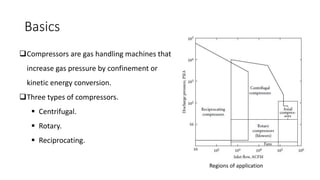
Basics
Regions of application
Compressors are gas handling machines that
increase gas pressure by confinement or
kinetic energy conversion.
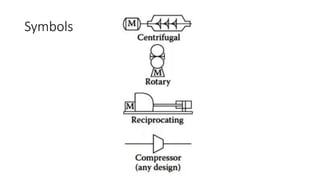
Three types of compressors.
 Centrifugal.
 Rotary.
 Reciprocating.
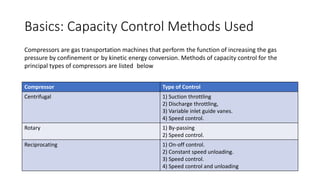
Basics: Capacity Control Methods Used
Compressor Type of Control
Centrifugal 1) Suction throttling
2) Discharge throttling,
3) Variable inlet guide vanes.
4) Speed control.
Rotary 1) By-passing
2) Speed control.
Reciprocating 1) On-off control.
2) Constant speed unloading.
3) Speed control.
4) Speed control and unloading
Compressors are gas transportation machines that perform the function of increasing the gas
pressure by confinement or by kinetic energy conversion. Methods of capacity control for the
principal types of compressors are listed below
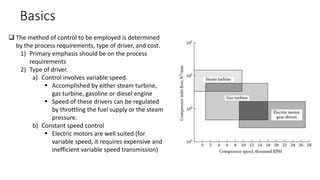
Basics
 The method of control to be employed is determined
by the process requirements, type of driver, and cost.
1) Primary emphasis should be on the process
requirements
2) Type of driver.
a) Control involves variable speed.
 Accomplished by either steam turbine,
gas turbine, gasoline or diesel engine
 Speed of these drivers can be regulated
by throttling the fuel supply or the steam
pressure.
b) Constant speed control
 Electric motors are well suited (for
variable speed, it requires expensive and
inefficient variable speed transmission)
Symbols
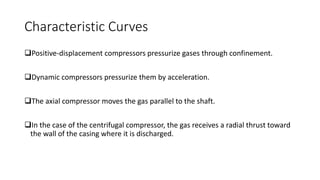
Characteristic Curves
Positive-displacement compressors pressurize gases through confinement.
Dynamic compressors pressurize them by acceleration.
The axial compressor moves the gas parallel to the shaft.
In the case of the centrifugal compressor, the gas receives a radial thrust toward
the wall of the casing where it is discharged.
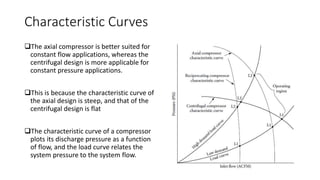
Characteristic Curves
The axial compressor is better suited for
constant flow applications, whereas the
centrifugal design is more applicable for
constant pressure applications.
This is because the characteristic curve of
the axial design is steep, and that of the
centrifugal design is flat
The characteristic curve of a compressor
plots its discharge pressure as a function
of flow, and the load curve relates the
system pressure to the system flow.
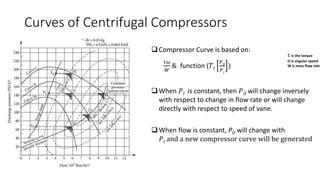
Curves of Centrifugal Compressors
τ is the torque
Ω is angular speed
W is mass flow rate
Compressor Curve is based on:
𝜏𝜔
𝑊
& function (𝑇𝐼
𝑃𝐷
𝑃𝐼
)
When 𝑃𝐼 is constant, then 𝑃𝐷 will change inversely
with respect to change in flow rate or will change
directly with respect to speed of vane.
When flow is constant, PD will change with
𝑃𝐼 and a new compressor curve will be generated
Compressor Throttling
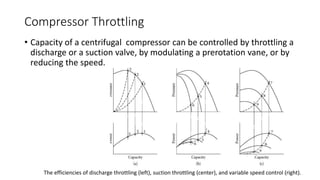
• Capacity of a centrifugal compressor can be controlled by throttling a
discharge or a suction valve, by modulating a prerotation vane, or by
reducing the speed.
The efficiencies of discharge throttling (left), suction throttling (center), and variable speed control (right).
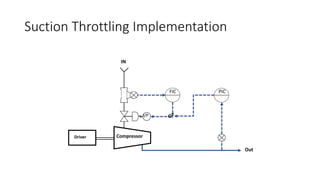
Suction Throttling Implementation
PIC
FIC
Or
Compressor
Driver
Out
IN
I/P
Suction Throttling: Constant Pressure System
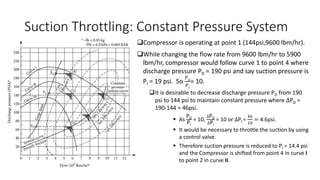
Compressor is operating at point 1 (144psi,9600 lbm/hr).
While changing the flow rate from 9600 lbm/hr to 5900
lbm/hr, compressor would follow curve 1 to point 4 where
discharge pressure PD = 190 psi and say suction pressure is
PI = 19 psi. So
𝑃𝐷
𝑃𝐼
= 10.
It is desirable to decrease discharge pressure PD from 190
psi to 144 psi to maintain constant pressure where ∆PD =
190-144 = 46psi.
 As
PD
PI
= 10,
∆PD
∆PI
= 10 or ∆PI =
46
10
= 4.6psi.
 It would be necessary to throttle the suction by using
a control valve.
 Therefore suction pressure is reduced to PI = 14.4 psi
and the Compressor is shifted from point 4 in curve I
to point 2 in curve II.
Suction Throttling: Constant Pressure System
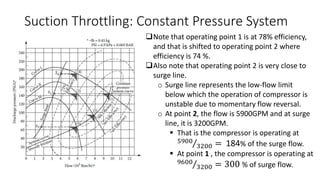
Note that operating point 1 is at 78% efficiency,
and that is shifted to operating point 2 where
efficiency is 74 %.
Also note that operating point 2 is very close to
surge line.
o Surge line represents the low-flow limit
below which the operation of compressor is
unstable due to momentary flow reversal.
o At point 2, the flow is 5900GPM and at surge
line, it is 3200GPM.
 That is the compressor is operating at
5900
3200 = 184% of the surge flow.
 At point 1 , the compressor is operating at
9600
3200 = 300 % of surge flow.
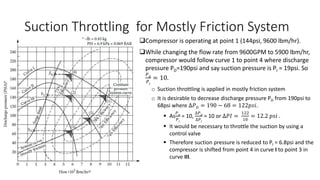
Suction Throttling for Mostly Friction System
Compressor is operating at point 1 (144psi, 9600 lbm/hr).
While changing the flow rate from 9600GPM to 5900 lbm/hr,
compressor would follow curve 1 to point 4 where discharge
pressure PD=190psi and say suction pressure is PI = 19psi. So
𝑃𝐷
𝑃𝐼
= 10.
o Suction throttling is applied in mostly friction system
o It is desirable to decrease discharge pressure PD from 190psi to
68psi where ∆𝑃𝐷 = 190 − 68 = 122𝑝𝑠𝑖.
 As
𝑃𝐷
𝑃𝐼
= 10,
∆𝑃𝐷
∆𝑃𝐼
= 10 or ∆𝑃𝐼 =
122
10
= 12.2 𝑝𝑠𝑖 .
 It would be necessary to throttle the suction by using a
control valve
 Therefore suction pressure is reduced to PI = 6.8psi and the
compressor is shifted from point 4 in curve I to point 3 in
curve III.
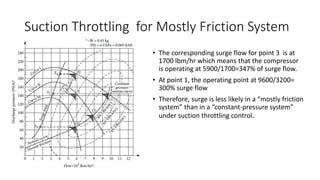
Suction Throttling for Mostly Friction System
• The corresponding surge flow for point 3 is at
1700 lbm/hr which means that the compressor
is operating at 5900/1700=347% of surge flow.
• At point 1, the operating point at 9600/3200=
300% surge flow
• Therefore, surge is less likely in a “mostly friction
system” than in a “constant-pressure system”
under suction throttling control.
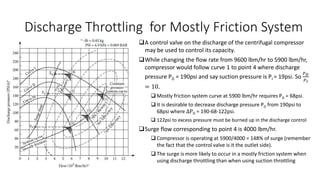
Discharge Throttling for Mostly Friction System
A control valve on the discharge of the centrifugal compressor
may be used to control its capacity.
While changing the flow rate from 9600 lbm/hr to 5900 lbm/hr,
compressor would follow curve 1 to point 4 where discharge
pressure PD = 190psi and say suction pressure is PI = 19psi. So
𝑃𝐷
𝑃𝐼
= 10.
 Mostly friction system curve at 5900 lbm/hr requires PD = 68psi.
 It is desirable to decrease discharge pressure PD from 190psi to
68psi where ∆PD = 190-68-122psi.
 122psi to excess pressure must be burned up in the discharge control
Surge flow corresponding to point 4 is 4000 lbm/hr.
 Compressor is operating at 5900/4000 = 148% of surge (remember
the fact that the control valve is it the outlet side).
 The surge is more likely to occur in a mostly friction system when
using discharge throttling than when using suction throttling
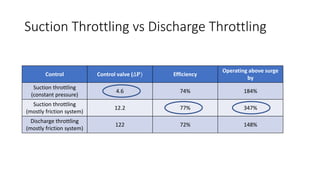
Suction Throttling vs Discharge Throttling
Control Control valve (∆𝐏) Efficiency
Operating above surge
by
Suction throttling
(constant pressure)
4.6 74% 184%
Suction throttling
(mostly friction system)
12.2 77% 347%
Discharge throttling
(mostly friction system)
122 72% 148%
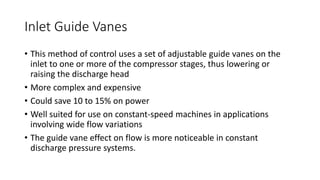
Inlet Guide Vanes
• This method of control uses a set of adjustable guide vanes on the
inlet to one or more of the compressor stages, thus lowering or
raising the discharge head
• More complex and expensive
• Could save 10 to 15% on power
• Well suited for use on constant-speed machines in applications
involving wide flow variations
• The guide vane effect on flow is more noticeable in constant
discharge pressure systems.
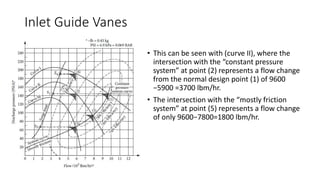
Inlet Guide Vanes
• This can be seen with (curve II), where the
intersection with the “constant pressure
system” at point (2) represents a flow change
from the normal design point (1) of 9600
−5900 =3700 lbm/hr.
• The intersection with the “mostly friction
system” at point (5) represents a flow change
of only 9600−7800=1800 lbm/hr.
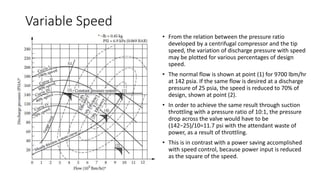
Variable Speed
• From the relation between the pressure ratio
developed by a centrifugal compressor and the tip
speed, the variation of discharge pressure with speed
may be plotted for various percentages of design
speed.
• The normal flow is shown at point (1) for 9700 lbm/hr
at 142 psia. If the same flow is desired at a discharge
pressure of 25 psia, the speed is reduced to 70% of
design, shown at point (2).
• In order to achieve the same result through suction
throttling with a pressure ratio of 10:1, the pressure
drop across the valve would have to be
(142−25)/10=11.7 psi with the attendant waste of
power, as a result of throttling.
• This is in contrast with a power saving accomplished
with speed control, because power input is reduced
as the square of the speed.
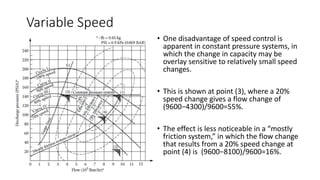
Variable Speed
• One disadvantage of speed control is
apparent in constant pressure systems, in
which the change in capacity may be
overlay sensitive to relatively small speed
changes.
• This is shown at point (3), where a 20%
speed change gives a flow change of
(9600−4300)/9600=55%.
• The effect is less noticeable in a “mostly
friction system,” in which the flow change
that results from a 20% speed change at
point (4) is (9600−8100)/9600=16%.
The Phenomenon of Surge
• In axial or centrifugal compressors, the phenomenon of momentary
flow reversal is called surge.
• During surging, the compressor discharge pressure drops off and then
is reestablished on a fast cycle.
• This cycling, or surging, can vary in intensity from an audible rattle to
a violent shock.
• Intense surges are capable of causing complete destruction of
compressor parts, such as blades and seals.
The Phenomenon of Surge
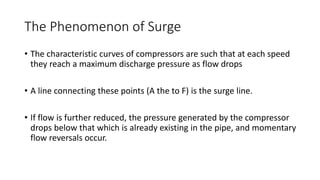
• The characteristic curves of compressors are such that at each speed
they reach a maximum discharge pressure as flow drops
• A line connecting these points (A the to F) is the surge line.
• If flow is further reduced, the pressure generated by the compressor
drops below that which is already existing in the pipe, and momentary
flow reversals occur.
Surge
Operating near surge line have following advantages and disadvantages:
1. Using full power near surge line.
2. System is becoming unstable when the operating point is Moving towards the
surge line from right to left. (At the left side of surge line, the system is unstable)
Surge Control : Fixed Setpoint
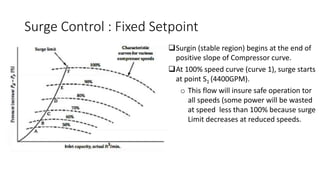
Surgin (stable region) begins at the end of
positive slope of Compressor curve.
At 100% speed curve (curve 1), surge starts
at point S1 (4400GPM).
o This flow will insure safe operation tor
all speeds (some power will be wasted
at speed less than 100% because surge
Limit decreases at reduced speeds.
Surge Control : Fixed Setpoint
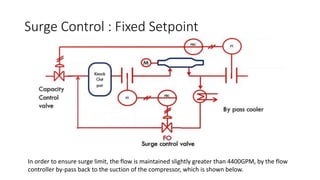
In order to ensure surge limit, the flow is maintained slightly greater than 4400GPM, by the flow
controller by-pass back to the suction of the compressor, which is shown below.
Surge Control : Fixed Setpoint
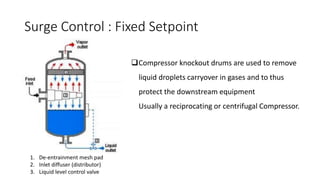
Compressor knockout drums are used to remove
liquid droplets carryover in gases and to thus
protect the downstream equipment
Usually a reciprocating or centrifugal Compressor.
1. De-entrainment mesh pad
2. Inlet diffuser (distributor)
3. Liquid level control valve
Antisurge Control
PD-PI < K3h
PD-PI = K3h
PD-PI > K3h
To the right of SLL: stable region and curve slope is –ve
To the left of SLL: unstable region and curve slope is +ve
On SLL : curve slope is zero
 The ratio of compressor pressure rise to the inlet flow rate
is used to control the flow in the bypass loop.
o Surge limit curve is parabolic.
∴
𝑃𝐷 − 𝑃𝐼
𝑃𝐼
∝
𝑄2
𝑇1
 Weight flow rate is Converted into volumetric flow rate
using density.
∴ 𝑃𝐷 − 𝑃𝐼 = 𝐾1𝑄2
𝑃𝐼
𝑇𝐼
 Head loss across the orifice plate in the Suction line is
h=K2Q2
𝑃𝐼
𝑇𝐼
∴ 𝑃𝐷- 𝑃𝐼 = 𝐾3𝐻
 Therefore K3h is Compared with (PD-PI)and set the flow in
bypass,
Antisurge Control
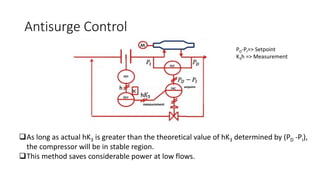
PD-PI=> Setpoint
K3h => Measurement
measurement
setpoint
As long as actual hK3 is greater than the theoretical value of hK3 determined by (PD -PI),
the compressor will be in stable region.
This method saves considerable power at low flows.

Compressor Control and Optimization.pptx

  • 1.
  • 2.
    Course Outcome At theend of the course, Students should be able understand compressors capacity and Antisurge control and their interactions .
  • 3.
    Basics Regions of application Compressorsare gas handling machines that increase gas pressure by confinement or kinetic energy conversion. Three types of compressors.  Centrifugal.  Rotary.  Reciprocating.
  • 4.
    Basics: Capacity ControlMethods Used Compressor Type of Control Centrifugal 1) Suction throttling 2) Discharge throttling, 3) Variable inlet guide vanes. 4) Speed control. Rotary 1) By-passing 2) Speed control. Reciprocating 1) On-off control. 2) Constant speed unloading. 3) Speed control. 4) Speed control and unloading Compressors are gas transportation machines that perform the function of increasing the gas pressure by confinement or by kinetic energy conversion. Methods of capacity control for the principal types of compressors are listed below
  • 5.
    Basics  The methodof control to be employed is determined by the process requirements, type of driver, and cost. 1) Primary emphasis should be on the process requirements 2) Type of driver. a) Control involves variable speed.  Accomplished by either steam turbine, gas turbine, gasoline or diesel engine  Speed of these drivers can be regulated by throttling the fuel supply or the steam pressure. b) Constant speed control  Electric motors are well suited (for variable speed, it requires expensive and inefficient variable speed transmission)
  • 6.
  • 7.
    Characteristic Curves Positive-displacement compressorspressurize gases through confinement. Dynamic compressors pressurize them by acceleration. The axial compressor moves the gas parallel to the shaft. In the case of the centrifugal compressor, the gas receives a radial thrust toward the wall of the casing where it is discharged.
  • 8.
    Characteristic Curves The axialcompressor is better suited for constant flow applications, whereas the centrifugal design is more applicable for constant pressure applications. This is because the characteristic curve of the axial design is steep, and that of the centrifugal design is flat The characteristic curve of a compressor plots its discharge pressure as a function of flow, and the load curve relates the system pressure to the system flow.
  • 9.
    Curves of CentrifugalCompressors τ is the torque Ω is angular speed W is mass flow rate Compressor Curve is based on: 𝜏𝜔 𝑊 & function (𝑇𝐼 𝑃𝐷 𝑃𝐼 ) When 𝑃𝐼 is constant, then 𝑃𝐷 will change inversely with respect to change in flow rate or will change directly with respect to speed of vane. When flow is constant, PD will change with 𝑃𝐼 and a new compressor curve will be generated
  • 10.
    Compressor Throttling • Capacityof a centrifugal compressor can be controlled by throttling a discharge or a suction valve, by modulating a prerotation vane, or by reducing the speed. The efficiencies of discharge throttling (left), suction throttling (center), and variable speed control (right).
  • 11.
  • 12.
    Suction Throttling: ConstantPressure System Compressor is operating at point 1 (144psi,9600 lbm/hr). While changing the flow rate from 9600 lbm/hr to 5900 lbm/hr, compressor would follow curve 1 to point 4 where discharge pressure PD = 190 psi and say suction pressure is PI = 19 psi. So 𝑃𝐷 𝑃𝐼 = 10. It is desirable to decrease discharge pressure PD from 190 psi to 144 psi to maintain constant pressure where ∆PD = 190-144 = 46psi.  As PD PI = 10, ∆PD ∆PI = 10 or ∆PI = 46 10 = 4.6psi.  It would be necessary to throttle the suction by using a control valve.  Therefore suction pressure is reduced to PI = 14.4 psi and the Compressor is shifted from point 4 in curve I to point 2 in curve II.
  • 13.
    Suction Throttling: ConstantPressure System Note that operating point 1 is at 78% efficiency, and that is shifted to operating point 2 where efficiency is 74 %. Also note that operating point 2 is very close to surge line. o Surge line represents the low-flow limit below which the operation of compressor is unstable due to momentary flow reversal. o At point 2, the flow is 5900GPM and at surge line, it is 3200GPM.  That is the compressor is operating at 5900 3200 = 184% of the surge flow.  At point 1 , the compressor is operating at 9600 3200 = 300 % of surge flow.
  • 14.
    Suction Throttling forMostly Friction System Compressor is operating at point 1 (144psi, 9600 lbm/hr). While changing the flow rate from 9600GPM to 5900 lbm/hr, compressor would follow curve 1 to point 4 where discharge pressure PD=190psi and say suction pressure is PI = 19psi. So 𝑃𝐷 𝑃𝐼 = 10. o Suction throttling is applied in mostly friction system o It is desirable to decrease discharge pressure PD from 190psi to 68psi where ∆𝑃𝐷 = 190 − 68 = 122𝑝𝑠𝑖.  As 𝑃𝐷 𝑃𝐼 = 10, ∆𝑃𝐷 ∆𝑃𝐼 = 10 or ∆𝑃𝐼 = 122 10 = 12.2 𝑝𝑠𝑖 .  It would be necessary to throttle the suction by using a control valve  Therefore suction pressure is reduced to PI = 6.8psi and the compressor is shifted from point 4 in curve I to point 3 in curve III.
  • 15.
    Suction Throttling forMostly Friction System • The corresponding surge flow for point 3 is at 1700 lbm/hr which means that the compressor is operating at 5900/1700=347% of surge flow. • At point 1, the operating point at 9600/3200= 300% surge flow • Therefore, surge is less likely in a “mostly friction system” than in a “constant-pressure system” under suction throttling control.
  • 16.
    Discharge Throttling forMostly Friction System A control valve on the discharge of the centrifugal compressor may be used to control its capacity. While changing the flow rate from 9600 lbm/hr to 5900 lbm/hr, compressor would follow curve 1 to point 4 where discharge pressure PD = 190psi and say suction pressure is PI = 19psi. So 𝑃𝐷 𝑃𝐼 = 10.  Mostly friction system curve at 5900 lbm/hr requires PD = 68psi.  It is desirable to decrease discharge pressure PD from 190psi to 68psi where ∆PD = 190-68-122psi.  122psi to excess pressure must be burned up in the discharge control Surge flow corresponding to point 4 is 4000 lbm/hr.  Compressor is operating at 5900/4000 = 148% of surge (remember the fact that the control valve is it the outlet side).  The surge is more likely to occur in a mostly friction system when using discharge throttling than when using suction throttling
  • 17.
    Suction Throttling vsDischarge Throttling Control Control valve (∆𝐏) Efficiency Operating above surge by Suction throttling (constant pressure) 4.6 74% 184% Suction throttling (mostly friction system) 12.2 77% 347% Discharge throttling (mostly friction system) 122 72% 148%
  • 18.
    Inlet Guide Vanes •This method of control uses a set of adjustable guide vanes on the inlet to one or more of the compressor stages, thus lowering or raising the discharge head • More complex and expensive • Could save 10 to 15% on power • Well suited for use on constant-speed machines in applications involving wide flow variations • The guide vane effect on flow is more noticeable in constant discharge pressure systems.
  • 19.
    Inlet Guide Vanes •This can be seen with (curve II), where the intersection with the “constant pressure system” at point (2) represents a flow change from the normal design point (1) of 9600 −5900 =3700 lbm/hr. • The intersection with the “mostly friction system” at point (5) represents a flow change of only 9600−7800=1800 lbm/hr.
  • 20.
    Variable Speed • Fromthe relation between the pressure ratio developed by a centrifugal compressor and the tip speed, the variation of discharge pressure with speed may be plotted for various percentages of design speed. • The normal flow is shown at point (1) for 9700 lbm/hr at 142 psia. If the same flow is desired at a discharge pressure of 25 psia, the speed is reduced to 70% of design, shown at point (2). • In order to achieve the same result through suction throttling with a pressure ratio of 10:1, the pressure drop across the valve would have to be (142−25)/10=11.7 psi with the attendant waste of power, as a result of throttling. • This is in contrast with a power saving accomplished with speed control, because power input is reduced as the square of the speed.
  • 21.
    Variable Speed • Onedisadvantage of speed control is apparent in constant pressure systems, in which the change in capacity may be overlay sensitive to relatively small speed changes. • This is shown at point (3), where a 20% speed change gives a flow change of (9600−4300)/9600=55%. • The effect is less noticeable in a “mostly friction system,” in which the flow change that results from a 20% speed change at point (4) is (9600−8100)/9600=16%.
  • 22.
    The Phenomenon ofSurge • In axial or centrifugal compressors, the phenomenon of momentary flow reversal is called surge. • During surging, the compressor discharge pressure drops off and then is reestablished on a fast cycle. • This cycling, or surging, can vary in intensity from an audible rattle to a violent shock. • Intense surges are capable of causing complete destruction of compressor parts, such as blades and seals.
  • 23.
    The Phenomenon ofSurge • The characteristic curves of compressors are such that at each speed they reach a maximum discharge pressure as flow drops • A line connecting these points (A the to F) is the surge line. • If flow is further reduced, the pressure generated by the compressor drops below that which is already existing in the pipe, and momentary flow reversals occur.
  • 24.
    Surge Operating near surgeline have following advantages and disadvantages: 1. Using full power near surge line. 2. System is becoming unstable when the operating point is Moving towards the surge line from right to left. (At the left side of surge line, the system is unstable)
  • 25.
    Surge Control :Fixed Setpoint Surgin (stable region) begins at the end of positive slope of Compressor curve. At 100% speed curve (curve 1), surge starts at point S1 (4400GPM). o This flow will insure safe operation tor all speeds (some power will be wasted at speed less than 100% because surge Limit decreases at reduced speeds.
  • 26.
    Surge Control :Fixed Setpoint In order to ensure surge limit, the flow is maintained slightly greater than 4400GPM, by the flow controller by-pass back to the suction of the compressor, which is shown below.
  • 27.
    Surge Control :Fixed Setpoint Compressor knockout drums are used to remove liquid droplets carryover in gases and to thus protect the downstream equipment Usually a reciprocating or centrifugal Compressor. 1. De-entrainment mesh pad 2. Inlet diffuser (distributor) 3. Liquid level control valve
  • 28.
    Antisurge Control PD-PI <K3h PD-PI = K3h PD-PI > K3h To the right of SLL: stable region and curve slope is –ve To the left of SLL: unstable region and curve slope is +ve On SLL : curve slope is zero  The ratio of compressor pressure rise to the inlet flow rate is used to control the flow in the bypass loop. o Surge limit curve is parabolic. ∴ 𝑃𝐷 − 𝑃𝐼 𝑃𝐼 ∝ 𝑄2 𝑇1  Weight flow rate is Converted into volumetric flow rate using density. ∴ 𝑃𝐷 − 𝑃𝐼 = 𝐾1𝑄2 𝑃𝐼 𝑇𝐼  Head loss across the orifice plate in the Suction line is h=K2Q2 𝑃𝐼 𝑇𝐼 ∴ 𝑃𝐷- 𝑃𝐼 = 𝐾3𝐻  Therefore K3h is Compared with (PD-PI)and set the flow in bypass,
  • 29.
    Antisurge Control PD-PI=> Setpoint K3h=> Measurement measurement setpoint As long as actual hK3 is greater than the theoretical value of hK3 determined by (PD -PI), the compressor will be in stable region. This method saves considerable power at low flows.

Editor's Notes

  • #10 Note: Compressor performance curve at different inlet (suction) pressure assuming constant torque, speed and temperature
  • #15 The same method of suction throttling may be applied in a “mostly friction system”. In order to reduce the flow from 9600 lbm/hr (4320 kg/hr) to 5900 lbm/hr (2655 kg/hr), it is necessary to alter the compressor curve from curve I to III, so that the intersection with the “mostly friction system curve” is at the new operating point (3), at 77% efficiency. In order to do this, one must change the discharge pressure from 190 psia on curve I to 68 psia on curve III. Thus, ΔPD=190−68=122 psi , and the amount of inlet pressure throttling for a machine with a compression ratio of 10 is ΔPI=122/10=12.2 psi. The corresponding surge flow is at 1700 lbm/hr (765 kg/hr), which means that the compressor is operating at 5900/1700=347% of surg e flow. Therefore, surge is less likely in a “mostly friction system” than in a “constant-pressure system” under suction throttling control.