Surgical
Endodontics
INTRODUCTION
10.3 %
Extn
Retreatment
Surgical
Endodontics
10.3 %
Over 1,500 years ago - Greek physician performed first
recorded endodontic surgical procedure - incision and drainage
of an acute endodontic abscess
1871 – Smith - First root end resection
1880 – Brophy - Root end filling
1881 - Claude Martin - Father of root end resection
1884 – Farrar - Root amputation
Surgical operating microscopes - 1980’s - Endodontic
microsurgery
1990s – Dr. Gary Carr surgical ultrasonic tips first designed –
Carr tips
1999 – Spartan/Obtura - Kim Surgical tips – Kis tips
HISTORY
Removal of tissues other than the contents of the
root canal space to retain a tooth with pulpal
and/or periapical involvement.
(Franklin Weine)
DEFINITION
OBJECTIVES
Toensure the placement of a proper seal between the
periodontium and the rootcanal foramina.
Indications
Glick and Ingle
1. Need for surgical drainage
⚫ Incisionand drainage
⚫ Trephination
2. Failed nonsurgical endodontic treatment
⚫ Irretrievableroot canal filling,material
⚫ Irretrievableintraradicular post
3. Calcific metamorphosisof the pulp space
4. Procedural errors
⚫ Instrument fragmentation
⚫ Non-negotiable ledging
⚫ Root perforation
⚫ Symptomaticoverfilling
5. Anatomic variations
⚫ Rootdilaceration
⚫ Apical root fenestration
BREAD
CFC
6. Biopsy
7. Correctivesurgery
⚫ Root resorptive defects
⚫ Rootcaries
⚫ Root resection
⚫ Hemi section
⚫ Bicuspidization
8. Replacement surgery
⚫ Replacement surgery
 Intentional replantation (extraction/replantation)
 Post-traumatic
⚫ Implantsurgery
 Endodontic
1. Patient’s medical status
2. Anatomical considerations
3. Practitioner’s skill and experience
Contra Indications
Surgical instruments
Bard Parker
Blades:
NO .10 No. 15c No. 15 No. 12 No. 11
ELEVATION INSTRUMENTS
09
TISSUE RETRACTION INSTRUMENTS
⚫ Arens tissue retractor
⚫ Selden retractor
⚫ Cats paw retractor
S
AC
CURETTAGE INSTRUMENTS
•Minicurettes
•Mini jacquette 34/35
•Columbia 13- 14
•Miniendodontic curettes
•Minimolten curettes
Osteotomy Instruments
⚫ No. 4 round bur
⚫ No. 6 round bur
⚫ No. 8 round bur
⚫ No. 57 fissure bur
⚫ Multipurpose bur
⚫ Endo-Z bur
RETRO FILL CARRIERS
MAP
RETRO
AMALGAM
CARRIER
RETRO FILL PLUGGERS
DENTAL OPERATING MICROSCOPE
CLASSIFICATION OF ENDODONTIC SURGERY
 Fisulative surgery
 Incision and drainage
 Cortical trephination
 Decompression procedures
 Periradicular surgery
 Curettage
 Root-end resection
 Root-end preparation
 Root-end filling
 Corrective surgery
 Perforation repair
 Mechanical(iatrogenic)
 Resorptive
 Periodontal management
 Root resection
 Tooth resection
 Intentional replantation
DCI
RC3
INCISION AND DRAINAGE
Materialsused
⦿ Iodoformgauze
⦿ Rubberdam material -“H” or “Christmas tree” shape.
⦿ Penrosedrain
Penrose drain Serrated drain
TREPHINATION
PERIRADICULAR SURGERY
CR3
Curettage
Root-end resection
Root-end preparation
Root-end filling
TREATMENT PLANNING FOR PERIRADICULAR SURGERY
1. Presurgical patient management
2. Need forprofound local anesthesiaand hemostasis
3. Managementof soft tissue
4. Managementof hard tissues
5. Surgical access, both visual and operative
6. Access toroot structure
7. Periradicularcurettage
8. Root-end resection
9. Rootend preparation
10. Root-end restoration
11. Soft-tissuerepositioning and suturing
12. Postsurgical care
PRESURGICAL PATIENT MANAGEMENT
A
K
LOCAL ANESTHESIA
TYPES OF LOCAL ANALGESIA
⚫Topical analgesia (surfaceanalgesia)
⚫Sub mucosal infiltration
⚫Subperiosteal infiltration
⚫Nerve blockanalgesia
⚫Intra ligamentaryanalgesia.
⚫Intraosseousanalgesia.
Failure to obtain analgesia
Pain during injection
Haematoma formation
Intravascular injection
Trismus
Paralysis
Lip Trauma
LOCAL COMPLICATIONS
Drug interactions
Allergy
SYSTEMIC COMPLICATIONS
PRINCIPLES OF FLAP DESIGN
MANAGEMENT OF SOFT TISSUE
1. Avoiding the incision overa bonydefect
2. Including the full extentof the lesion.
3. Avoiding sharpcorners
4. Avoiding incision acrossa bonyeminence
5. Making sure base of the flap should be wider than the free end.
6. Avoiding incision in the mucogingival junction.
7. Taking careduring retraction.
8. Incision should be made with firm, continuous firm strokeperpendiculartothecortical
boneplate.
9. The sutured flap margin should reston solid cortical boneplate.
CLASSIFICATION
⚫ Full thickness (Mucoperiosteal) –
Epithelium + Connectivetissue
+Periosteum
⚫ Partial thickness (Split) -
Epithelium + Connective tissue
⚫ Full mucoperiosteal flap
⚫ Triangular
⚫ Rectangular
⚫ Trapezoidal
⚫ Horizontal/Envelope
⚫ Papilla base
⚫ Limited mucoperiosteal
⚫ Sub marginal curved/Semilunar
⚫ Sub marginal scalloped rectangular/Luebke Ochsenbein
⚫Full mucoperiosteal flap
⚫ Triangular
⚫ Rectangular
⚫ Trapezoidal
⚫ Horizontal/Envelope
⚫ Papilla base
⚫Limited mucoperiosteal
⚫ Sub marginal curved/Semilunar
⚫ Sub marginal scalloped rectangular/Luebke Ochsenbein
TRIANGULAR FLAP
RECTANGULAR FLAP
TRAPEZOIDAL FLAP
HORIZONTAL FLAP
SUBMARGIN CURVED / SEMILUNAR FLAP
SUB MARGINAL SCALLOPED RECTANGULAR FLAP
OPTIMAL OSTEOTOMY SIZE
OSTEOTOMY
A surgical procedure to remove diseased or reactive tissue from alveolar bone in the
periradicular area or lateral region surrounding a pulp less tooth (AAE 1994)
PERIRADICULAR CURETTAGE
ROOT END RESECTION
◦LASER – ErYag,CO2
LOW SPEED
STRAIGHT
HANDPIECE
No.702 tapered
fissure bur
No.6 or No.8
round bur
BEVEL ANGLE
Advantages:
•Exposes fewer dentinal tubules, thus
preventing excess leakage and
contamination.
30-45o: 10o degree
ROOT END PREPARATION
⦿ Miniaturecontra-angle orstraight hand piece /ULTRASONIC
⦿ Small round or inverted cone bur.
⦿ Class I cavity preparation along the long axis of the rootwithin
the confinesof the rootcanal.
⦿ Recommended depth - 2 to 3 mm being the most
commonly advocated. (Gutmannand Harrison)
⦿ Disadvantage: Apical perforationdue todifficulty in aligning the
bur
RETROGRADE RESTORATIVE MATERIALS AND TECHNIQUES
Propertiesof ideal retrograderestorative
materials :
⚫ Well tolerated by periapical tissues
⚫ Bactericidal or bacteriostatic
⚫ Adhereto the tooth
⚫ Dimensionallystable
⚫ Readilyavailableand easy to handle
⦿ Notstain teeth orperiradiculartissue
⦿ Noncorrosive
⦿ Resistanttodissolution
⦿ Electrochemically inactive
⦿ Promote Cementogenesis
⦿ Radiopaque
Purpose:
To seal the apex so that no bacteria or bacterial by products can enter or leave from
the canal
⚫ Guttapercha
⚫ Amalgam
⚫ Cavit
⚫ IRM
⚫ Super EBA
⚫ Glass Ionomer
⚫ Compositeresins
⚫ Carboxylatecements
⚫ Zinc phosphatecements
⚫ Zincoxideeugenol cements
⚫ Mineral trioxideaggregation (MTA)
Root End filing materials
SOFT TISSUE REPOSITIONING AND COMPRESSION
 Theelevated muco periosteum gentlyreplaced to
itsoriginal position with the incision lines
approximated as closelyas possible.
 Tissuecompression: Using a surgical gauze
moistened with sterile saline, gently apply firm
pressure to the flapped tissue for 2 to 3
minutes (5 minutes forpalatal tissue) before
suturing.
 Enhances intravascularclotting in thesevered
blood vessels
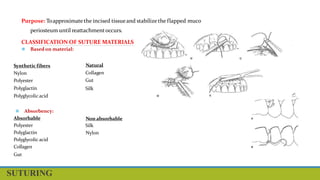
SUTURING
Purpose: Toapproximatethe incised tissueand stabilize the flapped muco
periosteum until reattachmentoccurs.
CLASSIFICATION OF SUTURE MATERIALS
⦿ Based on material:
Natural
Collagen
Gut
Silk
Synthetic fibers
Nylon
Polyester
Polyglactin
Polyglycolic acid
⦿ Absorbency:
Non absorbable
Silk
Nylon
Absorbable
Polyester
Polyglactin
Polyglycolic acid
Collagen
Gut
POST OPERATIVE INSTRUCTIONS AND CARE
 Do not lift up lipor pull back thecheek to look at where the surgery was
done.
 A little bleeding from surgical is normal. This should only last fora few
hours.
 A little swelling and bruising face may be evidentwhich may last fora few
days.
 Do not drink alcohol oruse tobacco (smoke orchew) for the next 3 days.
 Havea good, soft dietand drink lots of liquids for the first few days after
surgery.
⚫ Place an ice bag (cold) on face where the surgery was done. Leave it
on for 20 minutes and take it off for 20 minutes. Continue this for 6
to 8 hours.
⚫ Take the prescribed medicinesas recommended.
⚫ Rinse the mouth with 1 tablespoon of the chlorhexidine mouthwash
twicedaily for 5 days.
⚫ Sutureremoval after 5-7 days by thedental personnel only.
⚫ Maintain postoperative follow up recall visits
⚫ If any problemsexists informand visityourdentist immediately.
Corrective surgery may involve
⚫ Root resection.
⚫ Hemi section.
⚫ Intentional replantation.
CORRECTIVE SURGERY
ROOT AMPUTATION
HEMISECTION
BICUSPIDIZATION
COMPARISON OF TRADITIONAL V/S MICROSURGERY Kim and Rubenstein, 2001
PROCEDURE TRADITIONAL MICRO-SURGERY
Identification of
apex
Difficult Precise
Osteotomy Large (=>10 mm) Small (<5mm)
Root surface
inspection
None Always
Bevel angle Large (45o) Small (<10o)
Isthmus
identification
Nearly impossible Easy
Retro
preparation
Approximate Precise
Root end filling Imprecise Precise
Surgical  endodntics

Surgical endodntics

  • 1.
  • 2.
  • 3.
  • 4.
    Over 1,500 yearsago - Greek physician performed first recorded endodontic surgical procedure - incision and drainage of an acute endodontic abscess 1871 – Smith - First root end resection 1880 – Brophy - Root end filling 1881 - Claude Martin - Father of root end resection 1884 – Farrar - Root amputation Surgical operating microscopes - 1980’s - Endodontic microsurgery 1990s – Dr. Gary Carr surgical ultrasonic tips first designed – Carr tips 1999 – Spartan/Obtura - Kim Surgical tips – Kis tips HISTORY
  • 5.
    Removal of tissuesother than the contents of the root canal space to retain a tooth with pulpal and/or periapical involvement. (Franklin Weine) DEFINITION
  • 6.
    OBJECTIVES Toensure the placementof a proper seal between the periodontium and the rootcanal foramina.
  • 7.
    Indications Glick and Ingle 1.Need for surgical drainage ⚫ Incisionand drainage ⚫ Trephination 2. Failed nonsurgical endodontic treatment ⚫ Irretrievableroot canal filling,material ⚫ Irretrievableintraradicular post 3. Calcific metamorphosisof the pulp space 4. Procedural errors ⚫ Instrument fragmentation ⚫ Non-negotiable ledging ⚫ Root perforation ⚫ Symptomaticoverfilling 5. Anatomic variations ⚫ Rootdilaceration ⚫ Apical root fenestration BREAD CFC
  • 8.
    6. Biopsy 7. Correctivesurgery ⚫Root resorptive defects ⚫ Rootcaries ⚫ Root resection ⚫ Hemi section ⚫ Bicuspidization 8. Replacement surgery ⚫ Replacement surgery  Intentional replantation (extraction/replantation)  Post-traumatic ⚫ Implantsurgery  Endodontic
  • 9.
    1. Patient’s medicalstatus 2. Anatomical considerations 3. Practitioner’s skill and experience Contra Indications
  • 10.
    Surgical instruments Bard Parker Blades: NO.10 No. 15c No. 15 No. 12 No. 11
  • 11.
  • 12.
    TISSUE RETRACTION INSTRUMENTS ⚫Arens tissue retractor ⚫ Selden retractor ⚫ Cats paw retractor S AC
  • 13.
    CURETTAGE INSTRUMENTS •Minicurettes •Mini jacquette34/35 •Columbia 13- 14 •Miniendodontic curettes •Minimolten curettes
  • 14.
    Osteotomy Instruments ⚫ No.4 round bur ⚫ No. 6 round bur ⚫ No. 8 round bur ⚫ No. 57 fissure bur ⚫ Multipurpose bur ⚫ Endo-Z bur
  • 15.
  • 16.
  • 17.
  • 18.
    CLASSIFICATION OF ENDODONTICSURGERY  Fisulative surgery  Incision and drainage  Cortical trephination  Decompression procedures  Periradicular surgery  Curettage  Root-end resection  Root-end preparation  Root-end filling  Corrective surgery  Perforation repair  Mechanical(iatrogenic)  Resorptive  Periodontal management  Root resection  Tooth resection  Intentional replantation DCI RC3
  • 19.
  • 20.
    Materialsused ⦿ Iodoformgauze ⦿ Rubberdammaterial -“H” or “Christmas tree” shape. ⦿ Penrosedrain Penrose drain Serrated drain
  • 22.
  • 23.
  • 24.
    TREATMENT PLANNING FORPERIRADICULAR SURGERY 1. Presurgical patient management 2. Need forprofound local anesthesiaand hemostasis 3. Managementof soft tissue 4. Managementof hard tissues 5. Surgical access, both visual and operative 6. Access toroot structure 7. Periradicularcurettage 8. Root-end resection 9. Rootend preparation 10. Root-end restoration 11. Soft-tissuerepositioning and suturing 12. Postsurgical care
  • 25.
  • 26.
    LOCAL ANESTHESIA TYPES OFLOCAL ANALGESIA ⚫Topical analgesia (surfaceanalgesia) ⚫Sub mucosal infiltration ⚫Subperiosteal infiltration ⚫Nerve blockanalgesia ⚫Intra ligamentaryanalgesia. ⚫Intraosseousanalgesia.
  • 29.
    Failure to obtainanalgesia Pain during injection Haematoma formation Intravascular injection Trismus Paralysis Lip Trauma LOCAL COMPLICATIONS
  • 30.
  • 31.
    PRINCIPLES OF FLAPDESIGN MANAGEMENT OF SOFT TISSUE 1. Avoiding the incision overa bonydefect 2. Including the full extentof the lesion. 3. Avoiding sharpcorners 4. Avoiding incision acrossa bonyeminence 5. Making sure base of the flap should be wider than the free end.
  • 32.
    6. Avoiding incisionin the mucogingival junction. 7. Taking careduring retraction. 8. Incision should be made with firm, continuous firm strokeperpendiculartothecortical boneplate. 9. The sutured flap margin should reston solid cortical boneplate.
  • 33.
    CLASSIFICATION ⚫ Full thickness(Mucoperiosteal) – Epithelium + Connectivetissue +Periosteum ⚫ Partial thickness (Split) - Epithelium + Connective tissue
  • 34.
    ⚫ Full mucoperiostealflap ⚫ Triangular ⚫ Rectangular ⚫ Trapezoidal ⚫ Horizontal/Envelope ⚫ Papilla base ⚫ Limited mucoperiosteal ⚫ Sub marginal curved/Semilunar ⚫ Sub marginal scalloped rectangular/Luebke Ochsenbein
  • 35.
    ⚫Full mucoperiosteal flap ⚫Triangular ⚫ Rectangular ⚫ Trapezoidal ⚫ Horizontal/Envelope ⚫ Papilla base ⚫Limited mucoperiosteal ⚫ Sub marginal curved/Semilunar ⚫ Sub marginal scalloped rectangular/Luebke Ochsenbein
  • 36.
  • 37.
  • 38.
  • 39.
  • 40.
    SUBMARGIN CURVED /SEMILUNAR FLAP
  • 41.
    SUB MARGINAL SCALLOPEDRECTANGULAR FLAP
  • 42.
  • 43.
    A surgical procedureto remove diseased or reactive tissue from alveolar bone in the periradicular area or lateral region surrounding a pulp less tooth (AAE 1994) PERIRADICULAR CURETTAGE
  • 44.
  • 45.
    ◦LASER – ErYag,CO2 LOWSPEED STRAIGHT HANDPIECE No.702 tapered fissure bur No.6 or No.8 round bur
  • 46.
    BEVEL ANGLE Advantages: •Exposes fewerdentinal tubules, thus preventing excess leakage and contamination. 30-45o: 10o degree
  • 47.
    ROOT END PREPARATION ⦿Miniaturecontra-angle orstraight hand piece /ULTRASONIC ⦿ Small round or inverted cone bur. ⦿ Class I cavity preparation along the long axis of the rootwithin the confinesof the rootcanal. ⦿ Recommended depth - 2 to 3 mm being the most commonly advocated. (Gutmannand Harrison) ⦿ Disadvantage: Apical perforationdue todifficulty in aligning the bur
  • 48.
    RETROGRADE RESTORATIVE MATERIALSAND TECHNIQUES Propertiesof ideal retrograderestorative materials : ⚫ Well tolerated by periapical tissues ⚫ Bactericidal or bacteriostatic ⚫ Adhereto the tooth ⚫ Dimensionallystable ⚫ Readilyavailableand easy to handle ⦿ Notstain teeth orperiradiculartissue ⦿ Noncorrosive ⦿ Resistanttodissolution ⦿ Electrochemically inactive ⦿ Promote Cementogenesis ⦿ Radiopaque Purpose: To seal the apex so that no bacteria or bacterial by products can enter or leave from the canal
  • 49.
    ⚫ Guttapercha ⚫ Amalgam ⚫Cavit ⚫ IRM ⚫ Super EBA ⚫ Glass Ionomer ⚫ Compositeresins ⚫ Carboxylatecements ⚫ Zinc phosphatecements ⚫ Zincoxideeugenol cements ⚫ Mineral trioxideaggregation (MTA) Root End filing materials
  • 50.
    SOFT TISSUE REPOSITIONINGAND COMPRESSION  Theelevated muco periosteum gentlyreplaced to itsoriginal position with the incision lines approximated as closelyas possible.  Tissuecompression: Using a surgical gauze moistened with sterile saline, gently apply firm pressure to the flapped tissue for 2 to 3 minutes (5 minutes forpalatal tissue) before suturing.  Enhances intravascularclotting in thesevered blood vessels
  • 51.
    SUTURING Purpose: Toapproximatethe incisedtissueand stabilize the flapped muco periosteum until reattachmentoccurs. CLASSIFICATION OF SUTURE MATERIALS ⦿ Based on material: Natural Collagen Gut Silk Synthetic fibers Nylon Polyester Polyglactin Polyglycolic acid ⦿ Absorbency: Non absorbable Silk Nylon Absorbable Polyester Polyglactin Polyglycolic acid Collagen Gut
  • 52.
    POST OPERATIVE INSTRUCTIONSAND CARE  Do not lift up lipor pull back thecheek to look at where the surgery was done.  A little bleeding from surgical is normal. This should only last fora few hours.  A little swelling and bruising face may be evidentwhich may last fora few days.  Do not drink alcohol oruse tobacco (smoke orchew) for the next 3 days.  Havea good, soft dietand drink lots of liquids for the first few days after surgery.
  • 53.
    ⚫ Place anice bag (cold) on face where the surgery was done. Leave it on for 20 minutes and take it off for 20 minutes. Continue this for 6 to 8 hours. ⚫ Take the prescribed medicinesas recommended. ⚫ Rinse the mouth with 1 tablespoon of the chlorhexidine mouthwash twicedaily for 5 days. ⚫ Sutureremoval after 5-7 days by thedental personnel only. ⚫ Maintain postoperative follow up recall visits ⚫ If any problemsexists informand visityourdentist immediately.
  • 54.
    Corrective surgery mayinvolve ⚫ Root resection. ⚫ Hemi section. ⚫ Intentional replantation. CORRECTIVE SURGERY
  • 55.
  • 56.
  • 57.
  • 58.
    COMPARISON OF TRADITIONALV/S MICROSURGERY Kim and Rubenstein, 2001 PROCEDURE TRADITIONAL MICRO-SURGERY Identification of apex Difficult Precise Osteotomy Large (=>10 mm) Small (<5mm) Root surface inspection None Always Bevel angle Large (45o) Small (<10o) Isthmus identification Nearly impossible Easy Retro preparation Approximate Precise Root end filling Imprecise Precise

Editor's Notes

  • #8 BREAD CFC
  • #11 11 STAB INCISION 12 SUTURE REMOVAL 15 SHORT AND PRECISE INCISION
  • #14 A curette is a surgical instrument designed for scraping or debriding biological tissue or debris in a biopsy, excision, or cleaning procedure. In form, the curette is a small hand tool, often similar in shape to a stylus; at the tip of the curette is a small scoop, hook, or gouge.
  • #16  (Micro-Apical Placement) System
  • #19 Marsupialization is a surgical decompression procedure used to reduce large periapical lesions without periapical curettage. [3] Decompression allows continuous drainage from periapical lesion, which eliminates conditions favoring expansion of periapical pathosis resulting in healing by osseous regeneration.
  • #20 Surgical drainage is indicated when purulent and/or hemorrhagic exudates forms within the soft tissue and the alveolar bone; as result of a symptomatic Periradicular abscess
  • #23 Cortical trephination is a procedure involving the perforation of the cortical plate to accomplish the release of pressure from the accumulation of exudate within the alveolar bone
  • #26 Scully and Cawson -Anemia -Bleeding disorders -Cardio respiratory disorders -Drug treatment and allergies -Endocrine disorders -Fits and faints -Gastrointestinal disorders -Hospital admissions and surgeries -Infections -Jaundice -Kidney disease antibiotic prophylaxis needed in case of bacterial endocarditis
  • #27 Objectives: obtain profound and prolonged anaesthesia provide good hemostasis both during and after the surgical procedure Selection based on: Medical status of the patient Desired duration of anaesthesia
  • #43 Since the length of an ultrasonic tip is 3 mm, the ideal diameter of an osteotomy is about 4mm DURING MICROSURGERY IDEAL OSTEOTOMY 10MM
  • #45 Eliminating Anatomical variations Ledges Canal obstructions Resorptive defects Perforation defects Separated instruments Visualize seal created by orthograde treatment and need for root- end seal Gain access to pathological tissue trapped along lingual surface of root
  • #55 Corrective surgery is categorized as surgery involving the correction of defects in the body of the root other than the apex.
  • #56 Root amputation procedures are a logical way to eliminate a weak, diseased root to allow the stronger root(s) to survive when, if retained together, they would collectively fail.
  • #57 ⦿Hemi section is defined as separation of a multi rooted tooth and the removal of a root and the associated portion of the clinical crown.