- D I N E S H K U M A R . M
F R O S I O L E V E L I I I
SURFACE TREATMENT
WHAT IS SURFACE TREATMENT ?
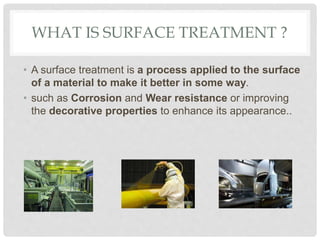
• A surface treatment is a process applied to the surface
of a material to make it better in some way.
• such as Corrosion and Wear resistance or improving
the decorative properties to enhance its appearance..
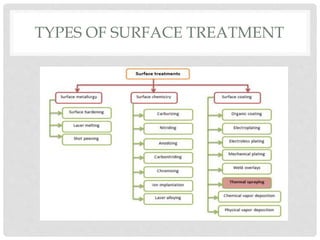
TYPES OF SURFACE TREATMENT
SURFACE METALLURGY
• How?
- Changing the mechanical property (Micro structure) only on the
surface of the material to achieve the desire surface property.
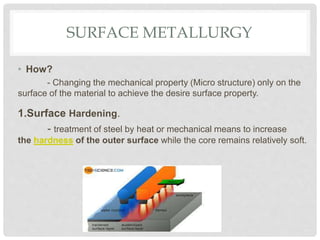
1.Surface Hardening.
- treatment of steel by heat or mechanical means to increase
the hardness of the outer surface while the core remains relatively soft.
SURFACE METALLURGY
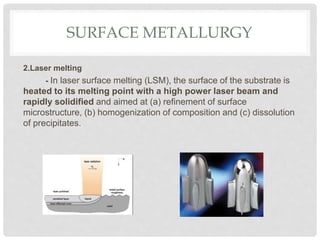
2.Laser melting
- In laser surface melting (LSM), the surface of the substrate is
heated to its melting point with a high power laser beam and
rapidly solidified and aimed at (a) refinement of surface
microstructure, (b) homogenization of composition and (c) dissolution
of precipitates.
SURFACE METALLURGY
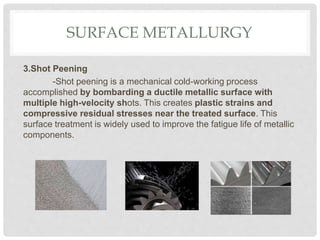
3.Shot Peening
-Shot peening is a mechanical cold-working process
accomplished by bombarding a ductile metallic surface with
multiple high-velocity shots. This creates plastic strains and
compressive residual stresses near the treated surface. This
surface treatment is widely used to improve the fatigue life of metallic
components.
SURFACE CHEMISTRY
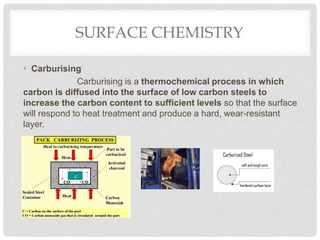
• Carburising
Carburising is a thermochemical process in which
carbon is diffused into the surface of low carbon steels to
increase the carbon content to sufficient levels so that the surface
will respond to heat treatment and produce a hard, wear-resistant
layer.
SURFACE CHEMICAL
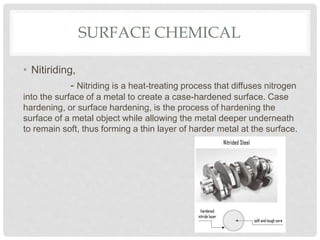
• Nitiriding,
- Nitriding is a heat-treating process that diffuses nitrogen
into the surface of a metal to create a case-hardened surface. Case
hardening, or surface hardening, is the process of hardening the
surface of a metal object while allowing the metal deeper underneath
to remain soft, thus forming a thin layer of harder metal at the surface.
SURFACE CHEMICAL
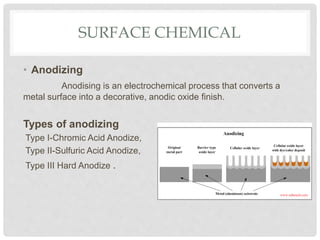
• Anodizing
Anodising is an electrochemical process that converts a
metal surface into a decorative, anodic oxide finish.
Types of anodizing
Type I-Chromic Acid Anodize,
Type II-Sulfuric Acid Anodize,
Type III Hard Anodize .
SURFACE CHEMICAL
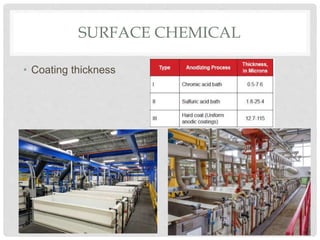
• Coating thickness
SURFACE CHEMICAL
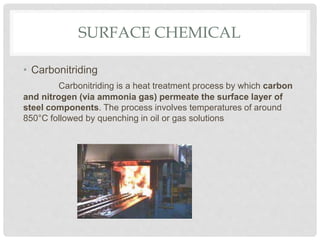
• Carbonitriding
Carbonitriding is a heat treatment process by which carbon
and nitrogen (via ammonia gas) permeate the surface layer of
steel components. The process involves temperatures of around
850°C followed by quenching in oil or gas solutions
SURFACE CHEMICAL
Chromizing
-Chromizing is a thermo-chemical process consisting of
saturating, by way of diffusion, of ferrous alloys, predominantly of
steel, with chromium. It is carried out in order to extend the service life
of tools and components exposed to wear and corrosion, including gas
corrosion, at temperatures up to 900°C.
SURFACE CHEMICAL
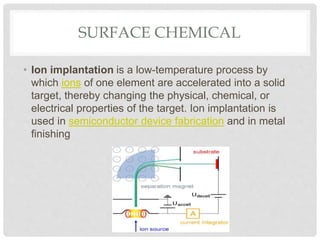
• Ion implantation is a low-temperature process by
which ions of one element are accelerated into a solid
target, thereby changing the physical, chemical, or
electrical properties of the target. Ion implantation is
used in semiconductor device fabrication and in metal
finishing

Surface treatment.pptx

  • 1.
    - D IN E S H K U M A R . M F R O S I O L E V E L I I I SURFACE TREATMENT
  • 2.
    WHAT IS SURFACETREATMENT ? • A surface treatment is a process applied to the surface of a material to make it better in some way. • such as Corrosion and Wear resistance or improving the decorative properties to enhance its appearance..
  • 3.
  • 4.
    SURFACE METALLURGY • How? -Changing the mechanical property (Micro structure) only on the surface of the material to achieve the desire surface property. 1.Surface Hardening. - treatment of steel by heat or mechanical means to increase the hardness of the outer surface while the core remains relatively soft.
  • 5.
    SURFACE METALLURGY 2.Laser melting -In laser surface melting (LSM), the surface of the substrate is heated to its melting point with a high power laser beam and rapidly solidified and aimed at (a) refinement of surface microstructure, (b) homogenization of composition and (c) dissolution of precipitates.
  • 6.
    SURFACE METALLURGY 3.Shot Peening -Shotpeening is a mechanical cold-working process accomplished by bombarding a ductile metallic surface with multiple high-velocity shots. This creates plastic strains and compressive residual stresses near the treated surface. This surface treatment is widely used to improve the fatigue life of metallic components.
  • 7.
    SURFACE CHEMISTRY • Carburising Carburisingis a thermochemical process in which carbon is diffused into the surface of low carbon steels to increase the carbon content to sufficient levels so that the surface will respond to heat treatment and produce a hard, wear-resistant layer.
  • 8.
    SURFACE CHEMICAL • Nitiriding, -Nitriding is a heat-treating process that diffuses nitrogen into the surface of a metal to create a case-hardened surface. Case hardening, or surface hardening, is the process of hardening the surface of a metal object while allowing the metal deeper underneath to remain soft, thus forming a thin layer of harder metal at the surface.
  • 9.
    SURFACE CHEMICAL • Anodizing Anodisingis an electrochemical process that converts a metal surface into a decorative, anodic oxide finish. Types of anodizing Type I-Chromic Acid Anodize, Type II-Sulfuric Acid Anodize, Type III Hard Anodize .
  • 10.
  • 11.
    SURFACE CHEMICAL • Carbonitriding Carbonitridingis a heat treatment process by which carbon and nitrogen (via ammonia gas) permeate the surface layer of steel components. The process involves temperatures of around 850°C followed by quenching in oil or gas solutions
  • 12.
    SURFACE CHEMICAL Chromizing -Chromizing isa thermo-chemical process consisting of saturating, by way of diffusion, of ferrous alloys, predominantly of steel, with chromium. It is carried out in order to extend the service life of tools and components exposed to wear and corrosion, including gas corrosion, at temperatures up to 900°C.
  • 13.
    SURFACE CHEMICAL • Ionimplantation is a low-temperature process by which ions of one element are accelerated into a solid target, thereby changing the physical, chemical, or electrical properties of the target. Ion implantation is used in semiconductor device fabrication and in metal finishing