POLYGONS
Understanding the properties of various shapes,
or figures, is going to be key throughout
Geometry.

In this lesson, we will explore some of these
shapes, more formerly known as polygons.


                                Sara Reyes
                                CSE 684
                                Spring 2012
LEARNING OBJECTIVES
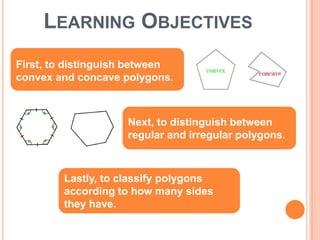
First, to distinguish between
convex and concave polygons.


                    Next, to distinguish between
                    regular and irregular polygons.


        Lastly, to classify polygons
        according to how many sides
        they have.
WHAT ARE POLYGONS?
Closed shapes or figures in a plane with three or more
sides.


Alternatively, a polygon can be defined as a closed
planar figure that is the union of a finite number of line
segments.


The term polygon is derived from a Greek word
meaning “many-angled”.
CONVEX VS. CONCAVE
                 POLYGONS
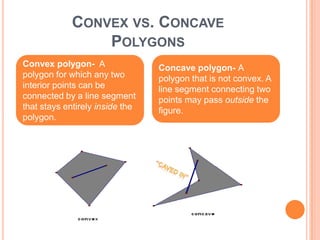
Convex polygon- A                Concave polygon- A
polygon for which any two        polygon that is not convex. A
interior points can be           line segment connecting two
connected by a line segment      points may pass outside the
that stays entirely inside the   figure.
polygon.
WHAT HAVE WE COVERED SO
             FAR?

   Distinguish between convex and concave polygons

    Distinguish between regular and irregular polygons

   Classify polygons according to the number of sides
   they have
o classify polygons according to how many they
   have
REGULAR VS. IRREGULAR
             POLYGONS


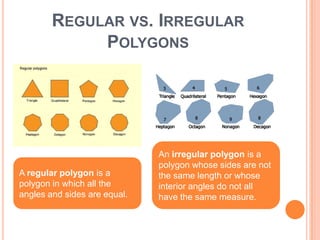
                              An irregular polygon is a
                              polygon whose sides are not
A regular polygon is a        the same length or whose
polygon in which all the      interior angles do not all
angles and sides are equal.   have the same measure.
SO, WHAT HAVE WE COVERED SO
                FAR?

    Distinguish between convex and concave polygons

    Distinguish between regular and irregular polygons

    Classify polygons according to the number of sides they
    have
o classify polygons according to how many they have
WHAT IS A TRIANGLE?

A triangle, sometimes called a trigon, is a three-sided
  polygon.
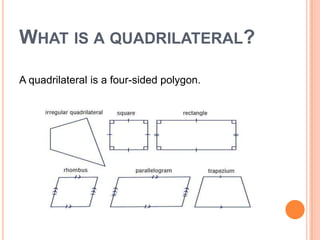
WHAT IS A QUADRILATERAL?

A quadrilateral is a four-sided polygon.
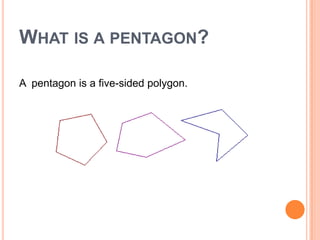
WHAT IS A PENTAGON?

A pentagon is a five-sided polygon.
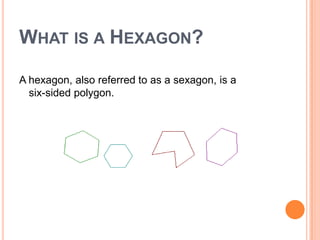
WHAT IS A HEXAGON?

A hexagon, also referred to as a sexagon, is a
  six-sided polygon.
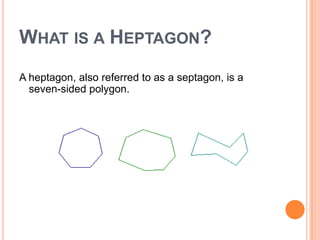
WHAT IS A HEPTAGON?
A heptagon, also referred to as a septagon, is a
  seven-sided polygon.
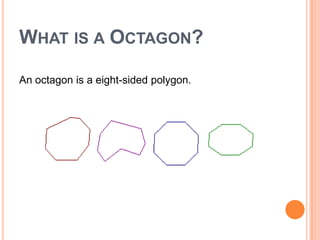
WHAT IS A OCTAGON?

An octagon is a eight-sided polygon.
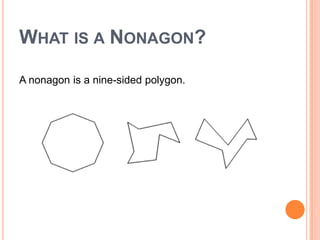
WHAT IS A NONAGON?

A nonagon is a nine-sided polygon.
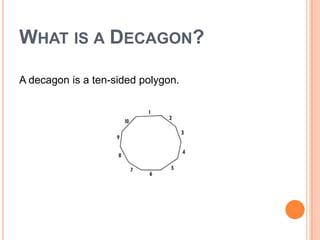
WHAT IS A DECAGON?

A decagon is a ten-sided polygon.
SO, WHAT HAVE WE COVERED SO
                FAR?

   Distinguish between convex and concave polygons

   Distinguish between regular and irregular polygons

   Classify polygons according to the number of sides they have
o classify polygons according to how many they have


    Lets recap what we learned throughout this lesson…
RECAP OF WHAT WE LEARNED…
 A polygon is a closed figure with three (or more)
  sides.
 When any two interior points of a polygon are
  connected by a line segment that:
      stays entirely inside, it is a convex polygon
      passes outside, it is a concave (“caved in”) polygon

 Regular polygons have equal side lengths and
  equal interior angle measures whereas irregular
  polygons do not.
 Polygons can be classified by the number of sides:
      three-sided = triangle
      four-sided = quadrilateral

      five-sided = pentagon

      etc.
FACTS
Definitions:
Polygons- Cliffs Quick Review: Geometry, 2001 (pg. 55)
Convex- Cliffs Quick Review: Geometry, 2001 (pg. 191)
Concave- Cliffs Quick Review: Geometry, 2001 (pg. 191)
Regular-
http://www.mathatube.com/polygons-list-of-regular-
   polygons.html
Irregular-
http://www.mathatube.com/polygons-list-of-regular-
   polygons.html
Classification:
Cliffs Quick Review: Geometry, 2001 (pg. 57 )
Naming Polygons (by how many sides):
http://en.wikipedia.org/wiki/Polygon#Classification
IMAGES
Triangles:
http://labspace.open.ac.uk/mod/resource/view.php?id=420267
Quadrilaterals:
http://students-math-worksheets.blogspot.com/
Pentagons:
http://share.ehs.uen.org/node/11675
Hexagons:
http://share.ehs.uen.org/node/11675
Heptagons:
http://share.ehs.uen.org/node/11675
Octagons:
http://share.ehs.uen.org/node/11675
Nonagon:
http://discomath.etown.edu:8080/webMathematica/Definitions/Nonagon.
   html
Decagon:
http://commons.wikimedia.org/wiki/File:Decagon_(PSF).png
Convex/Concave Polygon (Introduction):
http://www.emanueleferonato.com/images/convex_concave.png
Regular/Irregular Polygon (Introduction):
http://www.wyzant.com/Help/Images/polygon1.gif
Convex/Non-Convex Polygons (Body):
http://www.onemathematicalcat.org/Math/Geometry_obj/quadrilaterals.h
   tm
Regular Polygons (Body):
http://www.mathatube.com/polygons-list-of-regular-polygons.html
Irregular polygons (Body):
http://www.matsuk12.us/176120115181252763/blank/browse.asp?a=38
   3&BMDRN=2000&BCOB=0&c=66509


“The End” (Final Slide):
http://4.bp.blogspot.com/_EGnqH5_FsgU/TCvJHYZBG-
   I/AAAAAAAABsI/F250wMkUBG0/s400/not-the-end.jpg
Polygons

Polygons

  • 1.
    POLYGONS Understanding the propertiesof various shapes, or figures, is going to be key throughout Geometry. In this lesson, we will explore some of these shapes, more formerly known as polygons. Sara Reyes CSE 684 Spring 2012
  • 2.
    LEARNING OBJECTIVES First, todistinguish between convex and concave polygons. Next, to distinguish between regular and irregular polygons. Lastly, to classify polygons according to how many sides they have.
  • 3.
    WHAT ARE POLYGONS? Closedshapes or figures in a plane with three or more sides. Alternatively, a polygon can be defined as a closed planar figure that is the union of a finite number of line segments. The term polygon is derived from a Greek word meaning “many-angled”.
  • 4.
    CONVEX VS. CONCAVE POLYGONS Convex polygon- A Concave polygon- A polygon for which any two polygon that is not convex. A interior points can be line segment connecting two connected by a line segment points may pass outside the that stays entirely inside the figure. polygon.
  • 5.
    WHAT HAVE WECOVERED SO FAR?  Distinguish between convex and concave polygons Distinguish between regular and irregular polygons Classify polygons according to the number of sides they have o classify polygons according to how many they have
  • 6.
    REGULAR VS. IRREGULAR POLYGONS An irregular polygon is a polygon whose sides are not A regular polygon is a the same length or whose polygon in which all the interior angles do not all angles and sides are equal. have the same measure.
  • 7.
    SO, WHAT HAVEWE COVERED SO FAR?  Distinguish between convex and concave polygons  Distinguish between regular and irregular polygons Classify polygons according to the number of sides they have o classify polygons according to how many they have
  • 8.
    WHAT IS ATRIANGLE? A triangle, sometimes called a trigon, is a three-sided polygon.
  • 9.
    WHAT IS AQUADRILATERAL? A quadrilateral is a four-sided polygon.
  • 10.
    WHAT IS APENTAGON? A pentagon is a five-sided polygon.
  • 11.
    WHAT IS AHEXAGON? A hexagon, also referred to as a sexagon, is a six-sided polygon.
  • 12.
    WHAT IS AHEPTAGON? A heptagon, also referred to as a septagon, is a seven-sided polygon.
  • 13.
    WHAT IS AOCTAGON? An octagon is a eight-sided polygon.
  • 14.
    WHAT IS ANONAGON? A nonagon is a nine-sided polygon.
  • 15.
    WHAT IS ADECAGON? A decagon is a ten-sided polygon.
  • 16.
    SO, WHAT HAVEWE COVERED SO FAR?  Distinguish between convex and concave polygons  Distinguish between regular and irregular polygons  Classify polygons according to the number of sides they have o classify polygons according to how many they have Lets recap what we learned throughout this lesson…
  • 17.
    RECAP OF WHATWE LEARNED…  A polygon is a closed figure with three (or more) sides.  When any two interior points of a polygon are connected by a line segment that:  stays entirely inside, it is a convex polygon  passes outside, it is a concave (“caved in”) polygon  Regular polygons have equal side lengths and equal interior angle measures whereas irregular polygons do not.  Polygons can be classified by the number of sides:  three-sided = triangle  four-sided = quadrilateral  five-sided = pentagon  etc.
  • 18.
    FACTS Definitions: Polygons- Cliffs QuickReview: Geometry, 2001 (pg. 55) Convex- Cliffs Quick Review: Geometry, 2001 (pg. 191) Concave- Cliffs Quick Review: Geometry, 2001 (pg. 191) Regular- http://www.mathatube.com/polygons-list-of-regular- polygons.html Irregular- http://www.mathatube.com/polygons-list-of-regular- polygons.html Classification: Cliffs Quick Review: Geometry, 2001 (pg. 57 ) Naming Polygons (by how many sides): http://en.wikipedia.org/wiki/Polygon#Classification
  • 19.
  • 20.
    Convex/Concave Polygon (Introduction): http://www.emanueleferonato.com/images/convex_concave.png Regular/IrregularPolygon (Introduction): http://www.wyzant.com/Help/Images/polygon1.gif Convex/Non-Convex Polygons (Body): http://www.onemathematicalcat.org/Math/Geometry_obj/quadrilaterals.h tm Regular Polygons (Body): http://www.mathatube.com/polygons-list-of-regular-polygons.html Irregular polygons (Body): http://www.matsuk12.us/176120115181252763/blank/browse.asp?a=38 3&BMDRN=2000&BCOB=0&c=66509 “The End” (Final Slide): http://4.bp.blogspot.com/_EGnqH5_FsgU/TCvJHYZBG- I/AAAAAAAABsI/F250wMkUBG0/s400/not-the-end.jpg