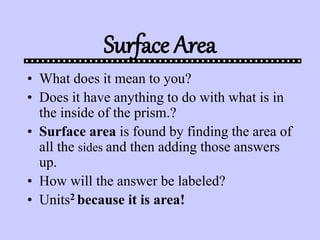
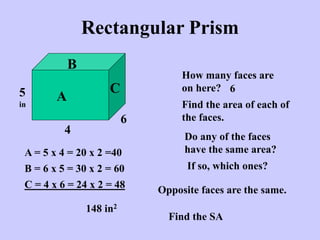
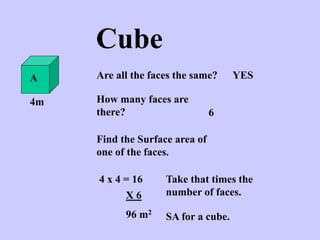
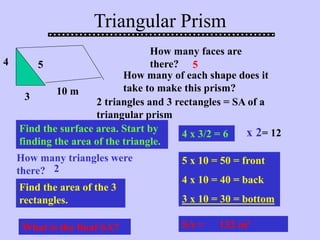
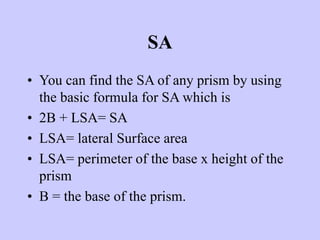
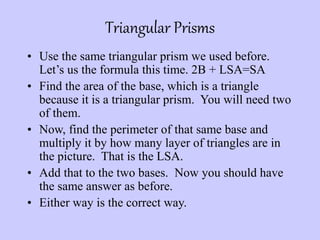
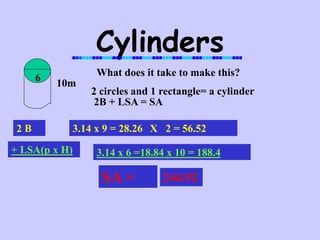
Surface area is calculated by finding the total area of all the sides (or faces) of an object and adding them together. It is measured in units squared. There are a few different ways to calculate the surface area of different types of prisms. For any prism, surface area can be calculated using the formula: Surface Area = 2 * (Area of Base) + Lateral Surface Area, where Lateral Surface Area is the perimeter of the base multiplied by the height of the prism. This formula and methods for calculating the surface area of rectangular prisms, cubes, triangular prisms, and cylinders are demonstrated. Surface area is important because it is used in many real-world applications like construction and packaging.