MANAGING
DEMAND AND
CAPACITY
UNDERSTANDING
CAPACITY CONSTRAINTS
AND DEMAND PATTERNS
Capacity
constraints
Time, labor,
equipment and
facilities
Optimal versus
maximal use of
capacity
Demand patterns
Charting demand
patterns
Predictable cycles
Random demand
fluctuations
Demand patterns
by market segment
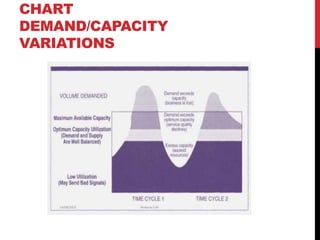
CHART
DEMAND/CAPACITY
VARIATIONS
DEMAND PATTERNS
Marketers need to understand the pattern or way the
demands behave, with respect to time, place and person.
Then the relevant strategies can be developed.
Sketching Demand Patterns : Companies need to keep a
track record or log book, where all the demands are recorded
on daily, weekly, monthly, seasonal, and yearly basis, and a
graphical chart, sketch or a report can be made. After a few
years, a set of patterns can be accurately predicted.
Foreseeable / Predictable Cycles : Then some easily
predicted or foreseeable cycle can be made. On that basis
services can be planned. Ex. Health check-ups in hospitals
Random Demand Variations : Some other service demands
are not easily predictable, or they occur randomly, even if the
cause can be ascertained. Say health care or insurance when
a flood or earthquake occurs.
Demand Patterns by Market Segments : Another more
specialised database keeping is done for different demand
pattern of customers of different segments. E.g., for a group
of family the bonus time is holiday time, whereas for another
group this is insurance premium pay time
CAPACITY
CONSTRAINTS
Capacity of a company is defined as the ability to meet the
demand and the extent to which it can do it. For production
of goods this can be expanded or contracted easily. But for
services it is difficult, as four critical factors are involved.
This are done with utmost care, planning, cost effective
measures. These are : • Time, Labour, • Equipment Facility
Time • Time is limited and mostly specialised professionals have this
constraints, they can’t take up more than the time permits and have to be idle
if there are none.This can be tackled by business houses by opening shop for
extended hours when the demand is more and vice versa. Say doctors can
have more consulting hours when there is demand. The service providers
must be willing to accept the change in situation.
Labour • Labour or workers are another area of constraint. Beyond the full
work load it’s hard to cater to more. On the other hand temporary employment
is not available sufficiently in skilled category. • This can be tackled by out
sourcing the workers to a contractors who has a large work force with him. •
He can adjust between several companies, but again the difference in the skill
is a bottleneck.
Equipment • Like machinery, transport etc. are needed more in no. when
there’s a bigger demand. For a limited period a company can’t buy extra
equipment or machinery. • But these can be managed by careful planning –
like having sufficient equipment for the minimum level in a cycle say a year
with down/maintenance time, and out sourcing the additional demand by
accurate prediction as far as possible.
Facility • These are mostly the infrastructure like premises, building, hotel
rooms, restaurant tables, class rooms, etc., which can’t be increased easily or
quickly. • But to some extent they can be enhanced, like two shifts in the class
rooms, adding a few tables and rearranging them in a restaurant, adding more
compartments in a train, more flights for air travel, etc
STRATEGIES FOR
SHIFTING DEMAND
TO MATCH CAPACITY
Demand too high
Use signage to
communicate busy days
and times.
Offer incentives to
customers for usage
during non-peak times.
Take care of loyal or
“regular” customers first.
Advertise peak usage
times and benefits of
non-peak use.
Charge full price for the
service--no discounts
Demand too low
•Use sales and
advertising to increase
business from current
market segments.
•Modify the service
offering to appeal to new
market segments.
•Offer discounts or price
reductions.
•Modify hours of
operation.
•Bring the service to the
customer.
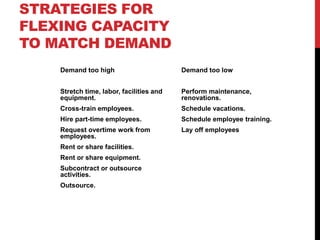
STRATEGIES FOR
FLEXING CAPACITY
TO MATCH DEMAND
Demand too high
Stretch time, labor, facilities and
equipment.
Cross-train employees.
Hire part-time employees.
Request overtime work from
employees.
Rent or share facilities.
Rent or share equipment.
Subcontract or outsource
activities.
Outsource.
Demand too low
Perform maintenance,
renovations.
Schedule vacations.
Schedule employee training.
Lay off employees

Managing demand and capacity

  • 1.
  • 2.
    UNDERSTANDING CAPACITY CONSTRAINTS AND DEMANDPATTERNS Capacity constraints Time, labor, equipment and facilities Optimal versus maximal use of capacity Demand patterns Charting demand patterns Predictable cycles Random demand fluctuations Demand patterns by market segment
  • 3.
  • 4.
    DEMAND PATTERNS Marketers needto understand the pattern or way the demands behave, with respect to time, place and person. Then the relevant strategies can be developed. Sketching Demand Patterns : Companies need to keep a track record or log book, where all the demands are recorded on daily, weekly, monthly, seasonal, and yearly basis, and a graphical chart, sketch or a report can be made. After a few years, a set of patterns can be accurately predicted. Foreseeable / Predictable Cycles : Then some easily predicted or foreseeable cycle can be made. On that basis services can be planned. Ex. Health check-ups in hospitals
  • 5.
    Random Demand Variations: Some other service demands are not easily predictable, or they occur randomly, even if the cause can be ascertained. Say health care or insurance when a flood or earthquake occurs. Demand Patterns by Market Segments : Another more specialised database keeping is done for different demand pattern of customers of different segments. E.g., for a group of family the bonus time is holiday time, whereas for another group this is insurance premium pay time
  • 6.
    CAPACITY CONSTRAINTS Capacity of acompany is defined as the ability to meet the demand and the extent to which it can do it. For production of goods this can be expanded or contracted easily. But for services it is difficult, as four critical factors are involved. This are done with utmost care, planning, cost effective measures. These are : • Time, Labour, • Equipment Facility
  • 7.
    Time • Timeis limited and mostly specialised professionals have this constraints, they can’t take up more than the time permits and have to be idle if there are none.This can be tackled by business houses by opening shop for extended hours when the demand is more and vice versa. Say doctors can have more consulting hours when there is demand. The service providers must be willing to accept the change in situation. Labour • Labour or workers are another area of constraint. Beyond the full work load it’s hard to cater to more. On the other hand temporary employment is not available sufficiently in skilled category. • This can be tackled by out sourcing the workers to a contractors who has a large work force with him. • He can adjust between several companies, but again the difference in the skill is a bottleneck. Equipment • Like machinery, transport etc. are needed more in no. when there’s a bigger demand. For a limited period a company can’t buy extra equipment or machinery. • But these can be managed by careful planning – like having sufficient equipment for the minimum level in a cycle say a year with down/maintenance time, and out sourcing the additional demand by accurate prediction as far as possible. Facility • These are mostly the infrastructure like premises, building, hotel rooms, restaurant tables, class rooms, etc., which can’t be increased easily or quickly. • But to some extent they can be enhanced, like two shifts in the class rooms, adding a few tables and rearranging them in a restaurant, adding more compartments in a train, more flights for air travel, etc
  • 8.
    STRATEGIES FOR SHIFTING DEMAND TOMATCH CAPACITY Demand too high Use signage to communicate busy days and times. Offer incentives to customers for usage during non-peak times. Take care of loyal or “regular” customers first. Advertise peak usage times and benefits of non-peak use. Charge full price for the service--no discounts Demand too low •Use sales and advertising to increase business from current market segments. •Modify the service offering to appeal to new market segments. •Offer discounts or price reductions. •Modify hours of operation. •Bring the service to the customer.
  • 9.
    STRATEGIES FOR FLEXING CAPACITY TOMATCH DEMAND Demand too high Stretch time, labor, facilities and equipment. Cross-train employees. Hire part-time employees. Request overtime work from employees. Rent or share facilities. Rent or share equipment. Subcontract or outsource activities. Outsource. Demand too low Perform maintenance, renovations. Schedule vacations. Schedule employee training. Lay off employees