Presented by
A. H. M. Saifuddin       0711020
Md. Mizanur Rahman       0711021
Sk. Mohiuddin Al Faruq   0711022


                   Supervised By
 A.M.M. Nazmul Ahsan
 Lecturer, Dept. of
 Industrial Engineering & Management(IEM),KUET.
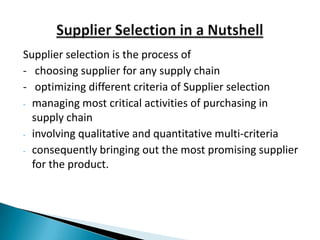
Supplier selection is the process of
- choosing supplier for any supply chain
- optimizing different criteria of Supplier selection
- managing most critical activities of purchasing in
  supply chain
- involving qualitative and quantitative multi-criteria
- consequently bringing out the most promising supplier
  for the product.
   As global purchasing is becoming more risky.
   As the advancement of different technologies in
    reducing time and cost such as Just In Time.
   Buyer supplier relation is no longer depends solely
    on the price of the product rather than delivery time,
    quality and flexibility.
   It helps assessing competitive market and allocates
    best option.
Fuzzy logic approach
         - measure supplier performance
         - help Decision Making (DM) for appropriate
 ordering
Multiple Attribute Utility Theory (MAUT)
          - formulate viable sourcing strategies
          - capable of handling multiple conflicting
 attributes
Analytical Hierarchical Process (AHP)
        - for prioritizing alternatives when multiple
 criteria must be considered
         - to structure complex problems in the form
 of a hierarchy
Multi-criteria decision model
         - for outsourcing contracts based on utility
 function. The utility function includes the impacts on
 cost, delivery time, and dependability.
Multi-Criteria Decision Making (MCDM)
        - for quality evaluation and performance
 appraisal
        - criteria attributes are both qualitative as well
 as quantitative

Grey relational Theory
       - easily captures the dynamic characteristics of
 different factors that in terms helps to save a lot
 costs and time.
   Quick and saves a lot of money and time.
   It’s a dynamic process that in turns provides
    opportunities for change in the number of attributes
    easily.
   It can be easily transform into computer algorithm or
    program that simply gives a quicker approach in
    attaining solution.
   Emphasizes mostly on objective factors rather than
    trust or dependency.
   Developed by Deng
   used to solve the uncertainty problems under the
    discrete data and incomplete information
   especially for those problems with very unique
    characteristic
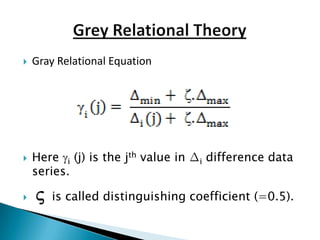
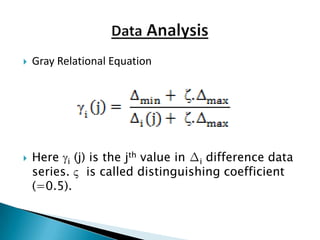
   Gray Relational Equation


   Here i (j) is the jth value in ∆i difference data
    series.

      is called distinguishing coefficient (=0.5).
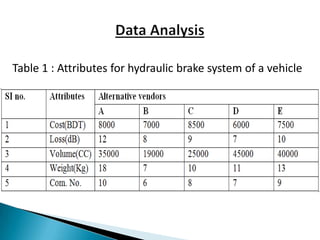
   Data collected from Aftab Automobiles for the break
    system of Automobiles.
   Several Attributes are chosen from different
    suppliers.
   Cost and other attribute’s quantities against each
    Supplier has been tabulated.
Table 1 : Attributes for hydraulic brake system of a vehicle
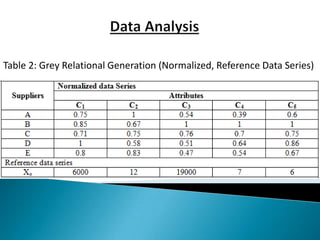
Table 2: Grey Relational Generation (Normalized, Reference Data Series)


              Table 2: Grey Relational Generation (Normalized,
                                        Reference Data Series)
Data Analysis
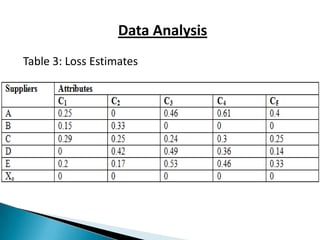
Table 3: Loss Estimates
   Gray Relational Equation


   Here i (j) is the jth value in ∆i difference data
    series. is called distinguishing coefficient
    (=0.5).
Data Analysis

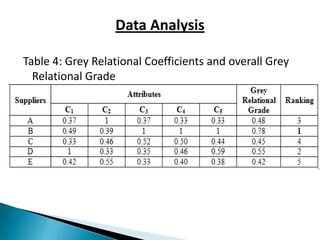
Table 4: Grey Relational Coefficients and overall Grey
  Relational Grade
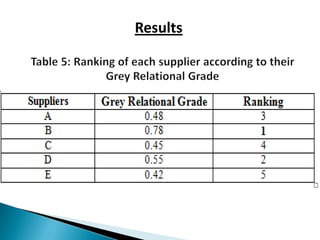
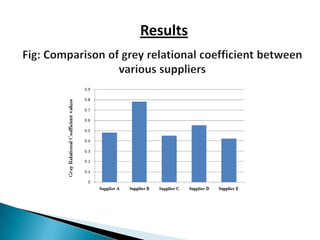
Results
Results
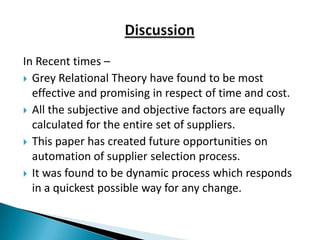
In Recent times –
 Grey Relational Theory have found to be most
  effective and promising in respect of time and cost.
 All the subjective and objective factors are equally
  calculated for the entire set of suppliers.
 This paper has created future opportunities on
  automation of supplier selection process.
 It was found to be dynamic process which responds
  in a quickest possible way for any change.
Due to the advantages of Grey multiple attributes
 decision, this paper proposes -
   For new supplier selection, it is very convenient to perform overall
    measurement based on each company’s requirements.
   The company can choose its own appropriate goal for each
    selection factor based on the characteristic demand of raw
    materials
   Based on the preceding discussion, it is judged that the proposed
    Grey multiple attributes decision method is very precise on the
    whole. It can overcome the ambiguity arising from the measured
    parameters of each attribute.
Supplier Selection : Gray Relational Analysis

Supplier Selection : Gray Relational Analysis

  • 2.
    Presented by A. H.M. Saifuddin 0711020 Md. Mizanur Rahman 0711021 Sk. Mohiuddin Al Faruq 0711022 Supervised By A.M.M. Nazmul Ahsan Lecturer, Dept. of Industrial Engineering & Management(IEM),KUET.
  • 3.
    Supplier selection isthe process of - choosing supplier for any supply chain - optimizing different criteria of Supplier selection - managing most critical activities of purchasing in supply chain - involving qualitative and quantitative multi-criteria - consequently bringing out the most promising supplier for the product.
  • 4.
    As global purchasing is becoming more risky.  As the advancement of different technologies in reducing time and cost such as Just In Time.  Buyer supplier relation is no longer depends solely on the price of the product rather than delivery time, quality and flexibility.  It helps assessing competitive market and allocates best option.
  • 5.
    Fuzzy logic approach - measure supplier performance - help Decision Making (DM) for appropriate ordering Multiple Attribute Utility Theory (MAUT) - formulate viable sourcing strategies - capable of handling multiple conflicting attributes
  • 6.
    Analytical Hierarchical Process(AHP) - for prioritizing alternatives when multiple criteria must be considered - to structure complex problems in the form of a hierarchy Multi-criteria decision model - for outsourcing contracts based on utility function. The utility function includes the impacts on cost, delivery time, and dependability.
  • 7.
    Multi-Criteria Decision Making(MCDM) - for quality evaluation and performance appraisal - criteria attributes are both qualitative as well as quantitative Grey relational Theory - easily captures the dynamic characteristics of different factors that in terms helps to save a lot costs and time.
  • 8.
    Quick and saves a lot of money and time.  It’s a dynamic process that in turns provides opportunities for change in the number of attributes easily.  It can be easily transform into computer algorithm or program that simply gives a quicker approach in attaining solution.  Emphasizes mostly on objective factors rather than trust or dependency.
  • 9.
    Developed by Deng  used to solve the uncertainty problems under the discrete data and incomplete information  especially for those problems with very unique characteristic
  • 10.
    Gray Relational Equation  Here i (j) is the jth value in ∆i difference data series.  is called distinguishing coefficient (=0.5).
  • 11.
    Data collected from Aftab Automobiles for the break system of Automobiles.  Several Attributes are chosen from different suppliers.  Cost and other attribute’s quantities against each Supplier has been tabulated.
  • 12.
    Table 1 :Attributes for hydraulic brake system of a vehicle
  • 13.
    Table 2: GreyRelational Generation (Normalized, Reference Data Series) Table 2: Grey Relational Generation (Normalized, Reference Data Series)
  • 14.
    Data Analysis Table 3:Loss Estimates
  • 15.
    Gray Relational Equation  Here i (j) is the jth value in ∆i difference data series. is called distinguishing coefficient (=0.5).
  • 16.
    Data Analysis Table 4:Grey Relational Coefficients and overall Grey Relational Grade
  • 17.
  • 18.
  • 19.
    In Recent times–  Grey Relational Theory have found to be most effective and promising in respect of time and cost.  All the subjective and objective factors are equally calculated for the entire set of suppliers.  This paper has created future opportunities on automation of supplier selection process.  It was found to be dynamic process which responds in a quickest possible way for any change.
  • 20.
    Due to theadvantages of Grey multiple attributes decision, this paper proposes -  For new supplier selection, it is very convenient to perform overall measurement based on each company’s requirements.  The company can choose its own appropriate goal for each selection factor based on the characteristic demand of raw materials  Based on the preceding discussion, it is judged that the proposed Grey multiple attributes decision method is very precise on the whole. It can overcome the ambiguity arising from the measured parameters of each attribute.