300 Indian Journal of Physiotherapy & Occupational Therapy. October-December 2014, Vol. 8, No. 4
Effectiveness of ARM Ergometer on Spasticity and Motor
Control in Sub-Acute and Chronic Stroke: A Randomised
Controlled Trial
Vinit patil1
, Tarpan Shah2
, Anil Murgode3
, Deepa Metgud4
1
Physiotherapist, Sancheti Hospital, Pune, 2
Asst. Prof., Shree Swaminaryan Physiotherpay College, Surat,
3
Asst. Prof., 4
Asso. Prof., K.L.E Institute of Physiotherapy, Belgaum, Karnataka
ABSTRACT
Background and Objectives: Stroke is the sudden death of cells in a limited part of brain caused by
a reduced flow of blood to the brain. Objectives of present study were to assess the effectiveness of
arm ergometry in improving range of motion of shoulder, elbow and wrist in sub-acute and chronic
hemiplegics and to compare the effectiveness of arm ergometry with conventional therapy on spasticity
and motor control.
Materials and Method: The present randomized controlled trial was conducted among 40 subjects
with sub-acute and chronic stroke referred to Department of Physiotherapy, KLES Dr. Prabhakar
Kore Hospital and Medical Research Centre, Belgaum. A written informed consent from study subjects
and ethical clearance was obtained. Subjects were divided into two groups namely Group A which
received cryotherapy, proprioceptive neuromuscular facilitation (contract-relax, hold-relax) and
neurodevelopmental techniques and Group B which received arm ergometer along with conventional
treatment. Outcome was measured in terms of spasticity, range of motion and motor control.
Results: Subjects treated in experimental group showed better reduction in spasticity (p<0.05). There
was no significant reduction in wrist flexor spasticity (p>0.05), patients who received conventional
treatment who shown reduction in spasticity in elbow flexors only (p<0.05). There was significant
improvement in range of motion and gross motor function in experimental group but, there was no
change in fine motor function.
Conclusion: Conventional treatment along with arm ergometer treatment found to be effective in
reducing spasticity and improving range of motion and motor control in sub-acute and chronic stroke
patients.
Keywords: Arm ergometer; Spasticity; Motor control; Range of motion; Stroke
INTRODUCTION
Stroke is the sudden death of cells in a limited part
of brain caused by a reduced flow of blood to the
brain.1,2
Cerebrovascular disease designates any
abnormality of brain resulting from pathological
process of blood vessels.3
Blood brings oxygen and
nutrients to the brain cells. Without blood, brain cells
quickly begin to die. The effect of stroke depends upon
the part of brain affected. A stroke may cause paralysis,
speech problem, and loss of memory, or reasoning
ability, coma or death. Stroke refers to any damage to
brain or CNS structures caused by abnormalities of
the blood supply.4
The most disabling feature of
cerebrovascular accident is ‘Spasticity’ which is motor
disorder characterized by a velocity dependent
increase in tonic stretch reflex and is one of the
components of upper motor neuron syndrome.5
It
suggests that treatmentpractices directed primarily at
DOI Number: 10.5958/0973-5674.2014.00055.0
55. Vinit patil--300--306.pmd 11/14/2014, 5:10 PM
300
Indian Journal of Physiotherapy & Occupational Therapy. October-December 2014, Vol. 8, No. 4 301
reducing spastic hypertonicity as major focus in
regaining motor control. Neurodevelopmental
approach makes use of position which inhibit
abnormal posture and patterns of movement, but
facilitates normal equilibrium, balance and righting
reactions and encourages normal movement
patterns.7
PNF which aims to promote neuromuscular
activity through stimulation of propriocepters and the
sensorimotor approach is based on that motor output
is dependent upon sensory input so sensory stimuli
can be used to activate or inhibit motor
responses.18
Task specific therapy is specifically
designed to deal with lost abilities or task showed best
results. Rehabilitation is thus induce the relearning of
real life activities.8,9
It has been proved that arm
ergometer helps in reducing excitability of
corticospinal tract in the forearm region and depresses
activity of H-reflex and F-wave by post-synaptic
inhibition or by disfacilitation of largest motor neuron.
Few studies were conducted on post stroke patients
with the help of paddling in lower limb in which they
found out that contralateral pedaling induced a
complete motor pattern of similar amplitude to the
bilateral pattern in both the paretic and non-paretic
leg of the subjects with severe hemiparesis. Fewer
studies have been done on arm ergometer in stroke
for spasticity, so it is not commonly used for
rehabilitation purpose. Therefore the present study
was undertaken to study effectiveness of arm
ergometer to reduce spasticity, improvement in motor
control and range of motion in subacute (7 to 21 days)
and chronic (after 21 days) stage.
MATERIALS AND METHODOLOGY
The present study was conducted in the
Department of Physiotherapy, KLES Dr. Prabhakar
Kore Hospital and Medical Research centre, Belgaum.
It was randomized controlled trial were Forty
participants of both male and female participants with
diagnosis of sub-acute and chronic stroke who were
referred to physiotherapy out patient department had
been taken.Convenient sampling had been done.
Patients Selected for the study was randomly allocated
in to Group A: Control Group, Group B: Experimental
group. Inclusion criteria were Patients who are able
to participate for at least 30 minutes of exercise using
arm ergometer .Patients whose paretic hand can reach
the arm-pedal without pain.Patients who has no
problem of comprehension. Patient who are able to
give their informed consent. Patient between the age
group of 20 to 70 years.Patient with spasticity between
1 to 3 of MAS. Exclusion Criteria were Patients with
subluxation and dislocation of shoulder,aphasia,
peripheral vascular disease, history of unstable angina
and cardiac arrhythmias, spinal cord injury, head
injury, fractures of upper limb.Patients with reflex
sympathetic dystrophy (RSD).
PROCEDURE
In Group A participants were treated on the
affected side with cryotherapy, PNF and NDT for 60
minutes daily, five days a week for three weeks. The
patients were made to lie in supine position with arm
in abduction and elbow in extension. The cryotherapy
was given for 20 minutes on flexor aspect of arm,
forearm and hand. In PNF, contract-relax and Hold-
Relax techniques in Flexion-Adduction-External
rotation pattern for arm and for scapula Abduction-
Depression pattern was used for 20 minutes. In the
contract relaxed technique patients were made to lie
in supine position and asked to contract biceps and
wrist flexors isotonically and hold it for eight seconds
followed by stretching given for two minutes. This
technique was repeated for four times. In hold relax
technique patients were asked to contract biceps and
wrist flexor isometrically and hold it for 20 seconds
followed by which stretching was given and
maintained for two minutes. This technique was
repeated four times. In NDT techniques patients were
made to lie in supine position and were treated with
scapular mobilization, isolated movements for arm in
flexion and abduction, isolated movements for forearm
in flexion and extension, and active assisted
movements for arm were given for five times.In Group
B, patients were treated with arm ergometer for 30
minutes alogwith conventional treatment. The patients
were positioned in front of arm ergometer in the
wheelchair or armless chair in such a way that fulcrum
of the handle adjusted at shoulder height. Arm training
was performed at constant relatively low resistance
for 30 minutes. Each training session consisted of 15
minutes of arm cycling in forward direction and
backward direction with five minutes of break in
between. Patients were not assisted in any way during
exercise apart from being given verbal
encouragements. After three weeks at the end of
treatment programme patients were assessed using
MAS, WMFT and Goniometry measurements.
55. Vinit patil--300--306.pmd 11/14/2014, 5:10 PM
301
302 Indian Journal of Physiotherapy & Occupational Therapy. October-December 2014, Vol. 8, No. 4
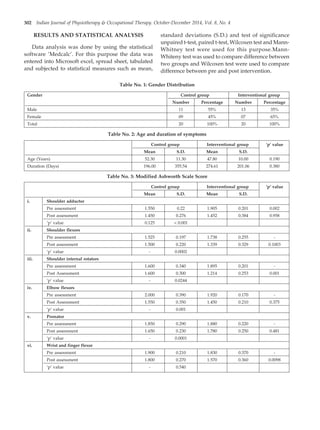
RESULTS AND STATISTICAL ANALYSIS
Data analysis was done by using the statistical
software ‘Medcalc’. For this purpose the data was
entered into Microsoft excel, spread sheet, tabulated
and subjected to statistical measures such as mean,
standard deviations (S.D.) and test of significance
unpaired t-test, paired t-test, Wilcoxen test and Mann-
Whitney test were used for this purpose.Mann-
Whiteny test was used to compare difference between
two groups and Wilcoxen test were used to compare
difference between pre and post intervention.
Table No. 1: Gender Distribution
Gender Control group Interventional group
Number Percentage Number Percentage
Male 11 55% 13 35%
Female 09 45% 07 65%
Total 20 100% 20 100%
Table No. 2: Age and duration of symptoms
Control group Interventional group ‘p’ value
Mean S.D. Mean S.D.
Age (Years) 52.30 11.30 47.80 10.00 0.190
Duration (Days) 196.00 355.54 274.61 201.06 0.380
Table No. 3: Modified Ashworth Scale Score
Control group Interventional group ‘p’ value
Mean S.D. Mean S.D.
i. Shoulder adductor
Pre assessment 1.550 0.22 1.905 0.201 0.002
Post assessment 1.450 0.276 1.452 0.384 0.958
‘p’ value 0.125 < 0.001
ii. Shoulder flexors
Pre assessment 1.525 0.197 1.738 0.255 -
Post assessment 1.500 0.220 1.339 0.329 0.1003
‘p’ value - 0.0002
iii. Shoulder internal rotators
Pre assessment 1.600 0.340 1.895 0.201 -
Post Assessment 1.600 0.300 1.214 0.253 0.001
‘p’ value - 0.0244
iv. Elbow flexors
Pre assessment 2.000 0.390 1.920 0.170 -
Post Assessment 1.550 0.350 1.450 0.210 0.375
‘p’ value - 0.001
v. Pronator
Pre assessment 1.850 0.290 1.880 0.220 -
Post assessment 1.650 0.230 1.780 0.250 0.481
‘p’ value - 0.0001
vi. Wrist and finger flexor
Pre assessment 1.900 0.210 1.830 0.370 -
Post assessment 1.800 0.270 1.570 0.360 0.0098
‘p’ value - 0.540
55. Vinit patil--300--306.pmd 11/14/2014, 5:10 PM
302
Indian Journal of Physiotherapy & Occupational Therapy. October-December 2014, Vol. 8, No. 4 303
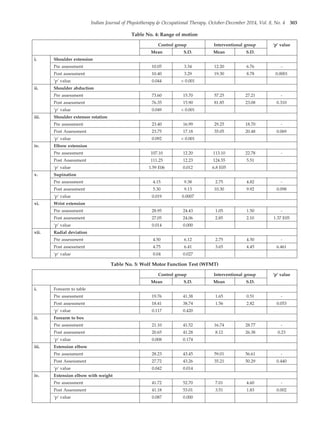
Table No. 4: Range of motion
Control group Interventional group ‘p’ value
Mean S.D. Mean S.D.
i. Shoulder extension
Pre assessment 10.05 3.34 12.20 6.76 -
Post assessment 10.40 3.29 19.30 8.78 0.0001
‘p’ value 0.044 < 0.001
ii. Shoulder abduction
Pre assessment 73.60 15.70 57.25 27.21 -
Post assessment 76.35 15.90 81.85 23.08 0.310
‘p’ value 0.049 < 0.001
iii. Shoulder extensor rotation
Pre assessment 23.40 16.99 29.25 18.70 -
Post Assessment 23.75 17.18 35.05 20.48 0.069
‘p’ value 0.092 < 0.001
iv. Elbow extension
Pre assessment 107.10 12.20 113.10 22.78 -
Post Assessment 111.25 12.23 124.55 5.51
‘p’ value 1.59 E06 0.012 6.8 E05
v. Supination
Pre assessment 4.15 9.38 2.75 4.82 -
Post assessment 5.30 9.13 10.30 9.92 0.098
‘p’ value 0.019 0.0007
vi. Wrist extension
Pre assessment 28.95 24.43 1.05 1.50 -
Post assessment 27.05 24.06 2.85 2.10 1.37 E05
‘p’ value 0.014 0.000
vii. Radial deviation
Pre assessment 4.50 6.12 2.75 4.50 -
Post assessment 4.75 6.41 3.65 4.45 6.461
‘p’ value 0.04 0.027
Table No. 5: Wolf Motor Function Test (WFMT)
Control group Interventional group ‘p’ value
Mean S.D. Mean S.D.
i. Forearm to table
Pre assessment 19.76 41.38 1.65 0.51 -
Post assessment 18.41 38.74 1.56 2.82 0.053
‘p’ value 0.117 0.420
ii. Forearm to box
Pre assessment 21.10 41.52 16.74 28.77 -
Post assessment 20.65 41.28 8.12 26.38 0.23
‘p’ value 0.008 0.174
iii. Extension elbow
Pre assessment 28.23 43.45 59.01 56.61 -
Post Assessment 27.72 43.26 35.21 50.29 0.440
‘p’ value 0.042 0.014
iv. Extension elbow with weight
Pre assessment 41.72 52.70 7.01 4.60 -
Post Assessment 41.18 53.01 3.51 1.83 0.002
‘p’ value 0.087 0.000
55. Vinit patil--300--306.pmd 11/14/2014, 5:10 PM
303
304 Indian Journal of Physiotherapy & Occupational Therapy. October-December 2014, Vol. 8, No. 4
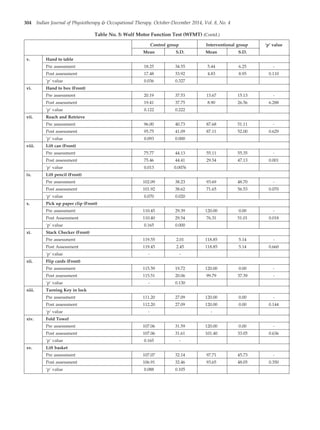
Table No. 5: Wolf Motor Function Test (WFMT) (Contd.)
Control group Interventional group ‘p’ value
Mean S.D. Mean S.D.
v. Hand to table
Pre assessment 18.25 34.55 5.44 6.25 -
Post assessment 17.48 33.92 4.83 8.95 0.110
‘p’ value 0.036 0.327
vi. Hand to box (Front)
Pre assessment 20.19 37.53 13.67 15.13 -
Post assessment 19.41 37.75 8.90 26.56 6.288
‘p’ value 0.122 0.222
vii. Reach and Retrieve
Pre assessment 96.00 40.73 87.68 51.11 -
Post assessment 95.75 41.09 87.11 52.00 0.629
‘p’ value 0.093 0.000
viii. Lift can (Front)
Pre assessment 75.77 44.13 55.11 55.35 -
Post assessment 75.46 44.41 29.54 47.13 0.001
‘p’ value 0.013 0.0076
ix. Lift pencil (Front)
Pre assessment 102.09 38.23 93.69 48.70 -
Post assessment 101.92 38.62 71.65 56.53 0.070
‘p’ value 0.070 0.020
x. Pick up paper clip (Front)
Pre assessment 110.45 29.39 120.00 0.00 -
Post Assessment 110.40 29.54 76.31 51.01 0.018
‘p’ value 0.165 0.000
xi. Stack Checker (Front)
Pre assessment 119.55 2.01 118.85 5.14 -
Post Assessment 119.45 2.45 118.85 5.14 0.660
‘p’ value - -
xii. Flip cards (Front)
Pre assessment 115.59 19.72 120.00 0.00 -
Post assessment 115.51 20.06 99.79 37.39 -
‘p’ value - 0.130
xiii. Turning Key in lock
Pre assessment 111.20 27.09 120.00 0.00 -
Post assessment 112.20 27.09 120.00 0.00 0.144
‘p’ value - -
xiv. Fold Towel
Pre assessment 107.06 31.59 120.00 0.00 -
Post assessment 107.06 31.61 101.40 33.05 0.636
‘p’ value 0.165 -
xv. Lift basket
Pre assessment 107.07 32.14 97.71 45.73 -
Post assessment 106.91 32.46 93.65 48.05 0.350
‘p’ value 0.088 0.105
55. Vinit patil--300--306.pmd 11/14/2014, 5:10 PM
304
Indian Journal of Physiotherapy & Occupational Therapy. October-December 2014, Vol. 8, No. 4 305
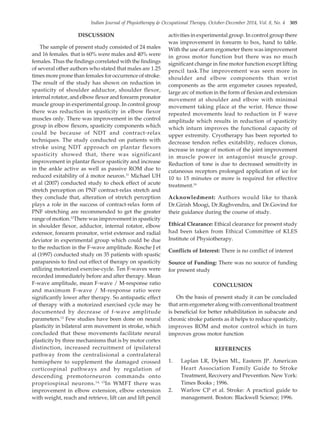
DISCUSSION
The sample of present study consisted of 24 males
and 16 females. that is 60% were males and 40% were
females. Thus the findings correlated with the findings
of several other authors who stated that males are 1.25
times more prone than females for occurrence of stroke.
The result of the study has shown on reduction in
spasticity of shoulder adductor, shoulder flexor,
internal rotator, and elbow flexor and forearm pronator
muscle group in experimental group. In control group
there was reduction in spasticity in elbow flexor
muscles only. There was improvement in the control
group in elbow flexors, spasticity components which
could be because of NDT and contract-relax
techniques. The study conducted on patients with
stroke using NDT approach on plantar flexors
spasticity showed that, there was significant
improvement in plantar flexor spasticity and increase
in the ankle active as well as passive ROM due to
reduced exitability of á motor neuron.11
Michael UH
et al (2007) conducted study to check effect of acute
stretch perception on PNF contract-relax stretch and
they conclude that, alteration of stretch perception
plays a role in the success of contract-relax form of
PNF stretching are recommended to get the greater
range of motion.12
There was improvement in spasticity
in shoulder flexor, adductor, internal rotator, elbow
extensor, forearm pronator, wrist extensor and radial
deviator in experimental group which could be due
to the reduction in the F-wave amplitude. Rosche J et
al (1997) conducted study on 35 patients with spastic
paraparesis to find out effect of therapy on spasticity
utilizing motorized exercise-cycle. Ten F-waves were
recorded immediately before and after therapy. Mean
F-wave amplitude, mean F-wave / M-response ratio
and maximum F-wave / M-response ratio were
significantly lower after therapy. So antispastic effect
of therapy with a motorized exercised cycle may be
documented by decrease of f-wave amplitude
parameters.13
Few studies have been done on neural
plasticity in bilateral arm movement in stroke, which
concluded that these movements facilitate neural
plasticity by three mechanisms that is by motor cortex
distinction, increased recruitment of ipsilateral
pathway from the centralisional a contralateral
hemisphere to supplement the damaged crossed
corticospinal pathways and by regulation of
descending premotorneuron commands onto
propriospinal neurons.14, 15
In WMFT there was
improvement in elbow extension, elbow extension
with weight, reach and retrieve, lift can and lift pencil
activities in experimental group. In control group there
was improvement in forearm to box, hand to table.
With the use of arm ergometer there was improvement
in gross motor function but there was no much
significant change in fine motor function except lifting
pencil task.The improvement was seen more in
shoulder and elbow components than wrist
components as the arm ergometer causes repeated,
large arc of motion in the form of flexion and extension
movement at shoulder and elbow with minimal
movement taking place at the wrist. Hence those
repeated movements lead to reduction in F wave
amplitude which results in reduction of spasticity
which inturn improves the functional capacity of
upper extremity. Cryotherapy has been reported to
decrease tendon reflex exitability, reduces clonus,
increase in range of motion of the joint improvement
in muscle power in antagonist muscle group.
Reduction of tone is due to decreased sensitivity in
cutaneous receptors prolonged application of ice for
10 to 15 minutes or more is required for effective
treatment.16
Acknowledment: Authors would like to thank
Dr.Girish Moogi, Dr.Raghvendra, and Dr.Govind for
their guidance during the course of study.
Ethical Clearance: Ethical clearance for present study
had been taken from Ethical Committee of KLES
Institute of Physiotherapy.
Conflicts of Interest: There is no conflict of interest
Source of Funding: There was no source of funding
for present study
CONCLUSION
On the basis of present study it can be concluded
that arm ergometer along with conventional treatment
is beneficial for better rehabilitation in subacute and
chronic stroke patients as it helps to reduce spasticity,
improves ROM and motor control which in turn
improves gross motor function
REFERENCES
1. Laplan LR, Dyken ML, Eastern JP. American
Heart Association Family Guide to Stroke
Treatment, Recovery and Prevention. New York:
Times Books ; 1996.
2. Warlow CP et al. Stroke: A practical guide to
management. Boston: Blackwell Science; 1996.
55. Vinit patil--300--306.pmd 11/14/2014, 5:10 PM
305
306 Indian Journal of Physiotherapy & Occupational Therapy. October-December 2014, Vol. 8, No. 4
3. Ropper AH, Brown RH. Adams and Victors
Principles of Neurology. 8th
Ed., USA: McGraw
Hill Medical Publishers; 2005.
4. Caplan LK. Stroke a clinical approach. 2nd
Ed.,
USA: Butterworth Heinemann; 1993.
5. Braddom RL. Physical medicine and
rehabilitation. Philadelphia: W. B. Saunders; 1996.
6. Shumway-Cook A, Woolacott M. Motor control
– Translating research into clinical practice. 3rd
Ed., Philadelphia: Lippincott Williams and
Wilkins; 2007.
7. Turnet A, Foster M, Johnson S. Averil & Stewart,
Occupational therapy and physical dysfunction.
4th
Ed., USA: Churchill Livingstone; 1999.
8. Gillen G, Burkhardta A. Stroke rehabilitation –
A function based approach. 2nd
Ed., Philadelphia:
Mosby Publishers; 2004.
9. Michaelsen SM, Dannenbaum R, Levin MF. Task
specific training with trunk restraint on arm
recovery in stroke – Randomised control trial.
Stroke 2006; 37(1): 186-92.
10. Carr JH, Shepherd RB. A motor relearning
programme for stroke. 2nd
Ed., UK: Heinmann
(Aspen Publication); 1987.
11. Ansari NN, Naghdi S. Effect of Bobath approach
on excitatory if the spinal alpha motor neurons
in stroke patients with muscle spasticity.
Electromyogr Clin Neurophysiol 2007; 47(1):
29-36.
12. Michael UH, Myrer JW, Hopkins JT, Hunter I,
Feland JB, Hilton SC. Acute stretch perception
alteration contributes to success of the PNF
contract relax stretch. J Sport Rehabil 2007; 16(2):
85-92.
13. Rösche J, Paulus C, Maisch U, Kaspar A, Mauch
E, Kornhuber HH. The effects of therapy on
spasticity utilizing a motorized exercise-cycle.
Spinal Cord 1997; 35: 176-8.
14. Canaugh JH, Summers JJ. Neural plasticity and
bilateral movements: Progress in a rehabilitation
approach for chronic stroke. Neurobiology 2005;
75(5): 309-20.
15. Javan B, Zehr EP. Short term plasticity of spinal
reflex exitability induced by rhythmic arm
movement. J Neurophysiol 2008; 99(4): 2000-5.
16. Palastranga F. Clayton’s electrotherapy theory
and practice. 3rd
Ed., New Delhi: A1TB
Publication; 2002.
55. Vinit patil--300--306.pmd 11/14/2014, 5:10 PM
306

Stroke Rehabilitation :Physiotherapy

  • 1.
    300 Indian Journalof Physiotherapy & Occupational Therapy. October-December 2014, Vol. 8, No. 4 Effectiveness of ARM Ergometer on Spasticity and Motor Control in Sub-Acute and Chronic Stroke: A Randomised Controlled Trial Vinit patil1 , Tarpan Shah2 , Anil Murgode3 , Deepa Metgud4 1 Physiotherapist, Sancheti Hospital, Pune, 2 Asst. Prof., Shree Swaminaryan Physiotherpay College, Surat, 3 Asst. Prof., 4 Asso. Prof., K.L.E Institute of Physiotherapy, Belgaum, Karnataka ABSTRACT Background and Objectives: Stroke is the sudden death of cells in a limited part of brain caused by a reduced flow of blood to the brain. Objectives of present study were to assess the effectiveness of arm ergometry in improving range of motion of shoulder, elbow and wrist in sub-acute and chronic hemiplegics and to compare the effectiveness of arm ergometry with conventional therapy on spasticity and motor control. Materials and Method: The present randomized controlled trial was conducted among 40 subjects with sub-acute and chronic stroke referred to Department of Physiotherapy, KLES Dr. Prabhakar Kore Hospital and Medical Research Centre, Belgaum. A written informed consent from study subjects and ethical clearance was obtained. Subjects were divided into two groups namely Group A which received cryotherapy, proprioceptive neuromuscular facilitation (contract-relax, hold-relax) and neurodevelopmental techniques and Group B which received arm ergometer along with conventional treatment. Outcome was measured in terms of spasticity, range of motion and motor control. Results: Subjects treated in experimental group showed better reduction in spasticity (p<0.05). There was no significant reduction in wrist flexor spasticity (p>0.05), patients who received conventional treatment who shown reduction in spasticity in elbow flexors only (p<0.05). There was significant improvement in range of motion and gross motor function in experimental group but, there was no change in fine motor function. Conclusion: Conventional treatment along with arm ergometer treatment found to be effective in reducing spasticity and improving range of motion and motor control in sub-acute and chronic stroke patients. Keywords: Arm ergometer; Spasticity; Motor control; Range of motion; Stroke INTRODUCTION Stroke is the sudden death of cells in a limited part of brain caused by a reduced flow of blood to the brain.1,2 Cerebrovascular disease designates any abnormality of brain resulting from pathological process of blood vessels.3 Blood brings oxygen and nutrients to the brain cells. Without blood, brain cells quickly begin to die. The effect of stroke depends upon the part of brain affected. A stroke may cause paralysis, speech problem, and loss of memory, or reasoning ability, coma or death. Stroke refers to any damage to brain or CNS structures caused by abnormalities of the blood supply.4 The most disabling feature of cerebrovascular accident is ‘Spasticity’ which is motor disorder characterized by a velocity dependent increase in tonic stretch reflex and is one of the components of upper motor neuron syndrome.5 It suggests that treatmentpractices directed primarily at DOI Number: 10.5958/0973-5674.2014.00055.0 55. Vinit patil--300--306.pmd 11/14/2014, 5:10 PM 300
  • 2.
    Indian Journal ofPhysiotherapy & Occupational Therapy. October-December 2014, Vol. 8, No. 4 301 reducing spastic hypertonicity as major focus in regaining motor control. Neurodevelopmental approach makes use of position which inhibit abnormal posture and patterns of movement, but facilitates normal equilibrium, balance and righting reactions and encourages normal movement patterns.7 PNF which aims to promote neuromuscular activity through stimulation of propriocepters and the sensorimotor approach is based on that motor output is dependent upon sensory input so sensory stimuli can be used to activate or inhibit motor responses.18 Task specific therapy is specifically designed to deal with lost abilities or task showed best results. Rehabilitation is thus induce the relearning of real life activities.8,9 It has been proved that arm ergometer helps in reducing excitability of corticospinal tract in the forearm region and depresses activity of H-reflex and F-wave by post-synaptic inhibition or by disfacilitation of largest motor neuron. Few studies were conducted on post stroke patients with the help of paddling in lower limb in which they found out that contralateral pedaling induced a complete motor pattern of similar amplitude to the bilateral pattern in both the paretic and non-paretic leg of the subjects with severe hemiparesis. Fewer studies have been done on arm ergometer in stroke for spasticity, so it is not commonly used for rehabilitation purpose. Therefore the present study was undertaken to study effectiveness of arm ergometer to reduce spasticity, improvement in motor control and range of motion in subacute (7 to 21 days) and chronic (after 21 days) stage. MATERIALS AND METHODOLOGY The present study was conducted in the Department of Physiotherapy, KLES Dr. Prabhakar Kore Hospital and Medical Research centre, Belgaum. It was randomized controlled trial were Forty participants of both male and female participants with diagnosis of sub-acute and chronic stroke who were referred to physiotherapy out patient department had been taken.Convenient sampling had been done. Patients Selected for the study was randomly allocated in to Group A: Control Group, Group B: Experimental group. Inclusion criteria were Patients who are able to participate for at least 30 minutes of exercise using arm ergometer .Patients whose paretic hand can reach the arm-pedal without pain.Patients who has no problem of comprehension. Patient who are able to give their informed consent. Patient between the age group of 20 to 70 years.Patient with spasticity between 1 to 3 of MAS. Exclusion Criteria were Patients with subluxation and dislocation of shoulder,aphasia, peripheral vascular disease, history of unstable angina and cardiac arrhythmias, spinal cord injury, head injury, fractures of upper limb.Patients with reflex sympathetic dystrophy (RSD). PROCEDURE In Group A participants were treated on the affected side with cryotherapy, PNF and NDT for 60 minutes daily, five days a week for three weeks. The patients were made to lie in supine position with arm in abduction and elbow in extension. The cryotherapy was given for 20 minutes on flexor aspect of arm, forearm and hand. In PNF, contract-relax and Hold- Relax techniques in Flexion-Adduction-External rotation pattern for arm and for scapula Abduction- Depression pattern was used for 20 minutes. In the contract relaxed technique patients were made to lie in supine position and asked to contract biceps and wrist flexors isotonically and hold it for eight seconds followed by stretching given for two minutes. This technique was repeated for four times. In hold relax technique patients were asked to contract biceps and wrist flexor isometrically and hold it for 20 seconds followed by which stretching was given and maintained for two minutes. This technique was repeated four times. In NDT techniques patients were made to lie in supine position and were treated with scapular mobilization, isolated movements for arm in flexion and abduction, isolated movements for forearm in flexion and extension, and active assisted movements for arm were given for five times.In Group B, patients were treated with arm ergometer for 30 minutes alogwith conventional treatment. The patients were positioned in front of arm ergometer in the wheelchair or armless chair in such a way that fulcrum of the handle adjusted at shoulder height. Arm training was performed at constant relatively low resistance for 30 minutes. Each training session consisted of 15 minutes of arm cycling in forward direction and backward direction with five minutes of break in between. Patients were not assisted in any way during exercise apart from being given verbal encouragements. After three weeks at the end of treatment programme patients were assessed using MAS, WMFT and Goniometry measurements. 55. Vinit patil--300--306.pmd 11/14/2014, 5:10 PM 301
  • 3.
    302 Indian Journalof Physiotherapy & Occupational Therapy. October-December 2014, Vol. 8, No. 4 RESULTS AND STATISTICAL ANALYSIS Data analysis was done by using the statistical software ‘Medcalc’. For this purpose the data was entered into Microsoft excel, spread sheet, tabulated and subjected to statistical measures such as mean, standard deviations (S.D.) and test of significance unpaired t-test, paired t-test, Wilcoxen test and Mann- Whitney test were used for this purpose.Mann- Whiteny test was used to compare difference between two groups and Wilcoxen test were used to compare difference between pre and post intervention. Table No. 1: Gender Distribution Gender Control group Interventional group Number Percentage Number Percentage Male 11 55% 13 35% Female 09 45% 07 65% Total 20 100% 20 100% Table No. 2: Age and duration of symptoms Control group Interventional group ‘p’ value Mean S.D. Mean S.D. Age (Years) 52.30 11.30 47.80 10.00 0.190 Duration (Days) 196.00 355.54 274.61 201.06 0.380 Table No. 3: Modified Ashworth Scale Score Control group Interventional group ‘p’ value Mean S.D. Mean S.D. i. Shoulder adductor Pre assessment 1.550 0.22 1.905 0.201 0.002 Post assessment 1.450 0.276 1.452 0.384 0.958 ‘p’ value 0.125 < 0.001 ii. Shoulder flexors Pre assessment 1.525 0.197 1.738 0.255 - Post assessment 1.500 0.220 1.339 0.329 0.1003 ‘p’ value - 0.0002 iii. Shoulder internal rotators Pre assessment 1.600 0.340 1.895 0.201 - Post Assessment 1.600 0.300 1.214 0.253 0.001 ‘p’ value - 0.0244 iv. Elbow flexors Pre assessment 2.000 0.390 1.920 0.170 - Post Assessment 1.550 0.350 1.450 0.210 0.375 ‘p’ value - 0.001 v. Pronator Pre assessment 1.850 0.290 1.880 0.220 - Post assessment 1.650 0.230 1.780 0.250 0.481 ‘p’ value - 0.0001 vi. Wrist and finger flexor Pre assessment 1.900 0.210 1.830 0.370 - Post assessment 1.800 0.270 1.570 0.360 0.0098 ‘p’ value - 0.540 55. Vinit patil--300--306.pmd 11/14/2014, 5:10 PM 302
  • 4.
    Indian Journal ofPhysiotherapy & Occupational Therapy. October-December 2014, Vol. 8, No. 4 303 Table No. 4: Range of motion Control group Interventional group ‘p’ value Mean S.D. Mean S.D. i. Shoulder extension Pre assessment 10.05 3.34 12.20 6.76 - Post assessment 10.40 3.29 19.30 8.78 0.0001 ‘p’ value 0.044 < 0.001 ii. Shoulder abduction Pre assessment 73.60 15.70 57.25 27.21 - Post assessment 76.35 15.90 81.85 23.08 0.310 ‘p’ value 0.049 < 0.001 iii. Shoulder extensor rotation Pre assessment 23.40 16.99 29.25 18.70 - Post Assessment 23.75 17.18 35.05 20.48 0.069 ‘p’ value 0.092 < 0.001 iv. Elbow extension Pre assessment 107.10 12.20 113.10 22.78 - Post Assessment 111.25 12.23 124.55 5.51 ‘p’ value 1.59 E06 0.012 6.8 E05 v. Supination Pre assessment 4.15 9.38 2.75 4.82 - Post assessment 5.30 9.13 10.30 9.92 0.098 ‘p’ value 0.019 0.0007 vi. Wrist extension Pre assessment 28.95 24.43 1.05 1.50 - Post assessment 27.05 24.06 2.85 2.10 1.37 E05 ‘p’ value 0.014 0.000 vii. Radial deviation Pre assessment 4.50 6.12 2.75 4.50 - Post assessment 4.75 6.41 3.65 4.45 6.461 ‘p’ value 0.04 0.027 Table No. 5: Wolf Motor Function Test (WFMT) Control group Interventional group ‘p’ value Mean S.D. Mean S.D. i. Forearm to table Pre assessment 19.76 41.38 1.65 0.51 - Post assessment 18.41 38.74 1.56 2.82 0.053 ‘p’ value 0.117 0.420 ii. Forearm to box Pre assessment 21.10 41.52 16.74 28.77 - Post assessment 20.65 41.28 8.12 26.38 0.23 ‘p’ value 0.008 0.174 iii. Extension elbow Pre assessment 28.23 43.45 59.01 56.61 - Post Assessment 27.72 43.26 35.21 50.29 0.440 ‘p’ value 0.042 0.014 iv. Extension elbow with weight Pre assessment 41.72 52.70 7.01 4.60 - Post Assessment 41.18 53.01 3.51 1.83 0.002 ‘p’ value 0.087 0.000 55. Vinit patil--300--306.pmd 11/14/2014, 5:10 PM 303
  • 5.
    304 Indian Journalof Physiotherapy & Occupational Therapy. October-December 2014, Vol. 8, No. 4 Table No. 5: Wolf Motor Function Test (WFMT) (Contd.) Control group Interventional group ‘p’ value Mean S.D. Mean S.D. v. Hand to table Pre assessment 18.25 34.55 5.44 6.25 - Post assessment 17.48 33.92 4.83 8.95 0.110 ‘p’ value 0.036 0.327 vi. Hand to box (Front) Pre assessment 20.19 37.53 13.67 15.13 - Post assessment 19.41 37.75 8.90 26.56 6.288 ‘p’ value 0.122 0.222 vii. Reach and Retrieve Pre assessment 96.00 40.73 87.68 51.11 - Post assessment 95.75 41.09 87.11 52.00 0.629 ‘p’ value 0.093 0.000 viii. Lift can (Front) Pre assessment 75.77 44.13 55.11 55.35 - Post assessment 75.46 44.41 29.54 47.13 0.001 ‘p’ value 0.013 0.0076 ix. Lift pencil (Front) Pre assessment 102.09 38.23 93.69 48.70 - Post assessment 101.92 38.62 71.65 56.53 0.070 ‘p’ value 0.070 0.020 x. Pick up paper clip (Front) Pre assessment 110.45 29.39 120.00 0.00 - Post Assessment 110.40 29.54 76.31 51.01 0.018 ‘p’ value 0.165 0.000 xi. Stack Checker (Front) Pre assessment 119.55 2.01 118.85 5.14 - Post Assessment 119.45 2.45 118.85 5.14 0.660 ‘p’ value - - xii. Flip cards (Front) Pre assessment 115.59 19.72 120.00 0.00 - Post assessment 115.51 20.06 99.79 37.39 - ‘p’ value - 0.130 xiii. Turning Key in lock Pre assessment 111.20 27.09 120.00 0.00 - Post assessment 112.20 27.09 120.00 0.00 0.144 ‘p’ value - - xiv. Fold Towel Pre assessment 107.06 31.59 120.00 0.00 - Post assessment 107.06 31.61 101.40 33.05 0.636 ‘p’ value 0.165 - xv. Lift basket Pre assessment 107.07 32.14 97.71 45.73 - Post assessment 106.91 32.46 93.65 48.05 0.350 ‘p’ value 0.088 0.105 55. Vinit patil--300--306.pmd 11/14/2014, 5:10 PM 304
  • 6.
    Indian Journal ofPhysiotherapy & Occupational Therapy. October-December 2014, Vol. 8, No. 4 305 DISCUSSION The sample of present study consisted of 24 males and 16 females. that is 60% were males and 40% were females. Thus the findings correlated with the findings of several other authors who stated that males are 1.25 times more prone than females for occurrence of stroke. The result of the study has shown on reduction in spasticity of shoulder adductor, shoulder flexor, internal rotator, and elbow flexor and forearm pronator muscle group in experimental group. In control group there was reduction in spasticity in elbow flexor muscles only. There was improvement in the control group in elbow flexors, spasticity components which could be because of NDT and contract-relax techniques. The study conducted on patients with stroke using NDT approach on plantar flexors spasticity showed that, there was significant improvement in plantar flexor spasticity and increase in the ankle active as well as passive ROM due to reduced exitability of á motor neuron.11 Michael UH et al (2007) conducted study to check effect of acute stretch perception on PNF contract-relax stretch and they conclude that, alteration of stretch perception plays a role in the success of contract-relax form of PNF stretching are recommended to get the greater range of motion.12 There was improvement in spasticity in shoulder flexor, adductor, internal rotator, elbow extensor, forearm pronator, wrist extensor and radial deviator in experimental group which could be due to the reduction in the F-wave amplitude. Rosche J et al (1997) conducted study on 35 patients with spastic paraparesis to find out effect of therapy on spasticity utilizing motorized exercise-cycle. Ten F-waves were recorded immediately before and after therapy. Mean F-wave amplitude, mean F-wave / M-response ratio and maximum F-wave / M-response ratio were significantly lower after therapy. So antispastic effect of therapy with a motorized exercised cycle may be documented by decrease of f-wave amplitude parameters.13 Few studies have been done on neural plasticity in bilateral arm movement in stroke, which concluded that these movements facilitate neural plasticity by three mechanisms that is by motor cortex distinction, increased recruitment of ipsilateral pathway from the centralisional a contralateral hemisphere to supplement the damaged crossed corticospinal pathways and by regulation of descending premotorneuron commands onto propriospinal neurons.14, 15 In WMFT there was improvement in elbow extension, elbow extension with weight, reach and retrieve, lift can and lift pencil activities in experimental group. In control group there was improvement in forearm to box, hand to table. With the use of arm ergometer there was improvement in gross motor function but there was no much significant change in fine motor function except lifting pencil task.The improvement was seen more in shoulder and elbow components than wrist components as the arm ergometer causes repeated, large arc of motion in the form of flexion and extension movement at shoulder and elbow with minimal movement taking place at the wrist. Hence those repeated movements lead to reduction in F wave amplitude which results in reduction of spasticity which inturn improves the functional capacity of upper extremity. Cryotherapy has been reported to decrease tendon reflex exitability, reduces clonus, increase in range of motion of the joint improvement in muscle power in antagonist muscle group. Reduction of tone is due to decreased sensitivity in cutaneous receptors prolonged application of ice for 10 to 15 minutes or more is required for effective treatment.16 Acknowledment: Authors would like to thank Dr.Girish Moogi, Dr.Raghvendra, and Dr.Govind for their guidance during the course of study. Ethical Clearance: Ethical clearance for present study had been taken from Ethical Committee of KLES Institute of Physiotherapy. Conflicts of Interest: There is no conflict of interest Source of Funding: There was no source of funding for present study CONCLUSION On the basis of present study it can be concluded that arm ergometer along with conventional treatment is beneficial for better rehabilitation in subacute and chronic stroke patients as it helps to reduce spasticity, improves ROM and motor control which in turn improves gross motor function REFERENCES 1. Laplan LR, Dyken ML, Eastern JP. American Heart Association Family Guide to Stroke Treatment, Recovery and Prevention. New York: Times Books ; 1996. 2. Warlow CP et al. Stroke: A practical guide to management. Boston: Blackwell Science; 1996. 55. Vinit patil--300--306.pmd 11/14/2014, 5:10 PM 305
  • 7.
    306 Indian Journalof Physiotherapy & Occupational Therapy. October-December 2014, Vol. 8, No. 4 3. Ropper AH, Brown RH. Adams and Victors Principles of Neurology. 8th Ed., USA: McGraw Hill Medical Publishers; 2005. 4. Caplan LK. Stroke a clinical approach. 2nd Ed., USA: Butterworth Heinemann; 1993. 5. Braddom RL. Physical medicine and rehabilitation. Philadelphia: W. B. Saunders; 1996. 6. Shumway-Cook A, Woolacott M. Motor control – Translating research into clinical practice. 3rd Ed., Philadelphia: Lippincott Williams and Wilkins; 2007. 7. Turnet A, Foster M, Johnson S. Averil & Stewart, Occupational therapy and physical dysfunction. 4th Ed., USA: Churchill Livingstone; 1999. 8. Gillen G, Burkhardta A. Stroke rehabilitation – A function based approach. 2nd Ed., Philadelphia: Mosby Publishers; 2004. 9. Michaelsen SM, Dannenbaum R, Levin MF. Task specific training with trunk restraint on arm recovery in stroke – Randomised control trial. Stroke 2006; 37(1): 186-92. 10. Carr JH, Shepherd RB. A motor relearning programme for stroke. 2nd Ed., UK: Heinmann (Aspen Publication); 1987. 11. Ansari NN, Naghdi S. Effect of Bobath approach on excitatory if the spinal alpha motor neurons in stroke patients with muscle spasticity. Electromyogr Clin Neurophysiol 2007; 47(1): 29-36. 12. Michael UH, Myrer JW, Hopkins JT, Hunter I, Feland JB, Hilton SC. Acute stretch perception alteration contributes to success of the PNF contract relax stretch. J Sport Rehabil 2007; 16(2): 85-92. 13. Rösche J, Paulus C, Maisch U, Kaspar A, Mauch E, Kornhuber HH. The effects of therapy on spasticity utilizing a motorized exercise-cycle. Spinal Cord 1997; 35: 176-8. 14. Canaugh JH, Summers JJ. Neural plasticity and bilateral movements: Progress in a rehabilitation approach for chronic stroke. Neurobiology 2005; 75(5): 309-20. 15. Javan B, Zehr EP. Short term plasticity of spinal reflex exitability induced by rhythmic arm movement. J Neurophysiol 2008; 99(4): 2000-5. 16. Palastranga F. Clayton’s electrotherapy theory and practice. 3rd Ed., New Delhi: A1TB Publication; 2002. 55. Vinit patil--300--306.pmd 11/14/2014, 5:10 PM 306