(Series of Lectures for DAE / B-Tech / BS
Electrical)
Presented by. Engr. Fazal Ur Rehman
Lecturer Electrical GPI Karak
Former HOD Electrical RPI, Rwp
 NEED.
 Calculations of KVL and KCL are complicated for
circuit having more than one sources.
 It makes calculation easy and understandable.
 It can be used to find out the voltage and current
of a circuit;
 For series Circuits
 Parallel Circuits
 Complex Circuits
 The effects of multiple sources in a circuit
are superimposed on each other. Therefore
the overall effect (current or Voltage) is due
to combined effort of all the sources
connected in a circuit.
OR
 The response in any branch of a circuit
having multiple independent sources is equal
to algebraic sum of responses due to each
source.
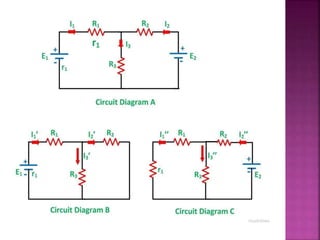
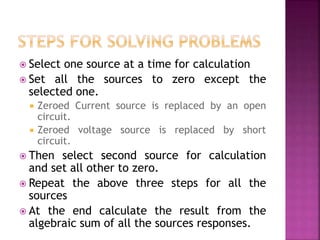
 Select one source at a time for calculation
 Set all the sources to zero except the
selected one.
 Zeroed Current source is replaced by an open
circuit.
 Zeroed voltage source is replaced by short
circuit.
 Then select second source for calculation
and set all other to zero.
 Repeat the above three steps for all the
sources
 At the end calculate the result from the
algebraic sum of all the sources responses.
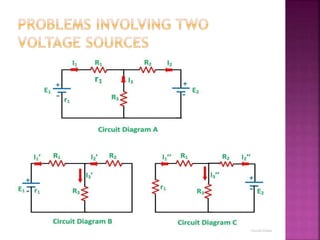
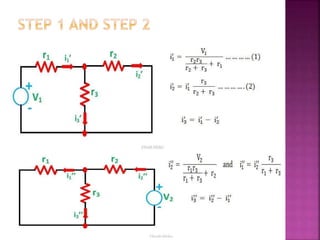
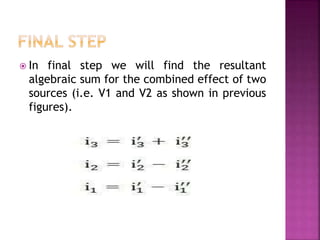
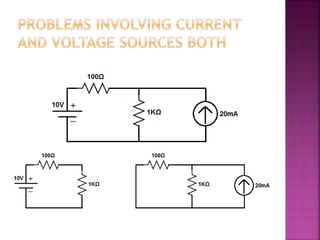
 In final step we will find the resultant
algebraic sum for the combined effect of two
sources (i.e. V1 and V2 as shown in previous
figures).
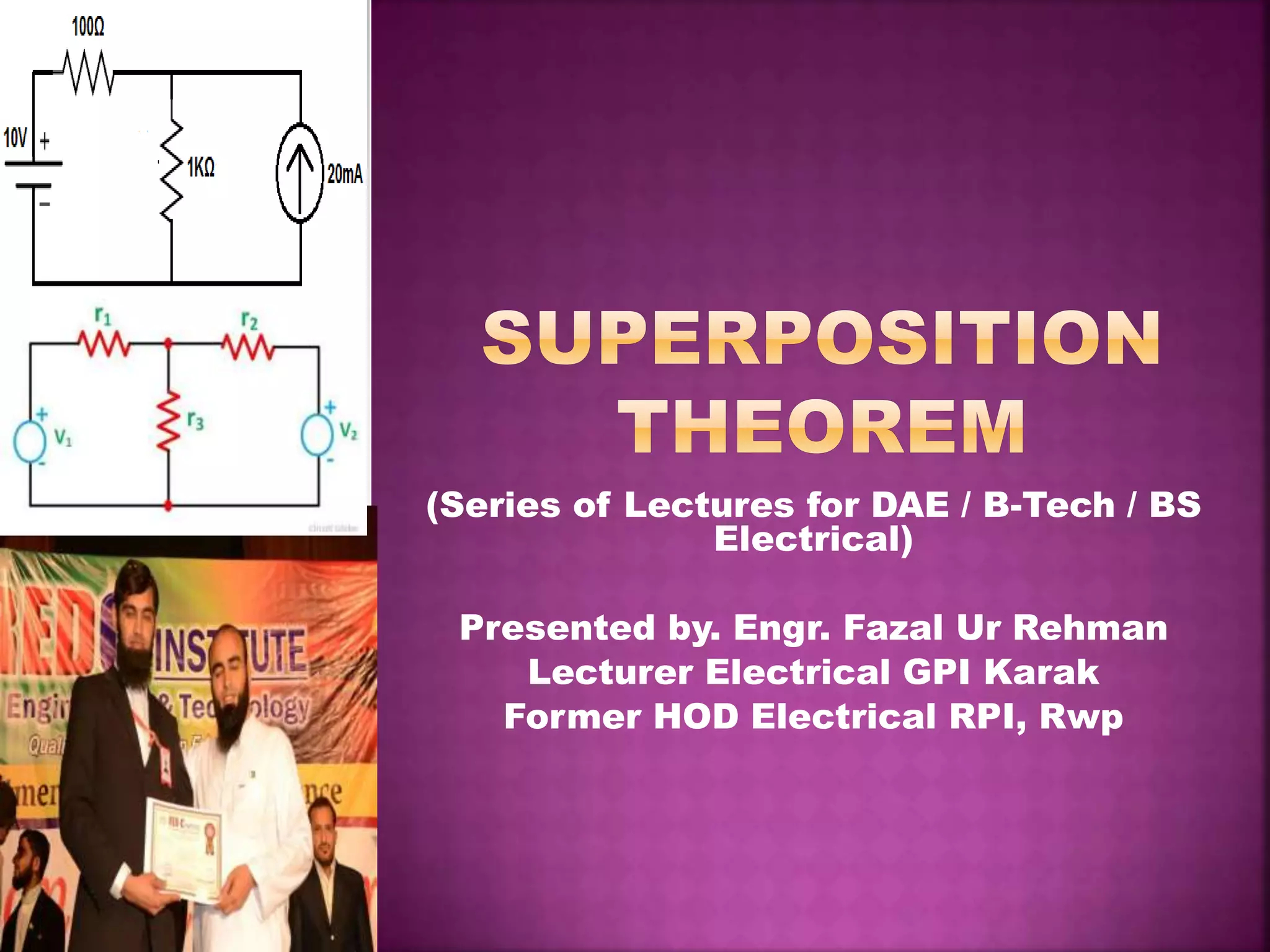
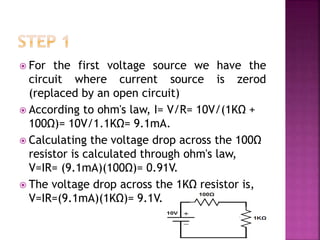
 For the first voltage source we have the
circuit where current source is zerod
(replaced by an open circuit)
 According to ohm's law, I= V/R= 10V/(1KΩ +
100Ω)= 10V/1.1KΩ= 9.1mA.
 Calculating the voltage drop across the 100Ω
resistor is calculated through ohm's law,
V=IR= (9.1mA)(100Ω)= 0.91V.
 The voltage drop across the 1KΩ resistor is,
V=IR=(9.1mA)(1KΩ)= 9.1V.
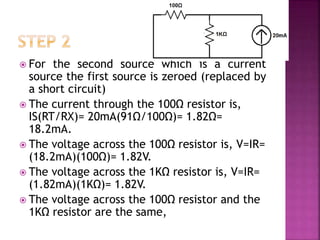
 For the second source which is a current
source the first source is zeroed (replaced by
a short circuit)
 The current through the 100Ω resistor is,
IS(RT/RX)= 20mA(91Ω/100Ω)= 1.82Ω=
18.2mA.
 The voltage across the 100Ω resistor is, V=IR=
(18.2mA)(100Ω)= 1.82V.
 The voltage across the 1KΩ resistor is, V=IR=
(1.82mA)(1KΩ)= 1.82V.
 The voltage across the 100Ω resistor and the
1KΩ resistor are the same,
 The current flowing through the 100Ω resistor
is, 9.1mA + (-18.2mA)= -9.1mA, which means
that current is flowing toward the voltage
source.
 The current flowing through the 1KΩ resistor
is, 9.1mA + 1.82mA= 10.92mA.
 The voltage across the 100Ω resistor is,
0.91V - (1.82V) = -0.91V.
 The voltage across the 1KΩ resistor is,
9.1V + 1.82V= 10.92
Superposition theorem

Superposition theorem

  • 1.
    (Series of Lecturesfor DAE / B-Tech / BS Electrical) Presented by. Engr. Fazal Ur Rehman Lecturer Electrical GPI Karak Former HOD Electrical RPI, Rwp
  • 2.
     NEED.  Calculationsof KVL and KCL are complicated for circuit having more than one sources.  It makes calculation easy and understandable.  It can be used to find out the voltage and current of a circuit;  For series Circuits  Parallel Circuits  Complex Circuits
  • 3.
     The effectsof multiple sources in a circuit are superimposed on each other. Therefore the overall effect (current or Voltage) is due to combined effort of all the sources connected in a circuit. OR  The response in any branch of a circuit having multiple independent sources is equal to algebraic sum of responses due to each source.
  • 5.
     Select onesource at a time for calculation  Set all the sources to zero except the selected one.  Zeroed Current source is replaced by an open circuit.  Zeroed voltage source is replaced by short circuit.  Then select second source for calculation and set all other to zero.  Repeat the above three steps for all the sources  At the end calculate the result from the algebraic sum of all the sources responses.
  • 8.
     In finalstep we will find the resultant algebraic sum for the combined effect of two sources (i.e. V1 and V2 as shown in previous figures).
  • 10.
     For thefirst voltage source we have the circuit where current source is zerod (replaced by an open circuit)  According to ohm's law, I= V/R= 10V/(1KΩ + 100Ω)= 10V/1.1KΩ= 9.1mA.  Calculating the voltage drop across the 100Ω resistor is calculated through ohm's law, V=IR= (9.1mA)(100Ω)= 0.91V.  The voltage drop across the 1KΩ resistor is, V=IR=(9.1mA)(1KΩ)= 9.1V.
  • 11.
     For thesecond source which is a current source the first source is zeroed (replaced by a short circuit)  The current through the 100Ω resistor is, IS(RT/RX)= 20mA(91Ω/100Ω)= 1.82Ω= 18.2mA.  The voltage across the 100Ω resistor is, V=IR= (18.2mA)(100Ω)= 1.82V.  The voltage across the 1KΩ resistor is, V=IR= (1.82mA)(1KΩ)= 1.82V.  The voltage across the 100Ω resistor and the 1KΩ resistor are the same,
  • 12.
     The currentflowing through the 100Ω resistor is, 9.1mA + (-18.2mA)= -9.1mA, which means that current is flowing toward the voltage source.  The current flowing through the 1KΩ resistor is, 9.1mA + 1.82mA= 10.92mA.  The voltage across the 100Ω resistor is, 0.91V - (1.82V) = -0.91V.  The voltage across the 1KΩ resistor is, 9.1V + 1.82V= 10.92