HIGH VOLTAGE ENGINEERING
[2160904]
ACTIVE LEARNING ASSIGNMENT :
TOPIC : CONDUCTION AND BREAKDOWN IN COMMERCIAL LIQUIDS.
UNIVERSITY : GUJARAT TECHNOLOGICAL UNIVERSITY.
COLLEGE : VADODARA INSTITUTE OF ENGINEERING.
DEPARTMENT : ELECTRICAL ENGINEERING [E.E.– I].
SEMESTER : VI.
PREPERED BY :
130800109025 [ MEET K. JANI ]
130800109026 [ BHARGAV M. JAYSWAL ]
130800109027 [ JESTY JOSE ]
130800109028 [ JOBIN ABRAHAM ]
GUIDED BY : ASSO. PROF. ANJALIBA D. RANA.
[ELECTRICAL DEPARTMENT]
ACTIVE LEARNING ASSIGNMENT
1
 Contents:
 Introduction
 Suspended Particle Mechanism
 Cavitation and Bubble Mechanism
 Thermal Breakdown
 Stressed Oil Volume Theory
 References
ACTIVE LEARNING ASSIGNMENT 2
 Introduction:
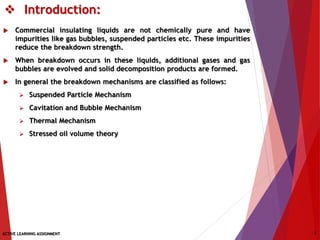
 Commercial insulating liquids are not chemically pure and have
impurities like gas bubbles, suspended particles etc. These impurities
reduce the breakdown strength.
 When breakdown occurs in these liquids, additional gases and gas
bubbles are evolved and solid decomposition products are formed.
 In general the breakdown mechanisms are classified as follows:
 Suspended Particle Mechanism
 Cavitation and Bubble Mechanism
 Thermal Mechanism
 Stressed oil volume theory
ACTIVE LEARNING ASSIGNMENT 3
 Suspended Particle Mechanism:
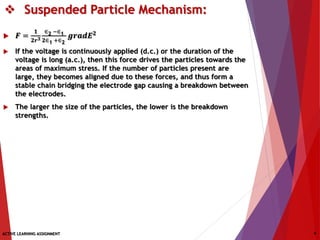
 𝑭 =
𝟏
𝟐𝒓 𝟑
∈2 −∈1
𝟐∈1 +∈2
𝒈𝒓𝒂𝒅𝑬 𝟐
 If the voltage is continuously applied (d.c.) or the duration of the
voltage is long (a.c.), then this force drives the particles towards the
areas of maximum stress. If the number of particles present are
large, they becomes aligned due to these forces, and thus form a
stable chain bridging the electrode gap causing a breakdown between
the electrodes.
 The larger the size of the particles, the lower is the breakdown
strengths.
ACTIVE LEARNING ASSIGNMENT 4
 Cavitation and Bubble Mechanism:
 The following processes have been responsible for the formation of
the vapor bubbles.
 Gas pockets at the surface of the electrodes.
 Electrostatic repulsive forces between space charges which may
be sufficient to overcome the surface tension.
 Gaseous products due to the dissociation of liquid molecules by
electron collisions.
 Vaporization of the liquid by corona type discharge.
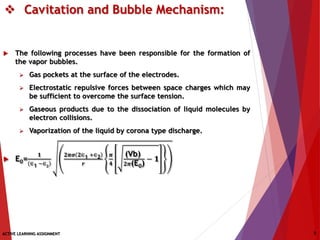
 E0=
𝟏
∈1 −∈ 𝟐
𝟐𝝅𝝈 𝟐∈1 +∈2
𝒓
𝝅
𝟒
(Vb)
𝟐𝝅(E0)
− 𝟏
ACTIVE LEARNING ASSIGNMENT 5
 Thermal Breakdown:
 Based on the experimental observations of extremely large currents
just before breakdown. The high current pulses originate from the
tips of the microscopic projections on the cathode surface with
 densities of the order of 1 A/cm3. This high density current pulses
give rise to localized heating of the oil which may lead to the
formation of vapor bubbles.
 When a bubble is formed, breakdown follows, either because of its
elongation to a critical size or when it completely bridges the gap
between the electrodes.
ACTIVE LEARNING ASSIGNMENT 6
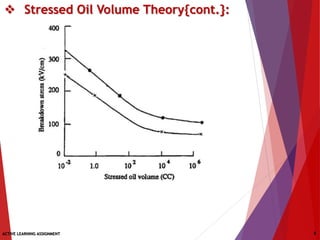
 Stressed Oil Volume Theory:
 Breakdown strength is determined by the “largest
possible impurity” or “weak link” in commercial liquids
where minute traces of impurities are present.
 The breakdown voltage determined by,
 Gas content in the oil
 Viscosity of the oil
 Impurities present in the oil
ACTIVE LEARNING ASSIGNMENT 7
 Stressed Oil Volume Theory{cont.}:
ACTIVE LEARNING ASSIGNMENT 8
 References:
1. M.S. Naidu, V. Kamaraju “HIGH-VOLTAGE ENGINEERING”, McGraw
Hill Education (India) Private Limited, Fifth Edition, Second
Reprint, 2014, ISBN : 978-1-25-906289-6.
2. C.L. Wadhwa “HIGH VOLTAGE ENGINEERING”, NEW AGE
INTERNATIONAL (P) LIMITED, PUBLISHERS, THIRD EDITION, Reprint,
2015, ISBN : 978-81-224-3090-5.
3. https://srirajkumar.files.wordpress.com/2012/07/conduction-and-
breakdown-in-pure-liquid-dielectrics.pdf
ACTIVE LEARNING ASSIGNMENT 9
ACTIVE LEARNING ASSIGNMENT 10
ANY QUESTIONS?

HIGH VOLTAGE ENGINEERING. Conduction and breakdown in commercial liquids

  • 1.
    HIGH VOLTAGE ENGINEERING [2160904] ACTIVELEARNING ASSIGNMENT : TOPIC : CONDUCTION AND BREAKDOWN IN COMMERCIAL LIQUIDS. UNIVERSITY : GUJARAT TECHNOLOGICAL UNIVERSITY. COLLEGE : VADODARA INSTITUTE OF ENGINEERING. DEPARTMENT : ELECTRICAL ENGINEERING [E.E.– I]. SEMESTER : VI. PREPERED BY : 130800109025 [ MEET K. JANI ] 130800109026 [ BHARGAV M. JAYSWAL ] 130800109027 [ JESTY JOSE ] 130800109028 [ JOBIN ABRAHAM ] GUIDED BY : ASSO. PROF. ANJALIBA D. RANA. [ELECTRICAL DEPARTMENT] ACTIVE LEARNING ASSIGNMENT 1
  • 2.
     Contents:  Introduction Suspended Particle Mechanism  Cavitation and Bubble Mechanism  Thermal Breakdown  Stressed Oil Volume Theory  References ACTIVE LEARNING ASSIGNMENT 2
  • 3.
     Introduction:  Commercialinsulating liquids are not chemically pure and have impurities like gas bubbles, suspended particles etc. These impurities reduce the breakdown strength.  When breakdown occurs in these liquids, additional gases and gas bubbles are evolved and solid decomposition products are formed.  In general the breakdown mechanisms are classified as follows:  Suspended Particle Mechanism  Cavitation and Bubble Mechanism  Thermal Mechanism  Stressed oil volume theory ACTIVE LEARNING ASSIGNMENT 3
  • 4.
     Suspended ParticleMechanism:  𝑭 = 𝟏 𝟐𝒓 𝟑 ∈2 −∈1 𝟐∈1 +∈2 𝒈𝒓𝒂𝒅𝑬 𝟐  If the voltage is continuously applied (d.c.) or the duration of the voltage is long (a.c.), then this force drives the particles towards the areas of maximum stress. If the number of particles present are large, they becomes aligned due to these forces, and thus form a stable chain bridging the electrode gap causing a breakdown between the electrodes.  The larger the size of the particles, the lower is the breakdown strengths. ACTIVE LEARNING ASSIGNMENT 4
  • 5.
     Cavitation andBubble Mechanism:  The following processes have been responsible for the formation of the vapor bubbles.  Gas pockets at the surface of the electrodes.  Electrostatic repulsive forces between space charges which may be sufficient to overcome the surface tension.  Gaseous products due to the dissociation of liquid molecules by electron collisions.  Vaporization of the liquid by corona type discharge.  E0= 𝟏 ∈1 −∈ 𝟐 𝟐𝝅𝝈 𝟐∈1 +∈2 𝒓 𝝅 𝟒 (Vb) 𝟐𝝅(E0) − 𝟏 ACTIVE LEARNING ASSIGNMENT 5
  • 6.
     Thermal Breakdown: Based on the experimental observations of extremely large currents just before breakdown. The high current pulses originate from the tips of the microscopic projections on the cathode surface with  densities of the order of 1 A/cm3. This high density current pulses give rise to localized heating of the oil which may lead to the formation of vapor bubbles.  When a bubble is formed, breakdown follows, either because of its elongation to a critical size or when it completely bridges the gap between the electrodes. ACTIVE LEARNING ASSIGNMENT 6
  • 7.
     Stressed OilVolume Theory:  Breakdown strength is determined by the “largest possible impurity” or “weak link” in commercial liquids where minute traces of impurities are present.  The breakdown voltage determined by,  Gas content in the oil  Viscosity of the oil  Impurities present in the oil ACTIVE LEARNING ASSIGNMENT 7
  • 8.
     Stressed OilVolume Theory{cont.}: ACTIVE LEARNING ASSIGNMENT 8
  • 9.
     References: 1. M.S.Naidu, V. Kamaraju “HIGH-VOLTAGE ENGINEERING”, McGraw Hill Education (India) Private Limited, Fifth Edition, Second Reprint, 2014, ISBN : 978-1-25-906289-6. 2. C.L. Wadhwa “HIGH VOLTAGE ENGINEERING”, NEW AGE INTERNATIONAL (P) LIMITED, PUBLISHERS, THIRD EDITION, Reprint, 2015, ISBN : 978-81-224-3090-5. 3. https://srirajkumar.files.wordpress.com/2012/07/conduction-and- breakdown-in-pure-liquid-dielectrics.pdf ACTIVE LEARNING ASSIGNMENT 9
  • 10.
    ACTIVE LEARNING ASSIGNMENT10 ANY QUESTIONS?