Switchgears and Protective Devices (Sunil S Rao)
Presented By: Engr. Fazal Ur Rehman
Lecturer Electrical KPTEVTA
Visiting Lecturer COMWAVE INSTITUTE ISLAMABAD
Today's Topics
Chapter No. 1
 1.1 General Background
 1.2 Substation
 1.3 Faults and abnormal conditions
 1.4 Fault Calculations
 1.5 Fault Clearing Process
 1.6 Protective Relaying
 1.18 Power System Stability
General Background
 To ensure supply of energy to every consumer at all
times at
 Rated Voltage
 Rated Frequency
 Specified Wave form
 Lowest Cost
 Minimum Environmental Degradation
 For all these achievements switchgears & Protective /
Control devices are installed at each voltage levels and
at each switching point.
 To ensure normal routine switching, control &
monitoring
 Automatic swiching during abnormal and faulty
operating conditions such as short circuits,
undervoltage, overloads
 Load Control Centre, Power Station Control Rooms
and Substation Control Rooms and communication
channels ensure control of National & Regional
Grids...
 Switchgears.
 It is defined as ‘ The equipment concerned with
switching and protection.’
 Switching equipment used in the transmission of
electricity.
 Examples are Circuit Breaker, Fuses, Relays,
Isolators etc.
 Circuit Breaker:
 Serve two purpose
 Switching during normal conditions for O & M.
 Switching during abnormal conditions.
 So far Classification of Switchgears is concerned it may
be a Primary switchgears and Secondary Switchgear.
(Will be discussed Later)
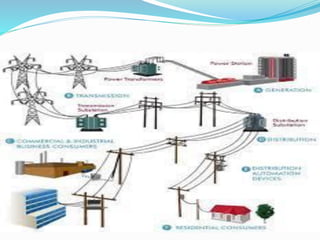
Substation
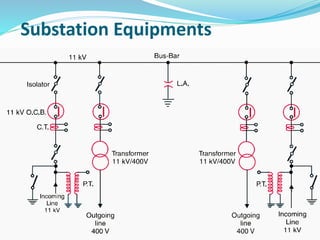
 A substation is a electric system facility.
 It is used
 To switch generators, equipment, and circuits or lines in
and out of a system.
 To change AC voltages from one level to another, and/or
change alternating current to direct current or direct
current to alternating current.
 To perform any of several other important functions…
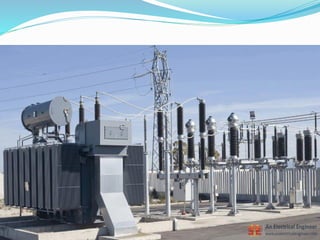
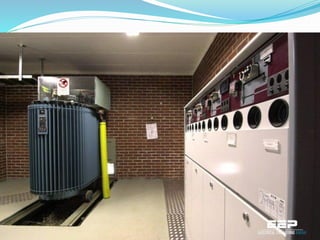
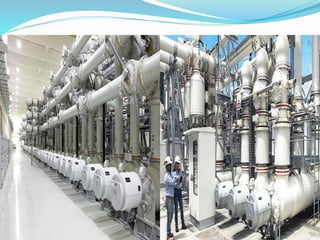
 Indoor / Outdoor / GIS Substation
 Indoor.
 Preferred for voltages up to 33 KV.
 Outdoor.
 Preferred for systems having voltages of 33 KV and
above.
 GIS
 Preferred in large cities for systems having voltages above
33KV
Substation Equipments
Faults & Abnormal Conditions
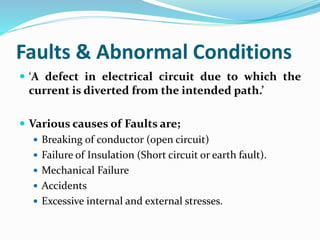
 ‘A defect in electrical circuit due to which the
current is diverted from the intended path.’
 Various causes of Faults are;
 Breaking of conductor (open circuit)
 Failure of Insulation (Short circuit or earth fault).
 Mechanical Failure
 Accidents
 Excessive internal and external stresses.
Fault Calculations
 Severity of fault can be estimated if level of fault
current is calculated. On the basis of this current level
relay setting and breaker ratings are found.
 This fault calculation is done in per-unit system.
 For symmetrical fault calculation is done on per phase
basis.
 For unsymmetrical faults the symmetrical components
method is adopted and implemented on digital
computers.
Fault Clearing Process
 Fault clearing process is started with the help of a
relay connected in secondary circuit.
 Which then indirectly trigger a signal to for tripping
of circuit breaker.
 At the end circuit breaker trip the supply from the load
or a circuit. And hence fault is cleared.
Protective Relaying
 Zones are protected separately.
 Zones are overlapped.
 Different protective relaying requirement for various
elements.
 Overcurrent protection
 Differential protection
 Thermal protection
 Overload protection
Power System Stability
 The tendency of synchronous generator connected
with AC Network to remain in synchronism is called
power system stability.
 The tendency to fall out of step is called unstable
condition.
 This stability decide the max power transfer capacity
and is dependant on load angle (δ ), as described by
swing equation. (discussed in next slide)
 Swing Equation.
 The Swing Equation of generator describes the relative
motion between the rotor axis and the synchronously rotating
stator filed axis with respect to time. This equation is very
helpful in analyzing the stability of connected machines
(machine here means generator).
 As we know that in a synchronous generator the speed of
rotor axis and stator filed axis is equal to synchronous
speed (N = 120f/P) during normal operating condition.
 This simply means that the relative speed between rotor axis
and stator field axis is zero. Thus a constant angle δ is
maintained between the rotor field axis and stator filed axis
under normal operating condition. This angle δ is known as
Load Angle or Torque Angle.
 The value of load angle depends on the loading of
machine. The more is the load, the more will be the load
angle δ as suggested by the power equation
P = EfVtSinδ / Xs
 Steady State Stability. At 900
 Transient Stability. At 300
 Transient stability is half of steady state stability.
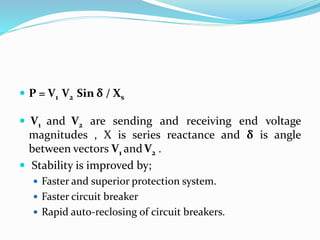
 P = V1 V2 Sin δ / Xs
 V1 and V2 are sending and receiving end voltage
magnitudes , X is series reactance and δ is angle
between vectors V1 andV2 .
 Stability is improved by;
 Faster and superior protection system.
 Faster circuit breaker
 Rapid auto-reclosing of circuit breakers.

Lecture no 1 switchgears bt255 converted

  • 1.
    Switchgears and ProtectiveDevices (Sunil S Rao) Presented By: Engr. Fazal Ur Rehman Lecturer Electrical KPTEVTA Visiting Lecturer COMWAVE INSTITUTE ISLAMABAD
  • 2.
    Today's Topics Chapter No.1  1.1 General Background  1.2 Substation  1.3 Faults and abnormal conditions  1.4 Fault Calculations  1.5 Fault Clearing Process  1.6 Protective Relaying  1.18 Power System Stability
  • 3.
    General Background  Toensure supply of energy to every consumer at all times at  Rated Voltage  Rated Frequency  Specified Wave form  Lowest Cost  Minimum Environmental Degradation
  • 4.
     For allthese achievements switchgears & Protective / Control devices are installed at each voltage levels and at each switching point.  To ensure normal routine switching, control & monitoring  Automatic swiching during abnormal and faulty operating conditions such as short circuits, undervoltage, overloads  Load Control Centre, Power Station Control Rooms and Substation Control Rooms and communication channels ensure control of National & Regional Grids...
  • 5.
     Switchgears.  Itis defined as ‘ The equipment concerned with switching and protection.’  Switching equipment used in the transmission of electricity.  Examples are Circuit Breaker, Fuses, Relays, Isolators etc.
  • 6.
     Circuit Breaker: Serve two purpose  Switching during normal conditions for O & M.  Switching during abnormal conditions.  So far Classification of Switchgears is concerned it may be a Primary switchgears and Secondary Switchgear. (Will be discussed Later)
  • 7.
    Substation  A substationis a electric system facility.  It is used  To switch generators, equipment, and circuits or lines in and out of a system.  To change AC voltages from one level to another, and/or change alternating current to direct current or direct current to alternating current.  To perform any of several other important functions…
  • 9.
     Indoor /Outdoor / GIS Substation  Indoor.  Preferred for voltages up to 33 KV.  Outdoor.  Preferred for systems having voltages of 33 KV and above.  GIS  Preferred in large cities for systems having voltages above 33KV
  • 13.
  • 14.
    Faults & AbnormalConditions  ‘A defect in electrical circuit due to which the current is diverted from the intended path.’  Various causes of Faults are;  Breaking of conductor (open circuit)  Failure of Insulation (Short circuit or earth fault).  Mechanical Failure  Accidents  Excessive internal and external stresses.
  • 15.
    Fault Calculations  Severityof fault can be estimated if level of fault current is calculated. On the basis of this current level relay setting and breaker ratings are found.  This fault calculation is done in per-unit system.  For symmetrical fault calculation is done on per phase basis.  For unsymmetrical faults the symmetrical components method is adopted and implemented on digital computers.
  • 16.
    Fault Clearing Process Fault clearing process is started with the help of a relay connected in secondary circuit.  Which then indirectly trigger a signal to for tripping of circuit breaker.  At the end circuit breaker trip the supply from the load or a circuit. And hence fault is cleared.
  • 17.
    Protective Relaying  Zonesare protected separately.  Zones are overlapped.  Different protective relaying requirement for various elements.  Overcurrent protection  Differential protection  Thermal protection  Overload protection
  • 18.
    Power System Stability The tendency of synchronous generator connected with AC Network to remain in synchronism is called power system stability.  The tendency to fall out of step is called unstable condition.  This stability decide the max power transfer capacity and is dependant on load angle (δ ), as described by swing equation. (discussed in next slide)
  • 19.
     Swing Equation. The Swing Equation of generator describes the relative motion between the rotor axis and the synchronously rotating stator filed axis with respect to time. This equation is very helpful in analyzing the stability of connected machines (machine here means generator).  As we know that in a synchronous generator the speed of rotor axis and stator filed axis is equal to synchronous speed (N = 120f/P) during normal operating condition.  This simply means that the relative speed between rotor axis and stator field axis is zero. Thus a constant angle δ is maintained between the rotor field axis and stator filed axis under normal operating condition. This angle δ is known as Load Angle or Torque Angle.
  • 20.
     The valueof load angle depends on the loading of machine. The more is the load, the more will be the load angle δ as suggested by the power equation P = EfVtSinδ / Xs  Steady State Stability. At 900  Transient Stability. At 300  Transient stability is half of steady state stability.
  • 21.
     P =V1 V2 Sin δ / Xs  V1 and V2 are sending and receiving end voltage magnitudes , X is series reactance and δ is angle between vectors V1 andV2 .  Stability is improved by;  Faster and superior protection system.  Faster circuit breaker  Rapid auto-reclosing of circuit breakers.