Number plate Recognition using MATLAB
Group Members-
1. Abhishek Sainkar
2. Ashish Kumar
3. Prajwal Durugkar
4.Munna Kumar
OBJECTIVE OF THE PROJECT
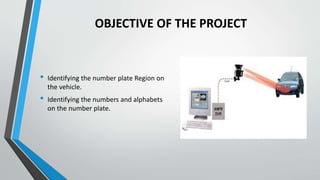
• Identifying the number plate Region on
the vehicle.
• Identifying the numbers and alphabets
on the number plate.
ASSUMPTIONS :
• The position of the car is fixed as it is
placed in a marked box.
• Single Entry & Exit Gate System.
• Single Lane Traffic.
• Artificial Illumination is provided at all
times.
NUMBER PLATE RULES :
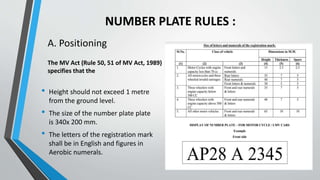
A. Positioning
• Height should not exceed 1 metre
from the ground level.
• The size of the number plate plate
is 340x 200 mm.
• The letters of the registration mark
shall be in English and figures in
Aerobic numerals.
The MV Act (Rule 50, 51 of MV Act, 1989)
specifies that the
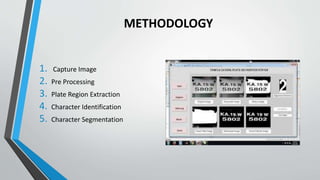
METHODOLOGY
1. Capture Image
2. Pre Processing
3. Plate Region Extraction
4. Character Identification
5. Character Segmentation
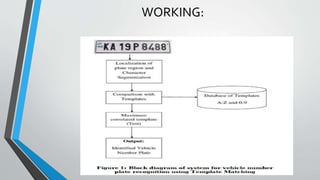
WORKING:
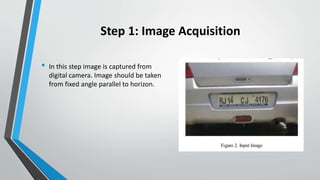
Step 1: Image Acquisition
• In this step image is captured from
digital camera. Image should be taken
from fixed angle parallel to horizon.
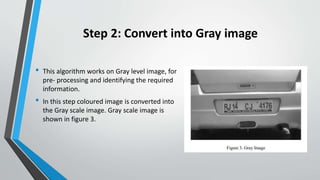
Step 2: Convert into Gray image
• This algorithm works on Gray level image, for
pre- processing and identifying the required
information.
• In this step coloured image is converted into
the Gray scale image. Gray scale image is
shown in figure 3.
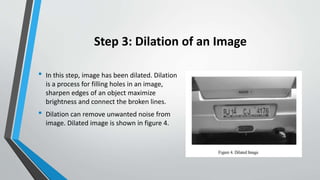
Step 3: Dilation of an Image
• In this step, image has been dilated. Dilation
is a process for filling holes in an image,
sharpen edges of an object maximize
brightness and connect the broken lines.
• Dilation can remove unwanted noise from
image. Dilated image is shown in figure 4.
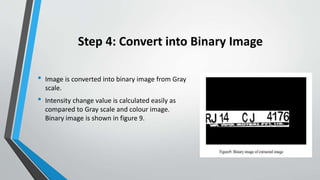
Step 4: Convert into Binary Image
• Image is converted into binary image from Gray
scale.
• Intensity change value is calculated easily as
compared to Gray scale and colour image.
Binary image is shown in figure 9.
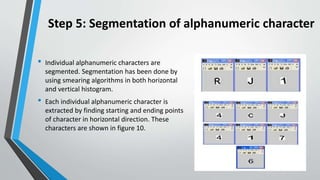
Step 5: Segmentation of alphanumeric character
• Individual alphanumeric characters are
segmented. Segmentation has been done by
using smearing algorithms in both horizontal
and vertical histogram.
• Each individual alphanumeric character is
extracted by finding starting and ending points
of character in horizontal direction. These
characters are shown in figure 10.
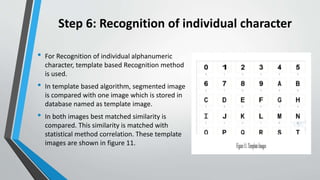
Step 6: Recognition of individual character
• For Recognition of individual alphanumeric
character, template based Recognition method
is used.
• In template based algorithm, segmented image
is compared with one image which is stored in
database named as template image.
• In both images best matched similarity is
compared. This similarity is matched with
statistical method correlation. These template
images are shown in figure 11.
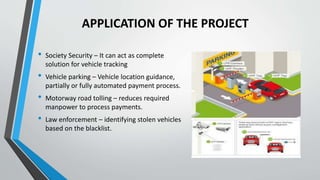
APPLICATION OF THE PROJECT
• Society Security – It can act as complete
solution for vehicle tracking
• Vehicle parking – Vehicle location guidance,
partially or fully automated payment process.
• Motorway road tolling – reduces required
manpower to process payments.
• Law enforcement – identifying stolen vehicles
based on the blacklist.
Thank You

Number plate recognition using matlab

  • 1.
    Number plate Recognitionusing MATLAB Group Members- 1. Abhishek Sainkar 2. Ashish Kumar 3. Prajwal Durugkar 4.Munna Kumar
  • 2.
    OBJECTIVE OF THEPROJECT • Identifying the number plate Region on the vehicle. • Identifying the numbers and alphabets on the number plate.
  • 3.
    ASSUMPTIONS : • Theposition of the car is fixed as it is placed in a marked box. • Single Entry & Exit Gate System. • Single Lane Traffic. • Artificial Illumination is provided at all times.
  • 4.
    NUMBER PLATE RULES: A. Positioning • Height should not exceed 1 metre from the ground level. • The size of the number plate plate is 340x 200 mm. • The letters of the registration mark shall be in English and figures in Aerobic numerals. The MV Act (Rule 50, 51 of MV Act, 1989) specifies that the
  • 5.
    METHODOLOGY 1. Capture Image 2.Pre Processing 3. Plate Region Extraction 4. Character Identification 5. Character Segmentation
  • 6.
  • 7.
    Step 1: ImageAcquisition • In this step image is captured from digital camera. Image should be taken from fixed angle parallel to horizon.
  • 8.
    Step 2: Convertinto Gray image • This algorithm works on Gray level image, for pre- processing and identifying the required information. • In this step coloured image is converted into the Gray scale image. Gray scale image is shown in figure 3.
  • 9.
    Step 3: Dilationof an Image • In this step, image has been dilated. Dilation is a process for filling holes in an image, sharpen edges of an object maximize brightness and connect the broken lines. • Dilation can remove unwanted noise from image. Dilated image is shown in figure 4.
  • 10.
    Step 4: Convertinto Binary Image • Image is converted into binary image from Gray scale. • Intensity change value is calculated easily as compared to Gray scale and colour image. Binary image is shown in figure 9.
  • 11.
    Step 5: Segmentationof alphanumeric character • Individual alphanumeric characters are segmented. Segmentation has been done by using smearing algorithms in both horizontal and vertical histogram. • Each individual alphanumeric character is extracted by finding starting and ending points of character in horizontal direction. These characters are shown in figure 10.
  • 12.
    Step 6: Recognitionof individual character • For Recognition of individual alphanumeric character, template based Recognition method is used. • In template based algorithm, segmented image is compared with one image which is stored in database named as template image. • In both images best matched similarity is compared. This similarity is matched with statistical method correlation. These template images are shown in figure 11.
  • 13.
    APPLICATION OF THEPROJECT • Society Security – It can act as complete solution for vehicle tracking • Vehicle parking – Vehicle location guidance, partially or fully automated payment process. • Motorway road tolling – reduces required manpower to process payments. • Law enforcement – identifying stolen vehicles based on the blacklist.
  • 14.