Complex Numbers
History in brief
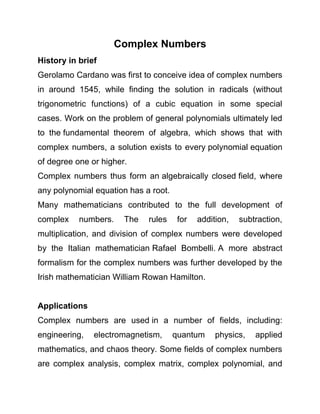
Gerolamo Cardano was first to conceive idea of complex numbers
in around 1545, while finding the solution in radicals (without
trigonometric functions) of a cubic equation in some special
cases. Work on the problem of general polynomials ultimately led
to the fundamental theorem of algebra, which shows that with
complex numbers, a solution exists to every polynomial equation
of degree one or higher.
Complex numbers thus form an algebraically closed field, where
any polynomial equation has a root.
Many mathematicians contributed to the full development of
complex

numbers.

The

rules

for

addition,

subtraction,

multiplication, and division of complex numbers were developed
by the Italian mathematician Rafael Bombelli. A more abstract
formalism for the complex numbers was further developed by the
Irish mathematician William Rowan Hamilton.

Applications
Complex numbers are used in a number of fields, including:
engineering,

electromagnetism,

quantum

physics,

applied

mathematics, and chaos theory. Some fields of complex numbers
are complex analysis, complex matrix, complex polynomial, and
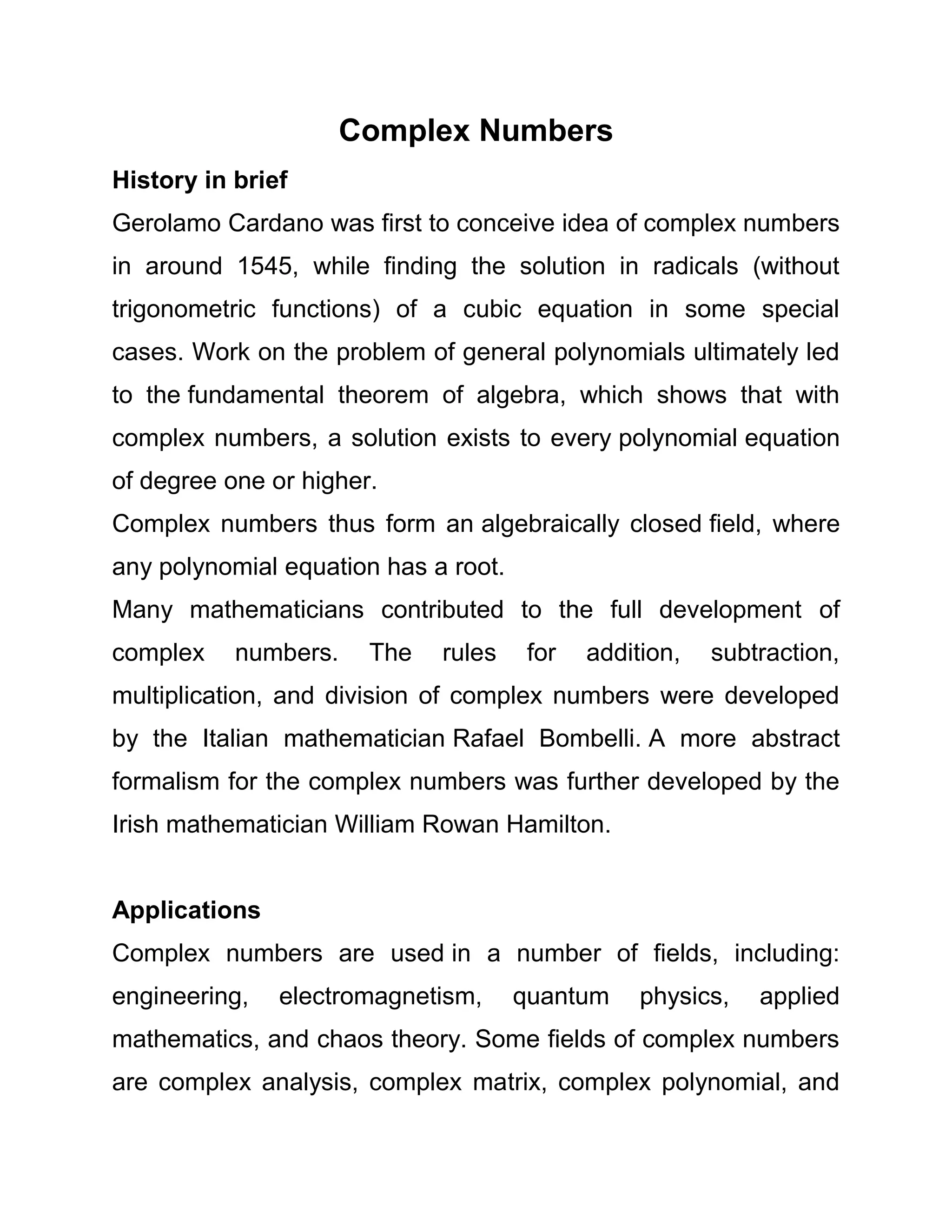
complex Lie algebra (In mathematics, Lie algebras are algebraic
structures which

were

introduced

to

study

the

concept

of infinitesimal transformations.

The term "Lie algebra" (after Sophus Lie) was introduced
by Hermann Weyl in the 1930s. In older texts, the name
"infinitesimal group" is used ) Some applications of complex
numbers are for representing AC Voltage which contains Potential
as the real part and Phase angle as the imaginary part. It is also
used to represent sinusoidal varying signals in Signal analysis.
If Fourier analysis is employed to write a given real-valued signal
as a sum of periodic functions these periodic functions are often
written as complex valued functions.

Introduction
Consider the equation x2 + 4 = 0. This is the same as x2 = – 4.
Solving this equation means finding a number whose square is –
4. Clearly x cannot be a real number, since the square of a real
number cannot be negative, i.e., we cannot find a real number
whose square is – 4. Similarly, the equations of the type x2 + 1 =
0, x2 + 5 = 0, x2 + 9 = 0, etc. cannot have their roots as real
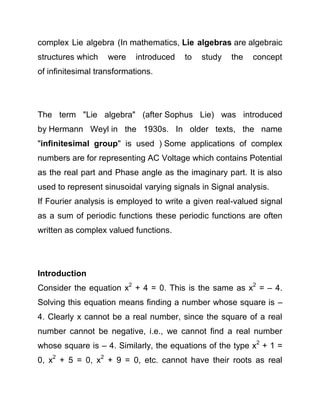
numbers. In order to overcome this difficulty, we have to introduce
a new type of numbers, whose square is negative.
 1 is

a non-real number. Let us denote it by the symbol i and call

it the imaginary unit.
Thus,

i  1

and hence i2 = – 1.

Definition
A number of the form x + iy, where x, y are real numbers and
i  1

is defined as a complex number.

If Z = x + iy, then x is called real part of z and y is called the
imaginary part of z and are denoted by Re (z) = x, Im (z) = y,
If x = 0 and y ≠ 0, then z = 0 + iy = iy is called purely imaginary
number.
If x ≠ 0 and y = 0, then z = x + i0 = x is a real number. Because of
this property the complex number system is considered as an
extension of real number system.

Algebra Of Complex Numbers
In performing operations with complex numbers, we can proceed
as in the algebra of real numbers, replacing i2 by – 1 when it
occurs.
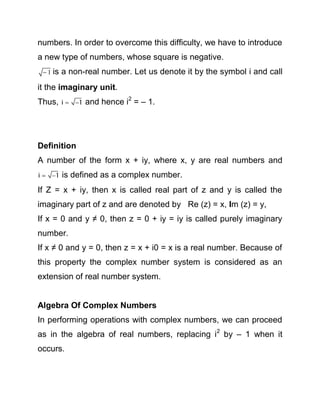
If z1 = x1 + iy1 and z2 = x2 + iy2 are any two complex
numbers, we define following rules and laws of operations.
1.

Equality: Two complex numbers z1 and z2 are

said to be

equal if the only if their corresponding real and imaginary parts
are equal, i.e. x1 = x2 and y1 = y2.
2.

Addition:
z1 + z2 = (x1+iy1) + (x2 + iy2) = (x1 + x2) + i (y1+y2)

3.

Subtraction:
z1 – z2 = (x1+ iy1) – (x2+iy2) = (x1 – x2) + i (y1 – y2)

4.

Multiplication:
z1. z2 = (x1 + iy1). (x2 + iy2) = (x1 x2 – y1 y2) + i (x1 y2 + y1 x2)

5.

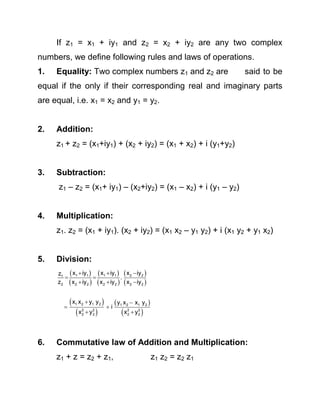
Division:
z1  x1  iy1   x1  iy1   x 2  iy 2 


.
z2  x 2  iy 2   x 2  iy 2   x 2  iy 2 



6.

x x
x
1

2

 y1 y 2 

2
2

y

2
2



i

 y1 x2  x1 y2 

x

2
2

 y2
2



Commutative law of Addition and Multiplication:
z1 + z = z2 + z1,

z1 z2 = z2 z1
7.

Associative law of Addition and Multiplication:
z1 + (z2 + z3) = (z1 + z2) + (z3)

(Where z3 = x3 + iy3)

z1 (z2 z3) = (z1 z2) z3
8.

Distributive law:
z1 (z2 + z3) = z1 z2 + z1 z3
Keep on visiting www.ednexa.com for more information
- Team Ednexa

Summary on Complex Number - Engineering Diploma

  • 1.
    Complex Numbers History inbrief Gerolamo Cardano was first to conceive idea of complex numbers in around 1545, while finding the solution in radicals (without trigonometric functions) of a cubic equation in some special cases. Work on the problem of general polynomials ultimately led to the fundamental theorem of algebra, which shows that with complex numbers, a solution exists to every polynomial equation of degree one or higher. Complex numbers thus form an algebraically closed field, where any polynomial equation has a root. Many mathematicians contributed to the full development of complex numbers. The rules for addition, subtraction, multiplication, and division of complex numbers were developed by the Italian mathematician Rafael Bombelli. A more abstract formalism for the complex numbers was further developed by the Irish mathematician William Rowan Hamilton. Applications Complex numbers are used in a number of fields, including: engineering, electromagnetism, quantum physics, applied mathematics, and chaos theory. Some fields of complex numbers are complex analysis, complex matrix, complex polynomial, and
  • 2.
    complex Lie algebra(In mathematics, Lie algebras are algebraic structures which were introduced to study the concept of infinitesimal transformations. The term "Lie algebra" (after Sophus Lie) was introduced by Hermann Weyl in the 1930s. In older texts, the name "infinitesimal group" is used ) Some applications of complex numbers are for representing AC Voltage which contains Potential as the real part and Phase angle as the imaginary part. It is also used to represent sinusoidal varying signals in Signal analysis. If Fourier analysis is employed to write a given real-valued signal as a sum of periodic functions these periodic functions are often written as complex valued functions. Introduction Consider the equation x2 + 4 = 0. This is the same as x2 = – 4. Solving this equation means finding a number whose square is – 4. Clearly x cannot be a real number, since the square of a real number cannot be negative, i.e., we cannot find a real number whose square is – 4. Similarly, the equations of the type x2 + 1 = 0, x2 + 5 = 0, x2 + 9 = 0, etc. cannot have their roots as real
  • 3.
    numbers. In orderto overcome this difficulty, we have to introduce a new type of numbers, whose square is negative.  1 is a non-real number. Let us denote it by the symbol i and call it the imaginary unit. Thus, i  1 and hence i2 = – 1. Definition A number of the form x + iy, where x, y are real numbers and i  1 is defined as a complex number. If Z = x + iy, then x is called real part of z and y is called the imaginary part of z and are denoted by Re (z) = x, Im (z) = y, If x = 0 and y ≠ 0, then z = 0 + iy = iy is called purely imaginary number. If x ≠ 0 and y = 0, then z = x + i0 = x is a real number. Because of this property the complex number system is considered as an extension of real number system. Algebra Of Complex Numbers In performing operations with complex numbers, we can proceed as in the algebra of real numbers, replacing i2 by – 1 when it occurs.
  • 4.
    If z1 =x1 + iy1 and z2 = x2 + iy2 are any two complex numbers, we define following rules and laws of operations. 1. Equality: Two complex numbers z1 and z2 are said to be equal if the only if their corresponding real and imaginary parts are equal, i.e. x1 = x2 and y1 = y2. 2. Addition: z1 + z2 = (x1+iy1) + (x2 + iy2) = (x1 + x2) + i (y1+y2) 3. Subtraction: z1 – z2 = (x1+ iy1) – (x2+iy2) = (x1 – x2) + i (y1 – y2) 4. Multiplication: z1. z2 = (x1 + iy1). (x2 + iy2) = (x1 x2 – y1 y2) + i (x1 y2 + y1 x2) 5. Division: z1  x1  iy1   x1  iy1   x 2  iy 2    . z2  x 2  iy 2   x 2  iy 2   x 2  iy 2   6. x x x 1 2  y1 y 2  2 2 y 2 2  i  y1 x2  x1 y2  x 2 2  y2 2  Commutative law of Addition and Multiplication: z1 + z = z2 + z1, z1 z2 = z2 z1
  • 5.
    7. Associative law ofAddition and Multiplication: z1 + (z2 + z3) = (z1 + z2) + (z3) (Where z3 = x3 + iy3) z1 (z2 z3) = (z1 z2) z3 8. Distributive law: z1 (z2 + z3) = z1 z2 + z1 z3 Keep on visiting www.ednexa.com for more information - Team Ednexa