MACHINE LEARNING &
MODEL DEPLOYMENT
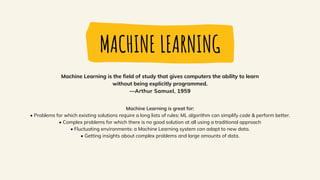
MACHINE LEARNING
Machine Learning is great for:
• Problems for which existing solutions require a long lists of rules: ML algorithm can simplify code & perform better.
• Complex problems for which there is no good solution at all using a traditional approach
• Fluctuating environments: a Machine Learning system can adapt to new data.
• Getting insights about complex problems and large amounts of data.
Machine Learning is the field of study that gives computers the ability to learn
without being explicitly programmed.
—Arthur Samuel, 1959
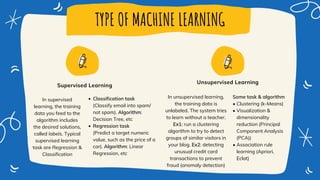
In supervised
learning, the training
data you feed to the
algorithm includes
the desired solutions,
called labels. Typical
supervised learning
task are Regression &
Classification
Classification task
Regression task
(Classify email into spam/
not spam). Algorithm:
Decision Tree, etc
(Predict a target numeric
value, such as the price of a
car). Algorithm: Linear
Regression, etc
TYPE OF MACHINE LEARNING
In unsupervised learning,
the training data is
unlabeled. The system tries
to learn without a teacher.
Ex1: run a clustering
algorithm to try to detect
groups of similar visitors in
your blog. Ex2: detecting
unusual credit card
transactions to prevent
fraud (anomaly detection)
Some task & algorithm
• Clustering (k-Means)
• Visualization &
dimensionality
reduction (Principal
Component Analysis
(PCA))
• Association rule
learning (Apriori,
Eclat)
Supervised Learning
Unsupervised Learning
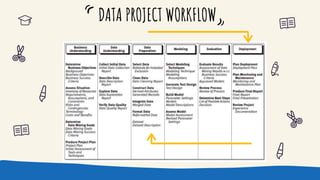
DATA PROJECT WORKFLOW
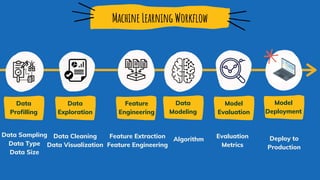
MachineLearningWorkflow
Data
Profilling
Data
Exploration
Feature
Engineering
Data
Modeling
Model
Evaluation
Model
Deployment
Data Sampling
Data Type
Data Size
Data Cleaning
Data Visualization
Feature Extraction
Feature Engineering
Algorithm Evaluation
Metrics
Deploy to
Production
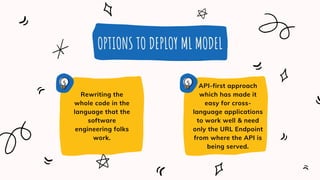
Rewriting the
whole code in the
language that the
software
engineering folks
work.
OPTIONS TO DEPLOY ML MODEL
API-first approach
which has made it
easy for cross-
language applications
to work well & need
only the URL Endpoint
from where the API is
being served.
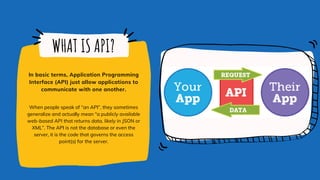
WHAT IS API?
When people speak of “an API”, they sometimes
generalize and actually mean “a publicly available
web-based API that returns data, likely in JSON or
XML”. The API is not the database or even the
server, it is the code that governs the access
point(s) for the server.
In basic terms, Application Programming
Interface (API) just allow applications to
communicate with one another.
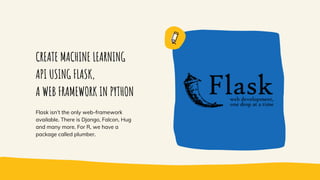
CREATE MACHINE LEARNING
API USING FLASK,
A WEB FRAMEWORK IN PYTHON
Flask isn’t the only web-framework
available. There is Django, Falcon, Hug
and many more. For R, we have a
package called plumber.
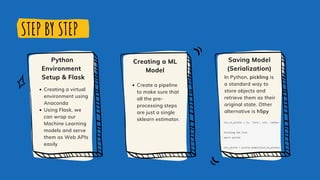
STEP BY STEP
Python
Environment
Setup & Flask
Creating a ML
Model
Saving Model
(Serialization)
Creating a virtual
environment using
Anaconda
Using Flask, we
can wrap our
Machine Learning
models and serve
them as Web APIs
easily
Create a pipeline
to make sure that
all the pre-
processing steps
are just a single
sklearn estimator.
In Python, pickling is
a standard way to
store objects and
retrieve them as their
original state. Other
alternative is h5py
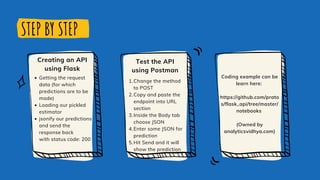
STEP BY STEP
Creating an API
using Flask
Test the API
using Postman
Coding example can be
learn here:
https://github.com/prato
s/flask_api/tree/master/
notebooks
(Owned by
analyticsvidhya.com)
Getting the request
data (for which
predictions are to be
made)
Loading our pickled
estimator
jsonify our predictions
and send the
response back
with status code: 200
Change the method
to POST
Copy and paste the
endpoint into URL
section
Inside the Body tab
choose JSON
Enter some JSON for
prediction
Hit Send and it will
show the prediction
1.
2.
3.
4.
5.
Hands-On Machine Learning with
Scikit-Learn and TensorFlow: Concepts,
Tools, and Techniques to Build
Intelligent Systems by Aurélien Géron 
SOURCES
https://www.analyticsvidhya.com/blog/
2017/09/machine-learning-models-as-
apis-using-flask/
https://towardsdatascience.com/deploy
ment-of-machine-learning-model-
demystified-part-1-1181d91815d2
https://medium.com/@opeyemibami/de
ployment-of-machine-learning-models-
demystified-part-2-63eadaca1571

Summary machine learning and model deployment

  • 1.
  • 2.
    MACHINE LEARNING Machine Learningis great for: • Problems for which existing solutions require a long lists of rules: ML algorithm can simplify code & perform better. • Complex problems for which there is no good solution at all using a traditional approach • Fluctuating environments: a Machine Learning system can adapt to new data. • Getting insights about complex problems and large amounts of data. Machine Learning is the field of study that gives computers the ability to learn without being explicitly programmed. —Arthur Samuel, 1959
  • 3.
    In supervised learning, thetraining data you feed to the algorithm includes the desired solutions, called labels. Typical supervised learning task are Regression & Classification Classification task Regression task (Classify email into spam/ not spam). Algorithm: Decision Tree, etc (Predict a target numeric value, such as the price of a car). Algorithm: Linear Regression, etc TYPE OF MACHINE LEARNING In unsupervised learning, the training data is unlabeled. The system tries to learn without a teacher. Ex1: run a clustering algorithm to try to detect groups of similar visitors in your blog. Ex2: detecting unusual credit card transactions to prevent fraud (anomaly detection) Some task & algorithm • Clustering (k-Means) • Visualization & dimensionality reduction (Principal Component Analysis (PCA)) • Association rule learning (Apriori, Eclat) Supervised Learning Unsupervised Learning
  • 4.
  • 5.
    MachineLearningWorkflow Data Profilling Data Exploration Feature Engineering Data Modeling Model Evaluation Model Deployment Data Sampling Data Type DataSize Data Cleaning Data Visualization Feature Extraction Feature Engineering Algorithm Evaluation Metrics Deploy to Production
  • 6.
    Rewriting the whole codein the language that the software engineering folks work. OPTIONS TO DEPLOY ML MODEL API-first approach which has made it easy for cross- language applications to work well & need only the URL Endpoint from where the API is being served.
  • 7.
    WHAT IS API? Whenpeople speak of “an API”, they sometimes generalize and actually mean “a publicly available web-based API that returns data, likely in JSON or XML”. The API is not the database or even the server, it is the code that governs the access point(s) for the server. In basic terms, Application Programming Interface (API) just allow applications to communicate with one another.
  • 8.
    CREATE MACHINE LEARNING APIUSING FLASK, A WEB FRAMEWORK IN PYTHON Flask isn’t the only web-framework available. There is Django, Falcon, Hug and many more. For R, we have a package called plumber.
  • 9.
    STEP BY STEP Python Environment Setup& Flask Creating a ML Model Saving Model (Serialization) Creating a virtual environment using Anaconda Using Flask, we can wrap our Machine Learning models and serve them as Web APIs easily Create a pipeline to make sure that all the pre- processing steps are just a single sklearn estimator. In Python, pickling is a standard way to store objects and retrieve them as their original state. Other alternative is h5py
  • 10.
    STEP BY STEP Creatingan API using Flask Test the API using Postman Coding example can be learn here: https://github.com/prato s/flask_api/tree/master/ notebooks (Owned by analyticsvidhya.com) Getting the request data (for which predictions are to be made) Loading our pickled estimator jsonify our predictions and send the response back with status code: 200 Change the method to POST Copy and paste the endpoint into URL section Inside the Body tab choose JSON Enter some JSON for prediction Hit Send and it will show the prediction 1. 2. 3. 4. 5.
  • 11.
    Hands-On Machine Learningwith Scikit-Learn and TensorFlow: Concepts, Tools, and Techniques to Build Intelligent Systems by Aurélien Géron  SOURCES https://www.analyticsvidhya.com/blog/ 2017/09/machine-learning-models-as- apis-using-flask/ https://towardsdatascience.com/deploy ment-of-machine-learning-model- demystified-part-1-1181d91815d2 https://medium.com/@opeyemibami/de ployment-of-machine-learning-models- demystified-part-2-63eadaca1571