Data Model
Presentation By:- Sumit Rana
BCA (2015-18)
A Three-dimensional Representation Of A Person Or Thing Or
Of A Proposed Structure, Typically On A Smaller Scale Than
The Original.
What is a Model ?
What is Data Model?
• Data models define how the logical structure of a database is
modeled.
• Data Models are fundamental entities to introduce abstraction in a
DBMS.
• Data models define how data is connected to each other and how
they are processed and stored inside the system.
Types of Data Models
• Hierarchical Model
• Network Model
• Relational Model
• Entity-relationship model
• Object-oriented database model
• Document model
• Entity-attribute-value model
• Star schema
• The object-relational model, which combines the two that make up
its name
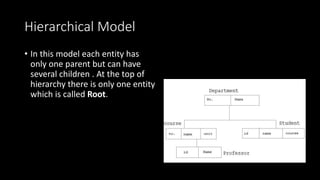
Hierarchical Model
• In this model each entity has
only one parent but can have
several children . At the top of
hierarchy there is only one entity
which is called Root.
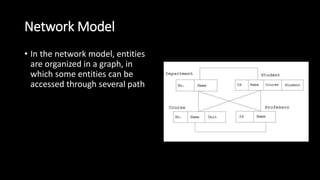
Network Model
• In the network model, entities
are organized in a graph, in
which some entities can be
accessed through several path
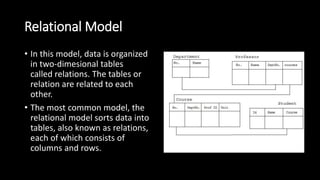
Relational Model
• In this model, data is organized
in two-dimesional tables
called relations. The tables or
relation are related to each
other.
• The most common model, the
relational model sorts data into
tables, also known as relations,
each of which consists of
columns and rows.
Entity-Relationship Model
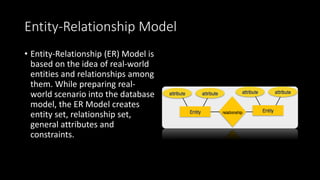
• Entity-Relationship (ER) Model is
based on the idea of real-world
entities and relationships among
them. While preparing real-
world scenario into the database
model, the ER Model creates
entity set, relationship set,
general attributes and
constraints.
ER Model is based on −
•Entities
•Attributes
•Relationships
Entities
• An entity can be a real-world object, that can be easily identifiable.
• For example, in a school database, students, teachers, classes, and
courses offered can be considered as entities. All these entities have
some attributes or properties that give them their identity.
Attributes
• Entities are represented by means of their properties,
called attributes. All attributes have values.
• For example, a student entity may have name, class, and age as
attributes.
Relationships
• The association among entities is called a relationship.
• For example, an employee works_at a department, a
student enrolls in a course. Here, Works_at and Enrolls are called
relationships.
Sources
• www.lucidchart.com
• www.tutorialspoint.com
• www.studytonight.com
Any Questions?
In Any Thing I Explained
Thanks You
Presentation By:- Sumit Rana
BCA (2015-18)

Data model

  • 1.
    Data Model Presentation By:-Sumit Rana BCA (2015-18)
  • 2.
    A Three-dimensional RepresentationOf A Person Or Thing Or Of A Proposed Structure, Typically On A Smaller Scale Than The Original. What is a Model ?
  • 3.
    What is DataModel? • Data models define how the logical structure of a database is modeled. • Data Models are fundamental entities to introduce abstraction in a DBMS. • Data models define how data is connected to each other and how they are processed and stored inside the system.
  • 4.
    Types of DataModels • Hierarchical Model • Network Model • Relational Model • Entity-relationship model • Object-oriented database model • Document model • Entity-attribute-value model • Star schema • The object-relational model, which combines the two that make up its name
  • 5.
    Hierarchical Model • Inthis model each entity has only one parent but can have several children . At the top of hierarchy there is only one entity which is called Root.
  • 6.
    Network Model • Inthe network model, entities are organized in a graph, in which some entities can be accessed through several path
  • 7.
    Relational Model • Inthis model, data is organized in two-dimesional tables called relations. The tables or relation are related to each other. • The most common model, the relational model sorts data into tables, also known as relations, each of which consists of columns and rows.
  • 8.
    Entity-Relationship Model • Entity-Relationship(ER) Model is based on the idea of real-world entities and relationships among them. While preparing real- world scenario into the database model, the ER Model creates entity set, relationship set, general attributes and constraints.
  • 9.
    ER Model isbased on − •Entities •Attributes •Relationships
  • 10.
    Entities • An entitycan be a real-world object, that can be easily identifiable. • For example, in a school database, students, teachers, classes, and courses offered can be considered as entities. All these entities have some attributes or properties that give them their identity.
  • 11.
    Attributes • Entities arerepresented by means of their properties, called attributes. All attributes have values. • For example, a student entity may have name, class, and age as attributes.
  • 12.
    Relationships • The associationamong entities is called a relationship. • For example, an employee works_at a department, a student enrolls in a course. Here, Works_at and Enrolls are called relationships.
  • 13.
  • 14.
    Any Questions? In AnyThing I Explained
  • 15.
    Thanks You Presentation By:-Sumit Rana BCA (2015-18)