





Generalization and
its types.
What is a generalization?
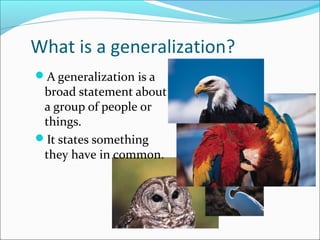
A generalization is a
broad statement about
a group of people or
things.
It states something
they have in common.
What is a generalization?
Universal proposition
based on particular
facts, are called
Generalization.
Example: All crows are
black.
Generalization Types:
Scientific Generalization
Scientific generalization is based on the evidence of causal
connection is called scientific generalization.
Example: All crows are black is based on causal connection
between crowness and blackness.
Empirical Generalization
Empirical Generalization is based on the evidence of
experience.
Example: All red mangoes are sweet.
Key Words
Sometimes
Always
Never
Most
Many
All
Generally
Valid Generalizations
Valid means true.
Supported by facts
Agrees with what you already know about the topic
Uses logic and reasoning
Proven with several examples
Faulty Generalizations
Faulty means false.
Not supported by facts
Watch for the key words: none, all, always, never,
everyone, nobody
universal and statistical
generalizations
 Universal generalization:Universal generalization: claims that all members of a group have
certain attributes or characteristics
 Asians are good at math.
Feminists hate men.
 Republicans favor tax cuts, Democrats oppose tax cuts.
 Statistical generalization:Statistical generalization: claims that a percentage or a portion of a
group has a certain attribute or property.
 76% of felons are recidivists
 1 out of 3 children in the U.S. is born out of wedlock
 19 of the 21 hijackers on Sept. 11 were Saudi Arabians.
Contingent generalization: based on conditions or qualifications
that must be met for the generalization to hold true. Generalizations
are more likely to hold true if they are confined to specific times,
places, or situations
 Most serial killers are male
 The majority of journalists are Democrats
inductive and deductive
generalizations
 Two types of generalizations: inductive and deductive
Inductive GeneralizationInductive Generalization:: bases a larger
inference on an example, sample, or particular instance
 example: Babbs bought a Saturn and it runs well. Biff
bought a Saturn and it runs well. I guess Saturns are
reliable cars. (the generalization is based on a nonrandom
sample of 3 cars)
 example: Of the 19 hijackers on Sept. 11, 15 were Saudis. I
think we can safely conclude that Saudi Arabia is a
breeding ground for terrorists.
inductive and deductive
generalizations
Deductive GeneralizationDeductive Generalization:: proceeds
from a general rule or general principle to a specific
case
 example: Brazilians love soccer. Hector is from
Brazil, so he probably loves soccer too.
 example: Don’t give money to that vagrant. They
are all winos and drug addicts.
 example: Biff is a Republican, so of course he’ll be
opposed to gun control.
TIME FOR QUESTIONS

Generalization and types

  • 2.
  • 3.
    What is ageneralization? A generalization is a broad statement about a group of people or things. It states something they have in common.
  • 4.
    What is ageneralization? Universal proposition based on particular facts, are called Generalization. Example: All crows are black.
  • 5.
    Generalization Types: Scientific Generalization Scientificgeneralization is based on the evidence of causal connection is called scientific generalization. Example: All crows are black is based on causal connection between crowness and blackness. Empirical Generalization Empirical Generalization is based on the evidence of experience. Example: All red mangoes are sweet.
  • 6.
  • 7.
    Valid Generalizations Valid meanstrue. Supported by facts Agrees with what you already know about the topic Uses logic and reasoning Proven with several examples
  • 8.
    Faulty Generalizations Faulty meansfalse. Not supported by facts Watch for the key words: none, all, always, never, everyone, nobody
  • 9.
    universal and statistical generalizations Universal generalization:Universal generalization: claims that all members of a group have certain attributes or characteristics  Asians are good at math. Feminists hate men.  Republicans favor tax cuts, Democrats oppose tax cuts.  Statistical generalization:Statistical generalization: claims that a percentage or a portion of a group has a certain attribute or property.  76% of felons are recidivists  1 out of 3 children in the U.S. is born out of wedlock  19 of the 21 hijackers on Sept. 11 were Saudi Arabians. Contingent generalization: based on conditions or qualifications that must be met for the generalization to hold true. Generalizations are more likely to hold true if they are confined to specific times, places, or situations  Most serial killers are male  The majority of journalists are Democrats
  • 10.
    inductive and deductive generalizations Two types of generalizations: inductive and deductive Inductive GeneralizationInductive Generalization:: bases a larger inference on an example, sample, or particular instance  example: Babbs bought a Saturn and it runs well. Biff bought a Saturn and it runs well. I guess Saturns are reliable cars. (the generalization is based on a nonrandom sample of 3 cars)  example: Of the 19 hijackers on Sept. 11, 15 were Saudis. I think we can safely conclude that Saudi Arabia is a breeding ground for terrorists.
  • 11.
    inductive and deductive generalizations DeductiveGeneralizationDeductive Generalization:: proceeds from a general rule or general principle to a specific case  example: Brazilians love soccer. Hector is from Brazil, so he probably loves soccer too.  example: Don’t give money to that vagrant. They are all winos and drug addicts.  example: Biff is a Republican, so of course he’ll be opposed to gun control.
  • 13.

Editor's Notes

  • #4 Birds have feathers.
  • #7 The key words change the meaning of the generalization. Some flowers have petals. Flowers always have petals. Flowers never have petals. Most flowers have petals. Many flowers have petals. All flowers have petals. Flowers generally have petals. You have to be VERY careful if you use the word never. Does it NEVER happen?? Is it remotely possible?? Likewise you have to be careful with the words always and all. They include the whole group. Does it ALWAYS happen??