ILLUSTRATING AND
EXPLAINING CONCEPTUAL
FRAMEWORK
LESSON 16
Writing A Conceptual Framework
Research Ethics are standardized rules that guide the design
and conduct of research. The term ethics refers to questions
of right and wrong.
When researchers think about ethics, they must also ask
themselves if it is right to conduct a particular study or carry
out certain procedures.
Conceptual Framework
Consists of concepts that are placed within a logical and
sequential design.
Represents less formal structure and used for studies in
which existing theory is insufficient.
Based on specific concepts and propositions and taken from
practical observation and intuition.
Purposes of Conceptual Framework
1. To clarify concepts and propose relationships among the
concepts in a study.
2. To provide a context for interpreting the study findings.
3. To explain observations.
4. To encourage theory development that is useful an
practical.
Step by Step Guide on How to Write the
Conceptual Framework
1. Choose your topic.
◩Decide on what will be your research topic. It should be within
the field of your specialization.
2. Do a literature review.
Go over a relevant and updates studies related to your
own research. Use a reliable sources of information and use
appropriate documentation.
Step by Step Guide on How to Write the
Conceptual Framework
3. Isolate the important variables.
Identify the specific variables mentioned in the literature
and show their interrelationships.
4. Generate the conceptual framework.
Build your conceptual framework using the variables
studied in the scientific articles you have read. Your problem
statement serves as a reference in constructing the conceptual
framework in effect, your study will attempt to answer a
question that other researchers have not explained yet.
What is framework?
Framework is described as the abstract, logical structure of
meaning that guides the development of the study.
All frameworks are based on the identification of key concepts
and the relationships among these concepts can be derived
from related concepts or existing theories.
Conceptual Paradigm
A diagram that visually represents and interprets the underlying
theory; principles and concepts of research.
A visual presentation of variables that interrelate with one
another as perceived by the researcher before an actual
investigation is done to prove its relationship.
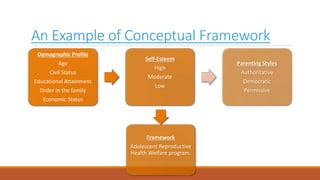
An Example of Conceptual Framework
Demographic Profile
Age
Civil Status
Educational Attainment
Order in the family
Economic Status
Self-Esteem
High
Moderate
Low
Parenting Styles
Authoritative
Democratic
Permissive
Framework
Adolescent Reproductive
Health Welfare program.

Lesson 16 illustrating and explaining conceptual framewok

  • 1.
  • 2.
    Writing A ConceptualFramework Research Ethics are standardized rules that guide the design and conduct of research. The term ethics refers to questions of right and wrong. When researchers think about ethics, they must also ask themselves if it is right to conduct a particular study or carry out certain procedures.
  • 3.
    Conceptual Framework Consists ofconcepts that are placed within a logical and sequential design. Represents less formal structure and used for studies in which existing theory is insufficient. Based on specific concepts and propositions and taken from practical observation and intuition.
  • 4.
    Purposes of ConceptualFramework 1. To clarify concepts and propose relationships among the concepts in a study. 2. To provide a context for interpreting the study findings. 3. To explain observations. 4. To encourage theory development that is useful an practical.
  • 5.
    Step by StepGuide on How to Write the Conceptual Framework 1. Choose your topic. ◩Decide on what will be your research topic. It should be within the field of your specialization. 2. Do a literature review. Go over a relevant and updates studies related to your own research. Use a reliable sources of information and use appropriate documentation.
  • 6.
    Step by StepGuide on How to Write the Conceptual Framework 3. Isolate the important variables. Identify the specific variables mentioned in the literature and show their interrelationships. 4. Generate the conceptual framework. Build your conceptual framework using the variables studied in the scientific articles you have read. Your problem statement serves as a reference in constructing the conceptual framework in effect, your study will attempt to answer a question that other researchers have not explained yet.
  • 7.
    What is framework? Frameworkis described as the abstract, logical structure of meaning that guides the development of the study. All frameworks are based on the identification of key concepts and the relationships among these concepts can be derived from related concepts or existing theories.
  • 8.
    Conceptual Paradigm A diagramthat visually represents and interprets the underlying theory; principles and concepts of research. A visual presentation of variables that interrelate with one another as perceived by the researcher before an actual investigation is done to prove its relationship.
  • 9.
    An Example ofConceptual Framework Demographic Profile Age Civil Status Educational Attainment Order in the family Economic Status Self-Esteem High Moderate Low Parenting Styles Authoritative Democratic Permissive Framework Adolescent Reproductive Health Welfare program.