PRACTICAL RESEARCH 2
Q2
Drawing Conclusions
and Recommendations
i
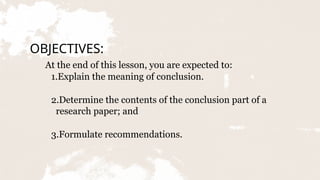
OBJECTIVES:
At the end of this lesson, you are expected to:
1.Explain the meaning of conclusion.
2.Determine the contents of the conclusion part of a
research paper; and
3.Formulate recommendations.
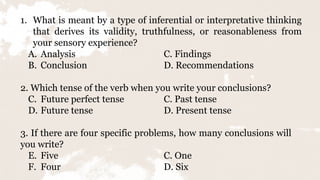
1. What is meant by a type of inferential or interpretative thinking
that derives its validity, truthfulness, or reasonableness from
your sensory experience?
A. Analysis C. Findings
B. Conclusion D. Recommendations
2. Which tense of the verb when you write your conclusions?
C. Future perfect tense C. Past tense
D. Future tense D. Present tense
3. If there are four specific problems, how many conclusions will
you write?
E. Five C. One
F. Four D. Six
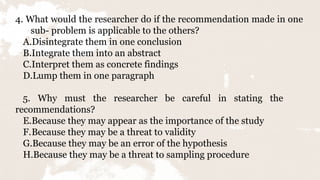
4. What would the researcher do if the recommendation made in one
sub- problem is applicable to the others?
A.Disintegrate them in one conclusion
B.Integrate them into an abstract
C.Interpret them as concrete findings
D.Lump them in one paragraph
5. Why must the researcher be careful in stating the
recommendations?
E.Because they may appear as the importance of the study
F.Because they may be a threat to validity
G.Because they may be an error of the hypothesis
H.Because they may be a threat to sampling procedure
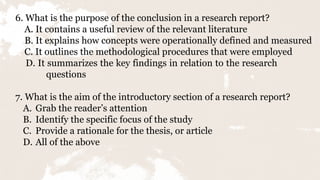
6. What is the purpose of the conclusion in a research report?
A. It contains a useful review of the relevant literature
B. It explains how concepts were operationally defined and measured
C. It outlines the methodological procedures that were employed
D. It summarizes the key findings in relation to the research
questions
7. What is the aim of the introductory section of a research report?
A. Grab the reader’s attention
B. Identify the specific focus of the study
C. Provide a rationale for the thesis, or article
D. All of the above
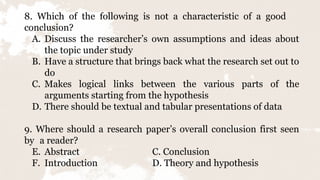
8. Which of the following is not a characteristic of a good
conclusion?
A. Discuss the researcher’s own assumptions and ideas about
the topic under study
B. Have a structure that brings back what the research set out to
do
C. Makes logical links between the various parts of the
arguments starting from the hypothesis
D. There should be textual and tabular presentations of data
9. Where should a research paper’s overall conclusion first seen
by a reader?
E. Abstract C. Conclusion
F. Introduction D. Theory and hypothesis
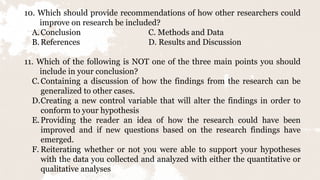
10. Which should provide recommendations of how other researchers could
improve on research be included?
A.Conclusion C. Methods and Data
B.References D. Results and Discussion
11. Which of the following is NOT one of the three main points you should
include in your conclusion?
C. Containing a discussion of how the findings from the research can be
generalized to other cases.
D.Creating a new control variable that will alter the findings in order to
conform to your hypothesis
E.Providing the reader an idea of how the research could have been
improved and if new questions based on the research findings have
emerged.
F. Reiterating whether or not you were able to support your hypotheses
with the data you collected and analyzed with either the quantitative or
qualitative analyses
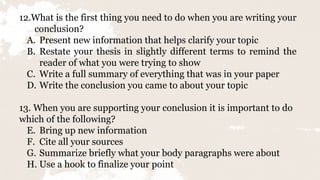
12.What is the first thing you need to do when you are writing your
conclusion?
A. Present new information that helps clarify your topic
B. Restate your thesis in slightly different terms to remind the
reader of what you were trying to show
C. Write a full summary of everything that was in your paper
D. Write the conclusion you came to about your topic
13. When you are supporting your conclusion it is important to do
which of the following?
E. Bring up new information
F. Cite all your sources
G. Summarize briefly what your body paragraphs were about
H. Use a hook to finalize your point
14. When you are writing what your findings showed, what is an
important to do?
A.Bring up something new as a final thought
B.Explain to the readers the main points you touched on about
your topic
C.Make an outlandish claim to confuse the reader
D.Use a quote that allows someone famous to make your
argument foryou
15. What is the final step in doing research?
E.Define research problem C. Design research
F.Formulate hypothesis D. Interpret and Report
Making of Conclusion
Conclusion is a type of inferential or interpretative thinking that derives its
validity, truthfulness, or reasonableness from your sensory experience.
According to Vizcarra (2003), conclusion must be written in the present
tense. They are statedbased on the findings of the study. There is a need for
careful analysis in identifying them so that they will not appear as findings
or recommendations. They are made in general statement which reflects
the results of the study.
If there are five specific problems, there should also be five conclusions. If
there are sub- topics under one sub-problem, you may or may not present
them separately. You can lump them in one conclusion if applicable.
10
Any conclusions drawn or deduced by you from facts or statements
resulting from logical thinking rather than from other assumption,
prediction, or generalization are the only ones included in the conclusion
section of your research paper (Decilo in Baraceros, 2016). The conclusion
that you give about what you found out through your analysis of the data
you collected is a “warranted conclusion,” which explains how the evidence
or findings resulting from your data analysis stands to prove or disprove
your conclusion. And, by large, the best kind of proof to back up your
conclusion is one that is factual and logical or given by correct reasoning.
Downplaying, much less, excluding warrants from this section of your
paper reserved specifically for stating conclusions about your findings
makes your readers cast doubts about the credibility or genuineness of
your conclusions (Thomas, 2013). 11
12
Why is it important to write a conclusion for your research
paper?
Including a conclusion in your research paper can be important to remind
your readers of the strength and impact of your argument. Concluding
statements in your paper can also help to refocus the reader's attention to
the most important points and supporting evidence of your arguments or
position that you presented in your research. Conclusions can also serve as
a basis for continuing research, creating new ideas to resolve an issue you
highlighted in your paper or offering new approaches to a topic.
Pointers in Writing Conclusions
1.Explain your point in simple and clear sentences.
2.Use expressions that center on the topic rather than on yourself, the
researcher.
13
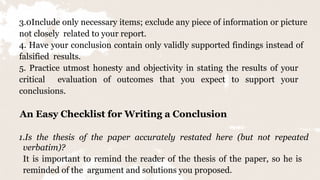
3.0Include only necessary items; exclude any piece of information or picture
not closely related to your report.
4. Have your conclusion contain only validly supported findings instead of
falsified results.
5. Practice utmost honesty and objectivity in stating the results of your
critical evaluation of outcomes that you expect to support your
conclusions.
An Easy Checklist for Writing a Conclusion
1.Is the thesis of the paper accurately restated here (but not repeated
verbatim)?
It is important to remind the reader of the thesis of the paper, so he is
reminded of the argument and solutions you proposed.
14
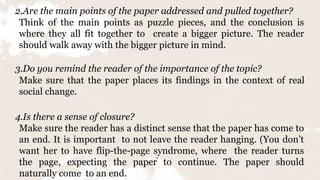
2.Are the main points of the paper addressed and pulled together?
Think of the main points as puzzle pieces, and the conclusion is
where they all fit together to create a bigger picture. The reader
should walk away with the bigger picture in mind.
3.Do you remind the reader of the importance of the topic?
Make sure that the paper places its findings in the context of real
social change.
4.Is there a sense of closure?
Make sure the reader has a distinct sense that the paper has come to
an end. It is important to not leave the reader hanging. (You don’t
want her to have flip-the-page syndrome, where the reader turns
the page, expecting the paper to continue. The paper should
naturally come to an end.
15
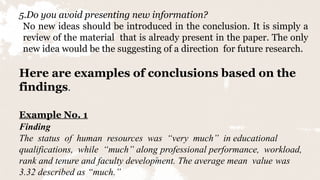
5.Do you avoid presenting new information?
No new ideas should be introduced in the conclusion. It is simply a
review of the material that is already present in the paper. The only
new idea would be the suggesting of a direction for future research.
Here are examples of conclusions based on the
findings.
Example No. 1
Finding
The status of human resources was “very much” in educational
qualifications, while “much” along professional performance, workload,
rank and tenure and faculty development. The average mean value was
3.32 described as “much.”
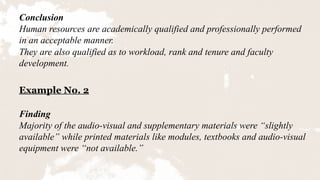
Conclusion
Human resources are academically qualified and professionally performed
in an acceptable manner.
They are also qualified as to workload, rank and tenure and faculty
development.
Example No. 2
Finding
Majority of the audio-visual and supplementary materials were “slightly
available” while printed materials like modules, textbooks and audio-visual
equipment were “not available.”
17
Conclusion
Senior High Schools are not sufficiently provided with adequate instructional
materials and equipment needed to facilitate quality teaching and learning.
Recommendations
The recommendations of the study are based on the findings and
conclusions. The number of findings and conclusions must also be the
number of recommendations if possible. However, the researcher may lump
them in one paragraph if the recommendation made in one sub-problem is
applicable to the others.
The recommendations must be specific and point out the direct agency or
people involved like administrators, teachers, students, and researchers
for possible future action. They must be carefully stated so that they
will not appear as the “importance of the study.” (Vizcarra, 2003).
There are instances that you can recommend an alternative to the
present study which future researchers may take. In doing this, you
must be clear on what should be done based on your findings. You
can include also the problems that should be avoided. Ideally, you
should be able to make a formal recommendation regarding the
altern ative that is best supported by the study. Present and discuss
the kinds of additional research suggested by your project (Chico &
Matira, 2016).
How to write a recommendation for your research paper
Recommendations are used to call for action or solutions to the problems
you have investigated in your research paper. Your recommendations
highlight specific solutions and measures to be implemented based on
the findings of your research.
Here are a few guidelines to enable you to write a good recommendation
for your research paper.
Should be concrete and specific
Avoid beating around the bush. You can choose to restate the problem
and then explain specific measures that can be used to solve those
problems. The solutions or call for action should be specific for the
problems you have stated earlier. Do not introduce new questions or
problems at this point.
The recommendations should connect to your conclusion
Your recommendation should logically support your conclusions and
should be achievable. You should limit yourself to a few
recommendations. It is possible that a single recommendation can be
fitting for all your conclusions.
Explain how the solution you suggested can contribute
to solving the problems you stated
You should not just stop at putting down possible solutions. You should
also explain how it can solve the problems highlighted in your research
paper. The conclusion and recommendation section in any research
paper is very important. It tells the reader that he has come to the end of
the paper. It also breaks down everything your research paper discusses
into more digestible chunks. As earlier stated, you should avoid
introducing new information in your conclusion and recommendation.
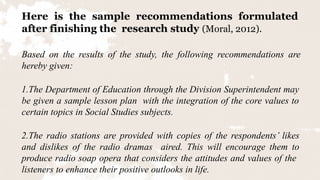
Here is the sample recommendations formulated
after finishing the research study (Moral, 2012).
Based on the results of the study, the following recommendations are
hereby given:
1.The Department of Education through the Division Superintendent may
be given a sample lesson plan with the integration of the core values to
certain topics in Social Studies subjects.
2.The radio stations are provided with copies of the respondents’ likes
and dislikes of the radio dramas aired. This will encourage them to
produce radio soap opera that considers the attitudes and values of the
listeners to enhance their positive outlooks in life.
3.Since the attitudes and values begin from the family, the
parents play a vital role in guiding their children as to
what type of radio dramas are to be listened to.
4.A parallel study may be conducted to ascertain the
cultural diversity found in the present study which is
centered in the mountain barangays of Cebu City. Such
parallel study is recommended in other places within
Cebu province.
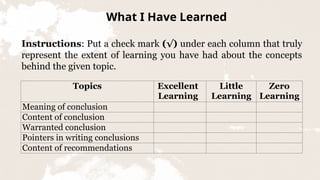
What I Have Learned
Instructions: Put a check mark (√) under each column that truly
represent the extent of learning you have had about the concepts
behind the given topic.
Topics Excellent
Learning
Little
Learning
Zero
Learning
Meaning of conclusion
Content of conclusion
Warranted conclusion
Pointers in writing conclusions
Content of recommendations
What I Can Do
Instructions: Carefully read and analyze your own research work. Go over
your findings. Review your problems then formulate your conclusion.
A.Statement of the Problem
B.Conclusion
C.My analysis
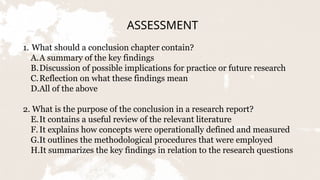
ASSESSMENT
1. What should a conclusion chapter contain?
A.A summary of the key findings
B.Discussion of possible implications for practice or future research
C.Reflection on what these findings mean
D.All of the above
2. What is the purpose of the conclusion in a research report?
E.It contains a useful review of the relevant literature
F.It explains how concepts were operationally defined and measured
G.It outlines the methodological procedures that were employed
H.It summarizes the key findings in relation to the research questions
3. What should be the basis for your recommendations?
A. Assumptions
B. Findings
C. Theories
D. Variables
4. What section in the research paper that focuses on providing a
comprehensive summary of the findings and points out what
were learned from the study?
E. Conclusion
F. Recommendations
G. References
H. Summary
5. What section in a research paper gives the researcher the chance
to give suggestions to matters for the improvement of the
research study?
A. Conclusion
B. Recommendations
C. References
D. Summary
6. Which of the following is NOT a purpose of the research
conclusion?
E. It demonstrates good organization
F. It does not leave a final impression to the readers
G. It gives the written work a sense of completeness
H. It stresses out the importance of the thesis statement
7. Which of the following characteristics of recommendations
states that it should not be ambiguous and must be specific?
A. Recommendations must be brief
B. Recommendations must be precise
C. Recommendations should be clear
D. None of the above
8. Which part of the research report that holds the findings of
the study and the discussion of each findings?
E. Introduction
F. Methodology
G. Results and Discussion
H. Review of Related Literature
9. What are you doing as you put your argument in new words
in your concluding paragraph?
A. Introducing a new topic sentence
B. Providing a new point
C. Restating your thesis
D. Writing a grabber
10. What does a conclusion do?
E. Does not introduce a new topic
F. Reminds the reader of the topic
G. Tie ideas together
H.All of the above
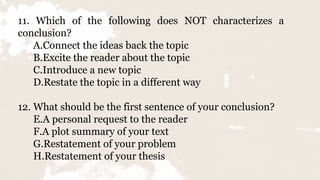
11. Which of the following does NOT characterizes a
conclusion?
A.Connect the ideas back the topic
B.Excite the reader about the topic
C.Introduce a new topic
D.Restate the topic in a different way
12. What should be the first sentence of your conclusion?
E.A personal request to the reader
F.A plot summary of your text
G.Restatement of your problem
H.Restatement of your thesis
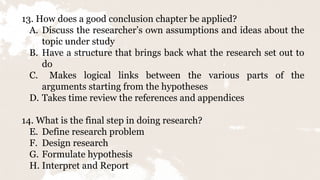
13. How does a good conclusion chapter be applied?
A. Discuss the researcher’s own assumptions and ideas about the
topic under study
B. Have a structure that brings back what the research set out to
do
C. Makes logical links between the various parts of the
arguments starting from the hypotheses
D. Takes time review the references and appendices
14. What is the final step in doing research?
E. Define research problem
F. Design research
G. Formulate hypothesis
H. Interpret and Report
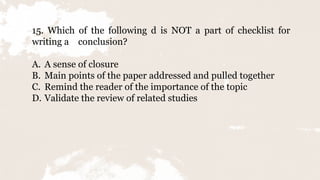
15. Which of the following d is NOT a part of checklist for
writing a conclusion?
A. A sense of closure
B. Main points of the paper addressed and pulled together
C. Remind the reader of the importance of the topic
D. Validate the review of related studies

7_Quarter 2-PRACTICAL-RESEARCH Drawing Conclusion 2 .pptx

  • 1.
    PRACTICAL RESEARCH 2 Q2 DrawingConclusions and Recommendations i
  • 2.
    OBJECTIVES: At the endof this lesson, you are expected to: 1.Explain the meaning of conclusion. 2.Determine the contents of the conclusion part of a research paper; and 3.Formulate recommendations.
  • 3.
    1. What ismeant by a type of inferential or interpretative thinking that derives its validity, truthfulness, or reasonableness from your sensory experience? A. Analysis C. Findings B. Conclusion D. Recommendations 2. Which tense of the verb when you write your conclusions? C. Future perfect tense C. Past tense D. Future tense D. Present tense 3. If there are four specific problems, how many conclusions will you write? E. Five C. One F. Four D. Six
  • 4.
    4. What wouldthe researcher do if the recommendation made in one sub- problem is applicable to the others? A.Disintegrate them in one conclusion B.Integrate them into an abstract C.Interpret them as concrete findings D.Lump them in one paragraph 5. Why must the researcher be careful in stating the recommendations? E.Because they may appear as the importance of the study F.Because they may be a threat to validity G.Because they may be an error of the hypothesis H.Because they may be a threat to sampling procedure
  • 5.
    6. What isthe purpose of the conclusion in a research report? A. It contains a useful review of the relevant literature B. It explains how concepts were operationally defined and measured C. It outlines the methodological procedures that were employed D. It summarizes the key findings in relation to the research questions 7. What is the aim of the introductory section of a research report? A. Grab the reader’s attention B. Identify the specific focus of the study C. Provide a rationale for the thesis, or article D. All of the above
  • 6.
    8. Which ofthe following is not a characteristic of a good conclusion? A. Discuss the researcher’s own assumptions and ideas about the topic under study B. Have a structure that brings back what the research set out to do C. Makes logical links between the various parts of the arguments starting from the hypothesis D. There should be textual and tabular presentations of data 9. Where should a research paper’s overall conclusion first seen by a reader? E. Abstract C. Conclusion F. Introduction D. Theory and hypothesis
  • 7.
    10. Which shouldprovide recommendations of how other researchers could improve on research be included? A.Conclusion C. Methods and Data B.References D. Results and Discussion 11. Which of the following is NOT one of the three main points you should include in your conclusion? C. Containing a discussion of how the findings from the research can be generalized to other cases. D.Creating a new control variable that will alter the findings in order to conform to your hypothesis E.Providing the reader an idea of how the research could have been improved and if new questions based on the research findings have emerged. F. Reiterating whether or not you were able to support your hypotheses with the data you collected and analyzed with either the quantitative or qualitative analyses
  • 8.
    12.What is thefirst thing you need to do when you are writing your conclusion? A. Present new information that helps clarify your topic B. Restate your thesis in slightly different terms to remind the reader of what you were trying to show C. Write a full summary of everything that was in your paper D. Write the conclusion you came to about your topic 13. When you are supporting your conclusion it is important to do which of the following? E. Bring up new information F. Cite all your sources G. Summarize briefly what your body paragraphs were about H. Use a hook to finalize your point
  • 9.
    14. When youare writing what your findings showed, what is an important to do? A.Bring up something new as a final thought B.Explain to the readers the main points you touched on about your topic C.Make an outlandish claim to confuse the reader D.Use a quote that allows someone famous to make your argument foryou 15. What is the final step in doing research? E.Define research problem C. Design research F.Formulate hypothesis D. Interpret and Report
  • 10.
    Making of Conclusion Conclusionis a type of inferential or interpretative thinking that derives its validity, truthfulness, or reasonableness from your sensory experience. According to Vizcarra (2003), conclusion must be written in the present tense. They are statedbased on the findings of the study. There is a need for careful analysis in identifying them so that they will not appear as findings or recommendations. They are made in general statement which reflects the results of the study. If there are five specific problems, there should also be five conclusions. If there are sub- topics under one sub-problem, you may or may not present them separately. You can lump them in one conclusion if applicable. 10
  • 11.
    Any conclusions drawnor deduced by you from facts or statements resulting from logical thinking rather than from other assumption, prediction, or generalization are the only ones included in the conclusion section of your research paper (Decilo in Baraceros, 2016). The conclusion that you give about what you found out through your analysis of the data you collected is a “warranted conclusion,” which explains how the evidence or findings resulting from your data analysis stands to prove or disprove your conclusion. And, by large, the best kind of proof to back up your conclusion is one that is factual and logical or given by correct reasoning. Downplaying, much less, excluding warrants from this section of your paper reserved specifically for stating conclusions about your findings makes your readers cast doubts about the credibility or genuineness of your conclusions (Thomas, 2013). 11
  • 12.
    12 Why is itimportant to write a conclusion for your research paper? Including a conclusion in your research paper can be important to remind your readers of the strength and impact of your argument. Concluding statements in your paper can also help to refocus the reader's attention to the most important points and supporting evidence of your arguments or position that you presented in your research. Conclusions can also serve as a basis for continuing research, creating new ideas to resolve an issue you highlighted in your paper or offering new approaches to a topic. Pointers in Writing Conclusions 1.Explain your point in simple and clear sentences. 2.Use expressions that center on the topic rather than on yourself, the researcher.
  • 13.
    13 3.0Include only necessaryitems; exclude any piece of information or picture not closely related to your report. 4. Have your conclusion contain only validly supported findings instead of falsified results. 5. Practice utmost honesty and objectivity in stating the results of your critical evaluation of outcomes that you expect to support your conclusions. An Easy Checklist for Writing a Conclusion 1.Is the thesis of the paper accurately restated here (but not repeated verbatim)? It is important to remind the reader of the thesis of the paper, so he is reminded of the argument and solutions you proposed.
  • 14.
    14 2.Are the mainpoints of the paper addressed and pulled together? Think of the main points as puzzle pieces, and the conclusion is where they all fit together to create a bigger picture. The reader should walk away with the bigger picture in mind. 3.Do you remind the reader of the importance of the topic? Make sure that the paper places its findings in the context of real social change. 4.Is there a sense of closure? Make sure the reader has a distinct sense that the paper has come to an end. It is important to not leave the reader hanging. (You don’t want her to have flip-the-page syndrome, where the reader turns the page, expecting the paper to continue. The paper should naturally come to an end.
  • 15.
    15 5.Do you avoidpresenting new information? No new ideas should be introduced in the conclusion. It is simply a review of the material that is already present in the paper. The only new idea would be the suggesting of a direction for future research. Here are examples of conclusions based on the findings. Example No. 1 Finding The status of human resources was “very much” in educational qualifications, while “much” along professional performance, workload, rank and tenure and faculty development. The average mean value was 3.32 described as “much.”
  • 16.
    Conclusion Human resources areacademically qualified and professionally performed in an acceptable manner. They are also qualified as to workload, rank and tenure and faculty development. Example No. 2 Finding Majority of the audio-visual and supplementary materials were “slightly available” while printed materials like modules, textbooks and audio-visual equipment were “not available.”
  • 17.
    17 Conclusion Senior High Schoolsare not sufficiently provided with adequate instructional materials and equipment needed to facilitate quality teaching and learning. Recommendations The recommendations of the study are based on the findings and conclusions. The number of findings and conclusions must also be the number of recommendations if possible. However, the researcher may lump them in one paragraph if the recommendation made in one sub-problem is applicable to the others. The recommendations must be specific and point out the direct agency or people involved like administrators, teachers, students, and researchers
  • 18.
    for possible futureaction. They must be carefully stated so that they will not appear as the “importance of the study.” (Vizcarra, 2003). There are instances that you can recommend an alternative to the present study which future researchers may take. In doing this, you must be clear on what should be done based on your findings. You can include also the problems that should be avoided. Ideally, you should be able to make a formal recommendation regarding the altern ative that is best supported by the study. Present and discuss the kinds of additional research suggested by your project (Chico & Matira, 2016).
  • 19.
    How to writea recommendation for your research paper Recommendations are used to call for action or solutions to the problems you have investigated in your research paper. Your recommendations highlight specific solutions and measures to be implemented based on the findings of your research. Here are a few guidelines to enable you to write a good recommendation for your research paper. Should be concrete and specific Avoid beating around the bush. You can choose to restate the problem and then explain specific measures that can be used to solve those problems. The solutions or call for action should be specific for the problems you have stated earlier. Do not introduce new questions or problems at this point.
  • 20.
    The recommendations shouldconnect to your conclusion Your recommendation should logically support your conclusions and should be achievable. You should limit yourself to a few recommendations. It is possible that a single recommendation can be fitting for all your conclusions. Explain how the solution you suggested can contribute to solving the problems you stated You should not just stop at putting down possible solutions. You should also explain how it can solve the problems highlighted in your research paper. The conclusion and recommendation section in any research paper is very important. It tells the reader that he has come to the end of the paper. It also breaks down everything your research paper discusses into more digestible chunks. As earlier stated, you should avoid introducing new information in your conclusion and recommendation.
  • 21.
    Here is thesample recommendations formulated after finishing the research study (Moral, 2012). Based on the results of the study, the following recommendations are hereby given: 1.The Department of Education through the Division Superintendent may be given a sample lesson plan with the integration of the core values to certain topics in Social Studies subjects. 2.The radio stations are provided with copies of the respondents’ likes and dislikes of the radio dramas aired. This will encourage them to produce radio soap opera that considers the attitudes and values of the listeners to enhance their positive outlooks in life.
  • 22.
    3.Since the attitudesand values begin from the family, the parents play a vital role in guiding their children as to what type of radio dramas are to be listened to. 4.A parallel study may be conducted to ascertain the cultural diversity found in the present study which is centered in the mountain barangays of Cebu City. Such parallel study is recommended in other places within Cebu province.
  • 23.
    What I HaveLearned Instructions: Put a check mark (√) under each column that truly represent the extent of learning you have had about the concepts behind the given topic. Topics Excellent Learning Little Learning Zero Learning Meaning of conclusion Content of conclusion Warranted conclusion Pointers in writing conclusions Content of recommendations
  • 24.
    What I CanDo Instructions: Carefully read and analyze your own research work. Go over your findings. Review your problems then formulate your conclusion. A.Statement of the Problem B.Conclusion C.My analysis
  • 25.
    ASSESSMENT 1. What shoulda conclusion chapter contain? A.A summary of the key findings B.Discussion of possible implications for practice or future research C.Reflection on what these findings mean D.All of the above 2. What is the purpose of the conclusion in a research report? E.It contains a useful review of the relevant literature F.It explains how concepts were operationally defined and measured G.It outlines the methodological procedures that were employed H.It summarizes the key findings in relation to the research questions
  • 26.
    3. What shouldbe the basis for your recommendations? A. Assumptions B. Findings C. Theories D. Variables 4. What section in the research paper that focuses on providing a comprehensive summary of the findings and points out what were learned from the study? E. Conclusion F. Recommendations G. References H. Summary
  • 27.
    5. What sectionin a research paper gives the researcher the chance to give suggestions to matters for the improvement of the research study? A. Conclusion B. Recommendations C. References D. Summary 6. Which of the following is NOT a purpose of the research conclusion? E. It demonstrates good organization F. It does not leave a final impression to the readers G. It gives the written work a sense of completeness H. It stresses out the importance of the thesis statement
  • 28.
    7. Which ofthe following characteristics of recommendations states that it should not be ambiguous and must be specific? A. Recommendations must be brief B. Recommendations must be precise C. Recommendations should be clear D. None of the above 8. Which part of the research report that holds the findings of the study and the discussion of each findings? E. Introduction F. Methodology G. Results and Discussion H. Review of Related Literature
  • 29.
    9. What areyou doing as you put your argument in new words in your concluding paragraph? A. Introducing a new topic sentence B. Providing a new point C. Restating your thesis D. Writing a grabber 10. What does a conclusion do? E. Does not introduce a new topic F. Reminds the reader of the topic G. Tie ideas together H.All of the above
  • 30.
    11. Which ofthe following does NOT characterizes a conclusion? A.Connect the ideas back the topic B.Excite the reader about the topic C.Introduce a new topic D.Restate the topic in a different way 12. What should be the first sentence of your conclusion? E.A personal request to the reader F.A plot summary of your text G.Restatement of your problem H.Restatement of your thesis
  • 31.
    13. How doesa good conclusion chapter be applied? A. Discuss the researcher’s own assumptions and ideas about the topic under study B. Have a structure that brings back what the research set out to do C. Makes logical links between the various parts of the arguments starting from the hypotheses D. Takes time review the references and appendices 14. What is the final step in doing research? E. Define research problem F. Design research G. Formulate hypothesis H. Interpret and Report
  • 32.
    15. Which ofthe following d is NOT a part of checklist for writing a conclusion? A. A sense of closure B. Main points of the paper addressed and pulled together C. Remind the reader of the importance of the topic D. Validate the review of related studies