Sulfur & it’s
compounds
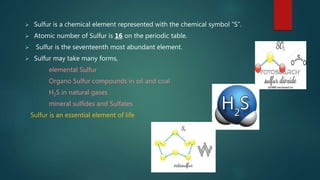
 Sulfur is a chemical element represented with the chemical symbol “S”.
 Atomic number of Sulfur is 16 on the periodic table.
 Sulfur is the seventeenth most abundant element.
 Sulfur may take many forms,
elemental Sulfur
Organo Sulfur compounds in oil and coal
H2S in natural gases
mineral sulfides and Sulfates
Sulfur is an essential element of life
General properties of Sulfur
 Pure Sulfur is tasteless and odorless with a light yellow color. Samples of
Sulfur often encountered in the lab have a noticeable odor.
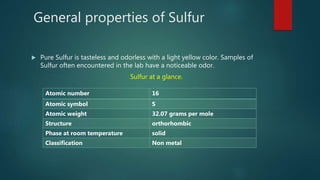
Sulfur at a glance.
Atomic number 16
Atomic symbol S
Atomic weight 32.07 grams per mole
Structure orthorhombic
Phase at room temperature solid
Classification Non metal
Physical properties of Sulfur
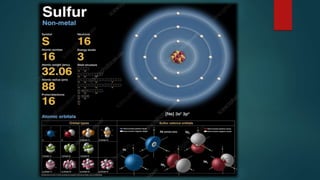
 Atomic weight of Sulfur 32.066 grams per mole.
 Part of group 16.
 Non metal & has specific heat of 0.706 Jg-1°C.
 Electron affinity is 200 kJmol-1
 Electronegativity is 2.58.
 Brittle solid.
 Insoluble in water.
 Highly soluble in Carbon disulfide
 Melting point 112°C
 Compared to other elements Sulfur has most allotropes.
 Common oxidation states of sulfur are -2, 0, +4, and +6.
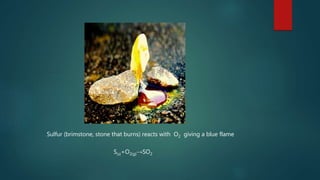
Sulfur (brimstone, stone that burns) reacts with O2 giving a blue flame
S(s)+O2(g)→SO2
Extraction of Sulfur
 Extracted by the Frasch process
In this method super heated water and compressed air is used to
draw liquid sulfur to the surface. Texas , Louisiana are the primary sites that
yield extensive amounts elemental Sulfur.
elemental Sulfur can also be produced by reducing H2S, commonly found in
oil and natural gas.
The Frasch Process
 This process has made sulfur a high purity (up to 99.9 percent pure) chemical
commodity in large quantities. Most sulfur-containing minerals are metal
sulfides, and the best known is perhaps pyrite ( FeS2 , known as fools gold
because of its golden color). The most common sulfate containing mineral is
gypsum, CaSO4⋅2H2O , also known as plaster of Paris.
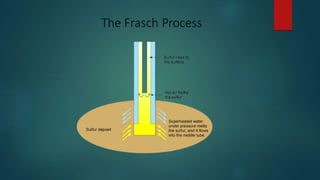
 The Frasch process is based on the fact that sulfur has a comparatively low
melting point. The process forces (99.5% pure) sulfur out by using hot water
and air. In this process, superheated water is forced down the outermost of
three concentric pipes. Compressed air is pumped down the center tube, and
a mixture of elemental sulfur, hot water, and air comes up the middle pipe.
Sulfur is melted with superheated water (at 170 °C under high pressure) and
forced to the surface of the earth as a slurry.
Allotropes of Sulfur
 While the S8 is the most common allotrope , there are 6 other structures with up to 20
Sulfur atoms per ring.
 Under appropriate conditions Sulfur vapor can contain S,S2,S4,S6 and S8.
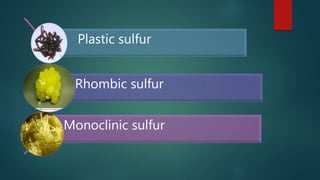
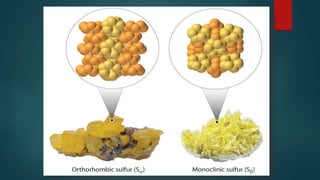
 At room temperature rhombic sulfur is a stable solid comprised of cyclic S8 molecules.
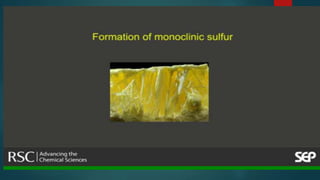
 At 95.5 °C rhombic sulfur becomes monoclinic sulfur. Crystal structure found in
monoclinic sulfur differs from that of rhombic sulfur. Monoclinic sulfur is also made up of
S8 molecules.
 Monoclinic sulfur becomes liquid sulfur at 119 °C. Liquid sulfur is straw-colored liquid
made up of S8 molecules and other cyclic molecules containing a range of six to twenty
atoms.
 At 160 °C, this becomes a dark, viscous liquid called Liquid sulfur (Sμ). The molecules are
still made up of eight Sulfur atoms but the molecule opens up and transforms from a
circle into a long spiral-chain molecule.
 At 180 °C, the chain length and viscosity reach their maximum. Chains break and viscosity
decreases at temperatures that exceed 180 °C.
 Sulfur vapor is produced when liquid boils at 445 °C. In the vapor that is produced, S8
molecules dominate but as the vapor continues to heat up, the molecules break up into
smaller groups of Sulfur.
 To produce plastic sulfur, Sis poured into cold water. Plastic sulfur is rubberlike and is
made up of long, spiral-chain molecules. If plastic sulfur sits for long, it will reconvert to
rhombic sulfur.
Plastic sulfur
Rhombic sulfur
Monoclinic sulfur
oxides
 There are many different stable sulfur oxides, but the two that are commonly found are
sulfur dioxide and sulfur trioxide.
SO2
 Colorless
 pungent
 nonflammable
 It has a density of 2.8 kg/m3
 melting point of -72.5. Because organic materials are more soluble in SO2 than in water,
the liquid form is a good solvent.
 SO2 is primarily used to produce SO3. The direct combustion of sulfur and the roasting of
metal sulfides yield SO2 via the contact process:
 S(s)+O2(g)→ SO2(g) Direct combustion
 2ZnS(s)+3O2(g)→ 2ZnO(s)+2SO2(g) Roasting of metal sulfides
SO2
 SO2 is produced whenever metal sulfide is oxidized. It is recovered and oxidized further to
give SO3 , for production of H2SO4 . SO2 reacts with H2S to form H2O and S .
2SO2+O2⇌2SO3
SO3+H2O⇌H2SO4 (a valuable commodity)
SO3+H2SO4⇌H2S2O7 (pyrosulfuric acid)
Sulfur reacts with sulfite ions in solution to form thiosulfate,
S+SO2−
3⟶S2O2−
3
 but the reaction is reversed in an acidic solution.
 Sulfur dioxide ( SO2 ) finds practical applications in bleaching and refrigeration but it is also
a nuisance gas resulting from the burning of Sulfurus
SO3
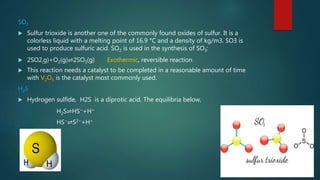
 Sulfur trioxide is another one of the commonly found oxides of sulfur. It is a
colorless liquid with a melting point of 16.9 °C and a density of kg/m3. SO3 is
used to produce sulfuric acid. SO2 is used in the synthesis of SO3:
 2SO2(g)+O2(g)⇌2SO3(g) Exothermic, reversible reaction
 This reaction needs a catalyst to be completed in a reasonable amount of time
with V2O5 is the catalyst most commonly used.
H2S
 Hydrogen sulfide, H2S is a diprotic acid. The equilibria below,
H2S⇌HS−+H+
HS−⇌S2−+H+
H2SO4
 Sulfuric acid, H2SO4, is produced by reacting SO3 with water. However, this often leads to
pollution problems. SO3(g) is reacted with 98% H2SO4 in towers full of ceramic material to
produce H2S2O7 or oleum. Water is circulated in the tower to maintain the correct
concentration and the acid is diluted with water at the end in order to produce the correct
concentration. Pure sulfuric acid has no color and odor, and it is an oily, hygroscopic liquid.
However, sulfuric acid vapor produces heavy, white smoke and a suffocating odor.
 Dilute sulfuric acid, H2SO4(aq) reacts with metals and acts as a strong acid in common
chemical reactions. It is used to produce H2(g) and liberate CO2(g) and can neutralize
strong bases.
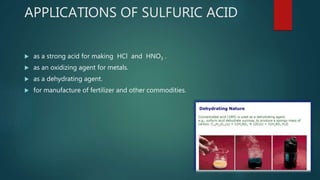
 Concentrated sulfuric acid, H2SO4 (conc.) has a strong affinity for water. In some cases, it
removes H and O atoms. Concentrated sulfuric acid is also a good oxidizing agent and
reacts with some metals.
 C12H22O11(s)→12C(s)+11H2O(l)
 (Concentrated sulfuric acid used in forward reaction to remove H and O atoms.)
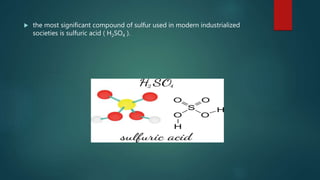
 the most significant compound of sulfur used in modern industrialized
societies is sulfuric acid ( H2SO4 ).
 Sulfuric acid, the most abundantly produced chemical in the United States, is
manufactured by the contact process.
 Most (about 70%) of the sulfuric acid produced in the world is used in the fertilizer
industry.
 Sulfuric acid can act as a strong acid, a dehydrating agent, and an oxidizing agent. Its
applications use these properties.
APPLICATIONS OF SULFURIC ACID
 as a strong acid for making HCl and HNO3 .
 as an oxidizing agent for metals.
 as a dehydrating agent.
 for manufacture of fertilizer and other commodities.
H2SO3
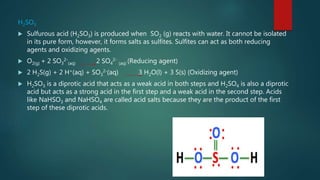
 Sulfurous acid (H2SO3) is produced when SO2 (g) reacts with water. It cannot be isolated
in its pure form, however, it forms salts as sulfites. Sulfites can act as both reducing
agents and oxidizing agents.
 O2(g) + 2 SO3
2-
(aq) 2 SO4
2-
(aq) (Reducing agent)
 2 H2S(g) + 2 H+(aq) + SO3
2-(aq) 3 H2O(l) + 3 S(s) (Oxidizing agent)
 H2SO3 is a diprotic acid that acts as a weak acid in both steps and H2SO4 is also a diprotic
acid but acts as a strong acid in the first step and a weak acid in the second step. Acids
like NaHSO3 and NaHSO4 are called acid salts because they are the product of the first
step of these diprotic acids.
S2O3
2-
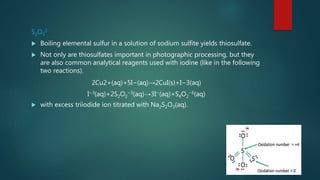
 Boiling elemental sulfur in a solution of sodium sulfite yields thiosulfate.
 Not only are thiosulfates important in photographic processing, but they
are also common analytical reagents used with iodine (like in the following
two reactions).
2Cu2+(aq)+5I−(aq)→2CuI(s)+I−3(aq)
I−3(aq)+2S2O2
−3(aq)→3I−(aq)+S4O2
−6(aq)
 with excess triiodide ion titrated with Na2S2O3(aq).
Sulfur halides
 Sulfur halides are compounds formed between sulfur and the halogens.
 Common compounds include SF2, S2F2, SF4, and SF6.
 SF4is a powerful fluorinating agent
 SF6 is a colorless, odorless, unreactive gas.
 Compounds formed by sulfur and chloride include S2Cl2, SCl4, and SCl2. SCl2is a red bad
smelling liquid that is utilized to produce mustard gas ( S(CH2CH2Cl)2 ).
 SCl2+ 2CH2CH2 → S(CH2CH2Cl)2
Applications
 Fungicide
 The vulcanization of rubber includes the use of sulfur as well.
 Cellophane and rayon are produced with carbon disulfide, a product of sulfur and
methane.
 Sulfur compounds can also be found in detergents, acne treatments, and
agrichemicals. Magnesium sulfate (epsom salt) has many uses, ranging from bath
additives to exfoliants.
 Sulfur is being increasingly used as a fertilizer as well. Because standard sulfur is
hydrophobic, it is covered with a surfactant by bacteria before oxidation can occur.
Sulfur is therefore a slow-release fertilizer. Lastly, sulfur functions as a light-
generating medium in sulfur lamps.
H2SO4
 Concentrated sulfuric acid was once one of the most produced chemicals in the United States
 the majority of the H2SO4 that is now produced is used in fertilizer.
 oil refining
 production of titanium dioxide, in emergency power supplies and car batteries. The mineral
gypsum is calcium sulfate dihydrate is used in making plaster of Paris.
 Over one million tons of aluminum sulfate is produced each year in the United States by
reacting H2SO4 and Al2O3. This compound is important in water purification.
 Copper sulfate is used in electroplating.
Sulfites
 Sulfites are used in the paper making industry because they produce a substance that coats
the cellulose in the word and frees the fibers of the wood for treatment.
Emissions and the Environment
 Particles, SO2(g), and H2SO4 mist are the components of industrial smog. Because power
plants burn coal or high-sulfur fuel oils, SO2(g) is released into the air. When catalyzed
on the surfaces of airborne particles, SO2 can be oxidized to SO3. A reaction with NO2
works as well as shown in the following reaction:
SO2(g)+NO2(g)→SO3(g)+NO(g)
 H2SO4 mist is then produced after SO3 reacts with water vapor in the air. If H2SO4 reacts
with airborne NH3, (NH4)2SO4 is produced. When SO2(g) and H2SO4 reach levels that
exceed 0.10 ppm, they are potentially harmful. By removing sulfur from fuels and
controlling emissions, acid rain and industrial smog can be kept under control. Processes
like the fluidized bed combustion have been presented to remove SO2 from smokestack
gases.
Thank You

Sulfur chemistry

  • 1.
  • 2.
     Sulfur isa chemical element represented with the chemical symbol “S”.  Atomic number of Sulfur is 16 on the periodic table.  Sulfur is the seventeenth most abundant element.  Sulfur may take many forms, elemental Sulfur Organo Sulfur compounds in oil and coal H2S in natural gases mineral sulfides and Sulfates Sulfur is an essential element of life
  • 3.
    General properties ofSulfur  Pure Sulfur is tasteless and odorless with a light yellow color. Samples of Sulfur often encountered in the lab have a noticeable odor. Sulfur at a glance. Atomic number 16 Atomic symbol S Atomic weight 32.07 grams per mole Structure orthorhombic Phase at room temperature solid Classification Non metal
  • 5.
    Physical properties ofSulfur  Atomic weight of Sulfur 32.066 grams per mole.  Part of group 16.  Non metal & has specific heat of 0.706 Jg-1°C.  Electron affinity is 200 kJmol-1  Electronegativity is 2.58.  Brittle solid.  Insoluble in water.  Highly soluble in Carbon disulfide  Melting point 112°C  Compared to other elements Sulfur has most allotropes.  Common oxidation states of sulfur are -2, 0, +4, and +6.
  • 6.
    Sulfur (brimstone, stonethat burns) reacts with O2 giving a blue flame S(s)+O2(g)→SO2
  • 7.
    Extraction of Sulfur Extracted by the Frasch process In this method super heated water and compressed air is used to draw liquid sulfur to the surface. Texas , Louisiana are the primary sites that yield extensive amounts elemental Sulfur. elemental Sulfur can also be produced by reducing H2S, commonly found in oil and natural gas.
  • 9.
    The Frasch Process This process has made sulfur a high purity (up to 99.9 percent pure) chemical commodity in large quantities. Most sulfur-containing minerals are metal sulfides, and the best known is perhaps pyrite ( FeS2 , known as fools gold because of its golden color). The most common sulfate containing mineral is gypsum, CaSO4⋅2H2O , also known as plaster of Paris.  The Frasch process is based on the fact that sulfur has a comparatively low melting point. The process forces (99.5% pure) sulfur out by using hot water and air. In this process, superheated water is forced down the outermost of three concentric pipes. Compressed air is pumped down the center tube, and a mixture of elemental sulfur, hot water, and air comes up the middle pipe. Sulfur is melted with superheated water (at 170 °C under high pressure) and forced to the surface of the earth as a slurry.
  • 10.
    Allotropes of Sulfur While the S8 is the most common allotrope , there are 6 other structures with up to 20 Sulfur atoms per ring.  Under appropriate conditions Sulfur vapor can contain S,S2,S4,S6 and S8.  At room temperature rhombic sulfur is a stable solid comprised of cyclic S8 molecules.  At 95.5 °C rhombic sulfur becomes monoclinic sulfur. Crystal structure found in monoclinic sulfur differs from that of rhombic sulfur. Monoclinic sulfur is also made up of S8 molecules.
  • 11.
     Monoclinic sulfurbecomes liquid sulfur at 119 °C. Liquid sulfur is straw-colored liquid made up of S8 molecules and other cyclic molecules containing a range of six to twenty atoms.  At 160 °C, this becomes a dark, viscous liquid called Liquid sulfur (Sμ). The molecules are still made up of eight Sulfur atoms but the molecule opens up and transforms from a circle into a long spiral-chain molecule.  At 180 °C, the chain length and viscosity reach their maximum. Chains break and viscosity decreases at temperatures that exceed 180 °C.  Sulfur vapor is produced when liquid boils at 445 °C. In the vapor that is produced, S8 molecules dominate but as the vapor continues to heat up, the molecules break up into smaller groups of Sulfur.  To produce plastic sulfur, Sis poured into cold water. Plastic sulfur is rubberlike and is made up of long, spiral-chain molecules. If plastic sulfur sits for long, it will reconvert to rhombic sulfur.
  • 12.
  • 16.
    oxides  There aremany different stable sulfur oxides, but the two that are commonly found are sulfur dioxide and sulfur trioxide. SO2  Colorless  pungent  nonflammable  It has a density of 2.8 kg/m3  melting point of -72.5. Because organic materials are more soluble in SO2 than in water, the liquid form is a good solvent.  SO2 is primarily used to produce SO3. The direct combustion of sulfur and the roasting of metal sulfides yield SO2 via the contact process:  S(s)+O2(g)→ SO2(g) Direct combustion  2ZnS(s)+3O2(g)→ 2ZnO(s)+2SO2(g) Roasting of metal sulfides
  • 17.
    SO2  SO2 isproduced whenever metal sulfide is oxidized. It is recovered and oxidized further to give SO3 , for production of H2SO4 . SO2 reacts with H2S to form H2O and S . 2SO2+O2⇌2SO3 SO3+H2O⇌H2SO4 (a valuable commodity) SO3+H2SO4⇌H2S2O7 (pyrosulfuric acid) Sulfur reacts with sulfite ions in solution to form thiosulfate, S+SO2− 3⟶S2O2− 3  but the reaction is reversed in an acidic solution.  Sulfur dioxide ( SO2 ) finds practical applications in bleaching and refrigeration but it is also a nuisance gas resulting from the burning of Sulfurus
  • 18.
    SO3  Sulfur trioxideis another one of the commonly found oxides of sulfur. It is a colorless liquid with a melting point of 16.9 °C and a density of kg/m3. SO3 is used to produce sulfuric acid. SO2 is used in the synthesis of SO3:  2SO2(g)+O2(g)⇌2SO3(g) Exothermic, reversible reaction  This reaction needs a catalyst to be completed in a reasonable amount of time with V2O5 is the catalyst most commonly used. H2S  Hydrogen sulfide, H2S is a diprotic acid. The equilibria below, H2S⇌HS−+H+ HS−⇌S2−+H+
  • 19.
    H2SO4  Sulfuric acid,H2SO4, is produced by reacting SO3 with water. However, this often leads to pollution problems. SO3(g) is reacted with 98% H2SO4 in towers full of ceramic material to produce H2S2O7 or oleum. Water is circulated in the tower to maintain the correct concentration and the acid is diluted with water at the end in order to produce the correct concentration. Pure sulfuric acid has no color and odor, and it is an oily, hygroscopic liquid. However, sulfuric acid vapor produces heavy, white smoke and a suffocating odor.  Dilute sulfuric acid, H2SO4(aq) reacts with metals and acts as a strong acid in common chemical reactions. It is used to produce H2(g) and liberate CO2(g) and can neutralize strong bases.  Concentrated sulfuric acid, H2SO4 (conc.) has a strong affinity for water. In some cases, it removes H and O atoms. Concentrated sulfuric acid is also a good oxidizing agent and reacts with some metals.  C12H22O11(s)→12C(s)+11H2O(l)  (Concentrated sulfuric acid used in forward reaction to remove H and O atoms.)
  • 20.
     the mostsignificant compound of sulfur used in modern industrialized societies is sulfuric acid ( H2SO4 ).
  • 21.
     Sulfuric acid,the most abundantly produced chemical in the United States, is manufactured by the contact process.  Most (about 70%) of the sulfuric acid produced in the world is used in the fertilizer industry.  Sulfuric acid can act as a strong acid, a dehydrating agent, and an oxidizing agent. Its applications use these properties.
  • 22.
    APPLICATIONS OF SULFURICACID  as a strong acid for making HCl and HNO3 .  as an oxidizing agent for metals.  as a dehydrating agent.  for manufacture of fertilizer and other commodities.
  • 23.
    H2SO3  Sulfurous acid(H2SO3) is produced when SO2 (g) reacts with water. It cannot be isolated in its pure form, however, it forms salts as sulfites. Sulfites can act as both reducing agents and oxidizing agents.  O2(g) + 2 SO3 2- (aq) 2 SO4 2- (aq) (Reducing agent)  2 H2S(g) + 2 H+(aq) + SO3 2-(aq) 3 H2O(l) + 3 S(s) (Oxidizing agent)  H2SO3 is a diprotic acid that acts as a weak acid in both steps and H2SO4 is also a diprotic acid but acts as a strong acid in the first step and a weak acid in the second step. Acids like NaHSO3 and NaHSO4 are called acid salts because they are the product of the first step of these diprotic acids.
  • 24.
    S2O3 2-  Boiling elementalsulfur in a solution of sodium sulfite yields thiosulfate.  Not only are thiosulfates important in photographic processing, but they are also common analytical reagents used with iodine (like in the following two reactions). 2Cu2+(aq)+5I−(aq)→2CuI(s)+I−3(aq) I−3(aq)+2S2O2 −3(aq)→3I−(aq)+S4O2 −6(aq)  with excess triiodide ion titrated with Na2S2O3(aq).
  • 25.
    Sulfur halides  Sulfurhalides are compounds formed between sulfur and the halogens.  Common compounds include SF2, S2F2, SF4, and SF6.  SF4is a powerful fluorinating agent  SF6 is a colorless, odorless, unreactive gas.  Compounds formed by sulfur and chloride include S2Cl2, SCl4, and SCl2. SCl2is a red bad smelling liquid that is utilized to produce mustard gas ( S(CH2CH2Cl)2 ).  SCl2+ 2CH2CH2 → S(CH2CH2Cl)2
  • 26.
    Applications  Fungicide  Thevulcanization of rubber includes the use of sulfur as well.  Cellophane and rayon are produced with carbon disulfide, a product of sulfur and methane.  Sulfur compounds can also be found in detergents, acne treatments, and agrichemicals. Magnesium sulfate (epsom salt) has many uses, ranging from bath additives to exfoliants.  Sulfur is being increasingly used as a fertilizer as well. Because standard sulfur is hydrophobic, it is covered with a surfactant by bacteria before oxidation can occur. Sulfur is therefore a slow-release fertilizer. Lastly, sulfur functions as a light- generating medium in sulfur lamps.
  • 27.
    H2SO4  Concentrated sulfuricacid was once one of the most produced chemicals in the United States  the majority of the H2SO4 that is now produced is used in fertilizer.  oil refining  production of titanium dioxide, in emergency power supplies and car batteries. The mineral gypsum is calcium sulfate dihydrate is used in making plaster of Paris.  Over one million tons of aluminum sulfate is produced each year in the United States by reacting H2SO4 and Al2O3. This compound is important in water purification.  Copper sulfate is used in electroplating. Sulfites  Sulfites are used in the paper making industry because they produce a substance that coats the cellulose in the word and frees the fibers of the wood for treatment.
  • 28.
    Emissions and theEnvironment  Particles, SO2(g), and H2SO4 mist are the components of industrial smog. Because power plants burn coal or high-sulfur fuel oils, SO2(g) is released into the air. When catalyzed on the surfaces of airborne particles, SO2 can be oxidized to SO3. A reaction with NO2 works as well as shown in the following reaction: SO2(g)+NO2(g)→SO3(g)+NO(g)  H2SO4 mist is then produced after SO3 reacts with water vapor in the air. If H2SO4 reacts with airborne NH3, (NH4)2SO4 is produced. When SO2(g) and H2SO4 reach levels that exceed 0.10 ppm, they are potentially harmful. By removing sulfur from fuels and controlling emissions, acid rain and industrial smog can be kept under control. Processes like the fluidized bed combustion have been presented to remove SO2 from smokestack gases.
  • 29.