Well aware that methods directly
 involving yoga and hypnosis were not
generally applicable or acceptable, he
     continued seeking universally
   acceptable means to tap the vast
mental reserve capacities of the human
 mind we all have but which are rarely
used. Suggestion proved to be the key.
Suggestopedia
                Superlearning

       Brain Friendly Learning

        Accelerated Learning


              Georgi Lozanov
Georgi
Lozanov
Born: July 22, 1926; Died: May 6, 2012
Sofia, Bulgaria

Medical doctor specialized in psychiatry
and psychotherapy

Had a passion for understanding how human beings learn

Established the Suggestology Research Institute in Sofia to
put his new system of teaching into practice
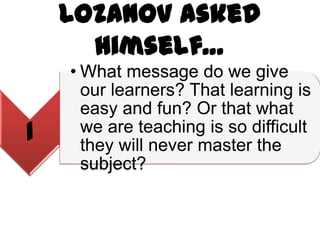
Lozanov asked
      himself…
    • What message do we give
      our learners? That learning is
      easy and fun? Or that what
1     we are teaching is so difficult
      they will never master the
      subject?
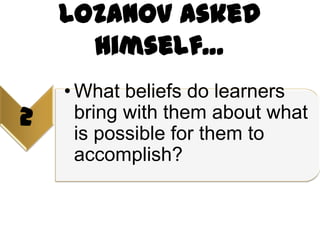
Lozanov asked
      himself…
    • What beliefs do learners
2     bring with them about what
      is possible for them to
      accomplish?
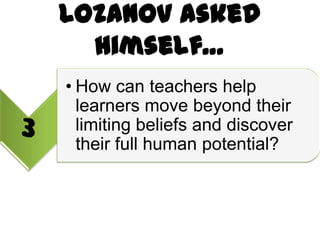
Lozanov asked
      himself…
    • How can teachers help
      learners move beyond their
3     limiting beliefs and discover
      their full human potential?
Concepts and Features
Mental Reserve Capacities (MRC)

We all possess considerable
 mental reserves which we
 rarely if ever tap under
 normal circumstances.
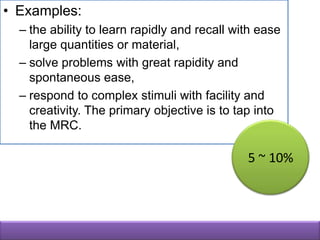
• Examples:
  – the ability to learn rapidly and recall with ease
    large quantities or material,
  – solve problems with great rapidity and
    spontaneous ease,
  – respond to complex stimuli with facility and
    creativity. The primary objective is to tap into
    the MRC.

                                              5 ~ 10%
Psychological Set-up
Our response to every stimuli is complex, involving
  unconscious processes which become automatic
  responses.
The responses tend to be automatic and typical for
  them - the result of an inner, unconscious
  disposition or set-up, which is the product of
  automatized, conditioned responses.
Our inner set-up operates when we encounter any
  situation - entering a school, consulting a
  physician- as examples.
Our unconscious set-up is extremely basic and
  important to our behaviour and to our
  survival –
and it can be extremely limiting, for it can
  imprison us in unconscious, consistently
  patterned responses which prevent us from
  experiencing and exploring other alternatives
- which might be far more desirable and
  beneficial to us.
Prevailing social norms, instilled in
 us by all our social institutions,
 including family and schools, are
 the main carriers and enforcers of
 the beliefs and responses which
 contribute to the formation of our
 inner set-up.
Only when a teacher or a doctor is able
 to penetrate the set-up, engage it in a
 way which allows it to be accepting
 and open to extensions and
 transformation does the real potential
 of a student/patient begin to open up.
Suggestion
• Suggestion is the direct to the
  set-up.
• Suggestion is the key which Lozanov
  found to penetrate through the “set-
  up” and stimulate the mental reserve
  capacities.
• Even more, through suggestion we can
  facilitate the creation of new, richer
  patterns of conscious/unconscious
  responses or new (set-ups).
• It creates and utilises such types of set-
  ups which would free and activate the
  reserve capacities of the human being
Suggestion
• DIRECT
• Direct suggestions are directed to conscious
  processes, i.e., what one says that can and will
  occur in the learning experience, suggestions
  which can be made in printed
  announcements, orally by the teacher, and/or
  by text materials.
Suggestion
• INDIRECT
• Indirect suggestion is largely unconsciously
  perceived.
• It is always present in any communication and
  involves many levels and degrees of subtlety.
• Lozanov speaks of it as the second plane of
  communication and considers it to encompass
  all those communication factors outside our
  conscious awareness
• Examples: voice tone, facial expression, body
  posture and movement, speech tempo,
  rhythms, accent, etc.
• Other important indirect suggestive effects
  result from room arrangement, decor, lighting,
  noise level, institutional setting - for all these
  factors are communicative stimuli
Anti-Suggestive Barriers
• The first task of suggestology and
  suggestopedia is to remove
  people‘s prior conditioning to de-
  suggest, to find the way to escape
  the social norm and open the way
  to development of the personality.
This is perhaps the greatest
 problem suggestology is
 confronted with, since the person
 must be ‗convinced‘ that his
 potential capacity is far above
 what he thinks it is.
The individual protects himself
 with psychological barriers,
 according to Dr. Lozanov, just
 as the organism protects itself
 from physiological barriers
mental
spiritual


            physical


Main Concern
Stages of Suggestopedia
1. Presentation

2. First Concert—―Active Concert‖

3. Second Concert—―Passive Review‖

4. Practice
Presentation
• A preparatory stage in which
  students are helped to relax and
  move into a positive frame of
  mind, with the feeling that the
  learning is going to be easy and
  fun.
First Concert–“Active Concert”
• This involves the active
  presentation of the material to be
  learnt. For example, in a foreign
  language course there might be
  the dramatic reading of a piece of
  text, accompanied by classical
  music.
Second Concert–“Passive
           Review”
• The students are now invited to relax
  and listen to some Baroque music,
  with the text being read very quietly in
  the background. The music is
  specially selected to bring the
  students into the optimum mental
  state for the effortless acquisition of
  the material.
Practice
• The use of a range of games,
  puzzles, etc. to review and
  consolidate the learning.
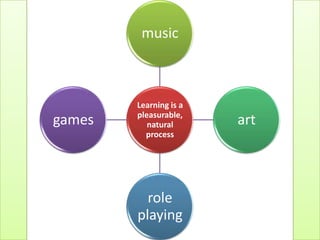
music


        Learning is a
        pleasurable,
games      natural      art
          process


          role
        playing
Learner Roles (Relaxer, True-
             Believer)
• Students volunteer for a
  suggestopedic course, but having
  volunteered, they are expected to be
  committed to the class and its
  activities.
• Students are expected to tolerate and
  in fact encourage their own
  ―infantilization.‖
Infantilization
• In the child's role that learner
  takes part in role playing, games,
  songs, and gymnastic exercises
  that help "the older student regain
  the self-confidence, spontaneity
  and receptivity of the child.
Learner Roles (Relaxer, True-
             Believer)
• Groups of learners are ideally socially
  homogeneous, 12 in number, and
  divided equally between men and
  women.
• Learners sit in a circle, which
  encourages face-to-face exchange
  and activity participation.
Teacher Roles (Auto-hypnotist,
        Authority Figure)
• To create situations in which
  learners are most suggestible
  and then to present linguistic
  material in a way most likely
  to encourage positive
  reception and retention by
  learners.
Teacher Roles (Auto-hypnotist,
       Authority Figure)
Lozanov lists several expected teacher
   behaviors as follows:

1. Show absolute confidence in the method.

2. Display fastidious conduct in manners and
    dress.

3. Organize properly, and strictly observe the
    initial stages of the teaching process—this
    includes choice and play of music, as well
    as punctuality.
Teacher Roles (Auto-hypnotist,
           Authority Figure)
4. Maintain a solemn attitude towards the
   session.

5. Give tests and respond tactfully to poor
   papers (if any).

6. Maintain a modest enthusiasm.
The role of instructional materials

• Materials consist of direct
  support materials, primarily
  text and tape, and indirect
  support materials, including
  classroom fixtures and music.
Suggestopedia apprentices use the
Learning Hypothesis
• I will learn because I was accepted
• I am now a native speaker, I can speak and
  understand the language
• I learned the text during the concert session, I know
  the language.
• The material is getting easier, I must be learning.
• I have successfully graduated from a language course,
  I can use the language.
What are the benefits of this
          approach?
• You will address the learning needs and
  styles of every student in your class.

• You will guarantee a higher and faster
  success rate among learners.

• You will increase retention and recall of
  material and long-term memory.
What are the benefits of this
          approach?
• You will instill higher confidence and self-
  esteem in your learners.

• You will promote the creativity as well as the
  learning and social competence of your
  students.

• You will create a pleasant, cooperative and
  fun learning environment in your classroom.
What are the benefits of this
         approach?
• You will have motivated students coming
  to your classes -- students who have
  rediscovered the joy of learning.

And --

• … motivated students make motivated
  teachers!!

Suggestopedia

  • 1.
    Well aware thatmethods directly involving yoga and hypnosis were not generally applicable or acceptable, he continued seeking universally acceptable means to tap the vast mental reserve capacities of the human mind we all have but which are rarely used. Suggestion proved to be the key.
  • 3.
    Suggestopedia Superlearning Brain Friendly Learning Accelerated Learning Georgi Lozanov
  • 4.
    Georgi Lozanov Born: July 22,1926; Died: May 6, 2012 Sofia, Bulgaria Medical doctor specialized in psychiatry and psychotherapy Had a passion for understanding how human beings learn Established the Suggestology Research Institute in Sofia to put his new system of teaching into practice
  • 5.
    Lozanov asked himself… • What message do we give our learners? That learning is easy and fun? Or that what 1 we are teaching is so difficult they will never master the subject?
  • 6.
    Lozanov asked himself… • What beliefs do learners 2 bring with them about what is possible for them to accomplish?
  • 7.
    Lozanov asked himself… • How can teachers help learners move beyond their 3 limiting beliefs and discover their full human potential?
  • 8.
  • 9.
    Mental Reserve Capacities(MRC) We all possess considerable mental reserves which we rarely if ever tap under normal circumstances.
  • 10.
    • Examples: – the ability to learn rapidly and recall with ease large quantities or material, – solve problems with great rapidity and spontaneous ease, – respond to complex stimuli with facility and creativity. The primary objective is to tap into the MRC. 5 ~ 10%
  • 11.
    Psychological Set-up Our responseto every stimuli is complex, involving unconscious processes which become automatic responses. The responses tend to be automatic and typical for them - the result of an inner, unconscious disposition or set-up, which is the product of automatized, conditioned responses. Our inner set-up operates when we encounter any situation - entering a school, consulting a physician- as examples.
  • 12.
    Our unconscious set-upis extremely basic and important to our behaviour and to our survival – and it can be extremely limiting, for it can imprison us in unconscious, consistently patterned responses which prevent us from experiencing and exploring other alternatives - which might be far more desirable and beneficial to us.
  • 13.
    Prevailing social norms,instilled in us by all our social institutions, including family and schools, are the main carriers and enforcers of the beliefs and responses which contribute to the formation of our inner set-up.
  • 14.
    Only when ateacher or a doctor is able to penetrate the set-up, engage it in a way which allows it to be accepting and open to extensions and transformation does the real potential of a student/patient begin to open up.
  • 15.
    Suggestion • Suggestion isthe direct to the set-up. • Suggestion is the key which Lozanov found to penetrate through the “set- up” and stimulate the mental reserve capacities.
  • 16.
    • Even more,through suggestion we can facilitate the creation of new, richer patterns of conscious/unconscious responses or new (set-ups). • It creates and utilises such types of set- ups which would free and activate the reserve capacities of the human being
  • 17.
    Suggestion • DIRECT • Directsuggestions are directed to conscious processes, i.e., what one says that can and will occur in the learning experience, suggestions which can be made in printed announcements, orally by the teacher, and/or by text materials.
  • 18.
    Suggestion • INDIRECT • Indirectsuggestion is largely unconsciously perceived. • It is always present in any communication and involves many levels and degrees of subtlety. • Lozanov speaks of it as the second plane of communication and considers it to encompass all those communication factors outside our conscious awareness
  • 19.
    • Examples: voicetone, facial expression, body posture and movement, speech tempo, rhythms, accent, etc. • Other important indirect suggestive effects result from room arrangement, decor, lighting, noise level, institutional setting - for all these factors are communicative stimuli
  • 20.
    Anti-Suggestive Barriers • Thefirst task of suggestology and suggestopedia is to remove people‘s prior conditioning to de- suggest, to find the way to escape the social norm and open the way to development of the personality.
  • 21.
    This is perhapsthe greatest problem suggestology is confronted with, since the person must be ‗convinced‘ that his potential capacity is far above what he thinks it is.
  • 22.
    The individual protectshimself with psychological barriers, according to Dr. Lozanov, just as the organism protects itself from physiological barriers
  • 23.
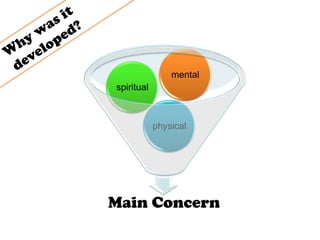
    mental spiritual physical Main Concern
  • 24.
    Stages of Suggestopedia 1.Presentation 2. First Concert—―Active Concert‖ 3. Second Concert—―Passive Review‖ 4. Practice
  • 25.
    Presentation • A preparatorystage in which students are helped to relax and move into a positive frame of mind, with the feeling that the learning is going to be easy and fun.
  • 26.
    First Concert–“Active Concert” •This involves the active presentation of the material to be learnt. For example, in a foreign language course there might be the dramatic reading of a piece of text, accompanied by classical music.
  • 27.
    Second Concert–“Passive Review” • The students are now invited to relax and listen to some Baroque music, with the text being read very quietly in the background. The music is specially selected to bring the students into the optimum mental state for the effortless acquisition of the material.
  • 28.
    Practice • The useof a range of games, puzzles, etc. to review and consolidate the learning.
  • 29.
    music Learning is a pleasurable, games natural art process role playing
  • 30.
    Learner Roles (Relaxer,True- Believer) • Students volunteer for a suggestopedic course, but having volunteered, they are expected to be committed to the class and its activities. • Students are expected to tolerate and in fact encourage their own ―infantilization.‖
  • 31.
    Infantilization • In thechild's role that learner takes part in role playing, games, songs, and gymnastic exercises that help "the older student regain the self-confidence, spontaneity and receptivity of the child.
  • 32.
    Learner Roles (Relaxer,True- Believer) • Groups of learners are ideally socially homogeneous, 12 in number, and divided equally between men and women. • Learners sit in a circle, which encourages face-to-face exchange and activity participation.
  • 33.
    Teacher Roles (Auto-hypnotist, Authority Figure) • To create situations in which learners are most suggestible and then to present linguistic material in a way most likely to encourage positive reception and retention by learners.
  • 34.
    Teacher Roles (Auto-hypnotist, Authority Figure) Lozanov lists several expected teacher behaviors as follows: 1. Show absolute confidence in the method. 2. Display fastidious conduct in manners and dress. 3. Organize properly, and strictly observe the initial stages of the teaching process—this includes choice and play of music, as well as punctuality.
  • 35.
    Teacher Roles (Auto-hypnotist, Authority Figure) 4. Maintain a solemn attitude towards the session. 5. Give tests and respond tactfully to poor papers (if any). 6. Maintain a modest enthusiasm.
  • 36.
    The role ofinstructional materials • Materials consist of direct support materials, primarily text and tape, and indirect support materials, including classroom fixtures and music.
  • 37.
    Suggestopedia apprentices usethe Learning Hypothesis • I will learn because I was accepted • I am now a native speaker, I can speak and understand the language • I learned the text during the concert session, I know the language. • The material is getting easier, I must be learning. • I have successfully graduated from a language course, I can use the language.
  • 38.
    What are thebenefits of this approach? • You will address the learning needs and styles of every student in your class. • You will guarantee a higher and faster success rate among learners. • You will increase retention and recall of material and long-term memory.
  • 39.
    What are thebenefits of this approach? • You will instill higher confidence and self- esteem in your learners. • You will promote the creativity as well as the learning and social competence of your students. • You will create a pleasant, cooperative and fun learning environment in your classroom.
  • 40.
    What are thebenefits of this approach? • You will have motivated students coming to your classes -- students who have rediscovered the joy of learning. And -- • … motivated students make motivated teachers!!