1
2
1. INTRODUCTION
Sugarcane is a vegetatively propagated crop. Belongs to family Saccharum. The word
"Saccharam" derived from Sanskrit word 'sarkara' which means sugar. Sugarcane is the main
source of producing sugar in Nepal.Of the world's total production of sugar sugarcane contributed
around 60%. Nepal ranked in 41st position in sugarcane production.
Manual planting of multibud setts (MBS) is the traditional planting material used in the planting
of commercial nurseries and production fields. To minimize the risk of gaps in the resultant stand,
manual planting rates are high (15–21 buds/meter), corresponding to 11–14 tonnes (T) of planting
material/hectare (ha). With mechanized planting, the amount of planting material used is even
larger, reaching levels greater than 20 T/ha. Sugarcane production costs have increased due to
increased labor and agricultural input costs, with the cost of planting material accounting for
almost 25% of operational production costs [1]. The large quantity of planting material required
in traditional planting systems also leads to problems with logistics, storage, and loss of bud
viability.
New planting systems have been developed to overcome some of the disadvantages of traditional
methods. The presprouted seedling (MPB) planting system allows for a reduction in the quantity
of planting material and better control of seedling vigor [2–6]. Another planting system (Plene™)
developed by Syngenta uses 5 cm, single-bud setts (SBS) treated with a pesticidal slurry [7]. Bud
chips are also a promising alternative for reduction of sugarcane production costs, although
improvement of survival rates and plant vigor under field conditions is needed [8].
2. STATEMENT OF PROBLEM
Sugarcane is a major cash crop and contributes 2.1% in AGDP of Nepal. Nepalese sugarcane
production contributes less than 1% among SAARC countries and ranks 41st position among
global sugarcane production status. Per capita consumption of sugar in Nepal is 8 kg/year and the
annual production of the sugar contributes 60% of total national demand. Average recovery
3
percentage of sugar in Nepal is very less (8.83%) as compared to other major producer countries.
Very limited research activities on varietal development and technology enhancement in sugarcane
has been done by Nepal Agricultural Research Council. Policy intervention of government to
promote sugarcane are mainly limited to cash subsidy to the farmers, simple technology extension
services, fixation of minimum procurement price and farm facilitation. There is an absence of
dedicated sugarcane development organization in present context. Delay payment to the
farmers,traditional technologies, lack of high yielding varieties and poor access of farmers to the
agriculture loan and insurance are found as major challengesof sugarcane production in Nepal.
3. RATIONALE OF THE STUDY (JUSTIFICATION)
The present research eventually helps in identifying the best planting method and agronomical
practices for sugarcane to promote sugarcane higher production and productivity. This research
will enable the farmers to obtain high yields by adopting effective planting and agronomical
practices. So, there is a greater scope for studying the effect of planting method and agronomical
practices in boosting sugarcane production and productivity in Nepal.
4. OBJECTIVE
4.1. General objective
 To increase the productivity and profitability of Sugarcane by using appropriate
Planting methods and agronomical practices.
4.2. Specific objectives
 To assess the growth, yield attributing characters and yield of Sugarcane under different
planting method and agronomical practices.
 To find out the effectiveness of appropriate planting method and agronomical practices in
Sugarcane production and evaluate the profitability of adopted planting method.
 To find out the yield gap of maize under different Planting method and agronomical
practices.
5. HYPOTHESIS
4
 Null Hypothesis (Ho): There is no significance difference on growth and yields of Sugarcane
under the different Planting method and agronomical practices.
 Alternate Hypothesis (H1): There is significance difference on growth and yields of Sugarcane
under the different Planting method and agronomical practices.
6. REVIEW OF LITERATURE
There are multiple methods to plant sugarcane. But main distinction can be divided into two
categories, of which the first comprises of taking the sugarcane stalk, cutting 4 eyes per sugarcane
stalk, and subsequently, planting them on the ground horizontally. As a side note, a sugarcane stalk
contains eyes of which the roots grow out of it for propagation. (Lakshmanan et al., 2005)
The second and more modern method is by using a special tool named bud chip scooping machine,
of which its functions are to remove the bud chip from a sugarcane stem by means of scooping; as
can be indicated by the name of the tool. According to a study in 2010 by Indian researchers, bud
chips are able to reduce the overall weight of the stalk by approximately 80%. (Jain et al., 2010)
Reduced overall weight of stalk can allow a sugarcane planter to carry more stalks. Nonetheless,
scooping bud chips, if performed incorrectly can cause damage to the sugarcane’s bud. The studies
regarding the damage of sugarcane bud chip in crop produce requires additional research.To further
improve the efficacy of the aforementioned bud chip scooping, a special toolset needs to be used, on
top of the soaking of the bud chip in ethephon (2-chloroethylphosphonic acid) @ 100 mg l-1 or
calcium chloride (0.1%) can increase the sprouting of bud chips. (Jain et al., 2010)
In a 2007 data collection and analysis research paper on the sugarcane species Saccharum
Officinarum L. by the Department of Agronomy, Pakistan, over the span of two years, showed that
increasing the planting distance between this species of sugarcane from 60 cm trenches to 120 cm
trenches had an average 5.5% increase in sugarcane height. (Chattha, Ali and Bilal, 2007)
7. MATERIALS AND METHODS
7.1 Site Selection:
5
The experiment conducted in the farm of local farmer located at Lamahi municipality of Dang
district of lumbini province .Geographically it is located at 27.97 N latitude and 82.48E longitude
at elevation of about 725m.
The soil type is sandy loam and climatically humid sub-tropical with average annual rainfall of
2000 mm (mainly during mid to late summer).
7.2 Soil sampling and analysis of initial fertility status of soil
Soil sample from researchfield will be taken before sowing of the seeds from each replication and
composite sample will be made and analyzed for the initial fertility status of the soil. The soil
samples will be taken by tube auger from 0 – 15 cm and 0 – 30 cm depth of soil layer. The samples
will be subjected to air drying under room condition, grounded and passed through 0.2 mm sieve
for analysis of
 Organic matter content, Organic carbon content, Total N content
 Available P2O5, Available K2O content Soil pH
The estimation of N will be carried out by Alkaline permanganate (Steam Distillation method),
P2O5 by Spectrophotometer and K2O by Flame Photometer method.
Survey of the experimental site, soil sampling and initial fertility evaluation will be done.
7.3 Weather data during the crop season
Monthly average maximum temperature, Monthly average minimum temperature
 Monthly average rainfall, Monthly average solar radiation
These data will be recorded from nearest point of Agro Meteorological Data Recorder.
7.4 Experimental setup
Design: Randomized Complete Block Design (RCBD) (one factorial)
Treatments: Total 7 treatments [seven different dose of N: P: K(government recommended dose,
NARC recommended dose, dose according to nutrient expert model, dose according to farmer
field practice, N according to leaf color chart (LCC) + P & K according to farmer field practice, N
6
according to leaf color chart (LCC) + P & K according to nutrient expert and N control + P & K
according to nutrient expert.]
Replication: Four, Plot size: 5×3 m2
The space between the block = 1m, Space between the treatments =0.5m.
The net area for cultivation = 420 m2 The gross area = 592 m2 (1.7 kattha)
Plants per plot: 95, Total no of plots: 28
Spacing: 60 cm ×25 cm between row to row and plant to plant respectively.
No of rows and columns: 5 rows and 7 columns
Treatment combination
Treatment Notation Treatment Combination
T1 Government recommendation (GR) 60:30:30 NPK kg/ha
T2 NARC recommendation (NARC) 180:60:40 NPK kg/ha
T3 Nutrient expert dose (NE) 110:27:33 NPK kg/ha
T4 Farmer field practice (FFP) Nutrient applied as farmer’s dose
and practice
T5 LCC (N) +FFP (P&K) N (LCC) +PK (FFP)
T6 LCC (N) + NE (P&K) N (LCC) + 27:33 PK kg/ha
T7 Control N control+ NE (P&K)
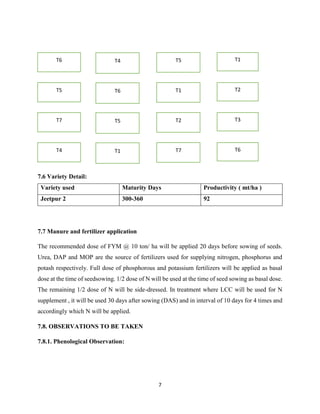
7.5 Field layout
Block 1 Block 2 Block 3 Block 4
T1
T2 T3 T4
T3 T7 T4 T5
T2 T3 T6 T7
7
7.6 Variety Detail:
Variety used Maturity Days Productivity ( mt/ha )
Jeetpur 2 300-360 92
7.7 Manure and fertilizer application
The recommended dose of FYM @ 10 ton/ ha will be applied 20 days before sowing of seeds.
Urea, DAP and MOP are the source of fertilizers used for supplying nitrogen, phosphorus and
potash respectively. Full dose of phosphorous and potassium fertilizers will be applied as basal
dose at the time of seedsowing. 1/2 dose of N will be used at the time of seed sowing as basal dose.
The remaining 1/2 dose of N will be side-dressed. In treatment where LCC will be used for N
supplement , it will be used 30 days after sowing (DAS) and in interval of 10 days for 4 times and
accordingly which N will be applied.
7.8. OBSERVATIONS TO BE TAKEN
7.8.1. Phenological Observation:
T6 T4 T5 T1
T5 T6 T1 T2
T7 T5 T2 T3
T4 T1 T7 T6
8
Five plants will be tagged for taking phenological observations. The phenological data will be
taken when 50% observation occurred and ended when 75% observation completed. The
phenological observations will be recorded as;
7.8.2 Emergence: Seed emergence will be recorded when about 50% of the seedling will have
emerged out of the soil.
7.8.3 Plant population/m2: The plant population/m2
will be counted about 20 days after sowing.
7.8.4 Days of tillering : The date of tillering will be recorded from tiller emergence to 75% of
plant will have tillered in each plot. The mid 3 rows will be taken for each phenological
observation.
7.8.5 Days of physiological maturity: The appearance of black layer between ear surface and ear
grains and occurrence of senescence of ear husks will be considered as an indication to
physiological maturity.
7.8.6 Biometric observation
7.8.6.1 Plant Height: Measuring the height of the sugarcane plants will helps determine their
growth rate and overall health.
7.8.6.2 Number of Leaves: Counting the number of leaves per plant will provides insights into
the plant's vigor and potential productivity.
7.8.6.3 Leaf Length and Width: Measuring the dimensions of individual leaves will helps assess
their health and vitality.
7.8.6.4 Stalk Diameter: Measuring the diameter of sugarcane stalks will indicates the plant's
maturity and potential sugar content.
9
7.8.6.5 Number of Internodes: Counting the internodes (segments) on each sugarcane stalk will
aids in determining the growth stage and identifying any abnormalities.
7.8.6.6 Number of Tillers: Counting the tillers (side shoots) per plant will helps estimate tillering
ability and potential yield.
7.8.6.7 Brix Measurement: Brix is a measurement of sugar content. Testing the sugarcane juice
for Brix levels will helps determine its potential for sugar production.
7.8.8 Yield attributing characters
7.8.7.1 Height of millable cane: The millable cane height (cm) will be measured in harvested,
detopped cane from the basal end up to the top end. The millable cane height will be recorded from
the randomly selected 25 canes and average values
7.8.7.2 No. of internodes per cane: The total numbers of internodes per cane will be counted
from randomly selected 25 canes and average values were recorded.
7.8.7.3. Weight of cane: Weight of randomly selected 25 millable canes will be measured by using
spring balance and mean values were recorded.
7.8.7.4. Analysis of juice quality: The randomly selected 25 millable canes after harvesting will
be crushed to obtain the juice. The juice will be analyzed in laboratory for brix %, pol % (sucrose
percent juice), CCS % and purity %, by using the method approved by the ICUMSA.Brix percent
and pol percent of juice will be calculated by using the Schmitz’s table and CCS percent will be
calculated with the help of corrected brix percent and pol percent values by using the following
formula.
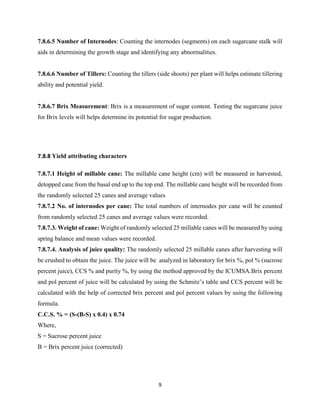
C.C.S. % = (S-(B-S) x 0.4) x 0.74
Where,
S = Sucrose percent juice
B = Brix percent juice (corrected)
10
0.4 = multiplication factor
0.74 = crusher factor
7.8 Economic analysis:
7.8.1 Cost of cultivation:
Cost of cultivation will be calculated on the basis of local charges for different agro-inputs viz.,
labor, fertilizer, insecticides and other necessary materials.
7.8.2 Gross return:
Economic yield (grain + stalk) will be converted into gross return (Rs/ha) on the basis of local
market prices of different commodities.
7.8.3 Net return
It will be calculated by deducting the cost of cultivation from the gross return.
Net return = Gross return – Cost of cultivation
7.8.4 B: C ratio: It will be calculated by following formula.
Benefit: Cost ratio = Gross return / Cost of cultivation (total cost)
7.9 STATISTICS ANALYSIS
Analysis for the variance for all parameters will be analyzed by using RSTAT statistical analysis
system. All the analyzed data will be subjected to DMRT for mean comparison. 5% level of
significance will be considered for ANOVA. Correlation and regression will be done for group
comparison from the reference of Gomez and Gomez (1984).
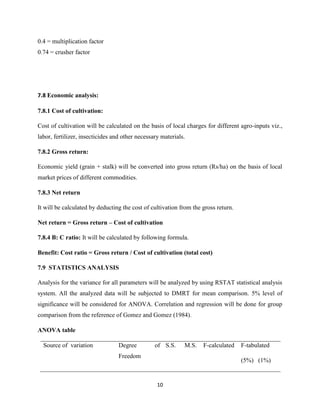
ANOVA table
Source of variation Degree of
Freedom
S.S. M.S. F-calculated F-tabulated
(5%) (1%)
11
Replication
Treatments
Error
r-1 = 3
t-1 = 6
(r-1) (t-1) = 18
Total rt-1 = 27
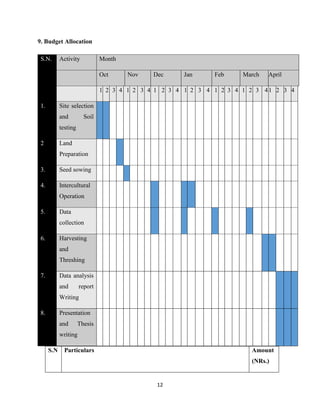
8. WORK SCHEDULE
12
9. Budget Allocation
S.N Particulars Amount
(NRs.)
S.N. Activity Month
Oct Nov Dec Jan Feb March April
1 2 3 4 1 2 3 4 1 2 3 4 1 2 3 4 1 2 3 4 1 2 3 41 2 3 4
1. Site selection
and Soil
testing
2 Land
Preparation
3. Seed sowing
4. Intercultural
Operation
5. Data
collection
6. Harvesting
and
Threshing
7. Data analysis
and report
Writing
8. Presentation
and Thesis
writing
13
1 Land Preparation 5000
2 Soil sample analysis 3000
3 Field layout 1500
4 Plastic rope, tags, tape, poly bags 2500
5 Manure and Fertilizers 8000
6 Seed and seed sowing 5000
7 Intercultural operations 10,000
8 Insecticides and Spray 2000
9 Measurement of growth parameters and yield attributing characters 7000
10 Data entry and analysis 5000
11 Stationary, Photocopies, printing, etc. 9000
12 Harvesting and Threshing 10,000
13 Drafts and thesis 20,000
Sub total 88,000
Contingency (10%) 8800
Total 96,800
10. EXPECTED OUTPUT
 Appropriate Planting method and Agronomical practices for maximizing the growth and
yield of Sugarcane will be assessed.
14
 Increase productivity and profitability of Sugarcane will be assessed.
11. BENEFICIARIES
 Primary beneficiary will be Sugarcane growers.
 Secondary beneficiary will be the researchers, students and organizations working in this
area.
 Tertiary beneficiary will be Sugarcane consumer and businessman.
12. RISK AND ASSUMPTION
 Farmers will adopt the generated technology.
 All the basic inputs will be available as per time, quantity and quality.
 Crop season will be normal for sugarcane.
13. References
Bajelan, B. and Nazir, N.S. (1993).Effect of fertility variation and planting pattern
on growth, yield and quality of sugarcane.
International Journal of Tropical Agriculture 11: 249–254.
Bell, M.J and Garside, A.L.(2005). Shoot and stalk dynamics and the yield of
sugarcane crops in tropical and subtropical
Queensland, Australia. Field Crop Research 92: 231-248
Bhullar, M.S., Saini, L.K., Kapur, M.L. and Singh, S. (2002). Effect of Method and
Density of Planting on Growth and Yield of Late Planted Sugarcane. Sugar Tech
4(3&4): 181 - 184.
Bhullar, M.S., Thind, K.S., Uppal, S.K. and Singh, K. (2008).
15
Productivity,profitability and quality of sugarcane( Saccharumsp.) plant-ratoon
system in relation to planting methods and seeding rate. Indian Journal of Agronomy
53(3): 195-199
Bull, T. (2000).The Sugarcane Plant. In: Mannual of cane growing . M. Hogarth; P.
Alsopp eds. Bureau of Sugarcane Exp.Station. Indoorapilly, Asustria pp. 77-83
Chattha, U.M., Ali, Asgar and Bilal, M ( 2007). Influnce of planting techniques on
growth and yield of spring planted
sugarcane (Saccharum officinarum) Pakistan Journal of Agricultural Sciences
44(3): 452-56.
Cheeroo-Naymuth, F.C., Robertson, M.J., Wegener, M.K and Nayamuth, A.R.H.(
2000).Using a simulation model to assess
potential and attainable cane yield in Mauritius. Field crop Research 66: 225-243

Sugarcane_Proposal_(Rbn).docx

  • 1.
  • 2.
    2 1. INTRODUCTION Sugarcane isa vegetatively propagated crop. Belongs to family Saccharum. The word "Saccharam" derived from Sanskrit word 'sarkara' which means sugar. Sugarcane is the main source of producing sugar in Nepal.Of the world's total production of sugar sugarcane contributed around 60%. Nepal ranked in 41st position in sugarcane production. Manual planting of multibud setts (MBS) is the traditional planting material used in the planting of commercial nurseries and production fields. To minimize the risk of gaps in the resultant stand, manual planting rates are high (15–21 buds/meter), corresponding to 11–14 tonnes (T) of planting material/hectare (ha). With mechanized planting, the amount of planting material used is even larger, reaching levels greater than 20 T/ha. Sugarcane production costs have increased due to increased labor and agricultural input costs, with the cost of planting material accounting for almost 25% of operational production costs [1]. The large quantity of planting material required in traditional planting systems also leads to problems with logistics, storage, and loss of bud viability. New planting systems have been developed to overcome some of the disadvantages of traditional methods. The presprouted seedling (MPB) planting system allows for a reduction in the quantity of planting material and better control of seedling vigor [2–6]. Another planting system (Plene™) developed by Syngenta uses 5 cm, single-bud setts (SBS) treated with a pesticidal slurry [7]. Bud chips are also a promising alternative for reduction of sugarcane production costs, although improvement of survival rates and plant vigor under field conditions is needed [8]. 2. STATEMENT OF PROBLEM Sugarcane is a major cash crop and contributes 2.1% in AGDP of Nepal. Nepalese sugarcane production contributes less than 1% among SAARC countries and ranks 41st position among global sugarcane production status. Per capita consumption of sugar in Nepal is 8 kg/year and the annual production of the sugar contributes 60% of total national demand. Average recovery
  • 3.
    3 percentage of sugarin Nepal is very less (8.83%) as compared to other major producer countries. Very limited research activities on varietal development and technology enhancement in sugarcane has been done by Nepal Agricultural Research Council. Policy intervention of government to promote sugarcane are mainly limited to cash subsidy to the farmers, simple technology extension services, fixation of minimum procurement price and farm facilitation. There is an absence of dedicated sugarcane development organization in present context. Delay payment to the farmers,traditional technologies, lack of high yielding varieties and poor access of farmers to the agriculture loan and insurance are found as major challengesof sugarcane production in Nepal. 3. RATIONALE OF THE STUDY (JUSTIFICATION) The present research eventually helps in identifying the best planting method and agronomical practices for sugarcane to promote sugarcane higher production and productivity. This research will enable the farmers to obtain high yields by adopting effective planting and agronomical practices. So, there is a greater scope for studying the effect of planting method and agronomical practices in boosting sugarcane production and productivity in Nepal. 4. OBJECTIVE 4.1. General objective  To increase the productivity and profitability of Sugarcane by using appropriate Planting methods and agronomical practices. 4.2. Specific objectives  To assess the growth, yield attributing characters and yield of Sugarcane under different planting method and agronomical practices.  To find out the effectiveness of appropriate planting method and agronomical practices in Sugarcane production and evaluate the profitability of adopted planting method.  To find out the yield gap of maize under different Planting method and agronomical practices. 5. HYPOTHESIS
  • 4.
    4  Null Hypothesis(Ho): There is no significance difference on growth and yields of Sugarcane under the different Planting method and agronomical practices.  Alternate Hypothesis (H1): There is significance difference on growth and yields of Sugarcane under the different Planting method and agronomical practices. 6. REVIEW OF LITERATURE There are multiple methods to plant sugarcane. But main distinction can be divided into two categories, of which the first comprises of taking the sugarcane stalk, cutting 4 eyes per sugarcane stalk, and subsequently, planting them on the ground horizontally. As a side note, a sugarcane stalk contains eyes of which the roots grow out of it for propagation. (Lakshmanan et al., 2005) The second and more modern method is by using a special tool named bud chip scooping machine, of which its functions are to remove the bud chip from a sugarcane stem by means of scooping; as can be indicated by the name of the tool. According to a study in 2010 by Indian researchers, bud chips are able to reduce the overall weight of the stalk by approximately 80%. (Jain et al., 2010) Reduced overall weight of stalk can allow a sugarcane planter to carry more stalks. Nonetheless, scooping bud chips, if performed incorrectly can cause damage to the sugarcane’s bud. The studies regarding the damage of sugarcane bud chip in crop produce requires additional research.To further improve the efficacy of the aforementioned bud chip scooping, a special toolset needs to be used, on top of the soaking of the bud chip in ethephon (2-chloroethylphosphonic acid) @ 100 mg l-1 or calcium chloride (0.1%) can increase the sprouting of bud chips. (Jain et al., 2010) In a 2007 data collection and analysis research paper on the sugarcane species Saccharum Officinarum L. by the Department of Agronomy, Pakistan, over the span of two years, showed that increasing the planting distance between this species of sugarcane from 60 cm trenches to 120 cm trenches had an average 5.5% increase in sugarcane height. (Chattha, Ali and Bilal, 2007) 7. MATERIALS AND METHODS 7.1 Site Selection:
  • 5.
    5 The experiment conductedin the farm of local farmer located at Lamahi municipality of Dang district of lumbini province .Geographically it is located at 27.97 N latitude and 82.48E longitude at elevation of about 725m. The soil type is sandy loam and climatically humid sub-tropical with average annual rainfall of 2000 mm (mainly during mid to late summer). 7.2 Soil sampling and analysis of initial fertility status of soil Soil sample from researchfield will be taken before sowing of the seeds from each replication and composite sample will be made and analyzed for the initial fertility status of the soil. The soil samples will be taken by tube auger from 0 – 15 cm and 0 – 30 cm depth of soil layer. The samples will be subjected to air drying under room condition, grounded and passed through 0.2 mm sieve for analysis of  Organic matter content, Organic carbon content, Total N content  Available P2O5, Available K2O content Soil pH The estimation of N will be carried out by Alkaline permanganate (Steam Distillation method), P2O5 by Spectrophotometer and K2O by Flame Photometer method. Survey of the experimental site, soil sampling and initial fertility evaluation will be done. 7.3 Weather data during the crop season Monthly average maximum temperature, Monthly average minimum temperature  Monthly average rainfall, Monthly average solar radiation These data will be recorded from nearest point of Agro Meteorological Data Recorder. 7.4 Experimental setup Design: Randomized Complete Block Design (RCBD) (one factorial) Treatments: Total 7 treatments [seven different dose of N: P: K(government recommended dose, NARC recommended dose, dose according to nutrient expert model, dose according to farmer field practice, N according to leaf color chart (LCC) + P & K according to farmer field practice, N
  • 6.
    6 according to leafcolor chart (LCC) + P & K according to nutrient expert and N control + P & K according to nutrient expert.] Replication: Four, Plot size: 5×3 m2 The space between the block = 1m, Space between the treatments =0.5m. The net area for cultivation = 420 m2 The gross area = 592 m2 (1.7 kattha) Plants per plot: 95, Total no of plots: 28 Spacing: 60 cm ×25 cm between row to row and plant to plant respectively. No of rows and columns: 5 rows and 7 columns Treatment combination Treatment Notation Treatment Combination T1 Government recommendation (GR) 60:30:30 NPK kg/ha T2 NARC recommendation (NARC) 180:60:40 NPK kg/ha T3 Nutrient expert dose (NE) 110:27:33 NPK kg/ha T4 Farmer field practice (FFP) Nutrient applied as farmer’s dose and practice T5 LCC (N) +FFP (P&K) N (LCC) +PK (FFP) T6 LCC (N) + NE (P&K) N (LCC) + 27:33 PK kg/ha T7 Control N control+ NE (P&K) 7.5 Field layout Block 1 Block 2 Block 3 Block 4 T1 T2 T3 T4 T3 T7 T4 T5 T2 T3 T6 T7
  • 7.
    7 7.6 Variety Detail: Varietyused Maturity Days Productivity ( mt/ha ) Jeetpur 2 300-360 92 7.7 Manure and fertilizer application The recommended dose of FYM @ 10 ton/ ha will be applied 20 days before sowing of seeds. Urea, DAP and MOP are the source of fertilizers used for supplying nitrogen, phosphorus and potash respectively. Full dose of phosphorous and potassium fertilizers will be applied as basal dose at the time of seedsowing. 1/2 dose of N will be used at the time of seed sowing as basal dose. The remaining 1/2 dose of N will be side-dressed. In treatment where LCC will be used for N supplement , it will be used 30 days after sowing (DAS) and in interval of 10 days for 4 times and accordingly which N will be applied. 7.8. OBSERVATIONS TO BE TAKEN 7.8.1. Phenological Observation: T6 T4 T5 T1 T5 T6 T1 T2 T7 T5 T2 T3 T4 T1 T7 T6
  • 8.
    8 Five plants willbe tagged for taking phenological observations. The phenological data will be taken when 50% observation occurred and ended when 75% observation completed. The phenological observations will be recorded as; 7.8.2 Emergence: Seed emergence will be recorded when about 50% of the seedling will have emerged out of the soil. 7.8.3 Plant population/m2: The plant population/m2 will be counted about 20 days after sowing. 7.8.4 Days of tillering : The date of tillering will be recorded from tiller emergence to 75% of plant will have tillered in each plot. The mid 3 rows will be taken for each phenological observation. 7.8.5 Days of physiological maturity: The appearance of black layer between ear surface and ear grains and occurrence of senescence of ear husks will be considered as an indication to physiological maturity. 7.8.6 Biometric observation 7.8.6.1 Plant Height: Measuring the height of the sugarcane plants will helps determine their growth rate and overall health. 7.8.6.2 Number of Leaves: Counting the number of leaves per plant will provides insights into the plant's vigor and potential productivity. 7.8.6.3 Leaf Length and Width: Measuring the dimensions of individual leaves will helps assess their health and vitality. 7.8.6.4 Stalk Diameter: Measuring the diameter of sugarcane stalks will indicates the plant's maturity and potential sugar content.
  • 9.
    9 7.8.6.5 Number ofInternodes: Counting the internodes (segments) on each sugarcane stalk will aids in determining the growth stage and identifying any abnormalities. 7.8.6.6 Number of Tillers: Counting the tillers (side shoots) per plant will helps estimate tillering ability and potential yield. 7.8.6.7 Brix Measurement: Brix is a measurement of sugar content. Testing the sugarcane juice for Brix levels will helps determine its potential for sugar production. 7.8.8 Yield attributing characters 7.8.7.1 Height of millable cane: The millable cane height (cm) will be measured in harvested, detopped cane from the basal end up to the top end. The millable cane height will be recorded from the randomly selected 25 canes and average values 7.8.7.2 No. of internodes per cane: The total numbers of internodes per cane will be counted from randomly selected 25 canes and average values were recorded. 7.8.7.3. Weight of cane: Weight of randomly selected 25 millable canes will be measured by using spring balance and mean values were recorded. 7.8.7.4. Analysis of juice quality: The randomly selected 25 millable canes after harvesting will be crushed to obtain the juice. The juice will be analyzed in laboratory for brix %, pol % (sucrose percent juice), CCS % and purity %, by using the method approved by the ICUMSA.Brix percent and pol percent of juice will be calculated by using the Schmitz’s table and CCS percent will be calculated with the help of corrected brix percent and pol percent values by using the following formula. C.C.S. % = (S-(B-S) x 0.4) x 0.74 Where, S = Sucrose percent juice B = Brix percent juice (corrected)
  • 10.
    10 0.4 = multiplicationfactor 0.74 = crusher factor 7.8 Economic analysis: 7.8.1 Cost of cultivation: Cost of cultivation will be calculated on the basis of local charges for different agro-inputs viz., labor, fertilizer, insecticides and other necessary materials. 7.8.2 Gross return: Economic yield (grain + stalk) will be converted into gross return (Rs/ha) on the basis of local market prices of different commodities. 7.8.3 Net return It will be calculated by deducting the cost of cultivation from the gross return. Net return = Gross return – Cost of cultivation 7.8.4 B: C ratio: It will be calculated by following formula. Benefit: Cost ratio = Gross return / Cost of cultivation (total cost) 7.9 STATISTICS ANALYSIS Analysis for the variance for all parameters will be analyzed by using RSTAT statistical analysis system. All the analyzed data will be subjected to DMRT for mean comparison. 5% level of significance will be considered for ANOVA. Correlation and regression will be done for group comparison from the reference of Gomez and Gomez (1984). ANOVA table Source of variation Degree of Freedom S.S. M.S. F-calculated F-tabulated (5%) (1%)
  • 11.
    11 Replication Treatments Error r-1 = 3 t-1= 6 (r-1) (t-1) = 18 Total rt-1 = 27 8. WORK SCHEDULE
  • 12.
    12 9. Budget Allocation S.NParticulars Amount (NRs.) S.N. Activity Month Oct Nov Dec Jan Feb March April 1 2 3 4 1 2 3 4 1 2 3 4 1 2 3 4 1 2 3 4 1 2 3 41 2 3 4 1. Site selection and Soil testing 2 Land Preparation 3. Seed sowing 4. Intercultural Operation 5. Data collection 6. Harvesting and Threshing 7. Data analysis and report Writing 8. Presentation and Thesis writing
  • 13.
    13 1 Land Preparation5000 2 Soil sample analysis 3000 3 Field layout 1500 4 Plastic rope, tags, tape, poly bags 2500 5 Manure and Fertilizers 8000 6 Seed and seed sowing 5000 7 Intercultural operations 10,000 8 Insecticides and Spray 2000 9 Measurement of growth parameters and yield attributing characters 7000 10 Data entry and analysis 5000 11 Stationary, Photocopies, printing, etc. 9000 12 Harvesting and Threshing 10,000 13 Drafts and thesis 20,000 Sub total 88,000 Contingency (10%) 8800 Total 96,800 10. EXPECTED OUTPUT  Appropriate Planting method and Agronomical practices for maximizing the growth and yield of Sugarcane will be assessed.
  • 14.
    14  Increase productivityand profitability of Sugarcane will be assessed. 11. BENEFICIARIES  Primary beneficiary will be Sugarcane growers.  Secondary beneficiary will be the researchers, students and organizations working in this area.  Tertiary beneficiary will be Sugarcane consumer and businessman. 12. RISK AND ASSUMPTION  Farmers will adopt the generated technology.  All the basic inputs will be available as per time, quantity and quality.  Crop season will be normal for sugarcane. 13. References Bajelan, B. and Nazir, N.S. (1993).Effect of fertility variation and planting pattern on growth, yield and quality of sugarcane. International Journal of Tropical Agriculture 11: 249–254. Bell, M.J and Garside, A.L.(2005). Shoot and stalk dynamics and the yield of sugarcane crops in tropical and subtropical Queensland, Australia. Field Crop Research 92: 231-248 Bhullar, M.S., Saini, L.K., Kapur, M.L. and Singh, S. (2002). Effect of Method and Density of Planting on Growth and Yield of Late Planted Sugarcane. Sugar Tech 4(3&4): 181 - 184. Bhullar, M.S., Thind, K.S., Uppal, S.K. and Singh, K. (2008).
  • 15.
    15 Productivity,profitability and qualityof sugarcane( Saccharumsp.) plant-ratoon system in relation to planting methods and seeding rate. Indian Journal of Agronomy 53(3): 195-199 Bull, T. (2000).The Sugarcane Plant. In: Mannual of cane growing . M. Hogarth; P. Alsopp eds. Bureau of Sugarcane Exp.Station. Indoorapilly, Asustria pp. 77-83 Chattha, U.M., Ali, Asgar and Bilal, M ( 2007). Influnce of planting techniques on growth and yield of spring planted sugarcane (Saccharum officinarum) Pakistan Journal of Agricultural Sciences 44(3): 452-56. Cheeroo-Naymuth, F.C., Robertson, M.J., Wegener, M.K and Nayamuth, A.R.H.( 2000).Using a simulation model to assess potential and attainable cane yield in Mauritius. Field crop Research 66: 225-243