PRACTICAL- 4
To calculate the doses of
different fertilizers
FERTILIZER
• Fertilizer refers to any compound that contains one or more chemical
elements/plant nutrients, natural or synthetic, that is placed on or
incorporated into the soil or applied directly onto plants to achieve normal
growth.
• The main supply sources of plant nutrients include organic manures, plant
residues, biological nitrogen fixation and commercial inorganic fertilizers.
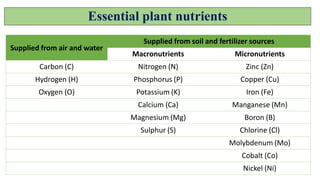
Essential plant nutrients
Supplied from air and water
Supplied from soil and fertilizer sources
Macronutrients Micronutrients
Carbon (C) Nitrogen (N) Zinc (Zn)
Hydrogen (H) Phosphorus (P) Copper (Cu)
Oxygen (O) Potassium (K) Iron (Fe)
Calcium (Ca) Manganese (Mn)
Magnesium (Mg) Boron (B)
Sulphur (S) Chlorine (Cl)
Molybdenum (Mo)
Cobalt (Co)
Nickel (Ni)
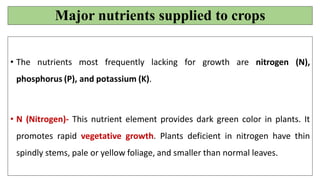
Major nutrients supplied to crops
• The nutrients most frequently lacking for growth are nitrogen (N),
phosphorus (P), and potassium (K).
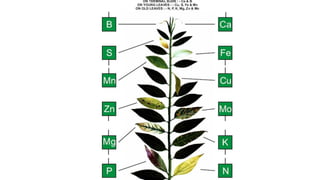
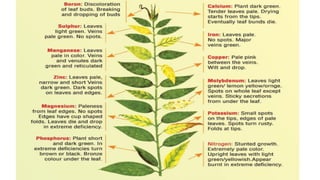
• N (Nitrogen)- This nutrient element provides dark green color in plants. It
promotes rapid vegetative growth. Plants deficient in nitrogen have thin
spindly stems, pale or yellow foliage, and smaller than normal leaves.
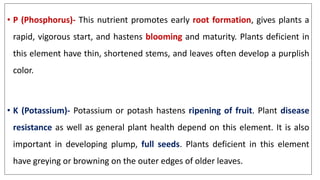
• P (Phosphorus)- This nutrient promotes early root formation, gives plants a
rapid, vigorous start, and hastens blooming and maturity. Plants deficient in
this element have thin, shortened stems, and leaves often develop a purplish
color.
• K (Potassium)- Potassium or potash hastens ripening of fruit. Plant disease
resistance as well as general plant health depend on this element. It is also
important in developing plump, full seeds. Plants deficient in this element
have greying or browning on the outer edges of older leaves.
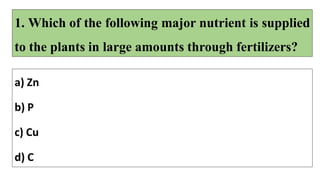
1. Which of the following major nutrient is supplied
to the plants in large amounts through fertilizers?
a) Zn
b) P
c) Cu
d) C
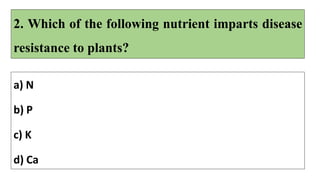
2. Which of the following nutrient imparts disease
resistance to plants?
a) N
b) P
c) K
d) Ca
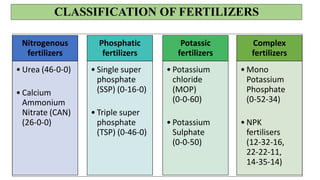
Nitrogenous
fertilizers
• Urea (46-0-0)
• Calcium
Ammonium
Nitrate (CAN)
(26-0-0)
Phosphatic
fertilizers
• Single super
phosphate
(SSP) (0-16-0)
• Triple super
phosphate
(TSP) (0-46-0)
Potassic
fertilizers
• Potassium
chloride
(MOP)
(0-0-60)
• Potassium
Sulphate
(0-0-50)
Complex
fertilizers
• Mono
Potassium
Phosphate
(0-52-34)
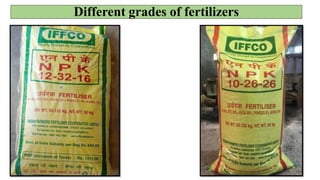
• NPK
fertilisers
(12-32-16,
22-22-11,
14-35-14)
CLASSIFICATION OF FERTILIZERS
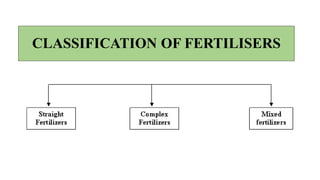
CLASSIFICATION OF FERTILISERS
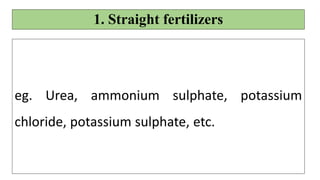
1. Straight fertilizers
eg. Urea, ammonium sulphate, potassium
chloride, potassium sulphate, etc.
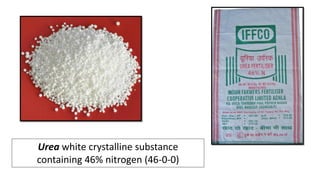
Urea white crystalline substance
containing 46% nitrogen (46-0-0)
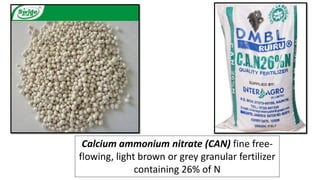
Calcium ammonium nitrate (CAN) fine free-
flowing, light brown or grey granular fertilizer
containing 26% of N
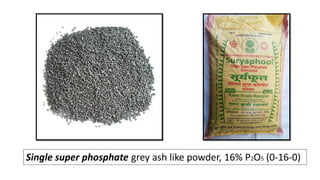
Single super phosphate grey ash like powder, 16% P2O5 (0-16-0)
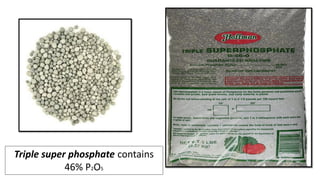
Triple super phosphate contains
46% P2O5
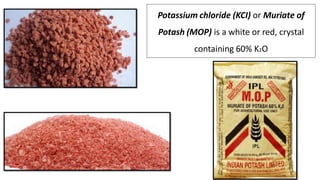
Potassium chloride (KCI) or Muriate of
Potash (MOP) is a white or red, crystal
containing 60% K2O
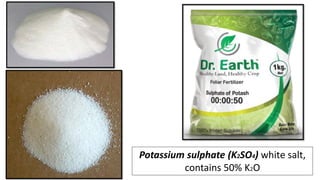
Potassium sulphate (K2SO4) white salt,
contains 50% K2O
2. Complex fertilizers
•eg. Diammonium phosphate (DAP),
nitrophosphates, ammonium phosphate, etc.
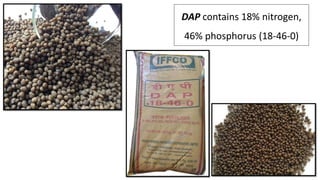
DAP contains 18% nitrogen,
46% phosphorus (18-46-0)
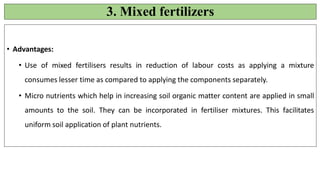
3. Mixed fertilizers
• Advantages:
• Use of mixed fertilisers results in reduction of labour costs as applying a mixture
consumes lesser time as compared to applying the components separately.
• Micro nutrients which help in increasing soil organic matter content are applied in small
amounts to the soil. They can be incorporated in fertiliser mixtures. This facilitates
uniform soil application of plant nutrients.
Different grades of fertilizers
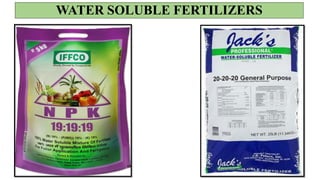
WATER SOLUBLE FERTILIZERS
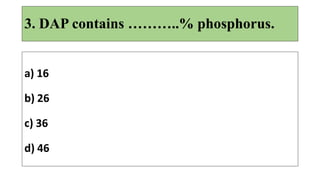
3. DAP contains ………..% phosphorus.
a) 16
b) 26
c) 36
d) 46
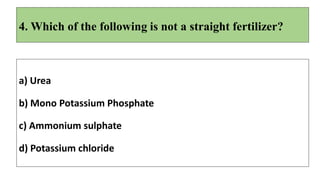
4. Which of the following is not a straight fertilizer?
a) Urea
b) Mono Potassium Phosphate
c) Ammonium sulphate
d) Potassium chloride
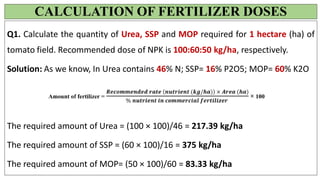
CALCULATION OF FERTILIZER DOSES
Q1. Calculate the quantity of Urea, SSP and MOP required for 1 hectare (ha) of
tomato field. Recommended dose of NPK is 100:60:50 kg/ha, respectively.
Solution: As we know, In Urea contains 46% N; SSP= 16% P2O5; MOP= 60% K2O
The required amount of Urea = (100 × 100)/46 = 217.39 kg/ha
The required amount of SSP = (60 × 100)/16 = 375 kg/ha
The required amount of MOP= (50 × 100)/60 = 83.33 kg/ha
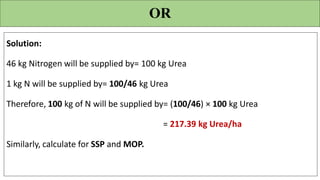
OR
Solution:
46 kg Nitrogen will be supplied by= 100 kg Urea
1 kg N will be supplied by= 100/46 kg Urea
Therefore, 100 kg of N will be supplied by= (100/46) × 100 kg Urea
= 217.39 kg Urea/ha
Similarly, calculate for SSP and MOP.
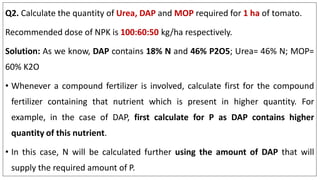
Q2. Calculate the quantity of Urea, DAP and MOP required for 1 ha of tomato.
Recommended dose of NPK is 100:60:50 kg/ha respectively.
Solution: As we know, DAP contains 18% N and 46% P2O5; Urea= 46% N; MOP=
60% K2O
• Whenever a compound fertilizer is involved, calculate first for the compound
fertilizer containing that nutrient which is present in higher quantity. For
example, in the case of DAP, first calculate for P as DAP contains higher
quantity of this nutrient.
• In this case, N will be calculated further using the amount of DAP that will
supply the required amount of P.
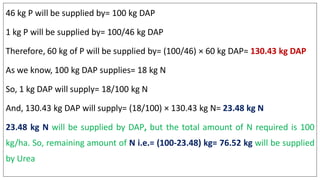
46 kg P will be supplied by= 100 kg DAP
1 kg P will be supplied by= 100/46 kg DAP
Therefore, 60 kg of P will be supplied by= (100/46) × 60 kg DAP= 130.43 kg DAP
As we know, 100 kg DAP supplies= 18 kg N
So, 1 kg DAP will supply= 18/100 kg N
And, 130.43 kg DAP will supply= (18/100) × 130.43 kg N= 23.48 kg N
23.48 kg N will be supplied by DAP, but the total amount of N required is 100
kg/ha. So, remaining amount of N i.e.= (100-23.48) kg= 76.52 kg will be supplied
by Urea
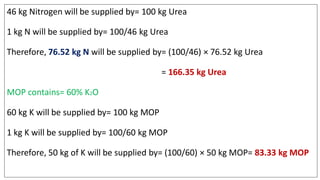
46 kg Nitrogen will be supplied by= 100 kg Urea
1 kg N will be supplied by= 100/46 kg Urea
Therefore, 76.52 kg N will be supplied by= (100/46) × 76.52 kg Urea
= 166.35 kg Urea
MOP contains= 60% K2O
60 kg K will be supplied by= 100 kg MOP
1 kg K will be supplied by= 100/60 kg MOP
Therefore, 50 kg of K will be supplied by= (100/60) × 50 kg MOP= 83.33 kg MOP
ACTIVITY
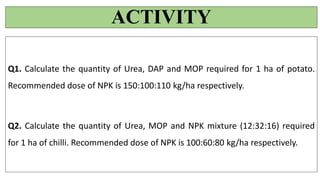
Q1. Calculate the quantity of Urea, DAP and MOP required for 1 ha of potato.
Recommended dose of NPK is 150:100:110 kg/ha respectively.
Q2. Calculate the quantity of Urea, MOP and NPK mixture (12:32:16) required
for 1 ha of chilli. Recommended dose of NPK is 100:60:80 kg/ha respectively.
fertilizer calculation

fertilizer calculation

  • 1.
    PRACTICAL- 4 To calculatethe doses of different fertilizers
  • 2.
    FERTILIZER • Fertilizer refersto any compound that contains one or more chemical elements/plant nutrients, natural or synthetic, that is placed on or incorporated into the soil or applied directly onto plants to achieve normal growth. • The main supply sources of plant nutrients include organic manures, plant residues, biological nitrogen fixation and commercial inorganic fertilizers.
  • 3.
    Essential plant nutrients Suppliedfrom air and water Supplied from soil and fertilizer sources Macronutrients Micronutrients Carbon (C) Nitrogen (N) Zinc (Zn) Hydrogen (H) Phosphorus (P) Copper (Cu) Oxygen (O) Potassium (K) Iron (Fe) Calcium (Ca) Manganese (Mn) Magnesium (Mg) Boron (B) Sulphur (S) Chlorine (Cl) Molybdenum (Mo) Cobalt (Co) Nickel (Ni)
  • 4.
    Major nutrients suppliedto crops • The nutrients most frequently lacking for growth are nitrogen (N), phosphorus (P), and potassium (K). • N (Nitrogen)- This nutrient element provides dark green color in plants. It promotes rapid vegetative growth. Plants deficient in nitrogen have thin spindly stems, pale or yellow foliage, and smaller than normal leaves.
  • 5.
    • P (Phosphorus)-This nutrient promotes early root formation, gives plants a rapid, vigorous start, and hastens blooming and maturity. Plants deficient in this element have thin, shortened stems, and leaves often develop a purplish color. • K (Potassium)- Potassium or potash hastens ripening of fruit. Plant disease resistance as well as general plant health depend on this element. It is also important in developing plump, full seeds. Plants deficient in this element have greying or browning on the outer edges of older leaves.
  • 7.
    1. Which ofthe following major nutrient is supplied to the plants in large amounts through fertilizers? a) Zn b) P c) Cu d) C
  • 8.
    2. Which ofthe following nutrient imparts disease resistance to plants? a) N b) P c) K d) Ca
  • 9.
    Nitrogenous fertilizers • Urea (46-0-0) •Calcium Ammonium Nitrate (CAN) (26-0-0) Phosphatic fertilizers • Single super phosphate (SSP) (0-16-0) • Triple super phosphate (TSP) (0-46-0) Potassic fertilizers • Potassium chloride (MOP) (0-0-60) • Potassium Sulphate (0-0-50) Complex fertilizers • Mono Potassium Phosphate (0-52-34) • NPK fertilisers (12-32-16, 22-22-11, 14-35-14) CLASSIFICATION OF FERTILIZERS
  • 10.
  • 11.
    1. Straight fertilizers eg.Urea, ammonium sulphate, potassium chloride, potassium sulphate, etc.
  • 12.
    Urea white crystallinesubstance containing 46% nitrogen (46-0-0)
  • 13.
    Calcium ammonium nitrate(CAN) fine free- flowing, light brown or grey granular fertilizer containing 26% of N
  • 14.
    Single super phosphategrey ash like powder, 16% P2O5 (0-16-0)
  • 15.
    Triple super phosphatecontains 46% P2O5
  • 16.
    Potassium chloride (KCI)or Muriate of Potash (MOP) is a white or red, crystal containing 60% K2O
  • 17.
    Potassium sulphate (K2SO4)white salt, contains 50% K2O
  • 18.
    2. Complex fertilizers •eg.Diammonium phosphate (DAP), nitrophosphates, ammonium phosphate, etc.
  • 19.
    DAP contains 18%nitrogen, 46% phosphorus (18-46-0)
  • 20.
    3. Mixed fertilizers •Advantages: • Use of mixed fertilisers results in reduction of labour costs as applying a mixture consumes lesser time as compared to applying the components separately. • Micro nutrients which help in increasing soil organic matter content are applied in small amounts to the soil. They can be incorporated in fertiliser mixtures. This facilitates uniform soil application of plant nutrients.
  • 21.
  • 22.
  • 23.
    3. DAP contains………..% phosphorus. a) 16 b) 26 c) 36 d) 46
  • 24.
    4. Which ofthe following is not a straight fertilizer? a) Urea b) Mono Potassium Phosphate c) Ammonium sulphate d) Potassium chloride
  • 25.
    CALCULATION OF FERTILIZERDOSES Q1. Calculate the quantity of Urea, SSP and MOP required for 1 hectare (ha) of tomato field. Recommended dose of NPK is 100:60:50 kg/ha, respectively. Solution: As we know, In Urea contains 46% N; SSP= 16% P2O5; MOP= 60% K2O The required amount of Urea = (100 × 100)/46 = 217.39 kg/ha The required amount of SSP = (60 × 100)/16 = 375 kg/ha The required amount of MOP= (50 × 100)/60 = 83.33 kg/ha
  • 26.
    OR Solution: 46 kg Nitrogenwill be supplied by= 100 kg Urea 1 kg N will be supplied by= 100/46 kg Urea Therefore, 100 kg of N will be supplied by= (100/46) × 100 kg Urea = 217.39 kg Urea/ha Similarly, calculate for SSP and MOP.
  • 27.
    Q2. Calculate thequantity of Urea, DAP and MOP required for 1 ha of tomato. Recommended dose of NPK is 100:60:50 kg/ha respectively. Solution: As we know, DAP contains 18% N and 46% P2O5; Urea= 46% N; MOP= 60% K2O • Whenever a compound fertilizer is involved, calculate first for the compound fertilizer containing that nutrient which is present in higher quantity. For example, in the case of DAP, first calculate for P as DAP contains higher quantity of this nutrient. • In this case, N will be calculated further using the amount of DAP that will supply the required amount of P.
  • 28.
    46 kg Pwill be supplied by= 100 kg DAP 1 kg P will be supplied by= 100/46 kg DAP Therefore, 60 kg of P will be supplied by= (100/46) × 60 kg DAP= 130.43 kg DAP As we know, 100 kg DAP supplies= 18 kg N So, 1 kg DAP will supply= 18/100 kg N And, 130.43 kg DAP will supply= (18/100) × 130.43 kg N= 23.48 kg N 23.48 kg N will be supplied by DAP, but the total amount of N required is 100 kg/ha. So, remaining amount of N i.e.= (100-23.48) kg= 76.52 kg will be supplied by Urea
  • 29.
    46 kg Nitrogenwill be supplied by= 100 kg Urea 1 kg N will be supplied by= 100/46 kg Urea Therefore, 76.52 kg N will be supplied by= (100/46) × 76.52 kg Urea = 166.35 kg Urea MOP contains= 60% K2O 60 kg K will be supplied by= 100 kg MOP 1 kg K will be supplied by= 100/60 kg MOP Therefore, 50 kg of K will be supplied by= (100/60) × 50 kg MOP= 83.33 kg MOP
  • 30.
    ACTIVITY Q1. Calculate thequantity of Urea, DAP and MOP required for 1 ha of potato. Recommended dose of NPK is 150:100:110 kg/ha respectively. Q2. Calculate the quantity of Urea, MOP and NPK mixture (12:32:16) required for 1 ha of chilli. Recommended dose of NPK is 100:60:80 kg/ha respectively.