SUFFIXES
COMMON NOUN SUFFIXES ADJECTIVES SUFFIXES VERB SUFFIXES OTHER SUFFIXES THAT CAN HELP YOU RECOGNISE THE WORD CLASS
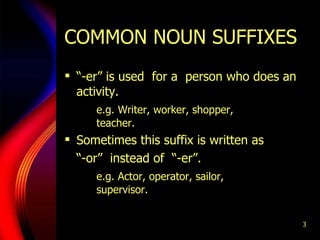
COMMON NOUN SUFFIXES “ -er” is used  for a  person who does an activity.  e.g. Writer, worker, shopper,  teacher. Sometimes this suffix is written as  “ -or”  instead of  “-er”. e.g. Actor, operator, sailor,  supervisor.
“ -er/or” are also used for things which do a particular job. e.g. Pencil-sharpener, grater,  projector. “ -er” and “-ee” contrast in meaning: “person who does something” (“-er”) and “person who receives or experiences the action” (“-ee”). e.g. Employer/ee, sender/addressee .
“ -(t)ion”  is used to make nouns from verbs. e.g. Complication, pollution,  reduction. “ -ist” (person) and “-ism” (activity or ideology). They are used for people’s politics, beliefs and ideologies, and sometimes their profession.  e.g. Marxism, Budhism, journalism,  anarchist, physicist, terrorist.
“ -ist” is also often used for  people who play musical instruments. e.g. Pianist, violinist . “ -ness” is used to make nouns from adjectives. e.g. Goodness, happinesss, sadness,  weakness.
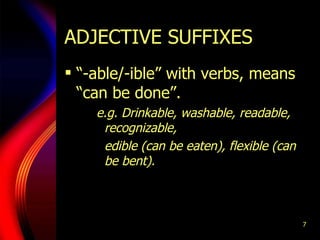
ADJECTIVE SUFFIXES “ -able/-ible” with verbs, means “can be done”. e.g. Drinkable, washable, readable, recognizable, edible (can be eaten), flexible (can be bent).
VERB SUFFIXES “ -ise (or ize)” makes verbs form adjectives. e.g.  Modernise, commercialise,  industrialise.
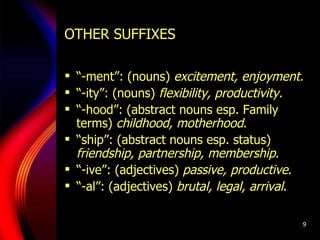
OTHER SUFFIXES “ -ment”: (nouns)  excitement, enjoyment. “ -ity”: (nouns)  flexibility, productivity. “ -hood”: (abstract nouns esp. Family terms)  childhood, motherhood . “ ship”: (abstract nouns esp. status)  friendship, partnership, membership . “ -ive”: (adjectives)  passive, productive . “ -al”: (adjectives)  brutal, legal, arrival .
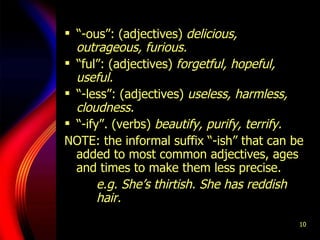
“ -ous”: (adjectives)  delicious,  outrageous, furious. “ ful”: (adjectives)  forgetful, hopeful, useful. “ -less”: (adjectives)  useless, harmless, cloudness. “ -ify”. (verbs)  beautify, purify, terrify. NOTE: the informal suffix “-ish” that can be added to most common adjectives, ages and times to make them less precise. e.g. She’s thirtish. She has reddish  hair.
THE END

Suffixes

  • 1.
  • 2.
    COMMON NOUN SUFFIXESADJECTIVES SUFFIXES VERB SUFFIXES OTHER SUFFIXES THAT CAN HELP YOU RECOGNISE THE WORD CLASS
  • 3.
    COMMON NOUN SUFFIXES“ -er” is used for a person who does an activity. e.g. Writer, worker, shopper, teacher. Sometimes this suffix is written as “ -or” instead of “-er”. e.g. Actor, operator, sailor, supervisor.
  • 4.
    “ -er/or” arealso used for things which do a particular job. e.g. Pencil-sharpener, grater, projector. “ -er” and “-ee” contrast in meaning: “person who does something” (“-er”) and “person who receives or experiences the action” (“-ee”). e.g. Employer/ee, sender/addressee .
  • 5.
    “ -(t)ion” is used to make nouns from verbs. e.g. Complication, pollution, reduction. “ -ist” (person) and “-ism” (activity or ideology). They are used for people’s politics, beliefs and ideologies, and sometimes their profession. e.g. Marxism, Budhism, journalism, anarchist, physicist, terrorist.
  • 6.
    “ -ist” isalso often used for people who play musical instruments. e.g. Pianist, violinist . “ -ness” is used to make nouns from adjectives. e.g. Goodness, happinesss, sadness, weakness.
  • 7.
    ADJECTIVE SUFFIXES “-able/-ible” with verbs, means “can be done”. e.g. Drinkable, washable, readable, recognizable, edible (can be eaten), flexible (can be bent).
  • 8.
    VERB SUFFIXES “-ise (or ize)” makes verbs form adjectives. e.g. Modernise, commercialise, industrialise.
  • 9.
    OTHER SUFFIXES “-ment”: (nouns) excitement, enjoyment. “ -ity”: (nouns) flexibility, productivity. “ -hood”: (abstract nouns esp. Family terms) childhood, motherhood . “ ship”: (abstract nouns esp. status) friendship, partnership, membership . “ -ive”: (adjectives) passive, productive . “ -al”: (adjectives) brutal, legal, arrival .
  • 10.
    “ -ous”: (adjectives) delicious, outrageous, furious. “ ful”: (adjectives) forgetful, hopeful, useful. “ -less”: (adjectives) useless, harmless, cloudness. “ -ify”. (verbs) beautify, purify, terrify. NOTE: the informal suffix “-ish” that can be added to most common adjectives, ages and times to make them less precise. e.g. She’s thirtish. She has reddish hair.
  • 11.