
Successful Writing Lecture Four
Review Preciseness Requirement for good writing Use concrete details (form the habit of thinking concretely even at the initial stage of writing) Look for specific words (and learn how to use them alongside the expansion of your vocabulary)
Effectiveness Adds power to the meaning Selecting effective words is not easy and it needs study and practice
-ing and –ed forms of verbs The –ing form of a verb is used when the action described by the verb continues to happen or when the relationship between the modified and the verb is active Example: She is cooking so much food for all of us Example: When I saw her, she was cooking so much food for all of us
-ing and –ed forms of verbs The –ed form of a verb is used when the action is completed at the time another action occurs  Or when the relationship between the modified and the verb is passive Example: She stopped with us quickly before she ran out the door  Example: She grabbed the taxi that drove past the subway station
Nouns as Modifiers Nouns can be put ahead of another noun as its modifiers in English Too many nouns clustered can cause ambiguity (uncertainty) and misunderstanding  Mostly, the maximum of the number of nouns as modifiers is two (sometimes this number can be exceeded)
Nouns as Modifiers Guiding Principle:  nouns as modifiers should not pose too much difficulty to the reader’s comprehension
Adverbs Can modify a verb, an adjective, another adverb or even a whole sentence Usually appears after the verb it modifies but before the adjective or the adverb If it modifies the whole sentence, it can appear either at the beginning or the end
Adverbs indicates manner, time, place, cause, or degree and answers questions such as "how," "when," "where," "how much". While some adverbs can be identified by their characteristic "ly"  suffix , most of them must be identified by untangling the grammatical relationships within the  sentence  or clause as a whole.
Adverbs In the following examples, each of the  highlighted  words is an adverb: The seamstress  quickly  made the mourning clothes. In this sentence, the adverb "quickly" modifies the verb "made" and indicates in what manner (or how fast) the clothing was constructed.
Adverbs The  boldly  spoken words would return to haunt the rebel. In this sentence the adverb "boldly" modifies the adjective "spoken." We urged him to dial the number more  expeditiously . Here the adverb "more" modifies the adverb "expeditiously." Unfortunately , the bank closed at three  today . In this example, the adverb "unfortunately" modifies the entire sentence.
Adverbs Conjunctive Adverbs You can use a  conjunctive adverb  to join two clauses together. Some of the most common conjunctive adverbs are "also," "consequently," "finally," "furthermore," "hence," "however," "incidentally," "indeed," "instead," "likewise," "meanwhile," "nevertheless," "next," "nonetheless," "otherwise," "still," "then," "therefore," and "thus."
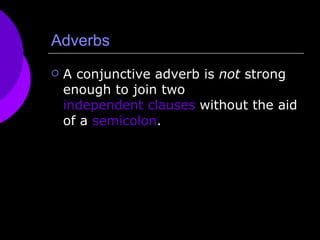
Adverbs A conjunctive adverb is  not  strong enough to join two  independent clauses  without the aid of a  semicolon .
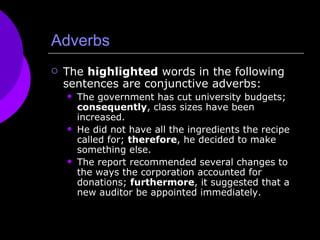
Adverbs The  highlighted  words in the following sentences are conjunctive adverbs: The government has cut university budgets;  consequently , class sizes have been increased. He did not have all the ingredients the recipe called for;  therefore , he decided to make something else. The report recommended several changes to the ways the corporation accounted for donations;  furthermore , it suggested that a new auditor be appointed immediately.
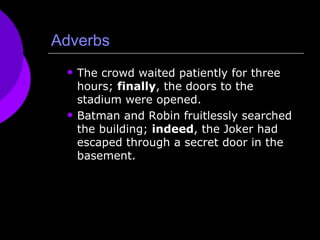
Adverbs The crowd waited patiently for three hours;  finally , the doors to the stadium were opened. Batman and Robin fruitlessly searched the building;  indeed , the Joker had escaped through a secret door in the basement.
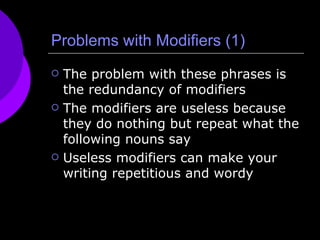
Problems with Modifiers (1) The problem with these phrases is the redundancy of modifiers The modifiers are useless because they do nothing but repeat what the following nouns say Useless modifiers can make your writing repetitious and wordy
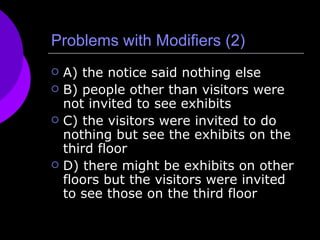
Problems with Modifiers (2) A) the notice said nothing else B) people other than visitors were not invited to see exhibits C) the visitors were invited to do nothing but see the exhibits on the third floor D) there might be exhibits on other floors but the visitors were invited to see those on the third floor
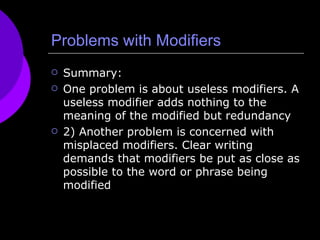
Problems with Modifiers Summary: One problem is about useless modifiers. A useless modifier adds nothing to the meaning of the modified but redundancy 2) Another problem is concerned with misplaced modifiers. Clear writing demands that modifiers be put as close as possible to the word or phrase being modified
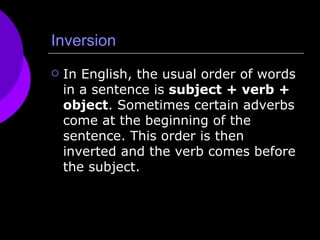
Inversion In English, the usual order of words in a sentence is  subject + verb + object . Sometimes certain adverbs come at the beginning of the sentence. This order is then inverted and the verb comes before the subject.
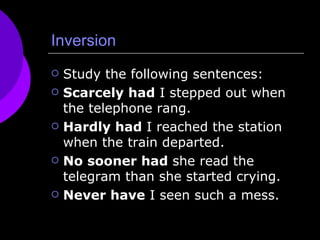
Inversion Study the following sentences: Scarcely had  I stepped out when the telephone rang.  Hardly had  I reached the station when the train departed.  No sooner had  she read the telegram than she started crying.  Never have  I seen such a mess.
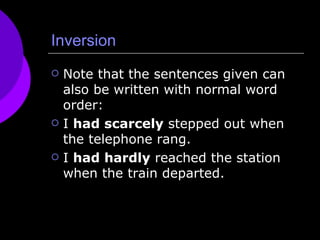
Inversion Note that the sentences given can also be written with normal word order: I  had scarcely  stepped out when the telephone rang.  I  had hardly  reached the station when the train departed.
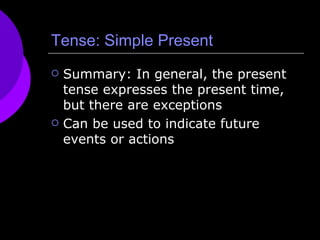
Tense: Simple Present  Summary: In general, the present tense expresses the present time, but there are exceptions Can be used to indicate future events or actions
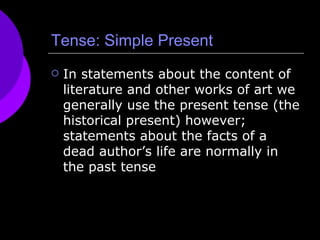
Tense: Simple Present In statements about the content of literature and other works of art we generally use the present tense (the historical present) however; statements about the facts of a dead author’s life are normally in the past tense
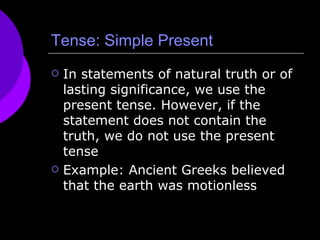
Tense: Simple Present In statements of natural truth or of lasting significance, we use the present tense. However, if the statement does not contain the truth, we do not use the present tense Example: Ancient Greeks believed that the earth was motionless
Sequence of Tenses When the main verb is in the present tense, the subordinate (secondary/inferior) verb can only be in the simple past tense, the past perfect tense, or the past future tense
Sequence of Tenses When the main verb indicates the future, the subordinate verb can be in the simple past tense, the present perfect tense, but never in the future tense
Mood The subjunctive mood 1. The first pattern of the subjunctive mood is the Be-pattern (as in sentences a, b, and c)  It is used to express indirect commands, motions, and resolutions
The Subjunctive Mood (cont’d) Verbs frequently used in this patter, to name just a few are; insist, order, decide, instruct, and propose This pattern is also used in the that-clause following adjectives or nouns to express opinions or intentions This pattern can be replaced by the should + infinitive form
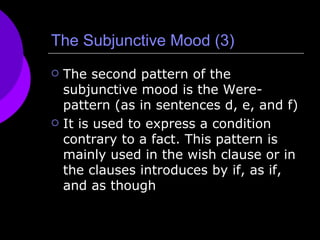
The Subjunctive Mood (3) The second pattern of the subjunctive mood is the Were-pattern (as in sentences d, e, and f) It is used to express a condition contrary to a fact. This pattern is mainly used in the wish clause or in the clauses introduces by if, as if, and as though
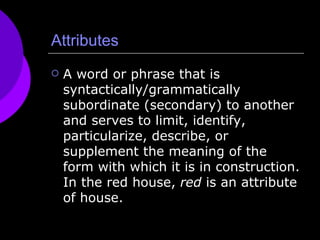
Attributes A word or phrase that is syntactically/grammatically subordinate (secondary) to another and serves to limit, identify, particularize, describe, or supplement the meaning of the form with which it is in construction. In the red house,  red  is an attribute of house.
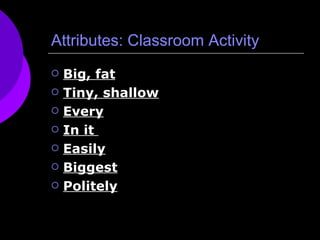
Attributes: Classroom Activity Big, fat Tiny, shallow Every In it  Easily Biggest Politely
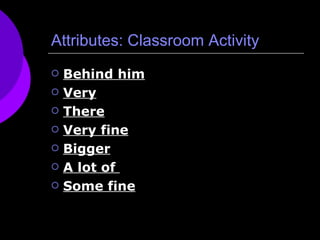
Attributes: Classroom Activity Behind him Very There Very fine Bigger A lot of  Some fine
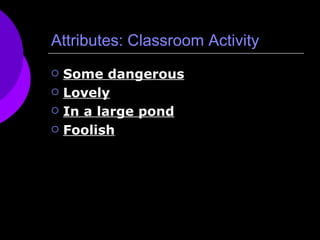
Attributes: Classroom Activity Some dangerous Lovely In a large pond Foolish
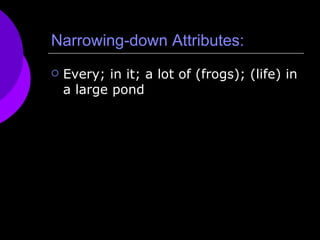
Narrowing-down Attributes:  Every; in it; a lot of (frogs); (life) in a large pond
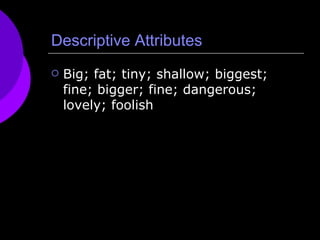
Descriptive Attributes Big; fat; tiny; shallow; biggest; fine; bigger; fine; dangerous; lovely; foolish
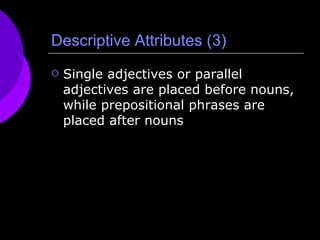
Descriptive Attributes (3) Single adjectives or parallel adjectives are placed before nouns, while prepositional phrases are placed after nouns
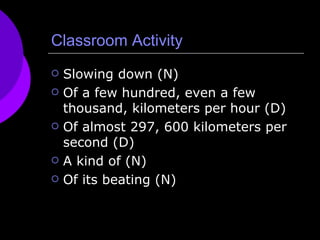
Classroom Activity Slowing down (N) Of a few hundred, even a few thousand, kilometers per hour (D) Of almost 297, 600 kilometers per second (D) A kind of (N) Of its beating (N)
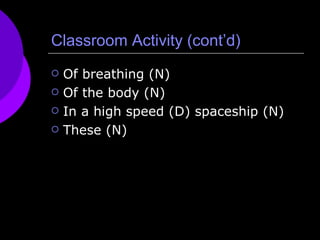
Classroom Activity (cont’d) Of breathing (N) Of the body (N) In a high speed (D) spaceship (N) These (N)
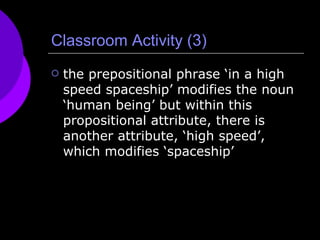
Classroom Activity (3) the prepositional phrase ‘in a high speed spaceship’ modifies the noun ‘human being’ but within this propositional attribute, there is another attribute, ‘high speed’, which modifies ‘spaceship’
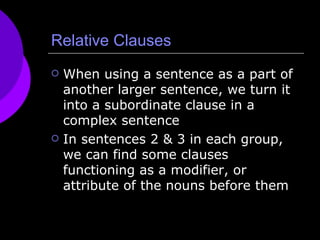
Relative Clauses When using a sentence as a part of another larger sentence, we turn it into a subordinate clause in a complex sentence  In sentences 2 & 3 in each group, we can find some clauses functioning as a modifier, or attribute of the nouns before them
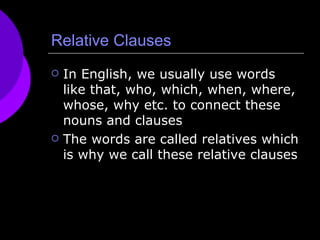
Relative Clauses In English, we usually use words like that, who, which, when, where, whose, why etc. to connect these nouns and clauses The words are called relatives which is why we call these relative clauses
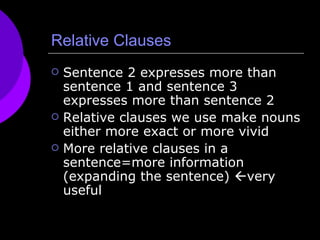
Relative Clauses Sentence 2 expresses more than sentence 1 and sentence 3 expresses more than sentence 2 Relative clauses we use make nouns either more exact or more vivid More relative clauses in a sentence=more information (expanding the sentence)   very useful
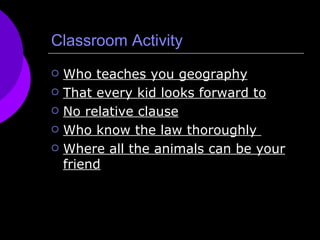
Classroom Activity Who teaches you geography That every kid looks forward to No relative clause Who know the law thoroughly  Where all the animals can be your friend
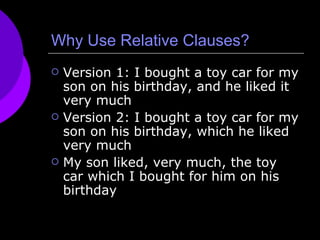
Why Use Relative Clauses? Version 1: I bought a toy car for my son on his birthday, and he liked it very much Version 2: I bought a toy car for my son on his birthday, which he liked very much My son liked, very much, the toy car which I bought for him on his birthday
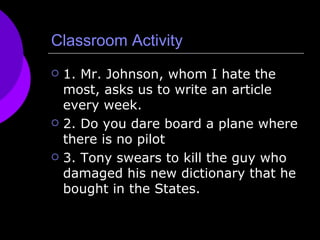
Classroom Activity 1. Mr. Johnson, whom I hate the most, asks us to write an article every week. 2. Do you dare board a plane where there is no pilot 3. Tony swears to kill the guy who damaged his new dictionary that he bought in the States.
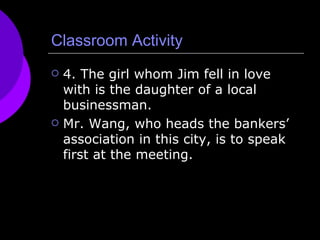
Classroom Activity 4. The girl whom Jim fell in love with is the daughter of a local businessman. Mr. Wang, who heads the bankers’ association in this city, is to speak first at the meeting.

Successful writing. lecture 4(2)

  • 1.
  • 2.
    Review Preciseness Requirementfor good writing Use concrete details (form the habit of thinking concretely even at the initial stage of writing) Look for specific words (and learn how to use them alongside the expansion of your vocabulary)
  • 3.
    Effectiveness Adds powerto the meaning Selecting effective words is not easy and it needs study and practice
  • 4.
    -ing and –edforms of verbs The –ing form of a verb is used when the action described by the verb continues to happen or when the relationship between the modified and the verb is active Example: She is cooking so much food for all of us Example: When I saw her, she was cooking so much food for all of us
  • 5.
    -ing and –edforms of verbs The –ed form of a verb is used when the action is completed at the time another action occurs Or when the relationship between the modified and the verb is passive Example: She stopped with us quickly before she ran out the door Example: She grabbed the taxi that drove past the subway station
  • 6.
    Nouns as ModifiersNouns can be put ahead of another noun as its modifiers in English Too many nouns clustered can cause ambiguity (uncertainty) and misunderstanding Mostly, the maximum of the number of nouns as modifiers is two (sometimes this number can be exceeded)
  • 7.
    Nouns as ModifiersGuiding Principle: nouns as modifiers should not pose too much difficulty to the reader’s comprehension
  • 8.
    Adverbs Can modifya verb, an adjective, another adverb or even a whole sentence Usually appears after the verb it modifies but before the adjective or the adverb If it modifies the whole sentence, it can appear either at the beginning or the end
  • 9.
    Adverbs indicates manner,time, place, cause, or degree and answers questions such as "how," "when," "where," "how much". While some adverbs can be identified by their characteristic "ly" suffix , most of them must be identified by untangling the grammatical relationships within the sentence or clause as a whole.
  • 10.
    Adverbs In thefollowing examples, each of the highlighted words is an adverb: The seamstress quickly made the mourning clothes. In this sentence, the adverb "quickly" modifies the verb "made" and indicates in what manner (or how fast) the clothing was constructed.
  • 11.
    Adverbs The boldly spoken words would return to haunt the rebel. In this sentence the adverb "boldly" modifies the adjective "spoken." We urged him to dial the number more expeditiously . Here the adverb "more" modifies the adverb "expeditiously." Unfortunately , the bank closed at three today . In this example, the adverb "unfortunately" modifies the entire sentence.
  • 12.
    Adverbs Conjunctive AdverbsYou can use a conjunctive adverb to join two clauses together. Some of the most common conjunctive adverbs are "also," "consequently," "finally," "furthermore," "hence," "however," "incidentally," "indeed," "instead," "likewise," "meanwhile," "nevertheless," "next," "nonetheless," "otherwise," "still," "then," "therefore," and "thus."
  • 13.
    Adverbs A conjunctiveadverb is not strong enough to join two independent clauses without the aid of a semicolon .
  • 14.
    Adverbs The highlighted words in the following sentences are conjunctive adverbs: The government has cut university budgets; consequently , class sizes have been increased. He did not have all the ingredients the recipe called for; therefore , he decided to make something else. The report recommended several changes to the ways the corporation accounted for donations; furthermore , it suggested that a new auditor be appointed immediately.
  • 15.
    Adverbs The crowdwaited patiently for three hours; finally , the doors to the stadium were opened. Batman and Robin fruitlessly searched the building; indeed , the Joker had escaped through a secret door in the basement.
  • 16.
    Problems with Modifiers(1) The problem with these phrases is the redundancy of modifiers The modifiers are useless because they do nothing but repeat what the following nouns say Useless modifiers can make your writing repetitious and wordy
  • 17.
    Problems with Modifiers(2) A) the notice said nothing else B) people other than visitors were not invited to see exhibits C) the visitors were invited to do nothing but see the exhibits on the third floor D) there might be exhibits on other floors but the visitors were invited to see those on the third floor
  • 18.
    Problems with ModifiersSummary: One problem is about useless modifiers. A useless modifier adds nothing to the meaning of the modified but redundancy 2) Another problem is concerned with misplaced modifiers. Clear writing demands that modifiers be put as close as possible to the word or phrase being modified
  • 19.
    Inversion In English,the usual order of words in a sentence is subject + verb + object . Sometimes certain adverbs come at the beginning of the sentence. This order is then inverted and the verb comes before the subject.
  • 20.
    Inversion Study thefollowing sentences: Scarcely had I stepped out when the telephone rang. Hardly had I reached the station when the train departed. No sooner had she read the telegram than she started crying. Never have I seen such a mess.
  • 21.
    Inversion Note thatthe sentences given can also be written with normal word order: I had scarcely stepped out when the telephone rang. I had hardly reached the station when the train departed.
  • 22.
    Tense: Simple Present Summary: In general, the present tense expresses the present time, but there are exceptions Can be used to indicate future events or actions
  • 23.
    Tense: Simple PresentIn statements about the content of literature and other works of art we generally use the present tense (the historical present) however; statements about the facts of a dead author’s life are normally in the past tense
  • 24.
    Tense: Simple PresentIn statements of natural truth or of lasting significance, we use the present tense. However, if the statement does not contain the truth, we do not use the present tense Example: Ancient Greeks believed that the earth was motionless
  • 25.
    Sequence of TensesWhen the main verb is in the present tense, the subordinate (secondary/inferior) verb can only be in the simple past tense, the past perfect tense, or the past future tense
  • 26.
    Sequence of TensesWhen the main verb indicates the future, the subordinate verb can be in the simple past tense, the present perfect tense, but never in the future tense
  • 27.
    Mood The subjunctivemood 1. The first pattern of the subjunctive mood is the Be-pattern (as in sentences a, b, and c) It is used to express indirect commands, motions, and resolutions
  • 28.
    The Subjunctive Mood(cont’d) Verbs frequently used in this patter, to name just a few are; insist, order, decide, instruct, and propose This pattern is also used in the that-clause following adjectives or nouns to express opinions or intentions This pattern can be replaced by the should + infinitive form
  • 29.
    The Subjunctive Mood(3) The second pattern of the subjunctive mood is the Were-pattern (as in sentences d, e, and f) It is used to express a condition contrary to a fact. This pattern is mainly used in the wish clause or in the clauses introduces by if, as if, and as though
  • 30.
    Attributes A wordor phrase that is syntactically/grammatically subordinate (secondary) to another and serves to limit, identify, particularize, describe, or supplement the meaning of the form with which it is in construction. In the red house, red is an attribute of house.
  • 31.
    Attributes: Classroom ActivityBig, fat Tiny, shallow Every In it Easily Biggest Politely
  • 32.
    Attributes: Classroom ActivityBehind him Very There Very fine Bigger A lot of Some fine
  • 33.
    Attributes: Classroom ActivitySome dangerous Lovely In a large pond Foolish
  • 34.
    Narrowing-down Attributes: Every; in it; a lot of (frogs); (life) in a large pond
  • 35.
    Descriptive Attributes Big;fat; tiny; shallow; biggest; fine; bigger; fine; dangerous; lovely; foolish
  • 36.
    Descriptive Attributes (3)Single adjectives or parallel adjectives are placed before nouns, while prepositional phrases are placed after nouns
  • 37.
    Classroom Activity Slowingdown (N) Of a few hundred, even a few thousand, kilometers per hour (D) Of almost 297, 600 kilometers per second (D) A kind of (N) Of its beating (N)
  • 38.
    Classroom Activity (cont’d)Of breathing (N) Of the body (N) In a high speed (D) spaceship (N) These (N)
  • 39.
    Classroom Activity (3)the prepositional phrase ‘in a high speed spaceship’ modifies the noun ‘human being’ but within this propositional attribute, there is another attribute, ‘high speed’, which modifies ‘spaceship’
  • 40.
    Relative Clauses Whenusing a sentence as a part of another larger sentence, we turn it into a subordinate clause in a complex sentence In sentences 2 & 3 in each group, we can find some clauses functioning as a modifier, or attribute of the nouns before them
  • 41.
    Relative Clauses InEnglish, we usually use words like that, who, which, when, where, whose, why etc. to connect these nouns and clauses The words are called relatives which is why we call these relative clauses
  • 42.
    Relative Clauses Sentence2 expresses more than sentence 1 and sentence 3 expresses more than sentence 2 Relative clauses we use make nouns either more exact or more vivid More relative clauses in a sentence=more information (expanding the sentence)  very useful
  • 43.
    Classroom Activity Whoteaches you geography That every kid looks forward to No relative clause Who know the law thoroughly Where all the animals can be your friend
  • 44.
    Why Use RelativeClauses? Version 1: I bought a toy car for my son on his birthday, and he liked it very much Version 2: I bought a toy car for my son on his birthday, which he liked very much My son liked, very much, the toy car which I bought for him on his birthday
  • 45.
    Classroom Activity 1.Mr. Johnson, whom I hate the most, asks us to write an article every week. 2. Do you dare board a plane where there is no pilot 3. Tony swears to kill the guy who damaged his new dictionary that he bought in the States.
  • 46.
    Classroom Activity 4.The girl whom Jim fell in love with is the daughter of a local businessman. Mr. Wang, who heads the bankers’ association in this city, is to speak first at the meeting.

Editor's Notes

  • #30 Clause: section, paragraph, section