SUBSTATION AUTOMATIONPresent Scenario - Growth and Future Opportunities in Indian MarketPresented By : Sudhanshu Shekhar
Basic functions▪ Control▪ Monitoring▪ Measurement▪ Recording▪ Operation Support and Maintenance
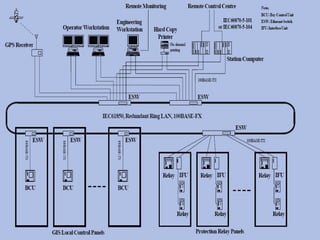
Station levelThe station level equipment consists of duplicated station computer, an operator work-station, a printer, a GPS receiver, and the station bus.Bay level▪ For a GIS substationThe bay level equipment consists of bay control units (BCUs) and GIS local control panels (LCPs) . The BCU is installed in the relevant LCP.▪ For an AIS substationThe bay control units are installed in the dedicated local control panel.▪ Protection relays, AVRs and other IEDs are connected to the station bus.Communication bus▪ Ethernet LAN, 100BASE-TX/FX▪ IEC 61850 protocol
Control points▪ Three level hierarchy- Remote control point (Network level)- Substation control point (Station level)- Local control point (Bay level)Remote monitoring▪ Remote monitoring through router/modem▪ Remote maintenance
Station computerThe station computer acts as substation server equipment and performs control and monitoring for thewhole substation.The personal computer is applied as an operatorworkstation and performs as client equipmentGPS (Global Positioning System)The GPS is used as a master clock in the substation.The GPS receiver distributes time synchronizingsignals to each IED using SNTP*.SNTP*: Simple Network Time Protocol
BCU (Bay Control Unit)The BCU performs control in accordance with control commands from network and station level control equipment and monitoring the bay power apparatus.The BCU provides the following functions.▪ Control- Close/Open commands to switchgear- Transformer tap raise/lower commands- Selection in or out of service of protection relay equipment- Synchronism check for circuit breaker closing- Interlocking check▪ Monitoring Status and failure monitoring of all relevant equipment- Measurement
▪ Recording- Event recording with time tag of 1ms time resolution- Fault recording▪ Other functions- Touch type LCD screen for local control at BCU- Time synchronization- Operation mode selection- Database maintenance- Automatic supervision- ProtectionProtection relays and other IEDsProtection relays and other IEDs can be connected to the station bus directly by IEC 61850 based communication.Non-IEC 61850 compliant IEDs can be connected via an interface unit
Communication facilities▪ Station busAn Ethernet LAN,100BASE-TX/FX, is used for the station bus to connect station level equipment and IEDs.Ethernet switches are used for the station bus.IEC61850 is applied for communication between thestation computer and the IEDs.Optical cables are used to suppress surge and noise interference from power apparatus.▪ Remote Control Center InterfaceThe following IEC communication standards are used for communication.- IEC 60870-5-101- IEC 60870-5-104
Open system architecture▪ IEC 61850 compliant open system	- Standardized Information Models and Communication Services	- Standardized Engineering tools using SCL*▪ Client/Server System Architecture▪ Bay Oriented Distributed SystemFlexible system configuration▪ Flexible configuration for all voltage levels▪ Redundant configuration▪ Integration of protection relays and other IEC 61850 compliant IED**s▪ Integration of non-IEC 61850 IEDsMinimized life cycle cost▪ Optimized Maintenance Cycle               SCL* : Substation Configuration Language▪ Efficient Supporting Guidance               IED** : Intelligent Electronic Device
Advanced Functions▪ Automation- Automatic synchronization for split system- Interlocking per bay and station wide- Automatic sequence control- Load sheddingReactive power switching▪Power apparatus monitoring- Circuit breaker contact wear- Switchgear operating time- SF6 gas pressure of GISOperation counter▪ Power quality monitoring (optional)- IEC 61000 -4-7, IEC 61000-4-30Harmonics (THD*,TDD**, up to 15th)Voltage swell, sag and interruption▪ Protection- For medium and low voltage power system- Directional over current protectionBack-up over current protection▪ Local Control at Bay Control unit with Touch ScreenTHD* : Total Harmonic DistortionTDD**: Total Demand Distortion
ADVANTAGESHigh reliability▪ Robust systems	- Fool proof philosophy	- RedundancyProtection from electrical interference▪ Minimized AC operated devices▪ Surge and noise withstand capability▪ Redundant configuration	- Duplicated common equipment	- Redundant LAN system	- Duplicated DC power supply (option)Easy maintenance▪ Bay based maintenance▪ Engineering tools and easy configuration▪ On-line database maintenance▪ Safety and easy bay extension on test mode▪ Signal blocking and forced status setting
Safety operation▪ Password security system▪ SBO* for control sequence▪ Supporting guidance	- Interlock guidance	- Safety tag	- Busbar coloring	- Memorandum on HMI screen	- Plant item information▪ Windows screen and operation▪ System monitoringSaving resources▪ Reduced installation space▪ Minimized control cables and auxiliary equipment▪ On demand printing▪ Low power consumptionSBO*: Select Before Operation
FUTURE ADVANCESIntegration of Substation Devices into the ISCS system- Remote terminal units- Microprocessor-based numerical relays- Disturbances recorders- Sequence of events recorders- Meters- Voltage regulators- Transformers tape changers- Capacitor bank controllers- Reclosers and timers - Supplementary interlocks- Any other PLC or IED based schemes 
Capability & Compatibility Consideration While Connecting ISCS System IED Devices- Ports for configuration - Ports for communication - Real time data exchange - Physical communication interfaces: serial cable, fibre, etc- Different modes of communication: RS232, RS 485 etc- Standard protocols: IEC-870, DNP3 etc- Communication speeds - Direct LAN interfaces- Time synchronizing through LAN or direct GPS interface - Upload/download capability and file transfer 
DrawbacksEmanating from different Areas such as: - Substation Design- Legacy system- Lack of skills among operation and maintenance staff,- Lack of expertise at the planning level to be able to justify advanced technologies- Lack of parity between cost and quality of power supply, - Lack of funding- Lack of stable management philosophy. 
THANK YOU
Substation Automation

Substation Automation

  • 1.
    SUBSTATION AUTOMATIONPresent Scenario- Growth and Future Opportunities in Indian MarketPresented By : Sudhanshu Shekhar
  • 2.
    Basic functions▪ Control▪Monitoring▪ Measurement▪ Recording▪ Operation Support and Maintenance
  • 4.
    Station levelThe stationlevel equipment consists of duplicated station computer, an operator work-station, a printer, a GPS receiver, and the station bus.Bay level▪ For a GIS substationThe bay level equipment consists of bay control units (BCUs) and GIS local control panels (LCPs) . The BCU is installed in the relevant LCP.▪ For an AIS substationThe bay control units are installed in the dedicated local control panel.▪ Protection relays, AVRs and other IEDs are connected to the station bus.Communication bus▪ Ethernet LAN, 100BASE-TX/FX▪ IEC 61850 protocol
  • 5.
    Control points▪ Threelevel hierarchy- Remote control point (Network level)- Substation control point (Station level)- Local control point (Bay level)Remote monitoring▪ Remote monitoring through router/modem▪ Remote maintenance
  • 6.
    Station computerThe stationcomputer acts as substation server equipment and performs control and monitoring for thewhole substation.The personal computer is applied as an operatorworkstation and performs as client equipmentGPS (Global Positioning System)The GPS is used as a master clock in the substation.The GPS receiver distributes time synchronizingsignals to each IED using SNTP*.SNTP*: Simple Network Time Protocol
  • 7.
    BCU (Bay ControlUnit)The BCU performs control in accordance with control commands from network and station level control equipment and monitoring the bay power apparatus.The BCU provides the following functions.▪ Control- Close/Open commands to switchgear- Transformer tap raise/lower commands- Selection in or out of service of protection relay equipment- Synchronism check for circuit breaker closing- Interlocking check▪ Monitoring Status and failure monitoring of all relevant equipment- Measurement
  • 8.
    ▪ Recording- Eventrecording with time tag of 1ms time resolution- Fault recording▪ Other functions- Touch type LCD screen for local control at BCU- Time synchronization- Operation mode selection- Database maintenance- Automatic supervision- ProtectionProtection relays and other IEDsProtection relays and other IEDs can be connected to the station bus directly by IEC 61850 based communication.Non-IEC 61850 compliant IEDs can be connected via an interface unit
  • 9.
    Communication facilities▪ StationbusAn Ethernet LAN,100BASE-TX/FX, is used for the station bus to connect station level equipment and IEDs.Ethernet switches are used for the station bus.IEC61850 is applied for communication between thestation computer and the IEDs.Optical cables are used to suppress surge and noise interference from power apparatus.▪ Remote Control Center InterfaceThe following IEC communication standards are used for communication.- IEC 60870-5-101- IEC 60870-5-104
  • 10.
    Open system architecture▪IEC 61850 compliant open system - Standardized Information Models and Communication Services - Standardized Engineering tools using SCL*▪ Client/Server System Architecture▪ Bay Oriented Distributed SystemFlexible system configuration▪ Flexible configuration for all voltage levels▪ Redundant configuration▪ Integration of protection relays and other IEC 61850 compliant IED**s▪ Integration of non-IEC 61850 IEDsMinimized life cycle cost▪ Optimized Maintenance Cycle SCL* : Substation Configuration Language▪ Efficient Supporting Guidance IED** : Intelligent Electronic Device
  • 11.
    Advanced Functions▪ Automation-Automatic synchronization for split system- Interlocking per bay and station wide- Automatic sequence control- Load sheddingReactive power switching▪Power apparatus monitoring- Circuit breaker contact wear- Switchgear operating time- SF6 gas pressure of GISOperation counter▪ Power quality monitoring (optional)- IEC 61000 -4-7, IEC 61000-4-30Harmonics (THD*,TDD**, up to 15th)Voltage swell, sag and interruption▪ Protection- For medium and low voltage power system- Directional over current protectionBack-up over current protection▪ Local Control at Bay Control unit with Touch ScreenTHD* : Total Harmonic DistortionTDD**: Total Demand Distortion
  • 12.
    ADVANTAGESHigh reliability▪ Robustsystems - Fool proof philosophy - RedundancyProtection from electrical interference▪ Minimized AC operated devices▪ Surge and noise withstand capability▪ Redundant configuration - Duplicated common equipment - Redundant LAN system - Duplicated DC power supply (option)Easy maintenance▪ Bay based maintenance▪ Engineering tools and easy configuration▪ On-line database maintenance▪ Safety and easy bay extension on test mode▪ Signal blocking and forced status setting
  • 13.
    Safety operation▪ Passwordsecurity system▪ SBO* for control sequence▪ Supporting guidance - Interlock guidance - Safety tag - Busbar coloring - Memorandum on HMI screen - Plant item information▪ Windows screen and operation▪ System monitoringSaving resources▪ Reduced installation space▪ Minimized control cables and auxiliary equipment▪ On demand printing▪ Low power consumptionSBO*: Select Before Operation
  • 14.
    FUTURE ADVANCESIntegration ofSubstation Devices into the ISCS system- Remote terminal units- Microprocessor-based numerical relays- Disturbances recorders- Sequence of events recorders- Meters- Voltage regulators- Transformers tape changers- Capacitor bank controllers- Reclosers and timers - Supplementary interlocks- Any other PLC or IED based schemes 
  • 15.
    Capability & CompatibilityConsideration While Connecting ISCS System IED Devices- Ports for configuration - Ports for communication - Real time data exchange - Physical communication interfaces: serial cable, fibre, etc- Different modes of communication: RS232, RS 485 etc- Standard protocols: IEC-870, DNP3 etc- Communication speeds - Direct LAN interfaces- Time synchronizing through LAN or direct GPS interface - Upload/download capability and file transfer 
  • 16.
    DrawbacksEmanating from differentAreas such as: - Substation Design- Legacy system- Lack of skills among operation and maintenance staff,- Lack of expertise at the planning level to be able to justify advanced technologies- Lack of parity between cost and quality of power supply, - Lack of funding- Lack of stable management philosophy. 
  • 17.