IEC 61850 Data & Service
Model and SCL
Alidu Abubakari
Researcher, KEPCO Research Institute (KEPRI)
Power Transmission Lab
Introduction
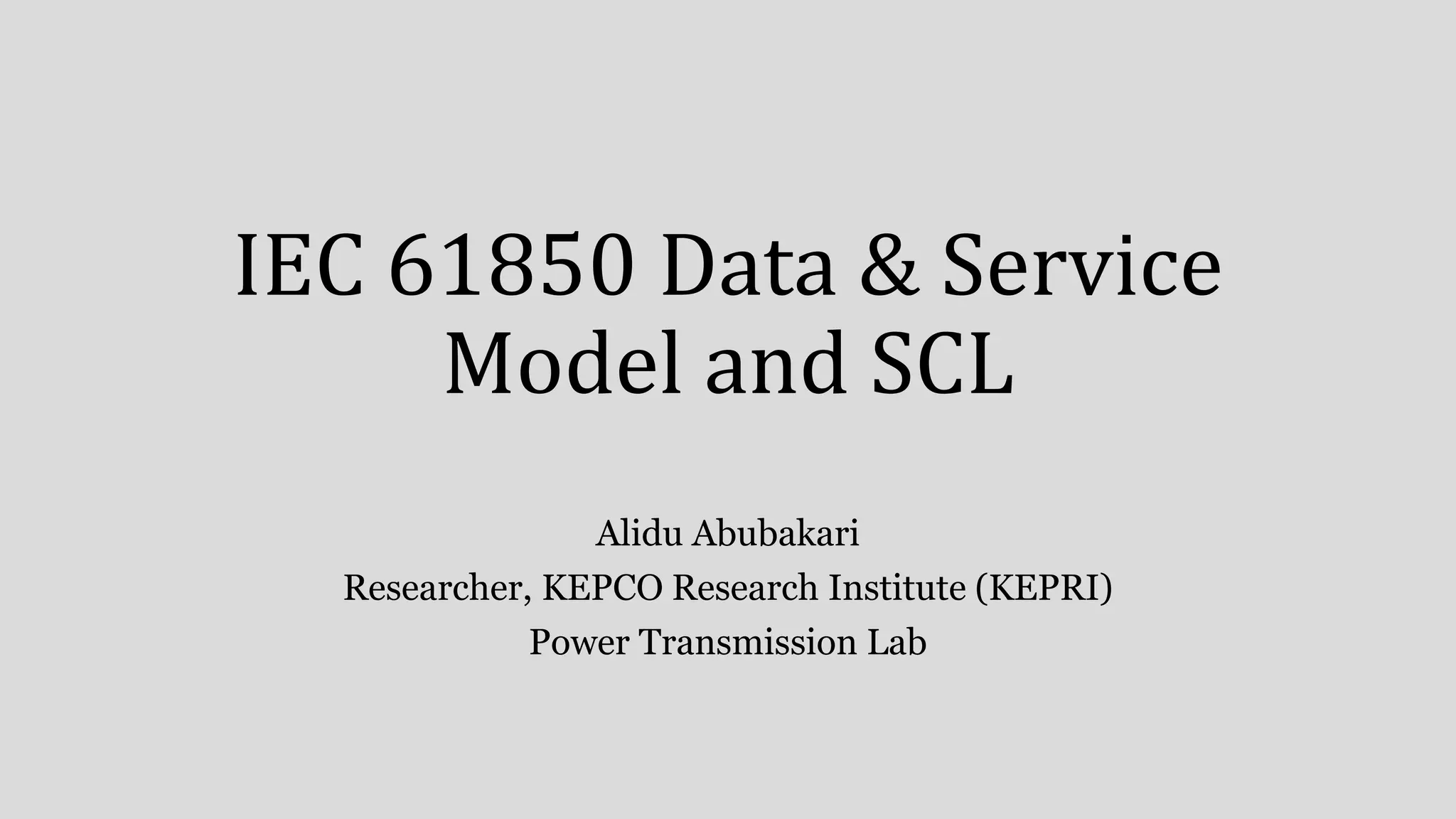
 Electric power networks are responsible for the transport of energy from
generation sites to end consumers
 The nodes in such networks are called substations and take over the
voltage transformation and also energy routing.
 Substations are controlled by the
Substation Automation system (SAS)
which is composed of
 all the electronic equipment that
continuously
 monitor,
 control and
 protect
the high voltage equipment so as to avoids
unplanned network outages
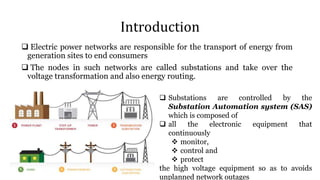
Intelligent Electronic Device
 Microprocessor–based controllers of power
system equipment– e.g. circuit breaker,
protective relay…
 Receive digitalized data from sensors and
power
equipment
 Issue control commands in case of anomalies
to
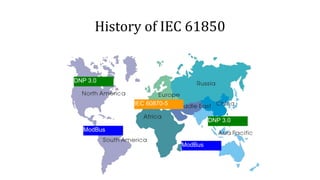
History of IEC 61850
ModBus
ModBus
IEC 60870-5
DNP 3.0
DNP 3.0
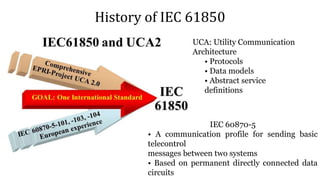
History of IEC 61850
UCA: Utility Communication
Architecture
• Protocols
• Data models
• Abstract service
definitions
IEC 60870-5
• A communication profile for sending basic
telecontrol
messages between two systems
• Based on permanent directly connected data
circuits
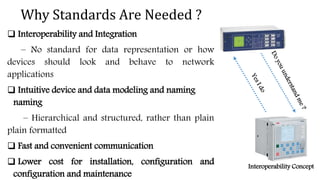
Why Standards Are Needed ?
 Interoperability and Integration
– No standard for data representation or how
devices should look and behave to network
applications
 Intuitive device and data modeling and naming
naming
– Hierarchical and structured, rather than plain
plain formatted
 Fast and convenient communication
 Lower cost for installation, configuration and
configuration and maintenance
Interoperability Concept
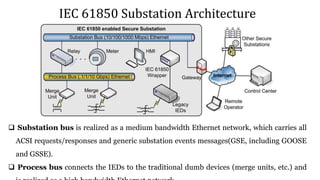
IEC 61850 Substation Architecture
 Substation bus is realized as a medium bandwidth Ethernet network, which carries all
ACSI requests/responses and generic substation events messages(GSE, including GOOSE
and GSSE).
 Process bus connects the IEDs to the traditional dumb devices (merge units, etc.) and
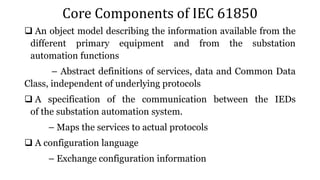
Core Components of IEC 61850
 An object model describing the information available from the
different primary equipment and from the substation
automation functions
– Abstract definitions of services, data and Common Data
Class, independent of underlying protocols
 A specification of the communication between the IEDs
of the substation automation system.
– Maps the services to actual protocols
 A configuration language
– Exchange configuration information
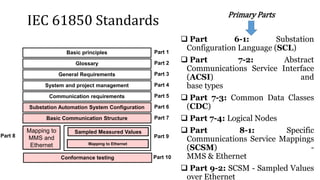
IEC 61850 Standards
 Part 6-1: Substation
Configuration Language (SCL)
 Part 7-2: Abstract
Communications Service Interface
(ACSI) and
base types
 Part 7-3: Common Data Classes
(CDC)
 Part 7-4: Logical Nodes
 Part 8-1: Specific
Communications Service Mappings
(SCSM) -
MMS & Ethernet
 Part 9-2: SCSM - Sampled Values
over Ethernet
Basic principles Part 1
Glossary Part 2
General Requirements Part 3
System and project management Part 4
Communication requirements Part 5
Substation Automation System Configuration Part 6
Basic Communication Structure Part 7
Part 9
Sampled Measured Values
Part 8
Conformance testing Part 10
Mapping to Ethernet
Mapping to
MMS and
Ethernet
Primary Parts
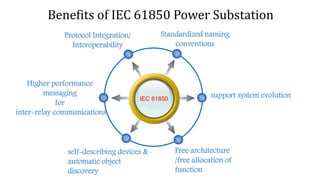
Benefits of IEC 61850 Power Substation
IEC 61850
Protocol Integration/
Interoperability
Higher performance
messaging
for
inter-relay communications
support system evolution
Standardized naming
conventions
Free architecture
/free allocation of
function
self-describing devices &
automatic object
discovery
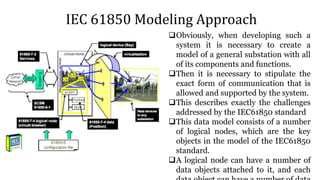
IEC 61850 Modeling Approach
Obviously, when developing such a
system it is necessary to create a
model of a general substation with all
of its components and functions.
Then it is necessary to stipulate the
exact form of communication that is
allowed and supported by the system.
This describes exactly the challenges
addressed by the IEC61850 standard
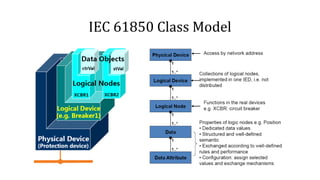
This data model consists of a number
of logical nodes, which are the key
objects in the model of the IEC61850
standard.
A logical node can have a number of
data objects attached to it, and each
IEC 61850 Class Model
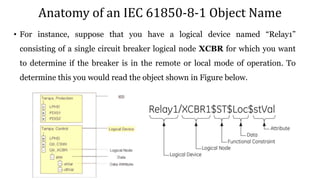
Anatomy of an IEC 61850-8-1 Object Name
• For instance, suppose that you have a logical device named “Relay1”
consisting of a single circuit breaker logical node XCBR for which you want
to determine if the breaker is in the remote or local mode of operation. To
determine this you would read the object shown in Figure below.
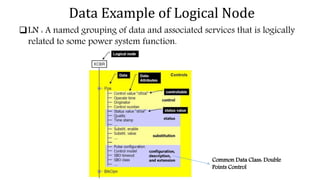
Data Example of Logical Node
Common Data Class: Double
Points Control
LN : A named grouping of data and associated services that is logically
related to some power system function.
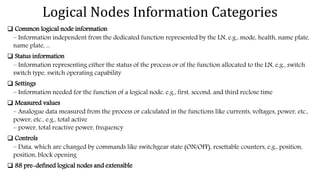
Logical Nodes Information Categories
 Common logical node information
– Information independent from the dedicated function represented by the LN, e.g., mode, health, name plate,
name plate, ...
 Status information
– Information representing either the status of the process or of the function allocated to the LN, e.g., switch
switch type, switch operating capability
 Settings
– Information needed for the function of a logical node, e.g., first, second, and third reclose time
 Measured values
– Analogue data measured from the process or calculated in the functions like currents, voltages, power, etc.,
power, etc., e.g., total active
– power, total reactive power, frequency
 Controls
– Data, which are changed by commands like switchgear state (ON/OFF), resettable counters, e.g., position,
position, block opening
 88 pre-defined logical nodes and extensible
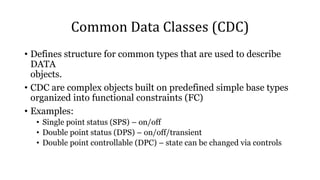
Common Data Classes (CDC)
• Defines structure for common types that are used to describe
DATA
objects.
• CDC are complex objects built on predefined simple base types
organized into functional constraints (FC)
• Examples:
• Single point status (SPS) – on/off
• Double point status (DPS) – on/off/transient
• Double point controllable (DPC) – state can be changed via controls
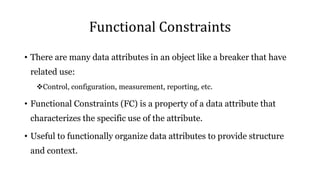
Functional Constraints
• There are many data attributes in an object like a breaker that have
related use:
Control, configuration, measurement, reporting, etc.
• Functional Constraints (FC) is a property of a data attribute that
characterizes the specific use of the attribute.
• Useful to functionally organize data attributes to provide structure
and context.
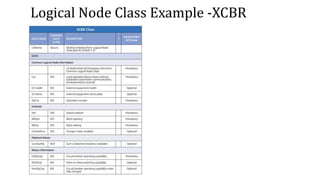
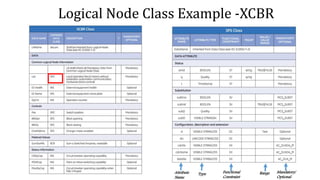
Logical Node Class Example -XCBR
Attribute
Name
Type Functional
Constraint
Range Mandatory/
Optional
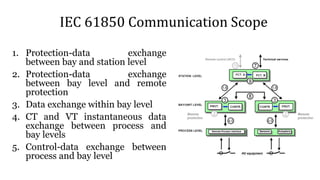
IEC 61850 Communication Scope
1. Protection-data exchange
between bay and station level
2. Protection-data exchange
between bay level and remote
protection
3. Data exchange within bay level
4. CT and VT instantaneous data
exchange between process and
bay levels
5. Control-data exchange between
process and bay level
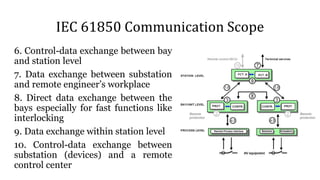
IEC 61850 Communication Scope
6. Control-data exchange between bay
and station level
7. Data exchange between substation
and remote engineer’s workplace
8. Direct data exchange between the
bays especially for fast functions like
interlocking
9. Data exchange within station level
10. Control-data exchange between
substation (devices) and a remote
control center
ACSI: Abstract Communications Service
Interface
None timing critical message transmitting
Used for configuration, maintenance, log…
Three basic components
A set of objects
A set of services to manipulate and access those objects
A base set of data types for describing objects
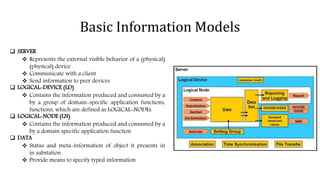
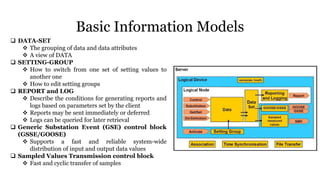
Basic Information Models
 SERVER
 Represents the external visible behavior of a (physical)
(physical) device
 Communicate with a client
 Send information to peer devices
 LOGICAL-DEVICE (LD)
 Contains the information produced and consumed by a
by a group of domain-specific application functions,
functions, which are defined as LOGICAL-NODEs
 LOGICAL-NODE (LN)
 Contains the information produced and consumed by a
by a domain specific application function
 DATA
 Status and meta-information of object it presents in
in substation
 Provide means to specify typed information
Basic Information Models
 DATA-SET
 The grouping of data and data attributes
 A view of DATA
 SETTING-GROUP
 How to switch from one set of setting values to
another one
 How to edit setting groups
 REPORT and LOG
 Describe the conditions for generating reports and
logs based on parameters set by the client
 Reports may be sent immediately or deferred
 Logs can be queried for later retrieval
 Generic Substation Event (GSE) control block
(GSSE/GOOSE)
 Supports a fast and reliable system-wide
distribution of input and output data values
 Sampled Values Transmission control block
 Fast and cyclic transfer of samples
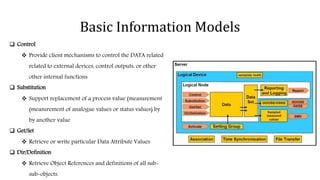
Basic Information Models
 Control
 Provide client mechanisms to control the DATA related
related to external devices, control outputs, or other
other internal functions
 Substitution
 Support replacement of a process value (measurement
(measurement of analogue values or status values) by
by another value
 Get/Set
 Retrieve or write particular Data Attribute Values
 Dir/Definition
 Retrieve Object References and definitions of all sub-
sub-objects.
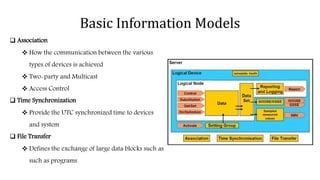
Basic Information Models
 Association
 How the communication between the various
types of devices is achieved
 Two-party and Multicast
 Access Control
 Time Synchronization
 Provide the UTC synchronized time to devices
and system
 File Transfer
 Defines the exchange of large data blocks such as
such as programs
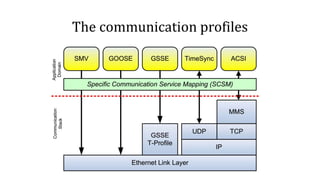
The communication profiles
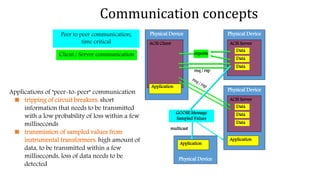
Physical Device
ACSI Server
Data
Data
Physical Device
ACSI Client
Application
Data
Physical Device
ACSI Server
Data
Data
Application
Data
reports
req / rsp
Client / Server communication
Physical Device
Application
GOOSE Message
Sampled Values
multicast
Peer to peer communication;
time critical
Applications of "peer-to-peer" communication
 tripping of circuit breakers: short
information that needs to be transmitted
with a low probability of loss within a few
milliseconds
 transmission of sampled values from
instrumental transformers: high amount of
data, to be transmitted within a few
milliseconds, loss of data needs to be
detected
Communication concepts
Principle of TPAA and MCAA
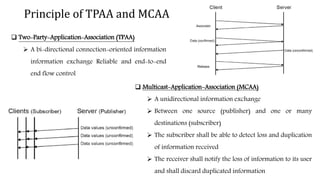
 Two-Party-Application-Association (TPAA)
 A bi-directional connection-oriented information
information exchange Reliable and end-to-end
end flow control
 Multicast-Application-Association (MCAA)
 A unidirectional information exchange
 Between one source (publisher) and one or many
destinations (subscriber)
 The subscriber shall be able to detect loss and duplication
of information received
 The receiver shall notify the loss of information to its user
and shall discard duplicated information
Service model
• Services provided by ACSI include querying object set,
getting/setting data values, controlling system objects, report
manipulation, log manipulation, and other services like file
upload/download.
• In order to request a service in a server, an application must first
establish a valid two-party application association (TPAA)
• A typical interaction procedure between an application A and a
server S goes as follows:
1. A establishes a TCP connection with S;
2. A “logs in” to S by requesting the Associate service from S,
providing authentication related information as parameters;
3. S validates the information provided by A and creates a TPAA
object, which provides a virtual view of S to A;
4. A requests subsequent services while S processes the requests
and responses with appropriate responses defined in the IEC 61850
standard;
5. A issues a Release request to S;
6. S reclaims the TPAA of A and ends the session.
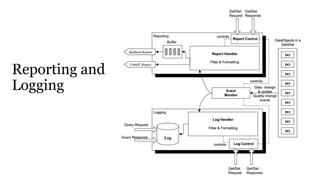
Reporting and
Logging
GOOSE: Generic Object Oriented Substation
Event
 Used for fast transmission of substation events, such as commands,
alarms, indications, as messages
 A single GOOSE message sent by an IED can be received several
receivers
 Take advantage of Ethernet and supports real-time behavior
 Examples:
Tripping of switchgear
Providing position status of interlocking
Mapping To Real Communication
Systems
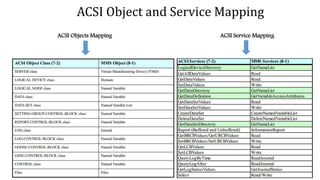
IEC 61850 is just a high level description of substation automation
Use MMS to implement IEC61850
Map each IEC 61850 object to a MMS object
Map each IEC 61850 service to a MMS operation
All but GOOSE messages and transmission of sampled values
are mapped to MMS protocol stack
ACSI Objects Mapping ACSI Service Mapping
ACSI Object and Service Mapping
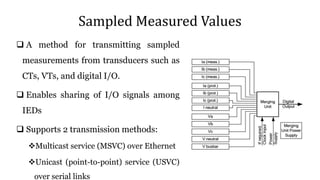
Sampled Measured Values
 A method for transmitting sampled
measurements from transducers such as
CTs, VTs, and digital I/O.
 Enables sharing of I/O signals among
IEDs
 Supports 2 transmission methods:
Multicast service (MSVC) over Ethernet
Unicast (point-to-point) service (USVC)
over serial links
SCL: Substation Configuration
Language
 Purpose: interoperable exchange of communication system
configuration data between an IED configuration tool and a
configuration tool from different manufacturers.
 A formal description of
– Relations between substation automation system and the
switchyard
– Relations of the switchyard structure to the SAS functions (logical
nodes) configured on the IEDs
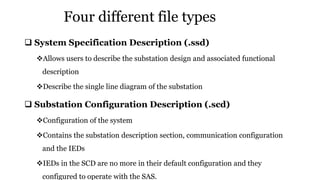
Four different file types
 System Specification Description (.ssd)
Allows users to describe the substation design and associated functional
description
Describe the single line diagram of the substation
 Substation Configuration Description (.scd)
Configuration of the system
Contains the substation description section, communication configuration
and the IEDs
IEDs in the SCD are no more in their default configuration and they
configured to operate with the SAS.
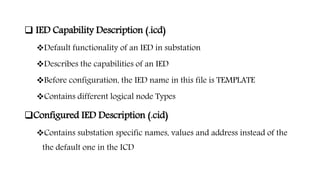
 IED Capability Description (.icd)
Default functionality of an IED in substation
Describes the capabilities of an IED
Before configuration, the IED name in this file is TEMPLATE
Contains different logical node Types
Configured IED Description (.cid)
Contains substation specific names, values and address instead of the
the default one in the ICD
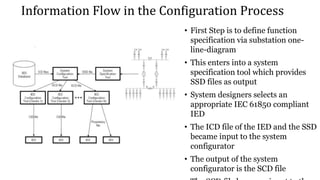
Information Flow in the Configuration Process
• First Step is to define function
specification via substation one-
line-diagram
• This enters into a system
specification tool which provides
SSD files as output
• System designers selects an
appropriate IEC 61850 compliant
IED
• The ICD file of the IED and the SSD
became input to the system
configurator
• The output of the system
configurator is the SCD file
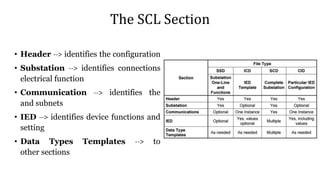
The SCL Section
• Header --> identifies the configuration
• Substation --> identifies connections
electrical function
• Communication --> identifies the
and subnets
• IED --> identifies device functions and
setting
• Data Types Templates --> to
other sections
Conclusion
 Due to its complexity and the assumed domain-specific knowledge,
the IEC 61850 standard is difficult for people to understand and
implement.
 Although the IEC 61850 adopts an object-oriented approach,
implementers still need their own internal data representation or
take the advantage of a database system.

IEC61850 tutorial

  • 1.
    IEC 61850 Data& Service Model and SCL Alidu Abubakari Researcher, KEPCO Research Institute (KEPRI) Power Transmission Lab
  • 2.
    Introduction  Electric powernetworks are responsible for the transport of energy from generation sites to end consumers  The nodes in such networks are called substations and take over the voltage transformation and also energy routing.  Substations are controlled by the Substation Automation system (SAS) which is composed of  all the electronic equipment that continuously  monitor,  control and  protect the high voltage equipment so as to avoids unplanned network outages
  • 3.
    Intelligent Electronic Device Microprocessor–based controllers of power system equipment– e.g. circuit breaker, protective relay…  Receive digitalized data from sensors and power equipment  Issue control commands in case of anomalies to
  • 4.
    History of IEC61850 ModBus ModBus IEC 60870-5 DNP 3.0 DNP 3.0
  • 5.
    History of IEC61850 UCA: Utility Communication Architecture • Protocols • Data models • Abstract service definitions IEC 60870-5 • A communication profile for sending basic telecontrol messages between two systems • Based on permanent directly connected data circuits
  • 6.
    Why Standards AreNeeded ?  Interoperability and Integration – No standard for data representation or how devices should look and behave to network applications  Intuitive device and data modeling and naming naming – Hierarchical and structured, rather than plain plain formatted  Fast and convenient communication  Lower cost for installation, configuration and configuration and maintenance Interoperability Concept
  • 7.
    IEC 61850 SubstationArchitecture  Substation bus is realized as a medium bandwidth Ethernet network, which carries all ACSI requests/responses and generic substation events messages(GSE, including GOOSE and GSSE).  Process bus connects the IEDs to the traditional dumb devices (merge units, etc.) and
  • 8.
    Core Components ofIEC 61850  An object model describing the information available from the different primary equipment and from the substation automation functions – Abstract definitions of services, data and Common Data Class, independent of underlying protocols  A specification of the communication between the IEDs of the substation automation system. – Maps the services to actual protocols  A configuration language – Exchange configuration information
  • 9.
    IEC 61850 Standards Part 6-1: Substation Configuration Language (SCL)  Part 7-2: Abstract Communications Service Interface (ACSI) and base types  Part 7-3: Common Data Classes (CDC)  Part 7-4: Logical Nodes  Part 8-1: Specific Communications Service Mappings (SCSM) - MMS & Ethernet  Part 9-2: SCSM - Sampled Values over Ethernet Basic principles Part 1 Glossary Part 2 General Requirements Part 3 System and project management Part 4 Communication requirements Part 5 Substation Automation System Configuration Part 6 Basic Communication Structure Part 7 Part 9 Sampled Measured Values Part 8 Conformance testing Part 10 Mapping to Ethernet Mapping to MMS and Ethernet Primary Parts
  • 10.
    Benefits of IEC61850 Power Substation IEC 61850 Protocol Integration/ Interoperability Higher performance messaging for inter-relay communications support system evolution Standardized naming conventions Free architecture /free allocation of function self-describing devices & automatic object discovery
  • 11.
    IEC 61850 ModelingApproach Obviously, when developing such a system it is necessary to create a model of a general substation with all of its components and functions. Then it is necessary to stipulate the exact form of communication that is allowed and supported by the system. This describes exactly the challenges addressed by the IEC61850 standard This data model consists of a number of logical nodes, which are the key objects in the model of the IEC61850 standard. A logical node can have a number of data objects attached to it, and each
  • 12.
  • 13.
    Anatomy of anIEC 61850-8-1 Object Name • For instance, suppose that you have a logical device named “Relay1” consisting of a single circuit breaker logical node XCBR for which you want to determine if the breaker is in the remote or local mode of operation. To determine this you would read the object shown in Figure below.
  • 14.
    Data Example ofLogical Node Common Data Class: Double Points Control LN : A named grouping of data and associated services that is logically related to some power system function.
  • 15.
    Logical Nodes InformationCategories  Common logical node information – Information independent from the dedicated function represented by the LN, e.g., mode, health, name plate, name plate, ...  Status information – Information representing either the status of the process or of the function allocated to the LN, e.g., switch switch type, switch operating capability  Settings – Information needed for the function of a logical node, e.g., first, second, and third reclose time  Measured values – Analogue data measured from the process or calculated in the functions like currents, voltages, power, etc., power, etc., e.g., total active – power, total reactive power, frequency  Controls – Data, which are changed by commands like switchgear state (ON/OFF), resettable counters, e.g., position, position, block opening  88 pre-defined logical nodes and extensible
  • 16.
    Common Data Classes(CDC) • Defines structure for common types that are used to describe DATA objects. • CDC are complex objects built on predefined simple base types organized into functional constraints (FC) • Examples: • Single point status (SPS) – on/off • Double point status (DPS) – on/off/transient • Double point controllable (DPC) – state can be changed via controls
  • 17.
    Functional Constraints • Thereare many data attributes in an object like a breaker that have related use: Control, configuration, measurement, reporting, etc. • Functional Constraints (FC) is a property of a data attribute that characterizes the specific use of the attribute. • Useful to functionally organize data attributes to provide structure and context.
  • 18.
    Logical Node ClassExample -XCBR
  • 19.
    Logical Node ClassExample -XCBR Attribute Name Type Functional Constraint Range Mandatory/ Optional
  • 20.
    IEC 61850 CommunicationScope 1. Protection-data exchange between bay and station level 2. Protection-data exchange between bay level and remote protection 3. Data exchange within bay level 4. CT and VT instantaneous data exchange between process and bay levels 5. Control-data exchange between process and bay level
  • 21.
    IEC 61850 CommunicationScope 6. Control-data exchange between bay and station level 7. Data exchange between substation and remote engineer’s workplace 8. Direct data exchange between the bays especially for fast functions like interlocking 9. Data exchange within station level 10. Control-data exchange between substation (devices) and a remote control center
  • 22.
    ACSI: Abstract CommunicationsService Interface None timing critical message transmitting Used for configuration, maintenance, log… Three basic components A set of objects A set of services to manipulate and access those objects A base set of data types for describing objects
  • 23.
    Basic Information Models SERVER  Represents the external visible behavior of a (physical) (physical) device  Communicate with a client  Send information to peer devices  LOGICAL-DEVICE (LD)  Contains the information produced and consumed by a by a group of domain-specific application functions, functions, which are defined as LOGICAL-NODEs  LOGICAL-NODE (LN)  Contains the information produced and consumed by a by a domain specific application function  DATA  Status and meta-information of object it presents in in substation  Provide means to specify typed information
  • 24.
    Basic Information Models DATA-SET  The grouping of data and data attributes  A view of DATA  SETTING-GROUP  How to switch from one set of setting values to another one  How to edit setting groups  REPORT and LOG  Describe the conditions for generating reports and logs based on parameters set by the client  Reports may be sent immediately or deferred  Logs can be queried for later retrieval  Generic Substation Event (GSE) control block (GSSE/GOOSE)  Supports a fast and reliable system-wide distribution of input and output data values  Sampled Values Transmission control block  Fast and cyclic transfer of samples
  • 25.
    Basic Information Models Control  Provide client mechanisms to control the DATA related related to external devices, control outputs, or other other internal functions  Substitution  Support replacement of a process value (measurement (measurement of analogue values or status values) by by another value  Get/Set  Retrieve or write particular Data Attribute Values  Dir/Definition  Retrieve Object References and definitions of all sub- sub-objects.
  • 26.
    Basic Information Models Association  How the communication between the various types of devices is achieved  Two-party and Multicast  Access Control  Time Synchronization  Provide the UTC synchronized time to devices and system  File Transfer  Defines the exchange of large data blocks such as such as programs
  • 27.
  • 28.
    Physical Device ACSI Server Data Data PhysicalDevice ACSI Client Application Data Physical Device ACSI Server Data Data Application Data reports req / rsp Client / Server communication Physical Device Application GOOSE Message Sampled Values multicast Peer to peer communication; time critical Applications of "peer-to-peer" communication  tripping of circuit breakers: short information that needs to be transmitted with a low probability of loss within a few milliseconds  transmission of sampled values from instrumental transformers: high amount of data, to be transmitted within a few milliseconds, loss of data needs to be detected Communication concepts
  • 29.
    Principle of TPAAand MCAA  Two-Party-Application-Association (TPAA)  A bi-directional connection-oriented information information exchange Reliable and end-to-end end flow control  Multicast-Application-Association (MCAA)  A unidirectional information exchange  Between one source (publisher) and one or many destinations (subscriber)  The subscriber shall be able to detect loss and duplication of information received  The receiver shall notify the loss of information to its user and shall discard duplicated information
  • 30.
    Service model • Servicesprovided by ACSI include querying object set, getting/setting data values, controlling system objects, report manipulation, log manipulation, and other services like file upload/download. • In order to request a service in a server, an application must first establish a valid two-party application association (TPAA)
  • 31.
    • A typicalinteraction procedure between an application A and a server S goes as follows: 1. A establishes a TCP connection with S; 2. A “logs in” to S by requesting the Associate service from S, providing authentication related information as parameters; 3. S validates the information provided by A and creates a TPAA object, which provides a virtual view of S to A;
  • 32.
    4. A requestssubsequent services while S processes the requests and responses with appropriate responses defined in the IEC 61850 standard; 5. A issues a Release request to S; 6. S reclaims the TPAA of A and ends the session.
  • 33.
  • 34.
    GOOSE: Generic ObjectOriented Substation Event  Used for fast transmission of substation events, such as commands, alarms, indications, as messages  A single GOOSE message sent by an IED can be received several receivers  Take advantage of Ethernet and supports real-time behavior  Examples: Tripping of switchgear Providing position status of interlocking
  • 35.
    Mapping To RealCommunication Systems IEC 61850 is just a high level description of substation automation Use MMS to implement IEC61850 Map each IEC 61850 object to a MMS object Map each IEC 61850 service to a MMS operation All but GOOSE messages and transmission of sampled values are mapped to MMS protocol stack
  • 36.
    ACSI Objects MappingACSI Service Mapping ACSI Object and Service Mapping
  • 37.
    Sampled Measured Values A method for transmitting sampled measurements from transducers such as CTs, VTs, and digital I/O.  Enables sharing of I/O signals among IEDs  Supports 2 transmission methods: Multicast service (MSVC) over Ethernet Unicast (point-to-point) service (USVC) over serial links
  • 38.
    SCL: Substation Configuration Language Purpose: interoperable exchange of communication system configuration data between an IED configuration tool and a configuration tool from different manufacturers.  A formal description of – Relations between substation automation system and the switchyard – Relations of the switchyard structure to the SAS functions (logical nodes) configured on the IEDs
  • 39.
    Four different filetypes  System Specification Description (.ssd) Allows users to describe the substation design and associated functional description Describe the single line diagram of the substation  Substation Configuration Description (.scd) Configuration of the system Contains the substation description section, communication configuration and the IEDs IEDs in the SCD are no more in their default configuration and they configured to operate with the SAS.
  • 40.
     IED CapabilityDescription (.icd) Default functionality of an IED in substation Describes the capabilities of an IED Before configuration, the IED name in this file is TEMPLATE Contains different logical node Types Configured IED Description (.cid) Contains substation specific names, values and address instead of the the default one in the ICD
  • 41.
    Information Flow inthe Configuration Process • First Step is to define function specification via substation one- line-diagram • This enters into a system specification tool which provides SSD files as output • System designers selects an appropriate IEC 61850 compliant IED • The ICD file of the IED and the SSD became input to the system configurator • The output of the system configurator is the SCD file
  • 42.
    The SCL Section •Header --> identifies the configuration • Substation --> identifies connections electrical function • Communication --> identifies the and subnets • IED --> identifies device functions and setting • Data Types Templates --> to other sections
  • 43.
    Conclusion  Due toits complexity and the assumed domain-specific knowledge, the IEC 61850 standard is difficult for people to understand and implement.  Although the IEC 61850 adopts an object-oriented approach, implementers still need their own internal data representation or take the advantage of a database system.