Subsistence Systems Making a Living Cross-Culturally
What are Subsistence Systems? Ways of making a living--directly Types of subsistence Systems Foraging/Hunting and Gathering Horticulture Intensive Cultivation or Agriculture Pastoralism Equestrian Hunting
Why Study Subsistence Systems? Kingdom:  Animalia: We cannot produce food by photosynthesis--no chlorophyll Therefore, we ultimately rely on plants We are how we produce Foragers are organized around the hunting and the gathering So are horticulturists in horticulture So are all the others
Subsistence Systems and Adaptation Culture is largely adaptive Main locus of adaptation: subsistence As subsistence systems become more complex Societies become more complex Therefore societies evolve from the simple to the complex
Overview Subsistence systems Principles of cultural materialism Cultural Evolution Cultural Ecology History of evolutionary thought
Types of Subsistence Systems Foraging or Hunting Gathering : Hunting animals, gathering plants Horticulture:  Cultivation with digging stick, hoe, or other hand tool(s) Intensive Cultivation:  Cultivation with high-yield technology: irrigation, plow Pastoralism:  Herding large animals Equestrian Hunting:  Hunting using draft animals (horse, reindeer)
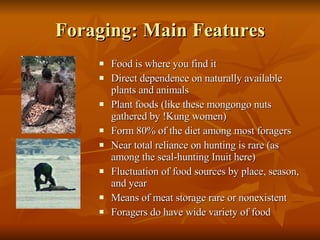
Foraging: Main Features Food is where you find it Direct dependence on naturally available plants and animals Plant foods (like these mongongo nuts gathered by !Kung women)  Form 80% of the diet among most foragers Near total reliance on hunting is rare (as among the seal-hunting Inuit here) Fluctuation of food sources by place, season, and year Means of meat storage rare or nonexistent Foragers do have wide variety of food
Foraging: Carrying Capacity Population limited by Carrying capacity: population resources can support Density of social relations Liebig’s Law of the Minimum Populations may not increase Beyond the minimum amount of critical resources That an environment yields
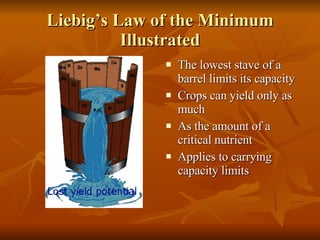
Liebig’s Law of the Minimum Illustrated The lowest stave of a barrel limits its capacity Crops can yield only as much As the amount of a critical nutrient Applies to carrying capacity limits
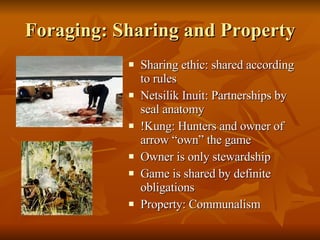
Foraging: Sharing and Property Sharing ethic: shared according to rules Netsilik Inuit: Partnerships by seal anatomy !Kung: Hunters and owner of arrow “own” the game Owner is only stewardship Game is shared by definite obligations Property: Communalism
Foraging: Other Derived Characteristics Egalitarianism No incentive to hoard Social class differences minimal Work time Average: 15-20 hours/week Nonintensive labor with other activities Domestic mode of production: work done until needs are met
Foragers: Contemporary Ancestors? Some societies may reflect early foragers Qualifications Foragers could be  deculturated !Kung may have been herdsman once Reduced to foraging by Bantu expansion Foragers occupy margins of earth Desert (SW Africa, Australia, Nevada basin) Extremely cold regions (Arctic regions)
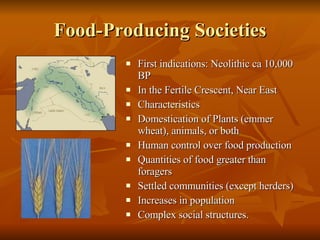
Food-Producing Societies First indications: Neolithic ca 10,000 BP  In the Fertile Crescent, Near East Characteristics Domestication of Plants (emmer wheat), animals, or both Human control over food production Quantities of food greater than foragers Settled communities (except herders) Increases in population Complex social structures.
Horticulture Definition Cultivation of crops  Carried out with hand tools Such as digging sticks or hoes Neither plows or irrigation systems are used Best known type of cultivation involves use of  slash-and-burn  or  swidden  cultivation
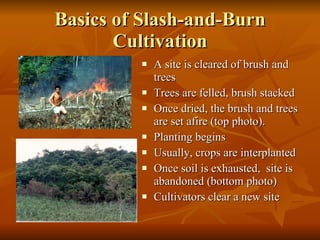
Basics of Slash-and-Burn Cultivation A site is cleared of brush and trees Trees are felled, brush stacked Once dried, the brush and trees are set afire (top photo). Planting begins Usually, crops are interplanted Once soil is exhausted,  site is abandoned (bottom photo) Cultivators clear a new site
Slash-and-Burn Cultivation: Adaptive Significance Most slash-and-burn cultivation is practiced in the tropics Tropical climate is extremely hard on soils  Intense heat Heavy rainfall Chemical reaction from heat and rain Slash-and-burn is best adapted to this climate--which the following will show
Constants of Tropical Rainforest: Intense Heat Plant and animal matter decompose to form  humus  or  topsoil Humus formatio virtually stops if soil reaches 77 degrees Fahrenheit Decomposition of humus exceed formation Humic materials break down to gases: ammonia, nitrogen, carbon dioxide Gases escape into the atmosphere
Constants of Tropical Rainforest: Rainfall Rainfall acts on the soil in two ways Erosion:  Rainfall carries away soil particles Particles themselves scour surface] Abrasion carries off even more soil Leaching Warm water dissolves water-soluble nutrients Nutrients seep into subsoil
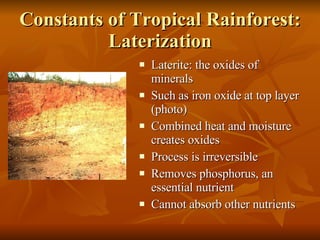
Constants of Tropical Rainforest: Laterization Laterite: the oxides of minerals  Such as iron oxide at top layer (photo)  Combined heat and moisture creates oxides Process is irreversible Removes phosphorus, an essential nutrient Cannot absorb other nutrients
A Long-Term Constant: Age of Soil This process has been going for centuries Soil is mostly clay and sand Plant and animal life is limited in protein Most plants reproduce by vegetative means Seeds involve large amounts of protein Animals are small Gregarious (herding) animals are rare
Adaptation of Tropical Rainforests Protective canopy of leaves and epiphytic plants Rate of growth Juxtaposition of different types of trees
Protective Canopy Mature forests contain trees with thick foliage at their tops Thick network of leafy branches Epiphytic plants that derive nutrients from rain and air Protective functions Provide protective shade from sun, allowing humus to accumulate Lessens action and amount of rainfall
Rate of Growth Rate of growth is spectacular Enables rapid use of nutrients before they disappear through erosion or leaching Litter fall of animal remains and dead vegetation Is four times of woodland in New York state Rainfall also captures nutrients from air 75% of potassium in soil, 40% of magnesium, and 25% of phosphorus come from rainwater
Species Juxtaposition Different tree species have different nutrient requirements Some require more phosphorus than others Other require more potassium Nutrient left by one tree is taken by others Dispersal of same species is protection against pests  and diseases
Clean clearing would Compact the soil due to heavy rainfall Erosion via runoff would increase Minimize or eliminate formation of humus Leach the soil Convert the soil into laterite Overall: reduce its fertility
Slash-and-Burn Cultivation Technique Review of distinctive features Cutting and burning vegetation prior to planting Shifting to new site after 2 or 3 crops Mundurucú practices Site selection: sloping, well-drained area Clearing Removal of shrubs and small trees Felling of trees by keystone method
Slash-and-Burn Cultivation Technique: Burning and Planting Mundurucú practices (con’t) Burning Vegetation allowed to dry: 2 months Fire set on day of slight breeze to fan flames Planting Begins at first rains: no cultivation Hole made with digging stick Cuttings or seeds inserted and covered Manioc and sweet potatoes in center Other crops planted at edges
Slash-and-Burn Cultivation: Weeding and Harvest Weeding Done twice during growing season Harvest Planting is staggered; so is harvesting Harvesting done as need arises Entire crop is not removed at one time Manioc replanted immediately after harvest to ensure permanent supply
Slash-and-Burn Cultivation as Imitation of Rainforest Crops are intermixed, each with different nutrient requirements Reduces competition for same nutrient Dispersal of same plants retard disease, pests Staggering planting and harvest minimizes soil exposure Burning slash returns nutrients to soil
Slash and Burn Cultivation as  Imperfect  Imitation of Rainforest Decomposition of stumps and branches Attract pests away from crops Supply added nutrients Weeding of mixed value Minimizes competition for nutrients Reduces shade and protection from erosion Imitation not the real thing Yield declines by 3rd year--time to move
Yanomamo Variations Techniques essentially the same Plantains augment manioc as staple When soil deteriorates Thorny shrubs grow, scratching bare skin Some plants continue yields New clearing is made adjacent to old site Done so over the years New sites cleared only under compulsion
The Protein debate Harris: arises when game is scarce Chagnon: conflict sparked by abduction of women Good:  Weighed every game animal on scale Weighed every Yanomamo villager Findings: Yanomamo were short on protein Could not link this fact with warfare Debate remains open: Tierney’s view
Intensive Cultivation Definition Embers’: Food production characterized by the permanent cultivation of fields Primary attributes Technology Irrigation Plow Staple crops: rice, corn, wheat, potatoes Risks of famine through disease, pests
Intensive Cultivation: Secondary Attributes Permanent settlements of high density Emergence of full-time nonfarm occupations Rise of specialization and trade Rise of complex societies Cities Stratification Codified Law States and the military
Pastoralism Definition Animal husbandry as the main or sole source of subsistence Animals: cattle, horses, sheep, goats, camels All parts of animal is consumed Meat and dairy products, blood Hides Even dung for fire and building material
Pastoralism: Secondary Characteristics Environment: semi-arid grasslands; other regions unsuitable for agriculture Nomadic: Transhumance: seasonal migration between different environmental zones. Property and valuables are portable Dependence on settled communities Agriculture and manufactured products Mixed economy lessens dependence
Pastoralism: Secondary Characteristics (Con’t) Warfare Raid of villages or other nomads Predatory states: Mongols Warrior age grades in East Africa Male dominance Warfare required male cooperation Animals are male property Residence is patrilocal Women have few rights
Pastoralism: Conclusion Incomplete food producers Animals, not plants, are domesticated Archaeological evidence suggest Pastoralism postdates cultivation. May have left settled regions By choice by force Probably not a transitional form between foraging and agriculture
Equestrian Hunting Definition Use of  animals (horse reindeer) To hunt other animals (bison, reindeer) A rare phenomenon Plains Indians hunting complex was not indigenous before 18th century Native horses died off long before contact Sources: stray horses lost by Spaniards
Equestrian Hunting: Characteristics Similar to pastoralism Environment: grassland rendered unsuitable for hoe agriculture by sod Bison moved seasonally Large herds in spring and summer Scattered  in late fall and winter Tribes moved accordingly Reminiscent of transhumance
Equestrian hunting: Warlike Attributes Higher mobility using horse increased military superiority Settle peoples may have adopted horse in self-defense A causal factor: trade with whites Competition for trade center access Even more buffalo hunted for trade Horse theft for another trade good Valued trade item: guns
Subsistence, Adaptation, and Evolution Cultural materialism : A research strategy (or plan) holding that causal explanations for similarities and differences among human groups can best be addressed by studying the harnessing of energy  Through interaction between existing technology And environmental limitations
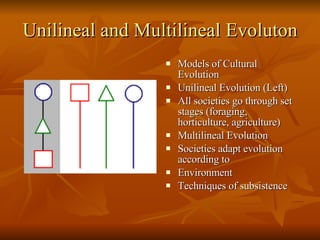
Unilineal and Multilineal Evoluton Models of Cultural Evolution Unilineal Evolution (Left) All societies go through set stages (foraging, horticulture, agriculture) Multilineal Evolution Societies adapt evolution according to Environment  Techniques of subsistence
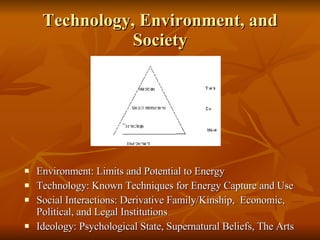
Technology, Environment, and Society Environment: Limits and Potential to Energy Technology: Known Techniques for Energy Capture and Use Social Interactions: Derivative Family/Kinship,  Economic, Political, and Legal Institutions Ideology: Psychological State, Supernatural Beliefs, The Arts
Comparison and Evaluation Examined five broad subsistence systems. Examined the implications of each on a society and culture Traced their significance in  Local and regional adaptations (cultural ecology) Universal cultural evolution Within intellectual historical context

Subsistence Systems

  • 1.
    Subsistence Systems Makinga Living Cross-Culturally
  • 2.
    What are SubsistenceSystems? Ways of making a living--directly Types of subsistence Systems Foraging/Hunting and Gathering Horticulture Intensive Cultivation or Agriculture Pastoralism Equestrian Hunting
  • 3.
    Why Study SubsistenceSystems? Kingdom: Animalia: We cannot produce food by photosynthesis--no chlorophyll Therefore, we ultimately rely on plants We are how we produce Foragers are organized around the hunting and the gathering So are horticulturists in horticulture So are all the others
  • 4.
    Subsistence Systems andAdaptation Culture is largely adaptive Main locus of adaptation: subsistence As subsistence systems become more complex Societies become more complex Therefore societies evolve from the simple to the complex
  • 5.
    Overview Subsistence systemsPrinciples of cultural materialism Cultural Evolution Cultural Ecology History of evolutionary thought
  • 6.
    Types of SubsistenceSystems Foraging or Hunting Gathering : Hunting animals, gathering plants Horticulture: Cultivation with digging stick, hoe, or other hand tool(s) Intensive Cultivation: Cultivation with high-yield technology: irrigation, plow Pastoralism: Herding large animals Equestrian Hunting: Hunting using draft animals (horse, reindeer)
  • 7.
    Foraging: Main FeaturesFood is where you find it Direct dependence on naturally available plants and animals Plant foods (like these mongongo nuts gathered by !Kung women) Form 80% of the diet among most foragers Near total reliance on hunting is rare (as among the seal-hunting Inuit here) Fluctuation of food sources by place, season, and year Means of meat storage rare or nonexistent Foragers do have wide variety of food
  • 8.
    Foraging: Carrying CapacityPopulation limited by Carrying capacity: population resources can support Density of social relations Liebig’s Law of the Minimum Populations may not increase Beyond the minimum amount of critical resources That an environment yields
  • 9.
    Liebig’s Law ofthe Minimum Illustrated The lowest stave of a barrel limits its capacity Crops can yield only as much As the amount of a critical nutrient Applies to carrying capacity limits
  • 10.
    Foraging: Sharing andProperty Sharing ethic: shared according to rules Netsilik Inuit: Partnerships by seal anatomy !Kung: Hunters and owner of arrow “own” the game Owner is only stewardship Game is shared by definite obligations Property: Communalism
  • 11.
    Foraging: Other DerivedCharacteristics Egalitarianism No incentive to hoard Social class differences minimal Work time Average: 15-20 hours/week Nonintensive labor with other activities Domestic mode of production: work done until needs are met
  • 12.
    Foragers: Contemporary Ancestors?Some societies may reflect early foragers Qualifications Foragers could be deculturated !Kung may have been herdsman once Reduced to foraging by Bantu expansion Foragers occupy margins of earth Desert (SW Africa, Australia, Nevada basin) Extremely cold regions (Arctic regions)
  • 13.
    Food-Producing Societies Firstindications: Neolithic ca 10,000 BP In the Fertile Crescent, Near East Characteristics Domestication of Plants (emmer wheat), animals, or both Human control over food production Quantities of food greater than foragers Settled communities (except herders) Increases in population Complex social structures.
  • 14.
    Horticulture Definition Cultivationof crops Carried out with hand tools Such as digging sticks or hoes Neither plows or irrigation systems are used Best known type of cultivation involves use of slash-and-burn or swidden cultivation
  • 15.
    Basics of Slash-and-BurnCultivation A site is cleared of brush and trees Trees are felled, brush stacked Once dried, the brush and trees are set afire (top photo). Planting begins Usually, crops are interplanted Once soil is exhausted, site is abandoned (bottom photo) Cultivators clear a new site
  • 16.
    Slash-and-Burn Cultivation: AdaptiveSignificance Most slash-and-burn cultivation is practiced in the tropics Tropical climate is extremely hard on soils Intense heat Heavy rainfall Chemical reaction from heat and rain Slash-and-burn is best adapted to this climate--which the following will show
  • 17.
    Constants of TropicalRainforest: Intense Heat Plant and animal matter decompose to form humus or topsoil Humus formatio virtually stops if soil reaches 77 degrees Fahrenheit Decomposition of humus exceed formation Humic materials break down to gases: ammonia, nitrogen, carbon dioxide Gases escape into the atmosphere
  • 18.
    Constants of TropicalRainforest: Rainfall Rainfall acts on the soil in two ways Erosion: Rainfall carries away soil particles Particles themselves scour surface] Abrasion carries off even more soil Leaching Warm water dissolves water-soluble nutrients Nutrients seep into subsoil
  • 19.
    Constants of TropicalRainforest: Laterization Laterite: the oxides of minerals Such as iron oxide at top layer (photo) Combined heat and moisture creates oxides Process is irreversible Removes phosphorus, an essential nutrient Cannot absorb other nutrients
  • 20.
    A Long-Term Constant:Age of Soil This process has been going for centuries Soil is mostly clay and sand Plant and animal life is limited in protein Most plants reproduce by vegetative means Seeds involve large amounts of protein Animals are small Gregarious (herding) animals are rare
  • 21.
    Adaptation of TropicalRainforests Protective canopy of leaves and epiphytic plants Rate of growth Juxtaposition of different types of trees
  • 22.
    Protective Canopy Matureforests contain trees with thick foliage at their tops Thick network of leafy branches Epiphytic plants that derive nutrients from rain and air Protective functions Provide protective shade from sun, allowing humus to accumulate Lessens action and amount of rainfall
  • 23.
    Rate of GrowthRate of growth is spectacular Enables rapid use of nutrients before they disappear through erosion or leaching Litter fall of animal remains and dead vegetation Is four times of woodland in New York state Rainfall also captures nutrients from air 75% of potassium in soil, 40% of magnesium, and 25% of phosphorus come from rainwater
  • 24.
    Species Juxtaposition Differenttree species have different nutrient requirements Some require more phosphorus than others Other require more potassium Nutrient left by one tree is taken by others Dispersal of same species is protection against pests and diseases
  • 25.
    Clean clearing wouldCompact the soil due to heavy rainfall Erosion via runoff would increase Minimize or eliminate formation of humus Leach the soil Convert the soil into laterite Overall: reduce its fertility
  • 26.
    Slash-and-Burn Cultivation TechniqueReview of distinctive features Cutting and burning vegetation prior to planting Shifting to new site after 2 or 3 crops Mundurucú practices Site selection: sloping, well-drained area Clearing Removal of shrubs and small trees Felling of trees by keystone method
  • 27.
    Slash-and-Burn Cultivation Technique:Burning and Planting Mundurucú practices (con’t) Burning Vegetation allowed to dry: 2 months Fire set on day of slight breeze to fan flames Planting Begins at first rains: no cultivation Hole made with digging stick Cuttings or seeds inserted and covered Manioc and sweet potatoes in center Other crops planted at edges
  • 28.
    Slash-and-Burn Cultivation: Weedingand Harvest Weeding Done twice during growing season Harvest Planting is staggered; so is harvesting Harvesting done as need arises Entire crop is not removed at one time Manioc replanted immediately after harvest to ensure permanent supply
  • 29.
    Slash-and-Burn Cultivation asImitation of Rainforest Crops are intermixed, each with different nutrient requirements Reduces competition for same nutrient Dispersal of same plants retard disease, pests Staggering planting and harvest minimizes soil exposure Burning slash returns nutrients to soil
  • 30.
    Slash and BurnCultivation as Imperfect Imitation of Rainforest Decomposition of stumps and branches Attract pests away from crops Supply added nutrients Weeding of mixed value Minimizes competition for nutrients Reduces shade and protection from erosion Imitation not the real thing Yield declines by 3rd year--time to move
  • 31.
    Yanomamo Variations Techniquesessentially the same Plantains augment manioc as staple When soil deteriorates Thorny shrubs grow, scratching bare skin Some plants continue yields New clearing is made adjacent to old site Done so over the years New sites cleared only under compulsion
  • 32.
    The Protein debateHarris: arises when game is scarce Chagnon: conflict sparked by abduction of women Good: Weighed every game animal on scale Weighed every Yanomamo villager Findings: Yanomamo were short on protein Could not link this fact with warfare Debate remains open: Tierney’s view
  • 33.
    Intensive Cultivation DefinitionEmbers’: Food production characterized by the permanent cultivation of fields Primary attributes Technology Irrigation Plow Staple crops: rice, corn, wheat, potatoes Risks of famine through disease, pests
  • 34.
    Intensive Cultivation: SecondaryAttributes Permanent settlements of high density Emergence of full-time nonfarm occupations Rise of specialization and trade Rise of complex societies Cities Stratification Codified Law States and the military
  • 35.
    Pastoralism Definition Animalhusbandry as the main or sole source of subsistence Animals: cattle, horses, sheep, goats, camels All parts of animal is consumed Meat and dairy products, blood Hides Even dung for fire and building material
  • 36.
    Pastoralism: Secondary CharacteristicsEnvironment: semi-arid grasslands; other regions unsuitable for agriculture Nomadic: Transhumance: seasonal migration between different environmental zones. Property and valuables are portable Dependence on settled communities Agriculture and manufactured products Mixed economy lessens dependence
  • 37.
    Pastoralism: Secondary Characteristics(Con’t) Warfare Raid of villages or other nomads Predatory states: Mongols Warrior age grades in East Africa Male dominance Warfare required male cooperation Animals are male property Residence is patrilocal Women have few rights
  • 38.
    Pastoralism: Conclusion Incompletefood producers Animals, not plants, are domesticated Archaeological evidence suggest Pastoralism postdates cultivation. May have left settled regions By choice by force Probably not a transitional form between foraging and agriculture
  • 39.
    Equestrian Hunting DefinitionUse of animals (horse reindeer) To hunt other animals (bison, reindeer) A rare phenomenon Plains Indians hunting complex was not indigenous before 18th century Native horses died off long before contact Sources: stray horses lost by Spaniards
  • 40.
    Equestrian Hunting: CharacteristicsSimilar to pastoralism Environment: grassland rendered unsuitable for hoe agriculture by sod Bison moved seasonally Large herds in spring and summer Scattered in late fall and winter Tribes moved accordingly Reminiscent of transhumance
  • 41.
    Equestrian hunting: WarlikeAttributes Higher mobility using horse increased military superiority Settle peoples may have adopted horse in self-defense A causal factor: trade with whites Competition for trade center access Even more buffalo hunted for trade Horse theft for another trade good Valued trade item: guns
  • 42.
    Subsistence, Adaptation, andEvolution Cultural materialism : A research strategy (or plan) holding that causal explanations for similarities and differences among human groups can best be addressed by studying the harnessing of energy Through interaction between existing technology And environmental limitations
  • 43.
    Unilineal and MultilinealEvoluton Models of Cultural Evolution Unilineal Evolution (Left) All societies go through set stages (foraging, horticulture, agriculture) Multilineal Evolution Societies adapt evolution according to Environment Techniques of subsistence
  • 44.
    Technology, Environment, andSociety Environment: Limits and Potential to Energy Technology: Known Techniques for Energy Capture and Use Social Interactions: Derivative Family/Kinship, Economic, Political, and Legal Institutions Ideology: Psychological State, Supernatural Beliefs, The Arts
  • 45.
    Comparison and EvaluationExamined five broad subsistence systems. Examined the implications of each on a society and culture Traced their significance in Local and regional adaptations (cultural ecology) Universal cultural evolution Within intellectual historical context