Subsidies and Countervailing
Measures in International Trade
Subsidies and
Countervailing Measure
1. Definition and features
2. International legislation on
subsidies
3. Categories
4. Remedies
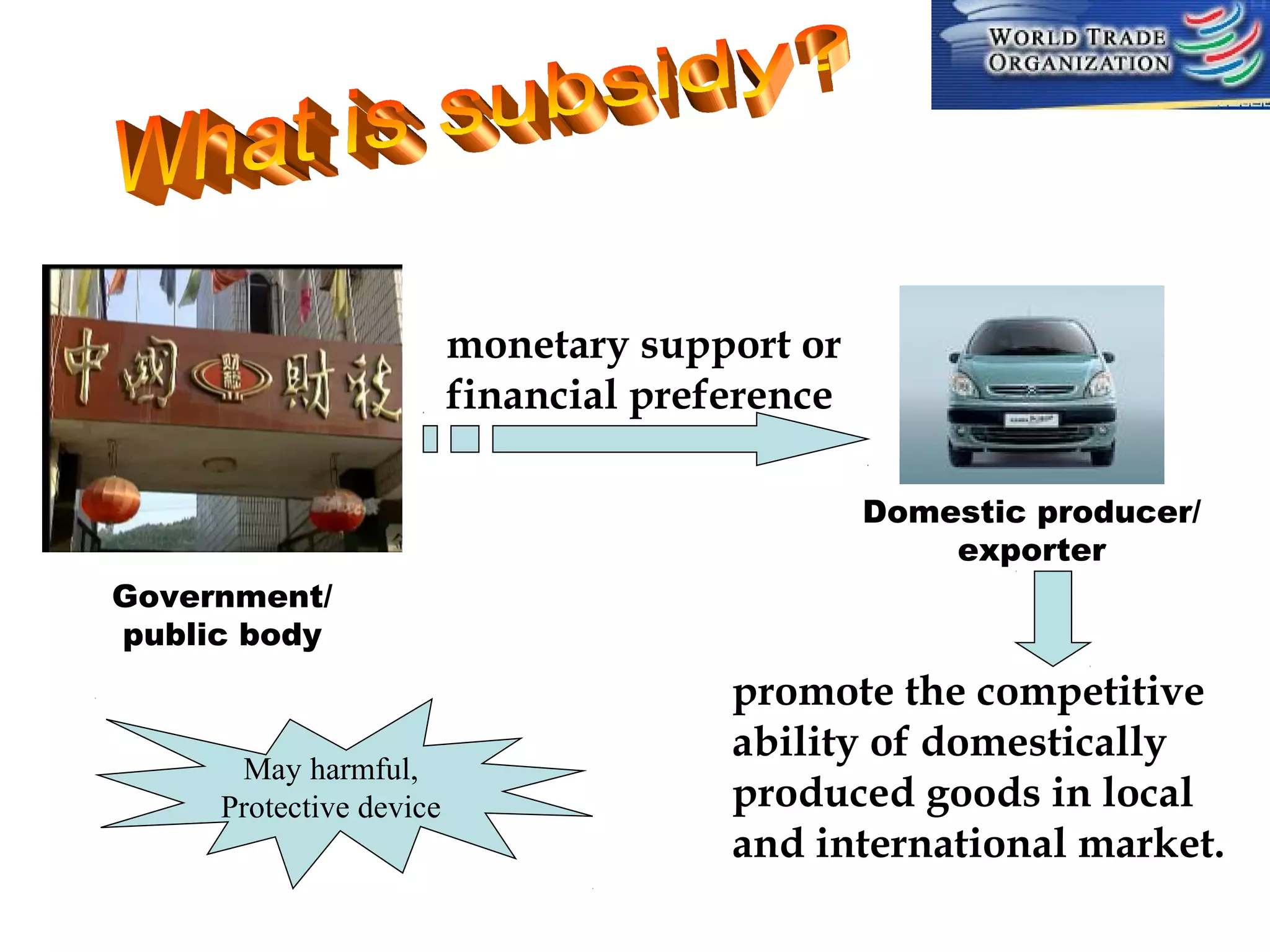
monetary support or
financial preference
Domestic producer/
exporter
Government/
public body

May harmful,
Protective device

promote the competitive
ability of domestically
produced goods in local
and international market.
Definition and features         
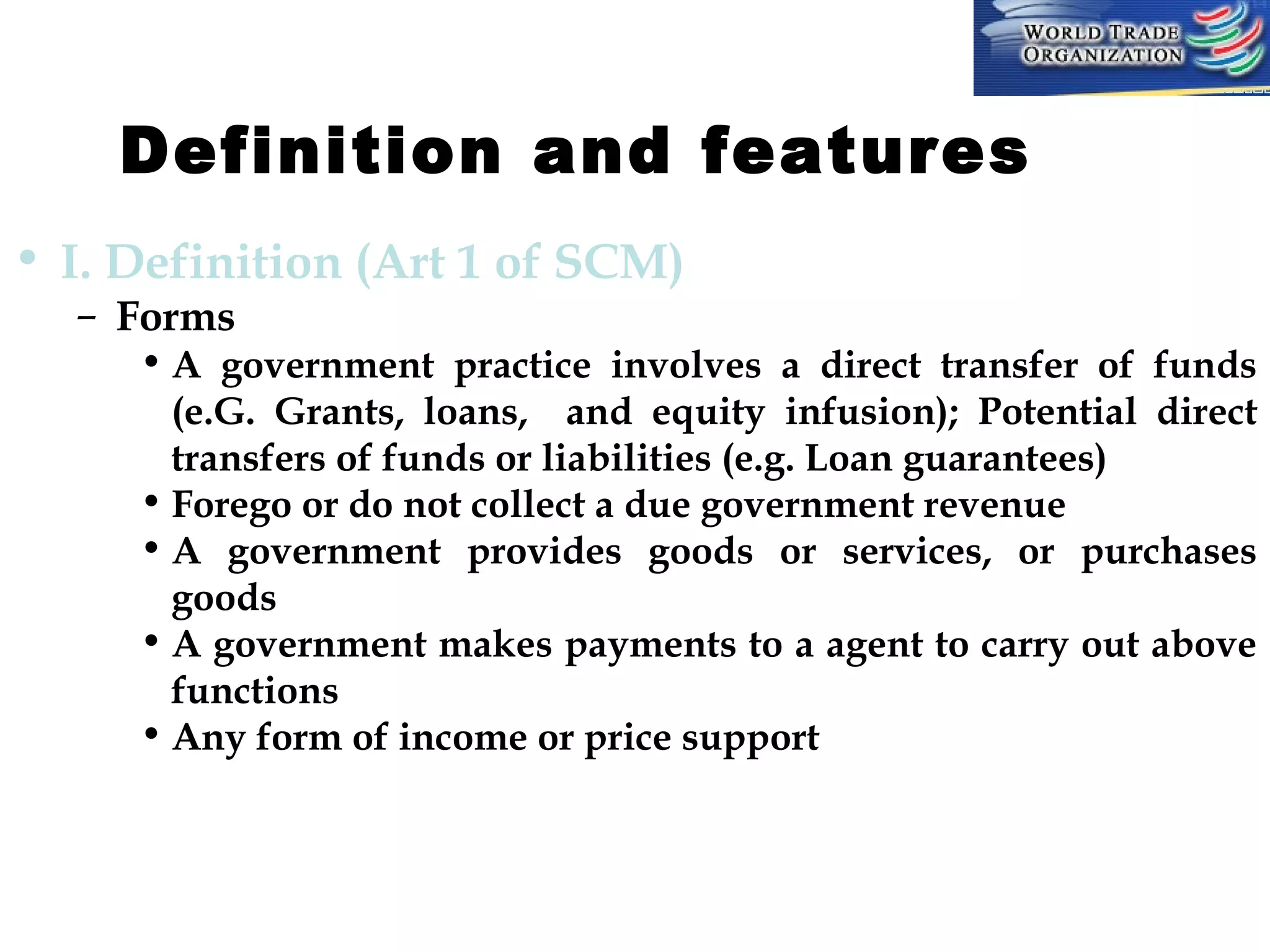
• I. Definition (Art 1 of SCM)

– It is the final contribution, income or price
support by a government or any public body
within a territory of a Member to domestic
producers and exporters.
– Subject

• A government or any public body within a Member

– Beneficiary Object

• Domestic producers or exporters
Definition and features         
• I. Definition (Art 1 of SCM)
– Forms

• A government practice involves a direct transfer of funds
(e.G. Grants, loans, and equity infusion); Potential direct
transfers of funds or liabilities (e.g. Loan guarantees)
• Forego or do not collect a due government revenue
• A government provides goods or services, or purchases
goods
• A government makes payments to a agent to carry out above
functions
• Any form of income or price support
Definition and features         
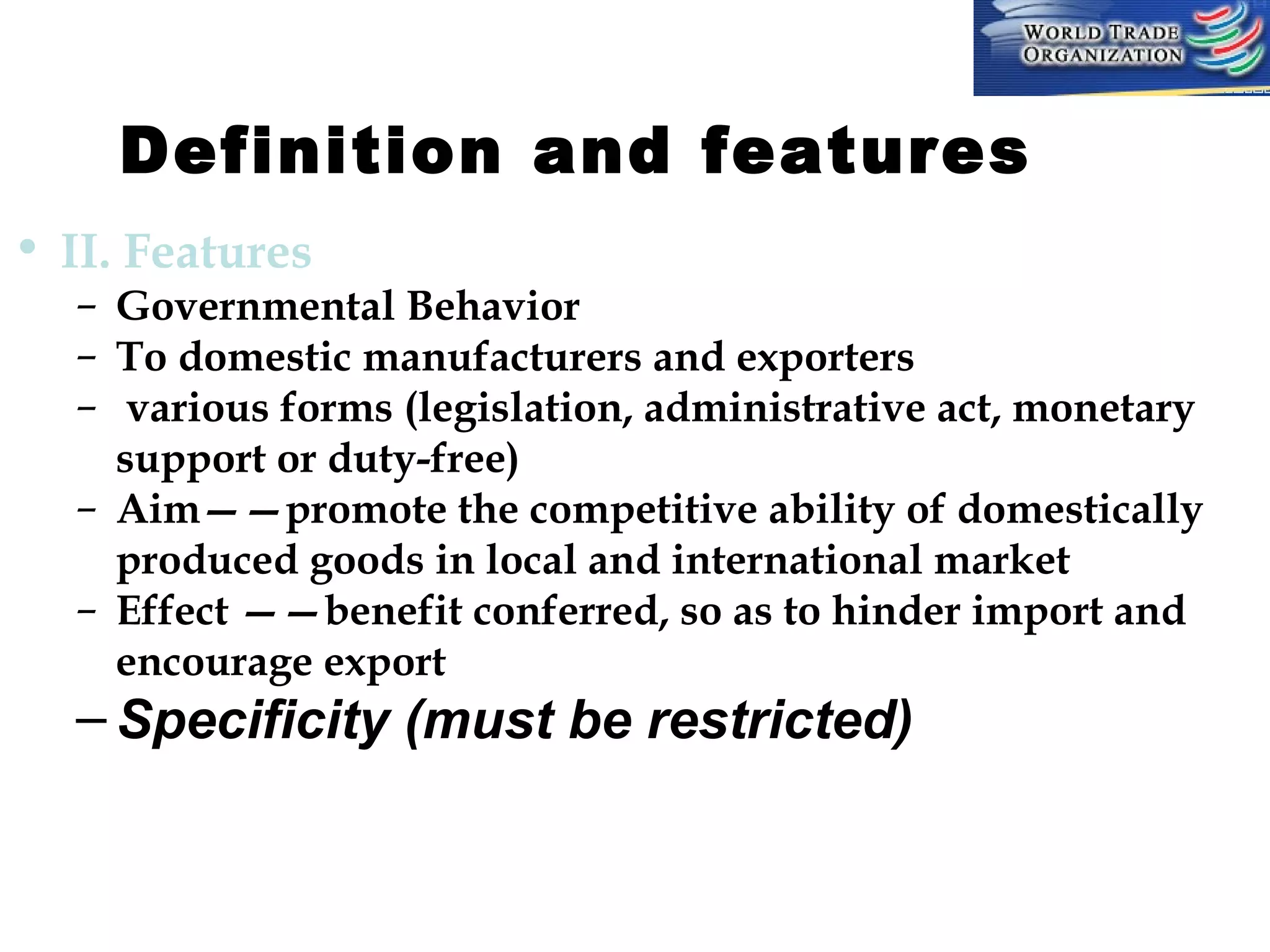
• II. Features

– Governmental Behavior
– To domestic manufacturers and exporters
– various forms (legislation, administrative act, monetary
support or duty-free)
– Aim——promote the competitive ability of domestically
produced goods in local and international market
– Effect ——benefit conferred, so as to hinder import and
encourage export

– Specificity (must be restricted)
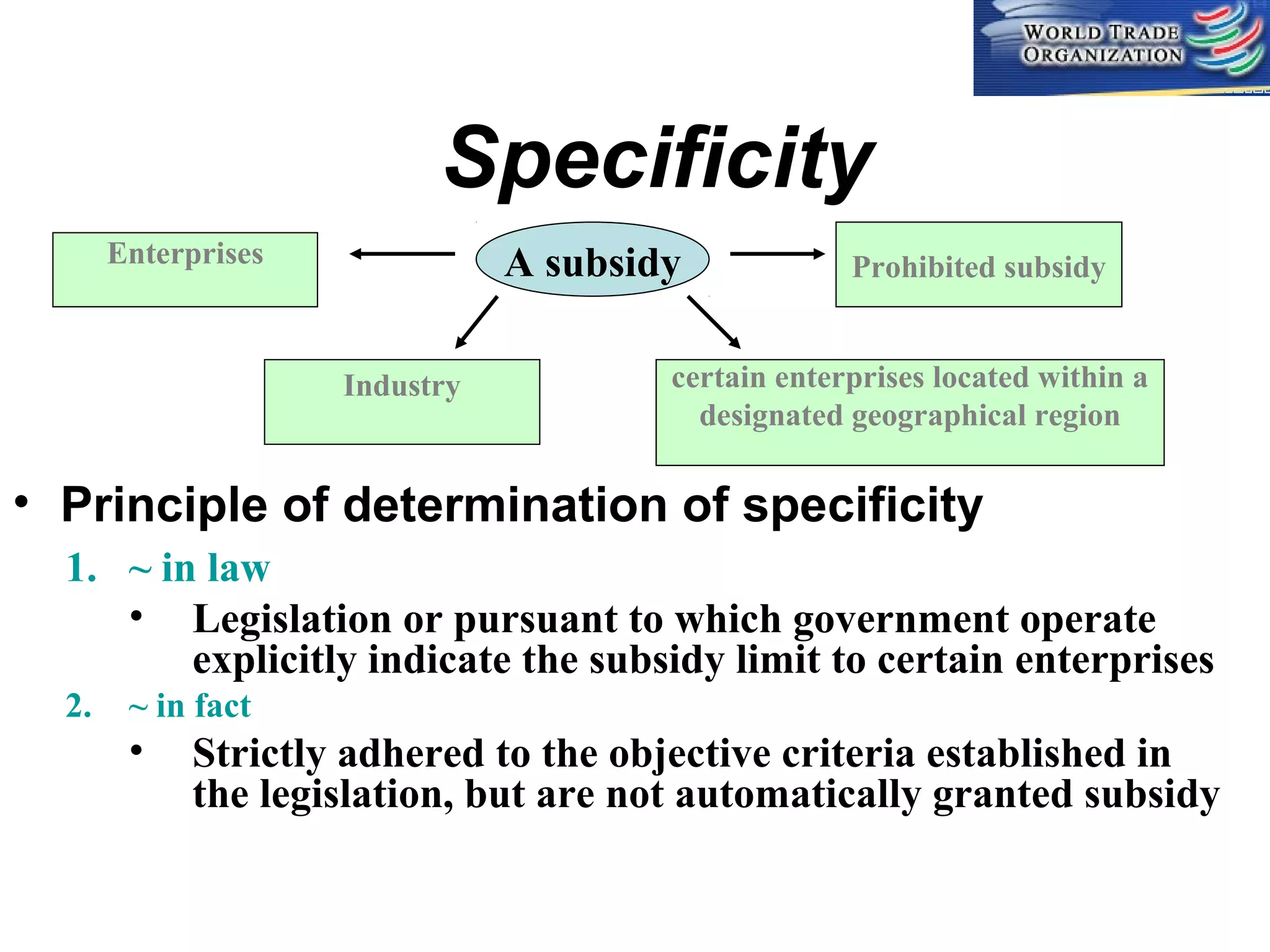
Specificity
Enterprises

A subsidy
Industry

Prohibited subsidy

certain enterprises located within a
designated geographical region

• Principle of determination of specificity
1. ~ in law
• Legislation or pursuant to which government operate
explicitly indicate the subsidy limit to certain enterprises
2.

~ in fact

•

Strictly adhered to the objective criteria established in
the legislation, but are not automatically granted subsidy
International legislations
on subsidies
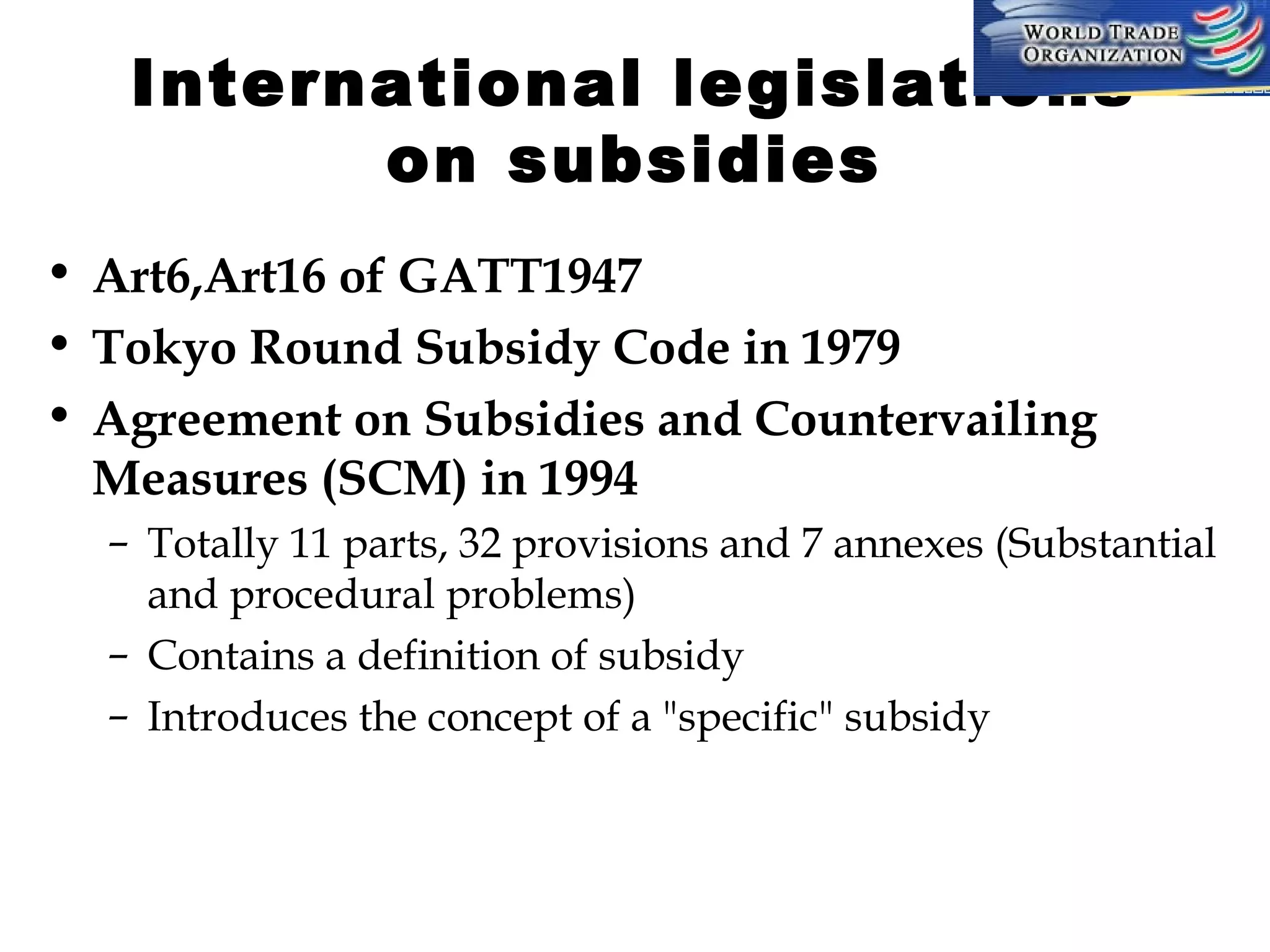
• Art6,Art16 of GATT1947
• Tokyo Round Subsidy Code in 1979
• Agreement on Subsidies and Countervailing
Measures (SCM) in 1994
– Totally 11 parts, 32 provisions and 7 annexes (Substantial
and procedural problems)
– Contains a definition of subsidy
– Introduces the concept of a "specific" subsidy
Categories

(Part II-IV of SCM)

• Prohibited subsidies
• Actionable subsidies
• Non-actionable subsidies
Red subsidy

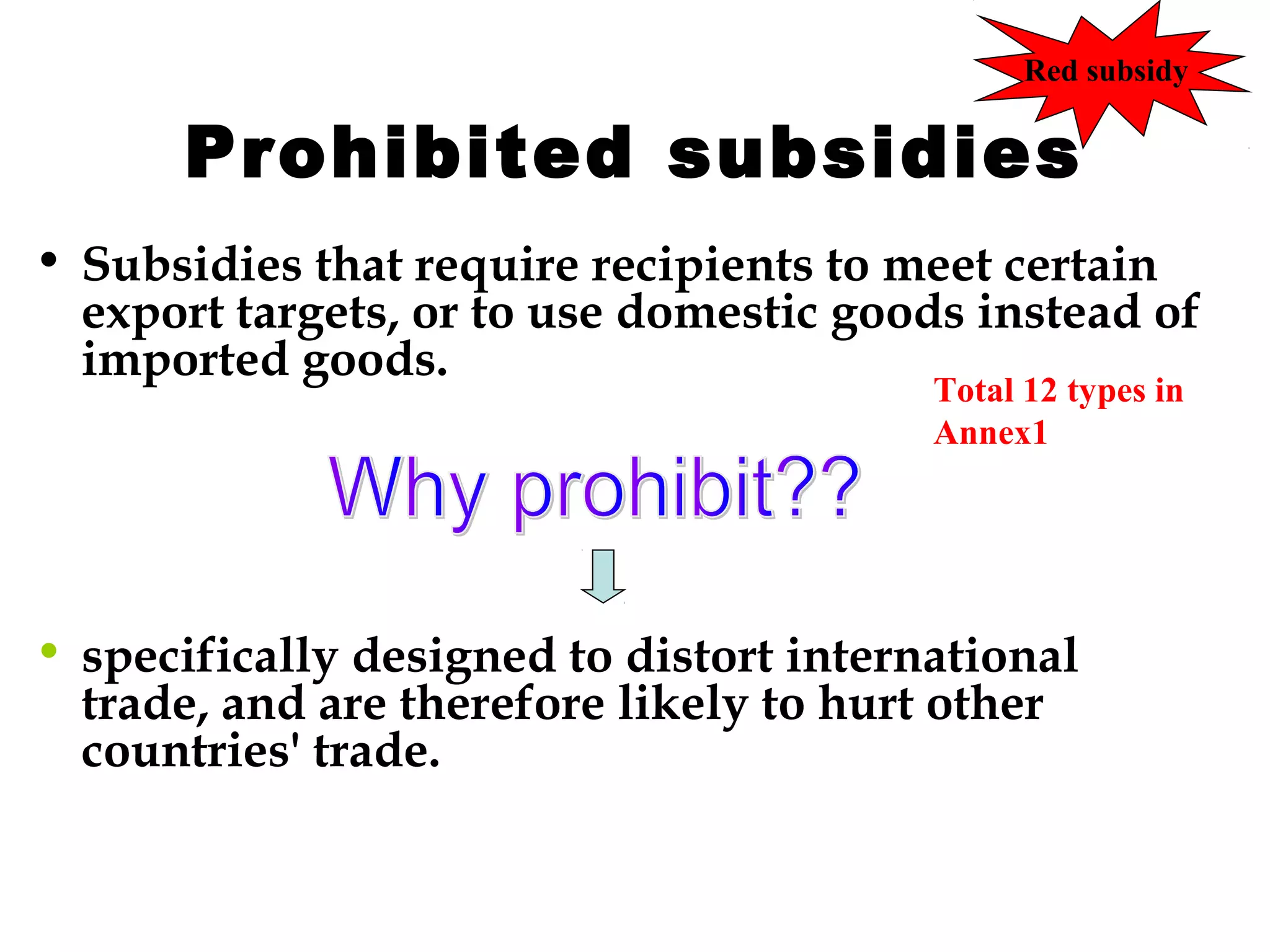
Prohibited subsidies
• Subsidies that require recipients to meet certain
export targets, or to use domestic goods instead of
imported goods.
Total 12 types in
Annex1

• specifically designed to distort international
trade, and are therefore likely to hurt other
countries' trade.
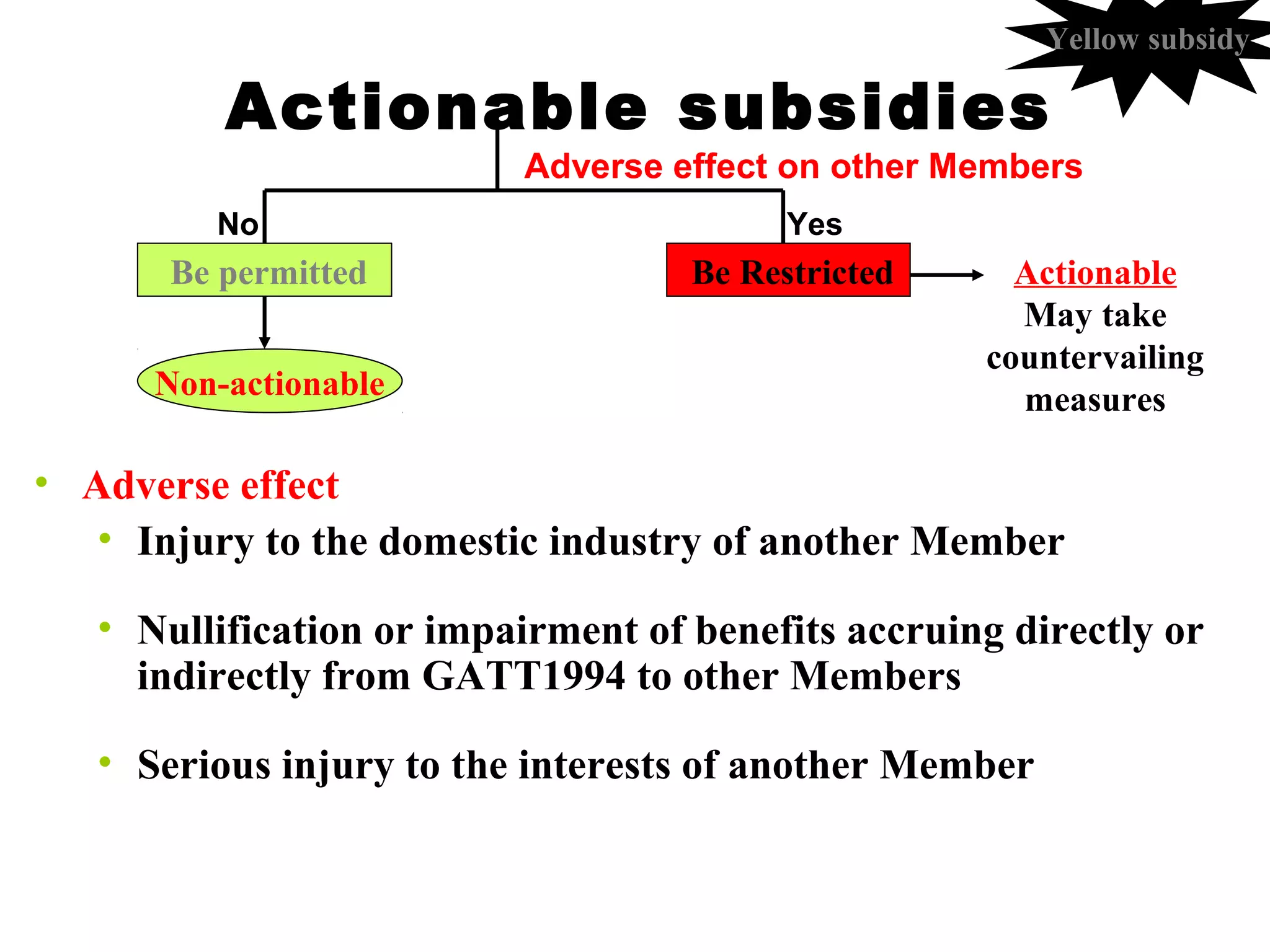
Yellow subsidy

Actionable subsidies

Adverse effect on other Members

No

Be permitted
Non-actionable

Yes

Be Restricted

Actionable
May take
countervailing
measures

• Adverse effect
• Injury to the domestic industry of another Member
• Nullification or impairment of benefits accruing directly or
indirectly from GATT1994 to other Members
• Serious injury to the interests of another Member
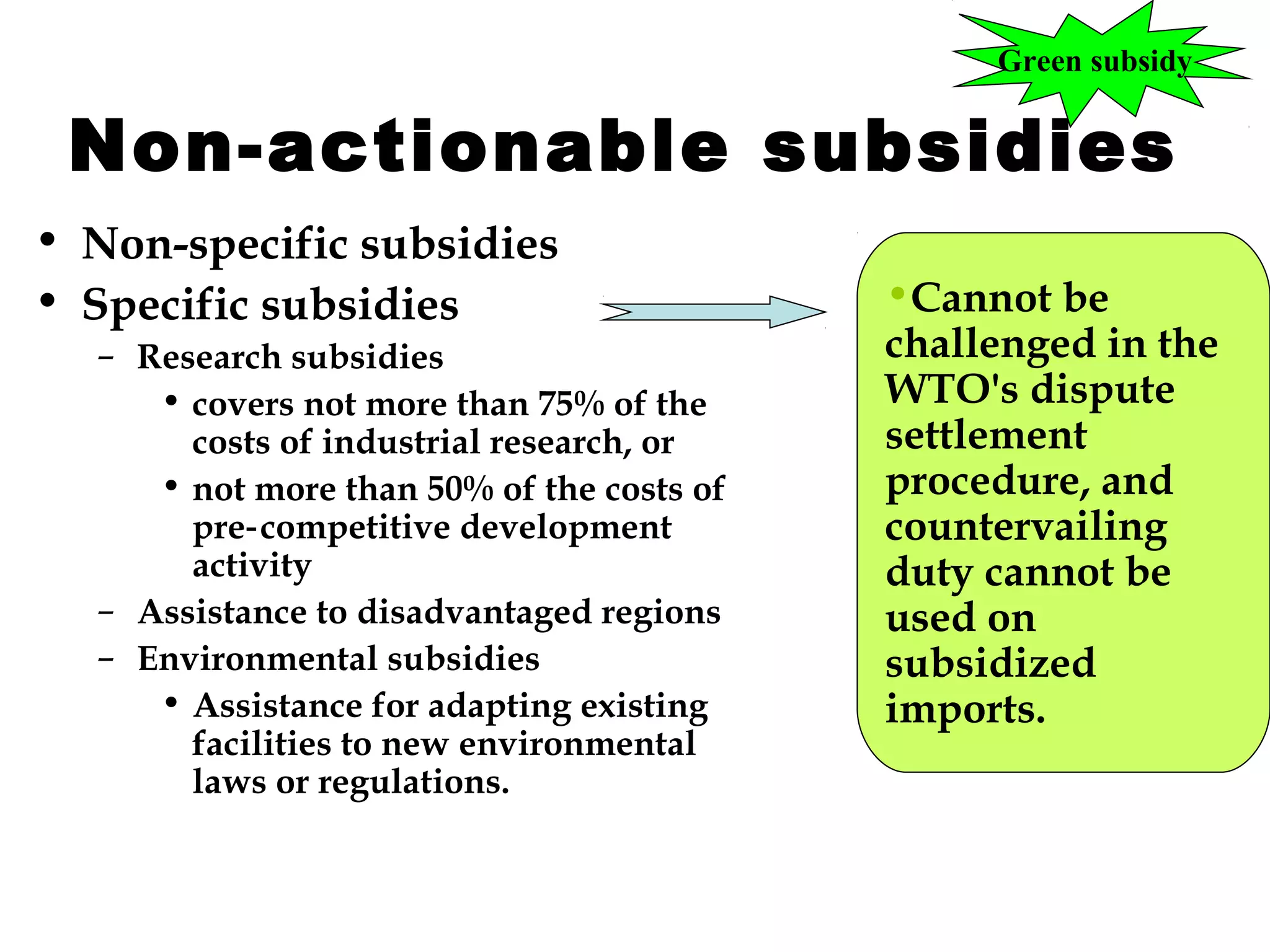
Green subsidy

Non-actionable subsidies
• Non-specific subsidies
• Specific subsidies
– Research subsidies
• covers not more than 75% of the
costs of industrial research, or
• not more than 50% of the costs of
pre‑ competitive development
activity
– Assistance to disadvantaged regions
– Environmental subsidies
• Assistance for adapting existing
facilities to new environmental
laws or regulations.

•Cannot be
challenged in the
WTO's dispute
settlement
procedure, and
countervailing
duty cannot be
used on
subsidized
imports.
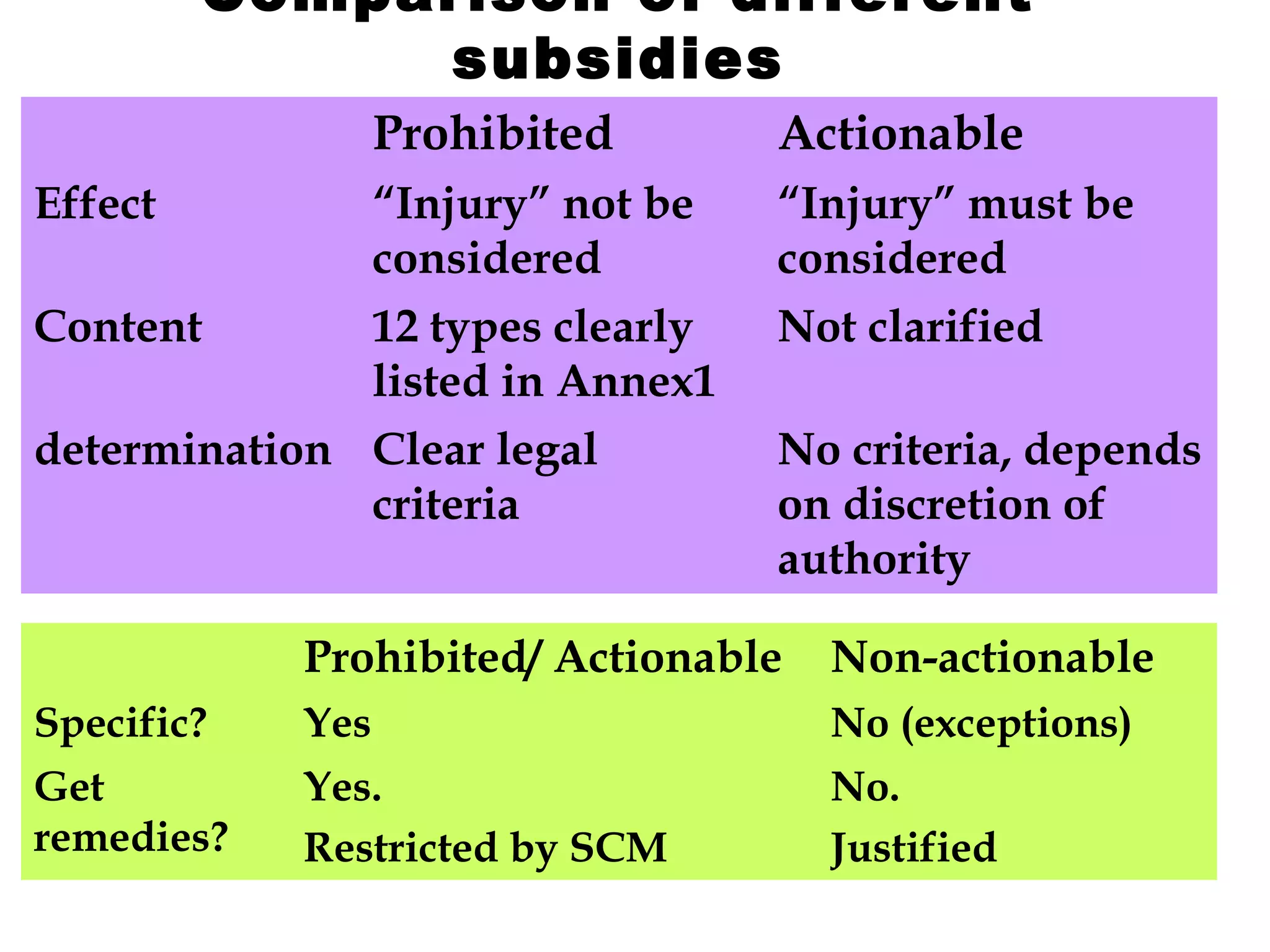
Comparison of different
subsidies
Prohibited
Effect

“Injury” not be
considered
Content
12 types clearly
listed in Annex1
determination Clear legal
criteria

Actionable
“Injury” must be
considered
Not clarified
No criteria, depends
on discretion of
authority

Prohibited/ Actionable

Non-actionable

Specific?

Yes

No (exceptions)

Get
remedies?

Yes.
Restricted by SCM

No.
Justified
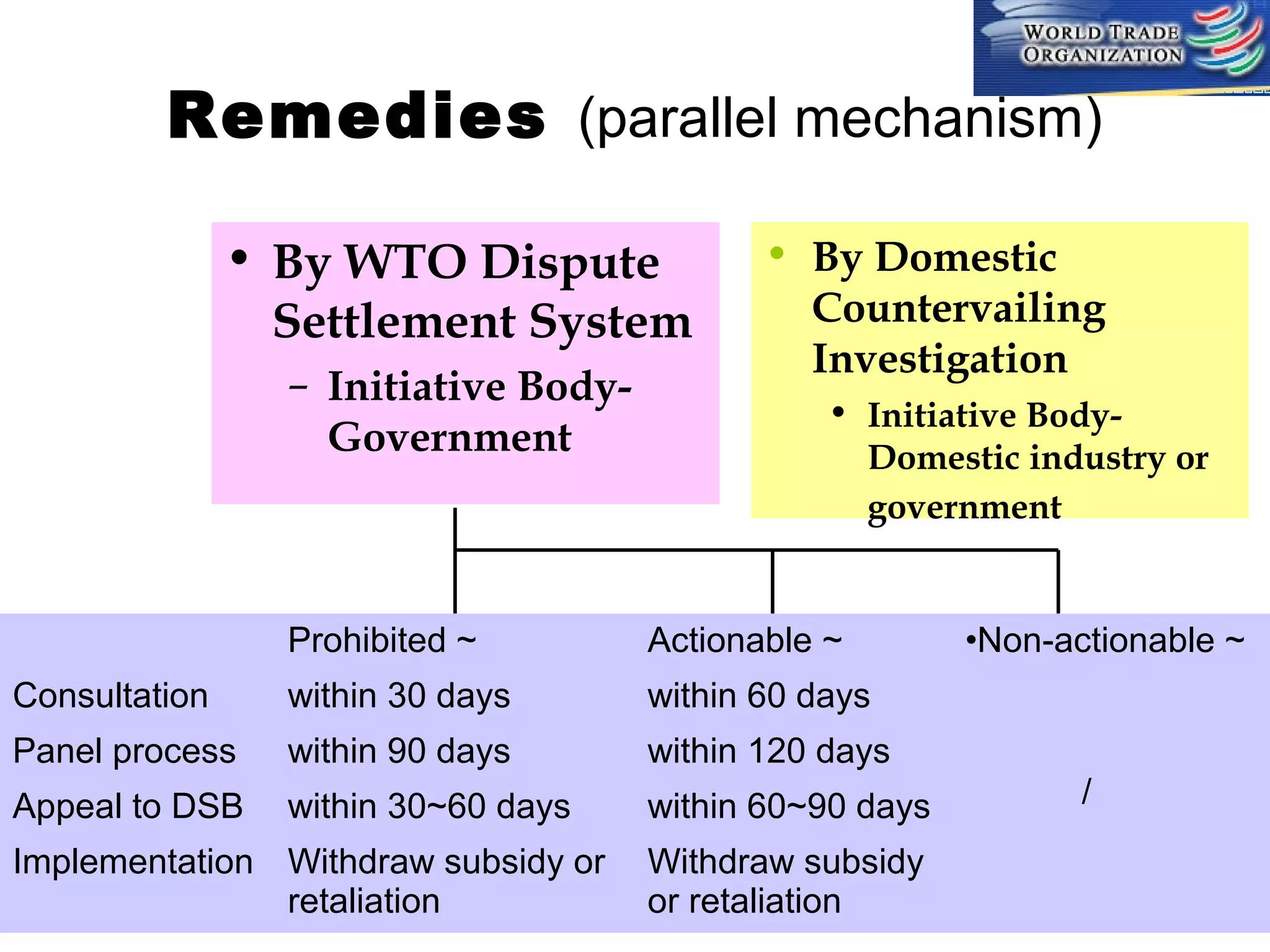
Remedies (parallel mechanism)
• By WTO Dispute
Settlement System
– Initiative BodyGovernment

• By Domestic
Countervailing
Investigation
• Initiative BodyDomestic industry or
government

Prohibited ~

Actionable ~

Consultation

within 30 days

within 60 days

Panel process

within 90 days

within 120 days

Appeal to DSB

within 30~60 days

within 60~90 days

•Non-actionable ~

Implementation Withdraw subsidy or
retaliation

Withdraw subsidy
or retaliation

/
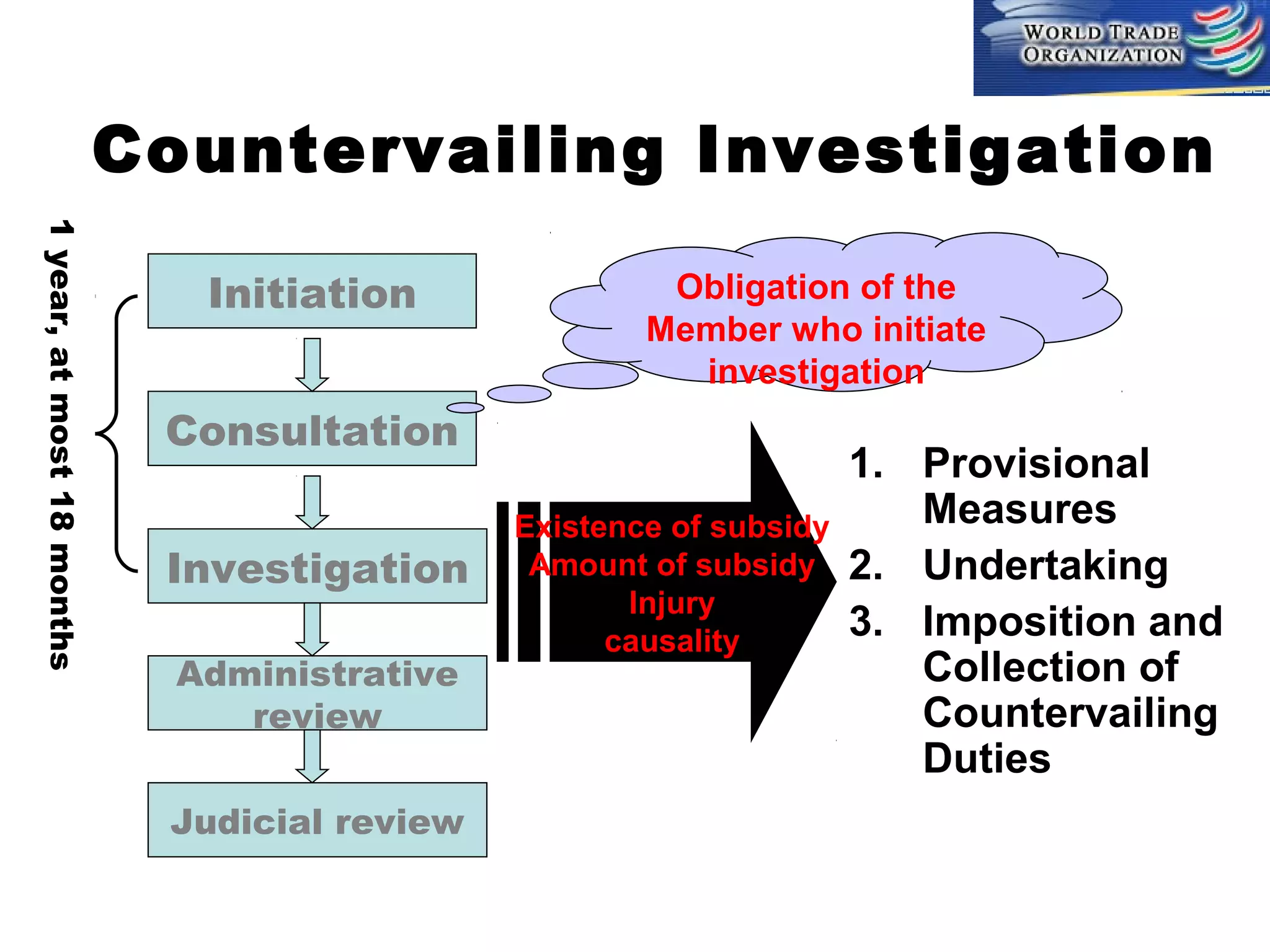
Countervailing Investigation
1 year, at most 18 months

Initiation

Obligation of the
Member who initiate
investigation

Consultation
Investigation
Administrative
review
Judicial review

Existence of subsidy
Amount of subsidy
Injury
causality

1. Provisional
Measures
2. Undertaking
3. Imposition and
Collection of
Countervailing
Duties
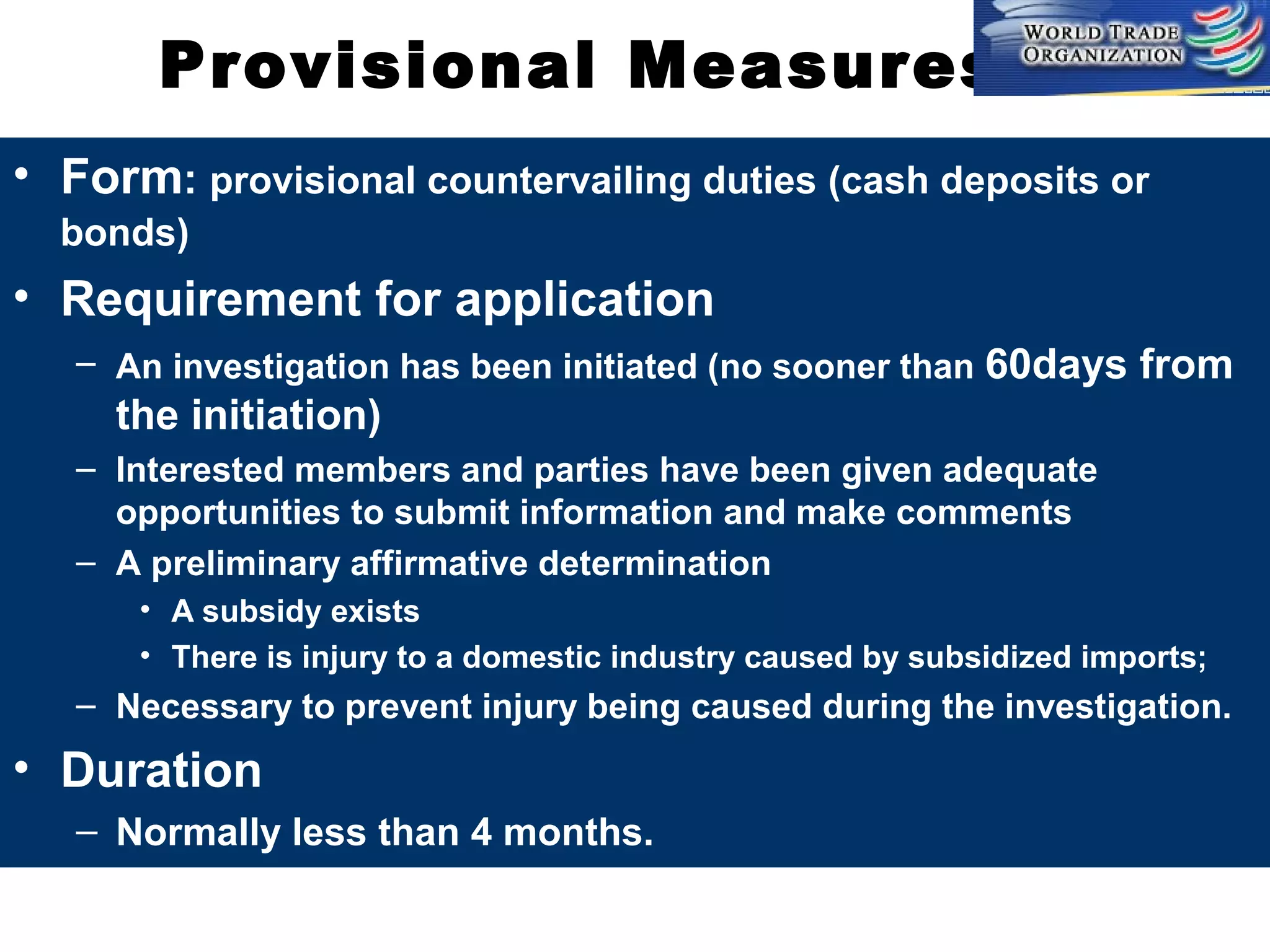
Provisional Measures
• Form: provisional countervailing duties (cash deposits or
bonds)

• Requirement for application
– An investigation has been initiated (no sooner than 60days

from

the initiation)
– Interested members and parties have been given adequate
opportunities to submit information and make comments
– A preliminary affirmative determination
• A subsidy exists
• There is injury to a domestic industry caused by subsidized imports;

– Necessary to prevent injury being caused during the investigation.

• Duration
– Normally less than 4 months.
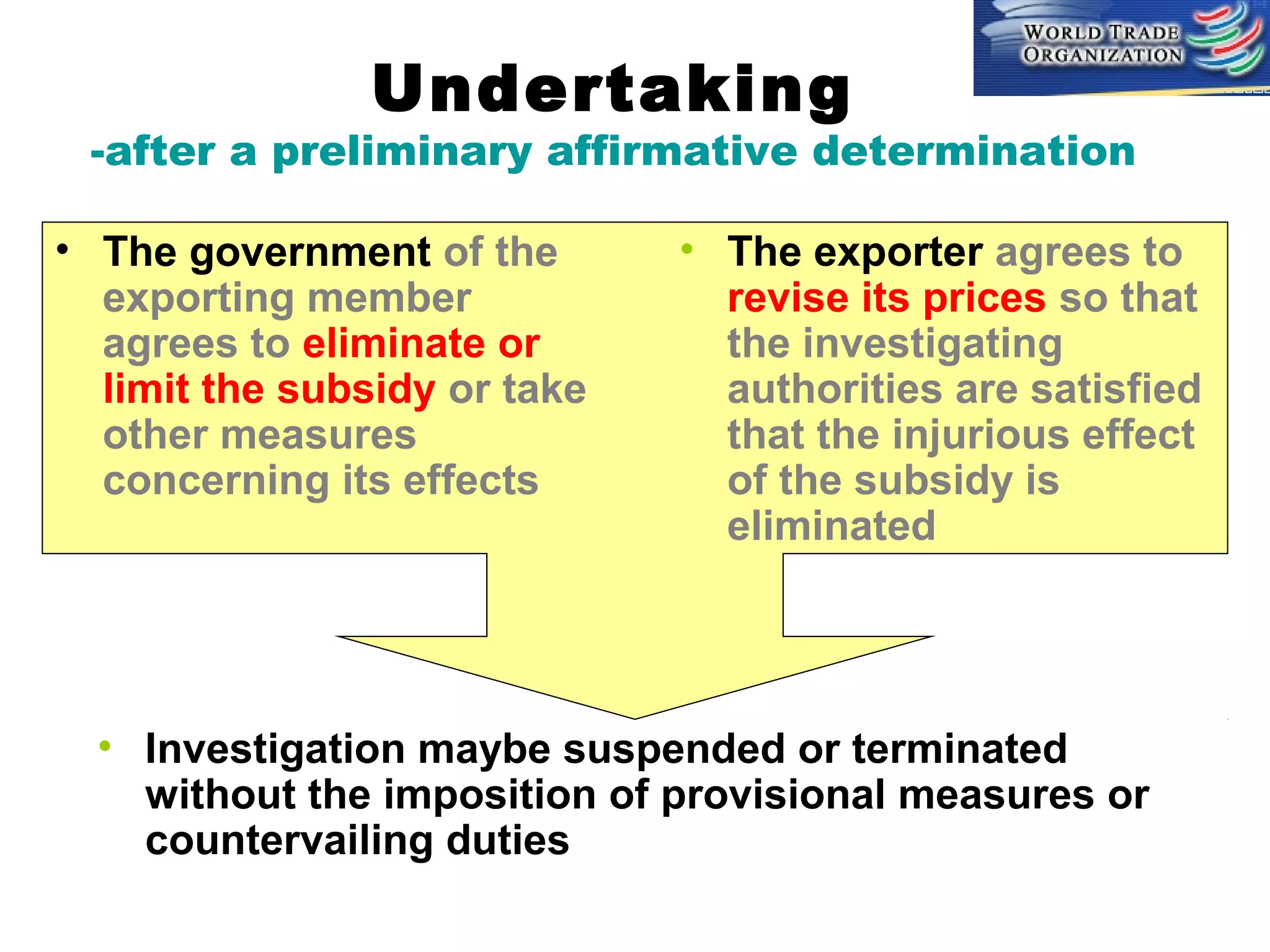
Undertaking

-after a preliminary affirmative determination
• The government of the
exporting member
agrees to eliminate or
limit the subsidy or take
other measures
concerning its effects

• The exporter agrees to
revise its prices so that
the investigating
authorities are satisfied
that the injurious effect
of the subsidy is
eliminated

• Investigation maybe suspended or terminated
without the imposition of provisional measures or
countervailing duties
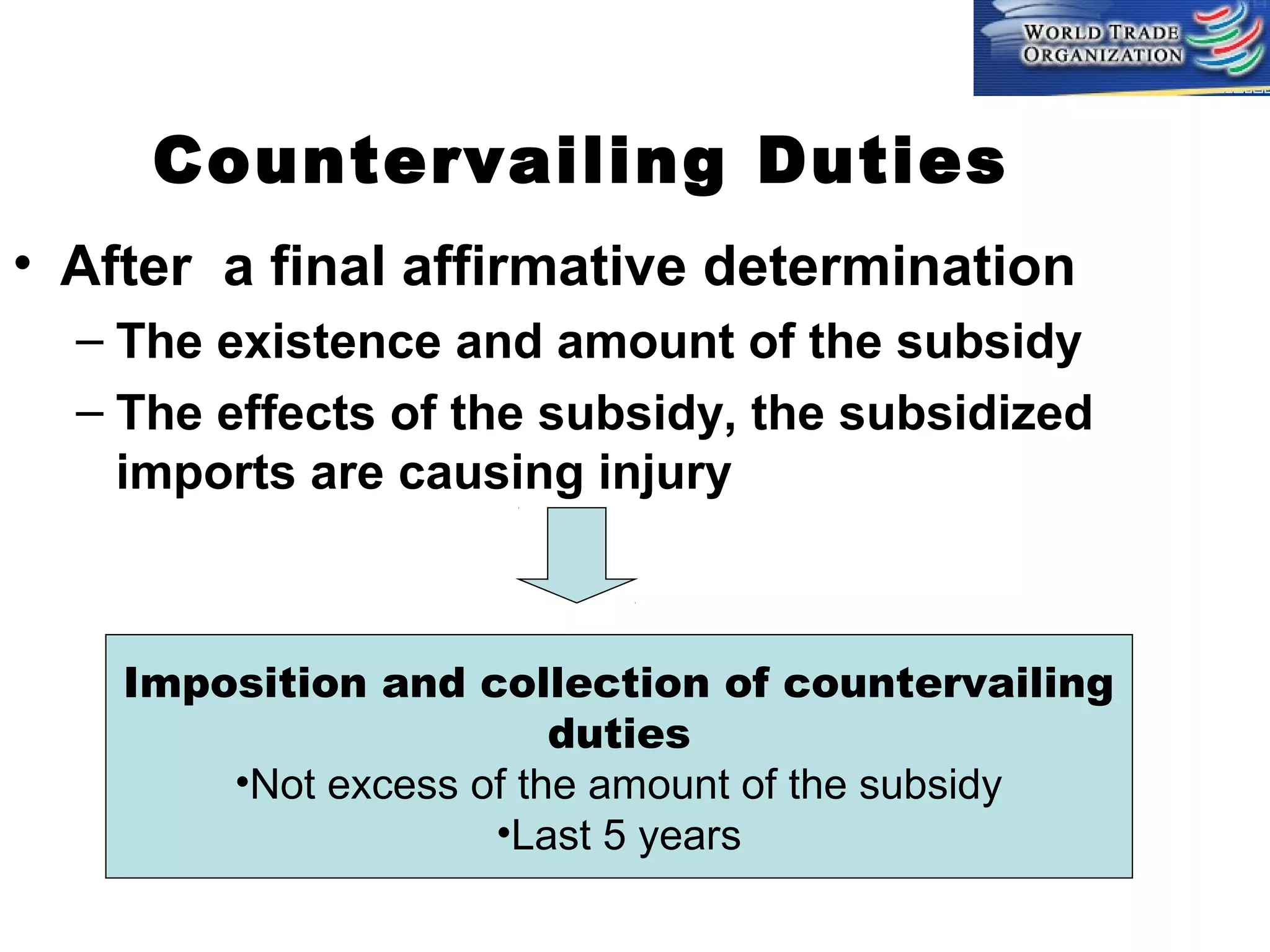
Countervailing Duties
• After a final affirmative determination
– The existence and amount of the subsidy
– The effects of the subsidy, the subsidized
imports are causing injury

Imposition and collection of countervailing
duties
•Not excess of the amount of the subsidy
•Last 5 years

Subsidies and countervailing measures new

  • 1.
  • 2.
    Subsidies and Countervailing Measure 1.Definition and features 2. International legislation on subsidies 3. Categories 4. Remedies
  • 3.
    monetary support or financialpreference Domestic producer/ exporter Government/ public body May harmful, Protective device promote the competitive ability of domestically produced goods in local and international market.
  • 4.
    Definition and features         • I. Definition (Art 1 of SCM) – It is the final contribution, income or price support by a government or any public body within a territory of a Member to domestic producers and exporters. – Subject • A government or any public body within a Member – Beneficiary Object • Domestic producers or exporters
  • 5.
    Definition and features         • I. Definition (Art 1 of SCM) – Forms • A government practice involves a direct transfer of funds (e.G. Grants, loans, and equity infusion); Potential direct transfers of funds or liabilities (e.g. Loan guarantees) • Forego or do not collect a due government revenue • A government provides goods or services, or purchases goods • A government makes payments to a agent to carry out above functions • Any form of income or price support
  • 6.
    Definition and features         • II. Features – Governmental Behavior – To domestic manufacturers and exporters – various forms (legislation, administrative act, monetary support or duty-free) – Aim——promote the competitive ability of domestically produced goods in local and international market – Effect ——benefit conferred, so as to hinder import and encourage export – Specificity (must be restricted)
  • 7.
    Specificity Enterprises A subsidy Industry Prohibited subsidy certainenterprises located within a designated geographical region • Principle of determination of specificity 1. ~ in law • Legislation or pursuant to which government operate explicitly indicate the subsidy limit to certain enterprises 2. ~ in fact • Strictly adhered to the objective criteria established in the legislation, but are not automatically granted subsidy
  • 8.
    International legislations on subsidies •Art6,Art16 of GATT1947 • Tokyo Round Subsidy Code in 1979 • Agreement on Subsidies and Countervailing Measures (SCM) in 1994 – Totally 11 parts, 32 provisions and 7 annexes (Substantial and procedural problems) – Contains a definition of subsidy – Introduces the concept of a "specific" subsidy
  • 9.
    Categories (Part II-IV ofSCM) • Prohibited subsidies • Actionable subsidies • Non-actionable subsidies
  • 10.
    Red subsidy Prohibited subsidies •Subsidies that require recipients to meet certain export targets, or to use domestic goods instead of imported goods. Total 12 types in Annex1 • specifically designed to distort international trade, and are therefore likely to hurt other countries' trade.
  • 11.
    Yellow subsidy Actionable subsidies Adverseeffect on other Members No Be permitted Non-actionable Yes Be Restricted Actionable May take countervailing measures • Adverse effect • Injury to the domestic industry of another Member • Nullification or impairment of benefits accruing directly or indirectly from GATT1994 to other Members • Serious injury to the interests of another Member
  • 12.
    Green subsidy Non-actionable subsidies •Non-specific subsidies • Specific subsidies – Research subsidies • covers not more than 75% of the costs of industrial research, or • not more than 50% of the costs of pre‑ competitive development activity – Assistance to disadvantaged regions – Environmental subsidies • Assistance for adapting existing facilities to new environmental laws or regulations. •Cannot be challenged in the WTO's dispute settlement procedure, and countervailing duty cannot be used on subsidized imports.
  • 13.
    Comparison of different subsidies Prohibited Effect “Injury”not be considered Content 12 types clearly listed in Annex1 determination Clear legal criteria Actionable “Injury” must be considered Not clarified No criteria, depends on discretion of authority Prohibited/ Actionable Non-actionable Specific? Yes No (exceptions) Get remedies? Yes. Restricted by SCM No. Justified
  • 14.
    Remedies (parallel mechanism) •By WTO Dispute Settlement System – Initiative BodyGovernment • By Domestic Countervailing Investigation • Initiative BodyDomestic industry or government Prohibited ~ Actionable ~ Consultation within 30 days within 60 days Panel process within 90 days within 120 days Appeal to DSB within 30~60 days within 60~90 days •Non-actionable ~ Implementation Withdraw subsidy or retaliation Withdraw subsidy or retaliation /
  • 15.
    Countervailing Investigation 1 year,at most 18 months Initiation Obligation of the Member who initiate investigation Consultation Investigation Administrative review Judicial review Existence of subsidy Amount of subsidy Injury causality 1. Provisional Measures 2. Undertaking 3. Imposition and Collection of Countervailing Duties
  • 16.
    Provisional Measures • Form:provisional countervailing duties (cash deposits or bonds) • Requirement for application – An investigation has been initiated (no sooner than 60days from the initiation) – Interested members and parties have been given adequate opportunities to submit information and make comments – A preliminary affirmative determination • A subsidy exists • There is injury to a domestic industry caused by subsidized imports; – Necessary to prevent injury being caused during the investigation. • Duration – Normally less than 4 months.
  • 17.
    Undertaking -after a preliminaryaffirmative determination • The government of the exporting member agrees to eliminate or limit the subsidy or take other measures concerning its effects • The exporter agrees to revise its prices so that the investigating authorities are satisfied that the injurious effect of the subsidy is eliminated • Investigation maybe suspended or terminated without the imposition of provisional measures or countervailing duties
  • 18.
    Countervailing Duties • Aftera final affirmative determination – The existence and amount of the subsidy – The effects of the subsidy, the subsidized imports are causing injury Imposition and collection of countervailing duties •Not excess of the amount of the subsidy •Last 5 years