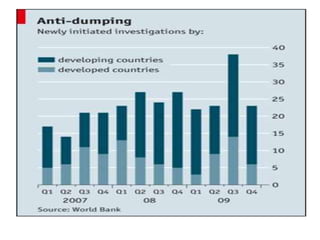
Anti-Dumping
Dumping
• “ Dumping is a situation of international price
discrimination, where the price of a product
when sold to the importing country is less than
the price of the same product when sold in the
market of the exporting country . Dumping
typically involves substantial export volumes of
a product, it often endangers the financial
viability of the product's manufacturers or
producers in the importing nation.”
Why does dumping takes place
• As a short-term predatory pricing strategy to
drive competitors out of the market.
• As a result of market intervention or state
subsidies that enable companies to artificially
lower their prices
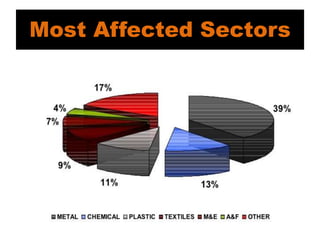
Most Affected Sectors
What is Injury?
Injury parameters include factors such as:
• Actual or potential decline in sales
• Loss of profits
• Market share
• Capacity utilization
• Increases unemployment
• Wages
• Ability to raise capital
Legal framework
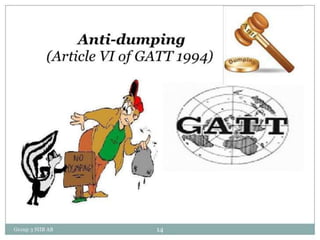
• Based on article VI of GATT, 1994
• Customs tariff act, 1975 sec 9A, 9B (as
amended in 1995)
• Investigations by designated authority,
Ministry of Commerce
• Imposition and collection by Ministry of
Finance
How did it all begin?
• In the 19th century European Sugar Industries appealed to
their respective governments for protection against sugar
being dumped at unfairly low prices.
• In 1902, there was a formal agreement on anti-dumping.
Canada adopted the first anti-dumping law in 1904
followed by the European countries and then the US in
1916.
• Formed the basis for the original GATT article (Article VI of
GATT) on anti-dumping in 1947.
What is anti-dumping?
• It is a measure to rectify the situation arising
out of the dumping of goods and its trade
distortive effect
• Re-establish fair trade.
• The use of anti dumping measure as an
instrument of fair competition is permitted by
the WTO.
• It provides relief to the domestic industry
against the injury caused by dumping.
Anti-dumping duty
• Anti-dumping duty is a tariff imposed on imports
manufactured in overseas countries and that are priced
below the fair market value of similar goods in the
domestic market.
• The government imposes anti-dumping duty on
foreign imports when it believes that the goods are
being dumped in the domestic market.
• Anti-dumping duty is imposed to protect local
businesses and markets from unfair competition by
foreign imports.
“India to levy antidumping
duty
on China telecom gear”-
Business standard – 15 December ,
2009
India to impose antidumping duties on some
equipment imported from China.
Chinese companies entered the Indian
telecom market, offering products and
services at prices about a third cheaper than
that of global competitors.
Indian manufacturers hurt as well .
Thank you

Anti dumping

  • 1.
  • 2.
    Dumping • “ Dumpingis a situation of international price discrimination, where the price of a product when sold to the importing country is less than the price of the same product when sold in the market of the exporting country . Dumping typically involves substantial export volumes of a product, it often endangers the financial viability of the product's manufacturers or producers in the importing nation.”
  • 3.
    Why does dumpingtakes place • As a short-term predatory pricing strategy to drive competitors out of the market. • As a result of market intervention or state subsidies that enable companies to artificially lower their prices
  • 4.
  • 5.
    What is Injury? Injuryparameters include factors such as: • Actual or potential decline in sales • Loss of profits • Market share • Capacity utilization • Increases unemployment • Wages • Ability to raise capital
  • 7.
    Legal framework • Basedon article VI of GATT, 1994 • Customs tariff act, 1975 sec 9A, 9B (as amended in 1995) • Investigations by designated authority, Ministry of Commerce • Imposition and collection by Ministry of Finance
  • 8.
    How did itall begin? • In the 19th century European Sugar Industries appealed to their respective governments for protection against sugar being dumped at unfairly low prices. • In 1902, there was a formal agreement on anti-dumping. Canada adopted the first anti-dumping law in 1904 followed by the European countries and then the US in 1916. • Formed the basis for the original GATT article (Article VI of GATT) on anti-dumping in 1947.
  • 9.
    What is anti-dumping? •It is a measure to rectify the situation arising out of the dumping of goods and its trade distortive effect • Re-establish fair trade. • The use of anti dumping measure as an instrument of fair competition is permitted by the WTO. • It provides relief to the domestic industry against the injury caused by dumping.
  • 10.
    Anti-dumping duty • Anti-dumpingduty is a tariff imposed on imports manufactured in overseas countries and that are priced below the fair market value of similar goods in the domestic market. • The government imposes anti-dumping duty on foreign imports when it believes that the goods are being dumped in the domestic market. • Anti-dumping duty is imposed to protect local businesses and markets from unfair competition by foreign imports.
  • 11.
    “India to levyantidumping duty on China telecom gear”- Business standard – 15 December , 2009
  • 12.
    India to imposeantidumping duties on some equipment imported from China. Chinese companies entered the Indian telecom market, offering products and services at prices about a third cheaper than that of global competitors. Indian manufacturers hurt as well .
  • 14.